
Report to the Committee on Armed Services, U.S. Senate
United States Government Accountability Office
A report to the Committee on Armed Services, U.S. Senate
For more information, contact: Kristy Williams at WilliamsK@gao.gov
What GAO Found
Natural disasters at military installations have resulted in significant costs and damages since 2015, but the Department of Defense (DOD) has not comprehensively tracked data related to those costs. In 2024, DOD began an effort to track the effects of extreme weather at military installations. However, GAO identified gaps in the scope of DOD’s data collection and its ability to collect complete and accurate data on disaster recovery costs. Specifically, DOD’s data collection is limited to the effects of extreme weather, which does not include the full scope of natural disasters, including seismic events such as earthquakes. Also, data DOD collects on the cost of extreme weather at installations may be inaccurate or incomplete in some cases, in part due to the timing of when installations are expected to report the information. Expanding the scope of its data collection to include all types of natural disasters and establishing a process to ensure cost data are complete and accurate can improve DOD’s ability to anticipate future disaster recovery needs.
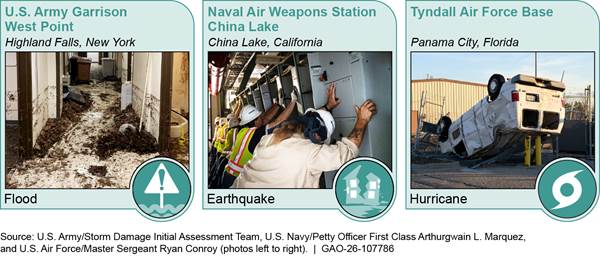
DOD has taken steps to increase installations’ disaster resilience—including implementing resilience improvements at the 12 installations GAO examined—but gaps in planning may limit these efforts. GAO identified some instances when installations were unable to pursue resilience improvements due to not having necessary data or sufficient funding. Installations are working to implement a statutory requirement to include resilience information as part of their master plans. This includes the identification of current and future risks and ongoing or planned projects to mitigate those risks. DOD policy reflects this requirement and addresses how resilience should be incorporated into construction projects, such as by adhering to Unified Facilities Criteria (DOD’s standards for design and construction of facilities). However, existing DOD and military department guidance does not address how installations should use the master plan resilience information when recovering from a disaster. By including such information in guidance, the military departments can help ensure that installations affected by disasters are better able to incorporate resilience improvements while quickly restoring essential capabilities.
Why GAO Did This Study
Extreme weather and natural disasters have resulted in billions of dollars of damages to military installations over the past decade. Such damages can affect DOD’s ability to execute its mission and disrupt installation resources that support service members and their families.
Senate Report 118-58, accompanying a bill for the National Defense Authorization Act for Fiscal Year 2024, includes a provision for GAO to assess DOD’s recovery from natural disasters at military installations. GAO examined the extent to which DOD has (1) tracked costs and damages associated with natural disasters since 2015 and (2) increased resilience of selected installations affected by natural disasters.
GAO reviewed documentation and interviewed officials from a non-generalizable sample of 12 installations on disaster damages and resilience improvement efforts and conducted in-person site visits at three of these installations. GAO analyzed annual and supplemental appropriations to identify funds designated for disaster recovery. GAO also reviewed documentation and interviewed DOD and military department officials related to installations’ recovery efforts and collection of related data.
What GAO Recommends
GAO is making five recommendations, including that DOD improve its efforts to collect data on the effects of extreme weather at installations and that the military departments issue guidance to enhance the use of resilience information in installation master plans. DOD concurred with GAO’s recommendations.
Abbreviations
ASD(EI&E) Assistant
Secretary of Defense for Energy, Installations,
and Environment
DOD Department of Defense
This is a work of the U.S. government and is not subject to copyright protection in the United States. The published product may be reproduced and distributed in its entirety without further permission from GAO. However, because this work may contain copyrighted images or other material, permission from the copyright holder may be necessary if you wish to reproduce this material separately.
February 23, 2026
The Honorable Roger Wicker
Chairman
The Honorable Jack Reed
Ranking Member
Committee on Armed Services
United States Senate
The Department of Defense (DOD) estimates that extreme weather has cost the department more than $15 billion in damage to military installations over the past decade and can impair military readiness.[1] Natural disasters—such as hurricanes, floods, earthquakes and wildfires—also pose risks to military installations.[2] Such installations include capabilities and assets that provide critical support for DOD’s mission as well as resources to support service members and their families, such as housing, hospitals, and childcare facilities.
Since 2015, extreme weather and natural disasters have resulted in significant damage to a number of military installations. For example, in 2018, Hurricane Michael caused more than $4 billion in damage to Tyndall Air Force Base. The hurricane damaged hundreds of buildings and created over 700,000 cubic yards of debris, according to DOD. In 2019, a pair of strong earthquakes struck Naval Air Weapons Station China Lake, resulting in nearly $4 billion in damage, including to critical labs and weapons magazines. In the wake of such events, installations must balance quickly restoring capabilities with improving resilience to future disasters.
Improving military installation resilience—defined by DOD as the ability to anticipate, prepare for, and adapt to changing conditions and withstand, respond to, and recover rapidly from disruptions—can help limit federal fiscal exposure by reducing the overall impact of disasters.[3] DOD components are required to take appropriate actions to plan for and maintain installations’ resilience. Additionally, since 2020, military installations have been required by statute to consider resilience to natural disasters as part of their installation master plans. These plans should identify risks and threats to the installations’ resilience and identify projects or other measures to mitigate their effects.
Senate Report 118-58, accompanying a bill for the National Defense Authorization Act for Fiscal Year 2024, includes a provision for GAO to assess DOD’s recovery from natural disasters at military installations.[4] Our review examined the extent to which DOD has (1) tracked costs and damage associated with natural disasters at military installations since 2015 and (2) increased the resilience of selected installations affected by natural disasters.
For both objectives, we selected a non-generalizable sample of 12 installations that sustained substantial damage from a natural disaster during fiscal years 2015 through 2024. At three of the installations, we conducted in-person site visits including tours of completed and ongoing disaster recovery projects. We also reviewed documentation and interviewed officials from the Office of the Assistant Secretary of Defense for Energy, Installations, and Environment (ASD(EI&E)) and each military department.
For our first objective, we analyzed annual and supplemental appropriations acts to identify appropriations designated for disaster recovery at military installations. We also obtained information and documentation from the 12 selected installations on disaster damage and costs. In addition, we reviewed DOD information and documentation on data collection related to disaster damage and costs. We compared DOD’s efforts to track disaster damage and costs with DOD management guidance and the Standards for Internal Control in the Federal Government principle that management should use quality information to make informed decisions and to evaluate performance in achieving key objectives and addressing risks.[5]
For our second objective, we reviewed DOD and military department guidance related to installation resilience. In addition, we reviewed ASD(EI&E) and military department information and documentation related to resilience improvements at installations, including efforts to incorporate resilience information into master plans. We also obtained information and documentation from the 12 selected installations on their disaster recovery efforts, including resilience improvements undertaken and any related challenges. We compared DOD’s efforts to improve installation resilience with the Standards for Internal Control in the Federal Government principle that management should internally communicate the necessary quality information to achieve the entity’s objectives.[6] Appendix I provides additional details about our objectives, scope, and methodology.
We conducted this performance audit from September 2024 to February 2026 in accordance with generally accepted government auditing standards. Those standards require that we plan and perform the audit to obtain sufficient, appropriate evidence to provide a reasonable basis for our findings and conclusions based on our audit objectives. We believe that the evidence obtained provides a reasonable basis for our findings and conclusions based on our audit objectives.
Background
DOD Roles and Responsibilities for Installation Resilience
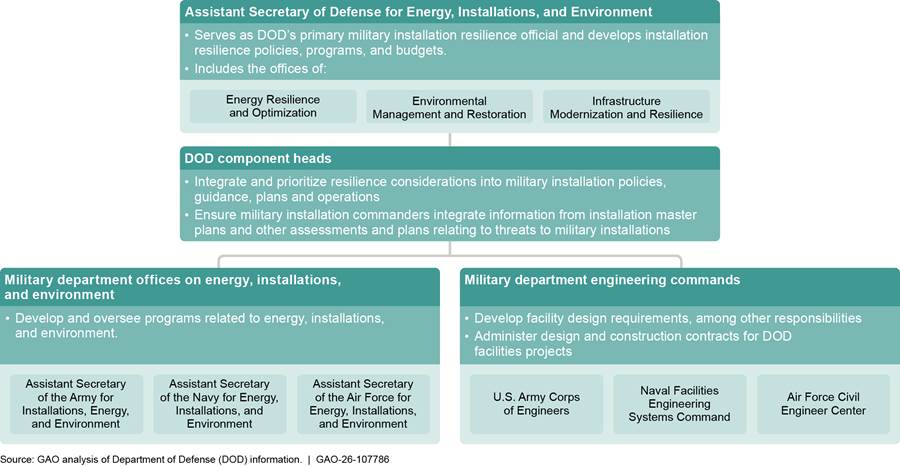
Within DOD, a range of offices have roles and responsibilities pertaining to ensuring the resilience of military installations, as shown in figure 1.
Natural Disasters and Associated Recovery Processes
Natural disasters include a range of events that can cause substantial damage or injury, such as hurricanes, tornados, floods, earthquakes, and fires.[7] Following a natural disaster, initial response activities focus on short- and medium-term priorities like saving lives, protecting property and the environment, and providing for basic human needs after a disaster. Disaster recovery activities, on the other hand, encompass a range of short- and long-term efforts that contribute to rebuilding resilient communities such as military installations.
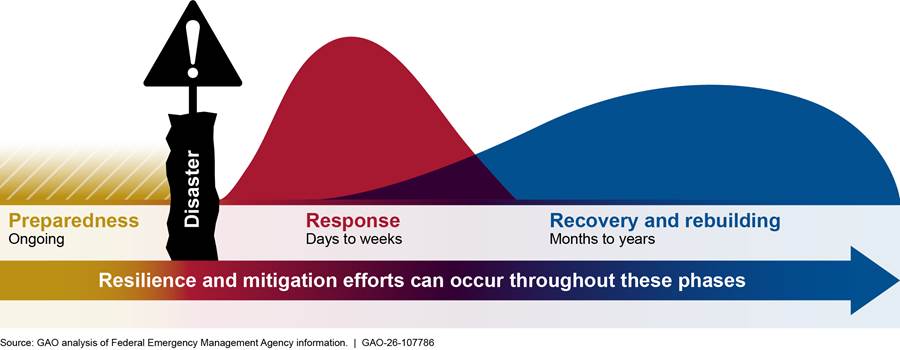
According to the Federal Emergency Management Agency’s National Disaster Recovery Framework (Framework), disaster recovery is not a linear or straightforward process but is cyclical and evolves based on the unique needs of each community.[8] The Framework further states that recovery efforts may be disrupted, delayed, or forced to restart as new disasters arise. While disaster response activities are often completed in a matter of days or weeks, disaster recovery can take months to years following a disaster, as shown in figure 2.
In the wake of a natural disaster, many activities related to disaster recovery—such as identifying project needs and opportunities for resilience improvements—are carried out at the military installation level. Over the past decade, military installations across the United States and its territories have been affected by various types of natural disasters that have resulted in substantial damage. The 12 selected installations affected by natural disasters that we examined for this report are shown in figure 3.[9]
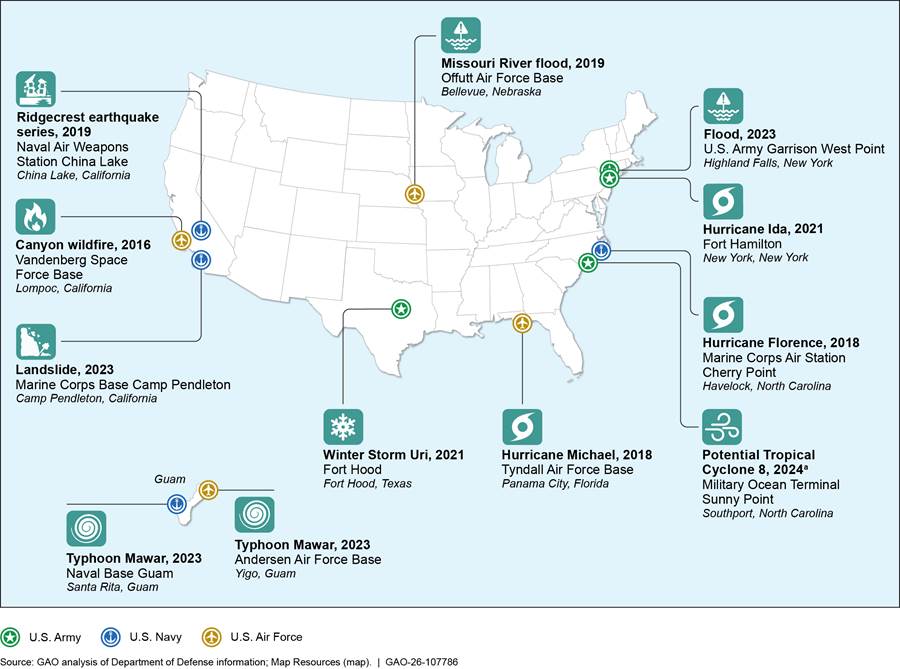
aA potential tropical cyclone is a disturbance that is not yet a tropical cyclone, but which poses the threat of bringing tropical storm or hurricane conditions to land areas within 48 hours.
Unified Facilities Criteria
Individual DOD facilities projects within installations must be designed in accordance with DOD’s facilities design standards, which are defined in the Unified Facilities Criteria.[10] Unified Facilities Criteria are technical manuals and specifications used for planning, design, construction, maintenance, and operations of all DOD facilities projects. Officials from the U.S. Army Corps of Engineers, Naval Facilities Engineering Systems Command, and the Air Force Civil Engineer Center are members of a panel responsible for administering and updating the Unified Facilities Criteria. The Unified Facilities Criteria include a core group of 26 standards that apply to building systems found in most DOD facility construction projects, and include standards such as architecture, roofing, and civil engineering. Engineers and planners apply the criteria that are most appropriate for their individual facilities projects to their project proposals and designs.
The Unified Facilities Criteria include standards that are meant to improve the resilience of DOD facilities. For example:
· The Unified Facilities Criteria for roofing identifies design requirements that should be applied in hurricane-prone areas.
· The Unified Facilities Criteria for foundations and earth structures specifies considerations for earthquake-prone areas and adopts procedures based on Federal Emergency Management Agency guidance on seismic provisions.
· The Unified Facilities Criteria for installation master planning states that installations should assess risks related to extreme weather applicable to a specific location to develop appropriate recommendations and plans for the installation.
Disaster Recovery Funding and Associated Processes
When an installation sustains damage as a result of a natural disaster, different types of funding may be available for recovery projects, depending on the cost and type of project (e.g., whether a facility must be replaced or can be repaired). The associated requirements and procedures for the use of each type of funding vary, including the period of time the funds are available for new obligations. Types of funding commonly used for disaster recovery projects and their associated processes are described below.
Military construction. Generally available for a period of up to 5 years, military construction funding is used to carry out the survey and site preparation for new facilities and the conversion or rehabilitation of existing facilities, along with the acquisition, planning, supervision, and administration of the projects. Military construction appropriations typically list specific funding amounts for each individual project, although amounts are also typically made available for unspecified minor military construction projects below certain cost thresholds. However, in the case of an emergency, DOD can submit a notification and request for the reprogramming of the funds. For every military construction project, each military service must provide Congress information on the project’s estimated cost, a description of the project, and why the project is needed, including any impacts to an installation’s mission if not approved.
Operation and maintenance. Generally, operation and maintenance funds are for expenses otherwise not provided for but necessary for the operation and maintenance of the relevant military department, as authorized by law and are generally available for a 1-year period. A subset of operation and maintenance funds for facilities sustainment, restoration, and modernization can be used for the maintenance and renovation of existing facilities. Operation and maintenance funds may be available for unspecified minor military construction projects below certain cost thresholds.[11] However, in some circumstances, such as a natural disaster, the military departments have the authority to use some operation and maintenance funds for military construction projects to restore or replace damaged or destroyed facilities.
Research, development, test, and evaluation. Used for expenses necessary for scientific research and military development of new technologies, these funds are generally available for up to 2 years once appropriated. These funds can be used at military installations for the maintenance, rehabilitation, lease, and operation of facilities and equipment related to the research and development of military technologies.
Procurement. Procurement funds are used for necessary expenses related to military equipment, spare parts or accessories, plant equipment, appliances, and machine tools, among other related expenses. In addition to general procurement appropriations, there are specific procurement accounts for different categories of items that can be housed at military installations, including aircraft, ammunition, and missiles, among others. These funds are generally available for a period of up to 3 years.
DOD Is Taking Steps to Improve Tracking of Disaster Costs and Damage at Installations
Natural disasters at a number of military installations have resulted in significant costs and damage since 2015. Starting in 2024, DOD began taking steps to track data on extreme weather costs and other impacts, but DOD’s efforts to date have not enabled the department to collect complete and accurate data on installation disaster recovery costs.
Natural Disasters at Installations Have Cost DOD at Least $15 Billion Since 2015
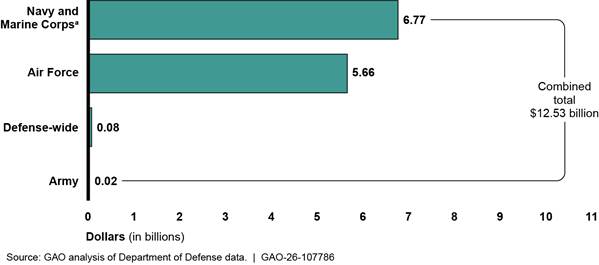
DOD has estimated that damage from extreme weather—including natural disasters—has cost the department at least $15 billion in the last decade; however, the department has not comprehensively tracked data related to those costs, as discussed later in this report.[12] Based on our review of annual and supplemental appropriations, Congress has provided DOD with at least $12.53 billion for military installations’ recovery from natural disasters since fiscal year 2015, of which about $4.22 billion was provided through supplemental appropriations.[13] Military installations can also use some other appropriated funds that are not specifically directed toward disaster recovery, such as funds for facilities restoration. However, DOD does not currently track when these funds are used for disaster recovery. As a result, our calculation of funds for disaster recovery does not capture the total amount expended for disaster recovery at military installations since 2015.
Of the $12.53 billion, the Departments of the Navy and Air Force received over 99 percent of the disaster recovery funding, with the remaining funds split between the Army and the rest of DOD (see fig. 4).[14]
Figure 4: Appropriations for Disaster Recovery at Military Installations by Component, Fiscal Years 2015-2024
Note: The amounts in this figure do not include appropriations for the Guard and Reserve components.
aThe $6.77 billion appropriated to the Department of the Navy includes $1.57 billion appropriated to the Navy, $866 million appropriated to the Marine Corps, and $4.34 billion appropriated to both services.
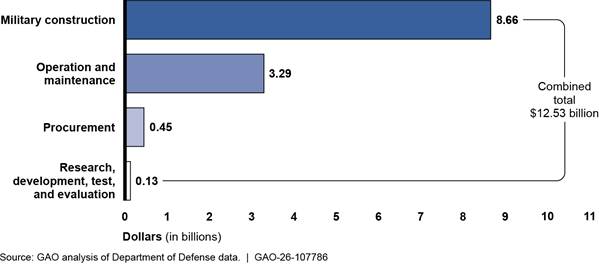
Across the military departments, most of the $12.53 billion was appropriated for military construction, followed by operation and maintenance, which can include restoration and repairs to facilities. The remaining disaster recovery appropriations were spread across procurement and research, development, test, and evaluation categories, as shown in figure 5.
Figure 5: Appropriations for Disaster Recovery at Military Installations by Category, out of $12.53 Billion, Fiscal Years 2015-2024
Note: The amounts in this figure do not include appropriations for the Guard and Reserve components.
The 12 military installations that we examined reported recovery costs ranging from an estimated $2.9 million to $4.5 billion per installation. These installations reported using various types of funding depending on the types of damage sustained from the natural disaster, and based on associated mission, as shown in table 1.
|
Selected installation (state or territory) |
Natural disaster (year) |
Total estimated cost of recovery |
Types of funding used |
Received funding from supplemental appropriations |
|
Tyndall Air Force Base (Florida) |
Hurricane Michael (2018) |
$4.5 billiona,b |
MILCON, O&M, Procurement |
Yes |
|
Naval Air Weapons Station China Lake (California) |
Earthquake (2019) |
$3.9 billion |
MILCON, RDT&E, O&M, Procurement |
No |
|
Naval Base Guam (Guam) |
Typhoon Mawar (2023) |
$2.8 billion |
MILCON, O&M, RDT&E |
Yes |
|
Andersen Air Force Base (Guam) |
Typhoon Mawar (2023) |
$1.1 billionc |
MILCON, O&M, Procurement |
Yes |
|
Offutt Air Force Base (Nebraska) |
Flood (2019) |
$1 billionb |
MILCON, O&M, Procurement |
Yes |
|
Marine Corps Air Station Cherry Point (North Carolina) |
Hurricane Florence (2018) |
$287 million |
MILCON, O&M |
Yes |
|
U.S. Army Garrison West Point (New York) |
Flood (2023) |
$188 million |
O&M |
Yes |
|
Marine Corps Base Camp Pendleton (California) |
Landslide (2023) |
$75.7 million |
O&M |
No |
|
Fort Hood (Texas) |
Winter Storm Uri (2021) |
$48.3 milliond |
O&M |
No |
|
Vandenberg Air Force Base (California) |
Canyon Fire (2016) |
$36.3 million |
O&M |
No |
|
Military Ocean Terminal Sunny Point (North Carolina) |
Potential Tropical Cyclone 8 (2024)e |
$28.4 million |
O&M, TWCF |
No |
|
Fort Hamilton (New York) |
Hurricane Ida (2021) |
$2.9 million |
O&M |
No |
Legend
MILCON: Military Construction
O&M: Operation and Maintenance
RDT&E: Research, Development, Test, and Evaluation
TWCF: Transportation Working Capital Fund
Source: GAO analysis of DOD information. | GAO‑26‑107786
Note: Each disaster recovery cost estimate presented represents the total of all types of funding listed and both annual and supplemental appropriations. These estimates, as well as information on the types of funding used and whether funds were received from supplemental appropriations, were provided to GAO by each installation during February through September 2025. GAO did not independently estimate each installation’s disaster recovery costs. Therefore, the methods for calculating the estimated costs may vary across the installations. In addition, estimated disaster recovery costs can change over time.
aThe cost estimate for Tyndall Air Force Base includes costs associated with transferring the F-22 mission from Tyndall Air Force Base to Joint Base Langley-Eustis following the damage resulting from Hurricane Michael. According to Air Force officials, these costs are considered part of the recovery from Hurricane Michael.
bThe cost estimates for Tyndall Air Force Base and Offutt Air Force Base reflect costs through fiscal year 2024. Air Force officials stated these installations incurred additional disaster recovery costs during fiscal year 2025, but updated cost documentation for fiscal year 2025 was not available as of December 2025.
cAndersen Air Force Base has received $1.1 billion for recovery activities, but the Air Force expects the total recovery costs to be over $9 billion
dFort Hood cost includes a $35.9 million heating bill for the storm that installation officials consider part of the disaster recovery costs.
eA potential tropical cyclone is a disturbance that is not yet a tropical cyclone, but which poses the threat of bringing tropical storm or hurricane conditions to land areas within 48 hours.
To help manage the use of available funds for disaster recovery projects, officials from these installations reported using various statutory authorities and budgetary or contracting tools. For example, some officials told us certain authorities can allow installations to use some operation and maintenance funds for disaster recovery projects. These officials also stated that using different contracting tools can expedite certain aspects of contracting and project approval processes. For more information on authorities specific to natural disaster recovery at military installations, see appendix II.
Selected Installations Sustained a Range of Damage from Natural Disasters Since 2015
Across the 12 installations included in our review, the types of natural disasters and extent of damage varied widely. For example, the physical effects of disasters, as reported by installation officials, ranged from widespread damage affecting hundreds of buildings to more limited damage affecting one area of an installation, as well as various effects on transportation networks, electrical systems, and other areas. Damage and effects on operations resulting from natural disasters at the installations we visited are illustrated in figure 6 and described below.
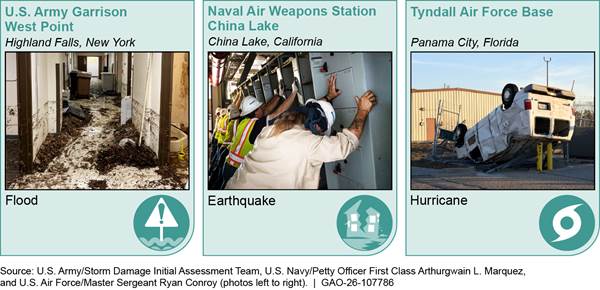
U.S. Army Garrison West Point. Installation officials stated that in July 2023, severe flooding occurred at U.S. Army Garrison West Point, resulting from 8 inches of rain within a few hours. According to installation officials, the intensity of the rain overwhelmed storm runoff systems, causing significant damage to primary roadways on the installation and flooding of facilities. Installation officials stated no buildings were fully destroyed from the flooding. However, the ground floor of several buildings sustained significant damage, including buildings housing medical and dental services for cadets and two soldier barracks—one of which was newly renovated—resulting in the need for temporary relocation of these services and affected soldiers.
Naval Air Weapons Station China Lake. In July 2019, two earthquakes—with respective magnitudes of 6.4 and 7.1—caused significant damage to Naval Air Weapons Station China Lake, as stated by installation officials. According to the officials, the earthquakes damaged over 700 buildings on the installation, including 87 that were damaged beyond repair. Others sustained repairable structural damage or minor damage such as cracks in the surface of stucco or drywall. Further, installation officials stated that weapons magazines sustained damage that required ordnances to be temporarily diverted, and damage to base housing required some service members to temporarily relocate to nearby towns.
Tyndall Air Force Base. In October 2018, category 5 Hurricane Michael made landfall near Tyndall Air Force Base and was utterly catastrophic, according to the Air Force. Installation officials stated that the hurricane’s high-speed winds and storm surge flooding damaged all facilities on the base, of which about 60 percent were damaged beyond repair. As a result of this damage, over 11,000 service members and their families were temporarily displaced. In addition, officials stated the Air Force shifted its F-22 training mission from Tyndall Air Force Base to Joint Base Langley-Eustis, though Tyndall was later selected as the home and training location for the F-35 mission of the 325th Fighter Wing.
Descriptions of the damage and the effects on operations resulting from natural disasters for all 12 installations included in our review are provided in appendix III.
DOD Is Taking Steps to Improve Tracking of Extreme Weather Data, but Gaps Remain in Scope and Completeness
DOD has taken steps to improve its tracking of extreme weather data, including costs and other effects at military installations, but these efforts have not yet enabled the department to collect complete and accurate data on natural disaster recovery costs. In 2024, ASD(EI&E) initiated an action plan to systematically track the effects of extreme weather and incremental change affecting military installations.[15] According to DOD officials, the impetus for this effort stems from a 2017 GAO recommendation, a congressional reporting requirement, and direction from the Deputy Secretary of Defense.[16] According to DOD, this effort is intended to address limitations of the current reporting of extreme weather effects at installations, which has not captured the full scope of these effects.
As part of this effort, ASD(EI&E) began an annual data call in fiscal year 2025 requesting that installations complete a spreadsheet to provide information on a range of extreme weather effects. The data call requests information on effects to both built and natural infrastructure at installations and associated costs, as well as intangible effects to training or mission readiness, such as health effects. The responses to the baseline data call—which covers extreme weather and incremental change occurring at installations throughout fiscal year 2025—were expected in December 2025.[17]
ASD(EI&E) officials stated that efforts are underway to transition data collection efforts from the spreadsheet to a web-based format for fiscal year 2026, which would allow installations to update information—such as cost data—following the initial entry.[18] According to DOD documentation, in addition to collecting baseline data to be used for comparison in future years, the information collected via the data call will be used to identify the various systems the military departments use to track damage and costs resulting from extreme weather and incremental change. According to ASD(EI&E) officials, once the various systems used by the military departments are identified, along with any gaps in the systems, the information will be used to streamline how military departments report the data. Figure 7 illustrates steps associated with DOD’s data collection effort.
Figure 7: Steps for DOD’s Effort to Collect Data on the Effects of Extreme Weather and Incremental Change at Military Installations
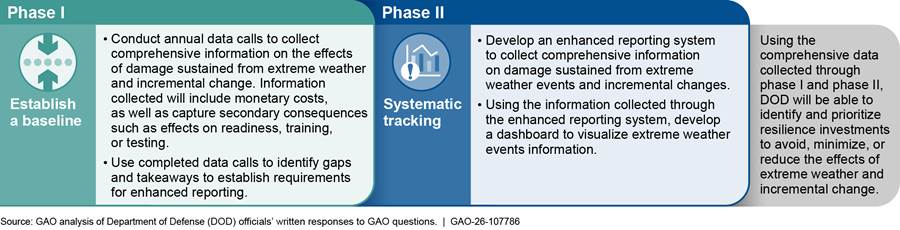
Note: For the purpose of this data collection, DOD defines an extreme weather event as a rare weather event at a particular place and time of year, with unusual characteristics in terms of magnitude, frequency, or extent that significantly impacted military personnel, systems, infrastructure, missions, or readiness. DOD defines incremental changes as gradual changes and chronic conditions in the environment, such as sea level rise, persistent drought, and permafrost thaw, which have significantly impacted military personnel, systems, infrastructure, missions, or readiness. The baseline data collection covers the period of October 1, 2024, through September 30, 2025. Officials stated the baseline data collection responses were expected in December 2025.
However, we identified gaps in the scope of DOD’s data collection and its ability to collect complete and accurate data on installation disaster recovery costs, as described below.
Scope of data. First, the scope of DOD’s data collection does not include all types of natural disasters that can result in significant damage to installations. Specifically, DOD officials confirmed that DOD’s data collection is limited to the effects of extreme weather and incremental change, which do not include the full scope of natural disasters like seismic events such as earthquakes. As demonstrated at Naval Air Weapons Station China Lake in 2019, earthquakes can result in significant damage to installations, which can require costly repairs and affect operations during the disaster recovery period, as stated by installation officials. As a result, the scope of DOD’s data collection excludes potentially billions of dollars in damage or recovery costs associated with natural disasters not covered by the definition for extreme weather.
Completeness and accuracy of data. Additionally, extreme weather cost information reported by installations via the data call is likely to be inaccurate or incomplete in some cases. ASD(EI&E)’s data call template for fiscal year 2025 requests that installations provide information on the effects—including costs—of extreme weather that occurs during that fiscal year. However, the template allows for variation in the type of recovery cost information that the installations can provide. Specifically, installations may report a dollar value for damage that either includes estimated recovery costs (i.e., the estimated costs of planned recovery projects) or reflects an estimated value of the damage without including estimated recovery costs. Because the cost of recovery may vary depending on the approach an installation takes, these different approaches can vary significantly.
Installation officials told us that initial estimates of recovery costs are based on the best information available at the time, and they typically do not represent the actual recovery costs. Officials stated that additional damage may be identified during the recovery process and disaster recovery projects may ultimately cost more than initially estimated. Further, recovery projects can take years to complete, and therefore accurate cost data may not be available within the same year that the disaster occurred. For example:
· Installation officials at West Point told us that their initial estimates of damage costs increased—in some cases, significantly—as projects developed, citing the need to increase the scope of contracts as additional damage was identified.
· Following the July 2019 earthquakes at China Lake, construction work to repair or replace damaged facilities began in 2020 and is expected to be completed in 2026. China Lake officials told us that, in one instance, additional damage to a laboratory was identified in the course of undertaking repairs, which expanded the scope of work needed to restore that facility.
· While Hurricane Michael struck Tyndall Air Force Base in October 2018, the installation reported it received additional appropriations for military construction projects as recently as fiscal year 2024, and work on these projects is estimated to continue until 2027.
The DOD Strategic Management Plan for Fiscal Years 2022–2026 includes a strategic objective to improve the collection of financial data for increased transparency in the spending and budgeting of funds.[19] Specifically, the objective states DOD must track and report where money is spent to ensure that it is utilized correctly to meet national security mission requirements. It further notes that efforts to improve collection of budget execution data can help ensure the accuracy of future budget requests. In addition, Standards for Internal Control in the Federal Government states that management should use quality information to make informed decisions and to evaluate performance in achieving key objectives and addressing risks.[20]
However, DOD has not fully tracked where and how disaster recovery funds are spent, in part because ASD(EI&E) has limited the scope of its data collection to include only the costs and effects of extreme weather and incremental change, which does not cover the full scope of natural disasters that can affect installations. An ASD(EI&E) official stated that this decision was to align with the statutory definition for extreme weather, which does not include seismic events.[21] The official stated that the department nonetheless has separately established seismic codes and standards and that seismic events could be added to its data collection.
ASD(EI&E) also cannot ensure it obtains quality information on disaster recovery costs to help make informed decisions regarding such investments because it has not established a process for collecting complete and accurate cost data over time. ASD(EI&E) officials acknowledged that estimated disaster recovery costs are likely to change over time, which could limit the accuracy of the data. Officials stated that the web-based data call format planned for implementation in fiscal year 2026 should help address this challenge, but updating the estimates following initial entry would be voluntary. Military department officials told us that installations would respond to ASD(EI&E)’s data calls but they stated that staffing limitations and competing demands could limit their capacity to do so.
DOD officials described plans to further refine its data collection efforts, with future efforts planned to align existing reporting systems and establish an automated comprehensive reporting system to standardize data collection, as appropriate.[22] According to DOD, its current efforts to collect baseline data will help support future systematic tracking by identifying gaps and lessons learned and by compiling existing data. However, ASD(EI&E) has not established a process to date that ensures installations report complete disaster recovery costs and update the cost data as more accurate information and estimates become available.
According to DOD, improving its data collection on the effects of extreme weather at military installations can enhance future planning and decision-making regarding investments to avoid or minimize such effects in the future. As ASD(EI&E) continues to implement and refine this effort, expanding its scope to include all types of natural disasters affecting military installations and establishing a process to ensure it collects complete and accurate data on disaster recovery costs would improve the department’s ability to plan and budget for future disaster recovery needs.
DOD Has Taken Steps to Increase Selected Installations’ Disaster Resilience, but Planning Gaps May Limit Opportunities
DOD has taken steps to increase disaster resilience at the 12 installations we examined, such as by elevating buildings above the floodplain or rebuilding older facilities to meet current, more rigorous building standards. However, we identified some instances when installations were unable to pursue certain resilience improvements as part of the disaster recovery due to planning gaps. These instances related to installations not having necessary data or sufficient funding to pursue some desired improvements. DOD has efforts underway to incorporate resilience information into installation master plans, which could help address these gaps, but we identified some limitations of those plans and related guidance.
DOD Has Taken Steps to Incorporate Resilience into Disaster Recovery at Selected Installations
We found that the 12 installations we examined took steps to improve resilience as part of their disaster recovery. According to DOD and military department officials, when an installation sustains damage from a natural disaster, installation officials are responsible for identifying needed recovery projects, including any resilience improvements. These projects can range from minor repairs to the replacement of entire facilities or other infrastructure, such as roadways and utilities. Disaster recovery projects may include resilience improvements—such as elevating buildings or designing roofs to withstand high speed winds—that can prevent or mitigate future damage and reduce the costs associated with future natural disasters.
According to officials from the Office of the Deputy Assistant Secretary of Defense for Infrastructure Modernization and Resilience, the military services determine how to prioritize disaster recovery projects using available funds. The officials further stated that disaster recovery projects generally do not focus solely on improving disaster resilience; rather, disaster resilience improvements are incorporated into projects as part of scoping and design. The officials stated the most important elements to improve resilience as part of any facility project are to choose an appropriate site that minimizes vulnerability to hazards and to complete the project in accordance with current Unified Facilities Criteria standards.
Among the 12 installations we examined, we found that the extent and type of resilience improvements undertaken at these installations differed due to various factors. For example, the type of disaster recovery projects pursued can depend on the severity and nature of damage incurred, management direction, and availability of funding. Examples of resilience projects undertaken at the installations we visited are illustrated in figure 8 and described below.
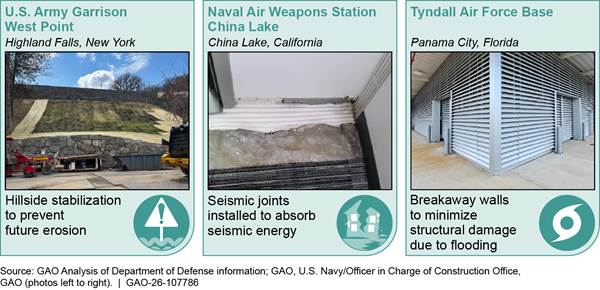
U.S. Army Garrison West Point. Officials told us that following the July 2023 flood, the installation focused on completing recovery projects as quickly as possible, both to restore normal operations expediently and to use operation and maintenance funding that would expire at the end of that fiscal year (i.e., on September 30, 2023). The officials also stated that, because they believed the flood would be considered a 1,000-year recurrence interval flood event, it would not be cost effective or feasible to prevent damage from a potential similar event in the future, which the officials stated would be unlikely to occur.
Nonetheless, West Point officials stated the installation made some resilience improvements to mitigate potential damage from future flooding. For example, in areas where flooding caused roadways to collapse, drainage was added to retaining walls to allow water to flow and prevent collapse of the retaining walls and roadways. In addition, the installation undertook projects to stabilize hillsides to prevent future erosion. For example, in one area the installation used plastic grid material planted over with grass to prevent erosion. In another area, the installation reinforced a slope above the rugby playing fields with anchors and mesh covered with concrete.
Naval Air Weapons Station China Lake. Officials told us that resilience improvements made as part of the installation’s recovery from a pair of 2019 earthquakes were primarily a result of replacing severely damaged or destroyed buildings with modern buildings that adhere to current building standards, including for seismic resilience. The officials stated this was, in part, because many of the damaged buildings dated to the World War II era, and building standards have become more rigorous since that time.
For example, facilities were built with flexible foundations to absorb seismic energy, and an air traffic control tower was built to flex and sway in the event of an earthquake. In other cases, damaged facilities were retrofitted with seismic joints and other measures to improve building stability. According to installation officials, the installation also undertook measures to mitigate risks posed by flash flooding. Using the results of a 2012 study that identified the installation’s 100-year floodplain, the installation ensured any rebuilt facilities were moved out of the floodplain and elevated. Additionally, culverts were installed to divert water from existing facilities in the floodplain. Officials stated these efforts helped prevent flooding during a subsequent 1,000-year flood event.
Tyndall Air Force Base. Officials told us that following Hurricane Michael, the Secretary of the Air Force directed the installation to meet current and future mission needs. To carry out this effort, officials stated the Air Force significantly redesigned the layout of the installation and constructed new facilities to improve disaster resilience as well as operational efficiency and quality of life for service members.
As part of the planning for the recovery at Tyndall, the Air Force issued memoranda to establish design flood elevation and design wind speed requirements specifically for Tyndall. These memoranda are intended to ensure the rebuilt infrastructure and facilities will be more resilient for future severe weather events. The design wind speed guidance, taken from Florida’s High Velocity Hurricane Zone standards, also specifies best practices for selecting building envelope materials (e.g., roofing, windows) that are capable of withstanding future category 5 hurricanes. According to installation officials, the installation also implemented design elements such as watertight facilities and breakaway walls to mitigate damage from future flooding.
Descriptions of resilience projects undertaken at all 12 of the installations included in our review are provided in appendix III.
Some Installations Had to Delay Certain Resilience Improvements due to Gaps in Planning
Among the 12 installations we examined, we identified instances when installations were unable to immediately pursue some resilience improvements as part of the disaster recovery. These instances related to installations not having data needed to design resilience improvements while expediently restoring installation functions or not having sufficient funding to pursue some desired improvements. DOD has taken steps that could help to address these planning gaps by implementing a requirement to include resilience information as part of installation master plans, including the identification of risks and proposed infrastructure projects or other measures to address those risks.[23] However, we identified some limitations of these plans and related guidance.
Data needed for resilience improvements. In some cases, installations need to conduct studies to obtain data needed to identify or design certain resilience improvements. For example, officials at U.S. Army Garrison West Point stated they rebuilt damaged stormwater runoff infrastructure to prior specifications because they did not have the data needed to determine appropriate improvements in an expedient manner, given that installation officials were focused on restoring operations as soon as possible.
As part of its disaster recovery, West Point officials stated the installation contracted a study in September 2023 to collect data to be used to inform improvements to the installation’s stormwater systems should they be needed in the future. West Point officials stated no such study had been completed by the installation prior to 2023, which limited their ability to make resilience improvements as part of the recovery from the 2023 flooding. As a result, the officials stated they would expect the same level of damage to occur if the installation experiences a similar flooding event, though the officials noted that such a severe level of flooding rarely occurs.
Conversely, officials from Military Ocean Terminal Sunny Point told us their installation had conducted the same type of study for a portion of their installation prior to Potential Tropical Cyclone 8. As a result of having a completed study, the installation was able to use the resulting data to make the covered area more resilient to future flooding as part of its disaster recovery efforts. The officials noted, however, the need to complete an additional study for a different area of the installation based on damage from that disaster.[24] Officials stated the installation will use the results of the second study—completed in May 2025—to pursue additional resilience improvements in the future. As of November 2025, an installation official stated resilience improvements to improve the flow of stormwater were being designed.
Funding needed for resilience improvements. In other instances, installation officials described some resilience improvements they were unable to make due to limited funds available for needed facilities and infrastructure projects across military installations. For example, an official from Vandenberg Space Force Base stated the installation would have liked to replace wooden utility poles with concrete poles during the recovery from the 2016 Canyon Fire, but they were unable to secure funding for this resilience upgrade due to competing priorities for funding disaster recovery projects at other installations.
Similarly, following Typhoon Mawar, a Naval Base Guam official stated the installation considered some resilience improvements that the installation currently does not have sufficient funding to pursue. For example, the installation considered burying more of its electrical lines underground, but funding constraints limited this effort. Additionally, the official stated the installation considered making resilience improvements to its water system that would enable the installation to maintain water service to facilities even if the system is damaged. The official stated the installation conducted a cost-benefit analysis to determine which projects to pursue using limited funding, and the installation planned to pursue some of these resilience improvements when additional funding is available, such as during the recovery from a potential future storm.
Officials from West Point and Sunny Point also noted limitations due to funding constraints. For example, West Point officials stated the installation considered moving mechanical systems in flood-damaged buildings to higher levels, but ultimately did not pursue this measure due to the costs that would be needed to reconfigure and renovate the buildings. Sunny Point officials also told us they considered more significant flood mitigation measures such as building a retaining wall around a key building, but opted not to do so, in part due to the associated costs.
DOD has taken some steps to enhance resilience planning, which could help address these planning gaps at installations. Specifically, installations are required by statute and DOD policy to incorporate resilience information into installation master plans, such as lessons learned from extreme weather events.[25] These plans should include the identification of current and future risks and threats to the installation’s resilience, as well as ongoing or planned projects to mitigate those risks and threats. Military department officials told us these projects would then be reviewed as part of existing processes for determining projects to pursue based on available funding.
According to DOD, 47 of the department’s more than 500 installations had completed this requirement as of April 2025, and at least 130 additional installations had efforts underway to do so in 2025.[26] Among the 12 installations in our sample, DOD’s tracking showed two installations had completed the requirement, and military department officials provided us with draft or recently completed plans for four additional installations.[27]
However, the plan for Andersen Air Force Base (dated June 2024) does not list any planned or ongoing risk mitigation projects, although the installation continues to undertake a range of disaster recovery projects following the effects of Typhoon Mawar in 2023. Additionally, the plan for Vandenberg Space Force Base notes the use of concrete poles as a lesson learned to mitigate the effects of wildfire, such as the 2016 Canyon Fire, but its listing of planned or ongoing risk mitigation projects describes use of existing wood poles and does not note any plans for use of concrete poles. In contrast, the plans for Fort Hood and West Point identify ongoing or recommended mitigation projects that address risks, respectively, for freezing weather and flooding, among other hazards.
Section 2864 of title 10, United States Code requires installations to integrate resilience planning into installation master plans, including by evaluating risks to the installation’s mission, planning for various types of resilience, and considering life-cycle costs of potential resilience projects. In addition, Standards for Internal Control in the Federal Government state that management should internally communicate the necessary quality information to achieve the entity’s objectives.[28]
Current DOD and military department guidance has established requirements to include resilience information in installation master plans and to incorporate resilience into construction projects, such as by adhering to Unified Facilities Criteria. However, installations may continue to miss opportunities to incorporate resilience into construction projects when recovering from natural disasters because the existing guidance does not clearly identify how installations should use the master plan resilience information in the context of disaster recovery, in light of the unique time constraints and significant financial investments to restore operations.
DOD and military department officials told us that guidance related to master planning and installation resilience is undergoing significant changes. For example, DOD officials stated the department is developing a new instruction on the topic of installation master planning, which is planned to replace the Unified Facilities Criteria focused on installation master planning. [29] In addition, DOD and military department officials described ongoing efforts to revise certain guidance related to installation resilience. Among these updates, in August 2025, DOD revised its December 2024 instruction on military installation resilience, such as by adding statutory authorities related to military installation, energy, and extreme weather resilience.[30]
We have previously reported that in the wake of disasters, opportunities to pursue future risk reduction may conflict with the desire for immediate restoration of critical infrastructure.[31] As the military departments update guidance related to installation resilience efforts, clearly identifying how installations should use resilience information in installation master plans when recovering from a natural disaster can help ensure that installations affected by disasters are better able to incorporate resilience improvements while quickly restoring installation capabilities.
Conclusions
Extreme weather and natural disasters have caused significant damage to military installations, costing the department billions of dollars to repair and rebuild. These events can affect mission readiness including service member health and safety and performance of equipment, among other factors. DOD has taken steps to address these risks, such as by collecting data on the effects of extreme weather at installations. However, DOD’s data collection efforts to date have not covered all types of natural disasters and have not collected complete and accurate information on disaster recovery costs. By expanding the scope of data collection to include all types of natural disasters and establishing a process to ensure cost data are complete and accurate, the department can enhance its ability to identify the costs of extreme weather and other natural disasters affecting installations.
DOD has also taken steps to implement resilience improvements as part of installations’ disaster recovery efforts, but gaps in planning for needed data or funding have limited opportunities for installations to pursue resilience improvements in some cases. DOD is implementing a requirement for installations to include resilience information as part of master plans, but related guidance does not address how these plans should be used during disaster recovery. By issuing guidance that clearly identifies how installations should use master plan resilience information during disaster recovery, the military departments can help strengthen installations’ ability to withstand future natural disasters while minimizing related costs and effects on operations.
Recommendations for Executive Action
We are making a total of five recommendations, including two to DOD and one to each of the military departments. Specifically:
The Secretary of Defense should ensure that the Under Secretary of Defense for Acquisition and Sustainment expands the scope of data collection on the costs and effects of extreme weather and incremental change at military installations to include all types of natural disasters affecting military installations. (Recommendation 1)
The Secretary of Defense should ensure that the Under Secretary of Defense for Acquisition and Sustainment establishes a process to ensure the collection of complete disaster recovery cost data from installations and that installations update the data as more accurate information and estimates become available. (Recommendation 2)
The Secretary of the Army should issue guidance that clearly identifies how installations should use installation master plan resilience information when recovering from a natural disaster. (Recommendation 3)
The Secretary of the Navy should issue guidance that clearly identifies how installations should use installation master plan resilience information when recovering from a natural disaster. (Recommendation 4)
The Secretary of the Air Force should issue guidance that clearly identifies how installations should use installation master plan resilience information when recovering from a natural disaster. (Recommendation 5)
Agency Comments
We provided a draft of this report to DOD for review and comment. DOD and the military departments concurred with our recommendations, and DOD cited actions it will take to address the recommendations. DOD’s comments are reproduced in appendix IV. DOD also provided technical comments, which we incorporated as appropriate.
We are sending copies of this report to the appropriate congressional committees, and the Secretary of Defense, the Secretary of the Army, the Secretary of the Navy, and the Secretary of the Air Force. In addition, this report is available at no charge on the GAO website at http://www.gao.gov.
If you or members of your staff have any questions about this report, please contact me at williamsk@gao.gov.
Contact points for our Offices of Congressional Relations and Public Affairs may be found on the last page of this report. GAO staff who made key contributions to this report are listed in appendix V.

Kristy E. Williams
Director, Defense Capabilities and Management
This report examines the extent to which the Department of Defense (DOD) has (1) tracked costs and damage associated with natural disasters at military installations since 2015 and (2) increased resilience of selected installations affected by natural disasters. It also describes DOD’s use of available authorities or tools to manage natural disaster recovery and enhance resilience to future disasters.
For the purpose of this review, we took several steps to select a sample of 12 installations that sustained substantial damage from a natural disaster. First, we asked the military departments to identify active duty, Reserve, or National Guard installations located within the United States or U.S. territories that had experienced substantial damage from a natural disaster during the period of fiscal year 2015 through fiscal year 2024. We defined the following terms as part of this request:
· Military installation. A base, camp, post, station, yard, center, or other activity under the jurisdiction of the Secretary of a military department, or in the case of an activity of a foreign country, under the operational control of the Secretary of a military department or the Secretary of Defense, without regard to the duration of the operational control.[32]
· Natural disaster. Discrete weather or natural event, such as any hurricane, tornado, storm, flood, high water, wind-driven water, tidal wave, tsunami, earthquake, volcanic eruption, landslide, mudslide, snowstorm, drought, fire, or other catastrophe that has the potential to cause significant damage to military installations and communities around military installations.[33] This definition excludes the effects of long-term shifts in climate, such as the thawing of permafrost or desertification.
· Substantial damage. Any damage that resulted in an interruption to normal operational capabilities or a need for maintenance, repair, or rebuilding that required additional funding beyond what is typically allocated for more routine weather and climate events.
In response to this request, the military departments provided us with listings totaling 197 installations, a majority of which were active-duty installations. Due to this, we chose to limit the scope of our work to only include active-duty installations. We selected our non-generalizable sample of 12 installations (four per military department and at least one from each service) using a judgmental sampling method that accounted for a range of disaster types, years, and geographic locations.
For the 12 installations, we conducted interviews with public works officials or other relevant officials regarding the installation’s disaster recovery efforts. Additionally, at three of the installations, we conducted in-person site visits during which we observed disaster damage as well as completed and ongoing disaster recovery projects. We also interviewed officials from the Office of the Assistant Secretary of Defense for Energy, Installations, and Environment (ASD(EI&E)) and each military department.
Methods Used to Assess Natural Disaster Costs and Damage
To analyze funds appropriated for DOD and military department natural disaster recovery, we first conducted a librarian-assisted search for supplemental appropriations, continuing resolutions, and annual consolidated appropriation acts for the period of fiscal year 2015 through 2024. Within those appropriations, we did a key word search to determine relevant appropriations for natural disaster recovery for further review. We included eight key words from our definition of natural disaster in our search: natural disaster, hurricane, tornado, storm, flood, landslide, fire, and wind, as well as the terms extraordinary and resilience.
For relevant DOD appropriations, the team used DOD budget guidance to identify categories of funding that are available to the military services for natural disaster recovery and clean-up. Based on this guidance, we identified the following appropriation categories relevant for natural disaster recovery: operation and maintenance; facilities sustainment, restoration, and modernization; military construction; research, development, test, and evaluation; and procurement.[34]
Using these categories of funding, we reviewed DOD appropriations related to natural disasters or extraordinary circumstances and compiled appropriations in two categories: (1) those connected to a specific natural disaster and related recovery expenses and (2) those connected to emergencies or extraordinary circumstances, but which did not reference a specific natural disaster event.
We conducted interviews with DOD and department officials to understand the extent to which data on natural disaster damage are collected and how recovery projects are funded. In addition, we reviewed DOD information and documentation on data collection related to disaster damage and costs. We compared DOD’s efforts to track disaster damages and costs with DOD management guidance and the Standards for Internal Control in the Federal Government principle that management should use quality information to make informed decisions and to evaluate performance in achieving key objectives and addressing risks.[35]
We interviewed public works and installation management officials to understand (1) the process of finding and determining the extent of infrastructure damage; (2) how recovery projects and resilience upgrades were determined; (3) and how disaster recovery costs were estimated and funded. We also obtained information and documentation related to estimated disaster recovery costs and whether each installation received funds from supplemental appropriations in support of disaster recovery efforts.
Methods Used to Determine Enhanced Resilience Requirements and Increased Resilience at Selected Installations
To identify resilience projects or other resilience measures undertaken by military installations affected by natural disasters, we reviewed documentation on disaster recovery projects and conducted interviews with officials at the non-generalizable sample of 12 installations. We asked installation officials to identify recovery projects that included enhanced resilience features, such as constructing facilities to withstand higher wind speeds, as well as any resilience improvements considered but not undertaken. Based on these interviews, we assessed resilience improvements included in recovery projects at military installations and steps DOD has taken to address gaps in resilience planning at installations.
We also reviewed DOD and military department guidance related to installation resilience. In addition, we reviewed ASD(EI&E) and military department information and documentation related to resilience improvements at installations, including efforts to incorporate resilience information into master plans. We compared DOD’s efforts to improve installation resilience with the Standards for Internal Control in the Federal Government principle that management should internally communicate the necessary quality information to achieve the entity’s objectives.[36]
Additionally, we reviewed DOD building code requirements and overarching criteria as established through the Unified Facilities Criteria program.[37] Further, we interviewed officials with the Unified Facilities Criteria program to understand how military building requirements are developed and how enhanced resilience is included in current DOD building codes.
Methods Used to Identify and Assess Federal Authorities and Tools to Manage and Expedite Natural Disaster Recovery
To identify and assess the extent to which military installations affected by natural disasters used statutory authorities and contracting, funding, or other tools to support recovery from a natural disaster, we reviewed DOD guidance and relevant sections of the U.S. Code and conducted interviews with installation officials.
For interviews with installation and department officials, we asked about statutory authorities used to fund recovery from a natural disaster. Additionally, we asked installation and department officials about the use of non-financial statutory authorities to help recovery. Based on these interviews, we further identified contracting, funding, and other tools available in DOD guidance and U.S. Code used by installations to manage recovery projects.
We conducted this performance audit from September 2024 to February 2026 in accordance with generally accepted government auditing standards. Those standards require that we plan and perform the audit to obtain sufficient, appropriate evidence to provide a reasonable basis for our findings and conclusions based on our audit objectives. We believe that the evidence obtained provides a reasonable basis for our findings and conclusions based on our audit objectives.
Appendix II: Identified Authorities and Tools for Disaster Recovery and Resilience from Fiscal Year 2015 to Fiscal Year 2024
Through analysis of U.S. Code and interviews with selected installations, we identified statutory authorities used to support recovery from natural disasters at military installations. Generally, these authorities provide construction authorization and alternative funding approaches for disaster recovery or installation resilience projects.
In some cases, officials told us about using these authorities for disaster recovery. For example, officials from Marine Corps Air Station Cherry Point and Tyndall Air Force Base stated that they used section 2854 of title 10, U.S. Code to repair or replace facilities damaged from extreme weather. Officials from Marine Corps Air Station Cherry Point reported use of this authority to fund recovery projects when military construction funds were not available. Statutory authorities that we identified for disaster recovery and disaster resilience at military installations are listed in table 2.
Table 2: Examples of Statutory Authorities for Disaster Recovery and Disaster Resilience on Military Installations
|
Authority |
United States Code (U.S.C.) |
Summary of authority |
Reporting requirements in authorizing legislation |
|
Emergency construction |
10 U.S.C. 2803 |
Authorizes carrying out projects not otherwise authorized by law if the project is determined vital to national security or protection of health safety or environmental quality, and so urgent that it cannot wait for the next authorization act. |
Requires a notification to Congress that provides a project justification and cost estimate, justification for carrying out the project under this authority, and the sources of funds to carry out the project. |
|
Contingency construction |
10 U.S.C. 2804 |
Authorizes the military departments to carry out military construction projects not otherwise authorized by law in cases where it is determined waiting until the next authorization act would be inconsistent with national security or national interest. |
Requires a notification to Congress that provides a project justification, cost estimate, and justification for using this authority. |
|
Repair of facilities |
10 U.S.C. 2811 |
Authorizes the use of available operation and maintenance funds to carry out repairs or restoration of a real property facility or area. Repair projects requiring more than $7.5 million are not allowed without prior approval from the Secretary concerned. |
If the project is in excess of $7.5 million, then congressional notification is required and must include justification for the project, estimated costs, and description of elements of military construction involved. If the project cost exceeds 75 percent of the estimated cost of a military construction project to replace the facility, an explanation is required as to why replacement of the facility is not in the government’s best interests. |
|
Military installation resilience projects |
10 U.S.C. 2815(e)a |
Authorizes military construction on a military installation, on certain facilities used by the Department of Defense (DOD), or outside of a military installation as long as the project would preserve or enhance the resilience of a military installation, certain facilities used by DOD, or community infrastructure necessary to maintain, improve, or rapidly reestablish an installation’s mission assurance and mission-essential functions. Projects may be funded from amounts available for operation and maintenance. Established in the National Defense Authorization Act for Fiscal Year 2020. The National Defense Authorization Act for Fiscal Year 2024 increased the amount that can be obligated for installation resilience projects under this section from $100 million to $125 million. |
Requires congressional notification including rationale for how projects would enhance military installation resilience, enhance mission assurance, support mission critical functions, and address known vulnerabilities, as well as the current project estimate, the source of funds, and certification that delay for the next authorization act would be inconsistent with national security or the protection of health, safety, or environmental quality. Requires submission of a report on the planned and active projects carried out under this authority. The report is required to be submitted no later than 90 days after the end of each fiscal year. |
|
Restoration or replacement of damaged or destroyed facilities |
10 U.S.C. 2854b |
Authorizes use of funds to repair, restore, or replace a facility that has been damaged or destroyed. If the facility was damaged as a result of a natural disaster or terrorism incident, available operation and maintenance funds may be used to carry out a military construction project. The National Defense Authorization Act for Fiscal Year 2019 increased the level of funds that can be obligated under this section from $50 million to $100 million. |
Requires congressional notification; when operation and maintenance funds are used, must include the current estimate, source of funds, in the case of damage to the facility (rather than destruction), a certification that the replacement project is more cost-effective than repair or restoration, and a certification that deferring to the next authorization act would be inconsistent with national security or the protection of health, safety, or environmental quality. |
|
Military construction projects for energy resilience, energy security, and energy conservation |
10 U.S.C. 2914 (c) |
Authorizes carrying out military construction projects for energy resilience, energy security, and energy conservation from available operation and maintenance appropriations. |
Requires congressional notification of the decision to carry out a project under this authority and including the cost estimate, source of funds, and certification that deferring the project until funds for military construction are available would be inconsistent with timely assurance of energy resilience, energy security, or energy conservation for one or more critical national security functions. |
Source: GAO analysis of United States Code. | GAO‑26‑107786
Note: As this report was in its final stages, Congress passed and the President signed into law the National Defense Authorization Act for Fiscal Year 2026, which included amendments to some of the statutory authorities listed in this table. Where relevant, these changes are outlined below. For a full account of amendments please see the National Defense Authorization Act for Fiscal Year 2026, Pub. L. No. 119-60 (2025).
aDuring final processing of this product, the National Defense Authorization Act for Fiscal Year 2026 amended section 2815 of Title 10, U.S. Code to include unspecified minor military construction projects not otherwise authorized and to add a reference to section 2805. Pub. L. No. 119-60, 2874 (2025).
bDuring final processing of this product, the National Defense Authorization Act for Fiscal Year 2026 amended section 2854 of Title 10, U.S. Code, increasing the maximum annual aggregate amount that can be obligated under this section by the Secretary concerned from $100 million to $300 million. Pub. L. No. 119-60, 2813 (2025).
Through our analysis, we also identified budgetary, contracting, or other tools used by the installations in our sample to support recovery from natural disasters at military installations. A majority of the installations we interviewed described using at least one of these tools to support the recovery process.
For example, the ability to solicit contracts before funding was available was discussed by both Andersen Air Force Base and U.S. Army Garrison West Point officials. Installation officials from West Point stated that this tool allowed them to expedite clean-up and the construction of recovery projects. Another tool discussed by installation officials was receiving funds through a lump sum appropriation instead of a line-item appropriation. Officials from Marine Corps Air Station Cherry Point reported that the lump sum appropriation allowed for funds to be reprogrammed across recovery projects as needed. This made it easier for officials to manage emerging needs for recovery projects, such as additional damage discovered during construction from the natural disaster. Examples of budgetary, contracting, and other tools that we identified for disaster recovery at military installations are listed in table 3.
|
Tool |
Summary of tool |
Reporting requirements |
|
Design-build project |
Allows for the design and the construction of a project under a single contract and with one contractor. Traditionally, construction is done as a design-bid-build project where design and construction are contracted for separately with two contracts and two contractors. |
None; however, the project should meet the specific criteria for this type of contract. Criteria include the extent to which project requirements have been adequately defined, time constraints, and the capability and experience of potential contractors, among others. |
|
Mutual aid agreements |
Officials stated they used mutual aid agreements with entities such as the U.S. Forest Service or local governmental agencies to cover additional labor or equipment needs. |
None discussed by officials. |
|
Lump sum appropriation |
A lump-sum appropriation covers a number of specific programs, projects, or items, in contrast with a line-item appropriation, which is available only for the specific object described. This allows for funds to be distributed across projects as needed. |
Officials at installations that received amounts from lump sum appropriations stated that spend plans were submitted to Congress to provide progress updates on the rebuild. Reporting requirements or direction may be outlined in language in the appropriations acts, accompanying explanatory statements, or committee reports. |
|
Solicitation in advance of funding availability |
Allows for solicitation to be initiated before funds are available, with some limitations. Requires a specific clause to be included in the solicitation stating that the government’s liability is contingent upon availability of funds. |
None |
Source: GAO analysis of Department of Defense information. | GAO‑26‑107786
We obtained information on disaster damage and resilience projects from a non-generalizable sample of 12 military installations that sustained substantial damage from a natural disaster since 2015. For more information on how we selected and obtained information from these installations, see appendix I. This appendix describes damage, operational effects, and resilience projects for the 12 installations we selected.
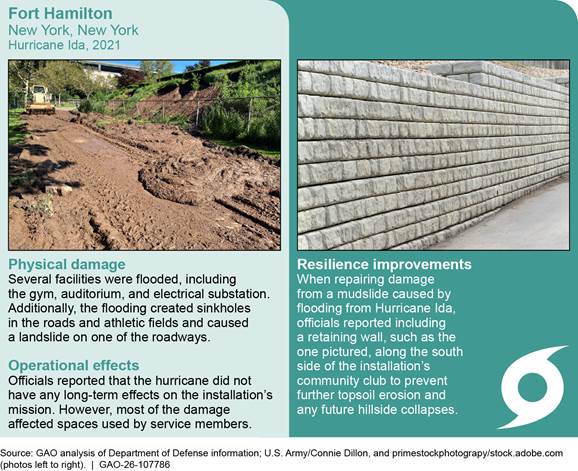
Fort Hamilton. In 2021, Fort Hamilton was hit by Hurricane Ida and experienced approximately 10 inches of rain over a period of 4 hours, as reported by installation officials. The officials stated several facilities located on the installation flooded, and the flooding caused large sinkholes—some big enough to fit an 80-gallon trash can—to form on some roads and athletic fields across the installation. As a result of the hurricane, officials reported the installation undertook projects and other measures to prevent similar damage in the future, as described in figure 9.
Figure 9: Damage, Operational Effects, and Resilience Improvements Resulting from Hurricane Ida Cited by Fort Hamilton Officials
Fort Hood. In 2021, Fort Hood was affected by severe freezing temperatures caused by Winter Storm Uri, according to installation officials. The officials stated that the installation sustained damage, including to more than 100 barracks, and as a result of the storm, undertook projects and other measures to help prevent similar damage in the future, as shown in figure 10.
Figure 10: Damage, Operational Effects, and Resilience Improvements Resulting from Winter Storm Uri Cited by Fort Hood Officials
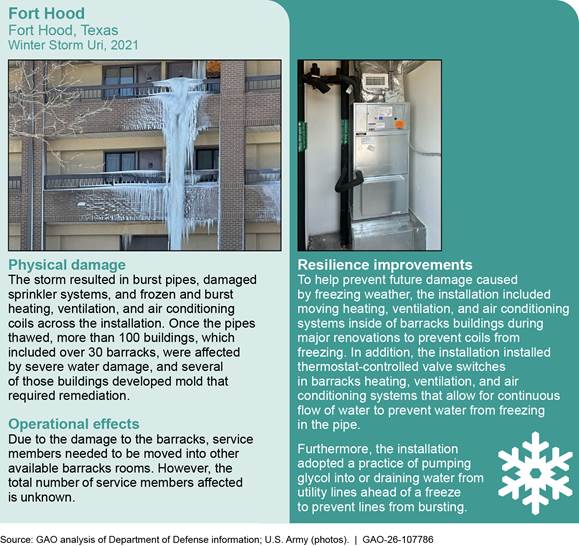
Military Ocean Terminal Sunny Point. Potential Tropical Cyclone Eight in 2024 produced 18 inches of rain in 24 hours and over 21 inches in total at Military Ocean Terminal Sunny Point, as reported by installation officials. As one of the largest transfer points of ammunition and weapons for the U.S. military, installation officials reported the installation was not able to receive cargo through mainline rail for over a month. Officials stated that in response to the storm damage, the installation undertook projects and other measures to prevent similar damage in the future, as shown in figure 11.
Figure 11: Damage, Operational Effects, and Resilience Improvements Resulting from Potential Tropical Cyclone 8 Cited by Military Ocean Terminal Sunny Point Officials
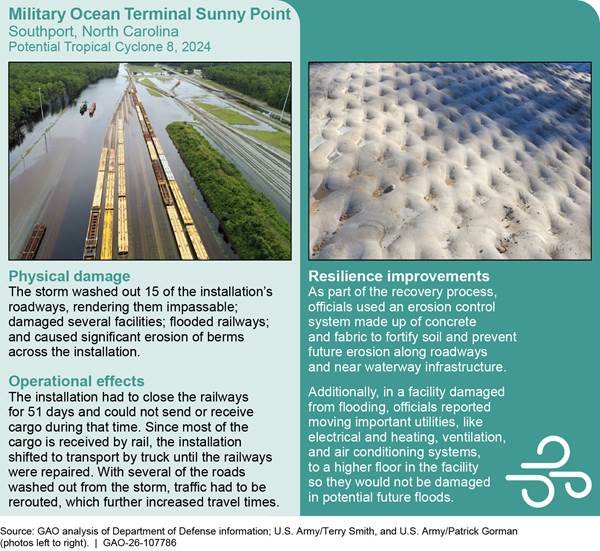
U.S. Army Garrison West Point. Installation officials stated that in 2023, U.S. Army Garrison West Point experienced 8 inches of rain within a few hours. Installation officials stated that the intensity of the rain overwhelmed the installation’s stormwater system, resulting in significant damage and flooding across the West Point campus. Following the storm, the installation made resilience improvements as part of its recovery projects to prevent future damage, as described in figure 12.
Figure 12: Damage, Operational Effects, and Resilience Improvements Resulting from 2023 Flooding Cited by U.S. Army Garrison West Point Officials
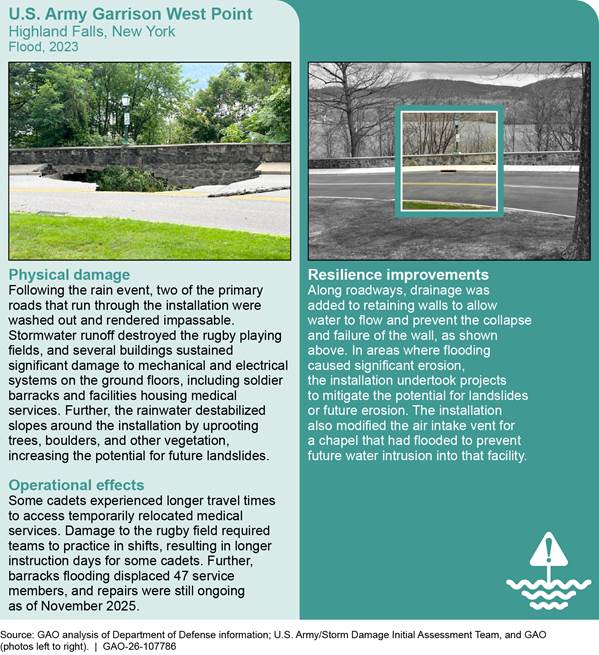
Marine Corps Air Station Cherry Point. In 2018, Marine Corps Air Station Cherry Point was hit by Hurricane Florence resulting in over 30 inches of rain at the installation, according to installation officials. The officials stated the significant amount of rain damaged a number of the older facilities located on the installation and led to rain directly intruding into the buildings. As a result of the storm, installation officials reported the installation undertook recovery projects to prevent similar damage in the future, as described in figure 13.
Figure 13: Damage, Operational Effects, and Resilience Improvements Resulting from Hurricane Florence Cited by Marine Corps Air Station Cherry Point Officials
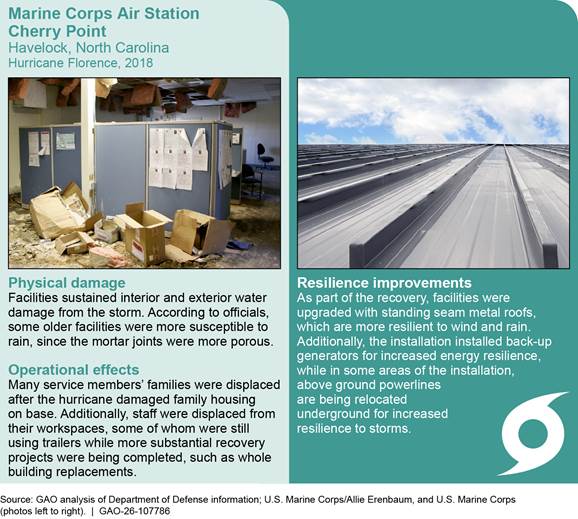
Marine Corps Base Camp Pendleton. Caused by an unusual amount of rain during the winter season, Marine Corps Base Camp Pendleton experienced a landslide on the main roadway that runs across the installation, according to installation officials. The officials stated the landslide affected the stability of and access to the main road, as well as the utility lines that ran underground alongside the main road, including water lines, gas lines, and electrical and communication data. As a result, installation officials reported the installation undertook projects to increase the resilience of the road where the landslide happened, as described in figure 14.
Figure 14: Damage, Operational Effects, and Resilience Improvements Resulting from 2023 Landslide Cited by Marine Corps Base Camp Pendleton Officials
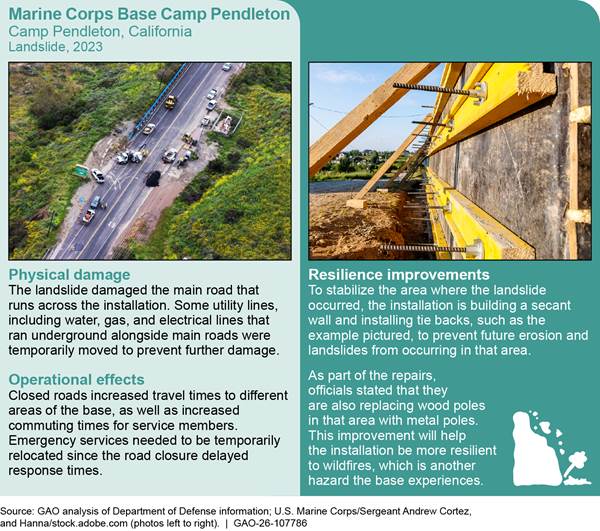
Naval Air Weapons Station China Lake. According to officials, in 2019, two earthquakes hit Naval Air Weapons Station China Lake resulting in significant damage of facilities across the installation, including laboratories and weapons magazines. Further, installation officials said the damage required extensive repairs, delaying some projects. Officials stated, in response to the earthquakes, the installation undertook several resilience improvements as part of its recovery projects to prevent damage in the future, as described in figure 15.
Figure 15: Damage, Operational Effects, and Resilience Improvements Resulting from 2019 Earthquakes Cited by Naval Air Weapons Station China Lake Officials
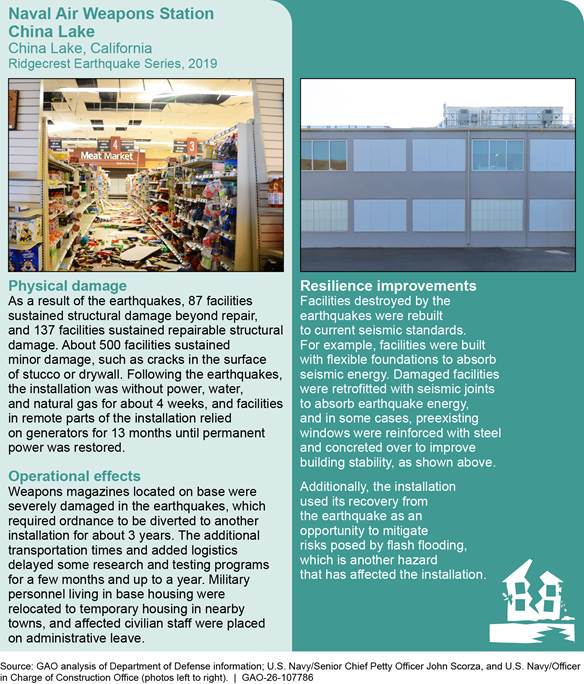
Naval Base Guam. Typhoon Mawar—a borderline category 5 hurricane with winds estimated between 130 and 156 miles per hour—hit Naval Base Guam in 2023, as reported by installation officials. The officials stated the storm caused the installation to lose access to utilities and caused severe wind damage to facilities located on the installation. To prevent similar damage in the future, installation officials stated the installation undertook projects and other measures to increase the resilience of the installation, as described in figure 16.
Figure 16: Damage, Operational Effects, and Resilience Improvements Resulting from Typhoon Mawar Cited by Naval Base Guam Officials
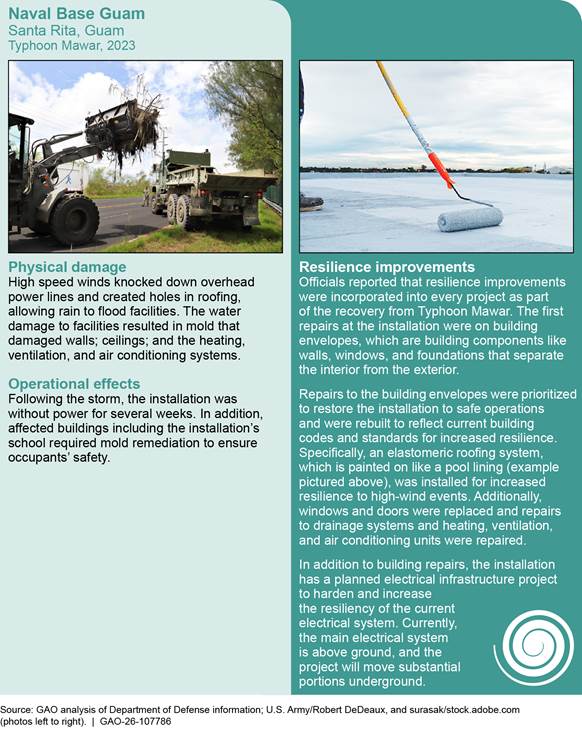
Andersen Air Force Base. Hit by Typhoon Mawar in 2023, Andersen Air Force Base sustained wind damage to facilities on the installation, according to installation officials. The officials stated heavy winds damaged roofing and blew-in the roll-up doors on a large portion of the facilities on base. To prevent similar damage in the future, installation officials reported the installation undertook projects and other measures to increase the resilience, as described in figure 17.
Figure 17: Damage, Operational Effects, and Resilience Improvements Resulting from Typhoon Mawar Cited by Andersen Air Force Base Officials
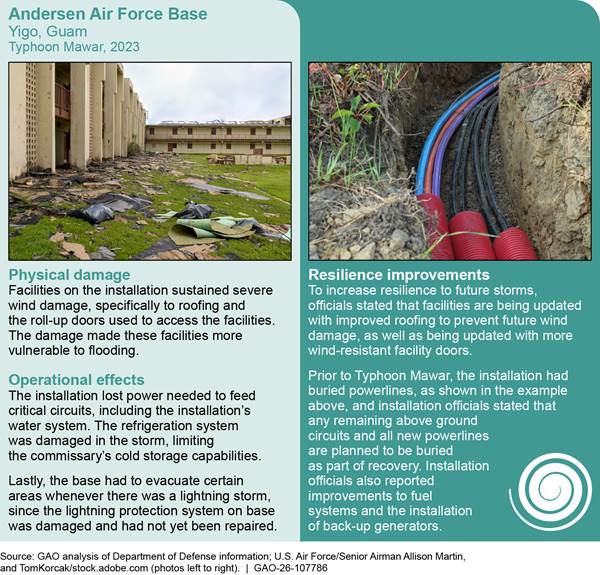
Offutt Air Force Base. In 2019, Offutt Air Force Base flooded with an estimated 720 million gallons of water from the river and the sewage treatment plant, according to installation officials. The officials stated this resulted in the destruction of significant amounts of the installation’s equipment, including training and mission systems. In addition, extensive mold resulting from the flooding affected the damaged facilities on the base. In response to the flooding, installation officials stated the installation undertook a variety of recovery projects and other measures to prevent similar damage in the future, as described in figure 18.
Figure 18: Damage, Operational Effects, and Resilience Improvements Resulting from 2019 Riverine Flooding Cited by Offutt Air Force Base Officials
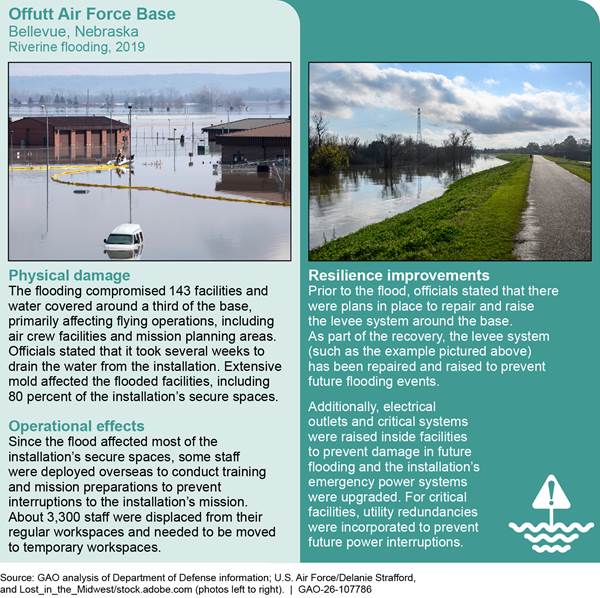
Tyndall Air Force Base. In 2018, Hurricane Michael, a category 5 hurricane at landfall, hit Tyndall Air Force Base and resulted in damage to 100 percent of the facilities on base in some way, as reported by installation officials. The officials stated about 60 percent of the facilities on base were destroyed beyond repair, and the remaining 40 percent were damaged at varying levels of severity. To prevent similar damage in the future, installation officials stated the installation undertook projects and other measures to increase the resilience of the installation, as described in figure 19.
Figure 19: Damage, Operational Effects, and Resilience Improvements Resulting from Hurricane Michael Cited by Tyndall Air Force Base Officials
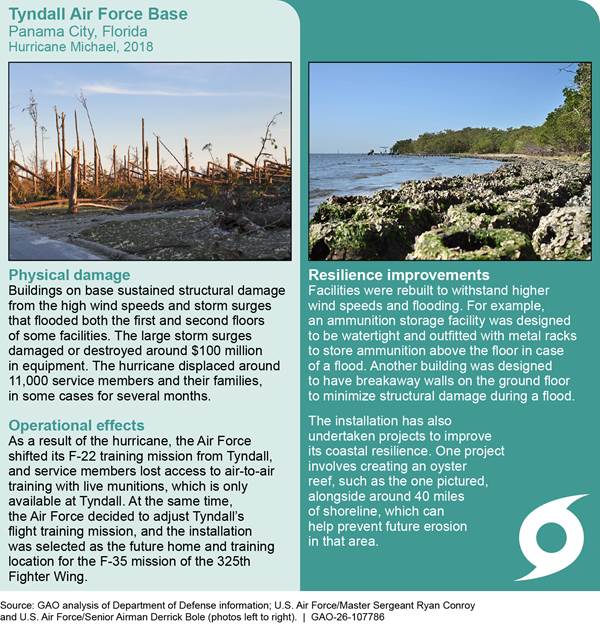
Vandenberg Space Force Base. In 2016, Vandenberg Space Force Base was affected by the Canyon Wildfire that burned an estimated 12,500 acres located on the south loop of the base, according to installation officials. The officials stated that the wildfire, which started in an area with no road access, was aided by coastal winds and spread over an 8-day event. As a result of the wildfire, installation officials reported the installation undertook recovery projects to help prevent similar damage in the future, as described in figure 20.
Figure 20: Damage, Operational Effects, and Resilience Improvements Resulting from the Canyon Wildfire Cited by Vandenberg Space Force Base Officials
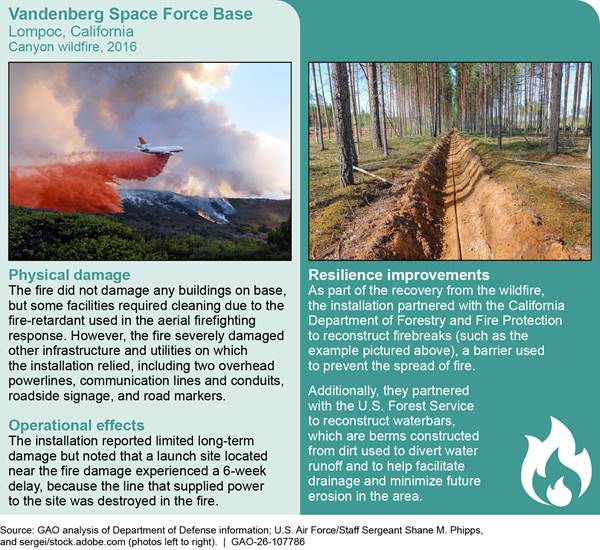
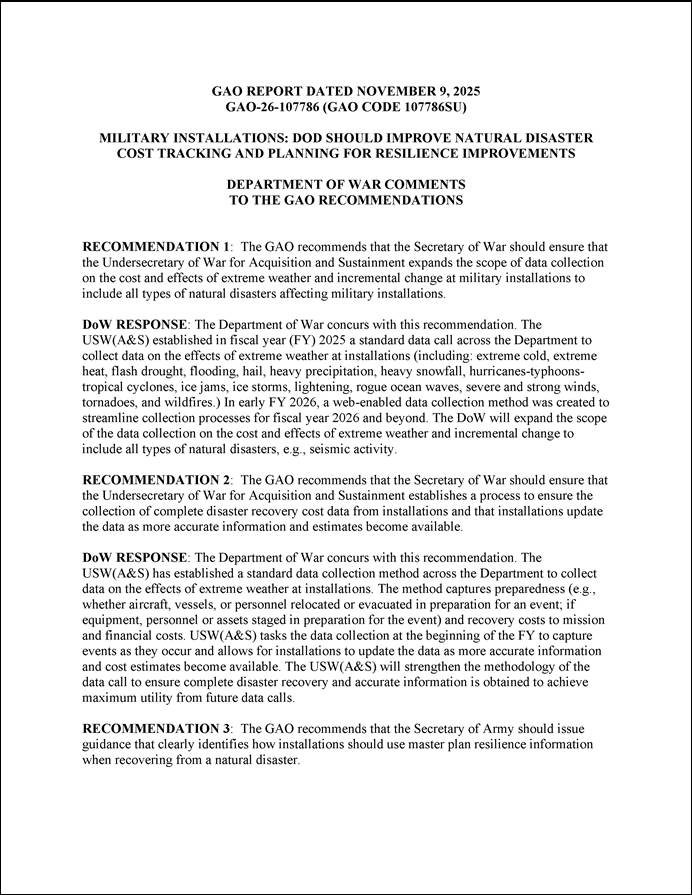
GAO Contact
Kristy Williams, WilliamsK@gao.gov
Staff Acknowledgments
In addition to the contact listed above, Simon Hirschfeld (Assistant Director), Serena Epstein (Analyst in Charge), Sharon Ballinger, Shannon Murphy, Lillian Ofili, Michael Silver, Kassandra Vaught, Brennan Williams, Emily Wilson, and Kiley Wilson made significant contributions to this report.
The Government Accountability Office, the audit, evaluation, and investigative arm of Congress, exists to support Congress in meeting its constitutional responsibilities and to help improve the performance and accountability of the federal government for the American people. GAO examines the use of public funds; evaluates federal programs and policies; and provides analyses, recommendations, and other assistance to help Congress make informed oversight, policy, and funding decisions. GAO’s commitment to good government is reflected in its core values of accountability, integrity, and reliability.
Obtaining Copies of GAO Reports and Testimony
The fastest and easiest way to obtain copies of GAO documents at no cost is through our website. Each weekday afternoon, GAO posts on its website newly released reports, testimony, and correspondence. You can also subscribe to GAO’s email updates to receive notification of newly posted products.
Order by Phone
The price of each GAO publication reflects GAO’s actual cost of production and distribution and depends on the number of pages in the publication and whether the publication is printed in color or black and white. Pricing and ordering information is posted on GAO’s website, https://www.gao.gov/ordering.htm.
Place orders by calling (202) 512-6000, toll free (866) 801-7077,
or
TDD (202) 512-2537.
Orders may be paid for using American Express, Discover Card, MasterCard, Visa, check, or money order. Call for additional information.
Connect with GAO
Connect with GAO on X,
LinkedIn, Instagram, and YouTube.
Subscribe to our Email Updates. Listen to our Podcasts.
Visit GAO on the web at https://www.gao.gov.
To Report Fraud, Waste, and Abuse in Federal Programs
Contact FraudNet:
Website: https://www.gao.gov/about/what-gao-does/fraudnet
Automated answering system: (800) 424-5454
Media Relations
Sarah Kaczmarek, Managing Director, Media@gao.gov
Congressional Relations
David A. Powner, Acting Managing Director, CongRel@gao.gov
General Inquiries
[1]Report on Extreme Weather Damage to Military Installations, Before the House Committee on Armed Services, 119th Cong. (2025) (briefing by the Office of the Under Secretary of Defense for Acquisition and Sustainment). 10 U.S.C. § 101(a)(20) defines extreme weather as recurrent flooding, drought, desertification, wildfires, thawing permafrost, sea level fluctuation, changes in mean high tides, or any other weather-related event, or anticipated change in environmental conditions, that present (or are projected to present) a recurring annual threat to the climate security of the United States or of allies and partners of the United States. For reporting purposes, DOD defines extreme weather as rare weather events at a particular place and time of year, with unusual characteristics in terms of magnitude, frequency, or extent that significantly impacts military personnel, systems, infrastructure, missions, or readiness. Assistant Secretary of Defense for Energy, Installations and Environment Memorandum, Extreme Weather and Incremental Change Reporting (Oct. 22, 2024).
[2]According to a DOD official, extreme weather encompasses some, but not all, natural disasters. For example, seismic events such as earthquakes can be natural disasters, but are not considered extreme weather.
[3]Department of Defense Directive 4715.21, Improving Military Installation and Critical Resources Resilience (Jan. 14, 2016) (change 3 effective Aug. 1, 2025).10 U.S.C. § 101(f)(8) defines military installation resilience as the capability of a military installation to avoid, prepare for, minimize the effect of, adapt to, and recover from extreme weather events, or from anticipated or unanticipated changes in environmental conditions, that do, or have the potential to, adversely affect the military installation or essential transportation, logistical, or other necessary resources outside of the military installation that are necessary in order to maintain, improve, or rapidly reestablish installation mission assurance and mission-essential functions. (As this report was in its final stages, the National Defense Authorization Act for Fiscal Year 2026 amended section 101(f)(8) to include “energy or water disruptions, or human-induced hazards with respect to the environment” as factors in military installation resilience. Pub. L. No. 119-60, § 2801 (2025).) The term fiscal exposure refers to the responsibilities, programs, and activities that may either legally commit the federal government to future spending or create the expectation for future spending. In 2015, we created an infographic that described five key sources of federal fiscal exposure, the environment and disasters among them. See https://blog.gao.gov/2015/02/26/fiscal-exposures-5-sources-of-risk-that-drive-future-spending/ GAO, Disaster Resilience Framework: Principles for Analyzing Federal Efforts to Facilitate and Promote Resilience to Natural Disasters, GAO‑20‑100SP (Washington, D.C.: Oct. 2019).
[4]S. Rep. No. 118-58, at 105 (2023).
[5]GAO, Standards for Internal Control in the Federal Government, GAO‑14‑704G (Washington, D.C.: September 2014). Department of Defense, DoD Strategic Management Plan Fiscal Years 2022-2026 (Jan. 2025).
[7]For example, in the context of certain emergency preparedness statutes, the term “natural disaster” is defined as any hurricane, tornado, storm, flood, high water, wind-driven water, tidal wave, tsunami, earthquake, volcanic eruption, landslide, mudslide, snowstorm, drought, fire, or other catastrophe in any part of the United States which causes, or which may cause, substantial damage or injury to civilian property or persons. 42 U.S.C. § 5195a (a)(2).
[8]Federal Emergency Management Agency, National Disaster Recovery Framework, Third Edition – Amended (Dec. 10, 2024).
[9]Appendix I provides information on our process for selecting this non-generalizable sample of installations.
[10]DOD, Unified Facilities Criteria (UFC) 1-200-01, DOD Building Code (Sept. 1, 2022) (incorporating change 4, effective Dec. 17, 2024).
[11]10 U.S.C. § 2805
[12]According to a DOD official, extreme weather encompasses some, but not all, natural disasters. For example, seismic events such as earthquakes can be natural disasters, but are not considered extreme weather.
[13]These totals do not include amounts appropriated for the Guard or Reserve components. The totals include amounts where the appropriation referenced by name a natural disaster event (such as a named hurricane) or otherwise specified that amounts were for expenses related to natural disasters.
[14]Defense-wide funds are generally for DOD organizations that are not tied to a specific military service. Examples of funds appropriated for use across the department include appropriations related to damage from hurricanes Harvey, Irma, and Maria in fiscal year 2018 and from flooding and earthquakes in fiscal year 2020. Bipartisan Budget Act of 2018, Pub. L. No. 115-123 (2018); Further Consolidated Appropriations Act of 2020, Pub. L. No. 116-94 (2019).
[15]For the purpose of this data collection, DOD defines an extreme weather event as a rare weather event at a particular place and time of year, with unusual characteristics in terms of magnitude, frequency, or extent that significantly impacted military personnel, systems, infrastructure, missions, or readiness. The characteristics of what is called extreme weather may vary from place to place in an absolute sense. For the purpose of data collection, DOD defines incremental changes as gradual changes and chronic conditions in the environment, such as sea level rise, persistent drought, and permafrost thaw, which have significantly impacted military personnel, systems, infrastructure, missions, and/or readiness. The characteristics of incremental changes may vary from place to place in an absolute sense. Assistant Secretary of Defense for Energy, Installations and Environment Memorandum, Extreme Weather and Incremental Change Reporting (Oct. 22, 2024).
[16]In December 2017, we recommended that DOD issue a requirement to installations to systematically track the costs associated with extreme weather events. GAO, Climate Change Adaptation: DOD Needs to Better Incorporate Adaptation into Planning and Collaboration at Overseas Installations, GAO‑18‑206 (Washington, D.C.: Nov. 2017). House Report 118-301, accompanying the National Defense Authorization Act for Fiscal Year 2024 directed the Secretary of Defense to submit an assessment to the congressional defense committees regarding the risks related to flooding and other extreme weather effects that threaten military installations. H.R. Rep. No. 118-301, at 1371 (2023) (Conf. Rep). In 2024, the Deputy Secretary of Defense requested that the Office of the Secretary of Defense initiate an effort to comprehensively track the effects of extreme weather and incremental change.
[17]This data call covers the period of October 1, 2024 through September 30, 2025.
[18]In December 2025, ASD(EI&E) officials stated that their office has released the web-based data call for fiscal year 2026, and they have begun to offer training sessions for data call responders.
[19]Department of Defense, DoD Strategic Management Plan Fiscal Years 2022-2026 (January 2025).
[21]10 U.S.C § 101(a)(20) defines extreme weather as recurrent flooding, drought, desertification, wildfires, thawing permafrost, sea level fluctuation, changes in mean high tides, or any other weather-related events or anticipated change in environmental conditions, that present or are projected to present a recurring annual threat to the climate security of the United States or allies and partners of the United States.
[22]In its August 2024 memo, DOD did not identify a time frame for completing this effort.
[23]DOD Instruction 4715.28, Military Installation Resilience, (Dec. 17, 2024) (incorporating change 1, Aug. 4, 2025). 10 U.S.C § 2864 requires that each installation master plan include energy and climate resiliency efforts and military installation resilience. The requirement, passed into law in 2019, did not specify a deadline for installations to incorporate resilience information into their master plans, but noted installation master plans should be updated at least every 10 years. National Defense Authorization Act for Fiscal Year 2020, Pub. L. No. 116-92, § 2801 (2019). A DOD official stated that each installation will incorporate the resilience component into its next master plan cycle at the latest. Based on the timing of the requirement, the installations in our sample generally had not incorporated resilience information into their master plans at the time of the disasters we examined.
[24]According to the West Point and Sunny Point officials, these studies were hydrologic and hydraulic studies intended to collect data on the volume and rate of water flow as it moves through an area.
[25]10 U.S.C § 2864 states that master plans must include the risks and threats to installation resilience, lessons learned from the effects of extreme weather events, and projections of future risks to the resilience of any project in the master plan. DOD Instruction 4715.28.
[26]An ASD(EI&E) official told us that the military departments were initially slow to implement the requirement because they viewed it as an unfunded requirement, but the pace of implementation has more recently improved. Department of the Army officials told us that funding was provided to support this effort during fiscal years 2024-2026, but the funding will no longer be available after that time. In July 2025, ASD(EI&E) issued a memo that an ASD(EI&E) official stated is intended to clarify that installations should rely on existing resources and information to develop the required resilience information. For example, an attachment to the memo states the requirement can be met by using standardized web enabled, common access card accessible analytical tools and associated dashboards, and other authoritative government resources. Assistant Secretary of Defense for Energy, Installations, and Environment Memorandum, Streamlining the Military Installation Resilience Component of Installation Master Plans (July 23, 2025).
[27]The military departments provided us with the resilience components of installation master plans for Fort Hood, U.S. Military Academy West Point, Andersen Air Force Base, Offutt Air Force Base, Tyndall Air Force Base, and Vandenberg Space Force Base. The Department of the Navy did not provide us with resilience components of installation master plans for the Navy installations in our sample (Marine Corps Air Station Cherry Point, Marine Corps Base Camp Pendleton, Naval Air Weapons Station China Lake, and Naval Base Guam). According to DOD’s tracking, those installations have not completed resilience components of installation master plans and are not anticipated to complete such plans during calendar year 2025.
[29]DOD, Unified Facilities Criteria (UFC) 2-100-01, Installation Master Planning (Sept. 30, 2020) (incorporating change 2, effective Mar. 19, 2025).
[30]DOD Directive 4715.21, Improving Military Installation and Critical Resources Resilience (Jan. 14, 2016) (incorporating change 3, effective Aug. 1, 2025). DOD Instruction 4715.28, Military Installation Resilience (Dec. 17, 2024) (incorporating change 1, effective Aug. 4, 2025).
[31]GAO, Hurricane Sandy: An Investment Strategy Could Help the Federal Government Enhance National Resilience for Future Disasters, GAO‑15‑515 (Washington, D.C.: July 30, 2015).
[32]10 U.S.C. § 2801(c)(4).
[33]The Robert T. Stafford Disaster Relief and Emergency Assistance Act, as amended, defines a natural disaster with reference to damage or injury to civilian property or persons. 42 U.S.C. § 5195a(a)(2). For purposes of this report, we have adapted this definition and applied it to military installations and their surrounding communities.
[34]Department of Defense 7000.14-R, Financial Management Regulation, vol. 2a, Budget Formulation and Presentation (Jan. 2011); Department of Defense 7000.14-R, Financial Management Regulation, vol. 2b, Budget Formulation and Presentation (Nov. 2017).
[35]GAO, Standards for Internal Control in the Federal Government, GAO‑14‑704G (Washington, D.C.: September 2014). Department of Defense, DoD Strategic Management Plan Fiscal Years 2022-2026 (Jan. 2025).
[37]Department of Defense Standard Practice 3007G, Unified Facilities Criteria, Facilities Criteria and Unified Facilities Guide Specifications (Nov. 1, 2019).