
Report to Congressional Requesters
United States Government Accountability Office
A report to congressional requesters.
For more information, contact: Alicia Puente Cackley at cackleya@gao.gov.
What GAO Found
Service coordinators employed by owners or managers of affordable housing link residents to supportive services, such as health care, meals, and transportation. Comprehensive data on service coordinators in rural federally assisted housing are not available. Some agencies, including the U.S. Department of Agriculture and Internal Revenue Service, support rental properties that may employ service coordinators. But they do not administer service coordinator programs, so they do not collect service coordinator data. The Department of Housing and Urban Development (HUD) operates two programs that fund and collect data on service coordinators in public housing and in privately owned multifamily housing. However, GAO found weaknesses in the quality and use of HUD’s data for the multifamily housing program:
HUD has not developed uniformly applied procedures for entering data in its IT system on multifamily properties that fund service coordinators. As a result, HUD cannot accurately determine how many properties have service coordinators or whether these properties comply with program requirements.
HUD does not routinely analyze performance reports it requires service coordinators at multifamily properties to prepare. Doing so could help HUD assess program effectiveness.
Stakeholders that GAO interviewed reported that service coordinators in federally assisted housing benefit residents’ well-being, and selected studies reported varied effects. For example, during GAO’s site visits to four rural locations, local stakeholders said service coordinators helped residents avoid eviction and apply for Medicaid. Four of the five studies GAO reviewed that measured potential effects of service coordination reported mixed results on certain resident health, financial, or housing outcomes.
According to selected stakeholders and researchers GAO interviewed, key challenges to service coordination in rural areas include managing multiple funding sources, limited service providers, and long distances between properties and services. They also described ways they have tailored efforts to meet these challenges, such as by inviting service providers to meet residents at the properties. Federal agencies also have taken some actions that may help address certain rural service coordination challenges. For example, one of HUD’s programs allows participating housing providers to use some grant funds to directly provide services to residents (e.g., on-site financial literacy classes).
Why GAO Did This Study
The federal government supports the development or operation of rural affordable rental housing through several agencies. Some residents of federally assisted housing may need supportive services to remain independent and in their homes. Rural populations may face a greater need for these services because they generally have higher percentages of older adults and people with disabilities than their urban counterparts.
This report examines (1) the availability and quality of data on service coordinators in rural federally assisted housing, (2) available evidence of their effect on residents' well-being, and (3) any challenges to rural service coordination and approaches to address them.
GAO reviewed HUD’s collection and use of service coordinator data, including data entry procedures, and reviewed selected studies on the effect of service coordinators. GAO also interviewed or received written responses from researchers and officials of four federal agencies that support rural housing or supportive services and conducted site visits to four geographically diverse rural areas to interview local service coordinators and stakeholders.
What GAO Recommends
GAO recommends that HUD (1) develop and use uniform procedures for entering data on multifamily properties that fund service coordinators and (2) establish a process for using service coordinator performance information to analyze program outcomes for multifamily properties. HUD had no comments on the recommendations.
This is a work of the U.S. government and is not subject to copyright protection in the United States. The published product may be reproduced and distributed in its entirety without further permission from GAO. However, because this work may contain copyrighted images or other material, permission from the copyright holder may be necessary if you wish to reproduce this material separately.
Abbreviations
HHS Department of Health and Human Services
HUD Department of Housing and Urban Development
iREMS Integrated Real Estate Management System
IRS Internal Revenue Service
IWISH Integrated Wellness in Supportive Housing
PHA Public Housing Agency
ROSS Resident Opportunity and Self-Sufficiency
RUCA Rural-Urban Commuting Area
SASH Support and Services at Home
USDA U.S. Department of Agriculture
June 1, 2026
Congressional Requesters
Several federal agencies support the development or operation of affordable housing for low- and moderate-income renters.[1] Some residents may need supportive services—such as health care, meals, and transportation—to remain independent and in their own homes. Rural populations may face a greater need for these services because they generally include higher percentages of older adults and people with disabilities than their urban counterparts.
Some owners or managers of affordable housing—including housing for families, older adults, or individuals with disabilities—employ service coordinators to link residents to these supportive services. Service coordinators primarily help residents navigate public benefits programs and connect to community-based services rather than providing services directly.[2] For example, a service coordinator might assist residents with gathering documents and explain how to apply for Medicaid or Supplemental Security Income, depending on residents’ individual needs. In rural areas, the job of a service coordinator can be complicated by long distances between properties, among other factors.
Federal agencies that subsidize affordable housing or service coordination for residents of such housing include the Departments of Housing and Urban Development (HUD), Agriculture (USDA), and the Treasury. For example, HUD directly funds service coordinators through two key grant programs. Additionally, HUD and USDA provide rental housing assistance and operating subsidies that can indirectly fund service coordinators through the assisted properties’ operating budgets, subject to certain approvals and restrictions. Furthermore, properties developed using certain tax credits administered or allocated by Treasury, including the Internal Revenue Service (IRS), may employ service coordinators using eligible federal sources or nonfederal sources, such as philanthropic donations.[3]
You asked us to review service coordination in rural assisted housing. This report examines (1) the extent to which federal agencies collect and use data on rural service coordinators and the quality of those data, (2) what available evidence indicates about the effect of service coordination on residents’ well-being, and (3) any challenges to rural service coordination and approaches to address them.
For all objectives, we reviewed statutes and regulations for federal housing and service coordination programs. We also interviewed or received written responses from HUD, USDA, Treasury, and Department of Health and Human Services (HHS) officials.
To obtain background information on the universe of federally assisted housing that may employ service coordinators, we analyzed data from the National Housing Preservation Database—an address-level inventory of federally subsidized rental housing programs.[4] We used USDA’s classifications of “small town” and “rural” at the census-tract level to classify properties as rural.[5]
To inform each of our objectives, we conducted site visits to rural locations in four states (Louisiana, New Hampshire, Washington, and Wisconsin), selected for diversity in geography and property subsidy type and for the presence of affordable housing with service coordinators. We interviewed a nongeneralizable sample of local stakeholders at each site to encompass a diversity of roles in the service coordination process, for a total of 23 interviews.[6] We also interviewed representatives of five national advocacy, research, or industry organizations.
For the first objective, we determined what data, if any, HUD, USDA, Treasury, and HHS collect on the prevalence, location, and funding of service coordinators in rural assisted housing.[7] We analyzed HUD’s data for the 2024 and 2025 fiscal or calendar years on service coordinator programs administered by the Office of Public and Indian Housing and Office of Multifamily Housing.[8] We assessed HUD’s data collection efforts against federal internal control standards related to the design of control activities and use of quality information.[9] We also assessed HUD’s efforts to use information on service coordinator performance against relevant key practices for evidence-based decision-making.[10]
For the second objective, we reviewed selected studies that examined the measurable and perceived effects of service coordinators on affordable housing residents’ well-being, including their health, housing, or finances.[11] Because our report focuses on federally funded service coordinators in federally assisted properties, we targeted studies in which the titles and job descriptions of the service coordinators generally aligned with those for HUD’s service coordinator programs. We also interviewed selected local and national stakeholders and agency officials.
For the third objective, we reviewed selected research, industry reports, and agency documents to identify challenges to rural service coordination and steps taken by local stakeholders and agencies to address them. We interviewed local stakeholders from our site visits and national stakeholders to gain additional perspectives. Appendix I describes our scope and methodology in greater detail.
We conducted this performance audit from September 2024 to June 2026 in accordance with generally accepted government auditing standards. Those standards require that we plan and perform the audit to obtain sufficient, appropriate evidence to provide a reasonable basis for our findings and conclusions based on our audit objectives. We believe that the evidence obtained provides a reasonable basis for our findings and conclusions based on our audit objectives.
Background
Rural Affordable Housing
According to data from the National Housing Preservation Database as of January 2026, the stock of affordable housing in the U.S. developed or operated with federal subsidies includes approximately 56,000 properties that contain over 4 million dwelling units.[12] The federal government provides these subsidies through multiple agencies and programs (see table 1). Some affordable properties may receive subsidies from more than one agency or program.
Table 1: Selected HUD, USDA, and Treasury Programs That Finance the Development or Operation of Affordable Rental Housing, as of Fiscal Year 2025
|
Agency |
Programa |
|
|
Department of Housing and Urban Development (HUD) |
Supportive Housing for the Elderly (Section 202) |
|
|
Supportive Housing for Persons with Disabilities (Section 811) |
|
|
|
Project-Based Section 8 |
|
|
|
Public Housing |
|
|
|
U.S. Department of Agriculture (USDA) |
Multifamily Direct Rural Rental Housing Loans (Section 515) |
|
|
Farm Labor Housing Loans and Grants (Section 514 and Section 516) |
|
|
|
Rural Rental Assistance Payments (Section 521) |
|
|
|
Multifamily Guaranteed Rural Rental Housing Loans (Section 538) |
|
|
|
Department of the Treasury |
Low-Income Housing Creditb |
|
|
New Markets Tax Credit |
|
|
Source: GAO analysis of HUD, Treasury, and USDA documents. | GAO‑26‑107802
Note: The selected programs are for multifamily rental housing with federal subsidies tied to the properties, including privately owned multifamily housing and public housing.
aSome affordable properties may receive
subsidies from more than one agency or program.
bThis credit is also known as the Low-Income Housing Tax Credit.
According to our analysis of the database, about 19 percent of the properties (accounting for 9 percent of units) are in rural areas, which we defined using USDA’s classifications of “small town” and “rural” at the census-tract level (see fig. 1). The difference between the property and unit shares for rural areas reflects the smaller average size of rural properties compared with urban properties.
Figure 1: Urban and Rural Distribution of Affordable Housing Properties and Total Units in These Properties, as of January 2026
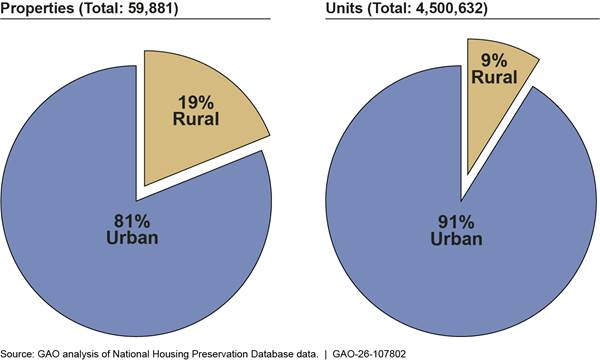
Note: The National Housing Preservation Database is an address-level inventory of federally assisted rental housing in the U.S. and is administered by the National Low-Income Housing Coalition and the Public and Affordable Housing Research Corporation. To identify urban and rural properties, we used classifications from the U.S. Department of Agriculture at the 2020 census-tract level. We combined the “small town” and “rural” categories into a single rural classification (codes 7–10) and the “urban core” and “suburban/micropolitan” categories into a single urban classification (codes 1–6). Totals exclude 724 properties for which the subsidy status was ambiguous.
Service Coordination Funding Sources
HUD service coordinator programs. Two HUD programs fund service coordination in eligible affordable rental housing: the Service Coordinators in Multifamily Housing Program and the Resident Opportunity and Self-Sufficiency (ROSS) Service Coordinator Program (see table 2).[13] In fiscal year 2025, these programs received $152 million in appropriations combined.
Table 2: HUD Service Coordination Programs for Assisted Multifamily and Public Housing, as of Fiscal Year 2025
|
HUD office |
Program name |
Description |
Fiscal year 2025 appropriations |
|
Office of Multifamily Housing |
Service Coordinators in Multifamily Housing Program |
Awards grants to eligible HUD-assisted multifamily properties to hire service coordinatorsa Allows eligible HUD-assisted multifamily properties to use operating funds to hire service coordinatorsb Participants are generally subject to the same program requirements regardless of funding type |
$112 million |
|
Office of Public and Indian Housing |
Resident Opportunity and Self-Sufficiency Service Coordinator Program |
Awards grants to public housing agencies and other eligible entities to hire service coordinatorsc |
$40 million |
Source: GAO analysis of Department of Housing and Urban Development (HUD) documents. | GAO‑26‑107802.
Note: This table does not include HUD’s Family Self-Sufficiency Program, which is sometimes classified as a service coordinator program, because it has different goals, services, and target populations than the programs listed.
aEligible properties are designated primarily for occupancy by older adults or persons with disabilities, including those generally subsidized through programs such as HUD’s Section 202 Direct Loan, Project-Based Section 8, and Section 221(d)(3) mortgage insurance.
bProperties whose operating budgets can support service coordinators are generally not eligible for grants through this program.
cEligible entities generally include nonprofit housing entities, Tribes, Tribally Designated Housing Entities, and resident associations.
Other service coordination funding sources. HUD and USDA provide rental housing assistance or operating subsidies that can indirectly fund service coordinators through the assisted properties’ operating budgets, subject to certain approvals and restrictions.[14] Specifically, HUD allows public housing agencies (PHA) and other entities to hire service coordinators using their general operating funds. Eligible PHAs may also apply to supplement these operating funds through HUD’s Elderly and Disabled Service Coordinator subsidy grant to fund service coordination.
In addition, since 2022, USDA’s Office of Rural Development has allowed properties with Section 515 Multifamily Direct Rural Rental housing loans to fund service coordinators through their operating budgets.[15] Owners and managers of federally assisted properties may also use state, local, and private philanthropic funds to hire service coordinators. Some properties may combine these funds with federal sources.
HUD Service Coordinator Roles and Tasks
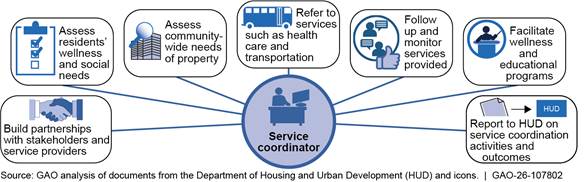
Service coordinators funded by HUD’s Service Coordinators in Multifamily Housing Program and ROSS Service Coordinator Program perform several tasks, including assessing residents’ needs and referring them to service providers (see fig. 2).
Figure 2: Tasks of Service Coordinators Funded by HUD’s Offices of Multifamily Housing and Public and Indian Housing
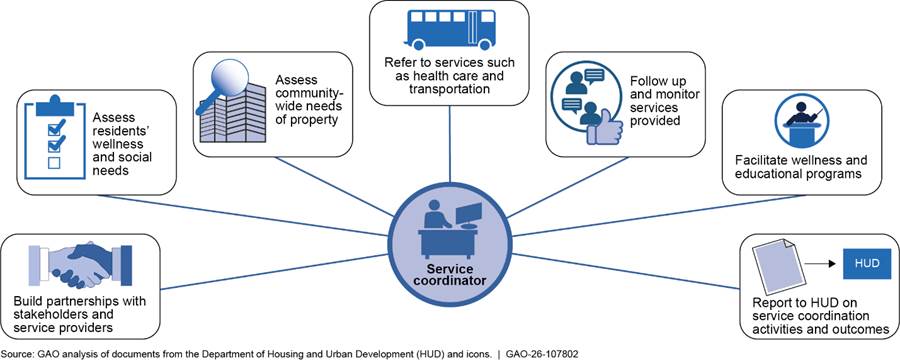
Note: Service coordinators funded by HUD grants and operating funds perform the same tasks.
Staffing and Service Delivery Arrangements
Service coordinator staffing and service delivery arrangements may differ across programs, properties, and regions. Service coordinators may do the following:
· Be directly hired or contracted. HUD multifamily properties and ROSS grantees may hire a service coordinator directly or contract with a local stakeholder to provide service coordination.
· Work full time or part time. A HUD multifamily property with fewer than 50 units may hire a part-time service coordinator. HUD ROSS grantees must have one full-time service coordinator position, which can be split between two or more part-time service coordinators. Part-time employment is generally defined as less than 35 hours per week.
· Serve one or multiple sites. HUD multifamily properties may have one service coordinator per property or share a service coordinator across multiple properties. For example, assuming a 50-unit workload, two 25-unit properties could share a full-time service coordinator. ROSS grantees may have several properties that are not physically colocated.
· Have specific caseload requirements. Full-time service coordinators at HUD-assisted multifamily properties or positions funded through ROSS grants should generally serve at least 50 residents.[16]
·
Work on-site or remotely. Most service coordinator
activities require some on-site, direct interaction with residents. HUD’s
technical assistance resource guide recommends considering whether some
activities, such as researching local stakeholders, or following up with
residents, could be done off-site.[17]
HUD Collects Some Data on Service Coordinators but Has Not Fully Addressed Quality Issues or Assessed Outcomes
Comprehensive Data on Service Coordinators Are Not Available, but HUD Collects Some Information
Comprehensive data on service coordinators in federally assisted affordable housing, including housing in rural areas, are not available. Some federal agencies support affordable housing projects that may employ service coordinators, such as Treasury and USDA. But these agencies do not administer service coordinator programs, so they do not collect service coordinator data. For example, USDA allows properties assisted by certain programs to use operating funds to hire service coordinators, but USDA officials said collecting data on service coordinators at properties in its assisted housing portfolio would require substantial resources.[18]
Similarly, officials from Treasury’s IRS and Community Development Financial Institutions Fund said they do not collect data on service coordinators at properties developed with Low-Income Housing Credits or New Markets Tax Credits. These properties may employ service coordinators funded through other non-tax credit sources. However, the tax credits do not directly fund service coordinators, and officials said that the agencies do not collect data on property operating costs, including service coordination expenses.
In contrast, HUD’s Office of Public and Indian Housing and Office of Multifamily Housing (a component of the Office of Housing) administer service coordinator programs that collect administrative data, such as grantee names and property addresses. These offices also collect performance data on the service coordination they fund, such as the number and type of services received.
· Public and Indian Housing. For its ROSS program, Public and Indian Housing collects data on the number of service coordinators by grantee (i.e., PHA or other eligible entity).[19] It also collects annual performance data on these coordinators through a standardized reporting framework, Standards for Success, which captures residents’ outcomes in areas such as housing, finances, and health.[20]
In addition to the ROSS program, Public and Indian Housing tracks the number of PHAs that receive Elderly and Disabled Service Coordinator supplementary funding. It also allows all PHAs to use their operating budgets to fund service coordinators.[21] However, HUD officials said they do not track how many PHAs have budget-funded service coordinators because the relevant information system does not differentiate between operating funds used for service coordination and those used for direct supportive services.
· Multifamily Housing. For its Service Coordinators in Multifamily Housing Program, Multifamily Housing maintains data on which properties have service coordinators, although the data for budget-funded service coordinators have quality problems described later in this report. The program requires all properties with service coordinators, whether budget-funded or grant-funded, to comply with the same program standards, including operating and performance reporting requirements. Multifamily Housing also collects annual performance information on service coordinators in the program using the Standards for Success reporting framework.
Our analysis of HUD’s administrative data for grant-funded service coordinators provides a partial view of how many rural HUD-assisted PHAs and multifamily properties have service coordinators. Corresponding information on budget-funded service coordinators is not known either because the information is not collected (in the case of Public and Indian Housing) or because of data quality issues (in the case of Multifamily Housing).
· Public and Indian Housing. Grant data show that in fiscal year 2024, the ROSS program funded 50 service coordinators at 49 PHAs or other eligible entities headquartered in rural locations.[22] Additionally, five rural PHAs received funding to cover service coordination expenses through Elderly and Disabled Service Coordinator supplemental funding.
·
Multifamily Housing. Grant data show that in calendar year
2024, the Service Coordinators in Multifamily Housing Program funded
approximately 113 grant recipients to employ service coordinators at rural
multifamily properties.[23]
Multifamily Housing does not compile data on the total number of service
coordinators in the program or at each property. Based on informal observation
and experience, Multifamily Housing officials said most properties employ one
service coordinator and typically no more than two.
Data on Budget-Funded Service Coordinators in HUD Multifamily Housing Are Not Reliable
HUD’s Office of Multifamily Housing has recognized the need for quality data on budget-funded service coordinators but has faced challenges meeting that need. From 2013 to 2020, Multifamily Housing took several steps to improve data on service coordinators in its Integrated Real Estate Management System (iREMS).[24] These steps included a data clean-up and verification effort by regional offices in 2013, headquarters guidance on data entry issued to regional offices in 2016, and the addition of a new iREMS data field on service coordinator funding sources in 2020.[25] Additionally, Multifamily Housing officials told us they had planned to do another clean-up and verification effort of iREMS service coordinator data but did not do so because of resource constraints. In connection with the 2013 data clean-up effort, a HUD memo stated that the agency aimed to reliably count and track properties with budget-funded service coordinators to support planning and monitoring of the Service Coordinators in Multifamily Housing Program.[26]
However, HUD’s prior efforts have not resulted in lasting data quality improvements. Our review of the iREMS data found data quality weaknesses that preclude accurate counting and tracking of multifamily properties with budget-funded service coordinators. For example, HUD provided us a spreadsheet of properties that identified those with service coordinators, on the basis of certain iREMS fields. However, the spreadsheet contained records with the following issues:
· Information on the presence of a service coordinator was outdated in most cases—ranging from 2 to 10 years old—or provided no clear indication of when it was last updated.
· Information about the service coordinator’s funding source was sometimes contradictory or ambiguous. For example, categorical fields suggested one funding source, but a narrative comment field indicated a different source.
· Information in categorical funding source fields was unclear because the categories were used inconsistently. For example, the same combination of funding source categories was used in different records to indicate that a property had a HUD budget-funded service coordinator, a non-HUD funded service coordinator, or no service coordinator.[27]
· Information in a narrative field could not be reliably or efficiently analyzed because it contained multiple, nonstandardized terms to describe the same condition. In some instances, the field indicated the presence of a service coordinator in at least nine different ways.
Because of these weaknesses, determining whether a property actively employs a budget-funded service coordinator may require subjectively interpreting or weighing the reliability of different iREMS fields. As a result, these determinations may vary depending on who conducts the analysis.
According to HUD officials, iREMS was not designed to track which properties have service coordinators through its existing data fields. They said that, as a result, HUD has had to repurpose certain data fields to track that information. Officials said they would like to add dedicated service coordination fields in iREMS but have not received appropriations to do so.
The data quality weaknesses we observed stem partly from the absence of current and uniformly applied iREMS data entry procedures. For example, three of the four regional offices we contacted stated that they did not have written procedures for recording service coordinators’ status and funding source.[28] In addition, Multifamily Housing headquarters officials said they were not aware of any current, standardized procedures used consistently across all regional offices for entering service coordinator information into iREMS.
Uniform data entry procedures could improve data quality by reducing the amount of dated, contradictory, or unclear information. For example, procedures that establish common rules for updating data, using categorical funding fields, and applying standardized terms in narrative fields would help address these data quality issues.
In the absence of such procedures, Multifamily Housing cannot reliably count and track properties with budget-funded service coordinators to support planning and monitoring for the service coordinator program.[29] For example, HUD cannot accurately assess trends or patterns—such as changes in program participation—that could inform HUD policy and oversight. Multifamily Housing officials said rising property insurance costs may be limiting the ability of some property owners to fund service coordinators out of their operating budgets. But further assessment of this issue would require reliable data on program participation. Moreover, HUD cannot fully assess whether all properties with service coordinators are complying with program requirements, such as submitting annual service coordinator performance reports.
Federal internal control standards call for management to use quality information and design control activities, such as policies and procedures, to achieve objectives.[30] Quality information is appropriate, current, complete, accurate, accessible, and provided on a timely basis. Although HUD has taken steps in the past to improve the quality of iREMS data, the effects of one-time efforts may be temporary, and data reliability may degrade over time without consistent data entry. Developing and uniformly applying data entry procedures could help ensure that HUD can use iREMS data to reliably determine the number and location of budget-funded service coordinators on an ongoing basis.
HUD Has Not Regularly Used Performance Data to Assess Service Coordination Outcomes in Multifamily Properties
Although HUD requires multifamily properties with service coordinators to submit annual service coordinator performance reports, the Office of Multifamily Housing does not regularly use this information to assess program outcomes, such as services provided or residents served. HUD’s last substantive analysis of this information used performance reports for fiscal year 2020.[31] Since then, service coordinators and housing providers have submitted new performance reports to HUD. Two service coordinators and one housing provider told us that preparing them takes significant time and resources. For each resident served, service coordinators must enter roughly 70 data elements on health, housing, and other outcomes.[32] The reports also contain administrative information, including the number of service coordinators working at the property.
However, Multifamily Housing has limited insight into the outcomes of its service coordinator program because it has not established a routine process for obtaining, preparing, and analyzing the data. In general, the data are stored and accessed by a contractor that serves multiple federal agencies. As a result, obtaining data extracts can take a significant amount of time and requires advance planning. In addition, the data may contain sensitive tenant-level information and duplicate records (e.g., if properties submit performance information incrementally rather than annually).
Therefore, before analysis can begin, the data must be cleaned, in part to identify and remove sensitive information and prevent improper disclosure, according to HUD officials. In addition, analyzing the data would require aggregating and tabulating information in ways that are useful to end users. The length and potential complexity of these steps underscores the importance of having established processes to carry them out.
In contrast, Public and Indian Housing has processes for annually analyzing performance reports submitted by ROSS service coordinator grantees and presenting the results in a public dashboard. Public and Indian Housing uses a contractor to support these activities. HUD’s website provides training webinars to help ROSS grantees understand and use the dashboard to improve their programs. The dashboard visually summarizes grantees’ performance information and progress on program priorities, including services provided and resident outcomes. The dashboard also allows grantees to compare their activities with those of grantees with similar portfolios to identify opportunities for improvement.
HUD officials described efforts Multifamily Housing had made in recent years to start using the annual performance reports. However, these efforts were limited in scope and did not fully leverage information contained in the reports. For example, the officials described efforts focused on reconciling service coordinator information across different data systems rather than on assessing service coordinator program outcomes.
We previously identified key performance management practices that can help federal leaders and employees effectively manage and assess their programs, including using evidence to learn.[33] Evidence—such as the performance data Multifamily Housing collects in annual performance reports—can help an organization assess program outcomes and better understand what led to current results. When managers review performance and administrative data, their assessments can help determine when existing strategies are working as intended or help identify opportunities for improvement. In addition, by disaggregating and analyzing relevant data, an organization can evaluate whether results varied on the basis of different factors, such as geographic location.
By establishing a process for using the annual service coordinator performance reports, Multifamily Housing could better assess program efficiency and effectiveness. For example, the reports collect information on the number of service coordinators and hours worked. Multifamily Housing officials said comparing the number of full-time service coordinators with the number of residents served could provide insight into service coordinator caseloads. Caseload information, in turn, could help HUD assess the share of property residents that are receiving services or whether service coordinators are over- or under-utilized. Additionally, analyzing information on the nature and number of services received could provide insights into the effect of service coordination on residents’ well-being.
Stakeholders Cited Benefits of Service Coordination, and Selected Studies Reported Varied Effects
Stakeholders Identified Perceived Benefits to Residents’ Health, Housing Stability, and Finances
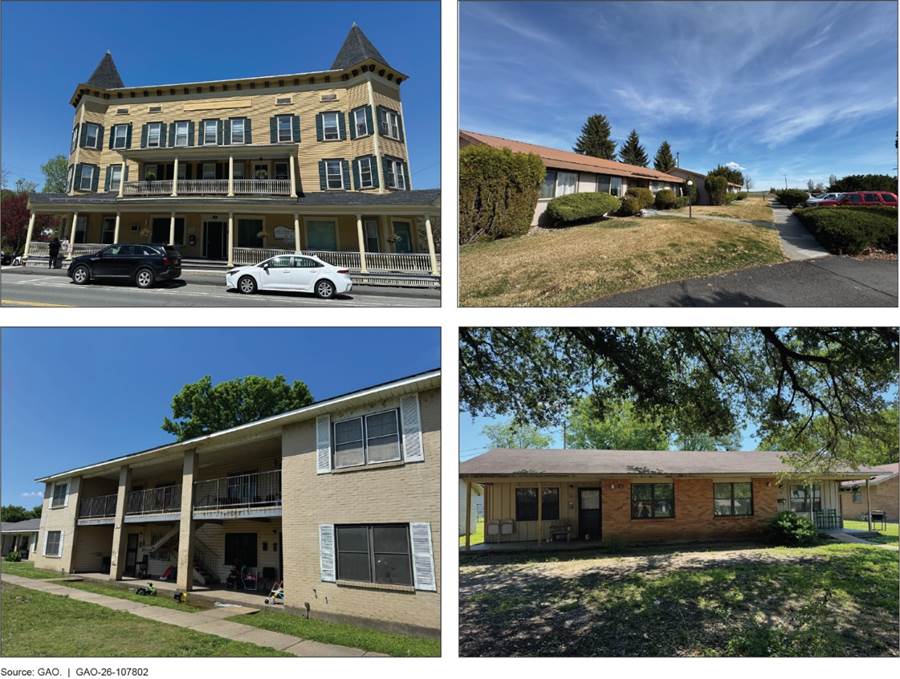
Most local stakeholders we interviewed said service coordinators improve residents’ well-being, including in health, housing, or finances.[34] These stakeholders included service coordinators, housing providers, and supportive services organizations we spoke with on our site visits to selected rural areas. Figure 3 shows examples of affordable rental housing with service coordinators that we visited.
Health
Multiple local stakeholders we spoke with said service coordinators supported residents’ health, such as by helping them access benefits like Medicaid and Medicare, arranging transportation to medical services, or connecting them with food programs like Meals on Wheels. Service coordinators also assisted residents in identifying mental health concerns, including depression, hoarding, or cognitive decline, according to a few local stakeholders. Multiple local stakeholders reported that service coordinators enhanced residents’ sense of well-being or quality of life, such as by providing personalized support and linking them to community resources.
For example, we spoke with a service coordinator in Louisiana who assisted an older adult with chronic health issues and a low fixed income. The service coordinator said they helped the individual apply for Medicaid and obtain a home health nurse, which helped the individual remain independent.
In addition, two housing providers and a local stakeholder discussed a number of older adults who are aging alone without family or other close contacts. They said service coordinators particularly benefit these residents by reducing social isolation and serving as emergency contacts.
Housing
Service coordinators support residents’ housing stability, including by helping prevent evictions, reduce rent delinquency, or navigate relationships with landlords, according to property managers and owners at all of our four site visit locations.[35] Two property managers said service coordinators help residents stay in compliance with property requirements—for example, by identifying and addressing issues that could lead to eviction, such as hoarding. One service coordinator described how building strong relationships with residents develops trust that can promote housing stability. For example, two housing providers said residents may avoid interacting with property management about a missed rent payment but will talk to a service coordinator whom they trust and whose role is to offer solutions.
During our site visits, two housing providers also said service coordinators helped older adults remain independent longer, allowing them to age in place rather than move to an assisted living facility.
Finances
Multiple local stakeholders said that through community programs, education events, or one-on-one check-ins, service coordinators helped residents improve their financial situation, budget funds, and stay current on bills and rent payments. For example, a service coordinator in Louisiana said they helped working-age residents increase their income (e.g., by finding a higher-paying job) and enabled some to move out of public housing. In Washington, a housing provider said their service coordinators may help residents obtain emergency cash assistance to cover essential living costs. In addition, four housing providers said service coordinators help residents reduce health costs and manage benefits.
Education, Employment, and Other Services
Service coordinators helped residents find employment and training opportunities by connecting them with job resources, according to a few local stakeholders we interviewed. For example, a ROSS service coordinator in Louisiana described how they helped a few low-income, working-age residents set goals and connect to training and education programs. They said they assisted residents in identifying local schools, applying for programs and financial aid, and coordinating transportation, and checked in regularly on these residents’ progress. As a result, some residents obtained degrees and certifications such as a GED, Certified Nursing Assistant, or Licensed Practical Nurse, according to the service coordinator. One property manager in New Hampshire and one service coordinator in Louisiana cited examples of service coordinators connecting residents with childcare and afterschool services that enabled the residents to seek education or obtain employment.
Selected Studies Reported Varied Effects of Service Coordination
Our review of five selected studies identified varied effects of service coordination on residents, including examples of favorable effects reported by service coordinators, residents, or property managers through interviews, focus groups, or surveys.[36] Four of the five studies we reviewed that measured potential effects of service coordination on certain resident housing, health, or financial outcomes reported mixed results.[37] The studies examined various approaches to service coordination, were conducted in diverse geographic locations, and used a range of methodological techniques.[38] Key findings for each study are described below.
· A 2019 evaluation of HUD’s ROSS Service Coordinator Program reported that many affordable housing residents rely on service coordinators to help address emergency and long-term needs, such as access to food and transportation to work.[39] The study reported that more than one-half of the service coordinators surveyed and interviewed reported using individualized plans to help residents set employment or education goals and track progress. Available data were not sufficient to determine how the ROSS program affected residents’ outcomes. Overall, residents participating in focus groups reported positive experiences with the program and increased awareness of resources that could help them overcome barriers to self-sufficiency or aging in place.
· A 2016 study examined the potential effects of a program combining on-site service coordination with other supportive services, including a centrally located medical doctor and social space.[40] The program targeted predominately low-income seniors and individuals with disabilities in 10 subsidized apartment buildings in Portland, Oregon. Survey respondents who engaged more frequently with the program reported they were more likely to access and use preventive health care, such as primary care and screenings, than those who engaged less. However, only the difference in primary care access was statistically significant. The study also found that surveyed residents reported less food insecurity, or fewer concerns about having enough food, after the program had been available for 16 months.
· A 2015 study of seniors living in HUD-assisted properties across nine states found that residents with access to on-site service coordinators had significantly lower odds of an acute inpatient admission compared with residents without such access.[41] The study measured other outcomes—such as emergency department visits and physician office visits—that showed no significant associations with the presence of an on-site service coordinator.
We also reviewed two studies that examined the potential effects of health and wellness teams—coordinators that assess residents’ needs and connect them to supportive services and wellness nurses—on seniors living in affordable housing.
The first study reported interim 2022 findings from a HUD-sponsored demonstration project of the Integrated Wellness in Supportive Housing (IWISH) model. The study found no evidence that the model affected older adults’ health care use or housing tenure in HUD-assisted properties when compared with properties in control groups after a 3-year period.[42] The IWISH model consists of a full-time on-site resident wellness director (an enhanced service coordinator position focused on residents’ health and wellness through a structured, person-centered approach); a part-time nurse; and supplemental funding to implement structured health and wellness activities.
However, the interim study also found evidence that IWISH participants reported perceived benefits from the program. For example, senior residents reported in focus groups that IWISH may improve housing stability, well-being, and awareness of health needs. The evaluation also noted limitations with the interim report on program outcomes, and a long-term assessment of effects is expected in 2026.[43]
The second study assessed the potential effect of a Vermont-based service coordinator program known as Support and Services at Home (SASH) on older adults and people with disabilities from 2010 through 2016 using medical expenditure and survey data.[44] The SASH program is intended to improve health and slow the growth of health care costs by providing service coordination and health and wellness services using affordable housing as a delivery platform.[45]
Among all SASH participants, this 2019 study found no evidence of reduced growth in health care expenditures relative to the comparison group for all reported health care measures. However, subgroup analyses found that some program participants experienced slower growth in institutional long-term care expenditures—specifically, rural participants and those living on-site with SASH staff. However, those results approached but did not meet statistical significance, and faster growth in post-acute care expenditures among rural participants was significant.
In addition, the SASH program was associated with slower growth in health care expenditures for two participant subgroups—an urban subgroup and a regional subgroup managed by the statewide SASH administrator—that included nearly one-half of all SASH participants. These subgroups showed evidence of slower growth in total health care expenditures and expenditures for acute hospital care, emergency department visits, and specialist visits, relative to the comparison group.[46] Researchers noted that these participants had access to additional community-based resources, which may have contributed to these outcomes.
Interviews with property managers indicated that SASH coordinators and wellness nurses provided residents the support they needed to remain safely in their homes, age in place, and avoid eviction. SASH participants also reported significantly fewer problems with medication-related tasks than a comparison group without access to SASH coordinators, such as remembering to take their medication and obtaining refills.[47] Additionally, property managers interviewed said they appreciated how SASH staff helped residents with physical and mental health concerns and connected them to health and other support services.
Federal Agencies and Local Stakeholders Have Used Multiple Approaches to Address Rural Service Coordination Challenges
Key Challenges to Rural Service Coordination Include Funding Availability and Limited Services
We identified several challenges to rural service coordination from interviews with agency officials and selected national and local stakeholders.
Managing Multiple Funding Sources May Impose Administrative Burden
Rural housing providers may fund service coordination through various methods, including through HUD or other grants, or as part of HUD and USDA affordable housing subsidies.[48] Three housing providers reported that combining multiple funding streams to provide service coordination in rural affordable properties can pose an administrative burden, as programs may have differing requirements or target populations. For example, one rural housing provider described combining a community health worker grant with a rural property’s HUD operating subsidy to support service coordination at several properties. As a result, the service coordinator’s duties and reporting requirements vary by property, depending on the funding source.
Four housing providers also described other situations that increase the administrative complexity of maintaining a service coordinator, including using rental subsidies from both HUD and USDA, transitioning from one subsidy to another, or transferring ownership while maintaining affordability. For example, one PHA administrator we spoke with transitioned their affordable housing portfolio from HUD’s public housing program to HUD’s multifamily housing program and then hired a third-party property administrator. As a result, the PHA has used different sources to fund service coordination in the same properties over time.
Grant Applicants May Have Limited Capacity to Navigate the Grant Process
Small, rural PHAs and properties with fewer staff and resources to navigate federal grant applications and requirements may face challenges competing for HUD’s service coordinator grants. For example, three housing providers we spoke with were not aware of HUD grant funding for service coordination or said they generally did not have the capacity to research and apply for competitive funding opportunities. Four housing providers said they consider several factors when deciding to apply for grants, such as the amount and duration of funding provided and reporting and staffing requirements.
Multiple local stakeholders also noted that it can be risky to rely on short-term funding, such as grants that may not be renewed. HUD service coordinator grants are limited, and renewals are subject to the availability of funds. The ROSS grant selection process includes preferences for resident associations and renewal applicants, after which new applicants may be selected.[49] Service Coordinators in Multifamily Housing Program grantees are selected through a regional lottery of qualified applicants.
Service Coordination Competes with Other Budget Priorities
Two housing providers said rising property management costs, such as insurance, may lead them to cut budget-funded service coordinators from their operating budgets. Two housing providers said affordable properties are constrained because they cannot easily increase revenue by raising rents. One housing provider noted that because service coordination is a property-level line item, any rent increase to fund service coordination must apply to all units in the property, even if some residents rely on the service coordinator and others do not.
Recruiting and Retaining Qualified Staff May Be Difficult
Three housing providers we spoke with said recruiting qualified service coordinator staff can be difficult because of the low salary, limited hours, or potentially long commutes. For example, two housing providers said service coordinator salaries in rural areas are not competitive given the professional qualifications and workload the position requires. Additionally, one housing provider said service coordinators in rural areas may leverage their experience and training to seek higher-paying positions. HUD has taken steps to address issues with the salaries of grant-funded service coordinators, including requiring them to be based on the median salaries of social workers or other salary-comparability information.[50]
Housing providers may hire a part-time service coordinator to assist small properties that do not meet the unit requirement for a full-time position. However, one multifamily housing provider said it can be difficult to hire and retain qualified staff for a part-time position with few weekly hours, especially in rural areas. HUD allows housing providers to hire one full-time service coordinator to assist two smaller properties. But two housing providers told us this model is not always feasible because long distances between remote properties can increase commuting time and costs.
Services May Be Limited
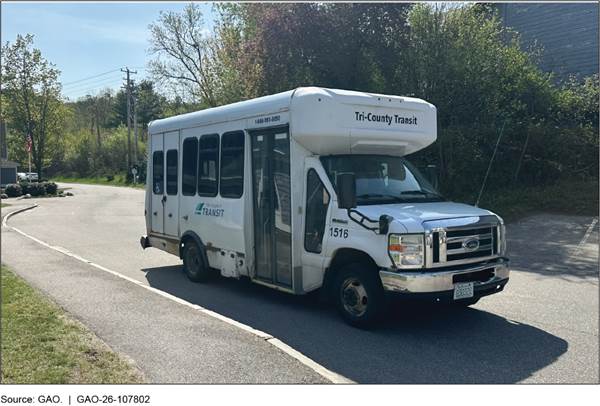
Multiple local stakeholders we spoke with said that services are limited in rural areas and that connecting residents to available services can be difficult. Multiple local stakeholders noted that residents in rural properties may face long travel times to reach available service providers and have few transportation options. (See fig. 4 for an example of a regional bus service.) One local stakeholder noted that clients may need to travel between states to access services but said funding can limit transportation services to specific counties. As a result, clients may need to use multiple transportation providers to reach their destinations.
Multiple local stakeholders we interviewed said their rural areas rely on a small number of organizations to provide a range of services.[51] For example, one local stakeholder owns and operates affordable housing, provides transportation and nutrition services, and administers the Low Income Home Energy Assistance Program (which subsidizes utility costs for eligible households). The organization’s representatives described challenges related to limited funding, including energy assistance that did not meet demand, and inconsistent funding, such as a pilot that funded affordable farmers’ markets but was later discontinued. The representatives said navigating different funding scenarios constrained the organization’s capacity to serve its communities.[52]
A few local stakeholders also said fewer organizations with lower capacity may result in additional service gaps for local residents. One local stakeholder noted that residents may have to travel farther to get medications as the number of local pharmacies decreases. Additionally, we have previously reported on the effect of rural hospital closures on residents’ access to health care.[53]
Broadband Connectivity and Digital Literacy May Be Limited
Multiple local stakeholders we spoke with said their communities lack reliable broadband internet and cell phone service, limiting the feasibility of virtual service coordination or use of telehealth services. For example, one service coordinator described the need to use paper administrative forms in properties without cell service. The service coordinator said they then had to update digital files based on the paper forms, increasing the time spent on administrative tasks.
Some residents in rural assisted housing also lack digital literacy, according to multiple local stakeholders we interviewed. One local stakeholder said that as public assistance programs transition to digital formats, rural residents without digital skills may be unable to access their benefits. For example, Login.gov (a platform to sign into many U.S. government websites with one account) requires account holders to use a phone number for multifactor authentication. Some clients may share phones, including landlines, with others who also need a phone number for their own account. One service coordinator said some residents need assistance ordering groceries online. Another said some residents are not interested in participating in community events that are offered virtually, such as health webinars.
Federal Agencies Have Taken Steps to Address Some Rural Service Coordination Challenges
HUD, USDA, and HHS officials described federal actions that may address some challenges to rural service coordination, including funding availability and limited services.
HUD allows direct services for some grantees. To help address the limited availability of services in rural areas and improve residents’ access to services, HUD revised policies for the ROSS program. A 2019 program evaluation found that grantees in rural areas reported fewer service providers with whom to partner and stated that additional funding for direct services could benefit grantees in communities with few resource partners.[54] Beginning in fiscal year 2024, HUD’s revised policy allows grantees to use up to 20 percent of their grant funds to provide services directly. Previously, HUD allowed grantees to use up to 10 percent of their grant for administrative costs, which could include direct services. Examples of direct services by a ROSS grantee could be on-site financial literacy classes or an education navigator program to help high school students and their families with the college application and federal student aid processes.
HUD provided guidance on virtual and off-site service coordination. According to a few local stakeholders we interviewed, service coordinators may reduce the time they spend in remote properties, while still meeting residents’ needs, by using communication tools other than in-person meetings. In 2021, HUD issued a technical assistance guide on virtual service coordination in Multifamily Housing properties.[55] The guide describes strategies used by service coordinators to assist residents while social distancing during the COVID-19 pandemic. It encourages property owners and service coordinators to consider the benefits of a virtual approach, depending on their properties’ broadband access and residents’ digital literacy. For example, after obtaining residents’ consent, service coordinators may meet with residents by phone or teleconference and maintain and update electronic records off-site.
USDA clarified service coordination as an eligible expense and collected information. Beginning in fiscal year 2022, USDA clarified that service coordination is an eligible expense for Section 515 rural properties, potentially increasing service coordinator coverage in rural areas. USDA properties may hire a service coordinator to assess tenant needs, link tenants to services, identify free services, and educate tenants on the availability of resources and supportive services. In 2024, USDA also engaged in informal efforts to learn more about service coordination in five states (Georgia, New Mexico, Minnesota, Virginia and Wisconsin), according to USDA officials.
HHS and HUD created the Housing and Services Resource Center. The center, which HHS and HUD established in 2021, is an interagency collaboration tasked with coordinating the agencies’ training, technical assistance, and resource development efforts related to the needs of older adults and people with disabilities. The center facilitates state and local partnerships between housing and service systems and aims to help local stakeholders leverage resources for housing, Medicaid-funded home and community-based services, behavioral health supports, and transportation services. USDA and other agencies joined the center in October 2024.
As of February 2026, the center’s website included information on topics including service coordination, supportive services, and accessible, affordable housing. Resources on the center’s website included a January 2024 webinar on combining various funding streams to provide service coordination in affordable housing. HHS officials said forthcoming resources for 2026 include a service coordination toolkit with information for housing providers, health partners, and aging and disability networks, along with case studies of service coordination.
Local Stakeholders Have Tailored Rural Service Coordination to Residents’ Needs and Communities
Housing providers and service coordinators we spoke with cited several approaches for effective service coordination in rural areas and noted the importance of tailoring approaches to local communities.
Tailoring service coordination to residents and communities. Multiple local stakeholders we spoke with said effective service coordination is tailored to residents and available local services. According to multiple local stakeholders, some rural residents are hesitant to seek services directly but are willing to get help from someone they trust who can refer them to services. One service coordinator described the importance of having initial in-person meetings to introduce the service coordinator program and available services. Five service coordinators said building trust through regular, informal interactions can help them understand residents’ needs over time. Another service coordinator reported using informal interactions with older residents to help identify any cognitive decline without using a formal assessment that could be perceived as invasive or condescending.
After establishing a relationship, service coordinators may tailor their approach to residents’ specific preferences and circumstances. One service coordinator discussed using text messaging to communicate with younger residents. Four service coordinators reported meeting with clients in their homes, which can help identify client needs and make referrals for services the client may not know are available. For example, one service coordinator reported making referrals to a nutrition assistance program after identifying residents’ need and eligibility through casual in-home conversations. Another service coordinator said they organized property-level monthly tenant council meetings to collect feedback from residents and identify needs for upcoming events. They noted that residents attending monthly events may also identify opportunities for mutual aid, such as carpooling.
Using flexible staffing arrangements. Flexible staffing arrangements can allow housing providers to adjust service coordination efforts to their organization’s capacity and properties’ location and needs, according to multiple local stakeholders we spoke with. For example, four housing providers we interviewed have full-time service coordinators who assist multiple properties. Service coordinators schedule specific on-site days at each property, allowing them to meet with residents regularly while avoiding the costs of frequent travel between properties. In addition, ROSS grantees may retain part-time service coordinators rather than one full-time service coordinator, as long as their combined hours equal one full-time service coordinator. This approach could benefit grantees with several physical sites that may not be in close proximity, since separate service coordinators could reduce travel time between multiple sites.
Contracting or direct hiring. Affordable housing providers can elect to hire and manage a service coordinator, or contract with a local stakeholder, such as a nonprofit, to provide service coordination for residents. According to USDA officials and one national stakeholder we spoke with, contracting this role can reduce the administrative burden for small housing providers. However, rural properties may not be near a local stakeholder that can provide service coordination.
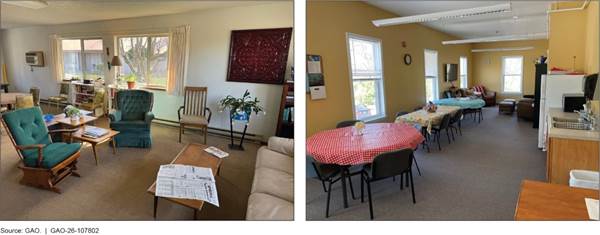
Connecting residents to services through on-site initiatives. Multiple local stakeholders said scheduling community-wide initiatives on-site and at convenient times can connect a greater number of residents to services while mitigating transportation challenges. (See fig. 5 for examples of community rooms in affordable rental housing.) For example, one housing provider said providing on-site health screenings can help make medical care more accessible, especially because their rural residents are less likely to seek medical treatment. Another service coordinator invited representatives of a local bank to visit and discuss their services with residents in response to residents’ concern about their financial institution after two local banks merged.
Collaborating with property management staff and service providers. Multiple local stakeholders said collaboration between service coordinators, property management staff, and service providers helped promote independent living and streamline residents’ access to services. For example, one service coordinator said other property staff may share observations about residents, such as mobility issues, that are helpful for the service coordinator’s needs assessments. A housing provider said service coordinators help residents respond to letters from property managers about their tenancy. For example, if a resident receives notice that their tenancy is threatened due to excessive clutter or hoarding, the service coordinator can connect them to housekeeping or mental health services that can help address the issue.
Service coordinators also work closely with available local service providers and other stakeholders to connect residents to resources, according to most multiple stakeholders we spoke with. (See fig. 6 for an example of pamphlets from local service providers.) One local stakeholder that worked closely with older adults described how properties with service coordinators are more connected to senior programing, including nutrition and transportation assistance, than properties without them. A housing provider reported that its service coordinator planned on-site activities, including a back-to-school event with the Boys and Girls Club. Multiple local stakeholders said working with local businesses and churches can help fill small assistance gaps for affordable housing residents. For example, one housing provider reported receiving an in-kind donation of winter coats, which the service coordinator distributed to residents.
Figure 6: Pamphlets for Local Service Providers Displayed in a Service Coordinator’s Office in Rural New Hampshire

Sharing information with peers. Five service coordinators reported using professional associations and peer networks to learn about strategies and approaches that other coordinators have found helpful. For example, two service coordinators in one state reported attending training offered by state and regional professional associations. One ROSS service coordinator described efforts to share best practices they developed, including a rent repayment program to help residents maintain their tenancy. One PHA administrator also described using professional associations and informal networks to learn about funding opportunities for service coordination.
Conclusions
Service coordinators link affordable housing residents to supportive services that help them remain independent and in their own homes. Rural areas may face greater need for and challenges in providing service coordination because of demographic, geographic, and other factors. Reliable information on the location and activities of service coordinators can provide insights into the availability and effects of service coordination across geographic areas, including rural communities.
As the administrator of two service coordination programs, HUD has recognized the need for such information and has processes to collect substantial data from participating properties and service coordinators. However, shortcomings exist in the quality and use of these data in HUD’s multifamily housing program:
· Because HUD’s Office of Multifamily Housing does not have uniform procedures for entering data into iREMS, it does not have quality information on the number of multifamily properties with budget-funded service coordinators. Developing and using such procedures would help Multifamily Housing track participation in its service coordinator program and assess compliance with program requirements.
·
Because Multifamily Housing does not have processes for using the
annual performance information submitted by service coordinators, its
understanding of program outcomes is limited. Establishing a process to
regularly access, clean, and analyze these data could help Multifamily Housing
evaluate the efficiency and effectiveness of its service coordinator program.
Recommendations for Executive Action
We are making the following two recommendations to HUD:
The Secretary of HUD should ensure that the Assistant Secretary for the Office of Housing develops and uses uniform procedures for entering data into iREMS that improve the quality of information on budget-funded service coordinators. (Recommendation 1)
The Secretary of HUD should ensure that the Assistant Secretary for the Office of Housing establishes a process to use the performance information collected for the Service Coordinators in Multifamily Housing Program to analyze program outcomes. (Recommendation 2)
Agency Comments
We provided a draft of this report to HUD, USDA, Treasury, and HHS for their review and comment. HUD, USDA, Treasury’s Community Development Financial Institutions Fund, and HHS had no comments on the draft report.
Treasury’s IRS provided technical comments, which we incorporated as appropriate.
We are sending copies of this report to the appropriate congressional committees, Secretary of Agriculture, Secretary of HUD, Secretary of HHS, Secretary of the Treasury, and other interested parties. In addition, the report is available at no charge on the GAO website at https://www.gao.gov.
If you or your staff have any questions about this report, please contact me at CackleyA@gao.gov. Contact points for our Offices of Congressional Relations and Media Relations may be found on the last page of this report. GAO staff who made key contributions to this report are listed in appendix II.

Alicia Puente Cackley
Director, Financial Markets and Community Investment
List of Congressional Requesters
The Honorable Joyce Beatty
House of Representatives
The Honorable Suzanne Bonamici
House of Representatives
The Honorable Adam Smith
House of Representatives
This report examines (1) the extent to which federal agencies collect and use data on rural service coordinators and the quality of those data, (2) what available evidence indicates about the effect of service coordination on residents’ well-being, and (3) any challenges to rural service coordination and approaches to address them. In this report, affordable housing refers to multifamily rental properties with federal subsidies that are tied to those properties. The primary federal agencies within our scope were the Department of Housing and Urban Development (HUD), the U.S. Department of Agriculture (USDA), and the Department of the Treasury because they administer programs or tax credits that support the development or operation of affordable housing.
To address these objectives, we
· performed geographic analysis of records in an affordable housing database;
· requested and, where available, analyzed federal data on service coordinators in affordable housing;
· selected and conducted nongeneralizable site visits to four rural areas that had affordable housing with service coordinators;
· reviewed selected studies on the effect of service coordinators on affordable housing residents;
· reviewed relevant statutes, regulations, and other agency and industry documentation on federal affordable housing and service coordination programs; and
· interviewed federal agency officials and representatives of selected national research and industry organizations.
Geographic Analysis of Affordable Housing
To obtain background information on the universe of affordable housing that may employ service coordinators, we analyzed data as of January 2026 from the National Housing Preservation Database, an address-level inventory of affordable housing properties.[56] The database is administered by the National Low-Income Housing Coalition and the Public and Affordable Housing Research Corporation. Using property addresses, we estimated the total number of properties in urban and rural areas that may employ service coordinators and the total number of dwelling units in those properties. Not all units in affordable housing properties have below-market rents or income restrictions.
For this analysis and throughout the report, we used USDA classifications of “small town” and “rural” at the census-tract level to classify properties, public housing agencies (PHA), and other eligible entities as rural. USDA uses Rural-Urban Commuting Area (RUCA) codes to classify census tracts as urban or rural on the basis of measures of population density, urbanization, and daily commuting. To measure a property’s rurality, we used its address to generate geocoordinates and spatially matched the property to 2020 census tract-level data. We then classified census tracts as urban or rural using USDA’s 2020 RUCA codes.[57] To generate geocoordinates for PHAs, we used their headquarters address, since they may be associated with more than one federally assisted property across multiple locations.
To assess the reliability of data from the National Housing Preservation Database, we reviewed technical documentation, performed electronic testing, and traced a sample of properties to HUD and USDA source data. We also interviewed or collected written information from National Low-Income Housing Coalition staff and from HUD and USDA officials. We determined that the data we used were sufficiently reliable for describing the amount and geographic distribution of affordable housing in the U.S. that may employ service coordinators. We did not assess the reliability of the data sources underlying the National Housing Preservation Database. Therefore, our analysis contains any limitations associated with those underlying data.
Analysis of Service Coordinator Data
To determine the extent to which federal agencies collect and use data on rural service coordinators, we asked HUD, USDA, Treasury, and the Department of Health and Human Services (HHS) to provide any information they maintain on the prevalence, location, and funding of service coordinators in assisted housing.[58] For reasons discussed earlier in this report, USDA, Treasury, and HHS did not have relevant data. HUD provided service coordinator data for programs administered by its Office of Public and Indian Housing and Office Multifamily Housing. These data included information on PHAs, other eligible entities, and HUD-assisted multifamily properties that received funding through HUD service coordinator programs or that funded service coordinators through their operating budgets.[59] The data also included performance information on service coordinators.
Number of Service Coordinators in Rural Public Housing
We analyzed Office of Public and Indian Housing data on PHAs and other eligible entities that received Resident Opportunity and Self-Sufficiency (ROSS) Service Coordinator Program grants in fiscal year 2024.[60] We also analyzed data on PHAs that received Elderly and Disabled Service Coordinator supplemental funding for calendar year 2025. These data were the most recent full-year data available at the time of our analysis. Each ROSS grant typically funds one service coordinator position in rural areas, while the supplemental funding is designed to cover service coordination expenses more generally. We used addresses in the data and applied USDA RUCA codes via the methodology described earlier to determine the number of grantees headquartered in rural areas that received funding from each source.
To assess the reliability of these data, we reviewed relevant documentation, interviewed knowledgeable agency officials, traced data to HUD congressional budget justifications, and performed electronic testing. We determined the data were sufficiently reliable to describe the number of rural PHAs and other eligible entities that received service coordination grants or supplemental funds from the Office of Public and Indian Housing.
Number of Service Coordinators in Rural Multifamily Housing
Data on grant-funded service coordinators. We analyzed an Office of Multifamily Housing list of entities (generally properties) that received grants under the Service Coordinators in Multifamily Housing program in calendar year 2024. This list was the most recent full-year data available at the time of our analysis. The list did not include grantee addresses but did include unique identifier numbers assigned by HUD’s Integrated Real Estate Management System (iREMS). This system is HUD’s official source of data on HUD-assisted or -insured multifamily properties and contains address information. We determined grantees’ addresses by using the unique identifier to match grantees in the list to iREMS data HUD downloaded and provided to us in March 2025. We were unable to identify addresses for about 1.4 percent of the grantees (21 out of 1,457) through this matching process. For grantees with an identified address, we used the geographic methodology described earlier to determine the number located in rural areas.
To assess the reliability of these data, we reviewed relevant documentation, interviewed knowledgeable agency officials, and performed electronic testing. We determined that these data were sufficiently reliable for describing the approximate number of rural entities that received Service Coordinators in Multifamily Housing grants in calendar year 2024.
Data on budget-funded service coordinators. The Office of Multifamily Housing collects service coordinator data in iREMS, which it considers to be the official source of information on budget-funded service coordinators in HUD multifamily properties. We analyzed iREMS data as of March 2025 for all HUD multifamily properties with either budget-funded or grant-funded service coordinators. To assess the reliability of these data, we reviewed HUD technical documentation and HUD’s policies and procedures for entering data into iREMS, interviewed knowledgeable agency officials, and performed electronic testing. Electronic testing consisted of identifying missing values, ambiguous values, logical inconsistencies, duplicates, and evidence of nonstandardized data entry or cleaning. In conducting this work, we focused on the iREMS data for budget-funded service coordinators because the Office of Multifamily Housing relies on a separate list of grantees for information on grant-funded service coordinators. We determined that the iREMS data were not sufficiently reliable to report the number or location of properties with budget-funded service coordinators.
The information and communication component of internal control was significant to this work, along with the related principle that management should use quality information to achieve the entity’s objectives.[61] The control activities component of internal control was also significant to this work, along with the related principle that management should design control activities to achieve objectives and respond to risks and implement control activities through policies.[62] We assessed the quality of HUD’s data and data entry procedures to determine whether they were consistent with HUD’s efforts to reliably count and track properties with budget-funded service coordinators to support planning and monitoring of the Service Coordinators in Multifamily Housing Program.
Performance Information on Service Coordinators
We assessed the Office of Public and Indian Housing’s and Office of Multifamily Housing’s use of performance information they collect on service coordinators. Specifically, we assessed their efforts against relevant key practices for evidence-based decision-making, including planning for results, assessing and building evidence, and using evidence.[63]
Both offices use a standardized reporting framework called Standards for Success that captures information on residents’ outcomes in areas such as housing, finances, and health. We reviewed HUD’s Standards for Success performance reports and related documents, including a data integrity manual and a list of data fields collected in the reports. We reviewed the Office of Public and Indian Housing’s ROSS data dashboard, which compiles and presents the performance information collected from the reports. We also reviewed the Office of Multifamily Housing’s plans to integrate the performance information into its own dashboard.
Site Visits to Rural Areas
To collect information on the effects and challenges of providing service coordination, we conducted nongeneralizable site visits to rural areas in four states: Louisiana, New Hampshire, Washington, and Wisconsin. We selected these areas because they had affordable housing with service coordinators and provided variation in geography and type of federal funding used. Specifically, we considered the following factors to select rural areas and properties within those areas:
· Rural areas. We selected one area in each of the four main census regions (North, Midwest, South, and West). Each area had at least one affordable housing property with a service coordinator. To identify these properties, we reviewed HUD fiscal year 2025 data provided by the Offices of Public and Indian Housing and Multifamily Housing and confirmed the presence of a service coordinator by contacting properties directly. We also used this outreach to confirm the availability of local stakeholders in each area to participate in interviews.
· Properties. Across our four rural areas, we selected properties to obtain diversity in (1) the types of federal housing subsidies they used, including HUD, USDA, and Treasury programs or tax credits; and (2) how they funded their service coordinators, including HUD ROSS Service Coordinator Program grants, HUD Service Coordinators in Multifamily Housing Program grants, and property or PHA operating budgets.[64]
In each rural area, we interviewed local stakeholders selected to obtain diversity in the types of roles involved in service coordination. These local stakeholders included eight service coordinators, 12 housing providers, and 14 organizations that provided supportive services or other community-based services.[65] These organizations included four community action agencies, one state office for health and aging, an area agency on aging, a mental health provider, a senior center, an employment center, and a nonprofit supportive service provider. We conducted a total of 23 interviews during our site visits and toured affordable housing properties in each area.[66]
We describe statements from these interviews in two ways. First, when summarizing how many local stakeholders across our site visits provided a particular response, we use the number of interviews (as opposed to the number of individual participants) as the unit of analysis. We broadly refer to their statements using qualifiers such as “a few,” “multiple,” and “most.” The qualifiers are defined as follows:
· “All” local stakeholders represents responses made by stakeholders in 23 interviews.
· “Most” local stakeholders represents responses made by stakeholders in 17 to 22 interviews.
· “Multiple” local stakeholders represents responses made by stakeholders in five to 16 interviews.
· “A few” local stakeholders represents responses made by stakeholders in two to four interviews.
In addition, when summarizing specifically how many service coordinators or housing providers provided a particular response, we use the number of individuals as the unit of analysis and do not use qualifiers. We attribute responses to these individuals when we interviewed them separately or could clearly ascribe responses to them in interviews with multiple participants.
We summarized the results of our interviews to develop categories of service coordination effects and challenges and to identify relevant examples from the rural areas we visited. The results of our selected site visits and local stakeholder interviews cannot be considered representative or generalizable to service coordination in all rural affordable housing.
Review of Studies
To identify what available evidence indicates about the effects of service coordinators on residents’ well-being, we conducted a literature review to identify relevant and recent studies on this topic. We targeted studies in which the titles and job descriptions of the service coordinators generally aligned with those for HUD’s service coordinator programs because this report focuses on federally subsidized service coordinators and properties. To assess what studies to include, we searched studies for the term “service coordinator” or a direct variant. If we did not find this terminology, we determined if the role described in the study aligned with our definition of service coordinator. We also considered whether the study warranted further assessment on the basis of statements from agency officials, interviewed stakeholders, or agency documents.
We excluded studies that examined other positions, such as social workers, community health workers, or nurses without combining that role with a “service coordinator” or similar variant. We also excluded studies that lacked sufficient detail on the service coordinators’ responsibilities to determine alignment with HUD’s programs.[67]
First, we identified 140 potentially relevant government, industry, and academic studies published from 2015 to 2025 by
· using multistage, librarian-assisted searches of academic databases (including Policy File, ProQuest, Scopus, and EBSCOhost) with search strings related to service coordinators, service coordination, and federally subsidized housing;[68]
· conducting internet searches;
· reviewing other literature cited in studies we identified (snowball method); and
· reviewing studies cited during our interviews with selected stakeholders and agency officials.
Two analysts systematically reviewed the abstracts and, as necessary, the full text of these studies to determine which studies met our inclusion criteria. To be included for further screening, the study had to directly examine the perceived or measurable effects of service coordinators on affordable housing residents’ well-being, including their health, housing, finances, or other areas.[69] Studies also had to focus on a U.S. population; be published from January 2015 through December 2025 in a peer-reviewed journal or issued by a federally sponsored or research institution; and contain original analyses of quantitative or qualitative data from interviews or focus groups. For studies that passed our initial screens, we further assessed whether the role of the service coordinator, as described in the study, matched dimensions of our service coordinator definition, including employer type, population served, and coordination of services in federally assisted properties.
Of the initially identified studies, nine met our inclusion criteria. Two methodologists assessed the methodological sufficiency of these studies based on generally accepted social science standards. We excluded studies that did not include original analyses or that lacked sufficient methodological detail or soundness. Based on this review, we selected five studies for final inclusion and summarized relevant and illustrative findings.
Review of Statutes, Regulations, and Other Documents
To identify the types of federal subsidies that support the development and operation of affordable housing and to identify federal service coordinator programs, we reviewed relevant statutes, regulations, and agency documents. While HUD’s Family Self-Sufficiency Program is sometimes classified as a service coordinator program, we did not include it in our scope because it differs significantly from other HUD service coordination programs with respect to goals, target population, and services provided.[70]
Because HUD-subsidized housing was the most central to our work, we reviewed HUD’s policies and procedures for PHAs and multifamily properties that receive HUD funding for service coordination or are approved to use operating funds for that purpose. We also reviewed the notices of funding opportunity for the ROSS Service Coordinator Program for fiscal years 2023 through 2025 and the Service Coordinators in Multifamily Housing Program for fiscal year 2024. Additionally, we reviewed USDA’s Multifamily Housing Asset Management Handbook to identify policies and procedures for using operating funds to hire service coordinators at USDA-assisted properties.
To identify actions agencies took to address service coordination challenges, we reviewed agency documents on updates to service coordination policies or practices in connection with feedback from affordable housing providers or other stakeholders. We also reviewed HHS documentation on the interagency Housing and Services Resource Center and publicly available information on the center’s website, including a webinar accessed in February 2026.
Interviews with Federal Agencies and National Organizations
For all of our objectives, we interviewed federal agency officials and representatives from stakeholder groups. These interviews addressed the different types of federal affordable housing subsidies and service coordination programs; service coordination data collection, requirements, and reporting; and the effects and challenges of providing service coordination.
We interviewed or received written responses from federal agency officials from HUD (including the Office of Public and Indian Housing and Office of Multifamily Housing), USDA (including the Rural Housing Service), HHS (including the Administration for Community Living), and Treasury (including the Internal Revenue Service and Community Development Financial Institutions Fund).
We also interviewed representatives from five national groups selected to cover different types of service coordination stakeholders, including advocacy, research, and industry organizations. These were the American Association of Service Coordinators, LeadingAge, the Housing Assistance Council, the Harvard Joint Center for Housing Studies, and the National Low Income Housing Coalition.
We conducted this performance audit from September 2024 to June 2026 in accordance with generally accepted government auditing standards. Those standards require that we plan and perform the audit to obtain sufficient, appropriate evidence to provide a reasonable basis for our findings and conclusions based on our audit objectives. We believe that the evidence obtained provides a reasonable basis for our findings and conclusions based on our audit objectives.
GAO Contact
Alicia Puente Cackley, CackleyA@gao.gov
Staff Acknowledgments
In addition to the contact named above, Steve Westley (Assistant Director), Kimberly Reardon (Analyst in Charge), Stephen Brown, Sarah Craig, Marc Molino, Christina Pineda, Jason Rodriguez, Jessica Sandler, Jennifer Schwartz, Rebecca Sero, Norma-Jean Simon, and Cindy Turner made key contributions to this report.
The Government Accountability Office, the audit, evaluation, and investigative arm of Congress, exists to support Congress in meeting its constitutional responsibilities and to help improve the performance and accountability of the federal government for the American people. GAO examines the use of public funds; evaluates federal programs and policies; and provides analyses, recommendations, and other assistance to help Congress make informed oversight, policy, and funding decisions. GAO’s commitment to good government is reflected in its core values of accountability, integrity, and reliability.
Obtaining Copies of GAO Reports and Testimony
The fastest and easiest way to obtain copies of GAO documents at no cost is through our website. Each weekday afternoon, GAO posts on its website newly released reports, testimony, and correspondence. You can also subscribe to GAO’s email updates to receive notification of newly posted products.
Order by Phone
The price of each GAO publication reflects GAO’s actual cost of production and distribution and depends on the number of pages in the publication and whether the publication is printed in color or black and white. Pricing and ordering information is posted on GAO’s website, https://www.gao.gov/ordering.htm.
Place orders by calling (202) 512-6000, toll free (866) 801-7077,
or
TDD (202) 512-2537.
Orders may be paid for using American Express, Discover Card, MasterCard, Visa, check, or money order. Call for additional information.
Connect with GAO
Connect with GAO on X,
LinkedIn, Instagram, and YouTube.
Subscribe to our Email Updates. Listen to our Podcasts.
Visit GAO on the web at https://www.gao.gov.
To Report Fraud, Waste, and Abuse in Federal Programs
Contact FraudNet:
Website: https://www.gao.gov/about/what-gao-does/fraudnet
Automated answering system: (800) 424-5454
Media Relations
Sarah Kaczmarek, Managing Director, Media@gao.gov
Congressional Relations
David A. Powner, Acting Managing Director, CongRel@gao.gov
General Inquiries
[1]The Department of Housing and Urban Development has generally considered housing affordable if it costs no more than 30 percent of household income. In this report, we use the term affordable housing to mean multifamily rental properties—including public housing and privately owned multifamily housing—with federal subsidies that are tied to those properties. The service coordinator programs within the scope of this report generally serve tenants of those properties, as opposed to other assisted renters whose housing subsidies are tied to the household (e.g., housing vouchers).
[2]In contrast, health or other services staff, such as nurses or social workers, typically work for organizations outside the housing sector and can often provide direct services like counseling or medical treatment.
[3]Federal tax credits that support the development of affordable rental housing include the Low-Income Housing Credit administered by IRS (also known as the Low-Income Housing Tax Credit) and the New Markets Tax Credit allocated by Treasury’s Community Development Financial Institutions Fund. According to IRS, the New Markets Tax Credit is generally unavailable for residential rental property, but it can be used in limited circumstances under Treasury Regulation (26 C.F.R. § 1.45D-1) where the residential rental property under Internal Revenue Code section 168(e)(2)(A) (codified at 26 U.S.C. § 168(e)(2)(A)) is part of a mixed-use project where less than 80 percent of the gross rental income comes from dwelling units.
[4]The National Housing Preservation Database is administered by the National Low-Income Housing Coalition and the Public and Affordable Housing Research Corporation. We analyzed data current as of January 2026. To assess the reliability of these data, we reviewed technical documentation, conducted electronic testing, traced a sample of properties to HUD and USDA source data, and interviewed knowledgeable staff. We determined these data were sufficiently reliable for describing the amount and geographic distribution of affordable housing in the U.S. that may employ service coordinators.
[5]To measure a property’s rurality, we used its address to generate geocoordinates and spatially matched the property to 2020 census tract-level data. We then classified the property’s census tract as urban or rural using USDA’s 2020 Rural-Urban Commuting Area codes, which are based on measures of population density, urbanization, and daily commuting. We combined USDA’s “small town” and “rural” categories into a single rural classification (codes 7–10) and its “urban core” and “suburban/micropolitan” categories into a single urban classification (codes 1–6).
[6]These local stakeholders included service coordinators and housing providers’ staff, such as administrators, property owners, managers, or developers, as well as staff from service providers or local community organizations like Community Action Agencies.
[7]For reasons discussed later in the report, data on service coordinators were not available from USDA, Treasury, and HHS.
[8]The specific date ranges for our analyses varied by service coordinator funding stream based on data availability. To assess the reliability of these data, we reviewed HUD documentation, conducted electronic testing, and interviewed knowledgeable agency officials. We determined that grantee data from the Resident Opportunity and Self-Sufficiency Service Coordinator and Service Coordinators in Multifamily Housing programs were sufficiently reliable for the purpose of reporting rural service coordinator funding recipients at the grantee level. We determined that data on service coordinators funded through the operating budgets of HUD-assisted multifamily properties were not sufficiently reliable to report the number or location of properties with budget-funded service coordinators, as discussed later in this report.
[9]GAO, Standards for Internal Control in the Federal Government, GAO‑14‑704G (Washington, D.C.: Sept. 10, 2014).
[10]GAO, Evidence-Based Policymaking: Practices to Help Manage and Assess the Results of Federal Efforts, GAO‑23‑105460 (Washington, D.C.: July 12, 2023).
[11]To be included in our final selection, the studies also had to (1) appear in a peer-reviewed journal or a federally sponsored or research institution publication from January 2015 through December 2025; (2) focus on a U.S. population; (3) contain original analyses of quantitative or qualitative data from interviews or focus groups; (4) contain sufficient detail on the service coordinators’ responsibilities, title, or job description to determine that these elements generally aligned with those for HUD’s service coordinator programs; and (5) directly examine the effect or perceived effect of service coordinators on affordable housing residents. We reviewed the studies’ methodologies for assessing these effects and determined them to be sufficiently sound.
[12]The National Housing Preservation Database is an address-level inventory of affordable housing in the U.S. that is administered by the National Low-Income Housing Coalition and the Public and Affordable Housing Research Corporation. It does not include data on properties developed with New Markets Tax Credits. Not all units in subsidized properties have below-market rate rents or are income-restricted.
[13]Although HUD’s Family Self-Sufficiency Program is sometimes classified as a service coordinator program, we do not cover it in this report because it differs significantly from the Service Coordinators in Multifamily Housing Program and ROSS Service Coordinator Program with respect to goals, target population, and services provided. It primarily serves HUD Housing Choice Voucher recipients through a structured 5-year curriculum aimed at building financial security. Many vouchers are tenant-based—that is, they are tied to the assisted household rather than a particular housing development or unit. As a result, voucher recipients live in a variety of property types, including single-family homes and multifamily developments that may not receive federal subsidies tied to the property.
[14]HHS programs such as Medicare, Medicaid Rehab, and programs authorized under Title III of the Older Americans Act fund services for eligible individuals that are similar to those performed by service coordinators for eligible individuals (e.g., referrals to supportive services). However, property owners and managers cannot use the funds to hire service coordinators.
[15]The Housing Act of 1949, as amended, authorized a service coordinator grant program for USDA properties, but the program has never received appropriations, according to USDA. 42 U.S.C. § 1485(y). USDA’s Section 514 and Section 516 Farm Labor Housing Program may also allow assisted properties to use their operating funds to hire service coordinators. However, USDA officials said these properties’ use of funds for that purpose was unlikely.
[16]HUD identifies the 50-resident benchmark for multifamily properties in its technical assistance resource guide and in its notice of funding opportunity for the Service Coordinators in Multifamily Housing grant for fiscal year 2024. The ROSS notice of funding opportunity for fiscal year 2024 requires grant recipients to have at least 50 units.
[17]Department of Housing and Urban Development, HUD’s Service Coordinators in Multifamily Housing Program Resource Guide – Appendix C: Building Capacity for Virtual Service Coordination (Washington, D.C.: May 2021).
[18]USDA officials said extracting and aggregating property-level budget information on service coordinators would require revisions to information systems, review processes, and staff training.
[19]Other eligible entities that may apply for the ROSS Service Coordinator Program include nonprofit housing entities, Tribes, Tribally Designated Housing Entities, and resident associations.
[20]For example, a service coordinator may report whether a resident has health insurance or employment.
[21]The Office of Public and Indian Housing does not consider service coordination funded through PHAs’ operating budgets to be a discrete program or subject to the requirements of ROSS.
[22]The ROSS program funded a total of approximately 475 service coordinators at 384 PHAs or other eligible entities in fiscal year 2024.
[23]The Service Coordinators in Multifamily Housing Program funded a total of approximately 1,439 grant recipients to employ service coordinators in calendar year 2024.
[24]Multifamily Housing officials use iREMS—an IT system—to record administrative property-level information, including data on which properties have service coordinators and how they are funded.
[25]We previously found weaknesses in the accuracy and reliability of HUD’s data on Section 202 properties with budget-funded service coordinators. Section 202 properties serve older adults and are statutorily required to provide supportive services to residents. We recommended that HUD improve the reliability of these data. HUD implemented this recommendation in 2020 when it updated iREMS to track service coordinator funding type. GAO, Elderly Housing: HUD Should Do More to Oversee Efforts to Link Residents to Services, GAO‑16‑758 (Washington, D.C.: Sept. 1, 2016).
[26]Multifamily Housing headquarters issued a 2013 memo directing regional offices to clean and verify existing iREMS service coordinator data. The memo included instructions for filling in missing information and reconciling duplicate records.
[27]We identified the inconsistencies by cross-checking the categorical funding source fields with other information in the property records.
[28]The fourth office said it used the guidance from 2016.
[29]Reliable upper- or lower-bound estimates of properties with service coordinators are also not possible because the data weaknesses we identified do not bias the data in a clear direction.
[31]In 2021, HUD analyzed a sample of resident data from Standards for Success reports. The review produced summary statistics describing the resident population and services used.
[32]According to a HUD resource guide for multifamily service coordinators, a full-time service coordinator’s caseload should generally range from 50 to 100 residents.
[34]We conducted a total of 23 interviews with local stakeholders during our site visits. Throughout this report, we refer to their responses using qualifiers such as “most” to represent 17 to 22 interviews; “multiple” to represent five to 16 interviews; and “a few” to represent three to four interviews.
[35]Two housing providers noted that by supporting housing stability, service coordination may also reduce property owners’ eviction and unit turnover costs.
[36]For information on our literature review criteria, see app. I.
[37]The 2019 ROSS study discussed later in this section did not measure resident outcomes.
[38]We report statistically significant results at the 0.05 level across studies. Isolating the contribution of any one program component, such as a service coordinator, in a bundled program is not possible. Additionally, most studies were not designed to establish causality, and reported associations could be influenced by unobserved or unmeasured factors.
[39]Urban Institute and EJP Consulting Group, Evaluation of the Resident Opportunity and Self-Sufficiency Service Coordinator Program, a report prepared for the Department of Housing and Urban Development, Office of Policy Development and Research (Washington, D.C.: November 2019). This study analyzed information from a national survey of ROSS-funded service coordinators, administrative data, site visits, interviews, and focus groups. This study reports results from a survey of 351 service coordinators launched in 2018, of which 215 responded (61 percent). Ten site visits were also conducted, consisting of interviews with stakeholders including grant managers, ROSS service coordinators, ROSS partners, other PHA or grantee organization staff, and one resident focus group at each site. Specific findings cannot be considered generalizable or representative.
[40]Paula C. Carder, Housing with Services (Portland, OR: Institute on Aging, Portland State University, October 2016). The program has some similarities to, but is distinct from, service coordination programs described later in this report that involve health and wellness teams. This study used administrative and survey data from 2014 to 2016 to track residents’ service use and staff contact and outcomes, such as access to preventive health services and primary care, hospital use, access to food, and housing stability. Program staff included service coordinators, health navigators, clinic staff, and a social worker. Before the study, a resident services employee or service coordinator was available at all properties to link residents to local resources, although training and availability varied. The study used surveys at two points in time to assess outcomes related to health care use, food access, resident quality of life, and social integration. Among approximately 1,400 residents surveyed, 272 completed both surveys and were included in the analysis. Resident survey respondents were more likely to be over age 65, White, not married, and have annual incomes of less than $10,000. Results may not be representative or generalizable.
[41]Alisha Sanders et al., Affordable Senior Housing Plus Services: What’s the Value? Examining the Association Between Available Onsite Services and Health Care Use and Spending (Washington, D.C.: Nov. 20, 2015). This study used 2008 Medicare and Medicaid claims data to measure the effect of the availability of on-site services—including service coordinators, nurses, health screenings, and transportation—on health care use and costs for 4,353 low-income residents aged 65 and older, compared with matched controls. The presence of a service coordinator and other on-site services in 2008 was determined using a property survey conducted in 2014, and results are not considered representative or generalizable. An acute inpatient admission was defined as an acute health care claim originating in an emergency department, hospital, or short-term care facility. Other outcomes assessed included number and odds of Medicare emergency department visits without admission, number of Medicare acute inpatient admissions, Medicaid and Medicare payments, and number of Medicare physician office visits.
[42]Department of Housing and Urban Development, Office of Policy Development and Research, Supporting Aging in Place Through IWISH: Results from the First Phase of the Supportive Services Demonstration (Washington, D.C.: Dec. 22, 2022). The study used a cluster-randomized control trial design and analyzed HUD administrative and Medicare and Medicaid claims data. Health and housing outcomes measured included transitions to long-term care, days of unplanned hospitalization, and ending residency for any reason. Other measured outcomes included days in long-term care, new use of specialty care, unplanned hospital admissions, unplanned 30-day hospital readmission, emergency department visits, ambulance events, and total Medicare fee-for-service spending. Interim results are reported for the period 2017−2020. The full study sample included 4,003 IWISH residents in 40 properties and 9,354 control residents in 84 properties. Health care outcomes were analyzed for 2,031 IWISH residents and 4,776 control residents on the basis of availability of claims data.
[43]For example, many of the health and wellness services offered by IWISH were available through service coordination and wellness programming at the control properties. Therefore, residents at the control properties may have experienced some benefits similar to those at IWISH properties. Control groups help determine whether observed results are attributable to the treatment being studied.
[44]RTI International and LeadingAge Center for Applied Research, Support And Services at Home (SASH) Evaluation: SASH Evaluation Findings, 2010–2016, a report prepared for the Department of Health and Human Services, Assistant Secretary for Planning and Evaluation Office of Disability, Aging and Long-Term Care Policy (Washington, D.C.: July 2019). The study was prepared under a contract between HHS’s Assistant Secretary for Planning and Evaluation Office of Disability, Aging and Long-Term Care Policy, and RTI International. The SASH study assessed outcomes related to the growth of Medicaid among a sample size of 1,052 SASH participants and Medicare fee-for-service expenditures among a sample size of 2,973 SASH participants, compared with a control group not participating in the program. Outcomes were assessed from January 2006 through the end of the study period in 2016 using a difference-in-difference model, with January 2006 through the date of SASH enrollment defined as the baseline period and the intervention period spanning from the date of SASH enrollment through December 2016. Among all SASH participants, no statistically significant associations were observed for Medicare expenditures relative to the comparison group, including total expenditures, acute hospital care, post-acute hospital care (such as skilled nursing care), emergency room visits, hospital outpatient, primary care physician expenditures, specialist physicians, and hospice care expenditures. Statistically significant associations were also not observed for Medicaid expenditures, including total expenditures, home- and community-based services, and long-term institutional care. The study also conducted interviews in 2015 with seven property managers, eight SASH coordinators, and seven wellness nurses.
[45]The SASH program consists of a full-time coordinator and quarter-time wellness nurse who provide services such as comprehensive health and wellness assessments; individualized care plans; on-site one-on-one nurse coaching; and care coordination with medical homes, health care, and wellness groups. SASH was originally designed for affordable housing residents but was available to eligible community participants during the study period.
[46]Cathedral Square Corporation is the statewide administrator for the SASH program and implemented it through one of the six designated regional housing organizations in Vermont during the study period.
[47]RTI International and LeadingAge Center for Applied Research, Support And Services at Home (SASH) Evaluation: Evaluation of the First Four Years, a report prepared for the Department of Health and Human Services, Assistant Secretary for Planning and Evaluation Office of Disability, Aging and Long-Term Care Policy (Washington, D.C: March 2017). The SASH evaluation resulted in five reports, including this report issued prior to the 2019 study. Medication-related tasks were measured using the Brief Medication Questionnaire. In 2015, a survey was mailed to 571 Medicare beneficiaries participating in SASH and to a comparison group of beneficiaries receiving housing assistance in Vermont and New York. A total of 298 surveys were completed, of which 135 were from SASH participants. Reported results are from a one-time cross-sectional survey.
[48]PHAs and multifamily properties may apply for HUD ROSS or Service Coordinators in Multifamily Housing grants, respectively. These grants fund service coordination for individual properties, which may have multiple physical sites, and joint applicants encompassing multiple properties. Both grants generally require applicants to have one service coordinator for about every 50 units or residents.
[49]Resident associations are nonprofit organizations led by public housing residents to promote and advocate for community needs.
[50]These requirements are in the notices of funding opportunity for the ROSS Service Coordinator Program and Service Coordinators in Multifamily Housing Program.
[51]We did not interview general health care providers.
[52]For example, a few local stakeholders said they are less competitive than urban organizations for funding opportunities that consider population size or number of clients served. According to multiple local stakeholders, some funding sources also lack flexibility to meet the needs of rural areas. For instance, a few local stakeholders we spoke with said grants often do not reimburse travel costs, which can increase the cost of providing services in rural communities.
[53]GAO, Rural Hospital Closures: Affected Residents Had Reduced Access to Health Care Services, GAO‑21‑93 (Washington, D.C.: Dec. 22, 2020).
[54]Urban Institute and EJP Consulting Group, Evaluation of the Resident Opportunity and Self-Sufficiency Service Coordinator Program, a report prepared for the Department of Housing and Urban Development, Office of Policy Development and Research (Washington, D.C.: November 2019).
[55]Department of Housing and Urban Development, Resource Guide – Appendix C.
[56]We analyzed the database for properties that received subsidies from the following federal housing programs or tax credits: from HUD, Section 202 Direct Loans, Section 221(d)(3) Below Market Interest Rate mortgage insurance program, Section 811 Project Rental Assistance Contract, Section 202 Project Rental Assistance Contract, Public Housing, and Project-Based Section 8; from USDA, Section 538 Multifamily Guaranteed Loans, Section 514 Off-Farm Labor Housing Loans, and Section 515 Rural Housing; and from the Internal Revenue Service, the Low-Income Housing Credit (also known as the Low-Income Housing Tax Credit). The database does not include data on affordable housing developed using Treasury’s New Markets Tax Credit.
[57]While USDA classifies codes 7–9 as “small town” and code 10 as “rural,” we combined these two categories into a single rural classification. Additionally, USDA classifies codes 1–3 as “urban core” and codes 4–6 as “suburban/micropolitan.” We combined these two categories into a single urban classification.
[58]Although HHS does not administer programs for developing or operating affordable housing, it helped establish the Housing and Services Resource Center, an interagency collaborative effort that provides some information on service coordination.
[59]Other eligible entities participating in the ROSS Service Coordinator Program include nonprofit housing entities, Tribes, Tribally Designated Housing Entities, and resident associations. For reasons discussed later in this appendix, we did not include HUD’s Family Self-Sufficiency Program in our scope.
[60]The Office of Public and Indian Housing compiles these data from HUD’s Inventory Management System/Public and Indian Housing Information Center, Real Estate Assessment Center, Line of Credit Control System, and an internal funding determinations spreadsheet.
[61]The information and communication component of internal control refers to the quality information that management and personnel communicate and use to support the internal control system. GAO, Standards for Internal Control in the Federal Government, GAO‑14‑704G (Washington, D.C.: Sept. 10, 2014).
[62]The control activities component of internal control refers to the actions management establishes through policies and procedures to achieve objectives and respond to risks in the internal control system, which includes the entity’s information system. GAO‑14‑704G.
[63]GAO, Evidence-Based Policymaking: Practices to Help Manage and Assess the Results of Federal Efforts, GAO‑23‑105460 (Washington, D.C.: July 12, 2023). To develop the 13 key practices identified in that report, we reviewed (1) federal laws and guidance on evidence-building and performance-management activities and (2) related GAO reports since 1996.
[64]In addition to the HUD data cited previously, we reviewed data from the National Housing Preservation Database to identify the extent to which properties used other federal assistance, including funding from USDA and Low-Income Housing Credits.
[65]Housing providers included PHA administrators, a Tribally Designated Housing Entity administrator, and property owners, managers, or developers.
[66]We conducted most site visit interviews in person but conducted three of them virtually for logistical reasons. Some of the entities we interviewed serve multiple roles, such as providing both affordable housing and supportive services.
[67]With one exception, our final selection excluded studies that did not use the terms “service coordinator” or “service coordination.” We made an exception because one study examined a position that generally aligned with HUD’s service coordination programs, met all other criteria, and was referred by agency officials. We also excluded studies that examined connecting individuals to supportive services only through other human and social service positions such as social workers, community health workers, or nurses.
[68]A research librarian conducted searches in Scopus; selected ProQuest databases, including Policy File Index, Research Library, and Sociology Collection; selected EBSCO databases, including AgeLine and CINAHL with Full Text; the 92 databases included in ProQuest Dialog; Harvard Think Tank Search; and Policy Commons.
[69]To develop categories of residents’ well-being, we used HUD’s Standards for Success indicators on well-being outcomes for measuring service coordinator grant effectiveness. We used HUD’s five general categories: education, employment, finances, health, and housing. On the basis of stakeholder interviews and our review of agency and industry documentation, we then revised these categories into health, housing, finances, and education, employment, and other services.
[70]HUD’s Family Self-Sufficiency Program primarily serves HUD Housing Choice Voucher recipients through a structured 5-year curriculum aimed at building financial security. Many vouchers are tied to the assisted household (tenant-based) rather than to a particular housing development or unit. As a result, voucher recipients live in a variety of property types, including single-family homes and multifamily developments that may not have project-based assistance.