
Report to the Committee on Armed Services, House of Representatives
United States Government Accountability Office
A report to the Committee on Armed Services, House of Representatives
Contact: Rashmi Agarwal at agarwalr@gao.gov
What GAO Found
The Department of Defense’s (DOD) Defense Suicide Prevention Office (DSPO) is responsible for suicide prevention efforts across the department, but it lacks information to monitor DOD-wide completion of required suicide prevention training. Specifically, a DSPO official told GAO the office does not receive data from the military services on whether they are completing the training. Requiring the services to report their training completion rates would give DSPO data needed to make informed decisions as it oversees training and develops DOD-wide suicide prevention policies.
In addition, the military services’ headquarters suicide prevention offices generally do not effectively monitor training completion for their service members. The Army, Navy, and Marine Corps offices do not regularly track required annual training completion and only the National Guard Bureau takes action to help ensure training completion. Addressing these issues would help the service headquarters offices ensure training and service-specific learning objectives are reaching the military community as intended.
The military services have also not fully assessed the effectiveness of their suicide prevention training. Most of the services have taken steps to do so. For example, the Army, Marine Corps, and Air Force have surveys for some annual trainings. But these and other efforts have not fully assessed training effectiveness, such as by identifying the extent to which expected outcomes have been achieved. Developing and implementing evaluation plans would help the services ensure a systematic approach to assessment and determine if trainings are achieving intended outcomes, such as recognizing risk factors for suicide.
DOD has made progress implementing certain training-related recommendations from the Suicide Prevention and Response Independent Review Committee, but uncertainties exist for future efforts. DOD has begun addressing the committee’s recommendations, including 18 on nonclinical training. However, GAO found that DOD’s ability to continue these efforts is uncertain given recent changes in staffing levels and pending decisions on combining suicide prevention training with other trainings. By using an iterative process to regularly update its project plans to account for and mitigate these uncertainties, DOD would be better positioned to effectively assess risks and manage resources.
Why GAO Did This Study
Suicide rates for active-duty service members have gradually increased since 2011, according to DOD. DOD’s latest data show that in 2024, 471 service members died by suicide. Suicide prevention training can increase awareness of risk factors and provide resources for intervention, among other things. However, recent GAO and DOD reports have identified gaps in DOD’s implementation of suicide prevention activities, including training.
House Report 118-125 includes a provision for GAO to assess DOD’s suicide prevention training. This report examines (1) DSPO and the military services’ monitoring of suicide prevention training completion; (2) the military services’ assessment of training effectiveness; and (3) DOD’s steps to address an independent review committee’s training-related recommendations.
GAO reviewed DOD policies, procedures, and other documentation on suicide prevention training; analyzed fiscal years 2020–2024 data on training completion; assessed DOD-wide evaluation procedures against federal standards; and interviewed officials.
What GAO Recommends
GAO is making 17 recommendations, including for DOD to issue guidance requiring the services to report suicide prevention training completion data to DSPO; the Army, Navy, and Marine Corps to regularly monitor training completion; the services to develop training evaluation plans; and for DOD to update project plans addressing the independent review committee recommendations. DOD agreed with nine recommendations, partially agreed with six, and did not agree with two. GAO clarified two recommendations and maintains all recommendations remain valid.
Abbreviations
ACE Ask, Care, Escort
DOD Department of Defense
DSPO Defense Suicide Prevention Office
NDAA National Defense Authorization Act
PMBOK® Project Management Body of Knowledge
PME professional military education
UMAPIT Unit Marine Awareness and Prevention Integrated Training
This is a work of the U.S. government and is not subject to copyright protection in the United States. The published product may be reproduced and distributed in its entirety without further permission from GAO. However, because this work may contain copyrighted images or other material, permission from the copyright holder may be necessary if you wish to reproduce this material separately.
May 20, 2026
The Honorable Mike Rogers
Chairman
The Honorable Adam Smith
Ranking Member
Committee on Armed Services
House of Representatives
Suicide rates for active-duty service members have gradually increased since 2011, according to the Department of Defense (DOD). The most recent DOD data at the time of our review show that 471 service members died by suicide in calendar year 2024.[1] As part of DOD’s suicide prevention efforts, the Army, Navy, Marine Corps, and Air Force have developed annual suicide prevention trainings and each service requires members to complete suicide prevention training annually.[2] However, recent audit reports from the military services have identified gaps in training completion or documentation.[3] We have also previously reported on gaps in the implementation of suicide prevention activities and the need for DOD’s Defense Suicide Prevention Office (DSPO) to assess nonclinical suicide prevention activities, such as those aimed at identifying and supporting people at risk.[4]
Additionally, in two of our recent reports on suicide prevention, we made nine recommendations related to training and evaluation.[5] DOD and the military services have implemented several of these recommendations related to training. For example, DOD updated guidance to include procedures and requirements for the evaluation of nonclinical suicide prevention activities and the Army, Air Force, and Marine Corps have taken steps to improve training for their suicide prevention personnel.
Section 738 of the National Defense Authorization Act (NDAA) for Fiscal Year 2022 directed the establishment of the Suicide Prevention and Response Independent Review Committee to review DOD’s suicide prevention and response programs.[6] The committee issued a report with its findings and recommendations, which it presented to the Secretary of Defense in December 2022 and published January 2023.[7]
House Report 118-125 accompanying a bill for the NDAA for Fiscal Year 2024 includes a provision for us to assess DOD’s suicide prevention training.[8] This report examines the extent to which (1) DSPO and military services monitor the service-wide completion of annual suicide prevention training, (2) the military services have assessed the effectiveness of annual suicide prevention training, and (3) DOD has taken steps to address suicide prevention training recommendations from the Suicide Prevention and Response Independent Review Committee report.
To address our first objective, we reviewed DOD and military service policies, and DSPO and military service headquarters-level procedures for monitoring annual suicide prevention training, which each service is required to provide to all service members. For each service, we analyzed data maintained in the services’ databases on service member completion of annually required suicide prevention training for fiscal years 2020 through 2024 to determine completeness and consistency.[9] We also performed electronic testing of the data to check for missing values and internal consistency and interviewed officials on each service database. Overall, we determined the data were sufficiently reliable for the purposes of describing what information is collected in the databases. We also interviewed DSPO officials to determine how, if at all, they track military service annual suicide prevention training across all the services, and we interviewed military service headquarters officials to understand the databases and other activities used to track annual nonclinical suicide prevention training.
To address our second objective, we reviewed DOD-wide procedures and requirements in DOD’s suicide prevention program policy for evaluating the effectiveness and outcomes of nonclinical suicide prevention activities and compared these to evaluation standards from GAO’s program evaluation quality principles.[10] We identified 11 requirements in DOD policy for nonclinical suicide prevention activity evaluation plans and compared these requirements to key questions related to evaluation from principles GAO has identified for assessing federal training efforts.[11] The Air Force was the only military service that stated that it had completed an evaluation plan for its annual nonclinical suicide prevention training. We conducted a content analysis in which we compared the document that Air Force officials identified as its annual nonclinical suicide prevention training evaluation plan with the DOD requirements for evaluation plans and assessed the extent to which the evaluation plan addressed each requirement.[12] We also interviewed DSPO and military service headquarters officials about nonclinical suicide prevention training evaluation efforts to determine the extent to which the military services have evaluated their respective annual nonclinical suicide prevention trainings.
To address our third objective, we reviewed the Suicide Prevention and Response Independent Review Committee recommendations that were identified in the Secretary of Defense memorandum for new DOD actions and identified 18 related to nonclinical suicide prevention training that DOD approved for implementation (see appendix I).[13] We then reviewed DOD and military service documents on the implementation of these 18 recommendations, as of August 2025. We also interviewed DSPO and military service headquarters officials about efforts to implement the recommendations. We reviewed the Project Management Institute’s A Guide to the Project Management Body of Knowledge (PMBOK® Guide), which provides leading practices for project management, and identified standards and practices related to managing situational ambiguity and uncertainty in planning projects.[14] We compared these standards and practices with DSPO’s project plans for implementing the Suicide Prevention and Response Independent Review Committee recommendations and with information on how DSPO manages services’ requests to deviate from the plans in response to changing circumstances.
We conducted this performance audit from September 2024 to March 2026 in accordance with generally accepted government auditing standards. Those standards require that we plan and perform the audit to obtain sufficient, appropriate evidence to provide a reasonable basis for our findings and conclusions based on our audit objectives. We believe that the evidence obtained provides a reasonable basis for our findings and conclusions based on our audit objectives.
Background
DOD Suicide Prevention Activities, Including Training
DOD has taken steps to provide greater standardization in identifying and addressing suicide in the military services. In 2008, DOD implemented a program to improve standardization of reporting for suicides and suicide attempts. Additionally, Section 733 of the Duncan Hunter NDAA for Fiscal Year 2009 directed the Secretary of Defense to establish a task force to review suicide prevention, which recommended the establishment of a DOD Suicide Prevention Policy Office.[15] As a result, DOD established DSPO to provide comprehensive enterprise-wide policy on nonclinical suicide prevention and serve as DOD’s official source for reporting on data related to suicides and suicide attempts among service members, and to conduct statutorily directed reviews.
DOD’s nonclinical suicide prevention activities include those that directly address suicide, such as training, to identify and support those service members deemed to be at higher risk for suicide. The purpose of suicide prevention training is to promote help-seeking behaviors, increase awareness of suicide risk factors, improve strategies for resilience and coping methodologies, and provide resources for intervention, such as referral techniques and protocols for at-risk service members.
Statutory, DOD-Wide, and Military Service Suicide Prevention Training Requirements
The statutory, DOD-wide, and military service level requirements for nonclinical suicide prevention trainings vary by military service, as shown in figure 1.
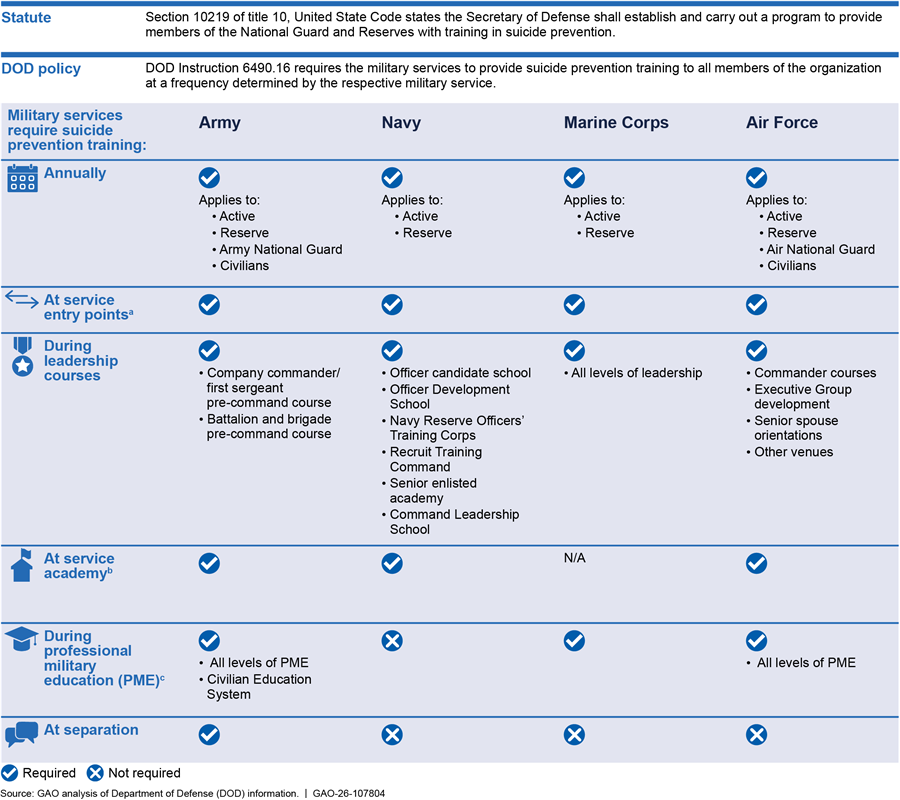
aService entry points include initial training provided to individuals when they join a military service.
bService academies include the U.S. Military Academy, the U.S. Naval Academy, and the U.S. Air Force Academy. Marine Corps is listed as N/A because it does not have a service academy.
cProfessional military education conveys the broad body of knowledge and develops the habits of mind that are essential to the military professional and commanders. It includes both officer and enlisted education.
DOD policy provides flexibility for the frequency of nonclinical suicide prevention training. As of May 2026, each military service requires its service members to take suicide prevention training on an annual basis. The services have each developed service-specific nonclinical annual suicide prevention trainings and learning objectives. Additionally, the Army allows commanders to request alternative trainings to meet the annual suicide prevention training requirement, as long as the alternative training meets certain objectives. However, members of the Army National Guard must use the Army’s Ask, Care, Escort (ACE) training to fulfill the National Guard Bureau annual nonclinical suicide prevention training requirement.[16] The Navy also does not require units to use the Navy’s developed service-specific training and allows units to develop their own trainings as long as these trainings meet certain objectives. The Army, Marine Corps, and the Air Force generally require these trainings to be attended live. While Navy officials encourage training to be done through small groups, Navy policy does not require the training to be administered live.
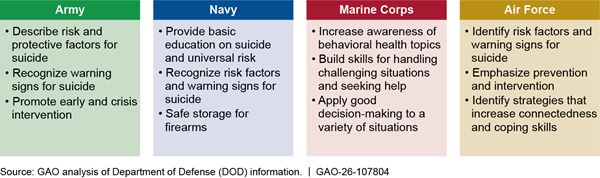
Figure 2 depicts each military service’s suicide prevention trainings and objectives.
Figure 2: Annual Required Military Service Nonclinical Suicide Prevention Trainings and Objectives, as of 2025
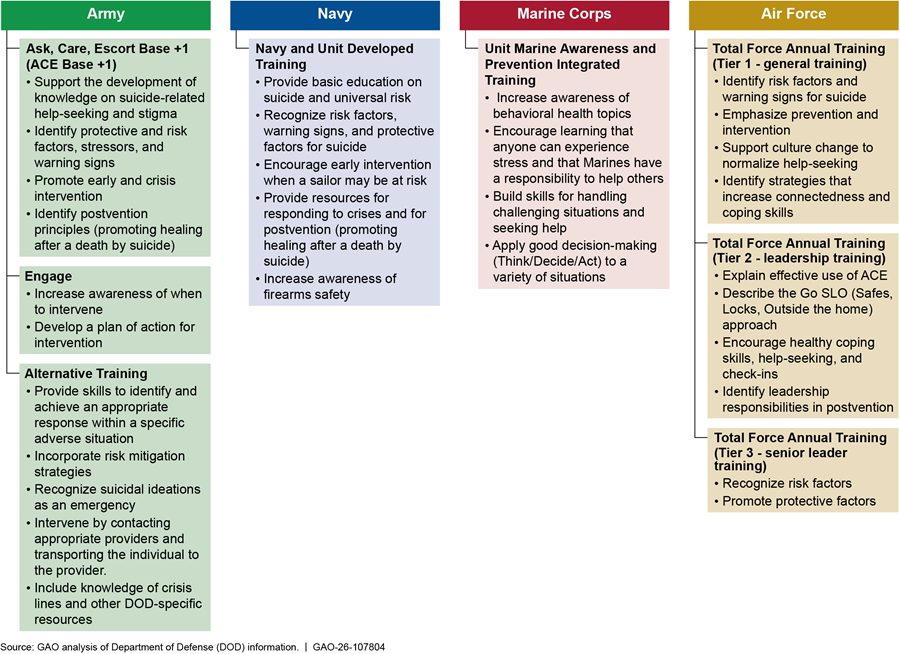
Note: The Army allows commanders to request alternative trainings to meet the annual suicide prevention training requirement, as long as it meets certain objectives. The Navy does not require units to use the Navy’s developed service-specific training and allows units to develop their own trainings as long as these trainings meet certain objectives.
DOD Roles and Responsibilities for Suicide Prevention Training
Several entities share responsibilities for implementing and overseeing the department’s suicide prevention training.
· Under Secretary of Defense for Personnel and Readiness. Section 580 of the NDAA for Fiscal Year 2013 establishes the Under Secretary of Defense for Personnel and Readiness as the office responsible for oversight of all suicide prevention and resilience programs for DOD.[17]
· DSPO. DSPO is responsible for leading, guiding, and overseeing the department’s suicide prevention programs. DSPO provides oversight of the military services’ compliance with nonclinical suicide prevention activities in accordance with DOD policy.
· Secretaries of the military departments. The Secretaries of the military departments are responsible for developing, implementing, and evaluating their own service-level suicide prevention programs, which are required to incorporate department-wide suicide prevention policy and requirements. To support these efforts, the Secretaries are responsible for adequately staffing, funding, and maintaining their suicide prevention programs with a designated person whose duties include implementation and oversight of a service command’s suicide prevention program.
· Military service chiefs. The military service chiefs are responsible for overseeing and providing resources for suicide prevention education and training for each service. The service chiefs direct commanders to provide suicide prevention training to all members of the organization. Each of the military service chiefs have designated offices to oversee suicide prevention education and training service-wide.
· Army. The Deputy Chief of Staff, G1 is responsible for ensuring that the Director of Prevention, Resilience, and Readiness provides strategic guidance and supervision for suicide prevention policies, plans, and training.
· Navy. The Navy Culture and Force Resilience Office, Suicide Prevention, is responsible for developing policy guidance for the Navy Suicide Prevention Program and ongoing program evaluation to the chain of command.
· Marine Corps. The Deputy Commandant for Manpower and Reserve Affairs is responsible for facilitating and serving as the execution authority for suicide prevention policy including oversight, development, implementation, evaluation, communication, and training.
· Department of the Air Force.[18] The Director, Integrated Resilience is responsible for overseeing and implementing the Air Force’s Integrated Resilience Program and Integrated Primary Prevention Program and has primary responsibility for nonclinical integrated prevention elements of the Air Force Suicide Prevention Program.
· National Guard Bureau. The Chief of the National Guard Bureau establishes policies for providing training to National Guard members. Additionally, the Chief is responsible for ensuring that National Guard members receive training on suicide prevention, as well as the availability of DOD, state, and local resources.
· Commanders. Commanders at all levels, including individual units, are responsible for providing suicide prevention training to all members of the organization on a timeline determined by each military service.
· Prevention personnel. Prevention personnel—those assigned either part-time or full-time to duties involving prevention-specific knowledge and skills—are responsible for advising commanders and implementing primary prevention activities, such as suicide prevention training.
Suicide Prevention and Response Independent Review Committee
The NDAA for Fiscal Year 2022 directed the Secretary of Defense to establish the Suicide Prevention and Response Independent Review Committee (henceforth, the independent review committee) to conduct a comprehensive review of clinical and nonclinical suicide prevention and response programs in DOD.[19] Among other things, the independent review committee conducted site visits to selected military installations and met with 2,106 military personnel and 692 civilian employees and family members.
Based on this review, the independent review committee identified significant concerns regarding DOD’s suicide prevention training efforts—resulting in 18 recommendations to improve the quality and effectiveness of DOD’s nonclinical suicide prevention training, among many other recommendations. Appendix I includes the independent review committee’s nonclinical suicide prevention training-related recommendations.[20] For example, the independent review committee concluded that responsibility and authority for suicide prevention training should be centralized within DSPO rather than dispersed throughout the military services. The independent review committee also concluded that as part of this change, a centralized training management system should be created to improve the tracking of training implementation and completion. As a result, the independent review committee recommended centralizing the suicide prevention training curriculum.
Additionally, the independent review committee concluded that to maximize effectiveness, suicide prevention training practices should be tailored to different settings, development levels, roles within the organization (e.g., supervisor duties), and different populations. As a result, the independent review committee recommended modernizing the content, delivery, and dosage of suicide prevention education and skill building across the career cycle of military personnel.
DSPO and the Military Services Do Not Effectively Monitor Annual Suicide Prevention Training Completion Service-Wide
While DSPO is responsible for oversight of suicide prevention activities across the department, it does not have information to effectively monitor the completion of suicide prevention training across DOD. The military service headquarters also generally do not effectively monitor service-wide completion of required annual suicide prevention training.
DSPO Lacks Information to Effectively Monitor Completion of Annual Suicide Prevention Training Across DOD
DSPO is the DOD-wide office responsible for oversight of suicide prevention activities, but it does not monitor completion of annual suicide prevention training across the military services. Specifically, a DSPO official told us that DSPO does not receive information on service member completion of required annual military service training. DOD Instruction 6490.16 states that the Director of DSPO is to coordinate with the Secretaries of the military departments to receive data required for implementing DOD suicide prevention programs.[21] The instruction also states that the Director of DSPO is to oversee the Defense Suicide Prevention Program and develop policy guidance for DOD suicide prevention.
DSPO lacks the information to effectively monitor the completion of annual suicide prevention training across the military services because the Under Secretary of Defense for Personnel and Readiness has not required the military services to report annual suicide prevention training completion rates to DSPO. A DSPO official told us that requiring the military services to report annual suicide prevention training completion rates to its office would better enable DSPO to monitor training completion as part of its oversight responsibilities. Until the Under Secretary of Defense for Personnel and Readiness develops and issues guidance requiring the military services to report their annual suicide prevention training completion rates, DSPO will not have the necessary data to make informed decisions about suicide prevention training and to develop policy guidance for the suicide prevention program throughout the department.
The Military Services Generally Do Not Effectively Monitor Service-Wide Completion of Annual Suicide Prevention Training
The military services’ headquarters suicide prevention offices generally do not effectively monitor service-wide annual suicide prevention training completion for their service members. Specifically, the Army, Navy, and Marine Corps do not track training completion service-wide. Additionally, the military services take some actions to help ensure training is completed at the individual units, such as through inspections by service inspectors general, but the Army, Navy, Marine Corps, and Air Force headquarters suicide prevention offices do not take corrective action when training is not completed. We discuss each service in more detail in the sections that follow.
Army
Officials from the Army’s Prevention, Resilience, and Readiness office told us they do not regularly monitor annual suicide prevention training completion service-wide. Further, officials told us they do not take actions, such as notifying suicide prevention personnel at unit commands, if training is not completed by individual units.
Officials from the Army’s Prevention, Resilience, and Readiness office told us they do not address noncompletion when it occurs because it is a commander’s responsibility to ensure service members are completing annual suicide prevention training. However, relying on unit commands and commanders to take these steps does not meet the Army’s headquarters-level responsibilities to provide oversight.
In addition, though Army guidance requires unit commanders to record annual suicide prevention training in the Army’s centralized training database, the Army does not use the database to monitor annual suicide prevention training completion or consistently capture training data.[22] This centralized database includes training data for active, reserve, and National Guard components, including course names and course numbers.
According to Army policy, the Army has two approved annual suicide prevention trainings and allows for approved alternative trainings to fulfill the annual requirement.[23] The suicide prevention training completion data the Army provided to us included over 600 unique training listings. However, Army Prevention, Resilience, and Readiness officials were unable to verify whether all these listings met the annual training requirement. As a result, the Army’s training completion data may not accurately represent the rates of completion for required suicide prevention training. For example, in fiscal years 2020 through 2024, Army data showed training completion rates ranging from about 28 to 50 percent across the active, reserve, and guard components.[24] However, because the officials could not verify whether data included in the Army’s database meets the annual requirement, these data may not accurately represent the actual completion rates of service members trained in accordance with policy.
The Army does not consistently capture training data because it has not standardized how to record approved annual suicide prevention training in its central database, and unit personnel can therefore enter any course title or identification number. Army headquarters officials told us they recognize the training data contained in their system are unreliable and said they are currently working to track training in a different database.
Navy
Officials from the Navy told us they do not monitor annual suicide prevention training completion service-wide. In addition, Navy suicide prevention officials told us they do not take actions, such as notifying suicide prevention personnel at unit commands, if training is not completed at the unit level.
Officials told us they do not take these actions because they rely on Naval Inspector General command inspections to check for annual suicide prevention training completion at individual units. The Naval Inspector General has developed a suicide prevention inspection checklist, which includes reviewing whether annual training has been completed. Naval Inspector General officials told us that historically, inspector general personnel performed command inspections every 4 to 5 years. Officials told us unit commanders are required to take action when deficiencies are identified by the inspector general.
However, inspector general officials told us that recently they have conducted command inspections less frequently—every 6 to 10 years—due to insufficient resources. Additionally, these officials told us that given the infrequency with which these inspections occur, the inspections cannot be relied on to ensure training compliance. Beyond the inspector general effort, an official from the Navy Culture and Force Resilience office told us they do not address noncompletion when it occurs because it is a commander’s responsibility to ensure service members are completing annual suicide prevention training. However, relying on inspectors general and commanders to take these steps does not meet the Navy’s headquarters-level responsibilities to provide oversight.
In addition, though the Navy has established a centralized database of training data, officials told us they do not use the database to monitor annual suicide prevention training completion. Further, the database does not consistently and completely capture training data. The database includes Navy course names and identification numbers for training, but the Navy is unable to verify the data’s consistency or completeness.
Specifically, the annual suicide prevention training completion data the Navy provided to us included 243 unique training listings. Navy policy allows units and commanders to develop alternate trainings to meet the annual requirement for suicide prevention training, in place of the annual training the Navy developed for this purpose. An official from the Navy Culture and Force Resilience office reviewed the training listings and told us that 194 of the listings probably fulfill the requirement, but that the official could not know for sure without confirming directly with the various units that had entered the training data.
Moreover, Navy commands record annual suicide prevention training completion in their unit-level records, but reporting the training completion data to the Navy’s central database is optional. As a result, the Navy cannot ensure that data in the centralized database are complete or that training completion data are accurate. For example, in fiscal years 2020 through 2024, the Navy recorded training completion data for sailors across the active and reserve components in its central database, which ranged from about 64 to 67 percent. However, because reporting training completion data in the Navy’s central database is optional and an official from the Navy Culture and Force Resilience office could not determine whether training captured in the database met the Navy’s annual training requirement, it is unclear whether these data represent a complete and accurate record of training completion.
The Navy does not consistently capture training data because it has not standardized how to record approved annual suicide prevention training in its central database, and unit personnel can therefore enter any course title or identification number. Navy headquarters officials told us that they recognize the training data in their system are not consistent or standardized.
Further, the Navy’s database does not have complete data because unit commanders are not required to record training completion in the Navy’s central database, though Navy officials told us they encourage commanders to record the training in the database. The Navy has not implemented a requirement for unit commanders to record training completion in the central database, according to Navy officials, because it does not want to increase the administrative burden on commanders. However, the other military services have implemented such a requirement. Specifically, the Army, Air Force, and Marine Corps require annual suicide prevention training to be recorded in central databases.[25]
Marine Corps
Officials from the Marine Corps Manpower and Reserve Affairs office told us they do not regularly monitor annual completion of suicide prevention training service-wide. Officials further told us they generally do not take actions at the headquarters level to ensure training completion.
Marine Corps officials told us they rely on Marine Corps Inspector General inspections to check for annual suicide prevention training completion at individual units. These officials have developed a checklist for use in inspector general inspections for the Marine Corps’s suicide prevention program, which includes ensuring training completion is documented. In instances when the inspector identifies an issue and unit officials do not immediately take action to correct it, the unit officials are required to file corrective action reports. According to Marine Corps Order 5040.6J, inspections are required every 3 to 4 years.[26] Further, Marine Corps guidance requires unit commanders to record suicide prevention training in the Marine Corps’s central database.[27] Our review of Marine Corps data from fiscal year 2020 through fiscal year 2024 showed that suicide prevention training completion rates across the active and reserve components ranged from about 40 to 66 percent. Marine Corps officials did not raise concerns with the accuracy of the data contained in their central database.
However, Marine Corps headquarters officials told us they do not regularly use the data to monitor service members’ completion of the training. Further, aside from the inspector general effort, they said they do not take actions at the headquarters level to ensure training completion, such as notifying prevention personnel within unit commands of noncompletion. Officials from the Marine Corps Manpower and Reserve Affairs office told us they do not address noncompletion when it occurs because it is a commander’s responsibility to ensure service members are completing annual suicide prevention training. This reliance on commanders does not, however, address the Marine Corps’s headquarters-level oversight responsibilities.
Department of the Air Force
Air Force headquarters officials regularly monitor annual suicide prevention training service-wide by requiring Air Force Major Commands to provide quarterly reports on annual suicide prevention training completion. Air Force officials told us Air Force major commands use data from the Air Force’s central database to create these reports. Additionally, Air Force guidance requires unit training managers to record training in its central database.[28] Our review of Air Force data from this database from calendar year 2020 through calendar year 2024 showed suicide prevention training completion rates across the active and reserve components ranged from about 39 to 92 percent and increased over the time period. Air Force officials told us some of these training completion rates may have been affected by the COVID-19 pandemic.[29]
However, Air Force headquarters officials told us they do not address noncompletion of suicide prevention training, such as by notifying prevention personnel at the command level. According to officials, this is because it is a commander’s responsibility to ensure service members are completing annual suicide prevention training. This reliance on commanders does not, however, address the Air Force’s headquarters-level oversight responsibilities.
National Guard Bureau
National Guard Bureau officials told us they regularly monitor annual suicide prevention training completion by collecting information monthly on completion. Officials told us they reach out to unit prevention personnel to discuss plans to ensure training is completed throughout the year and what plans are to ensure training is completed. The National Guard Bureau uses the Army and Air Force’s central training databases for recording training completion, but data on suicide prevention training completion officials provided were incomplete and inconsistent.
For example, officials told us they do not have complete Army National Guard training completion information because the Department of the Army’s central training database of record does not consistently capture annual suicide prevention training course data. Officials told us they are transitioning to an alternate database that is more accurate, but that they are unsure of what database to use in the future until Army headquarters provides guidance on a system of record for the Department of the Army, which includes the Army National Guard. In fiscal years 2020 through 2024, the database of record and the alternate databases both contained Army National Guard training completion information, and officials told us the alternate database shows completion rates from about 13 percent to about 35 percent. Additionally, officials provided incomplete Air National Guard data for 3 of 5 calendar years from 2020 through 2024. Specifically, officials were missing data for one or more quarters in those 3 years. Officials told us this was because until around 2025, they did not have standard procedures for ensuring historical training information is maintained and did not have access to the Air Force’s central training database. Officials told us they now have access to the Air Force’s central training database, which they believe addresses the issue of lack of data moving forward.
Military Service Oversight Responsibilities
Military service regulations outline the headquarters-level oversight responsibilities relating to suicide prevention. Specifically:
· Army Regulation 600-92, Army Suicide Prevention Program, states that the Director, Prevention, Resilience, and Readiness provides strategic guidance and supervision for the prevention policies, plans, and training.[30]
· Army General Order No. 2025-23, Establishment of the United States Army Transformation and Training Command as an Army Command, states that Transformation and Training Command is responsible for education and training.[31]
· Office of the Chief of Naval Operations Instruction 1720.4B, Navy Suicide Prevention Program, states that the Chief of Naval Operations, Navy Culture and Force Resilience Office, Suicide Prevention will develop policy guidance for the Navy Suicide Prevention Program and ongoing program evaluation to the chain of command.[32]
· Marine Corps Order 1720.2A, Marine Corps Suicide Prevention System, states that the Deputy Commandant for Manpower and Reserve Affairs facilitates and serves as the execution authority for suicide prevention policy including oversight, development, implementation, evaluation, communication, and training.[33]
· Department of the Air Force Instruction 90-5001, Integrated Resilience, states the Director for Integrated Resilience oversees and implements the Air Force’s Integrated Resilience Program and Integrated Primary Prevention Program and serves as the office of primary responsibility for nonclinical integrated prevention elements of the Air Force Suicide Prevention Program.[34]
· Chief, National Guard Bureau Directive-Type Memorandum 0300.00, National Guard Suicide Prevention Program, states the Director of Manpower and Personnel will serve as the National Guard principal authority on accountability, policy, and oversight for the National Guard Suicide Prevention Program.[35]
In addition, commanders at all levels, including individual units, are responsible for providing suicide prevention training to all members of the organization on a timeline determined by each military service.[36] Further, Standards for Internal Control in the Federal Government states that management should establish and operate monitoring activities to monitor the internal control system and evaluate the results, and that management should remediate identified internal control deficiencies on a timely basis.[37] According to the standards, monitoring assesses the quality of performance over time and promptly resolves the findings of audits and other reviews. Corrective actions are a necessary complement to control activities in order to achieve objectives. Standards for Internal Control in the Federal Government also states that management should use quality information—which is appropriate, current, complete, accurate, accessible, and provided on a timely basis—to achieve the entity’s objectives, and that it obtains relevant data from reliable internal and external sources to process such quality information.
Until the Army, Navy, and Marine Corps regularly monitor annual suicide prevention training service-wide, headquarters officials will not know whether annual suicide prevention training is being completed. Additionally, until each of the military services takes steps to identify noncompletion and notify prevention personnel at the appropriate level within commands when training is not completed, the services will not be able to fully ensure that training learning objectives are reaching military service members as intended—for example, recognizing risk factors and warning signs for suicide. Finally, until the Army and Navy take action to standardize training data recorded in their centralized databases, they will lack assurance that they have accurate, complete, and consistent data available on their suicide prevention training.
The Military Services Have Not Fully Evaluated Suicide Prevention Training Effectiveness
The military services have not fully evaluated the effectiveness of their respective annual suicide prevention trainings. Specifically, the Army, Navy, Marine Corps, and National Guard Bureau do not have evaluation plans to assess their annual suicide prevention trainings, according to officials. Additionally, though the Air Force has a document that Air Force officials have identified as their full evaluation plan, this document does not fully meet the requirements for evaluation plans outlined in DOD’s suicide prevention program policy.
Our work on assessing strategic training and development efforts in the federal government states that by incorporating valid measures of effectiveness into training, agencies can better ensure that they are adequately addressing training objectives and therefore increasing the likelihood that desired changes will occur in the target population’s skills, knowledge, abilities, attitudes, or behaviors.[38] Further, it states that developing and using a data collection and analysis plan can guide agencies in a systematic approach to assessing the effectiveness and efficiency of training. Such planning will allow agencies to have an informed and strategic perspective for evaluation decisions rather than an ad hoc approach that might result in missing important opportunities and either overinvesting or underinvesting in evaluations.[39] Under DOD’s suicide prevention program policy, suicide prevention activities, such as training, are to have mechanisms and resources in place to monitor the degree to which they meet intended outcomes; and the activities are to evaluate processes to inform enhancements, planning, and resourcing.[40] The policy also outlines 11 requirements for evaluation plans of nonclinical suicide prevention activities, such as training.[41]
The services, except for the Navy, have taken some steps to evaluate their suicide prevention training, such as through surveys or knowledge checks. For example, the Army, Marine Corps, and Air Force have implemented pre- and post-training surveys or knowledge checks for their headquarters-developed annual suicide prevention trainings (see fig. 3).
Figure 3: Surveys, Knowledge Checks, and Service Evaluation Efforts for Military Service-Specific Annual Suicide Prevention Trainings
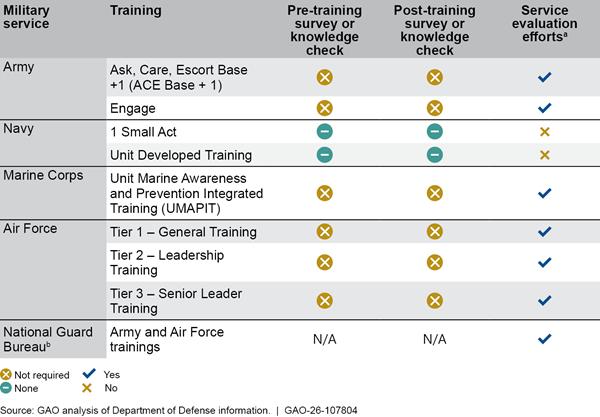
aService evaluation efforts refer to evaluation efforts or activities outside of the pre-and post-training surveys or knowledge checks conducted by the military services for their nonclinical suicide prevention trainings.
bThe Army National Guard uses Ask, Care, Escort (ACE) Base +1 to fulfill its annual nonclinical suicide prevention training requirements and the Air National Guard uses Air Force headquarters-developed trainings to fulfill annual nonclinical suicide prevention training requirements, according to National Guard Bureau officials.
The services use the surveys and knowledge checks in several ways. For example, the Walter Reed Army Institute of Research uses surveys to assess Army training participants’ self-rated knowledge and attitudes after training, and the Air Force uses knowledge checks to measure changes in training participants’ knowledge.[42]
As part of the procedures and requirements for the evaluation of effectiveness and outcomes for nonclinical suicide prevention training, DOD policy states that for each suicide prevention activity, evaluation plans must
· have clear steps for implementation and the responsibilities for those involved;
· specify the intended connections between inputs, activities, outputs, short-, intermediate- and long-term outcomes, and programmatic improvements expected from the implementation of the evaluation activities; and
· include a process for continued assessment or reassessment of the suicide prevention activity.[43]
DOD policy also states that evaluation plans must assess both process metrics and outcome metrics to account for different needs and be able to assess for effectiveness among the intended target population.[44] Additionally, it states that evaluation plans should be practical, feasible, and tailored in a way that produces accurate and actionable findings. For example, evaluation plans should account for and provide the resources and time required to conduct sufficient evaluation.[45] Moreover, our framework for assessing training states that a data collection and analysis plan sets priorities for evaluations, and systematically covers the methods, timing, and responsibilities for data collection.[46]
However, most of the military services do not have evaluation plans for their annual suicide prevention training, and none have evaluation plans that meet the requirements outlined in DOD policy. For example:
· Army. According to Army officials, the Army does not have a department-level evaluation plan for suicide prevention training evaluation. Army officials recognized that not having an evaluation plan is a gap in the Army’s evaluation of its suicide prevention training. However, since 2013, the Walter Reed Army Institute of Research has taken steps to evaluate headquarters-developed annual suicide prevention trainings, according to Army officials. As part of this, the Walter Reed Army Institute of Research has performed longitudinal studies for both the Ask, Care, Escort (ACE) and Engage trainings.[47] These studies aimed to measure service member knowledge and attitudes after participating in the trainings and to provide feedback on the training instruction and content. However, according to the Walter Reed Army Institute of Research, the research purposes and measures used in the studies are subjective and the studies noted that findings cannot be considered conclusive.
Additionally, evaluation of ACE and Engage trainings is inconsistent. For example, the Army reported that the Walter Reed Institute of Research interviews ACE instructors for insight into adherence to the training and its timelines, training satisfaction, and recommendations to help shape future versions of the training. Past findings from these field evaluation interviews were used to update the training, according to Army officials. However, these types of interviews were not part of the evaluation for the Engage training. Additionally, although commands are encouraged to implement evaluation processes at the command level, they may lack dedicated suicide prevention personnel to conduct these evaluations, according to Army officials.
Army officials also noted that there is a review and approval process for the alternative suicide prevention trainings used by commanders. Army officials stated that they have several approved alternative trainings for the Army’s annual nonclinical suicide prevention training requirement. However, Army officials told us they suspect that training is being underreported. They stated that they could not provide an estimate of the number of individuals who have completed annual training via commander small group leader-led training instead of ACE training.
· Navy. According to Navy officials, the Navy has not developed evaluation plans or attempted to evaluate its headquarters-developed annual suicide prevention training for effectiveness. Additionally, Navy officials told us that commanders are using unit-developed trainings to meet the annual suicide prevention training requirement. But officials do not know what unit-developed trainings are being used and have not attempted to evaluate these trainings for effectiveness.
· Marine Corps. According to Marine Corps officials, there were no current evaluation plans for the Unit Marine Awareness and Prevention Integrated Training (UMAPIT). The Marine Corps performed an evaluation for the pilot version of UMAPIT in 2022, using pre- and post-training surveys and implementation checklists. It found that the knowledge scores for the UMAPIT pilot were below the desired threshold and that the training was not consistently implemented across the Marine Corps. As of January 2026, a Marine Corps official stated that UMAPIT is being revised with the planned implementation later in 2026. This official stated that the Marine Corps plans to evaluate the revised training by 2027.
· Department of the Air Force.[48] According to Air Force officials, a document entitled Suicide Prevention Total Force Annual Training Pre-Post Knowledge Check Tiers 1&2 comprises the entire evaluation plan for the Air Force’s annual nonclinical suicide prevention training.[49] This document includes sections on the intended use and users, evaluation focus, methods, analysis, and interpretation plan; and the use, dissemination and sharing plan for the pre- and post- knowledge checks. Since DOD’s suicide prevention program policy includes criteria specifically for nonclinical suicide prevention activity evaluation plans, we used these criteria to assess this document. Based on our analysis, the document partially meets three out of 11 requirements identified in DOD policy.[50] For example, Air Force documentation partially meets the requirements related to (1) specifying the steps and responsibilities for implementation, (2) incorporating appropriate methodologies, and (3) addressing considerations for the evaluation standards outlined in the DOD Suicide Prevention Standards of Practices Framework. However, the document does not identify short-, intermediate-, or long-term outcomes, connections between inputs or activities and outcomes, or indications on the time frames and resources required to perform the evaluation.
Additionally, according to the document, the pre- and post- knowledge checks are required. However, Air Force officials stated that this is inaccurate and that these knowledge checks are voluntary. Further, the document also includes methodologies for the analysis of pre- and post- training. DOD policy states that evaluation plans must assess outcome metrics (the extent to which expected outcomes have been achieved), but the document does not specify desired benchmarks or targets for the knowledge checks and does not include plans to remediate training when performance on knowledge checks are low.[51]
According to Air Force officials, in 2025 the Air Force was in the process of developing and implementing a voluntary 6-month follow-up survey for its annual suicide prevention training to gather feedback from training participants on their perceptions of the training and its impact. According to Air Force officials, this effort is part of the Air Force evaluation of nonclinical suicide prevention training. However, this effort was developed after the document, and the document has not been updated to reflect the survey effort. Additionally, Air Force officials noted that staffing challenges have affected their ability to invest in evaluation plans. While the Air Force has developed an evaluation plan and begun to conduct a follow-up survey, the document does not address all elements of an evaluation plan outlined in DOD policy.
· National Guard Bureau. According to National Guard Bureau officials, the National Guard Bureau has not developed evaluation plans or evaluated the National Guard’s participation in Army- and Air Force-developed annual suicide prevention trainings. The Army National Guard and Air National Guard use their respective service headquarters-developed suicide prevention trainings to fulfill the National Guard suicide prevention training requirement. Additionally, National Guard Bureau officials told us states develop training materials to supplement the Army and Air Force annual trainings but must use the annual suicide prevention trainings.
Our framework for assessing training states that reviewing student and instructor feedback regularly is important to improving the overall training process and increasing the likelihood of success.[52] The Army, Air Force, and Marine Corps have taken some steps to solicit feedback on the annual suicide prevention trainings, through surveys or knowledge checks. Our framework for assessing training also states that agencies need credible information on how training and development programs affect organizational performance and that programs lacking outcome metrics will be unable to demonstrate how they contribute to results.
In response to a recommendation we made in April 2021, DSPO updated its suicide prevention program policy to incorporate evaluation requirements, procedures, and standards for nonclinical suicide prevention activities in 2023.[53] The updated policy—set forth in DOD Instruction 6490.16, Defense Suicide Prevention Program—outlines 11 requirements for evaluation plans, including that they should be practical, feasible, and tailored in a way that produces accurate and actionable findings.[54] According to the policy, the Director of DSPO is responsible for providing oversight and coordinating with the Secretaries of the military departments and the Chief of the National Guard Bureau on this evaluation.
To meet the evaluation requirements under DOD’s updated policy, the Secretaries of the military departments and the Chief of the National Guard Bureau are responsible for developing evaluation plans for nonclinical suicide prevention activities, such as training, in accordance with the procedures and requirements outlined in the instruction.
DSPO and military service officials have provided various reasons for not developing or implementing training evaluation plans, such as staffing challenges, competing priorities, and ambiguity surrounding the direction of evaluation in the department. However, taking steps to develop evaluation plans that are practical, feasible, and appropriately tailored, as directed by department policy, could help DSPO and the services prioritize resources and leverage available staff for their efforts. Moreover, our work on assessing strategic training states that the evaluation of training can help decision-makers manage scarce resources.[55] Evaluating their suicide prevention training would help the military services ensure that they are spending their resources on training that meets their respective needs.
Without the military services and the National Guard establishing and continually reassessing evaluation plans for their respective annual suicide prevention trainings, in accordance with DOD policy on such plans, DSPO and the military services cannot ensure a systematic approach to assessing the effectiveness of the annual trainings. Further, they cannot ensure that the annual trainings are effective in achieving intended outcomes, such as helping service members recognize risk factors for suicide.
DOD Has Taken Steps to Implement Training-Related Recommendations on Suicide Prevention, but Future Efforts Are Uncertain
DOD has begun implementing recommendations from the Suicide Prevention and Response Independent Review Committee’s comprehensive review of the department’s clinical and nonclinical suicide prevention and response programs.[56] However, since the time DSPO developed project plans for implementing these recommendations, changes to DOD’s approaches to personnel and training have created uncertainty and ambiguity around its ability to implement the independent review committee’s recommendations.
In December 2022, the Suicide Prevention and Response Independent Review Committee presented the Secretary of Defense with its report, including its findings and over 117 recommendations.[57] In response to the independent review committee’s report, in September 2023 the Secretary of Defense issued a memorandum on new DOD actions to prevent suicide in the military.[58] This memorandum outlined lines of effort related to the independent review committee report recommendations that DOD had determined to implement, including a line of effort on revising suicide prevention training.[59] The memorandum also identified a total of 20 clinical and nonclinical suicide prevention training recommendations from the independent review committee, of which 18 were related to nonclinical suicide prevention training (see appendix I).
In response to the Secretary’s September 2023 memorandum, DSPO collected, reviewed, and coordinated the approval of 16 funded project plans to implement the nonclinical suicide prevention training recommendations.[60] According to these plans, as of calendar year 2024, DOD estimated that it would require over $163 million and an additional 318 civilian full-time equivalent personnel to address these recommendations through 2029. DSPO officials monitor the implementation status of these recommendations, including efforts specifically related to nonclinical suicide prevention training. As part of this monitoring effort, DSPO and the military services had monthly action officer meetings where the action officers would discuss and document the implementation progress for approved independent review committee recommendations. As of January 2026, these meetings have been changed to quarterly meetings, according to a DSPO official.
As of September 2025, DSPO and the military services had closed one of the independent review committee’s recommendations on nonclinical suicide prevention training as implemented because DOD has an existing initiative that met the intent of the recommendation, according to DSPO officials. This recommendation pertained to reviewing and revising required training requirements through the Common Military Training Working Group. The remaining 15 funded nonclinical suicide prevention training-related recommendations are in the process of being implemented, according to DSPO officials.
For example, as part of the effort to implement the independent committee recommendation to centralize responsibility for core suicide prevention activities that are common to all the military services, DSPO, in coordination with the military services, is updating the 2016 Suicide Prevention Training Competency Framework, according to a DSPO official. This framework identifies core knowledge, skills, abilities and other characteristics for suicide prevention training and education across DOD components and the military services for suicide prevention training. Officials in each of the military service headquarters-level suicide prevention offices told us that they view these competencies as requirements for their annual suicide prevention trainings. The DSPO official stated that the updates will likely include additions to address newer efforts for suicide prevention such as lethal means safety, not reductions to the framework.
Officials in each of the military service suicide prevention offices told us that, of the 18 nonclinical suicide prevention recommendations in the report, their service-level efforts centered the most on two recommendations: (1) to modernize the content, delivery, and dosage of suicide prevention education and skill building across the career cycle of military personnel; and (2) to include content in leadership-focused training on how to implement response activities that should be taken immediately following a suicide or suicide attempt.
The military services have begun various actions to implement the two recommendations, according to military service officials. Navy, Air Force, and National Guard Bureau officials stated that they are working on contracts for implementing the recommendation to modernize the content, delivery, and dosage of suicide prevention education and skill building. Prior to the issuance of the independent review committee report, the Army had efforts in place that officials told us are related to modernizing training. As of January 2026, these efforts were ongoing and are related to the independent review committee recommendations, according to Army officials. Specifically:
· Army officials stated the Army began investing in modernizing the ACE Base and ACE Base +1 training over 10 years ago. Additionally, in response to a recommendation we made in 2022, the Army will now require all new and current Suicide Prevention Program Coordinators to take a course that familiarizes them with their roles and responsibilities for their respective locations and provides them with foundational knowledge to perform those duties.[61]
· Navy officials stated that the Navy has used funding to review training requirements and to review when to provide training. The Navy has also invested in modules for a virtual reality training for postvention and suicide-related behavior reintegration.[62] As of May 2025, the modules were being piloted in the fleet, according to Navy officials.
· The Air Force, as of August 2025, had approved the modification of contracts to begin implementing both recommendations noted above, according to Air Force officials.
· National Guard Bureau officials told us the National Guard Bureau modified an existing contract to develop a training team of state and territory-level regional officers who could serve as liaisons between the National Guard Bureau and the states to address the first recommendation related to modernizing the content, delivery, and dosage of suicide prevention education. National Guard Bureau officials also stated that the National Guard Bureau has a Memorandum of Agreement with the Institute for Defense Analyses to assist with the recommendation to include leadership-focused training on how to implement response activities that should be taken immediately following a suicide or suicide attempt. The Institute for Defense Analyses will assist the National Guard Bureau with a postvention policy that fits both DSPO parameters and nuances of the National Guard Bureau, including relevant training, according to National Guard officials.
However, recent changes to DOD’s planned civilian staffing levels and a review of mandatory trainings create an uncertain and situationally ambiguous environment regarding future efforts to implement the remaining independent review committee report recommendations.
Civilian staff reductions. DSPO and the military services have experienced reductions in their civilian staff that may affect implementation plans of the recommendations. Since March 2025, DOD began efforts to reduce civilian positions and functions that it determined are not directly tied to warfighting capabilities, including implementing a hiring freeze.[63] DSPO, Army, and Air Force officials stated they have lost personnel in or related to the suicide prevention programs as these personnel chose to participate in DOD’s deferred resignation program.[64] Navy officials stated that they have been unable to hire personnel to assist with implementation plans for the recommendation related to modernizing the content, delivery, and dosage of suicide prevention education and skill building due to the hiring freeze. Additionally, Air Force officials stated that prevention programs across the Air Force have been affected by the hiring freeze and personnel attrition. Officials from the military departments have told us that civilian personnel changes have varied over time, and they have not yet been able to quantify impacts to suicide prevention. However, this contrasts with personnel increases identified in the current project plans as needed for the implementation of the independent review committee recommendations.
Review of training. In March 2025, the Secretary of Defense directed a review of DOD training, stating that training should be directly linked to warfighting and that requirements not related to warfighting or otherwise required by law should be eliminated.[65] In April 2025, this review found that suicide prevention training ranked fifth out of 18 areas of training in terms of its contribution to the lethality of the force, with one having the highest contribution to the lethality of the force and 18 having the lowest contribution. It also found that suicide prevention training ranked third out of 18 in contributing to force readiness, with one having the highest contribution to force readiness and 18 having the lowest contribution. The review recommended combining suicide prevention training with four other trainings related to self-directed harm and prohibited abusive or harmful acts. Specifically, it recommended integrating domestic abuse, harassment prevention and response, sexual assault prevention and response, suicide prevention, and substance misuse and gambling disorder into a single annual training course.
This recommendation contrasts with several nonclinical suicide prevention training recommendations from the independent review committee, causing further uncertainty. For example, the independent review committee recommended that
· separate trainings should be developed for different audiences and for intended effect;
· DOD should allow service members to select from a range of complementary topics and educational materials to meet training requirements;
· training should be delivered in small groups of service members with similar rank or positions instead of mass “one-size-fits-all” training; and
· DOD should vary training duration and frequency to maximize engagement and efficacy.
As of December 2025, DSPO and the military services had not yet determined whether to combine the self-directed harm and prohibited abusive or harmful acts trainings, and it remained uncertain what effects this effort would have on DOD’s efforts to implement the independent review committee recommendations on nonclinical suicide prevention training, according to officials. However, in December 2025, the Navy started an internal Navy working group to look at areas to consolidate training across all the Common Military Training Requirements, including those related to self-directed harm and prohibited abuse or harmful acts, according to Navy officials.
A DSPO official stated that efforts to implement the independent review committee recommendations will continue until or unless officials are notified not to. However, changes within the department’s personnel and the recommendation to consolidate suicide prevention training with other trainings create uncertainty and situational ambiguity around future efforts.[66]
The Project Management Institute’s A Guide to the Project Management Body of Knowledge (PMBOK® Guide)—which provides global standards generally recognized as the leading practices for project management—includes fundamental concepts and constructs of project management and enables project teams to be proactive, innovative, and agile in delivering project outcomes.[67] These concepts are outlined through eight groups of related activities that are critical for the effective delivery of project outcomes, referred to as ‘performance domains’ in the guide. Specifically, the guide’s planning performance domain addresses activities and functions associated with the initial, ongoing, and evolving organization and coordination necessary for project deliverables and outcomes. Its uncertainty performance domain addresses uncertainty that presents threats and opportunities that project teams should explore, assess, and decide how to handle. As part of the uncertainty performance domain, the PMBOK® Guide states that a solution to situational ambiguity is to use an iterative process to increase the level of detail in the project plan as greater amounts of information are available.
DSPO’s 2024 project plans for implementing 16 of the independent review committee’s recommendations include several components of the planning performance domain, such as project phases, scope, expected delivery commitments by year; budgetary and personnel resource estimates needed for implementation; and responsible entities.[68] For example, DSPO’s implementation plan for the recommendation to modernize the content, delivery, and dosage of suicide prevention education and skill building, includes (1) a projected timeline for the phases of implementation, (2) projected execution of contract and nonlabor funding by fiscal year, and (3) projected needs for military and civilian full-time equivalents. Additionally, a DSPO official stated that an office can request approval to deviate from the plans if it cannot execute the funds it received for any reason. As of December 2025, there had been only one such request related to the nonclinical suicide prevention training plans, according to DSPO officials. This was related to reducing the number of full-time equivalents for the Marine Corps’s implementation plan on modernizing the content and delivery of suicide prevention training.
However, DSPO has not used an iterative process to regularly update its project plans to address uncertainty or situational ambiguity. These project plans could benefit from incorporating components or strategies from the uncertainty performance domain. For example, DSPO could use an iterative process to regularly review and revise the plans based on updated information related to staffing and training requirements.
By updating the independent review committee recommendation project plans to include strategies to address uncertainty and situational ambiguity, DSPO could help ensure that risks and opportunities are properly addressed and that resources are managed efficiently as DOD continues to take steps to implement the independent review committee’s recommendations.
Conclusions
Despite expanded suicide prevention efforts across DOD, suicide rates for active-duty service members have gradually increased since 2011. In calendar year 2024, 471 service members died by suicide. Each of the military services requires its service members to complete suicide prevention training on an annual basis. Such trainings are an essential part of DOD’s broader suicide prevention program and help ensure that service members use help-seeking behaviors, have awareness of suicide risk factors, and know resources for intervention, such as referral techniques and protocols for at-risk service members.
However, DSPO and the military services at their headquarters levels do not effectively monitor whether service members are completing suicide prevention training or take sufficient steps to ensure that they do complete it. Taking additional actions to improve their monitoring activities could help both DSPO and the military services ensure they have complete and accurate data on training completion and that service members are receiving the training they need to identify and respond to suicide risks. Such information is also critical for DSPO and the services to make informed decisions on, and develop policy guidance for, suicide prevention programs throughout the department.
In addition, none of the military services have fully evaluated the effectiveness of their suicide prevention trainings. To ensure that these trainings are helping to reduce suicide risks and that the services can make use of available resources, it is critical for the trainings to be effective at achieving their intended goals. Coordinating with DSPO to develop and implement evaluation plans for their respective annual suicide prevention trainings would help the military services ensure they are taking a systematic approach to assessing the effectiveness of the annual trainings and that the trainings are achieving intended outcomes.
Finally, DSPO’s project plans for implementing the Suicide Prevention and Response Independent Review Committee’s recommendations for nonclinical suicide prevention training do not include a process to regularly update those plans when additional information is available. Using an iterative process to update nonclinical suicide prevention training-related project plans would help DSPO ensure that risks, opportunities, and resources are managed effectively.
Recommendations for Executive Action
We are making the following 17 recommendations to DOD:
The Secretary of Defense should ensure that the Under Secretary of Defense for Personnel and Readiness develops and issues guidance to require the military services to report annual nonclinical suicide prevention training completion data to DSPO. (Recommendation 1)
The Secretary of the Army should ensure that the Director, Prevention, Resilience, and Readiness regularly monitors service members’ completion of annual nonclinical suicide prevention training. (Recommendation 2)
The Secretary of the Army should ensure that the Director, Prevention, Resilience, and Readiness notifies the prevention personnel at the appropriate level within commands when annual nonclinical suicide prevention training is not completed. (Recommendation 3)
The Secretary of the Army should ensure that the Director, Prevention, Resilience, and Readiness, in coordination with the Transformation and Training Command, standardizes how to record approved annual nonclinical suicide prevention training in the Army’s central training database. (Recommendation 4)
The Secretary of the Navy should ensure that the Chief of Naval Operations, Navy Culture and Force Resilience Office, Suicide Prevention regularly monitors service members’ completion of annual nonclinical suicide prevention training. (Recommendation 5)
The Secretary of the Navy should ensure that the Chief of Naval Operations, Navy Culture and Force Resilience Office, Suicide Prevention notifies the prevention personnel at the appropriate level within commands when annual nonclinical suicide prevention training is not completed. (Recommendation 6)
The Secretary of the Navy should ensure that the Chief of Naval Operations, Navy Culture and Force Resilience Office, Suicide Prevention standardizes how to record approved annual nonclinical suicide prevention training in the Navy’s central training database. (Recommendation 7)
The Secretary of the Navy should require commanders to record annual nonclinical suicide prevention training in the Navy’s central training database. (Recommendation 8)
The Secretary of the Navy should ensure that the Commandant of the Marine Corps requires the Deputy Commandant for Manpower and Reserve Affairs to regularly monitor service members’ completion of annual nonclinical suicide prevention training. (Recommendation 9)
The Secretary of the Navy should ensure that the Commandant of the Marine Corps requires the Deputy Commandant for Manpower and Reserve Affairs to notify prevention personnel at the appropriate level within commands when annual nonclinical suicide prevention training is not completed. (Recommendation 10)
The Secretary of the Air Force should ensure that the Director, Integrated Resilience, notifies the prevention personnel at the appropriate level within commands when annual nonclinical suicide prevention training is not completed. (Recommendation 11)
The Secretary of the Army, in coordination with the Director of DSPO, should develop and implement evaluation plans for the Army’s approved annual nonclinical suicide prevention trainings in accordance with DOD policy outlining the requirements for nonclinical suicide prevention evaluation plans. (Recommendation 12)
The Secretary of the Navy, in coordination with the Director of DSPO, should develop and implement evaluation plans for the Navy’s approved annual nonclinical suicide prevention trainings in accordance with DOD policy outlining the requirements for nonclinical suicide prevention evaluation plans. (Recommendation 13)
The Secretary of the Navy should ensure that the Commandant of the Marine Corps, in coordination with the Director of DSPO, develops and implements evaluation plans for the Marine Corps’s approved annual nonclinical suicide prevention trainings in accordance with DOD policy outlining the requirements for nonclinical suicide prevention evaluation plans. (Recommendation 14)
The Secretary of the Air Force, in coordination with the Director of DSPO, should update and implement evaluation plans for the Air Force’s approved annual nonclinical suicide prevention trainings in accordance with DOD policy outlining the requirements for nonclinical suicide prevention evaluation plans. (Recommendation 15)
The Secretary of Defense should ensure that the Chief of the National Guard Bureau, in coordination with the Director of DSPO, develops and implements evaluation plans for the National Guard’s approved annual nonclinical suicide prevention trainings in accordance with DOD policy outlining the requirements for nonclinical suicide prevention evaluation plans. (Recommendation 16)
The Secretary of Defense should ensure the Director of DSPO, in coordination with the military services, uses an iterative process to regularly update project plans for implementing the Suicide Prevention and Response Independent Review Committee recommendations for nonclinical suicide prevention training. (Recommendation 17)
Agency Comments and Our Evaluation
We provided a draft of this report to DOD for review and comment. In its written comments, reproduced in appendix II, DOD agreed with nine of our recommendations, partially agreed with six, and did not agree with two.
In its written comments, DOD disagreed with recommendation 1, that the Under Secretary of Defense for Personnel and Readiness develop and issue guidance to require the military services to report annual nonclinical suicide prevention training completion data to DSPO. DOD stated that the department requires the military service chiefs to provide suicide prevention training, but that frequency is not specified. Therefore, developing and issuing guidance to require reporting of annual training is not appropriate, according to DOD. However, as we noted in this report, each of the military service chiefs have implemented DOD’s requirement through annual nonclinical suicide prevention training. If DOD does not issue guidance requiring the military services to report their annual suicide prevention training completion rates, DSPO will not have the necessary data to make informed decisions about suicide prevention training and policy guidance throughout the department. Therefore, we continue to maintain that our recommendation is valid. If the military services change the frequency of the required training in the future, reporting the completion rates at that frequency would also meet the intent of our recommendation.
Additionally, DOD disagreed with recommendation 17, which initially called for the Director of DSPO, in coordination with the military services, to update nonclinical suicide prevention training-related project plans to include strategies for managing uncertainty and situational ambiguity, such as an iterative process that includes increased levels of detail in the project plans as greater amounts of information become available. Specifically, DOD stated that our recommendation, as written, did not provide an actionable requirement and that, in its view, some of our language was unclear. As we state in our report, since the time DSPO developed project plans for implementing the Suicide Prevention and Response Independent Review Committee’s recommendations, changes to DOD’s approaches to personnel and training have created uncertainty and situational ambiguity around its ability to implement the recommendations. For example, DSPO and the military services have experienced reductions in their civilian staff that may affect the implementation plans. An iterative process to regularly review and revise the plans based on updated information, such as a reduction in civilian staff, would help DOD ensure that risks, opportunities, and resources are managed effectively. We revised the wording of the recommendation to make clear that DOD needs to use an iterative process to regularly update its project plans specific to implementing independent review committee recommendations for nonclinical suicide prevention training. We believe that updating project plans in this way is a clear and specific action that would help DSPO, along with the military services, respond to a changing environment.
DOD partially agreed with our recommendations to the Army (recommendations 2,3, 4, and 12) and stated that the Army would coordinate with other appropriate offices in addition to the Director, Prevention, Resilience, and Readiness, to ensure the recommendations are implemented. We support DOD’s actions to include additional offices as needed to implement the recommendations. Additionally, in its comments on recommendation 4, DOD stated that Transformation and Training Command, and not the Training and Doctrine Command, is the correct office to coordinate with in recording suicide prevention training completion. In September 2025, the Army deactivated the Training and Doctrine Command but had not updated Army Regulation 350-1 to reflect the change to the Transformation and Training Command at the time of our review. As of April 2026, the Transformation and Training Command has been made officially responsible for the Army’s training and doctrine development. We have therefore updated our report and recommendation 4 to reflect this change.
DOD partially agreed with our recommendations to the Air Force (recommendations 11 and 15), stating that in the future, suicide prevention training may not be annual, and therefore our recommendations are not appropriate. However, in its comments, DOD identified actions it will take to implement the recommendations, including notifying installation commanders so they can ensure compliance with training requirements and developing an evaluation plan for nonclinical suicide prevention training. At the time of our report, the Air Force required suicide prevention training annually and provided no indication that it planned to change that frequency. We therefore continue to maintain our recommendations are valid.
DOD agreed with our recommendations to the Navy, Marine Corps, and National Guard Bureau, and stated that the department will take actions to implement these recommendations.
We are sending copies of this report to the appropriate congressional committees; the Secretary of Defense; the Under Secretary of Defense for Personnel and Readiness; the Secretaries of the Army, Navy, and Air Force; the Commandant of the Marine Corps; and the Chief of the National Guard Bureau. In addition, this report will be available at no charge on the GAO website at http://www.gao.gov.
If you or your staff have any questions about this report, please contact me at agarwalr@gao.gov. Contact points for our Offices of Congressional Relations and Media Relations may be found on the last page of this report. GAO staff who made key contributions to this report are listed in appendix III.

Rashmi Agarwal
Director, Defense Capabilities and Management
We reviewed the 2023 independent review committee recommendations and the Secretary of Defense’s 2023 memorandum for new Department of Defense (DOD) actions to prevent suicide in the military. We identified 18 nonclinical suicide prevention training related recommendations that DOD determined would be feasible and approved for implementation (see table 1).[69]
Table 1: Suicide Prevention and Response Independent Review Committee Nonclinical Suicide Prevention Training-Related Recommendations
|
Recommendation number |
Nonclinical suicide prevention training recommendation |
DOD implementation approach summary |
|
3.8 |
Centralize responsibility for core suicide prevention activities that are common to all services. |
Update Department of Defense Instruction (DODI) 6490.16 to centralize responsibility for core suicide prevention activities that are common to all services. |
|
4.1 |
Modernize the content, delivery, and dosage of suicide prevention education and skill building across the career cycle of military personnel. |
Modernize the content, delivery, and dosage of training in suicide prevention and skill building across the DOD through developing a new training and education capacity in the Defense Suicide Prevention Office (DSPO). |
|
4.1.1 |
Separate training should be developed for different audiences and for intended effect. |
Tailor suicide prevention training to specific audiences, such as peers and supervisors. |
|
4.1.2 |
Training should be delivered in small groups of service members with similar rank and/or positions instead of mass “one-size-fits-all” training. |
Deliver suicide prevention training in small group settings that allow for facilitated discussion and effective resource sharing. |
|
4.1.3 |
The DOD should vary training duration and frequency to maximize engagement and efficacy. |
Vary duration and frequency of suicide prevention training and related messages. |
|
4.1.4 |
The DOD should allow service members to select from a range of complementary topics and educational materials to meet training requirements. |
Develop suicide prevention training that addresses a variety of topics to meet the needs of specific service member groups. |
|
4.2 |
Centralize suicide prevention training curriculum. |
Centralize the core suicide presentation curriculum through the new training and education capacity in the DSPO. |
|
4.3 |
Require Military Exchange personnel to complete skills-based training designed to recognize indicators of elevated emotional distress and effective methods for interacting with and responding to acutely distressed customers. |
Provide Military Exchange associates responsible for firearm sales with skills-based training designed to recognize indicators of emotional distress and appropriately respond. |
|
4.8 |
Leadership focused suicide training should include how to implement postvention following a suicide or suicide attempt. |
Develop leader-focused training on how to implement postvention activities following a suicide death. |
|
5.1.3 |
Transform the current Violence Prevention Cell into the Integrated Prevention Resource Center of Excellence. |
Expand Integrated Primary Prevention activities to include an annual training summit and dissemination of evidence-informed practices. |
|
5.2a |
Form a task force to review required training and make recommendations to reduce training requirements that are not specific to maintaining military occupational competencies. |
Review and revise required training requirements through the Common Military Training Working Group. |
|
5.14 |
Establish standards for DOD-approved firearm safety training requirements. |
Augment existing firearm proficiency training with additional brief content for all participants on how to securely store personally owned firearms. |
|
5.14.1 |
Require DOD-approved firearm safety training, including refresher and sustainment training every 5 years |
Implement training developed in [recommendation] 5.14 to be delivered as an integrated part of regularly scheduled range training/qualification for military personnel, rather than being a standalone or annual training requirement. |
|
5.5 |
Integrate curriculum that teaches transformational leadership skills in all professional military education and formal leadership development courses. |
Conduct curriculum review of professional military education to identify gaps and opportunities to expand transformational leadership content. |
|
5.6 |
The services should integrate skills training in navigating difficult conversations into early leadership training courses and professional military education. |
Integrate skills training in navigating difficult conversations regarding suicide into leader training throughout the DOD. |
|
5.37 |
Address excessive alcohol use and the risks it poses in existing training requirements including suicide prevention training, sexual harassment and assault prevention training, and other safety-focused trainings. |
Develop integrated primary prevention training to address excessive alcohol use and attendant risks, to include suicide behavior. |
|
7.2 |
Enhance program evaluation efforts to continuously monitor how policies, programs, and initiatives impact risk and protective factors for suicide. |
DSPO will enhance program evaluation efforts to monitor how policies, programs, and initiatives impact risk and protective factors. |
|
7.3 |
Establish formal partnerships between the Office of People Analytics (OPA) and academic institutions to provide consultation and support for ongoing program evaluation efforts. |
DSPO and OPA will establish partnerships with academic institutions to provide program evaluation support. |
Source: GAO analysis of Suicide Prevention and Response Independent Review Committee Report and Secretary of Defense Memorandum for New DOD Actions to Prevent Suicide in the Military. | GAO‑26‑107804
aAs of September 2025, DSPO and the military services had closed this recommendation, according to DSPO officials.
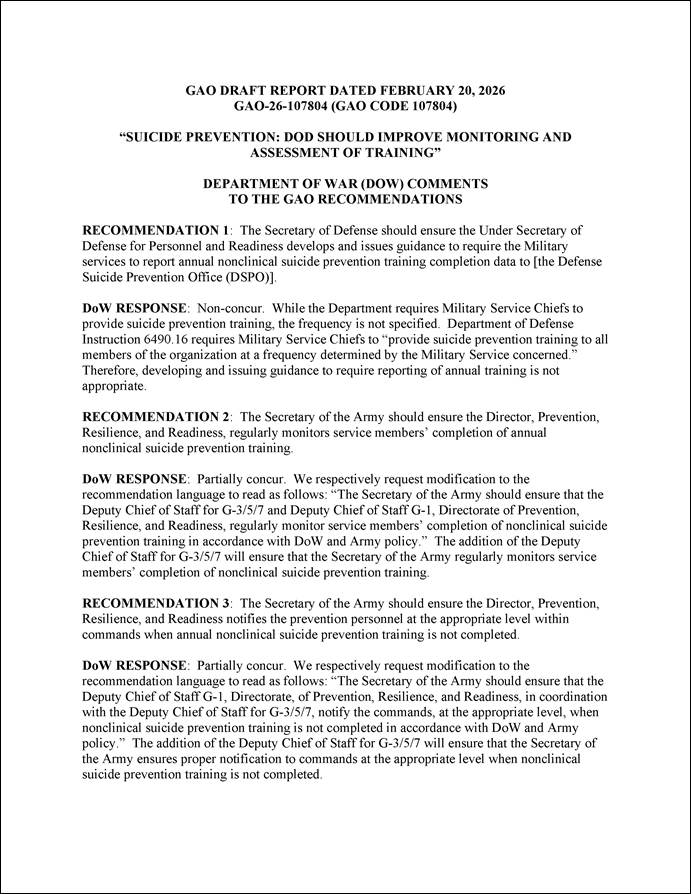
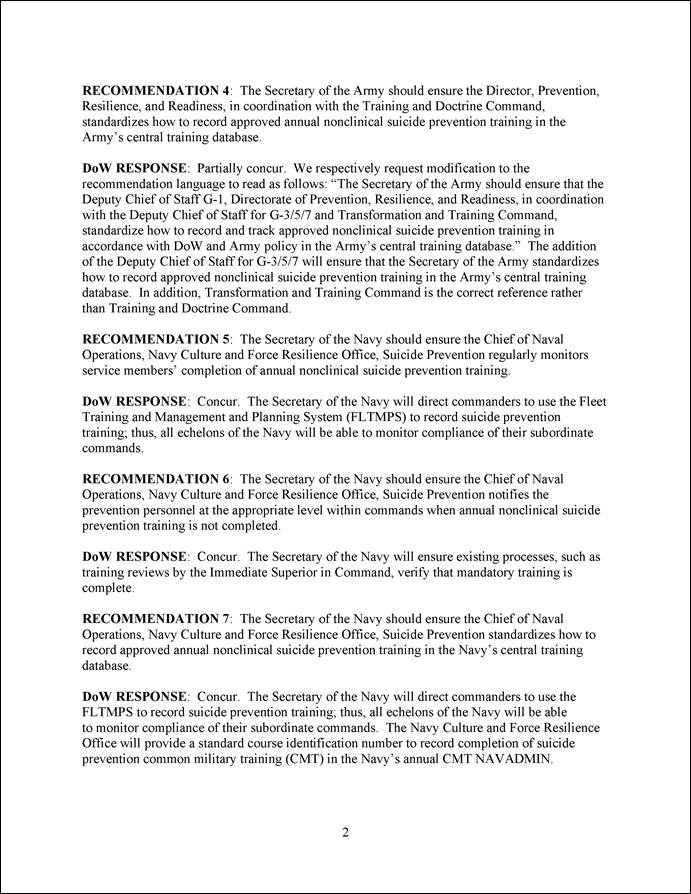
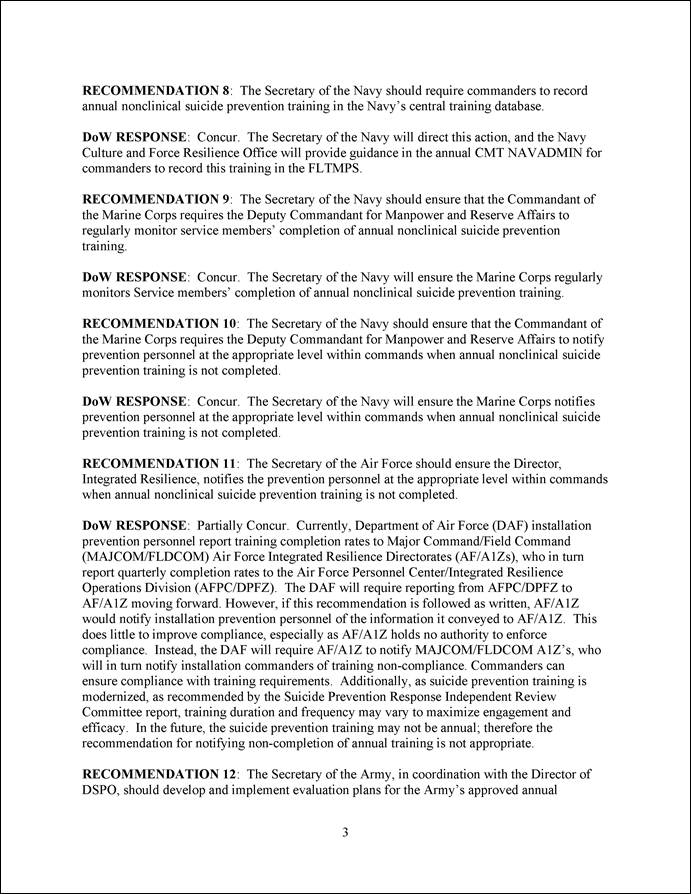
GAO Contact
Rashmi Agarwal, agarwalr@gao.gov
Staff Acknowledgments
In addition to the contact named above, Simon Hirschfeld (Assistant Director), Norris Smith (Analyst in Charge), Kiana Boyette, Vincent Buquicchio, Benjamin Emmel, Chelsey Goines, Amie Lesser, Jerome Sandau, Rebecca Sero, Anne Thomas, and Yoki Moody Wong made key contributions to this report.
The Government Accountability Office, the audit, evaluation, and investigative arm of Congress, exists to support Congress in meeting its constitutional responsibilities and to help improve the performance and accountability of the federal government for the American people. GAO examines the use of public funds; evaluates federal programs and policies; and provides analyses, recommendations, and other assistance to help Congress make informed oversight, policy, and funding decisions. GAO’s commitment to good government is reflected in its core values of accountability, integrity, and reliability.
Obtaining Copies of GAO Reports and Testimony
The fastest and easiest way to obtain copies of GAO documents at no cost is through our website. Each weekday afternoon, GAO posts on its website newly released reports, testimony, and correspondence. You can also subscribe to GAO’s email updates to receive notification of newly posted products.
Order by Phone
The price of each GAO publication reflects GAO’s actual cost of production and distribution and depends on the number of pages in the publication and whether the publication is printed in color or black and white. Pricing and ordering information is posted on GAO’s website, https://www.gao.gov/ordering.htm.
Place orders by calling (202) 512-6000, toll free (866) 801-7077,
or
TDD (202) 512-2537.
Orders may be paid for using American Express, Discover Card, MasterCard, Visa, check, or money order. Call for additional information.
Connect with GAO
Connect with GAO on X,
LinkedIn, Instagram, and YouTube.
Subscribe to our Email Updates. Listen to our Podcasts.
Visit GAO on the web at https://www.gao.gov.
To Report Fraud, Waste, and Abuse in Federal Programs
Contact FraudNet:
Website: https://www.gao.gov/about/what-gao-does/fraudnet
Automated answering system: (800) 424-5454
Media Relations
Sarah Kaczmarek, Managing Director, Media@gao.gov
Congressional Relations
David A. Powner, Acting Managing Director, CongRel@gao.gov
General Inquiries
[1]According to Calendar Year 2024 Annual Report on Suicide in the Military from calendar year 2023 to 2024 active component suicide rates decreased by about 4 percent, which DOD stated is statistically significant. Over the same time period, reserve suicide rates decreased by about 3 percent and the National Guard rate increased by about 3 percent, rates that DOD stated are not statistically significant.
[2]For the purposes of this report, annual suicide prevention training or annual training refers to nonclinical annual suicide prevention training, unless otherwise noted.
[3]See Naval Audit Service Audit Report, Navy Suicide Prevention Program, N2023-0005 (Jan. 10, 2023); Naval Audit Service Audit Report, Marine Corps Suicide Prevention Program, N2022-0013 (Feb. 28, 2022); Air Force Audit Agency, Audit Report: 72nd Air Base Wing Tinker Air Force Base, F2024-0018-RWC000 (July 12, 2024); and Air Force Audit Agency, Installation Report of Audit: Suicide Prevention 15th Wing Joint Base Pearl Harbor-Hickam Hawaii, F2023-0009-RWT000 (June 2, 2023).
[4]See GAO, Defense Health Care: DOD Needs to Fully Assess Its Nonclinical Suicide Prevention Efforts and Address Any Impediments to Effectiveness, GAO‑21‑300 (Washington, D.C.: Apr. 26, 2021). Department of Defense (DOD) Instruction 6490.16, Defense Suicide Prevention Program (Nov. 6, 2017) (incorporating change 3, Feb. 2, 2023) defines nonclinical suicide prevention activities as activities including, but not limited to, those that directly address suicide (e.g., training to identify and support those deemed to be at higher risk for suicide); efforts to promote total force fitness by targeting protective factors such as skill development (e.g., building healthy relationships, coping skills, emotional intelligence, effective communication, and resilience); efforts to promote protective environments and healthy climates (e.g., safe storage of lethal means); military dependent support programs; financial readiness; and efforts to address institutional and systematic risk factors for suicide. These differ from clinical suicide prevention activities, which entail educating clinical DOD prevention personnel and building clinical capacity to address the physical and psychological effects that self-directed harm and prohibited abusive or harmful acts have on service members and their dependents.
[5]GAO‑21‑300. In this report we made two recommendations related to evaluation, which DOD concurred with and has implemented. See also Suicide Prevention: DOD Should Enhance Oversight, Staffing, Guidance, and Training Affecting Certain Remote Installations, GAO‑22‑105108 (Washington, D.C.: Apr. 28, 2022). In this report we made seven recommendations related to training. DOD partially concurred with one recommendation and concurred with the remained six. DOD has implemented five of these recommendations and has taken some actions on the remaining two open recommendations related to training but not yet fully implemented them.
[6]Pub. L. No. 117-81, § 738. Section 738 did not specifically require DOD to implement the committee’s recommendations.
[7]See Preventing Suicide in the U.S. Military: Recommendations from the Suicide Prevention and Response Independent Review Committee (Jan. 4, 2023).
[8]H.R. Rep. No. 118-125, at 194 (2023).
[9]At the time of our analysis, the most recent complete data available were from fiscal year 2024.
[10]DOD Instruction 6490.16, Defense Suicide Prevention Program. Also see Program Evaluation: Key Terms and Concepts, GAO‑21‑404SP (Washington, D.C.: Mar. 22, 2021).
[11]GAO, Human Capital: A Guide for Assessing Strategic Training and Development Efforts in the Federal Government (Supersedes GAO‑03‑893G), GAO‑04‑546G (Washington, D.C.: Mar. 1, 2004).
[12]To conduct this analysis, two analysts independently reviewed the document that the Air Force stated constituted its evaluation plan for suicide prevention training with elements DOD requires to be included in an evaluation plan of suicide prevention activities. The two analysts then met to compare the results of their analysis and adjudicated any differences.
[13]See Preventing Suicide in the U.S. Military: Recommendations from the Suicide Prevention and Response Independent Review Committee (Jan. 4, 2023). Secretary of Defense Memorandum, New DOD Actions to Prevent Suicide in the Military (Sept. 26, 2023).
[14]Project Management Institute, Inc., A Guide to the Project Management Body of Knowledge (PMBOK® Guide) – Seventh Edition (2021). PMBOK is a trademark of Project Management Institute, Inc. The Project Management Institute is a not-for-profit association that, among other things, provides standards for managing various aspects of projects, programs, and portfolios.
[15]See Pub. L. No. 110-417, § 733.
[16]ACE is the Army suicide prevention training model. ACE Base +1 is an Army-approved suicide prevention and awareness training for soldiers, leaders, and civilians. ACE-Suicide Intervention (SI) is an ACE training for Army leaders. According to National Guard Bureau guidance, ACE-SI is a one-time requirement for leaders.
[17]Pub. L. No. 112-239, § 580 (10 U.S.C. § 1071 note).
[18]The Department of the Air Force is responsible for both the Air Force and Space Force in both operational support and training roles.
[19]Pub. L. No. 117-81, § 738.
[20]See Preventing Suicide in the U.S. Military: Recommendations from the Suicide Prevention and Response Independent Review Committee (Jan. 4, 2023).
[21]DOD Instruction 6490.16.
[22]See Army Regulation 600-92, Army Suicide Prevention Program (Oct. 4, 2024).
[23]Army Regulation 600-92.
[24]According to Army officials, COVID-19 significantly affected the training environment from fiscal year 2020 through fiscal year 2024.
[25]See Army Regulation 600-92. According to Department of the Air Force Instruction 90-5001, Integrated Resilience (July 23, 2024)(incorporating Department of the Air Force Guidance Memorandum 2025-01, dated Nov. 19, 2025), unit training managers are required to document training in MyLearning, the Department of the Air Force’s central training database, or via other means, as directed by the Department of the Air Force’s Community Action Board. See also Marine Corps Order 1553.10, Marine Corps Training Information Management System (MCTIMS) Standing Operating Procedures (SOP) (Oct 23, 2014).
[26]Marine Corps Order 5040.6J, Inspector General of the Marine Corps Inspections Program (July 11, 2019).
[27]See Marine Corps Order 1553.10.
[28]According to Department of the Air Force Instruction 90-5001, unit training managers are required to document training in MyLearning, the Department of the Air Force’s central training database, or via other means, as directed by the Department of the Air Force’s Community Action Board.
[29]According to Air Force officials, calendar year 2020 and 2021 training completions may have been affected by restrictions on in-person work due to the COVID-19 pandemic. The Air Force’s annual suicide prevention course—called Total Force Annual Training-Suicide Prevention—is delivered in person in a small group discussion format. The myLearning and Envision datasets suggest calendar year 2021 was affected more than other years of data that the Air Force provided, according to Air Force officials.
[30]Army Regulation 600-92, Army Suicide Prevention Program (Oct. 4, 2024).
[31]Army General Order No. 2025-23, Establishment of the United States Army Transformation and Training Command as an Army Command (Oct. 2, 2025).
[32]Office of the Chief of Naval Operations Instruction 1720.4B, Suicide Prevention Program (Sept. 18, 2018).
[33]Marine Corps Order 1720.2A, Marine Corps Suicide Prevention System (MCSPS) (Aug. 2, 2021).
[34]Department of the Air Force Instruction 90-5001.
[35]Chief, National Guard Bureau Directive-Type Memorandum 0300.00, National Guard Suicide Prevention Program (June 7, 2024).
[36]DOD Instruction 6490.16.
[37]GAO, Standards for Internal Control in the Federal Government, GAO‑14‑704G, (Washington, D.C.: Sept. 10, 2014).
[38]GAO, Human Capital: A Guide for Assessing Strategic Training and Development Efforts in the Federal Government, GAO‑04‑546G (Washington, D.C.: Mar. 1, 2004).
[39]GAO‑04‑546G. A data collection and analysis plan sets priorities for evaluations and systematically covers the methods, timing, and responsibilities for data collection.
[40]DOD Instruction 6490.16.
[41]The 11 nonclinical evaluation plan requirements include areas such as taking resources, review processes, and contextual factors into account; having mechanisms and resources to monitor the extent intended outcomes are met; including assessment of short-and intermediate-term outcomes to evaluate risk and protective factors; portraying the notions of short-, intermediate-, and long-term desired outcomes of an activity; and using the DOD Suicide Prevention Standards of Practice for Evaluation to develop the plans in accordance with established evaluation standards of practice.
[42]The Walter Reed Army Institute of Research is an Army Research Institute that works to protect against infectious disease threats and conducts basic and applied research that seeks to promote psychological resilience, enhance neurological functioning, and improve operational readiness among service members.
[43]DOD Instruction 6490.16.
[44]Process metrics monitor whether training is being implemented as intended. Outcome metrics are the specific data that are collected to assess the extent to which expected outcomes (e.g., changes in behaviors, attitudes, or knowledge) have been achieved.
[45]DOD Instruction 6490.16.
[47]Both ACE Base +1 and ACE-SI are included in the Army’s evaluation efforts as the Army’s suicide prevention training program of record and will be referred to as ACE throughout this section. Additionally, longitudinal studies employ continuous or repeated measures to follow individuals over prolonged periods of time—often years or decades—and are generally observational in nature.
[48]Department of the Air Force is responsible for both the Air Force and Space Force in operational support and training roles. According to Air Force officials, they meet with Space Force officials to see if the Space Force has any specific needs that need to be addressed.
[49]Air Force officials stated that the Suicide Prevention Total Force Annual Training Pre-Post Knowledge Check Tiers 1&2 was approved in January 2024. Air Force officials also provided a 2024 Bullet Background Paper to DSPO for the Air Force 2025 to 2026 evaluation. This Bullet Background Paper is a document that summarized the Suicide Prevention Total Force Annual Training Pre-Post Knowledge Check Tiers 1&2, according to Air Force officials. Additionally, the Air Force provided a similar document for the Tier 3 training, which is largely redundant to the document on Tiers 1&2 with the main difference being the training-specific pre- and post- knowledge check questions.
[50]See DOD Instruction 6490.16.
[51]According to Air Force officials, of the 102,850 individuals who opened the knowledge check QR code, 18,814 individuals (about 18 percent) completed the pre- and post- training knowledge check in 2024.
[52]GAO, Human Capital: A Guide for Assessing Strategic Training and Development Efforts in the Federal Government (Supersedes GAO‑03‑893G), GAO‑04‑546G (Washington, D.C.: Mar. 1, 2004).
[53]GAO, Defense Health Care: DOD Needs to Fully Assess Its Nonclinical Suicide Prevention Efforts and Address Any Impediments to Effectiveness, GAO‑21‑300 (Washington, D.C.: Apr. 26, 2021). DOD Instruction 6490.16, Defense Suicide Prevention Program.
[54]DOD Instruction 6490.16.
[56]The NDAA for Fiscal Year 2022 directed the Secretary of Defense to establish an independent suicide prevention and response review committee, referred to throughout this section as the independent review committee. See Pub. L. No. 117-81, § 738. Section 738 did not specifically require DOD to implement the committee’s recommendations.
[57]See Preventing Suicide in the U.S. Military: Recommendations from the Suicide Prevention and Response Independent Review Committee (Jan. 4, 2023).
[58]See Secretary of Defense Memorandum, New DOD Actions to Prevent Suicide in the Military (Sept. 26, 2023).
[59]The Secretary of Defense did not approve 16 of the independent review committee recommendations for implementation because, according to the Secretary’s memorandum, the implementation of the recommendations was not feasible.
[60]DOD refers to these project plans as plan of actions and milestones. Two independent review committee nonclinical suicide prevention training recommendations, though approved, are not currently being implemented because they have not been funded, according to DSPO officials.
[62]Postvention refers to response activities that should be undertaken in the immediate aftermath of a suicide that has impacted the unit.
[63]As of January 2026, the hiring freeze was still in effect, according to DOD officials.
[64]As of January 28, 2025, the Office of Personnel Management announced that federal employees could voluntarily resign effective September 30, 2025. Employees electing to resign would have their duties reassigned or eliminated by their agency and would be placed on paid administrative leave until September 30, with some exceptions. Employees who took this deferred resignation were also excused from return-to-office requirements while retaining their salary and benefits in the interim. In addition, DOD established the DOD deferred resignation program in March 2025.
[65]See Secretary of Defense Memorandum, Mission Focus of the Department of Defense (Mar. 17, 2025).
[66]As of January 2026, DOD was operating under a continuing resolution. Continuing Appropriations, Agriculture, Legislative Branch, Military Construction and Veterans Affairs, and Extensions Act, 2026, Pub. L. No. 119-37 (enacted Nov. 12, 2025).
[67]Project Management Institute, Inc., A Guide to the Project Management Body of Knowledge (PMBOK® Guide) – Seventh Edition (2021). The PMBOK® Guide states that a project is a temporary endeavor undertaken to create a unique product, service, or result, with a beginning and end to the project work or a phase of the project work. Projects can be part of a portfolio—projects and operations managed as a group to achieve strategic objectives—or program, where related projects are managed in a coordinated manner to obtain benefits not available from managing them individually. The PMBOK® Guide states that work in the project performance domains is guided by the principles of project management. The Standard for Project Management identifies project management principles that guide behaviors and actions of project professionals and other stakeholders who work on or are engaged with projects. The Standard for Project Management provides a basis for understanding project management and how it enables intended outcomes. This standard applies regardless of industry, location, size, or delivery approach. Project management principles are from Project Management Institute, Inc., A Guide to the Project Management Body of Knowledge (PMBOK® Guide), Seventh Edition (2021). PMBOK is a trademark of Project Management Institute, Inc. The Project Management Institute is a not-for-profit association that, among other things, provides standards for managing various aspects of projects, programs, and portfolios.
[68]DSPO drafted 16 project plans in 2024 for implementing nonclinical suicide prevention training-related recommendations from the independent review committee, of which 14 were approved in 2024 and two were updated and approved in 2025, according to a DSPO official. According to the official, DSPO did not develop plans for the other two relevant recommendations approved for implementation because they have not been funded.
[69]Preventing Suicide in the U.S. Military: Recommendations from the Suicide Prevention and Response Independent Review Committee (Jan. 4, 2023). Secretary of Defense Memorandum, New DOD Actions to Prevent Suicide in the Military (Sept. 26, 2023).