
Report to Congressional Addressees
United States Government Accountability Office
A report to congressional addressees
For more information, contact: Rebecca Shea at SheaR@gao.gov or Jared Smith at SmithJB@gao.gov.
What GAO Found
GAO estimated that annual federal tax fraud loss is between $116 billion and $304 billion based on data and information from 2018 through 2024. GAO’s estimate is informed by data on Internal Revenue Service (IRS) cases of fraud and potential fraud, potential fraud in the tax gap, and tax evasion from economic activities purposefully hidden from the government (i.e., shadow economy).
The estimated range reflects approximately 2 percent to 6 percent of estimated tax owed to the federal government (tax liability) if applied to tax year 2022, the most recent year for which an estimate of the tax liability is available.
GAO Estimated Range of Tax Fraud Loss as a Percentage of Estimated Total Tax Owed to the Federal Government, Tax Year 2022
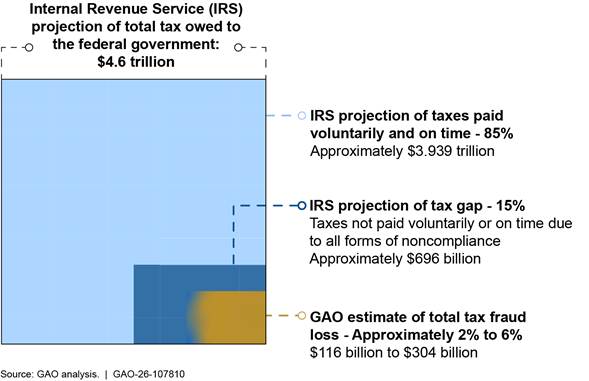
The estimated range represents GAO’s best estimate of the extent of tax fraud based on the available evidence and analytical methods. The methodology accounts for the inherent uncertainties associated with fraud estimation and data limitations.
The estimate could help Congress and agency officials understand the potential scale and scope of tax fraud loss and decide how to allocate resources for fraud risk management. For example, the estimate could inform decisions about the costs and benefits of implementing new controls to prevent, detect, and respond to tax fraud.
While it is not possible to eliminate fraud completely, different divisions within IRS undertake a broad range of activities that help manage tax fraud risk and safeguard taxpayer dollars. Some of these activities are directly aimed at preventing, detecting, and responding to tax fraud. Other activities are aimed at improving overall taxpayer compliance but nonetheless help the agency reduce tax fraud risk. For example, IRS’s Return Review Program screens certain individual tax returns for characteristics indicative of fraud. Through this program, according to IRS, it prevented $88 billion in invalid, and potentially fraudulent, tax refund payments from 2018 through 2024.
Additionally, tax return audits play a key role in helping IRS detect fraud. IRS trains auditors to recognize indicators of fraud when reviewing tax returns for overall compliance. Once IRS detects potential fraud in a tax return, it may respond in various ways, including through assessing civil penalties, criminal investigation, and referral for prosecution.
IRS has routinely assessed fraud risks consistent with leading practices for fraud risk management. However, the agency has not developed an antifraud strategy or designated an antifraud entity to mitigate fraud risks in a strategic and coordinated manner. An antifraud strategy could help IRS better manage fraud risks, which in turn could help reduce revenue lost to tax fraud. Further, designating an antifraud entity to undertake key fraud risk management activities—such as coordinating antifraud initiatives across the agency—would help IRS better mitigate the billions of dollars lost to fraud each year.
Why GAO Did This Study
Each year, the federal government collects trillions of dollars in revenue, the single largest source of which comes from taxes that IRS collects. Most taxpayers pay their taxes voluntarily and on time. However, some taxpayers do not comply with tax law, including by committing fraud—willful misrepresentation to obtain something of value. Tax fraud diverts revenue that could be used for critical government operations and services and exacerbates budget deficits.
This report (1) describes the estimated amount of federal tax revenue lost to fraud annually and (2) examines the ways in which IRS safeguards federal tax revenue and manages fraud risks.
GAO estimated the amount of federal tax revenue lost to fraud annually using a well-established probabilistic method for estimating ranges of outcomes under different assumptions and scenarios where there is a high degree of uncertainty, such as with fraud estimation. The simulation incorporated IRS data from 2018 through 2024, as well as information on tax fraud from other sources, such as academic literature.
GAO also analyzed IRS documentation and interviewed IRS officials.
What GAO Recommends
GAO is making two recommendations to IRS, that it develop and document an antifraud strategy and designate an antifraud entity.
IRS partially agreed with both recommendations. GAO continues to believe that IRS should develop an antifraud strategy and designate an antifraud entity.
|
Abbreviations |
|
|
|
|
|
|
|
CEO |
Chief Executive Officer |
|
|
CI |
Criminal Investigation |
|
|
CPA |
Certified Public Accountant |
|
|
Fraud Risk Framework |
A Framework for Managing Fraud Risks in Federal Programs |
|
|
GDP |
gross domestic product |
|
|
HMRC |
His Majesty’s Revenue and Customs |
|
|
IRS |
Internal Revenue Service |
|
|
RRP |
Return Review Program |
|
|
UK |
United Kingdom |
|
This is a work of the U.S. government and is not subject to copyright protection in the United States. The published product may be reproduced and distributed in its entirety without further permission from GAO. However, because this work may contain copyrighted images or other material, permission from the copyright holder may be necessary if you wish to reproduce this material separately.
September 25, 2026
Congressional Addressees
Each year, the federal government collects trillions of dollars in revenue, the single largest source of which comes from taxes collected by the Internal Revenue Service (IRS).[1] In fiscal year 2025, IRS collected about 84 percent of all federal revenue—more than $5 trillion—in the form of federal taxes. This tax revenue is a critical source of funding for government operations and services, including for national security operations, health care for veterans, and Social Security payments for retirees.
IRS studies conclude that, for the most part, taxpayers fulfill their tax obligations voluntarily and on time. For example, IRS has estimated that 85 percent of taxes are paid fully and on time.[2] Further, in a survey conducted by IRS, 84 percent of surveyed U.S. taxpayers indicated that it was never acceptable to cheat on their taxes.[3]
However, some taxpayers do not comply with tax law, including by committing fraud—willful misrepresentation to obtain something of value.[4] For example, criminals, including organized criminal groups, have used stolen identity information to fraudulently obtain taxpayer refunds at scale. Furthermore, some individuals and businesses intentionally evade taxes—failing to pay or deliberately underpaying taxes owed—and, therefore, reducing tax revenue collected. Tax revenue lost to fraud otherwise could be used for critical government operations and services and exacerbates annual budget deficits, increases the national debt, and erodes public confidence in the integrity of the tax system.
In addition to lost revenue, tax fraud schemes may also result in nonfinancial harms. For example, taxpayers who have been unwitting victims to illegal tax scams or tax refund identity theft may experience emotional distress.[5]
Despite the harm tax fraud causes, there is no comprehensive estimate of the amount of U.S. federal tax revenue lost to fraud. Yet, as we have previously reported, understanding the scope of the problem is critical to combating fraud in government programs and operations.[6] Further, understanding the scope and scale of fraud can help Congress, agency officials, and others ensure that resources for fraud risk management are sufficient to combat fraud affecting the federal government.
We performed our work at the initiative of the Comptroller General. This report (1) describes the estimated amount of federal tax revenue lost to fraud annually and (2) examines the ways in which IRS safeguards federal tax revenue and manages fraud risks.
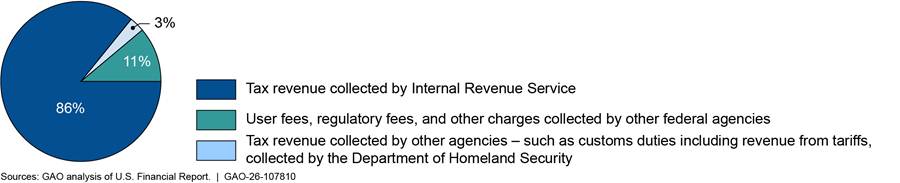
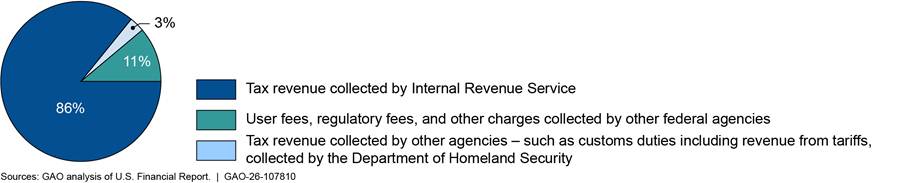
To address our first objective, we analyzed sources of federal revenue. We focused on federal taxes collected by IRS because this represents the largest source of federal revenue—86 percent of federal revenue in fiscal year 2024, the most recent year for which data were available when we began our review. Tax revenue collected by other agencies—such as customs duties, including revenue from tariffs, collected by the Department of Homeland Security—may also experience fraud. However, our estimated range of annual federal taxes lost to fraud does not account for fraud in tax revenue collected by these agencies. Additionally, more than 30 federal agencies collect nontax revenue in the form of user fees, regulatory fees, and other charges, and assessments for governmental services, programs, or activities. Figure 1 illustrates federal revenue collection, by type, for fiscal year 2024. Our estimated range of annual federal taxes lost to fraud does not account for fraud losses in these other sources of nontax revenue.
To develop our estimate of tax fraud loss, we collected and analyzed relevant data on (1) cases of adjudicated tax fraud and potential tax fraud, (2) potentially fraudulent noncompliance in the tax gap, and (3) federal tax evasion in the shadow economy.[7] While data on tax fraud are limited, we assessed the reliability of all data used in our analysis, such as by performing electronic testing of the data and interviewing knowledgeable agency officials about the data we obtained. We determined the data were sufficiently reliable for our purposes.
To estimate tax fraud loss, we used a Monte Carlo simulation—a method effective at estimating ranges for which there are limited data or where there is a high degree of uncertainty, such as with fraud estimation.[8] We chose this method based on our review of tax fraud studies, available fraud-related data, interviews with IRS officials, and our past work on fraud estimation.[9] Furthermore, Monte Carlo simulation is an effective method to estimate tax fraud loss because it addresses uncertainty about unobserved processes, such as undetected fraud.[10]
We also interviewed tax officials from the United Kingdom (UK) and Australia, as well as representatives from the World Bank and academia, to learn how others have approached tax revenue fraud estimation and related topics.[11] We discuss our estimation methodology in greater detail in appendix I.
To address our second objective, we reviewed IRS publications and documentation on how the agency safeguards revenue and manages fraud risk. This review included documentation on IRS measures and estimates related to tax fraud, including IRS Identity Theft Taxonomies and tax gap estimates and projections.[12] We interviewed IRS officials to discuss how they used these measures and estimates to support prevention and other fraud risk management activities they undertake.[13] We evaluated this information against relevant leading practices found within our Framework for Managing Fraud Risks in Federal Programs (Fraud Risk Framework).[14] Additional details on our scope and methodology appear in appendix I.
We conducted this performance audit from September 2024 through September 2026 in accordance with generally accepted government auditing standards. Those standards require that we plan and perform the audit to obtain sufficient, appropriate evidence to provide a reasonable basis for our findings and conclusions based on our audit objectives. We believe that the evidence obtained provides a reasonable basis for our findings and conclusions based on our audit objectives.
Background
Fraud in the Federal Tax System
Most U.S. taxpayers comply with tax law, and not all taxpayer noncompliance is due to fraud. However, some taxpayers commit fraud to evade paying their tax liabilities. The U.S. Tax Code defines tax fraud as an intentional wrongdoing on the part of a taxpayer, with the specific purpose of evading a tax known, or believed to be, owing.[15] IRS policy further states that tax fraud requires both (1) a tax due and owing and (2) fraudulent intent.[16] In addition to tax fraud committed by the taxpayer, others can commit fraud using the taxpayer’s information, with or without the knowledge of the taxpayer.
Tax fraud schemes vary and constantly evolve with changes to tax law, technology, and the economy. Tax fraud can be committed by taxpayers, tax professionals, or identity thieves, among others. We highlight three broad categories of tax fraud schemes below.
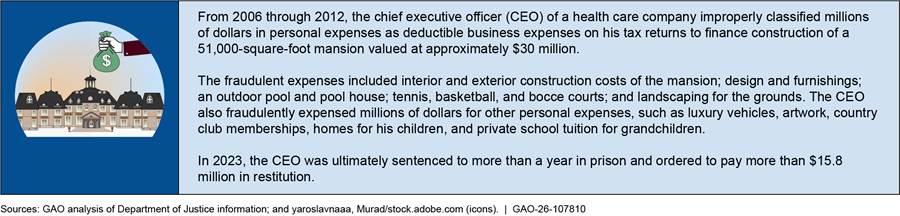
Tax evasion. Tax evasion may occur when taxpayers file tax returns but inaccurately report their expenses or income, with the goal of falsely reducing the amount of taxes due and ultimately paid to IRS.[17] For example, taxpayers may claim tax credits for which they do not qualify, falsely inflate their reported expenses or claimed deductions, conceal assets, or omit or underreport income. Figure 2 provides an example of tax evasion through underreporting of taxes.
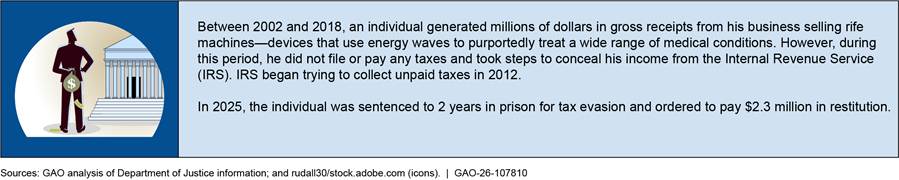
Alternatively, taxpayers may commit tax evasion by not filing any tax return at all. As part of this scheme, they may attempt to avoid IRS detection by exploiting underreported channels to conceal income and assets, such as by using cash-intensive businesses or cryptocurrencies. Figure 3 provides an example of tax evasion through not filing a required tax return or paying any taxes.
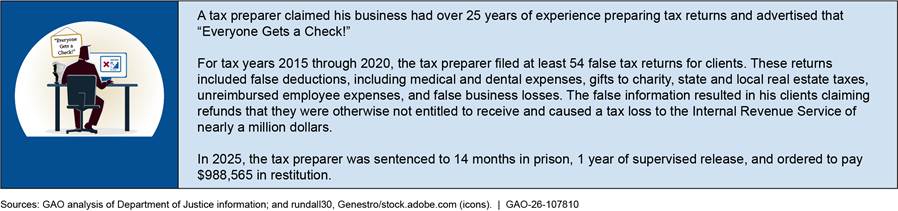
Return preparer fraud. Return preparer fraud occurs when tax professionals prepare and file false tax returns for their clients that include inflated personal or business expenses, false deductions, or excessive exemptions or credits to which the client (the taxpayer) is not entitled. In fiscal year 2024, more than half of all individual taxpayers relied on return preparers to assist them in meeting their tax filing obligations. Many tax return preparers are not subject to IRS regulation, including competency testing, suitability checks, or educational requirements, and many do not have professional credentials.[18] In some situations, the client/taxpayer may not have knowledge of the fraudulent actions of the return preparer. Figure 4 provides an example of return preparer fraud.
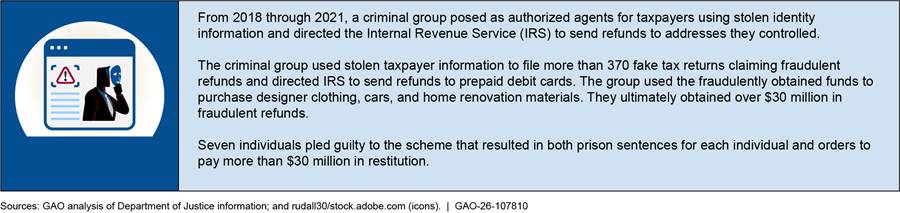
Identity theft tax refund fraud. Identity theft tax refund fraud occurs when fraudulent actors use personally identifiable information stolen from individuals, businesses, or tax professionals with the goal of stealing a victim’s tax refund. According to the Department of Justice, identity theft tax refund fraud schemes are often perpetrated by large criminal enterprises. The enterprises exploit the speed and relative anonymity of highly automated systems for storing personal information, preparing and filing tax returns electronically, and generating income tax refunds quickly—often in the form of electronic payments. Identity theft tax refund fraud involves three distinct steps:
1. Fraudulent actors steal or illicitly obtain a taxpayer’s Social Security number or other personally identifiable information;
2. Fraudulent actors file false tax returns with IRS, using the stolen identity information claiming a tax refund is due to the taxpayer; and
3. If the false tax return is not detected, IRS sends tax refunds to addresses, bank accounts, or other financial instruments controlled by the fraudulent actors.
Figure 5 provides an example of identity theft tax refund fraud.
IRS Structure, Roles, and Responsibilities to Address Tax Fraud
IRS has several divisions that help the agency address tax fraud. IRS has four major divisions focusing on specific groups of taxpayers:
1. Taxpayer Services Division, which serves all individual taxpayers.
2. Large Business and International Division, which serves domestic and foreign businesses (e.g., C corporations, S corporations, and partnerships) with a U.S. tax reporting requirement and assets equal to, or greater than, $10 million.[19]
3. Small Business/Self-Employed Division, which serves small businesses (those with less than $10 million in assets) and self-employed taxpayers.
4. Tax-Exempt and Government Entities Division, which serves organizations exempt from income tax, such as charities and private foundations, as well as federal, state, and local government agencies; Indian tribal governments; tax-exempt bonds; and employee plans.
Each of these divisions is responsible for designing, developing, and implementing its own programs and procedures to address taxpayer noncompliance, including tax fraud. For example, each division sets goals related to the number and type of audits to conduct and establishes parameters for selecting tax returns for audit, which may identify fraud.
Other functional and support divisions within IRS also help the agency detect, prevent, and respond to tax fraud:
· The Office of the Chief Risk and Control Officer leads the agency’s Fraud Risk Assessment process, which we discuss later in this report.
· The Office of Fraud Enforcement assists divisions across IRS in identifying indicators of tax fraud, developing enforcement recommendations, and developing potential criminal fraud referrals.
· The Office of Promoter Investigations leads activities that support IRS’s efforts to detect and deter abusive tax promotions and abusive tax return preparers.
· IRS’s Criminal Investigation Division investigates potential criminal violations of the Internal Revenue Code and related financial crimes, including tax fraud.[20]
Available Information on the Extent of Tax Fraud Loss and Related Limitations
One of the many challenges in determining the extent of tax fraud is its deceptive nature. As we have previously reported, federal programs may incur losses related to fraud that are never identified and, as a result, such losses are difficult to estimate.[21] While data are not complete, IRS has data that provide some insight into the extent of tax fraud (see fig. 6).
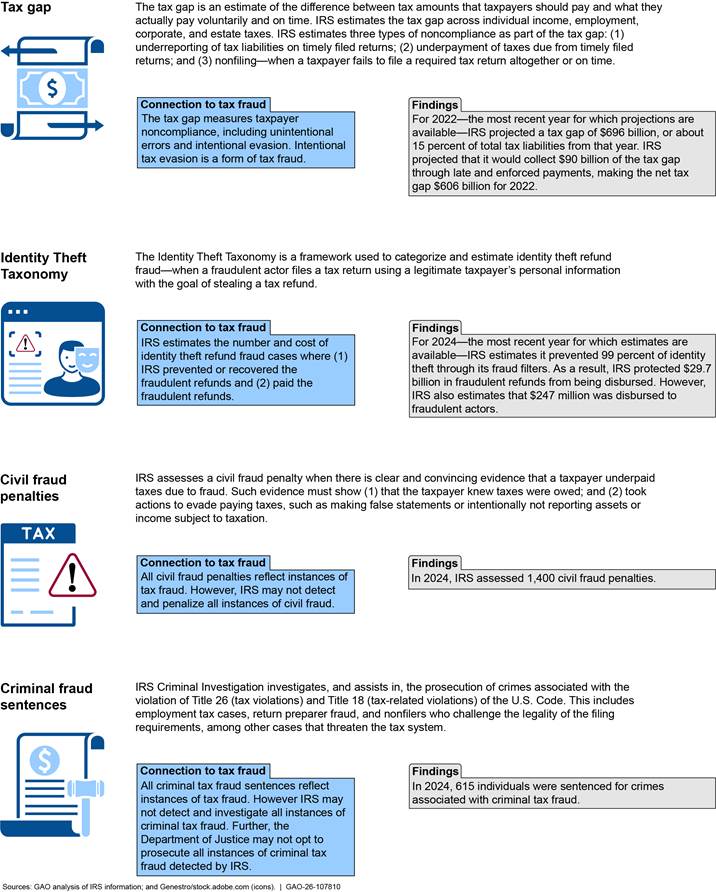
None of these data provides an exclusive and comprehensive picture of the tax fraud that IRS may encounter. For example, the tax gap includes tax losses due to fraud but also includes revenue lost due to reasons beyond fraud, such as taxpayer errors.[22] Other IRS data, such as the number of criminal fraud sentences, are exclusive to cases of fraud. However, sentence data only reflect instances of fraud addressed through the criminal adjudicative process.
IRS may also address suspected fraud through its noncompliance processes. For example, IRS employees may detect a tax return with an understatement of taxes and then assess those taxes, as well as noncompliance penalties, rather than conducting a full criminal investigation into whether the taxpayer intended to commit fraud. Finally, IRS may not identify all instances of fraud.
In addition to IRS data related to tax fraud, foreign governments have published information that provide some insight into the extent of tax fraud in their countries. For example, the UK tax authority publishes annual tax gap reports, estimating the difference between the amount of taxes it collects and the amount that would have been collected if every UK taxpayer was fully compliant with relevant tax law. Although the UK report does not make a separate estimate of the amount of fraud within its tax gap, UK tax officials told us that some taxpayer behaviors accounted for in the UK tax gap—evasion, criminal attacks, the hidden economy, and nonpayment—capture fraudulent behaviors.[23] Similarly, the Australian Taxation Office estimated tax loss due to shadow economy activities, which it considers to be deliberate actions to evade tax, in its tax gap estimates.[24]
GAO’s Prior Work on Measurement and Estimation to Manage Fraud Risks
We have previously found that determining the extent of fraud in federal programs—including through measurement and estimation—could help Congress, oversight bodies, and agency officials.[25] Specifically, fraud estimates can help management demonstrate the scope of the problem, inform resource priorities, and serve as a baseline for determining return on investment from fraud risk management activities (see fig. 7).
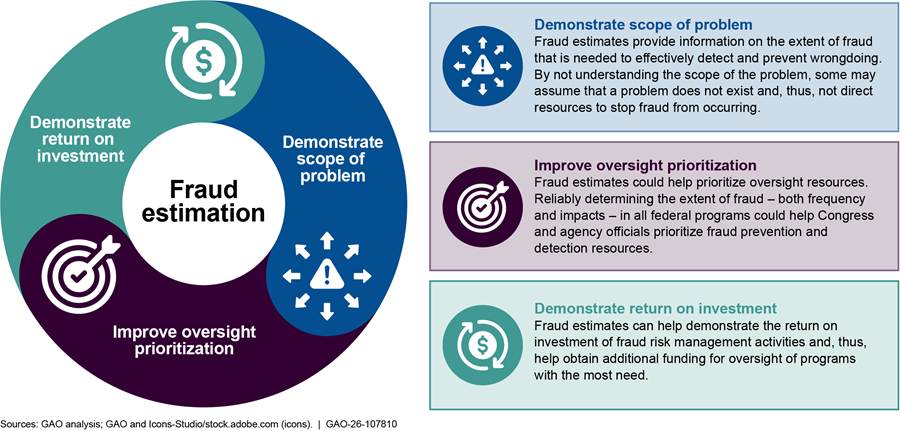
While we found there are benefits to estimating the extent of fraud, we also identified challenges to such efforts. For example, data to support fraud estimation may not be readily available or usable, definitions of fraud may vary across entities, and identifying previously undetected fraud can be resource intensive and require significant analysis and expertise.
To help address these issues, in 2024 we recommended that the Secretary of the Treasury, in consultation with the Office of Management and Budget, establish an effort to evaluate and identify methods to expand government-wide fraud estimation to support fraud risk management.[26] The Department of the Treasury indicated that it concurred with our recommendation. As of May 2025, Treasury officials stated that they were exploring fraud estimation approaches to address the recommendation. As of July 2026, we are awaiting an update from Treasury about the status of its actions in response to this recommendation. We continue to believe that with more targeted estimates, agencies would be better positioned to leverage this information to strategically manage fraud risk. We will continue to monitor Treasury’s actions.
Fraud Risk Management
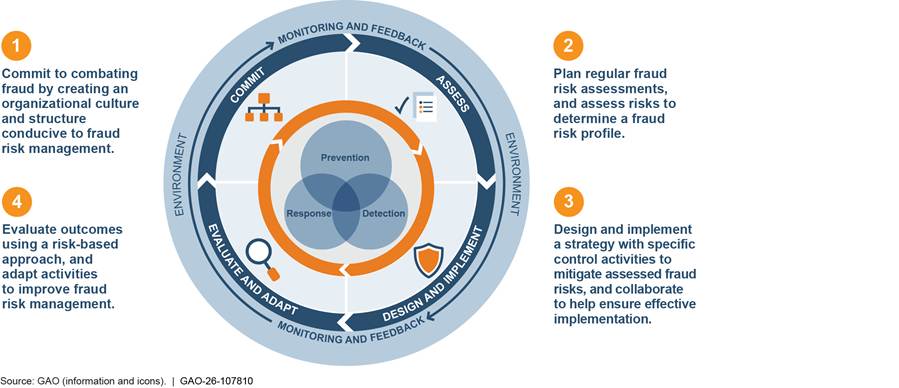
The Fraud Risk Framework provides a comprehensive set of key components and leading practices that serve as a guide for agency managers to use when developing efforts to combat fraud in a strategic, risk-based manner.[27] The objective of fraud risk management is to ensure program integrity by continuously and strategically mitigating the likelihood and impact of fraud.
As discussed in the Fraud Risk Framework, strategic fraud risk management involves more than having controls to prevent, detect, and respond to fraud. It encompasses structures and environmental factors that influence or help managers achieve their objective to mitigate fraud risks. The Fraud Risk Framework describes leading practices in four components: commit, assess, design and implement, and evaluate and adapt, as depicted in figure 8.
GAO’s Antifraud Resource provides information and tools to help federal officials learn more about fraud schemes that affect the federal government and how to combat such fraud.[28] The resource includes GAO’s Conceptual Fraud Model, which helps promote a common understanding of fraud across the federal government by identifying the key characteristics of fraud—both financial and nonfinancial—that affect federal programs and operations.
Estimated Annual Federal Tax Fraud Loss Is Between $116 Billion and $304 Billion Based on Data from 2018 Through 2024
We estimate that annual federal tax fraud loss is between $116 billion and $304 billion based on data and information from 2018 through 2024.[29] Some of this tax loss was known to the federal government, and IRS pursued actions to recover funds. However, some of this tax loss may have gone undetected by IRS.[30]
Our estimate reflects the range of values obtained using various data and information on tax fraud—both detected and undetected—from 2018 through 2024. Specifically, we considered (1) cases of adjudicated fraud and potential fraud from IRS, (2) potentially fraudulent noncompliance in the tax gap, and (3) federal tax evasion in the shadow economy.
Our estimated range of tax fraud loss reflects approximately 2 percent to 6 percent of tax owed to the federal government (the true tax liability) if applied to tax year 2022, the most recent year for which IRS has published a projection, as shown in figure 9.[31]
Figure 9: GAO’s Estimated Range of Tax Fraud Loss as a Percentage of the Internal Revenue Service’s (IRS) Estimated Total Tax Owed to the Federal Government, Tax Year 2022
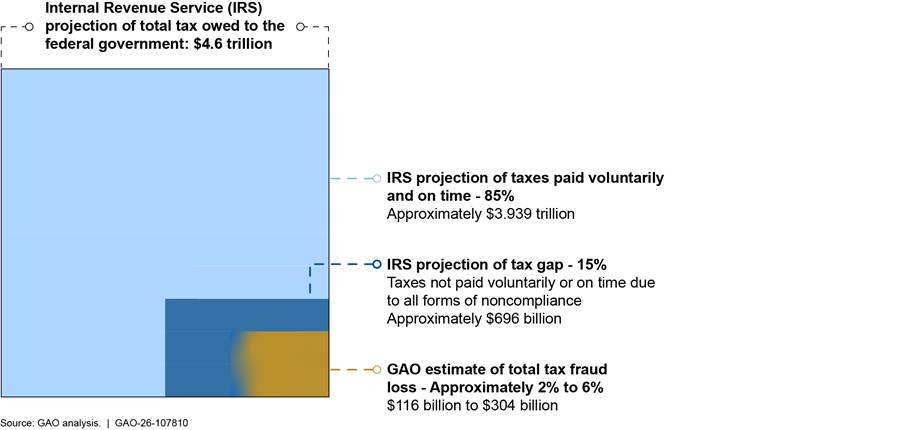
IRS estimates that about 15 percent of tax owed to the federal government was not paid voluntarily and on time (the gross tax gap) for tax year 2022.[32] Our estimated range of tax fraud loss reflects approximately 17 percent to 43 percent of the gross tax gap, if applied to tax year 2022.[33]
However, the comparison of our estimated range of tax fraud with IRS’s tax gap estimates should be interpreted with caution, recognizing that the estimation methods and data sources for these estimates are different. For example, IRS does not estimate tax loss specific to fraud; rather it assesses broader taxpayer noncompliance through its estimate of the tax gap. The tax gap reflects inadvertent noncompliance, such as from errors, as well as willful noncompliance due to fraud.[34] Additionally, our estimated range of tax fraud includes detected criminal fraud and identity theft, neither of which are included in IRS tax gap estimates.
There are limited data on U.S. tax fraud loss. However, an estimate developed by the Australian Taxation Office provides a point of comparison for our estimated range. Specifically, the Australian Taxation Office estimates tax revenue lost due to its shadow economy, which it considers to be a result of fraud.[35] The office reported that estimated tax loss due to shadow economic activities from 2022 through 2023 represented around 44 percent of the Australian tax gap. This estimate is generally in line with our estimated range of annual federal tax fraud loss as a proportion of the U.S. tax gap.
Our estimated range provides a reference for understanding the scale and scope of tax fraud loss and how it impacts federal revenue. As we previously reported, such information may help Congress, oversight entities, and agency officials improve fraud risk management by targeting resources.[36] Such information can also provide benchmarks for assessing the return on investment in counterfraud activities. However, tax fraud schemes vary and constantly evolve with changes to tax law (such as new tax credits), technology, and the economy. Additionally, the effectiveness of federal fraud risk management could substantially impact the scale of future fraud losses. Therefore, IRS may face different fraud risk environments in the future and different associated tax fraud losses. As a result, our estimate cannot be used to predict the exact amount of future federal tax fraud loss.
Our estimated range—although subject to unquantifiable uncertainty—represents our best estimate of the extent of fraud based on the available evidence and analytical methods. Due to the hidden nature of fraud, we cannot observe or detect all cases of tax fraud and associated losses. As a result, some portion of fraud and related loss will remain undetected; however, such fraud can, nevertheless, be estimated. We designed our simulation approach and underlying assumptions to account for the inherent uncertainties associated with fraud estimation and data limitations. We used a structured approach to quantify uncertainty where direct measurement was not feasible or possible. However, we cannot eliminate the possibility that the actual amount of fraud could be outside the range of our estimate. Our approach was not designed to provide precise amounts. Instead, it is meant to extend our current understanding about the likely extent of tax fraud, given available data.[37] See appendix I for additional details on our simulation, data sources, assumptions, and limitations.
IRS Safeguarded Billions of Dollars in Revenue but Has Not Developed an Antifraud Strategy
IRS Efforts Safeguarded Billions of Dollars in Revenue in 2018 Through 2024
While it is impossible to eliminate fraud completely, different divisions within IRS undertake a broad range of activities that help manage tax fraud risk and safeguard taxpayer dollars to ensure the integrity of the federal tax system. Some of these activities are directly aimed at preventing, detecting, and responding to tax fraud. Other activities are aimed at improving overall taxpayer compliance but, nonetheless, help the agency reduce tax fraud risk. Further, according to IRS officials, both fraud-specific efforts, and IRS’s overall compliance efforts, help IRS safeguard billions of dollars in tax revenue each year.
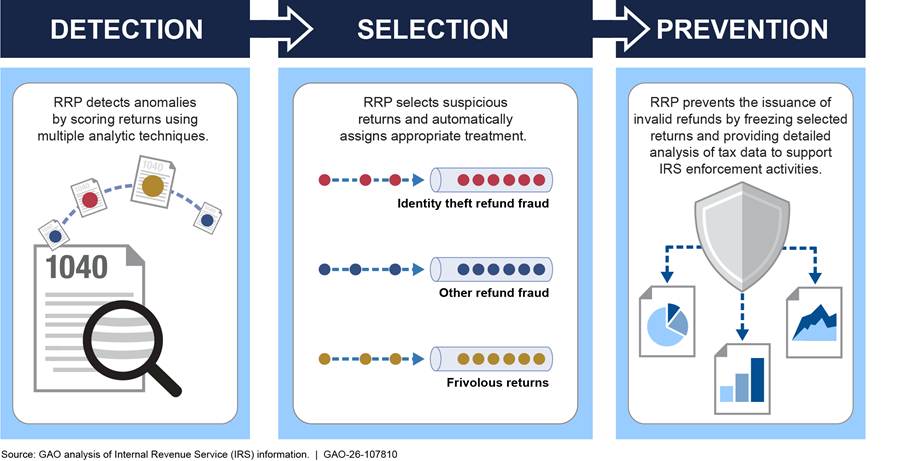
IRS efforts that help prevent tax fraud. Before IRS issues a tax refund payment, the IRS Taxpayer Services Division uses various automated systems to screen for noncompliant tax returns, including to prevent individuals from obtaining fraudulent tax refund payments as part of identity theft refund fraud schemes. For example, the Return Review Program (RRP) is an automated system used to screen individual tax returns claiming tax refunds by evaluating the returns for characteristics indicative of identity theft and other tax refund fraud.[38] According to IRS, RRP prevented approximately $88 billion in invalid, and potentially fraudulent, tax refund payments from 2018 through 2024. Figure 10 provides an overview of how RRP helps IRS prevent fraudulent tax returns.
IRS efforts that help detect tax fraud. Once IRS accepts tax returns for processing, tax return audits play a key role in helping IRS detect fraud. IRS provides training to its auditors to recognize indicators of fraud when reviewing tax returns for overall compliance.[39] When auditors detect indicators of fraud on a tax return, they are to initiate a discussion with their manager. If the manager concurs that there are indicators of fraud warranting further fraud development, the auditor is to contact IRS’s Office of Fraud Enforcement.[40] During this consultation, IRS officials told us that the Office of Fraud Enforcement helps the auditor assess the evidence that fraud occurred and advises on next steps to take—such as referring the case for civil penalties or criminal investigation by IRS’s Criminal Investigation. If the auditor and the Office of Fraud Enforcement determine that the taxpayer was noncompliant but do not have sufficient evidence that the taxpayer committed fraud warranting civil fraud penalties or criminal investigation, IRS officials told us that the agency can still collect underpaid or underreported taxes and assess penalties for other forms of noncompliance, such as failure to file taxes.
According to IRS, auditors across the agency completed more than 4.8 million audits from 2018 through 2024. As a result of their audit work, IRS auditors recommended an annual average of $24.9 billion in additional tax assessments for this same period. Further, IRS auditors protected an annual average of $3.7 billion in invalid refund payments during this same period, according to IRS.[41]
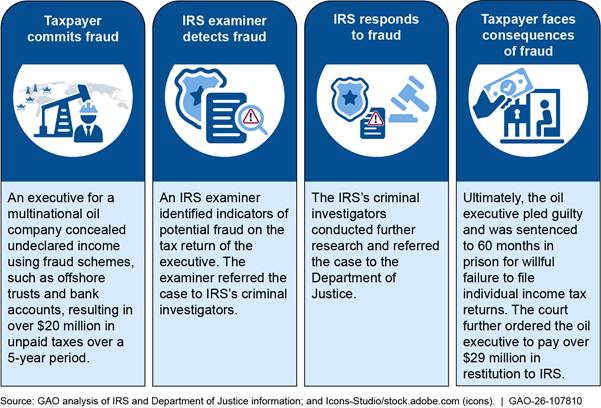
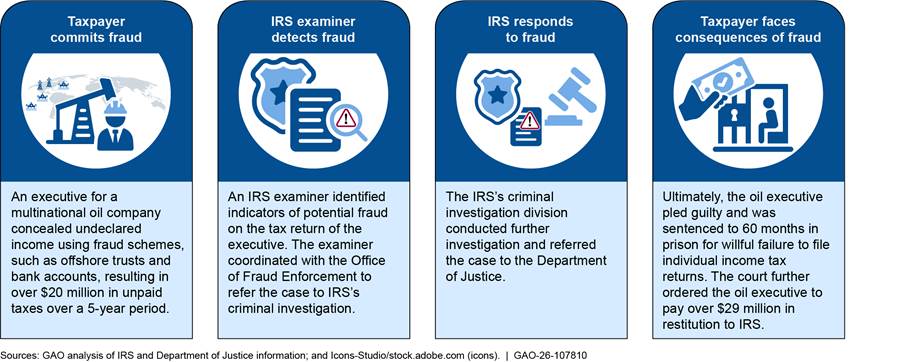
IRS efforts that help respond to tax fraud. Once IRS detects potential fraud in a tax return, it may respond in various ways. For example, IRS may choose to conduct an additional examination of the taxpayer; levy civil penalties on the taxpayer; or open a criminal investigation, among other actions. For example, in fiscal year 2024, IRS reported assessing 1,400 civil fraud penalties totaling $115 million and initiated more than 2,600 criminal investigations. IRS officials told us the agency selects the most appropriate response to suspected fraud based on the facts and circumstances of the case, agency resources, and the expected likelihood of collecting any delinquent taxes. Figure 11 provides an example of how IRS detected and responded to fraud on a tax return.
IRS Measures and Estimates Some Aspects of Tax Fraud to Support Fraud Risk Management
IRS officials within individual divisions identified various measures and estimates of tax fraud to inform some fraud risk management activities.
For example, officials with two divisions—the Small Business/Self-Employed Division and the Large Business and International Division—told us that they use a measure of fraud—the number of fraud development cases—to identify training needs. Specifically, IRS tracks the number of fraud development cases initiated by auditors in each division on a quarterly basis, and over a 3-year period. Officials from the Large Business and International Division noted that if they saw a decline in the number of fraud development cases that auditors initiate, they may reach out to determine whether auditors need additional training on procedures or skills for developing fraud cases.
Additionally, officials in the Taxpayer Services Division stated that IRS’s estimate of identity theft tax refund fraud allowed them to adjust strategies and detection methods. For example, these officials stated that, based on their analysis of a recent Identity Theft Taxonomy, they observed a trend in identity thieves using emerging technology to conduct identity theft tax refund fraud. As a result, in January 2024, IRS officials implemented new screening criteria to flag suspicious returns.
IRS Has Not Developed an Antifraud Strategy or Designated an Antifraud Entity
While IRS has efforts to prevent, detect, and respond to tax fraud, its approach to fraud risk management has been ad hoc and managed by individual IRS divisions. Specifically, although IRS has assessed its fraud risks consistent with leading practices, it has not designed and implemented a strategy to mitigate fraud risks in a strategic and coordinated manner. Further, IRS is not well-positioned to develop such a strategy because it lacks an antifraud entity to oversee such an effort across the agency.
IRS has routinely identified and assessed fraud risks, in accordance with leading practices for fraud risk management outlined in GAO’s Fraud Risk Framework.[42] In addition, under its Office of the Chief Risk and Control Officer, IRS has documented a fraud risk profile.[43]
According to documentation, IRS’s fraud risk assessment process is a biannual, collaborative assessment of internal and external risks to IRS. As part of its fraud risk assessment, the Office of the Chief Risk and Control Officer outlines enterprise-level inherent fraud risks and identifies high-exposure risks. For example, IRS’s most recent fraud risk assessment identified individual income tax fraud as one of the highest fraud risks that the agency faces.[44] Figure 12 provides an example of the type of individual income tax fraud risk that IRS faces.

However, IRS does not have an agency-wide antifraud strategy to address its identified fraud risks in a strategic and coordinated manner. According to officials with the Office of the Chief Risk and Control Officer, IRS does not have an antifraud strategy, and ownership of all antifraud programs and mitigations remains with each division. However, IRS’s divisions also do not have antifraud strategies at the operating level.
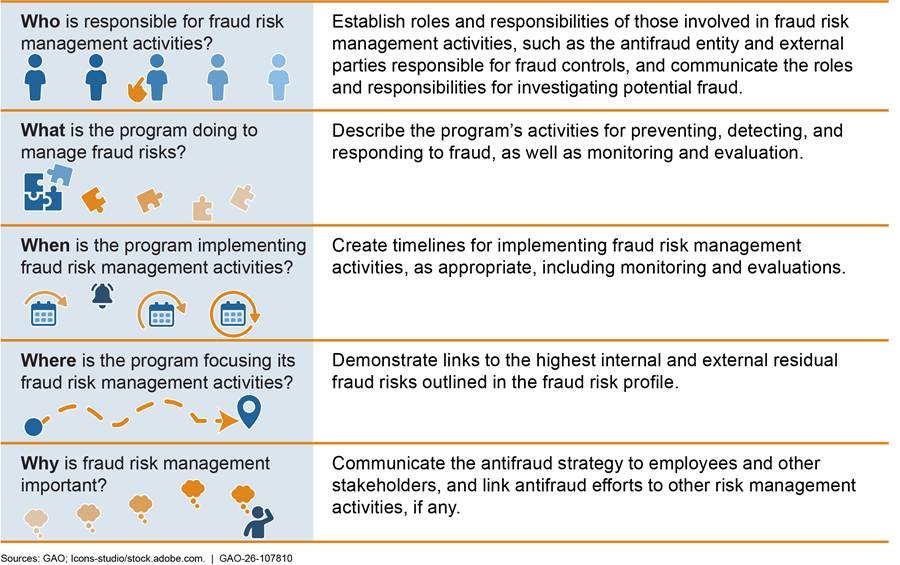
The Fraud Risk Framework notes that agencies or program managers should design, document, and implement a strategy with specific control activities to mitigate fraud risks identified as part of the fraud risk assessment. Specifically, managers who effectively manage fraud risks develop and document an antifraud strategy based on the fraud risk profile. The antifraud strategy describes how existing and new fraud controls will help the agency address fraud risks addressed in the fraud risk assessment. When developing an antifraud strategy, managers also consider the benefits and costs of control activities to address identified fraud risks, such as how the potential reduction of fraud losses compare with the cost for implementing certain fraud controls. Figure 13 identifies key elements of an antifraud strategy.
IRS division officials with key antifraud responsibilities provided us with various reasons for not having an antifraud strategy. Specifically, IRS officials from different divisions told us that
· they believed that the Office of the Chief Risk and Control Officer managed the agency’s antifraud strategy; however, that office told us an agency-wide strategy does not exist,
· they had not identified a specific need for an antifraud strategy;
· fraud detection activities undertaken during the normal course of audits represented their division’s antifraud strategy;
· the fraud detection procedures outlined in the Internal Revenue Manual represented their division’s antifraud strategy; and
· their division’s mission statement represented their antifraud strategy.
While fraud detection activities, standard operating procedures, and mission statements all represent sources of information that could inform an antifraud strategy, none of these alone constitute an antifraud strategy consistent with leading practices. For example, none of these documents or activities specifically explain how existing and new controls will help IRS address risks identified in its most recent fraud risk assessment. In 2023, IRS identified a new fraud risk—the risk that the enactment of new tax credits before the implementation of effective fraud controls would reduce tax revenue and erode public confidence in the integrity of the tax system. Figure 14 provides a case example of this type of fraud risk.
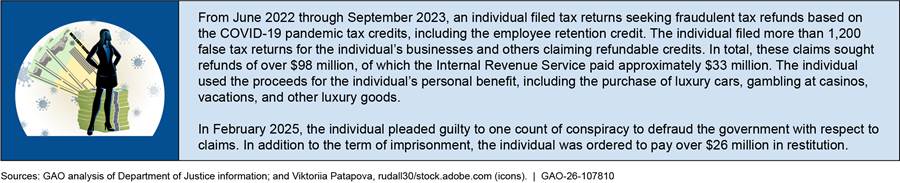
While IRS identified this type of risk in its assessment, it did not identify a specific plan to address it. An antifraud strategy could help IRS develop such a plan to identify what efforts are needed to appropriately mitigate these types of new and evolving risks.
Further, while IRS activities aimed at improving overall taxpayer compliance—such as audits—help the agency reduce tax fraud risk, IRS is not positioned to know whether its general noncompliance activities fully address tax fraud risks. It is similarly not positioned to ensure that it has suitable controls that prevent, detect, and respond to the specific risk of tax fraud. For example, a control that addresses noncompliance due to taxpayer error, such as education campaigns, will not address risks associated with tax fraud—when the taxpayer is willfully intending to evade taxes. An antifraud strategy could help ensure IRS has suitable controls to prevent, detect, and respond specifically to fraud risks.
Moreover, a coordinated antifraud strategy could help IRS prevent and detect fraud schemes targeting multiple tax types. Figure 15 provides an example of tax fraud across multiple tax types.

Developing and documenting an agency-wide antifraud strategy would help IRS take a strategic approach across its divisions to mitigate both new and existing fraud risks identified in its fraud risk assessment. For example, such a strategy would have better positioned IRS to identify the need for plans to address the tax fraud risk it identified with new tax credits.
Alternatively, IRS could direct divisions to develop antifraud strategies at the operating level that address tax fraud faced by each division.
Absent an antifraud strategy at any level, it is unclear which entities within IRS are responsible for managing tax fraud risks, how the agency plans to manage tax fraud risks, and its timeline for doing so. An antifraud strategy—either at the agency-wide or division level—would help IRS coordinate and communicate its overall approach to tax fraud risk management to ultimately mitigate such risks and reduce revenue lost to fraud.
Leading practices for fraud risk management also include designating an antifraud entity—an entity responsible for designing and overseeing fraud risk management activities.[45] While the specific department or unit that serves as the antifraud entity may vary, leading practices indicate that the antifraud entity should
· understand the program and its operations, as well as the fraud risks and controls throughout the program;
· have defined responsibilities and the necessary authority across the program; and
· have a direct reporting line to senior-level managers within the agency.
Further, in addition to designing and overseeing fraud risk management activities, the antifraud entity is generally responsible for coordinating antifraud initiatives across the program, such as facilitating communication with management and among stakeholders on fraud-related issues. Other responsibilities of the antifraud entity include
· serving as the repository of knowledge on fraud risks and controls,
· managing the fraud risk assessment process, and
· leading or assisting with trainings and other fraud-awareness activities.
IRS does not have a designated antifraud entity to undertake these activities. Although IRS’s Office of the Chief Risk and Control Officer manages the agency’s fraud risk assessment process—one of the responsibilities of the antifraud entity—officials told us that the Office of the Chief Risk and Control Officer is not IRS’s designated antifraud entity. Further, these officials stated that IRS does not have a designated antifraud entity because tax fraud risk mitigation is the responsibility of individual divisions.
The Fraud Risk Framework acknowledges that, in addition to the antifraud entity, employees across an agency can be responsible for the actual implementation of fraud controls. However, the antifraud entity is generally responsible for the leading practices described above. Absent a designated antifraud entity, IRS’s critical tax fraud risk management activities do not have oversight and coordination. For example, without a designated antifraud entity to undertake these efforts, IRS lacks assurance that individual divisions are developing and implementing antifraud strategies and tax fraud controls that effectively address the billions of dollars in estimated tax fraud loss that occurs each year.
Conclusions
Most U.S. taxpayers comply with the law and pay their tax liabilities. However, our estimate highlights the significant revenue impacts caused by the small minority of individuals and other entities who commit tax fraud. The estimated $116 billion to $304 billion lost to tax fraud each year could help fund critical government operations and services, such as national security operations and health care for veterans. Understanding the scope and scale of tax fraud facing IRS could help Congress and the agency allocate resources for fraud risk management activities, including making more informed decisions about the costs and benefits of implementing new or additional fraud risk management activities.
While IRS takes significant actions to safeguard tax revenue, additional activities would help the agency ensure that such actions are coordinated and strategic. However, IRS lacks an agency-wide antifraud strategy. Further, while some individual IRS divisions have documents that could inform an antifraud strategy—such as a mission statement—none of the divisions with key antifraud responsibilities have an antifraud strategy. An antifraud strategy—either at an agency-wide level or at the division level—would help IRS better manage fraud risks. By better managing fraud risks, IRS could reduce revenue lost to tax fraud, which could help alleviate annual budget deficits and increase public confidence in the integrity of the tax system. Further, designating an antifraud entity to coordinate antifraud initiatives across the agency (including the development of an antifraud strategy) would facilitate communication on fraud-related issues, serve as the repository of knowledge on fraud risks and controls, and help IRS better mitigate the billions of dollars lost to fraud each year.
Recommendations
We are making the following two recommendations to IRS:
1. The Commissioner of Internal Revenue should develop and document an agency-wide antifraud strategy, or direct divisions to develop and document antifraud strategies at the operating level with oversight by the designated antifraud entity. (Recommendation 1)
2. The Commissioner of Internal Revenue should designate an antifraud entity responsible for coordinating and overseeing fraud risk management activities. (Recommendation 2)
Agency Comments and Our Evaluation
We provided a draft of this report to IRS for review and comment. In written comments, which are reproduced in appendix II, IRS partially agreed with both recommendations. IRS also provided technical comments, which we incorporated, as appropriate.
Regarding our first recommendation that IRS develop and document an agency-wide antifraud strategy or direct divisions to develop and document antifraud strategies at the operating level, IRS partially agreed and stated that it manages fraud across multiple divisions, with a central focus within the Chief Compliance Officer. IRS also stated that it will continue to document its efforts to combat tax fraud through existing programs, continue to seek opportunities to expand tax fraud efforts and consider developing an agency-wide antifraud strategy.
We continue to believe that IRS should develop and document an agency-wide antifraud strategy, or direct divisions to develop and document such strategies, with oversight by the designated antifraud entity. Doing so would help IRS take a coordinated approach across its divisions to mitigate both existing and new fraud risks identified in its fraud risk assessment. Further, an antifraud strategy would help IRS coordinate and communicate its overall approach to tax fraud risk management and to ultimately mitigate such risks and reduce revenue lost to fraud.
Regarding our second recommendation that IRS designate an antifraud entity, the agency partially agreed and stated that the Chief Tax Compliance Officer is the responsible entity for coordinating division tax fraud initiatives, risk assessments, communications, and fraud awareness efforts and that IRS will continue to enhance tax fraud oversight to encompass greater awareness, as appropriate.
Identifying an office to serve as the designated antifraud entity is a positive step toward addressing our recommendation. However, as discussed in the report, the designated entity
· designs and oversees fraud risk management activities;
· coordinates antifraud initiatives across the program, including facilitating communication with management and among stakeholders on fraud-related issues;
· serves as the repository of knowledge on fraud risks and controls;
· manages the fraud risk assessment process; and
· leads, or assists with, trainings and other fraud-awareness activities.
As our report notes, IRS officials told us that IRS did not have a single entity responsible for these activities because they believe tax fraud risk mitigation is the responsibility of individual divisions. To fully implement our recommendation, IRS should ensure that the designated antifraud entity is undertaking all of the responsibilities of the antifraud entity and document these responsibilities.
In addition, in its written comments, IRS raised concerns that the report does not sufficiently distinguish fraud from broader taxpayer noncompliance. IRS also stated that the report characterizes a broader range of noncompliance cases as fraud. However, this is not the case. Our estimate of tax fraud loss excludes losses due to instances of noncompliance that are not fraud. In the report, we state that fraud is defined as willful misrepresentation to obtain something of value, which is consistent with IRS’s definition of fraud. The report notes that fraud is separate from nonfraudulent noncompliance, which can occur because of math errors when calculating taxes, lack of awareness of tax liability, or inability to pay. These definitions, which separate intentional misrepresentation (fraud) from unintentional noncompliance, are reflected in the data we collected and the modeling we conducted. Therefore, our estimate and reporting decouple fraud from other forms of noncompliance.
IRS also commented that evaluating tax fraud risk solely through the lens of criminal fraud or a single organizational function does not capture the full scope or effectiveness of the IRS’s compliance framework. Our review was not limited to criminal fraud or a single organizational function. We spoke with multiple IRS divisions responsible for a broad range of controls and management functions to address both fraud and noncompliance risks. From these divisions, we received data on criminal fraud, civil fraud, identity theft, and other fraud-related information that we used to develop our estimate.
IRS also stated that the report’s characterization of its fraud governance as fragmented does not reflect the agency’s tax compliance approach and that it believes additional analysis would be helpful to demonstrate how additional centralized oversight of fraud risks would materially improve outcomes, given the IRS’s current efforts. As we discuss in the report, IRS does not have an antifraud strategy or designated antifraud entity. IRS officials told us that tax fraud risk mitigation is the responsibility of individual divisions across the agency, as previously noted. We estimate that the federal government loses between $116 billion and $304 billion annually due to tax fraud. Further, IRS projected the net tax gap—taxes that will not be paid due to noncompliance—was $606 billion for tax year 2022. Given that we and the IRS estimate the federal government loses hundreds of billions annually to fraud and noncompliance, we believe additional action is warranted to address the significant risk of fraud and noncompliance that persists despite the IRS’s current efforts. While nonfraudulent noncompliance may be addressed through audits and collection enforcement, these controls are less effective for dealing with fraudsters who are seeking to avoid detection and evade controls. A focus on proactive, preventative controls is important to address fraud and more cost-effective than a pay-and-chase approach that relies on detecting fraudulent activity and attempting to recover funds. An antifraud strategy and entity, consistent with leading practices for managing fraud risk, would help IRS improve these outcomes.
We are sending copies of this report to the appropriate congressional committees, the Secretary of the Treasury, and other interested parties. In addition, the report is available at no charge on the GAO website at https://www.gao.gov.
If you or your staff have any questions about this report, please contact Rebecca Shea, SheaR@gao.gov or Jared Smith, SmithJB@gao.gov. Contact points for our Offices of Congressional Relations and Media Relations may be found on the last page of this report. GAO staff who made key contributions to this report are listed in appendix III.
Rebecca Shea
Director, Forensic Audits and Investigative Service
Jared B. Smith
Director, Applied Research and Methods
List of Addressees
The Honorable Gary C. Peters
Ranking Member
Committee on Homeland Security and Governmental Affairs
United States Senate
The Honorable James Comer
Chairman
The Honorable Robert Garcia
Ranking Member
Committee on Oversight and Government Reform
House of Representatives
The Honorable Pete Sessions
Chairman
Subcommittee on Government Operations
Committee on Oversight and Government Reform
House of Representatives
This report (1) describes our estimated range of annual federal tax loss due to fraud and (2) examines the ways in which the Internal Revenue Service (IRS) safeguards revenue and manages fraud risks.
To address both objectives, we interviewed IRS officials from the Criminal Investigation (CI) Division, the Taxpayer Services Division, the Small Business/Self-Employed Division, the Large Business and International Division, the Tax-Exempt and Government Entities Division, the Research and Applied Analytics and Statistics Division, the Office of Fraud Enforcement, the Office of Service-wide Penalties, the Office of the Chief Compliance Officer and the Office of the Chief Risk and Control Officer. We primarily interviewed officials responsible for helping IRS understand, prevent, detect, and respond to fraud. We also reviewed relevant IRS publications on tax noncompliance and fraud, such as IRS studies of identity theft and the tax gap, as described in greater detail below.
Estimated Range of Annual Federal Tax Loss Due to Tax Fraud
To address our first objective, we analyzed sources of federal revenue. We focused on federal taxes collected by IRS because this represents the largest source of federal revenue—86 percent of federal revenue in fiscal year 2024. Tax revenue collected by other agencies—such as customs duties, including revenue from tariffs, collected by the Department of Homeland Security—may also experience fraud. However, our estimated range of annual federal taxes lost to fraud does not account for fraud in tax revenue collected by these agencies. Additionally, more than 30 federal agencies collect nontax revenue in the form of user fees, regulatory fees, and other charges, and assessments for governmental services, programs, or activities. Figure 16 illustrates federal revenue collection, by type, for fiscal year 2024, which was the most recent data available when we began our work. Our estimated range of annual federal taxes lost to fraud does not account for fraud losses in these other sources of nontax revenue.
To supplement our understanding of tax fraud, we conducted a literature review. Specifically, we searched for studies on tax fraud developed by governments, academics, nonprofit organizations, and others related to measuring the extent of U.S. tax fraud.[46] We generally focused on studies published between fiscal years fiscal years 2014 and 2024.[47] We reviewed abstracts of 120 studies we identified to determine their relevance to U.S. tax fraud estimation or related issues. We determined that 49 were potentially relevant, and we reviewed the full text of these articles to determine whether they contained an estimate of U.S. tax fraud loss or other issues related to our work. None of the studies we reviewed comprehensively estimated the extent of U.S. tax fraud loss; however, we used these studies to better understand tax revenue fraud and available measures and estimates.
We also conducted another literature review on tax evasion, one type of tax fraud.[48] We used similar sources and time frames for this review as for the general tax fraud literature review. We reviewed abstracts of 47 studies we identified to determine their relevance to tax evasion or related issues. We determined that 30 studies were potentially relevant, and we reviewed the full text of these articles to identify whether they contained an estimate of U.S. tax evasion or other issues related to our work. None of these studies contained a comprehensive estimate of tax evasion in the United States; however, we used these studies to better understand tax evasion as a component of tax fraud and available measures and estimates.
Finally, as part of our work, we also interviewed tax officials from the United Kingdom (UK) and Australia as well as representatives from the World Bank and academia to learn how others have approached tax revenue fraud estimation and related topics.[49]
Fraud Categories
Our work estimates annual U.S. federal tax loss due to fraud. Fraud involves obtaining something of value through willful misrepresentation, which is determined through a court or adjudicative system.[50] However, not all fraudulent activity is investigated and adjudicated, for various reasons. For example, IRS auditors may detect indicators of fraud in a tax return, but it may be difficult to determine intent—a key component of fraud—and, therefore, IRS may address the tax fraud as another form of noncompliance, such as error. Similarly, IRS auditors may identify a tax return with an underpayment of taxes and choose to collect those taxes and assess penalties rather than conducting a full investigation into whether the taxpayer intended to commit fraud. When cases of potential fraud are referred for criminal investigation, IRS CI selects cases to pursue based on strategic priorities and geographic needs, according to officials. Furthermore, IRS may not detect all instances of fraud. We refer to instances of fraud that are not adjudicated as potential fraud.
Our estimated range of federal tax loss due to fraud includes adjudicated fraud, detected potential fraud that has not been adjudicated, and undetected potential fraud.[51] Within detected potential fraud, we considered three categories, which reflect different stages of fraud investigation. See figure 17 for additional information on these tax fraud categories and stages of fraud investigation.
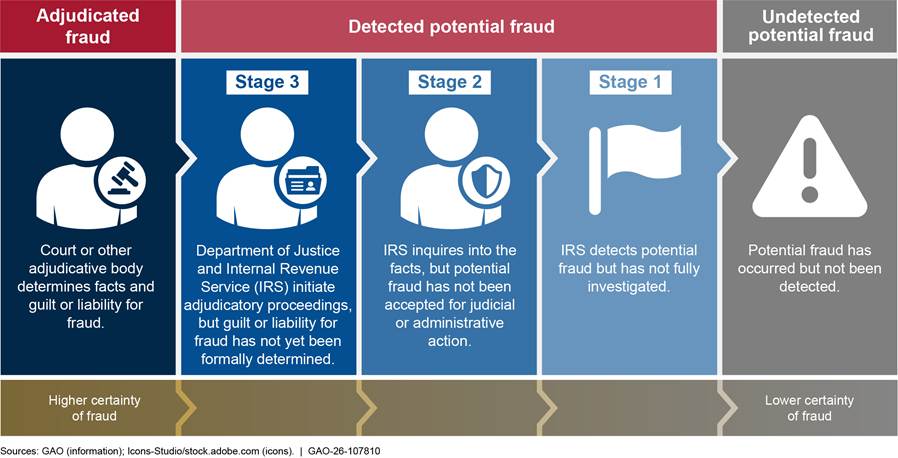
These tax fraud categories reflect different degrees of certainty about fraud. For example, cases of adjudicated fraud have the highest certainty. In contrast, the certainty of fraud may be substantially lower for an instance of potential fraud that has been detected but not yet investigated. Our estimation methodology takes these varying levels of certainty into account, as discussed later in this appendix.
Monte Carlo Simulation to Estimate Tax Fraud
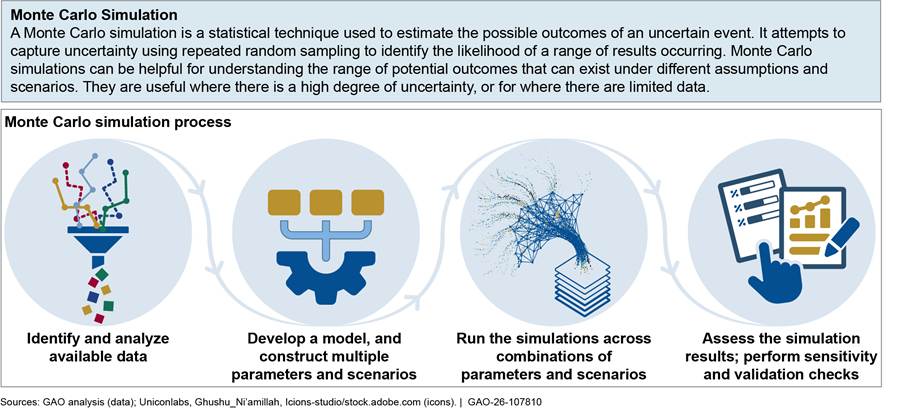
To estimate annual U.S. tax fraud loss, we used a Monte Carlo simulation—a method effective at estimating ranges for events for which there are limited data or where there is a high degree of uncertainty, such as with fraud estimation.[52] For additional information on Monte Carlo simulation, see figure 18.[53] We chose this method based on our review of tax fraud studies, available fraud-related data, interviews with IRS officials, and our past work on fraud estimation.
The foundation for our simulation framework is a set of assumptions about the nature of tax fraud and how information in the different fraud categories relates to each other. Due to the hidden nature of fraud, we cannot observe or detect all cases of tax fraud and associated losses. As a result, some portion of fraud and related loss will remain undetected; however, such fraud can, nevertheless, be estimated.
To address the uncertainty associated with the nature of fraud and challenges related to estimating fraud, our simulation uses available data from multiple sources that include the tax fraud categories described in figure 17.[54] We primarily used data and projections from fiscal years 2018 through 2024, the most recent data available at the time of our work.[55] We use these data to model the extent of loss in three areas of focus: (1) IRS data on adjudicated fraud and detected potential fraud, (2) detected and undetected potential fraud in the tax gap, and (3) undetected potential fraud in the shadow economy.[56]
Individually, these three areas do not provide a comprehensive understanding of tax fraud, but when analyzed collectively and in our simulation, they provide support for a more robust estimate of the extent of tax fraud. Additional detail on how we assessed the simulation results and developed a range of annual tax fraud is provided later in this appendix.
The insights offered by the Monte Carlo simulation we used to develop the estimate should be interpreted carefully, with an appreciation for the uncertainty associated with this methodology, which cannot be quantified. While we used a methodology to account for the inherent uncertainties associated with fraud estimation and data limitations, the actual amount of annual federal tax loss due to fraud could be outside the range of our estimate.
Data, Information Sources, and Assumptions Used in Our Modeling Frameworks
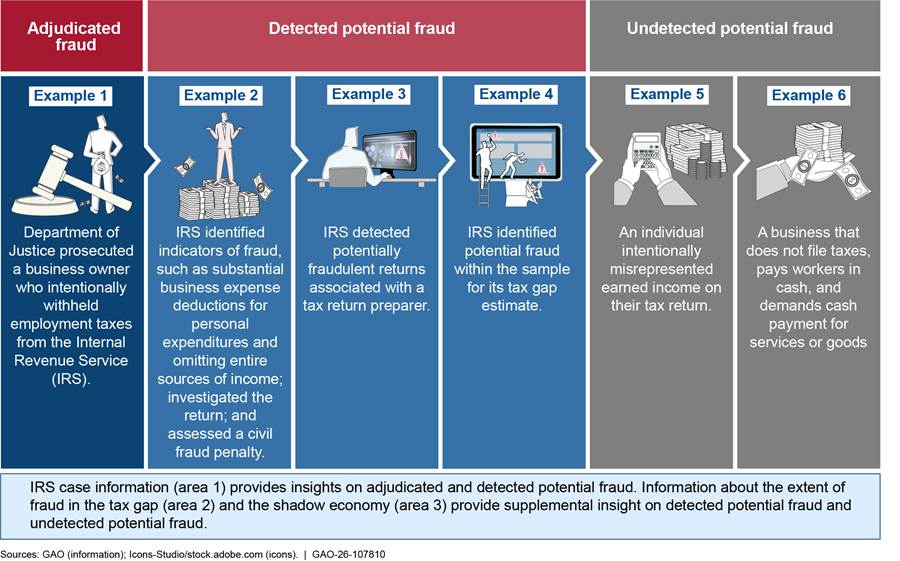
To develop our estimate of tax fraud loss, we collected and analyzed a variety of data and information to construct modeling frameworks for three areas of focus: (1) IRS cases of adjudicated fraud and potential tax fraud, (2) detected and undetected potential fraud in the tax gap, and (3) tax evasion (undetected potential fraud) in the shadow economy. For illustrative examples of tax fraud and how they are modeled in our work, see figure 19.
Area 1: IRS data on adjudicated fraud and detected potential fraud
IRS maintains some information on cases of adjudicated and detected potential fraud, which we used to estimate the extent of tax fraud and detected potential fraud known to IRS.
To inform our understanding of adjudicated fraud and detected potential fraud, we collected IRS data on cases of civil and criminal fraud and potential fraud for fiscal years 2018 through 2024. To collect these data, we sent standardized data collection forms and other data requests to IRS divisions responsible for identifying fraud and noncompliance.[57] We requested available data on cases in the fraud development process, cases with civil fraud assessments, cases referred to CI, cases accepted by CI, and cases rejected by CI.[58] Prior to requesting data, we met with the IRS divisions to discuss the requests and confirm that relevant data were available. From each of these IRS divisions, we collected aggregate, case-level statistics on the number of cases (occurrences) and the dollar amount (financial impact) associated with adjudicated fraud and each stage of detected potential fraud, where available.
We assessed the reliability of the data collected from each IRS division by performing electronic testing of the data, reviewing related documentation, and interviewing knowledgeable agency officials about the data we obtained. We determined these data were sufficiently reliable for our purposes. We also conducted a comparative analysis to identify areas of overlap and duplication. We identified 53 distinct and nonoverlapping data elements across IRS divisions, stages of fraud, and fraud type (e.g., individual fraud, corporate fraud, employment tax fraud, etc.) to include in the model estimation.[59]
To supplement our understanding of detected potential fraud, we also analyzed the available IRS individual Identity Theft Taxonomy estimating years 2018 through 2022 and Business Identity Theft Taxonomy for 2023, the most recent available reports at the time we began our review.[60] The taxonomies provide insight into fraudulent refunds paid and fraudulent refunds stopped before payment. Generally, identity theft can be identified—and may be prevented—early in the processing of tax returns. While some instances of fraudulent refunds paid may be included in the IRS data we collected, fraudulent refunds stopped before payment are not included. We use information from the Identity Theft Taxonomies to understand cases and the related potential loss that IRS estimates that its identity theft controls did not capture.
To construct our model, we made baseline assumptions about the nature and characteristics of aggregated, case-level fraud data detected by IRS (see table 1).
Table 1: Key Assumptions and Impacts on Our Simulation of Internal Revenue Service (IRS) Data on Adjudicated and Detected Potential Fraud
|
Key assumptions |
Impact on the portion of the simulation relying on IRS data on adjudicated fraud and detected potential fraud |
|
Not all fraud is detected or adjudicated. Due to the hidden nature of fraud, we cannot observe or detect the complete set of fraudulent activities. Furthermore, the process of investigating and adjudicating fraud can be costly, and IRS may pursue potential fraud through its noncompliance procedures. As a result, even if IRS identifies potential financial loss from detected potential fraud, it may never be addressed as fraud. |
Our model includes both data for adjudicated fraud and data related to detected potential fraud and accounts for undetected potential fraud. |
|
IRS data on detected potential fraud may include some instances of nonfraudulent activities. |
Our model includes parameters designed to set the financial loss to zero for a portion of cases in the detected potential fraud category. |
|
Total detected tax fraud loss can be reasonably modeled using the number of occurrences of fraud and potential fraud, the financial loss amount associated with each occurrence, and the type of detected fraud (e.g., individual fraud, corporate fraud, employment tax fraud, etc.). |
We developed our model using the number of occurrences of fraud and potential fraud, the financial loss amount associated with each occurrence, and the type of fraud. |
|
If we cannot observe information on the financial loss amount associated with potential fraud occurrence, the financial loss amount associated with each occurrence of potential fraud within the same type of fraud is assumed to be lower than the loss amount associated with each occurrence of adjudicated fraud, on average. If significant cases of detected potential fraud (that may have resulted in higher financial losses than adjudicated fraud cases) were not prosecuted, our simulation would underestimate tax loss from detected potential fraud. |
For those tax areas where financial loss data were not available, our model limits the average financial loss amount per occurrence of potential fraud such that it is less than the average financial loss amount associated with adjudicated fraud associated with the same tax area. |
|
The number of fraud occurrences expected for a typical year and type of fraud can be reasonably approximated with uniform or normal distributions across fiscal years 2018 through 2024. This assumption is derived from analyzing data obtained from IRS for cases aggregated from fiscal years 2018 through 2024. |
Our model includes a simulation step where fraud occurrences are randomly drawn from a uniform or normal distribution derived from the observed variability in fraud occurrences from 2018 to 2024. |
|
The range of financial losses attributable to individual occurrences of fraud can be reasonably captured using a series of gamma distributions estimated from the summary statistics obtained from the data collection process. |
Our model includes a simulation step where fraud loss amounts are generated using a series of statistical distributions derived from summary statistics observed in the data we collected.a To assess the validity of this assumption, we estimated a range of potential parameters for each IRS division and type of fraud, conducted statistical tests of fit, and performed sensitivity checks that included comparisons of the shape and scale of the estimated distributions with the data collected from IRS.b We independently selected the parameters for each IRS division, fraud category, and fraud type that provided the best fit to the data collected from IRS. |
Source: GAO analysis. | GAO‑26‑107810
aWe used gamma distributions—probability functions that are useful in modeling positive and skewed (unbalanced) distributions. A gamma distribution is determined by two parameters called scale and shape.
bStatistical tests of fit are tests to assess how well simulated data match observed data.
Area 2: Detected and undetected potential fraud in the tax gap
IRS develops the tax gap as estimates and projections of taxpayer noncompliance. According to IRS, the tax gap includes both taxpayer error and intentional tax evasion, which is a form of tax fraud. However, IRS does not estimate noncompliance attributable to fraud. We estimated the amount of the U.S. tax gap that could be attributed to detected and undetected potential fraud.
To inform our understanding of detected and undetected potential fraud in the tax gap, we reviewed available data on noncompliance from IRS tax gap publications with projections for tax years 2018 through 2022, including the size of the tax gap, tax types, and the proportion of each tax type that contributes to the tax gap.[61] We also met with IRS officials to gather information on the extent to which detected potential fraud is included in samples that inform the tax gap.
To further inform our understanding of detected and undetected potential fraud in the tax gap, we sought tax gap benchmarks from other English-speaking countries (i.e., United Kingdom (UK), Canada, and Australia) and identified relevant information from the UK’s tax authority, His Majesty’s Revenue and Customs (HMRC). Specifically, the UK publishes tax gap analysis by taxpayer behavior. Further, HMRC officials told us that some categories of taxpayer behavior capture tax loss due to fraud, such as evasion, criminal attacks, and some of the hidden economy and nonpayment.[62] We reviewed HMRC tax gap data and information on taxpayer behaviors associated with fraud from 2019 through 2024. We assessed the reliability of the IRS tax gap publication data and HMRC tax gap data by interviewing knowledgeable agency officials about these data and reviewing related documentation. We determined the data were sufficiently reliable for our purposes.
We mapped the UK’s taxpayer behaviors related to fraud to the U.S. tax gap, adjusting for differences between the U.S. and the UK tax systems. For example, we identified four UK tax types—individual income tax, corporate income tax, employment tax, and estate tax—that are comparable to U.S. tax types.[63] We constructed potential ranges of fraud in the corresponding tax types using the UK’s taxpayer behaviors related to fraud.
To construct our model, we identified baseline assumptions about the nature and characteristics of detected and undetected potential fraud in the tax gap (see table 2).
Table 2: Key Assumptions and Impacts on Our Simulation of Detected and Undetected Potential Fraud in the Tax Gap
|
Key assumptions |
Impact on simulations of the detected and undetected potential fraud in the tax gap |
|
A portion of the U.S. tax gap is attributable to fraud, although it is not identified in the tax gap estimate as fraud by the Internal Revenue Service (IRS).a |
We rely on the U.S. tax gap estimate with a reduction to account for the portion of the tax gap that is not attributable to fraud. |
|
We assume that the corporate income tax types for both countries are reasonably comparable. We also assume that the United Kingdom’s (UK) income tax, National Insurance contributions, and capital gains tax types are reasonably comparable to the U.S.’s individual income tax. Further, we assume that the UK’s Pay as You Earn tax type is reasonably comparable to the U.S.’s employment tax. Finally, we assume that the UK’s inheritance tax and gift tax types are reasonably comparable to the U.S.’s estate and gift tax. |
We model the portion of the U.S. tax gap estimate that is fraud using information from the UK’s analysis of its own tax gap. The comparison is performed on matched tax categories, as described in the key assumption. |
|
The UK tax types and U.S. tax types have both common elements and meaningful differences. For example, both countries collect individual income tax, and there are common economic activities associated with individual income tax. However, corporate income tax represents a greater share of the UK tax gap than the U.S. tax gap. There are also differences in specific tax rates and tax collection processes, including differences between resident-based taxation and citizen-based taxation. The extent to which these differences may affect taxpayer behaviors within these compared tax types is unknown. |
We included additional variability in the model parameters derived from the UK’s estimates for each tax type. The variability helps account for uncertainty about the true portion of each tax type that is associated with fraud. In addition, we applied various assumptions related to U.S. taxpayer behaviors, as described below. |
|
The UK’s taxpayers’ behaviors toward comparable tax obligation can be reasonably used to model U.S. taxpayers’ behaviors. |
We modeled scenarios where U.S. taxpayers have a similar, greater, or lesser tendency toward fraudulent noncompliance.b We also modeled a scenario where U.S. taxpayers have more variance in fraudulent noncompliance. |
Source: GAO analysis. | GAO‑26‑107810
aThe IRS’s tax gap is an estimate of the difference between tax amounts that taxpayers should pay and what they actually pay voluntarily and on time. While a portion of this estimated noncompliance is associated with fraud, IRS does not estimate the proportion of noncompliance that is due to fraud.
bFor the purposes of our work, we define a scenario as a specific set of assumptions.
Area 3: Tax evasion (undetected potential fraud) in the shadow economy
Most economic activities in the shadow economy are subject to taxation.[64] However, taxes are often not paid on economic activities within the shadow economy—reflecting tax evasion. For the purposes of our work, we define the size of the shadow economy as all legal economic activities that are purposely hidden from government authorities to avoid monetary, regulatory, or institutional oversight. For more information on the shadow economy and illustrative examples of economic activities within the shadow economy that we consider to be tax evasion, see figure 20. We consider this tax evasion to be undetected potential fraud. We estimate the amount of undetected potential fraud in the shadow economy using data and information discussed below.
Figure 20: Information on the Formal and Shadow Economies, with Illustrative Examples of Tax Evasion Within the Shadow Economy
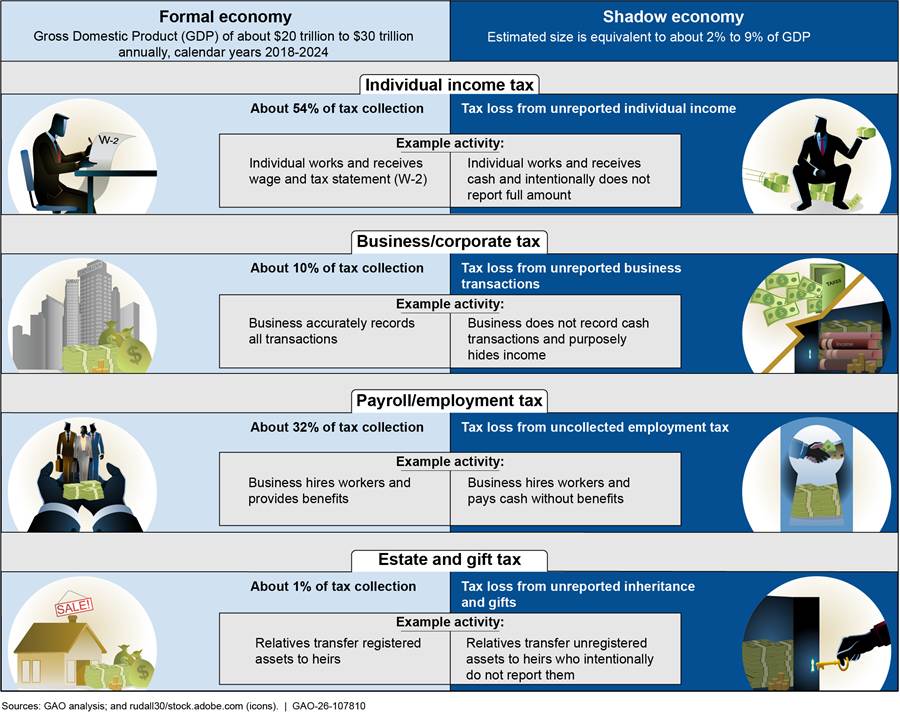
Note: The above percentages do not sum to 100 percent because they do not include all tax types, such as excise tax. Shares of tax collection of individual income tax, business/corporate tax, payroll/employment tax, and estate and gift tax are based on fiscal year 2022.
To inform our understanding of the shadow economy, we conducted a literature review of studies on tax fraud, tax evasion, and the shadow economy published between 2018 and 2024.[65] Through our review, we found that within academic literature there is no consensus on the definition of the shadow economy.
To inform our understanding of the size of the U.S. shadow economy, we identified three studies that estimate the size of the U.S. shadow economy as a percentage of gross domestic product (GDP) from 2018 through 2022, using different methodologies.[66] These studies each use a definition of the shadow economy similar to the definition we developed. We used these estimates and data from the Bureau of Economic Analysis on the U.S. GDP to estimate the relative size of the shadow economy compared with U.S. GDP from 2018 through 2024.
To inform our understanding of the proportion of activities in the shadow economy that are associated with various tax types (i.e., corporate income tax, individual income tax, employment tax, estate and gift tax, and excise tax), we reviewed IRS Data Books from 2018 through 2024.[67] We also reviewed data on the proportion of collected and uncollected tax from the IRS Data Books and tax gap publications.[68]
Finally, we reviewed data from the Department of Commerce’s Census Bureau’s American Community Survey Public Use Microdata Sample from 2018 through 2024.[69] Using those data, we estimated the proportion of individuals not required to file taxes because they make less than the minimum gross income required for owing taxes.[70]
For all of these data sources, we reviewed related documentation, conducted electronic testing and compared data with other sources, and interviewed knowledgeable agency officials and other subject matter experts, as appropriate. We determined the data were sufficiently reliable for the purpose of estimating tax loss due to fraud.
To construct a model to estimate the amount of potential tax that could have been collected by IRS, we identified key assumptions about the nature and characteristics of tax evasion in the shadow economy (see table 3).
|
Key assumptions |
Implication on modeling tax evasion (undetected potential fraud) in the shadow economy |
|
Our model framework relies on a proportionality assumption between the formal economy and the shadow economy, and the tax collected from the formal economy and the amount of potential tax not collected in the shadow economy. |
Model factors are developed from two ratios—U.S. gross domestic product (GDP) to Internal Revenue Service (IRS) tax collection—and estimated shadow economy to potential tax not collected in the shadow economy. This assumption allows us to estimate the total size of potential tax evasion without tracking microlevel economic activities in the shadow economy, given the lack of readily available data.a |
|
We consider economic activities in the shadow economy to mirror economic activities in the formal economy, such that the proportions of potential tax that could have been collected in the shadow economy are similar to the proportions of the tax collected in the formal economy. If the shadow economy includes more activities that are not capturable under the existing IRS tax collection process, then the proportion of potential tax that could have been collected from such economic activities in the shadow economy would be more similar to the proportion of the noncompliance in the estimated tax gap. We combine both potential scenarios as underlying parameters of our model. |
Model parameters for the proportion of economic activities associated with each tax type in the shadow economy are derived from the proportion of each tax type in the IRS tax collection. We incorporate both tax collection and the tax gap and combine both potential scenarios as underlying parameters of our model. |
|
Some economic activity within the shadow economy does not result in tax evasion. For example, if an individual earns less than IRS’s income reporting threshold, the individual is not evading taxes. For the purposes of this work, we assume that a portion of unreported income stemming from economic activities is not tax fraud. |
The model excludes the proportion of individuals with total income under the filing requirement derived from the American Community Survey (ACS) Public Use Microdata Sample from 2018 through 2024.b The model includes a parameter for the proportion associated with intentionality of tax evasion in the shadow economy. |
Source: GAO analysis. | GAO‑26‑107810
aAvailable information on the size of the U.S. shadow economy is limited to the aggregate shadow economy. We did not identify information on proportions of individual categories of economic activity. This proportionality assumption allows us to estimate the total size of potential tax evasion, including the taxable amount from activities that are not necessarily included in GDP.
bWe excluded the 2020 ACS data, which the Census Bureau published with experiential weights during the COVID-19 pandemic.
Simulation Procedures
Area 1: IRS data on adjudicated fraud and detected potential fraud
On the basis of the modeling framework and key assumptions described above, we developed mathematical simulation equations that estimate the dollar amount of tax loss from adjudicated fraud and detected potential fraud using multiple factors, including fraud occurrence, fraud category, fraud stage, and financial impact associated with each fraud occurrence.
For each factor, we developed multiple ranges of parameter sets as alternative scenarios to account for the uncertainty of our underlying assumptions and sensitivity tests. We developed a total of four scenarios with 53 components by changing different combinations of assigned parameter sets across different factors and scenarios.[71] Each component’s factors reflect the results of slightly different simulations that account for different levels of data availability and the reliability of fraud loss amounts collected within each IRS division. For example, the CI data we obtained contains information on estimated fraud loss amounts and fraud amounts recommended for prosecution rather than the final adjudicated fraud amounts associated with a case. To account for potential differences in estimated amounts and actual amounts and limit the influence of extreme values, we included variations in the parameters and truncation limits.
For each scenario, we simulated outcomes using random samples drawn from assigned factor parameters for each IRS division, stage, and fraud type (e.g., individual fraud, corporate fraud, employment tax fraud, etc.), then summed them up to calculate the total dollar amount of tax loss from adjudicated fraud and detected potential fraud.
Area 2: Detected and undetected potential fraud in the tax gap
On the basis of the modeling framework and key assumptions described above, we developed a mathematical equation that estimates the dollar amount of detected and undetected potential fraud in the tax gap using multiple factors, including tax types, size of the tax gap, the proportion of tax type within the tax gap, and the proportion of potential fraud in each tax type.[72]
For each factor, we developed multiple ranges of parameter sets as alternative scenarios to account for the uncertainty of our underlying assumptions and sensitivity tests.[73] We developed a total of 48 scenarios by changing different combinations of assigned parameter sets from each factor.[74] For each scenario, we calculated the mathematical equation using random samples drawn from assigned factor parameters for each tax type. We repeated the process and constructed a distribution of the calculated values. This process resulted in 48 distributions. We analyzed and tested the sensitivity of the shapes and ranges across these estimated distributions.[75]
Area 3: Undetected potential fraud in the shadow economy
On the basis of the modeling framework and key assumptions described above, we developed a mathematical equation that determines the estimated dollar amount of tax evasion in the shadow economy using multiple factors, including tax type, the size of the shadow economy, the proportion of economic activities associated with each tax type, and tax rate.[76]
For each factor, we developed multiple ranges of parameter sets as alternative scenarios to account for the uncertainty of our underlying assumptions and sensitivity tests.[77] We developed a total of 64 scenarios by changing different combinations of assigned parameter sets from each factor.[78] For each scenario, we calculated the mathematical equation using random samples drawn from assigned factor parameters for each tax type. We repeated the process and constructed a distribution of the calculated values. This process resulted in 64 distributions. We examined the sensitivity of the shapes and ranges across these estimated distributions.
Determining the Estimated Range
None of the three areas modeled above—adjudicated, detected potential, and undetected potential fraud—include all categories of tax fraud. Furthermore, there is overlap in some tax fraud estimated by the three areas. However, by assessing the simulations from the three areas, we identified an approach to determine an estimated range of tax loss. For more information on how we combined the simulation results from each area to determine an estimated range of U.S. tax fraud loss, see figure 21.
Figure 21: Combining Simulation Results to Develop Our Estimated Range of U.S. Tax Loss Due to Fraud
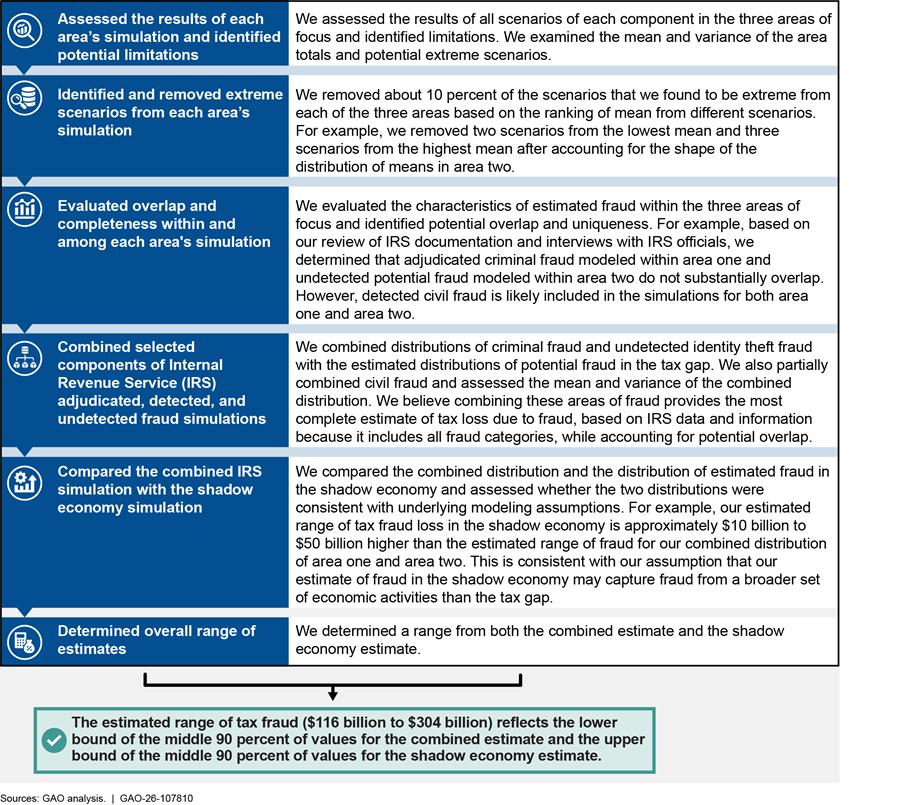
Note: The middle 90 percent of values for the combined estimate is $116 billion (5th percentile) and $253 billion (95th percentile). The middle 90 percent of values for the shadow economy estimate is $122 billion (5th percentile) and $304 billion (95th percentile).
Sensitivity Testing and Assessing Simulation Results
The estimated range of tax loss due to fraud excludes the extreme scenarios in our models. We tested all scenarios and tested how extreme values of random samples in each scenario affected the overall range. None of the tests resulted in a material impact on our estimate. To test the underlying assumptions required to combine simulation results, we conducted additional sensitivity analyses and did not see any meaningful deviation from the assumption.[79]
We also compared the results of our simulations with applicable fraud estimates we identified in our review of studies. While none of these studies estimate total U.S. tax fraud loss, some provide insight into aspects of tax fraud. Specifically, we compared our estimates with relevant areas of the UK’s estimates of tax fraud and error, the UK’s estimate of fraud in the tax gap, and Australia’s estimate of the shadow economy.[80] These estimates of UK and Australian tax fraud provided points of comparison for components of our estimated range.
Simulation Interpretation and Uncertainty
The insight offered by simulations should be interpreted carefully. Our approach was not designed to provide precise amounts. Instead, it was meant to extend our current understanding about the likely extent of tax fraud, given available data.
Our methodology has two primary sources of uncertainty. The first source of uncertainty is the statistical uncertainty arising from the randomness of the simulation process. We intentionally included this randomness to help capture the uncertainty associated with information available for each factor we used in the fraud estimation.
In addition to statistical uncertainty, our approach is affected by uncertainty associated with our underlying models and data. The results of our simulations depend on key assumptions made about how the historical data might correspond to adjudicated fraud, detected potential fraud, and undetected potential fraud. If one or more of our assumptions, as implemented in our simulation, are incorrect, then there is an increased risk that our range will not capture the actual extent of fraud.
The Ways in Which IRS Safeguards Federal Tax Revenue and Manages Fraud Risks
To address our second objective, we reviewed IRS publications and documentation on how the agency safeguards revenue and manages fraud risk. This included documentation on IRS measures and estimates related to tax fraud, including IRS Identity Theft Taxonomies and tax gap estimates and projections.[81] We also interviewed IRS officials to discuss how they used these measures and estimates to support fraud risk management and other fraud risk management activities they undertake.
We evaluated this information against leading practices in the third component of GAO’s A Framework for Managing Fraud Risks in Federal Programs (Fraud Risk Framework).[82] Specifically, we selected leading practices that were most relevant to our objectives and that represent key steps in developing effective fraud risk management activities.[83] The Fraud Risk Framework’s third component describes leading practices for designing and implementing a strategy with specific control activities to mitigate assessed fraud risk and collaborate to help ensure effective implementation. We assessed IRS’s efforts against one of the third component’s leading practices—to develop, document, and communicate an antifraud strategy to employees and stakeholders that describes the program’s activities for preventing, detecting, and responding to fraud, as well as monitoring and evaluation.
Based on our findings related to IRS’s efforts to design and implement a strategy with specific control activities to mitigate assessed fraud risk, we evaluated IRS’s structure for leading fraud risk management activities. For this, we analyzed the extent to which IRS’s actions aligned with a relevant leading practice in the first component of GAO’s Fraud Risk Framework. This leading practice states that agencies should designate an entity to design and oversee fraud risk management activities.
We conducted this performance audit from September 2024 through September 2026 in accordance with generally accepted government auditing standards. Those standards require that we plan and perform the audit to obtain sufficient, appropriate evidence to provide a reasonable basis for our findings and conclusions based on our audit objectives. We believe that the evidence obtained provides a reasonable basis for our findings and conclusions based on our audit objectives.
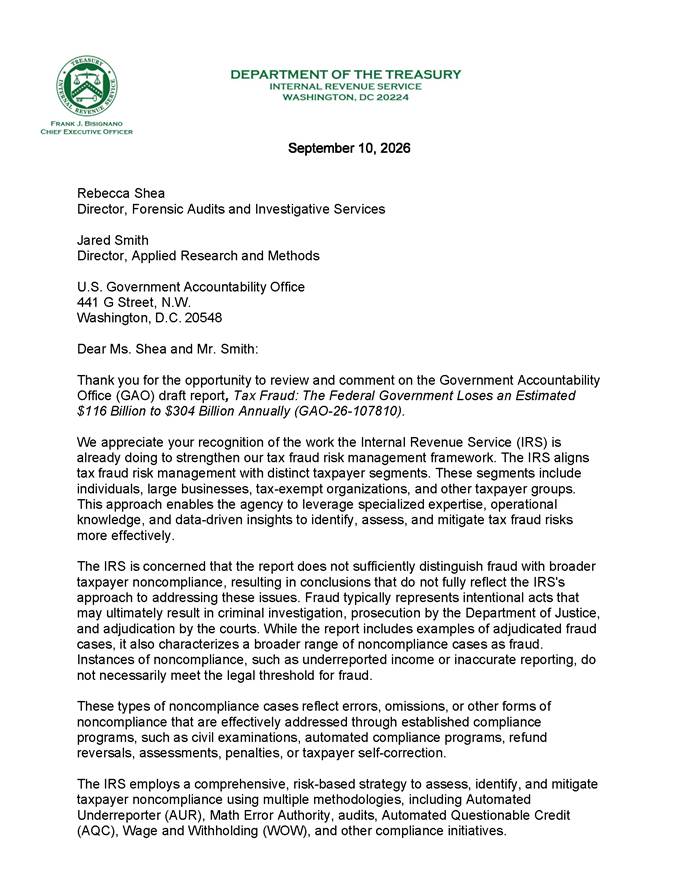
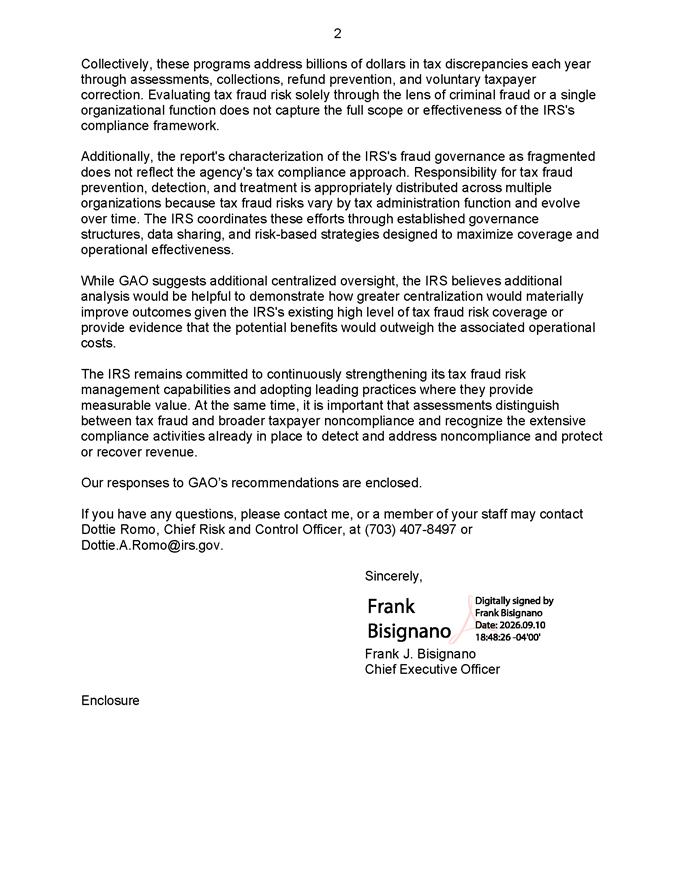
GAO Contacts
Rebecca Shea, SheaR@gao.gov
Jared B. Smith, SmithJB@gao.gov
Staff Acknowledgments
In addition to the contacts named above, James Ashley, Jonathon Oldmixon, Moon Parks, Steven Putansu (Assistant Directors); Lauren Kirkpatrick (Analyst in Charge); Kathleen Donovan, Ying (Sophia) Liu, and Cecilia Ritacco made key contributions to this report. Also contributing to the report were Kevin Donovan, Colin Fallon, Lija Guo, Leia Dickerson, Joe Rini, and Sabrina Streagle.
The Government Accountability Office, the audit, evaluation, and investigative arm of Congress, exists to support Congress in meeting its constitutional responsibilities and to help improve the performance and accountability of the federal government for the American people. GAO examines the use of public funds; evaluates federal programs and policies; and provides analyses, recommendations, and other assistance to help Congress make informed oversight, policy, and funding decisions. GAO’s commitment to good government is reflected in its core values of accountability, integrity, and reliability.
Obtaining Copies of GAO Reports and Testimony
The fastest and easiest way to obtain copies of GAO documents at no cost is through our website. Each weekday afternoon, GAO posts on its website newly released reports, testimony, and correspondence. You can also subscribe to GAO’s email updates to receive notification of newly posted products.
Order by Phone
The price of each GAO publication reflects GAO’s actual cost of production and distribution and depends on the number of pages in the publication and whether the publication is printed in color or black and white. Pricing and ordering information is posted on GAO’s website, https://www.gao.gov/ordering.htm.
Place orders by calling (202) 512-6000, toll free (866) 801-7077,
or
TDD (202) 512-2537.
Orders may be paid for using American Express, Discover Card, MasterCard, Visa, check, or money order. Call for additional information.
Connect with GAO
Connect with GAO on X,
LinkedIn, Instagram, and YouTube.
Subscribe to our Email Updates. Listen to our Podcasts.
Visit GAO on the web at https://www.gao.gov.
To Report Fraud, Waste, and Abuse in Federal Programs
Contact FraudNet:
Website: https://www.gao.gov/about/what-gao-does/fraudnet
Automated answering system: (800) 424-5454
Media Relations
Sarah Kaczmarek, Managing Director, Media@gao.gov
Congressional Relations
David A. Powner, Acting Managing Director, CongRel@gao.gov
General Inquiries
[1]Federal revenue refers to money collected by the federal government. While taxes are not the only source of revenue for the federal government, tax revenue represents the largest source of federal revenue. The IRS collects individual income tax, corporate income tax, estate tax, gift tax, various unemployment taxes, and certain excise and tariff taxes. Other agencies, such as U.S. Customs and Border Protection within the Department of Homeland Security, are responsible for collecting other taxes, including customs duties. This report is focused on taxes collected by IRS.
[2]Internal Revenue Service, Federal Tax Compliance Research: Tax Gap Estimates for Tax Years 2014-2016, Publication 1415 (Rev. 10-2022) (Washington, D.C.: August 2022).
[3]Internal Revenue Service, Research, Applied Analytics and Statistics, Comprehensive Taxpayer Attitude Survey 2024 Executive Report, Publication 5296 (Dec. 5, 2024).
[4]There are other reasons why taxpayers may not be compliant or fail to pay taxes. For example, taxpayers may fail to pay taxes due to math errors when calculating their taxes, lack of awareness of their tax liability, or no ability to pay their tax liability. This report is focused on taxpayer noncompliance due to fraud.
[5]Katelyn Golladay and Kristy Holtfreter, “The Consequences of Identity Theft Victimization: An Examination of Emotional and Physical Health Outcomes,” Victims & Offenders, vol. 12, no. 5 (2017): 741.
[6]GAO, Combating Fraud: Challenges in Managing Fraud Risks in Federally Funded, State-Administered Programs, GAO‑26‑109093 (Washington, D.C.: Apr. 15, 2026).
[7]According to IRS, the tax gap is the amount of true tax liability that is not paid voluntarily and on time. IRS estimates the tax gap across individual income, corporation income, employment, and estate taxes. IRS estimates are based on three types of noncompliance: (1) underreporting of tax liabilities on timely filed tax returns; (2) underpayment of taxes due from timely filed returns; and (3) nonfiling, when a taxpayer fails to file a required tax return altogether, or on time. For the purposes of this report, we define the shadow economy as legal economic activities that are purposely hidden from government authorities to avoid monetary, regulatory, or institutional oversight.
[8]We have previously reported on several challenges in measuring and estimating fraud, such as varying fraud definitions; limited available and useable data; and the inability to directly observe undetected fraud, among others. GAO, Fraud Risk Management: 2018-2022 Data Show Federal Government Loses an Estimated $233 Billion to $521 Billion Annually to Fraud, Based on Various Risk Environments, GAO‑24‑105833 (Washington, D.C.: Apr. 16, 2024).
[9]As part of this work, we conducted a literature review to identify available research on tax revenue fraud, including tax evasion. We used these studies to identify available measures and estimates of U.S. tax fraud and tax evasion and related methodologies. For additional details on our literature review, see app. I.
[10]Our methodology includes sensitivity testing and assesses data and modeling limitations. For additional details on our methodology, see app. I.
[11]We chose to speak with tax officials from the UK and Australia because these were the only two English-speaking national tax offices that had recent experience estimating tax losses due to fraud.
[12]IRS develops individual and business Identity Theft Taxonomies to estimate identity theft-related tax refund fraud.
[13]We met with IRS officials from all four major operating divisions addressing taxpayer compliance, including the Taxpayer Services Division; the Large Business and International Division; the Small Business/Self-Employed Division; and the Tax-Exempt and Government Entities Division. We also met with officials from IRS cross-functional and support offices and divisions that play a key role in helping IRS address tax fraud, such as the Office of Fraud Enforcement; the Office of Promoter Investigations; the Office of the Chief Risk and Control Officer; and the Research, Applied Analytics and Statistics Division.
[14]GAO, A Framework for Managing Fraud Risks in Federal Programs, GAO‑15‑593SP (Washington, D.C.: July 28, 2015).
[15]See, generally, 26 U.S.C. § 7201.
[16]IRS defines fraud as deception by misrepresentation of material facts, or silence when good faith requires expression, which results in material damage to one who relies on it and has the right to rely on it. Simply stated, it is obtaining something of value from someone else through deceit; see Internal Revenue Manual 25.1.1.3. The Internal Revenue Manual is the primary, official compilation of instructions to staff that relate to the administration and operation of IRS.
[17]Tax evasion involves an affirmative act to evade or defeat a tax, or payment of tax. Examples of affirmative acts are deceit, subterfuge, camouflage, concealment, attempts to color or obscure events, or to make things seem other than they are. Internal Revenue Service, Avoidance vs. Evasion, Internal Revenue Manual 25.1.1.3.3.
[18]GAO, Paid Tax Return Preparers: Opportunities Remain to Improve IRS Oversight, GAO‑26‑108723 (Washington, D.C.: Feb. 24, 2026).
[19]The Large Business and International Division also serves U.S. citizens and residents with offshore activities, nonresident aliens with U.S. activities, and high-wealth individuals.
[20]IRS’s Criminal Investigation investigates tax crimes, including tax evasion (26 U.S.C. § 7201); false statements (26 U.S.C. § 7206(1)); and failure to pay or file taxes (26 U.S.C. § 7203), among others. These investigations may also lead to charges for other federal crimes, such as false/fictitious claims (18 U.S.C. § 286/287) and conspiracy to defraud the United States. (18 U.S.C. § 371).
[22]Noncompliance reflected in the tax gap has multiple causes and spans different types of taxes and taxpayers, requiring multiple approaches to reduce the tax gap. For example, taxpayers who wish to comply with tax laws but do not understand their obligations may benefit from additional education and support.
[23]The UK tax authority defines the hidden economy as economic activities that are entirely hidden from its tax authority. His Majesty’s Revenue and Customs, “Official Statistics Tax gaps: Methodological annex” (June 19, 2025), https://www.gov.uk/government/statistics/measuring‑tax‑gaps/methodological‑annex#chapter‑l‑tax‑gap‑by‑customer‑group‑and‑behaviour. The hidden economy may also be referred to as the shadow economy.
[24]The Australian Taxation Office defines the shadow economy as both legal and illegal economic activity that is not reported or taxed that is the result of opportunistic deliberate actions to evade tax or exploit the regulatory system. Australian Taxation Office, “Tax Gap Program Summary Findings” (Nov. 3, 2025), https://www.ato.gov.au/about‑ato/research‑and‑statistics/in‑detail/tax‑gap/australian‑tax‑gaps‑overview/tax‑gap‑program‑summary‑findings.
[25]GAO‑24‑105833. A “measure” is a count of detected fraud or fraud-related activities. An “estimate” is a projection or inference based on fraud or fraud-related measures, assumptions, or analytical techniques, where direct measures are incomplete or unreliable.
[28]GAO, “The GAO Antifraud Resource” (Washington, D.C.: Nov. 2024), https://antifraud.gaoinnovations.gov.
[29]We used a Monte Carlo simulation to develop our estimated range of annual federal tax fraud loss. For details on our methodology and limitations, see app. I.
[30]As previously noted, this estimate does not include fraud in federal tax revenue collected by agencies other than IRS. This estimate does not account for fraud losses that IRS may have ultimately recovered, or may recover in the future, through collection, litigation, or restitution.
[31]We use the term “tax owed to the federal government” to mean the total true tax liability reported by IRS in its Tax Gap publications. Our estimated range reflects 2 percent to 8 percent of IRS’s estimated tax owed to the federal government for tax years 2018 through 2021.
[32]IRS’s tax gap estimate, as sized relative to the overall U.S. economy, has remained relatively stable over the 20-year period from 2001 through 2021. GAO, Tax Gap: IRS Should Take Steps to Ensure Continued Improvement in Estimates. GAO‑24‑106449 (Washington, D.C.: May 6, 2024).
[33]As previously noted, tax year 2022 is the most recent year for which IRS has published a tax gap projection. Similarly, our estimated range of tax fraud reflects approximately 17 percent to 56 percent of the gross tax gap for tax years 2018 through 2021.
[34]The tax gap estimate includes some fraud—such as undetected individual income tax nonfiling and underreporting, which may be due to evasion. However, IRS does not estimate all types of noncompliance within the tax gap. For example, IRS does not estimate corporate income tax nonfiling, excise tax underreporting and nonfiling, and estate tax nonfiling—each of which may include instances of fraud. Furthermore, the tax gap does not fully represent noncompliance associated with digital assets. Additionally, the tax gap includes other forms of noncompliance, such as taxpayer error.
[35]“Tax Gap Program Summary Findings,” Australian Taxation Office, last modified Nov. 3, 2025, https://www.ato.gov.au/about‑ato/research‑and‑statistics/in‑detail/tax‑gap/australian‑tax‑gaps‑overview/tax‑gap‑program‑summary‑findings.
[37]We performed sensitivity tests and assessments of what remains unknown. For additional details on our methodology, including sensitivity tests, see app. I.
[38]GAO, Tax Fraud and Noncompliance: IRS Could Further Leverage the Return Review Program to Strengthen Tax Enforcement, GAO‑18‑544 (Washington, D.C.: July 24, 2018).
[39]Indicators of fraud include failing to report or explain substantial amounts of income; substantial personal expenditures exceeding reported resources; concealing domestic or foreign bank accounts; brokerage accounts; digital assets, such as convertible virtual currency and cryptocurrency; or other property. See Internal Revenue Manual 25.1.2.3.
[40]See Internal Revenue Manual 25.1.2.2. Fraud development cases are tax return audits in which an IRS auditor has identified fraud indicators present in a tax filing and works to determine whether fraud has occurred and what possible responses the agency may take.
[41]IRS considers “revenue protected” as the amount of revenue protected due to actions taken by IRS employees during an audit to prevent the inappropriate release of funds from the Treasury in response to taxpayer efforts to recoup previously assessed and paid tax. IRS trains auditors to recognize indicators of fraud when reviewing tax returns for overall compliance. Therefore, the additional tax assessments and protected refund payments resulting from IRS audits cover all types of noncompliance, including, but not limited to, fraud.
[43]As described in the Fraud Risk Framework, a fraud risk profile documents the key findings and conclusions from a fraud risk assessment, including the analysis of the types of fraud risks, their perceived likelihood and impact, risk tolerance, and prioritization of risk.
[44]IRS defined individual income tax fraud risk as the risk that an individual may intentionally falsify, omit, or misstate information contained in their personal income tax returns, or fail to file personal returns to evade a tax obligation or to fraudulently obtain a refund from IRS.
[46]Tax fraud is intentional wrongdoing on the part of the taxpayer, with the specific purpose of evading a tax known, or believed to be, owing. IRS policy further states that tax fraud requires both (1) a tax due and owing and (2) fraudulent intent. In addition to tax fraud committed by the taxpayer, others can commit fraud using the taxpayer’s information, with or without the knowledge of the taxpayer. Our estimated range of federal tax loss due to fraud includes fraudulent activity consistent with the IRS’s definition. In addition, our estimated range includes identity theft refund fraud, detected potential fraud, and undetected potential fraud. Research databases searched included EconLit, PAIS International, ProQuest, Scopus, and WorldCat.
[47]At the time of our search, 2024 was the most recent fiscal year for which data was available. Our estimate uses data and information from 2018 through 2024, which provides information on variability across different risk environments.
[48]Tax evasion may occur when taxpayers file tax returns but inaccurately report their assets or income or claim false deductions or credits with the goal of falsely reducing the amount of taxes due and ultimately paid to the IRS. Alternatively, taxpayers may commit tax evasion by not filing any tax return at all. Tax evasion involves an affirmative act to evade or defeat a tax, or payment of tax.
[49]We chose to speak with tax officials from the UK and Australia because these were the only two English-speaking national tax offices that had recent experience estimating tax losses due to fraud. We chose to speak with representatives from the World Bank and academia who had experience with estimating the size of the shadow economy.
[50]GAO, Standards for Internal Control in the Federal Government, GAO‑25‑107721 (Washington, D.C.: May 15, 2025).
[51]We developed these categories based on our understanding of tax fraud schemes, investigations, available data, and our prior estimation work. GAO, Fraud Risk Management: 2018-2022 Data Show Federal Government Loses an Estimated $233 Billion to $521 Billion Annually to Fraud, Based on Various Risk Environments, GAO‑24‑105833 (Washington, D.C.: Apr. 16, 2024).
[52]We have previously reported on several challenges in measuring and estimating fraud, such as varying fraud definitions; limited available and useable data; and the inability to directly observe undetected fraud, among others. GAO, Fraud Risk Management: 2018-2022 Data Show Federal Government Loses an Estimated $233 Billion to $521 Billion Annually to Fraud, Based on Various Risk Environments, GAO‑24‑105833 (Washington, D.C.: Apr. 16, 2024).
[53]The Office of Management and Budget’s guidance on regulatory analysis notes Monte Carlo simulations as an analytic approach to account for uncertainty. Office of Management and Budget, Circular No. A-4, Regulatory Analysis (Washington, D.C.: Nov. 9, 2023).
[54]We have previously reported on limitations to fraud estimation, which related to the fact that not all fraud is adjudicated, not all fraud is detected, and measures and estimates based on potential fraud likely include some nonfraudulent activities. GAO, GAOverview: Fraud in the Federal Government – Challenges Determining the Extent of Federal Fraud, GAO‑23‑106110 (Washington, D.C.: Jan. 23, 2023). In addition, information about the extent of U.S. tax fraud is limited. Our simulation uses available data and information.
[55]Many of the components of the IRS tax gap projections for tax years 2018-2022 are based on IRS’s tax year 2014-2016 estimates. Data for these years were the most recent available at the time of our review.
[56]The tax gap is the difference between tax amounts that taxpayers should pay and what they actually pay voluntarily and on time. For additional information, see Tax Gap | U.S. GAO. For the purposes of our work, we define the shadow economy as all legal economic activities that are purposely hidden from government authorities to avoid monetary, regulatory, or institutional oversight. We chose to model these three areas of tax fraud based on our analysis of available data.
[57]We collected data from the following IRS divisions: Criminal Investigation; the Office of Fraud Enforcement; the Small Business/Self-Employed Division; the Large Business and International Division; the Tax Exempt and Government Entities Division; the Taxpayer Services Division; and the Research, Applied Analytics and Statistics Division.
[58]When an IRS auditor identifies indicators of fraud, the auditor must request a consultation with a Fraud Enforcement Advisor within the Office of Fraud Enforcement to determine whether to develop a civil or criminal fraud referral, if appropriate. If the compliance official and advisor determine that additional investigation is warranted, they will enter the case into fraud development.
[59]For example, CI provided the data elements of 12 fraud types and three stages of criminal fraud investigation, while other divisions together include 17 fraud types and two stages of civil fraud investigation. Each fraud type and stage has a different set of data elements of fraud occurrence, financial impact, and discount rate.
[60]The Identity Theft Taxonomies are frameworks used to categorize and estimate identity theft refund fraud—when a fraudulent actor files a tax return using a legitimate taxpayer’s personal information with the goal of stealing a tax refund.
[61]Many of the components of the IRS’s tax gap projections for tax years 2018 through 2022 are based on the IRS’s tax year 2014-2016 estimates. Data for these years were the most recent available at the time of our review.
[62]The UK’s estimates of fraud in taxpayer behavior are the only relevant tax fraud estimates we identified in our research of other counties.
[63]We excluded the Value Added Tax—a consumption tax that is assessed on the value added in each production stage of a good or service—from our analysis because the United States does not have a comparable federal tax category.
[64]Examples of economic activities in the shadow economy broadly include unreported individual wages and self-employed income (e.g., cash tips for service), investment returns on informal assets (e.g., financial gain for unlicensed online casino), hiring workers off the books (e.g., business paying workers under the table), and business profits associated with undisclosed economic activities (e.g., unreported cash transactions from a restaurant, roadside vendors, etc.). These economic activities are subject to tax, even if not accurately reported to IRS.
[65]For this review, we searched several databases, including EconLit, Scopus, and Social SciSearch and examined 165 relevant abstracts we identified through our search.
[66]Ceyhun Elgin, M. Ayhan Kose, Franziska Ohnsorge, and Shu Yu, “Understanding Informality” (Aug. 30, 2021); Alban Asllani, Roberto Dell’Anno, and Friedrich Schneider, “Long-Run Estimates of the Global Informal Economies and New Insights for 152 Countries over 1997 to 2022 Using an Enhanced MIMIC Approach,” IZA Institute of Labor Economics, IZA DP No. 17557 (December 2024); and Alban Asllani and Friedrich Schneider, “Taxation of the Informal Economy in the EU” (November 2022).
[67]The IRS Data Book is published annually by IRS and contains statistical tables on a fiscal year basis. The report provides data on collecting revenue, issuing refunds, enforcing the law, assisting the taxpayer, and the budget and workforce.
[68]We reviewed the proportions of tax collected and uncollected by tax type in the formal economy using the IRS Data Books. We reviewed the proportion of tax uncollected by tax type in the tax gap using IRS tax gap publications. Whether the proportion of activities that are associated with tax collection in the shadow economy is more similar to the formal economy, or the tax gap, is unknown. We consider both measures in our underlying modeling parameters.
[69]The American Community Survey Public Use Microdata Sample is a set of records from individual people or housing units, with disclosure protection enabled so that individuals or housing units cannot be identified. We excluded 2020 because the Census Bureau published the data with experimental weight during the COVID-19 pandemic.
[70]For example, single individuals under 65 years old who make less than $15,750 in 2025 are not required to file taxes.
[71]We included 53 nonoverlapping components (categories of fraud and potential fraud) based on fraud stage, IRS division, and tax type. For example, one component, criminal fraud perpetrated by return preparers in stage 2 of detected fraud may occur between 202 and 376 times annually, and each case may result in a tax loss of 3 percent to 47 percent of dollar values between $100,000 and $29 million. Another component, adjudicated employment tax fraud may occur between 46 and 117 times annually, and each case may result in a tax loss between $73,000 and $11 million.
[72]For this area, our modeling framework includes four tax types—individual income tax, corporate income tax, employment tax, and estate and gift tax. The tax gap basis is developed from a ratio of the IRS’s projected tax gap to the U.S.’s GDP. Each tax type has a different proportion of fraudulent behaviors related to evasion, criminal attacks, hidden economy, and nonpayment.
[73]For example, the tax gap includes four sets of range basis parameters, and each tax type has six sets of proportion ranges of fraudulent behavior.
[74]For example, in one scenario, 12.6 percent to 31.9 percent of individual income tax may include fraudulent behaviors. In another scenario, 11.2 percent to 23.2 percent of individual income tax may include fraudulent behaviors, keeping other conditions constant.
[75]For example, we compared different distribution results across alternative scenarios and assumptions. Specifically, we compared the distributions of all key percentiles (e.g., the distribution of 5th percentile and 95th percentile for all 45 distributions). We assessed the sensitivity of scenarios that tend to produce more extreme values and skewedness.
[76]For this area, our modeling framework includes five tax types—individual income tax, corporate income tax, employment tax, estate and gift tax, and excise tax. The size of the shadow economy is developed as a percentage of the U.S.’s GDP. The proportion of economic activities associated with each tax type equals the dollar amount of tax collection associated with the tax type divided by the product of the tax type’s rate and GDP. While the shadow economy GDP estimates that we used in our calculations do not include gift and estate transfers, money earned from the shadow economy may be transferred to others in a manner that results in unreported gift and estate transfers. To account for this possibility, we treated a small (less than 1 percent) portion of the total shadow economy as associated with the gift and estate tax. We performed sensitivity checks to confirm that the accounting for the gift and estate transfers did not materially impact our estimate.
[77]For example, we use the four sets of range parameters for our analysis on the size of the shadow economy. For our analysis of the proportion of economic activities associated with each tax type, we use two sets of range parameters for each tax type.
[78]For example, in one scenario, between 2 percent to 4 percent of the U.S.’s GDP may be associated with the shadow economy, and between 22.2 percent and 74.7 percent of the shadow economy may be associated with activities subject to individual income tax. Out of these values, 20 percent to 26 percent may be considered as potential individual income tax, and 70 percent to 90 percent of the potential income tax may contribute to potential tax loss. In another scenario, between 3 percent to 6 percent of the U.S.’s GDP may be associated with the shadow economy, and between 48.5 percent and 74.7 percent of the shadow economy may be associated with activities subject to individual income tax, keeping other conditions constant.
[79]To compute the middle 90 percent of the combined simulation results, we assumed the sum of the components followed a normal distribution. The results of our sensitivity analysis did not find any evidence to contradict the assumption that the sum of the components is normally distributed with mean and variance equal to the sum of the component-wise means and variances, respectively. As a result, we determined that computing a percentile-based range for the sum of these components by assuming that the sum follows this normal distribution is supported.
[80]To compare our estimated range of tax fraud loss with relevant estimates, we normalize the estimates using similar denominators, such as GDP, net tax collection, gross tax gap, or true tax liability.
[81]IRS develops individual and business Identity Theft Taxonomies to estimate identity theft-related tax refund fraud. IRS also reports on the tax gap—the difference between true tax liability for a given tax year and the amount paid on time.
[82]GAO, A Framework for Managing Fraud Risks in Federal Programs, GAO‑15‑593SP (Washington, D.C.: July 28, 2015).
[83]The Fraud Risk Framework contains four components: (1) commit, (2) assess, (3) design and implement, and (4) evaluate and adapt. Within the four components, there are overarching concepts and leading practices. We initially selected a leading practice from the design and implement component of GAO’s Fraud Risk Framework—developing, documenting, and communicating an antifraud strategy.