
Report to Congressional Committees
United States Government Accountability Office
A report to congressional committees.
For more information, contact: Michael E. Clements, clementsm@gao.gov
What GAO Found
Since January 2025, the Securities and Exchange Commission (SEC) has implemented significant personnel management changes in response to executive orders and other direction from the administration. Key changes include offering voluntary departure incentives, requiring employees to work in the office full time, and removing references to diversity, equity, and inclusion from SEC policies and procedures. About 18 percent of employees left SEC during the fiscal year ending September 30, 2025. Most employees who departed took a voluntary departure incentive, and according to SEC, it did not conduct any involuntary terminations in response to executive actions in 2025. SEC also paused its leadership development program in 2025, in part due to uncertainty about the availability and timing of future advancement opportunities.
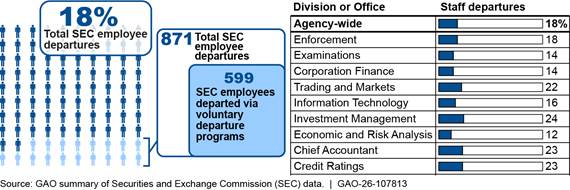
SEC’s 2024 Federal Employee Viewpoint Survey results were positive overall and showed improvement in prior challenge areas, such as performance management and communication across divisions and offices. GAO interviews with SEC employees in May and June 2025 highlighted positive practices in these areas, such as supervisors’ use of formal and informal feedback to recognize performance. However, employees GAO spoke with raised concerns about the effect of workforce reductions (48 of 61 employees) and the cancellation of routine telework (43 of 61 employees). For example, 33 of the 61 said that departing employees had either unique knowledge or specific subject-matter expertise, resulting in a loss of institutional knowledge. A few employees (8 of 61) stated that as of the time of the interviews, they believed SEC had not yet experienced the full effects of these departures.
SEC has made efforts to manage and assess the effects of its 2025 workforce changes. For example, it has taken steps to manage the effects of staff departures, including holding meetings with division and major office heads to identify skill and resource gaps and adjusting the targeted ratio of employees per senior officer. In December 2025, SEC also submitted a staffing plan that identified positions for potential hiring for each division and office. As SEC continues to address the effects of recent workforce changes, GAO will monitor its efforts through its triennial reports. Why GAO Did This Study
SEC relies on a highly skilled workforce to carry out its mission as the primary regulator of the U.S. securities markets. That mission is to protect investors; maintain fair, orderly, and efficient markets; and facilitate capital formation. The Dodd-Frank Wall Street Reform and Consumer Protection Act contains a provision for GAO to report triennially on the quality of SEC’s personnel management. GAO’s previous four reports (GAO-13-621, GAO-17-65, GAO-20-208, and GAO-23-105459) identified several challenges and included 11 recommendations, all of which SEC has addressed.
This report addresses (1) key personnel management changes SEC has implemented since GAO’s 2022 report, (2) employees’ views on SEC’s personnel management, and (3) steps SEC has taken to manage and assess the effects of recent personnel management changes on its mission.
GAO reviewed SEC documents and workforce data and interviewed SEC officials. GAO also analyzed SEC employee responses to the Federal Employee Viewpoint Survey from 2022 through 2024 (the latest available) and interviewed a nongeneralizable sample of 61 SEC employees in nine mission-critical divisions and offices.
Abbreviations
Dodd-Frank Act Dodd-Frank
Wall Street Reform and Consumer
Protection Act
OMB Office of Management and Budget
OPM Office of Personnel Management
SEC Securities and Exchange Commission
This is a work of the U.S. government and is not subject to copyright protection in the United States. The published product may be reproduced and distributed in its entirety without further permission from GAO. However, because this work may contain copyrighted images or other material, permission from the copyright holder may be necessary if you wish to reproduce this material separately.
March 27, 2026
The Honorable Tim Scott
Chairman
The Honorable Elizabeth Warren
Ranking Member
Committee on Banking, Housing, and Urban Affairs
United States Senate
The Honorable French Hill
Chairman
The Honorable Maxine Waters
Ranking Member
Committee on Financial Services
House of Representatives
The Securities and Exchange Commission (SEC) relies on a highly skilled workforce to carry out its mission as the primary regulator of the U.S. securities markets. That mission is to protect investors; maintain fair, orderly, and efficient markets; and facilitate capital formation.[1] We and others have previously reported on SEC’s efforts to address challenges in building and retaining such a workforce. Since our first report on this topic in 2013, SEC has made improvements to its personnel management. These improvements are reflected in SEC’s rank in the Partnership for Public Service’s annual “Best Places to Work in the Federal Government,” which rose from 19th place in 2012—when GAO first began work on SEC’s personnel management—to fourth place in 2024 (out of 25 midsize agencies).
In 2025, SEC offered voluntary departure incentives to its employees and implemented other significant changes to its personnel management practices in response to executive orders, presidential memorandums, and related Office of Personnel Management (OPM) and Office of Management and Budget (OMB) memorandums. During the fiscal year ending September 30, 2025, about 12 percent of SEC’s total staff left the agency through voluntary departure programs.
Section 962 of the Dodd-Frank Wall Street Reform and Consumer Protection Act (Dodd-Frank Act) includes a provision for us to report triennially on the quality of SEC’s personnel management, including the competence of professional staff; the effectiveness of supervisors; issues related to employee performance assessments; and intra-agency communication.[2] We previously reported on SEC’s personnel management in 2013, 2016, 2019, and 2022.[3]
This report examines (1) key personnel management changes SEC has implemented since our 2022 report, (2) employees’ views on SEC’s personnel management, and (3) steps SEC has taken to manage and assess the effects of the recent personnel management changes on its mission.
For the first objective, we reviewed relevant SEC documents and communications and interviewed officials in SEC’s Office of Human Resources. For example, we reviewed relevant SEC documentation of changes SEC made in 2025 in response to executive orders, presidential memorandums, and related memorandums. We also interviewed representatives from SEC’s Office of Inspector General and the SEC employee union. We reviewed SEC workforce data on staff departures in fiscal year 2025.[4]
For the second objective, we reviewed SEC’s Federal Employee Viewpoint Survey data from its 2022, 2023, and 2024 surveys.[5] In addition, we interviewed a nongeneralizable sample of 61 employees in mission-critical occupations across SEC’s mission-critical divisions and offices in May and June 2025.[6]
For the third objective, we reviewed relevant workforce planning tools and interviewed officials in SEC’s Office of Human Resources. We reviewed SEC’s 2026 staffing plan submitted to the Office of Personnel Management and the Office of Management and Budget. We also reviewed a summary of SEC’s reduction-in-force and reorganization plan and interviewed SEC’s liaison to the Department of Government Efficiency team. Appendix I provides more information on our scope and methodology.
We conducted this performance audit from September 2024 to March 2026 in accordance with generally accepted government auditing standards. Those standards require that we plan and perform the audit to obtain sufficient, appropriate evidence to provide a reasonable basis for our findings and conclusions based on our audit objectives. We believe that the evidence obtained provides a reasonable basis for our findings and conclusions based on our audit objectives.
Background
SEC is led by a commission that oversees its operations and provides final approval over staff interpretation of federal securities laws, proposals for new or amended rules to govern securities markets, and enforcement activities.[7] Headed by the SEC Chairman, the commission oversees six divisions, 25 offices, and 10 regional offices (see. fig. 1).[8] SEC has designated all six of its divisions and three of its offices as mission critical (i.e., primarily responsible for implementing SEC’s mission). In 2025, SEC integrated the functions of its Strategic Hub for Innovation and Financial Technology—previously reporting to the Office of the Chairman—into other parts of the agency.
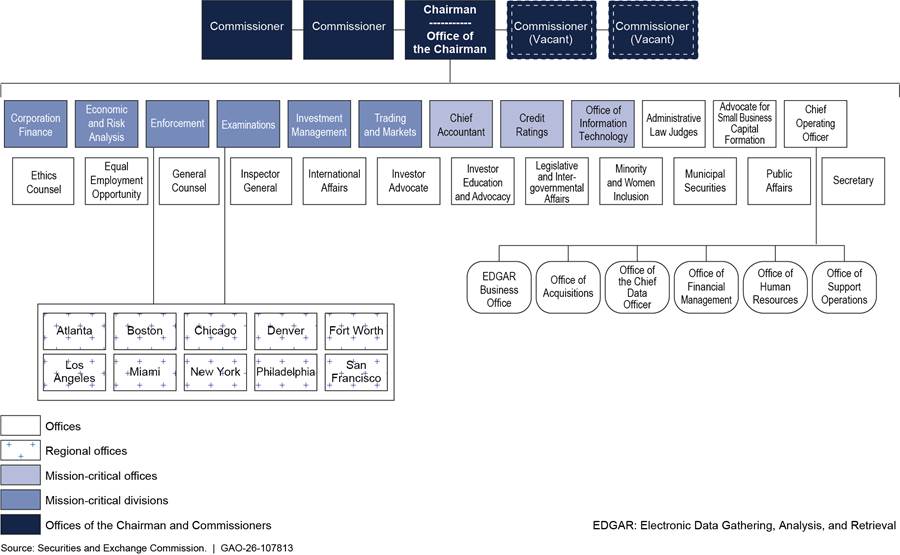
Table 1 outlines the roles and responsibilities of these mission-critical divisions and offices.
|
Office/division |
Roles and responsibilities |
|
Division of Enforcement |
Oversee all enforcement activities under the acts administered by SEC, including by conducting investigations into possible securities law violations, recommending the institution of administrative proceedings and civil actions arising out of enforcement activities, and facilitating the return of money to harmed investors. |
|
Division of Examinations |
Conduct examinations of registered entities, such as investment advisers, investment companies, broker-dealers, securities exchanges, and clearing agencies, for compliance with the federal securities laws. |
|
Division of Corporation Finance |
Review corporate disclosures, assist companies in interpreting SEC’s rules, and recommend new rules for adoption. |
|
Division of Trading and Markets |
Oversee the major securities market participants, including but not limited to self-regulatory organizations including Financial Industry Regulatory Authority, securities exchanges, and clearing agencies; broker-dealers; transfer agents; and security-based swaps dealers. |
|
Division of Investment Management |
Oversee investment companies—including mutual funds, exchange-traded funds, and closed-end funds—and registered investment advisers. Develop policy and rule recommendations, review filings submitted by funds and advisers, and provide guidance on related topics. |
|
Division of Economic and Risk Analysis |
Provide economic analysis, data analytics, and subject-matter expertise to support a range of SEC activities, including rulemaking, enforcement, and examination. Assist in identifying, analyzing, and responding to risks and trends, including those associated with new financial products and strategies. Manage and analyze public and private data to support relevant initiatives and projects, including the production of financial and market data analysis tools and economic statistics. |
|
Office of Information Technology |
Support SEC and its employees by managing all aspects of the agency’s information technology program, including enterprise architecture, application development, infrastructure operations and engineering, end user support, and information technology security. |
|
Office of the Chief Accountant |
Serve as principal advisor to SEC on accounting and auditing matters; work with domestic and international accounting and auditing standard-setting bodies; assist companies in interpreting applicable accounting standards; work to improve the professional performance of public company auditors to ensure that financial statements used for investment decisions are presented fairly and have credibility; and assist in enforcement actions involving accounting or auditing issues. |
|
Office of Credit Ratings |
Conduct examinations, administer rules, and provide guidance pertaining to Nationally Recognized Statistical Rating Organizations. |
Source: GAO summary of Securities and Exchange Commission (SEC) information. | GAO‑26‑107813
Note: Mission-critical divisions and offices are those that are primarily responsible for implementing SEC’s mission.
SEC’s Office of Human Resources has overall responsibility for the strategic management of SEC’s personnel management. It assesses compliance with federal regulations for areas such as recruitment, retention, leadership and staff development, and performance management. In addition, certain divisions have internal human resource coordinators that coordinate between the Office of Human Resources and their respective division heads. The Office of Human Resources reports to SEC’s Office of the Chief Operating Officer, which in turn reports to the Office of the Chairman.
To carry out its mission, SEC employs staff with a range of skills and backgrounds throughout the United States. In January 2026, SEC reported that it had approximately 4,000 employees across its headquarters and 10 regional offices. The regional offices are responsible for investigating and litigating potential violations of securities laws and have enforcement and examination staff to inspect regulated entities. Most SEC nonsupervisory staff are represented by the National Treasury Employees Union (referred to in this report as the SEC employees’ union).
Prior GAO Reports
GAO’s four prior reports identified several challenges related to SEC’s personnel management and included 11 recommendations, all of which SEC has implemented. For example, SEC implemented a recommendation to develop and implement a comprehensive workforce and succession planning process that incorporated OPM guidance.
Our most recent report, issued in 2022, found that while SEC employees had favorable views of many aspects of personnel management, most continued to have concerns related to performance management and staffing levels. In addition, employees had mixed views on issues related to communication, risk aversion, and favoritism.
Performance management. In 2022, we surveyed SEC employees and estimated that 56 percent of employees disagreed that SEC’s performance management system created meaningful distinctions in performance among employees.[9] In 2020, SEC had fully implemented a new performance management system that used a two-tier scale that rated employees as either “accomplished performer” or “unacceptable.” Prior to the two-tier scale, SEC had used a five-tier rating scale.
Communication across divisions and offices. In our 2013 report, we found that current and former SEC staff at the time described SEC’s culture using terms like “siloed communication” and “hierarchical.” We made recommendations in 2013 and 2016 related to improving intra-agency communication.[10] In 2019, we determined that SEC had implemented these recommendations, such as by creating cross-divisional committees and working groups.[11] On the basis of our 2022 survey results, we estimated that fewer than half of SEC employees agreed that information was adequately shared across divisions and offices.[12]
Recent Executive Actions Related to the Federal Workforce
Since January 2025, the President has issued executive orders and presidential memorandums related to personnel management within the federal government. Topics have included reducing the size of the federal government; returning to in-person work; ending diversity, equity, and inclusion programs; and reforming hiring and performance management, among others. OPM and OMB also issued memorandums to executive branch agencies regarding the implementation of these initiatives. In this report, we refer to executive orders, presidential memorandums, and related agency memorandums collectively as executive actions.[13]
SEC Implemented Personnel Management Changes in Response to 2025 Executive Actions
SEC Reduced Its Workforce, Restricted Telework, and Implemented Other Personnel Management Changes
In 2025, SEC announced and implemented significant personnel management changes in response to executive actions. Key changes included offering incentives for voluntary departures, requiring employees to work in the office on a full-time basis, and removing references to diversity, equity, and inclusion from SEC policies and procedures.
According to officials, in January 2025 SEC established a working group to evaluate recent executive actions, identify those that apply to SEC, and identify actions needed to address them. Officials said the working group helps the commission ensure compliance, monitor implementation, identify key stakeholders, and develop recommendations for the Chairman. Officials said final decisions on telework restrictions, voluntary departure incentives, and changes related to diversity, equity, and inclusion were made by the Chairman.[14]
Voluntary Early Retirement, Voluntary Separation, and Deferred Resignation
In February 2025, the President issued an executive order directing agency heads to promptly prepare for large-scale reductions in force.[15] OPM and OMB issued related guidance to agencies, which included exploring voluntary departure incentives prior to conducting a reduction in force.[16] In response, SEC offered all eligible employees voluntary early retirement and voluntary separation incentive payments.[17] SEC officials told us they offered these incentives in February 2025, after consulting with representatives of the Department of Government Efficiency. A total of 430 employees accepted one or both of these options and left SEC by April 4, 2025. Accordingly, SEC officials told us the agency did not find it necessary to conduct a reduction in force.
In September 2025, SEC offered voluntary early retirement and voluntary separation incentive payments again to a targeted set of employees. As part of its plans to reorganize its information technology functions and improve supervisory ratios, SEC offered these programs to all employees in the Office of Information Technology and to supervisory employees in most divisions and offices.[18] Forty-two employees accepted the offer and left SEC by February 2026.
In addition, SEC officials said OPM offered the government-wide Deferred Resignation Program to all SEC employees in late January 2025, outside of SEC management’s direction.[19] The 170 employees who accepted deferred resignation were placed on administrative leave—an excused absence without loss of pay or charge to annual leave—by early April and remained on leave until September 30, 2025.
In fiscal year 2025, 871 employees left SEC, or about 18 percent of SEC’s total workforce (see fig. 2).[20]
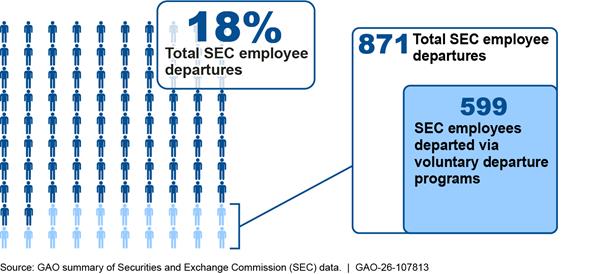
This decrease includes 599 employees, or about 12 percent of the workforce, who departed or went on administrative leave between January 1 and April 30, 2025, through one of the voluntary departure programs.[21] Table 2 provides a more detailed breakdown of employee departures in mission-critical divisions and offices due to these programs. According to SEC officials, SEC did not conduct any involuntary terminations in response to the executive actions.[22]
|
Division or office |
Workforce size as of end of fiscal year 2024a |
Reduction due to voluntary departure incentivesb |
Reduction due to deferred resignation |
Reduction due to other attrition |
Attrition rate (%) |
|
Enforcement |
1,305 |
109 |
54 |
72 |
18% |
|
Examinations |
1,079 |
69 |
35 |
46 |
14% |
|
Corporation Finance |
429 |
25 |
12 |
21 |
14% |
|
Trading and Markets |
276 |
31 |
9 |
20 |
22% |
|
Information Technology |
209 |
19 |
7 |
8 |
16% |
|
Investment Management |
219 |
31 |
5 |
17 |
24% |
|
Economic and Risk Analysis |
191 |
14 |
1 |
8 |
12% |
|
Chief Accountant |
43 |
1 |
2 |
7 |
23% |
|
Credit Ratings |
43 |
5 |
2 |
3 |
23% |
|
Mission-critical total |
3,794 |
304 |
127 |
202 |
17% |
|
Agency-wide total |
4,907 |
430c |
169d |
272 |
18% |
Source: GAO presentation of Securities and Exchange Commission (SEC) data. | GAO‑26‑107813
aThese data reflect SEC’s workforce size on October 5, 2024, the date of the end of the last pay period of fiscal year 2024.
bIncludes staff who took voluntary early retirement or voluntary separation incentive payments. Employees eligible for early retirement were also eligible to receive a voluntary separation incentive payment; therefore, this count includes employees who accepted only a voluntary separation incentive payment as well as those who accepted both early retirement and a separation payment.
cThis number does not include an additional 42 employees who accepted voluntary early retirement or voluntary separation incentive payments that SEC offered to a targeted set of employees in September 2025. These employees departed SEC after September 30, 2025.
dOne employee who accepted deferred resignation did not leave the agency until fiscal year 2026; in total, 170 employees accepted the deferred resignation offer.
In January 2026, SEC reported that it had approximately 4,000 employees, which is lower than SEC’s average full-time equivalent workforce has been since 2014 (see fig. 3).[23]
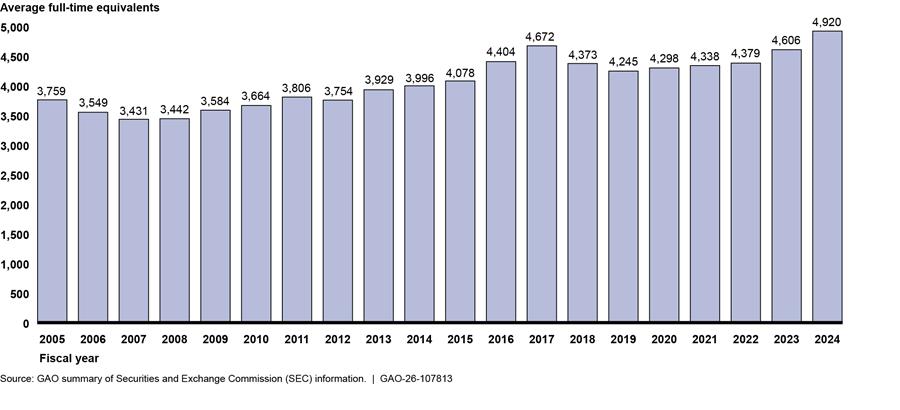
Note: SEC’s most recent Agency Financial Report did not include the full-time equivalent number for fiscal year 2025.
Hiring Freeze Extension
In January 2025, the President ordered a freeze on the hiring of federal civilian employees in the executive branch.[24] Thereafter, SEC extended its hiring freeze, which had been in place since the beginning of fiscal year 2024 in consideration of SEC’s funding levels. SEC officials said the agency complied with the federal hiring freeze while it was in effect.[25] Officials said SEC and its Office of Inspector General had separate authority to request exemptions during the hiring freeze.
SEC requested exemptions to fill certain key positions in 2025. As of July 2025, SEC had requested exemptions for 18 positions, including nine 2-year fellowships for professional accountants, according to officials. In addition, since May 2025, SEC has implemented 88 temporary promotions—limited to 120 days—to fill areas of critical need during the hiring freeze.[26]
Return to Office and Cancellation of Routine Telework
In January 2025, the President issued a memorandum directing agency heads to terminate remote work arrangements and require employees to work in-person on a full-time basis.[27] The memorandum required agency heads to act as soon as practicable and make exemptions when deemed necessary. According to SEC officials, SEC changed its telework policy to align with the memorandum and related OPM guidance.[28]
In January and February 2025, SEC informed staff that all employees would be required to conduct all regularly scheduled work on-site, with exceptions for staff who require reasonable accommodations, reside more than 50 miles from their SEC office, or have approved extended situational telework.[29] The return to office started with SEC’s non-bargaining-unit staff—senior officers, senior managers, and all other non-bargaining-unit staff, including branch managers—in February and March 2025. Bargaining-unit staff were required to return to the office beginning in April 2025. Employees qualifying for an approved exception continued to telework as of December 2025, according to SEC officials.
As of December 2025, SEC’s ad hoc telework policy stated that employees may engage in situational telework, with supervisory approval, when they are prevented from working in the office due to commuting obstacles, medical appointments, or personal situations that would otherwise result in the employee taking leave. As discussed later in this report, some employees we interviewed in May and June 2025 said their supervisors generally did not approve ad hoc telework.[30]
Changes to Diversity, Equity, and Inclusion Practices
In January 2025, the President issued an executive order prohibiting consideration of diversity, equity, and inclusion factors and goals in federal employment practices.[31] The order also required agency heads to terminate diversity, equity, and inclusion offices and positions to the maximum extent allowed by law. According to SEC officials, as of June 2025, SEC had updated certain personnel management policies and procedures to remove references to diversity, equity, and inclusion to align with the executive order and related OPM guidance.[32]
For example, in April 2025 SEC removed all references to diversity from the list of questions used in candidate interviews and removed a reference in its procedures to hiring panels considering diverse perspectives. In March 2025, SEC also removed all references to its strategic plan goal related to diversity, equity, and inclusion from managers’ performance appraisal criteria. In addition, SEC reduced its Office of Women and Minority Inclusion to one position.[33]
SEC Is Implementing Additional Changes in Response to Executive Actions, Including to Performance Management and Hiring
In September 2025, an SEC official said the agency was working on changes to its performance management system to align with a June 2025 OPM memorandum, and as of December 2025, SEC officials said they were continuing to work on those changes.[34] This memorandum provided government-wide standards for performance management that exclude pass/fail ratings except in limited circumstances.[35]
The officials said SEC plans to redesign its two-tier performance management system to align with the memorandum’s requirement to make clear distinctions among performance levels. They said SEC plans to implement this change for the fiscal year 2027 performance cycle, beginning in October 2026.[36] Officials also said that in 2025 SEC implemented certain requirements from the memorandum, including redesigning its supervisory performance plans to incorporate a new element for holding subordinate employees accountable and related standards.[37]
In addition, SEC is evaluating changes to its recruitment and hiring process to align with OPM memorandums issued in May and November 2025 and related executive orders.[38] For example, SEC officials told us that the agency is incorporating requirements related to accountability in federal hiring, including establishing a strategic hiring committee and developing an annual staffing plan (discussed further below). According to SEC’s May 2025 Merit Hiring Action Plan, SEC began to phase out the use of self-assessments in job applications and to use an alternative assessment method. As of January 2026, officials told us they had completed this change. SEC also plans to revise its policies and practices by the start of fiscal year 2027 to ensure that early-career hiring is focused on merit and practical skills.
SEC Revised and Then Paused Its Leadership Development Program
In 2024, SEC implemented a revised version of its leadership development program, previously piloted at the time of our 2022 report and known as the Leadership Evaluation, Accession, and Development program. While the pilot program was open to all employees within the divisions and offices participating in the pilot, SEC redesigned the program as a competitive program limited to managers in the SK-17 pay plan.[39] Officials said SEC targeted these managers because historical data showed they were most likely to be selected for senior officer positions and because the pilot’s broad eligibility made it too resource intensive.
According to officials, the revised program’s goal is to provide selected SEC managers with experience in senior officer competencies and individualized coaching to provide leadership skills for senior officer roles. When the revised program launched in 2024, more than 10 percent of SK-17 employees applied, and 30 were selected and completed the program by June 2025.
Officials told us in June 2025 that the program had been placed on hold following this last cohort and that the agency was not seeking a new cohort of participants. Officials cited the hiring freeze in place at the time and uncertainty about the availability and timing of future advancement opportunities. Officials also stated that additional clarity on the Chairman’s priorities for this and other training programs was needed to ensure alignment with the direction of SEC’s new leadership. As of January 2026, the program remained on hold.
SEC’s 2024 Employee Survey Showed Improvement over Prior Years, but Employees GAO Interviewed Highlighted Concerns About Recent Changes
SEC’s 2024 Federal Employee Viewpoint Survey results were positive overall and showed improvement in two areas where we previously identified concern: communication across divisions and offices and performance management.[40] Our interviews with 61 SEC employees in May and June 2025 also highlighted good practices in these areas. However, employees expressed new concerns related to recent changes SEC has made in response to executive actions, such as the cancellation of routine telework and departure of employees.
2024 Survey Results on Personnel Management Topics Showed Improvement
The results of SEC’s 2024 Federal Employee Viewpoint Survey—the most recent survey conducted prior to this review—indicated that, compared with prior years, respondents continued to have positive views on topics related to personnel management.[41] The 2024 results also showed improvement in some areas with longstanding challenges. For example, views related to performance management—an area of longstanding concern—improved.[42] Although it was the item with the lowest share of positive responses on the survey in 2024, the statement “In my work unit, differences in performance are recognized in a meaningful way” saw a nearly 9 percentage point increase in positive responses compared with 2022. Similarly, positive responses to a question related to communication across divisions and offices increased by 7 percentage points over the same period.[43] See appendix III for results of selected survey questions.
Employees GAO Interviewed Identified Positive Practices and Concerns About Recent Changes
Employees Highlighted Strengths Related to Recognition and Intra-Agency Communication
SEC employees we interviewed in May and June 2025 described positive aspects of SEC’s personnel management, including communication and collaboration across divisions and offices and supervisory recognition and feedback.[44] However, consistent with SEC’s 2024 Federal Employee Viewpoint Survey results, employees we interviewed generally expressed negative views on how well the two-tier performance management system makes distinctions in employee performance.
Communication and collaboration across divisions and offices. When asked whether challenges in sharing information or collaborating across divisions and offices affected their ability to achieve goals or carry out SEC’s mission, most employees interviewed (48 of 61) said they did not. Employees highlighted positive examples of communication across divisions and offices. About half of employees (28 of 61) stated that they felt comfortable reaching out directly to staff in other divisions or offices if there was a need for collaboration. Some employees (14 of 61) said they attended meetings involving multiple divisions and offices, such as meetings to provide guidance. A few employees (8 of 61) also cited communication through liaisons in other divisions or offices.
Supervisory recognition and feedback for high-quality work. When asked what SEC does well in recognizing high-quality work, most employees (50 of 61) cited awards, such as Special Act awards and division- and agency-wide awards, as mechanisms for recognizing performance distinctions.[45] A majority of employees (43 of 61) also cited feedback from supervisors or management, including written narratives, formal midyear and end-of-year discussions, and informal conversations with supervisors.
Two-tier performance management system. Of the 61 employees we interviewed, 43 stated that the performance management system does not make meaningful distinctions in performance. Some employees (15 of 61) noted that the system is not helpful in distinguishing high-performing employees.[46]
Employees Raised Concerns About Workforce Reductions and the Return to Office
When asked how recent changes at SEC have affected their ability to carry out SEC’s mission, a majority of employees interviewed raised concerns related to recent employee departures and the cancellation of routine telework.[47]
Effect of workforce reductions. Most employees we interviewed (48 of 61) discussed challenges associated with employee departures resulting from voluntary buyouts and deferred resignations.
· Knowledge and expertise transfer. About half (33 of 61) said the employees who left SEC had either unique knowledge from many years of experience or specific subject-matter expertise. They noted that the departures led to a loss of institutional knowledge. A few employees (5 of 61) expressed that the limited time some employees had before leaving was not adequate to pass on their knowledge. One employee noted that individuals who accepted the deferred resignation program left within 7 days. A few employees (8 of 61) stated that they believed SEC has not yet experienced the full effects of these departures, including potential knowledge or expertise gaps. For example, one employee said SEC has many “single points of failure” in key areas of expertise and that it would take time to determine what expertise the agency had lost.
· Workload and responsibilities. About one-third of employees interviewed (18 of 61) said they or their colleagues had taken on additional work or responsibilities following employee departures to ensure SEC could continue to carry out its mission.
· Ability to meet goals. Employees had varying views on how the recent changes affected their ability to meet goals. While a few (4 of 61) said they would still be able to meet their 2025 division or team goals, others (13 of 61) stated they did not expect to meet their division or team goals, were unsure if they could meet them, or that management had already lowered their goals for the year. For example, one supervisor said their manager lowered their team’s goals for disclosure reviews by 20 percent in 2025 because of the loss in personnel.
When asked what actions SEC could take to help ensure they or their division could still carry out the agency’s mission, some employees (17 of 61) stated that SEC should start backfilling vacant positions when possible.
Return to office and cancellation of routine telework. A majority (43 of 61) of employees we interviewed expressed concerns about full-time, in-person work and the cancellation of routine telework. About half of the employees (29 of 61) said the return to office decreased their morale or morale at SEC in general. A few employees (4 of 61) identified positive aspects of the return-to-office requirements, including three employees who noted increased opportunities for communication and connection with coworkers.
Employees’ concerns related to telework fell into several areas:
· Telework flexibility. Employees described several ways in which loss of telework flexibility affected their work. Twenty-three of 61 employees said they were able to accomplish more work when telework was permitted. A few employees (7 of 61) noted that they no longer work outside their normal work hours, as they frequently did when teleworking. One supervisor noted this could affect SEC’s ability to quickly respond to market developments that occur outside work hours, as employees might be concerned about violating the telework policy.
· Ad hoc telework. Some employees (14 of 61) expressed dissatisfaction with SEC’s ad hoc telework policy. A few employees (5 of 61) said they were told they could not telework for part of the day on days when they had a personal appointment and this resulted in having to take annual leave for the remainder of the day (rather than being able to work part of the day from home).
· Staff retention and hiring. About one-third of the employees (20 of 61) told us that they believed eliminating routine telework would make it more difficult to retain staff or attract new staff. A few employees (7 of 61) stated that they expect additional colleagues to leave SEC, or are considering leaving themselves, in part due to the elimination of routine telework.
When asked what actions SEC could take to help ensure they or their division could still carry out the agency’s mission, about half of employees (31 of 61) stated that SEC should allow routine telework. A few employees (4 of 61) stated that they would appreciate being permitted one or more days of routine telework each pay period.
Other concerns. Some employees interviewed (17 of 61) said there was a high level of uncertainty within SEC at the time of our interviews. Some employees (9 of 61) mentioned that the uncertainty related to recent events disrupted their or their colleagues’ ability to work. A few employees (3 of 61) expressed appreciation to SEC’s leaders and supervisors for communicating information about recent changes. Other employees (8 of 61) said they would like SEC management to provide more communication on ongoing or upcoming changes.
SEC Has Taken Steps to Manage and Assess Workforce Reductions and Other Changes
SEC has undertaken workforce planning efforts to manage its actions to reduce its workforce. In spring 2025, SEC conducted analysis and began holding human capital review meetings to understand the characteristics of departing staff and to identify skill and resource gaps.
· Analysis of departing staff. Following staff departures due to voluntary buyouts and deferred resignations in April 2025, SEC analyzed the characteristics of staff who left the agency. This analysis found, among other things, that employees with longer tenure were more likely to have taken the voluntary buyouts. Specifically, employees with 20 or more years tenure disproportionately made up the people who voluntarily departed. Officials said this outcome was expected because these employees were more likely to be eligible for early retirement.
· Human capital review meetings. In April 2025, officials from Human Resources and the Office of the Chief Operating Officer began holding modified versions of SEC’s annual human capital reviews with each division and major office on a regular basis. The purpose of these meetings was to gather information about workforce changes and help division heads determine how to reorganize to address these changes. Divisions identified some areas of lost expertise—for example, Investment Management identified lost expertise on rulemaking and on the Investment Company Act of 1940. Officials also assessed whether new priorities from the Chairman could reveal additional workforce gaps. For example, prioritizing cryptocurrency rulemaking might require SEC to address a gap because few employees have both rulemaking and cryptocurrency expertise.
In June 2025, following staff departures and disproportionate losses in specific areas of the workforce, SEC made changes to senior officer ratios and reviewed other supervisory ratios. Specifically, SEC increased the target ratio of employees and supervisory employees to senior officers. They also reviewed divisions’ and offices’ compliance to ensure that supervisory staffing met established targets, according to officials.[48]
In July 2025, the Office of Human Resources began working with each division and office to create and implement a plan to meet those ratios. Strategies to improve supervisory ratios included using incentives to encourage some supervisors to step down from management positions, combining groups that perform the same function, and shifting employees to new groups with similar job duties. In September 2025, SEC again offered voluntary early retirement and voluntary separation incentive payments to most supervisory-graded employees and allowed certain supervisors to accept a downgrade in their duties to help achieve the planned ratios.[49] According to SEC, 42 people departed the agency in fiscal year 2026 as a result of these efforts.
In December 2025, SEC officials submitted an annual staffing plan in response to the November 2025 OPM and OMB memorandum on ensuring accountability in federal hiring.[50] The memorandum provides guidance on the implementation of Executive Order 14356, which requires agencies to prepare an annual staffing plan in coordination with OPM and OMB and comply with the plan throughout the fiscal year.[51] SEC’s fiscal year 2026 staffing plan identified positions for potential hiring for each division and office. It also identified other personnel actions SEC planned to take based on its workforce planning analysis of skills gaps and needs. For example, the plan included steps to consolidate business groups or work functions to address staffing levels after the voluntary departures and to increase internal and public-facing efficiencies, such as consolidating investor assistance functions nationwide under one office.
The workforce changes SEC made in 2025 were significant and could pose risks to the agency’s ability to fulfill its mission. SEC officials told us that their efforts to address the effects of these changes are ongoing. For example, in December 2025, SEC officials said SEC’s newly established strategic hiring committee had begun gathering additional information on unmet critical hiring needs across divisions and offices.[52] Pursuant to the triennial review mandated under Section 962 of the Dodd-Frank Act, we will continue to monitor these and other steps SEC takes to assess the effects of workforce changes on its mission.
Agency Comments
We provided a draft of this report to SEC and OPM for review and comment. SEC provided technical comments, which we incorporated as appropriate. OPM did not have any comments on the report.
We are sending copies of this report to the appropriate congressional committees, Chairman of SEC, Director of OPM, and other interested parties. In addition, the report is available at no charge on the GAO website at https://www.gao.gov.
If you or your staff have any questions about this report, please contact me at clementsm@gao.gov. Contact points for our Offices of Congressional Relations and Media Relations may be found on the last page of this report. GAO staff who made key contributions to this report are listed in appendix V.

Michael E. Clements,
Director, Financial Markets and Community Investment
This report examines (1) key personnel management changes the Securities and Exchange Commission (SEC) has implemented since our 2022 report, (2) employees’ views on SEC’s personnel management, and (3) steps SEC has taken to manage and assess the effects of the recent personnel management changes on its mission.[53]
Review of SEC Personnel Management Practices
For our first objective, we reviewed documentation of changes SEC made to key personnel management practices since our 2022 report. For example, we reviewed relevant SEC documentation of changes SEC made in 2025 in response to executive orders, presidential memorandums, and related memorandums issued by the Office of Management and Budget and Office of Personnel Management (we refer to these orders and memorandums collectively as executive actions). These included communications SEC provided to staff about its return-to-office policy and documentation on changes to offices, positions, and policies related to diversity, equity, and inclusion.
We reviewed SEC data on its staff departures in fiscal year 2025 and early in fiscal year 2026 through voluntary departure programs. To determine the reliability of these data, we interviewed SEC officials on data quality and control and tested the data for outliers and obvious errors. We determined they were sufficiently reliable for purposes of describing the number of SEC employees who departed SEC through voluntary departure programs or other attrition.
We interviewed SEC Office of Human Resources officials on changes SEC made to personnel management practices since our 2022 report and its plans for further changes, including in response to executive actions in 2025. We also interviewed officials from SEC’s Office of Inspector General, representatives from SEC’s employees’ union, and officials from the Office of Personnel Management on the results of its evaluation of SEC’s human capital management conducted in the second quarter of fiscal year 2025. Additionally, we reviewed academic literature related to personnel management at SEC.
Analysis of Employees’ Views on SEC’s Personnel Management
To obtain SEC employees’ views on SEC’s personnel management, we reviewed SEC’s 2022–2024 Federal Employee Viewpoint Survey data and interviewed a nongeneralizable sample of 61 SEC mission-critical employees in mission-critical divisions and offices.
Analysis of Federal Employee Viewpoint Survey Data
We reviewed SEC data on the results of its Federal Employee Viewpoint Survey for 2022, 2023, and 2024 to obtain perspectives of those SEC staff who completed the survey on issues related to the agency’s personnel management.[54] We analyzed trends and changes in employees’ views during that time. For example, we identified survey items related to personnel management topics with the most positive and negative responses, as well as items with the largest changes between the 2022 and 2024 surveys.[55]
To assess the reliability of these survey data, we conducted tests for missing data and errors, collected written responses on survey administration and response rates, and interviewed officials responsible for survey administration. We found the data to be reliable for the purpose of analyzing respondents’ views on SEC’s personnel management practices, including trends in employee views.
Employee Interviews
To both inform our work and guide the engagement process as well as collect data for analysis, we conducted nongeneralizeable employee interviews at two points in time.
Initial interviews with current and former SEC employees. We provided opportunities for SEC employees to meet or communicate with us individually. Specifically, we set up a GAO toll-free phone number and email address for SEC employees to use to arrange a meeting with our team or provide information. In December 2024, we interviewed 48 nonsupervisory and supervisory employees who contacted us for interviews to obtain their views on personnel management at SEC. In addition, using information provided by SEC, we sent 312 letters to all employees who separated from SEC between January 2023 and October 2024, offering them an opportunity to schedule a meeting with us. We interviewed 18 of these former SEC employees in January and February 2025.
We asked all interviewees questions related to (1) what personnel management practices were working well, (2) what challenges existed in personnel management, (3) what actions, if any, SEC had taken to address these challenges, and (4) any other comments they might have about personnel management at SEC. To maintain the confidentiality of individual responses, we did not record individual names in our transcripts. Instead, we collected and analyzed the information by division, location, tenure, and supervisory status. GAO analysts summarized themes that emerged from these interviews and used them to identify key personnel management issues and inform the development of questions for the subsequent employee interviews.
Interviews with supervisory and nonsupervisory employees. We interviewed a nongeneralizable sample of 61 employees and supervisors in mission-critical occupations across SEC’s mission-critical divisions and offices in May and June 2025.[56]
To determine our sample, we stratified the population of mission-critical SEC employees into sampling strata by division and office to ensure representation across SEC’s mission-critical divisions and offices. We further stratified the Divisions of Enforcement and Examinations into headquarters and regional office categories because a majority of staff in those divisions work in SEC’s regional offices. Because of their smaller employee counts, we combined the Offices of the Chief Accountant, Information Technology, and Credit Ratings into one stratum for sampling purposes.
Within each stratum, we sorted employees by supervisory status and selected interview candidates using systematic random sampling. We selected at least two nonsupervisory and two supervisory employees from each group and selected additional employees in larger SEC divisions. In total, we met with 61 employees.
We initially emailed 62 employees. When response rates were insufficient for certain strata, we emailed alternates as needed and, in some cases, expanded outreach beyond the original alternates. To encourage participation, we asked SEC to send an email to employees selected for interviews and alternates before GAO reached out to employees.
Table 3 shows the number of employees interviewed by supervisory status for each sampling group.
Table 3: Number of Securities and Exchange Commission Employees Interviewed by GAO, by Supervisory Status and Mission-Critical Office or Division
|
Office or division |
Supervisory status |
Number interviewed |
|
Division of Enforcement – Headquarters |
|
|
|
|
Supervisor |
3 |
|
|
Nonsupervisor |
5 |
|
Division of Enforcement – Regional Offices |
|
|
|
|
Supervisor |
3 |
|
|
Nonsupervisor |
6 |
|
Division of Examinations – Headquarters |
|
|
|
|
Supervisor |
2 |
|
|
Nonsupervisor |
2 |
|
Division of Examinations – Regional Offices |
|
|
|
|
Supervisor |
4 |
|
|
Nonsupervisor |
8 |
|
Division of Corporation Finance |
|
|
|
|
Supervisor |
3 |
|
|
Nonsupervisor |
4 |
|
Division of Trading and Markets |
|
|
|
|
Supervisor |
2 |
|
|
Nonsupervisor |
3 |
|
Division of Investment Management |
|
|
|
|
Supervisor |
2 |
|
|
Nonsupervisor |
4 |
|
Division of Economic and Risk Analysis |
|
|
|
|
Supervisor |
2 |
|
|
Nonsupervisor |
4 |
|
Offices of the Chief Accountant, Credit Ratings, and Information Technology |
|
|
|
|
Supervisor |
2 |
|
|
Nonsupervisor |
2 |
|
Total |
|
61 |
Source: GAO. | GAO‑26‑107813
We gathered staff views on (1) performance management, (2) communication and collaboration across divisions and offices, and (3) recent changes at SEC that have affected the workforce. We developed these categories partially through our initial conversations with current and former SEC employees about personnel management, and we pretested the interview questions with three mission-critical employees. We included an additional question for supervisors on how SEC addresses poor performance. Information and views obtained from the interviews cannot be generalized to all staff within the agency.
Content analysis. To analyze the data we obtained from the interviews, we conducted a content analysis of the responses to each question. Two staff members developed a coding scheme based on responses from the initial individual interviews with current and former SEC employees, and on challenge areas identified through our analysis of Federal Employee Viewpoint Survey data. The coding scheme was piloted with transcripts from the employee interviews and refined into a final set of codes. We developed 45 coding categories, such as (1) recognition for high-quality work, (2) making meaningful distinctions in performance among employees, (3) communication and collaboration across divisions, (4) the return to office and elimination of telework, (5) departure of employees through voluntary departure programs, (6) morale, (7) ability to complete SEC’s mission and goals, and (8) how SEC can respond to effects of recent changes.
Two coders then used NVivo to independently code each of the interviews, coming together after approximately every 10 interviews to reconcile differences in coding. Once all the transcripts were coded, an analyst used NVivo to determine the prevalence of the different codes.
To characterize the views of SEC employees we interviewed, we used consistently defined quantifiers, shown in table 4.
|
Quantifier |
Number of employees (out of 61) |
|
A few |
3–8 |
|
Some |
9–17 |
|
About one-third |
18–27 |
|
Around half |
28–33 |
|
A majority |
34–47 |
|
Most |
48 and above |
Source: GAO. | GAO‑26‑107813
Review of Steps SEC Took to Manage and Assess Recent Changes
To obtain information on SEC’s efforts to manage and assess recent workforce changes, we reviewed relevant workforce planning tools and interviewed officials in SEC’s Office of Human Resources. We reviewed SEC’s fiscal year 2026 staffing plan that the agency provided to the Office of Personnel Management and the Office of Management and Budget.
We also reviewed SEC documents on and interviewed officials about recent workforce actions, including internal training materials, communications with staff about recent changes, and documentation related to updated supervisory ratios, the hiring freeze, and temporary promotions. We also observed a demonstration of several of SEC’s human capital dashboards—interactive software tools used by the Office of Human Resources and agency leadership to monitor workforce data, such as hiring, attrition, skill gaps, and workforce demographics. The demonstration allowed us to review updates since our prior reviews and new features, such as the ability to track hiring flows in real time.
We also reviewed information SEC provided us on the primary principles and proposals included in its reduction-in-force and reorganization plan submitted to the Office of Personnel Management and the Office of Management and Budget. We interviewed a representative from SEC’s internal Department of Government Efficiency team to understand SEC’s planning and implementation of its ongoing agency reorganization efforts and collected information from SEC officials on future workforce planning steps they plan to take.
We used SEC data extracted from the Department of the Interior’s Federal Personnel/Payroll System to construct the sample for our employee interviews and develop summary tables in our appendixes.[57] To assess the reliability of these data, we reviewed related documentation, tested the data for missing data and errors, and obtained written responses from SEC employees about data quality and control. We determined that the data were sufficiently reliable for the purposes of selecting our employee interview sample and developing summary tables on staffing ratios and turnover.
We conducted this performance audit from September 2024 to March 2026 in accordance with generally accepted government auditing standards. Those standards require that we plan and perform the audit to obtain sufficient, appropriate evidence to provide a reasonable basis for our findings and conclusions based on our audit objectives. We believe that the evidence obtained provides a reasonable basis for our findings and conclusions based on our audit objectives.
Section 962 of the Dodd-Frank Wall Street Reform and Consumer Protection Act includes a provision for us to review turnover within Securities and Exchange Commission (SEC) subunits, including consideration of supervisors whose subordinates have an unusually high rate of turnover.[58] We previously reported that Merit Systems Protection Board officials noted that turnover was not a good indicator of poor supervision for several reasons.[59] For example, staff may leave to pursue opportunities with a different employer or a different career path, or for personal reasons.
Tables 5, 6, and 7 present the percentage of staff who left SEC from fiscal years 2013 through 2025 in headquarters and regional offices.[60]
|
|
|
Percentage separated (total staff) |
||||||||||||
|
Reason for separation |
Employee category |
FY 13 |
FY 14 |
FY 15 |
FY 16 |
FY 17 |
FY 18 |
FY 19 |
FY 20 |
FY 21 |
FY 22 |
FY 23 |
FY 24 |
FY 25 |
|
Retirement |
Non |
1.3 (1,420) |
1.7 (1,450) |
1.3 (1,512) |
0.5 (1,751) |
1.5 (1,748) |
1.1 (1,710) |
1.1 (1,296) |
1.4 (1,339) |
2.0 (1,313) |
1.8 (1,471) |
2.2 (1,533) |
1.1 (1,437) |
9.0 (1,382) |
|
Supervisors |
2.3 (263) |
2.2 (268) |
1.1 (283) |
1.5 (341) |
1.5 (344) |
1.1 (351) |
1.7 (299) |
2.4 (294) |
1.7 (290) |
2.3 (311) |
1.2 (321) |
1.2 (326) |
12.3 (317) |
|
|
Senior officers |
3.1 (65) |
4.7 (64) |
0.0 (71) |
2.7 (75) |
2.5 (80) |
10.5 (86) |
0.0 (64) |
2.9 (69) |
3.1 (65) |
2.5 (79) |
1.4 (73) |
0.0 (71) |
14.3 (84) |
|
|
Resignation |
Non |
3.9 (1,420) |
4.6 (1,450) |
3.9 (1,512) |
3.1 (1,751) |
3.2 (1,748) |
2.9 (1,710) |
1.5 (1,296) |
1.7 (1,339) |
2.6 (1,313) |
3.0 (1,471) |
1.9 (1,533) |
1.7 (1,437) |
4.3 (1,382) |
|
Supervisors |
4.6 (263) |
1.9 (268) |
4.9 (283) |
1.5 (341) |
4.4 (344) |
2.3 (351) |
4.0 (299) |
0.7 (294) |
3.8 (290) |
2.9 (311) |
2.2 (321) |
1.5 (326) |
4.1 (317) |
|
|
Senior officers |
16.9 (65) |
7.8 (64) |
9.9 (71) |
10.7 (75) |
11.3 (80) |
2.3 (86) |
0.0 (64) |
2.9 (69) |
18.5 (65) |
17.7 (79) |
1.4 (73) |
5.6 (71) |
10.7 (84) |
|
|
Removal or termination |
Non |
0.4 (1,420) |
0.2 (1,450) |
0.4 (1,512) |
0.2 (1,751) |
0.5 (1,748) |
0.4 (1,710) |
0.2 (1,296) |
0.5 (1,339) |
0.6 (1,313) |
4.4a (1,471) |
9.7a (1,533) |
6.7a (1,437) |
0.3 (1,382) |
|
|
Supervisors |
0.0 (263) |
0.0 (268) |
0.0 (283) |
0.0 (341) |
0.0 (344) |
0.0 (351) |
0.0 (299) |
0.0 (294) |
0.0 (290) |
0.0 (311) |
0.0 (321) |
0.0 (326) |
0.0 (317) |
|
|
Senior officers |
0.0 (65) |
0.0 (64) |
0.0 (71) |
0.0 (75) |
0.0 (80) |
1.2 (86) |
0.0 (64) |
0.0 (69) |
3.1 (65) |
2.5 (79) |
0.0 (73) |
0.0 (71) |
1.2 (84) |
|
|
Total |
6.3 (1,748) |
6.3 (1,782) |
5.9 (1,866) |
4.1 (2,167) |
5.7 (2,172) |
4.6 (2,147) |
3.3 (1,659) |
3.6 (1,702) |
6.0 (1,668) |
9.1 (1,861) |
11.6 (1,927) |
8.2 (1,834) |
14.6 (1,783) |
FY = fiscal year
Source: GAO analysis of Securities and Exchange Commission (SEC) data. | GAO‑26‑107813
aThe expiration of appointments for student trainees accounts for the majority of removals and terminations.
|
|
|
Percentage separated (total staff) |
|
||||||||||||
|
Reason for separation |
Employee category |
FY 13 |
FY 14 |
FY 15 |
FY 16 |
FY 17 |
FY 18 |
FY 19 |
FY 20 |
FY 21 |
FY 22 |
FY 23 |
FY 24 |
FY25 |
|
|
Retirement |
Nonsupervisors |
1.2 (1,205) |
1.2 (1,182) |
0.7 (1,201) |
0.6 (1,253) |
1.5 (1,238) |
1.1 (1,192) |
0.9 (1,504) |
1.0 (1,569) |
1.3 (1,628) |
1.5 (1,655) |
1.3 (1,845) |
0.8 (1,849) |
9.3 (1,642) |
|
|
Supervisors |
0.0 (247) |
0.8 (237) |
1.2 (246) |
0.4 (279) |
1.1 (270) |
0.0 (269) |
0.9 (329) |
1.2 (333) |
2.7 (334) |
1.3 (320) |
2.3 (345) |
1.4 (354) |
13.4 (352) |
||
|
Senior officers |
7.1 (28) |
7.1 (28) |
3.7 (27) |
0.0 (27) |
3.2 (31) |
3.5 (29) |
0.0 (42) |
4.6 (44) |
0.0 (43) |
0.0 (38) |
7.3 (41) |
0.0 (39) |
7.3 (55) |
||
|
Resignation |
Nonsupervisors |
2.2 (1,205) |
2.9 (1,182) |
2.7 (1,201) |
1.8 (1,253) |
1.4 (1,238) |
1.9 (1,192) |
2.0 (1,504) |
1.0 (1,569) |
1.6 (1,628) |
2.9 (1,655) |
1.4 (1,845) |
0.8 (1,849) |
5.7 (1,642) |
|
|
Supervisors |
3.2 (247) |
2.1 (237) |
0.4 (246) |
1.1 (279) |
1.1 (270) |
1.1 (269) |
2.1 (329) |
0.6 (333) |
1.5 (334) |
1.6 (320) |
2.3 (345) |
1.1 (354) |
4.0 (352) |
||
|
Senior officers |
3.6 (28) |
0.0 (28) |
11.1 (27) |
7.4 (27) |
9.7 (31) |
3.5 (29) |
0.0 (42) |
4.6 (44) |
7.0 (43) |
7.9 (38) |
0.0 (41) |
0.0 (39) |
12.7 (55) |
||
|
Removal or termination |
Nonsupervisors |
0.4 (1,205) |
0.2 (1,182) |
0.2 (1,201) |
0.2 (1,253) |
0.2 (1,238) |
0.1 (1,192) |
0.3 (1,504) |
0.3 (1,569) |
0.3 (1,628) |
2.3a (1,655) |
6.1a (1,845) |
3.4a (1,849) |
0.4 (1,642) |
|
|
|
Supervisors |
0.0 (247) |
0.0 (237) |
0.0 (246) |
0.0 (279) |
0.4 (270) |
0.0 (269) |
0.3 (329) |
0.0 (333) |
0.0 (334) |
0.3 (320) |
0.3 (345) |
0.0 (354) |
0.0 (352) |
|
|
Senior officers |
0.0 (28) |
0.0 (28) |
0.0 (27) |
0.0 (27) |
0.0 (31) |
0.0 (29) |
0.0 (42) |
0.0 (44) |
2.3 (43) |
0.0 (38) |
0.0 (41) |
0.0 (39) |
0.0 (55) |
||
|
Total |
3.9 (1,480) |
4.0 (1,447) |
3.5 (1,474) |
2.5 (1,559) |
3.2 (1,539) |
2.8 (1,490) |
3.2 (1,875) |
2.3 (1,946) |
3.4 (2,005) |
6.2 (2,013) |
8.2 (2,231) |
4.5 (2,242) |
15.8 (2,049) |
||
FY = fiscal year
Source: GAO analysis of Securities and Exchange Commission (SEC) data. | GAO‑26‑107813
aThe expiration of appointments for student trainees accounts for the majority of removals and terminations.
|
|
|
Percentage separated (total staff) |
|
||||||||||||
|
Reason for separation |
Employee category |
FY 13 |
FY 14 |
FY 15 |
FY 16 |
FY 17 |
FY 18 |
FY 19 |
FY 20 |
FY 21 |
FY 22 |
FY 23 |
FY 24 |
FY25 |
|
|
Retirement |
Nonsupervisors |
1.3 (2,625) |
1.4 (2,632) |
1.1 (2,713) |
0.6 (3,004) |
1.5 (2,986) |
1.1 (2,902) |
1.0 (2,800) |
1.2 (2,908) |
1.6 (2,941) |
1.7 (3,126) |
1.7 (3,378) |
0.9 (3,286) |
9.1 (3,024) |
|
|
Supervisors |
1.2 (510) |
1.6 (505) |
1.1 (529) |
1.0 (620) |
1.3 (614) |
0.7 (620) |
1.3 (628) |
1.8 (627) |
2.2 (624) |
1.7 (631) |
1.8 (666) |
1.3 (680) |
12.9 (669) |
||
|
Senior officers |
4.3 (93) |
5.4 (92) |
1.0 (98) |
2.0 (102) |
2.7 (111) |
8.7 (115) |
0.0 (106) |
3.5 (113) |
1.9 (108) |
1.7 (117) |
3.5 (114) |
0.0 (110) |
11.5 (139) |
||
|
Resignation |
Nonsupervisors |
3.2 (2,625) |
3.8 (2,632) |
3.4 (2,713) |
2.6 (3,004) |
2.4 (2,986) |
2.5 (2,902) |
1.8 (2,800) |
1.3 (2,908) |
2.0 (2,941) |
2.9 (3,126) |
1.6 (3,378) |
1.2 (3,286) |
5.0 (3,024) |
|
|
Supervisors |
3.9 (510) |
2.0 (505) |
2.8 (529) |
1.3 (620) |
2.9 (614) |
1.8 (620) |
3.0 (628) |
0.6 (627) |
2.6 (624) |
2.2 (631) |
2.3 (666) |
1.3 (680) |
4.0 (669) |
||
|
Senior officers |
12.9 (93) |
5.4 (92) |
10.2 (98) |
9.8 (102) |
10.8 (111) |
2.6 (115) |
0.0 (106) |
3.5 (113) |
13.9 (108) |
14.5 (117) |
0.9 (114) |
3.6 (110) |
11.5 (139) |
||
|
Removal or termination |
Nonsupervisors |
0.4 (2,625) |
0.2 (2,632) |
0.3 (2,713) |
0.2 (3,004) |
0.4 (2,986) |
0.3 (2,902) |
0.3 (2,800) |
0.3 (2,908) |
0.4 (2,941) |
3.3a (3,126) |
7.7a (3,378) |
4.8a (3,286) |
0.4 (3,024) |
|
|
|
Supervisors |
0.0 (510) |
0.0 (505) |
0.0 (529) |
0.0 (620) |
0.2 (614) |
0.0 (620) |
0.2 (628) |
0.0 (627) |
0.0 (624) |
0.2 (631) |
0.2 (666) |
0.0 (680) |
0.0 (669) |
|
|
Senior officers |
0.0 (93) |
0.0 (92) |
0.0 (98) |
0.0 (102) |
0.0 (111) |
0.9 (115) |
0.0 (106) |
0.0 (113) |
2.8 (108) |
1.7 (117) |
0.0 (114) |
0.0 (110) |
0.7 (139) |
||
|
Total |
5.2 (3,228) |
5.3 (3,229) |
4.8 (3,340) |
3.4 (3,726) |
4.6 (3,711) |
3.9 (3,637) |
3.2 (3,534) |
2.9 (3,648) |
4.6 (3,673) |
7.6 (3,874) |
9.8 (4,158) |
6.2 (4,076) |
15.3 (3,832) |
||
FY = fiscal year
Source: GAO analysis of Securities and Exchange Commission (SEC) data. | GAO‑26‑107813
aThe expiration of appointments for student trainees accounts for the majority of removals and terminations.
Figure 4: Selected Responses from the Securities and Exchange Commission’s (SEC) Federal Employee Viewpoint Surveys, 2022–2024
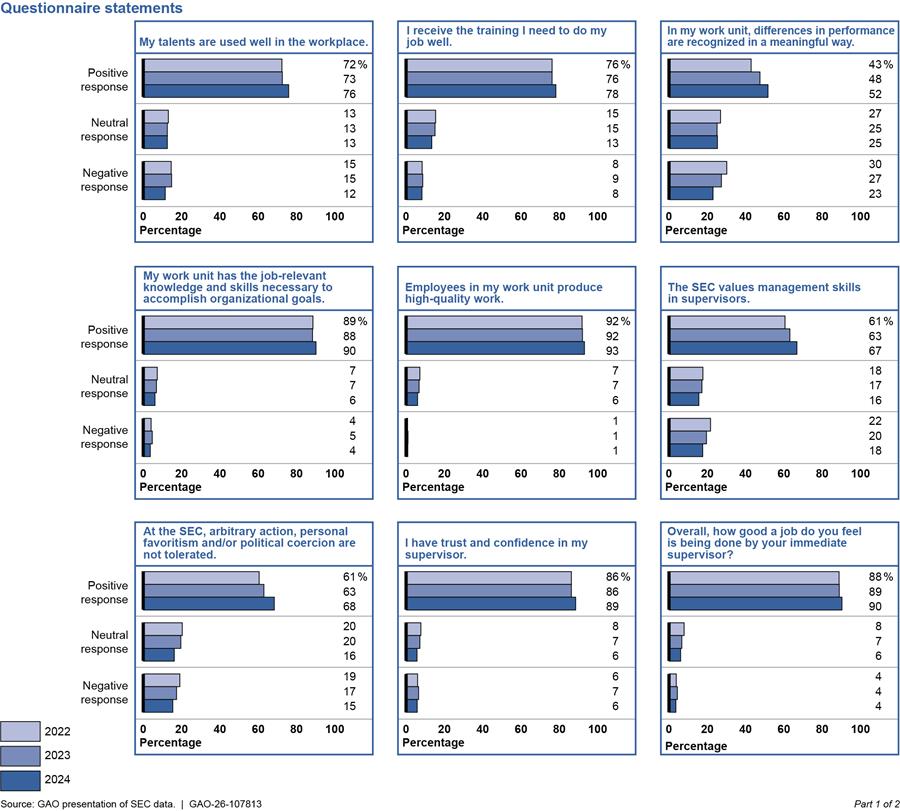
Note: Survey responses are rounded to the nearest percent, so bars that have the same percentage may have slightly different lengths.
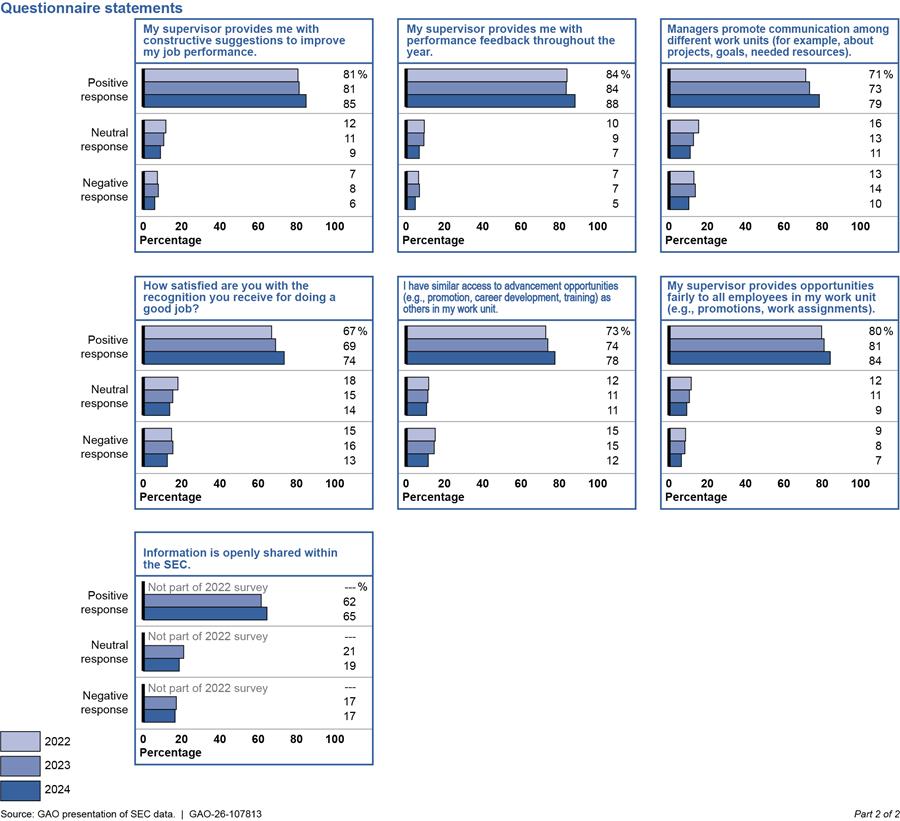
Note: Survey responses are rounded to the nearest percent, so bars that have the same percentage may have slightly different lengths.
Table 8 provides the ratio of nonsupervisors to supervisors at the Securities and Exchange Commission. Table 9 provides the ratio of nonsupervisors to senior officers. Table 10 provides the ratio of supervisors to senior officers.
Table 8: Ratio of Nonsupervisors to Supervisors in Mission-Critical Divisions and Offices at SEC, Fiscal Years 2013–2025
|
|
Ratio of nonsupervisors to supervisors |
||||||||||||
|
Division or office |
FY 13 |
FY 14 |
FY 15 |
FY 16 |
FY 17 |
FY 18 |
FY 19 |
FY 20 |
FY 21 |
FY 22 |
FY 23 |
FY 24 |
FY 25 |
|
Division of Corporation Finance |
5.1 |
5.0 |
5.3 |
5.0 |
5.0 |
4.2 |
4.2 |
5.2 |
4.9 |
5.1 |
6.1 |
5.8 |
5.5 |
|
Division of Economic and Risk Analysis |
7.7 |
7.4 |
7.3 |
7.4 |
7.8 |
8.6 |
7.5 |
9.7 |
9.1 |
10.7 |
12.3 |
8.8 |
7.2 |
|
Division of Enforcement |
7.6 |
8.0 |
7.6 |
6.6 |
7.3 |
6.6 |
6.2 |
6.2 |
6.3 |
6.7 |
6.7 |
6.2 |
5.9 |
|
Division of Investment Management |
3.8 |
4.5 |
4.0 |
4.7 |
4.2 |
3.9 |
4.3 |
4.3 |
4.7 |
4.8 |
4.5 |
4.4 |
3.9 |
|
Division of Trading and Markets |
4.7 |
4.2 |
4.9 |
4.9 |
4.6 |
4.7 |
5.0 |
4.9 |
5.1 |
5.5 |
5.2 |
5.0 |
4.9 |
|
Division of Examinations |
3.5 |
3.5 |
3.4 |
3.4 |
3.4 |
3.4 |
3.2 |
3.2 |
3.3 |
3.3 |
3.2 |
3.3 |
3.1 |
|
Office of Information Technology |
n/aa |
n/aa |
n/aa |
3.6 |
3.4 |
3.8 |
3.5 |
3.6 |
4.1 |
4.0 |
4.7 |
4.3 |
4.6 |
|
Office of the Chief Accountant |
n/ab |
n/ab |
n/ab |
n/ab |
n/ab |
6.3 |
5.8 |
11.3 |
8.5 |
7.7 |
7.7 |
9.2 |
6.6 |
|
Office of Credit Ratings |
n/ab |
n/ab |
n/ab |
n/ab |
n/ab |
4.6 |
4.3 |
5.0 |
7.4 |
7.0 |
5.1 |
5.3 |
5.7 |
FY = fiscal year; n/a = not applicable
Source: GAO analysis of Securities and Exchange Commission (SEC) data. | GAO‑26‑107813
aWe did not include data for fiscal years 2013–2015 because SEC designated the Office of Information Technology as mission-critical in 2016, according to SEC officials.
bWe did not include data for fiscal years 2013–2017 because SEC designated the Offices of the Chief Accountant and Credit Ratings as mission-critical in 2018, according to SEC officials.
Table 9: Ratio of Nonsupervisors to Senior Officers in Mission-Critical Divisions and Offices at SEC, Fiscal Years 2013–2025
|
|
Ratio of nonsupervisors to senior officers |
||||||||||||
|
Division or office |
FY 13 |
FY 14 |
FY 15 |
FY 16 |
FY 17 |
FY 18 |
FY 19 |
FY 20 |
FY 21 |
FY 22 |
FY 23 |
FY 24 |
FY 25 |
|
Division of Corporation Finance |
31.9 |
30.5 |
31.2 |
31.4 |
25.8 |
24.4 |
28.5 |
29.6 |
31.8 |
37.0 |
28.2 |
29.8 |
25.5 |
|
Division of Economic and Risk Analysis |
28.3 |
22.2 |
26.2 |
31.0 |
24.7 |
27.6 |
37.7 |
31.5 |
23.6 |
28.5 |
36.8 |
32.2 |
23.6 |
|
Division of Enforcement |
31.4 |
30.3 |
32.8 |
31.9 |
29.0 |
29.5 |
31.7 |
30.4 |
31.2 |
28.0 |
34.1 |
32.2 |
21.3 |
|
Division of Investment Management |
16.8 |
18.6 |
18.4 |
19.5 |
19.4 |
15.8 |
15.3 |
19.0 |
32.6 |
30.5 |
32.8 |
26.9 |
24.9 |
|
Division of Trading and Markets |
16.7 |
15.2 |
12.8 |
15.5 |
15.0 |
14.1 |
15.9 |
16.8 |
21.0 |
18.7 |
21.5 |
21.3 |
15.8 |
|
Division of Examinations |
32.1 |
40.4 |
32.2 |
35.5 |
36.0 |
33.7 |
34.7 |
32.2 |
29.0 |
27.9 |
29.9 |
34.7 |
26.3 |
|
Office of Information Technology |
n/aa |
n/aa |
n/aa |
34.8 |
22.3 |
23.2 |
26.6 |
23.7 |
31.8 |
24.4 |
21.5 |
25.7 |
15.2 |
|
Office of the Chief Accountant |
n/ab |
n/ab |
n/ab |
n/ab |
n/ab |
8.8 |
17.5 |
6.8 |
8.5 |
11.5 |
11.5 |
11.5 |
11.0 |
|
Office of Credit Ratings |
n/ab |
n/ab |
n/ab |
n/ab |
n/ab |
16.0 |
15.0 |
17.5 |
18.5 |
11.7 |
18.0 |
37.0 |
17.0 |
FY = fiscal year; n/a = not applicable
Source: GAO analysis of Securities and Exchange Commission (SEC) data. | GAO‑26‑107813
aWe did not include data for fiscal years 2013–2015 because SEC designated the Office of Information Technology as mission-critical in 2016, according to SEC officials.
bWe did not include data for fiscal years 2013–2017 because SEC designated the Offices of the Chief Accountant and Credit Ratings as mission-critical in 2018, according to SEC officials.
Table 10: Ratio of Supervisors to Senior Officers in Mission-Critical Divisions and Offices at SEC, Fiscal Years 2013–2025
|
|
Ratio of supervisors to senior officers |
||||||||||||
|
Division or office |
FY 13 |
FY 14 |
FY 15 |
FY 16 |
FY 17 |
FY 18 |
FY 19 |
FY 20 |
FY 21 |
FY 22 |
FY 23 |
FY 24 |
FY 25 |
|
Division of Corporation Finance |
6.2 |
6.1 |
5.9 |
6.3 |
5.2 |
5.8 |
6.7 |
5.7 |
6.5 |
7.2 |
4.6 |
5.2 |
4.6 |
|
Division of Economic and Risk Analysis |
3.7 |
3.0 |
3.6 |
4.2 |
3.2 |
3.2 |
5.0 |
3.3 |
2.6 |
2.7 |
3.0 |
3.7 |
3.3 |
|
Division of Enforcement |
4.1 |
3.8 |
4.3 |
4.8 |
4.0 |
4.5 |
5.1 |
4.9 |
5.0 |
4.2 |
5.1 |
5.2 |
3.6 |
|
Division of Investment Management |
4.4 |
4.1 |
4.6 |
4.1 |
4.6 |
4.0 |
3.6 |
4.4 |
7.0 |
6.3 |
7.3 |
6.1 |
6.4 |
|
Division of Trading and Markets |
3.5 |
3.6 |
2.6 |
3.1 |
3.3 |
3.0 |
3.2 |
3.4 |
4.1 |
3.4 |
4.1 |
4.3 |
3.2 |
|
Division of Examinations |
9.2 |
11.5 |
9.5 |
10.4 |
10.7 |
10.0 |
10.9 |
10.0 |
8.7 |
8.5 |
9.4 |
10.7 |
8.6 |
|
Office of Information Technology |
n/aa |
n/aa |
n/aa |
9.8 |
6.7 |
6.2 |
7.6 |
6.5 |
7.8 |
6.1 |
5.6 |
6.0 |
3.3 |
|
Office of the Chief Accountant |
n/ab |
n/ab |
n/ab |
n/ab |
n/ab |
1.4 |
3.0 |
0.6 |
1.0 |
1.5 |
1.5 |
1.3 |
1.7 |
|
Office of Credit Ratings |
n/ab |
n/ab |
n/ab |
n/ab |
n/ab |
3.5 |
3.5 |
3.5 |
2.5 |
1.7 |
3.5 |
7.0 |
3.0 |
FY = fiscal year; n/a = not applicable
Source: GAO analysis of Securities and Exchange Commission (SEC) data. | GAO‑26‑107813
aWe did not include data for fiscal years 2013–2015 because SEC designated the Office of Information Technology as mission-critical in 2016, according to SEC officials.
bWe did not include data for fiscal years 2013–2017 because SEC designated the Offices of the Chief Accountant and Credit Ratings as mission-critical in 2018, according to SEC officials.
GAO Contact
Michael E. Clements, (202) 512-8678, clementsm@gao.gov
Staff Acknowledgments
In addition to the contact named above, John Fisher (Assistant Director), Melissa Kornblau (Analyst in Charge), Isaac Fifelski, Shannon Smith, Marc Molino, Jennifer Schwartz, and Rebecca Sero made significant contributions to this report.
The Government Accountability Office, the audit, evaluation, and investigative arm of Congress, exists to support Congress in meeting its constitutional responsibilities and to help improve the performance and accountability of the federal government for the American people. GAO examines the use of public funds; evaluates federal programs and policies; and provides analyses, recommendations, and other assistance to help Congress make informed oversight, policy, and funding decisions. GAO’s commitment to good government is reflected in its core values of accountability, integrity, and reliability.
Obtaining Copies of GAO Reports and Testimony
The fastest and easiest way to obtain copies of GAO documents at no cost is through our website. Each weekday afternoon, GAO posts on its website newly released reports, testimony, and correspondence. You can also subscribe to GAO’s email updates to receive notification of newly posted products.
Order by Phone
The price of each GAO publication reflects GAO’s actual cost of production and distribution and depends on the number of pages in the publication and whether the publication is printed in color or black and white. Pricing and ordering information is posted on GAO’s website, https://www.gao.gov/ordering.htm.
Place orders by calling (202) 512-6000, toll free (866) 801-7077,
or
TDD (202) 512-2537.
Orders may be paid for using American Express, Discover Card, MasterCard, Visa, check, or money order. Call for additional information.
Connect with GAO
Connect with GAO on X,
LinkedIn, Instagram, and YouTube.
Subscribe to our Email Updates. Listen to our Podcasts.
Visit GAO on the web at https://www.gao.gov.
To Report Fraud, Waste, and Abuse in Federal Programs
Contact FraudNet:
Website: https://www.gao.gov/about/what-gao-does/fraudnet
Automated answering system: (800) 424-5454
Media Relations
Sarah Kaczmarek, Managing Director, Media@gao.gov
Congressional Relations
David A. Powner, Acting Managing Director, CongRel@gao.gov
General Inquiries
[1]SEC oversees over 30,000 entities, including more than 13,500 registered funds, 15,900 investment advisers, 3,200 broker-dealers, 29 national securities exchanges, and 111 alternative trading systems.
[2]Pub. L. No. 111-203, 124 Stat. 1376, 1908-1910 (2010) (codified at 15 U.S.C. § 78d-7).
[3]GAO, Securities and Exchange Commission: Employee Views of Personnel Management Improved, but Action Needed on Measuring Diversity and Inclusion Goals, GAO‑23‑105459 (Washington, D.C.: Dec. 22, 2022); Securities and Exchange Commission: Personnel Management Shows Improvement, but Action Needed on Performance Management System, GAO‑20‑208 (Washington, D.C.: Dec. 19, 2019); Securities and Exchange Commission: Actions Needed to Address Limited Progress in Resolving Long-Standing Personnel Management Challenges, GAO‑17‑65 (Washington, D.C.: Dec. 29, 2016); and Securities and Exchange Commission: Improving Personnel Management Is Critical for Agency’s Effectiveness, GAO‑13‑621 (Washington, D.C.: July 18, 2013).
[4]To determine the reliability of these data, we interviewed SEC officials on data quality and control and tested data fields for outliers or obvious errors. We determined they were sufficiently reliable for purposes of describing the number of SEC employees who departed SEC through voluntary departure programs or other attrition.
[5]SEC’s Federal Employee Viewpoint Survey is an annual survey that provides employees with the opportunity to share their perceptions of their work experiences, their agency, and their leaders. It is modeled on the Office of Personnel Management’s Federal Employee Viewpoint Survey. We assessed the reliability of SEC’s survey data by collecting written responses on survey administration and response rates and testing for missing data and errors. We found the data to be reliable for the purpose of analyzing respondents’ views on SEC’s personnel management practices, including trends in employee views.
[6]SEC has designated five occupations—attorneys, accountants, examiners, economists, and information technology specialists—as mission-critical because they reflect SEC’s primary mission and because mission‐critical work cannot be completed without them. SEC has also designated three offices and six divisions—the Offices of Information Technology, Credit Ratings, and the Chief Accountant, and the Divisions of Corporation Finance, Enforcement, Examinations, Investment Management, Economic and Risk Analysis, and Trading and Markets—as mission-critical because they are primarily responsible for implementing the agency’s mission. In this report, “mission-critical employees” refers to SEC staff working in mission-critical occupations within mission-critical divisions and offices. See app. I for more information on our sampling approach.
[7]As of March 2026, the commission’s membership included the Chairman and two commissioners; two commissioner seats were unfilled.
[8]SEC closed its Salt Lake City office in 2024 and reassigned staff to other areas of the agency. As of December 2025, SEC’s Office of Minority and Women Inclusion had one fully staffed employee, according to SEC officials. Since our 2022 report, SEC also closed the Strategic Hub for Innovation and Financial Technology.
[9]We surveyed a representative sample of nonexecutive SEC employees in mission-critical occupations in nine mission-critical divisions and offices. The results of the nonexecutive employee survey were generalizable to SEC’s mission-critical employees.
[10]GAO‑13‑621 and GAO‑17‑65.
[13]This report reviews key changes SEC made or planned in response to certain personnel-related executive actions in 2025; it does not address all personnel-related executive actions in 2025.
[14]The current Chairman was sworn in on April 21, 2025. The Acting Chairman made final decisions prior to that date, according to SEC officials.
[15]Exec. Order No. 14,210, Implementing the President’s “Department of Government Efficiency” Workforce Optimization Initiative, § 3(c), 90 Fed. Reg. 8441 (Jan. 29, 2025). The requirement was to be implemented consistent with applicable law and did not apply to certain functions (for example, public safety). Id. The order also required agency heads to submit reorganization plans to OMB within 30 days. § 3(e). A reduction in force is the federal government process for eliminating positions due to agency reorganization, reduced funding, or reduced workload.
[16]Office of Management and Budget and Office of Personnel Management, Guidance on Agency RIF and Reorganization Plans Requested by “Implementing the President’s ‘Department of Government Efficiency’ Workforce Optimization Initiative” (Washington, D.C.: Feb. 2025). See also Office of Personnel Management, Workforce Reshaping Operations Handbook, apps. H, I.
[17]Certain types of employees were not eligible for the offers, such as those serving under time-limited appointments or political appointments, or as re-employed annuitants.
[18]According to officials, offices were given the opportunity to opt out of offering voluntary early retirement or voluntary separation incentive payments to their supervisory employees if doing so would be detrimental to their management staffing levels.
[19]According to OPM, the Deferred Resignation Program was a government-wide program under which eligible employees were given the option to resign effective September 30, 2025. Office of Personnel Management, Guidance Regarding Deferred Resignation Program (Washington, D.C.: Jan. 2025).
[20]SEC’s Fiscal Year 2025 Agency Financial Report reported that the decline in its total workforce—accounting for both departures and hiring—was 17 percent for fiscal year 2025.
[21]Since the beginning of fiscal year 2025, SEC’s workforce declined by about 5.5 percent from attrition not connected to the voluntary departure programs, such as removals, appointment terminations, resignations, and retirements that predated the voluntary early retirement offers.
[22]App. II provides additional information on staff turnover for fiscal years 2013–2025.
[23]Full-time equivalent is a calculation of the total regular hours worked by all employees (including paid leave) divided by the standard compensable hours in a fiscal year used for budgetary purposes. SEC’s most recent Agency Financial Report did not include the full-time equivalent number for fiscal year 2025.
[24]See Presidential Memorandum, Hiring Freeze, 90 Fed. Reg. 8247 (Jan. 28, 2025). The order did not apply to certain types of positions (for example, military personnel of the armed forces) and authorized OPM to grant exemptions where necessary. See also Office of Management and Budget and Office of Personnel Management, Federal Civilian Hiring Freeze Guidance (Washington, D.C.: Jan. 2025).
[25]The President extended the hiring freeze through July 2025 and imposed other restrictions through October 2025. Presidential Memorandum, Extension of Hiring Freeze (Washington, D.C.: Apr. 2025); and Ensuring Accountability and Prioritizing Public Safety in Federal Hiring (Washington, D.C.: July 2025). In November 2025, OPM and OMB released a joint memorandum requiring agencies to abide by certain hiring restrictions until they submit annual staffing plans (discussed further below). Office of Management and Budget and Office of Personnel Management, Guidance on Executive Order 14356, Ensuring Continued Accountability in Federal Hiring (Washington, D.C.: Nov. 2025).
[26]A temporary promotion is a detail to a higher grade position or a position with known promotion potential of 120 days or less. SEC officials stated that during the hiring freeze, the agency was not making permanent promotions and had not made any changes to promotion criteria since the issuance of our prior report in 2022.
[27]Presidential Memorandum, Return to In-Person Work, 90 Fed. Reg. 8251 (Jan. 28, 2025).
[28]In January 2025, OPM released guidance stating that agencies should revise their telework policies to state that eligible employees must work full time at their respective duty stations, unless excused due to disability, qualifying medical condition, or other compelling reason certified by the agency head and the employee’s supervisor. Office of Personnel Management, Guidance on Presidential Memorandum Return to In-Person Work (Washington, D.C.: Jan. 2025). See also Office of Personnel Management and Office of Management and Budget, Agency Return to Office Implementation Plans (Washington, D.C.: Jan. 2025).
[29]In February 2025, the SEC employee union filed a grievance challenging SEC’s return-to-office directive as it applied to bargaining-unit employees. The matter was in arbitration as of January 2026, according to the union.
[30]In December 2025, OPM released additional guidance to promote consistency of telework and remote work policies across the federal government. Office of Personnel Management, Guide to Telework and Remote Work In the Federal Government (Washington, D.C.: Dec. 2025).
[31]Exec. Order No. 14,151, Ending Radical and Wasteful Government DEI Programs and Preferencing, 90 Fed. Reg. 8339 (Jan. 29, 2025). The order states that it is to be implemented consistent with applicable law. See also Exec. Order No. 14,173, Ending Illegal Discrimination and Restoring Merit-Based Opportunity, 90 Fed. Reg. 8633 (Jan. 31, 2025).
[32]See, for example, Office of Personnel Management, Further Guidance Regarding Ending DEIA Offices, Programs and Initiatives (Washington, D.C.: Feb. 2025).
[33]Pursuant to Section 342 of the Dodd-Frank Act, SEC established the Office of Minority and Women Inclusion, which is responsible for all matters related to diversity in management, employment, and business activities at SEC. Pub. L. No. 111-203, § 342, 124 Stat. 1376, 1541-44 (2010) (codified at 12 U.S.C. § 5452).
[34]Office of Personnel Management, Performance Management for Federal Employees (Washington, D.C.: June 2025, revised July 2025). The memorandum does not apply to certain senior-level positions, such as the Senior Executive Service, which were the subject of a separate OPM memorandum.
[35]The memorandum also includes standards for resolving poor performance, among other things. SEC officials told us that they follow the practices in 5 U.S.C. § 4303 and related policies and procedures when addressing employees with unacceptable ratings. The memorandum identifies additional tools supervisors can use and advises agencies to update related policies to ensure that poor performers can be swiftly removed, reduced in grade, or reassigned.
[36]As previously discussed, since 2020 SEC has used a two-tier scale for assessing employee performance in which employees are rated as either “accomplished performer” or “unacceptable.” In January 2021, SEC also created an incentive bonus program to reward exceptional performance. In February 2022, SEC discontinued the bonus program after one cycle in an agreement with SEC’s employee union. We previously found that many employees were dissatisfied with key aspects of SEC’s performance management system, including whether it created meaningful distinctions in performance among employees. See GAO‑20‑208 and GAO‑23‑105459. According to officials, SEC plans to negotiate the changes to its performance management system with its employee union.
[37]According to SEC officials, some requirements were implemented in October 2025, while others were not expected to be implemented by the end of calendar year 2025.
[38]Office of Personnel Management, Merit Hiring Plan (Washington, D.C.: May 2025); and Office of Management and Budget and Office of Personnel Management, Guidance on Executive Order 14356. These memorandums were issued in connection with Exec. Order No. 14,170, Reforming the Federal Hiring Process and Restoring Merit to Government Service, 90 Fed. Reg. 8621 (Jan. 30, 2025), and Exec. Order No. 14,356, Ensuring Continued Accountability in Federal Hiring, 90 Fed. Reg. 48,387 (Oct. 20, 2025), respectively.
[39]Employees in SEC’s SK-17 pay plan are supervisory staff. SEC’s leadership program prior to the Leadership Evaluation, Accession, and Development program was also competitive and limited to a select cohort of high-potential leaders.
[40]SEC did not implement the survey in 2025, and therefore we do not have survey results reflecting views after the 2025 workforce changes.
[41]OPM canceled the 2025 Federal Employee Viewpoint Survey. SEC officials told us they believe the 2024 results may no longer represent employee views because of significant personnel management changes since the survey was administered.
[42]Performance management was cited as an area of challenge for SEC in all four of our previous reports on SEC’s personnel management.
[43]As noted earlier, SEC implemented recommendations we made in 2013 and 2016 to improve intra-agency communication. However, as of 2022, employees viewed communication across divisions less favorably than communication within divisions.
[44]Throughout this section, we use the following quantifiers to quantify interview responses: “a few” (3 to 8 employees), “some” (9 to 17), “about one-third” (18 to 27), “about half” (28 to 33), “a majority” (34 to 47), and “most” (48 or more).
[45]Ten employees noted that SEC has not been able to provide cash awards in recent years due to budgetary constraints. Four employees said cash awards are more motivating for employees than time-off awards.
[46]As previously discussed, SEC is in the process of changing its performance management system to align with a June 2025 OPM memorandum that excludes pass/fail ratings except in limited circumstances.
[47]When asking about recent changes at SEC, we provided examples of such changes, such as the voluntary departure of employees through voluntary early retirement, voluntary separation incentive payments, and deferred resignations; return-to-office requirements; or any other recent personnel management changes at SEC.
[48]App. IV provides additional information on the ratio of management to staff for fiscal years 2013–2025.
[49]Supervisory staff include all employees in SEC’s pay plan grades SK-15 and SK-17.
[50]Office of Personnel Management, Guidance on Executive Order 14356.
[51]Agencies must also submit quarterly updates to OPM and OMB showing progress with respect to the annual staffing plan, including an explanation of any significant variances from the plan, and updates on recruitment initiatives. Exec. Order No. 14,356, Ensuring Continued Accountability in Federal Hiring; and Office of Management and Budget and Office of Personnel Management, Guidance on Executive Order 14356. The executive order does not apply to military personnel of the armed forces and certain other types of positions.
[52]Under Executive Order 14356 and the related OPM and OMB memorandum, agency heads must establish a strategic hiring committee to approve the creation or filling of each vacancy within the agency. The committee must ensure that agency hiring is consistent with the national interest, agency needs, and administration priorities, among other things.
[53]GAO, Securities and Exchange Commission: Employee Views of Personnel Management Improved, but Action Needed on Measuring Diversity and Inclusion Goals, GAO‑23‑105459 (Washington, D.C.: Dec. 22, 2022).
[54]SEC’s Federal Employee Viewpoint Survey is an annual survey that provides employees with the opportunity to share their perceptions of their work experiences, their agency, and their leaders. It is modeled on the Office of Personnel Management’s Federal Employee Viewpoint Survey. SEC used a contractor to implement the survey, which was distributed to all staff. According to SEC, the response rate for the survey was 74 percent in 2022, 78.5 percent in 2023, and 79.1 percent in 2024.
[55]As previously noted, the Office of Personnel Management canceled the 2025 survey.
[56]SEC has designated five occupations—attorneys, accountants, examiners, economists, and information technology specialists—as mission-critical because they reflect SEC’s primary mission and because mission‐critical work cannot be completed without them. SEC has also designated three offices and six divisions—the Offices of Information Technology, Credit Ratings, and the Chief Accountant, and the Divisions of Corporation Finance, Enforcement, Examinations, Investment Management, Economic and Risk Analysis, and Trading and Markets—as mission-critical divisions and offices because they are primarily responsible for implementing the agency’s mission. In this report, “mission-critical employees” refers to SEC staff working in mission-critical occupations within mission-critical divisions and offices.
[57]The Federal Personnel/Payroll System is a mainframe-based personnel and payroll system that supports numerous agencies. The data contained in this system include number of employees, start and separation dates, performance ratings, demographic information, and awards data.
[58]Pub. L. No. 111-203, § 962(b)(1)(F), 124 Stat. 1376, 1909 (2010) (codified at 15 U.S.C. §78d-7(b)(1)(F)).
[59]GAO, Securities and Exchange Commission: Actions Needed to Address Limited Progress in Resolving Long-Standing Personnel Management Challenges, GAO‑17‑65 (Washington, D.C.: Dec. 29, 2016); and Securities and Exchange Commission: Improving Personnel Management Is Critical for Agency’s Effectiveness, GAO‑13‑621 (Washington, D.C.: July 18, 2013).
[60]In 2024, SEC closed its Utah regional office, reducing the number of SEC regional offices from 11 to 10.