
Report to Congressional Committees
United States Government Accountability Office
A report to congressional committees
For more information, contact: Derrick Collins at CollinsD@gao.gov
What GAO Found
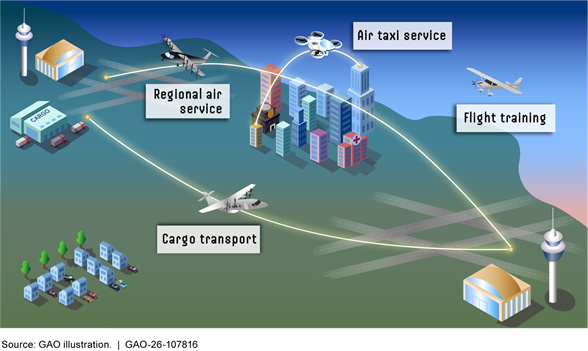
Manufacturers are developing fully electric and hybrid-electric aircraft, mostly for short-range and medium-range flying. These aircraft vary widely in design. Some require a runway for takeoff, while others take off vertically, for example, from the top of a building. They also have a wide variety of potential uses, including air taxi service and cargo transport. The Federal Aviation Administration (FAA) and other entities have also researched technologies that could potentially enable longer-range uses and broader deployment of electric aircraft in the future.
The infrastructure to support electric aircraft at U.S. airports is currently limited. According to FAA, as of December 2025, 47 airports have identified charging stations for electric aircraft in airport plans. The majority of these airports are part of the manufacturer BETA Technologies’ network of charging stations. According to FAA officials and selected stakeholders, airports face a variety of challenges related to installing infrastructure for electric aircraft, including cost, uncertainty about demand, and availability of reliable electricity.
As of March 2026, FAA is evaluating electric aircraft and engine designs for certification on a case-by-case basis, but is considering regulatory changes, such as developing dedicated airworthiness standards for electric vertical takeoff and landing aircraft, that could standardize its approach to evaluating these products in the long term. Stakeholders described challenges with FAA’s approach, including insufficient FAA staff with expertise in electric propulsion and limited standardization in the certification process. According to FAA officials, they have hired engineers in disciplines such as propulsion, and deployed experienced personnel as needed to emerging technology areas. However, ensuring that planned skill gap assessments are quantitative and include all mission-critical occupations, as GAO recommended in 2021, would help FAA better understand the skills its workforce needs to respond to technological changes.
Why GAO Did This Study
Electric propulsion aircraft have the potential to lower operating costs, increase access to air service for regional airports, and reduce environmental impacts and noise from aviation. However, FAA has not yet issued a type certification for a manned electric aircraft as of March 2026, and when such aircraft will be able to commercially operate is not clear.
Section 1012 of the FAA Reauthorization Act of 2024 includes a provision for GAO to assess the safe and scalable operation and integration of electric aircraft into the National Airspace System.
This report describes (1) the types and uses of electric aircraft in development; (2) the extent of infrastructure deployed at U.S. airports to support electric aircraft, and any challenges airports face in deploying infrastructure; and (3) FAA’s approach to certificating the airworthiness of electric aircraft designs, and related challenges identified by aviation industry stakeholders. GAO analyzed literature on electric aircraft published between 2019 and 2024 and used information from these studies to supplement testimonial evidence from interviews with aviation industry stakeholders and federal officials. GAO also analyzed public information on government and industry efforts to develop electric aircraft. GAO interviewed officials from FAA, the National Aeronautics and Space Administration, the National Laboratory of the Rockies, and a nongeneralizable selection of 30 aviation industry stakeholders, including aircraft and engine manufacturers, airports, fixed-base operators, state departments of transportation, and a flight training school. Eight interviews were conducted as part of site visits to Washington State and Ohio.
Abbreviations
|
AAAE American Association of Airport Executives |
|
ARAC Aviation Rulemaking Advisory Committee |
|
ARMD Aeronautics Research Mission Directorate |
|
CAAT Center for Advanced Aviation Technologies |
|
DOE Department of Energy |
|
DOT Department of Transportation |
|
eCTOL Electric conventional takeoff and landing (aircraft) |
|
eIPP Electric
Vertical Takeoff and Landing and Advanced Air |
|
eSTOL Electric short takeoff and landing (aircraft) |
|
eVTOL Electric vertical takeoff and landing (aircraft) |
|
FAA Federal Aviation Administration |
|
FACA Federal Advisory Committee Act |
|
NASA National Aeronautics and Space Administration |
|
NLR National Laboratory of the Rockies |
This is a work of the U.S. government and is not subject to copyright protection in the United States. The published product may be reproduced and distributed in its entirety without further permission from GAO. However, because this work may contain copyrighted images or other material, permission from the copyright holder may be necessary if you wish to reproduce this material separately.
May 27, 2026
The Honorable Ted Cruz
Chairman
The Honorable Maria Cantwell
Ranking Member
Committee on Commerce, Science, and Transportation
United States Senate
The Honorable Brian Babin
Chairman
The Honorable Zoe Lofgren
Ranking Member
Committee on Science, Space, and Technology
House of Representatives
The Honorable Sam Graves
Chairman
The Honorable Rick Larsen
Ranking Member
Committee on Transportation and Infrastructure
House of Representatives
Electric propulsion aircraft vary widely in design, but all employ electric power rather than fuel combustion as their primary source of propulsion. Among other potential benefits, electric aircraft could lower operating and maintenance costs for aviation businesses, increase access to air service for regional airports, and reduce the environmental impact of aviation, according to several recent studies.[1] Although several manufacturers have made progress toward certification in recent years, the Federal Aviation Administration (FAA) has not issued a type certification for a manned electric aircraft, and it is not clear how soon such aircraft will be able to commercially operate in the National Airspace System.
Section 1012 of the FAA Reauthorization Act of 2024 includes a provision for GAO to assess the safe and scalable operation and integration of electric aircraft into the National Airspace System. The act includes provisions on, among other things, the technical capacity and competencies needed in the FAA workforce to certificate electric aircraft, and the airport infrastructure required to support electric aircraft operations.[2]
This report describes (1) the types and use cases of electric aircraft in development; (2) the extent of infrastructure deployed at U.S. airports to support electric aircraft, and any challenges airports face in deploying infrastructure; and (3) FAA’s approach to certificating the airworthiness of electric aircraft designs, and any related challenges identified by aviation industry stakeholders.[3]
For all three objectives, we analyzed publications on electric aircraft published between 2019 and 2024. We identified these publications by searching databases, including ProQuest, EBSCO, Scopus, and Dialog, for key words such as “electric” or “hybrid-electric” aircraft, “regional air mobility,” and “electric infrastructure.” On the basis of this review, we identified 19 studies that discussed relevant policy and technical issues related to electric aircraft and their supporting infrastructure. We used information from these studies to supplement testimonial evidence from interviews we conducted with aviation industry stakeholders and federal officials, as described below. We also analyzed public information on government and industry efforts to develop electric aircraft and supporting infrastructure, including manufacturers’ annual reports; National Aeronautics and Space Administration (NASA) and the Department of Energy’s National Laboratory of the Rockies (NLR)[4] reports on electric propulsion research; FAA rulemaking documents on certification; and reports on Advanced Air Mobility, which includes electric aircraft.[5]
To describe the extent of infrastructure deployed at U.S. airports to support electric aircraft and related challenges, and FAA’s approach to certificating the airworthiness of electric aircraft designs, we interviewed officials from FAA, including staff from two Airport District Offices and FAA’s West, Central, and East Certification Branches. We also interviewed officials from NLR, NASA, and a nongeneralizable selection of 30 aviation industry stakeholders, which included representatives from aircraft and engine manufacturers, airports, fixed-base operators, state departments of transportation, and a flight training school.[6] See appendix I for the list of aviation industry stakeholders we interviewed. We selected these stakeholders based on the following criteria: representation of different airport sizes and aircraft designs, state-level aviation programs supporting electric aircraft, and geographic diversity. We conducted eight of these interviews as part of site visits to Washington State and Ohio.
We conducted this performance audit from September 2024 to May 2026 in accordance with generally accepted government auditing standards. Those standards require that we plan and perform the audit to obtain sufficient, appropriate evidence to provide a reasonable basis for our findings and conclusions based on our audit objectives. We believe that the evidence obtained provides a reasonable basis for our findings and conclusions based on our audit objectives.
Background
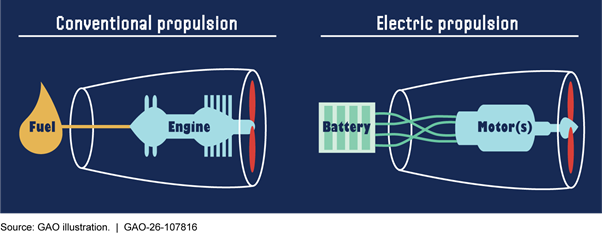
Electric aircraft differ from conventional aircraft in that they use battery-powered electric motors—rather than fuel combustion engines—to fully or partially drive the aircraft’s propellers or turbines. See fig. 1.
Electric aircraft offer a variety of potential benefits for the aviation industry and traveling public, according to several research studies.[7] They could reduce costs for aircraft operators, lower emissions, reduce noise, make smaller regional airports more accessible, and help create new jobs. For example, the use of electric aircraft has the potential to increase demand for aviation professions, such as flight instructors, pilots, and maintenance technicians, according to a Washington State Department of Transportation study.[8]
Electric aircraft are typically either fully electric or hybrid-electric.[9] Fully electric aircraft rely solely on electric motors powered by onboard batteries for propulsion. In a hybrid-electric aircraft, a conventional fuel-combustion engine supplements the aircraft’s battery-powered electric motors. Hybrid-electric aircraft are generally designed to fly longer distances and carry more passengers than fully electric aircraft, given the range limitations of current batteries and the weight they add to the aircraft.
In the United States, FAA is responsible for issuing and enforcing regulations and minimum standards that cover the manufacturing, operation, and maintenance of aircraft and other aviation products, such as engines and propellers. Aircraft and other aviation products with new designs are generally required to complete FAA’s multistep design certification process, known as “type certification,” before the product can be issued an airworthiness certificate to safely operate in the National Airspace System.[10] Aviation products follow one of two pathways to FAA type certification:
(1) the “existing standards” path, with any project-specific alternatives called special conditions as prescribed by FAA, for products such as fixed-wing aircraft or engines for which airworthiness standards have been set in regulation;[11]
(2) the “special class” path for products such as powered-lift operations (including electric vertical takeoff and landing (eVTOL) aircraft or drones) that do not fall under an existing airworthiness standard in regulation.[12]
For either path, the type certification process involves FAA and the applicant establishing a product’s certification basis, which consists of the regulatory standards the product must meet. FAA and the applicant then develop the means of compliance defining how the product will meet those agreed-upon regulatory standards and perform necessary flight and engineering tests for FAA to confirm the product’s ability to meet the regulatory standards.
In addition to type certification, FAA oversees several aspects of the National Airspace System that could be affected by the introduction of electric aircraft.[13] Specifically, FAA develops air traffic rules, assigns use of airspace, and controls air traffic. FAA also researches systems and procedures for air navigation and air traffic control and tests aviation systems, devices, materials, and procedures.
Other federal agencies supporting electric aircraft include NASA and the Department of Energy (DOE):[14]
· NASA: Through its Aeronautics Research Mission Directorate (ARMD), NASA leads research on fuel-burning hybrid-electric commercial transport and electric propulsion technologies that, the agency states, could make air travel more cost-effective, quiet, and efficient.[15] As of March 2026, NASA is conducting a number of related research projects, some of which continue work evolved from (1) the Electrified Powertrain Flight Demonstration Project, which conducted testing of fuel-burning hybrid-electric propulsion technologies in collaboration with industry; and (2) Advanced Air Mobility Pathfinders, which NASA anticipates will provide FAA with data to help them safely integrate eVTOL traffic into cities and the National Airspace System. NASA also participates in a number of federal interagency working groups and is actively engaged with standards development organizations.
· DOE: As the primary national laboratory for energy systems research and development, NLR helps industry partners create innovative components, fuels, infrastructure, and integrated systems for transportation modes, including aviation. As of March 2026, NLR is conducting work related to supporting electric aircraft as part of its Aviation Energy Futures research program. The work includes the following: advising airport planners and fuel providers on standards and best practices for airport energy delivery and quality, airport infrastructure, and regional delivery methods for introducing new products into existing systems; analyzing the potential impacts of vertical takeoff and landing (VTOL) energy infrastructure; studying the impact of electric aircraft on airport electricity infrastructure and demand; and modeling potential onsite generation capabilities to support these increased loads.
Electric aircraft are considered part of the Advanced Air Mobility effort, a government and industry approach to changing air transportation through new types of aircraft, technologies, and operating procedures. Advanced Air Mobility has Urban Air Mobility and Regional Air Mobility components, which are distinguished primarily by whether intended operations take place within, between, or outside of urban environments. eVTOL aircraft have been a focal point for Advanced Air Mobility in recent years, as we have previously reported, but manufacturers are also developing new electric aircraft with short and conventional takeoff and landing capabilities (see fig. 2).[16]
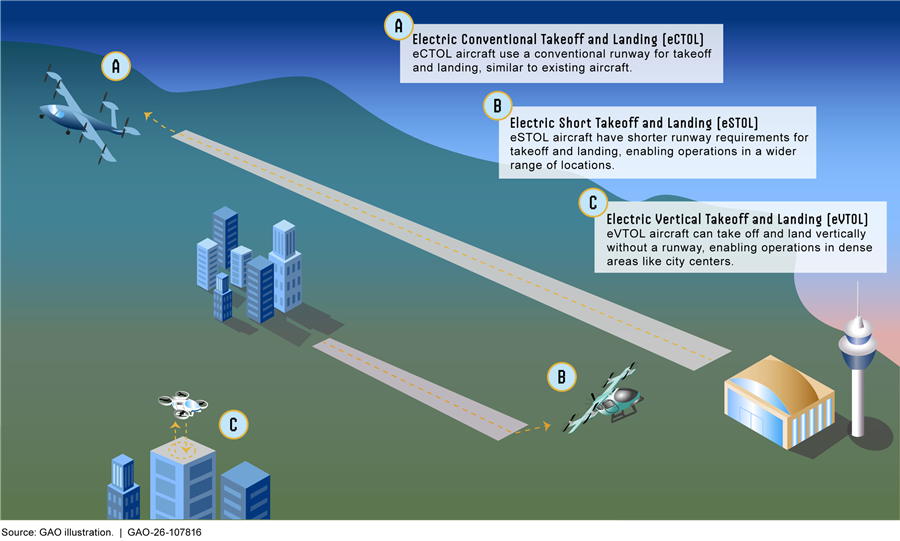
Note: According to the Federal Aviation Administration, suitable runway lengths depend on a variety of factors, including airport elevation above sea level, temperature, and airplane operating weights. For example, small airplanes with a maximum certificated takeoff weight of 12,500 pounds or less, and fewer than 10 passenger seats, may require a runway length from 2,000 to 10,000 feet. The EL9 Ultra Short eSTOL aircraft is able to take off in 150 feet, according to its manufacturer, Electra.
As of March 2026, FAA is engaged in two Advanced Air Mobility initiatives involving electric aircraft.
· Advanced Air Mobility National Strategy. On December 17, 2025, the Department of Transportation issued the Advanced Air Mobility National Strategy (National Strategy), which outlines a nationwide federal effort to accelerate the development and deployment of Advanced Air Mobility technologies, which include electric aircraft, and provides resources for state, local, tribal, and territorial governments planning for these new transportation options.[17] The National Strategy provides findings and recommendations organized by “key pillars” to support Advanced Air Mobility, including the importance of developing physical infrastructure, such as vertiports to accommodate eVTOLs and energy infrastructure to charge Advanced Air Mobility aircraft powered by electric propulsion.[18] The National Strategy estimates that there will be demonstrations and initial operations for Advanced Air Mobility aircraft by 2027; new air operations in multiple urban and rural areas by 2030; and advanced air operations, including fully autonomous flight, by 2035.
· eVTOL and Advanced Air Mobility Integration Pilot Program. Following the June 2025 Executive Order 14307, Unleashing American Drone Dominance,[19] FAA announced the Electric Vertical Takeoff and Landing and Advanced Air Mobility Integration Pilot Program (eIPP) in September 2025. Through the eIPP, state, local, tribal, and territorial governments will be able to partner with the private sector in at least five pilot projects to accelerate the deployment of eVTOL and other Advanced Air Mobility aircraft operations in the U.S.[20] Other priorities for the eIPP include generating data to inform FAA’s development of guidance and regulations and providing opportunities to accelerate commercial use operations for eVTOLs and other Advanced Air Mobility aircraft, according to the eIPP’s September 2025 public notice. In March 2026, FAA selected eight proposals for the program, including submissions from the Port Authority of New York and New Jersey, the Pennsylvania Department of Transportation, and the city of Albuquerque.[21] Manufacturers, including Joby Aviation, BETA Technologies, Archer Aviation, and Electra, have partnered with participants to support projects in cargo delivery, regional flights, and eVTOL passenger operations, according to a DOT press release on the program.
Short- and Medium-Range Electric Aircraft Are Being Developed for Various Uses, While Research Related to Long-Range Flight Proceeds
Manufacturers Are Developing Electric Aircraft for a Variety of Short- and Medium-Range Uses Across Civil Aviation
Manufacturers are developing fully electric and hybrid-electric aircraft for short-range and medium-range flying.[22] As we describe in more detail later in this report, these manned aircraft have not yet been type certificated by FAA for commercial operations. According to press releases from manufacturers, several are currently testing experimental electric aircraft in the National Airspace System.[23] Manufacturers are developing electric aircraft to explore different “operational use cases” (uses).[24] See figure 3.
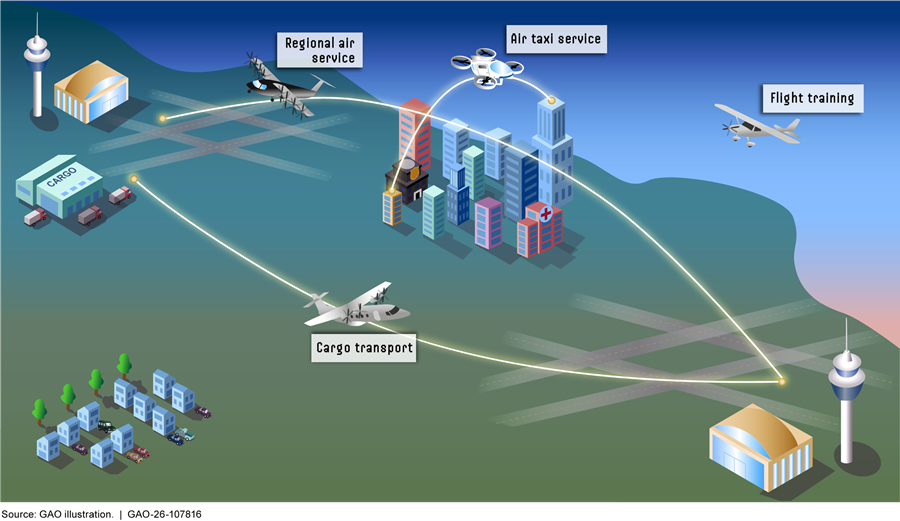
Electric aircraft could potentially be used across a broad swath of civil aviation for commercial passenger transportation, cargo/mail transportation, and general aviation.
Commercial Passenger Transportation
Manufacturers are developing short- and medium-range electric aircraft for on-demand and scheduled passenger air service, both within and outside of urban areas.
· Air taxis. Manufacturers, including Archer Aviation and Joby Aviation, are developing eVTOL aircraft to provide air taxi service. These aircraft would carry several passengers per flight and typically operate over short distances in urban areas—consistent with the Urban Air Mobility concept (the urban component of Advanced Air Mobility). According to Joby Aviation, eVTOL trips in cities such as New York and Los Angeles may be up to 10 times faster than driving. Several U.S. airlines have announced partnerships with eVTOL manufacturers in recent years. For example, in April 2025, Archer Aviation announced plans for a proposed eVTOL network in New York City in partnership with United Airlines. Additionally, in July 2024, Southwest Airlines signed a memorandum of understanding with Archer Aviation to develop operational plans for eVTOLs at California airports where Southwest operates, according to Archer Aviation.
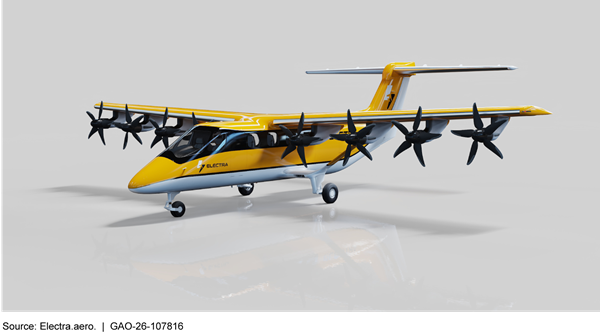
· Regional air service. Companies such as Surf Air Mobility, Electra, Heart Aerospace, ZeroAvia, and Ampaire are developing larger electric aircraft or engines for larger aircraft, according to company information and public financial reports. These aircraft could potentially be used to provide regional passenger air service to smaller airports (consistent with the Regional Air Mobility component of Advanced Air Mobility). For example, the operator Surf Air Mobility plans to upgrade existing regional aircraft with fully electric or hybrid-electric engines to provide a regional travel alternative to ground transportation, according to the company’s public financial reports. These aircraft could potentially provide point-to-point regional service to airports across the country outside of the traditional airline hub-and-spoke model, according to Surf Air Mobility. Additionally, the manufacturer Electra is developing a hybrid-electric aircraft with a short takeoff and landing capability that could enable operators to offer regional service directly between communities, employment centers, logistics hubs, and remote locations (see fig. 4).
Figure 4: Electra EL9 Ultra Short, a Hybrid-Electric Aircraft with a Short Takeoff and Landing Capability
The lower operating costs promised by electric aircraft could encourage operators to provide air service to smaller U.S. airports that might otherwise be unprofitable to serve.[25] By lowering operating costs for airlines, according to officials from one manufacturer, electric aircraft have the potential to at least reduce the federal subsidies provided to airlines to serve eligible communities in the Essential Air Service program.[26]
Additionally, the Advanced Air Mobility National Strategy recommends that DOT help revitalize general aviation airports, small air carrier operations, and aircraft manufacturing by reforming the existing regulatory framework for small commercial aircraft. According to the strategy, such an effort would allow right-sized aircraft, including electric aircraft, to safely enable new business models in order to address current air service deficiencies and open opportunities to increase mobility.[27]
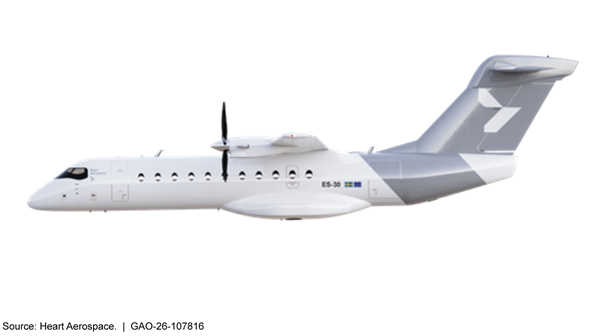
Several U.S. airlines have invested in manufacturers developing regional electric aircraft. For example, United Airlines and Mesa Airlines have issued purchase orders for Heart Aerospace’s ES-30 aircraft, according to Heart Aerospace (see fig. 5). Additionally, in 2021, Alaska Airlines secured options for 50 powertrains from the manufacturer ZeroAvia to begin converting its regional fleet to hydrogen-electric power, according to ZeroAvia.
Cargo/Mail Transportation
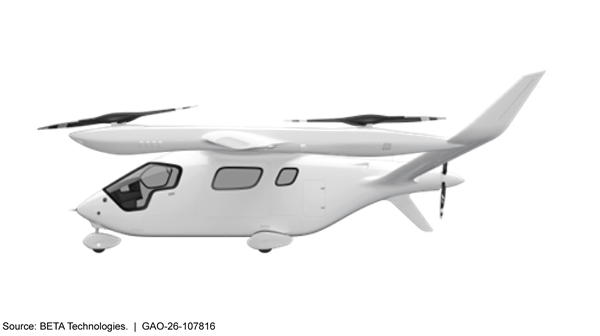
BETA Technologies has designed electric aircraft that could be used to deliver cargo and packages. In 2021, United Parcel Service announced plans to purchase BETA Technologies’ eVTOL aircraft to augment its air service for what it described as select small and midsize markets and, in 2023, announced plans to test the eVTOL in the United Arab Emirates (see fig. 6). The use of electric aircraft for light air cargo transportation will likely focus on custom cargo deliveries and military applications, according to an October 2021 NLR report.[28] Operations would include services between cargo hub airports and smaller aviation facilities, as well as freight deliveries to rural areas; remote communities; and Alaska, Hawaii, and the U.S. Pacific Trust Territories.[29]
General Aviation
Manufacturers, including Pipistrel and BETA Technologies, have designed electric aircraft for use in general aviation, a category that excludes commercial air service and includes flying for business and recreation, pilot training, emergency medical services, and sightseeing. Examples of these uses include the following:
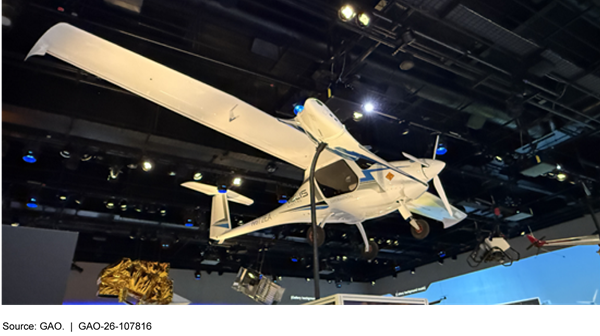
· Pilot training. In 2024, two flight schools operating at airports in California and Connecticut received exemptions from FAA that allow their Pipistrel Alpha Electro aircraft to operate as light-sport aircraft and be used for pilot training.[30] According to representatives from one of the schools we interviewed, they acquired the Alpha Electro to be quieter, less expensive to operate, and more environmentally friendly than conventional, single-engine training aircraft. See figure 7 for the similar Pipistrel Velis Electro aircraft.[31] Beginning in July 2026, FAA’s Modernization of Special Aircraft Certification final rule will allow aircraft in the light-sport category to be powered by electric propulsion without FAA exemptions;[32] and
· Medical transport. According to BETA Technologies, its ALIA eVTOL and eCTOL aircraft were initially developed to support vital organ transport. In November 2024, Metro Aviation, an air medical operator, announced an order for up to 20 ALIA eVTOLs, which it plans to integrate into its network of air medical operations after the aircraft is certificated. Electric aircraft such as eVTOLs may have the potential to fulfill emergency response missions faster than helicopters, as their smaller footprint may lead to wider access in restricted areas and city environments.[33]
Electric Aircraft Technologies That Could Enable Longer-Range Uses and Broader Deployment Are in Early Stages of Development
Government and private industry stakeholders are in the early stages of developing technologies related to electric propulsion systems for larger aircraft that could fly longer distances, according to selected government and industry project documentation. These technologies include batteries, electric motors, advanced cables, and charging systems.[34] Large commercial aircraft with electric propulsion are not likely to enter service in the next 20 years, according to selected research studies.[35] Although batteries that could meet the requirements of Airbus A320/Boeing 737-sized aircraft may be developed by midcentury, these aircraft will also require technologies, such as high-temperature superconducting electric motors, that are not yet widely available.[36]
FAA, NASA, and DOE have researched technologies related to fuel-burning, hybrid-electric, and electric propulsion systems that could potentially enable longer-range uses and broader deployment in the future:
· FAA has also funded research on (1) aviation electrification strategies through the Center of Excellence for Alternative Jet Fuels & Environment, and (2) the development of hybrid-electric engine components through the Continuous Lower Energy, Emissions and Noise program. In April 2025, FAA announced that it would establish a Center for Advanced Aviation Technologies (CAAT) to research Advanced Air Mobility technologies and ensure their safe integration into the National Airspace System. The Autonomy Research Institute at Texas A&M University-Corpus Christi will play a lead role in establishing and operating CAAT, according to an April 2025 university announcement. In February and March 2026, respectively, CAAT issued task orders to Advanced Air Mobility third-party service providers SkyGrid and ANRA Technologies to develop services to ensure the safe separation of aircraft in Advanced Air Mobility flight operations. These projects will run through early 2027, according to company press releases.
· NASA has invested in technologies related to fuel-burning hybrid-electric and electric aircraft propulsion since 2015, according to NASA. NASA’s projects include research into circuit breakers for high-voltage electrical systems, electric cable insulation materials, and advanced battery technologies, the results of which could be used in the development of future electrified aircraft designs. NASA has also funded industry and university-led research into hybrid-electric propulsion systems and megawatt electric machines. These projects could enable the development of larger, longer-range electrified aircraft in the future—for example, megawatt-class electric machines would be needed as a key component of an electrified powertrain in a hybrid-electric, single-aisle aircraft, according to NASA.[37]
· DOE has funded research projects to, for example, develop larger electric motors, power generation subsystems, and high-density batteries through the Advanced Research Projects Agency-Energy. NLR has also supported research to develop fuel cell, hydrogen production, and storage technologies that could enable the aviation sector’s wider adoption of hydrogen fuel by lowering associated costs and increasing the scale of technologies to safely make, store, move, and use hydrogen.
Manufacturers such as Wright Electric and ZeroAvia are also in the early stages of developing technologies such as advanced electric motors, larger hybrid-electric aircraft models, and hydrogen-electric propulsion systems designed for larger aircraft, according to company information.
Infrastructure to Support Electric Aircraft at U.S. Airports Is Limited, and Airports Face Challenges, Including Uncertain Costs and Demand
Across U.S. Public-Use Airports, Electric Aircraft Charging Infrastructure Is Limited
According to a 2023 NLR study, airports may require additional infrastructure, such as dedicated electric transformers, large-scale battery energy storage systems, charging stations, and cables and connectors, to support electric aircraft.[38] Additionally, airports often have land that could be used to generate energy for charging electric aircraft, among other uses, according to a 2021 NLR study.[39] Manufacturers such as BETA Technologies and Joby Aviation are implementing dedicated charging equipment at airports for use by electric aircraft.
A limited number of U.S. airports are planning to support electric aircraft, with some charging stations installed. According to FAA officials, as of December 2025, 47 airports have identified charging stations that could support electric aircraft on their Airport Layout Plans, and officials told us that many of these airports already have charging stations installed.[40] The majority of airports that have identified charging stations on their Airport Layout Plans (43 of 47) are nonhub or smaller airports located in the Northeast and Southeast.[41]
According to BETA Technologies’ November 2025 initial public offering document, most of the airports with charging stations on their Airport Layout Plans (34 of 47) are also part of BETA’s network of charging stations (see fig. 8). This network is the most extensive network of aircraft charging stations in the United States, according to FAA. According to its initial public offering document, BETA’s charging network includes 52 active charging stations at airports primarily in the eastern United States, with a further 32 in progress. Representatives from BETA told us the company has installed chargers at airports where an outside party has an interest in using electric aircraft. For example, BETA has reported that it received a $20 million contract from the Department of Health and Human Services’ Administration for Strategic Preparedness and Response to install 22 electric aircraft chargers at airport sites along the East and Gulf Coasts. According to BETA Technologies’ December 2025 testimony to Congress, this infrastructure will enable VTOL aircraft to transport medicine, patients, and equipment in a disaster-response role in hurricane-prone areas and help keep rural communities safe.[42]
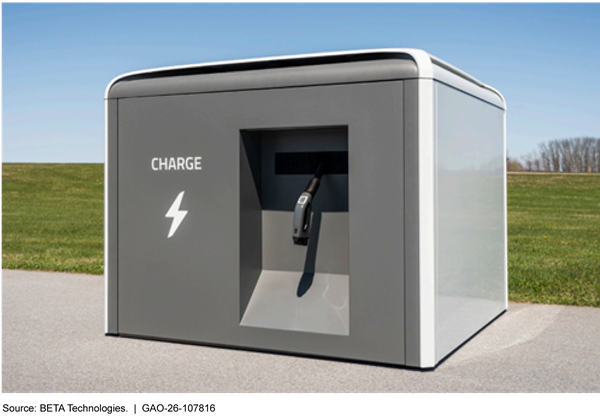
FAA officials said that other airports have included either a proposed vertiport or a designated area for future Advanced Air Mobility development, which could include a charging station, in their Airport Layout Plan. Two airports have conditionally approved Airport Layout Plans that include a vertiport, according to officials.
Officials said that most airports interested in supporting electric aircraft are in the planning and information-gathering stages. These officials said they are engaging with the airport community about the types of companies that are approaching FAA for certification of their electric aircraft and their associated uses, as well as the electrical needs that may be necessary to support an electric aircraft’s initial entry into service, and what more mature operations might look like.
It is possible that smaller airports will be able to support electric aircraft before larger commercial airports, according to representatives from an airport trade association and a recent study. According to a 2023 National Academies study, certain general aviation airports may be some of the most desirable locations for early integration of an Advanced Air Mobility service, such as electric aircraft.[43] The study also says these airports have less congested airspace, more land available for ground infrastructure and, in some cases, are located closer to major city centers.
Some airport businesses called fixed-base operators have already established partnerships with manufacturers in anticipation of FAA-certificated electric aircraft.[44] For example, in June 2024, the eVTOL manufacturer Archer Aviation announced a memorandum of understanding with the fixed-base operator Signature Aviation to install supporting infrastructure at Signature’s network of more than 200 airport terminals, including in New York, Los Angeles, the San Francisco Bay Area, and Texas. In addition, the fixed-base operator Atlantic Aviation announced plans in October 2024 to upgrade utility infrastructure and install charging stations at the East 34th Street Heliport in New York City to support eVTOL operations with partners including BETA Technologies, Joby Aviation, and Archer Aviation. Representatives from one fixed-base operator told us they do not expect to see electric aircraft in their facilities until 2030.[45] They said they are basing their investment decisions to build facilities including vertiports on the likelihood of manufacturers obtaining FAA certification and the markets where electric aircraft are likely to be adopted first.
Airports Considering Infrastructure to Support Electric Aircraft Face Challenges, Including Cost and Uncertain Demand
Airports face a variety of challenges related to installing infrastructure for electric aircraft, according to FAA officials and selected stakeholders, including the following:
· Cost. The cost of deploying infrastructure to support electric aircraft may be considerable, according to FAA officials, representatives from four airports and an industry association, and officials from a state DOT. For example, representatives from one airport told us the cost of electrification alone for the vertiport they are designing to support eVTOL operations will be in the $2 million range. Specific considerations on airport power infrastructure will vary greatly between airports based on size, current power capabilities, and the density of the expected electric aircraft traffic.[46]
· Airport revenue. As electric aircraft activity increases, airports could see reduced revenue from a decline in traditional aircraft fueling operations, according to representatives from five airports and officials from a state DOT. Officials from the state DOT said that this could be addressed through a mechanism to collect revenue from the provision of electricity, such as an electric charge fee, similar to a fuel flowage fee.[47] The Advanced Air Mobility National Strategy notes that existing funding mechanisms may need to be updated to support what it refers to as the transformation of domestic aviation, including the introduction of new types of aircraft, such as electric aircraft, and their potential uses.[48] The American Association of Airport Executives (AAAE) has similarly urged Congress to ensure that new entrants to the National Airspace System, including electric aircraft operators, are helping to pay for the costs of air traffic control services and the infrastructure needed to accommodate their operations—for example, through an electric charge fee or a ticket fee.
· Demand. As FAA has not yet certificated an electric manned aircraft for commercial operation, the viability of the business model for electric aircraft uses such as air taxis is untested, according to representatives from an industry association, an airport, and a fixed-base operator. They told us this uncertainty about future demand creates a challenge for airports about whether to invest in infrastructure to support electric aircraft. We have previously reported on the chicken-or-egg dilemma associated with emerging industries such as Advanced Air Mobility, in which stakeholders may be hesitant to invest resources in services and facilities to support aircraft before they are certificated, even though the success of the industry depends on such investment.[49]
· Electricity. The availability of electricity for the airport may be limited or unreliable, and airports have competing electricity demands, according to our past work and representatives from an industry association and five airports. In 2023, we reported that some airports anticipated that increased power demand would require new electrical infrastructure.[50] Additionally, AAAE has noted that one of the biggest challenges already facing airports is the increased demand for electrical capacity from airport users, such as rental car companies. Additionally, representatives from one airport identified reliability of electricity as a challenge. They told us their provider has electrical resiliency issues, and the airport loses power at least six times a year as a result. However, NLR officials told us that airports have the opportunity to supplement electrical grid resources and improve resiliency by generating electricity onsite and storing energy. We have ongoing work reviewing onsite renewable power generation projects at U.S. airports in response to a provision in Section 735 of the FAA Reauthorization Act of 2024.[51]
· Charging equipment selection. The different standards for electrical chargers used by manufacturers and the absence of an industry consensus present a challenge when considering infrastructure to support electric aircraft, according to FAA officials and representatives from three airports and two industry associations. As aircraft battery sizes, power, and charging time needed vary depending on the intended use, airports would have to choose based on the electric aircraft operations they wish to support.[52]
· Firefighting guidance. Electric aircraft batteries are a potential electrical fire hazard, and airports will need FAA guidance on aircraft rescue and firefighting training to respond to those fires, according to FAA officials, AAAE, and representatives from an industry association, three airports, and a fixed-base operator. We previously reported that, according to FAA, the firefighting techniques for Advanced Air Mobility aircraft are unknown and may differ, depending on the aircraft model.[53] FAA officials told us they need to develop guidance for responding to fires from lithium-ion batteries, as current procedures—which can include allowing the fire to burn itself out, or using large amounts of water—are impractical for electric aircraft. According to FAA officials, the William J. Hughes Technical Center for Advanced Aerospace is in the initial phase of research on electric aircraft fire fighting as of March 2026. This involves conducting a literature review of existing related standards and case studies and reviewing current tactics utilized in fighting battery fires that will inform future guidance or training requirements on fighting these fires. In addition, FAA is a member of the standards council responsible for revising the National Fire Protection Association’s NFPA 418 Standard for Heliports and Vertiports, which establishes fire safety requirements at heliports and rooftop hangars for the protection of people, aircraft, and other property, and is working with industry professionals to learn more about new technologies that address lithium-ion battery fires.
· Airspace management guidance. Representatives from three airports told us that integrating electric aircraft such as eVTOLs into the airport’s airspace presents a challenge. As we reported in 2024, FAA will have to determine how to safely and efficiently integrate Advanced Air Mobility operations—which are currently centered around electric aircraft—with commercial airlines and other types of operations if they take place in airspace where air traffic controllers are actively communicating with, directing, and separating all air traffic.[54] Alternately, if future Advanced Air Mobility operations occur in uncontrolled airspace, or airspace where air traffic controllers are not providing services, FAA will play an integral part in developing the operating rules in those airspace areas. Rules or guidance on airspace management should be a key short-term consideration for FAA, according to interviewees in our 2024 work.[55]
FAA officials also said that integrating electric aircraft’s ground movement, initial departures, and final approaches at airports where conventional aircraft operate could be a potential challenge. According to officials in FAA’s Air Traffic Organization, to develop guidance for integrating electric propulsion aircraft into the National Airspace System, they will need additional data on characteristics of electric aircraft, including their ability to integrate into existing airspace. In September 2025, FAA officials told us that the agency and industry are working to gather these data through research and a range of other initiatives, including tabletop exercises, experimental flights and testing, and demonstrations.
FAA Is Working to Certificate Electric Aircraft Designs While It Considers Long-Term Regulatory Approaches, but Manufacturers Have Identified Challenges
FAA Is in the Process of Certificating Aircraft Designs on a Case-by-Case Basis, While Considering Long-Term Approaches to Regulate These Novel Technologies
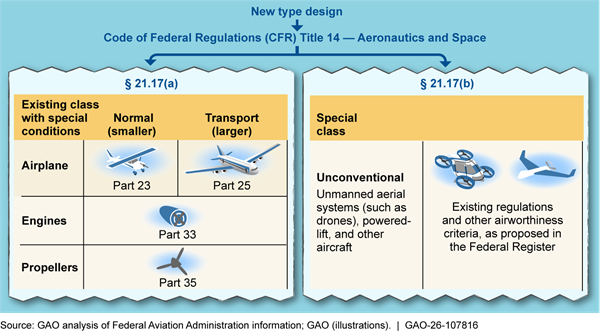
As of March 2026, no manned electric aircraft design has been certificated for commercial operations by FAA.[56] As mentioned earlier, FAA’s current approach to certificating the design of new aviation products, including electric aircraft and engines, is to evaluate them on a case-by-case basis against airworthiness standards set in regulation, using either (1) existing airworthiness standards, with any modifications called special conditions as prescribed by FAA; or (2) a “special class” category, which combines different airworthiness standards as deemed appropriate and applicable by FAA (see fig. 9).
Figure 9: Certification Pathways for Electric Airplane Design, with Applicable Part of Title 14 Code of Federal Regulations
Note: For products type certificated in accordance with 14 C.F.R. 21.17(a), the Federal Aviation Administration (FAA) may issue special conditions when it determines that existing airworthiness regulations do not provide adequate or appropriate safety standards because of a novel or unusual design feature of the product. Special conditions are issued in accordance with 14 C.F.R. Part 11 and contain such safety standards for the product as FAA finds necessary to establish a level of safety equivalent to that established in the regulations. FAA may grant an exemption from the requirements of a regulation when it finds that doing so is in the public interest.
“Existing Standards” Certification Path
FAA uses the “existing standards” path to certificate aircraft and aviation products, such as fixed-wing airplanes or engines, which include new technologies, such as electric propulsion. To ensure that these new technologies are safe, FAA develops project-specific alternatives to existing airworthiness standards, called “special conditions,” to regulate them. These “special conditions” are intended to confirm that the new technologies will provide the same level of safety as a conventional product. Such special conditions, however, are not the only requirements that the proposed product must meet. It must meet all the other standards for the product, if applicable.
For example, FAA issued special conditions for an electric engine from the manufacturer Safran, which required Safran to, among other things, ensure that the high-voltage electric wiring systems connecting the engine’s controller to its motor were protected against unintentional electrical discharges that could cause an electrical fire. According to the special conditions issued by FAA, applicable airworthiness standards for such engines do not contain adequate or appropriate safety standards for such a feature.
As of March 2026, according to FAA officials, 10 of the 23 aviation products with electric propulsion that FAA has received for certification since 2018 have been submitted through the “existing standards” path. Based on our review of FAA’s regulatory dockets, as of March 2026, FAA has issued special conditions for four of the 10 products—electric engine models manufactured by Safran, magniX, BETA Technologies, and ZeroAvia. As of March 2026, FAA has not issued special conditions for the remaining six products.
“Special Class” Certification Path
FAA uses the “special class” path to certificate the airworthiness of aviation products that do not fall under a category of existing airworthiness standards.[57] For example, eVTOL aircraft have features of both fixed-wing aircraft and helicopters, which are separate categories of airworthiness standards in regulation. In these cases, FAA’s approach is to combine portions of appropriate and applicable airworthiness standards from the “existing category” certification path, creating airworthiness criteria appropriate for a specific product. For example, the special class airworthiness criteria that FAA issued to Joby Aviation for a powered-lift model included elements of airworthiness standards for small aircraft, engines, and propellers.
According to FAA, 14 of the 23 electric propulsion type certification projects FAA has received since 2018—all of which are eVTOLs—have been submitted through this path.[58] Based on our review of FAA’s regulatory dockets, as of March 2026, FAA has issued special class airworthiness criteria for two of the 14 products—eVTOL models manufactured by Joby Aviation and Archer Aviation. As of March 2026, FAA has not issued special class airworthiness criteria for the remaining 12 products.[59]
Both certification paths include the following phases: conceptual design, requirements definition, compliance planning and implementation—at the end of which FAA issues the airworthiness certificate—and postcertification activities (see fig. 10 for more details).
Figure 10: FAA Information on Year of Application and Progress Toward Type Certification for Projects with Electric Propulsion, January 2018–March 2026
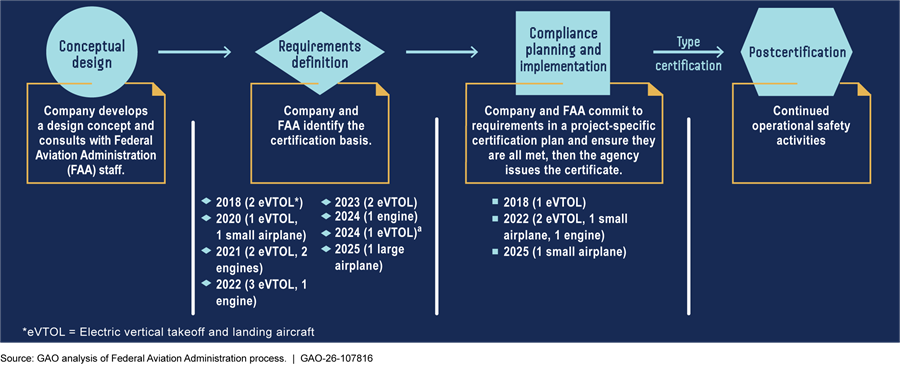
Note: Two projects have been paused by the applicant.
aProject was canceled in 2025, according to FAA officials.
Officials from FAA’s Aircraft Certification Service said that the first few applications for certification have been resource intensive but that they expected the process would become easier as FAA and manufacturers reached agreement on the technical requirements for certification and with the publication of standardized criteria, and as FAA acquired more experience with electric propulsion products. Additionally, products with electric propulsion remain a small portion of FAA’s overall certification workload. According to FAA officials, as of March 2026, 23 of the 16,788 certification projects FAA has received since 2018 involve electric propulsion.
While currently evaluating electric aircraft and propulsion products on a case-by-case basis, according to FAA officials, the agency is also considering regulatory changes that could help standardize its approach to evaluating these products in the long term. Specifically, these changes have the potential to reduce FAA’s need to develop individual airworthiness requirements for each electric aircraft, engine, or propeller design it evaluates, according to FAA officials. FAA officials have not yet set expected time frames for these efforts.
· Electric engines and propellers. Through the Aviation Rulemaking Advisory Committee (ARAC), FAA is planning to update current airworthiness standards for engines and propellers to incorporate advanced propulsion technologies, including electric propulsion. This effort comes in response to a requirement under Section 956 of the FAA Reauthorization Act of 2024.[60] As of March 2026, according to officials, FAA has not tasked the ARAC due to the termination of DOT Federal Advisory Committee Act (FACA), as amended,[61] committee memberships, including the ARAC, in August 2025.[62] In September 2025, FAA published a notice soliciting nominations for membership to serve on the ARAC.[63] According to officials, when the Secretary appoints new members to the ARAC, FAA intends to task the committee to address Section 956 before the act’s May 2027 deadline.
· eVTOLs. Over the long term, FAA is considering developing dedicated airworthiness standards for eVTOLs through a rulemaking, for which the agency would use the experience gained from eVTOL certification projects submitted under the “special class” path, according to FAA officials. Until such a rulemaking, FAA plans to issue type certification of powered-lift aircraft, such as eVTOLs, using guidelines published in an Advisory Circular in July 2025.[64]
· Large, fixed-wing aircraft. Airworthiness standards for large, fixed-wing aircraft are prescriptive and do not enable pathways to certification for hybrid- or fully electric aircraft, according to a 2022 National Academies study.[65] Developing and implementing a rewrite for those standards will likely be an extremely lengthy and expensive process, according to the study. FAA officials told us that while the agency does not have plans to completely revise airworthiness standards for large, fixed-wing aircraft to make them performance based, it may incorporate performance-based elements as specific rules are revised or added to the standards in the future.
Industry Stakeholders Identified Multiple Challenges with the Certification Process
Representatives from manufacturers and an aviation engineering services company described challenges they encountered in the type certification process, including limited numbers of FAA staff with expertise in electric propulsion, limited standardization in FAA’s certification process, and a lack of delegation by FAA. FAA officials told us they have taken certain steps, such as hiring engineers in critical disciplines like propulsion. However, FAA officials said their policy toward delegation and the case-by-case approach to establishing the certification basis for projects are appropriate because electric propulsion is a new technology.
Limited Subject Matter Experts Among FAA Certification Staff
Representatives from four of seven manufacturers and one aviation engineering services company described the limited number of relevant subject matter experts in electric propulsion at FAA as a challenge to making progress toward certification. Representatives from one manufacturer said that FAA does not have resources and subject matter experts who can understand technologies related to electric propulsion systems, such as batteries and electric rotors. Representatives from another manufacturer said that FAA has a limited pool of resources and expertise in electric propulsion technologies. In the company’s initial public offering document, BETA Technologies identified FAA staff availability as a factor that could affect its ability to meet certification targets.[66]
FAA officials at the East and West Certification Branches in FAA’s Aircraft Certification Service said that while they currently have staff capable of assessing the electric propulsion projects undergoing certification, they may not be able to handle increased numbers of electric propulsion certification projects in the future. FAA branch officials also explained that they have to acquire knowledge about new technologies used in electric propulsion aircraft on the job, while ensuring they have completed their other responsibilities. In July 2025, FAA officials told us that the East and West Certification Branches were short a total of eight full-time employees who were capable and experienced in electric propulsion work. As of March 2026, FAA said that staffing shortfalls are not affecting the progress of electric propulsion projects toward certification.
FAA officials said that they have been successful in hiring engineers in critical disciplines, including propulsion, and in deploying experienced personnel to emerging technology areas as needed. Officials said that the Aircraft Certification Service experiences routine attrition associated with retirement and other external factors, but that these trends were anticipated and incorporated into FAA’s workforce planning and hiring strategies. Officials also said that the agency leverages the Chief Scientist and Technical Advisor program to provide senior-level technical leadership and subject matter expertise in areas including new propulsion technologies.[67] Additionally, according to officials, the agency is strengthening its staffing across the Aircraft Certification Service to expand capacity in new and evolving disciplines, such as energy storage integration. Officials said that FAA is also expanding targeted training and development opportunities that enable engineers to work directly with applicants and gain hands-on experience with emerging technologies, including electric propulsion.
We have previously identified issues with FAA’s workforce planning. For example, in 2021, we reported that FAA had a limited understanding of the critical skills needed for its workforce to respond to technology changes. We recommended that the agency ensure that planned skill gap assessments are based on quantitative information about gaps across all mission-critical occupations.[68] FAA agreed with our recommendation. As of March 2026, FAA has not yet taken action to address the recommendation. Identifying and understanding where skill gaps exist are critical first steps to developing and implementing appropriate recruitment, retention, and training strategies.
Limited Standardization in Certification Process
Representatives from four of seven manufacturers and one aviation engineering services company described the limited standardization and predictability in the certification process as a challenge because it has created uncertainty for industry. For example, representatives from one manufacturer told us that FAA does not have a standardized timeline for providing an applicant the G-1 certification basis issue paper, a key milestone on the path to certification, which has made it difficult for industry to establish their own time frames toward certification.[69] In addition, representatives from another manufacturer told us that FAA’s 2022 decision to change the certification path for eVTOL aircraft—from the “existing standards” path as a small airplane to the “special class” path—made the certification process less predictable for industry. In 2024, we reported that FAA’s decision was an unexpected development, which required industry to suddenly change course, according to industry stakeholders and a DOT Inspector General report.[70] In its December 2025 testimony to Congress, BETA Technologies said that the greatest challenge for emerging technologies is the uncertainty around when and how policy and guidance are developed.[71]
FAA officials told us that they determine the certification basis for each project individually and could not provide a specific period for when an eVTOL, or any other electric propulsion project, would obtain type certification. Additionally, they said that applicants’ knowledge about the certification process varied widely and that some applicants had unrealistic expectations for the overall certification timeline. For example, FAA officials and representatives from one manufacturer said that some new manufacturers wanted to use certification documents, such as the G-1 issue paper, as milestones to secure funding, leading them to apply for certification prematurely.
Lack of Delegation from FAA
Representatives from three of seven manufacturers described a lack of delegation from FAA as a challenge because, without delegation, FAA staff oversee routine certification activities and applicants plan certification activities around FAA staff availability, which can affect certification timelines. Delegation under the FAA Designee Program is a process through which FAA can allow qualified individuals and companies to conduct certification activities.[72] According to FAA guidance, such delegation enables FAA to supervise more certification activities with less direct involvement, among other things. However, under FAA policy, designees under the delegation process may not undertake specified activities, such as approving departures from specific policy and guidance, establishing special conditions, or granting exemptions, because they exceed the scope of the matters the Administrator is authorized by statute to delegate through this program.[73] Representatives from two manufacturers said that it may take longer to go through the certification process as they wait for FAA staff to become available. FAA officials stated that they are not able to use delegation for electric propulsion projects because they cannot do so in a safe manner until the agency has more experience with the new technologies and has established policies and procedures for electric propulsion projects that do not rely on, for example, special conditions or exemptions.
Agency Comments
We provided a draft of this report to DOE, DOT, and NASA for review and comment. We received technical comments from DOT and NASA, which we incorporated as appropriate. DOE responded that they did not have any comments on our draft report.
We are sending copies of this report to the appropriate congressional committees, the Secretaries of Energy and Transportation, the Administrator of the National Aeronautics and Space Administration, and other interested parties. In addition, the report is available at no charge on the GAO website at http://www.gao.gov.
If you or your staff have any questions about this report, please contact me at CollinsD@gao.gov. Contact points for our Offices of Congressional Relations and Media Relations may be found on the last page of this report. GAO staff who made key contributions to this report are listed in appendix II.

Derrick Collins
Director, Physical Infrastructure
|
Type of organization |
Stakeholder |
|
U.S. federal agencies |
Department of Energy (National Laboratory of the Rockies) |
|
Federal Aviation Administration |
|
|
National Aeronautics and Space Administration |
|
|
Industry associations |
American Association of Airport Executives |
|
Aerospace Industries Association |
|
|
General Aviation Manufacturers Association |
|
|
Fixed-base operators |
Atlantic Aviation |
|
Signature Aviation |
|
|
Airports |
Bob Sikes Airport |
|
Chehalis-Centralia Airport |
|
|
Gainesville Regional Airport |
|
|
Jackson-Medgar Wiley Evers International Airport |
|
|
John Wayne Airport |
|
|
King County International Airport/Boeing Field |
|
|
Plattsburgh International Airport |
|
|
Salinas Municipal Airport |
|
|
Springfield-Beckley Municipal Airport |
|
|
Sugar Land Regional Airport |
|
|
Tampa International Airport |
|
|
Yakima Air Terminal/McAllister Field |
|
|
Manufacturers |
Archer Aviation |
|
BETA Technologies |
|
|
Electra |
|
|
Heart Aerospace |
|
|
Joby Aviation |
|
|
magniX |
|
|
ZeroAvia |
|
|
Aviation engineering services provider |
AeroTEC |
|
State departments of transportation |
Ohio Department of Transportation |
|
Washington State Department of Transportation |
|
|
Flight schools |
Learn 2 Fly CT |
|
Academics and researchers |
Venkat Viswanathan, University of Michigan |
|
Other |
National Advanced Air Mobility Center of Excellence, Springfield, OH |
Source: GAO. | GAO‑26‑107816
GAO Contact
Derrick Collins, CollinsD@gao.gov
Staff Acknowledgments
In addition to the contact named above, Susan Zimmerman (Assistant Director), Justin Reed (Analyst in Charge), Padma Chirumamilla, Melanie Diemel, Jack Gigante, Geoff Hamilton, Rich Hung, Danielle Novak, Amy Rosewarne, and Elizabeth Wood made key contributions to this report.
The Government Accountability Office, the audit, evaluation, and investigative arm of Congress, exists to support Congress in meeting its constitutional responsibilities and to help improve the performance and accountability of the federal government for the American people. GAO examines the use of public funds; evaluates federal programs and policies; and provides analyses, recommendations, and other assistance to help Congress make informed oversight, policy, and funding decisions. GAO’s commitment to good government is reflected in its core values of accountability, integrity, and reliability.
Obtaining Copies of GAO Reports and Testimony
The fastest and easiest way to obtain copies of GAO documents at no cost is through our website. Each weekday afternoon, GAO posts on its website newly released reports, testimony, and correspondence. You can also subscribe to GAO’s email updates to receive notification of newly posted products.
Order by Phone
The price of each GAO publication reflects GAO’s actual cost of production and distribution and depends on the number of pages in the publication and whether the publication is printed in color or black and white. Pricing and ordering information is posted on GAO’s website, https://www.gao.gov/ordering.htm.
Place orders by calling (202) 512-6000, toll free (866) 801-7077,
or
TDD (202) 512-2537.
Orders may be paid for using American Express, Discover Card, MasterCard, Visa, check, or money order. Call for additional information.
Connect with GAO
Connect with GAO on X,
LinkedIn, Instagram, and YouTube.
Subscribe to our Email Updates. Listen to our Podcasts.
Visit GAO on the web at https://www.gao.gov.
To Report Fraud, Waste, and Abuse in Federal Programs
Contact FraudNet:
Website: https://www.gao.gov/about/what-gao-does/fraudnet
Automated answering system: (800) 424-5454
Media Relations
Sarah Kaczmarek, Managing Director, Media@gao.gov
Congressional Relations
David A. Powner, Acting Managing Director, CongRel@gao.gov
General Inquiries
[1]National Renewable Energy Laboratory, Electrification of Aircraft: Challenges, Barriers, and Potential Impacts (Golden, CO: 2021). See also National Academies of Sciences, Engineering, and Medicine, Preparing Your Airport for Electric Aircraft and Hydrogen Technologies (Washington, D.C.: The National Academies Press, 2022); Nicholas K. Borer, Nathaniel J. Blaesser, and Michael D. Patterson, Regulatory Considerations for Future Regional Air Mobility Aircraft (San Diego, CA: AIAA Aviation Forum, 2023); National Renewable Energy Laboratory, Federal Aviation Administration Vertiport Electrical Infrastructure Study (Golden, CO: 2023); Phillip J. Ansell and Kiruba S. Haran, “Electrified Airplanes: A Path to Zero-Emission Air Travel,” IEEE Electrification Magazine, v.8, iss.2 (2020): 18-26; and Washington State Department of Transportation Aviation Division, Washington Electric Aircraft Feasibility Study (OIympia, WA: 2020).
[2]Pub. L. No. 118-63, § 1012,138 Stat. 1025, 1392 (2024).
[3]We did not include rotorcraft (e.g., helicopters) or manned free balloons in our scope.
[4]The Department of Energy renamed the National Renewable Energy Laboratory the National Laboratory of the Rockies on December 1, 2025, according to a Department of Energy press release.
[5]For example, see U.S. Department of Transportation and Advanced Air Mobility Interagency Working Group, The Advanced Air Mobility National Strategy: A Bold Policy Vision for 2026-2036 (Washington, D.C.: Dec. 17, 2025). The term ‘‘advanced air mobility’’ is defined in statute to mean a transportation system that is comprised of urban air mobility and regional air mobility using manned or unmanned aircraft in both controlled and uncontrolled airspace. The term “urban air mobility” is defined to mean the movement of passengers or property by air between two points in different cities or two points within the same city using an airworthy aircraft that (A) has advanced technologies, such as distributed propulsion, vertical takeoff and landing, powered lift, nontraditional power systems, or autonomous technologies; and (B) has a maximum takeoff weight of greater than 1,320 pounds. The term “regional air mobility” is defined to mean the movement of passengers or property by air between two points using an airworthy aircraft that (A) has advanced technologies, such as distributed propulsion, vertical takeoff and landing; powered lift; nontraditional power systems, or autonomous technologies; (B) has a maximum takeoff weight of greater than 1,320 pounds; and (C) is not urban air mobility. FAA Reauthorization Act of 2024, Pub. L. No. 118-63, § 951, 138 Stat. 1025, 1375.
[6]Fixed-base operators are businesses that provide aviation services such as fuel, parking, and hangar space at airports.
[7]National Renewable Energy Laboratory, Electrification of Aircraft; Vertiport Electrical Infrastructure Study; and National Academies, Preparing Your Airport.
[8]Washington State Department of Transportation Aviation Division, Washington Electric Aircraft Feasibility Study.
[9]Pascal Thalin, Fundamentals of Electric Aircraft, 2nd ed. (Warrendale, PA: SAE Books, 2023). Other types of electric propulsion aircraft include turboelectric, which use fuel-based energy storage with electrical power transmission for propulsion, and hydrogen-electric, which use hydrogen fuel cells and electrical energy for propulsion.
[10]FAA defines an “airworthy” aviation product as one that conforms to its type certificate and is in a condition for safe operation. When an aircraft conforms to its type certificate, its configuration and installed components are consistent with the drawings, specifications, and data that are part of the type certificate. Under specified circumstances, an experimental airworthiness certificate can be issued for the operation of an aircraft that does not have a type certificate or does not conform to its type certificate. In addition, FAA notes that the aircraft design for special light-sport aircraft is an aircraft design for which a type certification has not been issued.
[11]In general, FAA’s existing certification regulations include three aircraft classes—airplanes, rotorcraft (e.g., helicopters), and manned free balloons—each with its own set of rules, operating characteristics, and airworthiness standards. If FAA determines that the proposed new aircraft design meets one of these three classes and existing aircraft definitions, FAA uses the process in 14 C.F.R. § 21.17(a) to designate the applicable standards for certification. For products type certificated in accordance with 14 C.F.R. § 21.17(a), FAA may issue special conditions when it determines that existing airworthiness regulations do not provide adequate or appropriate safety standards because of a novel or unusual design feature of the product. Special conditions are issued in accordance with 14 C.F.R. Part 11 and contain such safety standards for the product as FAA finds necessary to establish a level of safety equivalent to that established in the regulations. FAA may grant an exemption from the requirements of a regulation when an applicant petitions for relief under 14 C.F.R. Part 11. 88 Fed. Reg. 38946, 38953 (June 14, 2023).
[12]For any new aircraft design elements, FAA could create a special condition only applicable to that particular design. If FAA determines that the proposed new aircraft design does not fit into existing aircraft definitions and corresponding airworthiness standards, FAA uses the 14 C.F.R. § 21.17(b) path to designate it as a special class aircraft. FAA can then apply regulatory standards, such as from any and all applicable classes (e.g., airplane, rotorcraft, or balloons) to form the certification basis.
[13]FAA also certifies aircraft operations, which can set specific limitations and requirements on operations based on an operator’s capabilities. According to FAA, many electric propulsion aircraft in design are seeking to become “on-demand” operators and will likely have unique specifications applied to their operational certification.
[14]This report focuses on electric aircraft for civil aviation. Manufacturers have also announced partnerships to use electric aircraft technologies in the defense industry. For example, Archer Aviation is making its eVTOL powertrain available to defense contractor Anduril to use in their autonomous air vehicle systems. BETA Technologies is developing a military variant of its eVTOL aircraft and is a candidate for the United States Marine Corps’ Aerial Logistics Connector program. Joby Aviation is working with defense contractor L3Harris to pursue applications for hybrid-electric VTOL aircraft.
[15]The Commerce, Justice, Science; Energy and Water Development; and Interior and Environment Appropriations Act, 2026, provides NASA with $935 million for its aeronautics research and development activities to remain available until September 30, 2027. Pub. L. No. 119-74, div. A, tit. III, 140 Stat. 5, 41. As of March 2026, program-level funding has not been finalized, according to NASA officials.
[16]See GAO, Transforming Aviation: Stakeholders Identified Issues to Address for ‘Advanced Air Mobility,’ GAO‑22‑105020 (Washington, D.C.: May 9, 2022); Transforming Aviation: Congress Should Clarify Certain Tax Exemptions for Advanced Air Mobility, GAO‑23‑105188 (Washington, D.C.: Nov. 30, 2022); and Advanced Air Mobility: Legal Authorities and Issues to Consider for Operations, GAO‑24‑106451 (Washington, D.C.: Mar. 14, 2024).
[17]U.S. Department of Transportation and Advanced Air Mobility Interagency Working Group, The Advanced Air Mobility National Strategy. According to FAA officials, the Advanced Air Mobility National Strategy replaces the 2023 Advanced Air Mobility Implementation Plan, also known as “Innovate28,” which FAA released in July 2023 to support industry in meeting a goal of piloted commercial Advanced Air Mobility operations with electric aircraft in 2025 and more widespread operations in 2028 and beyond. According to officials, FAA replaced the Implementation Plan in response to factors including shifting industry timelines for the readiness and deployment of Advanced Air Mobility aircraft, including delays for manufacturers in testing, certification, and commercialization; and the need for clearer roles and responsibilities, particularly for state, local, and tribal governments, as well as private industry partners involved in infrastructure development and community engagement.
[18]Other key pillars of the Advanced Air Mobility National Strategy include modernizing the airspace, ensuring that security policies and procedures keep pace with Advanced Air Mobility, elevating the importance of community planning and decision-making at the local level as Advanced Air Mobility evolves, training a workforce with new skills that apply to new methods of flight and advanced technologies, and enhancing safety and innovation through advanced research and testing of automation. Each pillar includes several recommendations for decision-makers to consider, which the companion document, The Advanced Air Mobility Comprehensive Plan, expands further with potential next steps. See U.S. Department of Transportation and Advanced Air Mobility Interagency Working Group, The Advanced Air Mobility Comprehensive Plan: LIFTing AAM to Maturity in the United States (Washington, D.C.: Dec. 17, 2025).
[19]Executive Order 14307, Unleashing American Drone Dominance. 90 Fed. Reg. 24727 (June 6, 2025).
[20]According to FAA’s public notice, aircraft involved in the eIPP will be piloted, optionally piloted, or unmanned Advanced Air Mobility aircraft seeking type certification. They will generally be more than 1,320 pounds, have a high frequency of interactions with air traffic control, and may be capable of carrying passengers.
[21]In addition to the above, FAA selected proposals from the following to participate in the program: Texas Department of Transportation, Utah Department of Transportation, Louisiana, Florida Department of Transportation, and the North Carolina Department of Transportation.
[22]A 2023 NASA study on aviation emissions, drawing from European Union research, sorted U.S flights into four distance-based buckets: 0-311 statute miles; 311-932 statute miles; 932-2,485 statute miles; and >2,485 statute miles. See Susie Go, John E. Melton, Xun J. Jiang, and Gregory Ziliac, “Estimations of Aircraft and Airport Domestic Greenhouse Gas Emissions from 2016-2021,” AIAA/IEE Electric Aircraft Technologies Symposium (San Diego, CA: June 2023). For the purposes of this report, the first bucket is considered a “short-range” distance and the second bucket a “medium-range” distance. Electric aircraft in development can fly up to medium-range distances. For example, Archer Aviation’s fully electric Midnight eVTOL is designed for back-to-back trips of about 20 miles, according to the company’s 2025 10-K report, while the Heart Aerospace ES-30 conventional takeoff and landing (CTOL) aircraft has a flight range of about 500 miles when operating as a hybrid-electric aircraft.
[23]Under a special airworthiness certificate, FAA can authorize aircraft to operate in the U.S. airspace in one or more categories. For example, FAA can issue an experimental airworthiness certificate for an aircraft that does not have a type certificate or does not conform to its type certificate and is in a condition for safe operation.
[24]National Academies, Preparing Your Airport. See also Ohio Department of Transportation, Infrastructure to Support Advanced Autonomous Aircraft Technologies in Ohio (Columbus, OH: June 2021); Minnesota Department of Aeronautics, Minnesota Electric Aviation Network (MEAN) Study Executive Summary (St. Paul, MN: August 2025); National Renewable Energy Laboratory, Electrification of Aircraft; and Washington State Department of Transportation Aviation Division, Electric Aircraft Feasibility Study.
[25]National Renewable Energy Laboratory, Electrification of Aircraft.
[26]The Essential Air Service program provides federal subsidies to air carriers to serve certain eligible communities, which are typically smaller communities or in rural areas. For more information, see GAO, Commercial Aviation: Trends in Air Service to Small Communities, GAO‑24‑106681 (Washington, D.C.: Sept. 25, 2024). See also, 49 U.S.C. § 41742.
[27]U.S. Department of Transportation and Advanced Air Mobility Interagency Working Group, The Advanced Air Mobility National Strategy.
[28]National Renewable Energy Laboratory, Electrification of Aircraft.
[29]National Academies, Preparing Your Airport.
[30]In January 2024, FAA granted an exemption to the cities of Mendota and Reedley, California, to allow them to operate the four specific Pipistrel Alpha Electro aircraft owned by New Vision Aviation, Inc., a flight school at Reedley Municipal Airport, Fresno Chandler Executive Airport, and William Robert Johnson Municipal Airport. In December 2024, FAA granted a similar exemption for one specific Pipistrel Alpha Electro aircraft to Hartford Aviation Technologies of Connecticut, which operates the Learn 2 Fly CT, LLC flight school at Hartford-Brainard Airport and Simsbury Airport.
[31]According to FAA, the Pipistrel Velis Electro aircraft is 50 kilograms heavier than the Alpha Electro.
[32]90 Fed. Reg.35034 (July 24, 2025). FAA’s final updated regulations for light-sport aircraft remove existing weight restrictions, as well as restrictions on the types of aircraft engines and propellers that can be used in these aircraft. According to FAA’s comments from the rulemaking, these changes will allow for the use of larger batteries and new types of propulsion systems, including hydrogen, electric, and hybrid-electric propulsion systems.
[33]NASA Transformative Vertical Flight Working Group 4 (TVF4), Electric Vertical Takeoff and Landing (eVTOL) Aircraft Technology for Public Services – A White Paper (Washington, D.C.: National Aeronautics and Space Administration, August 2021).
[34]See, for example, Ralph H. Jansen, et al., High Efficiency Megawatt Motor Preliminary Design (Indianapolis, IN: AIAA/IEEE Electric Aircraft Technologies Symposium, 2019); Dr. Rocco Viggiano, Dr. Donald Dornbusch, and Dr. Yi Lin, “Solid State Architecture Batteries for Enhanced Rechargeability and Safety for Electric Aircraft” (Chicago, IL: American Chemical Society Meeting and Exposition, 2022).
[35]See Yawen Liang, Gautham Ram Chandra Mouli, and Pavol Bauer, “Charging Technology for Electric Aircraft: State of the Art, Trends, and Challenges,” IEEE Transactions on Transportation Electrification, v.10, no.3 (2024): 6761-6788, which states that wide-body aircraft carrying 200-400 passengers are more likely to be powered by sustainable aviation fuel by 2050. See also John S. Langford and David K. Hall, “Electrified Aircraft Propulsion,” The Bridge, v.50, no.2 (2020): 21-27, which states that battery-powered transport aircraft are more than 20-30 years away, without breakthroughs in battery technology inconsistent with historical trends.
[36]Andreas W. Schafer, et al. “Technological, economic and environmental prospects of all-electric aircraft,” Nature Energy, vol. 4 (2019):160-166.
[37]Electric machines are systems of motors and generators that can produce electrical power. Megawatt-class electric machines can produce enough electricity to power roughly 500-800 U.S. homes, according to NASA. See “Electric Machines,” National Aeronautics and Space Administration, accessed February 10, 2026, https://www.nasa.gov/eap-technology/electric-machines/.
[38]National Renewable Energy Laboratory, Overview of Potential Hazards in Electric Aircraft Charging Infrastructure (Golden, CO: October 2023).
[39]National Renewable Energy Laboratory, Electrification of Aircraft.
[40]The Airport Layout Plan is a graphic representation of existing airport facilities and proposed developments for an airport for periods of 5, 10, and 20 years. A current Airport Layout Plan is typically updated as an output of an airport’s master plan and is required for airports that receive federal financial assistance. An airport master plan is a comprehensive study of the airport and typically describes short-, medium-, and long-term plans for airport development to meet future aviation demand. See FAA Advisory Circular No. 150/5070-6B (Jan. 27, 2015).
[41]Nonhub airports have less than 0.05 percent, but more than 10,000, of the annual U.S. commercial enplanements. Airports smaller than nonhub airports include nonprimary, nonhub, and general aviation airports. Nonprimary, nonhub airports are those airports that have scheduled passenger service and between 2,500 and 10,000 annual enplanements, while general aviation airports do not have scheduled service or have scheduled service with less than 2,500 passenger boardings each year.
[42]Kyle Clark, Written Testimony of Kyle Clark, Founder & CEO, BETA Technologies, testimony before the Subcommittee on Aviation, House Committee on Transportation & Infrastructure, 119th Cong., 1st sess., December 3, 2025.
[43]National Academies, Airport-Centric Advanced Air Mobility Market Study.
[44]A fixed-base operator usually operates on site at an airport as a business providing not only fuel and parking but also, depending on the airport, flight training, and aircraft rental and maintenance, among other things. See GAO, Airports: Information on Prices for Aviation Services and FAA’s Oversight of Grant Requirements, GAO‑20‑16 (Washington, D.C.: Nov. 26, 2019).
[45]According to FAA officials, the agency is testing and collecting data from the operation of helicopters and eVTOL aircraft. FAA will use the data to help develop a new advisory circular for vertical flight infrastructure design that combines current vertiport and heliport guidance, according to officials. Key measurements from the testing campaign include landing accuracy and downwash and outwash wind flow. Downwash is the vertical, downward flow of air produced by rotors/propellers, while outwash is the lateral, radial, outward airflow that occurs as the downwash contacts the landing surface. See Federal Aviation Administration, Electric Vertical Takeoff and Landing (eVTOL) Downwash and Outwash Surveys (Atlantic City, NJ: December 2024).
[46]National Academies, Preparing Your Airport. Section 745 of the FAA Reauthorization Act of 2024 authorizes an Electric Aircraft Infrastructure Pilot Program in which up to 10 eligible airport sponsors may use specified funds to carry out activities associated with acquiring, operating, and installing equipment to support electric aircraft operations and construct or modify infrastructure to facilitate the delivery of power or services necessary for the use of electric aircraft. As of March 2026, FAA officials told us the agency has identified a funding source and is assessing potential program candidates from the eIPP for participation in the Electric Aircraft Infrastructure Pilot Program.
[47]Airports charge fuel flowage fees to fixed-base operators for fueling aircraft on airport property, according to FAA.
[48]U.S. Department of Transportation and Advanced Air Mobility Interagency Working Group, The Advanced Air Mobility National Strategy.
[49]GAO, Transforming Aviation: Stakeholders Identified Issues to Address for ‘Advanced Air Mobility,’ GAO‑22‑105020 (Washington, D.C.: May 9, 2022).
[50]GAO, Airport Infrastructure: Selected Airports’ Efforts to Enhance Electrical Resilience, GAO‑23‑105203 (Washington, D.C.: Aug. 29, 2023). Section 742 of the FAA Reauthorization Act of 2024 amended 49 U.S.C. § 47140 to expand Airport Improvement Program eligibility to include, among other things, electric aircraft charging.
[51]See FAA Reauthorization Act of 2024, Pub. L. No. 118-63, § 735,138 Stat. 1025, 1275.
[52]National Academies, Preparing Your Airport. See also Liang, Mouli, and Bauer, “Charging Technology.”
[55]GAO‑24‑106451. A June 2025 executive order requires the Secretary of Transportation, acting through the Administrator of the FAA, and in coordination with the Director of the Office of Science and Technology Policy, to establish the eVTOL Integration Pilot Program to accelerate the deployment of safe and useful eVTOL operations in the United States. Executive Order 14307, Unleashing American Drone Dominance. 90 Fed. Reg. 24727 (June 6, 2025).
[56]In July 2025, the manufacturer Hartzell Propeller announced that it had received FAA Part 35 type certification for a propeller specifically designed for electric aircraft, which it developed with BETA Technologies.
[57]14 C.F.R. § 21.17(b).
[58]The 14 eVTOL certification projects that FAA has received since 2018 include one project that was canceled by the applicant in 2025, according to FAA officials.
[59]FAA notes, however, that it has published guidelines applicable to all powered-lift proposed to be type certificated as special class in an Advisory Circular in July 2025.
[60]See FAA Reauthorization Act of 2024, Pub. L. No. 118-63, § 956,138 Stat. 1025, 1381. FAA is also developing standards and test methodologies to ensure the durability, endurance, and reliability of electric aircraft engines, according to the National Aviation Research Plan 2025-2029. This research will address environmental and electromagnetic impacts on electric engines, as well as the hazards associated with the failure of one or more electric engines in a multiengine electric propulsion system. FAA is also collaborating with NASA, the Department of Defense, the aviation industry, and academia to develop modeling tools and means of compliance methods to ensure the safety of new propulsion systems and rotors.
[61]Pub. L. No. 92-463, 86 Stat. 770 (1972) (codified as amended at 5 U.S.C. app. 2).
[62]DOT’s termination of the ARAC followed a February 2025 hold on all FACA activities, according to FAA officials.
[63]90 Fed. Reg. 45306 (Sept. 19, 2025).
[64]FAA, Advisory Circular No. 21.17-4 (July 18, 2025).
[65]National Academies, Preparing Your Airport.
[66]In the same document, BETA Technologies also identified government shutdowns and their impact on the rulemaking and certification process as a risk to the company’s business. FAA officials said that during the 2025 government shutdown, the agency prioritized continuity of critical certification activities, which included work that supported existing certification applications for electric propulsion projects. Officials also said that the agency deferred the initiation of new certification activities and preapplication engagement with applicants until normal operations resumed.
[67]Chief Scientist and Technical Advisors, part of the Aviation Safety Senior Technical Experts Program, provide technical expertise and leadership to FAA through work such as collaborating on projects where policy and training is not yet developed, directing research policies, collaborating on standards development, identifying topics that merit organizational attention, and providing strategic advice on workforce development.
[68]GAO, FAA Workforce: Better Assessing Employees’ Skill Gaps Could Help FAA Prepare for Changes in Technology, GAO‑21‑310 (Washington, D.C.: May 13, 2021).
[69]The Certification Basis (G-1) Issue Paper designates the applicable airworthiness and environmental (i.e., noise, fuel venting, and exhaust emissions) regulations that a product must meet for certification. The Issue Paper also records any exemptions, Special Federal Aviation Regulations designations, and special conditions issued to the product. In 2020, we recommended that FAA provide information to staff to address uncertainties around the issue paper process. DOT agreed with the recommendation. As of January 2026, FAA reported that it has developed a job aid and integrated tool to help staff determine when an issue paper is required. Additionally, officials said they have developed a process for documenting how issues are resolved outside of the formal issue paper process, which they expect to deploy in March 2026. See GAO, Aviation Certification: FAA Needs to Strengthen its Design Review Process for Small Airplanes, GAO‑21‑85 (Washington, D.C.: Nov. 16, 2020).
[70]GAO, Advanced Air Mobility: Legal Authorities and Issues to Consider for Operations, GAO‑24‑106451 (Washington, D.C.: Mar. 14, 2024). See also U.S. Department of Transportation, Office of Inspector General, Regulatory Gaps and Lack of Consensus Hindered FAA’s Progress in Certifying Advanced Air Mobility Aircraft, and Challenges Remain, Report AV2023037 (Washington, D.C.: June 21, 2023).
[71]Kyle Clark, Written Testimony of Kyle Clark, Founder & CEO, BETA Technologies, testimony before the Subcommittee on Aviation, House Committee on Transportation & Infrastructure, 119th Cong., 1st sess., December 3, 2025.
[72]See FAA Order 8110.4C, Chg 7 (Oct. 20, 2023). FAA is authorized by statute to delegate to a qualified private person a matter related to issuing certificates, or related to the examination, testing, and inspection necessary to issue a certificate on behalf of the FAA Administrator as authorized by statute to issue under 49 U.S.C. § 44702(d).
[73]See FAA Order 8000.95D (Jan. 21, 2025).