
Report to Congressional Committees
United States Government Accountability Office
A report to congressional committees.
For more information, contact: Nagla'a El-Hodiri at elhodirin@gao.gov
What GAO Found
Since fiscal year 2020, the Department of State and the U.S. Agency for International Development (USAID) have used an interagency proposal process to allocate funding for countering Chinese influence projects. An interagency working group has overseen the process and drafted annual guidance for bureaus and posts around the world to submit proposals for funding. The guidance specifies that proposals should address specific lines of effort, which include issue areas such as economic coercion and military exports. However, the proposal process does not require bureaus and posts to seek input from key stakeholders with issue area or regional expertise. Providing documented input on proposals could help the working group better assess the feasibility of proposed projects and ensure approved proposals are designed to effectively address priorities for countering Chinese influence.
State and USAID reported funding an estimated 470 projects valued at about $1.2 billion from fiscal years 2020 to 2023, but working group officials do not have readily available and reliable data on the types and status of these projects. In response to GAO’s request, officials stated they had to ask the bureaus and overseas posts managing the projects to compile data from various sources, resulting in incomplete data and errors. For example, of the estimated 470 projects, officials did not provide data on time frames for 129 and lines of effort for 38. Officials also lacked data on the specific projects funded from nearly a third of the approved proposals. As a result, working group officials lack critical information to track how funds were used and determine whether the funding ultimately supports the activities described in approved proposals.
The working group has not assessed the results of efforts to counter Chinese influence across the portfolio of projects. Although State and USAID began developing a framework to do so in 2023, the agencies were still in the early stages of developing it when a January 2025 executive order paused obligations of foreign assistance funds. As of March 2026, officials said that State is uncertain about whether it would resume developing the framework. Without a process for assessing results across the portfolio of funded projects, working group officials and other stakeholders lack evidence to determine the effectiveness of projects, which could help inform future funding decisions.
Why GAO Did This Study
The People’s Republic of China and the U.S. are engaged in economic and geopolitical competition spanning trade, security, and the development of advanced technology. Since fiscal year 2020, Congress has directed expenditure of at least $1.6 billion from specified appropriations accounts to counter Chinese influence. State and USAID administered this funding.
The Senate report accompanying legislation that became the Department of State, Foreign Operations, and Related Programs Appropriations Act, 2024, includes a provision for GAO to review this funding. This report examines (1) State and USAID’s decision-making processes for the use of the funds, (2) the extent State and USAID maintained reliable data on the use of the funds, and (3) State and USAID’s efforts to assess results of projects countering Chinese influence.
GAO reviewed agency documents, interviewed agency officials, and analyzed State and USAID project data from fiscal years 2020-2023, which are the latest data available on funded projects.
What GAO Recommends
GAO is making five recommendations, including that State require documented input from key participants on proposals for projects to counter Chinese influence, collect and periodically update complete data on funded projects, and develop a process for assessing results across the portfolio of funded projects. State concurred with the recommendations.
|
Abbreviations |
|
|
|
|
|
BRI |
Belt and Road Initiative |
|
CCIF |
Countering Chinese Influence Fund |
|
China House |
Office of China Coordination |
|
CPRCIF |
Countering PRC Influence Fund |
|
DA |
Development Assistance |
|
ESF |
Economic Support Fund |
|
FAM |
Foreign Affairs Manual |
|
FMF |
Foreign Military Financing |
|
INCLE |
International Narcotics Control and Law Enforcement |
|
NADR |
Nonproliferation, Anti-terrorism, De-mining, and Related Programs |
|
OMB |
Office of Management and Budget |
|
PRC |
People’s Republic of China |
|
RCO |
Regional China Officer |
|
State/EAP/RSP |
Department of State, Bureau of East Asian and Pacific Affairs, Office of Regional Security Policy |
|
State/EEB |
Department of State; Bureau of Economic, Energy, and Business Affairs |
|
State/ENR |
Department of State, Bureau of Energy and Natural Resources |
|
State/F |
Department of State, Office of Foreign Assistance |
|
USAID |
U.S. Agency for International Development |
|
USAID/BRM |
USAID Office of Budget and Resource Management |
|
USAID/Policy |
USAID Office of Policy |
|
USAID/PPL |
USAID Bureau for Policy, Planning, and Learning |
|
USAID/PLR |
USAID Bureau for Planning, Learning, and Resource Management |
This is a work of the U.S. government and is not subject to copyright protection in the United States. The published product may be reproduced and distributed in its entirety without further permission from GAO. However, because this work may contain copyrighted images or other material, permission from the copyright holder may be necessary if you wish to reproduce this material separately.
June 17, 2026
The Honorable Lindsey Graham
Chair
The Honorable Brian Schatz
Ranking Member
Subcommittee on State, Foreign Operations, and Related Programs
Committee on Appropriations
United States Senate
The Honorable Mario Diaz-Balart
Chairman
The Honorable Lois Frankel
Ranking Member
Subcommittee on National Security, Department of State, and Related
Programs
Committee on Appropriations
House of Representatives
The People’s Republic of China (PRC) and the U.S. are engaged in economic and geopolitical competition spanning international trade, security, and the development of advanced technology. For decades, the PRC has pursued efforts to establish itself as the dominant economic and military power in the world, according to the 2025 U.S.- China Economic and Security Review Commission Report to Congress.[1] For example, according to the Council on Foreign Relations, the PRC’s Belt and Road Initiative (BRI) poses a significant challenge to U.S. interests, as it has the potential to displace U.S. companies from BRI-recipient countries, push countries to politically align with China, and pressure countries to withhold access to U.S. forces during a potential crisis.[2] In addition, the PRC uses disinformation and propaganda to gain international influence and undermine U.S. global leadership, according to the Atlantic Council.[3]
The U.S. government has taken steps to address the PRC’s actions and provide countries with alternatives to the PRC’s authoritarian influence. In fiscal year 2020, Congress created the Countering Chinese Influence Fund (CCIF) to counter the influence of the PRC worldwide.[4] In 2022, Congress established the Countering PRC Influence Fund (CPRCIF) with a similar mandate.[5] The stated purpose of CPRCIF is to counter the negative influence of the Government of the PRC, the Chinese Communist Party, and PRC-affiliated entities acting on their behalf globally.[6] Congress has directed a minimum of $1.625 billion total from five specified accounts[7] for CCIF and CPRCIF from fiscal years 2020 to 2024, the only U.S. government funding dedicated to countering Chinese influence, according to State officials.[8]
Senate Report 118-71 accompanying legislation that became the Department of State, Foreign Operations and Related Programs Appropriations Act, 2024, includes a provision for GAO to conduct an assessment of CPRCIF and its predecessor entity, CCIF. Our report examines (1) how the Department of State and the U.S. Agency for International Development (USAID)[9] made decisions on the use of funding to counter Chinese influence and how they changed their decision-making processes; (2) the extent to which State and USAID have maintained reliable data on the use of these funds; and (3) how State and USAID monitored and evaluated the results and effectiveness of programming to counter the PRC.
To identify how State and USAID have made decisions on the use of funding to counter Chinese influence and how they have changed their decision-making processes, we reviewed State and USAID’s annual guidance for the process used by the agencies to propose projects to fund from the appropriation accounts with available funding from fiscal years 2020 through 2024.[10] This included guidance on decision-making criteria, the time frames for the process, and the coordination requirements for proposed projects. We interviewed agency officials responsible for drafting the guidance, managing the proposal process, and making decisions about which proposed projects to fund. In addition, we interviewed officials from 21 out of 23 State and USAID bureaus responsible for specific geographic regions and issue areas that have managed funding for countering Chinese influence to understand their processes for identifying projects to propose for funding and implementing approved projects.[11]
To determine the extent to which State and USAID have maintained reliable data on the use of funding to counter Chinese influence, we reviewed agency data on proposals submitted for funding from fiscal years 2020 to 2023 and the projects funded as of September 30, 2024.[12] We analyzed these data to identify information, including the numbers of proposals submitted and approved, the numbers of projects funded, and allocation amounts. We assessed the reliability of these data by requesting and reviewing information and interviewing knowledgeable agency officials in Washington, D.C. regarding the underlying data systems and checks and reviews used to generate the data and ensure its reliability.[13] In addition, we analyzed these data to determine the extent of their completeness and confirm their accuracy. Based on these steps, we determined that the agencies’ data were sufficiently reliable for reporting on the aggregate numbers of proposals submitted and approved from fiscal years 2020 to 2023, and the estimated numbers of projects and allocation amounts, in total, and by fiscal year funding, CCIF and CPRCIF appropriation account, and global region for fiscal years 2020 to 2023. However, we identified issues and limitations with the reliability of the agencies’ data, such as incomplete data on project award numbers, project start and end dates, and obligations, which we discuss in this report.
To determine how State and USAID have monitored and evaluated the results and effectiveness of programming to counter the PRC, we reviewed documentation and guidance on agency monitoring and evaluation requirements. We reviewed documentation of interagency guidance for the CCIF and CPRCIF proposal process for each appropriation account for each of fiscal years 2020 to 2024 and interviewed agency officials. In addition, we reviewed documentation related to the development of a CPRCIF strategic monitoring, evaluation, and learning framework to examine its intended purpose and components. We also interviewed State and USAID officials about efforts to develop the framework, and plans to complete its development and use the information on the results and effectiveness of prior projects. We assessed these agency efforts against leading practices for evidence-building and performance management activities, drawn from our July 2023 report on evidence-based policymaking.[14]
We conducted this performance audit from September 2024 to June 2026 in accordance with generally accepted government auditing standards. Those standards require that we plan and perform the audit to obtain sufficient, appropriate evidence to provide a reasonable basis for our findings and conclusions based on our audit objectives. We believe that the evidence obtained provides a reasonable basis for our findings and conclusions based on our audit objectives.
Background
Congressional Funds for Countering Chinese Influence
Between 2020 and 2024, Congress made funding available for countering Chinese influence from five appropriation accounts.[15] These include the Economic Support Fund (ESF), Development Assistance (DA), Foreign Military Financing (FMF), International Narcotics Control and Law Enforcement (INCLE), and Nonproliferation, Anti-terrorism, De-mining, and Related Programs (NADR) appropriation accounts. State and USAID have managed the funds for countering Chinese influence and administered the appropriation accounts individually other than ESF, according to State officials.[16] Generally, the period of availability for obligation for these accounts is two fiscal years.[17] Table 1 provides an overview of some general authorities for each appropriation account.
|
Appropriation Account |
Examples of General Authorities |
|
Economic Support Fund |
The promotion of economic or political stability. |
|
Development Assistance |
Agriculture, rural development, and nutrition programs as well as American schools and hospitals abroad. |
|
International Narcotics Control and Law Enforcement |
Assistance for the control of narcotic and psychotropic drugs and other controlled substances, or for other anticrime purposes. |
|
Foreign Military Financing |
Grants to finance the procurement of defense articles, defense services and design and construction services by friendly foreign countries and international organizations. |
|
Nonproliferation, Anti-terrorism, De-mining, and Related Programs |
Nonproliferation, anti-terrorism, de-mining activities, the clearance of unexploded ordnances, the destruction of small arms, and related activities. |
Source: GAO analysis of the Foreign Assistance Act of 1961, Pub. L. No. 87-195, 75 Stat. 424 (codified as amended at 22 U.S.C. §§ 2151 et seq.). | GAO‑26‑107822
Notes: The authorities listed here are part of the general authorities listed in the authorizing statutes for these appropriation accounts. Annual appropriations laws can include additional purposes and limitations for these accounts.
Congress has mandated that a minimum amount of funding be made available for CCIF and CPRCIF for each fiscal year from 2020 to 2024 and directed that separate amounts of funding be made available from specific appropriation accounts to satisfy the minimum spending requirement. For example, Congress mandated a minimum of $400 million in CPRCIF funding for fiscal year 2024, and directed in an explanatory statement that at least $155 million was to be allocated from funds appropriated to the ESF account.[18] In addition, the annual appropriations acts provided State and USAID the authority to transfer and merge funds among the five accounts as needed.[19] For example, for fiscal year 2021 funds, State and USAID transferred $50 million into DA and ESF from the INCLE, FMF, and NADR appropriation accounts to meet demand for additional projects. Table 2 displays the total minimum funding amount for each fiscal year, including the minimum funding amounts for each appropriation account.
Table 2: Minimum Funds Directed by Congress for Countering People’s Republic of China Influence, Fiscal Years 2020-2024, Dollars (in millions)
|
Fiscal Year |
Economic Support Fund |
Development Assistance |
Foreign Military Financing |
International Narcotics Control and Law Enforcement |
Nonproliferation, Anti-terrorism, De-mining, and Related Programs |
Total |
|
2020 |
$80 |
$75 |
$50 |
$70 |
$25 |
$300 |
|
2021 |
$80 |
$75 |
$50 |
$70 |
$25 |
$300 |
|
2022 |
$80 |
$75 |
$50 |
$70 |
$25 |
$300 |
|
2023 |
$80 |
$90 |
$50 |
$80 |
$25 |
$325 |
|
2024 |
$155 |
$90 |
$50 |
$80 |
$25 |
$400 |
Source: GAO analysis of fiscal years 2020 through 2024 appropriations acts, Pub. L. No. 116-94. 133 Stat. 2534, 2896 (Dec. 20, 2019), Pub. L. No.116-260, 136 Stat. 1182 1775 (Dec. 27, 2020), Pub. L. No. 117-103, 136 Stat. 49, 646 (Mar. 15, 2022), Pub. L. No. 117-328, 136 Stat. 4459, 5053-4 (Dec. 29, 2022), and Pub. L. No. 118-47, 138, Stat. 460, 812 (Mar. 23, 2024) as well as explanatory statements that accompanied these appropriations acts. | GAO‑26‑107822
Notes: This table displays funding amounts for the Countering Chinese Influence Fund (FY 2020-FY 2021) and the Countering People’s Republic of China Influence Fund (FY 2022-FY 2024). Total minimum funding amounts were mandated by appropriations acts. Minimum amounts for appropriation accounts were directed in explanatory statements accompanying the relevant appropriations act. Guidance issued by the interagency working group to direct the annual proposal process treated these appropriations account funding amounts as mandatory subject to authority to transfer and merge funding between accounts. Transfers between accounts are not displayed in this table. State transferred $15 million from Foreign Military Financing, $20 million from International Narcotics Control and Law Enforcement, and $15 million from the Nonproliferation, Anti-terrorism, De-mining, and Related Programs appropriation accounts into the Development Assistance and Economic Support Fund accounts for a total of $50 million in fiscal year 2021 funds. According to State officials, the agencies did not transfer funds between accounts for fiscal year 2020, 2022, 2023, and 2024 funds.
State and USAID Interagency Working Group and Annual Proposal Process
State and USAID created an interagency working group to oversee the annual proposal process, and determine which projects are funded. The proposal process was competitive and open to all bureaus, offices, posts, and USAID missions around the world to propose projects for funding.
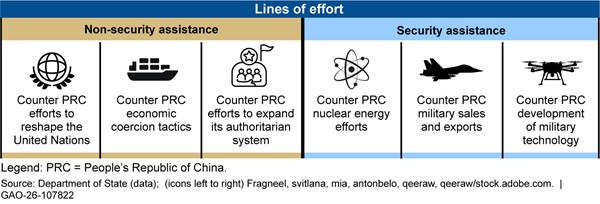
Each year the interagency working group issued guidance outlining the proposal process, which included decision-making criteria for adjudicating proposals.[20] Proposals were also evaluated for their relevance to one or more lines of effort. Lines of effort include issue areas State and USAID identified as priorities for countering Chinese influence, such as countering PRC economic coercion tactics and countering PRC military sales and exports that are specific to each appropriation account. Guidance for fiscal year 2020 to 2024 funds consistently stated that proposals must counter PRC behavior in one or more lines of effort to receive funding.
While the annual guidance included similar lines of effort addressing a wide range of issues in each fiscal year, according to officials, State and USAID have adjusted the lines of effort over time to ensure they align with relevant U.S. government strategies such as the National Security Strategy. For example, guidance for fiscal year 2022 funds further expanded upon the 2021 line of effort on promoting good governance by identifying several individual lines of effort focused on countering PRC economic coercion, malign development practices, and actions undermining respect for human rights. The lines of effort did not change between fiscal years 2023 to 2024. Guidance for fiscal year 2024 funds included 19 lines of effort across all appropriation accounts (see fig. 1).
Figure 1: Countering PRC Influence Lines of Effort for Fiscal Year 2024 Funds, by Appropriation Account
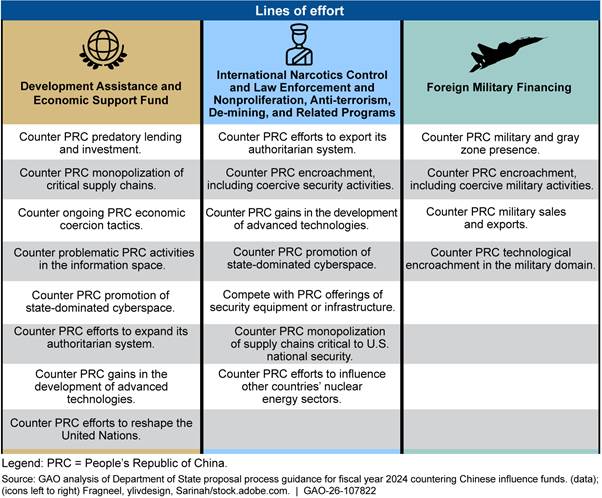
Note: Fiscal year 2024 proposal process guidance includes more detailed descriptions for each line of effort. The titles displayed in the graphic are a summary of the information included for each line of effort.
State and USAID have also directly allocated portions of funding for projects outside of the competitive proposal process in each fiscal year. For example, for fiscal year 2021 funds, State and USAID directly allocated all $155 million in combined DA and ESF funds to projects and used the proposal process to allocate the remaining $145 million in available CCIF funding, according to State officials. According to State officials, certain proposed projects required an expedited review and, as a result, fell outside the proposal process time frame. Despite this, the interagency working group evaluated them against the same criteria used in the proposal process, according to State officials. Since the fiscal year 2022 proposal process, the working group has increasingly decided which projects to fund through the proposal process rather than direct allocations, according to officials and agency data.
Working group decisions on which projects to fund have generally occurred in the fiscal year after the fiscal year Congress appropriated funds. For example, the working group made decisions on which projects to fund with fiscal year 2023 funding in the spring of fiscal year 2024. This time frame has applied to both funding allocated through the proposal process and funding directly allocated for projects.
Funding Uncertainty Due to Ongoing Foreign Assistance Review and State and USAID Realignment
Executive Order 14169, Reevaluating and Realigning United States Foreign Aid, issued January 20, 2025, mandated a 90-day pause in U.S. foreign assistance to assess programmatic efficiency and the consistency of ongoing assistance with U.S. foreign policy. In response, the interagency working group paused the competitive proposal process for fiscal year 2024 funds in January 2025, according to State officials. According to State officials, the working group resumed the proposal process on May 14, 2025, and asked regional and functional bureaus to submit a list of recommended projects for funding to the working group by May 23, 2025. The officials added that the working group continued to evaluate proposals against criteria that were included in the fiscal year 2024 proposal guidance as well as the new priorities of the ongoing Foreign Assistance Review.[21] State officials told us that State had made funding decisions for all fiscal year 2024 funds by September 12, 2025.[22]
Agency officials paused some State and USAID awards for previously funded CPRCIF projects to conduct an assessment of foreign assistance consistent with Executive Order 14169. As of March 2026, State officials identified some awards for CPRCIF projects for termination. However, the Office of Management and Budget had not communicated the results of its review of State’s assessment of foreign assistance, according to State officials. State officials added that the department was still in the process of realigning selected USAID functions within State and reorganizing State’s bureaus.
State and USAID Improved Decision-Making Process but Weaknesses Remain
State and USAID have taken steps to improve the countering PRC influence decision-making process each fiscal year, such as changing the membership of the interagency working group and updating the proposal process based on feedback from internal stakeholders and Congress. However, according to agency officials, State and USAID provided limited time for operating units to draft and submit proposals and subsequently obligate approved funding. In addition, the CPRCIF decision-making process has not consistently required units submitting proposals to obtain input from key participants, such as bureaus with regional and issue area expertise that could help improve the strength and feasibility of counter PRC influence proposals.
State and USAID Changed Working Group Membership and Guidance to Improve Decision-Making Process
According to State officials, State and USAID have changed the membership of the working group across fiscal years to improve coordination and information-sharing and ensure that projects align with U.S. foreign policy towards the PRC. State officials added that they made these changes in response to consultations with Congress and lessons learned from previous proposal processes. For example, State added the Office of China Coordination (colloquially “China House”) to the working group after its creation in December 2022.[23] For the fiscal year 2024 proposal process, the working group included designated representatives from State’s Office of Foreign Assistance (State/F)[24], State’s Bureau of East Asian and Pacific Affairs, Office of Regional and Security Policy (State/EAP/RSP), and China House.[25] State/EAP/RSP and China House were voting members that selected proposals for funding, and State/F served as a non-voting member that ensured proposals contained the required information and coordinated the overall proposal process, according to State officials. See Figure 2 for the changes in the membership of the working group.
Figure 2: Interagency Working Group Membership for the Countering Chinese Influence Proposal Process by Fiscal Year of Funding
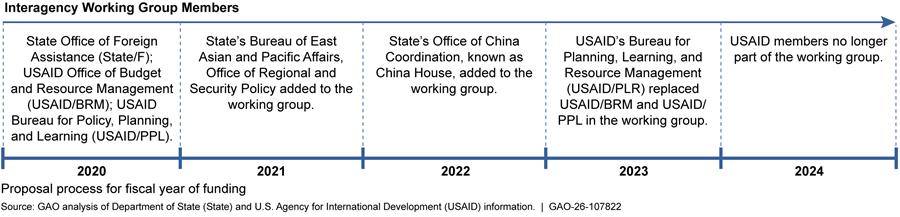
Note: According to State officials, each countering Chinese influence proposal process spans two fiscal years. For example, the proposal process for bureaus and posts requesting fiscal year 2024 funds began in November 2024 and ended in September 2025. The figure displays the changes to the membership of the interagency working group for the proposal process the working group used to make decisions on allocations for the fiscal year of funding shown. As of June 9, 2025, State officials confirmed USAID members were no longer part of the working group for the fiscal year 2024 proposal process.
State and USAID have also made changes to the proposal process guidance each fiscal year based on feedback collected from bureaus that participated in the prior proposal process and consultations with Congress, according to State and USAID officials. For example, they added requirements for bureaus to rank proposals prior to submission to the working group and introduced distinct review processes for proposals depending on the amount of funding requested.
Ranking Requirements. Bureaus submitting proposals for DA and ESF funds did not consistently rank proposals prior to submission to the working group because guidance for those funding accounts did not require them to do so.[26] In contrast, guidance for bureaus submitting proposals for INCLE, NADR, and FMF funds has consistently required bureaus to rank proposals for those funds prior to submission to the working group.[27] In response to bureau feedback, the working group added a requirement in the fiscal year 2024 proposal process for bureaus submitting proposals for DA and ESF funds to rank proposals prior to submission. Ten of 12 State non-security assistance bureaus noted the requirement was helpful because it allowed bureaus to indicate their priorities to the working group.[28] According to State officials, guidance for the fiscal year 2025 proposal process retained the requirement for bureaus to rank DA and ESF proposals prior to submission.
Streamlined Process Based on Funding Requested. In response to feedback from bureaus that the CPRCIF proposal process took too long to complete, the working group introduced distinct review processes for the fiscal year 2023 proposal process. The guidance outlined shorter review timelines and more concise proposal templates for proposals requesting less than $500,000 and longer review timelines and more detailed proposal templates for proposals requesting over $500,000.[29] However, State officials said the distinction was confusing for bureaus and posts to navigate and the working group removed the separate review processes from the guidance for the fiscal year 2024 proposal process.
See figure 3 for an overview of the most recent proposal process, which covered fiscal year 2024 funds.[30]
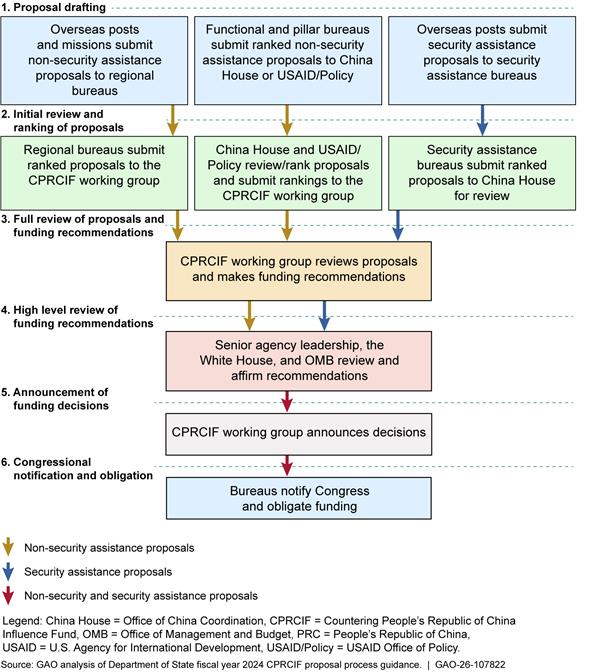
Note: USAID’s Office of Policy reviewed non-security assistance proposals submitted by USAID pillar bureaus in step two. China House conducted the initial review of both non-security assistance proposals submitted by State functional bureaus and security assistance proposals submitted by security assistance bureaus in step two. China House was also a member of the CPRCIF working group and reviewed all proposals in conjunction with other working group members in step three.
State and USAID Provided Limited Time to Prepare Proposals and Obligate Funds
State and USAID have provided limited time for bureaus and posts to draft and submit proposals and subsequently obligate funding for approved proposals with funds covering fiscal years 2020 to 2024, according to agency officials. For example, posts and bureaus had less than a month to draft proposals for most fiscal year 2024 funding.[31] As a result, State officials noted that units have submitted fewer proposals and struggled to obligate funds within the time available for obligation. In some cases, State reallocated funding away from approved proposals on short notice to avoid letting funding expire.
According to State officials, the proposal process officially begins when the working group releases annual guidance and ends with bureaus obligating funding for approved proposals by the end of the second fiscal year funds are available.[32] The funds for CPRCIF generally must be obligated by the end of the fiscal year (September 30) following the fiscal year in which the funds were appropriated. Figure 4 displays the countering Chinese influence proposal process time frames, including the guidance release date, proposal submission deadline, approval decision due date, and obligation deadlines across fiscal years.
Figure 4: Time Frames for the Countering Chinese Influence Proposal Process for Fiscal Year 2020-2024 Funds
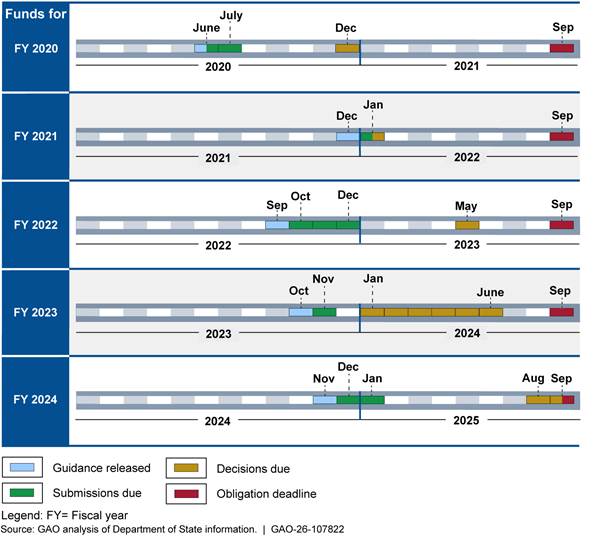
Notes: The figure does not cover all applicable time frames for the fiscal year 2020-2024 proposal processes. For example, for fiscal year 2021 funds, the interagency working group released partial guidance on September 21, 2021, but did not release complete guidance for non-security assistance until December 2021. The figure displays the date when the working group released all applicable guidance to posts and bureaus for the fiscal year 2021 proposal process. In addition, Foreign Military Financing (FMF) had distinct time frames for fiscal years 2020-2023 proposal processes than those contained in guidance for the use of funds drawn from the other appropriation accounts. Only FMF time frames for the fiscal year 2024 proposal process are included in the figure. Lastly, the submissions due time frames displayed for the fiscal year 2024 proposal process represent when posts and bureaus had to submit proposals to the relevant bureaus and offices for internal review and ranking prior to final submission to the working group.
Officials from State and USAID bureaus identified issues stemming from the short time frames, including challenges developing and submitting proposals, identifying implementing partners, and obligating funding on time.
Challenges Developing and Submitting Proposals
Officials from eight of 21 State and USAID regional and functional bureaus we interviewed noted they experienced challenges developing and submitting proposals because of the short time frames for the proposal process. For example, officials from State’s Bureau of Western Hemisphere Affairs stated that posts submitted fewer proposals for fiscal year 2024 funds than in previous proposal processes because the working group released guidance later than usual. Officials from USAID’s Bureau for the Middle East reported missions also submitted fewer proposals, because posts and missions only had about four weeks to draft proposals and coordinate reviews prior to submission.
Challenges Obligating Funding on Time
Officials from 15 of 21 State and USAID regional and functional bureaus we interviewed stated that the timing of the proposal process has limited their ability to identify implementing partners or obligate funding on time. In addition, State officials from three regional bureaus each identified one approved proposal for fiscal year 2023 funds that posts were not able to fully obligate before the deadline.[33] For example, a post in the Western Hemisphere submitted an ESF proposal in November 2023 requesting $500,000 to fund technical improvements to optical telescopes and prevent PRC espionage. According to State officials, the working group approved the proposal in May 2024, which did not leave sufficient time for the post to notify and obtain a response from the Congressional appropriations committees and implement the project. The post required funding to be made available sooner to implement the project, which would have necessitated beginning the proposal process earlier, according to State officials. Ultimately, State/F officials managed to reallocate the funding to a previously approved cybersecurity program implemented in another post in the Western Hemisphere by State’s Bureau of Cyberspace and Digital Policy to counter the PRC’s influence in that country.
State officials told us that they have not released the guidance earlier in the process because they have waited for the Congressional appropriations committees’ responses and internal reviews to be completed on the prior year’s funds before starting the subsequent year’s process. The working group also organized meetings with bureaus and posts to collect feedback on the past proposal process, known as after-action reviews, according to State officials. State officials told us the working group modified annual guidance based in part on feedback collected during after-action reviews. However, State could consider releasing preliminary guidance earlier and providing any updates that may be needed following both internal and Congressional reviews from the prior fiscal year process.
According to standards for internal control in the federal government, management should communicate quality information down and across reporting lines to enable personnel to understand and perform key roles in achieving objectives.[34] Management should also consider making information readily available to personnel when needed. Communicating annual proposal process guidance to bureaus and posts earlier could allow additional time for them to draft effective proposals and obligate funds on time and as intended. Without providing the annual guidance earlier in the proposal process, the agency risks overlooking opportunities to counter PRC influence. In addition, State risks that proposals the working group had selected out of hundreds of proposals for their strong counter PRC nexus may not be implemented due to time constraints. State may need to quickly identify alternative projects, which may result in CPRCIF resources funding projects that had not been identified as the highest priority during the proposal process.
Relevant Bureaus and Regional China Officers Were Not Consistently Involved in Reviewing Proposals
The interagency process for reviewing proposals has not consistently involved key stakeholders whose expertise and feedback could help assess the feasibility and strength of counter PRC influence proposals. Specifically, officials from relevant bureaus and PRC-focused policy experts known as Regional China Officers (RCO) did not always review and provide feedback on proposals prior to submission.[35] Without this input, units may submit proposals that duplicate existing efforts, do not align with strategic priorities, or cannot be implemented as proposed.
Relevant Bureaus
According to State officials, security assistance bureaus have generally coordinated proposals with the relevant bureaus prior to submission.[36] According to guidance across fiscal years, security bureaus review all proposals requesting security assistance funding prior to submission to the working group. In comparison, DA and ESF funds are not managed by a specific bureau. In addition, guidance for DA and ESF funding has recommended—but not required—that bureaus review all proposals in their region or issue area prior to submission to the working group.
Officials from six of the 16 State regional and functional bureaus we interviewed noted that without a requirement for coordination, they could not be certain that they were aware of and had reviewed all relevant proposals prior to submission.[37] For example, officials from State’s Bureau of Economic, Energy, and Business Affairs (State/EEB) stated that during the fiscal year 2023 proposal process, an official of the USAID mission in the Philippines submitted a proposal for a project intended to counter Chinese influence in the mining sector without coordinating with State/EEB officials as recommended.[38] State/EEB officials stated they reviewed the proposal after it was submitted to the working group and noted to working group officials that the proposal’s requested funding amount would not be sufficient. However, the working group ultimately approved the proposal and the amount of funding requested. Subsequently, the mission could not implement the proposed project activities as intended with the funding available and had to quickly change the scope of the project’s activities to obligate the funds, according to State officials.
Regional China Officers
State’s RCOs have not been required to review proposals. According to State officials, RCOs can assist in determining whether a proposal has a strong counter-China nexus, addresses the lines of effort, and avoids duplicating existing efforts. Guidance across fiscal years has noted posts and bureaus may consult with their RCO for additional support when drafting proposals, but does not require RCOs to review proposals.[39] For example, a RCO stationed in the Middle East noted they had not reviewed all security assistance proposals prior to submission to the working group. Working group officials explained that annual guidance has not required RCOs to review all proposals from their region to avoid the perception that RCOs have a role in approving or rejecting proposals, which could ultimately impede RCOs’ working relationships with posts. However, working group officials noted that RCOs already review most proposals from their respective regions and do not have a role in the CPRCIF decision-making process.
According to leading practices for interagency collaboration, if collaborative efforts do not consider the input of all key and relevant stakeholders, important opportunities for achieving outcomes may be missed.[40] Requiring regional and functional bureaus and RCOs to review relevant proposals and document their input prior to submission would better ensure proposals are designed to effectively counter Chinese influence. Input from bureaus with expertise in specific regions or issue areas as well as PRC-focused policy experts could serve as a valuable resource when adjudicating proposals. In addition, reviews by these stakeholders could minimize the likelihood of posts and bureaus submitting proposals that may duplicate existing efforts, are not in line with priorities, or cannot be implemented as proposed. Documented input from regional and functional bureaus and RCOs would help ensure that the working group is aware of all relevant input when reviewing proposals and making funding decisions.
State and USAID Do Not Have Readily Available and Reliable Data About Projects
State and USAID provided some data on the types of projects and funding allocation amounts that the agencies provided to counter Chinese influence from fiscal years 2020 to 2023. These data provide some information helpful for understanding how the agencies have used the funding, including allocation amounts for projects by fiscal year funding, appropriation account, and global region. However, the interagency working group has not collected and maintained readily available and reliable data[41] on all projects funded from approved proposals over this period. Without these data, working group officials lack critical information that could help them assess the status of projects, determine whether actual projects reflect what units proposed, and better ensure that limited funds are used effectively when deciding on future projects.
State and USAID Reported Funding an Estimated 470 Projects at $1.2 Billion Since 2020
For the projects with data available from State and USAID, our analysis showed the agencies funded about 470 projects countering Chinese influence, totaling approximately $1.2 billion in allocations from fiscal years 2020 to 2023.[42] The agencies funded these 470 projects from an estimated 430 approved proposals, out of an estimated 1,400 proposals submitted for fiscal years 2020 to 2023.[43]
State and USAID shared information on example projects with us, showing that the agencies have used CPRCIF funds to support a variety of assistance. For example:
· State’s Bureau of Energy Resources managed a project funded with approximately $1.3 million in fiscal year 2020 ESF allocations that supported efforts in three countries to identify markets and energy infrastructure where likely Chinese encroachment would be costly to U.S. and partner country interests. The project also supported efforts to mitigate the risk of this encroachment as well as respond to Chinese efforts to acquire new or existing critical electricity grid infrastructure in these countries.
· State’s Bureau of International Security and Nonproliferation managed a project funded with $600,000 in fiscal year 2022 NADR allocations aimed at increasing European academic institutions’ awareness of the risks of illicit technology transfer with Chinese military and defense-affiliated research entities. The project shared case studies of illicit technology transfers and provided best practices to academic institutions on how to secure sensitive research.
See appendix I for more information about the types of projects funded; estimated numbers of projects; and allocation amounts by fiscal year, appropriation account, and global region from fiscal years 2020 to 2023.
Interagency Working Group Has Not Consistently Collected and Maintained Project Data
The interagency working group does not have readily available and reliable data on projects funded from approved proposals since fiscal year 2020. In response to our request for data on all projects funded to counter Chinese influence, working group officials explained that they do not collect and maintain data on the projects funded from approved proposals. After asking numerous bureaus and posts to report and validate the data we requested, working group officials were unable to provide us complete data on projects funded for multiple fiscal years and appropriation accounts. Such data are important for tracking how the numerous units have used the funding to understand what has been obligated and for what purpose.
In November 2024, we requested data from interagency working group officials on State and USAID projects and the amounts that each agency had funded from CCIF and CPRCIF since fiscal year 2020 as of September 30, 2024.[44] At the same time, we also requested data on the proposals submitted for funding since fiscal year 2020 to determine key characteristics of these proposals and the projects resulting from each approved proposal.[45]
We requested key project data for multiple data fields to determine the status and key characteristics of funded projects.[46] This included information on the line of effort specifying the issue area the project addresses to counter Chinese influence, the project start and end dates to provide information about the implementation status, and funding obligations. We also requested information on the project name and award number to identify the specific projects funded from approved proposals, and the implementing agency unit that has managed the approved project.[47]
However, interagency working group officials were unable to provide timely and reliable data because they do not maintain the data. Based on our analysis of the project data working group officials provided, at least 58 State units and 55 USAID units took steps to report and validate data on their projects in response to our requests. It took the interagency working group more than five months to provide the requested data. Specifically, USAID did not provide its project data that we requested in November 2024 until April 2025, and State did not provide its project data and the proposal data we requested in November 2024 until May 2025.[48]
Project Data. After asking the bureaus and posts to report and validate the data, working group officials were still not able to provide reliable project data for multiple years and appropriation accounts. Although officials provided complete data on the offices or bureaus that managed the projects and the allocated funding amounts for all but one project, of the estimated total of about 470 projects since fiscal year 2020, officials could not provide data on award numbers for about one-fifth, start and end dates for about one-quarter, and obligations data for about one-third of projects. Table 3 shows the numbers of State and USAID estimated projects with incomplete data, by appropriation account for fiscal years 2020-2023.
Table 3: Estimated Numbers of State and USAID Projects for Fiscal Years 2020-2023 and Gaps in Key Data
|
Data field |
Development Assistance |
Economic Support Fund |
Nonproliferation, Anti-terrorism, De-mining and Related Programs |
International Narcotics Control and Law Enforcement |
Foreign Military Financing |
Totals |
|
Total estimated number of projects |
85 |
223 |
53 |
70 |
35 |
466 |
|
Number of projects with missing data by data field |
|
|||||
|
Award number |
- |
60 |
4 |
30 |
- |
94 |
|
Implementing partner |
- |
76 |
4 |
17 |
- |
97 |
|
Line of effort |
- |
38 |
- |
- |
- |
38 |
|
Start and end dates |
41 |
74 |
4 |
10 |
- |
129 |
|
Obligations |
57 |
94 |
4 |
- |
- |
155 |
Source: GAO analysis of Department of State and U.S. Agency for International Development (USAID) data. | GAO‑26‑107822
Notes: Data show total project numbers and gaps in key data for all estimated State and USAID projects that pertained to countering Chinese influence funded with fiscal years 2020 to 2023 funds by appropriations account. Data shown present the number of estimated projects with missing data of at least five percent of the total estimated number of projects by data field and each account.
In March 2026, officials of State’s Bureau of Counterterrorism provided information indicating that the missing fields for some of the projects funded from the Nonproliferation, Anti-terrorism, De-mining, and Related Programs appropriations account were likely due to duplicate entries in the project data.
State conducted an assessment of foreign assistance consistent with Executive Order 14169, Reevaluating and Realigning United States Foreign Aid (January 20, 2025) and identified some CPRCIF awards for termination. As of March 2026, the Office of Management and Budget had not communicated the results of its review of State’s assessment of foreign assistance, according to State officials.
Proposal Data. Working group officials were unable to provide complete data on the projects resulting from each approved proposal. Incomplete data limits officials’ understanding of whether the funding ultimately supports the activities described in approved proposals. Working group officials provided complete data on the estimated total of 430 proposals approved to fund the approximately 470 projects since fiscal year 2020, including the name of the proposal; the fiscal year it was submitted; and the bureau, office, or post that submitted it. However, working group officials lacked data on the specific projects funded from nearly one-third of the approved proposals. For example, working group officials were unable to provide any data on the names, award numbers, and implementing units for each of the projects resulting from these proposals. In addition, while the interagency working group provided some data on the projects that resulted from the remaining proposals, they were unable to provide all key data about these projects. For example, of the proposals for ESF funding for fiscal years 2020 to 2023, working group officials were unable to provide the names of the resulting projects and the implementing agency units for about one-third, and the award numbers for more than one-third. Without such data, working group officials cannot effectively track approved projects to inform future funding decisions and ensure the funding was used as intended.
The various sources and inconsistent methods employed, such as the different types of project documentation and databases available for reporting the data, contributed to the incomplete data and errors, according to officials. This was particularly the case for data on projects funded from the ESF and DA accounts.[49] After we followed up with bureau officials about potential errors we identified, officials from 11 State and USAID bureaus identified duplicate project and proposal data, missing project and proposal data, and data errors, including providing incorrect information about the bureau that managed the project, and incorrect allocations data. For example, these bureau officials identified 17 additional projects for which they had not previously provided data, and they identified 14 projects for which they provided duplicate data.
Standards for internal control in the federal government specify that management should obtain or generate relevant data from reliable sources in a timely manner based on information requirements.[50] Management needs this quality information to make informed decisions and address risks.
Without consistently collecting and periodically updating complete data on the projects funded from approved proposals, working group officials cannot effectively track how various units have used the funding to help inform their decision-making.[51] These officials need complete and timely data about what has been obligated and for what purpose to avoid duplicating existing efforts when deciding which investments the U.S. will make to respond to malign Chinese influence. Without these data, officials risk being unaware of past approved projects that would help them identify how to most effectively use limited funds when making decisions about future projects.
State and USAID Have Not Assessed Results Across the Portfolio of Projects and Early Assessment Efforts Are on Hold
Interagency Working Group Has Not Assessed Results Across the Portfolio of Projects Countering Chinese Influence
The interagency working group has not assessed the results of efforts to counter Chinese influence across the portfolio of projects funded with fiscal years 2020 to 2024 funds. The annual proposal guidance has required applicants to include a project-level monitoring and evaluation plan describing how the bureaus and posts would measure results of individual proposed projects. For example, the annual proposal guidance has asked applicants for an overview of the project-level monitoring, evaluation, and learning activities the bureau or post will use to assess progress, and a description of the project’s potential results. However, the guidance has not required bureaus or posts to use specific indicators nor planned evaluations that could be used for assessing results across all projects countering Chinese influence.
Officials told us that bureaus and posts do some monitoring and evaluation of these projects as required by agency policies. However, the performance data they have collected on individual projects do not specifically assess results to determine whether the projects are meeting the objectives of countering Chinese influence, according to officials. Further, State’s annual evaluation plans have not included any evaluations specifically related to CPRCIF or countering Chinese influence programming since fiscal year 2022, the earliest fiscal year for which annual evaluation plans are available.[52] This is because State was not planning to conduct any significant evaluations pertaining to counter Chinese programming in the following fiscal year.
State’s Foreign Affairs Manual (FAM) Volume 18 specifies the requirements for individual bureaus, offices, and overseas posts to monitor and evaluate units’ individual projects. However, the FAM does not include requirements for monitoring and evaluating agency-wide initiatives—such as countering PRC influence—across a portfolio of projects implemented by multiple units.
Working group officials lack evidence of the effectiveness of these projects because individual bureaus and posts are required to monitor and evaluate their individual projects and the performance data they collect do not focus specifically on countering Chinese influence. Interagency working group officials stated that they do not review information about the results generated from prior projects when making decisions about new proposals. These officials told us that they do not oversee the implementation of units’ project-level monitoring and evaluation plans or review the performance data because the units managing the project are responsible for implementing the plans. However, understanding which types of projects have been most effective in countering Chinese influence could help working group officials identify those proposals that present the greatest opportunities for countering Chinese influence when making future funding decisions.
Interagency Working Group Paused Its Development of a Framework to Assess Results Across the Portfolio of Projects
Since 2020, when the fund was created, the interagency working group has not developed a process for assessing the results of programming across the portfolio of projects. However, USAID and State began efforts to develop a monitoring, evaluation, and learning framework to do so in 2023. This effort was still in the early stages of development in early 2025, when it was paused in response to the January 2025 executive order requiring a review of foreign assistance. As of March 2026, officials said that State is uncertain about whether it would resume developing the framework.
The fiscal year 2021 proposal guidance indicated that the interagency working group was considering a monitoring and evaluation system that would inform future allocations and programming to counter Chinese influence. The interagency working group allocated funding to USAID’s Bureau for Planning, Learning, and Resource Management for the development of such a framework in fiscal year 2022, according to officials. These officials stated that, in September 2023, USAID obligated the funding for a contract to begin development of a monitoring, evaluation, and learning framework to assess the results of State and USAID projects in countering Chinese influence. A contracted short-term technical advisor within USAID supported the development of the framework’s components, including developing learning questions and plans, evaluation and research plans, and monitoring plans and indicators. In addition, as of September 2023, an interagency steering committee comprising State and USAID representatives was coordinating the development of the framework with the interagency working group, according to officials. These officials noted that the steering committee provided the working group with updates on the development of the framework and sought their feedback on the process.
Interagency working group officials acknowledged the need to develop the framework to more broadly track results among projects against lines of effort for countering Chinese influence. Officials stated that the purpose of the framework was to generate evidence beyond project-level monitoring and evaluation plans and to standardize how bureaus, offices, and posts measure the effectiveness of the portfolio of projects across lines of effort and global regions in countering Chinese influence. For example, a draft of the framework states that the monitoring and evaluation plan for each project countering Chinese influence would be required to include specific indicators. These indicators were to measure the extent to which the project is achieving the objective of each line of effort to which the project contributes and provide information about overall progress. The document noted that these measurements were intended to apply to all CPRCIF appropriation accounts to help inform strategic decision-making and future proposal decisions.
Officials planned to develop tools and resources to implement the framework, including a detailed indicator table and guidance for data collection and submission. From October 2023 to August 2024, the interagency steering committee held a series of three workshops with officials of State and USAID bureaus to discuss the development of the framework’s components and obtain input. As of February 2025, officials responsible for developing the framework had started gathering feedback from State and USAID regional and functional bureau officials on the draft framework and potential performance indicators. Figure 5 shows the timeline for officials’ efforts to develop the CPRCIF monitoring, evaluation, and learning framework as of March 2026.
Figure 5: Timeline for the Countering PRC Influence Fund Monitoring, Evaluation, and Learning Framework
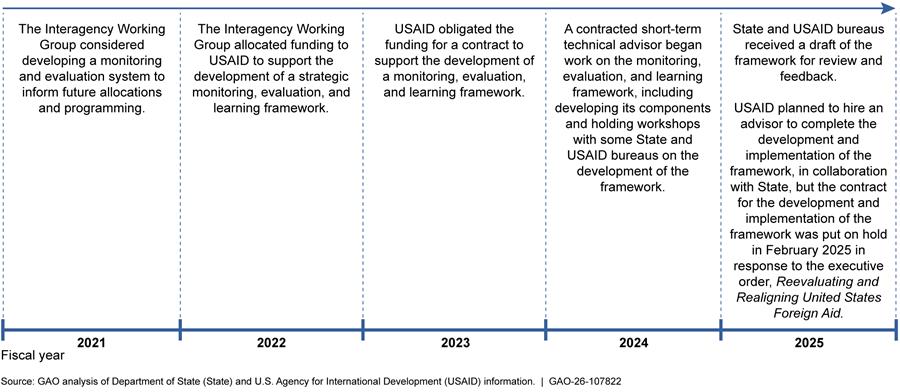
In February 2025, officials put the contract for the development of the framework on hold in response to Executive Order 14169, Reevaluating and Realigning United States Foreign Aid, according to officials. As of March 2026, State officials noted that they were assessing whether and how State could resume the framework’s development.
According to leading practices for evidence-based policymaking, building evidence involves a series of activities that can help decision makers obtain evidence they need to address policy questions or identify the questions they should address.[53] That evidence can help them assess, understand, and identify opportunities to improve results. Interagency working group officials have acknowledged the need to track the results of projects more broadly. However, without developing a process for assessing results across the portfolio of funded projects—whether using the framework they started or another process—working group officials and Congress lack evidence they need to determine whether the agencies’ use of the funds has been effective in countering Chinese influence. With this evidence, the working group could make better-informed decisions about the allocation of funds for future projects.
Conclusions
Countering China’s influence around the world is critical to ensuring U.S. economic and geopolitical standing across multiple fields, including international trade and critical supply chains, military presence and cybersecurity, and the development of advanced technology. State officials noted that CPRCIF is the U.S. government’s primary resource that specifically counters Chinese influence overseas. As a result, State needs a timely and thorough process for allocating CPRCIF funding that leverages the expertise of key bureau officials and Regional China Officers who are uniquely qualified to weigh in on potential projects and their likely outcomes. Furthermore, State must have complete and readily available data on projects funded from proposals, and a framework for assessing project results, to help ensure that funds go to projects that most effectively counter Chinese influence. By taking steps to better ensure that CPRCIF funding decisions are well-informed by agency expertise, reliable data, and evidence of results, agency officials and policy makers would have greater assurance that future investments of taxpayer dollars into CPRCIF are worthwhile.
Recommendations for Executive Action
We are making the following five recommendations to State:
The Secretary of State should ensure that the Office of China Coordination, in coordination with the Office of Foreign Assistance Oversight, releases the Countering PRC Influence Fund annual guidance earlier in the proposal process to provide agency units more time to develop proposals and subsequently obligate funds. (Recommendation 1)
The Secretary of State should ensure that the Office of China Coordination, in coordination with the Office of Foreign Assistance Oversight, updates the annual guidance for the proposal process for the Countering PRC Influence Fund to require regional and functional bureaus to obtain and document input from relevant regional and issue area experts on all proposals related to their respective regions or areas. (Recommendation 2)
The Secretary of State should ensure that the Office of China Coordination, in coordination with the Office of Foreign Assistance Oversight, updates the annual guidance for the proposal process for the Countering PRC Influence Fund to require Regional China Officers to review and document input on all proposals submitted by operating units within their region, including projects originating with or managed by functional bureaus. (Recommendation 3)
The Secretary of State should ensure that the Office of China Coordination, in coordination with the Office of Foreign Assistance Oversight, consistently collects and periodically updates complete data on projects funded from the Countering PRC Influence Fund at a sufficient level of detail, such as the award number; the bureau, office, or post that has managed the project; targeted region and country; start and end dates; obligated funding; and the line of effort the project has supported. (Recommendation 4)
The Secretary of State should ensure that the Office of China Coordination, in coordination with the Office of Foreign Assistance Oversight, develops a process for assessing the results of the portfolio of Countering PRC Influence Fund projects across lines of effort, appropriation accounts, and regions in countering Chinese influence. (Recommendation 5)
Agency Comments
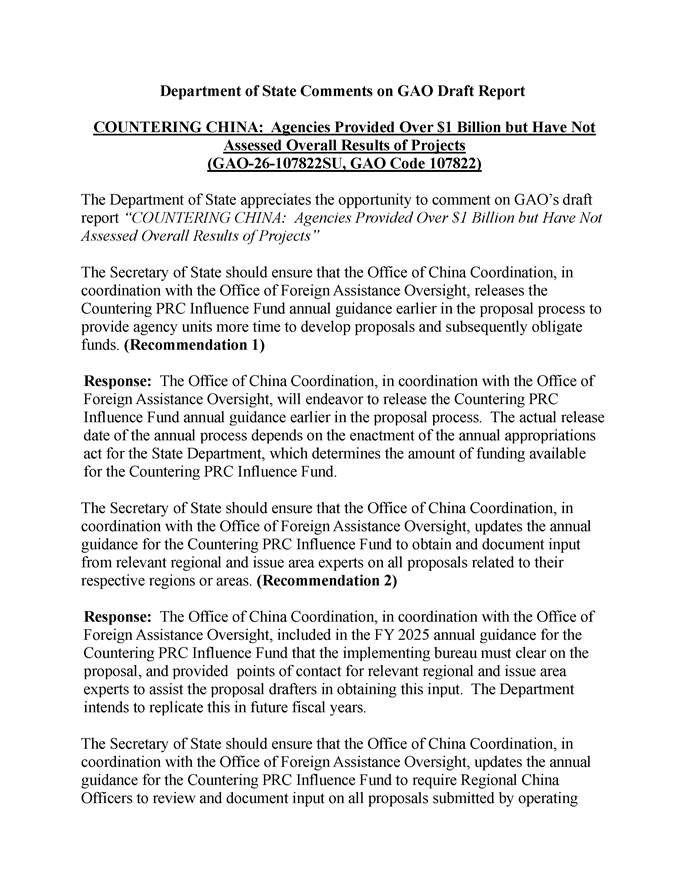
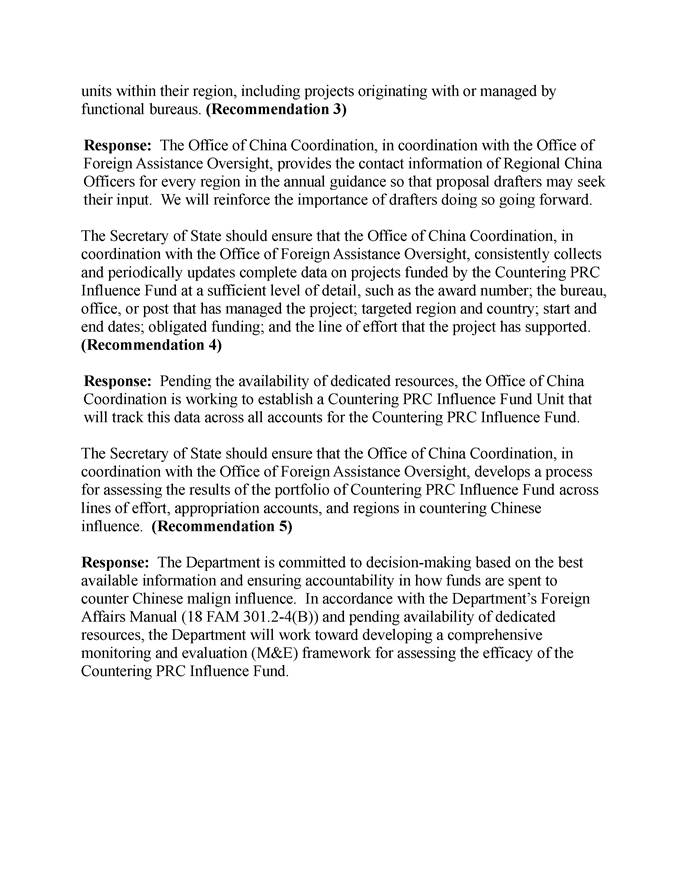
We provided a draft of this report to State for comment. In its comments, reproduced in appendix II, State concurred with our recommendations and provided additional information about its efforts to address them. For example, State noted that the fiscal year 2025 proposal guidance for CPRCIF required the implementing bureau to obtain approval on the proposal and provided points of contact for relevant regional and issue area experts to help obtain this input. State intends to replicate this requirement in future fiscal years, according to its comments. In addition, State noted that the Office of China Coordination is working to establish a Countering PRC Influence Fund Unit that will track data on projects across all accounts for CPRCIF, pending the availability of dedicated resources. We will monitor State’s efforts to determine if they address our recommendations.
We are sending copies of this report to the appropriate congressional committees, the Secretary of State, and other interested parties. In addition, the report is available at no charge on the GAO website at https://www.gao.gov.
If you or your staff have any questions about this report, please contact me at ElHodiriN@gao.gov. Contact points for our Offices of Congressional Relations and Media Relations may be found on the last
page of this report. GAO staff who made key contributions to this report are listed in appendix III.
Nagla’a El-Hodiri
Director, International Affairs and Trade
The Department of State and the U.S. Agency for International Development (USAID) funded an estimated 470 projects countering Chinese influence with an estimated total of $1.2 billion in allocations from fiscal years 2020 to 2023, according to our analysis of data the agencies provided.[54] State and USAID provided information for examples of projects countering Chinese influence showing that the agencies have used funds to provide various types of assistance. For example:
· State’s Bureau of Energy Resources managed a project funded with approximately $1.3 million in fiscal year 2020 Economic Support Fund (ESF) allocations that supported the development of a toolkit to assist officials in three countries identify markets and energy infrastructure projects where likely Chinese encroachment would be costly to U.S. and partner country interests. The toolkit intended to help these countries maintain sovereignty over their energy infrastructure by providing information to officials on how to rapidly mitigate the risk of this encroachment as well as counter Chinese efforts to deploy new or acquire existing critical electricity grid infrastructure.
· State’s Bureau of International Security and Nonproliferation managed a project funded with $600,000 in fiscal year 2022 allocations from the Nonproliferation, Anti-terrorism, De-mining and Related Programs appropriation account aimed at increasing European academic institutions’ awareness of the risks of illicit technology transfer with Chinese military and defense-affiliated research entities. The project focused on the transfer of potential dual-use and advanced technologies. It developed an expanded version of the China-Europe Academic Engagement Tracker, which characterizes research interactions between Central and Eastern European academic institutions and entities in China, to include additional European countries. The project shared the tracker as well as case studies of illicit technology transfers with academic institutions to highlight best practices on how to secure sensitive research.
· State’s Bureau of Western Hemisphere Affairs managed a project funded with $475,000 in fiscal year 2023 ESF allocations that supported training journalists in Taiwan-recognizing countries in Latin America. The training provided journalists with the skills to detect Chinese propaganda and disinformation and raise their awareness of China’s coercive practices.
· State’s Bureau of East Asian and Pacific Affairs managed a project funded with $2.3 million in fiscal year 2020 ESF allocations that sought to address China’s malicious cyber activity in countries of East and South Asia and the Pacific Islands. The project intended to promote open, interoperable, reliable, and secure internet usage in partner countries in East Asia and the Pacific region through establishing national cybersecurity strategies and policies, developing cyber-related legislation, and instituting cybersecurity standards, among other assistance.
· State’s Bureau of International Narcotics and Law Enforcement Affairs managed a project funded with $3.0 million in fiscal year 2023 allocations from the International Narcotics Control and Law Enforcement appropriation account to provide security screening technology to port security authorities in four countries to prevent China from gaining further access and control of port security operations in these countries. The project intended to provide security screening technology at airports, seaports, land ports, and rail operations and support necessary training and maintenance of the equipment.
· State’s Bureau of Political-Military Affairs, Office of Security Assistance managed a project funded with $3.0 million in fiscal year 2021 allocations from the Foreign Military Financing appropriation account that sought to improve a partner country’s intelligence capabilities to counter China’s malign activities. The project trained intelligence analysts, educated mid- and senior-level intelligence leaders, and influenced domestic cybersecurity policy in the partner country. These efforts intended to develop the intelligence community within the country and reinforce its relationship with the United States on security issues.
· USAID’s Bureau for Latin America and the Caribbean managed a project funded with $7.0 million in fiscal year 2021 allocations from the Development Assistance (DA) appropriation account to provide for a new infrastructure fund managed by the Inter-American Development Bank. The fund aimed to allow the bank to co-invest with the U.S. International Development Finance Corporation on infrastructure projects in partner countries to create alternatives to Chinese infrastructure investments in the Latin America region.
The data that State and USAID provided show that the agencies funded various numbers of projects and allocation amounts across fiscal years, appropriation accounts, and regions for fiscal years 2020 to 2023.
The data show that the agencies funded the largest estimated number of projects and allocation amounts from fiscal year 2023 funds. Table 4 shows the estimated numbers of State and USAID reported projects countering Chinese influence and allocations by fiscal year for fiscal years 2020 to 2023.
Table 4: Estimated Number of State and USAID Projects Countering Chinese Influence and Total Allocation Amounts by Fiscal Year, 2020-2023
|
Fiscal Year |
Number of projects |
Allocation amounts |
|
2020 |
130 |
$290 million |
|
2021 |
90 |
$260 million |
|
2022 |
90 |
$300 million |
|
2023 |
150 |
$320 million |
|
Total |
470 |
$1.2 billion |
Source: GAO analysis of Department of State and U.S. Agency for International Development (USAID) data. | GAO‑26‑107822
Notes: Sums of the number of projects and allocation amounts do not add to the totals because of rounding. State did not provide data on fiscal year allocations for one project, which is excluded from the totals.
State conducted an assessment of foreign assistance consistent with Executive Order 14169, Reevaluating and Realigning United States Foreign Aid (January 20, 2025) and identified some CPRCIF awards for termination. As of March 2026, the Office of Management and Budget had not communicated the results of its review of State’s assessment of foreign assistance, according to State officials.
The data show that the agencies funded the largest estimated number of projects and allocation amounts from the ESF account for fiscal years 2020 to 2023.[55] Table 5 shows the estimated number of State and USAID projects countering Chinese influence and allocations by appropriation account for fiscal years 2020 to 2023.
Table 5: Estimated Number of State and USAID Projects Countering Chinese Influence and Total Allocation Amounts by Appropriation Account, Fiscal Years 2020-2023
|
Appropriation accounts |
Number of projects |
Allocation amounts |
|
Economic Support Fund |
220 |
$380 million |
|
Development Assistance |
90 |
$320 million |
|
International Narcotics Control and Law Enforcement |
70 |
$250 million |
|
Nonproliferation, Anti-terrorism, De-mining, and Related Programs |
50 |
$70 million |
|
Foreign Military Financing |
40 |
$150 million |
|
Total |
470 |
$1.2 billion |
Source: GAO analysis of Department of State and U.S. Agency for International Development (USAID) data. | GAO‑26‑107822
Notes: Allocation amounts may not reflect total due to rounding.
State conducted an assessment of foreign assistance consistent with Executive Order 14169, Reevaluating and Realigning United States Foreign Aid (January 20, 2025) and identified some CPRCIF awards for termination. As of March 2026, the Office of Management and Budget had not communicated the results of its review of State’s assessment of foreign assistance, according to State officials.
The data show that the agencies funded projects in each of State’s six global regions. Overall, the agencies’ data show that they funded the largest estimated number of projects and allocation amounts in the East Asia and Pacific region (see fig. 6).
Figure 6: Estimated Number of State and USAID Projects Countering Chinese Influence, Fiscal Years 2020-2023
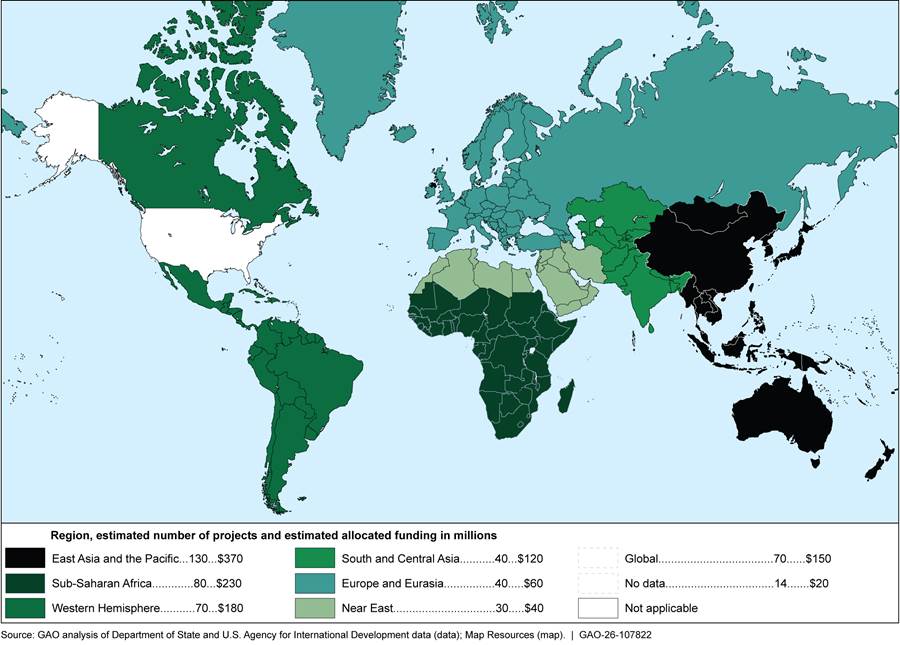
Note: State conducted an assessment of foreign assistance consistent with Executive Order 14169, Reevaluating and Realigning United States Foreign Aid (January 20, 2025) and identified some CPRCIF awards for termination. As of March 2026, the Office of Management and Budget had not communicated the results of its review of State’s assessment of foreign assistance, according to State officials.
GAO Contact
Nagla’a El-Hodiri, ElHodiriN@gao.gov
Staff Acknowledgments
In addition to the contact named above, Tatiana Winger (Acting Director), Lisa Helmer (Assistant Director), Bradley Hunt (Analyst-in-Charge), Larissa Barrett, Gergana Danailova, Neil Doherty, Mark Dowling, Bahareh Etemadian, Gabriel Nelson, Nicholas Pigeon Rossy, and Matteo Secomandi made key contributions to this report.
The Government Accountability Office, the audit, evaluation, and investigative arm of Congress, exists to support Congress in meeting its constitutional responsibilities and to help improve the performance and accountability of the federal government for the American people. GAO examines the use of public funds; evaluates federal programs and policies; and provides analyses, recommendations, and other assistance to help Congress make informed oversight, policy, and funding decisions. GAO’s commitment to good government is reflected in its core values of accountability, integrity, and reliability.
Obtaining Copies of GAO Reports and Testimony
The fastest and easiest way to obtain copies of GAO documents at no cost is through our website. Each weekday afternoon, GAO posts on its website newly released reports, testimony, and correspondence. You can also subscribe to GAO’s email updates to receive notification of newly posted products.
Order by Phone
The price of each GAO publication reflects GAO’s actual cost of production and distribution and depends on the number of pages in the publication and whether the publication is printed in color or black and white. Pricing and ordering information is posted on GAO’s website, https://www.gao.gov/ordering.htm.
Place orders by calling (202) 512-6000, toll free (866) 801-7077,
or
TDD (202) 512-2537.
Orders may be paid for using American Express, Discover Card, MasterCard, Visa, check, or money order. Call for additional information.
Connect with GAO
Connect with GAO on X,
LinkedIn, Instagram, and YouTube.
Subscribe to our Email Updates. Listen to our Podcasts.
Visit GAO on the web at https://www.gao.gov.
To Report Fraud, Waste, and Abuse in Federal Programs
Contact FraudNet:
Website: https://www.gao.gov/about/what-gao-does/fraudnet
Automated answering system: (800) 424-5454
Media Relations
Sarah Kaczmarek, Managing Director, Media@gao.gov
Congressional Relations
David A. Powner, Acting Managing Director, CongRel@gao.gov
General Inquiries
[1]U.S. – China Economic and Security Review Commission, 2025 Report to Congress, 119th Congress, 1st session, November 2025.
[2]China’s Belt and Road Initiative is the world’s largest infrastructure finance program. It has funded roads, ports, and other projects around the world and expanded China’s influence. Previous GAO work found that from 2013 to 2021, China provided $679 billion for infrastructure projects through the BRI in five key infrastructure sectors compared to $76 billion provided by the U.S. See GAO, International Infrastructure Projects: China’s Investments Significantly Outpace the U.S., and Experts Suggest Potential Improvements to the U.S. Approach, GAO‑24‑106866 (Washington, D.C.: Sep. 12, 2024).
[3]Kenton Thibaut, Atlantic Council, Effective U.S. Government Strategies to Address China’s Information Influence (Washington, D.C.: July 2024) HTTPS://WWW.ATLANTICCOUNCIL.ORG/IN-DEPTH-RESEARCH-REPORTS/ISSUE-BRIEF/EFFECTIVE-US-GOVERNMENT-STRATEGIES-TO-ADDRESS-CHINAS-INFORMATION-INFLUENCE/
[4]Pub. L. No. 116-94, 133 Stat. 2534, 2896 (Dec. 20, 2019).
[5]See Pub. L. No. 117-103, 136. Stat. 49, 646 (Mar.15, 2022). For the purposes of this report, we refer to all funding from CCIF and CPRCIF with the CPRCIF acronym. Congress made funding available for CCIF in 2020 and 2021. Beginning in 2022, Congress made funding available for CPRCIF, which continued the funding for countering Chinese influence that Congress had established with CCIF.
[6]The CCIF was established to counter the influence of the People’s Republic of China globally.
[7]The five accounts are Development Assistance; Economic Support Fund; International Narcotics Control and Law Enforcement; Nonproliferation, Anti-terrorism, De-mining, and Related Programs; and Foreign Military Financing.
[8]For the purposes of this report, we refer to projects funded from CPRCIF as projects countering Chinese influence. The fiscal year 2015, 2016, 2017, and 2018 State, Foreign Operations, and Related Programs Appropriations acts included language under the subheading “Counter Influence Programs” authorizing use of appropriations to counter Chinese influence in accordance with a strategy mandated by a provision within the fiscal year 2014 State, Foreign Operations, and Related Programs Appropriations Act.
[9]For this report, we reviewed documentary and testimonial evidence gathered from USAID officials between October 2024 and May 2025. Pursuant to Executive Order 14169, Reevaluating and Realigning U.S Foreign Aid (January 20, 2025), all U.S. foreign assistance programs were paused for 90 days while U.S. foreign assistance was assessed for programmatic efficiencies and consistency with United States foreign policy. Subsequent executive orders regarding workforce optimization and reductions of federal workforce resulted in significant reductions in staffing, operations, and programming of USAID.
[10]All years in this report are fiscal years unless otherwise specified.
[11]We interviewed officials from State’s Bureau of African Affairs, Bureau of European and Eurasian Affairs, Bureau of Western Hemisphere Affairs, Bureau of Near Eastern Affairs, Bureau of East Asian and Pacific Affairs, Bureau of South and Central Asian Affairs, and Bureau of International Organization Affairs. We also interviewed officials from State’s Bureau of Cyberspace and Digital Policy, Bureau of International Narcotics and Law Enforcement Affairs, Bureau of Political-Military Affairs, Bureau of Counterterrorism, Bureau of Arms Control and Nonproliferation, Bureau of Oceans and International Environmental and Scientific Affairs, and Bureau of Conflict Stabilization Operations. We met with officials from State’s Bureau of Energy Resources and Bureau of Economic and Business Affairs prior to State combining the two bureaus into the Bureau of Economic, Energy, and Business Affairs. We identified State’s Global Engagement Center and Bureau of Democracy, Human Rights, and Labor as having managed funding for countering Chinese influence, but due to the ongoing reorganization at State there were no staff available for us to meet with from either unit. From USAID, we interviewed officials from USAID’s Bureau for Asia, Bureau for the Middle East, Bureau for Latin America and the Caribbean, Bureau for Africa, and Bureau for Europe and Eurasia.
[12]We requested and received these data before State and USAID had completed the decision-making process for fiscal year 2024 funds. Because the interagency working group has made decisions about projects to fund the fiscal year after funds are appropriated, data on proposals and projects funded from fiscal year 2023 funds were the latest available at the time of our review. Additionally, the proposal process for allocating fiscal year 2024 funds was delayed due to the ongoing foreign assistance review in response to Executive Order 14169, Reevaluating and Realigning United States Foreign Aid (January 20, 2025). State officials did not inform us about the status of decisions on fiscal year 2024 funding for projects until March 2026. As a result, we excluded data on proposals and projects funded from fiscal year 2024 funds from our review.
[13]Because of USAID’s limited operating status and because of State’s reorganization and realignment, USAID regional and pillar bureaus and certain State bureaus, including the Bureau of African Affairs; the Bureau of Democracy, Human Rights, and Labor; and the Global Engagement Center could not provide information on data reliability.
[14]GAO, Evidence-based Policymaking: Practices to Help Manage and Assess the Results of Federal Efforts, GAO‑23‑105460 (Washington, D.C.: Jul. 12, 2023).
[15]Congress continued to make funding available for countering Chinese influence in fiscal years 2025 and 2026. The Full-Year Continuing Appropriations Act, 2025 made not less than $400 million available for CPRCIF from the same five appropriation accounts. Pub. L. No. 119-4, § 3, Div. A, title I, 139 Stat. 9, 12. The Consolidated Appropriations Act, 2026 made not less than $400 million available for CPRCIF from the FMF, INCLE, NADR, and National Security Investment Programs appropriation accounts. Pub. L. No. 119-75, Div. F, title VII, § 7043, 140 Stat. 173.
[16]State and USAID could both allocate and expend funds from the ESF appropriation account. USAID individually administers the DA account and State individually administers the INCLE and NADR accounts. State jointly administers the FMF account with the Department of Defense. Legislation appropriating funds for foreign assistance in fiscal years 2022 and 2023 specified that the use of countering Chinese influence funding be the joint responsibility of State and USAID.
[17]Foreign Military Financing is available for initial obligation for one year. However, Foreign Military Financing-Overseas Contingency Operations is available for initial obligation for two years, and the appropriations acts for fiscal years 2023 and 2024 specified that amounts allocated for countering Chinese influence from the FMF account are available for initial obligation for two years. FMF funds are deemed to be obligated upon apportionment.
[18]See Pub. L. No. 118-47, 138 Stat. 812 (Mar. 23, 2024) and House Appropriations Committee Print 55-008 at 1191 (Because an ‘‘amendments-between-the-Houses’’ process was used instead of a conference committee, there is no conference report and no ‘‘Joint Explanatory Statement of the Managers’’ associated with legislation that became Pub. L. No. 118-47).
[19]The transfer and merge authority for CCIF applied to all five accounts in fiscal years 2020 and 2021. For fiscal years 2022 – 2024, the authority for CPRCIF was limited to the INCLE, NADR and FMF accounts.
[20]State’s Bureau of International Narcotics and Law Enforcement Affairs and the Bureau of Political-Military Affairs have released supplemental guidance specific to proposals for INCLE and FMF funding, respectively, across fiscal years. The supplemental guidance includes specific decision-making criteria and review processes for proposals for projects countering Chinese influence funded from these accounts. Fiscal year 2024 guidance notes that the working group would recommend proposals for funding to State’s Office of Foreign Assistance and USAID’s Bureau for Planning, Learning, and Resource Management, which would conduct a high-level review of the funding recommendations.
[21]According to officials, the Foreign Assistance Review criteria included three questions to evaluate whether projects meet the Trump administration’s priorities: (1) Will it make America safer? (2) Will it make America stronger? (3) Will it make America more prosperous?
[22]Working group officials did not inform us about the status of decisions on fiscal year 2024 funding for projects until March 2026. Consequently, fiscal year 2024 funding decisions fall outside the scope of our review.
[23]The Office of China Coordination coordinates information-sharing and U.S. foreign policy towards the PRC across the Department of State. The Director and Deputy Director of China House’s Regional Program Office represented China House on the interagency working group.
[24]State’s Office of Foreign Assistance became the Office of Foreign Assistance Oversight on September 12, 2025.
[25]The interagency working group initially included USAID’s Office of Policy and Bureau for Planning, Learning, and Resource Management in the fiscal year 2024 proposal process; however, State officials confirmed that as of June 9, 2025, USAID members were no longer part of the working group.
[26]Fiscal year 2021 guidance required State and USAID regional and functional bureaus requesting DA/ESF funding to provide the interagency working group with one rank-ordered list of no more than two proposals. However, State and USAID bureaus could not always reach consensus on prioritization, and as a result, State/F made select decisions to permit additional submissions, according to State officials.
[27]State’s Bureau of Political-Military Affairs, Bureau of International Narcotics and Law Enforcement Affairs, Bureau of Counterterrorism, and Bureau of Arms Control and Nonproliferation reviewed and ranked proposals for FMF, INCLE, and NADR funds, respectively. State’s Bureau of Arms Control and Nonproliferation was formerly known as the Bureau of International Security and Nonproliferation until July 14, 2025.
[28]For the purposes of this report, we refer to DA and ESF funding as non-security assistance.
[29]Proposals requesting under $500,000 had to submit a concept paper and the working group announced approval decisions on January 30, 2024. Proposals requesting over $500,000 had to submit a full proposal and the working group announced approval decisions between early May and mid-June 2024. The different categories only applied to proposals requesting DA/ESF and INCLE/NADR funding.
[30]On November 21, 2024, the working group released fiscal year 2024 guidance that outlined the six-step proposal process for deciding on the use of fiscal year 2024 CPRCIF funding. In January 2025, the working group paused the fiscal year 2024 proposal process in response to the January 20, 2025, Executive Order Reevaluating and Realigning United States Foreign Aid. At that time, posts had submitted non-security assistance proposals to regional bureaus and security assistance proposals to security assistance bureaus for internal review and ranking. Between May 12 and May 14, 2025, the working group recommenced the proposal process and requested that bureaus submit ranked lists of proposals for adjudication by May 23, 2025. According to officials, State made decisions on fiscal year 2024 funding by September 12, 2025.
[31]Posts and bureaus requesting INCLE and NADR funding had around two months to draft and submit proposals.
[32]The interagency working group has generally released guidance in the fall of the first calendar year that funds have been made available and made funding decisions in the spring of the following calendar year. Funds taken from the ESF, DA, INCLE, and NADR accounts generally must be obligated by the end of the second fiscal year funds are available. FMF funds are generally available for initial obligation for one year, but Congress included a provision in acts appropriating funds for fiscal years 2023 and 2024 that specified amounts allocated for countering Chinese influence from the FMF account are available for initial obligation for two years. Additionally, interagency working group guidance for fiscal year 2021 funds stated that funds taken from the FMF account were to come from amounts designated for Overseas Contingency Operations/Global War on Terror and which were made available for two years.
[33]Officials from State’s Bureau of African Affairs and Bureau of European and Eurasian Affairs noted additional examples. According to State officials, a post in Africa suffered staff turnover and did not have sufficient time to coordinate a required feasibility study with an interagency partner prior to the obligation deadline, and State/F transferred funds to other priorities. A post in Europe identified cost-savings just prior to the obligation deadline, and State officials noted the proposal process did not provide sufficient time to reallocate unspent funds prior to the obligation deadline. As of March 17, 2026, the funds remained in State’s budgetary system.
[34]GAO, Standards for Internal Control in the Federal Government, GAO‑25‑107721 (Washington, D.C.: May 2025). 2 Foreign Affairs Manual 020 on Management Controls states that GAO internal controls standards apply to all of State’s management control systems, as required by the Federal Managers’ Financial Integrity Act.
[35]State created the RCO position in 2019. RCOs are State foreign service officers with experience working on China-related issues. There are 20 RCOs stationed in each of State’s six global regions. RCOs observe PRC actions and assist State officials at posts within their regions to understand the latest U.S. policies available to counter PRC influence. RCOs are not members of the interagency working group and, according to State officials, do not have a formal role in the CPRCIF decision-making process.
[36]“Security assistance bureaus” refers to State’s Bureau of Political-Military Affairs, Bureau of International Narcotics and Law Enforcement Affairs, Bureau of Counterterrorism, and Bureau of Arms Control and Nonproliferation.
[37]Officials of State’s regional bureaus have expertise in U.S. foreign policy for a specific geographic region. For example, the Bureau of African Affairs is responsible for the development and management of U.S. policy on the African continent. Officials of State’s functional bureaus have expertise in a specific issue area. For example, the Bureau of Cyberspace and Digital Policy leads the U.S. government’s efforts to shape technology policy, regulation, and standards internationally.
[38]We originally met with officials from the State’s Bureau of Energy and Natural Resources (State/ENR). On September 8, 2025, officials notified us that State/ENR became part of the new State Bureau of Economic, Energy, and Business Affairs.
[39]Annual guidance since fiscal year 2022 has recommended proposal drafters reach out to RCOs as a resource.
[40]GAO, Government Performance Management: Leading Practices to Enhance Interagency Collaboration and Address Crosscutting Challenges, GAO‑23‑105520 (Washington, D.C.: May 24, 2023).
[41]Reliable data means that data are sufficiently complete and accurate. Completeness of data refers to the extent to which relevant data records and fields are present and sufficiently populated. Accuracy refers to the extent that recorded data reflect the actual underlying information. See GAO, Assessing Data Reliability, GAO‑20‑283G (Washington, D.C.: December 2019).
[42]State conducted an assessment of foreign assistance consistent with Executive Order 14169, Reevaluating and Realigning United States Foreign Aid (January 20, 2025) and identified some CPRCIF awards for termination. As of March 2026, the Office of Management and Budget had not communicated the results of its review of State’s assessment of foreign assistance, according to State officials.
[43]An approved proposal may fund multiple projects.
[44]We requested data on the projects funded from fiscal years 2020 to 2024 funds. Because the interagency working group has made decisions about projects to fund the fiscal year after funds are appropriated, data on projects funded with fiscal year 2023 funds were the latest available as of September 30, 2024. Working group officials did not inform us about the status of decisions on fiscal year 2024 funding for projects until March 2026. Consequently, fiscal year 2024 funding decisions fall outside the scope of our review.
[45]For each proposal submitted for CCIF or CPRCIF funding for fiscal years 2020 to 2024, we requested data on the fiscal year of the proposal’s submission; proposal title; submitting agency unit; amount of funding requested; the appropriation account identified for the requested funding amount; and the name, award number, and implementing agency unit for the project funded from each approved proposal.
[46]For each project that had received CCIF or CPRCIF funding as of September 30, 2024, we requested data across multiple fields, including the agency unit that managed the award for the project, award number, project name, project description, implementing partner, line of effort, region or country of focus, project start and end dates, and amounts of funding allocated and obligated, in total, and in each fiscal year by appropriation account.
[47]An approved proposal may result in multiple awards for funded projects and the agency unit submitting the proposal may differ from the unit managing the resulting project. State’s Bureau of Political-Military Affairs provided case identifiers for FMF-funded projects rather than award numbers because the bureau uses case identifiers for FMF-funded cases implemented by the Department of Defense through the Foreign Military Sales system.
[48]During the period we requested the data, executive orders regarding workforce optimization and reductions of federal workforce resulted in significant reductions in staffing, operations, and programming of USAID. See Executive Order 14210, Implementing the President’s “Department of Government Efficiency” Workforce Optimization Initiative (February 11, 2025); Executive Order 14217, Commencing the Reduction of the Federal Bureaucracy (February 19, 2025); and Executive Order 14238, Continuing the Reduction of the Federal Bureaucracy (March 14, 2025).
[49]The Consolidated Appropriations Act, 2026, established a new National Security Investment Programs appropriation account that replaced the ESF, DA, and other prior appropriations accounts. See Consolidated Appropriations Act, 2026, Pub. L. No. 119-75, Div. F, 140 Stat. 526 (Feb. 3, 2026).
[50]See GAO‑25‑107721.
[51]We have previously reported that State has not tracked key program data, leading to challenges in providing readily available and accurate data on the status of programming. See GAO, Ukraine: Status of Foreign Assistance, GAO‑24‑106884 (Washington, D.C.: Mar. 28, 2024). We have also previously reported on the importance of State’s use of data to inform decision-making on priorities and allocating resources to achieve intended goals. See GAO, Cyber Diplomacy: State Should Use Data and Evidence to Justify Its Proposal for a New Bureau of Cyberspace Security and Emerging Technologies, GAO‑21‑266R (Washington, D.C.: Jan. 28, 2021).
[52]A provision of law commonly referred to as the “Evidence Act” requires agencies to develop an annual evaluation plan that outlines significant evaluations they plan to undertake in the fiscal year following the year in which it is submitted. Foundations for Evidence-Based Policymaking Act of 2018, Pub. L. No. 115-435, 132 Stat. 5529 (Jan. 14, 2019).
[54]Because the interagency working group has made decisions about projects to fund the fiscal year after funds are appropriated, data on projects funded with fiscal year 2023 funds were the latest available as of September 30, 2024. In addition, State conducted an assessment of foreign assistance consistent with Executive Order 14169, Reevaluating and Realigning United States Foreign Aid (January 20, 2025) and identified some CPRCIF awards for termination. As of March 2026, the Office of Management and Budget had not communicated the results of its review of State’s assessment of foreign assistance, according to State officials.
[55]The Consolidated Appropriations Act, 2026, established a new National Security Investment Programs appropriation account that replaced the ESF, DA, and other prior appropriation accounts. Consolidated Appropriations Act, 2026, Pub. L. No. 119-75, Div. F, 140 Stat. 526 (Feb. 3, 2026). Both State and USAID allocated and obligated funds from the ESF appropriation account, while USAID individually allocated and obligated funds from the DA appropriation account.