
Report to Congressional Committees
United States Government Accountability Office
A report to congressional committees
Contact: Courtney LaFountain at lafountainc@gao.gov
What GAO Found
Federal support for economic development is fragmented. GAO identified 140 federal economic development programs administered by 13 agencies. GAO surveyed these programs, 131 of which reported total obligations of about $60 billion in fiscal year 2024.
Further, these programs overlap. To assess overlap, GAO reviewed four selected Economic Development Administration (EDA) programs and 29 selected economic development programs administered by other federal agencies. All 29 programs overlapped with at least one of the EDA programs in at least one of three aspects—activities, beneficiaries, or purpose. Further, 20 programs overlapped with at least one of the EDA programs in all three aspects.
Selected EDA and Other Federal Economic Development Programs with Overlap in Activities, Beneficiaries, and Purpose, as of May 2026
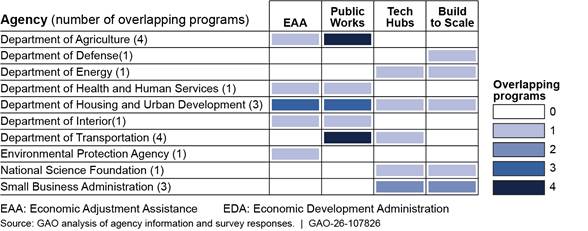
Note: Using survey responses from federal officials, GAO compared the four selected EDA programs with 29 selected federal economic development grant programs to determine whether they reported funding one or more of the same activities, serving similar beneficiaries, or having similar purposes.
Overlap can create both benefits and challenges. For example, communities can use similar programs in different phases of projects but may find it difficult to navigate requirements across multiple agencies. Agencies can share expertise in overlapping programs but may find it challenging to avoid duplicative funding.
EDA’s actions to manage the effects of overlap between programs have been limited. Of the 29 programs noted above, five reported collaborating with EDA in fiscal year 2024, the last full year at the time the survey was developed. In addition, EDA asks applicants to report funding from other federal agencies, but it does not verify the accuracy of this information prior to awarding funding.
The Public Works and Economic Development Act of 1965, as amended, requires EDA to coordinate with other federal agencies carrying out economic development activities. EDA officials said their current approaches meet this requirement. But most of EDA’s efforts to collaborate with other agencies are inactive and EDA does not have plans to resume them. Coordinating with other agencies on programs that overlap with EDA programs would help EDA limit the risk of duplicating efforts and avoid wasting resources. Further, incorporating GAO’s leading practices for interagency collaboration would help EDA better leverage the benefits of overlap, such as shared resources and information, with other agencies.
Why GAO Did This Study
The federal government supports economic development grant programs to help regional and local communities improve job opportunities and promote economic growth. EDA is the only federal agency focused solely on economic development. The Senate Appropriations Committee report accompanying the Departments of Commerce and Justice, Science, and Related Agencies Appropriations Bill, 2024, includes a provision for GAO to evaluate potential overlap and duplication among EDA grants and other federal grant programs.
This report examines (1) fragmentation of federal economic development programs across agencies and overlap in activities and beneficiaries; (2) overlap and duplication among selected EDA grant programs and other selected federal grant programs; and (3) EDA actions to manage the effects of overlap among selected grant programs.
GAO identified federal economic development programs using assistance listing data from SAM.gov. GAO reviewed the four EDA programs that received the most funding in fiscal years 2023 and 2024 and selected and surveyed 30 other programs with similar purposes to the EDA programs. Among the 29 programs that responded, GAO evaluated overlap and duplication with the four EDA programs. GAO also interviewed organizations representing grantees and economic developers and officials from EDA and eight other agencies.
What GAO Recommends
GAO recommends that EDA resume and improve its interagency collaboration efforts to manage the risks and leverage the benefits of overlap with other federal economic development programs. EDA agreed with GAO’s recommendation.
|
Abbreviations |
|
|
|
|
|
|
|
CDBG |
Community Development Block Grant |
|
|
EDA |
Economic Development Administration |
|
|
HUD |
Department of Housing and Urban Development |
|
|
SAM.gov |
System for Award Management website |
|
|
SBA |
Small Business Administration |
|
|
USDA |
Department of Agriculture |
|
This is a work of the U.S. government and is not subject to copyright protection in the United States. The published product may be reproduced and distributed in its entirety without further permission from GAO. However, because this work may contain copyrighted images or other material, permission from the copyright holder may be necessary if you wish to reproduce this material separately.
September 17, 2026
The Honorable Jerry Moran
Chair
The Honorable Chris Van Hollen
Ranking Member
Subcommittee on Commerce, Justice, Science, and Related Agencies
Committee on Appropriations
United States Senate
The Honorable Hal Rogers
Chairman
The Honorable Grace Meng
Ranking Member
Subcommittee on Commerce, Justice, Science, and Related Agencies
Committee on Appropriations
House of Representatives
The federal government supports regional and local communities through economic development programs that seek to improve job opportunities and promote economic growth. In fiscal year 2024, the federal government obligated about $60 billion towards economic development.[1] Although multiple agencies administer these programs, the Department of Commerce’s Economic Development Administration (EDA) is the only federal agency solely focused on economic development.[2] EDA provides grants to state, local, and tribal governments, among other entities, to promote a strong and growing economy throughout the United States that is competitive in global markets. Congress reauthorized EDA through fiscal year 2029 and subsequentially appropriated $466 million for programs and expenses for fiscal year 2026.[3]
To help improve government efficiency and effectiveness, we regularly report on federal programs with potentially duplicative, overlapping, and fragmented efforts, including economic development programs.[4] For example, in 2011, we found that 80 federal economic development programs appeared to overlap with at least one other program. In 2021, we recommended that EDA identify opportunities to collaborate with other agencies on federal fragmented efforts and monitor progress toward achieving outcomes of relevant interagency agreements.[5]
The Senate Appropriations Committee report accompanying the Departments of Commerce and Justice, Science, and Related Agencies Appropriations Bill, 2024, includes a provision for us to review the potential overlap and duplication of EDA grant programs with other agencies’ economic development programs.[6] This report examines (1) fragmentation of federal economic development programs across agencies and overlap in activities and beneficiaries; (2) overlap and duplication among selected EDA grant programs and other selected federal grant programs; and (3) EDA actions to manage the effects of overlap among selected EDA and other selected federal grant programs.
For the first objective, we developed an inventory of active federal economic development grant programs and surveyed the agencies that administer them.[7] To develop the inventory, we identified non-loan programs with economic development goals from federal assistance listings on the System for Award Management website (SAM.gov) using the most recent data available at the time of our June 2025 search.[8] We identified 167 programs across 13 agencies. After verifying our initial program list with agencies, we determined that 28 of the 167 programs did not meet our inclusion criteria and removed them from our review. Agency officials also split one program into two entries, resulting in a final inventory of 140 programs. We surveyed these agencies to verify program activities and beneficiaries and assess overlap for the 140 programs. All 13 agencies responded to our survey for at least one of their programs, providing information for 128 of the 140 programs.[9]
For the second objective, we selected from our inventory the four EDA programs that received the most funding in fiscal years 2023 and 2024, as well as 30 programs from 10 other agencies that had purposes similar to at least one of the four EDA programs, according to SAM.gov. The four EDA programs were: (1) Economic Adjustment Assistance; (2) Public Works; (3) Build to Scale, formerly known as the Regional Innovation Strategies Program; and (4) Regional Technology and Innovation Hubs (Tech Hubs). We refer to the 30 programs as “focused” programs. Our survey included additional questions for EDA and the 10 agencies on the extent and effects of overlap between the four EDA programs and the 30 focused programs. We received responses from all 10 agencies for 29 of the 30 programs.[10]
To determine the extent to which EDA has taken actions to manage the effects of overlap and duplication, we interviewed EDA and other agency officials about EDA actions to coordinate among overlapping programs.[11] We also reviewed relevant documentation, including EDA’s grant management guidance and its memorandums of understanding with other federal agencies. In addition, we analyzed survey responses from the 10 agencies administering the 29 focused programs about their collaboration efforts.[12]
For all objectives, we interviewed representatives of eight economic development organizations on the extent of duplication, overlap, and fragmentation among federal economic development grants; benefits and challenges for those applying to these programs; and collaboration across federal agencies.[13] See appendix I for more details on our methodology.
We conducted this performance audit from September 2024 to September 2026 in accordance with generally accepted government auditing standards. Those standards require that we plan and perform the audit to obtain sufficient, appropriate evidence to provide a reasonable basis for our findings and conclusions based on our audit objectives. We believe that the evidence obtained provides a reasonable basis for our findings and conclusions based on our audit objectives.
Background
Federal economic development programs support a wide range of efforts and have evolved to reflect shifting priorities. Federal investments in economic development programs initially focused on expanding infrastructure, access to public services, and industrial development. Since then, Congress has authorized additional, flexible programs that support a wider array of strategies, including technological innovation and entrepreneurship.
Federal economic development programs generally provide financial assistance to eligible entities, such as grants to state and local governments. Grant recipients receive payment in cash or in kind for a specified purpose and must use award funds for allowable purposes or risk collection of unallowable costs by the federal government. Grant programs may support narrowly or broadly defined purposes. For example, block grants allow state and local governments to spend funds on broad functional areas, such as health care, education, or community development. Federal agencies may allocate economic development grants using competitive or formula-based methods and may require recipients to contribute matching funds.
Economic Development Administration
The Public Works and Economic Development Act of 1965 established EDA to support economically distressed areas by providing financial assistance to help regions establish stable, diversified local economies and improve local conditions.[14] Since then, Congress authorized EDA to administer programs in broader areas, such as entrepreneurship, innovation, and disaster recovery. The Economic Development Reauthorization Act of 2024 expanded the types of economic development activities applicable to EDA programs, including project predevelopment, capacity building, outdoor recreation, and sustainable use of marine and coastal resources. It also created new program authorities and expanded the scope of several existing programs.
EDA supports regional economic development through competitive grant programs. Its four programs that received the most appropriations in fiscal year 2024 represented 68 percent of EDA’s funding.[15] These programs are:
· Economic Adjustment Assistance. The Economic Adjustment Assistance program provides grants for a wide range of construction and non-construction activities including workforce training, design and engineering, and technical assistance in regions experiencing long-term economic distress and sudden and severe economic dislocation. EDA administers the Assistance to Coal Communities and Assistance to Nuclear Closure Communities initiatives through this program.[16] Project areas must meet one or more economic distress criteria.
· Public Works. The Public Works program aims to help distressed communities revitalize, expand, and upgrade their physical infrastructure to attract new industries, encourage business expansion, diversify local economies, and generate or retain long-term private sector jobs and investments. Public Works covers infrastructure developments such as technology-based facilities, water and sewer system improvements, brownfield redevelopment, and telecommunications facilities.[17] Similar to Economic Adjustment Assistance, project areas must meet one or more economic distress criteria.[18]
· Tech Hubs. The Tech Hubs program aims to support technology development, job creation, and the expansion of U.S. innovation capacity. The program also aims to address national security and economic competitiveness challenges and close commercialization gaps in technology, markets, capital, regulations, or workforce. EDA awards grants to eligible consortia, which must include regional partners such as institutions of higher education, state or local governments, and industry groups.[19]
· Build to Scale. Build to Scale funds efforts to facilitate innovation and entrepreneurship by building public and private capacity to invent and improve products and services and bring them to market, sometimes through early-stage or start-up companies. Projects include implementing regional strategies that support entrepreneurship, technology development, commercialization, and increased access to capital for technology- and innovation-based industries.[20] Such industries could include biomedicine, agricultural technology, and advanced manufacturing.
EDA represented about 1 percent of Commerce’s $24.9 billion in economic development obligations in fiscal year 2024, according to survey responses (see fig. 1).[21] By comparison, the Broadband Equity, Access, and Deployment Program accounted for about 98 percent of such obligations.[22] The National Telecommunications and Information Administration manages this program, which supports the deployment of high-speed broadband in all states and territories.[23] Other Commerce components, including the National Institute of Standards and Technology, also administer programs that support economic development.
Figure 1: Department of Commerce Federal Economic Development Programs by Share of Total Fiscal Year (FY) 2024 Obligations
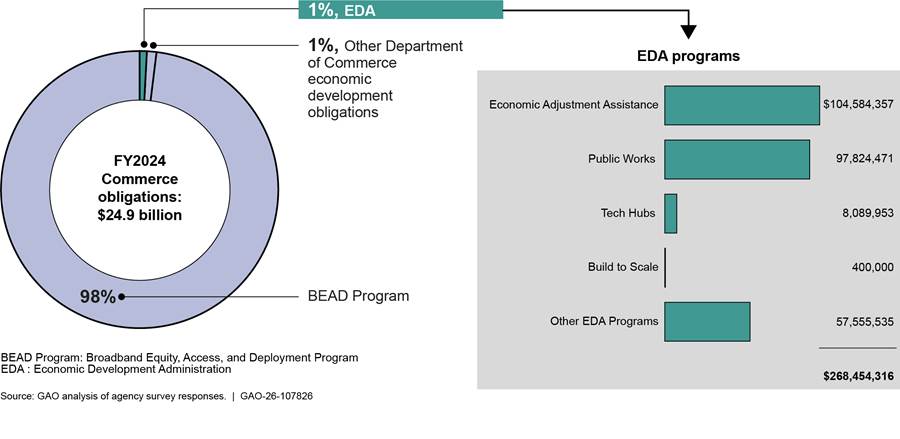
Note: Commerce officials provided program obligations in our survey. We did not independently verify the information that agencies provided in the survey or conduct a legal analysis to confirm the program information (such as award types or spending authorizations).
Other Federal Economic Development Programs
Other federal agencies, such as the Departments of Housing and Urban Development (HUD), Transportation, and Agriculture (USDA), also administer grant programs to support economic development (see fig. 2).
Figure 2: Federal Economic Development Obligations by Agency, Fiscal Year (FY) 2024 Obligations, Excluding Department of Commerce
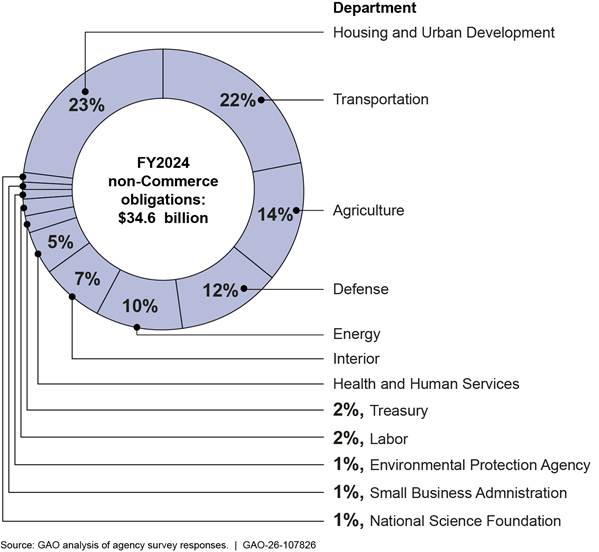
Note: Agency officials provided obligations in our survey or via email. We did not independently verify the information that agencies provided in the survey or conduct a legal analysis to confirm the program information (such as award types or spending authorizations).
· HUD. Outside of Commerce, HUD had the largest share of economic development obligations in fiscal year 2024. HUD’s Office of Community Planning and Development seeks to develop viable communities by promoting integrated approaches that provide housing and expand opportunities for people with low- and moderate-incomes. The office administers HUD’s Community Development Block Grant (CDBG) program, which provides annual formula grants to states, cities, and counties. Grantees can use funds for rehabilitating residential and nonresidential buildings, constructing public facilities (such as water and sewer systems), and supporting businesses in carrying out job creation and retention activities.
· Department of Transportation. The department oversees most federal, interstate transportation programs, including the national highway systems, air travel, and public transit, and administers grant programs to improve transportation systems and other critical infrastructure that support economic growth. The department’s State of Good Repair program, provides funding for projects to maintain, replace, or rehabilitate public transportation systems and ensure that public transit operates safely and efficiently so communities can improve mobility and encourage economic development.
· USDA. The Rural Development Policy Act of 1980 designated USDA as the lead federal agency for rural development. USDA Rural Development offers loans, grants, and loan guarantees that aim to create jobs, support economic development, and improve services such as health care and infrastructure in rural areas. For example, USDA’s Water & Waste Disposal Program provides funding for clean and reliable drinking water systems, sanitary sewage disposal, sanitary solid waste disposal, and storm water drainage in eligible rural areas.
Duplication, Overlap, and Fragmentation
Implementing programs across multiple agencies can lead to duplication, overlap, or fragmentation, which are defined in figure 3. As we have previously reported, addressing duplication, overlap, and fragmentation among federal programs and activities could save the government billions of dollars.[24]
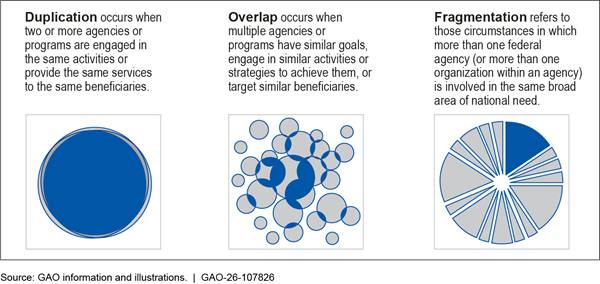
Duplication, overlap, and fragmentation are related. For example, fragmentation exists when multiple agencies are involved in the same area, and a subset of their programs could overlap or be duplicative depending on how similar the programs are.
Duplication, overlap, and fragmentation can have positive and negative effects. In some cases, it may be appropriate or beneficial for multiple agencies or entities to be involved in the same programmatic or policy area due to the complex nature or magnitude of the federal effort.[25] For example, we have found that duplication, overlap, and fragmentation can help beneficiaries fill gaps and meet needs by providing more specialized services relevant to an agency’s expertise.[26] However, we have also found that duplication, overlap, and fragmentation can be costly when entities dedicate staff time and other resources to separately manage similar programs. Duplication, overlap, and fragmentation can also lead to inconsistent information on program effectiveness, increased costs or inefficient use of resources, access barriers for users, and increased fraud risks.[27]
Economic Development Programs Are Fragmented Across 13 Agencies and Their Activities and Beneficiaries Overlap
Federal support for economic development is fragmented. We found 140 federal economic development programs administered by 13 agencies.[28] In addition, the activities these programs fund and the beneficiaries they serve overlap. As noted above, programs overlap when two or more agencies or programs are engaged in similar activities or serve similar beneficiaries. See appendix II for our full inventory of 140 economic development programs.
Most economic development programs we surveyed funded similar, overlapping activities (see fig. 4). Of the nine types of economic development activities, the most commonly reported activities were workforce development strategies, innovation and entrepreneurial activities, and business incubators. Most programs reported funding more than one activity; 37 programs reported funding a single activity type. In addition to these nine activity types, 63 programs reported funding other activities, including technical assistance and revolving loan funds.
Figure 4: Overlap in Economic Development Activities Across Key Federal Grant Programs, as Reported by Agency, as of May 2026
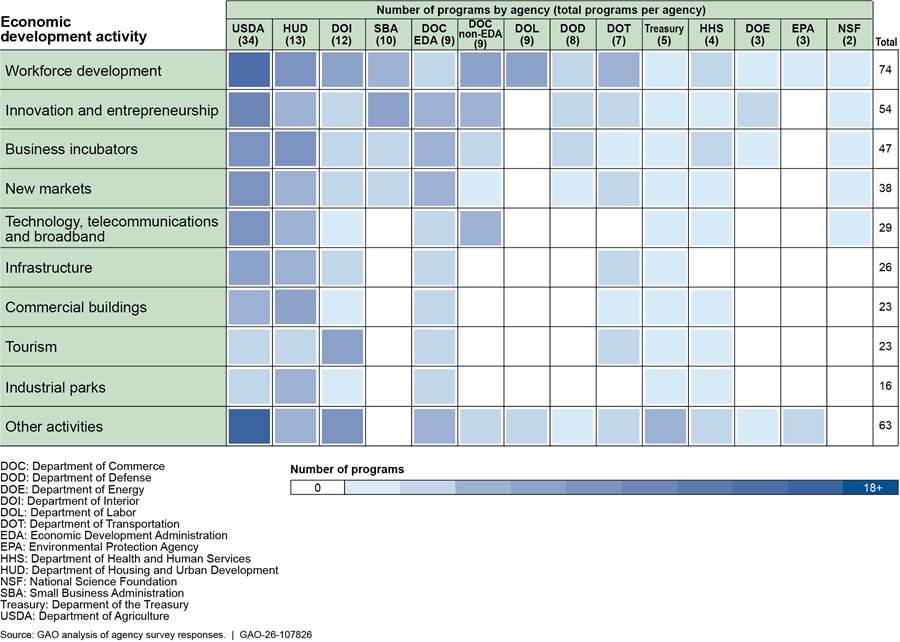
Notes: We used information from the System for Award Management website (SAM.gov) to define and identify programs by assistance listing number and confirmed information with survey responses. We used survey responses from 128 federal economic development programs administered by 13 agencies. Programs could report more than one type of activity. Programs that reported “other” activity types were asked to provide a narrative description of these activities and these descriptions included technical assistance and revolving loan funds, among other activities. Seven programs completed the survey but did not respond to the question on economic development activities. Information in SAM.gov may vary by agency and may represent more than one program as defined by the agency. We did not determine whether the scope of each listing was correct or similar to other agencies. See appendix I for more information on the survey.
Federal economic development programs are intended to serve seven beneficiary types, which also indicates that programs overlap (see fig. 5).[29] Intended beneficiaries may reflect geographic or economic conditions (e.g., rural or primarily low- and moderate-income communities) or individual or business characteristics (e.g., Native Americans or small businesses). Surveyed officials were asked to identify all intended beneficiaries of their programs, and the most commonly reported beneficiaries were rural communities and small businesses. Most programs reported more than one beneficiary type; 54 programs reported serving only one. In addition to these seven beneficiary types, 70 programs also reported serving other beneficiary types, including specific geographic areas; entities (e.g., rural utilities, military installations, and higher education institutions); or individuals.[30]
Figure 5: Overlap in Intended Beneficiaries Across Key Federal Economic Development Grant Programs, as Reported by Agency, as of May 2026
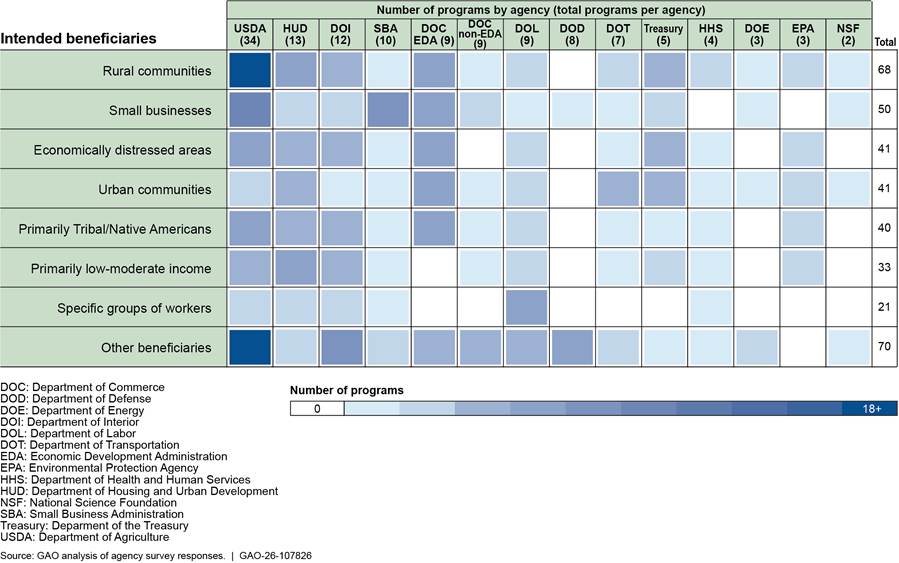
Note: We used information from the System for Award Management website (SAM.gov) to define and identify programs by assistance listing numbers and confirmed information with survey responses. We used survey responses from 128 federal economic development programs administered by 13 agencies. Programs could report more than one type of beneficiary. Programs that reported “other” beneficiary types were asked to provide a narrative description of these beneficiaries and these descriptions included specific geographic areas, entities (e.g., rural utilities, military installations, and higher education institutions), or individuals, among other beneficiaries. Information in SAM.gov may vary by agency and may represent more than one program as defined by the agency. We did not determine whether the scope of each listing was correct or similar to other agencies. See appendix I for more information on the survey.
Overlap among Selected Economic Development Programs Could Result in Inefficiencies
Selected EDA Programs Overlap with Other Federal Programs in Activities, Beneficiaries, and Purpose
Overlap exists between the selected EDA and federal economic development programs in three aspects—activities, beneficiaries, and purpose. Of the 29 focused programs that responded to our survey, 20 overlapped with at least one of the four selected EDA programs in all three aspects.[31] The remaining nine overlapped with at least one of the four selected EDA programs in one or two aspects.
Overlap across multiple aspects can increase the risk of unnecessary duplication of effort and inefficient use of resources by federal agencies and potential grantees. For example, potential grantees may prepare and submit grant applications to multiple programs to fund a project, staff at multiple federal agencies may spend time reviewing grant applications for the same project, or multiple programs may award grants for the same project improperly. Figure 6 depicts the extent to which other agencies’ federal economic development programs overlap with EDA’s four selected programs in zero, one, two, or all three aspects.
Figure 6: Number of Aspects of Overlap between Selected EDA Programs and Other Federal Economic Development Programs, by Agency, as of May 2026
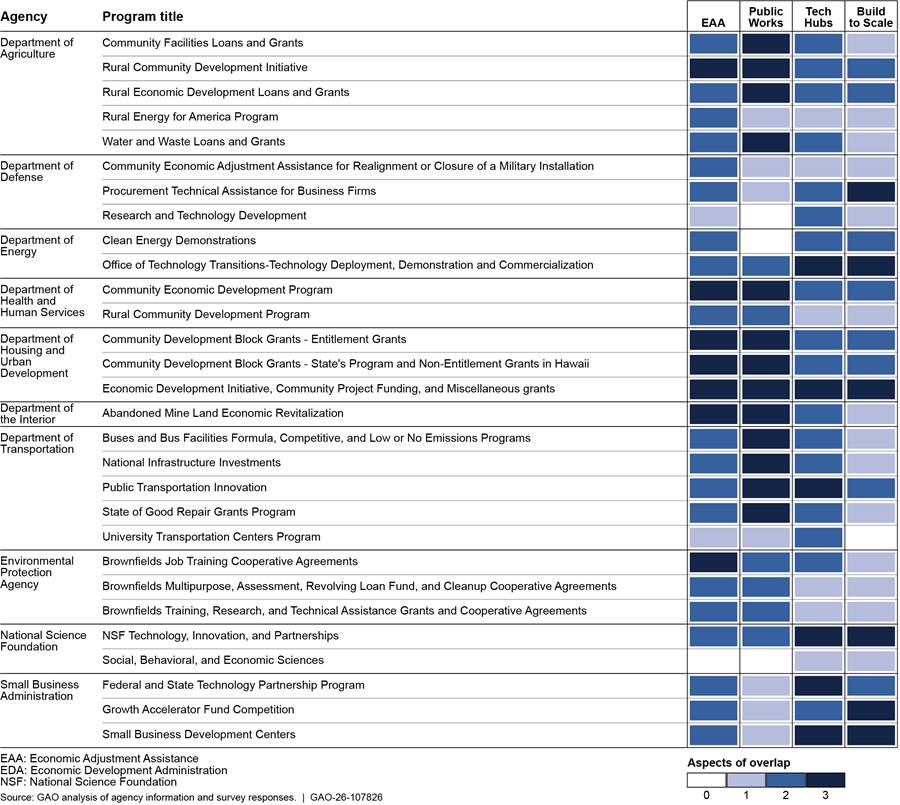
Note: Aspects of overlap include activities, beneficiaries, and purpose. Using survey responses from federal officials, we compared the extent of overlap between the four selected EDA programs and 29 focused federal economic development grant programs across three aspects: activities, beneficiaries, and purpose. Programs could report more than one type of activity and beneficiary. We used information from the System for Award Management website (SAM.gov) to define and identify programs by assistance listing numbers. Information in SAM.gov may vary by agency and may represent more than one program as defined by the agency. We did not determine whether the scope of each listing was correct or similar to other agencies. See appendix I for more information on the survey.
Programs that overlap in all three aspects may pose a greater risk to federal agencies and potential grantees of duplicating efforts or using resources inefficiently than programs that do not overlap or overlap in only one or two of the aspects.
However, substantial program overlap does not necessarily result in program duplication. For example, EDA’s Build to Scale program and SBA’s Growth Accelerator Fund Competition can overlap in all three aspects. Both programs are intended to benefit businesses through innovation and entrepreneurial activities to ultimately foster entrepreneurial ecosystems.[32] However, these two programs are not duplicative because EDA’s Build to Scale targets economically distressed areas but can still benefit businesses of all sizes, whereas SBA’s Growth Accelerator Fund Competition targets small businesses (or entrepreneur support organizations that provide resources to small businesses). Further, while the two programs have awarded funds to the same recipients in some instances, the awards were not duplicative because they supported different projects.
Overlap and Fragmentation Result in Benefits and Challenges to Communities and Federal Agencies
According to officials from EDA and representatives from the economic development organizations we interviewed, overlap and fragmentation across economic development grant programs can result in both benefits and challenges for communities and federal agencies.
Effects on Communities
Communities can benefit when overlapping or fragmented economic development programs complement one another, according to officials. Examples of the four selected EDA programs complementing other programs include the following:
· Economic Adjustment Assistance. This program can be used with other federal programs to support projects at different phases and help communities meet grant requirements. For example, EDA supports economic development projects at locations where abandoned mines were reclaimed with Department of the Interior funding or where brownfield sites were decontaminated with Environmental Protection Agency funding.[33] In addition, this program and HUD’s CDBG program can be used in tandem to fulfill grant requirements. Communities may use CDBG funding to satisfy matching requirements for eligible activities funded by EDA’s Economic Adjustment Assistance program because activities undertaken as part of Economic Adjustment Assistance fulfill eligible CDBG activities. Further, according to joint guidance from EDA and HUD, the strategic planning requirements for these programs align, enabling communities to streamline their planning processes.[34]
· Public Works. This program can be used with other federal programs to support different parts of community infrastructure projects. For example, Public Works and USDA funding can both support community water and sewer projects. USDA funding can support components needed to meet health and safety standards, while EDA funding can support related infrastructure and job creation.
· Tech Hubs. This program and the National Science Foundation’s Regional Innovation Engines program may be used for similar technologies and regions, but they focus on different levels of technology readiness. Tech Hubs supports the scaling of more mature technology through investments in the regional development of innovation-driven industries, whereas the Regional Innovation Engines program supports earlier stages of research and development.
· Build to Scale. This program can be used with other federal programs, such as SBA’s Growth Accelerator Fund Competition, to support different stages of technology development.
However, EDA officials and representatives from economic development organizations also told us that fragmented and overlapping economic development programs can pose challenges to communities, including the following:
· Identifying and applying for grants. Fragmentation and overlap can make it difficult for potential grantees to identify and apply for the programs that best meet their needs, according to six of the eight economic development organizations we interviewed. For example, International Business Innovation Association representatives said applicants may waste resources applying for grants that are a poor fit. In addition, representatives from two organizations said communication with multiple agencies can be duplicative.
· Managing multiple grant requirements. Tracking and reporting on multiple projects funded by different programs can be an administrative burden, according to five of the eight economic development organizations we interviewed. For example, National Rural Economic Developers Association representatives said managing requirements of multiple grant programs is burdensome because requirements vary by program and may be interpreted differently by officials within and across agencies. The representatives also said that the varying requirements and interpretations increase administrative complexity and uncertainty for applicants—particularly for rural communities who may have limited capacity and resources. In addition, the National League of Cities noted that a single project may be funded by multiple agencies with different requirements and reporting portals, which can be challenging for small and medium-sized cities to manage.
Effects on Federal Agencies
We found that, in some cases, agencies have leveraged resources and expertise from overlapping federal programs to better administer their own programs. For example, because certain EDA grants are available to both large and small businesses, SBA officials said they have collaborated with EDA on ways to better support small business applicants and grantees for those grant programs. In addition, EDA officials told us they have leveraged the expertise of officials administering and overseeing overlapping programs to screen applications related to new technologies. EDA officials also provided technical assistance to another agency implementing a new technological investment program similar to Build to Scale and Tech Hubs.
Agencies also partner on projects and initiatives. For example, EDA partnered with the Department of Energy to administer a onetime, targeted Build to Scale competition, known as “The Industry Challenge,” to fund projects focused on the sustainable use of marine and coastal resources for economic development.
However, multiple programs with overlapping and fragmented efforts can make it challenging for agencies to efficiently manage their programs. Examples include the following:
· Tracking awards. SBA officials noted the difficulty of tracking the recipients of SBA’s Growth Accelerator Fund Competition and EDA’s Build to Scale and Tech Hubs programs, limiting their ability to identify proposed or ongoing work funded by EDA. Further, EDA awards Tech Hubs funding to consortia with multiple partners, increasing the complexity of identifying funded organizations.
· Inefficient use of resources. EDA officials reported having approved funding for an applicant that had already received funding from the Department of Transportation for the same project. EDA officials said they did not learn of the duplicative funding until the applicant turned down EDA’s grant. EDA officials noted that they had already reviewed the feasibility of the project, including completing an engineering review. EDA officials stated that such situations waste agency resources that could instead be used to support other potential grantees.
EDA Has Taken Limited Steps to Manage the Effects of Overlapping Programs
EDA manages the effects of overlapping programs through the grant application process and some collaboration with other agencies. According to EDA’s grants manual, EDA requires applicants to identify and document funding from other federal sources and EDA can use that information to determine whether the applicant would be receiving duplicate funding.[35] EDA officials noted that they have declined to fund certain projects because the projects would be better suited to another federal agency’s program, such as HUD’s CDBG program.[36] However, EDA officials said they do not have a mechanism to verify the accuracy of applicant information prior to awarding a grant and rely on grantees to report receiving duplicative funding from two different agencies.
EDA has also taken some steps to collaborate with other agencies that administer overlapping programs. Current efforts include memorandums of understanding with the National Science Foundation, the Department of Energy, and Department of Defense related to collaboration on Tech Hubs and other regional innovation programs. EDA has also formed communities of practice for grantees and economic development organizations to share best practices.
However, most of EDA’s collaboration efforts are inactive and EDA does not have plans to reengage in them. In the past, EDA established local and regional information-sharing events on federal economic development resources. For example, EDA partnered with the Rural Partners Network in April 2023 to host an integration event for federal funders in western Kentucky.[37] However, EDA officials stated that some of these events are paused while others are used primarily for coordinating multiagency efforts to help communities with economic recovery from natural disasters.[38] The April 2023 event is the most recent event unrelated to disaster recovery.[39]
In addition, EDA had collaborated with other agencies to issue joint guidance to reduce administrative burden on grantees. For example, EDA partnered with HUD in December 2017 to develop reference materials to help communities efficiently meet requirements of both agencies. In April 2022, USDA, in collaboration with EDA and 15 other federal agencies, created a joint resource guide to help rural communities access complementary programs across agencies. However, as of July 2026, these resources are no longer available on EDA’s website.
According to EDA officials, EDA’s Economic Development Integration business practices guide its efforts to collaborate with other agencies and manage the effects of duplication, overlap, and fragmentation.[40] EDA established the practices in 2016 to collaborate with other agencies across economic development activities. Officials told us that while the collaboration tools established by the Economic Development Integration practices, such as joint guidance and information-sharing events, can be applied to a broad range of economic development activities, EDA has used them primarily for disaster recovery since 2018. EDA officials stated that they began focusing their work on disaster recovery due to a growing demand for EDA resources to support disaster recovery. In addition, they noted that ongoing staffing constraints have limited their ability to continue these efforts in other areas.
As previously noted, agency officials and representatives from the economic development organizations reported challenges associated with overlap that could be addressed through improved collaboration. For example, SBA officials said that sharing awardee lists in a searchable format would allow SBA’s Growth Accelerator Fund Competition and EDA’s Build to Scale programs to identify common grantees and share knowledge on grantee performance and ongoing work. However, only five of the focused programs reported collaboration with EDA in fiscal year 2024, the last full year at the time the survey was developed.[41] Of the 20 that we found substantially overlapping with one or more of the four selected EDA programs, three reported collaborating with EDA.
EDA’s authorizing statute, as amended, requires the agency to coordinate activities related to preparing and implementing comprehensive economic development strategies with other federal agencies carrying out other federal programs, states, economic development districts, Indian Tribes, and other appropriate planning and development organizations.[42] In addition, the Public Works and Economic Development Act of 1965, as amended, states that federal agencies, including EDA, should have a clear focus, improved coordination, a comprehensive approach, and simplified and consistent requirements to avoid duplication of economic development activities at all levels.[43] EDA officials said that their current approaches met these principles. However, as noted above, most of EDA’s efforts to collaborate with other agencies are inactive and EDA does not have plans to reengage in them.
Further, we have previously identified leading practices for interagency collaboration that can help agencies mitigate the negative effects of fragmented and overlapping programs.[44] These practices include ensuring accountability, clarifying roles and responsibilities, and leveraging resources and information. For example, we have previously reported that agencies can reinforce accountability and minimize duplicative efforts by tracking progress toward shared goals.[45] Clearly defining and agreeing on roles and responsibilities can help agencies organize their joint or individual efforts. Further, leveraging resources such as tools to share relevant data may help agencies avoid duplicate funding awards. We have also reported that collaboration is key to ensuring the efficient use of limited resources to address issues that cut across more than one agency.[46]
While EDA has more recently focused on disaster assistance coordination, its other economic development activities also warrant attention, given the 20 instances of significant overlap we identified. Our analysis could help EDA identify and prioritize collaboration with federal programs that also support economic development. Without resuming and improving these efforts with other federal programs, EDA could miss opportunities to identify and address risks of duplicative efforts and could avoid wasting resources. It could also miss opportunities to enhance the benefits of complementary programs for communities and to leverage expertise and resources across federal programs. To do so, EDA could leverage its own Economic Development Integration business practices and our leading practices for interagency collaboration.
Conclusions
Although EDA is the only agency solely focused on economic development, many other federal agencies also support the economic development of regional and local communities. EDA’s programs overlap with other federal programs in activities, beneficiaries, and purpose, increasing the risk of duplicative efforts and inefficient use of resources. While overlap can be beneficial in some cases, EDA’s efforts to collaborate with other agencies across economic development activities have been limited and inconsistent in recent years. By resuming and improving these efforts, EDA could focus use of its collaboration tools where there are increased risks or better opportunities for sharing agency expertise and meeting communities’ needs. Incorporating leading practices for interagency collaboration would strengthen EDA’s ability to collaborate with other agencies and manage the benefits and risks of significant overlap.
Recommendation for Executive Action
The Secretary of Commerce should ensure that EDA resumes and improves its interagency collaboration efforts to manage the risks and leverage the benefits of overlap with other federal economic development programs, and these efforts should include incorporating leading practices to enhance interagency collaboration. (Recommendation 1)
Agency Comments
We provided a draft of this report to the Departments of Commerce, Energy, Health and Human Services, and the Interior, as well as HUD, SBA, USDA, Environmental Protection Agency, and National Science Foundation for review and comment. We also provided relevant sections of the draft of this report for technical comments to the Departments of Defense, Labor, Transportation, and the Treasury.
The following agencies provided technical comments, which we incorporated as appropriate: EDA, SBA, USDA, Energy, and Health and Human Services. HUD, Interior, the Environmental Protection Agency, and the National Science Foundation informed us that they did not have comments.
EDA provided comments via email and agreed with our recommendation to resume and improve its interagency collaboration efforts to manage the effects of overlap with other federal economic development programs and incorporate leading practices in interagency collaboration. EDA said the agency will target formal arrangements with those agencies with the highest likelihood of overlap with EDA. As we discuss in the report, interagency collaboration also includes informal efforts, such as interagency task teams or meetings that bring together representatives of different agencies to exchange information.
We are sending copies of this report to the appropriate congressional committees, Secretary of Commerce, Secretary of Agriculture, Secretary of Defense, Secretary of Energy, Secretary of Health and Human Services, Secretary of Housing and Urban Development, Secretary of the Interior, Acting Secretary of Labor, Secretary of Transportation, Secretary of Treasury, Acting Director of the National Science Foundation, Administrator of the Environmental Protection Agency, and Administrator of the Small Business Administration. In addition, the report is available at no charge on the GAO website at https://www.gao.gov.
If you or your staff have any questions about this report, please contact me at lafountainc@gao.gov. Contact points for our Offices of Congressional Relations and Media Relations may be found on the last page of this report. GAO staff who made key contributions to this report are listed in appendix III.
Courtney LaFountain
Director, Financial Markets and Community Investment
This report examines (1) fragmentation of federal economic development programs across agencies and overlap in activities and beneficiaries; (2) overlap and duplication among selected Economic Development Administration (EDA) grant programs and other selected federal grant programs; and (3) EDA actions to manage the effects of overlap among selected EDA grant programs and other selected federal grant programs.
Economic Development Program Inventory
To examine fragmentation across agencies and overlap in activities and beneficiaries, we developed an inventory of active federal economic development programs.[47] We identified non-loan programs with economic development goals from federal assistance listings on the System for Award Management website (SAM.gov), using the most recent data available at the time of our search in June 2025.[48] Absent a common definition for economic development, we relied on a list of nine activities most often associated with economic development that we had previously developed.[49] To ensure the list was current, we shared it with EDA, which did not suggest any activities should be added or removed from the list. In our inventory, we included domestic federal grant programs that included at least one of the following activities:
· planning and implementing workforce development strategies, including strategies for job creation and retention;
· constructing and renovating commercial buildings;
· establishing business incubators (i.e., facilities to help small businesses get started);
· constructing industrial parks;
· developing infrastructure by constructing and repairing roads, water and sewer systems, transportation nodes (including ports, rail, and airports), and other critical infrastructure;
· planning and implementing innovation and entrepreneurship activities, including related infrastructure, business development, and commercialization of new technologies;
· promoting the development of new markets for existing products;
· developing telecommunications and broadband infrastructure and enabling technology transfer; and
· developing and improving areas for tourism.
We excluded programs that were related to COVID-19 or funded through other emergency appropriations, such as the American Rescue Plan Act of 2021; related to disaster recovery; administered by regional commissions, which are federally chartered intergovernmental bodies that serve specific regions and integrate federal and state economic development priorities alongside regional and local considerations. We excluded COVID-19 and other emergency programs to focus on programs that are more permanent. We excluded the other types of programs because they were the subject of ongoing or recent GAO work.[50]
We assessed the reliability of the SAM.gov data by reviewing technical documentation and our previous reports that used those data, performing electronic testing for obvious errors in accuracy and completeness, and consulted with GAO staff with relevant subject matter expertise.[51] We also reviewed survey responses from the Department of the Interior, Environmental Protection Agency, and the National Science Foundation to confirm the accuracy of information included in our initial list of programs. We cleaned the data using data analysis software to address the accuracy and completeness of errors we identified. We determined that the data were sufficiently reliable for creating our initial list of 167 programs.
We then developed and sent a web-based survey to the 13 federal agencies that administer the 167 programs. These agencies were (1) Department of Commerce; (2) Department of Defense; (3) Department of Energy; (4) Department of Health and Human Services; (5) Department of Housing and Urban Development (HUD); (6) Department of Labor; (7) Department of the Interior; (8) Department of Transportation; (9) Department of the Treasury; (10) Environmental Protection Agency; (11) National Science Foundation; (12) Small Business Administration (SBA); and (13) the Department of Agriculture (USDA). We asked each agency to provide basic program information (such as fiscal year 2024 obligations), verify the activities and beneficiaries for each program listed, and add any relevant programs we did not identify.[52]
To ensure the survey questions were understandable and collected the desired information, we pretested the survey with officials from five federal agencies and revised it based on their feedback. We selected pretest participants from agencies that fund different types of economic development activities to reflect a variety of perspectives. We also met with representatives of other agencies, as requested by either the agency or us, to explain the survey in more detail and help ensure consistency in data collection.
We sent the survey to agencies beginning in December 2025 and collected responses through May 2026. We used agency responses to determine whether the 167 programs we originally identified were (1) related to economic development, (2) grant programs, and (3) active in fiscal year 2025.[53] We determined that 28 of the 167 programs did not meet our inclusion criteria and removed them from our review. Agency officials also split one program into two entries, resulting in a final inventory of 140 programs.
We received completed responses from all 13 agencies, for 128 of 140 programs, for a 91 percent response rate. We did not receive responses for 12 of the 140 programs. These programs were administered by the Departments of Defense and Energy; USDA; the Environmental Protection Agency; and SBA.[54] We followed up several times over 6 months to request responses and informed the agencies that we would proceed with our review without their responses. We included these programs in the inventory and total program count based on the program name and administering agency listed in SAM.gov. However, we excluded them from other summary data in this report.
In some cases, we contacted agencies to clarify their responses or obtain additional information. In other instances, we obtained information from agency websites or documents to clarify or elaborate on survey responses. Program information in this report is based on agencies’ survey and interview responses, unless otherwise noted.
Selected EDA and Focused Programs
To examine overlap and duplication among selected EDA grant programs and other selected federal grant programs, we selected from our inventory the four EDA programs that received the most funding in fiscal year 2023 and 2024, as well as 30 programs from 10 other agencies that had purposes similar to at least one of the four EDA programs, according to SAM.gov. The four EDA programs were: (1) Economic Adjustment Assistance; (2) Public Works; (3) Build to Scale; and (4) Regional Technology and Innovation Hubs.
We refer to the 30 programs as “focused” programs (see table 1). We generally selected programs with larger amounts of obligations in fiscal year 2024, as reported in SAM.gov. We selected no more than five programs from each of the 10 agencies that administered these programs.
|
Program agency name |
Program title |
|
Department of Agriculture |
Community Facilities Loans and Grants |
|
Rural Community Development Initiative |
|
|
Rural Economic Development Loans and Grants |
|
|
Rural Energy for America Program |
|
|
Water and Waste Loans and Grants |
|
|
Department of Defense |
Community Economic Adjustment Assistance for Realignment or Closure of a Military Installation |
|
Procurement Technical Assistance for Business Firms |
|
|
Research and Technology Development |
|
|
Department of Energy |
Clean Energy Demonstrations |
|
Office of Technology Transitions-Technology Deployment, Demonstration and Commercialization |
|
|
Renewable Energy Research and Development |
|
|
Department of Health and Human Services |
Community Economic Development |
|
Rural Community Development |
|
|
Department of Housing and Urban Development |
Community Development Block Grants - Entitlement Grants |
|
Community Development Block Grants - State’s program and Non-Entitlement Grants in Hawaii |
|
|
Economic Development Initiative, Community Project Funding, and miscellaneous grants |
|
|
Department of the Interior |
Abandoned Mine Land Economic Revitalization |
|
Department of Transportation |
Buses and Bus Facilities Formula, Competitive, and Low or No Emissions Programs |
|
National Infrastructure Investments |
|
|
Public Transportation Innovation |
|
|
State of Good Repair Grants Program |
|
|
University Transportation Centers Program |
|
|
Environmental Protection Agency |
Brownfields Job Training Cooperative Agreements |
|
Brownfields Multipurpose, Assessment, Revolving Loan Fund, and Cleanup Cooperative Agreements |
|
|
Brownfields Training, Research, and Technical Assistance Grants and Cooperative Agreements |
|
|
National Science Foundation |
National Science Foundation Technology, Innovation, and Partnerships |
|
Social, Behavioral, and Economic Sciences |
|
|
Small Business Administration |
Federal and State Technology Partnership Program |
|
Growth Accelerator Fund Competition |
|
|
Small Business Development Centers |
Source: GAO analysis of agency documentation. | GAO‑26‑107826
Our agency survey included additional questions for the 10 agencies that administer the focused programs about the extent and effects of overlap between the four selected EDA programs and 30 focused programs and any collaboration efforts. We received responses from all 10 agencies for 29 of the 30 focused programs. We did not receive a response from one program: the Department of Energy’s Renewable Energy Research and Development program. We followed up several times over 6 months requesting responses and interviews and informed the Department of Energy that we would proceed with our review without its responses. We included this program in the inventory and total program count based on the program name and administering agency listed in SAM.gov. However, we excluded it from other summary data in this report. Of the 10 agencies with focused programs we surveyed, we sent the draft for comment to agencies for which we sent notification letters requesting entrance conferences.[55]
We used agencies’ survey responses to evaluate the focused programs using our duplication and overlap framework.[56] Specifically, we compared the activities, intended beneficiaries, and purposes of each focused program to selected EDA programs. Consistent with the framework, we defined overlap as instances in which programs have intended beneficiaries, purposes, or activities that are similar but not identical and duplication as instances in which programs have identical intended beneficiaries, purposes, and activities.
Interviews and Documentation Reviews
To address each objective, we analyzed documentation from EDA and six other agencies: HUD, SBA, USDA, Department of the Interior, Environmental Protection Agency, and the National Science Foundation. We also analyzed our survey responses and conducted interviews with representatives from eight economic development organizations representing grantees and economic developers. Through our interviews with EDA, other federal agencies, and economic development organizations, we obtained perspectives on the potential benefits and challenges of overlap and fragmentation for applicants, beneficiaries, and federal agencies.
We interviewed the following economic development organizations:
· International Economic Development Council
· International Business Innovation Association
· National Association of Counties
· National Association of Development Organizations
· National League of Cities
· National Rural Economic Developers Association
· State Science and Technology Institute
· University Economic Development Association
We identified these eight organizations by reviewing EDA’s list of organizations on its website and the organizations’ websites for information on their size, membership, perspectives, and whether they had partnered with EDA. We selected organizations that had partnered with EDA and represented a diverse range of sizes, memberships, and perspectives.
To assess the steps EDA has taken to manage the effects of overlap and duplication among selected EDA grant programs and other selected federal grant programs, we identified and analyzed relevant statutes and regulations, including the Public Works and Economic Development Act of 1965. We reviewed EDA guidance on grant management and collaboration practices, as well as documentation of collaboration efforts, including memorandums of understanding and joint guidance.[57] Additionally, we reviewed the survey responses related to collaboration between the selected EDA programs and the 29 focused programs and interviewed EDA and other agency officials. We also reviewed our prior work on leading practices for interagency collaboration and options to reduce or better manage duplication, overlap, and fragmentation.[58]
Finally, we interviewed officials from Department of Energy, Department of the Interior, Environmental Protection Agency, National Science Foundation, SBA, and USDA. We requested interviews with officials from HUD multiple times during the audit, but they declined our requests.[59]
We conducted this performance audit from September 2024 to September 2026 in accordance with generally accepted government auditing standards. Those standards require that we plan and perform the audit to obtain sufficient, appropriate evidence to provide a reasonable basis for our findings and conclusions based on our audit objectives. We believe that the evidence obtained provides a reasonable basis for our findings and conclusions based on our audit objectives.
Table 2 lists the 140 federal grant programs we identified that fund one or more economic development activities. Of these 140 programs, 128 responded to our survey, reporting obligations of about $60 billion in fiscal year 2024. The list excludes programs focused on disaster recovery or funded through emergency appropriations, such as programs established by the CARES Act or American Rescue Plan Act of 2021. We used information from the System for Award Management website (SAM.gov) to define and identify programs. Information in SAM.gov may vary by agency, and assistance listing numbers may represent more than one program as defined by the agency.[60] We did not determine whether the scope of each listing was correct or similar to other agencies
|
Program title |
Fiscal year 2024 obligations |
Award type |
|
Department of Commerce – Economic Development Administration (EDA) |
||
|
Build to Scale (11.024) |
$400,000 |
Discretionary |
|
Distressed Area Recompete Pilot Program (11.040) |
$0 |
Discretionary |
|
Economic Adjustment Assistance (11.307) |
$104,584,357 |
Discretionary |
|
Economic Development Support for Planning Organizations (11.302) |
$30,320,496 |
Other |
|
Economic Development Technical Assistance (11.303) |
$12,640,729 |
Discretionary |
|
Investments for Public Works and Economic Development Facilities (11.300) |
$97,824,471 |
Discretionary |
|
Regional Technology and Innovation Hubs (11.039) |
$8,089,953 |
Discretionary |
|
Research and Evaluation Program (11.312) |
$1,094,312 |
Discretionary |
|
Trade Adjustment Assistance for Firms (11.313) |
$13,499,998 |
Formula-based |
|
Department of Commerce – other offices (excluding EDA) |
||
|
Broadband Equity, Access, and Deployment Program (11.035) |
$24,408,576,434 |
Formula-based |
|
Manufacturing Extension Partnership (11.611) |
$151,675,000 |
Discretionary |
|
Marine Fisheries Initiative (11.433) |
$1,078,533 |
Discretionary |
|
Minority Business Development Agency (MBDA) Business Center (11.805) |
N/A |
Discretionary |
|
MBDA Business Center – American Indian and Alaska Native (11.804) |
$2,100,000 |
Discretionary |
|
Minority Business Resource Development (11.802) |
$5,200,000 |
Discretionary |
|
Science, Technology, Business and/or Education Outreach (11.620) |
$55,917,109 |
Discretionary |
|
State Digital Equity Planning and Capacity Grant (11.032) |
$29,786,321 |
Formula-based |
|
Tribal Broadband Connectivity Program (11.029) |
$13,557,991 |
Discretionary |
|
Department of Agriculture |
||
|
Agricultural and Rural Economic Research, Cooperative Agreements and Collaborations (10.250) |
$978,713 |
Discretionary |
|
Alaska Native Serving and Native Hawaiian Serving Institutions Education Grants (10.228) |
$5,925,000 |
Discretionary |
|
Assistance to High Energy Cost Rural Communities (10.859) |
$7,310,307 |
Both discretionary and formula-based |
|
Capacity Building for Non-Land Grant Colleges of Agriculture (10.326) |
$5,785,000 |
Discretionary |
|
Community Connect Grant Program (10.863) |
$66,678,118 |
Discretionary |
|
Community Facilities Loans and Grants (10.766) |
$1,189,971,784 |
Other |
|
Community Food Projects (10.225) |
$4,800,000 |
Discretionary |
|
Distance Learning and Telemedicine Loans and Grants (10.855) |
$84,755,934 |
Discretionary |
|
Emergency Community Water Assistance Grants (10.763) |
$14,048,600 |
Discretionary |
|
Emerging Markets Program (10.603) |
$7,349,038 |
Discretionary |
|
Farmers Market and Local Food Promotion Program (10.175) |
$27,859,799 |
Discretionary |
|
Grant Program to Establish a Fund for Financing Water and Wastewater Projects (10.864) |
$1,200,000 |
Discretionary |
|
Integrated Programs (10.303) |
$10,214,197 |
Both discretionary and formula-based |
|
Meat and Poultry Processing Expansion Program (10.381) |
$0 |
Discretionary |
|
National Fish and Wildlife Foundation (10.683) |
$0 |
Other |
|
Outreach and Assistance for Socially Disadvantaged and Veteran Farmers and Ranchers (10.443) |
The agency did not provide responses for this program. This program is included in the report in the full list of programs and total program count based on the program name and agency listed on the System for Award Management website (SAM.gov). It is not included in the other summary data provided in the report. |
|
|
Payments to Agricultural Experiment Stations Under the Hatch Act (10.203) |
$265,000,000 |
Formula-based |
|
Payments to 1890 Land-Grant Colleges and Tuskegee University (10.205) |
$83,053,575 |
Formula-based |
|
Regional Food System Partnerships (10.177) |
$5,224,700 |
Discretionary |
|
Rural Business Development Grant (10.351) |
$38,854,950 |
Discretionary |
|
Rural Cooperative Development Grants (10.771) |
$5,800,000 |
Discretionary |
|
Rural Community Development Initiative (10.446) |
$5,746,895 |
Discretionary |
|
Rural eConnectivity Pilot Program (10.752) |
$272,261,014 |
Discretionary |
|
Rural Economic Development Loans and Grants (10.854) |
$65,040,499 |
Discretionary |
|
Rural Energy for America Program (10.868) |
$1,199,500,000 |
Discretionary |
|
Rural Microentrepreneur Assistance Program (10.870) |
$4,424,920 |
Both discretionary and formula-based |
|
Schools and Roads - Grants to Counties (10.666) |
$64,001,009 |
Formula-based |
|
Schools and Roads - Grants to States (10.665) |
$96,515,853 |
Both discretionary and formula-based |
|
Small Business Innovation Research Program / Small Business Technology Transfer Program (10.212)a |
N/A |
Discretionary |
|
Solid Waste Management Grants (10.762) |
$4,294,630 |
Discretionary |
|
Sun Grant Program (10.320) |
$2,801,160 |
Discretionary |
|
Tribal Agriculture Technical Assistance (10.048) |
The agency did not provide responses for this program. This program is included in the report in the full list of programs and total program count based on the program name and agency listed on SAM.gov. It is not included in the other summary data provided in the report. |
|
|
Urban Agriculture and Innovative Production Grants Program (10.935) |
The agency did not provide responses for this program. This program is included in the report in the full list of programs and total program count based on the program name and agency listed on SAM.gov. It is not included in the other summary data provided in the report. |
|
|
Value-Added Producer Grants (10.352) |
$31,823,379 |
Discretionary |
|
Water and Waste Disposal Systems for Rural Communities (10.760) |
$1,292,955,507 |
Discretionary |
|
Water and Waste Facility Loans and Grants to Alleviate Health Risks for Colonias and Tribal Lands (10.770) |
$45,071,275 |
Discretionary |
|
Water and Waste Technical Assistance and Training Grants (10.761) |
$36,648,907 |
Discretionary |
|
Department of Defense |
||
|
Community Economic Adjustment Assistance for Advance Planning and Economic Diversification (12.614) |
$180,000 |
Discretionary |
|
Community Economic Adjustment Assistance for Compatible Use and Joint Land Use Studies (12.610) |
$901,949 |
Discretionary |
|
Community Economic Adjustment Assistance for Establishment or Expansion of a Military Installation (12.618) |
$9,036,005 |
Discretionary |
|
Community Economic Adjustment Assistance for Realignment or Closure of a Military Installation (12.607) |
$5,342,352 |
Discretionary |
|
Community Economic Adjustment Assistance for Responding to Threats to the Resilience of a Military Installation (12.003) |
$20,011,650 |
Discretionary |
|
Economic Adjustment Assistance for State Governments (12.617) |
$9,036,005 |
Discretionary |
|
Procurement Technical Assistance For Business Firms (APEX Accelerator) (12.002) |
$55,000,000 |
Discretionary |
|
Research and Technology Development (12.910) |
$4,200,000,000 |
N/A |
|
Youth Conservation Services (12.010) |
The agency did not provide responses for this program. This program is included in the report in the full list of programs and total program count based on the program name and agency listed on SAM.gov. It is not included in the other summary data provided in the report. |
|
|
Department of Energy |
||
|
Advanced Research Projects Agency – Energy (81.135) |
$451,731,762 |
Other |
|
Clean Energy Demonstrations (81.255) |
$1,749,051,043 |
Discretionary |
|
Energy Efficiency and Renewable Energy Information, Dissemination, Outreach, Training and Technical Analysis/Assistance (81.117)b |
$172,211,774 |
Formula-based |
|
Minority Economic Impact (81.137)b |
$26,625,698 |
Formula-based |
|
Office of Technology Transitions -Technology Deployment, Demonstration and Commercialization (81.010) |
$4,515,317 |
Discretionary |
|
Renewable Energy Research and Development (81.087)b |
$1,079,663,502 |
Discretionary |
|
Department of Health and Human Services |
||
|
Community Services Block Grant (93.569) |
$1,528,168,510 |
Both discretionary and formula-based |
|
Community Economic Development Program (93.570)c |
$18,003,476 |
Discretionary |
|
Rural Community Development Program (93.570)c |
$11,055,800 |
Discretionary |
|
Native American Programs (93.612) |
$29,328,720 |
Discretionary |
|
Department of Housing and Urban Development |
||
|
Affordable Housing Development in Main Street Rejuvenation Projects (14.878) |
$2,000,000 |
Discretionary |
|
Choice Neighborhoods Implementation Grants (14.889) |
$328,593,621 |
Discretionary |
|
Community Compass Technical Assistance and Capacity Building (14.259) |
$63,680,264 |
Discretionary |
|
Community Development Block Grants/Entitlement Grants (14.218) |
$2,093,823,300 |
Formula-based |
|
Community Development Block Grants/Special Purpose Grants/Insular Areas (14.225) |
$6,019,875 |
Formula-based |
|
Community Development Block Grants/State's program and Non-Entitlement Grants in Hawaii (14.228) |
$891,247,027 |
Formula-based |
|
Economic Development Initiative, Community Project Funding, and Miscellaneous Grants (14.218) |
$3,289,054,336 |
Other |
|
Indian Community Development Block Grant Program (14.862) |
$72,030,085 |
Discretionary |
|
Indian Housing Block Grants (14.867) |
$1,257,621,361 |
Both discretionary and formula-based |
|
Jobs Plus Initiative (14.895) |
$32,585,900 |
Discretionary |
|
Office of Native American Programs Training and Technical Assistance for Indian Housing Block Grant Program (14.893) |
$0 |
Discretionary |
|
Rural Capacity Building for Community Development and Affordable Housing Grants (14.265) |
$6,000,000 |
Discretionary |
|
Section 4 Capacity Building for Community Development and Affordable Housing (14.252) |
$42,000,000 |
Discretionary |
|
Department of Labor |
||
|
H-1B Job Training Grants (17.268) |
$23,975,522 |
Discretionary |
|
Homeless Veterans’ Reintegration Program (17.805) |
$65,494,580 |
Discretionary |
|
Native American Employment and Training (17.265) |
$74,161,107 |
Both discretionary and formula-based |
|
Reentry Employment Opportunities (17.270) |
$104,754,256 |
Discretionary |
|
Registered Apprenticeship (17.285) |
$285,000,000 |
Other |
|
Workforce and Innovation Opportunity Act (WIOA) Dislocated Worker National Reserve Demonstration Grants (17.280) |
$22,500,000 |
Discretionary |
|
WIOA National Dislocated Worker Grants / Workforce Investment Act National Emergency Grants (17.277) |
$61,716,752 |
Other |
|
Women in Apprenticeship and Nontraditional Occupations Technical Assistance Grant Program (17.701) |
$6,000,000 |
Discretionary |
|
YouthBuild (17.274) |
$98,355,124 |
Discretionary |
|
Department of the Interior |
||
|
Abandoned Mine Land Economic Revitalization (15.252) |
$258,839,334 |
Formula-based |
|
Coastal Wetlands Planning, Protection and Restoration (15.614) |
$10,782,575 |
Discretionary |
|
Cooperative Watershed Management (15.554) |
$16,556,923 |
Discretionary |
|
Earth Mapping Resources Initiative (15.073) |
$15,366,864 |
Discretionary |
|
Economic, Social, and Political Development of the Territories (15.875) |
$1,237,134,420 |
Both discretionary and formula-based |
|
Heritage Partnership (15.939) |
$67,293,135 |
Other |
|
Indian Economic Development (15.032) |
$12,483,133 |
Discretionary |
|
Outdoor Recreation Acquisition, Development and Planning (15.916) |
$444,259,943 |
Both discretionary and formula-based |
|
Salton Sea Program (15.571) |
$172,456,596 |
Both discretionary and formula-based |
|
Tribal Electrification Program (15.165) |
$61,021,811 |
Discretionary |
|
Tribal Energy Development Capacity Grants (15.148) |
$3,638,499 |
Discretionary |
|
Upper Klamath Basin Water Supply Alignment (15.566) |
$9,150,763 |
Formula-based |
|
Department of the Treasury |
||
|
Capital Magnet Fund (21.011) |
$321,235,225 |
Discretionary |
|
Community Development Financial Institutions Fund Equitable Recovery Program (21.033) |
$0 |
Discretionary |
|
Community Development Financial Institutions Program (21.020) |
$353,761,078 |
Discretionary |
|
Native Initiatives (21.012) |
$47,245,000 |
Discretionary |
|
State Small Business Credit Initiative Technical Assistance Grant Program (21.031) |
$80,974,174 |
Other |
|
Department of Transportation |
||
|
Assistance to Small and Disadvantaged Businesses (20.910) |
$2,261,325 |
Discretionary |
|
Buses and Bus Facilities Formula, Competitive, and Low or No Emissions Programs (20.526) |
$1,542,297,499 |
Both discretionary and formula-based |
|
Mobility Equity Research Initiative – Advancing Community-Centric Transportation Systems (20.948) |
$0 |
Discretionary |
|
National Infrastructure Investments (20.933)d |
$1,252,322,128 |
Discretionary |
|
Public Transportation Innovation (20.530)e |
$44,908,663 |
Discretionary |
|
State of Good Repair Grants Program (20.525) |
$4,629,156,056 |
Both discretionary and formula-based |
|
University Transportation Centers Program (20.701) |
$86,224,547 |
Discretionary |
|
Environmental Protection Agency |
||
|
Brownfields Job Training Cooperative Agreements (66.815) |
$6,951,628 |
Discretionary |
|
Brownfields Training, Research, and Technical Assistance Grants and Cooperative Agreements (66.814) |
$48,530,000 |
Discretionary |
|
Brownfields Multipurpose, Assessment, Revolving Loan Fund, and Cleanup Cooperative Agreements (66.818) |
$301,000,000 |
Discretionary |
|
Environmental and Climate Justice Community Change Grants Program (66.616) |
The agency did not provide responses for this program. This program is included in the report in the full list of programs and total program count based on the program name and agency listed on SAM.gov. It is not included in the other summary data provided in the report. |
|
|
Environmental Justice Small Grant Program (66.604) |
The agency did not provide responses for this program. This program is included in the report in the full list of programs and total program count based on the program name and agency listed on SAM.gov. It is not included in the other summary data provided in the report. |
|
|
Environmental Justice Thriving Communities Grantmaking Program (66.615) |
The agency did not provide responses for this program. This program is included in the report in the full list of programs and total program count based on the program name and agency listed on SAM.gov. It is not included in the other summary data provided in the report. |
|
|
National Science Foundation |
||
|
National Science Foundation Technology, Innovation, and Partnerships (47.084) |
$618,000,000 |
Discretionary |
|
Social, Behavioral, and Economic Sciences (47.075) |
$216,220,000 |
Discretionary |
|
Small Business Administration |
||
|
7(j) Technical Assistance (59.007) |
$3,504,609 |
Discretionary |
|
Federal and State Technology Partnership Program (59.058) |
$9,395,731 |
Discretionary |
|
Growth Accelerator Fund Competition (59.065) |
$6,750,000 |
Discretionary |
|
Microloan Program (59.046) |
The agency did not provide responses for this program. This program is included in the report in the full list of programs and total program count based on the program name and agency listed on SAM.gov. It is not included in the other summary data provided in the report. |
|
|
Native American Outreach (59.052) |
$3,760,000 |
Discretionary |
|
Prime Technical Assistance (59.050) |
The agency did not provide responses for this program. This program is included in the report in the full list of programs and total program count based on the program name and agency listed on SAM.gov. It is not included in the other summary data provided in the report. |
|
|
SCORE (59.026) |
$17,000,000 |
Discretionary |
|
Small Business Development Centers (59.037) |
$141,123,448 |
Formula-based |
|
State Trade Expansion (59.061) |
$20,000,000 |
Discretionary |
|
Transition Assistance Entrepreneurship Track (Boots to Business) (59.077) |
$4,909,493 |
Discretionary |
|
Veterans Outreach Program (59.044) |
$18,867,094 |
Discretionary |
|
Women's Business Ownership Assistance (59.043) |
$22,500,000 |
Discretionary |
Source: GAO analysis of agency survey responses. | GAO‑26‑107826
Notes: Program information in this table is based on GAO’s analysis of survey responses and publicly available information from SAM.gov. GAO did not independently verify the information provided by the agencies in the survey or conduct a legal analysis to confirm the information (such as award types or spending authorizations).
aSmall Business Innovation Research / Small Business Technology Transfer Programs aim to enable small businesses to undertake and obtain the benefits of research and development. Each agency, like the Department of Agriculture, manages its own program, while the Small Business Administration oversees the programs. We did not identify Small Business Innovation Research / Small Business Technology Transfer programs at agencies other than the Department of Agriculture as related to economic development.
bAgency officials provided information on obligations and award type but did not provide survey responses for this program. This program is included in the obligation totals and percentages in this report. It is not included in the other summary data provided in the report, such as data on the activities and beneficiaries.
cAgency officials stated that these are two separate programs.
dThe National Infrastructure Investments program is commonly referred to as the Better Utilizing Investments to Leverage Development Program.
eAgency officials stated that the Public Transportation Innovation program includes funding for a contract-based program that is appropriated in a specific amount and to a specific recipient.
GAO Contact
Courtney LaFountain, lafountainc@gao.gov
Staff Acknowledgments
In addition to the contact above, Allison Abrams (Assistant Director), Winnie Tsen (Assistant Director), Juliann Vadera (Analyst in Charge), Daniel Corstange, Garrett Hillyer, Daniel Horowitz, Jill Lacey, Colleen Moffatt Kimer, Marc Molino, Erin Murphy, Susan Murphy, Gabriel Nelson, Barbara Roesmann, and Nina Thomas-Diggs made key contributions to this report.
The Government Accountability Office, the audit, evaluation, and investigative arm of Congress, exists to support Congress in meeting its constitutional responsibilities and to help improve the performance and accountability of the federal government for the American people. GAO examines the use of public funds; evaluates federal programs and policies; and provides analyses, recommendations, and other assistance to help Congress make informed oversight, policy, and funding decisions. GAO’s commitment to good government is reflected in its core values of accountability, integrity, and reliability.
Obtaining Copies of GAO Reports and Testimony
The fastest and easiest way to obtain copies of GAO documents at no cost is through our website. Each weekday afternoon, GAO posts on its website newly released reports, testimony, and correspondence. You can also subscribe to GAO’s email updates to receive notification of newly posted products.
Order by Phone
The price of each GAO publication reflects GAO’s actual cost of production and distribution and depends on the number of pages in the publication and whether the publication is printed in color or black and white. Pricing and ordering information is posted on GAO’s website, https://www.gao.gov/ordering.htm.
Place orders by calling (202) 512-6000, toll free (866) 801-7077,
or
TDD (202) 512-2537.
Orders may be paid for using American Express, Discover Card, MasterCard, Visa, check, or money order. Call for additional information.
Connect with GAO
Connect with GAO on X,
LinkedIn, Instagram, and YouTube.
Subscribe to our Email Updates. Listen to our Podcasts.
Visit GAO on the web at https://www.gao.gov.
To Report Fraud, Waste, and Abuse in Federal Programs
Contact FraudNet:
Website: https://www.gao.gov/about/what-gao-does/fraudnet
Automated answering system: (800) 424-5454
Media Relations
Sarah Kaczmarek, Managing Director, Media@gao.gov
Congressional Relations
David A. Powner, Acting Managing Director, CongRel@gao.gov
General Inquiries
[1]Fiscal year 2024 obligation data are based on information collected from 128 economic development programs that responded to our survey and three that provided obligation amounts during the agency comment period. The data excludes programs focused on disaster recovery or funded through emergency appropriations, such as programs established by the CARES Act or American Rescue Plan Act of 2021.
[2]EDA was created by the Public Works and Economic Development Act of 1965, Pub. L. No. 89-136, 79 Stat. 552 (codified as amended at 42 U.S.C. §§ 3121-3233), to support job creation, job retention, and investment in economically distressed areas.
[3]Congress passed the Economic Development Reauthorization Act of 2024 as part of the Thomas R. Carper Water Resources and Development Act of 2024, reauthorizing EDA for fiscal years 2025 through 2029. EDA received its fiscal year 2026 appropriations in the Commerce, Justice, Science, and Related Agencies Appropriations Act, 2026.
[4]See, for example, GAO, 2026 Annual Report: Opportunities to Reduce Duplication, Overlap, and Fragmentation and Achieve an Additional One Hundred Billion Dollars or More in Future Financial Benefits, GAO‑26‑108505 (Washington, D.C.: May 12, 2026). GAO defines duplication as occurring when two or more agencies or programs are engaged in the same activities or provide the same services to the same beneficiaries. Overlap occurs when multiple agencies or programs have similar goals, engage in similar activities, or have strategies to achieve or target similar beneficiaries. Fragmentation refers to those circumstances in which more than one federal agency (or more than one organization with an agency) is involved in the same broad area of national need.
[5]GAO, Economic Development: Opportunities Exist for Further Collaboration among EDA, HUD, and USDA, GAO‑21‑579 (Washington, D.C.: July 30, 2021); and Efficiency and Effectiveness of Fragmented Economic Development Programs Are Unclear, GAO‑11‑477R (Washington, D.C.: May 19, 2011). As of March 2024, EDA had implemented the 2021 recommendations by collaborating with the Department of Housing and Urban Affairs and monitoring the outcomes of interagency collaboration efforts through reports, performance measures, surveys, and other activities.
[6]See S. Rep. No. 118-62, at 15 (2023). The Senate report directs EDA to ensure, to the greatest extent practicable, that its grant programs, including the Regional Technology and Innovation Hubs program, avoid duplication and overlap with any other federal grant program. We specifically include the Regional Technology and Innovation Hubs program in our review.
[7]We defined “active” programs as ones that had solicited applications, awarded grants, obligated funds, or prepared for future grant solicitations during fiscal year 2025. Grants may be categorized in SAM.gov as project grants, formula grants, cooperative agreements, direct payments for specified uses, and direct payments for unrestricted uses. For the purposes of this report, we considered these types of assistance to be grants.
[8]We excluded programs that only provide loans because EDA does not provide loans for economic development. EDA grant funds can be used to establish revolving loan funds to make loans to businesses that cannot obtain traditional bank financing and to government entities for public infrastructure. Commerce’s Office of Inspector General reviewed EDA’s oversight of revolving loan funds during our audit. Department of Commerce Office of Inspector General, EDA Needs to Improve Oversight of CARES Act Revolving Loan Funds to Ensure Loans are Made to Eligible Borrowers and Used as Intended, OIG-25-019-A, (Washington, D.C.: Apr. 30, 2025).
[9]Twelve programs did not respond to our survey. These programs are included in our inventory of 140 federal economic development programs, but only the 128 programs that responded to our survey are reflected in the report’s summary data.
[10]One focused program did not respond to our survey. Throughout the report, analysis of survey responses from the focused programs includes 29 programs.
[11]We interviewed officials from EDA, the U.S. Department of Agriculture (USDA), National Science Foundation, Small Business Administration (SBA), Environmental Protection Agency, the Department of Energy, and Department of the Interior.
[12]Agencies sometimes use the terms “collaboration” and “coordination” interchangeably to refer to any interagency activities. There are no commonly accepted definitions for these terms. For the purposes of this work, we use the term collaboration to refer to any joint activities intended to produce more public value than could be produced when agencies act alone, except when describing requirements that specifically use “coordinate” or “coordination” to refer to such activities.
[13]The economic development organizations we interviewed were the International Economic Development Council; International Business Innovation Association; National Association of Counties; National Association of Development Organizations; National League of Cities; National Rural Economic Developers Association; State Science and Technology Institute; and University Economic Development Association.
[14]EDA’s original programs included Public Works and Local Technical Assistance, among others.
[15]We did not include supplemental and emergency appropriations in our analysis.
[16]The Assistance to Coal Communities initiative targets communities and regions negatively affected by changes in the coal economy. The Assistance to Nuclear Closure Communities initiative targets areas affected, or expected to be affected, by nuclear power plant closures. The Economic Adjustment Assistance program also assists communities and regions affected by natural disasters, natural resource depletion, mass layoffs, and other severe economic shocks caused by structural changes to regional economies. For the purposes of this report, references to the Economic Adjustment Assistance program are limited to funding from annual appropriations that supports coal and nuclear closure communities.
[17]Brownfield sites are properties whose expansion, development, or reuse may be complicated by the presence or potential presence of a hazardous substance, pollutant, or contaminant. For more information, see GAO, Economic Development Administration: Remediation Activities Account for a Small Percentage of Total Brownfield Grant Funding, GAO‑06‑7 (Washington, D.C.: Oct. 27, 2005).
[18]Section 301(a) of the Public Works and Economic Development Act of 1965, as amended, describes the economic distress criteria used to determine eligibility for selected EDA programs. Economic distress is determined based on per capita or median household income, unemployment rate, labor force participation, expected economic dislocation and distress, and special needs, such as military base closures and population loss. 42 U.S.C. §3161(a). EDA officials stated that they have not yet implemented median household income and labor force participation criteria, which were codified in January 2025. See Pub. L. No. 118-272, § 2225, 138 Stat. 2992, 3191 (2025).
[19]15 U.S.C. § 3722a(b)(2), (c)(1).
[20]15 U.S.C. § 3722; 13 C.F.R. § 312.4.
[21]According to EDA officials, EDA’s share of Commerce obligations can increase significantly in any given fiscal year when Congress provides EDA with supplemental appropriations for disaster relief.
[22]The National Telecommunications and Information Administration’s Broadband Equity, Access, and Deployment Program was a one-time appropriation in Fiscal Year 2022. The program’s funding remains available until it is expended without a fiscal year limitation.
[23]We have previously reported on potential overlap and duplication among broadband programs, including the Broadband Equity, Access, and Deployment Program. In 2025, we reported that the program had entered into a memorandum of understanding with USDA’s Rural Utilities Service program to help avoid duplicative funding. We also made 14 recommendations, including two that Commerce clearly define and document certain aspects of its coordination with other agencies. Commerce agreed with the recommendations but had not implemented them as of June 2026. See GAO, Broadband Programs: Agencies Need to Further Improve Their Data Quality and Coordination Efforts, GAO‑25‑107207 (Washington, D.C.: Apr. 17, 2025); and Broadband: National Strategy Needed to Guide Federal Efforts to Reduce Digital Divide, GAO‑22‑104611 (Washington, D.C.: May 31, 2022).
[24]GAO, Fragmentation, Overlap, and Duplication: An Evaluation and Management Guide, GAO‑15‑49SP (Washington, D.C.: Apr. 14, 2015) and GAO‑26‑108505. For example, SBA implemented actions to improve its oversight and reduce fraud risk for the Economic Injury Disaster Loan Program, resulting in more than $16 billion in cost savings.
[26]We have reported on positive effects of duplication, overlap, and fragmentation in prior work. For example, in 2025, we found that certain USDA programs overlap with Department of Health and Human Services programs for older adults. The USDA programs provide nutrition assistance through food packages and vouchers, while Department of Health and Human Services programs fund home-delivered and congregate meals. Together, these programs serve older adults in different circumstances and help ensure their needs are met. GAO, Older Americans: HHS Should Apply Leading Practices as It Coordinates Overlapping Programs, GAO‑25‑107020 (Washington, D.C.: Jan. 8, 2025).
[28]There are 140 programs in our inventory of economic development programs. This inventory included 128 programs that responded to our survey and 12 programs that did not. We used the 128 programs that were active and responded to our survey in the summary data.
[29]Intended beneficiaries are those who are intended to receive benefits, services, or products from a program. Beneficiaries could be individuals, households, areas, or organizations. Our survey specified that intended beneficiaries can be distinct from eligible applicants if the program provides funding to state or local governments, regional organizations, institutions of higher education, or other entities that produce the benefits, services, or products. Respondents were asked to separately report on eligible applicants and intended beneficiaries for each program. For example, USDA’s Rural Business Development Grants program provides funding to state and local governments in rural areas (eligible applicants) to provide training and technical assistance to rural small businesses (intended beneficiaries).
[30]According to EDA officials, programs can have direct and indirect beneficiaries, and the likelihood of overlap is higher when direct beneficiaries are the same. In our survey, we did not distinguish between direct and indirect beneficiaries.
[31]As previously stated, we selected from our inventory the four EDA programs that received the most funding in fiscal years 2023 and 2024, as well as 30 programs from 10 other agencies that had purposes similar to at least one of the four EDA programs, according to SAM.gov. The four EDA programs were: (1) Economic Adjustment Assistance; (2) Public Works; (3) Build to Scale; and (4) Regional Technology and Innovation Hubs (Tech Hubs). We refer to the 30 programs as “focused” programs. One focused program did not respond to our survey.
[32]According to their survey responses, eligible applicants and intended beneficiaries for SBA’s Growth Accelerator Fund Competition can be the same entities, whereas eligible applicants and intended beneficiaries differ for EDA’s Build to Scale program. SBA’s Growth Accelerator Fund Competition is open to citizens or permanent residents of the U.S., businesses, and private entities. EDA’s Build to Scale program is open to nonprofit organizations and regional consortiums, as well as state, local, and tribal governments and is intended to serve different types of beneficiaries, such as start-up companies and individuals.
[33]The Department of the Interior’s Office of Surface Mining Reclamation and Enforcement administers the Abandoned Mine Land Economic Revitalization Program, which helps communities reclaim land disturbed by coal mining operations. For more information, see GAO, Abandoned Mine Land: Opportunities Exist to Improve Interior's Economic Revitalization Program for Coal Communities, GAO‑24‑106680 (Washington, D.C.: June 20, 2024). The Environmental Protection Agency’s Brownfields and Land Revitalization Program provides grants to state and local governments and others for site assessments, job training, revolving loans, cleanups, and for assisting state efforts. For more information, see GAO, Brownfield Redevelopment: Stakeholders Cite Additional Measures That Could Complement EPA's Efforts to Clean Up and Redevelop Properties, GAO‑05‑450T (Washington, D.C.: Apr. 5, 2005).
[34]EDA refers to this strategic plan as a Comprehensive Economic Development Strategy. Communities must also develop this plan to be eligible for the Public Works program. This plan is not required for Build to Scale or Tech Hubs, though officials noted that EDA can consider the plan for these and other EDA programs.
[35]EDA’s grants manual was effective as of August 24, 2022. The manual covers core policies and procedures for EDA’s grant-making activities, including descriptions of EDA’s organizational structure, roles and responsibilities, and guidance on grant processing. The manual states that EDA may collaborate with other federal agencies to fund a discrete portion of a larger project that is distinct from the scope supported through other agencies. EDA officials said they have plans underway to update the manual to ensure information on the agency’s processes is aligned with the grants management system rather than specific offices or programs.
[36]EDA officials stated that they have also declined to fund overlapping projects while reviewing applications. For example, according to EDA officials, they identified projects in a Tech Hubs application that overlapped with a Department of Energy program. EDA removed the overlapping projects before approving the Tech Hubs grant for the remaining proposed projects in the same application.
[37]USDA established the Rural Partners Network in 2022 as an alliance between federal agencies and civic partners to help rural communities by expanding interagency collaboration and improving access to resources. According to USDA officials, the Rural Partners Network was paused as of July 2025.
[38]In July 2026, we reported on EDA’s role in disaster recovery, including its role in coordinating federal resources from multiple agencies for economic recovery after natural disasters. We found that EDA incorporated some leading practices for interagency collaboration in this role but could improve efforts to ensure accountability and update guidance. We made four recommendations in the report. See GAO, Economic Development Administration: Actions Needed to Assess Disaster Recovery Outcomes, GAO‑26‑107742 (Washington, D.C.: July 2, 2026).
[39]Since 2023, EDA has held integration events related to disaster recovery, such as an event in Florida related to Hurricane Ian.
[40]According to an EDA press release, EDA established the Division of Economic Development Integration in 2016 to improve interagency collaboration and facilitate the investment of federal economic development resources. See EDA, “EDA’s Economic Development Integration Team Connects Grantees with Federal and Local Resources” (Washington, D.C.: May 18, 2023). Prior to 2026, EDA’s organizational chart included the Office of Economic Development Integration and Disaster Recovery. EDA officials told us in 2026 that Economic Development Integration was a set of business practices and was no longer featured on the organizational chart as its own division or office.
[41]As noted above, we identified 30 “focused” programs from 10 agencies that had similar purposes to at least one of the four EDA programs and 29 of the programs responded to our survey. Officials from the following five programs reported collaborating with EDA in fiscal year 2024: the National Science Foundation’s Technology, Information, and Partnerships Directorate (which includes National Science Foundation’s Regional Innovation Engines Program); USDA’s Rural Energy for America; SBA’s Growth Accelerator Fund Competition; HUD’s Economic Development Initiative, Community Project Funding, and Miscellaneous Grants program; and the Department of Energy’s Clean Energy Demonstrations programs.
[42]42 U.S.C. §3133. EDA was created by the Public Works and Economic Development Act of 1965.
[43]42 U.S.C. § 3121(a)(5).
[44]Interagency collaboration involves collaboration or coordination between two or more federal entities, or within components of the same entity. Agencies may use a variety of formal and informal mechanisms to implement interagency collaborative efforts. GAO, Government Performance Management: Leading Practices to Enhance Interagency Collaboration and Address Crosscutting Challenges, GAO‑23‑105520 (Washington, D.C.: May 24, 2023); and GAO‑15‑49SP.
[47]We excluded programs that only provide loans from our inventory because EDA does not provide loans for economic development. EDA grant funds can be used to establish revolving loan funds to make loans to businesses that cannot obtain traditional bank financing and to government entities for public infrastructure. The Department of Commerce Office of Inspector General reviewed EDA’s oversight of revolving loan funds during our audit. Department of Commerce Office of Inspector General, EDA Needs to Improve Oversight of CARES Act Revolving Loan Funds to Ensure Loans are Made to Eligible Borrowers and Used as Intended, OIG-25-019-A, (Washington, D.C.: Apr. 30, 2025).
[48]The General Services Administration manages SAM.gov, which provides information on working with the federal government. Grants may be categorized in SAM.gov as project grants, formula grants, cooperative agreements, direct payments for specified uses, and direct payments for unrestricted uses. For the purposes of this report, we considered these types of assistance to be grants.
In February 2024, the Office of Management and Budget (OMB) published an inventory of federal programs, using data from SAM.gov along with other sources. For the purpose of its inventory, OMB defined “program” as a federal financial assistance listing. Despite the availability of the OMB inventory, at the start of our review, we determined that SAM.gov was the best data source for our initial program list, as the inventory did not yet include all federal programs or required information, which we reported in September 2024. During our review, OMB published an updated and expanded inventory of federal programs in January 2025. However, in March 2026, we found that the inventory did not yet include all federal programs, such as defense programs and acquisition programs. We also identified quality issues, such as inactive programs being included in the inventory and missing spending data. See GAO, Federal Programs: OMB Needs to Continue Developing a Complete and Useful Inventory, GAO‑26‑107551 (Washington, D.C.: Mar. 5, 2026) and Federal Programs: OMB Needs a Structure to Govern and a Plan to Develop a Comprehensive Inventory, GAO‑24‑107656 (Washington, D.C.: Sept. 25, 2024).
[49]See, GAO, Efficiency and Effectiveness of Fragmented Economic Development Programs Are Unclear, GAO‑11‑477R, (Washington, D.C.: May 19, 2011) and GAO, Rural Economic Development: More Assurance Is Needed That Great Funding Information Is Accurately Reported, GAO‑06‑294 (Washington, D.C.: Feb. 24, 2006).
[50]In July 2026, we reported on EDA’s role in disaster recovery. See GAO, Economic Development Administration: Actions Needed to Assess Disaster Recovery Outcomes, GAO‑26‑107742 (Washington, D.C.: July 2, 2026). In April 2023, we reported on EDA’s award of American Rescue Plan Act appropriations. See GAO, American Rescue Plan Act: Implementation of Economic Development, Environment, and Wildlife Provisions, GAO‑23‑105795 (Washington, D.C.: Apr. 26, 2023). We are conducting ongoing work on the effects of economic development programs, which includes a review of potential duplication and overlap between EDA and the regional commissions.
[51]Information in SAM.gov may vary by agency and may represent more than one program as defined by the agency. We did not determine whether the scope of each listing was correct or similar to other agencies.
[52]We did not independently verify the information that agencies provided in the survey or conduct a legal analysis to confirm the program information (such as award types or spending authorizations).
[53]We defined “active” programs as those that solicited applications, awarded grants, obligated funds, or prepared for future grant solicitations during fiscal year 2025.
[54]The Department of Energy did not complete the survey for three programs but provided fiscal year 2024 obligations for these programs. We included these programs in our inventory and in our obligations data. We did not include these programs in our summary of survey responses from 128 programs.
[55]We sent copies of the draft report for review and comment to Departments of Commerce, Energy, and the Interior, and the Environmental Protection Agency, HUD, National Science Foundation, SBA, and USDA. We also sent a copy of the draft report to Health and Human Services based on their request.
[56]GAO, Fragmentation, Overlap, and Duplication: An Evaluation and Management Guide, GAO‑15‑49SP (Washington, D.C.: Apr. 14, 2025).
[57]Agencies sometimes use the terms “collaboration” and “coordination” interchangeably to refer to any interagency activities. There are no commonly accepted definitions for these terms. For the purposes of this work, we use the term collaboration to refer to any joint activities intended to produce more public value than could be produced when agencies act alone, except when describing requirements that specifically use “coordinate” or “coordination” to refer such activities.
[58]GAO, Government Performance Management: Leading Practices to Enhance Interagency Collaboration and Address Crosscutting Challenges, GAO‑23‑105520 (Washington, D.C.: May 24, 2023); and GAO‑15‑49SP.
[59]HUD informed us that staffing shortages prevented them from being able to schedule an interview.
[60]Managed by General Services Administration, SAM.gov provides information in assistance listings which are detailed public descriptions of federal programs that provide grants, loans, scholarships, insurance, and other types of assistance awards.