
Report to Congressional Committees
United States Government Accountability Office
A report to congressional committees
Contact: Kathryn A. Larin at larink@gao.gov
What GAO Found
Use of the Department of Defense (DOD) child care fee assistance program grew across the military services between fiscal year (FY) 2019 and FY 2024. Both the number of community-based providers and the number of children participating increased, according to GAO’s analysis of military service data. Most of this growth occurred after FY 2021 with military service officials citing additional program spending and efforts to expand the program to more states. GAO’s analysis of program data also indicated that DOD granted numerous exceptions to children to allow them to attend providers that do not meet some program requirements, such as obtaining national accreditation. From FY 2019 through FY 2024, the proportion of such providers ranged from about one-quarter to two-thirds of the providers across the military services. Military service officials said that they grant children exceptions to attend these providers on a case-by-case basis, for example, when no participating providers are near the family’s home.
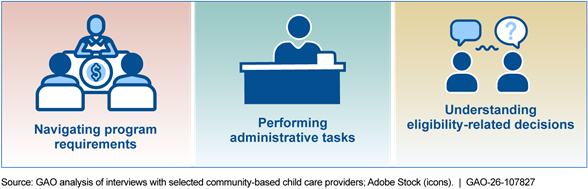
Selected child care providers GAO interviewed said that participating in the fee assistance program could be challenging. Challenges included meeting initial eligibility requirements, keeping up with administrative tasks to remain eligible, and understanding information from DOD about certain eligibility-related decisions. Selected child care providers and national accreditation organizations GAO interviewed said that achieving national accreditation or state quality ratings can be costly and time consuming for providers. Providers also said that ensuring families correctly complete and submit their required paperwork can sometimes be difficult. In addition, one provider with over 1,500 participating centers nationwide said their centers sometimes received unclear information from DOD in ineligibility letters sent to providers facing probation, suspension, or termination. While some reasons for ineligibility involve health or safety, in other cases the reason is relatively minor, such as a late state inspection report. GAO reviewed letter templates from the military services and found that they did not state that providers could request additional information about the decision or an additional review. DOD’s forthcoming Business Rule Guidance for the military services does not require this notification. Without including this information, providers with relatively minor issues may not be aware that they can follow up to resolve the issue. As a result, child care for military families may be unnecessarily disrupted, potentially harming DOD’s mission readiness.
Why GAO Did This Study
Many military service members need child care to perform their jobs, and DOD considers child care essential to overall mission readiness, efficiency, and retention. When U.S. on-base child care is not available, DOD's fee assistance program provides subsidies for families to use at eligible civilian child care providers in their community.
H.R. Rep. No. 118-529 (2024), includes a provision for GAO to review the DOD child care fee assistance program. This report addresses what available data show about recent participation trends in the DOD fee assistance program, and the challenges providers face participating in the program, among other objectives.
GAO analyzed DOD and military service data on program participation from FY 2019 through FY 2024 (the most recent available), and reviewed DOD program documents. GAO interviewed DOD and military service officials and staff from DOD’s program administrators. GAO also interviewed three participating providers and four national child care organizations about the program. GAO selected the national child care organizations based on DOD information and the participating child care providers based on recommendations from the national child care organizations.
What GAO Recommends
GAO recommends that DOD provide additional information to fee assistance providers regarding eligibility-related decisions. DOD agreed with the recommendation.
|
Abbreviations |
|
CCAOA Child Care Aware of America |
|
DOD Department of Defense |
|
FCC Family Child Care |
|
FY Fiscal Year |
|
MCCYN Military Child Care in Your Neighborhood |
|
OSD Office of the Secretary of Defense |
This is a work of the U.S. government and is not subject to copyright protection in the United States. The published product may be reproduced and distributed in its entirety without further permission from GAO. However, because this work may contain copyrighted images or other material, permission from the copyright holder may be necessary if you wish to reproduce this material separately.
June 17, 2026
The Honorable Roger F. Wicker
Chairman
The Honorable Jack Reed
Ranking Member
Committee on Armed Services
United States Senate
The Honorable Mike Rogers
Chairman
The Honorable Adam Smith
Ranking Member
Committee on Armed Services
House of Representatives
Many military service members need child care to perform their jobs, and the Department of Defense (DOD) considers child care essential to overall mission readiness, efficiency, and retention for the military.[1] DOD operates the largest employer-sponsored child care program in the United States.[2] According to DOD, the Army, Navy, Marine Corps, and Air Force administered child care for about 171,000 children from birth to age 12 in fiscal year (FY) 2024, the most recent data available at the time of our review.[3]
However, DOD has been unable to provide on-base child care to all service members who need it, particularly in areas with a lot of military families, and there can be long waitlists for care at DOD’s child development centers.[4] When on-base child care is not available, DOD’s fee assistance program—which DOD also calls the Military Child Care in Your Neighborhood (MCCYN) program—provides subsidies for parents to use at eligible civilian child care providers in their community.[5] In FY 2024, the military services spent about $192 million to care for approximately 40,000 service members’ children through the fee assistance program, according to DOD officials.
A report accompanying H.R. 8070, the Servicemember Quality of Life Improvement and National Defense Authorization Act for Fiscal Year 2025, includes a provision for us to review DOD’s policies and processes for identifying and assessing the eligibility of community-based child care providers for its fee assistance program.[6] This report addresses (1) what available data show about participation trends in the DOD fee assistance program from FY 2019 through FY 2024; (2) how DOD partners with states, counties, and providers to increase access to the program in areas of high unmet child care need; and (3) the challenges that DOD faces administering the program, including in assessing eligibility of child care providers, and that providers face participating in the program.
For all three objectives, we reviewed DOD policies and other documents related to administering and overseeing DOD’s child care program and fee assistance program; relevant federal laws and regulations; and related reports from GAO, DOD, and the Congressional Research Service.
To describe participation trends in the DOD fee assistance program, we analyzed summary program data from the military services for FY 2019 through FY 2024, the most recent data available at the time of our review. These data include the number of participating community-based child care providers and children served in the program for each military service. We also interviewed officials from DOD’s Office of the Secretary of Defense (OSD) and the military services who are responsible for or knowledgeable about the program and the data.[7] We assessed the reliability of these data by reviewing related documents and interviewing knowledgeable agency officials and representatives from Child Care Aware of America (CCAOA), an administrator for the program.[8] We found the data to be sufficiently reliable for the purpose of describing participation trends in DOD’s fee assistance program.
To obtain information on how DOD partners with states, counties, and providers to increase access to the program in areas of high unmet need and challenges DOD faces administering the fee assistance program, we interviewed officials from OSD and the military services and reviewed relevant documents. We asked DOD officials about (1) any efforts to expand the program in areas of high unmet need and (2) any challenges in assessing the eligibility of child care providers interested in participating in the program. In addition, we compared DOD’s child care program processes with:
· the goals and objectives related to military family well-being from DOD’s FY 2025 Annual Performance Plan and FY 2023 Performance Report,[9] and
· selected standards for internal control in the federal government, including controls related to the importance of communicating relevant and quality information internally and externally for an entity to achieve its objectives.[10]
We also reviewed templates for letters that are sent to providers from DOD when it determines a participating provider should be placed on probation, suspended, or terminated from the program. The Army, Marine Corps, and Air Force provided the same two letter templates (one for probation and one for termination) and Navy provided its own letter templates.
To obtain information on challenges community-based child care providers face participating in the fee assistance program, we reviewed documents from and conducted interviews with representatives from selected child care providers, accrediting organizations, and a licensing organization. The documents included email correspondence between CCAOA and a provider and step-by-step guides for military families on how to access community-based child care. Selected organizations were:
· Three community-based child care providers, including one small provider with multiple locations in a single state and two large national providers with locations throughout the United States. We selected the child care providers based on recommendations from officials at national child care accrediting organizations and CCAOA.
· Three child care accrediting organizations. We selected the national child care accrediting organizations from DOD’s list of accrediting organizations for the program.[11]
· One child care licensing organization. We selected this organization based on recent related GAO work.
In interviews, we asked about these organizations’ experiences with the fee assistance program and any challenges child care providers have faced qualifying for, participating in, or maintaining eligibility for the program. We also interviewed representatives from two military family organizations to obtain parents’ perspectives on the program. We selected the military family organizations based on recent related GAO work and a web search using relevant terms including “military family advocacy groups” and “child care.” Although content from these interviews is not generalizable, it provided insight into the experiences of community-based child care providers, child care accrediting organizations, and others that are knowledgeable about the DOD fee assistance program.
We conducted this performance audit from September 2024 to June 2026 in accordance with generally accepted government auditing standards. Those standards require that we plan and perform the audit to obtain sufficient, appropriate evidence to provide a reasonable basis for our findings and conclusions based on our audit objectives. We believe that the evidence obtained provides a reasonable basis for our findings and conclusions based on our audit objectives.
Background
Many U.S. workers with children need child care to perform their jobs but may experience challenges accessing it. In 2024, on average, more than half of all families with young children had both parents in the workforce, and more than two-thirds of single parents with young children were employed.[12] Working parents may face challenges accessing child care, especially quality care that is affordable.[13] Even when child care is available, it can cost more than other major household expenses. For example, according to a 2023 analysis from CCAOA, the average annual price of child care for two children exceeded homeowners’ median annual mortgage payments in the District of Columbia and 45 of 50 states that were analyzed.[14]
Child Care Needs of Military Families
It may be particularly difficult for military families to find child care in their communities due to the nature of their work (e.g., nontraditional work hours and frequent relocations).[15] These challenges can be particularly acute for families who live in areas with many other military families and limited child care options, where on-base care may not be available; or for families who have younger or multiple children and who live in areas with a high cost of living.[16]
To meet the unique needs of military families, DOD’s child care programs include:
· Child development centers. DOD-operated on-base child care centers, typically offering care for children from 6 weeks to 5 years of age.
· School-age care. DOD-operated, on-base before- and after-school care and summer/holiday care for children 6-12 years old.
· Family Child Care (FCC). Care operated in DOD-certified on-base or off-base homes, for children from 4 weeks through 12 years of age.
· Fee assistance (civilian, community-based child care providers).[17] DOD subsidizes care at eligible civilian child care providers, when DOD child care is not available (due to a lack of available spaces or how far away the service member lives from the on-base centers).
In some areas, military families have high unmet child care need, which DOD defines as a need for child care that has not been met by the date identified by parents for needing care. According to DOD, in 2025 the military services’ areas of highest unmet child care need were:
· Hawaii,
· the National Capital Region (Maryland, Virginia, and Washington, D.C.),
· Norfolk (Virginia),
· San Antonio (Texas), and
· San Diego (California).
These areas accounted for more than one-third of the almost 9,000 children on DOD’s list of those with unmet child care need.
DOD Fee Assistance Program
First authorized in 1999, the DOD fee assistance program provides subsidies for military families’ child care at eligible civilian child care providers in their U.S. community, and it serves children from birth through age 12.[18] The program is for families who cannot access DOD-operated child care because it is too far from their home or there is a lack of available space at their on-base child care development center. DOD provides a monthly subsidy amount to the child care providers based on factors including the provider’s rates (up to a DOD cap) and family income. This subsidy helps cover the cost of child care for military families, and families pay the remainder of the cost. Those eligible generally include active-duty service members, activated guard and reserve members, and civilian employees who (1) are stationed at a base that has been pre-identified as fee assistance-eligible or (2) do not live near a military base with a DOD-operated child development center.[19] To become eligible to participate in the program, child care providers must complete an online application. According to the program website, providers should receive a response about their application status within 3 to 5 business days and, if approved, an approval certificate within 7 to 10 business days of completing the application.[20]
DOD has licensing, inspection, and accreditation requirements that child care providers must meet to be eligible to participate in the program.
· Licensing requirements. Providers must have a valid state operating license that covers all ages they serve. States have developed their own child care licensing standards, and oversight and enforcement practices vary across states.
· Inspection requirements. Providers must have an annual state inspection free of disqualifying incidents.
· Accreditation requirements. Providers must be nationally accredited. DOD maintains a list of approved accreditation organizations that accredit child care providers for the program. Accreditation focuses on the quality of care. Accrediting organizations establish and use quality standards (e.g., related to staff training and support, leadership and management, or curricula) to assess the quality of child care programs.
In 2019, DOD expanded the fee assistance program to increase the pool of eligible child care providers, with Maryland and Virginia as pilot states. According to officials, after this pilot, DOD further expanded the program in 2022 by inviting any interested state to reach out to DOD for information on how to join the program. The program expansion—which DOD refers to as MCCYN-PLUS—allows child care providers without national accreditation that are rated by their state’s Quality Rating and Improvement System (quality rating system),[21] and have obtained certain rating levels, to be eligible to participate in the program.[22]
On a case-by-case basis, the military services may also grant exceptions for children to receive child care at providers that do not meet all program requirements, as long as the provider meets minimum requirements, such as state licensing and annual inspection. These providers are distinct from those that apply for and participate through DOD’s program expansion. Officials said that allowing these exceptions helps the military services meet families’ unique needs and provide child care to as many families as possible.
CCAOA administers the fee assistance program for the Air Force, Army, and Marine Corps; the Navy administers its own fee assistance program.[23] With the exception of the Navy program, CCAOA administers the provider application and review process, assists parents in finding eligible child care spaces, and ensures that participating providers continue to meet program requirements. Child care providers and military families who participate in the Air Force, Army, or Marine Corps programs interact with CCAOA directly.
From 2019 to 2024, the DOD Fee Assistance Program Grew in Size
Each Military Service Increased the Number of Child Care Providers and Children Served
All four military services increased the number of child care providers and children in the fee assistance program from FY 2019 through FY 2024, based on our analysis of program data from the military services. More specifically, during this period:
· Air Force saw an increase of 48 percent in the number of providers and 51 percent in the number of children.[24]
· Army saw an increase of 6 percent in the number of providers and 2 percent in the number of children.[25]
· Marine Corps saw an increase of 47 percent in the number of providers and 78 percent in the number of children.
· Navy saw an increase of 190 percent in the number of providers and 292 percent in the number of children.
Most of this growth occurred after FY 2021. From FY 2019 through FY 2020, which included the beginning of the COVID-19 pandemic, three of the four military services experienced declines in the number of child care providers and children in the program. After FY 2021, all four military services experienced increases in the number of child care providers and children in the program (see fig. 1).
Figure 1: Number of Community-Based Child Care Providers in the Department of Defense’s (DOD) Fee Assistance Program, by Military Service, Fiscal Years 2019–2024
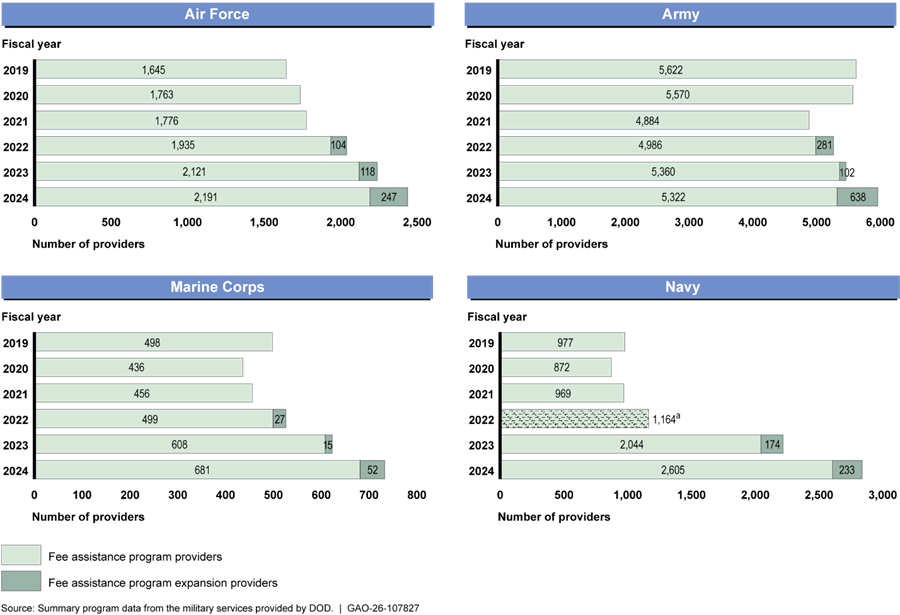
Note: The military services did not separately track fee assistance program expansion providers in their data until fiscal year (FY) 2022. According to Air Force officials, Space Force is included in the Air Force child care data.
aAccording to Navy officials, Navy’s FY 2022 data on fee assistance program expansion providers are not accurate due to the transition in its program administration from Child Care Aware of America to Navy. As such, only the total number of providers is reported for Navy in FY 2022.
Navy officials we interviewed attributed these participation increases to additional program spending, and they and Marine Corps officials attributed the increases to more states joining the fee assistance program expansion, which increased the pool of eligible child care providers. From FY 2019 through FY 2024, every military service increased program spending for fee assistance. For example, Navy’s program spending increased by more than five times, and Air Force and Marine Corps’ spending more than doubled. In addition, Air Force and Marine Corps officials said that expanding the fee assistance program to more states offered military families more child care options. Navy officials noted that the Navy had intentionally expanded its program to help reduce its child care waitlist and increase Navy families’ access to high-quality child care providers in the community.
The Military Services Grant Exceptions to Allow Families to Use Child Care Providers That Do Not Meet Some Program Requirements
Our analysis of summary program data from the military services indicated that substantial percentages of child care providers served children that had been granted exceptions. These providers—that do not meet some program requirements and are not already approved to participate in the program—are distinct from providers that apply for and participate through the program expansion.[26] From FY 2019 through FY 2024, the proportion of providers serving children with exceptions ranged from about one-quarter to two-thirds across the military services (see table 1).
Table 1: Percentages of Child Care Providers Participating and Children Served with an Exception in the Department of Defense’s (DOD) Fee Assistance Program, by Military Service, Fiscal Years 2019–2024
|
Military service |
Providers serving children with an exception (range of the lowest and highest percentage from fiscal year 2019 through 2024) |
Children served with an exception (range of the lowest and highest percentage from fiscal year 2019 through 2024) |
|
Air Force |
38% to 45% |
26% to 33% |
|
Army |
48% to 57% |
29% to 39% |
|
Marine Corps |
26% to 56% |
19% to 34% |
|
Navya |
42% to 66% |
27% to 56% |
Source: Summary program data from the military services provided by DOD. | GAO‑26‑107827
Note: According to Air Force officials, Space Force is included in the Air Force child care data.
aAccording to Navy officials, Navy’s fiscal year 2022 data are not accurate on fee assistance program providers serving children with an exception and on providers in the fee assistance expansion due to the transition in its program administration from Child Care Aware of America to Navy.
Over this period, in nearly every fiscal year, more than one-third of child care providers in each military service served children with an exception (see fig. 2). These providers served more than one-quarter of the children in each military service in nearly every fiscal year.
Figure 2: Number of Child Care Providers Serving Children with an Exception in the Department of Defense’s (DOD) Fee Assistance Program, by Military Service, Fiscal Years 2019–2024
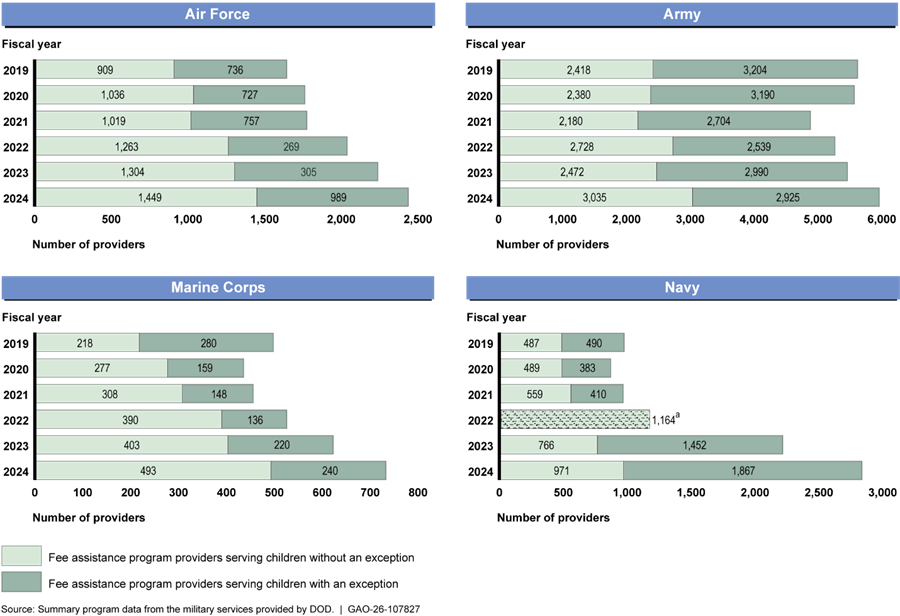
Note: According to Air Force officials, Space Force is included in the Air Force child care data.
aAccording to Navy officials, Navy’s fiscal year (FY) 2022 data are not accurate on fee assistance program providers serving children with an exception and on fee providers in the assistance program expansion due to the transition in its program administration from Child Care Aware of America to Navy. As such, the total number of providers are reported for Navy in FY 2022.
From FY 2023 through FY 2024, Navy had almost twice as many child care providers serving children who had been granted an exception than those serving children without an exception. Providers who enrolled children who had been granted an exception served more than half of all children in the Navy’s program during that period. Navy officials said that they expect the number of providers serving children with exceptions and children who are granted those exceptions to decrease as three things happen: 1) more providers apply to participate through the fee assistance program expansion, 2) more families use those providers, and 3) more states join the program expansion.
There are common reasons that the military services grant children exceptions, according to officials. These include the following:
· There are no available qualified child care providers that meet DOD’s accreditation or quality rating system requirements within driving distance of the family’s home.[27]
· A sibling is already enrolled with the child care provider.
· There are no qualified providers that meet the child’s transportation needs.
· There are no qualified providers that offer needed care for a child’s disabilities or for the service member’s nontraditional work hours.
· A child is already enrolled with a provider prior to the child qualifying for the program.
Officials added that exceptions are valid as long as the child is enrolled with the child care provider. If the child leaves the provider, the provider may not serve other eligible children through the fee assistance program without separate approval.
OSD officials said that they have heard concerns from some families that fee assistance program exceptions are granted inconsistently across the military services. Officials said that to address this and other inconsistencies across the military services, the agency developed MCCYN Business Rule Guidance that the military services have until September 2026 to implement.[28] Specifically, the Business Rule Guidance outlines certain instances that can be used by the military services to determine when families can enroll their children at a provider that does not meet some program requirements—either by granting the child an exception or listing certain circumstances where exceptions are not required. Officials said that the new guidance on exceptions should help to facilitate the enrollment process in areas where there is a known shortage of providers. Until this guidance is implemented, each military service will continue to review and grant exceptions on a case-by-case basis.
DOD Has Taken Steps to Increase Access to Child Care in Areas of High Unmet Need
To increase access to child care in areas of high unmet need, DOD officials said that they have expanded the fee assistance program and undertaken other targeted efforts.
DOD Fee Assistance Program Expansion
OSD officials said that expanding the fee assistance program to allow additional providers without national accreditation to participate, is an efficient way to increase access to quality child care for military families since building new on-base child development centers can take up to 10 years. As of March 2026, the fee assistance program expansion operated in 18 states and two counties, including in many areas of high unmet need (see fig. 3).[29]
Figure 3: States and Counties Participating in the Department of Defense (DOD) Fee Assistance Program Expansion and Areas of High Unmet Child Care Need as of March 2026
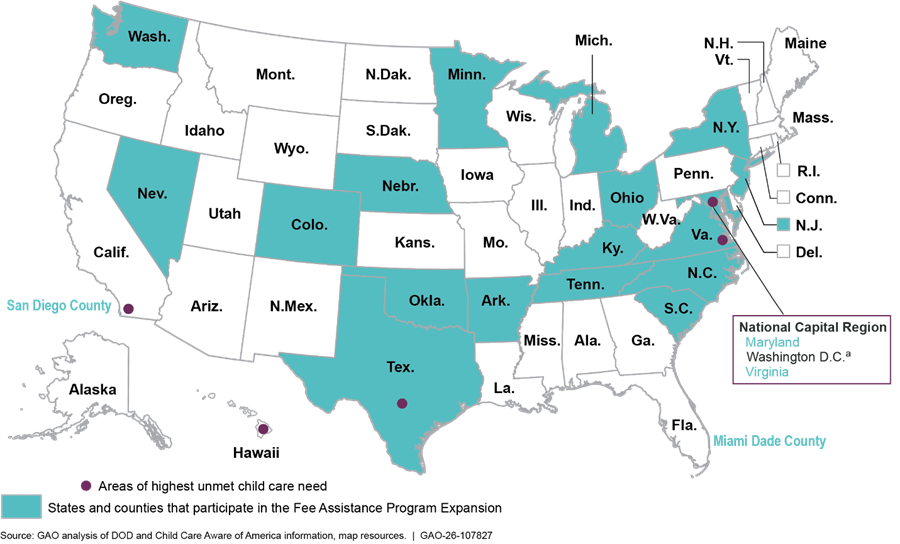
Note: According to Office of the Secretary of Defense (OSD) officials, areas of highest unmet child care need include Hawaii, the National Capital Region (Maryland, Virginia, and Washington, D.C.), Norfolk (Virginia), San Antonio (Texas), and San Diego (California). The fee assistance program expansion allows additional providers without national accreditation in participating states with appropriate quality ratings to participate.
aWashington, D.C. is the only area in the National Capital Region that does not participate in the fee assistance program expansion.
OSD officials said they reach out to and work with states to increase participation in the fee assistance program expansion and meet quarterly with participating and interested states.[30] When states express interest, DOD officials work with them to determine whether their licensing and quality rating systems meet the program’s requirements.[31] For example, DOD officials said they and CCAOA worked with officials from California for approximately 4 years to help San Diego County—which has a large military population and is an area of high unmet need—to resolve delays with child care facility licensing inspections. DOD officials said doing so required partnering with California state licensing officials to prioritize fee assistance program providers for annual inspections.
Additional Efforts
Officials from DOD described several other targeted efforts to increase access to child care for military families in areas of high unmet need. Some of these efforts were statutorily mandated. These include:
· Launching pilot projects to buy child care spaces from private child care providers in some areas of high unmet need, including San Diego, California; Colorado Springs, Colorado; Norfolk, Virginia; and the Washington, D.C. area.
· Contracting with the Armed Services YMCA to open and operate three child care centers in Virginia solely for military families.
· Reimbursing military families with nontraditional work hours for at-home child care (called the Child Care in Your Home program).[32]
· Launching a statutorily-mandated pilot program reimbursing military families for travel-related costs incurred by family members or friends who provide child care following a military family’s permanent change of station move.[33]
· Building new child development centers. For example, the Navy is building new centers on bases in Kitsap, Washington; Norfolk, Virginia; and San Diego, California, and the Army is building new centers on bases in Hawaii, as well as at Fort Polk, Louisiana; Fort Leavenworth, Kansas; Fort Knox, Kentucky; Fort Bragg, North Carolina; and Fort Gordon, Georgia.
In addition to expanding the fee assistance program to more states, these targeted efforts are aimed at helping to increase access to child care for military families and are mostly aimed towards areas with a large concentration of military families or areas of high unmet need.
Fee Assistance Program Administration Can Be Challenging, and DOD Does Not Provide Clear Information to Providers About Some Eligibility Decisions
Expanding the fee assistance program is a key component of DOD’s efforts to increase child care for military families, but it can be challenging for DOD to administer and some providers find it challenging to participate.
DOD Officials Reported Challenges Navigating Different State Licensing, Inspection, and Quality Requirements for Child Care Providers
DOD officials reported challenges navigating differences in states’ licensing, inspection, and quality rating systems while administering the fee assistance program and its expansion (see fig. 4).[34]
Figure 4: Reported Challenges the Department of Defense (DOD) Faces in Assessing Child Care Provider Eligibility for the Fee Assistance Program
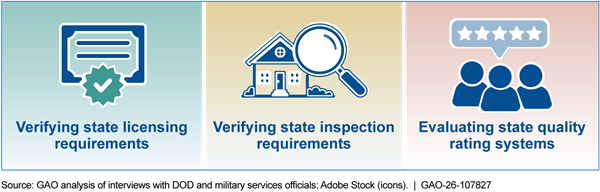
Verifying State Licensing and Inspection Requirements
Military service officials said navigating differences in licensing and inspection requirements across states can be time consuming and difficult. To be eligible to participate in the fee assistance program, child care providers must have a valid state license and an annual inspection free of potentially disqualifying incidents. DOD verifies that providers meet these requirements when providers apply to participate in the program and, for providers participating in the program, on an annual basis thereafter.[35] Navy officials said in some states, licensing systems are not online, which slows the process of verifying providers’ licenses. OSD officials also said other states do not have adequate staffing for things such as conducting inspections, which can lead to delays in licensing renewals for some providers. Further, state inspection standards are sometimes different than the program’s participation requirement. For example, according to OSD officials, California generally requires an inspection every 3 years while DOD requires them annually.
OSD officials said they work with states to help providers to meet the fee assistance program’s requirements. For example, DOD officials said they worked with California state officials to ensure that the state conducted annual inspections for child care providers participating in the fee assistance program. This one-on-one work with states can be resource intensive, and OSD officials said they do it to raise awareness and help ensure providers’ continued participation in the program.
Evaluating State Quality Ratings Systems
Before providers can participate in the fee assistance program expansion, DOD must evaluate their state’s quality rating system to determine whether providers in that state would meet the requirements to qualify.[36] This task can be challenging for DOD because states’ quality rating systems vary, have different requirements for each level of quality, and are often adjusted by the states. DOD officials said that reviewing each state’s quality rating system is time consuming. Further, when states adjust their quality rating systems, it necessitates another DOD review.
OSD officials noted that state- or county-level quality rating system requirements may delay child care providers’ participation in the fee assistance program. San Diego County—which has been identified consistently as an area of high unmet need for DOD families—requires every child care provider participating in its quality rating system to partner with a county-assigned “coach” for guidance on continuous quality improvement practices in early childhood education.[37] However, OSD officials said that there are not enough qualified coaches in the county to accommodate all providers, so child care providers that are not nationally accredited may be put on a waitlist for a coach before they can participate in the county’s quality rating system. According to OSD officials, the shortage of coaches has limited the number of child care providers in San Diego County that are eligible to participate in the fee assistance program expansion.[38]
OSD officials said that they work with states that have adjusted their quality rating systems to help them maintain or expand participation in the fee assistance program. For example, DOD officials said that they worked with officials from Virginia to address a state requirement that DOD-approved nationally accredited providers maintain both national accreditation and a quality rating in Virginia’s quality rating system. DOD officials said this requirement would be onerous and duplicative for fee assistance program providers. OSD worked through the Defense State Liaison Office with Virginia officials to exempt nationally accredited providers that serve only military families from the state requirements.[39] In 2025, Virginia enacted a law that exempts providers from having to participate in Virginia’s quality rating system if they are accredited by a DOD-approved accrediting organization and their sole source of public funding is through the fee assistance program, according to DOD officials. DOD officials said that this change avoided imposing duplicative quality requirements for these fee assistance program providers in Virginia.
Selected Child Care Providers Cited Challenges, Including Receiving Unclear Information from DOD About Certain Eligibility-Related Decisions
Selected child care providers told us they face various challenges related to participating in the fee assistance program. These include navigating the program’s requirements, performing administrative tasks associated with maintaining eligibility, and understanding certain eligibility-related decisions (see fig. 5).
Figure 5: Challenges Community-Based Child Care Providers Reported Facing While Participating in the Department of Defense’s (DOD) Fee Assistance Program
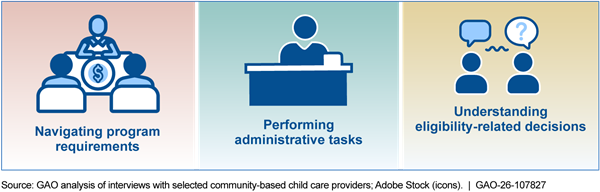
Navigating Program Requirements
Child care providers and national accreditation organization representatives we interviewed said that navigating the fee assistance program’s quality requirements—obtaining national accreditation or participating in their state quality rating system—can be costly and time consuming. This is especially true when providers may already struggle to meet basic operating requirements such as maintaining adequate staffing. Providers must also comply with ongoing administrative requirements to continue participating in the program. Representatives from the two large providers we interviewed said that completing administrative tasks required by the program can take child care center directors’ time and attention away from their classrooms.
These providers said that due to the time and resources necessary to meet fee assistance program requirements, larger child care providers with more administrative capacity and children enrolled may be more able to participate. For example, representatives from the two national child care providers we interviewed said that larger providers are more incentivized to participate than smaller providers since they may have more military children enrolled.
Performing Administrative Tasks
Child care providers said they perform administrative tasks to help military families correctly complete and submit their paperwork to participate in the fee assistance program. Families must complete this paperwork to enroll in and remain eligible for the program. For example, reimbursement rates in the fee assistance program may change multiple times per year. These changes can be triggered by a child moving to a new age group classroom, a parent changing pay grades, or the provider’s annual price increasing. The rate changes require providers and parents to complete additional paperwork to continue program participation. However, representatives from the two large child care providers we interviewed said military families do not always understand everything they need to do, and if families submit incomplete or incorrect paperwork, they can face disruptions in care for their children.
In 2021, we reported that accredited and licensed child care providers sometimes opt not to participate in the fee assistance program because of the administrative tasks associated with it or waits for reimbursement.[40] To help reduce some of these drawbacks to participation, Navy officials said they have attempted to streamline their processes to reduce the administrative tasks required of providers and families. Officials from the other military services (whose programs are administered by CCAOA) said they do not believe the requirements are onerous enough to deter providers from participating in the fee assistance program.
Understanding Eligibility-Related Decisions
Child care providers may experience challenges understanding eligibility-related decisions, including when they are facing probation, suspension, and termination from the fee assistance program. According to DOD officials, the military services may make these decisions in response to state licensing violations, health and safety issues found during providers’ state inspections, a pattern of complaints from military families describing concerning behaviors with children, or provider mismanagement. After making an eligibility-related decision, the military service sends a letter to the affected provider. These letters notify providers about the decision and can include CCAOA’s contact information, depending on which military service issues the decision.[41] However, as discussed below, the letter templates we reviewed do not contain clear and complete information about the process for how providers can request additional details about the decision.
Representatives from one large child care provider participating in the fee assistance program told us they have experienced challenges understanding information received from CCAOA related to probation and other disqualification decisions. This provider said that in February 2025, out of more than 1,500 locations participating in the fee assistance program nationwide, 252 were on probation and 15 had been disqualified. This provider reported challenges including
· inconsistency in the types of violations that result in a probation or disqualification decision at different locations, and
· unclear information from the military services regarding what led to the decision and the steps the provider can take to be restored to good standing in the program.
Inconsistent Eligibility-Related Decisions
OSD officials acknowledged that the military services make eligibility-related decisions independently, which could result in inconsistent decisions for providers with similar types of violations or complaints. OSD officials said that the program’s Business Rule Guidance was developed to address program implementation inconsistencies across the military services, and it includes information about the provider disqualification process, such as how long a provider may be placed on probation or suspended or which violations warrant termination from the program.[42] The guidance calls for the creation of two entities to help standardize these decisions: the Cross-Service Review Board and the Qualifying Team. OSD officials said that the purpose of the new Cross-Service Review Board is to make consistent decisions regarding providers’ continued eligibility in the program, including decisions about probation, suspension, or termination.
Unclear Information from the Military Services
The military services do not provide clear and complete information to child care providers about how they can respond to eligibility-related decisions. Military services officials said that child care providers can request additional information after receiving a probation, suspension, or termination decision. However, they do not clearly communicate to providers that they may request more information about the process to resolve the decision. In our review of templates for letters sent to providers in these circumstances, we noted that while they may include contact information for the program administrator and a description of the decision, none of the letter templates clearly stated that providers may request additional information about the decision or an additional review. In the case of providers with relatively minor issues such as a late inspection report, this could be a simple step the provider could take to help them resolve the situation.[43] A representative from a large child care provider we interviewed said that unclear information in these letters can create uncertainty for providers and military families and result in care disruptions for affected families. Federal internal control standards state that effectively communicating relevant and quality information to external parties can help the entity achieve its objectives and address related risks.[44]
DOD’s Business Rule Guidance does not require the military services to state that the provider can request additional information or a review to potentially resolve the issue in the eligibility-related decision letters they send to providers. Military services officials said that very few providers call for additional information about their decisions. Without including clear information in these letters to ensure that providers are aware of the option to request an additional review, providers may not be aware that there might be steps they can take to resolve the issue. Including this information in the letters could help support DOD’s goal of providing military families with options for affordable, quality, and licensed child care.[45]
Conclusions
DOD has taken steps to increase access to quality child care for military families, especially in areas of high unmet need, and largely through the fee assistance program. For example, the recent program expansion broadened eligibility requirements for child care providers so that more providers could offer child care to military families. However, selected child care providers cited challenges participating in the program, including unclear information from military services related to probation, suspension, or termination decisions. In letters notifying child care providers about these decisions, the military services do not inform providers that they may request additional information about the decision or an additional review, even when the issue is relatively minor, such as a late state inspection report. OSD officials said the agency’s new Business Rule Guidance will increase consistency of information provided across the military services about these decisions, but the guidance does not require the military services to clearly inform providers about options they have to request additional information about the decision or an additional review. Without including clear information about the option to request additional information about the decision or additional review, providers may not be aware that they can follow up to resolve the issue. For providers with relatively minor issues, this could potentially unnecessarily disrupt child care for military families and affect DOD’s mission readiness.
Recommendation for Executive Action
The Secretary of Defense should ensure that the Office of the Deputy Assistant Secretary of Defense for Military Community & Family Policy directs the Military Services to clearly inform child care providers that are placed on probation, suspended, or terminated from the fee assistance program about the option they have to request additional information about the decision or an additional review. (Recommendation 1)
Agency Comments
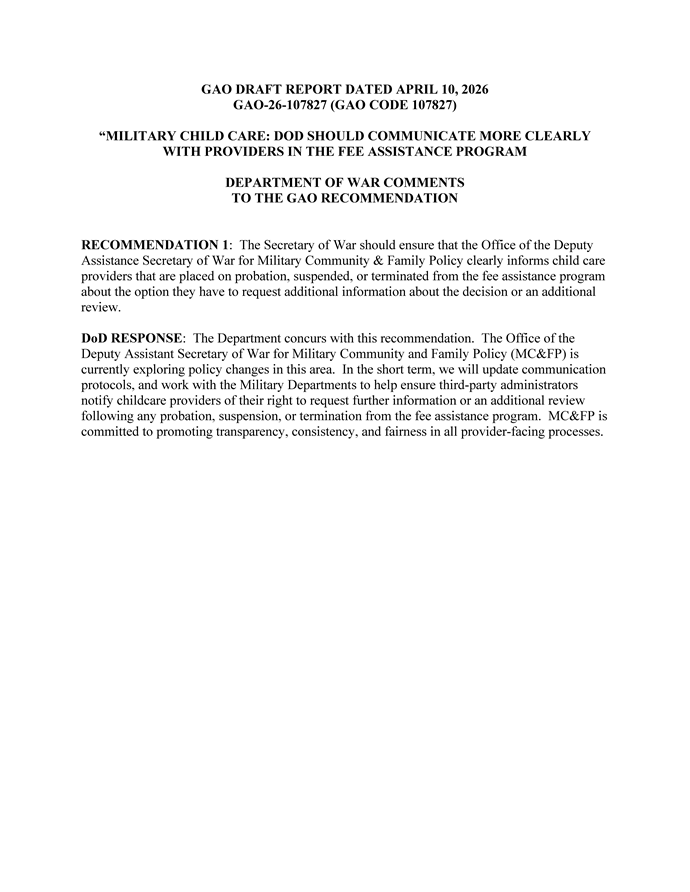
We provided a draft of this report to DOD for review and comment. DOD and the military services provided technical comments, which we incorporated into the report, as appropriate. In its written comments, reproduced in appendix I, DOD agreed with our recommendation to provide additional information to fee assistance providers regarding eligibility-related decisions. DOD stated its commitment to promoting transparency, consistency, and fairness in all provider-facing processes and said it will update related communication protocols with the military services and third-party administrators.
We are sending copies of this report to the appropriate congressional committees, the Secretary of Defense, and other interested parties. In addition, the report is available at no charge on the GAO website at http://www.gao.gov.
If you or your staff have any questions about this report, please contact me at larink@gao.gov. Contact points for our Offices of Congressional Relations and Media Relations may be found on the last page of this report. GAO staff who made key contributions to this report are listed in appendix II.

Kathryn A. Larin, Director
Education, Workforce, and Income Security Issues
GAO Contact
Kathryn A. Larin, larink@gao.gov
Staff Acknowledgments
In addition to the contact named above, Nora Boretti (Assistant Director), Aaron Karty (Analyst in Charge), and Sarah Wu made significant contributions to this report. Also contributing to this report were Myra Francisco, Gina Hoover, Kimberly Mayo, Mimi Nguyen, Stacia Odenwald, and Aaron Olszewski.
Military Child Care: Services Should Assess Their Employee Retention Efforts. GAO‑24‑106524. Washington, D.C.: May 14, 2024.
Military Child Care: DOD Efforts to Provide Affordable, Quality Care for Families. GAO‑23‑105518. Washington, D.C.: Feb. 2, 2023.
Military Child Care: Coast Guard is Taking Steps to Increase Access for Families. GAO‑22‑105262. Washington, D.C.: June 30, 2022.
Military Child Care: Potential Costs and Impacts of Expanding Off-Base Child Care Assistance for Children of Deceased Servicemembers. GAO‑22‑105186. Washington, D.C.: Dec. 14, 2021.
Military Child Care: Off-Base Financial Assistance and Wait Lists for On-Base Care. GAO‑21‑127R. Washington, D.C.: Dec. 1, 2020.
The Government Accountability Office, the audit, evaluation, and investigative arm of Congress, exists to support Congress in meeting its constitutional responsibilities and to help improve the performance and accountability of the federal government for the American people. GAO examines the use of public funds; evaluates federal programs and policies; and provides analyses, recommendations, and other assistance to help Congress make informed oversight, policy, and funding decisions. GAO’s commitment to good government is reflected in its core values of accountability, integrity, and reliability.
Obtaining Copies of GAO Reports and Testimony
The fastest and easiest way to obtain copies of GAO documents at no cost is through our website. Each weekday afternoon, GAO posts on its website newly released reports, testimony, and correspondence. You can also subscribe to GAO’s email updates to receive notification of newly posted products.
Order by Phone
The price of each GAO publication reflects GAO’s actual cost of production and distribution and depends on the number of pages in the publication and whether the publication is printed in color or black and white. Pricing and ordering information is posted on GAO’s website, https://www.gao.gov/ordering.htm.
Place orders by calling (202) 512-6000, toll free (866) 801-7077,
or
TDD (202) 512-2537.
Orders may be paid for using American Express, Discover Card, MasterCard, Visa, check, or money order. Call for additional information.
Connect with GAO
Connect with GAO on X,
LinkedIn, Instagram, and YouTube.
Subscribe to our Email Updates. Listen to our Podcasts.
Visit GAO on the web at https://www.gao.gov.
To Report Fraud, Waste, and Abuse in Federal Programs
Contact FraudNet:
Website: https://www.gao.gov/about/what-gao-does/fraudnet
Automated answering system: (800) 424-5454
Media Relations
Sarah Kaczmarek, Managing Director, Media@gao.gov
Congressional Relations
David A. Powner, Acting Managing Director, CongRel@gao.gov
General Inquiries
[1]Department of Defense, Report to the Congressional Defense Committees on Department of Defense Child Development Programs (Washington, D.C.: June 5, 2020).
[2]DOD’s child care program provides options for several types of child care, including DOD-operated child development centers, subsides for child care at community-based providers, and home-based family child care.
[3]We looked at DOD child care administered by the Army, Navy, Marine Corps, and Air Force. The Air Force oversees all air and space installation child and youth programs, including the Space Force’s child care program, according to an Air Force official. In this report, our discussion of the Air Force child care program includes the Space Force’s program.
[4]Department of Defense, Report to the Committee on Armed Services of the House of Representatives On Child Care Best Practices (Washington, D.C.: Mar. 4, 2022), Department of Defense, Report to the Congressional Defense Committees on Department of Defense Child Development Programs (Washington, D.C.: June 5, 2020), and GAO, Military Child Care: Potential Costs and Impacts of Expanding Off-Base Child Care Assistance for Children of Deceased Servicemembers, GAO‑22‑105186 (Washington, D.C.: Dec. 14, 2021).
[5]In this report, we refer to the Military Child Care in Your Neighborhood (MCCYN) program as the “fee assistance program.”
[6]H.R. Rep. No. 118-529, at 156-57 (2024), accompanying Servicemember Quality of Life Improvement and National Defense Authorization Act for Fiscal Year 2025, H.R. 8070, 118th Cong. (2024).
[7]Within OSD, the Office of the Deputy Assistant Secretary of Defense for Military Community & Family Policy sets policy for the DOD fee assistance program.
[8]CCAOA is a national nonprofit child care support organization that contracts with DOD to administer the fee assistance program. Navy administers its own fee assistance program.
[9]Performance Goal 1.2.1 is to take care of military families under the strategic objective of promoting the health, well-being, and safety of the force and families. Performance Goal 4.3.2 is to take care of military families under the strategic priority of taking care of military families and cultivating the workforce needed. Fiscal Years 2022-2026 DoD Strategic Management Plan (Arlington, VA: April 2024).
[10]Principles 14 and 15 in GAO, Standards for Internal Control in the Federal Government, GAO‑25‑107721 (Washington, D.C.: May 2025).
[11]DOD lists 12 accrediting organizations, and we selected three of them to interview based on their larger size and having a focus on early childhood care.
[12]Department of Labor, Bureau of Labor Statistics, “Families with own children: Employment status of parents by age of youngest child and family type, 2023-2024 annual averages,” accessed February 4, 2026, https://www.bls.gov/news.release/famee.t04.htm. This analysis covers families with children under age 6.
[13]GAO, Military Child Care: DOD Efforts to Provide Affordable Quality Care for Families, GAO‑23‑105518 (Washington, D.C.: Feb. 2, 2023).
[14]Child Care Aware of America, Child Care at a Standstill: Price and Landscape Analysis (Arlington, Va.: 2024).
[15]GAO, Military Child Care: Coast Guard is Taking Steps to Increase Access for Families, GAO‑22‑105262 (Washington, D.C.: June 30, 2022); and GAO‑23‑105518.
[17]DOD’s fee assistance program only operates in the United States.
[18]In this report, we use the term “child care providers” when referring to community-based child care providers.
[19]The program also requires the eligible family member’s spouse (if applicable) to be employed, seeking employment, or enrolled in an educational program.
[20]Child care providers must complete an online application through CCAOA’s or DOD’s MilitaryChildCare.com website.
[21]A state’s quality rating system provides a framework for defining quality early child care within that state. States typically use licensing requirements as a minimum on which to build additional standards that indicate higher levels of quality. Every state quality rating system contains two or more levels beyond licensing, with incremental progression to the highest level of quality as defined by the state or jurisdiction. Not all states have quality rating systems, and each state’s system is different. Common state quality rating system standards address health and safety, curriculum, the learning environment, family engagement, and provider qualifications.
[22]Unless otherwise indicated, we use the term “fee assistance program” to refer to the entire program, including the program expansion, and we refer to MCCYN-PLUS as the “program expansion.”
[23]In FY 2022 the Navy elected to administer its own fee assistance program and ended its contractual relationship with CCAOA for the administration of its fee assistance program, according to officials. Prior to this, CCAOA administered the program for all of the military services. Navy officials said that CCAOA is still able to provide some support to Navy parents looking for child care.
[24]According to Air Force officials, Space Force is included in the Air Force child care data.
[25]Army officials indicated that the number of child care providers and children in the Army’s program stayed somewhat stable over this period because the Army did not have a waitlist for child care in their fee assistance program.
[26]Typically, providers serving children who had been granted exceptions do not meet the program’s accreditation or quality rating system requirements. However, officials said that exceptions are only granted for children when a provider meets all state licensing and inspection requirements and has a state license in good standing.
[27]According to an agreement between the military services and CCAOA, exceptions may be granted when there is no accredited or MCCYN-PLUS child care provider within 15 miles or 20 minutes of commuting distance from a family’s home.
[28]According to a DOD memorandum, participants of a 2023 child care summit made several recommendations to (1) improve consistency in the military service’s implementation of DOD’s fee assistance program and (2) reduce the time for families to receive fee assistance. DOD’s Office of Child and Youth Programs established a working group with child and youth professionals from DOD and each military service to create the Business Rule Guidance to standardize family eligibility and improve processes for participating child care providers.
[29]These include Arkansas, Colorado, Kentucky, Maryland, Michigan, Minnesota, Nebraska, Nevada, New Jersey, New York, North Carolina, Ohio, Oklahoma, South Carolina, Tennessee, Texas, Virginia, Washington, San Diego County (California), and Miami-Dade County (Florida).
[30]OSD officials said that they provide program advertising materials to states in the fee assistance program expansion. States can then provide those materials to child care providers in their state’s quality rating system.
[31]OSD officials also said that states’ interest in joining the fee assistance program expansion often starts within the military community.
[32]See National Defense Authorization Act for Fiscal Year 2026, Pub. L. No. 119-60, tit. V, § 586, 139 Stat. 718, 893 (2025); William M. (Mac) Thornberry National Defense Authorization Act for Fiscal Year 2021, Pub. L. No. 116-283, div. A, tit. V, § 589, 134 Stat. 3388, 3657-58.
[33]See James M. Inhofe National Defense Authorization Act for Fiscal Year 2023, Pub. L. No. 117-263, div. A, tit. VI, § 627, 136 Stat. 2395, 2630-31 (2022).
[34]This applies to providers in a state who wish to fully participate in the program. As previously noted, the military services can grant exceptions on a case-by-case basis for families to enroll a child with a provider that does not meet some program requirements.
[35]Child care providers must adhere to state licensing standards and be inspected annually to participate in the fee assistance program. States develop their own child care licensing standards, and disqualifying incidents can vary by state.
[36]For each state, DOD must determine the quality rating system level that meets fee assistance program requirements.
[37]In California, quality rating systems are administered independently by regions or counties.
[38]OSD officials indicated that since the onset of COVID, certain states have experienced a shortage of licensing staff, including coaches for some quality rating systems.
[39]The Defense State Liaison Office provides state policymakers with insight on priorities affecting military families and their quality of life. This may include providing information and research, sharing knowledge of policies and processes, and offering assistance with legislation at the state level.
[41]Navy administers its own fee assistance program and has its own processes.
[42]The Business Rule Guidance refers to a list of reasons that may result in a decision of probation, suspension, or termination. Some of these reasons include a pattern of complaints from families, repeated or systemic physical or psychological abuse or neglect, or “other.”
[43]OSD officials said that the new Business Rule Guidance includes language intended to minimize instances where minor administrative issues result in detrimental actions being taken against providers.
[44]Principle 15 in GAO‑25‑107721.
[45]Fiscal Years 2022-2026 DoD Strategic Management Plan (Arlington, VA: April 2024).