
Report to Congressional Addressees
United States Government Accountability Office
A report to congressional addressees
Contact: Alyssa M. Hundrup at hundrupa@gao.gov
What GAO Found
The Department of Defense (DOD) and its components—relevant DOD offices and the military departments (Army, Navy, and Air Force)—are taking steps to prevent and mitigate the brain health effects of blast exposure. In 2024, DOD established several blast overpressure requirements, including one requiring that brain health be monitored. Specifically, this requires that all high-risk active duty service members complete a baseline cognitive assessment in fiscal year 2025 and all new service members complete one during initial military training. DOD also required tracking service members’ exposures to blast overpressure. As of fiscal year 2025, components have begun to implement tracking requirements, including updating the centralized data system to be able to track exposures.
Note: For more details, see fig. 4 in
GAO-26-107829.
According to DOD documentation and interviews, DOD components faced resource challenges:
· Cognitive assessments. DOD component officials reported that implementation was hindered by resource constraints, such as insufficient staff and technology to conduct the assessments, and that these challenges may affect their ability to meet additional requirements going forward. Such requirements expand assessments to all active and reserve service members, along with the goal to repeat assessments every 5 years.
· Exposure tracking. DOD component officials reported a lack of industrial hygiene personnel to complete exposure tracking requirements. Required tracking includes information about weapons systems used and exposures from those weapons for any service members exposed. Such tracking creates a record of the hazards that a service member is exposed to during their military service.
DOD officials said that because of the need to expeditiously begin cognitive assessments and start exposure tracking efforts, there was not an opportunity to fully evaluate and ensure they allocated the resources necessary, as required by DOD policy and guidance. Officials said a 1-year pilot starting summer 2026 of a new cognitive assessment tool may address resource issues, but DOD did not have documented plans to assess this. DOD officials said they also have efforts underway to assess industrial hygiene resources needed for exposure tracking but such efforts have not been finalized. These efforts are important first steps, but comprehensive assessments would provide a sound foundation for ensuring the resources needed to implement DOD’s requirements. Such assessments would ultimately strengthen DOD’s ability to identify and provide treatment to service members who may need medical care and help ensure vital records are maintained about their exposures during military service.
Why GAO Did This Study
There is growing evidence that using certain weapons that produce high levels of what is called blast overpressure (the sudden onset of a pressure wave) can affect service members’ brain health. Symptoms of blast overpressure exposure can include headaches, memory loss, and, most seriously, traumatic brain injury.
DOD is responsible for management of blast overpressure effects and issued a key memo with requirements for DOD components in August 2024. The requirements include prevention efforts such as mandated stand-off distances when firing weapons and monitoring efforts such as conducting periodic cognitive assessments.
A report accompanying the National Defense Authorization Act for Fiscal Year 2025 includes a provision for GAO to examine DOD’s efforts related to blast overpressure. Among other things, this report examines the status of implementation of DOD’s requirements and challenges DOD encountered in implementation.
GAO reviewed DOD policies and guidance and obtained DOD data on cognitive assessments completed in fiscal year 2025. GAO conducted interviews with DOD components and site visits to four military installations. The installations were selected to include an initial military training site, a site with special operations forces, and military department representation.
What GAO Recommends
GAO is recommending that DOD conduct comprehensive assessments of the resources needed to implement its cognitive assessment and exposure tracking requirements. DOD agreed with GAO’s recommendations and identified actions it plans to take to address them.
Abbreviations
DHA Defense Health Agency
DOD Department of Defense
OUSD(P&R) Office of the
Under Secretary of Defense for Personnel
and Readiness
TBI traumatic brain injury
This is a work of the U.S. government and is not subject to copyright protection in the United States. The published product may be reproduced and distributed in its entirety without further permission from GAO. However, because this work may contain copyrighted images or other material, permission from the copyright holder may be necessary if you wish to reproduce this material separately.
August 18, 2026
Congressional Addressees
Over the past few decades, concerns have surfaced about the potential brain health effects of the weapons that our country’s service members use in training and in combat. Specifically, service members can be repeatedly exposed to blast overpressure—the sudden onset of a pressure wave—when they fire or detonate certain weapons.[1] Following blast overpressure exposure, service members have reported symptoms such as headaches, slowed thinking and reaction time, and concentration or memory problems. Repeated exposure may result in serious injury such as traumatic brain injury (TBI).[2] TBIs adversely affect cognitive functioning—such as recalling and comprehending information—and can impact a service member’s work, relationships, and overall quality of life.
To help manage brain health risks of blast overpressure exposure to service members, the Department of Defense (DOD) issued a policy memorandum to DOD components in August 2024 (referred to in this report as the blast overpressure memorandum).[3] The memorandum outlines requirements such as administering cognitive assessments for service members, mandating stand-off distances for particular weapon systems, and tracking service member blast overpressure exposures.[4] The memorandum also includes time frames for implementation for some of these requirements.
Senate Report 118-188 accompanying the National Defense Authorization Act for Fiscal Year 2025 includes a provision for GAO to review DOD’s efforts to help prevent and manage the risks of blast overpressure exposure to service members and to better protect their brain health.[5] In this report, we
1. describe DOD’s requirements from its blast overpressure memorandum;
2. examine the status of DOD’s efforts to fulfill these requirements and challenges DOD faces in implementation; and
3. describe factors that may affect a service member’s decision to seek treatment for the brain health effects of blast overpressure exposure and what DOD has done to address these factors.
To describe DOD’s requirements to prevent and manage the brain health effects of blast overpressure, we reviewed documents and conducted interviews with DOD officials involved in the development and implementation of DOD’s requirements (those outlined in the blast overpressure memorandum) and in other relevant efforts. For example, we reviewed DOD directives, instructions, memos, and other guidance, with a specific focus on the 2024 blast overpressure memorandum, and related guidance on its implementation. We also interviewed officials from relevant DOD components responsible for blast overpressure efforts, including offices under the Office of the Under Secretary of Defense for Personnel and Readiness (OUSD(P&R))—such as Health Affairs and the Defense Health Agency (DHA)—and the military departments.
To examine the status of DOD’s efforts to implement the requirements to prevent and manage the brain health effects of blast overpressure exposure and any challenges DOD faces in implementation, we conducted several activities. We reviewed documents from DOD components, including memorandums, orders, and guidance related to implementing the requirements. We requested and analyzed information and data from DOD (including the military departments) about selected requirements’ implementation statuses through fiscal year 2025.[6] Specifically, we assessed the status based on DOD’s implementation guidance and information from DOD component surveys on the implementation status of the requirements in quarter 4 of fiscal year 2025. These surveys were developed by OUSD(P&R) as part of their monitoring efforts. Only one of the requirements—that service members complete a cognitive assessment during initial military training or if considered to be at high risk of blast overpressure exposure—had a deadline in fiscal year 2025. The other requirements did not have specific deadlines but instead had targeted time frames in guidance for which implementation was estimated to occur. We requested and reviewed data from DOD on completed cognitive assessments in fiscal year 2025. We also collected data as of March 2026.[7] To assess the reliability of the data we requested, we discussed the accuracy and completeness of the data with knowledgeable officials, reviewed related documentation, and conducted manual data testing. We found the data sufficiently reliable for our purposes. We also obtained information from DOD components on challenges faced in implementing the requirements by conducting interviews with DOD components and reviewing documentation such as related policies. This included reviewing DOD’s cognitive monitoring and safety and occupational health program policy, and the extent to which DOD components followed implementation guidance DOD released in December 2024. These policies and guidance require DOD components to plan for resources for safety and occupational health programs, including requirements from the blast overpressure memorandum.
We conducted interviews with officials from the same DOD components mentioned above regarding their responsibilities and the overall status of their efforts. We also conducted site visits to four selected military installations to discuss implementation efforts at those military installations.[8] We selected these installations to ensure we visited an initial military training site, an installation with special operations forces, and at least one installation from each military department.[9] During our site visits, we reviewed relevant documentation and we interviewed various groups, such as commanders, instructors, service members, health care providers, and industrial hygienists.
To describe factors that may affect a service member’s decision to seek treatment for the brain health effects of blast overpressure exposure and what DOD has done to address these factors, we interviewed a nongeneralizable selection of 73 service members (including some who serve as instructors) at the four military installations we visited. Each group interview consisted of a range of four to 18 service members working in various military occupational specialties and a range of years of experience. We also interviewed officials from DOD components about their efforts to address the factors that service members identified and reviewed DOD documentation.
We conducted this performance audit from September 2024 to August 2026 in accordance with generally accepted government auditing standards. Those standards require that we plan and perform the audit to obtain sufficient, appropriate evidence to provide a reasonable basis for our findings and conclusions based on our audit objectives. We believe that the evidence obtained provides a reasonable basis for our findings and conclusions based on our audit objectives.
Background
Service members can be exposed to blast overpressure when using weapons in both combat and training environments. Firing or detonating weapons releases energy and causes the sudden onset of a pressure wave. These waves travel through the surrounding medium (such as air or water) and vary in patterns and strengths depending on the type of weapon and environment where the weapon is used. For example, a shoulder-fired weapon produces a different pressure wave than an explosive used for breaching buildings. In addition, pressure waves travel differently in an open field than in a building, on a ship, or in a plane. Distance is also a factor—that is, service members who are close to the weapon are at higher risk for impact from the pressure.
Certain weapon systems are known to generate higher levels of blast overpressure, such as shoulder-fired weapons and .50 caliber weapons like a sniper rifle.[10] In addition, certain military occupational specialties—a service member’s occupation in the military—more frequently use blast overpressure-producing weapon systems. See figure 1 for an illustration of a training environment with weapons that produce blast overpressure.
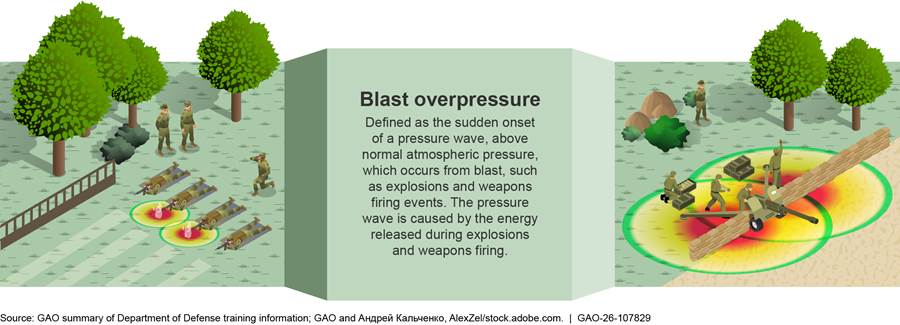
Note: The colors shown from the firing of the weapons represent the intensity of the blast overpressure wave with red being the strongest intensity.
Blast Overpressure Exposure and Brain Health
Blast overpressure exposure has been linked to adverse effects on brain health and cognitive performance.[11] Some studies have shown that exposure to blast overpressure is associated with brain health effects such as inflammation and alterations in structure and function.[12] Repeated exposures may contribute to chronic health issues, including tinnitus, irritability, memory and concentration difficulties, and sleep disturbances. In some cases, TBIs may result from blast overpressure exposure, including from repeated exposures.
|
Examples of Exposure Effects Reported by Service Members Service members may experience immediate effects after exposure to blast overpressure. For example, one service member reported that after conducting consecutive exercises with breaching weapons, they felt “rattled, dizzy, and were throwing up.” Another service member said that shooting a rocket launcher feels like “taking a hit from a [football player] going 150 miles per hour.” Source: GAO interviews. | GAO 26 10782 |
While research on the full impact of blast overpressure exposure continues, DOD has identified steps that can be taken to prevent, mitigate, and treat the brain health effects of such exposures. These steps include the following:
· design weapons to reduce the amount of blast overpressure produced;
· identify safe (or safer) positioning for service members firing the weapons;
· provide personal protective equipment, such as helmets and ear protection;
· track exposure to blast overpressure; and
· identify (to be able to treat) both the short- and long-term brain health effects.
DOD’s Work on Blast Overpressure Exposure and Brain Health
As concerns about blast overpressure exposure emerged, DOD expanded its efforts to address brain health to include blast overpressure exposure. To inform these efforts, recently enacted laws have required DOD to take specific actions, including studying health effects and creating a strategy to address exposures.[13] DOD also has issued guidance to its components on blast overpressure. Specifically, in 2022, in interim guidance, DOD established a threshold of blast overpressure exposure at 4 pounds per square inch. DOD identified that service members who are exposed to blasts at or above this threshold could experience potential health effects. The guidance included instructions to DOD components on managing exposure risks that exceed this threshold during training.[14] In 2024, DOD replaced its interim guidance with the blast overpressure memorandum, which established requirements for risk management actions to mitigate and track blast overpressure across DOD components.[15]
DOD’s efforts on blast overpressure and brain health include personnel across DOD components. Specifically, several DOD components have key roles in managing the effects of blast overpressure exposure:
· Office of the Under Secretary of Defense for Personnel and Readiness and its subordinate offices handle safety and occupational health hazards.
· Military departments (Army, Air Force, and Navy, including Marine Corps) and their corresponding special forces communities are responsible for service members within their department and manage a range of efforts, such as conducting training exercises with weapon systems known to produce higher levels of blast overpressure exposure.
· DHA oversees the military medical treatment facilities (medical facilities), where service members receive health care. In addition, DHA has offices that provide resources and guidance, such as the TBI Center of Excellence, which develops educational materials on brain health issues for service members and providers.
Additionally, within these DOD components, a broad range of personnel are responsible for helping to manage the brain health effects of blast overpressure exposure, spanning across the operational (combat and training) and medical communities. For example, instructors, range safety officers, and safety and occupational health personnel are involved in the prevention and mitigation of blast overpressure exposure. Industrial hygienists (see textbox) are key personnel responsible for assessing the risk of blast overpressure exposure and tracking potential exposures. Within the medical community, health care providers embedded in military units, and at medical facilities and specialized centers (such as DOD’s Defense Intrepid Network for TBI and Brain Health) are responsible for identifying and treating the brain health effects of blast overpressure exposure.[16]
|
DOD Industrial Hygienists DOD industrial hygienists are responsible for addressing occupational hazards (such as noise or exposures to chemicals like heavy metals or asbestos) to protect military and civilian personnel. Responsibilities include assessing and documenting exposures and recommending controls to eliminate or minimize exposure risks. For example, industrial hygienists use DOD’s exposure tracking system—the Defense Occupational and Environmental Health Readiness System-Industrial Hygiene—to collect and analyze exposures. This system allows DOD to capture occupational and environmental health risk data and monitor health hazards that can impact DOD personnel. The Defense Health Agency oversees industrial hygienists that support the Departments of Army and Air Force. The Department of Navy oversees its own industrial hygienists. |
Source: Department of Defense (DOD). | GAO‑26‑107829
DOD is involved in research related to blast overpressure exposure, including brain health effects, and mitigation and treatment options. For example, DOD initiated a study in 2025 on aspects of commercially available blast overpressure sensors including durability and longevity, according to DOD officials. Officials told us sensors could help indicate if blast overpressure exposure has exceeded levels considered to be safe with real-time information, which may help to increase both service member awareness of exposures and their likelihood of seeking care. (See appendix I for additional information on DOD’s ongoing research efforts as of June 2026.)
DOD Required Cognitive Assessments and Exposure Tracking, Among Other Things
Through its August 2024 blast overpressure memorandum, DOD established multiple requirements for the management of brain health risks from exposure to blast overpressure. The memorandum stated that service members’ experiences in training and operational environments have demonstrated possible adverse brain health effects from such exposure. Given this, the memorandum outlined actions that DOD components, primarily OUSD(P&R), the military departments, and DHA should take to prevent and mitigate blast overpressure exposure and its effects on brain health.
The requirements range across several areas, including prevention and mitigation efforts, cognitive assessments and tracking exposures, recognizing health effects, and oversight of such actions. For example, there is a requirement that cognitive assessments be conducted to monitor changes in service members’ brain health. To do this, service members complete a computer-based assessment that measures speed and accuracy of attention, memory, and thinking. Another requirement calls for the tracking of service members’ exposures to blast overpressure so that they have a longitudinal record of their hazard exposures. See table 1 for more information.
Table 1: Requirements for Managing Brain Health Risks from Blast Overpressure Outlined in DOD Policy Memorandum Published August 8, 2024, by Area
|
Area and responsible DOD component |
Requirement |
Description |
|
Weapon systems, prevention, and mitigationa Responsible DOD components: military departments |
Stand-off distances |
Service members involved in weapons training should maintain specific stand-off distances (i.e., how far away they should be from the weapon system when firing) to minimize risk |
|
Those observing training should maintain specific stand-off distances, which vary based on the weapon system |
||
|
Personal protective equipment |
Personal protective equipment, such as body armor, helmet, ear protection, and eye protection should be worn by service members firing weapon systems, instructors, and other personnel |
|
|
Number of personnel in vicinity |
Minimize the number of personnel in the vicinity of blast exposure events to minimize unnecessary exposure |
|
|
Safety warnings and restrictions in manuals |
Comply with safety warnings and restrictions in weapon systems technical and operator manuals |
|
|
Simulations |
Simulations should be integrated into training strategies when appropriate |
|
|
Excess rounds |
Do not expend excess rounds once training standards are achieved |
|
|
Cognitive assessments and tracking exposures Responsible DOD components: OUSD(P&R), Defense Health Agency, Military Departments |
Baseline cognitive assessments |
The entry process for all newly enlisted service members needs to include a cognitive assessment by December 31, 2024 Service members considered at high risk of blast exposure are to complete a baseline cognitive assessment by September 30, 2025 All other service members should complete cognitive assessments “as soon as possible” In addition to this requirement, DOD’s intention is that service members are also to complete an updated baseline assessment every 5 years |
|
Track potential exposure in centralized data system |
Identify and track service members potentially exposed to blast overpressure in DOD’s occupational exposure data system, prioritizing those who are in a military occupational specialty identified as increased riskb |
|
|
Protocol, processes, and procedures for occupational exposure data system |
Prioritize efforts to collect blast overpressure exposure data consistent with data collection protocol from the Under Secretary of Defense for Personnel and Readiness Establish recordkeeping processes and procedures for blast overpressure exposure data from sensors |
|
|
Health effects of blast exposure Responsible DOD components: OUSD(P&R), Military Departments, with support from Defense Health Agency |
Educate on blast exposure hazards |
Those personnel potentially exposed to blast overpressure are to be trained and educated on the potential adverse health and performance effects (including cognitive impairments) and risk management actions to protect themselves |
|
Procedures to recognize, report, and seek evaluation |
Establish procedures to ensure personnel recognize blast overpressure symptoms, report exposures to their command, and seek an evaluation from their medical provider if experiencing symptoms |
|
|
Oversight Responsible DOD components: OUSD(P&R), Military Departments |
Processes and procedures for oversight of actions |
Establish procedures to track and maintain oversight of blast exposure risk management actions; such actions include processes to request any exceptions to policies in the blast overpressure memorandum |
Source: Department of Defense (DOD). | GAO‑26‑107829
Note: This table summarizes requirements from DOD’s policy memorandum defining the department’s requirements. See Department of Defense, Deputy Secretary of Defense, Department of Defense Requirements for Managing Brain Health Risks from Blast Overpressure, Memorandum for Senior Pentagon Leadership, Commanders of the Combatant Commands, Defense Agency, and DOD Field Activity Directors (Aug. 8, 2024).
aThe blast overpressure memorandum also included a requirement to integrate blast overpressure risk management into the weapon systems acquisition lifecycle, including leveraging technology to reassess blast overpressure hazards, and incorporating warnings and cautions in technical publications to mitigate blast overpressure hazards that cannot be eliminated through design. This requirement is outside of the scope of our review.
bDOD’s occupational exposure data system is the Defense Occupational and Environmental Health Readiness System-Industrial Hygiene. It is used to collect, maintain, and analyze hazard and exposure data.
To help identify service members who might be at the highest risk of blast overpressure exposure, the 2024 blast overpressure memorandum included two lists: one of the weapon systems known to produce higher levels of blast overpressure and another with military occupational specialties at increased risk.
· Weapon systems known to produce high levels of blast overpressure. DOD’s memorandum identified certain weapons as having been shown to generate high levels of blast overpressure, including shoulder-fired weapons, 0.50 caliber rifles and guns (e.g., heavy machine guns and sniper rifles), explosives for breaching buildings, and indirect fire systems (e.g., cannons like howitzers and mortars).[17]
· Military occupations that frequently use blast overpressure producing weapons. DOD’s memorandum identified and considered at risk certain occupations that frequently use blast overpressure producing weapons. Such occupations include machine gunners, artillery and infantry positions, rescue pilots, explosive ordinance disposal positions, snipers, tank officers, and cannoneers. DOD also identified special operations forces operators and instructors who train other service members as occupations that may be exposed to blast overpressure more frequently.
See figure 2 for examples of weapons and military occupations identified by DOD for being at higher risk of blast overpressure exposure.
Figure 2: Examples of Weapon Systems Known to Produce Higher Levels of Blast Overpressure and Military Occupations That Frequently Use These Weapon Systems from DHA Factsheet
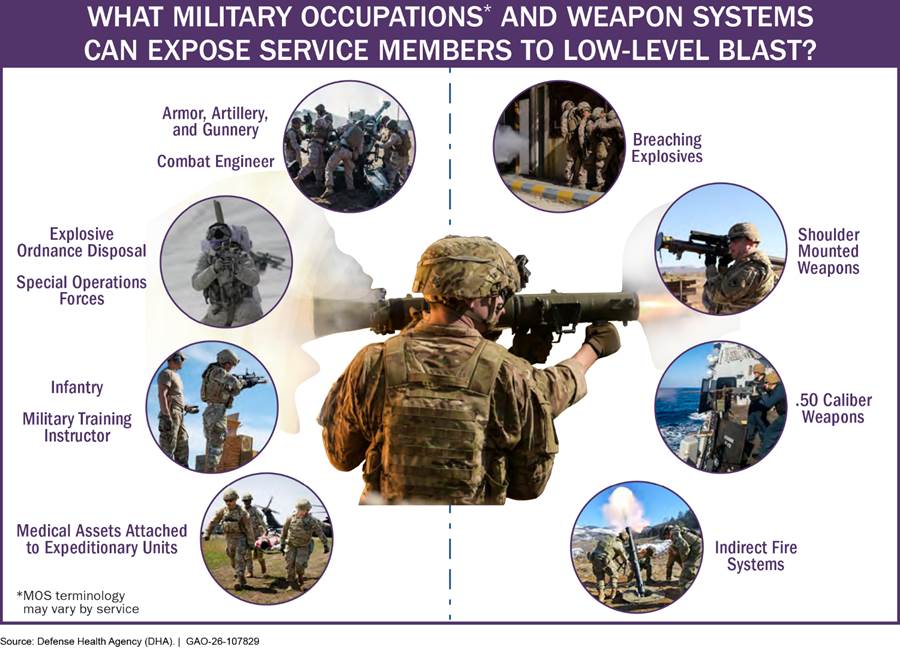
Note: The figure above is reproduced from one page of a factsheet from DHA revised in September 2025.
DOD officials said that these weapons and military occupation lists are considered a “starting point” and are not an all-inclusive list of weapons or occupations that could be at risk of producing or experiencing blast overpressure exposure.
|
DOD Efforts to Address Emerging Concerns about Hand Grenades According to DOD documentation and officials, when thrown correctly, hand grenades do not expose service members to blast overpressure at or in excess of DOD’s threshold for blast overpressure exposure. There have been anecdotal reports of cumulative, adverse effects of hand grenade training. Although DOD did not initially include hand grenades as a high-risk weapon system in its 2024 blast overpressure memorandum, there are efforts underway to address these possible adverse effects. For example, DOD officials said that hand grenades will be included in updated DOD guidance on preventing and mitigating blast overpressure exposure it plans to issue in 2026. Army officials said that they reduced the number of live hand grenades that personnel throw from two to one during training at certain military installations, ultimately reducing exposures for trainees and instructors. Source: Department of Defense (DOD) documents and officials. | GAO 26 107829 |
Several DOD components worked together to produce the blast overpressure memorandum and are responsible for implementing certain requirements. For example, OUSD(P&R) was the primary office responsible for developing the memo’s requirements and issued additional detailed guidance for the relevant DOD components, including the military departments, in December 2024 and April 2025. This office is also responsible for overseeing implementation across DOD, which it does primarily through collecting quarterly status updates from the military departments and specific DOD components. In addition, the military departments also provided feedback on a draft of the blast overpressure memorandum and are responsible for implementing many of its requirements.
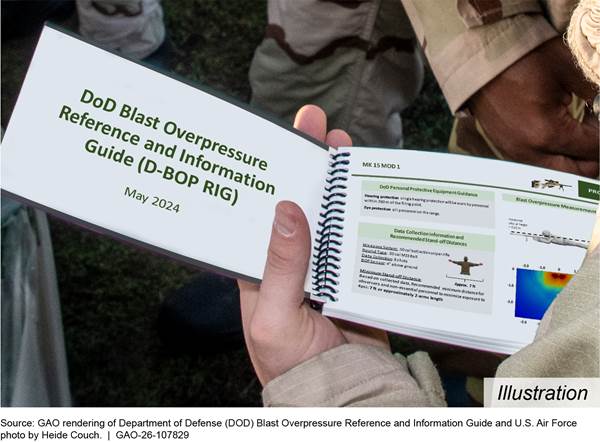
DOD officials told us that several efforts helped inform the blast overpressure memorandum requirements, including studies conducted or commissioned by DOD, and industry standards, and best practices within occupational and environmental health. For example, DOD completed a study in November 2023 to measure the magnitude of the blast overpressure wave on several weapon systems. The data and results helped identify appropriate stand-off distances and appropriate use of personal protective equipment as well as develop a reference and information guide that can be used by service members when operating these weapon systems, according to DOD officials. See figure 3.
Figure 3: Illustration of How DOD Blast Overpressure Reference and Information Guide May Be Used by Service Members, October 2024
DOD developed the reference and information guide based on certain weapon systems in open-air environments and DOD officials told us that they have taken a coordinated, phased approach to incorporate information on weapon systems in other environments. Officials from the Air Force and Navy told us that blast overpressure exposure risk in air- or ship-based environments are different than when the weapons are land-based. For example, officials from the Navy told us that water reflections can affect blast overpressure waves.[18] Officials from the Air Force said the pressure differential at 10,000 feet can potentially impact the blast wave and add to the harmful effects of blast exposure. As of April 2026, DOD was working to expand its guidance through additional research studies to understand blast overpressure impacts in these environments and expects this study to take a few years, depending on availability of resources to carry out the study.
DOD components, including the military departments, coordinated on the implementation of the 2024 blast overpressure memorandum requirements. Specifically, according to documentation and officials, there are DOD-wide and military department-specific working groups that meet regularly to share information and to coordinate and prioritize actions related to managing blast overpressure exposure. For example, one of the Navy working group meetings discussed successes, barriers, and next steps for specific areas where the Navy is doing work, such as operations and training, exposure tracking, and communications. In addition, DOD held a Blast Overpressure Summit in September 2025 with attendees from several DOD components. According to DOD, the Summit was attended by over 180 personnel and covered topic areas including identifying best practices and remaining gaps for blast overpressure risk management, educational and training opportunities for raising awareness, and funding and resource challenges. The U.S. Special Operations Command has also had several efforts to research blast overpressure effects for special operations service members specifically. (See appendix II for additional information on these efforts within the special operations community.)
DOD Has Begun Implementing Requirements but Reported Implementation Challenges for Cognitive Assessments and Exposure Tracking
DOD Has Taken Steps to Implement Requirements in Fiscal Year 2025
In fiscal year 2025, responsible DOD components made progress toward fulfilling requirements in the 2024 blast overpressure memorandum.[19] OUSD(P&R), the component responsible for overall oversight of implementation, released a guidance document in December 2024 to help components implement the blast overpressure memorandum requirements.[20] This guidance included specific actions for components to take and target dates for those actions, with some due dates in fiscal year 2025 and others extending through fiscal year 2029. Officials from OUSD(P&R) told us that they are taking a phased approach with implementation and that they assigned dates to actions in the guidance document to ensure accountability and progress. Additionally, OUSD(P&R) officials established performance measures in April 2025. OUSD(P&R) officials use these performance measures to assess components’ progress toward fulfilling the DOD’s requirements. For example, in the final fiscal year 2025 blast overpressure implementation survey, OUSD(P&R) asked military departments to report their progress toward incorporating blast overpressure products into training, including reporting the related performance measure: the percentage of units for which military departments had updated training.
Overall, we found responsible DOD components have taken steps to address the actions in guidance and have made progress across the various requirements in the blast overpressure memo. See table 2 for examples of actions DOD components have taken to implement requirements in the blast overpressure memo. For additional information, see appendix III.
Table 2: Examples of DOD Actions in Fiscal Year 2025 to Address Requirements for Managing the Brain Health Risks from Blast Overpressure
|
Requirement area |
Responsible components |
Example of actions taken by selected components |
|
Weapon systems, prevention, and mitigation |
Military departments (Army, Navy, Air Force) |
The military departments each updated guidance related to stand-off distances for personnel to mitigate exposure to blast overpressure from weapons identified in DOD guidance. For example, the Army issued safety memoranda, as did the Marine Corps within the Department of the Navy. The Air Force issued policy related to stand-off distances when firing certain weapons. |
|
Cognitive assessments and tracking exposures |
OUSD(P&R), DHA, Military departments |
DHA updated the exposure tracking system so industrial hygienists have the capability to track blast overpressure exposure, similar to exposure to other workplace hazards like heavy metals. |
|
Health effects of blast exposure |
OUSD(P&R), Military departments |
Military department officials from the Army told us they use a fact sheet DHA created about blast overpressure, including potential symptoms and actions to take if symptoms are persistent, and other documents to provide information to service members and providers about the brain health effects of blast overpressure. |
|
Oversight |
OUSD(P&R), Military departments |
The Army and Navy used multi-disciplinary working groups to coordinate their respective department’s actions to implement requirements outlined in the 2024 blast overpressure memorandum and related guidance. |
Source: GAO analysis of Department of Defense (DOD) documentation and interviews with DOD officials. | GAO‑26‑107829
Note: This table describes examples of actions DOD components have taken to address DOD’s requirements for managing brain health risks. See Department of Defense, Deputy Secretary of Defense, Department of Defense Requirements for Managing Brain Health Risks from Blast Overpressure, Memorandum for Senior Pentagon Leadership, Commanders of the Combatant Commands, Defense Agency, and DOD Field Activity Directors (Aug. 8, 2024). In guidance for implementing the memorandum, DOD assigned responsibility for actions to various DOD components, including the military departments (Army, Navy, and Air Force), the Office of the Under Secretary of Defense for Personnel and Readiness (OUSD(P&R)), and the Defense Health Agency (DHA).
Officials from the military departments told us that their work to implement the requirements will continue and officials from OUSD(P&R) said that they will continue monitoring components’ efforts on a quarterly basis to ensure the actions are implemented. DOD leadership for OUSD(P&R) also signaled its commitment to blast overpressure risk management by including it as one of four strategic priorities in fiscal year 2027, noting that, “the Department is committed to advancing combat readiness while reducing risks associated with blast overpressure.”[21] Military department officials similarly said that their departments will continue their blast overpressure work and identified priorities.
DOD Reported Resource Challenges Implementing Cognitive Assessment Requirements
|
DOD Requirements for Cognitive Assessments Cognitive assessments are computer-based tests that detect service members’ speed and accuracy of attention, memory, and thinking ability. Health care providers can compare subsequent cognitive assessments to a service member’s baseline assessment to detect cognitive changes. Through cognitive assessments, providers can identify service members who may need evaluation and treatment to avoid long-term effects of blast overpressure exposure. In the blast overpressure memo, DOD requires that
service members complete cognitive assessments. Specifically, as of fiscal
year 2025, cognitive assessments are required for newly enlisted service
members and for active duty service members considered at high risk of blast
exposure. All other service members should complete cognitive assessments “as
soon as possible.” Further, DOD’s intention is that all service members
complete a baseline assessment every 5 years under DOD’s cognitive monitoring
program. The U.S. Army Medical Command is leading the DOD-wide cognitive
monitoring program until the program transitions to the Defense Health
Agency. Officials told us that this transition is planned for fiscal year
2027. |
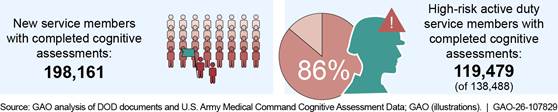
DOD components have made progress in having service members complete cognitive assessments in fiscal year 2025 but officials reported resource challenges, making it difficult to fully meet this requirement (see sidebar for an overview of these requirements). According to DOD data for fiscal year 2025, the military departments completed baseline cognitive assessments for most, but not all service members, as required by the 2024 blast overpressure memo. See figure 4. (See also appendix IV for more information on cognitive assessments.)
Figure 4: Overview of DOD’s Cognitive Assessments for New and High-Risk Service Members in Fiscal Year 2025
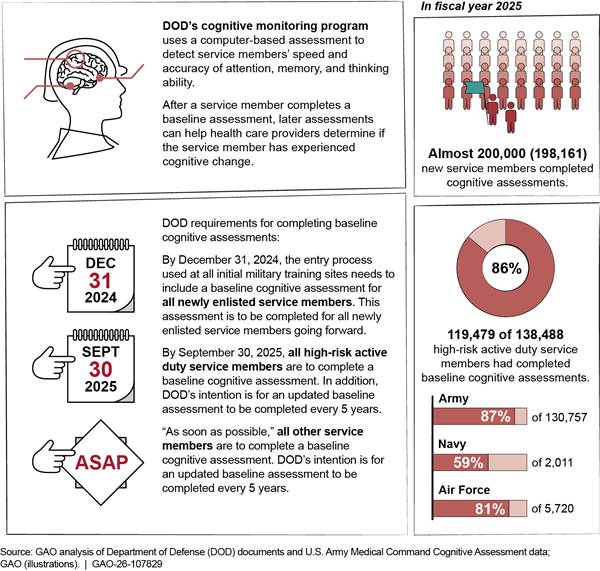
Notes: The U.S. Army Medical Command led implementation and data collection of cognitive assessments in fiscal year 2025. U.S. Army Medical Command is not responsible for tracking information about completion of initial military training. Officials told us that they could not provide a total number of newly enlisted service members who required testing in fiscal year 2025 because of the timing of the requirement and how other data about initial military training is tracked. As of March 2026, 96 percent of high-risk service members had completed baseline cognitive assessments, according to the Army’s data. Between the end of fiscal year 2025 and the end of March 2026, officials told us they made refinements to the cognitive assessment data to exclude service members who were not available for testing, such as those who were in an arrest and confinement or approved retirement status. The 96 percent completion rate in March 2026 is due in part to these exclusions, which resulted in a smaller number of service members who required testing. Officials confirmed that the numbers reported for fiscal year 2025 are accurate based on the data available at the time. High-risk service members are identified in DOD’s Requirements for Managing the Brain Health Risks from Blast Overpressure memorandum. These service members are assigned to at risk occupations that frequently use blast overpressure producing weapons. Such occupations include machine gunners, artillery and infantry positions, rescue pilots, explosive ordinance disposal positions, snipers, tank officers, and cannoneers.
As figure 4 shows, DOD data show the military departments had tested 86 percent of high-risk service members by the end of fiscal year 2025, the deadline outlined in the blast overpressure memorandum. Additional DOD data as of March 2026 show that 96 percent of high-risk service members had completed assessments.[22] However, officials from all three military departments said that they experienced challenges completing the cognitive assessments due in fiscal year 2025. Officials from the Army said they expect challenges to continue. Such challenges may continue in part because of the ongoing requirements related to cognitive assessments. Specifically, following the completion of assessments for high-risk service members, military departments are required to assess all remaining service members “as soon as possible.” This means they will need to complete these assessments for a much larger population than for newly enlisted and high-risk service members. In addition, DOD intends that all service members repeat the baseline assessment every 5 years.
Officials from the military departments reported that they faced challenges meeting DOD’s requirements for cognitive assessments in fiscal year 2025 due to resource constraints. According to DOD officials, because of the need to expeditiously begin work, there was not an opportunity for DOD components to fully evaluate and obtain the resources necessary to complete cognitive assessments, as required by DOD policy. Specifically, DOD’s policy for cognitive assessments requires the Assistant Secretary of Defense for Health Affairs to provide an operating budget for cognitive assessments, and requires DHA to program, obtain, and provide the necessary administrative, logistical, and financial resources for cognitive testing.[23] Similarly, DOD’s implementation guidance requires DOD components to plan and communicate the resource requirements for meeting cognitive assessment timelines by the fourth quarter of fiscal year 2025. It states that, beginning with the first quarter of 2026, DOD components, such as DHA and the military departments, are to evaluate, identify, plan for, and obtain from DOD the additional resources necessary to implement the requirements in the DOD blast overpressure memo.[24]
Military department officials said they did not receive new resources for cognitive monitoring when the blast overpressure memorandum requirements were introduced. Instead, they used existing resources to conduct assessments. However, resource allocations from DOD to support the cognitive assessment requirements were not made until July 2025, for assessments that needed to be completed by the end of September 2025, according to officials from the U.S. Army Medical Command, which led cognitive monitoring efforts in fiscal year 2025.[25] These officials said this made it challenging to conduct all of the required assessments by the September deadline. Navy officials said they faced a shortage of proctors for assessments and relied on service members doing temporary duty as proctors, which pulled them away from other responsibilities.[26] Air Force officials said they did not have dedicated staff or resources from the Air Force to conduct the assessments. Officials said they relied on DHA mental health providers to conduct assessments (giving these providers less time for patient care), and, though they received some computers from another military department, they faced issues due to limited availability of technology resources. As of the end of fiscal year 2025, DOD officials from military departments reported that funding had not been allocated from DOD to support cognitive monitoring of all remaining active and reserve service members.
In April 2026, DOD released information indicating that it will begin a 1-year pilot of a new cognitive assessment tool in the remainder of fiscal year 2026. The new tool is a web-based application that service members can use to complete assessments independently. According to DOD officials, the tool is expected to be less resource intensive than the current cognitive assessments and, as a result, could mitigate some of the resource challenges military departments reported. As of May 2026, DOD officials said they planned to start the pilot of the new cognitive assessment tool in June 2026. The officials said they were developing documentation, such as guidance, to support the pilot but did not have documented plans to assess the effect of the tool on overall resource needs. Assessing the effect of the pilot as part of a comprehensive assessment to evaluate needed resources would be consistent with implementing guidance, which calls for DOD components to evaluate, identify, plan for, and obtain the additional resources necessary.[27] As DOD conducts its pilot, it will be important for relevant components to assess the overall resource needs for conducting initial and repeated baseline cognitive assessments across all active and reserve service members on an ongoing basis. Doing so would provide a sound foundation for identifying resources needed to help ensure military departments can conduct timely cognitive assessments. Further, it would strengthen DOD’s ability to identify service members who may need further evaluation and potential treatment to avoid long-term effects from blast overpressure exposure.
DOD Reported Resource Challenges Implementing Exposure Tracking Requirements
|
DOD Requirements for Exposure Tracking Exposure tracking involves creating a record of the hazards, such as blast overpressure, that a service member is exposed to during their military service. This tracking includes qualitative information, such as information about the location, weapons systems, and service member. It also includes quantitative information, such as blast exposure data from sensors. Tracking service members’ exposures to blast overpressure is one of the Department of Defense (DOD) requirements for managing brain health risks from blast overpressure exposure. According to requirements outlined in the 2024 blast overpressure memorandum, DOD components, such as the military departments and the Defense Health Agency, are to · identify and track service members potentially exposed to blast overpressure in DOD’s occupational exposure data system, prioritizing those who are in a military occupational specialty the component identified as increased risk; · prioritize efforts to collect blast overpressure exposure data consistent with data collection protocol from the Under Secretary of Defense for Personnel and Readiness; and · establish recordkeeping processes and procedures for blast overpressure exposure data from sensors. To fulfill requirements for exposure tracking, DOD
requires industrial hygienists to track information about service members in
the exposure tracking system in fiscal year 2025. This information includes,
among other things, service members’ units, locations where service members
could be exposed to blast overpressure, and the weapons systems used at those
locations. Industrial hygienists are also to begin collecting and monitoring
blast overpressure exposures using sensor data with targets for completion in
fiscal years 2026 and 2027. |
Officials from DHA and two of the military departments said they also faced resource challenges that made it difficult to meet DOD’s exposure tracking requirements. (See sidebar for an overview of these requirements.) Air Force officials reported that they had met their targets for fiscal year 2025, but Army and Navy officials reported that they had started but not completed such requirements. For the Army, the military department with the largest number of high-risk service members, officials reported in their quarterly implementation survey to the OUSD(P&R) that as of the end of fiscal year 2025 they had started exposure tracking for less than 2 percent of the 142,000 potentially exposed service members. Actions DOD components need to take to fulfill exposure tracking requirements expand in fiscal years 2026 and 2027, which means challenges may continue as industrial hygienists’ responsibilities for exposure tracking increase.
According to officials from DHA, the Army, and the Navy, implementation challenges are the result of not having enough safety personnel—industrial hygienists—available to identify and track service members potentially exposed to blast overpressure.[28] Specifically, these officials said that they did not have enough industrial hygienists to complete the exposure tracking requirements identified in the blast overpressure memorandum that were targeted for fiscal year 2025 and beyond:
· DHA officials stated that there were not enough industrial hygiene personnel to implement DOD’s blast overpressure requirements for the military departments whose industrial hygienists are organized under DHA.[29] This issue especially affects the Army. An Army audit found that, as of November 2024, challenges executing industrial hygiene services for the Army were exacerbated when DHA assumed responsibility for industrial hygiene in October 2022, in part due to insufficient resources, including staff.[30]
· Army officials said the delay in identifying service members in DOD’s exposure data system is due to the Army’s reliance on DHA’s industrial hygienists to collect and populate information in the system after the transition of the Army’s industrial hygienists to DHA. Army officials said they need DHA support to ensure industrial hygienist personnel perform the data entry required so Army service members have records in the exposure data system.
· Navy officials said they do not have sufficient industrial hygiene personnel to keep up with their responsibilities across all hazards, including blast overpressure.[31] As of January 2026, Navy officials said that industrial hygienists spend between 50 to 60 percent of their time on blast overpressure hazards.
Officials from OUSD(P&R), the office responsible for overseeing implementation of the blast overpressure memo requirements, similarly told us that insufficient industrial hygienists are the primary barrier to DOD achieving its targets for exposure tracking. They said that limited industrial hygienist capacity is a problem exacerbated by the 2024 blast overpressure memorandum requirements. In a memo to the Under Secretary of Defense (Comptroller) and Chief Financial Officer, the Under Secretary of Defense for Personnel and Readiness underscored the need for additional resources and identified blast overpressure risk management, including exposure tracking, as one of four of the Under Secretary’s strategic priorities for resource enhancement during the fiscal year 2027 program and budget review process.[32] This memo noted that under-resourcing for blast overpressure could delay implementation of statutory requirements, and that prioritizing investments is in alignment with the Secretary of Defense’s strategic objective to safeguard warfighter health and ensure operational resilience.
Under DOD’s safety and occupational health program policy, the Assistant Secretary of Defense for Health Affairs, which oversees DHA, and the military departments are responsible for including sufficient resources to implement safety and occupational health programs, of which blast overpressure hazards are a part, in DOD’s resource allocation and prioritization process.[33] Under this policy, DHA and military department commanders, managers, and supervisors are responsible for planning, programming, and budgeting resources required to implement safety and occupational health programs. They are also responsible for providing sufficient safety and occupational health staffing to meet program requirements. Additionally, starting with the first quarter of fiscal year 2026, DOD’s December 2024 guidance for implementing requirements from the blast overpressure memo requires DOD components to evaluate, identify, plan for, and obtain the additional resources and support to implement the requirements from the blast overpressure memorandum.[34]
DHA officials said that the industrial hygiene responsibilities for blast overpressure were introduced as a new program need for which DOD did not allocate additional funding. DHA officials said they tried to obtain additional resources, but were unsuccessful. Specifically, DHA officials said that they submitted an internal request to DOD for additional resources for industrial hygienists during the fiscal year 2027 DOD resource allocation and prioritization process. [35] However, the officials told us they did not successfully obtain funding through this request, in part due to a lack of supporting data for the request.
In April 2026, DHA officials said that the DOD Office of Cost Assessment and Program Evaluation was conducting an assessment to determine resource needs for industrial hygiene, with an estimated completion in summer 2026.[36] DHA officials did not provide documentation of the assessment under development, but said that DOD plans to use it to prioritize resources across the relevant components, including at DHA and the military departments. However, until the assessment is completed and used during the resource allocation and prioritization process, it is not certain that the assessment will allow DHA to plan for and obtain additional resources, in alignment with implementing requirements from the blast overpressure memo. In the interim, the relevant DOD components may not have the resources they need to fully implement blast overpressure exposure tracking requirements. Completing a comprehensive assessment would provide a sound foundation to support efforts to obtain the resources necessary, resulting in DOD being better positioned to achieve its goals for exposure tracking. This, in turn, will yield vital records with the potential to give service members and providers documented insight into cumulative blast overpressure exposures over service members’ careers.
DOD Has Taken Steps to Help Address Factors Affecting Service Members’ Decisions to Seek Treatment
Service Members at Selected Installations Identified Several Factors That Can Affect Seeking Care for Blast-Related Effects
Service members at the four installations we visited reported a range of factors that may affect their decision to seek care or receive treatment for the brain health effects of blast exposure. Below are five common factors we heard.[37]
Service member awareness. We found service members’ awareness of the potential negative effects of blast overpressure varied and can affect their decisions to seek care. For example, some service members reported being familiar with the brain health effects of blast overpressure exposure because of their frequent use of blast overpressure producing weapons and thus might seek care if having symptoms. In contrast, other service members we spoke with were less familiar with the effects (possibly because they had fewer interactions with high-risk weapon systems), which may have deterred them from seeking treatment. We also heard from service members that they do not always hear about the potential brain health effects during trainings with high-risk weapons. Instead, a few indicated their awareness about these effects was often the result of word-of-mouth information. A few service members suggested that receiving training to inform them of the potential brain health risks of blast overpressure exposure would be helpful.
Career and mission duties. We found service members’ sense of personal responsibility to prioritize their mission and training objectives can affect their decisions to seek care. Some service members told us that if they felt symptoms during trainings they might be reluctant to ask for a break or to seek care. Some service members said they are further disinclined to rest, recover, or seek care when there is a shortage of staff who could take their place, as they do not want to be a burden to their colleagues. A few service members we interviewed reported that this drive to complete the mission and training objectives is a personal, internal drive—that is, they are not discouraged by others from seeking care. In fact, some noted that their colleagues have encouraged them to take the time they need to rest. Further, some service members at the installations we visited noted that they do not view stigma around seeking treatment as an issue. However, other service members reported that they believe there can be a risk to their career for reporting symptoms, and a few were concerned they could be discharged for medical reasons.
Leadership and unit culture. Service members said that leadership and unit culture can have a large effect on whether they seek treatment for potential blast-related injuries. Some service members said that leadership in their units emphasized the importance of service members taking care of themselves and encouraged seeking treatment when needed. For example, some service members at one military installation described leadership-endorsed opportunities for service members to meet with providers—such as with providers embedded within the units or with direct hand offs to a medical facility provider. These types of opportunities may help make service members more likely to seek treatment. Further, several service members described how the perspectives on blast overpressure exposure of more senior service members in their unit can influence their decisions to seek care. For example, we heard that senior service members may share their regrets about not taking blast overpressure exposure-related health concerns more seriously with junior service members and encourage them to seek care when needed.
Access to specialty medical care. Service members said the ability to obtain timely referrals and appointments with providers can affect whether they decide to seek care. For example, service members said that getting specialty care can take weeks to months to schedule. We also heard that service members at locations with specialty care (such as at a center within the Defense Intrepid Network for TBI and Brain Health) often want to seek care with those specialists but that availability might be limited. In contrast, other service members mentioned that they have been able to be assessed for a possible concussion within 24 hours, which might be because of specialized concussion care available at their installation. Finally, one service member described how he plans ahead by scheduling medical appointments to immediately follow training so that the provider can accurately assess the effects of the training on the service member.
Interactions with providers. Service members said their decision to seek treatment could be affected by interactions with providers, including whether providers are aware of the effects of blast overpressure exposure. Some service members mentioned that having providers embedded within units meant their symptoms were taken more seriously, and that embedded providers are often more responsive to health concerns. However, a few service members said providers can attribute symptoms of blast overpressure to dehydration. Some service members at one military installation said that it can be hard to prove certain symptoms, like headaches, are related to blast overpressure effects. In addition, service members told us that they are often told to take ibuprofen and drink water to address their symptoms. As a result, some service members feel that their brain health concerns—such as the symptoms that can seem mild but cumulatively add up—are not always taken seriously by providers. We also heard from some service members that their providers are unaware of blast-related symptoms.
See figure 5 for examples of information we heard from service members at the installations we visited.
Figure 5: Examples of Information from Service Members about Factors That Affect Their Decision to Seek Treatment for the Brain Health Effects of Blast Overpressure Exposure
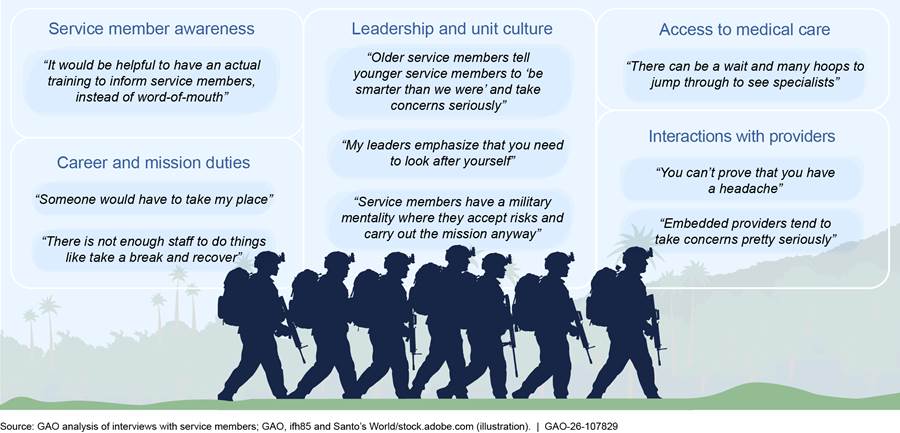
Note: The information we heard from service members at the four military installations we visited included in this figure is intended to be illustrative. Statements have been paraphrased to provide context and to remove identifying details.
DOD and the Military Departments Have Actions Underway to Help Encourage Service Members to Seek Treatment
DOD and the military departments have ongoing efforts to address some of the factors that service members said may affect their decision to seek treatment. Some of these efforts are in response to the requirements in the 2024 blast overpressure memorandum and others are efforts generated by specific units or military departments.
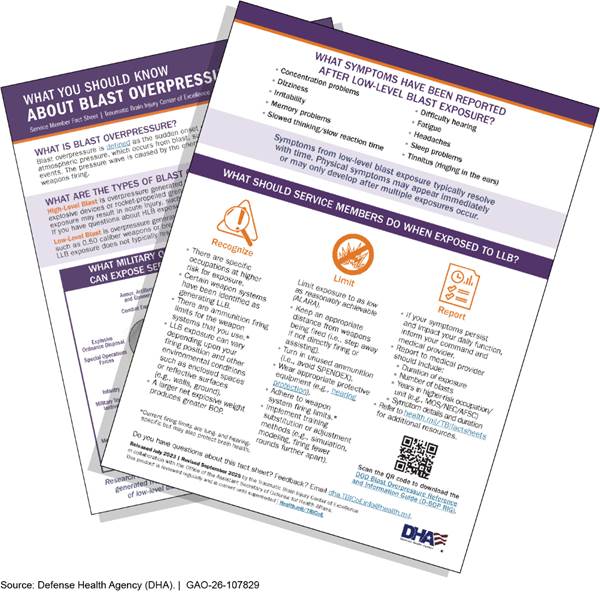
Service member awareness. To raise awareness of the potential effects of blast overpressure exposure, DOD (including the military departments) have several efforts underway. Specifically, the TBI Center of Excellence—an office within DHA that produces resources for service members and health care providers about TBIs—has developed an informational fact sheet for service members to help service members understand what blast overpressure is, symptoms to watch for, and what to do if they think they have been exposed. DOD officials told us that the fact sheet has been posted to DHA’s Warfighter Brain Health Hub website as well as an internal DOD platform.[38] See figure 6.
In addition, the military departments have also taken steps to increase service member awareness. For example, Army officials said they developed and distributed a “leader card” in 2024 with information on the effects of blast overpressure for training those in leadership positions, which is also intended to raise awareness among service members. The Navy sent out two department-wide messages in April 2024 and July 2025 on blast overpressure exposure to educate service members on its effects and provide direction to leadership. Air Force officials said that they provide training briefings prior to a training exercise occurring to educate service members at high risk of blast overpressure exposure. Further, officials from the military departments told us that they have been working on a communication plan aimed at disseminating information to service members on blast overpressure exposure and its potential effects and that, as of April 2026, this work is continuing.
Career and mission duties. The military departments have a few efforts to address leadership and unit culture that service members said might affect their decision to seek treatment. First, the Army scheduled breaks in service members’ training schedules to address service member concerns, according to Army officials. In addition, to encourage service members to seek treatment, the Air Force Safety Center distributed information emphasizing that service members who report or seek treatment for symptoms will not lose their status for missions that qualify for bonus pay, according to Air Force officials.
Leadership and unit culture. DOD components have efforts underway intended to improve leadership commitment and unit culture around blast overpressure exposure. For instance, at the 2025 DOD Blast Overpressure Summit, a session focused on topics like leadership commitment to managing blast overpressure exposure and addressing barriers to seeking care that may be present within military culture and units. DOD officials said that best practices for enhancing unit culture around blast overpressure management emerged from this session, such as the importance of commanders leading by example and seeking care themselves if they are having symptoms. Officials told us that another best practice is commanders reinforcing the importance of seeking care at quarterly leadership meetings.
In addition, Army officials told us that they have an annual assessment program, which asks questions to service members about various aspects of their health and that assessment program will soon include questions specifically about brain health. The officials said that the annual assessment gives service members an opportunity to raise possible issues with blast overpressure exposure and its effects on brain health in a routine manner, which may help to improve the unit culture around seeking care for possible blast overpressure symptoms. U.S. Special Operations Command officials also told us that they had an informational day for leadership in special operations in July 2025 dedicated to providing information on blast overpressure exposure and its effects.
Access to specialty medical care. DHA officials said that they have an initiative in the early development and implementation stages intended to increase access to care for service members at medical facilities. Access to medical care was one of the factors affecting decisions to seek treatment we heard from service members. DHA officials said that, as a part of this initiative, they plan to focus on tracking access to care for service members generally. Although this initiative is not dedicated solely to increasing access to care for blast overpressure symptoms, the ability to increase the capacity of complex care that medical facilities can provide may ultimately help service members seeking care for effects of blast overpressure exposure, according to DHA officials.[39]
Interactions with providers. The TBI Center of Excellence has developed a number of resources intended to enhance providers’ awareness of blast overpressure, which might help their interactions with service members. Specifically, the TBI Center of Excellence developed several resources for providers to support treatment of brain health effects in service members, some of which may be related to blast overpressure exposure. These resources include fact sheets, training events, clinical guidance, and other documents (such as instructions for documenting symptoms of blast overpressure exposure). Officials from the TBI Center of Excellence told us that these resources are made publicly available on the Center’s website and distributed to the military departments and providers at medical facilities. In addition, officials said the TBI Center of Excellence has a campaign for Brain Injury Awareness Month in March aimed to increase providers’ general understanding of brain injury issues and give them resources. Officials told us that the TBI Center of Excellence also has a network of contractors that provide training locally to providers at military installations.[40] Not all of these resources are specific to blast overpressure exposure, but some of them provide information on possible blast-related effects.
Additionally, in February 2026, DHA officials described efforts they are taking to enhance providers’ awareness of blast overpressure. The officials said that while DHA does not require providers training specific to the effects of blast overpressure exposure, they are considering whether training should be made mandatory or strongly encouraged.[41] They also described the goal of having blast overpressure training targeted to specific provider populations, such as primary care providers, emergency medicine physicians, and deployed providers, as those providers might be more likely to interact with service members exposed to blast overpressure.
Conclusions
DOD has taken critical steps to prevent and mitigate service members’ exposures to blast overpressure, steps intended to help protect their brain health and the readiness of our country’s military forces. For several requirements outlined in the 2024 blast overpressure memo—such as updating stand-off distances and conducting initial cognitive assessments—key DOD components worked to meet targets by the end of fiscal year 2025.
Importantly, DOD components, including DHA and the military departments, completed baseline cognitive assessments for most new service members and high-risk groups. However, military departments faced resource challenges completing these requirements, requirements that will continue to expand as they now aim to conduct such assessments for all service members, along with completing an updated assessment every 5 years. By completing a comprehensive assessment of the overall resource needs for conducting cognitive assessments going forward, including assessing the pilot of a new cognitive assessment tool’s effect on resources, the relevant DOD components can help ensure they can conduct timely cognitive assessments going forward. This will strengthen DOD’s ability to identify service members who may need further evaluation and potential treatment to avoid long-term effects from blast overpressure exposure.
DHA and the military departments have also taken initial steps to implement exposure tracking requirements but have been hampered by a lack of industrial hygiene staff, and they may continue to face challenges as tracking requirements expand in fiscal years 2026 and 2027. By completing a comprehensive assessment of resource needs for industrial hygiene, DOD would be better able to fully implement exposure tracking requirements. This, in turn, will yield vital records with the potential to give service members and providers documented insight into cumulative blast overpressure exposures over service members’ careers.
Recommendations
We are making the following two recommendations to DOD:
The Secretary of Defense should ensure the completion of a comprehensive assessment of the resources needed to implement the cognitive assessment requirements, inclusive of an evaluation of the new pilot to assess its effectiveness and the extent to which it addresses components’ resource needs. (Recommendation 1)
The Secretary of Defense should ensure the completion of a comprehensive resource assessment to support the needs of relevant DOD components for industrial hygiene staff to implement the blast overpressure tracking requirements. (Recommendation 2)
Agency Comments
We provided a draft of this report to DOD for review and comment. In its written comments, reproduced in appendix V, DOD agreed with our recommendations and identified actions DOD plans to take to address them.
Regarding our first recommendation, DOD stated that it will complete a comprehensive resource assessment for cognitive monitoring requirements through a workgroup DOD established to oversee the implementation of DOD’s new tool for such monitoring.
Regarding our second recommendation, DOD stated that DHA recently completed an enterprise-wide assessment of industrial hygiene staffing resources. DOD noted that implementing the resources needed is contingent upon future funding through its resource prioritization process. DOD also stated that it is conducting a comprehensive resource assessment of the technical capabilities necessary to fully implement blast overpressure tracking requirements. DOD estimates it will complete the actions for both recommendations by December 2026.
DOD also provided technical comments, which we incorporated as appropriate.
We are sending copies of this report to the appropriate congressional committees, the Secretary of Defense, the Under Secretary of Defense for Personnel and Readiness, the Assistant Secretary of Defense for Health Affairs, the Director of the Defense Health Agency, and the Secretaries of the Army, the Navy and the Air Force. In addition, the report is available at no charge on the GAO website at https://www.gao.gov.
If you or your staff have any questions about this report, please contact me at HundrupA@gao.gov. Contact points for our Offices of Congressional Relations and Media Relations may be found on the last page of this report. GAO staff who made key contributions to this report are listed in appendix VI.

Alyssa M. Hundrup
Director, Health Care
List of Addressees
The Honorable Roger Wicker
Chairman
The Honorable Jack Reed
Ranking Member
Committee on Armed Services
United States Senate
The Honorable Elizabeth Warren
Ranking Member
Subcommittee on Personnel
Committee on Armed Services
United States Senate
The Honorable Mike Rogers
Chairman
The Honorable Adam Smith
Ranking Member
Committee on Armed Services
House of Representatives
The Honorable Susan M. Collins
United States Senate
The Honorable Joni K. Ernst
United States Senate
The Honorable Kirsten Gillibrand
United States Senate
The Honorable Martin Heinrich
United States Senate
The Honorable Mazie K. Hirono
United States Senate
The Honorable Tim Kaine
United States Senate
The Honorable Angus S. King, Jr.
United States Senate
The Honorable Rick Scott
United States Senate
The Honorable Dan Sullivan
United States Senate
The Honorable Thom Tillis
United States Senate
The Honorable Sanford D. Bishop, Jr.
House of Representatives
The Honorable Robert Garcia
House of Representatives
The Honorable Jared Golden
House of Representatives
The Honorable Chrissy Houlahan
House of Representatives
The Honorable Ro Khanna
House of Representatives
The Honorable Susie Lee
House of Representatives
The Honorable Joseph D. Morelle
House of Representatives
The Honorable Seth Moulton
House of Representatives
The Honorable Jimmy Panetta
House of Representatives
The Honorable Chellie Pingree
House of Representatives
The Honorable Elise M. Stefanik
House of Representatives
This appendix provides information on research efforts Department of Defense (DOD) officials reported as ongoing research efforts as of May 2026 related to the effects, prevention, and treatment of blast overpressure exposure. For example, DOD identified ongoing research studies to help develop an occupational exposure limit, to guide the selection of sensors, and to understand the effects of blast overpressure in specific populations of service members. (See table 3 for examples.) These studies are in addition to prior research DOD completed on exposure to blast overpressure. For example, in a 2023 study, DOD demonstrated the feasibility of generating exposure reports for service members in training environments to monitor individual exposures.[42]
Various DOD components (including military departments and offices under the Office of the Under Secretary of Defense for Personnel and Readiness, such as the Defense Health Agency) participate in these efforts. Per DOD guidance, the Defense Health Agency is required to publish an annual summary of all blast overpressure studies and ongoing research.[43] In April 2026, DOD officials told us that efforts to address this requirement remain under development.
|
DOD component |
Research effort description |
Estimated completion date |
|
Office of Safety and Occupational Health |
Examine, in partnership with the National Academies of Sciences, the projected safety threshold for acute and chronic brain health effects to help determine an occupational exposure limit |
January 2027 |
|
Examine aspects of commercially available blast overpressure sensors, such as durability, life cycles, calibration mechanisms |
January 2029 |
|
|
U.S. Special Operations Command |
Track the cognitive testing and blast overpressure exposure of 100 Department of Navy service members in special operations for one year or longer |
March 2029 |
|
Pilot a treatment program for mid-to-late career service members with traumatic brain injury through an integrated, multidisciplinary evaluation and care coordination approach |
May 2028 |
|
|
Department of Navy |
Study cumulative blast exposure thresholds through survey of service members’ self-reported blast history and health effects |
Ongoing through 2029 |
|
Defense Health Agency |
Develop a clinical thresholds guide using clinical data to determine the clinical threshold for when blast overpressure affects service members |
September 2028 |
|
Study changes in service member eye markers based on repetitive blast overpressure exposure and head injuries |
Ongoinga |
Source: Department of Defense (DOD). | GAO‑26‑107829
aDOD officials expect this portfolio of studies to continue to support blast overpressure work and do not have an estimated completion date as of May 2026.
Appendix II: Information on Special Operations Forces and Related Efforts on Managing Blast Overpressure Exposure
This appendix provides information on special operations forces as well as their efforts to manage blast overpressure exposure within special operations commands.
Service members serving in special operations forces may have a higher volume of exposure to blast overpressure compared to service members in conventional forces, according to special operations forces officials. This is because service members in special operations forces generally conduct more training with heavy weapons that produce blast overpressure and can be deployed more often. Similarly, in certain special operations forces training courses, special operations forces officials noted that they fire more weapon rounds over the course of weeks than a conventional division fires in a year.
U.S. Special Operations Command has had efforts related to managing blast overpressure exposure and its effects on brain health for several years. For example, in 2019, U.S. Special Operations Command developed a “Comprehensive Strategy for Special Operations Forces Warfighter Brain Health.” This strategy outlined a number of efforts, including requiring that all special operations forces service members complete a baseline cognitive assessment, recommended use of blast sensors for service members likely to be exposed to blasts, and implemented training limitations for certain weapon systems. In addition, the command built on that strategy and released policy for special operations forces on brain health in 2023, which included information related to blast overpressure exposure. Among other things, this policy established range firing limitations for all special operations forces to reduce blast overpressure hazards and established policy for blast exposure monitoring. The 2019 strategy and the 2023 policy also required that service members serving in special operations forces undergo a baseline Comprehensive Assessment and Symptom History assessment and repeat it every 5 years to capture longitudinal data and document exposures, symptoms, and brain injuries. Specifically, this assessment includes a questionnaire that service members fill out about their occupation, possible exposures, symptoms, etc., and service members meet with an administrator after completing the questionnaire. Based on the results of the assessments, those personnel may make referrals for service members to follow-up with primary or specialty care providers.[44]
In addition, Department of Defense (DOD) entities are researching blast overpressure exposure and its effects within the special operations community. For example, U.S. Special Operations Command officials told us that as of December 2025, they have two longitudinal studies as well as ongoing research on mitigation strategies, blast sensors, and novel traumatic brain injury treatments. In addition, under the authority granted in the National Defense Authorization Act for Fiscal Year 2023, the Defense Health Agency (with oversight from the Office of the Assistant Secretary of Defense for Health Affairs) selected U.S. Army Special Operations Command to establish a pilot team to test sensors for measuring blast overpressure and collect exposure data in settings like training and other related brain health activities and functions.[45]
Appendix III: Information on DOD’s Implementation of Blast Overpressure Requirements, as of Fiscal Year 2025
This appendix contains information about efforts various Department of Defense (DOD) components (such as the military departments and the Defense Health Agency (DHA)) have taken to implement requirements in the 2024 blast overpressure memorandum, as of the end of fiscal year 2025.[46]
The requirements in DOD’s blast overpressure memorandum were effective immediately upon publication in August 2024, which is when components began implementation. Cognitive assessment requirements are the only requirements with deadlines of end of December 2024 (for testing for new service members at initial military training sites) and end of September 2025 (for high-risk service members) specified in this memorandum.
The DOD Office of the Under Secretary of Defense for Personnel and Readiness (OUSD(P&R)) is responsible for overseeing the various DOD components’ implementation of the requirements in the blast overpressure memo. To support implementation of the memorandum requirements, the OUSD(P&R) developed the following supporting documents:
1. Department of Defense Implementation Guidance for Managing Brain Health Risks from Blast Overpressure, released in December 2024.[47] This implementation guidance outlines risk management actions for responsible components, such as the military departments and DHA, to take to implement the requirements in the blast overpressure memo. Officials from OUSD(P&R) told us that they assigned dates to actions in the guidance document to ensure accountability and progress, but that dates may be adjusted based on certain factors, for example, where DOD is or would be in annual resource prioritization process.[48]
2. Department of Defense Performance Measures for Managing Brain Health Risks from Blast Overpressure, released in April 2025.[49] This memorandum contains performance measures that generally align with the implementation guidance. The performance measures form the basis for quarterly implementation surveys to responsible components: primarily OUSD(P&R), the military departments (Army, Navy, and Air Force), and DHA.
Based on our review, we found DOD has made progress in implementing the requirements, with work remaining to address the actions due in fiscal year 2025.[50] We found that the requirements fall within four main areas: (1) weapon systems, prevention, and mitigation, (2) cognitive assessments and tracking exposures, (3) health effects of blast exposure, and (4) oversight. See table 4 for an overview of our assessment.
Table 4: Implementation Status of Selected DOD Requirements for Managing the Effects of Blast Overpressure, as of Fiscal Year 2025
|
Requirement category |
|
|
|
Weapon systems, prevention, and mitigationa Requirements in category: Stand-off distances; personal protective equipment; number of personnel in vicinity; safety warnings and restrictions in manuals; simulations; no excess rounds |
Responsible components: |
Military departments (Army, Navy [including the Marine Corps], Air Force) |
|
Status: |
In progress: all military departments (Army, Navy [including the Marine Corps], Air Force) |
|
|
Examples of progress made |
The military departments each updated some departmental-level guidance after issuance of the 2024 blast overpressure memorandum related to stand-off distances for personnel firing weapons systems. For example, the Army and Marine Corps, within the Department of the Navy, have issued safety memoranda specific to weapons that produce high levels of blast overpressure. The Air Force issued policy related to stand-off distances for weapons systems that produce high levels of blast overpressure. |
|
|
Examples of work remaining |
In their final report for fiscal year 2025, the Army reported that updates to Army Regulation 385-63 for range safety to reflect stand-off distances for weapons that produce high levels of blast overpressure, were in progress. The Air Force reported that their Weapons Programs Office needed to provide input on the status of training and qualification requirements for weapons that produce blast overpressure at or above the threshold for exposure. The Navy reported that guidelines for training were developed to address stand-off distances and other safety requirements for blast overpressure prevention and mitigation for Navy Marine Corps training. As of September 2025, the Navy is in the process of developing similar resources for ranges in the broader Department of the Navy. |
|
|
Cognitive assessments and tracking exposures Requirements in category: Baseline cognitive assessments during initial military training and for high-risk personnel; track potential exposures in centralized data system; protocols, processes, and procedures for occupational exposure data system |
Responsible components: |
OUSD(P&R), Defense Health Agency, military departments (Army, Navy [including Marine Corps], Air Force) |
|
Status: |
Complete: OUSD(P&R) In progress: Defense Health Agency and the military departments (Army, Navy [including Marine Corps], Air Force) |
|
|
Examples of progress made |
DHA updated the occupational exposure data system so industrial hygienists can track blast overpressure exposures similarly to other workplace hazards, such as heavy metals.a Military departments reported having completed cognitive assessments for newly enlisted service members at all initial military training sites. Specifically, in fiscal year 2025, 198,161 service members received cognitive assessments during initial military training, according to DOD data.b The Navy developed a blast overpressure monitoring strategy for industrial hygienists to use at training sites across the Navy and Marine Corps. Using this strategy, Navy industrial hygienists have begun collecting data to assess blast overpressure during both shipboard and land-based weapons training. Air Force officials said that they have updated at-risk service members’ exposure records in the occupational exposure data system with necessary qualitative information, such as weapons systems used and duration of use. |
|
|
Examples of work remaining |
The Defense Health Agency is leading efforts to develop and validate an approach for translating blast overpressure sensor data into exposure measurements that can be used to quantify service members’ blast overpressure exposure in the occupational exposure data system. As of September 2025, DHA officials said the algorithm to support this approach was not performing consistently and therefore further review would be needed before sensor data could be consistently translated into exposure measurements. As of the end of fiscal year 2025, the Army and Navy had started, but had not completed, exposure tracking requirements. For example, the Army reported that they had started exposure tracking for less than 2 percent of 142,000 potentially exposed service members. While most high-risk service members received baseline cognitive assessments by the end of fiscal year 2025, according to DOD data, military departments did not complete testing for all high-risk service members. Military departments are continuing their efforts to test all high-risk service members in fiscal year 2026 with an aim of getting to 100 percent. |
|
|
Health effects of blast exposure Requirements in category: Educate service members exposed to blast exposure hazards; procedures to recognize, report, and seek evaluation |
Responsible components: |
OUSD(P&R) and military departments (Army, Navy [including Marine Corps], Air Force) |
|
Status: |
In progress: OUSD(P&R), military departments (Army, Navy [including Marine Corps], Air Force) |
|
|
Examples of progress made |
The Defense Health Agency developed a fact sheet to educate service members about blast overpressure exposure, and a provider support tool to educate providers, such as primary care providers who treat service members that may be exposed. These resources are available on the Defense Health Agency website. Military department officials from the Army told us they use these documents and others to provide information to service members and providers about the brain health effects of blast overpressure. |
|
|
Examples of work remaining |
OUSD(P&R) is required to create a strategic communication campaign focused on common themes and DOD efforts to protect warfighter brain health from blast overpressure. While officials said this campaign was previously completed and approved by the due date, as of February 2026, officials said they were revising this campaign to address areas they need to promote internal awareness within DOD. In their final fiscal year 2025 reports, all military departments reported they had not finished implementing procedures to ensure personnel recognize, report, and seek evaluation for blast overpressure symptoms. |
|
|
Oversight Requirements in category: Processes and procedures for oversight of actions to implement DOD’s requirements to manage the brain health risks of blast overpressure |
Responsible components: |
OUSD(P&R), military departments (Army, Navy [including Marine Corps], Air Force |
|
Status: |
In progress: OUSD(P&R), military departments (Army, Navy [including Marine Corps], Air Force |
|
|
Examples of progress made |
OUSD(P&R) has an oversight strategy that includes collecting information on a quarterly basis. This strategy includes a survey of responsible components that collects information about the status of actions and progress toward performance measures for requirements in the blast overpressure memo. OUSD (P&R) distributed implementation surveys for the second, third, and fourth quarters of fiscal year 2025. The Army and Navy created multi-disciplinary working groups to coordinate their departments’ efforts to address risks from blast overpressure, including efforts to implement the requirements in DOD’s blast overpressure memorandum, such as requirements for cognitive assessments and training. For example, the Army’s working group includes representation from the Army’s safety and occupational health, medical, and policy offices. |
|
|
Examples of work remaining |
OUSD(P&R) officials told us they plan to incorporate blast overpressure into DOD’s annual safety and occupational health program assessment, which includes assessments of workplace hazards. Officials explained they plan to do this when components have fully implemented blast overpressure requirements, such as requirements for blast overpressure exposure tracking, and when the quarterly oversight strategy is no longer needed. In their final fiscal year 2025 implementation surveys, the Navy and Air Force reported an in-progress status on oversight requirements overall at the end of fiscal year 2025. |
Source: GAO analysis of Department of Defense (DOD) information. | GAO‑26‑107829
Note: GAO selected requirements for review based on whether they had related actions due in fiscal year 2025 and to exclude requirements related to weapons acquisitions. We developed the above requirement categories and shorthand description of requirements in each category based on the full text of requirements in the DOD policy memorandum Department of Defense, Deputy Secretary of Defense, Department of Defense Requirements for Managing Brain Health Risks from Blast Overpressure, Memorandum for Senior Pentagon Leadership, Commanders of the Combatant Commands, Defense Agency, and DOD Field Activity Directors (Aug. 8, 2024). For more information, see the memorandum and GAO‑26‑107829.
aThis system is the Defense Occupational and Environmental Health Readiness System-Industrial Hygiene (DOEHRS-IH), which is used to collect, maintain, and analyze hazard and exposure data for individual personnel. These data can then be used to create a record of service members’ exposures to blast overpressure during their military service.
b”Initial military training” is the first training new service members receive and includes basic training and subsequent career specific training that occurs after basic training. U.S. Army Medical Command led implementation and data collection of cognitive assessments in fiscal year 2025. U.S. Army Medical Command officials told us that they could not provide a total number of newly enlisted service members who required testing in fiscal year 2025 due to the timing of the requirement and how other data about service members is tracked.
To manage brain health risks from blast overpressure exposure, the Department of Defense (DOD) required its components to conduct cognitive assessments for new service members and high-risk active duty service members. Specifically, in its 2024 blast overpressure memorandum, DOD required components to 1) ensure all new service members undergo cognitive assessments as part of the entry process by December 31, 2024, and 2) execute baseline cognitive assessments for currently serving high-risk service members by September 30, 2025.[51] Further, DOD intends for all high-risk active duty service members to undergo updated assessments every 5 years.[52]
As of April 2026, DOD assesses a service member’s cognitive function with a computer-based tool (called the Automated Neuropsychological Assessment Metrics) that measures speed and accuracy of attention, memory, and thinking. A service member’s baseline assessment allows health care providers to compare repeat assessments following cases of traumatic brain injury. Comparing assessments allows providers to identify cognitive changes and track a service member’s recovery. DOD officials stated the importance of allowing service members a recovery period following the detection of cognitive change.
DOD—through the military departments—administers these assessments to service members at military installations.[53] (See fig. 7 below for a photo of a testing site at a selected military installation). To administer the assessment, testing sites require specific equipment—such as laptops that can measure reaction time—and trained staff. Prior to the assessment, DOD staff brief service members on its structure and purpose, including on how assessments results may inform medical care. The briefing also discusses brain health and potential symptoms of cognitive issues. In April 2026, DOD began piloting a new assessment tool. The new tool may reduce current assessment administration challenges such as staff and equipment resources, according to DOD officials.
Figure 7: Cognitive Assessment Briefing Room and Testing Site at a Selected Military Installation, as of 2025
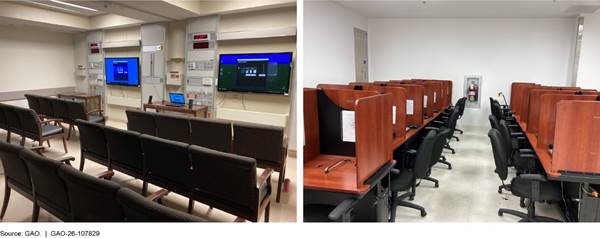
To assess the extent that DOD has met requirements for cognitive assessments, we requested data from DOD on the number of new and current service members who have undergone assessments. For new service members, DOD provided the number assessed in fiscal year 2025 at initial military training sites. (See table 5.) However, we were unable to determine the percentage who completed their assessment because Army officials could not provide a total number of newly enlisted service members who required testing in fiscal year 2025.[54] For current service members, we found that no military department completed enough assessments to meet the requirement by September 30, 2025. (See table 6.) We requested updated totals as of March 2026, which showed that 96 percent of high-risk active duty service members completed cognitive assessments.[55]
Table 5: Military Department Completion of Requirements for Cognitive Assessments for New Service Members, as of Fiscal Year 2025
|
Military department |
Number of new service members completed cognitive assessments at initial military training sites fiscal year 2025 |
|
Army |
97,585 |
|
Navy |
57,265 |
|
Air Force |
43,311 |
|
Total |
198,161 |
Source: GAO analysis of U.S. Army Medical Command data. | GAO‑26‑107829
Notes: See Department of Defense, Deputy Secretary of Defense, Department of Defense Requirements for Managing Brain Health Risks from Blast Overpressure, Memorandum for Senior Pentagon Leadership, Commanders of the Combatant Commands, Defense Agency, and DOD Field Activity Directors (Aug. 8, 2024). This memorandum requires military departments to ensure all new active and reserve component accessions undergo cognitive assessments as part of the entry process by December 31, 2024.
The U.S. Army Medical Command led implementation and data collection of cognitive assessments in fiscal year 2025. U.S. Army Medical Command is not responsible for tracking information about completion of initial military training. Officials told us that they could not provide a total number of newly enlisted service members who required testing in fiscal year 2025 because of the timing of the requirement and how other data about initial military training is tracked.
Table 6: Military Department Completion of Required Baseline Cognitive Assessments for High-Risk Service Members by end of Fiscal Year 2025
|
Military department |
Number of high-risk service members eligible for baseline assessments |
Number of high-risk service members who received baseline assessments |
Percentage of high-risk service members who received baseline assessments |
Requirement met for high-risk service members |
|
Army |
130,757 |
113,663 |
87% |
No |
|
Navy |
2,011 |
1,182 |
59% |
No |
|
Air Force |
5,720 |
4,634 |
81% |
No |
|
Total |
138,488 |
119,479 |
86% |
No |
Source: GAO analysis of U.S. Army Medical Command data. | GAO‑26‑107829
Note: See Department of Defense, Deputy Secretary of Defense, Department of Defense Requirements for Managing Brain Health Risks from Blast Overpressure, Memorandum for Senior Pentagon Leadership, Commanders of the Combatant Commands, Defense Agency, and DOD Field Activity Directors (Aug. 8, 2024). This memorandum requires military departments to accelerate requirements to execute baseline cognitive assessments for high-risk active duty service members by the end of fiscal year 2025 (September 30, 2025). GAO considers this requirement to be met if at least 95 percent of the service members in each category received baseline cognitive assessments by September 30, 2025.
GAO Contact
Alyssa M. Hundrup, HundrupA@gao.gov
Staff Acknowledgments
In addition to the contact named above, Karin Wallestad (Assistant Director), Christie Enders (Analyst-in-Charge), Brittaini Maul, Harry Bernholz, and Maggie Devlin made key contributions to this report. Also contributing were Ann Marie Cortez, Joycelyn Cudjoe, Kelly Longhini, Jeanne Murphy-Stone, Laurie Pachter, Ethiene Salgado-Rodriquez, and Jeff Tamburello.
The Government Accountability Office, the audit, evaluation, and investigative arm of Congress, exists to support Congress in meeting its constitutional responsibilities and to help improve the performance and accountability of the federal government for the American people. GAO examines the use of public funds; evaluates federal programs and policies; and provides analyses, recommendations, and other assistance to help Congress make informed oversight, policy, and funding decisions. GAO’s commitment to good government is reflected in its core values of accountability, integrity, and reliability.
Obtaining Copies of GAO Reports and Testimony
The fastest and easiest way to obtain copies of GAO documents at no cost is through our website. Each weekday afternoon, GAO posts on its website newly released reports, testimony, and correspondence. You can also subscribe to GAO’s email updates to receive notification of newly posted products.
Order by Phone
The price of each GAO publication reflects GAO’s actual cost of production and distribution and depends on the number of pages in the publication and whether the publication is printed in color or black and white. Pricing and ordering information is posted on GAO’s website, https://www.gao.gov/ordering.htm.
Place orders by calling (202) 512-6000, toll free (866) 801-7077,
or
TDD (202) 512-2537.
Orders may be paid for using American Express, Discover Card, MasterCard, Visa, check, or money order. Call for additional information.
Connect with GAO
Connect with GAO on X,
LinkedIn, Instagram, and YouTube.
Subscribe to our Email Updates. Listen to our Podcasts.
Visit GAO on the web at https://www.gao.gov.
To Report Fraud, Waste, and Abuse in Federal Programs
Contact FraudNet:
Website: https://www.gao.gov/about/what-gao-does/fraudnet
Automated answering system: (800) 424-5454
Media Relations
Sarah Kaczmarek, Managing Director, Media@gao.gov
Congressional Relations
David A. Powner, Acting Managing Director, CongRel@gao.gov
General Inquiries
[1]According to the Department of Defense (DOD), blast overpressure is the sudden onset of a pressure wave from a blast, such as from weapons firing or an explosion. Service members can be exposed to blast overpressure in both the combat and training environments. This is referred to as blast overpressure exposure.
According to DOD, there are two types of blast overpressure. High-level blast overpressure is generated by incoming munitions, such as improvised explosive devices or rocket-propelled grenades and can cause acute injuries, such as amputations, traumatic brain injury (TBI), or auditory injuries. Low-level blast overpressure is generated by firing weapon systems or detonating explosives and does not typically result in a mild TBI. For this report, we are focusing primarily on low-level blast overpressure exposure.
[2]Blast overpressure exposure does not always have a negative effect on brain health, nor does it always result in a TBI.
[3]See Department of Defense, Deputy Secretary of Defense, Department of Defense Requirements for Managing Brain Health Risks from Blast Overpressure, Memorandum for Senior Pentagon Leadership, Commanders of the Combatant Commands, Defense Agency, and DOD Field Activity Directors (Aug. 8, 2024).
DOD defines “DOD components” as the Office of the Secretary of Defense, military departments (Army, Navy, and Air Force), Office of the Chairman of the Joint Chiefs of Staff and the Joint Staff, combatant commands, DOD Office of Inspector General, defense agencies and field activities, and all other entities within DOD.
[4]Stand-off distances are the minimum distances service members should stand from the weapons system when it is fired to minimize exposure to high levels of blast overpressure.
[5]Pub. L. No. 118-159, 138 Stat. 1773 (2024); S. Rep. No. 118-188, at 173 (2024). In addition, we received a request for similar information from congressional requesters.
[6]We selected requirements for review based on whether the requirement had specific actions for completion in fiscal year 2025, including information for 10 of 12 requirements. (We did not specifically review requirements related to weapons acquisitions.)
[7]Data as of March 2026 showed fewer total high-risk service members compared to data as of the end of September 2025. Officials explained that between September 2025 and March 2026, they made refinements to the data to exclude service members who were not available for testing and should not be included in metrics, such as those who were in an arrest and confinement or approved retirement status. Officials confirmed that the numbers reported for fiscal year 2025 are accurate based on the data available at the time.
[8]The four installations in our non-generalizable sample included two Army installations—Fort Bragg, North Carolina; Fort Sill, Oklahoma; one Navy and Marine Corps installation—Marine Corps Base Quantico, Virginia; and one Air Force installation—Hurlburt Field, Florida.
[9]We spoke with service members in special operations forces service component commands for the military departments.
[10]According to DOD’s August 2024 blast overpressure memorandum, these types of weapons have been shown to produce blast overpressure exposures exceeding 4 pounds per square inch and this threshold “was identified as a health-based safety guideline informed by evolving medical science.”
[11]Brain health effects are not the only injuries that can occur from blast overpressure exposure. Injuries may occur in other parts of the body—such as the ears and lungs.
[12]James R. Stone et al., “Neurological Effects of Repeated Blast Exposure in Special Operations Personnel,” Journal of Neurotrauma, vol. 41, no. 7-8 (2024): 942-956, doi.org/10.1089/neu.2023.0309;
Natalie Gilmore et al., “Impact of Repeated Blast Exposure on Active-Duty United States Special Operations Forces,” Proceedings of the National Academy of Sciences, vol. 121, no. 19 (2024), doi.org/10.1073/pnas.2313568121.
[13]The National Defense Authorization Act for Fiscal Year 2018 required DOD to conduct a longitudinal medical study on blast overpressure exposure of members of the armed forces. Pub. L. No. 115-91, § 734, 131 Stat. 1283, 1444 (2017). DOD submitted the final report on its review and analysis of the effects of blast overpressure exposure from weapon systems, including the ability to monitor exposure in training environments, to Congress in December 2023. In addition, the National Defense Authorization Act for Fiscal Year 2023 required DOD to establish a comprehensive initiative (to be known as the Warfighter Brain Health Initiative) to address service member brain health and exposures. Pub. L. No. 117-263, § 735, 136 Stat. 2395, 2668 (2022). DOD reported to Congress on its strategy and action plan to address brain health in May 2024.
[14]The interim guidance established an interim threshold of blast overpressure exposure at 4 pounds per square inch based on reported health effects above this level. The interim guidance directed DOD components to mitigate risk of blast overpressure through several actions, including establishing maximum allowable number of rounds, using personal protective gear and equipment, and training on blast overpressure hazards. It also included a non-exhaustive list of weapon systems commonly associated with blast overpressure exposure. See Department of Defense, Assistant Secretary of Defense, Interim Guidance for Managing Brain Health Risk from Blast Overpressure, Memorandum for Assistant Secretary of the Army (Installations Energy & Environment), Assistant Secretary of the Navy (Energy, Installations & Environment), Assistant Secretary of the Air Force (Installations, Environment, and Logistics), Defense Agency and DOD Field Activity Directors, Director, Joint Staff, Director, National Guard Bureau, Washington Headquarters Service (Nov. 4, 2022).
[15]The DOD policy memorandum replaced the 2022 interim guidance that was a starting point for many DOD and military department efforts. The blast overpressure memorandum was effective immediately after publication. All the requirements but one—the requirement related to conducting cognitive assessments of service members—do not have specific deadlines for implementation. See Department of Defense, Department of Defense Requirements for Managing Brain Health Risks from Blast Overpressure.
[16]The Defense Intrepid Network for TBI and Brain Health is a network of health care facilities that includes the National Intrepid Center of Excellence, 10 Intrepid Spirit Centers, and two TBI and Brain Health Clinics outside the continental United States. These facilities provide interdisciplinary care to service members with TBIs. For example, the Intrepid Spirit Centers provide clinical and professional services such as physical therapy, nutrition, and neurology.
[17]According to the blast overpressure memorandum, these types of weapons have been shown to produce blast overpressure exposures exceeding 4 pounds per square inch and this threshold “was identified as a health-based safety guideline informed by evolving medical science.” The memorandum noted that the weapons list is not exhaustive, meaning that there could be other weapon systems that are associated with higher levels of blast overpressure exposure that are not included.
[18]Officials from the Navy said reflective surfaces can affect how blast waves and overpressure behave. For example, when a weapon is fired from a small boat or a ship on water, the blast overpressure waves can reflect and amplify, and can create other exposures, such as vibrations.
[19]Because the 2024 blast overpressure memorandum builds on interim guidance from 2022, some efforts to address risks from blast overpressure began prior to October 1, 2024, the start of fiscal year 2025, and some of these efforts intersect with efforts to address the 2024 blast overpressure memorandum requirements, according to DOD officials. However, according to OUSD(P&R) officials, efforts to address the requirements in the 2024 blast overpressure memorandum began in earnest during fiscal year 2025.
[20]Department of Defense, Under Secretary of Defense for Personnel and Readiness, Department of Defense Implementation Guidance for Managing Brain Health Risks from Blast Overpressure, Memorandum for Senior Pentagon Leadership, Commanders of the Combatant Commands, Defense Agency and DOD Field Activity Directors, (Dec. 12, 2024).
[21]Department of Defense, Under Secretary of Defense for Personnel and Readiness, Fiscal Year 2027 Program and Budget Review Strategic Priorities for the Office of the Under Secretary for Personnel and Readiness, Memorandum for Under Secretary of Defense (Comptroller)/Chief Financial Officer of the Department of Defense, Director of Cost Assessment and Program Evaluation (Aug. 12, 2025).
[22]Between the end of fiscal year 2025 and the end of March 2026, officials told us they made refinements to the cognitive monitoring data to exclude service members who were not available for testing, such as those who were in an arrest and confinement or approved retirement status. The 96 percent completion rate in March 2026 is due in part to these exclusions, which resulted in a smaller number of service members who required testing. Officials confirmed that the numbers reported for fiscal year 2025 are accurate based on the data available at the time.
[23]Department of Defense Instruction 6490.13, Comprehensive Policy on Traumatic Brain Injury-Related Neurocognitive Assessments by the Military Services (Sept. 11, 2015, incorporating Change 2, effective May 28, 2024).
[24]Examples of resources in this guidance include fiscal and human capital, training, contracts, and equipment, see Department of Defense, Department of Defense Implementation Guidance for Managing Brain Health Risks from Blast Overpressure.
[25]In June 2025, the Office of the Assistant Secretary of Defense for Health Affairs reported in their quarterly implementation survey to the OUSD(P&R) approval of additional resource allocations to support efforts to complete cognitive assessments for high-risk service members.
[26]Proctors are the staff responsible for administering cognitive assessments to servicemembers. Proctors must be trained, but proctors are not required to have specific mental health credentials.
[27]Assessing the pilot would also be consistent with GAO’s leading practices for effective pilot design, which state that agencies should develop detailed plans to evaluate the final results of a pilot’s implementation and performance. The results of such an evaluation can help agencies determine how the pilot can be incorporated into broader efforts. See GAO, Data Act, Section 5 Pilot Design Issues Need to Be Addressed to Meet Goal of Reducing Recipient Reporting Burden, GAO‑16‑438 (Washington, D.C.: Apr. 19, 2016).
[28]OUSD(P&R), DHA and the military departments are responsible for fulfilling requirements related to exposure tracking.
[29]Industrial hygienists for the United States Army and Air Force were transferred to DHA as of 2022. Industrial hygienists for the Air Force need to support tracking requirements for fewer Air Force service members compared to industrial hygienists supporting the Army. Compared to the Army’s approximately 142,000 high-risk service members, the Air Force identified less than 6,000 high-risk Air Force service members in fiscal year 2025.
In prior work, we have reported on DOD’s transfer of military health system functions from the military departments to the Defense Health Agency and related staffing and management challenges. See GAO, Defense Health Care: DOD Should Reevaluate Market Structure for Military Medical Treatment Facility Management. GAO‑23‑105441 (Washington, D.C.: Aug. 21, 2023); GAO, Defense Health Care: Actions Needed to Address Long-Standing Management Challenges with Medical Facilities, GAO‑25‑107432 (Washington, D.C.: Apr. 10, 2025); and GAO, Defense Health Care: Information Needed to Improve Monitoring of Military Personnel Staffing at Medical Facilities, GAO‑25‑106988 (Washington, D.C.: July 21, 2025).
[30]The review period for this audit was January 2024 through November 2024, which includes the first 4 months of DOD’s implementation of the blast overpressure requirements. See U.S. Army Audit Agency, Impacts from the Transition of the Occupational and Environmental Health Program, Report A-2025-0028-FIZ. (Mar. 17, 2025.)
[31]Unlike the Air Force and Army industrial hygienists, which are organized under DHA, industrial hygienists for the Department of the Navy are organized under the Navy’s Bureau of Medicine and Surgery.
[32]Department of Defense, Fiscal Year 2027 Program and Budget Review Strategic Priorities for the Office of the Under Secretary for Personnel and Readiness.
[33]Department of Defense Instruction 6055.01, DOD Safety and Occupational Health (SOH) Program, Incorporating Change 3 (Apr. 21, 2021).
[34]Examples of resources in this guidance include fiscal and human capital, training, contracts, and equipment. See Department of Defense, Department of Defense Implementation Guidance for Managing Brain Health Risks from Blast Overpressure.
[35]The resource prioritization process we refer to is the Planning, Programming, Budgeting, and Execution process. This process is a system for allocating resources among the military departments, defense agencies, and other components. This annual process serves as the framework for DOD civilian and military leaders to decide which programs and force management requirements to fund based on strategic objectives. The process produces DOD’s portion of the President’s annual budget request to Congress and updates DOD’s 5-year funding plan, known as the Future Years Defense Program. The process is a calendar-driven process that, for any fiscal year cycle, typically begins more than 2 years before the expected year of budget execution. See Congressional Research Service, Defense Primer: Planning, Programming, Budgeting, and Execution (PPBE) Process (Washington, D.C.: Dec. 6, 2024).
[36]According to DOD, the Cost Assessment and Program Evaluation, within the Office of the Secretary of Defense, supports the Secretary and other DOD senior leaders through non-advocate, fact-based decision support on the size, shape, affordability, disposition, and readiness of the future joint force to achieve the National Defense Strategy.
[37]We interviewed a nongeneralizable selection of 73 service members at four selected military installations. These service members included a wide range of military occupational specialties (including instructors) and had a range of years of experience within each of the military departments.
[38]The internal DOD platform referenced by officials was DENIX, which is for information related to environment, safety, and occupational health topics to be used by service members.
[39]In 2025, GAO found that military medical positions and assigned personnel in DOD medical facilities had declined over time. GAO also found that DHA and the military departments implemented a collaborative process to staff medical facilities with military medical personnel to help address facility staffing challenges. See Defense Health Care: Information Needed to Improve Monitoring of Military Personnel Staffing at Medical Facilities, GAO‑25‑106988 (Washington, D.C.: July 21, 2025).
[40]TBI Center of Excellence officials told us that there is a network of 12 contractors that support DHA at its medical facilities by providing training locally. In addition, officials said that they distribute information to chief medical officers at medical facilities at twice monthly meetings.
[41]In the 2024 blast overpressure memorandum, DOD required that service members needed to be educated about the possible brain health effects of blast overpressure exposure but there is not a similar requirement for providers that treat service members.
[42]Department of Defense, Under Secretary for Personnel and Readiness, Report to the Committees on Armed Services of the Senate and House of Representatives: Longitudinal Medical Study on Blast Pressure Exposure of Members of the Armed Forces (Washington, D.C.: December 2023).
Prior research also includes a 2018 report that, building on research on the effects of blast overpressure exposure, recommended the Army increase its efforts to protect service members from exposure-related brain health effects. Recommendations included improving safety when training on heavy weapons and developing more protective helmets. See Center for a New American Security, Protecting Warfighters from Blast Injury (Washington, D.C.: May 2018).
[43]In August 2024, DOD released guidance to DOD components that establishes requirements to manage brain health risks from blast overpressure. In December 2024, DOD released an additional guidance document with required actions and timelines to help components implement the August 2024 blast overpressure memo requirements. See Department of Defense, Deputy Secretary of Defense, Department of Defense Requirements for Managing Brain Health Risks from Blast Overpressure, Memorandum for Senior Pentagon Leadership, Commanders of the Combatant Commands, Defense Agency, and DOD Field Activity Directors (Aug. 8, 2024) and Department of Defense, Under Secretary of Defense for Personnel and Readiness, Department of Defense Implementation Guidance for Managing Brain Health Risks from Blast Overpressure, Memorandum for Senior Pentagon Leadership, Commanders of the Combatant Commands, Defense Agency and DOD Field Activity Directors, (Dec. 12, 2024).
[44]This assessment is done every 3 years for high-risk special operations service members, which is more accelerated than the DOD-wide cognitive assessments requirements in the 2024 blast overpressure memorandum.
[45]See Pub. L. No. 117-263, § 735(d), 136 Stat. 2290, 2669 (2023). The U.S. Army Special Operations Command is the service component command responsible for training, equipping, and providing special operations forces from the Army.
[46]This policy memorandum, Department of Defense, Deputy Secretary of Defense, Department of Defense Requirements for Managing Brain Health Risks from Blast Overpressure, Memorandum for Senior Pentagon Leadership, Commanders of the Combatant Commands, Defense Agency, and DOD Field Activity Directors (Aug. 8, 2024), establishes DOD requirements and direction for the management of health risks to DOD personnel from exposures to blast overpressure.
[47]See Department of Defense, Under Secretary of Defense for Personnel and Readiness, Department of Defense Implementation Guidance for Managing Brain Health Risks from Blast Overpressure, Memorandum for Senior Pentagon Leadership, Commanders of the Combatant Commands, Defense Agency and DOD Field Activity Directors (Dec. 12, 2024).
[48]The resource prioritization process we refer to is the Planning, Programming, Budgeting, and Execution process. This process is a system for allocating resources among the military departments, defense agencies, and other components. This annual process serves as the framework for DOD civilian and military leaders to decide which programs and force management requirements to fund based on strategic objectives.
[49]See Department of Defense, Under Secretary of Defense for Personnel and Readiness, Department of Defense Performance Measures for Managing Brain Health Risks from Blast Overpressure, Memorandum for Senior Pentagon Leadership, Commanders of the Combatant Commands, Defense Agency, and DOD Field Activity Directors (Apr. 15, 2025).
[50]We evaluated DOD’s progress toward implementing requirements as of the end of fiscal year 2025, based on the cognitive assessments deadline in the blast overpressure memorandum and the target dates in guidance. We selected requirements for review based on whether they had underlying actions due in fiscal year 2025, and we excluded requirements related to weapons acquisitions. To determine DOD components’ progress toward implementing those selected requirements, we matched the actions in DOD’s guidance with the relevant requirements in the 2024 blast overpressure memo. We considered a requirement to be met if all related actions in guidance for fiscal year 2025 were completed by the responsible component. DOD components responsible for implementing the requirements include military departments—the Army, Navy, including Marine Corps, and Air Force—and OUSD(P&R) and the Defense Health Agency.
[51]See Department of Defense, Deputy Secretary of Defense, Department of Defense Requirements for Managing Brain Health Risks from Blast Overpressure, Memorandum for Senior Pentagon Leadership, Commanders of the Combatant Commands, Defense Agency, and DOD Field Activity Directors (Aug. 8, 2024). The memorandum establishes requirements for risk management actions to mitigate and track blast overpressure across DOD components (which includes military departments and the Defense Health Agency).
[52]DOD reported this plan in the department’s response to section 735 of the National Defense Authorization Act for Fiscal Year 2023, which required DOD to establish a comprehensive initiative to address service member brain health and exposures.
[53]The Department of Army currently leads the cognitive assessment effort for DOD. The responsibility will transfer to the Defense Health Agency in 2027, according to DOD officials.
[54]The U.S. Army Medical Command led implementation and data collection for cognitive assessments in fiscal year 2025. U.S. Army Medical Command is not responsible for tracking information about completion of initial military training. Officials told us that they could not provide a total number of newly enlisted service members who required testing in fiscal year 2025 because of the timing of the requirement and how other data about initial military training is tracked.
[55]Data as of March 2026 showed fewer total high-risk service members compared to data as of the end of September 2025. Officials explained that between September 2025 and March 2026, they made refinements to the data to exclude service members who were not available for testing and should not be included in metrics, such as those who were in an arrest and confinement or approved retirement status. Officials confirmed that the numbers reported for fiscal year 2025 are accurate based on the data available at the time.