
Report to Congressional Committees
United States Government Accountability Office
A report to congressional committees
Contact: Diana Moldafsky at MoldafskyD@gao.gov
What GAO Found
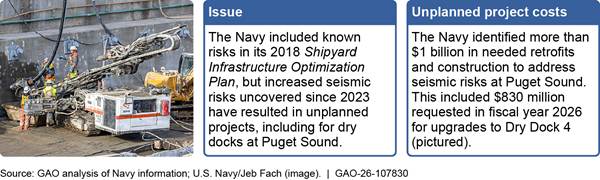
The Navy’s Shipyard Infrastructure Optimization Program (SIOP) will surpass $200 billion and take over 50 more years to execute, based on GAO’s analysis of Navy plans. Developing the plans and cost estimates to rebuild the Navy’s four public shipyards has taken the Navy years longer—and will cost much more—than originally anticipated due to multiple challenges and changes involved in the program. For example, environmental issues led to additional projects and more extensive work affecting project plans and costs at the shipyards, including Puget Sound Naval Shipyard (see figure).
The Navy established an oversight framework to guide SIOP plans and decisions over the duration of the program. The framework includes tools and requirements typically used for major defense acquisition programs—like for missiles, aircraft, or ships. However, the Navy has not outlined steps in the framework to reevaluate program objectives and resources as the program progresses over the next several decades. Without building such reviews into key future decision points, the Navy is limiting its ability to ensure that capabilities in SIOP’s plans today continue to be aligned or adjusted to support future fleet warfighting needs.
Further, while the Navy provides Congress with reports and briefings on various aspects of SIOP, the Navy does not provide Congress with consolidated, standardized information on full program costs and risks because there is no requirement to do so. In contrast, major defense acquisitions are required to provide annual program status reports with detailed metrics, including total costs to date, cost and schedule baselines, and risks, to track and monitor progress. Without a full picture of how much has been spent, what remains to be funded, and what risks may affect SIOP progress, Congress could make consequential decisions for SIOP based on incomplete information, thus risking billions in taxpayer dollars and a lack of program oversight for the decades to come.
Finally, the Navy created several organizations to manage SIOP projects and challenges. For example, the Navy created organizations for project oversight and program integration teams to coordinate issues with shipyards. However, the Navy has not fully documented the organizations’ roles and responsibilities. Doing so would formalize their new SIOP roles and help to ensure not only their ability to effectively implement SIOP’s essential projects but also the continuity of the critical shipyard operations to maintain and modernize the U.S. naval fleet now and throughout SIOP’s extended timeline.
Why GAO Did This Study
The Navy’s four public shipyards are essential to maintaining and modernizing the U.S. fleet of nuclear-powered vessels and its critical warfighting capabilities. The Navy initiated SIOP in 2018 to address poor shipyard conditions and capability gaps affecting fleet readiness. GAO has reported on the shipyards’ persistently poor condition and found that preliminary SIOP cost estimates were understated by billions of dollars.
The joint explanatory statement accompanying the Military Construction, Veterans Affairs, and Related Agencies Appropriations Act, 2024 includes a provision for GAO to report on SIOP oversight and management. This report examines (1) Navy planning and implementation of SIOP, including costs, timing, and challenges; (2) Navy oversight of SIOP; and (3) Navy establishment of project management organizations to oversee SIOP construction projects.
GAO analyzed SIOP program documents and project cost and schedule data; visited the shipyards to observe SIOP projects and ship maintenance; and interviewed officials.
What GAO Recommends
GAO recommends Congress consider requiring the Navy to annually report consolidated, standardized status updates for SIOP, including total costs, for its duration. GAO is also making three recommendations for the Navy to include future reviews of program requirements and resources in its oversight framework, and to document key SIOP organizations’ roles and responsibilities for managing shipyard projects and risks. The Navy agreed with the recommendations and outlined planned steps to implement them.
|
Abbreviations |
|
|
|
|
|
ASN (EI&E) |
Assistant Secretary of the Navy for Energy, Installations, and Environment |
|
ASN (RD&A) |
Assistant Secretary of the Navy for Research, Development, and Acquisition |
|
CAPE |
Office of Cost Assessment and Program Evaluation |
|
CDD |
capability development document |
|
CNO |
Chief of Naval Operations |
|
DCNO |
Deputy Chief of Naval Operations |
|
DOD |
Department of Defense |
|
MDAP |
major defense acquisition program |
|
MILCON |
Military Construction |
|
NAVFAC |
Naval Facilities Engineering Systems Command |
|
NAVSEA |
Naval Sea Systems Command |
|
O&M |
Operation and Maintenance |
|
OICC |
Officer in Charge of Construction |
|
PAE |
Portfolio Acquisition Executive |
|
PIT |
Program Integration Team |
|
PMO |
Program Management Office |
|
SIOP |
Shipyard Infrastructure Optimization Program |
|
VCNO |
Vice Chief of Naval Operations |
This is a work of the U.S. government and is not subject to copyright protection in the United States. The published product may be reproduced and distributed in its entirety without further permission from GAO. However, because this work may contain copyrighted images or other material, permission from the copyright holder may be necessary if you wish to reproduce this material separately.
September 25, 2026
The Honorable John Boozman
Chair
The Honorable Jon Ossoff
Ranking Member
Subcommittee on Military Construction, Veterans Affairs, and Related
Agencies
Committee on Appropriations
United States Senate
The Honorable John Carter
Chairman
The Honorable Debbie Wasserman Schultz
Ranking Member
Subcommittee on Military Construction, Veterans Affairs, and Related
Agencies
Committee on Appropriations
House of Representatives
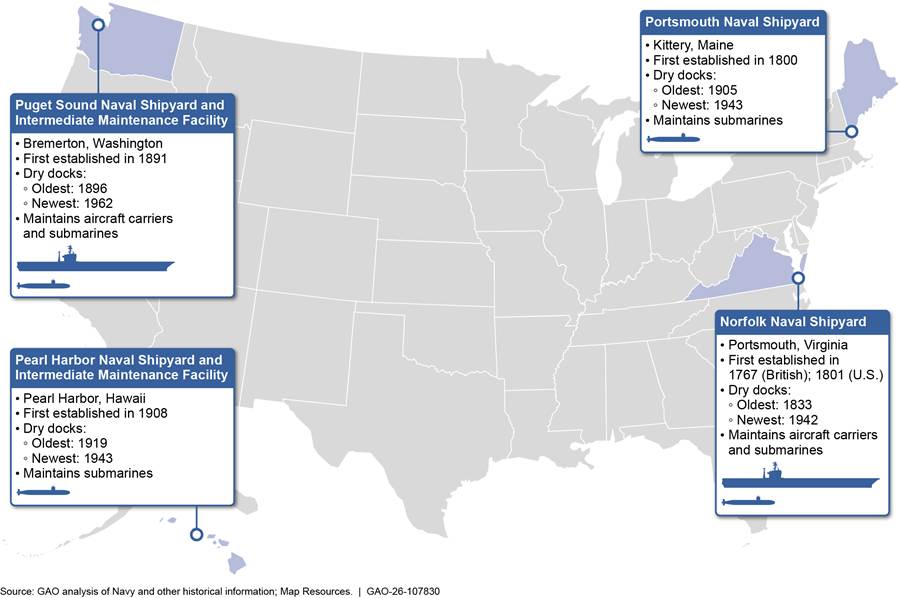
The readiness of the U.S. fleet of aircraft carriers and nuclear-powered submarines for global operations relies in large part on the capacity and capability of the Navy’s four public shipyards. These shipyards—Norfolk Naval Shipyard in Virginia, Pearl Harbor Naval Shipyard and Intermediate Maintenance Facility in Hawaii, Portsmouth Naval Shipyard in Maine, and Puget Sound Naval Shipyard and Intermediate Maintenance Facility in Washington—provide essential maintenance and modernization to ensure the U.S. fleet is able to provide critical warfighting capabilities.[1]
We have long reported on the persistent challenges and poor condition of the Navy’s shipyards. Although the Navy took steps to improve shipyard infrastructure over the years, we reported in 2017 that their physical condition had worsened, equipment was generally past its useful life, and backlogs of facility repair would take at least 19 years to clear.[2] We found the neglect of shipyard infrastructure contributed to ship maintenance taking longer than planned, resulting in ships being unavailable for thousands of days over the time we analyzed.[3] We further reported that no shipyard dry docks met the larger size and utility requirements to perform maintenance on the new Ford-class aircraft carriers, and that the redesign of the new Virginia-class submarines made them too long and complex for many of the shipyards’ dry docks.
In response to congressional direction, in 2018 the Navy established the Shipyard Infrastructure Optimization Program (SIOP) to address infrastructure deficiencies, including condition and capacity shortfalls, and to modernize the shipyards’ outdated configuration and technology to meet the needs of a 21st-century Navy.[4] The Navy initially estimated SIOP would cost at least $21 billion over 20 years. However, in 2019 and 2023 we identified Navy challenges with developing shipyard plans and cost estimates, which hindered its ability to complete program planning and begin full implementation.[5]
The joint explanatory statement accompanying the Military Construction, Veterans Affairs, and Related Agencies Appropriations Act, 2024 includes a provision for GAO to report on the oversight and management of SIOP.[6] This report examines (1) the status of Navy planning and implementation of SIOP, including costs, timing, and challenges; (2) the extent to which Navy program oversight includes processes to identify, mitigate, and communicate program risks to inform decisions; and (3) the extent to which the Navy established project management organizations to oversee SIOP construction projects.
To address these objectives, we analyzed Navy program documents, such as concepts of operations, memorandums, and draft and final plans; reports and notifications to Congress; and budget and project documentation. To examine SIOP construction projects, we analyzed data used by the program office to track projects, including project costs and schedules, contract information, and other data. We assessed the reliability of this data by interviewing responsible officials, reviewing relevant documentation, and comparing the data with documentation of project cost, schedule, and other information. We determined the data were sufficiently reliable for the purpose of presenting summary information on the number, type, and estimated costs of projects.
We visited the four shipyards, observed SIOP projects and shipyard operations, and discussed plans, processes, projects, and challenges with SIOP and shipyard officials. We interviewed personnel responsible for SIOP oversight and management, such as from the Offices of the Deputy Assistant Secretaries of the Navy for Sustainment and for Installations and Facilities, and the Office of the Chief of Naval Operations. We met with the program executive officer responsible for SIOP and with program management officials, including at the shipyards. We also interviewed personnel with SIOP responsibilities from Naval Facilities Engineering Systems Command (NAVFAC) and Naval Sea Systems Command (NAVSEA), including regional and local commands, at shipyards, and in various ship maintenance functions and shops. We compared information collected with Department of Defense (DOD) and Navy policies, internal control principles, and leading practices.
We conducted this performance audit from September 2024 to September 2026 in accordance with generally accepted government auditing standards. Those standards require that we plan and perform the audit to obtain sufficient, appropriate evidence to provide a reasonable basis for our findings and conclusions based on our audit objectives. We believe that the evidence obtained provides a reasonable basis for our findings and conclusions based on our audit objectives.
Background
History and Current Functions of the Naval Shipyards
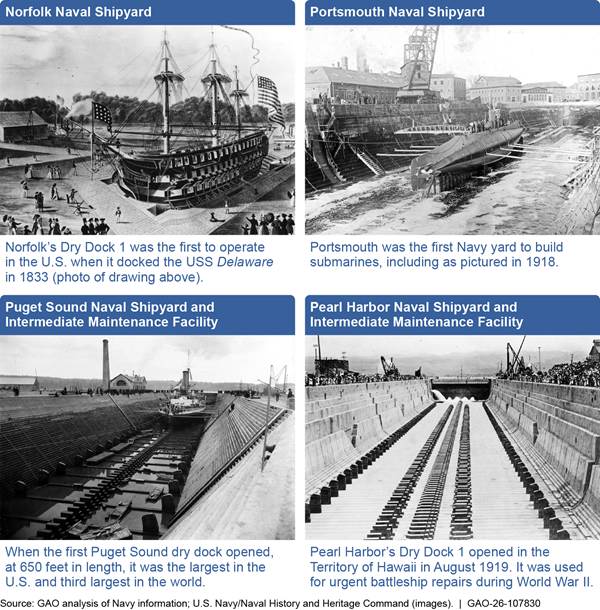
The functions of the Navy’s shipyards have evolved over the past 250 years. For example, what is today Norfolk Naval Shipyard was first established by the British, and Portsmouth shifted from building wooden sailing ships to submarines by World War I. Puget Sound and Pearl Harbor grew from early roles as naval stations to providing crucial battle damage repair in World War II (see fig. 1).
The Navy moved shipbuilding to the private sector in the 1960s, and by the end of the 1990s all but four shipyards had closed.[7] Today, the shipyards maintain the Navy’s increasingly complex nuclear-powered aircraft carriers and submarines (see fig. 2).
Note: Some dates may be approximate due to variation among historical sources.
|
Unique Shipyard Missions The Navy’s four shipyards focus on nuclear-powered ship maintenance, but each serves other unique functions. Puget Sound Naval Shipyard, for example, attributes about 12 percent of its annual workload to ship inactivation, nuclear reactor compartment disposal, and recycling. To dispose of a ship’s nuclear reactor, shipyard workers dismantle the ship propulsion space—containing the defueled reactors and hazardous material—and prepare it for transport to Hanford, Washington. The process involves workers from nearly every shop at the shipyard and occurs in Dry Dock 3, pictured below. Puget Sound is the only shipyard to make the steel encasements used to package the defueled reactor compartments for disposal.
Source: GAO analysis of Navy documents; U.S. Navy/Wendy M. Hallmark (image). | GAO‑26‑107830 |
The shipyards, like other military depots, conduct large-scale industrial operations essential to maintaining U.S. military readiness. Depot-level ship maintenance is a highly complex and comprehensive undertaking of time-consuming maintenance work, including overhauls, alterations, restorations, modernization, and nuclear refueling. Shipyard operations require infrastructure such as dry docks and piers; large waterfront facilities; extensive shops with specialized equipment; and highly skilled engineering and trade personnel. When homeported at the shipyard for maintenance, ships and crews rely on shipyard infrastructure and other support while the ship is at the yard.
Shipyard Infrastructure Optimization Program
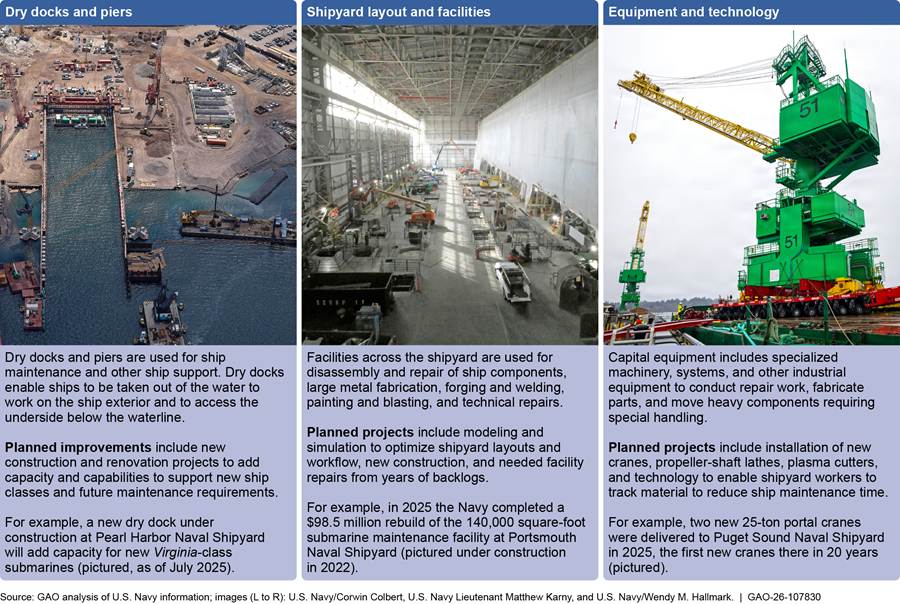
The Navy established SIOP in 2018 to address both the poor physical condition of the shipyards and capability gaps affecting ship maintenance operations.[8] Specific gaps include insufficient dry-dock capacity to support the new and larger classes of aircraft carriers and submarines. The Navy has begun construction and plans to rebuild the shipyards and improve their performance through three general lines of effort: (1) expanding and updating dry docks and piers, (2) recapitalizing shipyard facilities and optimizing workflows, and (3) modernizing capital equipment and technology (see fig. 3).
Figure 3: Types of Infrastructure Improvements Under the Navy’s Shipyard Infrastructure Optimization Program
Our Past Reviews of SIOP
Our past work highlighted challenges the Navy has faced developing SIOP plans, including cost and schedule estimates. For example, in 2018 the Navy initially estimated SIOP would take at least 20 years and cost $21 billion, but we found this estimate omitted key costs that could add billions to the ultimate price.[9]
In 2023, we reported the Navy had completed one shipyard plan, for Pearl Harbor, and estimated the cost to implement it could be about $16 billion—an increase of about 162 percent from the 2018 estimate.[10] We also found that the Navy had not updated its initial cost estimate due to challenges including project uncertainty, obtaining expertise, and cost volatility for commodities used in large amounts in SIOP projects.[11]
Finally, we found that while the Navy had developed detailed cost and schedule estimates for the Portsmouth dry-dock project—the first new dry dock under construction at the time—it followed most, but not all, best practices for developing reliable project cost estimates and schedules.[12]
Navy Organizations Responsible for Oversight and Management of SIOP and the Shipyards
The Navy program management office for SIOP was originally established in NAVSEA.[13] In 2022, the Navy moved this office, known as Program Management Office (PMO) 555, to NAVFAC and identified key program leadership, authorities, roles, and responsibilities for SIOP (see table 1).[14]
Table 1: Key Navy Officers and Organizations That Manage and Oversee the Shipyard Infrastructure Optimization Program (SIOP) and Shipyards, as of April 2026
|
Officer or organization |
Relevant responsibilities |
|
Assistant Secretary of the Navy for Research, Development, and Acquisition (ASN (RD&A)) |
· Principal official responsible to the Secretary of the Navy for SIOP activities, including program schedule, cost, delivery of required capabilities, and other responsibilities. · Exercises programmatic oversight of SIOP and serves as co-chair of the executive oversight council with the ASN (EI&E) and Vice Chief of Naval Operations (VCNO). |
|
Deputy Assistant Secretary of the Navy for Sustainment |
· Principal advisor to and coordinator for the ASN (RD&A) on matters pertaining to system sustainment policy and programs, including sustainment infrastructure such as shipyards, among other responsibilities. |
|
Assistant Secretary of the Navy for Energy, Installations, and Environment (ASN (EI&E)) |
· Formulates policies and procedures for Navy facility maintenance, military construction, real property and facilities, relevant environmental protection and planning, and safety and occupational health, among other responsibilities. · Co-chair of SIOP executive oversight council with the ASN (RD&A) and VCNO. |
|
Chief of Naval Operations (CNO) and VCNO |
· Responsible for the command, utilization of resources, and efficiency of the operating forces and shore activities. · VCNO serves as co-chair of SIOP executive oversight council with the ASN (RD&A) and ASN (EI&E). · Deputy CNO for Fleet Readiness and Logistics (DCNO N4) is lead requirements and resource sponsor for SIOP, with support from the DCNOs for Integration of Capabilities and Resources (N8) and Warfare Systems (N9). |
|
Program Executive Office Infrastructure and Expeditionary |
· Established in 2021 as Program Executive Office Industrial Infrastructure to supervise the management of SIOP and report directly to ASN (RD&A) on SIOP matters. |
|
Program Management Office (PMO) 555 |
· Established in 2018 to plan, develop, schedule, budget, and implement SIOP. PMO field offices provide onsite program management for SIOP execution at each shipyard. |
|
Naval Facilities Engineering Systems Command (NAVFAC) |
· Responsible for construction, engineering, and contracting expertise for shore infrastructure and other responsibilities for the Navy and others. · Head of contracting authority for facilities-related contracting for SIOP. · Supports PMO 555 in areas of expertise such as engineering and environmental studies, advanced planning, project design, and construction. |
|
Portfolio Acquisition Executive (PAE) for Industrial Operations |
· Single accountable office for ship depot maintenance, including the public shipyards; reports to ASN (RD&A). · Works with Naval Reactors to manage the maintenance, repair, and other aspects of the nuclear propulsion plants for aircraft carriers and submarines. |
Source: GAO analysis of Navy documentation. | GAO‑26‑107830
Note: In March 2026, the Navy announced the creation of several PAEs and other organizations as part of DOD’s effort to restructure how it manages and oversees acquisition programs. These organizations assumed responsibilities previously within Naval Sea Systems Command. According to officials, NAVFAC may undergo related restructuring, and in August 2026 the Navy announced the forthcoming creation of PAE Shore Infrastructure to include responsibilities for Navy construction, including SIOP.
Types of Funding and Processes for Navy Construction Projects and Infrastructure
When DOD components, including the Navy and other military services, need to construct new infrastructure or repair or replace existing facilities or other infrastructure, they may use different types of funding and related processes depending on the type of project. The associated requirements and procedures also vary, including the period of time the funds are available for new obligations. See table 2 for the types of funding the Navy uses for construction and infrastructure projects, including for SIOP dry docks, facilities, and capital equipment.
Table 2: Common Appropriations Available to Fund Department of Defense Construction and Equipment Projects, Including the Shipyard Infrastructure Optimization Program
|
Type of funding |
Time generally available |
Projects and activities |
Additional details |
|
Military Construction (MILCON) |
5 fiscal years |
Amounts available for the acquisition, construction, installation, and equipment of temporary or permanent public works, installations, facilities, and real property. Authorized activities include survey and site preparation for new facilities and the conversion or rehabilitation of existing facilities, as well as the acquisition, planning, supervision, and administration of the projects, among others. |
Amounts for specified MILCON projects, currently those over $9 million, are authorized by project in annual National Defense Authorization Acts. MILCON appropriations are then provided for in lump sum amounts. Specific amounts available for designated projects funded through appropriated lump sums are established in explanatory statements accompanying annual appropriation acts. Projects below the threshold—known as unspecified minor military construction projects—generally may be funded from lump sum MILCON appropriations. Each project proposed for inclusion in MILCON appropriations requests is supported by project data submitted to Congress. Project data includes a description of why the project is needed and impact if funding is not provided, description of proposed construction, cost estimates, and a spending plan, among other elements. |
|
Operation and Maintenance (O&M) |
1 fiscal year |
Amounts available for the costs of operation and maintenance activities and expenditures, such as force operations, fuel, supplies, and facilities maintenance and sustainment. Amounts may also be used to carry out repair of facilities for an entire facility or one or more functional areas of a facility. |
O&M amounts may be used for unspecified minor military construction projects currently costing not more than $4 million. Repair projects costing more than $7,500,000 must be approved in advance by the Secretary concerned, who must notify Congress with information including the justification of the project; the current project cost estimate; and, if the current estimate exceeds 75 percent of the estimated cost to replace the facility, an explanation of the reasons why replacement is not in the best interest of the government. |
|
Procurement |
3 fiscal years |
Amounts available for procurement and installation of equipment, appliances, and machine tools in public and private plants. |
Procurement amounts may be used for personal property, which includes specialized equipment that, although not readily movable in nature or required for the operation of the real property facility, is necessary for specified functional operation and activities utilizing the facility. Personal property includes industrial plant equipment. |
Source: GAO analysis of 10 U.S.C. §§ 2802-2807, § 2811; Pub. L. No. 119-37 (2025) and Pub. L. No. 119-75 (2026); and Chief of Naval Operations Instruction 11010.20J (Dec. 7, 2022). | GAO‑26‑107830
MDAP Policies and Processes
In its 2022 guidance establishing SIOP program oversight and management roles, the Navy noted it would treat SIOP as a major defense acquisition program (MDAP).[15] MDAPs are acquisition programs, such as for weapon systems and other military assets like ships, aircraft, and missile systems, that generally meet or exceed certain cost thresholds or are otherwise designated by the Secretary of Defense. They are among DOD’s costliest programs.[16] These programs may be implemented over long durations, taking many years or decades to go from initial concept to research and development, followed by manufacture and delivery of the final product or series of products. The Navy has the largest proportion of MDAPs in DOD, with 35 in research and development to early stages of production.[17]
The following DOD and Navy policies provide principles and procedures to guide MDAP planning, management, and oversight.
|
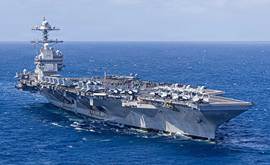
Examples of MDAPs: CVN 78 Gerald R. Ford Nuclear Aircraft Carrier and SSN 774 Virginia Submarine
Two examples of a major defense acquisition program (MDAP) are the Navy’s new Ford-class aircraft carrier (pictured) and Virginia-class attack submarine. The Ford class adds new propulsion, aircraft launch, and other capabilities. Virginia Block V submarines include added payload capacity and enhanced undersea acoustics. Both ships are larger with increased utility requirements than their predecessors and are not yet fully supported by existing public shipyard dry-dock capacity. As of July 2026, the Navy plans to procure a total of six Ford and 12 Virginia Block V ships—at an estimated cost of $96.4 billion and $54.95 billion, respectively. Source: GAO analysis of Navy documents; U.S. Navy/ Seaman Apprentice Nathan Sears (image). | GAO‑26‑107830 |
· DOD Directive 5000.01, The Defense Acquisition System (July 28, 2022), establishes the overarching policies governing DOD’s acquisition system.
· DOD Instruction 5000.02, Operation of the Adaptive Acquisition Framework (Apr. 8, 2026), establishes policy and procedures for managing acquisition programs and restructures defense acquisition guidance to improve process effectiveness and implement the Adaptive Acquisition Framework, among other purposes.[18]
· Secretary of the Navy Instruction 5000.2G, Department of the Navy Implementation of the Defense Acquisition System and the Adaptive Acquisition Framework (Apr. 8, 2022), prescribes Navy-specific acquisition and sustainment policies and procedures that supplement applicable DOD guidance on the operation of the Defense Acquisition System and implementation of the Adaptive Acquisition Framework.
Along with governing statutes, these policies establish the phases of the acquisition process, key decision points, required documentation, and roles and responsibilities for acquisition officials, among other things.[19] MDAPs are reviewed periodically at key decision points—called milestones—at which a milestone decision authority assesses and approves the program’s continued development. DOD milestones typically coincide with increased commitment of resources to the program, and milestone reviews include updating key documentation of the program’s requirements, costs, and schedule, among other elements. The acquisition process, reviews, and documentation can be tailored based on the program size, complexity, risk, urgency, and other factors.
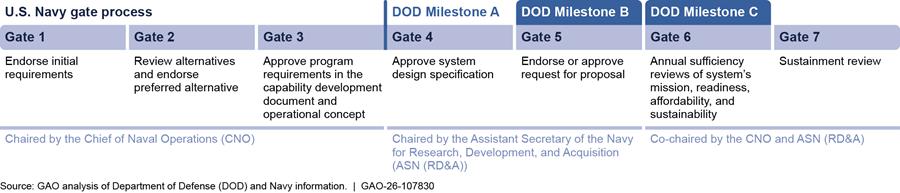
Navy leadership from the acquisition, requirements, resources, and warfighting communities convenes gate reviews along with the milestones to conduct oversight and ensure programs are on track to achieve their goals. As shown in figure 4, each gate review has a different objective and topics for review, and the seven gates are grouped into two sets: The first focuses on mission requirements and is typically chaired by the Chief of Naval Operations (CNO); the second focuses on acquisition and is led by the Assistant Secretary of the Navy for Research, Development, and Acquisition (ASN (RD&A)).
Figure 4: Overview of Navy Acquisition Framework and Key Decision Points for Major Defense Acquisition Programs
Although SIOP is not officially designated as an MDAP, according to officials, the Navy’s 2022 guidance lays out an executive oversight structure based on the Navy acquisition framework. This includes, as for typical Navy MDAPs, the ASN (RD&A) as milestone decision authority to approve the advancement of the program at the appropriate milestones in coordination with the CNO and other Navy leadership.
SIOP Will Cost Billions and Take Decades to Implement After Complex Planning Process
SIOP Costs Will Surpass $200 Billion and the Program Could Take an Additional 50 Years or More
The SIOP program office anticipates submitting a proposed program plan and cost estimate for approval by the ASN (RD&A), the Assistant Secretary of the Navy for Energy, Installations, and Environment (ASN (EI&E)), the Vice Chief of Naval Operations (VCNO), and other senior Navy leaders by September 2026. In the meantime, the Navy reported in April 2026 that based on the planning and the projects awarded to date, SIOP will cost substantially more than the initial 2018 estimate and will take multiple decades to complete. Based on our analysis of Navy funding guidance, planned projects, and cost analyses completed for three of the four shipyards as of April 2026, total costs to execute SIOP as planned will surpass $200 billion and program implementation could extend an additional 50 years or more.
Specifically, in 2025 the Navy issued guidance that set forth annual funding expectations for SIOP and directed that the shipyard plans being developed, and the number and type of planned projects to be scheduled every year, be updated to reflect this guidance. As of May 2026, the Navy had completed plans, project sequences, and cost analyses for Norfolk and Portsmouth, and it was in the process of documenting the Navy’s approval of plans for Puget Sound, according to program officials. The Navy also intends to update the planned sequence of projects for Pearl Harbor, according to the Navy guidance.
Taken together, the Navy’s funding projections and completed plans indicate that costs for all currently planned SIOP projects at the shipyards will surpass $200 billion across 5 decades of program execution. For example, the lowest of the three completed shipyard cost analyses, for Portsmouth, concluded that all currently planned projects there represented a rough cost of $41.6 billion when escalated across the possible time horizon of project execution.
Navy officials cited multiple reasons for the increase in potential costs, such as work required at the shipyards being more extensive than expected, including for seismic improvements of the dry docks; utility upgrades to meet new ship requirements and resiliency standards; and additional repair projects, transportation, or utility work not previously included in the program.[20] Costs for existing SIOP projects also increased, in part due to commodity price increases since 2018. Prior Navy cost estimates also lacked sufficient consideration of cost sensitivity, risks, and uncertainty, as we previously reported.[21] According to officials, the Navy has since incorporated more cost estimating practices such as reflecting project risk, escalation, and uncertainty, which provide more comprehensive cost estimates as a result.
Based on the overall schedule for projects identified in current plans, the last of the projects currently planned is not scheduled to be completed until after 2080. To manage this decades-long program and account for future project design and cost uncertainty, the Navy now plans to execute SIOP over three program blocks of projects across the coming decades, focusing first on projects with the most defined scope.
· Block 1 (approximately fiscal years 2026 through 2042): Near-term projects with greatest scope maturity—for example, dry-dock and pier projects. This block also includes the first new waterfront production facility at each shipyard.
· Block 2 (approximately fiscal years 2038 through 2079): All the remaining waterfront production facilities and their enabling projects. The program office intends to revisit the timeline for the end of block 2 prior to its initiation.
· Block 3 (approximately fiscal year 2074 through the end of the program): Logistics complexes, specialized repair shops, administrative support facilities, and remaining capability development document requirements. The program office intends to update the start of block 3 based on the progress of block 2.
Program officials stated that the timelines of the three blocks are rough estimates. Upgrades to dry docks and piers will continue beyond 2042, for example, and officials acknowledged that projects to provide new facilities for some maintenance and equipment functions would be pushed into the 2070s or beyond based on current plans and expected funding limits. The program office intends to revisit the timeline as each block progresses.
SIOP Planning Has Been Complex, Taking Years Longer Than Anticipated
The Navy has taken several years longer than it originally anticipated in 2018 to develop the set of shipyard plans and cost analyses for SIOP, ultimately taking more than 8 years to complete the planning activities and project development at each shipyard. As outlined in Navy guidance, the Navy expects to present overarching program plans and baseline cost and schedule estimates, including updates for Pearl Harbor, to Navy leadership for approval by September 2026.
According to officials, the Navy underestimated the time needed to conduct SIOP planning activities, in part because the Navy did not fully account for the many challenges, uncertainties, and complex analyses needed to sufficiently plan for an endeavor of SIOP’s magnitude.[22] Officials also identified lessons to refine plans as construction continued. Specifically, program officials identified several factors affecting the length of time ultimately needed for its planning efforts. These include (1) project cost and design changes; (2) unplanned projects and unforeseen conditions; and (3) planning numerous large-scale projects across four active shipyards.
Project estimate and design changes. Substantial project cost increases and design changes based on lessons learned from projects already underway warranted revisions to major projects and shipyard plans, according to officials at the shipyards. For example, the costs for the dry-dock projects in Portsmouth and Pearl Harbor in total grew by more than $2.5 billion since funding was originally requested from
|
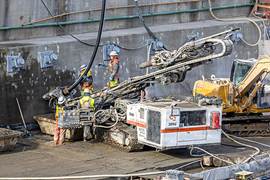
Seismic Risks at Puget Sound Require Unplanned Retrofit of Dry Docks and Facilities
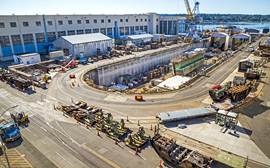
The Navy included known seismic and other risks in its initial Shipyard Infrastructure Optimization Plan in February 2018. However, since 2023, the Navy has identified over $1 billion in needed facility retrofits and new construction to mitigate newly assessed seismic risks at Puget Sound Naval Shipyard. In 2023, the Navy completed emergency dry-dock retrofits and repairs. The Navy also requested $830 million to conduct seismic upgrades for Dry Dock 4 (pictured) in its fiscal year 2026 budget request. Source: GAO analysis of Navy documents; U.S. Navy/Jeb Fach (image). | GAO‑26‑107830 |
Congress.[23] To better account for such cost uncertainty and improve the reliability and accuracy of their project estimates, the program executive office and NAVFAC issued joint guidance for implementing best practices and other requirements for SIOP cost estimates.[24] Project cost estimates increased as a result because they incorporated more realistic assumptions through the use of cost-estimating best practices. In 2025 the program office issued further guidance to update the remaining three shipyard plans, and all four shipyards’ planned project sequences and schedule baselines, to account for the increased cost expectations.
The Navy has also changed project designs and construction plans based on lessons learned from underway projects. Officials told us they applied one such lesson—obtaining early input from construction contractors to improve project design and cost controls—to Pearl Harbor and Puget Sound dry-dock projects based on experiences in Portsmouth. This early contractor involvement improved the Navy’s understanding of contractor construction practices and thus its ability to mitigate potential challenges or obstacles prior to project award, according to officials. However, because shipyard plans were underway, project changes affecting shipyard layouts warranted further revisions of shipyard plans. Officials told us that, at Puget Sound, contractor input into construction practices and logistics for the planned dry-dock project led to a full redesign of the project and the layout of a large portion of the shipyard. For more details on the Puget Sound dry-dock project, see appendix I.
Unplanned projects and unforeseen conditions. The number of needed shipyard construction and repair projects has grown since the Navy began SIOP planning in 2018, and unplanned work has been added to projects due to discoveries during construction. One reason officials cited for this is that, although numerous environmental and advanced planning studies have been or will be undertaken, many shipyard facilities were constructed more than 80 to over 120 years ago and suffered from long-deferred maintenance and worsening decrepitude during that time. As a result, unexpected facility and construction site conditions led to new projects being identified or additional work added to projects during construction. For example, the Navy identified safety risks in failing buildings at Norfolk that necessitated several extensive facility repair projects—including for a building that may ultimately be demolished as part of SIOP but is currently used for ship maintenance. At Puget Sound, updated NAVFAC assessments of seismic risks in the region affected about two dozen buildings. As a result, shipyard plans took longer to finalize, and overall program costs increased and timelines grew to account for these projects.
Planning numerous large-scale construction projects at active shipyards. Program officials stated that while they expected planning a multi-decade set of projects across four different locations to be challenging, the original planning timeline did not anticipate the complexity and variables affecting both the layout of the shipyards and design of individual projects. For example, in 2019, the Navy began to develop a digital model of shipyard industrial processes to design an optimized layout for each shipyard.[25] The Navy expected to complete this effort in 2020, but some shipyard officials expressed doubt at the sufficiency of the Navy’s expertise given the magnitude of the effort. The Navy completed the model in March 2026, according to program officials.
Officials told us that while modeling and simulation has provided advanced analysis to inform shipyard plans, planning all the projects within and across shipyards has resulted in more changes to initial plans than they expected. Further, the Navy has never undertaken a military construction effort with the number and scale of projects planned under SIOP—all on the site of actively operating shipyards. For example, at the time of its award, the dry-dock project at Portsmouth was the most expensive infrastructure project the Navy had awarded, according to officials—until the project at Pearl Harbor.
According to program officials, planning and designing dozens of projects across multiple locations has resulted in the Navy needing to anticipate possible cascading effects and adjust plans accordingly across the entire SIOP program portfolio. Given this, the challenge faced by the Navy is not just of scale, but interdependence: Any shift in timeline, cost, or scope in one project or location may affect the others.
Navy’s Oversight Framework Does Not Include Steps to Reassess SIOP over Time and Existing Reporting Does Not Provide Congress Full Insight into Costs and Risks
The Navy developed an oversight framework for SIOP by using gate reviews and milestone approvals associated with acquisition programs to provide executive-level visibility and guidance over the program. However, the Navy framework does not include future steps to reevaluate program requirements and sufficiency as the program progresses. Additionally, while the Navy provides Congress with numerous reports, briefings, and notifications in response to legislative requirements and other requests, it does not provide Congress with consolidated and standardized cost, risk, and performance information that would help it track and monitor SIOP’s progress for the decades to come.
Navy’s Oversight Framework for SIOP Incorporates MDAP Policies and Processes
The 2022 memorandum establishing Navy-wide roles and responsibilities for SIOP also clarified key decision authorities and other executive oversight responsibilities based on Navy policies for MDAPs.[26] The Navy then conducted the initial set of required Navy gate reviews, prepared program requirements documents, and conducted collateral DOD requirements and decisions in 2023. This framework is intended to give Navy leadership systematic opportunities to deliberate and review program plans, including cost and schedule information for SIOP.
For example, in July 2023 the Navy convened a gate review of the SIOP capability development document (CDD), which was then approved by the Acting CNO in August 2023 (see fig. 4 earlier in the report for the gate process and milestones).[27] The next review, planned for September 2026, is a Navy gate review combined with DOD Milestones B and C to approve the full plan and project sequences for SIOP. According to program officials, this review and milestone decision will represent collective program approval and commitment by the ASN (RD&A), the VCNO, and the ASN (EI&E), and will serve to formalize the Navy’s overall program cost estimate for SIOP and establish a cost and schedule baseline for the first block of projects, through fiscal year 2042.[28]
The Navy tailored these and other DOD acquisition tools and Navy requirements to leverage the level of oversight associated with MDAPs while adhering to requirements for military construction programs. For example, our previous work identified a common set of tools used by acquisition programs that could benefit other large Navy programs, which the Navy has adopted or adapted for SIOP (see table 3).[29]
Table 3: Planning and Oversight Tools for DOD’s Major Defense Acquisition Programs and Navy’s Use of Them for the Shipyard Infrastructure Optimization Program (SIOP), as of May 2026
|
Acquisition tool |
Description |
Navy planned use for SIOP |
|
Acquisition strategy |
A comprehensive integrated plan that identifies the acquisition approach and key framing assumptions. It describes the business, technical, product support, security, and supportability strategies that the program manager plans to employ to manage program risks and meet program objectives. |
The program office (PMO 555) plans to submit an approved acquisition strategy as one of the entrance criteria for a combined Gate 5/Milestone B-C approval in accordance with Secretary of the Navy Instruction 5000.2G. |
|
Cost estimate |
An in-depth estimate that covers the entire life cycle of the program. The estimate should include analysis to support decision-making that identifies and evaluates alternative courses of action that may reduce cost and risk and result in more affordable programs and less costly systems. |
A program cost position and individual shipyard estimates will be submitted for approval at the combined Gate 5/Milestone B-C. Naval Facilities and Engineering Systems Command is conducting cost estimates for each shipyard based on methods validated by a U.S. Army Corps of Engineers independent cost estimate of the plan for Pearl Harbor. Individual independent cost estimates are planned to be conducted for all military construction projects greater than $250 million. DOD’s Office of Cost Assessment and Program Evaluation (CAPE) will conduct these estimates for military construction projects greater than $400 million. |
|
Risk management plan |
Provides program risks and associated risk mitigation plans. Typically detailed in the program acquisition strategy and presented at all relevant decision points and milestones. |
PMO 555 developed a risk management plan in 2020 and updated it in 2025 to account for organizational and process changes, though it was not finalized as of May 2026. |
|
Baseline |
Documents the program cost, schedule, and performance baseline, which allows tracking and reporting of cost and schedule deviations, and performance shortfalls. . |
Baselines for the shipyards have been approved by Navy leadership, according to officials, though documentation had not yet been finalized as of May 2026. The Navy plans to submit an overall program baseline for approval at the Navy Gate 5/Milestone B-C and intends it to reflect the full program scope and totality of work planned for the next several decades but with more detail for the first of the three blocks of projects. |
|
Integrated master schedule |
An integrated and reliable schedule can realistically reflect changes, show when major events are expected, and show the completion dates for all activities leading up to them. This can help determine if the program’s parameters are realistic and achievable. |
PMO 555 officials plan to create a master schedule for the program based on the approved schedules for each shipyard. At each shipyard, PMO 555 manages active master schedules of the numerous SIOP project schedules, ship maintenance activities, and other major events. These schedules are coordinated with cognizant leaders and stakeholders to ensure SIOP activities are coordinated and deconflicted alongside key ship maintenance schedules and activities. |
|
Navy leadership/ stakeholder meetings |
Provides a setting in which the program office and other involved Navy organizations can brief Navy leadership on progress. These gate reviews are at key junctures that allow leadership to weigh in on decisions made, offer feedback, and provide accountability. |
The Navy established an oversight framework in 2022, including an Executive Oversight Council consisting of senior leaders across the Navy. This framework includes a gate review process based on Navy and DOD acquisition program guidance and regular briefings to obtain input and authority for program- and project-level decisions, and to manage risks. |
Source: GAO analysis of Department of Defense (DOD) Instruction 5000.85, Navy Instruction 5000.2G, Navy documents, and discussions with officials. | GAO‑26‑107830
Although military construction projects such as SIOP are not acquisition projects or subject to statutory and departmental requirements for acquisition programs, the Navy has developed its oversight framework for SIOP based on departmental policies and guidance governing acquisition programs. For example, DOD and Navy acquisition policies require that programs measure, track, and mitigate program risks, and report these risks as part of the DOD milestone decisions and Navy gate-review process.[30] Additionally, the policies provide the flexibility for acquisition programs to tailor their processes and requirements based on the characteristics and other considerations for the capability being acquired.
The Navy has continued to refine its oversight framework to ensure SIOP receives robust management attention, according to program officials. This includes a significant milestone planned for late fiscal year 2026—the combined Gate 5/Milestone B-C review—at which the Navy is expected to approve and agree to a general program cost and schedule baseline and an annual funding plan, among other approvals.
SIOP Oversight Framework Does Not Include Regular Future Steps to Reevaluate Program Requirements and Sufficiency over Time
Though the Navy developed and tailored its oversight framework for SIOP based on Navy practices, it did not include in the framework future steps to reevaluate program requirements—such as designated program reviews to reassess program objectives and performance parameters established in the CDD—as the program progresses. Furthermore, SIOP’s current CDD relies on program assumptions and requirements information that may be outdated. Specifically, while Navy leadership approved the CDD in 2023, the included capabilities and performance parameters were based on operational requirements, data, and analysis from 2017 through 2022—prior to more recent updates to shipyard projects, increased cost estimates, and extended time horizons of 50 or more years into the future.
DOD and Navy guidance require a program’s framework of gate reviews and milestones to include steps to formally review and revise a system’s planned requirements and performance parameters in the CDD at a Gate 6 review following the Gate 5 review and Milestone B.[31] Our prior work reviewing other Navy acquisition programs identified leading practices that further recommend formal reevaluation of the CDD periodically after Milestone C and construction has begun—which is especially important for programs that experience lengthy program planning and construction timelines, such as SIOP.[32]
The Navy decided to conduct a combined Gate 5/Milestone B-C review for SIOP—planned for late 2026—to streamline required military construction processes with acquisition oversight practices. However, the Navy has not identified specific steps to periodically reevaluate and revalidate the CDD after the combined Milestone B-C is completed to ensure continued relevance of the Navy operational requirements, objectives, and performance parameters SIOP was designed to meet. This step is important given the substantial changes to program structure, cost, and schedule since the CDD was first approved in 2023, including SIOP’s change in 2025 to a three-block approach to prioritize projects over the extended 50-year timeline.[33]
Additionally, while program office documentation laying out SIOP’s gate and milestone process has identified annual Gate 6 reviews as an opportunity to provide leadership oversight and monitoring of individual projects, it does not include annual reviews of program sufficiency, affordability, or readiness. Navy guidance requires annual sufficiency Gate 6 reviews of a system’s readiness, affordability, and sustainability, but the Navy did not build these required reviews into its gate and milestone process for SIOP.[34]
Program officials have recognized that fleet and shipyard requirements, as well as Navy priorities, may substantially change over the coming decades. The officials noted that a regular reappraisal of the program to assess its alignment with Navy readiness and requirements would help ensure SIOP is generating capabilities aligned with Navy needs. Officials agreed that future Gate 6 reviews could provide an opportunity to reassess, reevaluate, and revise the CDD and to identify any needed program changes should Navy requirements change or should the program face funding shortfalls or other risks.
Without reevaluating the relevance of the validated requirements, associated objectives, and performance parameters in the CDD with the current program-block structure and timelines for SIOP after its Gate 5/Milestone B-C and periodically during program implementation, the Navy may limit its ability to ensure that the shipyard improvements and capabilities in SIOP’s plans today are aligned to support the ships and maintenance needs of the Navy’s future fleet. Further, without required annual sufficiency reviews, the Navy risks making costly mistakes and consequential budget decisions over the next 50 years. Building in such reevaluations and reviews better positions long-duration programs to adjust, reduce, or off-ramp capabilities in response to a changed business case, emergent risk, or cost growth. Without building in such reviews for SIOP at key decision points, the Navy may miss opportunities to change course on planned projects, such as if ship maintenance and support requirements change, risking a waste of limited resources on what may be outdated or unneeded SIOP projects by the time they are complete and undermining the Navy’s ability to support future warfighting capabilities.
Existing Navy Reporting to Congress Does Not Include Consolidated, Standardized Information on SIOP Costs and Risks
The Navy does not currently provide consolidated, standardized reporting of full program information to ensure Congress is able to track and monitor SIOP progress and costs as part of its oversight role. For example, SIOP is funded through several different types of appropriation and budget categories, so annual budget amounts are dispersed across various funding requests provided to Congress. The Navy also provides a number of reports, briefings, and other notifications on SIOP or included projects to Congress, such as for the annual budget process and in response to various congressional requirements and requests. However, based on the reports and congressional notifications we analyzed, the Navy does not provide Congress with the type of consolidated, standardized cost, schedule, and risk information for SIOP that Congress has identified as necessary for its oversight of other high-value programs.
Budget request documents. SIOP projects are generally budgeted and funded across three types of Navy appropriation—Military Construction (MILCON), Operation and Maintenance (O&M), and Procurement. Therefore, annual funding requests for SIOP program activities and projects may be documented in different annual appropriation requests, apply to various budget categories, and fall under the jurisdiction of different appropriations subcommittees. For example, annual budget requests for large projects funded through the MILCON appropriations, such as the new dry docks underway at Portsmouth and Pearl Harbor, are individually highlighted in Navy budget requests with full project cost and schedule information. However, construction projects slated for O&M funding, which are intended for the repair, restoration, and modernization of the shipyards and represent the vast majority of SIOP projects, are not subject to these documentation requirements.[35]
At Pearl Harbor, for example, only the new dry-dock project is funded as a military construction project and thus identified in the MILCON budget request for fiscal year 2026. All other construction projects at Pearl Harbor were funded through the O&M budget, based on program office data. Of the 100 construction projects either completed or underway across the shipyards, the Navy data identified 86 as funded through O&M, representing over $2 billion and more than 20 percent of the total estimated costs for all completed and underway projects as of April 2026 (see table 4).
Table 4: Completed and Underway Shipyard Infrastructure Optimization Program Construction Projects and Costs by Appropriation Type, as of April 2026
|
Operation and Maintenance |
Military Construction |
|||
|
Status |
Number |
Final or estimated cost |
Number |
Final or estimated cost |
|
Completed |
50 |
$1,176,421,130 |
7 |
$582,990,142 |
|
Underway |
36 |
$1,316,027,056 |
7 |
$8,084,049,380 |
|
Total |
86 |
$2,492,448,186 |
14 |
$8,667,039,522 |
Source: GAO analysis of Navy data. | GAO‑26‑107830
Note: Costs given above represent final costs for completed projects, and estimated costs at completion for underway projects.
Additionally, the majority of future projects identified in Navy data are also repair, restoration, and modernization projects planned for O&M funding. Of the 40 SIOP projects currently in design and expected to be included in budget requests over the next 2 to 3 years, 31 projects are planned for O&M funding, and nine projects with MILCON funding. Among the completed, underway, and near-future O&M projects, at least 10 reach or surpass about $100 million current or estimated costs, based on Navy data. However, because these SIOP projects are not subject to the same congressional authorization and reporting requirements as for MILCON, Congress may not receive the same level of detailed cost and risk information to guide its oversight of these projects.[36]
Other SIOP-related reports and notifications to Congress. In addition to annual budget request documents, the Navy provides a number of reports, briefings, and other notifications to Congress covering aspects of SIOP’s cost, risk, and progress in response to various congressional requirements and requests. Specifically, as of April 2026, at least 15 legislative provisions have included reporting requirements directed at or applicable to SIOP. (For specific requirements and the frequency of statutory reporting requirements applicable to SIOP, see app. III).
However, the SIOP information the Navy reports to Congress is dispersed across multiple products that may not include all information that would help decision-makers get a fuller picture of the program. For instance, some reporting requirements are part of broader military reporting requirements, such as reports covering all Navy depots.[37] Other cost and risk information is provided on a project-by-project basis across disparate congressional notifications, such as when individual military construction projects, including under SIOP, surpass certain cost growth thresholds.
As part of its annual report on military depots, for example, the Navy provides some consolidated annual funding information for SIOP, but the reports we analyzed do not include total program costs to date.[38] These annual reports cover a 5-year budget period and have included recent program highlights, high-level budget estimates, and selected program and project updates, risks, and other narrative information for that time period. The Navy has also used this annual report as an opportunity to consolidate other reporting requirements.[39] However, the annual reports we analyzed do not provide total SIOP costs to date, either for the program or by major project. Additionally, the reports we analyzed may not include standardized cost and schedule information year to year. For example, the report provided in March 2024 accompanying the fiscal year 2025 President’s Budget included a funding plan and budget estimate for the full 5-year time horizon of the future years defense program. However, due to how the fiscal year 2026 budget was developed across DOD, the July 2025 report included only that budget year but no other past or future estimates.
In contrast, for MDAP reporting, certain elements have been identified as necessary information to facilitate oversight and assist Congress and agencies in making informed budget decisions for such large programs. Current reporting requirements include these elements, directing DOD and its components to submit standardized annual program status reports to Congress that provide a centralized source of both program summary information and detailed metrics to compare from year to year.[40] Required elements for these reports include total appropriations and expenditures to date; original and current program schedule, performance, and cost baselines; significant schedule risks; performing activities and contracts; and other metrics to provide clear visibility of program health and progress and that of major sub-programs.
Though SIOP projects include what the Navy reports as the largest naval infrastructure projects ever undertaken—and are more costly than many MDAPs—the Navy is not required to provide consolidated, standardized, annual program status reports as it does for MDAPs because SIOP is primarily a military construction program, not a designated MDAP. Absent such a reporting requirement appropriate for SIOP, Congress cannot ensure it receives a similar level of information for SIOP as it does for typical MDAPs. Additionally, while some major SIOP projects, like the dry-dock projects at Portsmouth and Pearl Harbor, are subject to recently instituted congressional briefing requirements, these are provided separately from the broader program reporting, and other major projects are not required to be reported.[41] Consequently, Congress does not receive a full picture of SIOP progress, costs, and risks that can be compared over time—such as total costs to date alongside expected future costs, plans, and risks.
According to Navy officials, a standardized reporting requirement for SIOP could help consolidate the number and types of congressional reporting requirements for the program, while also providing Congress with more comprehensive program information to understand the full scope of the Navy’s efforts to rebuild and modernize the shipyards. Officials added that the establishment of a program baseline for SIOP, planned to occur in September 2026, provides an opportunity to measure performance similar to MDAP reporting. Standards for Internal Control in the Federal Government states that management should communicate relevant and quality information with appropriate external parties, such as regulators and the public, and that such communication is necessary for effective oversight.[42] Quality information is defined as appropriate, current, complete, accurate, accessible, and provided on a timely basis to make informed decisions, and such information is to be used to evaluate an entity’s performance in achieving key objectives and addressing risks.
Without a full picture of how much has been spent, what remains to be funded, and what risks may affect future spending, Congress risks making consequential funding decisions for SIOP based on incomplete fiscal information. Without a means to compare deviations or changes year to year, Congress will be limited in its ability to assess and monitor program performance over time. An annual consolidated, standardized report that includes detailed and summary information for the program overall and for major SIOP projects would better position congressional decision-makers to ensure the Navy receives the long-term attention and oversight needed to fix the nation’s shipyards and achieve the Navy’s readiness goals without wasting taxpayer dollars. Information in the report could include total expenditures to date; original and current program schedule, performance, and cost estimates; associated risk analysis; and other elements reported by MDAPs, as applicable to SIOP and of interest to Congress.
Navy Has Not Fully Documented Roles and Responsibilities for Key Organizations Managing Shipyard Projects
Numerous SIOP construction projects are underway at the four shipyards, alongside active shipyard repair, maintenance, and overhaul operations. The Navy established several project management organizations to manage SIOP projects and current shipyard operations but has not fully documented the roles and responsibilities these organizations serve for SIOP.
SIOP Construction Occurs Alongside Shipyard Operations, Increasing Logistical Challenges
SIOP construction projects include large and complex dry docks; numerous repair and modernization projects; and other new construction, such as substantial utility upgrades.[43] These construction projects occur across the shipyard and alongside ongoing ship maintenance and other shipyard operations.
· Construction of new dry docks. The new dry docks underway at Portsmouth and Pearl Harbor, and in the last phases of design for Puget Sound, are the largest planned SIOP projects to date.[44] Notably, the scope of each project not only encompasses the large-scale dredging, excavation, and construction needed for the dry-dock basin, but also includes several supporting systems, infrastructure, and utilities, such as pump station buildings and electrical substations; tunnels, rails, and other conduits; and equipment like cranes. The work associated with each project occurs in the same areas and at the same time as shipyard operations. For example, the Portsmouth project is expanding the existing Dry Dock 1, which is simultaneously used to overhaul Los Angeles-class submarines. Consequently, the construction project managers and the shipyard’s ship maintenance teams coordinate the movement of submarines through the construction to the dry dock for maintenance, as well as coordinate throughout the submarine’s maintenance period. For more information on the Portsmouth dry-dock project as well as the other dry-dock projects, see appendix I.
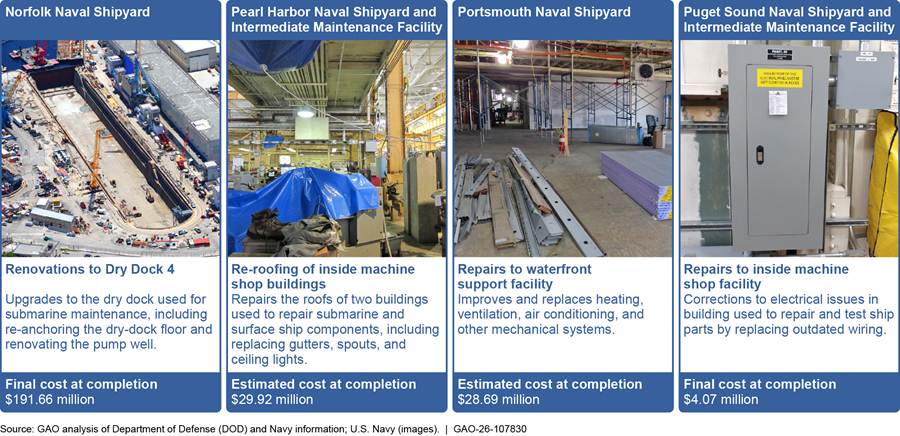
· Repair and modernization projects. The neglect of repair and upkeep of shipyard infrastructure over the years led to a backlog of repair, restoration, and modernization projects. As a result, the majority of SIOP projects as of April 2026 are repair and modernization projects. These projects include the repair of mechanical and electrical systems in various buildings, renovations of existing dry docks, and updates to dozens of other facilities and structures (see fig. 5). Some of these facilities continue to be used by the shipyard while they undergo their repairs.
Figure 5: Examples of Completed and Underway Shipyard Infrastructure Optimization Program Repair and Modernization Projects
· Other new construction. In addition to the construction of new dry docks at the shipyards, as of April 2026 the Navy had completed or begun 11 military construction projects to provide new or expanded facilities beyond repair and modernization. Projects include other dry-dock improvements at Norfolk and Portsmouth, a ship maintenance facility in Norfolk, and electrical and saltwater utility projects to support the Ford-class carriers at Norfolk and Puget Sound.
With construction throughout the shipyards, SIOP projects and shipyard operations—including regular ship maintenance, as well nuclear reactor overhauls and other repairs—are occurring in the same areas at the same time. For example, see figure 6 for the dispersed location of construction projects at Portsmouth; see appendix V for all four shipyards.
Figure 6: Location and Status of Shipyard Infrastructure Optimization Program (SIOP) Construction Projects at Portsmouth Naval Shipyard, as of April 2026
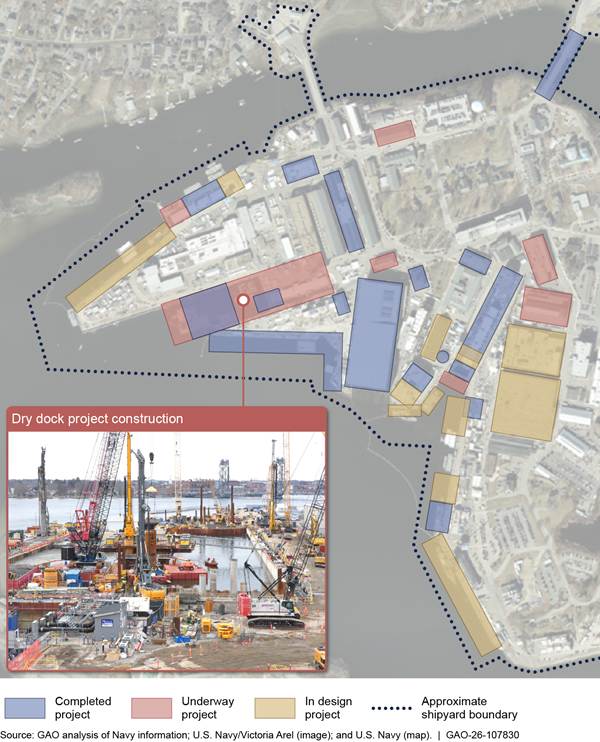
Note: Project markers indicate the primary location of SIOP projects but may not reflect the specific area in the project’s scope or additional space used for construction. For example, a project may renovate a portion of a building or construction projects may use additional laydown space elsewhere in the shipyard. Projects marked as in design are planned to be included in budget requests over the next 2 to 3 fiscal years based on Navy data. Map does not represent entire shipyard boundary or include eight of the 43 construction projects, such as utility projects that are spread throughout the shipyard or do not have a single precise location.
Concurrent construction and shipyard operations create challenges to ensuring the shipyards can complete their ship maintenance requirements, according to program and shipyard officials. For example, Puget Sound’s dry-dock project includes demolishing a large maintenance facility directly adjacent to the current Dry Dock 3, where the new dry dock will be constructed. This creates a set of cascading effects involving the movement of existing facility occupants and other interrelated demolishment and construction projects.
According to shipyard officials, this process of relocating occupants and demolishing buildings to make way for new construction requires careful planning that considers which occupants need to remain on the shipyard, given their support function, and which can move to either nearby leased space in the city of Bremerton or to other locations throughout the greater area of Naval Base Kitsap. All four shipyards have reported experiencing similar challenges with navigating concurrent SIOP construction projects and shipyard operations.
Navy Established Organizations to Manage SIOP Projects and Address Challenges but Has Not Fully Documented Their Roles and Responsibilities
The Navy established several organizations at each shipyard to ensure both progress implementing SIOP projects and continuity of shipyard operations. These organizations are responsible for managing SIOP projects, addressing project risks, and coordinating shipyard operations with ongoing and future construction. However, while these organizations were created for SIOP, their roles and responsibilities are not fully captured in program documentation.
As the program manager, PMO 555 is responsible for overall planning and implementation of SIOP across the shipyards. PMO 555 field offices at each shipyard provide onsite management and coordinate with individual project managers and other stakeholders to ensure SIOP projects meet shipyard and fleet needs. The Navy has created the following additional organizations and structures to serve specific SIOP roles to manage, oversee, and coordinate SIOP implementation at the shipyards.
· Officer in Charge of Construction (OICC). The Navy has established an OICC at Pearl Harbor, Portsmouth, and Puget Sound. According to officials, the Navy plans to establish one at Norfolk. OICCs are military command organizations that NAVFAC may establish to oversee major construction efforts installations.[45] As generally defined in NAVFAC guidance, an OICC is responsible for oversight of construction projects and contractor performance, and it reports to the commander of either NAVFAC Atlantic or NAVFAC Pacific depending on the location.[46]
· Project governance structure. NAVFAC policy lays out a general project governance structure that can be used to address and elevate risks and challenges pertaining to scope, cost, and schedule for high-risk projects, which the Navy has begun to use for SIOP.[47] This governance structure generally consists of three tiers—at the project, senior, and executive levels—to provide increasing stakeholder and management review of project risks and other issues. The intent for SIOP, according to officials, is to use the governance structure to help ensure that relevant stakeholders and decision-makers at the shipyard, and among PMO 555, NAVFAC, NAVSEA, and others, are appropriately aware of project progress, cost and schedule risks, or other issues, and can provide input as needed.
For example, at Portsmouth, Pearl Harbor, and Puget Sound, senior leadership teams have been convened to manage risks and issues for their large dry-dock projects. Additionally, project- and senior-level leadership teams at Portsmouth monitor and manage cost increases and schedule risks affecting the construction of a submarine nuclear reactor servicing complex.
· Program Integration Team (PIT). Created by PMO 555, the PITs consist of stakeholders from PMO 555, the OICC, and various offices and maintenance functions at the shipyard to identify and address challenges and potential conflicts between construction and shipyard operations, according to the team charters at each shipyard. PIT stakeholders collaborate on issues such as those related to safety and readiness, as well as day-to-day coordination of SIOP construction activities with shipyard operations. For example, SIOP construction projects include several large-scale utility upgrades to support the increased Ford- and Virginia-class power-supply requirements. Our review of project documentation found that these upgrades require electricity outages that can cause major disruptions. Accordingly, they must be coordinated throughout the shipyard to ensure the outages do not pose a risk to active shipyard operations or cause delays to ship maintenance.
· SIOP Integration Team. NAVFAC created a new organization, the SIOP Integration Team, to ensure the various NAVFAC functions, responsibilities, and other resources typically provided for Navy construction projects are applied at the level and scale needed for SIOP, according to officials. Additionally, the team is composed of representatives of NAVFAC Atlantic and Pacific who coordinate across their respective divisions and directorates responsible for project planning, design, and contracting to ensure NAVFAC has enough resources in those areas to meet SIOP requirements. They also coordinate with NAVFAC project managers, such as the OICC, throughout the construction process.
According to program officials, these organizations play critical roles in executing construction, managing project risks, and integrating SIOP projects with ongoing shipyard operations. However, the roles these key organizations play for SIOP, and their responsibilities for overseeing and managing shipyard projects, are not fully identified and documented in SIOP program documentation.
The Navy established initial program-level roles and authorities for SIOP in a 2022 memorandum, which includes high-level roles of PMO 555 and its field offices.[48] However, the memorandum does not further identify shipyard-level organizations and their responsibilities for managing and coordinating SIOP projects. PMO 555 subsequently developed the SIOP Concept of Operations to document and disseminate all aspects of SIOP management, including implementation at the shipyards. The SIOP Concept of Operations describes the PMO organizational structure in more detail than the Navy memorandum and identifies some roles and responsibilities for organizations including NAVFAC, NAVSEA, and Commander, Navy Installations Command at the headquarters, regional, and installation levels.
While the Navy intended the SIOP Concept of Operations to provide clarity on specific actions, efforts, and functional roles to successfully execute SIOP, our analysis of Navy documentation found that it does not fully identify or document the key organizational roles the OICC, PIT, project governance structure, or SIOP Integration Team serve for managing and coordinating SIOP projects, risks, and shipyard operations. Specifically, of the four organizational structures officials pointed to as essential to successful implementation of SIOP projects, one—the OICC—is mentioned in the SIOP Concept of Operations. Further, the roles laid out in the Concept of Operations mainly focus on planning activities—such as budget planning, advanced environmental studies, or developing early project plans and cost estimates—with limited description of construction and project execution. For example, the section that describes construction functions does not identify who is responsible for contractor oversight, such as the OICC, nor does it identify the governance structure that SIOP can use to address and elevate risks and challenges that pertain to project scope, cost, and schedule.
Additionally, while some of these organizations’ roles are described in separate documents, others are not fully captured in SIOP program documentation. For example, although not identified in the SIOP Concept of Operations, individual charters define the role and responsibilities of the PIT at each shipyard. Additionally, while the OICCs at Portsmouth and Pearl Harbor were established in individual notices, those documents have not been updated to reflect the full scope of projects in the now 50-year SIOP timeline, according to officials. Finally, the SIOP Integration Team is not formally documented beyond a brief reference in a broad NAVFAC document, and officials confirmed in March 2026 that no further documentation of its role yet exists.
Standards for Internal Control in the Federal Government states that management should establish and document the organizational structure, responsibility, and authority to achieve objectives and meet operational needs.[49] Further, our work on interagency collaboration states that organizations should define roles and responsibilities to clarify who will do what, organize their joint and individual efforts, and facilitate decision-making.[50] This work also states that the organizations should update documentation of roles and responsibilities regularly to provide consistency in the long term, especially when there are changes in staffing.
Additionally, the Army Corps of Engineers, which along with NAVFAC is one of two DOD construction agents, establishes guidance to inform its similar work. The Army Corps’s Partnering Playbook: Building Strong Relationships Across the Construction Project Delivery Life Cycle states that to drive successful outcomes for a construction project, a team should clearly define roles and responsibilities and understand the unique nature of its project including its duration.[51] The Playbook additionally states that stakeholder roles and responsibilities should be documented, including identifying who the decision-makers are, and updated when there are changes to project stakeholders.
One reason the SIOP Concept of Operations does not include key project management responsibilities is that it has not been updated since PMO 555 issued it in October 2022—before some of the organizations were created and when shipyard project planning was underway. For example, the PIT charters were issued in 2023, and shipyard plans were not complete until 2026. Additionally, the Concept of Operations states it is to be continuously updated. For example, the next update was planned to begin in early 2023, but it has not been updated as of May 2026.
Program officials told us that they still plan to issue a second iteration of the SIOP Concept of Operations but have since prioritized other more time-critical planning tasks.[52] Additionally, officials stated that SIOP organizations’ roles and responsibilities may change due to DOD acquisition organizational changes across the department.[53] However, officials agreed that the Concept of Operations would be an appropriate central place to identify and document the roles of these organizations for project management and coordination with shipyards.
As SIOP completes its planning process, it is critical that the roles and responsibilities of organizations centrally involved in managing and overseeing SIOP projects be appropriately reflected in overarching program documentation. Our prior work has found that without documenting roles and responsibilities, changes in leadership, which will continue to happen for SIOP given the program’s extended duration, can weaken the effectiveness of collaborative mechanisms.[54] As the Navy continues to implement department-wide reforms to the acquisition workforce, the associated adjustments could result in changes to leadership or organizational structures involved in SIOP, which could affect the roles and responsibilities of these organizations. It is thus important for SIOP to document these organizations’ roles, responsibilities, and relationships to ensure that critical functions are sustained even if higher-level leadership or organizational structures change.
Without documenting in the SIOP Concept of Operations the roles and responsibilities of SIOP’s project management organizations and how they operate, the Navy may find it more difficult to ensure the organizations collaborate effectively to achieve their critical responsibilities of implementing SIOP projects and ensuring continuity of shipyard operations throughout the program’s extended timeline. Taking these steps will better position the Navy to identify gaps in project management and oversight, including as the program evolves over time or the surrounding organizational environment changes. Doing so could also help ensure project coordination is comprehensive, thereby reducing the risk that implementation of SIOP projects may pose to the shipyards’ ability to maintain and modernize the U.S. naval fleet now and into the future.
Conclusions
The Navy’s four public shipyards provide vital maintenance and modernization to ensure the U.S. fleet of nuclear-powered aircraft carriers and submarines are ready and able to provide critical warfighting capabilities around the world. With SIOP, the Navy is undertaking a generational effort to address extensive infrastructure shortfalls, modernize outdated capabilities, and improve shipyard performance. However, the program will cost substantially more than initially estimated and will take multiple decades to complete.
Oversight of SIOP is critical given the program’s scope, time frame, and expected costs. The Navy has developed an oversight framework for SIOP, but it would benefit from including steps to (1) periodically reevaluate the relevance of program requirements and objectives and (2) conduct annual sufficiency reviews of mission readiness, affordability, and sustainability. Doing so would help ensure that SIOP’s current plans and projects continue to be aligned with the Navy’s future nuclear-powered fleet and that the shipyards can evolve as necessary to provide the appropriate maintenance and modernization needed to support future warfighting capabilities.
Congress receives numerous reports and information on SIOP’s priorities and projects, but the information is dispersed across multiple products that provide varying types of program information. The ultimate cost of SIOP as planned today will be among DOD’s costliest acquisition programs. The Navy has already spent billions on SIOP, and it plans to approve an overall program cost, schedule, and performance baseline, and identify all planned projects, after its combined Gate 5 and Milestone B-C. Congressional action requiring the Navy to report annual consolidated, standardized information on SIOP total costs, schedule, and performance, along with other metrics, would provide decision-makers a fuller picture of SIOP costs and risks in line with their oversight of other high-value defense programs. Requiring such reports for the duration of the program would further equip congressional decision-makers with comparable information to enable long-term monitoring of how taxpayer dollars are used to fix the nation’s shipyards. This information would additionally enable Congress to oversee the extent to which the resource requirements, objectives, and performance of the program continue to meet U.S. defense and fiscal priorities over the many years to come.
Finally, in recognition that an undertaking of SIOP’s size and complexity requires close oversight of projects at the shipyards, the Navy has created organizations to manage their resources, progress, and risks, but it has not fully documented their new SIOP-specific roles and responsibilities. Doing so in the program’s concept of operations would help the Navy ensure that these organizations collaborate effectively to manage projects, address challenges, and achieve program and shipyard goals. Taking this action now would also help the Navy identify any gaps in SIOP project management and oversight as the program evolves over time. This in turn would help the Navy ensure SIOP completes the projects the shipyards need to provide the maintenance and modernization critical to the Navy’s current and future readiness.
Matter for Congressional Consideration
Congress should consider requiring the Navy to annually report consolidated, standardized information on the status of SIOP costs and progress for the duration of the program. The status reports to Congress should include (1) detailed and summary information for the program overall, such as total expenditures to date; original and current program schedule, performance, and cost estimates; associated risk analysis; and other elements reported by MDAPs, as applicable to SIOP and of interest to Congress; and (2) similar detailed and summary information for individual SIOP projects, which could be identified based on cost thresholds or other applicable thresholds, such as categories of military construction projects. (Matter for Consideration 1)
Recommendations for Executive Action
We are making the following three recommendations to the Department of the Navy.
The Secretary of the Navy should ensure that the ASN (RD&A) includes in the SIOP oversight framework specific steps, such as part of its Gate 6 reviews, to periodically reevaluate SIOP’s validated CDD program requirements, objectives, and performance parameters, following its Gate 5/Milestone B-C approval and during program implementation, to confirm continued relevance or identify emerging program gaps or changes. (Recommendation 1)
The Secretary of the Navy should ensure that the ASN (RD&A) includes in the SIOP oversight framework specific steps and timing for conducting annual Gate 6 sufficiency reviews of SIOP’s mission readiness, affordability, and sustainability, as appropriate based on Navy MDAP guidance. (Recommendation 2)
The Secretary of the Navy should ensure that PMO 555, in coordination with NAVFAC and other pertinent stakeholders, identifies and documents key SIOP project management organizations and their SIOP roles, responsibilities, and collaborative relationships in the SIOP Concept of Operations. (Recommendation 3)
Agency Comments
We provided a draft of this report to DOD for review and comment. The Navy concurred with our recommendations and provided technical comments, which we incorporated as appropriate. The Navy’s written comments, which outline planned steps to implement our recommendations, are reproduced in appendix VI.
We are sending copies of this report to the appropriate congressional committees, the Secretary of Defense, and the Secretary of the Navy. In addition, the report is available at no charge on the GAO website at https://www.gao.gov.
If you or your staff have any questions about this report, please contact me at moldafskyd@gao.gov. Contact points for our Offices of Congressional Relations and Media Relations may be found on the last page of this report. GAO staff who made key contributions to this report are listed in appendix VII.

Diana Moldafsky
Director, Defense Capabilities and Management
The largest of the Shipyard Infrastructure Optimization Program (SIOP) projects, the construction of new dry docks at Portsmouth, Pearl Harbor, and Puget Sound Naval Shipyards are the largest-ever Navy infrastructure projects, according to officials. The projects also include demolition, relocation, and construction of various infrastructure. The Navy expects to complete the three projects at a total estimated cost of about $21.7 billion, as of Navy budget request documents submitted to Congress in April 2026.[55]
Two new dry docks at Portsmouth. In construction since 2021, the project extends existing Dry Dock 1 space to the north and west to provide the greater size, water, and electrical requirements to maintain current Virginia-class submarines.[56] Due to constrained space on the island shipyard, large cement monoliths for the dry-dock floor are constructed 200 miles away, then barged to the shipyard. Despite being amidst an expansive construction site, Dry Dock 1 is used to overhaul Los Angeles-class submarines, with two more maintenance periods expected during the remainder of the project. The Navy has requested a total authorization of $2.46 billion, and the Navy expects to complete the dry docks by May 2029. (See fig. 7.)
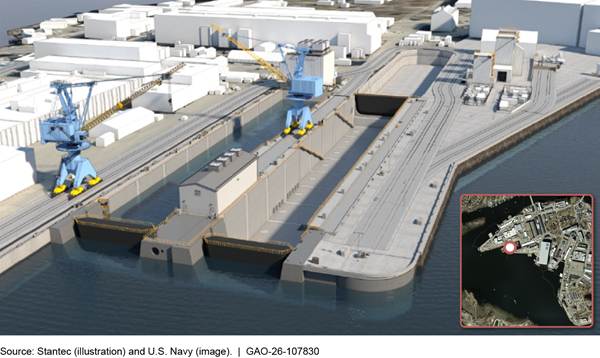
Pearl Harbor. Construction began in 2023 on a new dry dock for Virginia-class submarines, the majority of which are planned for homeporting at Pearl Harbor by 2030 and otherwise not supported by the existing Dry Dock 3. Work includes dredging to extend the shipyard footprint into the waterway; construction of the concrete dry dock, a new caisson enclosure, new electrical substation, mechanical and electrical utilities, and various pumphouses; and demolition of various infrastructure. The Navy also uses space outside the shipyard, including to construct large floor monoliths, as at Portsmouth. The Navy has requested a total authorization of $4.47 billion for the project, and it expects to complete it by March 2029. (See fig. 8.)
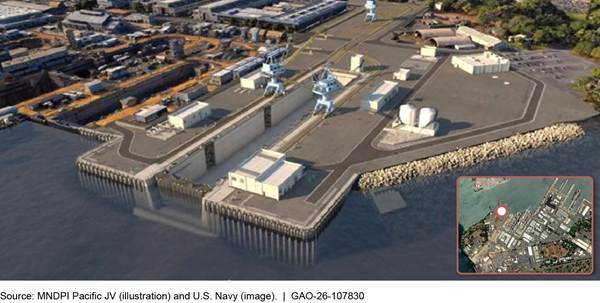
Puget Sound. In addition to constructing a new dry dock and associated structures, the Puget Sound project also involves the demolition and relocation of an existing dry dock, piers, and several critical shipyard facilities to clear the physical space needed to construct the dry dock. Navy plans as of April 2026 include capacity to support Virginia-class and Ford-class maintenance demands and meet seismic resilience requirements; demolition and construction of piers, wharves, and moorings; and removal, relocation, and construction of significant buildings including a large maintenance facility and the forge and heat-treat shop, the latter of which will be built at Naval Base Kitsap-Bangor. (See fig. 9.) The Navy is leasing off-shipyard property to temporarily move some building occupants. Site-preparation demolition is set to begin in 2027, according to Navy project plans, and construction on the dry dock in 2030. The Navy requested a total authorization of $14.76 billion for the project in its fiscal year 2027 budget request and plans to complete it in 2038.
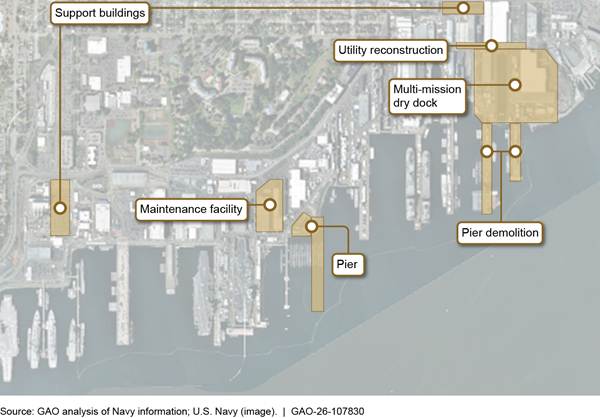
Table 5: Shipyard Infrastructure Optimization Program (SIOP) Construction Projects at Each Shipyard by Status and Funding Type, as of April 2026
|
Shipyard |
Status |
O&M |
Final or estimated cost at completion |
MILCON |
Final or estimated cost at completion |
Total projects |
Total cost |
|
Norfolk |
|
|
|
|
|
|
|
|
|
Completed |
9 |
$312,571,657 |
2 |
$123,248,048 |
11 |
$435,819,705 |
|
|
Underway |
5 |
$395,231,008 |
3 |
$863,072,457 |
8 |
$1,258,303,465 |
|
|
In design |
3 |
$107,453,000 |
3 |
$2,469,957,000 |
6 |
$2,577,410,000 |
|
|
Total |
17 |
$815,255,665 |
8 |
$3,456,277,505 |
25 |
$4,271,533,170 |
|
Pearl Harbor |
|
|
|
|
|
||
|
|
Completed |
9 |
$73,743,107 |
0 |
$0 |
9 |
$73,743,107 |
|
|
Underway |
6 |
$137,406,757 |
1 |
$4,471,000,000 |
7 |
$4,608,406,757 |
|
|
In design |
6 |
$1,118,680,000 |
0 |
$0 |
6 |
$1,118,680,000 |
|
|
Total |
21 |
$1,329,829,864 |
1 |
$4,471,000,000 |
22 |
$5,800,829,864 |
|
Portsmouth |
|
|
|
|
|
|
|
|
|
Completed |
19 |
$304,060,840 |
4 |
$411,855,611 |
23 |
$715,916,451 |
|
|
Underway |
7 |
$139,581,058 |
1 |
$2,421,000,000 |
8 |
$2,560,581,058 |
|
|
In design |
11 |
$313,839,474 |
1 |
$227,769,000 |
12 |
$541,608,474 |
|
|
Total |
37 |
$757,481,372 |
6 |
$3,060,624,611 |
43 |
$3,818,105,983 |
|
Puget Sound |
|
|
|
|
|
||
|
|
Completed |
13 |
$486,045,526 |
1 |
$47,886,483 |
14 |
$533,932,009 |
|
|
Underway |
18 |
$643,808,233 |
2 |
$328,976,923 |
20 |
$972,785,156 |
|
|
In design |
11 |
$1,055,161,360 |
5 |
$16,999,870,000 |
16 |
$18,055,031,360 |
|
|
Total |
42 |
$2,185,015,119 |
8 |
$17,376,733,406 |
50 |
$19,561,748,525 |
|
Total |
|
117 |
$5,087,582,020 |
23 |
$28,364,635,522 |
140 |
$33,452,217,542 |
Source: GAO analysis of Navy data. | GAO‑26‑107830
Note: Costs given above represent final costs for completed projects and estimated costs at completion for underway projects. For some of these projects, the current estimated cost at completion may be less than the total authorized amount for the project. Projects identified as in design are those the Navy plans to include in budget requests over the next 2 to 3 fiscal years. Our analysis of SIOP project data focused on construction projects funded with Operation and Maintenance (O&M) funding, or specific Military Construction (MILCON) appropriations. SIOP also includes capital equipment projects, which include procurement of equipment not considered real property, such as cranes, as well as structures such as nuclear reactor servicing complexes. As of March 2026, SIOP procured 385 pieces of equipment worth $1.49 billion using Navy procurement funding, according to program officials.
Table 6: Selected Statutory Reporting Requirements Applicable to the Shipyard Infrastructure Optimization Program (SIOP) or SIOP Projects
|
Statutory provision |
Designated reporter |
Required reporting elements |
Due date and current status of report requirement |
Addressees |
|
National Defense Authorization Act for Fiscal Year 2022, Pub. L. No. 117-81, § 355(b) (2021), codified at 10 U.S.C. § 8013 note Improved Oversight for Implementation of Shipyard Infrastructure Optimization Program of the Navy – Briefing |
Secretary of the Navy |
Briefing before start of physical construction with respect to each SIOP project with a contract awarded on or after October 1, 2024, and valued at $250,000,000 or more. Prior to briefing, submission of written information including updated cost estimates; comprehensive project schedule; and estimate that planned funding will be sufficient for project completion is required. |
Before the start of physical construction with respect to a covered project. |
SASC, HASC, SAC, HAC |
|
National Defense Authorization Act for Fiscal Year 2022, Pub. L. No. 117-81, § 355(c) (2021), codified at 10 U.S.C. § 8013 note Improved Oversight for Implementation of Shipyard Infrastructure Optimization Program of the Navy – Annual Report |
Commander of Naval Sea Systems Command, in coordination with the Program Manager Ships 555a |
Report detailing Navy funding for all efforts associated with SIOP. Report elements to include updated cost and schedule estimates for the SIOP implementation plan and for each dry dock, major facility and infrastructure project valued at $250,000,000 or more. |
Not later than December 31, 2022, and not later than December 31 of each year thereafter. |
SASC, HASC, SAC, HAC |
|
James M. Inhofe National Defense Authorization Act for Fiscal Year 2023, Pub. L. No. 117-263, § 373 (2022), codified at 10 U.S.C. § 2473 Five-Year Plans for Improvements to Depot and Ammunition Production Facility Infrastructure |
Secretaries of Military Departments |
As part of annual budget submission, secretaries submit plan describing infrastructure improvements at depots under their jurisdiction during the 5 years following the fiscal year for which the budget is submitted. Plans to include identification of major lines of effort; estimated costs; and information about how depot improvement jobs will be paced and sequenced to ensure continuous operations. |
Concurrent with annual budget submission of the President. |
SASC, HASC, SAC, HAC |
|
National Defense Authorization Act for Fiscal Year 2024, Pub. L. No. 118-31, § 344(a) (2023), amending section 355(b)(2) of the National Defense Act for Fiscal Year 2022 (Pub. L. No. 117-81), codified at 10 U.S.C. § 8013 note Matters Relating to Briefings on Shipyard Infrastructure Optimization Program of the Navy |
Secretary of the Navy |
Adding report element to briefings required before start of physical construction with respect to each SIOP project with a contract awarded on or after October 1, 2024, and valued at $250,000,000 or more. Prior to briefing, submission of written information revised to also include a risk analysis of how the schedule for each project affects the availability schedule for submarines and aircraft carriers. |
Before the start of physical construction with respect to a covered project. |
SASC, HASC, SAC, HAC |
|
National Defense Authorization Act for Fiscal Year 2025, Pub. L. No. 118-159, § 2879(c) (2024) Updates to Policies and Guidance of the Department of the Navy for the Replacement of Certain Dry Docks and Other Projects |
Secretary of the Navy |
Briefing on status of certain dry dock construction projects to include a summary of steps taken to ensure project costs do not increase; an assessment of the likelihood of future cost overruns; and other project details the Secretary deems relevant to support congressional oversight of SIOP projects. |
Not later than 90 days after date of enactment and quarterly thereafter. |
SASC, HASC |
|
National Defense Authorization Act for Fiscal Year 2026, Pub. L. No. 119-60, § 339 (2025) Modification of Report on Improved Oversight for Implementation of Shipyard Infrastructure Optimization Program of the Navy |
Commander of Naval Sea Systems Command, in coordination with the Program Manager Ships 555a |
Adding element to annual report detailing Navy funding for all efforts associated with SIOP.b Report also to include information on the incorporation of digital infrastructure and platforms into the SIOP implementation plan. |
Not later than December 31, 2022, and not later than December 31 of each year thereafter. |
SASC, HASC, SAC, HAC |
|
National Defense Authorization Act for Fiscal Year 2026, Pub. L. No. 119-60, § 2803 (2025), codified at 10 U.S.C. § 2820 Requirement for the Military Departments to Develop and Update a 20-Year Infrastructure Improvement Plan |
Secretaries of Military Departments |
Infrastructure improvement plan covering the 20-year period beginning after the date of submission, including a summary of major efforts to be carried out under the plan; milestones; a description of infrastructure improvement efforts; and a certification that funding is at a level sufficient to meet the requirements of the plan. Plans also include estimated costs of necessary improvements and description of how such costs would be addressed by the Department of Defense budget request; an assessment of how facility sustainment costs are accurately accounted for by the reporting military department; the incorporation of results-oriented management practices such as analytically based goals and regular reporting; and an assessment by the service chief of the plan. |
Not later than the date on which the President’s budget for fiscal year 2027 is submitted to Congress, and once every five years thereafter. |
SASC, HASC, SAC, HAC |
|
National Defense Authorization Act for Fiscal Year 2026, Pub. L. No. 119-60, § 2816 (2025) Authorization for Cost-Plus-Incentive-Fee Contracts for Certain Shipyard Infrastructure Optimization Program Military Construction Projects |
Secretary of the Navy |
Briefing on use of provided authority to include an overview of each project started or planned using the authority; a comparison of projected and actual cost of authorized contracts; a description of performance metrics; and assessment of lessons learned and recommendations for future use of provided contract authority. |
Not later than 180 days after the date of enactment, and annually thereafter for 5 years. |
SASC, HASC, SAC, HAC |
|
10 U.S.C. § 2811(d) Repair of Facilities – Congressional Notification |
Secretary of Department Concerned |
Report containing a project justification and current cost estimate; explanation of why facility replacement is not in best interest of the government if current repair estimates exceed 75 percent of estimated replacement project; and description of the project such as surveys and site preparation, project supervision, and acquisition of equipment integral to project. |
When decision is made to carry out a repair project in excess of $7,5000,000. |
Appropriate congressional committees, such as SASC, HASC, SAC and HAC |
|
10 U.S.C. § 2853(d) Authorized Cost and Scope of Work Variations – Exceptions to Limitation on Scope of Work Increases |
Secretary of Department Concerned |
Notice of waiver related to limitations on scope of work increases on a military construction project to include a description of the scope increase and reasons for the increase. |
Fourteen days prior to the effective implementation of a scope of work increase that increases the scope up to 10 percent of amount specified in project justification data provided as request for project authorization. |
Appropriate congressional committees, such as SASC, HASC, SAC and HAC |
|
10 U.S.C. § 2853(f) Authorized Cost and Scope of Work Variations – Additional Reporting Requirement for Certain Cost Increases |
Secretary of Department Concerned |
Report of any military construction project with total authorized cost greater than $40,000,000 that has a cost increase of 25 percent or more, including a description of reasons for the cost increase and responsible party; description and status of any proceedings into responsible party; actions taken based on proceedings; and summary of changes that may be required as a result of problems identified or lessons learned from the project. |
Not later than 180 days after congressional notice provided regarding a scope of work increase. |
Appropriate congressional committees, such as SASC, HASC, SAC and HAC |
|
Expired Provisions |
||||
|
William M. (Mac) Thornberry National Defense Authorization Act for Fiscal Year 2021, Pub. L. No. 116-283, § 346 (2021) Biannual Briefings on Status of Shipyard Infrastructure Optimization Plan |
Secretary of the Navy |
Briefings on a master plan for infrastructure development; planning and design updates for military construction and facility sustainment over the subsequent 5-year period; a human capital management plan; a workload management plan; performance metrics and assessment plan; a funding and authority plan; and a list of certain equipment unserviceable for over 30 consecutive days. |
Period beginning July 1, 2020, and ending July 2, 2025. |
SASC, HASC, SAC, HAC |
|
National Defense Authorization Act for Fiscal Year 2022, Pub. L. No. 117-81, § 355(a) (2021), codified at 10 U.S.C. § 8013 note Improved Oversight for Implementation of Shipyard Infrastructure Optimization Program of the Navy – Updated Plan |
Secretary of the Navy |
Briefing on updates to SIOP program, including updated cost estimates comprising most recent costs of capital improvement projects. |
Not later than September 30, 2022. |
SASC, HASC, SAC, HAC |
|
James M. Inhofe National Defense Authorization Act for Fiscal Year 2023, Pub. L. No. 117-263, § 356(b) (2022), codified at 10 U.S.C. § 8013 note Implementation of Comptroller General Recommendations Regarding Shipyard Infrastructure Optimization Plan of the Navy |
Secretary of the Navy |
If the Navy is unable to develop progress metrics, ensure that the SIOP program office includes all costs and uses cost estimation best practices, and obtain independent cost estimates for SIOP projects exceeding $250,000,000 by March 1, 2023; then briefing on current progress toward implementing identified program management elements. |
Before March 1, 2023, if unable to implement identified program management elements. |
SASC, HASC |
|
National Defense Authorization Act for Fiscal Year 2024, Pub. L. No. 118-31, § 344(b) (2023) Matters Relating to Briefings on Shipyard Infrastructure Optimization Program of the Navy |
Secretary of the Navy |
Briefing on implementation status of SIOP to include information on each project with a contract awarded on or after October 1, 2024, and valued at $250,000,000 or more. Project information includes updated cost estimates; comprehensive project schedule; estimate that planned funding will be sufficient for project completion is required; and a risk analysis of how each project affects submarine and aircraft carrier availability. |
Not later than October 1, 2024. |
SASC, HASC, SAC, HAC |
HAC = House Appropriations Committee
HASC = House Armed Services Committee
SAC = Senate Appropriations Committee
SASC = Senate Armed Services Committee
Source: GAO analysis of statutory requirements. | GAO‑26‑107830
aThis position was changed to Program Management Office 555, or PMO 555, in 2022.
bThese reporting requirements are added to the report required by P.L. No. 117-81, § 355(c) (2021).
Major defense acquisition programs (MDAP) are required to periodically provide status reports on those programs to Congress.[57] Originally required under 10 U.S.C. § 4351, reporting requirements are now provided through a Department of Defense (DOD) system for modernized selected acquisition reports (MSAR).[58] Because the Navy’s Shipyard Infrastructure Optimization Program (SIOP) is not an MDAP, it is not required to report information through the information system used by DOD. Additionally, because SIOP does not manufacture or deliver a series of the same product, such as ships or submarines, as might be the case with an MDAP, the Navy is not able to collect or report all information required by MSAR system requirements, such as unit acquisition costs. However, reporting applicable elements that are required of MDAPs may improve long-term oversight of the implementation of SIOP, given the expected cost and duration of the program exceeds that of many MDAPs. Such reports provided at least annually represent a comprehensive summary of the program, including status of the total program cost, schedule, and performance, as well as other cost and risk information. For examples of the types of information that could be applicable to SIOP, see table 7.
Table 7: Examples of Elements Included in Annual Status Reports to Congress for Major Defense Acquisition Programs Previously Required Under 10 U.S.C. § 4351
|
Elements included in status reports previously required by 10 USC § 4351 |
|
|
Element |
Examples of type of information reported by major defense acquisition programs |
|
Program schedule |
Detailed and summarized information for program schedule from development through completion Original baseline schedule, revised baseline schedule(s), and current schedule estimate Best estimate of annual costs |
|
Program baseline cost estimates and related risk analysis |
Original baseline cost, revised baseline cost, and current schedule estimate Associated sensitivity and risk analysis Primary risk parameters associated with current cost for the program |
|
Summary of history of major program changes |
Summary of significant events since program inception Program highlights since the last status report Reasons for any change in program cost or in program schedule since the last status report |
|
Program risks |
The significant schedule and technical risks at each major milestone |
|
Total program costs and history of those costs |
Program/subprogram acquisition costs Program procurement costs History of these costs |
|
Contract information and performance |
The major contracts under the program and designated major subprograms under the program and the reasons for any cost or schedule Variances under those contracts since the last report |
|
Life-cycle costs |
Full life-cycle cost analysis |
Source: GAO analysis of 10 U.S.C. § 4351. | GAO‑26‑107830
Note: The requirements under 10 U.S.C. § 4351 terminated after the final submission covering fiscal year 2023.
Appendix V: Locations of Construction Projects Completed, Underway, or in Design at the Naval Shipyards
Figure 10: Location and Status of Shipyard Infrastructure Optimization Program (SIOP) Construction Projects at Pearl Harbor Naval Shipyard, as of April 2026
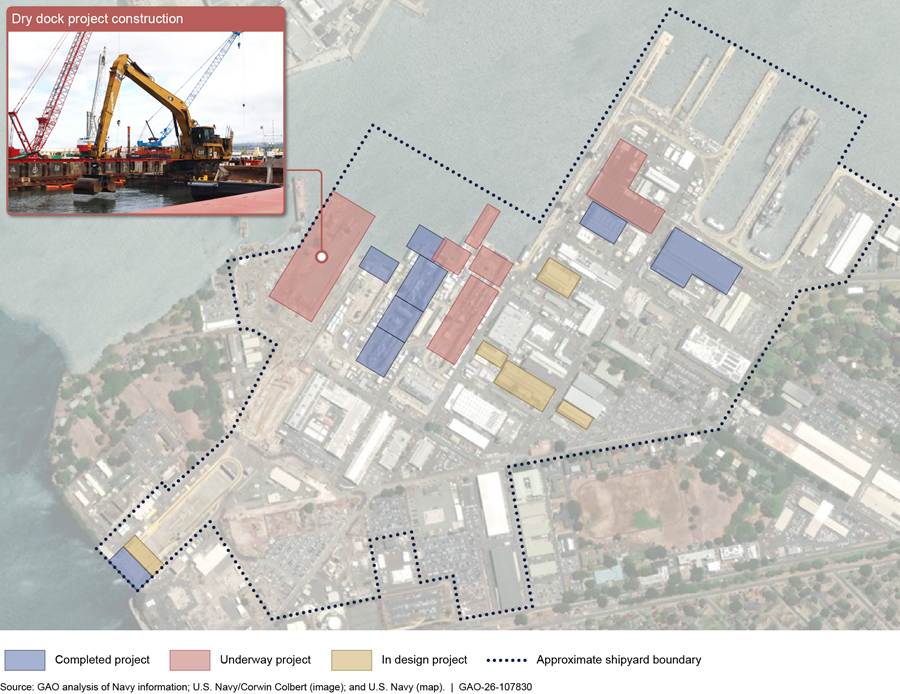
Note: Project markers indicate the primary location of SIOP projects but may not reflect the specific area in the project’s scope or additional space used for construction. For example, a project may renovate a portion of a building or may use additional laydown space elsewhere in the shipyard. Projects marked as in design are planned to be included in budget requests over the next 2 to 3 fiscal years based on Navy data. Map does not include four of the 22 construction projects, such as utility projects that are spread throughout the shipyard or that do not have a single precise location.
Figure 11: Location and Status of Shipyard Infrastructure Optimization Program (SIOP) Construction Projects at Portsmouth Naval Shipyard, as of April 2026
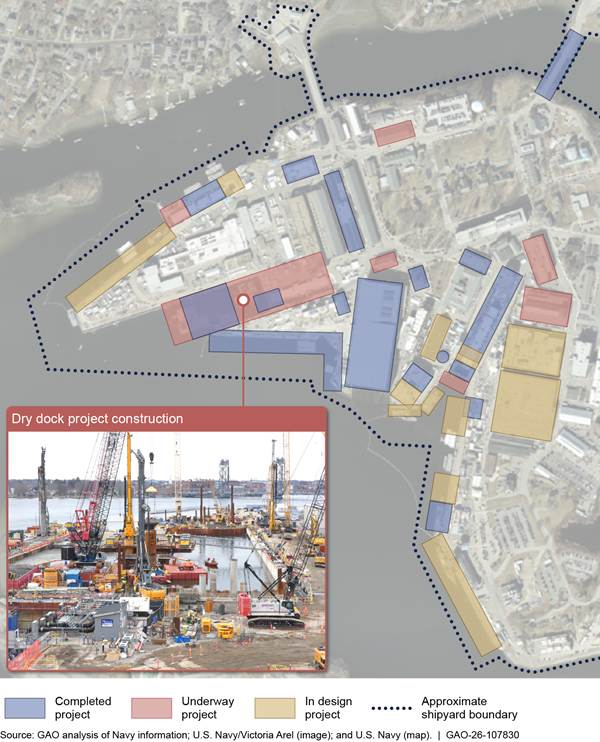
Note: Project markers indicate the primary location of SIOP projects but may not reflect the specific area in the project’s scope or additional space used for construction. For example, a project may renovate a portion of a building or may use additional laydown space elsewhere in the shipyard. Projects marked as in design are planned to be included in budget requests over the next 2 to 3 fiscal years based on Navy data. Map does not represent entire shipyard boundary or include eight of the 43 construction projects, such as utility projects that are spread throughout the shipyard or that do not have a single precise location.
Figure 12: Location and Status of Shipyard Infrastructure Optimization Program (SIOP) Construction Projects at Norfolk Naval Shipyard, as of April 2026
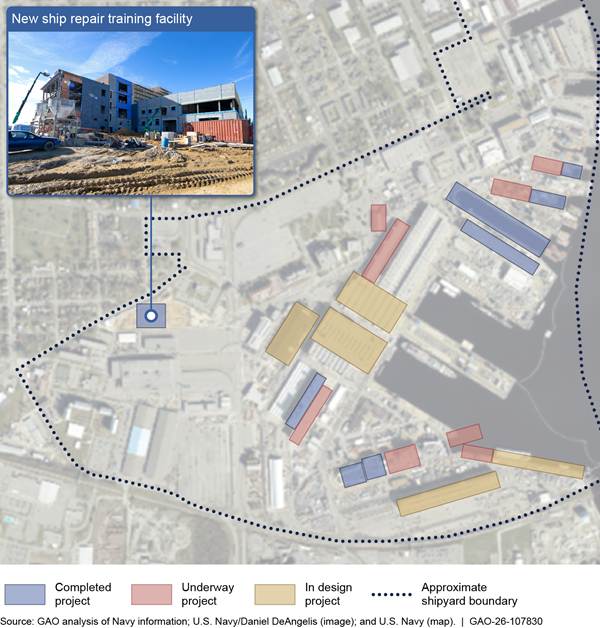
Note: Project markers indicate the primary location of SIOP projects but may not reflect the specific area in the project’s scope or additional space used for construction. For example, a project may renovate a portion of a building or may use additional laydown space elsewhere in the shipyard. Projects marked as in design are planned to be included in budget requests over the next 2 to 3 fiscal years based on Navy data. Map does not represent entire shipyard boundary or include four of the 25 construction projects, such as utility projects that are spread throughout the shipyard or that do not have a single precise location.
Figure 13: Location and Status of Shipyard Infrastructure Optimization Program (SIOP) Construction Projects at Puget Sound Naval Shipyard, as of April 2026
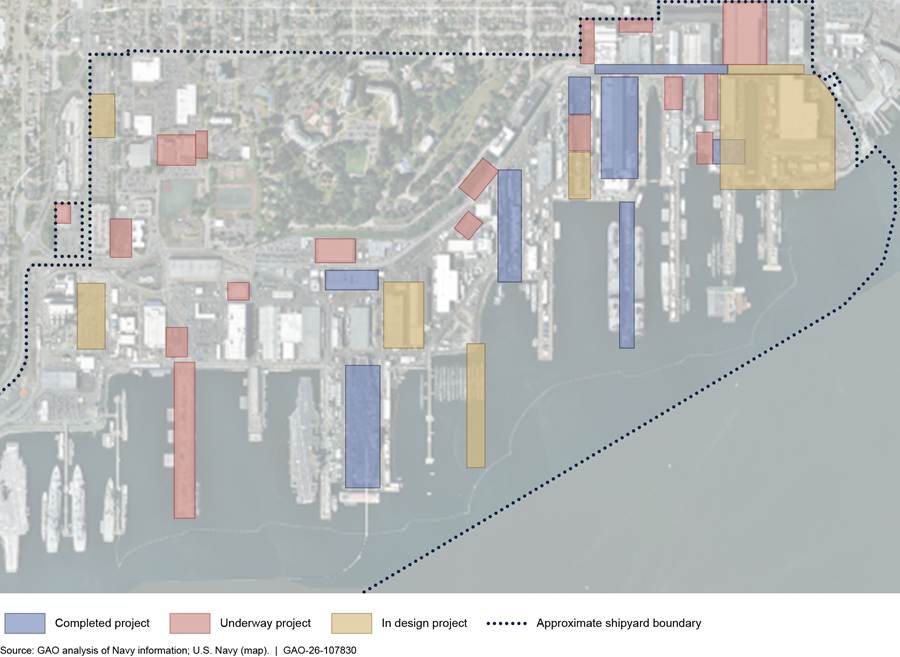
Note: Project markers indicate the primary location of SIOP projects but may not reflect the specific area in the project’s scope or additional space used for construction. For example, a project may renovate a portion of a building or may use additional laydown space elsewhere in the shipyard. Projects marked as in design are planned to be included in budget requests over the next 2 to 3 fiscal years based on Navy data. Map does not represent entire shipyard boundary or include 19 of the 50 construction projects, such as utility projects that are spread throughout the shipyard or that do not have a single precise location.
GAO Contact
Diana Moldafsky, MoldafskyD@gao.gov
Staff Acknowledgments
In addition to the contacts listed above, Julie A. Clark (Assistant Director), Sally Newman (Assistant Director, retired), Sally Williamson (Analyst in Charge), Madeline Barch, Jakob K. Brown, Lindsey Cross, Noah Gerber, Christopher Gezon, Felicia Lopez, Anne McDonough, Shelby S. Oakley, Anne Thomas, and Tonya Woodbury made key contributions to this report.
Installation Maintenance: DOD Needs Better Information and Oversight to Address Repair Backlogs and Improve Conditions. GAO‑26‑107255. Washington, D.C.: August 21, 2026.
Weapon Systems Annual Assessment: Requiring Mature Technologies Could Enable Shift to Rapid Delivery. GAO‑26‑108457. Washington, D.C.: July 2, 2026.
Navy And Coast Guard Shipbuilding: A Disciplined, Strategy-Driven Approach Is Needed to Achieve Ambitious Goals. GAO‑26‑109068. Washington, D.C.: April 22, 2026.
DOD Joint Bases: Actions Needed to Improve Sustainment of Facilities. GAO‑26‑106832. Washington, D.C.: February 26, 2026.
Nuclear Security Enterprise: Assessments of NNSA Major Projects. GAO‑26‑107777. Washington, D.C.: February 26, 2026.
National Science Foundation: Schedule Delays Continue for Some Major and Midscale Research Infrastructure Projects. GAO‑26‑107842. Washington, D.C.: February 24, 2026.
Military Installations: DOD Should Improve Natural Disaster Cost Tracking and Planning for Resilience Improvements. GAO‑26‑107786. Washington, D.C.: February 23, 2026.
Border Security: DHS Needs to Better Plan for and Oversee Future Facilities for Short-term Custody. GAO‑25‑107346. Washington, D.C.: September 2, 2025.
Defense Acquisition Reform: Persistent Challenges Require New Iterative Approaches to Delivering Capability with Speed. GAO‑25‑108528. Washington, D.C.: June 11, 2025.
DOD Real Property: Actions Needed to Improve Oversight of Underutilized and Excess Facilities. GAO‑25‑106132. Washington, D.C.: March 3, 2025.
Navy Ship Modernization: Poor Cruiser Outcomes Demonstrate Need for Better planning and Quality Oversight in Future Efforts. GAO‑25‑106749. Washington, D.C.: December 17, 2024.
Naval Reactors: Independent Analyses of Cost, Schedule, and Quality of Work Needed for Spent Fuel Handling Facility Project. GAO‑25‑106997. Washington, D.C.: December 12, 2024.
Transportation Grants: Implementation of Recommendations to Improve Documentation Would Enhance Program for Large, Complex Projects. GAO‑25‑107102. Washington, D.C.: November 13, 2024.
Military Construction: Better Information Sharing Would Improve DOD’s Oversight. GAO‑24‑106499. Washington, D.C.: September 16, 2024.
Navy Shipbuilding Increased Use of Leading Design Practices Could Improve Timeliness of Deliveries. GAO‑24‑105503. Washington, D.C.: May 2, 2024.
Southwest Border: Award and Management of Barrier Construction Contracts. GAO‑23‑106893. Washington, D.C.: July 18, 2023.
Navy Readiness: Actions Needed to Address Cost and Schedule Estimates for Shipyard Improvement. GAO‑23‑106067. Washington, D.C.: June 28, 2023.
DOD Construction Contracts: Contractor Proximity to Work Sites Varied. GAO‑23‑106035. Washington, D.C.: April 26, 2023.
Naval Shipyards: Ongoing Challenges Could Jeopardize Navy’s Ability to Improve Shipyards. GAO‑22‑105993. Washington, D.C.: May 10, 2022.
Military Depots: DOD Strategy for Addressing Deteriorating Facilities and Equipment is Incomplete. GAO‑22‑105009. Washington, D.C.: May 9, 2022.
Defense Infrastructure: DOD Should Better Manage Risks Posed by Deferred Facility Maintenance. GAO‑22‑104481. Washington, D.C.: January 31, 2022.
Southwest Border: Schedule Considerations Drove Army Corps of Engineers’ Approaches to Awarding Construction Contracts through 2020. GAO‑21‑372. Washington, D.C.: June 17, 2021.
Aircraft Carriers: Homeport Changes Are Primarily Determined by Maintenance Requirements. GAO‑21‑345. Washington, D.C.: April 22, 2021.
Navy Shipyards: Actions Needed to Address the Main Factors Causing Maintenance Delays for Aircraft Carriers and Submarines. GAO‑20‑588. Washington, D.C.: August 20, 2020.
Navy Shipbuilding: Increasing Focus on Sustainment Early in the Acquisition Process Could Save Billions. GAO‑20‑2. Washington, D.C.: March 24, 2020.
Navy Maintenance: Persistent and Substantial Ship and Submarine Maintenance Delays Hinder Efforts to Rebuild Readiness. GAO‑20‑257T. Washington, D.C.: December 4, 2019.
Naval Shipyards: Key Actions Remain to Improve Infrastructure to Better Support Navy Operations. GAO‑20‑64. Washington, D.C.: November 25, 2019.
Rail Transit: Federal Transit Administration Could Improve Information on Estimating Project Costs. GAO‑19‑562. Washington, D.C.: July 22, 2019.
Federal Construction: Army Corps of Engineers and GSA Need to Improve Data on Contract Changes. GAO-19-500. Washington, D.C.: July 2, 2019.
Military Depots: Actions Needed to Improve Poor Conditions of Facilities and Equipment That Affect Maintenance Timeliness and Efficiency. GAO‑19‑242. Washington, D.C.: April 29, 2019.
Tribal Consultation: Additional Federal Actions Needed for Infrastructure Projects. GAO‑19‑22. Washington, D.C.: March 20, 2019.
Defense Infrastructure: Action Needed to Increase the Reliability of Construction Cost Estimates. GAO‑18‑101. Washington, D.C.: March 27, 2018.
Naval Shipyards: Actions Needed to Improve Poor Conditions that Affect Operations. GAO‑17‑548. Washington, D.C.: September 12, 2017.
Defense Infrastructure: Actions Needed to Improve the Navy’s Processes for Managing Public Shipyards’ Restoration and Modernization Needs. GAO‑11‑7. Washington, D.C.: November 16, 2010.
The Government Accountability Office, the audit, evaluation, and investigative arm of Congress, exists to support Congress in meeting its constitutional responsibilities and to help improve the performance and accountability of the federal government for the American people. GAO examines the use of public funds; evaluates federal programs and policies; and provides analyses, recommendations, and other assistance to help Congress make informed oversight, policy, and funding decisions. GAO’s commitment to good government is reflected in its core values of accountability, integrity, and reliability.
Obtaining Copies of GAO Reports and Testimony
The fastest and easiest way to obtain copies of GAO documents at no cost is through our website. Each weekday afternoon, GAO posts on its website newly released reports, testimony, and correspondence. You can also subscribe to GAO’s email updates to receive notification of newly posted products.
Order by Phone
The price of each GAO publication reflects GAO’s actual cost of production and distribution and depends on the number of pages in the publication and whether the publication is printed in color or black and white. Pricing and ordering information is posted on GAO’s website, https://www.gao.gov/ordering.htm.
Place orders by calling (202) 512-6000, toll free (866) 801-7077,
or
TDD (202) 512-2537.
Orders may be paid for using American Express, Discover Card, MasterCard, Visa, check, or money order. Call for additional information.
Connect with GAO
Connect with GAO on X,
LinkedIn, Instagram, and YouTube.
Subscribe to our Email Updates. Listen to our Podcasts.
Visit GAO on the web at https://www.gao.gov.
To Report Fraud, Waste, and Abuse in Federal Programs
Contact FraudNet:
Website: https://www.gao.gov/about/what-gao-does/fraudnet
Automated answering system: (800) 424-5454
Media Relations
Sarah Kaczmarek, Managing Director, Media@gao.gov
Congressional Relations
David A. Powner, Acting Managing Director, CongRel@gao.gov
General Inquiries
[1]For purposes of this report, we generally refer to the four shipyards as Norfolk, Pearl Harbor, Portsmouth, and Puget Sound.
[2]GAO, Naval Shipyards: Actions Needed to Improve Poor Conditions that Affect Operations, GAO‑17‑548 (Washington, D.C.: Sept. 12, 2017). Also see GAO, Defense Infrastructure: Actions Needed to Improve the Navy’s Processes for Managing Public Shipyards’ Restoration and Modernization Needs, GAO‑11‑7 (Washington, D.C.: Nov. 16, 2010). For our previous work on this and other relevant topics, see the Related GAO Products page at the end of this report.
[3]GAO‑17‑548. Our analysis of Navy data found that in fiscal years 2000 through 2016, aircraft carrier maintenance was completed on schedule about 47 percent of the time and for submarines, 24 percent. These overruns resulted in at least 1,300 days’ worth of time aircraft carriers were not available for use in operations, and about 12,500 days for submarines.
[4]S. Rep. No. 115-125, at 113 (2017), accompanying a bill for the National Defense Authorization Act for Fiscal Year 2018. The Senate Armed Services Committee directed the Secretary of the Navy to submit a master plan for optimal placement and consolidation of shipyard facilities and equipment, and an investment strategy addressing facility, major equipment, and infrastructure requirements.
[5]GAO, Naval Shipyards: Key Actions Remain to Improve Infrastructure to Better Support Navy Operations, GAO‑20‑64 (Washington, D.C.: Nov. 25, 2019); and Navy Readiness: Actions Needed to Address Cost and Schedule Estimates for Shipyard Improvement, GAO‑23‑106067 (Washington, D.C.: June 28, 2023). We made recommendations to improve program and project planning and cost estimating, which we discuss later in this report.
[6]170 Cong. Rec. S1225 (daily ed. Mar. 5, 2024) (explanatory statement submitted by Sen. Murray).
[7]The Navy operated about a dozen shipyards over time. The last four to close were part of a broad DOD effort to reduce installation costs. See GAO, Defense Depot Maintenance: Uncertainties and Challenges DOD Faces in Restructuring Its Depot Maintenance Program, T-NSIAD-97-111 (Washington, D.C.: Mar. 18, 1997).
[8]We reported in 2017 that four dozen buildings were condemned or unusable, including some in prime waterfront locations that shipyard officials said could be used to improve the efficiency of ship repair processes. See GAO‑17‑548.
[9]GAO‑20‑64. The estimate did not include all costs, such as for program activities, utilities, environmental remediation, or inflation. We recommended the Navy enhance the quality and reliability of the estimate by incorporating these elements and GAO’s cost estimating best practices. In 2023, the Navy issued guidance on using cost estimating best practices including all 12 of GAO’s best practices.
[10]Estimate as of 2022 and in then-year dollars.
[11]GAO‑23‑106067. We found that the costs for concrete, steel, and diesel significantly increased between January 2018 and July 2022—by 29 percent, 116 percent, and 148 percent, respectively.
[12]GAO‑23‑106067. We recommended the Navy incorporate best practices in its estimates for key projects. The Navy agreed, and it has addressed the two recommendations to improve cost estimates but has not yet addressed the third recommendation, for well-constructed schedules.
[13]In March 2026, the Navy announced organizational changes as part of DOD’s overall effort to restructure how it manages and oversees acquisition programs by creating Portfolio Acquisition Executives (PAEs), some of which assumed responsibilities previously within NAVSEA. A PAE is the accountable official for a specific portfolio such as industrial operations.
[14]Secretary of the Navy and Chief of Naval Operations Memorandum, Roles and Responsibilities for the Shipyard Infrastructure Optimization Program (Apr. 21, 2022). NAVFAC is the designated DOD construction agent for Navy facilities projects, including SIOP, although U.S. Army Corps of Engineers services may also be used in the interest of efficiency and cost-effectiveness or when otherwise considered appropriate. Department of Defense Directive 4270.5, Military Construction (Feb. 12, 2005) (incorporating change 1, Aug. 31, 2018).
[15]Secretary of the Navy and Chief of Naval Operations, Roles and Responsibilities for the Shipyard Infrastructure Optimization Program (Apr. 21, 2022). According to officials, SIOP is not statutorily designated as an MDAP but is being treated as MDAP-equivalent.
[16]MDAPs are acquisition programs with an eventual total expenditure for research, development, test, and evaluation of more than $1 billion or an eventual total expenditure for procurement, including all planned increments or spirals, of more than $4.5 billion (based on 2024 constant dollars). MDAPs do not include those programs identified as highly sensitive, classified programs as determined by the Secretary of Defense.
[17]In July 2026, we reported that DOD planned more than $2.3 trillion of investments in 75 MDAPs. GAO, Weapon Systems Annual Assessment: Requiring Mature Technologies Could Enable Shift to Rapid Delivery, GAO‑26‑108457 (Washington, D.C.: July 2, 2026).
[18]The Adaptive Acquisition Framework supports the Defense Acquisition System with the objective of delivering effective, sustainable, and affordable solutions in a timely manner. Milestone decision authorities, other decision authorities, and program managers have broad authority to plan and manage their programs. The framework provides opportunities for decision-makers to develop and employ acquisition strategies and processes that match the characteristics of the capability being acquired.
[19]Statutes regarding defense acquisition and procurement are generally codified in title 10, subtitle A, part V of the U.S. Code. Department and agency guidance implements and supplements statutory authorities.
[20]We discuss some of these projects in more detail later in this report.
[22]Our reviews of large federal infrastructure efforts similarly identified that in early planning stages, program managers and contractors commonly underestimate the complexity and time to sufficiently plan large projects and estimate costs and schedules. We and other often-cited research have found that this tendency for optimism bias—either from erroneous initial judgment or to gain early support for a project—can lead to insufficient planning, minimization of risks, and underestimated costs and schedules. See GAO, Rail Transit: Federal Transit Administration Could Improve Information on Estimating Project Costs, GAO‑19‑562 (Washington, D.C.: July 22, 2019); and Space Acquisitions: DOD Faces Significant Challenges As It Seeks to Accelerate Space Programs and Address Threats, GAO‑19‑458T (Washington, D.C.: Mar. 27, 2019). Also see Bent Flyvbjerg, Mette Skamris Holm, and Søren Buhl, “Underestimating Costs in Public Works Projects: Error or Lie?,” Journal of the American Planning Association, Vol. 68, No. 3 (Summer 2002).
[23]In 2024, the Navy reported it increased its estimate to complete the Portsmouth project to nearly $2.46 billion, for a total increase of about $1.74 billion since originally requested in 2020. The Navy also reported an $834 million increase in its estimated costs to complete the Pearl Harbor project, for a total current estimate of nearly $4.47 billion. See GAO‑23‑106067.
[24]Naval Facilities Engineering Systems Command and Program Executive Office Industrial Infrastructure Memorandums, Cost Estimating Best Practices (Jan. 5, 2023); Program Executive Office Industrial Infrastructure Cost Estimate Requirements (Aug. 17, 2023); and Program Executive Office Industrial Infrastructure Cost Estimate Requirements – Change 1 (Dec. 18, 2024). This guidance included that cost estimates incorporate GAO best practices and additional cost and schedule risk analysis. The 2024 revision increased required project estimates’ risk contingency from 50 percent confidence of completion within budget and schedule to 85 percent.
[25]According to officials, this Shipyard Industrial Process Model was developed using historical data from 22 completed ship maintenance periods over the previous 10 years to create a baseline from which to improve.
[26]Secretary of the Navy and Chief of Naval Operations Memorandum, Roles and Responsibilities for the Shipyard Infrastructure Optimization Program (Apr. 21, 2022).
[27]The CDD is a key planning document in the Navy acquisition process. The CDD lays out the requirements and capabilities, including capability gaps, a program or system is being developed to address. For ships and other weapon systems, the CDD includes the operational capabilities, performance attributes, and key system characteristics that the program must deliver before the ship or system enters production.
[28]Unlike typical weapon system MDAPs, this decision point will not endorse or approve a single request for proposal or full funding commitment.
[29]GAO, Navy Ship Modernization: Poor Cruiser Outcomes Demonstrate Need for Better Planning and Quality of Oversight in Future Efforts, GAO‑25‑106749 (Washington, D.C.: Dec. 17, 2024).
[30]Department of Defense (DOD) Instruction 5000.85; Secretary of the Navy (SECNAV) Instruction 5000.2G. The Navy cites additional standards it used to develop elements of its framework, including Project Management Institute, Inc., The Standard for Program Management, Fourth Edition (2017); and GAO, Enterprise Risk Management: Selected Agencies’ Experiences Illustrate Good Practices in Managing Risk, GAO‑17‑63 (Washington, D.C.: Dec. 1, 2016).
[31]DOD Instruction 5000.85, Major Capability Acquisition (Aug. 6, 2020) (incorporating change 1, Nov. 4, 2021) and SECNAV Instruction 5000.2G.
[32]GAO, Navy Shipbuilding: Increased Use of Leading Design Practices Could Improve Timeliness of Deliveries, GAO‑24‑105503 (Washington, D.C.: May 2, 2024). We recommended that shipbuilding programs periodically reevaluate the CDD during construction of individual ships to confirm their relevance and identify needed changes. The Navy agreed, and in July 2025, DOD provided information stating that the Navy planned to evaluate validated requirements at annual gate reviews and other meetings. The Navy stated that it plans to provide documentation pertaining to this and other recommendations in that report, and we will continue to monitor the Navy’s actions to address them.
[33]For example, in 2024 we reported that 11 years elapsed between the start of the Navy’s acquisition program of a new destroyer (DDG 1000) and start of construction on the lead ship. During that time, Navy operational requirements shifted from shallower waters near shore to deeper water. The Navy determined the DDG 51 class of destroyers was more aligned with these operational needs and reduced the total number of DDG 1000 class ships from 32 to three. See GAO‑24‑105503.
[34]SECNAV Instruction 5000.2G. The Navy requires annual sufficiency reviews for weapon systems to include updated cost estimates, analysis of mission readiness shortfalls, a satisfactory affordability assessment, and any decisions to change system or program configuration.
[35]See, e.g.,10 USC § 2802(a) & (c) and 10 U.S.C. § 2805(b). Repair projects funded with O&M and exceeding $7.5 million are subject to notification requirements pursuant to 10 U.S.C. § 2811.
[36]See appendix II for the SIOP construction projects at each shipyard that have been completed, are underway, or are in the design process as of April 2026.
[37]For example, a statutory requirement was enacted in December 2022 requiring DOD to provide annual plans for improving the military depots’ infrastructure over next 5 years. James M. Inhofe National Defense Authorization Act for Fiscal Year 2023, Pub. L. No. 117-263, § 373 (2022) (amending title 10, U.S. Code by inserting new section 2473). Additionally, section 2853 of title 10, U.S. Code requires congressional notification of cost increases above certain thresholds for specific types of construction projects funded through Military Construction appropriations. See appendix III for a summary of congressionally required reports and notifications, including some that are specific to SIOP; others that apply generally to the military departments; or others that are specific to certain types of construction projects.
[38]Pub. L. No. 117-263, § 373. As part of the annual budget submission, secretaries of the military departments submit plans describing infrastructure improvements at depots under their jurisdiction during the 5 years following the fiscal year for which the budget is submitted.
[39]For example, the Navy’s July 2025 5-year plan report provided under Pub. L. No. 117-263, § 373 included information on shipyard equipment to fulfill a reporting requirement in accordance with Section 346 of the Fiscal Year 2021 National Defense Authorization Act conference report, and as the second of a twice-yearly report requirement under Pub. L. No. 116-283 § 346 (2021), a requirement that expired in July 2025.
[40]Assistant Secretary of Defense (Acquisition) Memorandum, President’s Budget 2027 Modernized Selected Acquisition Report Submissions for Major Defense Acquisition Programs and Major Subprograms (Jan. 15, 2026). Modernized selected acquisition reports replace the annual status reports formerly required under 10 U.S.C. § 4351. Section 809 of the National Defense Authorization Act for Fiscal Year 2023 required DOD to institute a defense acquisition reporting system for MDAPs that would replace reporting requirements under 10 U.S.C. § 4351, which terminated after the final submission covering fiscal year 2023. For examples of elements required to be reported under 10 U.S.C. § 4351, see appendix IV.
[41]National Defense Authorization Act for Fiscal Year 2025, Pub. L. No. 118-159, § 2879 (2024).
[42]GAO, Standards for Internal Control for the Federal Government, GAO‑14‑704G (Washington, D.C.: Sept. 2014). These internal control standards were updated in 2025 after we had begun our review, but the principles described here are also reflected in the update. See GAO, Standards for Internal Control for the Federal Government, GAO‑25‑107721 (Washington, D.C.: May 2025).
[43]SIOP also includes capital equipment projects, which include procurement of equipment not considered real property, such as cranes, as well as structures such as nuclear reactor servicing complexes. As of March 2026, SIOP procured 385 pieces of equipment worth $1.49 billion using Navy procurement funding, according to program officials.
[44]SIOP’s long-term plans include large construction to dry docks at Norfolk and other shipyards, but such future projects were not yet included in the Navy data we analyzed as of April 2026.
[45]For example, NAVFAC established an OICC to manage a $3.4 billion construction and repair disaster recovery program for Marine Corps locations affected by Hurricane Florence in 2018, and at Naval Air Weapons Station China Lake following damage from earthquakes in 2019.
[46]See Naval Facilities Engineering Systems Command, Concept of Operations (Jan. 31, 2023). This concept of operations serves as NAVFAC’s authoritative document describing its operating philosophy and organizational construct.
[47]NAVFAC Instruction 11013.41B, Project Governance for Facility Construction Projects (Apr. 13, 2026).
[48]Secretary of the Navy and Chief of Naval Operations Memorandum, Roles and Responsibilities for the Shipyard Infrastructure Optimization Program.
[50]GAO, Government Performance Management: Leading Practices to Enhance Interagency Collaboration and Address Crosscutting Challenges, GAO‑23‑105520 (Washington, D.C.: May 24, 2023).
[51]U.S. Army Corps of Engineers, Engineer Pamphlet 34-1-1, Partnering Playbook: Building Strong Relationships Across the Construction Project Delivery Life Cycle (Sept. 12, 2024).
[52]PMO 555 also planned to update the SIOP Concept of Operations by the first quarter of 2026 to ensure the use of best practices for well-constructed schedules when developing key SIOP project schedules. This was in response to a recommendation in our 2023 report. When we receive this document, we will assess if the changes meet the intent of this recommendation. See GAO‑23‑106067.
[53]As part of a broader DOD acquisition reform initiative, the Navy is in the process of reshaping its overall organizational and decision-making structure for acquiring and managing military systems, including support previously provided by systems commands such as NAVSEA and NAVFAC. For example, in March 2026, the Navy announced several new program acquisition executives to streamline decision-making authority and accountability, and in August 2026 it announced the forthcoming creation of a new organization, PAE Shore Infrastructure, to include responsibilities for Navy infrastructure at the shipyards.
[54]GAO, Workforce Innovation and Opportunity Act: Federal Agencies’ Collaboration Generally Reflected Leading Practices, but Could Be Enhanced, GAO‑18‑171 (Washington, D.C.: Feb. 8, 2018). We recommended that the Departments of Labor, Education, and Health and Human Services formally document agreements on collaboration efforts. The departments implemented this recommendation with a joint memorandum and other documentation of their collaborative roles and processes.
[55]Total amounts in this appendix for Portsmouth, Pearl Harbor, and Puget Sound projects are as of Navy’s April 2026 fiscal year 2027 budget request documents.
[56]The dry docks will fit Virginia-class Blocks I-IV. According to officials, Navy plans include future projects to support the larger Block V submarines.
[57]Assistant Secretary of Defense (Acquisition) Memorandum, President’s Budget 2027 Modernized Selected Acquisition Report Submissions for Major Defense Acquisition Programs and Major Subprograms (Jan. 15, 2026). The modernized selected acquisition reports (MSAR) replace reports formerly required under 10 U.S.C. § 4351.
[58]The specific requirements under section 4351 terminated after the final submission covering fiscal year 2023.