
TRANSPORTATION DEMONSTRATION GRANTS
DOT Should Develop and Implement a Lessons Learned Plan
Report to Congressional Committees
United States Government Accountability Office
A report to congressional committees.
For more information, contact: Elizabeth Repko at RepkoE@gao.gov.
What GAO Found
The Department of Transportation (DOT) Strengthening Mobility and Revolutionizing Transportation (SMART) grants program funds demonstration projects that use advanced transportation technologies, such as autonomous vehicles and drones. In the first 3 years of the program, DOT received 1,073 applications from a variety of community sizes, entity types, and technology areas. As of September 2025, DOT has announced awards of around $289 million, which is 58 percent of the total authorized and appropriated funding for the program in the Infrastructure Investment and Jobs Act (IIJA), for 135 SMART projects.
While citing challenges that delayed the implementation of their projects, recipients GAO interviewed had generally positive views of the SMART program. Recipients reported challenges in procuring the necessary technology and equipment, which affected their project’s timeframes. As of September 2025, most SMART projects were not yet completed, but DOT officials expect many projects to be completed by the end of 2026. However, recipients also identified positive effects of the SMART program, including that the program allows them to test and demonstrate innovative technology solutions. Further, some recipients said the program allowed them to speed up the research or project timeframe compared with the timeline if they relied on local funding.
DOT has collected information about SMART projects but has not fully aligned its efforts with key practices for a lessons-learned process. The IIJA states that DOT should develop a lessons-learned process to identify technologies that can be successfully used in future deployments. In addition, GAO has identified key practices to building a comprehensive, documented lessons-learned process.
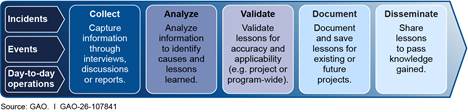
DOT’s current efforts do not fully align with these practices for lessons learned. For example, DOT has not analyzed information it collected from the SMART projects to identify lessons learned. DOT officials told GAO they have not developed a plan to align future activities with these practices because they were focused on awarding grants and not on planning for the analysis of program results. Developing and implementing a lessons-learned plan that incorporates key practices will help ensure that DOT can identify and share the results of the SMART program, particularly as projects are completed and recipients report their results to DOT. Without such a plan, DOT could miss opportunities to communicate lessons that could help improve the safety and reliability of transportation systems more broadly. Also, by better understanding lessons from the SMART program projects, communities can benefit from successes and may facilitate the adoption of advanced technologies.
Why GAO Did This Study
In 2021, the IIJA created the SMART program to fund demonstration projects that use advanced technologies and systems to improve transportation efficiency and safety. The SMART program provides discretionary grants that support projects across eight technology areas, and recipients include state, city, and tribal governments. The IIJA authorized and appropriated $500 million for the program between fiscal years 2022 and 2026. In February 2026, the Consolidated Appropriations Act, 2026 transferred $204.9 million in unobligated balances from the SMART grants program to support appropriations for other purposes.
The IIJA included a provision in statute for GAO to review the SMART program. This report addresses the characteristics of SMART program applicants and projects, perspectives of selected recipients on the program, and how DOT plans to identify lessons learned from the program. GAO reviewed DOT data on the applicants and projects selected for awards from fiscal years 2022 through 2024 and interviewed DOT officials on the SMART grant program. GAO also interviewed 17 selected grant recipients reflecting a range of community sizes and technology areas, on the program and their projects. In addition, GAO compared DOT efforts to identify lessons learned from the program with key practices GAO identified and federal guidance for developing lessons learned.
What GAO Recommends
GAO is making a recommendation for DOT to develop and implement a lessons-learned plan that incorporates key practices for the SMART program.
DOT agreed with our recommendation.
Abbreviations
DOT Department of Transportation
IIJA Infrastructure Investment and Jobs Act
LiDAR Light Detection and Ranging sensor
SMART Strengthening Mobility and Revolutionizing Transportation
This is a work of the U.S. government and is not subject to copyright protection in the United States. The published product may be reproduced and distributed in its entirety without further permission from GAO. However, because this work may contain copyrighted images or other material, permission from the copyright holder may be necessary if you wish to reproduce this material separately.
March 12, 2026
The Honorable Ted Cruz
Chairman
The Honorable Maria Cantwell
Ranking Member
Committee on Commerce, Science, and Transportation
United States Senate
The Honorable Brett Guthrie
Chairman
The Honorable Frank Pallone, Jr.
Ranking Member
Committee on Energy and Commerce
House of Representatives
The Honorable Sam Graves
Chairman
The Honorable Rick Larsen
Ranking Member
Committee on Transportation and Infrastructure
House of Representatives
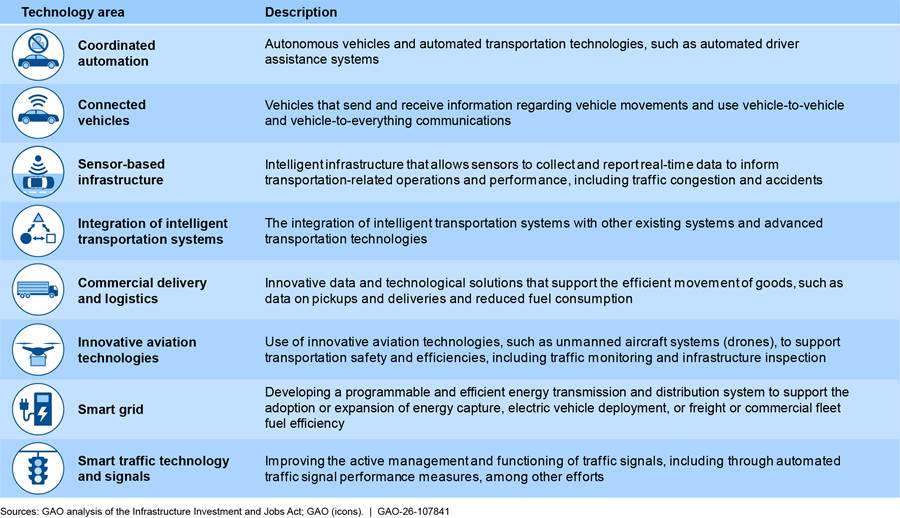
The United States is investing in advanced technologies, such as connected infrastructure and advanced aviation systems that have the potential to modernize and improve the efficiency, performance, and safety of the nation’s transportation system. In November 2021, the Infrastructure Investment and Jobs Act (IIJA) created a new program, the Strengthening Mobility and Revolutionizing Transportation (SMART) grants program.[1] According to the Department of Transportation (DOT), the SMART program aims to drive innovation, create jobs, and support the deployment of transformative transportation technologies. The SMART program provides discretionary grants to tribal, state, and city governments, among other entities, for planning and demonstration projects using advanced technologies and systems to improve transportation efficiency and safety. The IIJA states that these grants can support projects across eight technology areas, including connected and autonomous vehicles and drones.
DOT designed the SMART program as a two-stage grants program. Stage 1 grants are awarded for planning and prototyping projects, and stage 2 grants are awarded for scaled-up demonstrations of the original project. According to DOT, these projects are intended to provide results that can be replicated and adopted by other interested communities.
The IIJA authorized and appropriated $500 million for SMART grant awards for fiscal years 2022 through 2026.[2] DOT made stage 1 award selections for fiscal years 2022, 2023, and 2024; it announced the fiscal year 2024 stage 2 awards in December 2024.[3] As of September 2025, DOT announced the selection of 135 projects, totaling $289 million in SMART funding between fiscal years 2022 and 2024.[4] The first SMART projects were completed by mid-2025, and as more projects are completed, recipients are sending final project reports and results to DOT.
The IIJA included a provision for GAO to review DOT’s SMART grants program and submit a report to Congress. This report examines (1) the characteristics of SMART program applicants and awardees, (2) selected recipients’ perspectives on the program, and (3) how DOT plans to identify lessons learned from the SMART grants program.
To address the first objective, we analyzed DOT data on all SMART program applications and DOT selections in fiscal years 2022 through 2024. We used the data to identify characteristics of the applicants and of DOT selections, as well as the characteristics of SMART projects, such as community size, technology area, and funding amounts awarded. We included all stage 1 and stage 2 applications and DOT award selections announced in fiscal years 2022 through 2024 in our analysis. Our analysis identified minor inconsistencies and errors in the data provided by DOT, such as incorrect and missing data fields and test records. We reviewed DOT documents on award selections and announcements and followed up with DOT to discuss and correct the data. After discussion with DOT, we made appropriate changes, as needed, to address discrepancies and inconsistencies in the data DOT provided. On the basis of this discussion, we determined that the data are reliable for the purposes of this report.
To address the second objective, we interviewed DOT officials and 17 SMART recipients. To obtain perspectives on the recipients’ experience with the SMART program and their project outcomes, we conducted semistructured interviews with 17 of the 59 stage 1 SMART recipients that were selected in fiscal year 2022. Of these 17, we interviewed all eight recipients that received both stage 1 grants in fiscal year 2022 and were selected by DOT to receive stage 2 grants in fiscal year 2024. We also interviewed nine stage 1 recipients that did not apply for, or were not selected for, stage 2 grants in fiscal year 2024. These recipients reflect a range of community sizes, geographies, and technology areas. The perspectives of these interviewees are not generalizable to all recipients, but these responses provided a variety of views and informed perspectives on the SMART program.
To address the third objective, we reviewed DOT documentation, such as notices of funding opportunity and relevant program guidance, that described how the SMART program would collect and disseminate lessons learned from its projects. We also interviewed DOT officials to understand how they plan to identify and share lessons learned. We also assessed the extent to which DOT incorporates selected key practices of a lessons-learned process into its efforts, such as analyzing and disseminating the information it receives from SMART grant recipients.[5]
We conducted this performance audit from October 2024 to March 2026 in accordance with generally accepted government auditing standards. Those standards require that we plan and perform the audit to obtain sufficient, appropriate evidence to provide a reasonable basis for our findings and conclusions based on our audit objectives. We believe that the evidence obtained provides a reasonable basis for our findings and conclusions based on our audit objectives.
Background
SMART Eligible Entities and Projects
DOT’s SMART program, which is administered by the Office of the Assistant Secretary for Research and Technology, provides grants to eligible public sector agencies (state, regional, and local governments, and tribal governments, among others) to conduct demonstration projects. The IIJA required DOT to award up to 40 percent of the SMART grants funds to projects that primarily benefit large communities, up to 30 percent for midsized communities, and up to 30 percent for rural communities or regional partnerships.[6]
The SMART program funds projects that demonstrate advanced technologies that are not widely adopted in transportation systems. Figure 1 shows the eligible technology areas for SMART projects as established by the IIJA. Applicants must identify at least one of the technology areas for their project, but a project may address more than one eligible technology area.
DOT SMART Program Reporting
The IIJA requires that DOT submit a report to Congress that, among other things, describes the projects funded by the SMART program, assesses the realized improvements or benefits of the grants, and describes the lessons learned and recommendations for future deployment strategies of the technologies. In addition, the IIJA states that DOT shall develop and regularly update best practices based on, among other information, the data, lessons learned, and feedback from the SMART recipients.
SMART Program Stages
DOT designed the SMART program as a two-stage grants program. Stage 1 grants provide funding for projects that plan, refine, and prototype an innovative transportation concept, and report out on the results. The stage 1 grants provide recipients between $250,000 and $2 million for projects. The expected period of performance for stage 1 projects is up to 18 months. Recipients may request approval for an extension to the 18-month performance period from DOT if additional time is required to complete the project.
According to DOT, at the conclusion of stage 1, recipients should be able to create a plan to implement an expanded project. Recipients could then apply for stage 2 of the SMART program or decide not to pursue the project.
Stage 2 grants provide funds for scaled-up demonstrations of the stage 1 projects. In stage 2, projects are integrated with the existing transportation system and the concept is refined such that it could be replicated by others. The stage 2 grants could receive up to $15 million, and the period of performance for stage 2 projects is up to 3 years. Only stage 1 recipients, or their designee, could apply for a stage 2 grant.
SMART Grants Award Process
DOT outlined its process for soliciting, evaluating, and selecting projects for the SMART grants program in its annual notices of funding opportunities for the program and its internal evaluation guidance.
· Solicitation: DOT published annual notices of funding opportunity for its stage 1 and stage 2 grants for fiscal years 2022 through 2024. Eligible entities submit applications to DOT that include applicant information, project description, budget summary, and other project information. Applicants self-select their community size, entity type, and the primary technology area of their project.
· Evaluation: DOT initially screens applications to confirm the eligibility of applicants. Evaluators review and rate applications using criterion in the notice of funding opportunity.[7] The evaluators reach consensus on a rating of “highly recommended,” “recommended,” “not recommended,” or “ineligible” for each application. Then they provide the consensus ratings to the Senior Review Team—senior officials selected by the Secretary of Transportation.
· Selection: The Senior Review Team, which is composed of officials from DOT’s operating administrations (e.g. Federal Highway Administration, Federal Aviation Administration, etc.) and the Office of the Secretary, decides which applications to advance to the Secretary of Transportation for final review and approval. All “highly recommended” applications are advanced for final review, and the Senior Review Team may include “recommended” applications to ensure that a sufficient number of applications are on the list to meet the statutory requirements for applicant community sizes. The Secretary of Transportation makes the final award decisions and announces the selected projects.
DOT published the first SMART notice of funding opportunity in September 2022 and announced the selection of the first stage 1 projects in March 2023 (see fig. 2). DOT announced stage 1 awards in fiscal years 2023 and 2024.[8] No additional SMART grant awards will be announced or selected as, on February 3, 2026, the Consolidated Appropriations Act, 2026 transferred $204.9 million in unobligated balances that were previously appropriated for the SMART program funds to support appropriations for other purposes. According to DOT, these funds are no longer available for the SMART program.
Figure 2: Timeline of Select Strengthening Mobility and Revolutionizing Transportation (SMART) Program Milestones
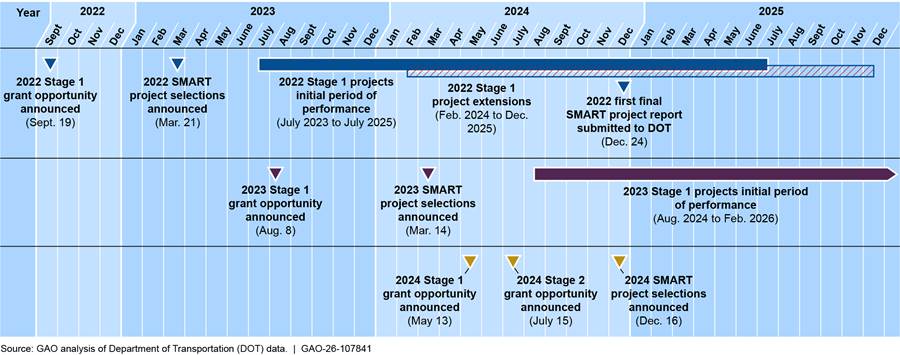
Note: The initial period of performance varies among projects, and not all recipients used the allowed 18 months for their stage 1 grants.
SMART Grant Reporting and Outreach
DOT collects information on the SMART projects through required plans and reports submitted by recipients, and through outreach activities and other communications. These plans and reports include the following:
· An evaluation plan and a data management plan. DOT requires recipients to submit an evaluation plan and data management plan within 90 days of the start of a project. The evaluation plan should include project goals and measurable performance metrics based on those goals that DOT can use to assess project success. Additionally, DOT requires recipients to submit a data management plan that outlines the relevant data collected during their project. DOT requires this plan to include all data needed to reproduce significant results and measure project outcomes and data that could add value to future deployments;
· Project reports. DOT requires recipients to submit quarterly reports over their 18-month period of performance, and the IIJA requires recipients to submit an implementation report no later than 2 years after receiving a grant, and annually thereafter until the grant is expended.[9] The quarterly reports are used to provide updates on project scope, schedule, and budget. In addition, within 90 days after the period of performance, DOT requires recipients to submit an implementation report that describes the project and assesses the costs and benefits of the project. According to DOT officials, recipients use information from their evaluation plan and quarterly reports to create the final report; and
· Outreach activities. DOT hosted multiday, in-person conferences for the SMART program recipients in 2023 and 2024. According to DOT, officials recorded key takeaways and feedback from recipients about their projects. In addition, DOT conducted site visits to SMART projects where they answered technical questions and discussed project challenges, according to DOT officials.
DOT Selected Applicants for SMART Awards Across Many Community Sizes and Technology Areas
In the first three years of the program, DOT received applications from a wide variety of community sizes, entity types, and technology areas. Likewise, DOT’s selections were spread across applicants and technologies. DOT received more applications for the SMART program than there was available funding. Specifically, from fiscal years 2022 through 2024, entities submitted 1,073 applications for the SMART program, and DOT selected 135 projects to receive grants[10] Of the 59 entities that received stage 1 grants in fiscal year 2022, 28 submitted applications for the stage 2 grants in fiscal year 2024. DOT selected 8 projects for the stage 2 grants. In total, DOT has announced awards of over $289 million to SMART projects, which is 58 percent of the $500 million authorized and appropriated in the IIJA for fiscal year 2022 through fiscal year 2026. (See table 1.)
Table 1: Strengthening Mobility and Revolutionizing Transportation Grant Applications and Selected Awards by Stage and Fiscal Year, from 2022 Through 2024, as of September 2025
|
SMART grant stage |
Number of |
Number of |
Total amount of selected awards (in millions) |
|
FY22 stage 1 |
389 |
59 |
$94.8 |
|
FY23 stage 1 |
348 |
34 |
$54.5 |
|
FY24 stage 1 |
308a |
34 |
$54.4 |
|
FY24 stage 2 |
28 |
8 |
$85.5 |
|
Total |
1,073 |
135 |
$ 289.2 |
Legend: SMART=Strengthening Mobility and Revolutionizing Transportation
FY=fiscal year
Source: GAO analysis of DOT data. ǀ GAO‑26‑107841
aDOT told us that they received an additional 23 fiscal year 2024 stage 1 applications that were ineligible for the SMART program. These applications are not reflected in this table
Community sizes. DOT received applications for projects from all community sizes for fiscal years 2022 through 2024. The IIJA requires DOT to award not more than 40 percent of SMART funding to projects that benefit large communities and not more than 30 percent each to midsized communities and rural or regional partnerships.[11] DOT’s award selections generally reflected this requirement for all fiscal years (see fig. 3).
Figure 3: Percentage of Strengthening Mobility and Revolutionizing Transportation Grant Funding of Selected Projects, by Community Size, for Fiscal Years 2022 through 2024, as of September 2025
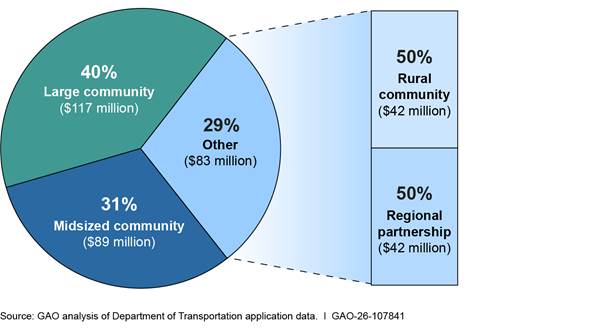
There was some variation in DOT’s selection of projects among applicants across community sizes. Our analysis shows that midsized communities submitted the most applications for stage 1 grants. In addition, we found that rural communities submitted more than twice as many applications as regional partnerships and received about the same total award selections and grant funding. DOT officials told us they considered the regional partnership and rural community applications together per the statute.[12] DOT selections also generally reflect the community size requirements when selecting stage 2 grants. See table 2 for additional information on DOT selected awards compared with applications.
Table 2: Stage 1 and Stage 2 Applications Submitted and Selected Projects, by Community Size, for Fiscal Years 2022 through 2024, as of September 2025
|
Community size |
Large |
Midsized |
Regional |
Rural |
|
Stage 1 awards |
||||
|
Applications |
313 |
459 |
81 |
180 |
|
Selected projects |
44 |
41 |
23 |
19 |
|
Funding amount |
$77,085,569 |
$62,229,244 |
$35,433,280 |
$28,887,723 |
|
Stage 2 awards |
||||
|
Applications |
14 |
8 |
3 |
3 |
|
Selected projects |
4 |
2 |
1 |
1 |
|
Funding amount |
$39,849,730 |
$26,568,169 |
$6,599,400 |
$12,435,301 |
|
Total applications |
327 |
467 |
84 |
183 |
|
Total selected projects |
48 |
43 |
24 |
20 |
|
Total Funding |
$ 116,935,299 |
$ 88,797,413 |
$ 42,032,680 |
$ 41,323,024 |
Source: GAO analysis of Department of Transportation application data. ǀ GAO‑26‑107841
Note: Twelve entities that applied for SMART grants in fiscal years 2022 and 2023 were identified as “unclear” in community size. None of these entities was selected for a SMART grant. These 12 applications are not included in the table above.
Most DOT selections went to “highly recommended” projects, and DOT also selected grants for some projects that were “recommended” by evaluators. Of the 1,073 applications submitted for the SMART program, DOT rated 235 projects as “highly recommended.” DOT selected 103 (less than half) of these “highly recommended” applications to receive SMART grants (see table 3). According to DOT officials, “recommended” applications may be considered to ensure that all statutory requirements can be met, such as allocating funds across different community sizes and technology areas.
Table 3: Strengthening Mobility and Revolutionizing Transportation (SMART) Application Ratings and Selected Projects for Fiscal Years 2022 Through 2024
|
Selected SMART projects |
Not selected as a SMART project |
Total applications |
|
|
Highly recommended applications |
103 |
132 |
235 |
|
Recommended applications |
32 |
376 |
408 |
|
Other applicationsa |
0 |
430 |
430 |
|
Total |
135 |
938 |
1,073 |
Source: GAO Analysis based on Department of Transportation data. ǀ GAO‑26‑107841
aOther applications include those that were not recommended, were rejected, or were ineligible for the SMART grants program.
Types of entities. Over half of all SMART program applicants self-designated as “political subdivision of a state” and received the largest share of awards (see table 4).[13] This category of entities includes cities, towns, county governments, special districts, airports, utilities, and similar units of local government, and covers different community sizes. For example, New York City, a large community, and Talladega, Alabama, a small rural community, as well as fire and police departments and regional port authorities designated themselves as a political subdivision of a state.[14]
Table 4: Strengthening Mobility and Revolutionizing Transportation Applicants by Entity Type and Total Funding of Selected Projects for Fiscal Years 2022 Through 2024, as of September 2025
|
Entity type defined by Statute |
Total applicants |
Total selected projects |
Total selected project funding (in millions) |
|
Political subdivision of a state |
621 |
51 |
$ 108.8 |
|
State |
209 |
36 |
$ 72.8 |
|
Public transit agency or authority |
164 |
31 |
$ 82.7 |
|
Metropolitan planning organization |
64 |
11 |
$ 15.9 |
|
Tribal government |
10 |
5 |
$ 7.5 |
|
Public toll authority |
3 |
1 |
$ 1.5 |
|
Group applicants |
2 |
0 |
$ - |
|
Grand total |
1,073 |
135 |
$ 289.2 |
Source: GAO analysis of Department of Transportation data. ǀ GAO‑26‑107841
Note: Numbers may not total due to rounding.
Technology areas. DOT selected SMART projects in all eight technology areas. Applicants self-designated their technology categories and many designated their projects as incorporating three or more technology categories. Of the awards, sensor-based infrastructure projects received the most awards since fiscal year 2022. These projects included safety technologies for bridge, rail, highway, city congestion and traffic, and weather monitoring systems, among others. (See table 5).
Table 5: Strengthening Mobility and Revolutionizing Transportation Applications and Selected Projects by Technology Area for Fiscal Years 2022 through 2024, as of September 2025
|
Technology |
Total applications |
Total selected projects |
Total selected project funding (in millions) |
|
Sensor-based infrastructure |
286 |
35 |
$ 68.5 |
|
Smart traffic technology and signals |
268 |
21 |
$ 33.5 |
|
Integration of intelligent transportation systems |
199 |
32 |
$ 65.1 |
|
Innovative aviation technologies |
109 |
17 |
$ 50.6 |
|
Connected vehicles |
64 |
14 |
$ 22.8 |
|
Coordinated automation |
63 |
2 |
$ 3.9 |
|
Smart grid |
49 |
6 |
$ 16.6 |
|
Commercial delivery and logistics |
35 |
8 |
$ 28.1 |
|
Grand Total |
1,073 |
135 |
$ 289.1 |
Source: GAO analysis of Department of Transportation data. ǀ GAO‑26‑107841
Note: The technology areas are based on the primary technology identified by the SMART program applicants.
Selected Recipients Reported Both Delays and Positive Experiences with the Program
DOT Expects Most SMART Projects to Be Completed in 2026, After Some Delays
As of September 2025, most SMART grants were ongoing, but DOT officials expect many projects will be completed by the end of 2026. According to DOT, as of September 2025, 31 of the 59 stage 1 SMART projects selected in fiscal year 2022 were completed (i.e. have reached the end of their period of performance). Of these, 15 recipients submitted a final implementation report to DOT on completion of their projects. The remaining projects selected in fiscal year 2022, and all projects selected in fiscal year 2023, were ongoing. DOT officials told us they expect these remaining projects will be finished by the end of 2026. In addition, most of the stage 1 and stage 2 projects selected in fiscal year 2024 are ongoing.
According to DOT, most stage 1 recipients requested extensions to the 18-month period of performance to complete their projects. DOT officials told us that 47 of the 59 recipients of fiscal year 2022 awards requested extensions.[15] DOT officials stated that an extension may range from 6 months to 12 months and is discussed within the final 90 days of the original performance period. DOT officials told us they also allow the recipient to modify the project’s scope to meet the new timeline for the extension.
Recipients told us that they had difficulty completing projects within the 18-month period of performance for the stage 1 awards. Twelve of the 17 selected recipients we interviewed told us that the period of performance was too short to complete their stage 1 project and reported a variety of delays that affected the project’s timeframes. For example, seven recipients we interviewed cited challenges in the contracting and procurement processes that caused delays in implementing their projects. Three of these recipients reported that delays resulted from challenges in obtaining local government approval for contracts for consultants and other partners. One recipient told us that meeting city and county requirements and receiving approval from the local county board delayed the implementation of their project. In addition, some recipients reported delays because of challenges in procuring the necessary technology and equipment through vendors or technical issues related to the technology used for the project.
According to DOT officials, the 18-month schedule was aggressive, but they explained that stage 1 grants were intended to support a shorter planning and prototyping of innovative, advanced technologies. These prototype projects are intended to demonstrate the viability for the technology to be used in a scaled, larger project in stage 2. In addition, DOT officials told us that some recipients were able to meet the timeframe to submit stage 2 applications for the fiscal year 2024 grants. For fiscal year 2024 stage 2 grants, 28 stage 1 recipients applied for stage 2, which exceeded DOT expectations, according to DOT officials.
Selected Recipients Reported the Program Had a Positive Effect on Their Ability to Demonstrate and Test Transportation Technologies
All 17 recipients we interviewed identified positive effects of the SMART program on the projects undertaken with the grants, as well as the benefits of the two-stage grant process. The recipients we interviewed cited various benefits of the DOT SMART grants program, including allowing them to test and demonstrate innovative technology solutions for transportation systems.
· Test innovative technologies: Nine recipients reported that the SMART program allows them to test and demonstrate innovative or advanced technology solutions for their communities. One recipient stated that the SMART grant will allow them to demonstrate that drones can be used to solve the problem of delivering medications to rural areas, which is currently done with difficult and expensive delivery options. Another recipient told us that the SMART program gave communities the opportunity to test cutting-edge sensors and connected vehicle technology that provides warnings to drivers and pedestrians and automatically activates crossing signals. In addition, another recipient told us that the SMART program provided them with the best opportunity to test advanced technologies to determine the best options and to demonstrate the technology to support future expansion in their community.
Recipients also noted that the program provides them with the flexibility to adjust stage 1 projects before starting a stage 2 grant. One recipient noted that the SMART program allowed them to adjust the technology solution or scope of the project for stage 2 if their original approach did not work. For example, one recipient reported that one of the sensor technologies tested was replaced at some locations due to supplier instability. The recipient reported that these changes to a more reliable sensor would allow for a cost-effective, maintainable, and scalable deployment for a broader rollout across the region.
· Expedite project implementation: Seven recipients we interviewed told us their SMART grant helped them speed up the research or project timeframe compared with the timeline if they relied only on other sources of funds.
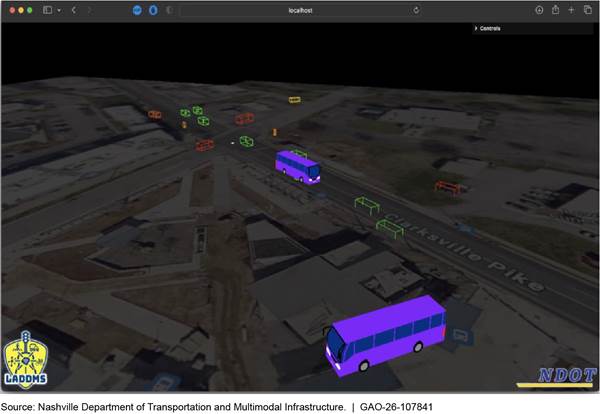
For example, the Nashville Department of Transportation and Multimodal Infrastructure used a SMART grant to install Light Detection and Ranging (LiDAR) sensors at selected intersections in the city to enhance driver and pedestrian safety. These sensors detect vehicles, pedestrians, and bicyclists at intersections and readily collect data on traffic patterns, collisions, and near-misses that, according to officials, have historically been difficult to gather. According to officials, they used the data collected to implement safety measures including changing the timing of traffic signals and installing pedestrian warning signals at specific intersections. These officials told us that these efforts have resulted in fewer near misses with pedestrians and reduced speeding at the selected intersections. Figure 4 shows a visual display of the traffic information collected by its LiDAR sensors that monitor the number and speed of vehicles at intersections, as well as buses and pedestrians. Nashville officials told us that the grant enabled them to test these technologies sooner and more broadly than they could have using only local funds.
Figure 4: Example of Intelligent Sensor Technology System Project Funded with Strengthening Mobility and Revolutionizing Transportation Grant
Furthermore, six recipients reported that SMART grants provided funding for projects that otherwise may not have started because of competing transportation priorities for state or local funds. For example, one recipient we interviewed used the SMART grant to test smart traffic signals to address safety issues at intersections and prioritize movement of transit and emergency vehicles to better manage traffic and enhance safety. According to the recipient, the SMART grant was well-suited to helping them advance this technological solution because it sped up research and implementation. Without the grant, the recipient expected the city would implement the technology more slowly, as this project would compete with other transportation priorities for funds.
· Deploy tested technology: In addition, all 17 recipients we interviewed cited the benefits of the SMART program’s two-stage award process. For example, some recipients noted that the program allowed them to demonstrate the proof-of-concept of the technologies in stage 1 before investing the funds to deploy the technology for a larger project in stage 2.
Ten recipients we interviewed told us the stage 1 grant allowed them to demonstrate the viability of the technology, which some recipients said would support the request for additional funding in stage 2. For example, the Alaska Department of Transportation and Public Facilities used a SMART grant to deploy drones in various communities throughout the state to conduct inspections of infrastructure, such as bridges, ice roads, and multimodal infrastructure and support facilities. Figure 5 shows the drone used to inspect a bridge.
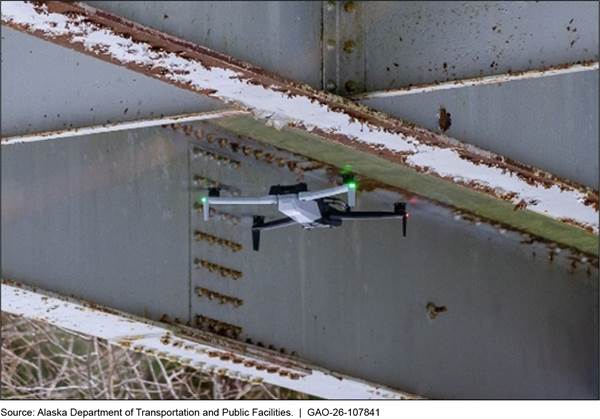
According to the recipient, the SMART project allowed them to reduce the cost and time needed to conduct infrastructure surveys and inspections by using drones instead of dispatching an inspector to rural, remote locations. It also allowed them to track and analyze infrastructure in new ways, and they anticipate that expanding the project will result in reducing maintenance costs by identifying issues earlier and increasing the reliability and safety of state infrastructure. The recipient told us that the success of stage 1 helped them expand the drone project for stage 2 and invest heavily in state-wide deployment of drone technology.
DOT Has Not Developed and Implemented a Plan to Identify Lessons Learned from the SMART Program
As previously mentioned, the SMART program was established to conduct demonstration projects of advanced technologies and systems to improve transportation efficiency and safety. According to DOT, these projects are meant to help transportation practitioners by identifying advanced technologies that can be successfully used across the country. To do this, the IIJA states that DOT should develop a lessons-learned process with program recommendations.[16] In addition, federal regulations require agencies to share lessons learned to improve grant program outcomes and foster the adoption of promising practices.[17]
A lessons-learned process is a systematic means for agencies to learn from specific events and make decisions about when and how to use that knowledge to change behavior.[18] We have previously reported that adopting a lessons-learned process can be particularly important when an agency is implementing a new program, such as the SMART program.[19] We have also reported that collecting lessons learned throughout the course of an event, rather than just at the end, can help to ensure that lessons learned are captured as close as possible to the learning opportunity.[20] In prior work, we identified key practices to building a comprehensive, documented lessons-learned process (see fig. 6).
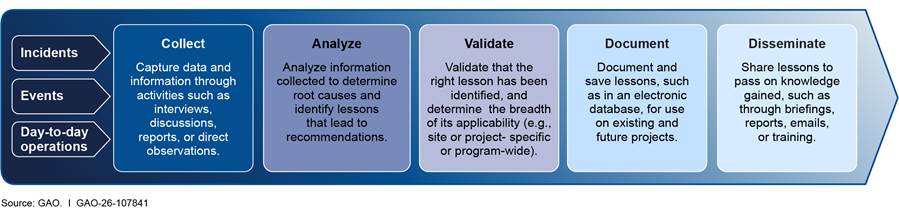
Note: This graphic was initially published in 2020 in GAO, VA Construction: VA Should Enhance the Lessons-Learned Process for Its Real-Property Donation Pilot Program, GAO‑21‑133 (Washington, D.C.: Dec. 10, 2020) and was based on additional prior work. We did not include the final practice– apply key lessons–here because project recipients are responsible for applying lessons and not the Department of Transportation.
While DOT has taken steps related to some of these key practices, such as collecting information, gaps remain. Further, DOT program officials we interviewed pointed to the need to develop lessons learned and articulated several potential future activities to do so. However, DOT’s current activities do not fully align with key practices, and DOT does not have a documented plan to align its future activities with them. Such a plan would include a process for collecting, analyzing, validating, documenting, and disseminating lessons learned from the SMART program. Specifically:
Collecting information. DOT collected information from recipients through required reports, including quarterly and implementation reports. DOT officials told us that this includes collecting a summary report that describes the successes and challenges of each project, results of the performance measures used for the project, whether the recipient found the technology they tested was feasible, and lessons learned identified by recipients.
In addition, DOT also collects information about projects through outreach activities such as visiting project sites and hosting conferences with project recipients. For example, DOT officials told us they hosted SMART Summits where they gather information from attendees and use stakeholder surveys to outline needed improvements to the program.
Analyzing information. DOT officials told us that they have not yet analyzed the information collected from the SMART projects but intend to do so as they receive more final grant implementation reports and project results. DOT officials said it may be challenging to analyze information across projects to identify lessons learned because the location, community size, and technology of each project vary. Further, they said each recipient develops specific goals and performance metrics, making comparisons across projects difficult. They stated that they intend to aggregate project results once they receive more implementation reports for each SMART project which they said should allow them to better understand lessons learned. However, they could not describe how they plan to further develop and implement a plan to identify lessons learned from individual projects, for the SMART grants program overall, or how lessons could be applied to other projects.
Validating lessons. DOT officials stated they intend to validate project-specific lessons learned that are identified by recipients by presenting at summits or conferences that practitioners attend, a process they have used in the past. For example, DOT officials said they discussed early lessons learned at the 2024 Intelligent Transportation Society of America conference where they received useful feedback from participants. DOT officials acknowledged that there may be other methods to validate lessons learned, which could include hosting small group discussions with recipients and subject matter experts, but they have no defined plans to do so.
Documenting lessons. DOT officials told us that each SMART recipient is required to document individual lessons learned on their project and to submit those lessons to DOT officials as part of their final reports. However, DOT officials told us that they have not yet developed and implemented a plan to document the overarching lessons they may identify by analyzing and validating lessons learned across these projects.
Disseminating lessons. DOT officials told us they intend to disseminate lessons learned through discussions at SMART Summits and by making information available on the SMART program website. For example, according to officials, from July 2022 through May 2025, DOT officials participated in 45 events that included recipients. Officials told us they provide information on the SMART program through presentations at these meetings as well as through informal discussions with practitioners. In addition, DOT plans to make information available online, including developing a searchable website grouped by type of technology used that includes the lessons learned from each project. This effort would potentially result in 127 stage 1 and future stage 2 project reports posted for others to search and review. While these efforts would be helpful in sharing lessons learned, DOT may not disseminate valuable and important lessons learned to key stakeholders without completing a plan that incorporates the previously identified key practices.
DOT officials noted that they have not yet developed a plan for identifying lessons learned from the SMART program. Officials acknowledged the need for such a plan but told us they have focused on awarding and supporting recipients rather than planning the analysis of program results. In addition, according to officials, staff turnover in the SMART program has caused staff to spend additional time on administrative tasks. For example, according to DOT officials, all original staff members of the program have left since its inception, and a staff member who worked closely with many of the recipients left the program. Also, officials noted that, as of September 2025, the SMART program team is comprised of four staff members, including two new hires. Developing and implementing a lessons-learned plan would help ensure that lessons are not lost and that the continuity of an established process is maintained, regardless of staffing or program changes.
According to DOT, the purpose of the SMART program is to share results with other communities that can learn from these demonstration projects. While funds are no longer available for future SMART projects, developing and implementing a lessons-learned plan that incorporates key practices will help ensure that DOT can identify and share demonstrated results from the SMART program. Without such a plan, DOT could miss opportunities to identify and share lessons that are likely to help communities benefit from successes and avoid pitfalls in the adoption of advanced technologies meant to improve the safety and reliability of their transportation systems.
Conclusions
The SMART program aims to drive innovation and support the deployment of various advanced technologies to improve transportation safety and efficiency across communities. The results of these projects, including the lessons learned from the implementation of these technologies, could be far reaching. DOT told us that it intends to identify and share lessons learned from the SMART projects. However, while DOT has collected information from recipients on their SMART projects, it has not fully aligned its activities with key practices of a lessons-learned process and has not developed a plan for identifying the lessons learned from the program in the future.
By doing so, DOT could effectively inform efforts to develop and deploy advanced transportation technologies. As a result, DOT may improve the adoption of these innovative and advanced technologies intended to transform the transportation system across the country.
Recommendation for Executive Action
The Secretary of Transportation should direct the Assistant Secretary for Research and Technology to develop and implement a lessons-learned plan that incorporates key practices including analyzing, validating, documenting, and disseminating the lessons learned from the SMART program. (Recommendation 1)
Agency Comments
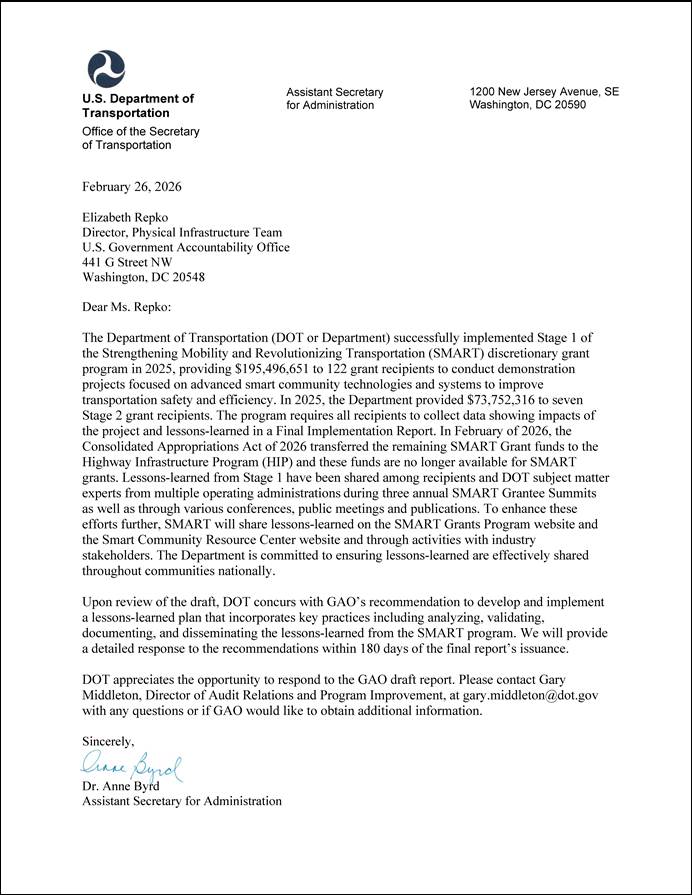
We provided a draft of this report to the Department of Transportation for its review and comment. In its comments, reproduced in appendix I, DOT agreed with our recommendation and provided technical comments, which we incorporated as appropriate.
We are sending copies of this report to the appropriate congressional committees, the Secretary of Transportation, and other interested parties. In addition, the report is available at no charge on the GAO website at http://www.gao.gov. If you or your staff have any questions about this report, please contact me at (202) 512-2834 or RepkoE@gao.gov. Contact points for our Offices of Congressional Relations and Media Relations may be found on the last page of this report. GAO staff who made key contributions to this report are listed in appendix II.
Elizabeth Repko
Director, Physical Infrastructure
GAO Contact
Elizabeth Repko, (202) 512-2834 or RepkoE@gao.gov
Staff Acknowledgements
In addition to the contact named above, John Stambaugh (Assistant Director), John F. Miller (Analyst in Charge), Virginia Chanley, Emily Crofford, Kamala Mullur, Josh Ormond, Paras Sharma, Todd Schartung, Sandra Sokol, and Michelle Weathers made key contributions to this report.
The Government Accountability Office, the audit, evaluation, and investigative arm of Congress, exists to support Congress in meeting its constitutional responsibilities and to help improve the performance and accountability of the federal government for the American people. GAO examines the use of public funds; evaluates federal programs and policies; and provides analyses, recommendations, and other assistance to help Congress make informed oversight, policy, and funding decisions. GAO’s commitment to good government is reflected in its core values of accountability, integrity, and reliability.
Obtaining Copies of GAO Reports and Testimony
The fastest and easiest way to obtain copies of GAO documents at no cost is through our website. Each weekday afternoon, GAO posts on its website newly released reports, testimony, and correspondence. You can also subscribe to GAO’s email updates to receive notification of newly posted products.
Order by Phone
The price of each GAO publication reflects GAO’s actual cost of production and distribution and depends on the number of pages in the publication and whether the publication is printed in color or black and white. Pricing and ordering information is posted on GAO’s website, https://www.gao.gov/ordering.htm.
Place orders by calling (202) 512-6000, toll free (866) 801-7077,
or
TDD (202) 512-2537.
Orders may be paid for using American Express, Discover Card, MasterCard, Visa, check, or money order. Call for additional information.
Connect with GAO
Connect with GAO on X,
LinkedIn, Instagram, and YouTube.
Subscribe to our Email Updates. Listen to our Podcasts.
Visit GAO on the web at https://www.gao.gov.
To Report Fraud, Waste, and Abuse in Federal Programs
Contact FraudNet:
Website: https://www.gao.gov/about/what-gao-does/fraudnet
Automated answering system: (800) 424-5454
Media Relations
Sarah Kaczmarek, Managing Director, Media@gao.gov
Congressional Relations
David A. Powner, Acting Managing Director, CongRel@gao.gov
General Inquiries
[1]Pub. L. No. 117-58, § 25005, 135 Stat. 429, 840 (codified at 23 U.S.C. § 502 note).
[2]The funds appropriated to the SMART program were initially available until expended. However, the Consolidated Appropriations Act, 2026 transferred $204.9 million in unobligated balances of the amounts previously appropriated for the SMART grants program to support appropriations for other purposes. Pub. L. No. 117-75, div. D, tit. I.
[3]In March 2025, DOT began reviewing all discretionary award selections for projects without signed grant agreements, including the SMART grants program, to ensure the project scopes align with administration priorities, executive orders, and related DOT orders and memorandums. These executive orders include Exec. Order No. 14154, 90 Fed. Reg. 8353 (Jan. 20, 2025), and Exec. Order No. 14151, 90 Fed. Reg. 8339 (Jan. 20, 2025), among others. A grant agreement is the formal legal instrument of financial assistance between a federal agency and a recipient. See 2 C.F.R. § 200.1
[4]DOT announced fiscal year 2024 SMART awards on December 17, 2024. The 34 stage 1 and eight stage 2 grants totaling $139 million announced in December were included in the DOT review. As of February 2026, DOT reported the approval of 29 stage 1 grants and 7 stage 2 grants. According to DOT, the remaining 5 stage 1 projects are still under agency review and one stage 2 project is canceled.
[5]We identified six lessons-learned key practices in GAO, Telecommunications: GSA Needs to Share and Prioritize Lessons Learned to Avoid Future Transition Delays, GAO‑14‑63 (Washington, D.C.: Dec. 5, 2013); and in VA Construction: VA Should Enhance the Lessons-Learned Process for Its Real-Property Donation Pilot Program, GAO‑21‑133 (Washington, D.C.: Dec. 10, 2020). We excluded one practice, applying lessons, from our analysis as we determined that it was not applicable to the SMART program because project recipients are responsible for applying lessons and not DOT.
[6]For the purposes of the SMART grants program, the IIJA defines a “large community” as a community with a population of not less than 400,000 individuals, as determined under the most recent annual estimate of the Bureau of the Census. “Midsized community” is defined as any community that is not a large community or a rural community. “Rural community” is defined as a community located in an area that is outside of an urbanized area, as that term is defined in 49 U.S.C. § 5302(24) (“The term ‘urbanized area’ means an area encompassing a population of not less than 50,000 people that has been defined and designated in the most recent decennial census as an ‘urbanized area’ by the Secretary of Commerce.”). “Regional partnerships” consist of two or more entities that collectively are larger than a midsized community. Pub. L. No. 117-58, § 25005, 135 Stat. at 840.
[7]Evaluators are DOT officials selected from modal administrations that are subject matter experts or have some expertise in the technology areas considered for SMART program grants.
[8]On August 7, 2025, the President signed Executive Order 14332, Improving Oversight of Federal Grantmaking, which requires all federal agencies to designate senior political officials who will have the authority and responsibility to review and approve all discretionary grant opportunities and pauses all Notices of Funding Opportunities until this review process is in place, among other requirements for discretionary grants. (90 Fed. Reg. 38,929 (Aug. 7, 2025)).
[9]Pub. L. No. 117-578, § 25005(f)(1), 135 Stat. 429, 844 (2021). DOT also collected draft implementation reports from recipients.
[10]The application data showed that DOT determined 34 applications were ineligible for the SMART program. DOT officials informed us that the fiscal year 2024 stage 1 applications included 23 ineligible applications. However, those 23 applications were not included in the data provided by DOT and are not reflected in the total applications in this report.
[11]The IIJA requires the SMART funding amounts for the community size not to exceed the stated percentages for the total appropriated SMART funding through fiscal year 2026. We did not evaluate the amounts reflected in the finalized grant agreements for all fiscal years.
[12]Regional partnerships consist of two or more entities that are, collectively, larger than a midsized community.
[13]The term “political subdivision of a state” is not defined in the SMART grants statute, but DOT defines it as: “a unit of government created under the authority of State law.”
[14]New York City has over 8 million people and Talladega, AL has a population of not quite 16,000.
[15]According to DOT officials, no fiscal year 2023 recipients requested extensions, as of September 2025, as they have not reached the current period of performance dates.
[16]The IIJA also requires DOT to submit a report to Congress in 2025, which includes information on lessons learned from the SMART program. According to DOT officials, the report is undergoing internal agency review, as of December 2025.
[17]2 C.F.R. § 200.301 (a). This provision is in the Office of Management and Budget’s Uniform Administrative Requirements, Cost Principles, and Audit Requirements for Federal Awards 2 C.F.R. Part 200 (2024). DOT has generally adopted these provisions in regulation. 2 C.F.R. § 1201.1 (2024).
[19]See previously used at GAO‑21‑133; and VA Leasing: VA Should Systematically Identify and Address Challenges in Its Efforts to Lease Space from Academic Affiliates, GAO‑26‑107821 (Washington, D.C.: Nov. 25, 2025).
[20]GAO, Customs and Border Protection: Actions Needed to Enhance Acquisition Management and Knowledge Sharing, GAO‑23‑105472 (Washington, D.C.: April 25, 2023).