
Report to Congressional Committees
United States Government Accountability Office
A report to congressional committees
Contact: Nathan J. Anderson at andersonn@gao.gov
What GAO Found
Selected field offices in Department of Energy's (DOE) Office of Environmental Management (EM) have taken steps to evaluate effectiveness of contractor assurance systems (CAS) in accordance with DOE policy, though neither DOE nor EM have defined effectiveness or specified evaluation criteria. The basis on which the selected field offices made their respective effectiveness determinations was unclear (see table). In addition, all selected field offices reported examples of poor CAS performance and recurring issues that undermined the reliability of the effectiveness determinations.
|
Selected field office |
CAS effectiveness determination |
Was CAS effectiveness defined? |
Were effectiveness criteria included? |
|
Hanford |
Effective |
No |
No |
|
Idaho |
Effective |
No |
No |
|
Los Alamos |
Not determined |
No |
No |
Source: GAO analysis of Office of Environmental Managment (EM) information. | GAO-26-107850
· Hanford: The field office reported that the contractor demonstrated poor work planning and conduct of operations, requiring EM to formally request a corrective action plan in several areas. Also, the contractor’s review of issues between January 2022 and October 2023 found that it improperly closed and insufficiently documented nearly 40 percent of sampled issues at the two highest significance levels. These are issues that should not recur or are typically related to misuse of resources, according to field office officials.
· Idaho: The field office reported that the number and severity of conduct of operations and maintenance-related abnormal events indicated a need for improved rigor and discipline in operations. The contractor noted trends that showed a continuing need for attention to detail and personnel awareness. Additionally, the contractor reported 15 radiological events over 8 months that put personnel at risk of radiological overexposure.
· Los Alamos: The field office identified concerns with CAS effectiveness, including that the contractor did not have effective processes for self-identifying significant issues. Furthermore, a widespread breakdown of the contractor’s training and qualification program in 2023 resulted in a stop work order—an indicator that a CAS is not functioning well, according to a field office official. The stop work order resulted in a 90-day delay for nuclear waste disposal and environmental remediation efforts.
Without defining what constitutes an effective CAS—including establishing specific, measurable evaluation criteria—field offices do not have concrete guidelines for evaluating CASs and their determinations may be less informative or meaningful as a result. Additionally, the lack of a clear definition hinders EM’s ability to hold the contractor accountable, and EM cannot be assured that contractors can effectively and efficiently manage risks.
Why GAO Did This Study
EM relies on contractors to execute its mission to clean up contaminated sites from decades of nuclear-related activities. EM expects certain contractors to design and use a CAS—management systems and processes to oversee their own performance, identify and report potential problems, and take actions to prevent their recurrence. According to EM policy, EM is to rely on outcomes and information from CASs to inform and optimize their respective oversight programs. However, in 2024, an independent entity found that contractors inadequately managed issues, leading to compromised safety and increased likelihood of significant consequences.
Senate Report 118-58, accompanying a bill for the National Defense Authorization Act for Fiscal Year 2024, includes a provision for GAO to examine EM’s oversight of contractors’ assurance systems. This report examines the extent to which EM has evaluated the effectiveness of selected CASs.
GAO reviewed EM and contractor documents, conducted a site visit, and interviewed DOE officials and contractors. GAO selected three contracts and associated CASs, contractors, and field offices to review based on factors including contract value and purpose.
What GAO Recommends
GAO is making four recommendations to EM, including that it define CAS effectiveness and establish specific, measurable evaluation criteria. DOE concurred with the recommendations.
Abbreviations
|
CAS |
Contractor Assurance System |
|
CPCCo |
Central Plateau Cleanup Company |
|
DNFSB |
Defense Nuclear Facilities Safety Board |
|
DOE |
Department of Energy |
|
EM |
Office of Environmental Management |
|
FAR |
Federal Acquisition Regulation |
|
Hanford |
Hanford Site |
|
Idaho |
Idaho National Laboratory |
|
IEC |
Idaho Environmental Coalition, LLC |
|
Los Alamos |
Los Alamos National Laboratory |
|
N3B |
Newport News Nuclear BWXT-Los Alamos, LLC |
|
SOPP |
Standing Operating Policies and Procedures |
This is a work of the U.S. government and is not subject to copyright protection in the United States. The published product may be reproduced and distributed in its entirety without further permission from GAO. However, because this work may contain copyrighted images or other material, permission from the copyright holder may be necessary if you wish to reproduce this material separately.
August 26, 2026
Congressional Committees
The Department of Energy’s (DOE) Office of Environmental Management (EM) is responsible for cleaning up 15 sites across the U.S. that are contaminated from decades of nuclear weapons production and nuclear energy research. As of April 2026, EM estimated that the remaining cleanup work could continue until 2100 and cost $641 to $840 billion. To execute its cleanup mission, EM relies on contractors for a range of activities, including building new facilities that treat radioactive waste and remediating contaminated soil and groundwater. EM spends approximately 95 percent of its annual $8 billion budget on contracting, with a contractor workforce of over 25,000 employees. Notably, DOE’s management and oversight of contractors has been a designated area on our High Risk List since 1990.[1]
In general, DOE expects certain contractors to oversee their own performance, identify and report potential problems, and implement corrective actions to prevent recurrence by designing and implementing contractor assurance systems (CAS).[2] These are management systems and processes that, among other things, are expected to provide reasonable assurance that a contractor’s management controls are effective and efficient, and that work is being performed safely, securely, and in compliance with requirements.[3] Both EM headquarters and field offices rely on outcomes and information from CASs to inform and optimize their respective oversight programs, using this information to prioritize oversight on potentially high consequence activities.
Oversight entities have nevertheless reported weaknesses in DOE’s oversight and CAS effectiveness. In 2022, the Defense Nuclear Facilities Safety Board (DNFSB) reported that DOE leverages CAS information without sufficient and documented justification that it is reliable and effective.[4] For example, DNFSB found that DOE lacked consistent, documented evaluation criteria with acceptable thresholds for evaluating CAS effectiveness. DNFSB noted that because DOE oversight is intended to proactively identify and correct contractor issues to prevent unsafe operations, any ineffectiveness in oversight could affect the safety of operations.
In addition, in 2024, DOE’s Office of Enterprise Assessments reported that contractors inadequately managed 25 percent of issues from a representative sample of about 4,000 issues across nine DOE sites, including three EM sites.[5] In many cases, these contractor weaknesses led to compromised worker safety and increased the likelihood of safety issues with more significant consequences, such as fatal injuries. According to the report, four contractors incorrectly categorized hundreds of instances of noncompliance and deficiencies in meeting nuclear safety requirements.[6] Though the issues should have been identified as issues that required resolution, they were identified by the contractors as optional opportunities for improvement, lessons learned, or suggestions, resulting in no action or untimely action being taken to address them.
Senate Report 118-58, accompanying a bill for the National Defense Authorization Act for Fiscal Year 2024, includes a provision for us to examine EM’s oversight of contractors’ assurance systems. This report examines (1) the extent to which EM has evaluated the effectiveness of selected CASs, (2) the extent to which EM has used information from selected CASs to conduct contractor oversight, and (3) the extent to which EM has used contract mechanisms to hold contractors accountable for CAS performance.
To address these objectives, we
· obtained and analyzed relevant DOE and EM policies, procedures, and guidance;
· reviewed EM and contractor documents, including contracts, contractors’ CAS descriptions, CAS assessments, oversight assessment schedules for calendar years 2024 through 2026, and performance evaluation documents for fiscal years 2022 through 2024;
· visited the Idaho National Laboratory;
· interviewed DOE and EM officials responsible for contractor oversight;
· interviewed relevant EM oversight officials and contractors about a nongeneralizable sample of three contracts that are associated with three contractors, CASs, sites, and field offices: (1) the Idaho Cleanup Project End State Contract with the Idaho Environmental Coalition, LLC (IEC) at the Idaho National Laboratory (Idaho); (2) the Los Alamos Legacy Cleanup Contract with Newport News Nuclear BWXT-Los Alamos, LLC (N3B) at Los Alamos National Laboratory (Los Alamos); and (3) the Central Plateau Cleanup Contract with Central Plateau Cleanup Company (CPCCo) at the Hanford Site (Hanford). We selected these contracts and their associated contractors, CASs, and sites, based on contract value ($25 million or higher) and purpose, among other reasons;[7] and
· compared the documentation and testimonial evidence to relevant DOE and EM requirements.[8]
See appendix I for a more detailed description of our scope and methods.
We conducted this performance audit from October 2024 to August 2026, in accordance with generally accepted government auditing standards. Those standards require that we plan and perform the audit to obtain sufficient, appropriate evidence to provide a reasonable basis for our findings and conclusions based on our audit objectives. We believe that the evidence obtained provides a reasonable basis for our findings and conclusions based on our audit objectives.
Background
CAS Key Elements and Requirements
A CAS is established and implemented by the contractor as a control system that provides information to contractors and DOE for improvement, performance evaluation, and oversight, according to DOE documents. When implemented effectively, a CAS provides evidence to assure the contractor’s management and DOE that work is being performed safely, securely, and in compliance with all requirements. DOE Order 226.1B states that a CAS should consist of six elements (see table 1). Contractors are responsible for, and have discretion over, how they implement their CASs provided the six elements are addressed. In doing so, they must ensure that the CASs enable them to identify and manage risks and that their systems of control are effective and efficient. In practice, these six elements are intended to result in a comprehensive site performance management system that is comprised of all operating and business functions.
|
1. A method for validating the effectiveness of assurance system processes. |
|
2. Rigorous, risk-informed, and credible self-assessment and feedback and improvement activities. Assessment programs must be risk-informed, formally described and documented, and appropriately cover potentially high consequence activities. |
|
3. A structured issues management system that is documented, captures program and performance deficiencies, and includes a process for categorizing the significance of findings based on risk and priority. |
|
4. Timely and appropriate communication to the contracting officer. |
|
5. Continuous feedback and improvement, including in work planning and hazard identification activities and lessons learned programs. |
|
6. Metrics and targets to assess the effectiveness of performance, including benchmarking key functional areas with other U.S. Department of Energy contractors, industry, and research institutions. |
Source: Contractor Requirements Document of U.S. Department of Energy Order 226.1B, Change 1. | GAO‑26‑107850
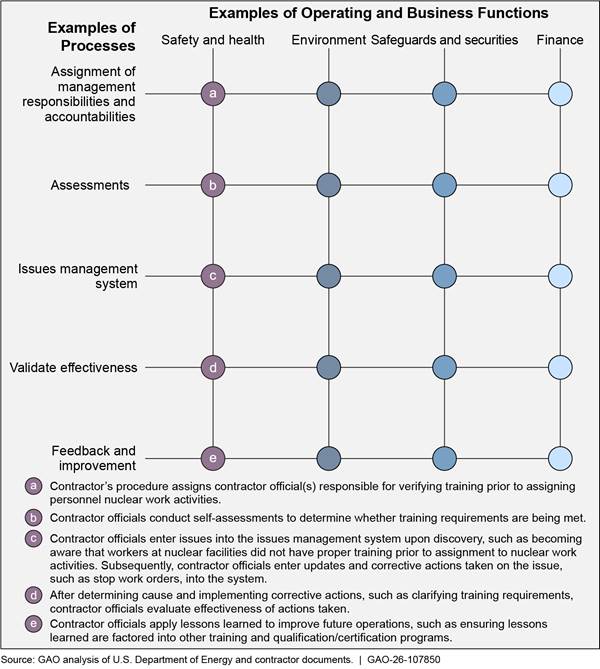
Functionally, a contractor’s CAS is a framework that encompasses all processes and activities designed to identify deficiencies and opportunities for improvement, report deficiencies to responsible managers, complete corrective actions, and share lessons learned across all aspects of operation. As such, CASs are considered cross-cutting assurance systems that emphasize feedback and improvement systems, including assessment, event reporting, worker feedback, issues management, lessons learned, and performance measures (see fig. 1).
CAS is one of three key management systems that represent a suite of oversight requirements, according to EM headquarters officials. Officials explained that these systems are interrelated, and the concepts are linked. For example, EM field offices and contractors are required to report the results of their Integrated Safety Management System and CAS effectiveness evaluations together in the Biennial Assurance System and Integrated Safety Management System Effectiveness Declaration.[9] In addition, an expectation established in EM’s quality assurance program documentation is that field offices will evaluate all contractor and EM programs in accordance with DOE Order 226.1B.[10]
EM’s Oversight Role
DOE Order 226.1B requires EM to evaluate contractor performance based on the results of: (1) operational awareness activities; (2) assessment of facilities, operations, and programs; and (3) assessments of the CAS.[11] The order also calls for EM to tailor its oversight program based on the effectiveness of CASs—that is, to appropriately use CAS information to adjust the rigor and frequency of oversight in a particular area. Together, the policy and order call for the CAS to be transparent to enable EM to determine the necessary level of federal oversight.
DOE regulations and directives require EM to maintain an adequate baseline oversight program that includes sufficient EM-led assessments of contractor management systems, such as the CAS. The results of CAS activities are an important source of information for EM’s oversight activities. However, regardless of the strength of a CAS, DOE directives require that EM perform various oversight functions to validate the effectiveness of safety controls at nuclear facilities.[12]
EM’s oversight of contractors consists of headquarters and field office oversight programs and processes (see fig. 2).[13] EM’s Office of Safety, Security, and Quality Assurance, within the Office of Field Operations, is the primary headquarters entity responsible for ensuring implementation of DOE’s CAS requirements within EM, according to an EM document and officials.[14]
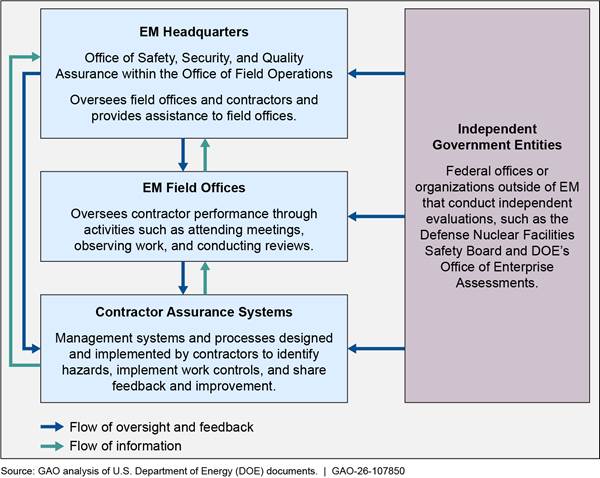
Headquarters program office oversight processes focus primarily on oversight of their subordinate field offices. They may also conduct oversight of contractors and provide support to field offices’ oversight activities. DOE guidance states that headquarters program office oversight should include mechanisms, such as:
· Planning baseline oversight. Establish baseline oversight activities and schedules.
· Collecting and analyzing program level information. Analyzing information such as field office oversight results, contractual expectations, operating experience information, and external organization inputs to maintain awareness of condition and trends across the facilities and help determine the effectiveness of field office oversight processes.
· Conducting and participating in oversight activities. Assess or participate in assessments led by field offices or contractors to independently determine the adequacy of the scope and implementation of field office oversight activities and CASs, among other things.
· Providing feedback to improve field offices’ oversight. Establish effective communication with field offices and clearly identify sources of information used to monitor and analyze performance, ensure that the information developed is of appropriate quality and usefulness for performing analyses, and for decision-making.
Field offices have primary responsibility for establishing and implementing line management oversight of contractor performance because they have the most experience with activities and hazards at their sites. Field offices, in conjunction with headquarters program offices, develop integrated oversight plans that identify planned assessments and other significant oversight activities by various organizations to enable coordination of assessments and oversight activities. DOE guidance states that in creating this schedule, field offices should ensure that line management oversight coordinates with CAS activities to promote efficient use of resources.
Contract Mechanisms
The contract is one of EM’s important enabling tools to manage and oversee contractors executing its mission, as it defines requirements and performance expectations between the government and EM contractors, according to EM’s strategic vision.[15] DOE’s contracting activities are subject to the Federal Acquisition Regulation (FAR), the Department of Energy Acquisition Regulation, and internal DOE directives, among other requirements. Regulations and DOE orders may require DOE to incorporate certain requirements in contracts it awards.[16] For example, under the Contractor Requirements Document in Order 226.1B, contractors must submit an initial CAS description to the contracting officer for EM review and approval, typically within the first 60 to 180 days after the contract award date. Once approved, the contractor must notify the contracting officer of significant CAS changes before making them.
EM’s contracts include various fee structures for compensating and incentivizing contractors. The three contracts we examined were performance-based contracts that included both cost-reimbursement for work and opportunities for the contractor to earn additional fees (e.g., award fees and incentive fees).[17] These fees are used to motivate the contractor toward exceptional performance. For example, some contracts have a fee consisting of a base amount and an award amount that the contractor may earn during the performance period. Other contracts provide an initially negotiated fee to be adjusted later by a formula based on the relationship of actual costs to target costs. According to an EM memorandum, incentive fees on a CAS should focus on outcomes that confirm the CAS is adequately controlling the work, managing risks, collecting and implementing feedback, and improving performance.[18] These incentive fees should clearly define the outcome desired. Under cost-reimbursement contract types, the government generally assumes the risk of a cost overrun.
Through its performance evaluation process, EM evaluates and reports on contractor performance to determine the amount of fee earned by the contract based on objective and subjective criteria, often included in a Performance Evaluation Measurement Plan. Objective evaluation criteria typically contain objective measures applicable to cost, technical performance, or schedule. Subjective evaluation criteria are used when objective criteria are not feasible, such as in the areas of quality assurance, program management, or safety. Outcomes of the performance evaluation process for each contractor are reported and stored in the Contractor Performance Assessment Reporting System; an online web application used by all federal agencies to report and collect past contractor performance evaluations.[19]
Selected EM Field Offices Determined Contractor Assurance Systems to be Effective Despite Shortcomings
DOE’s Order 226.1B states that DOE must evaluate CAS for effectiveness of performance, along with other contractor and DOE programs and management systems.[20] In accordance with the order, selected EM field offices and contractors have taken steps to evaluate CAS effectiveness. They reported the status of those efforts in Biennial Assurance System and Integrated Safety Management System Effectiveness Declarations as requested by EM headquarters.[21] In their calendar year 2021 and 2022 CAS effectiveness declarations (the most recent available), two of the three selected field offices—Idaho and Hanford—and associated contractors reported that their CASs were generally effective.[22] The third selected site—Los Alamos—did not determine whether the contractor’s CAS was effective. Instead, it acknowledged the contractor’s implementation of a CAS and identified several concerns with its effectiveness and areas for improvement.
In our review of the selected CASs, we were unable to determine how the field offices and contractors reached their respective effectiveness conclusions. Specifically, (1) the declaration narratives did not specify the definition of effectiveness or the criteria on which effectiveness was evaluated, (2) broad conclusionary statements were not supported with objective evidence, and (3) examples of challenges and poor performance were reported in the effectiveness declarations and other reports that undermine the reliability of the effectiveness determination.
|
Contractor and DOE Personnel Identified a Need for Clearer Expectations and Evaluation Criteria for CASs The Energy Facility Contractors Group (EFCOG)—a contractor-led organization of more than 140 companies that support DOE operations—conducted a survey in March 2026 of contractor and DOE personnel regarding the state of CAS across the DOE complex. The survey identified a shared need, from both contractor and DOE respondents, for clearer expectations and evaluation criteria for CAS from DOE. For example, 39 percent of DOE respondents identified the need for greater clarity of federal oversight expectations, such as evaluation criteria on what constitutes a well-performing CAS. In addition, the survey identified a difference in the confidence contractor and DOE respondents have in CAS performance. For example, the majority of contractor respondents (62 percent) perceived their CASs to be “effective” while the majority of DOE respondents (67 percent) generally perceived CASs as “somewhat effective.” The survey received a response rate of 25 percent (37 responses) from contractor personnel, which were mostly from EFCOG member companies. The survey received a 41 percent response rate (24 responses) from DOE personnel, which were contacts of EFCOG member companies and primarily represented field offices. Source: EFCOG survey documentation and GAO analysis. |
In addition to the CAS-specific information reported in the effectiveness declarations, EM field offices and contractors from the three selected sites documented other systemic or sustained performance issues through routine oversight activities. These weaknesses jeopardized safety and mission-related progress, which EM officials said can be proxy indicators for CAS performance, for example:
Idaho. In its effectiveness declaration, the Idaho field office described how it oversees and evaluates CAS implementation and reported that the existing oversight processes and products effectively implement CAS requirements.[23] It stated that the CAS provided evidence to assure that work is being performed safely, securely, and in compliance with all requirements; risks are being identified and managed; and that the systems of control are effective and efficient—without including objective evidence to support this broad statement. Idaho field office officials told us they document CAS performance in quarterly evaluation reports.
The Idaho field office’s effectiveness declaration that we reviewed also included examples of poor performance that undermine the reliability of the effectiveness determination. Specifically, it stated that in one quarterly evaluation report, “the number and severity of conduct of operations and maintenance-related abnormal events, including a serious hazardous energy control violation… indicated a need for improved rigor and discipline in operations and hazardous energy controls.”
More recently, IEC documented a recurring issue of 15 radiological events over 8 months (from June 2024 to February 2025) that put personnel at risk of radiological overexposure and could have led to the spread of radiological contamination. Most events occurred during routine work and included not wearing dosimeters or adhering to radiological boundaries. The radiological events rose to the level of reporting the noncompliance. According to an Idaho official, this example illustrates how the CAS can expose a problematic trend in radiological events. On one hand, the CAS could be viewed as effective in this case for helping to identify a problem. On the other hand, it could be viewed as ineffective because the issue recurred 15 times before the trend was identified. Absent a definition of effectiveness, EM cannot know if its CAS guidance and requirements help or hinder the quality of work.
Hanford. At Hanford, the field office reported in its effectiveness declaration that the contractor’s CAS is “fully implemented.” The Hanford contractor—CPCCo—also reported that its CAS is effective. However, both the field office and CPCCo described challenges and poor performance in their declarations that, in the absence of a definition of and criteria for evaluating effectiveness, undermine the reliability of the effectiveness determination. For example, the Hanford field office’s declaration stated that CPCCo demonstrated poor work planning and conduct of operations led to several occurrences requiring EM to formally request a corrective action plan to address overall poor performance in several areas. CPCCo noted it was addressing challenges related to software quality assurance, work control and planning, and conduct of operations.
In addition to issues reported in the Hanford field office effectiveness declaration, a separate January 2024 CPCCo review of issues between January 2022 and October 2023 found that CPCCo improperly closed and insufficiently documented nearly 40 percent of issues that were categorized at the two highest significance levels (13 in a sample of 33).[24] Another review of root cause evaluations between October 2022 and September 2023, found they lacked detail and discussion supporting the logic and conclusions. As a result, corrective actions were less than adequate, such as for addressing process weaknesses and organizational behavior, according to the review documentation.
Los Alamos. In its effectiveness declaration, the Los Alamos field office concluded that, at a basic level, the contractor and the field office had implemented a CAS and CAS oversight process, respectively.[25] The field office also identified concerns with CAS effectiveness, including that (1) the contractor—N3B—did not have effective processes for self-identifying issues of significance; (2) CAS-related metrics are too basic, lack meaningful leading indicators, and provide little ability to inform risk; and (3) that Los Alamos contractor oversight activities were not focused on CAS effectiveness.
N3B also conducted an independent review of its CAS in 2023 at the request of its senior management. This review found that N3B’s CAS implementation maturity was less than was expected at that point in project execution. It also found that management had not adequately embraced CAS as a management tool to drive performance improvements and facilitate mission success.[26] According to the 2023 review, N3B personnel had a limited understanding of CAS elements and an overarching view that N3B’s CAS hinders, rather than enables, effective mission execution. Issues management and risk management integration were among the CAS elements identified that were the least mature. For example, there was a reluctance to enter issues in the issues management system, pressure by management to screen issues as low significance, and a lack of engagement in corrective action identification, according to the review.
In addition to the CAS reviews, in 2023, the Los Alamos contractor identified a widespread breakdown of its training and qualification program that affected three nuclear facilities. The breakdown resulted in a stop work order—an indicator that a CAS is not functioning well, according to a field office official. The stop work order resulted in a 90-day delay for nuclear waste disposal and environmental remediation efforts.[27] The contractor found that personnel were not properly qualified for various tasks, including handling nuclear materials that can contaminate the environment and pose significant health risks to workers and the public if not handled and disposed of properly. According to an EM headquarters official, the breakdown rose to the level of reporting the noncompliance.
The examples of CAS effectiveness declarations described above are consistent with findings from DNFSB’s August 2022 report that concluded DOE lacked consistent, documented evaluation criteria with acceptable thresholds to evaluate the effectiveness of its safety oversight. DNFSB officials responsible for the review said that DOE is monitoring contractors and their CASs through various disparate means that are predominantly qualitative assessments, but it did not have documentation onsite that would support a CAS effectiveness review. In its response letter to the DNFSB report findings, DOE agreed that an updated set of criteria for evaluating CAS effectiveness should be developed, including possible quantitative effectiveness thresholds. However, in January 2026, EM headquarters officials said they were unaware of any concrete actions taken to develop criteria to assess CAS effectiveness.
Beyond broadly setting out the information that DOE should consider in evaluating effectiveness, the DOE order and related guidance do not provide direction on how to evaluate CAS for effectiveness of performance.[28] In particular, the order does not define effectiveness or specify measurable performance criteria. Officials from EM’s Office of Safety, Security, and Quality Assurance—the primary headquarters entity responsible for ensuring implementation of DOE’s CAS requirements within EM—concurred that the order leaves decisions on how to conduct oversight, including evaluating CAS effectiveness, up to each program and field office. Without conducting CAS effectiveness evaluations using clearer definitions of CAS performance effectiveness, including specific, measurable criteria on which to evaluate it, field offices do not have concrete guidelines for evaluating CASs. As a result, their determinations may be less informative and meaningful, and EM cannot be assured that contractors can identify and manage risks and that their systems of control are effective and efficient, as DOE policy requires.
EM Headquarters Has Not Determined How to Best Use Information from CASs to Conduct Risk-Informed Oversight
EM is required to implement a tailored and risk-informed oversight program based on the effectiveness of CAS.[29] However, EM headquarters does not collect information from CASs or field offices for conducting trend or other complex-wide analyses that would allow it to identify risks and tailor its oversight accordingly. Also, EM headquarters has not implemented its annual field office assessment schedules since 2020, including assessing the effectiveness of CASs.
EM Headquarters Does Not Collect Standardized Information from CASs and Its Field Offices That Is Needed to Conduct Tailored, Risk-Informed Oversight
EM headquarters does not have the information it needs to tailor its oversight responsibilities, as required by DOE Order 226.1B, because it cannot easily identify trends (e.g., systemic safety issues) or compare metrics across sites. Specifically, (1) EM headquarters does not directly obtain or use information from CASs, and (2) even if EM headquarters collected such information, the current format is not conducive to trend and complex-wide analyses that could inform how EM should tailor its oversight.
EM headquarters officials explained that they do not directly obtain or use information from CASs. EM headquarters has not yet determined or documented how it intends to use CAS information from field offices, such as
· specifying how it will use CAS information, including the information field offices provided in their effectiveness declarations, to tailor oversight;
· specifying the information it will collect from CASs or field offices, and how it will analyze the information to help determine the effectiveness of field office oversight and provide direction and feedback to field offices; and
· defining or requiring standardization of terms and metrics.
Rather, EM headquarters officials said they collect information by directly communicating with EM field office officials and through incident reporting systems, among other avenues. We asked for examples of information collected by EM headquarters from field offices that directly relate to CAS oversight, and officials provided examples of briefing slides. We found the briefings broadly focused on cleanup progress, with two of the three briefings for our selected sites not mentioning CASs at all. In addition, the guidance and template for the briefing slides provided to the field offices do not mention how, if at all, CAS performance should be included.
Officials said they use an issues management system to systematically track and trend issues to inform their annual assessment schedule. This system includes issues that EM headquarters officials have identified through their own oversight assessments or that independent entities (e.g., Office of Enterprise Assessments or DNFSB) have identified. EM headquarters tracked 64 issues identified in 2024 and 2025 across the EM complex—24 issues at Hanford, 17 issues at Los Alamos, no issues at Idaho, and 23 issues at other sites.[30] Issues tracked included individuals not being formally designated for fire protection roles and responsibilities and procedural steps being signed as complete that were either incorrect, not understood, or not completed. EM headquarters officials could not explain or demonstrate how they chose which issues to track from the various sources of information they consider. Officials also could not explain or demonstrate how the issues they tracked informed annual assessment schedules from a risk-based perspective. These officials broadly stated that they consider agency priorities and a “proper mix” to prioritize issues and set assessment schedules. However, officials did not explain what constitutes a “proper mix.”
Officials said they do not systematically track or trend information from field offices or CASs, but they receive notification of some incidents at sites for situational awareness. We identified examples of information and recurring issues that field office officials deemed important, but of which EM headquarters officials were unaware. For example, EM headquarters officials were not familiar with concerns with CAS effectiveness at Los Alamos that were identified by two independent reviews commissioned by field office officials in 2023 and 2025. The 2023 report found that N3B did not have effective processes for self-identifying issues of significance, among other concerns. In another instance, headquarters officials were unaware of a recurring issue of 15 radiological events from June 2024 to February 2025 at the Idaho site that put contractor (IEC) personnel at risk of radiological overexposure and that could have led to the spread of contamination at Idaho. Contractor officials said they reported the issues to the Noncompliance Tracking System, and field office officials said they included the issues in a quarterly report that field office officials said they sent to headquarters officials.
|
Example of Potential Metric Standardization Contractors are required to submit Safety Performance Objectives, Measures, and Commitment (SPOMC) reports to EM. SPOMC reports we reviewed included indicators and analyses on contractor assurance improvement, such as on the timely completion of assessments, sources of issues, and quality of assessments. Contractors and EM negotiate the performance indicators (i.e., metrics) in these reports, typically annually. Contractors develop performance goals and criteria for each performance indicator, which are quantified expectations, such as a specific value or outcome. A field office official said, if the field office disagrees with the contractors’ specifications, it may develop different performance goals and criteria for performance indicators. Many SPOMC performance indicators are likely applicable across field sites and contractors, according to a field office official. According to that official, if EM standardized how the indicators are measured across sites, the indicators could provide an overview of performance and be useful for a complex-wide oversight perspective. A different DOE entity recognized the utility of SPOMCs in performing risk-based oversight. This entity aims to mature the use of SPOMCs in conjunction with CASs, according to documentation. For example, the entity held a sitewide symposium on the development and use of SPOMCs and has a SPOMC working group. EM headquarters officials said they have not used information from SPOMC reports in conducting oversight. However, they requested information on SPOMCs from EM field offices in fiscal year 2026 to begin to understand the performance indicators and how contractors and field offices are using the information. Source: Department of Energy documents and GAO analysis. |
Field offices and contractors typically manage hundreds to thousands of issues per year. For example, contractor officials from CPCCo at Hanford identified 2,734 issues in fiscal year 2024, and 1,908 issues in fiscal year 2025. Hanford field office officials told us they tracked 346 issues for CPCCo in fiscal year 2024 and 320 issues for CPCCo in fiscal year 2025. Given the magnitude of difference between the issues tracked by headquarters versus the field offices and contractors, as well as examples of information and recurring issues for which headquarters was unaware, EM headquarters may not be collecting appropriate information to make risk-informed decisions that identify and address systemic safety issues, and to provide meaningful feedback to field offices, as required.
Even if EM headquarters had a complex-wide approach to collect such information, the current format of field office information is not conducive to trend and complex-wide analyses. DOE Order 226.1B requires CASs to have metrics that enable benchmarking of key functional areas with other DOE contractors, industry, and research institutions.[31] However, information collected and definitions and metrics used vary across contractors and field offices. EM headquarters officials told us this difference makes it difficult to use metrics directly from CASs across the field offices to make risk-informed oversight decisions.
We identified examples of a lack of standardization and how one field office’s use of standardization made information collected more conducive to trend and site-wide analysis, which could be an example for EM headquarters. In their issues management systems, all three selected sites classify the significance of an issue using different schemas. At two sites, the schemas used by the selected contractor and the EM field office differed. For example, IEC, the contractor at Idaho, has a schema with five significance levels while the field office has a schema with three significance levels.[32] The contractor at Los Alamos, N3B, has a schema with three significance levels while the field office has a schema with four significance levels.
In contrast, the Hanford field office, which oversees multiple contractors on the site, implemented a sitewide contractor assurance system in 2022 that establishes certain standardized terms and metrics for issues management, such as significance levels and key functional areas. Officials from the field office said standardizing key terms and metrics had been difficult because, although contractors do similar activities, they have varying opinions. However, EM officials at Hanford viewed the effort as a success and said this standardization has enabled the Hanford field office to analyze trends and make comparisons across contractors to inform sitewide oversight.
EM headquarters officials acknowledged the lack of standardization could lead to poor information sharing. While officials said standardization would be beneficial for comparing data across contractors and field offices, they said it could be hard to do with ongoing contracts, in part, because contractors and sites each develop their own unique sets of procedures and guidelines.
EM Headquarters Has Not Implemented a Field Office Oversight Assessment Schedule Since 2020
DOE Order 226.1B and EM’s oversight program policy and procedures require EM headquarters to establish a written, integrated oversight plan—which officials told us was their assessment schedules—to ensure that field offices perform effective oversight, placing high priority on high consequence activities.[33] Specifically, EM headquarters’ oversight processes, including its assessment schedules, must be tailored according to the effectiveness of CAS and the degree of risk, among other considerations.[34] The order and oversight program policy and procedures also require EM headquarters to provide direction and feedback to field offices to help implement and improve their oversight programs.[35] According to the guidance, DOE headquarters should evaluate areas where performance or vulnerabilities indicate the need for oversight beyond the scope of that conducted by field offices, ultimately ensuring that systemic safety issues affecting the DOE complex are identified and addressed.[36]
EM headquarters has not implemented its field office oversight assessment schedule since 2020. Specifically, from 2020 to 2023, EM officials said they did not develop annual assessment schedules. Starting in 2024, EM headquarters has developed annual assessment schedules—which included assessments of field offices’ CAS effectiveness declarations in the 2024 and 2025 schedules—but has not carried them out, according to officials.[37] Officials requested to receive CAS effectiveness declarations for calendar years 2021 and 2022 from field offices in April 2023 but told us they were unsure when and how they would formally assess the information. Officials also told us they received CAS effectiveness declarations from all but one field office for calendar years 2024 and 2025 in May 2026 and have included an informal review of the declarations on the 2026 assessment schedule draft.
Rather than implementing assessment schedules, EM headquarters officials told us they have conducted required and narrowly focused assessments that do not comprehensively assess field office oversight or oversight programs (e.g., CASs or quality assurance). Officials said they have conducted targeted activities, such as required assessments for starting or restarting operations of nuclear facilities. These assessments include requirements that overlap with DOE Order 226.1B and the associated Contractor Requirements Document. For example, the contractor is required to establish an effective feedback and improvement process, and the field office should have adequate management systems for oversight.[38] EM headquarters officials also said they have prioritized assisting field offices in performing their contractor oversight activities due to staffing and expertise shortages.[39] For example, EM headquarters officials told us that they have sent headquarters staff to various field offices to help field offices conduct assessments.
EM headquarters officials could not demonstrate how they used information from CASs and field offices to make risk-informed decisions to establish their assessment schedules. They also could not demonstrate how they used this information to prioritize their assistance efforts, as required, beyond saying that they meet safety needs first. Headquarters officials said it would be ideal to have a more sophisticated system or tool to help prioritize items on their assessment schedules. Officials also could not demonstrate how they use information from CASs and field offices to ensure that systemic safety issues affecting the DOE complex are identified and addressed, as suggested by DOE guidance. Using existing information from CAS could help EM headquarters officials identify the highest risks and subsequently target their limited staff resources to those. Without designing and implementing oversight assessment schedules of field offices that include assessments of field offices’ CAS effectiveness declarations, EM headquarters may not be able to verify whether field office oversight and contractor assurance systems are performing effectively.
Poor performance may lead to increasing costs while delaying projects. EM headquarters officials and a contracting officer explained that some indicators that a CAS is working well include on time and on budget delivery of work from contractors and, no work stops or pauses. They also said, in the absence of collecting and analyzing specific information about CAS performance, they collect and consider various other information sources in conducting oversight, such as the field office briefings focused on cleanup progress. However, as previously discussed, contractors experienced performance issues, including one that affected schedule and cost. For example, the contractor at Los Alamos experienced a widespread breakdown of its training and qualification program. Field office officials said this breakdown resulted in a 90-day delay for nuclear waste disposal and environmental remediation and incurred costs to correct. This kind of breakdown is an indicator that a CAS is not functioning well, according to a field office official.
EM Has Not Used Contract Mechanisms to Hold Contractors Accountable for CAS Performance at Selected Sites
EM has not used contract mechanisms to hold the contractor accountable for CAS performance at the three selected sites. According to DOE Order 226.1B, EM is required to establish performance expectations and communicate them to contractors through formal contract mechanisms.[40] Consistent with that requirement, for example, Hanford’s assurance system documentation notes that the efficacy of CASs in improving contractor performance is highly dependent on well-defined metrics and their inclusion in performance evaluation plans. Communicating such expectations to contractors about CAS performance relies, in part, on EM defining CAS effectiveness and establishing specific, measurable evaluation criteria, as previously discussed.
|
Examples of Potential Contract Mechanisms to Hold Contractors Accountable for CAS Performance There are several contract mechanisms that EM can consider using to communicate expectations and hold the contractor accountable for CAS performance. Implementation of any contract mechanism relies, in part, on EM defining CAS effectiveness and establishing specific, measurable evaluation criteria. For example, EM contracts contain a special contract requirements section (Section H) that can include clauses related to various business systems. Within these clauses are criteria for what constitutes an “acceptable” system and provisions for withholding payment if the criteria are not met. Specifically, EM can withhold payment if it determines that the contractor’s business system has a shortcoming that materially affects the ability of EM officials to rely upon information produced by the system. In addition, EM may use other contract mechanisms that are periodically developed, such as annual Performance Evaluation and Measurement Plans. These mechanisms provide an opportunity to communicate tailored and specific CAS performance expectations associated with an award or incentive fee. Source: Department of Energy documents and officials and GAO analysis. | GAO‑26‑107850 |
Selected contracts during our review period of fiscal years 2022 through 2024 did not have clear expectations or criteria for CAS performance in contract mechanisms. Officials told us they could use contract mechanisms, such as annual performance evaluations, to hold the contractor accountable for CAS performance. Additionally, EM could include CAS performance expectations in the special contract requirements section. However, our review found minimal use of such mechanisms related to CAS performance. We found no other consequences in the contracts for EM to leverage to hold the contractor accountable if EM identified weaknesses in CAS performance, for example:
· In the Idaho Cleanup Project End State Contract, CAS performance was evaluated within the subjective quality assurance or program management rating categories, rather than as a standalone category.[41] To determine the award amount within these categories,
field office officials said they used a formula that weighs components, including CAS performance. In fiscal years 2022 through 2024, Idaho withheld a portion of the fee, however, we did not find evidence that CAS performance was a reason. Additionally, the site’s contracting officers did not recall ranking CAS performance below satisfactory at any time.
· In the Los Alamos Legacy Cleanup Contract, CAS performance was evaluated within the subjective quality assurance or management rating categories, rather than as a standalone category.[42] Performance evaluation documentation did not specify the portion of the fee related to CAS performance versus quality assurance or management. We did not find evidence that CAS performance was a reason that Los Alamos withheld any subjective fee in fiscal years 2022 through 2024.[43] Also, the site’s contracting officers do not recall taking any contractual or downgraded performance evaluation actions related to CAS performance. Specifically, fee determination documentation noted improved organizational participation in CAS and resolution of CAS issues as a strength for fiscal year 2023. This contradicts a review commissioned by the contractor in the same year that reported the contractor’s CAS implementation maturity was less than was expected and that management had not adequately embraced CAS as a tool to drive performance improvements and mission success.
· In Hanford’s Central Plateau Cleanup Contract, field office officials said they used annual Contractor Performance Assessment Reporting System ratings as the mechanism to hold the contractor accountable for CAS performance in fiscal years 2022 through 2024.[44] The site’s contracting officer does not recall downgrading and contractor officials do not recall being downgraded on performance evaluations related to CAS performance.
Officials provided various explanations for why contracts did not include specific consequences related to CAS performance. For example, headquarters officials said assessing CAS performance comes down to a subjective review and believed the requirement to implement a CAS consistent with DOE Order 226.1B was sufficient. Also, a contracting officer from one site said they did not include CAS performance in performance incentives because they had other priorities.
Not communicating clear expectations for CAS performance and consequences for unmet expectations can increase the risk of moral hazards by reducing the incentive for contractors to achieve cost and schedule efficiencies. When establishing and communicating CAS performance expectations and consequences, it is important to be aware of perverse incentives that may be unintentionally created. This aligns with what EM headquarters and field office officials explained—that contractors have a vested interest in presenting favorable metrics and may filter out metrics that represent less favorable outcomes. For example, officials from one field office said they have encountered instances where a contractor assigned a lower significance rating to an issue than field office officials believed was warranted. Field office officials explained that a higher significance rating would have garnered more attention and required more in-depth analysis. Conversely, these same officials encountered instances where a different contractor assigned a higher significance rating to an issue than officials believed was warranted. Because higher significance ratings require more in-depth analysis, officials viewed this as an inefficient use of resources.
Officials also cautioned that using certain metrics or focusing on quantitative measures without additional context may not accurately represent CAS performance. EM headquarters officials said that raw numbers may lack context to aid understanding and assessment results represent only a snapshot. For example, a metric on the number of assessments a contractor conducts may not be appropriate because this could mistakenly focus attention on quantity over quality. One EM field office said a contractor has worked to streamline the number of assessments it conducts to focus on quality, and officials agree with this approach. Officials from this field office stated they are interested in how contractors are using the metrics they produce to evaluate their programs, rather than considering whether the numbers are good or bad.
EM officials said they expect to rely more on CASs for contractor oversight, particularly given current staffing constraints. By using appropriate contract mechanisms to establish and communicate clear contractor performance expectations for CASs, EM would be better positioned to hold contractors accountable for meeting expectations. This, in turn, could help prevent a range of calamities and ensure efficient use of taxpayer dollars.
Conclusions
EM’s cleanup mission is one of the most expansive and technically demanding cleanup missions in the federal government. Selected EM field offices have taken steps to evaluate CAS effectiveness, complying in form with DOE requirements. However, the CAS assessments of the three selected CASs lacked a definition of effectiveness, did not specify measurable evaluation criteria, and relied on broad conclusionary statements. In two cases, declarations simultaneously concluded that CASs were effective while documenting examples of poor performance and recurring safety issues. Without conducting CAS effectiveness evaluations using specific, measurable criteria, EM field offices and contractors lack a reliable foundation and consistent basis for identifying when a CAS is failing.
In addition, EM has not determined how to best use information from CASs to conduct proactive, risk-informed oversight, as required by DOE. The information EM headquarters collects is not standardized to enable headquarters officials to readily identify trends or detect systemic safety issues across the complex. Officials could not demonstrate how the information they collected informed oversight priorities to address the greatest risks. Furthermore, EM headquarters developed field office oversight assessment schedules required under its oversight program procedures but did not implement them. Without using information from CAS to inform and conduct oversight, EM headquarters may not be able to verify whether field office oversight and contractor assurance systems are performing effectively.
Finally, EM has not identified clear CAS performance expectations in contracts or using contract mechanisms to hold contractors accountable. CAS performance expectations were either absent from or subsumed within subjective categories of incentives or fees, with no specific consequences. EM officials said they expect to rely more heavily on CASs as staffing constraints limit their capacity for direct oversight. Without using contract mechanisms to set clear expectations for CAS performance and consequences for unmet expectations, there is increased potential for moral hazard risks. Such risks can include contractors having reduced incentive to operate efficiently and minimize costs or incentives to underreport risks or overstate progress.
Recommendations for Executive Action
We are making the following four recommendations to DOE:
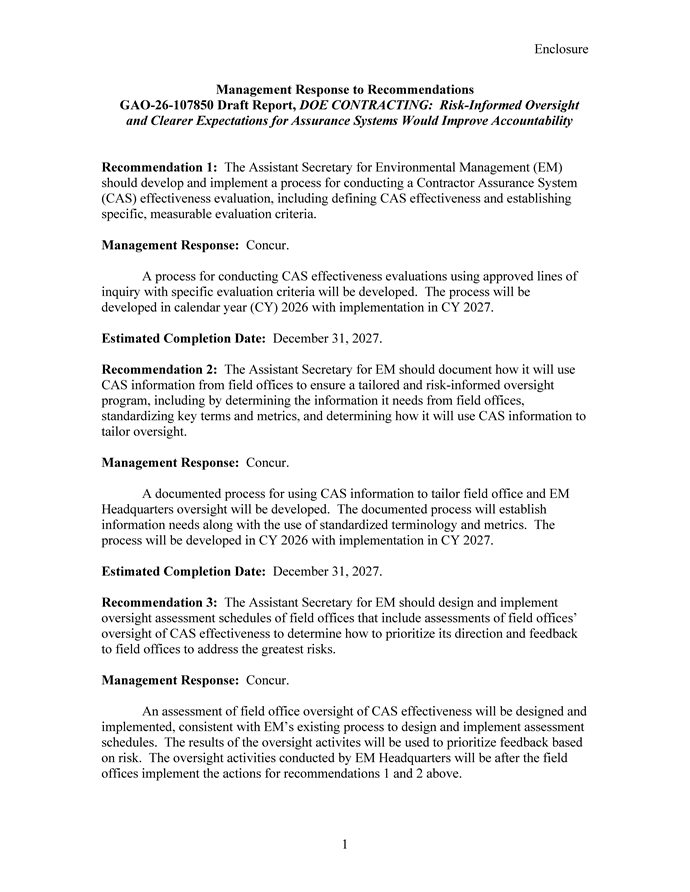
The Assistant Secretary of Environmental Management should develop and implement a process for conducting CAS effectiveness evaluations, including defining CAS effectiveness and establishing specific, measurable evaluation criteria. (Recommendation 1)
The Assistant Secretary of Environmental Management should document how it will use CAS information from field offices to ensure a tailored and risk-informed oversight program, to include determining the information it needs from field offices, standardizing key terms and metrics, and determining how it will use CAS information to tailor oversight. (Recommendation 2)
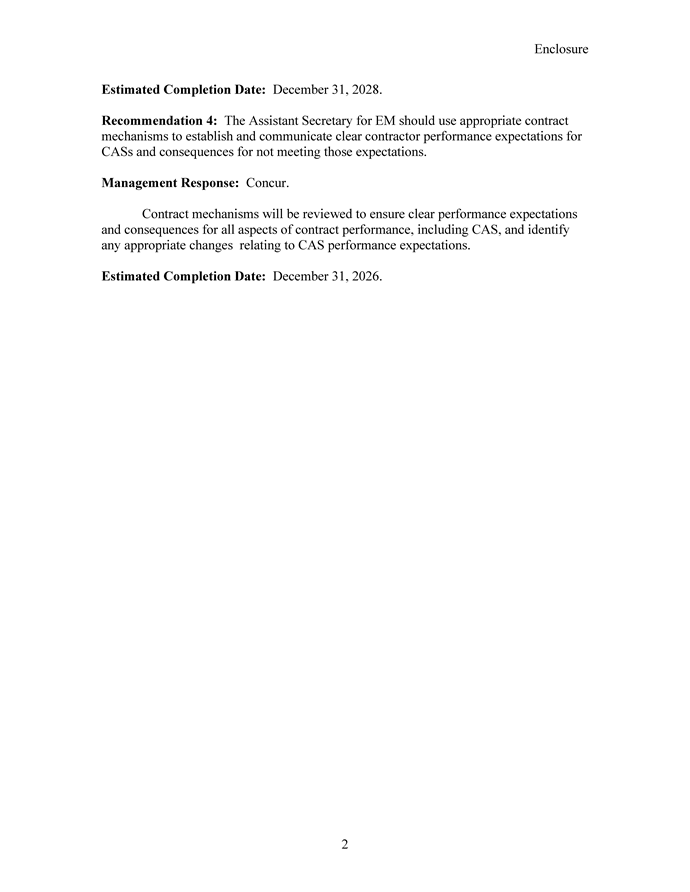
The Assistant Secretary of Environmental Management should design and implement oversight assessment schedules of field offices, to include assessments of field offices’ oversight of CAS effectiveness, to determine how to prioritize its direction and feedback to field offices to address the greatest risks. (Recommendation 3)
The Assistant Secretary of Environmental Management should use appropriate contract mechanisms to establish and communicate clear contractor performance expectations for CASs and consequences for not meeting those expectations. (Recommendation 4)
Agency Comments
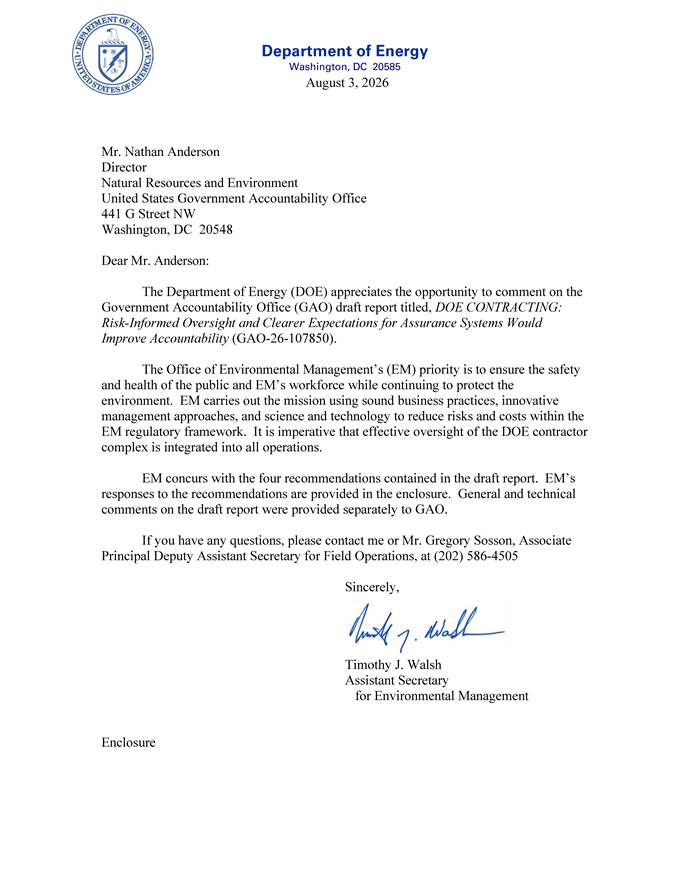
We provided a draft of this report to DOE for review and comment. In its written comments, reproduced in appendix II, DOE concurred with our four recommendations and described actions the agency plans to take to address them. The agency also provided technical comments, which we incorporated as appropriate.
In its written comments, DOE stated it would develop and implement processes for conducting CAS effectiveness evaluations that include specific evaluation criteria and for using CAS information to tailor field office and EM headquarters oversight, including establishing information needs and using standardized terminology and metrics. DOE also stated it will design and implement an assessment of field office oversight and use the results of those oversight activities to prioritize feedback based on risk. Finally, DOE stated it will review contract mechanisms to ensure clear performance expectations and consequences for all aspects of contract performance, including CAS, and identify any appropriate changes relating to CAS performance expectations.
We are sending copies of this report to the appropriate congressional committees, the Secretary of Energy, and other interested parties. In addition, the report is available at no charge on the GAO website at https://www.gao.gov.
If you or your staff have any questions about this report, please contact me at andersonn@gao.gov. Contact points for our Offices of Congressional Relations and Media Relations may be found on the last page of this report. GAO staff who made key contributions to this report are listed in appendix III.
Nathan J. Anderson
Director, Natural Resources and Environment
List of Committees
The Honorable Roger F. Wicker
Chairman
The Honorable Jack Reed
Ranking Member
Committee on Armed Services
United States Senate
The Honorable John Kennedy
Chair
The Honorable Patty Murray
Ranking Member
Subcommittee on Energy and Water Development
Committee on Appropriations
United States Senate
The Honorable Mike Rogers
Chairman
The Honorable Adam Smith
Ranking Member
Committee on Armed Services
House of Representatives
The Honorable Chuck Fleischmann
Chairman
The Honorable Marcy Kaptur
Ranking Member
Subcommittee on Energy and Water Development, and Related Agencies
Committee on Appropriations
House of Representatives
This report examines (1) the extent to which the Office of Environmental Management (EM) within the Department of Energy (DOE) has evaluated the effectiveness of selected Contractor Assurance Systems (CAS); (2) the extent to which EM has used information from selected CASs to conduct contractor oversight; and (3) the extent to which EM has used contract mechanisms to hold contractors accountable for CAS performance.
To address all our objectives, we selected a nongeneralizable sample of contracts that are associated with three contractors, CASs, sites, and field offices. We selected these contracts from a list of major contracts provided by EM.[45] We made our selections based on several factors including the presence of the requirement for contractors to design and implement a CAS, contract value, and purpose, among other reasons.[46] See table 2.
|
Contract Description |
Contractor |
Site |
|
Idaho Cleanup Project End State Contract |
Idaho Environmental Coalition, LLC |
Idaho National Laboratory |
|
Los Alamos Legacy Cleanup Contract |
Newport News Nuclear BWXT-Los Alamos, LLC |
Los Alamos National Laboratory |
|
Central Plateau Cleanup Contract |
Central Plateau Cleanup Company |
Hanford Site |
Source: U.S. Department of Energy contracts and documents. | GAO‑26‑107850
We conducted interviews to address all our objectives. We interviewed DOE and EM officials at the headquarters level responsible for field office and contractor oversight and, EM officials responsible for contractor oversight at the field offices of our three selected contracts. We interviewed contractors from the three selected contracts. We also interviewed officials from a nongeneralizable sample of independent entities, such as DOE’s Office of Enterprise Assessments, Defense Nuclear Facilities Safety Board, and Energy Facility Contractors Group.[47]
We conducted one in-person site visit during which we met with both EM site officials and contractor personnel. We visited the Idaho National Laboratory which is home to the Idaho Cleanup Project. Cleanup scope at the site involves decommissioning and dismantlement of over 200 excess environmental management facilities, including three reactors.
Finally, we obtained and analyzed relevant DOE and EM policies, procedures, and guidance. These included documentation on DOE and EM’s oversight process, such as standing operating policies and procedures.
To evaluate the extent to which EM has evaluated the effectiveness of selected CASs, we reviewed EM and contractor documents, including contractors’ CAS descriptions and assessments of CASs conducted by contractors, EM, and independent entities. These documents included calendar year 2021 and 2022 CAS effectiveness declarations (the most recent available during our review). We interviewed EM headquarters and field office officials about their efforts to evaluate the effectiveness of CASs, including how they reached conclusions. We then assessed EM’s efforts and the extent to which those efforts aligned with DOE policy.[48]
To evaluate the extent to which EM has used information from selected CASs to conduct contractor oversight, we reviewed EM documents, such as briefing slides and assessment schedules for calendar years 2024 through 2026. We interviewed EM headquarters and field office officials about their use of information from CASs to conduct contractor oversight, including about the information they collected and how they used that information as an input for developing assessment schedules. We then assessed EM’s use of information and the extent to which the use aligned with DOE policy and oversight program policy and procedures.
To evaluate the extent to which EM used contract mechanisms to communicate and evaluate CAS performance expectations, we reviewed EM documents, such as selected contracts and performance evaluation reports for fiscal years 2022 through 2024. We interviewed EM headquarters and field office officials about relevant contract mechanisms for communicating CAS performance and their use of those mechanisms. We then assessed EM’s use of identified contract mechanisms to communicate and evaluate CAS performance expectations and the extent to which the use aligned with DOE policy.
We conducted this performance audit from September 2024 to August 2026 in accordance with generally accepted government auditing standards. Those standards require that we plan and perform the audit to obtain sufficient, appropriate evidence to provide a reasonable basis for our findings and conclusions based on our audit objectives. We believe that the evidence obtained provides a reasonable basis for our findings and conclusions based on our audit objectives.
Nathan J. Anderson, andersonn@gao.gov
In addition to the contact named above, Wyatt R. Hundrup (Assistant Director), Jamie Meuwissen (Analyst in Charge), Adrian Apodaca, Jeffrey Carr, Rebecca Conway, R. Scott Fletcher, Lily A. Folkerts, Gwen Kirby, Serena Lo, and Meghan Perez made key contributions.
The Government Accountability Office, the audit, evaluation, and investigative arm of Congress, exists to support Congress in meeting its constitutional responsibilities and to help improve the performance and accountability of the federal government for the American people. GAO examines the use of public funds; evaluates federal programs and policies; and provides analyses, recommendations, and other assistance to help Congress make informed oversight, policy, and funding decisions. GAO’s commitment to good government is reflected in its core values of accountability, integrity, and reliability.
Obtaining Copies of GAO Reports and Testimony
The fastest and easiest way to obtain copies of GAO documents at no cost is through our website. Each weekday afternoon, GAO posts on its website newly released reports, testimony, and correspondence. You can also subscribe to GAO’s email updates to receive notification of newly posted products.
Order by Phone
The price of each GAO publication reflects GAO’s actual cost of production and distribution and depends on the number of pages in the publication and whether the publication is printed in color or black and white. Pricing and ordering information is posted on GAO’s website, https://www.gao.gov/ordering.htm.
Place orders by calling (202) 512-6000, toll free (866) 801-7077,
or
TDD (202) 512-2537.
Orders may be paid for using American Express, Discover Card, MasterCard, Visa, check, or money order. Call for additional information.
Connect with GAO
Connect with GAO on X,
LinkedIn, Instagram, and YouTube.
Subscribe to our Email Updates. Listen to our Podcasts.
Visit GAO on the web at https://www.gao.gov.
To Report Fraud, Waste, and Abuse in Federal Programs
Contact FraudNet:
Website: https://www.gao.gov/about/what-gao-does/fraudnet
Automated answering system: (800) 424-5454
Media Relations
Sarah Kaczmarek, Managing Director, Media@gao.gov
Congressional Relations
David A. Powner, Acting Managing Director, CongRel@gao.gov
General Inquiries
[1]GAO, High-Risk Series: Heightened Attention Could Save Billions More and Improve Government Efficiency and Effectiveness, GAO‑25‑107743 (Washington, D.C.: Feb. 25, 2025).
[2]U.S. Department of Energy, Policy for Federal Oversight and Contractor Assurance Systems, DOE Policy 226.2 (Washington, D.C.: Aug. 9, 2016) and U.S. Department of Energy, Implementation of Department of Energy Oversight Policy, DOE Order 226.1B, Change 1 (Washington, D.C.: May 3, 2022). The policy establishes the Department’s expectations for the implementation of a comprehensive and robust oversight process.
[3]This definition aligns with the Standards for Internal Control in the Federal Government definition of an internal control system as a process effected by an entity’s oversight body, management, and other personnel, designed to provide reasonable assurance that the objectives of an entity will be achieved. Thus, a contractor assurance system is an example of an internal control system. GAO, Standards for Internal Control in the Federal Government, GAO‑25‑107721 (Washington, D.C.: May 2025).
[4]Defense Nuclear Facilities Safety Board, Staff Report: Review of DOE Safety Oversight Effectiveness (Washington, D.C.: Apr. 10, 2022). DNFSB provides independent oversight of DOE’s public health and safety protections at defense nuclear facilities.
[5]U.S. Department of Energy, Independent Assessment of U.S. Department of Energy Contractors’ Management of Safety Issues (Washington, D.C.: Apr. 24, 2024). The Office of Enterprise Assessments is an independent office that has no line management or policy-making authorities. It is responsible for conducting independent evaluations of the effectiveness of DOE and contractor line management performance and risk management in implementing and overseeing safety and security programs, including line oversight and contractor assurance systems.
[6]Generally, a noncompliance is a condition that does not meet a DOE regulatory requirement. In the context of nuclear safety at DOE facilities, it refers to a failure to adhere to worker safety and health or nuclear safety requirements under 10 C.F.R. Part 851 or 10 C.F.R. Part 820, respectively.
[7]As of November 2024, the Idaho Cleanup Project End State Contract was valued at about $6.4 billion, the Los Alamos Legacy Cleanup Contract was valued at about $2.1 billion, and the Central Plateau Cleanup Contract was valued at $10 billion.
[8]DOE Order 226.1B; U.S. Department of Energy, Federal Line Management Oversight of Department of Energy Nuclear Facilities, DOE Guide 226.1-2A (Washington, D.C.: Apr. 14, 2014); and U.S. Department of Energy Office of Environmental Management, Safety, Security, and Quality Assurance (EM-3.1) Oversight Program, Standing Operating Policies and Procedures (SOPP) 49, Rev 5 (2024).
[9]DOE Policy 450.4A, Change 1, Integrated Safety Management Policy (Jan. 18, 2018); DOE Order 450.2, Change 1, Integrated Safety Management (Jan. 17, 2017).
[10]Relevant quality assurance requirements can be found in a number of sources, including 10 C.F.R. Part 830, Nuclear Safety Management and DOE Order 414.1E, Quality Assurance (Dec. 18, 2024).
[11]Operational awareness refers to the activities performed by DOE line personnel to maintain cognizance of overall facility or activity status, major changes planned, and overall safety posture. Examples of operational awareness activities include reviewing the contractor’s issue response and corrective action follow-up, contractor analysis and trending performance reports, and assessment review plans and reports; attending the contractor’s issues management boards and other safety-related management meetings; and participating in contractor facility condition inspections and work activity observations.
[12]DOE guidance states that baseline oversight is the minimum level of oversight to be conducted regardless of the contractor’s performance and should be planned, systematic, and scheduled as repetitive cyclic oversight activities in specified functional areas. DOE refers to oversight above and beyond the baseline activities as supplemental oversight, which should be conducted in response to declining performance and focus on topics of safety significance, as supported by data from DOE’s and the contractors’ assessment activities (which would be captured in the CAS). In contrast, DOE guidance describes reactive oversight as performing oversight in response to a specific event, condition, or emerging safety performance issue resulting from analysis of information.
[13]DOE Guide 226.1-2A. According to the guide, it provides supplemental information regarding DOE’s expectations of its requirements contained in DOE Order 226.1B that may be useful to DOE line management organizations in meeting the provisions of the order.
[14]U.S. Department of Energy, Office of Environmental Management Headquarters Safety Management Functions, Responsibilities, and Authorities (Washington, D.C.: June 2017). This document defines the safety management functions and responsibilities required in DOE directives that are applicable to EM. For purposes of this report, EM headquarters refers to EM’s Office of Safety, Security, and Quality Assurance within the Office of Field Operations unless otherwise noted. DOE’s Office of Environment, Health, Safety, and Security serves as the office of primary interest for DOE Order 226.1B and coordinates any changes, revisions, or directives developed in support of the order.
[15]DOE, EM, EM Strategic Vision: 2024-2034.
[16]The White House Office of Management and Budget’s Office of Federal Public Procurement Policy is leading a comprehensive revision of the FAR. This initiative, called the Revolutionary FAR Overhaul, began in April 2025 as directed by Executive Order 14275, Restoring Common Sense to Federal Procurement. The stated aim of the initiative is to remove provisions from the FAR that are not required by statute or essential to sound procurement. Exec. Order No. 14275, 90 Fed. Reg. 16,447 (Apr. 15, 2025). From May through October 2025, the Office of Federal Procurement Policy and the FAR Council issued model “class deviation” text—departures from the FAR that affect more than one contract action—for each part of the FAR and continues to issue updates. The FAR Council plans to initiate the formal rulemaking process to incorporate the model class deviation text into the FAR. DOE has adopted all of the model text.
[17]Under cost-reimbursement contracts, the government reimburses a contractor for allowable costs incurred, to the extent prescribed by the contract, and the contractor agrees to expend its best efforts to achieve the specified requirement within the estimated cost. However, the government is not promised a completed item or service within that cost.
[18]DOE, EM, Memorandum on Fiscal Year 2022 Performance Evaluation and Measurement Plan Guidance (Washington, D.C.: Mar. 19, 2021).
[19]Performance evaluations are generally required to be entered at least annually for contracts and orders above the simplified acquisition threshold, and when work is completed. 48 C.F.R. § 42.1502; see also DOE, Class Deviation PF 2026-15, Class Deviation to Adopt Revolutionary FAR Overhaul Part 42- Contract Administration and Audit Services 53 (2026).
[20]DOE Order 226.1B.
[21]The Biennial Assurance System and Integrated Safety Management System Effectiveness Declarations are required by DOE Order 450.2, Change 1, Integrated Safety Management (Apr. 25, 2011). According to the DOE memorandum requesting effectiveness declarations for calendar years 2021 and 2022, the existing DOE Oversight and Assurance systems implemented consistent with DOE Order 226.1B serve as the basis for the declaration.
[22]Field offices and contractors document the results of their effectiveness evaluations of the CASs and the Integrated Safety Management Systems in effectiveness declarations. The effectiveness declarations for calendar years 2021 and 2022 (combined) were requested by and submitted to EM headquarters as part of their oversight of field offices.
[23]According to the declaration, the field office oversees and evaluates CAS implementation through a quarterly evaluation report process that consolidates and analyzes oversight evaluation results across functional areas.
[24]The two highest significance levels are Level A and Level B. Level A requires an analysis, plan, action, and follow up. Hanford field office officials described a Level A issue as one that should not repeat. Officials said they look for a Level A issue to be perfectly corrected. Level B requires an analysis, plan, and action. Officials described a Level B issue as one that is expected to repeat, typically related to misuse of contractor or EM resources.
[25]In February 2023, the Los Alamos field office hired an independent contractor to evaluate the field office’s oversight and N3B’s CAS. It included the results of that independent evaluation in its effectiveness declaration.
[26]In 2023, N3B had been the Los Alamos cleanup contractor for 5 years, having secured the contract award in January 2018.
[27]According to Los Alamos officials, there was an additional delay of just under 30 days for several lower priority and less frequent activities, such as grounds keeping and periodic sampling in controlled areas, as these were dependent on training program changes.
[28]DOE Order 226.1B and DOE Guide 226.1-2A.
[29]DOE Order 226.1B.
[30]EM headquarters data includes all EM contractors at Hanford, not just CPCCo. EM headquarters officials created their issues management system in 2024 and therefore could not share trend reports for prior years.
[31]DOE Order 226.1B.
[32]Idaho officials said their schema for significance levels of an issue differ from the contractor, IEC, because the field office had a schema in place prior to the contractor’s arrival. The field office’s schema aligns with the Office of Nuclear Energy at Idaho’s schema. For this reason, the field office elects to translate the contractor’s unique schema into its own.
[33]DOE Order 226.1B and SOPP 49.
[34]DOE Order 226.1B.
[35]DOE Order 226.1B and SOPP 49.
[36]DOE Guide 226.1-2A.
[37]EM headquarters’ annual assessment schedules include various types of assessments, including field office CAS oversight and approval. In addition, the 2025 schedule included reviewing worker safety at one site, valve and piping maintenance at a different site, and systems engineering at multiple sites. EM headquarters officials said that oversight is generally stovepiped by specialty but that these specialty assessments contribute to CAS oversight.
[38]U.S. Department of Energy, Verification of Readiness to Start Up or Restart Nuclear Facilities, DOE Order 425.1D (Washington, D.C.: Apr. 16, 2010). Headquarters officials told us they use this version of the order and not the newer version approved on September 25, 2024.
[39]In May 2026, we reported that EM was understaffed. From fiscal year 2023 through 2025, total staff decreased by 33 percent, from 1,272 to 856. This created an overall vacancy rate of 45 percent as of the end of fiscal year 2025, based on a staffing need of 1,515 full-time employees that EM identified in fiscal year 2023. Specifically, the field offices we reviewed in this report had the following vacancy rates, as of the end of fiscal year 2025: 46 percent at the Hanford Site, 38 percent at the Idaho National Laboratory, and 62 percent at the Los Alamos National Laboratory. EM headquarters had a vacancy rate of 39 percent as of the end of fiscal year 2025. See GAO, Nuclear Waste Cleanup: DOE Shortages in Mission-Critical Positions Have Continued to Increase, GAO‑26‑108674 (Washington, D.C.: May 19, 2026).
[40]DOE Order 226.1B.
[41]For the Idaho Cleanup Project End State Contract during fiscal years 2022 through 2024, the incentive that included CAS performance was the Performance Management Incentive. In fiscal year 2023, CAS performance was included within the subjective fee, which was part of the Performance Evaluation and Measurement Plan. In total, the fees were worth $1 million in fiscal year 2022, $5.2 million in fiscal year 2023, and $2 million in 2024—the average annual contract value was about $430 million from fiscal years 2022 through 2024.
[42]For the Los Alamos Legacy Cleanup Contract from fiscal years 2022 through 2024, the fee that included CAS performance was the subjective fee in the Performance Evaluation and Measurement Plan. In total, the management rating category of the subjective fee was worth about $278,000 in fiscal year 2022—the average annual funding amount received by N3B was about $219 million from fiscal years 2021 through 2024. In fiscal year 2025, the N3B contract included fee gates, which required N3B to meet a minimum threshold or part of the potential fee could not be earned, according to Los Alamos field office officials.
[43]Some fee was withheld each fiscal year, but documentation did not provide a detailed explanation for the withholding nor reference poor CAS performance.
[44]Officials said that the contract added a fee via a Performance Evaluation and Measurement Plan that included CAS performance for fiscal year 2025. Our review of the fee language found it did not mention CAS performance.
[45]EM officials defined major contracts as those valued at $25 million or higher.
[46]We excluded several types of contracts that were not directly related to cleanup progress, such as contracts for performing occupational medical services, transportation services, and technical support services.
[47]The Energy Facility Contractors Group is a contractor-led organization of over 140 companies that support DOE operations. The organization has published tools related to CASs, such as on self-assessment of CASs. EM headquarters officials said they have interacted with the organization and consider its tools to be optional guidance to contractors.
[48]U.S. Department of Energy, Implementation of Department of Energy Oversight Policy, DOE Order 226.1B, Change 1 (Washington, D.C.: May 3, 2022); U.S. Department of Energy Guide 226.1-2A, Federal Line Management Oversight of Department of Energy Nuclear Facilities (Washington, D.C.: Apr. 14, 2014); and U.S. Department of Energy, Office of Environmental Management, Safety, Security, and Quality Assurance (EM-3.1) Oversight Program, Standing Operating Policies and Procedures (SOPP) 49, Rev 5 (2024).