
Report to Congressional Committees
United States Government Accountability Office
A report to congressional committees.
Contact: Alissa H. Czyz at CzyzA@gao.gov.
What GAO Found
The Space Force is the smallest military service, with about 15,400 total personnel in fiscal year 2025. The Space Force largely inherited its workforce from other services and has completed some assessments as it seeks to right-size its force to meet growing missions. However, it determines personnel requirements based on a mix of analyses that are not consistent across Space Force units. Further, some units operate under personnel requirements that are outdated and do not reflect mission growth. The Space Force has not established a process or guidance to consistently and accurately determine its personnel needs to accomplish its missions.
Relatedly, although it has estimated the number of contractor personnel supporting it, the Space Force does not have a process or guidance to accurately measure the number of contractor personnel and the nature of work they perform. Establishing such processes would help the Space Force better account for personnel needed to meet its evolving missions.
Even as the Space Force has continued to grow its workforce, officials have identified personnel shortfalls as a primary workforce challenge. GAO’s analysis found a 25 percent shortfall when comparing assigned personnel with total personnel requirements for fiscal year 2025. GAO also found that the Space Force is partly addressing personnel challenges, but its efforts are not guided by a comprehensive strategic workforce plan. Without such a plan, the Space Force may not be able to systematically plan for and manage a workforce that meets current and future mission needs.
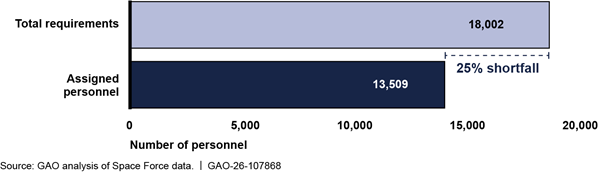
GAO’s analysis found a 22 percent shortfall in the number of support personnel the Air Force provides to the Space Force, which may increase risk to Space Force missions. Comprehensively evaluating, and revising as needed, the current arrangement of Air Force-provided support to the Space Force would help the Department of the Air Force make informed changes to address challenges and more effectively manage risks to space operations.
Why GAO Did This Study
In December 2019, the Space Force was established as a separate military service. It was created in recognition of the need to gain and maintain U.S. superiority in the increasingly contested space domain. In the 6 years since its establishment, the Space Force has been steadily growing and reorganizing its workforce as space-based threats grow and its missions increase.
Senate Report 118-188 includes a provision for GAO to assess the Space Force’s workforce planning. GAO’s report addresses, among other objectives, the extent to which the Space Force has determined its personnel needs; the Space Force has identified and addressed challenges in meeting them; and the Air Force has provided adequate personnel to support the Space Force.
GAO analyzed Space Force personnel data, reviewed applicable guidance, and conducted site visits to five Space Force bases.
What GAO Recommends
GAO is making four recommendations to the Department of the Air Force for the Space Force to establish processes to accurately determine personnel requirements and track contractor personnel; develop a strategic workforce plan; and evaluate and revise the Air Force-Space Force support arrangement. DOD concurred with the recommendations.
|
Abbreviations |
|
|
|
|
|
AFMAA |
Air Force Manpower Analysis Agency |
|
DOD |
Department of Defense |
|
FTE |
full-time equivalent |
|
PMA |
Personnel Management Act |
|
SPAFORGEN |
Space Force Generation Model |
|
STARCOM |
Space Force Space Training and Readiness Command |
This is a work of the U.S. government and is not subject to copyright protection in the United States. The published product may be reproduced and distributed in its entirety without further permission from GAO. However, because this work may contain copyrighted images or other material, permission from the copyright holder may be necessary if you wish to reproduce this material separately.
July 14, 2026
Congressional Committees
In December 2019, the National Defense Authorization Act for Fiscal Year 2020 established the U.S. Space Force.[1] It was established to meet the growing threat posed by near-peer competitors in space and in recognition of the need for a military service focused solely on pursuing superiority in the space domain.[2] The Space Force is trying to transform from a service provider operating in a relatively threat-free environment into a highly skilled warfighting organization operating in an increasingly contested domain.[3] From the onset, service leadership emphasized that the Space Force should be a lean and agile service, and they accordingly designed a streamlined headquarters and command structure. Additionally, to retain a focus on space missions, the Space Force relies on the Air Force to provide administrative and support functions.
In the 6 years since its establishment, the Space Force has been steadily reorganizing its workforce as space-based threats grow, and its missions and demands increase. The Space Force has emphasized the importance of sustainably growing and developing its workforce to meet these evolving mission needs, and senior leaders have recently indicated their intention to double the number of military personnel over the next decade.[4] Among emerging demands on the Space Force, in early 2025, the Department of Defense (DOD) began planning for a next-generation missile defense shield called Golden Dome for America, for which space-based interceptors and sensors are a critical component.
Senate Report 118-188, accompanying a bill for the National Defense Authorization Act for Fiscal Year 2025, includes a provision for us to assess the U.S. Space Force’s workforce planning.[5] Our report examines (1) how the size and composition of the Space Force has changed since the service’s inception; (2) the extent to which the Space Force has determined the personnel needed to accomplish its missions; (3) the extent to which the Space Force has identified and addressed challenges in meeting personnel needs; and (4) the extent to which the Air Force has provided adequate personnel to support the Space Force.
To address our first objective, we analyzed Space Force officer, enlisted, and civilian personnel data for fiscal years 2021 through 2025 as well as data on the total number of interservice transfers to the Space Force. For our second objective, we reviewed relevant DOD, Air Force, and Space Force guidance and Space Force personnel requirement assessments. In addition, we analyzed the number of contractor full-time equivalents (FTE) supporting the Space Force for fiscal years 2021 through 2025. We determined that the data were sufficiently reliable to present the general magnitude of the number of contractors supporting the service but discuss the limitations of these data in our report. We compared the Space Force efforts to determine personnel requirements and track contractor personnel against DOD guidance and Standards for Internal Control in the Federal Government on the use of quality information.[6]
To address our third objective, we analyzed Space Force personnel data for fiscal year 2025. We further compared the Space Force’s workforce planning efforts against GAO’s key principles for workforce planning.[7] We determined that the five key principles for effective strategic workforce planning were relevant to this objective. For our fourth objective, we analyzed documentation on the current arrangement for Air Force-provided personnel support to the Space Force, as well as data on the number of Air Force support personnel for fiscal year 2025.[8] We compared the Department of the Air Force’s efforts to evaluate the effectiveness of the current arrangement against the October 2020 memorandum from the Secretary of the Air Force and federal internal control standards on monitoring and evaluating activities on an ongoing basis.[9]
To address all four of our objectives, we assessed the data for inconsistencies, reviewed user guides for department-wide data systems, and interviewed Space Force and Air Force officials on the data and any discrepancies. We determined the data were sufficiently reliable for the purpose of presenting overall personnel numbers. Lastly, we interviewed officials at Space Force headquarters, all three field commands, and a nongeneralizable sample of Space Force units and offices selected to reflect changing mission requirements and variation in personnel shortfalls or efforts to address them. In addition, we interviewed officials from Air Force headquarters, Air Force Materiel Command, and the Air Force Manpower Analysis Agency (AFMAA). See appendix I for more details on our scope and methodology.
We conducted this performance audit from October 2024 to July 2026 in accordance with generally accepted government auditing standards. Those standards require that we plan and perform the audit to obtain sufficient, appropriate evidence to provide a reasonable basis for our findings and conclusions based on our audit objectives. We believe that the evidence obtained provides a reasonable basis for our findings and conclusions based on our audit objectives.
Background
Space Force Organization
As a separate military service within the Department of the Air Force, the Space Force is led by the Chief of Space Operations, who reports to the Secretary of the Air Force and DOD civilian leadership.[10] The Chief of Space Operations is supported by a headquarters office, known as the Space Staff. This office is responsible for, among other things, overseeing resourcing and developing doctrine, guidance, and plans for the Space Force.[11]
Field commands align under Space Force headquarters and report to the Chief of Space Operations. Field commands consist of a headquarters staff and the subordinate deltas and squadrons assigned to the command (see fig. 1).
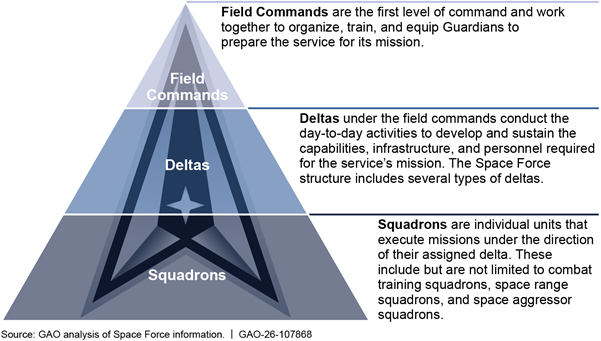
Note: Space Force Guardians include officers and enlisted military personnel, as well as civilian federal employees.
The Space Force has three field commands designed to align with the institutional responsibilities of the Space Force to organize, train, and equip its forces.
· Combat Forces Command generates and presents combat-ready intelligence, cyber, space, and combat support forces.[12]
· Space Training and Readiness Command (STARCOM) provides education and training for Space Force personnel; develops space warfighting doctrine, tactics, techniques, and procedures; and conducts testing and evaluations of space capabilities.
· Space Systems Command acquires, develops, fields, and sustains space capabilities.
The Space Force has various types of deltas: (1) Space Deltas support institutional functions, including training, education, and test and evaluation; (2) Mission Deltas ensure the collaboration between the capability enhancement, sustainment, and operations for Space Force weapon systems with build-in cybersecurity and intelligence support; (3) Space Base Deltas provide installation operations and other support; and (4) Space Launch Deltas are responsible for the launch mission at specific bases.[13] For example, Mission Delta 4 within Combat Forces Command is responsible for missile warning and tracking and Delta 1 within STARCOM is responsible for basic military, initial skills, and advanced training courses.
In addition to the three primary field commands, the Space Force has established service components to combatant commands supporting the Joint Force.[14] The Space Force has two direct reporting units that pursue advanced science, technology, intelligence, research, analysis, and engineering work to support space operations (see fig. 2). The Space Force also provides an element to the National Reconnaissance Office that supports the design, development, launch, and maintenance of intelligence satellites.
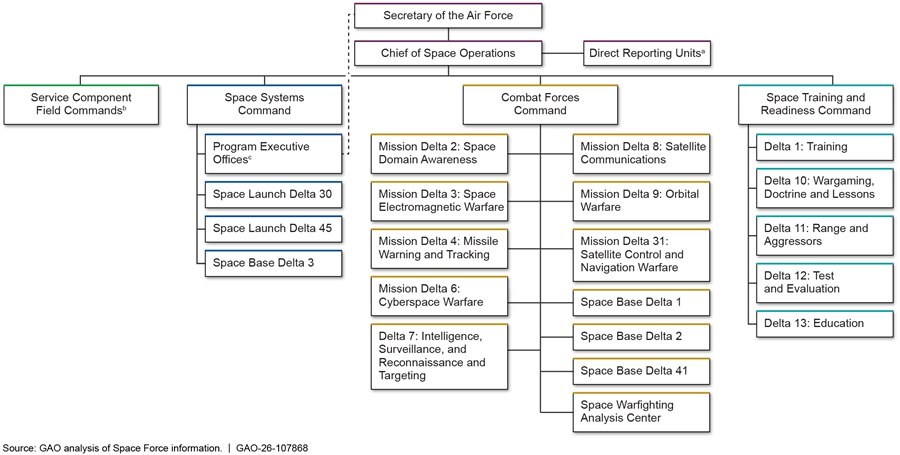
aThe Space Force has two direct reporting units: (1) the Space Development Agency, which reports to the Assistant Secretary of the Air Force for Space Acquisitions and Integration for acquisition matters, and to the Chief of Space Operations for all other matters; and (2) the Space Rapid Capabilities Office, which reports to the Chief of Space Operations, through the Secretary of the Air Force via its Board of Directors. In addition, the Space Force has one field operating agency, the National Space Intelligence Center.
bThe Space Force has six service component field commands to the combatant commands. U.S. Space Forces—Space is the service component to U.S. Space Command and the Space Force has five other service components at the other combatant commands with geographic areas of responsibility: U.S. Space Forces—Central, U.S. Space Forces—Europe and Africa, U.S. Space Forces—Indo-Pacific (including U.S. Space Forces—Japan and U.S. Space Forces—Korea), U.S. Space Forces—North, and U.S. Space Forces—South.
cProgram Executive Offices include (1) Space Access; (2) Battle Management, Command, Control, Communications, and Space Intelligence; (3) Military Communications and Positioning, Navigation, and Timing; (4) Space Sensing; (5) Space Combat Power; and (6) Operational Test and Training Infrastructure. These offices report directly to the Assistant Secretary of the Air Force for Space Acquisitions and Integration for acquisition matters. The Space Force is conducting ongoing acquisition reforms, including developing Portfolio Acquisition Executives for certain mission areas that will report to the Secretary of the Air Force through the Space Service Acquisition Executive.
Relationship with the Air Force
According to Space Force doctrine, upon the service’s establishment, Congress directed it to limit the duplication of common functions and to leverage existing support from the Air Force to execute the space mission.[15] In June 2020, the Secretary of the Air Force issued a memorandum outlining the key principles for the Space Force to leverage existing Air Force installation support to the maximum extent practicable. This included redesignating Air Force installations with primary space missions as Space Force installations, establishing a Space Force Base Delta Commander for such installations, and assigning subordinate Air Force support units and Medical Groups to Space Base Deltas and Space Launch Deltas.[16] Although Air Force support personnel assigned to subordinate units fall under the authority of the Space Force base commander, the Department of the Air Force retains the responsibility for determining the number and type of Air Force personnel assigned to support the Space Force.
The Air Force and Space Force codified the current arrangement for Air Force-provided base operating and other support functions in a May 2021 Memorandum of Understanding.[17] Under this agreement, the Air Force provides personnel (active-duty military, reservist, National Guard, and civilian personnel) to the Space Force for base operating support and other functional support services, such as civil engineering, personnel and human resource management, security forces, and medical and dental providers.[18] The Air Force Materiel Command is responsible for managing and ensuring that Air Force personnel assigned to Space Force installations receive the same force development opportunities, and functional and administrative support, as those at Air Force installations.
Space Force Guardians
Space Force Guardians include officers and enlisted military personnel, as well as civilian federal employees. Guardians across these three personnel categories possess many of the same skills and abilities, and in January 2024, the Chief of Space Operations issued guidance on the roles, responsibilities, and duties of each type of Guardian personnel.[19] Under this guidance:
· Officer Guardians are the Space Force’s principal leaders and planners and are trained and educated in space disciplines, command, and joint warfare.
· Enlisted Guardians are the Space Force’s primary warfighters and are trained as frontline operators and technical experts responsible for unit readiness.
· Civilian Guardians are non-uniformed personnel that lead, plan, and manage functional areas across the Space Force.
Five career fields are available for military Guardians: space operations, space intelligence, space cyber operations, engineering, and acquisitions. As of late 2024, all new Space Force officers must complete the Officer Training Course that includes training in space operations, intelligence, cyber, engineering, and acquisitions before specializing in one of the five available career fields. Enlisted Guardians complete basic military training, as well as initial skills training for one of three career fields: space operations, space intelligence, or space cyber operations.
Personnel Requirements Guidance
DOD joint doctrine defines personnel requirements as the human resources needed to accomplish specified workloads of organizations.[20] The military services are required to identify their personnel needs through a personnel requirements determination process using both general DOD-wide and service-specific guidance.[21] Space Force officials said they generally follow Department of the Air Force guidance—namely, Department of the Air Force Instruction 38-101 and Air Force Manual 38-102—to determine personnel requirements.[22] According to Space Force officials, personnel requirements are determined either through formal studies conducted by AFMAA or by using other analytical tools and techniques outlined under the Air Force guidance. Under Department of the Air Force guidance, analysts within AFMAA lead and manage formal study efforts for determining and validating personnel requirements for the Department of the Air Force, including the Space Force.[23]
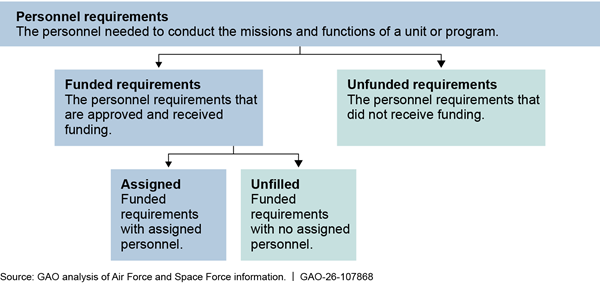
All personnel requirements for each Space Force unit are detailed in Unit Manpower Documents within the Air Force’s Manpower Programming and Execution System.[24] For example, the Unit Manpower Document of a squadron will list the number and type of personnel—including civilian or military, military rank, and occupational specialties—that are needed to perform the squadron’s workload and meet its missions. Personnel requirements appear in the system as either funded or unfunded. Funded personnel requirements, or positions, are the personnel needs that have been validated and for which budget funding is available. Unfunded requirements are those that have been deferred because of budgetary constraints and priorities. The Space Force assigns personnel to funded positions based on their availability and qualifications. Unfilled positions are those that the Space Force has been unable to fill with qualified personnel (see fig. 3).
Space Force Guardian Workforce Has Grown Through Interservice Personnel Transfers and Programmatic Increases
The Space Force Guardian workforce has grown through interservice personnel transfers and programmatic increases but remains considerably smaller than all other services. Although the Space Force largely inherited its workforce size and composition from the space-based mission areas of the other services, the composition has shifted with higher growth in the enlisted and civilian workforce compared to officers.
Size. The Space Force, the smallest military service, had 15,392 total Guardian personnel in fiscal year 2025.[25] Since its inception through the end of fiscal year 2025, the Space Force received about 11,350 military and civilian personnel through interservice transfers from the Air Force, Navy, and Army, and grew by about 4,000 personnel through programmatic increases (see table 1).
Table 1: Space Force Guardian Personnel Growth Through Interservice Transfers and Programmatic Increases Through Fiscal Year 2025
|
Military |
Civilian |
Total |
|
|
Total interservice transfers |
6,990 |
4,364 |
11,354 |
|
Air Force Space Command |
5,035 |
3,368 |
8,403 |
|
Air Force — other space-related |
1,546 |
643 |
2,189 |
|
Navy Narrowband Satellite System |
17 |
59 |
76 |
|
Army Satellite Payload, Planning, and Management |
302 |
200 |
502 |
|
Department of Defense Space Development Agency |
0 |
67 |
67 |
|
Navy Communications Satellite Program Office |
0 |
20 |
20 |
|
Army Joint Tactical Ground Stations |
90 |
7 |
97 |
|
Total programmatic increases |
2,995 |
1,043 |
4,038 |
|
Total Guardian force in fiscal year 2025 |
9,985 |
5,407 |
15,392 |
Source: GAO analysis of Space Force data. | GAO‑26‑107868
Note: These data do not reflect most of the civilian personnel reductions that took effect at the end of fiscal year 2025.
About 93 percent of all interservice transfers came from the Air Force, primarily from the former Air Force Space Command. During the Space Force’s establishment, the Secretary of the Air Force redesignated the Air Force Space Command as the Space Force and reassigned its military and civilian personnel.[26]
|
Part-Time Space Force Personnel Management Act (PMA) Transfers The PMA allows the Space Force to support full- and part-time work roles within the service. According to recent announcements, the new part-time roles for personnel transferring under the PMA will be role-specific and episodic, deviating from traditional military reserve models.
In the Space Force model, Guardians in part-time and full-time roles will be under the same assignment and promotion process. Space Force officials stated that part-time roles will focus on leveraging specialized expertise and experience, including mission support, training, and headquarters staff roles. In addition, the Space Force aims for these part-time roles to offer more flexibility for Guardians and improve talent retention. Source: GAO analysis of Space Force information (text); U.S. Space Force/Isaac Blancas (image) | GAO‑26‑107868 |
According to officials, the Space Force is planning to absorb about 1,800 Air Force Reserve and National Guard personnel beginning in fiscal year 2026. Under provisions of the 2023 Space Force Personnel Management Act (PMA), up to 400 full-time and 812 part-time Air Force Reserve personnel will transfer to the Space Force, according to Space Force data (see sidebar). [27] In addition, a provision in the Servicemember Quality of Life Improvement and National Defense Authorization Act for Fiscal Year 2025 directed the Secretary of the Air Force to transfer certain space functions and units of the Air National Guard, including full- and part-time Air Force National Guard personnel, equipment, and resources, to the Space Force.[28] According to Space Force data, under this provision, about 200 full-time and 350 part-time Air National Guard personnel will transfer to the Space Force. The Space Force assumed Air National Guard space missions as of October 1, 2025.[29]
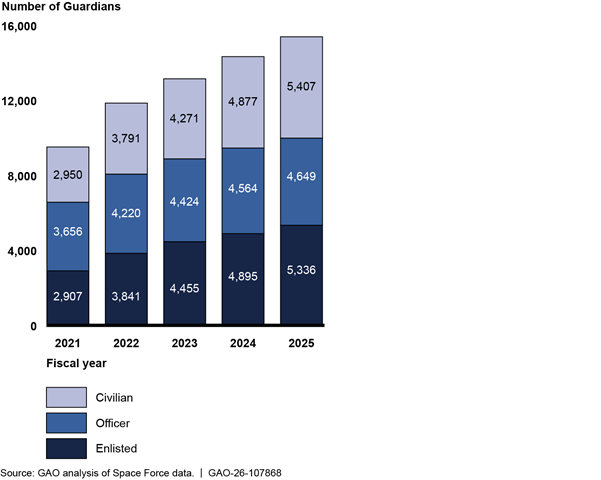
Composition. The composition of the Space Force workforce is generally equally divided between officers, enlisted, and civilians but continues to shift as the service matures. The Space Force consisted of 4,649 officer (30 percent), 5,336 enlisted (35 percent), and 5,407 civilian personnel (35 percent) in fiscal year 2025. However, from fiscal year 2021 through fiscal year 2025, the number of enlisted and civilian Guardians grew more rapidly than officers, increasing by 84 percent and 83 percent respectively, compared with 27 percent for officers (see fig. 4).
Despite the faster growth in enlisted Guardians, the Space Force composition of military personnel still has a high proportion of officers to enlisted compared with other services. Our analysis of Space Force data showed that in fiscal year 2025, the proportion of officer to enlisted Guardians was approximately 1:1 (47 percent to 53 percent). This is substantially higher than the average proportion of about 1:4 (20 percent to 80 percent) officer to enlisted personnel across the military services.[30]
The Space Force largely inherited its unique composition from the integration of space-based mission areas of the other services. Space Force officials stated that the Space Force’s unique military composition reflects that of its precursor organization, the Air Force Space Command, which had a larger proportion of officers compared with enlisted personnel. In addition, the Air Force, Army, and Navy transfers into the Space Force also included a high percentage of civilians performing tactical or operational duties for space missions. During the transfer period, the Space Force strategically decided not to change the existing force allocations between military and civilian personnel transferring from the other services.[31]
Space Force Has Not Accurately Determined Personnel Requirements or Tracked the Number of Contractor Personnel It Uses
The Space Force has not consistently and accurately determined its personnel requirements to meet its mission needs. Relatedly, although it has estimated the number of contractor personnel supporting the service, the Space Force has not accurately tracked the number of contractor personnel and the nature of work they perform.
Space Force Personnel Requirements Do Not Accurately Reflect Need
Although the Space Force continues to grow its workforce and has experienced significant mission growth and evolution, existing personnel requirement determinations do not accurately reflect the total number and type of personnel needed to accomplish its missions. Some units’ personnel requirements are based on legacy requirements from the former Air Force Space Command and other services’ space units. Officials from several squadrons that transitioned from the Air Force to the Space Force said their units are operating with personnel requirements that have not been reassessed and are outdated, given the changing workload resulting from recent mission growth.
In addition, some Space Force units’ personnel requirements are based on a mix of analyses that are not consistently applied across the service. The Space Force has used the AFMAA study process to assess some units’ personnel requirements. Over the past several years, AFMAA has conducted manpower assessments for several Space Force units and components (see table 2).[32] However, these assessments covered only a small fraction of the total service.[33]
|
Component or unit |
Date completed |
Prior personnel requirements |
Assessed personnel requirements |
Percentage change |
|
64th Cyberspace Squadron |
2/10/2023 |
104 |
154 |
48% increase |
|
53rd Space Operations Squadron |
1/27/2024 |
363 |
315 |
13% decrease |
|
Combat Forces Command Delta Space Staff |
5/17/2024 |
361 |
270 |
25% decrease |
|
U.S. Space Forces – Space |
2/10/2025 |
270 |
385 |
43% increase |
|
5th Space Warning Squadron |
3/20/2025 |
154 |
126 |
18% decrease |
Source: GAO analysis of Air Force information. | GAO‑26‑107868
Note: Prior requirement determinations do not include borrowed personnel or contractors contributing to the component or units’ workload during the study. The Air Force Manpower Analysis Agency determined new (assessed) personnel requirements, and we calculated the percentage change from prior requirements.
These assessments resulted in significant changes to the size of the studied units, ranging from a 13 percent decrease in the size of the 53rd Space Operations Squadron workforce to a 48 percent increase in the 64th Cyberspace Squadron’s workforce size.
However, the AFMAA personnel requirements determination process conducted under the Department of the Air Force guidance may not be optimally suited to the Space Force for several primary reasons.
· Organizational capacity. According to Space Force and AFMAA officials, the demand for AFMAA studies exceeds the agency’s capacity to provide them. Requests for studies come from across the Space Force, and Space Staff meet with AFMAA semi-annually to prioritize which studies to conduct based on mission and resourcing needs. However, AFMAA is responsible for assessing Air Force personnel requirements in addition to those of the Space Force, and officials said that AFMAA cannot meet all the demand coming from both services.
· Time-consuming process. AFMAA studies can take 6 to 24 months to complete, which Space Force officials said is generally too long given the rapid pace of mission growth and reorganizations within the service. For example, some units that have undergone assessments have then been restructured or given additional missions, which in turn render the findings of laborious and time-consuming assessments inaccurate and out of date.
· Suitability for small service. Additionally, Space Force and AFMAA officials said that the primary study types and methods developed by AFMAA to determine personnel requirements are not optimally scaled for the Space Force’s smaller size or designed for its many different space-based missions. Department of the Air Force Instruction 38-101 specifies the roles and responsibilities for determining and updating personnel requirements, but the officials added that the instruction is optimally suited to the Air Force and its missions while it is less optimally suited to the Space Force. For example, the standards and methods useful for measuring and quantifying Air Force workload across a much larger service are not practical for the much smaller Space Force. The officials noted that the Air Force has many squadrons performing similar work—like those units performing aircraft operation and maintenance—and so this evaluative approach is not particularly useful for the Space Force, which has many singular units performing different missions.
Despite these limitations, Space Force officials said that having accurate personnel requirements is necessary, especially for units that have experienced significant mission growth or change. However, Space Force officials said that not all units require a formal AFMAA study to accurately determine personnel requirements. To that end, in early 2025, the Space Force experimented with a “sprint” manpower assessment process that took less time to complete than conventional study types and received positive feedback from the involved parties. In addition, the Space Force has developed a cross-functional Manpower Working Group to develop additional personnel requirement tools for operational and support units.
Space Force officials have described other ways that they have attempted to best determine their personnel needs outside the formal AFMAA process. For example:
· Internal reviews. Some field command and delta leadership have conducted their own assessments to better understand their units’ progress toward accomplishing their missions and to better determine their personnel needs. We previously reported that Combat Forces Command conducted an internal personnel review in 2023 and identified a shortfall of nearly 2,000 military personnel needed to implement its force generation model (SPAFORGEN).[34] In early 2025, senior Space Force and Combat Forces Command leadership reassessed the personnel requirements of the field command’s units using crew ratios to ensure successful implementation of SPAFORGEN, downgrading the 2,000 military personnel shortfall to several hundred, according to Space Force officials.
· Programming plans. The Space Force requires its service components to develop programming plans to support combatant commands. Among other objectives, the programming plans are meant to identify the skills, experience, and staffing levels necessary to resource the service components with personnel able to support the combatant commands. Officials from one service component said that several members of the command’s leadership determined the personnel requirement in their programming plan. The officials deliberately kept the size of the personnel requirement lean.
While portions of the Space Force have used various methods to determine their personnel requirements, officials from multiple units told us they needed more personnel based on operational experience, but they had not followed any process to quantify and more accurately articulate their personnel needs. The Space Force’s reliance on potentially outdated legacy requirements, Air Force-assessed requirements, and unit-assessed requirements that have been determined through different methods means that the service is likely operating with an inconsistent and potentially inaccurate measure of its personnel needs.
DOD Directive 1100.4, Guidance for Manpower Management, states that personnel requirements are driven by workload and shall be established at the minimum levels necessary to accomplish mission and performance objectives. Changes in personnel shall be preceded by changes to the programs, missions, and functions that require personnel resources. Additionally, a formal validated process shall be used to determine mobilization, contingency, and wartime manpower requirements. Lastly, the guidance states that military and civilian personnel resources must be programmed in accordance with validated personnel requirements.[35]
In addition, Standards for Internal Control in the Federal Government states that management should use quality information—in this case, accurate personnel requirements determined through a standard service-specific process—to achieve the entity’s objectives.[36] Further, the federal internal control standards state that management should obtain relevant data from reliable internal sources in a timely manner based on identified information requirements.
The Space Force has not yet determined the minimum levels of personnel it needs to accomplish its missions and objectives because it has not developed service-specific guidance that establishes a process to accurately determine personnel requirements across its units. Space Force and AFMAA officials agreed that the Space Force should develop and follow a personnel requirements determination process that better suits its needs and circumstances. In addition, the Space Force has recognized that it cannot take old processes, rename them, and expect different outcomes, according to its 2025 Space Force Vector.[37] The Vector further states that the Space Force is therefore seeking to invest time, energy, and effort into developing and optimizing new processes. While it has recently drafted a potential new process, it has not been formally adopted or applied more widely across the Space Force. Officials did not provide a time frame for issuing service-specific guidance that would codify the process.
Developing service-specific guidance that establishes a process to determine personnel requirements could help ensure that the Space Force has a sound and consistent method for accurately accounting for its personnel needs. Also, such action could meet the Space Force’s need for more rapid and responsive assessments, particularly for growing and evolving mission areas. Finally, with relevant data, quality information, and an accurate baseline of personnel needed to meet its missions, the Space Force would be able to make more informed programming, budgeting, and resourcing decisions. Without such guidance, the service may remain burdened with outdated and inaccurate personnel requirements and will not have a full understanding of its personnel needs.
The Space Force Does Not Accurately and Consistently Track Contractors, Which Further Limits Determination of Personnel Requirements
The Space Force relies on contractor personnel to perform various functions but does not accurately and consistently track the number of contractor personnel supporting the service.[38] In the absence of contractor data, Space Staff officials divide the total amount of contractor spending by the estimated work hours to calculate the number of contractor full-time equivalents (FTE) supporting the entire service, according to a Space Force official. [39]
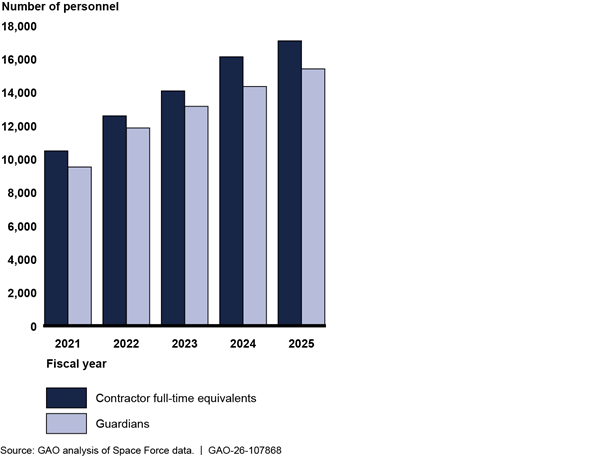
Based on these estimates, the number of contractor FTEs increased by 63 percent between fiscal years 2021 and 2025—from about 10,400 in fiscal year 2021 to an estimated 17,100 in fiscal year 2025 (see fig. 5). Also, the estimated number of contractor FTEs supporting the Space Force remained higher than the total number of Guardian personnel (officer, enlisted, and civilian) in fiscal years 2021 through 2025.
Figure 5: Estimated Number of Space Force Contractor Full-Time Equivalents Compared with Guardian Personnel, Fiscal Years 2021-2025
Space Force officials noted that these calculations provide a service-wide estimate of contractor FTE support but do not provide an exact number of service contractors.[40] According to Space Force officials, contractor personnel provide technical skills and help fill personnel needs. One Space Force official also noted that the large contingent of contractor personnel is partially a legacy carried over from the former Air Force Space Command.
Under Department of the Air Force Instruction 38-101, the Space Force may use its discretion to decide whether to track and document the number of contractors supporting the command.[41] According to a Space Force official, tracking service contractors became optional due to the DOD-wide moratorium on public-private competitions for converting functions currently performed by civilian employees to contractors.[42] Further, Space Force officials said that service contracts are typically written without specifying the number of full or part-time personnel the contractor will assign.
Although tracking contractor personnel is optional under Department of the Air Force Instruction 38-101, the guidance states that contractor data are useful for determining workforce mix; sizing organizations; and determining personnel requirements, base operating support plans, and personnel estimates for major acquisition programs.[43] For example, under DOD Instruction 1100.22, functions that are not military essential or inherently governmental, or that are exempted from private sector performance, will be designated for DOD civilian performance unless there is an approved analysis for exceptions. Such approved analysis could include a cost comparison determining that civilian personnel are not the lowest-cost provider.[44] Without more accurate service contractor data, the Space Force may not be able to conduct cost comparisons to assess whether functions should continue to be performed by contractor or government personnel.
Space Force officials recognize the need to accurately and consistently track contractor personnel supporting the service. According to a Space Force official, at the direction of the Chief of Space Operations, the Space Staff previously conducted a comprehensive review of each component to determine the total number of contractor FTEs under Space Force service contracts. Further, this official stated that the baseline data were recorded on Unit Manpower Documents through the Manpower Programming and Execution System. However, this official stated that the review captured contractor FTE data only for one point in time and that the process of determining contractor FTEs by directly contacting each component was challenging. Space Force officials said they have developed a potential standardized process to more consistently track contractor personnel going forward. However, that process has not yet been documented in guidance or implemented across the service.
DOD Directive 1100.4, Guidance for Manpower Management, states that DOD component heads are responsible for establishing and maintaining personnel data systems that account for all personnel resources, including active military, civilian, reserve, and contract.[45] In addition, Standards for Internal Control in the Federal Government states that management should use quality information to achieve the entity’s objectives.[46] Further, the federal internal control standards state that management should obtain relevant data from reliable internal sources in a timely manner based on identified information requirements.
Without accurately and consistently tracking contractor personnel supporting the service, the Space Force cannot fully quantify its personnel requirements and determine its optimal workforce mix. This is especially critical as the Space Force leverages significant contractor personnel support. Also, having a process to accurately track service contractor personnel would provide the Space Force with more complete information for strategic workforce planning, personnel requirements and optimal mix determinations, and budget decisions.
Space Force Identified Workforce Challenges but Has Not Fully Addressed Them
The Space Force identified several challenges that affect its workforce, including service-wide shortfalls in personnel; challenges with retaining cybersecurity and intelligence personnel and with having enough enlisted military personnel to meet needs; and challenges filling civilian personnel requirements with qualified personnel due to private sector competition and recent DOD personnel policy changes. However, the Space Force has not fully addressed these identified challenges and does not have a plan to align and coordinate existing efforts or to guide long-term strategies.
Space Force Identified Personnel Shortfalls and Related Challenges
Service-Wide Personnel Shortfalls
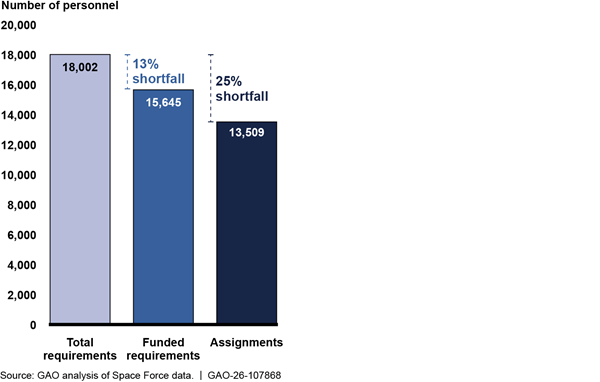
Even as the Space Force has continued to grow its Guardian (officer, enlisted, and civilian) workforce, officials have identified personnel shortfalls as a primary workforce challenge. Although the service’s personnel requirements do not accurately account for all personnel needs, they serve as the baseline with which the Space Force funds personnel requirements as they appear in Unit Manpower Documents. Our analysis of Space Force data shows that the service funded about 87 percent of service-wide personnel requirements in fiscal year 2025 and assigned Guardians to 86 percent of those funded requirements (positions). As illustrated in figure 6, assigned personnel filled about 75 percent of total documented requirements, representing a personnel shortfall of 25 percent.
Figure 6: Total Space Force Guardian Personnel Requirements, Funded Requirements, and Assignments in Fiscal Year 2025
Notes: Fiscal year 2025 personnel amounts do not reflect most of the civilian personnel reductions that took effect at the end of fiscal year 2025. Total personnel requirements are the number of personnel the Space Force has identified as necessary to meet its missions. Funded requirements, or positions, are the personnel needs for which budget funding is available and approved. Assignments are the total number of positions with assigned personnel to fill them. Total assignments do not include personnel assigned to support non-Space Force requirements, including personnel assigned to joint or Air Force units, or students in Space Force enlisted or officer training programs.
The extent of personnel shortfalls varied across the service. Among the three field commands in fiscal year 2025, Combat Forces Command and Space Systems Command had the highest “fill rates”—the percentage of personnel requirements filled with assigned Guardians. Combat Forces Command’s fill rate was 79 percent, representing a 21 percent shortfall and Space Systems Command’s fill rate was 81 percent, representing a 19 percent shortfall. The fiscal year 2025 personnel shortfall for STARCOM was larger at 35 percent.[47] The variation in fill rates across field commands reflects the Space Force’s prioritization of filling operations-focused positions, according to Space Force officials. The total personnel shortfall for all combatant command service components was 54 percent in fiscal year 2025. Officials said that as the Space Force recently established the service components, there are few personnel assigned, and it is planning for additional funded requirements to grow those commands. Personnel shortfalls in the three field commands and service components are illustrated in figure 7.
Figure 7: Space Force Field Command and Combatant Command Service Component Guardian Shortfalls in Fiscal Year 2025
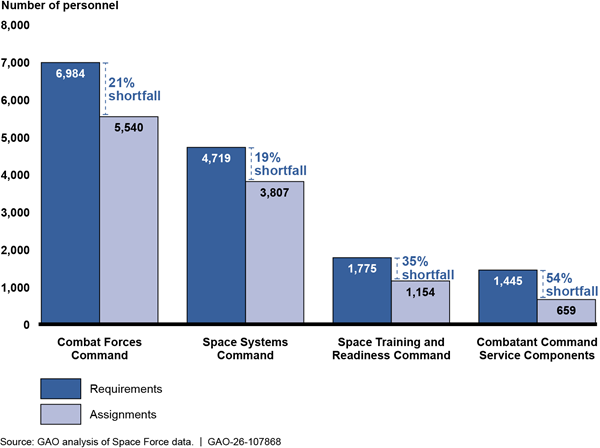
Notes: Fiscal year 2025 personnel amounts do not reflect most of the civilian personnel reductions that took effect at the end of fiscal year 2025. Total personnel requirements are the number of personnel the Space Force has identified as necessary to meet its missions. Assignments are the total number of positions with assigned personnel to fill them. Total assignments do not include personnel assigned to support non-Space Force requirements, including personnel assigned to joint or Air Force units, or students in Space Force enlisted or officer training programs.
Field command, delta, and squadron officials identified some common challenges they had in filling positions with qualified personnel and reducing these shortfalls.
Challenges from Limited Cybersecurity, Intelligence, and Enlisted Military Personnel
We met with senior field command leadership, as well as officials from various units, including offices, directorates, deltas, and squadrons within each field command. Overall, officials we met with identified shortages of cybersecurity and intelligence personnel, as well as a general need for more enlisted personnel as their greatest military workforce challenges.
· The Space Force has identified a critical deficiency of cyberspace expertise within the service. Given the increasing importance of cyber defense in space operations, senior Combat Forces Command officials told us that the Space Force should prioritize and grow its cyber workforce.[48] In summer 2025, Combat Forces Command’s cyber command (Mission Delta 6) reorganized and embedded its personnel directly within operational squadrons in other deltas. However, cyber officials from this delta added that the small size of cyber teams results in gaps in cyber coverage and that the Space Force needed to develop personnel with offensive cyber capabilities. Officials further added that the Space Force’s limited cyber workforce is used for information technology and communication support functions, but they would be better used for operational functions.
· Additionally, senior field command officials cited a shortage of intelligence analysts. For example, the intelligence directorate of Space Systems Command headquarters had a fill rate of 60 percent in April 2025, with some of its military personnel deployed elsewhere for 6-month periods. Space Systems Command officials said that staffing priority was given to operational intelligence units over their directorate. In assessing the effects of this low fill rate, the directorate found a loss of leadership and experience, increased response times to support requests, and less oversight provided to field command intelligence and special security activities. In addition, officials from a testing and evaluation delta noted that additional intelligence analysts were needed to improve the quality of test events.
· Further, senior field command officials stated that the Space Force needs to generally add more enlisted personnel to the workforce, even with the service meeting its annual recruiting goals.[49] For example, Combat Forces Command senior officials stated that several hundred additional military personnel are needed for SPAFORGEN implementation, with enlisted personnel comprising about 70 percent of that need. To address the need for more enlisted personnel, the Space Force is expecting to grow its enlisted workforce from 5,336 to 6,006 Guardians between fiscal years 2025 and 2028—approximately a 13 percent increase over the next 3 years.
Challenges with Filling Civilian Guardian Positions
Senior officials from each field command told us that filling civilian positions with qualified personnel has been more challenging than filling military positions due to private sector competition and recent DOD personnel policy changes. Space Force officials emphasized that the service was created to be lean, with civilians performing critical roles for space missions. The officials added that in addition to civilians providing continuity, operational stability, and specialized expertise, technical proficiency is required for these civilian positions, with 39 percent of the civilian workforce requiring science, technology, engineering, or mathematics degrees. For example, Space Systems Command officials described a rapidly growing space industry, with companies offering competitive salaries and benefits to attract personnel in these high-demand careers. This has made it difficult for Space Systems Command to recruit and retain skilled civilian personnel, especially given the higher pay that private industry can offer compared with the federal government.
Additionally, according to Space Force officials, recent personnel policy changes have affected the Space Force’s civilian workforce. For example:
· Since February 2025, a DOD-wide civilian hiring freeze has prevented the Space Force from filling vacant civilian positions without going through an exemption process.[50] Subsequently, DOD issued guidance clarifying the process for submitting exemption requests, including establishing categories of positions that were exempt from the hiring freeze and allowing designated departmental leaders to propose additional exemptions.[51] Space Force officials said that despite the laborious exemption process, they have been successful in using it to receive DOD’s approval for hiring over a hundred critical civilian personnel. However, this is well short of the service’s planned civilian workforce growth.
· In early 2025, presidential and DOD guidance mandated a return to in-person work. According to Space Force officials, this reversed the Space Force’s previous practice of “hiring the talent where it was” and attracting qualified personnel by offering a remote work option.[52]
· Additionally, in January 2025, the Office of Personnel Management announced that federal employees could voluntarily resign effective September 30, 2025, under the government-wide Deferred Resignation Program.[53] Then, in March 2025, the Secretary of Defense announced the opportunity for eligible civilian employees to participate in a DOD-specific Deferred Resignation Program under terms similar to those of the government-wide Deferred Resignation Program and to elect retirement pursuant to Voluntary Early Retirement Authority.[54]
Senior Space Force officials calculated that 14 percent of Space Force civilian personnel have left the service due to a combination of incentives including deferred resignations and retirements.[55] In May 2025, the Chief of Space Operations testified that the net effect of these efforts to reduce the civilian workforce resulted in 1,000 fewer civilian Guardians than were expected by the end of 2025.[56] The Chief of Space Operations testified that this reduction in planned civilian workforce is due to both the incentives given for people to resign or retire early and because the Space Force stopped planned civilian workforce growth as it waited to determine what the size of the civilian workforce would be, after which it could rebalance the force. Officials noted that these civilian personnel reductions will begin to appear in fiscal year 2026 data; thus, the personnel shortfalls illustrated in figures six and seven are expected to grow.
Senior field command officials said that high operational tempo and heavy workloads, coupled with personnel shortfalls and restrictions from filling civilian positions, are resulting in burnout and introduce increased risk of workplace errors and injuries. In addition, these challenges may negatively affect both the mental health of military and civilian personnel and future retention, according to officials from one Space Base Delta. Senior field command officials told us that, prior to recent civilian personnel policies, they addressed private sector competition by using remote work policies, direct and expedited hiring authorities, and a performance-incentivizing pay structure as tools to attract and retain qualified civilian personnel. The officials added that the use of these tools significantly improved their ability to meet personnel needs with well-qualified candidates. For example, officials in Space Systems Command and Space Development Agency told us they have had success using AcqDemo, a pilot program designed to attract, motivate, and retain high-quality acquisition workforce professionals.[57]
Faced with civilian personnel reductions and the loss of planned civilian workforce growth, senior field command officials described an ongoing effort to manage these reductions by assessing and determining where their command can take risk, scale back or eliminate workload, and prioritize functions that are inherently governmental or military essential. For example, Space Systems Command leaders said they were prioritizing resources for critical functions but were pausing important non-critical functions such as workforce development activities. While the reallocation of resources helps address the most pressing mission needs, officials expect it to negatively affect growth and the development of future capabilities in the long term.
According to Space Staff officials, increasingly limited personnel resources have resulted in the need to make difficult tradeoffs across the service. These officials added that personnel reductions in headquarters typically result in a negative effect on quality and timeliness of staffing, policy, oversight, and resourcing. Although these officials said they are acting in accordance with DOD personnel policy, they stated that the service must retain civilians with essential expertise, and that civilian losses cannot be fully offset by additional military personnel. The officials told us that they are working to identify and hire some civilian personnel to fill vacant mission-critical roles under current DOD policy.
Space Force Has Not Fully Addressed Identified Workforce Challenges and Lacks a Strategic Plan
While the Space Force has identified workforce challenges and is taking some actions to address them, it does not have a plan to align and coordinate its efforts to address workforce challenges or to guide long-term strategies. Recent personnel policy changes and civilian personnel reductions have left the Space Force with larger shortfalls and an unbalanced workforce to manage. Civilians comprise about one-third of the total Guardian workforce, and recent DOD personnel policy changes have resulted in limited civilian hiring. Additionally, prior to these policy changes, the Space Force had requested additional military end-strength to recruit and develop more officers and enlisted personnel.
With most interservice transfers complete, the Space Force is responsible for recruiting, training, developing, and retaining space-specialized personnel joining the military and entering the service. However, its ability to train them is limited by, among other things, instructor availability and facilities constraints. The Space Force is dependent on the Air Force to house and instruct enlisted personnel at Air Force installations for basic military and initial skills training, according to STARCOM officials. These officials have recognized this limited training infrastructure as a bottleneck preventing the Space Force from onboarding larger numbers of enlisted military personnel. Additionally, officials from multiple units described a shortage of cyber and intelligence military personnel, but the Space Force does not have a strategy or the educational capability to address these potentially critical competency gaps.
Further, officials at STARCOM stated that the Space Force faces pressure to focus on the near term and preparation for conflict, but STARCOM must also plan for the long term to manage the Guardian development mission. These officials told us they created a 10-year roadmap and are analyzing training throughput bottlenecks and developing potential strategies to address them. Officials added that with clear Space Force guidance and additional resources, STARCOM could double training throughput for enlisted Guardians with the use of contractors and temporary facilities. However, more permanent solutions to increasing training capacity, such as building Space Force facilities and increasing the STARCOM workforce, would require strategic decisions and more deliberate planning. While senior Space Force leaders have recently expressed their intention to double the number of military personnel in the next decade, it is unclear how the service will absorb and train such a large increase.
The Space Force already experiences personnel shortfalls and challenges in filling existing positions, and missions and new capabilities are expected to continue to grow. For example, officials from several units said that workforce planning has been insufficient for the onboarding of new systems and capabilities in the development pipeline—capabilities that will need to be acquired, tested, operated, and sustained with qualified personnel. Officials from one squadron stated that they are being assigned additional systems to operate and are also expected to continue operating current systems without additional personnel.
We previously reported that the Space Force took a positive step in 2023 by outlining the actions needed to ensure operational space units are fully resourced with the appropriate personnel and training capabilities required for day-to-day operations prior to operationally accepting a new system.[58] However, translating this strategy into reality will likely require significant resources, which the service has not identified. Additionally, officials expected that the development of the Golden Dome for America missile-defense system will increase demands on the Space Force’s acquisition, test and evaluation, and operator workforces.
Recent legislation has sought to ensure the Space Force has an appropriate balance between operators and acquisition personnel. Specifically, the National Defense Authorization Act for Fiscal Year 2026 requires the Secretary of the Air Force to ensure that the initial Space Force Officer Training Course provides foundational instruction in acquisition management, among other things. The act also requires the secretary to ensure that the Space Force assigns officers, after they complete the initial course, in a manner that sustains acquisition officer personnel levels comparably to operational personnel levels.[59] In November 2025, the Space Force announced that it is developing a new course for its acquisition personnel that will cover the existing curriculum and enhance it with space-specific training, senior acquisition mentor participation, industry engagements, and hands-on experiential learning.[60]
Moreover, in April 2026, the Space Force released Objective Force 2040, a document that outlines the service’s vision for the force it needs to succeed over the next 15 years.[61] The Objective Force includes overviews of the service’s mission areas, identifies new capabilities needed for the future operating environment, and discusses workforce implications of these planned changes. For example, it broadly describes the need for new units, additional personnel, the realignment of existing personnel and organizations, and the need to define personnel requirements for an entirely new mission area. The Objective Force states that it communicates the service’s intended direction and serves as a point of departure for more analysis, testing, and refining of the concepts contained in it. However, one key question the Objective Force poses for planners and programmers is how the Space Force will develop sufficient personnel to employ the capabilities defined within the document.
Strategic workforce planning addresses two critical needs: aligning an organization’s human capital program with current and emerging mission and objectives, and developing long-term strategies for acquiring, developing, and retaining staff to achieve program goals.[62] Key principles for effective workforce planning include (1) involving management and employees in developing the plan, (2) determining the critical skills and competencies needed to achieve long-term goals, (3) developing strategies that are tailored to address critical competency gaps, (4) building the administrative and educational capability needed to implement these strategies, and (5) monitoring and evaluating progress toward goals.[63] We have also determined that a strategic workforce planning process is particularly important for agencies with science and technology missions, such as the Space Force, that must compete for talent with the private sector and keep pace with scientific advancements.[64]
The Space Force has not developed a comprehensive strategic workforce plan to align the efforts undertaken by units and components to address their workforce challenges and to guide long-term strategies for ensuring that the service has an adequately sized and skilled workforce. To accompany the Objective Force design effort, Space Force officials are planning to develop a workforce plan that would include a comprehensive cost estimate for personnel, training, and facilities needed to support future capabilities and missions. However, more pressing priorities have prevented headquarters staff from developing these plans, according to Space Force officials.
Senior Space Force officials emphasized the need for a service-wide approach to coordinated, comprehensive, and strategic workforce planning. These officials added that the steps being taken to map out a long-term vision for the Space Force are timely and that a comprehensive strategic workforce plan would be an important element of the Space Force’s long-term force design efforts. A workforce plan that incorporates key strategic planning principles will help the Space Force systematically identify and address staffing and skills gaps and better build and maintain a workforce that meets current and future mission needs.
Air Force Does Not Provide Adequate Personnel Support to Space Force Missions Under Current Arrangement
Level of Air Force-Provided Personnel Does Not Meet Space Force Requirements for Base Operating and Other Functions
The current level of Air Force-provided support for base operating and other functions does not meet Space Force requirements and may pose increased risk to Space Force missions. The Air Force assigned 7,296 personnel to support the Space Force in fiscal year 2025. This included 2,408 civilians, 4,068 enlisted, and 820 officer personnel. Most Air Force support personnel are assigned to Combat Forces Command and Space Systems Command to support Space Base Deltas and Space Launch Deltas.[65]
However, our analysis of Air Force data shows that these assigned personnel filled about 78 percent of personnel requirements for Space Force support, representing a total shortfall of about 22 percent (see fig. 8). The shortfalls varied by field command. STARCOM had no Air Force personnel shortfall; Combat Forces Command had a shortfall of 23 percent; Space Systems Command had a shortfall of 22 percent; and the service component field commands had a total 44 percent shortfall in filled personnel requirements.
Figure 8: Shortfalls Between Required, Funded, and Assigned Air Force Personnel Supporting the Space Force for Fiscal Year 2025
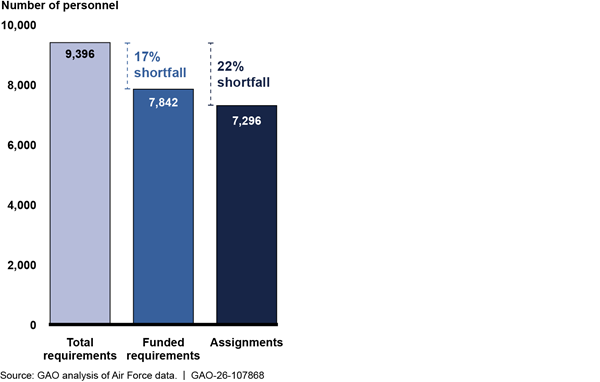
Notes: Total personnel requirements are the number of personnel the Air Force has identified as necessary to support the Space Force. Funded requirements, or positions, are the personnel needs for which budget funding is available and approved. Assignments are the total number of positions with assigned personnel to fill them.
One senior field command official told us that the Air Force personnel shortfalls present increased risk to Space Force missions. Officials from one Space Base Delta noted that the low level of funded civil engineering positions is leading to a higher risk of mission failure, and that the Space Force is taking risk against wartime readiness requirements and Joint Force needs. In addition, officials from the Medical Group within the delta told us that their unit is supporting 16 percent more people without additional funded personnel requirements for medical providers, making it challenging to provide timely medical services to Guardians and their families.
Further, officials from one Space Launch Delta stated that with the shortfalls, supporting increased space launch operations is becoming more challenging and unsustainable. According to squadron leaders, the delta closed one of the six fire stations on base due to the personnel shortfalls. They added that as a result, the squadron cannot meet National Fire Protection Association safety standards. Moreover, the officials said providing enough fire crew support for launches leaves the remainder of the base vulnerable in case of an emergency.[66]
Air Force Materiel Command officials told us that constrained Air Force personnel availability and competing Air Force operational priorities may limit the assignment of additional military personnel to support the Space Force.[67] Further, these officials said that the Air Force also faces hiring limitations and recruitment and retention challenges for in-demand civilian career fields, such as for civil engineers and security forces.
However, officials from one Space Launch Delta told us that existing Air Force personnel support requirements do not always reflect increased Space Force mission requirements.[68] For example, Air Force Materiel Command officials stated that current models do not sufficiently capture space launch operations and support. AFMAA completed assessments of security-related space launch support for the 45th Security Forces Squadron and 30th Space Security Forces Squadron in September 2025, but did not assess the 22 other squadrons that support the two space launch deltas. These studies provide a range of projected personnel requirements for security-related space launch support based on available policy options.
Air Force and Space Force Have Not Comprehensively Evaluated Support Arrangement
The Air Force and Space Force have taken some actions to address identified challenges with the current support arrangement, as discussed below. However, the services have not comprehensively evaluated the current support arrangement between them to assess its effectiveness considering identified challenges.
To begin to address challenges, the Air Force Materiel Command established a Servicing Major Command Review and Assessment Team in March 2023 as a mechanism to analyze and continuously improve the support provided by the Air Force to the Space Force. This working group includes representatives from Air Force headquarters, Space Force headquarters, the Air Force Materiel Command, and Space Launch Deltas, according to Air Force Materiel Command officials.
The working group has conducted some evaluations of the current arrangement. For example, the working group analyzed the funding levels for base operating support across the Department of the Air Force and found that the total rate of funded Air Force personnel requirements for the Space Force is about 7 percent lower than the average for the Air Force’s major commands. Air Force officials told us that this could be a legacy persisting from the lower level of base operating support funding for the Air Force Space Command, which was the source of most of the Space Force’s original personnel and units.
Air Force Materiel Command officials said they have requested additional funding and personnel to bring the Space Force’s base operating support to the average Air Force levels, but these efforts have been unsuccessful. According to Space Force officials, the Space Force has limited involvement in Department of the Air Force decision-making processes to raise these issues. Further, both Space Force and Air Force Materiel Command officials said that the separate funding structures for the two services make it challenging to receive additional Space Force base operating support resources.
Space Force and Air Force officials described some options for revising the current arrangement to address identified personnel shortfalls and challenges.
· Air Force Materiel Command officials told us that the Air Force can recategorize base operating support for certain missions as critical and increase personnel support to higher levels. According to Space Force and Air Force Materiel Command officials, this reclassification could be applied to some high-risk Space Force missions to prioritize allocations of base operating support resources.
· Air Force Materiel Command and Space Force officials said that military members in non-military essential support positions could be replaced with civilian or contractor personnel. Further, these officials said that the Space Force and Air Force are considering reassessing the optimal mix of personnel for base operating and other support functions.
· The Space Force could create additional military career fields within the service, such as security forces and civil engineering, increasing the role of the Space Force in managing its own base operating support personnel resources, according to Air Force Materiel Command officials. However, the Space Force could not fully conduct its own base operating support functions without significantly growing the size of the force, according to a Space Force official.
An October 2020 Secretary of the Air Force memorandum states that the Department of the Air Force analyzed several base operating support options at space installations and determined that the current arrangement is the most effective and efficient option currently available. The memorandum also states that the Department of the Air Force will continue planning and analysis to determine whether the current solution is best suited for long-term support and if other adjustments make sense.[69] In addition, Standards for Internal Control in the Federal Government states that agencies should monitor and evaluate activities on an ongoing basis, with particular attention warranted when changes occur at the entity or in its environment.[70]
Although the working group has conducted some analyses to improve Air Force base operating and other support to the Space Force, the Department of Air Force has not comprehensively reevaluated the effectiveness of the current arrangement. Rather than fully evaluate and review the agreement to address identified challenges, in October 2024, the Air Force and Space Force re-signed the May 2021 memorandum for Air Force provision of base operating and other support functions to the Space Force without any major revisions.[71]
Both Space Force and Air Force Materiel Command officials told us the current support arrangement between the services lacks specificity and should be evaluated and revised. An evaluation is especially critical as the Space Force’s system capabilities, mission requirements, and contributions to the Joint Force continue to expand in the increasingly contested space domain, according to a senior field command official.
Without comprehensively evaluating and revising the current arrangement of Air Force-provided support as necessary, the Department of the Air Force risks that the Space Force’s base operating and other support needs may continue to be inadequately met. A comprehensive evaluation would better allow the Department of the Air Force to make informed changes that address identified challenges. In addition, the department could more effectively balance competing Air Force and Space Force priorities to manage risk to increased space operations.
Conclusions
The Space Force states that it must remain adaptable and intent on assessing and evolving alongside the space domain. However, it continues to rely on Air Force processes and guidance that may not suit its need to effectively manage an agile and lean service with rapidly growing and changing missions. The Space Force does not have a service-specific process or guidance to accurately measure workload and determine its personnel needs or calculate how many contractors are supporting the service. Without this, the Space Force may lack a complete understanding of its personnel needs to inform programming, budgeting, and resourcing decisions.
In addition, ongoing personnel shortfalls and workforce challenges identified by the Space Force may limit its ability to meet current and future mission requirements. The workforce challenges facing the Space Force are multifaceted. They include shortages in military personnel with certain skillsets, personnel policies limiting civilian hiring, and new systems and capabilities requirements that will need more qualified personnel to test and operate them. While the Space Force officials have taken some actions, they would benefit from a comprehensive strategic plan to align efforts across the service and fully address challenges. This planning will be especially important if the Space Force intends to double its number of military personnel over the next decade.
The Space Force has also identified challenges with the level of personnel support from the Air Force for base operating and other functions under the current arrangement. These include Air Force support personnel shortfalls; outdated personnel requirement determinations; hiring limitations; and recruitment and retention challenges. Without comprehensively evaluating the effectiveness of the current arrangement and revising the agreement as necessary, the Department of the Air Force risks that the Space Force’s base operating and other support needs may continue to be inadequately met, especially as the Space Force mission requirements continue to grow.
Recommendations for Executive Action
We are making the following four recommendations to the Department of the Air Force:
The Secretary of the Air Force should ensure that the Chief of Space Operations develops service-specific guidance that establishes a process to accurately determine personnel requirements. (Recommendation 1)
The Secretary of the Air Force should ensure that the Chief of Space Operations develops a standard process to accurately and consistently track the number of contractor personnel supporting the service, documents this process in guidance, and implements this process across the service. (Recommendation 2)
The Secretary of the Air Force should ensure that the Chief of Space Operations develops a comprehensive, strategic workforce plan that incorporates key principles, including determining the critical skills and competencies needed to achieve long-term goals and developing strategies that are tailored to address critical competency gaps, as part of the Space Force’s long-term force design efforts. (Recommendation 3)
The Secretary of the Air Force should ensure that the Chief of Staff of the Air Force and Chief of Space Operations comprehensively evaluate the effectiveness of the current arrangement for Air Force-provided base operating and other support functions for the Space Force and make any necessary revisions to the Air Force-Space Force Memorandum of Understanding resulting from the evaluation. (Recommendation 4)
Agency Comments and Our Evaluation
We provided a draft of this report to DOD for review and comment. In written comments (reproduced in appendix IV), DOD concurred with our recommendations and described planned actions to address them. DOD also provided technical comments, which we incorporated as appropriate.
We are sending copies of this report to the appropriate congressional committees, the Secretary of Defense, the Secretary of the Air Force, and the Chief of Space Operations. If you or your staff have any questions about this report, please contact me at CzyzA@gao.gov. Contact points for our Offices of Congressional Relations and Media Relations may be found on the last page of this report. GAO staff who made key contributions to this report are listed in appendix V.
Alissa H. Czyz
Director, Defense Capabilities and Management
List of Committees
The Honorable Roger F. Wicker
Chairman
The Honorable Jack Reed
Ranking Member
Committee on Armed Services
United States Senate
The Honorable Mitch McConnell
Chair
The Honorable Christopher Coons
Ranking Member
Subcommittee on Defense
Committee on Appropriations
United States Senate
The Honorable Mike Rogers
Chairman
The Honorable Adam Smith
Ranking Member
Committee on Armed Services
House of Representatives
The Honorable Ken Calvert
Chairman
The Honorable Betty McCollum
Ranking Member
Subcommittee on Defense
Committee on Appropriations
House of Representatives
This report examines (1) how the size and composition of the Space Force has changed since the service’s inception; (2) the extent to which the Space Force has determined the personnel needed to accomplish its missions; (3) the extent to which the Space Force has identified and addressed challenges in meeting personnel needs; and (4) the extent to which the Air Force has provided adequate personnel to support the Space Force.
For objective 1, we analyzed data on the total number of officer, enlisted, and civilian personnel for fiscal years 2020 through 2025. In addition, we analyzed data on the total number of interservice transfers to the Space Force for fiscal years 2021 through 2025. However, in the report, we present these data from fiscal years 2021 through 2025, as the Space Force had very few personnel until fiscal year 2021. We assessed the reliability of the data by checking for inconsistencies and errors, comparing it against publicly available information, and interviewing Space Force officials about the data and any identified discrepancies. We determined the data were sufficiently reliable to present an overview of the Space Force workforce over this time period.
For objective 2, we reviewed relevant guidance, including Department of Defense (DOD) Instruction 1100.22, Department of the Air Force Instruction 38-101, and Air Force Manual 38-201.[72] Secondly, we reviewed the five personnel requirement determination studies completed by the Air Force Manpower Analysis Agency (AFMAA) for the Space Force. Next, we compared the Space Force efforts to determine personnel requirements and optimal workforce mix against (1) DOD Directive 1100.4, and (2) Standards for Internal Control in the Federal Government.[73] We determined that the internal control component of information and communication was significant to this portion of our second objective, along with the underlying principles that management should use quality information to achieve the entity’s objectives and that management should obtain relevant data from reliable internal sources in a timely manner based on identified information requirements.[74]
We further analyzed the number of Space Force contractor full-time equivalents for fiscal year 2021 through fiscal year 2025. We determined that the data were sufficiently reliable to present the general magnitude of the number of contractors supporting the service but discuss limitations in the report. We also reviewed DOD and Department of the Air Force guidance regarding contractor support, including DOD Instruction 1100.22, DOD Directive 1100.4, and Department of the Air Force Instruction 38-101.[75] We compared the Space Force’s efforts to track contractor support against this guidance and Standards for Internal Control in the Federal Government. We determined that the internal control component of information and communication was significant to this portion of our second objective as well, along with the underlying principle that management should use quality information to achieve the entity’s objectives.[76]
For objective 3, we analyzed the number of personnel requirements, funded personnel requirements, and assignments for Space Force headquarters, field commands, and other components, for fiscal year 2025. The Space Force provided the data on personnel requirements and authorizations through the Manpower Programming Execution System and the data on personnel assignments through the Military Personnel Data System and Defense Civilian Personnel Data System. We assessed the reliability of these data by comparing personnel numbers across the compiled data for consistency, reviewing documentation on each of the three data systems, and interviewing Space Force officials on the data systems and any identified discrepancies. We determined that the data were sufficiently reliable to present total personnel numbers for this time period. Lastly, we compared the Space Force’s workforce planning efforts against GAO’s Key Principles for Effective Strategic Workforce Planning.[77] We determined that the five key principles for effective strategic workforce planning were relevant to this objective.
The five key principles are (1) involve top management, employees, and other stakeholders in developing, communicating, and implementing the strategic workforce plan; (2) determine the critical skills and competencies that will be needed to achieve current and future programmatic results; (3) develop strategies that are tailored to address gaps in number, deployment, and alignment of human capital approaches for enabling and sustaining the contributions of all critical skills and competencies; (4) build the capability needed to address administrative, educational, and other requirements important to support workforce planning strategies; and (5) monitor and evaluate the agency’s progress toward its human capital goals and the contribution that human capital results have made toward achieving programmatic results.
For objective 4, we examined the extent to which the Air Force has provided adequate personnel to support the Space Force. First, we reviewed relevant documentation on the current arrangement for Air Force-provided personnel support to the Space Force, including the October 2020 memorandum from the Secretary of the Air Force, May 2021 Memorandum of Understanding, and the October 2024 re-signed Memorandum of Understanding.[78] Secondly, we analyzed the number of Air Force personnel requirements, funded personnel requirements, and assignments to support the Space Force for fiscal year 2025. The Air Force Materiel Command officials provided these data from the Manpower Programming Execution System, Military Personnel Data System, and Defense Civilian Personnel Data System. We assessed the reliability of these data by reviewing documentation on the data systems, and we obtained clarification from Air Force Materiel Command and Space Force officials on any discrepancies. We determined the data were sufficiently reliable for the purpose of presenting Air Force personnel numbers over this time period.
In addition, we assessed the Department of the Air Force’s efforts to evaluate the effectiveness of the current arrangement of Air Force-provided support against (1) the October 2020 memorandum from the Secretary of the Air Force and (2) Standards for Internal Control in the Federal Government.[79] We determined that the internal control component of monitoring was significant to our fourth objective, along with the underlying principle that management should establish and operate monitoring activities and evaluate the results, with particular attention warranted when there are changes at the entity or in its environment.
To address all our objectives, we interviewed human capital and other officials from Air Force headquarters, Space Force headquarters, and the headquarters of each of the three Space Force field commands. Based on these interviews, we then selected a nongeneralizable sample of offices, deltas, and squadrons from each of the three Space Force field commands, including service component field commands and direct reporting units, with whom to conduct semi-structured interviews. We selected offices, deltas, squadrons, and components to interview based on two criteria to support our second and third objectives: (1) units with evolving or expanding mission requirements, including those that recently underwent personnel requirement determination assessments due to workload or mission changes, and (2) units with identified personnel shortfalls, gaps, or deficiencies as well as units not facing significant personnel challenges, that have successfully mitigated those challenges, or that have implemented best practices for personnel management. In addition, we met with officials from two Air Force organizations, AFMAA and Air Force Materiel Command, to support our second and fourth objectives.
We interviewed or received written responses from the following units both virtually and during site visits at (1) Buckley Space Force Base in Colorado, (2) Los Angeles Air Force Base in California, (3) Peterson Space Force Base in Colorado, (4) Schriever Space Force Base in Colorado, and (5) Vandenberg Space Force Base in California:
· U.S. Space Force – Combat Forces Command
· Headquarters Directorate – Human Capital, Mission Sustainment, and Resource Management and Special Access Programs
· Headquarters Directorate – Operations, Plans, Training and Force Development
· Mission Delta 4 Command
· 5 Space Warning Squadron
· 64 Cyberspace Squadron
· Mission Delta 6 Command
· 66 Cyberspace Squadron
· Mission Delta 8 Command
· 4 Space Operations Squadron
· 53 Space Operations Squadron
· Space Base Delta 1 Command
· 21 Civil Engineering Squadron
· 21 Medical Group
· Cheyenne Mountain Space Force Station
· U.S. Space Force – Space Systems Command
· Headquarters Directorate – Intelligence
· Headquarters Directorate – Strategy, Plans, and Programs
· Commercial Space Office
· Directorate of Contracting
· Program Executive Office for Operational Test and Training Infrastructure
· Space Launch Delta 30 Command
· 30 Civil Engineering Squadron
· 30 Security Forces Squadron
· 30 Force Support Squadron
· Space Base Delta 3 Command
· U.S. Space Force – Space Training and Readiness Command
· Headquarters Directorate – Human Capital
· Delta 1 Command
· 533 Training Squadron
· 319 Combat Training Squadron
· Delta 11 Command
· 25 Space Range Squadron
· 527 Space Aggressor Squadron
· 392 Combat Training Squadron
· 33 Range Squadron
· 57 Space Aggressor Squadron
· Delta 12 Command
· 1 Test and Evaluation Squadron
· 3 Test and Evaluation Squadron
· 4 Test and Evaluation Squadron
· 17 Test and Evaluation Squadron
· U.S. Space Forces – Space
· U.S. Space Forces – Central
· Space Rapid Capabilities Office
· Space Development Agency
We conducted this performance audit from October 2024 to July 2026 in accordance with generally accepted government auditing standards. Those standards require that we plan and perform the audit to obtain sufficient, appropriate evidence to provide a reasonable basis for our findings and conclusions based on our audit objectives. We believe that the evidence obtained provides a reasonable basis for our findings and conclusions based on our audit objectives.
As shown in table 3, the largest categories of funded Air Force personnel requirements for the Space Force are civil engineers, security forces, and professional personnel (including Judge Advocates, Chaplains, and medical and dental providers).
Table 3: Total Number of Funded Air Force Personnel Requirements to Support the Space Force for Fiscal Year 2025
|
Function |
Civilian |
Enlisted |
Officer |
Total |
|
Acquisition |
7 |
0 |
35 |
42 |
|
Cyber/IT |
35 |
42 |
2 |
79 |
|
Intelligence |
0 |
6 |
8 |
14 |
|
Maintenance |
12 |
153 |
3 |
168 |
|
Operations |
28 |
189 |
55 |
272 |
|
Administrative |
98 |
159 |
19 |
276 |
|
Professionala |
38 |
682 |
311 |
1031 |
|
STEM |
13 |
2 |
98 |
113 |
|
Support total |
2596 |
2957 |
293 |
5846 |
|
Civil Engineering |
1019 |
679 |
51 |
1749 |
|
Contracting |
215 |
80 |
87 |
382 |
|
Finance |
127 |
111 |
67 |
305 |
|
Logistics/Readiness |
319 |
196 |
12 |
527 |
|
Personnel |
364 |
244 |
31 |
639 |
|
Security Forces |
338 |
1502 |
22 |
1862 |
|
Other Support |
214 |
145 |
23 |
382 |
|
Total |
2827 |
4190 |
824 |
7841 |
Source: GAO analysis of Air Force data. | GAO‑26‑107868
Note: Air Force officials compiled these data from the Manpower Programming and Execution System. Officials noted that the number of funded civilian personnel will decrease by 241 in fiscal year 2026 due to the Department of Defense civilian workforce reduction efforts.
aProfessional includes Chaplains, Judge Advocates, and medical and dental providers.
SPAFORGEN establishes a cycle of three phases—Prepare, Ready, and Commit—to ensure that its operational space units have the capacity and time to conduct readiness-building activities that cannot be accomplished while supporting a combatant command’s ongoing operational needs.[80] Although most Space Force units operate in place continuously from their home station, SPAFORGEN establishes a deployment cycle that includes time for rebuilding readiness (see fig. 9).
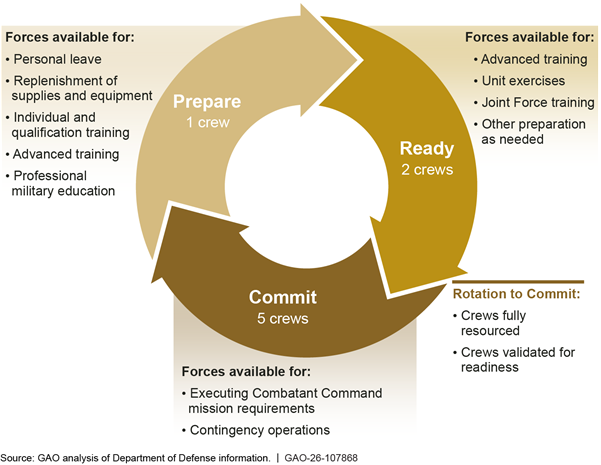
GAO Contact
Alissa H. Czyz, CzyzA@gao.gov
Staff Acknowledgments
In addition to the contact named above, Nicolaas Cornelisse (Assistant Director), Steven Banovac (Analyst in Charge), Bethany Cole, Michele Fejfar, Amie Lesser, Michael Shaughnessy, Carter Stevens, and Anne Thomas made key contributions to this report.
The Government Accountability Office, the audit, evaluation, and investigative arm of Congress, exists to support Congress in meeting its constitutional responsibilities and to help improve the performance and accountability of the federal government for the American people. GAO examines the use of public funds; evaluates federal programs and policies; and provides analyses, recommendations, and other assistance to help Congress make informed oversight, policy, and funding decisions. GAO’s commitment to good government is reflected in its core values of accountability, integrity, and reliability.
Obtaining Copies of GAO Reports and Testimony
The fastest and easiest way to obtain copies of GAO documents at no cost is through our website. Each weekday afternoon, GAO posts on its website newly released reports, testimony, and correspondence. You can also subscribe to GAO’s email updates to receive notification of newly posted products.
Order by Phone
The price of each GAO publication reflects GAO’s actual cost of production and distribution and depends on the number of pages in the publication and whether the publication is printed in color or black and white. Pricing and ordering information is posted on GAO’s website, https://www.gao.gov/ordering.htm.
Place orders by calling (202) 512-6000, toll free (866) 801-7077,
or
TDD (202) 512-2537.
Orders may be paid for using American Express, Discover Card, MasterCard, Visa, check, or money order. Call for additional information.
Connect with GAO
Connect with GAO on X,
LinkedIn, Instagram, and YouTube.
Subscribe to our Email Updates. Listen to our Podcasts.
Visit GAO on the web at https://www.gao.gov.
To Report Fraud, Waste, and Abuse in Federal Programs
Contact FraudNet:
Website: https://www.gao.gov/about/what-gao-does/fraudnet
Automated answering system: (800) 424-5454
Media Relations
Sarah Kaczmarek, Managing Director, Media@gao.gov
Congressional Relations
David A. Powner, Acting Managing Director, CongRel@gao.gov
General Inquiries
[1]Pub. L. No.116-92, § 952 (2019) (codified, as amended, at 10 U.S.C. § 9081). Specifically, the act established the U.S. Space Force as a separate military service within the Department of the Air Force.
[2]“History,” U.S. Space Force, accessed April 10, 2026, https://www.spaceforce.mil/about-us/about-space-force/history/.
[3]In November 2025, the Space Force released Space Force Vector 2025, an outline of the direction that the service seeks to maintain as it matures. It was designed to provide Guardians with a reference that connects key guidance, initiatives, and concepts shaping the service. U.S. Space Force, Space Force Vector 2025 (November 2025).
[4]The Space Force’s three core functions are (1) space control, (2) global mission operations, and (3) space access. Space control comprises the activities required to contest and control the space domain, so that U.S. forces can operate in space without prohibitive interference from threats, while also denying the same to an adversary. Global mission operations include activities to deliver space capabilities and systems in support of joint military operations. Space access operations include activities to ensure the movement and sustainment of equipment in, from, and to the space domain. See Space Force Doctrine Document 1, The Space Force (Apr. 3, 2025).
[5]S. Rep. No. 118-188, at 312 (2024).
[6]E.g., Department of Defense (DOD) Directive 1100.4, Guidance for Manpower Management (Feb. 12, 2005) and GAO, Standards for Internal Control in the Federal Government, GAO‑25‑107721 (Washington, D.C.: May 2025).
[7]GAO, Human Capital: Key Principles for Effective Strategic Workforce Planning, GAO‑04‑39 (Washington, D.C.: Dec. 11, 2003).
[8]Chief of Space Operations and Chief of Staff of the Air Force Memorandum, Memorandum of Understanding Between the United States Air Force and United States Space Force for Air Force Support to Space Force Installations and Missions (May 10, 2021) (as amended and re-signed Oct. 19, 2024); Secretary of the Air Force Memorandum, U.S. Space Force Base Operations Support (BOS) (Oct. 26, 2020).
[9]Secretary of the Air Force Memorandum, U.S. Space Force Base Operations Support (BOS) (Oct. 26, 2020) and GAO‑25‑107721.
[10]See 10 U.S.C. § 9082.
[11]The Space Staff leadership includes Deputy Chiefs of Space Operations for (1) Personnel; (2) Intelligence; (3) Operations; (4) Strategy, Plans, Programs and Requirements; and (5) Cyber and Data.
[12]In November 2025, the Space Force redesignated Space Operations Command as Combat Forces Command.
[13]In addition, the Space Force is currently developing System Deltas within Space Systems Command to perform acquisition functions. The Space Force also has six bases with several stations within and outside the continental U.S. The six bases are (1) Buckley Space Force Base in Colorado, (2) Los Angeles Air Force Base in California, (3) Patrick Space Force Base in Florida, (4) Peterson Space Force Base in Colorado, (5) Schriever Space Force Base in Colorado, and (6) Vandenberg Space Force Base in California.
[14]DOD has 11 unified combatant commands, which are military commands composed of forces from two or more military departments responsible for broad, continuing missions. See 10 U.S.C. § 161. These include seven combatant commands that have geographic areas of responsibility around the world and four combatant commands with military functional responsibilities that operate across geographic boundaries.
[15]Space Force Doctrine Document 1.
[16]Secretary of the Air Force Memorandum, Key Principles for U.S. Space Force (USSF) Garrison Support (June 29, 2020).
[17]Chief of Space Operations and Chief of Staff of the Air Force Memorandum, Memorandum of Understanding Between the United States Air Force and United States Space Force for Air Force Support to Space Force Installations and Missions (May 10, 2021). The memorandum was amended and re-signed in October 2024.
[18]See appendix II for more information on funded Air Force personnel requirements to support the Space Force.
[19]U.S. Space Force, Chief of Space Operations Guidance and Intent: Officer, Enlisted, and Civilian Guardians’ Narrative and Principles (Jan. 17, 2024).
[20]Joint Chiefs of Staff, Joint Pub. 1-0, Joint Personnel Support (Dec. 1, 2020).
[21]DOD-wide guidance includes DOD Directive 1100.4, Guidance for Manpower Management (Feb. 12, 2005).
[22]Department of the Air Force Instruction 38-101, Manpower and Organization (Aug. 29, 2019) (incorporating change 1, effective Sept. 26, 2025) and Air Force Manual 38-102, Manpower and Organization Standard Work Processes and Procedures (July 5, 2024). Air Force Manual 38-102 states that it does not apply to the Space Force, but Space Force officials said they use it to determine personnel requirements.
[23]Department of the Air Force Instruction 38-101.
[24]The Manpower Programming and Execution System is an online management information system designed to collect and document the execution of programmed end strength. This is the system of record for funded and unfunded personnel requirements and it produces the Unit Manpower Document. See Department of the Air Force Instruction 38-101.
[25]For comparison, the next-largest service, the Marine Corps, had about 200,000 active duty and reserve military personnel as well as about 30,000 civilian personnel in fiscal year 2024, the latest fiscal year for which data were available from the following source. See Department of Defense, Office of the Deputy Assistant Secretary of Defense for Military Community and Family Policy, 2024 Demographics: Profile of the Military Community (n.d.).
[26]Secretary of the Air Force Memorandum, Redesignation of Air Force Space Command to United States Space Force (Dec. 20, 2019).
[27]See National Defense Authorization Act for Fiscal Year 2024, Pub. L. No. 118-31, div. A, title XVII (2023) (codified, as amended, at 10 U.S.C. §§ 20001-20605). Specifically, section 1733 of the PMA authorized the Secretary of Defense during a transition period to transfer a qualifying officer of an Air Force reserve component, with that officer’s consent, and appoint them as an officer in the Space Force. Additionally, the section authorized the Secretary of the Air Force during the transition period to transfer a qualifying and consenting enlisted member of an Air Force reserve component to the Space Force. Pub. L. No. 118-31, div. A, title XVII, § 1733 (2023) (included as a note, as amended, at 10 U.S.C. § 20001).
[28]See Pub. L. No. 118-159, § 514 (2024) (included as a note at 10 U.S.C. § 20001). Under the provision, if a member of one of the specified Air National Guard units does not consent to the transfer to the Space Force, the Secretary of the Air Force will provide that member with retraining and reassignment to an Air Force reserve component.
[29]Secretary of the Air Force Memorandum, Transfer of Covered Space Functions and Missions of the Air National Guard (ANG) to the United States Space Force (USSF) (July 30, 2025).
[30]2024 Demographics: Profile of the Military Community (n.d.).
[31]U.S. Space Force, Classification and Growth of United States Space Force Careers (October 2024).
[32]AFMAA also assessed two security squadrons staffed by Air Force support personnel in September 2025, which we discuss later in this report.
[33]There are 84 squadrons in the Space Force as of February 2026, according to Space Force officials.
[34]For more information on SPAFORGEN, see appendix III. GAO, Space Operations: Improved Planning and Better Information Will Help DOD Address Readiness Challenges, GAO‑24‑106457C (Washington, D.C.: May 10, 2024).
[35]DOD Directive 1100.4.
[37]Space Force Vector 2025.
[38]For the purposes of this report, contractors supporting the Space Force refers to contractor personnel under service contracts, which involve paying a contractor to perform tasks like administrative and technical support. We have previously reported on DOD efforts and challenges with managing service contracts. See GAO, DOD Service Contracts: Actions Needed to Identify Efficiencies and Forecast Budget Needs, GAO‑23‑106123 (Washington, D.C.: Sept. 7, 2023).
[39]An FTE is a standard measure of labor that equates to 1 year of full-time work. FTEs are calculated by dividing the number of regular hours employees worked, not including overtime or holiday hours, by the total working hours for each fiscal year.
[40]We previously reported that the Space Force had not fully analyzed or reported the number of contractor personnel required to implement SPAFORGEN. GAO, Space Operations: Improved Planning and Better Information Will Help DOD Address Readiness Challenges, GAO‑24‑106457C (Washington, D.C.: May 10, 2024).
[41]Department of the Air Force Instruction 38-101.
[42]Specifically, annual appropriations acts since 2009 have prohibited DOD from using funding appropriated or otherwise made available by these acts, or any other acts, to begin or announce a study or public-private competition regarding the conversion to contractor performance of any function performed by federal employees pursuant to Office of Management and Budget Circular A-76 or any other administrative regulation, directive, or policy. See, e.g., Consolidated Appropriations Act, 2026, Pub. L. No. 119-75, div. E, § 741 (2026); Office of Management and Budget Circular No. A-76, Performance of Commercial Activities (May 29, 2003).
[43]Department of the Air Force Instruction 38-101.
[44]Department of Defense (DOD) Instruction 1100.22, Policy and Procedures for Determining Workforce Mix (Apr. 12, 2010) (incorporating change 1, effective Dec. 1, 2017). Specifically, according to the instruction, functions that are inherently governmental cannot be legally contracted, and will be designated for DOD civilian or military performance consistent with DOD criteria. Functions that are not inherently governmental are commercial in nature. However, commercial activities that are exempted from private sector performance by law, executive order, treaty, or international agreement shall be designated for DOD civilian or military performance. Additionally, commercial activities will be exempted from private sector performance and designated for DOD civilian or military performance, as necessary, to provide for the readiness and workforce management needs of DOD.
[45]DOD Directive 1100.4.
[47]Space Force officials said that part of this shortfall—about 250 positions—can be attributed to the ongoing relocation of STARCOM headquarters from Colorado Springs in Colorado to Patrick Space Force Base in Florida.
[48]We reported on DOD’s cyberspace operations workforce in GAO, DOD Cyberspace Operations: About 500 Organizations Have Roles, with Some Potential Overlap, GAO‑25‑107121 (Washington, D.C.: Sept. 17, 2025).
[49]The Space Force reached its fiscal year 2025 recruiting goal and has met its goals every year since inception. The Space Force’s fiscal year 2025 goal was to recruit 1,103 officer and enlisted Guardians.
[50]A hiring freeze is a temporary suspension of the recruiting and hiring of new employees in some or all parts of the executive branch for a set period of time. A hiring freeze may include exemptions for federal employees working in certain areas such as national security or public safety. On January 20, 2025, the president ordered a freeze on the hiring of federal civilian employees, to be applied throughout the executive branch. It prohibited positions from being filled after noon on January 20, 2025. It provided for exceptions for military personnel, as well as for positions related to immigration enforcement, national security, and public safety. Presidential Memorandum, Hiring Freeze (Jan. 20, 2025). A February 28, 2025, memorandum from the Secretary of Defense directed that no vacant DOD civilian position may be filled, and no new civilian positions may be created, unless approved by the Secretary. Secretary of Defense Memorandum, Immediate Civilian Hiring Freeze for Alignment with National Defense Priorities (Feb. 28, 2025). According to DOD officials, the hiring freeze was still in effect as of February 2026.
[51]Specifically, a March 14, 2025, memorandum from the Secretary of Defense stated that DOD would only hire mission-essential employees into positions that directly contribute to DOD’s warfighting readiness. It established a process whereby the secretaries of the military departments may approve hiring freeze exemptions for their respective civilian workforces after review by the Under Secretary of Defense for Personnel and Readiness. See Secretary of Defense Memorandum, Guidance Regarding the Department of Defense Civilian Hiring Freeze (Mar. 14, 2025). Subsequent departmental guidance further clarified the process and established categories of positions that were exempt from the hiring freeze. See Under Secretary of Defense for Personnel and Readiness Memorandum, Guidance on Hiring Freeze Exemptions for the Civilian Workforce (Mar. 18, 2025).
[52]On January 20, 2025, the president issued a memorandum directing the heads of all departments and agencies in the executive branch to, as soon as practicable, take all necessary steps to terminate remote work arrangements and require employees to return to work in-person at their duty stations on a full-time basis, provided that the department and agency heads make exemptions they deem necessary. Presidential Memorandum, Return to In-Person Work (Jan. 20, 2025). DOD subsequently issued guidance for implementing this order. See Secretary of Defense Memorandum, Initial Department of Defense Implementation Guidance, Return to In-Person Work (Jan. 31, 2025). We reported on DOD’s use of telework and recommended that DOD evaluate the effects on its policies in GAO, Civilian Telework and Remote Work: DOD Should Evaluate Programs in Relation to Department Goals, GAO‑26‑107601 (Washington, D.C: Jan. 8, 2026).
[53]See Director of the Office of Personnel Management Memorandum, Guidance Regarding Deferred Resignation Program (Jan. 28, 2025); Office of Personnel Management email, Fork in the Road (Jan. 28, 2025). Specifically, employees electing to resign would have their duties re-assigned or eliminated by their agency and would be placed on paid administrative leave until September 30, with some exceptions.
[54]See Secretary of Defense Memorandum, Initiating the Workforce Acceleration & Recapitalization Initiative (Mar. 28, 2025); Under Secretary of Defense for Personnel and Readiness Memorandum, Guidance on Department of Defense Deferred Resignation Program (Apr. 1, 2025). The Voluntary Early Retirement Authority allows an agency to downsize or restructure by giving certain eligible federal employees the option to retire early and begin receiving some benefits early. Unlike the government-wide Deferred Resignation Program, employees retiring under the DOD Deferred Resignation Program were not permitted to extend their departure date to December 31, 2025. Employees could elect retirement pursuant to Voluntary Early Retirement Authority without participating in the DOD Deferred Resignation Program.
[55]These resignations and retirements include 557 Space Force civilian personnel and 241 Air Force civilian personnel who were supporting the Space Force.
[56]Testimony on the Posture of the Department of the Air Force in Review of the Defense Authorization Request for Fiscal Year 2026 and the Future Years Defense Program, Before the S. Comm. on Armed Services, 119th Cong. 98-99 (2025) (statement of Chief of Space Operations Gen. B. Chance Saltzman).
[57]According to DOD, the DOD Civilian Acquisition Workforce Personnel Demonstration Project (AcqDemo) is a congressionally mandated project designed to show that the DOD acquisition workforce can be improved by providing employees with a flexible, responsive personnel system that rewards employee contribution and provides line managers with greater personnel flexibilities.
[58]GAO, Space Operations: Improved Planning and Better Information Will Help DOD Address Readiness Challenges, GAO‑24‑106457C (Washington, D.C.: May 10, 2024).
[59]Pub. L. No. 119-60, § 1601 (2025).
[60]Space Force Vector 2025.
[61]U.S. Space Force, Objective Force 2040 (Apr. 15, 2026).
[64]GAO, FDA Workforce: Agency-Wide Workforce Planning Needed to Ensure Medical Product Staff Meet Current and Future Needs, GAO‑22‑104791 (Washington, D.C.: Jan. 14, 2022).
[65]The Space Base Deltas include (1) Space Base Delta 1 at Peterson Space Force Base, (2) Space Base Delta 2 at Buckley Space Force Base, and (3) Space Base Delta 3 at Los Angeles Air Force Base. On June 18, 2025, the Space Force established Space Base Delta 41 at Schriever Space Force Base (previously under Space Base Delta 1).
[66]We have previously identified long-standing staffing issues within the DOD civilian firefighter workforce and recommended that DOD implement a strategy to mitigate firefighter staffing gaps and monitor efforts to set annual staffing targets and close gaps, and the military services develop strategic human capital plans that include all required elements. DOD has not implemented the six recommendations we made in this report. See GAO, Federal Civilian Firefighters: DOD Should Take Action to Address Long-Standing Staffing Gaps, GAO‑25‑107288 (Washington D.C.: Apr. 30, 2025).
[67]We previously reported that the Air Force did not know the number of personnel needed to continue operating its U.S. bases when units deploy. We recommended that it complete a service-wide assessment of Air Force base minimum staffing needs. The Department of the Air Force has implemented one of the four recommendations we made in this report. See GAO, Air Force Readiness: Actions Needed to Improve New Process for Preparing Units to Deploy, GAO‑25‑107017 (Washington, D.C: Nov. 26, 2024).
[68]The total number of space launches has rapidly increased from 16 in 2017 to 144 in 2024, with the Space Force anticipating conducting 182 launches in fiscal year 2025, according to the Congressional Research Service. Prior to the establishment of the Space Force, the Air Force Space Command supported space launches. Space Systems Command conducts space launches at two locations, Patrick Space Force Base in Florida and Vandenberg Space Force Base in California. See Congressional Research Service, Defense Primer: National Security Space Launch Program (Washington D.C.: Apr. 28, 2025).
[69]Secretary of the Air Force Memorandum, U.S. Space Force Base Operations Support (BOS) (Oct. 26, 2020).
[71]Chief of Space Operations and Chief of Staff of the Air Force Memorandum, Memorandum of Understanding Between the United States Air Force and United States Space Force for Air Force Support to Space Force Installations and Missions (May 10, 2021) (as amended and re-signed on Oct. 19, 2024).
[72]Department of Defense (DOD) Instruction 1100.22, Policy and Procedures for Determining Workforce Mix (Apr. 12, 2010) (incorporating change 1, effective Dec. 1, 2017); Department of the Air Force Instruction 38-101, Manpower and Organization (Aug. 29, 2019) (incorporating change 1, effective Sept. 26, 2025); and Air Force Manual 38-102, Manpower and Organization Standard Work Processes and Procedures (July 5, 2024). Air Force Manual 38-102 states that it does not apply to the Space Force, but Space Force officials said they use it in lieu of service-specific guidance to assist with determining personnel requirements.
[73]Department of Defense (DOD) Directive 1100.4, Guidance for Manpower Management (Feb. 12, 2005) and GAO, Standards for Internal Control in the Federal Government, GAO‑25‑107721 (Washington, D.C.: May 2025).
[75] DOD Instruction 1100.22, DOD Directive 1100.4, and Department of the Air Force Instruction 38-101.
[77]GAO, Human Capital: Key Principles for Effective Strategic Workforce Planning, GAO‑04‑39 (Washington, D.C.: Dec. 11, 2003).
[78]Secretary of the Air Force Memorandum, U.S. Space Force Base Operations Support (BOS) (Oct. 26, 2020); Chief of Space Operations and Chief of Staff of the Air Force Memorandum, Memorandum of Understanding Between the United States Air Force and United States Space Force for Air Force Support to Space Force Installations and Missions (May 10, 2021) (as amended and re-signed on Oct. 19, 2024).
[79]Secretary of the Air Force Memorandum, U.S. Space Force Base Operations Support (BOS) (Oct. 26, 2020) and GAO‑25‑107721.
[80]We have previously reported on the Department of Defense’s readiness for space operations describing, among other things, the Space Force’s efforts to address current and future readiness challenges for contested space operations through its force generation model and through efforts to fully resource new systems. See GAO, Space Operations: Improved Planning and Better Information Will Help DOD Address Readiness Challenges, GAO‑24‑106457C (Washington, D.C.: May 10, 2024).