
Report to the Chairman, Committee on Commerce, Science, and Transportation, U.S. Senate
June 2026
United States Government Accountability Office
A Report to the Chairman, Committee on Commerce, Science, and Transportation, U.S. Senate
Contact: Andrew Von Ah at vonaha@gao.gov
What GAO Found
The electromagnetic spectrum is a critical resource for many uses including national defense and commercial wireless services. Since more than one user operating on the same frequency can disrupt transmissions, the Department of Defense (DOD) must coordinate its spectrum use. It does so with other federal agencies and nonfederal entities, such as private sector companies and other organizations. This coordination occurs through a National Telecommunications and Information Administration (NTIA) committee. In doing so, DOD generally follows leading collaboration practices. For instance, DOD policy and practices provide for defined roles, established processes, and regular communication, which are each leading collaboration practices. Agency officials and private-sector stakeholders said DOD secures the frequency assignments it needs while addressing potential interference and other concerns with other users.
DOD and NTIA conduct spectrum repurposing studies to determine if continuous portions of the spectrum—called bands—can be designated for different categories of use (e.g., radar, mobile phone networks, GPS, or users [i.e., federal or nonfederal users]). DOD and NTIA followed most collaboration leading practices in conducting two such studies recently but did not consistently provide transparency to stakeholders or establish documented processes for the studies. For a major 2023 study for sharing spectrum bands DOD currently uses for radar, DOD collaborated with federal and nonfederal stakeholders. However, DOD did not clearly communicate to nonfederal stakeholders whether and how their input would be evaluated or used in decision-making. According to some stakeholders, this lack of transparency led to uncertainty about the value of their participation in the study. For a separate 2024 spectrum-sharing report, DOD and NTIA did not develop documented plans or establish formal processes to guide their work. Improved NTIA and DOD transparency, documentation of policies, and clearer expectations for collaboration could help reduce uncertainty and build trust. Considering that spectrum sharing and repurposing collaborations can potentially last years, these changes would also support more informed decision-making by nonfederal stakeholders about whether to invest time and resources in participating. Without addressing these uncertainties, nonfederal stakeholders may decide not to participate in future DOD- and NTIA- led studies, even though their input is valuable in determining how to repurpose spectrum effectively.
Why GAO Did This Study
In recent years, private-sector demand for spectrum has increased, creating debate over whether some DOD frequency assignments could be repurposed for nonfederal use. DOD coordinates with NTIA, which manages federal agencies’ spectrum use, in the processes to obtain frequency assignments and study the feasibility of repurposing spectrum.
GAO was asked to review DOD’s use of spectrum and its collaboration with NTIA and other stakeholders. Among other objectives, this report evaluates (1) the extent to which DOD’s processes for obtaining frequency assignments follow leading practices for collaboration; and (2) the extent to which DOD’s and NTIA’s processes for developing spectrum repurposing studies follow leading collaboration and information-sharing practices, among other objectives.
GAO reviewed DOD and NTIA documentation and interviewed officials from DOD components, NTIA, and federal and nonfederal stakeholders. GAO also compared DOD and NTIA practices with leading collaboration and other leading management practices.
What GAO Recommends
GAO is recommending that DOD develop a policy explaining how DOD will evaluate input from stakeholders when collaborating on spectrum repurposing studies and that DOD and NTIA develop policy requiring documented approaches to guide such studies in the future. DOD agreed with its recommendations, and NTIA agreed with its recommendation.
|
Abbreviations |
|
|
|
|
|
5G |
fifth generation |
|
37 GHz study |
37 GHz Spectrum Sharing Report |
|
CIO |
Chief Information Officer |
|
DOD |
Department of Defense |
|
EMBRSS study |
Emerging Mid-Band Radar Spectrum Sharing |
|
FCC |
Federal Communications Commission |
|
GHz |
gigahertz |
|
GPS |
Global Positioning System |
|
IIJA |
Infrastructure Investment and Jobs Act |
|
IRAC |
Interdepartment Radio Advisory Committee |
|
MHz |
megahertz |
|
NTIA |
National Telecommunications and Information Administration |
|
OBBBA |
One Big Beautiful Bill Act |
|
Redbook |
Manual of Regulations and Procedures for Federal Radio Frequency Management |
This is a work of the U.S. government and is not subject to copyright protection in the United States. The published product may be reproduced and distributed in its entirety without further permission from GAO. However, because this work may contain copyrighted images or other material, permission from the copyright holder may be necessary if you wish to reproduce this material separately.
June 5, 2026
The Honorable Ted Cruz
Chairman
Committee on Commerce, Science, and Transportation
United States Senate
Dear Mr. Chairman:
Radio-frequency spectrum is a scarce natural resource that enables a wide variety of services critical to both the U.S. economy and federal operations.[1] Common civilian applications include mobile telecommunications, Wi-Fi, and Global Positioning System (GPS) navigation. Spectrum is divided into frequency bands that are assigned to specific users for specific applications. Nearly all usable spectrum is already allocated, either by the National Telecommunications and Information Administration (NTIA) for federal use or by the Federal Communications Commission (FCC) for nonfederal use. Together, NTIA and FCC share responsibility for managing spectrum use.
Demand for spectrum has grown substantially with the expansion of commercial wireless services, particularly the development and deployment of fifth generation (5G) networks. To address this demand, FCC and NTIA have set common goals of promoting efficient and effective use of spectrum, including expanding opportunities for spectrum sharing between federal and nonfederal users. However, accommodating future growth, while protecting existing users, remains a challenge, given that developing spectrum-sharing frameworks is technologically and logistically complex.
The Department of Defense (DOD) has obtained spectrum assignments across several spectrum bands that are critical to national security. Assignments in these bands are used to support radar, satellite communications, and other defense systems and, as in other bands, must remain free from harmful interference. Harmful interference can degrade or block transmissions, reducing the reliability of communications and other essential functions. DOD demand for spectrum is increasing, as it seeks to deploy new, spectrum-intensive systems. For example, space-based sensing and missile warning systems associated with national defense will depend on spectrum. DOD’s increasing spectrum needs may necessitate additional planning and study to ensure that DOD has the appropriate spectrum assignments.
Over recent years, private-sector demand for spectrum—including in federal bands in which DOD has assignments—has intensified, particularly for mobile broadband service, creating tension between defense stakeholders and the private sector. In particular, the Lower 3 gigahertz (GHz) band has emerged as a focal point for such tensions, given its suitability for enabling faster mobile networks. Policymakers have, therefore, needed to balance ensuring DOD’s operational effectiveness with the economic and technological benefits associated with repurposing spectrum to expand private-sector access. Our recent work has highlighted that this balancing act between national defense and economic growth remains a central challenge in U.S. spectrum policy.[2]
You asked us to review DOD’s spectrum management. For this report, we focused on DOD’s key spectrum management activities and how DOD collaborates with external stakeholders to obtain spectrum frequency assignments and develop spectrum repurposing studies. Specifically, this report examines
1. how DOD manages spectrum assigned to it,
2. the extent to which DOD processes for obtaining frequency assignments follow leading practices for collaboration, and
3. the extent to which DOD’s and NTIA’s processes for developing spectrum repurposing studies follow leading practices for collaboration and information sharing.
For our first objective, we reviewed publicly available information on spectrum bands assigned to DOD, including frequency ranges and allocation status, as well as DOD and NTIA documentation describing spectrum management practices and uses. This review included regulations, such as the NTIA Manual of Regulations and Procedures for Federal Radio Frequency Management (Redbook), which includes information about agencies’ spectrum use;[3] relevant DOD documents, such as the National Spectrum Strategy;[4] and applicable statutes. We also considered publicly available reports by nonfederal entities and supplemented our documentary review with interviews of DOD officials with spectrum management roles.
To address our second objective, we examined policies and procedures for obtaining frequency assignments. For the second and third objectives, we further examined DOD and NTIA documentation and leading collaboration practices for obtaining frequency assignments and conducting spectrum repurposing feasibility studies. We assessed DOD efforts to obtain frequency assignments and DOD and NTIA efforts to develop spectrum repurposing studies against key considerations from our leading practices for effective collaboration[5] and one study against a relevant federal internal control standard.[6] We interviewed selected federal officials from the Coast Guard, DOD, the Department of Homeland Security, FCC, and the National Aeronautics and Space Administration to gain their perspective on how DOD collaborated with other federal agencies to request frequency assignments, and a nongeneralizable selection of nonfederal stakeholders to obtain their insights on how DOD collaborated on developing repurposing studies.
To address all three objectives, we selected the DOD Office of the Chief Information Officer (CIO), Department of the Army, Department of the Air Force, Department of the Navy, Defense Information Systems Agency, and Office of the Under Secretary of Defense for Research and Engineering for an in-depth review based on personnel size and variety of spectrum applications (e.g., training, operations, research). For each selected component, we reviewed documentation relevant to our objectives and interviewed officials knowledgeable about spectrum management. See appendix I for full details regarding our objectives, scope, and methodology.
We conducted this performance audit from October 2024 to June 2026 in accordance with generally accepted government auditing standards. These standards require that we plan and perform the audit to obtain sufficient, appropriate evidence to provide a reasonable basis for our findings and conclusions based on our audit objectives. We believe that the evidence obtained provides a reasonable basis for our findings and conclusions based on our audit objectives.
Background
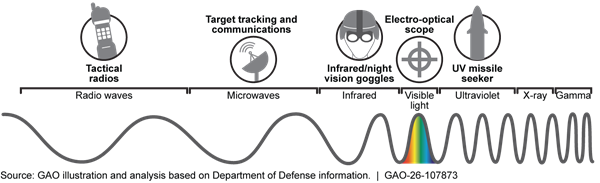
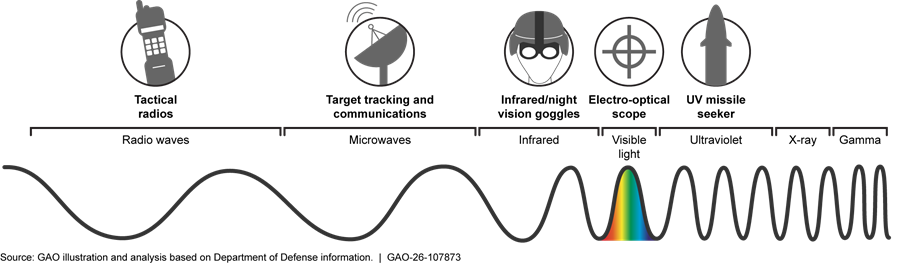
Spectrum is a resource that underpins both daily civilian life and national defense operations. Each segment of the spectrum—called a “band”—has unique characteristics defined by its wavelength and frequency, which determine how far signals can travel and the amount of information they can transmit. Because no two users can operate on the same frequency at the same time and location without causing harmful interference, spectrum is considered a scarce natural resource. DOD has numerous defense-related spectrum applications that span a wide range of spectrum bands (see fig. 1). Other federal agencies, such as the Federal Aviation Administration and the National Oceanic and Atmospheric Administration, also have mission-critical spectrum applications, including radar used for air traffic control or tracking weather patterns, respectively.
Federal Spectrum Management
In the United States, spectrum management responsibilities are divided between NTIA and FCC. NTIA, an agency within the Department of Commerce, manages federal agencies’ use of spectrum. FCC oversees spectrum use by nonfederal entities, including businesses and state and local governments. NTIA and FCC seek to balance increasing spectrum needs from federal, private sector, and other users.
NTIA regulates federal agencies’ spectrum use through its Manual of Regulations and Procedures for Federal Radio Frequency Management, commonly known as the “Redbook.” The Redbook establishes requirements for agencies to follow when requesting spectrum assignments and establishes ongoing spectrum management responsibilities. NTIA also oversees the Interdepartment Radio Advisory Committee (IRAC), an interagency body that coordinates federal use of spectrum and advises on policy matters.[7] IRAC includes representatives from across the federal government and plays a central role to coordinate assignments and minimize interference.
FCC regulates nonfederal entities’ spectrum use. FCC regulations govern how private sector, state, local, and other nonfederal users access and operate in specific frequencies. FCC also has the authority to administer competitive bidding processes—commonly known as spectrum auctions—to assign spectrum licenses for many commercial wireless services.[8] These auctions provide revenue to the federal government. According to an FCC official, 100 such auctions had occurred as of 2023 and had raised over $230 billion. In 2025, this authority was renewed by statute through 2034.[9]
NTIA and FCC co-manage spectrum in several ways, including by repurposing and assigning spectrum.
· Repurposing encompasses reallocating bands for new categories of uses, relocating existing users to different frequencies, or developing sharing arrangements that allow multiple users to operate in the same band. According to DOD officials, reallocation efforts are generally initiated by statute or presidential order. When federal agencies must vacate or share spectrum for an auction, the Spectrum Relocation Fund can cover relocation costs necessary for new equipment, infrastructure, and repurposing-related research.[10] Spectrum-sharing arrangements allow multiple users to operate in a band simultaneously under conditions designed to avoid harmful interference. For successful sharing to occur, users must resolve where (geographic sharing), when (sharing in time), and how spectrum will be used.
· Assignments occur after allocation decisions are made and involve authorizing specific entities to use particular frequencies. NTIA oversees assignment requests from federal agencies through procedures outlined in the Redbook and the work of IRAC’s Frequency Assignment Subcommittee. These assignments are much more common than spectrum repurposing efforts; in 2024, an NTIA official said that 92,000 such assignments were made.
Spectrum repurposing and assignment activities involve federal spectrum users collaborating with other federal and nonfederal spectrum users. Repurposing spectrum typically involves research and planning. Bands of spectrum used by DOD have recently been repurposed for private-sector use, and additional bands are being considered. According to DOD officials, DOD, typically in response to a statute or presidential order, conducts repurposing feasibility studies to help gauge costs, time frames, operational feasibility, and technical viability of bands under consideration for repurposing. These repurposing feasibility studies may require years of technical study[11] and collaboration with private-sector stakeholders.[12] DOD and NTIA completed the Emerging Mid-Band Radar Spectrum Sharing Feasibility Assessment Report (EMBRSS study) in 2023 and the National Spectrum Strategy 37 GHz Spectrum Sharing Report (37 GHz study) in 2024.[13] For receiving spectrum assignments, federal spectrum users must also collaborate, and they do so through IRAC’s Frequency Assignment Subcommittee.[14]
DOD Spectrum Use
DOD is the largest federal user of spectrum, by total frequency assignments. DOD uses spectrum on a day-to-day basis in a number of technologies and uses that enable critical missions and support activities. For instance, DOD uses over 120 different land-, sea-, and air-based radar systems in the 3.1-3.45 GHz band alone. Other examples of DOD spectrum uses in the United States include the following:
· Homeland defense. DOD uses spectrum, including the 3.1-3.45 GHz band, for a variety of systems, such as radar and radar-dependent systems, to detect, identify, track, and ultimately intercept aerial threats to the United States. These include persistent threats, like hostile aircraft incursions and nuclear-armed ballistic missiles, and emergent threats in the form of nuclear-capable hypersonic missiles and, increasingly, low-cost drones. In addition to having fixed, land-based radar systems, many of these radar systems are installed on ships or airborne and, thus, are constantly moving. Further, these radars require continuous operation to remain alert to threats.
· Communications. DOD uses spectrum (e.g., 4.4-4.94 GHz, 7125-8400 MHz [megahertz]) for different types of communications. For example, DOD uses wireless communications, including land-based radios for short-range text and voice transmissions, and satellites for long-distance voice, video, and data transmissions. In addition, DOD has begun to leverage both private and commercial 5G [fifth generation] wireless networks for increasing applications. For peacetime operations outside the United States, and within foreign countries where spectrum may be used for different purposes, DOD negotiates through the Department of State to secure direct agreements with those foreign governments in order to coordinate spectrum use and avoid interference.
· Navigation. DOD uses spectrum (e.g., 2.7-2.9 GHz, 3.1-3.5 GHz, and 5030-5091 MHz) for navigational purposes, including some that directly benefit the public. For example, DOD operates satellite-based GPS, which provides DOD, federal agencies, and the public with precise positioning information for many applications. GPS relies on continuous spectrum transmissions to communicate between satellites and end-user devices in real time. DOD also uses specialized microwave landing systems, and both on-board radar and land-based air traffic control radar systems, to assist the navigation of its military aircraft. Sometimes federal agencies use “guard bands,” which act like spectrum buffer zones by mitigating overlapping signals, to protect from interference safety-critical spectrum bands used for navigational purposes. For example, in 2020, FCC established a guard band in the 3.98-4.0 GHz range to protect the function of commercial aircraft altimeters from 5G mobile network interference.
· Testing, research, and development. DOD maintains numerous test ranges and facilities across the United States to research, develop, and field test new spectrum-dependent systems and capabilities. DOD also contracts with defense manufacturers who run their own test ranges and development and maintenance facilities and support DOD’s spectrum-dependent systems acquisitions. One example of testing involving spectrum uses radar systems to simulate how observable a DOD aircraft might be to an adversary’s radars. DOD’s testing occurs in many different spectrum frequencies and is planned in advance to allow time to coordinate spectrum-sharing requirements.
· Training. DOD routinely conducts unit-level training drills and large-scale training exercises with “live” spectrum in order to teach servicemembers how to effectively use spectrum-dependent systems and capabilities in conditions reflecting the modern battlefield.[15] DOD exercises also incorporate electromagnetic warfare capabilities, such as signal jamming, to attack, defend against, or otherwise simulate a hypothetical adversary’s use of spectrum.[16] These realistic types of training are designed to maintain readiness and are required by statute in certain situations.[17] Thus, DOD’s training often uses systems that could interfere with, or be hindered by, commercial spectrum use if such use were to occur within the same frequencies. While training is conducted daily and uses differing spectrum frequencies on a case-by-case basis, DOD typically plans and forecasts its training months in advance to allow time to coordinate spectrum-sharing requirements.
The 2023 National Spectrum Strategy and 2025 Public Law No. 119-21, commonly known as the One Big Beautiful Bill Act (hereafter, OBBBA), identified certain spectrum bands currently used by federal agencies, including bands where DOD is a leading user, for repurposing studies for possible nonfederal use (see table 1).[18] Nonfederal interests in these bands include improved 5G mobile networks, expanded in-flight internet services, indoor wireless networking, drone connectivity, and enhanced satellite internet services.[19]
|
Spectrum band |
Study origin |
Completion status |
Target due date |
Agencies responsible |
|
1675-1695 MHz |
One Big Beautiful Bill Act (OBBBA)a; Selected by National Telecommunications and Information Administration (NTIA) |
Ongoing |
To be determined |
NTIA and others to be determined |
|
2.69-2.9 GHz |
OBBBAa; presidential memo, December 2025b |
Ongoing |
To be determined |
NTIA and others to be determined |
|
3.1-3.45 GHz |
First study –Infrastructure Investment and Jobs Actc |
Report issued – Emerging Mid-Band Radar Spectrum Sharing Feasibility Assessment Report |
August 2023 – Study completed |
NTIA and Department of Defense (DOD) |
|
Second study – National Spectrum Strategyd |
Discontinued – band excluded from auction, reallocation, modification, or withdrawal under the OBBBAa |
Previously, August 2026 |
NTIA and DOD |
|
|
4.4-4.94 GHz |
OBBBAa; presidential memo, December 2025b |
Ongoing |
To be determined |
NTIA and others to be determined |
|
5030-5091 MHz |
National Spectrum Strategyd |
To be determined |
March 2026 |
NTIA, Federal Communications Commission, and Federal Aviation Administration (FAA) |
|
7125-8400 MHz |
First study – National Spectrum Strategyd |
Discontinued – Upper portion (7400-8400 MHz) excluded from auction, reallocation, modification, or withdrawal under the OBBBAa |
Previously, August 2026 |
NTIA, DOD, National Oceanic and Atmospheric Administration, National Aeronautics and Space Administration (NASA), Department of Energy, Department of Homeland Security, and FAA |
|
Second study – OBBBAa; presidential memo, December 2025b |
Ongoing – Lower portion (7125-7400 MHz) |
December 2026 |
NTIA and others to be determined |
|
|
18.1-18.6 GHz |
National Spectrum Strategy |
Report issued – 18 GHz Band Reporte |
February 2025 – Study completed |
NTIA, DOD, and NASA |
|
37.0-37.6 GHz |
National Spectrum Strategy |
Report issued – National Spectrum Strategy 37 GHz Spectrum Sharing Report |
October 2024 – Study completed |
NTIA and DOD |
Source: GAO analysis of DOD and NTIA information. | GAO‑26‑107873
Note: Public Law No. 119-21, commonly known as the One Big Beautiful Bill Act, excluded the 3.1-3.45 GHz band and the upper portion of the 7125-8400 MHz band between 7.4 and 8.4 GHz from the statute’s requirements regarding reallocation, modification, or withdrawal but directed the study of most of the lower portion of the band between 7.25 and 7.4 GHz for repurposing feasibility. The act also excluded the 3.1-3.45 GHz and 7.4-8.4 GHz bands from being subject to FCC’s current auction authority, which will expire in September 2034.
aAn Act to provide for reconciliation pursuant to title II of H. Con. Res. 14, Pub. L. No. 119-21, § 40002, 139 Stat. 72, 128–30 (2025).
bMemorandum on Winning the 6G Race, 2025 Daily Comp. Pres. Doc. 1212 (Dec. 19, 2025).
cPub. L. No. 117-58, § 90008(b)(1), 135 Stat. 429, 1349 (2021).
dAccording to NTIA officials, the National Spectrum Strategy is no longer active, and the spectrum repurposing studies associated with it have been discontinued. Target due dates and agency responsibilities for these studies are historical and no longer apply to ongoing efforts. The officials stated that other spectrum repurposing study efforts will continue, with direction from the OBBBA and the Winning the 6G Race presidential memorandum.
eNTIA, 18 GHz Band Report (Washington, D.C.: Mar. 2025).
DOD’s Management of Its Assigned Spectrum Is Distributed Across the Agency and Follows Plans Derived from National Priorities and Strategies
Various DOD Entities Have Spectrum Management Responsibilities, Which DOD’s Chief Information Officer Helps Coordinate and Advises on
DOD is comprised of numerous components headed by civilian officials and staffed by both uniformed military and civilian personnel, with many having roles and responsibilities related to spectrum management.[20] For example, the civilian secretaries of the Departments of the Army, Navy, and Air Force are responsible for organizing, training, and equipping forces for spectrum operations, while the uniformed military commanders of the combatant commands are responsible for including spectrum use in operational planning and articulate the operational risks associated with any proposed spectrum reallocation or sharing.[21]
DOD’s CIO reports directly to the Secretary of Defense and is the principal staff assistant and senior advisor responsible for leading the department’s management and use of spectrum.[22] This role includes responsibilities for developing DOD policy, providing oversight, guidance, and private- and public-sector coordination for all DOD spectrum matters.[23] For example, the DOD CIO is responsible for identifying gaps in DOD-wide information technology standards and mitigation plans for operating in the absence of acceptable standards.[24] The CIO is also responsible for ensuring that all DOD spectrum users are involved in major department-wide spectrum decisions, such as spectrum sharing or repurposing.
Other responsibilities for managing DOD’s assigned spectrum are distributed to DOD officials and components throughout the department. See appendix II for a detailed list and description of the key DOD entities involved in spectrum management and their roles and responsibilities. See figure 2 for the organizational structure of these key DOD entities.
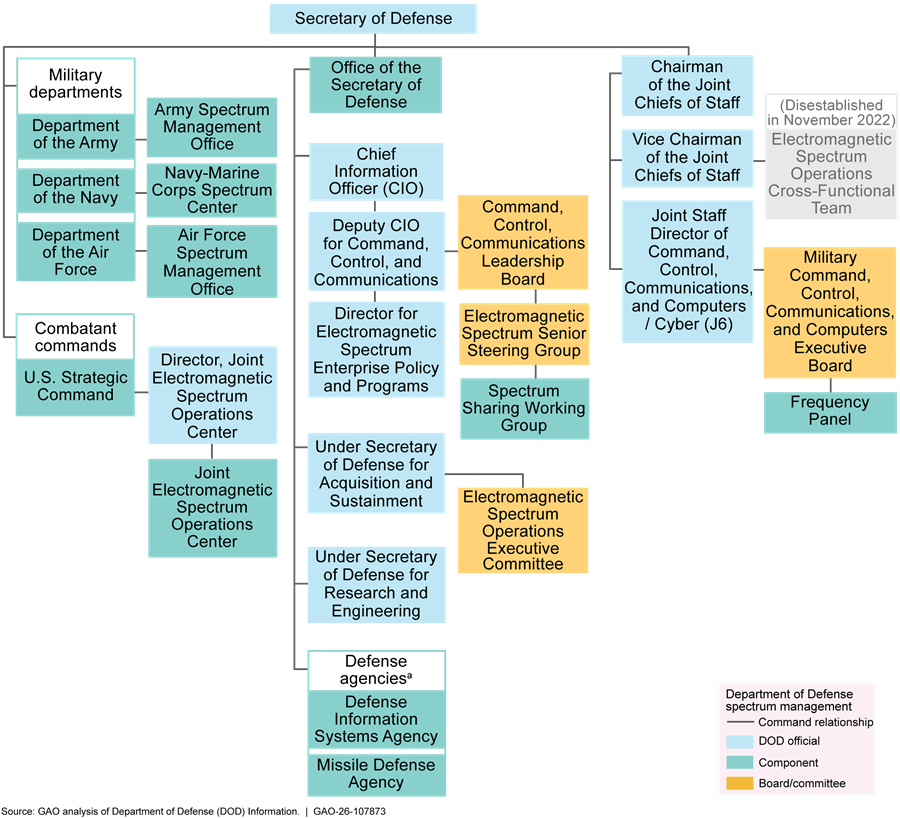
Note: The term “component” refers to any part of or organization within DOD.
aDefense agencies operate under the authority, direction, and control of a principal staff assistant in the Office of the Secretary of Defense, or other designated officials, pursuant to 10 U.S.C. § 192. The defense agencies listed in this figure, the Defense Information Systems Agency and the Missile Defense Agency, operate under the CIO and the Under Secretary of Defense for Research and Engineering, respectively.
As a principal staff assistant within the Office of the Secretary of Defense, the DOD CIO has a limited ability to require spectrum management actions and set spectrum policy directives across the department, and their ability is at times directed by the Secretary of Defense.[25] For example, DOD policy specifies that orders to the military departments shall be issued through the secretaries of these departments by the Secretary of Defense, or under authority specifically delegated in writing by the Secretary of Defense, or as provided by law.[26] Further, per statute, the Secretary of Defense is the DOD official responsible for ensuring the effective organization and management of spectrum used by DOD and for establishing a review and evaluation process for spectrum use.[27] According to DOD officials, aside from the Secretary of Defense, the CIO is the only Senate-confirmed DOD official with specific statutory authorities related to spectrum. Nonetheless, DOD officials stated that certain decisions, such as those related to spectrum repurposing, must be raised to the Secretary of Defense because of political sensitivities involving the White House and other cabinet agencies. According to these officials, the Secretary of Defense alone retains authority to compel DOD components to take actions, including those related to spectrum management, but in many cases the Secretary designates lower officials and components to make certain decisions.
Consequently, to address cross-cutting spectrum issues involving multiple DOD stakeholders, DOD establishes boards and committees that bring together decision-makers and are tasked with department-wide responsibilities. Examples of these bodies include the Command, Control, and Communications Leadership Board, which develops DOD’s spectrum strategy; the Electromagnetic Spectrum Senior Steering Group, which is responsible for overseeing implementation of the strategy; and the Military Command, Control, Communications, and Computer Executive Board, which resolves internal disputes over frequency assignments. Figure 3 shows which DOD officials chair these bodies. For more information on these bodies, see appendix II.
Figure 3: DOD Officials from Across the Department Chair Boards and Committees with Spectrum Responsibilities
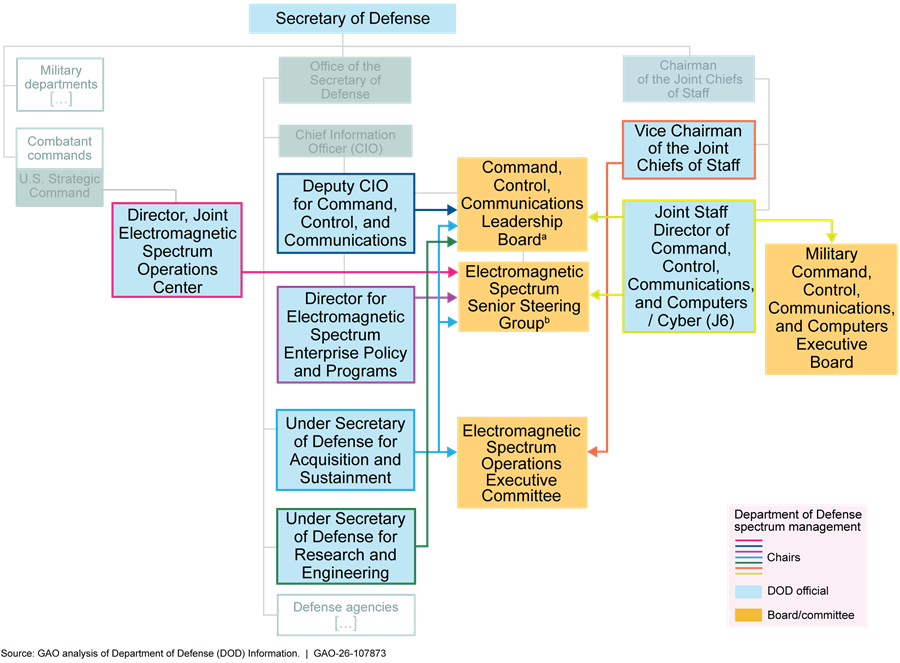
Note: DOD entities that are grayed out in this figure are provided as a reference to the organizational structure presented in figure 2 but are not the focus of this figure.
aThree of the chairs for the Command, Control, Communications Leadership Board are representatives for the officials pictured. The representative for the Under Secretary of Defense for Acquisition and Sustainment is the Deputy Assistant Secretary of Defense for Information and Integration Portfolio Management; the representative for the Under Secretary of Defense for Research and Engineering is the Director of Defense Research and Engineering; and the representative for the Joint Staff Director of Command, Control, Communications and Computers/Cyber (J6) is the Vice Director with the same title.
bTwo chairs for the Electromagnetic Spectrum Senior Steering Group are representatives for the officials pictured. The representative for the Under Secretary of Defense for Acquisition and Sustainment is the Platform and Weapons Portfolio Management Director for Electromagnetic Warfare; and the representative for the Joint Staff Director of Command, Control, Communications and Computers/Cyber (J6) is the Vice Director with the same title.
Additionally, the Secretary of Defense and the Chairman of the Joint Chiefs of Staff have statutory authority, and follow presidential orders, for certifying certain major spectrum repurposing-related changes.[28] Specifically, the Fiscal Year 2000 National Defense Authorization Act states that, prior to DOD vacating a spectrum band for which DOD is the primary user and relocating to an alternative band, the Secretary and the Chairman, along with the Secretary of Commerce, must certify that the proposed relocation to an alternative band will restore essential military capabilities that would be lost from vacating the other band.[29] Such a certification is the result of department-wide analyses of operational impacts, which are informed by the assessments of the Combatant Commands. In December 2025, a presidential memorandum instructed the Secretary of Defense to identify which national security missions must be addressed in certain spectrum repurposing studies to avoid materially impairing these missions if their operations were relocated to new bands.[30]
In addition to department-wide responsibilities, DOD’s military departments—the Army, Navy, and Air Force—each maintain spectrum management offices that coordinate spectrum use and continuous management within and among themselves. These offices also assist their department’s spectrum-dependent systems acquisitions and represent their respective military department’s spectrum management interests as members of the IRAC and its Frequency Assignment Subcommittee. Further, DOD’s area frequency coordinators, acting on behalf of their military departments, are responsible for coordinating to “deconflict” spectrum use among military and with other federal and nonfederal users within designated DOD test ranges that are dispersed across the United States.[31]
DOD further assigns local spectrum management responsibilities to military service officials. For example, installation spectrum managers—belonging to the Army, Navy, Marine Corps, Air Force, and Space Force—coordinate spectrum use in and around these services’ military installations.
DOD Plans Its Future Spectrum Use by Following Executive and Statutory Priorities and Spectrum-Specific Strategies
DOD’s spectrum planning incorporates a range of inputs from stakeholders across the federal government. The President and the Secretary of Defense articulate long-term goals for DOD, including those related to spectrum, in the National Security Strategy and the National Defense Strategy, respectively, which serve as a strategic roadmap for the department. The President may also establish goals for DOD through presidential orders. For example, in January 2025, the President signed an executive order directing DOD to develop plans for a next-generation missile defense capability in the United States, better known as Golden Dome.[32] According to DOD officials, while the capability is still in a planning phase, large components of it are expected to integrate existing radar and radar-dependent systems that rely on spectrum, alongside other emerging capabilities.
The White House’s 2023 National Spectrum Strategy, which articulated national objectives for spectrum policy, also influenced DOD’s prior spectrum planning.[33] These objectives included establishing a “spectrum pipeline”—a pathway for expanding spectrum access to more users through repurposing—to satisfy nonfederal and federal needs. The strategy also explored opportunities for spectrum sharing as another means to increase access to spectrum.[34]
Statutes also influence DOD’s long- and short-term planning. The annual National Defense Authorization Act may authorize or restrict DOD’s activities. DOD must also account for Annual Defense Appropriations Acts that appropriate specific funding amounts for DOD programs. Other recent statutes, such as the 2021 Infrastructure Investment and Jobs Act and the 2025 OBBBA, also include spectrum-related provisions that affect DOD.[35]
Using these inputs, DOD formulates its own spectrum-specific strategies to plan its spectrum management and use. DOD developed its first spectrum strategy in 2013, which called for DOD to adapt to the changing spectrum environment and respond to regulatory changes. In 2017, DOD issued another strategy that emphasized developing spectrum capabilities into offensive weapons. Neither strategy was fully implemented. In October 2020, DOD issued its latest spectrum strategy, the Electromagnetic Spectrum Superiority Strategy, which updates and consolidates the prior strategies and describes DOD’s current department-wide approach to spectrum management—embracing distributed decision-making.[36] Additionally, this strategy prioritizes sharing with other federal and nonfederal spectrum users.
DOD also assesses spectrum needs during spectrum-dependent systems acquisitions.[37] Specifically, DOD policy requires its components to determine whether sufficient spectrum is available for the operation of a new spectrum-dependent system for the entirety of its operating lifetime.[38]
DOD Coordinates Internally and with Federal Agencies on Frequency Assignment Requests and Generally Follows Selected Leading Practices for Collaboration
DOD Coordinates Frequency Assignment Requests Both Internally and Through an NTIA-Led Interagency Committee
DOD coordinates its frequency assignment requests first internally—within and across its departments—then with other federal agencies through an interagency review committee led by NTIA. Army, Navy, and Air Force spectrum users share information internally before requesting frequency assignments in bands allocated for federal or shared use. The requesting military department’s frequency management office reviews the request and coordinates to confirm mission need—whether the spectrum is for training, testing, or operations—and mitigate interference.
After a request is approved by the respective military department’s frequency management office, it is submitted to NTIA for review by IRAC, an interagency committee composed of other federal users. To request frequency assignments, DOD submits data and information on mission details to NTIA through Spectrum XXI, a software system used across DOD and other federal agencies for spectrum management.[39] This information includes geographic location, time of use, frequency band, and duration of assignment. All requests must contain a justification of need statement and a general explanation of the operation. Table 2 provides a summary of some of the key data DOD submits to NTIA to request frequency assignments.
Table 2: Summary Information and Examples of Key Data Submitted to NTIA to Request Frequency Assignments
|
Data point |
Description |
Example of agency data submission |
|
Signal characteristics |
Includes frequency or bands of frequencies requested, including adjustments for frequency tolerances, and the power levels at which such frequencies will be transmitted |
Land mobile 406.1 through 420 megahertz (MHz) at 50 watts power |
|
Time of use |
The percentage of time the frequency is anticipated to be in use |
10-50 percent of the time |
|
Antenna location |
Precise location of antenna transmitting (latitude and longitude coordinates at a precision up to 100 feet or finer and, if applicable, the direction the antennas point) |
Location of antenna in latitude and longitude: 38.8951 and -77.0364 |
|
User |
Which agency or agency subcomponent will use the frequency |
United States Navy |
|
Interference potential |
Narrative information relating to international coordination concerns, if applicable |
Federal Aviation Administration identifies possible harmful interference in its spectrum assignment application |
|
Type of use |
Information related to the type of station’s broadcasting frequencies |
Global Positioning System (GPS) |
Source: GAO analysis of National Telecommunications and Information Administration (NTIA) documentation. | GAO‑26‑107873
If there is concern that a proposed assignment may cause interference with another agency’s spectrum use, the agencies discuss a mutually agreeable way to meet frequency assignment requirements. When a frequency assignment is approved by IRAC, it is recorded in a government-wide file called the Government Master File.[40] The frequency assignment process is illustrated in figure 4 below.
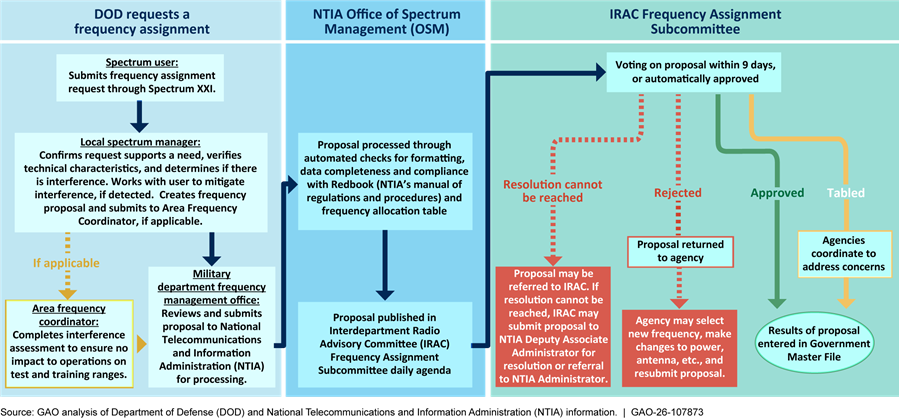
Note: Area Frequency Coordinators are responsible for coordinating among military and with other federal and nonfederal spectrum users within designated test ranges and facilities within the continental United States.
Similarly, the representatives to IRAC from the Army, Navy, and Air Force must determine if frequency assignment requests from other federal agencies or nonfederal users cause, or may cause, interference with DOD operations. According to DOD officials, when a request is received from IRAC, DOD’s IRAC representatives query Spectrum XXI. If interference is determined, these representatives then coordinate within their military department, including with local spectrum managers and, if applicable, area frequency coordinators. According to DOD officials, if a frequency assignment request is determined to cause interference across departments, coordination occurs through the Military Command, Control, Communications, and Computers Executive Board (see app. II for additional details about this board). As described in figure 4 above, the request is tabled, and the affected military departments then meet with the requesting entity to find a mutually agreeable way to meet frequency assignment needs.
Agency officials and private-sector stakeholders told us they work successfully with DOD through IRAC to coordinate frequency assignment requests that have the potential to conflict with DOD’s operations. For example, one agency official described working directly with DOD’s IRAC representatives to mitigate interference concerns by establishing agreements to schedule their operations to avoid conflicting with DOD operations. A private-sector representative told us they worked with DOD to make arrangements that would allow their equipment to operate while preventing harmful interference to DOD operations.
DOD Generally Follows Selected Leading Practices for Collaboration in Coordinating the Department’s Requests for Frequency Assignments
We found that DOD’s efforts to internally coordinate its frequency assignment requests across its departments prior to submitting these requests to IRAC generally followed five selected leading practices for collaboration (see table 3). We have previously identified leading practices for implementing interagency collaboration that intra-agency collaboration efforts can also benefit from.[41] Our prior work has shown that these practices can help agencies enhance and sustain collaboration and can be useful for addressing complex issues, such as coordinating frequency assignment requests.
Table 3: Extent to Which DOD’s Efforts to Coordinate Its Frequency Assignment Requests Follow Selected Leading Collaboration Practices
|
Leading collaboration practice |
Selected key considerations |
Extent followed |
|
|
Identify and sustain leadership |
Has a lead agency or individual been identified? |
● |
|
|
Clarify roles and responsibilities |
Have the roles and responsibilities of the participants been clarified? Has a process for making decisions been agreed upon? |
● |
|
|
Include relevant participants |
Have all relevant participants been included? Do the participants have the appropriate knowledge, skills, and abilities to contribute? |
● |
|
|
Leverage resources and information |
Are methods, tools, and technologies to share data and information being used? |
● |
|
|
Develop and update written guidance and agreements |
Have agreements regarding the collaboration been documented? |
● |
|
● = Generally followed; ◐ = Partially followed; ○ = Did not follow
Sources: GAO analysis of leading collaboration practices and Department of Defense (DOD) information. | GAO‑26‑107873
Note: Generally followed means we found that coordination efforts followed most, or all, aspects of the selected key considerations that we examined for the leading practice. Partially followed means we found that interagency coordination efforts followed some, but not all, of the selected key considerations that we examined for the leading practice. Did not follow means we found that coordination did not meet the selected key considerations that we examined for the leading practice. The key considerations selected were the most applicable and relevant to the collaboration mechanism we assessed.
Identify and sustain leadership. DOD has identified representatives to lead its collaboration through IRAC to request frequency assignments. DOD’s role on IRAC is defined in NTIA documentation. Specifically, NTIA’s Redbook designates the Army, Navy, and Air Force in sustained leadership roles representing DOD and their respective departments’ interests before IRAC.[42] In addition, a DOD instruction directs the secretaries of these military departments to provide representatives to IRAC.[43]
Clarify roles and responsibilities. DOD has taken steps to clarify the roles and responsibilities of the military departments’ representatives to IRAC by documenting them in policy. For example, according to an Air Force instruction, the Chief of the Spectrum Management Office represents the Air Force and Space Force at the national level and is responsible for reviewing and processing their departments’ frequency assignment requests through NTIA.[44] Further, in instances where consensus on frequency assignments cannot be reached between military departments, or when frequency assignments are requested for joint use, DOD officials told us that decisions are coordinated through the Military Command, Control, Communications, and Computers Executive Board.
Include relevant participants. DOD includes relevant department staff with the appropriate knowledge, skills, and abilities in its efforts to collaborate through IRAC on frequency assignments. As previously discussed, each of DOD’s three military departments provides a representative to the IRAC Frequency Assignment Subcommittee. These representatives are selected from, or advised by, their respective departments’ spectrum management offices to ensure they have the requisite knowledge to contribute to the collaborative effort.
Leverage resources and information. DOD leverages technological resources to support its collaboration in requesting frequency assignments through IRAC. Specifically, DOD uses Spectrum XXI to manage and process requests for frequency assignments and to coordinate these requests across DOD and with other federal agencies. This software is also used to submit requests to NTIA and IRAC for review by the Frequency Assignment Subcommittee, as described above.
While DOD uses Spectrum XXI to exchange information on spectrum use internally and with other agencies, we have previously reported that there are limitations with the data collected by this system that present various challenges for effectively managing spectrum.[45] For example, the timing data currently collected by Spectrum XXI do not include information about the specific times and days agencies use their assigned frequencies or bands of spectrum, but rather information about the percentage of the time the spectrum is in use. In addition, while Spectrum XXI includes precise data on where antennas are located, it does not include data on the area that the transmitted signals cover. Enhanced time and location data could be used to assign spectrum with greater efficiency.[46]
In response to statute, and in its role as system owner, DOD is developing a new version of Spectrum XXI that will improve the collection, tracking, and sharing of data on when and where spectrum is being used, among other things.[47] We have previously reported on NTIA’s and other agencies’ efforts to modernize their information technology systems, and the agencies have taken steps to implement our recommendations to improve those systems.[48]
Develop and update written guidance and agreements. DOD relies on several written documents that outline how its collaborative efforts through IRAC operate and how decisions are made. DOD and component-specific policy identify the roles and responsibilities of representatives to IRAC and establish processes for coordinating decision-making between departments. As previously discussed, NTIA’s Redbook outlines the military departments’ roles on the IRAC subcommittee that assists NTIA in assigning frequencies.
DOD and NTIA Did Not Fully Communicate Processes to External Stakeholders While Collaborating on Selected Spectrum Repurposing Studies
DOD and NTIA Have Used Various Processes to Collaborate on Two Selected Spectrum Repurposing Studies
To study how spectrum may be shared between federal and nonfederal users, DOD and NTIA have used various processes to collaborate with external entities, including establishing a working group and reviewing public comments. We reviewed the processes DOD and NTIA used during two selected spectrum repurposing studies: the EMBRSS study, which explored the feasibility of sharing between federal and nonfederal users in the 3.1-3.45 GHz band, and the 37 GHz study, which evaluated sharing frameworks between federal and nonfederal users in the Lower 37 GHz band.[49]
EMBRSS study
In conducting the EMBRSS study, DOD established what they referred to in the EMBRSS report as a “consensus-based, multistakeholder” working group comprised of more than 200 representatives from across the federal government, industry, and academia.[50] This working group, co-chaired by DOD, NTIA, and a representative from industry, was tasked with exploring sharing solutions to make more spectrum available for commercial 5G in the Lower 3GHz band.
According to DOD documentation, to develop sharing solutions, DOD and other working group members exchanged information on current and projected military and commercial spectrum requirements in the band. In addition, DOD created a subgroup of working group members to share industry proprietary and classified information.[51]
As documented in the study framework, working group members then proposed a variety of spectrum-sharing frameworks that would meet the needs of commercial stakeholders, while preserving DOD’s operations in the band.[52] DOD’s technical team, consisting of representatives from across military departments and contractors, conducted studies of these frameworks in collaboration with other government, industry and academic stakeholders.
Following the framework analyses, DOD released the EMBRSS report that concluded that sharing in the Lower 3 GHz band between federal and commercial systems would not be feasible unless each of nine specific regulatory and technological conditions were met. These conditions included that DOD maintains the right to preempt spectrum for national emergencies and that any regulatory protections enacted to prevent harmful interference to current federal users will also apply to future federal operations. This report was then provided to the Secretary of Commerce to determine which frequencies in the band could be made available for sharing between federal and nonfederal use.[53]
37 GHz study
The National Spectrum Strategy Implementation Plan called for NTIA, working with DOD, to establish a multistakeholder working group to study and report on a framework that would allow improved coordination between federal and nonfederal users in the Lower 37 GHz band.[54] NTIA announced in July 2024 that the design of the study would change to instead collect stakeholder input via an FCC Public Notice that sought information on sharing considerations in the band, rather than through a working group.[55] To that end, NTIA and DOD worked jointly to review and synthesize comments filed in response to this notice and to review prior FCC proceedings regarding the band.[56] DOD already shares portions of the band with commercial users. Therefore, the focus of this study was enhancing existing sharing arrangements between nonfederal users and the department.[57]
The two agencies developed a report in 2024 that included recommendations on sharing frameworks that would better allow federal and nonfederal users to coordinate in the band. In the report, NTIA and DOD recommended
· use of the framework that was proposed in the FCC notice, which included the possibility of federal and nonfederal users in the band coordinating operations through a portal;[58]
· DOD retention of 200 MHz of priority access in the lower portion of the band, between 37.0 and 37.2 GHz, with federal and nonfederal users having co-equal access to spectrum between 37.2 and 37.6 GHz; and
· safeguards to protect DOD operations in the adjacent 36-37 GHz band.
DOD Generally Followed Most Leading Practices When Collaborating Through a Working Group to Study Spectrum Repurposing
We compared DOD’s efforts to collaborate through the EMBRSS working group against the eight leading practices for collaboration and found that DOD’s collaboration efforts generally followed seven of these practices (see table 4).[59]
Table 4: Extent to Which DOD’s Collaboration Through the EMBRSS Working Group Followed Leading Practices for Collaboration
|
Leading collaboration practice |
Selected key considerations |
Extent followed |
|
|
Define common outcomes |
Have cross-cutting challenges or opportunities been identified? Have short- and long-term outcomes been clearly defined? |
● |
|
|
Ensure accountability |
What are the ways to monitor, assess, and communicate progress toward the short- and long-term outcomes? |
● |
|
|
Bridge organizational cultures |
Have strategies to build trust among participants been developed? |
● |
|
|
Identify and sustain leadership |
Has a lead agency or individual been identified? |
● |
|
|
Clarify roles and responsibilities |
Have the roles and responsibilities of the participants been clarified? Has a process for making decisions been agreed upon? |
● |
|
|
Include relevant participants |
Have all relevant participants been included? Do participants represent diverse perspectives and expertise? |
● |
|
|
Leverage resources and information |
How will the collaborative mechanism be staffed and funded? Are methods, tools, and technologies to share relevant data and information being used? |
● |
|
|
Develop and update written guidance and agreements |
If appropriate, have agreements regarding the collaboration been documented? |
◐ |
|
● = Generally followed; ◐ = Partially followed; ○ = Did not follow
Sources: GAO analysis of leading collaboration practices and Department of Defense (DOD) information. | GAO‑26‑107873
Note: Generally followed means we found that coordination efforts followed most, or all, aspects of the selected key considerations that we examined for the leading practice. Partially followed means we found that interagency coordination efforts followed some, but not all, of the selected key considerations that we examined for the leading practice. Did not follow means we found that coordination did not meet the selected key considerations that we examined for the leading practice. The key considerations selected were the most applicable and relevant to the collaboration mechanism we assessed.
We found that DOD’s efforts to collaborate through the EMBRSS working group generally followed seven leading collaboration practices.
Define common outcomes. DOD identified and documented the short- and long-term goals and associated limitations of the EMBRSS working group. In the short term, the working group was tasked with identifying feasible sharing solutions in the band that would then undergo study by DOD’s technical team and shape recommendations to DOD leadership. A longer-term goal of this collaboration was to develop a final report that would summarize the work conducted as part of the study. According to documentation provided to study participants, to guide this work—and consistent with language in statute—at the beginning of the collaboration, DOD identified the limitation that any sharing solutions proposed in this band must safeguard DOD’s operations.
Ensure accountability. DOD developed and documented target milestones to guide the group’s work, based on timelines presented in statute. In agendas for working group meetings, DOD identified deadlines for participants to review and submit input to draft report chapters.
Bridge organizational cultures. DOD undertook a range of efforts to bridge organizational cultures among working group participants. To build trust among participants, members signed nondisclosure agreements to enable robust discussion. According to DOD officials, policies and procedures to guide the working group were formalized and voted on by members at the outset of the collaboration.
Identify and sustain leadership. DOD was tasked in statute as the lead agency for conducting the EMBRSS study. In this role, the DOD CIO oversaw the development and management of the working group. The DOD CIO also designated co-chairs for the working group, to include representatives from the National Spectrum Consortium, NTIA, and industry.[60]
Clarifying roles and responsibilities. DOD provided documentation to working group participants that tasked them with generating feasible solutions to allow spectrum sharing between DOD and nonfederal entities in the band. In addition, this documentation outlined responsibilities, including reviewing and providing input on DOD technical analysis and report drafts. Further, DOD documented processes to review and adjudicate input received from working group members on report drafts. In instances where working group members and DOD could not reach consensus on this input, DOD established drafting groups to develop report language. According to DOD officials, while the purpose of the drafting group was to gain consensus, DOD leadership ultimately made the decision about which language was included in the report.
Include relevant participants. The working group was open to all National Spectrum Consortium member organizations, with participants representing telecommunications providers, equipment manufacturers, military radar providers, commercial spectrum users, academia, and federal agencies, among others. In addition, the DOD CIO took steps to ensure participation from across the department, such as issuing a memorandum requesting maximum participation.
Leverage resources and information. DOD leveraged funding resources and information in several ways. The EMBRSS study, including the activities of the working group, were funded via the Spectrum Relocation Fund. In addition, according to documentation provided to participants, DOD established processes and resources to communicate with working group participants, including a restricted portal to share documents and data.
We found that DOD’s collaboration through the working group partially followed one leading practice:
Developing written guidance and agreements. While DOD established some written guidance for the working group, we found that this documentation did not describe the extent to which input from working group participants would be considered. Further, while DOD documented processes for adjudicating report inputs, as described above, some working group participants nonetheless reported being uncertain whether or how their input was evaluated in the drafting of the report.
In the publicly available EMBRSS report, DOD described the study as “consensus based,” but some nonfederal participants we interviewed told us their input was not incorporated throughout the working group and report drafting processes. For example, according to DOD officials, during an initial working group meeting, DOD provided participants with a definition of spectrum sharing to guide the analysis and development of the study. This definition included that spectrum sharing does not involve compression or vacating the band. Participants told us that they had prolonged discussions with DOD where they expressed concerns with this definition and proposed alternatives. DOD made no changes to the definition.
Similarly, participants told us they were not involved in developing the previously described nine conditions for sharing that DOD included in the final report. According to some participants, these conditions would make it challenging for nonfederal users to share with federal users in the band. DOD officials told us that participants had the opportunity to comment on these conditions. However, according to DOD officials, the nine conditions were still included in the report, despite participants concerns, because they reflected DOD operational considerations and risks.
In addition, some participants told us that they provided written comments on draft sections of the report but did not have an opportunity to review the final draft. Thus, it was unclear to them, before the report was published, how or whether their input was incorporated. Some participants added that the revisions and corrections they made to draft versions of the report were not reflected in the final published report, and they were not told why.
DOD’s Electromagnetic Spectrum Superiority Strategy, discussed previously, prioritizes spectrum sharing and emphasizes that DOD must engage with other federal and nonfederal stakeholders to develop sharing technologies. DOD officials told us that documentation provided to working group participants generally described how and when input from participants would be collected and considered during the study. However, this documentation did not clearly describe the extent to which input would be considered or how DOD would determine whether or not to incorporate it throughout the study. We have previously reported that clearly articulating such guidance in formal documents can strengthen participants’ commitment to work collaboratively. Further, this documentation can be used to describe how a collaborative effort operates and how decisions will be made.[61] Moving forward, future collaboration on repurposing studies could benefit from DOD more clearly documenting how and when participants’ input would be considered and how it would be evaluated for use in the study. Such documentation would increase transparency for participants and provide assurance to participants that their input is being considered.
NTIA and DOD Did Not Document Processes for Conducting the 37 GHz Band Spectrum Repurposing Study
NTIA and DOD did not document processes for completing and drafting the 37 GHz study, including how responsibilities were shared within and between the two agencies or how recommendations were developed. As directed by the National Spectrum Strategy, NTIA was tasked with developing a plan to study spectrum in the 37 GHz band. In this strategy, NTIA recognized that as the demand for spectrum continues to increase, stakeholders must work together transparently to meet current and future spectrum requirements.
While the 37 GHz Spectrum Sharing Report describes at a high level the methodology used to develop the report and the stakeholders consulted, neither NTIA nor DOD documented how responsibilities would be assigned within or between agencies or a process to develop the report and recommendations. NTIA officials said that documentation outlining processes or responsibilities was not needed for the 37 GHz study because they were only working with one other agency (DOD) on the effort, and the study was limited to reviewing and synthesizing public comments, as described previously. DOD officials said that the National Spectrum Strategy, and its related implementation plan outlined a process to guide the 37 GHz study. However, when the design of the study changed to focus on collecting stakeholder input via an FCC notice, as previously described, no new guiding documentation was developed.[62]
Our prior work has found that NTIA has lacked certain documentation to support its spectrum management efforts involving collaboration with other stakeholders. For example, in 2022, we found that NTIA lacked planning documentation to guide its reallocation work that could have allowed it to more effectively coordinate with other agencies on spectrum planning.[63] In 2021, we also reported that a lack of clearly defined processes to guide interference studies hampered U.S. efforts to prepare for the international conference that establishes global spectrum regulations, which, in turn, undermined the U.S.’s positions for the meeting. [64]
Standards for Internal Control in the Federal Government states that management should establish control activities by documenting in policies what is expected and in procedures specified actions that implement policies to mitigate risks to achieving the entity’s objectives to
acceptable levels. Doing so can help ensure a common understanding of roles, responsibilities, and processes. Developing such documentation can better position NTIA and DOD to more effectively collaborate to implement their spectrum study development activities and help ensure that all relevant stakeholders have the necessary and critical information to meet spectrum study and reporting requirements. In addition, this documentation can provide assurances that NTIA and DOD anticipate and prepare for the many steps involved in conducting future complex spectrum studies. This is especially helpful for studies involving multiples agencies and stakeholders, such as the previously discussed spectrum repurposing feasibility studies required by the OBBBA.
Conclusions
Radio-frequency spectrum, essential to both national defense and economic growth, remains a scarce resource subject to increasing, and often competing, demands; since spectrum is a natural resource owned by no single entity, federal and nonfederal use must be carefully balanced to ensure its best use. As demand on the part of both federal and nonfederal users continues to rise, it is vital to U.S. interests to ensure that spectrum is being used efficiently, including by allocating it to the highest priorities and sharing spectrum, where possible. While NTIA and DOD have taken steps to assess opportunities for reallocating or sharing spectrum, such efforts are complex, time-consuming, and heavily dependent on effective collaboration. In particular, bands identified in the OBBBA for study and repurposing underscore the tensions in balancing DOD’s need to protect its soldiers and mission-critical systems from harmful interference with private-sector interests in expanding commercial wireless services. Assessing opportunities for reallocating or sharing spectrum requires the input of all vested parties in and outside the government. Toward that aim, improved NTIA and DOD guidance and transparency related to spectrum repurposing studies would enhance engagement between the federal government and private-sector stakeholders; such collaborations are best positioned to succeed if participants on all sides have a clear understanding of the process, how they can give input, and how that input will be considered and incorporated into decision-making. Further, more transparent documentation of policies and clearer expectations related to collaboration could help reduce uncertainty, build trust, and support more informed decision-making among private-sector stakeholders about whether to invest time and resources in participating in potentially years-long spectrum-sharing and repurposing collaborations, such as those emerging from the OBBBA.
Recommendations for Executive Action
We are making a total of three recommendations, two to DOD and one to NTIA. Specifically:
The Secretary of Defense should ensure that the DOD CIO develops a policy that requires each of its spectrum repurposing studies to have a documented approach shared with relevant stakeholders that explains how DOD considers and evaluates input from external stakeholders when developing the studies. (Recommendation 1)
The Secretary of Defense should ensure that the DOD CIO develops a policy for future spectrum repurposing studies to require a documented approach to conducting each study, including, for example, the processes used to develop the study and how responsibilities would be assigned within and between agencies. This documentation should be developed in consultation with NTIA and other federal participants, as appropriate. (Recommendation 2)
The NTIA Administrator should develop a policy for future spectrum repurposing studies to require a documented approach to conducting each study, including, for example, the processes used to develop the study and how responsibilities would be assigned within and between agencies. This documentation should be developed in consultation with DOD and other federal participants, as appropriate. (Recommendation 3)
Agency Comments
We provided a draft of this report to DOD, Commerce, and FCC for review and comment. We received written comments from DOD that are reprinted in appendix III, which agreed with our recommendations. Commerce agreed with our recommendation to it but did not provide written comments. FCC did not provide comments.
We are sending copies of this report to the appropriate congressional committees, the Secretary of Commerce, the Secretary of Defense, the Chairman of FCC, and other interested parties. In addition, the report is available at no charge on the GAO website at https://www.gao.gov.
If you or your staff have any questions about this report, please contact me at vonaha@gao.gov. Contact points for our Offices of Congressional Relations and Media Relations may be found on the last page of this report. GAO staff who made key contributions to this report are listed in appendix IV.
Sincerely,
Andrew Von Ah
Director, Physical Infrastructure
This report examines (1) how the Department of Defense (DOD) manages spectrum assigned to it, (2) the extent to which DOD processes for obtaining frequency assignments follow leading practices for collaboration, and (3) the extent to which DOD’s and the National Telecommunications and Information Administration’s (NTIA) processes for developing spectrum repurposing studies follow leading practices for collaboration and information sharing.
For all three objectives, we selected a subset of DOD components for more in-depth review. These components were selected based on their personnel size, spectrum applications (e.g., training, field operations, and research and development), and their roles in spectrum policy or operations. These reviews included collecting component-specific documentation and conducting interviews with, or receiving written responses to our questions from, officials representing each component. The selected components were the DOD Office of the Chief Information Officer (CIO), Army, Air Force, Navy, the Defense Information Systems Agency, and the Office of the Under Secretary of Defense for Research and Engineering.
To address our first objective, we reviewed publicly available information on DOD-assigned spectrum bands, including frequency ranges and allocation status, such as NTIA’s federal government spectrum use reports.[65] We examined documentation describing the operational purposes for which DOD uses spectrum, including the NTIA Manual of Regulations and Procedures for Federal Radio Frequency Management (Redbook),[66] and DOD Instruction 3222.03, DOD Electromagnetic Environmental Effects Program.[67] We also reviewed DOD guidance and policies for determining current and future spectrum management and requirements; spectrum allocation decisions in the National Spectrum Strategy;[68] and applicable statutes and regulations, such as the National Defense Authorization Act for Fiscal Year 2000,[69] and 47 C.F.R. § 300.1, which incorporates the NTIA Redbook, by reference. In addition, we reviewed publicly available reports from entities such as the Commerce Spectrum Management Advisory Committee, the Congressional Research Service, and the President’s Council of Advisors on Science and Technology. We supplemented this review with testimonial and documentary evidence from DOD CIO, spectrum management offices from selected DOD components, and NTIA officials.
To address our second objective, we reviewed DOD and government-wide policy and procedures for obtaining frequency assignments through NTIA’s Interdepartment Radio Advisory Committee (IRAC), namely, DOD 4650.01, Policy and Procedures for Management and Use of the Electromagnetic Spectrum, and the NTIA Redbook. To assess DOD’s military departments’ representatives’ adherence to leading practices for effective collaboration in their coordination with other federal agencies within IRAC, we assessed DOD and NTIA documentation, in addition to Coast Guard, Department of Homeland Security, DOD, Federal Communications Commission, National Aeronautics and Space Administration, and NTIA testimonial evidence related to DOD’s collaborative efforts. [70] We assessed DOD against (1) five of the eight leading practices that we determined to be the most relevant for DOD’s coordination through IRAC and (2) key considerations for each selected practice that we determined to be the most relevant for this coordination. See table 5 below for the selected practices and considerations.
|
Selected leading collaboration practices |
Selected key considerations |
|
Identify and sustain leadership |
Has a lead agency or individual been identified? |
|
Clarify roles and responsibilities |
Have the roles and responsibilities of the participants been clarified? Has a process for making decisions been agreed upon? |
|
Include relevant participants |
Have all relevant participants been included? Do the participants have the appropriate knowledge, skills, and abilities to contribute? |
|
Leverage resources & information |
Are methods, tools, and technologies to share data and information being used? |
|
Develop and update written guidance and agreements |
Have agreements regarding the collaboration been documented? |
Source: GAO. | GAO‑26‑107873
To address our third objective, we reviewed DOD and NTIA documentation related to the agencies’ efforts to develop the Emerging Mid-Band Radar Spectrum Sharing (EMBRSS) study and the National Spectrum Strategy 37 GHz Spectrum Sharing Report (37 GHz study), including materials they produced to guide the development of the studies and solicit nonfederal input and collaboration. To assess DOD’s adherence to leading practices for effective collaboration in their coordination with commercial entities on the EMBRSS study, we assessed DOD’s documentation related to that study against selected key considerations from all eight leading practices for effective collaboration. We selected key considerations for these practices that were most relevant for the coordination. See table 6 below for the practices and considerations. In addition, we interviewed, or received written responses to our questions from, DOD, NTIA, and FCC officials, as well as interviewed selected nonfederal stakeholders, to also gain their perspectives on DOD’s collaborative efforts. We selected a nongeneralizable sample of nine nonfederal stakeholders who participated in the EMBRSS working group and interviewed them about their experiences collaborating with DOD.
|
Leading collaboration practices |
Selected key considerations |
|
Define common outcomes |
Have cross-cutting challenges or opportunities been identified? Have short- and long-term outcomes been clearly defined? |
|
Ensure accountability |
What are the ways to monitor, assess, and communicate progress toward short- and long-term outcomes? |
|
Bridge organizational cultures |
Have strategies to build trust among participants been developed? |
|
Identify and sustain leadership |
Has a lead agency or individual been identified? |
|
Clarify roles and responsibilities |
Have the roles and responsibilities of the participants been clarified? Has a process for making decisions been agreed upon? |
|
Include relevant participants |
Have all relevant participants been included? Do participants represent diverse perspectives and expertise? |
|
Leverage resources and information |
How will the collaborative mechanism be staffed and funded? Are methods, tools, and technologies to share relevant data and information being used? |
|
Develop and update written guidance and agreements |
If appropriate, have agreements regarding the collaboration been documented? |
Source: GAO. | GAO- 26-107873
To assess DOD and NTIA’s effectiveness in documenting processes for the 37 GHz Spectrum Sharing study, we assessed documentation related to that study, in addition to testimonial evidence from NTIA and DOD officials, against principle 12.02 (management establishes control activities by documenting in policies what is expected and in procedures specified actions that implement policies to mitigate risks to achieving the entity’s objectives to acceptable levels) of Standards for Internal Control in the Federal Government.[71] In addition, we interviewed a nongeneralizable sample of four nonfederal stakeholders who filed comments in response to the FCC request for comment regarding the Lower 37 GHz band.[72]
Some data on DOD’s spectrum use are classified, which limited our ability to conduct a comprehensive analysis of all spectrum bands for this public report. Therefore, our analysis provides only a partial picture of DOD’s current spectrum use. Additionally, the results of interviews with selected components and stakeholders are not generalizable but provide illustrative perspectives.
We conducted this performance audit from October 2024 to June 2026 in accordance with generally accepted government auditing standards. These standards require that we plan and perform the audit to obtain sufficient, appropriate evidence to provide a reasonable basis for our findings and conclusions based on our audit objectives. We believe that the evidence obtained provides a reasonable basis for our findings and conclusions based on our audit objectives.
A number of Department of Defense (DOD) officials, components, and deliberative bodies have department-wide roles and responsibilities related to spectrum management. Descriptions of these key entities and their spectrum-related roles and responsibilities are in table 7.
|
Department of Defense (DOD) entity |
Description of spectrum-related roles and responsibilities |
|
Chief Information Officer (CIO) |
The CIO is the principal staff assistant and senior advisor responsible for leading the department’s management and use of spectrum.a The CIO’s responsibilities include developing DOD policy and providing oversight, guidance, and private- and public-sector coordination for all DOD spectrum matters. In November 2022, the Secretary of Defense made the CIO the senior designated official responsible for overseeing, executing, and implementing the 2020 Electromagnetic Spectrum Superiority Strategy.b This designation previously resided with the Vice Chairman of the Joint Chiefs of Staff. Additionally, the DOD CIO is responsible for identifying gaps in DOD-wide information technology standards, including spectrum standards, and mitigation plans for operating in the absence of acceptable standards.c The CIO is also responsible for ensuring that all DOD spectrum users are involved in any DOD decision processes concerning spectrum repurposing. The CIO delegates many of its spectrum-related responsibilities to the Director for Electromagnetic Spectrum Enterprise Policy and Programs (EMSEPP), who, in turn, advises the CIO on strategic direction, policy guidance, and oversight for DOD spectrum matters. Lastly, the CIO is a nonvoting observer of the Interdepartment Radio Advisory Committee (IRAC) and represents all of DOD at the National Telecommunications and Information Administration’s (NTIA) Policy and Plans Steering Group, which advises NTIA on spectrum policy. |
|
Vice Chairman of the Joint Chiefs of Staff |
The Vice Chairman of the Joint Chiefs of Staff is the nation’s second-highest-ranking military officer and the senior designated official responsible for proposing spectrum operations governance, management, organization, and operational reforms to the Secretary of Defense, after such reforms have undergone review by the Electromagnetic Spectrum Operations Executive Committee, which the Vice Chairman co-chairs. Until November 2022, the Vice Chairman was the senior designated official responsible for overseeing the department’s execution of the Electromagnetic Spectrum Superiority Strategy.d |
|
Under Secretary of Defense for Acquisition and Sustainment |
The Under Secretary of Defense for Acquisition and Sustainment is the principal staff assistant for issues related to spectrum-dependent systems acquisitions and sustainment. This role includes responsibilities for overseeing independent technical risk assessments of major defense acquisition programs for spectrum-dependent systems and publishing plans and procedures to guide the interoperability of electromagnetic warfare systems with other spectrum-dependent systems.e The Under Secretary also supports smaller electromagnetic warfare programs and rapid acquisition capabilities, in coordination with the CIO.f The Office of the Under Secretary is responsible for coordinating the Electromagnetic Spectrum Operations Executive Committee and serves as one of its co-chairs. |
|
Under Secretary of Defense for Research and Engineering |
The Under Secretary of Defense for Research and Engineering is the principal staff assistant for research, engineering, and technology development on all spectrum-dependent systems and is responsible for establishing DOD policies on, and supervision of, the research and engineering of spectrum-dependent systems for contested and congested electromagnetic environments. The Under Secretary is also the principal staff assistant and senior advisor for developmental testing and evaluation and issues guidance and procedures for developmental testing of spectrum-dependent systems within contested and congested electromagnetic environments. The Under Secretary also conducts independent technical risk assessments for spectrum-dependent acquisitions and advises DOD component heads on investment strategies for developmental spectrum-dependent systems.g |
|
Command, Control, Communications Leadership Board (C3LB) |
The C3LB advises the CIO on matters related to the strategic direction, resourcing, oversight, policy execution, and integration of Command, Control, and Communications (C3) capabilities and department-wide coordination of spectrum use.h The C3LB chartered, oversees, and resolves disagreements within the Electromagnetic Spectrum Senior Steering Group. The C3LB is quad-chaired by the Deputy CIO for Command, Control, and Communications, representing the CIO, and representatives for the Under Secretary of Defense for Acquisition and Sustainment, the Under Secretary of Defense for Research and Engineering, and the Joint Staff J6.i The C3LB operates by consensus among its members, which include senior CIO or C3 officials from the Army, Navy, Marine Corps, and Air Force, who represent the interests of the military services, as well as representatives from the Office of the Secretary of Defense, the Joint Staff, defense agencies, and select combatant commands.j |
|
Electromagnetic Spectrum Senior Steering Group (EMS SSG) |
According to DOD officials, the EMS SSG, organized under the C3LB, functions as the department-wide governance body for statutory and regulatory spectrum matters and is responsible for making key spectrum decisions. Additionally, the EMS SSG executes DOD spectrum strategy and policy and can compel actions among DOD components through the existing authorities of its members. The EMS SSG is the lead entity for implementing the 2020 Electromagnetic Spectrum Superiority Strategy. The EMS SSG advises the C3LB on spectrum-related issues and acts as an oversight body on behalf of the CIO. The EMS SSG is quad-chaired by the EMSEPP Director under the CIO; the Director of the Joint Electromagnetic Spectrum Operations Center under U.S. Strategic Command; the Director for Electromagnetic Warfare under the Under Secretary of Defense for Acquisition and Sustainment; and the Vice Director of the Joint Staff for Command, Control, Communications, and Computers and Cyber. The EMS SSG’s membership is composed of spectrum functional representatives from the military services, the Office of the Secretary of Defense, the Joint Staff, defense agencies, and the combatant commands. According to DOD officials, the EMS SSG meets monthly, or when requested by its chairs. The EMS SSG may also establish enduring or ad hoc working groups to develop courses of action for specific issues, such as on matters related to spectrum sharing and repurposing feasibility studies. |
|
Military Command, Control, Communications, and Computers Executive Board (MC4EB) |
The MC4EB, chaired by the Director of the Joint Staff for Command, Control, Communications, and Computers and Cyber, provides military recommendations; informs requirements, planning, and budgeting; and develops procedures for joint electromagnetic spectrum operations and capability needs. The MC4EB also coordinates operational spectrum use among DOD components, including providing operational communications guidance to combatant commands. The MC4EB hosts functional panels that have expertise in a specific area that can research and prepare issues for discussion or resolution. One such panel, the Frequency Panel, is dedicated to radio frequency management with the capacity to resolve spectrum assignment and interference disputes between the military services. The CIO and military service and combatant command representatives, among others, participate in the MC4EB as permanent voting members. The Frequency Panel’s membership mirrors the organizations in the MC4EB. |
|
Electromagnetic Spectrum Operations Executive Committee |
The Electromagnetic Spectrum Operations Executive Committee, formerly the Electronic Warfare Executive Committee, focuses on electromagnetic warfare strategy, acquisition, operational support, and security. This high-level committee—co-chaired by the Under Secretary of Defense for Acquisition and Sustainment and the Vice Chairman of the Joint Chiefs of Staff—is responsible for providing senior oversight, budget harmonization, and advice on electromagnetic warfare to DOD senior leaders. |
|
Defense Information Systems Agency (DISA) |
DISA, as a defense and combat support agency, operating under the authority, direction, and control of the CIO, advises the CIO and provides many DOD components with a broad variety of support activities for spectrum management, engineering, planning, policy, technology assessment, acquisitions, capability development, and operations using spectrum.k For example, DISA, in coordination with the CIO, the Chairman of the Joint Chiefs of Staff, the Combatant Commanders, and the secretaries of the military departments, develops integrated spectrum plans and strategies to address current and future needs for DOD spectrum operational access. DISA also maintains the capability to perform required electromagnetic compatibility analyses and studies to support effective use of the spectrum-dependent systems in electromagnetic environments. Further, DISA supports the CIO in the development and coordination of DOD positions and technical work as part of the U.S. preparatory process for the International Telecommunication Union Study Groups leading up to the World Radiocommunication Conference (WRC) engagements and participates in other international spectrum forums and coalition building.l DISA also includes the Portfolio Acquisition Executive (PAE) for Services. DISA supports spectrum-dependent system acquisition, spectrum planning and operations, such as deconfliction and interference resolution, and develops spectrum management tools and databases, among other activities. |
|
U.S. Strategic Command (STRATCOM) |
STRATCOM is one of four functional combatant commands with global, rather than geographically defined responsibilities. STRATCOM is the lead combatant command responsible for joint electromagnetic spectrum operations.m Specifically, STRATCOM has responsibilities for coordinating with DOD component heads to identify and prioritize joint spectrum operations requirements; establishing and maintaining a joint spectrum operations organization; and assisting the other combatant commands and military departments in planning, executing, and assessing joint spectrum operations across all domains. STRATCOM also designates representatives to participate in the Electromagnetic Spectrum Operations Executive Committee for spectrum-related capabilities.n In July 2023, STRATCOM established the Joint Electromagnetic Spectrum Operations Center to coordinate operational spectrum use across DOD’s operational components.o |
|
Joint Electromagnetic Spectrum Operations Center (JEC) |
As the designated operational lead for joint electromagnetic spectrum operations (JEMSO), the JEC, under the operational command of USSTRATCOM and in coordination with the Joint Staff, provides JEMSO support to all combatant commands and, as directed, partner nations through joint force training and readiness and assesses and develops recommendations for the Chairman of the Joint Chiefs of Staff to provide military advice regarding joint spectrum operations capabilities and guidance.p In addition, DOD stated that the JEC develops programs and methodologies to analyze the effectiveness of spectrum capabilities across multiple components and to identify operational gaps, by, for example, conducting wargames and field exercises. DOD also stated that the JEC works with the Joint Staff and the CIO to help inform regulatory agencies of the potential impacts of repurposing federal spectrum that DOD uses. |
Source: GAO analysis of DOD information. | GAO‑26‑107873
a10 U.S.C. § 142(b)(1)(F) and DOD, Department of Defense Directive 5144.02, DOD Chief Information Officer (DOD CIO) (Nov. 21, 2014, Incorporating change 1, Sept. 19, 2017).
bDepartment of Defense, Secretary of Defense Memorandum, Designation of the Chief Information Officer of the Department of Defense as the Senior Official Responsible for Oversight, Execution, and Implementation of the Electromagnetic Spectrum Superiority Strategy (Nov. 7, 2022).
c10 U.S.C. § 142(b)(3)(C). This responsibility is similar to those of the Electromagnetic Spectrum Operations Cross Functional Team’s role before it was disestablished in November 2022. See DOD, Secretary of Defense Memorandum, Establishment of the Electromagnetic Spectrum Operations Cross Functional Team (Feb. 2, 2019). The Secretary of Defense established the Electromagnetic Spectrum Cross-Functional Team pursuant to sections 918 and 1053(c) of the John S. McCain National Defense Authorization Act for Fiscal Year 2019. Pub. L. No. 115-232, §§ 918, 1053(c), 132 Stat. 1636, 1925, 1967 (2018).
dDepartment of Defense, Department of Defense Electromagnetic Spectrum Superiority Strategy (Oct. 2020).
eElectromagnetic warfare is military action involving the use of electromagnetic and directed energy to control the electromagnetic spectrum or to attack the enemy.
fDepartment of Defense, Department of Defense Directive 3222.04, Electronic Warfare (EW) Policy (Mar. 26, 2014, Incorporating change 2, Aug. 31, 2018).
gAdditionally, the Director of Operational Test and Evaluation is responsible for issuing guidance and procedures for testing of spectrum-dependent system’s operational effectiveness, operational suitability, and survivability within contested and congested electromagnetic environments, and the Director of Cost Assessment and Program Evaluation is responsible for independent cost assessment and analyses and evaluates plans, programs, and budgets with respect to spectrum dependencies within DOD programs. See DOD, Department of Defense Directive 3610.01, Electromagnetic Spectrum Enterprise Policy (Sept. 4, 2020).
h”Command, Control, and Communications,” or C3, is a focus area that deals with the critical information necessary to plan, coordinate, and control forces and operations across the full range of DOD missions. See DOD, C3 Modernization Strategy (Sept. 2020).
iDepartment of Defense, Command, Control, and Communications Leadership Board (C3LB) Charter (Apr. 16, 2021). The C3LB representatives for the Under Secretary of Defense for Acquisition and Sustainment, the Under Secretary of Defense for Research and Engineering, and the Joint Staff J6 are the Deputy Assistant Secretary of Defense for Information and Integration Portfolio Management; the Director of Defense Research and Engineering; and the Vice Director of the Joint Staff for Command, Control, Communications, and Computers and Cyber, respectively.
jIn situations where consensus cannot be reached, the C3LB will elevate dissenting opinions to the appropriate decision authority. The term “military services” refers to the U.S. Army, U.S. Navy, U.S. Marine Corps, U.S. Air Force, and U.S. Space Force, as distinct from the term “military departments” which refers to the Departments of the Army, Navy, and Air Force. The U.S. Marine Corps falls under the Department of the Navy, and the U.S. Space Force falls under the Department of the Air Force.
kDefense agencies include organizational entities of DOD that perform a supply or service activity common to more than one military department. See 10 U.S.C. § 101. Combat support agencies are defense agencies identified by statute or designated as such by the Secretary of Defense to provide support for operating forces, which are DOD organizations engaged in planning for, or conducting, military operations. See 10 U.S.C. § 193(f) for a list of certain combat support agencies.
lDepartment of Defense, Department of Defense Directive 5105.19, Defense Information Systems Agency (Feb. 15, 2022).
mSTRATCOM’s non-spectrum-related responsibilities include maintaining strategic deterrence, nuclear operations, global strike capabilities, and missile threat assessment.
nDepartment of Defense, Department of Defense Directive 3610.01, Electromagnetic Spectrum Enterprise Policy (Sept. 4, 2020).
oDepartment of Defense, Department of Defense Press Release, U.S. Strategic Command Stands Up Joint EMS Operations Center, U.S. Strategic Command Public Affairs Office (July 26, 2023); The term “operational” refers to the conduct of military operations.
pTestimony on United States Strategic Command and United States Space Command in Review of the Defense Authorization Request for Fiscal Year 2026 and the Future Years Defense Program Before the Subcomm. on Strategic Forces of the S. Comm. on Armed Servs., 119th Cong. 18 (2025) (statement of General Anthony J. Cotton, Commander, U.S. Strategic Command). Section 500e of U.S. Code, Title 10, directs the Secretary of Defense to establish an Electromagnetic Spectrum Enterprise Operational Lead. Under that section, the operational lead is responsible for synchronizing, assessing, and making recommendations to the Chairman of the Joint Chiefs of Staff with respect to the readiness of the combatant commands to conduct joint electromagnetic spectrum operations. 10 U.S.C. § 500e.
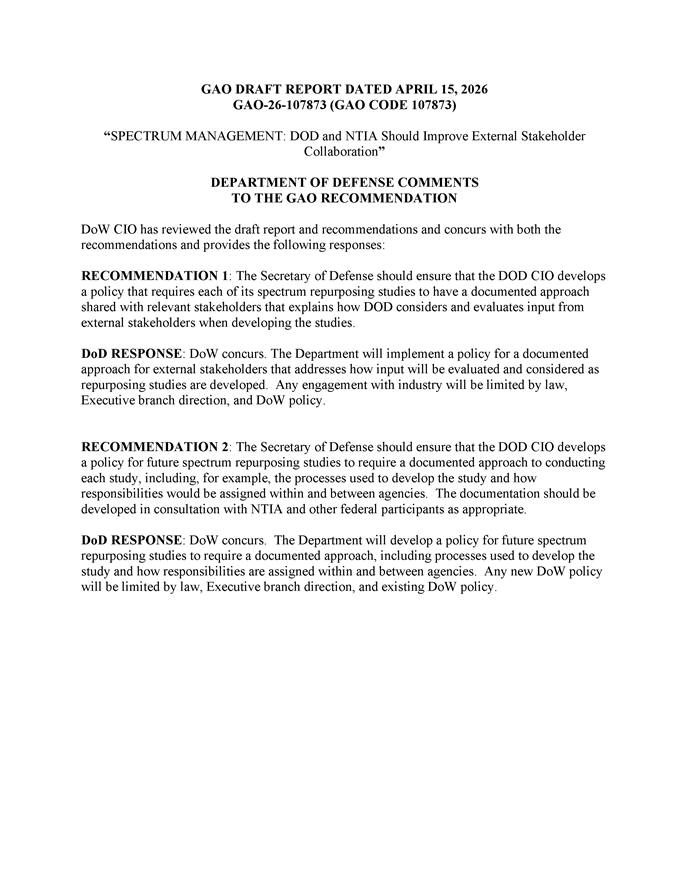
GAO Contact
Andrew Von Ah, vonaha@gao.gov
Staff Acknowledgments
In addition to the contact named above, Andrew Huddleston (Assistant Director), Sean Standley (Analyst in Charge), Thomas Baril, Melissa Bodeau, Shaun Byrnes, Miguel Cortez, Melanie Dieme, Vijay D’Souza, Kristen Farole, Richard Hung, Joseph Kirschbaum, Jon Ludwigson, Kyle O’Brien, Kathleen Padulchick, Mike Soressi, Justin Snover, Andrew Stavisky, James Tallon, Michelle Weathers, and Alicia Wilson made key contributions to this report.
The Government Accountability Office, the audit, evaluation, and investigative arm of Congress, exists to support Congress in meeting its constitutional responsibilities and to help improve the performance and accountability of the federal government for the American people. GAO examines the use of public funds; evaluates federal programs and policies; and provides analyses, recommendations, and other assistance to help Congress make informed oversight, policy, and funding decisions. GAO’s commitment to good government is reflected in its core values of accountability, integrity, and reliability.
Obtaining Copies of GAO Reports and Testimony
The fastest and easiest way to obtain copies of GAO documents at no cost is through our website. Each weekday afternoon, GAO posts on its website newly released reports, testimony, and correspondence. You can also subscribe to GAO’s email updates to receive notification of newly posted products.
Order by Phone
The price of each GAO publication reflects GAO’s actual cost of production and distribution and depends on the number of pages in the publication and whether the publication is printed in color or black and white. Pricing and ordering information is posted on GAO’s website, https://www.gao.gov/ordering.htm.
Place orders by calling (202) 512-6000, toll free (866) 801-7077,
or
TDD (202) 512-2537.
Orders may be paid for using American Express, Discover Card, MasterCard, Visa, check, or money order. Call for additional information.
Connect with GAO
Connect with GAO on X,
LinkedIn, Instagram, and YouTube.
Subscribe to our Email Updates. Listen to our Podcasts.
Visit GAO on the web at https://www.gao.gov.
To Report Fraud, Waste, and Abuse in Federal Programs
Contact FraudNet:
Website: https://www.gao.gov/about/what-gao-does/fraudnet
Automated answering system: (800) 424-5454
Media Relations
Sarah Kaczmarek, Managing Director, Media@gao.gov
Congressional Relations
David A. Powner, Acting Managing Director, CongRel@gao.gov
General Inquiries
[1]The radio-frequency spectrum is a part of the natural spectrum of electromagnetic radiation. Frequencies, which are grouped into bands, are properties of electromagnetic waves that describe how many wave patterns or cycles pass by in a time period.
[2]GAO, Spectrum Management: NTIA Should Improve Spectrum Reallocation Planning and Assess Its Workforce, GAO‑23‑104537 (Washington, D.C.: Jan. 27, 2022).
[3]National Telecommunications and Information Administration, Manual of Regulations and Procedures for Federal Radio Frequency Management (Washington, D.C.: Jan. 2013, as revised).
[4]White House, National Spectrum Strategy (Washington, D.C.: Nov. 13, 2023).
[5]We previously developed eight leading practices for effective collaboration. See GAO, Government Performance Management: Leading Practices to Enhance Interagency Collaboration and Address Crosscutting Challenges, GAO‑23‑105520 (Washington, D.C.: May 2023).
[6]GAO, Standards for Internal Control in the Federal Government, GAO‑25‑107721 (Washington, D.C.: May 2025).
[7]IRAC was first organized in 1922.The members of IRAC are the Department of Agriculture, Air Force, Army, Coast Guard, Department of Commerce, Department of Energy, Federal Aviation Administration, Department of Homeland Security, Department of the Interior, Department of Justice, National Aeronautics and Space Administration, Navy, National Science Foundation, Department of State, Department of Transportation, Department of the Treasury, United States Agency for Global Media, United States Postal Service, and Department of Veterans Affairs.
[8]FCC spectrum licenses authorize nonfederal entities to use frequencies under specific conditions; licenses may be assigned through auctions and are subject to ongoing FCC rules to prevent harmful interference and promote efficient spectrum use.
[9]An Act to provide for reconciliation pursuant to title II of H. Con. Res. 14, Pub. L. No. 119-21, § 40002(b)(1), 139 Stat. 72, 129 (2025) (hereafter, the One Big Beautiful Bill Act or OBBBA) (amending 47 U.S.C. § 309(j)(11)).
[10]The Office of Management and Budget, in consultation with NTIA, administers the Spectrum Relocation Fund. The funds come from the proceeds of FCC spectrum auctions.
[11]For example, the 3450-3550 MHz reallocation effort took about 4 years to complete. The band was identified by NTIA in 2018 for reallocation study. The band was reallocated from federal use for commercial use, and auctions concluded in 2022.
[12]Our prior work found that NTIA lacks a formalized planning process for spectrum repurposing, including plans with objectives and targets, integrated master schedules, and risk assessments. We recommended that NTIA align its spectrum repurposing planning with leading program-management practices to better anticipate steps and risks and execute more timely spectrum repurposing. As of January 2026, this recommendation remains unimplemented. See GAO‑22‑104537.
[13]Department of Defense, Emerging Mid-Band Radar Spectrum Sharing (EMBRSS) Feasibility Assessment Report (public redacted version) (Washington, D.C.: Sept. 2023); and National Telecommunications and Information Administration, National Spectrum Strategy 37 GHz Spectrum Sharing Report (Washington, D.C.: Nov. 29, 2024).
[14]FCC is a liaison to IRAC and submits frequency assignment requests for nonfederal use of spectrum in shared bands and other bands where there might be an impact on, or from, federal operations.
[15]Training primarily occurs at DOD’s testing and training ranges located on various military installations across the United States but may also occur off federal lands.
[16]Electromagnetic warfare is military action involving the use of electromagnetic and directed energy to control the electromagnetic spectrum or to attack the enemy. Signal jamming is the use of electromagnetic warfare capabilities to disrupt, usually temporarily, the signals relayed through the electromagnetic spectrum between communication equipment and sensors.
[17]See, for example, National Defense Authorization Act for Fiscal Year 2026, Pub. L. No 119-60, § 1682, 139 Stat. 718, 1203–04 (2025) (codified at 10 U.S.C. § 500g).
[18]Pub. L. No. 119-21, § 40002, 139 Stat. at 128–30.
[19]The 3.1-3.45 GHz and 7125-8400 MHz bands—of which DOD is a leading federal user—are of particular interest for enhancing 5G wireless communications services. The properties of the 3.1-3.45 GHz band make it desirable because it enables long-distance transmissions with high signal accuracy and high data capacity. DOD relies on the 3.1-3.45 GHz band for homeland defense radar applications. Its specific uses include long-range surveillance radars used to identify, track, and intercept aircraft and missiles, and smaller radar systems that can distinguish and track small drones. This band was studied in the EMBRSS study, which determined that spectrum sharing between federal and nonfederal users is feasible only if certain advanced interference-mitigation features and a coordination framework to facilitate sharing are put in place. DOD has previously expressed concern over the time and cost associated with repurposing this band while preserving essential military capabilities. In July 2025, the OBBBA excluded the 3.1-3.45 GHz band and the upper portion of the 7125-8400 MHz band between 7.4 and 8.4 GHz from the statute’s requirements regarding reallocation, modification, or withdrawal. The act also excluded the 3.1-3.45 GHz and 7.4-8.4 GHz bands from being subject to FCC’s current auction authority, which will expire in September 2034.
[20]DOD’s principal organizations include the Office of the Secretary of Defense; the Joint Chiefs of Staff; defense agencies; the Departments of the Army, Navy, and Air Force; and the combatant commands. See 10 U.S.C § 111.
[21]There are 11 combatant commands in the U.S. military, which are organized into two categories, geographic commands and functional commands. The seven geographic combatant commands are each led by a combatant commander, whose responsibilities include operational planning, security cooperation, and commanding forces, among other things, within specific regional areas of responsibility. U.S. Northern Command is responsible for DOD’s homeland defense missions within the continental United States. The four functional combatant commands operate worldwide across geographic boundaries to provide specialized capabilities.
[22]10 U.S.C. § 142(b)(1)(F), (d); and Department of Defense Directive 5144.02, DOD Chief Information Officer (DOD CIO) (Nov. 21, 2014, Incorporating change 1, Sept. 19, 2017).
[23]The CIO’s responsibilities cover a variety of other department-wide information technology matters, in addition to spectrum management. These include providing policy, oversight, and guidance for DOD’s information technology and cybersecurity, among others. See 10 U.S.C. § 142(b)(1)(H).
[24]10 U.S.C. § 142(b)(3)(C).
[25]In our prior work, we found that DOD risked not achieving its goals relating to spectrum management in the 2020 Electromagnetic Spectrum Superiority Strategy because it lacked a single senior designated official with appropriate oversight authority to ensure accountability among its many components. In December 2020, we recommended that the Secretary of Defense should assign clear responsibility to a senior official with authority and resources necessary to compel action for the long-term implementation of the 2020 strategy. In November 2022, DOD transferred responsibilities for oversight and execution of the strategy to the CIO. In June 2023, DOD provided documents demonstrating the CIO’s use of the Electromagnetic Spectrum Senior Steering Group to compel action to implement the 2020 strategy, meeting the intent of our recommendation. See GAO, Electromagnetic Spectrum Operations: DOD Needs to Address Governance and Oversight Issues to Help Ensure Superiority, GAO‑21‑64 (Washington, D.C.: Dec. 10, 2020).
[26]Department of Defense Directive 5100.01, Functions of the Department of Defense and Its Major Components (Dec. 21, 2010, Incorporating change 1, Sept. 17, 2020).
[27]10 U.S.C. § 488.
[28]The Chairman of the Joint Chiefs of Staff is the nation’s highest-ranking military officer and the principal military advisor to the President, the Secretary of Defense, the National Security Council, and the Homeland Security Council.
[29]National Defense Authorization Act for Fiscal Year 2000, Pub. L. 106-65, div. A, tit. X, §1062(b), 113 Stat. 512, 768 (1999).
[30]Memorandum on Winning the 6G Race, 2025 Daily Comp. Pres. Doc. 1212 (Dec. 19, 2025).
[31]Spectrum deconfliction refers to the practice of coordinating with other spectrum users to avoid or mitigate potential electromagnetic interference to spectrum-dependent systems.
[32]The Iron Dome for America, Exec. Order No. 14186, 90 Fed. Reg. 8767 (Jan. 27, 2025).
[33]As required by a presidential memorandum, the Secretary of Commerce, through NTIA, submitted the National Spectrum Strategy to the President through the Assistant to the President for National Security Affairs, the Assistant to the President for Economic Policy, and the Director of the Office of Science and Technology Policy. See White House, National Spectrum Strategy (Washington, D.C.: Nov. 13, 2023); and Modernizing United States Spectrum Policy and Establishing a National Spectrum Strategy, § 3, 88 Fed. Reg. 80079, 80080 (Nov. 13, 2023).
[34]According to NTIA officials, the National Spectrum Strategy is no longer active.
[35]See Pub. L. No. 117-58, § 90008(b)(1), 135 Stat. 429, 1349 (2021); and Pub. L. No. 119-21, § 40002, 139 Stat. 72, 128–30 (2025).
[36]Department of Defense, Department of Defense Electromagnetic Spectrum Superiority Strategy (Oct. 2020). In February 2026, we initiated a separate review of DOD’s progress in executing this strategy.
[37]In February 2026, we initiated a separate review of DOD’s assessments of spectrum needs for spectrum-dependent systems acquisitions.
[38]Department of Defense Instruction 4650.01, Policy and Procedures for Management and Use of the Electromagnetic Spectrum (Jan. 9, 2009, Incorporating Change 1, Oct. 17, 2017).
[39]Spectrum XXI is also used for conducting spectrum management analysis, fielding requests and assigning frequencies, and performing engineering tasks. Federal agencies use this system for submitting frequency assignment requests to NTIA. DOD is the owner of Spectrum XXI; however, NTIA operates a separate implementation of it and provides access to this system for other agencies through a government use agreement with DOD.
[40]NTIA generally requires that agencies conduct 5- or 10-year reviews of their frequency assignments to determine whether the frequency assignment is still needed or if other existing assignments will meet the requirements and whether data are still accurate. DOD officials told us each military department continuously reviews its frequency assignments and deletes or modifies assignments, as needed, in accordance with these requirements.
[42]National Telecommunications and Information Administration, Manual of Regulations and Procedures for Federal Radio Frequency Management (Washington, D.C.: May 2013, as revised). In addition, DOD CIO serves as an observer to IRAC.
[43]Department of Defense Instruction 4650.01, “Policy and Procedures for Management and Use of the Electromagnetic Spectrum” (Jan. 9, 2009).
[44]Department of the Air Force Instruction 17-220, Cyberspace Operations – Spectrum Management (June 8, 2021). The Navy also submits frequency assignment requests on behalf of the Marine Corps. According to DOD officials, if other DOD entities (for example, the Defense Advanced Research Projects Agency) need to request frequency assignments, the request will generally be submitted by the military department that owns the facility or installation where the frequency will be used.
[45]GAO, Spectrum Management: Information Technologies for Managing Federal Use, GAO‑22‑105221 (Washington, D.C.: Feb. 17, 2022).
[46]NTIA also collects information about the performance of federal receivers—the equipment that captures a transmitted signal. We previously reported that while this is helpful for preventing instances of harmful interference, we recommended that NTIA assess its information sources and address information gaps to aid in its broader spectrum efficiency efforts. NTIA agreed with these recommendations but has not implemented them; as of February 2026, we requested an update on its efforts and have not received a response. GAO, Spectrum Management: Key Practices Could Help Address Challenges to Improving Receiver Performance, GAO‑24‑106325 (Washington, D.C.: July 18, 2024).
[47]Federal agencies, including DOD, have been directed by statute to develop plans to modernize the information technology systems they use to manage spectrum. William M. (Mac) Thornberry National Defense Authorization Act for Fiscal Year 2021, Pub. L. No. 116-283 § 9203(c), 134 Stat. 3388, 4795–96 (2021). According to DOD officials, DOD is also engaged in broader spectrum information technology modernization efforts in response to this statute.
[48]See for example, GAO, Spectrum IT Modernization: Incorporating Leading Practices Could Improve Planning Effort, GAO‑24‑106634 (Washington, D.C.: Mar. 19, 2024). In this report, we recommended that NTIA develop reliable cost estimates and schedules and document how it will regularly communicate with stakeholders about its modernization project. NTIA agreed with these recommendations but not has not implemented them; as of November 2025, we are awaiting additional information from NTIA on its efforts to address these recommendations.
[49]The EMBRSS study responded to a provision in the Infrastructure Investment and Jobs Act (IIJA), Pub. L. No. 117-58, § 90008(b)(1), 135 Stat. 429, 1349 (2021). The 37 GHz study responded to direction from the National Spectrum Strategy. The EMBRSS and 37 GHz Reports were issued in 2023 and 2024, respectively.
[50]The working group was open to all members of the National Spectrum Consortium, a nonprofit organization focused on advanced spectrum and wireless technology development. DOD also coordinated with FCC, the Department of Commerce, NTIA, Department of Homeland Security, and the National Aeronautics and Space Administration.
[51]Members of this subgroup were selected through a lottery process and included representatives from industry and academia. These members were cleared to receive classified information on specific DOD systems, up to the Secret classification. Federal agencies also participated in this subgroup.
[52]The IIJA provided that the Secretary of Commerce may identify some of these frequencies to be shared only if the Secretary of Defense determined that sharing those frequencies with nonfederal users would not impact the primary mission of military spectrum users in the band.
[53]The IIJA directed DOD to conduct, and report findings to the Department of Commerce from, planning activities to improve the efficiency and effectiveness of DOD’s spectrum use to make spectrum in the 3.1-3.45 GHz band available for shared federal and nonfederal use. Pub. L. No. 117-58, § 90008(b)(1), 135 Stat. 429, at 1349. The National Spectrum Strategy tasked DOD and NTIA with co-leading a follow-on demonstration, with the goal of determining how to create spectrum access for commercial users while enabling continued protection of DOD operations in the 3.1 to 3.45 GHz band.
[54]The White House designated NTIA as the steward for executing the implementation plan for the National Spectrum Strategy.
[55]In July 2024, NTIA published a blog post providing an update on stakeholder engagement for the 37 GHz study. This post outlined that stakeholder input would be collected via an FCC Public Notice, rather than a working group.
[56]Information Sought on Sharing in the Lower 37 GHz Band in Connection with the National Spectrum Strategy Implementation Plan, Public Notice, 39 FCC Rcd 8815 (2024). NTIA, DOD, and FCC began collaborating in 2020 to develop a coordination mechanism for sharing in this band.
[57]According to NTIA officials, the 37 GHz study was not eligible for spectrum relocation funding because the reallocation had already occurred, and the study would not immediately lead to an auction.
[58]This portal would be used to determine if there was an overlap between federal and nonfederal operations. If overlap is determined, users would then submit more detailed data to coordinate operations to avoid harmful interference.
[60]The National Spectrum Consortium is a nonprofit organization focused on advanced spectrum and wireless technology development.
[62]In July 2024, NTIA published a blog post providing an update on stakeholder engagement for the 37 GHz study. This post outlined that stakeholder input would be collected via an FCC Public Notice, rather than a working group.
[63]GAO‑22‑104537. In this report, we recommended that NTIA develop plans for executing spectrum reallocations, among other things. As of January 2026, NTIA is rethinking how to implement the open recommendations in this report in accordance with the spectrum priorities laid out in the OBBBA enacted in 2025.
[64]GAO, Spectrum Management: Agencies Should Strengthen Collaborative Mechanisms and Processes to Address Potential Interference, GAO‑21‑474 (Washington, D.C.: June 29, 2021). In this report, we recommended that NTIA establish clearly defined and agreed-upon processes for making decisions on spectrum management activities that involve other agencies, particularly when consensus cannot be reached. NTIA collaborated with the White House to issue a memorandum for the heads of executive departments and agencies that included provisions for the development of consensus positions among federal agencies in support of national spectrum policy goals. We also recommended that NTIA work with FCC and the State Department to establish procedures to help guide the design of studies intended as U.S. contributions to international spectrum-related technical meetings. NTIA agreed with the recommendation but has not implemented it; as of February 2026, we requested an update on its efforts and have not received a response.
[65]Federal Government Spectrum Use Reports 225 MHz – 7.125 GHz, National Telecommunications and Information Administration, last modified August 2017, https://www.ntia.gov/page/federal‑government‑spectrum‑use‑reports‑225‑mhz‑7125‑ghz.
[66]National Telecommunications and Information Administration, Manual of Regulations and Procedures for Federal Radio Frequency Management (Washington, D.C.: May 2013, as revised).
[67]Department of Defense, DOD Instruction 3222.03: DOD Electromagnetic Environmental Effects Program (Washington, D.C.: Aug. 2014, Incorporating Change 2, Oct. 2017).
[68]White House, National Spectrum Strategy (Washington, D.C.: Nov. 13, 2023).
[69]National Defense Authorization Act for Fiscal Year 2000, Pub. L. No. 106-65, 113 Stat. 512 (1999).
[70]GAO, Government Performance Management: Leading Practices Could Enhance Interagency Collaboration on Federal Spectrum Issues, GAO‑23‑105520 (Washington, D.C.: Apr. 2023). We determined that these practices also applied to the collaboration between DOD’s departments.
[71]GAO, Standards for Internal Control in the Federal Government, GAO‑25‑107721 (Washington, D.C.: May 2025).
[72]Information Sought on Sharing in the Lower 37 GHz Band in Connection with the National Spectrum Strategy Implementation Plan, Public Notice, 39 FCC Rcd 8815 (2024).