
Report to Congressional Requesters
United States Government Accountability Office
A report to congressional requesters
For more information, contact: Tina Won Sherman at ShermanT@gao.gov
What GAO Found
Stakeholders and available literature identified occupation, culture, and personal life stressors that may negatively affect the mental health of law enforcement officers in the Department of Homeland Security (DHS).
Selected law enforcement agencies—U.S. Customs and Border Protection (CBP), U.S. Immigration and Customs Enforcement (ICE), and the Transportation Security Administration (TSA)—reported that at least 99 suicide-related deaths occurred in fiscal years 2016 through 2025. During this period, CBP reported 81 of these deaths and had an average suicide rate of 17.6, which varied annually compared to nationwide trends. ICE and TSA reported a total of 18 deaths. GAO found that the agencies face challenges collecting all data specified in DHS’s suicide prevention directive, in part due to privacy concerns and their need to rely on external sources for death information. DHS’s Office of Health Security (OHS) has taken steps to centralize data collection on deaths through a new system but still relies on agencies’ data. Assessing and updating the directive and ensuring the new system reflects any changes would allow for more consistent data collection and assist in prevention efforts.
OHS and DHS law enforcement agencies have policies and programs related to mental health and suicide prevention that apply to law enforcement officers. CBP and ICE have also developed initiatives that provide additional support for officers’ mental health. For example, CBP’s Safe Harbor initiative, which is unique within DHS, offers a path for officers to seek help for mental health concerns without risking job loss or removal from duty.
OHS, CBP, ICE, and TSA have taken some steps to assess mental health and suicide prevention programs and initiatives. However, they did not consistently collect and report sufficient data to OHS to support an overall program assessment. By developing a process to consistently collect and assess relevant information, such as annual reports on program implementation, OHS could improve analysis of comparable information across agencies and strengthen oversight of mental health and suicide prevention programs.
Also, while CBP has taken steps to assess the implementation of Safe Harbor, it lacks key information, such as the extent of employee awareness, to understand whether the initiative is working as intended. Developing a plan to assess the initiative’s effectiveness would better position CBP to determine which efforts best support law enforcement officers who need mental health services.
Why GAO Did This Study
DHS is the largest federal law enforcement agency, with more than 77,000 officers across nine agencies and offices. DHS officers perform critical work to protect national security, but this work may expose them to stress that could adversely affect their mental health.
GAO was asked to review DHS’s mental health and suicide prevention efforts related to its law enforcement officers. This report examines (1) stakeholder perspectives and available literature on mental health and suicide among these officers, (2) data on law enforcement officers’ deaths by suicide, (3) mental health and suicide prevention policies and programs, and (4) efforts to assess related programs.
GAO analyzed policies and documents and reviewed literature on mental health and suicide among DHS law enforcement officers. GAO selected three agencies—CBP, ICE, and TSA—for closer review based on total officers and magnitude of mental health resources provided. GAO analyzed agency data on officers’ suicide-related deaths. GAO interviewed DHS officials, a total of ten randomly selected officers from CBP, ICE, and TSA, and stakeholders from relevant employee organizations.
What GAO Recommends
GAO is making three recommendations, including that DHS assess and update its suicide prevention directive and consistently assess relevant programs, and that CBP assess Safe Harbor. DHS concurred with the recommendations.
This is a work of the U.S. government and is not subject to copyright protection in the United States. The published product may be reproduced and distributed in its entirety without further permission from GAO. However, because this work may contain copyrighted images or other material, permission from the copyright holder may be necessary if you wish to reproduce this material separately.
|
Abbreviations |
|
|
ARMOR |
Awareness and Resilience Mentoring for Operational Readiness |
|
CBP |
U.S. Customs and Border Protection |
|
CDC |
Centers for Disease Control and Prevention |
|
DHS |
Department of Homeland Security |
|
FAMS |
Federal Air Marshal Service |
|
ICE |
U.S. Immigration and Customs Enforcement |
|
OHS |
Office of Health Security |
|
TSA |
Transportation Security Administration |
June 4, 2026
Congressional Requesters
The Department of Homeland Security (DHS) is the largest federal law enforcement agency, employing more than 77,000 officers across nine agencies and offices.[1] DHS law enforcement officers perform critical work to protect national security, but these responsibilities may expose them to significant stress that, if unaddressed, could adversely affect their mental health.[2] A 2023 DHS Office of Inspector General report found that intensifying work conditions at the southwest border negatively impacted the mental health of U.S. Customs and Border Protection (CBP) and U.S. Immigration and Customs Enforcement (ICE) law enforcement officers.[3] Additionally, the report found that work-related stressors can lead to serious mental health issues, such as post-traumatic stress disorder, depression, suicidal thoughts, and suicide.[4] In recent years, Congress and others have emphasized the importance of better understanding mental health issues and suicide among law enforcement personnel, including DHS officers.[5]
In 2025, DHS received additional appropriations for hiring and training law enforcement officers and other related activities. Specifically, the July 2025 reconciliation law—Public Law 119-21, commonly known as the One Big Beautiful Bill Act— appropriated $4.1 billion for CBP to hire and train additional agents, officers, and other personnel.[6] The law also appropriated $29.85 billion to ICE for various purposes, including hiring and training additional ICE officers, agents, investigators, to carry out immigration enforcement activities.[7] With this increase in hiring, DHS will employ additional law enforcement officers, which may increase the number of personnel who could benefit from available mental health resources and support.
We have previously reported on mental health and wellness issues related to Transportation Security Administration (TSA) and CBP law enforcement officers. In February 2020, we reported on the extent to which TSA’s Federal Air Marshal Service (FAMS) has taken steps to address federal air marshals’ health concerns.[8] We found that federal air marshals have had long-standing health concerns, including extreme fatigue and mental health issues. In 2020, we recommended that FAMS develop and implement a plan to assess the health and fitness of its workforce, including trends over time. In August 2024, FAMS developed and implemented this plan, which helped it be better positioned to ensure its workforce can fulfill its national security mission. In September 2024, we reported on CBP’s initiatives to assess and improve retention and morale for its law enforcement personnel, which included CBP’s health and wellness initiatives.[9]
You asked us to review issues related to DHS’s mental health and suicide prevention programs for its law enforcement officers. This report examines: (1) what selected stakeholders and available literature said about mental health conditions and suicide among DHS law enforcement officers, (2) what policies and programs DHS and its law enforcement agencies had in place related to mental health and suicide prevention, (3) the extent to which DHS and selected agencies collected data on the use of mental health programs and law enforcement officers’ deaths by suicide, and (4) the extent to which DHS and selected agencies assessed their law enforcement mental health and suicide prevention programs.
To address our first objective, we conducted a literature search for research published between 2014 and 2025 using search terms such as “DHS,” “federal law enforcement,” “suicide,” and “mental health,” and analyzed the results for common themes.[10] We included research from peer-reviewed journals, government reports, and publications that focused on DHS and other federal law enforcement officers’ experiences that may affect mental health as well as deaths by suicide. We also identified additional publications focused on DHS law enforcement officers based on recommendations from stakeholders we interviewed. We identified 25 sources, of which five were specific to DHS law enforcement officers. Additionally, research we reviewed that discussed law enforcement personnel more generally informed our insight into common challenges that officers, including those from DHS, may face.
To further identify these issues, we interviewed officials from DHS’s Office of Health Security (OHS), the seven DHS agencies and two offices with law enforcement officers, and representatives from four employee organizations.[11] The DHS agencies include the U.S. Coast Guard, CBP, the Federal Emergency Management Agency’s Mount Weather Police Department, Federal Law Enforcement Training Centers, ICE, U.S. Secret Service (Secret Service), and TSA. DHS offices with law enforcement officers include the Federal Protective Service and the Office of the Chief Security Officer. At the agency-level, we interviewed officials from offices that oversee agency-specific mental health and suicide prevention policies and programs.[12] We also spoke with stakeholders from five associations that have experience with law enforcement officers’ mental health and death by suicide.[13] We further interviewed a nongeneralizable, randomly selected sample of three CBP, three ICE, and four TSA peer support volunteers—trained DHS employees who provide emotional support to colleagues—who were also law enforcement officers.[14] While these interviews were not generalizable due to the small sample size, they provided valuable perspectives on DHS law enforcement officers’ experiences that may affect their mental health as well as deaths by suicide.
To address our second objective, we reviewed relevant mental health and suicide prevention policies and documents from OHS, the seven law enforcement agencies, and two DHS offices. We also interviewed officials from these agencies and offices, peer support volunteers, and employee organization representatives about relevant programs, including specific law enforcement-related initiatives.
To address our third objective, we obtained and analyzed data from CBP, ICE, and TSA on Employee Assistance Programs and Peer Support Programs, such as the number of individuals using services, to identify changes in use over time.[15] We analyzed these agencies’ data for fiscal years 2020 through 2025.[16] We selected these agencies for further analysis as they were the agencies with the most mental health and suicide prevention staffing and funding resources relevant to our review, as well as among the DHS agencies with the highest number of law enforcement officers.[17]
We also requested and obtained data on the number of psychological examinations CBP, ICE, and TSA conducted on law enforcement officers for fiscal years 2020 through 2025.[18] For the same period, we obtained data on the number of firearms removed and other kinds of restrictions placed on law enforcement officers due to mental health concerns.[19] Further, to determine what data OHS and law enforcement agencies collected on suicide-related deaths, we analyzed data from CBP, ICE, and TSA for fiscal years 2016 through 2025. We selected this period to provide an analysis for the most recent full 10 fiscal years. We refer to these data as suicide-related due to differences across the agencies’ data collection practices that we discuss later in this report.
To assess the reliability of these data, we conducted electronic testing to look for discrepancies. We also interviewed and obtained written responses from agency officials about the reliability of the data and any discrepancies or outliers we encountered.[20] We further assessed the death by suicide data variables collected by CBP, ICE, and TSA against data variables specified in DHS’s Suicide Prevention, Intervention, and Postvention Directive 256-07.[21] We found the data sufficiently reliable to provide general information on mental health-related programs, psychological examinations, firearms removed, and other restrictions placed on law enforcement officers due to mental health concerns, as well as the number of suicide-related deaths and data on the manner of death.
To address our fourth objective, we reviewed relevant policies and documents from DHS, CBP, ICE, and TSA. For example, we reviewed the 2023 DHS Psychological Health and Resilience Research Strategy (2023 DHS Research Strategy).[22] In addition to the interviews described above, we interviewed officials from the DHS Science and Technology Directorate about DHS assessment efforts regarding mental health and suicide prevention programs. We compared assessment efforts by DHS and the selected agencies against key practices we previously identified to help manage and assess the results of federal efforts.[23] Specifically, we focused on key practices, as applicable, for federal evidence-building and performance-management activities, including planning for results and assessing and building evidence.
We conducted this performance audit from October 2024 to April 2026 in accordance with generally accepted government auditing standards. Those standards require that we plan and perform the audit to obtain sufficient, appropriate evidence to provide a reasonable basis for our findings and conclusions based on our audit objectives. We believe that the evidence obtained provides a reasonable basis for our findings and conclusions based on our audit objectives.
Background
DHS Law Enforcement Missions and Workforce
DHS is responsible for a wide variety of missions, including law enforcement activities that are critically important to maintain national security, as shown in table 1.
Table 1: Department of Homeland Security (DHS) Missons, Number of Law Enforcement Officers, and Total Workforce, by Agency and Office as of September 30, 2025
|
Agency |
Agency missions |
Total law enforcement officers |
Total workforce |
|
|
U.S. Coast Guarda |
Ensure the safety, security, and stewardship of the U.S. coastline and inland waterways by, for example, serving as a first responder for maritime search and rescue operations. |
5,973 |
59,596b |
|
|
U.S. Customs and Border Protection |
Protect the American people, safeguard U.S. borders, and enhance the nation’s economic prosperity. Mission priorities are combatting terrorism and transnational crime, securing the border, and facilitating lawful trade and travel. |
48,155 |
67,855 |
|
|
Federal Emergency Management Agency |
Provide support to individuals, communities, and organizations affected by various emergencies and disasters. |
331 |
23,146 |
|
|
Federal Law Enforcement Training Centers |
Train and support the training of federal, state, local, and tribal law enforcement officers and international partners that are responsible for enforcing laws, treaties, and regulations within the United States and abroad. |
16 |
1,375 |
|
|
U.S. Immigration and Customs Enforcement |
Enforce federal immigration laws. Protect the United States from cross-border crime by investigating terrorism, narcotics smugglings, transnational gang activity, child exploitation, human smuggling and trafficking, cybercrime, trade fraud, and human rights violations. |
16,273 |
25,412 |
|
|
U.S. Secret Service |
Ensure the safety and security of its protectees, key locations, and events of national significance. Investigate cybercrimes and financial crimes. |
5,809 |
8,203 |
|
|
Transportation Security Administrationc |
Secure the nation’s transportation systems, including air, rail, mass transit, and other modes of transportation. |
N/A |
65,414 |
|
|
Office |
Office Mission |
|
|
|
|
Federal Protective Service |
Prevent, protect, respond to, and recover from acts of terrorism and other hazards threatening the federal government’s essential services as well as ensure the continuity of the U.S. government. |
882 |
1,254 |
|
|
Office of the Chief Security Officer |
Provide supervision, oversight and direction of the department’s security programs. |
22 |
280 |
|
|
Total |
|
77,461d |
252,535e |
|
Source: GAO analysis of Department of Homeland Security (DHS) information. | GAO‑26‑107878
Note: This table focuses on DHS agencies and offices with law enforcement personnel.
aThe U.S. Coast Guard Maritime Law Enforcement Manual, COMDTINST M16247.1H, does not explicitly define a law enforcement officer, according to Coast Guard officials. However, Coast Guard officials told us they consider Boarding Officers, Boarding Team Members, Coast Guard Security Forces, and investigators from the Coast Guard Investigative Service as law enforcement officers.
bThe U.S. Coast Guard’s total workforce includes active duty, reservist, and civilian personnel.
cThe number of law enforcement officers, which includes federal air marshals, is sensitive information, according to Transportation Security Administration (TSA) officials, and is therefore not included in this report.
dThe total number does not include TSA law enforcement officers, including federal air marshals, because, according to TSA officials, the information is sensitive. As a result, the total number of DHS law enforcement officers is greater than 77,461.
eThe total DHS workforce is more than 260,000 employees, according to DHS’s website as of January 2026. This includes the seven law enforcement agencies and two offices and, for example, other offices, such as Office of Inspector General, Office of Intelligence and Analysis, and the Office of Homeland Security Situational Awareness.
Mental Health and Suicide Challenges Related to Law Enforcement Personnel
Law enforcement personnel across different jurisdictions, such as the local, state, and federal government-levels, routinely face circumstances that may adversely affect their mental health, according to a 2023 report from the Departments of Justice and Health and Human Services. Specifically, the report stated that law enforcement agency personnel may be exposed to significant occupational stressors that can affect individuals, the organization, and the public.[24] For example, the report detailed that:
· some personnel routinely encountered highly emotional interactions, danger, and interpersonal conflict that required quick and high-risk decisions to defuse, de-escalate, and resolve situations.
· some personnel were routinely exposed to individuals who have been victimized or otherwise traumatized.
· stigma surrounding mental health was a factor that hindered psychological health and well-being, including among law enforcement agency personnel.[25] Specifically, the report noted some personnel viewed seeking help as shameful and implying weakness and ineptitude, which can also elicit fear of ridicule and administrative consequences (e.g., removal from duty).
Research also indicates that deaths by suicide in law enforcement populations may be unreported and misclassified. While some studies have calculated suicide rates for law enforcement personnel, these studies also note that unreported or misclassified suicides make it difficult to determine the extent of death by suicide among law enforcement personnel.[26] This can also complicate efforts to compare law enforcement suicide rates to the general population, according to one study.[27] Some studies suggest that law enforcement personnel may face a higher risk of dying by suicide compared to the general population.[28]
DHS Roles and Responsibilities for Mental Health and Suicide Prevention
Several entities across DHS share responsibility for implementing and overseeing mental health and suicide prevention efforts, including OHS and individual agencies, as shown in figure 1. For example, DHS established OHS, headed by the Chief Medical Officer, in 2022 under the Secretary’s reorganization authority.[29] OHS’s mission is to unify the department’s medical, workforce health and safety, and public health functions under one office. In fiscal year 2024, OHS reported that it received a total appropriation of $70,760,000, including $1.4 million above the budget request for department-wide workforce wellness and suicide prevention efforts.[30] OHS reported its total fiscal year 2025 appropriation as $74,760,000—a $4 million increase over fiscal year 2024. Other DHS headquarters offices, such as the Science and Technology Directorate and the Office of Strategy, Policy, and Plans, have worked on some efforts related to mental health, suicide prevention, or law enforcement.[31] In addition, at the agency-level, each of the seven law enforcement agencies have offices that oversee agency-specific mental health and suicide prevention policies and programs.
Figure 1: Mental Health and Suicide Prevention Responsibilities at the Department of Homeland Security (DHS) and Selected Agencies and Offices
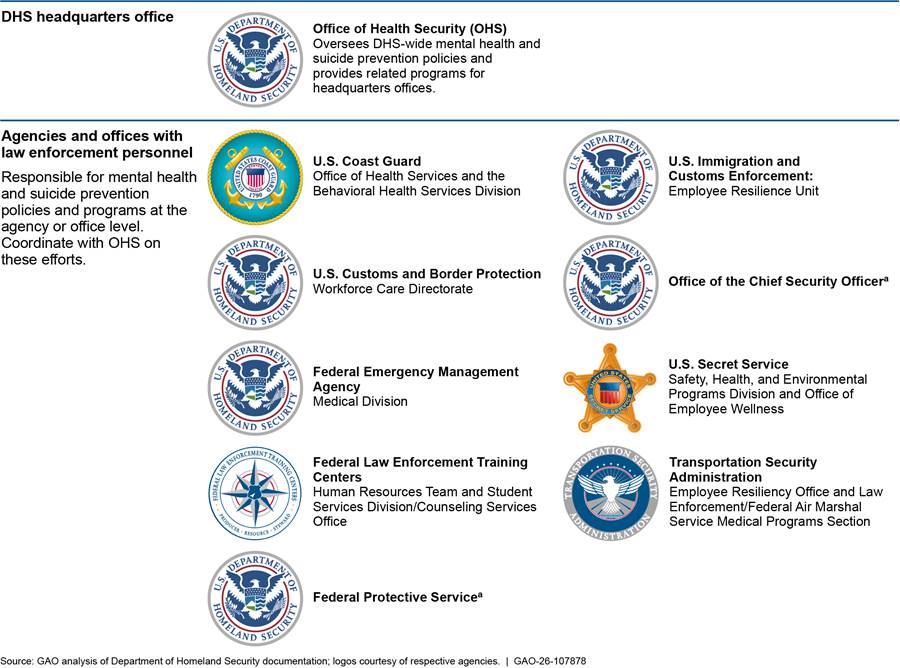
aThe Federal Protective Service and the Office of the Chief Security Officer are part of DHS headquarters and use mental health and suicide prevention policies and programs provided by OHS. The Federal Protective Service offers some additional initiatives but mainly uses programs offered by OHS.
Some of these law enforcement agencies also oversee other efforts, such as wellness and resiliency programs for employees.[32] For example, agencies are responsible for ensuring that law enforcement officers are examined for compliance with medical standards and physical requirements on a regular or as needed basis, including a psychiatric examination.[33] A psychiatric examination (including a psychological assessment) may only be used to make an inquiry into an employee’s mental fitness as it directly relates to successfully performing the duties of the position.[34]
DHS Resources Related to Mental Health and Suicide Prevention
DHS and its agencies reported varying levels of funding dedicated to mental health and suicide prevention programs. For example, OHS officials reported a total of approximately $832,000 in appropriated funds for mental health and suicide prevention efforts across DHS in fiscal year 2025. At the agency-level, CBP reported over $81 million (for its nearly 68,000 employees), ICE reported over $2 million (for its over 25,000 employees), and TSA reported nearly $5 million (for its over 65,000 employees) in appropriated funds for mental health and suicide prevention efforts for fiscal year 2025. Appendix I includes an overview of DHS and its agencies’ varying levels of staff and funding dedicated to mental health and suicide prevention.
DHS Law Enforcement Officers May Face Stressors Related to Mental Health Conditions and Suicide
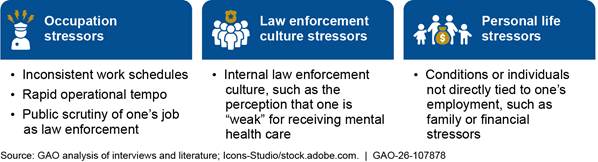
Stakeholders we interviewed and the literature we reviewed identified three main categories of stressors: (1) occupation, (2) law enforcement culture, and (3) personal life. See figure 2 for more details.
Figure 2: Key Categories of Stressors That May Affect Department of Homeland Security (DHS) Law Enforcement Officers
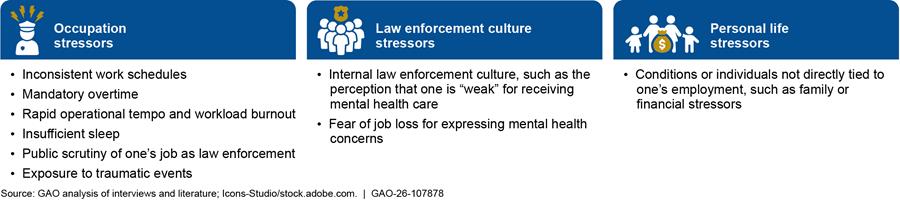
Note: Stakeholders from DHS, employee organizations, associations focused on law enforcement mental health and suicide prevention, and the literature identified key stressors.
Occupation stressors. Most of the peer support volunteers, stakeholders from employee organizations, DHS law enforcement agencies and offices, and associations we interviewed identified job-related stressors that could negatively affect law enforcement officers’ mental health.[35] In several interviews, stakeholders said that changing work schedules, mandatory overtime, and deployments away from home added strain to law enforcement officers’ personal lives. For example, one employee organization representative told us that irregular work schedules and frequent changes in law enforcement partners made it difficult to establish and sustain strong personal and family relationships. They noted that this disconnect can undermine personal support systems and potentially exacerbate risks of depression and suicidal ideation. Similarly, a 2021 FAMS survey found shifting work schedules can negatively affect well-being.[36] Additionally, a 2019 RAND report discussed how job-related stressors that affect DHS law enforcement officers such as daily exposure to traumatic events, can contribute to burnout and increased risk of depression.[37] A 2018 National Academies of Sciences, Engineering, and Medicine research also found that poor work-life balance contributed to law enforcement stress.[38]
Additionally, some stakeholders stated that DHS law enforcement officers may experience trauma from certain job-related tasks. For example, an official from an association explained that Border Patrol agents witnessing children separated from their parents or ICE investigators working to prevent child exploitation can find the work traumatic. Several other stakeholders mentioned that public and media criticism of law enforcement compounds stress for officers.
Law enforcement culture stressors. Nearly all the peer support volunteers and representatives from the employee organizations we interviewed identified factors related to law enforcement culture and perceived stigma against seeking professional mental health services.[39] Many peer support volunteers noted that law enforcement culture values individuals who independently persevere through hardship. For example, six of the 10 peer support volunteers stated that law enforcement officers often avoid seeking help for mental health concerns because they fear being perceived as weak. One peer support volunteer stated that the law enforcement culture emphasizes completing tasks at all costs, and officers may worry about being seen as incompetent if they ask for mental health help. The 2023 DHS Research Strategy cited prior research that indicates law enforcement personnel may avoid seeking help because of a general culture of independence and perseverance that may act as both a stressor and barrier for seeking help.[40]
Several stakeholders we interviewed said this stigma has begun to improve. However, they emphasized that stigma still exists. One peer support volunteer stated that law enforcement culture tends to reinforce the need to “suck it up,” which could contribute to officers being reluctant to seek mental health help when facing outside issues, such as substance use or divorce.
Representatives from most employee organizations we interviewed also stated that stigma is reinforced by fears of professional consequences. For example, representatives from all four employee organizations told us that law enforcement officers may hesitate to seek mental health support out of concern for job loss or other professional repercussions, such as loss of firearms. Additionally, results from a 2022 CBP employee organization survey found that many employees considered fear of fitness for duty examinations as a barrier to seeking help.
Personal life stressors. Nearly all of the peer support volunteers and stakeholders from the employee organizations and associations we interviewed identified personal life stressors as areas that can negatively affect law enforcement officers’ mental health.[41] For example, representatives from an employee organization and an agency stated that marital and financial issues are reasons law enforcement officers may seek mental health support through counseling.
The aggregation of the occupation and law enforcement culture stressors can make the personal life stressors, which most people face, even more difficult. For example, one peer support volunteer noted that law enforcement officers may have a higher risk of suicide compared to the general population due to the stress from work—including schedules—and not being able to spend time with family.[42] Additionally, a representative from an employee organization stated that relationship issues such as divorce, family crisis, and alcohol use are stressors that are inextricably intertwined with the job and culture of law enforcement. Furthermore, the 2023 DHS Research Strategy noted that research identified concerns for law enforcement personnel, such as poor work-life balance, alcohol use, sleep deprivation, and family unrest.
DHS and Law Enforcement Agencies Established Policies and Programs for Mental Health and Suicide Prevention
OHS and all seven DHS law enforcement agencies have established policies and programs related to mental health and suicide prevention that apply to all DHS employees. We identified five key department-wide policies, along with additional agency-specific policies, that collectively establish mental health and suicide prevention programs. At the department level, OHS manages initiatives across DHS headquarters and agencies, while law enforcement agencies offer additional programs to support employee mental health and suicide prevention.
OHS and Law Enforcement Agencies Established Policies for Mental Health and Suicide Prevention
OHS oversees mental health and suicide prevention policies that typically apply to all DHS employees, and the law enforcement agencies have additional specific policies to guide their programs. While department-wide policies do not address law enforcement officers specifically, these policies provide the framework for which law enforcement agencies implement their programs, according to OHS officials. Table 2 shows five department-wide policies, or directives, and their related programs that we identified as relevant to mental health and suicide prevention.[43]
Table 2: Key Department of Homeland Security (DHS) Mental Health and Suicide Prevention Policies and Related Programs
|
Policya |
Year |
Policy description |
Related program description |
|
Employee Assistance Program (Directive 254-02) |
2007 |
Establishes procedures and objectives for Employee Assistance Programs, such as counseling, across the department. Under this policy, DHS agencies are responsible for ensuring that employees have access to the program. |
Employee Assistance Programs are confidential short-term counseling programs to help employees with relationship, substance use, or financial issues. |
|
Traumatic Incident Management Program (Directive 254-03)b |
2007 |
Establishes the policy and procedures for the Traumatic Incident Management Program for DHS employees. Under this policy, DHS agencies should offer services to employees involved in or affected by traumatic incidents to minimize psychological trauma. |
Traumatic Incident Management Programs provide services such as debriefings and group sessions to support employees after events like shootings, hostage incidents, or deaths by suicide. |
|
Suicide Prevention, Intervention, and Postvention (Directive 256-07) |
2020 |
Establishes a framework for reducing deaths by suicide. This policy has three key elements—suicide prevention, intervention, and postvention—to reduce risk factors and build resilience skills.c |
The Directive outlines programs for suicide awareness training, suicide prevention messaging, and mindfulness training. |
|
Peer Support Programs (Directive 256-09) |
2022 |
Establishes the framework for Peer Support Programs, including that peer support volunteers undergo thorough application and approval processes for selection. The policy’s accompanying instruction includes selection criteria for peer support volunteers, such as that volunteers must have experience or interest in mental health topic areas.d |
Peer Support Programs use trained DHS volunteers to provide confidential assistance to other employees as part of routine health and wellness and after critical incidents. |
|
Workforce Health and Wellness Program (Directive 254-07)e |
2025 |
Establishes a policy for health and wellness programs with the goal of ensuring a ready workforce. This includes providing employees with flexible work schedules to participate in physical and mental health activities and ensuring that employes have access to health and wellness facilities. |
The Workforce Health and Wellness Program includes initiatives and activities related to physical and mental health, wellness, and occupational safety. |
Source: GAO analysis of DHS documents. | GAO‑26‑107878
Notes: We identified these five directives as relevant to mental health and suicide prevention. In addition to the examples in the table, the Office of Health Security (OHS) officials said that other directives such as the Worksite Lactation Directive and the Occupational Safety and Health Directive also play a role in employee well-being.
OHS is the principal medical, workforce health and safety, and public health authority for DHS. OHS oversees department-wide mental health and suicide prevention policies. Some of the policies in the table precede the establishment of OHS in 2022. According to OHS officials, OHS became responsible for implementing these policies in 2022.
aFour of the five DHS policies apply to all DHS agencies and employees, including law enforcement officers. While the Peer Support Programs (Directive 256-09) does not apply to the U.S. Coast Guard, the agency has incorporated peer support into its programs, according to Coast Guard officials.
bTraumatic incidents are also known as “critical incidents.”
cSuicide postvention is as an organized response after a death by suicide to facilitate recovery from grief and distress and mitigate negative effects and risk factors, according to the directive.
dDepartment of Homeland Security, Implementation of Peer Support Programs, Instruction 256-09-001 (June 29, 2022).
eDepartment of Homeland Security, Workforce Health and Wellness Program, Instruction 254-07-001 (May 5, 2025).
All seven law enforcement agencies have also established separate policies related to mental health and suicide prevention. These agency-specific policies provide more details on roles and responsibilities, resources, and programs. For example, CBP’s Suicide Prevention, Intervention, and Postvention Directive specifies which positions in CBP are responsible for developing and managing suicide prevention training.[44] Additionally, ICE’s Peer Support Program Directive and its accompanying handbook establish a selection process for peer support volunteers and an overview of types of services volunteers can provide.[45] Like the department-wide policies, agency-specific policies typically apply to all agency employees, including law enforcement officers.
OHS and Law Enforcement Agencies Provide Mental Health and Suicide Prevention Programs and Initiatives
OHS Programs and Initiatives
Programs for headquarters personnel. OHS provides mental health and suicide prevention programs for DHS headquarters personnel. These include an Employee Assistance Program, veteran support resources, and suicide awareness efforts. Also, OHS oversees the headquarters Workforce Health and Wellness Program that allows employees in positions with fitness standards, such as law enforcement officers, up to five hours a week to participate in physical and mental health activities during work. OHS is in the process of developing a Peer Support Program for headquarters personnel, according to officials. However, as of December 2025, these officials noted that factors such as staffing issues have delayed the program rollout.[46] OHS has plans to hire additional staff in fiscal year 2026 to support DHS agencies and to establish the DHS headquarters Peer Support Program, according to officials. Once implemented, this program will provide peer-to-peer assistance and connect employees to mental health resources. Law enforcement officers in the Federal Protective Service and the Office of the Chief Security Officer can use these programs, as they are headquarters personnel.
Suicide Prevention-Related Initiatives. OHS oversees the DHS-Columbia Protocol App, a mobile application that is available on all DHS phones and can assess employees’ suicide risk, as well as provide information on suicide prevention resources.[47] OHS officials told us that they also offer a suicide prevention training program called Question, Persuade, Refer, which teaches employees to recognize suicide-related crisis and warning signs and provide early intervention.
Coordination Council and Committee. OHS facilitates regular meetings with agency officials to discuss workforce health and suicide prevention programs through two initiatives—the Employee and Family Readiness Council and the Psychology Advisory Committee. As part of the Employee and Family Readiness Council, officials from OHS and DHS law enforcement agencies discuss workforce health and wellness program initiatives and updates. OHS officials told us that the Psychology Advisory Committee includes officials across DHS with expertise in clinical psychology and behavioral science who coordinate on mental health-related initiatives, such as providing input on training materials related to psychological readiness and suicide prevention.
Department-wide Employee Assistance Program. OHS is working to establish a single Employee Assistance Program for all DHS agencies, according to officials. Currently, each agency manages its own program. Once the new department-wide program is operational, existing agency-level Employee Assistance Programs will transition into it. According to officials, the new Employee Assistance Program will expand available services and offer tailored resources for law enforcement personnel, including specialized counselors and clinicians experienced in law enforcement. According to OHS officials, these new capabilities will help provide timely and targeted support for law enforcement personnel, veterans, and families. In May 2026, OHS officials said they have begun a phased rollout of the program.
Law Enforcement Agencies’ Programs and Initiatives
The seven DHS law enforcement agencies have mental health and suicide prevention programs available for all employees, including law enforcement officers. For example, all the agencies offer an Employee Assistance Program and a Peer Support Program.[48] These law enforcement agencies have also developed suicide awareness and wellness initiatives. Additionally, CBP and ICE have established initiatives that provide targeted support for law enforcement officers.
Employee Assistance Programs. Employees, including law enforcement officers, and family members can access Employee Assistance Programs for counseling, financial, and legal assistance services for free. Peer support volunteers that we interviewed from CBP, ICE, and TSA stated that law enforcement officers use the program for various purposes, including retirement planning and family counseling. Additionally, two CBP peer support volunteers noted that CBP law enforcement officers who want additional privacy may prefer to use the Employee Assistance Program, which offers services through a contractor, rather than talking with agency counselors or peer support volunteers. For example, one CBP peer support volunteer said that law enforcement officers may not want their coworkers to see them going into a counselor’s office, so they may contact the Employee Assistance Program.
Peer Support Programs. Trained peer support volunteers can provide emotional support during one-on-one sessions or serve as part of critical incident response teams. Furthermore, some agencies, such as CBP and ICE, provide chaplaincy programs, which have similar functions as Peer Support Programs with an additional focus on religious and spiritual guidance. CBP, ICE, and TSA officials also told us that they offer specialized peer support for veterans. According to most (seven out of 10) peer support volunteers we interviewed, law enforcement officers prefer to speak to other officers when seeking support. For example, one TSA peer support volunteer told us that federal air marshals prefer to talk with other marshals as they can better understand each other’s needs and experiences. Some peer support volunteers told us they have deployed to other offices as part of critical incident response teams. For example, peer support volunteers said they have deployed to offices where a colleague died or a natural disaster occurred and organized individual and group sessions for employees.
Suicide awareness and wellness initiatives. The seven agencies offer additional initiatives focused on suicide awareness or prevention and wellness. For example, CBP and Coast Guard require annual suicide prevention training for all employees. Also, Secret Service officials told us that they offer a suicide prevention course during initial training for newly hired law enforcement officers. CBP and ICE created informational campaigns to increase awareness of suicide prevention services, according to officials. Furthermore, six of the seven law enforcement agencies allow certain employees to engage in health and wellness activities during work hours.[49] Other wellness activities, such as those offered by the Federal Law Enforcement Training Centers, include mindfulness and stress management classes.
Law enforcement-related initiatives. CBP and ICE provide several initiatives that offer targeted support for employees in certain law enforcement positions.[50] For example, in 2023, CBP signed a memorandum of understanding, known as Safe Harbor, with the two employee organizations that represent CBP employees, including law enforcement officers.[51] Safe Harbor offers all CBP employees, including law enforcement officers, a path to seek help for mental health concerns without risking job loss or automatic removal from duty. According to CBP guidance, employees notify their supervisors to invoke Safe Harbor and discuss how their condition may affect performance. Once Safe Harbor is invoked, employees cannot be referred for a Fitness for Duty Evaluation for 12 months solely because they sought mental health treatment.[52]
While Safe Harbor applies to all CBP employees, it provides unique safeguards for law enforcement officers. For example, it specifies that a law enforcement officer’s temporary firearm removal (e.g., when there is an immediate threat to themselves or others) does not automatically lead to revocation of law enforcement authority. Instead, Safe Harbor allows officers to perform modified duties while seeking mental health treatment. CBP employee organization representatives stated that, from their perspective, this flexibility helps law enforcement officers stabilize and encourages them to seek help earlier, reducing the stigma or fear of losing employment.
ICE’s Awareness and Resilience Mentoring for Operational Readiness (ARMOR) program provides specialized resources to employees working on child exploitation investigations, including ICE special agents. According to ICE officials, the program is intended to help law enforcement officers recognize work-related trauma, develop coping strategies, and use support networks to reduce negative mental health effects caused by exposure to child exploitation material.
DHS Collected Data on Mental Health Program Use but Not All Suicide Death Data
OHS and our selected law enforcement agencies—CBP, ICE, and TSA—collect data on mental health program use but not all suicide-related data variables as specified in the relevant DHS directive.[53] Regarding mental health programs, OHS relies on agencies to provide data on the use of their individual programs. CBP, ICE, and TSA collect data on program use by all employees, including law enforcement officers. OHS has taken steps to centralize data on workforce deaths, including suicides. However, we found that while CBP, ICE, and TSA track data on law enforcement officers’ suicide-related deaths, they have faced challenges in collecting data on all the variables specified in DHS’s Suicide Prevention, Intervention, and Postvention Directive.[54]
OHS and Selected Law Enforcement Agencies Collected Data on Use of Their Mental Health Programs
OHS relies on agencies to collect data on their employees’ use of agency-specific mental health programs, including Peer Support Programs. OHS officials told us that they will request such data from agencies if DHS or external stakeholders, such as Congress, seek information on program use, including the number of employees who have accessed the programs.
CBP, ICE, and TSA collect data on the use of their agency-specific programs, including Employee Assistance Programs and Peer Support Programs, as shown in figure 3. These agencies track program use for all DHS employees, which includes, but is not specific to, law enforcement officers.[55] Additionally, these agencies track information on the number of psychological examinations, including fitness for duty examinations, conducted on law enforcement officers.
Figure 3: Examples of Data Collected on Mental Health Program Use by Selected Department of Homeland Security (DHS) Law Enforcement Agencies
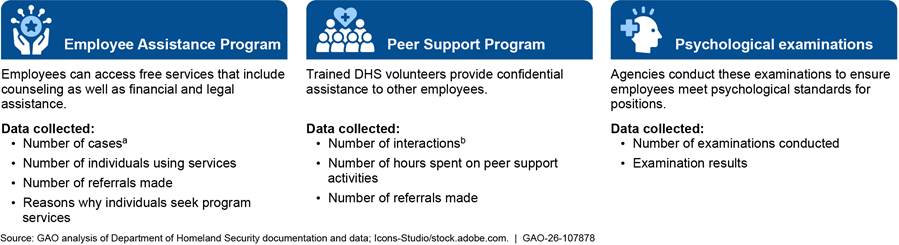
Note: The selected agencies are U.S. Customs and Border Protection, U.S. Immigration and Customs Enforcement, and the Transportation Security Administration.
aA case refers to a user’s request for Employee Assistance Program services.
bInteractions refer to any employee or individual provided support or assistance by a peer volunteer acting in their peer support capacity.
Employee Assistance Programs. CBP, ICE, and TSA collect some data on the use of their Employee Assistance Programs for all personnel.[56] CBP officials told us that employees can disclose their law enforcement officer status when using Employee Assistance Program services, but they are not required to and can decline. ICE and TSA collect some general data on program users (e.g., if the individual is an employee or supervisor) but not law enforcement status. Data provided by CBP, ICE, and TSA included the numbers of cases, individuals who accessed the program, and referrals made.[57] ICE and TSA also provided data on the reasons why individuals sought assistance.
Our review of agency data found the following:
· CBP’s Employee Assistance Program use increased on average 18 percent per year from calendar year 2020 through calendar year 2024.[58] CBP reported 4,548 cases in 2020 and 8,497 in 2024. From January to October 2025, CBP reported 7,468 cases.[59]
· ICE’s Employee Assistance Program use decreased on average 10 percent per year from fiscal year 2020 through fiscal year 2024.[60] ICE reported 4,082 service uses in fiscal year 2020 and 2,591 in fiscal year 2024. Using a set of different data variables, ICE reported 2,922 service uses in fiscal year 2025.[61] Additionally, for fiscal year 2025,
|
Law Enforcement Officers as Peer Support Volunteers Law enforcement officers across Department of Homeland Security agencies may serve as peer support volunteers and help colleagues, including other officers, with personal or professional challenges. These law enforcement officers provide this assistance in addition to their job duties. For the months below in 2025, U.S. Customs and Border Protection (CBP), U.S. Immigration and Customs Enforcement (ICE), and the Transportation Security Administration (TSA) reported the following number of law enforcement officers who provided peer support: · CBP: 1,765 (November) · ICE: 289 (December) · TSA: 251 (September) Source: GAO analysis of Department of Homeland Security documents; GAO interviews with officials. | GAO‑26‑107878 |
· ICE reported that individuals seeking Employee Assistance Program services sought help for various concerns, including marital, occupational, stress, and anxiety.
· TSA’s Employee Assistance Program use decreased on average 2 percent per year from fiscal year 2020 through fiscal year 2024.[62] TSA reported 8,040 service uses in fiscal year 2020 and 7,357 in fiscal year 2024. Using a set of different data variables, TSA reported 8,065 service uses in fiscal year 2025.[63] For fiscal year 2025, TSA reported that individuals seeking Employee Assistance Program services sought help for various concerns, including substance use, marital concerns, emotional concerns, and depression.
Peer Support Programs. CBP, ICE, and TSA collect data on use of their Peer Support and critical incident response programs.[64] CBP and ICE officials said that they do not collect data that may identify an individual’s law enforcement status. TSA officials, on the other hand, stated that the agency collects some data on the number of law enforcement officers receiving peer support, as well as the reasons for assistance. Across all three agencies, peer support volunteers are responsible for tracking and reporting their contacts, which we refer to as interactions, with employees.[65] Data provided by CBP, ICE, and TSA included the number of interactions and hours spent on peer support, as well as information on referrals made.
Our review of agency data found the following:
· CBP’s Peer Support Program data prior to fiscal year 2024 are either unavailable or unreliable, according to CBP officials.[66] In fiscal year 2024, CBP reported at least 35,602 interactions.[67] In fiscal year 2025, CBP reported at least 49,650 interactions.[68]
· ICE’s Peer Support Program interactions varied each year from fiscal year 2020 through fiscal year 2025. The number of interactions ranged from a high of 1,903 interactions in fiscal year 2023 to a low of 1,023 in fiscal year 2021.[69] ICE reported 1,539 in fiscal year 2025.
· TSA’s Peer Support Program interactions with all individuals on average decreased per year from fiscal year 2020 through fiscal year 2025.[70] For federal air marshals, the number of interactions varied each year and ranged from a high of at least 795 interactions in fiscal year 2020 and a low of at least 63 in fiscal year 2023.[71] TSA reported at least 701 interactions with federal air marshals in fiscal year 2025. Available data for fiscal years 2020 through 2025 show that federal air marshals sought peer support for help due to circumstances such as unexpected deaths, relationship issues, balancing career and family, and colleagues’ deaths by suicide.
Psychological examinations. CBP, ICE, and TSA collect data on the number of psychological examinations, including fitness for duty examinations, conducted on law enforcement officers and the results of these examinations.[72] Agencies perform psychological fitness for duty examinations to ensure employees continue to meet medical, including psychological, standards for positions. For example, CBP and TSA initiate a fitness for duty examination if management has evidence that an employee’s mental health issue conflicts with existing medical standards, according to officials. Similarly, ICE officials said they use psychological independent medical examinations to assess law enforcement officers’ psychological fitness when there is a high likelihood that an officer is unfit for duty. Agencies provided the following information for psychological examinations conducted for fiscal years 2020 through 2025:
· CBP reported that it performed 166 fitness for duty examinations on law enforcement officers during this period. Forty-three percent (72 of 166 examinations) of the examinations received a “fit” outcome, while 57 percent (94 of 166 examinations) received a “not fit” outcome.[73] In fiscal year 2025, CBP reported a total of 22 examinations, with 14 receiving a “not fit” outcome and eight receiving a “fit” outcome.
· ICE officials reported two psychological examinations during this period. Both law enforcement officers passed the examinations and returned to duty, according to officials.
· TSA FAMS officials reported that the agency referred one law enforcement officer for examination, who passed the evaluation. TSA reported no additional psychological examinations for non-TSA FAMS law enforcement officers for this period.
CBP, ICE, and TSA officers may have their firearms temporarily removed or law enforcement duties restricted if these agencies have concerns about officers’ medical conditions, including mental health. If an agency determines that there is no longer a concern, the officer can return to perform their full duties. However, if issues remain, the agency may perform additional evaluations, including psychological examinations.
· CBP and ICE officials said that while they collect data on the number of law enforcement officers who had their firearms removed, these agencies do not track specific medical reasons, including mental health-related reasons, for removals.[74]
· TSA officials provided the total number of temporary law enforcement restrictions due to mental health-related reasons per year from fiscal year 2022 through fiscal year 2025. According to TSA, temporary restrictions ranged from a low of 18 in fiscal year 2022 to a high of 35 in fiscal year 2023. TSA reported 19 temporary restrictions in fiscal year 2025.
OHS and Selected Law Enforcement Agencies Have Taken Steps to Collect Suicide-Related Data
OHS Centralized Data Collection
In 2025, OHS developed a database called the Workforce Fatality Tracking System to centralize and standardize data collection on DHS employee deaths, including law enforcement officers’ deaths by suicide. As of August 2025, OHS officials stated that they had begun collecting suicide-related death data through the system.
OHS coordinates with law enforcement agencies to obtain data on deaths by suicide using information the agencies already track. According to OHS officials, OHS contacts agencies’ designated points of contact to request death data, including cases of suspected and known suicides. OHS officials told us that they plan to use the data to identify patterns and trends and to inform suicide prevention and intervention strategies, programs, and policies. OHS officials also told us that OHS plans to share findings with agencies during monthly meetings to support information-sharing. CBP and TSA officials told us that their agencies had begun submitting data to OHS for inclusion in the new system as of August 2025, while ICE officials told us they will submit data once they complete training on the system.
Law Enforcement Agencies Collected Data
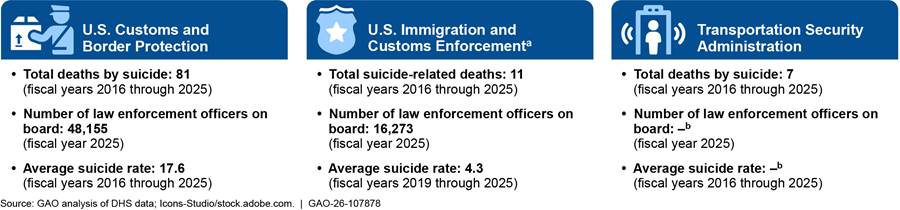
We found that the three selected law enforcement agencies—CBP, ICE, and TSA—collected data on suicide-related deaths among their law enforcement officers.[75] During fiscal years 2016 through 2025, these three agencies reported that at least 99 suicide-related deaths occurred among law enforcement officers. We refer to these data as suicide-related due to differences across the agencies’ data collection practices. Particularly, CBP and TSA officials told us that they update new information for suicide-related deaths as it is received, including final determination for cause of death. In contrast, ICE officials stated that they do not update incidents with “found dead” as cause of death if new information is identified.[76] CBP and TSA provided law enforcement officer “death by suicide data” to us, while ICE provided data that included cause of death as “found dead” or “self-inflicted gunshot.”
Suicide-related data from CBP, ICE, and TSA may not include all law enforcement officers’ deaths by suicide. All three agencies described challenges with collecting these data, such as the need to rely on external sources for information, which may contribute to missing and incomplete data. We discuss these challenges later in this report. As described above, research has also indicated that deaths by suicide in law enforcement populations tend to be unreported and misclassified.[77] Figure 4 summarizes suicide-related data from CBP, ICE, and TSA for fiscal years 2016 through 2025.
Figure 4: Suicide-Related Data from Selected Department of Homeland Security (DHS) Agencies for Fiscal Years 2016 Through 2025
Notes: Data may not include all law enforcement officers’ deaths by suicides. All three agencies described challenges with collecting suicide-related data, such as the need to rely on external sources for information, which may contribute to missing and incomplete data.
To calculate the average suicide rates for U.S. Customs and Border Protection (CBP) and U.S. Immigration and Customs Enforcement (ICE), we divided the number of law enforcement officers’ deaths during these years by the number of law enforcement officers in the same fiscal year. We then multiplied this rate by 100,000 officers. ICE did not provide the number of law enforcement officers for fiscal years 2016 through 2018, so we were unable to calculate the suicide rates for these years.
aWe refer to ICE’s data as suicide-related, as ICE reported the cause of death for five of its 11 suicide-related deaths as “found dead.” ICE defined “found dead” as when a law enforcement officer was found dead in their home, vehicle, etc. but there was no final determination of cause of death, such as a self-inflicted gunshot wound.
bAccording to the Transportation Security Administration (TSA), the number of law enforcement officers is sensitive information. Without the number of officers, we were unable to calculate suicide rates for TSA.
CBP. For fiscal years 2016 through 2025, CBP reported that at least 81 deaths by suicide occurred among its law enforcement officers. As shown in figure 5, our analysis found that the suicide rates for CBP law enforcement officers for this period varied compared to nationwide suicide rates for the general population.[78] In some years, CBP’s suicide rates were similar to the nationwide rates for the general population, while in other years CBP had higher rates. We also compared CBP’s suicide rate to the nationwide rate for males, because CBP reported that 86 percent of its law enforcement officers were male, as of December 2024. In six of the nine years with available nationwide data, CBP’s suicide rate was lower than the nationwide rate for males.[79] For fiscal years 2016 through 2025, CBP had an average suicide rate of 17.6 per year. Appendix II includes annual data on CBP’s deaths by suicide as well as nationwide rates for the general population, males, and females.
Figure 5: Suicide Rates for U.S. Customs and Border Protection Law Enforcement Officers Compared to Nationwide Suicide Rates, 2016–2025
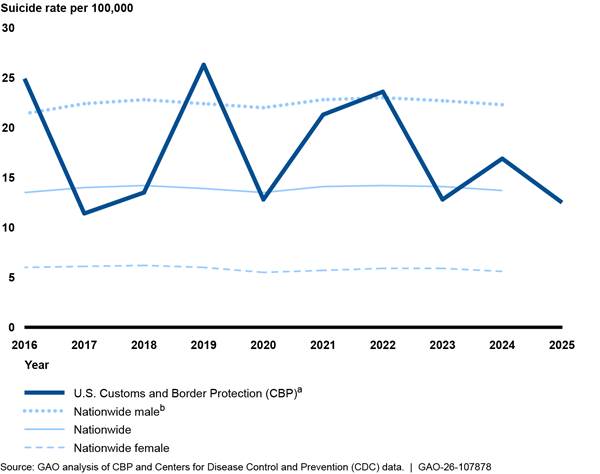
Note: We calculated CBP’s suicide rates by fiscal year, while CDC reports suicide data on a calendar year basis.
aTo calculate the CBP suicide rate for law enforcement officers, we divided the number of suicides by the number of law enforcement officers in the same fiscal year. We then multiplied this rate by 100,000 officers. As of December 2024, CBP reported that 86 percent of its law enforcement officers were male.
bCDC calculates the nationwide suicide rates as the number of suicides per 100,000 people in a population. As of January 2026, CDC published the provisional nationwide suicide rates for 2024 but not for 2025.
ICE. ICE reported that at least 11 suicide-related deaths occurred among law enforcement officers for fiscal years 2016 through 2025. For fiscal years 2019 through 2025, ICE had an average suicide rate of 4.3 per year.[80] The number of deaths per year ranged from zero to three deaths. ICE reported one law enforcement officer’s death in fiscal year 2025.
TSA. TSA reported that at least seven deaths by suicide occurred among law enforcement officers for fiscal years 2016 through 2025.[81] The number of deaths per year ranged from zero to two deaths. TSA reported one death in fiscal year 2025.
All three agencies collected information on the manner of death, and each reported at least one death that involved a firearm. For deaths involving a firearm, CBP, ICE, and TSA tracked whether the origin of firearm involved was personal, duty-issued, or unknown (see table 3). For CBP, we found that most of the suicide-related deaths involving a firearm included a duty-issued one (43 of 69).
Table 3: Number of Suicide-Related Deaths Involving a Firearm by Selected Department of Homeland Security Law Enforcement Agencies in Fiscal Years 2016 Through 2025
|
|
Deaths involving a firearm |
|||||
|
Agency |
Total |
Total |
Personal |
Duty-issued |
Unknown origin of firearm |
|
|
U.S. Customs and Border Protection |
81 |
69 |
18 |
43 |
8 |
|
|
U.S. Immigration and Customs Enforcement |
11 |
5 |
– |
1 |
4 |
|
|
Transportation Security Administration |
7 |
7 |
5 |
2 |
– |
|
Source: GAO analysis of Department of Homeland Security data. | GAO‑26‑107878
Selected Law Enforcement Agencies Face Challenges Collecting All Specified Suicide Data
While CBP, ICE, and TSA collect some data on suicide-related deaths, none of these agencies collect all data variables specified in DHS’s Suicide Prevention, Intervention, and Postvention Directive. The directive states that agencies will report these data variables, to the extent that data are available, annually to OHS. Further, the 2024 National Strategy for Suicide Prevention emphasizes the need to improve the quality, timeliness, scope, usefulness, and accessibility of data needed for suicide-related surveillance, research, evaluation, and quality improvement.[82] It also states that better connecting data from various sources can help to improve the quality of suicide-related data. Table 4 lists the data variables included in the directive and the extent to which CBP, ICE, and TSA collect data on each variable.[83]
Table 4: Suicide Death Data Variables Tracked by Selected Department of Homeland Security (DHS) Law Enforcement Agencies from Fiscal Year 2016 Through January 2025
|
DHS’s Suicide Prevention, Intervention, and Postvention Directive data variablea |
U.S. Customs and Border Protection |
U.S. Immigration and Customs Enforcement |
Transportation Security Administration |
|
Manner or mode of death |
● |
● |
● |
|
If injury or death by firearm: duty-issued or personal |
● |
● |
● |
|
Age and gender |
● |
◐ |
● |
|
Marital or domestic partner status |
● |
◐ |
◐ |
|
Date, time, place, and duty status |
◐ |
● |
◐ |
|
Years of employment with DHS, agency, and position level |
● |
¡ |
● |
|
Children (yes or no) |
● |
◐ |
¡ |
|
Cause of death |
¡ |
◐ |
● |
|
Race and ethnicity |
● |
¡ |
¡ |
|
Veteran status |
● |
¡ |
¡ |
|
Education level (e.g., high school, college, advanced degree) |
● |
¡ |
¡ |
|
Alcohol and/or drug use (yes or no) |
¡ |
● |
¡ |
|
Shift work and overtime (yes or no) |
¡ |
¡ |
● |
|
Use of Employee Assistance Program or other program resources (yes or no) |
¡ |
◐ |
¡ |
|
Relationship, legal, financial issues, recent death or loss, etc. |
¡ |
¡ |
¡ |
|
Performance or administrative issues (yes or no) |
¡ |
¡ |
¡ |
|
Line of duty mental stress or physical injury (yes or no) |
¡ |
¡ |
¡ |
|
Recent past suicidal behavior (yes or no) |
¡ |
¡ |
¡ |
● Agency tracked all data variable(s) for the majority of deaths
◐ Agency tracked some of the data variable(s) for at least one death
¡ Agency did not track data variable(s)
Source: GAO analysis of Department of Homeland Security information and agencies’ data. | GAO‑26‑107878
aDepartment of Homeland Security, Suicide Prevention, Intervention, and Postvention, Directive 256-07 (Oct. 19, 2020).
Inconsistent data collection could hinder DHS’s understanding of the prevalence of suicide among its law enforcement population, as well as prevalent risk factors. OHS officials told us that they rely on agencies for data collection, which makes efforts to compare data and identify trends across agencies more challenging. According to Science and Technology Directorate officials, limited collection of suicide data variables has made it difficult to determine what job-related factors may contribute to deaths by suicide or could be addressed by interventions.
As noted above, the directive states that agencies will report on data variables to the extent data are available. Agency officials from CBP, ICE, and TSA told us about challenges in collecting information on deaths by suicide, including the data variables specified in the directive. Specifically, agency officials told us that collecting data on the circumstances surrounding a suicide can be challenging without follow-up. The agencies rely on external sources, such as local police reports or death certificates, as well as follow-up with family members, to determine whether a cause of death was suicide related. CBP officials told us that they cannot collect some data variables as the information can be inaccessible and highly sensitive. Particularly, CBP officials stated that it can be difficult to ensure completeness of the data because of privacy concerns, as well as trying to respect the family of the deceased. CBP also only reports on verifiable information that is reported through official channels, according to officials. ICE and TSA officials told us that they do not collect information on some data variables because of privacy concerns. For example, TSA officials told us that they have not provided OHS with some of the information listed in the directive, such as an individual’s prior mental health issues or prior suicide attempts.
DHS’s new Workforce Fatality Tracking System is intended to bring more consistency to data collection, including law enforcement officers’ suicide data, according to OHS officials. As mentioned above, OHS officials aim to use the data to inform suicide prevention and intervention strategies. For this system, OHS still relies on agencies to collect the data. As the system is intended to track all employee deaths, the data variables included in the new database do not match the data variables included in DHS’s Suicide Prevention, Intervention, and Postvention Directive. In addition to the data variables in the system, OHS officials told us that they collect specific data for deaths by suicide by sending a survey to agencies. This survey includes questions on the employee’s background and circumstances leading to the death that align with the directive. However, the survey also includes additional questions that differ from the data variables in the directive, such as questions about the employee’s work and criminal history.
OHS officials told us they wrote the directive initially in 2020 as a placeholder for a DHS-wide suicide prevention directive. They said the data variables included in the directive were more aspirational than imminently achievable, with a larger goal to develop a DHS-wide understanding of suicide prevention. Additionally, OHS officials stated that some of the agencies were hesitant to buy into the directive. OHS officials said that they recognized that agencies face challenges with privacy concerns and limited information in collecting suicide-related data. These officials also told us that they were working with agencies to make data collection more consistent and to determine a minimum baseline of critical variables. However, as of December 2025, OHS officials said they have paused their effort to update the directive because of staffing issues. In January 2026, OHS officials told us that they received approval to fill key positions responsible for leading various suicide prevention efforts, including updating the directive in coordination with key stakeholders, such as officials from law enforcement agencies.
OHS officials told us they recognize the importance of improving the consistency of suicide-related data across agencies to improve insights on commonalities across incidents. As OHS brings on new staff, assessing and updating the data variables specified in the Suicide Prevention, Intervention, and Postvention Directive and, if appropriate, updating the Workforce Fatality Tracking System would allow for more consistent data collection among DHS agencies. This in turn would allow OHS and agencies to identify prevailing trends across agencies over time, assisting agency prevention efforts where death by suicide numbers may be concentrated, such as among law enforcement officers.
DHS Has Not Consistently Taken Steps to Assess Mental Health and Suicide Prevention Programs for Its Law Enforcement Officers
DHS and our three selected agencies have taken some steps to assess mental health and suicide prevention programs but have not done so consistently. For DHS-wide programs, these steps include, for example, developing policy directives that include reporting provisions, facilitating meetings, and conducting employee surveys. We found that while DHS and the selected agencies took these steps, they did not consistently implement assessment and reporting provisions included in relevant DHS directives. For the two initiatives we identified that offer targeted support to certain employees in law enforcement positions—ICE’s ARMOR program and CBP’s Safe Harbor—ICE began a multiyear program evaluation and CBP developed a four-phase evaluation framework. However, CBP lacks key information needed to assess Safe Harbor.
DHS and Selected Law Enforcement Agencies Have Taken Some Steps to Assess Mental Health and Suicide Prevention Programs
Within DHS, OHS, CBP, ICE, and TSA have taken some steps to assess mental health and suicide prevention programs designed for all employees, including law enforcement officers.[84] Specifically, DHS developed department-wide policies, and, according to OHS officials, OHS became responsible for implementing and overseeing these policies in 2022. In addition, OHS facilitates ongoing meetings with agencies and partnered with the Science and Technology Directorate to develop a research framework.
· Department-wide policies. DHS has developed department-wide policy directives that include some reporting provisions to support assessment efforts.[85] For example, the DHS’s Workforce Health and Wellness Program Instructions outline metrics that DHS and agency officials are to use to evaluate workplace health and wellness programs on an annual basis.[86] Additionally, DHS’s Peer Support Programs Directive includes a provision for agency programs to provide DHS with a peer support utilization report semiannually.[87] As discussed earlier in this report, DHS’s Suicide Prevention, Intervention, and Postvention Directive includes several variables for employee deaths by suicide that DHS and its agencies will report on, to the extent data are available.[88]
· OHS facilitations. OHS facilitates regular meetings with agency officials to discuss and assess mental health and suicide prevention efforts. For example, Employee and Family Readiness Council members meet quarterly to discuss, review, and evaluate various health and wellness programs, including mental health and suicide prevention, according to OHS officials. They also identify new priorities and coordinate activities on a quarterly basis, according to OHS officials. The Psychology Advisory Committee meets on a monthly basis and is involved in initiatives such as facilitating knowledge-sharing sessions and case reviews to enhance evidence-informed practice across the field, according to OHS officials.[89] OHS officials also told us that these facilitated meetings with DHS agencies serve as an important mechanism for fostering interagency cooperation. According to OHS officials, these meetings are not intended to be comprehensive assessment efforts and may also help reduce fragmentation and avoid duplication of efforts across agencies.
· Research strategy. OHS and the Science and Technology Directorate reported on DHS and agency efforts to assess health-and-wellness-related programs in the 2023 DHS Research Strategy. This effort was a result of a working group with participants from across DHS.[90] The Research Strategy identified research areas, such as suicide prevention and trauma exposure, and identified law enforcement as a target population of the DHS workforce to include in studies. The Research Strategy also identified resources for DHS psychological health and wellness at the individual and organizational levels. For example, the Research Strategy included an inventory of current assessment efforts of DHS and agency programs related to psychological health and wellness. Additionally, the Research Strategy outlined several objectives and priorities, including assessing the performance of psychological health programs (e.g., resilience, mental wellness, and suicide prevention).
Officials from CBP, ICE, and TSA also reported taking steps to assess agency-specific mental health and suicide prevention programs they offer that are available for all employees.
CBP. CBP’s Office of Field Operations established a social science program in 2024, according to CBP officials. The program’s goal is to assess the office’s policies, standard operating procedures, and training to ensure efforts are evidence-based and reflect best industry practices, according to Office of Field Operations officials. In 2024, the office conducted a survey on employees’ use, awareness, and accessibility of resiliency programs. Office of Field Operations staff who responded to the survey reported that they were generally satisfied with services provided in the office’s resiliency program. Based on the results of the survey, officials recommended that the office provide a clear and easily accessible channel for employee feedback on resiliency and well-being programs as the workforce needs shift in the future, such as an anticipated retirement surge in 2028.[91]
ICE. Officials from ICE and the Science and Technology Directorate hired an evaluator to assess whether the ICE Peer Support Program could be reliably and credibly evaluated. This evaluator reviewed whether sufficient data were available to conduct such an evaluation, and how useful an evaluation would be to stakeholders. In October 2024, the assessment concluded that the ICE Peer Support Program could be evaluated because, among other things, it had been well-designed and implemented for over 10 years. The assessment stated that an evaluation would also inform comparative assessments and the continued refinement of existing sister programs within DHS and other agencies with law enforcement officers. As of December 2025, ICE officials told us that any evaluation of the Peer Support Program is on hold due to budgetary constraints. In addition, ICE conducted two surveys in 2022 and 2024 that focused on employees’ views on agency mental health programs, such as the Employee Assistance Program, the Peer Support Program, and WorkLife.
TSA. TSA officials told us their assessment efforts for their mental health programs included monitoring the number of calls on two hotlines. Specifically, within TSA, FAMS offers a hotline for federal air marshals and their families, and TSA offers a separate one for all TSA employees. According to TSA officials, federal air marshals who are members of the critical incident response teams review call volume and general usage data (not personal information) from these hotlines to identify employee needs, recognize trends, and plan relevant training and support development within the program.
Additionally, FAMS officials told us that the agency took steps to assess the effectiveness of programs through a pulse survey. Specifically, in 2021, FAMS conducted a pulse survey with questions about law enforcement officers’ stressors, views on agency support, and perspectives on TSA mental health programs. FAMS used this survey to develop and implement methods to assess the health and fitness of the FAMS workforce as a whole.[92] For example, health and wellness recommendations included reviewing TSA’s Employee Assistance Program contract to ensure that the program provides services that can address law enforcement-specific needs. As of August 2025, FAMS officials stated that the 2021 pulse survey was the most recent one they had conducted.
OHS and Selected Law Enforcement Agencies Have Not Consistently Assessed or Reported on Mental Health and Suicide Prevention Programs
As DHS’s principal medical, workforce health and safety, and public health authority, OHS is responsible for oversight of DHS department-wide mental health and suicide prevention directives including implementation of assessment and reporting provisions. OHS, CBP, ICE, and TSA have taken some steps to assess mental health and suicide prevention programs available to all DHS employees. But they have not consistently implemented assessment and reporting provisions in the three key DHS directives that included such provisions. We based this finding on whether the agencies met the reporting time frames in the directives, such as annual or semiannual reporting. As discussed above, for the suicide prevention directive, agencies face challenges collecting the variables.
Furthermore, our prior work has demonstrated that federal decision-makers need evidence about whether federal programs and activities are achieving intended results as part of their oversight responsibilities.[93] We previously reported that applying certain key practices can help agencies in planning and implementing evidence-building activities and that these actions can produce the evidence needed to help them assess, understand, and identify opportunities to improve their results. More specifically, key practices to build and assess evidence include assessing the extent to which existing evidence addresses key questions, identifying and prioritizing new evidence needs, and generating new evidence.
OHS and the selected law enforcement agencies have not consistently implemented the three directives’ provisions related to program assessment and reporting, according to our review of the directives and information provided by OHS, CBP, ICE, and TSA officials. Specifically, as a result of these inconsistencies, OHS is not regularly collecting or reviewing agency reports and data that could be used to assess programs geared toward mental health and suicide prevention for DHS employees, including law enforcement officers. OHS is responsible for implementing and overseeing each of the directives, according to OHS officials. However, it does not have a process in place to consistently collect the reporting information the directives outline, or to conduct assessments to identify any areas for improvement. Table 5 lists examples of DHS directives’ provisions related to program assessment and reporting.[94]
Table 5: Department of Homeland Security (DHS) Mental Health and Suicide Prevention Assessment and Reporting Provisions
|
Workforce Health and Wellness Program (Instruction 254-07-001)a |
Peer Support Programs (Instruction 256-09-001)b |
Suicide Prevention, Intervention, and Postvention (Directive 256-07)c |
|
DHS and agency Workforce Health and Wellness Coordinators are to use certain metrics to evaluate workplace health and wellness programs on an annual basis. Examples of metrics: · Budget and staff for workforce health and wellness · Employees’ program assessment scores · Suicide rates |
Agencies provide a Peer Support utilization report semiannually to the Office of Health Security (OHS). Examples of report information: · Number of interactions · Type of peer support service provided · The amount of time committed to providing peer support services |
DHS and its agencies are to report on specific data variables, to the extent that data are available, on an annual basis. Examples of data variables: · Age and gender · Years of DHS employment · Cause of death |
Source: GAO analysis of DHS information. | GAO‑26‑107878
Note: According to OHS officials, OHS became responsible for implementing and overseeing these directives in 2022.
aDepartment of Homeland Security, Workforce Health and Wellness Program, Instruction 254-07-001 (Sept. 11, 2023).
bDepartment of Homeland Security, Peer Support Programs, Instruction 256-09-001 (June 29, 2022).
cDepartment of Homeland Security, Suicide Prevention, Intervention, and Postvention, Directive 256-07 (Oct. 19, 2020).
DHS’s Workforce Health and Wellness Program Directive. This directive includes reporting provisions and states that OHS and agency Workforce Health and Wellness Coordinators are to use certain metrics to evaluate workplace health and wellness programs on an annual basis.[95] These efforts are to include, for example, annual reporting to senior leadership regarding the implementation of workforce health and wellness programs, successes, shortcomings, and plans for improvement.[96] However, our review of agency documents found that CBP, ICE, and TSA did not provide this information annually, nor did they provide all of the information in the directive’s provisions. OHS stated that they collect information from agencies on an ad hoc basis if requested by DHS leadership or others, such as members of Congress, and compile findings into a report. Examples of these reports that we received from OHS included utilization information but did not include assessment information specified in the directive, such as successes, shortcomings, and plans for improvement.[97]
DHS’s Peer Support Program Directive. This directive states that agencies are to provide a Peer Support utilization report semiannually that includes the number of interactions, the amount of time committed to providing peer support services and the type and number of referrals.[98] Officials from CBP and TSA stated that they collected some information, such as number of interactions and the amount of time committed to providing peer support services included in the directive but did not provide us with any reports as we requested. ICE officials provided examples of reports that they collected most of the information in the directive, such as the number of interactions, referrals, and amount of time committed to providing peer support services.[99] These officials said they submitted the required utilization reports to OHS upon request. However, OHS officials told us in April 2025 that they have not collected these reports because they first wanted to develop a Peer Support Program for headquarters personnel.
In August 2025, OHS officials told us that they hired a Peer Support Coordinator to, in part, collect reports from agencies that OHS had previously not collected due to lack of sufficient personnel. In December 2025, OHS officials told us that the Peer Support Coordinator had been filling staffing gaps in the field and had yet to start these efforts. As mentioned above, OHS has plans to hire additional staff in fiscal year 2026 to support DHS agencies and to establish the DHS headquarters Peer Support Program, according to officials. OHS’s efforts to hire a Peer Support Coordinator and its plan to start collecting reports from agencies are positive steps, but additional steps are needed to ensure that there is a process in place to consistently collect and assess information on DHS’s Peer Support Program. For example, OHS could oversee progress of peer support programs by systematically reaching out to the DHS agencies for utilization reports.
DHS’s Suicide Prevention, Intervention, and Postvention Directive. This directive states that DHS and agencies are to report on specific data variables, to the extent that data are available.[100] These data variables include the date and manner of death, age, and whether the injury or death was by firearm. As discussed above, while CBP, ICE, and TSA collect some data on suicide-related deaths, agency officials have faced challenges in collecting all the data variables included in directive.
OHS and agencies have not consistently implemented directive provisions for reporting on and assessing mental health and suicide prevention programs because they do not have a process in place to do so across each of the directives. DHS, including OHS and the Science and Technology Directorate, has recognized the need to assess all mental health and suicide prevention programs, as outlined in the 2023 DHS Research Strategy. Specifically, the Research Strategy identified the need for systematic efforts within DHS to track progress and evaluate the outcomes of programs and policies, among other objectives. This includes having accurate information. The assessment and reporting provisions in the directives could help provide some of this information, if consistently implemented. However, officials told us that efforts to implement the Research Strategy have stalled due to changes in research priorities under the current administration as well as budget challenges.
By developing a process to consistently implement reporting provisions and assess DHS agencies’ mental health and suicide prevention programs, OHS, in coordination with the agencies, could better build and assess evidence to identify any areas for improvement. Coordination between OHS and DHS agencies is important as each agency implements its mental health and suicide prevention programs. OHS could use established groups, such as the Psychology Advisory Committee or Employee and Family Readiness Council discussed earlier, for such coordination. Furthermore, consistent data collection through the reporting provisions could improve analysis of comparable information across agencies, strengthen oversight, and help ensure comprehensive coverage of mental health and suicide prevention programs. This approach would also position OHS to identify program gaps and opportunities for enhancement across the department.
ICE and CBP Have Taken Steps to Assess Programs for Law Enforcement Officers, but CBP Lacks Information to Assess Safe Harbor
We identified two initiatives at ICE and CBP—the ARMOR program and Safe Harbor, respectively—that offer targeted support to certain employees in law enforcement positions. ICE’s ARMOR program provides specialized resources to employees working on child exploitation investigations, including ICE special agents. CBP’s Safe Harbor offers all employees, including law enforcement officers, a path to seek help for mental health concerns without risking job loss or automatic removal from duty.
We found that ICE has taken steps to assess its ARMOR program. Specifically, in 2024, ICE entered into an Interagency Agreement with the Uniformed Services University of the Health Sciences’ Center for the Study of Traumatic Stress to conduct a multi-year program evaluation. Data gathered will be used to determine which ARMOR activities are effective, remove or change those that are not, and determine if other best practices can be implemented. This study is in progress with preliminary results expected in September 2026, according to ICE officials.
CBP has also taken some steps to assess its implementation of the Safe Harbor memorandum of understanding with the two employee organizations that represent CBP employees, including law enforcement officers, but lacks key information. Our key practices for evidence-based policymaking can help a federal organization plan for results by providing a clear picture of what a program is trying to achieve, how it will achieve it, and any obstacles that may affect its ability to do so.[101] Key practices to plan for results include defining goals, such as near-term measurable results, identifying strategies and resources, and assessing the environment. These key practices also state that federal decision-makers need evidence about whether federal programs and activities are achieving intended results.[102]
The 2023 Safe Harbor memorandum of understanding includes several statements related to long-term goals or outcomes for the initiative, such as reducing the stigma associated with mental health treatment and ensuring confidentiality of employees’ mental health conditions. In addition, CBP’s Workforce Care Directorate developed a four-phase framework intended to evaluate and mature Safe Harbor, as shown in table 6. In August 2025, CBP officials stated that they conducted outreach with the Workforce Care Directorate staff to obtain their perspectives and identified areas for improvement. In particular, these officials said that staff shared concerns about low employee awareness of Safe Harbor and limited procedural and administrative guidance. Additionally, officials from CBP, two CBP employee organizations, and CBP peer support volunteers we spoke with expressed concerns about unclear guidance and inconsistent implementation across the agency.
Table 6: U.S. Customs and Border Protection’s (CBP) Four-Phased Approach to Evaluate and Mature Safe Harbor
|
Discover |
Build |
Deploy |
Advance |
|
Understand Workforce Care Directorate objectives, define the change, and perform assessments to develop a program maturity strategy |
Develop an overarching plan of action and detailed approaches to operationalize the maturation strategy. |
Implement the action plan to prepare, equip, and support people as they transition through the change. |
Reinforce the change, measure and improve program maturation outcomes, celebrate and share success stories, and drive continuous improvement. |
Source: GAO analysis of CBP documents. | GAO‑26‑107878
While developing an evaluation framework is a positive step, CBP lacks key information from employees needed to help it assess Safe Harbor and identify opportunities to improve results. For example, as of June 2025, CBP did not have information on what existing or new evidence could be used to determine the program’s effectiveness or the extent to which employees used Safe Harbor. CBP officials told us that although some CBP components historically collected data on Safe Harbor use, the CBP Workforce Care Directorate revised its guidance in August 2025 to address workforce concerns about case confidentiality. The revised guidance directs supervisors to share Safe Harbor information on a need-to-know basis and prohibits management from identifying employees who invoke Safe Harbor. According to CBP officials, these restrictions make data collection more difficult. Officials further stated that tracking employees who invoke Safe Harbor may discourage participation because employees may fear job loss or reduced privacy. As a result, CBP officials determined that the risks of tracking outweigh the potential benefits.
However, CBP officials acknowledged the importance of assessing the effectiveness of Safe Harbor and officials told us that they have collected some proxy data. These proxy data include the numbers of fitness for duty examinations discussed earlier in this report. According to CBP officials, the number of psychological fitness for duty examinations has declined significantly since the introduction of Safe Harbor. However, CBP officials stated they cannot directly attribute the cause of this decrease to Safe Harbor. In general, officials said they have not decided which data would most accurately show the effectiveness of the program.
CBP does not have these data and other information because it lacks a plan that establishes a clear approach to assess the effectiveness of Safe Harbor. While CBP’s four-phase framework is intended to evaluate and mature Safe Harbor, it is not an assessment plan and does not include specific details beyond the broad framework outline. More specifically, neither the Safe Harbor memorandum of understanding nor the framework include elements that we have identified as key to planning for results, such as including near-term measurable outcomes, or planning for building and assessing evidence, such as identifying data collection methods and employee awareness.[103] Planning for results also includes identifying and mitigating factors that may affect the ability to achieve goals. For example, this could include identifying ways to collect data without unique identifiers to provide needed program information that would not pose a risk to confidentiality.
Developing and implementing a plan for how CBP will assess the effectiveness of Safe Harbor could better position the agency to understand employees’ decisions to invoke the program. These steps would help CBP determine which efforts best support law enforcement officers who need mental health services. As part of this effort, CBP could consider consulting other entities, internal or external to DHS, as appropriate, with experience in assessing programs with sensitive information.[104] Other DHS law enforcement organizations could then consider whether to adapt elements of the Safe Harbor, as appropriate, as it is the first agreement of its kind within DHS.
Conclusions
DHS implements and oversees mental health and suicide prevention efforts available to all DHS employees. Over 77,000 of these employees are law enforcement officers who perform critical work to protect national security and who are exposed to stress that may adversely affect their mental health. This number will increase in the coming years as DHS has received additional funding for hiring and training law enforcement officers and other related activities. To better support its employees and officers and prepare for the increase in hiring, DHS could take additional steps to ensure it provides effective mental health and suicide prevention-related services.
Specifically, assessing and updating the data variables in DHS’s Suicide Prevention, Intervention, and Postvention Directive and, if appropriate, updating the Workforce Fatality Tracking System would make data collection more feasible and consistent. This could also help OHS and DHS agencies identify trends and target prevention efforts among certain populations, including law enforcement. In addition, developing a process to consistently collect and assess information related to mental health and suicide prevention programs would help OHS ensure comprehensive coverage of relevant programs and identify any programming gaps across the department. Furthermore, while CBP has taken some steps to assess Safe Harbor—the first agreement of its kind within DHS—it lacks key information to determine its effectiveness. Developing and implementing a plan for how it will assess the effectiveness of Safe Harbor, while taking into account concerns about confidentiality, could better position CBP to determine which efforts best support law enforcement officers who seek help for mental health concerns and understand their decisions to invoke the program and frequency of doing so.
Recommendations for Executive Action
We are making a total of three recommendations, including two to DHS and one to CBP. Specifically:
The Secretary of Homeland Security should direct OHS to assess and update the list of data variables specified in its Suicide Prevention, Intervention, and Postvention Directive and, if appropriate, ensure that OHS updates the Workforce Fatality Tracking System to be consistent with any changes to the directive. (Recommendation 1)
The Secretary of Homeland Security should ensure that OHS, in coordination with DHS law enforcement agencies, develops a process to consistently collect relevant information and use this information to assess its law enforcement agencies’ mental health and suicide prevention programs. For example, OHS could oversee progress of DHS mental health and suicide prevention programs by collecting data on elements such as successes, shortcomings, and plans for improvement on a regular basis and assess the outcomes. (Recommendation 2)
The Commissioner of CBP should develop and implement a plan to assess the effectiveness of Safe Harbor, while taking into account employee confidentiality concerns. This plan could consider, for example, including results with near-term measurable outcomes as well as building and assessing evidence by identifying and collecting needed data and other information. It could also include consulting with internal DHS or external resources as appropriate. (Recommendation 3)
Agency Comments
We provided a draft of this product to DHS for review and comment. DHS provided comments, which are reproduced in full in appendix III. In its comments, DHS agreed with our three recommendations and described OHS’s and CBP’s planned actions to address them. DHS also provided technical comments, which we incorporated as appropriate.
We are sending copies of this report to the appropriate congressional committees and the Secretary of Homeland Security. In addition, this report is available at no charge on the GAO website at http://www.gao.gov.
If you or your staff have any questions, please contact me at shermant@gao.gov. Contact points for our Offices of Congressional Relations and Media Relations may be found on the last page of this report. GAO staff who made key contributions to this report are listed in appendix IV.

Tina Won Sherman
Director, Homeland Security and Justice
List of Requesters
The Honorable Bennie G. Thompson
Ranking Member
Committee on Homeland Security
House of Representatives
The Honorable J. Luis Correa
Ranking Member
Subcommittee on Border Security and Enforcement
Committee on Homeland Security
House of Representatives
The Honorable Shri Thanedar
Ranking Member
Subcommittee on Oversight, Investigations, and Accountability
Committee on Homeland Security
House of Representatives
The Honorable Glenn F. Ivey
House of Representatives
Appendix I: Department of Homeland Security Resources Related to Mental Health and Suicide Prevention
The Department of Homeland Security (DHS) and its law enforcement agencies and offices reported varying levels of staffing and funding dedicated to mental health and suicide prevention programs in fiscal year 2025, as shown in table 7.
Table 7: Department of Homeland Security Law Enforcement Agencies’ and Offices’ Staffing and Fiscal Year 2025 Funding Related to Mental Health and Suicide Prevention
|
Agency |
Number of staff |
Fiscal year 2025 funding |
|
U.S. Coast Guarda |
16 |
$808,000 |
|
U.S. Customs and Border Protection (CBP) |
42b |
$81,200,000 |
|
Federal Emergency Management Agencyc |
8 |
Not applicable |
|
Federal Law Enforcement Training Centers |
2d |
$25,000 |
|
U.S. Immigration and Customs Enforcement (ICE)e |
16 |
$2,021,000 |
|
U.S. Secret Servicef |
7 |
$234,000 |
|
Transportation Security Administration (TSA)g |
4 |
$4,800,000 |
|
Office |
|
|
|
Office of Health Securityh |
2 |
$832,000 |
Source: GAO analysis of Department of Homeland Security (DHS) information. | GAO‑26‑107878
aU.S. Coast Guard’s staff provide mental health and other related services in the field and do not count leadership positions. Coast Guard’s funding includes $700,000 for mental health services under the Coast Guard Chief Medical Officer and $108,000 for its Suicide Prevention Program, not including personnel costs.
bCBP’s staff positions include one Suicide Prevention Psychologist, three Operational Psychologists, 13 Resilience Specialists, and 25 other employees.
cFederal Emergency Management Agency’s staff positions include 11 full-time licensed professional counselor positions, with eight employees onboard and three vacancies as of June 2025. Federal Emergency Management Agency’s officials were unable to provide specific funding information for mental health and suicide prevention programs.
dFederal Law Enforcement Training Centers’ staff positions dedicated to mental health and suicide prevention include three psychologists, with two onboard and one vacant, as of June 2025.
eICE’s staff positions include 16 Employee Resilience Unit employees, an office responsible for implementing ICE’s mental health and suicide prevention programs.
fU.S. Secret Service’s seven staff positions include six Employee Assistance Specialists and one Chaplain Program Manager. Funding for an Employee Assistant Program includes educational and skills development, referral services, financial or legal guidance, and counseling for employees and family members outside Secret Service headquarters.
gTSA’s staff positions include one National Program Manager and three National Program Coordinators for the Critical Incident Response Program. TSA’s estimated fiscal year 2025 funding includes $4.5 million for the Employee Assistance Program, $12,500 for the Suicide Prevention program, and $308,000 for the Critical Incident Response Program.
hThe Office of Health Security’s funding is for DHS-wide efforts, including headquarters programs. In January 2026, OHS received approval to hire two staff to fill the vacant positions. These programs are available to headquarters offices, including Federal Protective Service and the Office of the Chief Security Officer.
During fiscal years 2016 through 2025, U.S. Customs and Border Protection (CBP) reported that at least 81 deaths by suicide occurred among its law enforcement officers. We compared CBP’s suicide rates to nationwide rates for the general population, males, and females. Table 8 shows the suicide rates for CBP law enforcement officers for this period varied compared to nationwide suicide rates for the general population.[105] In some years, the rates were similar, while in other years CBP had higher rates. Additionally, in six of the nine years with available nationwide data, CBP’s suicide rate was lower than the nationwide rate for males. As of December 2024, CBP reported that 86 percent of its law enforcement officers were male.
Table 8: Suicide Rates for U.S. Customs and Border Protection (CBP) Law Enforcement Officers Compared to Nationwide Suicide Rates by Year
|
|
CBP law enforcement officers |
Nationwide suicide rates per 100,000a |
||||||
|
|
Total deaths by suicide |
Totalofficers |
Suicide |
Total |
Male |
Female |
||
|
2016 |
11 |
44,143 |
24.9 |
13.5 |
21.4 |
6.0 |
||
|
2017 |
5 |
43,931 |
11.4 |
14.0 |
22.4 |
6.1 |
||
|
2018 |
6 |
44,441 |
13.5 |
14.2 |
22.8 |
6.2 |
||
|
2019 |
12 |
45,643 |
26.3 |
13.9 |
22.4 |
6.0 |
||
|
2020 |
6 |
47,043 |
12.8 |
13.5 |
22.0 |
5.5 |
||
|
2021 |
10 |
47,036 |
21.3 |
14.1 |
22.8 |
5.7 |
||
|
2022 |
11 |
46,646 |
23.6 |
14.2 |
23.0 |
5.9 |
||
|
2023 |
6 |
46,779 |
12.8 |
14.1 |
22.7 |
5.9 |
||
|
2024 |
8 |
47,346 |
16.9 |
13.7 |
22.3 |
5.6 |
||
|
2025 |
6 |
48,155 |
12.5 |
— |
— |
— |
||
Legend: — = Not available
Source: GAO analysis of U.S. Customs and Border Protection (CBP) and Centers for Disease Control and Prevention (CDC) data. | GAO‑26‑107878
Note: CBP provided total law enforcement deaths by suicide and officers by fiscal year. As a result, we calculated the suicide rate by fiscal year, while the CDC reports suicide data on a calendar year basis. As of January 2026, CDC had published the provisional nationwide suicide rates for 2024 but not for 2025.
aCDC calculated the nationwide suicide rates as the number of suicides per 100,000 people in a population.
bTo calculate CBP’s suicide rate for law enforcement officers, we divided the number of suicides by the number of law enforcement officers in the same fiscal year. We then multiplied this rate by 100,000 officers. As of December 2024, CBP reported that 86 percent of its law enforcement officers were male.
Tina Won Sherman, shermant@gao.gov
In addition to the contact named above Sarah Turpin (Assistant Director), Wendy Dye (Analyst in Charge), Nasreen Badat, Dan Corstange, Elizabeth Marin, Sasan J. “Jon” Najmi, Vanessa Nunez, Amanda Panko, and Aaron Safer-Lichtenstein made key contributions to this report.
The Government Accountability Office, the audit, evaluation, and investigative arm of Congress, exists to support Congress in meeting its constitutional responsibilities and to help improve the performance and accountability of the federal government for the American people. GAO examines the use of public funds; evaluates federal programs and policies; and provides analyses, recommendations, and other assistance to help Congress make informed oversight, policy, and funding decisions. GAO’s commitment to good government is reflected in its core values of accountability, integrity, and reliability.
Obtaining Copies of GAO Reports and Testimony
The fastest and easiest way to obtain copies of GAO documents at no cost is through our website. Each weekday afternoon, GAO posts on its website newly released reports, testimony, and correspondence. You can also subscribe to GAO’s email updates to receive notification of newly posted products.
Order by Phone
The price of each GAO publication reflects GAO’s actual cost of production and distribution and depends on the number of pages in the publication and whether the publication is printed in color or black and white. Pricing and ordering information is posted on GAO’s website, https://www.gao.gov/ordering.htm.
Place orders by calling (202) 512-6000, toll free (866) 801-7077,
or
TDD (202) 512-2537.
Orders may be paid for using American Express, Discover Card, MasterCard, Visa, check, or money order. Call for additional information.
Connect with GAO
Connect with GAO on X,
LinkedIn, Instagram, and YouTube.
Subscribe to our Email Updates. Listen to our Podcasts.
Visit GAO on the web at https://www.gao.gov.
To Report Fraud, Waste, and Abuse in Federal Programs
Contact FraudNet:
Website: https://www.gao.gov/about/what-gao-does/fraudnet
Automated answering system: (800) 424-5454
Media Relations
Sarah Kaczmarek, Managing Director, Media@gao.gov
Congressional Relations
David A. Powner, Acting Managing Director, CongRel@gao.gov
General Inquiries
[1]We refer to these agencies as law enforcement agencies throughout this report. The DHS agencies include the U.S. Coast Guard, U.S. Customs and Border Protection (CBP), the Federal Emergency Management Agency’s Mount Weather Police Department, Federal Law Enforcement Training Centers, U.S. Immigration and Customs Enforcement (ICE), U.S. Secret Service, and the Transportation Security Administration (TSA). DHS offices with law enforcement officers include the Federal Protective Service and the Office of the Chief Security Officer.
[2]For the purposes of this report, we use DHS’s definition of law enforcement officer found in the DHS Lexicon. This definition states that a law enforcement officer is a position occupied by an employee authorized by statute to enforce the laws of the United States, carry firearms, and make criminal arrests in the performance of their duties, including designated Coast Guard and other military officers and members. As the statutory basis for this definition, DHS cites various sections under titles 8, 14, 18, 19, 40, 49, U.S. Code. Department of Homeland Security. DHS Lexicon Terms and Definitions, Instruction Manual 262-12-001-01 2017 Edition – Revision 2 (Washington, D.C.: Oct. 6, 2017). For the purposes of this report, we also use the U.S. Department of Health and Human Services’ definition of mental health, which refers to a person's emotional, psychological, and social well-being.
[3]Department of Homeland Security, Office of Inspector General, Intensifying Conditions at the Southwest Border Are Negatively Impacting CBP and ICE Employees’ Health and Morale (Washington, D.C.: May 3, 2023).
[4]Suicide is one of the leading causes of death in the United States and is a significant public health problem that negatively affects families and entire communities. Suicide is complex and determined by multiple combinations of factors, such as mental illness, substance use, trauma, painful losses, exposure to violence, and social isolation. See Centers for Disease Control and Prevention, “Facts about Suicide,” Suicide Prevention, accessed September 10, 2025, https://www.cdc.gov/suicide/facts/index.html; Substance Abuse and Mental Health Services Administration, “Warning Signs of Suicide,” accessed February 19, 2026, https://www.samhsa.gov/mental-health/suicidal-behavior/warning-signs.
[5]The Law Enforcement Mental Health and Wellness Act of 2017, enacted in 2018, provides support for law enforcement agencies’ efforts to protect the mental health and well-being of officers. Pub. L. No. 115-113, 131 Stat. 2276. In 2020, the Law Enforcement Suicide Data Collection Act required the Attorney General, acting through the Director of the Federal Bureau of Investigation, to establish a data collection program for the purpose of preventing future law enforcement suicides and to promote understanding of suicide in law enforcement. Pub. L. No. 116-143, 134 Stat. 644.
[6]See An Act to provide for reconciliation pursuant to title II of H. Con. Res. 14, Pub. L. No. 119-21, title IX, subtitle A, § 90002(a)(1), title X, subtitle A, pt. II, § 100052(1), 139 Stat. 72, 358, 387-388.
[7]Other examples of funding provided by the 2025 reconciliation law through fiscal year 2029 include $750 million to the Secretary of Homeland Security for Federal Law Enforcement Training Centers, of which at least $285 million is for training newly hired federal law enforcement personnel of DHS, state, and local law enforcement agencies operating in support thereof; and $1.17 billion to the Secret Service for various purposes, such as additional Secret Service resources, including personnel, training facilities, programming, and technology. See id. §§ 100051, 100053, 100057, 139 Stat. at 385-86, 389, 393-94.
[8]GAO, Aviation Security: Federal Air Marshal Service Has Taken Steps to Address Workforce Issues, but Additional Actions Needed, GAO‑20‑125 (Washington, D.C.: Feb. 12, 2020).
[9]We did not include any recommendations in this report. GAO, U.S. Customs and Border Protection: Efforts to Improve Recruitment, Hiring, and Retention of Law Enforcement Personnel, GAO‑24‑107029 (Washington, D.C.: Sept. 25, 2024).
[10]We selected this period to identify sources that could provide relevant information on DHS and other federal law enforcement officers’ experiences over a range of time.
[11]The four employee organizations were the Air Marshal Association, the National Border Patrol Council, the National Treasury Employees Union, and TSA Council 100.
[12]For example, this included officials from CBP’s Workforce Care Directorate, ICE’s Employee Resilience Unit, and TSA’s Employee Resiliency Office.
[13]We selected these associations based on their previous work on mental health and suicide, including related to law enforcement officers. The five associations were the American Psychological Association, First H.E.L.P, the International Association of Chiefs of Police, the National Action Alliance for Suicide Prevention, and the National Alliance on Mental Illness.
[14]We selected peer support volunteers who were also law enforcement officers for these interviews as these individuals could provide firsthand perspectives on DHS law enforcement officers’ mental health and deaths by suicide. We randomly selected volunteers from CBP, ICE, and TSA because these were among the agencies in our review with the largest numbers of law enforcement officers.
[15]Employee Assistance Programs are short-term counseling programs to help employees with issues, including relationships, substance use, or finances. For Employee Assistance Programs, we obtained summary-level data from CBP, ICE, and TSA. Peer Support Programs use trained DHS volunteers to provide confidential assistance to other employees. For Peer Support Programs, we received summary-level data from CBP and ICE, and TSA provided record-level data.
[16]We initially asked these agencies to provide data for fiscal years 2016 through 2025. In general, we found agencies had the most reliable, complete data for fiscal years 2020 through 2025. As a result, we focused on this five-year period to more consistently report data. Also, CBP reported its data on Employee Assistance Program use for calendar years 2020 through 2025.
[17]CBP and ICE have the highest number of law enforcement officers among DHS agencies. According to TSA officials, the number of its law enforcement officers, which includes federal air marshals, is sensitive information and is therefore not included in this report.
[18]Agencies may only perform psychiatric examinations, including a psychological assessment, to make an inquiry into an employee’s mental fitness as it directly relates to successfully performing the duties of the position.
[19]We also asked the other agencies and the two DHS offices in our review whether they tracked data on firearms removed and other kinds of restrictions placed on law enforcement officers because of mental health concerns. We did not ask the Coast Guard as they typically do not track data by law enforcement position.
[20]For example, for CBP’s Peer Support Program, officials told us that the data were unreliable prior to fiscal year 2024. As a result, we only report on CBP’s data for fiscal years 2024 and 2025. For TSA’s Peer Support Program, we tested the data and found some inconsistencies that limited our ability to analyze program use over time.
[21]Department of Homeland Security, Suicide Prevention, Intervention, and Postvention, Directive 256-07 (Oct. 19, 2020). Suicide postvention is as an organized response after a death by suicide to facilitate recovery from grief and distress and mitigate negative effects and risk factors, according to the directive.
[22]Department of Homeland Security, Department of Homeland Security Psychological Health and Resilience Research Strategy 2023-2033 (Washington D.C.: September 2023).
[23]In our prior work, we identified 13 key practices that can help federal leaders and employees develop and use evidence to effectively manage and assess the results of federal efforts. These 13 key practices can be viewed as four interrelated topic areas, including (1) plan for results, (2) assess and build evidence, (3) use evidence, and (4) foster a culture of learning and continuous improvement. GAO, Evidence-Based Policymaking: Practices to Help Manage and Assess the Results of Federal Efforts, GAO‑23‑105460 (Washington, D.C.: July 12, 2023).
[24]U.S. Departments of Justice and Health and Human Services. Practices to Foster a Culture of Wellness and Psychological Health and Well-being of Law Enforcement Agency Personnel (Washington, D.C.: May 2023). This report states that stressors can be internal (e.g., unrealistic expectations, self-doubt) or external (e.g., work pressure, financial hardship, or family problems or disruptions) and may exacerbate existing mental health conditions or challenges, leading to increased symptoms or difficulties in coping.
[25]The Centers for Disease Control and Prevention (CDC) defines stigma as negative attitudes, beliefs, stereotypes people may hold towards those who experience mental health conditions. See Centers for Disease Control and Prevention, “Mental Health Stigma,” accessed January 9, 2026, https://www.cdc.gov/mental‑health/stigma/index.html.
[26]John M. Violanti and Andrea Steege, “Law Enforcement Worker Suicide: An Updated National Assessment,” Policing: An International Journal, vol. 44, no. 1 (2021). Also, see Daniel S. Lawrence, Jessica Dockstader, and Kathleen E. L. Padilla, “Unveiling the Silent Battle: Suicide Rates among Law Enforcement Personnel,” Police Practice and Research, vol. 26, no. 3 (2025). This paper found that law enforcement officers had an average suicide rate of 21.4 per 100,000 officers from 2016 through 2022, with male officers showing a significantly higher rate (22.7) than their female counterparts (12.7). Both studies noted that possible misclassification and underreporting of law enforcement officers’ suicides limit accurate calculations of suicide rates for officers. From 2016 through 2022, the general population had an average nationwide suicide rate of 13.9, with males having a higher rate (22.4) than females (5.9), according to CDC.
[27]Violanti and Steege, “Law Enforcement Worker Suicide.”
[28]Violanti and Steege, “Law Enforcement Worker Suicide.” This paper found that law enforcement personnel are 54 percent more likely to die by suicide than other deceased individuals who had been employed during their lifetime are. Also, see Ian H. Stanley, Melanie A. Hom, and Thomas E. Joiner, ““A Systematic Review of Suicidal Thoughts and Behaviors Among Police Officers, Firefighters, EMTs, and Paramedics,” Clinical Psychology Review, vol. 44 (2016).
[29]6 U.S.C. § 452 (DHS reorganization authority); 6 U.S.C. § 597 (Chief Medical Officer). DHS further stated that this reorganization aims to pioneer best-in-class workforce health, safety, work-life, and wellness programs.
[30]See 2024 Explanatory Statement, 170 Cong. Rec. H1501, H1808 (daily ed. Mar. 22, 2024), accompanying Further Consolidated Appropriations Act, 2024, Pub. L. No. 118-47, 138 Stat. 460.
[31]DHS’s Science and Technology Directorate has worked on research related to mental health and suicide prevention across the department, as discussed later in this report. Additionally, DHS’s Office of Strategy, Policy, and Plans updated the Officer Wellness Resources section for the DHS Use of Force Policy in 2023, according to officials. Department of Homeland Security, Update to the Department Policy on the Use of Force, Policy Statement 044-05 (Revisions 01) (Washington, D.C.: Feb. 6, 2023). However, according to officials in September 2025, the office no longer has a role in law enforcement policy.
[32]Wellness incorporates many dimensions of health, including emotional, environmental, financial, intellectual, occupational, physical, social, and spiritual, each of which is interconnected within an individual’s total well-being, according to the U.S. Department of Health and Human Services. Resilience is the ability to adapt to changing conditions and withstand and rapidly recover from disruption, according to DHS’s Lexicon.
[33]An agency may require an applicant or employee who has applied for or occupies a position with medical standards or physical requirements, or that is covered by a medical evaluation program, such as a law enforcement position, to report for a medical examination. 5 C.F.R. §§ 339.102, 339.202, 339.203, 339.205. An agency may also order a psychiatric examination (including a psychological assessment) only to make inquiry into a person’s mental fitness as it directly relates to successfully performing the duties of the position. 5 C.F.R. § 339.301(e). Failure to meet medical (including psychological) standards or physical requirements mean the applicant or employee is not qualified for the position unless a reasonable accommodation or waiver is appropriate. 5 C.F.R. § 339.102(c).
[34]5 C.F.R. § 339.301(e) (the inquiry is to determine whether the person poses a significant risk to themselves or others, and/or presents a vulnerability to business operation and information systems). If an officer is deemed "unfit for duty" due to a psychological condition, the agencies may develop a plan of action, which could involve medical leave, reassigning the officer to light duty or administrative tasks until they are cleared by medical professionals, terminated, or retired.
[35]“Most” refers to eight out of 10 peer support volunteers, stakeholders from all four employee organizations, officials from five of the nine DHS law enforcement agencies and offices, and officials from three of the five associations.
[36]Federal Air Marshal Service, Federal Air Marshal Service Health and Wellness: Survey Results and Recommendations (June 2021). We previously reported on the 2012 FAMS-commissioned Harvard sleep and fatigue study—which included a literature review, an analysis of federal air marshals’ work schedules, and a survey of federal air marshals. The study found that shift work schedules, like federal air marshals’ flight schedules, can cause significant acute and chronic sleep deprivation which in turn can adversely affect their personal health, such as increasing the risk of heart disease. See GAO‑20‑125.
[37]Carrie M. Farmer, Katie Whipkey, and Margaret Chamberlin, Programs Addressing Psychological Health and Resilience in the U.S. Department of Homeland Security (Santa Monica, CA: RAND Corporation, 2019).
[38]National Academies of Sciences, Engineering, and Medicine, Opportunities to Enhance the Health and Well-Being of the Department of Homeland Security Law Enforcement Workforce: Proceedings of a Workshop—in Brief (Washington, D.C.: August 2018).
[39]“Nearly all” refers to eight out of 10 peer support volunteers and stakeholders from all four employee organizations.
[40]Department of Homeland Security, DHS Psychological Health and Resilience Research Strategy 2023-2033. The report cited the following research: Institute of Medicine, A Ready and Resilient Workforce for the Department of Homeland Security: Protecting America's Front Line (Washington D.C.: 2013) and Institute of Medicine, Advancing Workforce Health at the Department of Homeland Security: Protecting Those Who Protect Us (Washington D.C.: 2014). The report also cited a 2018 RAND paper that has not been publicly released.
[41]“Nearly all” refers to nine out of 10 peer support volunteers, stakeholders from all four employee organizations, and officials from four of the five associations.
[42]As discussed above, research indicates that while the data are incomplete, law enforcement officers may be more likely to die by suicide. See Violanti and Steege, “Law Enforcement Worker Suicide” and Stanley et al., “A Systematic Review of Suicidal Thoughts and Behaviors Among Police Officers, Firefighters, EMTs, and Paramedics.”
[43]Some mental health and suicide prevention policies precede the establishment of OHS in 2022. According to OHS officials, OHS became responsible for implementing these policies in 2022. In addition to the examples in table 2, OHS officials said that other directives such as the Worksite Lactation Directive and the Occupational Safety and Health Directive were also relevant to employee well-being.
[44]U.S. Customs and Border Protection, Suicide Prevention, Intervention, and Postvention, Directive 51250-26 (Apr. 27, 2023).
[45]U.S. Immigration and Customs Enforcement, Peer Support Program, ICE Directive 1037.1 (Feb. 22, 2013); Peer Support Program Handbook (Dec. 11, 2017).
[46]In December 2025, OHS officials told us that they have sent some of their personnel, including the Peer Support Coordinator, to DHS agencies to help fill in staffing gaps for psychological positions. According to OHS officials, DHS agencies with law enforcement officers in critical field operations have faced staffing gaps.
[47]The DHS-Columbia Protocol App uses a series of questions to determine whether a DHS employee is at risk for suicide, assess the severity and immediacy of that risk, and gauge the level of support that the person needs. Specifically, the app calculates a low, moderate, or high risk and assigns recommended support resources and next steps based on the risk, such as connecting an employee at high risk with immediate resources, according to DHS documentation.
[48]Coast Guard and TSA have critical incident response programs, which include peer support volunteers.
[49]These agencies are CBP, Coast Guard, the Federal Emergency Management Agency, ICE, the Secret Service, and TSA. In the Coast Guard, military members can exercise during normal working hours. Secret Service officials told us that law enforcement officers can participate in physical activities during work hours. Similarly, TSA policy states that federal air marshals can participate in approved fitness activities during work hours. As of December 2025, Federal Law Enforcement Training Centers officials said they are working on a policy to allow its employees similar flexibilities.
[50]CBP and ICE behavioral health professionals provide law enforcement personnel with support. For example, CBP’s Operational Psychologists and Resilience Specialists provide in-field support to law enforcement personnel, according to CBP officials. ICE’s licensed behavioral providers help officers with mental health issues or who exhibit suicidal-related behaviors, according to officials
[51]These two employee organizations are the National Border Patrol Council and the National Treasury Employees Union. The National Border Patrol Council represents Border Patrol agents and support personnel assigned to U.S. Border Patrol, a CBP component. The National Treasury Employees Union represents federal employees in CBP as well as other departments and offices.
[52]Under Safe Harbor, employees may not be subjected to disciplinary or adverse actions solely based on their use of mental health resources or because they have notified the agency of potential mental health issues. According to CBP guidance, if a medical provider determines that an employee is unable to perform the essential functions of the position, then that employee can undergo a Fitness for Duty Evaluation even if the employee has invoked Safe Harbor. Additionally, CBP guidance states that Safe Harbor and discipline are two separate processes, and Safe Harbor does not preclude an employee from facing disciplinary action.
[53]We reviewed data from these agencies because they are among the agencies with the highest number of law enforcement officers and have the most mental health resources relevant to our review.
[54]Department of Homeland Security, Suicide Prevention, Intervention, and Postvention, Directive 256-07. We refer to these data as suicide-related due to differences across the agencies’ data collection practices.
[55]For Employee Assistance Programs, family members of CBP, ICE, and TSA employees may use the services and are included in data.
[56]CBP, ICE, and TSA’s Employee Assistance Program data include WorkLife services, such as support for finding childcare and senior care.
[57]A case refers to a user’s request for Employee Assistance Program services.
[58]CBP reported Employee Assistance Program data by calendar year. To calculate CBP’s program use, we used the number of Employee Assistance Program Counseling/WorkLife cases per year. CBP data also included other kinds of Employee Assistance Program services, including health coaching and trainings.
[59]The number of CBP law enforcement officers on board increased from 47,043 officers in fiscal year 2020 to 48,155 officers in fiscal year 2025. According to CBP data, from January to October 2025, 82 percent of Employee Assistance Program cases were for CBP employees (6,090 of 7,468 cases) and the remaining cases were for family members. Of these 6,090 CBP employee cases, 45 percent were for those who said they were law enforcement officers (2,737 of 6,090), while the remaining the cases were either employees who did not identify as law enforcement or declined to provide their law enforcement status.
[60]To calculate ICE’s program use for fiscal years 2020 through 2024, we used the number of counseling cases, initial referrals, and presentation participants. Fiscal year 2025 data only include the number of cases and referrals due to changes in reporting format. ICE officials told us that this new format may limit data comparison across years.
[61]The number of ICE law enforcement officers on board increased from 12,749 officers in fiscal year 2020 to 16,273 officers in fiscal year 2025.
[62]To calculate TSA’s program use for fiscal years 2020 through 2024, we used the number of counseling cases, initial referrals, and presentation participants. Fiscal year 2025 uses only include number of cases and referrals.
[63]The number of law enforcement officers is sensitive information, according to TSA, and is therefore not included in this report
[64]CBP, ICE, and TSA reported on Peer Support Programs and critical incident response programs data jointly as the programs have some overlap. For example, peer support volunteers participate in critical incident responses.
[65]We refer to peer support contacts as interactions in this report. A contact refers to any DHS employee or individual provided support or assistance by a peer volunteer acting in their peer support capacity. Family members may use the services on a limited basis, according to CBP, ICE, and TSA officials.
[66]CBP components, including Air and Marine Operations, U.S. Border Patrol, and Office of Field Operations, manage their own specific Peer Support Programs. U.S. Border Patrol officials told us they began to collect usage data for their component-specific program prior to fiscal year 2024. However, CBP components were using different definitions for “interactions” to track use until CBP established a common definition in fiscal year 2024, according to CBP officials. As a result, CBP officials said they consider the data to be most reliable starting in fiscal year 2024.
[67]We use “at least” as CBP officials told us that the number of interactions in fiscal year 2024 may have been underreported for some CBP components. CBP’s data includes support provided through the Peer Support Program, critical incident responses, and chaplaincy program. CBP components with law enforcement officers–Air and Marine Operations, U.S. Border Patrol, and Office of Field Operations—reported at least 33,769 (95 percent) of these interactions for fiscal year 2024.
[68]CBP reported the number of interactions in fiscal year 2025 as a minimum. According to CBP officials, the majority of these interactions occurred in CBP components with law enforcement officers similar to fiscal year 2024.
[69]ICE’s data includes support provided through the Peer Support Program and critical incident responses.
[70]TSA’s data include support provided through the Peer Support Program, critical incident responses, and the military veterans support program. TSA’s data allows volunteers to report the law enforcement status of the individuals they are assisting.
[71]We use “at least” for the number of interactions because of inconsistencies we identified in TSA’s data. Additional interactions with federal air marshals may have occurred. TSA also tracks support provided to TSA law enforcement officers that are not federal air marshals as well as officers from other organizations. For example, TSA peer support volunteers assisted officers from CBP and nonfederal police departments, according to agency data.
[72]CBP, ICE, and TSA officials told us that they do not collect data on the prevalence of mental health conditions among their employees, including law enforcement officers, for several reasons, such as privacy concerns.
[73]CBP reported a total of 243 requested examinations. However, according to CBP officials, 77 out of 243 examinations were canceled cases. At the end of fiscal year 2025, nine cases were canceled. As a result, we only included the total number of examinations that received either a “fit” or “not fit” decision.
[74]We also asked three other agencies and the two offices in our review whether they tracked the number of law enforcement officers who temporarily had their firearm removed, temporarily had their law enforcement authority revoked, or lost their job due to mental health reasons from fiscal year 2020 through August 2025. The Federal Emergency Management Agency, Federal Law Enforcement Training Centers, and Office of the Chief Security Officer reported that no law enforcement officers had their firearm removed due to mental health reasons during this period. The Federal Protective Service reported two firearm removals during this period. The Secret Service reported that it had suspended the clearances of 32 of its law enforcement officers due to mental health concerns. Of those 32 law enforcement officers, officials reported that nine ultimately had their clearances revoked for mental health issues, resulting in their subsequent separation from the Secret Service. We did not ask Coast Guard as officials told us they typically do not track information by law enforcement position.
[75]We asked each of the seven law enforcement agencies and two DHS offices in our review for any available data on deaths by suicide for law enforcement officers. Coast Guard officials told us that they track deaths by suicide, but their data do not distinguish between law enforcement and non-law enforcement deaths by suicide. The Secret Service told us that nine law enforcement officers died by self-inflicted gunshot wounds from fiscal years 2016 through 2025. Officials from the Federal Emergency Management Agency’s Mount Weather Police Department, Federal Law Enforcement Training Centers, and Federal Protective Service reported that they have not had a law enforcement officer death by suicide. Officials from the Office of the Chief Security Officer stated that they do not collect data on deaths by suicide.
[76]ICE reported the cause of death for five of its 11 suicide-related deaths as “found dead.” Officials told us that “found dead” refers to when a law enforcement officer was found dead in their home, vehicle, etc. but there is no final determination of cause of death, such as a self-inflicted gunshot wound.
[77]Violanti and Steege, “Law Enforcement Worker Suicide,” and Lawrence et al., “Unveiling the Silent Battle” discussed underreporting and misclassifications of deaths by suicide among law enforcement officers. For example, medical examiners can misclassify a death by suicide if they do not have sufficient evidence to determine the cause of death, according to Violanti and Steege. Lawrence et al. noted that law enforcement officers’ deaths may be underreported because of privacy concerns of the deceased and their family.
[78]To calculate the suicide rates for law enforcement officers, we divided the number of suicides by the number of law enforcement officers in the same fiscal year. We then multiplied this rate by 100,000 officers. CDC calculates the nationwide suicide rate as the number of suicides per 100,000 people in a population. We compared CBP’s suicide rates to nationwide rates for calendar years 2016 through 2024. CDC published the provisional nationwide suicide rates for 2024 but not 2025, as of January 2026.
[79]According to CDC, suicide rates for males are higher than females. For calendar years 2016 through 2024, the general population had an average nationwide suicide rate of 13.9, with males having a higher rate (22.4) than females (5.9).
[80]ICE did not provide the number of law enforcement officers for fiscal years 2016 through 2018, so we were unable to calculate the suicide rates for these years.
[81]According to TSA, the number of law enforcement officers is sensitive information. Without the number of officers, we were unable to calculate suicide rates for TSA.
[82]U.S. Department of Health and Human Services, National Strategy for Suicide Prevention (Washington, D.C.: April 2024).
[83]As discussed above, the Secret Service reported that nine law enforcement officers died by self-inflicted gunshot wounds during this period. The Secret Service reported the following information for each death: manner of death, cause of death, date and place of death, and whether the firearm involved in the death was duty-issued or personal.
[84]We selected these agencies because they have the highest number of law enforcement officers and offer the most mental health resources relevant to our review.
[85]DHS established OHS in July 2022, after issuing its 2022 Peer Support Programs Directive and prior to issuing its Workforce Health and Wellness Program Directive in August 2023. DHS updated the Workforce Health and Wellness Program Directive in 2025. Prior to OHS’s creation, DHS’s Office of the Chief Human Capital Officer was responsible for implementing DHS’s Peer Support Programs Directive.
[86]Department of Homeland Security, Workforce Health and Wellness Program, Instruction 254-07-001 (Sept. 11, 2023).
[87]Department of Homeland Security, Peer Support Programs, Directive 256-09 (June 29, 2022).
[88]Department of Homeland Security, Suicide Prevention, Intervention, and Postvention, Directive 256-07.
[89]The Employee and Family Readiness Council members include WorkLife Program Managers and Component Health and Wellness points of contact from each DHS agency. Psychology Advisory Committee members include a multidisciplinary team of professionals with expertise in clinical psychology, behavioral science, and organizational development from each DHS agency.
[90]DHS employees from across 19 offices and agencies—including the seven law enforcement agencies in our review—participated in the working group. See Department of Homeland Security, DHS Psychological Health and Resilience Research Strategy 2023-2033.
[91]According to the Office of Field Operations’ 2024 survey on employees’ use, awareness, and accessibility of resiliency programs, excluding mandatory retirements, 65 percent of retirement-eligible respondents indicated that they planned to retire.
[92]We previously recommended FAMS develop and implement a plan to assess the health and fitness of the Federal Air Marshal Service workforce, including trends over time. As of August 2024, we closed this recommendation as implemented in part because of this pulse survey. See GAO‑20‑125.
[93]See GAO‑23‑105460.
[94]The three directives each included provisions for agencies to report certain information on an annual or semi-annual basis, and for DHS to use such information for assessment purposes. Some of the policies in the table precede the establishment of OHS in 2022. According to OHS officials, OHS became responsible for implementing these policies in 2022.
[95]Examples of metrics in DHS’s Workforce Health and Wellness Program Instruction 254-07-001 data variables include budget and staff for workforce health and wellness activities.
[96]Department of Homeland Security, Workforce Health and Wellness Program, Instruction 254-07-001.
[97]We conducted this analysis while DHS operated under the September 2023 Workforce Health and Wellness Program Instruction. DHS later issued the May 2025 Workforce Health and Wellness Program Directive which included slightly different language for this provision. More specifically, the May 2025 directive stated that assessment efforts are to include annual reporting to senior leadership regarding status of implementation of workforce health and wellness programs, levels of engagement (e.g., employee participation, activity logs, etc.), and employee satisfaction surveys (e.g., successes, shortcomings, and plans for improvement).
[98]OHS and Office of the Chief Human Capital Officer are separate DHS offices. The directive states that agencies provide the report to DHS’s Office of the Chief Human Capital Officer. Upon its creation, OHS took over the Office of the Chief Human Capital Officer’s responsibilities for this directive.
[99]Specifically, ICE Peer Support reports include information for the provisions related to the number of interactions, type of peer support services provided, the amount of time committed to providing peer support services, and the number of referrals made but not the type of referrals made.
[100]According to OHS officials, OHS became responsible for implementing and overseeing this directive in 2022.
[101]See GAO‑23‑105460.
[102]See GAO‑23‑105460.
[103]See GAO‑23‑105460.
[104]DHS’s Science and Technology Directorate, DHS’s primary research and development arm, is an example of an internal DHS entity.
[105]To calculate the suicide rates for law enforcement officers, we divided the number of suicides by the number of law enforcement officers in the same fiscal year. We then multiplied this rate by 100,000 officers. The Centers for Disease Control and Prevention (CDC) calculates the nationwide suicide rate as the number of suicides per 100,000 people in a population. We compared CBP’s suicide rates to nationwide rates for calendar years 2016 through 2024. As of January 2026, CDC had published the provisional nationwide suicide rates for 2024 but not for 2025.