
Report to Congressional Committees
United States Government Accountability Office
A report to congressional committees.
For more information, contact: Timothy J. DiNapoli at DiNapoliT@gao.gov.
What GAO Found
The Naval Sea Systems Command (NAVSEA) builds and supports the Navy’s fleet. Using its SeaPort contract, NAVSEA spent about $21 billion over 6 years to acquire professional support services, such as systems engineering. Consistent with Department of Defense (DOD) guidance, NAVSEA generally uses the “best value tradeoff” process for awarding task orders for professional support services. Using this process means that the Navy might pay more if additional benefits justify the higher cost.
To actively manage labor costs for professional support services, NAVSEA
· developed a system to track labor costs after it awards the task order, and
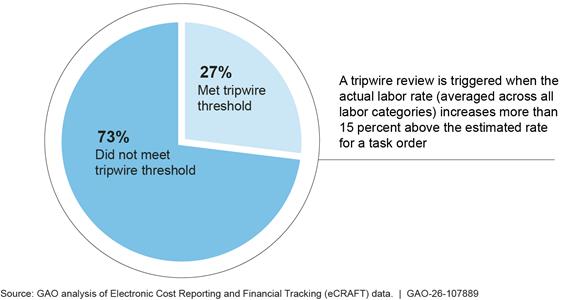
· established enhanced oversight when the actual labor rate exceeds 15 percent above the estimated rate for the task order, referred to as a “tripwire.”
GAO found that more than a quarter (106 of 389) of ongoing task orders for fiscal years 2019 through 2024 triggered the tripwire review.
Percentage of Ongoing Naval Sea Systems Command Task Orders That Met Tripwire Threshold, Fiscal Years 2019–2024
Across the 10 task orders that GAO reviewed in detail, actual labor costs increased by $152 million as of April 2025. This is about a 60 percent increase from their estimates at the time of award. Common drivers of these increases include changes in NAVSEA requirements or the need to use higher-priced labor categories to complete the work. For example, NAVSEA officials told GAO that requirements for uncrewed surface combatant ships were more complex and labor intensive than planned. This resulted in the need for additional senior personnel with more qualifications and experience to perform the work, but at higher labor cost. For five task orders that triggered the tripwire review, NAVSEA took or plans to take actions to address labor cost increases. For example, NAVSEA worked with the contractor to adjust its labor mix between more and less experienced personnel to control future cost growth.
Why GAO Did This Study
The Navy generally requires its commands, including NAVSEA, to first consider using its SeaPort contract when buying professional support services. The SeaPort contract identifies prequalified vendors that can provide these services, such as engineering and program management support, among others, needed to meet the Navy’s requirements. The labor cost for professional support services typically comprises a significant component of the overall contract costs.
A Senate report includes a provision for GAO to review NAVSEA’s professional support service contracts and associated labor costs. GAO’s report describes how NAVSEA (1) awards task orders for professional support services, and (2) manages increases in labor rates for professional support services.
To conduct this review, GAO analyzed ongoing NAVSEA task orders from fiscal years 2019 through 2024. GAO analyzed labor cost data for 389 task orders, and from those task orders selected a nongeneralizable sample of 10 for further review. GAO selected the 10 orders based on the labor rate increases, number of labor categories, and period of performance. GAO reviewed relevant federal, DOD, and Navy regulations; NAVSEA policy; and contract documentation. GAO also interviewed cognizant contracting and policy officials at DOD and NAVSEA.
Abbreviations
COR contracting officer’s representative
DFARS Defense Federal Acquisition Regulation Supplement
DOD Department of Defense
eCRAFT Electronic Cost Reporting and Financial Tracking
FAR Federal Acquisition Regulation
FPDS Federal Procurement Data System
IDIQ indefinite-delivery, indefinite-quantity
IT information technology
LPTA lowest price technically acceptable
NAVSEA Naval Sea Systems Command
NMCARS Navy Marine Corps Acquisition Regulation Supplement
PEO Program Executive Offices
RFO Revolutionary FAR Overhaul
SCLS Service Contract Labor Standards
SEA 02 Contracts Directorate
This is a work of the U.S. government and is not subject to copyright protection in the United States. The published product may be reproduced and distributed in its entirety without further permission from GAO. However, because this work may contain copyrighted images or other material, permission from the copyright holder may be necessary if you wish to reproduce this material separately.
April 14, 2026
Congressional Committees
Naval Sea Systems Command (NAVSEA), the command that builds and supports the Navy’s fleet, spends billions each year on contracts for professional support services, such as systems engineering and program management. It obligated about $21 billion on task orders for these services from fiscal years 2019 through 2024.[1] Contractors providing these services support a wide range of activities, which include assisting NAVSEA with submarine subsystems development and ship modernization efforts.
Navy acquisition regulations require that Navy commands must first consider using SeaPort—both an online platform and a contract vehicle—to acquire these types of professional support services.[2] The SeaPort contract vehicle is a multiple award indefinite-delivery, indefinite-quantity (IDIQ) contract. This contract allows Navy officials to place orders for specific services, referred to as task orders, from among a selected number of prequalified vendors. The bulk of SeaPort task orders are cost-reimbursement under which the Navy pays the contractors for allowable, incurred costs rather than a fixed price agreed upon in advance. While the government assumes more cost risk under cost-reimbursement contracts and task orders, agencies commonly use them to acquire services when uncertainties do not permit costs to be estimated with sufficient accuracy to use a fixed-priced contract. A significant component of costs for these services is derived from contractors’ charges for their employees, which are referred to as labor rates.[3]
The Senate Report 118-188 accompanying a bill for the National Defense Authorization Act for Fiscal Year 2025 includes a provision for us to review professional support service contracts and associated labor costs at NAVSEA. This report addresses (1) how NAVSEA awards task orders for professional support services, and (2) how NAVSEA manages increases in labor rates for professional support services.
For the first objective, we reviewed applicable statutes, federal and department-level regulations, policy, and guidance. We specifically reviewed the Federal Acquisition Regulation (FAR); the Defense Federal Acquisition Regulation Supplement (DFARS); the Navy Marine Corps Acquisition Regulation Supplement (NMCARS); relevant Department of Defense (DOD), Navy, and NAVSEA guidance on cost analysis; service contracts; and the SeaPort contract and task order award process.[4]
For both objectives, we obtained and analyzed NAVSEA SeaPort contract data from fiscal years 2019 through 2024—the most recent fiscal years for which complete data were available at the time of our review.[5] We also analyzed data from NAVSEA’s Electronic Cost Reporting and Financial Tracking (eCRAFT) system for 389 ongoing task orders that were active at NAVSEA’s 10 Warfare Center Divisions as of April 2025.[6]
We compared actual to estimated labor rates and labor hours for 389 SeaPort task orders awarded for professional support services to identify any changes.[7] We also analyzed the differences between actual and estimated rates by labor categories and whether the awardees had the lowest proposed cost compared to other offerors, as determined by NAVSEA. We identified the number of task orders in which average labor rates changed and common characteristics associated with the labor rate changes.
From the 389 SeaPort task orders, we selected a nongeneralizable sample of 10 task orders with varying labor rate increases, periods of performance, and number of labor categories. To identify factors that contribute to labor cost increases, we focused on task orders among those with the largest labor rate increases based on differences between estimated and actual labor rates. We analyzed relevant contract file documentation, such as NAVSEA’s cost analysis, tripwire reports, and contractor performance reports for SeaPort task orders. We also interviewed cognizant contracting personnel to better understand the changes in labor rates for the selected task orders to use as illustrative examples.
We also obtained data from the Federal Procurement Data System (FPDS) to analyze NAVSEA obligations such as the proportion of Navy SeaPort contract and task orders awarded by NAVSEA. We used the FPDS data to identify task order details such as the award date and the type of contract (fixed price or cost type). We compared FPDS summary statistics to SeaPort and eCRAFT data provided by NAVSEA to corroborate variables (such as award date, obligation amount, and type of contract) when possible. However, not all variables are included in all data sets.
We assessed the reliability of the three data sources—SeaPort, eCRAFT, and FPDS—by performing electronic testing of the data, interviewing knowledgeable officials, and reviewing relevant documents.[8] We found that the data from the three sources were sufficiently reliable for our purposes of analyzing NAVSEA’s SeaPort task orders and labor cost data.
We interviewed cognizant contracting and policy officials from the Defense Contract Audit Agency, Defense Contract Management Agency, and NAVSEA, including officials from the NAVSEA Contracts Directorate.[9] We also interviewed cognizant contracting personnel for the 10 selected task orders, including contracting officers and contracting officer’s representatives (COR)—who are responsible for administering the task order awards, monitoring costs, and overseeing contractor performance.[10] For additional information on our objectives, scope, and methodology, see appendix I.
We conducted this performance audit from October 2024 to April 2026 in accordance with generally accepted government auditing standards. Those standards require that we plan and perform the audit to obtain sufficient, appropriate evidence to provide a reasonable basis for our findings and conclusions based on our audit objectives. We believe that the evidence obtained provides a reasonable basis for our findings and conclusions based on our audit objectives.
Background
Federal Contract Phases
In competitive negotiated acquisitions, the FAR outlines procedures that are intended to foster an impartial and comprehensive evaluation process, leading to selection of the proposal representing the best value to the government.[11] Figure 1 illustrates the general phases when agencies award contracts by negotiation.
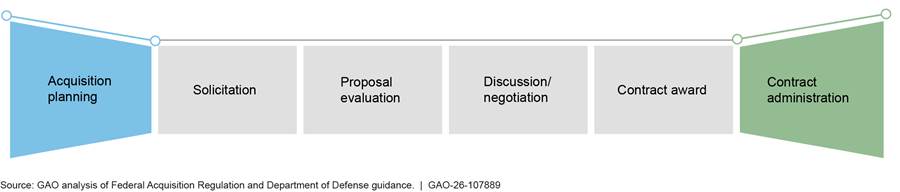
Note: GAO identified the above contracting phases—acquisition planning, solicitation, proposal evaluation, discussion/negotiation, contract award, and contract administration—based on regulations pertaining to contracting by negotiation. Federal Acquisition Regulation (FAR) Part 15 prescribes policies and procedures governing competitive and noncompetitive negotiated acquisitions exceeding the simplified acquisition threshold. These phases are not necessarily included when awarding every negotiated contract, or in all contracting methods and procedures. Task orders under indefinite-delivery, indefinite-quantity contracts are awarded pursuant to fair opportunity procedures described in FAR 16.5.
The acquisition process begins at the point when agency needs are established; it includes activities from acquisition planning through contract administration. See below for activities of selected contract phases.
· Acquisition planning. The acquisition planning phase includes presolicitation activities such as market research and defining requirements.
· Solicitation. Agencies solicit offers from prospective contractors by issuing a request for proposals. Among other things, the request for proposals do the following:
1. Inform the prospective contractors of the government’s requirements; and
2. Describe the information required in a proposal and, in a competitive acquisition, factors used to evaluate proposals and their relative importance.
· Proposal evaluation. Proposal evaluation is an assessment of the proposals and the offerors’ ability to perform the prospective contract successfully. For example, proposals undergo evaluation to determine offerors’ ability to meet the technical requirements and cost or pricing evaluation to determine whether the price is fair and reasonable. The contracting officer is responsible for evaluating the reasonableness of the offered prices. The analytical techniques and procedures—which may include cost realism analysis—are used to ensure that the final price is fair and reasonable.
·
Contract administration. This phase starts after the
contract is signed. It involves monitoring contractor performance, ensuring
compliance with contract terms and conditions, determining the allowability of
costs, and managing payments to the contractor, among other tasks.
Federal Source Selection Procedures
In competitive negotiated acquisitions, agencies seek the best value based on their specific requirements using a source selection process referred to as the best value continuum.[12] To determine best value, agencies may choose a source selection process that is considered most advantageous to the government and evaluate proposals either using the lowest price technically acceptable (LPTA) process or a tradeoff process, where price may be less important than other factors. See figure 2.
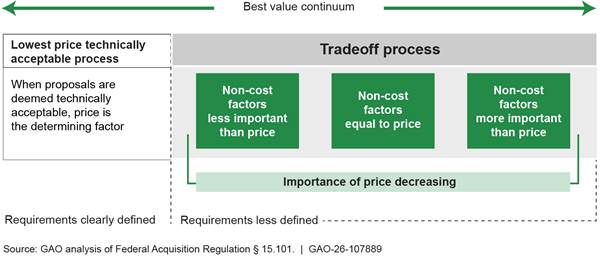
Federal agencies may choose to use the LPTA process where the requirement is clearly defined and the risk of unsuccessful contract performance is minimal. The agency would specify the evaluation factors it will use to establish technical acceptability in the solicitation. Contractors submit their proposals in response to the solicitation and the agency determines which of the contractors meet or exceed the acceptability standards. Since no tradeoffs between cost or price and non-cost factors are permitted, the award is made based on the LPTA proposal submitted to the government. DOD has statutory limitations on its use of LPTA.[13] Specifically, contracting officers are to avoid using LPTA for knowledge-based professional services or systems engineering services, among others, to the maximum extent practicable.
By contrast, an agency may elect to use the best value tradeoff process in acquisitions where the requirement is less definitive, more development work is required, or the acquisition has a greater performance risk. In these instances, non-cost evaluation factors, such as technical capabilities or past performance, may play a dominant role in the source selection process. Tradeoffs among price and non-cost factors allow the agency to accept other than the lowest priced proposal. The FAR requires that the solicitation state whether all evaluation factors other than cost or price, when combined, are significantly more important than, approximately equal to, or significantly less important than cost or price.[14] In these cases, an agency may award a contract to a vendor presenting other than the lowest-priced proposal if it determines that a higher-priced vendor provides a greater benefit to the agency, and that this greater benefit is worth paying an additional cost.[15]
We previously reported on DOD’s use of LPTA and best value tradeoff source selection process.[16] We generally found that DOD used the tradeoff process for a majority of the contracts that we reviewed and was generally in line with agency guidance. We recommended that DOD clarify its criteria for using the LPTA process and enhance training on using best value tradeoff decisions.[17] DOD has since implemented these recommendations.
NAVSEA Organization
NAVSEA is responsible for providing expertise in designing, engineering, building, buying, and maintaining ships, submarines, and combat systems to meet the fleet’s operational requirements. NAVSEA is currently comprised of directorates and Warfare Center Divisions and reports to the Assistant Secretary of the Navy for Research, Development and Acquisition, who leads the Navy’s acquisition community.[18] See figure 3.
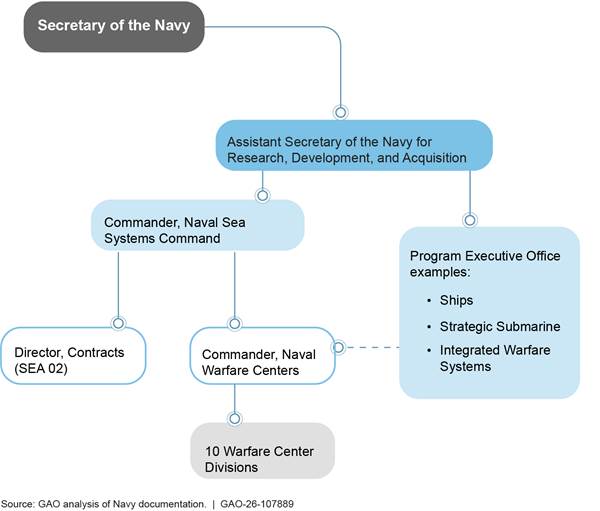
Note: The Program Executive Offices can submit requirements to the Warfare Center Divisions, which can then issue solicitations for those requirements. This is represented by the dotted line.
· SEA 02 is the Contracts Directorate, which includes field contracting offices. It has delegated authority to award the professional support service contracts to support ships and submarines, ship repair, and major weapon systems, among other things, to help meet NAVSEA requirements. SEA 02 is also responsible for issuing contracting policy and guidance NAVSEA-wide.
· Program Executive Offices (PEO) are responsible for the life-cycle management of their assigned programs. They manage the life cycle for shipbuilding acquisition programs, including program initiation, ship design, construction, testing, and delivery activities.
· The 10 NAVSEA Warfare Center Divisions provide technical advice and support to mission partners, such as the PEOs.
According to NAVSEA officials, offices such as the PEOs and Warfare Center Divisions generate requirements for professional support services. In addition to being requiring offices, the Warfare Center Divisions can also award SeaPort contracts and task orders for professional support services.
Navy SeaPort
NAVSEA requires its commands to first consider using SeaPort—both an online portal and a Navy-wide multiple award IDIQ contract—for professional support services.[19] Professional support services are those that require specialized or advanced knowledge, and in some instances, require specific certification requirements. The SeaPort IDIQ contract provides the Navy with a standardized and integrated approach for procuring services under two main categories: engineering support services and program management support services that cover 23 functional areas. Examples of the functional areas include research and development support and logistics support. Appendix II provides additional details on these 23 functional areas.
The Navy offers contractors rolling admissions onto the SeaPort IDIQ contract. To do so, the Navy issues periodic solicitations for contractors to have the opportunity to be awarded an IDIQ contract. According to NAVSEA officials as of March 2026, the latest rolling admission occurred in December 2024. During that process, the solicitation for the IDIQ contract stated that offerors’ proposals would be evaluated as acceptable or unacceptable. The solicitation required that prospective contractors submit proposals that described recent and relevant Navy experience in at least one of the functional areas to be considered technically acceptable. The solicitation did not include contract price, cost, or past performance as evaluation factors. Instead, these factors are generally considered in the competitive award of task orders through the fair opportunity process.[20]
Once a contractor is awarded a SeaPort IDIQ contract, it is eligible to compete for individual SeaPort task orders. NAVSEA contracting officials stated that offices, such as PEOs, program offices, and Warfare Center Divisions submit their requirements to a NAVSEA contracting office. The contracting office would then issue solicitations (e.g., requests for proposals) for individual task orders to be released through the portal. SeaPort contractors are notified when a solicitation is posted to the online portal and that they can submit proposals in response.
SeaPort task orders are competitively awarded to eligible contractors using the fair opportunity process for each order. This process is used when the government awards task orders under a multiple-award IDIQ contract. The government generally must place these orders—over a certain dollar threshold—on a competitive basis. This provides each awardee under the multiple award contract a fair opportunity to be considered. The contracting officer must provide a fair notice that the government intends to award a task order to all contract holders of this multiple-award contract. The notice includes a description of the requirement and on what basis selection will be made (i.e., evaluation factors), affording the contract holders a fair opportunity to submit an offer for the government to evaluate.[21]
From fiscal years 2019 through 2024, NAVSEA obligated about $21 billion under SeaPort, comprising about half of the Navy-wide obligations for professional support services. See table 1 for the comparison between NAVSEA and Navy SeaPort awards.
Table 1: Proportion of Navy SeaPort Task Orders Awarded by Naval Sea Systems Command (NAVSEA) From Fiscal Years 2019–2024
|
|
NAVSEA portion of Navy SeaPort total |
Navy SeaPort total |
|
Obligations (approx.) |
$21 billion |
$41 billion |
|
Task orders |
516 |
1,466 |
|
Contractors awarded task orders |
181 |
493 |
Source: GAO analysis of Federal Procurement Data System data. ǀ GAO‑26‑107889
Note: Task orders include only those over the micro-purchase threshold, which was generally $10,000 during the period of GAO’s review. SeaPort is an online portal and multiple-award contract that allows the Navy to award task orders to prequalified vendors for professional support services.
NAVSEA generally awards cost-reimbursement SeaPort task orders, including cost-plus-fixed-fee orders. Cost-plus-fixed-fee task orders include a fee (or profit), which is a percentage of the total estimated labor costs and becomes a fixed dollar amount once the task order is awarded, regardless of how actual costs may change over time.[22] While the SeaPort IDIQ contracts generally set the maximum fee at 8 percent, the specific fee rate is determined at the individual task order or line item level. NAVSEA officials stated that this fixed fee provides an incentive for the contractor to submit realistic cost proposals, noting that it is common for contractors to deliberately offer low-cost estimates for contracts or task orders to win the award.
SeaPort task orders must specify the labor categories, estimated labor rates, and the expected total costs of the order. The task orders can include multiple labor categories for professional support services, each with different estimated labor rates based on the task order requirements. These task orders may also include labor categories that are subject to the Service Contract Labor Standards (SCLS).[23] Examples of applicable SCLS labor categories include divers and stevedores or dock workers, who may also support SeaPort task orders. For example, a contractor providing engineering expertise for ship maintenance and testing activities may also need divers and stevedores to perform the work. The Department of Labor sets the labor rates—including annual adjustments—which are considered the minimum wage that can be applied to these labor categories. Because these rates are set by the Department of Labor, NAVSEA officials are not able to prevent increases in labor rates for these labor categories.
NAVSEA Requires the Use of Best Value Tradeoff Process to Award SeaPort Task Orders
Since 2023, NAVSEA has required all of its contracting activities to use the best value tradeoff source selection process, which is consistent with DOD statutory limitations.[24] We identified that, from fiscal years 2019 through 2024, NAVSEA awarded 141 of 267 task orders—or about 53 percent—to the offeror with the higher proposed cost.[25]
NAVSEA uses a template that provides instructions to offerors on its best value tradeoff process.[26] The template also notes that if a contracting office would like to deviate or request a waiver from using this approach, it would need to be approved by SEA 02. According to SEA 02 officials as of March 2026, they have not granted any waivers to date. NAVSEA’s template for SeaPort solicitations includes standardized language on the evaluation factors and their relative importance when evaluating contractors’ proposals. NAVSEA contracting offices have flexibility in what elements they want to include as subfactors—such as management approach or personnel requirements—within each of the evaluation factors, based on their specific needs. See figure 4.
Figure 4: Relative Importance of Evaluation Factors NAVSEA Uses to Assess Offerors’ Proposals for SeaPort Task Orders
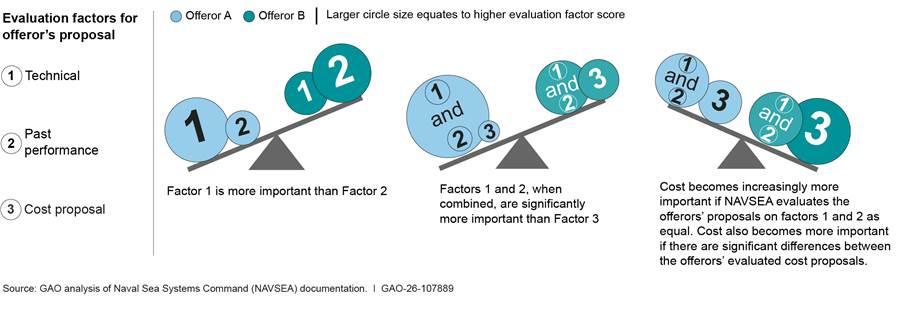
Note: The NAVSEA template includes a fourth factor, contract documentation. Factor 4 does not have any relative importance weighting since it is evaluated on a pass/fail basis. If the offeror has failed to meet any of these requirements, the proposal is ineligible for award and is eliminated from further consideration.
The template describes the basis for awarding the task order, stating that if one offeror has both the better rating on the non-cost factors including technical capability and past performance, and the lower total evaluated costs, then that offeror would provide the better value. However, if one offeror has the better rating on technical capability but at a higher cost, NAVSEA would need to decide whether the difference in technical capability is worth the difference in cost. NAVSEA may decide to select the offeror with the higher total evaluated cost if NAVSEA determines that it provides better value. NAVSEA will also evaluate the submitted contract documentation to ensure that the offerors provided all the required information, and NAVSEA will verify compliance. If the offeror fails to meet any of the requirements, NAVSEA will consider the proposal ineligible for award and it will be eliminated from further consideration.
NAVSEA conducts cost realism analysis when evaluating proposals using the best value tradeoff process, focusing on determining contractor risk. For cost-reimbursement contracts, the government is generally required to conduct cost realism analysis, which helps to determine the probable cost of performance for each offeror.[27] The probable cost may differ from an offeror’s proposed cost and is used for the purposes of evaluation to determine the best value. NAVSEA contracting officials using the template may use information other than the information provided in the cost proposal in order to perform cost realism analysis. This may include information from the Defense Contract Management Agency or the Defense Contract Audit Agency, independent government cost estimates, and salary databases or websites, among other sources. The NAVSEA SeaPort solicitation template advises that proposing unrealistically lower costs without sufficient justification would indicate that the offeror does not understand the requirement or does not have the requisite capability to support the effort. The template further states that a proposal with unrealistically low costs could raise a fundamental question of the offeror’s understanding of the scope of work and could negatively affect its proposal evaluation.
Using the best value tradeoff process, NAVSEA contracting officials determined that the offeror with the higher proposed cost provided the best value to the government slightly more often than choosing an offeror with the lowest proposed cost. Based on our analysis of 267 SeaPort task orders awarded from fiscal years 2019 through 2024, we found that NAVSEA awarded 141 orders to offerors with the higher proposed cost (or about 53 percent). By contrast, NAVSEA awarded 126 to offerors with the lowest proposed cost (or about 47 percent).[28]
NAVSEA Actively Manages Labor Rate Increases and Overall Costs
NAVSEA has several efforts in place to monitor labor costs. In addition to having policies to address labor costs, NAVSEA uses an electronic reporting system that notifies contracting personnel when a contractor’s labor rate exceeds 15 percent more than what was established at award.[29] Once the rate increase is more than 15 percent, NAVSEA personnel are required to identify the causes for the cost increases and to take mitigating actions, as needed. We found that for nine of the 10 selected task orders that we reviewed in detail, the average labor rates increased by more than 15 percent. NAVSEA took or plans to take cost mitigation actions on five of these task orders, including working with the contractors to adjust their labor mix and identifying qualified personnel at a lower rate. For the remaining four task orders that we reviewed, NAVSEA determined that no additional actions were needed.
NAVSEA’s Data System and Policies Require Enhanced Oversight When Labor Rates Exceed a Specified Threshold
NAVSEA uses its eCRAFT system to perform post-award tracking and monitoring of costs for service contracts. In June 2023, NAVSEA guidance provided instructions for contractors awarded SeaPort task orders on how to upload standard reports regarding actual contract costs into its eCRAFT system.[30] The contractor reports include expenditures for labor, such as data on labor rates and hours, materials, travel, subcontractor usage, and other contract charges. The contracting officer’s representative (COR) can use this information to track labor costs for a task order as part of their responsibilities to monitor service contracts.[31] NAVSEA CORs stated that they typically use an in-house spreadsheet in conjunction with eCRAFT data to identify any cost growth related to labor rates.
NAVSEA policy on service contracting requires additional oversight procedures when monthly average labor rates increase more than 15 percent above the estimated rate for the task order, referred to as a “tripwire.”[32] The COR must submit a written notification to the contracting officer, the requiring offices (such as a PEO), and the cognizant contracting department branch head, as appropriate, if the tripwire is triggered. The notification includes the cause of the labor rate increase, whether the condition is temporary or permanent, and any steps the contractor took to address the issue. If the increase in the average labor rate on the task order continues for more than 3 consecutive months, the matter will be elevated to NAVSEA leadership. NAVSEA officials stated that tripwires are meant to alert leadership of potential cost overruns and the extent to which they are addressed or mitigated.
Actual Labor Rates Often Exceeded Estimates
Actual labor rates for almost two-thirds of the 389 SeaPort task orders awarded from fiscal years 2019 through 2024 and were ongoing as of April 2025, exceeded estimated labor rates established at the time of award.[33] Further, based on our analysis, more than a quarter (106 of 389) of these task orders had average actual labor rates that increased by at least 15 percent, which is NAVSEA’s tripwire for additional oversight (see fig. 5).
Figure 5: Additional Oversight Required for More than a Quarter of 389 Ongoing NAVSEA SeaPort Task Orders Awarded From Fiscal Years 2019–2024
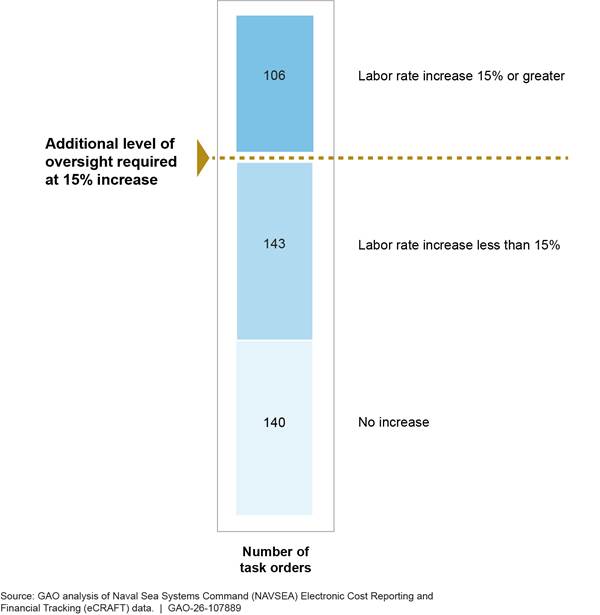
Note: Labor rate changes reflect the difference between the average estimated labor rate established at the time of award and the actual labor rate, as of April 2025, for 389 task orders. These average labor rates include certain labor categories that are subject to the Service Contract Labor Standards, for which the rates are set by the Department of Labor. NAVSEA policy requires heightened monitoring when the monthly average labor rate is more than 15 percent above the estimated rate for the task order.
Our analysis of eCRAFT data found that the percentage of task orders with increased labor rates was similar for awards made to an offeror with the lowest proposed cost and for awards made to an offeror with a higher proposed cost. See figure 6.
Figure 6: Comparison of Average Labor Rate Increases of 267 Selected NAVSEA SeaPort Task Orders Awarded From Fiscal Years 2019–2024
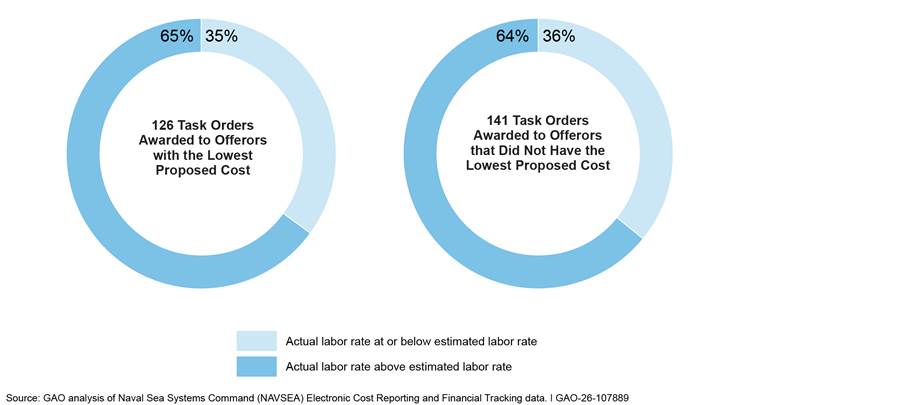
Note: GAO did not include one-third (122 out of 389) of the task orders in this analysis because 88 had only one offeror, 27 did not include enough information to include in the analysis, and seven were awards split between more than one offeror.
For those task orders, regardless of whether they were awarded to offerors with the lowest or higher proposed costs, they had a similar labor increase—an average of about 13 percent.
For the 389 task orders that we reviewed, we identified 291 different labor categories that were used. We found that labor rates for 228 of the 291 individual labor categories exceeded their estimates. Among the labor categories where NAVSEA spent the most over the 6-year period—such as systems engineer and management analyst—the average labor rate increase was less than 2 percent. However, for the remaining other categories, such as certain types of engineers, we found that within the 10 top labor categories—in terms of total accrued labor costs—the changes were up to 12.5 percent. These 10 labor categories accounted for 19 million hours of the total of 68 million hours—or approximately 28 percent—that contractors provided under 389 SeaPort task orders that NAVSEA awarded from fiscal years 2019 through 2024. See table 2.
Table 2: Top 10 Labor Categories Based on Total Accrued Labor Costs for 389 NAVSEA SeaPort Task Orders Awarded From Fiscal Years 2019–2024
|
Labor categorya |
Total accrued labor costs (in millions) |
Average hourly wage |
Total accrued labor hours |
Percent change in labor rates |
|
Systems engineer IV |
$303 |
$128 |
2,368,176 |
(1.9) |
|
Management analyst III |
$246 |
$96 |
2,564,274 |
1.9 |
|
Program/project manager III |
$192 |
$131 |
1,472,370 |
4.6 |
|
Systems engineer III |
$192 |
$105 |
1,821,025 |
3.5 |
|
Engineering technician IVb |
$175 |
$61 |
2,894,202 |
5.3 |
|
Engineer IV |
$161 |
$134 |
1,197,705 |
12.5 |
|
Engineering technician Vb |
$157 |
$72 |
2,186,833 |
3.1 |
|
Engineer III |
$154 |
$116 |
1,324,329 |
12.1 |
|
Program/project manager II |
$142 |
$107 |
1,322,664 |
5.0 |
|
Management analyst II |
$141 |
$74 |
1,904,696 |
8.2 |
Source: GAO analysis of Naval Sea Systems Command (NAVSEA) Electronic Cost Reporting and Financial Tracking (eCRAFT) data as of April 2025, and the Department of Labor Service Contract Act Directory of Occupations, 5th Edition. I GAO‑26‑107889
aA numeral after a labor category indicates the various levels of education and experience. For example, a systems engineer level III typically has a bachelor’s level degree with 7 years of professional experience, while a level IV would typically have a master’s level degree with 10 years of experience. It is a similar case with other labor categories followed by a numeral.
bThese labor categories are defined by the Department of Labor and may be subject to wage requirements of the Service Contract Labor Standards Act.
In contrast, the categories that experienced among the largest percentage increases were typically for far less commonly used labor categories, such as inspectors and woodworkers. These are examples of SCLS-applicable labor categories, for which the rates are determined by the Department of Labor. Overall, the 10 labor categories that experienced the highest increases in labor rates accounted for about 80,000 hours of the total of 68 million hours—or less than 1 percent—that contractors provided under SeaPort task orders NAVSEA awarded from fiscal years 2019 through 2024. See table 3 for three examples of labor categories that experienced significant increases in labor rates for the 389 task orders awarded over the 6-year period.
Table 3: Examples of Labor Categories Among the Highest by Percent Increase in Labor Rates for NAVSEA SeaPort Task Orders Awarded From Fiscal Years 2019–2024
|
Labor category |
Percent increase in labor rates |
Average hourly wage |
Total accrued labor hours |
Total labor cost (in thousands) |
|
Mathematician III |
183.6 |
$183 |
46 |
$8 |
|
Inspectora |
152.1 |
$76 |
3,238 |
$247 |
|
Woodworkera |
127.9 |
$62 |
15 |
$1 |
Source: GAO analysis of Naval Sea Systems Command’s (NAVSEA) Electronic Cost Reporting and Financial Tracking (eCRAFT) data as of April 2025. I GAO‑26‑107889
aThese labor categories are defined by the Department of Labor and may be subject to the wage requirements of the Service Contract Labor Standards Act.
Changes in Requirements and Market Factors Contributed to Cost Growth in Selected Task Orders
While increases in labor rates were one factor resulting in total cost increases, we found that changes in NAVSEA requirements as well as other market factors, such as inflation, contributed to cost growth for the 10 selected SeaPort task orders that we reviewed in more detail. Overall, we found that the actual costs for these 10 task orders increased by about $152 million—or about 60 percent—from their estimates as of April 2025. Figure 7 shows that changes in NAVSEA requirements and market factors contributed to the cost growth for the 10 selected task orders.
Figure 7: Examples of Changes in NAVSEA Requirements and Market Factors That Contributed to Cost Growth in 10 Selected Task Orders
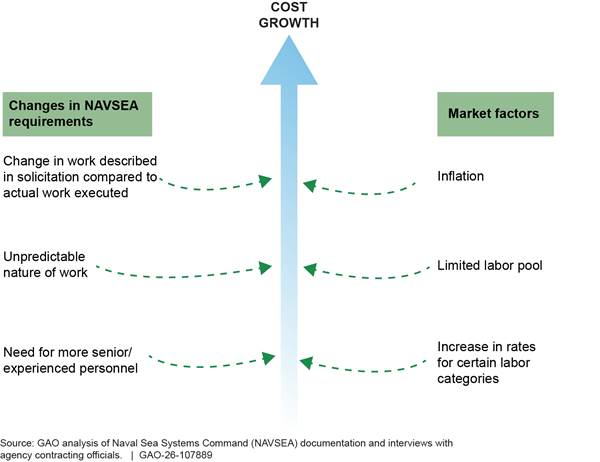
Note: GAO selected 10 task orders for a more detailed review from 389 ongoing SeaPort task orders that NAVSEA awarded from fiscal years 2019 through 2024.
Changes in requirements. We found that the differences between the requirement described in the solicitation and the work that is needed to be performed under a task order can drive the increase in actual labor costs compared with estimated costs at the time of award. For one task order that provided support services for uncrewed surface combatant ships, NAVSEA officials told us that the requirements were more complex and labor intensive than what was identified at the time of the solicitation. After the task order was awarded, NAVSEA and the contractor agreed that additional personnel with more qualifications and certifications were needed to perform the work. As a result, the actual labor rates for eight of the 16 labor categories in this task order increased over 50 percent from the estimated labor rates.
Requirements may also change due to the unpredictable nature of the work performed. For one task order in which the contractor is supporting trials at a testing facility, NAVSEA officials told us that the work executed under the task order depended on the outcomes of the trials, which cannot be predicted ahead of time. They stated that, based on the initial trial results, the requirements may need to be adjusted for the next trial. When a scheduled trial records unexpected results, NAVSEA may extend the trial or conduct another one, which requires additional work under the task order. NAVSEA officials also pointed out that, for this task order, they encountered an unexpected emergency when accidental damage to critical equipment required immediate repair work. This resulted in added labor costs to the task order.
Changes in requirements can result in a different labor mix compared to what was agreed to at the time of award. The labor mix could mean different labor categories and various levels of experience within the labor category. NAVSEA contracting officials noted that a more senior labor mix—with higher education and more experience relative to junior staff—would generally have higher labor rates. In contrast, a more junior labor mix would likely charge a lower rate, but may require more labor hours to complete the work. Either of these changes could lead to an increase in labor costs. For example, for one task order that supported Navy ship programs, NAVSEA contracting officials said that changes in government requirements, which included a more compressed schedule, drove the need for more experienced personnel, resulting in a higher labor cost. The contractor executed the work using a more senior labor mix than initially planned to meet the requirements.
Market factors. Market factors—such as inflation, a limited labor pool, and Department of Labor wage determinations—contributed to increased labor costs for professional support services for several task orders we reviewed. NAVSEA contracting officials responsible for five task orders identified inflation as one of the market factors that drove increases in labor costs.
In addition, a limited labor pool can lead the contractor to pay a premium to recruit and retain personnel, resulting in increased labor rates, according to NAVSEA contracting officials. For one task order, a limited labor pool led the contractor to pay a premium in labor rate to get professionals with the requisite skills. Because the task order included complex IT and information assurance requirements, the contractor needed to have personnel with the appropriate certifications and qualifications. NAVSEA contracting officials stated that personnel with these certifications and qualifications were limited in number across the industry and the contractor faced challenges finding qualified personnel to do the work. NAVSEA officials reported that certain labor categories—such as IT professionals—that have specialized skillsets were very competitive and could be hired by other private companies at a higher labor rate. They noted that the contractor would need to offer a higher labor rate to retain these same personnel. For example, a task order providing fleet operations support and testing had increased labor rates for the IT labor categories. Three of the IT labor categories on that task order had an average increase of more than 100 percent in actual rates as compared to the estimated rates.
Another driver of labor cost increase was wage determinations set by the Department of Labor for the labor categories that are subject to SCLS. Four of the 10 task orders we reviewed had labor categories with labor rates that are determined by the Department of Labor. According to NAVSEA contracting officials, these wage determinations were a significant contributor to labor cost growth for two of these task orders. For example, under a task order for data analysis for surface ship and submarine research and development efforts, 15 of the labor categories subject to SCLS—including heavy equipment mechanic and laborer—had increases ranging from 6 to 245 percent in actual rates as compared to the estimated rates.
NAVSEA Has Standard Practices to Address Rate Increases
NAVSEA has standard practices to monitor labor rates and to take additional action if the rate increases above a certain threshold. When CORs notice an increase of over 15 percent between a contractor’s average proposed and the average actual labor rate, NAVSEA policy requires them to take action to determine the causes and take mitigating actions, as needed. We found that nine of the 10 task orders in our sample had average labor rate increases that required additional NAVSEA oversight and action.
For five of these nine task orders, NAVSEA took action or is considering future actions to address the labor cost increases. These actions include working with the contractors to identify less expensive personnel to fulfill the requirement and planning for future contract actions. Specifically, NAVSEA worked with the contractors to:
· identify qualified, but less experienced personnel, to backfill positions to fulfill the government requirements and help mitigate costs;
· adjust the labor mix between more experienced and less experienced personnel;
· explore other cost mitigating approaches, fill vacancies at lower rates, and readjust labor rates for the next contract action; and
· give notice that the contractor may receive an adverse performance rating on cost control.
In addition, for one task order, NAVSEA is planning ahead to compete a follow-on task order and is conducting cost analysis to mitigate higher labor costs.
For the remaining four task orders, NAVSEA determined that no additional cost mitigation actions were needed as those actions could adversely affect contractor performance. For example, for one task order, NAVSEA contracting officials determined that labor rate increases were not the result of any mismanagement by the contractor, but rather government-driven resulting from complex requirements.
In addition to managing contract costs, NAVSEA contracting officials are also required to evaluate the contractors’ performance in the Contractor Performance Assessment Reporting System. In this system, contractors are rated for their cost control performance, among other factors. These ratings have a range, which includes exceptional and marginal. Seven of the 10 task orders we reviewed had at least a satisfactory rating on cost control. For the remaining three, NAVSEA contracting officials rated contractors as marginal for cost control in instances where the contractor could have addressed the cost increases. They explained that this rating provides incentives for contractors to control their costs and take actions to improve their rating. This is because other contracting officers will check a contractor’s performance ratings as part of the past performance evaluation factor, among other sources of information to inform future award decisions.
Contracting officers are required to determine whether the contractor continues to serve the best interest of the government when making a determination on whether to exercise the next option year on a task order.[34] This determination is based on input from various stakeholders, including the COR. If the contractor’s performance, including cost control, is not adequate, NAVSEA contracting officials can start the acquisition planning and preparation for a new competitive solicitation, and not exercise the next option year. We found that for all 10 task orders we reviewed, NAVSEA contracting officials made the determination to exercise the next option year. They cited several reasons to exercise the next option year, including that the cost to recompete exceeded the current cost of the task order and that it would be impractical in terms of time and cost to bring another source to the level of knowledge possessed by the incumbent contractor. NAVSEA officials stated that in general, terminating the award is considered a last resort and rarely occurs.
Agency Comments
We provided a draft of this report to DOD for comment. DOD did not provide comments on the report.
We are sending copies of this report to appropriate congressional committees and other interested parties, including the Secretary of Defense, and the Secretary of the Navy. The report will be available at no charge on GAO’s website at https://www.gao.gov.
If you or your staff have any questions about this report, please contact me at DiNapoliT@gao.gov. Contact points for our Offices of Congressional Relations and Medial Relations may be found on the last page of this report. GAO staff who made key contributions to this report are listed in appendix III.
Timothy J. DiNapoli, Managing Director
Contracting and National Security Acquisitions
List of Committees
The Honorable Roger F. Wicker
Chairman
The Honorable Jack Reed
Ranking Member
Committee on Armed Services
United States Senate
The Honorable Mitch McConnell
Chair
The Honorable Christopher Coons
Ranking Member
Subcommittee on Defense
Committee on Appropriations
United States Senate
The Honorable Mike Rogers
Chairman
The Honorable Adam Smith
Ranking Member
Committee on Armed Services
House of Representatives
The Honorable Ken Calvert
Chairman
The Honorable Betty McCollum
Ranking Member
Subcommittee on Defense
Committee on Appropriations
House of Representatives
The Senate Report 118-188 accompanying a bill for the National Defense Authorization Act for Fiscal Year 2025 includes a provision for us to review professional support service contracts and associated labor costs at Naval Sea Systems Command (NAVSEA). Our report addresses (1) how NAVSEA awards task orders for professional support services, and (2) how NAVSEA manages increases in labor rates for professional support services.[35]
To address the first objective, we reviewed applicable statutes, and federal and department-level regulations, policy, and guidance. We specifically reviewed the Federal Acquisition Regulation (FAR); the Defense Federal Acquisition Regulation Supplement (DFARS); the Navy Marine Corps Acquisition Regulation Supplement (NMCARS); relevant Department of Defense (DOD), Navy, and NAVSEA guidance on cost analysis; service contracts; and the SeaPort contract and task order award process.[36]
To address both objectives, we obtained and analyzed NAVSEA SeaPort contract data for task orders awarded from fiscal years 2019 through 2024—the most recent fiscal years for which complete data were available at the time of our review. SeaPort data provide summary-level data for task orders such as vendors’ offer information and labor costs, including fields for hours and dollar values. We also analyzed data from NAVSEA’s Electronic Cost Reporting and Financial Tracking (eCRAFT) system for 389 task orders that were active at NAVSEA’s 10 Warfare Center Divisions as of April 2025.[37] We limited our analysis to 389 ongoing SeaPort task orders because they had information available in the eCRAFT system. E-CRAFT contains detailed cost data, including estimated and actual labor costs and labor hours. The estimated labor rates are those proposed by the contractors and established at the time the task orders were awarded. Actual rates are the accrued labor rates that were charged to the government by the contractor via cost-reimbursement line items in the task orders.
We analyzed labor rates across the task orders and within task orders to identify any changes. Task orders included labor rates for several labor categories that are combined into an average labor rate for the task order. We used the loaded labor rate in our analysis, which would include overhead or administrative costs, the direct labor rate; and contractor fees, which is consistent with NAVSEA’s definition. We calculated differences between the average actual and estimated labor rates for each task order and whether the awardees had the lowest proposed cost compared with other offerors, as determined by NAVSEA. We identified the number of task orders in which average labor rates changed and common characteristics associated with the labor rate changes. Because our data were from ongoing task orders as of April 2025, they may not reflect the final labor rates charged to the government by the contractor.
We also analyzed the differences between actual and estimated rates by labor categories for the 389 task orders to describe common characteristics associated with labor rate changes. We identified the top 10 labor categories based on total accrued labor costs. We also identified labor categories that were among those with the largest percent increases, and whether they were subject to Department of Labor wage determinations.[38]
From the 389 SeaPort task orders we analyzed, we selected a nongeneralizable sample of 10 task orders with varying labor rate increases, periods of performance, and number of labor categories. To identify factors that contribute to labor rate increases, we selected task orders among those with the largest labor rate increases based on differences between estimated and actual labor rates. We then analyzed relevant contract file documentation, such as NAVSEA’s cost analysis, tripwire reports, and contractor performance reports for the 10 task orders. We also interviewed cognizant contracting personnel, including contracting officers and contracting officer’s representatives (COR), to better understand the changes in labor rates for the selected task orders to use as illustrative examples.
We also obtained data from the Federal Procurement Data System (FPDS) to analyze NAVSEA obligations, such as the proportion of Navy SeaPort contract and task orders awarded by NAVSEA. We used the FPDS data to identify task order details such as the award date and the type of contract (fixed price or cost type). We compared FPDS summary statistics to SeaPort and eCRAFT data provided by NAVSEA to corroborate variables—such as award date, obligation amount, and type of contract—when possible. However, not all variables are included in all data sets.
We assessed the reliability of the three data sources: SeaPort, eCRAFT, and FPDS. We assessed the reliability of the data by performing electronic testing; interviewing knowledgeable officials such as NAVSEA contracting officials and the eCRAFT Program Manager; and reviewing relevant documents, including guidance and instructions, such as a data element dictionary.[39] We found that the data from the three sources were sufficiently reliable for our purposes of analyzing NAVSEA’s SeaPort task orders and labor cost data.
We interviewed cognizant contracting and policy officials from the Defense Contract Audit Agency, Defense Contract Management Agency, and NAVSEA, including officials from the NAVSEA Contracts Directorate and the eCRAFT Program Manager.[40] We also interviewed cognizant contracting personnel for the 10 selected task orders, including contracting officers and CORs—who are responsible for administering the task order awards, monitoring costs, and overseeing contractor performance.[41]
We conducted this performance audit from October 2024 to April 2026 in accordance with generally accepted government auditing standards. Those standards require that we plan and perform the audit to obtain sufficient, appropriate evidence to provide a reasonable basis for our findings and conclusions based on our audit objectives. We believe that the evidence obtained provides a reasonable basis for our findings and conclusions based on our audit objectives.
The Navy Marine Corps Acquisition Regulation Supplement identifies 23 functional areas under engineering and program management categories, for which the Navy requires that its naval commands to first consider using SeaPort to acquire professional support services.[42] See below for an excerpt of the Navy regulations for SeaPort contracts.
Engineering Services
This category consists of supporting the application of engineering disciplines to technically support the research and development of new and existing naval capabilities and systems; technically support development of significant alterations to existing systems; support integration and interface of existing equipment or software into different applications or platforms to support the warfighter; and support evaluation of foreign or non-developmental systems, equipment, and technologies. This category also includes all support required within the area of environmental engineering of U.S. Navy weapon systems and base-related infrastructure. Functional areas that are included under the Engineering Services discipline include but are not limited to the following:
· engineering, system engineering, and safety and process engineering support
· software engineering, development, programming, and network support
· in-service engineering, fleet introduction, installation and checkout, and provisioning support
· measurement facilities, range, and instrumentation support
· interoperability, test and evaluation, and trials support
· research and development support
· modeling, simulation, stimulation, and analysis support
· prototyping, pre-production, model-making, and fabrication support
· system design documentation and technical data support
· reliability, maintainability, and availability support
· inactivation and disposal support
· biochemical engineering support
Program Management Services
This category consists of applying the business, financial management, and technical disciplines required to support planning, organizing, staffing, controlling, and leading team efforts in managing acquisition programs—such that the results place a capable and supportable system in the hands of the warfighter when and where it is needed, and does so at an affordable price. This functional area represents an integration of a complex system of differing but related functional disciplines that must work together to achieve program goals through development, production, deployment, operations, support, and disposal.
Functional areas that are included under the Program Management Services discipline include but are not limited to the following:
· financial analysis and budget support
· quality assurance support
· functional and direct programmatic administrative support
· professional development and training support
· analytical and organizational assessment support
· database administrators
· public affairs and multimedia support
· logistics support
· configuration management support
· information system development, information assurance, and IT support
· computer systems analysts
GAO Contact:
Timothy J DiNapoli, DiNapoliT@gao.gov
Staff Acknowledgments:
In addition to the individual named above, Mona Sehgal (Director), Nathan Tranquilli (Assistant Director), J. Andrew Walker (Assistant Director), Anh Nguyen (Analyst-in-Charge), Rose Brister, Koffi Dogbevi, Lorraine Ettaro, Suellen Foth, Robin Harris, Min-Hei (Michelle) Kim, Abigail Loxton, LeAnna Parkey, Anne Louise Taylor, and Elizabeth Yirava made key contributions to the report.
The Government Accountability Office, the audit, evaluation, and investigative arm of Congress, exists to support Congress in meeting its constitutional responsibilities and to help improve the performance and accountability of the federal government for the American people. GAO examines the use of public funds; evaluates federal programs and policies; and provides analyses, recommendations, and other assistance to help Congress make informed oversight, policy, and funding decisions. GAO’s commitment to good government is reflected in its core values of accountability, integrity, and reliability.
Obtaining Copies of GAO Reports and Testimony
The fastest and easiest way to obtain copies of GAO documents at no cost is through our website. Each weekday afternoon, GAO posts on its website newly released reports, testimony, and correspondence. You can also subscribe to GAO’s email updates to receive notification of newly posted products.
Order by Phone
The price of each GAO publication reflects GAO’s actual cost of production and distribution and depends on the number of pages in the publication and whether the publication is printed in color or black and white. Pricing and ordering information is posted on GAO’s website, https://www.gao.gov/ordering.htm.
Place orders by calling (202) 512-6000, toll free (866) 801-7077,
or
TDD (202) 512-2537.
Orders may be paid for using American Express, Discover Card, MasterCard, Visa, check, or money order. Call for additional information.
Connect with GAO
Connect with GAO on X,
LinkedIn, Instagram, and YouTube.
Subscribe to our Email Updates. Listen to our Podcasts.
Visit GAO on the web at https://www.gao.gov.
To Report Fraud, Waste, and Abuse in Federal Programs
Contact FraudNet:
Website: https://www.gao.gov/about/what-gao-does/fraudnet
Automated answering system: (800) 424-5454
Media Relations
Sarah Kaczmarek, Managing Director, Media@gao.gov
Congressional Relations
David A. Powner, Acting Managing Director, CongRel@gao.gov
General Inquiries
[1]Task orders are awards made under an indefinite-delivery, indefinite-quantity (IDIQ) contract, which provides for an indefinite quantity, within stated limits, of services during a fixed period. The government places orders for individual requirements. See Federal Acquisition Regulation (FAR) 16.504 and 16.505. In general, in awarding task orders under a multiple-award IDIQ, the government must place orders exceeding the micro-purchase threshold (generally at $10,000 at the time of the review) on a competitive basis. This includes providing each awardee a fair opportunity to be considered. These competitive procedures are referred to as the “fair opportunity process.” FAR 16.505(b).
[2]Navy Marine Corps Acquisition Regulation Supplement (NMCARS), Subpart 5237.1; and NMCARS Annex 22. For the purposes of this report, we are using the term professional support services to also include engineering support services.
[3]The labor rate is the total charge for an hour of labor. For the purposes of this report, when we refer to labor rates, it is the weighted average of the labor rates by hour for the labor categories—occupations or job types such as “engineer” or “project manager”—as defined by NAVSEA for its Electronic Cost Reporting and Financial Tracking (eCRAFT) system.
[4]This review focuses on task orders awarded from fiscal years 2019 through 2024. As such, references to FAR requirements are as of fiscal year 2024, and do not include revisions to the FAR that occurred after that time frame. The FAR is currently undergoing a complete overhaul called the Revolutionary FAR Overhaul (RFO). Executive Order 14275 directs the Office of Federal Procurement Policy to reduce the FAR to what is required by statute and is necessary for streamlined and efficient federal procurement. Exec. Order No. 14,275, 90 Fed. Reg. 16,447 (Apr. 15, 2025). The updated version of the FAR is referred to as FAR (deviation), while the version in place prior to the overhaul is referred to as FAR (legacy). The FAR (legacy) is referenced in this report since we conducted this performance audit prior to the FAR (deviation). DOD and the military components are reforming acquisition processes, including an overhaul of the DFARS. Exec. Order No. 14,265, 90 Fed. Reg. 15,621 (Apr. 9, 2025).
[5]SeaPort data provide summary-level data for task orders such as vendors’ offer information and labor costs, including fields for hours and dollar values.
[6]NAVSEA developed the eCRAFT system to monitor costs on service contracts for the 10 Warfare Center Divisions. Contractors submit reports into eCRAFT indicating work progress and expenditures for labor and other contract charges when they submit invoices for payment.
[7]The estimated labor rates are established at the time the task orders were awarded. Actual rates are the accrued labor rates that were charged to the government by the contractor via cost-reimbursement line items in the task orders. We used the loaded labor rate in our analysis, which included overhead or administrative costs, the direct labor rate, and contractor fees. The data we analyzed were as of April 2025. Because our data are from ongoing task orders, they may not reflect the final labor rates. Labor hours include regular hours, overtime hours, and uncompensated hours, which is consistent with how NASVSEA determines if the task order triggers the tripwire threshold—when the actual average labor rate increases by at least 15 percent from the estimate established at the time of award.
[8]NAVSEA, eCRAFT Enterprise (E2) Desk Guide for Contracting Officer’s Representatives and Technical Advisors; and eCRAFT Data Element Dictionary, Version 1.0. General Services Administration, FPDS Product and Service Codes Manual (Apr. 2024).
[9]The Defense Contract Audit Agency provides contract audits and financial advisory services to DOD. The Defense Contract Management Agency provides contract administration services and cost and pricing analysis to DOD.
[10]FAR 1.602-2. NAVSEA, Instruction 4200.17G (April 21, 2020).
[11]FAR 15.002. Best value means the expected outcome of an acquisition that, in the government’s estimation, provides the greatest overall benefit in response to the requirement. FAR 2.101.
[12]FAR Subpart 15.1.
[13]The National Defense Authorization for Fiscal Year 2017 and National Defense Authorization Act for Fiscal Year 2018 include provisions that limit DOD’s use of the LPTA source selection process. Pub. L. No. 114-328, § 813 (2016); and Pub. L. No. 115-91, §§ 822 and 832 (2017).
[14]FAR 15.101-1.
[15]FAR 16.505(b)(1). Pursuant to the fair opportunity process, solicitations for task orders should include the selection procedures, and the government must consider price or cost as one factor in the decision. For orders exceeding $7.5 million, the government is to disclose significant factors and subfactors, including cost or price, that the agency expects to consider in evaluating proposals, and their relative importance. Where award is made on a best value basis, the fair opportunity process requires a written statement documenting the basis for award and the relative importance of quality and price or cost factors.
[16]GAO, Federal Contracting: Information on Agencies’ Use of the Lowest Price Technically Acceptable Process, GAO‑19‑691 (Washington, D.C.: Sept. 26, 2019); Defense Contracting: DOD Should Clarify Criteria for Using Lowest Price Technically Acceptable Process, GAO‑19‑54 (Washington, D.C.: Nov. 13, 2018); Defense Contracting: DOD’s Use of Lowest Price Technically Acceptable Source Selection Procedures to Acquire Selected Services, GAO‑18‑139 (Washington, D.C.: Nov. 30, 2017); Defense Contracting: Factors DOD Considers When Choosing Best Value Processes Are Consistent with Guidance for Selected Acquisitions, GAO‑14‑584 (Washington, D.C.: July 30, 2014); and Defense Contracting: Enhanced Training Could Strengthen DOD’s Best Value Tradeoff Decisions, GAO‑11‑8 (Washington, D.C.: Oct. 28, 2010).
[18]According to Navy officials, the Navy is in the process of reorganizing the reporting structure across the department.
[19]NMCARS 5237.102; and NMCARS Annex 22. There are exceptions, such as actions set aside for 8(a) participants. DOD issued memorandums in May 2025 and June 2025 regarding the use of consulting and services contracts, and NAVSEA officials told us that they are still early in the process and have not yet made decisions on implementation.
[20]The contracting officer may choose not to include price or cost as an evaluation factor for award when a solicitation will result in multiple-award contracts for the same or similar services, among other conditions. FAR 15.304(c). The fair opportunity process requires that orders exceeding the simplified acquisition threshold be awarded competitively, including the consideration of price or cost. For orders exceeding $7.5 million, when developing the source selection procedures, the contracting officer should consider past performance on earlier orders under the contract, including quality, timeliness, and cost control. FAR 16.505(b)(1).
[21]In general, in awarding task orders under a multiple-award IDIQ, the government must place orders, exceeding the micro-purchase threshold, on a competitive basis. The contracting officer has broad discretion in developing order placement procedures but is to keep submission requirements to a minimum. Statutory exceptions to the fair opportunity process give the government flexibility to limit competition for task orders, such as when the agency need is so urgent that providing a fair opportunity would result in unacceptable delays. FAR 16.505(b).
[22]FAR 16.306. A cost-plus-fixed-fee contract is a cost-reimbursement contract that provides for a negotiated fee that is fixed at the inception of the contract. The fixed fee does not vary with actual cost but may be adjusted as a result of changes in the work to be performed under the contract.
[23]FAR Subpart 22.10. The Department of Labor sets the labor rates—including annual adjustments—for labor categories subject to the SCLS. These labor rates are considered the minimum wage that are applied to these labor categories. The Secretary of Labor exempted certain contracts from the SCLS statute if each service employee who will perform the services under the contract will spend only a small portion of his or her overall time doing so (a monthly average of less than 20 percent of the available hours on an annualized basis, or less than 20 percent of available hours during the contract period), among other conditions. FAR 22.1003-4(d).
[24]The National Defense Authorization Act for Fiscal Year 2017 and National Defense Authorization Act for Fiscal Year 2018 include provisions that limit DOD’s use of the LPTA source selection process for certain services, including knowledge-based professional services. Pub. L. No. 114-328 § 813 (2016); Pub. L. No. 115-91 §§ 822 and 832 (2017).
[25]This analysis was based on subset of the 389 task orders included in our review. See appendix I for more information. We did not include one-third (122 out of 389) of the task orders in this analysis because 88 had only one offeror, 27 did not include enough information to include in our analysis, and seven were awards split between more than one offeror.
[26]NAVSEA requires the use of the template for Cost-Plus-Fixed-Fee, Cost-Plus-Award-Fee, and Cost-Plus-Incentive-Fee, Level of Effort type of awards. While it is not required, the template should be used to the maximum extent practicable for other types of awards, such as Fixed Price or those using the Simplified Acquisition Procedures.
[27]FAR 15.305. The template notes that the government reserves the right to limit cost realism analysis to only those offerors that represent the most likely candidates for award.
[28]We did not include one-third (122 out of 389) of the task orders we reviewed in this analysis because 88 had only one offeror, 27 did not include enough information to include in our analysis, and seven were awards split between more than one offeror.
[29]In 2017, the Commanders of the Naval Undersea Warfare Center and the Naval Surface Warfare Center issued a memorandum for all 10 Warfare Center Divisions to use eCRAFT.
[30]Naval Undersea Warfare Center Division, eCRAFT Periodic Report Utility Vendor User Guide, Version 23.01 (Newport, R.I.: June 2023).
[31]NAVSEA, Instruction 4200.17G.
[32]NAVSEA, Instruction 4200.19B (undated). The average labor rate is calculated based on the labor rates for all of the labor categories included in the task order.
[33]These average labor rates include certain labor categories that are subject to the SCLS, for which the rates are set by the Department of Labor.
[34]FAR 17.207. The contracting officer may exercise options only after determining that funds are available; the requirement covered by the option fulfills an existing government need; and the exercise of the option is the most advantageous method of fulfilling the government’s need, price, and other factors considered; among other things.
[35]The labor rate is the total charge for an hour of labor. For the purposes of this report, when we refer to labor rates, it is the weighted average of the labor rates by hour for the labor categories—occupations or job types such as “engineer” or “project manager”—as defined by NAVSEA for its Electronic Cost Reporting and Financial Tracking (eCRAFT) system.
[36]This review focuses on task orders that were awarded from fiscal years 2019 through 2024. As such, references to FAR requirements are as of fiscal year 2024, and do not include revisions to the FAR that occurred after that time frame. The FAR is currently undergoing a complete overhaul called the Revolutionary FAR Overhaul (RFO). Executive Order 14275 directs the Office of Federal Procurement Policy to reduce the FAR to what is required by statute and is necessary for streamlined and efficient federal procurement. Exec. Order No. 14,275, 90 Fed. Reg. 16,447 (Apr. 15, 2025). The updated version of the FAR is referred to as FAR (deviation), while the version in place prior to the overhaul is referred to as FAR (legacy). The FAR (legacy) is referenced in this report since we conducted this performance audit prior to the RFO. DOD and the military components are reforming acquisition processes, including an overhaul of the DFARS. Exec. Order No. 14,265, 90 Fed. Reg. 15,621 (Apr. 9, 2025).
[37]NAVSEA developed the eCRAFT system to monitor costs on service contracts for the 10 Warfare Center Divisions. Contractors submit reports into eCRAFT indicating work progress and expenditures for labor and other contract charges when they submit invoices for payment. Labor hours include regular, overtime, and uncompensated hours, which is consistent with how NAVSEA determines if the task order triggers the tripwire threshold.
[38]FAR Subpart 22.10. The Department of Labor sets the labor rates—including annual adjustments—for labor categories subject to the Service Contract Labor Standards (SCLS). These labor rates are considered the minimum wage that are applied to these labor categories. The Secretary of Labor exempted certain contracts from the SCLS statute if each service employee who will perform the services under the contract will spend only a small portion of his or her overall time doing so (a monthly average of less than 20 percent of the available hours on an annualized basis, or less than 20 percent of available hours during the contract period), among other conditions. FAR 22.1003-4(d).
[39]General Services Administration, FPDS Product and Service Codes Manual (Apr. 2024). NAVSEA, eCRAFT Enterprise (E2) Desk Guide for Contracting Officer’s Representatives and Technical Advisors; and eCRAFT Data Element Dictionary, Version 1.0.
[40]The Defense Contract Audit Agency provides contract audits and financial advisory services to DOD. The Defense Contract Management Agency provides contract administration services and cost and pricing analysis to DOD.
[41]FAR 1.602-2. NAVSEA, Instruction 4200.17G (April 21, 2020).
[42]Navy Marine Corps Acquisition Regulation Supplement Annex 22.