
Report to Congressional Committees
United States Government Accountability Office
A report to congressional committees
Contact Diana Maurer at maurerd@gao.gov
What GAO Found
The Air Force has three maintenance depots that maintain the readiness of aircraft required for military operations. Depot maintenance delays have increased considerably since fiscal year 2019, whether measured by the original target completion date set before aircraft arrive at the depot or the revised target completion date that accounts for unplanned work found during maintenance.
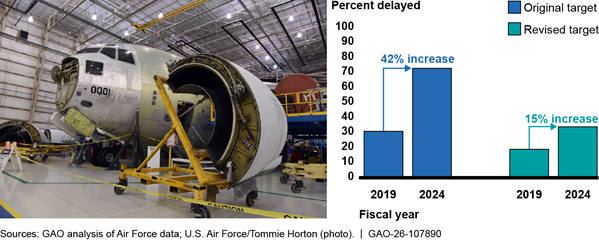
The Air Force tracks depot maintenance timeliness for both original and revised target completion dates but primarily uses the revised target for reporting on its performance. GAO found several limitations associated with the Air Force’s reporting on depot timeliness. For example:
· Reporting on the revised target masks the full extent of delays because it does not reflect unplanned work. Depots frequently revised targets after they completed maintenance to match the actual number of days it took to complete maintenance.
· Depots and aircraft program offices inconsistently apply the target completion date revision process.
As a result, the Air Force is not reporting the full extent of depot maintenance challenges and may not be able to make accurate comparisons across the fleet.
While all three depots have filled 90 percent or more positions since 2020, they have experienced shortages in specific occupations. According to depot officials, pay competition with the private sector is the primary challenge in recruiting and retaining personnel in occupations such as engineers and mechanics. The depots have taken some steps to mitigate this challenge by selectively using incentives and emphasizing the nonfinancial benefits of a federal career. However, the Air Force has not fully addressed pay competition with the private sector because DOD has not conducted a comprehensive assessment of pay gaps for occupations affected by private sector competition. Such an assessment would enable the depots to make informed decisions to address competition with the private sector for occupations critical to aircraft readiness.
Why GAO Did This Study
More than 2 decades of conflict has degraded the Air Force’s readiness, with wide-ranging effects on aircraft from continuous deployments. The Air Force is working to rebuild its readiness, in part by modernizing its maintenance depots to sustain an increasingly aging fleet. The Air Force’s three maintenance depots, also known as Air Logistics Complexes (ALC) are: Ogden ALC, Oklahoma City ALC, and Warner Robins ALC.
Senate Report 118-188 accompanying a bill for the National Defense Authorization Act for Fiscal Year 2025 includes a provision for GAO to assess maintenance and staffing at the three ALCs. This report assesses, among other things, the extent to which the Air Force has completed aircraft depot maintenance on time and addressed any staffing challenges at the depots.
GAO analyzed Air Force maintenance and staffing data; interviewed Department of Defense and Air Force officials; and conducted site visits to all three ALCs.
What GAO Recommends
GAO is making 10 recommendations to DOD, including that it uses the original target completion date as a primary metric to report on maintenance timeliness, ensures consistent implementation of the target completion date revision process, and conducts a comprehensive assessment of any pay gaps for occupations affected by competition with the private sector. DOD concurred with 8 recommendations and partially concurred with 2 related to assessing root causes of delays. The Air Force agreed to capture this information and would identify where to store it. GAO maintains the existing Air Force system would be an effective way to capture these data.
|
Abbreviations |
|
|
|
|
|
AFMC |
Air Force Materiel Command |
|
AFSC |
Air Force Sustainment Center |
|
ALC |
Air Logistics Complex |
|
BLS |
Bureau of Labor Statistics |
|
DOD |
Department of Defense |
|
FWS |
Federal Wage System |
|
OEWS |
Occupational Employment and Wage Statistics |
|
OPM |
Office of Personnel Management |
|
SOC |
Standard Occupational Classification |
This is a work of the U.S. government and is not subject to copyright protection in the United States. The published product may be reproduced and distributed in its entirety without further permission from GAO. However, because this work may contain copyrighted images or other material, permission from the copyright holder may be necessary if you wish to reproduce this material separately.
May 14, 2026
Congressional Committees
More than 2 decades of conflict has degraded the Air Force’s readiness, with wide-ranging effects on aircraft from continuous deployments. The Air Force is working to rebuild its readiness while it sustains an increasingly aging fleet of aircraft—with some aircraft more than 60 years old experiencing challenges with parts shortages and delays. Part of this rebuilding effort involves the Air Force modernizing its maintenance depots to meet the needs of the 2026 National Defense Strategy, which prioritizes strengthening the defense industrial base.[1]
The Air Force has three maintenance depots, also known as Air Logistics Complexes (ALC): Ogden ALC, Oklahoma City ALC, and Warner Robins ALC. They maintain the readiness of aircraft required for military operations, such as the F-35, KC-135, and C-130. The ability of the depots to complete maintenance on time directly affects military readiness because delays reduce the time aircraft are available for training and operations.
Senate Report 118-188 accompanying a bill for the National Defense Authorization Act for Fiscal Year 2025 includes a provision for us to assess the performance of maintenance and staffing at the three ALCs.[2] This report assesses the extent to which the Air Force has (1) completed aircraft depot maintenance on time; (2) evaluated the causes of any depot maintenance delays; and (3) addressed any staffing challenges at the depots.
For our first objective, we collected and analyzed data on aircraft maintained at each of the three ALCs. We focused primarily on fiscal years 2020 through 2024.[3] For each aircraft, we collected data on the original estimate of time, (i.e. days), needed to complete maintenance, in addition to the revised estimate (i.e., original and revised targets), if applicable. We also collected the actual number of days it took to complete maintenance for each aircraft. We used this information to calculate the difference between the number of days planned for maintenance and the actual number of days it took to complete maintenance to determine whether the Air Force completed aircraft maintenance on time, early, or late. We reviewed Air Force guidance and spoke with depot and aircraft program office officials about their processes for setting and revising completion targets and the main factors affecting depot maintenance timeliness. We compared this information with best practices for scheduling and with Standards for Internal Control in the Federal Government.[4]
For our second objective, we collected and analyzed information on the causes of depot maintenance delays by reviewing data from the Air Force’s root cause reporting system. Specifically, we reviewed descriptions of delay causes and their associated categories and totaled the number of days attributed to each category for fiscal years 2021 through 2024. We also spoke with officials from the depots, aircraft program offices, and Air Force Materiel Command (AFMC) about the uses of this system. We compared this information with GAO’s evidence-based policymaking practices and with Standards for Internal Control in the Federal Government.[5]
For our third objective, we obtained data on depot staffing levels and information on challenges affecting the depot workforce in fiscal years 2020 through 2025.[6] We analyzed the data in aggregate to identify any differences between the number of depot personnel employed (staffing level) and the number of depot personnel authorized for fiscal years 2020 through 2025. We also obtained information on actions the Air Force has taken to address depot workforce challenges.
To analyze potential differences in pay between the depots and the private sector, we obtained 2024 pay data for Air Force depot occupations that were identified by the depots as being affected by private sector pay competition. We also obtained private sector pay data from the Bureau of Labor Statistics (BLS) Occupational Employment and Wage Statistics (OEWS) for comparable occupations in the metropolitan statistical areas where the Air Force depots are located, as well as the respective states. We attempted to match Office of Personnel Management (OPM) occupational series to equivalent BLS Standard Occupational Classification (SOC) codes based on a BLS tool and our review of job titles. However, we were not able to verify the similarity of tasks required between depot occupations that may be more specialized, and the sample in the BLS data which includes more general occupational categories. We also did not control for additional factors that could account for some or all of the observed differences between the Air Force pay data and the OEWS estimates, such as experience level. We limited our scope to non-supervisory roles that had at least 35 employees in the depot workforce.
We assessed the reliability of the maintenance timeliness, delay cause, staffing, and pay data by reviewing related documentation, interviewing knowledgeable agency officials, and performing electronic data testing for missing data, outliers, and obvious errors. We determined these data to be sufficiently reliable for the purposes of summarizing trends in maintenance timeliness and staffing levels and for providing an example of the type of reporting possible on delay causes and pay differences. For a detailed description of our scope and methodology, see appendix I.
We conducted this performance audit from November 2024 to May 2026 in accordance with generally accepted government auditing standards. Those standards require that we plan and perform the audit to obtain sufficient, appropriate evidence to provide a reasonable basis for our findings and conclusions based on our audit objectives. We believe that the evidence obtained provides a reasonable basis for our findings and conclusions based on our audit objectives.
Background
Overview of Air Force Depots
The Air Force operates three ALCs at Hill Air Force Base, Utah; Tinker Air Force Base, Oklahoma; and Robins Air Force Base, Georgia, that perform depot-level maintenance on the military service’s aircraft (see fig. 1).[7]
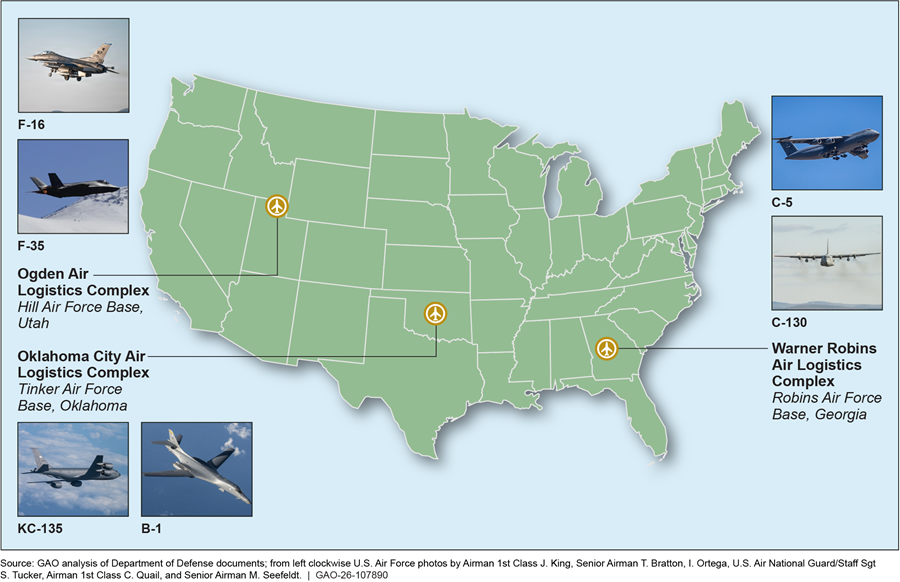
Ogden ALC. Located at Hill Air Force Base, Utah, this depot provides logistics, support, maintenance, and distribution for the F-16 and F-35, among others. It serves as the Landing Gear Center of Excellence handling all Air Force landing gear and a majority of other Department of Defense (DOD) landing gear. The ALC has almost 7,000 military, civilian, and contractor personnel.
Oklahoma City ALC. Located at Tinker Air Force Base, Oklahoma, this depot performs depot maintenance on and modifications to the KC-135 and B-1B, among others. It is the Air Force’s Engine Center for Industrial and Technical Expertise, providing maintenance, repair, and overhaul for a variety of engines, among other tasks. The ALC has over 9,000 military and civilian personnel.
Warner Robins ALC. Located at Robins Air Force Base, Georgia, this depot performs depot maintenance on the C-5 and C-130, among others. It also conducts maintenance of various Air Force, DOD, and allied electronic warfare systems, and manages items including avionics functions and technology. The ALC has over 6,400 military, civilian, and contractor personnel.
Roles and Responsibilities of Air Force Organizations Overseeing Depots
Air Force depots are overseen by two main organizations.
Air Force Materiel Command (AFMC). This command develops, acquires, and sustains weapon systems and their components, providing acquisition and life-cycle management services and logistics support, among other things. The Air Force Life Cycle Management Center within AFMC is responsible for the life-cycle management of weapon systems from inception to retirement, with a specific program office managing each type of aircraft. AFMC works with the program offices to develop, review, validate, and prioritize aircraft depot maintenance workload requirements and associated funding.
Air Force Sustainment Center (AFSC). This center oversees maintenance, supply chain management, and installation support. It is one of six specialized centers assigned to AFMC. It also provides installation support to over 140 associate units.
Process for Setting Target Completion Dates for Depot Maintenance
Prior to aircraft arriving at the depot, personnel at aircraft program offices and the depots establish an original target completion date (original target) by estimating the number of days it will take to complete the planned maintenance. However, sometimes during depot maintenance, additional aircraft issues are discovered that require additional time, resulting in unplanned work. Unplanned work is due to previously undiscovered aircraft defects and changes in program office requests, resulting in additional time required to obtain parts and engineering approvals and perform required labor. As an example of this unplanned work, officials at Ogden ALC stated that maintainers sometimes discover corrosion or stress cracks that were not previously identified and included in the program office’s work request. According to Air Force officials, unplanned work is becoming more prevalent, in part because of the aging fleet.
In response to discovering additional aircraft issues that need to be addressed, depots submit a request to the program offices to revise the target completion date (revised target) to add time to complete the unplanned work. The revision process is intended to grant depots relief on their deadlines in response to issues that arise outside their control. AFMC guidance allows depots to submit target revisions up to 15 days after maintenance is completed.[8] These revisions may occur after inspection of the aircraft but also during maintenance and after the maintenance has been completed, as shown in figure 2.
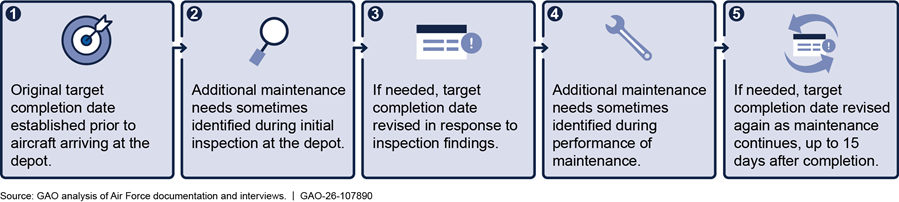
Note: This process is governed by Air Force Materiel Command guidance—AFMC Instruction 21-118, Aircraft Maintenance Production/Compression Report (AMREP) (July 16, 2025).
Air Force’s Process for Reporting Depot Maintenance Timeliness Masks Extent of Increasing Delays
Depot Maintenance Delays Have Increased Considerably
Maintenance delays at Air Force depots have increased considerably since fiscal year 2019, whether assessed by the original or the revised target.[9] The Air Force tracks depot timeliness based on both the original and revised targets but primarily uses the revised target as the baseline for reporting on its performance. Our prior work analyzed Air Force depot performance during fiscal years 2014 through 2019.[10] In fiscal year 2019, 31 percent of aircraft were delayed according to their original target. We found by fiscal year 2024, the proportion of aircraft that were delayed had increased to 73 percent according to their original target (see fig. 3).
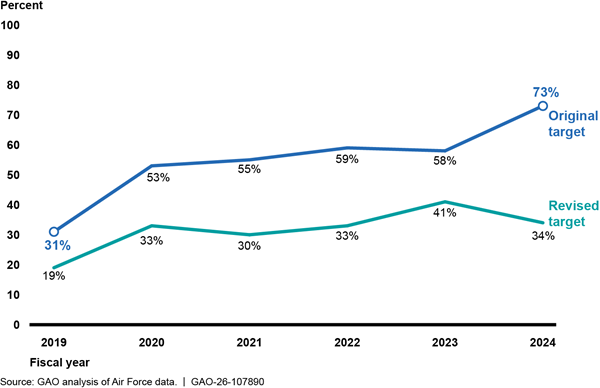
Note: Fiscal year 2019 data are drawn from our prior report on Air Force depot maintenance timeliness, GAO, Military Depots: The Navy Needs Improved Planning to Address Persistent Aircraft Maintenance Delays While Air Force Maintenance Has Generally Been Timely, GAO‑20‑390 (Washington, D.C.: June 23, 2020).
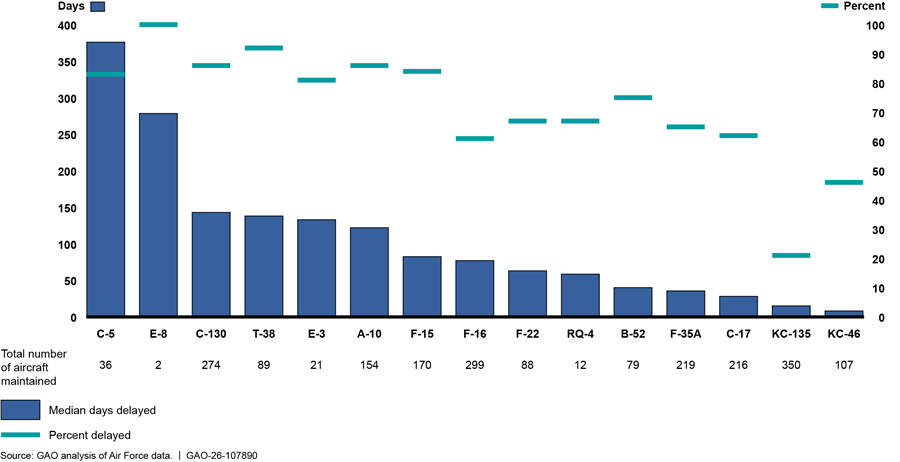
In comparing depot maintenance delays for specific aircraft types, we found wide variance. For example, from fiscal years 2020 through 2024, 46 percent of KC-46s were delayed by a median of 8 days.[11] However, 83 percent of C-5s were delayed by a median of 376 days (see fig. 4).
Figure 4: Median Number of Days Air Force Depot Maintenance Was Delayed and Percent of Aircraft Delayed, Based on Original Target Completion Date, Fiscal Years 2020–2024
Process for Assessing and Reporting Depot Timeliness Masks Extent of Delays
As stated earlier, the Air Force primarily uses the revised target as the baseline for assessing and reporting on its depot performance. However, we found that reporting on timeliness based on the revised target masks the full extent of maintenance delays because
· The additional time it takes to complete unplanned work is not reflected, and
· Targets are often revised after maintenance is completed, leading to many targets being revised to match actual performance, thereby showing no delays in those instances.
Air Force officials cited unplanned work as a major issue contributing to overall delays. These officials stated that the issue is worsening as aircraft continue to age, but these types of maintenance delays are not represented in the Air Force’s timeliness reporting. According to Air Force officials, targets are revised in response to unplanned work to grant depots relief on their deadlines for issues outside their control.
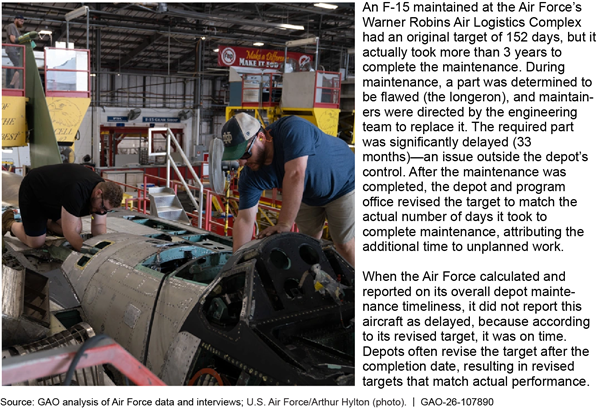
In addition, revising targets after the maintenance is completed affects the credibility of the revised target metric. We found that the depots and program offices often revise targets after the maintenance has been completed, which enables them to revise the target to match the actual number of days it took to complete maintenance. For instance, across the three depots, targets for 49 percent of all delayed aircraft from fiscal year 2020 through fiscal year 2024 were revised to match. This practice is especially prevalent at Oklahoma City ALC, where targets for 89 percent of delayed aircraft from fiscal year 2020 through fiscal year 2024 were revised to match (compared with 34 percent at Warner Robins ALC and 25 percent at Ogden ALC). See figure 5 for an example of an aircraft being delayed because of unplanned work, which led to the depot revising the target to match the actual number of days it took to complete maintenance.
Figure 5: Example of Unplanned Work Leading to Depot Revising Target to Match Actual Number of Days It Took to Complete Maintenance
Despite the limitations of using the revised target as the baseline for assessing depot maintenance timeliness, the Air Force uses the revised target as its primary metric for reporting on its performance, according to officials. For example, until December 2025 the Secretary of Defense was required to submit to Congress an annual report on the implementation of a comprehensive strategy for improving the depot infrastructure of each military service.[12] This annual report was also intended to identify progress in achieving analytically based goals related to depot cost and schedule performance and the impact of depot performance on weapon systems availability, among other conditions. Air Force data included in this report is derived from a metric called Net Aircraft Availability, which is based on the revised target according to officials.[13] As a result, the service does not provide information on the full extent of depot delays it faces, such as delays related to unplanned work. AFMC officials said the revised target is used as the baseline for assessment because they do not want to use metrics that penalize the depots for issues outside their control, such as unplanned work. However, they did acknowledge that reporting timeliness based on the original target shows the full extent of delays.
Although depot maintenance delays have increased according to both the original and revised targets, the Air Force’s overall performance varies widely, depending on which target is used as the baseline for assessment. For example, as shown in figure 3, more than half of the Air Force’s depot maintenance is delayed, and timeliness is worsening, according to the original target. However, according to the revised target, the Air Force completes more than half its depot maintenance on time and has improved in fiscal year 2024, compared with 2023.
GAO’s Schedule Assessment Guide states program performance should be measured and reported against an original baseline schedule, so deviations from the original plans can be tracked and managed.[14] Standards for Internal Control in the Federal Government also states that management should use quality information to achieve the entity’s objectives.[15]
However, the Air Force primarily assesses and reports on its depot maintenance performance to DOD and others according to the revised target, which lacks completeness and credibility. The quality of the Air Force’s information related to its depot maintenance timeliness is affected by the revised target (1) lacking completeness, because it masks delays related to unplanned work, and (2) lacking credibility, because targets can be revised after maintenance has been completed and are frequently revised to reflect actual performance.
AFMC guidance allows target revisions to occur after the maintenance is completed and, according to AFMC officials, they train program office representatives to submit the revisions after the completion of depot maintenance.[16] Further, the Air Force does not currently calculate the proportion of overall maintenance delays that are outside the depots’ control, such as delays related to unplanned work, according to AFMC. Doing so would allow them to report depot maintenance timeliness according to the original target, showing the full extent of delays, while still being able to report the proportion of delays that were outside the depots’ control. By not calculating and reporting on the proportion of overall maintenance delays that are outside the depots’ control, the Air Force is not showing DOD and other stakeholders the extent of delays caused by unplanned work.
Further, by reporting depot maintenance timeliness based on revised targets, the Air Force is not presenting the full extent of delays related to its depot maintenance enterprise. It is also presenting a metric that lacks completeness and credibility, diminishing its usefulness as an accurate assessment for performance. Without complete and credible metrics to understand the full extent of depot maintenance delays, decision-makers will not fully understand the sustainment challenges related to its aging fleet. Consequently, they will not have the information needed to determine the resources necessary to sustain the Air Force’s aging fleet and thereby be able to accurately plan for impacts on aircraft availability for training and operations.
Process for Revising Target Completion Dates is Inconsistent
The Air Force currently uses the target revision process when unplanned work arises so they can account for issues outside the depots’ control. Depots receive relief on their deadlines by requesting that additional days be added to the original target. However, we found depots potentially differ in how they approach the target revision process. Specifically, we found wide variance in the revised target data across the three depots and over time.
Inconsistency across the three depots. The wide variance in the revised target data across the three depots illustrates potential differences in how the depots and program offices implement the target revision process. From fiscal year 2020 through fiscal year 2024, 4 percent of aircraft maintenance was delayed at Oklahoma City ALC, based on the revised target; Ogden ALC, 48 percent; and Warner Robins ALC, 50 percent. Our analysis found that when aircraft were delayed at Oklahoma City ALC, they revised the target to match actual performance in most, if not all, instances. For example, in fiscal year 2024, 64 percent of aircraft at Oklahoma City ALC were delayed according to their original target, but targets for all of them (85 aircraft) were revised to match the actual number of days it took to complete maintenance. As a result, Oklahoma City ALC reported no delayed aircraft for fiscal year 2024. As discussed above, for fiscal years 2020 through 2024, targets for 89 percent of delayed aircraft were revised to match actual performance at Oklahoma City ALC, but this percentage compares with 34 percent at Warner Robins ALC and 25 percent at Ogden ALC. AFMC officials acknowledged differences in how depots and program offices manage their process for revising their target completion days. They said they allow depots and program offices to have flexibility in the implementation of the target revision process.
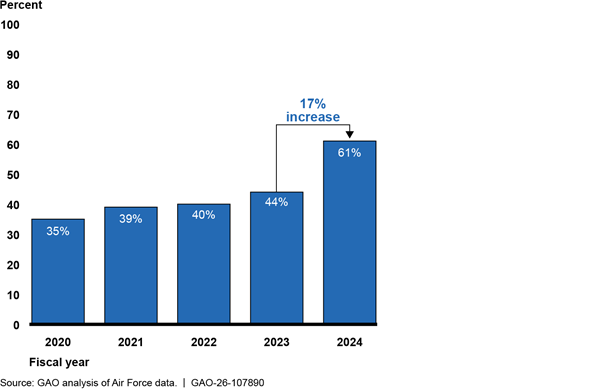
Inconsistency over time. We also found overall revisions of target dates increased considerably in fiscal year 2024, illustrating a change in how frequently depots sought revisions. AFMC officials attributed the recent increase in revisions to a change in leadership perspective. AFMC officials said Air Force Sustainment Center leadership had requested fewer target revisions to be submitted so they could show the difficulties conducting depot maintenance due to the aging fleet and the amount of unplanned work, parts issues, and personnel shortages they were facing. During fiscal years 2020 through 2023, depots and program offices revised targets for 39 percent of aircraft, on average, while in fiscal year 2024 the rate increased to 61 percent (see fig. 6).
Figure 6: Percentage of Total Aircraft with Revised Depot Maintenance Target Completion Dates, Fiscal Years 2020–2024
Standards for Internal Control in the Federal Government states that management should design control activities to achieve objectives and respond to risks, including evaluating the consistency with which internal controls are applied.[17]
We found the Air Force has not ensured consistent implementation of the target revision process, leading to wide variance in the revised target data across the three depots and over time. If the Air Force does not work to ensure greater consistency in the target revision process across depots and program offices, it will not have reliable information to distinguish between delays that are within and outside the depot’s control. Without the ability to make accurate comparisons across the fleet and over time, senior leaders are limited in their ability to make informed decisions driven by consistent maintenance performance data.
Air Force Has Not Fully Evaluated the Causes of Depot Maintenance Delays
The Air Force tracks the causes of delays during depot maintenance in a tracking system (root cause reporting system). However, we found several limitations with the usefulness of this system, including that delay cause categories are broad and inconsistently applied, the system does not include unplanned work, and root causes that are entered into the system are not analyzed to track common causes of delays.
Cause Categories for Delays Are Broad and Applied Inconsistently
When aircraft are delayed in depot maintenance, according to their revised target, AFMC requires program offices to enter the root cause into the root cause reporting system. Program office personnel are presented with one of the following preset categories: Personnel, Policy/Procedure, Material, Facilities, Supervisor/Management, Equipment and Weather. They must also enter a description of the delay, but these descriptions are open-ended and therefore can vary widely.
Tracking the relative scale and trends of delay causes requires quantitative analysis, which we found is most accessible at the category level because of the standardization of categories. Therefore, it is important that these categories are specific and easily understandable. However, we found several limitations to the usefulness of these categories.
First, we found the categories in AFMC’s root cause reporting system are too broad to be useful. For example, the F-35 Joint Program Office tracks depot delays using a different set of categories, according to program office officials. They stated that categories such as “Lack of Skilled Manpower” and “Organic Rework” are used to track personnel shortages and mechanics’ errors, respectively. However, in AFMC’s root cause reporting system, these two categories are combined into the single category “Personnel.” Because a shortage of personnel and mechanics’ errors are distinct delay causes that have different root causes and solutions, categorizing both under “Personnel” makes it difficult for decision-makers to differentiate between these distinct causes when reviewing category level summary analyses.
Second, we also found inconsistencies in how the same types of delays are categorized. While reviewing entries in the root cause reporting system, we identified instances where delay descriptions matched verbatim, stating that aircraft were delayed because too many aircraft were in-process at once—but these delays were categorized differently—as both “Policy/Procedure” and “Supervisor/Management.” We also found instances where delays related to the COVID-19 pandemic were categorized as “Personnel” and “Facilities” despite AFMC’s instructions to categorize COVID-19 pandemic related delays as “Supervisor/Management.”[18] AFMC stated they review entries into the root cause reporting system for accuracy.
Third, AFMC has not provided definitions for its cause categories to all maintenance stakeholders. AFMC has provided definitions for its cause categories in training documents for program offices. However, these definitions are not made available in AFMC’s primary maintenance guidance, the Aircraft Maintenance Production/Compression Report.[19] AFMC officials stated that they believed the categories are self-explanatory. Based on our review, categories such as “Policy/Procedure” and “Supervisor/Management” are not clearly understood based on their titles, such as the category “Supervisor/Management” including delays related to COVID-19. These generic titles limit the ability for stakeholders to understand any summary analyses of these categories. See table 1 for the category definitions that AFMC provides in training materials for program office personnel.
Table 1: Delay Cause Category Definitions for Root Cause Analysis Inputs Provided by AFMC to Program Office Personnel in Training Documents
|
Category |
Definition |
|
Personnel |
Insufficient staffing, lack of appropriately trained personnel, or errors caused by personnel that contribute to delays or issues in performing depot maintenance tasks. |
|
Policy/Procedure |
Depot policy or procedure that may delay aircraft completion, such as prioritizing higher-priority aircraft or maintaining specific amount of work-in-progress within designated gates. |
|
Material |
Issues with parts supportability, whether managed by the Air Force or Defense Logistics Agency, including shortages or unavailability of raw stock required for local part fabrication. |
|
Facilities |
Infrastructure issues, such as facility condition or capacity, preventing depot production due to limited availability, condition, or necessary upgrades and improvements. |
|
Supervisor/Management |
Management decisions or inaction, such as failing to ensure known parts are ordered on time or implementing workforce restrictions (e.g., COVID-19 pandemic-related prohibitions on personnel working) that impede aircraft production. |
|
Equipment |
Any unavailable maintenance or testing equipment, ranging from tools to test stands, or equipment breakdowns that disrupt production. |
|
Weather |
Any adverse weather-related factor or condition that prevents timely completion of the aircraft depot maintenance, including hurricanes, blizzards, excessive hail, or events causing base or contract facility closure, impacting functional check flights activities, or damaging the aircraft while in depot possession. |
Source: Air Force Materiel Command (AFMC) training documents. | GAO‑26‑107890
Our evidence-based policymaking practices state that management should assess the quality of their evidence, including the conclusions that can be drawn from it and its usefulness to decision-makers.[20] Standards for Internal Control in the Federal Government also states that management should design control activities to achieve objectives and respond to risks, including evaluating the consistency with which internal controls are applied.[21]
However, we found the Air Force has not made the cause categories in the root cause reporting system specific enough to facilitate analyses or made the cause category definitions available to all maintenance stakeholders. Without revising the cause categories to make them more specific and making category definitions available to all stakeholders, the Air Force will not have useful and consistent data that can be analyzed to mitigate future depot delays.
Tracking System Does Not Include Unplanned Work Among Delay Causes
The Air Force’s root cause reporting system does not track the full scope of the causes of depot delays. Despite unplanned work being a significant cause of delays, the system does not include it as a category, including delays obtaining parts and engineering reviews related to the unplanned work.
Instead, unplanned work is documented in target revision request forms, which are documents with descriptions of the additional work that needs to be completed, but they do not contain categories that enable summary analysis. Further, the information in these forms is not required to be entered into a software system, according to AFMC officials. As a result, Air Force personnel cannot perform summary quantitative analyses that include unplanned work to understand the full scope of depot delays.
According to GAO’s evidence-based policymaking practices, management should assess the coverage and quality of their evidence, including whether it is complete.[22] AFMC officials acknowledged there is no Air Force system for tracking and analyzing the causes of delays associated with unplanned work. Instead, this information is shared through meetings between the depots, program offices, and Air Force major commands, according to AFMC officials.
AFMC’s requirement to enter a root cause into the root cause reporting system is limited to aircraft that are delayed according to their revised target, not their original target, so it does not include unplanned work. As previously stated, targets are revised in response to unplanned work, so aircraft that require unplanned work are often not designated as delayed according to their revised target, thus avoiding the need to submit a root cause analysis. Further, AFMC has not established delay cause categories related to unplanned work in their root cause reporting system, such as additional labor time, unplanned parts delays, and additional time for obtaining engineering approvals.
Given that aircraft that are late according to their original target are not included in the Air Force’s current system, the Air Force is not able to comprehensively track and analyze the full scope of depot delays, including unplanned work. Without the inclusion of the full scope of delays, management and senior leaders are limited in their ability to fully analyze and understand the relative scale and trends of all depot delays, which would help them rebuild Air Force readiness.
Causes of Delays Across Depots Are Not Analyzed
We found root causes that are entered into the tracking system are not analyzed by AFMC to quantify the relative scale of delay causes and their trends across the depots. Although AFMC requires program offices to input root causes, AFMC officials told us that they do not summarize or conduct any analysis on the data, but that program offices may use the data for their own analysis.
In the absence of this analysis conducted by the Air Force, we conducted our own quantitative analysis of the delay causes with data provided by AFMC, which summarizes the number of days associated with each delay cause category across the three depots for fiscal years 2021 through 2024. Despite the limitations of these categories that we presented earlier in our report, including their broadness, inconsistent application, and lack of definitions provided beyond training documents, we conducted this analysis to demonstrate how the Air Force can use delay cause category data to show the relative scale of each type of delay (see fig. 7).
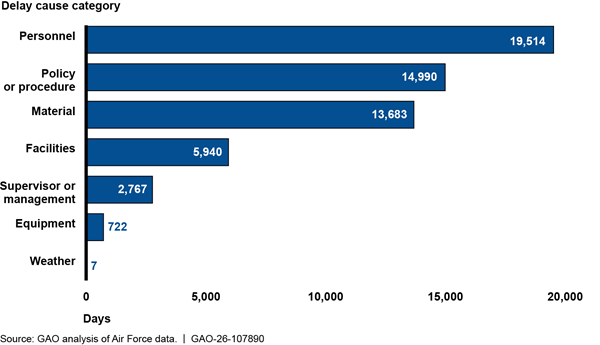
Note: We analyzed data from the Air Force’s root cause reporting system to calculate the total number of days associated with each delay cause category.
Our evidence-based policymaking practices state that management should use evidence to assess why desired results were not achieved and use those insights to inform management decisions.[23] Standards for Internal Control in the Federal Government also states management should process data into quality information to make informed decisions and evaluate the entity’s performance in achieving key objectives and addressing risks.[24]
We found there is no Air Force requirement for AFMC to conduct periodic quantitative analysis on the root causes of depot delays entered in the root cause reporting system and to develop actions to address common issues across the depots. By not periodically analyzing these data, the Air Force is missing opportunities to assess trends and recurring problems and to better understand the root causes of delays to ultimately improve depot maintenance timeliness.
Air Force Has Not Fully Addressed Pay Competition with Private Sector
The Air Force has filled most staff positions and is addressing some challenges related to staff shortages in certain occupations. However, while the depots have identified pay competition with the private sector as the primary challenge affecting their ability to staff certain occupations, they have not conducted a comprehensive assessment of pay for those occupations to identify the extent of the gaps.
Air Force Has Filled Most Positions and Is Addressing Some Challenges
All three depots had relatively high overall staffing levels during fiscal years 2020 through 2025, based on our analysis of Air Force depot personnel data. Their workforce was staffed at 90 percent or higher, comparing authorized with filled positions (see fig. 8).[25]
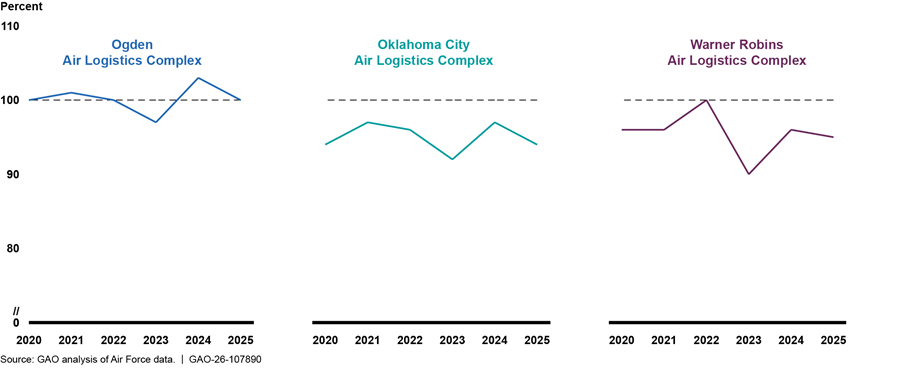
Despite high staffing levels overall, the depots faced some workforce challenges and experienced shortages in certain occupations. According to AFSC and depot officials, various factors affected staffing during fiscal years 2020 through 2024, including the COVID-19 pandemic, and high attrition rates due to retirements and resignations, particularly at Ogden and Warner Robins ALCs.[26]
|
Executive Branch Decisions in Fiscal Year 2025 Affecting the Air Force Depot Workforce Air Force depot officials expressed concerns about decisions the executive branch made in fiscal year 2025 that potentially affected depot workforce staffing and their ability to hire and retain personnel. Specifically: · Federal hiring freeze: The depots have not been able to hire new personnel due to a federal governmentwide and DOD hiring freeze instituted in January and February 2025. · Deferred Resignation Program: This program was intended to encourage federal workforce reductions and employees transitions out of federal service. According to Air Force Sustainment Center officials, 619 employees across the three depots (3 percent of the total workforce) left due to this program. · DOD-directed staffing reductions: During our site visits, depot officials told us that while they have not been directed to reduce staffing, uncertainty associated with whether DOD’s decision to reduce its civilian workforce as part of a broader effort to reduce spending has affected depot personnel morale and potentially retention. Source: GAO analysis of DOD information. | GAO‑26‑107890 |
For fiscal year 2025, AFSC officials told us that the executive branch’s decision to institute a federal hiring freeze, offer a deferred resignation program, and possibly reduce DOD’s civilian workforce have also affected staffing (see sidebar).
Officials at all three depots cited staff shortages in certain occupations during fiscal years 2020 through 2025, identifying multiple factors that may have contributed to those shortages. For example:
· Ogden ALC. According to depot officials, the depot experienced shortages in engineer occupations, information technology management occupations, machinists, and transportation/mobile equipment operators, among others, due to difficulty attracting experienced workers and competition with the private sector. For example, the depot had less than 90 percent staffing-to-authorized positions for transportation/mobile equipment operators during fiscal years 2022 through 2024 and 60 percent staffing to authorized positions for industrial engineers in fiscal year 2024. Ogden ALC officials told us that the depot used overtime and staffing reassignments to address shortages. In addition, the ALC used flexible work arrangements, recruitment, relocation, retention bonuses, and professional development opportunities to help address shortages.
· Oklahoma City ALC. According to depot officials, the depot experienced shortages in aircraft mechanics, aircraft engine mechanics, and nondestructive testers, among others, due to competition with the private sector.[27] For example, the depot had 88 percent staffing to authorized positions for aircraft mechanics for fiscal year 2023 and less than 90 percent staffing to authorized positions for aircraft engine mechanics for fiscal years 2020 and 2023. Oklahoma City ALC officials told us that they used overtime to address these shortages.
· Warner Robins ALC. According to depot officials, the depot experienced shortages in aircraft mechanics, engineers, and nondestructive testers, among others, due to increased attrition and workload. For example, the depot had less than 90 percent staffing to authorized positions for nondestructive testers for fiscal years 2021, 2023, and 2024 and less than 90 percent staffing to authorized positions for mechanical engineers for fiscal years 2020 through 2025. Warner Robins ALC officials told us they used overtime, direct contracting support, and staffing moves across the organization to address shortages.
In addition to those efforts described above, all three Air Force depots took steps to address other challenges that affected workforce staffing during fiscal years 2020 through 2024. For example, Oklahoma City ALC officials told us they used hiring events that included onsite interviews, physicals, drug testing, and fingerprinting to speed up the hiring process. At Warner Robins ALC, depot officials told us they developed internships for specific positions, such as aircraft mechanics and sheet metal mechanics, to address difficulty hiring due to private sector competition. Also, all three depots developed relationships with high schools, technical colleges, and universities to build pipelines of qualified candidates and educate the local community about employment opportunities at the depots, as well as the importance of the national security mission. For more information on these and other steps taken by the depots to address staffing challenges during fiscal years 2020 through 2024, see appendix II.
Air Force Depots Have Not Fully Assessed Private Sector Pay Competition
Challenges Competing with Private Sector and Steps Taken to Address Them
Air Force depot officials identified pay competition with the private sector as the primary challenge affecting their ability to staff certain occupations in their workforce, which our prior work also identified as a challenge.[28] According to depot officials, pay competition exists in various specialties, such as engineers and mechanics (see table 2).
Table 2: Occupations Air Force Depots Identified as Being Affected by Private Sector Pay Competition
|
Depot |
Occupations by OPM position title |
|
Ogden ALC |
· Aerospace Engineering · Chemical Engineering · Electric Engineering · Electronics Engineering · General Engineering · Industrial Engineering · Materials Engineering · Mechanical Engineering |
|
Oklahoma City ALC |
· Aircraft Electrician · Aircraft Engine Mechanic · Aircraft Mechanic · Electronic Integrated Systems Mechanic · Nondestructive Tester |
|
Warner Robins ALC |
· Aerospace Engineering · Aircraft Mechanic · Computer Science · Electronics Engineering · Electronics Mechanic · Industrial Engineering · Mechanical Engineering · Nondestructive Tester |
Legend: ALC = Air Logistics Complex; OPM = Office of Personnel Management
Source: GAO analysis of Air Force information. | GAO‑26‑107890
|
Challenges with Federal Wage System (FWS) Wage Surveys Our prior work has identified challenges with the Federal Wage System (FWS) wage surveys, including how these challenges may affect the recruitment and retention of FWS employees at selected Department of Defense installations due to pay competition with the private sector. For example, we reported that federal and private sector job descriptions in the FWS wage surveys may not exactly match, thereby affecting wage rates for FWS employees. In addition, we reported that private sector companies, including federal contractors, are not required to participate in the FWS wage surveys, which may affect the accuracy of local wage rates. Source: GAO‑25‑107152. | GAO‑26‑107890 |
Depot officials told us they are not able to compete with the private sector due to the following factors:
· Private sector’s ability to offer higher pay. Depot officials told us that the private sector generally offers higher salaries, hourly wages, and bonuses. For example, officials at both Oklahoma City ALC and Warner Robins ALC told us private sector companies can offer hiring bonuses that range from $25,000 to $50,000 for experienced mechanics. According to depot officials, private sector competitors can be both private industry partners that work as contractors at the depots, such as Pratt & Whitney, Northrup Grumman, and Lockheed Martin, and private sector industries that recruit potential employees for the same skill sets, such as the aerospace, automotive, and oil and gas industries.
· Length of depot hiring process. Depot officials told us that the need to obtain approval for the use of recruitment incentives can lengthen the process and consequently increase the likelihood of candidates declining job offers.
· Pay setting for Federal Wage System (FWS) occupations. The FWS covers federal blue-collar hourly employees such as aircraft mechanics, machinists, pipefitters, and welders. These employees constitute approximately two-thirds of each depot’s workforce. DOD, not the ALCs, is the lead agency that conducts wage surveys, analyzes survey data, and issues wage schedules for FWS occupations in all local wage areas.[29] Annual wage surveys collect voluntary wage data from private sector companies from which wage schedules for DOD FWS employees are developed and adjusted. Thus, the depots may be limited to using pay rates set by these surveys for their FWS employees. For example, AFSC officials told us that the depots must set pay for its employees within pay policy guidelines and use federal wage surveys. They also stated that these surveys typically lag behind private sector pay in local areas. In addition, depot officials at Warner Robins ALC told us they have concerns with the accuracy of the FWS wage surveys because private sector employers within the surveyed areas are not required to participate, which results in data gaps when attempting to compare depot and private sector pay. See sidebar for challenges with the FWS wage surveys.[30]
Depot officials told us they have taken some steps to address pay competition with the private sector by selectively using pay flexibilities, such as incentives, or emphasizing nonfinancial benefits of employment at the depots.[31] Specifically:
· Ogden ALC. The depot has requested group-retention incentives for its nondestructive testers and engineers to help reduce attrition. To request this incentive, Ogden ALC conducted an analysis of differences in pay between comparable depot and private sector occupations. However, officials noted that this incentive must be renewed annually.
· Oklahoma City and Warner Robins ALCs. The depots emphasized the nonfinancial benefits of a federal career to potential candidates at recruitment events, such as work-life balance, health insurance, and retirement benefits.
· Warner Robins ALC. The depot used incentives for hiring highly qualified candidates, such as a special needs or superior qualifications incentive, which provide a higher minimum rate of pay based on a candidate’s skills and competencies, among other factors.
Depots’ Efforts to Assess Pay Competition with the Private Sector
Although the Air Force depots have taken some steps to address pay competition with the private sector, the depots have not conducted a comprehensive pay assessment to identify the extent of the gaps for the occupations they have identified as being affected by this issue. While the depots have identified occupations that have challenges with recruitment or retention due to pay competition with the private sector, depot officials told us they primarily relied on anecdotal evidence to do so. For example, Air Force depot officials told us they obtained their information on pay competition through discussions with potential candidates and competing private sector companies at hiring events, exit interviews with employees leaving federal employment, and online searches of salary information on the Bureau of Labor Statistics’ (BLS) website.
Ogden ALC conducted a targeted analysis of differences in pay between comparable depot and private sector occupations through a group-retention incentive request for its engineering and nondestructive tester series occupations. This analysis, which was conducted due to increasing attrition in those occupations in prior years, resulted in a 10 percent increase in the annual base salary of those occupations. According to an Ogden ALC official, they used job listings for similar private sector occupations to show that the private sector was paying more.
Oklahoma City and Warner Robins ALC officials told us they did not conduct an analysis of private sector pay differences for depot occupations during fiscal years 2020 through 2024. Oklahoma City ALC officials told us they had tried to institute a group-retention incentive, but their request was not approved by AFSC because it applied to all occupations and was not targeted to specific occupations with evidence to show the private sector paid more. Depot officials at all three ALCs stated that if incentives were offered to employees but not reapproved later, it could potentially have a negative effect on employee morale and be perceived as a pay cut. They also generally expressed concern with the use of pay flexibilities to address pay competition with the private sector, stating that these incentives are short term, require approvals that increase hiring timelines, and may need approval on an annual basis.
GAO’s Analysis of Median Pay for Selected Depot Occupations
In the absence of a comprehensive assessment of pay competition by the Air Force depots, for illustrative purposes, we analyzed 2024 pay data for depot occupations identified by depot officials as being affected by private sector pay competition. We compared depot pay to private industry pay data from the BLS in the metropolitan statistical area in which the depot is located. Our analysis of available data found that some depot occupations, such as mechanical engineers, had lower median pay compared with the private sector, while other depot occupations, such as nondestructive testers, had higher median pay compared with the private sector. For more details of our illustrative analysis of the pay differences between selected Air Force depot and private sector occupations, see appendix III.
Although our assessment provided a simple comparison of the median pay between depot occupations and comparable private sector occupations, it does not account for various factors that may explain the differences in pay. For example:
· Similarity of tasks in each occupational sample: Specific tasks being performed at the depots may differ from the work tasks being performed by the comparable occupations in the private sector in that local area. Depot officials stated that depot occupations are likely more specialized and complex than the more general sample in the BLS data, when comparing titles against BLS occupational codes. For example, electrical engineers working in building construction differ from electrical engineers at the depot, who work on fighter aircraft. Our analysis was not able to verify the similarity of tasks performed between depot occupations and BLS occupational codes.
· Experience level: More experienced workers tend to have higher wages, on average. Because the BLS data do not include experience level, we were not able to include this factor in our analysis. Differences in pay between the depot and the private sector in our analysis may be driven by differences in experience level. For
example, the depot workforce may have more years of experience compared with the private sector population in the BLS data.
· Business size: Workers in larger establishments generally have higher wages than those in smaller establishments. The BLS data does not include the size of establishments in their data and therefore is not included in our analysis.
|
GAO and RAND Studies on Aircraft Mechanics Prior studies have reported on pay and workforce challenges affecting the aircraft mechanic—which is a key occupation required for completing aircraft depot maintenance. In 2023, we reported that aircraft mechanics across the aviation and aerospace workforce are affected by challenging work conditions. We noted that their pay may not be aligned to their significant responsibilities to ensure the safety and airworthiness of aircraft. Our report also found that there was limited awareness of aircraft maintenance careers, and that the skills trainees acquire are valued by other industries, such as the oil and amusement park industries, which may offer better compensation and work environments. A 2021 RAND study found private sector aircraft mechanics were paid more than civilian aircraft mechanics employed by the Air Force, after accounting for factors that might affect pay such as education and experience, with the pay gap widening over time. They found median private sector pay was $3,000 more in 2012 and had increased to over $10,000 in 2018. The RAND study noted concern about the gap in public-private sector pay potentially widening in the future. Source: GAO, Aviation Workforce: Current and Future Availability of Airline Pilots and Aircraft Mechanics, GAO-23-105571 (Washington, D.C.: May 17, 2023) and RAND Corporation, Department of Air Force Civilian Compensation and Benefits: How Five Mission Critical and Hard-to-Fill Occupations Compare to the Private Sector and Key Federal Agencies (Feb. 10, 2021). | GAO-26-107890 |
· Competition from specific businesses: Depots may only compete with a few companies, such as large aerospace and defense businesses, according to depot officials. However, the BLS data encompasses a wider sample of companies across various industries. Therefore, our analysis may not reflect the true pay competition that depots face from the private sector.
In addition, a 2021 RAND study compared the pay of five mission critical and hard-to-fill Air Force civilian occupations with the private sector, including aircraft mechanics.[32] In its study, RAND noted the limitations of its use of Occupational Employment and Wage Statistics (OEWS) data, which does not include factors that can affect pay such as experience, educational attainment, veteran status, and age. To address this limitation, the study used data on age and educational attainment from the Census Bureau’s American Community Survey to develop a proxy for experience level. They implemented these factors into their analysis and found aircraft mechanics employed by the Air Force were paid less than those in the private sector. See sidebar for a discussion of our prior work on aircraft mechanics pay issues and this RAND study.
Our evidence-based policymaking practices and Standards for Internal Control in the Federal Government state that management should assess the environment—including periodic review of control activities such as management of human capital—to identify internal and external factors that affect goal achievement or achieving an entity’s objectives or address related risks, which can include economic trends, among others, and plan accordingly to address or mitigate those factors.[33] In addition, our key principles for strategic workforce planning state that agencies should develop strategies tailored to address gaps and competencies that need attention.[34]
The Air Force depots have identified some staffing challenges and taken some steps to address pay competition with the private sector. However, depot officials told us they have not conducted a comprehensive assessment of pay for depot occupations they identified as being affected by private sector pay competition, including identifying significant internal and external factors affecting depot occupation pay, such as economic trends. Officials from AFSC, which provides oversight of the three depots, and the depots told us they are generally aware of pay differences between certain depot and private sector occupations, but they are not aware of the extent of those gaps for their workforces. Such an assessment, conducted on a periodic basis, would enable the depots to identify factors affecting staffing, both internal and external, such as the extent of any pay gaps compared with the private sector. It would also enable them to use the results from the assessment to help develop tailored strategies to address staffing challenges. DOD officials told us that the Office of the Deputy Assistant Secretary of Defense for Product Support would be the most appropriate entity to conduct such an assessment, because its responsibilities include addressing human capital concerns in the logistics workforce across the department.
By conducting a periodic, comprehensive assessment of pay for depot occupations facing pay competition challenges, the depots could help Air Force depot senior leaders make informed decisions on how to compensate depot employees competitively and better compete with the private sector for potential talent needed to accomplish the depot mission of rebuilding military readiness.
Conclusions
The Air Force’s three maintenance depots will continue to play a critical role in maintaining the readiness of aircraft required for military operations and training, such as the F-35 and C-130. Depot maintenance delays—which have worsened considerably for the Air Force since 2019—reduce the time aircraft are available for training and operations, affecting unit readiness. However, by reporting its maintenance performance according to its revised targets—a method that has multiple weaknesses—the Air Force is not presenting the full scope of delays, including unplanned work. Targets are also often revised after maintenance is completed, and the revision process is inconsistently applied. By continuing to use the revised target as its primary metric for reporting on its performance, the Air Force is not reporting the full extent of depot delays and therefore not showing stakeholders the sustainment challenges it faces with its aging fleet.
While the Air Force has a system for tracking causes of some maintenance delays, it is of limited use, given the broadness of the categories, their inconsistent application, and the data not being analyzed across the depots. In addition, delays related to unplanned work are not included in the system. The Air Force is missing opportunities to assess delay trends and leverage useful data that can inform efforts to mitigate future depot delays and ultimately improve depot maintenance timeliness.
In addition, while the Air Force has taken some steps to attempt to address pay competition with the private sector by selectively using incentives and emphasizing nonfinancial benefits of employment at the depots, it has not conducted a comprehensive assessment of occupations they identify as being affected by pay competition with the private sector. By doing so, the depots could identify the extent of any pay gaps and use this information to make informed decisions and to develop tailored strategies to address competition with the private sector for these occupations.
Recommendations for Executive Action
We are making 10 recommendations to the Department of Defense.
The Secretary of the Air Force should ensure that AFMC uses the original target completion date as a primary metric for reporting on depot maintenance timeliness to show the full extent of depot maintenance delays. (Recommendation 1)
The Secretary of the Air Force should ensure AFMC calculates and reports on the proportion of overall depot delays due to issues outside the depots’ control, such as unplanned work. (Recommendation 2)
The Secretary of the Air Force should ensure that AFMC revises guidance to limit target completion date revisions after depot maintenance has been completed. (Recommendation 3)
The Secretary of the Air Force should ensure that AFMC establishes consistent implementation of the revision process for target completion dates across depots and program offices. (Recommendation 4)
The Secretary of the Air Force should ensure that AFMC revises its delay cause categories to improve their specificity and make category definitions available to all stakeholders. (Recommendation 5)
The Secretary of the Air Force should ensure that AFMC requires inputting a delay root cause analysis in the root cause reporting system for all aircraft exceeding their original target completion date. (Recommendation 6)
The Secretary of the Air Force should ensure that AFMC establishes categories related to unplanned work in the root cause reporting system, such as additional labor time, unplanned parts delays, and additional time for obtaining engineering approvals. (Recommendation 7)
The Secretary of the Air Force should ensure that AFMC conducts periodic quantitative analysis on the root causes of depot delays entered in the root cause reporting system and develops actions to address common issues across the depots. (Recommendation 8)
The Secretary of Defense should ensure that the Deputy Assistant Secretary of Defense for Product Support conducts and periodically updates a comprehensive assessment of pay for depot occupations competing with the private sector that includes identifying significant internal and external factors affecting depot occupation pay—such as economic trends—and uses this information and results to update this assessment periodically. (Recommendation 9)
The Secretary of Defense should ensure that the Deputy Assistant Secretary of Defense for Product Support uses the information and results from the periodic, comprehensive assessments of pay to develop tailored strategies for addressing challenges that arise from competition with the private sector, such as gaps in pay or staffing or skill shortages. (Recommendation 10)
Agency Comments and Our Evaluation
We provided a draft of this report to DOD for review and comment. In written comments on a draft of this report, DOD concurred with 8 of our recommendations and partially concurred with 2. DOD’s comments are reprinted in their entirety in appendix IV.
The Air Force partially concurred with our recommendation that the Secretary of the Air Force should ensure that AFMC requires inputting a delay root cause in the root cause reporting system for all aircraft exceeding their original target completion date. While the Air Force agreed that depot repair activity delays should be captured in the Aircraft Maintenance Production/Compression Report system, the service stated it would ensure that AFMC properly documents delays for unplanned work or induced delays in the proper locations.
The Air Force partially concurred with our recommendation that the Secretary of the Air Force should ensure that AFMC establishes categories related to unplanned work in the root cause reporting system, such as additional labor time, unplanned parts delays, and additional time for obtaining engineering approvals. While the Air Force agreed that categories related to unplanned work, such as additional labor time, are important for determining depot maintenance delays, the service did not agree with establishing them within the root cause reporting system. It stated that AFMC will identify a proper location for unplanned work in support of trend analysis assessments.
As our report states, the root cause reporting system is the Air Force’s mechanism for storing and tracking information on the causes of maintenance delays. We believe that including a root cause for all aircraft exceeding their original target completion date, as well as establishing categories related to unplanned work in this system, would be an effective and efficient way to capture these data for tracking and analyses.
The Air Force also provided technical comments on our draft report, which we incorporated where appropriate.
We are sending copies of this report to the appropriate congressional committees, the Secretary of Defense and Secretary of the Air Force. In addition, the report is available at no charge on the GAO website at http://www.gao.gov.
If you or your staff have any questions about this report, please contact me at maurerd@gao.gov. Contact points for our Offices of Congressional Relations and Media Relations may be found on the last page of this report. GAO staff who made key contributions to this report are listed in appendix V.
Diana Maurer,
Director, Defense Capabilities and Management
List of Committees
The Honorable Roger F. Wicker
Chairman
The Honorable Jack Reed
Ranking Member
Committee on Armed Services
United States Senate
The Honorable Mitch McConnell
Chair
The Honorable Christopher Coons
Ranking Member
Subcommittee on Defense
Committee on Appropriations
United States Senate
The Honorable Mike Rogers
Chairman
The Honorable Adam Smith
Ranking Member
Committee on Armed Services
House of Representatives
The Honorable Ken Calvert
Chairman
The Honorable Betty McCollum
Ranking Member
Subcommittee on Defense
Committee on Appropriations
House of Representatives
Senate Report 118-188 accompanying a bill for the National Defense Authorization Act for Fiscal Year 2025 includes a provision for us to assess the performance of maintenance and staffing at the three Air Logistics Complexes (ALCs).[35] This report assesses the extent to which the Air Force has (1) completed aircraft depot maintenance on time; (2) evaluated the causes of any delays; and (3) addressed any staffing challenges at the depots.
For our first objective, we collected and analyzed data on aircraft maintained at each of the three ALCs. Although we focused on fiscal years 2020 through 2024, we also included in figure 3 data for fiscal year 2019 from our June 2020 report on Air Force depot maintenance timeliness to show a baseline for comparison.[36] Following our June 2020 report, the Air Force changed software systems and made corrections to data during the transfer, according to an Air Force Materiel Command (AFMC) official. Results of our analysis indicate the proportion of 2019 records affected was small and no records were changed from a late status, therefore we believe the original 2019 data are suitable for the purposes of reporting the baseline from our prior report. For each aircraft, we collected data on the original estimate of time (in days) needed to complete maintenance (original target completion date, or original target), the revised estimate (revised target completion date, or revised target), and the actual number of days required for completion. We used this information to calculate the difference between the number of days planned for maintenance and the number of days it actually took to complete maintenance, to determine whether the depots completed aircraft maintenance on time, early, or late. We analyzed these data to determine the overall proportion of aircraft that were late by fiscal year, according to both the original and revised targets.
We also analyzed timeliness across each ALC and across each aircraft type. For aircraft that were late according to their original target, we determined the median number of days late by aircraft type. In addition, we calculated the percentage of aircraft that were late according to their original target and that which also had their targets revised to exactly match the actual number of days required to complete maintenance. Lastly, we calculated the percentage of total aircraft that had their targets revised by fiscal year. We reviewed Air Force guidance documents, visited each ALC, and spoke with officials at depots, program offices, Air Force Sustainment Center (AFSC), and AFMC about processes for setting and revising completion targets and the main factors affecting depot maintenance timeliness. We compared this information with best practices for scheduling and with Standards for Internal Control in the Federal Government.[37]
For our second objective, we collected and analyzed information on the causes of depot maintenance delays by reviewing data from the Air Force’s root cause reporting system. Upon initial review of categories and descriptions, we noticed instances of inconsistent application of delay categories and different types of delays being entered into the same category. We totaled the number of days attributed to each delay cause category for fiscal years 2021 through 2024, despite the limitations of the categories identified, to show the type of analysis that is possible on the causes of delays across the Air Force. We reviewed AFMC guidance related to the root cause reporting requirement.[38] We also spoke with depots, program offices, and AFMC about how the system is used and what is done with the data once it is reported. We compared this information with our evidence-based policymaking practices and with Standards for Internal Control in the Federal Government.[39]
For our third objective, we obtained data on Air Force depot staffing levels and information on challenges affecting the depot workforce for fiscal years 2020 through 2025. We analyzed the data in aggregate to identify any differences between the number of depot personnel employed (staffing level) and authorized for fiscal years 2020 through 2025.[40] We obtained information on challenges that affected the Air Force depot workforce, including what actions the Air Force depots have taken to address these challenges.
To analyze potential differences in pay between the depots and the private sector, we obtained 2024 pay data for Air Force depot occupations that were identified by the depots as being affected by private sector pay competition. We also obtained private sector pay data from the Bureau of Labor Statistics (BLS) Occupational Employment and Wage Statistics (OEWS) for comparable occupations in the metropolitan statistical areas where the Air Force depots are located, as well as the respective states. We attempted to match Office of Personnel Management (OPM) occupational series to equivalent BLS Standard Occupational Classification codes (SOC) based on a BLS tool and our review of job titles. However, we were not able to verify the similarity of tasks required between depot occupations that may be more specialized than the BLS OEWS occupations—the sample in the BLS data includes more general occupational categories. We also did not control for additional factors that could account for some or all of the observed differences between the Air Force pay data and the OEWS estimates, such as experience level. We limited our scope to nonsupervisory roles that had at least 35 employees in the depot workforce. We conducted electronic testing of depot occupation and OEWS pay data, such as checking for negative or missing values. We also clarified with BLS any concerns or questions we had with the data or with our occupational code titles matching and we determined the data were reliable for our purposes.
To assess the reliability of the maintenance timeliness, delay causes, and staffing data we reviewed and evaluated two systems—the Aircraft Maintenance Production/Compression Report and the Manpower Programming and Execution Systems—that are used to collect and track data on depot maintenance and staffing, respectively. We conducted these assessments by interviewing officials regarding their data-collection processes, reviewing related policies and procedures associated with the collection of the data, examining the data for missing values and other anomalies, and interviewing knowledgeable agency officials regarding the accuracy and completeness of the data. Based on our assessments, we determined that the data used from these systems were sufficiently reliable for the purposes of summarizing trends in aircraft maintenance timeliness for fiscal years 2020 through 2024 and in staffing for fiscal years 2020 through 2025.
We interviewed knowledgeable officials and obtained documentation where appropriate, from the following organizations:
· Office of the Deputy Assistant Secretary of Defense for Materiel Readiness
· Office of the Deputy Assistant Secretary of Defense for Product Support
· Office of the Deputy Assistant Secretary of the Air Force for Technology, Engineering and Product Support
· AFMC
· Air Force Sustainment Center
· 448th Supply Chain Management Wing
· Ogden ALC
· Oklahoma City ALC
· Warner Robins ALC
· Air Force Life Cycle Management Center program offices (B-1, B-52, KC-135, F-15, F-16, F-22, F-35, A-10, C-5, C-130)
We conducted this performance audit from November 2024 to May 2026 in accordance with generally accepted government auditing standards. Those standards require that we plan and perform the audit to obtain sufficient, appropriate evidence to provide a reasonable basis for our findings and conclusions based on our audit objectives. We believe that the evidence obtained provides a reasonable basis for our findings and conclusions based on our audit objectives.
The Air Force depots have taken steps to address various challenges affecting the staffing of their workforce for fiscal years 2020 through 2024. Our prior work has identified longstanding challenges related to the DOD depot workforce, including the Air Force depots.[41] Some of these challenges can affect staffing such as competition with the private sector, long hiring timelines, location of the depot, and an aging workforce. Table 3 below provides examples of steps the Air Force depots have taken to address some of these challenges.
|
Challenge to staffing |
Air Force depot affected |
Brief explanation of challenge |
Step(s) taken to address challenge |
|
Competition with private sector |
OC-ALC |
Difficulty hiring Airframe and Powerplant (A&P) certified workersa |
· Targeted recruiting of A&P graduates from local educational partnerships by providing automatic job interviews for all graduates at invitation-only recruiting events. · Offering higher wage grade upon hire to A&P graduates for aircraft mechanic, aircraft electrician, and sheet metal mechanic positions. |
|
OO-ALC |
Increased attrition for specific occupations |
· Use of group retention incentive to increase the base pay of engineering series occupations and nondestructive testers to reduce attrition to private sector competitors. · Exploring alternative pay systems to develop options for ways to potentially increase range of pay for personnel in science and technology positions. |
|
|
WR-ALC |
Difficulty hiring entry-level and experienced personnel in specific occupations |
· Offering internships for specific wage grade occupations such as aircraft mechanics, electronics mechanics, and sheet metal mechanics to increase hiring and experience of entry-level employees. · Targeted recruiting events and developing partnerships focused on specific occupations or skill sets needed with high schools, technical colleges, and universities in the middle Georgia area to build pipelines of future employees. |
|
|
Long hiring timelines |
OC-ALC |
Administrative requirements lengthening hiring process |
· Preselected pools of qualified candidates to target individuals they want to invite to hiring events and provide interviews. · Implemented concurrent processes at hiring events to speed up the hiring process by conducting on-site interviews, physicals, drug testing, and fingerprinting at the same event. |
|
OO-ALC |
Time for approval to use incentives |
· Use of letters of intent to hire to reduce the number of candidates declining job offers due to the increased length of the hiring process when requesting incentives for new hires. |
|
|
WR-ALC |
Increased declinations of job offers |
· Use of letters of intent to hire on the spot at hiring events to help reduce the number of candidates declining job offers. |
|
|
Aging workforce |
WR-ALC |
Half the workforce being retirement eligible within 5 years |
· Targeted recruiting of former military personnel to hire experienced workers, in addition to hiring new trainees and apprentices. · Increased recruiting and training to hire and train personnel to exceed expected attrition and ensure continuity of workforce. |
Legend: ALC = Air Logistics Complex; OC = Oklahoma City, OO = Ogden, WR = Warner Robins.
Source: GAO analysis of Air Force information, including ALC officials’ statements. | GAO‑26‑107890
aAccording to DOD, this certification is issued by the Federal Aviation Administration and validates that a mechanic is authorized to work on any part of the aircraft (e.g., power plants, propellers, and engines) except the instruments.
Appendix III: Analysis
of Median Pay Between Selected Air Force Depot and
the Private Sector Occupations
The Air Force employs civilians in various specialties at the depots, including engineers and mechanics, but competes with the private sector for access to these skilled personnel. We received pay data from the depots on occupations they identified as being affected by pay competition with the private sector (as of September 30, 2024). We obtained estimated 2024 pay data from the Bureau of Labor Statistics (BLS) Occupational and Employment and Wage Statistics (OEWS) program on comparable private sector occupations.[42] We analyzed the pay data to understand any potential differences in median pay between the selected depot occupations and comparable private sector occupations (see table 4).[43]
Table 4: Illustrative Pay Differences Between Selected Air Force Depot Occupations and Comparable Private Sector Occupations, 2024
|
Depot location (city, state) |
Selected depot occupation |
Comparable private sector occupation |
Median ALC pay |
Median private sector pay (local/state) |
Pay difference |
|
Ogden ALC (Ogden, UT) |
General engineer |
Engineer, all others |
$125,419 |
$99,450 (locality) |
$25,569 (26% more) |
|
$103,180 (Utah) |
$22,239 (22% more) |
||||
|
Electronics engineer |
Electronics engineer, except computer |
$113,489 |
$104,550 (locality) |
$8,989 (9% more) |
|
|
$98,290 (Utah) |
$15,199 (15% more) |
||||
|
Mechanical engineer |
Mechanical engineer |
$89,544 |
$97,990 (locality) |
-$8,446 (9% less) |
|
|
$99,210 (Utah) |
-$9,666 (10% less) |
||||
|
Oklahoma City ALC (Oklahoma City, OK) |
Aircraft engine mechanic/aircraft mechanic |
Aircraft mechanics and service technicians |
$66,867 |
$56,810 (locality) |
$10,057 (18% more) |
|
$80,710 (Oklahoma) |
-$13,843 (17% less) |
||||
|
Aircraft electrician |
Avionics technician |
$66,867 |
$60,830 (locality) |
$6,037 (10% more) |
|
|
$38,630 (Oklahoma) |
-$1,763 (3% less) |
||||
|
Electronics integrated systems mechanic |
Electrical and electronics repairers, commercial and industrial equipment |
$75,424 |
$56,700 (locality) |
$18,724 (33% more) |
|
|
$57,220 (Oklahoma) |
$18,204 (32% more) |
||||
|
Nondestructive tester |
Engineering technologists and technicians, except drafters, all others |
$66,867 |
$65,170 (locality) |
$1,697 (3% more) |
|
|
$66,500 (Oklahoma) |
$367 (1% more) |
||||
|
Warner Robins ALC |
Mechanical engineer |
Mechanical engineer |
$89,529 |
$99,900 (locality) |
-$10,371 (10% less) |
|
$96,820 (Georgia) |
-$7,291 (8% less) |
||||
|
Aircraft mechanic Aircraft mechanic |
Aircraft mechanics and service technicians |
$68,078 |
$59,160 (locality) |
$8,918 (15% more) |
|
|
Aircraft mechanics and service technicians |
$68,078 |
$84,730 (Georgia) |
-$16,652 (20% less) |
Legend: ALC = Air Logistics Complex; OPM = Office of Personnel Management; SOC = Standard Occupational Classification
Source: GAO analysis of Air Force and Bureau of Labor Statistics pay data. | GAO‑26‑107890
Note: Median pay is annual. Locality refers to the metropolitan statistical area the depot is located. This illustrative analysis compared the median pay for selected Air Force depot occupations to similarly titled private sector occupations, as determined by the Bureau of Labor Statistics (BLS), in the metropolitan statistical area where the depot is located. Air Logistics Complex (ALC) annual pay data are as of September 30, 2024. For occupations that are paid hourly, such as Federal Wage System employees, annual ALC pay is calculated by multiplying the hourly wage rate by 2,080 hours. Private sector pay estimates are from the BLS Occupational Employment Wage Statistics (OEWS) Program for May 2024.
The May 2024 OEWS estimates combine six semiannual panels of survey establishment data collected over the prior three-years (May 2024, November 2023, May 2023, November 2022, May 2022, and November 2021) with wage data collected in earlier periods updated to represent this period of time. For most occupations, the OEWS program publishes both hourly and annual wage estimates, using a standard work year of 2,080 hours to convert between hourly and annual wage data. OEWS private sector pay estimates include commissions, cost of living allowances, deadheading pay, guaranteed pay, hazard pay, incentive pay, longevity pay, over-the-road pay (mileage), piece rates, portal-to-portal rates, production bonuses, and tips in addition to base pay. ALC pay data include base pay and locality pay. Thus, if the ALCs offer any other pay besides base and locality pay and it affects the median ALC pay, it would bias downwards the differences between the private sector median pay and the ALC median pay.
The data are for occupations that were identified by the ALCs as being affected by private sector pay competition, occupations that have more than 35 total employees at a particular ALC, non-supervisory roles, occupations for which there are OEWS estimates available and for which there is a one-to-one mapping between the Office of Personal Management (OPM) code and the Standard Occupational Classification (SOC) code. Air Logistics Complex (ALC) occupations are classified based on the (OPM) occupation code system and private sector occupations are classified based on the SOC code system, thus we mapped OPM codes to SOC codes based on suggestions from BLS as well as the occupation titles in the OPM code system and occupation titles in the SOC code system. As such, matching of titles may be imperfect due to Air Force depot occupations potentially entailing different work tasks than similarly titled private sector occupations. This analysis only examined simple differences in pay and does not account for other factors that may also affect any potential analysis of pay, such as worker level of experience, and tasks being performed, among others.
Our illustrative analysis compared the median pay for selected Air Force depot occupations to similarly titled private sector occupations, as determined by the BLS, in the metropolitan statistical area where the depot is located. Air Logistics Complex (ALC) occupations are classified based on the Office of Personal Management (OPM) occupation code system and OEWS occupations are classified based on the Standard Occupational Classification (SOC) code system. Thus, we mapped OPM codes to SOC codes based on suggestions from BLS as well as the occupation titles in the OPM code system and occupation titles in the SOC code system. As such, matching of titles may be imperfect due to Air Force depot occupations potentially entailing different work tasks than similarly titled private sector occupations.
We limited our scope to non-supervisory positions that had more than 35 total employees at a particular depot, occupations for which there are OEWS estimates available, and for which there is a one-to-one mapping between the OPM code and the SOC code, according to a BLS tool. This analysis is not representative of all occupations at the Air Force depots—it is limited to the occupations that depot officials identified as being affected by private sector pay competition. This analysis only examined simple differences in available pay data—differences in reported medians may not correspond to actual differences in pay due to a variety of reasons, including: (1) sampling errors in the OEWS data we obtained from BLS; (2) experience level differences in the depot and private sector populations; (3) differences in specific tasks being performed at the depot versus the wider scope of tasks potentially included in the BLS SOC sample; (4) business size; (5) competition from specific businesses; and (6) bonuses and incentives. In addition, we examined the statistical significance of these comparisons with a 95 percent confidence interval, using the mean instead of the median because median margins of error were not available from BLS. We found the differences observed with Electronics Engineers at Ogden ALC, Aircraft Electricians and Nondestructive Testers at Oklahoma City ALC, and Aircraft Mechanics at Warner Robins ALC were not statistically significant.
As shown in table 4, compared with the private sector, some occupations at the ALCs had higher median annual pay, while other occupations had lower median annual pay at the ALCs. However, as noted above, the tasks performed at the ALCs might be different than the tasks performed in the private sector, which might be driving the differences in median pay. For example, when examining the 90th percentile of pay, which might represent the more skilled or experienced individuals, the 90th percentile of pay is lower at the ALCs than the estimated 90th percentile of pay in the private sector local pay for our selected occupations. Moreover, the range between the median and 90th percentile tends to be lower at the ALCs than for the private sector estimated local pay. This suggests a wider spread of pay in the private sector than in the ALCs with top earners tending to earn more for our selected occupations in the private sector than at the ALCs, even if the estimated median pay is sometimes lower in the private sector.
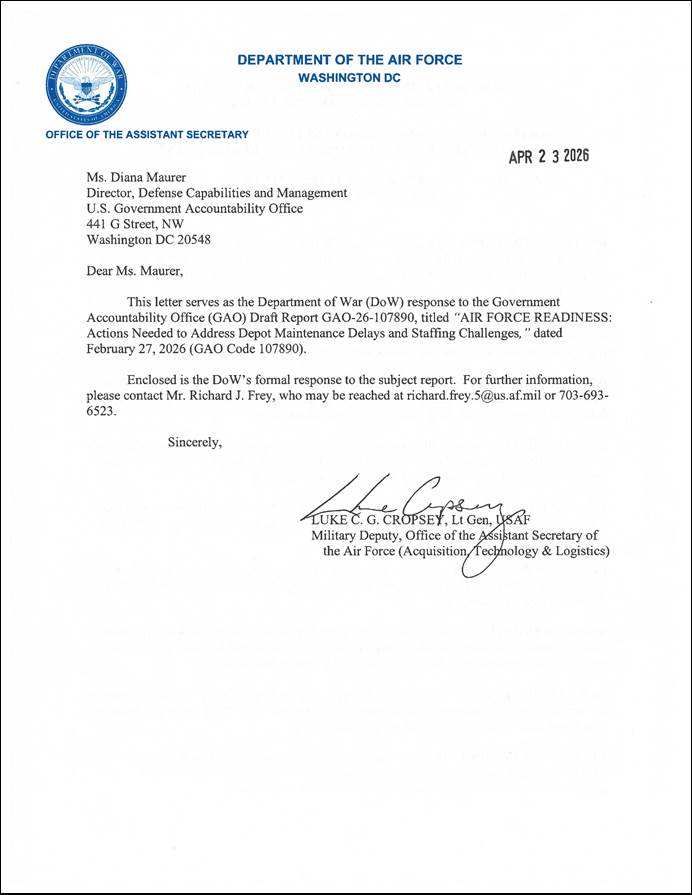
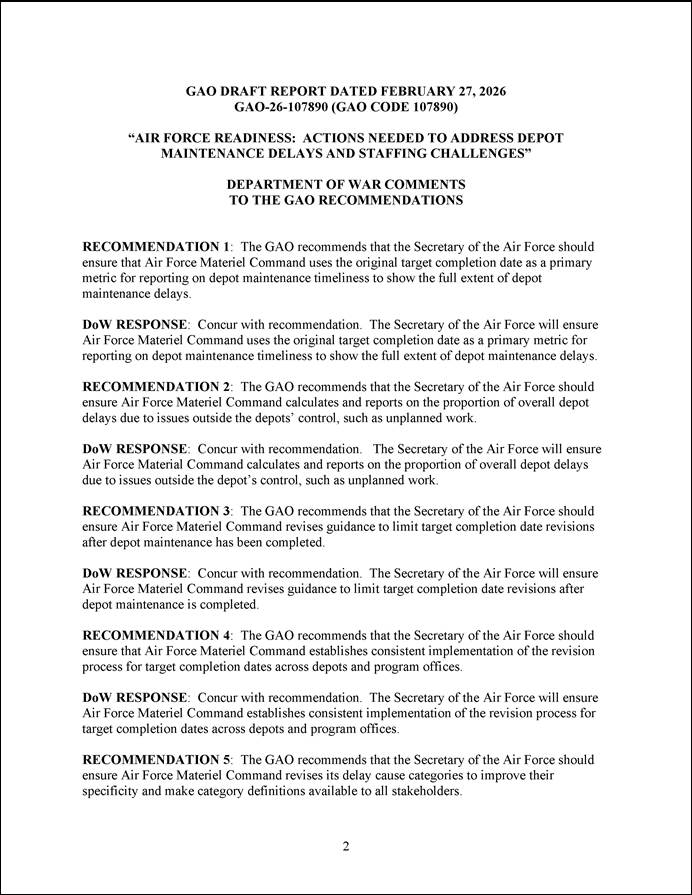
GAO Contact
Diana Maurer at maurerd@gao.gov
Staff Acknowledgments
In addition to the contact listed above, Chris Watson (Assistant Director), Delia Zee (Analyst in Charge), Nicole Ashby, James Ashley, Lilia Chaidez, Richard Hung, Amie Lesser, Felicia Lopez, Shannon Murphy, Susan Murphy, Michael Pose, and Colson Sutherland made key contributions to this report.
The Government Accountability Office, the audit, evaluation, and investigative arm of Congress, exists to support Congress in meeting its constitutional responsibilities and to help improve the performance and accountability of the federal government for the American people. GAO examines the use of public funds; evaluates federal programs and policies; and provides analyses, recommendations, and other assistance to help Congress make informed oversight, policy, and funding decisions. GAO’s commitment to good government is reflected in its core values of accountability, integrity, and reliability.
Obtaining Copies of GAO Reports and Testimony
The fastest and easiest way to obtain copies of GAO documents at no cost is through our website. Each weekday afternoon, GAO posts on its website newly released reports, testimony, and correspondence. You can also subscribe to GAO’s email updates to receive notification of newly posted products.
Order by Phone
The price of each GAO publication reflects GAO’s actual cost of production and distribution and depends on the number of pages in the publication and whether the publication is printed in color or black and white. Pricing and ordering information is posted on GAO’s website, https://www.gao.gov/ordering.htm.
Place orders by calling (202) 512-6000, toll free (866) 801-7077,
or
TDD (202) 512-2537.
Orders may be paid for using American Express, Discover Card, MasterCard, Visa, check, or money order. Call for additional information.
Connect with GAO
Connect with GAO on X,
LinkedIn, Instagram, and YouTube.
Subscribe to our Email Updates. Listen to our Podcasts.
Visit GAO on the web at https://www.gao.gov.
To Report Fraud, Waste, and Abuse in Federal Programs
Contact FraudNet:
Website: https://www.gao.gov/about/what-gao-does/fraudnet
Automated answering system: (800) 424-5454
Media Relations
Sarah Kaczmarek, Managing Director, Media@gao.gov
Congressional Relations
David A. Powner, Acting Managing Director, CongRel@gao.gov
General Inquiries
[1]Department of War, 2026 National Defense Strategy (Jan. 23, 2026).
[2]S. Rep. No. 118-188, at 108-109 (2024).
[3]In some cases, we included data for fiscal year 2019 from our June 2020 report to show a baseline for comparison on Air Force depot maintenance timeliness. See GAO, Military Depots: The Navy Needs Improved Planning to Address Persistent Aircraft Maintenance Delays While Air Force Maintenance Has Generally Been Timely, GAO‑20‑390 (Washington, D.C.: June 23, 2020).
[4]GAO, Schedule Assessment Guide: Best Practices for Project Schedules, GAO‑16‑89G (Washington, D.C.: Dec. 2015); Standards for Internal Control in the Federal Government, GAO‑14‑704G (Washington, D.C.: Sept. 2014).
[5]GAO, Evidence-Based Policymaking: Practices to Help Manage and Assess the Results of Federal Efforts, GAO‑23‑105460 (Washington, D.C.: July 12, 2023), and GAO‑14‑704G.
[6]Based on discussions with depot officials, we included the latest data available from fiscal year 2025 in our analysis of staffing levels to understand any effects of executive branch decisions related to the federal workforce, such as hiring freezes.
[7]Depot-level maintenance includes the inspection, repair, overhaul, or the modification or rebuild of end items, assemblies, subassemblies, and parts that, among other things, require extensive industrial facilities, specialized tools and equipment, or uniquely experienced and trained personnel that are not available in other maintenance activities. For the purposes of this report, we refer to ALCs as Air Force depots.
[8]AFMC Instruction 21-118, Aircraft Maintenance Production/Compression Report (AMREP) (July 16, 2025).
[9]The maintenance timeliness portion of our report is focused on fiscal years 2020 through 2024. However, figure 3 begins with fiscal year 2019 to show a baseline for comparison since that was the last time we reported on Air Force depot maintenance timeliness. See GAO‑20‑390. To determine the proportion of aircraft that were late each fiscal year, we examined individual aircraft records from the Air Force’s Aircraft Maintenance Production/Compression Report (AMREP). For each aircraft, we compared the targeted number of days for maintenance completion (original and revised) with the actual number of days it took to complete maintenance.
[11]We calculated median days based on original targets and include only aircraft whose maintenance was completed late (not on time or early).
[12]National Defense Authorization Act for Fiscal Year 2020, Pub. L. No. 116-92, § 359 (2019); 10 U.S.C. § 2476 note. In December 2025, after we completed our audit work, the National Defense Authorization Act for Fiscal Year 2026 eliminated the annual reporting requirement. Pub. L. No. 119-60, § 338 (2025).
[13]Air Force Sustainment Center officials stated that the Net Aircraft Availability metric is measured by combining the total number of days each aircraft is produced early or late with the revised target as the baseline for a “net” total number of days. The metric is affected by the number of aircraft maintained that year.
[16]AFMC Instruction 21-118.
[18]See table 1 for delay cause category definitions.
[19]AFMC Instruction 21-118.
[25]Authorized refers to the number of positions that the Air Force identified as funded. Filled refers to the actual number of positions that were filled in comparison with the authorized level.
[26]Our prior work found the pandemic exacerbated existing challenges with the depots’ workforce (e.g., personnel shortages or not having enough personnel with the appropriate skills for performing the work). See GAO, Depot Maintenance: DOD Should Improve Pandemic Plans and Publish Working Capital Fund Policy, GAO‑21‑103 (Washington, D.C.: Apr. 6, 2021).
[27]The nondestructive testing occupational series includes jobs involved in the examination of metals, composites, ceramics, plastics, and other materials for internal and external structural defects, corrosion, and moisture penetration.
[28]GAO, Military Depots: DOD Can Benefit from Further Sharing of Best Practices and Lessons Learned, GAO‑20‑116 (Washington, D.C.: Jan. 30, 2020); DOD Depot Workforce: Services Need to Assess the Effectiveness of Their Initiatives to Maintain Critical Skills, GAO‑19‑51 (Washington, D.C.: Dec. 14, 2018).
[29]5 C.F.R. §§ 532.209, 532.231; 5 C.F.R. pt. 532, app. A.
[30]For more information on challenges related to the FWS wage surveys, including FWS recruitment and retention at selected DOD installations, see GAO, Defense Workforce: Efforts to Address Challenges in Recruiting and Retaining Federal Wage System Employees, GAO‑25‑107152 (Washington, D.C.: Sept. 3, 2025).
[31]Pay flexibilities refer to agencies’ discretionary authority to provide additional direct compensation in certain circumstances to support their recruitment, relocation, and retention efforts. Examples of pay flexibilities include recruitment, relocation, and retention incentives; special qualification appointments; and student loan repayment, among others.
[32]RAND Corporation, Department of Air Force Civilian Compensation and Benefits: How Five Mission Critical and Hard-to-Fill Occupations Compare to the Private Sector and Key Federal Agencies (Feb. 10, 2021).
[34]GAO, Human Capital: Key Principles for Effective Strategic Workforce Planning, GAO‑04‑39 (Washington, D.C.: Dec. 11, 2003).
[35]S. Rep. No. 118-188, at 108-109 (2024).
[36]GAO, Military Depots: The Navy Needs Improved Planning to Address Persistent Aircraft Maintenance Delays While Air Force Maintenance Has Generally Been Timely, GAO‑20‑390 (Washington, D.C.: June 23, 2020).
[37]GAO, Schedule Assessment Guide: Best Practices for Project Schedules, GAO‑16‑89G (Washington, D.C.: Dec. 2015); Standards for Internal Control in the Federal Government, GAO‑14‑704G (Washington, D.C.: Sept. 2014).
[38]Air Force Materiel Command Instruction 21-118, Aircraft Maintenance Production/Compression Report (AMREP) (July 16, 2025).
[39]GAO, Evidence-Based Policymaking: Practices to Help Manage and Assess the Results of Federal Efforts, GAO‑23‑105460 (Washington, D.C.: July 12, 2023); GAO‑14‑704G.
[40]Based on discussions with depot officials, we included the latest data available from fiscal year 2025 in our analysis of staffing levels to understand any effects of executive branch decisions related to the federal workforce, such as hiring freezes.
[41]GAO, Military Depots: DOD Can Benefit from Further Sharing of Best Practices and Lessons Learned, GAO‑20‑116 (Washington, D.C.: Jan. 30, 2020); DOD Depot Workforce: Services Need to Assess the Effectiveness of Their Initiatives to Maintain Critical Skills, GAO‑19‑51 (Washington, D.C.: Dec. 14, 2018).
[42]The Occupational Employment Wage Statistics (OEWS) Program estimates are for May 2024. The May 2024 OEWS estimates combine six semiannual panels of survey establishment data collected over the prior three-years (May 2024, November 2023, May 2023, November 2022, May 2022, and November 2021) with wage data collected in earlier periods updated to represent this period of time. BLS’ OEWS private sector pay data include commissions, cost of living allowances, deadheading pay, guaranteed pay, hazard pay, incentive pay, longevity pay, over-the-road pay (mileage), piece rates, portal-to-portal rates, production bonuses, and tips in addition to base pay. ALC pay data include base pay and locality pay. Thus, if the ALC gives any other pay besides base and locality pay and it affects the median ALC pay, it would bias downwards the differences between the private sector median pay and the ALC median pay (i.e., if our data shows that ALC median pay is higher than private sector pay then if we were to take into account any bonuses at the ALCs and they affect the median pay then the absolute difference would be higher and if our data shows that the ALC median pay is less than the private sector median pay the absolute difference would be lower).
[43]Median wage (also known as the 50th percentile wage) is the amount of pay between the highest paid 50 percent and lowest paid 50 percent of workers in an occupation (i.e., in the middle). The median wage is considered a better indicator than the mean (or average) wage because it is not significantly affected by outliers and is more representative of what the majority of workers may earn.