
Report to Congressional Committees
United States Government Accountability Office
A report to congressional committees
For more information, contact DeniganMacauleyM@gao.gov
What GAO Found
Given the trauma survivors of human trafficking have experienced, they may need behavioral health services, including mental health care services, such as therapy, or substance use disorder treatment. The Department of Health and Human Services (HHS) and the Department of Justice (DOJ) fund grant programs that help provide access to such services. In fiscal year 2025, HHS awarded approximately $7.5 million for two key trafficking survivor services programs and DOJ awarded approximately $45 million for two key programs. The programs assisted approximately 2,600 survivors and 11,300 survivors in that year, respectively, helping them access services.
GAO’s review of HHS’s two key grant programs found that the agency followed leading practices in assessing how programs perform. HHS did this by, for instance, setting long-term and measurable near-term goals with targets and time frames that communicated what the agency expected the programs to achieve. For example, to assess its long-term goal to provide services for survivors, HHS set a near-term goal for a grantee to deliver services to 50 survivors in a given fiscal year. DOJ also followed leading practices for its minor survivor assistance program, but did not do so for its adult program. Specifically, DOJ did not set measurable near-term goals for what it expects its adult program to achieve. By setting such near-term goals with targets and time frames, DOJ would be better positioned to assess the effectiveness of its adult program and the progress it makes toward supporting the needs of adult human trafficking survivors.
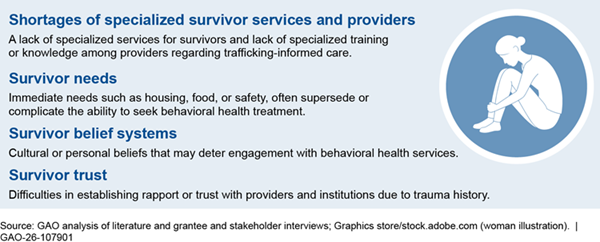
GAO’s analysis of literature and interviews with selected HHS and DOJ grantees and selected stakeholders identified factors that can affect human trafficking survivors’ access to behavioral health services. Such factors included shortages of providers specializing in treating survivors of human trafficking. These are longstanding and complex issues, some of which are beyond federal control. HHS and DOJ officials said they are aware of the factors and have taken actions—such as increasing human trafficking training for behavioral health providers—to help improve survivors’ access to services.
Why GAO Did This Study
Human trafficking is a crime that involves compelling or coercing a person to provide labor or engage in commercial sex acts. In 2024, the National Human Trafficking Hotline identified nearly 12,000 human trafficking cases in the United States.
The Trafficking Victims Prevention and Protection Reauthorization Act of 2022 includes a provision for GAO to study the accessibility of behavioral health services for survivors of human trafficking in the United States. This report (1) describes the key HHS and DOJ programs that fund behavioral health services for trafficking survivors, (2) evaluates how HHS and DOJ assessed the performance of key programs, and (3) describes factors that can affect survivors’ access to services and federal efforts to improve access.
GAO reviewed HHS and DOJ documentation and interviewed agency officials. GAO selected four key programs whose grantees reported providing the largest amount of behavioral health services in recent years and interviewed 15 grantees selected to obtain variation in the amount of services provided and location. GAO analyzed fiscal year 2025 grantee performance data for the four programs, the most recent available. GAO evaluated HHS and DOJ steps for assessing the performance of the programs. GAO also conducted a literature search and interviewed six selected stakeholders, including representatives from survivor organizations and a researcher.
What GAO Recommends
GAO recommends that the DOJ sets measurable near-term goals with targets and time frames for its adult survivor assistance program. DOJ concurred with this recommendation.
|
Abbreviations |
|
|
|
|
|
DOJ |
Department of Justice |
|
HHS |
Department of Health and Human Services |
|
OTIP |
Office on Trafficking in Persons |
|
OVC |
Office for Victims of Crime |
This is a work of the U.S. government and is not subject to copyright protection in the United States. The published product may be reproduced and distributed in its entirety without further permission from GAO. However, because this work may contain copyrighted images or other material, permission from the copyright holder may be necessary if you wish to reproduce this material separately.
June 11, 2026
Congressional Committees
Human trafficking is a crime that involves compelling or coercing a person to provide labor or services, or to engage in commercial sex acts.[1] There are limited data on the extent to which people are trafficked.[2] For instance, in 2024, the National Human Trafficking Hotline identified nearly 12,000 human trafficking cases involving nearly 22,000 potential victims in the United States.[3] However, many cases may not be uncovered or reported.
A major aspect of U.S. anti-trafficking efforts is survivor assistance—providing immediate services when survivors are identified and helping them recover from their victimization.[4] Given the trauma survivors have experienced, they may need behavioral health services, including mental health care services, such as therapy, or substance use disorder treatment.
The Trafficking Victims Protection Act of 2000 and its subsequent reauthorizations have authorized the Department of Health and Human Services (HHS) and the Department of Justice (DOJ) to make grants to develop, expand, and strengthen victim services programs.[5] These grants are administered by the Office on Trafficking in Persons (OTIP), within HHS’s Administration for Children and Families, and the Office for Victims of Crime (OVC), within DOJ’s Office of Justice Programs.
The Trafficking Victims Prevention and Protection Reauthorization Act of 2022 includes a provision for us to study the accessibility of behavioral health services for survivors of human trafficking in the United States.[6] This report
1. describes the key HHS and DOJ programs that fund behavioral health services for human trafficking survivors;
2. evaluates how HHS and DOJ assess the performance of these key programs for human trafficking survivors; and
3. describes available information about factors that can affect human trafficking survivors’ access to behavioral health services, and what steps the federal government has taken to improve access.
To address objectives one and two—describing the key HHS and DOJ programs that fund behavioral health services for human trafficking survivors, and evaluating how HHS and DOJ measure the performance of these key programs—we identified four key grant programs that fund behavioral health services for human trafficking survivors. To do this, we reviewed HHS and DOJ documents, as of March 2025, including notices of funding opportunities and requested information about each agency’s human trafficking survivor assistance grant programs and the organizations that were awarded grants (grantee). We also interviewed HHS and DOJ officials about their programs and performance management processes. We assessed the reliability of the grant award and performance data by reviewing related documentation, interviewing agency officials, and comparing the data to publicly available information, when possible, to identify any anomalies. We determined that the data were sufficiently reliable for the purposes of our reporting objectives.
Based on this information, we identified 15 programs (seven administered by HHS and eight administered by DOJ) in fiscal year 2025 that provided funds to support survivor assistance services, including behavioral health services. None of the 15 programs were solely focused on providing behavioral health services to survivors, and instead provided survivor assistance services broadly, which may include food, shelter, medical and behavioral health services, and legal services, among others. From these programs, we selected the four key grant programs—two from HHS and two from DOJ—because their stated primary purpose was to fund grantees that provide services to human trafficking survivors and the grantees reported providing the largest amount of behavioral health services to survivors in recent fiscal years.[7] To address objective one, we summarized key grant program information and analyzed key program grantee performance data for fiscal year 2025—the most recent available data. For information on all 15 grant programs, see appendix I.
Two of the four key grant programs are administered by HHS’s OTIP and the other two programs are administered by DOJ’s OVC. To better understand the services provided to survivors through these key grant programs and how HHS and DOJ evaluate program grantees, we interviewed representatives from a nongeneralizable selection of 15 grantees with ongoing grants as of March 2025. We selected grantees to obtain variation in the reported amount of behavioral health services provided and geographic region served. The results of these interviews are not generalizable to all OTIP and OVC grantees. For additional information about the 15 grantees and how we selected them, see appendix II.
To address objective two, we evaluated HHS’s and DOJ’s efforts to assess the performance of the four key grant programs. To do so, we reviewed agency documentation on the key grant programs, including grant notices of funding opportunity, agency strategic plans, grantee reporting guidance, and other information. We then evaluated the extent to which HHS’s and DOJ’s assessments were consistent with leading practices of performance management.[8]
To describe available information about factors that can affect access to behavioral health services for human trafficking survivors, we conducted a literature search for relevant peer-reviewed studies published from January 1, 2020, through January 21, 2026. We conducted a structured search in multiple electronic research databases for studies using various terms related to our objective, including human trafficking, smuggling, forced labor, modern slavery, labor or sex trafficking, mental or behavioral health, drug use, drug abuse, substance use, chemical dependence, substance misuse, psychoanalysis, and child and adolescent psychiatry.[9] We reviewed the 190 search results to identify those that discussed human trafficking in the United States and included both of the following criteria: (1) qualitative or quantitative information on the behavioral health of survivors of human trafficking, and (2) information about behavioral health access challenges for survivors of human trafficking. We identified 25 studies that met our criteria. (For a complete list of the identified studies, see the Bibliography of Related Studies at the end of this report.)
In addition, to further examine factors that can affect survivors, we interviewed the 15 selected grantees and six selected stakeholders, including representatives from trafficking survivor organizations and an academic researcher. We selected stakeholders with relevant knowledge of trafficking from among those suggested by HHS and DOJ officials and our prior work. We asked the selected stakeholders and grantees about the barriers to accessing behavioral health services faced by human trafficking survivors. We identified information from the 25 selected studies and the interviews with the 15 selected grantees and six selected stakeholders on barriers to accessing behavioral health services for survivors of human trafficking, including common themes and examples of barriers. The information we obtained from literature, grantees, and stakeholders reflect specific perspectives and study populations and is thus not generalizable to human trafficking survivors as a whole. We also interviewed HHS and DOJ officials about actions taken to address barriers and improve access to behavioral health services for human trafficking survivors.
We conducted this performance audit from October 2024 to June 2026 in accordance with generally accepted government auditing standards. Those standards require that we plan and perform the audit to obtain sufficient, appropriate evidence to provide a reasonable basis for our findings and conclusions based on our audit objectives. We believe that the evidence obtained provides a reasonable basis for our findings and conclusions based on our audit objectives.
Background
The United States recognizes two primary forms of human trafficking: sex trafficking and labor trafficking. The Trafficking Victims Protection Act of 2000, as amended, defines “severe forms of trafficking in persons” as
· a commercial sex act induced by force, fraud, or coercion, or in which the person induced to perform such an act is a minor (sex trafficking); or
· the recruitment, harboring, transportation, provision, or obtaining of a person for labor or services through the use of force, fraud, or coercion for the purpose of subjection to involuntary servitude, peonage, debt bondage, or slavery (labor trafficking).[10]
The movement of persons across jurisdictional boundaries is not necessary to establish that human trafficking has occurred. See the text box for more information on human trafficking survivors and their traffickers.
|
Human Trafficking Survivors Human trafficking survivors can be of any age, race, ethnicity, sex, gender identity, sexual orientation, nationality, immigration status, cultural background, religion, socio-economic class, and education attainment level, according to DOJ and other government documentation. Human trafficking can take place in rural, suburban, and urban settings throughout the United States, and often involves individuals who are already vulnerable, such as runaway and homeless youth or individuals with substance use disorder. Human Traffickers Human traffickers may be family members, intimate partners, acquaintances, or strangers, and they may run the human trafficking operation on their own or be a member of a large or small organized criminal network, according to DOJ and other government documentation. To control their victims, traffickers may use tactics and techniques such as physically isolating their victim; emotionally manipulating a victim through false promises of love; threatening a victim with various forms of harm, including from the legal system, such as deportation or arrest; and manipulating a victim’s substance use. |
Source: Summary of published materials from the Department of State, the Department of Justice (DOJ), and other government agencies. | GAO‑26‑107901
Federal Agency Roles in Combating Human Trafficking
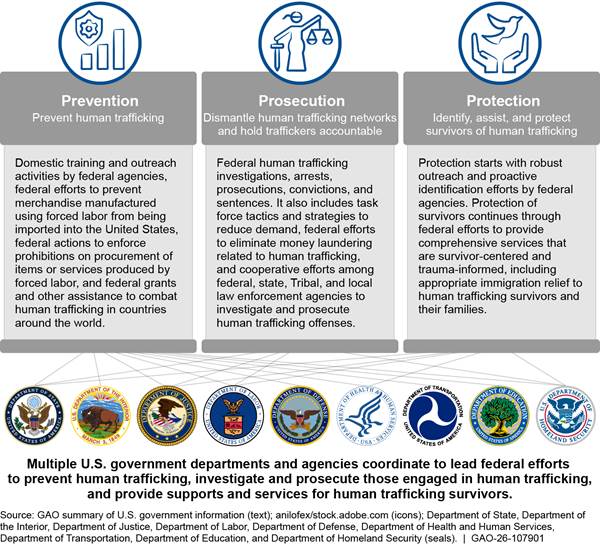
Federal agencies, state and local law enforcement, and non-governmental organizations have taken a collaborative approach to combating human trafficking in the United States, both in conducting investigations and prosecutions of traffickers and ensuring that survivors have access to needed services. The President’s Interagency Task Force to Monitor and Combat Trafficking in Persons is a cabinet-level entity consisting of 18 federal agencies and offices, including HHS and DOJ.[11] The Task Force convenes routinely to advance and coordinate federal efforts to combat human trafficking and collaborate with a range of stakeholders.
To combat human trafficking, federal agency efforts focus on (1) preventing human trafficking, (2) prosecuting human trafficking offenses, and (3) protecting survivors of human trafficking.[12] (See fig. 1.)
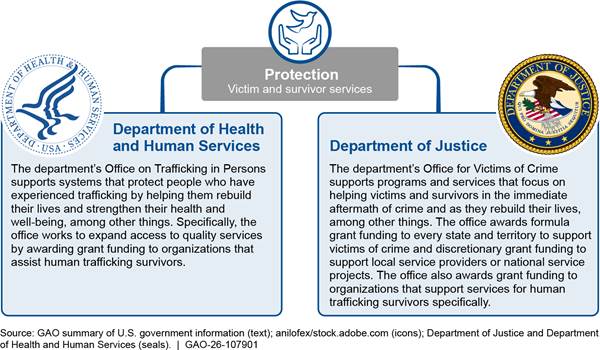
Victim and survivor assistance services are one of the types of protection provided by federal agencies.[13] Specifically, the Trafficking Victims Protection Act of 2000 authorized HHS and DOJ to make grants available to states, Tribes, localities, and non-governmental organizations to develop, expand, and strengthen victim service programs.[14] (See fig. 2.) Congress provides funding for trafficking survivor services grants through annual appropriations. Additional financial support for these grants comes from the Domestic Trafficking Victims’ Fund.[15]
Figure 2: Departments of Health and Human Services’ and Justice’s Human Trafficking Protection Programs
Grantees who receive HHS or DOJ survivor assistance grants may provide services directly to trafficking survivors or provide survivors with case management services—a process used to assess an individual’s needs and coordinate the needed services.
The needs of survivors vary by individual and may include food, shelter, and clothing; medical, behavioral health, financial, and legal services; and education and job training. The Trafficking Victims Protection Act of 2000 established a certification process through which foreign national survivors of human trafficking, who are certified as such by HHS, are eligible for federal assistance and services.[16]
Behavioral Health
Behavioral health conditions, which include mental health conditions (such as anxiety disorders, mood disorders, and schizophrenia) and substance use disorders (such as alcohol use disorder and opioid use disorder), affect a substantial number of adults in the United States. Research indicates that survivors of human trafficking often experience a range of behavioral health conditions resulting from trauma and abuse. For example, a 2025 survey of more than 200 child sex trafficking survivors found that over 80 percent had been diagnosed with a behavioral health disorder.[17] Treatment for behavioral health conditions vary based on an individual’s needs and may include services such as therapy and medication management. Moreover, trafficking survivors often experience co-morbid physical and mental health conditions, such as sexually transmitted infections and anger control problems, which can complicate diagnosis, treatment, and recovery.[18]
Key HHS and DOJ Trafficking Programs Fund a Variety of Survivor Services, Including Behavioral Health Services
HHS’s Office on Trafficking in Persons (OTIP) administers
two key human trafficking survivor assistance programs that allow grantees to
use funds to provide or facilitate survivors’ access to behavioral health
services: the Trafficking Victim Assistance Program and the Domestic Victims of
Human Trafficking Services and Outreach Program. DOJ’s Office for Victims of
Crime (OVC) administers another two key survivor assistance programs: the
Services for Victims of Human Trafficking program and the Services for Minor
Victims of Human Trafficking program.[19]
Key HHS Human Trafficking Survivor Assistance Programs
HHS’s OTIP administers two key human trafficking survivor assistance programs that allow grantees to use funds to provide a variety of services, including behavioral health services.[20]
· The Trafficking Victim Assistance Program funds grantees who provide comprehensive case management services to foreign national adult survivors of human trafficking.[21]
· The Domestic Victims of Human Trafficking Services and Outreach Program funds grantee projects that build, expand, and sustain organizational and local capacity to provide direct services, assistance, and referrals to survivors of human trafficking who are U.S. citizens or lawful permanent residents.[22]
For both programs, grantees are required to provide comprehensive case management services, including the provision of or referrals to mental health and substance use treatment services, as applicable to the survivor. (See text box.) According to grant program documentation, comprehensive case management services should empower survivors to identify and achieve personal milestones toward well-being and independence. The programs’ requirements stipulate that case management services and activities should be accessible and include developing a service plan, counseling, monitoring, evaluating survivor progress, and securing and coordinating direct services.
|
HHS’s OTIP Required Comprehensive Case Management Services for the Trafficking Victim Assistance Program and the Domestic Victims of Human Trafficking Services and Outreach Program · Culturally responsive and linguistically appropriate services. · Identification, screening, assessment, safety planning, and service planning. · Advocacy and information about crime victims’ rights and services. · Direct assistance to support unmet basic needs and the well-being of survivors. · Allowable and reasonable expenses such as food, clothing, transportation, and child care. · Health care, including mental health, substance use treatment, medical, and dental services. · Emergency, transitional, and long-term housing assistance. · Employment assistance, vocational training, and job training and placement services. · Enrolling survivors to receive applicable public benefits. Additional Required Services for the Trafficking Victim Assistance Program · Assisting survivors to obtain HHS certification, a process through which foreign national survivors of human trafficking who are certified as such by HHS are eligible for federal assistance and services. · Coordination with migrant health programs. Additional Services Required for the Trafficking Victim Assistance Program and Optional for the Domestic Victims of Human Trafficking Services and Outreach Program · Legal advocacy services related to the survivor’s human trafficking experience. · Educational assistance. · Life skills training, including managing personal finances. · Peer-to-peer support and mentoring. · Family reunification and supportive services intended to support broader well-being. |
Source: Department of Health and Human Services’ (HHS) Office on Trafficking in Persons (OTIP) grant program documents. | GAO‑26‑107901
In fiscal year 2025, OTIP awarded approximately $7.5 million to the 12 grantees in both the Trafficking Victim Assistance Program and the Domestic Victims of Human Trafficking Services and Outreach Program.[23] According to agency documents, these grantees reported that 2,580 survivors of human trafficking accessed services in fiscal year 2025: 1,473 foreign national survivors through the Trafficking Victim Assistance Program, and 1,107 U.S. citizen or lawful permanent resident survivors through the Domestic Victims of Human Trafficking Services and Outreach Program.
OTIP data shows that adults represented nearly all survivors served by both programs and that survivors served by each program varied by race and type of trafficking experience. In addition, approximately 90 percent of all survivors served who reported race and ethnicity identified as non-white or multiple races, and approximately 55 percent of all survivors served experienced sex only or both sex and labor trafficking in fiscal year 2025. For more information on the survivors served by these programs, see appendix IV.
As noted, OTIP grantees must be able to provide or refer survivors to behavioral health services, as appropriate; according to agency documents, 10 of the 12 grantees reported using grant funds to provide nearly 1,000 survivors with behavioral health services in fiscal year 2025. (See table 1.) For example, a representative from one selected grantee described providing survivors with long-term case management services (where staff evaluate a survivor’s current situation and needs, develop a service plan, and coordinate needed services) for as long as survivors want the services. The representative said that the organization partners with a lot of different agencies to provide survivors with connections to behavioral health and substance use treatment services, when needed. For instance, the organization contracts with two therapists in the local area that have extensive experience working on issues related to human trafficking and who prioritize these referrals so that survivors are seen within a week, according to the representative.
|
Program name |
Long-term goal |
Annual program fundinga |
Number of grantees |
Number of survivors who accessed services |
Number of grantees that used grant funds to provide behavioral health services |
Number of survivors who accessed behavioral health services |
|
Trafficking Victim Assistance Program |
To fund time-limited comprehensive case management services to foreign national adult survivors of a severe form of human trafficking. |
$4,000,000 |
1 |
1,473 |
1 |
630 |
|
Domestic Victims of Human Trafficking Services and Outreach Program |
To fund projects, through cooperative agreements, that will build, expand, and sustain organizational and local capacity to provide direct services, assistance, and referrals to survivors of severe forms of human trafficking who are U.S. citizens or lawful permanent residents. |
$3,476,331 |
11b |
1,107 |
9 |
315 |
|
Total |
|
$7,476,331 |
12 |
2,580 |
10 |
945 |
Source: GAO review and analysis of Department of Health and Human Services’ (HHS) Office on Trafficking in Persons (OTIP) data and documentation. | GAO‑26‑107901
Note: From the seven OTIP programs that supported human trafficking survivors by allowing grantees to fund behavioral health services, we focused on two programs that, as of March 2025, reported its grantees provided the largest amount of behavioral health services in fiscal years 2022 through 2024.
OTIP provided aggregate grant program-level performance data about the survivors who accessed grantee services during fiscal year 2025. The long-term goals are from each grant program’s notice of funding opportunity that was in effect in fiscal year 2025. The relevant Trafficking Victim Assistance Program’s notice of funding opportunity was posted April 27, 2022, and the program’s project period is from September 30, 2022, through September 29, 2027. The Domestic Victims of Human Trafficking Services and Outreach Program grantees were awarded funding in two different award cycles. The relevant notice of funding opportunity for six of the 11 grantees was posted April 29, 2022, and the grantees’ project period is from September 30, 2022, through September 29, 2027. The relevant notice of funding opportunity for the remaining five grantees was posted February 17, 2023, and the grantees’ project period is from November 30, 2023, through November 29, 2028.
aTotal grant awards for each grantee’s full 5-year project period totaled $37,381,655.
bTwo of the Domestic Victims of Human Trafficking Services and Outreach Program grantees voluntarily relinquished their awards in 2025 due to programmatic restructuring at their organizations, according to HHS officials.
Key DOJ Human Trafficking Survivor Assistance Programs
DOJ’s OVC administers two key human trafficking survivor assistance programs that allow grantees to use funds to provide a variety of services, including behavioral health services, with one program focused on serving minors (survivors under age 18).[24]
· The Services for Victims of Human Trafficking program funds the development, expansion, or strengthening of grantee service programs for adult survivors or a combination of adult and minor survivors of human trafficking.
· The Services for Minor Victims of Human Trafficking program funds projects that address the needs of minor survivors of human trafficking through services to ensure their safety, security, and healing.[25]
For both OVC programs, grantees are required to provide services to meet the individual needs of survivors or refer survivors to essential services, such as behavioral health services, as applicable. (See text box.) For the adult program, providing these services helps adult survivors achieve increased safety, independence, self-sufficiency, and well-being. For the minors program, providing these services allows minor survivors the opportunity to make informed decisions about the support they need and enable them to work toward identifying and achieving their personal goals.
|
Examples of Survivor Services Funded by OVC’s Services for Victims of Human Trafficking program and Services for Minor Victims of Human Trafficking program Information and referral services, such as · information about the criminal justice process, and · information about or referral to substance use disorder treatment and support. Personal advocacy or accompaniment, such as · accompaniment to emergency medical care or forensic exam, and · advocacy for immigration assistance. Emotional support, safety, and health services, such as · crisis intervention, · individual therapy and mental health services, and · substance use disorder services. Shelter and housing services, such as · emergency shelter or placement, and · transitional housing. Criminal and civil justice system assistance, such as · civil legal assistance, and · criminal record relief. Education, employment, and skill building services, such as · job training, and · life skills building. |
Source: Department of Justice’s (DOJ) Office for Victims of Crime (OVC) grant program documents. | GAO‑26‑107901
In fiscal year 2025, 183 OVC grantees in both the Services for Victims of Human Trafficking program and the Services for Minor Victims of Human Trafficking program implemented budgets that totaled approximately $45 million.[26] According to OVC data, these grantees reported that 11,286 potential and confirmed survivors of human trafficking accessed services that same fiscal year: 8,767 individuals through the adult program, and 2,519 individuals through the minors program.[27] Combined, the two DOJ OVC programs were approximately five times as large in fiscal year 2025—both in grant awards funded and survivors served—as the two key HHS OTIP programs combined.
Agency data shows approximately 75 percent of new survivors served who reported race across both programs identified as non-white or multiple races and approximately 68 percent of total survivors served experienced sex only or sex and labor trafficking in fiscal year 2025. For more information on the survivors served by these programs, see appendix V.
As noted, grantees must be able to provide or refer survivors to behavioral health services when necessary to meet a survivor’s needs; in fiscal year 2025, approximately two-thirds of grantees in both programs reported using grant funds to provide over 50,000 behavioral health services to survivors, according to agency data. (See table 2.) For example, representatives from one selected grantee described the mental health services their organization provides directly to survivors, including individual therapy, group therapy, and somatic body movement sessions (such as yoga and breathing exercises). Representatives also described the behavioral health conditions and services that are outside their organization’s scope, such as survivors who are experiencing active psychosis or those needing addiction services. In those instances, the organization assists the survivor with finding the appropriate provider or program.
|
Program name |
Long-term goal |
Average annual program fundinga |
Number of grantees |
Number of survivors who accessed servicesb |
Number of grantees that used grant funds to provide behavioral health services |
Number of behavioral health services accessed by survivorsc |
|
Services for Victims of Human Trafficking |
To develop, expand, or strengthen survivor service programs for survivors of human trafficking. This program is intended for survivor service programs serving adults or a combination of adults and minors. |
$33,246,329 |
140 |
8,767 |
92 |
20,879 |
|
Services for Minor Victims of Human Traffickingd |
To provide services that address the needs of minor survivors of sex and labor trafficking through a continuum of services to ensure their safety, security, and healing. |
$11,407,804 |
43 |
2,519 |
35 |
31,066 |
|
Total |
|
$44,654,133 |
183 |
11,286 |
127 |
51,945 |
Source: GAO review and analysis of Department of Justice’s (DOJ) Office for Victims of Crime (OVC) data and documentation. | GAO‑26‑107901
Notes: From the eight OVC programs that supported human trafficking survivors by allowing grantees to fund behavioral health services, we focused on two programs that, as of March 2025, reported its grantees provided the largest amount of behavioral health services in fiscal year 2024. Of OVC’s eight grant programs, three others—the Anti-Trafficking Housing Assistance Program, the Preventing Trafficking of Girls program, and the Enhanced Collaborative Model Task Force to Combat Human Trafficking program—also provided a number of behavioral health services to survivors.
OVC’s data includes completed grantee quarterly performance reports about the survivors served and services provided during fiscal year 2025. The long-term goals are from each grant program’s fiscal year 2024 notice of funding opportunity, which were in effect in fiscal year 2025.
A grantee can have multiple OVC trafficking survivor assistance grants.
Types of behavioral health services designated by OVC are (1) referral to substance use treatment and support; (2) provision of substance use services (such as medication-assisted treatment and therapy); (3) provision of individual therapy or mental health services; and (4) provision of other types of therapy (such as traditional, cultural, or alternative healing; art; writing; or play). OVC also collects information from grantees on the provision of information about substance use abuse treatment support available to survivors of crime, but we did not include this type of service as a type of behavioral health service as it is information and not a referral to services or the provision of services.
aThe agency does not provide incremental funding by year for these grant award recipients. Grantees were awarded all funds for the entire multi-year project period upfront, according to OVC officials. Grantees then reimburse themselves for approved project costs over the course of their project period. Total grant awards for each grantee’s full multi-year project period totaled $143,489,224 in fiscal year 2025. To estimate an average annual funding amount, we divided the total grant program funding by the number of years of the project period and rounded to the nearest dollar.
bIndividuals can receive services from more than one grantee at a time and, therefore, program aggregated totals may not reflect the unique number of survivors served, according to OVC officials. In addition, grantees report the total survivors served annually (rather than quarterly), according to OVC officials. Grantees submit these annual measures with their fourth quarter performance report. OVC’s data includes completed fiscal year quarterly performance reports from grantees as of February 10, 2026. Fifteen grantees in the Services for Victims of Human Trafficking program and five grantees in the Services for Minor Victims of Human Trafficking program did not report fourth quarter data in fiscal year 2025. Therefore, the table does not include the total survivors served for these grantees and the totals may be higher.
cSurvivors may receive multiple types of services from grantees or the same type of service multiple times from grantees, according to OVC officials. Therefore, the number of behavioral health services accessed by survivors may be greater than the unique number of survivors who accessed services.
dOVC allocated its annual funding to grantees that provide services for minor survivors of human trafficking through two notifications of funding opportunities in fiscal years 2020 through 2022, according to OVC officials. For example, in fiscal year 2022, OVC’s funding opportunities were for Services for Minor Victims of Labor Trafficking and Field-Generated Strategies to Address the Criminalization of Minor Victims of Sex Trafficking. According to OVC officials, since fiscal year 2023, OVC has allocated this funding through a single notification of funding opportunity that supports grantee projects for minor survivors of both sex and labor trafficking—Integrated Services for Minor Victims of Human Trafficking.
On December 30, 2025, DOJ’s OVC posted its fiscal year 2025 notices of funding opportunities for these two programs, which will fund selected grantees for 3 years starting July 1, 2026.[28] Because OVC posted these funding opportunities after the end of the fiscal year, grantees in the final year of their 3-year project period in fiscal year 2025 had their grants expire before the opportunity to apply for another 3-year grant cycle opened. DOJ received its fiscal year 2026 appropriations in January 2026, and, as of that month, OVC officials said they were in the process of determining fiscal year 2026 funding opportunities.
HHS Followed Leading Practices to Assess Grant Programs’ Performance; DOJ Followed Most but Not All Practices for its Adult Survivor Program
HHS’s Office on Trafficking in Persons followed leading practices to assess the performance of its two key human trafficking survivor assistance programs. This included setting long-term and measurable near-term goals, collecting relevant information, and using this information to assess progress made on its goals. DOJ’s Office for Victims of Crime followed most of the leading practices, but did not set measurable near-term goals for its adult human trafficking survivor assistance program, although it did so for its program for minors.
HHS Followed Leading Practices to Assess Grant Programs’ Performance
Our review of agency documentation and interviews found that HHS’s OTIP followed leading practices for performance management when assessing grantee performance in its two key survivor assistance grant programs: the Trafficking Victim Assistance Program and the Domestic Victims of Human Trafficking Services and Outreach Program. Specifically, for fiscal year 2025, OTIP set goals, collected performance information about its programs, and used this performance information to measure grant programs’ progress toward its goals. (See text box for leading practices.)
|
Leading Performance Management Practices Identified by GAO Our prior work has shown that federal decision makers need evidence about whether programs and activities are achieving intended results. To do so, agencies should engage in performance management—a three-step process by which agencies assess the progress a program is making toward pre-established goals. 1. Setting long-term and near-term goals. For each long-term goal, an agency sets one or more near-term goals. · Long-term goals: Outcomes that an agency seeks to achieve through its programs. · Near-term goals: Tangible, measurable results that an agency expects its programs to achieve. Near-term goals must be composed of a performance measure, a target level of performance, and a time frame to achieve the results by. 2. Information collection. Agencies collect information to assess program performance and progress toward program goals. Agencies use performance measures to communicate what information they will collect. 3. Information use. Agencies use performance information to assess progress toward goals and inform management decisions, such as expanding effective approaches, identifying and correcting problems, or setting new goals. |
Source: GAO‑23‑105460, GAO‑05‑927, and GAO/GGD‑96‑118. | GAO‑26‑107901
Long-Term and Near-Term Goals
For each survivor assistance grant program, OTIP set one long-term goal. These long-term goals aim to ensure that survivors get needed services either through case management or provided directly by grantees.[29]
For each program, OTIP also (1) set one measurable near-term goal at the program-level with program-wide targets, and (2) collaborated with grantees to set measurable near-term goals at the grantee-level with individualized targets for each grantee, according to OTIP officials. For example, to assess its performance reaching its long-term goal to provide services for survivors through its Domestic Victims of Human Trafficking Services and Outreach Program, OTIP set (1) a program-level near-term goal to increase the number of survivors served by the program, and (2) a grantee-level near-term goal for one of its grantees to deliver services to 50 survivors in a fiscal year. According to OTIP officials, individualized targets are set for grantee-level near-term goals. While the targets are individualized to each grantee, OTIP collects data on the same performance measure across all grantees—the number of survivors served in each program—to assess how the programs are doing. (See table 3.)
Table 3: Goals for Key HHS OTIP Human Trafficking Survivor Assistance Grant Programs, Fiscal Year 2025
|
Performance management step |
Trafficking Victim Assistance Program |
Domestic Victims of Human Trafficking Services and Outreach Program |
|
Long-term goals |
||
|
Long-term goal |
To directly fund time-limited comprehensive case management services to foreign national adult survivors of a severe form of human trafficking. |
To fund projects, through cooperative agreements, that will build, expand, and sustain organizational and local capacity to provide direct services, assistance, and referrals to survivors of severe forms of human trafficking who are U.S. citizens or lawful permanent residents. |
|
Near-term goals |
||
|
Program-level near-term goal |
In fiscal year 2025, maintain service levels by serving the same average number of survivors served over the previous 4 years.a |
In fiscal year 2025, increase service levels by serving the average number of survivors over the previous 4 years plus 1 percent.b |
|
Performance measure |
Total number of foreign national adult survivors served. |
Total number of U.S. human trafficking survivors served. |
|
Target |
Equal to the 4-year average number of survivors served. |
Equal to the 4-year average of survivors served plus an additional 1 percent. |
|
Time frame |
Fiscal year 2025. |
Fiscal year 2025. |
|
Grantee-level near-term goal (example)c |
To increase total enrollment in the Trafficking Victim Assistance Program to at least 500 foreign national adult survivors in the fiscal year. |
To increase the number of U.S. trafficking survivors provided direct services by one grantee to 50 survivors in the fiscal year. |
|
Performance measure |
Number of foreign national adult survivors enrolled in the program. |
Number of U.S. human trafficking survivors served. |
|
Target |
500 foreign national adult survivors. |
50 U.S. human trafficking survivors. |
|
Time frame |
Fiscal year. |
Fiscal year. |
Source: GAO summary of Department of Health and Human Services’ (HHS) Office on Trafficking in Persons (OTIP) documentation and interviews. | GAO‑26‑107901
Notes: The long-term goals are from each grant program’s notice of funding opportunity that was in effect in fiscal year 2025. The relevant Trafficking Victim Assistance Program’s notice of funding opportunity was posted April 27, 2022, and the program’s project period is from September 30, 2022, through September 29, 2027. The Domestic Victims of Human Trafficking Services and Outreach Program grantees were awarded funding in two different award cycles. The relevant notice of funding opportunity for the first group of grantees was posted April 29, 2022, and the grantees’ project period is from September 30, 2022, through September 29, 2027. The relevant notice of funding opportunity for the second group of grantees was posted February 17, 2023, and the grantees’ project period is from November 30, 2023, through November 29, 2028.
aIn fiscal year 2025, three Trafficking Victim Assistance Programs provided services to foreign national survivors of human trafficking—the Trafficking Victims Assistance Program; Aspire: Child Trafficking Victim Assistance Demonstration Program, which served foreign national minors who have experienced trafficking; and Lighthouse: Services, Outreach, and Awareness for Labor Trafficking Demonstration Program, which served foreign national adults who experienced labor trafficking. For this report, we selected the Trafficking Victims Assistance Program as one of OTIP’s key programs. The program-level goal is the same for all three programs under the Trafficking Victim Assistance Program, according to HHS officials.
bIn fiscal year 2025, two Domestic Victims of Human Trafficking Programs provided services to survivors of human trafficking who are U.S. citizens or lawful permanent residents—the Domestic Victims of Human Trafficking Services and Outreach Program and the Demonstration Grants to Strengthen the Response to Victims of Human Trafficking in Native Communities, which served Native American survivors. For this report, we selected the Domestic Victims of Human Trafficking Services and Outreach Program as one of OTIP’s key programs. The program-level goal is the same for both programs under the Domestic Victims of Human Trafficking Services and Outreach Program, according to HHS officials.
cGrantee-level near-term goals are examples from single grantees, as goals and targets vary by grantee. According to HHS officials, grantees set measurable annual targets for direct services, outreach activities, and public awareness efforts. There was one grantee for the Trafficking Victim Assistance Program in fiscal year 2025.
Information Collection
OTIP collects grantee performance information to understand its grant programs’ progress toward achieving the near-term goals in several ways, including through regular performance progress reports and site visits.
Performance reports. OTIP requires grantees to submit regular performance progress reports that provide aggregated information on the performance measures OTIP sets, according to the grant programs’ notices of funding opportunity and agency guidance documents. Specifically, grantees report this performance information both quarterly and annually. Each quarter, grantees provide information on the number of survivors enrolled in the program, the characteristics of new survivors served (such as race and the type of trafficking experienced), and program entry and case closure dates, among other measures. OTIP also requires grantees to provide aggregated information on the types and costs of services survivors used annually, including behavioral health services. In our review of selected grantees’ most recent performance progress reports, we found that grantees provided this information about the survivors they or their subrecipients served. For example, one grantee said because they work with other organizations to provide a network of comprehensive case management services to support survivors, it is responsible for collecting and submitting this data across all of the organizations to OTIP.
Site visits. OTIP also collects information to measure grantee performance through site visits, according to the grant programs’ notices of funding opportunity. Site visits allow OTIP project officers to meet program staff in-person, review protocols, and verify documentation and financial systems, according to OTIP officials. Officials noted the project officer assigned to the grantee conducts an in-person site visit at least once during the project period. After completing a site visit, the OTIP project officer issues a report detailing any findings or corrective actions needed. OTIP officials told us that if there are serious concerns about a grantee, they inform HHS’s Office of Grants Management so it can conduct more detailed financial oversight. Additionally, project officers meet regularly with grantees, conduct desk audits, and review the performance progress reports.
Information Use
OTIP uses the information it collects through performance progress reports and site visits to assess its grantees’ individual and the grant programs’ overall progress on goals, and to conduct broader program evaluations. OTIP then refines its program goals, as appropriate, according to agency documentation and officials.
Program progress and evaluation. OTIP assesses grantee performance through reviews of collected information for accuracy and compliance with program requirements and project progress on goals, according to agency documentation and officials. These reviews occur each quarter, coinciding with grantees submitting their performance progress reports. Agency officials and grantee representatives we interviewed also said they meet regularly to address any questions about the information grantees submit.
Additionally, OTIP has partnered with the Office of Planning, Research, and Evaluation, within the Administration for Children and Families, to conduct program evaluations. Program evaluations assess program-wide performance. As of March 2026, OTIP, along with the Office of Planning, Research, and Evaluation, was conducting a 5-year evaluation of the Trafficking Victim Assistance Program, and one of its counterpart programs Aspire. According to agency officials, this evaluation should be completed in fiscal year 2029.[30] Grantees may also fund their own independent evaluations, which one grantee has done, according to OTIP officials.
Refine programs. OTIP uses grantee performance information and the program evaluations to refine its programs, including what services it needed to add to better support human trafficking survivors. For example, OTIP created the Aspire program in 2022 after the agency found that an increasing number of minors were accessing survivor services through the Trafficking Victim Assistance Program. According to OTIP officials, they created Aspire to better meet the needs of minor survivors of human trafficking. Specifically, they noted minors may require additional assistance accessing behavioral health care depending on the state where they reside. For example, representatives from one grantee told us that in certain states minors must have a guardian present to receive behavioral health services, such as therapy. Additionally, in our prior work, we have reported that minors may require more intensive case-management or support needs than adult survivors of human trafficking.[31]
DOJ Followed Most, but Not All, Leading Practices Assessing Grant Programs’ Performance
Based on our review of DOJ’s OVC documentation and interviews, we found that OVC followed most, but not all, leading practices for performance management when assessing grantee performance in its two key survivor assistance grant programs: the Services for Victims of Human Trafficking program and the Services for Minor Victims of Human Trafficking program.[32] Specifically, for fiscal year 2025, OVC set one long-term goal for each key grant program, two measurable near-term goals for the program for minors, but did not set measurable near-term goals for the adult services program.[33]
Long-Term and Near-Term Goals
For fiscal year 2025, DOJ’s OVC set one long-term goal for each of its two key trafficking survivor assistance grant programs.[34] OVC’s long-term goal for the Services for Victims of Human Trafficking program is to develop, expand, or strengthen survivor services programs for survivors of human trafficking. The long-term goal for the Services for Minor Victims of Human Trafficking program is to provide services that address the needs of minor survivors of human trafficking.
OVC also set two measurable program-level near-term goals and associated targets and time frames that apply to the minor services program.[35] For example, one of these near-term goals was for the majority of its grantees to have partnership-building activities with other organizations annually. It created this goal, target, and time frame in response to a recommendation we made in 2023.[36]
However, OVC did not set measurable near-term goals with targets and time frames for the adult services program. OVC took some steps toward setting a near-term goal in its fiscal year 2025 notice of funding opportunity, which will fund selected grantees for 3 years starting July 1, 2026. Specifically, OVC identified several performance measures; however, the agency did not set measurable targets or time frames for the measures. OVC’s fiscal year 2025 notice of funding opportunity identified the need to increase the availability of programs and enhance the grantees’ capacity to provide quality services to support survivors of human trafficking by funding national, state, and local victim services organizations. (See table 4.)
Table 4: Goals for DOJ’s Office for Victims of Crime’s Key Human Trafficking Survivor Assistance Grant Programs, Fiscal Year 2025
|
Performance management step |
Services for Victims of Human Trafficking |
Services for Minor Victims of Human Trafficking |
||
|
Long-term goals |
||||
|
Long-term goal |
To develop, expand, or strengthen survivor service programs for survivors of human trafficking. This program is intended for survivor service programs serving adults or a combination of adults and minors. |
To provide services that address the needs of minor victims of sex and labor trafficking through a continuum of services to ensure their safety, security, and healing. |
||
|
Near-term goals |
||||
|
Program-level near-term goal |
No program-level near-term goal set. |
Program-level near-term goal 1: demonstrate community outreach and education so that the majority of grantees are demonstrating engagement in at least one community outreach activity per quarter. |
Program-level near-term goal 2: collaborate with local partners so that a majority of grantees complete partnership-building activities each year. |
|
|
Performance measure |
No measure set. |
Number of grantees providing community outreach activities each quarter. |
Number of partnership-building activities completed each year. |
|
|
Target |
No target set. |
Majority of grantees. |
Majority of grantees. |
|
|
Time frame |
No time frame set. |
Per quarter. |
Annual. |
|
|
Grantee-level near-term goal |
No grantee-level near-term goal set. |
No grantee-level near-term goal set. |
||
Source: GAO summary of Department of Justice’s (DOJ) Office for Victims of Crime (OVC) grant documentation and interviews. | GAO‑26‑107901
Notes: The long-term goals are from each grant program’s fiscal year 2024 notice of funding opportunity, which were in effect in fiscal year 2025.
The program-level near-term goals and targets for its Services for Minor Victims of Human Trafficking program applies to all of OVC’s anti-trafficking programs for minors, according to OVC officials. As of September 2025, OVC was in the process of collecting baseline data to set initial targets for its minor-serving anti-tracking programs. OVC plans to establish baseline targets for the number of grantees reaching each program-level near-term goal in its fiscal year 2026 notices of funding opportunities, according to OVC officials.
Additionally, OVC does not distinguish between long- and near-term goals, but rather refer to these terms as goals and objectives, respectively, according to OVC officials. For the purpose of our report, we use these terms for consistency across multiple agencies and programs and to align with leading practices.
Setting measurable near-term goals that have specific targets and time frames can help organizations and agencies at all organizational levels measure the results their programs and activities are achieving, and the progress made toward achieving the outcomes set in their long-term goals.[37] According to OVC officials, OVC does not set measurable near-term goals for the adult services program because they found that it leads grantees to prioritize meeting metrics over ensuring the quality of care.[38] OVC officials explained that setting a grantee-level target is not appropriate because the number and the needs of survivors in a community is variable and unpredictable. The officials stated that grantees appreciate the flexibility of the grant funding to meet these variable needs, a point that two OVC grantees made during our interviews. Additionally, OVC officials noted that they are unable to set similar program-level near-term goals with targets for the adult services program as they do with the minor services program because they do not collect the same performance information from its adult services grantees.
Although setting measurable near-term goals with targets and time frames for programs that are highly influenced by external factors can be challenging, leading practices for performance management and our prior work have identified ways to do so.[39] Other agencies in HHS have set such near-term goals at the grantee- and program-levels, and DOJ has set measurable goals at the program-level for its grant program for minors. Working with the grantees to ensure flexibility and leveraging existing data, OVC could develop program-level near-term goals for its adult program and further refine the goals, if needed, when funding allows for changes to its grantee data collection. For instance, OVC could explore a program-level target for near-term goals, as it does for its program for minors, focused on a majority of grantees providing services to survivors each year. By setting measurable near-term goals with targets and time frames, OVC would be better positioned to assess the effectiveness of the Services for Victims of Human Trafficking program, progress it is making toward OVC’s long-term goals for the program, and help the agency identify ways to improve program performance.
Information Collection
OVC collects performance information from its grantees, including through regular grantee reporting and site visits, as part of its efforts to assess grantee performance and manage the programs, according to agency documentation and officials.
Performance reports. OVC requires grantees to submit two types of reports—the quarterly performance progress report and semi-annual narrative report—according to agency documentation. The quarterly performance progress reports require grantees to submit information on OVC performance measures, such as survivor services administered by the grantee, survivor demographic information, and training activities, among others. The semi-annual narrative report allows grantees to provide information beyond just performance measures by describing their activities and impact in the community. In fiscal year 2020, OVC changed both the information it collects from its grantees and the system it uses to collect it. According to the agency’s website, OVC did so to better reflect and report grantees’ activities, standardize the questions across OVC’s human trafficking portfolio, and align human trafficking performance measures to OVC’s other performance measures. OVC prepared grantees for this transition and communicated when they would be expected to transition to the new systems, according to some grantees we interviewed.
Site visits. OVC also collects performance information through in-person and virtual site visits. Some site visits have been virtual since 2020, due to the COVID-19 pandemic, according to OVC officials. Three of the selected grantees we spoke with that had site visits reported finding the process to be transparent and smooth.
Information Use
OVC uses the information it collects through grantee reporting and site visits to help assess its grant programs’ progress on goals and solicit program evaluations. OVC then refines grant programs’ support of specific grantees and the language in the programs’ notices of funding opportunities to better support human trafficking survivors, as appropriate.
Program progress and evaluation. OVC grant managers assess its grant programs’ progress on goals and each individual grantee’s compliance with program requirements in multiple ways, according to agency documents and officials. OVC conducts reviews of the quarterly and semi-annual performance reports that grantees submit, according to officials. In addition, OVC has worked with the National Institute of Justice since 2015 to solicit program evaluations of various service models. These evaluations focus on service modality, methodologies, dosages, and venues, according to OVC officials.[40]
Refine programs. OVC uses the collected performance information to inform decisions at the individual grantee and program levels. For example, at the grantee level, OVC assessed projects for significant increases or declines in reported services provided or survivors served. According to agency officials, this type of assessment lets them identify the grantees who may need additional support or technical assistance. At the program level, OVC officials used performance information to adapt funding opportunities to address gaps in who receives services. For example, OVC officials noted their grantees consistently reported serving far more survivors of sex trafficking than labor trafficking, reflecting national and global research, which indicates labor trafficking victims are under-identified. For its fiscal year 2023 funding opportunities, OVC added language to emphasize that grantees should propose meaningful responses to address labor trafficking.
Service Availability Among Factors that Can Affect Survivors’ Access to Behavioral Health Services; Agencies Have Taken Steps to Improve Access
Our analysis of literature and interviews with representatives from the selected grantees and stakeholder organizations (collectively referred to as interviewees), identified a range of factors that can affect human trafficking survivors’ access to behavioral health services, such as a shortage of specialized services for survivors. While some factors are beyond federal control, HHS and DOJ took steps, such as creating new grant programs, to help improve access to behavioral health services for survivors of human trafficking.
Factors That Can Affect Access to Behavioral Health Services for Survivors
|
Health Insurance Coverage of Behavioral Health Services We previously reported that consumers with health insurance coverage for behavioral health care experienced challenges accessing needed care. For example: · Limited access to in-network providers. Consumers experienced challenges finding in-network providers, which could have caused higher health care costs or delays in receiving care. · Restrictive administrative process. Consumers faced challenges accessing recommended behavioral health services because of restrictive administrative processes for determining whether the services were covered by their insurance. · Coverage limitations. Coverage restrictions limited consumers’ access to certain services or limited the types of providers eligible for payment. Source: GAO‑22‑104597. | GAO‑26‑107901 |
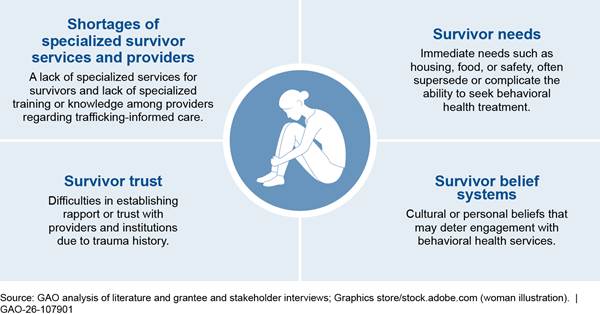
According to our literature search and interviewees, we identified four factors that can affect survivors’ access to behavioral health services: (1) shortages of specialized survivor services and providers, (2) survivor needs, (3) survivor belief systems, and (4) a lack of trust survivors may have in behavioral health providers and institutions of care. (See fig. 3.) Survivors may experience more than one of these factors in addition to broader factors related to accessing behavioral health services in the United States, such as provider shortages and health insurance access and restrictions.[41]
Figure 3: Factors That Can Affect Access to Behavioral Health Services for Human Trafficking Survivors, Identified by Literature, and Selected Grantee and Stakeholder Organizations
Note: We interviewed 15 selected Department of Health and Human Services (HHS) and Department of Justice (DOJ) grantees that provide services to human trafficking survivors and six selected stakeholders, including representatives from trafficking survivor organizations and an academic researcher. We selected grantees to obtain variation in the reported amount of behavioral health services provided and geographic region served. We selected stakeholders with relevant knowledge of trafficking from among those suggested by HHS and DOJ officials and our prior work.
Shortages of specialized survivor services and providers. According to our literature search and some interviewees, few organizations or behavioral health providers specialize in treating survivors of human trafficking. Trauma among survivors of human trafficking is common and complex, and addressing survivors’ needs requires providers who are trained to identify trauma and respond appropriately—specialized skills that many providers lack, according to many interviewees.[42] Specifically, some grantee and stakeholder representatives stated that the limited availability of trauma-informed behavioral health providers is a main challenge in addressing survivors’ behavioral health needs. (See text box for information on trauma-informed care.) Additionally, a 2021 study that surveyed 62 human trafficking survivors working in anti-trafficking efforts and 37 community agencies that work with survivors found that less than half of respondents (26 percent of survivors and 41 percent of community agencies) reported that trauma-informed care was available within their local communities. Similar proportions of respondents (26 percent of survivors and 35 percent of community agencies) indicated that the mental health needs of survivors were being met.[43] Representatives of a grantee and a stakeholder added that insufficient expertise in treating survivors of human trafficking can result in inaccurate diagnoses or inappropriate treatment, potentially causing further harm.
|
What is trauma? Trauma can happen after an event, series of events, or set of circumstances that is a physically or emotionally harmful or threatening experience to someone. It can have a negative effect on a person’s functioning and mental, physical, social, emotional, or spiritual well-being. What is trauma-informed care? A trauma-informed approach to care acknowledges that health care organizations and care teams need to have a complete picture of a patient’s life situation—past and present—in order to provide effective health care services with a healing orientation. Some main principles to trauma-informed care are (1) safety—the patient, staff, and organization feel physically and psychologically safe; (2) trustworthiness and transparency—decisions for the patients are made with transparency and with the goal of building and maintaining trust; (3) peer support—individuals with shared experiences are integrated into the organizations; (4) collaboration—importance is placed on partnering and leveling power difference between staff and clients; and (5) empowerment—the organization fosters a belief in the primacy of the people who are served to heal and promote recovery. |
Source: GAO summary of information from the Department of Health and Human Services’ Substance Abuse and Mental Health Services Administration. І GAO‑26‑107901
With the limited availability of behavioral health providers with sufficient training in trauma-informed care, the behavioral health needs of all human trafficking survivors cannot be met, according to our literature search and some stakeholder and grantee representatives. For instance, a 2021 study that surveyed Missouri service providers indicated that, among providers that typically come into contact with human trafficking survivors, fewer than half provided services that met survivors’ most critical needs (including counseling, crisis services, shelter, and medical assistance) in-house.[44] The need for organizations to refer survivors to other providers for critical services adds an additional layer to service availability, according to the study.
Limited provider availability is further exacerbated for certain survivor populations, such as minors, males, and non-English speakers, according to our literature search and many interviewees. For example, a representative from one grantee referred to a behavioral health provider with both the experience in human trafficking and the expertise to treat a minor as a “unicorn,” emphasizing the rarity of such professionals. In addition, more broadly, a 2023 study that drew on interviews with a number of Korean survivors of human trafficking and their service providers in New York City found that the lack of culturally competent medical providers who could communicate in the survivors’ language created barriers to the survivors’ receipt of services.[45]
Moreover, some grantee and stakeholder representatives told us that even when enough behavioral health providers with training in trauma-informed care are available, organizations specializing in services for human trafficking survivors often do not have the funding to hire enough of these providers to meet the needs of all survivors. For example, some grantee and stakeholder representatives reported that funding available to organizations that serve survivors typically does not focus on behavioral health, limiting how organizations can use allocated funding. A grantee representative reported that the organization did not have the funding to increase its capacity to meet the behavioral health needs of human trafficking survivors in its service area.
The result of these provider shortages can be extended wait times for initial appointments and limited hours of availability for these appointments, according to our literature search and some grantee representatives. One grantee representative noted that having to wait for an initial behavioral health appointment often discouraged survivors, leading some to decline the service altogether. In addition, a 2021 study that surveyed human trafficking survivors and community agencies demonstrated that wait times for health care services in general may affect survivors’ access to care. Specifically, 84 percent of survivor respondents and 57 percent of community agency respondents identified the number of days of wait time until a health care appointment as a constraint on survivors seeking and accessing health care services.[46] Further, some grantee representatives indicated that it is critical that behavioral health providers be highly responsive to survivor needs by offering service hours outside of traditional hours of operation (i.e., 9 a.m. to 5 p.m.).
Survivor needs. Survivor needs, such as addressing basic needs or having legal documentation, can affect survivors’ willingness or ability to access behavioral health services, according to our literature search and some interviewees. The literature search and some grantees specifically noted survivors’ basic needs—including secure housing and financial independence—need to be met to transition out and stay out of the trafficking environment. Without first fulfilling these basic needs, survivors’ willingness or ability to access and engage in behavioral health services can be reduced, according to some grantee and stakeholder representatives. This is also supported in literature we searched. For instance, in a 2021 qualitative study, six New York-based human trafficking survivors reported that their traffickers provided shelter and monetary incentives that met their basic needs, thus making it difficult for them to exit their trafficking situations. These survivors reported facing financial struggles, homelessness, and unemployment or difficulty finding a job after leaving their trafficking situations.[47] Such instability can make a survivor’s ability to engage in behavioral health services more difficult.
Additionally, some interviewees indicated that a lack of essential documentation, such as identification or legal status, can affect survivors’ ability to access social services, including behavioral health services. According to some grantee and stakeholder representatives, survivors may not have personal identity documents. One grantee explained that traffickers confiscate these documents to maintain control and keep survivors as captives. Since identity documentation is required to access health care, survivors may have to wait to access needed behavioral health services until they can obtain identification documents. Documentation issues are compounded for foreign nationals because of the additional need to secure legal status, which adds a layer of complexity to obtaining services in the United States, according to some grantees and stakeholders.
Furthermore, some representatives from the selected stakeholder organizations indicated that some survivors have cognitive impairment that can make it difficult to navigate the health care system, further limiting their ability to access behavioral health services. According to a stakeholder representative, long-term trauma can cause cognitive functioning impairment.
Survivor belief system. Literature we searched and some interviewees reported that survivors’ internal belief systems—including cultural values, difficulty recognizing exploitation, and stigma—may affect survivors’ willingness to seek behavioral health services. For example, the 2023 study of a number of Korean survivors and their service providers in New York City reported that East Asian survivors often resisted counseling due to the cultural belief that emotional pain requires personal healing rather than professional mental health support.[48] Moreover, some grantee and stakeholder representatives indicated that survivor circumstances can influence whether they recognize themselves as a victim and thus seek assistance. For example, one stakeholder explained that trafficking situations may involve cycles of violence and positive treatment, leading survivors, particularly minors, to normalize the abuse inherent in trafficking. Such normalization of a trafficking situation may not allow a survivor to recognize their exploitation and, therefore, their need for or potential benefit from behavioral health services.
Additionally, our literature search and some interviewees reported that feelings of stigma or shame reduced survivors’ willingness to access services. Specifically, a 2024 qualitative study of primarily African Americans, surveyed 194 male sex workers, many of whom were trafficked in a Midwestern city and found that some had feelings of shame that resulted in them missing health appointments.[49] A representative from one stakeholder organization—a behavioral health provider—reported that many of the survivors she treats need medications to address their behavioral health challenges; however, the representative noted stigma about receiving behavioral health services, especially for African American and Hispanic survivors, affects their willingness to access such services. The identified studies highlighted the importance of culturally competent services and relevant provider training.
Survivor trust. A history of unreliable or harmful services can cause survivors of human trafficking to distrust or fear behavioral health providers and broader systems of care, according to our literature search and some grantees. For example, a 2020 study that interviewed young female survivors found that many, though not all, lacked trust in behavioral health professionals. Such distrust stemmed, in part, from providers’ perceived unreliability due to scheduling difficulties and lack of coordinated care (e.g., having to go through the same set of screenings and assessments for multiple providers), according to the study. This resulted in the study’s survivors turning to other sources, such as peers, for support rather than behavioral health care providers.[50]
High turnover among behavioral health providers results in survivors having to repeatedly establish rapport and trust with new providers, which may result in survivors stopping their care, according to our literature search and some grantee and stakeholder representatives. We previously reported that the workload for behavioral health providers is often high, which can lead to providers burning out and leaving the field.[51] Additionally, survivors may experience mistrust in “the system,” such as the health care or foster care systems, due to negative experiences or trauma, according to some grantee representatives. For example, a representative from one grantee shared the story of a survivor who experienced intense trauma during placement into a foster home, cumulating with the survivor experiencing trafficking out of a group home. This survivor’s experience resulted in mistrust in the system intended to keep the survivor safe.
Furthermore, survivors may fear reaching out to organizations that facilitate access to behavioral health services, according to our literature search and some interviewees. For example, one stakeholder said that a survivor’s fear of being misunderstood, especially for survivors who have experienced sex work or forced criminality while being trafficked, may affect their willingness to access behavioral health services. In addition, some grantees and a stakeholder representative explained that foreign national survivors further fear accessing health care (emergency care or behavioral health) or other government services because it could result in deportation.
HHS and DOJ Actions to Help Improve Access to Behavioral Health Services
HHS and DOJ officials told us they are aware of the factors we identified that affect human trafficking survivors’ access to behavioral health services. These are longstanding and complex issues affecting a unique population, some of which are beyond federal control. Still, HHS and DOJ have taken actions to help improve access to behavioral health services for human trafficking survivors.
HHS and DOJ took the following actions that may increase access to specialized behavioral health services for human trafficking survivors:
· HHS’s OTIP created the grant program Aspire to serve human trafficking survivors who are foreign national minors. Prior to the establishment of Aspire, OTIP identified that the Trafficking Victim Assistance Program was serving a higher number of minors, according to HHS officials. Since human trafficking survivors who are minors have unique needs and require services that differ from adult survivors, OTIP created Aspire in 2022 to serve this population.
· DOJ’s OVC strengthened its expectations of grantees to serve survivors of labor trafficking. Specifically, in its notice of funding opportunity for its victim services programs in 2023 OVC included language about expanding access to services for survivors of labor trafficking. The notice also encouraged organizations with experience serving labor trafficking survivors—as well as organizations that have focused on responding to sex trafficking, but are interested in enhancing responses to labor trafficking—to apply for the grants.
· OVC created the Behavioral and Physical Health Services for Human Trafficking Victims purpose area in fiscal year 2024 under its Services for Victims of Human Trafficking program.[52] This purpose area’s goal is to increase the quality and quantity of behavioral and physical health services to assist survivors of all forms of human trafficking. According to OVC officials, the agency funded two grantees in the behavioral and physical health services purpose area in fiscal year 2024.
· OTIP took steps to increase the availability of formal training on human trafficking in behavioral health curricula. For example, in 2014, OTIP funded the development of the Stop, Observe, Ask and Respond to Health and Wellness National Training Program. The training program provides survivor and clinician-informed training to equip professionals, including behavioral health providers, with skills to identify, respond to, and support individuals at risk for or experiencing human trafficking.[53] The program consists of a series of online continuing education and continuing medical training modules for health professionals.[54]
· The Substance Abuse and Mental Health Services Administration, within HHS, has funded a behavioral health technical assistance center since fiscal year 2024 named the Resource & eMpowerment Technical Assistance Center for Behavioral Health. This center builds provider capacity and offers training and technical assistance to behavioral health and health care professionals who work with refugees and migrants, which may include survivors of human trafficking. For example, the center is required to provide clinical case consultation services to behavioral health providers and develop and maintain a list of resources that address human trafficking concerns that arise in the refugee and migrant population.[55]
Additionally, HHS and DOJ took the following actions, which may help organizations and others better understand survivors’ needs:
· OTIP funded the Look Beneath the Surface campaign. This is a national public awareness and outreach campaign that provides people who are at-risk or experiencing human trafficking with information about human trafficking, how to identify potential human trafficking schemes, and how to access support. In addition, according to HHS officials, OTIP funds local educational agencies to provide skills-based training for educators, other school staff, and students through the Human Trafficking Youth Prevention Education Demonstration Program.
· In partnership with OTIP, the HHS Office of Planning, Research, and Evaluation is conducting an exploratory study on the long-term health and wellness needs, including behavioral health, of survivors of human trafficking, according to HHS officials. The agency anticipates releasing the study’s findings in 2027.[56]
Conclusions
HHS’s Office on Trafficking in Persons and DOJ’s Office for Victims of Crime administer survivor assistance grant programs that help provide survivors of human trafficking access to needed services, including behavioral health care, to help them recover from their victimization. Grantees of the two key OTIP trafficking survivor assistance programs provided approximately 2,600 survivors with various services in fiscal year 2025, and grantees of the two OVC programs provided services to approximately 11,300 survivors that year.
While OTIP followed leading practices to assess the performance of its key programs, OVC followed most, but not all, leading practices and has an opportunity to strengthen its assessment of its Services for Victims of Human Trafficking program. By setting measurable near-term goals with targets and time frames, such as by leveraging available data for program-level goals, OVC would be better able to assess the progress that it is making toward the program’s long-term goals, including helping survivors of human trafficking access the behavioral health care and other services they need.
Recommendation for Executive Action
The Attorney General should ensure that the Office for Victims of Crime sets measurable near-term goals with targets and time frames for the Services for Victims of Human Trafficking program. (Recommendation 1)
Agency Comments and Our Evaluation
We provided a draft of this report to HHS and DOJ for review and comment. In its written comments, reproduced in appendix VI, DOJ concurred with our recommendation. DOJ stated that the Office for Victims of Crime will conduct a review of current program performance measures to identify appropriate near-term performance goals at the program level for the Services for Victims of Human Trafficking program. The agency added that once measurable goals with targets and time frames are established, OVC will communicate the goals to current grantees.
HHS and DOJ provided technical comments, which we incorporated as appropriate.
We are sending copies of this report to the appropriate congressional committees, the Secretary of Health and Human Services, the Attorney General, and other interested parties. In addition, the report is available at no charge on the GAO website at http://www.gao.gov.
If you or your staff have any questions about this report, please contact me at DeniganMacauleyM@gao.gov. Contact points for our Offices of Congressional Relations and Media Relations may be found on the last
page of this report. GAO staff who made key contributions to this report are listed in app. VII.

Mary Denigan-Macauley
Director, Health Care
List of Committees
The Honorable James E. Risch
Chairman
The Honorable Jeanne Shaheen
Ranking Member
Committee on Foreign Relations
United States Senate
The Honorable Bill Cassidy, M.D.
Chair
The Honorable Bernard Sanders
Ranking Member
Committee on Health, Education, Labor, and Pensions
United States Senate
The Honorable Charles E. Grassley
Chairman
The Honorable Richard J. Durbin
Ranking Member
Committee on the Judiciary
United States Senate
The Honorable Brett Guthrie
Chairman
The Honorable Frank Pallone, Jr.
Ranking Member
Committee on Energy and Commerce
House of Representatives
The Honorable Brian J. Mast
Chairman
The Honorable Gregory W. Meeks
Ranking Member
Committee on Foreign Affairs
House of Representatives
The Honorable Jim Jordan
Chairman
The Honorable Jamie Raskin
Ranking Member
Committee on the Judiciary
House of Representatives
Appendix I: HHS and DOJ Grant Programs that Fund Behavioral Health Services for Human Trafficking Survivors
We identified grant programs administered by the Department of Health and Human Services’ (HHS) Office on Trafficking in Persons (OTIP) and the Department of Justice’s (DOJ) Office for Victims of Crime (OVC) that fund behavioral health services for human trafficking survivors. To do so, we reviewed HHS and DOJ documents, as of March 2025, including notices of funding opportunities and requested information about each agency’s human trafficking survivor assistance grant programs and the organizations that were awarded grants (grantee). We also interviewed HHS and DOJ officials about their programs and performance management processes. We assessed the reliability of the grant award and performance data by reviewing related documentation, interviewing agency officials, and comparing the data to publicly available information, when possible, to identify any anomalies. We determined that the data were sufficiently reliable for the purposes of our reporting objectives.
Based on this information, we determined that 15 grant programs (seven administered by HHS’s OTIP and eight administered by DOJ’s OVC) in fiscal year 2025 supported human trafficking survivors by allowing grantees to use funds for behavioral health services. We summarized grant program information and analyzed program grantee performance data for fiscal year 2025—the most recent available data. See table 5 for more information on the seven OTIP programs, and table 6 for more information on the eight OVC programs. None of the 15 programs were solely focused on providing behavioral health services to survivors, and instead provided survivor assistance services broadly, which may include food, shelter, medical and behavioral health services, and legal services, among others. From these programs, we selected the four key grant programs—two from each agency—because their stated primary purpose was to fund grantees that provide services to human trafficking survivors and the grantees reported providing the largest amount of behavioral health services to survivors in recent fiscal years.[57]
Table 5: HHS’s OTIP Grant Programs That Fund Behavioral Health Services for Human Trafficking Survivors, Fiscal Year 2025
|
Program name |
Long-term goal |
Annual program funding |
Number of grantees |
Number of survivors who accessed services |
Number of grantees that used grant funds to provide behavioral health services |
Number of survivors who accessed behavioral health services |
|
Aspire: Child Trafficking Victim Assistance Demonstration Program |
To provide national coverage of comprehensive case management and other supportive services to foreign national children who have experienced severe forms of human trafficking and who are not currently receiving, or eligible to receive, similar trafficking-specific services from another federally funded program. |
$1,500,000 |
1 |
435 |
1 |
151 |
|
Domestic Victims of Human Trafficking Services and Outreach Program* |
To fund projects, through cooperative agreements, that will build, expand, and sustain organizational and local capacity to provide direct services, assistance, and referrals to survivors of severe forms of human trafficking who are U.S. citizens or lawful permanent residents. |
$3,476,331 |
11a |
1,107 |
9 |
315 |
|
Human Trafficking Youth Prevention Education Demonstration Programb |
To fund local educational agencies to partner with a non-profit or nongovernmental organization to build the capacity of selected schools to provide skills-based human trafficking prevention education for educators, other staff, and students and to establish a Human Trafficking School Safety Protocol that addresses the safety, security, and well-being of staff and students. |
$3,424,295 |
7 |
N/A |
N/A |
N/A |
|
Lighthouse: Services, Outreach, and Awareness for Labor Trafficking Demonstration Program |
To fund projects that will build, expand, and sustain organizational and local capacity to provide direct services, assistance, and referrals for foreign national adults who have experienced labor trafficking. |
$971,308 |
3 |
65 |
0 |
0 |
|
SOAR to Health and Wellness Training Demonstration Program |
To fund the implementation of SOAR (stop, observe, ask, respond) training and capacity building to identify, treat, and respond to individuals who have experienced severe forms of human trafficking. |
$997,442 |
2 |
263 |
0 |
0 |
|
Trafficking Victim Assistance Program* |
To fund time-limited comprehensive case management services to foreign national adult survivors of a severe form of human trafficking. |
$4,000,000 |
1 |
1,473 |
1 |
630 |
|
Victims of Human Trafficking in Native Communities Demonstration Program |
To fund cooperative agreements that will build, expand, and sustain organizational and local capacity to provide direct services, assistance, and referrals for Native Americans (i.e., American Indians, Alaska Natives, Native Hawaiians, or Pacific Islanders) who have experienced severe forms of human trafficking. |
$964,808 |
3 |
64 |
2 |
24 |
|
Total |
|
$15,334,184 |
28 |
3,407 |
13 |
1,120 |
Legend:
* = GAO selected key grant programs
Source: GAO review and analysis of Department of Health and Human Services’ (HHS) Office on Trafficking in Persons (OTIP) data and documentation. | GAO‑26‑107901
Notes: From the seven OTIP programs that supported human trafficking survivors by allowing grantees to fund behavioral health services, we focused on two programs that, as of March 2025, reported its grantees provided the largest amount of behavioral health services in fiscal years 2022 through 2024.
OTIP provided aggregate grant program-level performance data about the survivors who accessed grantee services during fiscal year 2025. The long-term goals are from each grant program’s notice of funding opportunity that was in effect in fiscal year 2025.
aTwo of the Domestic Victims of Human Trafficking Services and Outreach Program grantees voluntarily relinquished their awards in 2025 due to programmatic restructuring at their organizations, according to HHS officials.
bThe Human Trafficking Youth Prevention Education Demonstration Program is not a direct survivor assistance program, according to HHS officials. Human trafficking prevention education providers and recipients may identify potential survivors of human trafficking and refer those individuals to the appropriate providers in implementing human trafficking school safety protocols required under the grant program; however, grant recipients do not provide direct survivor services.
Table 6: DOJ’s OVC Grant Programs That Fund Behavioral Health Services for Human Trafficking Survivors, Fiscal Year 2025
|
Program name |
Long-term goal |
Average annual program fundinga |
Number of grantees |
Number of survivors who accessed servicesb |
Number of grantees that used grant funds to provide behavioral health services |
Number of behavioral health services accessed by survivorsc |
|
Anti-Trafficking Housing Assistance Program |
To support organizations with the capacity to implement collaborative, coordinated, and comprehensive housing models in providing trafficking survivors with safe, stable housing and appropriate trauma-informed, victim-centered, and culturally responsive services. |
$17,736,911 |
73 |
1,477 |
45 |
10,759 |
|
Enhanced Collaborative Model Task Force to Combat Human Trafficking |
To support a sustainable, multidisciplinary, co-leadership task force approach to improve and increase survivor identification of all forms of human trafficking, provide survivors with access to services, and seek justice on their behalf. |
$11,022,586 |
49 |
2,472 |
34 |
4,612 |
|
Enhancing Juvenile and Family Court Responses to Human Trafficking |
To develop or enhance programs to provide direct services and diversion programs for youth in contact with the juvenile and family court systems who are survivors of sex or labor trafficking or at risk for human trafficking due to past or current crime victimization, including child abuse and neglect. |
$337,500 |
3 |
290 |
1 |
8 |
|
Improving Outcomes for Child and Youth Victims of Human Trafficking |
To improve responses to and outcomes for child and youth survivors of sex and labor trafficking through increased collaboration at the statewide or Tribal jurisdiction level and to create effective change across systems. |
$4,258,717 |
10 |
443 |
4 |
713 |
|
Preventing Trafficking of Girls |
To prevent and reduce victimization of girls who are vulnerable to sex or labor trafficking, or both. |
$3,390,669 |
21 |
1,438 |
16 |
6,936 |
|
Project Beacon: Increasing Access to Services for Urban American Indian and Alaska Native Victims of Human Trafficking Program |
To increase the quantity and quality of victim-centered services available to assist American Indian and Alaska Native survivors of human trafficking in urban areas. |
$698,105 |
5 |
40 |
5 |
233 |
|
Services for Minor Victims of Human Trafficking* |
To provide services that address the needs of minor survivors of sex and labor trafficking through a continuum of services to ensure their safety, security, and healing.d |
$11,407,804 |
43 |
2,519 |
35 |
31,066 |
|
Services for Victims of Human Trafficking* |
To develop, expand, or strengthen survivor service programs for survivors of human trafficking. This program is intended for survivor service programs serving adults or a combination of adults and minors. |
$33,246,329 |
140 |
8,767 |
92 |
20,879 |
|
Total |
|
$82,098,621 |
344 |
17,446 |
232 |
75,206 |
Legend:
* = GAO selected key grant programs
Source: GAO review and analysis of Department of Justice’s (DOJ) Office for Victims of Crime (OVC) data and documentation. | GAO‑26‑107901
Notes: From the eight OVC programs that supported human trafficking survivors by allowing grantees to fund behavioral health services, we focused on two programs that, as of March 2025, reported its grantees provided the largest amount of behavioral health services in fiscal year 2024.
OVC’s data includes completed grantee quarterly performance reports about the survivors served and services provided during fiscal year 2025. The long-term goals are from each grant program’s fiscal year 2024 notice of funding opportunity, which were in effect in fiscal year 2025.
A grantee can have multiple OVC trafficking survivor assistance grants.
Types of behavioral health services designated by OVC are (1) referral to substance use treatment and support; (2) provision of substance use services (such as medication-assisted treatment and therapy); (3) provision of individual therapy or mental health services; and (4) provision of other types of therapy (such as traditional, cultural, or alternative healing; art; writing; or play). OVC also collects information from grantees on the provision of information about substance use abuse treatment support available to survivors of crime, but we did not include this type of service as a type of behavioral health service as it is information and not a referral to services or the provision of services.
Starting in fiscal year 2025, OVC awarded a single grantee the Pilot Program for Community Based Organizations in Underserved Communities to Build Capacity and Serve Adolescent and Youth Victims of Trafficking—a $6 million award over a 5-year project period. The grantee did not serve any survivors of human trafficking in fiscal year 2025. According to OVC officials, the program was active but was not yet expending funds to serve survivors. This grant program is not included in the table.
aThe agency does not provide incremental funding by year for these grant award recipients. Grantees were awarded all funds for the entire multi-year project period upfront, according to OVC officials. Grantees then reimburse themselves for approved project costs over the course of their project period. To estimate an average annual funding amount, we divided the total grant program funding by the number of years of the project period and rounded to the nearest dollar.
bIndividuals can receive services from more than one grantee at a time and, therefore, program aggregated totals may not reflect the unique number of survivors served, according to OVC officials. In addition, grantees report the total survivors served annually (rather than quarterly), according to OVC officials. Grantees submit these annual measures with their fourth quarter performance report. OVC’s data includes completed fiscal year quarterly performance reports from grantees as of February 10, 2026. Across all grant programs, 49 grantees did not report fourth quarter data in fiscal year 2025. Therefore, the table does not include the total survivors served for the 49 grantees and the totals may be higher.
cSurvivors may receive multiple types of services from grantees or the same type of service multiple times from grantees, according to OVC officials. Therefore, the number of behavioral health services accessed by survivors may be greater than the unique number of survivors who accessed services from the grantees.
dOVC allocated its annual funding to grantees that provide services for minor survivors of human trafficking through two notifications of funding opportunities in fiscal years 2020 through 2022, according to OVC officials. For example, in fiscal year 2022, OVC’s funding opportunities were for Services for Minor Victims of Labor Trafficking and Field-Generated Strategies to Address the Criminalization of Minor Victims of Sex Trafficking. According to OVC officials, since fiscal year 2023, OVC has allocated this funding through a single notification of funding opportunity that supports grantee projects for minor survivors of both sex and labor trafficking—Integrated Services for Minor Victims of Human Trafficking.
We interviewed representatives from a nongeneralizable selection of 15 grantees to better understand (1) the services provided to human trafficking survivors through four key Department of Health and Human Services (HHS) and Department of Justice (DOJ) survivor assistance grant programs, (2) their perspectives on how HHS and DOJ evaluate program grantees, and (3) the barriers survivors face accessing behavioral health services.
To select these grantees, we used information from HHS and DOJ, provided in March 2025, about the grantees in each of the four key survivor assistance grant programs with ongoing grants.[58] We selected among grantees that reported providing higher amounts of behavioral health services. In addition, we selected at least one grantee from each of the four key survivor assistance grant programs; we also selected to obtain variation in the geographic location served by the grantees. Through this process, we selected a total of 23 grantees.
We then reached out to the 23 selected grantees to request an interview. Representatives from 15 grantees accepted our invitation and we conducted interviews from May through July 2025. The results of these interviews are not generalizable to all HHS or DOJ grantees. See table 7 for additional information on these grantees.
|
Characteristic |
Number of selected grantees (n = 15) |
|
Grant program |
· HHS’s OTIPa · Trafficking Victim Assistance Program: 1 · Domestic Victims of Human Trafficking Services and Outreach Program: 2 · DOJ’s OVC · Services for Victims of Human Trafficking: 9 · Services for Minor Victims of Human Trafficking: 3 |
|
Census region |
· Northeast: 6 · South: 5 · Midwest: 1 · West: 3 |
|
Number of grantees by average annual award amountb |
· Less than $300,000: 5 · $300,000 to less than $400,000: 9 · Greater than $400,000: 1 |
Source: GAO summary of the Department of Health and Human Services’ (HHS) Office on Trafficking in Persons (OTIP), and the Department of Justice’s (DOJ) Office for Victims of Crime (OVC) grantee information. | GAO‑26‑107901
aTwo of the 15 grantees had awards from both OTIP and OVC. For the purposes of our selection, we categorized these grantees under their HHS OTIP grant award.
bHHS OTIP award recipients received funding for five consecutive fiscal years, with one-fifth of the funds distributed each fiscal year. According to OVC officials, the agency does not provide incremental funding by year for these OVC grant award recipients. Grantees were awarded all funds for the entire multi-year project period (often 3 years) upfront and reimbursed themselves for approved project costs over the course of their project period. To estimate an average annual funding amount, we divided the total grant program funding by the number of years in the project period and rounded to the nearest dollar.
Appendix III: Substance Abuse and Mental Health Services Administration Programs Supporting Human Trafficking Survivors
The Substance Abuse and Mental Health Services Administration, within the Department of Health and Human Services, does not have any behavioral health programs that specifically target assisting survivors of human trafficking, according to agency officials. However, as of February 2026, at least one grantee in 10 different programs reported supporting human trafficking survivors, often through workforce trainings, according to agency officials. (See table 8.) Officials noted that these trainings aim to build the capacity of providers who can identify, respond to, connect, and provide appropriate mental health supportive services to youth who have been affected by human trafficking. Officials added that some providers have entered into formal agreements with community agencies that interact with survivors of human trafficking to increase access to prevention and treatment services and develop referral pathways.
Table 8: Substance Abuse and Mental Health Services Administration Grant Programs with Grantees That Reported Supporting Human Trafficking Survivors, February 2026
|
Grant program |
Program goal |
Number of grantees that reported supporting human trafficking survivors |
|
Children’s Mental Health Initiative |
To provide comprehensive community mental health services to children, youth, and young adults, birth through 21 years old, with a serious emotional disturbance, which may include efforts to identify and serve children at risk, and their families. |
9 |
|
Community Programs for Outreach and Intervention with Youth and Young Adults at Clinical High Risk for Psychosis |
To identify, prevent, or lessen the impact of psychotic disorders in youth and young adults, not more than 25 years old, who are at a clinical high risk for psychosis and provide evidence-based interventions in a trauma-informed manner to prevent the onset of psychosis. |
3 |
|
Cooperative Agreements for School-Based Trauma-Informed Support Services and Mental Health Care for Children and Youth |
To increase student access to evidence-based and culturally relevant trauma support services and mental health care by developing innovative initiatives, activities, and programs to link local school systems with local trauma-informed support and mental health systems, including those under the Indian Health Service. |
1 |
|
Healthy Transitions: Improving Life Trajectories for Youth and Young Adults with Serious Mental Disorders |
To improve and expand access to developmentally, culturally, and linguistically appropriate services and supports for transition-aged youth and young adults (ages 16-25) who either have, or are at risk for developing, serious mental health conditions. |
1 |
|
National Child Traumatic Stress Initiative: Community Treatment Service Centers |
To increase access to effective trauma- and grief-focused treatment and service systems for children, adolescents, and their families, who experience traumatic events. |
13 |
|
National Child Traumatic Stress Initiative: Treatment and Service Adaptation Centers |
To provide national expertise for specific types of traumatic events, population groups, and service systems, and support the specialized adaptation of effective evidence-based treatment and service approaches for communities across the nation. |
6 |
|
Project AWARE (Advancing Wellness and Resiliency in Education) |
To develop a sustainable infrastructure for school-based mental health programs and services. |
5 |
|
Resiliency in Communities After Stress and Trauma |
To promote resilience, trauma-informed approaches, and equity in communities that have recently faced civil unrest, community violence, or collective trauma within the past 24 months; and assist high-risk youth and families through the implementation of evidence-based violence prevention, and community youth engagement programs. |
1 |
|
Statewide Family Network |
To provide resources to enhance the capacity of statewide mental health family controlled organizations to support, train, and mentor family members or primary caregivers who are raising children, youth, and young adults with serious emotional disturbance or co-occurring disorders. |
1 |
|
Tribal Behavioral Health |
To prevent and reduce suicidal behavior and substance misuse, reduce the impact of trauma, and promote mental health among American Indian/Alaska Native youth, up to and including age 24, by building a healthy network of systems, services, and partnerships that impact youth. |
1 |
|
Total |
|
41 |
Source: Information from the Department of Health and Human Services’ Substance Abuse and Mental Health Services Administration. | GAO‑26‑107901
Table 9 provides demographic information on human trafficking survivors who were served by two key programs of the Department of Health and Human Services’ (HHS) Office on Trafficking in Persons.
Table 9: Types of Human Trafficking Survivors Served by Key HHS OTIP Survivor Assistance Grant Programs, Fiscal Year 2025
|
|
Trafficking Victim Assistance Program (1,473 total survivors served) |
Domestic Victims of Human Trafficking Services and Outreach Program (1,107 total survivors served) |
|
Age of survivors served |
||
|
Adults |
1,473 |
1,084 |
|
Minors |
0 |
23 |
|
Race of survivors serveda |
||
|
American Indian or Alaska Native |
2 |
56 |
|
Asian |
103 |
19 |
|
Black or African American |
87 |
434 |
|
Hispanic or Latino |
1,203 |
202 |
|
Native Hawaiian or other Pacific Islander |
12 |
4 |
|
White |
59 |
157 |
|
Sex of survivors served |
|
|
|
Male |
625 |
70 |
|
Female |
847 |
1,012 |
|
Sex not reported |
1 |
25 |
|
Type of trafficking experienced by survivors served |
||
|
Sex |
222 |
637 |
|
Labor |
961 |
56 |
|
Sex and labor |
221 |
356 |
|
Type not reported |
69 |
58 |
Source: GAO summary of Department of Health and Human Services’ (HHS) Office on Trafficking in Persons (OTIP) data. | GAO‑26‑107901
Note: From the seven OTIP programs that supported human trafficking survivors by allowing grantees to fund behavioral health services, we focused on two programs that, as of March 2025, reported its grantees provided the largest amount of behavioral health services in fiscal years 2022 through 2024.
aGrantees are not required to report, and survivors served are not required to provide, race and ethnicity information. Numbers are non-cumulative. Response categories are not mutually exclusive and will not sum to total number of survivors served.
Table 10 provides demographic information on human trafficking survivors who were served by two key programs of the Department of Justice’s (DOJ) Office for Victims of Crime.
Table 10: Types of Human Trafficking Survivors Served by Key DOJ OVC Survivor Assistance Grant Programs, Fiscal Year 2025
|
|
Services for Victims of Human Trafficking program |
Services for Minor Victims of Human Trafficking programa |
|
Eligible individuals who accessed services |
|
|
|
Total survivors served |
8,767 |
2,519 |
|
New survivors served (of total served) |
6,066 |
2,057 |
|
Age of new survivors served |
|
|
|
Adults |
5,149 |
227b |
|
Minors |
701 |
1,827 |
|
Not reported or not tracked |
207 |
2 |
|
Race of new survivors served |
|
|
|
American Indian or Alaska Native |
197 |
28 |
|
Asian |
567 |
40 |
|
Black or African American |
1,290 |
692 |
|
Hispanic or Latino |
1,825 |
542 |
|
Native Hawaiian or other Pacific Islander |
38 |
34 |
|
White Non-Latino or Caucasian |
1,410 |
499 |
|
Some other race |
47 |
13 |
|
Multiple races |
274 |
163 |
|
Not reported or not tracked |
418 |
46 |
|
Sex of new survivors servedc |
|
|
|
Male |
1,216 |
281 |
|
Female |
4,600 |
1,739 |
|
Not reported or not tracked |
199 |
16 |
|
Type of trafficking experienced by total survivors served |
|
|
|
Sex |
4,740 |
1,814 |
|
Labor |
2,513 |
189 |
|
Sex and labor |
970 |
91 |
|
Unknown |
544 |
425 |
Source: GAO summary of Department of Justice’s (DOJ) Office for Victims of Crime (OVC) data. | GAO‑26‑107901
Notes: Information on the age, race, and sex of survivors served by these DOJ OVC grant programs are only collected for new survivors being served by the grantee. The type of trafficking experienced is collected for total survivors served.
From the eight OVC programs that supported human trafficking survivors by allowing grantees to fund behavioral health services, we focused on two programs that, as of March 2025, reported its grantees provided the largest amount of behavioral health services in fiscal year 2024.
Grantees report the total survivors served and the type of trafficking experienced annually (rather than quarterly), according to OVC officials. Grantees submit these annual measures with their fourth quarter performance report. OVC’s data includes completed fiscal year quarterly performance reports from grantees as of February 10, 2026. Fifteen grantees in the Services for Victims of Human Trafficking program and five grantees in the Services for Minor Victims of Human Trafficking program did not report fourth quarter data in fiscal year 2025. Therefore, the table does not include the total survivors served or the type of trafficking experienced for these grantees and the totals may be higher.
aOVC allocated its annual funding to grantees that provide services for minor survivors of human trafficking through two notifications of funding opportunities in fiscal years 2020 through 2022, according to OVC officials. For example, in fiscal year 2022, OVC’s funding opportunities were for Services for Minor Victims of Labor Trafficking and Field-Generated Strategies to Address the Criminalization of Minor Victims of Sex Trafficking. According to OVC officials, since fiscal year 2023, OVC has allocated this funding through a single notification of funding opportunity that supports grantee projects for minor survivors of both sex and labor trafficking—Integrated Services for Minor Victims of Human Trafficking.
bApproximately 85 percent of adults served by the Services for Minor Victims of Human Trafficking program were aged 18 through 24.
cDue to changes to OVC’s performance reporting in 2025, the categories of sex of new survivors served do not sum to the number of new survivors served, according to OVC officials.
GAO Contact
Mary Denigan-Macauley, DeniganMacauleyM@gao.gov
Staff Acknowledgments
In addition to the contact named above, Rebecca Abela (Assistant Director), Kathryn Richter (Analyst in Charge), Wyatt Anderson, and DeAndrea Porch made key contributions to this report. Also contributing to this report were Sonia Chakrabarty, Leia Dickerson, Jeffrey Fiore, Cheryl Goodman, David Jones, Janice Latimer, Drew Long, Diona Martyn, Eric Peterson, and Madeliene Tierney.
Albright, Karen, Jordan Greenbaum, Sherry A. Edwards, and Carmelle Tsai. “Systematic Review of Facilitators of Barriers to, and Recommendations for Healthcare Services for Child Survivors of Human Trafficking Globally.” Child Abuse & Neglect, vol. 100 (2020).
Barnert, Elizabeth, Mikaela Kelly, Sarah Godoy, Laura S. Abrams, and Eraka Bath. “Behavioral Health Treatment “Buy-in” among Adolescent Females with Histories of Commercial Sexual Exploitation.” Child Abuse & Neglect, vol. 100 (2020).
Boulineaux, Christina, Jaya Prakash, Hanni Stoklosa, Jennifer Cox, Andrea Reilly, and Annie Lewis O’Connor. “An Analysis of Human Trafficking Medical Clinics’ Practices in the United States.” International Journal of Caring Sciences, vol. 17, issue 2 (2024).
Feldwisch, Rachel. P., Christie Jansing, Isabella Betancourt, Avish Waghray, Kayla Horne, Christopher Sanders, and Megan Jessup-Smyth. “Barriers and Facilitators of Treatment Engagement: Perspectives Shared by Survivors of Adolescent Sex Trafficking and Experienced Clinicians.” Clinical Social Work Journal, vol. 53 (2025): 194-207.
Gerassi, Lara, Tonya E. Edmond, Vanessa Fabbre, Abby Howard, and Andrea J. Nichols. “Disclosing Sex Trading Histories to Providers: Barriers and Facilitators to Navigation of Social Services Among Women Impacted by Commercial Sexual Exploitation.” Journal of Interpersonal Violence, vol. 36 (3-4) (2021): NP1259–1284NP.
Iqbal, Syed Z., Temilola Salami, Mary C. Reissinger, Mohammad Hadi Masood, Kanta Ukrani, and Asim A. Shah. “The Mental Health Clinician’s Role in Advocacy for Survivors of Human Trafficking: Treatment and Management.” Psychiatric Annals, vol. 51, no. 8 (2021).
Koegler, Erica, Kathleen M. Preble, and Sarah M. Tlapek. “Identifying Service Needs and Service Gaps for Sexually Exploited/trafficked Persons in Missouri.” Journal of Social Work, vol. 21(4), (2021): 713–729.
Lim, Sahnah, Seunggun Lee, Lori Cohen, John J. Chin, Chau Trinh-Shevrin, and Nadia S. Islam. “Factors Influencing Recovery and Well-Being Among Asian Survivors of International Criminal Sex Trafficking in an Urban U.S. City.” Journal of Interpersonal Violence, vol. 38 (3-4) (2023): 2360–2386.
Litam, Stacey Diane A, and Sheerah Neal. “Trauma-informed Interventions for Counselling Sex Trafficking Survivors.” Int J Adv Counselling, vol. 44 (2022): 243–262.
Marburger, Kathryn and Sheri Pickover. “A Comprehensive Perspective on Treating Victims of Human Trafficking.” The Professional Counselor, vol. 10, issue 1 (2020): 13–24.
Mays, Cheri, Thomas A. Field, and Kok-Mun Ng. “Systematic Review of Competencies for Counseling Survivors of Sex Trafficking.” Journal of Human Trafficking (2024).
Mumey, Audrey, Srishti Sardana, Randall Richardson-Vejlgaard, and Adeyinka M. Akinsulure-Smith. “Mental Health Needs of Sex Trafficking Survivors in New York City: Reflections on Exploitation, Coping, and Recovery.” Psychological Trauma: Theory, Research, Practice, and Policy, vol. 13, no. 2 (2021): 185–192.
Nodzenki, Marie, Allard W. de Smalen, Nicola S. Pocock, Mark Kavenagh, Ligia Kiss, and Ana Maria Buller. “Human Trafficking of Boys and Young Men: A Systematic Literature Review of Impacts on Mental Health and Implications for Services in Post-Trafficking Settings.” Social Sciences (2024).
Palines, Patrick A., Angela L. Rabbitt, Amy Y. Pan, Melodee L. Nugent, and Wendi G. Ehrman. “Comparing Mental Health Disorders Among Sex Trafficked Children and Three Groups of Youth at High-risk for Trafficking: A dual Retrospective Cohort and Scoping Review.” Child Abuse & Neglect, vol. 100 (2020).
Panda, Preeti, Anjali Garg, Sara Lee, and Ashwini R. Sehgal. “Barriers to the Access and Utilization of Healthcare for Trafficked Youth in the United States.” Child Abuse & Neglect, vol. 121 (2021).
Rapoza, Sarah. “Sex Trafficking: A Literature Review with Implications for Health Care Providers.” Advanced Emergency Nursing Journal, vol. 44, no. 22 (2022): 248-261.
Robinson, Christabelle, Daniela Peterka-Benton, and Teresa Crowe. “Unveiling the Long-Term Challenges: Disabilities and Post-Human Trafficking Survival - A Survivor Perspective.” Journal of Human Trafficking, vol. 11, no. 1 (2025): 98–109.
Robitz, Rachel, Emilio C. Ulloa, Marissa Salazar, and Monica D. Ulibarri. “Mental Health Service Needs of Commercially Sexually Exploited Youth: Voices of Survivors and Stakeholders.” Violence and Victims, vol. 35, no. 3 (2020).
Romero, Devon E., Claudia G. Interiano-Shiverdecker, Katherine E. McVay, and Brenda Jones. “Child Sex Trafficking and Professional School Counselor Preparedness in Texas.” Journal of Counselor Preparation and Supervision, vol. 18, no. 2 (2024).
Sawyer, Nathaniel, and David Hoskins. “Culturally Competent Mental Health Care for Imprisoned Black Survivors of Sex Trafficking.” Journal of Human Trafficking (2025).
Titchen, Kanani E., Elizabeth Chang, Jessican Kim, Shannon Tran, Ellora Nyhan, and Makini Chisolm-Straker, “Youth Survivors of Human Trafficking: On Improving Health Care Access and Treatment.” Academic Pediatrics, vol. 25, no. 4 (2025).
Trudeau, Elizabeth, Scott Noble, Sill Davis, Sherman Bryant, and Anthony Queen. “Identifying Trafficking Experience and Health Needs among African American Male Survival Sex Workers.” Journal of Human Trafficking, vol. 10, no. 1 (2024): 153–167.
Wagner, Amelia, Sarah Lockwood, Amy Farrell, et al. “Understanding the Retrospective and Current Health Care Needs and Service Experiences of Adult Survivors of Minor Sex Trafficking.” Research in Human Development, vol. 21 (2024): 135-158.
Woehler, Elliott, and Lindsay Akers. “Repairing the Trauma Bonds of Sex Trafficking Victim-Survivors with Animal-Assisted Therapy.” Journal of Creativity in Mental Health, vol. 17, no. 4 (2022): 456–468.
The Government Accountability Office, the audit, evaluation, and investigative arm of Congress, exists to support Congress in meeting its constitutional responsibilities and to help improve the performance and accountability of the federal government for the American people. GAO examines the use of public funds; evaluates federal programs and policies; and provides analyses, recommendations, and other assistance to help Congress make informed oversight, policy, and funding decisions. GAO’s commitment to good government is reflected in its core values of accountability, integrity, and reliability.
Obtaining Copies of GAO Reports and Testimony
The fastest and easiest way to obtain copies of GAO documents at no cost is through our website. Each weekday afternoon, GAO posts on its website newly released reports, testimony, and correspondence. You can also subscribe to GAO’s email updates to receive notification of newly posted products.
Order by Phone
The price of each GAO publication reflects GAO’s actual cost of production and distribution and depends on the number of pages in the publication and whether the publication is printed in color or black and white. Pricing and ordering information is posted on GAO’s website, https://www.gao.gov/ordering.htm.
Place orders by calling (202) 512-6000, toll free (866) 801-7077,
or
TDD (202) 512-2537.
Orders may be paid for using American Express, Discover Card, MasterCard, Visa, check, or money order. Call for additional information.
Connect with GAO
Connect with GAO on X,
LinkedIn, Instagram, and YouTube.
Subscribe to our Email Updates. Listen to our Podcasts.
Visit GAO on the web at https://www.gao.gov.
To Report Fraud, Waste, and Abuse in Federal Programs
Contact FraudNet:
Website: https://www.gao.gov/about/what-gao-does/fraudnet
Automated answering system: (800) 424-5454
Media Relations
Sarah Kaczmarek, Managing Director, Media@gao.gov
Congressional Relations
David A. Powner, Acting Managing Director, CongRel@gao.gov
General Inquiries
[1]Inducing a minor to perform commercial sex acts is considered human trafficking, regardless of the use of coercion. 22 U.S.C. § 7102. See also 18 U.S.C. §§ 1589–91.
[2]Such data are hampered by the hidden nature of the crime, inconsistent definitions of human trafficking, and challenges in identifying individual survivors of human trafficking, among other reasons, according to federal agencies and researchers. See, for example, Amy Farrell and Ieke de Vries, “Measuring the Nature and Prevalence of Human Trafficking,” The Palgrave International Handbook of Human Trafficking (Switzerland: Palgrave Macmillan, Cham, 2019).
[3]See “Cases Identified in 2024,” National Statistics, National Human Trafficking Hotline, accessed Feb. 26, 2026, https://humantraffickinghotline.org/en/statistics. The data tracked by the hotline only include those reports the hotline receives and thus represent an unknown subset of total human trafficking cases in the United States. A single case can include one or more potential survivors of trafficking.
[4]For the purposes of this report, we generally use the term “survivor” rather than “victim” to refer to people who have experienced human trafficking. We recognize that some people choose to use the title “survivor,” while others do not, and the terminology reflecting those who have experienced trafficking continues to evolve. We use the term “victim” in this report when needed for precision and accuracy, such as when the term is used in relevant laws or federal programming.
[5]Victims of Trafficking and Violence Protect Act of 2000, Pub. L. No. 106-386, div. A, § 107, 114 Stat. 1464, 1474 (codified as amended at 22 U.S.C. § 7105).
[6]Pub. L. No. 117-348, § 123, 136 Stat. 6211, 6218 (2023).
[7]For HHS grantees, we used information provided by the agency in March 2025 on the amount of grant funds that grantees reported using to provide or refer survivors to behavioral health services in fiscal years 2022 through 2024. For DOJ grantees, we used information provided by the agency in March 2025 on the number of behavioral health services grantees reported providing to survivors in fiscal year 2024, or, when fiscal year 2024 was not available, the most recent available fiscal year.
[8]Specifically, we used the three leading practices outlined in GAO, Evidence-Based Policymaking: Practices to Help Manage and Assess the Results of Federal Efforts, GAO‑23‑105460 (Washington, D.C.: July 12, 2023): goal setting, collecting information, and using information. We refer to these as performance management practices because they can help federal agencies manage program performance.
[9]A research librarian conducted searches in various research databases, such as ProQuest Health & Medical Collection, ProQuest Sociology Collection, PTSDpubs, Scopus, CINAHL with Full Text, APA PsycInfo, EMBASE, EMCare, MEDLINE, NTIS: National Technical Information Service, PAIS International, SciSearch: A Cited Reference Science Database, Social SciSearch, WorldCat, Find Policy, and PubMed.
[10]22 U.S.C. § 7102(11). The term “commercial sex act” means any sex act on account of which anything of value is given to or received by any person; the term “sex trafficking” means the recruitment, harboring, transportation, provision, obtaining, patronizing, or soliciting of a person for the purpose of a commercial sex act. 22 U.S.C. §§ 7102(4), (12).
[11]The Trafficking Victims Protection Act of 2000 required the President to establish the task force; it is chaired by the Secretary of State, and the President appoints its members. 22 U.S.C. § 7103. As of January 2026, the agencies of the Task Force were the Department of State, Department of the Treasury, Department of Defense, DOJ, Department of the Interior, Department of Agriculture, Department of Commerce, Department of Labor, HHS, Department of Transportation, Department of Education, Department of Homeland Security, the Office of the United States Trade Representative, and the Equal Employment Opportunity Commission, as well as the Office of the Director of National Intelligence, and the White House Offices of Management and Budget, the National Security Council, and the Domestic Policy Council.
[12]See Department of Justice, Attorney General’s Annual Report to Congress on U.S. Government Activities to Combat Trafficking in Persons: Fiscal Year 2023 (January 2025).
[13]Other interventions, services, and support provided by the federal government to protect victims and survivors of human trafficking include the identification of possible victims, safeguarding survivors from inappropriate penalization, and seeking financial remedies for survivors, among others.
[14]22 U.S.C. § 7105. In addition to those grants, both HHS and DOJ administer other programs that, while not designed to provide services solely to human trafficking survivors, may still serve these survivors. For example, the Substance Abuse and Mental Health Services Administration, within HHS, funds grant programs, some of which may support human trafficking survivors, often through workforce trainings, according to agency officials. See appendix III for more information. In addition, DOJ’s OVC administers the Crime Victims Fund, which was established by the Victims of Crime Act of 1984. Pub. L. No. 98-473, tit. II, ch. 14, 98 Stat. 1837, 2170. The fund, which is financed primarily by fines and other types of penalties, is allocated to states and territories to support crime victim compensation and assistance. According to OVC officials, OVC data shows such assistance may include the provision of behavioral health services to human trafficking survivors.
[15]The Domestic Trafficking Victims’ Fund is administered by DOJ, in consultation with HHS. The fund is financed through a penalty assessment imposed on anyone convicted of certain federal trafficking-related offenses. The funding may be used to support existing grant programs authorized by the Trafficking Victims Protection Act of 2000. See 18 U.S.C. § 3014.
[16]See 22 U.S.C. § 7105(b).
[17]See Emily F. Rothman, Julia Cusano, Amelia Wagner, Sarah Lockwood, Carlos A. Cuevas, and Amy Farrell, “Prevalence of Neurodevelopmental, Mental, and Behavioral Disorders in a Sample of U.S. Commercially Sexually Exploited Youth, and Associations with Health and Health Care Access,” Journal of Human Trafficking, vol. 11, no. 1 (2025).
[18]See, for example, Karen Albright, Jordan Greenbaum, Sherry A. Edwards, Carmelle Tsai, “Systematic Review of Facilitators of, Barriers to, and Recommendations for Healthcare Services for Child Survivors of Human Trafficking Globally,” Child Abuse & Neglect, vol. 100 (2020); and Kathryn Marburger and Sheri Pickover, “A Comprehensive Perspective on Treating Victims of Human Trafficking,” The Professional Counselor, vol. 10, issue 1 (2020): 13-24.
[19]In 2016, we found that while overlap existed across grant programs intended to combat human trafficking, HHS and DOJ had processes in place to minimize grant duplication. See GAO, Human Trafficking: Agencies Have Taken Steps to Assess Prevalence, Address Victim Issues, and Avoid Grant Duplication, GAO‑16‑555 (Washington, D.C.: June 28, 2016).
[20]In fiscal year 2025, seven of HHS’s OTIP grant programs provided funds to support survivor assistance services, including behavioral health services. From these grant programs, we selected the two that, as of March 2025, reported its grantees provided the largest amount of behavioral health services to survivors in fiscal years 2022 through 2024. For information on all seven OTIP grant programs, see appendix I.
[21]In fiscal year 2025, three Trafficking Victim Assistance Programs provided services to foreign national survivors of human trafficking—the Trafficking Victims Assistance Program; Aspire: Child Trafficking Victim Assistance Demonstration Program, which served foreign national minors; and Lighthouse: Services, Outreach, and Awareness for Labor Trafficking Demonstration Program, which served foreign national adults who experienced labor trafficking. For this report, we selected the Trafficking Victims Assistance Program as one of OTIP’s key programs. See appendix I for more information on the other two programs.
Case management is a process used to assess an individual’s needs and coordinate the needed services.
[22]In fiscal year 2025, two Domestic Victims of Human Trafficking Programs provided services to survivors of human trafficking who are U.S. citizens or lawful permanent residents: the Domestic Victims of Human Trafficking Services and Outreach program and the Demonstration Grants to Strengthen the Response to Victims of Human Trafficking in Native Communities, which served Native American survivors. For this report, we selected the Domestic Victims of Human Trafficking Services and Outreach Program as one of OTIP’s key programs. See appendix I for more information on the other program.
[23]HHS awarded grantees in both grant programs with funding for 5-year project periods. The Trafficking Victim Assistance Program project period is September 30, 2022, through September 29, 2027. The Domestic Victims of Human Trafficking Services and Outreach Program grantees were awarded funding in two different award cycles. Six of the grantees have project periods from September 30, 2022, through September 29, 2027, and five of the grantees have project periods from November 30, 2023, through November 29, 2028. According to HHS officials, two of the Domestic Victims of Human Trafficking Services and Outreach Program grantees voluntarily relinquished their awards in 2025 due to programmatic restructuring at their organizations.
[24]In fiscal year 2025, eight of DOJ’s OVC grant programs provided funds to support survivor assistance services, including behavioral health services. From these grant programs, we selected the two that, as of March 2025, reported its grantees provided the largest amount of behavioral health services to survivors in fiscal year 2024. Of OVC’s eight grant programs, three others—the Anti-Trafficking Housing Assistance Program, the Preventing Trafficking of Girls program, and the Enhanced Collaborative Model Task Force to Combat Human Trafficking program—also provided a number of behavioral health services to survivors in fiscal year 2024. For information on all eight grant programs, see appendix I.
[25]Eligibility for services is limited to survivors who were trafficked and began receiving services while under age 18; however, receipt of services can extend beyond the age of 18, as needed.
According to OVC officials, OVC allocated its annual funding to grantees that provide services for minor survivors of human trafficking through two notifications of funding opportunities in fiscal years 2020 through 2022. For example, in fiscal year 2022, OVC’s funding opportunities were for Services for Minor Victims of Labor Trafficking and Field-Generated Strategies to Address the Criminalization of Minor Victims of Sex Trafficking. According to OVC officials, since fiscal year 2023, OVC has allocated this funding through a single notification of funding opportunity that supports grantee projects for minor survivors of both sex and labor trafficking—Integrated Services for Minor Victims of Human Trafficking.
[26]A grantee can have multiple OVC trafficking survivor assistance grants. According to OVC officials, the agency does not provide incremental funding by year for these grant award recipients. Grantees were awarded all funds for the entire multi-year project period upfront. Grantees then reimburse themselves for approved project costs over the course of their project period. Total grant awards for each grantee’s full multi-year project period totaled $143,489,224 in fiscal year 2025. To estimate an average annual funding amount, we divided the total grant program funding by the number of years of the project period and rounded to the nearest dollar.
[27]Individuals can receive services from more than one grantee at a time and, therefore, program aggregated totals may not reflect the unique number of survivors served, according to OVC officials.
[28]For fiscal year 2024, Congress made the relevant amounts available to DOJ indefinitely as no-year funds, which continuing resolutions carried forward through fiscal year 2025.
[29]The long-term goals are from each grant program’s notice of funding opportunity that was in effect in fiscal year 2025. The relevant Trafficking Victim Assistance Program’s notice of funding opportunity was posted April 27, 2022, and the program’s project period is from September 30, 2022, through September 29, 2027. The Domestic Victims of Human Trafficking Services and Outreach Program grantees were awarded funding in two different award cycles. The relevant notice of funding opportunity for the first group of grantees was posted April 29, 2022, and the grantees’ have project periods from September 30, 2022, through September 29, 2027. The relevant notice of funding opportunity for the second group of grantees was posted February 17, 2023, and the grantees’ have project periods from November 30, 2023, through November 29, 2028.
[30]For this evaluation, OTIP is collaborating with the HHS Administration for Children and Families’ Office of Planning, Research, and Evaluation, as well as an outside contractor. In 2021, the Office of Planning, Research, and Evaluation published an evaluation of the Domestic Victims of Human Trafficking Program. See J. Hardison Walters, K. Krieger, E. Tibaduiza, M. Sheppard, and J. Kolnik, Evaluation of the Domestic Victims of Human Trafficking Program: Final Report, OPRE Report # 2021-58 (Washington, D.C.: Office of Planning, Research, and Evaluation, Administration for Children and Families, U.S. Department of Health and Human Services, April 2021).
[31]See GAO, Child Trafficking: Addressing Challenges to Public Awareness and Survivor Support, GAO‑24‑106038 (Washington, D.C.: Dec. 11, 2023).
[32]These leading practices include setting long-term and near-term goals, collecting performance information, and using this information to assess progress made on these goals. See GAO‑23‑105460.
[33]According to officials, OVC does not distinguish between long- and near-term goals, but rather refer to these as goals and objectives, respectively. For the purpose of our report, we use the terms long-term and near-term goals for consistency across multiple agencies and programs, and to align with leading practices in GAO‑23‑105460.
[34]The long-term goals are from each grant program’s fiscal year 2024 notice of funding opportunity, which were in effect in fiscal year 2025.
[35]According to OVC officials, these near-term goals and targets apply to all minor-serving anti-trafficking programs and not only to the Services for Minor Victims of Human Trafficking program.
[36]In 2023 we found that OVC had not developed achievable performance goals (i.e., near-term goals) for its child anti-trafficking programs. We recommended that it establish near-term goals consistent with leading practices, including being objective, measurable, and quantifiable. In May 2024, OVC developed performance goals for its child anti-trafficking programs, including the Services for Minor Victims of Human Trafficking program, and will establish performance targets for these programs after collecting 2 years of baseline data. See GAO‑24‑106038.
[37]See GAO‑23‑105460.
[38]OVC officials said they would ideally measure quality of care provided by its grantees. However, they explained they could not set measurable near-term goals related to quality of care because they do not have a mechanism to measure service quality. OVC previously provided funding through an agreement with a grantee to develop a free online outcome measurement tool that captured client satisfaction. According to officials, they encouraged their grantees to use this tool and were exploring how OVC could use aggregated data from this tool to gauge the impact of OVC-funded programs. However, the agreement for this tool was not active as of May 2026, and therefore OVC does not have access to the data or the ability to identify OVC-funded programs, according to DOJ officials.
[39]Among other possible strategies that agencies could use to set near-term goals, agencies could set separate goals for populations or service areas with different performance expectations or focus on broader end outcomes to account for variation in local service activities. For additional information, see GAO, Managing for Results: Measuring Program Results That Are Under Limited Federal Control, GAO/GGD‑96‑118 (Washington, D.C., Dec. 11, 1998); and GAO‑23‑105460.
[40]See, for example, L.M. Jones, J. O’Brien, and K.J. Mitchell, Crimes Against Children Research Center, Improving Outcomes for Child and Youth Victims of Commercial Sexual Exploitation: An Evaluability Assessment of the Love 146 Survivor Care Programs (Durham, N.H.: Office of Justice Programs’ National Criminal Justice Reference Service, Oct. 2024).
[41]See, for example, GAO, Behavioral Health: Available Workforce Information and Federal Actions to Help Recruit and Retain Providers, GAO‑23‑105250 (Washington, D.C.: Oct. 27, 2022); and Mental Health Care: Access Challenges for Covered Consumers and Relevant Federal Efforts, GAO‑22‑104597 (Washington, D.C.: Mar. 29, 2022).
[42]For example, a study of 131 sex and labor trafficking survivors found that 71 percent suffered from depression and 61 percent from post-traumatic stress disorder. See E. K. Hopper and L. D. Gonzalez, “A Comparison of Psychological Symptoms in Survivors of Sex and Labor Trafficking,” Behavioral Medicine, vol. 44, no. 3 (2018).
[43]See Preeti Panda et al., “Barriers To the Access and Utilization of Healthcare for Trafficked Youth in the United States,” Child Abuse & Neglect, vol. 121 (2021).
[44]See Erica Koegler, Kathleen M. Preble, and Sarah M. Tlapek, “Identifying Service Needs and Services Gaps for Sexually Exploited/Trafficked Persons in Missouri,” Journal of Social Work, vol. 21, no. 4 (2021): 713-729.
[45]See Lim et al., “Factors Influencing Recovery and Well-Being Among Asian Survivors of International Criminal Sex Trafficking in Urban U.S. City,” Journal of Interpersonal Violence, vol. 38 (3-4), (2023): 2360-2386.
[46]See Panda et al., “Barrier to the Access and Utilization of Healthcare.”
[47]See Audrey Mumey et al., “Mental Health Needs of Sex Trafficking Survivors in New York City: Reflections on Exploitation, Coping, and Recovery,” Psychological Trauma: Theory, Research, Practice, and Policy, vol. 13, no. 2 (2021): 185-192.
[48]See Lim et al., “Factors Influencing Recovery and Well-Being Among Asian Survivors.”
[49]See Elizabeth Trudeau et al., “Identifying Trafficking Experience and Health Needs among African American Male Survival Sex Workers,” Journal of Human Trafficking, vol. 10, no. 1 (2024): 153-167.
[50]The study also showed that some providers were able to promote trust by providing nonjudgmental care that interviewed survivors found helpful. See Elizabeth Barnert et al., “Behavioral Health Treatment ‘Buy-in’ Among Adolescent Females with Histories of Commercial Sexual Exploitation,” Child Abuse & Neglect, vol. 100 (2020).
[51]See GAO‑23‑105250.
[52]OVC offers several areas under its Services for Victims of Human Trafficking grant program for potential grantees to focus on—known as purpose areas—such as behavioral and physical health services, legal services, and economic empowerment, education, and employment services.
[53]The Stop, Observe, Ask, and Respond to Health and Wellness Act of 2018 codified the program and required it to include both the activities that had been in place before the law was enacted, as well as specific new initiatives. It also authorized HHS to award grants to entities to train health care and social service providers. Pub. L. No. 115-398, 132 Stat. 5238 (codified at 42 U.S.C. § 300d-54).
[54]Additionally, OTIP requires grantee personnel who interact with survivors to receive training on human trafficking.
[55]The clinical case consultation service is intended to offer support in areas such as screening, assessing, and treating behavioral health conditions; identifying and responding to human trafficking; and clinical decision-making. According to agency officials, the center responds to clinical inquiries within 3 business days. Further, officials noted that the center provides ongoing professional development through provider series, office hours, webinars, learning communities, and an online repository of learning modules.
[56]According to HHS officials, grantees have indicated that inflation and rising housing costs lengthen service timelines (i.e., the time required for clients to obtain stability and self-sufficiency) and limit the number of new clients that direct service providers can accept. Officials noted that basic needs must be met before behavioral health needs can be addressed. HHS officials added that behavioral health access would be improved if needed survivor services were co-located (i.e., basic needs assistance and behavioral health services were able to be accessed through one provider).
[57]For HHS’s OTIP grantees, we used information provided by the agency in March 2025 on the amount of grant funds that grantees reported using to provide or refer survivors to behavioral health services in fiscal years 2022 through 2024. For DOJ’s OVC grantees, we used information provided by the agency in March 2025 on the number of behavioral health services grantees reported were accessed by survivors in fiscal year 2024, or, when fiscal year 2024 was not available, the most recent available fiscal year.
[58]Two programs are administered by HHS’s Office on Trafficking in Persons (OTIP) and two programs are administered by DOJ’s Office for Victims of Crime (OVC). The OTIP programs are the Trafficking Victim Assistance Program and the Domestic Victims of Human Trafficking Services and Outreach Program. The OVC programs are the Services for Victims of Human Trafficking program and the Services for Minor Victims of Human Trafficking program.