
Report to Congressional Committees
United States Government Accountability Office
A report to congressional committees.
For more information, contact: Tatiana Winger at WingerT@gao.gov.
What GAO Found
Visitor visa adjudications, which account for most nonimmigrant visas (NIV), have surpassed pre-COVID numbers. The Department of State adjudicated 9.2 million visitor visas pre-COVID in fiscal year (FY) 2019. That number dropped to 1.5 million in FY 2021. By FY 2025, the number of adjudications surpassed pre-pandemic levels, reaching 11.7 million. The average wait time to obtain an interview for a visitor visa was almost 8 times higher than before the pandemic, increasing from 26 days in FY 2019 to 201 days in FY 2025. In addition, the number of consular officers working on NIVs almost recovered from a COVID-era low of 1,104 in FY 2021 to pre-pandemic levels in FY 2024, reaching 1,342, but dropped to 904 in FY 2025 due to hiring freezes and attrition.
State officials in Brazil, China, India, and Mexico—the countries GAO selected for more in-depth analysis—identified low staffing levels relative to demand for visitor visas as the main factor, among others, contributing to wait times to obtain an interview. According to data provided by State, wait times to obtain an interview in Mexico and India are longer than in China and Brazil, in part because they have fewer staff working on NIVs relative to the number of applications they receive (see table).
Nonimmigrant Visa (NIV) Applications, CA Officers working on NIVs, NIV Applications per CA Officer, and Weighted Average Interview Wait Times to Obtain an Interview by Selected Countries, Fiscal Year 2025
|
Country |
NIV applications |
CA officers |
NIV applications |
Average wait time to |
|
Brazil |
1,141,235 |
87 |
13,118 |
32 |
|
China |
1,206,011 |
119 |
10,135 |
34 |
|
India |
1,455,255 |
68 |
21,401 |
346 |
|
Mexico |
2,658,627 |
124 |
21,441 |
283 |
Source: GAO analysis of Department of State data. | GAO-26-107902
Since FY 2019, State has conducted and implemented one Global Repositioning Exercise (GREX), which provides information used to bring consular staffing levels into alignment with workloads, according to State officials. Although the GREX is not required by policy, State officials said that the exercise is designed to be conducted annually. However, officials said they did not conduct the exercise in FY 2021 and FY 2022 because of issues related to COVID and in FY 2024 and FY 2025 because of changing policy priorities. Having a mechanism to require the exercise would help ensure State consistently and fully assesses workloads and NIV demand at posts and adequately addresses its staffing needs, particularly in years when significant changes are affecting workload.
Why GAO Did This Study
Millions of travelers to the U.S. apply for NIVs each year, which include visitor visas for tourism and business purposes, as well as visas for foreign students, diplomats, and temporary workers. According to the U.S. Travel Association, international travel and tourism contributed $176 billion to the U.S. economy in 2025. In adjudicating visas, State must balance speed and efficiency with national security concerns. One key issue that can affect efficiency is long wait times for an interview, which is required in most cases to obtain a visa.
A House Committee on Appropriations report and the explanatory statement accompanying legislation that became the Further Consolidated Appropriations Act, 2024 includes a provision for GAO to examine the efficiency of consular operations, including visa processing times. This report examines (1) trends in the number of applications and adjudications for NIVs, associated wait times to obtain an interview, and staffing levels from FY 2019 through FY 2025; and (2) how staffing levels affect wait times and to what extent State determines posts’ staffing needs; among other objectives. GAO analyzed State’s data for NIVs and interviewed State officials in Washington, D.C. GAO also conducted interviews and discussion groups with consular officers and management in Brazil, China, India, and Mexico, the countries with the highest demand for NIVs in FY 2025.
What GAO Recommends
GAO recommends that State establish a mechanism, such as a policy or guidance, requiring it to consistently conduct its GREX. State neither agreed nor disagreed. GAO maintains the recommendation is valid, as discussed in the report.
|
Abbreviations |
|
|
|
|
|
CA |
Bureau of Consular Affairs |
|
FY |
fiscal year |
|
GREX |
Global Repositioning Exercise |
|
GSS |
Global Support Strategy |
|
LES |
Locally Employed Staff |
|
LNA |
limited non-career appointment |
|
MRV |
machine-readable visa |
|
NIV |
nonimmigrant visa |
|
RPD |
Remote Processing Division |
|
|
|
This is a work of the U.S. government and is not subject to copyright protection in the United States. The published product may be reproduced and distributed in its entirety without further permission from GAO. However, because this work may contain copyrighted images or other material, permission from the copyright holder may be necessary if you wish to reproduce this material separately.
September 28, 2026
The Honorable Susan Collins
Chair
The Honorable Brian Schatz
Ranking Member
Subcommittee on State, Foreign Operations, and Related Programs
Committee on Appropriations
United States Senate
The Honorable Mario Diaz-Balart
Chair
The Honorable Lois Frankel
Ranking Member
Subcommittee on National Security, Department of State, and Related
Programs
Committee on Appropriations
House of Representatives
In 2025, international travel to the U.S., which is estimated to have contributed $176 billion to the national economy, declined $5 billion from 2024, according to the U.S. Travel Association. In addition, international travel has not fully recovered to 2019 levels, before the COVID pandemic disrupted global travel. Although the U.S. recorded over 68 million international visitor arrivals in 2025, this represented a 5.5 percent decrease from 2024. It also represented 86 percent of the total volume of international arrivals recorded in 2019, according to the National Travel and Tourism Office.
A portion of international travelers to the U.S. were temporary visitors who are required to obtain a nonimmigrant visa (NIV) from the Department of State prior to their arrival at a U.S. port of entry. According to the Congressional Research Service, long interview wait times for travelers from some high demand countries who must obtain NIVs to visit the U.S. is one factor causing concern among industry observers about the decline in tourism. As we have previously reported, State has historically faced challenges maintaining reasonable wait times to obtain NIV interviews.[1] State officials stated that national security is the top priority when adjudicating visa applications, but it is also important to provide visitor visas in a timely manner, given the extensive impact that the travel and tourist industry has on the U.S. economy.
A House Committee on Appropriations report and the explanatory statement accompanying legislation that became the Further Consolidated Appropriations Act, 2024, includes a provision for us to review the efficiency of consular operations, including visa processing times.[2] This report examines (1) trends in the number of applications and adjudications for NIVs, associated wait times to obtain an interview, and staffing levels from fiscal year (FY) 2019 through FY 2025; (2) how staffing levels affect interview wait times and to what extent State determines posts staffing needs; (3) additional factors, if any, identified by State officials that contribute to wait times for NIV applicant interviews at selected overseas posts; and (4) the steps State has taken to reduce interview wait times for NIV applicants.
To address the first objective, we obtained and analyzed data from State on the number of applications and adjudications for NIVs from FY 2019 through FY 2025. We selected FY 2019 because this was pre-COVID and the year before COVID disrupted the travel industry. It also allows us to make comparisons to COVID and post-COVID. FY 2025 data was the most current available at the time of our review. We also analyzed data on the number of staff working on NIVs and interview wait times by post. We used interview wait times by post to calculate average interview wait times globally. To assess the reliability of State’s data, we performed logic checks to identify missing data and errors and interviewed State officials. We found the data on the number of applications and adjudications, and staffing levels for FY 2019 through FY 2025 reliable for our reporting purposes. We found the visitor visa wait time data for FYs 2019, 2024, and 2025 reliable for our reporting purposes. We did not find the visitor visa wait time data for FYs 2020, 2021, 2022, or 2023 reliable for our reporting purposes[3].
To address the second objective, we reviewed available reports that document State’s Global Repositioning Exercise (GREX), the mechanism the department has to assess post staffing needs globally based on their workload, according to information provided by State. We interviewed State officials responsible for conducting the GREX.
To address the third objective, we selected four posts—Mexico City, Mexico; Beijing, People’s Republic of China (China); Sao Paulo, Brazil; and New Delhi, India—to conduct site visits and more in-depth analysis. We selected these four posts based on number of adjudications and average wait times in FY 2024. Specifically, we considered the number of visa applications that require an interview; the average wait time for scheduling an interview; and the number of consular officers responsible for adjudicating NIVs for each country; among other factors. Using these criteria, we identified 1) countries with high demand for NIVs and visitor visa interview wait times of over 90 days (long wait times), and 2) countries with high demand for NIVs and visitor visa interview wait times of 90 days or less (short wait times). We used this time frame because State has an unofficial goal of providing an interview within 90 days from the time an application is submitted. Mexico and India had the highest demand for NIVs and long wait times. Brazil and China had the highest demand for NIVs and short wait times. During our site visits, we conducted discussion groups with Consular Affairs (CA) officers and Locally Employed Staff (LES) and interviewed CA managers to obtain their perspectives on the factors that affected wait times. The observations that discussion group participants made are not generalizable.
To address the fourth objective, we analyzed information from the discussion groups we conducted at our four selected posts. We also reviewed State documentation about steps that have been taken to address interview wait times and resolve inefficiencies. We also interviewed State officials in Washington, D.C., to discuss efforts State has taken to reduce wait times. For more detailed information on our scope and methodology, see appendix I.
We conducted this performance audit from November 2024 to September 2026 in accordance with generally accepted government auditing standards. Those standards require that we plan and perform the audit to obtain sufficient, appropriate evidence to provide a reasonable basis for our findings and conclusions based on our audit objectives. We believe that the evidence obtained provides a reasonable basis for our findings and conclusions based on our audit objectives.
Background
NIV Application and Adjudication Process
Foreign nationals who wish to travel to the U.S. on a temporary basis and are not citizens of countries that participate in the Visa Waiver Program must generally obtain an NIV.[4] Nonimmigrants include a wide range of visitors, such as tourists, foreign students, diplomats, and temporary workers who are admitted for a designated period of time and specific purpose. NIVs include various types of visas, including B1 for business and B2 for tourism.[5] We collectively refer to B1 and B2 visas as “visitor visas” in this report. In FY 2025, visitor visas comprised 83 percent of all NIV adjudications, with student/exchange visas comprising 7 percent, petition-based temporary worker visas comprising 8 percent, and crewmember and transit visas comprising 2 percent (see fig. 1).
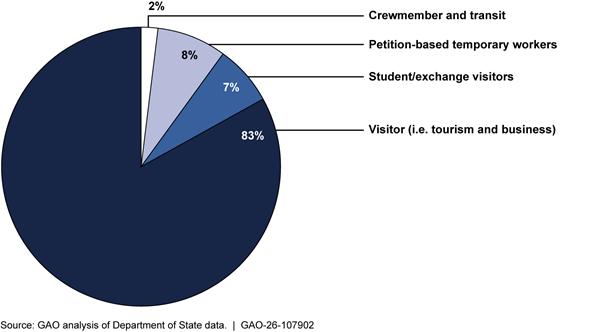
Note: Crewmember visas are for persons working on board commercial sea vessels or international airlines in the U.S., and transit visas are for persons transiting through the U.S. enroute to another country. Petition-based temporary worker visas are employment visas for foreign nationals who wish to work in the U.S. for a fixed period, such as persons in specialty occupations and temporary agriculture workers. Student visas are for persons who wish to enter the U.S. to attend an academic, vocational or other recognized nonacademic institution, and exchange visas are for persons approved to participate in exchange visitor programs in the U.S. such as government visitors, etc. Visitor visas are for persons who want to enter the U.S. temporarily for business, tourism, or for a combination of both purposes. These are broad and general descriptions of NIV categories; for the legal definitions, see 8 U.S.C. § 1101(a)(15).
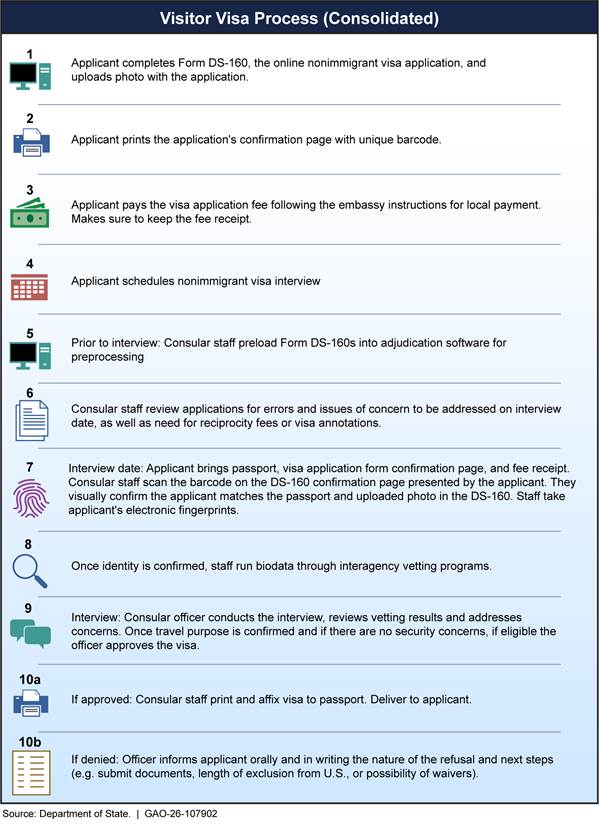
State manages the application process for NIVs, as well as the consular officer corps and its functions, at over 230 visa-issuing U.S. embassies and consulates abroad (hereafter referred to as “posts”), as of 2023. The NIV application process includes several steps, including documentation reviews, collection of biometrics (i.e., fingerprints and full-face photographs), cross-referencing of an applicant’s name and biometrics against multiple databases maintained by the U.S. government, and in-person interviews. In-person interviews with consular officers are generally required by law for most foreign nationals seeking NIVs. For an overview of the NIV process, see figure 2. State allows interview waivers in some instances for qualified applicants applying to renew NIVs (or for applicants for selected visas such as official or diplomatic visas).
National Security and Visa Application Wait Times
According to State officials, under the administration’s America First policy, they are prioritizing national security vetting over reducing the time it takes to obtain an NIV, including visitor visas. For example, State officials said they anticipate that the steps taken to focus on added security screenings—such as vetting social media presence of all students and exchange visitors applying for student visas—may result in longer wait times to obtain an interview.[6] State does not have an official goal for the length of time it should take to provide an interview and issue a visa. However, according to State officials, there is an unofficial goal of providing an interview within 90 days from the time an application is submitted.
NIV Demand Has Recovered from COVID Lows, but Average Wait Times Remain Higher than Pre-COVID Levels
Demand for and Adjudication of Nonimmigrant Visas Have Recovered and Surpassed Pre-COVID Levels
Demand
In FY 2019, demand for NIVs was at an estimated 11.4 million applications.[7] Demand dropped to 5.5 million in FY 2020 and then to 5 million in FY 2021. Demand during these years was directly affected by multiple COVID travel restrictions in place for travel into the U.S. from multiple countries.[8] For example, in 2020, the U.S. suspended entry for nearly all foreign nationals who had been present in 26 European countries, China, Brazil, and Iran at any point during the 14 days prior to their scheduled travel to the U.S. These restrictions affected some of the highest demand NIV countries like China and Brazil. In addition, the U.S. temporarily limited inbound land border crossings from Mexico to “essential travel,” which did not include tourism, from March 2020 to January 2022.
Demand began to recover in FY 2022, reaching about 10 million NIV applications that year, as travel restrictions were lifted and State began to resume normal operations.[9] In FY 2023, demand for NIVs surpassed pre-pandemic levels with 13 million applications and has continued to increase through FY 2025. According to a congressional report, the growth in demand may have resulted from pent-up demand for travel as the U.S. and countries worldwide eased pandemic restrictions on travel and as COVID-19 vaccines became widely available[10]. See figure 3 below for the number of NIV applications submitted each year from FY 2019 through FY 2025.
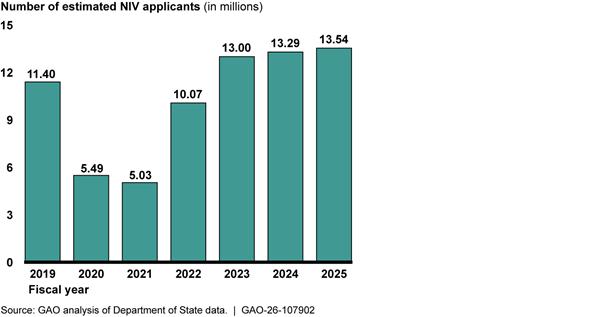
Note: State’s Bureau of Consular Affairs estimated the number of NIV applications in fiscal years 2019 through 2025 by dividing the total fee collections in a fiscal year by the average fee rate.
Adjudications
The trend in the number of NIVs adjudicated closely mirrored demand trends for NIVs from FY 2019 through 2025, dropping starting in FY 2020 and beginning to recover in FY 2022 (see fig. 4).[11] The number of adjudications increased starting in FY 2022, and, in FY 2023, 2024, and 2025, adjudications surpassed pre-pandemic levels. Adjudications for visitor visas, the largest category of NIVs, also went from 9.2 million in FY 2019 to a low of 1.5 million in FY 2021. However, in FY 2025 it recovered and surpassed pre-COVID levels, reaching 11.7 million, 2.5 million more than it was in FY 2019.
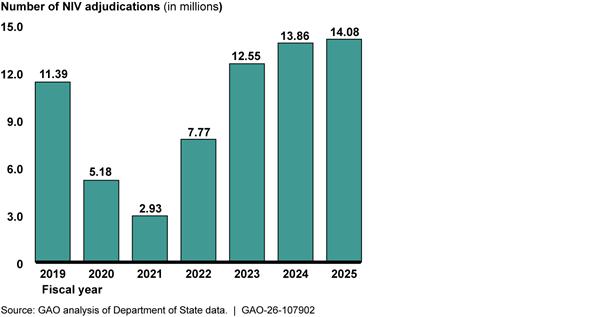
Note: Because processing times to adjudicate applications can range from a few days to several years, applications may be adjudicated in a fiscal year that is different from the fiscal year in which they were submitted.
COVID had a significant impact on the number of applications State adjudicated during that timeframe. According to State, in late March 2020, due to the COVID-19 pandemic, posts suspended routine visa services and provided only mission-critical and emergency services. As a result, the number of adjudications dropped. In FYs 2021 and 2022, adjudications fell below the number of applications submitted for those years. The largest difference was in FY 2021, when adjudications for NIVs represented about 58 percent of the number of applications received that year, which contributed to an increasing backlog. State defines backlog as accumulated visa applications waiting to be adjudicated and generally considers applications requiring more than a few months’ wait for an appointment a backlog. In FY 2024, the number of adjudications surpassed the number of applications for the first time since the pandemic, as State increased capacity for adjudication through increased number of staff and increased capacity for remotely processing visas, according to State officials. Adjudications also surpassed applications in FY 2025.
Average Wait Times for Visitor Visa Interviews Remain Longer than Pre-COVID Wait Times
Wait times for interviews for visitor visas were about eight times longer in FY 2025 than before the pandemic in FY 2019. In FY 2019, two countries—Russia and Haiti—had average visitor visa interview wait times longer than 90 days, and the global average visitor visa interview wait time was 26 days. However, in FY 2025, 39 countries had wait times longer than 90 days, and the global average visitor visa interview wait time was 201 days[12] (see tab. 1). Although average visitor visa interview wait times are not back to pre-pandemic levels, improvements have been made since FY 2022 when some countries had wait times exceeding 1,000 days, according to State.[13]
|
Fiscal year |
Average visitor visa wait time in days |
|
2019 |
26 |
|
2025 |
201 |
Source: GAO Analysis of Department of State data. | GAO-26-107902
Notes: Data provided by State for wait times from fiscal year (FY) 2020 through 2023 are not sufficiently complete for us to provide average wait times for those fiscal years. The average interview wait times for visitor visas does not factor in wait times for 11 posts in FY 2019 that interviewed a total of 189,076 visitor visa applicants, and nine posts in FY 2025 that interviewed a total of 7,395 visitor visa applicants because State was unable to provide usable wait time data for these posts.
In the countries with the 10 longest wait times for a visitor visa interview in FY 2025, average visitor visa interview wait times ranged from 293 days in Uganda to 597 days in Colombia (see tab. 2). These 10 countries collectively accounted for about 24 percent of the world’s visitor visa applications adjudicated in FY 2025. Further, three of them—Colombia, Canada, and India—were among the top 10 countries for the number of total visitor visa adjudications in FY 2025.
Table 2: Top 10 Countries with the Longest Wait Times to Obtain an Interview for a Visitor Visa, FY 2025
|
Country |
Average wait time in days |
|
Colombia |
597 |
|
Turkey |
489 |
|
Canadaa |
475 |
|
Honduras |
447 |
|
Peru |
373 |
|
Costa Rica |
356 |
|
India |
346 |
|
United Arad Emirates |
317 |
|
Bangladesh |
297 |
|
Uganda |
293 |
Source: GAO analysis of Department of State data. | GAO-26-107902
aApplicants in Canada are third-country nationals. Canadian citizens do not require visitor visas to visit the U.S, except, for example, where travel is for specified purposes. State was unable to provide usable wait time data for Montreal, a post in Canada, which adjudicated 234 visitor visas in FY 2025.
Staffing Levels for Adjudicating NIVs Almost Returned to Pre-COVID Levels in FY 2024 but Decreased in FY 2025
The number of staff working on NIVs decreased during the pandemic, began to recover to pre-COVID levels in FY 2023, but decreased again in FY 2025. The number of staff working on NIVs refers to those staff who adjudicate NIVs more than 50 percent of the time. In addition to staff working on NIVs, State assigns consular officers to other sections at posts within CA like Immigration Visas, American Citizens Services[14], and the Fraud Prevention Unit.
In FY 2019, there were 1,402 officers working on NIVs globally (see fig. 5). This number decreased during the COVID-19 pandemic, reaching a low of 1,104 in FY 2021. In FYs 2020 and 2021, State eliminated 81 positions in part to account for reductions in demand for NIVs. In addition, some staff were moved to other CA sections like American Citizens Services in posts like Mexico City. However, in FY 2023, the 81 positions were reestablished as demand returned to pre-COVID levels. In addition, State hired 120 limited non-career appointments (LNA)[15] staff in FY 2023 to fill adjudicator positions.
Figure 5: Number of Consular Officers and Temporary Adjudicators Working on NIVs Worldwide, FYs 2019–2025
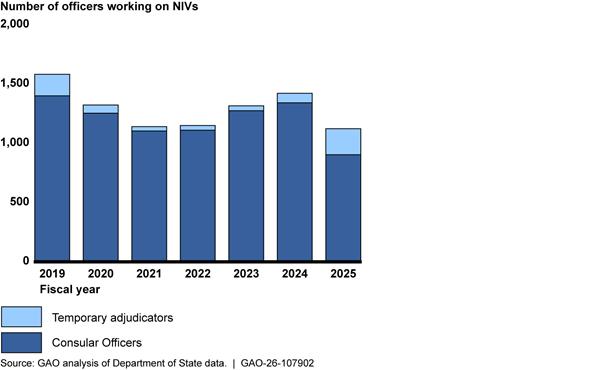
The number of officers working on NIVs almost returned to pre-pandemic levels in FY 2024, reaching 1,342. However, more recently in FY 2025, State reduced the number of officers working on NIVs to 904, a reduction of 498 CA officers from FY 2024. State officials explained that this reduction was largely due to the hiring freeze and reduction in force set in place on January 20, 2025, for the executive branch. This limited State’s ability to hire more staff. Attrition also contributed to this drop in staffing levels. State officials noted that consular leaders overseas also review their operations and shift officer duties as needed, including moving them to other consular sections like Immigrant Visas, Fraud Prevention, or American Citizens Services as needed.[16]
In addition to the number of CA officers working on NIVs at a post, State sends staff on temporary duty from other posts to posts with higher demand. These adjudicators are referred to as temporary adjudicators in this report. In FY 2019, there were 181 temporary adjudicators working on NIVs. The number of temporary adjudicators working on NIVs also decreased during the COVID-19 pandemic, reaching a low in FY 2021. By FY 2024, the number of temporary adjudicators had increased but remained below pre-COVID levels. However, in FY 2025, the number of temporary adjudicators working on NIVs increased to 220, surpassing pre-pandemic levels. State officials explained that this was due to CA sending temporary adjudicators from posts with lower demand to posts with prioritized needs like the FIFA World Cup, which explains the inverse relationship between fewer NIV officers and more temporary adjudicators.
State Officials Cited Inadequate Staffing Levels Relative to Demand as Affecting Wait Times; State Has Not Taken Steps to Ensure Staffing Exercise Consistently Occurs
State Officials in Selected Countries Attributed Long Wait Times to Inadequate Post Staffing Levels Relative to NIV Demand
According to interviews with CA managers and discussion groups with CA officers and Locally Employed Staff (LES) in Mexico, China, Brazil, and India, the demand for visitor visas relative to staffing levels at posts in these countries is the most significant factor contributing to wait times for applicants to obtain an interview. According to CA staff, not having adequate staffing levels to address demand limits their ability to conduct interviews and creates backlogs that result in longer wait times.
Wait times to obtain an interview in Mexico and India are longer than in China and Brazil, in part because they have fewer staff working on NIVs relative to the number of applications they receive. Mexico, China, Brazil, and India have the highest demand for NIVs in the world, with the majority of these applications being for visitor visas. In FY 2025, Mexico received about 2.7 million NIV applications; India 1.5 million; China 1.2 million and Brazil 1.1 million (see tab. 3).
Table 3: Nonimmigrant Visa (NIV) Applications, CA Officers working on NIVs, NIV Applications per CA Officer, and Weighted Average Wait Times to Obtain an Interview by Select Countries, Fiscal Year 2025
|
Country |
NIV applications |
CA officers |
NIV applications |
Average wait time to |
|
Brazil |
1,141,235 |
87 |
13,118 |
32 |
|
China |
1,206,011 |
119 |
10,135 |
34 |
|
India |
1,455,255 |
68 |
21,401 |
346 |
|
Mexico |
2,658,627 |
124 |
21,441 |
283 |
Source: GAO analysis of Department of State Data. | GAO-26-107902
State Did Not Consistently Conduct its Annual Global Repositioning Exercise from 2019–2025, Despite Misaligned Staffing Levels at Some Posts
Since 2019, State has conducted and implemented one Global Repositioning Exercise (GREX). According to State officials, GREX is intended to be conducted annually to align consular staffing levels with changing policy priorities and workloads. State officials stated that while the GREX is a State initiative, it is not required by law, regulation, or policy.
According to State officials, to conduct the GREX, they evaluate staffing requests from each post and consider a set of factors such as related workloads, achievements, staffing, and unique challenges at posts. They also use their professional judgment to conduct the exercise. Specifically, officials stated that the evaluation includes a data-driven analysis of how productive the post is in adjudicating visas in relation to other posts, appointment wait times, availability of current and projected double-encumbered positions, staffing changes for the past year, and physical space limitations.[17] Consular workload is evaluated based on the number of nonimmigrant, immigrant, and American Citizen Services performed during the previous fiscal year and the number of positions at the post that may be available to support adjudicators, such as LES and eligible family members.[18] According to these officials, they consider additional factors including the percentage of third-country nationals applying for visas at that post, average NIV refusal rate, host government cooperation, the likelihood of adding diplomatic positions, and the security environment in the host country.
While State officials said that the GREX is an initiative intended to be conducted annually, they explained the extent to which they completed the GREX from 2019 through 2025 and the reasons why they did not complete one every year:
· In FY 2019 State conducted a GREX and reported repositioning 10 positions; according to State, the modest number of repositions was due to demand for visas being lower that year than in previous years.
· In FY 2020, State issued a memo on the GREX explaining that given a worldwide decline in visa demand and sharp reduction in revenue, due to COVID, State decided not to reposition any positions that year.
· In FY 2021 and FY 2022, State did not conduct a GREX because they concentrated on reducing the number of consular positions due to the significant decline in visa applications during COVID.
· In FY 2023, State conducted a GREX to restore the positions they eliminated during COVID—an extensive exercise that restored 81 positions and took extra time to complete.
· State did not complete and implement a GREX for FYs 2024 and 2025 because of policy changes when the current administration took office, including a hiring freeze and a reduction in force.[19]
According to State officials, they are currently working on a GREX for FY 2026 and expect to continue using this exercise as their main mechanism to determine post consular workloads and staffing.
According to State officials, they have the ability to reallocate positions outside a GREX when necessary, which they have done to a limited extent in the years the exercise has not been conducted. State officials explained that in years when they have not conducted a full-scale GREX, they use the same methodology to assess any individual repositioning requests. They said adding or removing positions outside of the GREX review is not common, and that State discourages posts from requesting standard repositioning outside of a GREX. According to State officials, this is because State must make staffing decisions within its global cap of 1,925 consular positions. Adding a new position in one post would require abolishing a position at another post, which is something that cannot be done efficiently outside the GREX.
A GREX provides a centralized platform to undertake a worldwide review of posts’ workloads and related staffing needs. However, State officials stated that while the GREX is a State initiative, it is not required by law, regulation, or policy. State’s decision not to conduct a GREX consistently may have contributed to the misalignment of staff assigned to adjudicate NIVs in some posts with high demand, which could have contributed to long wait times for interviews. According to GAO’s Internal Control Standards, agencies should periodically evaluate their organizational structure so that it meets the entity’s objectives. Furthermore, management is responsible for evaluating pressure on personnel to help personnel fulfill their assigned responsibilities in accordance with the entity’s standards of conduct. Management may adjust excessive pressures by rebalancing workloads or increasing resource levels. In addition, management should establish control activities by documenting in policies what is expected and in procedures the specified actions that implement policies to mitigate risks to achieving the entity’s objectives to acceptable levels. Establishing a policy or guidance requiring State to consistently conduct and implement the GREX would help ensure that State consistently and fully assesses workloads and NIV demand at posts around the world and adequately addresses their staffing needs, particularly in years when staffing levels may be declining or other changes are affecting workload.
State Officials Identified Several Factors That Contribute to Wait Times for Interviews, in Addition to Staffing Levels
State officials and LES participating in interviews and discussion groups we conducted in Mexico City, New Delhi, Beijing, and Sao Paulo identified several other factors, in addition to staffing levels, that contribute to wait times for interviews and the efficiency of the visitor visa process. Factors identified included the COVID pandemic recovery process; the complexity of the applicant pool; the reliance on agents that applicants pay to apply for a visa, who are commonly referred to as “fixers”; the adequacy of post infrastructure; and technology.
COVID recovery. Wait times to obtain an interview for a visitor visa in all four countries increased from FY2019 to FY2025, with wait times in India and Mexico increasing to over 8 times as long (see tab. 4).
Table 4: Average Wait Times to Obtain a Visitor Visa Interview in Selected Countries, FYs 2019 and 2025
|
|
Average visitor visa wait time in days |
|
|
Country |
FY 2019 |
FY 2025 |
|
Brazil |
9 |
32 |
|
China |
18 |
34 |
|
India |
42 |
346 |
|
Mexico |
33 |
283 |
Source: GAO analysis of Department of State data. | GAO-26-107902
In FY 2025, visitor visa interview wait times in Mexico and India were over eight times longer than in FY 2019. Staff we interviewed in Mexico City and New Delhi reported having very high demand for NIVs and insufficient staff to address it coming out of the pandemic, which limited their ability to reestablish normal operations and led to backlogs. The number of officers working on NIVs in Mexico and India has increased since low levels during the COVID pandemic in FY 2022. In addition, in FY 2023, State sent over 100 CA officers and LES on temporary duty assignments to countries like Mexico and India to address staffing shortages and reduce wait times. Nevertheless, demand continues to be high, and long interview wait times persist.
Conversely, visitor visa interview wait times in Brazil and China were lower than in Mexico and India in FY 2025. Staff in Sao Paulo and Beijing reported having the resources necessary to reestablish normal operations after COVID. In China, there was a significant decline in demand for visas after the pandemic, allowing staff time to work through backlogs. According to State officials, this decline was related to an overall economic decline in China and an increased anti-Asian sentiment reported in the U.S. after COVID. In Sao Paulo, a CA manager said they received sufficient staff to reach pre-pandemic staffing levels soon after the pandemic. Furthermore, demand after the pandemic remained steady, which allowed them to work through the COVID backlog.
Complexity of the applicant pool. CA staff who participated in discussion groups in Mexico City and New Delhi reported that the complexity of the applicant pool at those posts requires CA officers to spend additional time and be more diligent when adjudicating visa applications. CA officials explained that every decision to adjudicate a visa is related to national security. Therefore, to prevent a security incident or applicants overstaying their visa they need to adequately assess the applicant’s qualification during the interview. For example, in Mexico City, CA officers said they identify a lot of ineligibilities based on previous immigration violations because of the proximity of Mexico to the U.S. They also reported having to spend additional time determining whether applicants have links to organized crime, especially since the U.S. decision that designated specified drug cartels as foreign terrorist organizations.[20] According to State officials, this designation disqualifies anyone with an association to a cartel from obtaining a visitor visa, which may include musicians and bands that play music celebrating cartel culture. Furthermore, according to State officials, Mexico City processes 92 percent of all temporary worker visas, which were prioritized over visitor visas after COVID. According to State officials, posts in Mexico also have a high number of third-country applicants applying for visitor visas, which may require additional time.
In New Delhi, CA officers reported seeing many applicants who apply for visitor visas with the likely intention of migrating to the U.S. According to State officials, to adjudicate a visa for such an applicant, officers must establish the applicant’s work and education history, ties to their home country, and connections they may have in the U.S., to assure that there is no risk of the applicant overstaying their visa. Often these applicants apply repeatedly after being denied, creating a greater strain on the system, according to CA officers. In addition, they said that many people apply for a visitor visa because it is seen as a social status symbol in India, but they have no intention of actually traveling to the U.S. Checking these types of factors takes additional time, according to State officials.
According to participants in Beijing and Sao Paulo discussion groups, applicants at these posts have less-complex profiles. For example, they said that travelers from China who obtain visitor visas have low overstay rates, simplifying the screening and adjudication process to some extent. State officials said that, while there are additional checks they must conduct for Chinese applicants because of concerns about espionage, illicit technology transfers, association with the Chinese Communist Party, and other security concerns, the majority are straightforward tourist applicants. According to discussion group participants in Sao Paulo, most visitor visas are straightforward tourist applicants with low overstay incidence, and there are fewer concerns about association with organized crime.
Infrastructure. Discussion group participants in Mexico City and New Delhi said that the number of customer service windows at their respective posts are not sufficient to accommodate the number of officers necessary to conduct NIV interviews each day, which affects their level of efficiency. Additionally, during our site visit, we observed hundreds of applicants in Mexico City and New Delhi lined up outside the U.S. embassy and in secondary waiting areas, due to space limitations inside the embassy. Management in Mexico City said that to overcome the shortage of windows they implemented an afternoon shift. Furthermore, at the time of our visit to Mexico City, CA was scheduled to move to a new U.S. embassy compound, which has more customer service windows.[21] CA in New Delhi is also planning to move into a new building on its embassy compound; however, the new location will have the same number of windows. Officers in Sao Paulo stated that the use of multiple shifts allows them to address the shortages of windows. Officials in Beijing said their post has enough customer service windows to meet demand working in one shift.
Prevalent use of fixers. Participants in discussion groups at all four posts reported that the prevalent use of agents hired by applicants to help them apply for a visa, commonly known as “fixers,” negatively affects wait times and efficiency. According to discussion group participants, while some fixers provide needed assistance to applicants and follow established rules, others can be unethical and try to circumvent the process. For example, New Delhi discussion group participants said that fixers advertise their services to unqualified applicants and encourage them to apply for visas that they are unlikely to obtain. According to State officials, these fixers coach unqualified applicants on how to dress and what to say in the interview to be approved for a visitor visa. Some of them offer their clients the chance to set up three interviews for a set price, contributing to numerous unqualified repeat applicants CA must interview. Furthermore, State officials at all four posts reported that some fixers often take up interview appointment slots as soon as they become available to sell to their clients, saturating the system and creating a scarcity of appointments for other applicants. This can add to interview wait times for applicants applying directly or through other agents. State has taken several steps to stop fixers from reserving appointments, which we discuss in more detail later in this report.
Technology. Staff at all four posts said they needed new IT systems for adjudicating visas to automate and consolidate tasks and improve efficiency. They stated that the IT systems they use are antiquated and inefficient. According to staff at post, CA also relies on multiple systems from multiple agencies to check applicants’ background information, such as the existence of criminal records and travel histories, which slows adjudicators down. CA managers in Mexico City explained that in posts like Mexico City where people have similar names, the current technology system often shows multiple false “hits”[22] in the interviewee’s application file, which slows adjudicators down as they must manually go through all the hits. We reported in 2015 that NIV system outages, worldwide outages of the Consular Consolidated Database, and poor user interfaces were challenges facing State. CA staff stated that the posts continue to face some of the same technology challenges highlighted in our 2015 report.[23] According to CA officers in Mexico City, workarounds have been created to help but have not resolved these issues.
State HQ officials noted that they are developing a modern, intuitive, web-based visa system, the Integrated Visa Application, that will replace the current systems. In addition, according to State HQ officials, CA’s Visa Office is continuously expanding innovative tools, including robotic process automation, to increase efficiency and accuracy in the systems currently being used.
State Has Taken Steps to Reduce Wait Times for Applicant Interviews
State has taken various steps at the global and post level to improve average interview wait times, which have improved since peaking during COVID, although they remain longer than pre-COVID levels. Of the 169 posts with available data, 97 had average visitor visa wait times of over 90 days in FY 2022. By FY 2025, this number had decreased to 65 of 205 posts.
To improve interview wait times, State has granted interview waivers where possible, processed eligible NIV applications remotely, required application numbers used to schedule an interview to match those on visa applications to prevent fixers from taking up interview appointments, and maximized support from Global Support Strategy (GSS) contractors. In addition, management at posts has taken other steps.
Interview waivers. According to State, they used interview waivers to significantly reduce average wait times by reducing the workload at many posts. In March 2021, to ease COVID workloads, State worked with the Department of Homeland Security to expand the window for applicants to renew a visa without an interview from 24 months to within 48 months of expiration for certain visa types. For example, in Mexico City, the percentage of interview waiver cases adjudicated at the post increased significantly during the pandemic. In FY 2019, around 50 percent of visitor visas adjudicated in Mexico City were interview waiver cases. This portion increased to almost 92 percent in FY 2021 as COVID severely limited the number of in-person interviews conducted; however by FY 2025 the rate was back to 43 percent. About 26 percent of NIVs issued globally in FY 2025 were adjudicated without an in-person interview.
According to information provided by State, as of October 1, 2025, consistent with the increased emphasis on national security, State has adjusted the requirements for interview waivers, which CA officials stated can have effects on wait times. State determined that most nonimmigrant visa applicants must be interviewed in person by a consular officer and reduced the renewal window to 12 months and only for certain visa types.
Remote processing. The Remote Processing Division (RPD), located in Washington, D.C., has increased CA’s capacity to adjudicate a larger number of NIVs while reducing the workload for some of State’s highest demand posts. The purpose of the RPD is to adjudicate interview waiver visas remotely that do not require local adjudication. According to State OIG officials, the RPD was set up in October 2012 to facilitate processing NIVs, specifically visitor visas, from China, since there was high demand. Activity in the RPD slowed down after a downturn in the Chinese economy and the COVID pandemic in 2020, according to State OIG officials. Post-COVID, capacity at the RPD increased significantly according to State.
In FY 2023, the RPD had a team of 60 adjudicators who adjudicated upwards of 12 percent of NIVs worldwide, freeing up staff time at posts and relieving demand burdens at some of the highest NIV demand posts. In New Delhi, for example, 80.6 percent of visitor visa interview waiver cases were adjudicated by the RPD and 45.7 percent of the post’s total visa workload was adjudicated by the RPD in FY 2024, according to data from the post. According to data from Mexico City, with expanded interview waiver authorities, the RPD adjudicated about 800,000 interview waiver NIV cases for Mission Mexico in both FY 2023 and FY 2024.
In addition to interview waiver cases adjudicated remotely by the RPD, posts with lighter demand also help adjudicate visitor visas remotely for posts with higher demand. Staff in New Delhi stated that in FY 2024, posts with lighter workloads, such as Beijing, helped remotely adjudicate interview waiver cases for them, helping further lighten their workload. According to CA officers in Sao Paulo, they also transferred interview waiver cases to Recife, another post in Brazil with lighter demand, for adjudication to help lighten their workload.
Global Support Strategy (GSS). According to CA, under GSS, State contracts out essential, nongovernmental support for visa operations at U.S. embassies and consulates worldwide. GSS contractors generally take on nongovernment work like appointment scheduling, fee collection, document delivery services, greeter services, and offsite facilities for biometrics and document services. GSS services are typically available at posts with 5,000 or more applications. Document delivery is added at posts with 10,000 or more applications, greeter services are added at posts with 20,000 or more applications, and offsite biometrics at posts with 250,000 applications or more. All four posts we visited had offsite biometric sites.
According to CA officers in Sao Paulo, GSS has lightened their workload. It has enabled posts to outsource certain administrative activities related to visa processing that would otherwise be handled by consular personnel. This has allowed consular officers to be able to spend more time adjudicating visas, which has allowed managers to schedule more interviews. Staff in Sao Paulo noted that GSS services were particularly helpful after COVID as they worked to reduce backlogs and lower wait times. For example, in Sao Paulo, GSS worked overtime to facilitate visa pickups. They also reorganized their application processing center to allow for a more efficient flow of applicants to support the surge of applicants after COVID.
System adjustments to increase appointment availability and efficiency. To reduce the effects of fixers, in April 2025, State began requiring that the barcode number on the interview confirmation page match the number used to schedule the interview. Interviewees with mismatched numbers were turned away. Management in Beijing said they expect this new policy to reduce instances of fixers using “dummy” or repeat visa application numbers to secure appointments for their clients. State officials also said they expect that this policy will allow them to preload and preprocess applications using the barcode before the interview resulting in more efficient and accurate NIV processing.
Management efforts at posts. In addition to centralized State efforts, staff who participated in our discussion groups in Mexico City, Sao Paulo, Beijing, and New Delhi highlighted management efforts they believe reduced wait times and improved the NIV adjudication processes at posts. Specifically:
· In Mexico City and Sao Paulo, management implemented morning and afternoon shifts to increase the number of adjudications and to overcome infrastructure challenges, as they did not have enough windows for all the adjudicators. For example, in Sao Paulo, they had 19 windows for 38 adjudicators; doing multiple shifts allowed all adjudicators to get a chance to conduct their 120 interviews a day.
· In New Delhi and Sao Paulo, management periodically organized events called “Super Saturdays” to have staff work extra hours on Saturdays to adjudicate more visas and reduce the backlog. New Delhi held quarterly “Super Saturdays,” while in Sao Paulo they held about four.
· According to post staff, in New Delhi and Beijing, management used validation studies to train adjudicators, reducing the time officers spend on interviews. Validation studies provide information such as overstay rates and adjustment rates in a country, and overstay rates by people of different ages, professions, from different regions, and for different visa types.
· According to CA officers in Sao Paulo, management prioritized reducing interview wait times for visitor visas by scheduling 120 interviews a day for fully-trained officers and introducing up to four shifts to accommodate extra officers. In addition, managers assigned staff from the Fraud Prevention Unit and American Citizens Services to help adjudicate visitor visas. Managers also helped to adjudicate visas. They also eliminated administrative days and training days and used all 5 workdays for interviews.
· In Beijing, management took several steps, such as using the “core crew” program to identify staff who will be available during high leave periods several months in advance. This allowed managers to open the number of appointments that could be covered during those high leave periods, ensuring that officers did not have to take up extra work and that applicants were able to attend interviews, keeping wait times low. Staff also noted that management had developed an effective onboarding training program that focuses on how to deal with the applicant population and address unique challenges of their applicant population.
Conclusions
Although maintaining national security is of paramount importance, processing visitor visas in a timely manner also has impacts on the U.S. travel and tourism industry and the broader U.S. economy. A natural tension exists between speed in adjudicating visitor visas—the highest demand NIVs—and addressing national security concerns. State officials identified a number of factors contributing to the efficiency of the visitor visa process and have taken steps at the global and post level to improve average interview wait times. However, State officials in the four selected countries we visited emphasized that adequate staffing levels at their posts, relative to demand, are critical to processing visitor visas in a timely manner. Yet since 2019, most of State’s efforts to address staffing needs have been focused on individual post’s staffing requests instead of conducting a global staffing needs assessment through the GREX. The GREX provides a centralized platform for undertaking a worldwide review of posts’ workloads and related staffing needs; however, the exercise is not required in policy, according to State officials. Establishing a policy or guidance requiring State to consistently conduct and implement the GREX would help ensure that State consistently and fully assesses workloads and NIV demand at posts around the world and adequately addresses their staffing needs, particularly in years when staffing levels may be declining or other changes are impacting workload.
Recommendation for Executive Action
The Secretary of State should establish a mechanism, such as a policy or other guidance, requiring State’s Bureau of Consular Affairs to consistently conduct its Global Repositioning Exercise to help ensure proportionate levels of staffing to address workloads at each post. (Recommendation 1)
Agency Comments and Our Evaluation
We provided a draft of this report to State for review and comment.
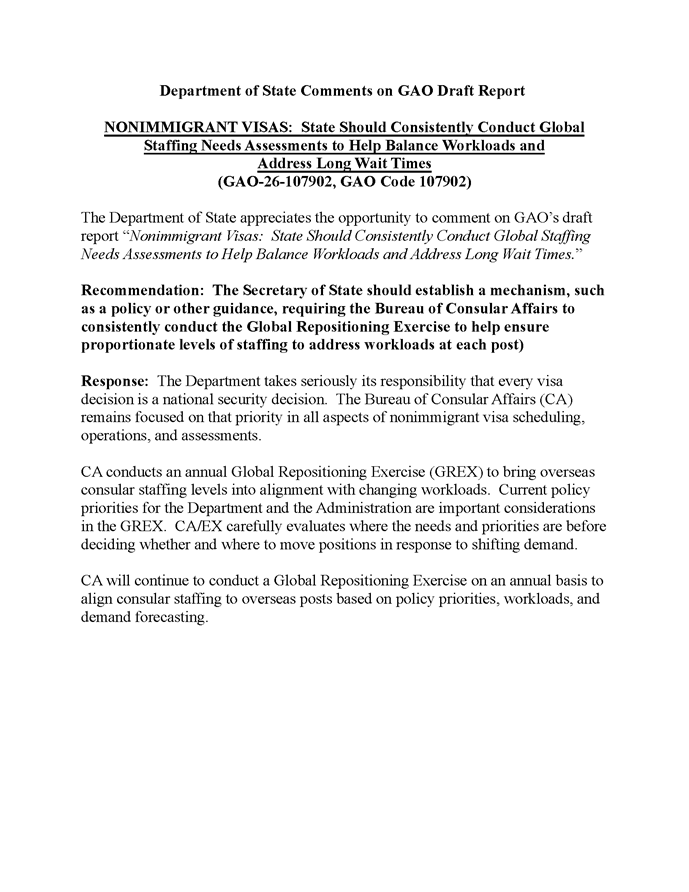
In its written comments, reproduced in appendix II, State neither agreed nor disagreed with the recommendation. State noted that it conducts a GREX on an annual basis and that current policy priorities are important considerations in the GREX. State also noted in its letter that it will continue to conduct these exercises on an annual basis.
However, as we have reported, State conducted and implemented one GREX in the past 6 years. In its letter, State did not address establishing a mechanism requiring CA to consistently conduct the GREX. We continue to believe that establishing such a mechanism would help position State to ensure there are proportionate levels of staffing to address workloads at each post.
We are sending copies of this report to the appropriate congressional committees and the Secretary of State. In addition, the report is available at no charge on the GAO website at https://www.gao.gov.
If you or your staff have any questions about this report, please contact me at WingerT@gao.gov. Contact points for our Offices of Congressional Relations and Media Relations may be found on the last page of this report. GAO staff who made contributions to this report are listed in appendix III.
Tatiana Winger
Director, Contracting and National Security Acquisitions
This report examines (1) trends in the number of applications and adjudications for nonimmigrant visas (NIV), associated wait times to obtain an interview, and staffing levels from fiscal year (FY) 2019 through FY 2025; (2) how staffing levels affect wait times and to what extent the Department of State determines posts staffing needs; (3) factors, if any, identified by State officials that contribute to wait times for NIV applicant interviews at selected overseas posts; and (4) the steps State has taken to reduce interview wait times for NIV applicants.
To report global average visitor visa wait times for FYs 2019, 2024, and 2025, for each fiscal year, we multiplied the number of applicants that, according to State, required a visitor visa interview at a post by the average post visitor visa wait time.[24] We then aggregated this number for all posts and divided it by the total number of applicants that required visitor visa interview at all posts, which resulted in weighted global average visa visitor wait.
The global average interview wait time for visitor visas does not factor in wait times for 11 posts in FY 2019 that interviewed a total of 189,076 visitor visa applicants; 18 posts in FY 2024 that interviewed a total of 159,883 visitor visa applicants, and nine posts in FY 2025 that interviewed a total of 7,395 visitor visa applicants because State was unable to provide usable wait time data for these posts.[25] State gave the following reasons for the missing data for these time periods: the post was not issuing routine visas, the post was in a status such as “Emergency Appointments Only” or “Temporarily Closed” for at least part of the year that made calculating reliable averages impossible, or there were gaps in data reporting from these posts.
We did not calculate global average visitor visa wait times for FYs 2020, 2021, 2022, or 2023 because the data were not sufficiently reliable for calculating these averages. Data for these years included multiple missing values or placeholder values of “999” to denote various reasons for missing data, such as the post being in “Emergency Appointments Only” or “Temporarily Closed” status for at least part of the year, or actual wait times of or exceeding 1,000 days. Given the prevalence of missing values and use of the “999” placeholder for those years, we determined that the data were not sufficiently reliable for calculating global average wait times. However, we found the data sufficiently reliable for the purposes of calculating and reporting average visitor visa wait times in FYs 2019, 2024, and 2025. However, for all fiscal years, including the ones for which we found the data reliable for our reporting purposes, the data provided by State contained several posts that were missing data entirely, these were reported by State as posts that were not issuing NIVs in the fiscal year.
To calculate the countries with the longest average visitor visa wait times in 2025, we used the average visitor visa wait times and the number of visitor visa adjudications for each of the posts within the country to calculate a weighted average for visitor visa wait time by country. Averages were weighted using the number of visitor visas the post adjudicated.
To report on the total number of NIV applications per year from FY 2019 to 2025, State divided the total machine-readable visa (MRV) fees collected for NIVs each fiscal year by the average fee rate. MRV fees are collected at the country level, and the NIV type is not specified during payment. As a result, State does not have data on MRV fee collections by post or visa type.
To report on the total number of NIV adjudications each year from FYs 2019 through 2025, we aggregated the adjudications at all NIV-issuing posts for all NIV visa types for the respective fiscal years, including student/exchange visitors, petition-based temporary workers, crew and transit, and visitor visas.
Staffing level data was provided by State for each post that included the total number of consular officers, consular officers working on NIVs, temporary adjudicators, and temporary adjudicators working on NIVs. The data were snapshots of officers working at each post in March of that fiscal year for consistency and comparison purposes. The number of consular officers working on NIVs represents the number of officers working as NIV adjudicators more than 50 percent of the time.
To report on how staffing levels affect interview wait times and factors that contribute to wait times for NIV applicants to obtain an interview, we selected four countries for site visits and more in-depth analysis: Mexico, China, Brazil, and India. To select countries for our in-depth analysis, we analyzed data provided by State on NIVs and considered the number of visa applications that, according to State, require an interview; the average wait time for scheduling an interview; the number of consular officers responsible for adjudicating NIVs for each country; and their estimated workload, regional diversity, and accessibility of the country. Using these criteria, we identified two types of countries within our scope and focus of research: 1) countries with high demand for NIVs and long visitor visa interview wait times of over 90 days, and 2) countries with high demand for NIVs and short visitor visa interview wait times of 90 days or less. We identified the top 10 countries with high demand for NIVs and long wait times for applicants to obtain an interview and the 10 countries high demand for NIVs and short wait times for applicants to obtain an interview. We used this time frame because State has an unofficial goal of providing an interview within 90 days from the time an application is submitted. Mexico followed by India were the two countries with the highest demand for NIV and long wait times. Brazil followed by China were the two counties with the highest demand for NIVs and short wait times.
To select the countries for our site visits, we focused our analysis on B1/B2 visas issued in FY 2024, the most common type of NIV issued. Within these four countries, we selected posts with the highest number of visitor visa adjudications in each country, which were Mexico City, Beijing, Sao Paulo, and New Delhi. During our site visits, we conducted discussion groups with Consular Affairs (CA) officers and Locally Employed Staff (LES) and interviews with CA managers to identify factors that impact wait times, toured Consular facilities, and observed the NIV adjudication process. The observations that discussion group participants made are not generalizable. In addition, we reviewed documents provided by State on factors that affect wait times during and after the COVID pandemic, such as cables and public announcements.
To report on average visitor visa wait times; number of staff working on NIVs; and number of visitor visa applications, and NIV applications per CA officer for Mexico, India, Brazil, and China in FY 2025, we requested data from the countries we visited on visitor visas adjudications and applications, wait times, and staffing levels for all posts within these four countries. We used the average visitor visa wait times and the number of visitor visa adjudications for each of the posts in the country to calculate a weighted average visitor visa wait time for the country. We calculated the number of staff working on NIVs by aggregating the number of staff working on NIVs at all posts in the country. We divided the number of applications in country by the number of CA officers working on NIV in the country to calculate the number of NIV applications per CA officer. We included Hong Kong in our calculations for China.
To report on the process State follows to determine posts’ consular staffing needs, we reviewed related documents and met with State officials. Specifically, we reviewed available documents, such as memos that record State’s annual Global Repositioning Exercise (GREX), the process State follows to bring overseas consular staffing levels into alignment with changing policy priorities and workloads. We reviewed information regarding the scope and methodology of the GREX. Because State had conducted and implemented one GREX since 2019, we also requested information about the process State follows to make post consular staffing decisions when a GREX is not conducted. We met with State officials and subject matter experts responsible for conducting the GREX and making staffing decisions when the GREX is not conducted. These officials explained the GREX process, the reasons it has not been completed annually since 2019, and how staffing decisions have been made during the years the GREX was not conducted.
To report on the steps State has taken to reduce interview wait times for NIV applicants, we conducted discussion groups in our four selected posts with CA officers and LES and interviewed managers. We also reviewed State documentation such as cables and public announcements on steps State has taken to address interview wait times and resolve inefficiencies. We also interviewed State officials in Washington, D.C., to discuss efforts State has taken to reduce wait times.
We conducted this performance audit from November 2024 to September 2026 in accordance with generally accepted government auditing standards. Those standards require that we plan and perform the audit to obtain sufficient, appropriate evidence to provide a reasonable basis for our findings and conclusions based on our audit objectives. We believe that the evidence obtained provides a reasonable basis for our findings and conclusions based on our audit objectives.
GAO Contact
Tatiana Winger, WingerT@gao.gov
Staff Acknowledgments
In addition to the contact named above, Jeffrey Baldwin-Bott (Assistant Director), Francisco M. Enriquez (Analyst-in-Charge), Kevin Donovan, Mark Dowling, Kumba Gaye, John Hussey, Christopher Keblitis, Abinash Mohanty, and Terry Richardson made key contributions to this report.
The Government Accountability Office, the audit, evaluation, and investigative arm of Congress, exists to support Congress in meeting its constitutional responsibilities and to help improve the performance and accountability of the federal government for the American people. GAO examines the use of public funds; evaluates federal programs and policies; and provides analyses, recommendations, and other assistance to help Congress make informed oversight, policy, and funding decisions. GAO’s commitment to good government is reflected in its core values of accountability, integrity, and reliability.
Obtaining Copies of GAO Reports and Testimony
The fastest and easiest way to obtain copies of GAO documents at no cost is through our website. Each weekday afternoon, GAO posts on its website newly released reports, testimony, and correspondence. You can also subscribe to GAO’s email updates to receive notification of newly posted products.
Order by Phone
The price of each GAO publication reflects GAO’s actual cost of production and distribution and depends on the number of pages in the publication and whether the publication is printed in color or black and white. Pricing and ordering information is posted on GAO’s website, https://www.gao.gov/ordering.htm.
Place orders by calling (202) 512-6000, toll free (866) 801-7077,
or
TDD (202) 512-2537.
Orders may be paid for using American Express, Discover Card, MasterCard, Visa, check, or money order. Call for additional information.
Connect with GAO
Connect with GAO on X,
LinkedIn, Instagram, and YouTube.
Subscribe to our Email Updates. Listen to our Podcasts.
Visit GAO on the web at https://www.gao.gov.
To Report Fraud, Waste, and Abuse in Federal Programs
Contact FraudNet:
Website: https://www.gao.gov/about/what-gao-does/fraudnet
Automated answering system: (800) 424-5454
Media Relations
Sarah Kaczmarek, Managing Director, Media@gao.gov
Congressional Relations
David A. Powner, Acting Managing Director, CongRel@gao.gov
General Inquiries
[1]GAO, Nonimmigrant Visas: State Has Reduced Applicant Interview Wait Times, but Sustainability of Gains is Uncertain, GAO-15-773 (Washington, D.C.: Sep. 9, 2015).
[2]Pub. L. No 118-47 138 Stat. 460 (Mar. 23, 2024).
[3]Data sets for these years included multiple missing values or placeholder values of “999” to indicate various reasons for missing data, such as the post being in “Emergency Appointments Only” or “Temporarily Closed” status for at least part of the year, or actual wait times exceeding 1,000 days.
[4]The Visa Waiver Program enables most citizens or nationals of participating countries to travel to the U.S. for tourism or business for stays of 90 days or less without obtaining a visa.
[5]The maximum period of validity of a visitor visa is 10 years from the date of issuance and allows for multiple entries.
[6]In June 2025, State announced that it would conduct comprehensive vetting, including the online social media presence of all students and exchange visitors applying for visas.
[7]Demand for NIVs is calculated from the total number of machine-readable visa (MRV) application fees received by State in a fiscal year. State’s Bureau of Consular Affairs estimated the number of NIV applications in FYs 2019 through 2025 by dividing the total fee collections in a fiscal year by the average fee rate. MRV fee data are only available at the country level and for all NIVs; there are no data available at the post level or by visa type. Demand for NIVs does not mirror the number of visitors that enter the U.S. each year since a significant number of visitors are from visa waiver countries and visitors may also hold multiple-entry visas.
[8]In this report, pre-COVID refers to FY 2019 and before. COVID refers to FY 2020, 2021, and 2022. Post-COVID refers to FY 2023 and after.
[9]The Centers for Disease Control ended the Federal COVID-19 Public Health Emergency Declaration in May 2023. However, State resumed full routine NIV services earlier in Sao Paulo and New Delhi (February 2022), in Mexico City (May 2022), and in Beijing (December 2022).
[10]Congressional Research Service, U.S. Tourism: Economic Impacts and Pandemic Recovery (Washington, D.C.: Nov. 29, 2023).
[11]Demand refers to the number of NIV applications received, whereas adjudications refer to the number of applications that were processed. We report on both types of data to show an emergence of a backlog (applications outpacing adjudications) during the COVID pandemic that led to higher interview wait times.
[12]In FY 2024, the average visitor visa interview wait time was 246 days. This wait time does not factor in wait times for 18 posts that interviewed a total of 159,883 visitor visa applicants because State was unable to provide usable wait time data for these posts.
[13]Data provided by State for wait times from FY 2020 through 2023 are not sufficiently complete and reliable for us to provide global average wait times for those fiscal years. This is due to adjustments to the data during the COVID pandemic. During these fiscal years, State used a placeholder entry (“999”) in the wait time field to indicate a number of different circumstances in addition to actual wait times of or exceeding 1,000 days.
[14]The American Citizens Services unit issues emergency passports, processes passport applications, registers the birth of U.S. citizen children born abroad, provides notarial services, assists with information on voting in the U.S., and provides information on Social Security benefits. It also assists U.S. travelers in distress, for example, in acquiring funds from home, arranging for medical care, or assisting U.S. citizens who are arrested or incarcerated.
[15]State places competitively qualified U.S. citizens into Foreign Service LNAs in posts with high workloads. These employees are professional members of consulate and embassy teams to which they are assigned. An LNA contract is limited to 5 years with the possibility of a 1-year extension.
[16]State officials noted that things have changed significantly in FY 2026 as the hiring freeze has been lifted for Foreign Service Officers, LNAs, eligible family members, and LES. They said that they are back to hiring at the rate they did before the hiring freeze.
[17]Positions that are double encumbered occur when an officer assigned to replace an incumbent arrives at post before the current incumbent departs. This creates a temporary double encumbering of a single position.
[18]Eligible family members typically include spouses or domestic partners of State Officials serving abroad. Eligible family members may have access to employment opportunities while stationed overseas.
[19]According to State officials, they were working on the FY 2024 GREX when the current administration took office. They did not complete the GREX due to shifts in priorities by the administration, including plans for a reduction in force.
[20]On February 20, 2025, the designation by State of eight Latin American drug trafficking cartels as Foreign Terrorist Organizations and Specially Designated Global Terrorists took effect, in response to Executive Order 14157. Designating Cartels and Other Organizations as Foreign Terrorist Organizations and Specially Designated Global Terrorists, 90 Fed. Reg. 8439 (Jan. 20, 2025).
[21]The U.S. Embassy in Mexico City began operations at their new embassy compound on November 24, 2025.
[22]“Hits” refer to information that could disqualify the applicant from receiving an NIV such as a criminal record. False hits refer to those that upon further investigation do not match the applicant’s birth date, full name, or nationality.
[23]GAO, Nonimmigrant Visas: State Has Reduced Applicant Interview Wait Times, but Sustainability of Gains is Uncertain, GAO-15-773 (Washington, D.C.: Sept. 9, 2015). We made the following recommendations to State: 1) Evaluate the relative impact of efforts undertaken to reduce NIV interview wait times to help managers make informed future resource decisions. 2) Document a plan for obtaining end user (i.e., consular officers’) input to help improve end user satisfaction and prioritize enhancements to information technology systems. The first recommendation was closed as not implemented due to a shift in State’s focus from wait times to security. State addressed the second recommendation by transmitting a cable that outlined State’s updated methods for submitting requests to Consular Affairs and State’s process for reviewing, discussing, approving, and prioritizing legacy system enhancement and new functionality requests.
[24]According to State officials at post, wait times are defined as the number of calendar days until the next day with at least 5 percent of appointments available.
[25]The average visitor visa wait times did not factor in the following posts for FY 2019: Caracas, Chengdu, Havana, Juba, Kabul, Khartoum, Maseru, Minsk, Sofia, Vladivostok, and Yekaterinburg. The following were not factored in for FY 2024: Baghdad, Dili, Hamilton, Havana, Helsinki, Juba, Kinshasha, Kyiv, Lilongwe, Malabo, Maseru, Montreal, Moscow, Niamey, Port Au Prince, Rangoon, Sofia, and Tijuana. The following posts were not factored in for FY2025: Dili, Hamilton, Havana, Juba, Kyiv, Maseru, Montreal, Moscow, and Port Au Prince.