
Report to Congressional Committees
United States Government Accountability Office
A report to congressional committees
For more information, contact: Allison Bawden at BawdenA@gao.gov
What GAO Found
In July 2024, the National Nuclear Security Administration (NNSA) released an internal Integrated Science, Technology, and Engineering (ST&E) Plan documenting investments needed for ST&E capabilities over the next 20 years. NNSA’s plan identified and prioritized 46 ST&E facility investments across the nuclear security enterprise that support stewardship of the nuclear weapons stockpile and other NNSA missions. The investments were prioritized by mission importance and mission need time frame. They included sustainment and enhancement of existing facilities and construction of new facilities.
NNSA also collected initial estimates of related ST&E workforce and programmatic investment needs—such as needed equipment and materials—from the nuclear security enterprise sites for the 20-year period. However, NNSA did not fully assess these funding needs and has no plans to do so. NNSA officials said that the plan focused on facility investments due to a deadline to provide that information for the agency’s Enterprise Blueprint, which was publicly released. Completing a comprehensive analysis of the ST&E workforce and programmatic investment needs would allow NNSA to better understand the total funding needs for stockpile stewardship and proactively plan for those needs.
Annular Core Research Reactor, a National Nuclear Security Administration Facility Requiring Sustainment Investment
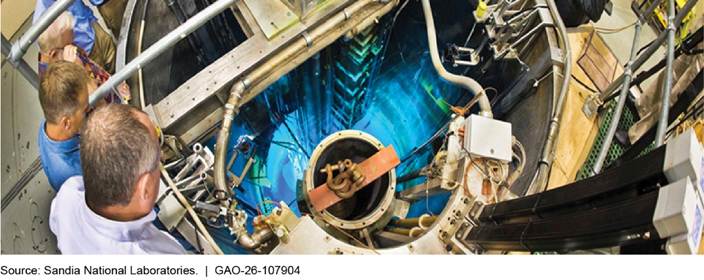
NNSA provided the most detailed cost information on seven high mission importance, near-term ST&E facility investment projects in the Department of Energy’s fiscal year 2026 budget justification. Cost information on other proposed facility investments was limited because the projects are in early planning phases or are sustainment investments.
NNSA officials said they have not updated their integrated assessment of future ST&E facility investment needs. NNSA’s ST&E facility priorities have already evolved and may further change over time to reflect changes in congressional priorities or new technologies in areas such as high energy density physics, artificial intelligence, or production. Regularly updating the agency’s integrated assessment of its ST&E facility needs would help guide future investment decisions to support stockpile stewardship and modernization.
Why GAO Did This Study
NNSA relies on unique science, technology, and engineering facilities and a skilled contractor workforce across the nuclear security enterprise to maintain and modernize the nuclear weapons stockpile without relying on nuclear explosive testing. According to NNSA, many ST&E facilities are decades old. A 2022 major review recommended that NNSA develop an enterprise-wide plan to revitalize its ST&E facilities and workforce.
Senate Report 118-58 accompanying a bill for the National Defense Authorization Act for fiscal year 2024 includes a provision for GAO to review NNSA’s plans for ST&E capabilities. This report examines (1) the extent to which NNSA’s Integrated ST&E Plan identified and prioritized the ST&E facilities, workforce, and programmatic investments needed to support stockpile stewardship; (2) the information available about estimated costs of these investments; and (3) the extent to which NNSA is regularly updating its integrated assessment of ST&E facility investment needs.
GAO reviewed agency and national security laboratory contractors’ documents related to the Integrated ST&E Plan and budget documents; made site visits to facilities at NNSA’s Los Alamos and Sandia National Laboratories in New Mexico; and interviewed NNSA officials and laboratory contractors.
What GAO Recommends
GAO is making two recommendations to NNSA to analyze ST&E workforce and programmatic investment needs and to regularly update its integrated assessment of ST&E facility investment needs. NNSA’s comments outline actions it plans to take to address both recommendations.
|
Abbreviations |
|
|
|
|
|
ACRR |
Annular Core Research Reactor |
|
CREST |
Combined Radiation Environments for Survivability Testing |
|
DARHT |
Dual-Axis Radiographic Hydrodynamic Test |
|
DOE |
Department of Energy |
|
ECSE |
Enhanced Capabilities for Subcritical Experiments |
|
HEAF |
High Explosives Applications Facility |
|
HERMES |
High-Energy Radiation Megavolt Electron Source |
|
Integrated ST&E Plan |
Developing an Integrated Plan for Revitalization of NNSA Science, Technology, and Engineering |
|
LANSCE |
Los Alamos Neutron Science Center |
|
LAMP |
LANSCE Accelerator Modernization Project |
|
Livermore |
Lawrence Livermore National Laboratory |
|
Los Alamos |
Los Alamos National Laboratory |
|
MC2 |
Microelectronic Components Capability |
|
MESA |
Microsystems Engineering, Science, and Applications |
|
M&O |
Management and operating |
|
NIF |
National Ignition Facility |
|
NIF EYC |
NIF Enhanced Fusion Yield Capability |
|
NNSA |
National Nuclear Security Administration |
|
PULSE |
Principal Underground Laboratory for Subcritical Experimentation |
|
ST&E |
Science, technology, and engineering |
|
Sandia |
Sandia National Laboratories |
|
Zeus |
Z-Pinch Experimental Underground System |
This is a work of the U.S. government and is not subject to copyright protection in the United States. The published product may be reproduced and distributed in its entirety without further permission from GAO. However, because this work may contain copyrighted images or other material, permission from the copyright holder may be necessary if you wish to reproduce this material separately.
July 15, 2026
Congressional Committees
The National Nuclear Security Administration (NNSA) within the Department of Energy (DOE) is responsible for maintaining and advancing the safety, security, and reliability of the U.S. nuclear weapons stockpile, among other missions.[1] NNSA relies on unique science, technology, and engineering (ST&E) facilities and a highly skilled workforce across the U.S. nuclear security enterprise to assess and certify the current stockpile’s performance and to research and develop new materials, designs, technologies, and production processes for modernizing the nuclear deterrent. NNSA uses this science-based stockpile stewardship model to maintain and modernize the nuclear stockpile without relying on nuclear explosive testing. Since 1992, the United States has observed a moratorium on nuclear explosive testing based on the ongoing national security assessment that it does not need to conduct such testing to ensure the safety, security, and effectiveness of the nuclear weapons it maintains.[2]
In September 2022, NNSA completed a major review, called the Enhanced Mission Delivery Initiative, of its ability to deliver its national and global security missions. According to the published report of the review, many of the agency’s ST&E facilities and test infrastructure are considered relatively new and well maintained but are decades old. The report further noted that NNSA is investing in new ST&E capabilities but did not have a nuclear security enterprise-wide strategic plan.[3] NNSA is also currently investing in several multi-billion-dollar weapon and production modernization programs in response to concerns about the age of the existing stockpile and in response to a deterioration in the international security environment with the U.S. facing, for the first time in its history, two major nuclear powers. In this context, the 2022 mission delivery review recommended that NNSA develop an integrated strategic plan to revitalize the ST&E base that includes time-phased investments in new and recapitalized facilities, and investments in the ST&E workforce.
In response to this recommendation, NNSA released an internal strategic plan in 2024—Developing an Integrated Plan for Revitalization of NNSA Science, Technology, and Engineering (Integrated ST&E Plan)—for investing in ST&E across the nuclear security enterprise. The Integrated ST&E Plan documented NNSA’s intended coordinated approach to modernize ST&E facilities across the enterprise over the next 20 years to support its stockpile stewardship, nonproliferation, and counterproliferation missions.[4] The plan also documented NNSA’s assessment of ST&E workforce and programmatic investments needed over the same time period. These programmatic investments included equipment and materials for carrying out experiments and other ST&E activities. Subsequently, NNSA released its publicly available Enterprise Blueprint that outlines broader planned requirements for recapitalizing or building new facilities, including ST&E facilities, to meet its missions over the next 25 years.[5] The Integrated ST&E Plan provided information about the ST&E facilities for the Enterprise Blueprint effort.
Senate Report 118-58 accompanying a bill for the National Defense Authorization Act for fiscal year 2024 includes a provision for GAO to review NNSA’s plans for ST&E capabilities as part of the agency’s stockpile stewardship mission.[6] This report examines (1) the extent to which NNSA’s Integrated ST&E Plan identified and prioritized the ST&E facilities, workforce, and programmatic investments needed to support stockpile stewardship; (2) the available information about estimated costs of the proposed facility investments; and (3) the extent to which NNSA is regularly updating its integrated assessment of needed ST&E facility investments.
To address the first objective, we examined agency documents including the Integrated ST&E Plan, the recommendation from NNSA’s major mission delivery review and NNSA senior leadership’s tasking memo about developing the Integrated ST&E Plan.[7] We also interviewed laboratory contractors who provided NNSA with information on the identified ST&E facility investments and estimates of needed ST&E workforce and programmatic investments. To address the second objective, we reviewed information on estimated costs of ST&E facility investments that was available in DOE’s fiscal year 2026 congressional budget justification and in other sources such as NNSA project documents, guidance, and facility plans and presentations from laboratory contractors.[8] We also reviewed NNSA guidance for preparing cost estimates for capital acquisition projects, which we then assessed against GAO’s 12-step process for developing reliable cost estimates (see app. III).[9] To address the third objective, we interviewed NNSA officials involved in the Integrated ST&E Plan’s five identified areas of future work. In addition, we reviewed the Integrated ST&E Plan, NNSA senior leadership’s tasking memo on developing the plan, and NNSA’s Planning, Programming, Budgeting, and Evaluation Process. We also applied our best practices for evidence-based policy making.[10]
To address all three objectives, we interviewed NNSA program officials in headquarters and field offices and representatives from management and operating (M&O) contractors who helped develop and oversee the Integrated ST&E Plan at Los Alamos National Laboratory (Los Alamos), Sandia National Laboratories (Sandia), and Lawrence Livermore National Laboratory (Livermore). We also conducted site visits to a nongeneralizable sample of six ST&E facilities at Los Alamos and Sandia in New Mexico to observe the facilities’ current conditions and to better understand NNSA’s investment priorities and plans. Since most of the ST&E facility investments were designated for the three national security laboratories, as discussed in this report, we focused on the laboratories and did not visit all sites across the nuclear security enterprise where current or planned facility investments are located. In addition, we leveraged findings as they related to the Integrated ST&E Plan from two of our recent reports: our 2023 report on NNSA’s Enhanced Capabilities for Subcritical Experiments (ECSE) program and related projects and our 2025 report on NNSA’s Inertial Confinement Fusion program’s recapitalization efforts.[11] In conducting audit work for both efforts we visited relevant ST&E facilities and projects at Livermore and the Nevada National Security Site. For more information on our methodology, see appendix I.
We conducted this performance audit from October 2024 to July 2026 in accordance with generally accepted government auditing standards. Those standards require that we plan and perform the audit to obtain sufficient, appropriate evidence to provide a reasonable basis for our findings and conclusions based on our audit objectives. We believe that the evidence obtained provides a reasonable basis for our findings and conclusions based on our audit objectives.
Background
The United States Nuclear Security Enterprise
NNSA’s federal employees oversee about 59,000 M&O contractor employees who manage the eight government-owned sites that comprise the U.S. nuclear security enterprise. These sites include three national security laboratories, four production sites, and a national security site. (See fig. 1).
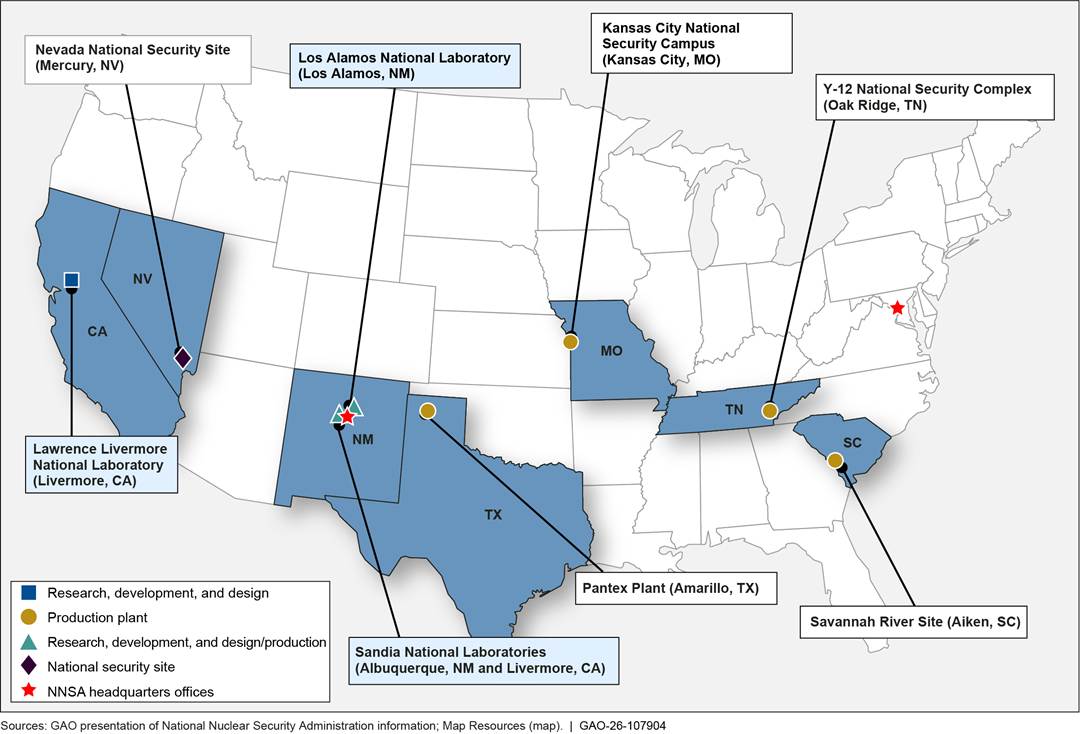
A wide variety of research, development, testing, evaluation, and production activities to support the stockpile is conducted at NNSA sites. The three NNSA national security laboratories—Los Alamos in New Mexico, Sandia in New Mexico and California, and Livermore in California—are primarily responsible for nuclear weapons design and related science, technology, and engineering activities in support of the stockpile. The four production sites are primarily responsible for production and assembly of nuclear weapons materials, components, and systems.[12] The Nevada National Security Site is responsible for unique nuclear and non-nuclear experiments that are essential to maintaining the stockpile.[13]
U.S. Stockpile Stewardship and Modernization
Starting in the early 1990s and the end of the Cold War, stockpile stewardship focused on surveillance, sustainment, and component life-extension for the existing nuclear stockpile to meet its mission requirements. This has been done in the absence of underground nuclear testing by an expert workforce using a network of unique experimental, testing, and computational capabilities.
As noted in the 2022 Nuclear Posture Review and the 2023 Strategic Posture Commission report, in recent years, the international security environment has deteriorated. The U.S. now faces, for the first time in its history, two major nuclear powers as strategic competitors and potential adversaries.[14] This evolving threat environment has shortened time frames and increased workload for the nuclear security enterprise. NNSA’s scope of work is now centered on simultaneously sustaining and modernizing U.S. nuclear weapons and recapitalizing and modernizing its production infrastructure. To meet Department of Defense requirements and congressional direction, NNSA is currently undertaking five nuclear weapon modernization programs.[15] According to NNSA’s fiscal year 2025 Stockpile Stewardship and Management Plan, cost estimates for these efforts range from approximately $100 million to $28 billion each.[16] In addition, NNSA has ongoing studies to evaluate options to meet potential future military needs.
Concurrently with and in service of NNSA’s weapons modernization, NNSA is also modernizing its outdated production infrastructure for capabilities such as those needed to produce plutonium pits, uranium secondaries, high explosives, and non-nuclear components at scale.[17] NNSA officials have described the several hundred-billion-dollar efforts to modernize, expand, and manufacture a modern, safe, and reliable U.S. arsenal in a limited time frame as the busiest the agency has been in three decades.
Role of ST&E in Science-Based Stockpile Stewardship and Modernization
ST&E activities that support science-based stockpile stewardship and modernization underpin NNSA’s ability to ensure the current stockpile is safe, secure, and effective and modernize the nuclear stockpile while maintaining the U.S. moratorium on nuclear explosive testing.
According to NNSA’s Fiscal Year 2025 Stockpile Stewardship and Management Plan, the agency’s ST&E activities fall under four areas: (1) computational science, (2) experimental science, (3) engineering and technology, and (4) production science.[18] Table 1 describes the ST&E activities and examples of associated capabilities needed to carry them out.
Table 1: Nuclear Security Enterprise Science, Technology, and Engineering (ST&E) Areas, Activities, and Examples of Capabilities that Support Stockpile Stewardship and Modernization
|
ST&E area |
ST&E activities |
Examples of ST&E capabilities |
|
Computational science |
Computer modeling and simulations combined with modern data science methods, including artificial intelligence/machine learning, allows NNSA to advance ST&E tools and design, certify, sustain, and assess nuclear weapons. |
Advanced high-performance computers and data and computing facilities with sufficient power and cooling and other infrastructure. |
|
Experimental science |
Experiments that leverage historical underground test data and generate new data needed to advance understanding of the physics associated with nuclear weapon design, assessment, and qualification, and validate computer codes and models used to certify nuclear weapons. These include hydrodynamic experiments, subcritical experiments, and high energy density experiments.a |
Lasers, linear accelerators, and pulsed power technologies that can examine in a laboratory environment the extreme temperature, pressure, and radiation conditions that occur during a nuclear explosion. These capabilities are located in facilities with specialized support infrastructure, such as for heating, cooling, power, and water supply to allow their safe and effective operation. |
|
Engineering and technology |
Engineering and technology activities enable NNSA to design, develop, certify, and qualify materials, processes, subsystems, and systems to survive the harsh radiation and other environments that nuclear weapons are expected to encounter in storage, flight, and detonation |
Nuclear research reactors and other test facilities for examining weapons in different environments they could encounter. |
|
Production science |
Research and development to enable production processes and materials for at-rate production of nuclear weapons materials and components. |
Facilities to enable research and development, testing, and demonstrations of new technologies and processes such as additive manufacturing techniques for producing weapons materials and components. Microelectronics research and development and fabrication facilities to produce and test the strategic radiation-hardened microelectronics that provide the electronic signals that initiate the nuclear explosive chain. |
Source: GAO analysis of National Nuclear Security Administration (NNSA) documents. | GAO‑26‑107904
aIn hydrodynamic experiments, non-fissile isotopes (i.e., surrogates to plutonium, which cannot sustain a nuclear chain reaction) are subjected to enough pressure and shock that they start to behave like liquids, becoming hydrodynamic. While these experiments do not create a nuclear yield, they provide vital data about what happens during nuclear detonation. Subcritical experiments play a crucial role in weapon assessments because they allow NNSA to study plutonium by compressing it with high explosives—the same process that occurs in a nuclear weapon—in a way that falls short of a self-sustaining chain reaction as would occur in a nuclear explosive test. High energy density science is the study of matter and radiation at extreme temperatures and pressures such as those in a functioning nuclear weapon and reproduced in laboratory experiments.
NNSA Offices Responsible for ST&E Capabilities that Support Stockpile Stewardship and Modernization
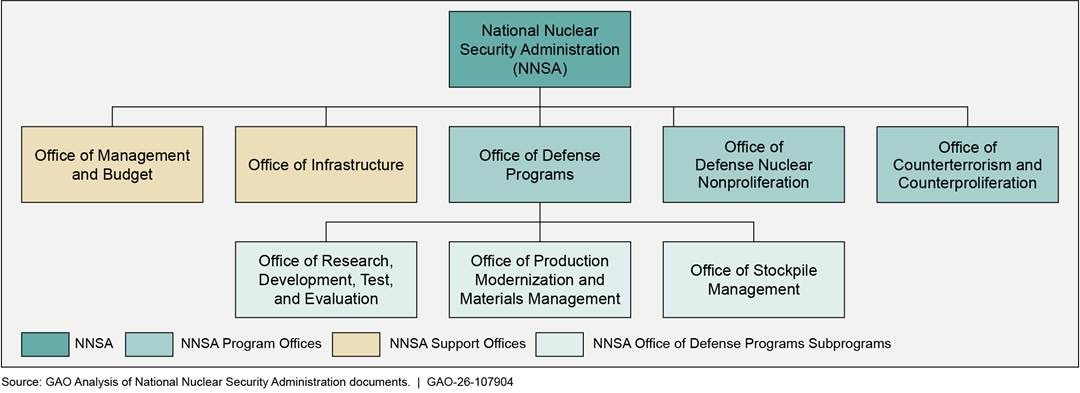
NNSA’s Office of Defense Programs manages the agency’s stockpile stewardship and modernization mission. Within that office, the Office of Research, Development, Test, and Evaluation oversees the operations and long-term planning for ST&E capabilities.[19] The Office of Research, Development, Test, and Evaluation collaborates with the NNSA Offices of Production Modernization and Materials Management and Stockpile Management within the Office of Defense Programs to support these offices’ stockpile management and modernization and production programs.
Outside of stockpile stewardship and modernization, the Office of Defense Nuclear Nonproliferation and the Office of Counterterrorism and Counterproliferation are responsible for managing the ST&E capabilities that support their missions. In addition, other NNSA offices have responsibilities for supporting the entire ST&E portfolio. NNSA’s Office of Management and Budget manages the agency’s Planning, Programming, Budgeting and Evaluation Process. The Office of Infrastructure is responsible for the operation, maintenance, recapitalization, and construction of NNSA infrastructure in a safe, secure, and cost-effective manner to support all NNSA programs. (See fig. 2).
Figure 2: National Nuclear Security Administration Offices that Manage Science, Technology, and Engineering to Support Stockpile Stewardship and Modernization
NNSA’s Enhanced Mission Delivery Initiative Recommendation on ST&E
In its 2022 Enhanced Mission Delivery Initiative report, NNSA noted that many of its ST&E facilities were relatively new and well-maintained but are still decades old. For example, the report noted that NNSA’s signature ST&E experimental facilities at the national security laboratories were, at the time, on average 20 years old and in need of continual investment to sustain existing capabilities. The report further stated that NNSA may not be able to sustain or deliver the new science and modeling and simulation capabilities needed to meet emerging or future national security and nuclear challenges if the agency did not start investing immediately. According to the report, while the laboratories and sites were currently making such investments, NNSA lacked a nuclear security enterprise-wide plan to guide these efforts in a strategic manner. The report recommended that NNSA and the laboratories develop an integrated strategic plan to revitalize the ST&E base that includes time-phased investments in new and recapitalized facilities and investments in the ST&E workforce. This plan was intended to help the agency avoid a wave of ST&E modernization in the 2030s and 2040s or, worse yet, avoid a situation in the period of 2035–2040 where a needed capability is not available.
NNSA’s Integrated ST&E Plan and Enterprise Blueprint
To address the recommendation for an integrated ST&E plan, NNSA’s Associate Principal Deputy Administrator issued a tasking memo in September 2023 that outlined directions for developing such a plan. This memo directed NNSA to establish an Integrated Project Team to manage the effort consisting of officials from three NNSA program offices (the Offices of Defense Programs, Defense Nuclear Nonproliferation, and Counterterrorism and Counterproliferation, respectively), the Office of Infrastructure, and representatives from the M&O sites. The Integrated Project Team was tasked with identifying (1) existing and new ST&E facilities and capabilities that will be necessary to meet the nuclear security mission through 2045 and that were expected to cost over $100 million and (2) any additional ST&E workforce and programmatic investments anticipated throughout the same time span. Furthermore, the tasking memo requested the Integrated Project Team plan on the basis that NNSA would receive an increased budget within a specific percentage range annually to pursue the ST&E investments.[20]
The Integrated Project Team completed its work and issued the Integrated ST&E Plan internally in July 2024.[21] As part of this effort, the Integrated Project Team developed a list of ST&E facility investments to meet mission needs through 2045. According to the Integrated ST&E Plan, the list leveraged identified capabilities needs in existing strategies and planning documents and additional input from representatives of the M&O contractors.[22] The Integrated Project Team, in coordination with program offices and the directors of the three national laboratories, then prioritized the facility investments based on two criteria—mission importance and mission need timeframes—and developed a priority matrix to document the results. For the purposes of the Integrated ST&E Plan, mission importance was defined as:
· high (the facility provides a critical capability that must be maintained or expanded);
· medium (the facility provides an important capability, but may not be essential for the design, certification, or assessment of nuclear weapons); and
· hard-to-assess (the facility provides a capability that may be useful, but more information is needed to understand the costs and benefits of the project).
In addition, NNSA defined mission need timeframes as:
· near-term (needed within 5 years),
· mid-term (needed within 6 to 15 years), and
· long-term (needed after 15 years).[23]
Concurrent with development of the Integrated ST&E Plan, NNSA developed the Enterprise Blueprint, which had a broader scope than the Integrated ST&E Plan and was released publicly in October 2024. NNSA’s Enterprise Blueprint is a 25-year plan to deliver specialized infrastructure, including modernized NNSA’s production and ST&E facilities, to meet requirements across NNSA’s missions.[24]
The Budget for ST&E Capabilities Modernization
NNSA’s ST&E facility modernization efforts are generally funded through two budget approaches—program budgets and line-item capital asset project budgets.[25] The funds for recapitalization to sustain a facility and for the development of major items of equipment come from operating funds that are available within a program budget.[26] In DOE’s budget justifications, funding estimates for sustainment of NNSA’s ST&E facilities that support stockpile stewardship and modernization are included in the Stockpile Research, Technology, and Engineering program budget line and the Infrastructure and Operations program budget line within DOE’s Weapons Activities appropriation account.[27]
Large recapitalization projects and construction of new ST&E facilities are funded through line-item capital asset project budgets.[28] A line-item capital asset project is a distinct project for which Congress is requested to authorize and appropriate specific funds. Funding estimates for these projects are included in DOE’s congressional budget request as a numbered line item separate from program budgets.
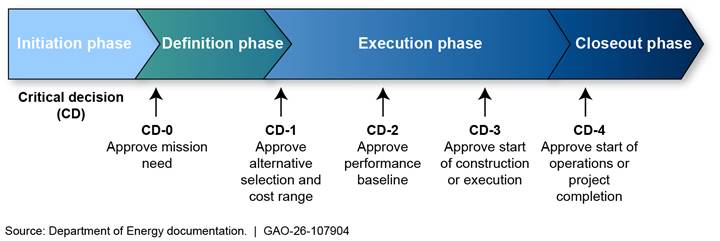
In addition, any DOE capital asset project, which includes line-item construction projects and major items of equipment projects, whose total cost is planned to exceed $50 million must follow the DOE Order 413.3B, Program and Project Management for the Acquisition of Capital Assets.[29] The order prescribes four project management phases—initiation, definition, execution, and close out—divided into five critical decision milestones. Each of these five critical decision points, shown in figure 3, indicates an authorization to increase the commitment of resources and requires successful completion of the prior phase. For example, in the initiation phase, a DOE program office identifies a mission need, which is a gap between its current capabilities and those required to achieve the goals of the program. The program translates this gap into functional requirements. After mission need approval (critical decision 0), the project moves into the definition phase, which includes an analysis of alternatives and alternative selection, and completion of a conceptual design process before critical decision 1 approval.
NNSA’s Planning, Programming, Budgeting and Evaluation process provides the requirements, responsibilities, and basic procedures by which strategic planning supports program priority setting and annual budgeting.[30] As detailed in this policy document, NNSA is required to provide Congress annually with a Future-Years Nuclear Security Program that details anticipated budget requests for each program element (and its associated projects and activities) for the fiscal year in which the annual budget is submitted and the four succeeding fiscal years.[31] As a result, NNSA’s budget justifications are intended to include a 5-year forecast for anticipated annual budget requests, providing visibility into program plans.
NNSA Identified and Prioritized ST&E Facility Investments but Did Not Fully Assess Workforce and Programmatic Investments
NNSA’s internal Integrated ST&E Plan documented the agency’s priorities for investing in both existing and new ST&E facilities across the nuclear security enterprise to support NNSA’s missions, including stockpile stewardship and modernization, over 20 years between 2025 and 2045. However, the plan did not fully assess funding needs for the ST&E workforce and programs.
NNSA Identified and Prioritized ST&E Facilities for Sustainment, Enhancement, or Replacement with New Facilities
The Integrated ST&E Plan identified 46 proposed investments to either sustain or enhance existing ST&E facilities or to build new facilities. NNSA and its M&O contractors determined that these investments are necessary for stockpile stewardship and other NNSA missions over 20 years between 2025 and 2045.[32]
According to our analysis, we found the following information about the 46 facility investments:
· Most of the investments, 35, were either ongoing or proposed to be located at the three NNSA national security laboratories and the Nevada National Security Site: 11 at Los Alamos, 11 at Sandia, nine at Livermore, and four at the Nevada National Security Site;[33]
· NNSA prioritized 33 investments as high mission importance, six as medium, and seven as hard-to-assess;
· NNSA prioritized 10 investments as near-term needs, 18 as mid-term, and 18 as long-term; and
· NNSA included 19 of the 46 facility investments in the publicly issued Enterprise Blueprint.[34] All 19 investments would either enhance existing facilities or build new facilities, and 17 of 19 were prioritized as high mission importance with needs in the near- or mid-term.
For detailed information on each of the 46 ST&E facility investments included in NNSA’s Integrated ST&E Plan, see appendix II.
We found that the 46 facility investments in the Integrated ST&E Plan could be categorized as (1) sustainment of existing facilities, (2) enhancement of existing facilities, or (3) construction of new facilities. The plan described sustainment investments as ongoing, mission critical recapitalization needed for existing facilities to continue meeting mission needs, including stockpile stewardship and modernization. Enhancement investments would provide new or improved capabilities at existing facilities, such as modernizing existing facility components and increasing specialized facility space. Lastly, new construction investments were proposed replacements of existing facilities. Table 2 summarizes our analysis of the ST&E facility investments by investment type and priority.
Table 2: The Integrated Science, Technology, and Engineering (ST&E) Plan’s Facility Investments by Type and Priority, July 2024
|
|
|
Mission importance |
||
|
ST&E facility investment type |
Mission need timeframe |
High |
Medium |
Hard-to-assess |
|
Sustainment of existing facilities |
Near-term (<5 years) |
3 |
0 |
0 |
|
Mid-term (6 to 15 years) |
0 |
0 |
0 |
|
|
Long-term (>15 years) |
0 |
0 |
0 |
|
|
Enhancement of existing facilities |
Near-term |
3 |
0 |
0 |
|
Mid-term |
2 |
1 |
0 |
|
|
Long-term |
1 |
0 |
1 |
|
|
Construction of new facilities |
Near-term |
4 |
0 |
0 |
|
Mid-term |
14 |
1 |
0 |
|
|
Long-term |
6 |
4 |
6 |
|
|
Total |
|
33 |
6 |
7 |
Source: GAO Analysis of National Nuclear Security Administration (NNSA) documents. | GAO‑26‑107904
Note: Of the 46 ST&E facility investments, NNSA identified 10 investments as near-term (needed within 5 years), 18 as mid-term (needed within 6 to 15 years), and 18 as long-term (needed after 15 years) mission needs. According to NNSA officials, identified mission need timeframes represented the range of years when investments in the ST&E facilities would need to begin to prevent capability downtime or potential capability loss for mission critical ST&E capabilities.
The following provides information and examples of the facilities in each investment type.
Sustainment. NNSA’s plan identified three existing ST&E facilities in need of ongoing sustainment: Livermore’s National Ignition Facility (NIF), Sandia’s Z Pulsed Power Facility, and Sandia’s Annular Core Research Reactor (ACRR). (For more information on the ACRR facility, see fig. 4). Although the September 2023 tasking memo that provided direction for the Integrated ST&E Plan’s development did not call for identifying sustainment activities, the plan included sustainment of these facilities to emphasize the importance of ensuring existing facilities are able to meet current mission needs. According to NNSA and laboratory contractors, these facilities provide one-of-a-kind capabilities that could go partially or completely offline without consistent investment in sustainment activities.
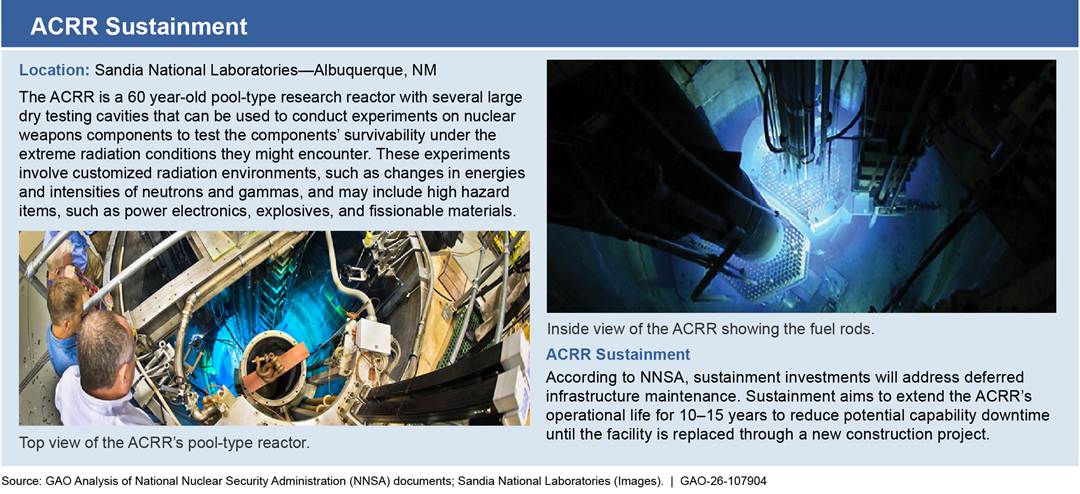
As we reported in 2025, NNSA relies on the NIF and Z Pulsed Power Facility, both of which are unique facilities to study high energy density science, including for conducting inertial confinement fusion experiments in support of stockpile stewardship and modernization.[35] Notably, NIF is the first facility in the world to achieve fusion ignition, where the system creates more fusion energy than the lasers used to drive the reaction.[36] These two facilities are nearing 20 and 30 years of age, respectively, and need recapitalization to maintain experimental operations with a reduced risk of catastrophic failure. We reported in 2025 that NNSA’s recapitalization plan for these facilities identified 26 sustainment activities for NIF, including refurbishing the facility’s laser amplifiers, and 40 sustainment activities for the Z Pulsed Power Facility, including replacing the facility’s Marx Bank capacitors.
Enhancement of Existing Facilities. NNSA’s Integrated ST&E Plan identified eight investments to enhance existing ST&E facilities to improve their capabilities. NNSA considered six of the eight investments as high mission importance with needs in the near-, mid-, and long-term.
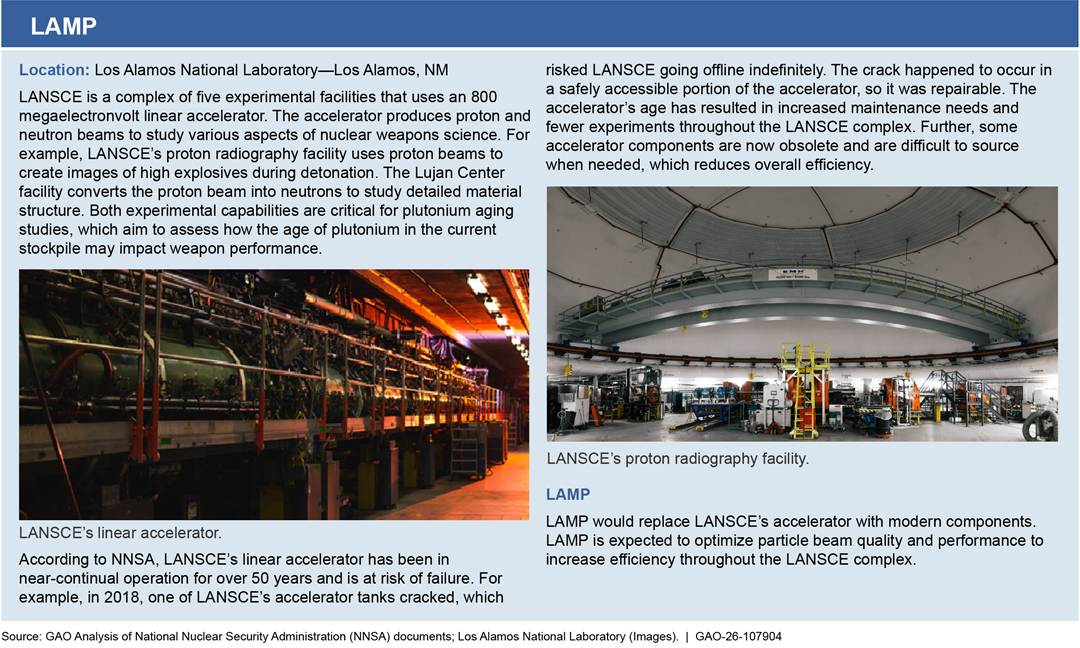
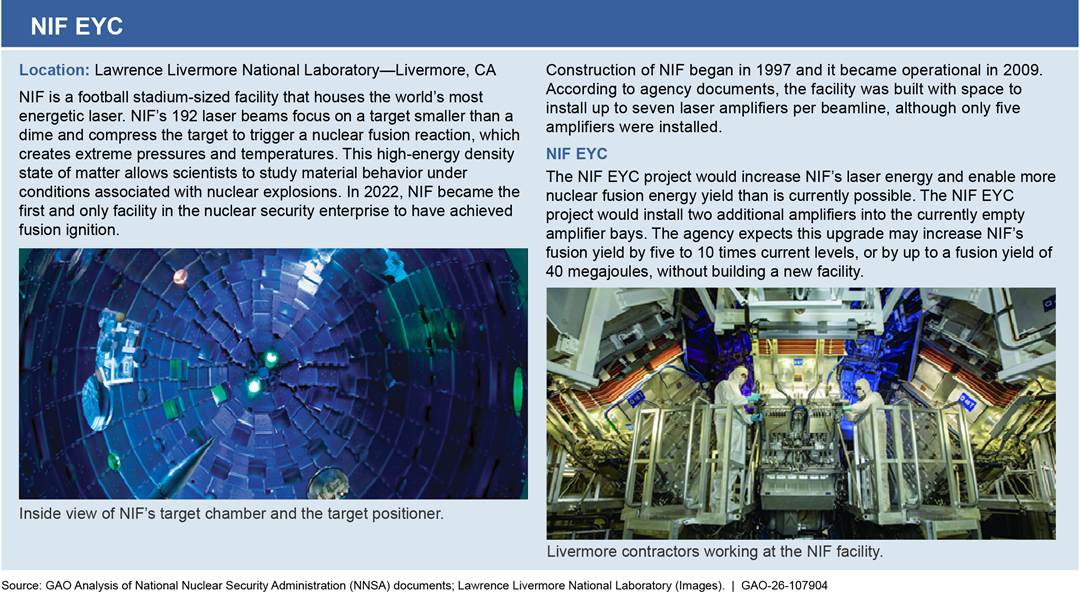
Enhancement investments included the Los Alamos Neutron Science Center (LANSCE) Accelerator Modernization Project (LAMP) and NIF’s Enhanced Fusion Yield Capability (NIF EYC) project at Livermore. NNSA prioritized both as high mission importance and near-term needs. For more information on the LANSCE Accelerator Modernization Project, see figure 5. For more information on the NIF EYC project, see figure 6.
Construction of New Facilities. NNSA’s Integrated ST&E Plan identified 35 investments that would construct new facilities to replace existing ones or provide next generation capabilities. NNSA identified 24 of the 35 facility investments as high mission importance with varying needs in the near-, mid-, and long-term. The remaining 11 investments were identified as either medium or hard-to-assess mission importance.
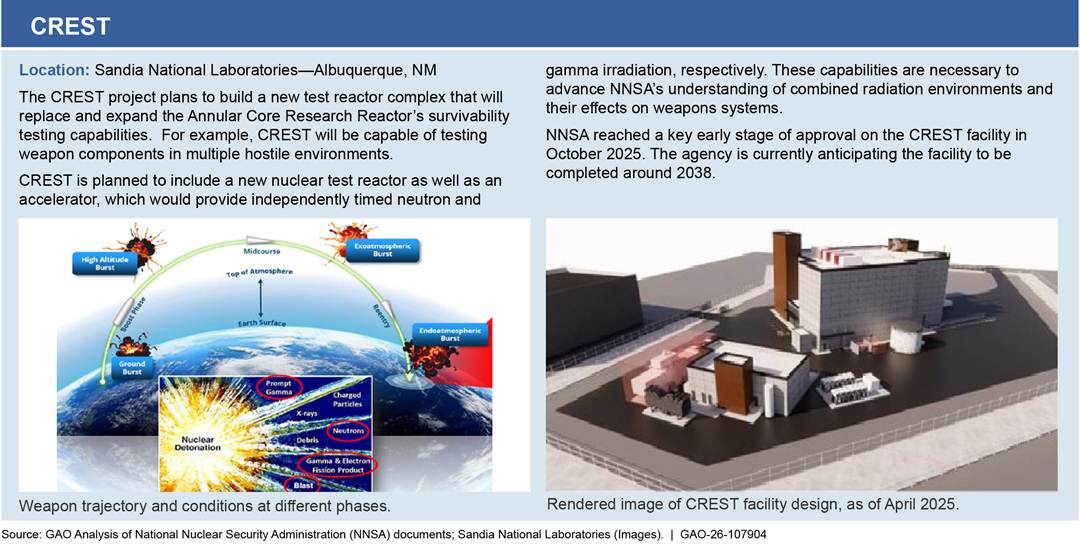
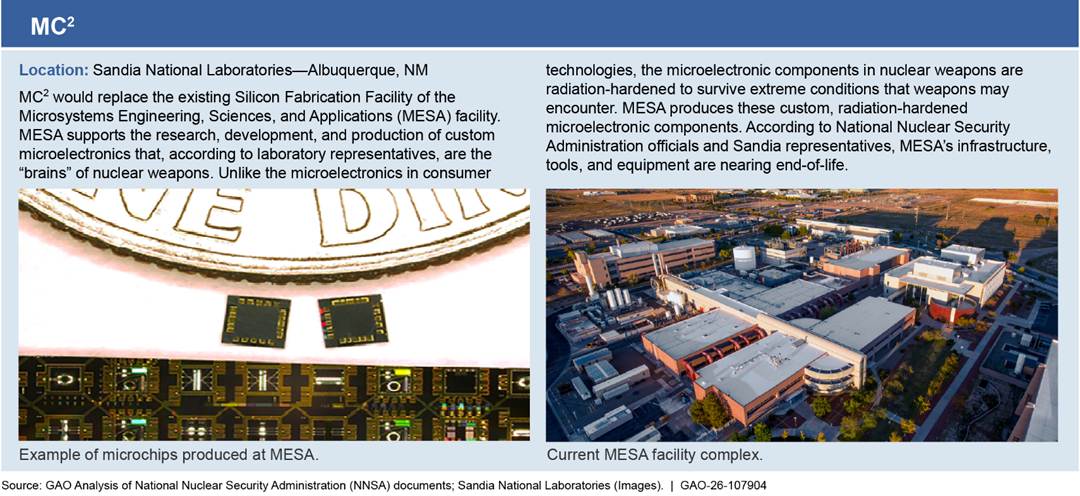
For example, new construction investments included two at Sandia. Specifically, the Combined Radiation Environments for Survivability Testing (CREST) facility is planned as a next-generation replacement for the ACRR’s test reactor capability, which NNSA is currently sustaining but has stated is nearing end-of-life. In addition, the proposed Microelectronic Components Capability (MC2) would provide a next-generation replacement for the existing Silicon Fabrication Facility at Sandia’s Microsystems Engineering, Science, and Applications (MESA) facility. NNSA prioritized both investments as high mission importance, but NNSA considered CREST as a near-term need and MC2 as a mid-term need.[37] For more information on CREST, see figure 7. For more information on MC2, see figure 8.
NNSA Did Not Fully Assess ST&E Workforce and Programmatic Investments
NNSA did not fully assess the workforce and programmatic investments needed for the agency’s ST&E efforts that underpin its missions.[38] NNSA collected initial estimates from the nuclear security enterprise sites for ST&E workforce and programmatic investments needed over the next 20 years from 2025 to 2045. However, NNSA officials viewed this data as unreliable and currently have no plans to conduct further analysis. According to NNSA documents and officials, the Integrated ST&E Plan focused on facility investments due to deadlines around providing ST&E facility investment information as an input to NNSA’s October 2024 Enterprise Blueprint. Work on the Integrated ST&E Plan did not continue after the blueprint was published.
NNSA’s recommendation in the 2022 Enhanced Mission Delivery Initiative to develop the Integrated ST&E Plan included identifying workforce needs in addition to facility needs. Along with the ST&E facilities and capabilities across the nuclear security enterprise, the scientists, engineers, and technicians that comprise the nuclear enterprise’s expert ST&E workforce underpin the agency’s ability to meet its missions. Further, NNSA senior leadership’s September 2023 tasking memo for the plan’s development also directed NNSA to identify ST&E programmatic investments. According to NNSA officials, programmatic investments could include costs associated with small-scale equipment and material samples for experiments.
In response to the recommendation and tasking memo, the Integrated Project Team collected information from sites across the nuclear security enterprise on their estimated ST&E workforce and programmatic investments. NNSA requested that the M&O contractors identify estimated workforce and programmatic investments above those already identified in NNSA’s budget plans (referred to as an “uplift” by NNSA). These plans included the fiscal year 2025 enacted budget and anticipated funding for the next five fiscal years (the Future-Years Nuclear Security Program).
However, NNSA officials who coordinated the Integrated Project Team told us that they had questions about the information that M&O contractors submitted about the sites’ workforce and programmatic estimates. Specifically, NNSA’s preliminary analysis of the information provided by the sites indicated that the estimates far exceeded what the agency had anticipated. According to this analysis, the M&O contractors estimated the ST&E workforce uplifts would cost $1.2 billion per year over the Integrated ST&E Plan’s 20-year period. This figure alone exceeded what NNSA had anticipated spending cumulatively on ST&E workforce, programmatic, and facility investments at all priority levels. We also found that contractor representatives at the laboratories who provided the information had different understandings of which resources qualified as workforce and programmatic uplifts for NNSA’s data collection purposes. For example, both Sandia and Livermore representatives said programmatic investments can capture a variety of resources, including staff. As a result, the distinction between programmatic and workforce uplifts may not have been clear and the three laboratories may have provided inconsistent information to NNSA for the same data request.[39]
According to NNSA documents, program offices were not asked to review the M&O contractors’ estimates in part due to uncertainty around the data. As stated in the Integrated ST&E Plan, NNSA officials on the Integrated Project Team determined that additional review and analysis was needed for planning purposes. Given the need for further analysis, NNSA officials said they decided not to report on the anticipated costs for the agency’s additional ST&E workforce and programmatic needs in the Integrated ST&E Plan. As mentioned above, NNSA officials delayed this analysis to a later, undetermined date due to deadlines for producing NNSA’s Enterprise Blueprint completed in October 2024.
NNSA noted in both the Integrated ST&E Plan and the Fiscal Year 2025 Stockpile Stewardship and Management Plan that the expert ST&E workforce across the nuclear enterprise is critical for stockpile stewardship. These documents say this is particularly important since the stockpile is being modernized and expanded, not just maintained, and the ST&E workload has increased substantially. Collecting consistent and accurate data from the M&O contractors about their anticipated ST&E workforce and programmatic investments and completing comprehensive ST&E workforce and programmatic analyses would better position NNSA decision makers to understand necessary funding levels and to proactively plan for those needs.
NNSA Reported Varying Levels of Cost Information on the Facility Investments
NNSA and its contractors have reported cost information on the ST&E facility investments at varying levels of detail. For example, NNSA provided the most detailed cost information for the seven ST&E facility investments that are active capital asset projects in the DOE fiscal year 2026 congressional budget justification.[40] NNSA prioritized all seven of these facility investments as high mission importance in the near-term in the Integrated ST&E Plan. Cost information on the remaining 39 facility investments in the plan is limited or non-existent. This is because either (1) these proposed investments are still in early planning and have not yet been approved to move forward either as program-funded major item of equipment projects or as line-item projects or (2) they were sustainment investments included in the subprogram budgets. NNSA did not report cost information in the Integrated ST&E Plan for any of the facility investments described in the plan and this information was not called for in the tasking memo.
Of the seven ST&E capital asset projects described in the fiscal year 2026 congressional budget justification, NNSA requested dedicated line-item funding for the first time for four of these capital asset projects: CREST, LAMP, NIF EYC, and MESA Photolithography Capability, which would provide new cleanroom space to the MESA facility.[41] The three other projects—the U1a Complex Enhancements Project, the Advanced Sources and Detectors project, and the Z-Pinch Experimental Underground System (Zeus) Test Bed Facilities Improvement project—have been ongoing for several years.[42] These three projects support NNSA’s ECSE program that aims to establish two new test beds at the Nevada National Security Site to provide improved capabilities for underground subcritical experiments.[43] According to the fiscal year 2026 budget justification, NNSA currently estimates these three projects taken together will cost roughly $3.3 billion and be completed between fiscal years 2030 and 2033. Table 3 describes estimated total project costs and projected completion dates for these seven projects.
Table 3: Estimated Costs and Completion Dates for Projects Identified in the National Nuclear Security Administration’s Integrated ST&E Plan for Which DOE Requested Construction Funds, Fiscal Year 2026
|
Project name |
Project type |
Most recent project critical decisiona |
Estimated total project costs (in millions) |
Estimated completion date, fiscal year |
|
Advanced Sources and Detectors |
New construction |
2/3 |
$2,228 |
2033 |
|
Combined Radiation Environments for Survivability Testing |
New construction |
1 |
1,970–3,870 |
2038 |
|
Los Alamos Neutron Science Center Accelerator Modernization Project |
Enhancement of existing facility |
0 |
456–1,007 |
2034 |
|
MESA Photolithography Capabilityb |
Enhancement of existing facility |
N/Ac |
400d |
2032 |
|
National Ignition Facility Enhanced Fusion Yield Capability |
Enhancement of existing facility |
1 |
535–1,000 |
2031–2035 |
|
U1a Complex Enhancements Project |
New construction |
2/3 |
876 |
2030 |
|
Z-Pinch Experimental Underground System (Zeus) Test Bed Facilities Improvement |
New construction |
2/3 |
233.2 |
2030 |
Source: GAO analysis of Department of Energy (DOE) fiscal year 2026 congressional budget justification. | GAO‑26‑107904
aDOE’s project management order divides capital asset projects into five critical decision milestones. Each of these five critical decision points marks an authorization to increase the commitment of resources and requires successful completion of the prior phase. These milestones are (0) approve mission need, (1) approve alternative selection and cost range, (2) approve performance baseline, (3) approve start of construction or execution, and (4) approve start of operations or project completion. Until a project has set its performance baseline at critical decision-2, preliminary cost estimates are reported in ranges.
bThis capability is referred to as the Microsystems Engineering, Science, and Applications (MESA) to Microelectronic Component Capability in the in the Integrated ST&E Plan.
cThe National Nuclear Security Administration has approved the mission need statement and program requirements document for this project. However, this project’s critical decision 0 approval is still pending.
dAccording to the congression budget justification, the project’s conceptual design included an initial cost range of $332 million to $350 million. However, that estimate had not completed external review, so a rough order of magnitude figure of $400 million was presented instead.
Costs for three ongoing sustainment investments (NIF, Z Pulsed Power Facility, and ACRR) described in the Integrated ST&E Plan are not described as capital asset projects in the congressional budget justification.[44] This is because sustainment activities for NIF and Z Pulsed Power Facility are funded through subprogram budgets under the Stockpile Research, Technology, and Engineering program budget line, while sustainment activities for ACRR are funded through subprogram budgets under the Infrastructure and Operations and Production Modernization budget lines. As a result, the costs of these sustainment activities are not reported separately from the subprograms’ overall annual budgets. We reported in 2025 that NNSA has estimated the sustainment activities for NIF and the Z Pulsed Power Facility will have estimated total costs of $302 million and $118 million respectively through roughly 2031.[45]
According to NNSA officials, NNSA has developed limited, if any, cost information on the remaining 36 facility investments because these investments are still in early planning phases. As a result, they said that the cost information that may exist for these identified potential investments is preliminary and intended for internal NNSA planning purposes. For example, contractor representatives at Los Alamos said that they developed a preliminary cost estimate for a potential project to build a new facility for future high-performance computers, which was identified in the Integrated ST&E Plan as high mission importance and medium-term mission need timeframe. These representatives said that the project’s preliminary cost estimate range was between $500 million and $680 million, but these were pre-conceptual estimates that have not yet been approved by NNSA.
Further, contractor representatives from Sandia told us that they currently estimate that a proposed Engineering-Data Analytics Facility may cost $200 million to $360 million to build. The Integrated ST&E Plan prioritized the facility as high mission importance and a medium-term mission need.[46] However, the Sandia representatives said this was a rough order of magnitude estimate range, since they are in the early stages of planning for such a facility.[47] Further, representatives at Los Alamos did not have cost information available for the potential replacement of the 1950s-era Sigma manufacturing science facility, which was identified in the Integrated ST&E Plan as high mission importance and long-term mission need timeframe.[48]
According to NNSA Office of Management and Budget officials, the agency has historically had challenges developing reliable early-stage cost estimates on their capital asset projects because these estimates are often overly optimistic.[49] These officials said they are working to improve the imperfect practice of predicting future costs of early-stage capital assets by applying more consistent and rigorous standards. To that end, they recently developed a new Capital Acquisition Estimating Framework that can help program managers develop more realistic, early-stage cost estimates for new line-item capital projects. We found that the framework met or substantially met the 12 steps to develop a high quality and reliable cost estimate process described in the GAO Cost Estimating and Assessment Guide.[50] (See app. III for the detailed analysis.)
NNSA Is Not Regularly Updating Its Integrated Assessment of ST&E Facility Investments to Reflect Changing Priorities
NNSA’s Integrated ST&E Plan represented a snapshot of its 20-year facility investment priorities at the time of completion in July 2024. However, we found that NNSA has not revisited or updated its integrated assessment of ST&E facilities’ investment needs to reflect changes in priorities and guide the agency’s decisions on prioritizing and sequencing these investments to maintain and modernize the nuclear stockpile.
NNSA’s September 2023 tasking memo that guided development of the Integrated ST&E Plan said that the agency should develop a strategic enterprise blueprint that will be a “living framework” to allow the agency to adapt as new technologies, production activities, and global security requirements evolve. Further, NNSA officials from the Integrated Project Team involved in developing the Integrated ST&E plan said the effort was not intended to be a one-time report, since facility investment priorities will evolve over time to reflect the changing priorities of the nuclear security enterprise over the medium- and long-term. However, the tasking memo did not specify a process to regularly update the plan. NNSA officials told us in March 2026 that they have not established such a process and do not currently have plans to update the Integrated ST&E Plan. Officials said they will continue to plan and prioritize ST&E infrastructure through the annual Planning, Programming, Budgeting and Evaluation Process. However, this process only covers a 5-year planning window for anticipated annual budget requests through the Future-Years Nuclear Security Program and does not examine infrastructure needs for the next 20 years. The need for a long-term, integrated ST&E plan was the reason for the original recommendation in NNSA’s 2022 Enhanced Mission Delivery Initiative report and in the NNSA tasking memo to implement the recommendation.
Since issuing the Integrated ST&E Plan in fiscal year 2024, NNSA’s priorities for investments in ST&E facilities have changed for several reasons. These reasons include congressional funding decisions, changes to ongoing ST&E facility projects, changes to the agency’s priorities in core research and development areas, and the effects of delays in project starts on the portfolio as a whole. As we noted above, 33 of the 46 facility investments NNSA identified in the Integrated ST&E Plan were categorized as high mission importance and 28 were categorized as either near- or medium-term mission need. Congress may choose not to authorize and appropriate funding for these priority investments or may do so on a different time frame than in NNSA’s plans. For example, Congress did not appropriate funds for the MESA Photolithography Capability project in fiscal year 2026 as requested by NNSA.[51] This means NNSA will not move forward with the project until fiscal year 2027 at the earliest.
Similarly, delays and cost increases on ongoing ST&E projects have affected NNSA’s planned investments and necessitate adjusting priorities. For example, NNSA has experienced execution challenges that led to schedule delays and cost increases on the three ongoing projects that compose NNSA’s ECSE program: the U1a Complex Enhancements Project, the Advanced Sources and Detectors project, and the Z-Pinch Experimental Underground System Test Bed Facilities Improvement project.[52] We reported in August 2023 that NNSA estimated the Advanced Sources and Detectors project would cost $1.8 billion and be completed in fiscal year 2030.[53] As of May 2025, NNSA reported that the project is expected to cost over $2.2 billion and be completed in fiscal year 2033.[54] Similarly, in May 2023, we reported that NNSA estimated the Z-Pinch Experimental Underground System Test Bed Facility Improvement project would cost between $49.5 million and $125.5 million and be completed in fiscal year 2026.[55] Since then, NNSA’s cost estimate for the project has increased to $233.2 million and the scheduled completion date has been pushed out to fiscal year 2030.[56] These delays and cost increases may crowd out potential investments in other projects until the existing projects are completed.
In addition, new priorities have emerged in core research and development areas such as artificial intelligence (AI) and machine learning, high energy density physics, radiography, and microelectronics. These evaluations will likely impact the ST&E facility investment priorities as described in the Integrated ST&E Plan. For example, NNSA’s Office of Advanced Simulation and Computing issued an AI for Nuclear Deterrence Strategy in March 2024 that identifies areas where the program office planned to focus investments to ensure AI methods can be appropriately applied to the unique demands of the nuclear security enterprise.[57] Further, Executive Order 14363, signed in November 2025, called on DOE to lead a new, government-wide AI initiative called the Genesis Mission.[58] This initiative aims to build an integrated AI platform to harness federal scientific datasets to accelerate scientific breakthroughs including in nuclear weapons development timelines and nuclear nonproliferation efforts. At the time of our audit, it was unclear to what extent this new AI mission would impact the facility investment priorities described in the Integrated ST&E Plan to support high-performance computing.
Further, there are areas where NNSA must determine the best scientific and technical path forward, which will impact portfolio planning decisions. For example, Inertial Confinement Fusion program officials reported that they began pre-conceptual planning in January 2025 on a strategy for a next-generation high energy density capability. The Integrated ST&E Plan identified this capability as a high mission priority with a medium-term mission need timeframe. In September 2025, we reported that NNSA plans to evaluate two different technologies to provide this capability: (1) pulsed power, the technology used at the Z Pulsed Power Facility, and (2) indirect drive laser, the technology used at NIF.[59] According to NNSA documents and officials, there are major open questions as to which fusion technology should be the driver for this capability and evaluating which of these technologies will be the most effective driver will require NNSA to conduct multi-year analyses. This decision will also be informed by the anticipated enhanced capabilities resulting from the NIF EYC project and potential upgrades to the Z Pulsed Power facility.[60]
NNSA Office of Management and Budget officials also told us they will continue evaluating ST&E facility investment priorities using planning tools that they developed in recent years to analyze time-phased budget scenarios. These scenario analyses allow them to evaluate the affordability of executing planned portfolios of projects, for example, by examining plans under different overall funding levels. According to these officials and the Integrated ST&E Plan, the NNSA Office of Management and Budget evaluated initial time-phased scenarios while developing the Integrated ST&E Plan. However, this initial analysis only included the investments for which NNSA requested funding in the fiscal year 2026 congressional budget request and the following 4 years covering the Future-Years Nuclear Security Program but did not evaluate scenarios covering the full 20-year plan.
Under NNSA’s Planning, Programming, Budgeting, and Evaluation process, program planning informed by long-term strategic plans should be a continuous activity that informs how the agency develops its budget.[61] In addition, our best practices for evidence-based policymaking state that agencies should continually and systematically monitor the internal and external environments that might affect their plans and update their plans accordingly.[62] Regularly updating NNSA’s integrated assessment of needed ST&E facility investments would position NNSA program managers and leadership to ensure ST&E infrastructure planning continues to reflect evolving priorities. These actions would also help guide future ST&E investment decisions to support stockpile stewardship and modernization.
Conclusions
NNSA’s Integrated ST&E Plan, issued in July 2024, identified needed ST&E facility investments that support the agency’s ability to ensure the current stockpile is safe, secure, and effective and modernize the nuclear stockpile over the next 20 years. However, NNSA officials did not fully assess the workforce and programmatic investments, in part because they needed to support the agency’s other planning efforts by providing information about the planned facility investments. Officials said they have no current plans to do so. Collecting and analyzing data on NNSA’s ST&E workforce and program needs will better position NNSA decision makers to understand necessary funding levels and to proactively plan for those needs, especially as the demands on the expert ST&E workforce across the nuclear enterprise increase.
NNSA is not regularly updating its integrated assessment of ST&E facility investment needs to ensure they reflect changing priorities. The Integrated ST&E Plan represented a snapshot of its 20-year facility investment priorities at the time of completion. However, NNSA’s ST&E facility investment priorities have already shifted since the Integrated ST&E Plan was issued, due to a combination of congressional funding decisions, delays to ongoing projects, and administration initiatives in core research and development areas like artificial intelligence. Regularly updating the agency’s integrated assessment of ST&E facility investment needs would help ensure that NNSA’s future ST&E investment decisions continue to reflect the evolving stockpile stewardship and modernization priorities.
Recommendations for Executive Action
We are making two recommendations to NNSA:
The NNSA Deputy Administrator for Defense Programs should ensure completion of a comprehensive analysis of the workforce and programmatic investments needed to implement the ST&E facilities and capabilities described in the Integrated ST&E Plan. (Recommendation 1)
The NNSA Deputy Administrator for Defense Programs should regularly update the integrated assessment of ST&E facility investment needs to reflect changing priorities. (Recommendation 2)
Agency Comments
We provided NNSA with a draft of this report for review and comment. In its comments, reproduced in appendix IV, NNSA stated that the agency plans to take actions in response to our recommendations. Specifically, NNSA plans to complete a comprehensive analysis of the ST&E workforce and programmatic investments necessary to achieve NNSA”s mission by December 2027. In addition, NNSA plans to develop a process for regular, periodic updates to the Integrated ST&E Plan by December 2026. NNSA also provided technical comments, which we incorporated as appropriate.
We are sending copies of this report to the appropriate congressional committees, the Secretary of Energy, the Administrator of NNSA, and other interested parties. In addition, the report is available at no charge on the GAO website at https://www.gao.gov.
If you or your staff have any questions about this report, please contact me at BawdenA@gao.gov. Contact points for our Offices of Congressional Relations and Media Relations may be found on the last page of this report. GAO staff who made key contributions to this report are listed in appendix V.

Allison Bawden
Director, Natural Resources and Environment
List of Committees
The Honorable Roger Wicker
Chairman
The Honorable Jack Reed
Ranking Member
Committee on Armed Services
United States Senate
The Honorable John Kennedy
Chair
The Honorable Patty Murray
Ranking Member
Subcommittee on Energy and Water Development
Committee on Appropriations
United States Senate
The Honorable Mike Rogers
Chairman
The Honorable Adam Smith
Ranking Member
Committee on Armed Services
House of Representatives
The Honorable Chuck Fleischmann
Chairman
The Honorable Marcy Kaptur
Ranking Member
Subcommittee on Energy and Water Development, and Related Agencies
Committee on Appropriations
House of Representatives
This report examines (1) the extent to which the National Nuclear Security Administration’s (NNSA) Integrated Plan for Revitalization of NNSA Science, Technology, and Engineering (Integrated ST&E Plan) identified and prioritized the ST&E facilities, workforce, and programmatic investments needed to support stockpile stewardship and; (2) the available information about the estimated costs of the proposed facility investments; and (3) the extent to which NNSA is regularly updating its integrated assessment of needed ST&E facility investments.[63]
Per the provision in Senate Report 118-58 for GAO to review NNSA’s plans for ST&E capabilities as part of the agency’s stockpile stewardship mission, this report focused on the Office of Defense Programs because its Office of Research, Development, Test, and Evaluation manages the agency’s stockpile stewardship mission. However, we included the few investments in the Integrated ST&E Plan that specifically state they support the Office of Defense Nuclear Nonproliferation and the Office of Counterterrorism and Counterproliferation, like spaced-based capabilities for the former program office, to provide a comprehensive review of NNSA’s coordinated ST&E efforts and investment needs.
To determine how NNSA identified and prioritized facilities, workforce, and programmatic investments needed for stockpile stewardship, we examined agency documents including the Integrated ST&E Plan, the recommendation from the 2022 Enhanced Mission Delivery Initiative report that the agency identify ST&E facility and workforce investment needs across program offices, and the agency senior leadership’s tasking memo that guided the plan’s development.[64] We also interviewed laboratory contractors who provided NNSA with information on the identified ST&E facility investments and estimates of ST&E workforce and programmatic investments to support stockpile stewardship and other NNSA missions over the next 20 years.
We recategorized the Integrated ST&E Plan’s 46 identified ST&E facility investments into three investment types that we determined were mutually exclusive: sustainment of existing facilities, enhancement of existing facilities, and construction of new facilities. NNSA had identified sustainment investments but combined enhancement and new construction investments, both of which provide new capabilities, into one “new” category. We also recategorized the investments NNSA identified as “in-progress”—three ongoing projects at the Nevada National Security Site referred to in the Integrated ST&E Plan as comprising one investment called the Principal Underground Laboratory for Subcritical Experimentation (PULSE)—under “construction of new facilities” since these investments are to build new capabilities.[65]
After recategorizing the identified ST&E facility investments, we quantified the investments by their respective mission importance and mission need timeframe prioritization rankings. To do this, we categorized formerly “in-progress” investments—which were under construction in 2024 when the Integrated ST&E Plan was released—as high mission importance facilities that would be needed in the near-term. Since NNSA did not assign specific need timeframes for “hard-to-assess” investments, we categorized these investments as facilities that were expected to be needed in the long-term.
Furthermore, we compared the Integrated ST&E Plan and the Enterprise Blueprint to determine which ST&E facility investments NNSA included in both strategic plans.[66] At the time we were developing this report, NNSA was citing its publicly available Enterprise Blueprint as the nuclear security enterprise’s strategy for investing in new and enhanced infrastructure to meet mission needs. Since the Integrated ST&E Plan was an internal strategic document, we assessed the extent to which NNSA’s public plan aligned with its internal plan.
To describe what information was available about the ST&E facility investments’ estimated costs, we examined the Department of Energy’s fiscal year 2026 congressional budget justification and NNSA project documents and guidance.[67] Specifically, we compared which facility investments identified in NNSA’s Integrated ST&E Plan were included in that budget justification, the most recent justification available at the time we developed our report, and documented costs associated with each investment. We collected and reviewed documentation on investments from the laboratory contractors, including facility plans and presentations. We also interviewed officials in NNSA’s Office of Management and Budget and reviewed NNSA presentations on cost and schedule tools that NNSA developed to assess early-stage project cost estimates, including costs associated with sustaining, enhancing, or constructing new ST&E facilities. In addition, we assessed NNSA’s new guidance for preparing cost estimates for capital acquisition projects, called the Capital Acquisition Estimating Framework, against GAO’s Cost Estimating and Assessment Guide, a 12-step process aimed at developing, delivering, and evaluating reliable cost estimates (see app. III).[68]
To determine the extent to which NNSA is regularly updating its integrated assessment of needed ST&E facility investments, we interviewed NNSA officials in the Office of Research, Test, Development, and Evaluation and its three subprograms that are involved in the Integrated ST&E Plan’s five identified areas of future work. We reviewed the Integrated ST&E Plan and NNSA senior leadership’s tasking memo on developing the plan. We also reviewed NNSA’s Planning, Programming, Budgeting, and Evaluation process, as well as GAO best practices for evidence-based policymaking, including monitoring and updating plans accordingly.[69]
To address all three objectives, we interviewed NNSA program officials in headquarters and field offices and representatives from management and operating (M&O) contractors involved with ST&E facilities at Los Alamos National Laboratory (Los Alamos), Sandia National Laboratories (Sandia), and Lawrence Livermore National Laboratory (Livermore). Specifically, we interviewed officials in NNSA’s Office of Research, Development, Test, and Evaluation and their three respective subprograms within the Office of Defense Programs that helped develop and oversee NNSA’s Integrated ST&E Plan.[70] We also interviewed representatives from laboratory contractors who provided NNSA with information on the identified ST&E facility investments.
We also conducted site visits to a nongeneralizable sample of six ST&E facilities at Los Alamos and Sandia in New Mexico to observe the facilities’ current conditions and to better understand NNSA’s investment priorities and plans. Since most of the ST&E facility investments were designated for the three national security laboratories, as discussed in this report, we focused on the laboratories and did not visit all sites across the nuclear security enterprise where current or planned facility investments are located. In addition, we leveraged findings as they related to the Integrated ST&E Plan from two of our recent reports: our 2023 report on NNSA’s ECSE program and related projects and our 2025 report on NNSA’s Inertial Confinement Fusion program’s recapitalization efforts.[71] In conducting audit work for both efforts we visited relevant ST&E facilities and projects at Livermore and the Nevada National Security Site.
We conducted this performance audit from October 2024 to July 2026 in accordance with generally accepted government auditing standards. Those standards require that we plan and perform the audit to obtain sufficient, appropriate evidence to provide a reasonable basis for our findings and conclusions based on our audit objectives. We believe that the evidence obtained provides a reasonable basis for our findings and conclusions based on our audit objectives.
Appendix II: Science, Technology, and Engineering Facility Investments included in NNSA’s Integrated ST&E Plan
In the Integrated Science, Technology, and Engineering (ST&E) Plan, the National Nuclear Security Administration (NNSA) identified 46 ST&E facility investments across the nuclear security enterprise and prioritized each one based on two factors: (1) mission importance and (2) estimated mission need timeframe over 20 years (see table 4).[72] Mission importance was defined as high, medium, or hard-to-assess and reflected how significantly NNSA’s ability to meet mission needs would be affected if the existing facility providing a capability were compromised. Mission need timeframe was defined as near-term (needed within 5 years), mid-term (needed within 6 to 15 years), or long-term (needed after 15 years) and reflected when NNSA would need the facilities to be operational for the agency to continue meeting current and future mission needs.
Additionally, we found that the 46 facility investments in the plan could be categorized as one of three types: (1) sustainment of existing facilities, (2) enhancement of existing facilities, or (3) construction of new facilities. NNSA described sustainment projects as ongoing, mission critical recapitalization needed for existing facilities to continue meeting stockpile stewardship and modernization mission needs. Enhancement investments included modernizing existing facility components and increasing specialized facility space. Lastly, new construction investments were proposed replacements of existing facilities.
Of the 46 ST&E facility investments identified in the Integrated ST&E Plan, NNSA included 19 in the agency’s Enterprise Blueprint.[73] All 19 were prioritized as high mission importance, with 17 of 19 having needs in the near- or mid-term. The ST&E facility investments that are also included the Enterprise Blueprint are denoted with an asterisk (see table 4).
Table 4: Investments for the National Nuclear Security Administration’s (NNSA) Science, Technology, and Engineering (ST&E) Facilities Included in the Integrated ST&E Plan
|
ST&E facility investment |
Description |
Site |
Mission importance |
Mission need timeframe |
|
Investments to Sustain Existing NNSA Science, Technology, and Engineering (ST&E) Facilities |
||||
|
Annular Core Research Reactor (ACRR) sustainment |
The ACRR is a pool-type reactor that tests the survivability of nuclear weapon components in extreme radiation conditions. The ACRR itself is nearly 50 years old, and it is housed in and supported by infrastructure that is over 70 years old. ACRR sustainment projects will address deferred infrastructure maintenance and aim to extend the ACRR’s operational life for 10 to 15 years until it can be replaced. |
Sandia |
High |
Near-term |
|
Z Pulsed Power Facility sustainment |
The Z Pulsed Power Facility uses electromagnetic pulsed power to simulate the extreme pressures and temperatures that nuclear explosions create. This allows for the study of materials science and other weapons science under these conditions. |
Sandia |
High |
Near-term |
|
National Ignition Facility (NIF) sustainment |
NIF is the world’s most energetic laser whose 192 beams trigger a nuclear fusion reaction. NIF is the only fusion facility in the world to have achieved fusion ignition—producing more energy from fusion reactions than laser energy put into the target. Scientists use NIF to study material behavior under the extreme pressures and temperatures associated with nuclear explosions and improve their understanding of processes that occur during weapon detonation. |
Livermore |
High |
Near-term |
|
Investments to Enhance Existing NNSA Science, Technology, and Engineering (ST&E) Facilities |
||||
|
Microsystems Engineering, Science, and Applications (MESA) to Microelectronic Components Capabilitya |
The MESA facility supports research, development, and production of custom, strategic radiation-hardened microelectronics that can survive the extreme conditions that weapons may encounter. According to NNSA, the facility currently does not have enough clean room space to meet NNSA’s mission needs. The proposed project will build a small-scale addition onto the silicon fabrication facility to provide more clean room space. |
Sandia |
High |
Near-term |
|
Los Alamos Neutron Science Center (LANSCE) Accelerator Modernization Project (LAMP)* |
LANSCE is a complex of five experimental facilities that uses an 800 megaelectronvolt linear accelerator to study various aspects of stockpile stewardship science, including plutonium aging studies to support weapon qualification. LANSCE’s linear accelerator is over 50 years old and is at risk of failure due to its age and obsolete components. The LAMP will replace LANSCE’s accelerator with modern components and anticipate optimizing beam quality and performance. |
Los Alamos |
High |
Near-term |
|
National Ignition Facility (NIF) Enhanced Fusion Yield Capability (EYC)* |
When NIF was constructed in 2009, NNSA installed five of the up to seven possible amplifiers per beamline. The NIF EYC project plans to upgrade NIF to enable more fusion yield than is currently possible by installing additional and more powerful amplifier glass into the existing amplifier bays in the laser chain. If successful, this upgrade may increase NIF’s fusion output by five to 10 times current levels without building a new facility. |
Livermore |
High |
Near-term |
|
Dual-Axis Radiographic Hydrodynamic Test (DARHT) Facility Modernizationb |
The DARHT facility’s two linear accelerators provide x-ray images of materials in weapons-relevant configurations as they implode so scientists can study physics related to the implosion process. DARHT modernization is a portfolio of projects to upgrade the facility and improve performance, including modernizing pulsed power equipment at DARHT’s Axis 2 linear accelerator, increasing accelerator hallway length, and relocating certain facility utilities. |
Los Alamos |
High |
Mid-term |
|
Los Alamos Neutron Science Center (LANSCE) Enhancements* |
This project is targeted to enhance dynamic radiography, scattering science, and nuclear physics capabilities at LANSCE’s various facilities. Proposed enhancements include adding another proton beam flight path from the front end of LANSCE to the proton radiography facility to accommodate higher demand for experiments and modernizing the Proton Storage Ring facility. |
Los Alamos |
High |
Mid-term |
|
Energetics Components Capability Sustainment* |
The Explosive Components Facility supports design and testing of more than 30 energetic components (i.e., explosives, fuels) that are used in the nuclear stockpile. NNSA plans to use the facility to produce some energetics components in-house because of stockpile modernization schedules and supply chain risks in the private sector. This project will supplement the facility’s current capabilities with development, prototyping, and manufacturing capabilities by expanding facility space and adding specialized infrastructure. |
Sandia |
High |
Long-term |
|
High Explosives Applications Facility (HEAF) Expansion* |
HEAF is a high explosives research and development facility used for conducting energetic material experiments. The proposed project is planned as a 50,000 square-foot addition to the existing HEAF that will house new capabilities, including machine learning, aimed at improving the qualification and acceptance of new high explosive materials. Additional lab space is targeted to include automation platforms to increase efficiencies in developing high energy materials. |
Livermore |
Medium |
Mid-term |
|
Scorpius/Z-Pinch Experimental Underground System (Zeus) upgrades |
Scorpius and Zeus are capabilities under construction that will capture data from subcritical experiments at NNSA’s Principal Underground Laboratory for Subcritical Experimentation (PULSE) facility (formerly the U1a facility). This proposed investment would upgrade Scorpius’s radiographic imaging systems, including increasing the number of X-ray pulses, and enhance Zeus’s neutron generation capacity. NNSA says that ongoing investments will be needed over the next 20 years. |
Nevada National Security Site |
Hard-to-Assess |
Long-term |
|
Investments to Construct New NNSA Science, Technology, and Engineering (ST&E) Facilities |
||||
|
Principal Underground Laboratory for Subcritical Experimentation (PULSE)* |
PULSE, formerly known as U1a, is an underground facility that supports multiple test beds and accompanying experimental technologies to facilitate and capture data from subcritical experiments.c The PULSE investment in the Integrated ST&E Plan comprises three ongoing construction projects: (1) the U1a Complex Enhancements Project, the Advanced Sources and Detectors project to build a new linear accelerator, and the Z-Pinch Experimental Underground System Test Bed Facilities Improvement project to construct a test bed for using a dense plasma focus neutron generation machine. These three projects make up NNSA’s Enhanced Capabilities for Subcritical Experiments program that aims to provide improved capabilities for underground subcritical experiments. |
Nevada National Security Site |
High |
Near-term |
|
Combined Radiation Environments for Survivability Testing (CREST)* |
The CREST project is intended to replace and modernize the ACRR facility to conduct radiation survivability testing for the stockpile. The CREST nuclear reactor and its accelerator will provide independently timed neutron and gamma irradiation in multiple hostile environments. NNSA approved the conceptual design for CREST in 2025 and currently anticipates the facility to be completed around 2038. |
Sandia |
High |
Near-term |
|
New High Energy Density Capability* |
The New High Energy Density Capability would result in a next generation fusion facility. NNSA has not yet decided whether this capability would be a pulsed-power or laser-based approach. |
Los Alamos, Sandia, or Livermored |
High |
Mid-term |
|
Space Systems Integration Building* |
The proposed facility would primarily support NNSA’s Office of Defense Nuclear Nonproliferation. This 80,000–100,000 gross square feet experimental facility would provide upgraded facilities to replace existing space instrumentation systems development and production facilities mostly housed in the SM-40 complex, which is more than 70 years old. |
Los Alamosd |
High |
Mid-term |
|
Space Rapid Prototyping and Testing Facility* |
The proposed facility would support the emerging Space Monitoring and Verification Program in NNSA’s Office of Defense Nuclear Nonproliferation. The facility would provide a dedicated space for rapid prototyping and testing against mock targets. |
Sandiad |
High |
Mid-term |
|
Dynamic Material Properties Laser* |
The proposed project would address mesoscale material science gaps by adding a five-kilojoule class pulsed laser at the Stanford Linear Accelerator National Accelerator Laboratory instead of building an entirely new facility.e |
Livermore at the Stanford Linear Accelerator National Accelerator Laboratoryd |
High |
Mid-term |
|
Defense Materials Science Sector* |
The proposed project is a high energy capability to increase understanding of material structure at the mesoscale level. To develop this capability, NNSA would use the long beamline sector at Argonne National Laboratory’s Advanced Photon Source and incorporate elements such as using high explosives to create dynamic targets.f |
Los Alamos at the Advanced Photon Source |
High |
Mid-term |
|
Next Generation MESA facility: Microelectronic Components Capability (MC2)* |
The proposed MC2 facility would replace and modernize the current MESA silicon fabrication facility, which was built in the 1980s. The MESA complex supports research, development, and production of custom, strategic radiation-hardened microelectronics that can survive the extreme conditions that weapons endure. |
Sandiad |
High |
Mid-term |
|
Future Supercomputing Infrastructure for High Performance Computing |
This project is a proposed facility to replace the Strategic Computing Complex, which supports the laboratory’s supercomputers. While the existing facility is only 20 years old, space and utility limitations have begun to threaten the facility’s structural integrity and computer performance. The existing facility was constructed around providing air cooling systems whereas modern supercomputing uses liquid cooling, a more efficient option for supercomputers’ significant cooling needs. This project would be capable of supporting more power and would use chilled water for cooling needs. |
Los Alamosd |
High |
Mid-term |
|
Tritium Development Laboratory |
This project is a proposed 50,000 square foot facility that would be capable of handling up to two kilograms of tritium and other nuclear materials to mature technologies for modern tritium and gas transfer systems. The nuclear security enterprise has not had tritium technology development and validation capabilities for extracting, recycling, and processing tritium reservoirs since the Savannah River Site’s 232-H tritium facility closed in the early 2000s. |
Savannah River National Laboratoryd |
High |
Mid-term |
|
Engineering-Data Analytics Facility |
This project is a proposed data storage and high-performance computing center that would collect and analyze large volumes of weapons systems data. This project would combine artificial intelligence technology and high-performance data analytics to improve digital collaboration across the nuclear security enterprise. |
Sandiad |
High |
Mid-term |
|
Agile Advanced Manufacturing Research and Development Facility |
This proposed 50,000 square foot manufacturing research and development facility would support rapid technology development and maturation to address emerging deterrence threats, including new technologies. The facility would support low quantity production runs and rapid delivery of classified tooling in days, rather than weeks or months, while reserving 20 percent of building space to respond flexibly and quickly to future enterprise needs as they arise. |
Kansas City National Security Campusd |
High |
Mid-term |
|
Microelectronics, sensors, assembly and packaging prototyping |
This proposed 40,000 square foot facility would include agile advanced microelectronics manufacturing space and new technologies incorporating all facets of assembly, inspection, and testing of microelectronic devices. |
Kansas City National Security Campusd |
High |
Mid-term |
|
Energetic Materials Characterization Minimum Viable Product* |
The proposed facility would consolidate high explosive research and development into one facility instead of 18 separate facilities, many of which are aging or otherwise failing to meet needs. In fiscal year 2023, NNSA put a 3-year pause on the project ahead of it meeting critical decision 1 to evaluate whether a campus of three facilities, rather than one facility, would be a better solution (see Energetic Materials Characterization Research and Development Campus below). |
Los Alamosd |
High |
Mid-term |
|
New Radiography Capability* |
The proposed facility combines three prior proposals into one placeholder for a future radiography capability whose specific technology for radiographic imaging (i.e., linear accelerator or laser driven x-ray sources) is yet undecided.g Dynamic radiography of explosively driven implosions using plutonium surrogates is an essential tool for assessing the current stockpile and supporting the design and certification of modernization efforts. |
Livermore or Los Alamosd |
High |
Mid-term |
|
Energetic Material Development Enclave Campus Expansion* |
The proposed facility would add three new facilities to the Energetic Material Development Enclave Campus for more resilient high-explosives production and weapon qualification options: (1) an administrative building; (2) a manufacturing research and development laboratory space; and (3) a facility for evaluation and small-scale testing. |
Livermored |
High |
Mid-term |
|
Uranium Production and Weaponization Testbed |
The proposed facility would develop a pilot-scale uranium processing and weaponization testbed in support of NNSA’s Office of Defense Nuclear Nonproliferation. The testbed will host threat-relevant equipment focused on uranium conversion, separation, component fabrication, and weaponization activities. These capabilities will develop competencies and an expert workforce in uranium production and weaponization that can address the nonproliferation missions throughout the U.S. government. |
Y-12d |
High |
Long-term |
|
High-Energy Radiation Megavolt Electron Source (HERMES) and Saturn Replacement Facility* |
The proposed football field-sized facility would replace and consolidate the two 1970s-era facilities housing HERMES and Saturn. Additionally, HERMES and Saturn would be modified and modernized with pulsed power technology to provide equipment that can meet testing requirements to address new threats. |
Sandiad |
High |
Long-term |
|
Space, Sources, and Sensing Facility* |
The proposed project would consolidate nuclear safety and space sensing capabilities used for research and development in support of NNSA’s Office of Defense Nuclear Nonproliferation. This project would include low-hazard science and industrial space, specialized labs, and cleanroom spaces. |
Livermored |
High |
Long-term |
|
Sigma Replacement Facility |
The proposed facility would replace the Sigma Complex with three to five new buildings that comply with modern environmental, safety, and security standards. Sigma is a manufacturing science capability built in the 1950s that handles a range of hazardous materials for research and development. |
Los Alamosd |
High |
Long-term |
|
Secure Demonstrator Smart Factory and Digital Engineering facility |
The proposed 40,000 square foot facility would establish a dedicated space to securely use digital engineering tools and processes alongside advanced manufacturing practices. Digital engineering integrates all data needed for designing, testing, and manufacturing a product in one digital space (i.e., the cloud) instead of across multiple software platforms or different physical mainframes. This results in more efficiencies and collaboration overall, and it enables faster product realization.h |
Kansas City National Security Campusd |
High |
Long-term |
|
Energetic Materials Characterization Research and Development Campus |
This proposed facility is an alternative to the Energetic Materials Characterization Minimum Viable Product that would be an integrated, three building campus that consolidates high explosives research and development into one facility instead of 18 separate facilities, many of which are aging or otherwise failing to meet needs (see above). |
Los Alamosd |
High |
Long-term |
|
Advanced Engineering Development Laboratory |
This proposed facility would replace and consolidate existing non-radiological engineering facilities that are between 36 and 68 years old that provide support for the Savannah River Site’s tritium facilities. This facility would provide modern capabilities that are expected to increase efficiency. |
Savannah River National Laboratoryd |
Medium |
Mid-term |
|
Radiography/Assembly Capability Replacement |
The proposed facility complex would replace and consolidate multiple 70-year-old facilities that are critical to the weapons mission. The complex would be centrally located near existing hydrodynamic and engineering test facilities (e.g., DARHT) and would provide modernized and expanded capacity to support weapon modernization programs. |
Los Alamosd |
Medium |
Long-term |
|
New Applied Technologies Laboratory |
The proposed three-facility campus would consolidate and replace 80-year-old Manhattan Project-era research and development facilities for weapons production, including the uranium production and weaponization testbed. |
Y-12d |
Medium |
Long-term |
|
Combined Environments Test Facility |
The proposed facility would replace existing environmental testing facilities that are 50 to 75 years old and lack the space and infrastructure to support new weapons testing capabilities. The new facility would provide environmental testing that combines elements such as shock, vibration, temperature, and pressure. |
Sandiad |
Medium |
Long-term |
|
New Weapons Environmental Testing Replacement Capability |
The proposed facility would consolidate and replace 60-year-old prefabricated facilities at Site 300 that are beginning to fail and are unable to meet environmental testing needs for future stockpile life extension programs with new delivery platforms. This capability is critical for conducting annual weapon assessments by allowing environmental testing for integrated warhead reserve components. Testing capabilities would include elements such as shock, vibration, and temperature. |
Livermored |
Medium |
Long-term |
|
Adaptive Nuclear Threat Reduction Capability |
The proposed new facilities would support NNSA’s Office of Defense Nuclear Nonproliferation and the Office of Counterterrorism and Counterproliferation. The facilities would provide reliable access to research, development, testing, and evaluation facilities with appropriate security and hazard categories to meet mission needs and to increase collaboration with domestic and international partners.i |
Los Alamos, Sandia, and Livermored |
Hard-to-Assess |
Long-term |
|
New Livermore Nuclear Science Center |
The proposed facility would replace the existing aboveground physics facility (Building 194) with a modern experimental laboratory that will support and connect directly to its underground accelerator complex. This laboratory would also centralize nuclear theory, experimental low energy nuclear physics, radiochemistry, and nuclear data into a single building. |
Livermored |
Hard-to-Assess |
Long-term |
|
Gas Transfer and Surety Laboratory |
The proposed facility would provide a dedicated space for gas transfer systems research, design, development, testing, and evaluating, which contributes to plutonium science and stockpile sustainment and production needs. |
Los Alamosd |
Hard-to-Assess |
Long-term |
|
Plutonium Criticality Capability at National Criticality Experiments Research Center |
The proposed investment would provide an additional plutonium critical assembly for conducting various experiments on critical and subcritical systems and study relevant fundamental physics. |
Los Alamos, Nevada Nuclear Security Sited |
Hard-to-Assess |
Long-term |
Source: GAO analysis of National Nuclear Security Administration (NNSA) documents. | GAO‑26‑107904
Notes:
*ST&E facility investment is included in NNSA’s Enterprise Blueprint.
aNNSA now refers to this project as the Microelectronics Photolithography Capability. Additionally, Sandia is conducting an ongoing MESA Extended Life Program that addresses facility and equipment sustainment needs.
bNNSA refers to DARHT’s portfolio of modernization projects as the DARHT Capability Expansion strategy.
cIn the Integrated ST&E Plan, NNSA labeled PULSE as “in-progress.” We have recategorized PULSE as a facility with high mission importance needed in the near-term since the facility is currently being constructed and is near completion.
dAccording to DOE Order 413.3B, the location of a new facility is not determined until after Critical Decision 1, “Approve Alternative Selection and Cost Range.” The site listed here represents the site that identified the proposed capability for the Integrated ST&E Plan.
eThe Stanford Linear Accelerator National Accelerator Laboratory is a DOE Office of Science asset.
fThe Advanced Photon Source at Argonne National Laboratory is a DOE Office of Science asset.
gNNSA now calls the New Radiography Capability the Future Dynamic Radiography Capability.
hDigital engineering capabilities enable the creation of “digital twins,” or the digital counterparts to physical products that are manufactured.
iThe Integrated ST&E Plan states that each lab—Los Alamos, Sandia, and Livermore—would receive the Adaptive Nuclear Threat Reduction Capability. NNSA counts this investment as three separate investments of the total 46 ST&E facility investments included in the plan.
We assessed the National Nuclear Security Administration’s (NNSA) Capital Acquisition Estimating Framework. The purpose of the framework is to “provide clear and concise expectations for preparing a programmatic cost estimate for NNSA capital acquisition projects.” GAO’s Cost Estimating and Assessment Guide presents a 12-step process to develop a reliable cost estimate. The cost estimating process provides the foundational guidance for initiating, researching, assessing, analyzing, and presenting a cost estimate. Each of the 12 steps is important for ensuring that cost estimates are developed and delivered in time to support important program decisions. The 12-step process represents a consistent methodology based on industry and government best practices that can be used across the federal government to develop, manage, and evaluate program cost estimates.
Table 5 below details our assessment of the Capital Acquisition Estimating Framework compared to GAO’s 12-step cost estimating process.[74]
Table 5: Assessment of NNSA’s Capital Acquisition Estimating Framework Based on GAO Cost Estimating Process
|
Step |
Score |
Description |
|
Define the estimate’s purpose |
Fully Met |
The framework defines an estimate’s purpose as “the scope of work and the phase of the project and is driven by a specific need” and goes on to say that what can be defined, such as estimate details, is dependent on the known scope of a particular stage. It adds that NNSA’s estimating team works with the project office and federal project director to determine the estimate’s purpose and scope. |
|
Develop the estimating plan |
Fully Met |
The framework provides an example table of contents for a cost estimating plan, lists expectations for developing the estimate plan, and includes a template for a notional cost estimate plan as an appendix. |
|
Define the program |
Fully Met |
The framework states that “a full and complete technical baseline description needs to be developed commensurate with the level of information for the phase of the program” and includes a table of elements—such as system purpose, software description, and work breakdown structure—along with descriptions of what information to include with each element. |
|
Determine the estimating structure |
Fully Met |
The framework describes a work breakdown structure as “a product-oriented breakdown of a project into smaller, more manageable components and a key project deliverable.” NNSA has established a work breakdown structure for capital acquisition projects which includes a work breakdown structure dictionary. This work breakdown structure was based on UNIFORMAT II using best practices from DOE’s Work Breakdown Structure Handbook. |
|
Identify ground rules and assumptions |
Fully Met |
The framework says that the estimator should leverage experienced program and technical personnel when creating assumptions. The framework also includes a table of expectations that identifies what the NNSA estimators need to consider. |
|
Obtain the data |
Fully Met |
The framework states that data are the foundation of an estimate, that the project phase determines the type of data, highlights the GAO process steps, and sets expectations for data collection, normalization, and storage. |
|
Develop the point estimate |
Fully Met |
The framework instructs cost estimators to prepare a point estimate by (1) developing the cost model by estimating each work breakdown structure element using the best methodology from the data collected; (2) including all estimating assumptions in the cost model; (3) expressing costs in base year dollars; (4) time-phasing the results by spreading cost in the years they are expected to occur based on the program schedule; and 5) summing the work breakdown structure element estimates to develop the overall point estimate. The framework also identifies a method for validating the estimate. |
|
Conduct sensitivity analysis |
Substantially Met |
For this step, the framework presents both the NASA and GAO definitions of sensitivity analysis. It also lists potential factors that may be found in a sensitivity analysis, such as a shorter or longer life cycle; the volume, mix, or pattern of workload; and potential requirements changes. While several of the GAO process steps are addressed, the expectations listed in framework for this step do not explicitly address the need to document the sensitivity analysis. |
|
Conduct risk and uncertainty analysis |
Fully Met |
The framework states that a risk analysis “provides the opportunity to evaluate a wide range of project risks to determine where resources will have the greatest impact and maximize the likelihood of the project’s success.” The framework further states that “as part of risk and uncertainty analysis, confidence levels are developed that reflect the overall level of potential cost when taking into account the base estimate (i.e., deterministic estimate), estimate uncertainty, and risk exposure for a given project.” The framework also lists the expectations of conducting a risk and uncertainty analysis, which align with those described in the GAO Cost Guide. |
|
Document the estimate |
Fully Met |
The framework declares “estimates should be documented to show all parameters, assumptions, descriptions, methods, and calculations used to develop a cost estimate.” The framework lists the GAO process steps for estimate documentation and the NNSA expectations for each step. |
|
Present the estimate to management for approval |
Fully Met |
The framework states review materials shall be prepared to present the estimate, including full life-cycle costs, to management. It also states that, when appropriate, the estimate should be compared to an independent cost estimate and that reasons for any variance should be provided. Further, the framework states that there are expectations for obtaining management approval. For example, sending a review of materials that will be prepared to present the estimate, including full life-cycle costs, to management. In addition, the framework expects acceptance of the estimate document which includes management review of materials that includes a method to record management acceptance. |
|
Update the estimate to reflect actual costs and changes |
Fully Met |
The framework describes updating the estimate to reflect actual costs and changes. For example, the appropriate laboratory, plant, or site shall record, report, and maintain earned value information from the approved performance measurement baseline and elicit and document lessons learned for areas of the cost estimate where actual costs or schedule performance deviates. |
Source: GAO analysis of National Nuclear Security Administration (NNSA) Capital Acquisition Estimating Framework. | GAO‑26‑107904
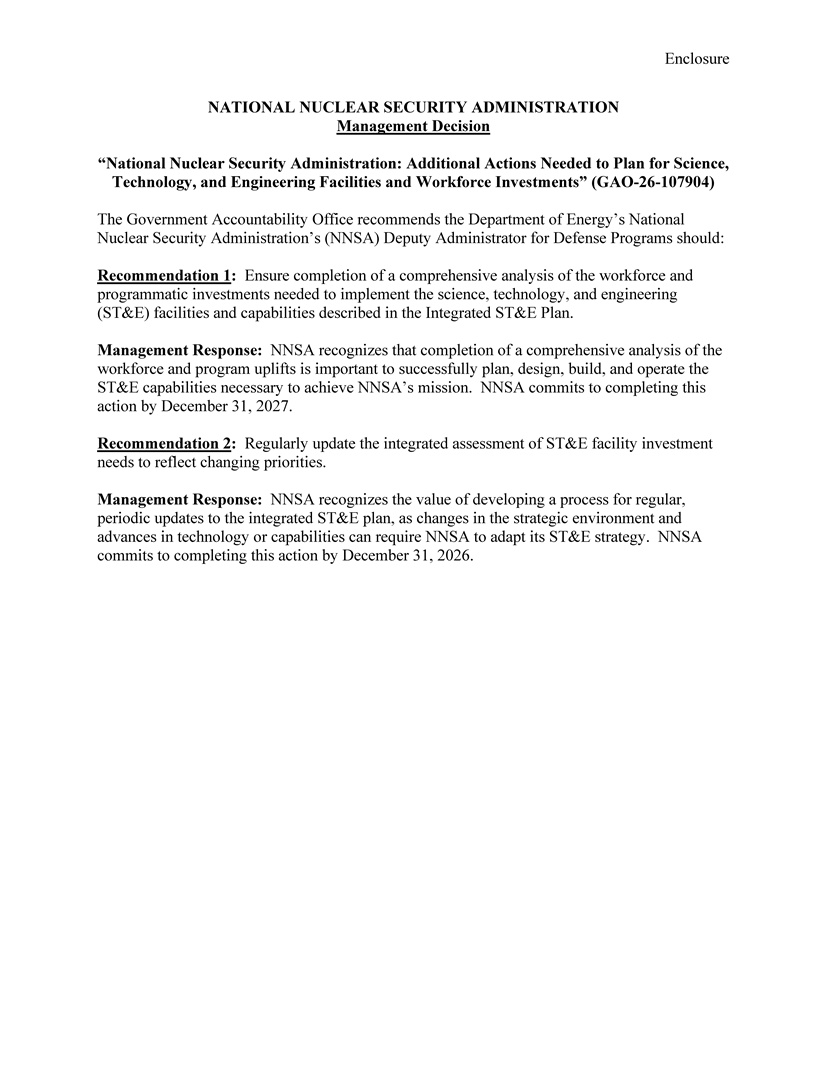
GAO Contact
Allison Bawden, BawdenA@gao.gov
Staff Acknowledgments
In addition to the contact named above, Brian M. Friedman (Assistant Director), Perry Lusk, Jr. (Analyst in Charge), Adrian Apodaca, William Bauder, Hannah Bisbing, Rebecca Conway, Kimani Darasaw, Pamela Davidson, Jennifer Echard, Gwen Kirby, and Jennifer Leotta made key contributions to this report.
The Government Accountability Office, the audit, evaluation, and investigative arm of Congress, exists to support Congress in meeting its constitutional responsibilities and to help improve the performance and accountability of the federal government for the American people. GAO examines the use of public funds; evaluates federal programs and policies; and provides analyses, recommendations, and other assistance to help Congress make informed oversight, policy, and funding decisions. GAO’s commitment to good government is reflected in its core values of accountability, integrity, and reliability.
Obtaining Copies of GAO Reports and Testimony
The fastest and easiest way to obtain copies of GAO documents at no cost is through our website. Each weekday afternoon, GAO posts on its website newly released reports, testimony, and correspondence. You can also subscribe to GAO’s email updates to receive notification of newly posted products.
Order by Phone
The price of each GAO publication reflects GAO’s actual cost of production and distribution and depends on the number of pages in the publication and whether the publication is printed in color or black and white. Pricing and ordering information is posted on GAO’s website, https://www.gao.gov/ordering.htm.
Place orders by calling (202) 512-6000, toll free (866) 801-7077,
or
TDD (202) 512-2537.
Orders may be paid for using American Express, Discover Card, MasterCard, Visa, check, or money order. Call for additional information.
Connect with GAO
Connect with GAO on X,
LinkedIn, Instagram, and YouTube.
Subscribe to our Email Updates. Listen to our Podcasts.
Visit GAO on the web at https://www.gao.gov.
To Report Fraud, Waste, and Abuse in Federal Programs
Contact FraudNet:
Website: https://www.gao.gov/about/what-gao-does/fraudnet
Automated answering system: (800) 424-5454
Media Relations
Sarah Kaczmarek, Managing Director, Media@gao.gov
Congressional Relations
David A. Powner, Acting Managing Director, CongRel@gao.gov
General Inquiries
[1]NNSA’s other missions are to work to prevent nuclear weapon proliferation and reduce the threat of nuclear and radiological terrorism around the world (i.e., nonproliferation) and to help prevent, counter, and respond to a terrorist or other adversary with a nuclear or radiological device (i.e., counterterrorism and counterproliferation).
[2]Nuclear explosive testing is when a nuclear weapon is detonated in a controlled environment to check its operation and measure its capabilities.
[3]National Nuclear Security Administration, Evolving the Nuclear Security Enterprise: A Report of the Enhanced Mission Delivery Initiative (Washington, D.C.: Sep. 2022). In February 2025, we reported on NNSA’s plans for implementation of the initiative’s recommendations, the status of reforms, and the extent that these reforms were aligned with selected leading practices for agency reform. GAO, National Nuclear Security Administration: Fully Incorporating Leading Practices for Agency Reform Would Benefit Enhanced Mission Delivery Initiative, GAO‑25‑106675 (Washington, D.C.: Feb. 16, 2025). At the time of our February 2025 report, NNSA was still developing its response to the initiative’s recommendation related to developing plans for the science, technology, and engineering facilities base. Senate Report 118-58 included a provision for us to specifically report on NNSA’s plans for ST&E facilities.
[4]National Nuclear Security Administration, Developing an Integrated Plan for Revitalization of NNSA Science, Technology, and Engineering (Washington, D.C.: July 2024). Additionally, NNSA, jointly with the U.S. Navy, manages the naval nuclear propulsion program, but this mission is not included in the Integrated ST&E Plan’s scope.
[5]National Nuclear Security Administration, Enterprise Blueprint (Oct. 2024).
[6]S. Rep. No. 118-58, at 387 (2023).
[7]National Nuclear Security Administration, Evolving the Nuclear Security Enterprise: A Report of the Enhanced Mission Delivery Initiative (Washington, D.C.: Sep. 2022).
[8]Department of Energy, FY 2026 Budget Justification – National Nuclear Security Administration, vol. 1 (Washington, D.C.: May 30, 2025).
[9]GAO, Cost Estimating and Assessment Guide: Best Practices for Developing and Managing Program Costs, GAO‑20‑195G (Washington, D.C.: Mar. 12, 2020).
[10]GAO, Evidence-Based Policymaking: Practices to Help Manage and Assess the Results of Federal Efforts, GAO‑23‑105460 (Washington, D.C.: July 12, 2023) and National Nuclear Security Administration, Management and Budget, Planning, Programming, Budgeting, And Evaluation Process, NNSA Policy Document (NAP) 130.1D, (Washington, D.C.: Jan. 3, 2025).
[11]GAO, Nuclear Weapons: Program Management Improvements Would Benefit U.S. Efforts to Build New Experimental Capabilities, GAO‑23‑105714 (Washington, D.C.: Aug. 30, 2023) and GAO, National Nuclear Security Administration: Improvements Needed for Managing Recapitalization of Fusion Facilities, GAO‑25‑107204, (Washington, D.C.: Sep. 5, 2025).
[12]Besides the four production sites, Los Alamos National Laboratory and Sandia National Laboratories have production roles in addition to their science and technology roles.
[13]For example, NNSA conducts subcritical experiments at the Nevada National Security Site. Subcritical experiments play a crucial role in NNSA’s weapon assessments because they allow NNSA to study plutonium by compressing it with high explosives—the same process that occurs in a nuclear weapon—but in a way that falls short of conducting a nuclear explosive test.
[14]U.S. Department of Defense, 2022 Nuclear Posture Review: 2022 National Defense Strategy of the United States of America (Washington, D.C.: Oct. 27, 2022). America’s Strategic Posture: The Final Report of the Congressional Commission on the Strategic Posture of the United States (Washington, D.C.: Oct. 2023).
[15]The B61-13 Program is producing a modern variant of the B61 nuclear gravity bomb for the United States Air Force. The W80-4 Life Extension Program is extending the life of the legacy W80 warhead for use in the Air Force’s Long Range Standoff cruise missile. This cruise missile is the replacement for the current, aging Air-Launched Cruise Missile. The W80-5 Modification Program will provide the warhead for the Navy’s Nuclear-Armed, Sea-Launched Cruise Missile Program. The W87-1 Modification Program will replace the W78 warhead and will be fielded on the Air Force Sentinel missile system. The W93 Program will meet requirements set by the Department of Defense to augment Navy forces with a survivable weapon deployable on the Ohio-class and Columbia-class submarines.
[16]NNSA, Fiscal Year 2025 Stockpile Stewardship and Management Plan – Biennial Plan Summary. Report to Congress (Washington, D.C.: Sep. 2024). The low end of this range reflects the reported cost for completing the B61-13 Program, which involves the use of production capabilities that supported the B61-12 Program—a program that recently completed its last production unit. The high end of this range is NNSA’s reported planning estimate for the W93 Program. We reported in December 2024 that NNSA plans to develop a weapon design and cost report for the W93 Program with a more specific estimate by December 2026. GAO, National Nuclear Security Administration: Assessments of Nuclear Weapon Acquisitions, GAO‑25‑106048 (Washington, D.C.: Dec. 17, 2024).
[17]See our July 2024 report that described NNSA’s production modernization efforts. GAO, National Nuclear Security Administration: Actions Needed to Improve Integration of Production Modernization Programs and Projects, GAO‑24‑106342 (Washington, D.C.: July 9, 2024). Most nuclear weapon systems in the U.S. stockpile are two-stage weapons. The first stage (primary) consists of a hollow pit typically made of plutonium and other materials, surrounded by explosive material. The second stage (secondary) may consist of uranium, lithium, and other materials. The primary and the secondary together, housed within a radiation case, are referred to as the weapon’s nuclear explosive package. When detonated, these nuclear components produce the weapon’s explosive energy, or “yield.” GAO, Nuclear Weapons: Information on the National Nuclear Security Administration’s Research Plan for Plutonium and Pit Aging, GAO‑24‑106740 (Washington, D.C.: Feb. 29, 2024).
[18]NNSA, Fiscal Year 2025 Stockpile Stewardship and Management Plan – Biennial Plan Summary. Report to Congress (Washington, D.C.: Sep. 2024).
[19]The Office of Research, Development, Test, and Evaluation has three suboffices: Office of Experimental Sciences; Office of Advanced Simulation, Computing, and Institutional R&D Programs; and Office of Engineering and Technology Maturation.
[20]The tasking memo instructed that the Integrated Project Team operate under an anticipated 2–4 percent increase annually for NNSA’s Weapons Activities and Defense Nuclear Nonproliferation budgets for 2025 to 2045.
[21]National Nuclear Security Administration, Developing an Integrated Plan for Revitalization of NNSA Science, Technology, and Engineering (Washington, D.C.: July 2024).
[22]According to the ST&E Integrated Plan, the Integrated Project Team was able to leverage capability needs identified in other NNSA strategic documents, including NNSA’s annual Stockpile Stewardship and Management Plan, its Prevent, Counter, and Respond Report to Congress, and the Office of Defense Programs’ March 2024 Stockpile Science and Technology (S&T) Investment Strategy. National Nuclear Security Administration, Fiscal Year 2024 Stockpile Stewardship and Management Plan (Washington, D.C.: Nov. 2023); Prevent, Counter, and Respond—NNSA’s Plan to Reduce Global Nuclear Threats FY 2025–FY 2029 (Washington, D.C.: Sep. 2024); and Stockpile Science and Technology (S&T) Investment Strategy 2024–2045.
[23]NNSA’s mission need timeframes represented the range of years when investments in the ST&E facilities would need to begin to prevent capability downtime or potential capability loss for mission critical ST&E capabilities.
[24]National Nuclear Security Administration, Enterprise Blueprint.
[25]Capital assets are land, structures, equipment, and intellectual property, which are used by the federal government and have an estimated useful life of 2 years or more.
[26]A major item of equipment is a type of capital asset project for capital equipment or software that is designed and fabricated or acquired in support of a DOE mission activity.
[27]The Stockpile Research, Technology, and Engineering program budget line is further divided into five subprogram budget lines: (1) Assessment Science, (2) Engineering and Integrated Assessments, (3) Inertial Confinement Fusion, (4) Advanced Simulation and Computing, and (5) Weapon Technology and Manufacturing Maturation.
[28]Line-item capital asset projects are required for specific efforts that will exceed the minor construction threshold, currently $34 million.
[29]Department of Energy, Program and Project Management for the Acquisition of Capital Assets, DOE Order 413.3B (Change 7) (Washington, D.C.: updated June 21, 2023). The goal of the order is to support project management in delivering projects within their original cost and schedule baselines and be fully capable of meeting mission performance and other requirements. Some of NNSA’s major capital asset acquisitions are for major items of equipment. While NNSA manages these under DOE Order 413.3B, they typically do not incur construction costs.
[30]50 U.S.C. § 2452. NNSA, Management and Budget, Planning, Programming, Budgeting, and Evaluation Process, NAP 130.1D (Washington, D.C.: Jan. 3, 2025).
[31]50 U.S.C. § 2453.
[32]Most of the proposed ST&E facility investments support stockpile stewardship and modernization efforts in NNSA’s Office of Defense Programs, but certain investments also support NNSA’s nonproliferation missions and counterproliferation missions. We identified four investments that primarily support the nonproliferation mission.
[33]Of the remaining 11 investments, seven are planned for other facilities in the nuclear security enterprise, like the Kansas City National Security Campus. Two are planned to be collaborations between NNSA and DOE Office of Science facilities, such as a proposed partnership between Livermore and the Office of Science’s Stanford Linear Accelerator National Accelerator Laboratory. One is planned to be a collaboration between Los Alamos and the Nevada National Security Site. Finally, one is identified in the Integrated ST&E Plan as associated with all the three national security laboratories since NNSA has not determined which technology to pursue for the New High Energy Density Capability.
[34]National Nuclear Security Administration, Enterprise Blueprint.
[36]Ignition is when a nuclear fusion reaction produces more energy in the fusion target than the energy used to initiate the nuclear reaction. A December 2022 experiment at NIF achieved ignition when 2.05 megajoules of laser energy generated 3.15 megajoules of fusion energy. NIF has subsequently achieved ignition multiple times since the first successful demonstration in 2022. We reported in September 2025 that the highest fusion yield generated on NIF as of May 2025 was approximately 8.6 megajoules. GAO‑25‑107204.
[37]In June 2020, we reported on NNSA’s management of its microelectronics activities, including plans at that time for sustainment and a replacement facility. GAO, Nuclear Weapons: NNSA Needs to Incorporate Additional Management Controls Over Its Microelectronics Activities, GAO‑20‑357 (Washington, D.C.: June 9, 2020).
[38]The Integrated ST&E Plan’s scope focused on the M&O contractor workforce and did not include evaluating the federal workforce that manages NNSA’s ST&E programs and oversees the M&O contractors.
[39]We did not independently review the data that the laboratories provided to NNSA.
[40]Department of Energy, FY 2026 Congressional Budget Justification – National Nuclear Security Administration, vol. 1 (Washington, D.C.: May 2025).
[41]In the Integrated ST&E Plan, NNSA called the proposed MESA Photolithography Capability project “MESA to MC2.”
[42]U1a is an underground laboratory at the Nevada National Security Site that NNSA has referred to as the Principal Underground Laboratory for Subcritical Experimentation (PULSE) facility as of 2024. The Advanced Sources and Detectors project is a major item of equipment project. In the Integrated ST&E Plan, NNSA included the three projects under one investment called PULSE.
[43]We previously reported on NNSA’s management of the ECSE program and its related projects. GAO‑23‑105714.
[44]In addition to the efforts identified in the Integrated ST&E plan, contractor representatives from the national laboratories identified other ST&E sustainment efforts that were not included in the Integrated ST&E Plan. For example, contractor representatives at Sandia told us that their efforts to sustain the MESA facility under the MESA Extended Life Program costs approximately $36 million per year. According to these representatives, they began full execution of the MESA Extended Life Program in 2021 and expect this effort to sustain MESA through 2040.
[46]This proposed facility could serve as a data storage and high-performance computing center to help improve digital collaboration across the enterprise, according to Sandia representatives and the Integrated ST&E Plan.
[47]Sandia representatives noted that this project has been identified as a need but Sandia has not moved forward with NNSA on planning activities.
[48]Originally built in the late 1950s, the Sigma manufacturing science research and development facility provides capabilities at Los Alamos to help meet NNSA’s stockpile assessment and certification missions. Sigma handles a range of radioactive and hazardous materials, including uranium, beryllium, and a broad spectrum of other materials. According to agency officials, this is the only NNSA facility that can cast classified graphite molds for plutonium pit designs and production.
[49]We have previously identified that many cost estimating challenges can be traced to over-optimism. GAO‑20‑195G.
[50]GAO‑20‑195G. We did not review the estimates to assess if they were following GAO best practices or NNSA policies.
[51]Line-item funding for the MESA Photolithography Capability project was not included in Commerce, Justice, Science; Energy and Water Development; and Interior and Environment Appropriations Act, 2026, Pub. L. No. 119-74, 140 Stat. 5, or the accompanying explanatory statement, 172 Cong. Rec. H255 (Jan. 8, 2026).
[52]NNSA currently refers to the U1a Complex as the Principal Underground Laboratory for Subcritical Experiments (PULSE). However, the U1a Complex Enhancements Project retains this name for budget and appropriations purposes. NNSA has also begun a separate but related project to replace the access shafts at PULSE, which are degrading more rapidly than expected due to heavy usage.
[54]DOE, FY 2026 Congressional Budget Justification – National Nuclear Security Administration, vol. 1 (Washington, D.C.: May 2025).
[56]DOE, FY 2026 Congressional Budget Justification–National Nuclear Security Administration, vol. 1 (Washington, D.C.: May 2025).
[57]NNSA, Artificial Intelligence for Nuclear Deterrence Strategy, 2023 (Washington, D.C.: March 11, 2024). These areas are: (1) application of AI methods and technologies to nuclear security mission areas; (2) foundational research and development in machine learning methods and technologies; (3) scalable and performant data infrastructure; and (4) enabling the data-driven workforce of the future.
[58]90 Fed. Reg. 55,035 (Nov. 28, 2025).
[60]We also reported in 2025 that given the decision to explore different fusion technologies for a next generation facility, NNSA had decided to plan a major upgrade for the Z Pulsed Power Facility. GAO‑25‑107204. This decision to pursue an upgrade to the Z facility was not identified as a priority in the Integrated ST&E Plan as it occurred after completion of the plan.
[61]NAP 130.1D.
[62]GAO, Evidence-Based Policymaking: Practices to Help Manage and Assess the Results of Federal Efforts, GAO‑23‑105640 (Washington, D.C.: July 12, 2023).
[63]National Nuclear Security Administration, Developing an Integrated Plan for Revitalization of NNSA Science, Technology, and Engineering (Washington, D.C.: July 2024).
[64]National Nuclear Security Administration, Evolving the Nuclear Security Enterprise: A Report of the Enhanced Mission Delivery Initiative (Washington, D.C.: Sep. 2022).
[65]The three projects support NNSA’s Enhanced Capabilities for Subcritical Experiments (ECSE) program that aims to establish two new test beds at the Nevada National Security Site to provide improved capabilities for underground subcritical experiments. PULSE was formerly called U1a.
[66]National Nuclear Security Administration, Enterprise Blueprint (Washington, D.C.: Oct. 2024).
[67]Department of Energy, FY 2026 Budget Justification – National Nuclear Security Administration, vol. 1 (Washington, D.C.: May 30, 2025).
[68]GAO, GAO Cost Estimating and Assessment Guide: Best Practices for Developing and Managing Program Costs, GAO‑20‑195G (Washington, D.C.: Mar. 12, 2020).
[69]National Nuclear Security Administration, Management and Budget, Planning, Programming, Budgeting, And Evaluation Process, NAP 130.1D (Washington, D.C.: Jan. 3, 2025) and GAO, Evidence-Based Policymaking: Practices to Help Manage and Assess the Results of Federal Efforts, GAO‑23‑105640 (Washington, D.C.: July 12, 2023).
[70]The three subprograms in NNSA’s Office of Development, Test, and Evaluation are the Office of Experiment Sciences; the Office of Advanced Simulation and Computing, and Institutional Research and Development Programs; and the Office of Engineering and Technology Maturation.
[71]GAO, Nuclear Weapons: Program Management Improvements Would Benefit U.S. Efforts to Build New Experimental Capabilities, GAO‑23‑105714 (Washington, D.C.: Aug. 30, 2023) and GAO, National Nuclear Security Administration: Improvements Needed for Managing Recapitalization of Fusion Facilities, GAO‑25‑107204, (Washington, D.C.: Sep. 5, 2025).
[72]National Nuclear Security Administration, Developing an Integrated Plan for Revitalization of NNSA Science, Technology, and Engineering (Washington, D.C.: July 2024).
[73]National Nuclear Security Administration, Enterprise Blueprint (Oct. 2024).
[74]GAO, Cost Estimating and Assessment Guide: Best Practices for Developing and Managing Program Costs, GAO‑20‑195G (Washington, D.C.: Mar. 2020).