
Report to Congressional Committees
United States Government Accountability Office
A report to congressional committees
For more information, contact: Michael E. Clements clementsm@gao.gov or Triana McNeil mcneilt@gao.gov
What GAO Found
Mexican transnational criminal organizations are a major supplier of the top two illicit synthetic drugs involved in overdose deaths in the U.S.—fentanyl and methamphetamine. To supply these drugs to U.S. users, these organizations
· source and purchase precursor chemicals primarily from China, using payment methods such as electronic funds transfers and virtual currency;
· produce or oversee the production of fentanyl and methamphetamine in clandestine labs in Mexico; and
· smuggle the drugs across the U.S.-Mexico border and supply them to U.S.-based drug trafficking groups.
Local drug trafficking groups sell these drugs to users through e‑commerce platforms, online marketplaces, mobile applications, and social media using payment methods such as cash, peer-to-peer payment applications, and virtual currency, according to Financial Crimes Enforcement Network (FinCEN) and Drug Enforcement Administration (DEA) reports.
Transnational criminal organizations launder the illicit proceeds from synthetic drug sales using methods such as
· bulk cash smuggling (moving physical currency across international borders),
· funnel accounts (bank accounts that collect deposits from members of the criminal network in multiple locations),
· trade-based money laundering (using goods in trade transactions to disguise the movement of illicit funds),
· virtual currency (exchanging bulk cash for virtual currency), and
· Chinese money laundering networks.
Chinese money laundering networks are largely decentralized and use both underground-banking mechanisms (which bypass formal banking channels) and other laundering methods within banking systems to convert, move, and obscure illicit proceeds for a fee. Mexican transnational criminal organizations are increasingly using these networks in part because their laundering schemes have lower costs than other organizations, according to law enforcement officials.
To combat drug trafficking and related money laundering, federal agencies coordinate and share information with each other and with state, local, and international partners through task forces, working and advisory groups, colocation, and other information-sharing channels. These mechanisms help agencies share resources and expertise, prevent overlapping investigations, and combine unique authorities. In addition, starting on January 20, 2025, the administration began instituting a variety of new policies, including some aimed at combating the flow of synthetic drugs into the U.S. For example, Executive Order 14159 requires the Departments of Justice and Homeland Security to jointly establish Homeland Security Task Forces in all 50 states to end the presence of cartels and transnational criminal organizations in the U.S. Agencies reported that it is too early to assess the full impact of these policies.
Why GAO Did This Study
Mexican transnational criminal organizations have fueled the U.S. synthetic drug crisis, contributing to hundreds of thousands of overdose deaths over the last 5 years, according to the Centers for Disease Control and Prevention. These organizations dictate the flow of nearly all illicit drugs into the U.S. They generate billions of dollars in profits from the sale of synthetic drugs and must launder those profits, often with the help of professional criminal money launders.
Since 2019, FinCEN and other federal agencies have intensified efforts to combat illicit finance related to synthetic drug trafficking. Additionally, within the Department of Justice, the DEA, Federal Bureau of Investigation, and United States Attorneys’ Offices have investigated and prosecuted cases related to these activities. GAO added drug misuse to its High-Risk List in 2021; the list highlights vulnerable areas across the federal government.
The Preventing the Financing of Illegal Synthetic Drugs Act contains a provision for GAO to study the trafficking of synthetic drugs into the U.S. and related illicit financing activity. This report describes (1) how Mexican transnational criminal organizations source, produce, and distribute synthetic drugs; (2) how these organizations launder their proceeds; and (3) information-sharing and coordination efforts by federal agencies to combat synthetic drug trafficking and related money laundering.
GAO reviewed federal agency documents and reports, recent executive orders, and recent court cases involving synthetic drug trafficking. GAO also interviewed federal agency officials, industry representatives, and other stakeholders with relevant expertise.
|
Abbreviations |
|
|
|
|
|
CBP |
Customs and Border Protection |
|
CDC |
Center for Disease Control and Presentation |
|
CMLN |
Chinese money laundering networks |
|
DEA |
Drug Enforcement Administration |
|
DHS |
Department of Homeland Security |
|
DOJ |
Department of Justice |
|
FBI |
Federal Bureau of Investigation |
|
FinCEN |
Financial Crimes Enforcement Network |
|
ICE-HSI |
Immigration and Customs Enforcement-Homeland Security Investigations |
|
IRS-CI |
Internal Revenue Service-Criminal Investigation |
|
TCO |
Transnational criminal organizations |
|
USPS |
United States Postal Service |
This is a work of the U.S. government and is not subject to copyright protection in the United States. The published product may be reproduced and distributed in its entirety without further permission from GAO. However, because this work may contain copyrighted images or other material, permission from the copyright holder may be necessary if you wish to reproduce this material separately.
December 18, 2025
The Honorable Tim Scott
Chairman
The Honorable Elizabeth Warren
Ranking Member
Committee on Banking, Housing and Urban Affairs
United States Senate
The Honorable French Hill
Chairman
The Honorable Maxine Waters
Ranking Member
Committee on Financial Services
House of Representatives
Transnational criminal organizations (TCO) have played a central role in fueling the U.S.’s ongoing synthetic drug crisis.[1] According to the Centers for Disease Control and Prevention (CDC), this crisis has contributed to hundreds of thousands of overdose deaths over the last 5 years. Provisional data show more than 42,200 overdose deaths from illicit synthetic opioids, such as fentanyl[2]—lab-manufactured substances often far more potent than natural opioids—during the 12-month period ending in April 2025.[3] We added drug misuse to our High-Risk List in 2021. The list highlights areas across the federal government that are seriously vulnerable to mismanagement or that need transformation. Drug misuse remains on the High-Risk List as of February 2025.[4]
TCOs generate billions of dollars in profits from the sale of illicit synthetic drugs. To conceal the origin of these funds and integrate them into the legitimate economy, TCOs often rely on professional money launderers and employ a range of tactics, according to federal law enforcement. These tactics include underground banking systems, trade-based money laundering schemes, and use of virtual currencies, among other methods.[5]
Since 2019, the Financial Crimes Enforcement Network (FinCEN) and other federal agencies have intensified efforts to combat illicit finance related to synthetic drug trafficking. The Department of the Treasury launched the Counter-Fentanyl Strike Force in 2023, and FinCEN has issued multiple advisories, including one in June 2024, to help financial institutions identify suspicious activity linked to the manufacturing of illicit fentanyl and other synthetic opioids.[6] Additionally, the Department of Justice (DOJ), Drug Enforcement Administration (DEA), Federal Bureau of Investigation (FBI), and United States Attorneys’ Offices, have investigated and prosecuted TCOs involved in synthetic drug trafficking and laundering of the proceeds.
The Preventing the Financing of Illegal Synthetic Drugs Act includes a provision for us to study the trafficking of synthetic drugs into the U.S. and related illicit financing activity.[7] This report describes (1) how TCOs source, manufacture, and distribute synthetic drugs; (2) how these organizations launder their proceeds; and (3) coordination and information-sharing efforts by federal agencies, and recent policy changes. This report primarily focuses on Mexican TCOs, as they dictate the flow of nearly all illicit drugs, including synthetic drugs, into the U.S., according to DEA.[8]
For all objectives, we reviewed federal agency reports and guidance, executive orders, prior GAO reports, and think tank publications. We also reviewed indictments and adjudicated cases identified on the DOJ website for press releases, issued between January 1, 2023, and June 1, 2025, related to synthetic drugs, precursor chemicals, human smuggling, and money laundering.[9]
Additionally, we interviewed officials from federal agencies and offices responsible for identifying, investigating, and prosecuting synthetic drug trafficking and illicit finance, specifically: (1) components within DOJ, including the Criminal Division, FBI, DEA, Executive Office for U.S. Attorneys, and the Organized Crime Drug Enforcement Task Forces; (2) components within the Department of Homeland Security (DHS), including Immigration and Customs Enforcement-Homeland Security Investigations (ICE-HSI) and Customs and Border Protection (CBP); (3) Department of State; (4) components within Treasury, including FinCEN and the Internal Revenue Service-Criminal Investigation (IRS-CI); and (5) the U.S. Postal Inspection Service within the U.S. Postal Service (USPS).[10] We also interviewed stakeholders from three nonprofit policy entities: the RAND Corporation, the Brookings Institute, and InSight Crime.[11]
To address our first objective, we focused our work on fentanyl and methamphetamine as they were the top two synthetic drugs involved in overdose deaths,[12] according to CDC’s 2023 data.[13] We reviewed reports from federal agencies and other sources such as the U.S.-China Economic and Security Review Commission. In addition, we reviewed online listings for illicit drug manufacturing supplies and finished drugs. We used undercover identities to communicate with questionable China-based chemical companies and purported drug dealers.[14] Our investigative work did not confirm that the chemical companies in fact sold the listed chemicals or that the purported drug dealers in fact sold the listed drugs.
To address our second objective, we reviewed government reports, industry articles, research institute publications, and legislative materials published in the past five years on the use of payment methods and money laundering typologies associated with synthetic drug trafficking.[15]
We also requested and analyzed FinCEN data from August 2019 through March 2025 on suspicious activity reports that referenced a 2019 or 2024 FinCEN advisory related to synthetic drug trafficking. In addition, we analyzed suspicious activity reports that referenced certain activities, such as funnel accounts and electronic funds transfers.[16]
To address our third objective, we interviewed or received written responses from the agencies identified above on agency coordination and information-sharing efforts related to these issues.[17] We also reviewed agency memos, press releases, and websites that described coordination and information sharing among federal, state, local, international partners, and private sector partners.
We also reviewed recent policy changes implemented between January 20, 2025, and July 31, 2025, including presidential proclamations and executive orders and related amendments. We interviewed or received written responses from agencies about the policies. See appendix I for a complete description of our scope and methodology.
We conducted this performance audit from November 2024 to December 2025 in accordance with generally accepted government auditing standards. Those standards require that we plan and perform the audit to obtain sufficient, appropriate evidence to provide a reasonable basis for our findings and conclusions based on our audit objectives. We believe that the evidence obtained provides a reasonable basis for our findings and conclusions based on our audit objectives.
We conducted our related investigative work in accordance with investigation standards prescribed by the Council of the Inspectors General on Integrity and Efficiency. We believe that the evidence obtained provides a reasonable basis for our findings and conclusions based on our audit objectives.
Background
TCOs engage in a wide range of criminal activities that threaten U.S. public safety and national security, including the trafficking of humans, firearms, wildlife, and drugs. TCOs from Mexico are a major manufacturer of illicit synthetic drugs entering the U.S.
Illicit fentanyl and methamphetamine are the top two causes of drug- related deaths in the U.S. according to CDC’s 2023 data. According to DEA, fentanyl is a synthetic opioid typically used to treat patients with chronic severe pain. It is a controlled substance that is about 100 times more potent than morphine. Methamphetamine is also a highly addictive synthetic drug, though it has more limited legitimate uses. According to the Global Coalition to Address Synthetic Drug Threats, these drugs are often more lethal than plant-based drugs like cocaine and heroin.[18] Further, they can be made anywhere with widely available chemicals and equipment and can be shipped in small quantities.
Synthetic drugs are made by combining chemicals known as precursor chemicals.[19] While some of these precursor chemicals are regulated, others of them are unregulated and have safe and legitimate purposes, such as producing cosmetics, perfumes, and cleaning agents.[20]
Multiple federal law enforcement and financial agencies are involved in efforts to combat synthetic drug trafficking and related money laundering (see fig. 1).
Figure 1: Key Federal Agencies Involved in Combating Synthetic Drug Trafficking and Related Illicit Finance
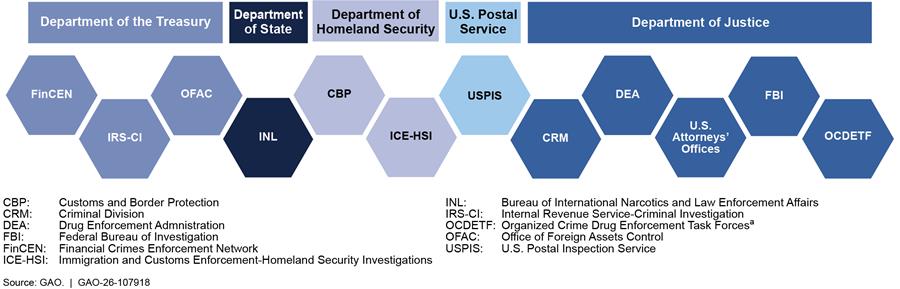
Note: This list is not exhaustive, and tile placement does not indicate agency role or relationships.
aAccording to the Department of Justice, as of September 30, 2025, OCDETF has been shut down and its functions have been transferred to the new Homeland Security Task Forces described later in this report.
One way the federal government combats the illicit flow of money is through the Bank Secrecy Act. The act requires covered financial institutions (e.g., banks, broker-dealers, and money services businesses) to among other things, maintain detailed records and file suspicious activity reports and other records.[21] FinCEN enforces the Bank Secrecy Act and other requirements related to anti-money laundering and countering the financing of terrorism. The information financial institutions report through suspicious activity reports and other records can help law enforcement identify and investigate potential money laundering and other illicit activity connected to synthetic drug trafficking.[22]
Federal agencies also partner with state and local agencies, as well as coordinate with international counterparts, to combat synthetic drug trafficking and related financial crimes. For example, DOJ has broad authority to investigate crime and prosecute offenders and conducts much of its work in offices located throughout the U.S. and overseas. Similarly, DHS works to secure and protect air, land, and water borders across the country and internationally. Through partnerships with other countries and international law enforcement, DHS works to identify and stop criminals and illegal activity, such as drug smuggling, prior to reaching the U.S. For example, DOJ has broad authority to investigate crime and prosecute offenders and conducts much of its work in offices located throughout the U.S. and overseas. Similarly, DHS works to secure and protect air, land, and water borders across the country and internationally.
Sourcing, Manufacturing, and Distribution of Synthetic Drugs
How do Mexican TCOs source precursor chemicals?
Mexican TCOs use diverse business strategies to directly or indirectly source fentanyl and methamphetamine precursor chemicals, primarily from China-based chemical companies.[23] According to DEA’s 2024 drug threat assessment and a nonprofit entity report, TCOs may obtain precursor chemicals through several channels: (1) directly from suppliers in China; (2) through intermediaries in the U.S., such as reshipping companies or complicit companies or individuals; and (3) via brokers who work independently of any TCO.[24] The nonprofit entity report also indicates that large TCOs rely on intermediaries who operate front companies to gather the chemicals in bulk in Mexico before selling them to criminal groups. According to Treasury officials, both China-based suppliers and TCOs use networks of front and shell companies in the sale and purchase of precursor chemicals.
FinCEN reported that Mexican TCOs began sourcing fentanyl precursor chemicals from China in 2019 after China placed controls on all fentanyl-related substances.[25] According to Department of State officials, the controls applied to the manufacture and export of these substances. Before 2019, Mexican TCOs sourced finished fentanyl from China, according to the reports. Mexican TCOs have sourced methamphetamine precursor chemicals from China and India since at least 2009, according to reports from DOJ and the U.S.-China Economic and Security Review Commission.[26]
Online Marketplaces
Chemical suppliers in China use e-commerce platforms and internet advertising to reach their customers, which may include those who purchase and supply the precursor chemicals to Mexican TCOs. DOJ has noted that many China-based suppliers openly advertise precursor chemicals on the internet. FinCEN likewise reported that these companies use darknet marketplaces, e-commerce and other public platforms, such as social media platforms, to market chemicals used to manufacture illicit fentanyl.[27] According to a private sector report, these platforms are used only to advertise the products, and buyers must contact the supplier directly to make purchases.[28] Consistent with this, the China-based chemical companies we identified in our web searches did not have an option for direct online purchases, but instead provided only options to contact the company.
DEA and others have reported that Chinese chemical suppliers use certain keywords and phrases to signal their willingness to supply the chemicals for illicit purposes.[29] These include offering discreet delivery options and guaranteeing customs clearance. Our web searches and undercover communication with China-based chemical companies identified examples of such listings, which are included in appendix II.
In its 2025 National Drug Threat Assessment,[30] DEA reported that some China-based chemical suppliers may be growing wary of supplying precursors controlled by China to their international customers, demonstrating an increasing awareness of the government of China’s efforts to comply with recent updates to the United Nations counternarcotics treaty.[31] To mitigate risks associated with controlled precursors, China-based chemical supply companies advertise and ship an ever-diversifying array of alternative precursor chemicals for fentanyl manufacturing, according to DEA. Later in this report, we discuss how Mexican TCOs have adapted to chemical restrictions by producing fentanyl and methamphetamine using less restricted chemicals.
Payment Methods
TCOs use various payment methods to purchase precursor chemicals, including electronic funds transfers and virtual currency, according to FinCEN. Payments can be structured as multiple low-value transactions from different senders to evade Bank Secrecy Act reporting and recordkeeping requirements and disguise links to drug trafficking.[32] Transfers may route through U.S. correspondent banks or the agents of money services businesses.[33] In its review of 2024 fentanyl-related Bank Secrecy Act filings, FinCEN found that 57 percent were filed by depository institutions and 32 percent by money services businesses.[34] FinCEN also found that electronic funds transfers, referenced in 80 percent of reports, were the most common payment method in fentanyl-related Bank Secrecy Act filings. According to FinCEN’s 2024 advisory, illicit actors often route payments through shell and front companies to disguise shipments and counterparties.
TCOs use virtual currency to purchase precursor chemicals, according to DEA and Treasury. Illicit actors use virtual currencies because they are somewhat anonymous, making detection by law enforcement more difficult. In a study of Chinese precursor manufacturers, a blockchain analytics firm reported that the amount of virtual currency deposited into wallets linked to these manufacturers increased by more than 600 percent from 2022 to 2023, and more than doubled in the first four months of 2024.[35] FinCEN’s review of 2024 Bank Secrecy Act filings for suspected fentanyl-related activity found that nearly 10 percent of reports had a potential nexus to virtual currency. Of those, 86 percent referenced Bitcoin.
A knowledgeable stakeholder in international crime told us that Mexican TCOs increasingly transmit funds directly to wallets controlled by sellers who accept virtual currency. For example, in April 2023, Treasury’s Office of Foreign Assets Control sanctioned two entities in China and five individuals based in China and Guatemala for supplying precursor chemicals to drug cartels in Mexico, which paid using a virtual currency wallet. In October 2023, DOJ announced indictments charging China-based chemical companies and Chinese nationals with trafficking fentanyl precursors and laundering drug proceeds using virtual currency (see text box).
|
Federal Court Case: Combating the Sale and Transit of Chemicals for Illicit Drug Manufacturing In October 2023, the Department of Justice announced the unsealing of eight indictments involving Hanhong Medicine Technology (HUBEI) Co., Ltd., a pharmaceutical company located in Wuhan, China, for the alleged sale of fentanyl precursor chemicals, xylazine, and other drugs to customers in the U.S. and Mexico. The indictment also lists two coconspirators: an alleged drug trafficker affiliated with a Mexican transnational criminal organization and an alleged drug trafficker in Pennsylvania. One of the indictments charges that HUBEI openly advertised online and sold an array of chemicals, including fentanyl precursors, methamphetamine precursors, nitazenes, and xylazine, using its website, storefront websites, and social media platforms to target customers in the U.S. and Mexico. HUBEI allegedly sold and shipped fentanyl precursors and xylazine from China to a fentanyl manufacturer in Mexico and a known drug trafficker based in Pennsylvania. The company is also charged with shipping more than 43 kilograms of fentanyl precursor chemicals to undercover federal agents in South Florida. According to the indictment, this amount is enough to manufacture approximately 15.2 million fentanyl-laced pills containing a 5-milligram dose of fentanyl each. The indictment charges that the sale was negotiated via an instant messaging application and that representatives of HUBEI operated a cryptocurrency wallet to accept payments. The defendants were indicted and charged with Conspiracy to Manufacture and Distribute Fentanyl (21 U.S.C. § 846), Manufacture and Distribution of a Fentanyl Precursor with Intent to Unlawfully Import into the U.S. (21 U.S.C. § 959(a)), and Conspiracy to Commit Money Laundering (18 U.S.C. § 1956(h)). The defendants were transferred to Fugitive Status on October 31, 2023, and the case remains on hold, as of December 1, 2025. The charges described above are not exhaustive and do not represent a comprehensive overview of the case. We highlighted aspects of the indictments that are most relevant to our work. Charges in an indictment are merely allegations. All defendants are presumed innocent until proven guilty beyond a reasonable doubt in a court of law. For more information on this case, see U.S. v. Hanhong Medicine Technology (HUBEI) Co. Ltd., et al., (23-CR-20394), U.S. District Court for the Southern District of Florida. |
Source: GAO presentation of Department of Justice information. | GAO‑26‑107918
Shipping and Smuggling Methods
According to DEA’s 2024 drug threat assessment report, Mexican TCOs use seaports in Mexico as the main entry points for large quantities of methamphetamine and fentanyl precursor chemicals.[36] Further, some large TCOs exert control over multiple Mexican seaports, which they may charge other drug traffickers to use. While seaports are key to getting industrial-scale shipments from China to Mexico, most fentanyl precursors arrive via air cargo or through postal facilities, according to DEA.
Mexican TCOs and their chemical suppliers in China rely on evasive and diverse shipping methods to avoid detection by law enforcement or international chemical regulators, according to DEA and others.[37] These methods include
· exploiting de minimis shipments,[38]
· comingling precursors with larger shipments of other legitimate goods,
· mislabeling containers as pet food or household goods,
· using front companies to appear legitimate, and
· shipping through neighboring countries, such as routing them from China to the U.S. before crossing the border to Mexico.[39]
Mexican TCOs may also obtain the chemicals by diverting or stealing from company production lines, such as by siphoning chemicals from imports, according to DEA reports.[40]
How do Mexican TCOs manufacture fentanyl and methamphetamines?
Mexican TCOs manufacture or oversee the manufacture of fentanyl and methamphetamine using agile methods to respond to market and regulatory changes. According to DEA and nongovernment reports, these drugs are manufactured in crude, clandestine labs in Mexico, ranging from large open-air labs in rural areas to small labs in urban apartments.[41] Many of these labs do not require sophisticated chemistry equipment or elaborate operations to manufacture the drugs.
Mexican TCOs manufacture fentanyl and methamphetamine in several forms to appeal to various markets and drug users, including those who misuse prescription drugs, according to DEA.[42] These TCOs are also increasingly producing counterfeit prescription pills laced with fentanyl or methamphetamine (see fig. 2). Users may be unaware these pills contain fentanyl or methamphetamine, creating the risk of overdose or other harm.
Figure 2: Comparison of Authentic Prescription Pills and Fake Prescription Pills Laced with Illicit Fentanyl
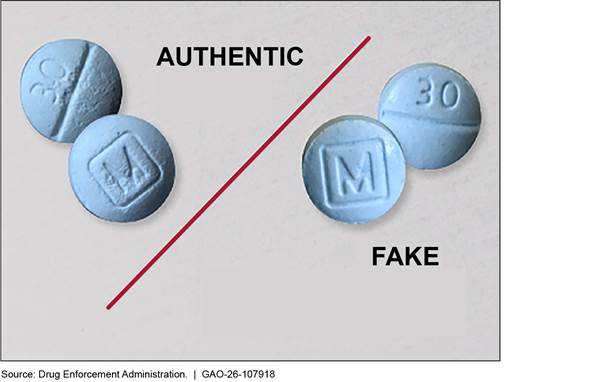
Note: Authentic prescription oxycodone contains an imprint of “M30” to indicate that it contains 30 milligrams of oxycodone hydrochloride.
TCOs manufacture counterfeit prescription pills using pill press machines and die molds that replicate trademarked markings. These tools are advertised and sold online, primarily by companies based in China, according to DEA and FinCEN reports.[43] During our investigative work, we found a die mold for producing counterfeit oxycodone “M30” pills listed for sale online from a China-based company (see fig. 3).[44]
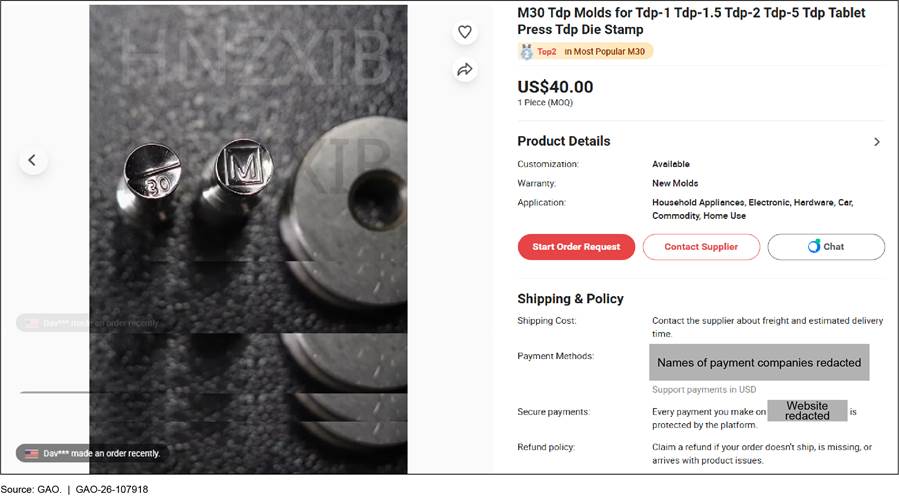
Note: Authentic prescription oxycodone contains an imprint of “M30” to indicate that it contains 30 milligrams of oxycodone hydrochloride. Counterfeit drugs often contain these markers, so they appear authentic.
TCOs have recently shifted away from manufacturing methods that rely on heavily restricted precursors in favor of less restricted, easier-to-obtain chemicals, according to DEA. DEA’s 2025 National Drug Threat Assessment indicates that this shift led to a decline in the purity of fentanyl beginning in 2024.[45] However, the assessment notes that lower purity does not make street-level fentanyl less dangerous because U.S.-based traffickers often adulterate it with other drugs, such as xylazine (a veterinary sedative), which can complicate the reversal of overdoses.
How do Mexican TCOs smuggle and distribute fentanyl and methamphetamine into the U.S.?
Mexican TCOs use their influence over Mexican transportation routes and maintain U.S. distribution networks to smuggle and distribute fentanyl and methamphetamine in the U.S., according to DEA’s 2024 and 2025 drug threat assessments (see fig. 4 for methods used).[46] TCOs move these drugs through Mexico and across the southwest U.S. border using tractor trailers, human mules, couriers, privately-owned vehicles, among other methods. Some traffickers pay other criminal organizations to access ports of entry, tunnels, or other smuggling routes.
Figure 4: How Mexican TCOs Generally Source Precursor Chemicals and Distribute Fentanyl and Methamphetamine into the U.S.
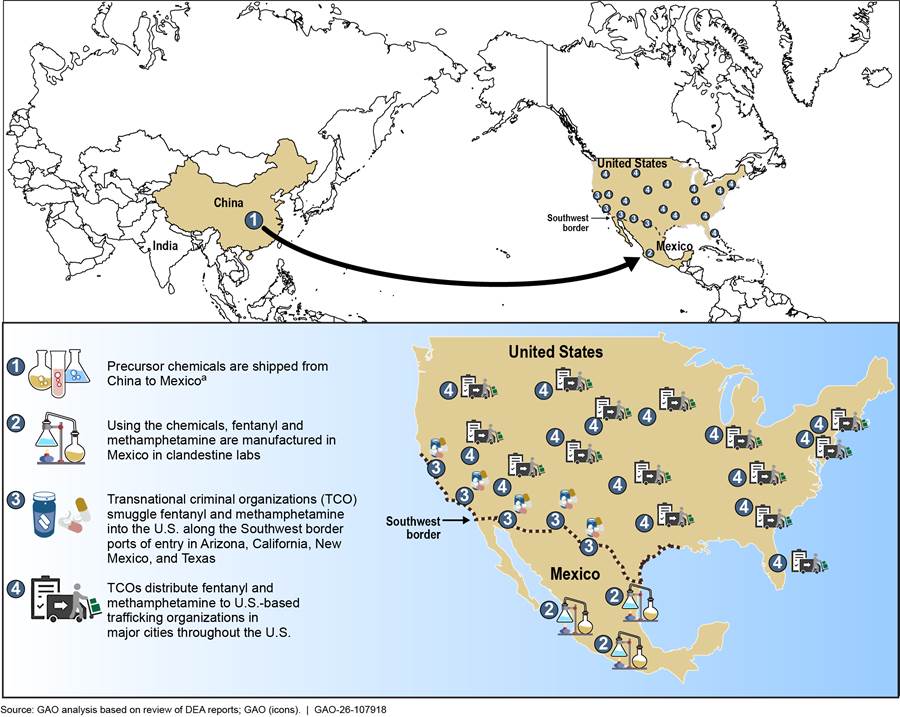
Note: This figure focuses on trafficking from Mexico as Mexican transnational criminal organizations are the largest supplier of illicit synthetic drugs to the U.S.
aPrecursor chemicals from China may also be shipped through neighboring countries, such as routing them from China to the U.S. before crossing the border to Mexico. While China is the primary source country for precursor chemicals, India is a secondary source country, according to the Drug Enforcement Administration’s National Drug Threat Assessment 2024.
Mexican TCO drug trafficking activities are linked to human trafficking, human smuggling, and firearms trafficking. According to DEA, TCOs may use trafficked women and children to smuggle drugs across the U.S. border.[47] In addition, people seeking to be smuggled may pay their fees by transporting drugs into or within the U.S., according to DOJ officials we interviewed. The United Nations Office on Drugs and Crime reported that firearms trafficking and drug trafficking benefit from the other’s established routes.[48] According to ICE, TCOs use illegally trafficked firearms to protect drug smuggling operations and secure smuggling routes. See text box below for a case involving TCO-linked defendants accused of drug distribution and human smuggling.
|
Federal Court Case: Combating Drug Trafficking, Human Smuggling, and Other Crimes In November 2023, a federal grand jury in Tucson, Arizona, returned an indictment against alleged members of Malas Manas, a transnational criminal organization operating in Mexico with the permission of the Sinaloa cartel, according to a DOJ press release. The indictment alleges that the defendants participated in a polycriminal network operating in the U.S. and Mexico that involved drug trafficking, human smuggling, and laundering the proceeds of the criminal activities. Between 2019 and 2023, the defendants allegedly distributed fentanyl, methamphetamine, and other illicit drugs in Arizona and elsewhere in the U.S. Additionally, they allegedly smuggled individuals unlawfully present in the U.S. from the U.S.-Mexico border region into Arizona. The indictment charges that the defendants used a social media platform to communicate with potential customers and to discuss smuggling fees and foot guide commissions. Payments were allegedly made by family members in the U.S. via bulk cash or wire transfer, and the money was allegedly moved subsequently to Mexico either in person or through financial institutions in Mexico. The defendants were indicted on November 29, 2023, and charged with various criminal violations, including Aiding and Abetting Distribution of Marijuana, Methamphetamine, Fentanyl, and Cocaine (21 U.S.C. §§ 841(a)(1), 2), Conspiracy to Transport Aliens (8 U.S.C. § 1324), and Conspiracy to Launder Monetary Instruments (18 U.S.C. § 1956(h)). The accused leader of the human smuggling operation, Jorge Damian Roman-Figueroa, was arrested by Mexican law enforcement in October 2021, prosecuted, and sentenced to 8 years in prison, where he allegedly continues to direct his organization’s operations. As of December 1, 2025, the case remains open. The charges described above are not exhaustive and do not represent a comprehensive overview of the case. We highlighted aspects of the indictments that are most relevant to our work. Statements in an indictment are merely allegations. All defendants are presumed innocent until proven guilty beyond a reasonable doubt in a court of law. For more information on this case, see U.S. v. Roman-Figueroa et al. (4:23-cr-01975), U.S. District Court for the District of Arizona. |
Source: GAO presentation of Department of Justice information. | GAO‑26‑107918
Most fentanyl and methamphetamine trafficking into the U.S. occurs through official ports of entry along the southwest border, according to DEA.[49] More than 90 percent of interdicted fentanyl is stopped at these locations, where TCOs primarily use vehicles driven by U.S. citizens to smuggle the drugs, according to DHS.[50] TCOs also smuggle some drug shipments between official ports of entry to evade detection, according to DOJ officials we interviewed. For example, TCOs have used river crossings located in the California desert to smuggle fentanyl and methamphetamine into the U.S.
DEA reports indicate that Mexican TCOs are generally not directly involved in local sale and distribution.[51] Rather, they leverage relationships with U.S.-based trafficking organizations who supply the drugs to local independent drug trafficking groups and gangs. The TCOs maintain large distribution hubs across the U.S. to supply fentanyl and methamphetamine to regional cartel-affiliated traffickers in key cities such as Los Angeles, Phoenix, Houston, Chicago, Atlanta, and Miami.
How do local drug traffickers distribute and sell fentanyl and methamphetamine?
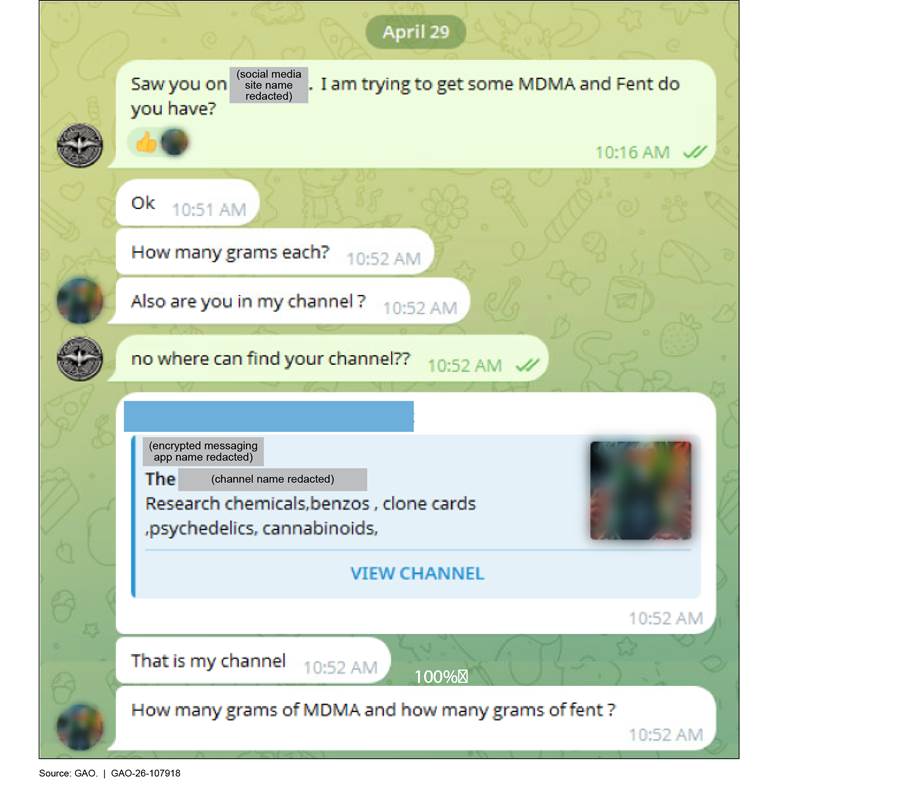
According to DEA, drug traffickers in the U.S. often use online platforms to advertise, communicate, and sell fentanyl and methamphetamine, among other drugs.[52] These platforms include social media sites and applications and encrypted messaging applications.[53] For example, in our undercover work we communicated with a purported drug trafficker we found through a social media site, who then directed us to a channel on an encrypted messaging app (see fig. 5). We plan to refer this instance of potential drug trafficking to DEA for follow-up as appropriate.
Figure 5: GAO Undercover Communication with Purported Drug Trafficker Who Uses a Social Media Site and Encrypted Messaging Application
Drug traffickers in the U.S. may adulterate Mexican TCO-supplied fentanyl and methamphetamine with other drugs before selling them to the local market, according to DEA.[54] U.S.-based drug traffickers may do this to increase profits by reducing the amount of costly drugs in a mixture or to cater to user preferences, such as a prolonged high. Fentanyl adulterants include xylazine, nitazenes (synthetic opioids that can match or surpass the potency of fentanyl), and medetomidine (a veterinary sedative 200–300 times more potent than xylazine).[55] U.S. traffickers can obtain these adulterant drugs directly from China, according to DEA.[56] In its 2025 National Drug Threat Assessment, DEA reported that its forensic analysis found that of the 5,058 polydrug (multiple-drug) samples, 75 percent had fentanyl or a fentanyl-related substance as the primary drug in 2024.[57]
Local drug trafficking groups in the U.S. use a variety of payment methods to facilitate the sale of synthetic drugs, which may occur both online (through marketplaces, e-commerce platforms, mobile applications, and social media platforms) and in person, according to FinCEN and DEA reports.[58] These reports noted that to complete sales, traffickers rely on cash, peer-to-peer payment applications, and increasingly, virtual currency.
While cash remains the primary method for street-level sales, DEA has reported a rise in the use of virtual currencies and peer-to-peer payment methods to conduct synthetic drug transactions and to obscure the origin of illicit funds. In one case, a dark web vendor pleaded guilty in 2024 to selling controlled substances, including fentanyl, and accepting virtual currency as payment (see text box). The drug trafficking organization laundered proceeds into virtual currency accounts.
|
Federal Court Case: Online Marketplaces and Virtual Currency in Synthetic Drug Trafficking A federal case involving a transnational criminal organization highlights how dark web marketplaces and virtual currencies are used to distribute synthetic drugs and conceal illicit proceeds. Between 2012 and 2017, Banmeet Singh led a transnational criminal organization responsible for distributing bulk quantities of illicit drugs, including fentanyl, across Europe and North America. Singh arranged the sale of drugs through accounts on dark web marketplaces such as Silk Road and Alpha Bay. Customers then paid for their purchases by transferring virtual currency. Singh and his co-conspirators also used wire transfers and cash shipments to conceal and move millions of dollars in drug proceeds. Singh shipped the drugs from Europe to his co-conspirators at distribution cells he controlled across the U.S., including in Ohio, Florida, and Washington. Singh was indicted on October 17, 2018, and extradited from the U.K. to the U.S. in 2023. He pled guilty to Conspiracy to Distribute and Possess with Intent to Distribute Controlled Substances (21 U.S.C. § 846) and Conspiracy to Commit Money Laundering (18 U.S.C. § 1956(h)). He was sentenced to 5 years imprisonment and forfeited approximately $150 million in virtual currency from drug proceeds, according to the DOJ press release. The charges described above are not exhaustive and do not represent a comprehensive overview of the case. We highlighted aspects of the case that are most relevant to our work. For more information on this case, see U.S. v. Singh (2:18-cr-00216-ALM) U.S. District Court for the Southern District of Ohio (Eastern Division). |
Source: GAO presentation of Department of Justice information. | GAO‑26‑107918
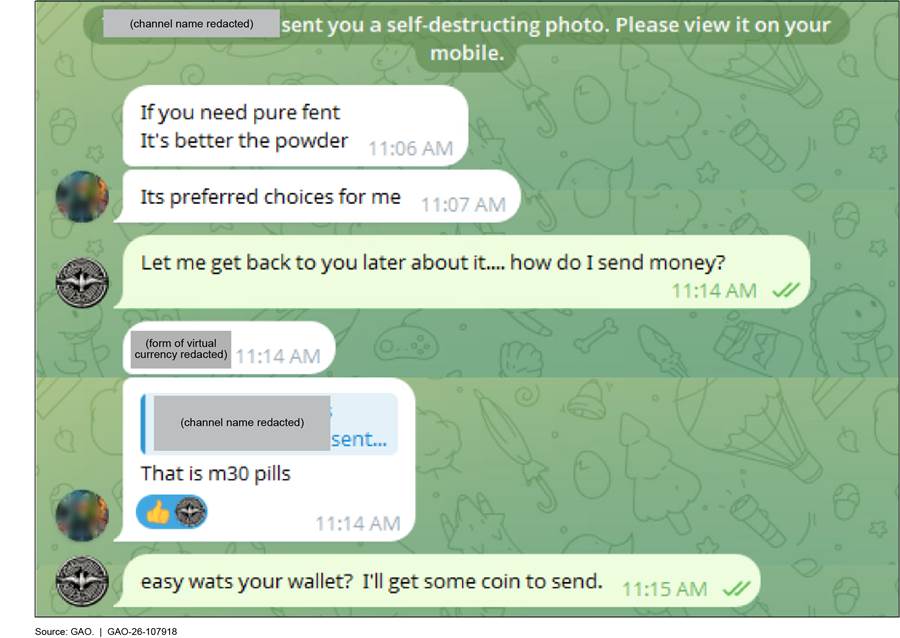
Our investigative work also identified purported sellers on online marketplaces who requested virtual currency as payment for synthetic drugs. See figure 6 for an example of our undercover communication with a purported drug trafficker who requested payment in virtual currency. We plan to refer potential drug trafficking to DEA for follow-up as appropriate.
Figure 6: GAO Undercover Communication with Purported Drug Trafficker Seeking Payment in Virtual Currency
Laundering Proceeds from the Sale of Synthetic Drugs
How do TCOs launder the proceeds from synthetic drug sales?
TCOs use methods such as bulk cash smuggling, funnel accounts, wire transfers, trade-based money laundering, and virtual currency to launder proceeds from synthetic drugs sales.[59] Increasingly, TCOs are outsourcing money laundering to professional money-laundering networks, including Chinese money laundering networks (CMLN) due in part to their reliability and access to the U.S. financial system, as discussed in detail below.[60] Money laundering methods do not necessarily vary by drug type, according to IRS officials. IRS officials said TCOs tend to choose methods based on their own organization and location.
Bulk cash smuggling involves moving physical currency across an international border, often to be deposited in a financial institution in another country. TCOs favor bulk-cash smuggling to repatriate their illicit funds from or move funds into the U.S., according to Treasury’s 2024 National Money-Laundering Risk Assessment.[61] They move bulk cash across the U.S.-Mexico border using air transport, armored car services, privately owned vehicles, and commercial tractor-trailers, according to FinCEN’s recent alert.[62] FinCEN noted that when moving bulk cash into the U.S., TCOs may deposit the funds into U.S. depository accounts owned by Mexico-based businesses or wire them through money services businesses.
Funnel accounts are bank accounts used to collect deposits from various locations. Multiple individuals deposit the cash into a bank account available to other members of the criminal network in another part of the country. The depositors may be individuals outside the organization who are compensated for transferring the funds. Funnel accounts remain a key tool for moving funds across the Mexican border, according to Treasury’s 2024 National Money-Laundering Risk Assessment.
Trade-based money laundering relies on trade transactions to disguise the movement of illicit funds. TCOs may submit false invoices on import and export documentation that misrepresent the price, quantity, or type of goods involved. They then sell the goods for their real value in local currency in the importing country, laundering the difference between the invoiced and actual amount. Other schemes can involve merchants who, wittingly or not, accept payment in funds derived from illicit activity in exchange for exports of goods.
Virtual currencies can be used to launder drug proceeds. Brokers may accept bulk cash in exchange for transferring an equivalent sum in virtual currency to a digital wallet owned by the TCO, according to DEA’s 2025 National Drug Threat Assessment.
Treasury’s 2024 National Money-Laundering Risk Assessment indicated that virtual currency is used far less frequently for money laundering than cash and more traditional methods. A stakeholder knowledgeable about transnational crime we interviewed said TCOs prefer cash because it is more commonly used to buy goods such as vehicles, gas, weapons, and ammunition, especially in Mexico. However, U.S. law enforcement agencies have detected an increase in the use of virtual currency to launder criminal proceeds.
Professional money laundering organizations are third-party specialists that help launder illicit funds for a fee. They can be professional criminal networks or individuals employed in legitimate professional services—such as lawyers, accountants, or arts and antiquities dealers—who knowingly help launder criminal proceeds. They may pick up and transport drug proceeds and then deposit them into the banking system or transfer them elsewhere. Treasury’s 2024 risk assessment reports that TCOs are increasingly using professional money laundering organizations, especially CMLNs.
What are the characteristics of Chinese money laundering networks and why do TCOs use them?
According to law enforcement officials, CMLNs use underground-banking channels, virtual currency, and traditional laundering methods within banking systems to convert, move, and obscure illicit proceeds for a fee. CMLNs are largely decentralized, relying on a network of Chinese nationals living in the U.S., Mexico, and China to sell U.S. dollars to Chinese citizens seeking to move money offshore. These citizens seek such services to circumvent China’s capital flight laws, which restrict transfers of large sums abroad.[63]
TCOs are increasingly using CMLNs in part because their laundering schemes involve fewer interactions with the formal banking system and at a lower cost than other organizations, according to law enforcement officials we interviewed. According to FinCEN, CMLNs are typically able to offer lower rates than other money laundering organizations because most CMLN revenue comes from selling the illicit cash to Chinese citizens at a high rate. TCOs also use CMLNs, in part, due to the speed and effectiveness of their money laundering operations and their willingness to absorb financial losses and assume risks, according to FinCEN.
In a 2024 congressional hearing, a HSI official noted that in fiscal year 2023, many of the roughly 600 fentanyl-related cases connected to China involved CMLNs.[64] According to DOJ officials we interviewed, Colombian money launderers in New York once dominated the market, using traditional laundering schemes and charging higher commissions for the amount laundered. CMLNs offer lower-risk schemes and sometimes use the laundered money for other operations, allowing them to offer lower commission and dominate the market.
Below, we provide illustrative examples of schemes CMLNs may use in their money laundering operations; such schemes are not necessarily sequential.
Some CMLNs use schemes that involve underground banking mechanisms that may bypass some aspects of formal banking channels and avoid the need to physically move currency across borders. One such process, known as a “mirror transaction,” is illustrated in figure 7. Based on our prior reports and review of FinCEN and DEA reports, an example of a mirror transaction involving CMLNs could work as follows (in practice, this may involve additional parties and steps):[65]
· A TCO delivers proceeds from synthetic drug trafficking in bulk U.S. dollars to a CMLN member in the U.S.
· The CMLN immediately credits the TCO’s counterpart abroad (for example, in Mexico) with an equivalent value in local currency, minus a commission. This is a “mirror transaction” in which funds do not cross borders.
· Subsequently, the CMLN sells the U.S. dollars to a Chinese citizen to use for expenses in the U.S., such as real estate or other transactions restricted by China’s capital flight laws.
· Those Chinese citizens transfer an equivalent amount from their Chinese bank accounts to the CMLN’s bank account in China.
· According to DOJ officials, the CMLN may use the funds in these bank accounts to purchase goods exported to Mexico, including precursor chemicals, for trade-based money laundering.
Mirror transactions exchange equivalent funds in different countries without crossing borders, helping obscure the origin of illicit drug proceeds.
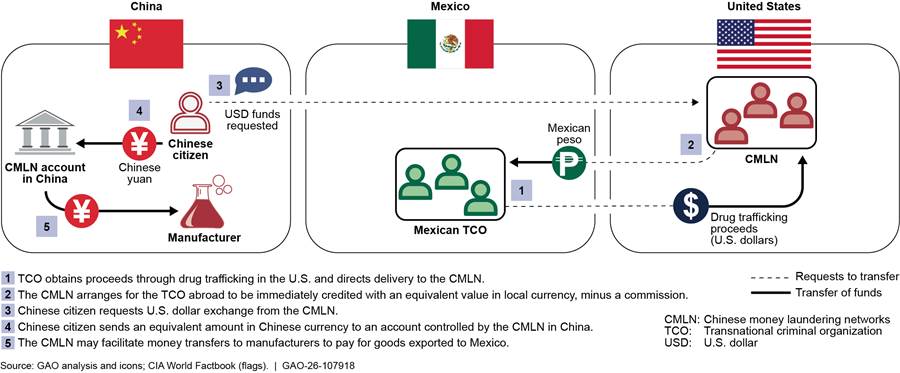
This illicit finance system provides benefits for various parties: liquidity for CMLNs, evasion of China’s capital controls for clients, and concealment of the criminal origins of drug proceeds for TCOs.[66]
CMLNs may also use schemes that involve traditional money laundering methods within the banking system. For example, HSI has reported that CMLNs may recruit Chinese nationals living in the U.S. to open domestic bank accounts, often supplying them with counterfeit Chinese passports to do so. These accounts operate as funnel accounts: couriers deposit funds that are quickly withdrawn and used to purchase cashier’s checks made out to third parties not associated with the account.
According to an April 2025 FinCEN report, suspicious activity report filings revealed networks of suspected CMLN couriers, mostly Chinese passport holders, engaging in suspicious activity such as large cash deposits, cashier’s check purchases, and peer-to-peer payments.[67] These transactions often involved personal or business accounts tied to seemingly legitimate businesses like restaurants and salons, as well as to suspected shell companies used for potential laundering. CMLNs have also transferred funds from their bank accounts directly to Mexico-based financial institutions. In June 2025, FinCEN prohibited certain fund transfers to three such financial institutions, citing their role in laundering money for TCOs.[68]
Another method CMLNs might use is trade-based money laundering. For example, in a 2024 congressional hearing, a HSI official noted CMLNs recruit individuals to purchase high-value electronics and luxury goods in the U.S. CMLNs then export the merchandise to China and sell it for a profit.[69] The resulting funds can then be used to purchase real estate, precursor chemicals, or other assets—or re-laundered using additional methods.
CMLNs also leverage U.S. banks to facilitate laundering, using funnel accounts, shell companies, and traditional banking products (see fig. 8).
Figure 8: Examples of How Chinese Money Laundering Networks Launder Drug Proceeds Through U.S. Banks
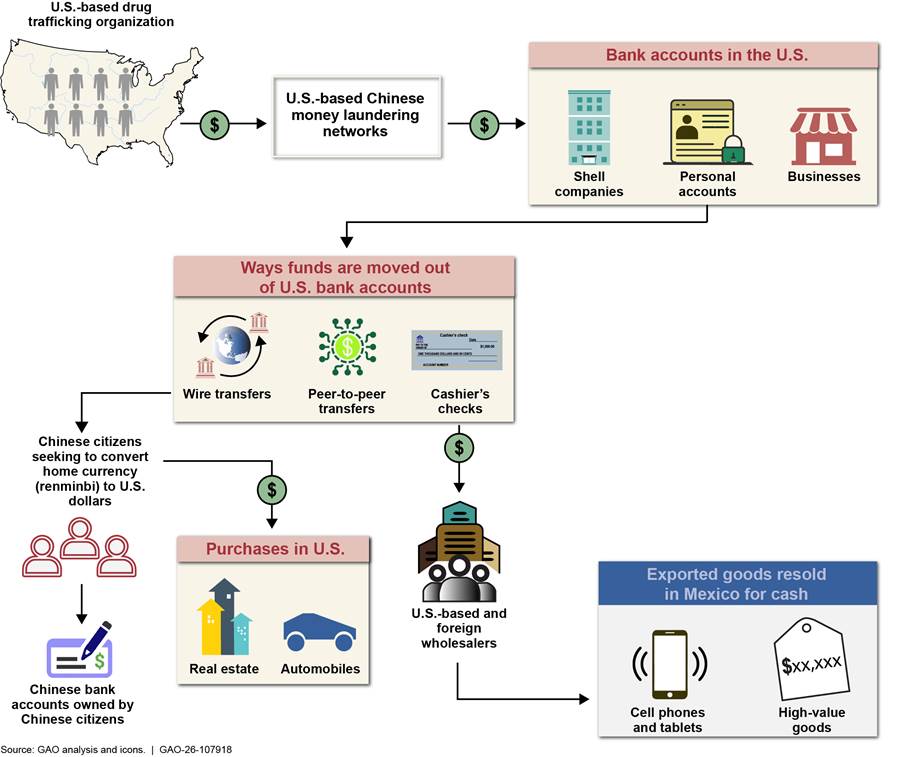
In June 2024, DOJ announced an indictment charging individuals with laundering drug proceeds through CMLNs using schemes such as the exchange of luxury goods and virtual currencies, as well as traditional banking methods, such as cashier’s checks (see text box).
|
Federal Court Case: Chinese Money Laundering Networks A 2023 federal indictment and 2024 superseding indictment in Los Angeles illustrates how Chinese money laundering networks help transnational drug traffickers clean and repatriate drug proceeds to Mexico through underground financial networks. The indictment charges that members of the Sinaloa cartel exported large quantities of illicit drugs, including cocaine and methamphetamine, from Mexico to coconspirators in the U.S. Between 2019 and 2023, the defendants allegedly distributed and sold the illicit drugs in California and elsewhere and laundered the proceeds by purchasing cryptocurrency, structuring assets to avoid federal reporting requirements, and using Chinese money laundering networks. For example, defendant Hang Su was charged with transporting bags of bulk cash from a codefendant who bought and sold U.S. currency in exchange for Chinese currency on the black market. According to the Department of Justice, more than $50 million in drug proceeds flowed between the Sinaloa Cartel members and Chinese underground money exchanges during the conspiracy. The defendants were indicted on October 26, 2023, and charged with various criminal violations, including Conspiracy to Aid and Abet the Distribution of Cocaine and Methamphetamine (21 U.S.C. § 846), Conspiracy to Launder Monetary Instruments (18 U.S.C. § 1956(h)), and Conspiracy to Operate an Unlicensed Money Transmitting Business (18 U.S.C. § 371). On June 27, 2025, defendant Hang Su plead guilty to Conspiracy to Operate an Unlicensed Money Transmitting Business and is awaiting sentencing. In August 2025, defendants Jiayong Yu, Xuanyi Mu, Shou Yang, and Oscar Eduardo Mayorga pleaded guilty to Conspiracy to Operate an Unlicensed Money Transmitting Business and are awaiting sentencing. In September 2025, Diego Acosta Ovalle pleaded guilty to Conspiracy to Operate an Unlicensed Money Transmitting Business and is awaiting sentencing. Numerous other defendants pleaded guilty to various charges, including conspiracy to launder monetary instruments and possession with intent to distribute certain controlled substances, in the case and are awaiting sentencing. The case remains on going as of December 1, 2025. The charges described above are not exhaustive and do not represent a comprehensive overview of the case. We highlighted aspects of the indictments that are most relevant to our work. Statements in an indictment are merely allegations. All defendants are presumed innocent until proven guilty beyond a reasonable doubt in a court of law (defendant Hang Su pleaded guilty to the charge noted above). For more information on this case, see U.S. v. Martinez-Reyes et al. (2:23-cr-524), U.S. District Court for the Central District of California. |
Source: GAO presentation of Department of Justice information. | GAO‑26‑107918
How has FinCEN helped financial institutions identify and report money laundering related to synthetic drugs?
FinCEN issued advisories in 2019, 2024, and 2025 to assist financial institutions in identifying and reporting suspicious activity related to synthetic drug trafficking and the use of CMLNs. Additionally, FinCEN recently reviewed suspicious activity reports from 2020 through 2024 and identified related money laundering trends, including suspected CMLN activity.[70] Treasury’s 2024 National Money Laundering Risk Assessment noted that CMLNs are becoming one of the most significant money laundering threat actors to the U.S. financial system. Their use of mirror transactions can make it more difficult for U.S. law enforcement to investigate. FinCEN’s advisories are designed to help financial institutions understand how illicit synthetic drug operations are financed and support them in filing useful suspicious activity reports to FinCEN for law enforcement.
FinCEN, through its Advisory Program, communicates money laundering, terrorist financing, and other illicit finance threats and vulnerabilities to the U.S. financial system. Financial institutions may use this information in part to support their suspicious activity monitoring systems. These advisories can cover a range of illicit finance threats, financial typologies, “red flag” indicators, and other guidance developed in collaboration with law enforcement agencies. According to FinCEN officials, the advisories are intended to help institutions better understand illicit finance typologies and indicators of potentially suspicious activity to report to FinCEN as part of their anti-money laundering programs and Bank Secrecy Act requirements. Its 2019 and 2024 advisories highlight typologies and red flags in the illicit fentanyl and synthetic opioid supply chain to help financial institutions detect, prevent, and report suspicious activity. Its 2025 advisory highlights typologies and red flags related to TCO use of CMLNs (see table 1).
|
Date |
Advisory |
Description |
|
Advisory related to drug trafficking |
||
|
August 21, 2019 |
Advisory to Financial Institutions on Illicit Financial Schemes and Methods Related to the Trafficking of Fentanyl and Other Synthetic Opioids FIN-2019-A006 |
Alerts financial institutions to financial typologies and red flags linked to the trafficking of fentanyl and other synthetic opioids. Provides examples of the use of money services businesses, online payment processors, darknet marketplaces, and convertible virtual currency by traffickers. |
|
Advisory related to supply chains |
||
|
June 20, 2024 |
Supplemental Advisory on the Procurement of Precursor Chemicals and Manufacturing Equipment Used for the Synthesis of Illicit Fentanyl and Other Synthetic Opioids FIN-2024-A002 |
Supplements the 2019 advisory to reflect evolving supply chain trends. Focuses on procurement of precursor chemicals, pill presses, and die molds. Identified red flags for financial institutions related to customer and counterparty profiles, and transactions. |
|
Advisory related to Chinese money laundering networks (CMLN) |
||
|
August 28, 2025 |
FinCEN Advisory on the Use of Chinese Money Laundering Networks by Mexico-Based Transnational Criminal Organizations to Launder Illicit Proceeds FIN-2025-A003 |
Provides an overview of CMLNs and their connection to transnational criminal organizations. Discusses financial typologies associated with CMLNs, such as mirror transactions and trade-based money laundering. Highlights red flag indicators related to CMLN-affiliated money mules and trade-based money laundering schemes. |
Source: GAO analysis of Financial Crimes Enforcement Network (FinCEN) Information. | GAO‑26‑107918
The 2019 and 2024 advisories reference press releases from prior cases along with customer and counterparty profiles and transactional red flags.[71] The 2025 advisory references CMLN-affiliated money mules and
|
“Red Flags” for Fentanyl Supply Chain Activity In 2024, FinCEN advised financial institutions to watch for the following indicators of illicit fentanyl supply chain activity: Customer and Counterparty Profiles · Customer or counterparty has previous drug-related convictions or is a suspicious chemical or pharmaceutical entity in China and shows signs of possible illicit shell company activity. · Customer or counterparty operates on an e-commerce or darknet marketplace that advertises precursor chemicals or manufacturing equipment for fentanyl. · Customer is a Mexican company that reportedly imports fentanyl precursor chemicals and manufacturing equipment without appropriate licenses or registrations. Transaction-Related Indicators · Customer sends low-dollar or virtual currency payments with no clear legitimate purpose to beneficiaries involved in chemical or pharmaceutical industries in China. · Entity is a Mexico-based or China-based entity in an unrelated industry that transacts across borders with a chemical or pharmaceutical firm in Mexico or China. · Customer is a Mexican company with no apparent link to chemical or pharmaceutical industries and engages in transactions involving fentanyl precursors or associated manufacturing equipment. Source: GAO analysis of Financial Crime Enforcement Network (FinCEN) information. | GAO‑26‑107918 |
trade-based money laundering schemes and included a list of red flags to help financial institutions detect, prevent, and report related suspicious activity. Examples of red flags include the following:
· A customer, especially one who presented a Chinese passport as identification, regularly receives funds not commensurate with the reported occupation or income.
· A customer presents a Chinese passport and a visa that contain the same photograph despite being allegedly issued years apart.
· A customer’s account, especially that of a Chinese national, receives numerous transfers or deposits and has a significant number of withdrawals or transfers, none of which appear to be related to customer’s stated expected activity.
· A business owned by a Chinese national regularly receives deposits from online marketplaces, but rarely, or never, engages in transactions that indicate the purchase of goods to maintain inventory.
· A small U.S.-based business in the electronics or real estate industry receives wires from Mexico, China, Hong Kong, and the United Arab Emirates and has no known nexus to these countries.
· A business that sells electronics or other luxury goods has income that is not commensurate with the size and scale of the business.
According to members of the Independent Community Bankers of America, a banking industry trade group, FinCEN’s red flags and case examples help financial institutions improve their monitoring activities. Members of the American Bankers Association similarly noted that advisories provide useful information on priorities, including areas of critical concern.
FinCEN’s advisories also requested that filers reference the advisories in their suspicious activity reports through a unique key term for each advisory. According to FinCEN officials, the use of advisory key terms allows FinCEN and its law enforcement partners to search and monitor suspicious activity reports filed in response to the advisories for trend analysis and to support new or ongoing investigations.
What do recent suspicious activity report filings reveal about money laundering related to synthetic drug trafficking?
Our analysis of suspicious activity report data from August 2019 through March 2025 found that 86 percent of reports filed in response to FinCEN’s 2019 and 2024 advisories referenced fentanyl, methamphetamine, or other synthetic drugs.[72] Among the total 1,457 filings analyzed, 48 percent of the suspicious activities occurred at depository institutions and 51 percent at money services businesses. Additionally, 40 percent of the 1,457 filings in our analysis referenced suspicious electronic funds transfers or wire transfers, with such references increasing from 24 filings in 2020 to 293 in 2024.
In an April 2025 report, FinCEN’s analysis of 2024 Bank Secrecy Act data found that the fentanyl supply chain leverages U.S. financial institutions.[73] The report also found that money laundering schemes range from simple funds transfers to complex schemes, such as those involving CMLNs. According to FinCEN officials we interviewed—and consistent with findings we reviewed in FinCEN documents—CMLNs remain prominent among global professional money laundering groups. In an August 2025 report, FinCEN analyzed Bank Secrecy Act data from 2020 through 2024 and noted that banks filed the majority of potentially CMLN-related reports, with depository institutions filing 85 percent of the reports and money services businesses filing 9 percent.[74] FinCEN also found that the most common suspicious activity involved U.S.-based Chinese nationals making large cash deposits, with 33 percent of reports referencing these cash deposit transactions.
Agency Coordination, Information-Sharing Efforts, and Recent Policy Changes
How do federal agencies coordinate to combat synthetic drug trafficking and related money laundering?
Federal agencies coordinate and share information with each other and with state, local, and international partners through task forces, working and advisory groups, colocation, and other information-sharing channels, as shown in table 2.[75] These mechanisms are intended to help agencies share resources and expertise, deconflict investigations, and combine unique authorities in combating drug trafficking and money laundering organizations.[76]
Table 2: Examples of Interagency Efforts That Address Synthetic Drug Trafficking and Illicit Financing
|
Interagency effort |
Description |
Participating entitiesa |
|
Bank Secrecy Act Advisory Group |
Public-private partnership led by FinCEN that convenes industry, regulator, and law enforcement representatives for discussions regarding administration of the Bank Secrecy Act, including how recordkeeping and reporting requirements can be improved to enhance utility to law enforcement and national security. |
DOJ Treasury USPIS State and local partners Private sector partners |
|
CBP National Targeting Center |
Uses data and law enforcement intelligence to identify international cargo shipments and travelers that may be connected to transnational criminal activities, including narcotics smuggling, human trafficking, and money laundering, and shares data and intelligence with law enforcement in support of investigations. |
DOJ DHS Treasury Department of State USPIS Private sector partners International partners |
|
DEA Special Operations Division |
Multiagency operational coordination center led by DEA aimed at dismantling drug trafficking and money laundering organizations by attacking their command, control, and communications. |
DOJ DHS Treasury USPIS Intelligence Community partners State, local, and international partners |
|
El Dorado Task Force |
Financial crimes task force led by HSI to disrupt and dismantle transnational money laundering organizations by conducting proactive investigations, engaging private sector partners, and leveraging federal and state laws and regulations. |
DOJ DHS Treasury State and local partners Private sector partners |
|
FinCEN Exchange |
Public-private information-sharing partnership led by FinCEN to enhance financial institutions’ ability to identify and report information that supports law enforcement in disrupting money laundering and other financial crimes. |
Treasury National Security agencies Federal, state, and local partners Private sector partners |
|
Five Eyes Law Enforcement Group |
Coalition of law enforcement agencies from Australia, Canada, New Zealand, the United Kingdom, and the U.S., led by the National Crime Agency.b Shares criminal intelligence and collaborates on operations to combat transnational crime, including drug trafficking and money laundering. |
DOJ DHS Treasury International partners |
|
Joint Criminal Opioid and Darknet Enforcement |
FBI-led team that coordinates efforts to detect, disrupt, and dismantle major criminal enterprises and supply chains reliant on the darknet for trafficking opioids and other illicit narcotics. |
DOJ DHS Treasury USPIS State, local, and international partners |
|
Organized Crime Drug Enforcement Task Forcesc |
Former DOJ component that used a prosecutor-led, multiagency approach to lead coordinated investigations of transnational organized crime, money laundering, and major drug trafficking networks. |
DOJ DHS Treasury Department of State USPIS State and local partners |
|
Synthetic Drugs Interagency Coordination Group |
ONDCP-led group that aims to exchange information and synchronize U.S. government efforts to combat synthetic drug manufacturing and trafficking. |
DOJ DHS Department of State ONDCP Embassy Mexico City Other U.S. law enforcement representatives |
|
Trade Transparency Unit |
International effort led by HSI to combat trade-based money laundering. As of August 2025, 19 partner countries have established units with HSI assistance. The units collaborate and exchange trade data to better identify anomalies that may indicate trade-based money laundering, such as discrepancies in the reported value of imported goods. |
DHS International partners |
CBP: Customs and Border Protection
DEA: Drug Enforcement Administration
DHS: Department of Homeland Security
DOJ: Department of Justice
FBI: Federal Bureau of Investigation
FinCEN: Financial Crimes Enforcement Network
HSI: Homeland Security Investigations
ICE: Immigration and Customs Enforcement
ONDCP: Office of National Drug Control Policy
Treasury: Department of the Treasury
USPIS: U.S. Postal Inspection Service
Source: GAO analysis of agency information. | GAO‑26‑107918
aThis list of participating entities is not exhaustive. Federal agencies shown are limited to those we interviewed (see app. I) and the Office of National Drug Control Policy.
bLeadership of the Five Eyes Law Enforcement Group rotates among member agencies every 2 years. The United Kingdom’s National Crime Agency formally assumed leadership from ICE-HSI in July 2025.
cIn accordance with the Deputy Attorney General’s July 23, 2025, memorandum entitled, “Transitioning [Organized Crime Drug Enforcement Task Forces] Resources for Homeland Security Task Forces,” the program concluded its investigative and prosecutorial operations and began the closure or transfer of executive functions as of July 25, 2025. On September 17, 2025, the Attorney General signed the Department of Justice’s Agency Reduction in Force and Reorganization Plan that terminated Organized Crime Drug Enforcement Task Forces and distributed select functions and resources among the FBI, DOJs Justice Management Division, and the DHS to support the establishment of Homeland Security Task Forces pursuant to Executive Order 14159.
Task Forces
A task force is a group of agencies formed to address a specific issue or threat, often by sharing resources and information. It is one of the primary ways law enforcement agencies coordinate with one another and with state, local, or international partners on synthetic drug trafficking and money laundering investigations. The distinct mission of a task force generally determines the type and number of agencies involved and its geographic scope. For example, the FBI’s Joint Criminal Opioid and Darknet Enforcement team includes task forces comprised of several federal agencies that coordinate global operations targeting criminal activity on darknet marketplaces. See text box below for an example of a case involving the Joint Criminal Opioid and Darknet Enforcement team.
|
Federal Court Case: Operation SpecTor An indictment against defendants Holly Adams and Devlin Hosner charged that they sold tens of thousands of counterfeit oxycodone pills containing fentanyl on darknet marketplaces, such as Darkode and ToRReZ, between 2021 and 2022. The defendants allegedly shipped the drugs and contraband to buyers across the U.S., using the U.S. Postal Service, United Parcel Service, and other means and received more than $800,000 in cryptocurrency. In March 2022, federal law enforcement officers seized more than 10,000 counterfeit oxycodone pills and approximately 60 grams of methamphetamine from the defendants’ residence. The Department of Justice reported that this case was part of more than 100 federal operations and prosecutions under Operation SpecTor. Led by the Federal Bureau of Investigation’s Joint Criminal Opioid and Darknet Enforcement team, Operation SpecTor is the largest international operation against darknet trafficking of fentanyl and opioids. From 2021 through 2023, the operation resulted in 288 arrests, the seizure of more than 850 kilograms of drugs (including 64 kilograms of fentanyl-related narcotics), and more than $50 million in cash and virtual currencies. It involved federal law enforcement from the Drug Enforcement Administration, Immigration and Customs Enforcement-Homeland Security Investigations, Customs and Border Protection, U.S. Postal Inspection Service, and Internal Revenue Service-Criminal Investigation, with additional support from state, local, and international partners. Defendants Adams and Hosner were indicted on May 12, 2022, and charged with Conspiracy to Distribute and Possess with Intent to Distribute Fentanyl and Methamphetamine (21 U.S.C. §§ 846, 841(a)(1)) and Conspiracy to Launder Money (18 U.S.C. § 1956(a)(1)(B)(i) and (h)). Defendant Holly Adams pleaded guilty to both counts and was sentenced to 12 years’ imprisonment. In December 2025, defendant Devlin Hosner pleaded guilty to conspiracy to distribute and possess with intent to distribute certain controlled substances and is awaiting sentencing. For more information on this case, see U.S. v. Adams et al. (2:22-cr-00100-JAM), U.S. District Court for the Eastern District of California. |
Source: GAO presentation of Department of Justice information. | GAO‑26‑107918
According to the Financial Action Task Force, task forces can be well-suited for large and complex investigations as they are designed to facilitate information sharing and allow agencies to leverage one another’s expertise and legal authorities.[77] For example, Organized Crime Drug Enforcement Task Forces used a prosecutor-led, multiagency approach to coordinate investigations. It included representatives from DOJ, DHS, Treasury, USPS, Department of State, and state and local law enforcement agencies.[78]
DOJ officials said new task forces were recently established in accordance with Executive Order 14159, Protecting the American People Against Invasion, signed January 20, 2025. The order required DOJ and DHS to jointly established Homeland Security Task Forces in all 50 states to end the presence of cartels and TCOs in the U.S. DHS officials said these new task forces would leverage the existing structures and capabilities of Organized Crime Drug Enforcement Task Forces and other interagency task forces to expand the counter-drug mission of the Homeland Security Task Forces in accordance with the executive order. Additionally, FBI officials said these task forces are being formed to increase collaboration with domestic law enforcement and Intelligence Community partners to combat synthetic drug trafficking and foreign terrorist organizations generally. According to DOJ officials, as of November 2025, the Homeland Security Task Forces National Command Center is operational.
Task forces can also help prevent duplicative investigations. For example, DOJ, DHS, USPS, and state and local agencies used an El Dorado Task Force to coordinate their investigation into a New York-based drug trafficking network. According to DOJ, the joint investigation resulted in four arrests in October 2023 and the seizure of approximately 24 kilograms of suspected fentanyl powder, more than 200,000 suspected fentanyl pills, and four commercial pill presses.[79] In cases such as this, agencies are able to deconflict law enforcement activities like surveillance or executing arrest warrants, reducing duplication and overlap.
Working and Advisory Groups
Working and advisory groups are formal mechanisms through which agencies and international partners or private sector partners collaborate to address a specific issue or shared goal.[80] Interagency working groups allow agencies with different authorities and resources to address common concerns, identify resource and capability gaps, and leverage resources, according to the Office of National Drug Control Policy.[81] Agencies use these groups to synchronize investigations, share intelligence and data, and build productive relationships over time.
Officials from several agencies told us that these groups are important to their efforts to combat synthetic drug trafficking and related money laundering. They noted that group goals are dynamic and can change to align with evolving criminal networks and strategies:
· Department of State officials told us that the Synthetic Drugs Interagency Coordination Group, which focuses on combating the manufacturing and trafficking of all synthetic drugs, was initially established in 2015 as the U.S. Embassy Interagency Heroin-Fentanyl Working Group in Mexico City. Its goal was to synchronize U.S. and Mexican investigative efforts to combat heroin and fentanyl manufacturing and trafficking.[82]
· FBI officials told us that the Five Eyes Law Enforcement Group recently prioritized addressing CMLNs due to their significant role in illicit finance related to drug trafficking.
· The
Bank Secrecy Act Advisory Group provides an avenue for FinCEN to communicate
regularly with private-sector representatives on how Bank Secrecy Act reports
support law enforcement investigations and how reporting could be improved.[83] According to a June 18, 2025,
Treasury press release, FinCEN recently expanded the group’s membership to
increase the number of small community banks.
Colocation
Colocation is the practice of housing one or more entities, often in one location, to collaborate on shared mission projects. Agencies use colocated centers, divisions, and teams to deconflict and leverage resources with other law enforcement agencies, international partners, and the private sector. Ten components from DHS, DOJ, Treasury, and USPS reported using colocation to coordinate and share information, intelligence, and data to combat transnational criminal organizations and illicit finance.
For example, officials said CBP’s National Targeting Center houses personnel from five components of the agencies in our review and more than a dozen international and industry partners. The center aims to identify high-risk individuals and cargo prior to their arrival in the U.S. and to support related criminal investigations, including drug smuggling and money laundering. It operates through various divisions, units, and teams, such as the Executive Cargo Division, Counter Transnational Organized Crime Unit, and Industry and Partnership Alliance team.
Additionally, DEA leads the Special Operations Division, which is overseen by officials from DEA, FBI, and HSI, according to DEA officials. Officials said over 36 federal, local, and international agencies collaborate in the division to identify and dismantle international and domestic drug trafficking and money laundering organizations by targeting their command, control, and communications. DEA officials said colocation fosters open lines of communication, which they described as crucial to relationships between the agencies. We previously reported on interagency efforts to combat synthetic drugs at the National Targeting Center and to address illicit finance at the Special Operations Division.[84]
What other mechanisms do federal agencies use to share information?
Federal agencies share information with each other, the private sector, and state and local law enforcement through a variety of channels, including memorandums, liaison information reports, programs, and events. They also share intelligence and data with each other and international partners to identify, disrupt, and dismantle drug trafficking organizations and illicit financial activity.
For example, DHS officials told us the Trade Transparency Unit program, which is a data sharing program, supports their work combating illicit finance, including money laundering related to synthetic drug trafficking. Trade Transparency Units are the U.S. government’s primary partnership effort for sharing trade data to address trade-based money laundering.[85] They serve as a means for agencies in different countries to jointly analyze trade data and identify anomalies that may indicate laundering activity. FinCEN also reported sharing financial intelligence with U.S. law enforcement agencies and FinCEN’s financial intelligence unit foreign counterparts. For example, FinCEN uses memorandums of understanding that permit law enforcement agencies access to Bank Secrecy Act information.[86]
FBI officials reported using liaison information reports to share impactful and actionable content on issues relevant to the private sector. For example, officials said several FBI field offices produced reports in 2024 on synthetic drug trafficking or money laundering for private companies in the healthcare, agriculture, and transportation sectors. FBI officials told us they also share intelligence with other agencies to combat synthetic drug trafficking. For example, they regularly share intelligence with the Department of Defense on the flow of illicit drugs, including fentanyl, via air and maritime shipping routes, which has resulted in the seizure of both illicit drugs and illicit funds used to purchase them.
FinCEN has used an information sharing public-private partnership program, known as the FinCEN Exchange, for identifying illicit financial activity and to build relationships with and between financial institutions and law enforcement. In 2024, it held 10 informational exchange events in U.S. cities highly affected by the opioid epidemic as part of its Promoting Regional Outreach to Educate Communities on the Threat of Fentanyl series. During these events, representatives from financial institutions and law enforcement agencies discussed how to identify and track illicit financial flows tied to fentanyl-related activity. One participating financial institution representative described the exchange as informative and said it enhanced their institution’s monitoring processes for fentanyl-related and broader drug trafficking activity. DOJ officials said the exchanges help to build strong partnerships with the private sector.
In June 2025, FinCEN launched a new exchange series, Combating and Obstructing Money Movements Associated with Narcotics and Drug Trafficking Organizations. In collaboration with the Texas Department of Banking, FinCEN held the first of these events in McAllen and El Paso, Texas, because of the proximity to the southwest border and exposure to cartel and TCO activity, including drug trafficking and human smuggling. The series supports Executive Order 14157, which designates cartels and other TCOs as foreign terrorist organizations and specially designated global terrorists.[87]
In general, agency officials we spoke with believed the existing coordination and information-sharing efforts enhance their work to combat synthetic drug trafficking and illicit financing.[88] Partnerships with other federal, state, local, and international law enforcement agencies are critical to interdicting fentanyl, its precursor chemicals, and manufacturing equipment, and disrupting fentanyl-related supply chains, according to DHS.[89] FBI officials told us that establishing additional working groups with federal, state, and local partners could further streamline communication and deconfliction. Officials from other agencies, such as CBP, FinCEN, and the U.S. Postal Service Inspection Service, said they were focused on enhancing existing coordination and information-sharing efforts. See figure 9 for examples of coordination and information-sharing efforts for combating drug trafficking and illicit finance.
Figure 9: Examples of Coordination and Information-Sharing Efforts for Combating Drug Trafficking and Illicit Finance
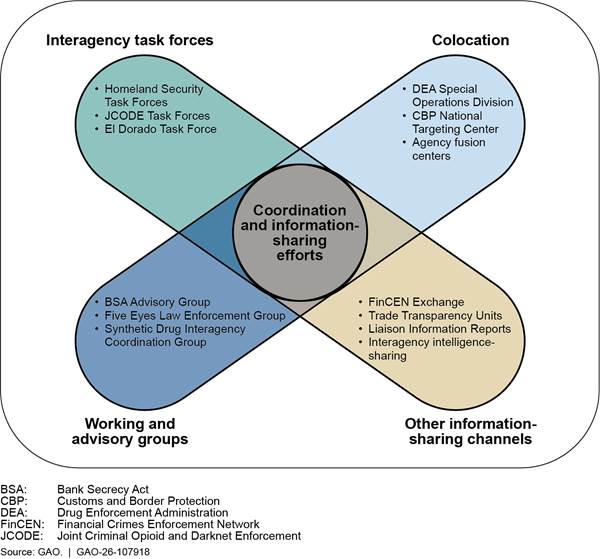
What recent policy changes aim to address transnational crime?
On January 20, 2025, the administration began instituting a variety of new policies, including some aimed to combat the flow of synthetic drugs into the U.S. These actions include the use of terrorist designations, sanctions, and import duties (see table 3).
|
Policy |
Description |
|
Presidential Proclamation 10886 – Declaring a National Emergency at the Southern Border of the United States (Jan. 20, 2025) |
Declares a national emergency at the U.S.-Mexico border and directs the deployment of the Armed Forces to the border. |
|
Executive Order 14157 – Designating Cartels and Other Organizations as Foreign Terrorist Organizations and Specially Designated Global Terrorists (Jan. 20, 2025) |
Establishes a process to designate certain international cartels and other organizations as foreign terrorist organizations or specially designated global terrorists and instructs the Secretary of State to recommend designations by February 2025.b |
|
Executive Order 14159 – Protecting the American People Against Invasion (Jan. 20, 2025) |
Instructs the Attorney General and Secretary of Homeland Security to jointly establish Homeland Security Task Forces in every state. The objectives of the task forces are listed as including (1) ending the presence of cartels, foreign gangs, and transnational criminal organizations throughout the U.S., (2) dismantling cross-border human smuggling and trafficking networks, and (3) ensuring the use of all available law enforcement tools to execute U.S. immigration laws. |
|
Executive Order 14193 – Imposing Duties to Address the Flow of Illicit Drugs Across Our Northern Border (Feb. 1, 2025)c |
Expands the scope of the national emergency declared in Presidential Proclamation 10886 and imposes tariffs on selected products of Canada. |
|
Executive Order 14194 – Imposing Duties to Address the Situation at Our Southern Border (Feb. 1, 2025)c |
Expands the scope of the national emergency declared in Presential Proclamation 10886 and imposes tariffs on selected products of Mexico. |
|
Executive Order 14195 – Imposing Duties to Address the Synthetic Opioid Supply Chain in the People’s Republic of China (Feb. 1, 2025)c |
Expands the scope of the national emergency declared in Presidential Proclamation 10886 and imposes tariffs on selected products of China. |
|
Executive Order 14256 – Further Amendment to Duties Addressing the Synthetic Opioid Supply Chain in the People’s Republic of China as Applied to Low-Value Imports (Apr. 2, 2025) |
Eliminates the de minimis exemption for products of the People’s Republic of China (PRC) (which include products of Hong Kong) and establishes a new duty rate for international postal packages sent to the United States through the international postal network from the PRC or Hong Kong. |
Source: GAO analysis of executive orders and other presidential actions. | GAO‑26‑107918
aOn September 9, 2025, the Supreme Court agreed to review two cases involving challenges to the President’s authority to impose tariffs on goods imported into the United States under the International Emergency Economic Powers Act. Learning Resources, Inc. v. Trump, 2025 U.S. App. LEXIS 14142, cert. granted, 94 U.S.L.W. 3065, (U.S. Sept. 9, 2025) (No. 24-1287) and Trump v. V.O.S. Selections, Inc., (Fed. Cir. 2025) 149 F.4th 1312, cert. granted, 94 U.S.L.W. 3065 (U.S. Sept. 9, 2025) (No. 25-250).
bOn February 20, 2025, the Department of State announced the designation of eight Western Hemisphere-based transnational criminal organizations as terrorist organizations following the issuance of Executive Order 14157, including Tren de Aragua, Cártel de Sinaloa, and Cártel de Jalisco Nueva Generación.
cExecutive Orders 14193, 14194, and 14195 have been amended multiple times since February 1, 2025. We did not include amendments in this table that were not significant to our review.
In general, agency officials told us it is too early to assess the full impact of recent policy changes on efforts to combat synthetic drug trafficking. However, officials noted that the foreign terrorist organization designations provide additional authorities for law enforcement, while also presenting potential challenges related to investigating and prosecuting drug trafficking and related money laundering cases.[90]
DOJ officials said Executive Order 14157, Designating Cartels and Other Organizations as Foreign Terrorist Organizations and Specially Designated Global Terrorists, subjects members of designated cartels and their associates to U.S. sanctions and allows prosecutors to use additional tools, such as terrorism (including material support) and narcoterrorism charges. FBI officials also noted that it allows DOJ to pursue enhanced penalties under terrorism sentencing guidelines.
Treasury officials described sanctions as a complementary tool to the civil and criminal penalties associated with foreign terrorist organization designations. They said that when used as part of a whole-of-government approach, sanctions can help disrupt TCO manufacturing and trafficking of synthetic drugs.
Treasury enhanced its sanction authorities against TCOs following issuance of Executive Order 14157 and the Department of State’s subsequent designation of eight cartels as foreign terrorist organizations on February 20, 2025. For example, according to a June 18, 2025, Treasury press release, the Office of Foreign Assets Control sanctioned five Mexico-based leaders of Cártel de Jalisco Nueva Generación under counterterrorism authorities. This action froze their assets and prohibited persons in the U.S. or subject to the jurisdiction of the U.S. from transacting with them. It could also result in potential secondary sanctions on foreign financial institutions that engaged in transactions with the designated individuals, according to the press release.[91]
More broadly, officials reported that Treasury’s Office of Foreign Assets Control undertook eight TCO-related actions between January 20, 2025, and May 9, 2025. These actions resulted in the designation of 20 individuals and 11 entities pursuant to counternarcotics, TCO, or counterterrorism sanctions authorities.
Similarly, DOJ officials reported leveraging the authorities provided by the terrorism designations. For example, in the spring of 2025, an alleged high-ranking member of Tren de Aragua, a Venezuelan TCO designated as a foreign terrorist organization, was charged with conspiring to provide and providing material support to a designated terrorist group. According to DOJ, this was the first case in which a Tren de Aragua member was charged with terrorism-related crimes.
DHS officials cited some potential challenges stemming from the terrorism designations. Officials expressed concerns that certain investigative activities—such as undercover drug buys or paying confidential informants—could violate statutes prohibiting material support to designated foreign terrorist organizations or their associates.
According to DHS officials, leveraging intelligence authorities in criminal prosecutions triggers additional reporting requirements under the rules of discovery. Officials said efforts to leverage the enhanced authorities in the executive order should be carefully coordinated with federal prosecutors.
Specifically, DHS officials said the order could affect law enforcement’s ability to prosecute members of designated TCOs due to concerns about sharing intelligence information.
Agency Comments
We provided a draft of this report to Treasury (including FinCEN), DOJ, the DHS, IRS-CI, Department of State and USPS for review and comment. Treasury, DOJ, and DHS provided technical comments, which we incorporated as appropriate. USPS provided a formal letter which we have reprinted in appendix III.
We are sending copies of this report to the appropriate congressional committees and the Secretary of the Treasury, Attorney General, Secretary of Homeland Security, Secretary of State, and the Postmaster General. In addition, the report is available at no charge on the GAO website at https://www.gao.gov.
If you or your staff have any questions about this report, please contact Michael E. Clements at ClementsM@gao.gov or Triana McNeil at McNeilT@gao.gov. Contact points for our Offices of Congressional Relations and Public Affairs may be found on the last page of this report.
GAO staff who made key contributions to this report are listed in appendix IV.
Michael E. Clements
Director, Financial Markets and Community Investment
Triana McNeil
Director, Homeland Security and Justice
This report describes (1) how transnational criminal organizations (TCO) source, manufacture, and distribute synthetic drugs; (2) the methods these TCOs use to launder their proceeds; and (3) coordination and information sharing efforts among federal agencies and recent policy changes.
For all objectives, we reviewed key federal agency reports and guidance, including
· the Department of the Treasury’s 2024 National Money Laundering Risk Assessment,[92]
· the Drug Enforcement Administration’s (DEA) national drug threat assessments for 2024 and 2025,[93]
· the Financial Crimes Enforcement Network’s (FinCEN) Advisory to Financial Institutions on Illicit Financial Schemes and Methods Related to the Trafficking of Fentanyl and Other Synthetic Opioids (FIN-2019-A006),[94] and
· FinCEN’s Supplemental Advisory on the Procurement of Precursor Chemicals and Manufacturing Equipment Used for the Synthesis of Illicit Fentanyl and Other Synthetic Opioids (FIN-2024-A002).[95]
We also reviewed executive orders issued between January 20, 2025, and July 31, 2025, that contained provisions related to synthetic drug trafficking.[96] We selected this time frame because it reflected key policy changes of the new administration as of the time of our review.
We reviewed prior GAO reports on drug trafficking and illicit finance, as well as reports and testimony from RAND, Brookings Institute, and InSight Crime that we identified during a literature search and review of recent congressional hearings. We reached out to the authors of these reports, selected for their research focus and expertise on these topics.[97]
In addition, we reviewed recent indictments and adjudicated cases to illustrate examples of TCO networks and methods, as well as interagency law enforcement operations, investigations, and prosecutions. To identify these cases, we searched the Department of Justice (DOJ) website for press releases issued between January 1, 2023, and June 1, 2025, related to synthetic drugs, including fentanyl, precursor chemicals, human smuggling, and money laundering.[98] Our review identified more than 40 cases. Based on our review, we selected 16 cases that contained information that aligned with our objectives. We reviewed these cases and identified the five we believed best highlighted the sourcing, production, and distribution of synthetic drugs; the laundering of funds related to the sale of synthetic drugs; and coordination efforts among federal, state, and local law enforcement to investigate and prosecute synthetic drug crimes and included selected relevant public information available as of December 1, 2025. Our review was not intended to be comprehensive but was conducted to provide illustrative examples.
We also interviewed federal officials about TCO synthetic drug trafficking and related money laundering activities, and about agencies’ interagency collaboration and analytical tools. We interviewed officials from: (1) components within DOJ, including the Criminal Division, Federal Bureau of Investigation, DEA, Executive Office for U.S. Attorneys, and the Organized Crime Drug Enforcement Task Forces; (2) components within the Department of Homeland Security, including Immigration and Customs Enforcement-Homeland Security Investigations and Customs and Border Protection; (3) Department of State; (4) Treasury, including FinCEN and the Internal Revenue Service-Criminal Investigation; and (5) the U.S. Postal Inspection Service within the U.S. Postal Service. These agencies were selected because they have anti-money laundering and anti-drug responsibilities and, in some cases, coordinate with each other to conduct criminal investigations.
We also interviewed four knowledgeable stakeholders from three nonprofit policy entities: RAND, Brookings Institute, and InSight Crime. We identified these individuals by reviewing congressional testimonies related to synthetic drug trafficking and soliciting suggestions from others we interviewed. Each knowledgeable stakeholder has published research on TCO involvement in drug trafficking or money laundering.
For our first objective, we focused on fentanyl and methamphetamine as they are the top two synthetic drugs involved in overdose deaths, according to 2023 data from the Centers for Disease Control and Prevention.[99] We reviewed relevant reports from FinCEN, the U.S.-China Economic and Security Review Commission, the U.S. Congress Select Committee on the Strategic Competition Between the United States and the Chinese Communist Party, and the United Nations Office on Drugs and Crime and Flemish Peace Institute.
To illustrate how precursor chemicals and die molds are advertised and sold online for illicit drug manufacturing, we conducted surface web searches and used undercover identities to communicate with questionable China-based chemical companies.[100] Search terms included the names and Chemical Abstracts Service numbers (unique numeric identifiers) of precursor chemicals, as well as phrases such as “research chemicals” and “M30 die molds.” We identified companies as China-based by reviewing their stated location their product listings or e-commerce platform, but we did not independently verify their location.
We then reviewed relevant online listings for key terms and phrases to use in our search that indicated a willingness to supply chemicals for illicit purposes. We identified key terms and phrases by reviewing information from DEA, FinCEN, and the U.S. Congress Select Committee on the Strategic Competition Between the United States and the Chinese Communist Party.[101] We contacted the companies we identified to inquire about purchasing multiple chemicals, mislabeling shipments, and forms of payment. We also compared the sample order quantity from a questionable company to the amounts available from a reputable company.[102] We collected screen shots of our search results and communications. We did not independently confirm whether the companies actually sold the chemicals they advertised.
We also searched the surface and dark web for finished fentanyl and methamphetamine to illustrate how U.S.-based drug dealers sell these drugs. We used undercover identities to communicate with purported drug suppliers about preferred communication platforms, pricing, and forms of payment. We collected screen shots of these communications. Our investigative work, however, did not confirm that the purported suppliers in fact sold the listed drugs.
To address our second objective, we reviewed prior GAO reports related to drug trafficking and money laundering strategies. We also conducted a literature search to identify studies that describe the use of payment methods or money laundering for synthetic drug trafficking published in the past 5 years. The literature search included government reports, industry articles, research institute publications, and legislative materials.
We reviewed FinCEN data from August 2019 through March 2025 on suspicious activity reports that referenced its 2019 or 2024 advisories related to synthetic drug trafficking, including reports that flagged activities such as suspicious electronics funds transfers or and currency exchange. To assess the reliability of these data, we reviewed agency documentation of these systems. We determined that these data were sufficiently reliable for illustrating the number of suspicious activity report submissions related to the FinCEN advisories.
Additionally, we interviewed the American Bankers Association and the Independent Community Bankers of America to obtain their perspective on filing suspicious activity reports for synthetic drug-related money laundering. We selected these two industry associations because they represent a broad spectrum of U.S. banks, from large national institutions to small community banks. Each association identified at least 15 member institutions to participate in group interviews, and they also provided additional written and testimonial comments from their members.
To address our third objective, we interviewed or received written responses from the federal agencies identified above regarding coordination and information-sharing efforts to detect and prevent synthetic drug trafficking and associated money laundering. We also reviewed agency memos, press releases, and agency websites that described coordination and information-sharing efforts among federal agencies, as well as among state, local, international, and private sector partners. To identify international coordination efforts, we reviewed reports and press releases from international bodies, such as the Financial Action Task Force and the Five Eyes alliance.[103]
To describe recent policy changes related to combating synthetic drug trafficking and transnational criminal organizations, we reviewed presidential proclamations, executive orders, and related amendments issued between January 20, 2025, and July 31, 2025. We also interviewed officials or received written responses from agencies about the policies.
We conducted this performance audit from November 2024 to December 2025 in accordance with generally accepted government auditing standards. Those standards require that we plan and perform the audit to obtain sufficient, appropriate evidence to provide a reasonable basis for our findings and conclusions based on our audit objectives. We believe that the evidence obtained provides a reasonable basis for our findings and conclusions based on our audit objectives.
We conducted our related investigative work in accordance with standards prescribed by the Council of the Inspectors General on Integrity and Efficiency.
To illustrate the online advertisement and sale of precursor chemicals, we conducted online searches and undercover communications with China-based chemical companies listing fentanyl precursors for sale.[104] Consistent with Drug Enforcement Administration and other reports, we found examples of companies using certain words and phrases that may appeal to customers seeking these chemicals to manufacture synthetic drugs. Examples included offering discreet delivery, agreeing to change the chemical name on the packaging, and guaranteeing customs clearance.[105] In addition, one of the companies offered to sell a fentanyl precursor sample that was significantly larger than the maximum amount available for purchase from a reputable company.
Discreet Delivery and Mislabeling. In one case, we identified a Chinese company advertising delivery by private truck (see fig. 10). At our request, the company also agreed to mislabel a chemical used in fentanyl manufacturing as hydrogen peroxide and provided a picture of a sample label.
Figure 10: Advertisement for Discreet Delivery and Communication on Mislabeling a Fentanyl Precursor Chemical
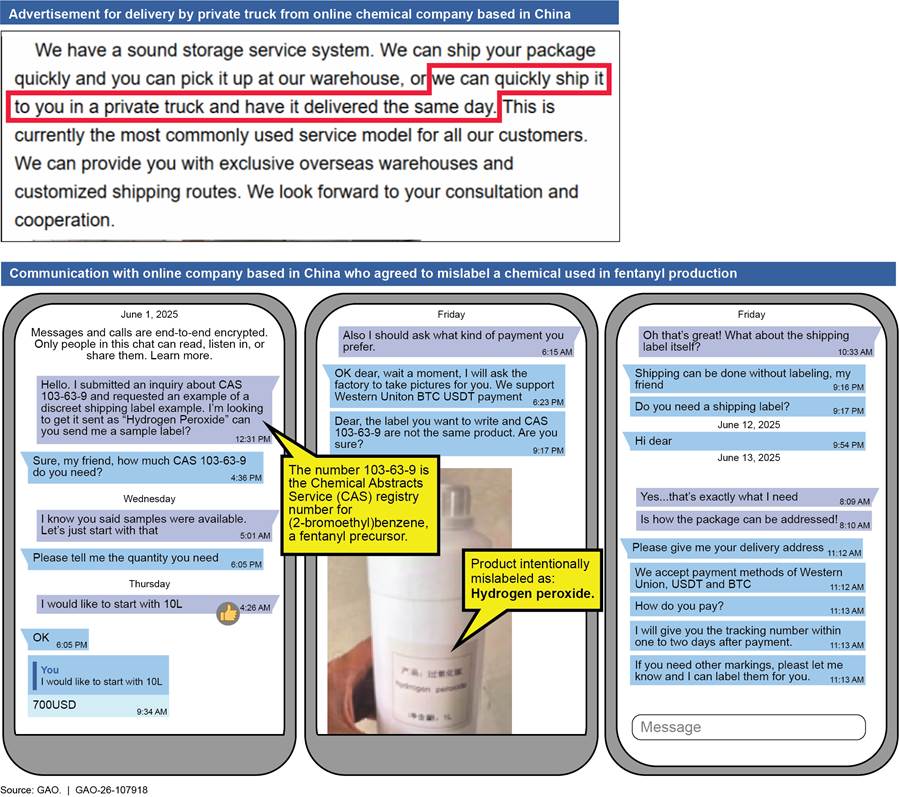
Note: These companies reported being in China, but we did not independently verify their location.
In addition, the China-based company we contacted offered to sell the chemical in amounts that were significantly more than that available for purchase from a reputable company. Specifically, we found that a reputable company offered the chemicals in quantities ranging from 5 grams to 500 grams (0.037 liters to 0.37 liters) (see fig. 11). However, the company we contacted that was willing to mislabel the chemical (fig. 10) was willing to sell us 10 liters—roughly 27 times more than the maximum available from a reputable company. In addition, the minimum amount available for purchase from the company was a sample size of 5 liters—roughly 13 times the maximum available from a reputable company (fig. 11). This chemical does not have common industrial uses and is known for its use in fentanyl manufacturing.
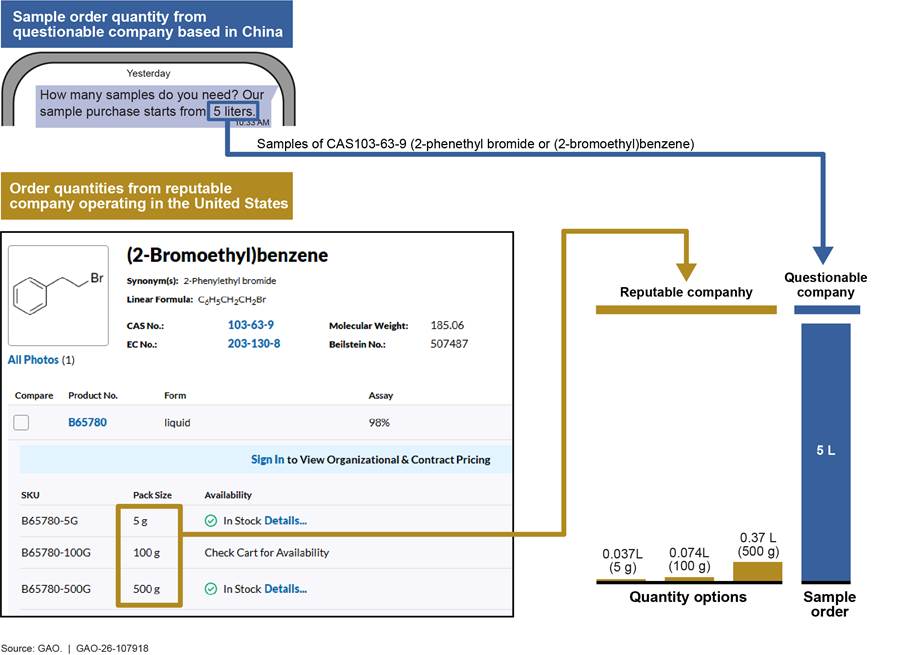
Note: The companies reported being in China and operating in the U.S., respectively, but we did not independently verify their locations.
Customs Clearance. In response to our undercover inquiry about purchasing several fentanyl precursors, a company representative promised “special transport double customs clearance,” meaning customs clearance in both the exporting and importing countries (see fig. 12). The company representative did not specify how the package would be guaranteed to clear customs.
Figure 12: Example of Communication on Customs Clearance for Fentanyl Precursor Chemicals from Questionable Company Based in China
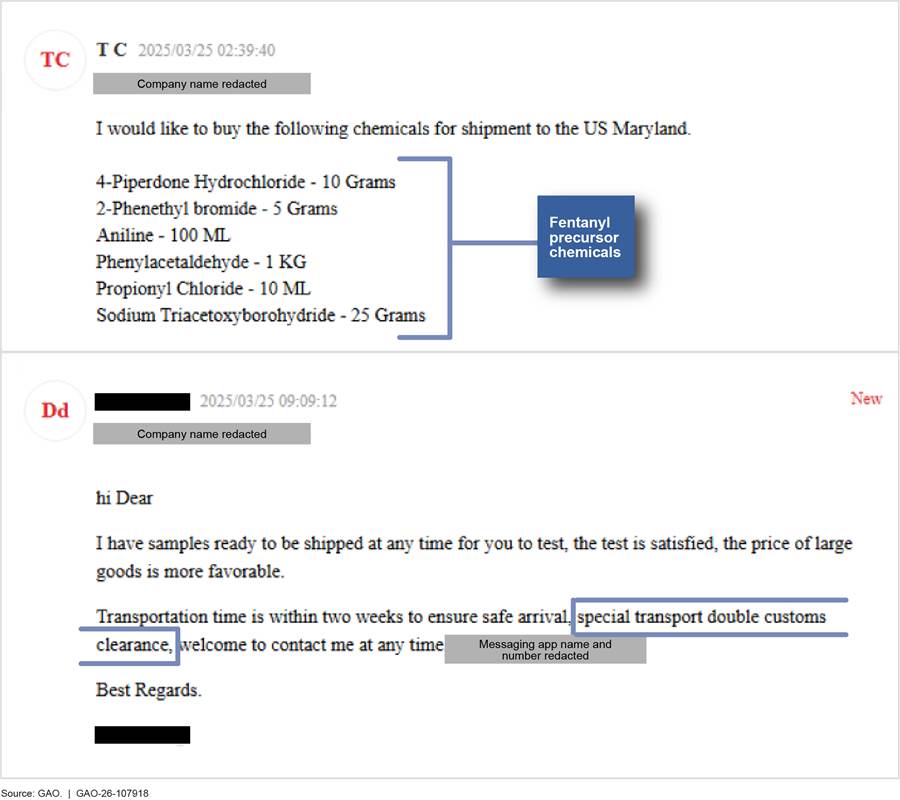
Notes: Double customs clearance refers to clearing the customs process in both the exporting and importing countries.
The company reported being in China, but we did not independently verify its location.
GAO Contacts
Michael E. Clements, ClementsM@gao.gov or Triana McNeil, McNeilT@gao.gov
Staff Acknowledgments
In addition to the contacts named above, Winnie Tsen (Assistant Director), David Lutter (Assistant Director), Rachel Siegel (Analyst in Charge), Willie Commons III, MJ O’Malley, Risto Laboski, Jeff Larson, Nicholas Lessard-Chaudoin, Charlene Lindsay, Mark MacPherson, Marc Molino, Nisha Rai, Jessica Sandler, Jena Sinkfield, and Mary Stack made key contributions to this report.
The Government Accountability Office, the audit, evaluation, and investigative arm of Congress, exists to support Congress in meeting its constitutional responsibilities and to help improve the performance and accountability of the federal government for the American people. GAO examines the use of public funds; evaluates federal programs and policies; and provides analyses, recommendations, and other assistance to help Congress make informed oversight, policy, and funding decisions. GAO’s commitment to good government is reflected in its core values of accountability, integrity, and reliability.
Obtaining Copies of GAO Reports and Testimony
The fastest and easiest way to obtain copies of GAO documents at no cost is through our website. Each weekday afternoon, GAO posts on its website newly released reports, testimony, and correspondence. You can also subscribe to GAO’s email updates to receive notification of newly posted products.
Order by Phone
The price of each GAO publication reflects GAO’s actual cost of production and distribution and depends on the number of pages in the publication and whether the publication is printed in color or black and white. Pricing and ordering information is posted on GAO’s website, https://www.gao.gov/ordering.htm.
Place orders by calling (202) 512-6000, toll free (866) 801-7077,
or
TDD (202) 512-2537.
Orders may be paid for using American Express, Discover Card, MasterCard, Visa, check, or money order. Call for additional information.
Connect with GAO
Connect with GAO on X,
LinkedIn, Instagram, and YouTube.
Subscribe to our Email Updates. Listen to our Podcasts.
Visit GAO on the web at https://www.gao.gov.
To Report Fraud, Waste, and Abuse in Federal Programs
Contact FraudNet:
Website: https://www.gao.gov/about/what-gao-does/fraudnet
Automated answering system: (800) 424-5454
Media Relations
Sarah Kaczmarek, Managing Director, Media@gao.gov
Congressional Relations
A. Nicole Clowers, Managing Director, CongRel@gao.gov
General Inquiries
[1]TCOs are groups, networks, and associated individuals who operate transnationally to obtain power, influence, or monetary or commercial gains, wholly or partly by illegal means. They protect their activities through a pattern of crime, corruption, or violence through a transnational organization structure and the exploitation of transnational commerce or communication mechanisms. Our use of the term TCO does not directly adhere to the Department of State’s and Department of the Treasury’s formal designation of a limited number of these organizations as significant TCOs under 21 U.S.C. § 2341(5); 31 C.F.R. § 590.312; and Executive Order 13,581, § 3(e), 76 Fed. Reg. 44,757, 44,758 (July 25, 2011). Pursuant to 31 C.F.R. § 590.312 and Executive Order 13,581, significant TCOs are defined as a group of persons that includes one or more foreign persons; that engages in or facilitates an ongoing pattern of serious criminal activity involving the jurisdictions of at least two foreign states, or one foreign state and the U.S.; and that threatens the national security, foreign policy, or economy of the U.S.
[2]We use “fentanyl” throughout this report to refer to illicit fentanyl manufactured by criminal organizations, not to the pharmaceutical fentanyl used in clinical settings as a pain reliever and anesthetic.
[3]According to the CDC, its provisional overdose counts are often incomplete and underestimate final counts. These provisional data are not comparable with final data and are subject to change. Additionally, provisional overdose data does not differentiate licit from illicitly sourced synthetic opioids, and methadone is excluded from the synthetic opioid provisional data category cited here.
[4]GAO, High-Risk Series: Heightened Attention Could Save Billions More and Improve Government Efficiency and Effectiveness, GAO‑25‑107743 (Washington, D.C.: Feb. 25, 2025).
[5]For the purposes of this report, we use the term “virtual currency” to include cryptocurrency, convertible virtual currency, and other industry labels such as digital assets and virtual assets.
[6]Financial Crimes Enforcement Network, FinCEN Advisory: Supplemental Advisory on the Procurement of Precursor Chemicals and Manufacturing Equipment Used for the Synthesis of Illicit Fentanyl and Other Synthetic Opioids, FIN-2024-A002 (Vienna, VA: June 20, 2024).
[7]Pub. L. No. 118-79, § 3, 138 Stat. 1515, 1516-17 (2024).
[8]Drug Enforcement Administration, National Drug Threat Assessment 2024 (Springfield, VA: May 2024); and 2025 National Drug Threat Assessment (Springfield, VA: May 2025).
[9]We chose this time frame to help us identify recent cases related to issues under the scope of our review. We have continued to monitor these cases and updated our examples based on court documents as of December 1, 2025
[10]The U.S. Postal Inspection Service is the federal law enforcement arm of USPS. It is responsible for protecting the U.S. mail system from illegal or dangerous use and investigating crimes that involve the mail.
[11]These stakeholders were selected for their knowledge of illicit synthetic drug trafficking and related money laundering, as demonstrated by relevant publications and invitations to testify before Congress. InSight Crime is a nonprofit and media organization.
[12]The statutory provision for us to conduct this study directed us to include Captagon (a synthetic stimulant) among the synthetic drugs we reviewed. However, Captagon is not widely abused in the U.S. at this time, according to DEA.
[13]CDC’s 2023 data on overdose deaths are the most recently available final data.
[14]We considered companies questionable if their online listings included key words or phrases that indicated their willingness to supply chemicals for illicit purposes and that would appeal to potential customers seeking to obtain the chemicals for illicit drug manufacturing.
[15]We conducted a literature search to identify studies that describe the use of payment methods or money laundering for synthetic drug trafficking published in the past 5 years.
[16]To assess the reliability of these data, we reviewed agency documentation of these systems. We determined that these data were sufficiently reliable for illustrating the number of suspicious activity report submissions related to the FinCEN advisories. In April 2025, we requested data from August 2019, when FinCEN’s 2019 advisory was published.
[17]GAO, Government Performance Management: Leading Practices to Enhance Interagency Collaboration and Address Crosscutting Challenges, GAO‑23‑105520 (Washington, D.C.: May 24, 2023).
[18]Department of State, Global Coalition to Address Synthetic Drug Threats: Implementation and Impact 2023-2024 (Washington, D.C.).
[19]Precursor chemicals also include pre-precursor and designer precursor chemicals. Pre-precursor chemicals are at least one step behind in chemical composition in the production chain from precursors used to make synthetic drugs. Designer pre-precursor chemicals are intentionally created for use in manufacturing scheduled precursors.
[20]Substances that are deemed to pose a risk of abuse and dependence are regulated under the Controlled Substances Act. The act classifies controlled drugs, substances, and certain precursor chemicals into five categories—Schedule I through Schedule V based on their acceptable medical use and potential for abuse or dependency. 21 U.S.C. § 802. In addition, the act separately classifies certain substances as List I or List II chemicals based on their use and importance to the manufacture of controlled substances. Unscheduled and unlisted chemicals are those that have not been classified under the act. For additional information see GAO, Synthetic Opioids: Considerations for the Class-Wide Scheduling of Fentanyl-Related Substances, GAO-21-499 (Washington, D.C.: Apr. 12, 2021).
[21]A money services business is a person doing business, whether on a regular basis or as an organized or licensed business concern, at least in substantial part in the U.S., which is a dealer in foreign exchange, check casher, issuer or seller of traveler’s checks or money orders, provider of prepaid access, money transmitter, under certain circumstances the USPS, or seller of prepaid access. 31 C.F.R. § 1010.100(ff). It does not include, among others, a bank or foreign bank.
[22]Certain financial institutions must file a suspicious activity report with FinCEN if they suspect that a transaction of $5,000 or more ($2,000 for money services businesses) may involve illegal activity, evade regulations, or lack a clear business purpose. 31 C.F.R. § 1020.320; 31 C.F.R. § 1022.320.
[23]While China is the primary source country for precursor chemicals, India is a secondary source country, according to DEA.
[24]Drug Enforcement Administration, National Drug Threat Assessment 2024; and InSight Crime, The Flow of Precursor Chemicals for Synthetic Drug Production in Mexico (Washington, D.C.: May 2023).
[25]Financial Crimes Enforcement Network, Supplemental Advisory on the Procurement of Precursor Chemicals and Manufacturing Equipment Used for the Synthesis of Illicit Fentanyl and Other Synthetic Opioids, FIN-2024-A002 (Vienna, Va.: June 20, 2024).
[26]Department of Justice, National Drug Intelligence Center, National Drug Threat Assessment 2010 (Johnstown, PA: Feb. 2010); and U.S.-China Economic and Security Review Commission, Meth Precursor Chemicals from China: Implications for the United States (Washington, D.C.: July 18, 2016).
[27]Financial Crimes Enforcement Network, Fentanyl-Related Illicit Finance: 2024 Threat Pattern and Trend Information, Financial Trend Analysis (Vienna, VA.: Apr. 2025).
[28]InSight Crime, The Flow of Precursor Chemicals for Synthetic Drug Production in Mexico (Washington, D.C. Mar. 2023).
[29]Financial Crimes Enforcement Network, Fentanyl-Related Illicit Finance: 2024 Threat Pattern and Trend Information; Drug Enforcement Administration, National Drug Threat Assessment 2024; and Select Committee on the Strategic Competition Between the United States and the Chinese Communist Party, The CCP’s Role in the Fentanyl Crisis (Washington, D.C.: Apr. 16, 2024).
[30]Drug Enforcement Administration, 2025 National Drug Threat Assessment.
[31]The counternarcotics treaty “provides comprehensive measures against drug trafficking, including provisions against money laundering and the diversion of precursor chemicals.” Beginning December 3, 2024, treaty parties were required to apply certain measures at both the national and international levels, including notifying the competent authorities of the other parties concerned if there is reason to believe that an import, export, or transit of the substances is destined for illicit drug manufacture and requiring proper labeling and documentation of shipments in international trade and ensuring that those documents are kept for a minimum of 2 years. United Nations Convention Against Illicit Traffic in Narcotic Drugs and Psychotropic Substances, Dec. 20, 1988, 1582 U.N.T.S. 95.
[32]According to FinCEN, “structuring” includes attempts not only to evade reporting requirements but also to evade the Travel Rule (31 C.F.R. § 1010.410(f)) and related recordkeeping requirements. 31 U.S.C. § 5324. FinCEN’s regulations on structuring (see generally 31 C.F.R. §§ 1010.100(xx), 1010.314) focus on evasion of currency transaction reporting requirements.
[33]A correspondent bank is a financial institution that provides services on behalf of another financial institution. Correspondent banks are most likely to be used by domestic banks to service transactions that either originate or are completed in foreign countries, acting as a domestic bank’s agent abroad.
[34]FinCEN’s analysis of Bank Secrecy Act filings identifying suspected fentanyl-related activity encompassed all three aspects of the illicit fentanyl supply chain, including precursor chemical procurement, fentanyl trafficking, and fentanyl-related money laundering.
[35]TRM Labs noted that it studied more than 120 Chinese precursor manufacturers. TRM Labs, Beyond Fentanyl: Cryptocurrency’s Role in the International Synthetic Drug Precursor Market (June 9, 2024).
[36]Drug Enforcement Administration, National Drug Threat Assessment 2024.
[37]Drug Enforcement Administration, National Drug Threat Assessment 2024; Financial Crimes Enforcement Network, Fentanyl-Related Illicit Finance: 2024 Threat Pattern and Trend Information; and Select Committee on the Strategic Competition Between the United States and the Chinese Communist Party, The CCP’s Role in the Fentanyl Crisis.
[38]The de minimis exemption allows items to be imported to the U.S. free of duty and of any tax imposed on by reason of importation if the total fair retail value of the shipment imported by one person on one day does not exceed $800 U.S. dollars. 19 U.S.C. § 1321(a)(2)(C). In July 2025, the President signed an executive order suspending duty-free de minimis treatment effective August 29, 2025, on a global basis, including certain goods from China, Canada, Mexico, as part of federal efforts to stop the flow of synthetic opioids into the U.S. Executive Order 14324, Suspending Duty-Free De Minimis Treatment for All Countries, 90 Fed. Reg. 37775 (August 5, 2005); Notice of Implementation of President’s Executive Order 14324, Suspending Duty-Free De Minimis Treatment for All Countries, 90 Fed. Reg. 42418 (Sept. 2, 2025). Public Law 119-21—commonly known as the One Big Beautiful Bill Act—repeals the statutory basis for the de minimis exemption effective July 2027. An Act to provide for reconciliation pursuant to title II of H. Con. Res. 14, Pub. L. No. 119-21, tit. VII, § 70531(b), 139 Stat. 72, 283 (2025).
[39]According to CBP, these tactics can enable individuals to bypass vendor shipping policies for regulated goods in certain countries and reduce clarity of the packages’ origin. Chemical shipments can be mislabeled and smuggled into Mexico without the shippers’ knowledge.
[40]Drug Enforcement Administration, National Drug Threat Assessment 2024; and 2025 National Drug Threat Assessment.
[41]Drug Enforcement Administration, National Drug Threat Assessment 2024; and InSight Crime, The Flow of Precursor Chemicals for Synthetic Drug Production in Mexico; and Reuters, Fentanyl’s deadly Chemistry: How Rogue Labs Make Opioids (Toronto, Ontario: July 2024).
[42]Drug Enforcement Administration, 2025 National Drug Threat Assessment.
[43]Drug Enforcement Administration, 2025 National Drug Threat Assessment; and Financial Crimes Enforcement Network, Supplemental Advisory on the Procurement of Precursor Chemicals and Manufacturing Equipment Used for the Synthesis of Illicit Fentanyl and Other Synthetic Opioids.
[44]Authentic prescription tablets are marked “M30” to indicate they contain 30 milligrams of oxycodone hydrochloride. Counterfeit drugs often contain these markers to appear authentic.
[45]Drug Enforcement Administration, 2025 National Drug Threat Assessment.
[46]Drug Enforcement Administration, National Drug Threat Assessment 2024; and 2025 National Drug Threat Assessment.
[47]Jarod Forget, “Violent Drug Organizations Use Human Trafficking to Expand Profits” (Washington, D.C.: Drug Enforcement Administration, Jan. 28, 2021), https://www.dea.gov/stories/2021/2021-01/2021-01-28/violent-drug-organizations-use-human-trafficking-expand-profits.
[48]United Nations Office on Drugs and Crime and Flemish Peace Institute, Firearms and Drugs: Partners in Transnational Crime (Vienna, Austria: 2024).
[49]Drug Enforcement Administration, National Drug Threat Assessment 2024; and 2025 National Drug Threat Assessment. According to DEA’s 2025 National Drug Threat Assessment, sophisticated fentanyl “super laboratories” in Canada present a growing concern for the U.S. In 2024, 22.7 kilograms of Canada-sourced fentanyl were seized at the U.S.-Canada border compared with, 9,354 kilograms seized at the U.S.-Mexico border. While the estimated flow of fentanyl from Canada is substantially lower than that from Mexico, these operations could expand and fill supply gaps if Mexico-sourced fentanyl production and trafficking is disrupted, according to DEA.
[50]“Intercepting Drugs and Chemicals at Ports of Entry” Combating Fentanyl, Department of Homeland Security, accessed Aug. 22, 2025, https://www.dhs.gov/fentanyl. Data on interdicted illicit fentanyl represent only the amount seized and thus prevented from reaching its destination. According to DHS officials, seizure data do not necessarily indicate the total amount of fentanyl that is manufactured or the overall flow of fentanyl and other synthetic drugs into the U.S.
[51]Drug Enforcement Administration, National Drug Threat Assessment 2024; and 2025 National Drug Threat Assessment.
[52]Drug Enforcement Administration, National Drug Threat Assessment 2024; and 2025 National Drug Threat Assessment.
[53]We have ongoing work examining the online sale of fentanyl. We anticipate issuing this report in early 2026.
[54]Drug Enforcement Administration, National Drug Threat Assessment 2024; and 2025 National Drug Threat Assessment.
[55]DEA reported that xylazine is the most common adulterant found in fentanyl powder, but medetomidine is increasingly being detected in mixtures containing both fentanyl and xylazine. Drug Enforcement Administration, 2025 National Drug Threat Assessment.
[56]Drug Enforcement Administration, 2025 National Drug Threat Assessment; The Growing Threat of Xylazine and its Mixture with Illicit Drugs (Springfield, VA: Oct. 2022); and State and Territory Report on Enduring and Emerging Threats (Springfield, VA: Oct. 2024).
[57]Drug Enforcement Administration, 2025 National Drug Threat Assessment.
[58]Financial Crimes Enforcement Network, Fentanyl-Related Illicit Financial: 2024 Threat Pattern and Trend Information; Drug Enforcement Administration, National Drug Threat Assessment 2024; and 2025 National Drug Threat Assessment.
[59]For additional information on these methods, see GAO, Trafficking and Money Laundering: Strategies Used by Criminal Groups and Terrorists and Federal Efforts to Combat Them, GAO‑22‑104807 (Washington, D.C.: Dec. 23, 2021).
[60]While these groups have also been referred to as “Chinese money laundering organizations,” DOJ officials told us that “Chinese money laundering networks” is the preferred term since these groups may not have a hierarchical structure.
[61]Department of the Treasury, 2024 National Money Laundering Risk Assessment (Washington, D.C.: Feb. 7, 2024).
[62]Financial Crimes Enforcement Network, FinCEN Alert on Bulk Cash Smuggling and Repatriation by Mexico-Based Transnational Criminal Organizations, FIN-2025-Alert001 (Vienna, VA: Mar. 31, 2025).
[63]China prohibits Chinese nationals living outside of China from transferring more than $50,000 annually out of their Chinese bank accounts for use in a foreign country. Chinese citizens are also restricted from directly transferring Chinese currency abroad without prior approval from China’s State Administration of Foreign Exchange. Department of State, 2024 Investment Climate Statements: China, https://www.state.gov/reports/2024-investment-climate-statements/China/.
[64]Ricardo Mayoral, Assistant Director, Homeland Security Investigations, Department of Homeland Security, Chinese Money Laundering Organizations: Cleaning Cartel Cash, testimony before the U.S. Senate Caucus on International Narcotics Control, 118th Cong., 2nd sess., Apr. 30, 2024.
[65]This example is meant for illustration purposes. It is not comprehensive and may not include all parties and steps. See GAO‑22‑104807; GAO, Anti-Money Laundering: Better Information Needed on Effectiveness of Federal Efforts, GAO‑24‑106301 (Washington, D.C.: Feb. 8, 2024); Financial Crimes Enforcement Network, Fentanyl-Related Illicit Financial: 2024 Threat Pattern and Trend Information; and Drug Enforcement Administration, National Drug Threat Assessment 2024.
[66]For additional information, see GAO‑22‑104807.
[67]Financial Trend Analysis, Fentanyl-Related Illicit Financial: 2024 Threat Pattern and Trend Information.
[68]In June 2025, FinCEN issued a Notice of Order for three foreign institutions suspected of money laundering of synthetic drug proceeds. According to FinCEN’s announcement, the order was its first action pursuant to the Fentanyl Sanctions Act, Pub. L . No. 116-92, div. F, tit. LXXII, 133 Stat. 1198, 2261.(2020) and the 2024 FEND Off Fentanyl Act, Pub. L. No. 118-50, Div. E, 138 Stat. 895, 934 (2024). Pub. L . No. 116-92, div. F, tit. LXXII, 133 Stat. 1198, 2261.(2020) and the 2024 FEND Off Fentanyl Act, Pub. L. No. 118-50, Div. E, 138 Stat. 895, 934 (2024).
[69]Ricardo Mayoral, Assistant Director, Homeland Security Investigations, Department of Homeland Security, Chinese Money Laundering Organizations: Cleaning Cartel Cash, testimony before the U.S. Senate Caucus on International Narcotics Control, 118th Cong., 2nd sess., Apr. 30, 2024.
[70]In April 2025, FinCEN issued a report reviewing suspicious activity reports filed in 2024. In August 2025, FinCEN released a report analyzing suspicious activity reports from 2020 through 2024. According to FinCEN’s reports, the reports were issued pursuant to Section 6206 of the Anti-Money Laundering Act of 2020, which requires FinCEN to periodically publish threat pattern and trend information derived from Bank Secrecy Act filings.
[71]According to FinCEN, Bank Secrecy Act reports have identified suspected money laundering between a customer and another party (counterparty). For example, customers might send similar dollar amount transactions within a short time frame to the same counterparties in Mexico. Financial Crimes Enforcement Network, Fentanyl-Related Illicit Finance: 2024 Threat Pattern and Trend Information.
[72]In our analysis, we focused on suspicious activity reports that referenced the 2019 or 2024 advisories. We requested and analyzed data from FinCEN for filings submitted from August 21, 2019, to March 31, 2025, and identified 1,457 suspicious activity reports. Since the analysis captures only suspicious activity reports that referenced the advisories, the count may not reflect all reports involving money laundering related to synthetic drug trafficking.
[73]Financial Crimes Enforcement Network, Fentanyl-Related Illicit Financial: 2024 Threat Pattern and Trend Information.
[74]Financial Crimes Enforcement Network, Chinese Money Laundering Networks: 2020-2024 Threat Pattern and Trend Information Financial Trend Analysis (Vienna, VA: Aug. 2025).
[75]It was not within the scope of our review to assess the extent that negative effects were present related to duplication, overlap, or fragmentation in agency coordination and information-sharing efforts. For additional information, see GAO, Fragmentation, Overlap, and Duplication: An Evaluation and Management Guide, GAO‑15‑49SP (Washington, D.C.: Apr. 14, 2015) and GAO‑23‑105520.
[76]According to a High Intensity Drug Trafficking Areas Program report, deconfliction is a principle that helps prevent investigations from overlapping. Specifically, target and event deconflictions alert investigators when there are investigatory crossovers (i.e., duplicate targets) by law enforcement agencies and when law enforcement actions, such as undercover operations, surveillance, or executing search warrants, are planned in a manner that threatens effective coordination or compromises law enforcement operations. For more information, see Office of National Drug Control Policy, High Intensity Drug Trafficking Areas Program, 2024 Report to Congress (Washington, D.C.: Feb. 22, 2024).
[77]The Financial Action Task Force is an international standards setting body for anti-money laundering and counter-terrorist financing. Financial Action Task Force, Anti-money Laundering and Counter-Terrorist Financing Measures, United States Mutual Evaluation Report (Paris, France: Dec. 2016).
[78]According to the Department of Justice, as of July 25, 2025, the Organized Crime Drug Enforcement Task Forces program concluded its investigative and prosecutorial operations and began the closure or transfer of executive functions. According to officials, on September 17, 2025, the Attorney General signed the Department of Justice’s Agency Reduction in Force and Reorganization Plan which terminated the program and distributed selected functions and resources to other components within the Departments of Justice and Homeland Security. Specifically, officials said Organized Crime and Drug Enforcement Task Forces’ work was transferred to the Homeland Security Task Forces established under Executive Order 14159, which we describe below and in table 3 of this report. We have ongoing work examining interagency anti-drug task forces and DOJ-specific task forces and anticipate issuing these reports in 2026.
[79]Department of Justice, One of the Largest-Ever Fentanyl Seizures in New York City Results in Four Charged For Operating Fentanyl Mill In Bronx Residence, press release no. 23-353, Oct. 6, 2023, https://www.justice.gov/usao-sdny/pr/one-largest-ever-fentanyl-seizures-new-york-city-results-four-charged-operating.
[80]GAO‑23‑105520; GAO, Managing for Results: Implementation Approaches Used to Enhance Collaboration in Interagency Groups, GAO‑14‑220 (Washington, D.C.: Feb. 14, 2014).
[81]Office of National Drug Control Policy, National Southwest Border Counternarcotics Strategy (May 2016); National Drug Control Strategy (May 2024).
[82]GAO, Illicit Opioids: While Greater Attention Given to Combating Synthetic Opioids, Agencies Need to Better Assess their Efforts, GAO‑18‑205 (Washington, D.C.: Mar. 29, 2018).
[83]Specifically, the statutory purpose of the Bank Secrecy Act Advisory Group is to serve as the means by which the Secretary of the Treasury (1) receives advice on the manner in which Bank Secrecy Act reporting requirements should be modified to enhance the ability of law enforcement agencies to use the information provided for law enforcement purposes; and (2) informs private-sector representatives, on a regular basis, of the ways in which the Bank Secrecy Act reports have been used to assist with law enforcement investigations. Annunzio-Wylie Anti-Money Laundering Act, Pub. L. No. 102-550, tit. XV, § 1564, 106 Stat. 3680, 4073-4074 (1992).
[84]GAO‑18‑205; GAO, Illicit Finance: Agencies Could Better Assess Progress in Countering Criminal Activity, GAO‑25‑106568 (Washington, D.C.: Jan. 16, 2025). This report includes several open recommendations, including one to the Secretary of the Treasury to work with relevant agencies to implement a process for collecting and assessing evidence on the extent to which agencies are achieving the goals outlined in the National Strategy for Combating Terrorist and Other Illicit Financing.
[85]GAO, Trade-Based Money Laundering: U.S. Government Has Worked with Partners to Combat the Threat, but Could Strengthen Its Efforts, GAO‑20‑333 (Washington, D.C.: Apr. 2, 2020).
[86]FinCEN also coordinates a voluntary program authorized by Section 314(b) of the USA PATRIOT Act, for financial institutions to share information with each other, to help identify and report potential money laundering or terrorist activities. The program allows the institutions to share normally private information about customers or transactions with one another when they suspect such activity. The full name of the USA PATRIOT Act is the Uniting and Strengthening America by Providing Appropriate Tools Required to Intercept and Obstruct Terrorism Act of 2001. Pub. L. No. 107-56, § 314, 115 Stat. 307 (2001).
[87]The U.S. government uses terrorist designations to impose financial sanctions, immigration restrictions, or other penalties in pursuit of law enforcement or national security goals. There are different categories of designations, such as foreign terrorist organization, which can designate groups, and specially designated global terrorist, which can designate a wider range of entities (e.g., groups, individuals, financiers, and front companies acting as part of a terrorist organization).
[88]We did not assess the effectiveness of agencies’ coordination and information-sharing efforts as part of our review. However, in 2024, we recommended that DHS develop and document criteria for establishing a joint task force and establish targets for performance measures for Joint Task Force-East. DHS agreed with the recommendations but has not yet taken actions that fully address them. GAO, Department of Homeland Security: Additional Actions Need to Improve Oversight of Joint Task Forces, GAO‑24‑106855 (Washington, D.C.: Feb. 7, 2024). Also in 2024, we recommended that DOJ lead an effort, in coordination with DHS and Treasury, to develop a methodology for producing government-wide data on the outcomes of anti-money laundering investigations. DOJ agreed with the recommendation but has not yet taken actions that fully address it. GAO, Anti-Money Laundering: Better Information Needed on Effectiveness of Federal Efforts, GAO‑24‑106301 (Washington, D.C.: Feb. 8, 2024).
[89]GAO, Illicit Fentanyl: DHS Has Various Efforts to Combat Trafficking but Could Better Assess Effectiveness, GAO‑25‑107667 (Washington, D.C.: Sep. 2, 2025).
[90]Additionally, as described earlier, agency officials said new task forces were established with Executive Order 14159.
[91]Department of the Treasury, Treasury Sanctions Cartel de Jalisco Nueva Generacion Leaders Under Counterterrorism Authorities (Washington, D.C.: June 18, 2025).
[92]Department of the Treasury, 2024 National Money Laundering Risk Assessment (Washington, D.C.: Feb 2024).
[93]Drug Enforcement Administration, 2025 National Drug Threat Assessment (Springfield, VA: May 2025); National Drug Threat Assessment 2024 (Springfield, VA: May 2024).
[94]Financial Crimes Enforcement Network, Advisory to Financial Institutions on Illicit Financial Schemes and Methods Related to the Trafficking of Fentanyl and Other Synthetic Opioids, FIN-2019-A006 (Vienna, VA.: Aug. 21, 2019).
[95]Financial Crimes Enforcement Network, Supplemental Advisory on the Procurement of Precursor Chemicals and Manufacturing Equipment Used for the Synthesis of Illicit Fentanyl and Other Synthetic Opioids, FIN-2024-A002 (Vienna, VA: June 20, 2024).
[96]Key executive orders included Executive Order 14157, Designating Cartels and Other Organizations as Foreign Terrorist Organizations and Specially Designated Global Terrorists (Jan. 20, 2025) published at 90 Fed. Reg. 8439 (Jan. 29, 2025); and Executive Order 14159, Protecting the American People Against Invasion (Jan. 20, 2025) published at 90 Fed. Reg. 8443 (Jan. 29, 2025).
[97]GAO, Trafficking and Money Laundering: Strategies Used by Criminal Groups and Terrorists and Federal Efforts to Combat Them, GAO‑22‑104807 (Washington, D.C.: Dec 23, 2021) and Illicit Finance: Agencies Could Better Assess Progress in Countering Criminal Activity, GAO‑25‑106568 (Washington, D.C.: Jan. 16, 2025); David Luckey, RAND Corporation, China’s Role in Synthetic Opioid Trafficking, testimony presented before the House Select Committee on the Strategic Competition Between the United States and the Chinese Communist Party, 118th Cong., 2nd sess., April 16, 2024; Dr. Vanda Felbab-Brown, The Brookings Institution, Strengthening International Cooperation to Stop the Flow of Fentanyl into the United States, testimony for the record for the Senate Subcommittee on Emerging Threats and Spending Oversight of the Committee on Homeland Security and Governmental Affairs, 118th Cong., 2nd sess., April 16, 2024; and InSight Crime, The Flow of Precursor Chemicals for Synthetic Drug Production in Mexico (Washington, D.C.: May 2023).
[98]We chose this time frame to help us identify recent cases related to issues under the scope of our review.
[99]The statutory provision for us to conduct this study directed us to include Captagon (a synthetic stimulant) among the synthetic drugs we reviewed. However, Captagon is not widely abused in the U.S. at this time, according to DEA.
[100]We defined questionable companies as companies whose online listings include key words or phrases that indicate their willingness to supply chemicals for illicit purposes and that would appeal to potential customers seeking to obtain the chemicals for illicit drug manufacturing.
[101]Drug Enforcement Administration, National Drug Threat Assessment 2024 (Springfield, VA: May 2024); Financial Crimes Enforcement Network, Fentanyl-Related Illicit Finance: 2024 Threat Pattern and Trend Information, Financial Trend Analysis (Vienna, VA.: Apr. 2025); and the Select Committee on the Strategic Competition Between the United States and the Chinese Communist Party, The CCP’s Role in the Fentanyl Crisis (Washington, D.C.: Apr.16, 2024).
[102]We defined reputable sellers as those whose online listings do not include key words or phrases that would appeal to potential customers seeking to obtain the chemicals for illicit drug manufacturing.
[103]Financial Action Task Force establishes internationally recognized standards for combatting money laundering and terrorist financing. The Five Eyes Law Enforcement Group (a coalition of law enforcement agencies from Australia, Canada, New Zealand, the United Kingdom, and the United States) shares criminal intelligence and collaborates on operations to combat transnational crime.
[104]For more detailed information on our methodology, see app. 1.
[105]For examples, see Drug Enforcement Administration, National Drug Threat Assessment 2024; Select Committee on the Strategic Competition Between the United States and the Chinese Communist Party, The CCP’s Role in the Fentanyl Crisis (Washington, D.C.: Apr. 16, 2024); and Financial Crimes Enforcement Network, Fentanyl-Related Illicit Finance: 2024 Threat Pattern and Trend Information, Financial Trend Analysis (Vienna, VA.: Apr. 2025).