
Report to the
Ranking Member, Committee on Oversight and Government Reform,
House of Representatives
United States Government Accountability Office
A report to the Ranking Member, Committee on Oversight and Government Reform, House of Representatives
Contact: Carol C. Harris at harriscc@gao.gov
What GAO Found
The General Services Administration (GSA) is responsible for ensuring that federal agencies have access to telecommunications services. Six agencies GAO selected to review recently completed their transitions from expired, legacy telecommunications contracts to the replacement Enterprise Infrastructure Solutions (EIS) contract. However, their transitions were delayed by more than three years past GSA’s September 2022 revised deadline. Due to continued delays, GSA took actions to extend the service period of the legacy contracts until May 2026 at the latest to avoid service disruptions. The delays exposed the agencies to price increases due to the ability of vendors to raise prices during the extended service periods and the phasing out of legacy telecommunications technologies. In particular, there was a total 206 percent price increase from February to March 2025 for the selected agencies’ Networx contracts—the largest of the legacy contracts.
Amount Billed for Selected Agencies’ Legacy Networx Contracts in February 2025 and March 2025
|
Agency |
February 2025 costs |
March 2025 costs |
Percent change |
|
Department of Agriculture |
$227,986.93 |
$543,645.43 |
138% |
|
Department of Commerce |
$1,768,695.34 |
$5,761,127.10 |
226% |
|
Department of Defense |
$4,842,079.74 |
$15,012,896.07 |
210% |
|
Department of Homeland Security |
$5,855,206.65 |
$16,853,049.42 |
188% |
|
Department of the Interior |
$399,435.26 |
$1,858,077.70 |
365% |
|
Department of Transportation |
$282,652.93 |
$896,799.13 |
217% |
|
Total |
$13,376,056.85 |
$40,925,594.85 |
206% |
Source: GAO analysis of billing data provided by the General Services Administration. | GAO-26-107919
Note: Agencies’ increases varied due to prevalence of legacy telecommunication technologies.
The six agencies collectively identified 21 factors that contributed to their transition delays. The most commonly reported factors included performance issues with EIS vendors, the COVID-19 pandemic, and legacy connections. For example, officials from four selected agencies identified supply chain disruptions and staffing challenges related to the COVID-19 pandemic.
Three of the six agencies identified and mitigated risks related to over half of their cited delay factors. Further, GSA and the six agencies were inconsistent in identifying and mitigating the risk of service disruptions due to missed final deadlines. For example, two of the six agencies’ related risks were either closed (i.e., resolved) or did not specify the final 2026 deadlines.
GSA does not currently know whether all selected agencies experienced service disruptions due to these inconsistent risk mitigation efforts. This is because, among other reasons, GSA is not notified whether a replacement service was in place before an expiring legacy service was disconnected. GSA has begun planning for the follow-on to EIS but has not determined which agencies had disruptions, if there were any impacts, and the effectiveness of any mitigation efforts. Until GSA determines the success of agencies’ mitigation efforts, it will be missing key information that could help inform the next transition and ultimately prevent excess costs and delays going forward.
Why GAO Did This Study
GSA was responsible for successfully managing 221 agencies’ transitions from expired legacy telecommunications contracts to the replacement contract: EIS. Agencies’ transitions to EIS were marked with significant delays, prompting GSA to extend the deadlines of the expiring legacy contracts multiple times. The final deadline was May 31, 2026.
GAO was asked to review federal agencies’ efforts to transition to EIS. This report (1) describes the status and cost implications of selected agencies' efforts to transition to EIS, (2) identifies key factors that selected agencies reported contributing to delays in transitioning, and (3) determines the extent to which these agencies and GSA mitigated risks related to the identified delay factors and the risk of missing final transition deadlines.
GAO reviewed transition billing data and interviewed agency officials to identify transition status and key delay factors. GAO also analyzed risk management documentation from GSA, as well as six agencies that had a significant amount of transition work remaining as of September 2024: the Departments of Agriculture, Commerce, Defense, Homeland Security, the Interior, and Transportation.
What GAO Recommends
GAO is making a recommendation to GSA to determine (1) whether at least the selected agencies experienced service disruptions and if so, the impact of those disruptions and (2) the effectiveness of agencies’ efforts to mitigate service disruptions. GSA concurred with our recommendation and stated that it is working on a plan to address it.
|
Abbreviations |
|
|
|
|
|
ASD |
Office of Acquisition Solutions Development |
|
BV |
business volume |
|
CIO |
Chief Information Officer |
|
DHS |
Department of Homeland Security |
|
DOD |
Department of Defense |
|
E-MORRIS |
Enhanced Monthly On-Line Records and Reports of Information Technology Services |
|
EIS |
Enterprise Infrastructure Solutions |
|
FAA |
Federal Aviation Administration |
|
FCC |
Federal Communications Commission |
|
GSA |
General Services Administration |
|
HQ |
headquarters |
|
IDIQ |
Indefinite Delivery, Indefinite Quantity |
|
IP |
internet protocol |
|
MOU |
memorandum of understanding |
|
NOAA |
National Oceanic and Atmospheric Administration |
|
OCIO |
Office of the Chief Information Officer |
|
POTS |
plain old telephone service |
|
PWV |
proportional weighted value |
|
RAFT |
Risk Assessment for Transition |
|
SIR |
service instance record |
|
TDM |
time-division multiplexing |
|
TOPS |
Telecommunications Ordering and Pricing System |
|
TPTR |
Transition Progress Tracking Report |
|
USDA |
U.S. Department of Agriculture |
|
WITS |
Washington Interagency Telecommunications System |
This is a work of the U.S. government and is not subject to copyright protection in the United States. The published product may be reproduced and distributed in its entirety without further permission from GAO. However, because this work may contain copyrighted images or other material, permission from the copyright holder may be necessary if you wish to reproduce this material separately.
August 31, 2026
The Honorable Robert Garcia
Ranking Member
Committee on Oversight and Government Reform
House of Representatives
Dear Ranking Member Garcia:
The General Services Administration (GSA) is responsible for ensuring that federal agencies have access to the telecommunications services and solutions that they need to meet mission requirements. The government’s telecommunications infrastructure that GSA supports is large and complex and is directly linked to the mission and core business processes of all government agencies. Transitioning or upgrading this core agency infrastructure is likewise complex. The federal government has recently transitioned from legacy telecommunications contract vehicles—Networx, Washington Interagency Telecommunications System (WITS) 3, and Regional Local Service Agreements—to the replacement Enterprise Infrastructure Solutions (EIS) contract.[1] The EIS contract, which was originally awarded in July 2017, has a combined value of $50 billion and is for a 15-year period of performance ending in July 2032.[2]
The federal government has a history of telecommunications contract transitions that were significantly delayed and led to hundreds of millions of dollars in increased costs and missed savings. For instance, the transition that began in 1998 experienced delays that hindered the timely achievement of program goals and resulted in an estimated $74 million in missed savings.[3] Further, the previous transition to Networx, which began in 2007, took 33 months longer than planned, and the majority of agencies experienced transition delays. In 2013, we reported that these delays led to an increase of $66.4 million in costs to GSA and an estimated $329 million in lost savings as a result of agencies continuing to order services from a predecessor contract even after the services were available through Networx at generally lower rates.[4]
The most recent transition effort followed the same path. Even though the original EIS transition deadline was March 2020, significant delays resulted in GSA extending the final expiration dates for the legacy contracts to February 2026 (for the WITS 3 contract vehicle) and May 2026 (for the Networx and Regional Local Service Agreements).
You asked us to review federal agencies’ transition to the new telecommunications contracts. This report: (1) describes the status and cost implications of selected agencies’ efforts to transition to the Enterprise Infrastructure Solutions (EIS) contract, (2) identifies the factors selected agencies reported contributing to delays in transitioning to EIS, and (3) determines the extent to which agencies and GSA mitigated risks related to the identified factors on EIS transition delays, as well as the risk of missing final transition deadlines.
We selected GSA for this review, as it is responsible for managing the agencies’ transition to EIS. As part of this work, GSA issued monthly Transition Progress Tracking Reports (TPTR) to track agencies’ progress in transitioning off of the legacy contracts. Using this data, we selected six large agencies that had not completed their transitions to EIS as of September 2024 for review:[5] the Departments of Agriculture (USDA), Commerce, Defense (DOD), Homeland Security (DHS), the Interior, and Transportation.[6]
To address the first objective, we tracked the six selected agencies’ progress in completing their transitions by reviewing GSA’s TPTRs from September 2024 through May 2026. These reports provided an overview of agencies’ transition progress. We also analyzed GSA documentation specifying how much the selected agencies were billed for the legacy contracts after GSA’s revised September 2022 transition deadline.[7] In addition, we interviewed agency officials about progress and remaining work.
To assess the reliability of the TPTR reports and legacy contracts billing data, we reviewed the GSA-provided data to identify outliers, missing data, and other potential errors. We also interviewed agency officials from GSA and the other six agencies who were knowledgeable about the data. We determined that the TPTR reports and billing data were sufficiently reliable for the purposes of this report.[8]
To address the second objective, we conducted semi-structured interviews with agency officials at each of the six selected agencies. We determined the most commonly cited delay factors across the agencies’ responses. To do so, we assigned preliminary categories to each delay factor cited by the agency officials. We then used professional judgement to identify the root cause of each category and group those with similar root causes together. We did so to refine the delay factor categories to better fit repeating, overarching themes mentioned in multiple interviews. Once we had our final list of delay factor categories, we compared the agency responses against this list to determine which delay factors were the most frequently cited by the six agencies. Further, we asked GSA officials to provide additional context for each of the delay factors. We also asked GSA if the list of commonly cited delay factors adequately captured the key delay factors from GSA’s perspective.
To address the third objective, we analyzed EIS transition risk registers managed by GSA and the selected agencies against GSA’s guidance for managing risks.[9] We reviewed the risk registers to determine whether GSA and the agencies identified and mitigated risks related to the list of most commonly cited delay factors from objective two. Specifically, for each of the risks related to a delay factor, we examined the risk registers for risk management strategies, mitigation plans, and contingency plans to determine how the agency attempted to mitigate the risk. We also reviewed the risk registers to determine if the agencies and GSA were identifying and mitigating the critical risk of potentially missing the transition deadline and having services disconnected. To do so, we examined the risk register for the risk management strategies, mitigation plans, and contingency plans for each related risk. Finally, we analyzed agencies’ contingency planning activities, by assessing documentation related to the agencies’ participation in GSA’s Risk Assessment for Transition (RAFT) project.[10] A more detailed discussion of our objectives, scope, and methodology is provided in appendix I.
We conducted this performance audit from October 2024 to August 2026 in accordance with generally accepted government auditing standards. Those standards require that we plan and perform the audit to obtain sufficient, appropriate evidence to provide a reasonable basis for our findings and conclusions based on our audit objectives. We believe that the evidence obtained provides a reasonable basis for our findings and conclusions based on our audit objectives.
Background
Three Legacy Telecommunications Contracts Recently Expired
There were three legacy government-wide telecommunications contracts that recently expired: Networx, WITS 3, and Regional Local Service Agreements. The largest was Networx. In 2007, GSA awarded two sets of Networx contracts, which had an estimated combined value of $20 billion. These contracts had differing characteristics:
· Networx Universal. GSA awarded Networx Universal contracts to AT&T, Verizon Business Services, and Qwest Government Services.[11] Networx Universal offered voice and data services, wireless services, and management and application services, including video and audio conferencing, as well as mobile and fixed satellite services, with national and international coverage.
· Networx Enterprise. GSA awarded Networx Enterprise contracts to AT&T, Verizon Business Services, Qwest Government Services, Level 3 Communications,[12] and Sprint Nextel.[13] Networx Enterprise offered services similar to those of Networx Universal, with a focus on those that are internet-based. It also required telecommunications services to be available in a smaller geographic area than Networx Universal.
The additional legacy telecommunications contracts were WITS 3 and Regional Local Service Agreements.
· WITS 3. This contract vehicle supported a variety of telecommunications services available to all federal agencies in Washington, D.C. and surrounding Maryland and Virginia counties. Among other things, it provided data, voice, and cloud services.
· Regional Local Service Agreements. These contracts provided local telecommunications services in every state and major city in the United States.
EIS Provides Telecommunications Services to the Federal Government
EIS is the replacement for the expired Networx, WITS 3, and Regional Local Service Agreements telecommunications contracts. GSA awarded the EIS contract in July 2017, and it is the main component of GSA’s telecommunications portfolio.[14]
EIS is a multiple-award Indefinite Delivery, Indefinite Quantity (IDIQ) contract—also known as a task order contract.[15] According to GSA, each EIS task order should clearly describe all services to be performed or supplies to be delivered so the full cost or price can be established when the order is placed. For an agency to award a task order with an EIS vendor, an agency must first go through the fair opportunity process. Fair opportunity is a process in which the contracting officer must provide each EIS awardee with a fair opportunity to be considered for each order exceeding the micropurchase threshold, unless exceptions apply.
According to GSA, the EIS contract provides high-quality telecommunications and network services and solutions that meet or exceed agency requirements, conform to government policies and standards, and offer competitive pricing. The EIS contract provides voice and data services to over 200 agencies and Native American tribes of all sizes. GSA officials also stated that EIS provides continuous competition to satisfy specific networking projects, emerging requirements, technology refreshment, and access to innovative solutions.[16]
GSA Managed the Transition to the EIS Contract
GSA manages the EIS contract as part of its effort to fulfill its statutory mandate to manage the acquisition of telecommunications services for the federal government. Specifically, the Office of Acquisition Solutions Development (ASD) within GSA’s Federal Acquisition Service provides federal agencies’ access to telecommunications and networking services and solutions. Within ASD, GSA’s Enterprise Technology Solutions Service Center assists agencies in acquiring network and telecommunications services, including network infrastructure, satellite communications, wireless, security, and cloud services through solutions such as EIS. For EIS, the Enterprise Technology Solutions Service Center supported 221 agencies as they transitioned from legacy services to modernized IT telecommunications and cybersecurity infrastructures by providing comprehensive planning, acquisition, and migration support. As part of supporting the transition effort, GSA:
· Performed validation and maintenance of the inventory of services to transition to EIS;[17]
· Monitored vendors’ performance and initiated corrective action if required;[18]
· Assisted agencies with transition planning, agency-specific transition projects, and using the EIS contracts through consultative services and self-help tools;
· Defined major milestones and reported transition progress to all stakeholders, initiating corrective action where required; and
· Monitored and facilitated coordination, communication, and cooperation among the suppliers, agencies, and other GSA organizations.
As part of reporting transition progress, GSA tracked agencies’ transitions from the legacy contracts to EIS in its monthly TPTRs. In these reports, GSA tracked the transition off the legacy contracts at the service instance record (SIR) level. A SIR is an inventory tracking record that represents a summarized roll-up of base services and their associated equipment, features, and other ancillary contract line-items. Agencies and GSA used SIRs to track the progress of agencies’ transition from Networx, WITS 3, and Regional Local Services contracts to EIS.[19] Specifically, GSA used an agency’s number of active SIRs and its total number of both active and inactive SIRs to calculate the percentage of SIRs that were successfully disconnected.[20] GSA also tracked costs by calculating the amount each agency was billed by vendors for services, including adjustments, taxes, and fees.
GSA Extended the EIS Transition Timeline After Agencies Missed Both Original and Revised Deadlines
In response to agency delays, GSA revised the EIS transition timeline multiple times. The following figure contains key deadlines in the transition process, including the deadlines for awarding EIS task orders, completing the transition to EIS, and, for the agencies that did not meet earlier deadlines, extending the period of performance for the legacy contracts by signing agreements with GSA. The figure also includes the timing of GSA’s decisions to offer the extensions.
Figure 1: Changes to the General Services Administration’s (GSA) Enterprise Infrastructure Solutions (EIS) Transition Timeline
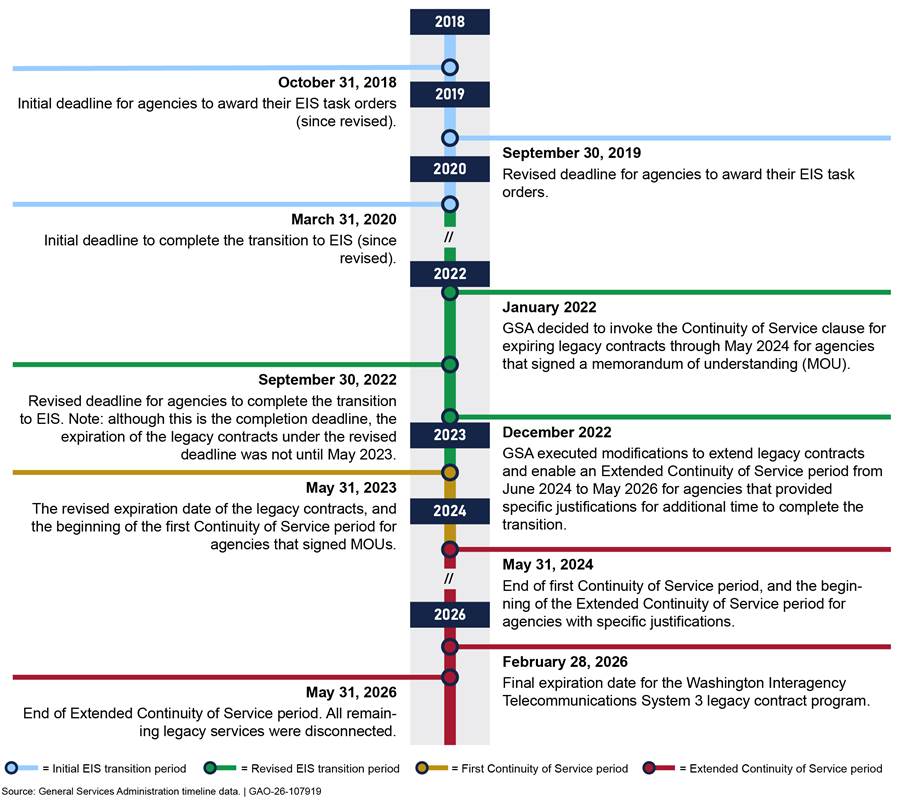
As stated in the memorandums of understanding (MOU) that the agencies had to sign to participate in the Continuity of Service periods illustrated in the figure above, GSA would not be extending the legacy contracts past May 2026. Due to the finality of the 2026 expiration dates of the legacy contracts, the services provided through the legacy contracts were either disconnected after February 2026 (in the case of the WITS 3 contract vehicle) or disconnected after May 2026 (for Networx and the Regional Local Service Agreements). These disconnections occurred whether or not the agencies had contracted replacement telecommunications services.
GSA Highlighted the Importance of Risk Management for the Transition to EIS
The Software Engineering Institute defines risk as the possibility of suffering loss.[21] For a development project, loss describes the impact to the project, which could be in the form of diminished quality of the end product, increased costs, delayed completion, or failure.[22] Risk management is a systematic approach for minimizing exposure to potential losses. It provides a disciplined environment for continuously assessing what could go wrong (i.e., assessing risks), determining which risks to address (i.e., setting mitigation priorities), and implementing actions to address high-priority risks and bring those risks within tolerance.[23]
GSA developed a risk management plan for its management of the government-wide transition to EIS.[24] This plan included the following steps for managing risk management activities.
· Identifying risks. Risk identification is the iterative process of determining which risks may affect the project and documenting their characteristics. GSA’s transition risk stakeholders were to use a variety of techniques to identify and clarify risks, including brainstorming, holding interviews, and conducting analyses.[25] Identified potential risks were to be documented, submitted for review, and then transformed into detailed risk statements. These risk statements were to then be discussed with transition risk stakeholders to determine if they apply to the EIS transition and should be included on the risk register.
· Performing qualitative and quantitative risk analysis.[26] Qualitative risk analysis is the process of prioritizing risks for further analysis or action by subjectively evaluating and scoring the probability of occurrence and impacts on time, cost, scope, and quality. For the quantitative risk analysis, the GSA-assigned probability and impact scores were then to be used to calculate risk exposure.
· Planning risk responses. Risks assigned to a medium or high risk exposure score would then move on to having a risk owner assigned. The risk owner would then determine or confirm the response strategy and develop a response plan.[27] These strategies included the following:
· Escalate. Risk Owner lacks the authority, resources, or knowledge to manage the risk.
· Mitigate. Reduce the likelihood of the occurrence or the impact of the risk.
· Transfer. Hand off the ownership of response and negative impact to a third party.
· Avoid. Change the project management plan so that the risk no longer affects the project.
· Accept. Agree that the potential consequences are manageable.
· Monitoring and controlling risk. Risk monitoring and control is the process of monitoring identified risks for signs that they may be occurring, controlling identified risks through planned or unplanned risk responses, and documenting the success or failure of those risk response plans.
GSA’s risk management plan also called for maintaining a risk register and issues log to record the results of the risk management process described in the steps above. Specifically, the risk register was used to identify, track, monitor, control, and report risks throughout the project lifecycle. During the monitor and control process, any program risks that occurred, or became realized, were to be documented in the issues log and tracked through final resolution.
GSA also informed the agencies of the importance of managing risks during the transition. GSA’s Full Service Transition Plan stated that careful and methodical risk identification and mitigation were critical to minimizing transition risk.[28]
Further, GSA discussed risk in its Transition Handbook, which it developed to facilitate agencies’ successful, timely, and orderly transitions of services from the expiring legacy contracts to the EIS contract.[29] In this handbook, GSA made it clear that the most critical risk to an agency is loss of service. This is because disconnected services could potentially result in a disruption to mission critical operations.
In addition to providing guidance, GSA conducted the Risk Assessment for Transition (RAFT) project more than a year after the initial March 2020 deadline for completing the EIS transition. Specifically, the RAFT project ran from September 2021 through June 2023 to help agencies make a realistic assessment of how long their transition would take and conduct contingency planning. According to the RAFT project charter, the transition program was critically behind schedule and that, as of June 2021, only 48.4 percent of services had been disconnected from the expiring contracts. The charter stated that if there was a risk that an agency would not meet the revised September 2022 EIS transition deadline, contingency planning should begin right away. The charter specified that continency planning must be done before the risk was realized so that when it happened, the agency could immediately implement the contingency response and mitigate negative impacts.
GSA recommended that agencies take advantage of the project, but agencies’ participation in RAFT was not required. For the agencies that participated, the RAFT project was a two-stage process. In stage one, agencies worked with GSA to develop a realistic transition schedule. In stage two, agencies worked with GSA to explore contingency options and develop a contingency plan. In total, 42 agencies completed stage one, and seven completed stage two. Ultimately, GSA used the results of this project to inform its decision to extend the legacy contracts to May 2024.
Selected Agencies Had Different Approaches for Managing Their Transitions
While GSA was responsible for managing the government-wide transition to EIS, individual agencies had principal responsibility for their own transitions. For example, they were responsible for coordinating transition efforts with both legacy and EIS vendors to ensure that existing telecommunications services were disconnected and that new services were ordered.
Each agency decided how to manage its transition, including whether to do so centrally or allow one or more components to manage their transitions separately. The agencies also decided how to manage and track transition risks. The six agencies included in our review employed different methodologies for risk management. For instance, five of the six agencies created their own risk registers, and one (Interior) did not. The list below summarizes how each of the six selected agencies managed their transition and their transition risks.
· Commerce managed its transition centrally with one exception: the National Oceanic and Atmospheric Administration (NOAA). An official within the department’s Office of the Chief Information Officer (OCIO) stated that the department managed the centralized transition effort by coordinating with both the Chief Information Officer (CIO) and Commerce’s components. The official stated that the Commerce components involved in the centralized transition effort were able to make decisions on how to best accomplish their own transitions. Regarding NOAA’s transition, Commerce officials stated that NOAA had its own telecommunications contract and retained execution authority over its own transition activities. Commerce officials informed us that the department, acting through its OCIO, exercised oversight over NOAA’s transition through coordination with NOAA leadership and the administration of centralized data calls and reporting requirements. According to Commerce officials, both Commerce and NOAA maintained risk registers to identify, assess, and mitigate transition risks.
· DHS employed a federated, decentralized approach to managing its transition effort. According to DHS officials, each of the department’s components managed its transition separately. DHS Headquarters (HQ), which oversees and supports DHS at a high level, managed its own transition apart from the other components. In total, 12 components, including DHS HQ, were individually tracked, including the U.S. Coast Guard and the U.S. Secret Service. Similarly, each of the components managed their own risks and developed their own mitigation plans.
· DOD managed its transition centrally; however, department officials stated that individual components could obtain waivers to manage their own transitions. Specifically, DOD officials informed us that a team within the Defense Information Systems Agency’s Procurement Services Directorate/Defense Information Technology Contracting Organization is the program manager for the entirety of DOD’s EIS transition. As part of this centralized management, DOD officials also stated that DOD’s military departments, defense agencies, and field activities had roles and responsibilities supporting the transitions of their respective inventories. In DOD’s EIS Transition Plan, DOD listed the entities that chose to manage their own transitions: the Morale, Welfare, and Recreation Libraries, the National Guard Bureau, the National Security Agency, the Navy Engineering Logistics Office, and the U.S. Army Corps of Engineers. To manage the risks of this transition, DOD created a risk register log to identify and track all associated risks. According to DOD’s EIS Transition Plan, the risk register and identified risk items were to be reviewed at least monthly to assess and reassess risks as needed.
· Interior managed its transition centrally. According to department officials, Interior’s OCIO had the most responsibility for the transition. The officials also stated that, while Interior’s components were in control of how they spent their funding, the EIS transition was centralized through the department’s OCIO. As far as managing transition risk, Interior officials informed us that it outsourced project management activities, including the creation and management of risk registers, to vendors for all of its task order awards.
· Transportation had centralized management across the department with one exception: the Federal Aviation Administration (FAA). Specifically, Transportation officials informed us that the department had two major lines of effort with regards to the transition: (1) the OCIO-led effort for the department and (2) the FAA-led effort. The officials explained that FAA led a separate effort because it has complex communication systems that are best understood by FAA. According to Transportation and FAA officials, both the OCIO-led transition team and the FAA transition team independently managed transition risks within their respective programs. Officials from both efforts stated that they used risk registers to manage risks and that they updated their risk registers monthly. According to Transportation’s EIS Transition Plan, any member of the transition team was able to identify issues or concerns such as potential risks.
· USDA managed its transition centrally with no components managing their own transitions. Specifically, USDA officials informed us that one center within its OCIO was responsible for the EIS Program and that USDA mission areas were to support the centralized transition process. USDA officials stated that they used a risk register to identify, assess, and mitigate risks. Specifically, the officials stated that the department had an overall program risk register. The officials also stated that they identified individual risks and issues at the project level. The officials stated that the program risk register was updated monthly, and the project risks were updated weekly.
In addition to having control over their own transitions from the legacy contracts to EIS, agencies also had the ability to bypass the EIS contract and order services from other agreements. For example, Commerce used non-EIS telecommunications services. Notably, N-Wave is a NOAA engineered and managed network apart from EIS that provides high-speed network services to NOAA, other components within Commerce, and other federal agencies. In addition, NOAA officials informed us that, in order to ensure that no services were disrupted at the expiration of the legacy services, it developed contingency plans to use short-term commercial services to bridge any gaps.
Deregulation of Legacy Telecommunications Services Progressed Concurrently with the Transition to EIS
While agencies were managing their transition to EIS, the Federal Communications Commission (FCC) engaged in ongoing efforts to remove or stop the enforcement of provisions related to legacy telecommunications infrastructure.[30] Specifically, these provisions required certain carriers to provide connections through legacy time-division multiplexing (TDM) telecommunications infrastructure at regulated rates. FCC also streamlined the procedures for discontinuing TDM services.[31] TDM is a legacy digital technology that transmits voice and data services over circuit-switched networks, traditionally using copper-based infrastructure. It is increasingly being replaced by modern technologies such as internet protocol (IP)-based and Ethernet-based services delivered over fiber-optic or wireless network infrastructure. FCC has taken actions to facilitate carriers’ transition away from legacy TDM-based services offered at regulated rates toward more scalable, flexible, and widely supported IP-based alternatives.[32]
According to GSA, the deregulation of TDM affected the agencies’ transitions in three ways. First, agencies still relying on TDM paid higher costs because carriers increased prices for legacy services.[33] Second, there were service disruptions and forced migrations as vendors indicated that they would stop supporting or maintaining TDM based solutions. Third, there were delays in modernizing since remote locations did not permit cost effective new technologies.
GSA Is Currently Planning for the Successor to EIS
As the EIS contracts are nine years into their 15-year performance period, GSA has already begun planning for the successor to EIS to ensure that there are no breaks in service. GSA is currently conducting market research, and engaging customers and vendors in preliminary discussions that will shape the EIS follow-on solution. In addition, agency officials stated that GSA plans to analyze lessons learned from the EIS transition and identify those relevant for the next transition. GSA officials noted that they have not yet developed specifics for conducting this post transition assessment. However, they have engaged with agencies including DOD to review the transition experience. GSA plans to conduct the assessment in the fourth quarter of fiscal year 2026.
GAO’s Prior Work Has Examined Agencies’ Efforts to Plan for Transitioning between Telecommunications Contracts
We have been reviewing telecommunications contract transitions for over 25 years, documenting the difficulties that have accompanied each transition cycle.
· In March 2001, we reported that the federal government’s transition from FTS2000 to FTS2001 contract services for local and long-distance calls encountered delays and took more than 24 months, which hindered the timely achievement of program goals.[34] We concluded that these transition delays resulted in raised telecommunications costs. In total, an estimated $74 million in savings was lost due to delays in completing the transition to FTS2001. We made a total of eight recommendations to enable more accurate tracking of FTS2001 transition progress, promote the completion of the transition, identify and resolve all outstanding billing issues, and continue efforts to obtain consideration from the FTS2001 vendors for failure to meet requirements within established time frames. All recommendations were implemented.
· In June 2006, we reported on GSA and selected agencies’ plans to transition from FTS2001 to Networx, which was scheduled to begin in 2007.[35] For this report, we identified transition planning practices that could help agencies reduce the risk of experiencing adverse effects of moving from one broad telecommunications contract to another. These planning practices were to: (1) develop an accurate inventory of telecommunications assets and services, (2) perform a strategic analysis of telecommunications requirements, (3) develop a structured transition management approach, (4) identify the resources needed for the transition, and (5) develop a transition plan that includes identifying agency-specific risks that could affect transition success. We made five recommendations to implement the planning practices. All five recommendations were implemented.
· In June 2008, we issued another report on the transition to Networx.[36] The agencies had not yet transitioned, and GSA extended the FTS contracts to 2010. As with the report from 2006, this report examined selected agencies’ transition plans. We found that the six selected agencies were generally following sound transition planning practices, though there were gaps in their planning. We made recommendations focused on addressing the gaps in transition planning to the three agencies that had not implemented key practice activities and did not plan to do so. We made 10 recommendations, seven of which were not implemented.[37]
· In December 2013, we reported that the transition from FTS to Networx was finally completed in March 2013 (i.e., 33 months later than originally planned).[38] We estimated that agencies could have saved $329 million if they transitioned on time. We also found that weak project planning and complex acquisition processes were factors that contributed to the delay. As a result, we recommended, among other things, that GSA take two actions to improve planning and execution of the next telecommunications transition. GSA agreed with these recommendations. The agency implemented one of the recommendations and did not implement the other one, which was to examine, in coordination with the Office of Personnel Management, potential government-wide telecommunications expertise shortfalls and use the study to shape the next telecommunications acquisition (now called EIS).[39]
Our last two reports, issued in September 2017 and April 2020, specifically relate to the EIS transition.
· In September 2017, we began our series of reports on the transition to Networx’s successor: EIS.[40] In preparation for the transition to EIS, we reviewed GSA documentation as well as selected agency transition plans. Among other things, we found that the five selected agencies had yet to fully apply most of the five planning practices that we identified in the 2006 report. Of the 25 recommendations that we made, 10 remain at least partially open.
· In April 2020, we issued a second report on the government-wide transition to EIS.[41] We found that the 19 selected agencies were in different stages of transitioning to EIS. While all 19 agencies stated that they planned to fully transition by May 2023, we found that 11 agencies were not planning to transition by September 2022 and that most agencies did not meet GSA’s milestones for completing critical contracting actions in 2019. In this report, we identified several key factors that contributed to delays in meeting the 2019 milestone as reported by agency officials. We made recommendations to five agencies to fully implement the transition planning practices first identified in our 2006 report. Of the report’s 25 recommendations, 10 remain at least partially open.
Selected Agencies’ Transitions to EIS Were Delayed by Years, Causing Costs to Rise
GSA’s revised deadline for transitioning off of the legacy telecommunications contracts was September 2022. Although GSA executed modifications to extend the legacy contract expiration dates until February 2026 for the WITS 3 contract vehicle and May 2026 for the remaining contracts, September 2022 remained the official deadline for the transition. As such, all of the selected agencies were more than three years past the revised deadlines at the end of their transition.
Each of the six selected agencies informed us in April 2026 that they would either complete their transitions by the end of May 2026 or that they had already completed their transitions. Specifically, one agency (Interior) reported that it completed its transition in February 2026. The remaining agencies reported that they would complete their transitions in May 2026.
Given their transition delays, agencies continued to spend funds on the legacy contracts for over three years after GSA’s revised September 2022 deadline. From October 2022 through December 2025, vendors billed the six selected agencies approximately $1.84 billion for legacy services. Table 1 below details the amounts that each agency spent on their legacy telecommunications contracts during this time period.
Table 1: Amount Billed for Legacy Telecommunications Contracts, from October 2022 through December 2025
|
Selected agency |
Amount billed |
|
Department of Agriculture |
$143,411,731.75 |
|
Department of Commerce |
$107,510,891.65 |
|
Department of Defense |
$896,878,768.93 |
|
Department of Homeland Security |
$588,306,176.90 |
|
Department of the Interior |
$54,519,145.80 |
|
Department of Transportation |
$52,566,588.12 |
|
Total |
$1,843,193,303.15 |
Source: GAO analysis of billing data provided by the General Services Administration. | GAO‑26‑107919
The $1.84 billion figure does not represent the total amount that could have been saved if the agencies transitioned on time. That is because the agencies would have still had to pay for replacement telecommunications services. While GSA states that cost savings is a benefit of EIS, it is unclear how much less the EIS services would have cost, especially as agencies informed us that they often use the cost savings with EIS to purchase more bandwidth. For example, Transportation officials stated that overall expenditures are approximately comparable to prior legacy contract costs due to reinvestment in network modernization, including increased bandwidth and upgraded service capabilities. Even so, one of the selected agencies, USDA, anticipated significant cost avoidance due to the EIS transition. Specifically, the department estimated that, even with the delays, it would be able to save $500 million through 2035 on the EIS contract.[42] USDA officials estimated that, without the delays, the savings could have been $112 million higher.
Nevertheless, the delays in the transition to EIS have exposed the agencies to price increases. The memorandums of understanding that the agencies signed to participate in the extension of the legacy contracts through May 2026 state that the contract extensions do not prevent vendors from increasing prices or removing services. The ability of vendors to raise prices during the continuity of service periods alongside the aforementioned deregulation and phasing out of TDM services led to a marked price increase in March 2025. According to GSA officials, the increase that went into effect on March 1, 2025, was attributed to rising TDM costs. GSA’s billing data showed that the costs of the legacy Networx contracts for the six selected agencies went from approximately $13.4 million in February 2025 to approximately $40.9 million in March 2025. This represents a total price increase of approximately 206 percent.
Although the six selected agencies were all affected by the March 2025 TDM-related price increases, Interior was the most affected. The cost of Interior’s legacy telecommunications services went from approximately $399 thousand in February 2025 to $1.86 million in March 2025, a price increase of 365 percent. Three other agencies also experienced price increases of over 200 percent: Commerce, DOD, and Transportation. Table 2 summarizes the increased charges across all six agencies.
Table 2: Amount Billed for Selected Agencies’ Legacy Networx Contracts in February 2025 and March 2025
|
Agency |
February 2025 costs |
March 2025 costs |
Percent change |
|
Department of Agriculture |
$227,986.93 |
$543,645.43 |
138% |
|
Department of Commerce |
$1,768,695.34 |
$5,761,127.10 |
226% |
|
Department of Defense |
$4,842,079.74 |
$15,012,896.07 |
210% |
|
Department of Homeland Security |
$5,855,206.65 |
$16,853,049.42 |
188% |
|
Department of the Interior |
$399,435.26 |
$1,858,077.70 |
365% |
|
Department of Transportation |
$282,652.93 |
$896,799.13 |
217% |
|
Total |
$13,376,056.85 |
$40,925,594.85 |
206% |
Source: GAO analysis of billing data provided by the General Services Administration. | GAO‑26‑107919
Note: Agencies’ increases varied due to prevalence of legacy telecommunication technologies.
Selected Agencies Identified Multiple Factors That Contributed to EIS Transition Delays
The six selected agencies did not meet GSA’s September 2022 deadline for transitioning off of the legacy telecommunications contracts. These agencies provided 21 distinct factors that they identified as contributing to their delays. Ten of the 21 delay factors were identified by at least three of the six agencies. These ten factors, in the order of the most to least identified factor, are: (1) vendor performance issues, (2) COVID-19 pandemic, (3) internal agency management decisions, (4) legacy connections, (5) manual vendor processes, (6) contract structure, (7) GSA-related challenges, (8) special construction, (9) staffing, and (10) vendors not addressing agencies’ technical needs.[43]
Of these 10 factors, no factor was identified by all six agencies.[44] One of the delay factors was identified by five agencies, four delay factors were identified by four agencies, and five delay factors were identified by three agencies. The list below describes these factors and identifies illustrative examples for each.
· Vendor Performance Issues. Officials from five agencies (Commerce, DHS, Interior, Transportation, and USDA) attributed delays to vendor performance issues. These issues included poor performance, unresponsiveness, errors, malfunctions, communication breakdowns, and inaccuracies. For example, Interior officials stated that its EIS award for voice services was underperforming, did not modernize services in line with advances in technology, and incurred higher costs compared to other best-in-class options.
In addition, DHS HQ officials stated that the nature of the transition led to vendor performance issues. Specifically, these officials stated that the transition of the entire federal government to EIS using only three major vendors for most of the task orders overwhelmed the vendors’ capacity to process orders and complete installations. DHS HQ officials further noted that all of the carriers had fallen short of promised results. Specifically, DHS HQ officials noted that agencies are not likely to terminate an underperforming vendor, as the next logical option would probably yield similar results. DHS HQ officials concluded that this situation paralyzed this effort for large departments with geographically diverse locations.
· COVID-19 Pandemic. Officials from four agencies (DHS, DOD, Transportation, and USDA) identified delays attributed to the COVID-19 pandemic, including supply chain disruptions, access issues, and staffing challenges. For instance, USDA officials stated that a vendor faced supply chain issue delays of eight months or more for core service equipment following the onset of COVID-19. The department officials noted that no progress could be made without core service equipment. USDA applied for and was granted a priority designation related to national security acquisitions. USDA officials stated that this designation enabled the department to obtain critical telecommunications equipment in a timely manner, mitigating the risk of potential service disruptions due to hardware shortages.
DOD officials also stated that COVID-19 resulted in vendor technicians’ access to sites and locations being delayed or interrupted. As a result, DOD officials stated that problems with site access coordination and the dispatching of vendor personnel delayed the department’s transition.
· Internal Agency Management Decisions. Four agencies (Commerce, DHS, DOD, and USDA) identified delays related to internal agency decisions and processes such as decisions made about priorities, IT systems, or the contracts. For example, officials within Commerce’s NOAA stated that NOAA’s Oceanic & Atmospheric Research program did not prioritize the EIS transition. A NOAA official stated that many priorities including the transition had to compete for resource allocation.
Furthermore, USDA officials reported delays related to internal agency management decisions. Specifically, these officials informed us that the department decided to reduce the risk of long‑term operational and service disruptions by fully modernizing its infrastructure and not transitioning in a like-for-like manner. USDA officials stated that this included work to flatten its 17 separate networks into one and upgrade the department’s security infrastructure. The officials stated that these changes led to longer procurement times and a longer design phase.
· Legacy Connections. Four agencies (DOD, Interior, Transportation, and USDA) identified delays related to the modernization of legacy telecommunications connections (e.g., TDM) to IP-based connections (e.g., Ethernet). As mentioned earlier, the deregulation of legacy telecommunications technology may have required agencies to update their connections. DOD officials identified this as a delay factor and provided documentation showing that the department was required to modernize telecommunications and cease the use of TDM technologies by March 2025. DOD officials stated that the related government and commercial infrastructure upgrades and special construction requirements caused delays for up to two years.[45] Despite these delays, DOD officials stated that the decision to modernize was still the most efficient path for DOD to take in the long run.
In addition, Transportation officials stated that the FCC order that allowed for the decommissioning of plain old telephone service (POTS) infrastructure during the transition required the department to adjust its strategy and perform new tasks that delayed the transition. Specifically, department officials stated that their vendor discontinued support for POTS lines and offered a replacement service that had not been proven to meet the department’s technical and operational requirements. Department officials clarified that this was problematic because the department’s POTS solution supported Transportation’s life-support safety systems, and any replacement system would need to meet high standards for system availability. In April 2026, department officials informed us that FAA continued to face many challenges as the POTS replacement solution did not work with many of the older elevator and fire alarm systems.
· Manual Vendor Processes. Four agencies (DHS, Interior, Transportation, and USDA) identified delays related to vendors’ using manual processes instead of automated ones. For example, USDA officials stated that a significant part of the ordering process with one of its vendors was manual in the stages before task orders could be accepted or processed. USDA officials specified that this resulted in price quotes with too many errors. Department officials stated that these vendor errors included orders with incorrect office locations, speeds, router sizes, and service types. USDA officials stated that an example of this would be ordering broadband but receiving Ethernet. According to the agency, this slowed down the ordering process, and USDA staff had to spend time helping the vendor in order to reduce the error rate.
DHS HQ also identified this as a delay factor. Specifically, DHS HQ officials stated that one of its vendors processed transitions via paper forms. The officials estimated that it took six to seven months to transition from one service to another, even when the transition required no hardware changes to make the connection.
· Contract Structure. Three agencies (Commerce, DHS, and Interior) identified delays related to the structure of the EIS contract itself. This factor would include delays attributed to requiring modifications for minor changes to a task order. For example, DHS HQ officials stated that the structure of the EIS contract was such that any location, access speed, or combination thereof that was not specifically identified in an awarded task order would require contract modifications. As far as impact, the DHS HQ officials noted that these administrative actions introduced an average delay of 60 days or more. In April 2025, DHS HQ officials noted that this was no longer an issue, as the department had worked through these issues by simplifying the review process, among other things.
· GSA-Related Challenges. Three agencies (DHS, DOD, and Interior) identified challenges related to GSA and its role in administering and supporting agencies’ transition activities. For instance, Interior officials stated that delays were caused by GSA no longer providing transition support for full-service offerings. GSA’s full-service model, which it operated for all legacy regional contracts except WITS 3, included managing service transitions, ordering services on behalf of agencies, troubleshooting service disruptions, and resolving issues with the suppliers as the customer of record on behalf of the agency customers. GSA decided not to offer this program for EIS in 2017. Among other things, GSA officials informed us that it was not feasible to continue offering full-service support because the business and financial processes are labor intensive and onerous with high volume, low dollar value task orders. Interior stated that this issue caused delays and increased costs.
· Special Construction. Three agencies (DHS, DOD, and USDA) identified delays related to special construction projects required to carry out transition activities. In terms of EIS, special construction is synonymous with special access construction, and it refers to a one-time construction project that provides access from a service delivery point (e.g., a government building) to the service provider’s network. For instance, USDA officials stated that one reason for its delays was the high number of department sites requiring special construction in order to receive Ethernet services. The officials stated that hundreds of sites did not have pre-existing Ethernet service and estimated construction costs at each site ranged from a few thousand dollars to millions of dollars. According to the department, USDA has site locations in almost every US county, and a significant number of their rural locations were still using legacy and TDM services. The officials noted that these costs slowed down their ordering process when the USDA components did not have what they considered to be sufficient visibility into their fiscal year 2025 budget.
· Staffing. Three agencies (Commerce, Interior, and Transportation) identified delays related to staffing issues at the agency, at the vendor, or both.[46] For instance, Transportation officials reported that a vendor faced challenges in providing sufficient and appropriately skilled personnel, which impacted the quality and timeliness of deliverables.[47] According to the agency, this staffing shortfall hindered progress and required additional oversight and support from Transportation staff.
· Vendors Not Addressing Agencies’ Technical Needs. Three agencies (Interior, Transportation, and USDA) identified delays attributed to vendors not addressing agencies’ technical transition needs and requirements. For example, Transportation’s FAA reported that its vendor had not produced vetted new solutions for several necessary service types such as POTS and point-to-point services. As a result, FAA officials stated that it was unable to order services until the vetting was complete.
Selected Agencies Did Not Consistently Identify and Mitigate Risks Related to the Delay Factors and Service Disruption
While none of the six selected agencies identified and mitigated risks related to all of their cited delay factors, three agencies (Commerce, DHS, and Transportation) identified and mitigated risks related to over half of them. GSA also identified and mitigated risks related to eight of the 10 reported delay factors. Additionally, efforts by the selected agencies and GSA to identify and mitigate the most critical risk of service disruption were inconsistent.
Three of the Six Selected Agencies Identified and Mitigated Risks Related to Most of Their Cited Delay Factors; GSA Identified and Mitigated Risks Related to the Majority of Factors
GSA issued guidance to agencies that stated that careful and methodical risk identification and mitigation are critical to minimizing risk during the EIS transition. In addition, GSA developed a detailed risk management plan for its own management of the government-wide transition to include processes for identifying risks, performing qualitative and quantitative risk analysis, planning risk responses, and monitoring and controlling risk.
The selected agencies inconsistently identified and mitigated risks related to the top 10 delay factors that they identified. Five of the six selected agencies developed risk registers for the EIS transition: Commerce, DHS, DOD, Transportation, and USDA. Interior did not develop a risk register for the transition. Of the agency components that were included in our review of their parent agencies, NOAA (a component of Commerce), the U.S. Coast Guard (a component of DHS), and FAA (a component of Transportation) developed risk registers. U.S. Secret Service (a component of DHS) officials stated that the component does not use a risk register to manage risks.
The five agencies that had risk registers identified a total of 70 risks related to at least one of the top 10 delay factors. The agencies had an associated risk response strategy (e.g., accept, avoid, mitigate) and/or risk response plan to manage all 70 of these risks. Nevertheless, we found that none of the agencies had identified or mitigated risks related to all of their cited delay factors. Specifically:
· Commerce cited four of the top 10 factors as causing transition delays. Of these four, three factors had related risks identified in the combined risk registers submitted by Commerce and NOAA. See table 3 for the reported factors that were and were not identified in the agency’s risk documentation.
Table 3: Top Delay Factors Reported by the Department of Commerce and Whether They Were Identified in Its Combined Risk Registers
|
Top delay factors reported by Commerce |
Identified in risk registers? |
|
Vendor performance issues |
Yes |
|
Internal agency management decisions |
Yes |
|
Staffing |
Yes |
|
Contract structure |
No |
Source: GAO analysis of data from Commerce and the National Oceanic and Atmospheric Administration. | GAO‑26‑107919
While Commerce did not cite the remaining six delay factors as causes of its delays, the department had risks related to four of them in its combined risk registers: COVID-19, legacy connections, manual vendor processes, and vendors not addressing agencies’ technical needs. For all of their identified risks related to the delay factors, Commerce and NOAA had an associated risk response strategy (e.g., accept, avoid, mitigate) and most also had a risk response plan.
· DHS reported seven of the top 10 factors as causing transition delays. Of these seven, six factors had related risks identified in the combined risk registers submitted by DHS and the Coast Guard. See table 4 for the reported factors that were and were not identified in the agency’s risk documentation.
Table 4: Top Delay Factors Reported by the Department of Homeland Security (DHS) and Whether They Were Identified in Its Combined Risk Registers
|
Top delay factors reported by DHS |
Identified in risk registers? |
|
Vendor performance issues |
Yes |
|
Internal agency management decisions |
Yes |
|
Contract structure |
Yes |
|
COVID-19 pandemic |
Yes |
|
General Services Administration-related challenges |
Yes |
|
Special construction |
Yes |
|
Manual vendor processes |
No |
Source: GAO analysis of data from DHS, the United States Coast Guard, and the United States Secret Service. | GAO‑26‑107919
While DHS did not cite the remaining three delay factors as causes of its delays, the combined risk registers from DHS and the Coast Guard had risks related to two of them: legacy connections and staffing. For all of their identified risks related to the delay factors, DHS and the Coast Guard had an associated risk response strategy (e.g., accept, avoid, mitigate) and risk response plan.
·
DOD reported five of the top 10 factors as causing
transition delays. Of these five, two factors had related risks identified in
DOD’s risk register. See table 5 for the reported factors that were and were
not identified in the agency’s risk documentation.
Table 5: Top Delay Factors Reported by the Department of Defense (DOD) and Whether They Were Identified in Its Risk Register
|
Top delay factors reported by DOD |
Identified in risk register? |
|
Internal agency management decisions |
Yes |
|
COVID-19 pandemic |
No |
|
Legacy connections |
Yes |
|
General Services Administration-related challenges |
No |
|
Special construction |
No |
Source: GAO analysis of DOD data. | GAO‑26‑107919
While DOD did not cite the remaining five delay factors as causes of its delays, DOD had risks related to one of them: vendor performance issues. For all identified risks related to the delay factors, DOD had an associated risk response strategy (e.g., accept, avoid, mitigate) and risk response plan.
· Interior. Interior did not create a risk register. As such, all seven of the top 10 delay factors reported by Interior did not have a related risk included in an agency risk register. The reported delay factors were: contract structure, GSA-related challenges, legacy connections, manual vendor processes, staffing, vendor performance issues, and vendors not addressing agencies’ technical needs.
·
Transportation reported six of the top 10 factors as
causing transition delays. Of these six, four factors had related risks
identified in the combined risk registers submitted by Transportation and FAA.
See table 6 for the reported factors that were and were not identified in the
agency’s risk documentation.
Table 6: Top Delay Factors Reported by the Department of Transportation and Whether They Were Identified in Its Combined Risk Registers
|
Top delay factors reported by Transportation |
Identified in risk registers? |
|
Vendor performance issues |
Yes |
|
Staffing |
Yes |
|
COVID-19 pandemic |
Yes |
|
Legacy connections |
No |
|
Vendors not addressing agencies’ technical needs |
Yes |
|
Manual vendor processes |
No |
Source: GAO analysis of data from Transportation and the Federal Aviation Administration. | GAO‑26‑107919
While Transportation did not cite the remaining four delay factors as causes of its delays, it had risks related to one of them: contract structure. For all of their identified risks related to the delay factors, Transportation and FAA had an associated risk response strategy (e.g., accept, avoid, mitigate) and risk response plan.
· USDA reported seven of the top 10 factors as causing transition delays. Of these seven, three factors had related risks identified in USDA’s risk register. See table 7 for the reported factors that were and were not identified in the agency’s risk documentation.
Table 7: Top Delay Factors Reported by the Department of Agriculture (USDA) and Whether They Were Identified in Its Risk Register
|
Top delay factors reported by USDA |
Identified in risk register? |
|
Vendor performance issues |
Yes |
|
Internal agency management decisions |
Yes |
|
COVID-19 pandemic |
No |
|
Legacy connections |
No |
|
Vendors not addressing agencies’ technical needs |
Yes |
|
Special construction |
No |
|
Manual vendor processes |
No |
Source: GAO analysis of USDA data. | GAO‑26‑107919
While USDA did not cite the remaining three delay factors as causes of its delays, the department had risks related to all three of them: contract structure, GSA-related challenges, and staffing. For all risks identified related to the delay factors, USDA had an associated risk response strategy (e.g., accept, avoid, mitigate) and risk response plan.
In addition, GSA identified 82 risks in its risk register related to eight of the top 10 delay factors cited by the selected agencies. Specifically, GSA identified risks related to all delay factors except for manual vendor processes and special construction.
Further, of the 82 risks related to the delay factors, 52 were open in September 2025 and 30 had been previously closed (i.e., resolved). Of the 52 open risks, all risks that were required to have an associated risk response strategy and risk response plan had them in place.[48] For example, GSA developed a risk response strategy for a risk that we categorized as being related to the COVID-19 pandemic delay factor. Though GSA did not anticipate the onset of the COVID-19 pandemic, it did identify a risk in January 2016 related to a potential catastrophic event that could affect travel, communications, or the general ability for stakeholders to perform work. For this particular risk, GSA decided to accept the risk, but also take actions such as preparing emergency response and recovery plans.
Efforts to Identify and Mitigate the Risk of Service Disruption Were Inconsistent; GSA Might Not Know the Impact of Contingency Plans
GSA issued guidance to help agencies succeed in their transitions and avoid any service disruptions to mission critical operations. Specifically, GSA reported that the most critical risk to an agency during the transition is loss of service.[49] The potential for a loss of service was acutely present towards the end of the transition to EIS because any remaining legacy services would be disconnected once they reached their expiration date at the end of May 2026.
Three of the Six Selected Agencies Identified and Mitigated Risks Related to Missing Final Deadlines and Ensuing Service Disruptions
We found that the six selected agencies were inconsistent in identifying and mitigating the risk that services may be disconnected without maintaining the operation of those services on another contractual agreement. While all of the agencies that had risk registers identified risks associated with missing deadlines and having services disconnected, three agencies (Commerce, DHS’s Coast Guard, and Transportation’s FAA) had open risks related to the final 2026 deadlines in the year prior to the final transition.[50] The two remaining agencies that had risk registers (DOD and USDA) had risks related to missing the final deadlines, but they were either closed or did not specify the 2026 deadlines. Below is our assessment of selected risks, as well as a summary of how the agencies prepared to mitigate the effects of services being disconnected.
· Commerce. We found that Commerce’s risk register contained risks and mitigation plans related to the possibility of not meeting the final 2026 deadlines. Specifically, Commerce identified three risks in its risk register that were open as of August 2025 and were related to missing transition deadlines. These open risks were found both on Commerce’s centralized risk register as well as the risk register for NOAA. One risk was about the possibility that NOAA may not be able to completely transition off of the legacy contracts by their expiration date. Both Commerce and NOAA decided to watch the risk and devised different risk response strategies. In the department-level risk register, Commerce wrote, among other things, that, if any services could not be transitioned by May 2026, alternative commercial contracts would be established to cover those services. NOAA stated that it was monitoring the risk, as well as the progress of the transition of one of its components, the National Weather Service. NOAA also stated that the vendor was adding resources to try to mitigate the risk.
· DHS. For DHS HQ, we identified nine risks open as of August 2025 related to missing final deadlines; however, none of the risks specifically mentioned the 2026 deadlines. One of the nine open risks concerned the possibility of missing transition deadlines and using legacy contracts. Specifically, DHS HQ’s risk register stated, among other things, that if the department was not able to meet GSA’s published milestone deadlines for the EIS transition, the department might have started experiencing service disruptions. This risk was first opened in July 2019. DHS HQ decided to mitigate this risk with a number of strategies, including allowing DHS’s components to manage task orders, updating DHS’s Transition Plan, and proactively coordinating with GSA and OMB about DHS’s transition to EIS from the expiring contracts. While this risk was specifically noted as being reviewed in March 2025, the risk description referenced the May 2023 expiration date for the legacy contracts.
In contrast with DHS HQ, the Coast Guard identified two risks as being related to missing the final 2026 transition deadlines. One of these risks was specifically about a vendor falling behind and not meeting schedule requirements. Coast Guard officials stated that the potential consequences of this risk could be a loss of service and increased costs. The Coast Guard developed mitigation plans that included the pursuit of a gap contract to ensure continuity of service, escalating the issue to vendor leadership, and prioritizing the deployment of alternative solutions to expedite transition. This risk was open as of August 2025.
· DOD. While DOD identified one risk as being related to the possibility of missing final deadlines, the risk did not offer specific mitigation or action plans. The risk also did not mention the 2026 deadlines. This risk was specifically related to resource availability, and it concerned the possibility that, without committed resources, manual processes would be used, timelines would not be met, and service interruptions to the customers would occur. DOD identified this risk in September 2016, and it remained open as of August 2025. DOD’s recommended action plan did not offer specifics. Rather, DOD was to make sure that the department had a commitment from all groups for resources and funding to support the EIS transition.
· Interior. Interior did not have a risk register. Consequently, we did not identify any risks or mitigation plans related to missing final deadlines.
· Transportation. While Transportation identified a risk related to missing the final transition deadlines, the risk was closed more than a year prior to the 2026 deadlines. This risk was specifically about the possibility that Transportation would not meet GSA’s deadlines. Transportation’s risk response strategy was to attempt to mitigate the risk by working with GSA to identify gap areas. This risk was opened in October 2020 and closed as of November 2024.
FAA, on the other hand, had an open risk that mentioned the 2026 deadlines. Specifically, we identified a risk in FAA’s July 2025 risk documentation related to missing the transition deadlines. The risk had two trigger dates in its description, stating that 1) if the EIS transition was not completed by May 2024, then increased telecom costs would occur, and 2) if the transition was not completed by May 2026, then loss of service might occur. FAA gave this risk its highest probability and impact ratings. The risk documentation included updates on FAA’s transition status and the riskiest projects. While the documentation did not include a mitigation or contingency plan for the overall risk, it did contain a mitigation strategy for rectifying an issue with one of the projects labelled as risky. The documentation did not identify when the risk was opened.
· USDA. USDA did not have any open risks specifically related to the expiration of the legacy contracts in 2026. Rather, USDA identified three closed risks in its risk register concerning the possibility and impact of missing previous transition deadlines. USDA identified each of these risks in June 2020, and subsequently closed each of them in 2022, prior to the revised September 2022 transition deadline. One of these risks concerned the possibility that there may be delays in finalizing task order awards because of the size and complexity of the solicitation. USDA was concerned that this risk could result in the department not meeting the May 2023 expiration date for the legacy contracts. USDA’s strategy to handle this risk was to work with GSA and the legacy vendors to develop options for continuing services. It also developed a contingency plan, which was to develop an alternative procurement option to maintain legacy services.
In addition, the agencies did not consistently avail themselves of the RAFT project, which GSA conducted, in part, to help agencies to explore contingency options to prevent the consequences of missing final deadlines. According to the RAFT project charter, it was already clear to GSA that the transition program was critically behind schedule and agencies were at risk of not meeting the revised September 2022 deadline.
One of the six selected agencies (USDA) participated in both the schedule assessment and contingency planning sessions as part of the RAFT project. As a result of completing the contingency planning session with GSA, USDA received a decision tree to help the agency mitigate the consequences of missing deadlines. However, the department did not update its report for contingency options after October 2021. Three agencies (Commerce, DOD, and Transportation) participated in the schedule assessment session, but not the contingency planning session. Two agencies (Interior and DHS) declined to participate in either. Interior officials decided not to participate because they believed that they would complete the transition by the September 2022 deadlines. DHS officials stated that they originally intended to participate in the schedule assessment but did not ultimately do so.
GSA Developed Mitigation Plans but Has Not Assessed Agencies’ Success in Avoiding Service Disruptions
GSA has a statutory mandate to manage the acquisition of telecommunications services for the federal government. While agencies were individually responsible for their transitions, GSA was ultimately responsible for a successful government-wide transition.
GSA identified and developed mitigation plans for risks related to the potential disruption of service following the expiration of the legacy contracts. Specifically, GSA’s risk register included five risks that related to the possibility of agencies missing the final EIS transition deadline and having services disconnected that were open as of September 2025. Of the five open risks, GSA gave the three listed below high risk exposure ratings.[51]
· Late disconnection of service from expiring contracts. According to its risk register, GSA identified this risk in January 2016. This risk was explicitly about agencies disconnecting their services from expiring contracts too close to the contract expiration date and causing a gap in service. GSA’s risk strategy was to transfer the risk to the individual agencies. The response plan included steps such as the agencies implementing an alternative acquisition as a contingency plan and to have GSA customer support engage with the legacy vendors early and periodically.
· EIS vendors may not be able to handle task orders and orders within the transition time frame. According to its risk register, GSA identified this risk in January 2016. This risk was concerned with the possibility of vendors not being able to handle their orders within the transition time frame. GSA decided to mitigate the risk through a response plan that includes, among other things:
· collecting agency input and holding executive meetings with vendors,
· having agencies document performance and take additional steps to enforce compliance, and
· evaluating agencies’ justifications for extending the legacy contracts for concerns of vendor performance issues and escalating the issues as necessary.
· Lack of oversight or enforcement on agency activity. According to its risk register, GSA identified this risk in January 2016. This risk concerned the possibility that a lack of oversight or enforcement by GSA senior leadership, the Office of Management and Budget, agency senior leadership, and Congress over agency activity may result in transition delays or failure. GSA’s risk strategy was to escalate this risk and use multiple strategies to mitigate the effects.[52] Specifically, the risk register mentions actions such as engaging with relevant oversight bodies, including regular interagency coordination meetings, and extending the legacy contracts to 2026 with agencies’ justifications. GSA also required that senior agency leadership sign the memorandums of understanding in order to participate in the continuity of service periods to ensure broad oversight of the transition schedule and requirements.
GSA identified the risk of service disruption as the most critical risk, as disconnected services could potentially disrupt agencies’ missions and operations. However, GSA has not assessed the extent to which agencies’ mitigation efforts were effective in preventing service disruptions. Further, GSA has not obtained information about service disruptions and ensuing consequences for all selected agencies.[53] GSA stated it plans to conduct post-transition agency assessments; however, the scope and depth of these assessments have yet to be determined.
According to GSA officials, GSA is not notified whether a replacement service was in place before an expiring legacy service was disconnected. Rather, GSA officials stated that they would know about service disruptions only if agencies or the vendors informed GSA or asked for GSA’s assistance. GSA does not have insight into service disruptions because, among other things, the agencies do not have to use the EIS contract managed by GSA—they can enter into agreements on their own. Further, agencies might have let unnecessary legacy services expire at the end of the transition without ordering a replacement. As a consequence, GSA would be unable to determine the ultimate success of the transition and any mitigation efforts without conducting an assessment. As it stands, GSA is missing key information as it currently plans for the successor, follow-on program to the EIS contract. Without this information, GSA may face yet another transition beset with costly delays.
Conclusions
For 25 years, the federal government’s telecommunications contract transitions have been significantly delayed. These delays have historically led to hundreds of millions of dollars in increased costs and missed savings. Similarly, the recently completed transition to EIS was plagued with multi-year delays, cost increases, and missed savings. Given this history, it would be a serious oversight not to anticipate similar delays with the next transition. For the EIS transition, each of the selected agencies missed the revised transition deadline by more than three years. These delays increased the agencies’ vulnerability to the effects of the ongoing deregulation of TDM, including forced migration to new telecommunications solutions and significant price increases that, from one month to another, were as high as 365 percent. Agencies did not consistently identify or plan to mitigate risks related to service disruptions. GSA referred to the loss of service as the most critical risk due to potential disruptions of mission critical operations. However, GSA has not determined whether all selected agencies suffered service disruptions and, if so, the impact of any disruptions. Until it evaluates the results of the selected agencies’ mitigation efforts in preventing service disruptions, it will not fully understand whether the transition was successful. Conducting such an assessment would provide critical insight into future transition risk planning efforts.
Recommendation for Executive Action
The Administrator of General Services should ensure that GSA’s Federal Acquisition Service’s ASD conducts its post transition assessments for at least the selected agencies to determine (1) whether any agencies experienced service disruptions and, if so, the impact of those disruptions and (2) the effectiveness of agencies’ mitigation and contingency plans in mitigating the risk of service disruptions (Recommendation 1)
Agency Comments
We provided a draft of this report to Commerce, DHS, DOD, GSA, Interior, Transportation, and USDA for review and comment. GSA, the one agency to which we made a recommendation, provided written comments that are reprinted in appendix II. In its comments, GSA concurred with our recommendation and stated that it is working on a plan to address it. Commerce, GSA, and USDA provided technical comments, which we incorporated as appropriate. DHS, DOD, Interior, and Transportation did not have any comments on our draft report.
We are sending copies of this report to the appropriate congressional committees, the Administrator for the General Services Administration and the heads of the selected agencies in our review. In addition, the report is available at no charge on the GAO website at https://www.gao.gov.
If you or your staff have any questions about this report, please contact me at harriscc@gao.gov. Contact points for our Offices of Congressional Relations and Media Relations may be found on the last page of this report. GAO staff who made key contributions to this report are listed in appendix III.
Sincerely,
Carol C. Harris
Director, Information Technology and Cybersecurity
Our objectives were to (1) describe the status and cost implications of selected agencies’ efforts to transition to the Enterprise Infrastructure Solutions (EIS) contract, (2) identify the factors that selected agencies reported contributing to delays in transitioning to EIS, and (3) determine the extent to which agencies and the General Services Administration (GSA) mitigated risks related to the identified factors on EIS transition delays, as well as the risk of missing final transition deadlines.
We selected GSA for this review, as it was responsible for managing the agencies’ transition to EIS. As part of managing this transition, GSA issued monthly Transition Progress Tracking Reports (TPTR) to track agencies’ progress in transitioning off of the legacy contracts at the service instance record (SIR) level.[54] When SIRs are weighted based on their complexity to transition, they were referred to as SIR Proportional Weighted Value (PWV). GSA also tracked costs by calculating the agencies’ business volume (BV) reduction for the legacy contracts.[55]
The TPTR used the aforementioned records to provide an overview of agencies’ transition progress based on the SIR disconnected percentage, the SIR PWV disconnected percentage, and the BV reduction percentage metrics:
· SIR disconnected percentage. This metric tracked the percentage of the total legacy SIRs that have been disconnected.
· SIR PWV disconnected percentage. Progress for SIRs weighted with PWV was tracked and reported similarly to the SIRs without weights. This measurement differed from the SIR disconnected percentage, as this weighted calculation factored in the difficulty of the remaining work.
· BV reduction percentage. This percentage tracked the amount billed for the legacy contracts in comparison to how much agencies spent on the legacy contracts before the transition began in November 2016.
Using this data, we selected six agencies that had not completed their transitions to EIS as of September 2024 for review: the Departments of Agriculture (USDA), Commerce, Defense (DOD), Homeland Security (DHS), the Interior, and Transportation. Our selection process had two main criteria:
· Agencies had to be categorized as large. Specifically, they had to be categorized as large by GSA for the purposes of the EIS transition. We used GSA’s September 2024 TPTR to identify the list of large agencies. GSA determined whether an agency was large, medium-sized, or small by calculating the average annual BV on legacy contracts from fiscal year 2012 through fiscal year 2015. Large-sized agencies had to have an average annual BV of at least $10 million on the legacy contracts. Focusing on the large agencies for this review ensured that we analyzed the agencies that had potentially missed significant program benefits and cost savings from the delayed transition. Further, the large agencies contained the majority of remaining legacy contracts at the time of selection in October 2024.
· Agencies had to have a substantial amount of work yet to accomplish. We selected agencies with a substantial amount of transition work left to do in order to focus our review on agencies that would likely still be working on their transition throughout the review process. For our purposes, we defined having a substantial amount of work yet to accomplish as having any of GSA’s reported metrics in its September 2024 TPTR as being less than 75 percent.
Further, we included the components from three of the six selected agencies (Commerce, DHS, and Transportation) that managed a significant proportion of their parent agencies’ EIS transitions. Specifically:
· Commerce. We included the National Oceanic and Atmospheric Administration (NOAA) in our analysis due to its relative size in comparison with its parent agency and the fact that it managed its EIS transition separately.[56]
· DHS. Given the federated nature of DHS’s transition effort, we decided to include DHS headquarters (HQ) as the management body of DHS, as well as two other components. In order to select the components for inclusion, we selected the two components with the lowest completion percentages per DHS’s September 2024 transition update: (1) the U.S. Secret Service and (2) the U.S. Coast Guard.
· Transportation. We included the Federal Aviation Administration (FAA) in our review because Transportation officials informed us that the department had two major lines of effort with regards to the transition: (1) the centralized effort and (2) the FAA-led effort.
To address the first objective, we tracked the six selected agencies’ progress in completing their transitions by reviewing GSA’s TPTRs from September 2024 through May 2026. For this work, we focused on the SIR disconnected percentage to track progress.
To assess the reliability of the TPTRs, we reviewed the GSA-provided data to identify outliers, missing data, and other potential errors. We also interviewed agency officials from GSA and the other six agencies who were knowledgeable about the data. We also interviewed agency officials about progress and remaining work. We determined that the TPTRs were sufficiently reliable for our purposes.
In addition, we analyzed GSA billing data to calculate how much the six selected agencies were billed for the legacy telecommunications contracts from October 2022 to December 2025. We chose October 2022 as the start date, as that was the month following GSA’s September 2022 EIS transition deadline. To perform this analysis, we requested legacy contract billing data from two GSA systems: the Enhanced Monthly On-Line Records and Reports of Information Technology Services (E-MORRIS) system and the Telecommunications Ordering and Pricing System (TOPS). E-MORRIS provided billing data for the legacy Networx contracts, and TOPS provided billing for the Washington Interagency Telecommunications System (WITS) 3 and the Regional Local Service Agreements contracts. Using this data, we calculated how much the selected agencies were billed for each type of legacy contract each month, including any GSA management fees.
To assess the reliability of the billing data, we reviewed the criteria that GSA officials used to pull our requested data for correctness. We also reviewed the contents of all the reports to determine if all necessary data were provided and for any outlying data. We determined that billing data sources were sufficiently reliable for our purposes.
To address the second objective, we conducted semi-structured interviews with agency officials at each of the six selected agencies and any included components in order to determine the factors that contributed to their EIS transition delays. We combined any component responses with their parent agencies to review the delay factors at the department level. We then assessed the agencies’ responses to determine the most commonly cited delay factors across the agencies’ responses. To do so, we first assigned preliminary categories to each delay factor cited by the agency officials. We then used professional judgement to identify the root cause of each category and group those with similar root causes together. We did so to better refine the delay factor categories to better fit repeating, overarching themes mentioned in multiple interviews. Once we had the final list of delay factor categories, we compared the agency responses against this list to determine which delay factors were cited by at least three of the six agencies.[57] We confirmed these determinations with agency officials to ensure that they agreed with how we categorized their original responses into the delay factors.
Further, we asked GSA officials to provide additional context for each of the delay factors. We also asked GSA if the list of commonly cited delay factors adequately captured the key delay factors from GSA’s perspective.
To address objective three, we analyzed EIS transition risk registers managed by GSA and the selected agencies against GSA’s guidance for managing risks. The risk registers provided by the selected agencies and components were current as of summer 2025.[58] We reviewed the risk registers to determine whether GSA, the agencies, and any included components identified and mitigated risks related to the list of most commonly cited delay factors from objective two. Specifically, for each of the risks related to a delay factor, we examined the risk registers for risk management strategies, mitigation plans, and contingency plans to determine how the agency attempted to mitigate the risk. We also reviewed the risk registers to determine if the agencies and GSA were identifying and mitigating the critical risk of potentially missing the transition deadline and having services disconnected. To do so, we examined the risk register for the risk management strategies, mitigation plans, and contingency plans for each related risk. At the end of our risk register analysis, we combined the results for any included components with their parent agencies. Finally, we analyzed agencies’ contingency planning activities, by assessing documentation related to the agencies’ participation in GSA’s Risk Assessment for Transition (RAFT) project.
We conducted this performance audit from October 2024 to August 2026 in accordance with generally accepted government auditing standards. Those standards require that we plan and perform the audit to obtain sufficient, appropriate evidence to provide a reasonable basis for our findings and conclusions based on our audit objectives. We believe that the evidence obtained provides a reasonable basis for our findings and conclusions based on our audit objectives.
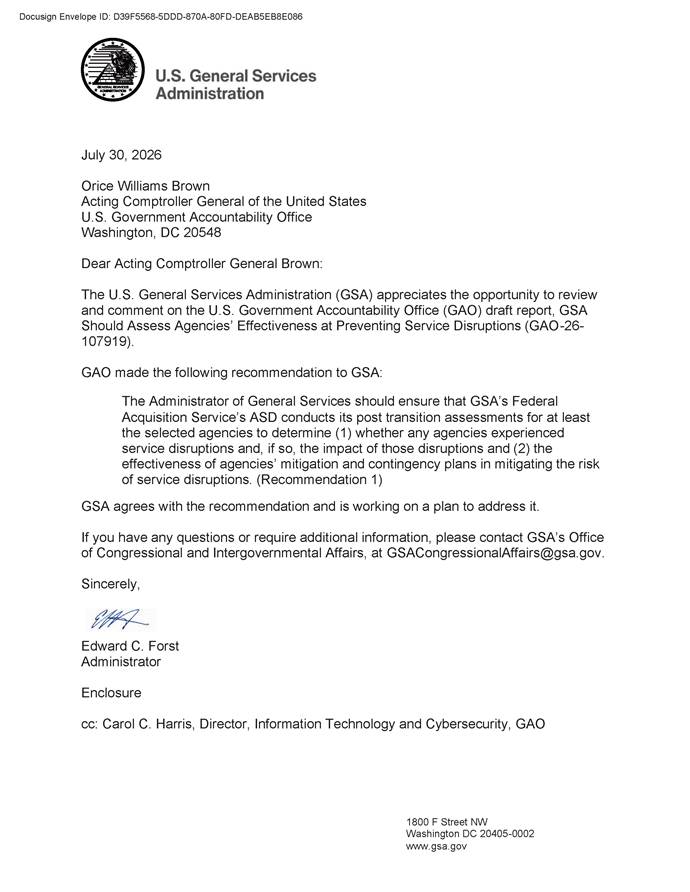
GAO Contact
Carol C. Harris, harriscc@gao.gov
Staff Acknowledgments
In addition to the contact named above, the following staff made key contributions to this report: Niti Tandon (Assistant Director), Meredith Raymond (Analyst in Charge), Chase Carroll, Angel Green, Donna Epler, Anh-Thi Le, Scott Pettis, and Walter Vance.
The Government Accountability Office, the audit, evaluation, and investigative arm of Congress, exists to support Congress in meeting its constitutional responsibilities and to help improve the performance and accountability of the federal government for the American people. GAO examines the use of public funds; evaluates federal programs and policies; and provides analyses, recommendations, and other assistance to help Congress make informed oversight, policy, and funding decisions. GAO’s commitment to good government is reflected in its core values of accountability, integrity, and reliability.
Obtaining Copies of GAO Reports and Testimony
The fastest and easiest way to obtain copies of GAO documents at no cost is through our website. Each weekday afternoon, GAO posts on its website newly released reports, testimony, and correspondence. You can also subscribe to GAO’s email updates to receive notification of newly posted products.
Order by Phone
The price of each GAO publication reflects GAO’s actual cost of production and distribution and depends on the number of pages in the publication and whether the publication is printed in color or black and white. Pricing and ordering information is posted on GAO’s website, https://www.gao.gov/ordering.htm.
Place orders by calling (202) 512-6000, toll free (866) 801-7077,
or
TDD (202) 512-2537.
Orders may be paid for using American Express, Discover Card, MasterCard, Visa, check, or money order. Call for additional information.
Connect with GAO
Connect with GAO on X,
LinkedIn, Instagram, and YouTube.
Subscribe to our Email Updates. Listen to our Podcasts.
Visit GAO on the web at https://www.gao.gov.
To Report Fraud, Waste, and Abuse in Federal Programs
Contact FraudNet:
Website: https://www.gao.gov/about/what-gao-does/fraudnet
Automated answering system: (800) 424-5454
Media Relations
Sarah Kaczmarek, Managing Director, Media@gao.gov
Congressional Relations
David A. Powner, Acting Managing Director, CongRel@gao.gov
General Inquiries
[1]As used in this report, a contract vehicle is a contract, or group of contracts, that provides a streamlined process for government agencies to place multiple orders for certain products and services with a pre-selected vendor or group of vendors.
[2]The 15-year performance period is divided into one 5-year base period and two additional 5-year options.
[3]GAO, FTS2001: Transition Challenges Jeopardize Program Goals, GAO‑01‑289 (Washington, D.C.: Mar. 30, 2001).
[4]GAO, Telecommunications: GSA Needs to Share and Prioritize Lessons Learned to Avoid Future Transition Delays, GAO‑14‑63 (Washington, D.C.: Dec. 5, 2013).
[5]For the purposes of the EIS transition, GSA defines a large agency as any agency that was billed a yearly average of at least $10 million for Networx legacy services from fiscal year 2012 through fiscal year 2015.
[6]For more information on our selection methodology, see appendix I.
[7]GSA changed its original March 2020 deadline to September 2022 due to delays. We provide additional information about GSA’s EIS transition deadlines later in the report.
[8]For a more detailed discussion of data reliability, see appendix I.
[9]According to GSA’s EIS Risk Management Plan, risk registers are documents used to identify, track, monitor, control, and report risks throughout the project lifecycle. The risk registers reviewed for this engagement were current as of summer 2025. Specifically, any risk registers provided by the selected agencies and components were current as of July or August 2025. GSA attested to the currency of its submitted risk register in September 2025.
[10]One of the goals of the RAFT project was to help agencies develop contingency plans with GSA support.
[11]In April 2011, Qwest Communications and CenturyLink, Inc. merged and Qwest Government Services began doing business as CenturyLink QGS. Following a rebrand of CenturyLink in 2020, CenturyLink QGS changed its name to Lumen Technologies Government Solutions in March 2021.
[12]CenturyLink acquired Level 3 Communications, Inc. in November 2017.
[13]Sprint Nextel, which was subsequently renamed as the Sprint Corporation in 2013, was acquired by T-Mobile US in April 2020.
[14]As of May 2026, there were nine EIS vendors: AOC Connect; the AT&T Corporation; BT Federal, Inc; Comcast Government Services, LLC; Granite Telecommunications, LLC; L3Harris; Lumen; Manhattan Telecommunications; and Verizon.
[15]A task order is an order for services placed against an established task order contract. For EIS, a task order is the official contractual mechanism used by agencies to order supplies and services.
[16]General Services Administration, Transition Handbook: Networx, WITS 3, and GSA Regional Local Services to Enterprise Infrastructure Solutions (EIS) Contracts, Version 7.1 (Washington, D.C.: June 28, 2022).
[17]GSA’s responsibility for managing the inventory of telecommunications services to transition included, among other things, collecting, reconciling, correcting, validating, and maintaining the inventory throughout the transition.
[18]The legacy and EIS vendors were responsible for disconnecting services under the expired contracts and installing new services ordered under EIS.
[19]When SIRs are weighted based on their complexity to transition, it is referred to as SIR Proportional Weighted Value (PWV). Simple services have a low PWV while more complex services have a higher weighted value.
[20]To calculate the SIR disconnected percentage, the difference between the total SIR count and the number of active SIRs is divided by the total SIR count.
[21]Audrey J. Dorofee, Julie A. Walker, Christopher J. Alberts, Ronald P. Higuera, Richard L. Murphy, and Ray C. Williams, Continuous Risk Management Guidebook (Pittsburgh, PA: Software Engineering Institute, Carnegie Mellon University, 1996).
[22]Dorofee, Walker, Alberts, Higuera, Murphy, and Williams, Continuous Risk Management Guidebook.
[23]Christopher J. Alberts and Audrey J. Dorofee, Risk Management Framework (Pittsburgh, P.A.: Software Engineering Institute, Carnegie Mellon University, 2010).
[24]GSA Transition Coordination Center, Risk Management Plan, Version 6.2 (Washington, D.C.: Nov. 2023).
[25]According to GSA’s Risk Management Plan, transition risk stakeholders assisted in identifying risks and helped to develop and analyze risk responses. These stakeholders included the GSA Transition Director and the officials responsible for monitoring, controlling, and updating the status of risks and issues.
[26]Three measures are associated with a risk: (1) probability, (2) impact, and (3) risk exposure. In this context, probability is defined as a measure of the likelihood that a threat will occur, while impact is defined as a measure of the loss that will occur if the threat is realized. Risk exposure provides a measure of the magnitude of a risk based on current values of probability and impact. Alberts and Dorofee, Risk Management Framework.
[27]According to GSA, a response plan consists of specific actions (taken or planned) that support the response strategy, address risks by their priority, and insert resources and activities into the budget, schedule, and project management plan as needed.
[28]For all regional legacy contracts except for WITS 3, GSA operated a Full Service Program in which it was responsible for managing service transitions, ordering services on behalf of agencies, troubleshooting service disruptions, and resolving issues with the suppliers as the customer of record on behalf of the agency customers. GSA decided to end the Full Service Program with EIS. GSA’s Full Service Transition Plan was to provide guidance for agencies transitioning services from GSA’s Full Service Program to EIS, and to assist with the nuances of coordination with GSA as the “customer of record” for existing services. General Services Administration, Enterprise Infrastructure Solutions (EIS) GSA Assisted Transition (GSAAT): Full Service Transition Plan, v 7.0 (Washington, D.C.: July 25, 2022).
[29]General Services Administration, Transition Handbook.
[30]The Telecommunications Act of 1996 required incumbent local exchange carriers to open their networks to competitors, allowing competitors to lease facilities for providing services to consumers and offering telecommunication services to resellers at wholesale rates. 47 U.S.C. § 251(c). Section 10 of the Act required FCC to forbear from regulations or any provision of the Act if new competition and technology rendered these regulations or provisions unnecessary for consumer protection and forbearance is consistent with the public interest. 47 U.S.C. § 160(a).
[31]For example, Business Data Services in an Internet Protocol Environment et al., Report and Order on Remand, 34 FCC Rcd 5767 (2019); Petition of USTelecom for Forbearance Pursuant to 47 U.S.C. 160(c) to Accelerate Investment in Broadband and Next-Generation Networks, Memorandum Opinion and Order, 34 FCC Rcd 6503 (2019); and Accelerating Wireline Broadband Deployment by Removing Barriers to Infrastructure Investment, Second Report and Order, 33 FCC Rcd 5660 (2018).
[32]As stated in Petition of USTelecom for Forbearance Pursuant to 47 U.S.C. 160(c) to Accelerate Investment in Broadband and Next-Generation Networks, Memorandum Opinion and Order, 34 FCC Rcd 6503 (2019), FCC data reflect that, between December 2008 and June 2017, the TDM share of all wireline voice telephone connections, including both switched access lines (also called plain old telephone service or POTS) and interconnected VoIP, fell from 82 percent to 37 percent, while the number of interconnected VoIP connections increased by almost 300 percent over the same period.
[33]According to GSA, EIS orders did not experience TDM price increases.
[35]GAO, Telecommunications: Full Adoption of Sound Transition Planning Practices by GSA and Selected Agencies Could Improve Planning Efforts, GAO‑06‑476 (Washington, D.C.: June 6, 2006).
[36]GAO, Telecommunications: Agencies Are Generally Following Sound Transition Planning Practices, and GSA Is Taking Action to Resolve Challenges, GAO‑08‑759 (Washington, D.C.: June 27, 2008).
[37]DHS did not implement six of the seven recommendations that we made, and the Nuclear Regulatory Commission did not implement one of its two recommendations. Commerce implemented the one recommendation that we made to it.
[39]GSA stated in June 2018 that it did not plan to implement this recommendation. We closed it as not implemented.
[40]GAO, Telecommunications: Agencies Need to Apply Transition Planning Practices to Reduce Potential Delays and Added Costs, GAO‑17‑464 (Washington, D.C.: Sept. 21, 2017).
[41]GAO, Telecommunications: Agencies Should Fully Implement Established Transition Planning Practices to Help Reduce Risk of Costly Delays, GAO‑20‑155 (Washington, D.C.: Apr. 7, 2020).
[42]USDA’s cost avoidance estimate assumes an end-date of 2035, three years after the currently scheduled end date of EIS.
[43]Both legacy and EIS vendors are represented in agencies’ reported delay factors.
[44]In this section, the delay factors reported by Commerce, DHS, and Transportation were combined with the delay factors cited by components that managed their own transitions. Specifically, Commerce’s reported delay factors include those cited by NOAA, DHS’s reported delay factors include those cited by the Coast Guard and the Secret Service, and Transportation’s delay factors include those cited by FAA. See appendix I for more detail on our methodology.
[45]As we will discuss below, special construction in terms of EIS is synonymous with special access construction. It refers to a one-time construction project that provides access from a service delivery point (e.g., a government building) to the service provider’s network.
[46]For the staffing delay factor, we did not include any identified staffing issues that were specifically caused by the COVID-19 pandemic. For those staffing issues, we categorized them as being related to the COVID-19 pandemic delay factor.
[47]Although this delay factor was originally identified by officials managing the centralized, department-wide transition effort, FAA officials stated that they were also affected by similar issues, as they also selected the same vendor.
[48]Specifically, 51 of the 52 open risks had associated risk response strategies, and 49 of the 52 open risks had associated risk response plans. The risks without a risk response strategy or plan were not required to have either because they had low risk exposure scores.
[49]General Services Administration, Transition Handbook.
[50]Specifically, GSA attested to the currency of its submitted risk register in September 2025. Further, any risk registers provided by the selected agencies and components were current as of July or August 2025.
[51]Risk exposure provides a measure of the magnitude of a risk based on current values of probability and impact.
[52]GSA’s risk management plan states to escalate a risk when the risk owner lacks the authority, resources, or knowledge to manage the risk.
[53]In July 2026, GSA submitted a question list for a July 2026 meeting with DOD that inquired about the effectiveness of DOD’s continency plans in avoiding service disruptions, among other things.
[54]A SIR is an inventory tracking record that represents a summarized roll-up of base services and their associated equipment, features, and other ancillary contract line-items.
[55]BV was the amount billed by vendors for services, which included adjustments, taxes, and fees.
[56]We based our size comparison on the component’s budget. Specifically, approximately 53 percent of the department’s requested fiscal year 2026 budget was for NOAA.
[57]The delay factors identified by fewer than three agencies were: funding (two agencies), infrastructure complexity (two agencies), location-related delays (two agencies), mission-related challenges (two agencies), supply chain issues (two agencies), vendor processes (two agencies), agency’s choice to use EIS contract (one agency), demarcation point issues (one agency), interagency collaboration issues (one agency), protests (one agency), and subcontractor-related issues (one agency).
[58]Specifically, any risk registers provided by the selected agencies and components were current as of July or August 2025. GSA attested to the currency of its submitted risk register in September 2025.