
Report to Congressional Committees
United States Government Accountability Office
A report to congressional committees
Contact: Jacqueline M. Nowicki at nowickij@gao.gov
What GAO Found
All states that receive funding under Title I of the Elementary and Secondary Education Act of 1965, as amended (ESEA) are required to develop statewide accountability systems. Thirty-six states have chosen to include indicators related to chronic absenteeism in their statewide accountability systems. ESEA also has certain chronic absenteeism reporting requirements for all states, regardless of whether a state includes chronic absenteeism in its accountability system.
In 2026, the Department of Education discontinued its most comprehensive monitoring of ESEA’s programmatic and fiscal requirements. The ESEA provision intended to improve oversight of funds does not explicitly direct Education to monitor grantees, nor does it include specific requirements regarding the method or frequency of monitoring and oversight activities. Suspending its most comprehensive monitoring has broad oversight implications that extend beyond chronic absenteeism. Given that Education is not currently assessing ESEA compliance with Title I fiscal requirements, there is higher risk that these federal funds—comprising about two-thirds of the nearly $27 billion in ESEA funding in 2025—could be subject to undetected fraud, waste, or abuse.
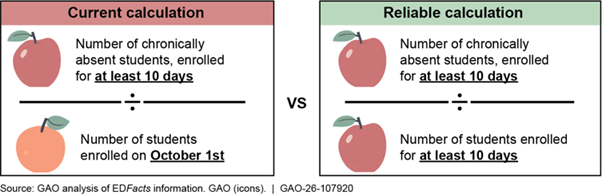
While Education requires states to report data on chronically absent students using a standard method, the way Education uses those data to calculate chronic absenteeism rates can be unreliable. For example, Education directs states to report the number of chronically absent students over a school year, but to report total enrollment based on a single date. Calculating rates using mismatched timeframes has resulted in unreliable and implausible chronic absenteeism rates (e.g., rates over 100 percent), according to GAO’s analysis. GAO calculated rates at the school level and found this was especially true in low-performing schools where enrollment fluctuates more often, and shared-time schools which students attend for partial days, such as those housing career and technical education programs. Specifically, over 30 percent of these schools had implausible rates compared to under 2 percent for other schools.
Missing school means missing valuable instructional time and poses serious implications for students' overall academic success and wellbeing. Absent quality chronic absenteeism data, this nationwide data source cannot be used to reliably track trends or evaluate the effectiveness of accountability efforts and interventions to address chronic absenteeism.
Why GAO Did This Study
Chronic absenteeism, which Education defines as missing 10 percent or more school days, is associated with decreased academic performance. As recently as February 2026, Education cited chronic absenteeism as a key challenge. Education has also noted that chronic absenteeism remains elevated following the COVID-19 pandemic. At least one-quarter of K-12 students were estimated to be chronically absent in recent years.
GAO was asked to examine federal oversight related to chronic absenteeism. This report examines (1) how states have incorporated chronic absenteeism into their statewide accountability systems and the extent to which Education’s monitoring addresses relevant federal requirements and (2) the extent to which Education has leveraged its data to help address chronic absenteeism.
GAO reviewed relevant federal laws and analyzed Education’s guidance and relevant monitoring reports since 2019, when Education fully implemented its main ESEA monitoring strategy. GAO also analyzed Education’s school year 2022–2023 chronic absenteeism data (the most recent available).
What GAO Recommends
GAO recommends that Congress consider clearly articulating ESEA monitoring requirements to ensure compliance and deter waste, fraud, and abuse. GAO is also making three recommendations, including that Education resume more comprehensive ESEA monitoring and improve the reliability of chronic absenteeism data. Education agreed with one of the recommendations and disagreed with two. GAO continues to believe these actions are necessary, as discussed in the report.
Abbreviations
CCD Common Core of Data
CSI Comprehensive Support and Improvement
ESEA Elementary and Secondary Education Act of 1965, as amended
NCES National Center for Education Statistics
SQSS school quality or student success
Title I Title I, Part A of the Elementary and Secondary Education Act of 1965, as amended
This is a work of the U.S. government and is not subject to copyright protection in the United States. The published product may be reproduced and distributed in its entirety without further permission from GAO. However, because this work may contain copyrighted images or other material, permission from the copyright holder may be necessary if you wish to reproduce this material separately.
September 23, 2026
The Honorable Shelley Moore Capito
Chair
The Honorable Tammy Baldwin
Ranking Member
Subcommittee on Labor, Health and Human Services, Education, and Related Agencies
Committee on Appropriations
United States Senate
The Honorable Robert B. Aderholt
Chairman
The Honorable Rosa L. DeLauro
Ranking Member
Subcommittee on Labor, Health and Human Services, Education, and Related Agencies
Committee on Appropriations
House of Representatives
Chronic absenteeism, generally defined as missing 10 percent or more of school days per year, is associated with decreased academic performance, according to the Department of Education. Research shows chronically absent students are less likely to read at grade level and are more likely to drop out of high school. As recently as February 2026, Education has cited chronic absenteeism as a key challenge. Education has also noted that chronic absenteeism remains elevated following the COVID-19 pandemic. Estimates of the proportion of students who are chronically absent range from about one-quarter to one-third of K-12 students in recent years. High rates of chronic absenteeism can make it difficult for students and schools to close achievement gaps. It can also reduce the impact of the federal government’s multibillion-dollar investment in K-12 education, as children cannot benefit from classroom instruction when they are not in school.
In fiscal year 2025, the federal government invested nearly $27 billion in K-12 education funds through programs in the Elementary and Secondary Education Act of 1965, as amended (ESEA).[1] Under ESEA Title I, Part A (Title I) states receive formula grants and allocate these funds to support schools and districts with high concentrations of students from low-income families. States are required to develop and implement a statewide accountability system to receive these funds. States may choose to incorporate chronic absenteeism indicators as part of their statewide accountability systems but are not required to do so. Regardless of states’ choices with respect to their statewide accountability systems, ESEA requires all states to annually develop concise and understandable state report cards that include certain information, such as certain chronic absenteeism data, that are widely accessible to the public, among other requirements.
You asked us to examine how Education assesses states’ efforts to improve chronic absenteeism for states that include it in their statewide accountability systems. You also asked us to identify opportunities to improve federal oversight of these efforts.
This report assesses (1) how states have incorporated chronic absenteeism into their statewide accountability systems and the extent to which Education’s monitoring addresses federal requirements relevant to chronic absenteeism; and (2) the extent to which Education has leveraged its data to help address chronic absenteeism.
To assess how states have incorporated chronic absenteeism into their statewide accountability systems, we sent surveys to officials at all 50 state educational agencies plus the District of Columbia about state policies and practices related to chronic absenteeism.[2] To determine the extent to which Education’s monitoring addresses federal requirements relevant to chronic absenteeism, we reviewed documents Education uses to monitor state oversight of these requirements as well as related monitoring reports issued from 2019 through 2025. We also reviewed related federal laws, including state report card requirements in the ESEA and Education guidance and interviewed Education officials. We also reviewed chronic absenteeism information available on state report cards.
To determine how Education has leveraged federal data related to chronic absenteeism, we analyzed EDFacts chronic absenteeism data from school year 2022–2023, the most recent data available at the time of our review. We assessed the reliability of the data by reviewing documentation about the data, conducting our own electronic data tests, and interviewing federal officials knowledgeable about the data. See appendix I for detailed information on our scope and methodologies, including a description of how we assessed the reliability of EDFacts data.
We conducted this performance audit from November 2024 to September 2026 in accordance with generally accepted government auditing standards. Those standards require that we plan and perform the audit to obtain sufficient, appropriate evidence to provide a reasonable basis for our findings and conclusions based on our audit objectives. We believe that the evidence obtained provides a reasonable basis for our findings and conclusions based on our audit objectives.
Background
ESEA Requirements Related to Chronic Absenteeism
To receive federal funding under Title I of the ESEA, each state must develop and implement a statewide accountability system. States are required to describe these systems in a state plan that must be reviewed and approved by Education. These plans remain in effect for the duration of states’ participation in Title I and should be periodically reviewed and revised as necessary by the state to reflect changes in the state’s strategies and programs under Title I. States that choose to include chronic absenteeism in their statewide accountability systems generally do so in the following ways:
Indicators. ESEA requires states to select indicators for their statewide accountability system on which to measure school performance each year. Such indicators must include academic indicators, including student performance on math and reading assessments. They must also include at least one statewide indicator of school quality or student success (SQSS).[3] In reauthorizing ESEA in 2015, Congress signaled a desire to capture school quality more broadly than data from standardized test scores, which it noted did not provide a full or accurate picture of school quality or success.[4] All SQSS indicators must allow states to meaningfully differentiate between schools’ performance. States may choose to include chronic absenteeism as an academic or SQSS indicator, but neither is required. If states choose to include chronic absenteeism as an indicator in their statewide accountability system, they have flexibility in how to define and weigh it.
Support and improvement plans. ESEA requires that states identify low-performing schools for three categories of support and improvement: (1) targeted support and improvement, (2) additional targeted support and improvement, and (3) comprehensive support and improvement. In general, support and improvement plans must be developed and implemented for all three categories of schools. States that include chronic absenteeism as an indicator in their statewide accountability system must ensure that support and improvement plans are informed by the chronic absenteeism indicator. This is because ESEA requires that support and improvement plans be informed by all indicators in the statewide accountability system.
State report cards. Regardless of states’ choices with respect to their accountability systems, ESEA generally requires every state to include on its report card information about public schools related to a wide variety of student and school performance metrics, accountability, per-pupil expenditures, and educator qualifications, including certain chronic absenteeism data.[5] These annual report cards can help promote transparency by providing parents and other stakeholders information on state, district, and school performance and progress.[6] States are also required to include performance information on all SQSS measures on their state report cards. Therefore, states that choose an SQSS chronic absenteeism indicator are required to include this information in their state report card and to ensure that school districts prepare and disseminate local report cards with this information.
Education’s Monitoring of ESEA Requirements Related to Chronic Absenteeism
Education awards Title I funding to states and is responsible for overseeing state implementation of ESEA requirements. States are responsible for ensuring that districts and schools comply with ESEA requirements. Education has generally monitored state compliance with ESEA requirements, including those related to chronic absenteeism, through three types of monitoring: consolidated monitoring, targeted monitoring, and annual report card reviews.
· Consolidated monitoring is a broad monitoring effort that includes Title I and other ESEA education programs. It is intended to thoroughly review key ESEA programs, including compliance with fiscal and programmatic requirements, through a single, streamlined process. Education selects several states per year based on a variety of risk factors and reviews the states’ compliance with federal statutes and guidance.
· Targeted monitoring addresses areas of particular concern. These more narrowly focused reviews provide oversight of a subset of ESEA requirements.
· Annual report card reviews primarily assess if states have posted updated report card information for the previous school year. They also verify compliance with selected requirements, including those related to per-pupil expenditure data and other areas of particular concern in a given year, akin to targeted monitoring.
When Education has found areas of state non-compliance during consolidated and targeted monitoring reviews or its annual report card review, it has required the state to take corrective action. Education has published its findings from these reviews, and any state corrective actions, in publicly available reports. Grantees are required to cooperate with Education’s program monitoring.[7]
Federal Collection of Chronic Absenteeism Data
Education collects data annually from each state on chronic absenteeism as part of its EDFacts data collection and has publicly reported on these data.[8] States are required to report counts of students who are chronically absent at each school using a standard federal definition. Education requires states to report these counts for all students and for certain student subgroups.[9] In the past, Education has analyzed these data to track trends over time, show geographic variation in chronic absenteeism rates, and highlight disparities by key demographic characteristics. Education has also used these data to provide states individualized analyses of school-level chronic absenteeism data to inform their school improvement efforts.
Education’s Past Monitoring Identified Weaknesses in State Chronic Absenteeism Reporting and Education Has Suspended Its Most Comprehensive ESEA Monitoring Strategy
Most States Chose to Include Chronic Absenteeism as an Indicator in Their Statewide Accountability Systems
Thirty-six states chose to include chronic absenteeism as an indicator in their statewide accountability systems, as of the 2025–2026 school year.[10] All of these states opted to include chronic absenteeism as a statewide SQSS indicator, except for California, which included it as an academic indicator. Education cannot require states to set goals and performance targets for SQSS or academic indicators because it is not an ESEA requirement, according to Education officials.[11] Some states have independently set goals and performance targets to reduce chronic absenteeism.[12] For example, Alabama and Ohio set long-term goals to decrease the chronic absenteeism rate to 5 percent by 2030 and school year 2030–2031, respectively. In contrast, Michigan set a long-term goal that fewer than 26 percent of students be chronically absent by school year 2031–2032. Nebraska took a different approach; it set separate individualized targets for each school using school year 2020–2021 as a baseline to reduce chronic absenteeism by 50 percent within 10 years.
States that included a chronic absenteeism indicator in their statewide accountability system used ESEA’s flexibility to implement it differently, according to our state survey. For example, 30 states reported making chronic absenteeism an SQSS indicator for all schools, two states used it only for elementary schools, and one state used it only for high schools.[13]
States also used ESEA’s flexibility in deciding how much weight chronic absenteeism had within their statewide accountability system. For example, in their survey responses, six states reported chronic absenteeism was the state’s only SQSS indicator for both elementary and high schools and another six reported it was their only SQSS indicator for elementary schools. In contrast, 19 states chose multiple SQSS indicators to which they assigned weights for chronic absenteeism that ranged from 4 to 50 percent.
In terms of addressing chronic absenteeism, in survey responses, states reported taking a variety of approaches (see fig. 1).
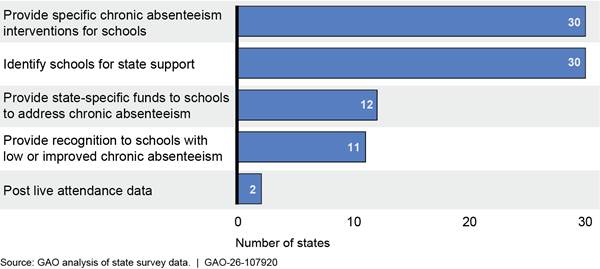
Note: States could select multiple responses to GAO’s survey question. Nine of 48 states did not select any response, 17 of 48 states selected 1–2 options, and 22 of 48 states selected 3–5 options.
Education Has Monitored Chronic Absenteeism Reporting Requirements in About Half of States
ESEA has reporting requirements related to chronic absenteeism for all states, and Education has assessed states’ compliance with these requirements in 26 states from fiscal year 2019 through fiscal year 2025. The agency has done so through consolidated monitoring for 19 states during this time period and through a fiscal year 2023 targeted monitoring effort related to this topic in nine states.[14]
During targeted and consolidated monitoring, officials checked that state and selected local report cards contained required information on chronic absenteeism, both for all students and for certain student subgroups, according to Education officials. For states that chose chronic absenteeism as an indicator, Education also checked report cards for additional information required for all SQSS indicators, according to Education officials. As shown in figure 2, Education found that at least some chronic absenteeism data were missing from the report cards of seven of the 26 states it monitored: Idaho, Mississippi, Nebraska, New Hampshire, Texas, Vermont, and Washington. Education directed all seven states to add the missing information to their report cards.
Figure 2: Department of Education’s Monitoring of States’ Adherence to Chronic Absenteeism Report Card Requirements, Fiscal Years 2019–2025
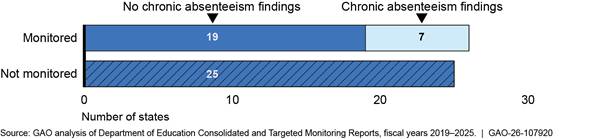
Note: Education found issues with chronic absenteeism reporting in the following seven states: Idaho, Mississippi, Nebraska, New Hampshire, Texas, Vermont, and Washington.
We reviewed the 2025 report cards for the seven states where Education had previous monitoring findings related to missing chronic absenteeism data and could not find certain required information for two of these states. Specifically, we could not find recent chronic absenteeism data on one state’s report card or state-level data disaggregated for required subgroups on another. We also noted that some included data on chronic absenteeism were in spreadsheets that were difficult to interpret. After reviewing what we identified, Education officials told us they were requiring those states to add the missing data to their state report cards. We also identified parts of Education’s report card guidance for states regarding chronic absenteeism reporting that was unclear and asked Education for clarification.[15] In April 2026, Education officials acknowledged the issues and said they would review the guidance and update it, as needed, to help ensure that it would be clear and accurate.
Education Found Issues Related to Additional ESEA Requirements for States That Used Chronic Absenteeism Indicators in Their Statewide Accountability Systems
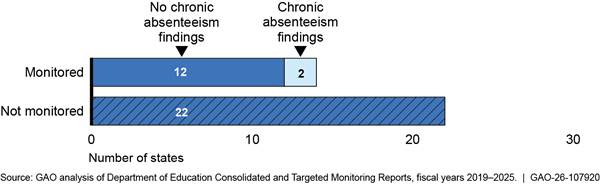
Since it fully implemented its consolidated monitoring strategy for current ESEA requirements in 2019, Education has monitored 14 of the 36 states (less than 40 percent) that chose to include chronic absenteeism in their statewide accountability system using this approach (see fig. 3). Education had chronic absenteeism findings related to indicator requirements in two of those 14 states.
Figure 3: Department of Education’s Monitoring of States’ Adherence to Statewide Accountability System Requirements for States with Chronic Absenteeism Indicators, Fiscal Years 2019–2025
To monitor these states, Education examined issues related to indicators and support and improvement plans.
Indicators. Education officials said they checked the mechanics of how indicators, including SQSS indicators, were calculated and reviewed documentation to ensure that indicators “meaningfully differentiated” performance across schools, as required.
Support and improvement plans. Education officials said they also checked whether the state required that support and improvement plans be informed by all indicators in the statewide accountability system.
Education’s monitoring findings related to these issues were in Maryland and New Mexico, in fiscal years 2024 and 2023, respectively. Regarding Maryland, Education found that the state had not demonstrated that any of its SQSS indicators, including chronic absenteeism, allowed for meaningful differentiation, as required. Regarding New Mexico, Education found that the state was not ensuring that support and improvement plans were informed by all indicators in the statewide accountability system, including the chronic absenteeism SQSS indicator, as required. Education required both states to provide documentation showing that the issues had been remedied. Maryland subsequently provided documentation that resolved the SQSS indicator monitoring finding, according to Education officials. Officials told us they were still working with New Mexico to resolve the finding about support and improvement plans.
Education Has Suspended Its Most Comprehensive Monitoring Strategy for Compliance with ESEA Requirements, Including Those Related to Chronic Absenteeism
In 2026, Education suspended its consolidated monitoring efforts for all ESEA programs and requirements. Consequently, 32 of 51 states have not undergone consolidated monitoring since Education fully implemented this monitoring strategy in 2019.[16] Education has conducted some limited monitoring in these states since 2019, such as targeted monitoring for specific Title I reporting requirements (including for chronic absenteeism) or for smaller programs authorized by other titles in ESEA. This type of monitoring is significantly more narrowly scoped than consolidated monitoring.
Regarding chronic absenteeism, 25 of 51 states remain unmonitored for reporting requirements that apply to all states. Similarly, 22 of the 36 states that chose to include chronic absenteeism as an indicator in their statewide accountability systems remain unmonitored for compliance with requirements related to indicators and support and improvement plans (see fig. 4).
Figure 4: Status of the Department of Education’s Monitoring Efforts for Programs Under the Elementary and Secondary Education Act of 1965, as Amended (ESEA), Fiscal Years 2019–2025
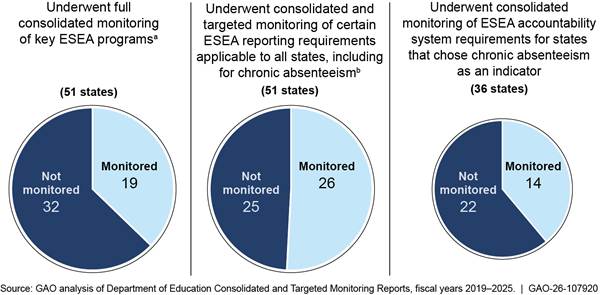
aIn 2017 and 2018, Education phased in its consolidated monitoring strategy as certain ESEA requirements took effect. The first year Education fully implemented consolidated monitoring for current ESEA requirements was 2019.
bSpecifically, consolidated and targeted monitoring examined ESEA reporting requirements for report cards in 20 U.S.C. 6311(h).
According to officials, Education has suspended consolidated monitoring of ESEA requirements in 2026 because it is developing plans for future monitoring activities. However, Education could not provide us with specific plans or timeframes for resuming consolidated monitoring, as of August 2026, or details on a comparable alternative method for ensuring states’ compliance with ESEA requirements.
Officials told us that while Education is required to oversee grantee implementation, it has broad discretion in determining how to best carry out those responsibilities. They also said there were no specific requirements regarding the method or frequency of monitoring and oversight activities. Education officials described their efforts to identify areas of potential noncompliance in the absence of consolidated monitoring, including conducting annual report card reviews, working with recently monitored states to address previous monitoring findings, providing technical assistance on Title I requirements upon request, and conducting some monitoring for smaller ESEA programs. However, these efforts are limited in scope, substantively different than systematically assessing compliance with ESEA requirements more broadly through consolidated monitoring, and focused on a narrower selection of ESEA requirements. As a result of suspending consolidated monitoring, Education will not be able to systematically assess whether states are complying with ESEA requirements and following their approved state plans.
Title I is one of the largest federally funded, state-administered programs. In fiscal year 2025, Education allocated over $18 billion to states through Title I formula grants. According to the Office of Management and Budget’s Uniform Guidance, federal agencies are to manage federal awards in a way that ensures programs are implemented in full accordance with statutory requirements.[17] Without resuming comprehensive monitoring, there is heightened risk that Education will be unable to identify instances where states are not meeting ESEA requirements, including those related to chronic absenteeism. Further, because states are required to disseminate key data on student and school performance via annual report cards, if such instances are not identified and addressed, policymakers, researchers, and members of the public, including parents, may not have access to accurate performance data. In addition, indicators, such as chronic absenteeism, may not appropriately inform school improvement efforts.
Because Education has largely relied on consolidated monitoring to broadly assess states’ compliance with programmatic and fiscal requirements across multiple ESEA programs, suspending it has broad oversight implications that extend beyond chronic absenteeism. Moreover, given that Education is not currently assessing compliance with ESEA fiscal requirements for Title I, there is a higher risk that billions of dollars in federal ESEA formula grant funds could be subject to undetected fraud, waste, or abuse. In fiscal year 2025, ESEA formula grant funds totaled almost $27 billion, and over $18 billion of these funds—about two-thirds—were related to Title I. Our prior work has found that the decentralized structure of state-administered programs, such as Title I, creates vulnerabilities for fraud.[18]
The provision in ESEA intended to improve monitoring and oversight of ESEA funds, including Title I funds, does not explicitly direct Education to conduct monitoring.[19] Therefore, it does not require Education to conduct monitoring with any set frequency or using any specific method. For example, the provision does not require that Education’s monitoring occur regularly or be comprehensive. Clearly articulating its expectations for federal monitoring of ESEA programs could provide Congress greater assurance that ESEA’s monitoring strategy would help ensure compliance with federal requirements and deter waste, fraud, and abuse with respect to these funds, as intended by the ESEA.[20]
Education’s Chronic Absenteeism Data Has Significant Weaknesses, Potentially Hindering Efforts to Address Chronic Absenteeism
Education Collects National Data on Chronic Absenteeism
Every year, states report to Education the number of students in each school who are chronically absent using a standard definition. According to this definition, a student is considered chronically absent if they were enrolled in a given school for at least 10 days and missed at least 10 percent of the days they were enrolled. For example, a student enrolled in a school for 100 days who missed 10 of those days would be considered chronically absent. If a student is absent for half or more of the school day, according to the definition, the student should be considered absent for the day. According to EDFacts, both excused and unexcused absences from school count when determining if a student is chronically absent. Excessive absences, even excused absences, can have serious negative impacts on student academic achievement due to lost instructional time, according to researchers.
Education’s EDFacts database is unique in that it is the only federal data collection meant to provide nationally comparable data about the number of chronically absent students in every public school and school district, annually. Outside of the chronic absenteeism reporting for EDFacts, states have the flexibility to tailor their definition of chronic absenteeism for the purposes of their statewide accountability systems.
At least 25 of the 48 states responding to our survey define and calculate chronic absenteeism differently in their statewide accountability systems compared to the EDFacts standard definition.[21] For instance, some states described using a different cutoff for how many days a student must be enrolled to be included in a school’s chronic absenteeism counts. Some states also reported differences in which absences are included when determining chronic absenteeism and how much of a school day a student must miss before being considered absent. Table 1 illustrates examples of how states reported defining chronic absenteeism in our survey and how those approaches compare with the EDFacts definition.
|
EDFacts standard definitions related to chronic absenteeism |
State-reported elements related to chronic absenteeism compared to EDFacts |
|
To be counted as chronically absent, students must be enrolled in a school for at least 10 days and absent 10 percent or more of those days. |
· Some states use a higher cutoff for how many days a student must be enrolled before counting a student in their chronic absenteeism calculations. For example, one state indicated students must be enrolled at least half of the school year to be counted in their state’s chronic absenteeism calculation. · Three states track the number of students who attend regularly (e.g., number of students who are not chronically absent), versus tracking the number of students who are chronically absent as required for EDFacts reporting. |
|
Both excused and unexcused absences are included in the chronic absenteeism calculation. |
· Approximately 90 percent of states responding to this question (39 of 44) include both excused and unexcused absences in their state’s chronic absenteeism calculations, mirroring the approach taken in EDFacts. The remaining states (5 of 44) only include unexcused absences, count some but not all excused absences, or do not have a policy about which absences are counted, allowing districts to determine the approach. |
|
Students should be counted as absent if they missed at least half of the school day. |
· Some states only count full-day absences toward chronic absenteeism while others include partial days or use instructional hours. Furthermore, some states reported allowing districts to decide their approach to partial attendance. |
Source: GAO Analysis of EDFacts information and state educational agency survey data. | GAO‑26‑107920
Notes: GAO sent a survey to all 50 state educational agencies and the District of Columbia. GAO received 48 out of 51 responses. Not all states answered all questions. Arizona, Florida, and Hawaii did not respond to GAO’s survey. States may choose to include chronic absenteeism as an academic or school quality or student success indicator, but neither is required. If states choose to include chronic absenteeism as an indicator in their statewide accountability system, they have flexibility in how to define and weigh it.
Education Lacks Key Data That Could Be Used to Help Address Chronic Absenteeism
While EDFacts’ definition provides a standardized method for counting the number of chronically absent students, the way Education uses those data to calculate chronic absenteeism rates can be unreliable. When calculated reliably, chronic absenteeism rates measure the percentage of students who are chronically absent. Reliable rates provide more information about the magnitude of the chronic absenteeism problem than counts alone. They also enable comparisons across schools of different sizes.
To calculate chronic absenteeism rates, Education divides the number of students identified as chronically absent by the number of students enrolled. Education’s absenteeism rates are not reliable because the way Education counts chronically absent students is not comparable to the way Education counts enrolled students. Specifically, students identified as chronically absent are counted over an entire school year, whereas the number of enrolled students is limited to a single day (October 1). Using a single day count is problematic because enrollment counts may differ if students are moving in and out of the school over the course of the school year. A reliable chronic absenteeism rate calculation would use the same time period for determining both the number of chronically absent students and the number of students enrolled in the school (see fig. 5).
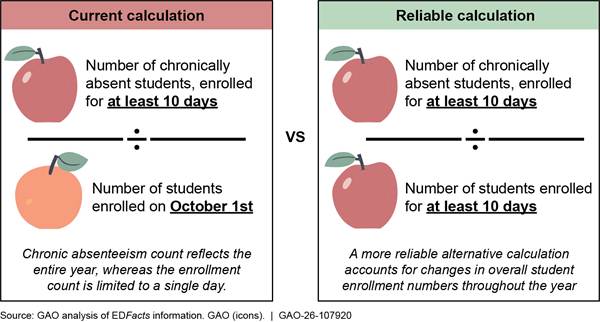
In late 2024, Education officials began the process of requiring states to report the number of students enrolled over the entire school year so that Education could more accurately calculate chronic absenteeism rates. However, officials said they later decided not to proceed due to staffing changes at the agency. In March 2025, Education announced a reduction in force and reorganization. In the Institute of Education Sciences, the office within Education responsible for the EDFacts data collection, Education reduced its workforce by over 85 percent.[22] Further, the Office of Elementary and Secondary Education, which officials said serves as data steward for the chronic absenteeism data collection, reduced its workforce by 43 percent over the same period.[23]
States already need to identify the number of students enrolled for at least 10 days to determine the number of students who are chronically absent as required for EDFacts reporting, according to an interview we conducted with an expert on chronic absenteeism data. Since states are already identifying and collecting these data, the additional burden of reporting it to EDFacts could be minimal.
The method Education uses to calculate chronic absenteeism rates has led to overstated and implausible chronic absenteeism rates in some cases, such as rates that are over 100 percent. Our analysis of EDFacts data for school year 2022–2023 found implausible chronic absenteeism rates in around 2.5 percent of schools nationwide.[24] It is also likely that other schools may have calculations that overstate the chronic absenteeism rate while still appearing plausible.
In data notes that accompany the EDFacts dataset, Education cautions data users that chronic absenteeism rates calculated using EDFacts data may be inflated because of the mismatch between chronic absenteeism counts and enrollment counts. Table 2 shows examples of how the mismatch between the way EDFacts counts student enrollment and chronic absenteeism can lead to inaccurate or implausible chronic absenteeism rates.
Table 2: Examples of How Chronic Absenteeism Calculations May Result in Overstated or Unreliable Rates
|
|
Count of Chronically Absent students |
Count of students enrolled on Oct. 1 (used for EDFacts rate) |
Chronic absenteeism rate calculated using available EDFacts data |
Count of students enrolled at least 10 days over school year (not currently collected in EDFacts) |
Reliable chronic absenteeism rate using data not currently collected in EDFacts |
Difference in chronic absenteeism rate |
Conclusion |
|
School A |
100 |
500 |
20% |
500 |
20% |
0 points |
Calculation using available EDFacts data reflects the reliable rate |
|
School B |
100 |
500 |
20% |
1000 |
10% |
10 points |
Calculation using available EDFacts data overstates the reliable rate |
|
School C |
100 |
80 |
125% |
150 |
66% |
59 points |
Calculation using available EDFacts data overstates the reliable rate and is implausible |
Source: GAO Analysis based on the Department of Education’s methodology for calculating chronic absenteeism. | GAO‑26‑107920
We found that reliability issues with chronic absenteeism rates were more pronounced for schools where students frequently enroll and unenroll. For example, nearly 13 percent of schools designated as Comprehensive Support and Improvement (CSI) had implausible chronic absenteeism rates (rates over 100 percent) compared to approximately 2 percent of non-CSI schools. As we have previously reported, CSI schools often have a high rate of students changing schools, which could contribute to overstated chronic absenteeism rates.[25]
Having accurate chronic absenteeism rates is particularly important for statewide accountability efforts. Overstated chronic absenteeism rates could make it more difficult to focus resources on schools and districts with the greatest need of support in this area—especially for states that use the EDFacts definition of chronic absenteeism in their statewide accountability systems. It could also mask cases where rates are improving, which could decrease opportunities to identify and replicate promising practices.
In our prior work, we have found that federal decision-makers need quality data to determine if federal programs and grants are working as intended and to identify strategies to improve performance.[26] Moreover, Education’s most recent Strategic Plan calls for strengthening agencywide data governance and identifies improving the quality of Education’s data from grantees and subrecipients as a strategy for achieving this strategic goal.[27] Education’s website also states that it is using every tool in its toolbox to help schools and communities increase attendance.[28] Collecting data that would allow it to calculate reliable chronic absenteeism rates is a critical tool it could add to its toolbox.
Moreover, unless Education addresses the reliability of its chronic absenteeism data, EDFacts data cannot reliably be used to compare or track trends in chronic absenteeism rates, identify which schools or states have particularly concerning levels of chronic absenteeism, or evaluate the impact of accountability efforts on a national level. For instance, with better data, researchers could more accurately identify trends, such as the relationship between school improvement designations (e.g., CSI) and chronic absenteeism and analyze potential policies and interventions to address them.
Data for Shared-Time Schools Have Additional Data Reliability Concerns and Reporting Instructions Are Unclear
Our analysis of EDFacts chronic absenteeism data from school year 2022–2023 found schools categorized as “shared-time schools” were significantly more likely to have implausible chronic absenteeism rates (i.e., rates over 100 percent) than other schools.[29] Shared-time schools often house career and technical education or other specialized programs. Because students in these programs split their time across schools, a student could be counted as absent in one school but present somewhere else. A student could also be counted as chronically absent in more than one school. We found that more than 30 percent of shared-time schools had implausible chronic absenteeism rates compared to under 2 percent for non-shared-time schools.[30]
Additionally, our analysis suggests that states may not be using the same approach to reporting chronic absenteeism data for students in shared-time schools. We found wide variation in the extent of implausible chronic absenteeism rates in shared-time schools across states, from no schools with implausible rates in multiple states (including Delaware, Idaho, Maryland, Missouri, North Carolina, and Rhode Island) to 98 percent of shared-time schools with implausible rates in Pennsylvania.[31]
Education does not provide states with guidance on how students in shared-time schools should be included in EDFacts chronic absenteeism data submissions.[32] Education officials said they had not received any questions from states regarding how to report chronic absenteeism in shared-time schools, thus they were unaware of any issues. However, a lack of questions from states does not mean that states are taking a consistent approach that yields comparable, accurate data, especially given that shared-time schools had disproportionately high levels of implausible chronic absenteeism rates and the variation between states.
Education has identified improved data quality and governance as a key objective within its strategic plan.[33] Absent guidance on how to report chronic absenteeism data for shared-time schools, states may take inconsistent approaches, which limits data quality and the national comparability of chronic absenteeism rates for these schools. Without quality data, Education and stakeholders will be unable to evaluate the effectiveness of initiatives and cannot accurately determine if improvements are needed. Given recent national attention on the importance of career readiness (e.g., career and technical education programs) in addition to college readiness, accurate chronic absenteeism data for shared-time schools could be especially critical since many such programs are located at these schools.
Conclusions
Missing school means missing valuable instructional time and poses serious implications for students’ overall academic success and well-being. As such, sustained levels of high chronic absenteeism represent a risk to the federal government’s investment in K-12 education, which in fiscal year 2025 totaled nearly $27 billion.
Effective monitoring of federal programs under Education’s purview is critical to its ability to ensure that federal funds are used for the purposes intended and programs are achieving goals and objectives, which includes improving school and student performance. Education’s previous monitoring efforts helped ensure that states complied with ESEA requirements as evidenced by its monitoring findings. Suspending its key monitoring effort places billions of dollars in federal funding for ESEA programs—nearly $27 billion in fiscal year 2025—at heightened risk for undetected fraud, waste, and abuse. Additionally, for states that chose chronic absenteeism as an indicator in their statewide accountability plans, monitoring has important implications for school improvement efforts. Given the importance of effective oversight, Congress should consider clearly articulating its expectations for federal monitoring of ESEA. Doing so would provide greater assurance that Education’s monitoring strategy for ESEA will help ensure compliance with federal requirements and deter waste, fraud, and abuse with respect to these funds, as intended by the ESEA.
Additionally, in our prior work, we have found that decision-makers need quality data on chronic absenteeism to inform their decisions and to drive improvement. Since Education uses different time periods for identifying the number of chronically absent students and number of students enrolled in schools, the chronic absenteeism rates it calculates cannot be used to reliably track trends, identify schools struggling the most, or evaluate the effectiveness of accountability efforts and interventions. By requiring states to report data on the number of students enrolled in schools in a way that matches how they report chronic absenteeism counts, Education would be able to calculate reliable chronic absenteeism rates. Further, without guidance to help ensure that states report chronic absenteeism data for shared-time schools consistently, data for those schools cannot be reliably used to compare trends across states. Improved data would help policymakers better understand and address potential attendance challenges at shared-time schools.
Matter for Congressional Consideration
Congress should consider clearly articulating ESEA monitoring requirements to help ensure that the federal government’s approach to monitoring ESEA programs will ensure compliance with federal requirements and deter waste, fraud and abuse with respect to these funds, as intended by the ESEA. (Matter for Consideration 1)
Recommendations for Executive Action
We are making the following three recommendations to Education:
The Secretary of Education should promptly resume more comprehensive monitoring to better ensure states are meeting ESEA fiscal and programmatic requirements. (Recommendation 1)
The Secretary of Education should require that states report the number of students who are enrolled in each school in a way that matches how it requires states to report chronic absenteeism counts so that it can calculate reliable chronic absenteeism rates. (Recommendation 2)
The Secretary of Education should provide guidance on how states should report chronic absenteeism data for shared-timed schools to ensure consistent reporting among states. (Recommendation 3)
Agency Comments and Our Evaluation
We provided a draft of this report to the Department of Education for review and comment. In its comments, reproduced in appendix II, Education concurred with our third recommendation and did not concur with our first and second recommendations. Education also provided technical comments, which we incorporated as appropriate.
Education disagreed with an earlier version of our first recommendation. In the draft report we provided to Education, we recommended that it promptly resume monitoring whether states are meeting ESEA requirements. Education stated that consolidated monitoring is not the only oversight that the department has carried out for ESEA programs, including in 2026 when it stopped consolidated monitoring. We agree and note that the draft report we provided to Education included examples of the department’s other oversight activities. As we also noted in the draft report, the reviews that Education described conducting in 2026 were limited in scope and substantively different than systematically assessing compliance with ESEA requirements more broadly through consolidated monitoring or a similar approach. In response to Education’s comments, we adjusted the wording of the recommendation to clarify its focus on more comprehensive monitoring of ESEA fiscal and programmatic requirements. In a few instances within the report, we also clarified our references to consolidated monitoring. Regarding Education’s comment about its other oversight efforts, we added its monitoring of smaller programs within ESEA to the examples of monitoring already discussed in our draft report.
Education noted that it will provide its 2027 monitoring plan in early fall 2026. We are encouraged that Education is developing a monitoring plan for 2027. However, by significantly curtailing the scope of fiscal and programmatic monitoring, especially for Title I, given the size of the program relative to other ESEA programs, Education has left over $18 billion in federal funding at heightened risk for undetected waste, fraud, and abuse. We continue to believe that Education should promptly resume more comprehensive monitoring to ensure that federal funds are being used for the purposes intended and are sufficiently safeguarded.
Education also disagreed with our second recommendation that it require states to report school enrollment data in a way that enables Education to calculate reliable chronic absenteeism rates. Education noted that the mismatch between the enrollment data and chronic absenteeism data is a known limitation that is already documented. We agree that this is a known limitation. The draft report on which Education commented stated that in the data notes accompanying the EDFacts dataset, Education cautions users that chronic absenteeism rates calculated using the data may be inflated. However, the fact that this is a known limitation does not negate the importance of addressing it, especially given how Education and others have highlighted the importance of addressing chronic absenteeism. As noted in our report, Education’s annual EDFacts data is the only federal data collection meant to provide nationally comparable data on chronic absenteeism for every public school and school district. Without addressing the mismatch between enrollment data and chronic absenteeism data, Education cannot fulfill one of the primary reasons for collecting the data.
Education noted that it has chosen to continue working with currently reported EDFacts data elements, highlighting limitations as needed, rather than imposing additional reporting burden on states. However, as stated in the draft report, states already need to identify the number of students enrolled for at least 10 days to determine the number of students who are chronically absent as required for EDFacts. Therefore, any additional burden could be minimal. Further, collecting only part of the data needed to calculate accurate rates means that states and districts are expending time and effort reporting data with limited utility, and doing so in a way that does not meet a primary purpose of collecting and reporting the data.
Education indicated that the data limitation associated with using October 1 enrollment counts is particularly problematic at the school level, where student counts are smaller and the populations are usually more mobile. Education also noted it does not publicly publish analysis at this level for this reason. These data limitations do not disappear when the data are aggregated to the district and state levels; rather, they become harder to discern. Furthermore, having reliable data at the school level is important for helping to understand trends in low-performing schools, including analyzing the effectiveness of chronic absenteeism interventions that could be replicated. We continue to believe that Education should require states to report the number of students who are enrolled in each school in a way that matches how it requires states to report chronic absenteeism counts so that it can calculate reliable chronic absenteeism rates.
We are sending copies of this report to the appropriate congressional committees, the Secretary of Education, and other interested parties. In addition, the report is available at no charge on the GAO website at https://www.gao.gov.
If you or your staff have any questions about this, please contact me at NowickiJ@gao.gov.
Contact points for our Offices of Congressional Relations and Media Relations may be found on the last page of this report. GAO staff who made key contributions to this report are listed in appendix III
Jacqueline M. Nowicki, Director
Education, Workforce, and Income Security
This report assesses (1) how states have incorporated chronic absenteeism into their statewide accountability systems and the extent to which the Department of Education’s monitoring addresses federal requirements relevant to chronic absenteeism; and (2) the extent to which Education has leveraged its data to help address chronic absenteeism.
Monitoring Review
To determine the extent to which Education’s monitoring addresses federal requirements relevant to chronic absenteeism, we reviewed documents Education uses to monitor state oversight of these requirements as well as the 28 related monitoring reports issued from 2019 through 2025, the years after Education had completed phasing current ESEA requirements into consolidated monitoring. We also reviewed relevant federal laws, including state report card requirements in ESEA, and guidance and interviewed Education officials. We also reviewed chronic absenteeism information available on all 50 states plus the District of Columbia’s most recent report cards available at the time of our review.
Survey of State Educational Agencies
To obtain information on chronic absenteeism policy and practices in each state, we conducted a survey of 50 state educational agencies plus the District of Columbia. The survey consisted of multiple-choice and open-ended questions, and asked agencies about:
· state policy on school attendance and chronic absenteeism,
· chronic absenteeism accountability mechanisms under ESEA,
· chronic absenteeism accountability mechanisms under state public school accountability systems, and
· oversight and monitoring activities conducted by Education.
To ensure that respondents would be able to respond knowledgeably to survey items, we asked two external experts for comments on our initial survey questionnaire and pretested the survey with officials from three state educational agencies. Specifically, we solicited an initial round of feedback with two selected external experts with experience in chronic absenteeism and attendance research. Next, we conducted pretests with officials from three state educational agencies. We selected the state educational agencies to reflect variation in geography, state population, and if chronic absenteeism was included as an SQSS indicator in the statewide accountability system. The purpose of the pretests was to check that (1) the questions were clear and unambiguous, (2) terminology was used correctly, (3) the questionnaire did not place an undue burden on agency officials, (4) the respondents could feasibly obtain the information needed to answer the questions, and (5) the survey was comprehensive and unbiased. As a result of the comments we received from experts and during our pretests, we made changes to refine and improve the content and format of the survey.
We administered the survey between September 2025 and February 2026 to officials at the 50 state educational agencies plus the District of Columbia. The survey was distributed to agency officials by email using the Qualtrics web-based survey tool. Prior to distributing the survey, we identified points of contact by asking agencies to refer us to the official most knowledgeable about state policies and practices regarding chronic absenteeism. The 2025 federal government shutdown, from October 1, 2025, to November 12, 2025, extended the timeline of the survey. We conducted follow-up for nonresponding states via phone calls from December 2025 to January 2026. We received responses from 48 of the 51 state educational agencies, a 94 percent response rate. Florida, Arizona, and Hawaii did not provide responses to our survey.
Analysis of EDFacts Chronic Absenteeism Data
As part of our review, we assessed the reliability of EDFacts chronic absenteeism data, including the number of schools with implausible chronic absenteeism rates. We defined a school with an EDFacts implausible chronic absenteeism rate to be a school in which the implied rate of chronically absent students was greater than 100 percent, meaning there were more students reported chronically absent than students enrolled, according to the EDFacts data. Schools with no reported K-12 enrollments were excluded, as were Bureau of Indian Education schools and schools outside the 50 states and the District of Columbia.[34]
We supplemented the EDFacts data with data from the Common Core of Data (CCD) about school characteristics, such as whether the school was a shared-time school. The National Center for Education Statistics (NCES) collects a range of data annually from state educational agencies on all public schools and school districts in the nation.[35] These data include information on a number of school characteristics such as school type (e.g., traditional public school, charter school), student demographics, and enrollment. We calculated the number and percent of schools with chronic absenteeism rates above 100 percent for specific types of schools, such as schools identified for comprehensive support and improvement, shared-time schools, and alternative schools.[36]
We assessed the reliability of the EDFacts chronic absenteeism data by reviewing relevant technical documentation, comparing district-level chronic absenteeism data to an alternative data source (the Return 2 Learn data collected by the American Enterprise Institute), checking for missing or unexpected values and outliers, and interviewing knowledgeable Education officials. We determined the EDFacts chronic absenteeism data was sufficiently reliable for the purpose of reporting the number and percentage of schools with implied chronic absenteeism rates above 100 percent. This can be considered a lower bound for the number and percentage of schools with inaccurate data on chronic absenteeism rates.
We assessed the reliability of the CCD by reviewing technical documentation and performing electronic and manual data testing for missing data, unexpected values, or obvious errors.[37] We determined the school type variables were reliable for the purpose of analyzing the characteristics of schools with implied chronic absenteeism rates above 100 percent.
GAO Contact
Jacqueline M. Nowicki, nowickij@gao.gov
Staff Acknowledgments
In addition to the contact named above, Barbara Steel (Assistant Director), Amy MacDonald (Analyst in Charge), Isaac Pavkovic (Senior Analyst), Madeline Barch, Elizabeth Calderon, Linda Keefer, M. Magdalena Jimenez Aguilar, Abigail Loxton-Daun, Raquel Qualls-Hampton, Ronni Schwartz, Joy Solmonson, Curtia Taylor, Margaret Weber, and Adam Wendel made significant contributions to this report.
The Government Accountability Office, the audit, evaluation, and investigative arm of Congress, exists to support Congress in meeting its constitutional responsibilities and to help improve the performance and accountability of the federal government for the American people. GAO examines the use of public funds; evaluates federal programs and policies; and provides analyses, recommendations, and other assistance to help Congress make informed oversight, policy, and funding decisions. GAO’s commitment to good government is reflected in its core values of accountability, integrity, and reliability.
Obtaining Copies of GAO Reports and Testimony
The fastest and easiest way to obtain copies of GAO documents at no cost is through our website. Each weekday afternoon, GAO posts on its website newly released reports, testimony, and correspondence. You can also subscribe to GAO’s email updates to receive notification of newly posted products.
Order by Phone
The price of each GAO publication reflects GAO’s actual cost of production and distribution and depends on the number of pages in the publication and whether the publication is printed in color or black and white. Pricing and ordering information is posted on GAO’s website, https://www.gao.gov/ordering.htm.
Place orders by calling (202) 512-6000, toll free (866) 801-7077,
or
TDD (202) 512-2537.
Orders may be paid for using American Express, Discover Card, MasterCard, Visa, check, or money order. Call for additional information.
Connect with GAO
Connect with GAO on X,
LinkedIn, Instagram, and YouTube.
Subscribe to our Email Updates. Listen to our Podcasts.
Visit GAO on the web at https://www.gao.gov.
To Report Fraud, Waste, and Abuse in Federal Programs
Contact FraudNet:
Website: https://www.gao.gov/about/what-gao-does/fraudnet
Automated answering system: (800) 424-5454
Media Relations
Sarah Kaczmarek, Managing Director, Media@gao.gov
Congressional Relations
David A. Powner, Acting Managing Director, CongRel@gao.gov
General Inquiries
[1]The federal government also invests in K-12 education by providing funding to support children with disabilities through the Individuals with Disabilities Education Act and offers discretionary grant opportunities such as Charter School Program grants.
[2]Throughout this report, we refer to the District of Columbia as a state. We received survey responses from 48 of the 51 states.
[3]Statewide means the same indicator or indicators are used for each grade span. The SQSS indicator must also be valid, reliable, and comparable.
[4]S. Rep. No. 114-231 (2016) (Conf. Rep.) and ESEA Conference Report Summary https://edworkforce.house.gov/uploadedfiles/esea_conference_report_summary.pdf, accessed on May 21, 2026.
[5]State report cards are also required to be developed in consultation with parents and widely accessible to the public, which includes certain requirements like making it available on a single webpage of the state educational agency’s website. State report cards must also be concise, presented in an understandable and uniform format, and to the extent practicable, in a language that parents can understand.
[6]See S. Rep. No. 114-231 (2016) (Conf. Rep.) and U.S. Department of Education, Office of Elementary and Secondary Education, A Parents’ Guide to Report Cards (Washington, D.C.: 2018).
[7]34 C.F.R. § 76.591.
[8]The EDFacts data collection and reporting system centralizes data provided by states, including performance data on public schools (pre-K through grade 12), and financial grant information. For an example of Education’s public reporting of chronic absenteeism data, see: https://www.ed.gov/teaching-and-administration/supporting-students/chronic-absenteeism.
[9]Student subgroups include homeless status, economically disadvantaged status, disability status, English learner status, major racial and ethnic group status, and sex.
[10]For 34 of the 36 states, we obtained this information from our state survey. For the three states that did not respond to our survey (Arizona, Florida, and Hawaii), we reviewed the state’s ESEA plan to determine if the state had opted to include chronic absenteeism as an indicator. Based on our review, we found that Arizona and Hawaii chose to include chronic absenteeism.
[11]Specifically, ESEA states that Education may not prescribe indicators that states use, including any requirement to measure student growth. ESEA also states that if a state chooses to measure student growth, Education may not prescribe the specific metrics used to measure such growth.
[12]In 2024, leaders of American Enterprise Institute, Attendance Works, and EdTrust called upon states to cut chronic absenteeism rates by 50 percent over 5 years. State education leaders in 18 states committed to this challenge.
[13]This analysis only applies to the 33 states that responded to our survey and that chose chronic absenteeism as an SQSS indicator. It does not include California, which reported using chronic absenteeism as an academic indicator, or two states that use chronic absenteeism as an SQSS indicator that did not respond to our survey.
[14]Two states were monitored through both consolidated monitoring and targeted monitoring on Title I reporting requirements.
[15]Specifically, the guidance did not clearly explain for which student groups states must report EDFacts chronic absenteeism data on state report cards and at what level (state, school district, or school) the data must be reported. Also, the guidance did not clearly explain for which student groups EDFacts chronic absenteeism data must be reported on local report cards.
[16]In 2017 and 2018, Education phased in its consolidated monitoring strategy as certain ESEA requirements took effect. The first year Education fully monitored current ESEA requirements was 2019.
[17]2 C.F.R. § 200.300.
[18]GAO, Combating Fraud: Managing Risks in Federally Funded, State-Administered Programs, GAO‑26‑109100 (Washington, D.C.: July 23, 2026). In this report, we found that while pass-through entities, such as states, are responsible for evaluating subrecipients’ risk of committing fraud, monitoring subrecipient activities as necessary, and addressing issues that arise, federal agencies play an important role in combatting fraud. Although federal agencies that award grants do not have a direct legal relationship with subrecipients, they provide indirect oversight by ensuring that states carry out their subrecipient oversight responsibilities.
[19]Specifically, it requires the Secretary to notify each recipient of a grant under ESEA of its responsibility to comply with all applicable monitoring requirements and properly monitor any subgrantees, review and analyze the results of monitoring and compliance reviews, publicly report the work by the Secretary to prevent fraud, waste, and abuse, and work with the Office of Inspector General of the Department of Education, as needed, to help ensure that employees of Education understand how to adequately monitor grantees and to help grantees adequately monitor any subgrantees. 20 U.S.C. § 7934.
[20]Congress has articulated clear monitoring expectations for other large state-administered programs. For example, under the Individuals with Disabilities Education Act, which provides formula grants to assist states in providing special education and related services through the Grants to States program, the Secretary is required to monitor implementation, including through annually reviewing state performance reports and determining each state’s progress in implementing the requirements of the statute. See 20 U.S.C. § 1416. Additionally, under the Child Care and Development Block Grant program, the main federal funding for the Child Care and Development Fund, which provides funds to states to subsidize child care for low-income families, the Department of Health and Human Services is explicitly required to monitor state compliance. See 42 U.S.C. § 9858g(b).
[21]Since not all states answered all questions, we cannot determine the exact number of states where state definitions differ from EDFacts.
[22]Specifically, at the end of calendar year 2024, there were 191 staff compared to 28 staff at the end of the calendar year 2025, according to Office of Personnel Management, Enterprise Human Resources Integration data.
[23]Office of Personnel Management, Enterprise Human Resources Integration data.
[24]Data for school year 2022–2023 were the most recently available data at the time of our review.
[25]GAO‑ K‑12 EDUCATION: Characteristics and Turnaround Strategies of Schools Identified for Comprehensive Support and Improvement, GAO‑26‑107849 (Washington, D.C.: Mar. 12, 2026).
[26]GAO, Evidence-Based Policymaking: Practices to Help Manage and Assess the Results of Federal Efforts, GAO‑23‑105460 (Washington, D.C.: July 12, 2023).
[27]U.S. Department of Education, U.S. Department of Education Strategic Plan Fiscal Years 2022–2026 (Washington, D.C.: July 8, 2022).
[28]See https://www.ed.gov/teaching-and-administration/supporting-students/chronic-absenteeism, accessed Mar. 5, 2026.
[29]According to EDFacts data from the 2022–2023 school year, there were a total of 777 shared-time schools.
[30]Schools from six states are excluded from these rates because they do not report shared-time status to Education.
[31]In addition, the one shared-time school in Kentucky had an implausible chronic absenteeism rate. The states with shared-time schools but none with implausible chronic absenteeism rates include Delaware (six shared-time schools), North Carolina (three shared-time schools), Missouri (three shared-time schools), Maryland (one shared-time school), Idaho (two shared-time schools) and Rhode Island (one shared-time school). The states with the highest proportion of shared-time schools with implausible rates are Pennsylvania (62 of 63) and Kentucky (one of one).
[32]In contrast, Education provides EDFacts guidance on how to report school enrollment for students who attend shared-time schools.
[33]U.S. Department of Education, Strategic Plan Fiscal Years 2022–2026.
[34]We excluded 132 schools that reported counts of chronically absent students but did not report enrollment counts as part of EDFacts because it is not possible to calculate chronic absenteeism rates without both counts. We also excluded schools that did not report data on chronically absent students to EDFacts or schools where chronic absenteeism data was suppressed as part of disclosure avoidance, generally schools that reported fewer than five chronically absent students.
[35]NCES is one of four centers for education sciences within Education’s Institute of Education Sciences. The Institute of Education Sciences is the statistics, research, and evaluation arm of Education.
[36]We compared the chronic absenteeism rates for schools identified for comprehensive support and improvement (alone or in combination with another identification status) to schools not identified for comprehensive support and improvement (i.e., schools identified for targeted support and improvement, schools identified for additional targeted support and improvement, and schools that were not identified for improvement).
[37]Six states did not report shared-time school status for any schools and were excluded from the analysis of shared-time schools. (These states are California, the District of Columbia, Louisiana, Oregon, Texas, and Washington).