
Report to Congressional Requesters
United States Government Accountability Office
A report to congressional requesters
For more information, contact: Howard Arp at ArpJ@gao.gov.
What GAO Found
From fiscal year 2021 through the first half of fiscal year 2025, the Council of the Inspectors General on Integrity and Efficiency (CIGIE)’s Integrity Committee (IC) received 16,245 complaints, resulting in 460 cases for review. The IC also completed 15 reports of investigations during that period.
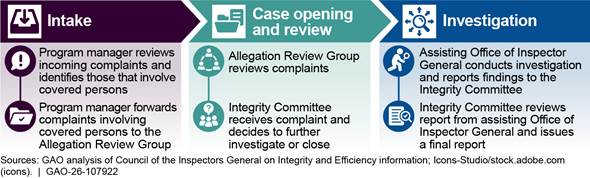
GAO found that IC intake processes did not consistently comply with documented policies. To the IC’s credit, GAO estimates that 97 percent of complainants received an immediate response acknowledging complaint receipt. However, although required by policy, GAO found the IC lacked a process for legal counsel to conduct secondary reviews of program manager decisions on potentially frivolous complaints. Without such reviews, cases with merit could go uninvestigated, thereby undermining the IC’s work.
GAO also estimates that 24 percent of cases met all time frame requirements for opening and review. The remaining 76 percent did not always meet timeliness requirements for, among other things, providing legal analyses for IC member review before meetings. Additionally, the IC did not always document required information in case summaries, including recusals of members with conflicts of interest. Without adherence to time frame and documentation requirements, members risk inconsistently handling cases and not fully evaluating them due to reduced review time and incomplete information.
GAO’s review of five investigations completed between October 2020 and March 2025 found that
--none was completed within the 150-day time frame required by law. Instead, investigation length for the five reviewed investigations ranged from 427days to 1,246 days. Although mandated to do so, the IC did not provide updates to Congress in some instances when investigations exceeded 150 days;
--the IC conducted limited oversight to ensure that assisting Offices of Inspectors General (OIG), who were responsible for performing investigations, complied with CIGIE’s Quality Standards for Investigations. This oversight was hampered by assisting OIGs not providing required monthly status updates to the IC in 37 of 90 instances; and
--the IC’s final investigative reports did not always reflect the conclusions reached by the assisting OIG and lacked detailed explanations for differences.
Why GAO Did This Study
The Inspector General community serves a critical role across the federal government by detecting and preventing fraud, waste, and abuse in federal agencies and helping ensure integrity and effectiveness in agency programs. Given this important role, the leadership in each OIG is held to the highest standards of professional conduct. The Integrity Committee within CIGIE is responsible for investigating noncriminal allegations against senior-level OIG personnel.
GAO was asked to assess the IC’s policies related to its processes. This report addresses the extent that the IC processes for (1) intake, (2) review, and (3) investigation of complaints comply with applicable policies and standards required by the IG Act of 1978, as amended.
GAO reviewed the IC’s policies and procedures and interviewed IC personnel and personnel from two OIG offices. GAO also analyzed a generalizeable sample of opened cases and a judgmental, nongeneralizeable sample of completed investigations from fiscal years 2021 through the first half of fiscal year 2025.
What GAO Recommends
GAO is making eight recommendations to CIGIE, including adhering to policy on conducting secondary reviews of potentially frivolous complaints; strengthening policies to enhance compliance with required time frames and documentation; improving statutorily required reporting to Congress; and providing full explanations for IC investigative conclusions that conflict with conclusions reached by assisting OIGs.
CIGIE agreed with the recommendations and plans several actions to implement them.
This is a work of the U.S. government and is not subject to copyright protection in the United States. The published product may be reproduced and distributed in its entirety without further permission from GAO. However, because this work may contain copyrighted images or other material, permission from the copyright holder may be necessary if you wish to reproduce this material separately.
Abbreviations
ARG Allegation Review Group
CIGIE Council
of the Inspectors General on Integrity and
Efficiency
DOD Department of Defense
IC Integrity Committee
IG Inspector General
MOU memorandum of understanding
OIG Office of Inspector General
OSC Office of Special Counsel
PIN Public Integrity Unit
PM program manager
USDA U.S. Department of Agriculture
May 14, 2026
The Honorable James Comer
Chairman
Committee on Oversight and Government Reform
House of Representatives
The Honorable Pete Sessions
Chairman
Subcommittee on Government Operations
Committee on Oversight and Government Reform
House of Representatives
The Honorable Andy Biggs
House of Representatives
The Honorable Clay Higgins
House of Representatives
The Inspector General (IG) community serves a critical role across the federal government by conducting audits and investigations designed to prevent and detect fraud, waste, and abuse in federal agencies and to help ensure the integrity, economy, and effectiveness of agency programs. Given this important role, it is critical that the leadership in each Office of Inspector General (OIG) be held to the highest standards of professional conduct.
Within the Council of the Inspectors General on Integrity and Efficiency (CIGIE), the Integrity Committee (IC) investigates noncriminal complaints levied against senior-level OIG personnel, among others.[1] The IC is to receive, review, and refer for investigation allegations of wrongdoing made against so-called “covered persons.” Such persons include inspectors general, certain designated senior members of an OIG, and the Special Counsel and Deputy Special Counsel of the U.S. Office of Special Counsel (OSC).[2] Between October 2020 and March 2025, the IC received 16,245 complaints through its intake process. During that same period, the IC completed 15 investigations of senior-level IG personnel.
To ensure the IC is operating as intended, you requested that we assess its processes. This report evaluates the extent that IC processes for (1) intake; (2) review; and (3) investigation comply with applicable IC policies and standards, as required by the Inspector General Act of 1978, as amended (IG Act).[3]
To address all three objectives, we reviewed CIGIE policies and procedures and assessed the IC’s implementation of its Policies and Procedures. We interviewed CIGIE and CIGIE IC personnel and members and reviewed records to describe how the IC functions and oversees investigations. Appendix I provides additional information about how the IC intake and investigative processes compare with similar entities’ processes. We identified two similar OIG entities and interviewed relevant officials. To help ensure independence, we excluded any matters pertaining to GAO’s OIG from this review.
For our objective on the complaint intake processes, we analyzed a generalizable sample of 79 complaints received from fiscal year 2021 through the first half of fiscal year 2025. Our analysis was focused on the extent to which the IC complies with its policies for receipt and screening of complaints and determining which complaints are relevant for IC review through its intake process.
Regarding our objective on review processes, we reviewed a generalizable sample of complaints the IC processed as cases from fiscal year 2021 through the first half of fiscal year 2025. Our review focused on evaluating the extent to which the IC complied with its own policies, procedures, and standards for processing these cases. Our review also included assessing IC members’ review and determination of actions to be taken on cases.
For our objective on evaluating investigation processes, we reviewed a judgmental, nongeneralizable sample of five full investigations the IC completed from fiscal year 2021 through the first half of fiscal year 2025. The IC chair was responsible for these investigations, which were conducted with the assistance of OIGs. For these five full investigations, we evaluated the extent to which the IC complied with its own policies, procedures, and standards for conducting investigations and with CIGIE’s Quality Standards for Investigations (Quality Standards). Since our sample was not generalizable, our findings cannot be used to make inferences about the population of all full IC investigations. See appendix II for additional details on our scope and methodology.
We conducted this performance audit from October 2024 to March 2026 in accordance with generally accepted government auditing standards. Those standards require that we plan and perform the audit to obtain sufficient, appropriate evidence to provide a reasonable basis for our findings and conclusions based on our audit objectives. We believe that the evidence obtained provides a reasonable basis for our findings and conclusions based on our audit objectives.
Background
The IG Act requires CIGIE to establish an Integrity Committee.[4] This committee is organizationally under the CIGIE chair and Vice chairs. The IC is to receive and review complaints containing allegations of wrongdoing made against IGs and staff members that directly report to an IG, or other specifically designated staff. These individuals are known as “covered persons.” The allegations against covered persons reviewed by the IC include the following:
· abuse of authority in the exercise of official duties;
· substantial misconduct, such as gross mismanagement or gross waste of funds; or
· a substantial violation of law, rule, or regulation, or conduct that undermines the independence or integrity reasonably expected of a covered person.
The IC membership consists of what are known as establishment IGs and those from designated federal entities, as well as a representative of the U.S. Office of Government Ethics and a representative of the Federal Bureau of Investigation.[5] The IC selects one of its members to serve as chair of the IC for a 2-year term and is responsible for its functions. In carrying out its functions, the IC is supported by a program manager (PM) and legal counsel within CIGIE, as well as assisting Offices of Inspector General.[6]
The IG Act requires the IC to establish policies and procedures to ensure fairness and consistency in determining whether to initiate an investigation and in conducting investigations. The IC published the Policies and Procedures of the Integrity Committee (IC Policies and Procedures) to govern the process it follows to review complaints and, as necessary, investigate and adjudicate allegations contained within those complaints. Additionally, the IC developed the Case Management Standards for the Integrity Committee Working Group (CIGIE IC Standards I) that govern how staff are to manage the processing of complaints submitted to the IC. The IC Standards were developed as internal, administrative guidance for staff in managing the processing of complaints submitted to the IC. These policies and standards include timeliness metrics for processing cases. They also include requirements for documenting matters such as recusals, when conflicts of interest among members arise. Figure 1 provides an overview of the IC’s intake, case opening and review, and investigation processes.
Figure 1: Overview of the Integrity Committee’s Complaint Intake, Review, and Investigation Processes
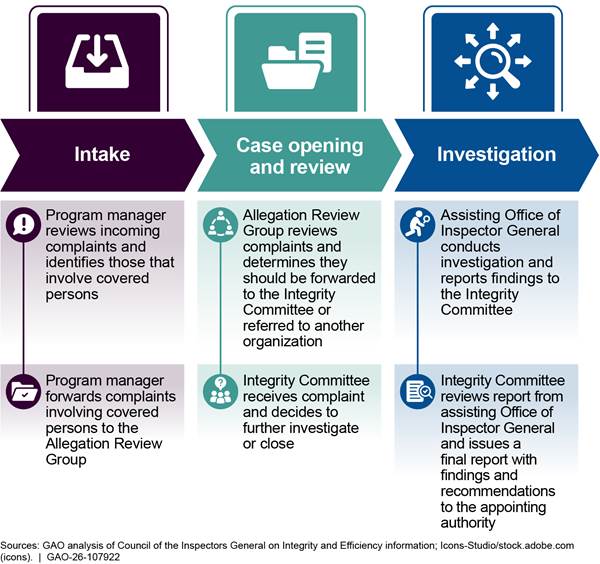
The intake process begins when the IC receives complaints through its website and by email. The PM is to review and determine which complaints should be reviewed by the IC. Specifically, after the PM determines that a complaint is relevant to a covered person, the PM is to assign a case number to the complaint and then forward it to the Allegation Review Group (ARG).
During case opening and review, complaints go through a multistep process before being submitted to the IC. The ARG consists of an IC legal counsel, a representative from OSC, and a representative of the Public Integrity Unit (PIN) of the Department of Justice. Generally, OSC is to review the complaint to determine whether the matter pertains to a prohibited personnel practice, in which case OSC is responsible for investigating the matter.[7] PIN is to review the complaint to assess whether it contains a criminal allegation, in which case the Department of Justice will investigate it. The PM is to place all complaints, regardless of whether they are accepted by OSC or PIN, on the agenda for consideration at the next IC meeting. IC meetings occur approximately every 3 weeks.
After complaints are reviewed and discussed at the meeting, the IC may request further information about the complaint from the complainant or other source; request a response from the subject of the complaint to address the allegation(s); and take one of several options, including closing the complaint or referring it to the IC chair for investigation.[8]
For the investigation process, if the IC decides to refer the complaint to the IC chair for investigation, it identifies an OIG from among CIGIE membership to conduct the investigation. The OIG conducting the investigation on the IC’s behalf is referred to as the assisting IG. At the conclusion of the assisting OIG’s investigation, the IC is to produce a final report of the investigation, with findings; conclusions on whether the allegations were substantiated; and recommendations to the appointing authority of the subject of the investigation. The appointing authority is the person responsible for determining the appropriate response to investigative findings.[9]
The IG Act of 1978, as amended, requires the IC to publish semiannual reports to Congress.[10] These reports are to notify Congress of the status and progress of investigations, categorize and quantify allegations by federal position, detail current IC membership and staff, identify challenges currently facing the IC, and provide other relevant information.
Integrity Committee Resources
CIGIE’s main source of funding is assessments collected from the IG member offices, which contribute a pro rata amount of their annual funding to CIGIE.[11] CIGIE collects payments from its 74 members in advance of every fiscal year, and the contributions are placed into a no-year revolving fund, which are available until expended. This fund provides resources for CIGIE activities, including the IC. Table 1 provides information on CIGIE’s reported funding for fiscal years 2021 through 2025.
Table 1: Council of the Inspectors General on Integrity and Efficiency (CIGIE) No-Year Revolving Fund and Annual Budget, by Fiscal Year
|
Fiscal year |
CIGIE revolving fund beginning balancea (dollars in millions) |
CIGIE annual operating budgetb (dollars in millions) |
|
2021 |
$15.8 |
$10.8 |
|
2022 |
19.0 |
11.6 |
|
2023 |
19.7 |
12.4 |
|
2024 |
19.7 |
13.8 |
|
2025 |
23.8 |
15.0 |
Source: GAO analysis of CIGIE information. | GAO-107922
aThe revolving fund is the beginning of year balance that includes funds from assessments, tuition, and appropriations that fund all CIGIE activities for the year, including unobligated balances associated with the training institute tuition and unobligated appropriations for Oversight.gov and data analytics.
bCIGIE’s annual operating budget is associated with assessments for CIGIE operations and excludes the training institute expenses funded by tuition and expenses associated with Oversight.gov and data analytics for which CIGIE receives a direct appropriation.
To fund the IC’s activities, CIGIE is to annually allocate a portion of its operating budget from the no-year revolving fund. The amount allocated is based on the prior year’s investigative activities and approved by CIGIE’s Budget Committee, Executive Council, and members. If the IC needs more funds for investigations than allocated for the year, more can be drawn from the revolving fund. If the IC uses less than it was budgeted, those funds are returned to CIGIE’s revolving fund and reprogrammed for other activities. For fiscal year 2025, $1.3 million of approximately $23.8 million in the revolving fund was allocated to the IC.
The three main components of IC costs are paying for (1) investigations undertaken by assisting OIGs; (2) three full-time staff (program manager and two attorneys), and an attorney detailee; and (3) case management system support. The reported cost of assisting OIG investigations is generally the IC’s largest expense. See figure 2.
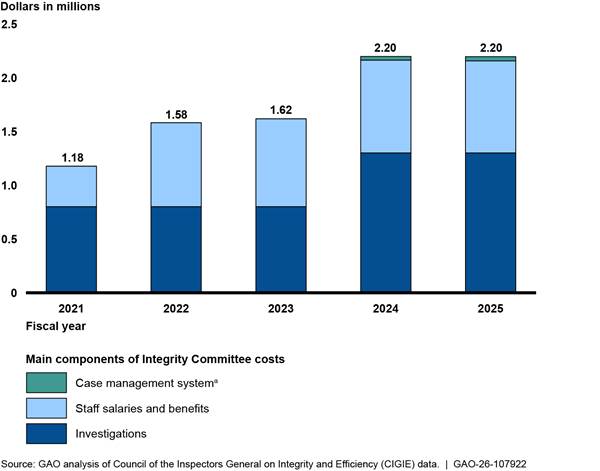
a CIGIE began tracking IC case management system costs as part of the planned IC budget on October 1, 2024.
The IC reimburses the investigative costs of the assisting OIG through an interagency agreement. Reimbursement includes actual hourly labor costs (with premium pay, if applicable) and other associated costs, such as for travel and transcripts.
From fiscal years 2021 through 2023, CIGIE planned to spend $800,000 from the revolving fund for IC investigations. However, in 2023, the IC actually spent $1.2 million on investigations. The IC subsequently determined that it needed to plan for higher costs over an extended period to account for the increasing number of complaints and investigations. Accordingly, in 2024, CIGIE began planning to spend $1.3 million for IC investigations.
The IC Has Not Consistently Reviewed Program Manager Intake Decisions
From fiscal year 2021 through the first half of fiscal year 2025, the IC received 16,245 complaints through its intake process. From these, the PM ultimately determined that 460 should be submitted to the ARG for review.
For these complaints, we found that the PM almost always followed requirements to provide an immediate response to the complainant that their complaint was received. According to CIGIE IC Standards I, the PM is required to provide an immediate response to the complainant acknowledging receipt of a complaint that is processed for the IC to review. Based on our generalizable sample, we estimate that the PM provided an immediate written response, as required, for about 97 percent of the processed complaints.[12]
While the PM responded timely to complainants, we found that the review process did not always follow requirements. Specifically, the process did not adhere to the policy outlined in CIGIE IC Standards I when reviewing complaints deemed frivolous. Complaint information is deemed frivolous if it is so irrelevant and unsupported that it is not worth consideration. The frivolous complaints remain in the PM’s email box in a “Frivolous” subfolder. According to IC standards, they are to be reviewed by IC legal counsel for concurrence that these complaints are frivolous.
However, through our discussions with IC officials, we learned that the legal counsel did not perform the required secondary review of the PM’s decisions that complaints were frivolous. The legal counsel explained to us that the IC chair delegated the review of frivolous complaints solely to the PM in January 2021, eliminating secondary review by legal counsel. However, the legal counsel did not document that decision, and changes were not made to CIGIE IC Standards I. When asked, officials said they defer to the IC chair’s preference. In addition, in place of the required review, legal counsel explained that some information on frivolous correspondence is included on the agendas for IC meetings in case any member would like further information.
Nevertheless, without a process for secondary review of the PM’s decisions on what constitutes a frivolous complaint, actions taken by a single individual determine whether to pursue the complaint, even if the determination is not accurate. Allowing one individual to perform this role without review by another key party is inconsistent with IC policy. Further, it increases the risk that the IC is not reviewing relevant complaints that it should have had an opportunity to consider.
IC Frequently Did Not Meet Timeliness and Documentation Requirements
IC Did Not Always Meet Required Timelines to Process Cases
We found, based on a generalizable sample of cases, that the IC frequently did not meet required time frames to complete ARG review, present cases to the IC members, draft legal analyses in advance of regular meetings, or document IC decisions. Figure 3 provides an overview of the steps in the case opening and review process and the required timelines, as established in IC Policies and Procedures and CIGIE IC Standards I.
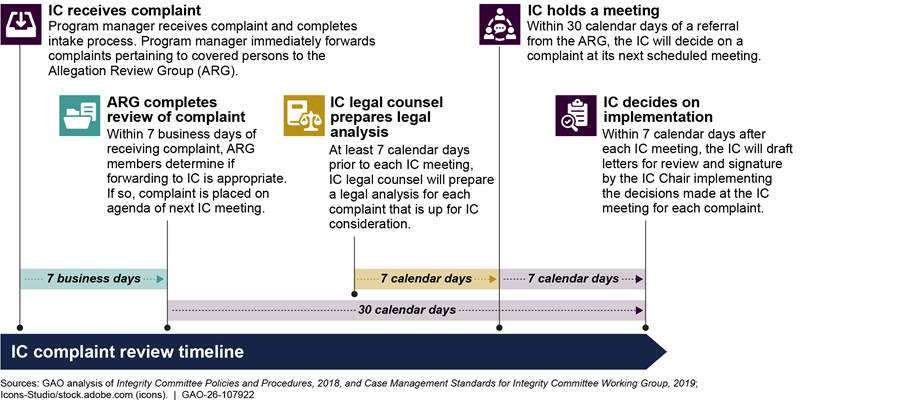
Based on our generalizable sample of 79 cases, we estimate that about 24 percent of cases met all applicable requirements for case opening and timelines. The remaining 76 percent of cases did not meet at least one applicable requirement, with some cases not following multiple requirements.
Specifically, of the cases that did not meet at least one requirement, we estimate that
· in 49 percent of cases, either the Department of Justice or the OSC representative to the ARG did not determine whether to forward a case to the IC within 7 business days after its receipt of a complaint, as required;[13]
· in 11 percent of cases, the complaints were not presented to the IC in the next meeting following the ARG’s determination;
· in 46 percent of cases, the legal counsel did not draft a written legal analysis for IC members at least 7 days before the meeting date. This estimate includes instances where, as officials explained to us, legal counsel did not draft a legal analysis because the IC chair decided that legal counsel could provide a verbal legal analysis at the meeting instead; and
· in 14 percent of cases, letters implementing the decisions made at the IC meeting were not timely. Specifically, we observed for these cases that the letters notifying complainants the cases were closed were dated more than 7 days after it was decided in the meeting. In most of these cases, 12 or more days had passed before IC staff finalized the letters. Since none of the cases in our sample were referred to the IC chair for investigation, these closure decisions were all made by the IC during its initial review of the complaint.
When asked why the IC frequently did not adhere to required timelines for processing cases opened, the legal counsel explained that this was inadvertent in some cases. Additionally, the deadline to present complaints in advance of the next IC meeting can be delayed by such factors as when the complaint was received, the amount of materials provided with the complaint, and whether additional information was requested by IC staff before presenting the complaint. The legal counsel also explained that for several cases where a written legal analysis was not prepared in accordance with policy, the IC chair in 2019 decided verbal briefings were sufficient. The legal counsel further explained that the IC chair in 2022 permitted verbal briefings in cases where the IC attorney assigned determined it was more efficient than written analyses. The IC did not provide us with evidence that the decision to accept verbal legal analysis briefings was documented as a policy deviation or change in CIGIE policies or in official memos.
When processing timelines are not met, IC members could have less time to review case materials and possibly impede their ability to fully weigh evidence before making decisions at the meeting. This could lead to inconsistencies in how they handle cases. Further, in cases with verbal briefings, IC members would not have had an opportunity to review the legal analysis before discussing the matter at the IC meeting. Following such varying practices increases the risk of inconsistent treatment of cases.
IC Usually Followed Policies, Procedures, and Standards for Documenting Case Opening and Review
Based on our generalizable sample, we estimate that about 92 percent of cases that were sent to ARG from fiscal year 2021 through the first half of fiscal year 2025 followed all applicable requirements for case opening and documentation. The remaining 8 percent of cases did not follow at least one applicable requirement. In advance of each IC meeting, as specified in CIGIE IC Standards I, the PM drafts a case executive summary for each case forwarded to the IC for review and action. The case summary is to include information such as the case number, agency, subject, complainant, identification of individuals represented by outside counsel, summary of allegations, and dates for ARG review.
As part of the case summary, the PM is also to note any recusals by IC members in the case summary.[14] In the sample, we identified recusals as the most common item lacking documentation, in an estimated 4 percent of cases.[15] Other documentation shortfalls included lack of evidence that the PIN reviewed the case and no inclusion of a summary of the complaint was in the case summary.
When we asked the IC about the missing recusal documentation, legal counsel explained that, as a general practice, recusals are reflected in the IC meeting minutes, not in the case executive summary, because that is what IC Policies and Procedures require. Legal counsel explained that this change was made in March 2024. Additionally, the counsel said the IC’s new case management system permits IC staff to control access and prevents members from seeing complaints from which they are recused.
However, CIGIE IC Standards I require case summaries to include recusals. This policy deviation is not documented in CIGIE policies or in official memos.
By not ensuring that required case summary elements are included for IC member review, members lack awareness of critical case information, including who is recused, prior to their IC meetings. This could result in members not being fully prepared to discuss cases at their meetings and inadvertently sharing information with the recused individual about the allegation.
Selected Investigations Did Not Always Follow Policy
We reviewed a nongeneralizable, judgmental sample of five completed investigations.[16] Across those investigations, none were completed within required time frames, and the IC did not always send several required updates to Congress about the progress of investigations. Additionally, we found the IC conducted limited oversight to ensure that assisting OIGs performed investigations, in compliance with Quality Standards. Further, the IC did not receive detailed reimbursement requests from the assisting OIGs to ensure that resources were expended for their intended purpose. Finally, we observed that the IC’s final Reports of Investigations did not always reflect the conclusions reached by the assisting OIG’s investigation.
IC Did Not Always Complete Timely Investigations and Did Not Provide All Required Updates to Congress
After reviewing an allegation, the IC may determine it appropriate to refer the matter to the chair to conduct a timely and thorough investigation. The IG Act directs the IC chair to complete an investigation into an allegation of wrongdoing within 150 calendar days from the date of referral. If the investigation cannot be completed within the 150-day period, the IG Act requires the chair to promptly notify the congressional committees of jurisdiction and brief the congressional committees every 30 days thereafter regarding the status of the investigation and the general reasons for delay, until the investigation is complete.[17]
Our review of a judgmental, nongeneralizable sample of five investigations completed by the IC from fiscal year 2021 through the first half of fiscal year 2025 showed that none of these investigations met the 150-day threshold for completion. These cases ranged from 427 to 1,246 days in duration. IC officials cited resource challenges impeding their ability to complete investigations in 150 days. These challenges included identifying OIGs that (1) were willing to offer their resources to conduct IC investigations and (2) considered such investigations a high priority.
Although we found that the IC generally provided Congress with timely updates on the status of the five sampled investigations, the IC did not provide 10 out of 73 required updates. For most of those updates, the legal counsel told us that their absence was inadvertent. For one investigation, the counsel could not provide an explanation for the missed updates.
The importance of required updates is underscored by investigations taking a year or more, rather than months. For those lengthy investigations, Congress needs the required updates to enable it to exercise appropriate oversight.
IC Conducts Limited Oversight of Assisting OIG Investigations
When the IC refers a matter for investigation, the IC chair is responsible for oversight of the investigation. In all cases we reviewed, the investigations were conducted by assisting OIGs, all of which are members of CIGIE.[18]
CIGIE and the assisting OIG sign a Memorandum of Understanding (MOU) outlining the provisions of investigative services, to help ensure a thorough and timely investigation. The provisions of the MOU include that
· the chair has full control and direction of the investigation,
· the assisting OIG will comply with Quality Standards in its investigation, [19] and
· the assisting OIG will provide updates to the IC chair every 30 days on the status of the investigation.
For the five investigations we reviewed, we did not find documentation in the case files of the IC oversight of assisting OIG actions throughout the investigation. CIGIE’s Quality Standards require several things, including that the independence of investigators is ensured and that investigators have properly planned for the investigation. The five case files we reviewed did not contain documentation that the independence of assisting OIG investigators was verified or that a review of the assisting OIG’s investigative planning documents was performed.
IC officials explained to us that they have no control over staff the assisting OIG selects to conduct the investigation and must trust that the assisting OIGs will comply with the Quality Standards, including the independence and planning requirements. According to the legal counsel, the IC expects other mechanisms to provide assurance that the assisting OIGs comply with the standards. Namely, the IC expects that assisting OIGs will include IC investigations in their pool of investigations subject to selection for peer review. Peer review is a process by which an outside OIG evaluates the extent to which an OIG’s investigative policies and procedures comply with CIGIE’s Quality Standards. However, the IC does not have a process for reviewing the results of peer reviews conducted on assisting OIGs or ensuring that IC investigations are subject to selection for peer review.
By design, if an IC investigation is selected for peer review, the assisting OIG is to notify the IC, as stated in the MOU signed between CIGIE and the assisting OIG. However, the legal counsel told us that the IC has not received any such notification. As a result, a primary mechanism the IC relies on to provide assurances about compliance with standards does not function the way the IC assumed.
The MOU for each of the five investigations we reviewed required assisting OIGs to provide monthly status updates to the IC during the investigation. The required status updates are the primary means of communication between the assisting OIG and the IC before the draft report is received. Additionally, the IC chair has the authority to review the status of an investigation at any time.
According to multiple IC officials, assisting OIGs do not regularly consult with the IC about their investigations. Instead, the assisting OIGs independently conduct the investigations according to their investigative procedures. Our review of five completed investigations found monthly status updates missing for each selected investigation, as shown in figure 4. In total, 37 of the 90 expected monthly status updates for all five investigations were missing.
Figure 4: Missing Monthly Integrity Committee Status Updates for Five Completed Investigations
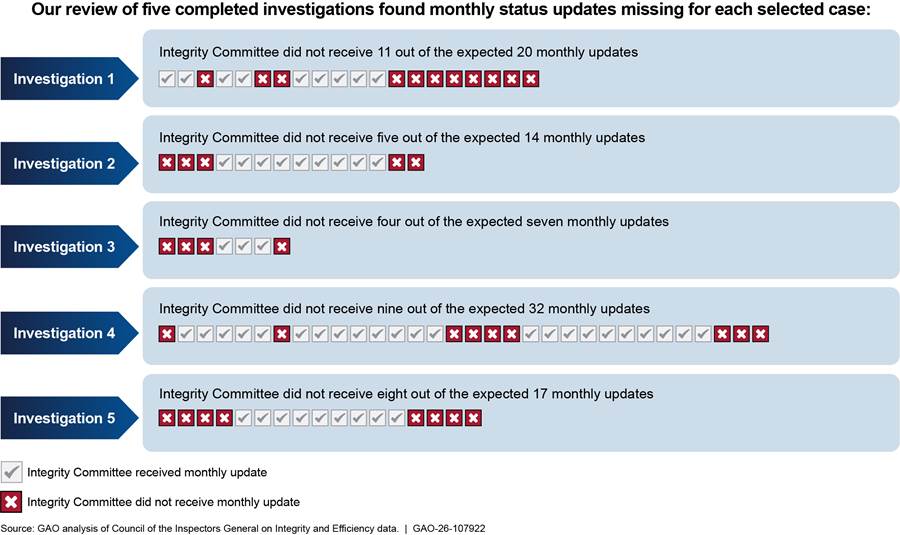
According to IC officials, they cannot force the assisting OIGs to report monthly. As we observed in one of the five investigations, the IC may attempt to check in with the assisting OIG if they have not received a monthly update, but they can only rely on the expectation that the assisting OIG will follow the monthly reporting requirement stated in the MOU. Absent status updates, the IC cannot readily oversee the investigations and ensure they are timely and thorough.
The IG Act established an expectation that the IC would oversee investigations. Ensuring that there are specific peer reviews conducted on assisting OIGs and reviewing monthly assisting OIG reports are key to facilitating that oversight. However, as demonstrated by the selected cases we reviewed, the oversight is not operating as intended. This increases the risk across the range of all investigations that IC may not be overseeing investigations fully. This, in turn, raises questions about the extent that investigations are meeting applicable standards.
Assisting OIG Billing Requests to the IC Lack Specificity About How Funds Were Expended
MOUs signed by CIGIE and the assisting OIG state that CIGIE will reimburse the assisting OIG for the costs of the investigation, including actual labor costs and other expenses. According to the MOUs, the requests are to include information to support the reimbursement requests.
For the five investigations we reviewed, the billing requests lacked supporting documentation, and the assisting OIG expenditure records varied. Specifically:
· For two of the selected investigations, the IC maintained a spreadsheet from the assisting OIGs with high-level labor costs per quarter for the duration of the investigation. However, the IC did not maintain detailed labor cost information, such as hours used, salary per hour, or the pay grade of the investigators.
· For a different selected investigation, the assisting OIG submitted a request by letter, with only the total cost specified.
· For the remaining two selected investigations, the assisting OIGs submitted billing forms that included labor hours broken out by the hourly rate and hours worked.
Although supporting documentation was varied and lacking in details, the IC approved all reimbursement requests. In approving these requests, the IC did not document any review of the expenses.
According to the legal counsel, the IC has never denied payment to an assisting OIG for investigative costs. Additionally, the IC did not provide us with any document to support that it has request review procedures for reimbursement or detailed instructions for the content and supporting documentation to be provided by assisting OIGs.
According to our review of the five selected investigations, as well as discussions with IC officials, controls are not in place to ensure that reimbursement requests are properly reviewed for accuracy and to ensure that all costs are necessary and allowable. Rather, payments are made as requested. This increases the risk that the IC may pay assisting OIGs for unnecessary or unallowable costs in conducting an investigation.
IC Reports of Investigation Came to Different Conclusions than Assisting OIG Reports
After completing an investigation, IC Policies and Procedures require the assisting OIG to submit a written report to the IC. This report is to include relevant facts and conclusions to support the allegations investigated. The IG report is then provided to the subject, who is given 10 days to respond to its findings and conclusions. After the IC receives the subject’s response, the IC members, with assistance from legal counsel, review the report and discuss proposed findings and recommendations. They determine whether the facts in the report substantiate the allegations.
Once IC members reach agreement, the IC produces a final report of its findings, conclusions, and recommendations and provides the report to the appropriate parties for action. The final reports we reviewed included an appendix with the assisting OIG’s investigative report and conclusion on whether the allegations were substantiated.[20]
For four of the five final reports we reviewed, we found differences in conclusions reported by assisting OIGs in their investigative reports and the IC’s final reports.
· In one of the five investigations, the assisting OIG investigators found that one of the subjects lacked candor in responses to their inquiries. They concluded that this substantiated an allegation that the official engaged in inappropriate conduct. In contrast, the IC determined that the subject’s lack of candor resulted from the timespan that elapsed between the events under investigation and the timing of the investigation 4 years later. The IC did not reach the same conclusion as the assisting OIG and determined that the allegation against the subject was not substantiated. In their respective reports, the assisting OIG and IC each relied on different interpretations of the law to reach their conclusions. However, the IC did not address these differences in its final report.
· In another of the investigations, the assisting OIG investigators found evidence that they believed showed more likely than not that the subject had engaged in both an abuse of authority and inappropriate conduct. In contrast, the IC determined that the allegation of abuse of authority and inappropriate conduct by the subject was not substantiated. However, it did not provide a rationale for this determination in its final report or why it reached a different conclusion than the assisting OIG.
· In another investigation, the assisting OIG reported on suballegations within an overall allegation against a subject. The assisting OIG concluded that most of the suballegations were not substantiated, but one was substantiated. Based on this finding, the assisting OIG concluded in its report that the overall allegation was substantiated, in part. The IC, in its final report, presented this suballegation as the overall allegation and concluded that it was fully substantiated, rather than substantiated in part. According to IC legal counsel, the IC only determines whether an allegation is substantiated and does not determine that allegations are substantiated in part. But this explanation was not provided in the final report. As a result, someone reading it and the appendix with the assisting OIG report may not understand the apparent disconnect between the two reports and why the IC reached the conclusions it did.
· Finally, in one investigation we reviewed, the assisting OIG investigated four allegations against the subject. The investigative team concluded that one of those allegations was substantiated, while the other three were not. In its final report, the IC concurred that one allegation was substantiated but did not address the remaining three allegations. The IC legal counsel stated that the three allegations were not assigned to the assisting OIG for investigation, so the IC did not need to provide a final determination on whether it agreed with the assisting OIG’s conclusions. This is not explained in the IC’s final report. As a result, someone reading the report may not understand why the IC did not address all the allegations discussed in the assisting OIG’s report.
· Further, for this final investigation, both the MOU between CIGIE and the assisting OIG and the notification of investigation provided to the subject include language that states that if additional, noncriminal conduct is discovered during the investigation, this information will be brought to the IC chair for consideration. However, based on documentation we reviewed in the case file, it is not clear if these three allegations were discussed with the chair prior to the assisting OIG submitting its report. For example, there is no record if the IC chair decided that these allegations should or should not be included in the scope of the investigation. As a result, it is not clear to the reader what the IC’s final determination was about these allegations or why they were not included in the report.
According to CIGIE’s Quality Standards, reports should thoroughly address all relevant aspects of an investigation, and the investigative report findings must be supported by adequate documentation. The IC’s Policies and Procedures also require the assisting OIG’s written report to include all relevant facts and conclusions.
The IC’s final reports we reviewed address the findings of the assisting OIGs and include the assisting OIG reports as appendixes. However, as we found, the IC’s reports do not always explain the differing conclusions between it and the assisting OIG.
During the course of our review, the IC did not agree that possible disconnects between the assisting OIG reports and the final IC reports exist or, if they do exist, are problematic. Specifically, according to legal counsel, the IC final reports sufficiently address the findings of the assisting OIG and serve as a clear, final determination of the matter.
Further, according to the IC legal counsel, the IC recently decided to direct assisting OIGs to refrain from providing conclusions about whether allegations are substantiated. However, this decision was not documented or updated in the IC’s Policies and Procedures.
Differences in the conclusions reached by assisting OIGs and the IC, as documented in their respective reports, can lead to uncertainty by readers about what was substantiated, or not, and why. This includes possibly creating confusion on what actions need to be taken in response to an allegation. The various officials responsible for taking action based on IC investigations should have clarity on the final results of an investigation and the basis for those results. However, the conflicting information we observed in the four investigations we reviewed could lead to the wrong action being taken, or the correct action not being taken, after the completion of an IC investigation.
Conclusions
The IC is critical to ensuring that allegations of wrongdoing made against senior officials in the IG community are investigated in a fair, consistent, timely, and impartial manner. In carrying out that mission, the IC must demonstrate consistency in how it processes, reviews, and justifies the decisions it reaches with respect to each allegation, from intake through the issuance of a final report.
However, we found that IC processes for complaint intake, case opening and review, and investigations did not consistently comply with all applicable policies and standards. Specifically, the IC did not fully comply with existing policy requiring secondary review of decisions on whether complaints are frivolous; missed established process time frames; and did not include required documented information in case summaries, including information on member recusals. Further, the IC did not always inform Congress of the status of lengthy investigations and lacked a process for ensuring the independence of assisting OIG staff and adherence to applicable investigative standards.
In addition, the IC’s primary mechanism for conducting oversight of investigations--monthly status reports—were missing about 40 percent of the time for the investigations we reviewed. The IC also routinely paid assisting OIGs for their work based on limited expense justifications. Without adhering to clearly documented policies, procedures, and standards, the IC cannot be assured that the matters it considers are processed and reviewed in a consistent and timely manner.
Finally, the IC’s decision not to fully explain instances where it reached different conclusions than assisting OIGs based on the same evidence creates confusion for decision-makers. These decision-makers must rely on these conclusions to take appropriate actions that hold senior officials in the IG community accountable.
Addressing these issues with a sense of urgency could inform a reassessment of policies and processes. This could help the IC better ensure it is fulfilling its mission.
Recommendations for Executive Action
We are making the following eight recommendations to the CIGIE chair:
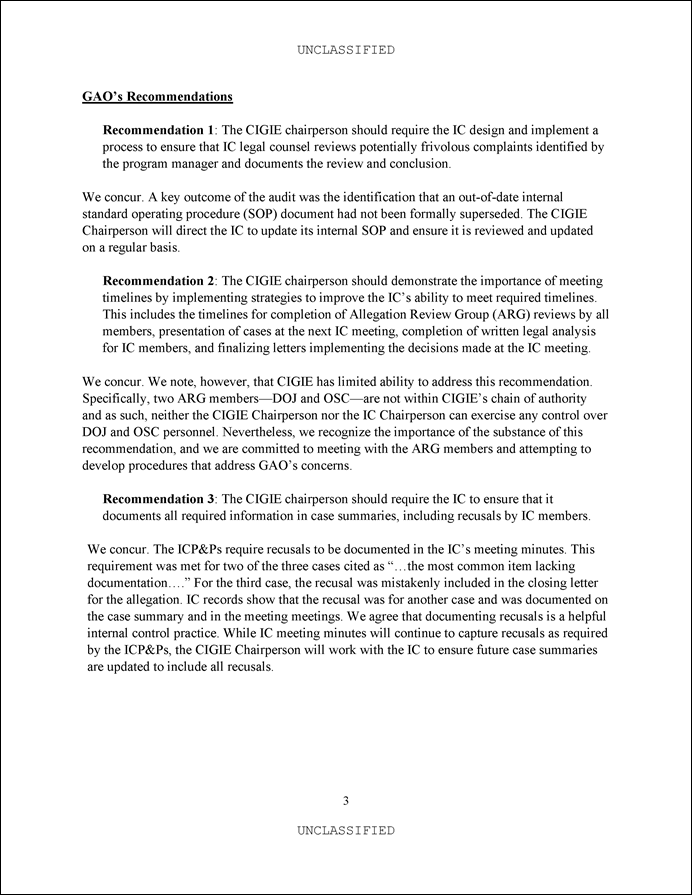
The CIGIE chair should require the IC to design and implement a process to ensure that the IC legal counsel reviews potentially frivolous complaints identified by the program manager and documents the review and conclusion. (Recommendation 1)
The CIGIE chair should demonstrate the importance of meeting timelines by implementing strategies to improve the IC’s ability to meet required timelines. This includes the timelines for completion of ARG reviews by all members, presentation of cases at the next IC meeting, completion of written legal analysis for IC members, and finalization of letters implementing the decisions made at the IC meeting. (Recommendation 2)
The CIGIE chair should require the IC to ensure that it documents all required information in case summaries, including recusals by IC members. (Recommendation 3)
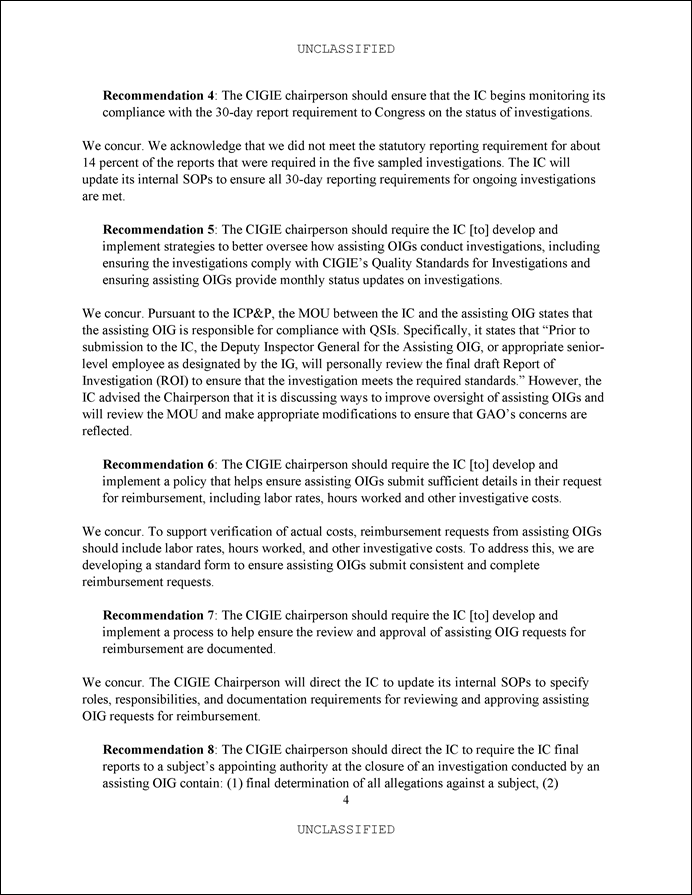
The CIGIE chair should ensure that the IC begins monitoring its compliance with the 30-day reporting requirement to inform Congress about the status of investigations. (Recommendation 4)
The CIGIE chair should require the IC to develop and implement strategies to better oversee how assisting OIGs conduct investigations, including ensuring that the investigations comply with CIGIE’s Quality Standards for Investigations and that the assisting OIGs provide monthly status updates on investigations. (Recommendation 5)
The CIGIE chair should require the IC to develop and implement a policy that helps ensure that assisting OIGs submit sufficient details in their request for reimbursement, including labor rates, hours worked, and other investigative costs. (Recommendation 6)
The CIGIE chair should require the IC to develop and implement a process to help ensure that the review and approval of assisting OIG requests for reimbursement are documented. (Recommendation 7)
The CIGIE chair should direct the IC to require that IC final reports to a subject’s appointing authority at the closure of an investigation conducted by an assisting OIG contain (1) a final determination of all allegations against a subject; (2) distinctions between partial and full substantiation of allegations, if applicable; and (3) detailed reasons for the IC reaching differing conclusions from the assisting OIG on allegations, if applicable. (Recommendation 8)
Agency Comments
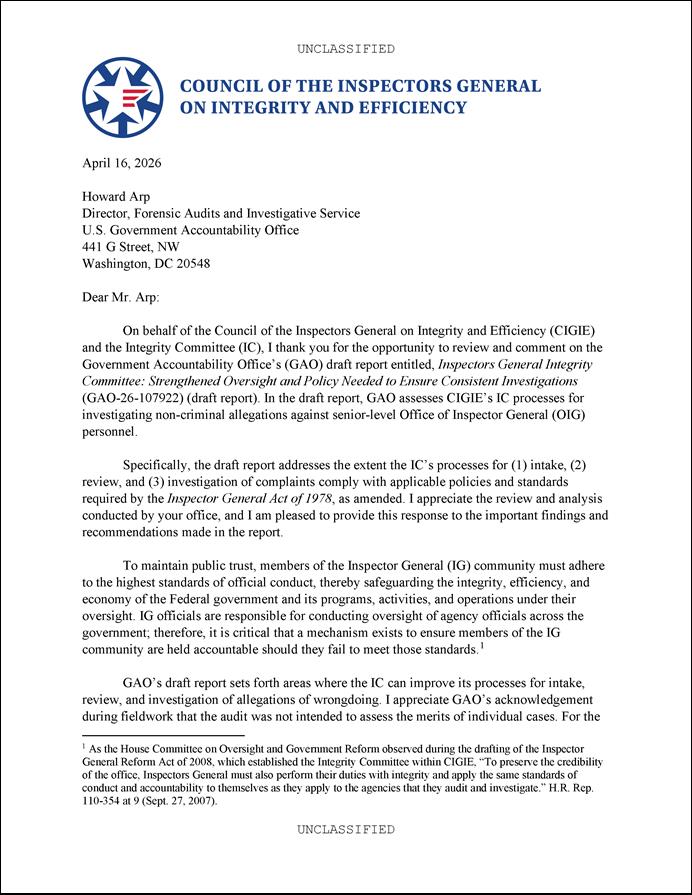
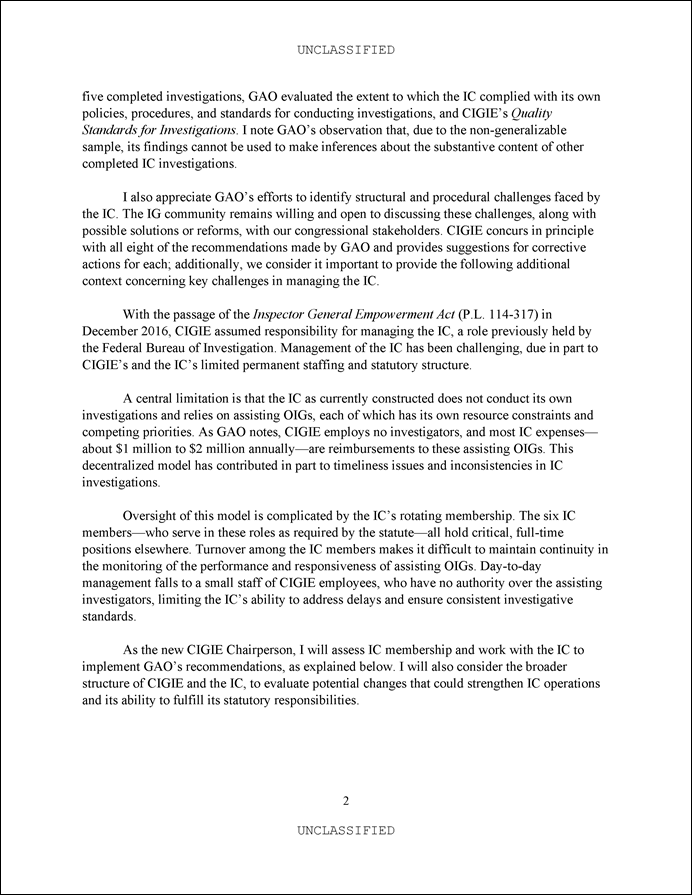
We provided a draft of this report to CIGIE for review and comment. In its written comments, reproduced in appendix III, CIGIE agreed with our eight recommendations. It also recognized the importance of formally updating internal standards to reinforce the need to meet statutory reporting requirements for investigations and to ensure the standards are updated regularly. CIGIE committed to developing strategies to improve compliance with policies and internal standards to improve timeliness, documentation and reporting. Additionally, CIGIE plans to take actions to enhance oversight of investigations by assisting OIGs and to address clarity of conclusions in investigative reports. CIGIE also provided technical comments, which we incorporated, as appropriate.
As agreed with your offices, unless you publicly announce the contents of this report earlier, we plan no further distribution until 30 days from the report date. At that time, we will send copies to the appropriate congressional committees, the chair of CIGIE, and other interested parties. In addition, the report will be available at no charge on the GAO website at https://www.gao.gov.
If you or your staff have any questions about this report, please contact me at arpj@gao.gov. Contact points for our Offices of Congressional Relations and Media Relations may be found on the last page of this report. GAO staff who made key contributions to this report are listed in appendix IV.

Howard Arp
Director, Investigations
Forensic Audits and Investigative Service
Other investigative entities conduct investigations of senior officials similar to those of the Council of the Inspectors General on Integrity and Efficiency’s (CIGIE) Integrity Committee (IC) but often use different approaches. We judgmentally selected two external entities—the Administrative Investigations Unit, a component of the Department of Defense’s (DOD) Office of Inspector General (DOD OIG) and the Sensitive Investigations Office of the Department of Agriculture’s Office of Inspector General (USDA OIG)—to provide brief descriptions of how these entities investigate allegations against high-ranking officials within their departments, as compared with the IC’s processes. We specifically focused on the intake processes and the investigation and reporting processes.
Intake
The IC accepts complaints through a form on its website and by email. Complaints are reviewed by one individual. The IC coordinates review of complaints with two outside entities, the Department of Justice and the U.S. Office of Special Counsel (OSC).
DOD’s OIG accepts complaints through the hotline website, military service and defense agency notifications, and a variety of other means. Complaints are reviewed by investigators and management and then forwarded to OIG leadership for a disposition decision.
USDA’s OIG receives complaints through a hotline and through direct communication with certain senior officials in the IG office. Complaints are reviewed by a staff of hotline analysts and then by management before a case is opened.
Investigation and Reporting
The IC investigates complaints of an administrative nature.[21] The IC relies on assisting OIGs to conduct the investigations. CIGIE completes a memorandum of understanding (MOU) with the assisting OIG on behalf of the IC, to complete the investigation in accordance with CIGIE Quality Standards but allows the assisting OIG to follow its own procedures to conduct the investigation. It is the responsibility of the assisting OIG to assign investigators to the investigations. Under statute, the IC is to complete investigations within 150 days before it must provide monthly progress reports to Congress on the status of an investigation that has gone beyond that time frame.[22] After the assisting OIG provides the IC with its report, containing findings and conclusions based on the evidence it collected about the allegations, the IC reviews it to make its determination. Then the IC issues a final report, which is publicly available. This final report includes an appendix with the assisting OIG’s report.
DOD’s OIG conducts investigations into administrative allegations. To do so, it has a unit of specifically trained investigators assigned to conduct these investigations and to provide frequent status updates to OIG leadership. It may investigate or refer an investigation to another DOD component for investigation, such as a Military Service IG. DOD’s OIG policies call for timely conduct of investigations in accordance with CIGIE’s Quality Standards and, in complaints brought by whistleblowers, the DOD OIG advises complainants when it cannot complete the investigation in 180 days. DOD’s OIG conducts oversight reviews of investigations conducted by the Military Service IGs, Defense Agency IGs, and other offices in DOD to ensure quality and impartiality. DOD’s OIG generally posts final reports of substantiated investigations on its public website and includes information about its administrative investigations in its Semiannual Report to Congress.
USDA’s OIG conducts all senior official investigations internally with its own specifically trained staff of investigators. It investigates civil, criminal, and administrative allegations, in accordance with CIGIE Quality Standards, as appropriate, USDA’s OIG management conducts close oversight of senior-level investigations, including frequent briefings and updates, as warranted. USDA’s OIG does not publicly post reports of its investigations. But it does include a summary of investigative findings relating to OIG investigations involving senior government employees where allegations of misconduct were substantiated, as well as instances of investigations of senior government employees that were closed and not disclosed to the public, in its Semiannual Report to Congress.
Our objectives were to evaluate the extent that the Council of the Inspectors General on Integrity and Efficiency’s (CIGIE) Integrity Committee (IC) processes for (1) intake; (2) review; and (3) investigation comply with applicable IC policies and standards, as required by the Inspector General Act of 1978, as amended (IG Act). To address all three objectives, we reviewed CIGIE policies and procedures and assessed the IC’s implementation of its policies and procedures. We interviewed CIGIE and CIGIE IC personnel and members and reviewed IC meeting minutes, case summary documents, budgetary documents, and other records to describe how the IC functions and oversees investigations. For informational purposes, we compared IC processes for receiving and investigating complaints with two organizations with similar responsibilities. We judgmentally selected these organizations because they perform similar investigations of senior officials and political appointees. As presented in appendix I, we reviewed and compared the investigative practices and quality standards followed by the organizations in their respective intake, investigation, and reporting processes.
To evaluate the IC’s process for complaint intake, which is how the IC receives and screens complaints for review, we interviewed personnel from the IC working group and reviewed CIGIE’s IC Standards I. To identify key requirements for the process. We analyzed a generalizable sample of 79 complaints, received from fiscal year 2021 through the first half of fiscal year 2025 and determined the sample to be relevant for IC review through the IC’s complaint intake process and identified the extent to which the IC complied with the requirements.
To evaluate the IC’s process for reviewing complaints that are opened as cases and forwarded to the IC, we reviewed a listing of cases opened during fiscal year 2021 through the first half of fiscal year 2025. We consolidated these listings and identified 460 unique opened cases. For the purpose of developing our generalizable sample, we excluded two cases from our review for reasons including the involvement of a classified matter. We then selected a simple random sample of 80 cases from the remaining 458 unique cases. The sample size was calculated for a proportion estimate, assuming a 50 percent population proportion and a required precision level of at least +/- 10 percentage points for a 95 percent confidence level. After further review, we identified that one sample case was outside the scope of our review and removed it from our sample, resulting in a final sample of 79 cases. We used a data collection instrument to collect and assess information on the IC’s compliance with its policies and procedures, IC standards for case management, and standards of procedures for OSC referrals. We conducted file reviews to determine the level of compliance with required policies and standards. We discussed the IC’s processing of those open cases through interviews with IC staff, as well as the Department of Justice’s Public Integrity Unit and U.S. Office of Special Counsel representatives of the Allegation Review Group.
To evaluate the IC’s process for investigating cases, we reviewed a judgmental sample of five investigations completed by the IC during fiscal year 2021 through the first half of fiscal year 2025. We sought to ensure variation across the organizations and subjects in the sample. Specifically, the sample of five full investigations included subjects employed at presidentially appointed and senate confirmed IG offices, designated federal entity IG offices, and a legislative branch IG office. To ensure independence, we did not include any IC investigations pertaining to GAO’s OIG in our sample. Additionally, the sample included investigations that determined that allegations were substantiated and investigations that did not substantiate allegations. Because we used a nongeneralizable sample to select the investigations, our findings cannot be used to make inferences about other full investigations.
To review the completed investigation files, we developed a data collection instrument populated with standards drawn from IC Policies and Procedures, CIGIE’s IC Standards I, and CIGIE’s Quality Standards. We assessed the extent to which the investigations’ case records reflect the IC’s compliance with requirements for overseeing investigations. Two reviewers were assigned to review each investigation. They conducted separate reviews and, when completed, resolved differences in their findings. Another reviewer conducted a final review for concurrence with the findings. We interviewed the IC counsel assigned to each of the selected completed investigations to provide additional explanations.
We conducted this performance audit from October 2024 to March 2026 in accordance with generally accepted government auditing standards. Those standards require that we plan and perform the audit to obtain sufficient, appropriate evidence to provide a reasonable basis for our findings and conclusions based on our audit objectives. We believe that the evidence obtained provides a reasonable basis for our findings and conclusions based on our audit objectives.
GAO Contact
Howard Arp, ArpJ@gao.gov
Staff Acknowledgments
In addition to the contact named above, Jonathan Meyer (Assistant Director), Brendan Culley (Analyst in Charge), James Ashley, Eben Beh, Troy Burrows, Pamela Davidson, Colin Fallon, Melissa Hart, Maria McMullen, Paula Rascona, Sabrina Streagle, and Vanessa Taja made key contributions to this report.
The Government Accountability Office, the audit, evaluation, and investigative arm of Congress, exists to support Congress in meeting its constitutional responsibilities and to help improve the performance and accountability of the federal government for the American people. GAO examines the use of public funds; evaluates federal programs and policies; and provides analyses, recommendations, and other assistance to help Congress make informed oversight, policy, and funding decisions. GAO’s commitment to good government is reflected in its core values of accountability, integrity, and reliability.
Obtaining Copies of GAO Reports and Testimony
The fastest and easiest way to obtain copies of GAO documents at no cost is through our website. Each weekday afternoon, GAO posts on its website newly released reports, testimony, and correspondence. You can also subscribe to GAO’s email updates to receive notification of newly posted products.
Order by Phone
The price of each GAO publication reflects GAO’s actual cost of production and distribution and depends on the number of pages in the publication and whether the publication is printed in color or black and white. Pricing and ordering information is posted on GAO’s website, https://www.gao.gov/ordering.htm.
Place orders by calling (202) 512-6000, toll free (866) 801-7077,
or
TDD (202) 512-2537.
Orders may be paid for using American Express, Discover Card, MasterCard, Visa, check, or money order. Call for additional information.
Connect with GAO
Connect with GAO on X,
LinkedIn, Instagram, and YouTube.
Subscribe to our Email Updates. Listen to our Podcasts.
Visit GAO on the web at https://www.gao.gov.
To Report Fraud, Waste, and Abuse in Federal Programs
Contact FraudNet:
Website: https://www.gao.gov/about/what‑gao‑does/fraudnet
Automated answering system: (800) 424-5454
Media Relations
Sarah Kaczmarek, Managing Director, Media@gao.gov
Congressional Relations
David A. Powner, Acting Managing Director, CongRel@gao.gov
General Inquiries
[1]The Council of the Inspectors General on Integrity and Efficiency was statutorily established as an independent entity within the executive branch by the Inspector General Reform Act of 2008, Pub.L. No. 110-409, which amended the Inspector General Act of 1978. CIGIE’s two-fold mission is to (1) address integrity, economy, and effectiveness issues that transcend individual government agencies; and (2) increase the professionalism and effectiveness of personnel by developing policies, standards, and approaches to aid in the establishment of a well-trained and highly skilled workforce in the Offices of the Inspectors General. CIGIE is comprised of inspectors general whose offices are presidentially appointed/senate confirmed under 5 U.S.C. §402 and those that are appointed by agency heads (designated federal entities) under 5 U.S.C. §415. 5 U.S.C. §424(b).
[2]The U.S. Office of Special Counsel is an independent federal investigative and prosecutorial agency. Its primary mission is to safeguard the merit system by protecting federal employees and applicants from prohibited personnel practices, especially reprisals for whistleblowing.
[3]As codified at 5 U.S.C. §§ 401-424.
[4]5 U.S.C. §424(d).
[5]Establishment IGs are appointed by the President and confirmed by the Senate under 5 U.S.C. §402, while designated federal entity IGs are appointed by the head of the entity under 5 U.S.C. §415.
[6]The IC program manager is a staff member of the IC responsible for its day-to-day operations.
[7]Prohibited personnel practices are employment-related activities that are banned in the federal workforce because they violate the merit system through some form of employment discrimination; retaliation; improper hiring practice; or failure to adhere to laws, rules, or regulations that directly concern the merit system principles.
[8]The IG Act, as amended, specifies that if the IC determines a matter should be investigated, the IC will refer the matter to the IC chair to conduct the investigation.
[9]The appointing authority for an IG or designated staff member within an establishment OIG is the President. The appointing authority for an IG or designated staff member within a designated federal entity is the head of the designated federal entity.
[10]5 U.S.C. §424(d)(9).
[11]In addition, CIGIE receives funding through tuition paid for its training Institution classes and appropriations from Congress. CIGIE receives appropriations for mandated activities, such as the Oversight.gov website and the establishment of a data analytics capability.
[12]Estimates presented in this report are based on results from a generalizable random sample of 79 cases. All estimates have margins of error of +/- 10 percentage points or fewer, unless otherwise noted. See app. I for more details.
[13]According to the IC legal counsel, the IC ARG member does not document their affirmative decision to forward the matter to the IC; the OSC and PIN members document their declination of the matter.
[14]Recusals by IC members can occur for a variety of reasons, including potential conflicts of interest.
[15]The 95 percent confidence interval for this estimate ranges from 1 percent to 10 percent.
[16]We selected the sample of five investigations using methods to ensure variation across organizations and subjects and the inclusion of both substantiated and unsubstantiated claims in our sample. See app. II for more details.
[17]The committees of jurisdiction include the Committee on Homeland Security and Governmental Affairs of the Senate, the Committee on Oversight and Government Reform of the House of Representatives, and other congressional committees of jurisdiction. 5 U.S.C. §424(d)(7)(C)(ii).
[18]According to IC Policies and Procedures, CIGIE will maintain a list of OIGs capable of undertaking investigations for the IC, and these responsibilities will be rotated and allocated among CIGIE members so as not to create an undue burden on any OIG. To the extent possible, investigations will be conducted by an OIG of a similar size, except that this shall not apply to OIGs with fewer than 50 employees. Additionally, the James M. Inhofe National Defense Authorization Act for Fiscal Year 2023 added the requirement that only an establishment OIG can conduct an IC investigation of a subject or subjects employed by another establishment OIG. Pub. L. No. 117-263, §5237, 136 Stat. 2395, 3237 (Dec. 23, 2022).
[19]CIGIE issued updated Quality Standards for Investigations in July 2025. However, since the sample of investigations we reviewed were all completed by March 2025, we applied the Quality Standards for Investigations issued in November 2011.
[20]In accordance with Section 10(C)(i) of the Integrity Committee Policies & Procedures (2018), the IC determines “whether (1) facts within the report of investigation are proven by a preponderance of the evidence and (2) those facts provide a reasonable basis to conclude that the Respondent engaged in particular wrongdoing.” Moreover, 5 U.S.C. § 424(d) requires the IC to report its investigative findings, regardless of whether the allegations were substantiated or not.
[21]Allegations that are of a criminal nature are referred to the Department of Justice.
[22]5 U.S.C. § 424(d)(7)(C).