
Report to Congressional Requesters
United States Government Accountability Office
A report to congressional requesters
Contact: Elizabeth Curda at curdae@gao.gov
What GAO Found
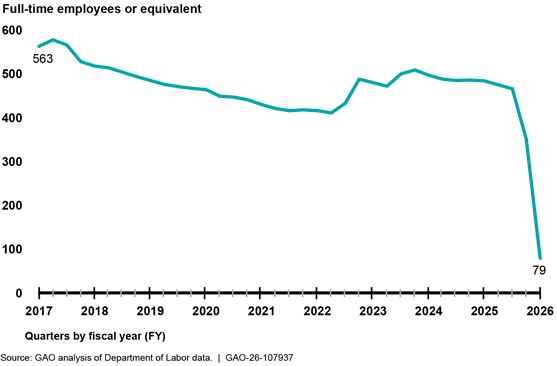
Section 503 of the Rehabilitation Act of 1973 (Section 503) requires certain federal contractors to take proactive steps to employ people with disabilities. The Office of Federal Contract Compliance Programs (OFCCP) within the Department of Labor (DOL) oversees contractors’ compliance with Section 503. Since January 2025, DOL has reduced its oversight activities. For example, DOL has suspended audits of selected contractors, which were a key tool for monitoring compliance. From fiscal years 2017 through 2025, 532 audits found Section 503 violations. Without resuming audits, DOL has less assurance that contractors are supporting employment of people with disabilities. Further, DOL has reduced OFCCP’s workforce in response to changes in its activities (see fig.). However, these changes were not informed by strategic workforce planning consistent with key principles for such efforts. DOL has made changes to Section 503 regulations that could further impact OFCCP’s activities. Engaging in strategic workforce planning would help DOL ensure that OFCCP’s workforce composition meets its needs.
Federal contractors face a range of challenges complying with Section 503. Selected stakeholders identified challenges in three key areas:
· conducting outreach to and recruiting people with disabilities,
· retaining and advancing people with disabilities, and
· demonstrating compliance with Section 503.
Stakeholders also said that DOL could provide additional guidance to help contactors comply with the law. For example, information on how to provide reasonable accommodations and a list of best practices for Section 503 compliance could help contractors better understand how to support employees with disabilities.
Why GAO Did This Study
In fiscal year 2025, the federal government spent about $793 billion on contracts with federal contractors—which employ over 1 million U.S. workers. Section 503 prohibits federal contractors from discriminating in employment against people with disabilities. It also requires certain contractors to take proactive steps to employ and advance in employment people with disabilities.
GAO was asked to review the implementation and oversight of Section 503. This report addresses (1) the extent to which DOL monitors Section 503 compliance and plans for its workforce needs, and (2) what challenges, if any, contractors face in complying with Section 503 and the extent to which DOL has provided resources to assist contractors.
GAO analyzed OFCCP enforcement data and DOL human resources data, and reviewed DOL documents. GAO conducted interviews and discussion groups with DOL officials as well as representatives of contractors, consultants who assist contractors with compliance, academic researchers, and other stakeholders who were familiar with Section 503 compliance or supporting employment of people with disabilities. GAO also conducted a nongeneralizable survey of representatives of contractors.
What GAO Recommends
GAO is making eight recommendations, including that DOL resume compliance audits, conduct strategic workforce planning for OFCCP, and provide additional information to help contractors provide reasonable accommodations to employees with disabilities and comply with Section 503. DOL agreed with six of the recommendations and neither agreed nor disagreed with the other two.
|
Abbreviations |
|
|
|
|
|
|
|
AAP |
affirmative action program |
|
|
ADA |
Americans with Disabilities Act of 1990 |
|
|
DOL |
U.S. Department of Labor |
|
|
EEOC |
U.S. Equal Employment Opportunity Commission |
|
|
FY |
fiscal year |
|
|
ODEP |
Office of Disability Employment Policy |
|
|
OFCCP |
Office of Federal Contract Compliance Programs |
|
|
Section 503 |
Section 503 of the Rehabilitation Act of 1973 |
|
|
VEVRAA |
Vietnam Era Veterans’ Readjustment Assistance Act of 1974 |
|
This is a work of the U.S. government and is not subject to copyright protection in the United States. The published product may be reproduced and distributed in its entirety without further permission from GAO. However, because this work may contain copyrighted images or other material, permission from the copyright holder may be necessary if you wish to reproduce this material separately.
September 29, 2026
The Honorable Bernard Sanders
Ranking Member
Committee on Health, Education, Labor and Pensions
United States Senate
The Honorable Kirsten Gillibrand
Ranking Member
Special Committee on Aging
United States Senate
In fiscal year 2025, the federal government spent about $793 billion on contracts with federal contractors—which employ over 1 million U.S. workers. Section 503 of the Rehabilitation Act of 1973 (Section 503) generally requires federal contractors and subcontractors to take proactive steps to employ and advance in employment people with disabilities.[1] The U.S. Department of Labor (DOL) is responsible for enforcing Section 503 and does so through its Office of Federal Contract Compliance Programs (OFCCP).
You asked us to review the implementation and oversight of Section 503. This report addresses (1) the extent to which DOL monitors contractors’ efforts to comply with Section 503, investigates individual complaints, and plans for its workforce needs; and (2) what challenges, if any, contractors face in complying with Section 503, practices they have found helpful, and the extent to which DOL has provided resources to assist.
To examine DOL’s efforts to monitor contractors, investigate individual complaints, and plan for its workforce needs, we reviewed agency documents, interviewed agency officials, and analyzed agency data. Specifically, we reviewed documents including DOL’s policies and procedures, internal reporting, and public communications. We also interviewed officials from DOL and the U.S. Equal Employment Opportunity Commission (EEOC).[2] We analyzed OFCCP’s data on enforcement activities and DOL human resources data on the OFCCP workforce from fiscal years 2017 to 2026, the most recent fiscal years for which data were available at the time of our review. To determine the reliability of the oversight data, we reviewed relevant documentation, interviewed knowledgeable DOL officials, and conducted electronic testing (such as checking for missing values and consistency between related data fields). To determine the reliability of the human resources data, we reviewed written responses from DOL officials. We determined these data to be sufficiently reliable for providing information on OFCCP’s efforts and workforce.
We also compared DOL’s Section 503 oversight activity with the agency’s strategic and performance plans and with relevant principles of federal standards for internal control.[3] Specifically, we considered principles related to identifying and responding to risks, using quality information, and performing monitoring activities. We also assessed DOL’s management of the OFCCP workforce against key principles of strategic workforce planning identified in our prior work.[4]
To describe challenges that contractors face and practices they find helpful, we conducted 11 interviews and four discussion groups with representatives of contractors, consultants who assist contractors with Section 503 compliance, academic researchers, and representatives of disability organizations.[5] We selected these stakeholders because they had experience with Section 503 compliance or supporting employment of people with disabilities.[6] We also conducted a nongeneralizable, opt-in, anonymous survey of representatives of contractors to collect additional perspectives.
To assess the extent to which DOL has provided resources to help address challenges, we spoke with DOL officials and reviewed publicly available agency documents. We assessed the resources DOL provided against needs identified by stakeholders, the agency’s performance plan, and relevant principles of federal standards for internal control.[7] Specifically, we considered principles related to communicating quality information. For more information on our objectives, scope, and methodology, see appendix I.
We conducted this performance audit from November 2024 to September 2026 in accordance with generally accepted government auditing standards. Those standards require that we plan and perform the audit to obtain sufficient, appropriate evidence to provide a reasonable basis for our findings and conclusions based on our audit objectives. We believe that the evidence obtained provides a reasonable basis for our findings and conclusions based on our audit objectives.
Background
Section 503 of the Rehabilitation Act of 1973
Section 503 generally applies to federal contractors and subcontractors that hold a federal contract or subcontract worth more than $20,000.[8] According to Section 503 and its implementing regulations, these contractors must not discriminate against applicants or employees on the basis of disability and must take affirmative action—or proactive steps—to employ and advance in employment people with disabilities who are qualified for the job.
Employees or applicants who believe a contractor has violated Section 503 may submit a complaint to DOL.
Affirmative action programs (AAP). Federal regulations implementing Section 503 also require federal contractors with 50 or more employees that hold contracts worth at least $50,000 to have written AAPs relating to the employment of people with disabilities, explaining the steps they will take. Contractors must have a separate AAP for each of their establishments (such as distinct physical locations). Among other requirements, the AAP must include
· a statement of the contractor’s policy on nondiscrimination and affirmative action for people with disabilities, which also must be made available to employees;
· reviews of personnel processes to ensure they do not exclude people with disabilities;
· outreach efforts designed to recruit people with disabilities;
· an annual assessment of the effectiveness of these outreach and recruitment efforts; and
· an internal audit and reporting system that measures the effectiveness of the AAP.
Reasonable accommodations. The Section 503 regulations require contractors to provide reasonable accommodations. These are generally adjustments to a work environment that help applicants or employees with disabilities have equal employment opportunities. Examples of reasonable accommodations include telework, sign language interpreters, or tools such as screen readers that can read websites aloud to people with visual impairments. Contractors generally must provide a reasonable accommodation when it is requested, unless it would cause the contractor an undue hardship.[9]
Overlap with the Americans with Disabilities Act of 1990 (ADA). Protections for people with disabilities under Section 503 may overlap with protections under the ADA. Title I of the ADA, which is enforced by EEOC, applies to employers with at least 15 employees, including federal contractors.[10] The ADA prohibits job discrimination against people on the basis of disability in areas such as hiring, promotion, pay, and benefits.
Under the ADA, anyone who believes they have experienced disability-based employment discrimination may submit a complaint to EEOC. OFCCP and EEOC have issued joint regulations for how to handle complaints that raise overlapping Section 503 and ADA issues.[11]
Recent regulatory changes. In August 2026, DOL finalized changes to the Section 503 regulations, which it had proposed in July 2025.[12] The changes removed requirements that DOL considered inconsistent with ADA provisions. Specifically, the amended regulations removed a 7 percent “utilization goal” and a requirement for contractors to invite applicants and employees to self-identify as having a disability or not. Previously, Section 503 regulations set a utilization goal of having either 7 percent of each of a contractor’s job groups, or 7 percent of its entire workforce, filled by people with disabilities. Contractors were expected to track their progress toward this goal by inviting applicants and employees to fill out a form to self-identify as having or not having a disability.
OFCCP Oversight
Oversight responsibilities. DOL is responsible for overseeing contractors’ compliance with two employment laws covering federal contractors: Section 503 and portions of the Vietnam Era Veterans’ Readjustment Assistance Act of 1974 (VEVRAA) that require certain contractors to take affirmative action to employ and advance in employment qualified veterans. Previously, DOL was also responsible for overseeing contractors’ compliance with Executive Order 11246, Equal Employment Opportunity, which prohibited certain federal contractors from discriminating in employment decisions on the basis of race, color, religion, sex, sexual orientation, gender identity, or national origin.[13] This executive order was revoked on January 21, 2025, by Executive Order 14173, Ending Illegal Discrimination and Restoring Merit-Based Opportunity.[14]
Compliance procedures. Section 503, VEVRAA, and Executive Order 11246 included nondiscrimination and affirmative action requirements for contractors, including requirements for written AAPs. When Executive Order 11246 was in effect, OFCCP implemented its oversight responsibilities under Section 503, VEVRAA, and the executive order through the following compliance procedures:[15]
· Directing all contractors covered by the AAP requirements to annually certify that they had developed and maintained AAPs for all establishments.
· Conducting audits of a sample of contractors every year.[16] Audits covered the contents and implementation of AAPs, and OFCCP could require contractors to take corrective actions where audits found violations. Most commonly, OFCCP conducted general audits, which covered Section 503, VEVRAA, and Executive Order 11246 requirements together. OFCCP also conducted focused reviews, which were audits only covering contractors’ compliance with a subset of requirements, such as just Section 503.
· Receiving and investigating complaints submitted by individuals.
Data collection. OFCCP developed data on the pool of contractors for potential audits each year by using federal contract data to identify employers with contracts and subcontracts that met the relevant thresholds.[17] For example, in the fiscal year 2025 selection process, OFCCP identified about 320,000 contracts covered by Section 503, which were held by about 70,000 contractors, according to officials.[18]
OFCCP previously collected data on the number of employees with disabilities employed by federal contractors only from those contractors selected for audit, according to DOL officials. For example, officials said that the 771 contractors OFCCP audited in fiscal year 2024 reported employing about 24,000 people with disabilities.[19]
DOL Has Reduced Section 503 Oversight Activities and OFCCP’s Workforce
DOL has suspended two of its key Section 503 compliance monitoring tools—federal contractors’ certification of their annual AAPs, and audits of contractors to assess their compliance with Section 503 requirements. From fiscal years 2021 through 2025, DOL investigated about 3 percent of the Section 503 complaints it received. The department has also substantially reduced OFCCP’s workforce since 2025.
DOL Has Suspended Section 503 Compliance Monitoring
DOL Has Paused Contractors’ Requirement to Certify Completion of AAPs
In January 2025, DOL paused all OFCCP enforcement activity.[20] In response, OFCCP suspended federal contractors’ certification of their annual AAPs, according to DOL officials, though the underlying requirement to maintain AAPs is still in effect. Contractors had made this certification through an online system called the Contractor Portal.[21]
OFCCP introduced the Contractor Portal in 2022 in response to our 2016 recommendation that it create a process to monitor contractors for compliance.[22] According to DOL officials, contractors certifying compliance through the Contractor Portal had improved OFCCP’s enforcement because it allowed for monitoring all contractors subject to Section 503 for AAP completion in addition to auditing a sample of them. For example, in its audits, OFCCP could prioritize those contractors that did not certify compliance. This was an audit selection methodology used in fiscal year 2023, the first year after the Contractor Portal was introduced. Officials said that that this approach helped identify violations by contractors not aware of the Section 503 requirements.
Stakeholders we interviewed told us there was confusion among contractors about the current requirements. For example, in light of changes to federal contractor requirements since January 2025, some stakeholders we spoke with said contractors were not clear about what OFCCP requirements still applied and what employment practices were still allowed. In addition, without the Contractor Portal in use, there is no longer a mechanism for contractors to demonstrate to OFCCP their compliance with the requirement for contractors to maintain an AAP.
DOL officials said they paused collecting certification of AAPs through the Contractor Portal because the certification included outdated information on the revoked Executive Order 11246, and because DOL was still in the process of changing the Section 503 regulations. However, the requirement for contractors to have a written AAP relating to people with disabilities remained in effect, and is still in place after the recent regulatory changes.
DOL’s fiscal year 2027 annual performance plan calls for OFCCP to empower qualified protected individuals, including people with disabilities, to secure jobs. Further, to help achieve agencies’ objectives, federal standards for internal control call for agencies to use quality information to achieve their objectives and to perform monitoring activities.
Resuming the certification of completion of AAPs through the portal or another mechanism would provide OFCCP with greater assurance that contractors are complying with the requirement to have AAPs and could provide information on contractors’ compliance to inform OFCCP’s other monitoring and enforcement efforts. Moreover, because the certification can remind contractors about the requirements that apply to them, it would also help address contractor confusion about what requirements are still in effect and help contractors ensure they are meeting the requirement to maintain AAPs.
DOL Has Paused Audits That Assessed Contractors’ Compliance
Before suspending them in early 2025, OFCCP used audits to assess Section 503 compliance of a sample of contractors. Some contractor representatives we spoke to said that the prospect of OFCCP audits helped focus their leadership’s attention on Section 503 compliance. As mentioned above, OFCCP typically conducted general audits covering compliance with all of its oversight responsibilities, and in some years, it conducted focused reviews that audited compliance with one of these oversight responsibilities on its own (see text box).
|
Section 503 Focused Reviews The Office of Federal Contract Compliance Programs (OFCCP) typically conducted general audits that assessed federal contractors’ compliance with all of OFCCP’s oversight responsibilities. However, in fiscal years 2019 and 2020, some OFCCP audits were “focused reviews” that only covered a particular oversight responsibility, such as Section 503 of the Rehabilitation Act of 1973 (Section 503). For fiscal year 2020, OFCCP issued a report on the Section 503 focused reviews it had conducted. The report concluded that the focused reviews allowed OFCCP to pay greater attention to increasing employment of people with disabilities. Focused reviews also allowed OFCCP to bring attention to best practices in those areas, some of which were included in the report. Most of the contractors that received a focused review benefitted from at least some of the technical assistance that was included in the review, and some entered into agreements to resolve violations of affirmative action requirements, according to the report. Stakeholders we spoke with said that from the contractor perspective, the focused reviews had been more efficient than general audits. For example, according to one contractor representative, the focused reviews involved a shorter list of items to review, and the contractors received clear guidance from OFCCP on what to submit. |
Source: GAO interviews with selected stakeholders and analysis of OFCCP information. | GAO‑26‑107937
According to our analysis of OFCCP data, OFCCP concluded 8,971 audits of contractors from fiscal years 2017 to 2025, including general audits and focused reviews. About 1,411 (15.7 percent) of these found at least one violation of OFCCP regulations (see fig. 1).[23]
Figure 1: Office of Federal Contract Compliance Programs General Audits and Focused Reviews Concluded, by Status of Findings, FY 2017–2025
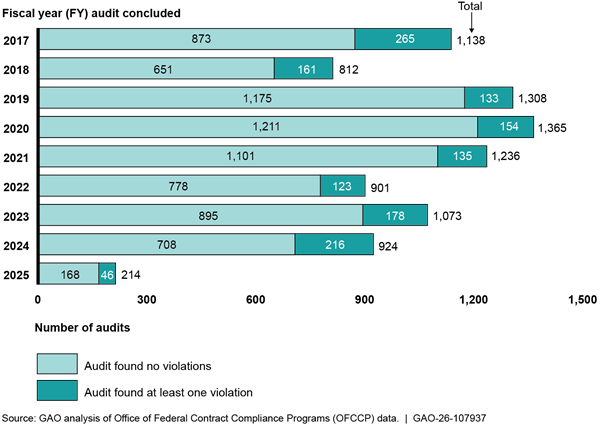
Notes: OFCCP conducted audits of federal contractors for its oversight responsibilities, including Section 503 of the Rehabilitation Act of 1973, which covers employment of people with disabilities. These include general audits covering all of OFCCP’s oversight responsibilities and focused reviews covering one responsibility. An audit may extend across fiscal years. GAO reports the number of audits by the fiscal year they concluded. These data are as of April 2025. OFCCP did not conduct any additional audits in the remainder of fiscal year 2025 because it suspended its auditing in January 2025.
A total of 532 audits from fiscal years 2017 to 2025 specifically found Section 503 violations. This was about 6 percent of all audits during that period, and 38 percent of audits that found at least one violation (see fig. 2).[24] Violations included failure to conduct appropriate outreach and recruitment to people with disabilities, failure to invite applicants and employees to self-identify their disability status, and failure to provide reasonable accommodations. When it finds Section 503 violations, OFCCP can require contractors to take corrective actions and to provide financial relief, such as back pay, if the violation involved discrimination against people with disabilities. OFCCP can also enter into agreements with contractors to resolve violations, including ongoing monitoring requirements.
Figure 2: Number of Office of Federal Contract Compliance Program Audits Finding Any Violation and Section 503 Violations, FY 2017–2025
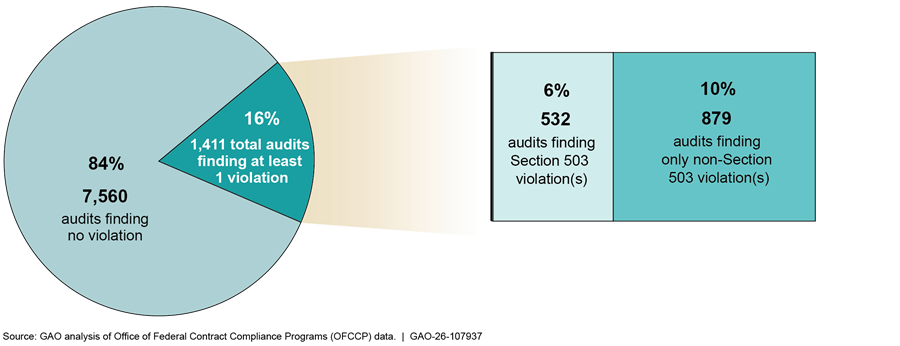
Notes: OFCCP conducted audits of federal contractors for its oversight responsibilities, including Section 503 of the Rehabilitation Act of 1973 (Section 503), which covers employment of people with disabilities. These include general audits covering all OFCCP’s oversight responsibilities and focused reviews covering one responsibility. These data are as of April 2025. OFCCP did not conduct any additional audits in the remainder of fiscal year (FY) 2025 because it suspended its auditing in January 2025.
As mentioned above, OFCCP paused its enforcement activities in January 2025, including all audits. In July 2025, OFCCP announced that it was closing all pending audits and that it would not start new audits during the rest of fiscal year 2025. According to DOL officials, OFCCP had not resumed auditing as of May 2026.
DOL’s fiscal year 2027 annual performance plan calls for OFCCP to empower people with disabilities to secure jobs. Auditing contractors’ compliance with their Section 503 obligations may support this objective by allowing DOL to assess and manage the risk of contractors’ noncompliance. Federal standards for internal control describe risk management principles—such as identifying, analyzing, and responding to risks and performing monitoring activities—that agencies should use to achieve their objectives.
DOL officials said they suspended audits because they were reviewing all OFCCP oversight procedures after recent policy changes. They said this review was still ongoing as of May 2026 and did not have a time frame for finalizing and implementing any changes. However, in the absence of audits related to Section 503, DOL lacks a mechanism for regularly monitoring contractors’ implementation of the policies and practices described in their required AAPs. In turn, OFCCP has less assurance that contractors are complying with Section 503 and supporting the employment of people with disabilities.
DOL Has Not Analyzed Why Many Section 503 Complaints Are Closed or Referred Elsewhere
OFCCP receives and investigates complaints on behalf of DOL as part of its Section 503 oversight activities.[25] According to our analysis of OFCCP data for fiscal years 2021 through 2025, OFCCP investigated about 3 percent of the Section 503 complaints it received. Specifically, OFCCP received 3,063 complaints that alleged contractor violations of Section 503 during this period and investigated 99 of them (see table 1).[26]
Table 1: Section 503 Complaints Received and Investigated by the Office of Federal Contract Compliance Programs, FY 2021–2025
|
Fiscal year (FY) received |
Total Section 503 complaintsa |
Section 503 complaints investigated |
Percentage investigated |
|
2021 |
409 |
46 |
11 |
|
2022 |
643 |
22 |
3 |
|
2023 |
941 |
20 |
2 |
|
2024 |
761 |
11 |
1 |
|
2025b |
309 |
0 |
0 |
|
Total |
3,063 |
99 |
3 |
Source: GAO analysis of Office of Federal Compliance Programs (OFCCP) data. | GAO‑26‑107937
aThese are complaints received that alleged a violation of Section 503 of the Rehabilitation Act of 1973 (Section 503).
bOFCCP did not conduct complaint investigations between January 24, 2025, and July 2, 2025, because OFCCP suspended its enforcement activity during this time.
DOL officials said that the complaints that OFCCP does not investigate are either closed without investigation or referred to other agencies (such as EEOC). According to our analysis of complaints received from October 2023 to March 2026, OFCCP referred 402 complaints (about 37 percent) to other agencies during that period, mostly to EEOC.[27]
DOL officials said that complaints are either closed without investigation or referred to another agency when OFCCP determines that a complaint is not appropriate for it to investigate for jurisdictional or procedural reasons. These reasons include the following:
· The complainant withdrew the complaint.
· The complainant and contractor reached a settlement.
· The complaint was submitted too late (more than 300 days after the alleged violation).
· OFCCP lacked jurisdiction over the complaint (for example, the employer did not hold a contract covered by Section 503).
· The complainant did not respond when OFCCP contacted them for more information.
According to officials, these decisions involve multiple OFCCP staff, including investigators, managers, and researchers (who determine whether the employer is a contractor covered by Section 503).
OFCCP has procedures for reviewing decisions it makes about handling complaints in individual cases, according to DOL officials. For example, OFCCP has a process for reevaluating its complaint decisions in response to an appeal from an individual. OFCCP staff also document the determinations made for each individual complaint (e.g., complaint to be investigated, closed, or referred to another agency) in OFCCP’s electronic Compliance Management System, with reasons recorded in case notes.
However, OFCCP does not comprehensively analyze this information to help inform management and oversight of its complaints process and gain insights into why about 97 percent of complaints it received were not investigated. For example, hundreds of people submitted disability-related complaints to OFCCP from October 2023 to March 2026 that OFCCP referred to EEOC because the complaints were more appropriate for EEOC action. However, OFCCP has not analyzed referred complaints in the aggregate to obtain insights on why the complaints were submitted to OFCCP rather than EEOC, for example. While DOL officials said that OFCCP welcomes complaints from people who may not know if their employer is a contractor subject to Section 503 so that OFCCP can direct them appropriately, the agency expends resources reviewing each complaint and referring them, as appropriate—resources that it could direct toward investigating complaints and conducting other oversight and enforcement activities.
Further, while each complaint that was closed includes information on why that determination was made, OFCCP has not analyzed its complaints to assess the reasons for their closure and whether and how these reasons have varied, if at all, over time or across regions, for example. Such an analysis could identify trends and help inform OFCCP on managing and implementing its complaints process, such as whether instructions or guidance that redirects potential complainants to other agencies or provides more information on timelines for submitting complaints would strengthen the process.
OFCCP’s process for handling complaints is part of its internal control system for overseeing Section 503 compliance. Federal standards for internal control call for agencies to use quality information related to their internal control systems and to monitor the systems’ effectiveness.
By comprehensively analyzing the reasons for decisions on referring or closing complaints, OFCCP could obtain valuable information that would strengthen its ability to manage and oversee the complaints process, to use the results to identify areas for improvement, and to implement solutions to efficiently address those areas. This in turn could help reduce the number of complaints that OFCCP cannot ultimately investigate and help the agency direct its resources toward processing and investigating those complaints that fall within its jurisdiction.
DOL Reduced OFCCP’s Workforce and Has Not Planned for Future Needs
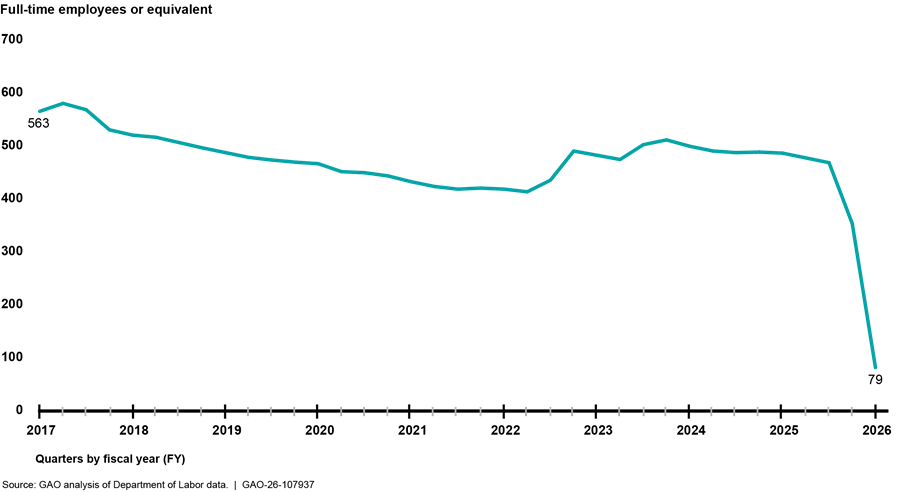
In 2025, DOL reduced OFCCP’s workforce and began reorganizing its field office structure. According to DOL’s human resources data, OFCCP had 484 full-time employees, or equivalent, in the first quarter of fiscal year 2025.[28] This dropped to 351 in the fourth quarter of fiscal year 2025 then to 79 in the first quarter of 2026. Since fiscal year 2017, OFCCP’s workforce was generally between 400 and 600 full-time employees, or equivalent (see fig. 3). DOL also substantially reduced the number of OFCCP field offices as part of this reorganization. According to DOL officials, OFCCP had 50 offices in January 2025 and six in April 2026.
DOL officials said the department reduced OFCCP’s workforce and number of field offices in response to reductions in the scope of OFCCP’s mission after Executive Order 11246 was revoked. In particular, the scope of OFCCP’s work would no longer include reviewing contractors’ compliance with various requirements related to race, color, religion, sex, sexual orientation, gender identity, or national origin.
Staff in OFCCP have performed a range of activities, according to officials. This has included conducting and supervising audits and complaint investigations, and answering questions through OFCCP’s public Help Desk. Required skills have included the ability to analyze compliance with laws and regulations, conduct interviews and negotiations, and plan outreach activities.
In its strategic plan and its fiscal year 2027 annual performance plan, DOL commits to ensuring proper allocation of resources and personnel to OFCCP. In prior work, we identified five key principles that agencies should apply to guide such efforts: (1) involving top leadership, (2) determining the skills and competencies needed to achieve current and future results, (3) developing strategies tailored to address workforce gaps, (4) building the capability needed to support workforce strategies, and (5) monitoring and evaluating the agency’s progress toward workforce goals.[29] These principles should be applied throughout the phases of a strategic workforce planning process (see fig. 4).
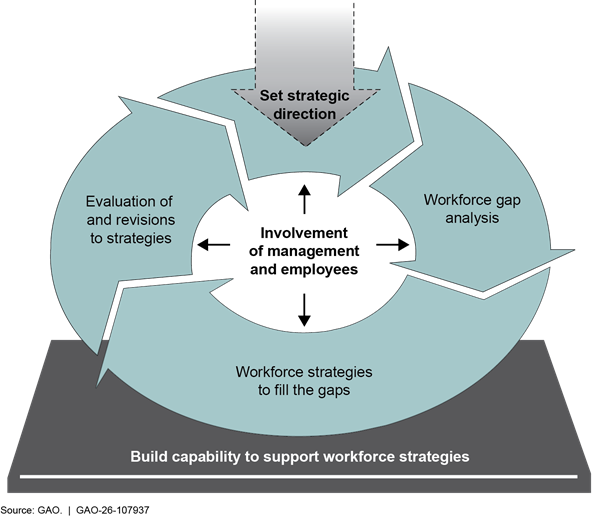
Although DOL made changes to its OFCCP workforce in response to revisions to the office’s scope of work, this was not informed by workforce planning that was consistent with those key principles. According to DOL officials, DOL does not intend to conduct any workforce planning for OFCCP because they believe OFCCP’s workforce is the right size for its revised mission. However, DOL is in the process of considering procedural changes related to Section 503 compliance and oversight, including changes related to the amended regulations issued in August 2026. These could further affect OFCCP’s activities and thus the size and composition of the workforce needed to implement those activities. For example, the office may need staff with specific skills—such as auditing, investigative, or research skills—that reflect its current activities, or it may identify the need for staff with other skills to support its future mix of oversight and enforcement activities. Because OFCCP has suspended its monitoring activities, it is not currently clear how OFCCP’s workforce aligns with mission needs.
Given the magnitude of the recent workforce cuts and the policy changes underway and being considered, engaging in strategic workforce planning would help OFCCP better ensure it has the appropriate workforce to meet its current and future mission.
Additional Guidance from DOL Could Help Federal Contractors Address Challenges Complying with Section 503
Selected stakeholders identified challenges contractors faced in three key areas of Section 503 compliance: (1) conducting outreach to and recruiting people with disabilities, (2) retaining and advancing people with disabilities, and (3) demonstrating compliance with Section 503.[30] Stakeholders also described practices that contractors found helpful to address these challenges. In some cases, they pointed to guidance such as models, instructions, or other information that DOL could provide to help contactors comply with Section 503.
OFCCP Has Removed Its Database with Potential Outreach and Recruitment Partners from Its Website
Selected stakeholders described challenges contractors faced in conducting outreach to and recruiting people with disabilities. Challenges to recruiting people with disabilities that stakeholders cited include job descriptions containing unnecessary requirements that could screen out people with disabilities; application systems and screening processes that prevent people with disabilities from submitting applications or being hired; and difficulties finding partner organizations, such as local disability advocacy groups, to help recruit people with disabilities. In some cases, stakeholders identified practices they found helpful for mitigating these challenges (see table 2). Stakeholders also said it would be useful to have information about organizations that could help contractors with their outreach and recruitment efforts.
Table 2: Challenges and Helpful Practices Identified by Selected Stakeholders for Federal Contractors’ Outreach to and Recruitment of People with Disabilities
|
Area |
Challenges |
Helpful practices for federal contractors |
|
Avoiding unnecessary requirements in job descriptions |
· Job descriptions might contain unnecessary requirements (e.g., a job description for an office position might say the employee must be able to lift 50 pounds when the job does not require lifting). |
· Reviewing job descriptions to remove unnecessary requirements, whether by reviewing all job descriptions regularly or only reviewing specific job descriptions as they are posted. |
|
Ensuring application process is accessible and minimizes bias |
· Application systems might not be accessible to people with disabilities, such as if they are not compatible with screen readers. |
· Reviewing application systems for accessibility. · Testing application systems by using screen readers or keyboard-only navigation to help identify and remove barriers that could prevent people with certain disabilities from completing applications. · Providing accommodations for interviews, such as sign-language interpretation. · Prominently posting instructions for requesting accommodations on the employment pages of contractor websites or in individual job postings. |
|
Finding partner organizations |
· Difficulty finding partner organizations, such as local disability advocacy groups, to help recruit people with disabilities. This can be especially difficult for specific careers, such as engineering, and in rural areas. |
· Attending “reverse job fairs” where disability advocacy organizations and people with disabilities have booths to connect contractors with potential hires. · Partnering with schools that have specific programs to provide education to students with disabilities to identify potential future employees. |
Source: GAO analysis of information from selected stakeholders. | GAO‑26‑107937
Notes: Stakeholders included representatives of contractors, consultants who assist contractors with compliance with Section 503 of the Rehabilitation Act of 1973 (Section 503), academic researchers, and representatives of disability organizations. Section 503 requires certain federal contractors to take proactive steps to employ and advance in employment people with disabilities. 29 U.S.C. § 793.
Stakeholders described benefits of partnering with organizations that can help contractors conduct outreach to and recruit people with disabilities, thus helping contractors comply with Section 503 requirements. For example, one contractor representative said her company maintained relationships with organizations that could refer applicants with disabilities to them. She said the company had made good hires through these referrals. Another contractor representative described a company whose partnership with an organization regularly led to three or four hires of people with disabilities per year.
Stakeholders told us that it would be useful for OFCCP to provide a list of such potential partner organizations—particularly local or regional organizations. OFCCP’s website previously included a database of potential partner organizations, including some regional organizations. However, as of July 2026, while OFCCP’s website lists some national organizations that might help contractors recruit people with disabilities, the database with regional organizations is no longer on the site. In April 2026, OFCCP officials told us that OFCCP had taken down the database because it contained information related to the revoked Executive Order 11246, which addressed protections related to race and gender. They did not cite specific plans to repost the database. Some stakeholders told us the database had been helpful to contractors in recruiting people with disabilities or that they wished that it had not been taken down.
DOL’s fiscal year 2027 annual performance plan states that OFCCP will ensure that employers have the resources and support they need to comply with their Section 503 obligations.[31] By providing resources on partner organizations on its website, OFCCP can help contractors more effectively collaborate with organizations in their region to reach out to and recruit people with disabilities for their workforce and thus meet Section 503 requirements. In providing such resources, OFCCP could remove any information related to Executive Order 11246 and focus the resources on helping contractors identify partners to support their compliance with Section 503.
OFCCP’s Website Has Limited Information on Providing Reasonable Accommodations That Could Aid Retention and Advancement
Selected stakeholders described challenges contractors have faced in retaining and advancing employees with disabilities. Challenges include developing a workplace culture supportive of employees with disabilities, fostering the career advancement of employees with disabilities, and providing reasonable accommodations. In particular, stakeholders said managers and other employees may not understand how best to provide reasonable accommodations, and employees with disabilities may not know what to request. Contractors who struggle to implement practices to retain and advance employees with disabilities may face high attrition among those employees. In some cases, stakeholders identified practices they found helpful in addressing these challenges (see table 3). Stakeholders also said that guidance to help contractors provide reasonable accommodations would be helpful.
Table 3: Challenges and Helpful Practices Identified by Selected Stakeholders for Federal Contractors’ Retention and Advancement of People with Disabilities
|
Area |
Challenges |
Helpful practices for federal contractors |
|
Developing a supportive workplace culture |
· Cultural stigma, sometimes including among contractor leadership, against employing people with disabilities. · Employees across the company might not prioritize efforts to support employees with disabilities. |
· Establishing employee resource groups for people with disabilities. These groups can provide a community for people with disabilities and other interested employees to collaboratively develop solutions to workplace challenges, such as securing reasonable accommodations. · Training all staff, including managers, on inclusion of people with disabilities. · Leaders voluntarily disclosing their own disabilities to their employees. · Leadership tying support for employees with disabilities to the organization’s values. |
|
Facilitating career advancement |
· Employers might not provide people with disabilities the same opportunities for promotion and career advancement as their colleagues. · Employers in industries with specific safety requirements, such as airlines, may face legal restrictions in promoting people with certain disabilities into specific positions. |
· Ensuring that opportunities for advancement are advertised to all employees, including people with disabilities. |
|
Providing reasonable accommodations |
· Reasonable accommodations might be provided inconsistently across an organization or under different management teams. · Managers might deny accommodations they think are too expensive, unnecessary, or a form of favoritism. · Employees might be unsure what accommodations are available to request. · Complex accommodation request systems can pose challenges for employees with certain disabilities, such as disabilities affecting executive function. |
· Centralizing the reasonable accommodations process to help contractors provide accommodations more quickly and consistently and prevent inappropriate denials from managers. · Centralizing reasonable accommodation funding to help avoid situations in which decisions about accommodations are influenced by individual units’ budgets. · Training managers in the reasonable accommodations process. · Teaching managers and other employees what technology is available to assist people with disabilities. |
Source: GAO analysis of information from selected stakeholders. | GAO‑26‑107937
Notes: Stakeholders included representatives of contractors, consultants who assist contractors with compliance with Section 503 of the Rehabilitation Act of 1973 (Section 503), academic researchers, and representatives of disability organizations. Section 503 requires certain federal contractors to take proactive steps to employ and advance in employment people with disabilities. 29 U.S.C. § 793.
Stakeholders said it would be helpful for OFCCP to provide resources to help managers and other contractor employees learn about providing reasonable accommodations. For example, some stakeholders suggested that OFCCP could provide videos to teach contractors how to provide reasonable accommodations.
As of July 2026, OFCCP’s website provides some information on reasonable accommodations, but the information is limited in scope, and the website has no clearly labeled section focused on reasonable accommodations. For example, the website provides a short pamphlet informing contractor employees of their right to request reasonable accommodations. However, the pamphlet does not contain information for contractors about providing reasonable accommodations. The website links to DOL’s Office of Disability Employment Policy’s (ODEP) Job Accommodation Network and explains that the network provides resources for providing reasonable accommodations. However, this link is on a page focused on recruitment and hiring, not reasonable accommodations.
Additionally, we found that some information that OFCCP officials said they referred callers to verbally is not linked on the OFCCP website, making it more difficult to locate. OFCCP officials told us that when contractors called OFCCP with questions about reasonable accommodations, officials sometimes referred the callers to resources from a DOL website called employer.gov or from ODEP. Employer.gov provides employers with basic information on topics such as nondiscrimination and requirements for federal contractors. The ODEP website has a variety of resources for employers, including a list of potential accommodations organized by disability type. However, contractors who visit OFCCP’s website rather than calling do not receive a referral to these resources and may not be aware of them.
As stated above, DOL’s performance plan states that OFCCP will ensure that employers have the resources and support they need to comply with their Section 503 obligations.[32] By including links to existing resources on a reasonable accommodations webpage or other prominent place on its website, OFCCP can help ensure that contractors have the information they need to provide accommodations to employees and applicants with disabilities.
Additional Guidance from OFCCP Could Help Contractors Comply with Section 503
Selected stakeholders told us that federal contractors can find it challenging to demonstrate their compliance with Section 503 to OFCCP. For example, some stakeholders said that contractors faced difficulties assessing the effectiveness of their efforts to conduct outreach to people with disabilities, as required under Section 503. They said contractors also faced challenges understanding Section 503 requirements or best practices for compliance. Some contractor representatives said that guidance to help them complete assessments and comply with Section 503 could be helpful.
In some cases, stakeholders described practices contractors had found helpful to address the challenges (see table 4).
Table 4: Challenges and Helpful Practices Identified by Selected Stakeholders for Federal Contractors’ Demonstration of Compliance with Section 503
|
Area |
Challenges |
Helpful practices for federal contractors |
|
Assessing outreach and recruitment |
· Assessing the impact of individual outreach events on the number of applications from people with disabilities and the number hired may be difficult. · People with disabilities who attend an outreach event may not apply for a job with the contractor immediately, making it difficult to connect events with their outcomes. · Applicants with disabilities may not report in application systems that they learned about the employer through an outreach event. |
· Training recruiters in disability outreach requirements; having them track events attended and which event attendees are hired. |
|
Understanding compliance requirements |
· Smaller contractors are less likely to have compliance specialists on staff and may struggle to understand Section 503 requirements. · Section 503 requirements may be applied inconsistently across Office of Federal Contract Compliance Programs offices. For example, different offices may have different documentation expectations, which can lead to unpredictable demands across audits. |
· Hiring external consultants with expertise in Section 503 compliance. |
|
Encouraging self-identificationa |
· Some employees and applicants are reluctant to self-identify as having a disability, sometimes due to fear of discrimination. · Some employees and applicants do not realize they meet the definition of having a disability. |
· Conducting company-wide disability self-identification campaigns. · Leaders voluntarily disclosing their own disabilities to employees; employees may then feel safer and be more willing to complete the self-identification form. |
Source: GAO analysis of information from selected stakeholders. | GAO‑26‑107937
Notes: Stakeholders included representatives of contractors, consultants who assist contractors with compliance with Section 503 of the Rehabilitation Act of 1973 (Section 503), academic researchers, and representatives of disability organizations. Section 503 requires certain federal contractors to take proactive steps to employ and advance in employment people with disabilities. 29 U.S.C. § 793.
aThe Department of Labor removed the requirement for employers to invite self-identification when it amended the Section 503 regulations in August 2026. GAO collected stakeholder perspectives before the regulatory changes were finalized.
Given the challenges connecting contractors’ outreach efforts to outcomes, stakeholders said that contractors would benefit from resources from OFCCP instructing them on how to assess their outreach and recruitment efforts. For example, one contractor representative said it would be helpful to have a model of a completed assessment. OFCCP’s website previously included a sample completed AAP with a plan for how the contractor would assess the effectiveness of their outreach and recruitment efforts. However, as of July 2026, this sample AAP has been removed. Moreover, while the sample included an example of how contractors might plan to assess outreach and recruitment, it did not provide a model of a completed assessment.
Contractor representatives also told us that to help contractors understand requirements for compliance, it would be helpful for OFCCP to provide a list of best practices for Section 503 compliance. OFCCP previously provided a list of best practices for Section 503 compliance on its website, but as of July 2026, this list has been removed.
In May 2026, OFCCP officials told us that they had removed both the sample completed AAP and the list of best practices from the website because the requirements for affirmative action might change. They said OFCCP would reevaluate the need for such resources when the proposed regulatory changes were finalized. Under the amended regulations, the AAP requirement to assess outreach is still in effect, and contractors would benefit from guidance on how to comply.
As noted above, DOL’s performance plan states that OFCCP will ensure that employers have the resources and support they need to comply with their obligations.[33] OFCCP providing resources for assessing outreach and recruitment efforts and on best practices for Section 503 compliance would help contractors better understand how to comply with requirements and thus help support contractors’ employment of people with disabilities.
Conclusions
Section 503 is a key tool to promote the employment, retention, and advancement of people with disabilities in federal contractors’ workplaces. DOL plays a critical role in successfully implementing Section 503 because it is the agency empowered to enforce compliance, and contractors rely on its guidance for carrying out their responsibilities.
DOL could encourage greater compliance with Section 503 by resuming certification through OFCCP’s Contractor Portal or another mechanism and conducting compliance audits. Certification through the portal helped ensure that all contractors covered by Section 503 were aware of their obligation to have up-to-date AAPs. Audits provided an opportunity for DOL to further review the contents and implementation of AAPs and to require contractors to take corrective action where necessary. Resuming these oversight activities would strengthen DOL’s ability to ensure contractor compliance with requirements and thus their support of employment of people with disabilities.
DOL also has an opportunity to enhance its oversight of Section 503 by looking strategically at OFCCP’s procedures and workforce. Specifically, comprehensively analyzing the reasons for decisions on referring or closing complaints could help OFCCP identify ways to better communicate to the public and potential complainants. This in turn could inform corrective actions that could ensure the Section 503 complaints process is functioning effectively as a mechanism for addressing issues with contractors’ employment of people with disabilities. DOL also reduced the OFCCP workforce, but this was not informed by strategic planning. As OFCCP continues to implement changes, strategic workforce planning would help ensure that DOL is allocating staff with the needed skills to its contractor compliance efforts.
DOL could also help federal contractors more effectively support the employment of people with disabilities by ensuring that they have the information they need to comply with Section 503. OFCCP has opportunities to do so by providing resources on partner organizations that could assist contractors in recruiting employees with disabilities, reasonable accommodations, assessment of outreach and recruitment efforts as required by Section 503 regulations, and best practices for Section 503 compliance.
Recommendations for Executive Action
We are making the following eight recommendations to DOL:
The Secretary of Labor should ensure that OFCCP resumes collecting certification of AAPs from contractors through its Contractor Portal or other mechanism. (Recommendation 1)
The Secretary of Labor should ensure that OFCCP resumes audits related to Section 503 compliance. (Recommendation 2)
The Secretary of Labor should ensure that OFCCP analyzes trends in reasons for closing or referring Section 503 complaints that are not appropriate for it to investigate, and uses the results to identify and implement any identified actions to strengthen the complaints process, as appropriate. (Recommendation 3)
The Secretary of Labor should carry out strategic workforce planning for OFCCP, consistent with key principles, to align its workforce with its current responsibilities and future needs. (Recommendation 4)
The Secretary of Labor should ensure that OFCCP provides resources on its website with potential partner organizations, including regional organizations, that can help contractors recruit employees with disabilities. (Recommendation 5)
The Secretary of Labor should ensure that OFCCP adds a reasonable accommodations section to its website with links to resources explaining how employers can provide reasonable accommodations. (Recommendation 6)
The Secretary of Labor should ensure that OFCCP develops resources with information on how to assess outreach and recruitment efforts required by Section 503 regulations, and publishes those resources on its website. (Recommendation 7)
The Secretary of Labor should ensure that OFCCP provides a list of best practices for Section 503 compliance on its website. (Recommendation 8)
Agency Comments and Our Evaluation
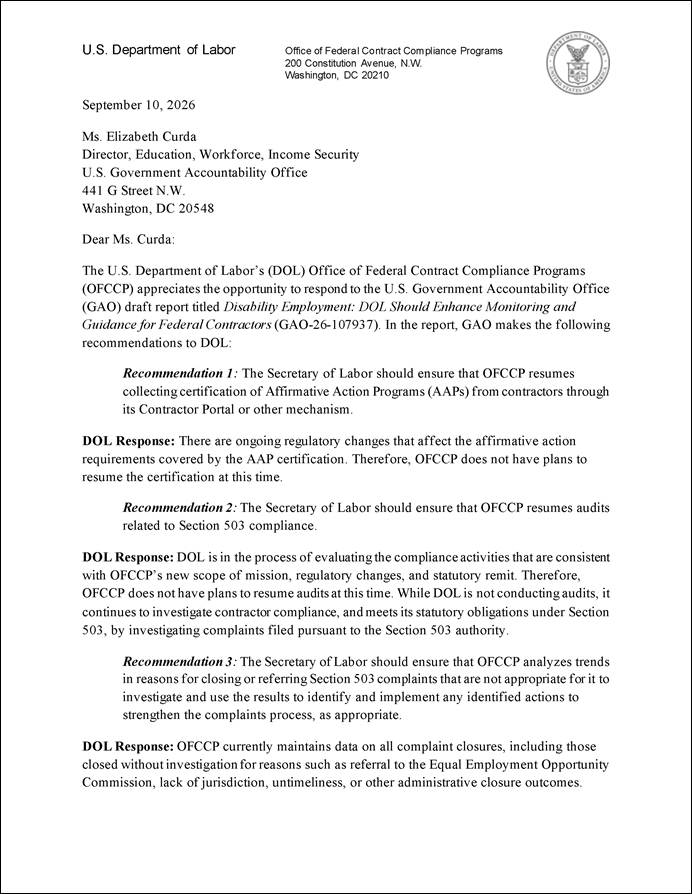
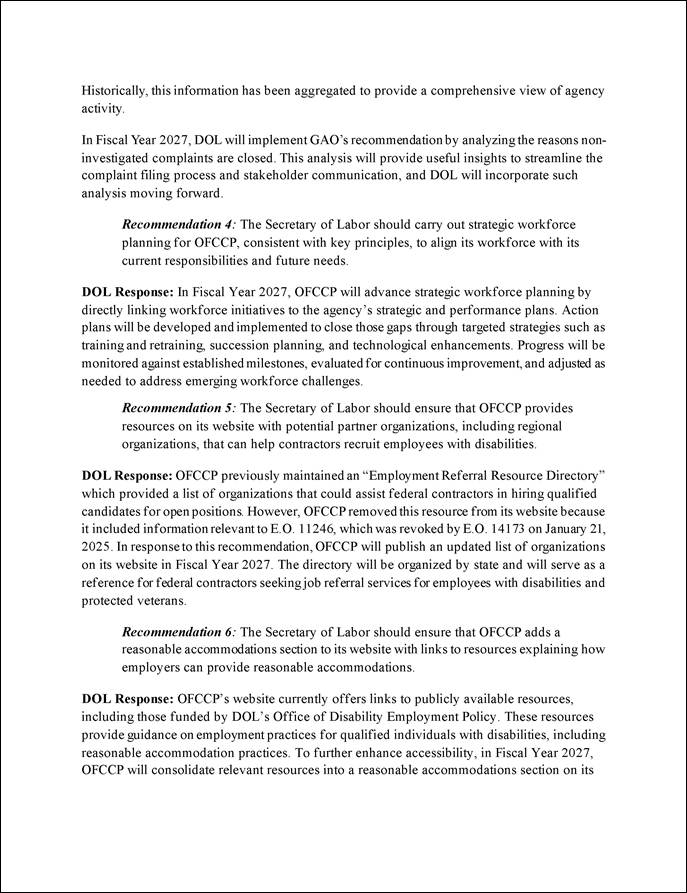
We provided a draft of this report to DOL and EEOC for review and comment. DOL’s written comments are reproduced in appendix II. DOL and EEOC also provided technical comments, which we incorporated as appropriate.
DOL neither agreed nor disagreed with recommendations 1 and 2. It said that OFCCP does not have plans to resume Section 503 AAP certifications or audits at this time and that DOL is in the process of evaluating its compliance activities in light of recent regulatory changes. DOL also noted that it continues to enforce Section 503 through complaint investigations. We agree that OFCCP’s compliance activities will need to be adapted to the amended Section 503 regulations. However, the AAP certification and Section 503 audits are both important mechanisms for helping DOL ensure that contractors are complying with Section 503 requirements that remain in effect. We maintain that DOL should resume these activities as soon as possible.
DOL agreed with recommendations 3 through 8 and described steps it plans to take. For example, DOL said it would develop action plans to close OFCCP workforce gaps, consolidate reasonable accommodations resources on its website, and post updated information on Section 503 best practices and evaluating outreach. We will continue to monitor DOL’s progress in implementing our recommendations.
As we agreed with your offices, unless you publicly announce the contents of this report earlier, we plan no further distribution until 17 days from the report date. At that time, we will send copies to the appropriate congressional committees, the Acting Secretary of Labor, the Chair of EEOC, and other interested parties. In addition, the report will be available at no charge on the GAO website at https://www.gao.gov.
If you or your staff have any questions about this report, please contact me at curdae@gao.gov. Contact points for our Offices of Congressional Relations and Media Relations may be found on the last page of this report. GAO staff who made key contributions to this report are listed in appendix III.
Elizabeth H. Curda
Director, Education, Workforce, and Income Security
This report addresses (1) the extent to which the U.S. Department of Labor (DOL) monitors contractors’ efforts to comply with Section 503 of the Rehabilitation Act of 1973 (Section 503), investigates individual complaints, and plans for its workforce needs; and (2) what challenges, if any, contractors face in complying with Section 503, practices they have found helpful, and the extent to which DOL has provided resources to assist.
For our first objective, we interviewed agency officials, reviewed agency documents, and analyzed agency data. Specifically, we interviewed officials from DOL’s Office of Federal Contract Compliance Programs (OFCCP), which enforces Section 503, and from the U.S. Equal Employment Opportunity Commission (EEOC). OFCCP and EEOC can coordinate on enforcing Section 503. We also reviewed written responses provided by these officials.
We reviewed agency documents including DOL policies and procedures, such as the Federal Contract Compliance Manual used by OFCCP officials in their work; public communications related to enforcement changes in 2025; documentation of OFCCP’s audit selection methodology; and a report OFCCP issued about its fiscal year 2020 Section 503 focused reviews. We also reviewed relevant federal laws and regulations.[34]
To assess DOL’s oversight efforts, we used several criteria. First, we compared DOL’s Section 503 oversight activity with the agency’s strategic and performance plans and with relevant principles of federal standards for internal control.[35] Specifically, we considered principles related to identifying and responding to risks, using quality information, and performing monitoring activities. We also assessed DOL’s management of the OFCCP workforce against key principles of strategic workforce planning identified in our prior work.[36]
To describe OFCCP oversight activities, we analyzed data from OFCCP’s internal tracking systems from fiscal years 2017 to 2026, covering both audits (up to fiscal year 2025) and complaint investigations. This involved combining data from multiple systems and removing duplicate entries because OFCCP’s tracking systems changed during this period. Specifically, OFCCP transitioned its tracking of audits from a legacy system to a new Compliance Management System in 2018, according to officials. Officials also said OFCCP transitioned tracking of complaint investigations from manually completed Excel files to the Compliance Management System in 2024.
To describe changes made to DOL’s workforce, we analyzed data on OFCCP from DOL’s human resources information system for fiscal years 2017 to 2026. The data included staffing by fiscal year quarter in terms of full-time equivalents. A full-time equivalent is a standard measure of labor that reflects the total number of hours worked by employees divided by the working hours in a year. For example, an employee working full-time for the year would count as one full-time equivalent, and an employee working half-time for the year would count as 0.5 full-time equivalents.
To determine the reliability of the oversight data, we reviewed relevant documentation, interviewed knowledgeable DOL officials, and conducted electronic testing (such as checking for missing values and for consistency between related data fields). To determine the reliability of the human resources data, we reviewed written responses from DOL officials. Overall, we determined that the oversight and human resources data were sufficiently reliable for the purpose of summarizing trends in audits, complaints, and staffing levels. However, we identified two issues with the complaint data and, as a result, limited our years of analysis. Specifically, for the oversight activities analysis, we excluded complaint data before 2021 because we could not reliably remove duplicate entries when we merged datasets. We also excluded data from before 2024 on whether Section 503 complaints were investigated by OFCCP or referred to another agency because the tracking system for complaints used before 2024 did not contain sufficient information on this to be comparable with the 2024–2026 Compliance Management System complaint data.
For our second objective, we conducted nongeneralizable interviews and discussion groups, attended a summit on supporting employment of people with disabilities, toured contractor facilities, and conducted a survey.
Interviews and discussion groups. We conducted 11 interviews and four discussion groups. Across these interviews and discussion groups, we spoke with 16 representatives of contractors, nine consultants who assist contractors with Section 503 compliance, two academic researchers, and four representatives of disability organizations.[37] The representatives of contractors worked in areas such as human resources, compliance, and training. Some stakeholders were also members of an industry group that facilitates communication between federal contractors and DOL. We identified stakeholders through professional contacts and referrals from an organization representing federal contractors and a disability organization.
We selected stakeholders representing employers from different industries, such as hospitality and technology. We also selected stakeholders who support people with disabilities, including as employees of federal contractors or through work for disability-focused organizations. Selected stakeholders had experience with Section 503 compliance, were familiar with challenges that employers face in supporting employment of people with disabilities, or were familiar with challenges that people with disabilities face in securing and retaining employment. Some selected stakeholders identified as people with disabilities.
In the interviews and discussion groups, we asked about challenges that federal contractors faced, and practices they found helpful, when complying with Section 503 or supporting employment of people with disabilities. We also asked about stakeholders’ experiences working with OFCCP. We structured the interviews and discussion groups to allow us to identify common themes and examples of contractors’ experiences.
Summit. We attended a summit for employers and others working to support applicants and employees with disabilities. We conducted two of our discussion groups in person at this summit; these discussion groups were open to interested attendees who worked for federal contractors or otherwise had experience with Section 503. We also attended plenary talks and breakout sessions about disability inclusion and compliance with relevant federal laws, including Section 503.
Facility tours. We toured facilities of two federal contractors to learn about their efforts to improve physical accessibility and otherwise support employees with disabilities. Both facilities were located in the same city as the summit we attended.
Survey. We conducted a nongeneralizable, opt-in, anonymous survey of representatives of contractors to collect additional perspectives. In addition to demographic and screening questions, the survey asked the following three open-ended questions:[38]
· What challenges, if any, have you seen employers face in complying with Section 503 and/or employing people with disabilities?
· What practices, if any, have you found to help employers in complying with Section 503 and/or employing people with disabilities?
· Is there anything else you’d like to share related to compliance with Section 503 and/or employing people with disabilities?
We conducted pre-tests of the survey with five people familiar with Section 503 compliance. The purpose of the pretests was to check that (1) the questions were clear and unambiguous, (2) terminology was used correctly, and (3) the respondents could feasibly obtain the information needed to answer the questions. We revised the survey based on feedback we received in the pre-tests.
We administered the survey between September and December 2025. To reach our target audience of representatives of federal contractors, we distributed a link to our web-based questionnaire to representatives of employer and disability organizations and asked them to disseminate it among their federal contractor contacts.
We received 48 responses to the survey. Of these, 10 had responses to at least one of the three open-ended questions listed above. The remainder had responses only to the screening and/or demographic questions. Because the survey was anonymous, we are unable to verify that all respondents were in fact employees of federal contractors. It is also possible that some respondents completed the survey more than once.
To assess the extent to which DOL has provided resources to help address challenges, in addition to the interviews and discussion groups with selected stakeholders, we spoke with DOL officials and reviewed publicly available agency documents, such as an OFCCP Section 503 frequently asked questions webpage and a pamphlet explaining an employee’s right to request reasonable accommodations. We assessed the resources DOL provided against needs identified by stakeholders, the agency’s performance plan, and relevant principles of federal standards for internal control.[39] Specifically, we considered principles related to communicating quality information.
We conducted this performance audit from November 2024 to September 2026 in accordance with generally accepted government auditing standards. Those standards require that we plan and perform the audit to obtain sufficient, appropriate evidence to provide a reasonable basis for our findings and conclusions based on our audit objectives. We believe that the evidence obtained provides a reasonable basis for our findings and conclusions based on our audit objectives.
GAO Contact
Elizabeth Curda, curdae@gao.gov
Staff Acknowledgments
In addition to the contact named above, Erin Godtland (Assistant Director), Daniel Dye (Analyst in Charge), Sarah Krause, Michael Murray, and Zoe Ziliak Michel made key contributions to this report. Other staff who made key contributions to this report were Bri Bovbjerg, Joanna Carroll, Alison Cashin, Andrew Emmons, Alex Galuten, Gina Hoover, Mimi Nguyen, Anne Ordway, and Almeta Spencer.
The Government Accountability Office, the audit, evaluation, and investigative arm of Congress, exists to support Congress in meeting its constitutional responsibilities and to help improve the performance and accountability of the federal government for the American people. GAO examines the use of public funds; evaluates federal programs and policies; and provides analyses, recommendations, and other assistance to help Congress make informed oversight, policy, and funding decisions. GAO’s commitment to good government is reflected in its core values of accountability, integrity, and reliability.
Obtaining Copies of GAO Reports and Testimony
The fastest and easiest way to obtain copies of GAO documents at no cost is through our website. Each weekday afternoon, GAO posts on its website newly released reports, testimony, and correspondence. You can also subscribe to GAO’s email updates to receive notification of newly posted products.
Order by Phone
The price of each GAO publication reflects GAO’s actual cost of production and distribution and depends on the number of pages in the publication and whether the publication is printed in color or black and white. Pricing and ordering information is posted on GAO’s website, https://www.gao.gov/ordering.htm.
Place orders by calling (202) 512-6000, toll free (866) 801-7077,
or
TDD (202) 512-2537.
Orders may be paid for using American Express, Discover Card, MasterCard, Visa, check, or money order. Call for additional information.
Connect with GAO
Connect with GAO on X,
LinkedIn, Instagram, and YouTube.
Subscribe to our Email Updates. Listen to our Podcasts.
Visit GAO on the web at https://www.gao.gov.
To Report Fraud, Waste, and Abuse in Federal Programs
Contact FraudNet:
Website: https://www.gao.gov/about/what-gao-does/fraudnet
Automated answering system: (800) 424-5454
Media Relations
Sarah Kaczmarek, Managing Director, Media@gao.gov
Congressional Relations
David A. Powner, Acting Managing Director, CongRel@gao.gov
General Inquiries
[1]29 U.S.C. § 793. The Section 503 regulations define disability as a physical or mental impairment that substantially limits one or more major life activities of an individual, a record of such an impairment, or being regarded as having such an impairment. Section 503 refers to “individuals with disabilities.” We use “people with disabilities” throughout this report.
[2]OFCCP can coordinate with EEOC on Section 503 oversight.
[3]GAO, Standards for Internal Control in the Federal Government, GAO‑25‑107721 (Washington, D.C.: May 2025).
[4]GAO, Human Capital: Key Principles for Effective Strategic Workforce Planning, GAO‑04‑39 (Washington, D.C.: Dec. 11, 2003).
[5]We refer to all these individuals as “selected stakeholders” or “stakeholders” in this report. In this report, “representatives of contractors,” whom we also call “contractor representatives,” are employees of federal contractors, such as human resources or compliance professionals. “Consultants” are third parties.
[6]Some selected stakeholders identified as people with disabilities.
[8]Section 503 is codified at 29 U.S.C. § 793 and is implemented with regulations at 41 C.F.R. Part 60-741. In this report, we use “contractor” to refer to any employer with a federal contract or subcontract.
[9]“Undue hardship” means the accommodation would require significant difficulty or expenses when considered in light of various factors.
[10]42 U.S.C. §§ 12111-17.
[11]See 29 C.F.R. Part 1641 and 41 C.F.R. Part 60-742.
[12]91 Fed. Reg. 54,482 (Aug. 21, 2026).
[13]Exec. Order No. 11246, Equal Employment Opportunity, 30 Fed. Reg. 12,319 (Sep. 28, 1965), as amended.
[14]Exec. Order No. 14173, Ending Illegal Discrimination and Restoring Merit-Based Opportunity, 90 Fed. Reg. 8633 (Jan. 31, 2025).
[15]DOL assigned the responsibility for overseeing contractors’ compliance with Section 503, VEVRAA, and Executive Order 11246 to OFCCP. Therefore, in this report, we refer to these as OFCCP’s “oversight responsibilities.”
[16]OFCCP referred to its detailed reviews of a sample of contractors as “compliance evaluations.” In this report, we refer to them as “audits.”
[17]Only those contractors subject to the written AAP requirement (at least 50 employees and a contract worth at least $50,000) would be selected for audit.
[18]OFCCP released its initial list of contractors selected for fiscal year 2025 audits in November 2024, but it ultimately did not use this list because it suspended audits in January 2025.
[19]Fiscal year 2024 was the most recent full year in which OFCCP conducted audits. Officials said that OFCCP also received certain data on contractor employees in conjunction with EEOC, through employers’ EEO-1 reports. This included overall workforce size and non-disability demographic data that were relevant to Executive Order 11246 oversight. These data did not include the number of employees with disabilities because that is not a reporting category for EEOC, according to EEOC officials. Private-sector employers with at least 100 employees, and federal contractors with at least 50 employees and that meet certain requirements, are required to complete an EEO-1 report every year. The EEO-1 report collects information on the employer’s workforce, with each job category (such as managers and service workers) broken down by race, ethnicity, and sex. In July 2026, EEOC proposed removing the requirement for employers to file the EEO-1 report. 91 Fed. Reg. 46,332 (July 23, 2026).
[20]Specifically, DOL directed that open enforcement actions related to the revoked Executive Order 11246 be closed immediately, and Section 503 and VEVRAA actions be paused pending further guidance.
[21]The Contractor Portal remained closed as of May 2026, according to DOL officials.
[22]See GAO, Equal Employment Opportunity: Strengthening Oversight Could Improve Federal Contractor Nondiscrimination Compliance, GAO‑16‑750 (Washington, D.C.: Sept. 22, 2016). In that report, we made six recommendations to DOL, including that OFCCP develop a contractor selection process that reflects contractor noncompliance risk, develop a mechanism to monitor contractors’ compliance with AAP requirements, and review and assess the clarity of its contractor guidance. All of these were implemented.
[23]An OFCCP audit may extend across fiscal years. We report the number of audits by the fiscal year they concluded to align these data with the fiscal years in which violations were found. These data are as of April 2025; OFCCP did not conduct any additional audits in the remainder of fiscal year 2025. According to officials, DOL also has its own data verification process for quarterly and annual reporting, which uses additional information sources beyond what we were provided. Officials said this verification process produced different results from ours. However, the difference was small (within 2 percentage points).
[24]According to officials, DOL’s data verification process also produced different results from ours for this analysis. However, the difference was again small (within 1 percentage point in this case).
[25]DOL paused Section 503 complaint investigations as part of the suspension of OFCCP enforcement activities in January 2025 and resumed them in July 2025.
[26]A single complaint could have alleged multiple violations, and complaints that alleged violations of Section 503 might also have alleged violations of VEVRAA or Executive Order 11246.
[27]Data limitations prevented us from analyzing data from before fiscal year 2024 on complaints DOL received but did not investigate. See app. I.
[28]The DOL workforce data we analyzed were expressed in terms of full-time equivalents. A full-time equivalent is a standard measure of labor that reflects the total number of hours worked by employees divided by the working hours in a year. For example, an employee working full-time for the year would count as one full-time equivalent, and an employee working half-time for the year would count as 0.5 full-time equivalents.
[30]Selected stakeholders included representatives of contractors, consultants who assist contractors with Section 503 compliance, academic researchers, and representatives of disability organizations.
[31]Further, federal standards for internal control state that agencies should communicate relevant and quality information to external parties such as contractors to help the agency achieve its goals. GAO‑25‑107721.
[32]Further, federal standards for internal control state that agencies should communicate relevant and quality information to external parties such as contractors to help the agency achieve its goals. GAO‑25‑107721.
[33]Further, federal standards for internal control state that agencies should communicate relevant and quality information to external parties such as contractors to help the agency achieve its goals. GAO‑25‑107721.
[34]Section 503 is codified at 29 U.S.C. § 793 and is implemented with regulations at 41 C.F.R. Part 60-741.
[35]See GAO, Standards for Internal Control in the Federal Government, GAO‑25‑107721 (Washington, D.C.: May 2025).
[36]See GAO, Human Capital: Key Principles for Effective Strategic Workforce Planning, GAO‑04‑39 (Washington, D.C.: Dec. 11, 2003).
[37]We refer to all these individuals as “stakeholders” in this report. In this report, “representatives of contractors,” whom we also call “contractor representatives,” are employees of federal contractors, whereas consultants are third parties. Some discussion group participants also participated in interviews.
[38]The screening questions were intended to ensure that respondents worked for federal contractors and in a capacity related to Section 503 compliance or supporting employees with disabilities. Respondents reported working in areas such as human resources, compliance, and legal services.
[39]See GAO‑25‑107721.