
Report to Congressional Committees
United States Government Accountability Office
A report to congressional committees
For more information, contact: Latesha Love-Grayer at LoveGrayerL@gao.gov
What GAO Found
The U.S. Agency for International Development (USAID) allocated $624 million in Economic Support Fund (ESF) assistance for the West Bank and Gaza for fiscal years (FY) 2022-2024. This assistance funded 37 prime awards for sectors including water infrastructure and education, as well as debt relief payments to a Palestinian Authority creditor. With a few exceptions, USAID complied with its anti-terrorism policies and procedures. State took over administration of this ESF funding from USAID in July 2025. All 37 awards have ended except for support to the East Jerusalem Hospital Network.
State’s Bureau of Near Eastern Affairs (NEA) is managing the remaining USAID activities in the West Bank and Gaza. Congress appropriated ESF funding in FY 2025 and National Security Investment Programs (NSIP) funding in FY 2026 that State can use for the West Bank and Gaza if oversight requirements are met. Officials told GAO that State’s planning had identified potential early recovery and economic development programming for West Bank and Gaza, but State has not yet determined responsibility for managing such programs.
According to State officials, ongoing regional conflict has delayed NEA’s initial efforts to replace USAID’s anti-terrorism policies and procedures for West Bank and Gaza. Once developed, these policies and procedures would not necessarily apply to State components other than NEA, such as the U.S. Embassy in Jerusalem, if they become responsible for future programming. State guidance says that risks should be identified, evaluated, and mitigated. Determining and documenting how relevant components will mitigate terrorism risk could help State ensure that such assistance is not diverted to terrorist ends.
As State determines its risk mitigation measures, it could incorporate leading practices and lessons learned. GAO has identified mandatory provisions in award agreements as a leading oversight practice. This practice, formerly used by USAID, could help State ensure awardees understand their anti-terrorism obligations and associated penalties. Additionally, State could directly leverage USAID lessons learned by adopting timelines for any future compliance audits. As GAO has previously reported, these timelines could help ensure that appropriate corrective actions can be taken to address any noncompliance before awards expire. Incorporating these leading practices and lessons learned would strengthen State’s oversight of future funding to the West Bank and Gaza.
Why GAO Did This Study
Since 1993, the U.S. has provided more than $7.8 billion in assistance to Palestinians in the West Bank and Gaza primarily through ESF assistance. Appropriations acts for FY 2022-2024 include provisions for GAO to review the treatment, handling, and uses of ESF funds provided for assistance to the West Bank and Gaza.
This report examines (1) the status of USAID’s West Bank and Gaza program supported by FY 2022-2024 ESF assistance, (2) the extent to which USAID complied with its anti-terrorism policies and procedures, and (3) U.S. plans for oversight of future ESF or NSIP assistance in the West Bank and Gaza.
GAO reviewed relevant policies and data from USAID and State, as well as compliance reports and financial audits conducted by third parties. GAO also analyzed prime awards and a random generalizable sample of subaward actions for compliance with USAID’s anti-terrorism policies and procedures. Finally, GAO conducted fieldwork in Israel and the West Bank and interviewed USAID and State officials.
What GAO Recommends
GAO is recommending that State (1) finalize NEA’s development of anti-terrorism policies and procedures for the West Bank and Gaza, (2) determine and document how it will mitigate risk for components other than NEA, (3) adopt mandatory anti-terrorism provisions for awards, and (4) establish timelines to better ensure that compliance audits finish in time to take appropriate action. State concurred with the recommendations.
|
Abbreviations |
|
|
|
|
|
|
|
ATC |
Anti-terrorism certification |
|
|
ADS |
Automated Directives System |
|
|
ESF |
Economic Support Fund |
|
|
FY |
fiscal year |
|
|
FAM |
Foreign Assistance Manual |
|
|
NEA |
U.S. Department of State Bureau of Near Eastern Affairs |
|
|
NSIP |
National Security Investment Programs |
|
|
USAID |
U.S. Agency for International Development |
|
This is a work of the U.S. government and is not subject to copyright protection in the United States. The published product may be reproduced and distributed in its entirety without further permission from GAO. However, because this work may contain copyrighted images or other material, permission from the copyright holder may be necessary if you wish to reproduce this material separately.
September 23, 2026
The Honorable Susan Collins
Interim Chair
The Honorable Brian Schatz
Ranking Member
Subcommittee on State, Foreign Operations, and Related Programs
Committee on Appropriations
United States Senate
The Honorable Mario Diaz-Balart
Chairman
The Honorable Lois Frankel
Ranking Member
Subcommittee on National Security, Department of State, and Related Programs
Committee on Appropriations
House of Representatives
Since the signing of the Oslo Accords in 1993, the U.S. government has provided more than $7.8 billion in bilateral assistance to Palestinians in the West Bank and Gaza. Until July 2025, the U.S. Agency for International Development (USAID) was primarily responsible for implementing this assistance, most of which was appropriated through funds from the Economic Support Fund (ESF) account.[1] This assistance to the West Bank and Gaza aimed to increase stability and improve lives by working within local communities to increase economic opportunity and access to basic services and provide humanitarian relief, among other things. This assistance is bound by federal laws, executive orders, and policies to ensure that the assistance does not support entities or individuals associated with terrorism.
By July 2025, State had paused and then significantly reduced foreign assistance programs and took over administration of certain foreign assistance programs from USAID, which had largely ceased operations at that time. Since then, State has managed the few remaining programs in the West Bank and Gaza and will oversee any future activities using funds from the ESF account or the newly created National Security Investment Programs (NSIP) account.[2] Congress appropriated funding to ESF in fiscal year (FY) 2025 and NSIP in FY 2026 that State can use for programs in the West Bank and Gaza, if certain statutory oversight requirements are met.[3]
The annual consolidated appropriations acts for FY 2022 through FY 2024 include provisions for GAO to review the treatment, handling, and uses of funds provided through the ESF account for the West Bank and Gaza, including the extent to which the funded projects and activities comply with certain anti-terrorism requirements.[4]
This report (1) describes the status of USAID’s West Bank and Gaza program supported by FY 2022-2024 ESF assistance, (2) evaluates the extent to which USAID complied with its anti-terrorism policies and procedures to ensure that this program assistance did not provide support to entities or individuals associated with terrorism, and (3) assesses U.S. plans for oversight of future ESF or NSIP assistance in the West Bank and Gaza.[5]
To describe the status of USAID’s West Bank and Gaza program supported by FY 2022-2024 ESF assistance, we reviewed data from USAID and State on obligations and expenditures of ESF assistance for fiscal years 2022, 2023, and 2024. We determined the data to be sufficiently reliable for describing funding status. In addition, we interviewed and obtained information from officials at the U.S. Embassy in Jerusalem and USAID’s mission to the West Bank and Gaza during fieldwork in April 2025. After USAID’s West Bank and Gaza mission ceased operations, we also obtained information from prime awardee organizations that received this assistance.[6]
To evaluate the extent to which USAID complied with its anti-terrorism policies and procedures, we reviewed USAID’s relevant policies and procedures, known as Mission Order 21, and conducted a compliance analysis on all 37 prime awards for which USAID used FY 2022-2024 ESF assistance. In addition, we conducted a compliance analysis for a random generalizable sample of 130 associated subaward actions that required vetting.[7] We found this data to be sufficiently reliable for the purpose of analyzing compliance with USAID’s anti-terrorism policy. After USAID’s West Bank and Gaza mission ceased operations, State could not provide us with some documentation related to this objective. We note this where appropriate in our report.
To assess U.S. plans for oversight of future assistance in the West Bank and Gaza, we interviewed and obtained documentation from State officials in Washington D.C. and the U.S. Embassy in Jerusalem. We compared this information to USAID and State vetting policies as well as oversight best practices, such as GAO’s Fraud Risk Framework.
We conducted this performance audit from December 2024 to September 2026 in accordance with generally accepted government auditing standards. Those standards require that we plan and perform the audit to obtain sufficient, appropriate evidence to provide a reasonable basis for our findings and conclusions based on our audit objectives. We believe that the evidence obtained provides a reasonable basis for our findings and conclusions based on our audit objectives. For more details on our scope and methodology, see appendix 1.
Background
Key Events Related to U.S. Assistance to the West Bank and Gaza
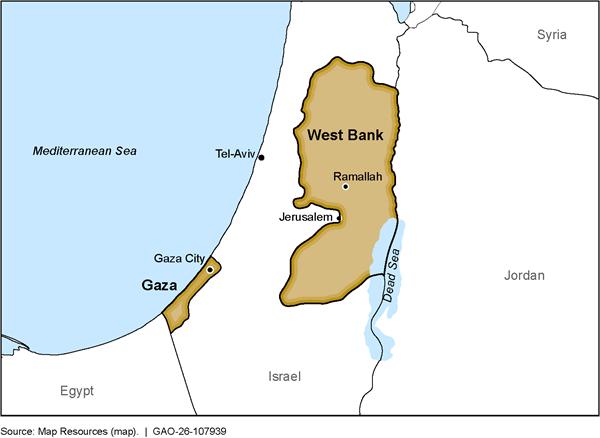
Since the signing of the Oslo Accords in 1993, the U.S. government has provided more than $7.8 billion in bilateral assistance for Palestinians in the West Bank and Gaza. This assistance primarily used funds appropriated through the ESF account. As of April 2025, about 3 million Palestinians live in the West Bank, and an estimated 2.1 million in Gaza. Another estimated 2 million Palestinians live in Israel as citizens. Of the Palestinians in the Middle East, about 5.9 million are registered refugees in the West Bank, Gaza, Jordan, Lebanon, and Syria. Figure 1 shows the location of the West Bank and Gaza relative to surrounding countries.
Until late 2023, governance of the West Bank and Gaza was split between two groups: the Palestinian Authority and Hamas, respectively. Fatah is the dominant faction in the West Bank and the elected head of the Palestinian Authority but does not control all the land in the West Bank.[8] Instead, the majority of the West Bank is under Israeli civil and military control. Hamas, a U.S.-designated terrorist organization, is the main opposition to Fatah. While Fatah was elected to lead the Palestinian Authority, Hamas seized control of Gaza in 2007.[9]
Since October 2023, major developments in the region’s security conditions and U.S. foreign assistance policy and administration have altered the provision of U.S. assistance in the West Bank and Gaza.
Security conditions. In October 2023, after decades of tension and cycles of violence, Hamas and other militant groups attacked Israel from Gaza, killing an estimated 1,200 people and taking 251 hostages. Israel responded with military operations against Hamas, controlling over half of the land in the Gaza Strip by October 2025, according to the United Nations. After Hamas’s initial attack, the USAID mission ceased all projects in Gaza and continued projects in the West Bank after a short pause, according to mission officials.
Following a series of Israel-Hamas ceasefire agreements during November 2023 through October 2025, the United Nations Security Council in November 2025 endorsed the Comprehensive Plan to End the Gaza Conflict in Security Council Resolution 2803.[10] This resolution welcomed the establishment of a Board of Peace to coordinate funding for Gaza, among other things. The council also authorized a temporary International Stabilization Force to secure and demilitarize Gaza. The Board of Peace was established in January 2026. In February 2026, the U.S. and Israel launched wide-ranging attacks against Iran, leading to the authorized departure of non-essential U.S. personnel at U.S. diplomatic missions in Israel.
According to State and United Nations reports, the Israel-Hamas conflict has resulted in dire humanitarian and economic conditions in Gaza. For example, the United Nations Office for the Coordination of Humanitarian Affairs reported that over 70,000 people in Gaza have been killed because of the Israeli military response as of February 2026, including over 1,500 since the ceasefire that began on October 10, 2025. Additionally, the United Nations reported that 81 percent of all structures have been destroyed or damaged along with 77 percent of the total road network. According to State, all subsequent economic activity in Gaza has come to a standstill. An April 2026 joint assessment by the United Nations, European Union, and World Bank estimated recovery and reconstruction needs in Gaza at around $71.4 billion.
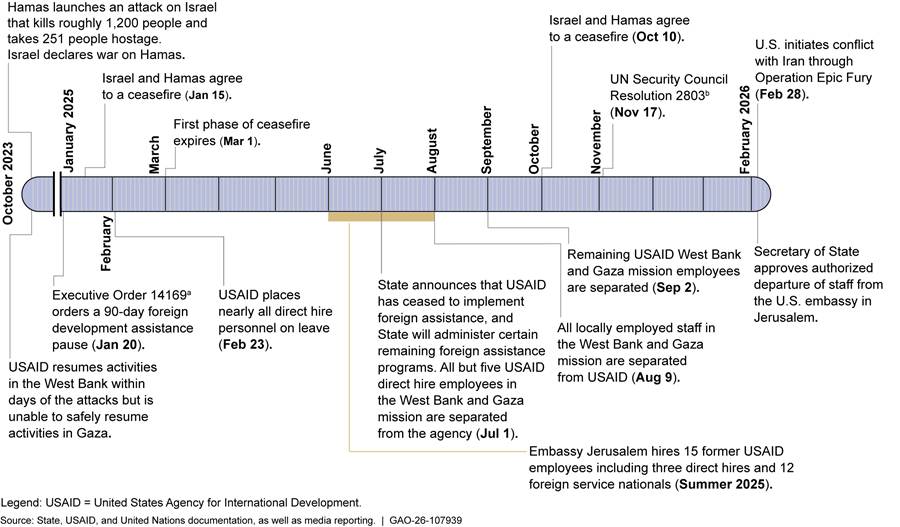
Similarly, the West Bank has undergone violence and difficult economic conditions since late 2023. According to State, Israel has engaged in settlement expansion in the West Bank, settler violence, and demolitions and evictions of Palestinian homes, among other actions. According to State reports, Palestinians have carried out attacks on Israelis, and Palestinian officials have made payments to the families of individuals imprisoned on charges of terrorism against Israel. Further, the West Bank has also experienced a sharp and protracted economic downturn due to movement restrictions, revocations in work permits, and decreased access to foreign markets. See figure 2 below for a timeline of key events related to the war and U.S. foreign assistance in the region.
Figure 2: Timeline of Key Conflict and Assistance Events Related to the West Bank and Gaza from October 2023 Through February 2026
aExec. Order No. 14169, Reevaluating and Realigning United States Foreign Aid, 90 Fed. Reg. 8,619 (Jan. 20, 2025).
bUnited Nations, Security Council Resolution 2803, S/Res/2803 (2025).
U.S. foreign assistance policy and administration. On January 20, 2025, the President began a process to reassess the alignment of U.S. foreign assistance worldwide with U.S. interests. In Executive Order 14169, the President directed a 90-day pause in U.S. foreign development assistance so that agency heads, in consultation with the Director of the Office of Management and Budget, could review and determine whether to continue, modify, or cease each foreign assistance program with the concurrence of the Secretary of State.[11] This process led to the cancellation of most USAID programming, according to a March 2025 statement by the Secretary of State. In July 2025, the Secretary further announced that USAID had ceased to implement foreign assistance, and that State would administer certain remaining foreign assistance programs. At that time, five direct hire employees remained at USAID’s West Bank and Gaza mission to conduct closure activities, with departures planned for early August and separation from USAID in September. All locally employed staff were separated from USAID in August 2025. Over the summer of 2025, the U.S. Embassy in Jerusalem hired 15 former USAID employees, including three direct hires and 12 locally employed staff, to manage foreign assistance functions.
Mission Order 21
USAID assistance to the West Bank and Gaza was administered under Mission Order 21, an administrative order describing policies and procedures to ensure that program assistance in the West Bank and Gaza would not inadvertently provide support to entities or individuals associated with terrorism.[12] The order covers the actions USAID should take to comply with provisions for the West Bank and Gaza Program included in appropriations acts, among other legal prohibitions against supporting entities or individuals associated with terrorism.[13]
Mission Order 21 specifies USAID’s criteria for (1) vetting recipients of assistance for links to terrorism,[14] (2) obtaining anti-terrorism certifications, and (3) including specific mandatory provisions in award documents. These criteria include factors such as: (1) whether a proposed award is a contract, grant, or cooperative agreement, (2) whether the proposed awardee is US-based, non-US, or a public international organization, and (3) the award amount.[15]
Vetting: Mission Order 21 establishes criteria requiring USAID to vet certain individuals and non-U.S. organizations for links to terrorism before awarding contracts, subcontracts, grants, cooperative agreements, and other types of training or in-kind assistance, with some exceptions. The criteria considers the dollar value of awards (including cumulative awards to the same recipient), award types, and how much time has passed since the recipient was last vetted to determine whether vetting is required. This vetting involves checking names and other identifying information against the Terrorist Watchlist and other sources to determine any links to terrorism. If an individual or organization is found to have links to terrorism, they will be recommended ineligible to receive funding. Vetting is not required for U.S. organizations, but it is required for certain key individuals at U.S. organizations’ field offices in the West Bank and Gaza, Israel, or in the city of Jerusalem.[16] Vetting also does not apply to public international organizations but does apply to their subawardees.[17] According to USAID, the vetting process provides reasonable assurance that program assistance is “not provided to or through any individual, private or government entity, or educational institution that is believed to advocate, plan, sponsor, engage in, or has engaged in, terrorist activity.”
Anti-terrorism certification (ATC): Mission Order 21 requires that all U.S. and non-U.S. organizations sign an anti-terrorism certification before receiving a grant or cooperative agreement from USAID. In the ATC, the recipient organization attests that it does not provide material support or resources for terrorism.[18] This requirement does not apply to USAID contracts.[19] The ATC certifies, in part, that the “recipient did not provide…and will take all reasonable steps to ensure that it does not and will not knowingly provide material support or resources to any individual or entity that commits, attempts to commit, advocates, facilitates, or participates in terrorist acts.”
Mandatory provisions: Mission Order 21 requires that all solicitations, as well as all prime awards and subawards for contracts, grants, and cooperative agreements contain two mandatory provisions in award documents. These provisions: (1) prohibit support for terrorism, and (2) restrict funding from being provided to facilities named after an individual or group that commits or has advocated, sponsored, or committed acts of terrorism.[20]
Compliance Reviews and Financial Audits
Beginning in 2003, every annual appropriations act has included a provision requiring at least annual audits of all contractors and grantees, and significant sub-contractors and subgrantees, under the West Bank and Gaza Program.[21] The FY 2026 appropriations act also included this requirement regarding NSIP assistance for the West Bank and Gaza program.[22] When USAID administered this program, the agency complied with this requirement by hiring external firms to perform compliance reviews and financial audits of its activities. One of the compliance review contracts was still active as of May 2026.
Fiscal Year 2022-2024 ESF Funded 37 Awards Before State Ended Nearly All Programming
USAID funded 37 prime awards using FY 2022-2024 ESF assistance for West Bank and Gaza. Each prime award supported one of the agency’s three development objectives: (1) Economic Growth and Infrastructure, (2) Investing in the Next Generation, and (3) Governance and Civic Engagement. USAID also used $67.5 million of FY 2022-2024 ESF assistance for debt relief payments to a Palestinian Authority creditor, the East Jerusalem Hospital Network. By July 2025 nearly all prime awards for the West Bank and Gaza program had either ended or been terminated, according to USAID. As of January 2026, debt relief to the East Jerusalem Hospital Network continued, while the single ongoing ESF-funded award in the West Bank and Gaza focused on building the capacity of the network.
ESF Funded 37 Awards from Fiscal Years 2022 – 2024
USAID allocated $624 million in FY 2022-2024 ESF assistance for the West Bank and Gaza. USAID obligated most of this assistance to a total of 37 prime awards to support program activities in the West Bank and Gaza. As of October 1, 2025, $95.7 million in FY 2022-2024 funding was never obligated, according to USAID data, and thus had expired, according to State.[23] Additionally, $347 million of the obligated funding in our scope was not disbursed to awardees (unliquidated obligations). These unliquidated obligations may be available for State to deobligate and reobligate for an additional 4 years past their original expiration date. For a full breakdown of the FY 2022-2024 ESF assistance, see table 1 below.
Table 1: Fiscal Year 2022 through 2024 Economic Support Fund Assistance for West Bank and Gaza as of May 2026
In dollars
|
Fiscal year appropriated |
Allocated |
Obligated |
Unobligated balancesa |
Total disbursed |
Unliquidated obligationsb |
|
2022 |
219,000,000 |
188,416,788 |
30,583,212 |
111,096,168 |
77,320,620 |
|
2023 |
230,000,000 |
216,682,119 |
13,317,881 |
61,758,945 |
154,923,174 |
|
2024 |
175,000,000 |
123,223,864 |
51,776,136 |
8,437,644 |
114,786,220 |
|
Total |
624,000,000 |
528,322,771 |
95,677,229 |
181,292,757 |
347,030,014 |
Source: U.S. Agency for International Development (USAID) data | GAO‑26‑107939
aFunds appropriated to the Economic Support Fund generally have an initial period of availability for obligation of 2 fiscal years. According to State, these amounts were never obligated and thus all unobligated balances listed in this column have expired as of October 1, 2025.
bFunds obligated during the initial 2-year period of availability remain available for deobligation and reobligation for an additional 4 years from the date when the availability of such funds would otherwise have expired. After this period, the funds are no longer available for new obligations but remain available for expenditure and valid adjustments for an additional 5 fiscal years.
According to State officials, State has not obligated any funds for assistance to West Bank and Gaza from the FY 2025 ESF account or from the FY 2026 NSIP account. Further, State has not determined which State components will be responsible for new ESF or NSIP-funded activities in the West Bank and Gaza.
USAID used $67.5 million of FY 2022-2024 ESF assistance for debt relief payments to a Palestinian Authority creditor, the East Jerusalem Hospital Network, as allowable under U.S. law.[24] USAID officials told us that an external audit firm vetted all parties involved beforehand when USAID managed these payments. USAID officials also emphasized that none of the money flowed through any financial system of the Palestinian Authority at any step in the process. USAID sent the funds to a bank which then sent the funds to the hospitals.
The remainder of the FY 2022-2024 ESF funding supported project assistance. We reviewed all 37 prime awards that received FY 2022-2024 ESF project assistance. Some of these awards also received prior fiscal year ESF funding. As a result, the total obligation amounts by development objective in the following paragraphs exceed the total obligation amounts in table 1. According to USAID, four of the 37 prime awards were “buy-in” awards managed by USAID Washington to provide global services, or regional services for missions and for certain Washington bureaus. USAID West Bank and Gaza mission officials told us the mission “bought into” these awards by requesting services to be performed in Jerusalem, West Bank, or Gaza. The mission transferred funds to USAID Washington to obligate under these global awards for the cost of the requested services.
The USAID West Bank and Gaza mission categorized its awards under one of three development objectives: (1) Economic Growth and Infrastructure, (2) Investing in the Next Generation, and (3) Governance and Civic Engagement (see figure 3 below).
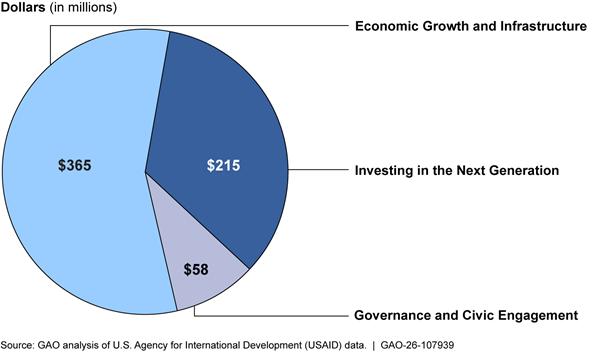
Economic Growth and Infrastructure: The largest portion of the program assistance supported the agency’s Economic Growth and Infrastructure development objective. As of June 2025, USAID had obligated more than $356 million under this objective to the awards we reviewed. Awards addressing this objective included those related to health (including water), infrastructure, private sector competitiveness, stabilization operations, and security sector reform. For example, one award sought to increase household level access to safe drinking water and sanitation services in Gaza to improve hygiene practices. Another award aimed to increase equitable access to safe, sustainable, and climate-resilient sanitation services.
Investing in the Next Generation: The second-largest portion of program assistance supported this development objective. As of June 2025, USAID had obligated more than $215 million under this objective to the awards we reviewed. Awards addressing this objective included those related to education, health, social and economic services, and protection of vulnerable populations. For example, one award sought to strengthen non-governmental early childhood and primary educational opportunities in the West Bank, Gaza, and East Jerusalem. Another award aimed to link vulnerable youth to employment opportunities or help them start their own business in increasingly in-demand technical sectors, according to USAID.
Governance and Civic Engagement: The smallest portion of program assistance supported the agency’s Governance and Civic Engagement development objective. As of June 2025, USAID had obligated more than $58 million under this objective to the awards we reviewed. Awards addressing this objective included those related to civil society, good governance, and rule of law. For example, one award sought to improve the delivery of essential public services and promote inclusive and accountable governance. By strengthening institutional capacities, the award aimed to better respond to citizens’ concerns and decrease frustrations that are drivers of insecurity, according to USAID. Another award tried to build the capacity of local civic organizations to advocate for citizen interests and deliver essential services, according to USAID.
Nearly All ESF-Funded Activities Have Ended Except for Support for the East Jerusalem Hospital Network
By July 2025, according to State officials, nearly all assistance in the scope of our review had ended as the U.S. government scaled back its foreign assistance for the West Bank and Gaza and globally. Since taking over West Bank and Gaza programming, State has continued to provide debt relief payments and project assistance to the East Jerusalem Hospital Network. The East Jerusalem Hospital Network consists of six non-profit charitable hospitals that have a long history of providing services to patients from East Jerusalem, the West Bank, and Gaza. The network has recently struggled with critical cash flow issues because the Palestinian Authority Ministry of Health has not paid for services provided to patients referred from the West Bank and Gaza to the network’s hospitals. State officials told us they followed USAID’s process for debt relief payments to the network.
The project assistance award to the East Jerusalem Hospital Network supports the network’s capacity building project, according to State. This award restarted in March 2025, when State rescinded its February 2025 termination. State also provided a new obligation of $600,000 in FY 2024 ESF funds to the program in September 2025, according to officials. They added that this program is now part of a global award managed by State’s Bureau of Global Health Security and Diplomacy.
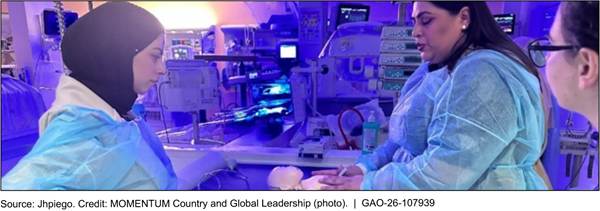
According to the awardee, the program aims to help the hospitals build capacity, upgrade skills, improve service quality, and replace old equipment while also diversifying income streams to make the network more resilient and less reliant on the Palestinian Authority. Over 950,000 beneficiaries have received lifesaving health services through this initiative since the start of the project in FY 2023. A pediatric care training provided by this program can be seen in figure 4 below.
Figure 4: U.S.-Funded Neonatal Resuscitation Training for East Jerusalem Hospital Network Pediatric Residents

During our April 2025 fieldwork, officials at the West Bank and Gaza mission characterized the award termination process as inconsistent and unpredictable. For example, some awards were restarted and terminated multiple times. Mission officials told us that such sudden termination of projects could create unintended harm. For example, the mission described one terminated infrastructure project that left behind 14 kilometers of “ripped up” roads and 18 kilometers of incomplete wastewater collection pipelines, leading to major disruptions for residents. The West Bank and Gaza mission also identified instances where the termination of ESF-funded awards forfeited potential benefits. For example, the early termination of the Mission’s flagship youth initiative removed a source of life skills, remedial education, and workforce readiness training intended to offer 85,000 marginalized youth safe, productive alternatives to violence and instability. In another example provided by the mission, a project’s early termination stopped the rehabilitation of water and sanitation system infrastructure. According to USAID officials, this exacerbated conditions in an already difficult humanitarian situation.
USAID Complied with Anti-Terrorism Policies and Procedures with a Few Instances of Noncompliance
We assessed USAID’s compliance with its anti-terrorism policies and procedures and found that USAID generally fulfilled these requirements, but some noncompliance posed a potential risk. USAID generally complied with Mission Order 21’s vetting, anti-terrorism certification, and mandatory provision requirements at both the prime award and subaward levels. However, USAID and State could not provide documentation for several prime award ATCs and mandatory provisions, which officials attributed to factors associated with USAID ceasing operations in 2025. Further, we identified three instances of noncompliance where the subaward agreements’ mandatory provisions were missing required language. Additionally, two of the 21 compliance reports we reviewed found instances of noncompliance with the mission order.
USAID Generally Complied with Requirements for Prime Awards but Could Not Provide All Documentation
We assessed whether USAID complied with its anti-terrorism policies and procedures related to vetting, anti-terrorism certifications, and mandatory provisions for the 37 prime awards issued by USAID using FY 2022-2024 ESF funds. According to our assessment, USAID generally complied with these requirements at the prime award level. However, USAID and State were unable to provide documentation of Mission Order 21 anti-terrorism certifications for two awards that required them, although the awardees had signed similar certifications. Additionally, USAID and State could not provide mandatory provision documentation for three awards. In each case, State officials stated they could not provide the relevant award documentation due to the departure of key USAID staff, shutdown of legacy USAID records systems, and the incomplete transition of USAID records to State.
Table 2: USAID’s Compliance with Anti-Terrorism Policies for Prime Awards Funded with Economic Support Fund Assistance, Fiscal Years 2022–2024
|
|
Required |
Complied |
Could not fully demonstrate compliance |
||
|
Prime awards (37 total) |
Vetting |
32 |
32 |
0 |
|
|
Anti-Terrorism Certifications |
12 |
10 |
2 |
||
|
Mandatory Provisions |
37 |
34 |
3 |
||
Source: GAO analysis of U.S. Agency for International Development (USAID) data and award documentation. | GAO‑26‑107939
USAID Vetted All Prime Awards in Accordance with Its Anti-Terrorism Policies
Our analysis found that USAID fully complied with its vetting requirements for prime awards. We assessed all 37 prime awards that received FY 2022-2024 ESF funds, 32 of which required vetting.[25] Of the 32 awards that required vetting, 29 were made to U.S. awardees with field-based key individuals and three were made to a non-U.S. awardee.
We analyzed the contract documentation for all 32 prime awards for which vetting was required. In each instance where a vetting requirement was triggered under Mission Order 21, we verified that the awardee had subsequently received an eligible vetting result from USAID. USAID completed required vetting for all 32 prime awards.[26]
USAID Provided Mission Order 21 ATCs for Nearly All Prime Awards Requiring Them
Our analysis found that USAID complied with its ATC requirements in 10 of 12 prime awards that required them.[27] These ten prime awards contained the required ATC timelines and language specified in Mission Order 21. The remaining two awards contained ATCs with shorter timelines and language that was similar but not identical to the ATC language required by Mission Order 21.
Timelines: Mission Order 21 requires the awardee to certify they did not engage in transactions with or provide material support to individuals or entities associated with terrorism within the previous ten years. In contrast, the two outlier awards’ ATCs required the awardee to certify they had not provided such support within the previous three years.
Language: Mission Order 21 ATC language also requires that the awardee will take all reasonable steps to ensure that it does not and will not knowingly provide material support or resources to any individual or entity that commits, attempts to commit, advocates, facilitates, or participates in terrorist acts; or has committed, attempted to commit, facilitated, or participated in terrorist acts. It further provides steps that may enable the awardee to comply with its obligations, as well as definitions of various terms. Other than some definitions, this language is missing from these two ATCs.
Embassy officials told us that awardees in the West Bank and Gaza were generally required to sign the specific ATC associated with Mission Order 21. However, State officials told us they could not provide the Mission Order 21-specific ATCs for these two awards because USAID personnel with knowledge of the award files had already left the agency when USAID began transferring these files to State. According to officials, this was an issue that arose in many cases during the transition of program administration from USAID to State where State did not receive required documentation, particularly for terminated awards.
USAID and State Could Not Provide Documentation of Mandatory Provisions for Three of 37 Prime Awards
Our analysis found that USAID complied with its mandatory provision requirements for 34 of 37 prime awards in our scope. However, USAID and State could not provide us with documents containing mandatory provisions for three of the prime awards. Officials cited the departure of key USAID staff, the shutdown of legacy USAID records systems, and the inefficient transition of USAID records to State as reasons why they could not locate the original award documentation or determine if the documents had ever existed.
USAID Complied with Vetting and Certification Policy for Subaward Actions but Did Not Fully Comply with Mandatory Provision Policy
To assess whether USAID complied with its anti-terrorism policies and procedures at the subaward level, we selected a generalizable sample of 130 subaward actions from 2,220 subaward actions requiring vetting according to USAID data.[28] We found that USAID complied with its vetting and anti-terrorism certification requirements for the sampled subaward actions but did not fully comply with mandatory provisions requirements. In three cases, the mandatory provisions were missing a subsection that requires prompt notification of changes in key individuals that would trigger a requirement for updated vetting. The absence of awardee agreement to this provision in subawards created a risk that individuals associated with terrorism could be assigned to a key role for the award.
Table 3: USAID’s Compliance with Anti-Terrorism Policies and Procedures for Sampled Subaward Actions Funded with Economic Support Fund Assistance, Fiscal Years 2022–2024
|
|
Required |
Complied |
Did not fully comply |
Estimated subaward action compliance rateb |
|
|
Subaward actionsa |
Vetting |
130 |
130 |
0 |
97.72-100% |
|
Anti-terrorism Certifications |
57 |
57 |
0 |
N/Ac |
|
|
Mandatory Provisions |
130 |
127 |
3 |
93.4-99.52% |
|
Source: GAO analysis of U.S. Agency for International Development (USAID) data and award documentation. | GAO‑26‑107939
aWe selected a generalizable sample of 130 in-scope subaward actions out of a population of 2,220.
bBecause all sample estimates are subject to sampling error, we present our results using a 95 percent confidence interval. See appendix I for more information.
cSubawards can be associated with multiple subaward actions. Because we sampled subaward actions rather than subawards, our sample of subaward actions is not generalizable to the larger population of subawards requiring ATCs.
USAID Generally Vetted Subaward Actions in Accordance with Its Anti-Terrorism Policies
Our analysis found that USAID fully complied with its vetting requirements for the subaward actions in our sample. Based on this analysis, we estimate that between 97.7 and 100 percent of all 2,220 subaward actions requiring vetting were vetted in accordance with USAID policy (see appendix I for more information).[29] To obtain this estimate, we assessed a generalizable sample of 130 subaward actions, all of which required vetting prior to award, according to USAID data.[30] For each relevant subaward action, we verified that the awardee had received an eligible vetting result from USAID prior to the award.[31]
USAID Documented ATCs for Required Subawards
Our analysis of the subawards in our sample found that USAID had anti-terrorism certifications on file for all subawards requiring them. Our sample of 130 subaward actions contained 57 actions that corresponded with 55 unique subaward agreements requiring ATCs because they were grants or cooperative agreements.[32] The remaining 73 subaward actions came from subawards which did not require ATCs because they were contracts. In addition to determining ATC compliance, we also verified that the awardees and subawardees signed the certification on or before the award start date.[33]
We Identified Three Subaward Agreements with Incomplete Mandatory Provisions Which Posed Potential Risk
Our analysis found that USAID did not fully comply with mandatory provision requirements for three of the 130 subaward actions in our sample. We assessed a generalizable sample of 130 subaward actions and found that three were associated with subaward agreements lacking full documentation of mandatory provisions. Based on our analysis, we estimate that between 0.48 and 6.6 percent of all 2,220 subaward actions are associated with an underlying subaward agreement without compliant mandatory provisions.[34] The other 127 were associated with subaward agreements that included the required mandatory provisions in their entirety. Based on our analysis, we estimate that between 93.4 and 99.52 percent of all 2,220 subaward actions are associated with an underlying subaward agreement containing compliant mandatory provisions.[35] See appendix I for more information.
In the three non-compliant subawards, the award documentation did not include subpart (g) of the mandatory “Prohibition Against Terrorism” provision. The prime awardee in question believed it did not need to include subpart (g) in these subaward agreements. However, Mission Order 21 requires subpart (g) be included in each subaward made by USAID prime contractors or recipients.
Subpart (g) obliges the contractor or recipient to promptly notify USAID of changes in its key individuals or in the identity of key individuals of any subaward recipient. Without subpart (g), subawardees may not receive notice of their obligations to provide notification of changes in their key individuals to ensure appropriate vetting of those individuals. If subawardees do not provide notice of these changes and vetting is not conducted as a result, this raises the risk that individuals associated with terrorism could be assigned to a key individual role under a government-funded subaward. Any U.S. funding diverted to entities or individuals associated with terrorism could pose a potential threat to national security and a potential reputational risk to the agency administering the assistance.
Former USAID officials who had transferred to the U.S. Embassy in Jerusalem told us they could not comment on the missing language due to their lack of access to relevant documentation. A third-party compliance review contracted by the West Bank and Gaza mission also found three other instances of incomplete mandatory provisions in subawards associated with the same prime awardee.
Two USAID Compliance Reviews Found Instances of Noncompliance
USAID monitored compliance with Mission Order 21 by using external firms to conduct compliance reviews and financial audits of awardees with ongoing awards. Two of the 21 compliance reports we reviewed found instances of noncompliance with the mission order. In one case where the award was ongoing, the awardee addressed the issues. In the other case where the award had ended, USAID notified the awardee of the issue but took no further action. None of the 12 financial audits that we reviewed found instances of noncompliance with Mission Order 21.
Compliance Reviews
Since our December 2023 report, the West Bank and Gaza mission conducted 21 compliance reviews of awards funded by ESF assistance, 19 of which found no instances of noncompliance with Mission Order 21, and two which found a total of five instances of noncompliance.[36]
The first compliance review examined a sample of 64 subawards for compliance with Mission Order 21, of which 16 were subject to vetting. The review found four instances of noncompliance on the part of the prime awardee, including three instances of incomplete mandatory provisions and one instance of missing mandatory provisions.[37] According to the review, USAID vetted the 16 subawards subject to vetting in accordance with Mission Order 21. The compliance review for this awardee covered award activities from September 28, 2022, to September 30, 2023.
In a letter to the prime awardee, USAID recommended that the awardee strengthen its internal controls over compliance and the internal procedures specifically regarding the ATC and the mandatory provisions to mitigate any future occurrences of noncompliance. USAID also requested that the awardee amend the subawards and include the complete versions of the mandatory provisions and revisit all West Bank and Gaza mission-funded subawards to ensure that they contain the required provisions. The awardee responded to USAID in writing with a detailed list of corrective actions intended to address the non-compliance issues.
The second compliance review found one instance of missing mandatory provisions and no other noncompliance with either ATCs or vetting requirements. The audit firm reviewed all four of one prime awardee’s subawards for compliance with Mission Order 21, three of which were subject to vetting, according to the firm. USAID officials told us they did not request any corrective actions from the awardee because the award had already ended. The compliance review for this awardee covered award activities from October 1, 2023 to September 30, 2024. We previously recommended that USAID conduct compliance reviews in time to take corrective actions during the award, should auditors detect any noncompliance.[38]
Financial Audits
In addition to the compliance review process, USAID oversaw compliance with Mission Order 21 through financial audits performed by external audit firms approved by USAID’s Regional Inspector General. The mission outsourced 12 financial audits of organizations receiving awards funded with ESF assistance since our December 2023 report, none of which found instances of noncompliance with Mission Order 21.[39]
Future Economic Assistance Will Depend on Security Conditions and Opportunities Exist to Strengthen Future Oversight
State will administer any future ESF or NSIP-funded activities in the West Bank and Gaza, but officials stated that security conditions must improve before any such activities can begin. In the interim, State NEA is developing anti-terrorism policies and procedures for any new ESF or NSIP-funded assistance to the West Bank and Gaza that it might implement. However, the timeliness and scope of these new policies could affect when State obligates the remaining ESF and NSIP funds for activities in the region. Furthermore, as NEA develops these new policies it has an opportunity to incorporate mandatory provisions into future anti-terrorism procedures—a leading practice for anti-fraud and anti-terrorism oversight. It can also incorporate lessons learned from USAID regarding timeliness of mandatory annual compliance reviews.[40]
Security Conditions in West Bank and Gaza Will Affect Future Assistance
In May 2026, State officials told us they had not finalized plans regarding how remaining ESF and NSIP assistance would fit into any future economic development or reconstruction efforts in the West Bank and Gaza. According to State officials, the department’s top priority in the West Bank and Gaza region is resolving the ongoing security and humanitarian crises through means outlined in United Nations Security Council Resolution 2803, such as the Board of Peace and the International Stabilization Force. Further, since the adoption of United Nations Security Council Resolution 2803, State has been working with other donors to address immediate humanitarian needs in Gaza and to solicit personnel, equipment, and financial contributions for the International Stabilization Force. Officials stated that while planning had identified potential early recovery and economic development programming, the United States would not begin funding such efforts until security in the West Bank and Gaza improves.
Furthermore, State has not determined implementation responsibility for future programming. According to officials, State’s Bureau of Near Eastern Affairs (NEA) is managing USAID’s active programming for the West Bank and Gaza and could potentially implement future assistance to the area. However, future ESF or NSIP funds could also potentially be allocated to the U.S. Embassy in Jerusalem or to other technical bureaus to execute new programming.
Timeliness and Scope of New Anti-Terrorism Policies and Procedures Could Affect Future Assistance
Delays in Developing Anti-Terrorism Policy Could Affect State’s Ability to Use Funds
As of June 2026, State NEA is reviewing USAID’s policies and procedures to determine how it will conduct anti-terrorism oversight. In May 2026, NEA finished a terrorist financing risk assessment for the West Bank and Gaza that officials stated would provide the basis for developing updated anti-terrorism oversight policies and procedures. According to NEA officials, the conflict with Iran delayed this process due to the tenuous security environment in Israel and related authorized departure of American staff. In the meantime, State continues to utilize USAID’s existing policies and procedures to administer and vet the few ongoing activities inherited from USAID in the West Bank and Gaza.
As part of this policy development, NEA officials identified several elements of Mission Order 21 that they are considering revising. For example:
· Vetting threshold. Mission Order 21 established a $25,000 cumulative vetting threshold for contracts and subcontracts involving multiple awards to the same firm or individual within a 12-month period. According to NEA officials, adhering to this cumulative threshold required extensive tracking and reporting to know whether a given modification to a contract or subcontract might push a recipient over the $25,000 mark. In contrast, other mission orders used a flat threshold of $25,000 to trigger vetting. They stated they would be evaluating the relative utility of the cumulative threshold when developing a new anti-terrorism policy for the West Bank and Gaza.
· Vetting timelines. Mission Order 21 contained vetting timelines that State officials identified as creating additional administrative burdens. For example, vetting approval of an awardee generally remained in effect for that particular award for three years, provided there was no change in the awardee’s key individuals. However, any new award or time extension of an existing award required new vetting if more than 12 months had passed since the awardee’s original vetting approval. Officials told us they would be interested in creating a more standardized timeline for vetting in any new policy for the West Bank and Gaza.
NEA’s new anti-terrorism policies and procedures will also be informed by the ongoing integration of USAID’s vetting capabilities with State’s. USAID conducted more extensive anti-terrorism vetting than State does for its programs. Specifically, USAID formerly detailed analysts—18 according to officials—to the Federal Bureau of Investigation’s Threat Screening Center (formerly known as the Terrorist Screening Center) in the United States. Some of these analysts have transitioned to State and continue to work at the Threat Screening Center. Under USAID’s vetting process, they analyzed any derogatory information and provided specific recommendations to approve or deny eligibility to prospective awardees.[41]
In contrast, State’s Office of Risk Analysis and Management conducts counterterrorism name-check vetting upon request but does not analyze the vetting results or recommend whether to approve or disapprove eligibility for funding. Rather, the programming bureau is solely responsible for determining the significance and relevance of any derogatory information uncovered by the vetting process, according to State OIG. State officials characterized the office’s process as primarily focused on due diligence. According to State officials from the Threat Screening Center and Office of Risk Analysis and Management, State is in the early stages of reviewing both vetting processes to determine how best to integrate their capabilities. This integration will inform any new vetting policy and procedures stemming from NEA’s terrorist financing risk assessment.
The annual appropriations act for fiscal year 2026 included the same statutory oversight requirements for assistance to the West Bank and Gaza under the NSIP account as had been in place for prior ESF assistance.[42] Among other things, it requires that State take all appropriate steps to ensure that such assistance is not provided to individuals associated with terrorism before any funds for assistance to the West Bank and Gaza are obligated. If NEA does not establish anti-terrorism policies in a timely manner, it may delay State in providing assistance in the West Bank and Gaza using ESF and NSIP funds. Any future reconstruction or economic development efforts in the region could lose access to this financial support.
Further, federal internal control standards state that documentation of controls, including changes to controls, is evidence that controls are identified and capable of being monitored, evaluated, and communicated to those responsible for their performance. Documenting changes to anti-terrorism vetting and the rationale behind such changes would help State effectively determine if they have adequately managed risks. It would also help State communicate new vetting requirements to potential implementers as well as Congress.
Scope of NEA’s New Anti-Terrorism Policies and Procedures May be Limited
Differences in how USAID and State approached vetting requirements may limit the scope of NEA’s nascent anti-terrorism policy.
Country-specific vetting policy: Chapter 319 of USAID’s Automated Directives System (ADS) contained the policy directives and required procedures for regional bureaus to establish or modify partner vetting systems at missions in their region. As of January 2025, ADS 319 required partner vetting systems for seven locations, all of which issued mission orders for vetting policies and procedures such as Mission Order 21 for the West Bank and Gaza.[43] This enabled USAID to prescribe specific risk mitigation procedures for any assistance going to those specific countries.
Bureau-specific vetting policy: In contrast, State has not created country-specific vetting policies comparable to USAID’s mission orders, according to State officials. Instead, State’s latest vetting policy contained in a 2022 update to the Foreign Assistance Manual gives bureaus the flexibility to develop risk management processes appropriate for State-funded programs they are responsible for.[44] As a result, any new NEA anti-terrorism policies and procedures for assistance to the West Bank and Gaza would apply solely to future NEA awards unless other bureaus adopt them as well. If State allocates new ESF or NSIP assistance for West Bank and Gaza to another bureau, officials stated that the bureau could instead conduct their own risk assessment and develop risk mitigation measures in their own anti-terrorism policy.
Embassy internal vetting procedures: According to State policy, bureaus should take into account the views of the Chief of Mission in the relevant country when deciding what review process is appropriate for any particular program. Further, Chiefs of Mission should work with the applicable bureau to implement vetting processes. Officials stated that embassies are generally best positioned to assess in-country risks, and that the U.S. Embassy in Jerusalem has pre-existing internal vetting procedures for awards and activities they issue and manage. According to these officials, NEA is working with the embassy to determine how these internal vetting procedures might change in response to updates to NEA’s policy. Additionally, they told us competing priorities such as the conflict with Iran and the authorized departure status at the embassy have delayed this work. They characterized such decisions as particularly important if State makes the embassy responsible for future West Bank and Gaza programming. As of May 2026, officials stated that no decisions had been made regarding responsibility for future assistance activities in West Bank and Gaza.
The annual appropriations act for fiscal year 2026 states that the Secretary of State shall, as appropriate, establish procedures specifying the steps to be taken to ensure that assistance to the West Bank and Gaza is not provided to individuals associated with terrorism.[45] Additionally, Standards for Internal Control in the Federal Government and GAO’s Fraud Risk Framework both state that management should document the results of risk assessments, including the response to those risks.[46] Further, State’s guidance on risk management states that risks should be identified, evaluated, and mitigated.[47] Until State determines and documents how components involved in providing ESF and NSIP assistance in the West Bank and Gaza will mitigate terrorism risk, it may not be able to ensure that such assistance is not diverted to terrorist ends.
State Could Benefit from Applying Leading Practices Regarding Mandatory Anti-Terrorism Provisions
Mission Order 21 requires that certain mandatory provisions be incorporated into all USAID West Bank and Gaza program awards but State does not have such a general requirement, according to officials. Such mandatory provisions provide notice to awardees and subawardees of their specific obligations under USAID’s anti-terrorism policies for the West Bank and Gaza Program. For example, the “Prohibition against Support for Terrorism” mandatory provision requires awardees to keep USAID appraised of changes in the “key individuals” of the awardee and of all subawardees vetted by USAID, among other things. It also reserves the right of USAID to rescind its approval of subawards at any time if USAlD becomes aware of information indicating that the subaward is contrary to U.S. law or policy prohibiting support for terrorism. The provision also details remedies available to USAID in the event of noncompliance. For example, it reserves the right of USAID to terminate the prime award if USAID determines that the awardee is involved in or advocates terrorist activity. Additionally, the mandatory “Restriction on Facility Names” provision states that USAID can disallow any or all costs incurred by the contractor or recipient with respect to the facility and, if necessary, issue a bill for collection for the amount owed, in addition to any other remedies that may be available to USAID in cases of noncompliance.
In contrast, according to State officials, State does not currently use country-specific mandatory provisions in its assistance agreements. State’s guidance on terrorist financing risk mitigation does not generally require these provisions, although it does identify them as an option that bureaus can use to mitigate risk.[48] At the time of our review, NEA had not yet evaluated the potential use of mandatory clauses in future anti-terrorism risk management for West Bank and Gaza programming.
GAO’s Fraud Risk Management Framework states that managers should design and implement a strategy with specific control activities to mitigate assessed fraud risks and collaborate to help ensure effective implementation. GAO and international fraud risk prevention guidance have identified the use of mandatory provisions as a leading practice for mitigating these risks in foreign assistance. GAO has highlighted USAID’s use of mandatory provisions in award agreements to ensure disclosure of fraud or mitigate terrorism-related risks as a beneficial risk management practice and has also noted USAID’s ability to apply additional terms to award agreements as necessary to address specific local risks.[49] GAO has also identified weak or limited counter fraud or anti-terrorism clauses in delivery partner agreements and contracts as an inadequate internal control that could increase the risk of fraud, waste, and abuse.[50]
Furthermore, the World Bank’s anti-corruption guidelines recommend that borrowers of World Bank loans include anti-corruption clauses in their agreements with other recipients. Under these clauses, the recipient of loan proceeds agrees to abide by the Anti-Corruption Guidelines and the Borrower may terminate the agreement if the recipient is ever sanctioned by the World Bank.[51] Similarly, United Nations guidance encourages the use of clauses in legal agreements with all parties to facilitate implementing sanctions, noting their obligation to comply with the anti-fraud and anti-corruption policy and clearly stating that the United Nations organization may impose sanctions or exit a contract in the case of noncompliance.[52]
If State does not develop and properly incorporate anti-terrorism clauses into awards funded by ESF or NSIP assistance for the West Bank and Gaza, awardees and subawardees may not be fully aware of their anti-terrorism obligations. Further, including these provisions would allow State to address risks specific to West Bank and Gaza assistance while also strengthening its ability to respond to noncompliance, by stipulating that partners who do not comply may be subject to termination or their costs may be disallowed.
State Could Benefit from Leveraging Lessons Learned in Making Decisions on Compliance Reviews
State must ensure that audits of all contractors and grantees and significant subcontractors and sub-grantees under the West Bank and Gaza program are conducted on at least an annual basis.[53] USAID previously established a post-award compliance review process as an internal control to identify and address noncompliance with Mission Order 21 requirements. However, we found these reviews did not always occur in time to enforce the relevant remedies for awardees’ noncompliance with Mission Order 21 requirements. In our March 2021 report on West Bank and Gaza oversight, we found at least 18 subawards were no longer active by the time the compliance review was submitted.[54] If audits are not completed until after an award has ended, the audit is significantly less useful because corrective actions such as withholding cash payments or approval of further awards can no longer be taken.
We recommended that USAID conduct post-award compliance reviews of prime awardees and their subawards of ESF assistance for USAID’s West Bank and Gaza program in time to identify noncompliance and take appropriate actions before the awards end. USAID agreed and in response committed to conduct compliance reviews of prime awardees and their subawards within the first 18 months of implementation, contingent upon available resources. USAID guidance also stated that the West Bank and Gaza mission had incorporated a special award provision for future awards regarding the need for such compliance reviews.
According to GAO’s Fraud Risk Framework, as a leading practice, managers should use “lessons learned” about internal control weaknesses and mitigation steps to improve fraud risk management activities. State has taken over USAID’s former role of administering ongoing ESF-funded activities and any future ESF or NSIP-funded activities in the West Bank and Gaza and is now responsible for ensuring that compliance audits are conducted on at least an annual basis.[55] According to State officials, the manner and extent to which USAID audited its West Bank and Gaza programming was unique, and the future of similar compliance reviews and audits will depend on how State and USAID processes are integrated going forward.
Given the extent to which USAID struggled to complete these audits in a timely manner without established timelines, State may experience similar challenges. This challenge may be more likely, since State does not have prior experience conducting or outsourcing these audits and is undergoing significant organizational changes.
State has an opportunity to learn from USAID’s experience in mitigating risks through compliance audits by establishing clear timelines for such audits of West Bank and Gaza assistance at the outset. Clearly established timelines could strengthen the timeliness of compliance audits required by State, which would help State ensure that resources are not diverted to entities or individuals associated with terrorism.
Conclusion
As of June 2026, the crisis in and around the West Bank and Gaza presents significant challenges for foreign assistance. While USAID was able to continue its activities in the West Bank until it ceased those operations, State may need additional preparations before it is ready to obligate funding for foreign assistance to the area. These preparations include taking steps to prevent the potential diversion of funds and developing anti-terrorism policies and procedures in line with existing law.
An important part of these preparations is for State NEA to document the actions it will take to mitigate risks in new policies and procedures. For example, decisions regarding vetting criteria, timelines, and USAID’s former intelligence-based vetting capability should specifically address congressional oversight requirements prior to any new obligation of funds. Additionally, documenting NEA’s risk mitigation measures for West Bank and Gaza assistance would effectively convey new requirements to stakeholders, potential implementers, and Congress.
While NEA is developing new anti-terrorism policies and procedures for any new ESF and NSIP assistance to West Bank and Gaza, we acknowledge that State has not finalized planning or management responsibility for such assistance. Until State determines and documents how other bureaus and the U.S. Embassy in Jerusalem will mitigate risk in the context of providing this assistance, either in concert or separate from NEA’s efforts, it cannot fully ensure that such assistance will not be improperly diverted.
In the meantime, as NEA determines what its own risk mitigation measures will be, it can leverage best practices and lessons learned from USAID’s oversight experiences. For example, including mandatory provisions in award agreements is a leading practice that would firmly establish anti-terrorism requirements and help ensure State’s ability to respond effectively to any instances of noncompliance. Furthermore, NEA could customize the terms of these provisions to specifically address any risks unique to the West Bank and Gaza.
Additionally, NEA could directly leverage USAID lessons learned by adopting timelines for any future compliance audits. These timelines would be a relatively simple internal control that, if established at the outset, could help ensure that appropriate corrective actions can be taken to address any noncompliance before awards expire. This internal control would help State better ensure that resources are not diverted to entities or individuals associated with terrorism.
Recommendations for Executive Action
We are making the following four recommendations to State:
The Secretary of State should direct the Assistant Secretary for Near Eastern Affairs to finalize anti-terrorism policies and procedures for ESF or NSIP-funded activities in the West Bank and Gaza and determine the steps it will take to appropriately mitigate terrorist diversion risk, including how USAID’s previous intelligence-based vetting capabilities will be used. (Recommendation 1)
The Secretary of State should determine and document how State will mitigate terrorist diversion risk for any State components beyond NEA that could manage future ESF or NSIP-funded activities in West Bank and Gaza, such as the U.S. Embassy in Jerusalem. (Recommendation 2)
The Secretary of State should direct the Assistant Secretary for Near Eastern Affairs and any other State components providing ESF or NSIP-funded award in the West Bank and Gaza to adopt the use of mandatory anti-terrorism provisions in any new policies and procedures. (Recommendation 3)
The Secretary of State should direct the Assistant Secretary for Near Eastern Affairs and any other State components providing ESF or NSIP-funded awards in the West Bank and Gaza to establish timelines to better ensure that compliance audits under this program are conducted in time to identify noncompliance and take appropriate actions before awards end. (Recommendation 4)
Agency Comments
We provided a draft of this report to State and USAID for comment. State concurred with our four recommendations in its comments and committed to taking various actions to strengthen anti-terrorism oversight. The agency’s comments are reproduced in appendix II. State also provided technical comments that we incorporated as appropriate. USAID provided no comments on the draft report.
We are sending copies of this report to the appropriate congressional committees, the Secretary of State, the Acting Administrator of USAID, and other interested parties. In addition, the report will be available at no charge on the GAO website at http://www.gao.gov.
If you or your staff have any questions about this report, please contact me at LoveGrayerL@gao.gov. Contact points for our Offices of Congressional Relations and Media Relations can be found on the last page of this report. GAO staff who made key contributions to this report are listed in appendix III.
Latesha Love-Grayer
Director, International Affairs and Trade
The annual consolidated appropriations acts for fiscal year (FY) 2022 through FY 2024 include provisions for us to review the treatment, handling, and uses of funds provided through the Economic Support Fund (ESF) account for the West Bank and Gaza, including the extent to which the funded projects and activities comply with certain anti-terrorism requirements.[56] This report (1) describes the status of USAID’s West Bank and Gaza program supported by FY 2022-2024 Economic Support Fund assistance, (2) evaluates the extent to which USAID complied with its anti-terrorism policies and procedures to ensure that this program assistance did not provide support to entities or individuals associated with terrorism, and (3) assesses U.S. plans for oversight of future ESF or National Security Investment Program (NSIP) assistance in the West Bank and Gaza.
To address our first objective, we reviewed data from USAID and State on obligations and expenditures of ESF assistance for fiscal years 2022, 2023, and 2024. We then used these data to calculate unobligated balances and unliquidated obligations for each fiscal year. To determine the reliability of these funding data, we reviewed our data reliability assessment from previous work[57] and interviewed knowledgeable officials. We determined that the funding data were sufficiently reliable for the purposes of this report. We also received information from the mission about all prime awards supported by this funding and their associated subawards, including the USAID development objective each award was categorized under. Further, we interviewed knowledgeable officials and reviewed written responses from State, USAID, and prime awardee organizations about the activities undertaken and updates on project terminations and shutdown of agency operations. Finally, we conducted fieldwork in Israel and the West Bank to obtain information on ESF-funded activities and any changes to the mission’s anti-terrorism policies and procedures.
To address our second objective, we reviewed USAID’s Mission Order 21, which describes the West Bank and Gaza mission’s policies and procedures to ensure that assistance does not inadvertently provide support to entities or individuals associated with terrorism. We then conducted a compliance analysis on all 37 prime awards funded with FY 2022-2024 ESF assistance, as well as a random generalizable sample of 130 associated subaward actions. We reviewed relevant documentation, conducted electronic testing of the data, and interviewed knowledgeable officials about the reliability of these data, and found them to be sufficiently reliable for sampling and conducting our compliance analysis. We also interviewed USAID officials regarding the agency’s anti-terrorism policies and procedures and the steps they took to ensure compliance with those policies and procedures.
For our compliance analysis, we examined whether USAID completed vetting of organizations and key individuals and whether award documentation included mandatory provisions and anti-terrorism certifications, as required by Mission Order 21. At the prime award level, we reviewed all award documentation and vetting documentation from USAID. For each award, we reviewed documents such as contract modifications and email exchanges to determine when vetting was required under Mission Order 21. In each case a vetting requirement was triggered, we verified whether USAID had provided a subsequent positive eligibility determination. We also verified whether anti-terrorism certifications and mandatory provisions were included in their entirety in the award documentation when required. When documentation was missing, we reached out to officials from USAID, State, and the prime awardee organizations. As USAID’s West Bank and Gaza operations ended, the shutdown of record-keeping systems and departure of key staff at USAID and its contractors limited our ability to collect audit documentation and conduct needed follow-up. We note these limitations where appropriate in our report.
At the subaward level, we received data from USAID containing basic information such as the awardee, award type, cumulative amount, vetting requirements, and date for 6,674 subaward actions under the 37 prime awards we reviewed.[58] According to USAID data, of the 19 prime awardees working on the 37 prime awards, 17 made subawards to other organizations. These 17 prime awardees issued 6,674 subaward actions, but the number of subaward actions made by each awardee varied considerably. Some awardees made fewer than 20 subaward actions, while one awardee made over 2,000. To create our sample frame, we first removed one duplicate entry. We also removed subaward actions with start dates before October 1, 2022, to avoid overlapping with our previous compliance review.[59] Finally, USAID’s data had a column indicating whether vetting was required, which we used to remove subaward actions that did not require vetting. We selected a generalizable simple random probability sample of size 140 (without replacement) out of the remaining 2,230 subaward actions requiring vetting, setting a target margin of error of +/- 5 percentage points.
Because we followed a probability procedure based on random selections, our sample is only one of many samples that we might have drawn. Since each sample could have provided different estimates, we express our confidence in the precision of our particular sample’s results as a 95 percent confidence interval. This is the interval that would contain the actual proportion value for 95 percent of samples we could have drawn. Since all estimated proportions were expected to be close to 0 or 100 percent, we used Korn-Graubard ‘exact’ methods of calculating confidence intervals.
After reviewing documentation for the sampled subaward actions, we determined that USAID’s database incorrectly listed certain cost amendments as requiring vetting when no vetting requirement was triggered under Mission Order 21. We described this issue to embassy officials, who confirmed that the cost amendments did not trigger a vetting requirement. To address this issue, we conducted a subpopulation analysis using SUDAAN for the 130 in-scope sampled subaward actions, out of the subpopulation of 2,220 subaward actions USAID had identified as requiring vetting to ensure the variance estimation procedure correctly accounted for the out-of-scope records.
For our vetting analysis, we verified whether USAID had provided a positive eligibility determination on or before the start date of each subaward action. For our anti-terrorism certification analysis, we reviewed the award documentation associated with each subaward action in our sample to determine whether the original underlying subaward required an anti-terrorism certification. For the 57 subaward actions corresponding to subawards that required anti-terrorism certifications, we reviewed whether the certification was included in its entirety and signed on or before the start date of the award. For our mandatory provision analysis, we reviewed the award documentation associated with the original agreement underlying each of the 130 subaward actions to determine whether the mandatory provisions were included in their entirety. When documentation was missing or incomplete, we reached out to officials from USAID, State, and the prime awardee organizations.
After conducting our preliminary analysis, we interviewed knowledgeable officials at State headquarters, the U.S. Embassy in Jerusalem, and USAID’s West Bank and Gaza mission to discuss the documentation and our observations. When the closure of USAID’s West Bank and Gaza operations prevented further follow-up, we reached out to prime awardee organizations to obtain and discuss outstanding documentation. We also reviewed 21 compliance review reports and 12 financial audits of prime awardees conducted by external audit firms hired by USAID for potential issues of noncompliance with Mission Order 21. We also interviewed USAID officials about the findings of the compliance reports and subsequent actions taken by USAID and the awardees to address the issues identified.
To assess U.S. plans for oversight of future ESF or NSIP assistance for the West Bank and Gaza, we interviewed knowledgeable officials and reviewed written responses from State. Specifically, we spoke with USAID officials at the West Bank and Gaza mission, former USAID officials employed at the U.S. Embassy in Jerusalem, and State officials in Washington to discuss programming status, future planning, and potential changes to anti-terrorism policy. We also interviewed officials from the Threat Screening Center and State’s Office of Risk Analysis and Management to examine State and USAID’s vetting procedures. We compared the information we collected to USAID and State vetting policies as well as oversight best practices, such as GAO’s Fraud Risk Framework.
We conducted this performance audit from December 2024 to September 2026 in accordance with generally accepted government auditing standards. Those standards require that we plan and perform the audit to obtain sufficient, appropriate evidence to provide a reasonable basis for our findings and conclusions based on our audit objectives. We believe that the evidence obtained provides a reasonable basis for our findings and conclusions based on our audit objectives.
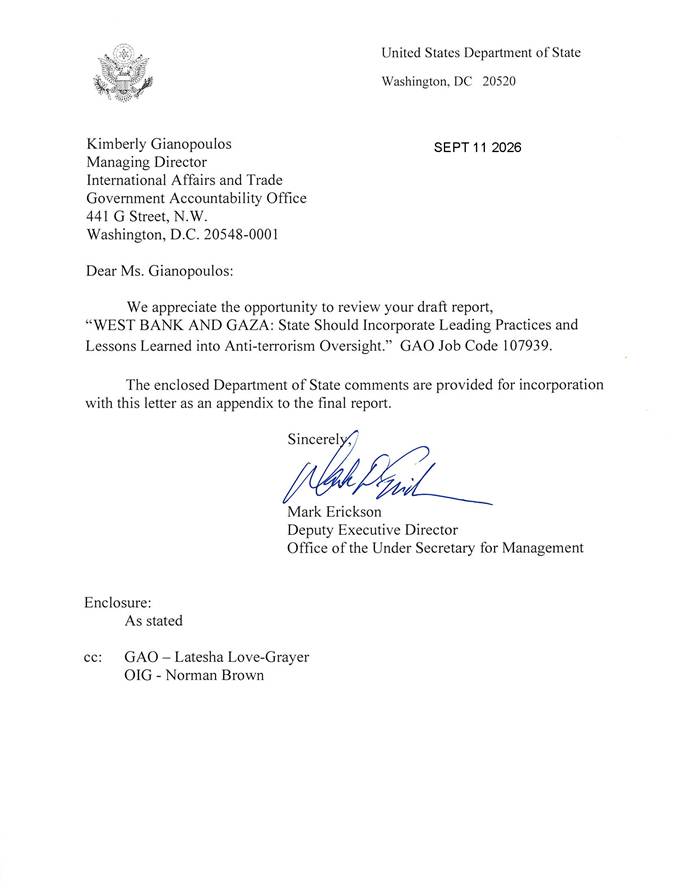
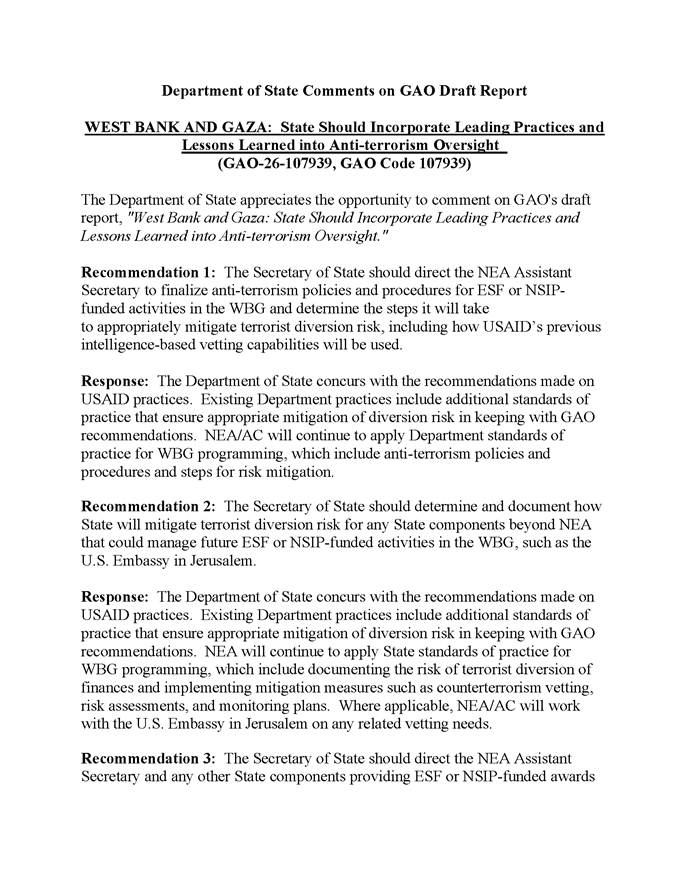
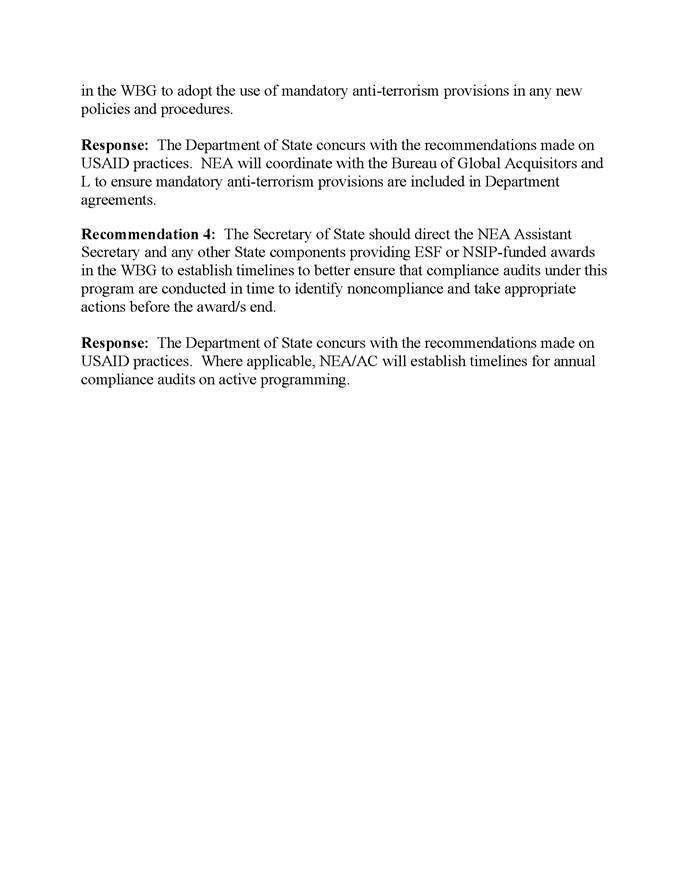
GAO Contact
Latesha Love-Grayer, LoveGrayerL@gao.gov
Staff Acknowledgments
In addition to the contact named above, Judith A. McCloskey (Assistant Director), David Hancock (Analyst-in-Charge), James Toscano, Frances Tirado, Larissa Barrett, and Alex Welsh made key contributions to this report.
The Government Accountability Office, the audit, evaluation, and investigative arm of Congress, exists to support Congress in meeting its constitutional responsibilities and to help improve the performance and accountability of the federal government for the American people. GAO examines the use of public funds; evaluates federal programs and policies; and provides analyses, recommendations, and other assistance to help Congress make informed oversight, policy, and funding decisions. GAO’s commitment to good government is reflected in its core values of accountability, integrity, and reliability.
Obtaining Copies of GAO Reports and Testimony
The fastest and easiest way to obtain copies of GAO documents at no cost is through our website. Each weekday afternoon, GAO posts on its website newly released reports, testimony, and correspondence. You can also subscribe to GAO’s email updates to receive notification of newly posted products.
Order by Phone
The price of each GAO publication reflects GAO’s actual cost of production and distribution and depends on the number of pages in the publication and whether the publication is printed in color or black and white. Pricing and ordering information is posted on GAO’s website, https://www.gao.gov/ordering.htm.
Place orders by calling (202) 512-6000, toll free (866) 801-7077,
or
TDD (202) 512-2537.
Orders may be paid for using American Express, Discover Card, MasterCard, Visa, check, or money order. Call for additional information.
Connect with GAO
Connect with GAO on X,
LinkedIn, Instagram, and YouTube.
Subscribe to our Email Updates. Listen to our Podcasts.
Visit GAO on the web at https://www.gao.gov.
To Report Fraud, Waste, and Abuse in Federal Programs
Contact FraudNet:
Website: https://www.gao.gov/about/what-gao-does/fraudnet
Automated answering system: (800) 424-5454
Media Relations
Sarah Kaczmarek, Managing Director, Media@gao.gov
Congressional Relations
David A. Powner, Acting Managing Director, CongRel@gao.gov
General Inquiries
[1]In 1993, the government of Israel and the Palestine Liberation Organization signed the Oslo Peace Accords, which called for the withdrawal of Israeli forces from parts of the West Bank and Gaza and affirmed the Palestinian right to self-government within those areas. According to the Department of State, U.S. bilateral assistance provided since then includes funds appropriated through the following accounts: Economic Support Fund; International Narcotics Control and Law Enforcement; and Nonproliferation, Antiterrorism, Demining, and Related Programs.
[2]The consolidated appropriations act for fiscal year 2026 established a new National Security Investment Programs account that provides funding for the same purpose as the prior ESF account, among others. It also includes provisions for GAO to review the treatment, handling, and uses of funds provided through the National Security Investment Programs account for the West Bank and Gaza, including the extent to which the funded projects and activities comply with certain anti-terrorism requirements. Consolidated Appropriations Act, 2026, Pub. L. No. 119-75, § 7039(e), 140 Stat. 173, 579 (Feb. 3, 2026). In its FY 2027 budget request, the administration proposed the America First Opportunity Fund which would absorb NSIP.
[3]See, for example, Pub. L. No. 119-75, §§ 7039(a)-(c) and 7041(h).
[4]Consolidated Appropriations Act, 2022, Pub. L. No. 117-103, § 7039(e), 136 Stat. 49, 633-634 (Mar. 15, 2022); Consolidated Appropriations Act, 2023, Pub. L. No. 117-328, § 7039(e), 136 Stat. 4459, 5042 (Dec. 29, 2022); Further Consolidated Appropriations Act, 2024, Pub. L. No. 118-47, § 7039(e), 138 Stat. 460, 801 (Mar. 23, 2024).
[5]GAO has reported regularly on these topics since September 2006. For the most recent examples, see GAO, West Bank and Gaza Aid: USAID Generally Ensured Compliance with Anti-terrorism Policies and Addressed Instance of Noncompliance, GAO‑24‑106243 (Washington, D.C.: Dec 7, 2023); GAO, West Bank and Gaza Aid: Should Funding Resume, Increased Oversight of Subawardee Compliance with USAID’s Antiterrorism Policies and Procedures May Reduce Risks, GAO‑21‑332 (Washington, D.C.: Mar. 29, 2021); and Foreign Assistance: U.S. Assistance to the West Bank and Gaza, Fiscal Years 2015 and 2016, GAO‑18‑612 (Washington, D.C.: Aug. 8, 2018).
[6]A prime award is an agreement that the federal government makes with a non-federal entity for the purpose of carrying out a federal program. Prime awards are distinct from subawards. A subaward is an agreement that a prime award recipient makes with another entity to perform a portion of the work for a prime award.
[7]For purposes of this report, subaward actions are the contract or agreement actions taken over the course of a unique subaward, such as cost amendments or time extensions. We selected a sample of 130 subaward actions which is generalizable to the larger universe of 2,220 subaward actions requiring vetting. Since all samples are subject to sampling error, we present our results using a 95 percent confidence interval. See appendix I for more information.
[8]In 1993, the government of Israel and the Palestine Liberation Organization signed the Oslo Peace Accords, which called for the withdrawal of Israeli forces from parts of the West Bank and Gaza and affirmed the Palestinian right to self-government within those areas.
[9]Hamas has been designated a Foreign Terrorist Organization and a Specially Designated Global Terrorist by the U.S. government. Provisions in annual appropriations acts have prohibited funding for assistance to Hamas, any entity effectively controlled by Hamas, or any power-sharing government of which Hamas is a member or that results from an agreement with Hamas and over which Hamas exercises undue influence. See e.g. Pub. L. No. 119-75, § 7040(f); Pub. L. No. 118-47, § 7040(f); Pub. L. No. 117-328, § 7040(f).
[10]United Nations, Security Council Resolution 2803, S/Res/2803 (2025).
[11]Exec. Order No. 14169, Reevaluating and Realigning United States Foreign Aid, 90 Fed. Reg. 8619 (Jan. 20, 2025).
[12]USAID, Amended and Restated Mission Order No. 21 (Oct. 3, 2007). In addition to Mission Order 21, various federal laws and executive orders prohibit assistance to entities or individuals associated with terrorism. See, for example, Executive Order 13224, which blocks property of individuals and entities designated as committing or posing a significant risk of committing terrorist acts that threaten the security of U.S. nationals or the national security, foreign policy or economy of the United States. Exec. Order No. 13224, 66 Fed. Reg. 49079, Sept. 23, 2001, codified as amended at 50 U.S.C. § 1701 note.
[13]See, for example, Pub. L. No. 118-47, § 7039.
[14]While Mission Order 21 is specific to the West Bank and Gaza, USAID’s Automated Directives System (ADS) Chapter 319 contained the policy directives and required procedures for partner vetting across USAID. USAID undertook partner vetting as part of its strategy to mitigate the risk of the diversion of funds and resources to terrorists, supporters of terrorists, or affiliates of terrorists, while facilitating its ability to deliver programs in support of U.S. national security and foreign policy priorities. USAID, ADS Chapter 319: Partner Vetting (Jan. 17, 2025).
[15]Mission Order 21 was most recently updated in 2017 with the addition of Addendum 1, which extended the existing vetting requirements to certain staff of U.S.-based organizations. In this report, we use the term “Mission Order 21” to refer to both the mission order and Addendum 1 added in September 2017. According to USAID documents, USAID issued this addendum after the government of Israel charged a Gaza field office employee of a past U.S.-based prime awardee with diverting donor funding to Hamas’s military wing. USAID concluded that vetting of the prime awardee’s field-based key individuals might have revealed sufficient risk to warrant action by the mission.
[16]According to Mission Order 21, key individuals are: (1) principal officers of the organization’s governing body (e.g., chairman, vice chairman, treasurer or secretary of the board of directors or board of trustees); (2) the principal officer and deputy principal officer of the organization (e.g., executive director, deputy director; president, vice president); (3) the program manager or chief of party for the USAID-financed program; and (4) any other person with significant responsibilities for administration of USAID-financed activities or resources. Field-based staff include any key individual, regardless of nationality, who: (1) is an employee of a U.S.-based organization office in the area within the legal boundaries of the country of Israel, the city of Jerusalem, or the Palestinian territories of the West Bank or Gaza; or (2) is assigned to work in this area for a majority of the life of a relevant award; or (3) intends to spend more than 6 months of his or her time (cumulatively) during any 12-month period working in this area; or (4) is a consultant or adviser that is based in this area with regard to the relevant award.
[17]Although United Nations subawardees are subject to vetting, Mission Order 21 exempts United Nations organizations from USAID’s partner vetting process. USAID OIG reported that the lack of government partner vetting for United Nations agency personnel and reliance on the United Nations’ vetting processes for their own staff created risks for USAID’s programs. USAID asserted that vetting awards to United Nations organizations was distinct from vetting awards to other types of implementing organizations due to the United Nations agencies’ “international character, privileges and immunities, and the special nature of our relationship, including presence on certain United Nations agency boards to influence their policies and procedures.” (USAID OIG: Advisory Notice: Assessment of USAID’s Oversight Policies to Prevent the Diversion of Assistance to Hamas and Other Terrorist Organizations, July 25, 2024.)
[18]The West Bank and Gaza mission also required the anti-terrorism certification for subawardees in the cases of second-tier recipients of cash assistance and grants under contracts.
[19]The USAID Office of Inspector General has reported the lack of a certification requirement for prospective contractors concerning past assistance to terrorist organizations to be a vulnerability. (USAID OIG: Advisory Notice: Assessment of USAID’s Oversight Policies to Prevent the Diversion of Assistance to Hamas and Other Terrorist Organizations, July 25, 2024.)
[20]Per Mission Order 21, these mandatory provisions are included in award documents as clauses titled “Prohibition against Support for Terrorism” and “Restriction on Facility Names.” There is also a second version of the “Prohibition against Support for Terrorism” clause that is specifically for grants awarded to the United Nations or United Nations agencies.
[21]See, for example, Consolidated Appropriations Resolution, 2003, Pub. L. No. 108-7, § 568(c)(1), 117 Stat. 11, 207 (Feb. 20, 2003); and Consolidated Appropriations Act, 2022, Pub. L. No. 117-103, 136 Stat. 49, 633, § 7039(d)(1) (Mar. 15, 2022).
[22]Pub. L. No. 119-75, § 7039(d)(1).
[23]Funds appropriated to the ESF account generally have an initial period of availability for obligation of 2 fiscal years. Funds obligated during this period remain available for deobligation and reobligation for an additional 4 years from the date when the availability of such funds would otherwise have expired. After this period, the funds are no longer available for new obligations but remain available for expenditure and valid adjustments for an additional 5 fiscal years.
[24]These payments were made pursuant to an exception in the Taylor Force Act that specifically allowed ESF assistance for the West Bank and Gaza to be provided to the East Jerusalem Hospital Network. Pub. L. No. 115-141, § 1004(b)(1)(A), 132 Stat. 1143, 1145 (Mar. 23, 2018) (codified at 22 U.S.C. § 2378c–1(b)(1)(A)).
[25]Of the five awards that did not require vetting, the first four were made to U.S.-based awardees that did not require vetting because they had no local field-based key individuals. The final award did not require vetting because it was an Indefinite Delivery, Indefinite Quantity contract for which USAID did not award any activities.
[26]Mission Order 21 does not identify a deadline for vetting of field-based key individuals of U.S.-based organizations, and USAID officials told us that vetting of these field-based key individuals of those organizations does not have to occur before the award start date. However, the awardee cannot incur costs for the field-based key individuals until the individuals receive an eligible vetting determination, according to officials. As a result, we did not analyze the timing of USAID’s vetting.
[27]By signing these certifications, organizations attest that they do not provide material support or resources for terrorism. Of the 37 prime awards that received FY 2022-2024 ESF funds, 12 required anti-terrorism certifications because they were cooperative agreements and 25 did not require ATCs because they were contracts.
[28]According to USAID data, of the 19 prime awardees working on the 37 prime awards, 17 made subawards to other organizations. These 17 prime awardees issued 6,674 subaward actions, but the number of subaward actions made by each awardee varied considerably. Some awardees made fewer than 20 subaward actions, while one awardee made over 2,000.
[29]Because all sample estimates are subject to sampling error, we present our results using a 95 percent confidence interval.
[30]According to ADS Chapter 319, “if vetting is required, USAID must deem the presumptive awardee or contractor eligible prior to award, unless otherwise authorized in accordance with this chapter.” USAID, ADS 319: Partner Vetting (Jan. 15, 2021).
[31]One subawardee in our sample signed a subaward action during a one-day gap between two eligibility periods. At no point was this subawardee deemed ineligible for USAID assistance.
[32]Subawards can be associated with multiple subaward actions. Because we sampled subaward actions rather than subawards, our sample of subaward actions is not generalizable to the larger population of subawards requiring ATCs.
[33]In one case, the subawardee signed the ATC two days late.
[34]Because all sample estimates are subject to sampling error, we present our results using a 95 percent confidence interval.
[35]Because all sample estimates are subject to sampling error, we present our results using a 95 percent confidence interval.
[37]The report also identified three instances where the ATC was signed late. However, USAID officials told us they had ATCs on file for the three instances of late signing of anti-terrorism certification identified in the report, and the awardee fully complied with Mission Order 21 in each instance. Officials said the erroneous non-compliance finding in the report resulted from the prime awardee going above and beyond Mission Order 21 requirements by having subawardees sign multiple ATCs.
[39]The mission also outsourced an audit of a debt relief grant agreement, under which USAID provided direct payments to Palestinian Authority creditors. This report did not assess Mission Order 21 compliance.
[40]Section 7039(d)(1) of public law 119-75 and prior annual appropriations acts include a requirement that State shall ensure that federal or non-federal audits of all contractors and grantees, and significant subcontractors and sub-grantees, under the West Bank and Gaza Program, are conducted at least on an annual basis.
[41]Although missions could override an ineligible recommendation, USAID officials and analysts at the Threat Screening Center stated that the West Bank and Gaza mission for the past few years operated under an informal zero-tolerance policy whereby any ineligible recommendation from the Threat Screening Center automatically led to disapproval of the subject award or subaward. Of the ESF assistance in the scope of our review, the West Bank and Gaza mission denied 22 proposed subawards due to adverse vetting determinations by the Threat Screening Center.
[42]See Pub. L. No. 119-75, § 7039(a)-(e) and Pub. L. No. 118-47, § 7039(a)-(e).
[43]As of January 2025, in addition to the West Bank and Gaza, USAID had established mission orders for partner vetting in Afghanistan, Iraq, Lebanon, Pakistan, Syria, and Yemen. If deemed necessary, USAID bureaus or missions could also request vetting for USAID activities in countries without a pre-existing partner vetting program.
[44]State, Foreign Assistance Manual (FAM), 2 FAM 050, Terrorist Financing: Assessing Risk and Risk Mitigation Measures (May 2022). This policy states that USAID will implement similar procedures through the Automated Directives System, policy directives, and published regulations, although USAID is no longer administering foreign assistance programs.
[45]Pub. L. No. 119-75, § 7039(b).
[46]GAO, Standards for Internal Control in the Federal Government, GAO‑25‑107721 (Washington, D.C.: May 2025) and GAO, A Framework for Managing Fraud Risks in Federal Programs, GAO‑15‑593SP (Washington, D.C.: July 28, 2015).
[47]State’s FAM provides that all employees of the Department are expected to identify, evaluate, and mitigate any substantial risks to their objectives or to the enterprise in which they are engaged, including the risks of inaction. Specifically, Department leaders, including Chiefs of Mission, should require the best possible assessment of risk, identification of mitigation measures, and evaluations of any remaining residual risk before making decisions. 2 FAM 031, Department Risk Management Policy (April 2024). These principles are in line with principle 10 of Federal Standards for Internal Control, and the leading practices outlined in A Framework for Managing Fraud Risks in Federal Programs, which identify steps federal agencies should take to manage program and operational risks.
[48]2 FAM 058, Additional Risk Mitigation Measures and Procedural Protections (May 2022).
[49]GAO, Foreign Assistance: USAID Should Strengthen Risk Management in Conflict Zones, GAO‑24‑106192 (Washington, D.C: Apr 30, 2024).
[50]GAO, Foreign Assistance: Opportunities Exist for Agencies to Improve Their Management of Fraud, Waste, and Abuse Risks, GAO‑26‑108945 (Washington, D.C.: Mar 17, 2026).
[51]World Bank, The World Bank's Anti-Corruption Guidelines and Sanctions Reform: Benefiting the Poor by Helping to Prevent and Combat Fraud and Corruption in World Bank Financed Projects (English). Washington, DC.
[52]United Nations, Chief Executives Board for Coordination. Guidance Notes - Managing Fraud Risk, High-Level Committee on Management 2020.HLCM.20 (2 October 2020).
[53]See, for example, Pub. L. No. 119-75, § 7039(d).
[55]Pub. L. No. 119-75, § 7039(d)(1).
[56]Consolidated Appropriations Act, 2022, Pub. L. No. 117-103, § 7039(e), 136 Stat. 49, 633-634 (Mar. 15, 2022); Consolidated Appropriations Act, 2023, Pub. L. No. 117-328, § 7039(e), 136 Stat. 4459, 5042 (Dec. 29, 2022); Further Consolidated Appropriations Act, 2024, Pub. L. No. 118-47, § 7039(e), 138 Stat. 460, 801 (Mar. 23, 2024).
[58]For the purposes of this report, subaward actions are the contract or agreement actions taken over the course of a unique subaward, such as cost amendments or time extensions.