
Report to Congressional Committees
United States Government Accountability Office
A report to congressional committees
Contact: Jon Ludwigson at ludwigsonj@gao.gov
What GAO Found
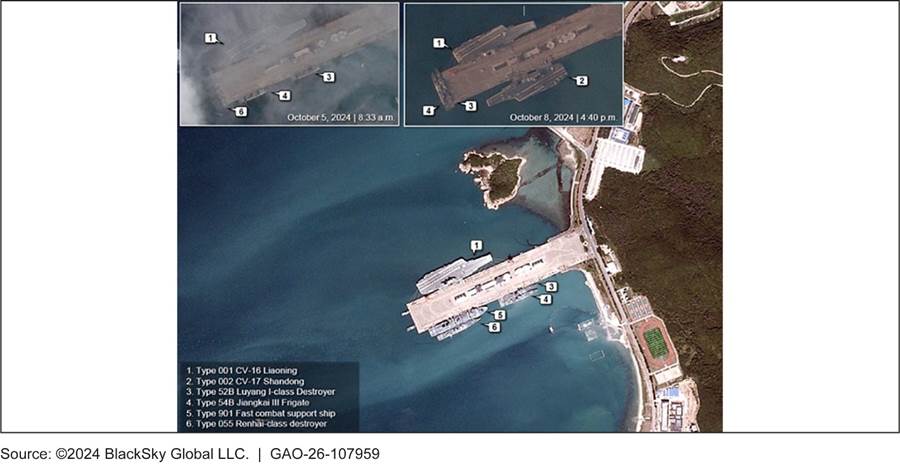
The U.S. commercial space sector has grown rapidly over the last few years, and offers data and data-related services—such as the imagery below—that the Department of Defense (DOD) uses to maintain national security.
Within the Space Force, the Joint Commercial Operations Cell (JCO)—the main organization that buys data and services—purchased various types of data and services through the contractor-operated Global Data Marketplace. JCO expended $76.8 million on data and services from the marketplace from January 2023 through September 2025. These purchases supported missions including space domain awareness and tactical surveillance, reconnaissance and tracking. The National Reconnaissance Office (NRO) and National Geospatial-Intelligence Agency (NGA) also purchased various forms of commercial imagery and commercial analytic products, respectively, from fiscal years 2021 through 2025.
Some Space Force officials told GAO about challenges they have faced related to purchasing and using commercial space data such as licensing costs, perceived use restrictions, and concerns over long-term access to the data. These challenges led to hesitation to purchase and use commercial data among these potential users. JCO leads an informal working group to discuss and coordinate current and future commercial space data purchases made by various federal organizations. This working group meets monthly and coordinates purchases. GAO found that many of the challenges reported by Space Force officials could have been addressed with discussions at the working group, but the Space Force officials were not part of the working group and information about the working group is not widely available.
JCO officials said they would be supportive of information about the working group being listed to increase awareness. Increased communication about the working group could lead to additional Space Force and other officials engaging in discussions that could address perceived issues and improve the use of commercial space data and services for national security purposes.
Why GAO Did This Study
Threats to DOD’s space assets from strategic competitors have grown substantially in number and intensity. DOD is working to integrate commercial space solutions, such as data and services, to mitigate these threats as well as enhance its capabilities.
Members of Congress included a provision in a committee report for GAO to review DOD’s purchases of commercial space data and services. GAO’s report examines (1) the types of commercial space data and data-related services DOD purchased from fiscal years 2021 through 2025, and (2) the extent to which DOD faced challenges when purchasing and using these data and related services.
GAO analyzed expenditures for orders JCO made through the Global Data Marketplace from January 27, 2023, to September 30, 2025. In the case of NRO and NGA, GAO obtained unclassified summary information. GAO attended an informal working group meeting led by JCO, reviewed the contract for the marketplace, and interviewed relevant DOD agency officials and contractor representatives. “Commercial space data” are data collected from commercial assets, and “commercial space data-related services” is the range of services for commercial space data.
What GAO Recommends
GAO is recommending that the Secretary of the Air Force enhance awareness of and engagement with the working group to address issues and concerns raised by current and potential users of commercial space data and services. DOD agreed with GAO’s recommendation and has plans to increase awareness of the working group and of how to access data and services that government entities have purchased.
|
Abbreviations |
|
|
|
DFARS Defense Federal Acquisition Regulation Supplement |
|
DOD Department of Defense |
|
FAR Federal Acquisition Regulation |
|
GDM Global Data Marketplace |
|
GEOINT geospatial intelligence |
|
GPR government purpose rights |
|
GSA General Services Administration |
|
JCO Joint Commercial Operations Cell |
|
NGA National Geospatial-Intelligence Agency |
|
NRO National Reconnaissance Office |
|
PNT positioning, navigation, and timing |
|
TacSRT tactical surveillance, reconnaissance and tracking |
This is a work of the U.S. government and is not subject to copyright protection in the United States. The published product may be reproduced and distributed in its entirety without further permission from GAO. However, because this work may contain copyrighted images or other material, permission from the copyright holder may be necessary if you wish to reproduce this material separately.
August 27, 2026
Congressional Committees
The threats to the Department of Defense’s (DOD) space assets from potential adversaries have grown substantially in number and intensity. A key part of DOD’s strategy to mitigate those threats and to pursue other goals involves better leveraging the commercial space sector. This sector has grown rapidly over the last few years and offers an increased number of data sources and services that could enhance national security, such as Earth observation and deep analytical capabilities. Numerous companies have developed space and ground-based assets to capture data and actively seek to sell these data to customers, which can include other commercial companies, DOD and other federal agencies, and foreign governments, among others. To better leverage commercial solutions, DOD has highlighted the need to: use contracts or other agreements to ensure its access to commercial solutions during peacetime and conflict; integrate the commercial space solutions into wargames and training exercises before a crisis; and continue to seek out emerging commercial space solutions for potential use by the warfighter.
The purchase and use of commercial space data and services offer several benefits to DOD. For instance, commercial imagery provides an advantage over intelligence community imagery because it is not classified and therefore may be easier to share with all allies and partners.[1] Also, DOD can use data and services from commercial ground-based and space-based observation systems to address collection gaps from the government’s Earth observation systems. The ground-based, government-owned network of sensors used to collect space situational awareness data is not evenly distributed throughout the world, which leads to gaps in data collected in some areas. Lastly, when appropriate, relying on the commercial market enables DOD to take advantage of market innovations, avoid development costs, and potentially reduce acquisition costs, among other benefits.
The Senate Armed Services Committee report accompanying a bill for the James M. Inhofe National Defense Authorization Act for Fiscal Year 2023 expressed concern that DOD is slow to purchase and invest in commercial space data and services, resulting in continued reliance on government-owned resources. The committee report also includes a provision for us to review DOD’s purchase of commercial space data and services.[2] Our report (1) describes the types of commercial space data and data-related services DOD purchased from fiscal years 2021 through 2025, and (2) assesses the extent to which DOD faced challenges when purchasing and using commercial space data and data-related services.
Various commercial and government entities define commercial space data and services differently. Some entities consider the selling of data to be a service while others consider the output from analytic services to still be data. For the purposes of this report, we define “commercial space data” as the data collected from commercial on-orbit and ground-based space-related assets and acquired or licensed by government agencies, among other entities. This could include data from satellites, radars, and telescopes. Commercial on-orbit satellites observe locations or objects on the ground, sea, and space, and ground-based telescopes observe objects in space. Examples of these data include electro-optical and radar imagery and radio frequency data, among others.
We define “commercial space data-related services” as the range of services for commercial space data offered by commercial companies to government agencies, among other entities. These services could include analysis of commercial space data, resulting in reports and other analytical products such as tactical information and 3D visualizations of space events. For the purposes of this report, we refer to “commercial space data-related services” as “commercial space services.” We excluded government-funded data from academic institutions; government contracts for integration of commercial space data into government systems; commercial space hardware and services related to launches of spacecraft; commercial satellite communications; and commercial in-space servicing, assembly, and manufacturing of spacecraft from our review. We did so to focus our review on commercial space data and services.
To describe the types of commercial space data and services that DOD purchased from fiscal years 2021 through 2025, we identified three key DOD organizations that focus on purchasing commercial space data and services:
· the U.S. Space Force’s Joint Commercial Operations Cell (JCO);
· the National Reconnaissance Office (NRO); and
· the National Geospatial-Intelligence Agency (NGA).
Our review also includes the Global Data Marketplace (GDM), a contractor-owned marketplace that facilitates commercial space data and services sales to DOD.
We analyzed expenditure information for orders that JCO and other DOD organizations made through GDM from January 27, 2023, to September 30, 2025. Representatives for the contractor for GDM, Bluestaq, said they could not easily provide information prior to January 2023 because it was archived after they upgraded the accounting system, and therefore not readily accessible. We also obtained unclassified summary information for fiscal years 2021 through 2025 about the range and highest amount of annual available funding for commercial imagery and obligations for commercial analytic products from NRO and NGA, respectively.[3] To assess the reliability of these data, we reviewed related documentation; traced a selection of data to key documents; interviewed agency officials and contractor representatives; and electronically tested for missing data, outliers, and other inconsistencies.
We interviewed DOD agency officials from JCO, NRO, and NGA about the types of commercial space data and services they purchase and how these purchases support various DOD missions. To better understand the marketplace, we also interviewed officials from the General Services Administration (GSA)—which awarded the contract for GDM—and representatives from Bluestaq. We determined that the data from Bluestaq, NRO, and NGA were sufficiently reliable for the purpose of describing the types of commercial space data and services that DOD purchased during the time frame of our review. We did not review purchases for commercial space data and services made by other DOD organizations outside of these selected entities and GDM.
To assess the extent to which DOD experienced challenges with purchasing and using commercial space data and services, we reviewed agency documentation such as the contract documentation, user guides, and a summary document of a legal memorandum regarding GDM. We attended the June 2025 informal Cross-Government Data Buy Working Group meeting and reviewed notes from a prior monthly meeting. We also reviewed DOD strategy documents to better understand DOD’s strategic goals around the integration of commercial space solutions. We reviewed the Standards for Internal Control in the Federal Government, and specifically, the principles related to information and communication, and found them to be applicable to our review.[4]
Additionally, we interviewed agency officials from the Space Force, NRO, NGA, and other DOD organizations about challenges with buying and using commercial space data and services. We also interviewed contracting officials from GSA. Further, we held discussions with representatives from two industry associations with knowledge about commercial space data and services, and representatives from four commercial companies who are members of one of these associations. For additional information on our objectives, scope, and methodology, see appendix I.
We conducted this performance audit from November 2024 to August 2026 in accordance with generally accepted government auditing standards. Those standards require that we plan and perform the audit to obtain sufficient, appropriate evidence to provide a reasonable basis for our findings and conclusions based on our audit objectives. We believe that the evidence obtained provides a reasonable basis for our findings and conclusions based on our audit objectives.
Background
Commercial Space Data and Services
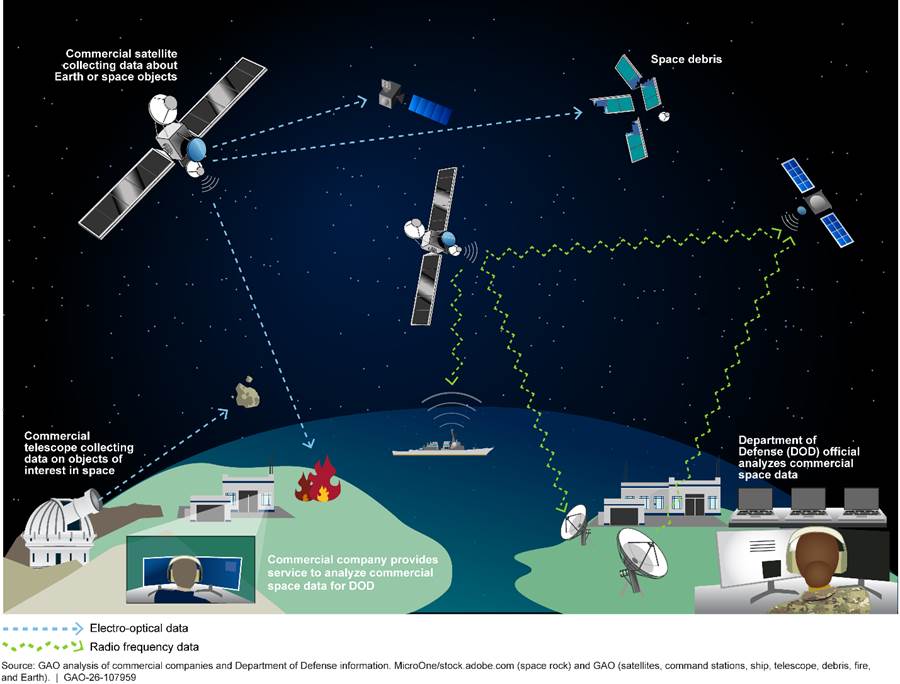
Commercial space data can come from a variety of sources in space and on the ground, primarily satellites and telescopes. Commercial satellites collect information about activities in space, such as locations of nearby satellites, or on Earth, including images of natural disasters. Ground-based commercial telescopes collect data on objects in space, including locations and physical characteristics. These data can be electro-optical, which is based on detecting visible light and infrared radiation, radio frequency from detecting electromagnetic signals, or other data types. Commercial space services consist of analyzing these data, resulting in reports and other analytical products that are sold to the government or other entities. Figure 1 depicts a notional example of the various types of commercial space data that companies could collect from space- and ground-based assets as well as analyses that could occur.
DOD Organizations that Purchase and Use Commercial Space Data and Services
Three DOD organizations play a key role in purchasing and using commercial space data and services.
· Joint Commercial Operations Cell. JCO, a Space Force organization, buys non-classified commercial data and services to support its various missions.[5] These missions include to (1) protect and defend U.S. space assets and deter adversary aggression by using commercial data to provide space domain awareness information; (2) detect and locate threats to positioning, navigation, and timing (PNT) services and electromagnetic interference in satellite communication frequencies through the use of commercial data and services to provide PNT and satellite communication situational awareness information; and (3) support specific combatant commands’ requests for information about discrete tactical events through tactical surveillance, reconnaissance and tracking (TacSRT).[6]
Since 2024, JCO has led the Cross-Government Commercial Data Sharing Working Group, an informal group consisting of officials from various federal organizations that purchase and use commercial space data and services. Within DOD, these organizations are the Space Force, U.S. Space Command, Department of the Air Force, Defense Intelligence Agency, and NRO. Non-DOD organizations that are part of the working group are the Department of Commerce, National Aeronautics and Space Administration, and Intelligence Advanced Research Projects Activity. While this working group does not have a memorandum of understanding, JCO officials said that it aims to discuss current and future commercial space data purchases made by the organizations, with a goal of coordinating data buys.
· National Reconnaissance Office. NRO is the primary acquirer of commercial imagery for DOD and the intelligence community, having assumed this responsibility from NGA in 2017. In 2018, NRO established the Commercial Systems Program Office, in part to perform this role. This office manages commercial purchases, including evaluating and integrating commercial capabilities into government systems. Once commercial imagery is acquired, NRO disseminates it to NGA and other users. NRO officials said that generally their purchases are not for the space domain awareness mission, which is primarily a Space Force mission.
· National Geospatial-Intelligence Agency. NGA is the primary acquirer of commercial analytic services and products, which can consist of analysis of satellite imagery, for DOD and the intelligence community. The agency delivers these analytic products to other government users to provide shareable commercial geospatial intelligence (GEOINT).[7] NGA also stores commercial imagery and provides the military services, combatant commands, and others access to this imagery.
Global Data Marketplace
GDM, formerly known as the Space Situational Awareness Marketplace or Space Domain Awareness Marketplace, began operating in 2020. It is a contractor-owned online platform designed to facilitate data transactions between commercial vendors and consumers. As of July 2026, 319 vendors were part of GDM. One of the goals of the marketplace is to allow the military and intelligence community to quickly acquire commercial data and services for operational needs, such as space domain awareness.
The Space Force organizations that purchased through GDM from January 27, 2023, to September 30, 2025, were:
· JCO including its TacSRT cell;
· System Delta 810 for Environmental and Tactical Surveillance;
· Space Domain Awareness Tools, Applications, and Processing Lab;
· Space Domain Awareness and Combat Power Program Executive Office;
· Space Environment; and
· the 19th Space Defense Squadron.
System Delta 810, mentioned above, purchased data and services through GDM to support TacSRT. This delta is responsible for providing environmental surveillance to military operations. According to JCO officials, as of September 2025, JCO became responsible for purchasing TacSRT for all mission areas and System Delta 810 generally makes purchases to support the development of new use cases for TacSRT.
JCO buys commercial space data and services on behalf of other government customers. Other DOD organizations that bought through GDM during this time frame were the Defense Intelligence Agency’s Office of Space and Counterspace, and the Air Force Tactical Exploitation of National Capabilities Directorate. Non-DOD users of GDM include civil U.S. government agencies, foreign government organizations, and commercial companies.
GSA awarded a contract in August 2019 to a contractor, Bluestaq. This contract includes the operation of GDM and the Unified Data Library. The library is the Space Force’s cloud-based, online data repository designed to consolidate and disseminate commercial and U.S. government data across classification levels, including data purchased through GDM. The library and GDM work together to support end-to-end data delivery, with GDM enabling purchasing of data and the library enabling distribution of the data. According to Bluestaq representatives, the demand for growth for the Unified Data Library led GSA to increase the contract ceiling to $649 million. This GSA contract is a sole-source Small Business Innovation Research Phase III award.[8] Under the Small Business Innovation Research program, a small business concern retains all rights to the Small Business Innovation Research data it developed in the performance of the contract, which are not granted to the federal government.[9] Specifically, Bluestaq retains ownership of the technical data and computer software that it used to develop GDM but it does not own the commercial data and analytics that commercial vendors sell using GDM.[10] The GSA contract expired on July 31, 2026, and according to GSA officials, they are working on follow-on efforts to continue providing these services.[11]
Data Rights for Commercial Space Data and Services
To use and share commercial space data and services, vendors on GDM offer various tiers of data rights for government customers to purchase. According to Bluestaq representatives, the data rights tiers enable a customer flexibility in tailoring data to its needs, which in turn affects the cost of the data. These data rights can vary based on the number of people, organizations, or countries that are able to access the data. As a general matter, the broader access that is needed, the higher the cost of purchasing that access.
DOD generally does not acquire the actual data, but rather purchases a license to use the data. This license controls how the government can use, disclose, or reproduce contractor-owned information. The government obtains a license to use commercial data and analytics in accordance with the Federal Acquisition Regulation (FAR); agency supplements to this regulation, such as the Defense Federal Acquisition Regulation Supplement (DFARS); and any specifically negotiated licenses in the contract.[12] Specifically negotiated license rights refer to standard license agreements that are modified by the mutual agreement of the contractor and the government.[13] When this occurs in GDM, the exact terms are spelled out in a specifically negotiated license agreement that is unique to the data purchase. The license to use the data is provided by the vendor via GDM, and the vendor can continue to sell licenses to others to use those data.
NRO, in collaboration with NGA, developed a common group of end user license agreements that define how commercial imagery can be used and shared across a broad user community. These agreements support sharing commercial imagery for defense or intelligence community needs and can also be used to share data between or outside the defense and civilian community, including foreign partners. NGA has adopted the use of end user license agreements. See appendix II for more information about GDM and NRO’s data rights.
Strategies and Executive Order Relevant to Using Commercial Solutions
Since fiscal year 2024, several DOD strategies and a presidential executive order emphasize the need to integrate commercial solutions—including commercial space data and services—into the national security space architecture. See table 1.
Table 1: DOD Strategies and Presidential Executive Order Related to the Integration of Commercial Space Data and Services
|
Document title |
Summary |
|
Department of Defense Commercial Space Integration Strategy (April 2024) |
This is the first commercial space integration strategy for DOD and guides department-wide commercial integration efforts. It prioritizes 13 national security space mission areas—including space domain awareness and intelligence, surveillance, and reconnaissance—where commercial solutions can be integrated to enhance space mission assurance across various types of conflict. The degree of commercial integration will vary for a mission area based on whether the U.S. government is responsible for certain national security functions and the maturity of the commercial market. |
|
U.S. Space Force Commercial Space Strategy: Accelerating the Purposeful Pursuit of Hybrid Space Architectures (April 2024) |
This strategy emphasizes that the Space Force will take full advantage of the speed and innovation from commercial capabilities to support combatant command operations in specific mission areas. The Space Force’s priority missions are for (1) new commercial integration such as tactical surveillance, reconnaissance and tracking, among others, and (2) continued integration of commercial space solutions for mature missions such as space domain awareness. |
|
U.S. Space Command Commercial Integration Strategy (March 2025) |
This strategy aims to incorporate commercial solutions into the U.S. Space Command to improve the security of space. This is done by the command (1) partnering with DOD and others to prioritize commercial capabilities that meet its requirements; (2) seeking ways to access commercial data and services to achieve mission success; and (3) implementing information sharing protocols and space domain awareness measures to provide threat alerts. |
|
Presidential Executive Order 14369, “Ensuring American Space Superiority” (December 18, 2025) |
This executive order emphasizes that U.S. space policy is to create a responsive national security space architecture by integrating commercial space capabilities and other approaches. |
Source: GAO assessment of Department of Defense (DOD) documentation and presidential executive order. | GAO‑26‑107959
Congressional Direction Regarding Commercial Space Data and Services
In fiscal year 2026, congressional actions directed the Air Force and Space Force to explore their use of commercial space data and services, especially for space situational awareness and TacSRT. For example:
· The Senate Armed Service Committee’s report accompanying the bill for the National Defense Authorization Act for Fiscal Year 2026 directed the Secretary of the Air Force to brief congressional defense committees on the feasibility and advisability of a study on using ground-based and in-space commercial data and analytics to capture unresolved imagery collected by existing assets in geostationary orbit.[14] This study would demonstrate how commercial data and analytics can be used to assess the imagery in geostationary orbit to increase space situational awareness and defense capabilities.
· In the National Defense Authorization Act for Fiscal Year 2026, Congress directed the Secretary of the Air Force to conduct a study on the feasibility and advisability of establishing a program of record for TacSRT capabilities within DOD.[15] These capabilities refer to using commercial data and analytics to provide surveillance, reconnaissance, and tracking information to combatant commands. Congress also provided the Secretary authority to establish this program of record as needed.
· In the Senate Armed Services Committee’s report accompanying the bill for the National Defense Authorization Act for Fiscal Year 2026, the committee directed the Chief of Space Operations to provide a briefing that includes an assessment of the potential for duplication between TacSRT and existing DOD intelligence, surveillance, and reconnaissance programs, and how such duplication is being mitigated.[16] The committee also directed the Chief of Space Operations to provide a review of how the Space Force ensures that TacSRT does not encroach upon activities traditionally subject to intelligence oversight.[17]
Prior GAO Reports
We have issued two reports that assessed DOD acquisition of commercial satellite imagery and use of commercial data for space operations.
· In September 2022, we reported that the U.S. intelligence community and DOD had not clarified roles and responsibilities for the acquisition of commercial satellite imagery.[18] We found that without doing so, the potential for unnecessary overlap between the intelligence community and DOD will increase as interest in commercial imagery grows. DOD concurred with our recommendation that it should establish clear roles and responsibilities across the intelligence community and DOD stakeholders for the acquisition of commercial satellite imagery, include these roles in updated DOD guidance, and communicate them to all relevant stakeholders. As of March 2026, however, DOD had not implemented this recommendation.
· In April 2023, we reported that Space Force staff who monitor objects in space were not using the Unified Data Library that contains commercial and U.S. government space situational awareness data because the library was not integrated into specific operational systems.[19] DOD concurred with our recommendation that the Space Force create a plan for programs to determine how to use the Unified Data Library to access and manage all data for Space Force space situational awareness systems. This recommendation was implemented. In June 2024, the Assistant Secretary of the Air Force for Space Acquisition & Integration provided a report to Congress that describes how the Space Force will use the Unified Data Library.[20]
DOD Purchased a Wide Variety of Commercial Space Data and Services to Support Various Missions
From fiscal years 2021 through 2025, JCO, NRO, and NGA spent hundreds of millions of dollars to purchase a variety of commercial space data and services through different methods. The Space Force generally made its purchases, which consisted of numerous small buys under the simplified acquisition threshold, through GDM. This threshold was $250,000 at the time of our review.[21] In contrast, NRO and NGA purchased commercial space data and services through other contracts. All of the organizations used the data and services purchased to support their respective missions.
Space Force Purchased Many Types of Data and Services through GDM
JCO is the primary organization that purchases commercial space data and services through GDM for the Space Force and combatant commands. From January 27, 2023, to September 30, 2025, the Space Force made purchases totaling $123.9 million, with JCO accounting for $76.8 million or 62 percent of the total.[22] System Delta 810 accounted for $35.6 million or 29 percent during this time frame. JCO officials told us that as of September 2025, they became responsible for purchasing TacSRT for all mission areas and System Delta 810 makes purchases to support the development of new use cases for TacSRT. This means that JCO will likely make more TacSRT purchases moving forward. Purchases from other DOD organizations using GDM during this time frame totaled $4.6 million. Appendix III provides more information about GDM’s purchasing process as of April 2026.
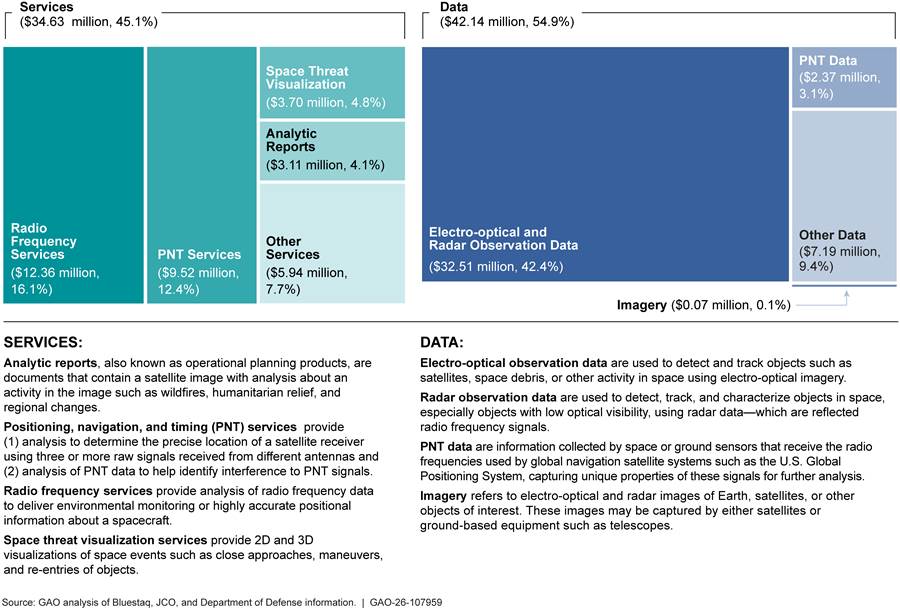
JCO accounted for nearly 45 percent of the individual purchases, totaling 590 of the 1,315 purchases made by DOD through GDM over this time frame. Most of these purchases were relatively small. For example, 6 percent of JCO’s purchases were below the micropurchase threshold of $10,000, and another 81 percent were between the micropurchase threshold and the simplified acquisition threshold of $250,000.[23] Under these levels, the FAR provides streamlined procedures to reduce cost, increase efficiency, and avoid unnecessary burdens for the agencies and contractors.[24] Figure 2 depicts the expenditures made and types of commercial data and services purchased by JCO through GDM.
Figure 2: Joint Commercial Operations Cell (JCO) Commercial Space Data and Service Purchases by Expenditures Through the Global Data Marketplace from January 27, 2023, to September 30, 2025
JCO used these data and services to support multiple missions:
Space domain awareness. JCO purchased commercial electro-optical and radar observation data for space domain awareness to support its mission of protecting and defending U.S. space assets. For example, JCO used commercial electro-optical observation data of space objects to augment information from the U.S. Space Surveillance Network to improve its monitoring of the southern hemisphere.[25] Further, it purchased radio frequency services to identify the types and locations of satellites broadcasting radio signals to help refine the locations and movements of satellites that were of interest to the U.S. Space Command. These data are compiled with other data from government sources to provide more precision and fidelity on satellite locations and characteristics.
PNT and satellite communication situational awareness. JCO acquired PNT data through GDM to support its mission to detect and locate threats to PNT capabilities as well as electromagnetic interference in satellite communication frequencies. PNT equipment on the ground or in space receives radio signals from satellites like the Global Positioning System, which contain timing and positioning information. JCO also bought PNT services that analyzed PNT data to help locate interference and jamming of PNT signals. Because this commercial analysis is non-classified, JCO can share these insights with allies, which can provide a means of rapid dissemination on the location of potential threats, when needed.
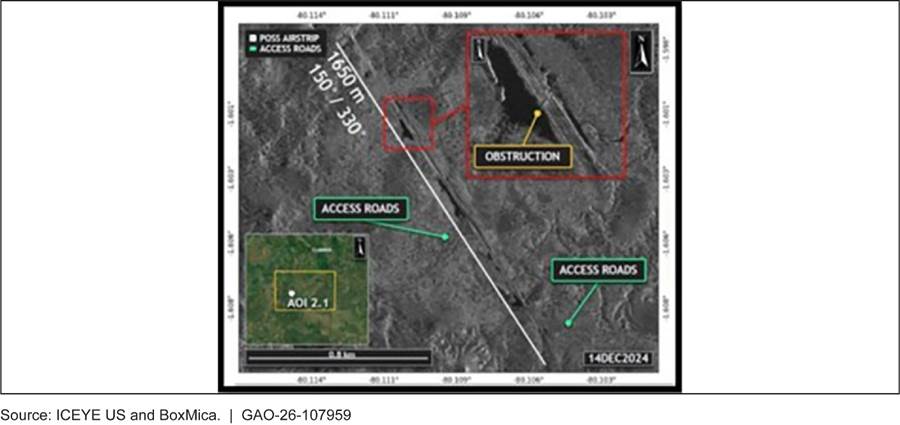
TacSRT. In fiscal year 2025, JCO began purchasing analytic reports from the commercial vendors through GDM to support its TacSRT mission, specifically for humanitarian assistance and illegal resource extraction. JCO refers to these reports as operational planning products. It can use these products to help meet a combatant command’s request for information about events such as population movements, forest fires, humanitarian crises, and other activities. According to the August 2025 TacSRT user guide, these products enable the combatant command to avoid using highly specialized government-owned satellites to fulfill operational requirements with less specialized needs. The operational planning products can contain images and information previously purchased by the government or new images. These products are typically in a portable document format that allows a user to view the image and analysis, but does not allow a user to further manipulate the image for additional analysis. For example, in December 2024, this product helped the U.S. Southern Command identify possible clandestine airstrips in Ecuador. The U.S. government shared this product with the Ecuadorian government, which allowed the latter to further investigate and disable the airstrips that were likely used by narcotraffickers. See figure 3.
Figure 3: Commercial Space Services Helped Identify Possible Airstrips in Ecuador Potentially Used by Narcotraffickers
NRO Purchased Commercial Imagery Through Various Agency-Awarded Contracts
NRO purchased various forms of commercial imagery, such as electro-optical images, from fiscal years 2021 through 2025.[26] NRO’s commercial purchases are guided by a memorandum of understanding between NRO and NGA. This memorandum highlights that NRO serves as the primary acquirer of commercial GEOINT imagery for both the intelligence community and DOD.[27] NRO reported purchasing commercial electro-optical imagery from three contractors—Vantor, Planet Labs, and BlackSky—through its $4 billion Electro-Optical Commercial Layer contract. According to agency documents, NRO awarded this contract in fiscal year 2022. This contract has a 5-year base period and five 1-year option periods. In addition to this contract, NRO reported purchasing other types of imagery data through separate contracts that focus on emerging commercial capabilities within radar, radio frequency detections, hyperspectral, and electro-optical imagery.[28] NRO is analyzing these data to assess whether they can be used to meet mission requirements.
NRO’s annual budget and spending are classified, but the agency provided unclassified summary information on its available funding for electro-optical imagery and emerging capabilities from fiscal year 2021 through fiscal year 2025.[29] Table 2 provides more details on the annual average of NRO’s available funding for commercial imagery, rounded to enable declassification, as well as its highest amount of annual available funding from fiscal years 2021 through 2025.
|
Types of commercial imagery |
Range of annual average of available fundinga (dollars in millions) |
Highest amount of annual available fundinga (dollars in millions) |
|
Legacy electro-optical imageryb |
100 – 200 |
354 |
|
Current electro-optical imageryc |
200 – 300 |
438 |
|
Emerging capabilities within:d |
||
|
Radar |
0 – 50 |
119 |
|
Radio frequency |
0 – 20 |
55 |
|
Hyperspectral imagery |
0 – 2 |
2 |
|
Other electro-optical imagery |
0 – 2 |
2 |
Source: National Reconnaissance Office (NRO) data and documentation. | GAO‑26‑107959
aNRO’s reported available funding refers to its budget authority, which includes the base, other additions, and supplemental budgets. Its reported available funding does not include funding from other sources such as transfers and reprogramming, according to NRO officials.
bLegacy electro-optical refers to commercial electro-optical imagery purchased from NRO’s Enhanced View Follow-On contract that was awarded in August 2018, and other electro-optical contracts.
cCurrent electro-optical refers to commercial electro-optical imagery purchased from NRO’s Electro-Optical Commercial Layer contract that was awarded in fiscal year 2022.
dNRO awarded contracts to study emerging capabilities within radar and radio frequency in fiscal year 2022, hyperspectral imagery in fiscal year 2023, and other electro-optical imagery in fiscal year 2024.
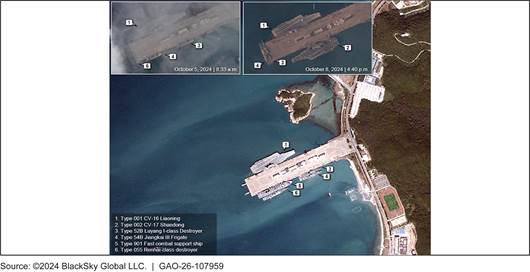
NRO used its electro-optical imagery purchases to support foundation and intelligence data collection as well as nighttime imaging and imaging of objects in space, among other uses. According to NRO officials, the three providers under the Electro-Optical Commercial Layer contract offer different types of imagery. For example, one vendor can provide a rapid revisit rate of the same area while another can provide images of the entire world every single day. The increased use of commercial electro-optical imagery to meet customer requirements reduces demand on government owned satellites, so that they can be reserved for the most challenging or sensitive missions. Figure 4 shows commercial electro-optical satellite images bought by NRO that depict changes in Chinese aircraft carriers and other ships’ locations over time and identify the types of ships.
Figure 4: National Reconnaissance Office Purchased Images of Chinese Aircraft Carriers at Sanya Naval Base, Hainan Province, China
In addition to the electro-optical imagery, NRO purchased emerging commercial capabilities within radar, radio frequency, hyperspectral, and electro-optical imagery to explore whether it can use this imagery to address intelligence challenges. For example, in November 2023, NRO awarded contracts to five companies to explore commercial electro-optical capabilities beyond what it can purchase through the existing Electro-Optical Commercial Layer contract. This included high-resolution thermal infrared imagery. According to NRO officials, the agency analyzes the data received under these contracts for utilization benefits.
NGA Purchased Analytic Products Through a Variety of Contracting Mechanisms
NGA purchased a range of commercial GEOINT analytic products that it can apply to the commercial imagery that NRO purchased. The September 2017 memorandum of understanding between NRO and NGA stated that NGA serves as the primary acquirer and disseminator of GEOINT-related commercial analytic services and products to support intelligence community and DOD customers. Additionally, NGA can acquire images when needed for analytic services on a case-by-case basis. NGA’s commercial GEOINT products support various mapping and information efforts for other DOD, intelligence community, and civil organizations. According to NGA officials, the agency purchased these products through a variety of contracting mechanisms that include: (1) indefinite-delivery, indefinite-quantity contracts, (2) purchase cards for small dollar purchases, and (3) interagency contracts with GSA where GSA performs acquisition activities on behalf of NGA.[30]
NGA’s annual budget and spending are classified, but the agency provided unclassified summary information on its obligations for commercial analytic products. This summary illustrates the range within which the annual average purchases fell for each product category. Table 3 provides a summary of NGA’s commercial purchases.
Table 3: NGA’s Reported Range of Obligations for Commercial Analytic Products, Fiscal Years 2021–2025
|
Types of commercial analytic products |
Range of annual average of obligations (dollars in millions) |
Highest amount of obligationsa (dollars in millions) |
|
Foundation productsb |
25 - 50 |
50 – 75 |
|
Economic indicators |
0 - 25 |
0 - 25 |
|
Other data analysis |
0 - 25 |
0 - 25 |
|
New and emerging analytic products and technologies |
0 - 25 |
0 - 25 |
Source: National Geospatial-Intelligence Agency (NGA) data. | GAO‑26‑107959
aAccording to NGA officials, some years of purchases fell outside the average for the time period, and those are described as the highest amount of obligations.
bFoundation products refer to maps or images that contain several categories of geospatial information to inform intelligence analysis.
NGA’s purchases of commercial analytic products supported a variety of intelligence analysis uses. More specifically:
· NGA’s foundation products compile several categories of geospatial information, including aeronautical, maritime, and topographic imagery and elevation data. These products are maps or images of a specific location with details about visible terrain, objects, and other features. These products are used to inform intelligence analysis.
· NGA’s economic indicators refer to monitoring trade activity to understand trends that affect economies and military capabilities worldwide. The economic indicators focus on information such as infrastructure monitoring, data about transportation networks, objects of economic significance, and natural resources analytics. For example, a commercial vendor sells commercial industry data about the percentage change in oil storage for specific countries that was derived in part from electro-optical imagery. According to NGA officials, the agency then purchases this analysis to calculate the exact volume of oil at a given point to bolster its analysis of global crude oil storage, fill levels, and other information. The resulting product would not be just imagery, but analytic processing of the imagery.
·
NGA also purchases new and emerging commercial analytic products
to evaluate their use in answering intelligence questions, according to NGA
officials. Officials told us that a commercial vendor’s algorithm was used to
detect areas where tree cover was removed. NGA successfully tested this
algorithm to detect the creation of illicit airstrips.
Working Group Has Not Been Leveraged To Help Address Challenges in Purchasing and Using Commercial Data
Space Force officials told us about specific challenges they faced related to commercial space data and services. Following a 2024 legal review of its original purchasing approach, the Space Force worked with GSA to change the way it purchased data through GDM. These changes initially resulted in purchases taking longer, though recent measures appear to have mitigated this challenge, according to Space Force officials. Also, some Space Force officials told us about challenges they faced related to the lack of information on the purchase and use of commercial data. These challenges could have been addressed by an existing working group; however, these officials were unaware of the group’s existence. Further, adversary threats to commercial space companies pose additional potential challenges to DOD.
JCO Took Action to Address Potential Delays from Changes to GDM Purchasing Process
The Space Force, in collaboration with GSA, took action to address potential delays in purchasing data through GDM following a change in the purchasing process. DOD customers previously purchased commercial space data and services through GDM using credits, where DOD funding was converted into a deposit of credits in an account for the customer at the rate of $1 per credit. The credits from a customer’s account were then used to make purchases through GDM. According to JCO officials, this process allowed customers to quickly buy commercial data and services as needed.
In response to a May 2024 Space Systems Command Office of the Staff Judge Advocate’s legal memorandum, GSA—in collaboration with JCO—changed GDM’s purchasing process to no longer use credits. The legal memorandum raised a concern about the lack of authority to use appropriated funds to buy credits or to convert appropriated funds into credits to make purchases through GDM. Further, an official from the Space Systems Command Office of the Staff Judge Advocate noted that another concern was that the purchasing process using credits occurred outside the GSA contract. After the legal determination, GSA changed its approach. Starting in December 2024, GSA added line items to the contract instead of using credits. The line items allowed customers to add funding to pay for approved purchase requests for commercial space data and services through GDM on a cost reimbursable basis. Appendix III describes the purchasing process for GDM as of April 2026.
JCO officials were initially concerned that the revised purchasing process significantly increased the time to purchase data and services, especially for JCO’s TacSRT mission. The revised process included additional steps, such as contracting officers determining that the price is fair and reasonable when a customer purchases data through GDM. TacSRT is intended to support rapid responses to events, such as humanitarian assistance and disaster relief. According to JCO’s TacSRT documentation, products for priority, urgent, and emergency requests should generally be delivered in under 72 hours. JCO officials expected that purchasing a product for TacSRT under the new approach could take 4 to 6 weeks, regardless of urgency.
To mitigate the delays that had occurred under the new purchasing process, GSA pre-approved three categories of operational planning product purchases within the contract for TacSRT in December 2025. The categories can be used if the costs are less than the pre-determined amounts. According to GSA officials, they determined that these amounts were fair and reasonable based on historical purchases. Thus, these purchases can be made more quickly. The three categories are based on the varying levels of imagery, analytic, and timing of report delivery needs to meet anticipated TacSRT requirements. Table 4 provides more details about the pre-approved categories.
Table 4: GSA Contract’s Tactical Surveillance, Reconnaissance and Tracking (TacSRT) Cost Categories and Criteria for Each Operational Planning Product
|
Product cost category |
Product criteria |
|
Low cost |
The vendor performs analytics and uses existing or free imagery available to meet the requirements. This means no new imagery is acquired by the vendor. Routine report delivery, not required within 72 hours. |
|
Medium cost |
The vendor performs analytics and acquires between 1 and 20 images to meet the requirements. New imagery costs vary depending on the data type. Additional services for urgent delivery within 72 hours, and off-hours support to meet requirement timelines can be used. |
|
High cost |
The vendor performs analytics and acquires over 20 images to meet the requirements. New imagery costs vary depending on the data type. Additional services for emergency delivery within 24 hours, and off-hours support to meet requirement timelines can be used. |
Source: General Services Administration (GSA) contract and other information. | GAO‑26‑107959
Note: Each product cost category has a not-to-exceed amount.
In March 2026, JCO officials stated that they have begun monitoring the time it takes to purchase operational planning products for TacSRT to ensure that the pre-approved categories work as intended. According to JCO officials, adequate communication and planning have helped avoid delaying purchases for operational planning products. GSA officials said that they are also tracking the amount of time the revised purchasing process in GDM takes for all categories of data. Going forward, GSA and JCO officials stated that they are considering whether to use a similar process or other processes for any follow-on contracts.
For space domain awareness purchases, JCO officials were able to mitigate delays from the revised purchasing process because these are routine purchases for recurring operations. Officials can plan these purchases months ahead of time. In addition, data to meet JCO’s protect and defend mission have historically focused on space-object tracking and related analytics, such as data fusion and curation. The timelines for these have remained largely unchanged under the new purchasing process.
Some Officials Did Not Have Information About a Forum That Could Help Address Challenges to Purchasing and Using Data and Services
Senior Space Force officials who incorporate and oversee data governance in their organizations reported several challenges in purchasing and using commercial space data and services. These include the cost of the data, perceived licensing or use restrictions, and long-term access. These challenges led to hesitation to purchase and use commercial data among some potential users. For example:
· A senior data official for the Space Force’s Space Training and Readiness Command stated that they do not use commercial space data from GDM, in part, due to the costs of licensing the data. They also noted a perceived inability to use commercial data purchased by other Space Force organizations. According to this official, the command’s budget does not provide for the costs of licensing commercial space data. This official also told us that if commercial space data are licensed specifically for operations, the Space Training and Readiness Command might not be able to use those data for training.
· A senior data and artificial intelligence official for a directorate in the Space Force’s Combat Forces Command stated that they had concerns about long-term access to the data. This official was concerned that specific commercial space data from GDM would no longer be available to their organization when the contract ended. This perceived lack of continued access presented concerns about using the data to train an artificial intelligence agent—an autonomous software system.
These types of issues are often discussed by an informal working group known as the Cross-Government Commercial Data Sharing Working Group. This JCO-led working group, which started in 2024, is comprised of officials from various federal agencies that purchase and use commercial space data and services through GDM and other contracts. According to JCO officials, this working group aims to coordinate data purchases, discuss options for cost-sharing, and collaborate to increase data rights for specific data. The group meets monthly and the meetings give participants an opportunity to notify each other of planned buys of commercial space data and services.
Because some of these buys can be planned months in advance, the monthly meeting is a timely way to coordinate. For example, we attended a June 2025 working group meeting and observed that JCO, NRO, and the Department of Commerce coordinated a multi-month purchase of electro-optical data for wide-area coverage of geostationary orbit to supplement information from an aging DOD satellite capability. Each organization identified these data as important to its mission and funded a portion of the purchase, which was bought with government purpose rights (GPR). GPR provides the government rights to broadly use data across the full range of government entities, such as for training, operations, and other uses, without restriction.[31] As a result, these data are now shareable across the U.S. government, even for organizations that did not contribute to the cost-sharing effort. In another example at the June 2025 working group meeting, JCO officials informed other organizations that they could use low-Earth orbit data that had been purchased with GPR.
The working group could have helped address the Space Training and Readiness Command official’s concern about their lack of budget for acquiring commercial data to be used in training exercises, as well as the Combat Forces Command official’s concerns about long-term access to data. JCO officials stated that the Space Training and Readiness Command could access data purchased by JCO with licenses for GPR. Regarding the Combat Forces Command official’s concerns, a JCO official told us that all data they purchase from GDM are stored in the Unified Data Library and remain in this library. JCO officials also stated that an agency with data rights would not lose access to the data it had already purchased. During the June 2025 working group meeting, JCO officials shared information on incoming data purchases with GPR that were added to the Unified Data Library and invited working group participants to access the data on this library.
While the working group operates regularly and has increased collaboration among agencies that already purchase commercial space data, some Space Force officials were not aware of its existence. We reviewed Space Force public websites, publicly accessible JCO presentations, and Intelink, an internal government website, for information about the informal working group and did not find this information. JCO officials confirmed that information about the working group is not listed publicly or on internal websites, but they would be supportive of information about the working group being listed to increase awareness.
Furthermore, JCO officials told us that they do not maintain information to inform current and potential users about using and buying data and services in part because this information changes rapidly. According to JCO officials, DOD organizations that are not previously aware of specific data purchases or are not part of the working group do not have an easily accessible way to know about purchases from GDM or other contracts. Not having readily available information about the working group for current and potential users could limit the coordination of commercial data and service purchases between relevant organizations, and increase costs for making separate purchases for commercial data and services.
Internal controls highlight that management should externally and internally communicate the necessary quality information to achieve the entity’s objectives.[32] In this case, those objectives include incorporating commercial space solutions. The April 2024 DOD Commercial Space Integration Strategy emphasizes the objective of integrating commercial solutions to enhance space missions by incorporating commercial space solutions into planning, training activities, and supporting day-to-day operations.[33] Furthermore, the December 2025 Presidential Executive Order “Ensuring American Space Superiority” emphasizes that U.S. space policy should secure national security in space by integrating commercial space capabilities.[34]
Expanded communication about the working group could include individual outreach, or posting notices on DOD websites about the goals of the working group and how to join. Communication about how to access and use commercial space data and services could include developing a frequently asked questions document to address common misconceptions about long-term access and perceived use restrictions of data from GDM. It could also include points of contact at JCO for who would be able to assist potential users with access to and information about the commercial data and services. This increased communication could enable current and potential users to integrate commercial space data and services across multiple mission areas, and potentially reduce the costs of purchases to support DOD’s objective of using commercial data and services.
Adversary Threats to Commercial Space Companies Pose Challenges
DOD’s use of data and services from commercial space companies also presents challenges because of potential risks from adversary nations. Commercial companies can sell these data not just to the U.S. government and our allies, but also to private companies and countries that may be our adversaries. For example, a representative from a U.S. commercial company with Earth observing satellites told us that in February 2026, it temporarily restricted its customers from ordering imagery of the Middle East to protect U.S. military interests. In March 2026, the company worked with NRO’s Commercial Systems Program Office to further modify these restrictions to limit access and publication of this imagery. In addition, because these commercial space companies provide data that are valuable for defense, they are a potential target of adversary cyberattack. According to a Space Force official, these attacks are already being realized by commercial satellite communication companies. This official stated that the Space Force is monitoring the effects of these government actions on the U.S. commercial space data and service industry.
Conclusions
The use of commercial space data and services to support DOD missions holds potential to enhance national security, reduce demand on government-owned satellites, and potentially reduce costs. Partner agencies and organizations are already benefitting from sharing commercial data and services. These data and services are becoming important to some DOD users to quickly answer operational questions without relying on DOD capabilities. The benefits of using commercial data are likely to grow as these data become more available and as knowledge of their applicability to DOD’s work increases across the department. The availability of commercial data and services is not without complications. Adversaries are also able to access and use commercial offerings that, in some cases, provide once-exquisite capabilities to a much wider range of countries and organizations. The effects of these data’s availability will likely be closely watched and assessed by the department.
The Space Force, through the Cross-Government Commercial Data Sharing Working Group, has the opportunity to increase its user base for these commercial data and services by ensuring that all potential DOD customers are aware of opportunities to purchase them and how to access and use the data purchased by others. By fully taking advantage of these opportunities, DOD can maximize the value for dollars already spent and fully explore what the commercial space data and services sector has to offer to the warfighter.
Recommendation for Executive Action
The Secretary of the Air Force should ensure that Space Force develops ways to inform current and potential users of commercial space data and services about (1) the Cross-Government Commercial Data Sharing Working Group, and (2) how to access and use the data and services that government entities have purchased.
Agency Comments and Our Evaluation
We provided a draft of this report to DOD for review and comment. In its comments, reproduced in appendix IV, DOD concurred with our recommendation, stating that it plans to (1) have JCO work with contracting officers to inform them of the Cross-Government Commercial Data Sharing Working Group and (2) post additional information to support accessing commercial space data and services that government entities have purchased.
We are sending copies of this report to the appropriate congressional committees and the Secretary of Defense. In addition, the report is available at no charge on the GAO website at https://www.gao.gov.
If you or your staff have any questions about this report, please contact me at LudwigsonJ@gao.gov. Contact points for our Offices of Congressional Relations and Media Relations may be found on the last page of this report. GAO staff who made key contributions to this report are listed in appendix V.
Jon Ludwigson
Director, Contracting and National Security Acquisitions
List of Committees
The Honorable Roger F. Wicker
Chairman
The Honorable Jack Reed
Ranking Member
Committee on Armed Services
United States Senate
The Honorable Mitch McConnell
Chair
The Honorable Christopher Coons
Ranking Member
Subcommittee on Defense
Committee on Appropriations
United States Senate
The Honorable Mike Rogers
Chairman
The Honorable Adam Smith
Ranking Member
Committee on Armed Services
House of Representatives
The Honorable Ken Calvert
Chairman
The Honorable Betty McCollum
Ranking Member
Subcommittee on Defense
Committee on Appropriations
House of Representatives
The Senate Armed Services Committee report accompanying a bill for the James M. Inhofe National Defense Authorization Act for Fiscal Year 2023 includes a provision for us to review the Department of Defense’s (DOD) purchases of commercial space data and services.[35] Our report (1) describes the types of commercial space data and data-related services DOD purchased from fiscal year 2021 through fiscal year 2025, and (2) assesses the extent to which DOD faced challenges when purchasing and using commercial space data and data-related services.
For the purposes of this report, we define “commercial space data” as the data collected from commercial on-orbit and ground-based space-related assets and acquired or licensed by government agencies, among other entities. This could include data from satellites, radars, and telescopes. Commercial on-orbit satellites observe locations or objects on the ground, sea, and space, and ground-based telescopes observe objects in space. Examples of these data include electro-optical and radar imagery and radio frequency data, among others.
We define “commercial space data-related services” as the range of services for commercial space data offered by commercial companies to government agencies, among other entities. These services could include analysis of commercial space data, resulting in reports and other analytical products such as tactical information and 3D visualizations of space events. For the purposes of this report, we refer to “commercial space data-related services” as “commercial space services.”
We created these terms because we did not find these definitions in key DOD documents, such as the June 2025 DOD Dictionary of Military and Associated Terms; April 2024 DOD Commercial Space Integration Strategy; and April 2024 U.S. Space Force Commercial Space Strategy: Accelerating the Purposeful Pursuit of Hybrid Space Architectures. We also did not find definitions for these terms in the Federal Acquisition Regulation (FAR), including in Part 2 Definitions and Part 12 Acquisition of Commercial Products and Commercial Services. We provided our working terminology to DOD officials for review and incorporated their input into the above definitions. To focus our review on commercial data and services for these data, we excluded government-funded data from academic institutions; government contracts for integration of commercial space data into government systems; commercial space hardware and services related to launches of spacecraft; commercial satellite communications; and commercial in-space servicing, assembly, and manufacturing of spacecraft from our review.
To determine the scope of purchase of these data and services for our review, we took a number of steps. Through interviews with relevant DOD officials and a review of our prior work, we identified that the key organizations that focus on purchasing commercial space data and services are the Joint Commercial Operations Cell (JCO) within the U.S. Space Force, the National Reconnaissance Office (NRO), and the National Geospatial-Intelligence Agency (NGA).[36] Our review also includes the Global Data Marketplace (GDM), a contractor-owned marketplace that facilitates commercial space data and services sales to DOD.
We then reviewed data contained in the Federal Procurement Data System to determine if purchases for commercial space data and services were available in that database. We could not use this system to describe the types of commercial space data and services DOD purchased for several reasons. First, there is no straightforward way to filter data in the Federal Procurement Data System for the specific subset of data and services that fall under the scope of this report.[37] Also, while spending information from the contract for GDM is reported into the Federal Procurement Data System, this information is aggregated and does not provide information about individual purchases placed through GDM.[38] Lastly, NRO’s and NGA’s annual spending are not reported in the Federal Procurement Data System because this information is classified. Since these data were not available through the Federal Procurement Data System, we requested and received the necessary data directly from Bluestaq, the contractor of GDM, as well as from NRO and NGA. We did not review purchases for commercial space data and services made by other DOD organizations outside of these selected entities and GDM because there is no straightforward way to identify these purchases in the Federal Procurement Data System.
Once our scope and data sources were determined, we then analyzed expenditure information for orders DOD, including JCO, made through GDM from January 27, 2023, to September 30, 2025. This expenditure information was provided by Bluestaq. According to Bluestaq representatives, while DOD made purchases through GDM before January 27, 2023, they could not easily provide information about the types of commercial space data and services that were brought and expenditures prior to this date. This is because the contractor had archived the information after it upgraded its accounting system and the information was not readily accessible. The Space Force organizations that purchased through GDM from January 27, 2023, to September 30, 2025, were:
· JCO, including its Tactical Surveillance, Reconnaissance and Tracking (TacSRT) Cell;
· System Delta 810 for Environmental and Tactical Surveillance;
· Space Domain Awareness Tools, Applications, and Processing Lab;
· Space Domain Awareness and Combat Power Program Executive Office;
· Space Environment; and
· the 19th Space Defense Squadron.
Other DOD organizations that bought through GDM during this time frame were the Defense Intelligence Agency’s Office of Space and Counterspace and Air Force Tactical Exploitation of National Capabilities Directorate.
The expenditures through GDM mentioned in this report do not include non-DOD users of GDM such as (1) other U.S. government agencies like the National Aeronautics and Space Administration and National Oceanic and Atmospheric Administration, (2) foreign government organizations like the Australian Defence Space Command, and (3) commercial companies. According to Bluestaq documentation regarding its due diligence process, its compliance team screens potential users and vendors prior to them joining GDM for national security concerns. We had discussions with Bluestaq representatives about its due diligence process, but did not review the process in depth because it was outside our scope.
We obtained unclassified summary information about available funding for commercial imagery from NRO and obligations for commercial analytic products from NGA.[39] Both NRO and NGA provided this information as a range of annual averages for fiscal years 2021 through 2025 rather than an exact dollar amount to avoid disclosing classified information. Also, NRO provided the highest amount of annual available funding as an exact dollar value for fiscal years 2021 through 2025; NGA provided an estimate of the highest amount of obligation for this time period. NGA’s contracts for artificial intelligence were not included in its obligations because the deliverables from these contracts were not considered commercial space data or services, according to NGA officials. While we obtained information about purchased commercial space data and services from Bluestaq, NRO, and NGA, we could not determine the full extent to which DOD purchased these data and services from fiscal years 2021 through 2025 because of the previously mentioned limitations.
We assessed the reliability of the data from Bluestaq by (1) performing electronic testing, (2) reviewing related documentation, (3) tracing a selection of data to key documents, and (4) interviewing contractor representatives knowledgeable about the data. We assessed the reliability of the NRO and NGA data by reviewing related documentation and interviewing knowledgeable agency officials. We determined that the data from each of these sources were sufficiently reliable for the purposes of describing the types of commercial space data and services that DOD purchased during the time frame of our review.
We interviewed agency officials from JCO, NRO, and NGA about the types of commercial space data and services they purchase and how the data and services support various DOD missions. We also interviewed other agency officials in the Space Force—such as Space Domain Awareness Tools, Applications, and Processing Lab; System Delta 810 for Environmental and Tactical Surveillance; and Commercial Space Office—and the Office of the Assistant Secretary of the Air Force for Space Acquisition and Integration for additional perspectives about DOD’s use of these data and services. Lastly, to better understand the marketplace, we interviewed contracting officials at the General Services Administration (GSA), the contracting office of the contract for GDM, and representatives from Bluestaq.
To gain an understanding of how customers buy commercial space data and services through GDM and other contracts, we reviewed agency documentation such as the GSA contract for GDM; solicitations; performance work statements; contract addendums regarding data and data rights; overview briefings; NRO and NGA announcements regarding contract awards for commercial space data and services; and memorandum of understanding regarding specific roles and responsibilities between NGA and the Space Force. We also reviewed contractor information regarding GDM such as the product catalog and purchase records, and attended demonstrations regarding the use of GDM.
To assess the extent to which DOD experienced challenges with purchasing and using commercial space data and services, we reviewed agency documentation, including the GSA contract for GDM; performance work statements; contract addendums for purchases made through GDM about various data types; JCO’s August 2025 TacSRT User Guide and October 2025 TacSRT Standard Operating Procedures; and a summary document about the May 2024 Space Systems Command’s Office of the Staff Judge Advocate legal memorandum regarding GDM.
We also reviewed information on the Cross-Government Data Buy Working Group. This is an informal JCO-led group consisting of representatives from federal organizations that purchase and use commercial space data and services through GDM and other contracts. We attended the June 2025 working group meeting and reviewed notes from a prior monthly meeting. We also reviewed Space Force public websites, publicly accessible JCO presentations, and the unclassified Intelink, an internal government website, for information about the working group. We reviewed DOD strategy documents, such as the April 2024 DOD Commercial Space Integration Strategy and the April 2024 U.S. Space Force Commercial Space Strategy, to better understand DOD’s strategic goals around the integration of commercial space solutions.[40] Lastly, we reviewed the Standards for Internal Control in the Federal Government, and specifically, the principles related to information and communication. We found them to be applicable to our review.[41]
As part of our second objective about challenges with purchasing and using commercial space data and services, we also interviewed agency officials from:
· NRO;
· NGA;
· Space Force organizations (including the Space Force component of the U.S. Southern Command’s Air Forces Southern; Space Forces-Space Office of the Staff Judge Advocate and Joint Navigation Warfare Center; Combat Forces Command; Space Training and Readiness Command; Space Systems Command’s JCO; Chief Data and Artificial Intelligence Office; System Delta 810 for Environmental and Tactical Surveillance; Contracting Directorate; Office of the Staff Judge Advocate; Space Domain Awareness Tools, Applications, and Processing Lab; and the Operational Test and Training Infrastructure Program Executive Office); and
· other DOD organizations with potential equities in commercial space data and services purchases (including the Defense Contract Management Agency Space Enterprise’s Integration Cell; Office of the Assistant Secretary of the Air Force for Space Acquisition and Integration; U.S. Air Force Test Pilot School; and Air Force Life Cycle Management Center Commercial Weather Data Pilot). In some cases, these organizations provided context on DOD purchases of commercial space data and services.
We interviewed GSA officials from the Office of Assisted Acquisition Services regarding the contract for GDM. Lastly, we gathered additional perspectives about selling commercial space data and services to DOD from two industry associations with knowledge about commercial space data and services—the Aerospace Industries Association and the American Commercial Remote Sensing Coalition. We also interviewed representatives from Bluestaq (the GDM contractor) and commercial companies that are members of the American Commercial Remote Sensing Coalition: Vantor (formerly known as Maxar), BlackSky, Planet Labs, and HawkEye 360.
We reviewed the DOD documentation and information collected at the interviews to identify challenges that were specific to buying and using commercial space data services, such as obstacles in purchasing and using data from GDM. We excluded challenges that were organization-wide and not specific to commercial space data and services, such as funding limitations and hesitation about using new technologies.
We conducted this performance audit from November 2024 to August 2026 in accordance with generally accepted government auditing standards. Those standards require that we plan and perform the audit to obtain sufficient, appropriate evidence to provide a reasonable basis for our findings and conclusions based on our audit objectives. We believe that the evidence obtained provides a reasonable basis for our findings and conclusions based on our audit objectives.
In the Global Data Marketplace (GDM), a vendor may choose to sell licenses to the same data at multiple different data rights tiers, allowing the government customer to tailor the data rights for its needs. For example, the government could purchase rights for a single organization to use the data or purchase government purpose rights that allow for the sharing of the data across federal agencies in the U.S. and with foreign countries. See the notional example for the variation of data rights for space domain awareness data in figure 5.
Figure 5: Notional Example of Variation of Data Rights and Prices for Space Domain Awareness Data offered by a Vendor on the Global Data Marketplace (GDM)
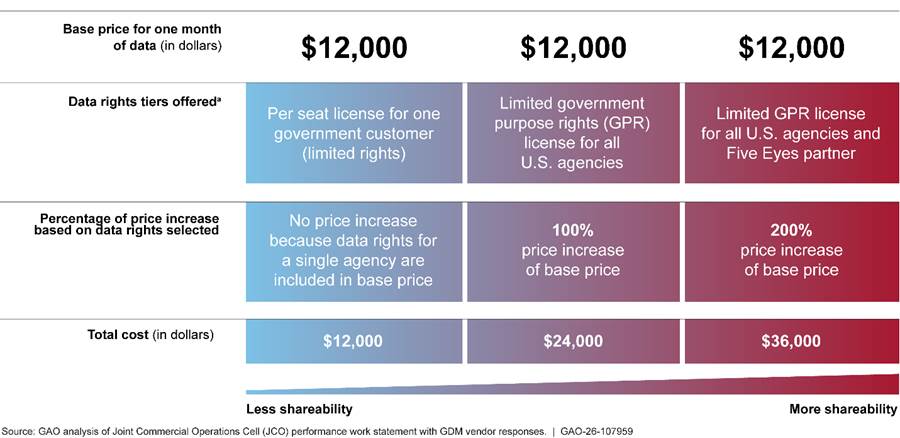
aThe data rights tiers are examples of specifically negotiated license rights. These licenses can provide additional rights beyond what is listed in regulation. DOD may not accept less than limited rights in technical data. DFARS 227.7103-5(d)(1). The data rights tiers are based on the definitions used in JCO’s performance work statement for fused data products and analytics. Those definitions are as follows:
(i) Per seat license is defined as the buyer shall have the right to use, modify, reproduce, release, perform, display, or disclose the space domain awareness data solely within the buyer’s internal organization.
(ii) Limited government purpose rights license for only the U.S. is defined as the government shall have the right to use, modify, reproduce, release, perform, display, or disclose space domain awareness data within the government.
(iii) Limited government purpose rights license for the U.S. and Five Eyes partner is defined as the government shall have the right to use, modify, reproduce, release, perform, display, or disclose space domain awareness data within the government. Five Eyes partner refers to a government agency of the United Kingdom, Canada, Australia, or New Zealand that is a member of the Five Eyes intelligence alliance under a multilateral agreement with the U.S. government.
Separate from GDM, the National Reconnaissance Office, in collaboration with the National Geospatial-Intelligence Agency, developed a common group of end user license agreements that define how commercial imagery can be used and shared across a broad user community. The agreements range from least restrictive (Public Release) to most restrictive (National Security). Table 5 shows the types of end user license agreements and their different levels of sharing allowed.
|
Authorized user community |
Public release |
U.S. Government Plusa |
U.S. government |
National Security Plusb |
National security |
|
Department of Defense (DOD) and intelligence community |
√ |
√ |
√ |
√ |
√ |
|
Executive Office of the President and Congress |
√ |
√ |
√ |
√ |
√ |
|
DOD and intelligence community, and foreign mission partners for national security purposes |
√ |
√ |
— |
√ |
— |
|
U.S. federal civil government |
√ |
√ |
√ |
— |
— |
|
U.S. federal civil government and foreign civil partners for U.S. government purposes |
√ |
√ |
— |
— |
— |
|
U.S. state, local, and tribal governments |
√ |
√ |
√ |
— |
— |
|
Non-governmental organizations for government purposes |
√ |
√ |
√ |
— |
— |
|
Contractors and grantee organizations associated with government agency |
√ |
√ |
√ |
√ |
√ |
|
Public release |
√ |
— |
— |
— |
— |
√ = applies to authorized user community — = not applicable
Source: National Reconnaissance Office (NRO) Commercial Imagery End User License Agreement documentation. | GAO‑26‑107959
Note: In each of NRO’s end user license agreements templates, the contractor grants the U.S. government a perpetual, worldwide license to specific material such as generating and sharing unlimited hardcopies of the material, and other products derived from the material.
aU.S. Government Plus allows for unlimited sharing to licensed users: all portions of the U.S. government defined under Title 5 U.S.C. 101-105; Executive Office of the President; members of Congress; congressional staff; foreign governments; intergovernmental entities; international defense and coalition partners; state and local governments, territories, and tribal authorities; non-government organizations; and nonprofit organizations, as well as contractors or grant recipients supporting the entities identified.
bNational Security Plus allows for unlimited sharing to licensed users: all entities defined under Title 10 U.S.C. or Title 50 U.S.C.; the U.S. Coast Guard; Executive Office of the President; members of Congress; congressional staff; U.S. Department of State; foreign governments and intergovernmental entities; international defense and coalition partners for U.S. national security purposes; and shareable with contractors or grant recipients supporting entities such as those defined under Title 10 U.S.C., Title 50 U.S.C., the Department of State, and foreign governments.
The Global Data Marketplace (GDM) is a contractor-owned online platform designed to facilitate data and services transactions between vendors and consumers. The General Services Administration (GSA) awarded a contract for GDM in August 2019 to a contractor, Bluestaq. One of the goals of the marketplace is to allow the military and intelligence community to quickly acquire commercial data and services for operational needs. According to Bluestaq’s March 2025 GDM vendor agreement, vendors act as independent contractors within GDM to sell commercial space data and services to customers.
Based on GSA’s process chart and other documentation, the process for a U.S. government entity customer buying commercial space data and services through GDM is as follows:
· A customer, which is a U.S. government entity such as the Joint Commercial Operations Cell, submits the following documentation to GSA:
o Information about the customer’s funding, requirements for its anticipated GDM purchase, and historical purchases, among other details. GSA uses this information to manage its workload related to GDM purchases.
o A military interdepartmental purchase request or other interagency agreement to start the process of transferring funds between the two agencies (i.e., the customer and GSA).
· GSA reviews the customer’s documentation and issues a modification to its contract to obligate the funds.
· GSA and the customer discuss the requirements. Then the customer posts a request for proposals through its GDM account that GDM vendors can respond to.
o For example, a request for proposals in support of space domain awareness could include requirements about when data collection needs to start and end or the type of orbital regime that data are collected from.
· The customer works with GSA to document the requirements of its purchase, historical data such as past purchases, and an evaluation of the proposals received from GDM vendors.
· GSA contracting officials evaluate whether the prices of the selected proposal are fair and reasonable. If contracting officials cannot determine the prices to be fair and reasonable, they will request additional information from the customer or GDM vendor. If the prices are determined to be fair and reasonable, GSA contracting officials allow the purchase to proceed.
· The customer can buy commercial services for tactical surveillance, reconnaissance and tracking if they cost less than the amounts that have been pre-approved by GSA for price reasonableness. This allows the customer to purchase these services as needed in response to dynamic events.
· Then, the customer completes the purchase on GDM.
· The customer receives the purchased data and services from GDM through the Unified Data Library. This library is a cloud-based data repository that is designed to consolidate commercial and U.S. government data, as well as data from academic sources and other countries, into one place. Also, the library restricts visibility and access of commercially purchased data to the specific users and groups authorized based on the data rights negotiated at the point of sale.
· Lastly, Bluestaq can invoice GSA weekly for purchases made.
Jon Ludwigson at LudwigsonJ@gao.gov
In addition to the contact named above, Laura Hook (Assistant Director), Carmen Yeung (Analyst-in-Charge), Lori Fields, Brittany Morey, Christine Pecora, Maura Sullivan, and Clinton Thurlow made key contributions to this report. Additional contributions were provided by Saisinzita Cheruvu, Nicolaas Cornelisse, Jean McSween, Gabe Nelson, Jack Reid, Sylvia Schatz, Megan Stewart, and Kevin Walsh.
The Government Accountability Office, the audit, evaluation, and investigative arm of Congress, exists to support Congress in meeting its constitutional responsibilities and to help improve the performance and accountability of the federal government for the American people. GAO examines the use of public funds; evaluates federal programs and policies; and provides analyses, recommendations, and other assistance to help Congress make informed oversight, policy, and funding decisions. GAO’s commitment to good government is reflected in its core values of accountability, integrity, and reliability.
Obtaining Copies of GAO Reports and Testimony
The fastest and easiest way to obtain copies of GAO documents at no cost is through our website. Each weekday afternoon, GAO posts on its website newly released reports, testimony, and correspondence. You can also subscribe to GAO’s email updates to receive notification of newly posted products.
Order by Phone
The price of each GAO publication reflects GAO’s actual cost of production and distribution and depends on the number of pages in the publication and whether the publication is printed in color or black and white. Pricing and ordering information is posted on GAO’s website, https://www.gao.gov/ordering.htm.
Place orders by calling (202) 512-6000, toll free (866) 801-7077,
or
TDD (202) 512-2537.
Orders may be paid for using American Express, Discover Card, MasterCard, Visa, check, or money order. Call for additional information.
Connect with GAO
Connect with GAO on X,
LinkedIn, Instagram, and YouTube.
Subscribe to our Email Updates. Listen to our Podcasts.
Visit GAO on the web at https://www.gao.gov.
To Report Fraud, Waste, and Abuse in Federal Programs
Contact FraudNet:
Website: https://www.gao.gov/about/what-gao-does/fraudnet
Automated answering system: (800) 424-5454
Media Relations
Sarah Kaczmarek, Managing Director, Media@gao.gov
Congressional Relations
David A. Powner, Acting Managing Director, CongRel@gao.gov
General Inquiries
[1]For more information about the sharing of commercial data between allies and partners, see GAO, Space Operations: DOD Is Pursuing Efforts to Collaborate with Allies and Partners but Needs to Address Key Challenges, GAO‑25‑108043 (Washington, D.C.: July 8, 2025).
[2]S. Rep. No. 117-130, at 290 (2022).
[3]NRO’s reported available funding refers to its budget authority, which includes the base, other additions, and supplemental budgets. This is available for obligation for commercial imagery. Its reported available funding does not include funding from other sources such as transfers and reprogramming, according to NRO officials.
[4]GAO, Standards for Internal Control in the Federal Government, GAO‑14‑704G (Washington, D.C.: Sept. 10, 2014).
[5]The U.S. Space Command established JCO in 2020 to support the command’s protect and defend mission. JCO reports to the Space Systems Command within Space Force.
[6]According to the June 2025 DOD Dictionary of Military and Associated Terms, space domain awareness is the timely, relevant, and actionable understanding of the operational environment that allows military forces to plan, integrate, execute, and assess space operations. According to the August 2025 Tactical Surveillance, Reconnaissance and Tracking (TacSRT) User Guide, TacSRT is a Chief of Space Operations initiative to use commercial capabilities to provide unclassified tactical support to the warfighter.
[7]The June 2025 DOD Dictionary of Military and Associated Terms defines geospatial intelligence (GEOINT) as the exploitation and analysis of imagery and geospatial information to describe, assess, and visually depict physical features and geographically referenced activities on or about Earth. GEOINT consists of imagery, imagery intelligence, and geospatial information. Also, see 10 U.S.C. § 467(3)-(4).
[8]Small Business Innovation Research Phase I aims to determine the technical merit and feasibility of ideas that appear to have commercial potential. Phase II aims to make technical progress such as developing prototypes. Phase III is to commercialize technologies developed in earlier phases. There is no limit on the dollar value of a Phase III award. 15 U.S.C. § 638(e)(11)-(13) (definitions), (r)(4)(Phase III agreements, competitive procedures, and justification for awards).
[9]Defense Federal Acquisition Regulation Supplement 252.227-7018(c).
[10]Technical data include recorded information of a scientific or technical nature (including computer software documentation and computer databases). Computer software includes computer programs, source code, and others, and related material that would enable the software to be reproduced, recreated, or recompiled. See DFARS 252.227-7018(c).
[11]As of April 2026, GSA officials stated that they plan to extend the contract by 12 months to July 31, 2027. GSA and JCO are developing the follow-on Small Business Innovation Research Phase III contract, which is intended to support GDM. The Unified Data Library will become a separate effort through the Space Systems Command.
[12]DFARS Part 252.227-7015 Technical Data – Commercial Products and Commercial Services; DFARS Part 227.7202 Commercial Computer Software and Commercial Computer Software Documentation. The FAR is currently undergoing a complete overhaul called the Revolutionary FAR Overhaul. Executive Order 14275 directs the Office of Federal Procurement Policy to reduce the FAR to what is required by statute and is necessary for streamlined and efficient federal procurement. Exec. Order No. 14275, 90 Fed. Reg. 16447 (Apr. 15, 2025). DOD and the military components are reforming acquisition processes, including an overhaul of the DFARS. Exec. Order No. 14265, 90 Fed. Reg. 15621 (Apr. 9, 2025). Our review focuses on contracts awarded before and in fiscal year 2025. As such, references to the FAR and DFARS are to the codified versions, and do not include deviations to the FAR or DFARS that occurred after that time frame.
[13]DFARS 227.7103-5(d). Specifically negotiated licenses can provide additional rights beyond what is listed in regulation. DOD may not accept less than limited rights in technical data. DFARS 227.7103-5(d)(1).
[14]S. Rep. No. 119-39, at 269 (2025). Unresolved imagery is imagery that is unclear.
[15]Pub. L. No. 119-60, § 1607(a), (e) (2025). The Secretary of the Air Force was to conduct the study in coordination with the Under Secretary of Defense of Intelligence and Security.
[16]S. Rep. No. 119-39, at 281 (2025).
[17]In May 2025, NGA and the Space Force signed a memorandum of agreement outlining roles and responsibilities between NGA’s GEOINT and Space Force’s TacSRT. As of June 2026, DOD’s Office of Inspector General was conducting a review of DOD’s integration of Space Force’s TacSRT program with DOD intelligence collection management, including assessing the extent of coordination between the two.
[18]GAO, National Security Space: Actions Needed to Better Use Commercial Satellite Imagery and Analytics, GAO‑22‑106106 (Washington, D.C.: Sept. 7, 2022). This is the public version of our classified report: GAO, National Security Space: Actions Needed to Better Use Commercial Satellite Imagery and Analytics, GAO‑22‑105072C (Washington, D.C.: July 22, 2022) (SECRET//NOFORN).
[19]GAO, Space Situational Awareness: DOD Should Evaluate How It Can Use Commercial Data, GAO‑23‑105565 (Washington, D.C.: Apr. 24, 2023).
[20]Department of the Air Force, Report to Congressional Committees regarding Plan for Space Force Space Situational Awareness (Washington, D.C.: June 2024).
[21]As of October 1, 2025, the simplified acquisition threshold increased from $250,000 to $350,000. This threshold can be higher when acquisitions are used to support a contingency operation or to facilitate defense against or recovery from nuclear, biological, chemical, or radiological attack. See FAR 2.101.
[22]The contractor for GDM, Bluestaq, provided information about purchases made through GDM from January 27, 2023 to September 30, 2025. According to Bluestaq, the Space Force made purchases through GDM before January 27, 2023. However, Bluestaq could not easily provide information about the amounts or types of commercial space data and services that the Space Force bought prior to January 27, 2023, because it archived the information after it upgraded its accounting system and the information was not readily accessible.
[23]As of October 1, 2025, the micropurchase threshold increased from $10,000 to $15,000. See FAR 2.101.
[24]FAR 13.002.
[25]The U.S. Space Surveillance Network is comprised of optical and radar sensors throughout the world to track objects in orbit. For more information, see GAO‑23‑105565.
[26]Electro-optical imagery is a collection of digital information captured by sensors that detect visible light and infrared radiation. The electro-optical imagery acquired by NRO includes two- and three-dimensional images.
[27]National Reconnaissance Office, Memorandum of Understanding between the National Reconnaissance Office and the National Geospatial-Intelligence Agency on Partnership and Collaboration in Support of Their Mission, NRO ID 2016-05309 (September 2017).
[28]Hyperspectral imaging, an evolution of electro-optical imaging, uses numerous bands—often hundreds—of the visible and infrared portions of the electromagnetic spectrum. This allows users to identify objects of interest that may not be otherwise distinguishable.
[29]NRO’s reported available funding refers to its budget authority, which includes the base, other additions, and supplemental budgets. This is available for obligation for commercial imagery. Its reported available funding does not include funding from other sources such as transfers and reprogramming, according to NRO officials. NRO provided these amounts as rounded annual averages for fiscal years 2021 through 2025, rather than an exact dollar amount, to avoid disclosing classified information.
[30]Indefinite-delivery, indefinite-quantity contracts are used when the exact quantities and timing for products or services are not known at the time of award. These contracts can be awarded to one or more contractors for the same or similar products or services. They provide for the issuance of orders, which are used to procure specific products or services during the period of the contract. See FAR 16.504.
[31]See DFARS 227.7103-5(b) and appendix II for more information about data rights in GDM.
[33]Department of Defense, Commercial Space Integration Strategy 2024 (Washington, D.C.: April 2024).
[34]Exec. Order No. 14369, 90 Fed. Reg. 16433 (Dec. 18, 2025).
[35]S. Rep. No. 117-130, at 290 (2022).
[36]GAO, National Security Space: Actions Needed to Better Use Commercial Satellite Imagery and Analytics, GAO‑22‑106106 (Washington, D.C.: Sept. 7, 2022). This is the public version of our classified report: GAO, National Security Space: Actions Needed to Better Use Commercial Satellite Imagery and Analytics, GAO‑22‑105072C (Washington, D.C.: July 22, 2022) (SECRET//NOFORN). GAO, Space Situational Awareness: DOD Should Evaluate How It Can Use Commercial Data, GAO‑23‑105565 (Washington, D.C.: Apr. 24, 2023).
[37]On February 24, 2026, the Federal Procurement Data System ezSearch capability was retired and transitioned to SAM.gov. All SAM.gov search results are unclassified contract actions above the micropurchase threshold and modifications to previously reported data regardless of dollar value. SAM.gov is an integrated award environment hosted by the General Services Administration.
[38]The contract was awarded in August 2019 and expires on July 31, 2026. It is a sole-source Small Business Innovation Research Phase III award managed by the General Services Administration (GSA). As of April 2026, GSA officials stated that they are working on follow-on efforts to support GDM.
[39]NRO’s reported available funding refers to its budget authority, which includes the base, other additions, and supplemental budgets. This is available for obligation for commercial imagery. Its reported available funding does not include funding from other sources such as transfers and reprogramming, according to NRO officials.
[40]Department of Defense, Commercial Space Integration Strategy 2024 (Washington, D.C.: 2024); U.S. Space Force Commercial Space Strategy: Accelerating the Purposeful Pursuit of Hybrid Space Architectures (Washington, D.C.: 2024).
[41]GAO, Standards for Internal Control in the Federal Government, GAO‑14‑704G (Washington, D.C.: Sept. 10, 2014).