
Report to Congressional Requesters
United States Government Accountability Office
A report to congressional requesters.
For more information, contact: Tatiana Winger at wingert@gao.gov.
What GAO Found
The Department of State last updated its standards for overseas housing space in 1991, according to State officials. Those standards may no longer align with State’s goal of providing Foreign Service personnel living abroad with housing comparable to the Washington, D.C., metropolitan area. In the last 35 years, housing in the Washington, D.C., area has been increasing in cost and decreasing in square footage. In addition, State’s method for measuring overseas housing does not align with the domestic industry standards typically followed by housing appraisers in the U.S., which may prevent State from comparing its overseas housing to housing in the Washington D.C. area. Without reviewing and updating, as applicable, its overseas housing policy, State may be paying for larger residential units than necessary for its Foreign Service personnel.
State’s posts largely adhered to overseas housing cost and space standards, with 87 percent and 81 percent of units meeting those standards, respectively. Posts must request waivers to exceed these standards. Rental cost waivers resulted in overages of under 2 percent of annual lease costs in 2025, representing $8.8 million of the total $497 million in lease costs. GAO found the use of cost and space waivers varied by rank, family size, and locality. For example, executive officers and smaller families most frequently used cost and space waivers. Additionally, posts designated with more difficult living conditions used space waivers more frequently and exceeded standards by the largest margin.
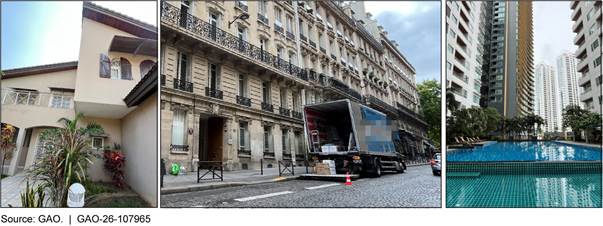
State officials from the three posts that GAO selected for illustrative purposes, in Côte d’Ivoire, France, and Thailand, identified various challenges that limited their ability to provide and manage overseas housing for Foreign Service personnel. The challenges included resource constraints, limited suitable housing, and disparate systems tracking housing data. State’s Staff Housing Opportunity Purchase program aims to address some of these challenges by enabling eligible posts to acquire residential properties using proceeds from the global sales of excess properties. This initiative supports the provision of high-quality housing while generating long-term savings for the U.S. government through reduced lease costs, according to State officials.
Why GAO Did This Study
Around the world, State employees play critical roles in achieving U.S. foreign policy. State seeks to provide Foreign Service personnel serving abroad with safe and secure housing at a cost most advantageous to the U.S. government.
GAO was asked to review the housing benefit for Foreign Service personnel serving abroad. This report examines (1) the extent to which State updates its overseas housing standards to ensure they align with its goal of providing adequate housing, (2) the extent to which State adheres to its overseas housing standards at posts, and (3) the challenges State faces in adhering to its overseas housing standards at selected posts.
GAO reviewed relevant laws, policies, and guidance documents, and collected State data on overseas housing for fiscal year 2025 to analyze housing availability, size, costs, and waivers. GAO analyzed changes to housing affordability and Foreign Service personnel salaries in the Washington, D.C., area from 1993 to 2023—the latest available data. GAO also interviewed State officials at headquarters and at three overseas posts. GAO selected these posts to illustrate conditions for different regions, a range of embassy sizes, a mix of both owned and leased properties, and a mix of space and cost waivers.
What GAO Recommends
GAO recommends that the Secretary of State review and update, as applicable, State’s (1) maximum housing space standards for overseas Foreign Service personnel to ensure they reflect the current economic conditions in the Washington, D.C., area and (2) method for measuring overseas housing space to align with domestic industry standards. State concurred with both recommendations.
|
Abbreviations |
|
|
|
|
|
|
|
ANSI |
American National Standards Institute |
|
|
BMIS |
Building Management Integrated System |
|
|
OBO |
Bureau of Overseas Buildings Operations |
|
|
RPA |
Real Property Application |
|
|
SHOP |
Staff Housing Opportunity Purchase |
|
This is a work of the U.S. government and is not subject to copyright protection in the United States. The published product may be reproduced and distributed in its entirety without further permission from GAO. However, because this work may contain copyrighted images or other material, permission from the copyright holder may be necessary if you wish to reproduce this material separately.
August 10, 2026
The Honorable James E. Risch
Chairman
Committee on Foreign Relations
United States Senate
The Honorable Michael T. McCaul
House of Representatives
The U.S. government’s diplomatic corps plays a critical role in achieving U.S. foreign policy goals, such as formulating and implementing policy, collecting information, and engaging with foreign governments and citizens. To mitigate the stresses of overseas service, the Department of State provides housing, among other benefits and allowances, to personnel serving abroad.[1] As of September 30, 2024, State operated 279 overseas U.S. embassies and consulates (posts) and managed residential assets supporting over 9,000 State U.S. direct hire employees living overseas.[2] In 2025, State reported spending $497 million on residential leases.
State’s objective for its overseas housing program is to provide safe and secure housing that meets the personal and professional requirements of employees, at a cost most advantageous to the U.S. government.[3] State periodically takes steps to ensure that its housing program meets employees’ needs, such as by conducting customer satisfaction surveys.[4] Under State’s policy, adequate housing is housing comparable to what an employee would occupy in the Washington, D.C., metropolitan area, with adjustments for family size and local conditions.[5]
You asked us to review total compensation, including allowances and non-cash benefits, for State Foreign Service personnel serving abroad. This report is the second of two reports addressing your request.[6] It examines (1) the extent to which State updates its overseas housing standards to ensure they align with its goal of providing adequate housing to Foreign Service personnel living abroad, (2) the extent to which State adheres to its overseas housing standards at posts, and (3) the challenges State faces in adhering to its overseas housing standards at selected posts.[7]
To address these objectives, we reviewed relevant federal laws, policies, and State planning and guidance documents. We also reviewed our prior related reports and interviewed State officials at headquarters in Washington, D.C., and at three overseas posts in Abidjan, Côte d’Ivoire; Paris, France; and Bangkok, Thailand.[8] We selected these posts to illustrate the mix of housing options available in various regions and locality tiers, a range of embassy sizes, and a mix of both leased and owned properties.[9]
To examine the extent to which State updates its overseas housing standards, we analyzed economic indicators from the U.S. Census Bureau’s American Housing Survey and information on State websites. We used these data to ascertain whether the size of housing occupied by Foreign Service personnel living in the Washington, D.C., area may have changed since State last updated its housing space standards in 1991. Specifically, we analyzed data on Foreign Service salaries and U.S. Census Bureau data on housing in the Washington, D.C., area in 1993 and 2023, the most current data available at the time of our review. We also assessed State’s overseas housing program against its policies and Principle 12, “Implement Control Activities,” in GAO’s Standards for Internal Control in the Federal Government.[10]
To examine the extent to which State adheres to its overseas housing standards at posts, we reviewed cost and space waivers submitted to State’s Bureau of Overseas Buildings Operations (OBO) and analyzed State data on leased overseas housing units from State’s Building Management Information System (BMIS). We limited our scope to State-leased residential properties occupied by Foreign Service personnel.[11] For the cost and space standards and waivers analysis, we reviewed housing units identified in the dataset as exceeding either of those standards. We assessed the reliability of State’s data by reviewing related documentation and performing data reliability checks. On the basis of these steps, we determined that the data were sufficiently reliable for the purposes of our reporting objectives.
To examine the challenges State faces in adhering to its standards at selected overseas posts, we conducted structured interviews of OBO officials at headquarters as well as housing officials and local staff from the three selected posts. We analyzed the interview responses to identify and group recurrent themes. Appendix I provides additional details of our scope and methodology.
We conducted this performance audit from December 2024 to August 2026 in accordance with generally accepted government auditing standards. Those standards require that we plan and perform the audit to obtain sufficient, appropriate evidence to provide a reasonable basis for our findings and conclusions based on our audit objectives. We believe that the evidence obtained provides a reasonable basis for our findings and conclusions based on our audit objectives.
Background
State Overseas Housing Program
By statute, the Secretary of State is required to establish and implement housing policy and space standards in consultation with all U.S. agencies that have employees outside the United States who are under Chief of Mission authority, or with other agencies or employees who participate in the overseas housing program.[12] State documents its policies governing its housing program in its Foreign Affairs Manual (FAM).[13] This report focuses only on housing for State employees in the Foreign Service who work overseas.
The maximum allowable housing cost and space of a residence is determined by an individual’s rank and family size, adjusted for locality factors.
· Personnel rank places employees into three categories (Standard, Mid-Level, or Executive) according to their Foreign Service rank.[14]
· Family size reflects the number of eligible family members who reside at post for more than 50 percent of the year.[15]
· The location of a post and its local market conditions are used by OBO to set each post’s unique housing cost maximums. For housing space maximums, a post’s location falls into one of three locality tiers according to the quality of life at post, as defined in State policies, with each increase in tier correlating to a 10 percent increase in allowable housing space.[16] As figure 1 shows, locality tiers vary within the geographic regions corresponding to State’s six regional bureaus.
o Tier 1 (baseline): High economic development, general availability of cultural and recreational activities, essentially unrestricted travel, and safety comparable to Washington, D.C.
o Tier 2 (10 percent increase over tier 1): More limited cultural and recreational activities, greater isolation or climate constraints, and security conditions that may result in travel restrictions.
o Tier 3 (10 percent increase over tier 2): Most difficult living conditions, with scarce cultural and recreational facilities, restricted travel, and very high security threats, resulting in employees spending most leisure time at home.
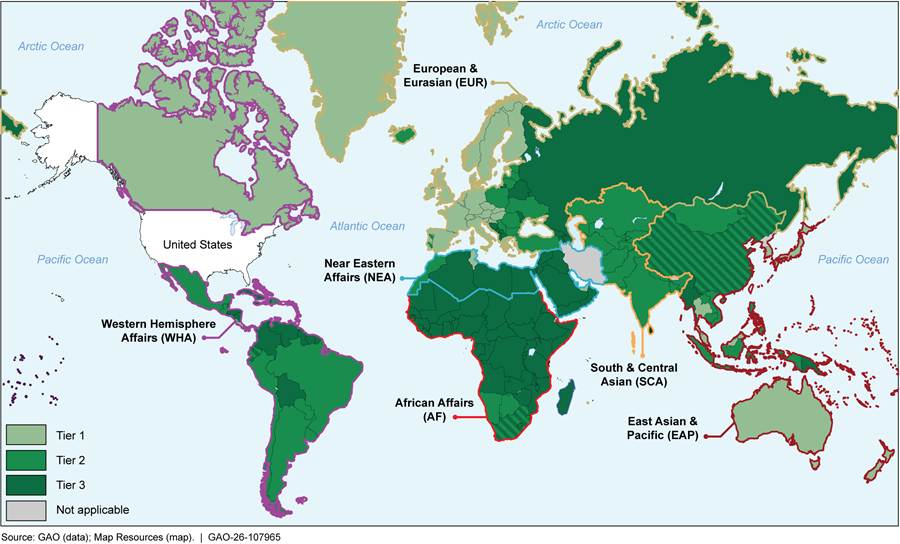
Note: Not applicable refers to those countries where we do not have posts. Striped lines show countries where posts fall under multiple locality‑tier designations. Each stripe corresponds to the appropriate shade shown in the legend. State characterizes posts by tier as follows: Tier 1 posts have high economic development, general availability of cultural and recreational activities, essentially unrestricted travel, and safety comparable to Washington, D.C. Tier 2 posts have more limited cultural and recreational activities, greater isolation or climate constraints, and security conditions that may result in travel restrictions. Tier 3 posts have the most difficult conditions, with scarce cultural and recreational facilities, restricted travel, and very high security threats, resulting in employees spending most of their leisure time at home.
Maximum Allowable Costs
Foreign Service personnel’s rank and family size, adjusted to reflect the local market’s rental rates, determine their maximum allowable rental costs. Officials said that OBO establishes rental cost benchmarks, or standards, for each post by defining the maximum amount that posts are permitted to pay for a residential lease.[17] OBO uses input from the posts as well as commercial vendors to determine local market prices. OBO sets the standards for employee rank and family size to determine the specific maximum rental cost applicable to Foreign Service personnel. For example, State’s housing cost standards in fiscal year 2024 would result in a standard-rank employee with a family of two at a post in Abidjan (a locality tier 3 post) to occupy a residential unit with an annual rent of no more than $55,000. By the same standards, an executive-rank employee with a family of four serving at the same post could occupy a unit with an annual rent of up to $70,000 (see table 1).
Table 1: State’s Standards for Maximum Allowable Annual Rental Costs for Overseas Housing in Abidjan, Côte d’Ivoire, Fiscal Year 2024
|
Employee rank |
Family size (no. of occupants) |
|||
|
1-2 occupants |
3-4 occupants |
5-6 occupants |
7+ occupants |
|
|
Standard |
$55,000 |
$60,000 |
$65,000 |
$65,000 |
|
Mid-Level |
$60,000 |
$65,000 |
$70,000 |
$70,000 |
|
Executive |
$65,000 |
$70,000 |
$74,000 |
$74,000 |
Source: Department of State’s Annual Rental Benchmarks, fiscal year 2024. | GAO‑26‑107965
Maximum Allowable Space
State’s housing space standards establish the maximum allowable residential square footage for overseas Foreign Service personnel according to their position rank and family size at the time of arrival at post, adjusted for locality factors. For example, State’s housing space standards would allow a standard-rank employee with a family of two serving at a locality tier 1 post to occupy a residential unit no larger than 1,168 square feet. An executive-rank employee with a family of four, serving at a locality tier 1 post, could occupy a unit of up to 2,146 square feet (see table 2).[18] State’s housing policy clarifies that the housing space standards represent maximum allowable space, rather than entitlements or goals for personnel abroad, and do not preclude the agency from adopting smaller space standards for certain categories of personnel.
Table 2: State’s Standards for Maximum Allowable Housing Space for Overseas Foreign Service Personnel in Locality Tier 1
|
Employee rank |
Family size (no. of occupants) |
|||
|
1-2 occupants |
3-4 occupants |
5-6 occupants |
7+ occupants |
|
|
Standard |
1,168 sq. ft. |
1,700 sq. ft. |
1,976 sq. ft. |
2,103 sq. ft. |
|
Mid-Level |
1,296 sq. ft. |
1,870 sq. ft. |
2,188 sq. ft. |
2,316 sq. ft. |
|
Executive |
1,700 sq. ft. |
2,146 sq. ft. |
2,465 sq. ft. |
2,592 sq. ft. |
Source: Department of State, Foreign Affairs Manual, 15 FAM Exhibit 237(1). | GAO‑26‑107965
Note: For the purposes of our housing space data analysis, we limited our analysis to family sizes of six or less to avoid potential outliers. State characterizes posts by tier as follows: Tier 1 posts have high economic development, general availability of cultural and recreational activities, essentially unrestricted travel, and safety comparable to Washington, D.C. Tier 2 posts have more limited cultural and recreational activities, greater isolation or climate constraints, and security conditions that may result in travel restrictions. Tier 3 posts have the most difficult conditions, with scarce cultural and recreational facilities, restricted travel, and very high security threats, resulting in employees spending most of their leisure time at home.
Waivers for Overseas Housing That Exceeds Rental Cost or Space Standards
When assigning a housing unit to incoming Foreign Service personnel, the post considers both the rental cost and space standards that apply to that employee according to rank and family size. Posts must obtain OBO’s approval for a waiver for leases exceeding the authorized rental cost or space limits tied to the employee’s rank, family size, and locality.
Overseas posts face constant changes in family sizes and housing needs as employees rotate in and out of post and agencies make staffing and assignment changes, according to State officials. These factors can make full compliance with rental benchmark and space standards difficult. Officials also noted that waivers provide the flexibility needed to address these challenges. To obtain a waiver, posts must support requests with strong rationales and precise, complete data.
Roles and Responsibilities in State’s Overseas Housing Program
Headquarters
The Bureau of Overseas Buildings Operations (OBO) establishes housing policy and manages State’s overseas housing program. OBO maintains records of the department’s leased and owned real property holdings abroad through a system called the Real Property Application (RPA). OBO conducts overseas housing surveys as part of its mission to provide the most effective facilities for U.S. diplomacy abroad.
The Bureau of Diplomatic Security is responsible for the Residential Security Program, which provides for a secure environment for the residences of U.S. citizen direct-hire employees and their eligible family members sent abroad to conduct official business for the U.S. government at Foreign Service posts.[19] In carrying out these responsibilities, the Bureau of Diplomatic Security:
· Oversees the physical security of overseas facilities by ensuring that new construction and major renovation projects comply with the Secure Embassy Construction and Counterterrorism Act and Overseas Security Policy Board physical security standards.[20]
· Establishes residential threat levels at overseas posts and develops security standards for different types of residences and threat environments.[21]
Overseas Missions
Each overseas post implements its housing program according to State’s standards and relies on Foreign Service personnel and locally employed staff for support.
· The general services officer manages the post’s physical resources, including the housing program. According to post officials, the general services officer identifies new housing, negotiates lease agreements, maintains an up-to-date housing inventory, and coordinates the preparation of housing for incoming personnel with other housing team partners.
· The housing team, which includes locally employed staff, collaborates with the general services officer and other post leadership to manage the overseas housing program. The team identifies residences that meet established space and cost standards, manages housing data at post, and works with landlords to coordinate safety and security needs, routine building maintenance, and structural work orders. It also manages and submits waiver requests when standards cannot be met and coordinates resident assignments for arrivals and departures. The housing team includes the following personnel:
o The regional security officer, who inspects and validates the security suitability of housing in accordance with country-specific threat environment standards, and for conducting and certifying security surveys for each residence.
o The post occupational safety and health officer, who conducts safety inspections, identifies hazards, and coordinates corrective actions as necessary.
o The make-ready team, which cleans and prepares residences for arriving personnel once an employee is assigned to a unit.
· The Interagency Housing Board, which comprises representatives for each agency under Chief of Mission authority, coordinates with the general services officer and housing team at all overseas posts to ensure parity in housing decisions, apply established standards, approve assignments, and review exceptions to the standards that may require waivers.
State’s Overseas Housing Portfolio
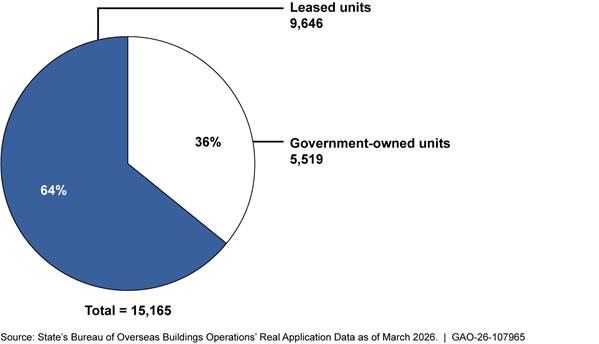
State’s overseas housing portfolio for Foreign Service personnel is primarily composed of leased residences, as well as government-owned properties.[22] The portfolio consists of apartments, detached townhomes in compounds, and some single-family dwellings.[23] As figure 2 shows, State provided 64 percent of its housing through leased properties and 36 percent through government-owned properties, as of March 2026.
Figure 2: Department of State’s Owned or Leased Units Occupied by Foreign Service Personnel, as of March 2026
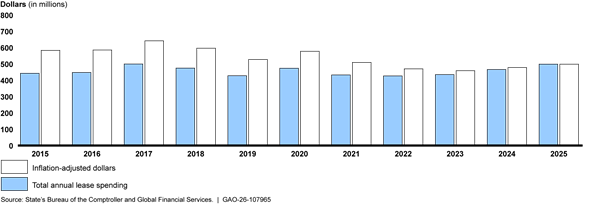
· Leased units. State officials said that leasing properties allows flexibility, as posts can terminate leases if properties no longer suit their needs. State prefers to lease properties for at least 5 years or more to recuperate initial investments in security upgrades such as the installation of generators, water purification systems, or 24-hour surveillance systems. From fiscal years 2015 through 2025, State’s annual spending on overseas leased properties ranged from a low of $425 million in 2022 ($468 million in 2025 inflation-adjusted dollars) to a high of $498 million in 2017 ($640 million in 2025 inflation-adjusted dollars), according to State data (see fig. 3).
Figure 3: Department of State’s Total Annual Spending on Leased Housing Units, Fiscal Years 2015-2025
· Government-owned units. Owning properties offers long-term stability and greater control over costs, according to State officials. However, purchasing properties for State typically requires substantial upfront funding and entails ongoing maintenance expenses, according to State officials. Officials said that State generally retains owned residences for longer than 10 years. State’s annual spending on government-owned properties varies significantly from one year to the next, depending on whether OBO is commissioning or decommissioning properties that year.
State Has Not Updated Some Overseas Housing Standards in 35 Years
State has not updated its standards of maximum allowable housing for overseas Foreign Service personnel or its methods for measuring the square footage of housing since establishing these policies in 1991, according to OBO officials. As a result, the existing standards may no longer align with the agency’s housing goals. However, State has updated other aspects of its housing standards, including introducing rental cost standards in 2007 and updating its method for calculating family size in the mid-1990s and 2021, according to OBO officials.
State Set Its Current Housing Space Standards in 1991, and Some Aspects Do Not Align with Domestic Industry Standards
State Has Not Updated Its Housing Space Standards Since 1991, Although Housing and Income Conditions Have Changed
State established its current overseas housing space standards in 1991, according to OBO officials.[24] The standards were based on a housing survey of State employees—both Foreign Service and Civil Service—living in the Washington, D.C., area.[25] However, given changes to housing and employee incomes since 1991, the standards for overseas housing space may no longer reflect the size of employee housing in the Washington, D.C., area.
The objective of State’s overseas housing program is to provide safe and secure housing that meets the personal and professional requirements of employees, at a cost that is most advantageous to the U.S. government. The housing abroad policy defines adequate housing as “housing comparable to what an employee would occupy in the Washington, D.C., Metropolitan Area.”[26]
In 2005, State commissioned a study to assess its housing space standards.[27] The study found that few Foreign Service personnel could afford to buy the same-sized housing in the Washington, D.C., area that they would be allowed to occupy overseas, and that most Foreign Service personnel in the Washington, D.C., area lived in smaller housing than they would be allowed to occupy overseas. Nevertheless, the study recommended that State maintain its existing housing space standards and did not provide a rationale for this recommendation.
Our analysis of more recent data shows that since State last updated its housing space standards in 1991, the Washington, D.C., area has undergone significant economic changes, particularly related to housing costs and size. We found that from 1993 to 2023, median housing square footage in the Washington, D.C., area decreased, and median housing costs increased more than Foreign Service personnel salaries.[28] Specifically, during this period:
· The inflation-adjusted median monthly cost of all occupied housing increased by 27 percent, from $1,867 per unit in 1993 to $2,379 per unit in 2023.
· The median square footage of all occupied homes decreased by 27 percent, from 2,339 square feet in 1993 to 1,700 square feet in 2023.
· Inflation-adjusted salaries for standard- and mid-level-rank employees increased by 24 percent and 11 percent, respectively, and executive-rank employee salaries decreased by 23 percent.[29]
OBO officials told us they did not have documentation explaining why State’s previous leadership chose to maintain the existing overseas residential space standards since the 2005 study. Leadership may have considered the updates unnecessary, according to OBO officials. They said that the current space standards are sufficiently flexible for posts to administer their housing programs in an efficient manner.
OBO officials said they revisited the 2005 study in 2019 and noted the study’s assumptions and methodology were flawed because it compared State’s maximum housing space standards to the actual size of housing occupied by Foreign Service personnel in the Washington, D.C., area. Officials explained that it would have been more accurate for the study to compare the actual size of housing occupied by overseas Foreign Service personnel with the actual size of housing occupied by such personnel in the Washington, D.C., area, because most overseas personnel are assigned to housing below the maximum housing space standard. However, OBO did not conduct another study with a methodology it considered more appropriate at that time.
Because State has not reviewed its housing space standards relative to changes to housing and employee incomes that have occurred since 1991, it does not have assurance that the standards reflect the current size of housing that a State employee would occupy in the Washington, D.C., area. Additionally, without an updated assessment, State cannot confirm whether it is fulfilling its policy requiring the establishment of cost-effective systems of management controls to ensure that activities are managed effectively, efficiently, and economically.[30] Federal internal control standards call for management to have a control system in place to periodically review policies and procedures for continued relevance to help the agency achieve its objectives and address related risks.[31] Until it reviews and updates its housing space standards, State may be providing larger, more costly overseas residences than needed to meet its definition of adequate housing.
State’s Method for Measuring Housing Space Excludes More Residential Areas Than Domestic Industry Standards
State’s method for measuring the square footage of overseas housing units—used to determine the maximum allowable space for Foreign Service personnel—excludes certain residential areas that are typically included under domestic industry standards. As a result, State may be undercounting the square footage of its overseas housing, potentially contributing to higher than necessary housing costs.
To determine the square footage of overseas housing space, State measures what it refers to as “usable living space,” such as bedrooms, bathrooms, kitchens, living rooms, and dining rooms. However, it excludes other residential areas such as hallways, foyers, stairwells, laundry rooms, and closets from this calculation. By contrast, the American National Standards Institute (ANSI) measurement method, adopted as the U.S. domestic industry standard in 1996 (last updated in 2021) and typically followed by housing appraisers in the United States, includes all finished square footage connected to the residence.[32] This method adds some residential areas excluded from State’s space measurements (see fig. 4).
Figure 4: Comparison of Residential Areas Included in the Department of State’s and the American National Standards Institute’s Housing Measurement Methods
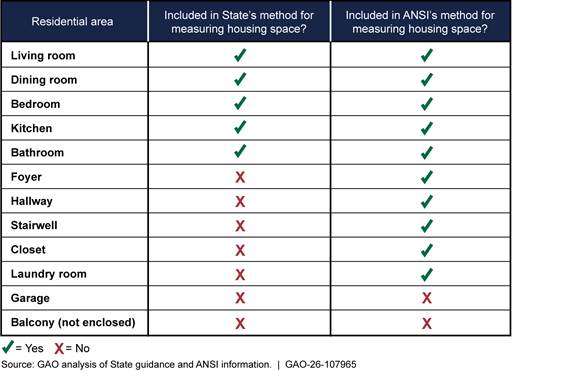
As a result, a measurement of the same residence using both State’s and ANSI’s methods would likely result in a lower total square footage using State’s calculation when compared with the ANSI calculation (see fig. 5).
Figure 5: Comparative Measurements of a Hypothetical Floorplan, Using Department of State and American National Standards Institute Square Footage Calculations
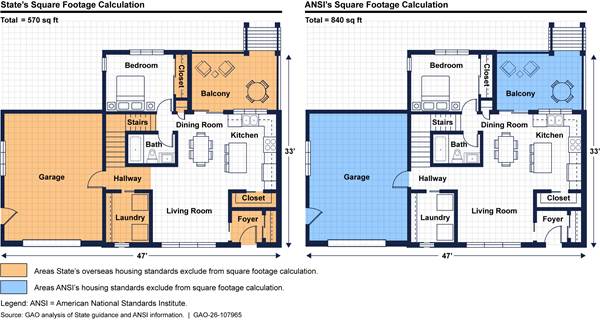
OBO officials told us that State’s method for measuring the square footage of overseas housing—including which residential areas are used for the calculation—was established in a 1991 update of its housing space policies. At that time, State could not base its measurement method on domestic industry standards because none existed before ANSI adopted its method in 1996. OBO officials said they had not revisited the 1991 methodology because they believe their current approach provides sufficient flexibility and accurately reflects the size and functionality of a residence, including the appropriate bedroom allocations, for Foreign Service families. OBO officials said their goal is to better standardize the “usable livable space” across units and countries because the residential areas in overseas housing can vary greatly. For example, historic buildings abroad can include unusual features such as oversized staircases and large laundry rooms that more modern buildings would not have, according to OBO officials.
Because State has not reassessed its methodology for measuring housing space, it cannot reliably determine whether it is meeting its objective of providing adequate overseas housing at a cost most advantageous to the U.S. government. As such, State may not be compliant with its requirement to establish cost-effective management controls.[33] In addition, federal internal control standards call for management to periodically review policies for continued relevance and effectiveness in achieving the entity’s objectives.[34]
By measuring overseas housing space using methods comparable to those used by domestic industry standards, State could better ensure that its updated housing space standards for Foreign Service personnel housing overseas reflect the size of such housing in the Washington, D.C., area, which is the basis of its definition of adequate housing. Additionally, State would have greater assurance that its housing costs are not higher than necessary, as its current measurement method could underestimate overseas square footage and allow posts to provide larger-than-needed residences (see app. II for more details).
State Has Updated Some Housing Standards, Such as Rental Cost Standards and Family Size Calculations
State Updated Posts’ Rental Cost Standards in 2007
In 2007, OBO updated its housing standards by establishing its Rental Benchmark Program to promote cost-effective residential property leasing and efficient management of overseas housing programs, according to OBO officials.[35] OBO officials said this program set rental cost standards by defining the maximum that posts could pay for a residential lease and enabled posts to execute leases under that limit without approval from OBO. All posts with 10 or more operating residential leases must participate in the program, unless otherwise excepted or directed by OBO.[36]
OBO officials told us they typically update posts’ rental cost standards on a rolling basis and develop annual schedules specifying which posts OBO will review. However, staffing shortages delayed many reviews of rental cost standards from 2007 to 2021, when OBO hired a staff member to manage the rental cost standards program, according to officials. Since 2021, OBO has updated these standards for more than 173 posts to reflect current market conditions and added 22 posts that previously had not met the minimum of 10 residential leases, according to officials. OBO officials said they plan to review rental cost standards for 20 posts in 2026.
OBO develops, reviews, and approves the rental cost standards in consultation with posts. Posts must conduct an annual survey of local housing prices and submit the results to OBO by December 31 each year. The survey covers all neighborhoods approved by the post’s regional security officer, assesses market conditions, and enables posts to compare local housing market rates with current housing inventory costs.[37] Additionally, the survey reflects State’s housing selection criteria by accounting for maximum space standards, rental costs, commuting distance, and security considerations. OBO then uses the survey data in addition to other factors to set rental cost standards, with adjustments for Foreign Service personnel rank and family size. OBO may also review and update rental cost standards for posts that request increases on an ad hoc basis because of rapid changes in the local housing market, according to officials at one post.
State Updated How It Calculates Family Size in the Mid-1990s and 2021
State updated its method for calculating family size in the mid-1990s by combining one-person families and two-person families without children into the same housing space category, according to OBO officials. This amendment resulted in single Foreign Service personnel receiving housing space comparable to housing provided for couples, according to officials.
Additionally, OBO officials said that State updated its calculation of family size in 2021 to ensure that single Foreign Service personnel with children received appropriate accommodation. Before this amendment, a married couple at post with one child would qualify for a larger maximum housing space allowable than a single parent with one child, despite requiring the same number of occupied bedrooms, according to officials. This update corrected this disparity by considering a single parent with one child at post to be a family size of three for the purpose of calculating the maximum housing space allowable.[38]
Posts Generally Adhered to Overseas Housing Standards for Rental Cost and Space, Which State Waived Under Certain Conditions
While most overseas housing units met State’s rental cost and space standards, waivers were issued in both categories under certain conditions. Rental cost waivers represented a relatively small share of total annual lease costs and varied by region, locality tier, and employee rank. The use of space waivers followed similar patterns, occurring most frequently at posts with difficult living conditions and among executive-rank employees and smaller families.
Rental Cost Waivers Represented a Small Amount of Annual Lease Costs and Varied Across Regions, Localities, and Ranks
Rental Cost Waivers Represented Under 2 Percent of Total Annual Lease Costs in 2025 and 13 Percent of Housing Units
The use of rental cost waivers represented a small share of State’s total annual spending on leased housing. From 2015 through 2025, State reported spending an average of about $455 million annually on leased overseas housing. In 2025, State reported spending a total of $497 million on leased housing, of which about $8.8 million, or 1.8 percent, resulted from rental cost overages that exceeded established standards for units occupied by Foreign Service personnel.
In 2025, 13 percent of the 7,377 housing units that State leased for Foreign Service personnel exceeded rental cost standards and required waivers, according to State data. The remaining 87 percent of units met rental cost standards. Among units needing waivers, rental costs averaged $9,200 above the annual ceiling, about 17 percent higher than the established standard.
Rental Cost Waivers Varied Regionally, and 38 Percent of Cost Overages Stemmed from Tier 3 Posts
The use of rental cost waivers for Foreign Service personnel overseas varied by locality, with posts in more difficult living environments relying on waivers more frequently and incurring higher total overages. As table 3 shows, waivers granted for housing units that exceeded rental cost standards increased with the difficulty of living conditions. Tier 3 posts accounted for the largest share of over‑standard spending at 38 percent of the total, amounting to $3.3 million of the $8.8 million in rental overages in 2025.
Table 3: Rental Cost Waivers and Cost Variances for Foreign Service Personnel Overseas by Locality Tier, 2025
|
|
Tier 1 |
Tier 2 |
Tier 3 |
Global total |
|
Number of residences |
1,578 |
2,556 |
3,243 |
7,377 |
|
Number of cost waivers granted |
286 |
311 |
364 |
961 |
|
Average annual amount exceeding rental cost standard per unit |
$8,820 |
$9,506 |
$9,266 |
$9,200 |
|
Percentage of average rental cost over standard |
14 |
21 |
18 |
17 |
Source: GAO analysis of data from the Department of State’s Building Management Integrated System as of August 2025. | GAO‑26‑107965
Note: State characterizes posts by tier as follows: Tier 1 posts have high economic development, general availability of cultural and recreational activities, essentially unrestricted travel, and safety comparable to Washington, D.C. Tier 2 posts have more limited cultural and recreational activities, greater isolation or climate constraints, and security conditions that may result in travel restrictions. Tier 3 posts have the most difficult conditions, with scarce cultural and recreational facilities, restricted travel, and very high security threats, resulting in employees spending more of their leisure time at home.
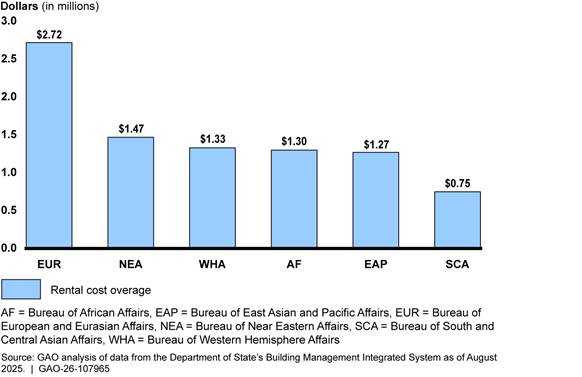
Total spending over the rental cost standard varied by region. Posts under the Bureau of European and Eurasian Affairs recorded the highest overage ($2.7 million), and posts under the Bureau of South and Central Asian Affairs recorded the lowest overage ($0.75 million). State officials noted that approximately 30 percent of diplomatic missions are in countries under the Bureau of European and Eurasian Affairs. Overages for waivers issued by posts under State’s other regional bureaus were generally similar (see fig. 6).
Figure 6: Total Rental Cost Overages for Foreign Service Personnel Overseas, by Department of State Regional Bureau, 2025
Regional patterns indicate that waivers did not always align with the size of rental cost overages. Posts under the Bureaus of African Affairs and European and Eurasian Affairs recorded the highest proportional use of rental waivers, at 22 percent and 17 percent of units, respectively (see fig. 7). By contrast, posts under the Bureaus of Near Eastern Affairs and South and Central Asian Affairs relied on waivers less frequently but recorded the largest average rental cost overages. These results suggest that rental costs are more likely to substantially exceed State’s rental cost standards in the South and Central Asia and Near Eastern regions than in other regions.
Figure 7: Rental Cost Waiver Usage and Rental Cost Overages for Foreign Service Personnel Overseas, by Department of State Regional Bureau, 2025
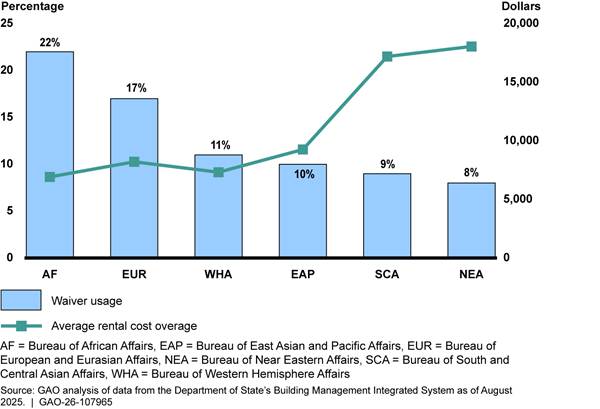
Note: Waiver usage refers to the percentage of housing units in that regional bureau that received waivers.
Larger Proportions of Executive-Rank Personnel and Smaller Families Received Rental Cost Waivers in 2025
Use of rental cost waivers varied among Foreign Service personnel overseas, with executive-rank employees and smaller families being more likely than other ranks and family sizes to exceed rental cost standards, according to State data.
Specifically, costs for executive-rank employees exceeded rental cost standards 19 percent of the time, a larger proportion than for other ranks, with an average overage of $26,209—almost three times more than the average overage for standard- and mid‑level-rank employees. Figure 8 shows rental cost waiver usage and average cost overages for the three ranks of Foreign Service personnel.
Figure 8: Rental Cost Waiver Usage and Average Rental Cost Overages for Foreign Service Personnel Overseas, by Rank, 2025
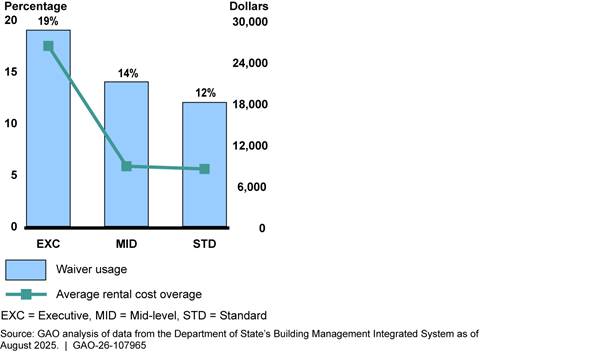
Note: Waiver usage refers to the percentage of housing units occupied by that rank that received waivers.
As figure 9 shows, the usage of rental cost waivers and the size of average rental cost overages in 2025 also varied by family size. Families of different sizes required rental cost waivers at comparable rates, though families of one or two occupants showed a slightly higher likelihood of requiring one. In addition, larger families averaged higher dollar overages when they required waivers, suggesting that the cost of appropriately sized housing increases more sharply for larger families in many markets.
Figure 9: Rental Cost Waiver Usage and Average Rental Cost Overage for Foreign Service Personnel Overseas, by Family Size, 2025
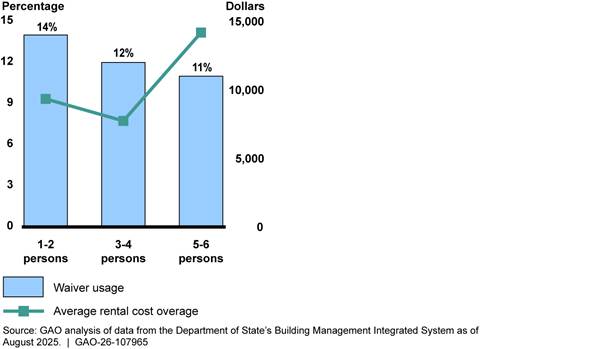
Note: Waiver usage refers to the percentage of housing units occupied by that family size that received waivers.
Use of Space Waivers Was Greater Among Posts with Difficult Living Conditions and for Executive-Rank Personnel and Small Families
Tier 3 Posts Used Housing Space Waivers Most Often and Exceeded Standards by the Largest Margins
Tier 3 posts—those in locations with more difficult living conditions—relied more heavily on space waivers than other posts and, on average, exceeded space standards by a wider margin, according to State data. State authorizes larger housing allowances for these posts, permitting units up to 20 percent larger than those allowed in Tier 1 localities. Tier 3 posts represent the largest share of overseas posts, and in 2025 submitted a total of 711 space waivers to OBO, the highest number of waivers among the locality tiers.
Additionally, the average amount of square footage exceeding established standards also increased with the difficulty of living conditions, with Tier 3 posts averaging 344 square feet over the standards for allowable space (see table 4).
Table 4: Space Waiver Activity and Housing Standard Variances for Foreign Service Personnel Overseas, by Locality Tier, 2025
|
|
Tier 1 |
Tier 2 |
Tier 3 |
Global total |
|
Number of residences |
1,578 |
2,556 |
3,243 |
7,377 |
|
Number of space waivers granted |
166 |
529 |
711 |
1,406 |
|
Average square footage exceeding standards |
194 |
258 |
344 |
291 |
|
Percentage over standards |
13 |
16 |
20 |
18 |
Source: GAO analysis of data from the Department of State’s Building Management Integrated System as of August 2025. | GAO‑26‑107965
Note: State characterizes posts by tier as follows: Tier 1 posts have high economic development, general availability of cultural and recreational activities, essentially unrestricted travel, and safety comparable to Washington, D.C. Tier 2 posts have more limited cultural and recreational activities, greater isolation or climate constraints, and security conditions that may result in travel restrictions. Tier 3 posts have the most difficult conditions, with scarce cultural and recreational facilities, restricted travel, and very high security threats, resulting in employees spending more of their leisure time at home.
Regional patterns also showed that posts relying more heavily on space waivers tended to exceed space standards by greater amounts. For example, posts under the Bureau of African Affairs used waivers for 36 percent of housing units and averaged an overage of 441 square feet, the highest among all the regional bureaus (see fig. 10). State officials noted that it is more difficult to find smaller residences up to standards for posts under the Bureau of African Affairs.
Figure 10: Space Waiver Usage and Average Square Footage Overage for State Foreign Service Personnel Overseas, by Department of State Regional Bureau, 2025
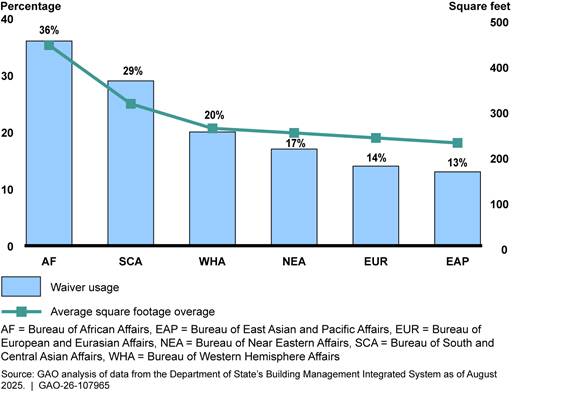
Note: Waiver usage refers to the percentage of housing units in that regional bureau that received waivers.
Larger Proportions of Executive-Rank Personnel and Smaller Families Received Space Waivers in 2025
Although posts issued space waivers infrequently, with 81 percent of units meeting standards, State data show that executive-rank employees and smaller families were more likely than other groups to be housed in units exceeding State’s maximum allowable space standards.
On average, executive-rank employees with housing space waivers occupied units that were 21 percent (495 square feet) larger than the applicable space ceiling, representing the largest average overage among all rank groups (see fig. 11). However, executive-rank employees accounted for the fewest waivers overall, as they made up a smaller share of the overseas workforce. OBO approved 894 waivers for standard-rank employees, 442 waivers for mid-level-rank employees, and 48 waivers for executive-rank employees. As a result, while executive-rank employees were more likely to receive a waiver proportionally, they accounted for a small share of total waivers overall.
Figure 11: Space Waiver Usage and Average Square Footage Overage for State Foreign Service Personnel Overseas, by Rank, 2025
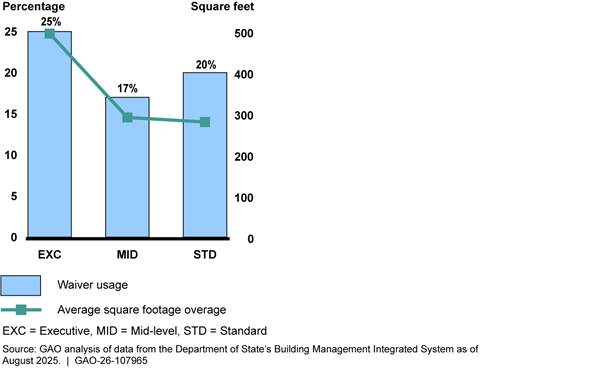
Note: Waiver usage refers to the percentage of housing units occupied by that rank that received waivers.
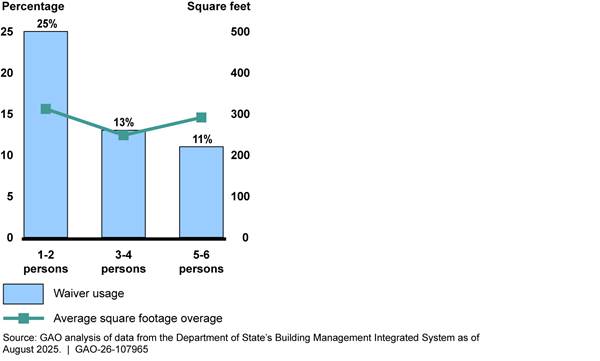
State data also show an association between family size and waiver use. Posts placed 25 percent of smaller families (one or two persons) in units that exceeded State’s housing space standards. This was the highest rate among all family sizes and averaged 22 percent, or 312 square feet, above the applicable space ceiling (see fig. 12).
Figure 12: Space Waiver Usage and Average Square Footage Overage for State Foreign Service Personnel Overseas, by Family Size, 2025
Note: Waiver usage refers to the percentage of housing units occupied by that family size that received waivers.
Selected Posts Cited Various Challenges in Applying Overseas Housing Standards; a State Program Aims to Address Some of Them
State officials from the three posts we selected for our review—Abidjan, Côte d’Ivoire; Bangkok, Thailand; and Paris, France—identified various challenges that limited their ability to provide and manage overseas housing for Foreign Service personnel. The challenges included resource constraints, limited suitable local housing, mismatches between workforce composition and available housing, and disparate systems used to track housing data. State’s Staff Housing Opportunity Purchase (SHOP) Program aims to address some of these challenges.
Selected Posts Cited Various Challenges in Applying Overseas Housing Standards
Resource Constraints
Limited funding for preparing housing for incoming tenants and other improvements have hampered the selected posts’ ability to provide and maintain suitable housing for Foreign Service personnel, according to officials we interviewed. State conducts make-ready activities for both owned and leased properties but only funds property repairs and upgrades for government-owned properties.
Officials at the selected posts noted they had less funding to make housing ready for new tenants given reduced budgets. According to officials, the posts clean and make minor repairs and improvements to the properties before assigning them to incoming tenants. Typical make-ready tasks may include cleaning carpets and curtains, patching or painting walls and ceilings, repairing damaged appliances, and other minor repairs to address reasonable wear and tear. In Paris, for example, the make-ready team said that recent resource constraints prevented them from making certain repairs and improvements, including planned curtain and flooring upgrades. They noted that the average cost for the routine make-ready process was approximately $14,000 in summer 2023, but officials reduced spending to approximately $3,000 by summer 2025. Officials said that this reduced level of investment was unsustainable over the long term. Therefore, the post will likely defer or forgo needed improvements, leading to the gradual deterioration of furnishings and living conditions. Over time, these deferrals may increase overall costs, as delayed make-ready activities can require more extensive and expensive remediation and may limit the post’s ability to maintain housing that meets established standards. Officials from the other two posts we visited described similar experiences.
|
Historic Apartments in Paris Needing Repair State leases apartments in Paris that were generally constructed in the 19th century. Located near the U.S. embassy in Paris, these Haussmann style buildings are known for their architectural beauty and close proximity to the embassy. However, due to their age, the buildings need ongoing and costly infrastructure upgrades, including repairs to water damage caused by aging and leaking pipes.
Source: GAO. | GAO‑26‑107965 |


In addition, officials at selected posts told us that the lack of appropriate resources for minor improvements and alterations have contributed to challenges to providing suitable housing that meets State’s housing standards. According to officials, properties must conform to local structural, safety and health, fire, and building codes or requirements. According to State’s policy, new and renewed residential leases must meet established security standards.[39] To maximize the duration and value of the leased investment, posts are required to make every effort to lease appropriate housing for 5 years or more.[40] Also, according to the policy, posts should attempt to have the landlord perform the work at no cost, since making improvements to a property generally increases the property’s value.[41] If neither condition is possible, State’s policy states that funding for enhancements may be considered. Further, if posts request funding for needed safety and security upgrades, OBO reviews the request for validity and identifies the full range of actions that may address the posts’ needs.[42] However, when State faces budget constraints, funding for enhancements can become challenging. For example, officials in Abidjan said that the city has prolonged internet outages and unreliable electrical power, which landlords cannot fix. Therefore, OBO supports the post by providing generators for each residence to ensure adequate living conditions.
Similarly, officials in Paris noted that many leased units located near the U.S. Embassy in Paris, often situated in historic buildings, are prone to recurrent flooding due to outdated plumbing systems and structural deficiencies. These issues are difficult and costly to repair, according to officials. Although officials have attempted to mitigate these problems through landlords, efforts have been limited, forcing the post to defer certain improvements such as wall repair and painting. In some cases, Foreign Service personnel have had to deal with ongoing structural issues, according to the officials. These persistent infrastructure limitations and the need for landlord-led investments constrain the post’s ability to consistently maintain housing that meets established standards.
Limited Suitable Local Housing
Officials at the selected posts noted that the availability of suitable housing is limited because local housing often does not meet State’s space, safety, and security standards.[43] Additional factors such as inflation, national disasters, and competition from the private sector further limit the availability of suitable housing.
Although the posts said they had made upgrades or requested waivers to adhere to State’s standards, finding compliant housing continued to pose challenges. In Paris, for example, many apartments in desirable neighborhoods were constructed in the 19th century and do not meet State’s fire safety standards. According to officials from Paris, these deficiencies often include the absence of centralized automatic fire alarm systems and the lack of two enclosed exit stairwells at each floor level, which are difficult to remedy. The officials said mitigation strategies may be applied when standards cannot be met. However, in Paris, OBO waived the fire standards for some housing units.
Officials at the selected posts also said that some landlords can be reluctant to lease properties to the U.S. government because State standards require physical upgrades that are not typical in the local housing market and some changes can be difficult to reverse.[44] For example, officials from the posts said that State’s safety standards may require certain safety upgrades, which could include plexiglass balcony barriers in Paris or steel safety doors in Abidjan.
Inflation, natural disasters, and competition from the private sector further limit the availability of reasonably priced housing, according to officials from the posts. High housing costs near U.S. embassies have led local housing teams to seek housing beyond the targeted 45-minute commuting radius of the embassies, according to officials from the selected posts. In Bangkok, recent rapid expansion in urban areas, which has driven real estate inflation, forced the post to release approximately 100 residences near the U.S. Embassy as the leases were no longer cost-effective. Similarly, in Abidjan, significant population growth coupled with inflationary pressures increased housing costs and made it more difficult to acquire appropriate residences that met State’s standards.
Natural disasters have further exacerbated the challenges in finding compliant, affordable housing near the U.S. Embassy. For example, a major earthquake in Bangkok in spring 2025 destroyed many apartment buildings, which decreased the supply of available housing.
Finally, posts compete with other diplomatic missions and private industry for suitable housing, which increases the costs of procuring leased properties. According to officials in Abidjan, few residential properties there meet State’s size, safety, and security standards, particularly for one- or two-person families. Officials said demand for high-quality housing—from private industry, affluent individuals, or other diplomatic personnel—is primarily concentrated on the same large properties located in desirable areas. As a result, the post is often compelled to allocate larger or more expensive residences to smaller family sizes. Officials in Bangkok also noted high demand and low supply of suitable properties in desirable geographic areas near the U.S. Embassy.
Mismatches Between Workforce Composition and Available Housing Inventory
State’s rotational staff assignment system, coupled with broader workforce management decisions, can result in discrepancies between the workforce and available housing inventory.
State reassigns Foreign Service personnel to new posts approximately every 2 to 3 years, requiring posts to accommodate a continuous influx of personnel. Variations in accompanying family size occasionally create a mismatch between workforce housing needs and available unit types. For example, if a Tier 1 post, such as Paris, were receiving an incoming standard-rank single employee, it would allow that employee a housing unit with a maximum space of 1,168 square feet. However, if the outgoing employee had a family of four and occupied a 1,500 square foot residence, the available residence would exceed the allowable space standard for the incoming employee by 332 square feet. This mismatch would necessarily result in a waiver request to OBO.
Workforce actions from headquarters can also disrupt existing housing pools. For example, the 2025 drawdown of the U.S. Agency for International Development reduced the need for existing housing inventory at some posts. As a result of the drawdown, the post in Abidjan was able to adjust its housing inventory by eliminating older residences. OBO guidance to posts following the drawdown encouraged posts to keep the best quality leased housing at the most advantageous cost and terminate the older, higher-priced outliers, according to officials.
Disparate Systems Tracking Housing Data
The various systems that State uses to track data on the overseas housing program are not integrated, and some officials have insufficient training on how to use them. State uses at least three independent data systems—the Real Property Application, the Electronic Model Lease system, and the Building Management Integrated System—to process leases and manage its overseas housing program at posts. However, data sharing among the three systems is limited, according to officials at the selected posts.
OBO officials said that staff at the posts must enter the same housing data into multiple systems, resulting in processing mistakes and inaccurate and incomplete information. Both OBO officials as well as officials at the selected posts said that the IT systems are not integrated or interoperable, resulting in missing or lost information and causing delays in lease approvals, waiver processing, and overall housing readiness.
Officials at the selected posts said that users were not provided with relevant training and do not have the expertise to navigate these independent systems. OBO officials said that they work with users to troubleshoot problems. To address processing errors caused by the poorly integrated data, State plans to introduce a new system toward the end of 2026, that will combine the functions of these three applications into one system and streamline its housing asset management information. OBO officials added that they plan to provide relevant training with the introduction of the new data system.
Staff Housing Opportunity Purchase Program Aims to Address Some of the Challenges Cited by Selected Posts
|
Addressing Challenges in the Real Estate Market at the Post in Abidjan, Côte d’Ivoire Through its Staff Housing Opportunity Purchase program, State funded the purchase of four new four-bedroom detached homes that had previously been leased by the post.
|
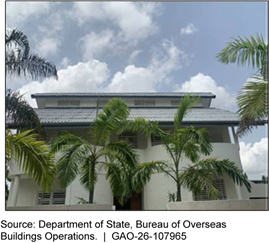
OBO’s Staff Housing Opportunity Purchase (SHOP) program aims to address some of the previously identified challenges to the overseas housing program, particularly the cost of bringing properties into compliance with State standards.[45] Established in 2015, the SHOP program allows eligible posts to acquire residential properties using proceeds from global sales of excess real property and reinvesting those funds into housing assets.[46] Ownership provides a longer investment horizon, enabling OBO to justify and recover the upfront costs associated with upgrading properties to meet required standards, according to OBO officials.
When selecting posts to receive SHOP funding, OBO prioritizes acquisitions in locations that can withstand geopolitical challenges and that are assessed as low threat and resilient to political instability. For example, using the SHOP program, the post in Abidjan recently acquired four new detached homes that are expected to decrease its annual leasing expenditure by $200,000. Officials in Abidjan told us that in July 2025, only 12 percent of the Abidjan post’s housing inventory was government-owned, with the remaining 78 percent being leased housing. The officials noted that increasing the share of government-owned housing is a strategic effort to improve quality of life, strengthen operational sustainability, and achieve long-term cost savings.
Shifting from leased to government-owned properties positions State to benefit from long-term property value through capital appreciation and by reducing annual leasing and tax expenditures, according to OBO officials. In fiscal year 2025, OBO used SHOP funds to purchase 35 housing units across posts in Jakarta, Indonesia; Quito, Ecuador; Manila, Philippines; and Cape Town, South Africa, which will result in an estimated cost savings of $1.68 million per year on leased properties, according to the officials. Further, since some U.S. government-owned diplomatic residences are exempt from property taxes, there is a built-in savings for owning versus leasing (as leases will include payment for property taxes directly or indirectly). The officials said that OBO anticipates purchasing 87 units in Tegucigalpa, Honduras; Bangui, Central African Republic; and Kinshasa, Democratic Republic of the Congo, in fiscal years 2026 and 2027.
Conclusions
State seeks to mitigate the stresses of overseas service by providing safe, secure, and functional housing to its Foreign Service personnel serving abroad. While adequate overseas housing is critical to over 9,000 personnel, State’s goal is to provide it at a cost most advantageous to the U.S. government. State’s ability to balance providing adequate housing for Foreign Service personnel abroad with responsible stewardship of taxpayer funds hinges on maintaining standards comparable to housing in the Washington, D.C., area. However, State has not updated its overseas housing space standards in more than 35 years. Since economic conditions in the Washington, D.C., area have changed significantly during this period, State may be providing overseas housing that exceeds what personnel could afford domestically.
By revisiting the assumptions underlying its maximum housing space standards and aligning its overseas measurement standards with domestic ones, State could help reduce its overseas rental expenditures and achieve savings for taxpayers. Until it does so, State is missing an opportunity to better position itself to manage costs and ensure its housing program aligns with both personnel needs and taxpayer interests.
Recommendations for Executive Action
We are making the following two recommendations to State:
The Secretary of State should ensure that the Director of the Bureau of Overseas Buildings Operations reviews and updates, as applicable, State’s maximum housing space standards for overseas Foreign Service personnel to ensure the standards are comparable to the current economic conditions in the Washington, D.C., area. (Recommendation 1)
The Secretary of State should ensure that the Director of the bureau of Overseas Buildings Operations reviews and updates, as applicable, State’s method for measuring housing space overseas to align with domestic industry standards for measuring housing space in the Washington, D.C., area. (Recommendation 2)
Agency Comments
We provided a draft of this report to the Department of State for review and comment. In its comments, reproduced in appendix III, State concurred with our recommendations and acknowledged that it would be taking steps to implement them. State also provided technical comments, which we incorporated as appropriate.
We are sending copies of this report to the appropriate congressional committees and the Secretary of State. In addition, the report is available at no charge on the GAO website at https://www.gao.gov.
If you or your staff have any questions about this report, please contact me at wingert@gao.gov. Contact points for our Offices of Congressional Relations and Public Affairs may be found on the last page of this report. GAO staff who made key contributions to this report are listed in appendix IV.
Tatiana Winger
Director, Contracting and National Security Acquisitions
This report examines (1) the extent to which the Department of State updates its overseas housing standards to ensure they align with its goal of providing adequate housing to Foreign Service personnel living abroad, (2) the extent to which State adheres to its overseas housing standards at posts, and (3) the challenges State faces in adhering to its overseas housing standards at selected posts. This report is the second of two reports examining State’s pay, benefits, and allowances for overseas personnel serving abroad.[47]
To address these objectives, we reviewed relevant federal laws, policies, and State planning and guidance documents. We also reviewed our prior related reports and interviewed State officials at headquarters in Washington, D.C.; at selected regional bureaus; and at three overseas posts in Côte d’Ivoire, France, and Thailand.[48] We selected these posts to illustrate the mix of housing options available at various regions and locality tiers, a range of embassy sizes, and a mix of both owned and leased properties.[49]
To select the posts, we analyzed State’s Real Property Application (RPA) data from 2024 and 2025 on government-owned and -leased housing and considered input from State officials. Beginning with a universe of approximately 150 posts drawn from the RPA system, we identified posts with housing units occupied across all personnel rank categories (Standard, Mid-Level, and Executive) and family size categories of one through six occupants. We excluded family sizes of seven or more to avoid outliers. We then applied additional selection criteria, including locality tier, geographic region, post size measured by total housing units, the mix of government-owned versus -leased units, the number of space and cost waivers submitted from 2018 through 2025, and the post’s rank in terms of spending on leases in fiscal year 2023 and 2024.
For each of the posts in our examples, we collected 2025 data from State’s Building Management Integrated System (BMIS) to determine the numbers of cost and space waivers submitted by each post, region, and locality tier. We used the BMIS data to identify the number of space and cost waivers submitted to State’s Bureau of Overseas Buildings Operations (OBO), by post, region, and locality tier. On the basis of each post’s geographic region, locality tier, and size, and the number of space and cost waivers used at each post, we selected approximately 15 posts for potential site visits.
By prioritizing the selection of one post from each locality tier and from different geographic regions, we selected Paris, France (Tier 1, Europe and Eurasia); Bangkok, Thailand (Tier 2, East Asia and the Pacific); and Abidjan, Côte d’Ivoire (Tier 3, African Affairs). We selected Paris in part because of the multitude of agencies and entities represented and the high volume of over-cost waivers at that post relative to other Tier 1 posts. We selected Bangkok for its large housing inventory, high waiver volume, and predominantly leased housing stock. We also prioritized selecting a sub-Saharan Africa post given the unique housing challenges and high number of Tier 3 posts in that region. Our initial selection, Nairobi, was unable to accommodate our visit, and we substituted Abidjan following consultations with the African Affairs regional bureau and relevant post officials. Through our site visits to the selected posts, we obtained information about the implementation of State’s overseas housing standards, which we analyzed to identify challenges in adhering to the standards.
To examine the extent to which State updates its overseas housing standards to ensure they align with its goal of providing adequate housing, we analyzed data and information, such as economic indicators, from the U.S. Census Bureau’s American Housing Survey and State websites. We analyzed data on changes in housing affordability and Foreign Service salaries in the Washington, D.C., area from 1993 through 2023, the most current data available at the time of our review. We also reviewed a 2005 Bearing Point study that State commissioned to assess its housing space standards. Additionally, we compared State’s standards for measuring overseas housing square footage with the domestic industry standards established by the American National Standards Institute in 1996. We also assessed State’s overseas housing program against its policies and Principle 12, “Implement Control Activities,” in GAO’s Standards for Internal Control in the Federal Government.[50]
To examine the extent to which State adheres to its overseas housing standards, we reviewed cost and space waivers submitted to OBO and collected and analyzed State data on government-owned and -leased overseas housing for fiscal year 2025. In addition, we collected information on the justifications used for cost and space waivers from the three posts we visited. Using this information, we could identify illustrative circumstances under which posts may need to request waivers.
To assess the extent to which overseas housing units exceed established space and cost standards, we analyzed a subset of BMIS data from August 2025, which are populated with information from the RPA. The BMIS dataset contained waiver data for all housing units exceeding State’s space and cost standards, as well as data on all other housing units in our scope. We limited our scope to State-leased properties occupied by Foreign Service personnel across three rank categories (Standard, Mid-Level, and Executive) and three locality tiers, using current occupant count as a proxy for family size. We excluded representational units, family sizes of seven or more, and units with capital leases from this analysis, as well as a small number of outliers identified during our data reliability assessment.[51] BMIS data did not identify which housing units were occupied by Foreign Service personnel. However, State officials provided data on units funded through OBO’s program, which they said would serve as a reasonable proxy.
For the cost and space standards and waivers analysis, we reviewed housing units identified in the dataset as exceeding either of those standards. In both cases, we calculated the difference nominally and as a percentage of the authorized standard to produce a consistent measure of the degree to which units exceeded established thresholds. We reported results in total and broken out by regional bureau, locality tier, personnel rank, and family size. We assessed the reliability of State’s data by reviewing relevant documentation and performing data reliability checks, including examining the data for missing values and interviewing State officials with expertise on BMIS and RPA. On the basis of these steps, we determined that the data were sufficiently reliable for the purposes of our reporting objectives.
To examine the challenges State faces in adhering to its standards at overseas posts, we conducted structured interviews with OBO officials at headquarters as well as housing officials and local staff from three selected posts. We asked about challenges they had experienced in adhering to and applying State’s standards when providing overseas housing to Foreign Service personnel. Three analysts analyzed the interview responses to identify and group the recurrent themes. The analysts worked iteratively, comparing notes and reconciling differences. The identified recurrent themes explicitly or implicitly illustrated challenges stemming from headquarters or local market conditions. We also followed up with relevant officials when we needed additional clarification. The responses from OBO and site visit interviews are specific to the perspectives of officials at these sites and cannot be generalized. However, we believe that these responses provide important context and insights into the challenges in adhering to State’s standards for the provision of overseas housing.
To develop descriptive statistics on State’s overseas housing inventory used in appendix II, we analyzed RPA data as of December 2025, calculating summary statistics disaggregated by locality tier, residence type, and occupant family size. We calculated cost per square foot by dividing average annual rent by average net square footage within each category. To examine illustrative cost variation across posts, we analyzed inventory and cost data for the three site visit posts alongside global figures and applied a 10 percent proportional reduction to average unit size and rent to illustrate the potential fiscal impact of space standard reductions. These estimates assume a direct proportional relationship between unit size and lease cost, which may not hold in practice and should not be interpreted as projections.
To confirm that the data were sufficiently reliable for the purposes described above, we reviewed relevant documentation, interviewed agency officials knowledgeable about the RPA system and its data entry processes, and checked for missing values, duplicate records, and anomalous entries. On the basis of these steps, we determined that the RPA data were sufficiently reliable for the purposes of our analysis.
We conducted this performance audit from December 2024 to August 2026 in accordance with generally accepted government auditing standards. Those standards require that we plan and perform the audit to obtain sufficient, appropriate evidence to provide a reasonable basis for our findings and conclusions based on our audit objectives. We believe that the evidence obtained provides a reasonable basis for our findings and conclusions based on our audit objectives.
The Department of State provided us with data from the Bureau of Overseas Buildings Operations’ Real Property Application, a comprehensive database of all real property abroad, which we analyzed to develop descriptive statistics on key characteristics of the overseas housing portfolio. We also visited selected posts in Côte d’Ivoire, France, and Thailand that illustrate the variation in overseas housing costs across posts. While local market rates remain outside State’s direct control, space authorization standards offer a potential means of managing costs over time. Consistent with these observations, State’s overseas housing costs varied across locality tiers, with tier 1 posts incurring average annual rents, about 42 percent to 49 percent higher than those in tier 2 and 3, respectively.
Variations in Leased Housing Costs at Posts and the Potential Impact of Space Reductions
State’s leased housing costs varied across posts. To better understand this variation, we conducted site visits to three overseas posts—Abidjan, Côte d’Ivoire; Bangkok, Thailand; and Paris, France—which provided insight into the mix of housing options across different regions, locality tiers, and embassy sizes. Among these posts, Paris stood out as the highest‑cost location, with a cost per square foot more than twice that of Bangkok despite having a smaller average unit size (see table 5). Abidjan, while less expensive per square foot than Paris, had the largest average unit size of the three posts, nearly 400 square feet above the global leased average.
|
Post |
Leased units |
Total net square footage |
Average square footage per unit |
Average annual rent per unit |
Total annual rent |
Cost per square foot |
|
Abidjan |
45 |
87,929 |
1,954 |
$56,572 |
$2,545,748 |
$28.95 |
|
Bangkok |
244 |
389,009 |
1,594 |
$33,649 |
$8,210,354 |
$21.11 |
|
Paris |
100 |
155,300 |
1,553 |
$74,763 |
$7,476,271 |
$48.14 |
|
Global total |
7058 |
11,127,664 |
1,577 |
$46,428 |
$327,691,286 |
$29.44 |
Source: GAO analysis of Department of State Real Property Application data as of December 2025. | GAO‑26‑107965
Note: Dollar figures are in nominal U.S. dollars. Cost per square foot = average annual rent divided by average square footage.
State’s space authorization standards provide a potential means of managing lease costs over time. Unlike local market rates, which State cannot directly control, the size of units State selects for lease is subject to its own space authorization standards. Table 6 illustrates, in simple terms, what proportional cost reductions might look like if average leased unit sizes were reduced. For example, a 10 percent reduction in average unit size, if reflected proportionally in lease costs, would suggest savings ranging from $254,565 annually in Abidjan to $747,630 in Paris.[52] Applied across the global portfolio under the same assumptions, the estimated figure approaches $32.8 million annually. While these figures are intended only to convey the order of magnitude of potential savings rather than serve as projections, they do illustrate that a reduction in maximum space standards could potentially represent an opportunity for avoiding future costs.
|
Post |
Leased units |
Current average square footage |
Reduced average square footage (–10%) |
Current average annual rent |
Reduced average annual rent (–10%) |
Savings per unit |
Total estimated savings |
|
Abidjan |
45 |
1,954 |
1,759 |
$56,572 |
$50,915 |
$5,657 |
$254,565 |
|
Bangkok |
244 |
1,594 |
1,435 |
$33,649 |
$30,284 |
$3,365 |
$821,036 |
|
Paris |
100 |
1,553 |
1,398 |
$74,763 |
$67,287 |
$7,476 |
$747,630 |
|
Global total |
7058 |
1,577 |
1,419 |
$46,428 |
$41,785 |
$4,643 |
$32,768,882 |
Source: GAO analysis of Department of State Real Property Application data as of December 2025. | GAO‑26‑107965
Note: These estimates assume a direct proportional relationship between unit size and lease cost, which may not hold in practice. Lease prices reflect a range of factors beyond square footage (i.e., location, building quality, and amenities) that do not necessarily scale with unit size. Additionally, the availability of smaller units of comparable quality and location cannot be assumed in all markets. These figures should be understood as illustrative only and not as reliable projections of achievable savings. Dollar figures are in nominal U.S. dollars.
Characteristics of State Overseas Housing
The largest share of State’s overseas housing inventory—44 percent of all units—are in tier 3 posts, where cultural and recreational facilities are scarce, travel is restricted, and security conditions are often more challenging. Locality tier 3 posts also provide the largest units at the lowest cost per square foot, reflecting the more generous maximum space standards extended to personnel serving in the most difficult environments.
Locality tier 2 posts account for approximately 35 percent of all units, followed by tier 1 posts at 21 percent, as shown in table 7. Locality tier 1 posts represent the smallest share of the inventory but have the highest average annual rent by a significant margin, about 42 percent to 49 percent higher than either tier 2 or tier 3 localities.
|
Locality tier |
Units |
Percentage of total |
Average square footage |
Total square footage |
Average annual rent |
Total annual rent |
Cost per square foot |
|
Tier 1 |
1,507 |
21 |
1,369 |
2,063,149 |
$61,334 |
$92,430,720 |
$44.80 |
|
Tier 2 |
2,440 |
35 |
1,518 |
3,704,325 |
$41,254 |
$100,660,419 |
$27.18 |
|
Tier 3 |
3,111 |
44 |
1,723 |
5,360,190 |
$43,266 |
$134,600,147 |
$25.11 |
|
Global total |
7,058 |
100 |
1,577 |
11,127,664 |
$46,428 |
$327,691,286 |
$29.44 |
Source: GAO analysis of Department of State Real Property Application data as of December 2025. | GAO‑26‑107965
Note: Dollar figures are in nominal U.S. dollars. Cost per square foot = average annual rent divided by average square footage.
Apartments are the predominant residence type within State’s overseas housing portfolio, while condominiums represent its highest-cost unit type. As shown in table 8, apartments account for 56 percent of all units, and houses constitute an additional 24 percent, which together represent 80 percent of the total inventory.
|
Residence type |
Units |
Percentage of total |
Average square footage |
Total square footage |
Average annual rent |
Total annual rent |
Cost per square foot |
|
Apartment |
3,982 |
56 |
1,404 |
5,590,763 |
$46,230 |
$184,088,400 |
$32.93 |
|
House |
1,724 |
24 |
1,862 |
3,210,432 |
$43,379 |
$74,784,619 |
$23.30 |
|
Townhouse |
777 |
11 |
1,657 |
1,287,486 |
$50,357 |
$39,127,718 |
$30.39 |
|
Villa |
364 |
5 |
1,949 |
709,549 |
$50,120 |
$18,243,722 |
$25.72 |
|
Condo |
211 |
3 |
1,561 |
329,434 |
$54,250 |
$11,446,828 |
$34.75 |
|
Total |
7,058 |
100 |
1,577 |
11,127,664 |
$46,428 |
$327,691,286 |
$29.44 |
Source: GAO analysis of Department of State Real Property Application data as of December 2025. | GAO‑26‑107965
Note: Dollar figures are in nominal U.S. dollars. Cost per square foot = average annual rent divided by average square footage.
GAO Contact
Tatiana Winger, wingert@gao.gov
Staff Acknowledgments
In addition to the contact named above, Miriam Carroll Fenton (Assistant Director), Carolina Morgan (Analyst-in-Charge), Kevin Lyman, Brian Tremblay, Julia Liebell-McLean, Debbie Chung, Chris Keblitis, Gergana Danailova, Alexa Stechschulte, and Deirdre Sutula made key contributions to this report.
The Government Accountability Office, the audit, evaluation, and investigative arm of Congress, exists to support Congress in meeting its constitutional responsibilities and to help improve the performance and accountability of the federal government for the American people. GAO examines the use of public funds; evaluates federal programs and policies; and provides analyses, recommendations, and other assistance to help Congress make informed oversight, policy, and funding decisions. GAO’s commitment to good government is reflected in its core values of accountability, integrity, and reliability.
Obtaining Copies of GAO Reports and Testimony
The fastest and easiest way to obtain copies of GAO documents at no cost is through our website. Each weekday afternoon, GAO posts on its website newly released reports, testimony, and correspondence. You can also subscribe to GAO’s email updates to receive notification of newly posted products.
Order by Phone
The price of each GAO publication reflects GAO’s actual cost of production and distribution and depends on the number of pages in the publication and whether the publication is printed in color or black and white. Pricing and ordering information is posted on GAO’s website, https://www.gao.gov/ordering.htm.
Place orders by calling (202) 512-6000, toll free (866) 801-7077,
or
TDD (202) 512-2537.
Orders may be paid for using American Express, Discover Card, MasterCard, Visa, check, or money order. Call for additional information.
Connect with GAO
Connect with GAO on X,
LinkedIn, Instagram, and YouTube.
Subscribe to our Email Updates. Listen to our Podcasts.
Visit GAO on the web at https://www.gao.gov.
To Report Fraud, Waste, and Abuse in Federal Programs
Contact FraudNet:
Website: https://www.gao.gov/about/what-gao-does/fraudnet
Automated answering system: (800) 424-5454
Media Relations
Sarah Kaczmarek, Managing Director, Media@gao.gov
Congressional Relations
David A. Powner, Acting Managing Director, CongRel@gao.gov
General Inquiries
[1]See 5 U.S.C. §§ 5921-28. The authority to prescribe regulations governing the payment of overseas differentials and allowances is delegated to the Secretary of State. Foreign Service personnel receive federal benefits such as health insurance, life insurance, and overtime.
[2]Department of State, Bureau of Global Talent Management, GTM Fact Sheet, Facts About Our Most Valuable Asset – Our People (Sept. 30, 2024). This report focuses on the overseas housing allowances for State Foreign Service personnel only and does not examine whether other U.S. agencies’ personnel assigned to posts adhere to the housing allowance. We use the terms “personnel” and “employees” to refer to this population.
[3]Department of State, Foreign Affairs Manual,15 FAM 211.1(a).
[4]Under the Diplomatic Residential Initiative, State’s Bureau of Overseas Buildings Operations (OBO) conducted quality of life surveys to help State better understand overseas housing conditions and resident satisfaction, with results shared through a dashboard to highlight issues such as residence conditions, security, and commuting. State conducted three ad hoc surveys between 2021 and 2023; in the final survey, 73 percent of 6,084 respondents reported satisfaction with their housing, citing strengths such as location, commute, security, and unit size, and concerns including limited storage, outdated units, plumbing issues, and heating/AC problems. The surveys were discontinued after 2023.
[5]15 FAM 211.1(a). State policy specifies that, when applying housing selection guidelines, posts must consider all locations meeting, or that can be modified to meet, security and safety criteria and that are within a reasonable commute. 15 FAM 252.3. State’s policy defines a “reasonable commute” as 45 minutes one-way (the average commuting distance for U.S. government employees in Washington, D.C). Id. OBO officials said they define the Washington, D.C., metropolitan area as within this 45-minute one-way commute of the city. For brevity, we will refer to the Washington, D.C., metropolitan area as the Washington, D.C., area.
[6]In 2024, we reported on the compensation amounts provided to these personnel. We found that State had spent about $3.1 billion on pay, benefits, and allowances for Foreign Service personnel serving abroad in fiscal year 2023. Of that amount, approximately 37 percent ($1.2 billion) supported basic compensation, while 21 percent ($647 million) was allocated toward the housing allowance. GAO, State Department: Spending on Pay, Benefits, and Allowances for Overseas Employees, GAO‑25‑107098 (Washington, D.C.: Dec. 19, 2024.)
[7]Data in this report pertain only to overseas housing occupied by Foreign Service personnel, except for data in figure 3, which includes State’s total annual spending on all leased housing units, including those occupied by employees of other federal agencies at posts.
[8]GAO, Overseas Allowances: State Spends Almost $480 Million Annually to Compensate Employees for Costs and Hardships of Foreign Assignments, GAO‑18‑87 (Washington, D.C.: Nov. 2, 2017); Overseas Allowances: State Should Assess the Cost-Effectiveness of Its Hardship Pay Policies, GAO‑17‑715 (Washington, D.C.: Sept. 13, 2017); and Department of State Overseas Comparability Pay, GAO‑11‑772R (Washington, D.C.: June 30, 2011).
[9]State’s policy includes a three-level locality index, which we refer to as “locality tiers,” with each tier increasing the allowable housing space by 10 percent. 15 FAM 264.2(b). Factors considered when determining a post’s locality tier are available cultural and recreational activities, climate, security, and isolation. Id. at 264.2(a).
[10]GAO, Standards for Internal Control in the Federal Government, GAO‑25‑107721 (Washington, D.C.: May 2025), Principle 12, “Implement Control Activities.” Internal control is a process effected by an entity’s oversight body, management, and other personnel that provides reasonable assurance that the objectives of an entity will be achieved.
[11]We did not examine size and costs for government-owned or -leased designated housing, which is housing for positions that have representational duties such as ambassador, deputy chief of mission, and consul general. These residences are exempt from the space standards.
[12]5 U.S.C. § 5921 note (Limitation on Housing Benefits). Other agencies that might have employees under Chief of Mission authority include the Departments of Commerce, Justice, the Treasury, etc.
[13]For brevity, we refer to State’s overseas housing program policies and procedures as “overseas housing standards.”
[14]In this report, we use the term “Mid-Level” to refer to the category of rank that State policy refers to as “Middle”.
[15]15 FAM 264.1(c). Family members receiving separate maintenance allowances are not counted as family members when determining an employee’s space authorization. Id.
[16]OBO and regional bureaus review locality codes every 5 years, and posts may request reassessment when quality of life conditions materially change.
[17]State refers to the maximum amount that posts are allowed to pay for a residential lease as a rental benchmark. For the purposes of our reporting objectives, we refer to it as a rental cost standard.
[18]15 FAM 237(1) lists separate maximum housing space standards for locality tier 1, 2, and 3 posts.
[19]15 FAM 252.4.
[20]12 FAM 312(b).
[21]GAO, Diplomatic Security: State Department Should Better Manage Risks to Residences and Other Soft Targets Overseas, GAO‑15‑700 (Washington, D.C.: July 9, 2024.)
[22]The use of the living quarters allowance, which substantially covers housing costs, including rent, utilities, and local taxes, is also available at posts where government-owned or -leased housing is not provided. This allowance has decreased substantially since 2014 and is now primarily limited to Canada. The allowance is being discontinued and will not be addressed in this report.
[23]See appendix II for more information on the characteristics of State’s overseas housing portfolio.
[24]Since 1991, State has updated certain aspects of its overseas housing standards, such as by establishing the Rental Benchmark Program in 2007 and updating its method for calculating family size in the mid-1990s and 2023, according to OBO officials.
[25]Housing abroad policy and space standards are established pursuant to Section 156 of the Foreign Relations Authorization Act, Fiscal Years 1990 and 1991.15 FAM 211.1(b); Foreign Relations Authorization Act, Fiscal Years 1990 and 1991, Pub, L. No. 101-246, 104 Stat. 15, 46, (1990) (codified at 5 U.S.C. § 5921 note).
[26]See 15 FAM 211.1(a).
[27]Bearing Point, Department of State/Bureau of Overseas Buildings Operations/Real Estate and Property Management Housing Standards Update Report (Feb. 2, 2005).
[28]Our analysis was of the U.S. Census Bureau’s American Housing Survey data and Foreign Service personnel salaries. While State’s current Foreign Service housing space standards were set in 1991, the most relevant available American Housing Survey data for the Washington, D.C., area were from 1993, and the most recent data were from 2023, as of April 2026.
[29]We calculated Foreign Service salaries using the mid-range salary for each rank in State’s 2023 Foreign Service Salary Schedule.
[30]See 2 FAM 021.1(b).
[31]GAO‑25‑107721, Principle 12, “Implement Control Activities.”
[32]American National Standards Institute, Square Footage—Method for Calculating: ANSI Z765-2021, American National Standard for Single-Family Residential Buildings (Upper Marlboro, Maryland: Mar. 29, 2021).
[33]See 2 FAM 021.1(b).
[34]GAO‑25‑107721, Principle 12, “Implement Control Activities.”
[35]See 15 FAM 221.
[36]Posts participating in the Rental Benchmark Program have rental cost standards set by the Portfolio Management Division, Office of Real Property Leasing, Directorate of Planning and Real Estate, Bureau of Overseas Buildings Operations.
[37]See 15 FAM 212.6(a).
[38]See 15 FAM 264.1(c)(6).
[39]15 FAM 312.5.
[40]15 FAM 313.2. Lease terms do not have to match the standard length of a tour of duty and should be negotiated to match the post’s longer term staff housing needs. Leases may be negotiated for longer than 5-year terms, as long as they remain operating leases and include appropriate lease termination rights.
[41]If the landlord will not make minor improvements and alterations when a lease is initially acquired and brought into the housing pool, post management may undertake the work and consider possible negotiating tactics such as asking for a rental rate reduction or extended rent-free period, thus compensating the U.S. government for property improvements benefitting the landlord.
[42]OBO processes approval requests for major leases according to priority, available funding, complexity, and other factors. 15 FAM 311.5-2.
[43]According to the State’s OBO Functional Bureau Strategy of 2022, one of OBO’s goals is to institutionalize a residential plan to provide diplomatic housing with improved conditions, safety, and security.
[44]Officials at selected posts said that properties leased to Foreign Service personnel must meet State’s space, cost, safety, and security standards.
[45]The Secretary of State has the authority under the Foreign Service Buildings Act of 1926, as amended, to purchase properties abroad for use by the diplomatic and consular establishments of the United States. 22 U.S.C. § 292(a). The Secretary of State delegated this authority to the Director of OBO. Delegation of Authority; Overseas Real Property Management, 88 Fed. Reg. 89,001 (Dec. 26, 2023). According to OBO officials, this authorization, provided by OBO to posts, constitutes a legally sufficient delegation of authority for officials of selected embassies to execute documents for the U.S. government in residential purchase transactions.
[46]According to OBO, the SHOP program has no appropriated funding. In fiscal year 2026, OBO combined its various residential purchase programs into the SHOP program for prioritization and funding purposes. The SHOP program has generally only been funded from proceeds from the sales of excess real property, to save the U.S. government money over the long term, through the lease cost savings. However, the lack of a dedicated funding source limits the amount of SHOP purchases that OBO can plan, schedule, and execute.
[47]In 2024, we reported on the compensation amounts provided to these personnel. We found that State had spent about $3.1 billion on pay, benefits, and allowances for Foreign Service personnel serving abroad in fiscal year 2023. Of that amount, approximately 37 percent ($1.2 billion) supported basic compensation, while 21 percent ($647 million) was allocated toward the housing allowance. GAO, State Department: Spending on Pay, Benefits, and Allowances for Overseas Employees, GAO‑25‑107098 (Washington, D.C.: Dec. 19, 2024.)
[48]For example, see GAO, Overseas Allowances: State Spends Almost $480 Million Annually to Compensate Employees for Costs and Hardships of Foreign Assignments, GAO‑18‑87 (Washington, D.C.: Nov. 2, 2017); Overseas Allowances: State Should Assess the Cost-Effectiveness of Its Hardship Pay Policies, GAO‑17‑715 (Washington, D.C.: Sept. 13, 2017); and Department of State Overseas Comparability Pay, GAO‑11‑772R (Washington, D.C.: June 30, 2011).
[49]State’s policy includes a three-level locality index, which we refer to as “locality tiers,” with each tier increasing the allowable housing space by 10 percent. 15 FAM 264.2(b). Factors considered when determining a post’s locality tier are available cultural and recreational activities, climate, security, and isolation. Id. at 264.2(a).
[50]GAO, Standards for Internal Control in the Federal Government, GAO‑25‑107721 (Washington, D.C.: May 2025), Principle 12, “Implement Control Activities.” Internal control is a process effected by an entity’s oversight body, management, and other personnel that provides reasonable assurance that the objectives of an entity will be achieved.
[51]We did not examine size and costs for government-owned or -leased designated housing, which is housing for positions that have representational duties such as ambassador, deputy chief of mission, and consul general. Since these residences serve diplomatic functions, they have larger space standards than other housing and can therefore be more expensive.
[52]These estimates assume a direct proportional relationship between unit size and lease cost, which may not hold in practice. Lease prices reflect a range of factors beyond square footage (i.e., location, building quality, and amenities) that do not necessarily scale with unit size. Additionally, the availability of smaller units of comparable quality and location cannot be assumed in all markets. These figures should be understood as illustrative only and not as reliable projections of achievable savings.