
Report to Congressional Requesters
United States Government Accountability Office
A report to congressional requesters
For more information, contact: Candice N. Wright at wrightc@gao.gov.
What GAO Found
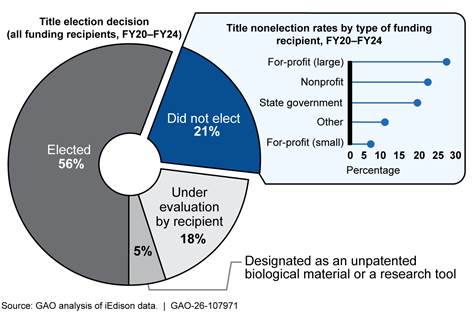
The Bayh-Dole Act lets recipients of federal funding retain ownership rights, or “elect title,” to inventions made with federal funding if they meet certain reporting requirements. GAO found that when recipients (e.g., universities and businesses) invented useful technologies, most chose to retain ownership rights, while about 21 percent declined to do so, from fiscal year 2020 through 2024 (see figure). The most common reason they declined was low commercial potential for the inventions (meaning they would not be likely to find a commercial partner to bring the invention to market, according to university representatives). Small for-profit funding recipients had the lowest rate of declining ownership rights.
Title Election Decisions and Rates of Nonelection by Type of Funding Recipient, Fiscal Years (FY) 2020–2024
Funding recipients cited several challenges to meeting invention reporting requirements. These challenges included inconsistent requirements across agencies, time-consuming annual reporting, and delays with requests for deadline extensions. Despite these challenges, one organization representing small businesses told GAO that compliance with reporting requirements generally does not prevent small businesses from bringing their federally funded inventions to market.
Several recipients said continued use of a web-based reporting system, known as iEdison, could help address some of these challenges. However, some agencies said there were still concerns with iEdison, including occasional incomplete reporting by funding recipients. For example, iEdison allows funding recipients the flexibility to submit information using their own formats. But some stakeholders said recipients may not know what information to include. Agency review time increases as a result, officials said.
In March 2026, the National Institute of Standards and Technology (NIST) published a sample form for funding recipients to use when disclosing a new invention. Use of the optional sample form may improve the consistency and completeness of submissions.
Why GAO Did This Study
Federal agencies fund billions of dollars in research
each year that can result in new inventions. The Bayh-Dole Act of 1980 created
an incentive for federally funded researchers to bring inventions to market so
the public could benefit. Specifically, recipients of federal research funding,
such as universities, small businesses, and nonprofits, may elect ownership of
and profit from their inventions if the recipients meet certain requirements.
For example, they must disclose their inventions to the government and report
annually on commercialization efforts.
To streamline invention reporting, many agencies use iEdison, a web-based
system managed by NIST. A July 2023 executive order directed specific agencies
to take steps to transition to iEdison by the end of 2025.
GAO was asked to review the federal invention disclosure process. This report examines (1) the percentage of disclosed inventions for which funding recipients elected to retain title and the reasons for not doing so, (2) challenges funding recipients face in complying with reporting requirements, and (3) how selected agencies are managing the transition to a single federal disclosure system.
GAO analyzed inventions data reported to 30 agencies by funding recipients; interviewed stakeholders, such as groups that represent universities and small businesses; and interviewed officials from five selected research funding agencies.
GAO’s draft report recommended that NIST finalize and publish guidance, such as a sample form, that identifies required invention reporting elements. In response, in March 2026, NIST published a sample form and additional guidance on its website. As a result, GAO removed the recommendation and revised the report accordingly.
|
Abbreviations |
|
|
|
|
|
DOD |
Department of Defense |
|
DOE |
Department of Energy |
|
e-NTR |
New Technology Reporting system |
|
FBI |
Federal Bureau of Investigation |
|
HHS |
Department of Health and Human Services |
|
NIH |
National Institutes of Health |
|
NIST |
National Institute of Standards and Technology |
|
NSF |
National Science Foundation |
|
NASA |
National Aeronautics and Space Administration |
|
T3CP |
Technology Transfer, Transition, and Commercial Partnerships Office |
This is a work of the U.S. government and is not subject to copyright protection in the United States. The published product may be reproduced and distributed in its entirety without further permission from GAO. However, because this work may contain copyrighted images or other material, permission from the copyright holder may be necessary if you wish to reproduce this material separately.
April 13, 2026
The Honorable Thom Tillis
Chair
Subcommittee on Intellectual Property
Committee on the Judiciary
United States Senate
The Honorable Chris Coons
United States Senate
Technological innovation is responsible for much of the economic growth and increased standard of living in modern societies. Federal agencies support this innovation by funding billions of dollars in research activities. This funding supports more than half of the research conducted at U.S. academic institutions; some of this research leads to useful inventions.
In 1980, Congress passed the Bayh-Dole Act to promote commercialization of these inventions, which would in turn benefit the public.[1] The act accomplishes this by enabling inventors, businesses, and research institutions that receive federal funding to retain title (i.e., keep ownership rights) to the resulting inventions, thus creating a financial incentive to commercialize them.
The Bayh-Dole Act and its implementing regulations provide the legal framework for the ownership of inventions developed by recipients of federal research and development funding.[2] To transfer the results of this funding to the public, the act tasks funding recipients with deciding whether they want to retain ownership of inventions they developed with federal funding. The act establishes time frames for when funding recipients must disclose federally funded inventions, determine whether to retain title of ownership to these inventions, and apply for patent protection, among other things.
When funding recipients take these actions, in a process known as invention reporting, agencies receive information on federally funded inventions that the agencies can use to protect the government’s interests. One of these interests is for the government to retain a nonexclusive, nontransferable, irrevocable, and royalty-free license to use the invention for government purposes. Furthermore, if funding recipients do not meet the required time frames, the government can take ownership of the invention.
However, previous publications have found invention reporting complex and inconsistent across agencies. For example, agencies have required funding recipients to report different information and have used different systems to track inventions.[3]
One way in which agencies are trying to promote consistency in reporting is by requiring funding recipients to report on their compliance through iEdison. iEdison is a web-based system managed by the National Institute of Standards and Technology (NIST) intended to facilitate invention reporting and tracking. A July 2023 executive order directed specific federal agencies to take steps to transition to iEdison by the end of 2025 to streamline and standardize invention reporting across the federal government.[4]
You asked us to review several issues related to the process for disclosing federally funded inventions. This report describes (1) the percentage of disclosed federally funded inventions for which funding recipients chose to retain title from fiscal years 2020 through 2024 and the factors for choosing not to retain title, (2) challenges funding recipients face in complying with Bayh-Dole reporting requirements, and (3) how selected federal R&D funding agencies are managing the transition to a single federal reporting system.
To determine the percentage of inventions for which funding recipients chose to retain title from fiscal years 2020 through 2024, we analyzed data from 30 of the 35 agencies that use NIST’s iEdison system for invention reporting. Of the five other agencies, three did not use the system until fiscal year 2025, and two did not provide data to analyze.[5] Additionally, two agencies—the Department of Defense (DOD) and the National Aeronautics and Space Administration (NASA)—were transitioning to department-wide use of iEdison.[6] To describe challenges funding recipients face in complying with reporting requirements, we interviewed a non-generalizable sample of businesses and stakeholder groups whose memberships comprise universities and small businesses to gather their perspectives on challenges and on any effects on commercialization. Some of the stakeholder groups we spoke with represented hundreds of universities or small businesses. In addition, we conducted semi-structured interviews with officials from seven university technology transfer offices selected to reflect a range of sizes, budgets, geographic locations, and levels of research activity.
To assess how agencies are managing the transition to a single federal reporting system, we identified the top five federal R&D funding agencies—specifically, the Departments of Defense; Energy (DOE); and Health and Human Services (HHS), which includes the National Institutes of Health (NIH); the National Science Foundation (NSF); and the National Aeronautics and Space Administration. We found that, of these five agencies, DOD and NASA were in the process of transitioning to iEdison in response to Executive Order 14104. We interviewed officials at DOD and NASA and reviewed these agencies’ invention-reporting documents and their data related to invention disclosures, title elections, and extension requests. We also interviewed officials from NIST, which manages iEdison, and from each of the top five funding agencies to understand how they use invention-disclosure systems. Appendix I contains more information about our objectives, scope, and methodology.
We conducted this performance audit from December 2024 to April 2026, in accordance with generally accepted government auditing standards. Those standards require that we plan and perform the audit to obtain sufficient, appropriate evidence to provide a reasonable basis for our findings and conclusions based on our audit objectives. We believe that the evidence obtained provides a reasonable basis for our findings and conclusions based on our audit objectives.
Background
Bayh-Dole Act. The Bayh-Dole Act generally allows the recipients of federal funding to retain title of ownership to patents for inventions developed with federal funding. For example, a university can retain title to an invention developed by a university professor that resulted from work funded by NIH.[7] The aim of the act is to promote commercialization and ensure that federally funded research benefits the public. Prior to the act, the government generally retained title to federally funded inventions regardless of whether the research was performed in federal laboratories or at universities.
|
Provisional Patent Applications and 2018 Bayh-Dole Act Rule Changes Inventors can choose for their initial patent application to be either provisional or non-provisional. A provisional patent application allows an inventor to establish a favorable early filing date for a later non-provisional application with relatively low cost and minimal documentation, but the provisional application will expire 12 months from the date the application is filed. On May 14, 2018, rule changes were implemented to the Bayh-Dole Act that included: · Expanding the definition of “initial patent application” to permit a funding recipient to file a provisional application as its initial patent application. · Reducing the timeline for federal funding recipients to file non-provisional patents from 12 months to 10 months. · Introducing a 1-year automatic extension, if requested and the funding agency takes no action, for filing a non-provisional application after first filing a provisional application. Source: GAO analysis of federal regulations. | GAO‑26‑107971 |
Invention-disclosure process. In exchange for the right to retain title to federally funded inventions, funding recipients agree to certain reporting requirements. Specifically, they agree to disclose inventions to the funding agency within 2 months from when an inventor reports an invention to the recipient (typically their employer). The funding recipients also agree to notify the funding agency no more than 2 years after this notification of whether they elect to retain title to the invention (see fig. 1). In addition, funding recipients agree to apply for a patent on the invention, typically within 1 year of the election of title.[8] After a patent is granted, they also agree to attempt to commercialize the invention and report periodically to the funding agency on their commercialization efforts, known as utilization reporting. If the recipient does not disclose the invention, elect title to it, or file a patent application within the time frames specified, the relevant federal agency can take title.[9]
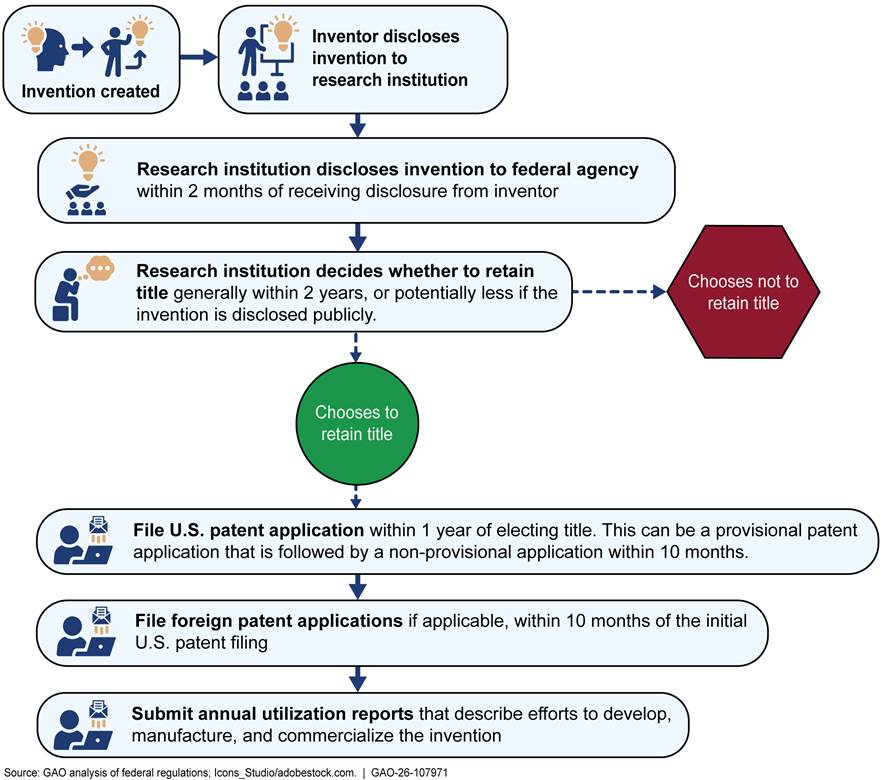
Note: The inventor is typically not the direct recipient of federal funding. The funding is commonly received by the research institution where the inventor works, such as a university, nonprofit, or business. The inventor informs their research institution when an invention is developed from federal funding.
Many agencies—including HHS, DOE, and NSF—have allowed funding recipients to report invention information through a web-based reporting system known as iEdison, which is managed by NIST. Agencies may use internal systems to manage and monitor results from research conducted by federal scientists, while the agencies rely on systems like iEdison to collect required invention and patent-reporting information from nonfederal funding recipients.[10]
Executive Order 14104. In July 2023, Executive Order 14104, Federal Research and Development in Support of Domestic Manufacturing and United States Jobs, directed specific federal agencies to take steps to transition all unclassified invention reporting to iEdison by December 31, 2025. The order tasks NIST with coordinating this effort and requires NIST to consider developing an action plan to support agency transitions.[11] The order states that the use of iEdison is intended to streamline invention-reporting requirements for recipients of federal funding.
Funding Recipients Mostly Retained Their Disclosed Inventions
Federal funding recipients elected title to approximately 56 percent of disclosed inventions during fiscal years 2020 through 2024. Funding recipients declined to elect title to 21 percent of inventions, and they were still evaluating another 18 percent of inventions. The most common reason for declining to retain title was low commercial potential of the invention, according to our analysis of iEdison data from the 30 agencies included in our review.
Recipients Elected to Retain Most Disclosed Inventions
From our analysis of data for the 30 agencies in our review that used the iEdison system from fiscal years 2020 through 2024, federal funding recipients—such as universities, small businesses, and nonprofit organizations:
· elected title to approximately 56 percent of inventions,
· declined to elect title to 21 percent of inventions,
· were evaluating whether to elect tile for 18 percent of inventions, and
· designated 5 percent of inventions as an unpatented biological material or research tool.[12]
Under the Bayh-Dole Act and implementing regulations, funding recipients must disclose subject inventions and may elect to retain title, provided the recipients meet reporting and other requirements.[13] Funding recipients generally decide whether to elect title within 2 years of disclosing an invention or within 1 year if the invention is disclosed publicly. Table 1 contains data on title election decisions for individual years.
|
Title election decision |
FY 2020 |
FY 2021 |
FY 2022 |
FY 2023 |
FY 2024 |
|
Title was elected |
5,147 (57.8%) |
5,684 (60.3%) |
6,240 (61.0%) |
6,064 (59.2%) |
5,235 (45.7%) |
|
Title was not elected |
2,429 (27.3%) |
2,181 (23.1%) |
2,201 (21.5%) |
1,996 (19.5%) |
1,518 (13.3%) |
|
Election decision is under evaluation by recipient |
747 (8.4%) |
894 (9.5%) |
1,278 (12.5%) |
1,739 (17.0%) |
4,329 (37.8%) |
|
Designated as an unpatented biological material or research tool |
563 (6.3%) |
642 (6.8%) |
498 (4.9%) |
430 (4.2%) |
348 (3.0%) |
|
Total |
8,911 |
9,429 |
10,227 |
10,243 |
11,450 |
Source: GAO analysis of iEdison data. | GAO‑26‑107971
Note: This table reflects data from NIH (current as of August 2025), FBI (current as of February 2026), and the 28 other agencies in our review that used the iEdison invention-reporting system during fiscal years 2020 through 2024 (current as of December 2025). For less than 1 percent of inventions funded by Department of Energy, the agency retained title. Because of these inventions (not included in the table), title election decisions in each column do not add up to the fiscal year totals.
Among these agencies, the four largest R&D funding agencies that used iEdison—DOD, DOE, HHS (which includes NIH), and NSF—accounted for 97 percent of all inventions reported in the data. See figure 2 for title election rates by recipients of funding from this subset of our analysis.[14]
Figure 2: Inventions for Which Funding Recipients Elected Title, by Funding Agency, Fiscal Years 2020–2024
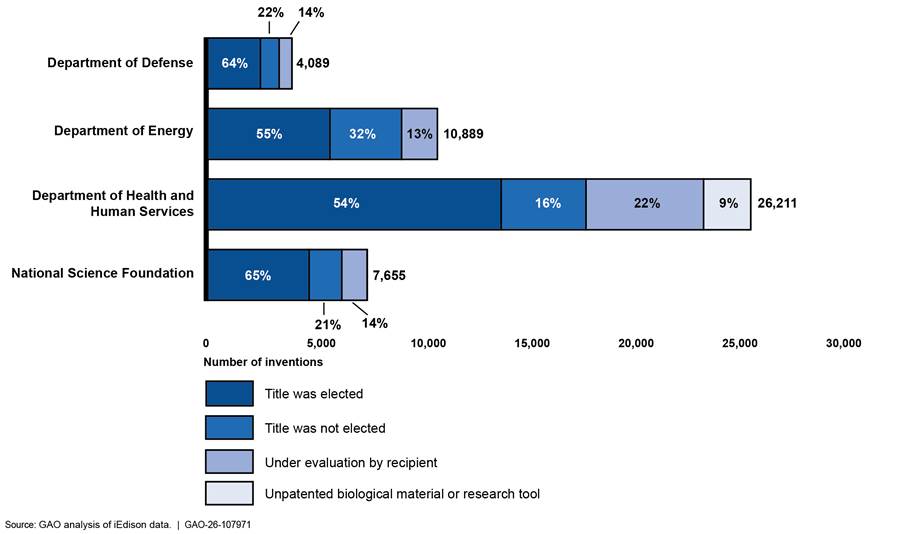
Note: The data account for those agency components that use the iEdison invention-reporting system. The total number across all four agencies’ components, as reported in iEdison, is 48,844 inventions. Due to rounding, percentages may not add up to 100 percent. Less than 1 percent of Department of Defense, Department of Energy, and National Science Foundation inventions were designated as an unpatented biological material or research tool.
Among all 30 agencies in our review, the percentage of disclosed inventions for which funding recipients did not elect title varied by funding recipient type.[15] As shown in figure 3, among types of funding recipients that disclosed at least 100 inventions during fiscal years 2020 through 2024, organizations categorized as large for-profit organizations had the highest rate of declining title (28 percent).[16] These were followed by nonprofits (23 percent), and state-government organizations (20 percent).[17]
Small for-profit companies had the lowest nonelection rate (8 percent). One reason for this low nonelection rate may be due to the mission focus of small businesses. For example, the co-founder of one small for-profit company told us the company always elects title to its inventions because its primary business strategy is to develop technologies that it can patent and license in the commercial marketplace.
In contrast, universities and other large entities may be more selective about which of their inventions’ titles they elect to retain. For example, representatives of one stakeholder group said larger universities may have more resources and in-house expertise to assess an invention’s commercial marketplace or patentability. As a result, these entities may be better informed about other options for intellectual-property protection, including copyrights and trade secrets.
Figure 3: Title Election Decisions and Rates of Nonelection by Type of Funding Recipient, Fiscal Years (FY) 2020–2024
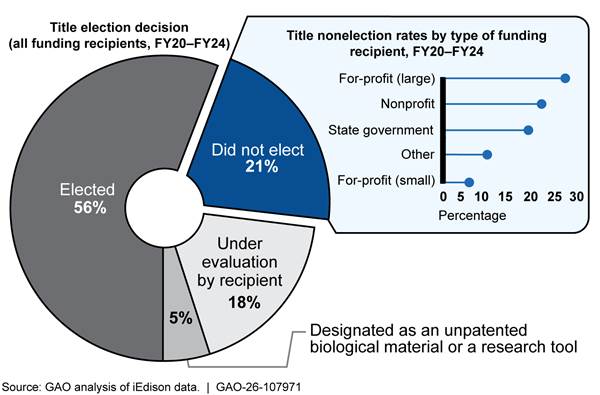
Note: The categories shown include all types of funding recipients with at least 100 reported inventions from fiscal years 2020 through 2024. Types with fewer than 100 inventions across the 5-year span include for-profit (size unknown), individual inventor, local government, and foreign categories.
Low Commercial Potential Was the Most Common Reason for Not Retaining an Invention
From our analysis of iEdison data for the 30 agencies we reviewed,[18] the most common reasons funding recipients provided for choosing not to retain title to an invention during fiscal years 2020 through 2024 included the following (see table 2):[19]
|
Reason for not electing title |
Total, fiscal years 2020–2024 |
|
Low commercial potential |
72.2% |
|
Non-patentable invention |
10.3% |
|
Invention did not yield expected results |
2.0% |
|
Budget limitation |
0.8% |
|
Immature market |
0.3% |
|
Other |
14.2% |
Source: GAO analysis of iEdison data. | GAO‑26‑107971
Notes: iEdison allows funding recipients to indicate one of three reasons for not electing title related to non-patentability: not patentable (not novel), not patentable (obvious), and not patentable (not useful). Our review of iEdison data from fiscal years 2020 through 2024 found that 7 percent of funding recipients selected “not novel,” 2 percent selected “obvious,” and 1 percent selected “not useful.”
For 12 inventions reported to National Institutes of Health, funding recipients gave no reason for not electing title.
|
Title Election Extension Requests Under the Bayh-Dole Act Under the Bayh-Dole Act, funding recipients that develop a federally funded invention must notify the government within a set time frame if they intend to choose (or “elect”) to retain title, generally within 2 years, or potentially less if the invention is disclosed publicly. However, funding recipients may request additional time through a title election extension request. Among other reasons, funding recipients may request extensions when they need more time to evaluate an invention’s commercial potential, conduct patentability assessments, or secure a licensee before deciding whether to retain title. NIST officials told us there is no limit in the amount of additional time funding recipients can request for title elections. Federal agencies review and approve these requests at their discretion, based on the justification provided by the funding recipient. Extension requests allow funding recipients to make more informed decisions while preserving their ability to retain rights to the invention. Source: GAO. | GAO‑26‑107971 |
Low commercial potential. The top reason provided by funding recipients for choosing not to retain title was the invention’s low commercial potential (72 percent). For example, several stakeholders we interviewed said a key factor in deciding whether to elect to retain title is the funding recipient’s ability to find a licensee to commercialize the invention.[20] Representatives from four universities noted that, in certain instances, they can request additional time to evaluate an invention’s commercial potential before deciding whether to elect title (see sidebar for more information and app. II for summary data on extension requests). For example, they said these extensions allow additional time to improve the invention and identify a potential licensee to commercialize the invention. If funding recipients are unable to do so, they may choose to abandon rights to the invention.
Non-patentability. Another reason funding recipients elected not to retain title is because they determined that the invention was not patentable (10 percent).[21] According to several university representatives we interviewed, they assess whether an invention is patentable before deciding whether to retain title. In other cases, funding recipients said they do not elect to retain title because alternative forms of intellectual-property protection, such as trade secrets or copyright, are more appropriate, particularly for inventions in the area of software development. For example, software code is considered a work of authorship and can be copyrighted. Software code may, however, perform tasks that could result in a patentable invention.
Invention did not yield expected results. Funding recipients sometimes elected not to retain title because an invention did not yield expected results (2 percent). Representatives at two universities told us their universities generally elect title only when an invention is sufficiently advanced in its development. However, there are cases when an invention is disclosed while inventors are still collecting data to demonstrate an invention’s patentability. According to one university representative, the university sometimes also chooses not to elect title based on its early evaluation of a technology.
Additional reasons funding recipients chose not to retain title included a lack of funding (1 percent). Specifically, two stakeholder groups we spoke to said funding recipients may need to weigh the costs of pursuing patent protection, which can be thousands of dollars, against the potential commercial value of the invention when deciding whether to retain title. Other reasons included an immature market for the invention (less than 1 percent).[22]
Funding Recipients Identified Challenges with Invention Reporting
Funding recipients and stakeholder groups we interviewed cited a range of challenges to complying with invention-reporting requirements, including the burden of duplicative or inconsistent reporting processes across agencies. Several funding recipients said that broader agency adoption of iEdison could help address some of these challenges by streamlining the reporting process.
The following three challenges were often cited by the recipients we interviewed.
Duplicative or inconsistent reporting requirements. Representatives from one group that represents universities and businesses told us that agencies vary in their reporting requirements. Some funding recipients we spoke with said they are forced to duplicate their efforts when reporting on inventions when agencies maintain separate invention-reporting systems or processes outside of iEdison. For example, according to our interviews with funding recipients, some agencies require recipients to report information through iEdison and also email it to the agency or enter it into a second, agency-specific database. Until September 2025, NASA had been using its own longstanding reporting system, officials said. Funding recipients with multiple inventions funded by multiple agencies, therefore, need to keep track of varied reporting processes across agencies. Several recipients said that as agencies transition to iEdison, the use of a single reporting system will help address this challenge.
Burdensome utilization reporting. Representatives of some universities said utilization reporting is the most time-consuming piece of the invention-reporting process. In a utilization report, funding recipients provide annual updates to funding agencies on the status and use of a federally funded invention, including whether it is being licensed or commercialized.[23] Representatives at one university said they hired an additional full-time employee following a 2023 iEdison update that required funding recipients to submit utilization reports for all subject inventions to which title had been elected. Representatives from another university noted that collecting utilization-report information is particularly difficult when licenses involve sublicensees and when an invention is used in products manufactured in multiple locations. In addition, agencies such as NIH and DOE have added supplemental questions to the standard utilization questions, which increases the time and effort required to prepare these reports (see sidebar).[24] According to one NIST official, the Interagency Working Group for Bayh-Dole helped address some of the reporting challenges when it developed common utilization-report questions in October 2023.[25] These questions are now used by all agencies that require reporting in iEdison. Additionally, NIST officials said iEdison reduces the utilization-reporting burden because it is designed to prompt recipients with only the questions that are applicable for each invention and to automatically populate so recipients do not need to reenter information.
|
Department of Energy (DOE) Utilization Reporting In addition to the standard set of utilization-reporting questions, DOE uses questions that are required when inventions are licensed or commercialized (approximately 11 percent and 2 percent, respectively, of data reported in iEdison, according to DOE officials). These questions include information on how many new U.S.-based jobs and companies were created due to commercialization efforts. Funding recipients are also required to provide information on business type, the expected or actual start date of manufacturing, and the number of products produced at each manufacturing location. DOE officials noted that the additional utilization-reporting questions allow the agency to assess the effect of its research funding through licensed and commercialized inventions. Source: GAO. | GAO‑26‑107971 |
Delays with extension requests. Agencies varied in the time they took to respond to requests for time extensions related to title elections and patent filings, with some agencies responding quickly while others were slow or did not respond at all.[26] Representatives from one state’s university system said it was difficult for universities to adjust their practices for each individual agency, which added burden to the reporting process. Representatives from this university system said that if they do not receive a response from an agency, they will operate with the understanding that they are in compliance but do not explicitly consider the extension approved. At another university, representatives said that they assume that no response back from an agency is an implicit approval. Some funding agencies we interviewed said they do not maintain formal policies that specify time frames for responding to extension requests. For example, NIH officials told us they aim to respond in 24 to 48 hours to all types of extension requests but said this is not official agency policy or procedure. NIST officials told us that extension requests for non-provisional patent applications are automatically approved after 60 days in iEdison if the agency has not responded. From our analysis of iEdison data we received from NIST, we found that the average agency response times ranged from 7 days for non-provisional patent extension requests to 29 days for title election extension requests, as shown in table 3.
|
Extension request type |
FY 2022 |
FY 2023 |
FY2024 |
Average, FY22-24a |
|
Title election extension |
16 |
18 |
36 |
29 |
|
Initial patent filing extension |
73 |
22 |
6 |
20 |
|
Non-provisional patent filing extension |
10 |
3 |
9 |
7 |
Source: GAO analysis of iEdison data. | GAO‑26‑107971
Note: Agency response times were not collected in the iEdison system prior to August 2022. Response times reflect the number of calendar days from the recipient’s extension request to the agency’s response. According to NIST officials, response times in the data include time for extension requests made during the automatic extension period.
aDue to the large volume of extension requests to the National Institutes of Health (NIH) that would skew the average response times lower, NIH data are not included in the calculated averages. See table 5 for data specific to NIH and all other agencies.
Some of the agencies that received the most extension requests, such as DOE and NIH, were among the quickest to respond. Other agencies, on the other hand, received fewer requests but took in some cases hundreds of days to respond. Officials from two agencies said lengthy response times were due to staffing and resource shortages. Officials from one of the agencies said they have addressed the resource shortage and are now responding more quickly. See appendix III for individual agency response times.
To streamline reporting requirements, Executive Order 14104, issued in July 2023, directed specific agencies to take steps to transition to a common invention-reporting system, namely iEdison.[27] While funding recipients still face reporting challenges, as noted above, NIST officials said they expect broader adoption of iEdison by agencies to streamline reporting and address burdens associated with duplicative reporting and utilization reporting. Representatives of one small business stakeholder group told us its members do not consider compliance with reporting requirements to be a significant challenge when developing and bringing their products into the marketplace. A more significant challenge they face involves securing funding for the gap in support for the time period between early technology development and commercial success, more commonly known as the commercialization “valley of death.”[28]
Features of iEdison Could Result in Inefficiencies
While we were conducting this work, two of the largest federal R&D funding agencies we interviewed—DOD and NASA—were taking steps to transition to iEdison in response to Executive Order 14104. These two agencies identified obstacles that may affect their transition, including limitations in iEdison’s ability to accommodate their specific reporting needs. Agency officials said that adding certain features to iEdison—such as standardized reporting elements—could help address these challenges.
Agencies Are Taking Steps to Transition to iEdison
To streamline reporting requirements, Executive Order 14104, issued in July 2023, directed specific agencies to take steps to transition to iEdison. DOD and NASA, two of the largest federal R&D funders, have used internal systems or processes to manage invention disclosures, but these agencies are transitioning to iEdison in response to Executive Order 14104. The order tasked NIST with considering an action plan for the transition. According to NIST officials, NIST has instead been working with agencies on an ongoing basis to support the transition. DOD’s efforts are ongoing while NASA completed its transition in September 2025. The following describes their transition efforts.
|
DOD Efforts to Transition to iEdison DOD officials we interviewed said the department has taken four steps to support DOD’s transition to iEdison. They said the department designated its Technology Transfer, Transition, and Commercial Partnerships (T3CP) Office as the primary office of responsibility for DOD-wide implementation of iEdison. T3CP’s first step is to coordinate with DOD information security and technology protection teams to determine whether the security of information stored in iEdison meets DOD security requirements. This effort includes working with DOD and the NIST Chief Information Security Officer. Second, T3CP is piloting implementation with three DOD Manufacturing Innovation Institutes to evaluate whether funding recipients and sub-awardees can input system data. The pilot is also examining potential updates to contract language, resource needs, and lessons learned to inform future guidance and training. Third, T3CP surveyed DOD components on current invention-reporting practices and resource implications of full iEdison implementation. Results will be used alongside findings from the pilot and security assessments to shape the department’s guidance. Finally, T3CP plans to engage with DOD components already using iEdison to identify and incorporate best practices into department-wide implementation efforts. Source: GAO analysis of Department of Defense (DOD) testimonial data. | GAO‑26‑107971 |
DOD. As of June 2025, DOD officials said the department does not have a centralized process for tracking and managing federally funded inventions across the department. Rather, there are individual offices within DOD that track and manage Bayh-Dole reporting requirements with DOD’s DD-882 form. Funding recipients use this form to report key details regarding the funding agreement and recipient, inventor name and employer, invention title, identification number(s) at U.S. and other foreign patent offices, and option to elect title.[29] They also report patent information, or they report that they have no patents on the invention, referred to as a null report.[30] While other DOD components have adopted iEdison, adoption was not widespread across the department as of June 2025.[31] Officials said they are planning for a department-wide transition to iEdison by March 2026. According to them, components have differing views on how the transition to iEdison could affect departmental costs. Some components anticipate that the transition may duplicate existing processes and require additional personnel to manage user access and correspondence within iEdison. Officials from other components, however, believe that the potential benefits of a common data system may outweigh the anticipated initial costs. Officials said they distributed a survey across the department to help them determine how long the transition will take and what resources will be needed, among other things.[32] According to officials, continued use of the DD-882 form will not be a duplicative process because the form will be used to collect information needed to close grants and contracts, information that cannot be collected in iEdison.
NASA. NASA officials told us the agency began requiring funding recipients to use iEdison for invention reporting in September 2025. Prior to then, NASA used its internally developed New Technology Reporting system (e-NTR) to manage invention disclosures. NASA will continue to manage inventions developed internally through e-NTR, officials said. They noted that the transition could increase costs due to the need to operate and integrate two systems.
NASA and DOD officials said they needed to update regulations to require funding recipients to submit invention disclosures through iEdison. For example, in January 2026, NASA’s Office of Procurement updated the NASA Federal Acquisition Regulation Supplement to direct funding recipients to report inventions in iEdison. NASA officials said this change was communicated to recipients through contracting officers throughout the agency. As of January 2026, DOD officials said they planned to update the DOD Grant and Agreement Regulations by February 2026. They said they would also update the Defense Federal Acquisition Regulation Supplement but had not established a timeline for doing so due to higher priorities related to acquisition reform.
Some Agencies Identified Obstacles That Could Affect the Transition to iEdison
Agency officials identified two obstacles to using iEdison: (1) inconsistencies in how information is reported by funding recipients and (2) the lack of a null-invention-reporting feature. NASA and DOD officials said they are evaluating options to ensure comprehensive reporting after their transitions to iEdison.
Inconsistent Invention Disclosure Reporting
Executive Order 14104 called for the transition to iEdison to streamline invention reporting by making it easier and consistent across government. However, iEdison, as currently configured, allows for inconsistencies in how information is reported.
Specifically, iEdison does not require recipients to use a standardized invention-disclosure form. This design choice eases the burden on recipients by giving them significant flexibility in how they enter information into the system, according to agency officials we interviewed.[33] However, according to agency officials, this flexibility increases the burden on agencies because it can lead to inconsistencies across submissions, which creates inefficiencies in the agencies’ review process. For example, NASA officials said that in cases where more than one organization is involved in developing an invention—true for about one-third of inventions reported to NASA—the lack of a standard form in iEdison adds to the agency’s review time by making it difficult to determine whether reports are duplicates. NIH officials also noted that reviewing disclosures is time intensive when funding recipients use their own formats. This practice can lead to different formatting and to submissions that do not include the required details on the invention, they said.[34]
According to NIST officials, the Interagency Working Group for Bayh-Dole, which is convened by NIST’s Technology Partnerships Office, has not developed a standard invention disclosure form because most large funding recipients already use their own templates, among other reasons. However, in the absence of a standard form or template, stakeholders we interviewed noted that some funding recipients may not know what information to include in their invention disclosures. As a result, agencies may not receive the information needed to review and accept disclosures, leading to back-and-forth between agencies and funding recipients.
In September 2025, NIST officials stated that the working group had previously discussed developing a sample cover sheet to guide recipients that do not use their own disclosure forms. But NIST had not yet published the sample, in part because NIST was working to obtain feedback from the working group. In March 2026, NIST published a sample form on its website that can be used by funding recipients when reporting an invention in iEdison. Developing and publishing the sample invention-disclosure form may improve the consistency and completeness of submissions. More consistent invention reporting, in turn, may improve the efficiency of the disclosure and review process, particularly for agencies that manage a high volume of invention disclosures, such as NIH. In addition, publishing such a form while allowing funding recipients to continue using established forms that are meeting agencies’ needs supports the 2023 executive order’s objective of streamlining reporting.
Lack of Null Invention Reporting
Another obstacle to adopting iEdison, according to agency officials, is that it currently does not request “null reporting,” in which recipients report that a specific federal funding award resulted in no inventions. This feature is important because it helps agencies more efficiently identify federally funded inventions that funding recipients did not disclose. Identifying these inventions can help agencies avoid paying to use them in the future, since they have a right to use them for free under the Bayh-Dole Act.[35]
Agencies sometimes maintain separate processes or systems outside of iEdison to identify potentially unreported inventions. For example, DOE officials said that during the award closeout process they ask funding recipients to certify that all inventions have been reported, and the officials review U.S. Patent and Trademark Office data for inventions that may have gone unreported.[36] Null-invention reporting could help agencies with this type of oversight by allowing them to focus such efforts only on funding recipients that have not reported on whether their awards resulted in any inventions.
Agency officials and stakeholders we spoke with noted that there are likely funding recipients who are not reporting inventions in iEdison. According to one stakeholder we spoke to, one reason is that researchers may not recognize when they have developed an invention they need to report under Bayh-Dole, particularly those associated with smaller universities, which may not regularly partner with the federal government. But because iEdison does not allow users to report when no inventions resulted from a funded project, the frequency of this underreporting is unknown.
DOD and NASA officials said they are evaluating options to ensure comprehensive reporting after their planned transitions to iEdison. For instance, DOD plans to continue using the DD-882 form in parallel with iEdison to retain the ability to collect null-invention reports. DOD officials stated that adding a null-reporting feature to iEdison could allow them to eventually retire this separate form, reducing administrative burden and improving reporting consistency.[37] NASA officials said they are still considering how, if at all, to address the issue. According to them, without null reporting, a transition to iEdison will likely result in fewer invention disclosures, lower-quality information, and challenges in identifying NASA-funded inventions that should have been disclosed but were not.
However, according to NIST officials, adding a null-reporting function is infeasible because it would require a significant redesign of the iEdison system. NIST officials further stated that this addition would involve substantial technical challenges because iEdison does not have a record for each grant, contract, or cooperative agreement issued by every participating agency. Without that information, iEdison cannot notify funding recipients about when or for which awards null reports may be due. NIST’s online guidance directs funding recipients to communicate with their funding agency about how they should report that no inventions were developed. NIST officials told us that agencies are still free to collect null-invention information through other means.
NIST officials also emphasized that most federally funded awards do not result in subject inventions and that requiring funding recipients to submit null invention reports for every award would significantly increase iEdison system usage, administrative burden, and the agency’s costs to maintain the system.[38]
Agency Comments
We provided a draft of this report to Commerce, DOD, DOE, the Department of Justice, HHS, NASA, and NSF for review and comment. Commerce, HHS, and NASA provided technical comments, which we incorporated, as appropriate.
In our draft report, we recommended that NIST consult with the Interagency Working Group for Bayh-Dole to finalize and publish guidance, such as a sample form, that identifies a format for required reporting elements to guide federal funding recipients that do not use or have not yet developed their own invention-disclosure forms. At the time of our review, NIST officials had not published a sample form in part because they were working to obtain feedback from the Interagency Working Group for Bayh-Dole, according to officials. During the agency comment period, NIST stated that it agreed with our recommendation and took action to address it. Specifically, in March 2026, NIST’s Technology Partnerships Office published a sample form on its website, along with checklists and additional guidance for funding recipients to use when disclosing inventions in iEdison. NIST officials said they obtained feedback from the working group on the guidance. We reviewed documentation that NIST provided us in March 2026, agreed that NIST’s actions met our draft recommendation, and therefore removed the recommendation from our report. Issuing this guidance should help improve the consistency and completeness of invention-disclosure reporting in iEdison.
We are sending copies of this report to the appropriate congressional committees, the Secretaries of Commerce, Defense, Energy, Health and Human Services, and Justice; the Administrator of NASA, the Acting Director of the National Science Foundation, and other interested parties. In addition, the report will be available at no charge on the GAO website at http://www.gao.gov.
If you or your staff have questions about this report, please contact me at (202) 512-6888 or WrightC@gao.gov. Contact points for our Offices of Congressional Relations and Public Affairs may be found on the last page of this report. Key contributors to this report are listed in appendix V.
Candice N. Wright
Director, Science, Technology Assessment, and Analytics
This report examines (1) the percentage of disclosed federally funded inventions that funding recipients chose to retain from fiscal years 2020 through 2024 and the factors for choosing not to retain title, (2) challenges funding recipients face in complying with Bayh-Dole reporting requirements, and (3) how selected federal R&D funding agencies are managing the transition to a single federal reporting system.
For all three objectives, we reviewed the Bayh-Dole Act and Executive Order 14104, which directed specific agencies to transition to the iEdison invention-reporting system.[39]
To address our first objective, we analyzed data from 30 of the 35 agencies that use the National Institute of Standards and Technology’s (NIST) iEdison system for invention disclosures.[40] The data included the numbers of invention disclosures, title elections, and extension requests, and reasons federal funding recipients chose not to elect title. In the initial data NIST provided, the reported inventions funded by Department of Energy (DOE) included 832 inventions categorized as “U.S. federal government owned.” NIST and DOE recognized this categorization as erroneous and coordinated to correct the data. NIST is assessing whether to remove the federal-owned category from the list of options funding recipients can select when they register for iEdison.
To assess the reliability of the remaining data, we reviewed iEdison guidance from NIST—the agency that manages iEdison. We conducted manual testing of the data and also asked knowledgeable officials how the data were collected and what steps were taken to ensure its quality. We found these data to be sufficiently reliable for our reporting purposes.
To address our second objective, we interviewed a non-generalizable sample of three businesses and eight stakeholder groups who offer services or whose membership comprises of universities and small businesses. We spoke with these groups to gather their perspectives on challenges complying with reporting requirements and any effects on commercialization. We identified these groups using a snowball technique in which we collected contacts through referrals from prior interviews. In addition, we conducted semi-structured interviews with officials from seven university technology transfer offices selected to reflect a range of sizes, budgets, geographic locations, and level of research activity. Our non-generalizable selection of universities cannot be used to make inferences about all universities that have disclosed and reported inventions under the Bayh-Dole Act.
To address our third objective, we evaluated agencies’ efforts to transition to a single federal disclosure system in response to Executive Order 14104. We identified the top five federal R&D funding agencies—specifically, the Department of Defense, Department of Energy, Department of Health and Human Services (including the National Institutes of Health), National Science Foundation, and National Aeronautics and Space Administration—and determined the invention-reporting systems they used from fiscal years 2020 through 2024. We interviewed the Department of Defense and the National Aeronautics and Space Administration, which we identified as the remaining two agencies that were undertaking the transition to iEdison. We spoke with officials from these agencies about how they obtain comprehensive invention reporting from funding recipients and the opportunities and challenges to using a singular federal reporting system. We reviewed these agencies’ invention-reporting documents and their data related to invention disclosures, title elections, and extension requests. We also interviewed agency officials from NIST and from each of the top five federal R&D funding agencies to understand how they use invention-disclosure systems and any recent or planned changes to those systems.
We conducted this performance audit from December 2024 to April 2026, in accordance with generally accepted government auditing standards. Those standards require that we plan and perform the audit to obtain sufficient, appropriate evidence to provide a reasonable basis for our findings and conclusions based on our audit objectives. We believe that the evidence obtained provides a reasonable basis for our findings and conclusions based on our audit objectives.
Federal agencies may grant extensions to funding recipients for deadlines related to reporting invention disclosures, title election decisions, and patent filings under the Bayh-Dole Act.[41] Table 4 includes data on the number of extension requests and the percent of requests approved by the 30 agencies in our review that used the iEdison invention-reporting system during fiscal years 2022 through 2024. Extension requests for invention disclosures are not captured in the iEdison data because funding recipients request these extensions prior to the invention being reported in the system. According to NIST’s website, funding recipients should contact funding agencies to ask how to submit these requests.
Table 4: Number of Extension Requests and Percent of Requests Approved by Federal Agencies, Fiscal Years (FY) 2022–2024
|
Extension request type |
FY 2022a |
FY 2023 |
FY 2024 |
Total |
|
Title election extension |
158 (83.5%) |
478 (89.1%) |
838 (94.0%) |
1,474 (91.2%) |
|
Initial patent filing extension |
169 (91.1%) |
919 (93.5%) |
516 (93.6%) |
1,604 (93.3%) |
|
Non-provisional patent filing extension |
228 (84.2%) |
2,088 (88.9%) |
2,745 (93.4%) |
5,061 (91.2%) |
Source: GAO analysis of iEdison data. | GAO‑26‑107971
Note: Included agencies are the 30 agencies in our review that used the iEdison invention-reporting system.
aThe iEdison system contains only partial-year data for fiscal year 2022. According to NIST officials, extension requests submitted prior to August 8, 2022, are not included in the data because the NIH legacy system did not collect dates for extension requests or approvals. The NIST iEdison system, which does capture this data, was launched in August of 2022.
From our analysis of iEdison data for the 30 agencies we reviewed, agencies typically approve extension requests. Non-provisional patent filings were the type of extension most frequently requested by federal funding recipients. Applications for non-provisional patents are more expensive and time-intensive to prepare than provisional patent applications, as they require a complete set of claims and supporting materials to initiate formal examination by the U.S. Patent and Trademark Office.
Federal agencies’ response times to extension requests varied by agency and by type of extension.
Table 5: Number of Extension Requests and Average Agency Response Times by Type of Extension Request, Fiscal Years 2022–2024
|
Agency |
Title election extensions (response time in days) |
Initial patent filing extensions (response time in days) |
Non-provisional patent filing extensions (response time in days) |
|
Department of Commerce |
— |
— |
— |
|
Economic Development Administration |
6 (301) |
1 (no data) |
1 (no data) |
|
National Institute of Standards and Technology |
1 (242) |
2 (14) |
10 (51) |
|
National Oceanic and Atmospheric Administration |
0 |
0 |
1 (10) |
|
U.S. Census Bureau |
0 |
0 |
1 (0) |
|
Department of Homeland Security |
— |
— |
— |
|
Science and Technology Directorate |
0 |
1 (128) |
3 (60) |
|
Department of Defense |
— |
— |
— |
|
Army Research Laboratory |
0 |
2 (no data) |
1 (no data) |
|
Army Research Office |
14 (no data) |
22 (no data) |
78 (60) |
|
Defense Advanced Research Projects Agency |
30 (460) |
23 (519) |
102 (59) |
|
Defense Health Administration Defense Medical Research and Development Command |
47 (3) |
28 (6) |
138 (8) |
|
Defense Threat Reduction Agency |
4 (9) |
2 (8) |
11 (39) |
|
Office of Naval Research |
3 (no data) |
3 (1,073) |
4 (60) |
|
Department of Energy |
267 (2) |
210 (1) |
418 (1) |
|
National Nuclear Security Administration |
1 (65) |
4 (2) |
18 (11) |
|
Department of Transportation |
0 |
0 |
13 (60) |
|
Federal Aviation Administration |
0 |
0 |
1 (0) |
|
Department of Health and Human Services |
— |
— |
— |
|
Advanced Research Projects Agency for Health |
1 (57) |
0 |
2 (60) |
|
Centers for Disease Control and Prevention |
2 (524) |
0 |
4 (61) |
|
U.S. Food and Drug Administration |
3 (117) |
2 (129) |
4 (13) |
|
National Institutes of Health |
927 (2) |
1,052 (5) |
3,154 (3) |
|
National Aeronautics and Space Administrationa |
— |
— |
— |
|
National Science Foundation |
141 (2) |
226 (8) |
1019 (2) |
|
U.S. Department of Agriculture |
|
|
|
|
Agricultural Research Service |
2 (no data) |
2 (168) |
12 (60) |
|
National Institute of Food and Agriculture |
16 (146) |
22 (237) |
64 (6) |
Source: GAO analysis of iEdison data. | GAO‑26‑107971
Notes: According to NIST officials, the most common reasons why no data exist for an agency are that the extension requests were voided, withdrawn, denied, or were neither approved nor denied by the agency.
Agency response times were not collected in the iEdison system prior to August 2022. Response times reflect the number of calendar days between the recipient’s extension request and the agency’s response. According to NIST officials, response times in the data include time for requests made during the automatic extension period. A response time of zero indicates that the agency provided a response on the same day as the request.
The following agencies reported zero extension requests: Army Small Business Innovation Research Contracting Center of Excellence, Army Space and Missile Defense Command, Defense Microelectronics Activity, Federal Bureau of Investigation, Naval Research Laboratory, Nuclear Regulatory Commission, and U.S. Geological Survey.
According to NIST officials, the response times for non-provisional patent filings include extension requests that were approved automatically after 60 days.
aAccording to NASA officials, NASA’s New Technology Reporting system did not have a field to collect information on extension requests.
Appendix IV: NASA-Funded Invention Disclosures and Title Election Information, Fiscal Years 2020–2024
NASA provided summary data on invention disclosures and title election decisions reported by funding recipients through NASA’s New Technology Reporting system (e-NTR) during fiscal years 2020 through 2024. According to NASA officials, the e-NTR system did not collect information on extension requests, agency response times to extension requests, or reasons why funding recipients do not elect title.
Table 6: Disclosed Inventions and Title Elections by Recipients of National Aeronautics and Space Administration (NASA) Funding, Fiscal Years (FY) 2020–2024
|
Funding recipient type |
FY 2020 |
FY 2021 |
FY 2022 |
FY 2023 |
FY 2024 |
|
College/university |
266 |
184 |
204 |
200 |
216 |
|
Large entity |
54 |
40 |
61 |
52 |
72 |
|
Nonprofit |
352 |
358 |
289 |
290 |
323 |
|
Small business |
578 |
492 |
492 |
431 |
414 |
|
Total |
1,250 |
1,074 |
1,046 |
973 |
1,025 |
|
Number of funding recipients that elected title |
32 |
39 |
55 |
31 |
36 |
Source: NASA. | GAO‑26‑107971
GAO Contact
Candice N. Wright, WrightC@gao.gov.
Staff Acknowledgments
In addition to the contact named above, Robert J. Marek (Assistant Director), Michael Walton (Analyst-in-Charge from August 19, 2025), Courtney Thacker (Analyst-in-Charge until August 19, 2025), Miguel Cortez Jr., Patrick Harner, Evan Jaffe, Curtis Martin, Ben Shouse, and Andrew Stavisky made key contributions to this report.
The Government Accountability Office, the audit, evaluation, and investigative arm of Congress, exists to support Congress in meeting its constitutional responsibilities and to help improve the performance and accountability of the federal government for the American people. GAO examines the use of public funds; evaluates federal programs and policies; and provides analyses, recommendations, and other assistance to help Congress make informed oversight, policy, and funding decisions. GAO’s commitment to good government is reflected in its core values of accountability, integrity, and reliability.
Obtaining Copies of GAO Reports and Testimony
The fastest and easiest way to obtain copies of GAO documents at no cost is through our website. Each weekday afternoon, GAO posts on its website newly released reports, testimony, and correspondence. You can also subscribe to GAO’s email updates to receive notification of newly posted products.
Order by Phone
The price of each GAO publication reflects GAO’s actual cost of production and distribution and depends on the number of pages in the publication and whether the publication is printed in color or black and white. Pricing and ordering information is posted on GAO’s website, https://www.gao.gov/ordering.htm.
Place orders by calling (202) 512-6000, toll free (866) 801-7077,
or
TDD (202) 512-2537.
Orders may be paid for using American Express, Discover Card, MasterCard, Visa, check, or money order. Call for additional information.
Connect with GAO
Connect with GAO on X,
LinkedIn, Instagram, and YouTube.
Subscribe to our Email Updates. Listen to our Podcasts.
Visit GAO on the web at https://www.gao.gov.
To Report Fraud, Waste, and Abuse in Federal Programs
Contact FraudNet:
Website: https://www.gao.gov/about/what-gao-does/fraudnet
Automated answering system: (800) 424-5454
Media Relations
Sarah Kaczmarek, Managing Director, Media@gao.gov
Congressional Relations
David A. Powner, Acting Managing Director, CongRel@gao.gov
General Inquiries
[1]Patent and Trademark Law Amendments Act, Pub. L. No. 96-517, 94 Stat. 3015 (1980) (codified, as amended, at 35 U.S.C. §§ 200-212), commonly referred to as the Bayh-Dole Act.
[2]The Bayh-Dole Act refers to these funding recipients as “contractors.” That term can refer to any person, business, or nonprofit organization that is a party to a federal funding agreement, which includes contracts, grants, or cooperative agreements for the performance of experimental, developmental, or research work. 37 C.F.R. § 401.2(a)-(b). For the purposes of this report, we will refer to contractors as “funding recipients.”
[3]National Institute of Standards and Technology, Return on Investment Initiative for Unleashing American Innovation, NIST Special Publication 1234 (April 2019); and GAO, Federal Research: Additional Actions Needed to Improve Licensing of Patented Laboratory Inventions, GAO‑18‑327 (Washington, D.C.: June 19, 2018).
[4]Executive Order 14104, Federal Research and Development in Support of Domestic Manufacturing and United States Jobs, directed the following agencies to take steps to transition to iEdison by calendar year 2025: Department of Defense, Department of Agriculture, Department of Commerce, Department of Health and Human Services, Department of Transportation, Department of Energy, Department of Homeland Security, National Science Foundation, and the National Aeronautics and Space Administration. 88 Fed. Reg. 51,203 (July 28, 2023).
[5]Three agencies (the National Aeronautics and Space Administration, National Institute of Justice, and the U.S. Bureau of Reclamation) only began using iEdison for invention reporting in fiscal year 2025. Another two agencies (the Agency for Healthcare Research and Quality and the U.S. Agency for International Development) did not respond to NIST’s request to share data. As a result, information from these agencies is not included in our analysis.
[6]DOD has not yet adopted iEdison across the entire agency. As such, the data in this report only reflect reported inventions that resulted from funding from the following DOD components: Army Research Laboratory, Army Research Office, Army Small Business Innovation Research Contracting Center of Excellence, Army Space and Missile Defense Command, Defense Advanced Research Projects Agency, Defense Health Agency Medical Research and Development Command, Defense Microelectronics Activity, Defense Threat Reduction Agency, the Naval Research Laboratory, and the Office of Naval Research. NASA began using iEdison for invention reporting in fiscal year 2025. The data we analyzed, however, included one invention in fiscal year 2023 for which the funding recipient designated NASA as the primary funding agency.
[7]While individual inventors have rights to their intellectual property, employment agreements and university policies may mandate the transfer of these rights to the institution, which then manages the technology transfer process. In this case, inventors often receive a share of any revenue generated from licensing their invention to a third party or from royalties if the invention is commercialized.
[8]A funding recipient who decides to initially file a provisional application must later file a corresponding non-provisional application within 10 months of the provisional filing per 37 C.F.R. § 401.14(c)(3)(ii). A non-provisional application is examined by a patent examiner and may result in an issued patent if all the requirements for patentability are met. Funding recipients may request extensions to this deadline, which agencies can approve or deny at their discretion.
[9]37 C.F.R. § 401.14(d).
[10]The Bayh-Dole Act applies to inventions resulting from grants, contracts, or cooperative agreements for the performance of experimental, developmental, or research work to non-federal entities such as universities, businesses, and nonprofits. Accordingly, our analysis does not address research conducted by federal employees or agencies.
[11]According to NIST officials, the agency did not develop a formal action plan for the transition to iEdison because NIST has been working with agencies on an ongoing basis to support the transition, and the process has been continuously evolving across most agencies.
[12]According to NIST guidance, funding recipients can select this option in iEdison if the agency makes it available and if the funding recipient has no active patents associated with the technology. In addition to the title election decisions made by funding recipients, we found that for 97 inventions funded by the Department of Energy, the agency retained title. For inventions conceived or first reduced to practice under certain funding agreements with DOE, 42 U.S.C. § 5908 provides that title to such inventions vests in the United States. This does not apply to funding agreements with nonprofits and small businesses that are governed under Bayh-Dole.
[13]The term “subject invention” means any invention by a recipient of federal funding conceived or first actually reduced to practice in the performance of work under a funding agreement. 35 U.S.C. § 201(e). Compliance requirements under the Bayh-Dole Act include that a recipient of federal funding must disclose the invention to the funding agency, elect to retain title, file a patent application, include a government support clause in the patent application, and make reasonable efforts to commercialize the invention. 37 C.F.R. § 401.14(c), (f), (h).
[14]NASA began using the iEdison system in fiscal year 2025. Therefore, invention disclosures from recipients of NASA funding are not included in this portion of our analysis. See appendix IV for summary data provided to us by NASA collected through its internally developed invention-disclosure system.
[15]According to NIST officials, funding recipients select their organization’s ownership type when they register for an iEdison account.
[16]Types of funding recipients that disclosed fewer than 100 inventions during fiscal years 2020 through 2024 include for-profit (size unknown), individual inventor, local government, and foreign categories. Organizations categorized as large for-profit companies in iEdison are those that do not qualify as a small business under Small Business Administration guidelines, according to NIST.
[17]Organizations categorized as nonprofits in iEdison are organizations that are not owned by a government entity, which can include independent research institutions, and privately owned universities, according to NIST.
[18]NASA data are not included in this portion of our analysis because the invention-disclosure system NASA used during fiscal years 2020 through 2024 did not collect information on why a funding recipient chose not to retain title.
[19]If a funding recipient selects “does not retain title” as their title election status in iEdison, they must indicate why their institution decided not to take title. The options in iEdison include: (1) low commercial potential; (2) not patentable (not novel); (3) not patentable (obvious); (4) not patentable (not useful); (5) did not yield expected results; (6) budget limitation; (7) immature market; and (8) other. According to NIST officials, iEdison users select the “other” option when the selection choices do not adequately capture the reason for not electing title. In these cases, the funding recipient enters a reason in an open text field.
[20]For the purposes of this report, we define “some” to be two to three, “several” to be four to five, and “many” to be six or more.
[21]iEdison allows funding recipients to indicate one of three reasons for not electing title related to non-patentability: not patentable (not novel), not patentable (obvious), and not patentable (not useful). Based on our review of iEdison data from fiscal years 2020 through 2024, 7 percent of funding recipients selected “not novel,” 2 percent selected “obvious,” and 1 percent selected “not useful.”
[22]Funding recipients can also select “other” as a reason for not electing title, which was the case for 14 percent of inventions. Examples of “other” reasons shared with us by NIST include “unable to reach inventors” and “software to be released as open source.”
[23]The Bayh-Dole Act allows agencies to require periodic reporting on utilization or efforts at obtaining utilization that are being made by the funding recipient or its licensees or assignees. 35 U.S.C. § 202(c)(5). Effective October 1, 2023, iEdison began requiring funding recipients to report annually on a standard set of utilization questions for all subject inventions to which title had been elected. Funding agencies can request to add supplemental questions.
[24]According to NIH officials, NIH’s utilization questions have been used since 2002 to collect the commercial name of any products approved by the FDA from a subject invention that reached the market during the reporting period in question. According to NIH documentation, the decision to include these additional utilization questions permits the tracking of FDA-approved drugs that resulted from NIH funding and serves as a resource for the public to understand the return on investment of basic science research. National Institutes of Health, A Plan to Ensure Taxpayers’ Interests are Protected (July 2001).
[25]Executive Order 14104, issued in July 2023, directed NIST and the Interagency Working Group for Bayh-Dole to develop common invention utilization questions while allowing agencies to add agency-specific questions. It also directed NIST and the heads of other agencies to minimize the burden of utilization reporting on recipients of federal R&D funding in accordance with the Paperwork Reduction Act and applicable guidance from the Office of Management and Budget.
[26]Federal agencies have discretion in whether to approve or deny extension requests but generally approve them. See app. II for summary information on extension request approvals.
[27]Executive Order 14104 directs specific federal agencies to take steps toward transitioning to the iEdison system for invention reporting by the end of calendar year 2025.
[28]We have previously reported on private sector challenges with the commercialization “valley of death.” See GAO, Department of Energy: Improved Performance Planning Could Strengthen Technology Transfer, GAO‑21‑202 (Washington, D.C.: Feb. 1, 2021); and GAO, Small Business Innovation Research: Most Agencies Did Not Implement Required Commercialization Pilot, GAO‑24‑107155 (Washington, D.C.: Sept. 25, 2024).
[29]According to DOD officials, iEdison also requires all of these information elements as well as information on utilization of the invention, such as stage of development (Not Licensed or Commercialized; Licensed; or Commercialized); commercialization planning activities; licenses executed (number, types, income generated, and U.S. manufacture requirements); and commercialization (year of the first commercial sale and product information).
[30]DOD officials also said the DD-882 form is needed for the contracting officer to close out grants or contracts. As a contract deliverable, the DD-882 is processed for compliance within the DOD contracting information system. Processing the DD-882 is incorporated into the standard operating procedures across relevant DOD awarding offices. Officials said there are no plans to link the DOD contracting information system for contract deliverables with iEdison as a tool for contract compliance as it would require additional resources.
[31]Specifically, certain DOD offices have elected to use iEdison for Bayh-Dole invention reporting, including the Army Research Laboratory, Defense Applied Research Programs Agency, Defense Health Agency, Defense Threat Reduction Agency, and Office of Naval Research. For other DOD offices, divisions, and components, recipients also use Form DD-882 to submit interim and final invention reports to the contracting (or grant) officer and to report subcontracts awarded that contain a “patents rights” clause.
[32]During our review, DOD officials said the department is also developing a memorandum of understanding with NIST to facilitate the transition. They also said they are working with NIST to address security concerns with iEdison. In March 2026, NIST officials told us that the memorandum of understanding with DOD was executed in January 2026. They also said that a security review had been completed, and no changes were needed to the system.
[33]According to NIST, when funding recipients report an invention, they need to upload an invention-disclosure document into iEdison that contains information about the invention. Funding recipients can upload the information using their own forms. The disclosure form should include the title of invention, date it was disclosed to the funding recipient, names of inventors, funding agency and award numbers, and a sufficient description of the invention, among other information.
[34]NIH officials said they have developed standard responses for incomplete invention disclosures and created an optional cover sheet to try to ensure funding recipients include key elements about their invention, but institutions still use varied formats, requiring NIH to manually review each submission.
[35]The federal government is generally entitled by law to a nonexclusive, nontransferable, irrevocable, and royalty-free license to practice, or have practiced on its behalf, the inventions it funds. 35 U.S.C. § 202(c)(4).
[36]Advanced Research Projects Agency ‑ Energy a subagency within DOE, has also developed a tool called IMPACTS which uses analytics to identify reports with a higher potential of underreporting.
[37]DOD officials said the DD-882 form will likely remain an important reporting tool to track invention information as it informs the contracting officer that applications were either filed or not filed, and therefore any lack of filing in iEdison or in the funding recipient’s final report is not by error of omission.
[38]Specifically, NIST officials stated if every agency required each funding recipient to log into iEdison annually to submit null-invention reports, this would significantly increase system traffic. NIST officials noted that they do not charge agencies to participate in iEdison and instead cover 100 percent of the system’s costs, including staff to provide training and user support. They also stated that NIST incurs a $0.07 fee from Login.gov for every individual login. Factoring in development costs, access fees, and the additional support staff that would be needed, NIST anticipates that implementing null-invention reporting would substantially increase the overall cost of maintaining iEdison.
[39]The Bayh-Dole Act applies to inventions resulting from federally funded extramural research conducted by non-federal entities such as universities, businesses, and nonprofits. Accordingly, our analysis focuses on extramural research and does not address intramural research conducted by federal employees or agencies.
[40]We reviewed iEdison data on invention disclosures and title election decisions reported during fiscal years 2020 through 2024 from 30 federal departments and agencies. NIST maintains iEdison data for 35 agencies; however, two agencies (Agency for Healthcare Research and Quality and U.S. Agency for International Development) did not respond to NIST’s request to share data. As a result, information from these agencies is not included in our analysis. Another three agencies (the National Aeronautics and Space Administration, National Institute of Justice, and U.S. Bureau of Reclamation) only began using iEdison for invention reporting in fiscal year 2025.
[41]37 C.F.R. § 401.14(c)(5).