
Report to the Committee on Armed Services, House of Representatives
United States Government Accountability Office
A report to the Committee on Armed Services, House of Representatives.
Contact: Shelby S. Oakley at OakleyS@gao.gov
What GAO Found
The Navy is currently 24 months behind in its efforts to modernize three DDG 1000 Zumwalt class destroyers to host the Conventional Prompt Strike (CPS) hypersonic missile as part of its surface strike mission. Both the DDG 1000 and CPS efforts face challenges:
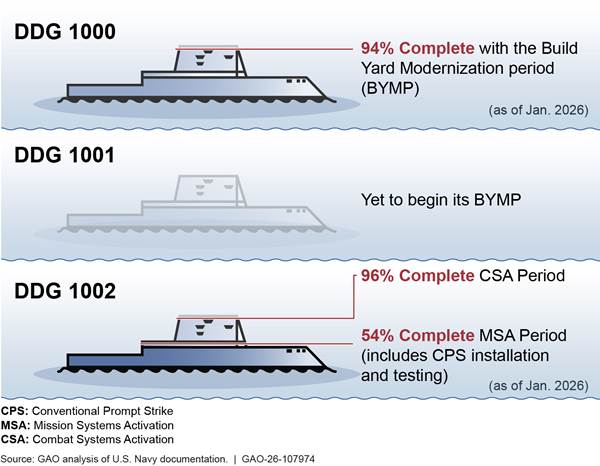
· Although modernization of the first ship in the class, USS Zumwalt (DDG 1000), was 94 percent complete as of January 2026, it is behind schedule due to unplanned work.
· The DDG 1000 class ships have unique systems, such as its radar, combat, and network systems, that are costly and difficult to sustain and maintain.
· The CPS effort was originally scheduled to begin flight testing on the DDG 1000 class in 2025 but this is now planned for 2027 due to funding and testing challenges.
· The CPS program encountered quality and production issues putting the current rate well below the production goal of 12 missile rounds per year.
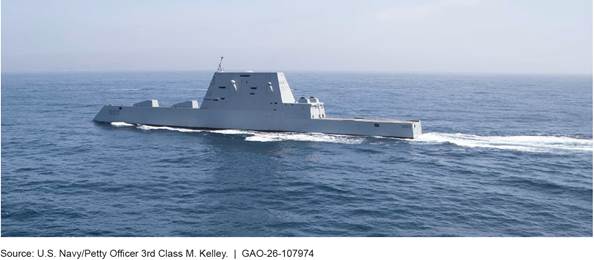
DOD is planning to invest at least $50 billion into developing, testing, producing, and fielding CPS capability across several programs, including: CPS, Virginia class submarine, and the Army’s Long-Range Hypersonic Weapon, among others. While Navy and Army officials told GAO that they coordinate with each other, the services largely manage investment decisions for these programs separately, which contributes to inefficiencies and delays.
DOD does not have a comprehensive strategy across all programs that ensures that each program’s investments achieve CPS’s common objectives. Without a comprehensive investment strategy that includes more formal coordination, the Army and Navy are not well-positioned to make timely and efficient investments in key areas, such as addressing shortfalls on their shared production lines or ensuring the economical sustainment and performance of the DDG 1000. Why GAO Did This Study
The Navy intends to provide its three DDG 1000 Zumwalt class ships with the ability to strike surface targets. In 2021, the Navy decided to add hypersonic CPS missiles—at a planned cost of nearly $50 million per missile—to the DDG 1000 class destroyers to enable the U.S. to strike valuable, heavily defended targets from a distance with a non-nuclear payload. To do so, the Navy is modernizing the ships to include installing a vertical launch system for CPS missiles. The Navy plans to add the CPS missile system to some Virginia class submarines. The Army is developing its own version of the CPS, called the Long-Range Hypersonic Weapon, and is responsible for producing the missile glide body for both services, among other responsibilities.
A House report includes a provision for GAO to review the Navy’s large surface combatant program, including efforts to modify the DDG 1000 for its new mission. This report examines (1) the status of the DDG 1000 modernization, including CPS development, testing, and integration, and what risks these programs face; and (2) the extent to which DOD has a comprehensive strategy across various programs needed to field the CPS missile capability.
GAO reviewed relevant Navy and Army documentation and interviewed Navy and Army officials and contractor representatives. GAO also visited ship and missile contractor facilities in Mississippi and Alabama.
What GAO Recommends
GAO is recommending that DOD develop and regularly review a comprehensive strategy that guides the coordination of investment decisions for delivering CPS capability. DOD concurred with this recommendation.
|
Abbreviations |
|
|
|
|
|
AAF |
Adaptive Acquisition Framework |
|
BYMP |
Build Yard Modernization Period |
|
CPS |
Conventional Prompt Strike |
|
DOD |
Department of Defense |
|
LRHW |
Long-Range Hypersonic Weapon |
|
MSA |
Mission Systems Activation |
|
OPNAV |
Office of the Chief of Naval Operations |
|
TSCE |
Total Ship Computing Environment |
This is a work of the U.S. government and is not subject to copyright protection in the United States. The published product may be reproduced and distributed in its entirety without further permission from GAO. However, because this work may contain copyrighted images or other material, permission from the copyright holder may be necessary if you wish to reproduce this material separately.
July 17, 2026
The Honorable Mike Rogers
Chairman
The Honorable Adam Smith
Ranking Member
Committee on Armed Services
House of Representatives
The Department of Defense (DOD) seeks to deter large-scale aggression. Hypersonic missiles represent a key capability to accomplish this goal, as they can move at least five times the speed of sound. This enables them to engage targets in less time than standard missiles. They also have unpredictable flight paths that can penetrate advanced anti-access and area denial capabilities. With this capability, the United States can conventionally strike valuable, heavily defended targets from a distance in the early phases of a conflict—a U.S. Strategic Command requirement since the early 2000s.
The Navy and the Army are jointly developing and fielding the same missile, which the Navy refers to as Conventional Prompt Strike (CPS) and the Army calls the Long-Range Hypersonic Weapon (LRHW). The Navy plans to field the CPS system on Zumwalt class DDG 1000 destroyers starting in the late-2020s, and then on Virginia class submarines in the early 2030s. As we reported in July 2024, the Army had paused its fielding efforts for LRHW. Since then, the Army has, following a successful test, resumed fielding LRHW, which is launched from a wheeled platform.[1] Additionally, the Navy has preliminarily identified CPS for use on the Trump class battleship.
House Report 118-529 accompanying the National Defense Authorization Act for Fiscal Year 2025 includes a provision for us to review the status of the Navy’s large surface combatant program, including efforts to modify the DDG 1000 Zumwalt class for its new mission. Specifically, our report examines: (1) the status of the DDG 1000 modernization program, including the CPS’s development, testing, and integration, and what risks this program faces; and (2) the extent to which DOD has a comprehensive strategy for fielding CPS missile capability.
To determine the status of the DDG 1000 program and CPS development, testing, and integration, we assessed the extent to which the Navy has met cost, schedule, and performance goals for its DDG 1000 class modernization program and CPS development, and the reasons for deviations, if any, from these goals. Specifically, we reviewed Navy cost and schedule documentation and information on test results for these programs, and we spoke with program and test officials about challenges they face.
To determine risks the DDG 1000 program faces, we reviewed Navy documentation on DDG 1000 class sustainment efforts and its modernization program. We spoke with officials from the Office of the Chief of Naval Operations (OPNAV) about plans for the class, including investments needed to meet their expected service lives. We assessed technical, schedule, and production risks facing the CPS program, as well as Navy plans to address these risks. To do so, we reviewed Navy risk and programmatic documentation and spoke with program officials and contractor representatives about plans to mitigate those risks. We met with contractor representatives and Navy Supervisor of Shipbuilding officials at the Huntington Ingalls Industries shipyard in Pascagoula, Mississippi, where that contractor is performing DDG 1000 class modernization work. We also met with contractor officials from Dynetics and Lockheed Martin at the CPS glide body and missile production facilities in Huntsville and Courtland, Alabama.
To determine the extent to which DOD and the Navy have a comprehensive strategy for fielding CPS capability, we reviewed acquisition plans for the CPS and DDG 1000 programs and identified other efforts that are key to developing or fielding CPS capability. We reviewed anticipated costs for the CPS program, as well as investments needed for complementary programs to provide CPS capability over its expected life cycle. We also discussed with officials from these programs, as well as the Army’s LRHW program and the Navy’s Office of the Chief of Naval Operations, the extent to which they coordinate.
We assessed DOD’s management of the CPS and LRHW programs against leading practices we have identified in our prior work for managing product portfolios.[2]
We conducted this performance audit from December 2024 to July 2026, in accordance with generally accepted government auditing standards. Those standards require that we plan and perform the audit to obtain sufficient, appropriate evidence to provide a reasonable basis for our findings and conclusions based on our audit objectives. We believe the evidence obtained provides a reasonable basis for our findings and conclusions based on our audit objectives.
Background
DDG 1000
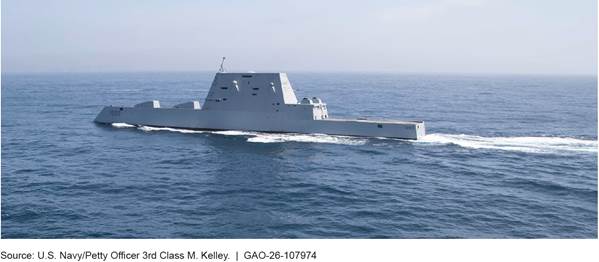
In the mid-1990s, the Navy began early design efforts for a next generation destroyer that ultimately culminated in the DDG 1000 program in 2001. The DDG 1000 (Zumwalt) class of destroyers consists of three ships: the Zumwalt (DDG 1000), the Michael Monsoor (DDG 1001), and the Lyndon B. Johnson (DDG 1002).[3] The Navy originally designed these ships as multi-mission surface combatants with a focus on providing land attack capability to support forces ashore and contribute to operations in shallow coastal water environments. Figure 1 shows the DDG 1000 as it is underway.
The cost of a DDG 1000 class ship increased considerably. As a result, the Navy reduced the number of ships from an initial planned procurement of 32 ships down to three. In 2017, driven by a changing security environment and mission needs, the role of the DDG 1000 class shifted from supporting troops from near-shore littoral waters to offensive surface strike, which will leverage the ships’ unique technologies to deter conflict and, if necessary, destroy enemy ships from a distance. Further, as part of this mission, in 2022 the Navy designated the DDG 1000 class as the initial host platform for the CPS hypersonic missile. The Navy accepted delivery of the first two ships, DDG 1000 and DDG 1001, in 2021 and 2024, respectively. The third ship, DDG 1002, is undergoing activation of its combat system prior to delivery, expected in 2028.
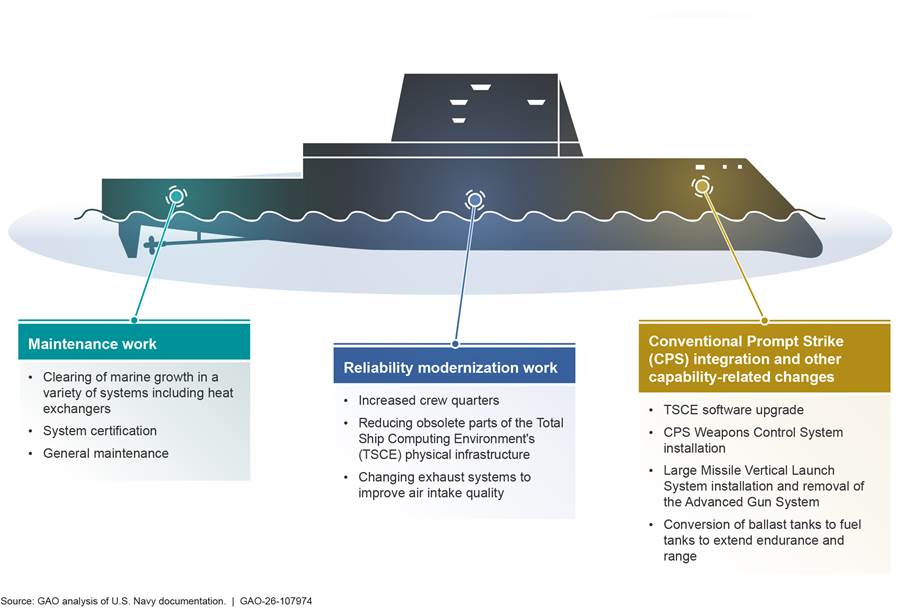
Modifying the DDG 1000 class to incorporate the hypersonic missile requires significant changes to the hull as well as some of the ship systems. These changes resulted in the Navy initiating modifications to the DDG 1000 class collectively referred to as a Build Yard Modernization Period (BYMP), for the two in-service ships, DDG 1000 and DDG 1001, and a Mission System Activation (MSA) period for DDG 1002, which has yet to complete its new construction period.[4] The BYMP and MSA are both ship modernization periods currently being completed by Huntington Ingalls Industries. They involve installing the Large Missile Vertical Launch Tubes and other components of the CPS weapon system. The Navy also leveraged the BYMP to correct some issues identified during a brief employment of the DDG 1000 in 2022. These changes are detailed in figure 2.
Conventional Prompt Strike and Long-Range Hypersonic Weapon
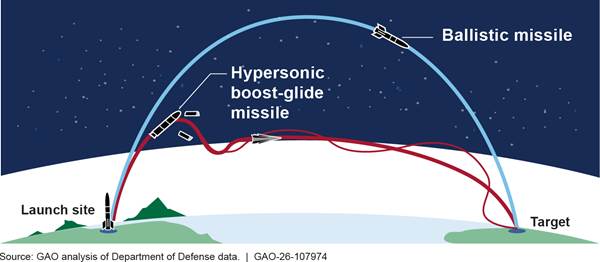
CPS is a boost-glide hypersonic missile designed to be fired from a surface ship platform, or from a submarine. Boost-glide systems work by using a missile to propel a payload to the edge of space at which point a glide body separates from the missile. The glide body then uses aerodynamic lift to extend its range and maneuver itself toward the target. CPS missiles can fly longer distances than most missiles, use flight patterns that are less predictable than ballistic missile trajectories and can engage targets in less time than standard missiles. Throughout this report, we refer to CPS as a specific missile, the Navy program to develop that missile, and the conventional strike capability it enables. Unless otherwise specified, the term as used in this report refers to the Navy’s missile development program. Figure 3 shows a notional trajectory of a boost-glide weapon compared with a ballistic missile.
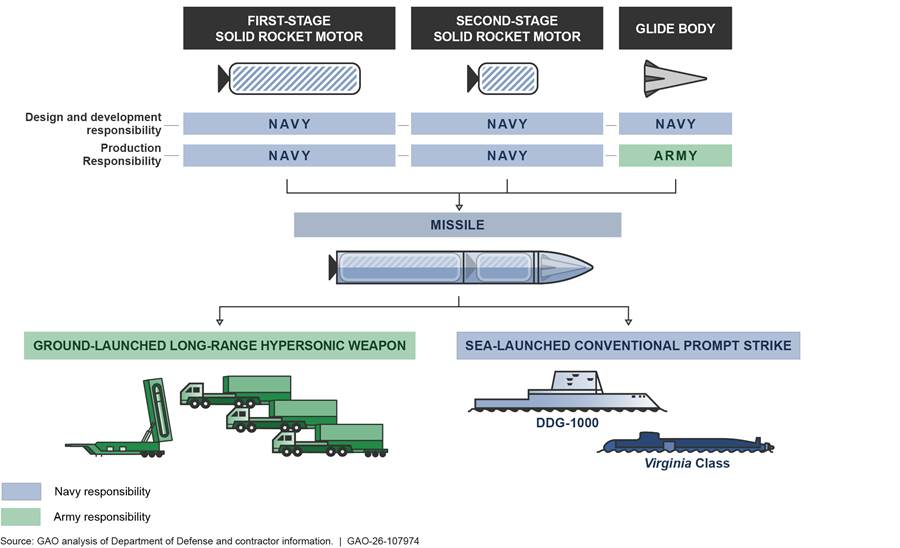
The Army version of the same weapon, the LRHW, employs the same missile and glide body as CPS missiles. Lockheed Martin is the prime contractor for developing and integrating the missile for both CPS and LRHW, including a two-stage solid rocket motor as well as a glide body built by Dynetics. Both programs share the missile and glide body production lines at the contractors’ facilities. The primary difference between the CPS and LRHW employment of the missile body is how they are each launched. The LRHW uses a land-based hot launch system (i.e., the missile ignites from the launcher), whereas CPS uses a cold-gas launch system that ejects the missile from a canister using compressed gas before it ignites the solid rocket motor at a safe distance above the ship or submarine.
The Army procures the hypersonic missile and associated canister through the Navy’s CPS program, which is responsible for overall missile production. Design and production responsibilities for certain subsystems are divided between the Army and Navy, as shown in figure 4 below, but both services currently have a role in and fund production oversight.
Acquisition Pathways and Organizations Responsible for CPS and LRHW Programs
To deliver effective, suitable, survivable, sustainable, and affordable solutions to the warfighter in a timely manner, DOD established the Adaptive Acquisition Framework (AAF) in January 2020. The AAF emphasizes several principles that include simplifying acquisition policy, tailoring acquisition approaches, and conducting data-driven analysis. DOD Instruction 5000.02 establishes the groundwork for the operation of the AAF. The AAF is comprised of six acquisition pathways, each with processes, reviews, documentation requirements, and metrics that program managers can match to the characteristics and risk profile of the capability DOD is acquiring.[5] One of those pathways—the middle tier of acquisition (MTA) pathway—includes two expedited paths. The first path, rapid prototyping, is intended to quickly develop and demonstrate capability in an operational environment within 5 years. Rapid prototyping is also intended to develop prototypes that a military department can field to the warfighter as an interim capability. The second path, rapid fielding, is intended to begin production of a new or upgraded capability within 6 months, and complete fielding of that capability within 5 years.[6]
Several Navy organizations have responsibilities for developing, funding, and integrating the CPS into the DDG 1000 and the Virginia class submarines.
· The Navy’s Strategic Systems Programs office is responsible for developing and producing CPS missiles. This program is sponsored by the Navy’s Undersea Warfare Division within the Office of the Chief of Naval Operations (OPNAV N97).[7]
· The Navy’s DDG 1000 program office within the office of the Portfolio Acquisition Executive, Maritime manages the DDG 1000 program, including the BYMP. The Navy’s Surface Warfare Division within the Office of the Chief of Naval Operations (OPNAV N96) sponsors this program.
· The Navy’s fleet is responsible for the maintenance and operation of the vessels once delivered.
· The Virginia class submarine is managed by the Navy’s Direct Reporting Program Manager Submarines and funding is managed by OPNAV N97.
The Navy is developing and initially fielding CPS capability via two consecutive MTA efforts. The first was a rapid prototyping effort focused on development of the missiles for use by both the Navy and Army. In 2021, following congressional direction to ensure CPS technologies were transferable to surface platforms, the Navy chose DDG 1000 as the initial platform due to its size—CPS missiles are nearly four stories tall—and to leverage the ship’s unique systems and technologies.[8] This first effort concluded in 2025 with a successful flight test utilizing the cold-gas launch from a land-based launcher. The second effort is a rapid fielding effort with a focus on integrating CPS missiles with Zumwalt class destroyers, that is expected to conclude in fiscal year 2027 with a flight test from the USS Zumwalt. The overall CPS effort plans to then transition to the major capability acquisition pathway at low-rate initial production for fielding on Virginia class submarines and the remaining Zumwalt class ships, as well as potentially other surface warfare ships, such as the future Trump class battleship.[9]
The Army’s Hypersonic Project Office—part of the Rapid Capabilities and Critical Technologies Office—was responsible for developing LRHW prototypes in coordination with the Navy. This effort began in 2019 under the Army Rapid Capabilities and Critical Technologies Office’s accelerated prototyping authority.[10] However, in August 2023, the Army initiated an MTA rapid fielding effort for LRHW and transitioned management of this part of the program to the Army Program Executive Office for Missiles and Space. The Army’s Hypersonics Project Office still manages procurement of ground support equipment, to include launchers and communications and control equipment.
Navy Continues to Face Performance Challenges Despite Recent Successes
Despite recent successes testing the CPS missile, the Navy faces several programmatic challenges associated with developing, delivering, and deploying the CPS missile on the DDG 1000. These challenges include rising costs, schedule delays, reliability issues with DDG 1000 class destroyers, and CPS production challenges, among other things.
DDG 1000 and CPS Efforts Are Exceeding Cost and Schedule Targets
DDG 1000 Class Modernization
Until mid-2025, the DDG 1000 program was generally meeting cost targets for CPS weapon system installation during DDG 1000’s BYMP and DDG 1002’s MSA period. Program officials reported that the plan to sequence modernization around the planned deployment of the DDG 1001 has worked well. Additionally, early on, they identified efficiencies associated with assembling parts of the vertical launch tube at the vendor facility, prior to installation at the shipyard. However, over the past year, the cost and schedule performance on the first ship to undergo this work, the DDG 1000, has degraded. As a result, the program reported increasing its estimate to upgrade all three ships from $1.8 billion to at least $2 billion. Further, the Navy now expects to complete the BYMP for the DDG 1000 in the fourth quarter of fiscal year 2026, a delay of 10 months based on earlier plans to complete this work in September 2025. Figure 5 shows the program’s schedule for completing modernization and CPS missile integration work on the DDG 1000 class.
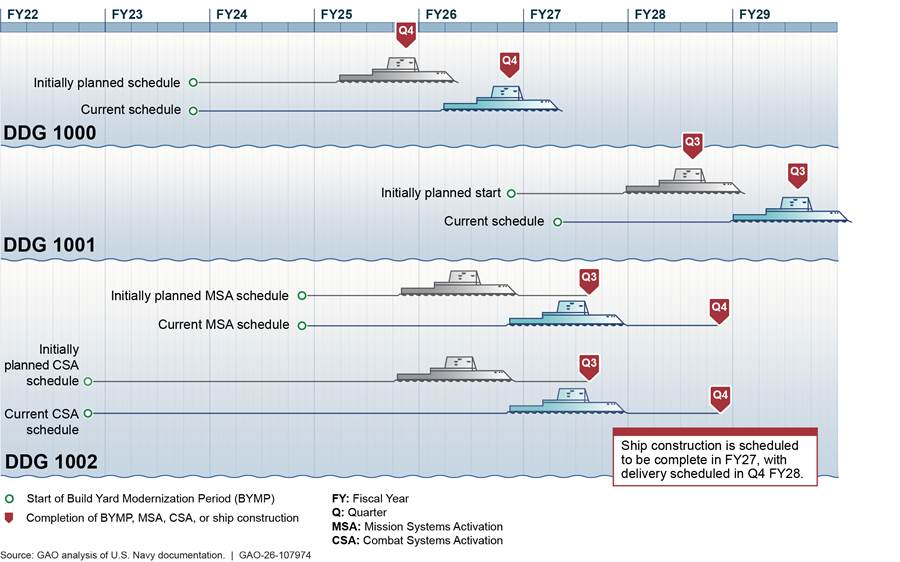
Note: This schedule is based on the current scope of ship modernization, which retains many of the DDG 1000 class’s unique systems. An official from the Office of the Chief of Naval Operations said that, should the Navy decide to change the scope of this work, the schedule could potentially change.
DDG 1001 is the only ship in the class that has yet to begin its BYMP as it spent part of 2025 conducting fleet operations in its first deployment. It is scheduled to begin its BYMP in February 2027. Figure 6 shows the respective completion levels for the DDG 1000 class modernization work.
Schedule estimates have increased for the following reasons:
Unplanned work. Program officials reported that the primary cause of recent delays is unplanned work. Program officials noted that the Navy modified the BYMP contract with Huntington Ingalls in August 2025 to add 230,000 hours—at a cost of $20 million—for unplanned work. Among other things, the unplanned work addresses the need for more cabling than was anticipated in the initial project design, as the contractor cut and removed more cabling than planned from the forward part of the ship for CPS missile launch tube installation. The additional cabling was needed to match changes to the ship configuration since new construction cables were installed as part of the BYMP. Another source of unplanned work and delays per program officials is that this is the first time that the Navy has shut down and restarted key DDG 1000 class ship systems. For example, equipment failures in the ship’s complex electrical system, which is akin to a small power plant, contributed to delays. Program officials said that, as this is the first time the Navy is installing and integrating a hypersonic weapon system on a ship, the Navy is working to mitigate risk by actively documenting and applying lessons learned to the BYMP schedule and work processes for the remaining ships.
Risk management. According to program officials, the Navy made changes to the CPS flight test schedule, discussed below, to allow the prime contractor more time to fully complete testing aboard the ship prior to it leaving the yard, and to provide the crew with more time to acclimate to the ship. The initial schedule carried risk associated with overlapping events to support plans to field CPS capability in 2025, and it required the crew to move aboard while some work was ongoing, according to program officials. The new schedule allows the Navy to space out key events and reduce the risk of overlaps between crew moving aboard and completion of the BYMP work.
Funding constraints. According to officials from the Navy’s Supervisor of Shipbuilding Gulf Coast, activation of the DDG 1002 combat systems started slowly due to the Navy incrementally funding this work and sequencing it with the DDG 1000 BYMP. CPS program officials told us that they still expect the contractor to be able to complete CPS installation and testing on the DDG 1002 during its MSA period.
Conventional Prompt Strike
Over the past 5 years, CPS costs estimates have fluctuated, driven by factors such as the Navy’s removal or addition of host platforms, revisions to total quantities, planned periodic capability insertions, and production time frames to date, among others. In fiscal year 2020, early in the MTA rapid prototyping phase, the Navy estimated it would cost about $31 billion in total lifecycle costs for a program that would deliver 262 missiles. In 2024, the Navy increased its estimate of the total cost to acquire CPS by about 30 percent while reducing the number of missiles to be procured—now $41 billion in total lifecycle costs for 224 missiles. These missile quantities do not reflect a specific program requirement, according to CPS program officials, but rather modeling based on various inputs, including budget documents, analyses of industrial base capacity, and direct, ongoing collaboration with the U.S. Strategic Command and the requirements sponsor—OPNAV N97. Additionally, the Army is planning to spend more than $10 billion to procure 48 missiles and associated ground support equipment.
Navy costs for missile quantities cited above include nearly $4.6 billion in development, procurement, shipbuilding, and operations and maintenance funding for fielding the system on the DDG 1000 and Virginia class submarines. In total, the Navy plans to spend over $41 billion in total life-cycle costs to field the CPS capability on both platforms. As of April 2026, CPS unit costs were estimated to be about $63 million to $71 million per missile with an average estimated cost of approximately $67 million per missile. The exact unit cost will depend on the contractor’s efficiency in production, which is, in part, dependent on stable annual procurement funding for the missile. Additionally, program officials said that some costs reported in Navy budget documents depend on what is included with the missile (e.g., support equipment). Program officials said that unit costs may change once missile procurements begin in fiscal year 2027, due to design maturation, inflationary pressures, and planned technology upgrades, as well as overall procurement quantities.
Program officials attributed these cost increases, in part, to a change in the acquisition strategy. Specifically, the 2024 increased estimate reflects revised acquisition plans, costs associated with incremental technology insertions, a better-defined schedule, and actual contract cost information.
Program officials also told us that their initial cost estimates were optimistic in that they assumed no issues with development or testing of the missile. As we reported in June 2025, anomalies led to tests that did not yield official results. This drove a 2-year delay to planned flight tests aboard the DDG 1000.[11] Anomalies were related to missile production and fire control and software issues with the Army’s launcher that was used for the test. This prompted the program to request an extension of the rapid prototyping effort to October 2025, from its initial planned completion of the end of September 2024. Officials attribute these delays to reductions in funding that resulted in not having planned quantities of test assets. These assets could have mitigated gaps associated with issues that caused the test anomalies.
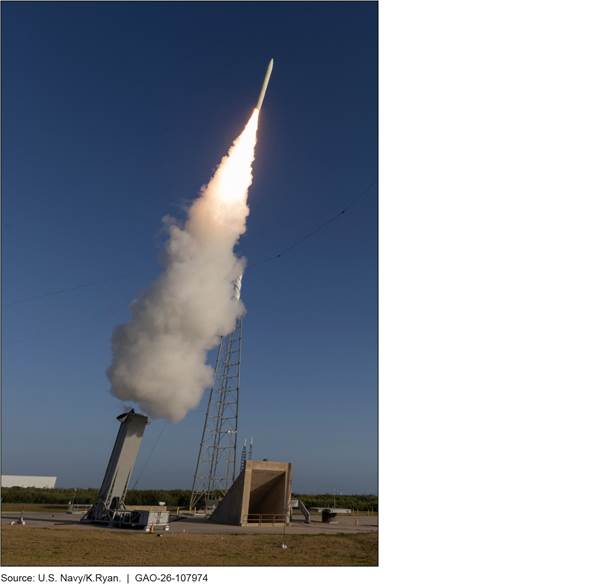
Subsequently, the Army and Navy conducted two successful flight tests in December 2024 and April 2025. For example, in April 2025, CPS successfully conducted a cold gas launch flight test at a land-based test site and then monitored the missile for a full flight. The CPS missile met many key performance requirements with program officials noting that the CPS launch, weapons control, and missile systems all functioned as intended. Recent flight tests and simulations demonstrate CPS missiles can meet minimum requirements for range and accuracy, among others. The specific requirements are classified. The April 2025 test was the final event in the CPS rapid prototyping effort, allowing the program to exit the rapid prototyping phase in October 2025. Figure 7 shows the CPS being launched during its April 2025 flight test.
The Navy planned to begin flight testing CPS on the DDG 1000 class in 2025—a key milestone in the rapid fielding phase. Following the CPS flight test delays to address program funding and risks, the Navy now plans to test CPS on the DDG 1000 in 2027, and alignment of CPS testing with the DDG 1000 program is the main schedule driver. As of January 2026, the program was about 10 percent behind its new schedule target for completing CPS work but still expected to begin testing aboard the DDG 1000 in 2027. Figure 8 depicts the CPS flight test schedule to date.
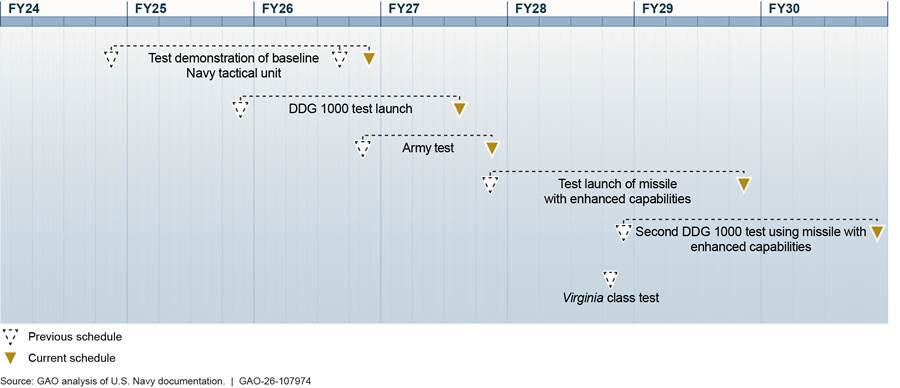
Note: Testing on the Virginia class is dependent on delivery of the first Block V submarine with the Virginia Payload Module, which will house the missile, and completion of an underwater test launch facility, expected in fiscal years 2029 and 2030, respectively.
Program officials said that in May 2024, the program revised a key schedule goal, the date for the first CPS missile flight test from on board the DDG 1000, to the third quarter of fiscal year 2027. CPS program officials told us that they also adjusted their testing strategy, creating multiple incremental test events prior to the next flight test. This decision is intended to maximize the possibility for successful test outcomes and limit risk to the host platform and crew. Additionally, program officials said that they are working with the contractor to optimize testing and development activities to mitigate risk. Though the program delayed its schedule for the missile flight test aboard the DDG 1000, program officials noted that the CPS schedule is still largely optimistic and is predicated on successful development efforts and test outcomes.
CPS and DDG 1000 Programs Face Production and Reliability Challenges
Conventional Prompt Strike
Lockheed Martin, the CPS missile body prime contractor responsible for production integration, faces significant production issues that it must address to build the missiles at anticipated rates and costs. Navy data indicate that the contractor facility operations are not currently able to meet demand, making it difficult for Lockheed Martin to keep production commitments. Specifically, the facility is currently capable of producing a maximum of six to seven rounds a year out of the 12 rounds per year necessary to stabilize production. One reason for this gap is that the missile is more labor-intensive to build than planned. For example, as of March 2025, days of direct hands-on work per missile far exceeded estimates needed to achieve the expected production rate.
Further, Army and Navy officials noted numerous problems that increase production timespans. Additionally, because of missile systems’ complexity, the environments they operate in, and the high degree of accuracy and precision needed for their operation, quality is paramount to their success. Production problems we noted include the following:
· Application of coatings. The CPS missile experiences extremely high temperatures during flight and needs a robust coating to prevent damage to key missile components. Further details of related issues are omitted because the Navy determined that they are controlled unclassified information.[12]
· Complexity of work instructions. Navy and Army officials found that the work instructions used to build the missile are too complex for the average worker to follow. According to Navy and Army program officials, the work instructions are largely written as engineering specifications, which the contractor provides to workers who have recently graduated from high school or vocational school. Navy production oversight officials said that it is unreasonable to expect workers to understand the instructions provided. The contractor is in the process of revising work instructions across workstations. However, Navy officials explained that under the terms of the existing contract, the prime contractor retains responsibility for all manufacturing processes and ultimate delivery of the final product. To avoid actions that could be construed as co-direction in violation of the terms of the contract, officials further explained that the government’s role is necessarily focused on assessing production progress and final deliverables rather than prescribing specific internal process improvements.
· Parts and supply controls. The Navy also found that the contractor has insufficient material preservation controls and inspection of parts at the subcontractor facilities. For example, the prime contractor found a container of the thermal protection system coating was contaminated at the Lockheed Martin facility, according to Navy oversight officials, causing delays in production. Army officials also cited incomplete parts kits as another recurring issue. Specifically, parts are sometimes missing from kits, which are groups of all the parts necessary to complete a portion of the missile. When parts are missing from kits, it slows production as these missing parts need to be borrowed from other missile kits. In some cases, the contractor had to partially disassemble missiles in production to address issues with parts or incomplete assembly kits.
· Workforce. The program also faces challenges with high workforce turnover, including several workers who have transitioned to competing programs in prime contractor Lockheed Martin’s portfolio or left the company, according to Navy oversight officials. Army officials said that the contractor recently increased manufacturing personnel from about 60 to 80 workers but noted that it takes about a year for workers to be able to work independently.
Additionally, a Navy audit of the production facility in 2023 noted various issues relating to lack of adequate parts inspection; multiple instances of untagged expired materials, such as adhesives; and numerous instances of quality assurance steps not being followed. The contractor is in the process of implementing initiatives to address these and other production issues, such as revising work instructions and better defining and managing assembly kits.
DDG 1000 Class Modernization
The DDG 1000 program faces reliability challenges that have degraded performance of the ship class. For instance, the DDG 1000 program has yet to fully address significant reliability issues with the integrated power system. Since its acceptance in 2020, this system experienced numerous category 3 or 4 casualty reports for issues that degraded capability or prevented the ship from performing its missions.[13]
The Navy is addressing sustainment and obsolescence issues, in part, by taking parts from—or cannibalizing—DDG 1002, for current operations on in-service ships. Cannibalized parts must either be returned, or spares procured before the donor ship can deploy. Program officials cited this as a factor that also delayed systems activation on the DDG 1002. We have previously reported that parts cannibalization is an inefficient way to sustain operations over a long period of time.[14]
Navy and Army Do Not Have a Comprehensive Strategy to Guide Investment Decisions
The Navy and Army are collectively planning to invest over $50 billion to deliver CPS capability, but the Navy is largely making investment decisions on a program-by-program basis, rather than doing so from a portfolio-wide perspective.[15]
DOD’s approach to making investment decisions for delivering CPS capability is fragmented, preventing the services from making efficient progress toward their objectives and contributing to delays that cascade through the Navy and Army efforts. Specifically, the Navy, in coordination with the Army, is responsible for buying missile bodies and making investments to achieve the optimal production efficiency rate of 12 missile bodies per year. This is critical for the program to achieve its cost and schedule targets. However, decisions by one service can affect the other service.
For example, diagnosing production issues to improve production throughput and quality across the Army and Navy has been a challenge. The Navy is responsible for the missile body production line. However, an Army official told us that in fiscal year 2025 at a cost of about $6 million, the Army hired a consultant to study the shared missile-body production line to diagnose issues and recommend solutions. The Army’s consultant recommended a series of actions at the production facility to enable it to reach a build rate of 12 missiles per year. Lockheed Martin is implementing several of these actions, though it is too early to determine the effectiveness of these actions. In January 2026, Navy program officials told us that, while the study confirmed some of the issues they were already aware of, they did not necessarily embrace its overall findings. Consequently, the Navy has deployed its own teams and has traveled to the production facility regularly to help solve production problems. However, according to Navy program officials, they have limited influence over the contractor’s production processes, given contractual constraints described above, to make more significant improvements. A comprehensive strategy to guide investments for the full CPS capability could help ensure all parties involved—including Army and Navy program offices and those making funding decisions—have a common understanding of relevant priorities.
Another key investment decision relates to the work performed under the BYMP and planning for the overall sustainment of the three DDG 1000 ships. A key risk to the long-term viability of the DDG 1000 class program is in needing to develop a cost-effective sustainment strategy for a ship class with unique systems. The decisions made more than a decade ago to truncate the ship class from 32 to three ships impacted spare parts availability and obsolescence, according to program officials. They further stated that the reduction of ships in the class played a role in the cost increase of developing and maintaining unique system components for the three remaining ships. Additionally, officials explained that parts suppliers have less incentive to continually sustain or maintain unique system components, which leads to obsolescence.
Further, parts shortages, increasing obsolescence, reported intellectual property issues, and reliance on contractors to maintain and fix these systems while the ships are deployed can limit the missions the ships perform, according to Navy surface warfare and other officers. For example, Navy officials noted that key parts associated with the DDG 1000 power system take 3 months from the time they are ordered until they can be delivered. This means that if there is a parts failure at startup and no spares, then there is potentially 3 months of down time. During the BYMP, the Navy is applying fixes to improve the operation and sustainability of some of these systems but has yet to decide whether it will eventually replace these unique systems with Navy standard equipment that perform the same function. For example, the DDG 1000 class uses a SPY-3 combat radar and unique computer network system (known as the Total Ship Computing Environment), instead of the SPY-1 or SPY-6 radar and Aegis combat system that the Navy uses on other surface combatants. The SPY-3 radar is only common with the lead carrier of the Ford class program, CVN 78, and is an obsolescence risk. The DDG 1000 class also has a unique network system—the Zumwalt Operating Environment—instead of the Consolidated Afloat Networks and Enterprise Services in use on other surface ships. The Navy estimates that replacing these and other systems would cost an additional $1 billion to $2 billion for all three ships. An OPNAV official told us that Navy stakeholders have discussed replacing unique systems on the DDG 1000 class with Navy standard systems, but a decision is still pending.
The 2-year BYMP presented an opportunity for the Navy to formally consider replacing these unique systems and enhance the cost-effective sustainability of the DDG 1000 class to its full 35-year service life, which would run at least through the 2050s. However, an OPNAV official said that there is no single document or analysis supporting the decision to exclude these replacements from the BYMP. Early in our review, an OPNAV official said the Navy was considering using the DDG 1000 as a bridge for providing CPS capability until the Virginia class submarines are available as a host platform, approximately from 2027 to 2031. If this was the Navy’s plan, then including these system replacements in the BYMP would potentially negate the cost-effective nature of the upgrades since each ship in the class would, in this scenario, only have 1 or 2 deployments before potential decommissioning.
However, later in our review, Office of the Chief of Naval Operations and program officials told us that they plan to operate the DDG 1000 to the end of its service life and that the DDG 1000 was never intended to only be a bridge from its capability delivery until the Navy fields the missile on the Virginia class submarines. According to these officials, they excluded replacing the DDG 1000s unique systems with Navy standard systems to better manage the length, complexity, and cost of the BYMP and provide the fleet with some capability as soon as possible. However, as previously noted, these officials were unable to provide evidence supporting the determination that replacing the DDG 1000 class’s unique systems would have prolonged the BYMP. Since this decision was not documented, it is unclear how the Navy balanced the priority of integrating CPS with the sustainment issues associated with operating the vessel for the next 20-plus years.
The absence of a formal or coordinated approach to such investment decisions reflects that DOD does not have a comprehensive strategy that guides portfolio-wide decision making for providing CPS capability, or that ensures decisions are documented along the way. Given the expense of the CPS program and the $2 billion that the Navy is already investing in modifying the DDG 1000 for the CPS, having a strategic approach to managing the various efforts, players, and decision points could better ensure that near- and long-term plans for providing CPS capability remain viable. This would also help to optimize investments for efficiency and maximum effect.
Our prior work has shown how leading companies use agile portfolio management practices to optimize their investments across product developments.[16] A product portfolio is a collection of products that a company offers, managed as a group to achieve certain goals that align with the organization’s strategic vision and business strategies, which communicate capability needs. Our work provides an example of how the Navy and Army can establish an approach to guide investment decisions to achieve common goals as effectively and efficiently as possible. For example, we reported in September 2025 that a key mechanism leading companies use to manage their portfolios is a business strategy that can span multiple programs to communicate how they work together to make investment decisions. These companies then update product development data throughout product development to inform recurring decisions on product priorities. Similarly, the Army and Navy could develop a strategy that spans the various acquisition, modernization, and development programs involved with ultimately delivering CPS capability to guide and prioritize related investment decisions.
Importantly, leading companies scale their investment in a product’s development based on the pace at which that product’s business case matures, rather than on promised performance or the passage of time. For DOD, this could mean periodically reviewing plans to deliver CPS capability based on progress developing the missile system or integrating it into surface- or submarine-based launch platforms. This would include cycles of testing and validation, supported by corresponding feedback. Leading companies use these strategies to allocate funds and investments to achieve the overall goals of the corporation. As leading companies execute product development efforts, they regularly review and update their product portfolios to consistently revisit their investment decisions—a critical approach that the Army and Navy have yet to establish.
While the programs involved with CPS collaborate to varying degrees, there is no documented comprehensive strategy for delivering the full CPS capability that outlines how they will coordinate and prioritize investment decisions across all relevant programs. Navy leadership meets on a regular basis to discuss key issues. While helpful, this leadership group—in combination with the Navy and Army’s senior- and working-level coordination—have been unable to fully mitigate challenges associated with coordinating and prioritizing critical investments. Further, while the Army and Navy recognize the need to document the coordination of CPS-related investments, they have formalized processes for a limited set of efforts—for example, for coordinating hypersonic glide-body development and associated investments and cost sharing, such as for specific test events.
· Navy and Army officials said that they coordinate almost daily at the working level and periodically through an executive steering committee that meets to discuss program schedule and risks at a high level. However, this committee does not include participation from the Army and the Virginia class submarine program. Based on documentation from these meetings, they also do not demonstrate collective decision-making capacity to influence investment priorities across the programs and services.
· DOD, Navy, and Army previously created memorandums to guide coordination but none of these documents address program-wide investment. For example, in 2019, DOD signed a common hypersonic glide body memorandum that focused on coordinating investment in production and research for just the glide body. This memorandum assigned DOD Research and Engineering with responsibility for creating a council to coordinate cross-service investments. This memorandum applied only to the glide body and this council is no longer active, according to Navy officials.
· The Army and the Navy have several signed memoranda to document cost sharing agreements for specific test events. In addition, Army officials said that they have two draft memorandums of agreement with the Navy to address division of roles and responsibilities and cost sharing between the Army and Navy. However, these memorandums focus primarily on costs and responsibilities between the Army and CPS program as they relate to missile production, according to officials from both services.
· The CPS program has a signed memorandum with the Virginia class submarine program office and the Program Executive Office for Undersea Weapons Systems (with responsibility now transferred to the Direct Reporting Program Manager Submarines). This memorandum identifies relationships and responsibilities regarding efforts to integrate the CPS payload on the Virginia class Block V submarines. As with other agreements, this memorandum is limited in its scope and does not encompass the full breadth of programs involved with delivering CPS capability.
Though Navy officials agreed that there is no formal approach for coordinating plans and investments across all the programs associated with fielding CPS capability, they said they consider the coordination outlined above to be sufficient. However, disparate views regarding how to best address CPS production issues and lack of a documented approach for assessing DDG 1000 sustainment highlight areas where a formal strategy could help guide priorities and optimize investments. Without a comprehensive strategy to guide investment decisions, it is unlikely that the Army and the Navy will be well-positioned to make decisions across the portfolio of programs that result in efficiently delivering the CPS capability at planned cost and schedule targets.
Conclusions
Fielding capabilities like hypersonic missiles is critical for deterring and, if necessary, defeating peer adversaries. These missiles, however, are expected to cost nearly $70 million per missile and over $40 billion for 224 missiles. This includes the cost to develop and incorporate the necessary technologies on only some of a growing number of large and complex Navy platforms. Some of these platforms, such as the DDG 1000 class, have their own sustainability and affordability issues. Moreover, the Navy cannot make decisions in isolation since the Army is buying its own missiles and manages key aspects of production. Despite these complexities, the Navy and the Army do not have a comprehensive strategy to guide CPS portfolio investments in a way that facilitates effective and efficient allocation of funding to achieve the capability envisioned in the services’ respective plans. Without such a strategy, the Navy and the Army create the potential for both additional delay and inefficient use of taxpayer funds.
Recommendation for Executive Action
The Secretary of Defense should ensure that the Under Secretary of Defense for Acquisition and Sustainment, in coordination with the Secretaries of the Navy and Army, develops a comprehensive strategy that outlines how all programs involved with delivering CPS portfolio capability should coordinate and regularly review investment decisions. (Recommendation 1)
Agency Comments and Our Evaluation
We provided a draft of this report to DOD for review and comment. DOD provided an official comment letter (reproduced in appendix I) noting concurrence with our recommendation. The Navy also provided technical comments which we incorporated as appropriate.
We are sending copies of this report to the appropriate congressional committees and other interested parties, including the Secretary of Defense, the Secretary of the Navy, and the Secretary of the Army. In addition, the report is available at no charge on the GAO website at https://www.gao.gov.
If you or your staff have any questions concerning this report, please contact us at OakleyS@gao.gov. Contact points for our Offices of Congressional Relations and Media Relations may be found on the last page of this report. Staff members making key contributions to this report are listed in appendix II.

Shelby S. Oakley
Director, Contracting and National Security Acquisitions
GAO Contact
Shelby S. Oakley, Director, oakleys@gao.gov
Staff Acknowledgments
In addition to the contact named above, the following staff members made key contributions to this report: Laurier Fish (Assistant Director), Andrew H. Redd (Analyst-in-Charge), Rose Brister, Susan Ditto, Rohan Krishnamoorthy, Mark Oppel, and Adam Wolfe.
The Government Accountability Office, the audit, evaluation, and investigative arm of Congress, exists to support Congress in meeting its constitutional responsibilities and to help improve the performance and accountability of the federal government for the American people. GAO examines the use of public funds; evaluates federal programs and policies; and provides analyses, recommendations, and other assistance to help Congress make informed oversight, policy, and funding decisions. GAO’s commitment to good government is reflected in its core values of accountability, integrity, and reliability.
Obtaining Copies of GAO Reports and Testimony
The fastest and easiest way to obtain copies of GAO documents at no cost is through our website. Each weekday afternoon, GAO posts on its website newly released reports, testimony, and correspondence. You can also subscribe to GAO’s email updates to receive notification of newly posted products.
Order by Phone
The price of each GAO publication reflects GAO’s actual cost of production and distribution and depends on the number of pages in the publication and whether the publication is printed in color or black and white. Pricing and ordering information is posted on GAO’s website, https://www.gao.gov/ordering.htm.
Place orders by calling (202) 512-6000, toll free (866) 801-7077,
or
TDD (202) 512-2537.
Orders may be paid for using American Express, Discover Card, MasterCard, Visa, check, or money order. Call for additional information.
Connect with GAO
Connect with GAO on X,
LinkedIn, Instagram, and YouTube.
Subscribe to our Email Updates. Listen to our Podcasts.
Visit GAO on the web at https://www.gao.gov.
To Report Fraud, Waste, and Abuse in Federal Programs
Contact FraudNet:
Website: https://www.gao.gov/about/what-gao-does/fraudnet
Automated answering system: (800) 424-5454
Media Relations
Sarah Kaczmarek, Managing Director, Media@gao.gov
Congressional Relations
David A. Powner, Acting Managing Director, CongRel@gao.gov
General Inquiries
[1]For additional information, see GAO, Hypersonic Weapons: DOD Could Reduce Cost and Schedule Risks by Following Leading Practices, GAO‑24‑106792 (Washington, D.C.: July 29, 2024).
[2]GAO, Leading Practices: Agile Portfolio Management and Iterative Business Cases Drive Innovative Product Development, GAO‑25‑107130 (Washington, D.C.: September 17, 2025). For the 2025 report, we interviewed portfolio management and product development representatives from eight leading companies to identify how they employ portfolio management practices and develop business cases to guide product development investments.
[3]The Michael Monsoor (DDG 1001) is named after U.S. Navy SEAL Michael Monsoor, who was posthumously awarded the Congressional Medal of Honor for his valorous actions during the Battle of Ramadi in 2006.
[4]Completion of the DDG 1002’s construction is referred to as its combat systems activation, which Huntington Ingalls Industries initiated prior to and in conjunction with the ship’s MSA.
[5]Department of Defense, The Defense Acquisition System, DOD Directive 5000.01 (Sept. 9, 2020) (incorporating change 1, July 28, 2022); and Operation of the Adaptive Acquisition Framework, DOD Instruction 5000.02 (Jan. 23, 2020) (incorporating change 2, April 8, 2026).
[6]See Department of Defense, Operation of the Middle Tier of Acquisition, DOD Instruction 5000.80 (Dec. 30, 2019) (incorporating Change 1, Nov. 25, 2024) for a discussion of the MTA pathway’s two expedited acquisition tracks, their objectives, and associated timelines.
[7]Program sponsors manage funding for weapons development, acquisition, and modernization programs, among other things, including developing inputs for the president’s budget request.
[8]The Navy originally planned to put CPS missiles on Ohio class and Virginia class submarines. It also originally planned to use one of the DDG 1000s as a testbed to prove surface ship launch capability. In 2022, the Navy eliminated plans to employ CPS missiles on Ohio class ballistic missile submarines and opted to modify all three DDG 1000 class destroyers—instead of just one—to host the missile prior to testing and employment on selected Virginia class submarines.
[9]See Department of Defense, Major Capability Acquisition, DODI 5000.85 (Aug. 6, 2020) (incorporating Change 1 Nov. 4, 2021) for a description of the major acquisition pathway and its production and fielding requirements.
[10]According to the Army, the Rapid Capabilities and Critical Technologies Office’s charter at the time permitted it to initiate such projects on its own authority without using the middle tier of acquisition rapid prototyping pathway.
[11]GAO, Weapon Systems Annual Assessment: DOD Leaders Should Ensure That Newer Programs Are Structured for Speed and Innovation, GAO‑25‑107569 (Washington, D.C.: June 11, 2025).
[12]Generally, controlled unclassified information is information created or possessed by the government, or by an entity for or on behalf of the government, that requires or permits safeguarding and dissemination controls pursuant to law, regulation, or government-wide policy. 32 C.F.R. § 2002.4(h).
[13]The Navy issues category 3 and 4 casualty reports for these issues, which indicate degradation to critical mission capability that needs immediate repair.
[14]GAO, Navy Surface Ships: Maintenance Funds and Actions Needed to Address Ongoing Challenges, GAO‑25‑106990 (Washington, D.C.: Jan. 31, 2025).
[15]For purposes of this review, investment decisions include near- and long-term plans for developing, producing, funding, and fielding CPS capability across multiple programs and the associated industrial base.