
Report to Congressional Committees
United States Government Accountability Office
A report to congressional committees.
For more information, contact: James A. Reynolds at reynoldsj@gao.gov.
What GAO Found
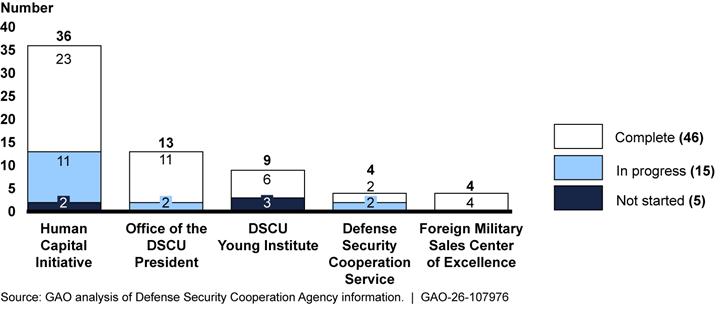
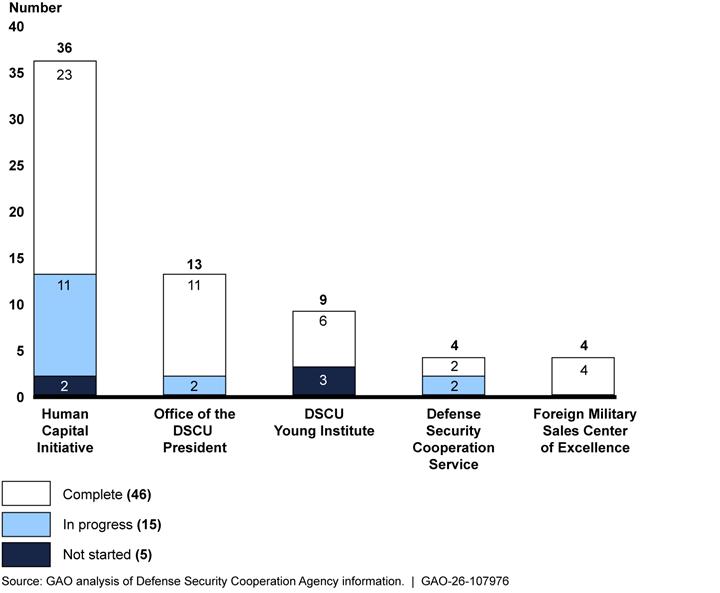
Five Defense Security Cooperation Agency (DSCA) teams are implementing the security cooperation workforce provisions in the National Defense Authorization Act for Fiscal Year 2024. Of the 66 provisions in the law we identified and reviewed, the agency has completed work on 46, is in progress on 15, and has not started implementing the remaining five. DSCA expects to complete work on all security cooperation workforce provisions in fiscal year 2028. For example:
· The Human Capital Initiative has completed work on 23 provisions and is in progress on 11 provisions. For example, the team has completed the provision to identify and code security cooperation workforce positions. It is in progress of implementing the provision to develop a management information system with the qualification, assignments, and tenure of security cooperation workforce personnel.
· The Defense Security Cooperation Service has completed work on two of four provisions related to ensuring that security cooperation workforce offices possess the requisite personnel, and that such personnel possess the skills needed to properly perform their missions.
Status of Security Cooperation Workforce Provisions, by Defense Security Cooperation Agency Implementation Team, as of May 2026
Note: DSCU = the Defense Security Cooperation University
DSCA officials implementing the security cooperation workforce provisions have identified and made plans to address personnel shortfalls and other challenges. For example, DSCA officials said that the federal civilian hiring freeze, implemented in January 2025, has been a factor in not being able to hire personnel to fill positions in the Human Capital Initiative. Officials are addressing this challenge by assigning key tasks and duties to other team members and leveraging other DSCA expertise to overcome critical skill gaps. As another example, officials identified challenges related to the development of a management information system. Officials said that DOD’s various security cooperation workforce components use different data systems to track positions and personnel. Until this management information system is in place, analysis of the security cooperation workforce position data is being done manually.
Why GAO Did This Study
To advance the U.S. national security strategy and foreign policy, the Department of Defense’s (DOD) security cooperation workforce works on activities that build the capacity of partner nations’ security forces through security assistance, including foreign military sales. This workforce includes military and civilian personnel in the U.S. and overseas who are responsible for planning, monitoring, or conducting these types of activities. DSCA, within DOD, plays a key role in planning and executing these programs.
Congress included provisions to help modernize and professionalize the security cooperation workforce in the National Defense Authorization Act for Fiscal Year 2024 The statute also includes a provision for GAO to evaluate DOD’s implementation of these provisions. GAO examined (1) the status of DSCA’s implementation of the Act’s security cooperation workforce provisions and (2) DSCA’s plans to address the challenges it identified in implementing the provisions.
GAO reviewed and analyzed DSCA documents describing actions the agency is taking to implement the provisions. GAO identified a total of 66 provisions in the law. GAO assessed the status as “complete” if there was evidence of actions taken that addressed the provision with no significant identified actions remaining to implement it. “In progress” indicates there is some evidence of actions taken to address the provision, and “not started” means that, as of May 2026, DSCA had not taken any actions to address the provision. GAO also interviewed DSCA officials responsible for managing these efforts about these actions and challenges in implementing the provisions.
|
Abbreviations |
|
|
|
|
|
DOD |
Department of Defense |
|
DSCA |
Defense Security Cooperation Agency |
|
DSCS |
Defense Security Cooperation Service |
|
DSCU |
Defense Security Cooperation University |
|
FMS |
Foreign Military Sales |
|
FY |
fiscal year |
|
NDAA |
National Defense Authorization Act |
|
SCO |
security cooperation organization |
This is a work of the U.S. government and is not subject to copyright protection in the United States. The published product may be reproduced and distributed in its entirety without further permission from GAO. However, because this work may contain copyrighted images or other material, permission from the copyright holder may be necessary if you wish to reproduce this material separately.
August 20, 2026
The Honorable Roger F. Wicker
Chairman
The Honorable Jack Reed
Ranking Member
Committee on Armed Services
United States Senate
The Honorable Mike Rogers
Chairman
The Honorable Adam Smith
Ranking Member
Committee on Armed Services
House of Representatives
Security cooperation with foreign partners aims to strengthen alliances, enhance regional stability, and address shared security challenges—ultimately promoting U.S. national security interests. Toward that end, the U.S. government uses security cooperation programs to provide partner countries with military equipment and support during wartime and peacetime.[1] The Department of Defense (DOD), particularly the Defense Security Cooperation Agency (DSCA), plays a key role in directing and administering security cooperation programs. Thus, the development of a security cooperation workforce with the right skills and experience is an important part of supporting U.S. national security interests. The security cooperation workforce includes military and civilian personnel in the United States and overseas who are responsible for planning, monitoring, or conducting security cooperation activities, which can include the sale and end-use monitoring of defense articles and services to foreign governments.[2]
Congress has provided direction on the security cooperation workforce. For example, the fiscal year (FY) 2017 National Defense Authorization Act (NDAA) directed the Secretary of Defense to establish and implement a Security Cooperation Workforce Development Program to oversee the development and management of a professional workforce supporting DOD’s security cooperation programs and activities.[3] Following the passage of the FY 2017 NDAA, DSCA created the Security Cooperation Workforce Development Program to improve the quality and professionalism of the security cooperation workforce.
In the FY 2024 NDAA, Congress added provisions that provide more direction to DOD on the specific elements and activities of the Security Cooperation Workforce Development Program.[4] For example, the FY 2024 NDAA included provisions to implement a security cooperation human capital initiative and to create a management information system to provide standardized information and data on security cooperation personnel. The law did not prescribe timeframes for generally implementing the program.
The FY 2024 NDAA also requires GAO to conduct an evaluation of DOD’s actions to carry out the specific provisions in the act including those related to the Security Cooperation Workforce Development Program.[5] This report is part of a body of work consisting of GAO’s review of security cooperation efforts, including DOD’s implementation of Foreign Military Sales (FMS) reforms.[6] In this report, we examine (1) the status of DSCA’s implementation of the security cooperation workforce provisions, and (2) DSCA’s plans to address challenges it has identified to the implementation of the provisions.
To examine the status of DSCA’s implementation of the security cooperation workforce provisions, we obtained documents from and interviewed DSCA officials responsible for these provisions. We reviewed and analyzed agency documents describing actions the agency was taking to implement the provisions. We further analyzed DSCA’s progress in implementing these provisions by assessing whether the status of implementing the provisions was complete, in progress, or not started. Based on our review of DSCA documentation, we identified a total of 66 provisions in the law for our analysis. We considered the status “complete” if we received evidence of actions taken that addressed the provision with no significant identified actions remaining to implement it. We considered the status “in progress” if we received some evidence of actions taken to address the provision. We considered the provision “not started” if DSCA had not taken any actions to address the provision as of May 2026.
To determine the plans to address the challenges DSCA has identified to implementing the security cooperation workforce provisions, we interviewed agency officials responsible for managing those initiatives. We asked agency officials to identify:
· challenges they experienced in implementing the provisions,
· plans for how to address any challenges, and
· any practices that helped the agency to implement the provisions.
We then reviewed these responses to identify any recurrent themes. For additional details on our objectives, scope, and methodology, see appendix I.
We conducted this performance audit from December 2024 to August 2026 in accordance with generally accepted government auditing standards. Those standards require that we plan and perform the audit to obtain sufficient, appropriate evidence to provide a reasonable basis for our findings and conclusions based on our audit objectives. We believe that the evidence obtained provides a reasonable basis for our findings and conclusions based on our audit objectives.
Background
Security Cooperation Activities
DOD defines security cooperation as interactions of DOD with the defense establishment of a foreign country that:[7]
· build and develop allied and partner nation military and security capabilities for self-defense and multinational operations;
· provide U.S. forces with access to the foreign country during peacetime or a contingency operation; or
· build defense relationships that promote specific U.S. security interests.
To help achieve these objectives, DOD administers security cooperation programs authorized under Title 10 and certain security assistance programs authorized under Title 22 of the U.S. code. For example, Title 10 of the U.S. code authorizes DOD to provide U.S.-funded training and equipment to foreign countries for the purpose of building their capacity to conduct specific operations.[8]
Similarly, Title 22 authorizes the Department of State to use Foreign Military Financing funds or a foreign government’s funds to purchase defense articles and services through the FMS program, which DSCA administers. According to State, in FY 2025 the U.S. government funded $17.9 billion in arms sales to partner nations through Title 22.[9] In the same year, the total value of transferred defense articles, security services, and security activities was about $104.4 billion.
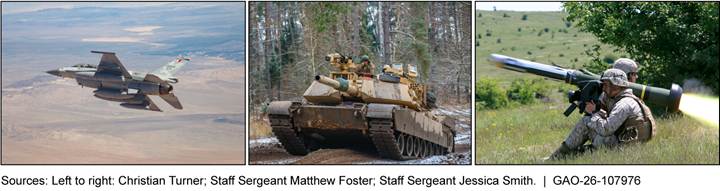
Under these authorities, DOD has provided such items as training and equipment for partners’ self-defense and counterterrorism operations, as well as intelligence, surveillance, and reconnaissance equipment for counter-illicit drug trafficking operations. Figure 1 shows examples of defense articles the U.S. government has transferred to foreign partners.
National Defense Authorization Acts Directed DOD to Improve Its Management and Development of the Security Cooperation Workforce
The FY 2017 NDAA included a provision for the Secretary of Defense to establish and implement the Security Cooperation Workforce Development Program. The security cooperation workforce includes members of the armed forces and civilian employees of DOD:[10]
· working in the security cooperation organizations (SCOs) of U.S. missions overseas;[11]
· in the geographic and functional combatant commands responsible for planning, monitoring, or conducting security cooperation activities; and
· in the military departments performing security cooperation activities, including activities in connection with the acquisition and development of technology release policies.
|
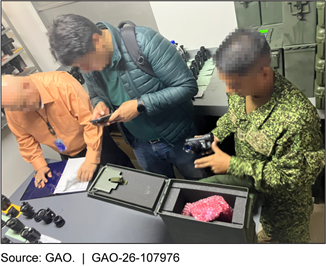
Example of the Security Cooperation Workforce Security Cooperation Organization (SCO) personnel are responsible for working with other governments to define requirements for defense articles and services needs under the Foreign Military Sales program and monitoring the end use of U.S. defense articles provided to those governments, among other activities. Enhanced end use monitoring requires annual physical security assessments and inventory checks of defense articles, by serial number. During an inventory check, SCO officials may identify violations such as insufficient security measures at storage facilities, the loss of defense articles, or tampering with articles. The photo shows SCO officials conducting an enhanced end use monitoring inspection.
|
The law also designated the Director of DSCA as the manager of the program. According to officials, DSCA implemented the law via written interim guidance issued in July 2017 and final guidance issued in February 2018. DSCA also established the Defense Security Cooperation University (DSCU) in 2019 to train, educate, and certify the security cooperation workforce.
The FY 2024 NDAA added more specific provisions related to DSCA’s management and implementation of the Security Cooperation Workforce Development Program and retained the designation of the Director of DSCA as the manager of the program. Examples of the FY 2024 provisions include:
· a comprehensive system to track and account for all DOD personnel in the security cooperation workforce,
· a management information system to provide standardized information and data on security cooperation personnel,
· the establishment of a Defense Security Cooperation Service (DSCS) to ensure that SCOs at overseas missions possess the requisite personnel with the skills needed to properly perform their missions.[12]
The FY 2024 NDAA also included numerous provisions related to implementing a security cooperation human capital initiative, establishing a Foreign Military Sales Center of Excellence, and providing DSCU with the ability to award and accept research grants which are managed by the BG Charles Young Research, Analysis, and Lessons Learned Institute.
In the House of Representatives Committee on Armed Services report to the FY 2024 NDAA, the committee indicated that it added these provisions to address remaining issues related to developing appropriate workforce skills and assigning the workforce to match skills with requirements. The FY 2024 NDAA did not specify a deadline for DOD to implement the provisions reflected in the act.[13]
DSCA Has Made Progress Toward Implementing Security Cooperation Workforce Reform Provisions and Expects to Complete All Provisions by FY 2028
Five DSCA Teams are Implementing the Security Cooperation Workforce Provisions
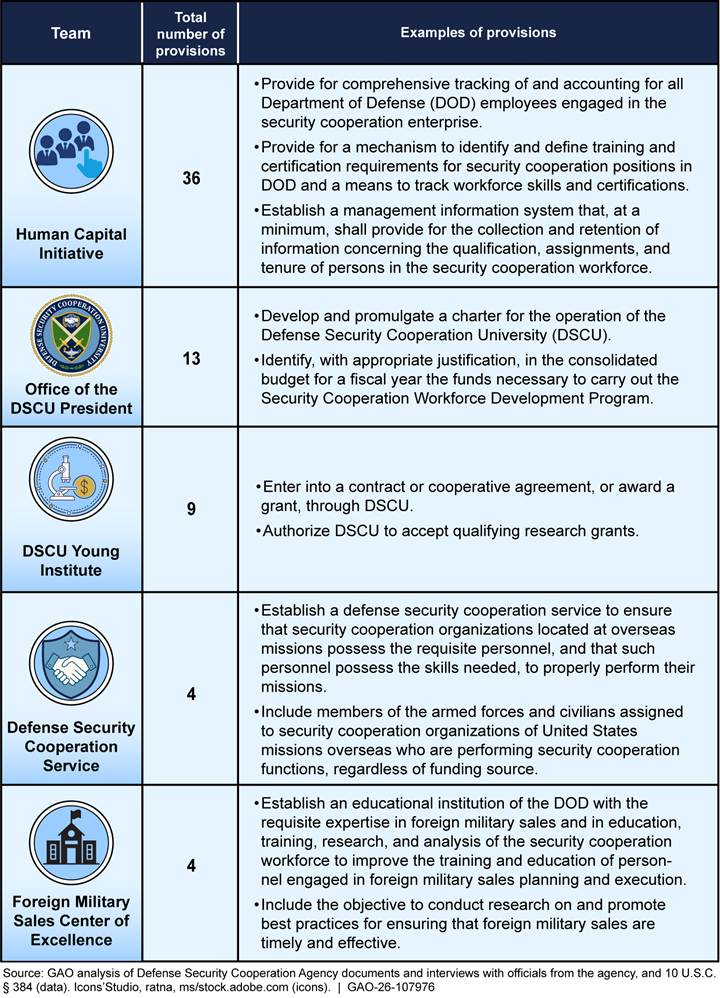
According to DSCA officials and our analysis of the agency’s documents, five DSCA teams are implementing 66 security cooperation workforce provisions specified in 10 U.S.C. § 384.[14] Figure 2 provides examples of the security cooperation workforce provisions each team is implementing and the total number of provisions assigned to each team.
Figure 2: Examples of Security Cooperation Workforce Provisions Being Implemented by Defense Security Cooperation Agency’s Teams, as of April 2026
DSCA Has Completed Work on 46 of 66 Security Cooperation Workforce Provisions
We determined that the status of DSCA’s implementation for all but five of the security cooperation workforce provisions is either complete, which means that no significant identified actions remain to implement them, or is in progress, as shown in figure 3.
Figure 3: Status of Security Cooperation Workforce Provisions, by Defense Security Cooperation Agency Implementation Team, as of May 2026
Note: DSCU = the Defense Security Cooperation University
Although the law did not prescribe timeframes for overall implementation of these provisions, as of April 2026, DSCA estimated it will complete the remaining tasks by the end of FY 2028.
Human Capital Initiative
As of May 2026, DSCA had completed work on 23 of the 36 security cooperation workforce provisions organized under the Human Capital Initiative, made progress in implementing 11 other provisions, and had not started work toward the remaining two provisions.
Examples of completed Human Capital Initiative provisions include:
· DSCA has completed the security cooperation workforce provision to establish a program of professional certification for security cooperation workforce personnel by establishing four proficiency levels in the nine functional areas for the security cooperation workforce. DSCA issued final guidelines in August 2025 for the Security Cooperation Workforce Certification Program 2.0.[15] These guidelines included four major program elements:
1. The creation of competencies and functional areas with assigned proficiency levels to help ensure that the workforce takes the appropriate training. The guidelines established 10 competencies.[16] One such competency is Country/Regional Orientation and Awareness for security cooperation staff to develop and maintain an understanding of a country or region’s cultural, economic, political, and security environment. The guidelines also established nine functional areas.[17] An example is Security Cooperation Operations, which is conducted by a SCO assigned overseas. This would typically include most members of the armed forces and civilian employees of DOD working on security cooperation operations at U.S. Missions. The guidelines also established four levels of proficiency ranging from awareness/foundational level to executive level.[18]
2. Leadership training for civilians appropriate for their proficiency level as identified by DOD.
3. Experience in the appropriate functional area at the appropriate proficiency level. According to the guidelines, all security cooperation workforce members must obtain one year of successful experience to be eligible for certification.
4. Continuous learning to ensure that security cooperation workforce members remain up to date after they complete mandatory certification requirements.
Now that the work to establish the professional certification is complete, each new position in the security cooperation workforce will be assigned a functional area and a certification level by the respective DOD component, program, or supervisor, according to DSCA. This action will help to ensure that workforce members take courses that best meet the requirements of their assigned positions.
· DSCA has identified and coded security cooperation workforce positions from DOD components’ systems of record.[19] DSCA completed work on this security cooperation workforce provision in April 2024. DSCA then began collecting data informally from the DOD components by requesting monthly updates of their security cooperation positions data. According to agency officials, they instituted a formal quarterly data tasking for this information in March 2025. As of October 2025, DSCA had identified 19,379 personnel positions in the nine functional areas of DOD’s security cooperation workforce. See figure 4.
Figure 4: Security Cooperation Workforce Functional Areas and Personnel Positions Across the Department of Defense Identified by Defense Security Cooperation Agency, as of October 2025
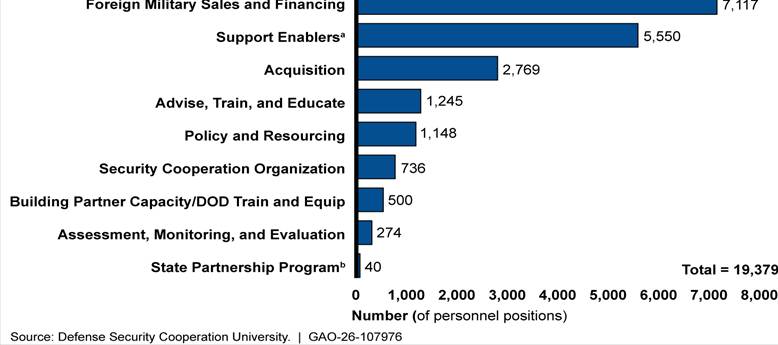
aDSCA defines the Support Enablers functional area as members of the security cooperation functional community who are engaged in critical support functions for security cooperation but not in day-to-day operation or management of security cooperation programs. Support enablers mostly includes financial management, human relations, information technology, and legal personnel.
bDSCA defines the State Partnership Program functional area as focused on security cooperation activities planned and conducted by designated members of the National Guard’s State Partnership Program.
Examples of DSCA’s work on the 11 “in progress” security cooperation workforce provisions under the Human Capital Initiative include:
· DSCA is implementing the provision requiring the creation of a management information system that, according to DSCA officials, will, at a minimum, provide for the collection and retention of information concerning the qualifications, assignments, and tenure of personnel in the security cooperation workforce. According to DSCA officials, the agency has identified the capabilities it needs for the system, such as the ability to receive training certification data from DSCU and support analysis of the workforce. DSCA has also finished its analysis of potential software solutions that have the capabilities needed for the system. DSCA expects to complete the work on this provision by May 2028.
· DSCA is implementing the provision to include performance measures for the Human Capital Initiative.[20] Human Capital Initiative officials said that they are completing a human capital assessment that will collect information on security cooperation personnel policies, job functions, knowledge and skill gaps, management challenges, and other topics.[21] Once the assessment is complete, they will develop criteria for areas of focus to monitor and improve. They plan to leverage DOD expertise to build an evaluation system that will capture performance measures and monitor and evaluate outcomes of its human capital management strategies, policies, programs, and activities for the security cooperation community.
· DSCA is identifying the appropriate composition of career and temporary personnel necessary to carry out the security cooperation workforce mission and estimates a completion date in FY 2027 for this provision. According to DSCA officials, implementation of this task is contingent upon (1) completing the ongoing Human Capital Initiative assessment of the security cooperation workforce, and (2) completing a fully operational management information system for analysis.
As of May 2026, DSCA had not started work on two of the 36 security cooperation workforce provisions organized under the Human Capital Initiative:
· One provision requires DSCA to provide for a mechanism for assigning appropriately certified personnel of the security cooperation workforce to assignments associated with key positions in connection with security cooperation programs and activities. DSCA estimates a completion date in FY 2027 for this provision.
· Another provision is for DSCA to identify career paths that provide a competency-based road map for security cooperation employees to aid in their career planning and professional development. DSCA estimates a completion date in FY 2027 for this provision.
The Human Capital Initiative developed and is using an approved Plan of Action and Milestones to track progress on its implementation of the provisions. For the Human Capital Initiative, this plan separates out the provisions into discrete actions, status of implementation, and estimated completion date.
The Office of the DSCU President
The Office of the DSCU President is leading the implementation of 13 security cooperation workforce provisions. Of these, 11 are complete and two are in progress. For example,
· The Office of the DSCU President has completed work on the two provisions related to the definition and establishment of the required program and its management. Specifically, in January 2025, the office issued a DOD directive that establishes policies and assigns responsibilities for DOD security cooperation activities with partner nations. These responsibilities include oversight of governance for security cooperation programs and updates to standards and priorities for assessment, monitoring, and evaluation activities.[22]
· The Office of the DSCU President is in progress on the provision to align DOD and DSCA strategic planning, budget process, performance management goals, and metrics to ensure the appropriate workforce mix and skill sets to accomplish the security cooperation mission. DSCA estimates a completion date of FY 2027 for this provision.
The Office of the DSCU President also uses the Human Capital Initiative’s Plan of Action and Milestones for identifying specific tasks and tracking the status of its implementation of the provisions.
DSCU Young Institute
DSCA established DSCU’s Young Institute in June 2023.[23] The Young Institute was later assigned responsibilities for implementing provisions from the FY 2024 NDAA related to administering research grants, contracts, and cooperative agreements to engage in research and development projects and to accept qualifying research grants. DSCU’s Young Institute has completed work on six of the nine security cooperation workforce provisions related to the acceptance of research grants and cooperative research and development arrangements. For example,
· The Young Institute has completed work on the two security cooperation workforce provisions related to cooperative research and development arrangements. They have accomplished this by funding research to develop knowledge of security cooperation activities, resulting in lessons that can be applied by individuals to the practice of those activities. In FY 2024, DSCU’s Young Institute awarded seven grants and one cooperative agreement. For example, the Institute awarded a grant to a researcher for a project to develop a database of defense institutions.
In addition, the DSCU Charter, issued in October 2025, included language stating that DSCU may accept qualifying research grants for work performed by DSCU faculty in accordance with the law. The Young Institute is responsible for the provisions related to the acceptance of research grants.
The Institute has not started work on three of the provisions related to establishing a policy for administration of grant funds. For example,
· According to officials, the Young Institute plans to establish a policy for the administration of grant funds by the end of FY 2026, after which it will have completed the remaining provisions related to the acceptance of research grants.
Young Institute officials said that they monitor their progress in implementing the provisions for cooperative research and development through the award of grants and cooperative agreements and by maintaining a catalogue of the research projects that the institute has sponsored.
The Defense Security Cooperation Service
On October 1, 2024, DOD announced its creation of DSCS, effectively moving the DSCS team from under DSCU and establishing it as a separate entity under DSCA. DSCS has completed two provisions related to the transfer of civilian personnel to the organization. DSCS is in progress in implementing the two provisions related to the transfer of military personnel from elsewhere in DOD to DSCS. Officials expect to complete the last steps for the in progress provisions related to the military personnel transfer around July 2026.[24] For example,
· DSCS completed work on the transfer of civilian personnel funded under Title 22 from the combatant commands to DSCS in October 2024 and the transfer of civilian employees funded under Title 10 in January 2026, according to officials. Officials said that these personnel are now fully assigned to and supported by DSCS.
· DSCS is making progress on the two security cooperation workforce provisions related to the transfer of military personnel. According to DSCS officials, one phase of the transfer was finalized with the January 2026 publication of a workforce document that identifies the SCO positions and their approved staffing levels. The last step in the process is the activation of this document within each Military Service’s personnel systems. When the Military Services’ personnel systems complete their updates, anticipated around July 2026, DSCS will assume full administrative control of the entire SCO workforce of approximately 1,320 personnel and will be fully responsible for SCO staffing, training, and equipping.[25]
DSCS officials said they are informally tracking the roles, responsibilities, and tasks for fully establishing DSCS.
The FMS Center of Excellence
DSCU has completed work on the four security cooperation workforce provisions related to establishing the FMS Center of Excellence. This included the establishment of a DOD educational institution with the requisite expertise in foreign military sales and in education, training, research, and analysis of DOD’s security cooperation workforce to serve as an FMS Center of Excellence. To establish the FMS Center of Excellence, DOD:
· Issued a memorandum designating DSCU as the FMS Center of Excellence in May 2024. DSCU’s Wright Patterson Air Force Base campus began working on the plans for the FMS Center of Excellence concept in February 2025.
· Obtained approval from DSCU for the FMS Center of Excellence concept in March 2025.
· Issued the DSCU Charter in October 2025, establishing the center of excellence.
· Reorganized the center within the DSCU Workforce Training Directorate in January 2026, which completed the provisions to establish the center of excellence, according to officials.
DSCA Plans to Address Challenges in Implementing Security Cooperation Workforce Provisions
DSCA officials responsible for the Human Capital Initiative and three other teams identified challenges to implementing the security cooperation workforce provisions and have begun to make plans to address those challenges. These challenges include personnel shortfalls that have affected almost all teams as well as other challenges specific to each team.
Personnel Shortfalls
Officials responsible for the implementation of four of the five teams identified new or vacant positions for which they would like to hire personnel to help with continued implementation of the security cooperation workforce provisions. Among other factors contributing to the challenge in filling these positions, said officials, is the January 20, 2025, federal civilian hiring freeze.[26]
Human Capital Initiative. According to Human Capital Initiative officials, they initially were authorized to hire personnel for 10 positions to help implement the security cooperation workforce provisions within this initiative’s purview. Of those positions, two were subsequently defunded, two are currently filled but are temporarily addressing other DSCU requirements, and six positions remain unfilled. Officials reported that they are addressing this challenge by:
· assigning key tasks and duties to other members of the Human Capital Initiative;
· leveraging expertise from across DSCU to overcome critical skill gaps; and
· utilizing a contract support team with applicable knowledge and expertise.
Officials said that they believe that they can accomplish the implementation of the Human Capital Initiative-related security cooperation workforce provisions once they can successfully recruit and fill the remaining six authorized and funded positions. As of April 2026, DSCU had received authorization from DOD’s Strategic Hiring Committee to hire staff for these positions but had not yet filled them.
Young Institute. Officials also told us that personnel shortfalls reduce the time that Young Institute staff can direct toward implementing the Young Institute’s mission. For example, although the Young Institute was able to fill its vacant billet for a supervisory lecturer, that individual has been diverted to support security cooperation workforce education and development to enable Security Cooperation Workforce Certification Program 2.0 curriculum development and delivery, according to officials. In addition, the director of the Young Institute is currently serving as acting vice president of DSCU and will likely remain in that position for some time. Officials said that they are addressing this challenge by focusing on priority efforts. This includes generating research on lessons learned for security cooperation.
Defense Security Cooperation Service. According to DSCS officials, the January 2025 hiring freeze paused efforts to ramp up the hiring of DOD civilian personnel into the DSCS headquarters, at the combatant commands, and at the SCOs, leaving the newly created organization behind its hiring targets. However, the Undersecretary of Defense for Personnel and Readiness has approved an exemption for DSCA to hire personnel who are funded through State’s Title 22 Foreign Military Sales program. Also, DSCS can hire internal DOD transfers regardless of funding source. According to DSCS officials, both options have helped address personnel shortfalls as DSCS works to implement the security cooperation workforce provisions.
FMS Center of Excellence. According to officials, personnel shortfalls had left approximately five out of 15 positions unfilled at the FMS Center of Excellence. These shortfalls resulted in a minimal capability to produce curriculum, execute courses, and conduct research to improve the training and education of security cooperation personnel. Consequently, the shortfalls also slowed down the center’s delivery of educational products and services that are important for ensuring that the FMS workforce is fully trained and prepared to perform its duties. Officials said that they have faculty that currently provide FMS training, education, and research that will be leveraged for the FMS Center of Excellence. As of March 2026, officials said that they are working on selecting candidates to fill the five positions, now that those positions have been authorized.
Team Specific Challenges
Officials provided some examples of challenges specific to their team as well as how they planned to address those challenges. For example:
· Human Capital Initiative. Officials said that the process to develop the management information system is their biggest challenge. Plans for the management information system include the ability to match positions and personnel from the components’ systems of record.[27] Officials expect to complete the management information system in May 2028. Without a management information system, any analysis of the security cooperation workforce position data must be done manually. Officials said that the security cooperation workforce components use a variety of different data systems to track positions and personnel. Not having had a standardized system created challenges to gaining access to or requesting data from these systems.
As of April 2026, however, the Human Capital Initiative receives quarterly security cooperation workforce data from all relevant components. Officials said that these data have helped identify vacancies and errors in the workforce data. DSCU’s internal information technology subject matter experts have also developed an interim solution using data collected from systems of record to begin the analysis of security cooperation workforce data. Although this is a labor-intensive process, the interim solution will provide a visual presentation of the status of Security Cooperation Workforce Certification Program 2.0 coding efforts and other human capital analyses, according to officials.
· Young Institute. According to officials, limitations with the existing research on security cooperation present a challenge to their efforts to professionalize and educate the security cooperation workforce. Officials said that most existing research is focused on policymakers instead of practitioners and that this limits the lessons learned and best practices available to security cooperation planners and implementers of security cooperation activities.
To address this challenge, officials said that they are engaging with the security cooperation workforce and DSCU curriculum developers to understand the knowledge needs of planners and implementers of security cooperation activities. They are using this information to inform the DSCU research agenda. They are also using this information to conduct a deeper search of existing literature and to share useful concepts and evidence with the security cooperation community.
Agency Comments
We provided a draft of this report to the Departments of Defense and State for their review and comments. DOD provided technical comments, which we incorporated as appropriate, and State did not provide comments.
We are sending copies of this report to the appropriate congressional committees and the Secretaries of the Department of Defense and State. In addition, the report is available at no charge on GAO’s website at https://www.gao.gov.
If you or your staff have any questions about this report, please contact me at reynoldsj@gao.gov. Contact points for our Offices of Congressional Relations and Media Relations may be found on the last page of this report. GAO staff who made key contributions to this report are listed in appendix II.

James A. Reynolds
Director, International Affairs and Trade
In this report, we examine (1) the status of the Defense Security Cooperation Agency’s (DSCA) implementation of the security cooperation workforce provisions, and (2) DSCA’s plans to address challenges it has identified to the implementation of the provisions.
For the first objective, to examine the status of DSCA’s implementation of the security cooperation workforce provisions, we obtained documents from and interviewed DSCA officials responsible for these provisions in the fiscal year 2024 National Defense Authorization Act.[28] We reviewed and analyzed agency documents describing the work DSCA is doing to implement the provisions. The law did not prescribe timeframes for generally implementing these provisions. We further analyzed DSCA’s progress in implementing these provisions by assessing whether the status of implementing the provisions was complete, in progress, or had not started. Our review expresses no legal opinion about the extent to which DOD actions complied with the provisions.
To determine the number of applicable provisions, we excluded from our analysis a) statutory language that was used to organize the provisions, such as descriptive titles and b) language in the law that was not directed at the Department of Defense. In some instances, the provisions include an introductory passage that is followed by specific requirements. To avoid double counting, we did not count the introductory language as a separate provision, though the language was considered in interpreting the requirements. Once we made the exclusions, there were a total of 66 provisions included in our scope for analysis.
We rated the status as “complete” if we received evidence of actions taken that addressed the provision with no significant identified actions remaining to implement it; “in progress” if we received some evidence of actions taken to address the provision; and “not started” if DSCA had not taken any actions to address the provision as of May 2026. To perform these analyses, two analysts reviewed agency documents to determine the status of implementation of the provision. The analysts worked iteratively, comparing notes and reconciling differences at each stage of the analysis.
For the second objective, to determine the plans to address the challenges identified by DSCA to the agency’s implementation of the provisions, we interviewed agency officials from the Defense Security Cooperation University, Defense Security Cooperation Service, the Young Institute, and the Foreign Military Sales Center of Excellence responsible for managing those initiatives. We asked the agency officials to identify:
· challenges they experienced in implementing the provisions,
· plans for how to address any challenges, and
· any practices that helped the agency to implement the security cooperation workforce provisions.
We then reviewed these responses to identify any recurrent themes.
We conducted this performance audit from December 2024 to August 2026 in accordance with generally accepted government auditing standards. Those standards require that we plan and perform the audit to obtain sufficient, appropriate evidence to provide a reasonable basis for our findings and conclusions based on our audit objectives. We believe that the evidence obtained provides a reasonable basis for our findings and conclusions based on our audit objectives.
GAO Contact
James A. Reynolds, reynoldsj@gao.gov
Staff Acknowledgments
In addition to the contacts named above, Judith McCloskey (Assistant Director), Claude Adrien, Rachel Girshick, Chris Keblitis, Samantha Lalisan, Donna Morgan, and Terry Richardson made key contributions to this report.
The Government Accountability Office, the audit, evaluation, and investigative arm of Congress, exists to support Congress in meeting its constitutional responsibilities and to help improve the performance and accountability of the federal government for the American people. GAO examines the use of public funds; evaluates federal programs and policies; and provides analyses, recommendations, and other assistance to help Congress make informed oversight, policy, and funding decisions. GAO’s commitment to good government is reflected in its core values of accountability, integrity, and reliability.
Obtaining Copies of GAO Reports and Testimony
The fastest and easiest way to obtain copies of GAO documents at no cost is through our website. Each weekday afternoon, GAO posts on its website newly released reports, testimony, and correspondence. You can also subscribe to GAO’s email updates to receive notification of newly posted products.
Order by Phone
The price of each GAO publication reflects GAO’s actual cost of production and distribution and depends on the number of pages in the publication and whether the publication is printed in color or black and white. Pricing and ordering information is posted on GAO’s website, https://www.gao.gov/ordering.htm.
Place orders by calling (202) 512-6000, toll free (866) 801-7077,
or
TDD (202) 512-2537.
Orders may be paid for using American Express, Discover Card, MasterCard, Visa, check, or money order. Call for additional information.
Connect with GAO
Connect with GAO on X,
LinkedIn, Instagram, and YouTube.
Subscribe to our Email Updates. Listen to our Podcasts.
Visit GAO on the web at https://www.gao.gov.
To Report Fraud, Waste, and Abuse in Federal Programs
Contact FraudNet:
Website: https://www.gao.gov/about/what-gao-does/fraudnet
Automated answering system: (800) 424-5454
Media Relations
Sarah Kaczmarek, Managing Director, Media@gao.gov
Congressional Relations
David A. Powner, Acting Managing Director, CongRel@gao.gov
General Inquiries
[1]DOD defines security cooperation to include interactions of DOD with foreign defense establishments to build and develop allied and partner security capabilities for self-defense and multinational operations. DOD Directive 5132.03, Security Cooperation, Jan. 16, 2025.
[2]The Arms Export Control Act, as amended, requires the President to establish a program for monitoring the end use of defense articles and defense services sold, leased, or exported under that act or the Foreign Assistance Act of 1961. This monitoring program must, to the extent practicable, be designed to provide reasonable assurance that recipients are complying with requirements imposed by the U.S. government on the purpose, transfer, and security of defense articles and defense services.
[3]National Defense Authorization Act for Fiscal Year 2017, Pub. L. No. 114-328, § 1250, 130 Stat. 2000, 2526 (2016), codified as amended at 10 U.S.C. § 384.
[4]National Defense Authorization Act for Fiscal Year 2024, Pub. L. No. 118-31, § 1204, 137 Stat. 136, 442 (2023).
[5]Pub. L. No. 118-31, § 1204(a), 137 Stat. at 448. For purposes of this report, we use the term “security cooperation workforce provision” to broadly refer to the requirements, authorities, and definitions in 10 U.S.C. § 384.
[6]See, for example, GAO, U.S. Arms Transfers: State Department Should Improve Investigations and Reporting of Foreign Partners’ End-Use Violations, GAO‑25‑107622 (Washington, DC: Sep. 16, 2025) and GAO, Foreign Military Sales: DOD Is Not Meeting Timeliness Goals, but Efforts to Improve Process and Workforce Are Underway, GAO‑25‑107203SU (Washington, DC: June 30, 2025).
[7]DOD Directive 5132.03, Security Cooperation, Jan. 16, 2025.
[8]10 U.S.C. § 333.
[9]Department of State, “Fiscal Year 2025 U.S. Arms Transfers and Defense Trade,” March 16, 2026, https://www.state.gov/releases/bureau‑of‑political‑military‑affairs/2026/03/fiscal‑year‑2025‑u‑s‑arms‑transfers‑and‑defense‑trade/
[10]10 U.S.C. § 384(j).
[11]DOD defines a SCO as a DOD element that is part of the United States Diplomatic mission located in a foreign country to carry out security assistance and security cooperation management functions under the supervision and coordination authority of the senior defense official/defense attaché. According to DOD, a recent directive from the Secretary of Defense renamed some SCOs as “United States Military Groups.” For the purposes of this report, we use the term SCO.
[12]10 U.S.C. § 384(c).
[13]The FY 2024 NDAA included two related deadlines. It required DOD to submit a report on the security cooperation workforce by December 2023, and once every 2 years thereafter, to the Committees on Armed Services of the Senate and the House of Representatives. The FY 2024 NDAA also required that DOD ensure military departments, and other entities submit to DSCU a formal manpower document not less frequently than semi-annually. Pub. L. No. 118-31, § 1204, 137 Stat. at 444, 447, codified as amended at 10 U.S.C. §§ 384(d)(2)(C), (k).
[14]According to DSCA officials, while these teams serve as the offices of primary responsibility for implementing the security cooperation workforce provisions, DSCU faculty responsible for curriculum development and delivery and the staff responsible for supporting academic and business operations are also critical components of successful implementation of these provisions.
[15]According to DSCU, the primary purpose of the Security Cooperation Workforce Certification 2.0 is to establish a framework to guide DOD security cooperation professional development. The certification program also intends to provide a mechanism to ensure updates to the provisions are achieved through appropriate education, training, and development in nine functional areas.
[16]The 10 competencies are: Country/Regional Orientation and Awareness; Strategy and Policy Development; International Armaments Cooperation Activities/Programs; Sales and Transfers; International Program Planning and Execution; Security Cooperation Planning and Execution; Assessment, Monitoring, and Evaluation; Political-Military Activities; Security, Foreign Disclosure, and End-Use Controls; and Capability Development.
[17]The nine functional areas are: Policy and Resourcing; Foreign Military Sales and Foreign Military Financing; Security Cooperation Operations; Support Enablers; Acquisition; Building Partner Capacity/DOD Train and Equip; Advise, Train, and Educate; State Partnership Program; and Assessment, Monitoring, and Evaluation.
[18]The guidelines feature four levels of proficiency: Awareness/Foundational (Level I), Practitioner (Level II), Expert (Level III), and Executive (Level IV).
[19]DOD component’s systems of record include workforce and personnel systems from the defense agencies and DOD field activities, combatant commands, the Air Force, Army, Marine Corps, and Navy.
[20]Only the Human Capital Initiative had a provision related to assessing progress in implementing the security cooperation workforces using results-oriented performance measures. 10 U.S.C. § 384(e)(2)(K).
[21]The security cooperation human capital assessment consists of a three-phased approach collecting essential human capital and mission-related data from the 30 various components of the DOD Security Cooperation Functional Community. The human capital assessment began with interviews of senior leader to help define the security cooperation landscape and to obtain recommendations for where the subsequent assessment phases should focus. Following the interviews, DSCU conducted focus groups with mid-level leaders and subject matter experts within all security cooperation functional areas. The final phase of the assessment, the workforce survey, will reach out to nearly 10,000 security cooperation personnel—military and government civilians—to round out available views from the security cooperation workforce.
[22]DOD Directive 5132.03, Security Cooperation, Jan. 16, 2025.
[23]Originally named the DSCU Research, Analysis, and Lessons Learned Institute when established by DSCA in June 2023, it was renamed the Brigadier General Charles Young Research, Analysis, and Lessons Learned Institute in April 2024.
[24]DSCS officials said that the activation of the workforce document that identifies the SCO positions and their approved staffing levels will occur over several months: U.S. Air Force estimated by May 2026, U.S. Army estimated by June 2026, U.S. Marine Corps estimated by July 2026. As of April 2026, a date for the U.S. Navy was pending. Officials explained that personnel movements are dependent on the effective dates for each service’s workforce documents as well as some additional workforce tasks.
[25]The number of SCO personnel (1,320) is larger than the number of Security Cooperation Organization functional area positions in Figure 4 (736) because an individual serving in a SCO can have a different functional area than Security Cooperation Organization, according to DSCU officials. For example, a SCO official could have a functional area such as Support Enablers, Foreign Military Sales and Financing, or Policy and Resourcing. In addition, DSCS’s SCO workforce data also include locally employed staff who are not included in the security cooperation workforce position data.
[26]Hiring Freeze, Memorandum for the Heads of Executive Departments and Agencies, 90 Fed. Reg. 8247 (Jan. 28, 2025). In July 2025, the hiring freeze was extended through October 15, 2025. Ensuring Accountability and Prioritizing Public Safety in Federal Hiring, Presidential Memoranda, July 7, 2025. In October 2025, an executive order directed that vacant civilian positions may only be filled as provided for in the order or required by law. The executive order requires all agencies to establish strategic hiring committees responsible for the approval of the creation or filling of each vacancy within their respective agency. Exec Order No. 14356, Ensuring Continued Accountability in Federal Hiring, 90 Fed. Reg. 48387 (Oct. 20, 2025).
[27]DOD component’s systems of record include workforce and personnel systems from the defense agencies and DOD field activities, combatant commands, the Air Force, Army, Marine Corps, and Navy.
[28]National Defense Authorization Act for Fiscal Year 2024, Pub. L. No. 118-31, § 1204, 137 Stat. 136, 442 (2023).