
Report to the
Subcommittee on Government Operations, Committee
on Oversight and Government Reform, House of Representatives
United States Government Accountability Office
A report to the Subcommittee on Government Operations, Committee on Oversight and Government Reform,
House of Representatives
Contact: Kevin Walsh, walshk@gao.gov
What GAO Found
The Federal Aviation Administration’s (FAA) Brand New Air Traffic Control System (BNATCS) has an ambitious goal to significantly accelerate the modernization of outdated air traffic control (ATC) systems. The goal is to be achieved at an unprecedented speed. The first of two phases aims to modernize communication, surveillance, weather, and training systems, among other things. For example, FAA plans to modernize voice radio systems 9 years earlier than initially planned. Phase 1 is to be fully completed by December 2028. In July 2025, Congress appropriated $12.5 billion to support BNATCS and FAA is using most of the funds for phase 1. For phase 2, FAA plans to develop new automation systems to track aircraft and optimize traffic. FAA stated that they will need approximately $10.2 billion for this phase (not including facilities). FAA does not yet have an estimated date for when phase 2 will be started or completed.
FAA has made progress in implementing portions of phase 1. For example, as of May 2026, FAA reported replacing 2,560 of 5,170 old and frail copper wires with high-speed fiber optic communications cables.
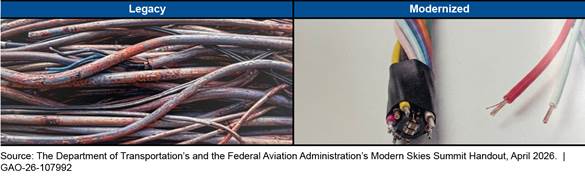
FAA has not developed a comprehensive and well-documented lifecycle cost estimate for BNATCS. In June 2026, FAA officials provided high-level estimates per program for phase 1. However, officials were unable to provide the analysis that supported these figures. In addition, officials acknowledged that the estimate does not include government costs, most of the operations costs for phase 1, or any of the costs for phase 2. In addition, FAA has not developed an integrated master schedule for phase 1. Instead, FAA has 11,389 individual project schedules that are not integrated. As a result, individual projects are scheduled for installations at the same sites, generally without optimizing the schedules to reduce impacts to controller operations. Officials stated they have plans to address this issue, however; they did not have a time frame for when the issue would be resolved.
While accelerating this modernization is critical, FAA’s lack of a reliable lifecycle cost estimate and an integrated master schedule introduce heightened risk to BNATCS. GAO’s decades-long bodies of work on acquisitions and FAA modernizations indicate that these risks increase the likelihood of FAA repeating its history of cost overruns, delays, and unmet performance targets. If these risks are realized, FAA would need to continue to rely on severely outdated systems that are prone to failure leading to more flight delays and safety incidents.
Why GAO Did This Study
FAA air traffic controllers rely on a myriad of legacy systems to monitor weather, conduct surveillance, and manage communications for up to 45,000 flights per day. This aging and unreliable technology has contributed to an increase in flight delays and aviation incidents. FAA has attempted to modernize ATC systems since the 1980s, but has experienced challenges and delivered limited results. In September 2024, GAO reported that over 75 percent of FAA’s 138 ATC systems were unsustainable or potentially unsustainable. GAO also reported that FAA was not moving fast enough to modernize its systems. In May 2025, the Secretary of Transportation announced the latest FAA modernization effort, BNATCS.
Due to the importance of successfully implementing this latest modernization effort, GAO was asked to examine FAA’s progress. GAO’s objectives were to (1) identify the initial plans and status of BNATCS and (2) assess the extent to which FAA has established a cost estimate and schedule to support BNATCS.
GAO analyzed FAA’s planning and implementation materials. GAO also assessed available schedule and cost estimation documentation and compared them to best practices. Further, GAO interviewed FAA officials regarding BNATCS status, cost, and schedule.
What GAO Recommends
GAO is recommending that FAA prioritize (1) developing a reliable lifecycle cost estimate for BNATCS and (2) developing a detailed integrated master schedule for BNATCS phase 1. Transportation partially concurred with both recommendations. GAO believes both recommendations are sound and should be fully addressed.
|
Abbreviations |
|
|
|
|
|
ATC |
air traffic control |
|
BNATCS |
Brand New Air Traffic Control System |
|
FAA |
Federal Aviation Administration |
|
NAS |
National Airspace System |
This is a work of the U.S. government and is not subject to copyright protection in the United States. The published product may be reproduced and distributed in its entirety without further permission from GAO. However, because this work may contain copyrighted images or other material, permission from the copyright holder may be necessary if you wish to reproduce this material separately.
September 14, 2026
The Honorable Pete Sessions
Chairman
The Honorable Kweisi Mfume
Ranking Member
Subcommittee on Government Operations
Committee on Oversight and Government Reform
House of Representatives
The Federal Aviation Administration’s (FAA) mission is to promote the safe, orderly, and expeditious flow of air traffic in the national airspace. To ensure FAA’s mission is met, air traffic controllers are to manage communications; monitor weather, navigation, and surveillance; and direct aircraft from takeoff to landing. Controllers manage up to 45,000 flights per day. FAA anticipates continued growth and congestion in the airspace, forecasting that passenger air travel will increase annually by 2.4 percent, on average.[1]
Controllers rely on a myriad of complex technologies and systems. Over the past several decades, FAA has been experiencing challenges with aging air traffic control (ATC) systems. For example, in 2024, we reported that FAA determined that of its 138 ATC systems, 51 (37 percent) were unsustainable and 54 (39 percent) were potentially unsustainable.[2] Challenges with existing systems were due to, among other things, unavailability of parts, reduced technical expertise in outdated technologies, and growth in airspace demand. This has impacted the ability of older systems to continue to support mission needs.
In 2025, FAA faced a series of incidents further raising concerns about the reliability of systems supporting ATC. For example, flights in January, February, and March 2025 faced near collisions at airports including Phoenix Sky Harbor and Chicago Midway. While National Transportation Safety Board investigations of these incidents are still ongoing, preliminary observations indicate both human and technology errors.
In addition, between April and May 2025, the Newark airport was impacted by multiple significant failures of antiquated telecommunications lines at the Philadelphia Terminal Radar Approach Control center that manages its airspace. These failures led to controllers losing radar and radio contact with aircraft, causing widespread flight delays and cancellations. FAA attributed the incidents to aging infrastructure, specifically old copper wiring, and the decision to relocate Newark’s airspace control to the Philadelphia facility without adequately testing the reliability of the commercial telecommunications lines used for critical data.
Our past work coupled with these recent incidents led the Secretary of Transportation, at the direction of the President, to announce the Brand New Air Traffic Control System (BNATCS) plan in May 2025. The plan aims to significantly accelerate the deployment of select modernized systems as well as develop a new common automation platform for air traffic controllers. Recognizing the urgency, in July 2025, Congress appropriated $12.5 billion for FAA to implement several parts of this initiative related to systems modernization and facilities construction.[3]
Due to the importance of successfully implementing this latest modernization effort, you asked us to examine FAA’s progress. Our objectives were to (1) identify the initial plans and status of the new ATC system modernization effort and (2) assess the extent to which the FAA has established a cost estimate and schedule to support the ATC modernization plan and request for funding.
To address the first objective, we analyzed FAA’s planning materials for BNATCS for the systems modernization elements of their plan, such as its plan and proposal, presentation slides from industry briefings, and supporting materials for a request for solution for a prime systems integrator contract. We also reviewed the systems integrator contract.[4] Our review did not include assessing plans associated with ATC facilities construction.
We then determined the status of BNATCS by first reviewing the agreed upon deployment schedule for each program. We assessed progress relative to the schedule based on data captured in a dashboard used by FAA officials to determine progress of the BNATCS initiative. We assessed the reliability of the dashboard data by cross checking the data against other sources, when available. However, we could not ascertain the complete reliability of the status data or the summary report prepared using this data due to lack of visibility into the systems that feed into the dashboard. Specifically, FAA did not identify source information for the dashboard or demonstrate the parameters for updating and validating data in the dashboard. Because FAA management uses these data to manage their operations, we believe the data are sufficient for our purpose of describing the program status and believe they provide acceptable approximations at the time of our analysis.
Lastly, to supplement our understanding of BNATCS progress and related challenges, we interviewed officials from FAA and the Department of Transportation, as well as representatives from the National Air Traffic Controllers Association, Professional Aviation Safety Specialists, and Air Line Pilots Association.[5]
To address our second objective, we reviewed BNATCS cost estimate documentation, when available. We compared these documents to GAO’s Cost Estimating and Assessment Guide best practices for developing a lifecycle cost estimate.[6] FAA provided limited information to evaluate or substantiate the high-level costs reflected in various planning materials. We discuss our concerns with the lack of a detailed cost estimate in the report.
We also reviewed BNATCS schedule documentation, when available. This included a review of deployment requirements agreed upon with the integrator.[7] Additionally, we observed a live demonstration of FAA’s use of its scheduling tool. To ensure consistency, we validated the schedule data against other data sources, such as an internal BNATCS executive dashboard and briefing slides. We compared the schedule documentation to best practices in GAO’s Schedule Assessment Guide.[8] We also interviewed FAA and Department of Transportation officials regarding any inconsistencies.
We conducted this performance audit from December 2024 to September 2026 in accordance with generally accepted government auditing standards.[9] Those standards require that we plan and perform the audit to obtain sufficient, appropriate evidence to provide a reasonable basis for our findings and conclusions based on our audit objectives. We believe that the evidence obtained provides a reasonable basis for our findings and conclusions based on our audit objectives.
Background
As an agency of the Department of Transportation, FAA’s mission is to promote the safe, orderly, and expeditious flow of air traffic in the national airspace. This air travel is also vital to the nation’s economy. Specifically, according to a September 2024 FAA report, in 2022 civil aviation supported $1.8 trillion in economic activity and 9.4 million jobs and had direct and catalytic impacts that account for 4 percent of the U.S. Gross Domestic Product.[10]
To ensure FAA’s mission is met, air traffic controllers rely on numerous complex systems to monitor communications and weather and provide navigation and surveillance services during the various phases of flight. Figure 1 provides a simplified view of air traffic control within the national airspace.
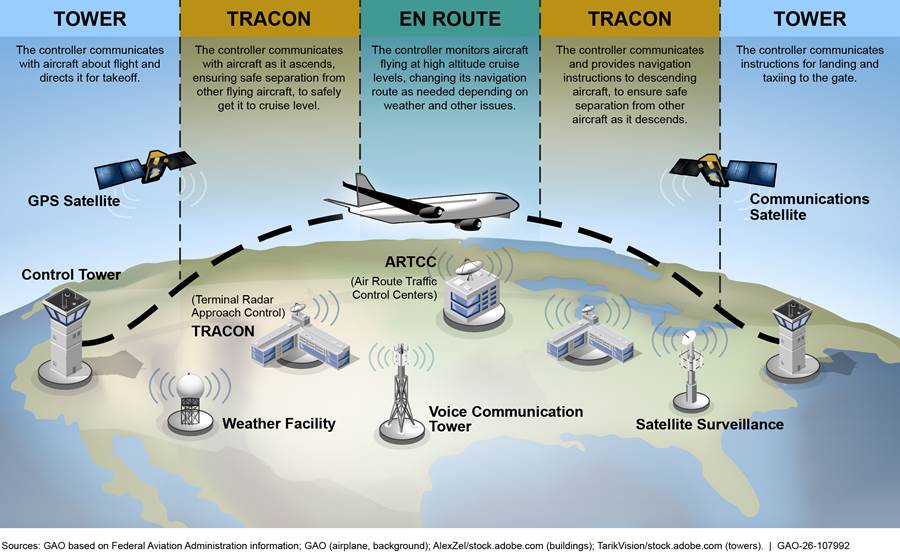
The facilities within the national airspace include:
· 409 towers (144 FAA-owned and 265 FAA-contracted),
· 119 combined towers and Terminal Radar Approach Control facilities,
· 25 standalone Terminal Radar Approach Control facilities, and
· 21 Air Route Traffic Control Centers.
However, the systems supporting air traffic control are aging and FAA has been experiencing challenges with maintaining them. According to FAA officials, aging systems have been difficult to maintain due to the unavailability of parts and retirement of technicians with expertise in maintaining the aging systems. In addition, there has been dramatic growth in airspace demand since the older systems were initially implemented.
These challenges affecting aging systems can impact FAA’s ability to meet its mission. For example, the Notice to Airmen system, which is a critical system that enables air traffic controllers to provide real-time updates to aircraft crews about critical flying situations relating to issues such as weather, congestion, and safety, was over 30 years old. On January 11, 2023, the system became unavailable to users. To ensure safety, FAA grounded all departing aircraft across the nation for about 2 hours to fix the system. This was the first nationwide ground stop since the terrorist attacks on September 11, 2001. The January 2023 outage caused cancellations of over 1,300 flights and delayed almost 10,000 other flights throughout the day. The system again failed in February 2025 followed by an additional outage in March 2025. A backup system, which was implemented in mid-2024, was activated and mitigated these disruptions, but the outages still resulted in flight delays and cancellations.
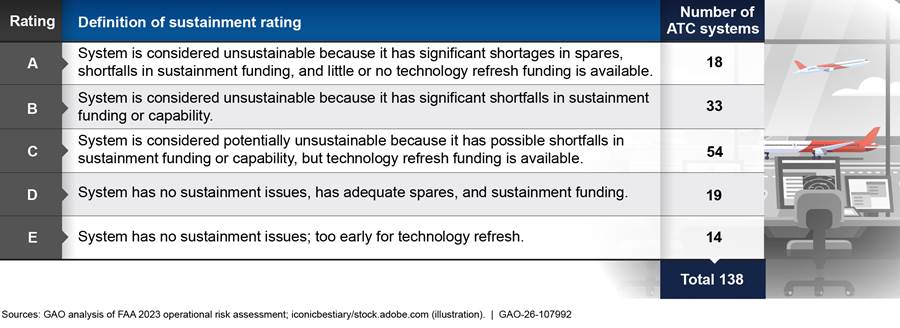
After the shutdown of the national airspace in 2023, FAA conducted an operational risk assessment to evaluate the sustainability of all ATC systems.[11] We reported in September 2024, that the assessment determined that of FAA’s 138 systems, 51 (37 percent) were unsustainable and 54 (39 percent) were potentially unsustainable (see figure 2).[12]
Figure 2: Federal Aviation Administration (FAA) Air Traffic Control (ATC) System Sustainment Ratings
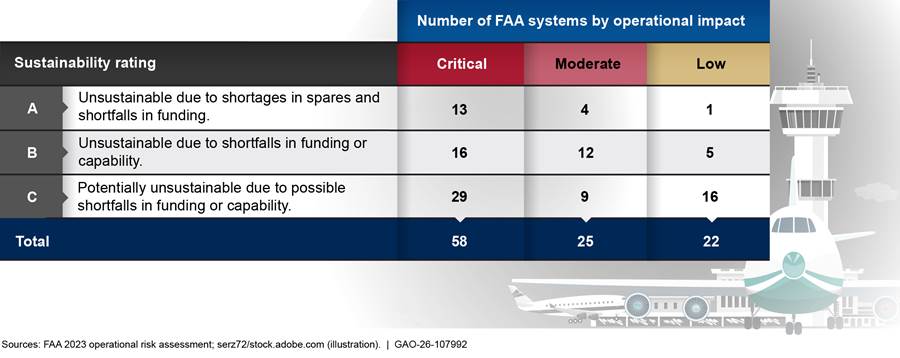
We also reported that of the 105 unsustainable and potentially unsustainable systems, 58 (29 unsustainable and 29 potentially unsustainable systems) had critical operational impacts on the safety and efficiency of the national airspace (see figure 3).
Figure 3: Federal Aviation Administration (FAA) Air Traffic Control (ATC) System Safety and Efficiency Operational Impact Categories by Sustainment Rating
Additional incidents since 2023 illustrate that the underlying risks to safety and efficiency persist due to legacy ATC systems and the lack of modernized systems. For example:
· In February 2023, there was a close call between a FedEx aircraft in final approach and a Southwest Airlines jet preparing for take-off at Austin-Bergstrom International Airport in Austin, Texas.[13] Similarly, there was a close call between a landing Mesa Airlines aircraft and SkyWest plane taking off at Hollywood Burbank Airport, California. According to the National Transportation Safety Board investigation reports, the lack of surface detection equipment at these airports to alert controllers about potential conflicts on the taxiway or runway surface was a contributing factor for both the incidents.
· In August 2023, there was a close call between a Cessna Citation aircraft which overflew a Southwest Airlines aircraft by about 100 feet at San Diego International Airport, California. According to a National Transportation Safety Board investigation report, the primary printer for paper flight strips (which contain vital flight information used for sequencing flights) jammed. Instead of using the backup system, the controllers attempted to troubleshoot the primary printer which took their focus away from the operation at the time of the incident.
· In late April 2025, a failure with antiquated telecommunication lines and systems at the Philadelphia Terminal Radar Approach Control facility resulted in air traffic controllers losing radar and radio contact with all inbound and outbound aircraft at the Newark Liberty International Airport for about 90 seconds. During this time, controllers were unable to see aircraft positions or communicate with pilots over one of America’s busiest airports. FAA ordered an immediate ground stop, and the ripple effects disrupted more than a thousand passengers over several hours. A second outage at the same facility in May 2025 prompted another ground stop and led to hundreds of additional delays and cancellations.
· In September 2025, a telecommunications issue led to a loss of radar, frequencies, and automation equipment at the Dallas Terminal Radar Approach Control facility. This resulted in ground stops and over 1,800 flight delays and cancellations as controllers reverted to manual methods to release flights.
GAO Reporting on FAA’s System Modernization Challenges over Decades
For over four decades we have reported on challenges facing FAA’s modernization of its ATC systems. Below are five key reasons for these challenges:
1. FAA poorly defined requirements.
2. FAA insufficiently involved stakeholders during the planning, development, and testing phases.
3. FAA inadequately oversaw contractors and their associated deliverables.
4. FAA did not receive full funding for modernization efforts.
5. FAA relied on overly optimistic estimates to inform modernization decisions.
Specifically, in 1982, we reported that FAA released its first comprehensive plan for improving air traffic control services.[14] At that time, the agency estimated that implementation of this national airspace modernization plan would cost about $10 billion with full benefits realized by the late 1990s. FAA aimed to consolidate facilities; standardize computer hardware and software; and enable greater reliance on automation for improved safety, fuel efficiency, and productivity.[15]
As we subsequently reported over several years, FAA faced challenges with this modernization. Due to the many delays and overruns that the agency encountered, we designated FAA’s ATC modernization as a high-risk area in 1995.[16] In doing so, we noted that the estimated cost of the overall modernization had ballooned to $36 billion, and the largest component, the Advanced Automation System, had to be dramatically revamped. In continuing to identify FAA modernization as a high-risk area, in 2003 we reported that after 2 decades, FAA’s ATC modernization had not met performance targets and was far from complete. Among the reasons for FAA’s performance were that it did not (1) recognize the technical complexity of the effort, (2) realistically estimate the resources required, (3) adequately oversee its contractors’ activities, and (4) effectively control system requirements.[17]
In 2003, Congress created the Joint Planning and Development Office to plan for and coordinate a transformation from the current ATC system to the next generation air transportation system (NextGen).[18] NextGen was a multi-decade, multi-billion-dollar program to increase the safety and efficiency of air travel by transitioning from a ground-based ATC system that used radar, to a system of systems based on satellite navigation and digital communications. FAA released its initial plan to implement NextGen in 2004.
In 2009, we reported that FAA had made progress in addressing the root causes of its past problems and was committed to sustaining this progress in the future. As such, we removed FAA ATC modernization from our high-risk list, but noted that continued focus on ATC systems modernization was warranted as FAA began new modernization efforts.[19]
However, as with the prior modernization effort, we reported that NextGen encountered challenges that contributed to significant schedule delays and unmet performance targets. Specifically, in November 2023, we reported that while NextGen was initially planned to be completed by 2025, FAA did not anticipate completing NextGen until at least 2030. In addition, FAA spent more than $14 billion on NextGen from fiscal years 2007 through 2022 and the combined federal and industry cost of completing NextGen was projected to be at least $35 billion through 2030.[20] We found that FAA had made mixed progress meeting milestones in its ongoing effort to modernize air traffic management under the NextGen initiative.
In September 2024, we reported that FAA has been slow to modernize the most critical and at-risk systems.[21] Specifically, FAA had 17 systems that were especially concerning. The investments that FAA had underway to modernize these systems were not planned to be completed for at least 6 years, and in some cases, they would not be completed for at least 10 years. In addition, FAA did not have ongoing investments associated with four of these critical systems and thus it was unknown when the associated systems would be modernized.
Moreover, we found that many of 20 selected investments were slow to establish a cost, schedule, and performance baseline, with some investments taking over 6 years to commit to a baseline. As a result, the pre-baselined investments received limited oversight. For those that had established a baseline, we found that FAA’s acquisition oversight council provided inconsistent oversight.
As a result, we made 11 recommendations to FAA.[22] Of the 11 recommendations, as of May 2026, FAA had fully addressed six and partially addressed one. The remaining four had not yet been fully addressed. Implementing these recommendations is critical to helping the agency manage risks and modernize the national airspace system (NAS).
Weaknesses in Air Traffic Control System Domains Areas
Despite FAA’s efforts to modernize ATC systems, as of May 2025, FAA continued to have weaknesses in key ATC domain areas including automation, communications, surveillance, and weather.[23]
Table 1 describes performance issues with select systems in each of these domains as of May 2025.
Table 1: Federal Aviation Administration (FAA) Air Traffic Control (ATC) System Domains with Associated Performance Concerns, as of May 2025
|
Type/description |
Performance issues |
|
Domain: Automation |
|
|
Traffic Flow Management: Balances air traffic demand with available capacity to ensure efficient use of national airspace system (NAS) resources. The current flow automation system (called the Traffic Flow Management System) receives, processes, coordinates, distributes, and reports information on current and projected traffic flows throughout the NAS. Air Traffic Control System Command Center, Air Route Traffic Control Centers, Terminal Radar Approach Control facilities, control towers, and other NAS users rely on the system’s capabilities throughout the operational day to gain situational awareness and develop, execute, and refine traffic management to balance demand with capacity. The availability of the system is key to timely strategic traffic management problem identification and resolution, which is needed to provide efficient and equitable solutions to capacity constraints. |
· Capabilities have been deployed onto an aging infrastructure, making it challenging to modify. · The system, particularly the portion allocated to remote sites, is expected to become untenable by 2027 because it has reached end-of-life and is exhibiting reliability, maintainability, and availability shortfalls. · As the system becomes increasingly unreliable, traffic managers will need to revert to using manual methods that can be both inefficient and prone to error. |
|
Terminal Flight Data Manager: Intended to improve airport surface operations. The system delivers decision support capabilities to air traffic controllers and air traffic managers, integrating flight, surveillance, and traffic management information. Terminal Flight Data Manager should also automate manual flight data processes, including upgrading from paper flight strips used by controllers to track vital information (e.g., flight number, aircraft type, assigned altitude, and departure and destination information) to electronic flight strips, and improve surface traffic flow management. |
· The Terminal Flight Data Manager program experienced an almost 3-year delay and 20 percent cost increase, leading to a reduction in planned deployment sites from 89 to 49. · Controllers at airports without Terminal Flight Data Manager rely on paper flight strips to manually monitor and share flight plans. · Paper flight strips lead to untimely flight plan data and data failing to be shared with necessary stakeholders and may result in disrupted movement of passengers and goods, tarmac congestion, and wasted fuel. |
|
Information Display Systems: Used by controllers in Air Route Traffic Control Centers, Terminal Radar Approach Control facilities, and control towers. Information displayed consists of textual, graphical, and any combination of contextual information, such as flight approach charts, combined with Notice to Airmen and weather information. This information is needed to support controller-to-pilot flight operations. |
· Legacy display systems rely on obsolete technology (e.g., floppy disks) and interfaces from the 1980s, inefficient data organization, and manual update methods. · The systems are cumbersome for controllers to search, retrieve, and display information. · Multiple diverse display systems create inefficient activities needed to sustain these systems. |
|
Standard Terminal Automation Replacement System: Used at Terminal Radar Approach Control facilities and control towers to track and coordinate flights and is used in sequencing, issuing conflict alerts, and for weather updates for arriving and departing aircraft. |
· Components of the system have reached their end-of-life and are no longer compatible with current commercial offerings. · Without continued sustainment investment for the system, the agency may face challenges to maintain system performance levels, respond to future security threats, and ensure support for terminal operations. |
|
En Route Automation Modernization: Manages high-altitude flights at Air Route Traffic Control Centers. The system provides controllers with real-time data for safe and efficient aircraft navigation through en route airspace. |
· The system relies on disparate, aging systems which struggle to support the growing complexity of the NAS. · En Route Automation Modernization is inefficient, requires high costs to sustain, and experiences integration challenges. |
|
Domain: Communications |
|
|
Telecommunications: Serves as the communications backbone for the NAS, connecting approximately 5,000 FAA facilities, radars, voice systems, and flight data communications. The agency currently obtains most of its communications services through the FAA Telecommunications Infrastructure network. |
· Copper cables are from the 1960s. · Technology is no longer supported by the communications providers. · Incidents stemming from unsupported technology have the most direct impact on the ATC environment due to the potential for operational disruptions. |
|
Voice switches: Connects radios and telephone lines together to enable air traffic controllers to talk to pilots and other air traffic control personnel through a radio system. FAA uses 450 voice switches to support the NAS. |
· Reliance on old voice switches, with the oldest technology deployed in the 1990s. · Legacy voice switches only support analog communication, and most have passed end-of-life and are no longer manufactured. · Obsolescence issues have caused parts shortages and the risk of potential delays due to outages and impacts on the safety of the NAS. |
|
Voice radio equipment: A specialized radio system used to enable real-time, two-way voice communication between pilots and air traffic controllers throughout the flight. FAA relies on 42,000 radios throughout the NAS. Air traffic controllers, pilots, and ground maintenance use air-to-ground radios to ensure aircraft separation, transmit instructions and clearances, and provide weather services, among other things. |
· Many older radios are obsolete and have been out of production since 2015 or earlier. · Radio components are either nearing or have surpassed manufacturer warranties and support dates, preventing FAA from acquiring identical replacement equipment. |
|
Domain: Surveillance |
|
|
Cooperative and non-cooperative surveillance radars: Used for terminal and en route airborne surveillance.a Cooperative surveillance radars determine aircraft position, altitude, and identity based on equipped, on-board avionics coordination (aircraft transponder) with ground-based systems. Non-cooperative surveillance radars determine an aircraft’s position independently, without on-board avionics (failed or not equipped). They also provide weather information to air traffic controllers. |
· Surveillance system components, such as radars, are no longer manufactured and have passed (or would soon pass) their planned 20-year life. · Diminishing performance and loss of any of the surveillance services compromises the safety of the flying public due to the dependency on these services from safety critical automation systems. · Loss of radar can lead to operational inefficiencies in the NAS such as an increase in aircraft separation, loss of real-time weather data, and loss of aircraft identification information. |
|
Surface Awareness Initiative: Intended to allow controllers to track aircraft and vehicles on the ground in real-time in any weather condition, and where aircraft may be out of sight from the control towers. This is necessary to proactively address any potential safety concerns. The system will provide controllers with icons of both aircraft and vehicles that are transmitting Automatic Dependent Surveillance-Broadcast on a digital airport map that depicts runways, taxiways, hold ramps, and other areas on the surface movement areas of an airport in all weather conditions. |
· Prior to the Surface Awareness Initiative, 35 airports used Airport Surface Detection Equipment, Model X in their towers, nine airports used Airport Surface Surveillance Capability in their towers, and over 400 airports were without surface surveillance systems. · The absence of the Surface Awareness Initiative can lead to an increased risk of collisions and runway incursions. |
|
Domain: Weather |
|
|
Weather observation systems: Intended to provide the surface weather observations required by FAA regulations. This system generates weather observations such as wind speed, temperature, barometric pressure, cloud height, visibility, and thunderstorm occurrence. The Visual Weather Observation System, an advanced weather observation system, pairs a 360-degree view camera with a full suite of weather sensors giving pilots visual and textual weather information. |
· Over 59 percent of Automated Weather Observation System stations experienced a full outage and over 77 percent experienced a “reduced service” outage in the Alaskan airspace from January 2019 to November 2023. · Once an outage occurs, air carriers are frequently left with uncertainty of the outage duration, leading to cancellations of scheduled services. |
|
Weather Camera Program: Reduces weather-related accidents and flight interruptions, and improves flight decision making. The program provides pilots, dispatchers, Flight Service Specialists, and National Weather Service Forecasters with visual weather information at airports, mountain passes, and other strategic locations along regularly used air routes enabling informed planning and decision-making before and during a flight. When combined with other available textual weather products, weather camera images become a powerful tool to aid flight decision making. |
· Many areas do not have weather cameras. · Failure to maintain and modernize weather observation systems and cameras can lead to severe disruptions, risking the timely delivery of critical supplies, healthcare, and emergency services. |
Sources: GAO analysis of FAA investment planning documentation; University of Alaska Anchorage data. | GAO‑26‑107992
Note: Data are from Alaska Aviation Weather infrastructure: Outage Patterns and Strategic Prioritization (November 2025).
aControllers in the control tower communicate with an aircraft about the upcoming flight and direct it for takeoff. When landing, these controllers communicate instructions for landing and taxiing to the arrival gate. Controllers, typically located in a Terminal Radar Approach Control facility, then communicate with an aircraft as it ascends or descends, ensuring safe separation from other aircraft. En route controllers, located in Air Route Traffic Control Centers, monitor aircrafts flying at high altitude cruise levels and change navigation routes as needed depending on weather and other issues.
FAA Developed Plans to Accelerate ATC Modernization and Began Implementation
BNATCS plans to modernize ATC systems with a two-phased approach. The first phase is comprised of 13 programs that largely plan to accelerate existing investments that were underway prior to BNATCS. Collectively, FAA plans to complete all of phase 1 in 3 years (by December 2028). In July 2025, Congress appropriated $9 billion for BNATCS systems modernization, which FAA is using to fund a large portion of phase 1.[24] As of June 2026, FAA projects that the total cost of phase 1 system implementation will be $10.6 billion. For phase 2, FAA plans to develop new automation systems to, among other things, track aircraft and optimize air traffic. FAA officials stated that they will need approximately $10.2 billion for the systems modernization elements of that phase.[25] The officials also stated that they do not have an estimate for when phase 2 will start or be completed. As of May 2026, FAA made progress in implementing portions of nine of the 13 programs for phase 1.
Initial Plans for BNATCS Mostly Focus on Accelerating Existing Modernization Investments
The initial plans for BNATCS are to modernize systems within four ATC system domains: (1) Automation, (2) Communication, (3) Surveillance, and (4) Weather.[26] The modernization is planned in two phases, the first of which includes 13 programs (i.e., telecommunications, voice switches, radios, radars, Surface Awareness Initiative, Surface Movement Radar, information displays, Terminal Flight Data Manager, weather cameras, Automated Weather Observation System, Visual Weather Observation System, Alaska Automation Capability, and Tower Simulation System).[27] Collectively, phase 1 is to be completed by December 2028.
Prior to the announcement of BNATCS in May 2025, FAA had at least 11 ongoing modernization investments underway that relate to seven new programs and did not have any ongoing investments related to the remaining six new programs (see table 2). Phase 1 plans to significantly accelerate the delivery of the existing investments or expand the scope of existing investments. For example:
· FAA had previously planned to replace the telecommunication copper wires with fiber optics, wireless, or satellite communications by September 2030. Under BNATCS, FAA now plans to complete the replacement of copper wires about 21 months earlier, by December 2028.
· FAA also previously planned to replace 1,581 voice radios by September 2037. Through BNATCS, FAA now plans to replace these radios about 9 years earlier, by December 2028.
Table 2 provides an overview of the BNATCS plan for phase 1 and how pre-existing modernization programs have changed since BNATCS.
Table 2: Description of the Brand New Air Traffic Control System (BNATCS) Phase 1 Plan, as of May 2026
|
Domain/program |
Description of planned work |
Completion date prior to BNATCS |
BNATCS completion date |
Change in completion date |
|
Domain: Automation |
||||
|
Information displays |
Replace existing systems with a single platform that pulls data into one view, referred to as the Enterprise Information Display System. This system is to be deployed at 435 locations. |
9/30/2034 |
9/30/2028 |
72 months earlier |
|
Terminal Flight Data Manager |
Rollout electronic flights strips to 89 airports.a |
9/30/2029b |
11/30/2028 |
10 months earlier for 49 airports (There was no prior effort to deploy to the additional 40 airports.) |
|
Domain: Communications |
||||
|
Telecommunications |
Replace 5,170 copper lines with fiber optic cable and transition nearly 30,000 services to Internet Protocol (IP). |
9/30/2030 |
12/31/2028 |
21 months earlier |
|
Voice switches |
Replace all 450 legacy voice switches with 450 new IP-enabled voice switches. |
9/30/2037 |
11/30/2028 |
106 months earlier |
|
Radios |
Convert the analog radio system with a digital radio system at 1,581 sites. |
9/30/2037 |
12/31/2028 |
105 months earlier |
|
Domain: Surveillance |
||||
|
Radars |
Replace electrical components of radar equipment with 612 new radars.c |
None |
12/31/2028 |
No prior effort |
|
Surface Awareness Initiative |
Increase the rollout of the Surface Awareness Initiative by 160 to a total of 220 airports. |
9/30/2028d |
8/31/2027 |
13 months earlier for 60 airports (There was no prior effort to deploy to an additional 160 airports.) |
|
Surface Movement Radar |
Replace outdated Surface Movement Radars with 53 updated models. |
9/30/2030 |
12/31/2028 |
21 months earlier |
|
Domain: Weather |
||||
|
Weather cameras |
Install weather cameras at 64 new sites.e |
None |
9/30/2028 |
No prior effort |
|
Automated Weather Observation System |
Install the Automated Weather Observation System at 50 new locations. |
None |
12/31/2028 |
No prior effort |
|
Visual Weather Observation System |
Install the Visual Weather Observation System at 60 new locations. |
None |
9/30/2028 |
No prior effort |
|
Alaska Automation Capability |
Replace and modernize the Alaska Flight Service Management system in 17 locations. |
None |
12/31/2028 |
No prior effort |
|
Otherf |
|
|
|
|
|
Tower Simulation System |
Install the Tower Simulation System at 117 control towers. |
None |
5/31/2028 |
No prior effort |
Source: GAO analysis of BNATCS data and Integrator Accountability Contract. | GAO‑26‑107992
aThe Terminal Flight Data Manager system includes multiple components, including electronic flight strips, surface metering, and scheduling. According to FAA officials, the surface metering and scheduling components are not part of the initial phase 1 deployment. Officials explained that BNATCS phase 1 will deploy electronic flights strips to all 89 locations first and then will return to select sites to turn on additional surface metering functionality.
bThis date represents FAA’s pre-BNATCS completion date for deploying the Terminal Flight Data Manager system to 49 airports. Prior to BNATCS, FAA did not plan to expand beyond the 49 airports.
cAccording to FAA officials, the agency is replacing the primary electronic radar components for radars but not replacing some of the physical components such as the antenna or rotary joints. Officials stated that a follow-on modernization of the antennas is envisioned at some point after 2028.
dThis date represents FAA’s completion date for deploying the Surface Awareness Initiative to 60 airports. Prior to BNATCS, FAA did not plan to expand beyond 60 airports.
ePrior to BNATCS, FAA had an investment to install 160 weather cameras with approximately 145 located in the continental U.S. and the remaining in Alaska. However, the BNATCS program is a separate investment to install 64 additional weather cameras with 15 located in U.S. Territories (e.g., Puerto Rico) and the rest in Alaska.
fThe Tower Simulation System is a tool used to train air traffic controllers on airport tower operations. This system is not associated with a domain.
According to FAA officials, the telecommunications program is the most critical as it provides the backbone for ATC communications across the NAS.
In July 2025, Public Law 119-21—commonly known as the One Big Beautiful Bill Act, appropriated $9 billion to ATC systems modernization,[28] which FAA is using to fund a majority of phase 1.[29], [30] In January 2026, FAA reported to the Office of Management and Budget that the act would fully fund 10 of the 12 programs that received appropriations from the One Big Beautiful Bill Act (telecommunications, voice switches, radios, radars, Surface Awareness Initiative, Surface Movement Radar, weather cameras, Automated Weather Observations System, Visual Weather Observation System, and Tower Simulation System). For the two other programs (information displays and Terminal Flight Data Manager), FAA reported that it needed an additional $450 million. The thirteenth program—the Alaska Automation Capability program—did not receive appropriations from the One Big Beautiful Bill Act.
Following the One Big Beautiful Bill Act appropriations, in June 2026, FAA officials provided a high-level cost estimate for BNATCS which projected that the phase 1 systems modernization will cost $10.6 billion.[31] Later in this report we discuss that this high-level cost estimate underestimates the total costs of BNATCS phase 1 systems modernization work.
Table 3 provides a breakdown of the funding that was appropriated in the One Big Beautiful Bill Act for BNATCS system modernization efforts. It also provides FAA’s recent estimate for how much, in total, FAA projects phase 1 system modernizations will cost, and the difference between the two amounts.
Table 3: Comparison of Appropriations from the One Big Beautiful Bill Act to the Federal Aviation Administration’s (FAA) Estimate for Phase 1 System Modernization Costs for the Brand New Air Traffic Control System Modernization Initiative, as of June 2026
Dollars in millions
|
Domain/program |
Appropriations
from |
Cost estimate for Phase 1 system modernization |
Difference |
|
Domain: Automation |
|||
|
Information displays |
$300 |
$637 |
$337 additional |
|
Terminal Flight Data Manager |
$300a |
$684 |
$384 additional |
|
Domain: Communications |
|
|
|
|
Telecommunications |
$4,750 |
$5,910 |
$1,160 additional |
|
Voice switches |
|||
|
Radios |
|||
|
Domain: Surveillance |
|||
|
Radars |
$3,000 |
$2,440 |
$560 less |
|
Surface Awareness Initiative |
$500 |
$469 |
$31 less |
|
Surface Movement Radar |
|||
|
Domain: Weather |
|||
|
Weather camera |
$80 |
$185 |
$105 additional |
|
Automated Weather Observation System |
|||
|
Visual Weather Observation System |
|||
|
Alaska Automation Capability |
Not applicableb |
$198 |
$198 additional |
|
Other |
|||
|
Tower Simulation System |
$100 |
$92 |
$8 less |
|
Total |
$9,030 |
$10,615 |
$1,585 additional |
Source: GAO analysis of the Act’s appropriations and BNATCS cost estimate provided to GAO in June 2026. | GAO‑26‑107992
aThe One Big Beautiful Bill Act appropriated $300 million for FAA to carry out Section 619 of the FAA Reauthorization Act of 2024, which prioritizes activities associated with the performance-based navigation, data communications, and Terminal Flight Data Manager NextGen programs. According to FAA’s high-level cost estimate, the agency plans to use the full $300 million for the Terminal Flight Data Manager program.
bThe Alaska Automation Capability program did not receive appropriations from the One Big Beautiful Bill Act, however, as of December 2025, it is one of the 13 Brand New Air Traffic Control System phase 1 programs.
According to FAA officials, the agency plans to fund the balance of $1,585 million, in part, by using $1,011 million from the agency’s fiscal year 2026 annual appropriations, which leaves a remaining balance of $574 million. The President’s budget request for fiscal year 2027 requested approximately $565 million for phase 1 systems modernization programs. Officials stated that the agency will pursue other avenues to address any additional remaining gap.
The BNATCS plan for phase 2 consists of further ATC system improvements related to flight scheduling. Specifically, FAA reports that the current way that airlines schedule flights creates severe bottlenecks throughout the day, leading to overscheduling during peak hours. Each day begins with thousands of built-in delays because airlines often try to depart and land at the same time. Phase 2 is intended to build new systems (which do not currently exist in the market) to address these issues, including:
· developing a Common Automation Platform, which is intended to replace both the En Route Automation Modernization system and the Standard Terminal Automation Replacement system. These are critical systems controllers use to visually display and track all aircraft within the airspace.
· delivering a new traffic flow management system, called Flow Management Data and Services. This system is expected to provide a more reliable platform to optimize traffic flow, reduce delays, and improve situational awareness for air traffic controllers.
In May 2026, FAA officials expected that they will need $10.2 billion in additional funding for phase 2 systems modernization.[32] The President’s budget request for fiscal year 2027 requested $860 million to begin funding phase 2.[33] According to FAA officials, as of May 2026, the agency has not received full funding for phase 2 and therefore has not developed an associated timeline for implementation.
As part of FAA’s initial plans for BNATCS, the agency has established oversight structures to track and oversee progress on the initiative. Specifically, in August 2025, the FAA Administrator stood up a BNATCS oversight group, known as the BNATCS Executive Steering Committee. The committee is tasked with:
· overseeing and routinely monitoring the development and progress of BNATCS;
· sharing information and providing recommendations to the Administrator on BNATCS key decisions, such as resource management;
· ensuring compliance with good industry practices, among other things; and
· managing and resolving matters that require senior decision-making authority.
In addition, in January 2026, FAA established an Airspace Modernization Office, which is responsible for the installation of BNATCS.[34] According to FAA officials, the new office reports directly to the Administrator.
The Executive Steering Committee is supported by a BNATCS working group and staff in the new Airspace Modernization Office. In addition, the agency created an executive dashboard that they update monthly to assist with tracking and overseeing the status and progress.
In parallel with standing up the steering committee, in August 2025, the Administrator subjected all BNATCS programs to new accelerated acquisition rules. In addition, the Administrator issued a blanket waiver. Under this waiver, all BNATCS programs are exempt from nearly all of FAA’s Acquisition Management System requirements. Instead, these programs must adhere to a new brief set of accelerated acquisition principles, including using sound business-judgment and mission-aligned decision-making; streamlining and accelerating procurement methods to reduce delays; and ensuring transparency, accountability, and fiscal responsibility.
FAA Has Begun Implementing Some BNATCS Plans for Phase 1
FAA has made progress implementing some of BNATCS initial plans for phase 1. Specifically, in December 2025, FAA awarded a contract for a prime systems integrator to Peraton,[35] which has a ceiling of $1.5 billion.[36] The contractor is responsible for overseeing the integration and coordination among the 13 systems modernization programs that collectively make up BNATCS phase 1. According to FAA officials, existing program contracts were modified to grant Peraton the authority to manage those contractors on FAA’s behalf.
FAA reported to the White House in January 2026 that it was using the $9 billion appropriated by the One Big Beautiful Bill Act to fully fund 10 programs, and to partially fund two others.[37] As of March 2026, FAA had obligated $1.8 billion (20 percent of the appropriations). Figure 4 shows how much was appropriated to each BNATCS program domain and how much FAA has obligated for each of the domains, as of March 2026.
Figure 4: Obligated Funding for the Brand New Air Traffic Control System, Relative to the One Big Beautiful Bill Act Appropriations for Phase 1 System Modernization Programs, as of March 2026
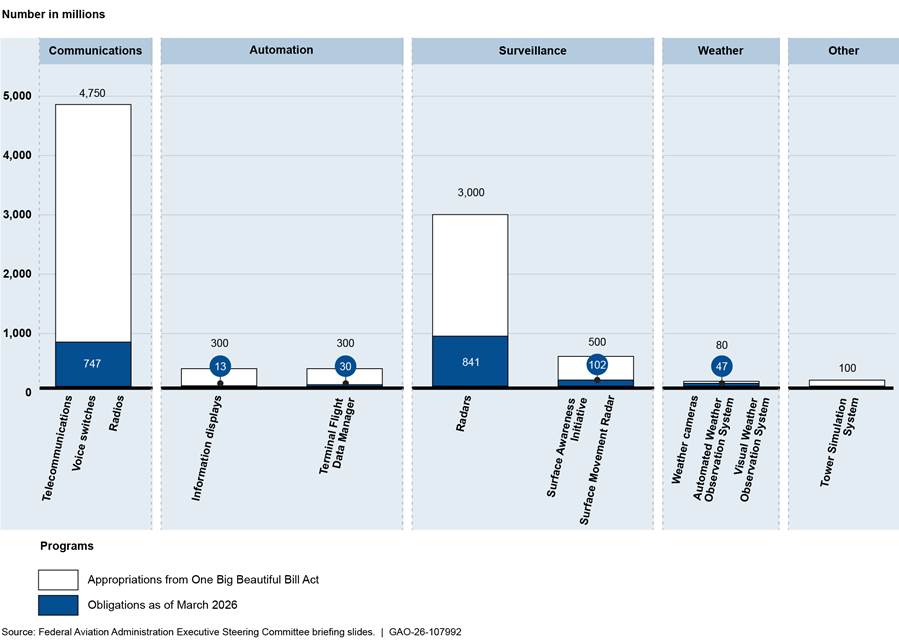
Note: The Alaska Automation Capability program did not receive appropriations from the One Big Beautiful Bill Act, however, as of December 2025 it is one of the 13 Brand New Air Traffic Control System phase 1 programs.
Of the 13 programs within phase 1, FAA has begun implementing modernized systems associated with nine. The agency plans to start implementation of the remaining four between June 2026 and September 2027. Figure 5 provides FAA’s reported status of phase 1 work as of May 2026.
Figure 5: Federal Aviation Administration (FAA) Reported Status of Implementation of Brand New Air Traffic Control System (BNATCS) Phase 1, as of May 2026
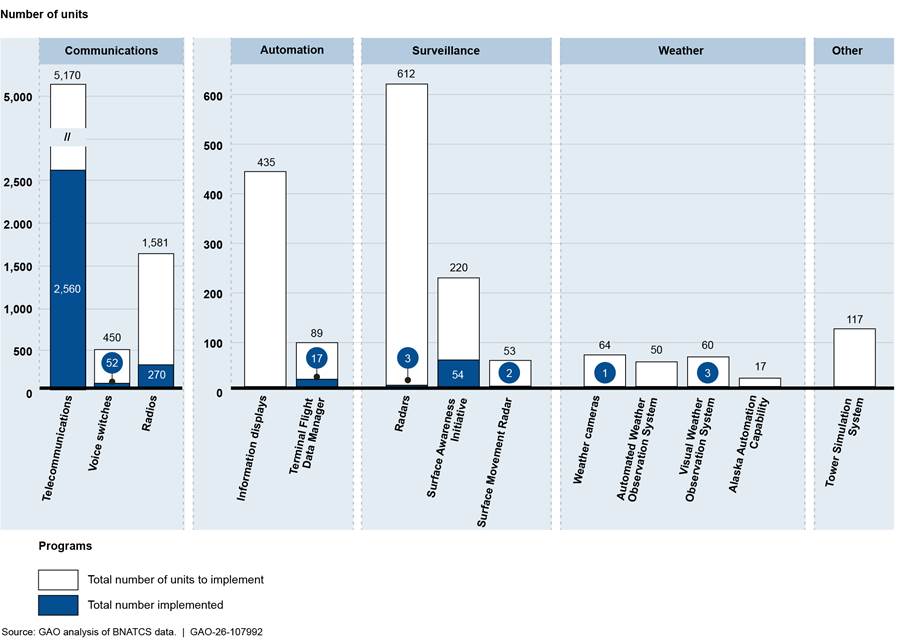
FAA officials stated in January 2026 that the voice switches carry the highest risk of any phase 1 work due to installation complexities. Specifically, FAA officials stated that large tower voice switches have the greatest risk because of: the size of the sites and airspace it controls, the age of technology coming out of the facilities, and the need to operate new and old voice switches simultaneously for every controller at those sites. FAA officials added that work to replace the information display systems is also a risk due to program complexity. In addition, in September 2024, we reported that the replacement Enterprise Information Display System (which was under way prior to BNATCS) was behind schedule and had significantly increased its cost estimate.[38] In May 2025, FAA terminated the contract with the associated vendor to pursue an in-house development approach instead, which according to officials, enabled more flexibility to implement faster.
As of June 2026, the FAA had 30 months left to implement the remaining elements of each of these programs.
FAA Did Not Develop a Reliable Cost Estimate or Integrated Schedule for BNATCS
FAA has not developed a reliable lifecycle cost estimate for BNATCS. Specifically, in June 2026, FAA officials provided a high-level document that is intended to provide overall estimates for each program in phase 1. However, FAA officials were unable to provide the analysis that supported these figures. In addition, FAA officials acknowledged that the estimate does not include government-related costs, most of the operations and maintenance costs for phase 1, or any of the costs for phase 2. In addition, while the prime contractor is responsible for developing an integrated master schedule for phase 1, as of May 2026, BNATCS was comprised of over 11,000 individual project schedules that were not integrated or optimized. FAA officials acknowledged these weaknesses and stated they had plans underway to address them; however, they did not have a time frame for when the issues would be resolved.
FAA Did Not Develop a Reliable Cost Estimate for BNATCS
According to GAO’s Cost Estimating and Assessment Guide, a comprehensive lifecycle cost estimate should include both government and contractor costs for all direct and indirect costs for planning, procurement, operations and maintenance, and disposal, regardless of funding source.[39] Cost estimates are necessary for government acquisition programs for many reasons, including to support decisions about funding one program over another, to develop annual budget requests, and to evaluate resource requirements at key decision points. In addition, a well-documented cost estimate, including the analysis that was used to support the estimate, is essential for validating and defending the estimate to help answer decision makers and oversight groups’ probing questions. It also helps with analyzing changes in program costs. Moreover, having a realistic estimate of projected costs increases the probability of a program’s success.
As mentioned, in July 2025, the One Big Beautiful Bill Act appropriated $9 billion to FAA for implementing the phase 1 systems modernization.[40] In June 2026, FAA officials indicated that BNATCS will need an additional $10.8 billion for system modernization efforts ($574 million to fully implement the remaining portions of phase 1, and $10.2 billion to implement phase 2 programs). Correspondingly, the President’s budget request for fiscal year 2027, requested $1.4 billion ($565 million for phase 1, and $860 million for phase 2) of this additional $10.8 billion.[41]
Despite receiving a significant amount of funding, as well as identifying the need for additional funding, FAA has not developed a comprehensive and well-documented lifecycle cost estimate for BNATCS. Specifically, in May 2026, FAA officials provided a high-level document that contains overall estimates for each program in phase 1. However, FAA officials were unable to provide any analysis that supported these high-level estimates. Officials stated that the analysis was not readily available and would require a tremendous amount of effort to locate and provide.
FAA officials acknowledged that the document does not include all costs associated with each program, such as government-related costs or most of the post-implementation operations and maintenance costs. In particular, officials confirmed that the estimate does not include operations and maintenance costs beyond those for the first partial year and first full year after implementation. As a result, FAA’s $10.6 billion estimate for phase 1 systems modernization underestimates the full costs.
Moreover, the estimate does not include any cost for phase 2. FAA stated that they have not established an estimate for the costs associated with phase 2 because they have not received funding for this second phase. However, according to GAO’s Cost Estimating and Assessment Guide and recognized best practices, the lifecycle cost estimate should be the basis for the annual budget request, rather than the reverse.
FAA’s Acquisition Management System generally aligns with GAO’s Cost Estimating and Assessment Guide regarding lifecycle cost estimates. In particular, its acquisition lifecycle management steps require establishing a lifecycle cost estimate. However, the FAA Administrator implemented a waiver that exempts BNATCS programs from such requirements. As such, a key contributing reason why BNATCS has not developed a comprehensive and well-documented lifecycle cost estimate is that the program is not explicitly required to.
|
FAA’s NextGen initiative was FAA’s prior major ATC systems modernization initiative. It made limited progress over 20 years and did not establish a complete lifecycle cost estimate. In 2023, we recommended that NextGen establish a lifecycle cost estimate. However, FAA did not implement this recommendation and NextGen experienced significant cost overruns and delays, and underdelivered modernized systems. Source: Summary of GAO‑24‑105254. | GAO‑26‑107992 |
The Administrator approved the waiver with the goal of significantly accelerating the implementation of BNATCS. Specifically, the waiver states that the Acquisition Management System lifecycle process involves numerous steps and extensive documentation, which risks creating substantial delays. In addition, the waiver states that financial, legal, technological, security, and program review requirements can add months, if not years, to the deployment of new NAS technology. Lastly, the waiver states that because of the age of the FAA’s systems, the nation’s economic reliance on the NAS, and its critical role in national security and defense, swift and decisive action is essential.
While we agree with the need to significantly accelerate the modernization of ATC systems, the exception from certain critical acquisition management functions introduces heightened risk to the program. Specifically, without a reliable cost estimate for BNATCS that is comprehensive and well-documented, FAA risks being unable to effectively estimate the effort’s future funding needs. It also risks using unreliable data to make budgetary decisions and to hold program officials accountable.
As such, FAA faces an increased likelihood of repeating its history of cost overruns and unmet performance targets. The risk of FAA not meeting its performance targets could force controllers to continue to rely on aging and increasingly unreliable systems as they aim to protect lives and ensure expeditious flow of air traffic to support the nation’s economy.
FAA Developed Thousands of Project Schedules, but Not an Integrated Schedule to Manage BNATCS
According to GAO’s Schedule Assessment Guide, the success of a program depends, in part, on having a reliable integrated master schedule.[42] The master schedule should define when the program’s set of work activities and milestone events are to occur, how long they will take, and how they are related to one another. In particular, an integrated master schedule connects all the scheduled work of the government and the contractor in a network, or collection, of logically linked sequences of activities. The sequences clearly show how related portions of work depend on one another, including the relationships between the government and contractors. In addition, it provides a means to gauge progress, identify and address potential problems, and promote accountability. For an integrated master schedule to be an effective management tool, it should be developed before the implementation work begins so that dependencies among various workstreams are effectively managed.
According to FAA officials, in December 2025, following the contract award, Peraton worked with FAA to finalize a high-level milestone schedule during a 90-day negotiation period. Officials added that during the negotiation window, the contractor tested and validated the assumptions and inputs of the schedule.
In addition, according to the BNATCS contract, the integrator is responsible for developing an integrated master schedule for phase 1. The detailed schedule is expected to include all activities of the integrator, subcontractors, and dependencies on the FAA, stakeholders, and other third parties. FAA officials emphasized that a highly efficient and optimized schedule will be critical to the success of BNATCS as the supporting programs will continue to increase their cadence for deployments in the coming months and years.
FAA officials stated that the integrator delivered a preliminary integrated master schedule in April 2026. However, as of May 2026, FAA had not integrated the 11,389 schedules of its 11,389 projects that support the 13 BNATCS programs. FAA officials stated that due to the high number of projects, attempting to integrate all the projects in their scheduling tool would not be useful or helpful. As a result, individual projects are scheduled to conduct different installations at the same installation sites repeatedly, generally without addressing potential conflicts, optimizing the schedules, or reducing disruptions to air traffic control operations. According to FAA officials, in limited cases, project officials manually identify conflicts associated with their project, but this is not occurring on a wide scale.
FAA officials acknowledged these project scheduling weaknesses. In response, in May 2026, the officials stated that they have plans to implement an artificial intelligence tool to automatically identify schedule conflicts and opportunities to better coordinate installations among the projects at each site. This tool is expected to alert program officials to these conflicts or opportunities, after which the program manager will be expected to work with the appropriate project teams to make changes in the schedule. However, this tool is currently undergoing testing, and the business rules for using the tool and the new process have not been established. As such, it is unclear when this tool will be implemented, how effective the tool will be, or when improvements to the schedule will occur.
Nevertheless, the nine BNATCS programs that have work underway are doing so without input from an integrated master schedule to ensure all interdependencies are being considered during implementation. For example, in April 2027, technicians are scheduled to visit a facility in St. Louis, Missouri to conduct site preparation for the installation of a voice switch, and then approximately 8 months later in January 2028, the information displays program is planning to conduct site preparation for installation at the same site. Multiple visits are not optimal and will cause unnecessary disruption to the ATC facilities. There are countless possible overlaps among the projects, including the remaining 2,610 fiber optic cable installations, 435 installations of Enterprise Information Display Systems, 72 Terminal Flight Data Manager systems, 398 voice switch installations, 1,311 radio site installations, and 166 Surface Awareness Initiative systems installations.
Moreover, such inefficiencies can contribute to schedule delays that add schedule pressure. We have previously reported that schedule pressure on federal programs can lead to omissions and skipping or compressing of key activities, such as testing and deficiency resolution, that can compromise the success of the system.[43]
Without an integrated master schedule that accounts for dependencies between the projects and the associated site installations, FAA risks having an inefficient schedule that causes excessive disruptions to air traffic control operations and jeopardizes FAA’s ability to meet its aggressive deployment schedule. As mentioned, if these risks are realized, FAA will need to continue to rely on severely outdated and underperforming systems that are prone to failure, which could lead to more system outages, ground stops, flight delays, and safety incidents.
Conclusions
The country needs a safe, orderly, and expeditious national airspace. However, FAA’s current ATC systems that are intended to support these needs are severely outdated, underperforming, and unsustainable. This aging and unreliable technology has contributed to an increase in aviation incidents. FAA’s ambitious—but needed—goal is to accelerate and complete the first phase of ATC systems modernization within 3 years and for $10.6 billion. FAA expects that they will need an additional $10.2 billion for phase 2.
To its credit, FAA has implemented some initial plans for BNATCS. It has leveraged pre-existing investments to quickly deliver results, including replacing 50 percent of copper wires with fiber optic cables, and 17 percent of the radio sites.
We agree with the need to significantly accelerate the modernization of these ATC systems and applaud FAA’s initial progress. However, in the interest of expediency, FAA is introducing additional risk. Notably, FAA’s lack of a reliable lifecycle cost estimate for BNATCS that is comprehensive and well-documented increases the likelihood of cost overruns and unmet performance targets. FAA has also added risk by concurrently implementing thousands of projects without an integrated master schedule for phase 1. Without a schedule that accounts for dependencies between these projects and the associated site installations, FAA risks having an inefficient schedule that causes excessive disruptions to air traffic control operations and jeopardizes the agency’s ability to meet its aggressive deployment schedule.
In essence, the FAA is buying delivery speed at the risk of cost uncertainty and potential disruptions. The net effect could be that air traffic controllers are forced to continue to rely on severely outdated systems that are prone to failure leading to more system outages, ground stops, flight delays, or worse—safety incidents.
Recommendations for Executive Action
We are making two recommendations to FAA.
The Administrator of FAA should prioritize developing a lifecycle cost estimate in accordance with GAO’s cost estimating best practices for the BNATCS initiative. (Recommendation 1)
The Administrator of FAA should prioritize developing a detailed integrated master schedule in accordance with GAO’s scheduling best practices for BNATCS phase 1. (Recommendation 2)
Agency Comments and Our Evaluation
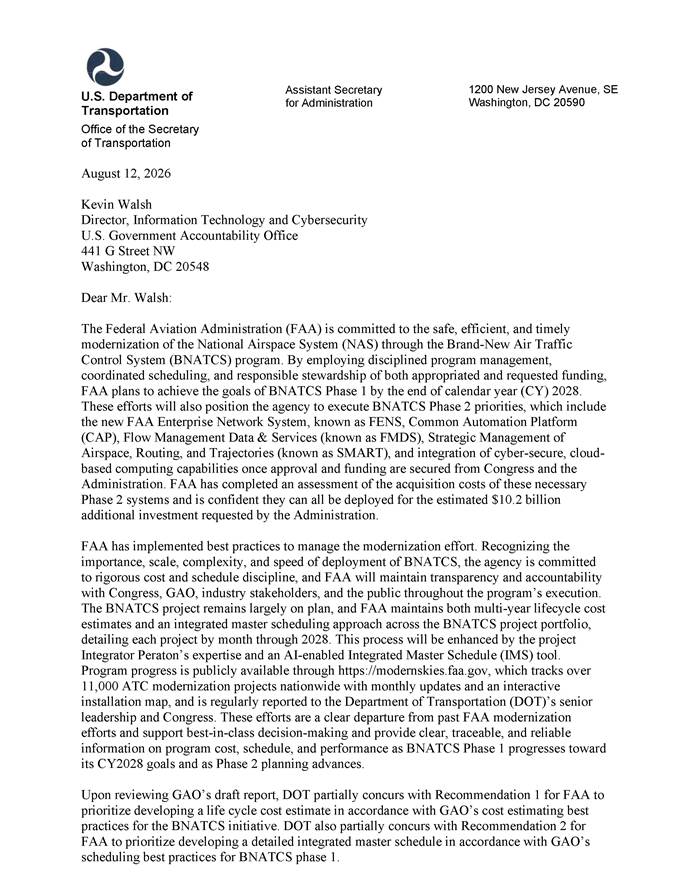
We provided a draft of this report to the Department of Transportation. In its written comments, reproduced in appendix III, Transportation partially concurred with our two recommendations. The department did not cite actions that it will take to address the recommendations.
Transportation partially concurred with Recommendation 1, which is that the Administrator of FAA prioritize developing a lifecycle cost estimate in accordance with GAO’s cost estimating best practices for the BNATCS initiative. In written comments, Transportation’s Assistant Secretary for Administration stated that the FAA Administrator did not waive BNATCS from the Acquisition Management System policy and the requirement to develop a cost estimate. The Assistant Secretary added that the Administrator amended the requirements of the Acquisition Management System policy to add an Accelerated Acquisitions section. This section requires FAA to adhere to principles of sound business judgment and transparency, accountability, and fiscal responsibility, among others. The comments further stated that teams consisting of finance and program office employees have created and continue to update lifecycle cost estimates for all BNATCS phase 1 programs. Specifically, the comments stated that FAA, among other things, established estimating plans and methodologies during pre-BNATCS investment analysis efforts. In addition, cost estimating teams updated ground rules and assumptions and input data based on the current technical scope.
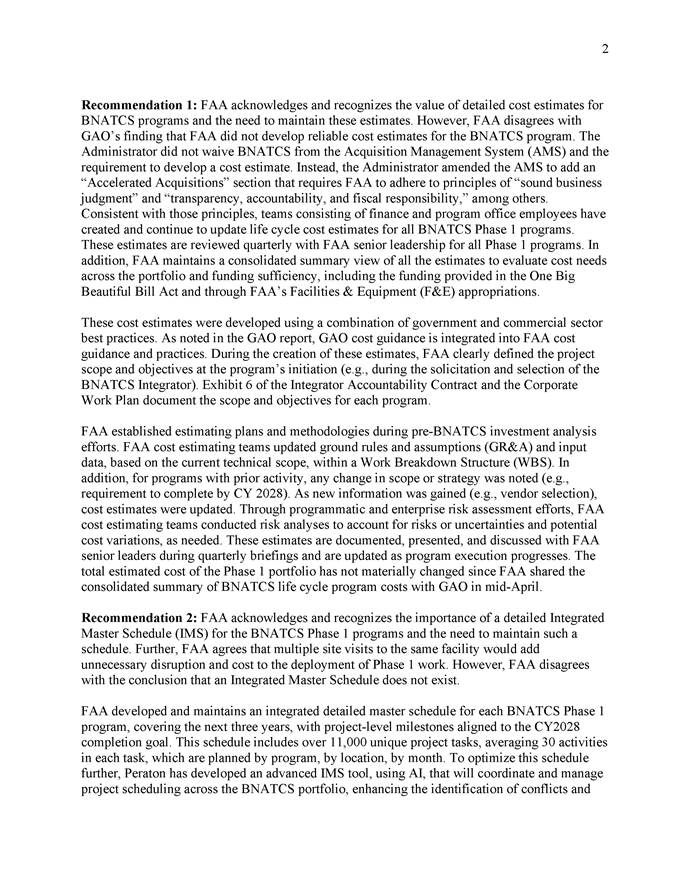
We agree with the Assistant Secretary’s comments on the actions that have been taken. However, we disagree that the waiver still requires BNATCS programs to comply with other parts of the Acquisition Management System, such as developing a lifecycle cost estimate. The waiver explicitly states that the Administrator is implementing a blanket waiver of the existing Acquisition Management System, including its contract clauses, policies, and guidance (collectively, the Acquisition Management System) as well as financial, legal, technology, security, and program review processes, as necessary, for all activities associated with BNATCS. As such, the Administrator waived the lifecycle cost estimate requirement.
In addition, while Transportation contends that FAA has created a lifecycle cost estimate for all BNATCS phase 1 programs, the high-level document that FAA provided to us does not meet the requirements to be considered a reliable and well-documented lifecycle cost estimate. Specifically, as we state in this report, the estimate FAA provided does not include all costs associated with each program, such as government-related costs or most of the post-implementation operations and maintenance costs. In particular, officials confirmed that the estimate does not include operations and maintenance costs beyond those for the first partial year and first full year after implementation. As a result, FAA’s $10.6 billion estimate for phase 1 systems modernization underestimates the full costs. Moreover, the estimate does not include any cost for phase 2.
Further, FAA officials were unable to provide any analysis that supported their high-level estimates. Officials stated that the analysis was not readily available and would require a tremendous amount of effort to locate and provide. As such, Recommendation 1 is still necessary, as written.
Transportation also partially concurred with Recommendation 2, which is that the Administrator of FAA prioritize developing a detailed integrated master schedule in accordance with GAO’s scheduling best practices for BNATCS phase 1. In written comments, Transportation’s Assistant Secretary for Administration stated that FAA developed and maintains an integrated detailed master schedule for each BNATCS phase 1 program, covering the next three years. The comments stated that this schedule includes over 11,000 unique project tasks, averaging 30 activities in each task, which are planned by program, location, and month. The comments further stated that Peraton has developed an advanced scheduling tool using AI that will coordinate and manage project scheduling across the BNATCS portfolio. The written comments noted that these capabilities are in the process of being fully optimized.
We disagree that FAA has established an integrated detailed master schedule for each BNATCS program that logically sequences activities and manages interdependencies. As we stated in the report, FAA had not integrated the schedules of its 11,389 projects that support the 13 BNATCS programs. FAA officials stated that due to the high number of projects, attempting to integrate all the projects in their scheduling tool would not be useful or helpful. As a result, individual projects are scheduled to conduct different installations at the same installation sites repeatedly, generally without addressing potential conflicts, optimizing the schedules, or reducing disruptions to air traffic control operations. According to FAA officials, in limited cases project officials manually identify conflicts associated with their project, but this is not occurring on a wide scale.
We recognize that FAA is working with a prime systems integrator to develop an AI tool that they anticipate will optimize the 11,389 unique schedules, as reflected in our report. However, as of May 2026, this tool was undergoing testing, and the business rules for using the tool and the new process had not been established. It is unclear when this tool will be implemented, how effective the tool will be, or when improvements to the schedule will occur. As such, BNATCS programs that have ongoing work underway are doing so without input from an integrated master schedule to ensure all interdependencies are being considered during implementation. Until FAA demonstrates that the over 11,000 unique schedules are integrated and associated tasks and resources are coordinated, we believe that the recommendation is necessary, as written.
In addition to the aforementioned comments, we received technical comments from Transportation, which we incorporated as appropriate.
We are sending copies of this report to the appropriate congressional committees, the Secretary of Transportation, and other interested parties. In addition, this report will also be available at no charge on the GAO website at https://www.gao.gov.
If you or your staff have any questions about this report, please contact me at walshk@gao.gov. Contact points for our Offices of Congressional Relations and Media Relations may be found on the last page of this report. GAO staff who made major contributions to this report are listed in appendix IV.
Kevin Walsh
Director, Information Technology and Cybersecurity
Our objectives were to (1) identify the initial plans and status of the new air traffic control (ATC) system modernization effort and (2) assess the extent to which the Federal Aviation Administration (FAA) has established a cost estimate and schedule to support the ATC modernization plan and request for funding.
To address the first objective, we reviewed FAA’s planning materials for the Brand New Air Traffic Control System (BNATCS) for the systems modernization elements of their plan. This included reviewing publicly released documents leading up to the prime systems integrator contract award, such as the BNATCS plan and proposal, presentation slides from industry briefings, and supporting materials for a request for solution. We also reviewed the systems integrator contract.[44] Our review did not include assessing plans associated with ATC facilities construction.
We then determined the status of BNATCS by first analyzing the agreed upon deployment schedule for each phase 1 BNATCS program. We assessed progress relative to the schedule based on data captured in a dashboard used by FAA officials to determine progress of the BNATCS initiative. We assessed the reliability of the dashboard data by cross checking the data against other sources, when available. However, we could not ascertain the complete reliability of the status data or the summary report prepared using these data due to lack of visibility into the systems that feed into the dashboard. Specifically, FAA did not identify source information for the dashboard or demonstrate the parameters for updating and validating data in the dashboard. Because FAA management uses these data to manage their operations, we believe the data are sufficient for our purpose of describing the program status and believe they provide acceptable approximations at the time of our analysis.
Lastly, to supplement our understanding of BNATCS progress and related challenges, we interviewed officials from FAA and the Department of Transportation, as well as representatives from the National Air Traffic Controllers Association, Professional Aviation Safety Specialists, and Air Line Pilots Association.[45]
To address our second objective, we reviewed BNATCS cost estimate documentation, when available. We compared these documents to GAO’s Cost Estimating and Assessment Guide, best practices for developing a lifecycle cost estimate.[46] FAA provided limited information to evaluate or substantiate the high-level costs reflected in various planning materials. We discuss concerns regarding the lack of a detailed cost estimate in the report.
We also reviewed BNATCS schedule documentation, when available. This included a review of deployment requirements agreed upon with the integrator.[47] In addition, we observed a live demonstration of FAA’s use of its scheduling tool. We validated the schedule data against other data sources, such as an internal BNATCS executive dashboard and briefing slides, to ensure consistency. We compared the schedule documentation to best practices in GAO’s Schedule Assessment Guide.[48] We then interviewed FAA and Department of Transportation officials regarding any inconsistencies.
We conducted this performance audit from December 2024 to September 2026 in accordance with generally accepted government auditing standards.[49] Those standards require that we plan and perform the audit to obtain sufficient, appropriate evidence to provide a reasonable basis for our findings and conclusions based on our audit objectives. We believe that the evidence obtained provides a reasonable basis for our findings and conclusions based on our audit objectives.
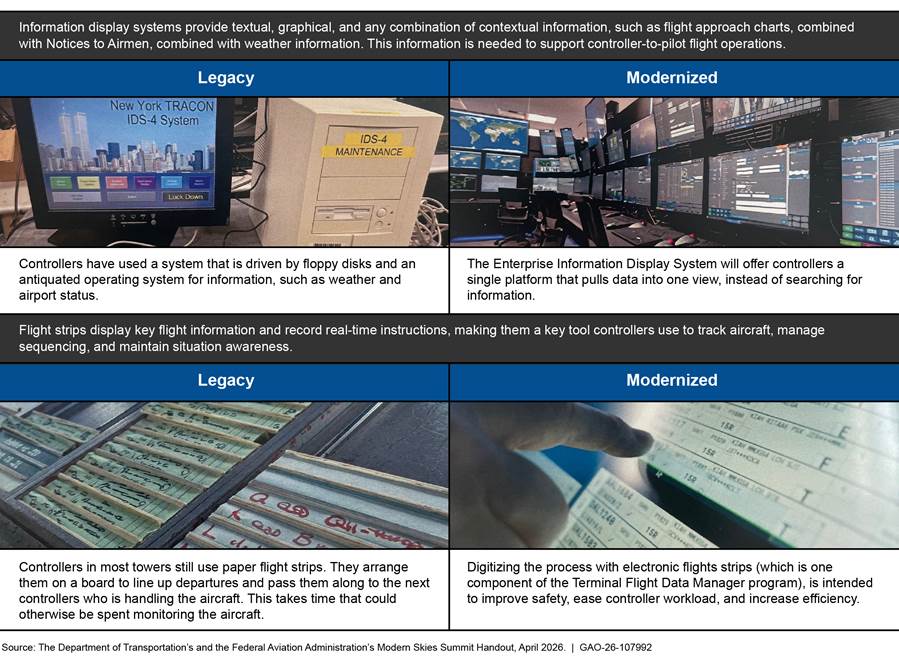
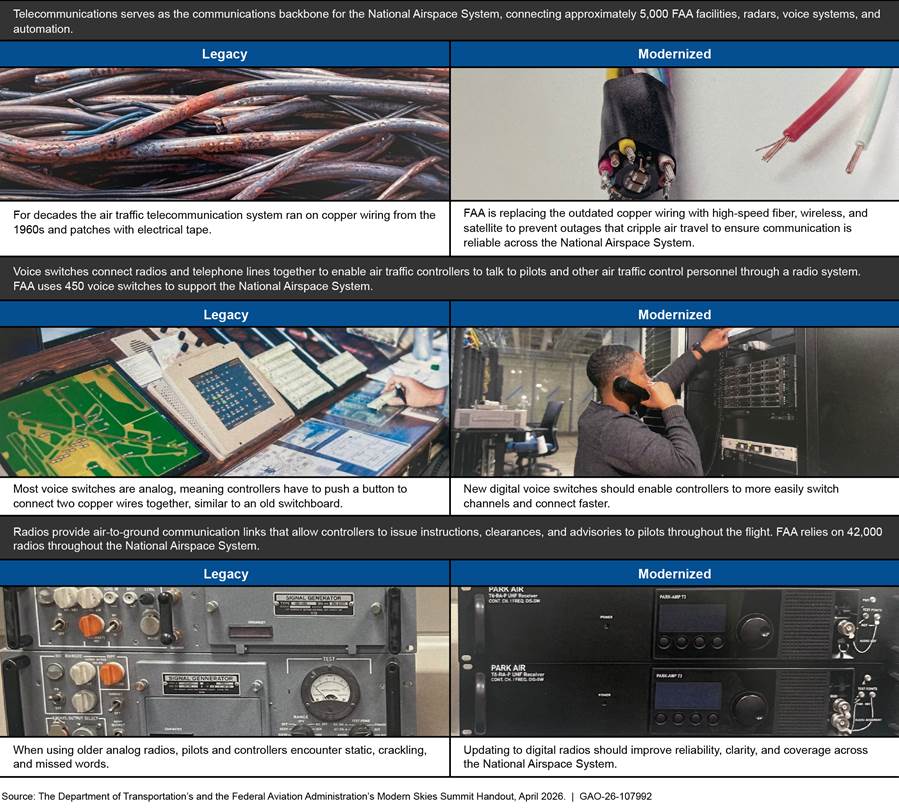
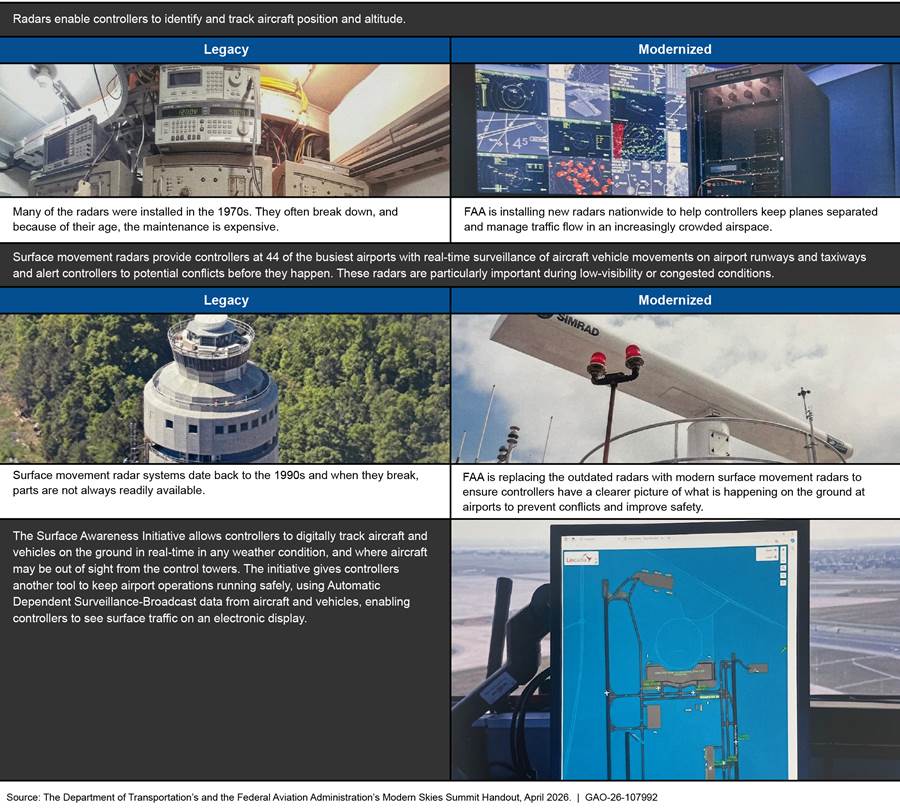
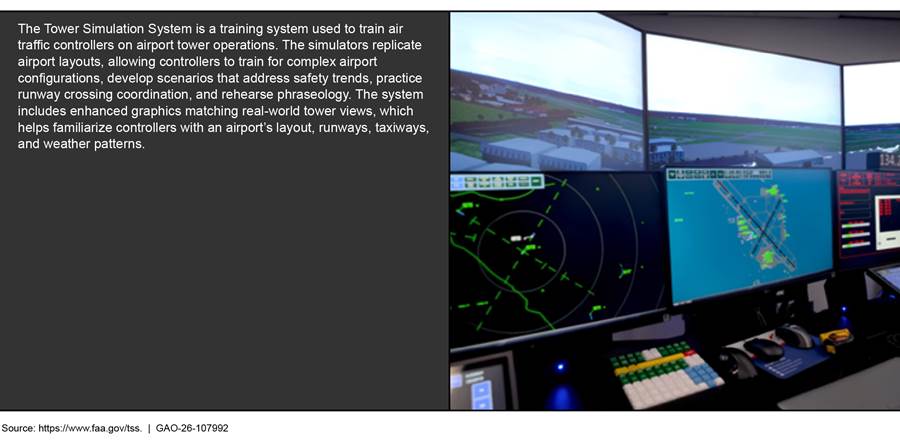
This appendix offers a brief overview and images of the legacy air traffic control (ATC) systems, when applicable, and modernized replacement systems being deployed or planned to be deployed under the Brand New Air Traffic Control System (BNATCS) phase 1. The systems are organized by key ATC domains (automation, communication, surveillance, weather). In addition, BNATCS includes the Tower Simulation System, which is not associated with a specific domain.
Automation
Communication
Surveillance
Weather
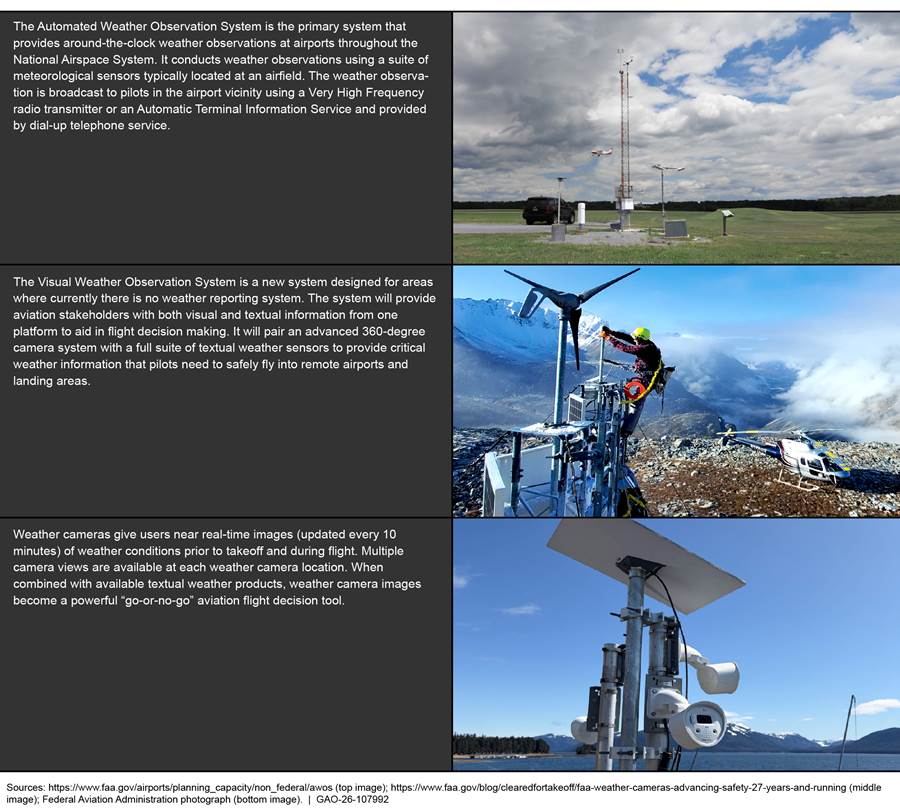
Note: The Alaska Automation Capability is the fourth BNATCS weather-related system modernization program. For this program, FAA plans to develop a web-based replacement solution for FAA’s Alaska Flight Service, which provides weather data, aeronautical information, and flight planning services to pilots. In June 2026, FAA officials stated that system design artifacts had not yet been developed to illustrate a graphical representation of the Alaska Automation Capability.
Other
Kevin Walsh, walshk@gao.gov
In addition to the contact listed above, the following staff made significant contributions to this report: Shannin O’Neill (Assistant Director), Mathew Bader (Analyst in Charge), Albert Csaszar, Jennifer Echard, Elizabeth Harris, Smith Julmisse, Andrew Knox, Anh-Thi Le, Jennifer Leotta, David Sausville, Walter Vance, and Johnathan Wade.
The Government Accountability Office, the audit, evaluation, and investigative arm of Congress, exists to support Congress in meeting its constitutional responsibilities and to help improve the performance and accountability of the federal government for the American people. GAO examines the use of public funds; evaluates federal programs and policies; and provides analyses, recommendations, and other assistance to help Congress make informed oversight, policy, and funding decisions. GAO’s commitment to good government is reflected in its core values of accountability, integrity, and reliability.
Obtaining Copies of GAO Reports and Testimony
The fastest and easiest way to obtain copies of GAO documents at no cost is through our website. Each weekday afternoon, GAO posts on its website newly released reports, testimony, and correspondence. You can also subscribe to GAO’s email updates to receive notification of newly posted products.
Order by Phone
The price of each GAO publication reflects GAO’s actual cost of production and distribution and depends on the number of pages in the publication and whether the publication is printed in color or black and white. Pricing and ordering information is posted on GAO’s website, https://www.gao.gov/ordering.htm.
Place orders by calling (202) 512-6000, toll free (866) 801-7077,
or
TDD (202) 512-2537.
Orders may be paid for using American Express, Discover Card, MasterCard, Visa, check, or money order. Call for additional information.
Connect with GAO
Connect with GAO on X,
LinkedIn, Instagram, and YouTube.
Subscribe to our Email Updates. Listen to our Podcasts.
Visit GAO on the web at https://www.gao.gov.
To Report Fraud, Waste, and Abuse in Federal Programs
Contact FraudNet:
Website: https://www.gao.gov/about/what-gao-does/fraudnet
Automated answering system: (800) 424-5454
Media Relations
Sarah Kaczmarek, Managing Director, Media@gao.gov
Congressional Relations
David A. Powner, Acting Managing Director, CongRel@gao.gov
General Inquiries
[1]The FAA Reauthorization Act of 2024 includes a provision for GAO to review the efficiency and efficacy of commercial air traffic in congested airspace. FAA Reauthorization Act of 2024, Pub. L. No. 118-63, tit. VI, § 615, 138 Stat. 1229 (2024). We have ongoing work to address this provision.
[2]GAO, Air Traffic Control: FAA Actions Are Urgently Needed to Modernize Aging Systems, GAO‑24‑107001 (Washington, D.C.: Sept. 23, 2024).
[3]Public Law 119-21—commonly known as the One Big Beautiful Bill Act—appropriated these funds for fiscal year 2025. An Act to provide for reconciliation pursuant to title II of H. Con. Res. 14, Pub. L. No. 119-21, tit. IV, § 40003, 139 Stat. 131 (2025).
[4]On December 5, 2025, FAA awarded the BNATCS integrator contract to Peraton Inc. For more information on the contract award, see the posting on USAspending.
[5]The National Air Traffic Controllers Association is a labor union and aviation safety organization that represents nearly 20,000 air traffic controllers, engineers, and other aviation safety-related professionals. The Professional Aviation Safety Specialists is a labor union that represents, among others, national airspace safety inspectors and technicians. The Air Line Pilots Association, International is the world’s largest airline pilot union, representing and advocating for more than 80,000 pilots at 42 airlines in the United States and Canada.
[6]GAO, Cost Estimating and Assessment Guide: Best Practices for Developing and Managing Program Costs, GAO‑20‑195G (Washington, D.C.: Mar. 12, 2020).
[7]According to FAA officials, following the contract award in December 2025, the agency and integrator underwent a 90-day negotiation period. The deployment schedule is the final, negotiated roadmap that will be used to monitor contractor performance.
[8]GAO, Schedule Assessment Guide: Best Practices for Project Schedules, GAO‑16‑89G (Washington, D.C.: Dec. 22, 2015).
[9]We experienced several delays on this engagement. First, in May 2025—4 months into our audit—FAA announced BNATCS, which required us to significantly adjust our scope and methodology. Next, in August 2025, we temporarily paused our audit at FAA’s request. At the time, FAA was onboarding its new Administrator and had paused the award of the BNATCS prime systems integrator contract to allow the Administrator time to review the BNATCS contracting strategy. We reinitiated the audit in September 2025, once FAA announced the BNATCS Request for Solution. The lapse in FAA’s appropriations from October 1, 2025, until November 12, 2025, also extended the time frame of this audit. Lastly, significant delays in FAA providing documentation further impacted audit time frames.
[10]Gross Domestic Product is the value of all goods and services produced in the United States in a given year.
[11]Since 2023, FAA has continued to conduct an operational risk assessment each year.
[13]A close call refers to a runway incursion which is an occurrence at an airport involving the incorrect presence of an aircraft, vehicle, or person on a runway. Incursions are caused by operational incidents, pilot deviations, and vehicle or pedestrian deviations.
[14]GAO, Examination of the Federal Aviation Administration’s Plan for the National Airspace System—Interim Report, AFMD-82-66 (Washington, D.C.: Apr. 20, 1982).
[15]GAO, AFMD-82-66; Issues Related to an Independent FAA, T-RCED-88-45 (Washington, D.C., Jun. 2, 1988).
[16]GAO, High-Risk Series: An Overview, HR-95-1 (Washington, D.C.: Feb. 1, 1995). We updated our concerns in subsequent high-risk reports in 1997 through 2007. For example, see GAO, High-Risk Series: An Overview, HR-97-1 (Washington, D.C.: Feb. 1, 1997); and GAO, High-Risk Series: An Update, GAO‑07‑310 (Washington, D.C.: Jan. 31, 2007).
[17]Department of Transportation Office of the Inspector General, Advanced Automation System, AV-1998-113 (Washington, D.C.: Apr. 15, 1998). Of the $2.6 billion spent on the Advanced Automation System program, the Department of Transportation’s Office of the Inspector General estimated the total loss to the federal government to be about $1.5 billion, excluding FAA personnel costs.
[18]In 2003, the Vision 100—Century of Aviation Reauthorization Act mandated that FAA create and carry out a plan for modernizing its air traffic control systems. Vision 100— Century of Aviation Reauthorization Act, Pub. L. No. 108-176, § 709, 117 Stat. 2490, 2582-2585 (2003).
[19]GAO, High-Risk Series: An Update, GAO‑09‑271 (Washington, D.C.: Jan. 22, 2009).
[20]GAO, Air Traffic Control Modernization: Program Management Improvements Could Help FAA Address NextGen Delays and Challenges, GAO‑24‑105254 (Washington, D.C.: Nov. 9, 2023).
[23]FAA enterprise architecture roadmaps include a total of nine domains, including: (1) Aircraft, (2) Automation, (3) Communication, (4) Enterprise Services and Capabilities, (5) Facilities, (6) Navigation, (7) Safety, (8) Surveillance, and (9) Weather.
[24]Public Law 119-21—commonly known as the One Big Beautiful Bill Act—appropriated $12.5 billion in total for ATC modernization for fiscal year 2025 (to remain available until September 30, 2029), of which $9 billion was designated for modernization of ATC systems. Specifically, the act appropriated $300 million for information display systems; $300 million for Terminal Flight Data Manager; $4,750 million for telecommunications; $3,000 million for radars; $500 million for runway safety technologies, runway lighting systems, and surface surveillance technologies; $80 million for the Automated Weather Observation System, Visual Weather Observation System, and weather cameras; and $100 million for advanced training technologies. The remaining $3.5 billion was appropriated for ATC facilities construction, which is not in the scope of this review. An Act to provide for reconciliation pursuant to title II of H. Con. Res. 14, Pub. L. No. 119-21, tit. IV, § 40003, 139 Stat. 131 (2025).
[25]This figure does not include phase 2 facilities construction costs. As of May 2026, FAA officials stated that they had not finalized the facilities construction cost estimate.
[26]BNATCS also includes the construction and consolidation of select Air Route Traffic Control Centers and construction, realignment, and consolidation of additional facilities. This report is focused on the ATC system components of BNATCS and therefore does not include a review of the plans or status of FAA facility improvements.
[27]We have ongoing work reviewing FAA’s weather reporting systems and Weather Camera Program pursuant to Section 316 and Section 317 of the FAA Reauthorization Act of 2024. FAA Reauthorization Act of 2024, Pub. L. No. 118-63, tit. III, §§ 316-317, 138 Stat. 1079-80 (2025).
[28]Public Law 119-21—commonly known as the One Big Beautiful Bill Act—appropriated these funds for fiscal year 2025 (to remain available until September 30, 2029). An Act to provide for reconciliation pursuant to title II of H. Con. Res. 14, Pub. L. No. 119-21, tit. IV, § 40003, 139 Stat. 131 (2025). The Airport and Airway Trust Fund, also known as the Aviation Trust Fund, was established by Congress in 1970 to help finance FAA investments in the airport and airway system, such as construction and safety improvements at airports and technological upgrades to the ATC system, as well as FAA operations. Historically, FAA has relied on this funding for ongoing sustainment or technical refresh of ATC systems. With any remaining funds, the agency pursued efforts to replace or modernize these systems.
[29]The act appropriated a total of $12.5 billion for FAA’s new ATC modernization initiative. Of the $12.5 billion, $9 billion was appropriated to ATC systems modernization. The remaining $3.5 billion was appropriated for ATC facilities construction, which is not in the scope of this review.
[30]Prior to the announcement of BNATCS, between 2020 and 2025, FAA reported receiving approximately $2.3 billion in funding via annual appropriations for these areas.
[31]This estimate excludes additional costs for systems work that, according to FAA officials, are outside the bounds of BNATCS. For example, the FAA projects spending $91 million for cable loop sustainment efforts to support the BNATCS telecommunication phase 1 work, which is not included in the $10.6 billion estimate.
[32]FAA officials stated that they will also need additional funding for facilities construction, however, as of May 2026 they were not certain how much.
[33]The President’s budget request for fiscal year 2027 requested $100 million for Common Automation Platform and $60 million for Flow Management Data and Services. It also requested $700 million for FAA Enterprise Network Services, which is intended to serve as the next generation replacement for FAA’s Telecommunications Infrastructure network by delivering an IP-based, high-availability enterprise network.
[34]In January 2026, the Secretary of Transportation announced a reorganization of FAA. Part of this reorganization was transferring responsibility for modernizing ATC systems out of the Air Traffic Organization and other FAA groups and aligning it under a newly created Airspace Modernization Office. The office also has oversight over BNATCS as well as the integrator. Creation of this office addresses a requirement of the FAA Reauthorization Act of 2024.
[35]Here, the prime integrator is the lead contractor responsible for the full execution of modernization activities, including overseeing and coordinating the actions of other contractors and their subcontractors to ensure delivery of often large, complex programs.
[36]According to FAA officials, the final negotiated price with the integrator is approximately $876 million. This represents a reduction of over $600 million from the contract ceiling of $1.5 billion. For example, officials stated that in negotiations, they shifted responsibility for oversight of radar installation from the integrator to the radar vendors at no additional cost, saving FAA over $150 million. Officials added that they also deferred development of the Flow Management Data and Services system. FAA officials noted that the cost savings provide them flexibility to add items into the contract where the integrator can provide value without exceeding the $1.5 billion contract threshold.
[37]Since that time, FAA added a thirteenth program—Alaska Automation Capability—to the scope of BNATCS phase 1.
[40]An Act to provide for reconciliation pursuant to title II of H. Con. Res. 14, Pub. L. No. 119-21, tit. IV, § 40003, 139 Stat. 131 (2025). The act appropriated a total of $12.5 billion for FAA’s new ATC modernization initiative to remain available until September 30, 2029. Of the $12.5 billion, $9 billion was appropriated to ATC systems modernization. The remaining $3.5 billion was appropriated for ATC facilities construction, which is not in the scope of this review.
[41]These figures do not include costs associated with ATC facilities construction.
[43]GAO, 2020 Census: Continued Management Attention Needed to Address Challenges and Risks with Developing, Testing, and Securing IT Systems, GAO‑18‑655 (Washington, D.C.: Aug. 30, 2018); IT Modernization: SBA Urgently Needs to Address Risks on Newly Deployed System, GAO‑25‑106963 (Washington, D.C.: Nov. 6, 2024); F-35 Joint Strike Fighter: Development Is Nearly Complete, but Deficiencies Found in Testing Need to Be Resolved, GAO‑18‑321 (Washington, D.C.: Jun. 5, 2018).
[44]On December 5, 2025, FAA awarded the BNATCS integrator contract to Peraton Inc. For more information on the contract award, see the posting on USAspending.gov.
[45]The National Air Traffic Controllers Association is a labor union and aviation safety organization that represents nearly 20,000 air traffic controllers, engineers, and other aviation safety-related professionals. The Professional Aviation Safety Specialists is a labor union that represents, among others, national airspace safety inspectors and technicians. The Air Line Pilots Association, International is the world’s largest airline pilot union, representing and advocating for more than 80,000 pilots at 42 airlines in the United States and Canada.
[46]GAO, Cost Estimating and Assessment Guide: Best Practices for Developing and Managing Program Costs, GAO‑20‑195G (Washington, D.C.: Mar. 12, 2020).
[47]According to FAA officials, following contract award in December 2025, the agency and integrator underwent a 90-day negotiation period. The deployment schedule is the final, negotiated roadmap that will be used to monitor contractor performance.
[48]GAO, Schedule Assessment Guide: Best Practices for Project Schedules, GAO‑16‑89G (Washington, D.C.: Dec. 22, 2015).
[49]We experienced several delays on this engagement. First, in May 2025—4 months into our audit—FAA announced BNATCS, which required us to significantly adjust our scope and methodology. Next, in August 2025, we temporarily paused our audit at FAA’s request. At the time, FAA was onboarding its new Administrator and had paused the award of the BNATCS prime systems integrator contract to allow the Administrator time to review the BNATCS contracting strategy. We reinitiated the audit in September 2025, once FAA announced the BNATCS Request for Solution. The lapse in FAA’s appropriations from October 1, 2025 until November 12, 2025, also extended the timeframe of this audit. Lastly, significant delays in FAA providing documentation further impacted audit timeframes.