
Report to Congressional Committees
United States Government Accountability Office
A report to congressional committees
For more information, contact: Frank Rusco at ruscof@gao.gov
What GAO Found
DOE established the Office of Clean Energy Demonstrations (OCED) in December 2021 to manage the historic amount of funding appropriated to DOE for demonstration projects. Key responsibilities include managing projects and assessing lessons learned to improve project oversight.
OCED projects vary in scale and cover diverse clean energy technologies, including hydrogen and advanced nuclear energy. Generally, at least 50 percent of the project costs are borne by the project awardees. As of November 2025, OCED had committed over $18 billion to about 100 projects, although 35 of these projects have been identified for termination.
To manage projects, OCED developed a framework that included a phased project approach and independent assessments at key oversight points to reduce organizational biases. Previously, OCED estimated it would need 351 staff to be fully staffed for the expected number of demonstration projects.
There have been significant changes at OCED in 2025 affecting its capacity, including a significant decrease in workforce and contract support. OCED lost 85 percent of its staff (from 285 staff to about 40) between January and June 2025. This included all independent assessment staff. Further, in February 2025, OCED issued a stop work order on almost all contracts supporting the office.
Office of Clean Energy Demonstrations (OCED) Workforce Changes from January 2025 to June 2025 and OCED’s Committed Funds and Projects as of November 2025
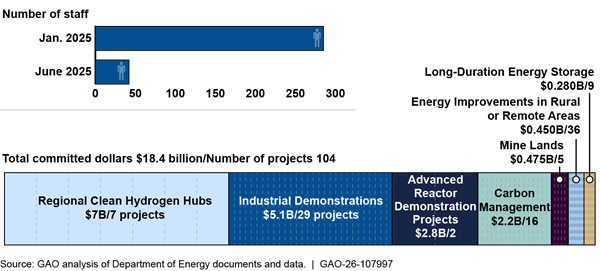
Currently, it is unclear how DOE plans to meet its statutory requirements to manage projects given OCED’s limited capacity. The office is unlikely to be able to conduct in-depth project reviews at key oversight decision points and an OCED official said the office will likely move some aspects of OCED’s oversight to other DOE offices. For example, the Office of Project Management agreed to conduct independent assessments, but that office lost about 60 percent of its staff in 2025. Without a plan to meet the statutory requirements of managing projects and assessing lessons learned, DOE faces increased risks of not having the capacity to manage and oversee billions of dollars of federal funding for demonstration projects.
Why GAO Did This Study
The Infrastructure Investment and Jobs Act (IIJA) of 2021 requires the Department of Energy (DOE) to establish a program for clean energy demonstration projects. Roughly $27 billion was appropriated to DOE for large-scale clean energy demonstration projects.
Congress included a provision in the IIJA for GAO to examine the oversight of demonstration projects and recommend changes for the purpose of better carrying out the program.
This report examines (1) recent changes at OCED and (2) DOE’s capacity to successfully manage projects given these changes.
GAO reviewed DOE and OCED documents, including policies, guidance, and award documentation. GAO also interviewed DOE officials and stakeholders, including surveying 45 recipients of OCED awards.
What GAO Recommends
GAO recommends that the Secretary of Energy develop a plan to meet statutory requirements for managing projects and assessing lessons learned for clean energy demonstration projects. DOE agreed with GAO’s recommendation.
|
Abbreviations |
|
|
|
|
|
DDAB |
Demonstration and Deployment Advisory Board |
|
DOE |
Department of Energy |
|
IIJA |
Infrastructure Investments and Jobs Act |
|
NEPA |
National Environmental Policy Act |
|
OBBBA |
One Big Beautiful Bill Act |
|
OCED |
Office of Clean Energy Demonstrations |
|
OIG |
Office of Inspector General |
This is a work of the U.S. government and is not subject to copyright protection in the United States. The published product may be reproduced and distributed in its entirety without further permission from GAO. However, because this work may contain copyrighted images or other material, permission from the copyright holder may be necessary if you wish to reproduce this material separately.
February 11, 2026
The Honorable Mike Lee
Chairman
The Honorable Martin Heinrich
Ranking Member
Committee on Energy and Natural Resources
United States Senate
The Honorable Brian Babin
Chairman
The Honorable Zoe Lofgren
Ranking Member
Committee on Science, Space, and Technology
House of Representatives
The Infrastructure Investment and Jobs Act (IIJA) requires the Department of Energy (DOE) to establish a program for clean energy demonstration projects, including managing demonstration projects and assessing and sharing lessons learned.[1] DOE established the Office of Clean Energy Demonstrations (OCED) in December 2021, in part to meet these requirements, and to manage the historic amount of funding appropriated to DOE for demonstration projects. The IIJA, Inflation Reduction Act, and other appropriations acts provided DOE with about $27 billion in appropriations for large-scale clean energy projects for fiscal years 2022 through 2026.[2]
As of November 2025, of that $27 billion, OCED had committed over $18 billion to about 100 projects, though this number is subject to change as discussed later in this report.[3] These projects vary in scale and cover diverse clean energy technologies, including clean hydrogen, advanced nuclear energy, and carbon capture.
Other DOE offices had managed demonstration projects before DOE established OCED, and the DOE Office of Inspector General (OIG) and GAO have reported on weaknesses in DOE’s management of such projects. DOE’s OIG and GAO highlighted weaknesses related to DOE’s management, including human capital and risks associated with DOE’s oversight, such as not consistently administering projects against established scopes, schedules, and budgets.[4]
According to DOE documents, DOE created OCED to centralize the management of demonstration projects across DOE into one “center of excellence.” This was done to improve DOE management and aimed to deliver clean energy demonstration projects at scale in partnership with the private sector to accelerate deployment and market adoption.
The IIJA includes a provision for us to review the processes and procedures used by OCED to evaluate proposals and award projects, as well as OCED’s oversight of such projects, and to recommend any changes to the processes, procedures, and program structure.[5] In November 2024, we reported on OCED’s establishment and its program development and proposal review process for issuing awards for projects.[6] This report examines (1) recent changes at OCED and (2) DOE’s capacity to successfully manage projects given these changes.
To examine recent changes at OCED and DOE’s capacity to manage projects, we reviewed DOE and OCED documents as well as relevant legislation. Specifically, we reviewed DOE and OCED policies and procedures, guidance, award documentation, organizational charts, and invoice data for 36 invoices submitted by seven project awardees. We also interviewed DOE and OCED officials about their oversight and management processes and changes to these processes. Finally, we surveyed 45 project awardees (as of July and August 2025), including administering the survey questions during interviews with eight of the awardees to allow for follow-up discussion on their responses.[7]
We conducted this performance audit from December 2024 to February 2026 in accordance with generally accepted government auditing standards. Those standards require that we plan and perform the audit to obtain sufficient, appropriate evidence to provide a reasonable basis for our findings and conclusions based on our audit objectives. We believe that the evidence obtained provides a reasonable basis for our findings and conclusions based on our audit objectives.
Background
The IIJA appropriated about $21.5 billion dollars of no-year appropriations to DOE for clean energy demonstration projects.[8] No-year appropriations are available for obligations for an indefinite period of time without fiscal year limitation, meaning they are available until they are expended.
The IIJA also stated that the Secretary of Energy shall
1. establish a program to conduct project management and oversight of covered projects, including conducting independent oversight of the execution of a covered project after funding has been awarded for that covered project; and
2. appoint a head of program, and that head of program shall assess the lessons learned in overseeing covered projects and implement improvements in the process of evaluating and overseeing covered projects.[9]
DOE established OCED as the program to fulfill the statutory requirements of conducting project management and oversight of projects, which includes evaluating the progress of projects based on the proposed schedule and technical and financial milestones, and assessing lessons learned in overseeing projects. For the purposes of this report, we will refer to these two requirements as project management and oversight.
Generally, OCED demonstration projects require a minimum of 50 percent cost-share to fund projects, meaning at least 50 percent of the project costs are borne by the project awardees, which are often private companies. Cost sharing augments federal funding to increase a project’s impact while ensuring that awardees have a financial stake in the project’s success. In some cases, OCED awardees are providing up to about 90 percent of funds, while OCED is providing about 10 percent.
OCED Lost Most of its Staff and Contract Support in 2025, and the Office’s Future is Uncertain
Since January 2025, there have been various changes at OCED, including reductions in workforce and contract support. Additionally, the future of OCED is uncertain, with an ongoing DOE-wide review of projects, some project cancellations, a DOE organizational realignment, and proposed budget decreases.
OCED’s Loss of Staff and Contract Support in 2025 Has Diminished the Office’s Capacity
Beginning in January 2025, OCED experienced diminished capacity following OCED workforce reductions, contract pauses, and cancellations.
Workforce reductions. According to OCED documents, there was an 85 percent reduction of OCED staff (285 staff to 42) between January and June 2025. This reduction was a result of OCED accepting deferred resignations, transferring staff to other DOE offices, and additional resignations.[10] According to OCED documentation, about 90 percent of the workforce reduction was a result of DOE accepting deferred resignations (219 staff). Key OCED divisions, such as portfolio strategy and project management, lost at least 90 percent of its total workforce, as shown in table 1.
Table 1: Changes in Office of Clean Energy Demonstrations (OCED) Workforce by Division, from January 2025 to June 2025
|
OCED Division |
Number of
Staff in |
Number of
Staff in |
Percent change |
|
Portfolio Strategy |
25 |
0 |
-100% |
|
Contracts & Awards |
57 |
19 |
-67% |
|
Project Management |
139 |
14 |
-90% |
|
Business Operations |
35 |
5 |
-86% |
|
Engagement Office |
24 |
0 |
-100% |
|
Office of the Director |
5 |
4 |
-20% |
|
Total |
285 |
42 |
-85% |
Source: GAO Analysis of Department of Energy Documents. I GAO‑26‑107997
Our prior work has highlighted the importance of strategic workforce planning efforts to develop strategies for acquiring, developing, and retaining staff with the right skills and competencies to achieve goals.[11] Previously, OCED estimated that it would need 351 onboarded staff to be fully staffed after reviewing staffing requirements for each OCED division and as OCED officials expected to shift focus to managing awarded OCED projects. In November 2024, we recommended that OCED develop a strategic workforce plan and processes to monitor and evaluate progress toward OCED’s human capital goals.[12] As of September 2025, DOE had not made progress towards implementing this recommendation that would help ensure DOE has the expertise needed to oversee clean energy projects. In part, DOE stated that this is because of the unclear future of OCED, as described below.
Contract Pauses and Cancellations. In February 2025, in part to comply with an executive order and considering the unclear future of OCED, OCED issued a stop work order on almost all its contracts, according to an OCED official.[13] This had the effect of reducing OCED’s project oversight capabilities. For example, a contract was terminated for OCED’s Project Management Oversight platform, which was intended to provide real-time data on all the projects OCED is overseeing, with information such as upcoming decision milestones. Additionally, OCED did not issue new contracts, including a planned award for a company to support independent project assessments, according to an OCED official.
OCED’s Future is Unclear Due to Various Factors, Including an Ongoing DOE-wide Project Review and Organizational Realignment
An ongoing DOE-wide Portfolio Review Process, organizational realignment, and DOE’s proposal to wind down OCED operations raise questions about the future of the office. In May 2025, DOE announced a new DOE-wide policy to evaluate financial assistance agreements on a case-by-case basis, including all awards previously made by OCED.[14] This review process, known as the Portfolio Review Process, is intended to among other things, ensure awards and projects are financially sound, economically viable, and consistent with the Administration’s policies, priorities, and program goals—known as Standards. The DOE policy stated that if it is determined that a project meets Standards, the project will proceed, but if Standards are not met, DOE may terminate the project based on the outcome of DOE’s review, as allowed by law.
As a result of its Portfolio Review Process, DOE announced the termination of 35 OCED projects, representing up to $6.4 billion or about 35 percent of committed OCED funding. These terminations were announced in May and October 2025 and include projects across six of OCED’s eight portfolio areas: Carbon Management, Regional Clean Hydrogen Hubs, Current and Former Mine Land, Long Duration Energy Storage, Rural or Remote Areas, and Industrial Demonstrations.
DOE’s termination announcements began a process that may ultimately lead to the termination of projects and the decommitting and deobligation of associated funding, unless the terminations are reversed. For example, terminated awardees were notified of their right of administrative appeal, where awardees have between 10 to 30 days to submit a written appeal to DOE identifying pertinent facts and reasons in support of reinstating the award. Some terminated awardees told us they have held meetings with DOE officials to discuss how to address the agency’s concerns. According to OCED data, as of November 2025, OCED had not yet decommitted any funds for terminated projects, although eight of the 35 terminated awards have begun the close-out process.
DOE’s May 2025 termination letters cite various reasons for award termination including a lack of alignment with DOE priorities, high estimated costs, and failure to meet technology, engineering, or statutory compliance requirements.[15] However, according to some awardees that are pursuing an administrative appeal, they believe their project is aligned with DOE priorities and they stated that DOE’s termination letters included inaccurate information. DOE provided information on the Portfolio Review Process, but did not provide this information in time for inclusion in this report. Additionally, DOE has not provided us with any documentation or analysis of how these awards did not meet the Standards. Therefore, we were unable to review how DOE assessed projects against the Standards.
According to a statement by the Secretary of Energy, DOE intended to review all previously awarded large projects at DOE, including OCED projects, by the end of summer 2025.[16] As of November 2025, besides the 35 terminated awards mentioned above and two projects within the Advanced Nuclear portfolio that DOE confirmed will proceed, DOE indicated that the remaining OCED awards are still undergoing review.
Beyond DOE’s ongoing Portfolio Review Process, other actions create uncertainty about the future of OCED. For example, in November 2025, DOE announced an organizational realignment eliminating the Office of Infrastructure, which previously included OCED. Additionally, in its fiscal year 2026 budget justification, DOE proposed a 100 percent decrease in OCED’s annual appropriations (from $50 million to $0).[17] Further, unobligated balances from OCED’s Industrial Demonstrations Program have been rescinded through Public Law 119-21—commonly known as the One Big Beautiful Bill Act (OBBBA).[18] OCED had committed about $5.1 billion to this program, and according to a DOE official, at the time OBBBA was enacted, had obligated about $4.5 billion.[19]
DOE still has available uncommitted appropriations and may have additional appropriations available after project terminations are finalized for clean energy demonstration projects. Since the IIJA appropriated about $21.5 billion dollars of no-year appropriations to DOE for clean energy demonstration projects, DOE will have an ongoing need to solicit and review applications for additional projects. Once these additional projects are underway, DOE will be required to conduct project management and oversight.
DOE Has No Plan to Ensure It Meets Statutory Requirements for Project Management and Oversight with OCED’s Limited Capacity
Given the large decrease in staff resources, contract support, and proposed budget, OCED does not have the capacity to be an effective entity, and DOE does not have a plan to ensure it meets statutory requirements for project management and oversight without an effective OCED. OCED had developed a framework for project management, including day-to-day management and key oversight decision points. However, OCED’s capacity to successfully implement this approach and manage these decision points is severely constrained by the changes described above.
OCED Has Capacity to Manage Some Oversight Functions, but Capacity to Manage Other Key Functions are Severely Constrained
Given the large decrease in staff resources and contract support, OCED’s capacity for day-to-day management, such as processing invoices, has been diminished but remains generally functional. However, OCED’s capacity to successfully oversee key project decisions points, such as go/no-go decisions and assessing lessons learned, is severely constrained.
· Processing Invoices. According to one OCED official we interviewed, OCED is currently focusing its efforts on basic forms of project management and compliance, such as reviewing and processing invoices. According to this official, OCED has the capacity to manage invoice reviews. According to 94 percent (34 of 36) of the awardees we surveyed who had submitted an invoice as of August 2025, OCED continues to process and pay invoices. However, 42 percent (15 of 36) of these awardees have experienced payment delays and have not always received invoice approvals within OCED’s 30-day time frame for processing invoices.[20] In our review of 36 invoices submitted to OCED between January 1, 2025 to September 12, 2025, about 17 percent (6 of 36) of invoices were processed and approved within the 30-day review period.[21] According to an OCED official, OCED had reviewed most invoices not approved within 30 days, but had questions or concerns that required follow-up prior to approval. However, according to some of the eight awardees we interviewed, while some OCED follow-up questions were substantive, other concerns were non-substantive, such as formatting.[22] Additionally, some awardees we interviewed also stated in September 2025 that OCED had not approved payments for some invoices for which OCED had no outstanding questions or concerns. According to OCED officials, OCED had paid all outstanding invoices as of November 2025.
· Award Modifications. OCED has been carrying out other forms of basic project management such as approving some award modifications. Award modifications are used to reflect administrative changes, such as lines of accounting, and more substantive changes, such as changes to the award scope, schedule, or budget. According to the 20 awardees who had submitted an award modification request, OCED approved modifications for half (10 of 20) awardees and had not approved the other half. According to some awardees we interviewed, OCED did not provide a time frame of when it will review their modifications not yet approved, though some requests have been outstanding since 2024. Several awardees we interviewed indicated that they believe that OCED will not review modification requests until after the DOE-wide Portfolio Review Process is completed. Additionally, some awardees we interviewed stated that while they needed award modifications, they had not formally submitted them to OCED because the office indicated it would not review them at this time.
OCED self-initiated some award modifications that were not requested by awardees. For example, according to some awardees we interviewed, their awards were modified to allow for additional data requests, such as those used by the Portfolio Review Process. One awardee also told us their award was modified to update OCED personnel, such as project managers. However, according to several awardees we interviewed, OCED has not modified awards to remove community benefits plans, even though these were suspended in January 2025 in response to Executive Order 14151.[23] OCED officials sent a letter to awardees instructing them to cease activities and stop incurring costs associated with community benefits plans. However, unless OCED modifies the awards, other uses of the funds by awardees may not reflect the Administration’s new award priorities.
· Awardee Communication. According to 93 percent (42 of 45) of the awardees we surveyed, their OCED project manager, who is generally their main point of contact within OCED, is no longer at the agency. Prior to receiving a new project manager, awardees sent project updates to a generic OCED email account. As of August 2025, 76 percent (34 of 45) of projects had been assigned a new project manager and several awardees we interviewed indicated they have had a consistent grants and agreement officer throughout the award period. However, the new project managers are responsible for managing a greater number of projects, and according to some awardees we interviewed, the managers are not able to dedicate the same level of resources to each project as before, reducing the level of day-to-day oversight. About 84 percent (38 of 45) of awardees indicated that they have regular communication with OCED.
· Go/No-Go Decision Points. OCED sought to reduce the risk of funding unsuccessful projects by building go/no-go decision points into its awards. At these decision points, according to OCED’s standard terms and conditions, OCED has the authority to decide whether to advance projects to future phases of an award.[24] At a minimum, awardees must meet established project milestones before they are able to advance to subsequent phases, according to OCED documents. In our November 2024 report, OCED officials said that their approach to go/no-go decisions will be more rigorous than previous DOE demonstration project go/no-go decision points.
Prior to project cancellations, OCED officials told us that they had 20 go/no-go decision points from May through August 2025. According to an OCED official, OCED’s capacity for go/no-go reviews based on the programmatic status of the award still partially remains in many cases. However, one of the primary divisions within OCED that would have carried out these go/no-go reviews has 90 percent less staff to conduct them and it may be more challenging for OCED to evaluate projects.
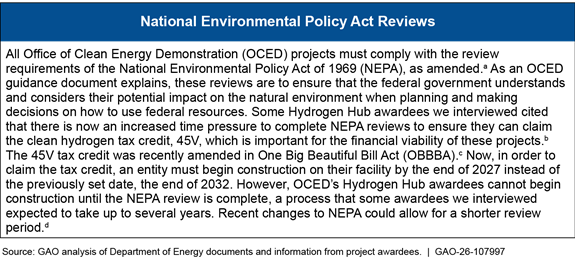
According to one awardee we surveyed, they submitted all information needed for a go/no-go review and to proceed with Phase 2 in November 2024. OCED instructed them to proceed with Phase 2 work via a letter received in March 2025, and indicated that the award modification was under development, but as of July 2025, the award modification had not been received. Some awardees we interviewed waiting on go/no-go reviews indicated that OCED’s delay in reviews will likely negatively impact project schedules and their budgeting, as they cannot start work and access Phase 2 funds until OCED completes its review. Figure 1 shows how delays in project schedules could affect the financial viability of some projects.
Figure 1: How Delays to Project Schedules Could Impact the Financial Viability of Hydrogen Hub Projects
aPub. L. No. 91–190, 83 Stat. 852 (1970) (codified as amended at 42 U.S.C. §§ 4321–47). Specifically, for any “major Federal actions significantly affecting the quality of the human environment,” NEPA requires agencies to prepare a detailed statement of those effects. 42 U.S.C. § 4332(C).
bThe clean hydrogen tax credit is codified at 26 U.S.C. § 45V.
cAn Act To provide for reconciliation pursuant to title II of H. Con. Res. 14, Pub. L. No. 119-21, tit. VII, subtit. A, ch. 5, § 70511, 139 Stat. 72, 252 (2025) (codified at 26 U.S.C. § 45V(c)(3)(C)).
dFor example, the Fiscal Responsibility Act of 2023 amended NEPA, including by adding deadlines and page limits for preparation of environmental review documents. Pub. L. No. 118-5, div. C, tit. III, § 321(b), 137 Stat. 10, 39–46 (codified in relevant part at 42 U.S.C. § 4336a(e), (g)).
· Independent Assessments. OCED developed a policy requiring independent assessments for projects receiving over $100 million of federal funding.[25] This practice was designed to reduce organizational biases.[26] Specifically, OCED planned to meet this requirement by conducting independent project and cost assessments prior to the project construction phase of a project, where the largest amount of money is typically spent. These assessments combine elements of a project review and cost review into one assessment, which includes reviewing elements such as project management quality and feasibility, cost estimate quality as directly tied to scope, schedule, risk, and more.
According to an OCED official, OCED had planned to issue a contract for conducting the independent assessments but did not due to the uncertainty regarding OCED’s future. OCED considered conducting these assessments within OCED. However, all personnel on OCED’s independent assessment team are no longer with the office.
· Demonstration and Deployment Advisory Board (DDAB). DOE established the DDAB in 2023 to provide advice on projects receiving over $100 million of federal funding.[27] This included advising on project-specific risk management and project decisions, such as go/no-go decisions. DDAB can also provide recommendations and guidance on strategy and management, although the DDAB does not have decision-making authority. OCED also indicated that the DDAB was important to implementing our previous recommendation that DOE institutionalize external independent reviews to oversee Advanced Reactor Demonstration Projects.[28] The DDAB last met in October 2024 and has not met since.
· Assessing Lessons Learned. OCED’s approach to assessing lessons learned included having OCED management review prior recommendations, best practices, and interview related experts on DOE’s management of demonstration projects. According to OCED officials, OCED used this information as it established policies and procedures related to project selection and management. However, it is unclear if OCED has policies or processes in place to assess and share lessons learned going forward.
DOE Has No Plan to Ensure it Meets Statutory Project Management and Oversight Requirements
Given the large decrease in staff resources, contract support, and proposed budget, OCED does not have the capacity to be an effective entity, and DOE does not have a plan to ensure it meets statutory requirements for project management and oversight without an effective OCED.
In light of OCED’s limited capacity and funding uncertainty, as well as DOE’s organizational realignment, an OCED official we interviewed indicated the office will likely transfer some projects or project management functions to other DOE offices. DOE is likely to transfer the majority of OCED projects to the newly created Office of Critical Minerals and Energy Innovations. Other projects are likely to be transferred to existing or realigned DOE offices.[29]
However, due to staff losses, it is not clear what these offices’ capacity will be to perform project management oversight. For example, two offices to which OCED could potentially transfer projects also lost staff between January and August 2025. The Office of Energy Efficiency and Renewable Energy lost about 38 percent of staff, while the Office of Fossil Energy and Carbon Management lost about 25 percent of staff.[30]
Similarly, one OCED official indicated that DOE’s Office of Project Management likely has the expertise to conduct some project management functions, such as independent assessments, and has agreed to conduct these assessments contingent upon additional resources of personnel and funding. However, the Office of Project Management lost about 60 percent of its staff between February and May 2025. As of December 2025, the office has not assumed the responsibilities of performing such independent assessments for OCED.
Further, while these offices do have some project management practices in place, GAO has identified project management risks among them. For example, in our December 2021 report, we found that the Office of Fossil Energy and Carbon Management supported projects even though they were not meeting required key milestones and bypassed cost controls designed to limit its financial exposure. As a result, the agency spent nearly $472 million on four unbuilt coal carbon capture and sequestration facilities. We recommended that DOE more consistently administer projects against established scopes, schedules, and budgets.[31] Additionally, in our September 2022 report, we found that the Office of Nuclear Energy had taken some steps to manage the risks associated with nuclear demonstration awards, but had not institutionalized all project management practices, such as external independent reviews. We recommended that DOE document and institutionalize risk management processes for large nuclear energy demonstration projects.[32] DOE indicated that OCED is best positioned to respond to the recommendations made in these reports, and while OCED has made some progress in addressing them, as of November 2025, the recommendations had not been fully implemented.
Regardless of whether DOE shuts down OCED, terminates additional projects, or transfers projects and project management functions to other DOE offices, DOE is required to have a program for project management and oversight of covered projects, as directed by the IIJA.[33] Even if OCED’s ongoing projects are terminated through DOE’s ongoing Portfolio Review Process, DOE still has statutory requirements to have a program to evaluate proposed awards for, and to manage, clean energy demonstration projects as well as billions of dollars in no-year appropriations for such activities. DOE does not currently have a plan for such a clean energy program that takes into account OCED’s and other DOE offices’ currently diminished capacity. Without a plan in place to robustly oversee and manage all the projects, in addition to being unable to fulfill its statutory obligations, DOE faces an increased risk of project mismanagement and not having the capacity to oversee billions of dollars of federal funding. Additionally, there is a decreased likelihood DOE will meet its goal to accelerate the deployment of clean energy technologies.
Conclusions
OCED was established, in part, to consolidate expertise at DOE and address long standing concerns about DOE’s management of large-scale demonstration projects. However, it is likely that OCED does not have the capacity to be effective without the staff or contract support to manage its awards and meet statutorily required oversight functions.
As DOE continues its ongoing process of reexamining awards and how to best organize its remaining staff and operations to advance the agency’s mission, having a plan in place to robustly oversee and manage clean energy demonstration projects will better position DOE to meet its goals and ensure the agency is able to meet statutory requirements.
We and DOE’s OIG have repeatedly reported that it is essential for DOE to have trained project management staff and systems in place to minimize risks of project mismanagement. Moreover, as DOE relies on private sector partners to achieve goals of delivering successful energy demonstration projects to accelerate deployment and market adoption of new or innovative technologies, these changes may affect DOE’s ability to meet its broader goals. Private companies, which are often funding more than 50 percent of these projects, may reconsider future partnerships with the federal government.
Recommendation for Executive Action
The Secretary of Energy should develop a plan to meet statutory requirements for managing projects and assessing lessons learned for clean energy demonstration projects. (Recommendation 1).
Agency Comments
We provided a draft of this report to DOE for review and comment. DOE provided written comments, reproduced in appendix 1. DOE concurred with our recommendation and the agency is working on specific actions to ensure DOE meets statutory requirements for clean energy demonstration projects. DOE also provided technical comments, which we incorporated as appropriate.
We are sending copies of this report to the appropriate congressional committees, the Secretary of Energy, and other interested parties. In addition, the report is available at no charge on the GAO website at https://www.gao.gov.
If you or your staff have any questions about this report, please contact me at ruscof@gao.gov. Contact points for our Offices of Congressional Relations and Public Affairs may be found on the last page of this report. GAO staff who made major contributions to this report are listed in appendix II.
Frank Rusco
Director, Natural Resources and Environment
GAO Contact
Frank Rusco, ruscof@gao.gov
Staff Acknowledgments
In addition to the contact named above, Quindi Franco (Assistant Director), Colson Campbell Ricciardi (Analyst-in-Charge), Maggie Childs, John Delicath, Wil Gerard, Chaya Johnson, Amber Sinclair, Michael Smith, Sara Sullivan, Amanda Sutter, and Jeremy Williams made significant contributions to this report.
The Government Accountability Office, the audit, evaluation, and investigative arm of Congress, exists to support Congress in meeting its constitutional responsibilities and to help improve the performance and accountability of the federal government for the American people. GAO examines the use of public funds; evaluates federal programs and policies; and provides analyses, recommendations, and other assistance to help Congress make informed oversight, policy, and funding decisions. GAO’s commitment to good government is reflected in its core values of accountability, integrity, and reliability.
Obtaining Copies of GAO Reports and Testimony
The fastest and easiest way to obtain copies of GAO documents at no cost is through our website. Each weekday afternoon, GAO posts on its website newly released reports, testimony, and correspondence. You can also subscribe to GAO’s email updates to receive notification of newly posted products.
Order by Phone
The price of each GAO publication reflects GAO’s actual cost of production and distribution and depends on the number of pages in the publication and whether the publication is printed in color or black and white. Pricing and ordering information is posted on GAO’s website, https://www.gao.gov/ordering.htm.
Place orders by calling (202) 512-6000, toll free (866) 801-7077,
or
TDD (202) 512-2537.
Orders may be paid for using American Express, Discover Card, MasterCard, Visa, check, or money order. Call for additional information.
Connect with GAO
Connect with GAO on X,
LinkedIn, Instagram, and YouTube.
Subscribe to our Email Updates. Listen to our Podcasts.
Visit GAO on the web at https://www.gao.gov.
To Report Fraud, Waste, and Abuse in Federal Programs
Contact FraudNet:
Website: https://www.gao.gov/about/what-gao-does/fraudnet
Automated answering system: (800) 424-5454
Media Relations
Sarah Kaczmarek, Managing Director, Media@gao.gov
Congressional Relations
David A. Powner, Acting Managing Director, CongRel@gao.gov
General Inquiries
[1]Pub. L. No. 117-58, div. D, tit. XII, § 41201, 135 Stat. 429, 1130–32 (2021) (codified as amended at 42 U.S.C. § 18861).
[2]An Act To provide for reconciliation pursuant to Title II of S. Con. Res. 14, Pub. L. 117-169, 136 Stat. 1818 (2022) (commonly known as the Inflation Reduction Act). For detail on the appropriations, see GAO, Clean Energy: New DOE Office Should Take Steps to Improve Performance Management and Workforce Planning, GAO‑25‑106748 (Washington, D.C.: Nov. 14, 2024).
[3]Committed means the total federal cost share amount for the full selected or awarded project (as identified in selection or award documentation). For awards with multiple phases, this represents the full federal amount if DOE agrees to pursue all phases of the project, the project successfully meets all milestone requirements to advance to subsequent phases, and is subject to future award negotiations at the end of each phase.
[4]U.S. Department of Energy, Office of Inspector General, Special Report: Prospective Considerations for Clean Energy Demonstration Projects, DOE-OIG-22-39 (Washington, D.C.: Aug. 12, 2022); GAO, Carbon Capture and Storage: Actions Needed to Improve DOE Management of Demonstration Projects, GAO‑22‑105111 (Washington, D.C.: Dec. 20, 2021); GAO, Nuclear Energy Projects: DOE Should Institutionalize Oversight Plans for Demonstrations of New Reactor Types, GAO‑22‑105394 (Washington, D.C.: Sept. 8, 2022).
[5]Pub. L. No. 117-58, § 41201(f)(2), 135 Stat.at 1131 (codified in relevant part at 42 U.S.C. § 18861(h)(2)).
[7]We conducted outreach to the 56 awardees with an ongoing OCED award across portfolios for which we had award documentation. Forty-five awardees responded, and 11 either did not respond or did not have current contact information listed. We did not conduct survey outreach to the 24 awardees whose awards were terminated in May 2025. Of the 45 awardees that responded to our outreach, 37 provided written responses to our survey questions and eight provided responses to our survey questions via interviews. OCED terminated some of these awards after they provided responses to the survey questions. In the interviews, we discussed the questions in greater detail, including their views on OCED’s invoice processing and communication. To characterize the eight interviewed awardees’ views throughout this report, we defined modifiers (e.g., “some”) to quantify users’ views as follows: “some” awardees means two to three awardees, “several” awardees means four to five awardees, “most” awardees means six to seven awardees, and “all” awardees means eight awardees.
[8]Pub. L. No. 117-58, 135 Stat. at 1376–79.
[9]Pub. L. No. 117-58, § 41201, 135 Stat. at 1130–32 (codified in relevant part as amended at 42 U.S.C. § 18861(b), (c)). A covered project is defined as a demonstration project of the Department that (a) receives or is eligible to receive funding from the Secretary and (b) is authorized under division D of the IIJA or the Energy Act of 2020. 42 U.S.C. § 18861(a)(1). The Energy Act of 2020 is division Z of the Consolidated Appropriations Act, 2021, Pub. L. No. 116–260, div. Z, 134 Stat. 1182 (2020).
[10]The U.S. Office of Personnel Management released information in January 2025 allowing federal employees to voluntarily resign via a Deferred Resignation Program (DRP). Deferred resignation was generally available to full-time federal employees, except for military personnel of the armed forces, employees of the U.S. Postal Service, and those in positions specifically excluded by the employing agency. OPM explained that electing employees would retain all pay and benefits, regardless of workload, until their effective resignation date, which could be no later than September 30, 2025. Electing employees would promptly have their duties re-assigned or eliminated and be placed on administrative leave, except during necessary transition activities. The DRP was challenged, although the case was dismissed. Am. Fed’n of Gov’t Employees v. Ezell, No. 1:25-cv-10276, 2025 U.S. Dist. LEXIS 187652 (D. Mass., Sept. 24, 2025). That dismissal has been appealed. Am. Fed’n of Gov’t Employees v. Kupor, No. 25-1959 (1st Cir., Oct. 8, 2025).
[11]GAO, FDA Workforce: Agency-Wide Workforce Planning Needed to Ensure Medical Product Staff Meet Current and Future Needs, GAO‑22‑104791 (Washington, D.C.: Jan. 14, 2022).
[13]Executive Order 14154 of January 20, 2025, “Unleashing American Energy,” requires agencies to review all agency actions to identify any that impose undue burden on the identification, development, or use of domestic energy resources. 90 Fed. Reg. 8353, 8354 (Jan. 29, 2025), at § 3. This order also (1) directed agencies to immediately pause disbursement of funds appropriated under the IRA or Infrastructure Investment and Jobs Act; (2) directed agencies to review such disbursements for alignment with policies specified in the order, and report and provide recommendations to the Office of Management and Budget (OMB) and the National Economic Council within 90 days of the order; and (3) prohibits agencies from disbursing such funds until the Director of OMB and Assistant to the President for Economic Policy have determined that such disbursements are consistent with any review recommendations they have chosen to adopt. Id. at § 7(a), 90 Fed. Reg. at 8357. Several lawsuits against E.O. 14154 and the pause in disbursements are pending, and courts have preliminarily enjoined the pause, at least in part. For example, the U.S. District Court for the District of Rhode Island preliminarily enjoined DOE and other agencies from freezing, halting, or pausing on a non-individualized basis the processing and payment of already-awarded funds appropriated under the IRA and IIJA, pending resolution of the lawsuit, and ordered the agencies to take immediate steps to resume the processing, disbursement, and payment of these already-awarded funds. Woonasquatucket River Watershed Council v. United States Dep’t of Agric., 778 F. Supp. 3d 440 (D.R.I., Apr. 15, 2025) (appealed No. 25-1428 (1st Cir.; May 1, 2025)); see also Nat’l Council of Nonprofits v. OMB, 775 F. Supp. 3d 100 (D.D.C. 2025) (appealed No. 25-5148 (D.C. Cir., Apr. 25, 2025)).
[14]DOE Policy Memorandum, May 15, 2025. Ensuring Responsibility for Financial Assistance.
[15]DOE’s termination letters sent in October 2025 noted that the awards did not pass Standards of the Portfolio Review Process Committee.
[16]House Committee on Appropriations, Subcommittee on Energy and Water Development and Related Agencies, Hearing on Fiscal Year 2026 Department of Energy Budget Request (119th Cong.; May 7, 2025) (Testimony by Sec. Chris Wright).
[17]DOE, Fiscal Year 2026 Congressional Budget Justification, Budget in Brief (May 2025). DOE appropriations for fiscal year 2026 did not include appropriations directed to OCED. Commerce, Justice, Science, Energy and Water Development; and Interior and Environment Appropriations Act, 2026, Pub. L. No. 119-74, div. B, tit. III, __ Stat. __ (2026).
[18]An Act To provide for reconciliation pursuant to title II of H. Con. Res. 14, Pub. L. No. 119-21, tit. V, subtit. D, § 50402(b), 139 Stat. 72, 152 (2025).
[19]DOE has taken steps to terminate some of the projects in the Industrial Demonstrations Program and some of the previously obligated funds may be deobligated as a result. As of November 2025, the $4.5 billion has not been formally deobligated and made available for rescission.
[20]DOE guidance directs that payment must be made within 30 calendar days after receipt of the payment request for cost reimbursement, unless the request is deemed improper.
[21]For the remaining 30 of 36 invoices, OCED’s approval timeframe ranged from 32 days to 106 days, with 11 invoices still under review.
[22]To characterize the eight interviewed awardees’ views throughout this report, we defined modifiers (e.g., “some”) to quantify users’ views as follows: “some” awardees means two to three awardees, “several” awardees means four to five awardees, “most” awardees means six to seven awardees, and “all” awardees means eight awardees. OCED terminated some of these awards after our interviews.
[23]Exec. Order 14151 of January 20, 2025, “Ending Radical and Wasteful Government DEI Programs and Preferencing,” 90 Fed. Reg. 8339 (Jan. 29, 2025).
[24]In the standard terms and conditions, OCED’s financial assistance agreements state that “DOE will conduct a Go/No-Go Review of the Recipient’s application and performance under the Award to date at the end of each Budget Period to inform its decision on whether to fund the Award in the next Budget Period (“Continuation Decision”).” DOE’s continuation decision is contingent upon considerations including “the project continuing to support DOE’s programmatic goals and be economically viable.” “As a result of this [Go/No-Go] review, DOE, in its sole discretion, may choose to (1) fund the Award in the next Budget Period, (2) fund the Award in the next Budget Period with additional conditions or requirements, or (3) not fund future Budget Periods of the Award.” “Each decision whether to authorize and fund activities in the next Budget Period is separate and distinct and the Recipient has no entitlement to any authorization or funding of activities beyond the current Budget Period.”
[25]DOE Order 540.2, “Independent Assessments of Projects Receiving $100 Million or More in Federal Financial Assistance or Other Transaction Authority” (Washington, D.C.: Oct. 28, 2024).
[26]See GAO‑22‑105394.
[27]DOE Memorandum, “Large Clean Energy Demonstration and Deployment Projects” (Washington, D.C.: Jan. 3, 2023).
[29]According to OCED officials, OCED transferred two advanced nuclear demonstration projects from OCED to DOE’s Office of Nuclear Energy around May 2025. This included transferring staff (program management, contracting officers, and environmental specialists) from OCED to the Office of Nuclear Energy to support these projects.
[30]In the organizational realignment, the Office of Energy Efficiency and Renewable Energy is to become part of the new Office of Critical Minerals and Energy Innovations and the Office of Fossil Energy and Carbon Management is to be merged with the Geothermal Energy Office to become the Office of Hydrocarbons and Geothermal Energy.
[33]Pub. L. No. 117-58, § 41201, 135 Stat. at 1130–32 (codified in relevant part as amended at 42 U.S.C. § 18861(b)).