
Report to the Ranking Member, Committee on Oversight and Government Reform, House of Representatives
United States Government Accountability Office
A report to the Ranking Member, Committee on Oversight and Government Reform, House of Representatives
For more information, contact: Karen L. Howard at HowardK@gao.gov.
What GAO Found
Anyone conducting weather modification operations in the U.S. is required to notify and update the National Oceanic and Atmospheric Administration (NOAA), which is in turn required to maintain a record of the activities and share it with the public. Weather modification includes cloud seeding (which seeks to alter local precipitation) and solar geoengineering (which seeks larger scale changes in climate). Several states use cloud seeding to address an ongoing lack of precipitation in the western U.S. Cloud seeding is the most common weather modification technique, but recently, more organizations have begun to conduct solar geoengineering operations or research.
NOAA has a statutory requirement to provide oversight of weather modification reporting, but the agency is not fully meeting its responsibilities to maintain and share weather modification reports. Weather modification operators may report inconsistent information or fail to report, and we estimate that over half of all the reports filed with NOAA likely have errors, including missing required information (e.g., maps). NOAA does not have written agency guidance for reviewing reports or maintaining its database. Such guidance could help NOAA meet its responsibilities and provide useful, complete, and transparent information to the public.
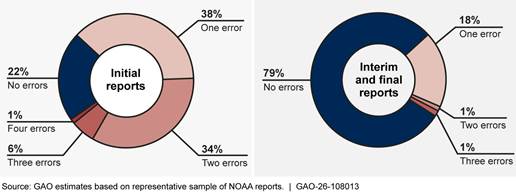
Estimated Errors in Initial, Interim, and Final Reports from the National Oceanic and Atmospheric Administration (NOAA) Weather Modification Reports Database
NOAA is also required to maintain a record of emerging solar geoengineering activities, but its forms and processes are not well-suited to those activities. Operators had challenges with the forms and reporting process and may also be unaware of the reporting requirement. State and local officials engaging with weather modification activities may likewise be unaware of NOAA’s reporting process, even though the reports could contain information they need to make decisions about weather modification. Improved instructions and outreach from NOAA could help ensure operators are reporting their activities and providing better-quality information to improve understanding of this emerging technology.
Implementing measures to increase the quality of the information NOAA collects from operators could help provide transparent information to the public about weather modification activities, including solar geoengineering. This could also provide more assurance that these activities are being properly overseen, and may help address increased public concern, canceled projects, or bans.
Why GAO Did This Study
NOAA, within the Department of Commerce, is the only federal agency with responsibilities under the Weather Modification Reporting Act of 1972 (the Act).
This report examines the extent to which NOAA is meeting its statutory responsibilities for overseeing current U.S. weather modification reporting and is prepared to oversee an emerging approach like solar geoengineering.
To conduct this review, GAO analyzed a representative sample of weather modification reports filed with NOAA and available on its website and compared reports to information from other sources. GAO reviewed 54 articles from a structured literature search, visited nine locations across two states, and held 24 interviews with agency officials, operators, and other stakeholders.
What GAO Recommends
GAO is making three recommendations, including that Commerce and NOAA should (1) establish written agency guidance for its review of and confirmation that all weather modification reports submitted to NOAA contain the legally required information; (2) improve NOAA’s instructions on how to complete the reporting forms for a range of weather modification activities, including emerging solar geoengineering activities; and (3) implement a process to regularly inform the operators as well as state and local agencies directly about NOAA’s role in weather modification oversight, the applicability of the Act to different activities, and where to find required reporting forms. NOAA agreed with the recommendations.
Abbreviations
EPA Environmental Protection Agency
NOAA National Oceanic and Atmospheric Administration
This is a work of the U.S. government and is not subject to copyright protection in the United States. The published product may be reproduced and distributed in its entirety without further permission from GAO. However, because this work may contain copyrighted images or other material, permission from the copyright holder may be necessary if you wish to reproduce this material separately.
February 23, 2026
The Honorable Robert Garcia
Ranking Member
Committee on Oversight and Government Reform
House of Representatives
Dear Ranking Member Garcia:
Weather modification has been broadly defined as any attempt to deliberately and artificially change the makeup or behavior of the atmosphere. This definition covers both short-term, local activities—such as cloud seeding, which seeks to increase precipitation—and larger scale activities, such as solar geoengineering (also called solar radiation modification or solar radiation management), which seeks to decrease global temperature.[1] To help address an ongoing lack of precipitation in the western U.S., several states are using cloud seeding to increase precipitation. In 2024, a range of state and local agencies across nine states were spending or planning to spend a combined total of at least $20 million on cloud seeding to increase local precipitation in the form of rain or snow.[2] In addition, as global temperature has increased, so has interest in solar geoengineering. However, the public may not fully understand weather modification, including how cloud seeding differs from other activities such as solar geoengineering, and questions about these activities are increasing.
Federal support and involvement in weather modification is minimal. Currently, the National Oceanic and Atmospheric Administration (NOAA) is the only federal agency with a statutory requirement directed at weather modification.[3] Specifically, under the Weather Modification Reporting Act of 1972 (the Act), NOAA requires all persons conducting weather modification operations (which may include field research) within the U.S. to notify and update NOAA prior to commencing their activities, during their activities, and upon completion.[4] The purpose of the Act is to provide for the reporting of weather modification activities to the federal government and to that end it requires that records of weather modification shall be maintained by NOAA and shared with the public “to the fullest practicable extent.”[5]
We performed our work at the initiative of the Comptroller General. This report examines (1) the extent to which NOAA is meeting its statutory responsibilities for overseeing current U.S. weather modification reporting and (2) the extent to which NOAA is prepared to oversee an emerging approach like solar geoengineering.
To address our objectives, we analyzed agency and other data, reviewed literature, and conducted interviews. Specifically, to evaluate the extent to which NOAA’s weather modification report submission, processing, and record maintenance efforts are meeting the Act’s requirements, we analyzed a representative sample from over 1,000 weather modification reports filed with NOAA that are publicly available on its website in the online database of weather modification reports (referred to as “the database” below) to determine the extent to which the reports contained required information.[6] We also analyzed original reports in the form they were submitted to NOAA by weather modification stakeholders, as well as other sources that report these activities, to check for missing reports or any changes in the reports as they were posted to the website.
We also reviewed 54 articles from a structured literature search we carried out to understand current and emerging types of weather modification. We also conducted 24 interviews with researchers, weather modification operators, and others. The results of these interviews are illustrative and not generalizable. See appendix I for a detailed description of our scope and methodology.
We conducted this performance audit from January 2025 to February 2026 in accordance with generally accepted government auditing standards. Those standards require that we plan and perform the audit to obtain sufficient, appropriate evidence to provide a reasonable basis for our findings and conclusions based on our audit objectives. We believe that the evidence obtained provides a reasonable basis for our findings and conclusions based on our audit objectives.
Background
What is Weather Modification?
The Act defines weather modification as “any activity performed with the intention of producing artificial changes in the composition, behavior, or dynamics of the atmosphere.”[7] This definition covers cloud seeding (which seeks to alter local precipitation) and solar geoengineering (which seeks to cool Earth by reflecting solar energy back into space), among other activities.[8] Although solar geoengineering activities have recently increased, as we reported in December 2024, most weather modification activities in the U.S. focus on cloud seeding to enhance local precipitation.[9]
|
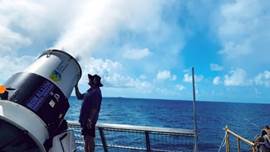
Marine Cloud Brightening Research Could Protect the Great Barrier Reef Off the coast of Australia, researchers are conducting marine cloud brightening experiments to research the potential to reduce coral bleaching in the Great Barrier Reef. The Great Barrier Reef is home to thriving coral reefs and abundant marine life. However, with warming sea surface temperatures, coral reef ecosystems may be affected by coral bleaching, which often leads to coral death. Marine cloud brightening may be useful as a tool to mitigate rising temperatures. This research is intended to limit the intensity and amount of solar radiation reaching Earth’s surface by increasing the reflectivity of clouds. These efforts may help cool sea surface temperatures.
A researcher sprays droplets of seawater into the sky to brighten clouds, increasing their ability to reflect sunlight and potentially reducing the temperature of the water below. Source: GAO analysis; Southern Cross University, 2023 (image). | GAO‑26‑108013 |
Solar geoengineering falls into three strategies: stratospheric aerosol injection, cirrus cloud thinning, and marine cloud brightening, generally used from higher to lower in the atmosphere, respectively (see fig. 1). Stratospheric aerosol injection is the addition of reflective particles or gases, such as sulfur dioxide, higher above Earth (in the stratosphere) to increase reflectivity there and reduce incoming solar radiation. This method tries to mimic the cooling effect some volcanic eruptions have had. Cirrus cloud thinning is intended to modify high-altitude cirrus clouds to allow more outgoing heat to escape Earth’s atmosphere. This method is not well understood and has only been studied in computer simulations to date. Marine cloud brightening modifies clouds over the ocean to increase their ability to reflect sunlight, reducing incoming heat to Earth’s atmosphere and potentially cooling the water and coast. Marine cloud brightening focuses cooling on a regional scale over large bodies of water (e.g., in clouds over ocean reefs) while stratospheric aerosol injection could have global cooling effects.
Figure 1: Comparison of Solar Geoengineering for Global or Regional Cooling Versus Cloud Seeding for Increased Local Precipitation
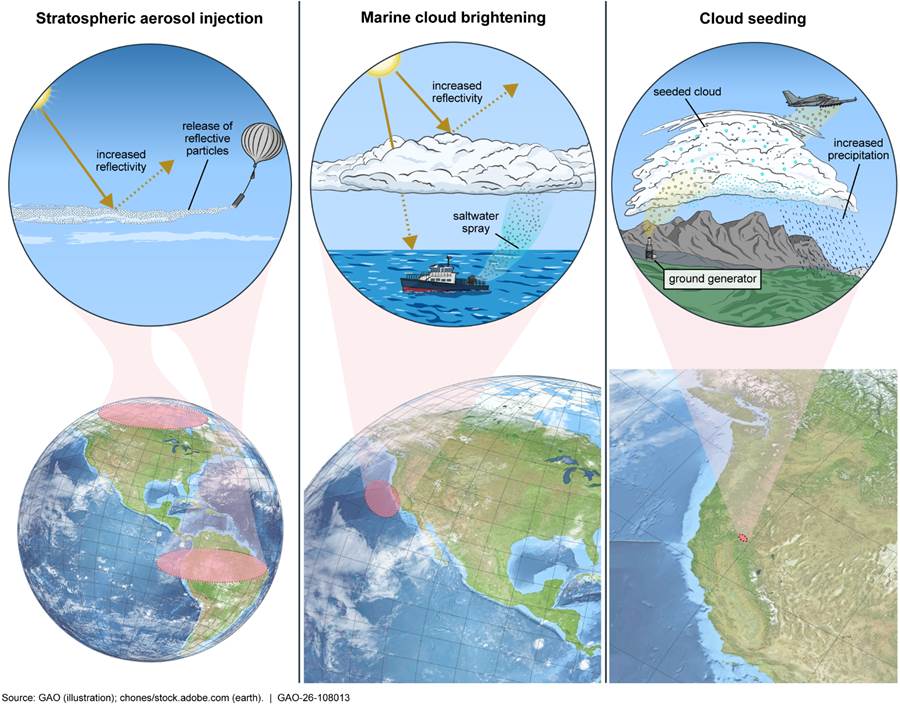
Note: Highlighted areas are illustrative.
Weather Modification Status in the U.S.
As of July 2025, 10 states had reported weather modification activities (see fig. 2). All of these states have an approval process, such as permitting or licensing, before weather modification operations can occur. As of that same date, three states had banned weather modification, and 29 other states had proposed some form of ban, five of which (Idaho, Texas, Utah, Wyoming, and North Dakota) also have active cloud seeding programs or activities.
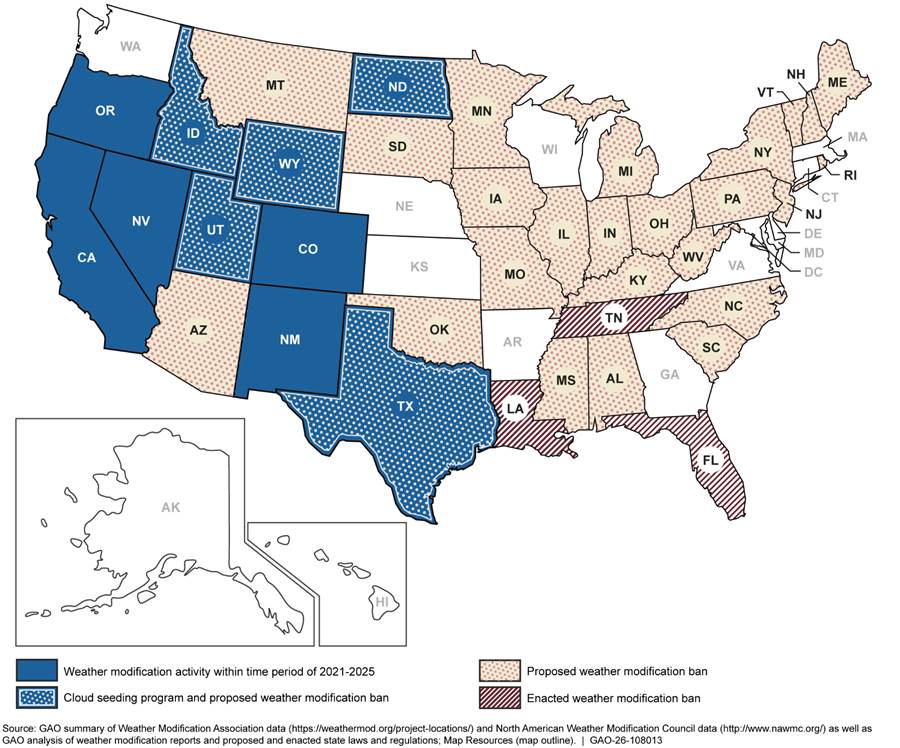
Note: Proposed bans may only address certain types of weather modification activities, or activities conducted by certain actors.
In 1974 and 1979, we reported that a coordinated federal approach to these programs had never been established, despite more than a decade of supporting weather modification studies.[10] In 2010 and in 2011, we reported that a coordinated federal strategy for geoengineering did not exist, which created challenges for agency and policymaker decisions about geoengineering.[11] Our 2011 report further noted that “we cannot ignore the possibility of new risks from either [geoengineering] research or its use or misuse.”
In 2013, the Congressional Research Service reported that the potential effects of geoengineering activities may cross state and regional boundaries, and this may necessitate more comprehensive federal policy regarding geoengineering.[12] In recent years, there has been an increase in interest in and proposals for solar geoengineering field experiments. According to the Center for International Environmental Law, out of the nearly 600 outdoor geoengineering experimental trials proposed since 1971, more than half were submitted between 2019 and 2023.[13] NOAA is currently the only federal agency with laws directly pertaining to weather modification.
NOAA’s Role in Weather Modification Oversight
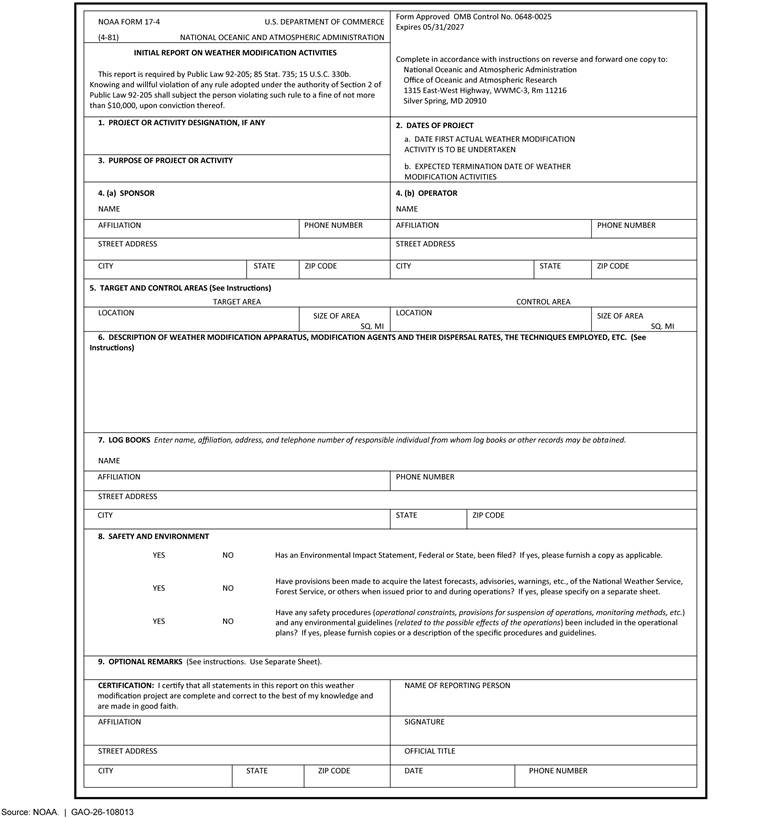
Under the Act, no person may engage or attempt to engage in weather modification in the U.S. without submitting a report to NOAA, and fines for knowing and willful failure to report could be up to $10,000.[14] Federal regulations (referred to below as “the regulations”) detail which activities are required to be reported and what information should be provided in initial, interim, and final activity reports.[15] For example, initial reports of weather modification should include the planned dates of the activities, environmental and safety information, and maps of activity areas including details such as where control measurements are planned to occur (see fig. 3).[16]
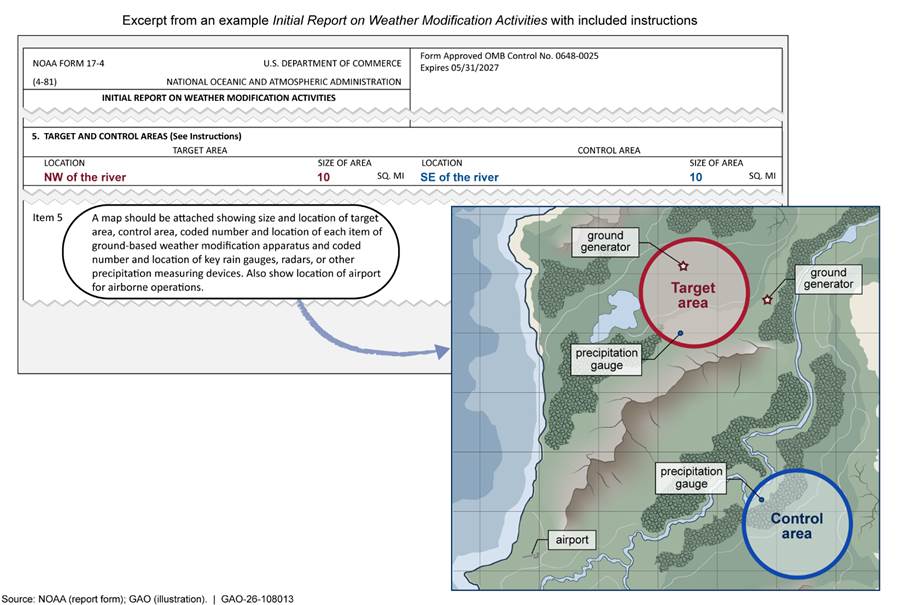
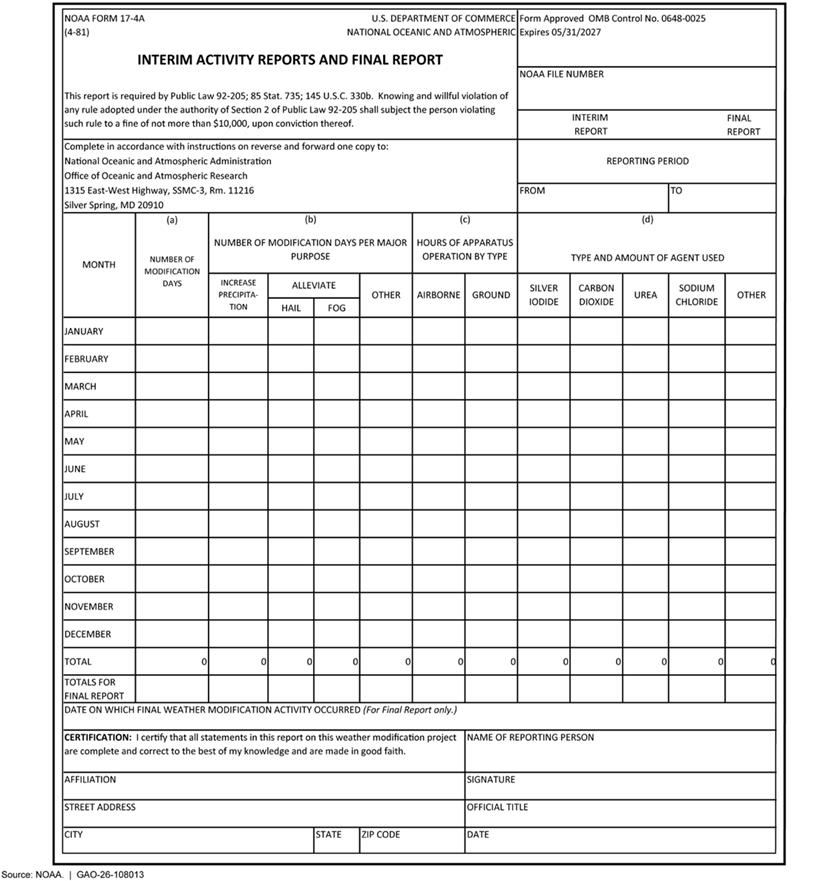
Interim and final reports use the same form. These reports must include the amounts of any substances used and the days per month that weather modification activities took place. See appendix II for blank copies of the initial report and the interim and final reports.
NOAA stores the reports it receives in a database, which is publicly available on the agency website. The database provides brief descriptions of reporting requirements and access to downloadable files of all available reports. These files can be searched by date range, purpose of the activity, and a project number or designator often including a two-letter state code and year. These data are submitted by the operator. Operators are required to send initial reports to NOAA at least 10 days before their activity begins, and final reports no more than 45 days after the activity ends. On its website, NOAA also provides information about weather modification, links to the regulations, the required reporting forms, and an email address for operators to contact for assistance or to submit their reports.
Other Agencies
Other federal agencies, such as the Environmental Protection Agency (EPA), have limited roles in weather modification oversight. For example, because the most common seeding agent (silver iodide) was in use prior to enactment of the Toxic Substances Control Act in 1976 and quantities of weather modification agents released into the environment are typically very low (below Clean Air Act reporting thresholds), the role of EPA in weather modification oversight has traditionally been limited. However, in response to the National Weather Modification Policy Act of 1976, in 1979 the Commerce Department issued a report to the President and Congress on weather modification noting that as more effective technologies for weather modification were developed and private weather modification activities became more common, the interstate implications of weather modification would warrant a more comprehensive federal regulatory role.[17]
NOAA Is Not Fully Meeting Responsibilities for Providing Oversight of Weather Modification Reporting
NOAA is not fully meeting responsibilities for providing federal oversight and public transparency of weather modification reporting. The agency’s processes for reviewing reports and maintaining the database contribute to several issues, including incomplete, inconsistent, and unreliable information. NOAA also provides limited guidance on reporting requirements and does not effectively communicate with operators and other stakeholders, which further impedes use of the database.
NOAA Processes Do Not Ensure Transparency or Reliability of Reports in Its Database
NOAA officials interpret the agency’s responsibility to maintain a public database of complete weather modification reports as a matter of public transparency but told us that responsibility does not cover additional oversight actions. The Act and implementing regulations require that any person conducting weather modification activities must report those activities to NOAA before, during, and after their completion, and that the agency must maintain records of those activities for the public. NOAA officials told us they receive reports submitted by weather modification operators, ensure required information is present, and make all reports they receive available on the agency website.
NOAA’s publicly accessible, online database of reports contained 1,084 files as of February 2025.[18] We analyzed a representative sample of 111 files to determine whether they contained information required by the regulations and found the database to be incomplete, inconsistent, and unreliable. Specifically:
· Incomplete. Reports have been lost or were never included in the database. In March 2025, NOAA officials told us that all the reports they had were available in the database, and some reports submitted prior to use of digital records may have been lost. Although the Act went into effect in 1971 and does not specify how long reports need to be maintained by the agency, the earliest report NOAA had in its database, as of December 2025, was from 1999. NOAA officials told us that prior to the creation of the online database in 2019, reports were published in other ways. For example, in 1989 NOAA published a print summary of reported weather modification activities which noted that individual reports were available on written request. Officials told us they do not know the location of some reports submitted prior to use of the online database and repeatedly noted a lack of resources when describing the program’s status.
Two of the operators we interviewed provided emails and other evidence of their submitted reports that we were unable to find in the database. We also reviewed state agency websites describing weather modification activities occurring within those states between 2021 and 2025 and found four out of 10 of these states had publicly reported activities that did not appear in the NOAA database.
An additional factor that may contribute to the incompleteness of the database is that the NOAA office responsible for reviewing the reports does not host the database. Specifically, NOAA officials told us that Weather Program Office staff who review the reports submit them to be hosted by the NOAA Library on a quarterly basis. NOAA officials said there is no memorandum of agreement with the library for this task or for how long the reports must be kept available on the website. Without agency guidance, NOAA may not be able to ensure the reports remain available. As we noted in December 2024, incomplete reporting about weather modification may hamper long-term or larger scale studies about its efficacy.[19]
· Inconsistent. NOAA has not ensured a consistent report filing system in its database. For example, we found that multiple reports from the same project had inconsistent designators, some files had multiple reports contained within them, and some individual reports’ maps were stored under separate designators.[20] Three stakeholders said reports in the database are difficult to find and use. Specifically, one noted this makes analysis of them challenging and another said the database does not meet the public transparency intent of the Act. For example, researchers attempting to use the database told us they have found it to be unclear and of limited use for their research. NOAA officials told us that while funds were set aside in 2024 for the library to improve the database, such as incorporating the ability to search based on the activity location, more recent cuts to funding for information technology and staff delayed those improvements. Officials said they now anticipate the work to be completed in spring 2026.
· Unreliable. NOAA officials told us that, in cases the officials were aware of, operators have proactively corrected their own reports. However, our analysis estimated that 78 percent of initial reports had one or more errors, and 21 percent of interim and final reports had at least one error (see fig. 4).[21] However, interim and final reports have fewer requirements than initial reports, provide space within the form for all inputs, and do not require attachments like maps or environmental reports, which may be more easily lost or left out. This may account for some of the disparity between reporting errors in initial reports versus interim or final reports.
Figure 4: Estimated Errors in Initial, Interim, and Final Reports from the National Oceanic and Atmospheric Administration (NOAA) Weather Modification Database
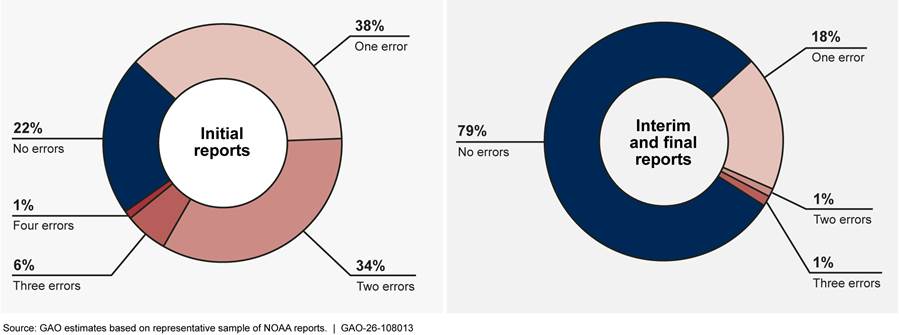
Notes: The 95 percent confidence intervals (CI) for categories follow: initial reports with no errors (14-32 percent); initial reports with one error (28-49 percent); initial reports with two errors (24-44 percent); initial reports with three errors (2-13 percent); initial reports with four errors (0-9 percent); interim and final reports with no errors (69-87 percent); interim and final reports with one error (11-29 percent); interim and final reports with two errors (0-9 percent); interim and final reports with three errors (0-9 percent). Due to rounding, some percentages may not add to exactly 100 percent.
The regulations require a map for each weather modification initial report, and the map must contain the size and location of target and control areas, as well as other operational information. However, our review of initial reports estimated that 32 percent of initial reports did not include a map and that an additional 36 percent of reports included maps with one or more missing components (see fig. 5). Accurate maps, if available, could be used to inform operators that they were seeding a previously affected area. Operators could then more accurately estimate the cost and potential effectiveness of their operations. Maps could also address public questions about where weather modification activities occur, more accurately model atmospheric conditions or forecast weather, and better evaluate unintended effects including potential safety and environmental effects of the activities.
Figure 5: Estimated Errors in Maps from the National Oceanic and Atmospheric Administration (NOAA) Weather Modification Database
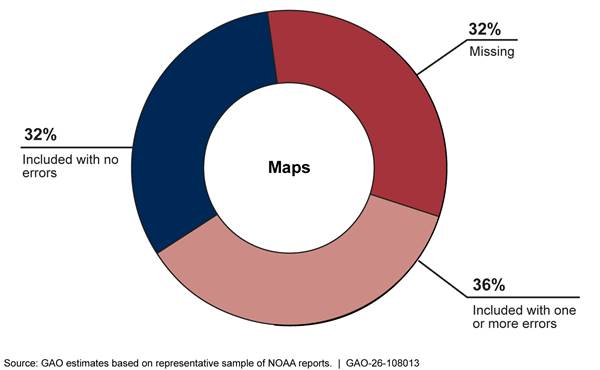
Notes: The 95 percent confidence intervals (CI) for categories follow: map included with one or more errors (27-47 percent); map included with no errors (23-42 percent); map missing (23-43 percent). Due to rounding, some percentages may not add to exactly 100 percent.
NOAA officials told us they have no written agency guidance for collecting or processing weather modification reports. They also said they only review the database periodically to confirm that links to reports are active. Consequently, NOAA is not fully aware of the extent of weather modification activities that have occurred and are occurring within the U.S., how they are being conducted, or potential effects. Federal standards for internal control state several principles to support efficient and effective systems, such as that agency managers should communicate assigned responsibilities and expectations; document and communicate policies and procedures; and obtain relevant, quality information and use it to support the functioning of the system.[22] In 1976, NOAA stated that one intention of the weather modification reporting program was that scientists and other concerned persons have access to information about past and ongoing weather modification efforts. In addition, NOAA stated that the program provides information on the possibility of harm or interference with federal research projects, and the regulations state that NOAA may inform operators and state officials about such cases and make recommendations.[23] Written guidance about collecting and processing reports may help address issues with the database and help NOAA fulfill the intention of the program.
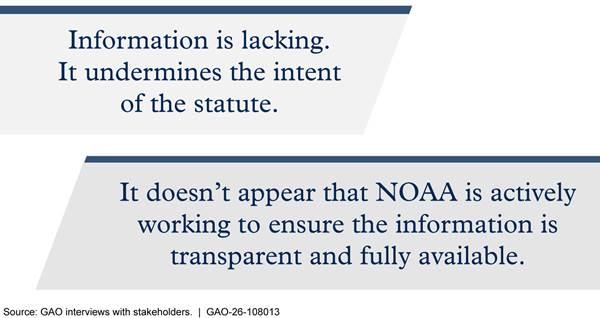
Without complete files, the transparency and usefulness of the database is limited. Stakeholders also reported to us that they perceive a lack of oversight from NOAA based on the state of the database (see fig. 6). This leads to a lack of public knowledge and trust that the technology is being overseen, which may contribute to increased public concern, canceled projects, or bans. Establishing agency guidance for the internal review of and confirmation that all weather modification reports submitted to NOAA contain all legally required information would help address the errors in the database and increase transparency and public trust for weather modification activities.
Figure 6: Stakeholder Perspectives on National Oceanic and Atmospheric Administration (NOAA) Information Transparency
NOAA Does Not Effectively Communicate Its Reporting Requirements
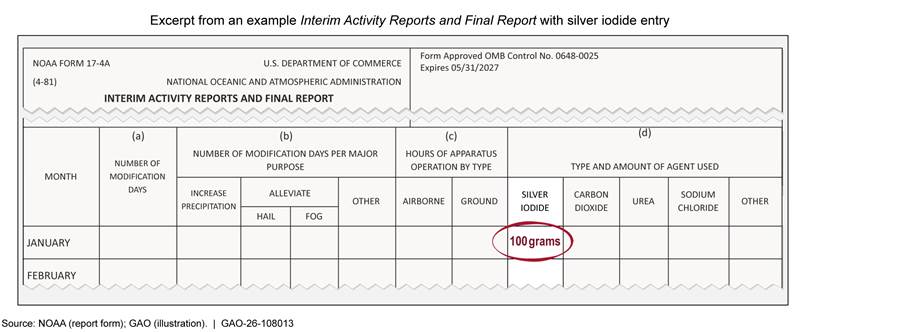
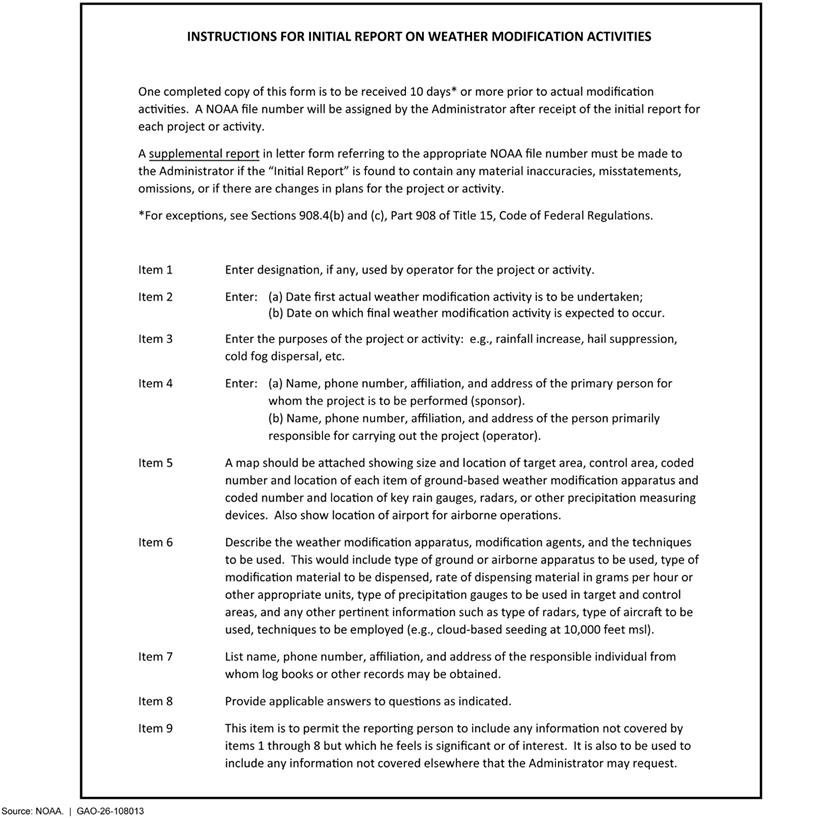
NOAA provides some public guidance on reporting requirements through a single page of instructions attached to the initial report form. However, as of December 2025, NOAA does not provide instructions for interim or final reports. Federal standards for internal control state that officials should externally communicate quality information so that external stakeholders can help agencies meet their goals.[24] Stakeholder comments and our review identified areas on the forms that are inadequate to gather complete, accurate, and reliable information. We also found that the instructions are unclear. For example, operators must explain the amount of different chemicals used during their activities on the interim and final reports, but the form does not include a specific space for unit measurements or explain how the amounts should be measured. One operator could thus report amounts in grams where another could use pounds. Operators using airborne cloud seeding must also individually decide whether they should report only the amounts of active materials or the total weight of the flares.[25] Figure 7 shows an excerpt from an interim activity and final report, showing the amount of space given on the report and one way it has been interpreted by operators. As shown in our review of the database, many of the submitted forms contained errors or had missing components. In addition, some operators told us they were not able to understand how to fill out the forms or found the forms lacked space and context to accurately describe their activities.
Figure 7: Excerpt from a National Oceanic and Atmospheric Administration (NOAA) Interim Activity Report and Final Report
If operators are using the same sections of the form but reporting different information, it impedes use and interpretation of reports by other operators and the public. For example, some NOAA officials told us they do not use the database to inform other agency work that could otherwise benefit from the inclusion of information about weather modification activities, including atmospheric modeling efforts or weather forecasting. NOAA also does not assess weather modification reports for scientific validity or accuracy, although the regulations imply that the agency may review weather modification activities to determine whether the activities depart from generally accepted practices.[26] Further, the information in the database is not complete, accurate, or transparent to operators and the public. Providing operators with clearer instructions about the forms could increase accuracy, completeness, and usability of the database and improve monitoring and oversight of weather modification reporting.[27]
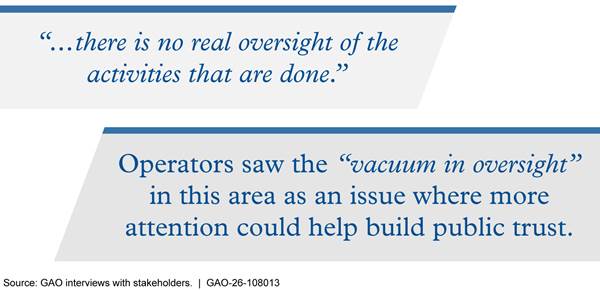
NOAA officials told us they do not actively seek missing reports, but when made aware by other sources, they have contacted the operator in noncompliance.[28] Officials provided letters from a prior correspondence with one operator who had not been reporting. A state official was unsure what happens if operators do not report, and another state official told us that the lack of accountability for individuals that do not report means that “there is no oversight and really…no reason to report.” Under the Act, operators who knowingly and willfully fail to report their weather modification activities can be fined, but officials said they have never imposed a fine. This lack of accountability for operators further contributes to NOAA’s inability to provide complete and transparent information about weather modification activities.
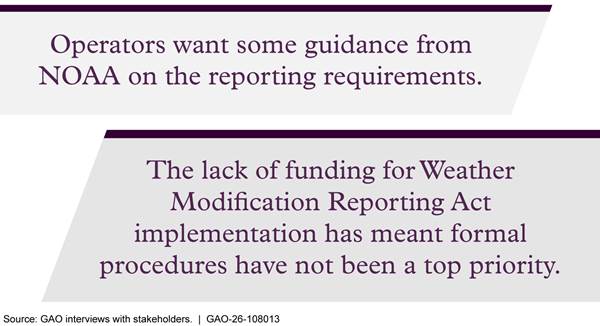
Finally, some operators and state and local agency stakeholders we interviewed expressed confusion about the weather modification reporting process and requirements (see fig. 8). NOAA officials told us that, due to a lack of resources, they rely on peer-to-peer outreach to inform the public and operators of the requirement to submit reports. For example, NOAA officials provided documentation of a panel discussion and said they had personal conversations with stakeholders at conferences. A state official involved with weather modification operations in their state told us that operators “don’t understand the necessity or value of reporting.” Although NOAA officials told us they consider the agency to be meeting its responsibilities under the Act, our findings show that NOAA’s processes and resources do not enable effective oversight. According to federal standards for internal control, quality information and communication can allow external stakeholders, such as operators, to help agencies meet their goals.[29] Regularly informing operators and state and local agencies about NOAA’s role in weather modification reporting oversight and where to find required forms may help address missing or incomplete forms.
Figure 8: Stakeholder Perspectives on National Oceanic and Atmospheric Administration (NOAA) Guidance and Communication
NOAA Is Not Fully Prepared to Oversee Reporting of Emerging Solar Geoengineering Activities
In addition to conventional weather modification approaches such as cloud seeding, the Act’s definition of weather modification encompasses emerging weather modification approaches, like solar geoengineering. However, despite an increasing number of these solar geoengineering activities, NOAA is not fully prepared for smaller-scale activities, let alone large-scale, coordinated activities. Some solar geoengineering stakeholders told us they had challenges with NOAA’s reporting forms, and that the forms were not well suited to their activities. In addition, NOAA’s current implementation approach under the Act does not ensure it collects and communicates quality information to the public on solar geoengineering activities, limiting public transparency. Because NOAA’s forms and process are not well suited to solar geoengineering, the agency’s oversight is limited, and the public may not understand how solar geoengineering fits under NOAA’s reporting system or trust information contained in the database.
Some Solar Geoengineering Stakeholders Identified Additional Challenges with Reporting Their Activities
The NOAA weather modification reporting form is not well suited for solar geoengineering activities, and some stakeholders told us it is unclear what activities must be reported to NOAA. Activities “modifying the solar radiation exchange of the earth or clouds” are subject to reporting and NOAA officials told us that NOAA’s office of general counsel concluded that solar geoengineering would fall under the Act’s reporting requirements.[30] However, stakeholders struggled with certain aspects of the reporting process, limiting public transparency of solar geoengineering activities.
With regard to the reporting forms, solar geoengineering operators appreciated that the initial reporting form was not too lengthy, but they also told us they had challenges with it. For example, the regulations require that the initial report submission includes a map with the size and location of a target area and control area on the ground. A cloud seeding activity might target a specific mountain range for precipitation enhancement and use a nearby, unseeded mountain range as a control area. However, solar geoengineering operators are typically aiming for broader regional or even global effects, so they told us it is difficult to define a target area on the ground, as required for the map. Specifically, solar geoengineering activities such as marine cloud brightening may target clouds over water but not specific ground areas, and stratospheric aerosol injection may result in global effects so there cannot be a control. Solar geoengineering operators told us the map requirement may be ambiguous for their activities.
While solar geoengineering technologies and activities have advanced since the weather modification reporting forms were first created in 1972, the forms have remained virtually unchanged since 1974. Solar geoengineering activities may currently represent a very small proportion of weather modification activities (e.g., out of 1,084 reports in NOAA’s public database as of February 2025, four describe solar geoengineering activities), but interest in geoengineering has increased recently. Solar geoengineering stakeholders we talked to told us that the reporting forms seem to be designed for cloud seeding. Consequently, the reporting process may not capture quality information on solar geoengineering activities in the U.S.
Some solar geoengineering operators may also be unaware of the reporting requirement or unclear whether their activities fall under the Act, contributing to a potentially incomplete picture of solar geoengineering activity. NOAA officials told us they are aware the public may not understand that solar geoengineering activities fall under the Act. Federal internal control standards state that agency managers should communicate relevant and quality information with appropriate external parties, but weather modification operators receive minimal guidance from NOAA on completing the reporting forms.[31]
Weather modification operators expressed a need for more guidance from the agency. NOAA officials also told us that while it is useful to collect information on solar geoengineering research, the usefulness of the information they collect is limited by operators’ lack of knowledge of the reporting requirement. NOAA officials also told us they do not actively look for unreported weather modification activities. Officials told us they requested retroactive reports from one solar geoengineering operator only after learning of their activities from outside sources. The operator was unaware that its activities fell under the Act until notified directly by NOAA. Because NOAA is unaware of the extent of unreported activities, this limits the intended public transparency of the Act. Improved guidance from NOAA, such as to state licensing or permitting officials, could increase operator awareness of the reporting requirement.
NOAA’s Implementation Approach Provides Insufficient Oversight of Reports from Emerging Solar Geoengineering Activity
NOAA’s implementation approach under the Act does not ensure that quality information on solar geoengineering activities is collected and made available to the public. Because the forms are not well suited to solar geoengineering and the public may not understand how these activities fit under NOAA’s reporting system, oversight is limited. Solar geoengineering activities are challenging to identify in the database, and some stakeholders are not aware of the database or NOAA’s role. Because of challenges with the quality of the online database and with public awareness of the federal role in solar geoengineering reporting, NOAA’s weather modification reporting process does not provide effective oversight.
Database quality. In NOAA’s database, solar geoengineering activities are difficult to identify and distinguish from other weather modification activities like cloud seeding for precipitation enhancement. For example, as of February 2025, the four solar geoengineering reports in the database are not categorized as such but as “marine boundary layer” or “air temperature reduction” or they are left undesignated. Reports are entered into the database as individually scanned documents, or even photos of documents, further limiting searchability. For example, one stakeholder we spoke with struggled to find a solar geoengineering report in the database even though the report was available. That stakeholder instead turned to media outlets to learn more about the solar geoengineering activity.
Public awareness of reporting and database. Stakeholders from multiple sectors expressed a need for NOAA to provide more information to the public to improve understanding of solar geoengineering activity.[32] Activity and interest in solar geoengineering have increased in recent years. For example, local officials and the public were surprised to learn of a recent solar geoengineering activity occurring near them. NOAA officials told us they may have an opportunity to update the weather modification reporting form to include information specific to solar geoengineering. NOAA also received a public petition in March 2024 requesting rulemaking to clarify solar geoengineering reporting requirements under the Act. However, as of December 2025, NOAA has not updated the forms and officials told us they have not done formal public outreach about reporting requirements.
State and local officials interacting with solar geoengineering activities may also be unaware of NOAA’s reporting process. All states with weather modification activities recently reported to NOAA have some form of approval process in place but do not have regulations specifically addressing solar geoengineering.[33] NOAA officials told us they communicate informally with stakeholders about weather modification activities, such as at conferences. Nevertheless, local officials in one city told us they were unaware of NOAA’s reporting process and stopped a solar geoengineering project because of a lack of information. While NOAA has created a public-facing webpage about weather modification, agency officials told us they do not have resources to conduct additional public outreach on weather modification.[34] The Act also requires NOAA to provide summaries of weather modification activities “from time to time,” but the most recent summary was published in 1989. Federal standards for internal control assert that management should communicate relevant and quality information with appropriate external parties.[35] Regular outreach and instruction from NOAA on the weather modification reporting process and its applicability to solar geoengineering could ensure better quality information on solar geoengineering activities and improve public transparency and understanding of these activities.
While NOAA is currently the only federal entity with a statutory requirement directed at weather modification, in prior work we reported that some geoengineering activities may be regulated by EPA under the Clean Air Act.[36] However, EPA officials told us whether a solar geoengineering activity falls under this law can depend on the materials used and their volume. In one recent case, under its Clean Air Act authority, EPA requested information from a solar geoengineering operator on launch locations and quantities of the dispersed materials.[37] While EPA officials told us they worked with NOAA to create this request, they also told us some EPA officials had not been aware of the NOAA database before preparing this request. EPA officials told us they released new online resources to increase transparency to the public on solar geoengineering. In July 2025, in those resources, EPA announced that it is determining whether (1) it has authorities that can be used to regulate this activity, especially if geoengineering significantly scales up; (2) new authorities would be needed from Congress; or (3) another agency should take the lead in regulating such activities.[38]
Given the minimal federal oversight, limited transparency, and public trust questions, there have been calls to ban or cancel geoengineering activities. For example, as of July 2025, more than 30 states have some form of proposed or enacted bans of weather modification, some of which reference solar geoengineering activities that may not be occurring yet. State-level penalties for violation of enacted bans vary but some include fines as high as $10,000 per day per violation or $100,000 per violation. However, some operations that occur in states allowing weather modification could have more widespread effects that cross borders into states with bans. Figure 9 highlights stakeholder concerns about federal oversight of weather modification. Our prior work has highlighted the importance of building knowledge to inform regulatory processes for emerging technologies. NOAA could improve the weather modification reporting process to ensure quality information is available on emerging solar geoengineering technology to support decision makers at the local, state, and federal levels and improve understanding of this emerging technology.
Figure 9: Stakeholder Perspectives on the National Oceanic and Atmospheric Administration’s (NOAA) Lack of Oversight of Weather Modification
Conclusions
The Act and its associated regulations require that any person conducting weather modification activities must report those activities to NOAA before, during, and after their completion, and the agency shall maintain the record of those activities for the public. NOAA’s ability to fulfill its responsibilities under the Act requires the collection, maintenance, and sharing of complete information regarding ongoing weather modification activities. However, NOAA does not have written agency guidance for collecting, processing, and maintaining a record of weather modification activities and we found its database of these activities to be incomplete, inconsistent, and unreliable.
NOAA is also not well prepared to oversee emerging solar geoengineering activities, especially if such activities increase in scale and application. Solar geoengineering stakeholders told us the current form used to report their activities under the Act is not suited for geoengineering. If implemented at scale, some geoengineering activities may cause interstate effects, which may not be adequately considered under current reporting requirements. NOAA has not conducted additional outreach to stakeholders or the public about the applicability of the Act to geoengineering activities and how they should be reported.
Recommendations for Executive Action
We are making the following three recommendations to Commerce and NOAA:
The Secretary of Commerce should direct the Administrator of NOAA to establish written agency guidance for its internal review of and confirmation that all weather modification reports submitted to NOAA contain the legally required information per 15 C.F.R. part 908. (Recommendation 1)
The Administrator of NOAA should improve its instructions on how to complete the reporting forms for a range of weather modification activities, to include emerging solar geoengineering activities. For example, this could include clarifying how to describe the target area for solar geoengineering research or operations. (Recommendation 2)
The Administrator of NOAA should implement a process to regularly and directly inform the operators, as well as state and local agencies, about NOAA’s role in weather modification oversight, the applicability of the Act to different activities, and where to find required reporting forms. (Recommendation 3)
Agency Comments and Our Evaluation
We provided a draft of this report for review and comment to the Department of Commerce (NOAA) and EPA. The Director of NOAA’s Audit and Information Management Office provided comments via email and the agency concurred with our recommendations. However, NOAA officials indicated that our description of their role in weather modification oversight implied greater authority than the agency has. They requested we add that the agency has oversight of weather modification reporting, not weather modification activities. We have modified our draft to acknowledge this concern and incorporated technical comments where appropriate. EPA’s Audit Liaison for the Office of Air and Radiation also provided us with technical comments, which we incorporated as appropriate.
We are sending copies of this report to the appropriate congressional committees, the Secretary of Commerce, the Administrator of EPA, and other interested parties. In addition, the report is available at no charge on the GAO website at https://www.gao.gov.
If you or your staff have any questions about this report, please contact me at HowardK@gao.gov. Contact points for our Offices of Congressional Relations and Media Relations may be found on the last page of this report. GAO staff who made key contributions to this report are listed in appendix III.
Sincerely,
Karen L. Howard, PhD
Director, Science, Technology Assessment, and Analytics
This report examines (1) the extent to which the National Oceanic and Atmospheric Administration (NOAA) meets its statutory responsibilities for overseeing current U.S. weather modification reporting, including its public database of weather modification reports and (2) the extent to which NOAA is prepared to oversee an emerging approach like solar geoengineering.
To address both objectives, we used a range of methodologies. We first defined the scope of weather modification based on the statutory definition in the Weather Modification Reporting Act of 1972 (the Act), which defines the term as “any activity performed with the intention of producing artificial changes in the composition, behavior, or dynamics of the atmosphere.” To further validate this choice, we used prior GAO work and peer-reviewed scientific literature. We also interviewed a cross-section of weather modification stakeholders within academia, the private sector, state agencies, nonprofits, and federal agencies—NOAA and the Environmental Protection Agency (EPA).
In addition, we reviewed prior GAO work on weather modification and conducted a structured literature search. We reviewed key reports; peer-reviewed articles; and federal, state agency, and other documents. We reviewed a random, generalizable sample of weather modification reports submitted to NOAA and stored in its database. We obtained original reports from stakeholders for comparison with NOAA database records to check for missing reports or any changes in the reports as they were posted to the website. We interviewed a range of stakeholders from across sectors involved in weather modification and attended the 2025 Weather Modification Association meeting, where we spoke with additional stakeholders on-site. We visited nine locations across California and Utah where operations, research, or state or local oversight of weather modification occurs and interviewed additional stakeholders there. These activities are described in more detail below.
Review of NOAA’s Weather Modification Database
To evaluate the extent to which NOAA is meeting its responsibilities in the Act through NOAA’s publicly available weather modification database, we assessed the extent to which reports contained information required under the Act’s associated regulations as well as the quality of information that NOAA or the public could use to meet agency objectives or the intent of the Act. As of February 2025, agency officials confirmed the files on this website represented the extent of all the weather modification records in their possession. We randomly selected a generalizable sample of 111 files from the 1,084 files available for download in the database as of February 2025.[39] We used a generalizable sample to balance a size sufficient for quantitative analysis with the time required for manual review, as discussed below.
To assess the completeness and quality of the information in the database, we manually examined each file for 16 report elements that are required by 15 C.F.R. 908.1-21 (which implements the Act). Specifically, these elements included: the dates activities began and ended; names and addresses of operators and sponsors; the purpose of the activities; a map depicting where the activities occurred (with locations of specific equipment or operations); descriptions of operations, equipment, modification agents, and safeguards; inclusion of a NOAA file-designator on the form; the duration of operations (broken out by purpose and apparatus); and the total amount of agent used. We assessed whether this required information was provided in full, missing, or incomplete. Using these results, we estimated a 95 percent confidence interval for reports missing required information and estimated the proportion of reports in NOAA’s database that lack required information.
To ensure we did not overlook instances in which an individual submitted required documentation for a weather modification report in multiple separate filings, we searched for additional files in NOAA’s database by using keywords in the filename submitted with the weather modification report. If we found the missing files stored separately, we included them in our analysis of the report. If a sampled file was not an initial or interim/final report (i.e., it was a miscellaneous document like email communications to NOAA) we did not count that file in our analysis. Because this analysis was limited to the weather modification reports that NOAA possesses and makes available to the public in its database, it did not include reports that were not submitted to NOAA.
Literature Review
To understand the current and emerging types of weather modification that could be relevant across our objectives, we reviewed relevant literature identified by agency officials, experts, stakeholders, and our literature search. A GAO research librarian conducted a literature search for our objectives based on search terms we refined based on our review of relevant, publicly available databases, such as those maintained by the American Geophysical Union and the National Academy of Sciences. The librarian also searched a variety of databases, including ProQuest Dialog Databases (Environmental Science Professional, Medical Toxicology & Environmental Health, and others), and SCOPUS. We narrowed our search to articles published since 2021 to capture recent development and uses of weather modification technologies. Our search included scholarly or peer-reviewed material; government reports; trade or industry papers; and association, nonprofit, and think tank publications. We selected and reviewed 54 articles most relevant to our objectives.
Interviews
We interviewed a selection of 24 key stakeholders with experience and perspectives on current and emerging types of weather modification for the above objectives. We identified these stakeholders from our review of literature and recommendations from other interviews (i.e., using a snowball technique).[40] Stakeholders included:
· Relevant agency officials from NOAA and EPA.
· Six officials at state and local agencies whose activities included conducting, funding, or overseeing weather modification projects.
· Five academic researchers who study weather modification, its effects, or governance.
· Representatives from six private companies, including those that use and develop weather modification technologies.
· Representatives from four associations involved in weather modification operations, research, or policy.
Because this is a judgmental selection of stakeholders, the results of our interviews are illustrative and represent a range of important perspectives but are not generalizable.
Review of State-Level Activities and Legislation
For our review of state-level activities, we looked at the NOAA weather modification website within the last 5 years (2021-2025) and noted each state that had a weather modification activity listed. We further refined this approach with a search of NOAA records and information available on other website sources.
To determine the extent of state-level legislative activity regarding weather modification, we included all 50 states within the U.S. and searched the respective state legislature websites for bills prohibiting “weather modification” in any form and in alignment with the federal statutory definition of weather modification as “any activity performed with the intention of producing artificial changes in the composition, behavior, or dynamics of the atmosphere.” We did not examine U.S. territories or protectorates in our search.
Potential Extent of Unreported Activities at the Federal Level
To evaluate the extent to which weather modification activities may be unreported to NOAA, we analyzed publicly available data from state agencies involved in weather modification, contacted state officials, and reviewed publicly available data from associations that track weather modification activities. Specifically, we looked at states that had reported weather modification activities on state websites in the most recent year for which a full year of reporting data was available from the state agency. We were able to compare the NOAA database to 2023 or 2024 weather modification activities reported by state agencies of Texas, Wyoming, Utah, Idaho, Colorado, North Dakota, Oregon, New Mexico, and Nevada, but not California. The most recent California state reporting of weather modification operations was only available for 2023, and it reported cloud seeding projects operational in 2022. For this reason, we only compared 2022 data for California to the NOAA database.
We conducted this performance audit from January 2025 to February 2026 in accordance with generally accepted government auditing standards. Those standards require that we plan and perform the audit to obtain sufficient, appropriate evidence to provide a reasonable basis for our findings and conclusions based on our audit objectives. We believe that the evidence obtained provides a reasonable basis for our findings and conclusions based on our audit objectives.
Appendix II: National Oceanic and Atmospheric Administration (NOAA) Reporting Forms and Instructions
NOAA Form 17-4, Page 1
GAO Contact
Karen L. Howard, PhD, HowardK@gao.gov
Staff Acknowledgments
In addition to the contact named above, Katrina Pekar-Carpenter (Assistant Director), Edward Rice (Analyst-in-Charge), Marie Armbruster, Carolyn Johnson, and Samuel Porter made key contributions to this report. Also contributing to this report were Jenny Chanley, Ryan Han, Patrick Harner, Mark Kuykendall, Won (Danny) Lee, and Yann Panassie.
The Government Accountability Office, the audit, evaluation, and investigative arm of Congress, exists to support Congress in meeting its constitutional responsibilities and to help improve the performance and accountability of the federal government for the American people. GAO examines the use of public funds; evaluates federal programs and policies; and provides analyses, recommendations, and other assistance to help Congress make informed oversight, policy, and funding decisions. GAO’s commitment to good government is reflected in its core values of accountability, integrity, and reliability.
Obtaining Copies of GAO Reports and Testimony
The fastest and easiest way to obtain copies of GAO documents at no cost is through our website. Each weekday afternoon, GAO posts on its website newly released reports, testimony, and correspondence. You can also subscribe to GAO’s email updates to receive notification of newly posted products.
Order by Phone
The price of each GAO publication reflects GAO’s actual cost of production and distribution and depends on the number of pages in the publication and whether the publication is printed in color or black and white. Pricing and ordering information is posted on GAO’s website, https://www.gao.gov/ordering.htm.
Place orders by calling (202) 512-6000, toll free (866) 801-7077,
or
TDD (202) 512-2537.
Orders may be paid for using American Express, Discover Card, MasterCard, Visa, check, or money order. Call for additional information.
Connect with GAO
Connect with GAO on X,
LinkedIn, Instagram, and YouTube.
Subscribe to our Email Updates. Listen to our Podcasts.
Visit GAO on the web at https://www.gao.gov.
To Report Fraud, Waste, and Abuse in Federal Programs
Contact FraudNet:
Website: https://www.gao.gov/about/what-gao-does/fraudnet
Automated answering system: (800) 424-5454
Media Relations
Sarah Kaczmarek, Managing Director, Media@gao.gov
Congressional Relations
David A. Powner, Acting Managing Director, CongRel@gao.gov
General Inquiries
[1]In 2010, we reported that most geoengineering proposals fall into two categories: (1) carbon dioxide removal, which would remove carbon dioxide from the atmosphere, and (2) solar radiation management, which would offset temperature increases by reflecting sunlight back into space. GAO‑10‑903.
[2]GAO, Cloud Seeding Technology: Assessing Effectiveness and Other Challenges, GAO‑25‑107328, (Washington, D.C.: Dec. 2024). A few local government entities have also used weather modification for hail suppression to protect crops. The amount of annual spending also varies widely. For example, a local irrigation district in Oregon received $76,000 in federal funding in 2024 to investigate the potential of cloud seeding while Utah typically budgets $5 million annually.
[3]In July 2025, the Environmental Protection Agency (EPA) announced it was conducting an internal review of any current authorities that it can use to regulate solar geoengineering activities, especially if these activities expand in scale.
[4]Under the Weather Modification Reporting Act of 1972, codified as amended at 15 U.S.C. §§ 330-330e, NOAA requires that all persons who conduct weather modification activities within the U.S. or its territories report such activities at least 10 days prior to and within 45 days after undertaking the activities. 15 C.F.R. §§ 908.4, 908.6; https://library.noaa.gov/weather-climate/weather-modification-project-reports
[5]For federal agency requirements, the Act is directed at the Secretary of Commerce, who oversees NOAA and delegates these responsibilities to the NOAA Administrator.
[6]Although it is impossible to know the full extent of weather modification activity that goes unreported, we sought to better understand the extent of this activity by reviewing nonprofit organization and state government websites and contacting state agencies with jurisdiction over weather modification. The results of this effort are presented later in this report.
[7]15 U.S.C. § 330(3).
[8]Solar geoengineering is described as a reportable activity under the regulation implementing the Act, which requires reporting of any modification of “…the solar radiation exchange of the earth or clouds, through the release of gases, dusts, liquids, or aerosols into the atmosphere,” among other activities. 15 C.F.R. § 908.3.
[9]GAO‑25‑107328. As we showed in our technology assessment, silver iodide is dispersed into storm clouds using planes or ground generators to stimulate water in the cloud to crystallize around the silver iodide particles and increase local precipitation.
[10]GAO, Need for a National Weather Modification Research Program, B-133202 (Washington, D.C.: Aug. 1974) and Federal Weather Modification Efforts Need Congressional Attention, CED-80-5 (Washington, D.C.: Nov. 1979).
[11]GAO, Climate Change: A Coordinated Strategy Could Focus Federal Geoengineering Research and Inform Governance Efforts, GAO‑10‑903, (Washington, D.C.: Sep. 2010). GAO, Climate Engineering: Technical Status, Future Directions, and Potential Responses, GAO‑11‑71, (Washington, D.C.: July 2011). This report used the term “climate engineering” interchangeably with geoengineering.
[12]Congressional Research Service, Geoengineering: Governance and Technology Policy. CRS R41371. (2013).
[13]Center for International Environmental Law, “The Risks of Geoengineering Accelerating Biodiversity Loss and Compounding Planetary Crises.” (2024). https://www.ciel.org/wp-content/uploads/2024/10/CIEL_briefing_The-Risks-of-Geoengineering_October2024.pdf
[14]The $10,000 fine established in 1971 would be over $60,000, adjusted for inflation using the 2025 gross domestic product price index.
[15]15 C.F.R. §§ 908.1-.21.
[16]Weather modification experiments may specify a location that remains unaffected called a “control.” Researchers can compare measurements between the area targeted by the experiment and the control to better understand the effect of the experiment.
[17]U.S. Department of Commerce, A Report to The President and The Congress: National Weather Modification Policies and Programs. (1979). https://library.oarcloud.noaa.gov/noaa_documents.lib/Digitization_Scans/FY23_Scans/National_Weather_Modification_Policies_and_Programs_Submitted_by_the_Secretary_of_Commerce_in_Compliance_with_Public_Law_94-490.pdf
[18]For the purposes of this report, we use the word “file” to represent a single document, available on the database through a single URL. We use the word “report” to represent a complete initial, interim, or final report. We selected our sample from the files available as of February 24, 2025.
[20]Each report should use a unique designator that includes information like year, state, and project name. NOAA provides instructions for creating these designators.
[21]We calculated 95 percent confidence intervals (CI) for all results of our database analysis. This helps determine the statistical significance of our results. A 95 percent CI means that if our analysis was repeated multiple times with different samples, then 95 percent of those samples would have values within the CI range. For initial reports, we calculated a CI of 68-86 percent. For interim and final reports, we calculated a CI of 13-31 percent.
[22]GAO, Standards for Internal Control in the Federal Government, GAO‑25‑107721 (Washington, D.C.: May 2025), 39, 80, 83.
[23]41 Fed. Reg. 23394 (June 10, 1976) and 15 C.F.R. § 908.12.
[24]GAO‑25‑107721, 87.
[25]Airborne cloud seeding frequently involves releasing tiny particles of chemicals such as silver iodide into clouds. These particles can be dispersed using flares or other delivery mechanisms containing additional ingredients, which may or may not be accounted for in the reported weight. For more information about cloud seeding, see GAO‑25‑107328.
[26]The regulations state NOAA will notify operators and state officials “when consideration of a weather modification activity report and related information indicates” that the activity may be a danger to public or environmental safety or adversely affect federal projects. 15 C.F.R. § 908.12.
[27]GAO‑25‑107328. In December 2024, we noted that standardization of reports could help make research and understanding more generalizable and better support independent evaluations of cloud seeding.
[28]NOAA officials told us they have heard of cases where operators may have filed incorrect or incomplete reports to protect proprietary information, but that they have no way to confirm that information.
[29]GAO‑25‑107721, 87.
[30]15 C.F.R. § 908.3 specifically includes certain types of solar radiation modification subject to the reporting requirements of the Act.
[31]GAO‑25‑107721, 87.
[32]The Act and implementing regulations do not require NOAA to engage in additional outreach or information sharing beyond maintaining a record of weather modification activities and making those records available to the public to the fullest extent practicable.
[33]In 2021 the National Academies of Sciences, Engineering, and Medicine noted that “existing U.S. laws and regulations are potentially relevant to [solar geoengineering] research but were not crafted with [solar geoengineering] research in mind.” National Academies of Sciences, Engineering, and Medicine. 2021. Reflecting Sunlight: Recommendations for Solar Geoengineering Research and Research Governance. Washington, DC: The National Academies Press. https://doi.org/10.17226/25762
[34]NOAA officials told us the agency has no dedicated appropriations for weather modification oversight, to include solar geoengineering. Instead, the agency uses funds from its Office of Oceanic and Atmospheric Research to conduct its duties under the Act. Officials told us this office has many other functions and priorities, such as developing technologies to monitor natural processes, improving predictions of natural phenomenon, and providing scientific information for the public and the government.
[35]GAO‑25‑107721, 87.
[36]GAO‑10‑903, 29. The Clean Air Act defines EPA’s responsibilities for protecting and improving the nation’s air quality and the stratospheric ozone layer. 42 U.S.C. §§ 7401-7671q. https://www.epa.gov/clean-air-act-overview/clean-air-act-text
[39]The generalizable stratified random sample of files were selected from all available file years. The selected files contained a total of 169 individual initial or interim/final reports.
[40]The snowball technique involves identifying new experts, articles, or reports within those we had already reviewed on the topic or during an interview with an expert. As part of our approach, we included stakeholders from a range of sectors to reduce the chances for bias.