
Report to Congressional Committees
United States Government Accountability Office
A report to congressional committees.
For more information, contact: David B. Hinchman, hinchmand@gao.gov
What GAO Found
Shared services are the delivery of common services to federal agencies through consolidated, standardized capabilities offered through designated lead provider agencies. The Office of Management and Budget (OMB) designated four lead agencies to serve as Quality Service Management Offices for centralizing certain shared services, with the General Services Administration (GSA) responsible for overall coordination. Each of the four agencies offers and manages a marketplace of shared services in four functional areas: cybersecurity, financial management, grants management, and human resources.
Across the federal government, many agencies and their components’ adoption of shared services varied by functional area (see figure).
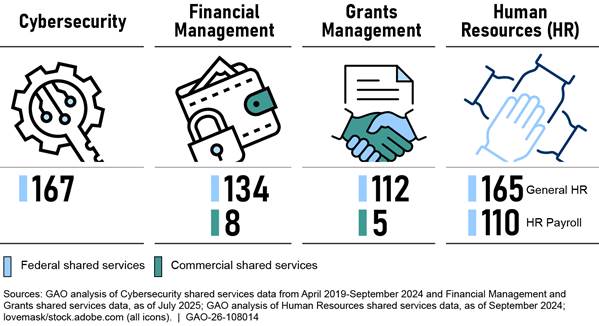
Note: The term “customer agencies” refers to customers from the Chief Financial Officers Act (CFO Act) agencies, which may include individual bureaus or components within a larger agency. It also includes non-CFO Act agencies, independent agencies, and commissions that use shared services.
Agencies identified various benefits, such as operational efficiencies and cost savings, but no barriers to adopting shared services. However, agencies identified challenges, including finding services that met both operational needs and legal requirements, shared services operating outdated legacy IT systems, and difficulties integrating shared services into their agencies.
As coordinators, GSA and the lead agencies have addressed some of these challenges. For example, they have expanded the marketplace of services to better meet agencies’ needs. However, key leadership roles vital to making decisions about shared services remain unfilled due, in part, to a lack of OMB engagement. Further, GSA and agencies do not have comprehensive data on how well shared services are meeting agencies’ needs. The absence of leadership commitment and data to inform decision-making are contributing factors to limiting the amount of cost savings and benefits.
Why GAO Did This Study
The federal government can increase efficiency and reduce duplicative efforts by consolidating certain mission-support services—such as payroll or travel—within a smaller number of federal agency providers. In 2019, OMB estimated that moving to shared services could save the government between $1.25 and $7.5 billion of the $25 billion a year spent on those services.
The explanatory statement accompanying the Consolidated Appropriations Act, 2023 includes a provision for GAO to review the adoption of shared technology platforms and services. This report (1) describes the level of shared service adoption across federal agencies; and (2) describes the benefits, barriers, and challenges federal agencies face in adopting shared services and determines the extent to which they have mitigated the challenges.
GAO analyzed documentation from GSA and the Quality Service Management Offices on government-wide federal shared service adoption. GAO also administered a questionnaire on adoption, benefits, barriers, and challenges to six randomly selected agencies and two agencies selected due to their extensive experience using shared services. GAO compared coordinating agencies’ efforts to mitigate the identified challenges against OMB guidance. GAO also interviewed agency officials.
What GAO Recommends
GAO is making a total of four recommendations to OMB and GSA, including that the agencies ensure executive leadership positions are filled and implement a plan and time frame for collecting performance data. GSA agreed with our recommendations and OMB did not provide comments.
Abbreviations
|
CFO Act |
Chief Financial Officers Act |
|
CISA |
Cybersecurity and Infrastructure Security Agency |
|
DHS |
Department of Homeland Security |
|
EEOC |
Equal Employment Opportunity Commission |
|
FDIC |
Federal Deposit Insurance Corporation |
|
FIBF |
Federal Integrated Business Framework |
|
FM |
Financial Management |
|
FSSP |
federal shared service provider |
|
FY |
fiscal year |
|
GSA |
General Services Administration |
|
HHS |
Department of Health and Human Services |
|
HR |
Human Resources |
|
IAP |
Investment Action Plan |
|
OGP |
Office of Government-wide Policy |
|
OMB |
Office of Management and Budget |
|
OPM |
Office of Personnel Management |
|
QSMO |
Quality Service Management Office |
|
SAPOC |
Senior Accountable Point of Contact |
|
SSGB |
Shared Services Governance Board |
|
USDA |
United States Department of Agriculture |
This is a work of the U.S. government and is not subject to copyright protection in the United States. The published product may be reproduced and distributed in its entirety without further permission from GAO. However, because this work may contain copyrighted images or other material, permission from the copyright holder may be necessary if you wish to reproduce this material separately.
February 3, 2026
Congressional Committees
Shared services show promise for increasing government efficiency and decreasing costs to the taxpayer. Such services involve the delivery of common mission support activities to agencies seeking assistance, typically on a fee-for-service basis. This assistance can range from federal financial management to travel management to human resources and payroll.
Reducing duplicative efforts and consolidating services with other federal agencies can yield significant cost savings.[1] In 2019, the Office of Management and Budget (OMB) estimated that moving to shared services could save the government 5 to 30 percent of the $25 billion annually spent for mission support activities. Accordingly, OMB designated four agencies to serve as Quality Service Management Offices (QSMO) for centralizing specific categories of shared services. The designated QSMOs offer and manage a marketplace of solutions or government-wide storefronts in their respective functional areas. The four QSMOs and their functional areas are the Department of Homeland Security’s Cybersecurity and Infrastructure Security Agency (Cybersecurity); the Department of the Treasury (Financial Management); the Department of Health and Human Services (Grants Management); and the Office of Personnel Management (Human Resources).
The Explanatory Statement accompanying the Consolidated Appropriations Act, 2023 includes a provision for GAO to identify statutes or policies that currently inhibit the adoption of shared services and make recommendations on changes that would remove these obstacles.[2] Our objectives were to (1) describe the level of shared service adoption across federal agencies; and (2) describe the benefits, barriers, and challenges federal agencies face in adopting shared services and determine the extent to which they have mitigated the challenges.
For both objectives, we administered a questionnaire to eight selected civilian executive branch agencies. We selected a mix of four Chief Financial Officers Act (CFO Act) and four non-CFO Act agencies to capture a range of experience and perspectives.[3] To do so, we randomly selected six agencies from a list of federal civilian executive branch agencies maintained by the Department of Homeland Security’s (DHS) Cybersecurity and Infrastructure Security Agency (CISA) that had over $1.0M in actual fiscal year (FY) 2023 cybersecurity expenditures based on the president’s FY 2025 budget.[4] We then selected two additional agencies, one CFO Act and one non-CFO Act, from a list of agencies nominated by the General Services Administration (GSA) and CISA that have broad experience obtaining shared services. The selected agencies were the Commodity Futures Trading Commission; the Departments of Agriculture, Housing and Urban Development, and Labor; the Equal Employment Opportunity Commission; the Federal Deposit Insurance Corporation; the Federal Retirement Thrift Investment Board; and the Social Security Administration.
To address the first objective, we summarized documentation from GSA and the four QSMO program offices on government-wide adoption of shared services in each of the respective functional areas (Cybersecurity, Grants Management, Human Resources and Financial Management) and performance management data from GSA. We also summarized responses to our questionnaire from the eight selected agencies on adoption of shared services.
To address the second objective, we analyzed QSMO and GSA documentation on benefits, barriers, and challenges to shared service adoption as well as selected agencies’ responses to our questionnaire. To determine the extent to which agencies had mitigated the challenges, we summarized guidance and planning documentation, such as OMB’s memorandum on shared services and roles and responsibilities for ensuring an effective shared services marketplace.[5] We then compared the challenges with OMB, GSA, and QSMOs’ mitigation efforts to identify gaps.
For both objectives, we interviewed relevant agency officials to obtain their views and verify the information provided. A detailed discussion of our objectives, scope, and methodology is provided in appendix I.
We conducted this performance audit from January 2025 to February 2026 in accordance with generally accepted government auditing standards. Those standards require that we plan and perform the audit to obtain sufficient, appropriate evidence to provide a reasonable basis for our findings and conclusions based on our audit objectives. We believe that the evidence obtained provides a reasonable basis for our findings and conclusions based on our audit objectives.
Background
Shared services are common, mission-support services to federal customer agencies that are consolidated, standardized, and scalable.[6] In 2019, OMB issued guidance for centralized mission support capabilities for the federal government through shared services.[7] This guidance was intended to improve mission outcomes, improve services, and reduce costs of mission support functions. Among other things, the guidance laid out a process for designating QSMOs for centralizing certain shared services, coordinated by the GSA’s Office of Government-wide Policy (OGP).
History of Federal Shared Services Directives and Standards
Over the last 20 years, the federal government has taken a variety of actions, including issuing directives and standards, to promote and implement shared services that have varied in scope and scale.[8] See figure 1 for a timeline of key Congressional and executive actions through March 2025.
Figure 1: Timeline of Key Congressional and Executive Actions to Implement Federal Shared Services, Through March 2025
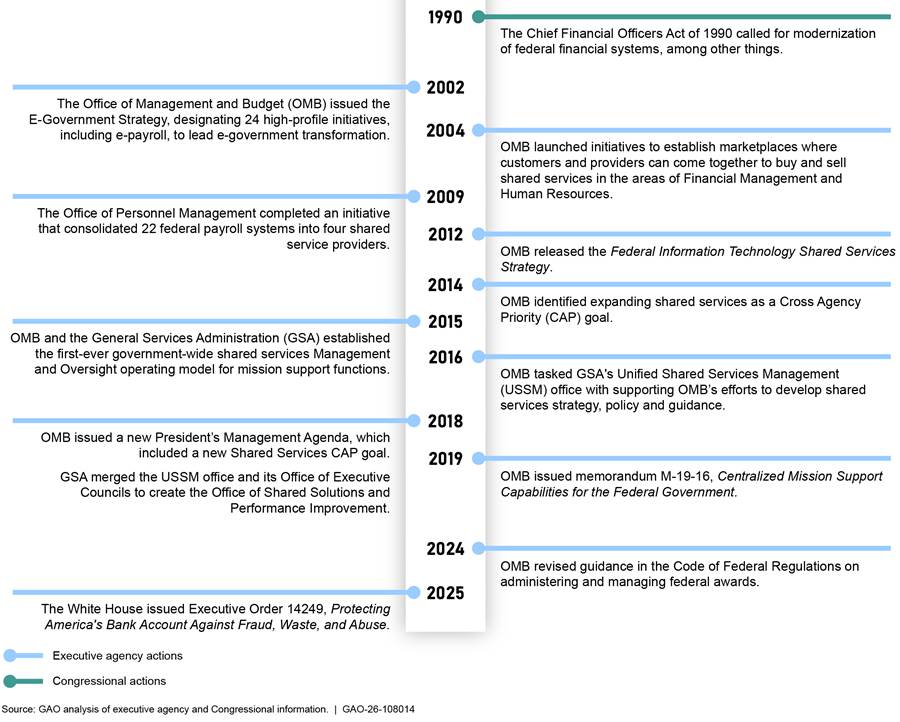
Federal Information Technology Shared Services Strategy. In May 2012,
OMB released the Federal Information Technology Shared Services Strategy.[9] This provided federal agencies with
policy guidance on the full range and lifecycle of intra- and inter-agency IT
shared services, which enable mission, administrative, and
infrastructure-related IT functions. The strategy required agencies to move to
use a “shared first” approach to certain IT.
Management and Oversight operating model. In October 2015, OMB and GSA established the first-ever government-wide shared services management and oversight operating model for mission support functions. This model aimed to enhance the efficiency of federal operations by encouraging agencies to collaborate and deliver support functions, such as financial management and human resources, through shared services.
OMB Memorandum M-19-16. In April 2019, OMB’s Memorandum M-19-16 established a process for designating agencies as QSMOs as part of efforts to reduce duplication, improve accountability, and improve federal shared services.[10] The memorandum establishes a process for designating lead agencies as QSMOs—including establishing governance and accountability—and requires all CFO Act agencies appoint a Senior Accountable Point of Contact (SAPOC) to coordinate actions across the agency to support adoption of the shared service strategies. Table 1 provides an overview of key responsibilities associated with shared services, as outlined in M-19-16.
Table 1: Shared Services Roles and Responsibilities as Defined by Office of Management and Budget (OMB) Memorandum M-19-16
|
Entity |
Responsibility |
|
Office of Management and Budget |
· Designate lead agencies to serve as Quality Service Management Offices (QSMO). · Analyze the QSMOs’ proposed plans and milestones with GSA and, if needed, recommend corrective actions in consultation with the governing board. Final designation of a QSMO is contingent upon the approval of a 5 year plan by OMB. · Approve agency business cases to demonstrate that a separate procurement for new or modernized services results in better value, considering price and timeline, than what is available in the marketplace. |
|
General Services Administration (GSA) |
· Issue guidance by publishing information and best practices to support adoption of a shared solution for agencies. · Provide OMB with information needed to maintain high quality shared service capabilities. |
|
Quality Service Management Offices |
· Offer and manage the marketplace of solutions for common technology, services, or fully managed services to respond to agency needs, guiding the long-term sustainability of the services and solutions. · Work with agencies on alternative strategies to help them build a business case, also referred to as an Investment Action Plan, if a QSMO marketplace is not operational or the existing marketplace solutions do not meet the agency’s needs. · Collect data to inform continuous improvement. · Drive the implementation of standards that align with needs across the federal government. |
|
Shared Services Governance Board |
· Serve as a cross-government body to provide advice and recommendations to OMB on shared services. · Resolve differences in business standards. |
|
Chief Financial Officers Act agencies |
· Identify and name Senior Accountable Points of Contact (SAPOC)—whose responsibilities include advocating for and making decisions about shared services. |
|
All agencies |
· Select an option from a QSMO marketplace when modernizing or making substantial enhancements in a functional area represented by a QSMO, unless otherwise approved through a business plan. This is also called an investment action plan that shows that a separate procurement of those services was a better value, and is reviewed by the respective QSMO and approved by the agency SAPOC, Chief Information Officer, and OMB in a decision memorandum. |
Source: GAO analysis of OMB Memorandum M-19-16. | GAO-26-108014
Federal Integrated Business Framework (FIBF). The FIBF is a standards model that coordinates common business needs across agencies by outlining outcomes, data, processes, and performance. After standards are drafted, the Business Standards Council is to help shepherd them through approval. The standards are intended to represent a consensus among agencies on management functions and may operationalize specific administrative policies. They are to include basic system functionality, data specifications, and performance measures, among other key features. The framework is expected to help federal agencies align mission support services, improve interoperability, and drive shared service adoption.
Each designated area has a standards lead. The leads are to facilitate working groups with agencies to ensure their needs are met. Specifically:
· Cybersecurity standards in alignment with the FIBF are partially complete as of July 2025 and are largely based on the National Institute of Standards and Technology’s standard, NIST 800-53.[11] CISA officials stated that, as of July 2025, they are developing functional requirements for the most common shared cybersecurity professional services with input from federal agencies, industry, and academia.
· Treasury officials developed the Financial Management Capability Framework in accordance with the FIBF to ensure financial systems meet baseline standards. Treasury updates the standards annually with input from federal stakeholders and industry.
· The Grants QSMO uses the FIBF to guide early acquisition planning and improve vendor alignment.
· The HR QSMO aligned its Human Capital Business Reference Model and Human Capital Information Model with the FIBF. The models are intended to enable agencies to more effectively plan for, deliver, assess, and manage their HR workforce, policy, processes, budget, and service delivery.
Updated regulations on administrating federal grants.[12] In 2024, OMB revised guidance in the Code of Federal Regulations on administering and managing federal awards. The new guidance establishes that federal agencies are to coordinate with the Grants QSMO and Council on Federal Financial Assistance when appropriate.
Executive Order on core financial management. A March 2025 executive order requires all CFO Act agencies to consolidate their core financial systems and use financial management solutions offered by the Financial Management (FM) marketplace.[13] The order also requires all other agencies to consolidate their financial management shared services under a single provider approved by the Department of the Treasury. OMB was to issue guidance on this issue within 180 days of the executive order. Additionally, the order requires agency heads to ensure that core financial systems comply with federal accounting and financial reporting standards and relevant regulations, guidance documents, policy statements, and other agency actions published by Treasury.
Federal Shared Services Roles and Responsibilities
Various entities within the federal government have roles and responsibilities for overseeing federal shared services, coordinating shared services, and delivering shared services to federal agencies who are the customers for such services.
Oversight Entities
OMB. The agency, within the Executive Office of the President, oversees the management of federal IT and issues government-wide guidance to agencies on a wide variety of topics, including IT and shared services. Additionally, according to memorandum M-19-16, OMB is to act as a final decision-maker on matters including QSMO designation, long-term strategies, and overall shared services direction and policy.
Shared Services Governance Board (SSGB). The SSGB is a cross-council board of agency executives from each of the Federal Executive Councils. The board was established in 2015 to provide cross-agency governance and oversight for federal shared services. The board is responsible for
· resolving standardization issues raised by the cross-government Business Standards Council – which is responsible for developing government-wide functional standards;[14]
· facilitating agency outreach on shared services, advising on funding strategies, and guiding agency outreach;
· providing direction on cross-functional issues and for technical coordination of shared service implementation; and
· making recommendations to OMB for final decision-making.
Members of the SSGB include representatives from key member councils, specifically the Chief Financial Officers Council, Chief Human Capital Officers Council, Chief Information Officers Council, Chief Acquisition Officers Council, Performance Improvement Council, Council on Federal Financial Assistance, Chief Data Officers Council, and the Small Agency Council.[15]
Coordinating Agencies
GSA’s Office of Government-wide Policy (OGP). According to OMB’s Memorandum M-19-16, GSA’s OGP is to serve as the central coordination point for managing shared services governance across federal civilian agencies. In its role as the coordination office, OGP shares best practices to support shared service adoption. It also collects and provides performance management information through an annual survey and conducts assessments, which are intended to maintain high quality services and solutions. GSA houses the Office of Government-wide Policy and its Office of Shared Solutions and Performance Improvement, which execute GSA’s shared service coordination responsibilities.
Quality Service Management Offices (QSMO). The Departments of Homeland Security’s CISA, Treasury, Health and Human Services (HHS), and the Office of Personnel Management (OPM), as the designated QSMOs, are responsible for establishing marketplaces[16] and supporting agencies moving to shared services in their respective functional areas. Table 2 provides an overview of the designation dates for the QSMOs and their respective marketplaces.
Table 2: Establishment Dates for the Quality Service Management Offices (QSMO) and Their Respective Marketplaces by Functional Area
|
Establishmenta |
Cybersecurity |
Financial Management |
Grants Management |
Human Resources |
|
Pre-designated |
April 2019 |
April 2019 |
April 2019 |
May 2022 |
|
Designated |
April 2020 |
June 2020 |
January 2021 |
January 2025 |
|
Marketplace established |
July 2023 |
December 2022 |
September 2022 |
April 2024 |
Source: GAO analysis of QSMO-provided data. | GAO-26-108014
aOMB pre-designates agencies to serve as a QSMO in a selected functional area; it fully designates the agency upon completion and approval of a QSMO implementation plan. QSMO agencies are responsible for establishing marketplaces with solutions for technology and services in their respective functional areas.
Service Providers
Federal shared service providers (FSSP) perform tasks, including cybersecurity, core financial services, human resources, and payroll, on a fee-for-service basis for federal customers. In addition to federal shared service providers, the FM and Grants QSMOs have approved commercial shared service providers in their functional areas. Agencies can also select from among these vendors to address their needs in the respective functional areas. For example, the FM commercial services in the marketplace provide core financial services, delivered by private sector contractors rather than FSSPs.
QSMO marketplaces offer lists of selected providers and their respective products available to customer agencies in each functional area.[17] For example:
· The Cybersecurity QSMO marketplace offers cybersecurity shared services that inform or augment the customer’s ability to protect its enterprise. Participating FSSPs include the Department of Transportation’s Enterprise Services Center, the Department of Justice, and the Department of Health and Human Services. Specifically, these providers, as well as CISA, offer a variety of services, including assessment services, cybersecurity operations center services, and protective domain name system services.[18]
· The FM QSMO marketplace offers core financial system solutions, additional services and solutions that are complementary to core financial management, and Treasury solutions that support a range of financial management activities.[19] Participating FSSPs include the Department of the Interior’s Interior Business Center, the Department of Transportation’s Enterprise Services Center, the Department of the Treasury’s Administrative Resource Center, and the General Services Administration’s Pegasys Financial Services organization.
· The Grants QSMO marketplace includes five federal grants services,[20] in addition to three grants shared services that agencies that award federal grants are required to implement by federal law or regulation.[21] Federal providers offer grants management shared services in three categories: award management systems, payment request management systems, and indirect cost negotiation services. These services are available for other federal customer agencies and function across all parts of the grants management life cycle.
· The HR QSMO marketplace offers general HR services, including staffing, talent management, and workforce analytics, as well as payroll services. Its federal providers include the Department of the Interior’s Interior Business Center, Department of the Treasury’s Administrative Resource Center, Department of Defense’s Defense Finance and Accounting Service, General Services Administration’s Payroll Services Branch, and the United States Department of Agriculture’s National Finance Center. The Office of Personnel Management’s (OPM) Human Resources Solutions also offers services through the marketplace.
GAO Has Reported on Efforts to Implement Federal Shared Services
During the past several years, we reported on federal agencies’ efforts to implement shared services, and on the progress that oversight agencies have made to help federal agencies in those efforts. Most recently, in December 2025, we reported on steps the FM QSMO has taken and common challenges to implementing financial management shared services across the government.[22]
In January 2024, we reported on progress in creating grant reporting data standards required by a recent law which involved steps to issue FIBF grant data elements.[23] We found that the data elements were partially consistent with three of eight statutory requirements, and some of the data elements did not reflect five of 13 leading practices for formulating data definitions. We also found that OMB and HHS did not have a stakeholder engagement plan or a process to ensure timely communication with Congress. We recommended that HHS, in consultation with OMB, ensure that data elements are machine-readable, that these data elements are consistent with leading practices, and that they develop a stakeholder outreach plan. We also recommended that OMB and HHS jointly develop a process to ensure timely communication with Congress. As of November 2025, HHS and OMB have fully implemented two and partially implemented one of our recommendations. OMB and HHS have yet to implement the recommendation on timely communication with Congress.
In July 2019, we reported on the types of services that FSSPs provide to their customer agencies to implement Digital Accountability and Transparency Act of 2014 (DATA Act) requirements, as well as challenges to this process and efforts to address the challenges.[24] We found that agencies reported challenges including being delayed by FSSPs, lack of guidance from OMB and Treasury, limited resources, errors made by the providers, and inadequate provider project management. We described efforts taken by customer agencies, Treasury, and FSSPs to address the challenges.
In March 2019, we reported that efforts to promote greater use of shared services for HR and financial management activities resulted in some cost savings and efficiency gains, but challenges—such as limited oversight, demand uncertainty, and limited supply—impeded more widespread adoption.[25] We recommended that OMB work with GSA to finalize a plan for monitoring the implementation of a shared service, document key roles and responsibilities, update and disseminate provider information, and implement a process for tracking cost-savings data. OMB did not comment on the recommendation but noted that it may update its shared service policy in the future. Shortly thereafter, OMB released M-19-16, establishing a new shared service governance model.
In addition to these reports, we have also issued several reports that discuss challenges with selected shared service providers, including the U.S. Department of Agriculture’s National Finance Center,[26] CISA’s diagnostic cybersecurity program,[27] and GSA’s identity management program.[28] We made recommendations to address challenges associated with these programs. While GSA implemented one of the recommendations regarding completing a pilot for its identity-proofing program, the remainder of the recommendations remain not implemented.
Federal Agencies’ Adoption of Shared Services Varied
Government-wide, many federal agencies and their components were using shared services, with varied adoption levels across the four QSMO functional areas. Across the selected agencies, shared services were largely adopted in all QSMO functional areas for which the agencies had a need. One agency adopted services from three of the four areas, and four agencies did not need services in one area but had adopted services in the other three.
Broader Government-wide Adoption of Shared Services Varied by Functional Area
Federal agencies, which include customer agencies such as individual bureaus, components, or programs, adopted shared services in each of the four designated functional areas. Some of these services were adopted prior to the designation of the QSMOs, while others have been adopted through the QSMO marketplaces.
Figure 2 shows the number of customer agencies adopting shared services across the four designated functional areas of Cybersecurity, FM, Grants, and HR.
Figure 2: Federal Customer Agency Adoption of Shared Services by Functional Area (Cybersecurity, Financial Management, Grants Management, and Human Resources), as of September 2025
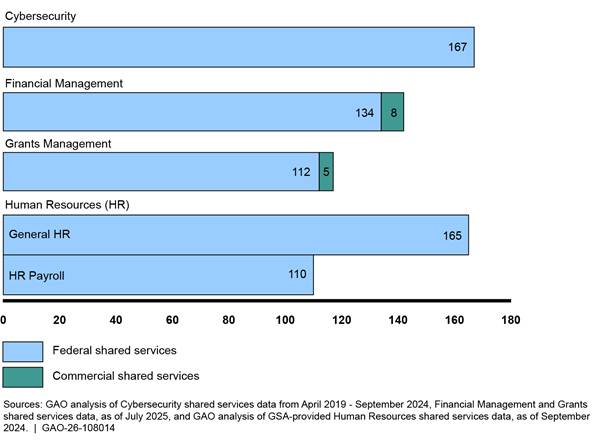
Note: The number of customer agency adoptions includes Chief Financial Officers Act (CFO Act) agencies, which can, in turn, include multiple individual bureaus or components within a larger agency (for example, the Federal Aviation Administration within the Department of Transportation); non-CFO Act agencies; independent agencies; and commissions. Financial Management and Grants Management data include adoptions for federal and commercial shared services/solutions. Cybersecurity and HR did not have commercial services available, as of July 2025.
Cybersecurity. Between fiscal years 2019 and 2024, 167 customer agencies from 96 agencies had adopted one or more federal shared services for their cybersecurity needs.[29] 92 of the 96 agencies had adopted a QSMO service provided by CISA, which includes services like Protective Domain Name System services.[30] Moreover, according to CISA officials, CISA has partnered with GSA to deliver commercial services through the Cybersecurity marketplace. CISA officials stated that, while commercial shared services are currently not offered, the agency was evaluating ten potential commercial vendors as of August 2025.
Further, as of September 2025, there were 17 customer agencies from seven agencies that discontinued using a shared service since the QSMO was pre-designated in 2019. The Cybersecurity QSMO cited several reasons for this, including agencies opting to transition to internal service providers or agencies using services that are time-limited.
Financial Management. As of July 2025, 142 customer agencies in 101 federal agencies had adopted one or more FM shared services.[31] Of the 142 customer agencies in those agencies, 21 adopted a financial management shared service from a federal provider and eight adopted a shared service from a QSMO-approved commercial provider since Treasury’s pre-designation as the FM QSMO in 2019.[32] Further, FM QSMO officials stated that they were not aware of any customer agencies that have discontinued or stopped using FM shared services since the QSMO was pre-designated.
Table 3 shows customer agencies’ adoption of FM shared services by federal and commercial providers since the QSMO’s pre-designation in April 2019.
Table 3: Customer Agencies’ Adoption of Financial Management (FM) Shared Services by Provider (Fiscal Years 2019-2025)a
|
Federal provider |
Number of customer agenciesb |
|
Department of Treasury (Administrative Resource Center) |
12 |
|
Department of Transportation (Enterprise Services Center) |
2 |
|
Department of the Interior (Interior Business Center) |
4 |
|
General Services Administration (Pegasys Financial Services) |
3 |
|
Subtotal |
21 |
|
Commercial provider |
|
|
Accenture Federal Services (FM Technology Operations Support) |
1 |
|
Booz Allen Hamilton (FM Business Operations, Functional, and Analytical Support) |
1 |
|
Carahsoft Technology Corp (Additional FM Solutions) |
1 |
|
cBEYONData (FM Adoption and Transition Services; FM Technology Operations Support) |
1 |
|
CGI Federal (Core Financial Systems Solutions; FM Technology Operations Support) |
2 |
|
eMentum (FM Business Operations, Functional, and Analytical Support) |
1 |
|
Paperless Innovations (Additional FM Solutions; FM Technology Operations Support) |
1 |
|
Subtotal |
8 |
|
Total |
29 |
Source: GAO analysis of Financial Management shared services data, as of July 2025. | GAO-26-108014
Note: Data for fiscal year 2025 adoptions reflect adoptions through July 2025 and do not represent the full fiscal year.
aThe number of agency adoptions includes customers from Chief Financial Officers Act (CFO Act) agencies, including individual bureaus or components within a larger agency in some cases; and independent agencies. According to FM Quality Service Management Office (QSMO) officials, as of January 2025, eight customer agencies used more than one core financial system.
bThis shows the number of customer agencies that adopted a financial management shared service from a federal or commercial provider since Treasury’s pre-designation as the financial management QSMO in 2019. Some of these services were adopted prior to the launch of the marketplace in December 2022, while others have been adopted through the marketplace.
Grants. As of July 2025, 117 customer agencies in 22 federal agencies that award grants had adopted one or more grant management shared services.[33] Specifically, of the 117 customer agencies, 51 adopted a Grants shared service or commercial solution since HHS’s designation as the Grants QSMO in 2021.[34] Of those 51 customers, 46 adopted a grants management shared service from a federal provider and five adopted from a commercial provider.
Table 4 shows customer agencies’ adoption of Grants shared services by federal and commercial providers since the QSMO’s designation in January 2021.
Table 4: Customer Agencies’ Adoption of Grants Management Shared Services by Provider (Fiscal Years 2021-2025)a
|
Federal providerb |
Number of customer agenciesc |
|
|
Payment systems |
||
|
Department of Treasury (Automated Standard Application for Payments) |
1 |
|
|
Department of Health and Human Services (Payment Management System) |
6 |
|
|
Awards management solutions |
||
|
Department of Health and Human Services (eRA) |
6 |
|
|
Department of Health and Human Services (GrantSolutions) |
26 |
|
|
Indirect cost negotiation services |
|
|
|
Department of the Interior (Interior Business Center Indirect Cost Rate Negotiation Service) |
7 |
|
|
Subtotal |
46 |
|
|
Commercial provider (solution) |
|
|
|
REI Systems, Inc. (GovGrants) |
3 |
|
|
Unison Software, Inc. (PRISM Grants) |
2 |
|
|
Subtotal |
5 |
|
|
Total |
51 |
|
Source: GAO analysis of Grants Management shared services data, as of July 2025. | GAO-26-108014
Note: Data for fiscal year 2025 adoptions reflect adoptions through July 2025 and do not represent the full fiscal year.
aThe number of agency adoptions includes individual bureaus or components within a larger agency.
bFederal providers offer Grants Management shared services in three categories: payment systems, awards management solutions, and indirect cost negotiation services.
cThis is the number of customer agencies that adopted a Grants shared service from a federal or commercial provider since HHS’s designation as the Grants Quality Service Management Office in 2021. Some of these services were adopted prior to the launch of the marketplace in September 2022, while others have been adopted through the marketplace.
Further, Grants QSMO noted that three customer agencies discontinued or stopped using a Grants shared service, due to funding constraints and a reduction in the volume of grants processed, which resulted in the service becoming cost prohibitive.
Human Resources. As of September 2024, 165 customer agencies had adopted general HR services. Additionally, 110 customer agencies had adopted payroll services from the HR federal shared providers.[35] According to OPM and GSA, no adoption data was available since the establishment of the HR QSMO marketplace. OPM officials stated that they are evaluating how they want to collect additional data and will continue to coordinate with OMB to help make this decision.[36] OPM officials also stated that the HR marketplace currently does not offer any commercial solutions. In July 2025, the HR QSMO’s director stated that they recently met with potential vendors and that they plan to offer commercial services in the future.
Further, HR QSMO noted that two customer agencies discontinued or stopped using HR and payroll shared services. One of the customer agencies discontinued using HR and payroll shared services because its requirements were not met by its existing HR FSSP; however, the customer migrated to a different FSSP within the HR QSMO. The second customer stopped using HR services because the customer decided to insource their services and hire its own federal employees to support their needs.
Selected Agencies Largely Adopted Shared Services
All eight of the selected agencies had generally adopted most or all of the available shared services. Specifically, all eight agencies adopted shared services from at least three out of four functional areas. Table 5 summarizes selected agencies’ adoption of shared services, with further details below the table.[37]
|
Functional areas |
CFTC |
EEOC |
FDIC |
FRTIB |
HUD |
Labor |
SSA |
USDA |
|
Cybersecurity |
✓ |
✓ |
✓ |
✓ |
✓ |
✓ |
✓ |
✓ |
|
Financial Management |
✓ |
✓ |
✓ |
✓ |
✓ |
✓ |
✓ |
✕ |
|
Grants Management |
N/A |
N/A |
N/A |
N/A |
✓ |
✓ |
✓ |
✓ |
|
Human Resources |
✓ |
✓ |
✓ |
✓ |
✓ |
✓ |
✓ |
✓ |
✓ = Agency indicated adopting a shared service
✕ = Agency indicated not adopting a shared service
N/A = Agency does not have grant programs
Commodity Futures Trading Commission = CFTC; Equal Employment Opportunity Commission = EEOC; Federal Deposit Insurance Corporation = FDIC; Federal Retirement Thrift Investment Board = FRTIB; Department of Housing and Urban Development = HUD; Department of Labor = Labor; Social Security Administration = SSA; United States Department of Agriculture = USDA.
Source: GAO analysis of agency responses to questionnaire, as of June 2025. | GAO-26-108014
Cybersecurity. As of June 2025, officials from all eight selected agencies reported that they either used one of the cybersecurity shared services under CISA or an existing shared service from the Department of Justice (a federal shared service provider under the Cybersecurity functional area).
Financial Management. As of June 2025, officials from seven of the eight selected agencies reported that they used at least one shared service from the FM functional area. Officials from one agency, the United States Department of Agriculture (USDA), stated that the agency did not use any of the FM shared services because it used USDA’s internal shared services.
Grants. As of June 2025, officials from all four selected CFO Act agencies reported using at least one shared service offered through the Grants functional area. Officials from four non-CFO Act agencies stated that they did not use a shared service from the Grants functional area because they are not grant-making agencies.
Human Resources. As of June 2025, officials from all eight selected agencies reported using at least one shared service available from the HR functional area.
Agencies Reported Benefits and No Barriers to Shared Service Adoption but Have Not Fully Mitigated Associated Challenges
Agencies identified a variety of benefits and challenges to shared service adoption, but none reported barriers that prohibit them from adopting shared services. Specifically, the eight selected agencies, as well as coordinating agencies, described various benefits and challenges.[38] Some agencies have planned or instituted measures that mitigate the identified challenges, but oversight and coordinating agencies have not addressed underlying issues that would enable them to fully mitigate the challenges.
Agencies Identified Various Benefits to Adopting Shared Services
According to GSA, shared services have the potential to provide various benefits to the federal government, including
· reducing duplication by supporting common functions across government agencies;
· improving service quality by consolidating expertise in certain functions, thereby reducing the risk of error or delays; and
· leveraging the consolidated buying power of the government, thereby representing an effective use of resources.
Both selected agencies and coordinating agencies identified benefits to adoption of shared services that generally aligned with these expected benefits of shared services.
Officials from selected agencies identified aspects of shared service adoption that streamlined their agencies’ internal processes, improved their agencies’ cybersecurity postures, saved their limited resources, and improved their service delivery. These benefits are described in Table 6 and detailed below the table.
|
Selected agency |
Operational efficiencies |
Enhanced cybersecurity |
Cost savings |
Improved service delivery |
|
Commodity Futures Trading Commission |
✓ |
✓ |
✓ |
— |
|
Department of Housing and Urban Development |
✓ |
✓ |
✓ |
— |
|
Department of Labor |
✓ |
✓ |
✓ |
✓ |
|
Equal Employment Opportunity Commission |
✓ |
✓ |
✓ |
✓ |
|
Federal Deposit Insurance Corporation |
✓ |
✓ |
✓ |
✓ |
|
Federal Retirement Thrift Investment Board |
✓ |
— |
✓ |
✓ |
|
Social Security Administration |
✓ |
✓ |
✓ |
✓ |
|
United States Department of Agriculture |
✓ |
✓ |
✓ |
✓ |
✓ = Agency officials reported experiencing the type of benefit
— = Agency officials did not report experiencing the type of benefit
Source: GAO analysis of agency responses to questionnaire. | GAO-26-108014
Operational efficiencies. Officials from all eight of the selected agencies stated that adoption of shared services has brought operational efficiencies to their work. For example, Labor officials stated that the federal shared services approach for HR optimizes system integrations by leveraging existing processes. This, in turn, minimizes the need to develop new integration processes from scratch. Additionally, Equal Employment Opportunity Commission (EEOC) officials stated that this approach has reduced administrative burden by standardizing processes, leading to improved resource allocation at the agency.
Enhanced cybersecurity. Officials from seven of the eight selected agencies stated that shared services have helped them improve their agencies’ cybersecurity. For example, officials from the Department of Housing and Urban Development stated that the HR shared services the agency uses are regularly updated and patched to secure agency data, which enables the agency to focus on HR rather than cybersecurity activities. Further, Federal Deposit Insurance Corporation (FDIC) officials stated that the agency’s security posture is enhanced by leveraging CISA shared services and through the sharing of best practices among federal partners.
Cost savings. Officials from all eight selected agencies stated that they have realized cost savings by adopting shared services. These cost savings came via increased economies of scale, saved licensing costs, and minimized labor, equipment, and operational costs.[39] For example:
· Federal Retirement Thrift Investment Board officials stated that, as a small agency, using shared services allows it to achieve significantly better economies of scale and pricing for services. Agency officials identified roughly $1.5 million in savings in FY 2024 through cybersecurity and other IT shared services.
· Labor officials project that the agency will save roughly $500,000 per year in labor and administrative costs by moving from manually processed performance reviews to an automated performance management system through the HR QSMO.
· Commodity Futures Trading Commission officials stated that the commission has avoided spending tens of millions of dollars by using financial management shared services. According to commission officials, it avoids the labor costs associated with on-site design, implementation, and maintenance of each of the systems it would have needed had it not adopted the available shared service.
· Officials from the FDIC stated that the Corporation had been using an HR system through an internally managed contract. However, by procuring the same system through the Interior Business Center, the agency saved approximately $200,000 in one-time direct costs.[40] FDIC officials stated that they are planning to complete additional analyses of alternatives for other HR-related modernizations.
Improved service delivery. Officials from six of the eight selected agencies stated that shared services have helped their agencies achieve improved service delivery. For example, EEOC officials stated that leveraging shared service providers has allowed the agency to benefit from modernized and secure technology solutions without the need for extensive in-house development. Officials noted that this has led to improved service delivery, data management, and process automation. Additionally, officials from the Social Security Administration stated that the agency has benefited from continuous improvements to the GrantSolutions service through the Grants QSMO.[41] Officials cited specific reports that streamlined their ability to extract data as well as modules that improved both recipient reporting and staff review of grants.
As the coordinating agencies for shared services, GSA’s OGP and the QSMOs have a perspective that allows them to see common benefits across customer agencies. Officials from those organizations identified the following benefits:
Reduced operating costs. GSA and the FM QSMO reported that shared services allow agencies to leverage the government’s buying power through shared contracts. GSA additionally reported that shared services reduce costly upgrade cycles that impact government operations. The Grants QSMO, as well as GSA, noted that shared services reduce labor costs by minimizing administrative burden. Neither GSA nor these QSMOs could provide specific estimations of the reduced costs. However, the Cybersecurity QSMO identified about $112 million in cost avoidance between 2023 and 2024 for the three FSSPs in its marketplace. According to CISA officials, agencies realized the cost avoidance through reduced labor costs.[42]
Managed services. GSA reported that shared services enable agencies to realign resources—technology, workforce, and funding—back to core mission functions, enhancing their focus on delivering public services. Additionally, GSA reported that agencies may benefit from shared services that manage administrative work, including features to streamline compliance with federal policy and consolidate reporting. For example, FM QSMO marketplace guidance states that the FM QSMO validates marketplace offerings to ensure continued compliance with new policies or changing requirements. The Grants QSMO marketplace guidance similarly states that the Grants QSMO validates offerings to adhere to government-wide data and security standards.
Enhanced efficiencies. The FM and Grants QSMOs reported that competitive shared solutions improve access to innovative technologies that will ensure stable operations while meeting emerging needs. Additionally, GSA reported that shared services offer opportunities to align business processes and data across multiple functional areas (such as financial management with procurement) to improve strategic decision-making both within and across agencies.
Agencies Did Not Identify Barriers but Noted Various Challenges to Adopting Shared Services
None of the selected or coordinating agencies (including GSA and QSMOs), or OMB, identified specific structural, legal, or policy barriers that prohibit federal agencies from adopting shared services or solutions. However, in some cases, agencies noted that agency-specific requirements make it more difficult to adopt shared services.[43]
While there were no barriers reported, selected agencies and coordinating agencies identified challenges to adopting shared services. Table 7 provides a summary of these challenges.[44]
|
|
Type of agency |
||
|
Selected agenciesa |
Coordinating agenciesb |
||
|
Challenge |
Description |
|
|
|
Marketplace limitations |
Customers struggled with finding adequate services through the Quality Service Management Office (QSMO) marketplaces, usually due to existing options not meeting legal, technical or operational customer requirements. |
✓ |
✓ |
|
Federal Shared Service Provider performance |
Providers relied on outdated systems that did not meet customer expectations and customers experienced difficulty trusting providers to flexibly meet performance standards. |
✓ |
✓ |
|
Federal Shared Service Provider transparency |
Providers did not adequately share pricing information as well as specifications to document compliance requirements. |
✓ |
✓ |
|
Managing system implementation |
Customers faced difficulties coordinating shared service implementation, including change management issues and stakeholder engagement. |
✓ |
✓ |
|
Resource priorities |
Customers faced difficulties balancing the costs associated with transitioning to a shared service with other priorities. |
✓ |
✓ |
|
QSMO visibility |
Coordinating agencies faced difficulties knowing when to work with agencies that are modernizing systems in their designated area. |
— |
✓ |
✓ = At least one agency reported experiencing the type of challenge (or, in the case of coordinating agencies, reported that customer agencies they worked with had experienced the challenge).
— = Agencies did not report experiencing the type of challenge.
Source: GAO analysis of agency documentation and agency responses to questionnaire. | GAO-26-108014
aThe selected agencies were the Commodity Futures Trading Commission, Department of Housing and Urban Development, Department of Labor, Equal Employment Opportunity Commission, Federal Deposit Insurance Corporation, the Federal Retirement Thrift Investment Board, the Social Security Administration, and the United States Department of Agriculture. The Commodity Futures Trading Commission and the Federal Retirement Thrift Investment Board did not identify any challenges.
bThe coordinating agencies were the General Services Administration, Department of Health and Human Services, Department of the Treasury, Cybersecurity and Infrastructure Security Agency, and the Office of Personnel Management.
Marketplace limitations. Officials from six of the eight selected agencies noted challenges to finding shared services and solutions that meet their technical, operational, or mission-critical needs. For example, USDA officials stated that the availability of system controls that allow them to conduct their fiduciary responsibilities limits them from considering some shared solutions. Moreover, officials from three of the agencies stated that, because they require solutions capable of supporting their specific requirements, they must often take more time to vet a limited pool of potential solutions.
Officials from all five of the coordinating agencies acknowledged challenges with agency-specific requirements. For example, Cybersecurity QSMO officials noted that agencies may require capabilities or features not available through an offered solution. Additionally, officials from the Grants QSMO noted that certain program-specific statutes may necessitate customization of shared systems as these programmatic statutory requirements can increase implementation complexity and cost, which may influence agency adoption decisions.
FSSP performance concerns. Officials from five of the eight selected agencies identified issues with existing federal shared service providers’ performance.[45] For example, an official from one selected agency stated that one cybersecurity FSSP could not deliver an adequate solution that addressed risk management framework shortcomings because it relied on legacy technology. The official noted that the solution provided by the FSSP “proved unwieldy” for the agency’s specific concerns, forcing it to switch to a third-party provider. Further, officials from three of these agencies reported concerns about losing direct control over system functionality, reducing their flexibility to automate or customize systems as operational responsibilities require, thereby hindering potential performance needs.
Four of the five coordinating agencies reported challenges that could hinder providers’ abilities to meet performance standards, including supply chain issues, technical expertise shortages, and struggles to balance competitive rates with having funding to regularly modernize outdated solutions. For example, GSA reported that some shared services rely on legacy technologies, which provide limited functionality and restrict opportunities to pursue modernization. In addition, in an evaluative report on one FSSP’s performance, the National Academy of Public Administration confirmed these findings related to legacy technologies.[46]
FSSP transparency. Officials from four of the eight selected agencies stated that they lacked the data needed to make clear decisions regarding whether to adopt a shared service from a specific provider, particularly regarding pricing and whether they would be locked into the provider once they adopt. For example, one official identified challenges with ensuring that FSSPs will meet performance expectations through documented service level agreements.
Officials from two of the five coordinating agencies acknowledged specific challenges with FSSP transparency. For example, GSA acknowledged that customer agencies have indicated challenges with keeping consistent, transparent service level agreements, as well as with understanding opaque pricing elements associated with the QSMO marketplaces’ services. Further, GSA’s customer experience survey also indicated challenges with customer agencies understanding the pricing elements associated with three of the marketplaces’ services (excluding Cybersecurity).
Managing system implementation. Officials from five of the eight selected agencies cited issues with change management amid complex system implementations as a factor hindering shared service adoption.[47] For example, officials from the Social Security Administration cited challenges aligning business needs, automation, and processes with a new system that may not be able to accommodate these items. Officials from the Department of Housing and Urban Development also identified challenges with aligning stakeholders to efficiently implement the system. Additionally, all five of the coordinating agencies reported that customer agencies face challenges related to managing shared service implementation. For example, GSA officials observed that agencies’ existing systems are deeply embedded in complex business processes, complicating the implementation of a shared service into legacy business architectures.
Resource priorities. Officials from five of the eight selected agencies noted challenges associated with allocating sufficient resources for the costs associated with shared services, including capital, labor, and maintenance costs. For example, several agency officials cited lack of funding or staffing resources needed to execute a transition to shared services beyond what they need to maintain their other systems. Officials from one selected agency stated that the agency may become locked in to an external vendor that may no longer meet its needs if it does not have the resources to switch.
All five of the coordinating agencies reported that customer agencies face challenges with prioritizing resources. For example, according to Grants QSMO officials, many agencies are largely on their own to determine how to fund IT modernization, including shared services, because no dedicated funding source exists. Further, GSA reported that customer agencies are strategizing funding solutions and forecasting future needs, but do not have a reliable source of funding on which to ground decisions to modernize.
QSMO visibility into modernization. The selected agencies did not report challenges related to QSMO visibility into their modernization activities. For example, one agency noted that it actively works with the relevant QSMO for new shared services while another noted that it is a willing partner when offerings are available.
However, officials from three of the four QSMOs stated that they are not always able to work with potential customer agencies because they do not always have visibility into when agencies are considering modernizing or substantially changing a QSMO-covered IT service. As a result, they cannot help the agencies consider shared services or develop an investment action plan (IAP) to approve an alternative service. As noted earlier, agencies are required to use IAPs to ensure services procured outside of the QSMO marketplaces are aligned with the standards and goals of government-wide shared services. For example, Cybersecurity QSMO officials stated that they are unable to work with agencies to develop IAPs because CISA does not have visibility into agency requests for modernization funding. Additionally, officials from the FM QSMO noted that agency contracting officers do not always know that there is a requirement to consider shared services when modernizing.
Leadership Vacancies and Lack of Performance Data Hinder Agencies’ Mitigation Efforts
In fulfilling their responsibilities for offering and managing the marketplace of shared solutions, coordinating agencies (GSA and the four QSMOs) have taken steps that partially address the identified challenges. Nevertheless, customer agencies and coordinating agencies continue to report challenges with adopting shared services. Factors such as lack of data to inform decision-making, unfulfilled oversight responsibilities, and leadership vacancies contributed to ongoing challenges. Efforts to mitigate these challenges, remaining work, and underlying factors are described below.
Marketplace limitations. Among other things, OMB Memorandum M-19-16 requires QSMOs to offer and manage the marketplace of solutions for common technology, services, or fully managed services to respond to agency needs. It also requires OMB to approve agency business cases or IAPs to demonstrate that a separate procurement for new or modernized services results in better value, considering price and timeline, than what is available in the marketplace. Further, according to GSA’s Investment Planning Guidance, OMB’s decision on IAP approval is to be documented in a decision memorandum.[48]
QSMOs have taken actions to manage and expand the marketplace and to drive the implementation of standards. Specifically, QSMOs, in partnership with standards leads, collect feedback from agencies on specific requirements. Once identified, QSMOs work to increase the supply of solutions, including through commercial solutions that may better address those requirements while still being in alignment with federal data standards. For example, Grants QSMO officials noted that they guide agencies to align their business processes with standard system capabilities before undertaking modernization, helping agencies to define requirements according to the FIBF to improve planning accuracy. QSMOs also conduct market research to save agencies time vetting potential solutions.
However, not all QSMOs have added commercial solutions that address the needs of certain agencies. Additionally, some selected agencies have requirements that may not be addressed by commercial solutions through the marketplace. Although the standard leads are to regularly update business standards to support new requirements, officials from some selected agencies stated that the standards still do not capture some of their technical needs.
The lack of solutions to meet agencies’ needs is due, in part, to other unfulfilled oversight responsibilities specified in OMB’s M-19-16. Specifically, the Shared Services Governance Board (SSGB) does not have executive leadership and has not met since August 2024. As a result, the board has not facilitated outreach to coordinate agency requirements and subsequently inform strategies and priorities for agency requirements.
Additionally, CFO Act agencies have not all designated Senior Accountable Point of Contacts (SAPOC), with whom the SSGB would coordinate to ensure their agencies’ requirements are heard. Specifically, as of September 2025, at least 10 out of the 24 CFO Act agencies had unfilled SAPOC roles. According to coordinating agency officials, when SAPOC roles have been filled in the past, they have not always been filled by management-level staff with the necessary authority to make decisions and fulfill necessary responsibilities. QSMO officials noted that they often bypass this function and approach decision-makers directly. However, without a SAPOC at the appropriate management level, agencies lack an official who can coordinate actions across the agency to support adoption of shared service strategies.
According to a GSA official, agencies and officials have not faced negative consequences for not filling their OMB-specified roles and responsibilities. Without consistent leadership commitment, standards may continue to not reflect agency requirements. This can result in agencies opting to pursue solutions that meet their requirements outside the marketplaces.
In addition, the IAP process is intended to mitigate challenges associated with marketplace limitations and unmet requirements. This is to be accomplished by allowing agencies to pursue solutions outside of the QSMO marketplaces.
However, OMB has not engaged with some of the QSMOs to review and approve the IAPs. Specifically, Grants QSMO officials stated that they submitted an IAP to OMB, but they did not receive any response. Moreover, HR QSMO officials stated that they were initially developing IAPs but then decided to develop partnership agreements.[49] They noted that this was due, in part, to a lack of engagement by OMB to review IAPs.
Without reviewing and approving IAPs, OMB is unable to ensure that QSMOs and agencies are pursuing cost-effective and modern solutions, including avoiding duplicative efforts. This can result in a lack of transparency into agency decisions for QSMOs, or in delays or uncertainties on using alternative shared services.
FSSP performance and transparency. OMB Memorandum M-19-16 directs QSMOs to collect data to inform continuous performance improvement and respond to agency needs in managing QSMO marketplaces. It also directs GSA to provide OMB with information needed to maintain high quality shared service capabilities and issue guidance by publishing information and best practices.
GSA and QSMOs collect and monitor basic service measures for FSSPs, including customer experience data, such as service volumes and self-reported numbers of service measures met. These measures allow coordinating agencies to determine how well FSSPs serve their customers. Additionally, when coordinating agencies have been aware of performance issues that result from providers’ legacy systems that need modernizing, GSA has provided guidance to providers on cost recovery and price transparency. GSA has also identified a need for additional performance management data, including cost avoidance data, as part of planning the future development of its performance management framework.
Coordinating agencies have taken actions to collect and disseminate data to inform continuous improvement and respond to agency needs in managing the marketplace. For example, QSMOs offer one-on-one meetings to agencies on shared service offerings. This allows the QSMOs to provide transparency to interested agencies on how specific shared services perform and could provide value to potential customers, including how shared services benefits may be worth giving up direct control over system functionality.
However, the coordinating agencies lack comprehensive data needed to monitor and subsequently address challenges to these performance and transparency issues. Specifically, GSA has yet to collect data related to understanding the actual costs of modernizing mission support activities and shifting to shared services. GSA has also not collected all the performance management framework data outside of a pilot case with one FSSP. According to GSA officials, in early 2025, the agency had put efforts to further develop the performance framework methodology on hold due to resource constraints and changing priorities. Nevertheless, GSA has yet to develop a new plan and time frame for developing the methodology and collecting the data. Moreover, QSMOs do not collect all the established service measures from the providers. Without comprehensive data, decision-makers will likely not be able to adequately identify, monitor, and subsequently address challenges affecting the shared services ecosystem, including full transparency into the cost of shared services and how well they are working.
Managing system implementation, resource priorities, and QSMO visibility. Among other things, OMB Memorandum M-19-16 requires GSA to issue guidance to support shared services. It also requires GSA to issue best practices to help agencies transition to shared services.
To address challenges associated with managing complex system change and implementation issues, GSA issued guidance in the form of the Modernization and Migration Management (M3) framework to agencies.[50] QSMOs have also shared best practices from agencies that have successfully transitioned to a shared service and QSMO officials stated that they connect interested agencies with successful agencies to more deeply understand migration successes.
To address challenges with resource priorities, QSMO officials reported that they provide advisory support and data to agencies who aim to use the Technology Modernization Fund.[51] Additionally, Cybersecurity QSMO officials stated that the QSMO centrally funds its services to remove the burden of transferring funds from customer agencies. Officials from the Cybersecurity QSMO also stated that they have worked to design services that are both easy to implement and require minimal maintenance and support by agencies, which minimizes the cost of labor associated with shared services. Finally, some customer agencies have working capital funds that support shared services.[52]
To address the challenge of QSMOs’ visibility into agency modernizations, specifically related to their responsibility to work with agencies to ensure use of the marketplace or otherwise build business cases, Grants QSMO officials stated that they regularly scan a relevant website for notifications of federal awarding opportunities, indicating that an agency is considering modernization. In addition, officials from the FM QSMO stated that they meet with contracting representatives to ensure the representatives are educated on shared service requirements outlined in M-19-16. Similarly, officials from the Cybersecurity QSMO stated that their Federal Enterprise Improvement Team has started working with agency officials government-wide to understand agency needs and guide the officers to appropriate solutions, as needed.
However, GSA and QSMOs have not fully addressed challenges associated with system implementation, resource priorities, and visibility. OMB M-19-16 requires the SSGB to serve as a cross-government body to provide advice and recommendations to OMB on shared services. Yet, GSA officials noted that they are waiting for direction from OMB and GSA executive leadership. Officials from the Grants QSMO noted that coordination often depends on internal alignment between program-level staff and CIO offices, and leadership turnover—particularly among CIOs—can disrupt previously established consensus and planning efforts. Without key data and executive-level leadership commitment the SSGB will continue to lack the ability to advocate for resources for shared services. It will also be unable to provide the data necessary for QSMOs to have visibility into agencies’ modernization efforts and support agencies in adopting shared services.
Conclusions
The federal government’s use of shared technology services shows great potential for reducing duplicative efforts, enhancing efficiency and reducing the cost of common agency needs such as cybersecurity, financial management, and human resources. Given these efficiencies, many federal agencies currently take advantage of shared services. However, adoption across the government varies and is hampered by systemic challenges.
While the organizations responsible for coordinating shared services across the government have taken some actions, these efforts have not fully addressed challenges. Key executive leadership responsibilities are not being addressed, roles vital to making decisions and resolving conflict are vacant due, in part, to a lack of OMB engagement, and comprehensive cost and performance management data are lacking. These shortfalls lead to uncertainty and delays that limit the ability of leaders to pursue shared service strategies that can yield substantial savings.
Recommendations for Executive Action
We are making a total of four recommendations, including two to OMB and two to GSA. Specifically:
The Director of OMB should ensure that agency IAPs prepared in cooperation with QSMOs are reviewed and approved by all respective parties as described in OMB Memorandum M-19-16. (Recommendation 1)
The Director of OMB should direct the civilian Chief Financial Officers Act agencies to fill the roles of Senior Accountable Points of Contact for shared services as required under OMB Memorandum M-19-16. (Recommendation 2)
The Administrator of General Services should, in coordination with the Director of OMB, appoint the Shared Services Governance Board (SSGB) co-chair and direct that individual to assume executive leadership responsibilities under OMB Memorandum M-19-16. (Recommendation 3)
The Administrator of General Services should, in coordination with the four QSMOs, establish and implement a revised plan and time frame for collecting data outlined in its performance management framework, including cost data. (Recommendation 4)
Agency Comments
We provided a draft of this report to the two agencies to which we made recommendations—OMB and GSA—and the other 12 agencies in our audit for their review and comment. We received responses from all of the agencies except one, as summarized below.
In written comments, reprinted in appendix II, GSA agreed with our recommendations and stated that the agency had a plan to address them. OMB did not provide comments on our draft report. Five agencies—DHS, EEOC, FDIC, HHS, and OPM—provided technical comments, which we incorporated as appropriate. The other seven agencies—USDA, the Commodity Futures Trading Commission, the Federal Retirement Thrift Investment Board, the Department of Housing and Urban Development, the Department of Labor, the Social Security Administration, and Treasury—stated that they had no comments.
We are sending copies of this report to the appropriate congressional committees, the Secretaries of the Departments of Agriculture, Health and Human Services, Homeland Security, Housing and Urban Development, Labor, and Treasury; the Administrator of the General Services Administration; the Chairs of the Commodity Futures Trading Commission, the Equal Employment Opportunity Commission, and the Federal Deposit Insurance Corporation; the Executive Director of the Federal Retirement Thrift Investment Board; the Directors of the Office of Management and Budget and the Office of Personnel Management; the Commissioner of the Social Security Administration, and other interested parties. In addition, the report is available at no charge on the GAO website at https://www.gao.gov.
If you or your staff have any questions about this report, please contact me at hinchmand@gao.gov. Contact points for our Offices of Congressional Relations and Public Affairs may be found on the last page of this report. GAO staff who made key contributions to this report are listed in appendix III.
David B. Hinchman
Director, Information Technology and Cybersecurity
List of Committees
The Honorable Bill Hagerty
Chair
The Honorable Jack Reed
Ranking Member
Subcommittee on Financial Services and General Government
Committee on Appropriations
United States Senate
The Honorable David Joyce
Chairman
The Honorable Steny Hoyer
Ranking Member
Subcommittee on Financial Services and General Government
Committee on Appropriations
House of Representatives
The Explanatory Statement accompanying the Consolidated Appropriations Act, 2023 includes a provision for us to identify statutes or policies that currently inhibit the adoption of shared technology platforms and services and make recommendations on changes that would remove these obstacles.[53] Our objectives were to (1) describe the level of shared service adoption across federal agencies, and (2) describe the benefits, barriers, and challenges federal agencies face in adoption of shared services and determine the extent to which they have mitigated the challenges.
To define the scope of shared services in our review, we reviewed the Office of Management and Budget’s (OMB) most recent comprehensive guidance[54] for centralized mission support capabilities for the federal government through shared services.[55] This guidance included, among other things, assigning the General Services Administration (GSA) certain shared service responsibilities, designating Quality Service Management Offices (QSMO) for centralizing certain shared services, a cross-government Shared Services Governance Board, and a Business Standards Council to work together to develop standards for government-wide shared services.
We focused on the shared services that fall under OMB’s QSMO designations in OMB Memorandum M-19-16. The QSMOs focus shared service efforts in four defined functional areas: the Department of Homeland Security’s Cybersecurity and Infrastructure Security Agency (Cybersecurity); the Department of the Treasury (Financial Management); the Department of Health and Human Services (Grants Management); and the Office of Personnel Management (Human Resources). We selected services in these designated areas and excluded other shared services because they involve case-by-case requirements and processes for government-wide adoption and do not follow the same marketplace model.[56]
To select a sample of civilian executive branch agencies who use these shared services, we selected a mix of four Chief Financial Officers Act (CFO Act) and four non-CFO Act agencies to capture a range of experience and perspectives.[57] To do so, we randomly selected six agencies from a list of federal civilian executive branch agencies maintained by the Department of Homeland Security’s (DHS) Cybersecurity and Infrastructure Security Agency (CISA) that had over $1.0M in actual fiscal year (FY) 2023 cybersecurity expenditures based on the president’s FY 2025 budget.[58] We then selected two additional agencies, one CFO Act and one non-CFO Act, from a list of agencies nominated by GSA and CISA that have broad experience obtaining shared services.
The eight selected agencies were: the Commodity Futures Trading Commission; the Departments of Agriculture, Housing and Urban Development, and Labor; the Equal Employment Opportunity Commission; the Federal Deposit Insurance Corporation; the Federal Retirement Thrift Investment Board; and the Social Security Administration. While this is not a generalizable sample, we believe that it provides a reasonable approach to understanding how agencies benefit from shared services, and what challenges they faced associated with shared services.
For both objectives, we administered a questionnaire to the eight selected civilian executive branch agencies. The questionnaire addressed such issues as adoption of shared services from the four functional areas, benefits, barriers, and challenges related to adoption of shared services, and mitigation efforts taken by the agencies to address barriers or challenges. We interviewed relevant agency officials to obtain clarification and additional insight, as appropriate. We sent requests to OMB staff for documents and information but did not receive a response.
To describe the level of adoption of shared services across federal agencies, we summarized documentation from GSA and the four QSMO program offices on government-wide adoption of shared services in each of the respective QSMO areas: Cybersecurity, Financial Management (FM), Grants Management (Grants), Human Resources (HR), and performance management data from GSA. We provided a data request template with adoption information regarding time frame, provider names, and name of shared service to limit inconsistent data.
To assess the level of adoption of shared services in the four functional areas, we summarized QSMO-provided shared services adoption data. This included data between April 2019 to July 2025 for the Cybersecurity, FM, and Grants QSMOs and from May 2022 to July 2025 for the HR QSMO. We received and analyzed adoption data between October 2022 to September 2024 for the Cybersecurity QSMO, April 2019 to July 2025 for the FM QSMO, and October 2020 to July 2025 for the Grants QSMO. For the HR QSMO, HR officials stated that they did not have any new adoption data beyond what was provided to GSA. We received and analyzed GSA-provided HR data, which was dated as the end of fiscal year 2024 (September 2024). We also analyzed responses from the eight selected agencies to our questionnaire.
To determine the number of shared services adopted by agencies,[59] we counted the number of customer agencies provided by the QSMOs to calculate the number of customer agencies using a shared service since a QSMO was pre-designated.[60] This data was self-reported from the QSMOs. We also calculated the number of customer agencies who adopted shared services or solutions since the launch of the respective marketplaces. Additionally, we calculated the number of customer agencies that have discontinued or stopped using a shared service since the QSMO was pre-designated.
To describe the benefits, barriers, and challenges federal agencies faced in adoption of shared services, we analyzed selected agencies’ responses to our questionnaire, as well as QSMO and GSA documentation on benefits, barriers, and challenges to shared service adoption. We reviewed agency-provided information on identified cost avoidance, but did not independently verify the cost savings. We also conducted a review of other available data on shared services benefits and challenges, including a recent report from the National Academy of Public Administration.[61] Where available, we also analyzed customer experience data to derive challenges with specific aspects of the marketplace or provider experience. We then identified common themes among the challenges and categorized each challenge into one of six categories we identified. Where challenges fit into multiple categories, we used professional judgment to determine the most appropriate category match for a challenge.
To determine the extent to which coordinating agencies (GSA and the four QSMOs) have mitigated the challenges, we summarized OMB’s M-19-16 guidance and the Shared Services Governance Board charter roles and responsibilities for ensuring an effective shared services marketplace. We analyzed GSA and QSMO documentation to identify efforts to establish an effective shared services ecosystem, including explicit references to challenges. We then compared the challenges with OMB, GSA, and QSMOs’ mitigation efforts to identify gaps. We sent requests to OMB staff for documents and information but did not receive a response.
We conducted this performance audit from January 2025 to February 2026 in accordance with generally accepted government auditing standards. Those standards require that we plan and perform the audit to obtain sufficient, appropriate evidence to provide a reasonable basis for our findings and conclusions based on our audit objectives. We believe that the evidence obtained provides a reasonable basis for our findings and conclusions based on our audit objectives.
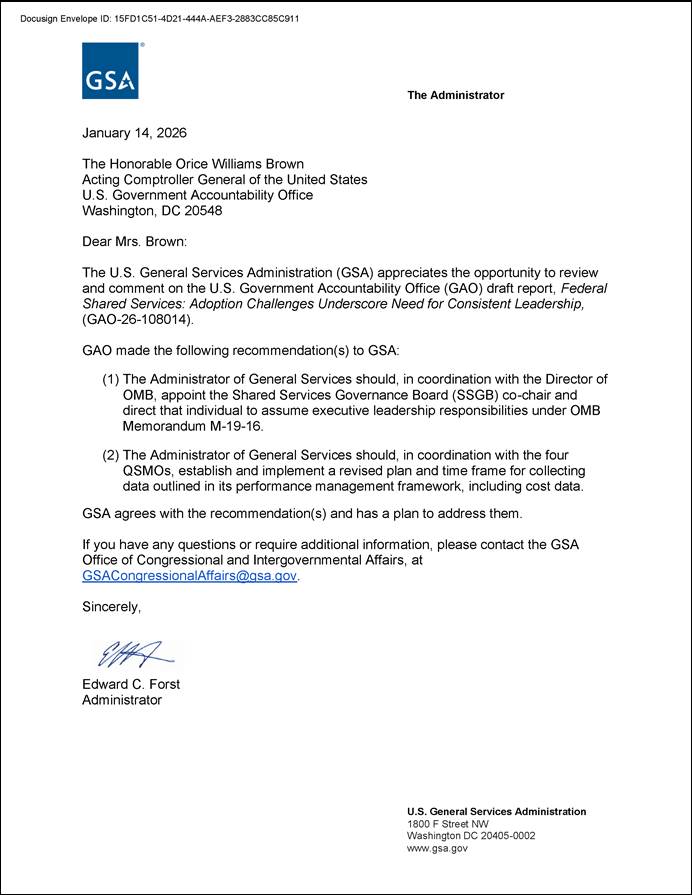
GAO Contact
David B. Hinchman, HinchmanD@gao.gov
Staff Acknowledgments
In addition to the contact named above, the following staff made key contributions to this report: Neelaxi Lakhmani (Assistant Director), Kara Lovett Epperson (Analyst-in-Charge), Revanth Ayinala, Alina Budhathoki, Christopher Businsky, Jess Lionne, and Curt Williams.
The Government Accountability Office, the audit, evaluation, and investigative arm of Congress, exists to support Congress in meeting its constitutional responsibilities and to help improve the performance and accountability of the federal government for the American people. GAO examines the use of public funds; evaluates federal programs and policies; and provides analyses, recommendations, and other assistance to help Congress make informed oversight, policy, and funding decisions. GAO’s commitment to good government is reflected in its core values of accountability, integrity, and reliability.
Obtaining Copies of GAO Reports and Testimony
The fastest and easiest way to obtain copies of GAO documents at no cost is through our website. Each weekday afternoon, GAO posts on its website newly released reports, testimony, and correspondence. You can also subscribe to GAO’s email updates to receive notification of newly posted products.
Order by Phone
The price of each GAO publication reflects GAO’s actual cost of production and distribution and depends on the number of pages in the publication and whether the publication is printed in color or black and white. Pricing and ordering information is posted on GAO’s website, https://www.gao.gov/ordering.htm.
Place orders by calling (202) 512-6000, toll free (866) 801-7077,
or
TDD (202) 512-2537.
Orders may be paid for using American Express, Discover Card, MasterCard, Visa, check, or money order. Call for additional information.
Connect with GAO
Connect with GAO on X,
LinkedIn, Instagram, and YouTube.
Subscribe to our Email Updates. Listen to our Podcasts.
Visit GAO on the web at https://www.gao.gov.
To Report Fraud, Waste, and Abuse in Federal Programs
Contact FraudNet:
Website: https://www.gao.gov/about/what-gao-does/fraudnet
Automated answering system: (800) 424-5454
Media Relations
Sarah Kaczmarek, Managing Director, Media@gao.gov
Congressional Relations
David A. Powner, Acting Managing Director, CongRel@gao.gov
General Inquiries
[1]GAO, 2025 Annual Report: Opportunities to Reduce Fragmentation, Overlap, and Duplication and Achieve an Additional One Hundred Billion Dollars or More in Future Financial Benefits, GAO-25-107604 (Washington, D.C.: May 13, 2025). In addition, we identified “Improving the Management of IT Acquisitions and Operations” as a high-risk area in February 2015 as a result of challenges we observed with the federal government’s management, acquisition, and development of IT investments. We continue to identify this area as high risk, and in 2025 renamed it to “Improving IT Acquisitions and Management.” GAO, High-Risk Series: Heightened Attention Could Save Billions More and Improve Government Efficiency and Effectiveness, GAO-25-107743 (Washington, D.C.: Feb. 25, 2025).
[2]Page 1180 of the Explanatory Statement contained in the Committee Print Accompanying H.R. 2617/Public Law 117-328, Consolidated Appropriations Act, 2023, Book 1 of 2 (Div. E, Financial Services and General Government Appropriations Act, 2023).
[3]We selected the agencies from a list of 23 CFO Act agencies and 41 non-CFO Act agencies.
[4]Because there is not a consolidated list of IT spending across individual agencies, we determined that the cybersecurity expenditures (FY 2023 actuals) as published in the President’s FY 2025 budget proposal’s analytical perspectives were a reasonable proxy for total IT spending at agencies.
[5]Office of Management and Budget, Centralized Mission Support Capabilities for the Federal Government, Memorandum M-19-16 (Washington, D.C.: Apr. 26, 2019).
[6]The term “customer agencies” refers to customers from the Chief Financial Officers Act (CFO Act) agencies, which may include individual bureaus or components within a larger agency. It also includes non-CFO Act agencies, independent agencies, and commissions that use shared services.
[7]OMB, Memorandum M-19-16.
[8]Our March 2019 report on shared services provides a detailed history on federal shared service efforts. See GAO, Streamlining Government: OMB and GSA Could Strengthen Their Approach to Implementing a New Shared Services Plan, GAO-19-94 (Washington, D.C.: Mar. 7, 2019).
[9]The White House, Federal Information Technology Shared Services Strategy, (Washington, D.C.: May 2, 2012).
[10]OMB, Memorandum M-19-16.
[11]National Institute of Standards and Technology, Security and Privacy Controls for Information Systems and Organizations, NIST Special Publication 800-53, Rev. 5, Sept. 2020 (includes updates as of Dec. 10, 2020; Gaithersburg, MD).
[12]2 CFR § 1.305.
[13]The White House, Protecting America’s Bank Account Against Waste, Fraud, and Abuse, Executive Order 14249 (Washington, D.C.: Mar. 25, 2025).
[14]The Business Standards Council is a cross-government team of experts responsible for coordinating the development of a business standards framework for each functional area of shared services in collaboration with the relevant key member councils. It is also to work with the SSGB to ensure that standards are agreed upon across the government. A designated lead agency for each functional area is to coordinate the development of the standards for the respective area in accordance with the Federal Integrated Business Framework.
[15]The councils are to collaboratively work to improve practices in their respective mission areas. For example, the Chief Acquisition Officers Council promotes effective business practices that ensure the timely delivery of best value products and services to the agencies, achieve public policy objectives, and further integrity, fairness, competition, and openness in the federal acquisition system.
[16]These storefronts offer multiple solutions for technology and services in their respective functional areas.
[17]There are some shared service providers such as the National Aeronautics and Space Administration that are not currently part of a QSMO marketplace; however, under M-19-16, they are able to continue serving existing agency customers.
[18]Protective domain name system services prevent connections to known or suspected malicious sites and offer a more secure way of allowing access to services such as websites and sending email.
[19]Treasury defines a core financial system solution as a standards-based financial management software suite in a cloud environment. Core financial systems involve functions such as budget execution, revenue management, general ledger management, and financial/performance reporting.
[20]According to Grants QSMO officials, the QSMO marketplace previously offered a sixth validated service. However, officials stated that the provider is reassessing the service’s capabilities, and it is not currently open to external customers.
[21]Federal grant-awarding agencies are to use three mandatory Grants services (Federal Audit Clearinghouse, Grants.gov, and Sam.gov).
[22]GAO, Financial Management Shared Services: Progress and Identified Challenges, GAO-26-107895 (Washington, D.C.: Dec. 10, 2025).
[23]GAO, Grants Management: Action Needed to Ensure Consistency and Usefulness of New Data Standards, GAO-24-106164 (Washington, D.C.: Jan. 25, 2024).
[24]The Digital Accountability and Transparency Act of 2014 (DATA Act) was enacted, in part, to increase accountability and transparency of federal spending. See GAO, Data Act: Customer Agencies’ Experiences Working with Shared Service Providers for Data Submissions, GAO-19-537 (Washington, D.C.: July 18, 2019).
[26]GAO, Homeland Security: Actions Needed to Address Longstanding Gaps in Human Resources IT, GAO-25-107233, (Washington, D.C. Sept. 4, 2025).
[27]GAO, Cybersecurity: Network Monitoring Program Needs Further Guidance and Actions, GAO-25-107470, (Washington, D.C.: June 11, 2025).
[28]GAO, Identity Verification: GSA Needs to Address NIST Guidance, Technical Issues, and Lessons Learned, GAO-25-106640 (Washington, D.C.: Oct. 16, 2024).
[29]The data represent adoption of Cybersecurity shared services from CISA and the three QSMO-approved federal providers between FY 2019 and 2024. According to the CISA officials, adoption data for FY 2025 were not available to ensure accurate and complete data. According to CISA officials, not all services are adopted on an ongoing basis.
[30]According to CISA officials, Protective Domain System Services provides federal civilian executive branch agencies with an intrusion protection system service, which they are mandated to use.
[31]The starting time frame for the data, totaling 142 agency customers, was not available and includes data prior to 2019 (i.e., the FM QSMO’s pre-designation). The data reflect adoptions as of July 2025.
[32]Data for FY 2025 reflect adoptions through July 2025 and do not represent the full fiscal year. We did not independently validate the provided data.
[33]The starting time frame for the data, totaling 117 agency customers, was not available. Data reflect adoptions as of July 2025. The mandatory Grants services data is not included in the data totaling 117 agency customers.
[34]According to officials from the Grants QSMO, there are 53 grant-awarding agencies in the federal government. Of the 53 agencies, 22 agencies have adopted one or more Grants shared services. There were 51 agency customers adopting a Grants shared service within the 22 federal awarding agencies. The number of agency adoptions includes individual bureaus, components, and grant programs within a larger agency. Grant programs can vary in the methods they use to award funds based on whether the grants are discretionary project grants or formula grants. Discretionary project grants are generally awarded on a competitive basis to eligible applicants for specific projects, while formula grant award funds are based on specific criteria for eligibility, in specified amounts in accordance with statutory formulas. Officials from the Grants QSMO office noted that they recommended agencies adopt Grants shared services incrementally – for example, only one program or element within a grant-awarding agency may switch to a shared service at a time. Officials stated that this allowed for lessons to be learned and applied to future transitions.
[35]The number of agency adoptions may include individual bureaus or components within a larger agency, such as the Department of the Treasury’s Bureau of the Fiscal Service.
[36]OPM was pre-designated in 2022 and launched its marketplace in April 2024.
[37]The eight agencies we selected were the Commodity Futures Trading Commission, Equal Employment Opportunity Commission, Federal Deposit Insurance Corporation, Federal Retirement Thrift Investment Board, Department of Housing and Urban Development, Department of Labor, Social Security Administration, and the United States Department of Agriculture.
[38]The agencies responsible for coordinating shared services include GSA and the four QSMOs (HHS, Treasury, DHS, and OPM).
[39]Agency officials anecdotally provided examples of cost savings, but did not provide comprehensive data—which would include baseline legacy cost estimates—to support their claims. As they were not comprehensive, we were unable to determine the reliability of the data. We discuss the implications of limited data in a following section of this report.
[40]The Department of the Interior’s Interior Business Center offers shared services through the HR QSMO and the FM QSMO.
[41]GrantSolutions supports federal agencies throughout the full grants lifecycle—from pre-award planning through application, award, and closeout.
[42]CISA officials reported that they estimated the total by incorporating the difference between the cost for the FSSP to provide the service (including labor rates and hours for specified labor categories) and the “GSA value of services” based on GSA schedule rates for the same labor categories. However, the data are not comprehensive because they do not include the services CISA itself provides agencies. We did not independently verify the cost savings reported by the agency. CISA officials stated that they intend to reexamine their cost savings methodology in fiscal year 2026.
[43]For example, according to EEOC officials, its enabling statute, Title VII, as well as provisions in the Americans with Disabilities Act (ADA), Genetic Information Nondiscrimination Act (GINA), and the Pregnant Workers Fairness Act (PWFA) contain strict confidentiality requirements. Specifically, the EEOC is prohibited by statute from making public charge information and information in reports submitted by employers. See 42 U.S.C. §§ 2000e-5(b), 2000e-8(e) (Title VII); 42 U.S.C. § 12117(a) (ADA); 42 U.S.C. § 2000ff-6(a)(1) (GINA); and 42 U.S.C. § 2000gg-2(a)(1) (PWFA). Additionally, according to Labor officials, the implementation of the Confidential Information Protection and Statistical Efficiency Act imposes strict confidentiality requirements on Labor components, restricting data access and requiring signed agreements and specialized training. 44 U.S.C. § 3572.
[44]While six of the selected agencies identified multiple challenges, two agencies (the Commodity Futures Trading Commission and the Federal Retirement Thrift Investment Board) did not identify any challenges.
[45]As noted earlier, we previously reported on challenges with certain federal shared service providers. See GAO-25-107233 and GAO-25-107470.
[46]The National Academy of Public Administration is a Congressionally-chartered non-partisan 501(c)(3) (nonprofit) organization that responds to requests for assistance from Congress; federal agencies; and state, local, and international government entities. In its report, the Academy made 16 recommendations to improve the shared service provider’s performance by augmenting governance, engaging customers, modernizing systems, and obtaining resources. The USDA’s National Finance Center is one of four federal payroll processing centers (among other services it offers) and is offered through the HR QSMO. National Academy of Public Administration, Stabilizing and Modernizing the National Finance Center’s Operations in Service to the Federal Workforce and the Nation, (Washington, D.C.: July 2023).
[47]Change management involves techniques to help managers plan, organize, and negotiate successful changes in the organization. The objective of managing organizational change is to maximize the likelihood of successfully implementing change quickly and with reduced risk.
[48]General Services Administration, Shared Services: Investment Planning Guidance (March 26, 2021).
[49]According to HR QSMO officials, partnership agreements and memoranda of understanding allow the HR QSMO and agencies to communicate about expectations around the modernization process. According to GSA-provided data, the HR QSMO currently has five partnership agreements, approved between March 2024 and December 2024.
[50]The M3 framework is designed to help agencies achieve successful outcomes and reduce risk during administrative system and/or service modernizations and migrations. The framework provides objectives, key activities and outcomes for stepped phases of a modernization across program management, organization, technology, and service delivery workstreams. General Services Administration, Office of Shared Solutions and Performance Improvement, Modernization and Migration Management (M3) Playbook, https://ussm.gsa.gov/m3/
[51]The Technology Modernization Fund (TMF) awarded funding to agencies to, among other things, modernize aging federal information systems. Our prior work examined the TMF, including: GAO, Technology Modernization Fund: Although Planned Amounts Are Substantial, Projects Have Thus Far Achieved Minimal Savings, GAO-24-106575 (Washington, D.C.: Dec. 12, 2023); Technology Modernization Fund: Past Awards Highlight Need for Continued Scrutiny of Agency Proposals, GAO-22-106054 (Washington, D.C.: May 25, 2022); and Technology Modernization Fund: Implementation of Recommendations Can Improve Fee Collection and Proposal Cost Estimates, GAO-22-105117 (Washington, D.C.: Dec. 10, 2021). As of January 2026, the future of the TMF is uncertain.
[52]Working capital funds are used to support services that are performed more efficiently when centralized and may also allow agencies to benefit from economies of scale and take advantage of specialized expertise. Our prior work examined agency Working Capital Funds, including: GAO, Commerce Working Capital Fund: Policy and Performance Measure Enhancements Could Help Strengthen Management, GAO-23-104624 (Washington, D.C.: Dec. 13, 2022); and Working Capital Fund: HUD Could Improve Management to Better Achieve Efficiencies and Help Ensure Customer Satisfaction, GAO-20-263, (Washington, D.C.: Mar. 17, 2020).
[53]Page 1180 of the Explanatory Statement contained in the Committee Print Accompanying H.R. 2617/Public Law 117-328, Consolidated Appropriations Act, 2023, Book 1 of 2 (Div. E, Financial Services and General Government Appropriations Act, 2023).
[54]OMB, Memorandum for Heads of Executive Departments and Agencies: Centralized Mission Support Capabilities for the Federal Government, Memorandum M-19-16, (Washington, D.C.: Apr. 26, 2019).
[55]OMB defines an IT shared service as an information technology function that is provided for consumption by multiple organizations within or between federal agencies. See OMB, Federal Information Technology Shared Services Strategy, (Washington, D.C.: May 2, 2012).
[56]For example, GSA established GO.gov to handle travel services across the federal government (GO.gov is an update to the current travel and expense management system (E-Gov Travel Service). Additionally, electronic records management, while establishing business standards that follow the same format as other types of services, does not offer services facilitated by a marketplace.
[57]We selected the agencies from a list of 23 CFO Act agencies and 41 non-CFO Act agencies.
[58]Because there is not a consolidated list of IT spending across individual agencies, we determined that the cybersecurity expenditures (FY 2023 actuals) as published in the President’s FY 2025 budget proposal’s analytical perspectives were a reasonable proxy for total IT spending at agencies.
[59]Agency customers include customers from the CFO Act agencies, which in turn includes individual bureaus or components within a larger agency (for example, the Federal Aviation Administration within the Department of Transportation), non-CFO Act agencies, independent agencies, and commissions.
[60]OMB pre-designates agencies to serve as a QSMO in a selected functional area; it fully designates the agency upon completion and approval of a QSMO implementation plan.
[61]The National Academy of Public Administration is a Congressionally-chartered non-partisan 501(c)3 nonprofit that responds to requests for assistance from Congress; federal agencies; and state, local, and international government entities. In its report, the Academy made 16 recommendations to improve the shared service provider’s performance by augmenting governance, engaging customers, modernizing systems, and obtaining resources. The United States Department of Agriculture’s National Finance Center is one of four federal payroll processing centers (among other services it offers) and is offered through the HR QSMO. National Academy of Public Administration, Stabilizing and Modernizing the National Finance Center’s Operations in Service to the Federal Workforce and the Nation, (Washington, D.C.: July 2023).