
Report to the Chairman, Committee on Finance, U.S. Senate
August 2026
United States Government Accountability Office
A report to the Chairman of the Committee on Finance, U.S. Senate
Contact: Michelle B. Rosenberg at RosenbergM@gao.gov
What GAO Found
The Centers for Medicare & Medicaid Services (CMS) oversees the accuracy of Medicaid eligibility determinations through the Payment Error Rate Measurement (PERM) and the Medicaid Eligibility Quality Control (MEQC) programs. CMS estimates improper payments due to eligibility errors through its PERM program, and both the PERM and MEQC programs identify the root and specific causes of Medicaid eligibility errors and require states to develop corrective action plans (CAP) to address them. Root causes describe the source of the error and specific causes describe the exact action taken or not taken that led to the error.
Caseworkers (staff who process Medicaid applications) were generally identified as the most prevalent root cause of errors in the PERM and MEQC reports GAO reviewed. The specific causes of errors generally fell into four categories.
Causes of Medicaid Eligibility Errors Identified in Payment Error Rate Measurement (PERM) Reports from Reporting Years 2019–2025
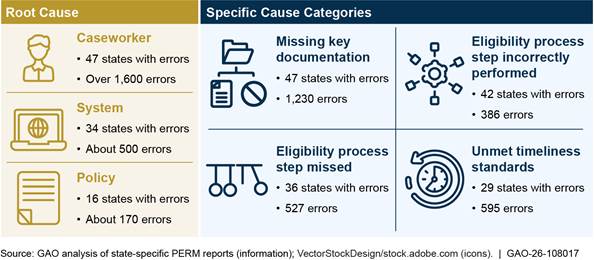
Note: Error totals may not match as some causes are not listed. See report for more information.
The selected states GAO reviewed took a variety of corrective actions—such as providing caseworkers with training, guidance, and making updates to eligibility systems—to reduce eligibility errors identified in the PERM and MEQC.
Although CMS provides feedback on states’ CAPs, the agency’s inconsistent enforcement of required evaluations and limited analysis of state CAPs impair its oversight:
· Incomplete CAPs. CMS accepted PERM CAPs that were missing elements required by federal regulations. For example, states are required to evaluate the effectiveness of their prior corrective actions across five elements, but many CAPs GAO reviewed were missing required elements.
· Limited analyses of CAPs. CMS does not systematically analyze eligibility errors and CAPs across states and years to determine the effectiveness of corrective actions and whether they could be effective in multiple states.
Collecting required elements and conducting these analyses would help CMS better support states in reducing eligibility errors and improper payments.
Why GAO Did This Study
Determining Medicaid eligibility is a complex process that is vulnerable to errors and can lead to improper payments. CMS oversees Medicaid eligibility determinations through its PERM program, which is conducted across all states on a 17-state, 3-year rotational cycle. CMS also requires states to conduct reviews of both eligibility approvals and denials through the MEQC program. The PERM national estimate of improper payments due to eligibility errors has fluctuated in recent years, in part due to temporary changes in Medicaid eligibility requirements implemented in response to the COVID-19 pandemic, but has recently begun to increase.
GAO was asked to review Medicaid eligibility errors. This report describes the causes of Medicaid eligibility errors and corrective actions selected states took to address them, and assesses CMS’s oversight of state corrective actions.
GAO reviewed state-specific PERM reports and other documentation from CMS for reporting years 2019 through 2025, as well as MEQC results and CAPs from seven states selected to obtain variation in Medicaid expenditures, enrollment, and eligibility error rates. GAO also interviewed officials from CMS and those states.
What GAO Recommends
GAO is making two recommendations to CMS to (1) ensure PERM CAPs include all required elements, and (2) systematically analyze eligibility errors and corrective actions across states and years and use that information to reduce errors. The agency agreed with the second and asked that the first be closed, stating its routine oversight process is sufficient. GAO maintains that additional action is needed as CMS has accepted incomplete CAPs.
|
Abbreviations |
|
|
|
|
|
CAP |
corrective action plan |
|
CMS |
Centers for Medicare & Medicaid Services |
|
HHS |
Department of Health and Human Services |
|
MCPIRP |
Medicaid and CHIP Program Integrity Reporting Portal |
|
MEQC |
Medicaid Eligibility Quality Control |
|
OBBBA |
One Big Beautiful Bill Act |
|
PERM |
Payment Error Rate Measurement |
This is a work of the U.S. government and is not subject to copyright protection in the United States. The published product may be reproduced and distributed in its entirety without further permission from GAO. However, because this work may contain copyrighted images or other material, permission from the copyright holder may be necessary if you wish to reproduce this material separately.
August 18, 2026
The Honorable Mike Crapo
Chairman
Committee on Finance
United States Senate
In fiscal year 2024, Medicaid—a joint, federal-state program that finances health care for certain low-income and medically needy individuals—covered 83 million individuals at an estimated cost of $957 billion, of which $620 billion was financed by the federal government. Eligibility for the Medicaid program is governed by a combination of federal and state laws and regulations. As the day-to-day administrators of the Medicaid program, states are responsible for assessing applicants’ eligibility. The Centers for Medicare & Medicaid Services (CMS)—within the Department of Health and Human Services (HHS)—is responsible for overseeing states’ compliance with Medicaid eligibility requirements, including overseeing the accuracy of their eligibility determinations.
We have previously reported that determining Medicaid eligibility is a complex process and vulnerable to error. Such errors can result in inaccurate eligibility determinations, both improper approvals and denials. Improper approvals can have significant implications for federal and state spending and lead to improper payments, while improper denials could result in people losing coverage for which they are eligible.[1]
CMS assesses the accuracy of Medicaid eligibility determinations through two programs—the Payment Error Rate Measurement (PERM) program, and the Medicaid Eligibility Quality Control (MEQC) program. CMS uses PERM to estimate the improper payment rate for Medicaid, including the improper payment rate due to eligibility errors.[2] Under MEQC, states assess the accuracy of their eligibility determinations and report the results to CMS. For each program, states are required to submit corrective action plans (CAP) to CMS that outline actions they are taking or plan to take to correct identified errors.[3]
CMS suspended the eligibility component of PERM and MEQC for fiscal years 2015 through 2018 to provide states with time to adjust to statutory changes in Medicaid eligibility rules and for CMS to revise the programs.[4] During those years, CMS did not publish an updated national estimate of improper payments due to Medicaid eligibility errors. Instead, the agency continued to report the fiscal year 2014 improper payment rate for eligibility errors, which was 3.1 percent.
In 2019, its first year using the updated PERM approach, CMS estimated that the eligibility improper payment rate more than doubled to 8.4 percent.[5] According to CMS, this increase was a result of states adjusting to the changes in eligibility rules, as well as CMS’s revised measurement approach. The estimated eligibility improper payment rate continued to rise through 2021 reaching a high of 16.6 percent before declining to 3.3 percent in 2024. CMS attributed the decline, in part, to the continuous enrollment condition in place during the COVID-19 pandemic under which states could receive temporary enhanced federal funding if they kept enrollees continuously enrolled in Medicaid.[6] As the COVID-19 pandemic continuous enrollment condition ended, the eligibility error rate again started to increase, rising to 4.4 percent in 2025.[7]
Given the changes in eligibility error rates, you asked us to review issues related to Medicaid eligibility errors. In this report, we
1. describe the causes of Medicaid eligibility errors;
2. describe the actions selected states have taken to address Medicaid eligibility errors; and
3. assess CMS oversight of state corrective actions to address Medicaid eligibility errors.
To describe the causes of Medicaid eligibility errors, we reviewed national and available state-specific PERM improper payment reports from CMS for all 50 states and the District of Columbia for reporting years 2019 through 2025 (the most recent years of data available).[8] A reporting year includes state-specific reports for the 17 states reviewed that year. The state-specific reports included data on Medicaid eligibility errors identified from a sample of cases that led to improper payments and identify the root causes and specific causes of those errors.[9] We used these data to determine the total number of errors and projected improper payments by cause and reporting year. We assessed the reliability of these data by reviewing agency documentation, interviewing CMS officials, and reviewing the data for internal consistency. We determined that the data were sufficiently reliable for the purposes of our reporting objectives.
In addition, we reviewed the MEQC reports from reporting years 2020 through 2024 (the most recent available at the start of our review) for seven selected states: Alaska, Delaware, Illinois, Kansas, Pennsylvania, Tennessee, and Washington.[10] We selected these states to obtain variation in program characteristics, including variation in Medicaid expenditures, enrollment, and eligibility error rates. The MEQC reports included information on Medicaid eligibility errors identified from a sample of determinations that led to both improper denials and approvals, as well as the causes for those errors.[11] We used this information to describe the causes of errors appearing across the selected states and across multiple years of reporting. We also interviewed CMS officials to capture their perspectives on the causes of eligibility errors.
To describe actions selected states have taken to address Medicaid eligibility errors, we reviewed PERM and MEQC CAPs for the seven selected states from 2019 through 2024. In our review of MEQC CAPs, we focused on corrective actions planned in response to errors related to negative determinations—meaning improper eligibility denials. In reviewing the CAPs, we developed standardized categories of corrective actions to capture the types of actions states took to reduce errors across our selected states. We also interviewed officials from our selected states about their decisions on what corrective actions to take to address eligibility errors.
To assess CMS oversight of state corrective actions to address Medicaid eligibility errors, we reviewed CMS’s regulations describing requirements for the PERM and MEQC processes, and CMS policies associated with the completion and review of PERM and MEQC CAPs. In addition, we interviewed officials from CMS and the selected states’ Medicaid programs to learn about CMS’s review of states’ CAPs, including any feedback or requested changes that CMS provides to states. We assessed the extent to which CMS oversight ensured the state CAPs included required information by reviewing the PERM and MEQC CAPs and related CMS communications for our selected states. Finally, we assessed CMS’s oversight in the context of agency goals as outlined in CMS’s Medicaid Integrity Plan for fiscal years 2024 through 2028.
We conducted this performance audit from January 2025 to August 2026 in accordance with generally accepted government auditing standards. Those standards require that we plan and perform the audit to obtain sufficient, appropriate evidence to provide a reasonable basis for our audit findings and conclusions based on our audit objectives. We believe that the evidence obtained provides a reasonable basis for our findings and conclusions based on our audit objectives.
Background
Medicaid Eligibility
States have flexibility within federal requirements to define eligibility for Medicaid coverage. For example, while states must cover certain mandatory groups and benefits, they have the option to cover certain other groups of individuals and benefits. As a result, there is substantial variability in Medicaid eligibility across states.
States are primarily responsible for assessing applicants’ eligibility for and enrolling eligible individuals into Medicaid. These responsibilities include verifying individuals’ eligibility at the time of application, performing redeterminations of eligibility at least annually, and promptly disenrolling individuals who are no longer eligible. In verifying individuals’ eligibility, states must assess specified nonfinancial and financial information.
· Nonfinancial. Individuals applying for Medicaid must satisfy certain nonfinancial criteria. For example, to be eligible for Medicaid individuals generally must be residents of the state in which they are applying and must be either citizens of the United States or certain noncitizens, such as lawful permanent residents. Medicaid eligibility may also be based on other factors, like the applicant’s age, or whether they are pregnant or have a disability.
· Financial. Individuals applying for Medicaid generally must also have an income below specified limits.[12] States are required to calculate the income for most nondisabled, nonelderly applicants using a uniform method derived from a federal tax-based definition of income. States have more flexibility in determining how to calculate incomes for individuals whose eligibility is determined on the basis of age or disability. For example, states may disregard certain types or amounts of income for these populations.[13]
Once a state determines that an individual meets relevant financial and nonfinancial eligibility criteria, the state enrolls the individual into Medicaid.
In addition to existing Medicaid requirements, Public Law 119-21, commonly known as the One Big Beautiful Bill Act (OBBBA), includes provisions that will result in changes to Medicaid eligibility requirements and processes in future years. For example, beginning in 2027, states will need to conduct eligibility redeterminations more frequently (every 6 months instead of annually) for certain enrollees.[14] In addition, states will be required to implement community engagement requirements—requirements for work, community service, or educational activities—as a condition of eligibility for certain individuals by the first day of the first quarter that begins after December 31, 2026.[15]
CMS and State Oversight of Eligibility Determinations
CMS operates two distinct, but complementary programs to oversee states’ eligibility determinations in the Medicaid program—PERM and MEQC.[16]
PERM. CMS uses the PERM program to estimate the national Medicaid improper payment rate, which is comprised of three components: fee-for service, managed care, and eligibility determinations.[17] To develop the improper payment rate, CMS draws a sample of fee-for-service and managed care payments. CMS then reviews the eligibility determinations for a subset of individuals for whom those payments were made. Because PERM samples eligibility determinations for individuals from whom payments were made, it only includes cases of individuals that were approved for Medicaid. It does not include information on Medicaid denials or terminations because these cases would not have payments associated with them.
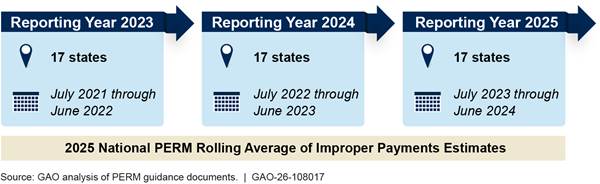
CMS conducts PERM across all states on a 17-state, 3-year rotational cycle, so that one-third of states are reviewed each year.[18] CMS then computes the national improper payment estimate using a rolling average of the improper payment estimates from the most recent 3 years of data. For example, the national Medicaid improper payment estimate reported in 2025 is based on reviews conducted in 2023, 2024, and 2025. The reviews conducted in those years include payments that states made from July 2021 through June 2024. (See fig. 1.)
In addition to calculating the national improper payment rate based on the rolling average of PERM’s most recent 3 years of data, CMS calculates an improper payment rate for each cycle. The cycle rate only includes the 17 states that are reviewed through PERM in a given year. The national rolling rate for the eligibility component of PERM declined from 2021 until it rose again in 2025, while the cycle rate has continued to decline since 2020. (See table 1.)
Table 1: Payment Error Rate Measurement (PERM) Program Medicaid Eligibility Error Rates, Reporting Years 2014-2025
|
Reporting year |
National rolling rate |
Cycle rate |
|||
|
2014 |
3.1% |
2.3% |
|
||
|
2015-2018a |
3.1% |
N/A |
|
||
|
2019 |
8.4% |
20.6% |
|
||
|
2020 |
14.9% |
22.3% |
|
||
|
2021 |
16.6% |
9.3% |
|
||
|
2022 |
11.9% |
5.4% |
|
||
|
2023 |
6.0% |
3.9% |
|
||
|
2024 |
3.3% |
1.5% |
|
||
|
2025 |
4.4% |
1.2%b |
|
||
Source: GAO summary of PERM reports from CMS. | GAO‑26‑108017
Note: The Centers for Medicare & Medicaid Services (CMS) uses the PERM program to measure and report a national rolling improper payment rate for Medicaid. CMS uses a 17-state rotation per cycle, reviewing each state every 3 years. The rolling rate is based on the PERM’s most recent 3 years of data. For example, the rolling rate for 2025 would include data from 2023, 2024, and 2025. The cycle improper payment rate only includes data from the 17 states that are reviewed through PERM in a given year.
aFor fiscal years 2015 through 2018, CMS paused PERM as it made changes to the methodology to reflect new requirements in the Patient Protection and Affordable Care Act. See Pub. L. No. 111-148, tit. II, 124 Stat. 119, 271 (2010), as amended by the Health Care and Education Reconciliation Act of 2010, Pub. L. No. 111-152, 124 Stat. 1029 (modifying Medicaid eligibility rules). During these years, CMS used a static 3.1 percent rolling rate, which it used, in part, to calculate the rolling rate for reporting years 2019 and 2020.
bFor reporting year 2025, CMS did not include errors for redeterminations that were completed after the continuous enrollment condition ended in the cycle rate, due to variations in state implementation of the end of continuous enrollment. However, CMS did track these errors internally and used them in calculating the national rolling rate. If the errors had been included in the cycle rate, then the reporting year 2025 cycle error rate would have been 8.7 percent according to CMS officials. The continuous enrollment condition—in place from March 2020 through March 2023—allowed states to receive temporary enhanced federal funding if they kept enrollees continuously enrolled in Medicaid.
MEQC. The MEQC program is designed to identify methods to reduce and prevent errors related to incorrect eligibility determinations. Under the MEQC, states are required to conduct a review of a sample of cases to independently verify whether individuals met eligibility criteria. The results are then reported to CMS. States are required to review sample cases of both individuals found eligible for Medicaid coverage (i.e., active cases), as well as those found ineligible (i.e., negative cases). For active cases, states can choose, with CMS approval, to focus their reviews on recent changes to eligibility policies and processes, areas where the state suspects vulnerabilities, or proven error prone areas. MEQC cases are sampled in the calendar year prior to the release of the report. For example, the 2024 MEQC report reflects cases from January 1, 2023, to December 31, 2023. States conduct the MEQC in between their PERM review years. MEQC reviews do not produce an error rate. However, these reviews do provide CMS and states with information about the accuracy and timeliness of eligibility determinations including erroneous denials and terminations.
Both the PERM and MEQC programs entail reviews that classify eligibility errors by type, identify a cause of the error, and require states to address the root and specific causes of the errors. Root causes describe the source or principal actor of the error and can include a caseworker—the individual responsible for processing an applicant’s Medicaid application—system, or policy issue. Specific causes describe the exact action taken or not taken that led to the error. These could include not saving certain documentation or incorrectly calculating enrollees’ income.
In response to errors identified by the PERM and MEQC reviews, states are required to develop corrective action plans (CAP) addressing each error identified and submit these plans to CMS for review.[19] For the PERM CAP, states are required to evaluate the effectiveness of their prior corrective actions by assessing (1) improvements in operations, (2) efficiencies, (3) the number of errors, (4) improper payments, and (5) the ability to meet PERM improper payment rate targets assigned by CMS.[20] In addition, for the eligibility component of the PERM CAP, states are required to evaluate whether actions the state takes to reduce eligibility errors will also avoid increases in improper denials.[21]
States develop their CAPs using templates that CMS has created. In 2023, states began submitting their CAPs through the Medicaid and CHIP Program Integrity Reporting Portal (MCPIRP), an online reporting portal; prior to that, states used text documents and spreadsheets for their CAPs.
The Social Security Act generally requires CMS to reduce federal payments to a state Medicaid program if the state’s eligibility error rate exceeds 3 percent.[22] In its revised PERM rules, finalized in 2017, CMS issued revised procedures through which it can withhold funds for eligibility errors beginning in fiscal year 2022.[23] However, CMS may waive the reduction in federal funds if it determines that the state made a good faith effort in the interim years to reduce its error rate (i.e., through implementing corrective actions and meeting MEQC requirements).[24] According to CMS officials, the agency has not withheld federal funds from states as a result of having eligibility error rates above the 3 percent threshold during the period under our review. However, OBBBA limits the amount of reduction of federal funds that CMS can waive beginning in fiscal year 2030.[25]
COVID-19 Pandemic and Effect on Medicaid Eligibility Errors
During the COVID-19 pandemic, states could receive temporary enhanced federal funding if they kept enrollees continuously enrolled in Medicaid.[26] CMS also provided states with additional flexibilities in response to the COVID-19 pandemic, which temporarily expanded eligibility to Medicaid and streamlined eligibility processes, among other things.[27] Due to these flexibilities and because states that received temporary funding could not disenroll ineligible individuals during the pandemic, CMS cited few errors for redeterminations. This practice continued even after the continuous enrollment condition ended in March 2023 and states began to resume full eligibility redeterminations, including disenrollments. See appendix I for more information on the effect of the COVID-19 pandemic on Medicaid eligibility errors.
Most Eligibility Errors Were Attributed to Caseworkers and Included Missing Documentation and Issues with the Eligibility Process
Root Causes of Eligibility Errors
We found that caseworkers were typically identified as the most prevalent source, or root cause, of Medicaid eligibility errors identified through PERM and the selected states’ MEQC reports we reviewed.[28] Other root causes of errors included state eligibility systems and state policies.[29] (See fig. 2.)
Figure 2: Medicaid Projected Improper Payments and Number of Sample Errors by Root Cause Identified Through the PERM Program, Reporting Years 2019–2025
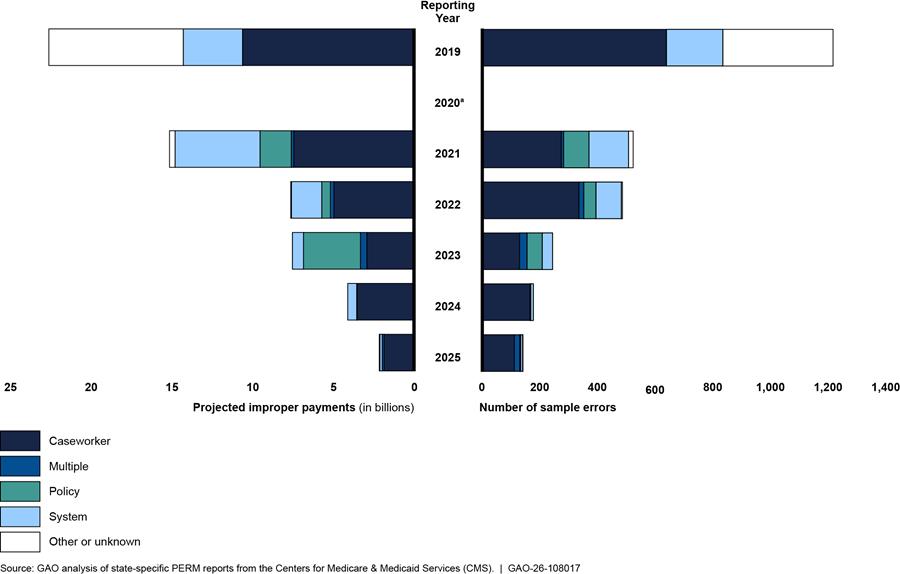
Notes: CMS uses the Payment Error Rate Measurement (PERM) program to measure and report a national improper payment rate for Medicaid. CMS uses a 17-state rotation per cycle, reviewing each state every 3 years. Thus, the data in the figure represent errors identified in the 17 states reviewed in that reporting year. Multiple errors on a single case are counted separately in this graph. All reporting years sampled approximately 6,000 cases except reporting year 2021. That year, CMS sampled about 3,500 cases.
In reporting year 2021, CMS changed how it summarized the root cause of an error and developed six broad categories: caseworker, system, policy, multiple, unable to determine, and other. We reviewed the available data from CMS and categorized 2019 PERM data using those categories CMS created for later years.
aThe projected improper payments, number of sample errors, and root cause of errors are not available for reporting year 2020 because CMS did not produce state specific reports for PERM that year due to the COVID-19 pandemic.
Caseworkers. Errors were most commonly attributed to caseworkers in states’ PERM reports, which, for each reporting year, include data from the 17 states reviewed that year. Over 1,600 of the 2,789 errors (nearly 60 percent) identified in state-specific PERM reports were attributed to caseworkers from reporting years 2019 through 2025, and more than 40 percent of errors and projected improper payments identified in PERM reports were attributed to caseworkers in all but one reporting year. Additionally, caseworker errors were the most widespread, with 47 states having at least one error attributed to caseworkers from reporting years 2019 through 2025.
Similarly, MEQC reports for our seven selected states showed that caseworkers were typically the most commonly cited root cause of errors leading to both improper eligibility approvals and denials. For example, among five of our states, caseworkers were cited as the source for at least 90 percent of the errors that resulted in an improper denial in reporting years 2023 and 2024.[30]
CMS officials told us errors attributed to caseworkers often stem from several factors such as insufficient training or high turnover rates.
Eligibility systems. State eligibility systems were generally the second most frequent root cause of eligibility errors. Almost 500 of the 2,789 errors (about 20 percent) identified in the state-specific PERM reports were attributed to states’ eligibility systems, with 34 states having at least one system error from reporting years 2019 through 2025.
MEQC reports for our seven selected states also showed that some states had system issues that led to improper eligibility approvals and denials. For example, among three of our states, system issues were the only other root cause cited for improper denials, outside of caseworkers, in reporting year 2023. In those states, system issues caused between 2 percent and 6 percent of all errors that led to improper denials.
State policies. Errors were less frequently attributed to state policies not aligning with federal regulation or other regulatory guidance than to caseworkers or eligibility system issues. About 170 of the 2,789 errors (about 6 percent) identified in state-specific PERM reports were attributed to state policies that did not align with federal regulation or guidance. Sixteen states had at least one error caused by a policy discrepancy across our review period. Although policy issues were frequently cited as the root cause of errors in reporting year 2023, these errors were largely concentrated in a few states, with one state accounting for 81 percent of all policy errors that year.
MEQC results for our seven selected states showed that errors attributed to policy issues were generally rare. Most of our selected states did not have any identified errors attributed to policies in their MEQC results for either improper approvals or denials in reporting years 2023 and 2024.
Specific Causes of Eligibility Errors
In addition to root causes, CMS and states categorize the causes of errors further into specific causes, which are the actions taken or not taken that led to an error. The specific causes of eligibility errors generally fell into one of four categories:
· Missing key documentation. Instances where there was insufficient information or documentation, such as a missing signature or application form, to verify enrollees’ eligibility determination.
· Eligibility process step incorrectly performed. Instances where a step in the eligibility process was not performed correctly, though all necessary steps may have been taken. This could include, for example, the incorrect calculation of an enrollee’s income or resources or the approval of an application when an individual did not meet certain requirements (e.g., residency).
· Eligibility process step missed. Instances where not all necessary steps were taken to process an application such as not using required data sources to process an application or failing to act on information provided by the enrollee.
· Unmet timeliness standards. Instances where applications were not processed or redeterminations were not conducted in accordance with the time frames specified in regulation.[31]
Specific causes are not unique to any one root cause. For example, key documentation could be missing due to a caseworker or a system issue.
Missing key documentation was cited as the most frequent and widespread cause of errors that led to improper payments, according to state-specific PERM reports from 2019 through 2025. (See table 2.) Although more than 40 states had errors caused by an eligibility process step not being performed correctly, states in general made the fewest errors in this category. In contrast, fewer states had errors caused by unmet timeliness standards, but there were relatively more total errors in this category compared to the categories related to performing an eligibility process step incorrectly or missing it completely.
Table 2: Categories of Specific Causes of Medicaid Eligibility Errors that Led to Improper Payments, Reporting Years 2019–2025
|
Category |
Number of states with an error (n=51) |
Number of sample errors |
Examples of specific causes identified through the Payment Error Rate Measurement (PERM) |
|
Missing key documentation |
47 |
1,230 |
Insufficient documentation for verification. A state had an error cited in reporting year 2019 because a caseworker did not maintain sufficient documentation to demonstrate that an enrollee’s Social Security number was verified. Missing signature. A state had an error cited in reporting year 2021 because its policy did not require enrollee signatures for redeterminations unless a paper renewal form was returned to the state. A caseworker had completed a redetermination via a phone call, but did not require a telephonic signature, which aligns with state policy, but not federal requirements, which require a signature regardless of the application method. |
|
Eligibility process step incorrectly performed |
42 |
386 |
Incorrect income limits applied. A state had an error cited in reporting year 2021 because its eligibility system did not use the correct income limits when determining what Medicaid eligibility group an enrollee qualified for. As a result, the enrollee was placed in the wrong eligibility group. Data entry issue. A state had an error cited in reporting year 2024 because a caseworker entered incorrect information on an enrollee’s household composition and tax filer status. As a result, the enrollee was placed in the wrong eligibility group. |
|
Eligibility process step missed |
36 |
527 |
No income verification. A state had 18 errors cited in reporting year 2019 because the state’s eligibility system did not verify income information from enrollees before approving or renewing them for Medicaid benefits. No initial determination. A state had 11 errors cited in reporting year 2023 reflecting an erroneous state policy that granted automatic Medicaid eligibility to certain enrollees based upon eligibility for the Temporary Assistance for Needy Families program without having documentation or records to support a Medicaid determination. |
|
Unmet timeliness standards |
29 |
595 |
Untimely redetermination. A state had three errors cited in reporting year 2021 because system errors led to redeterminations not being conducted before the renewal date. Untimely redetermination. A state had 22 errors cited in reporting year 2023 because caseworkers did not process redeterminations within the required 12-month period. Specifically, these redeterminations were due before the COVID-19 pandemic, but caseworkers had not completed them when required. |
Source: GAO analysis of state-specific PERM reports from the Centers for Medicare & Medicaid Services (CMS). | GAO‑26‑108017
Note: The PERM reports we reviewed included more than 50 specific causes of eligibility errors. We categorized these specific causes into the above categories and an “other” category, which represented about 2 percent of all errors. The number of states with errors represents the total number of unique states that had at least one error with a specific cause that fell into the category during the period of review. The number of errors represents the total number of sample errors that had a specific cause that fell into the category. Multiple errors on a single case are counted separately. The specific cause of errors is not available for reporting year 2020 because CMS did not produce state specific reports for PERM due to the COVID-19 pandemic. All reporting years sampled approximately 6,000 cases except reporting year 2021. That year, CMS sampled about 3,500 cases.
The specific causes of errors that led to improper denials, which are identified in the MEQC, but not the PERM, were largely consistent with the causes of errors identified in the PERM across our selected states for reporting years 2020 through 2024.[32]
· Missing key documentation. Four of our seven selected states had at least one error with a specific cause related to missing documentation. For example, a selected state cited an error in its MEQC for reporting year 2023 because a caseworker did not keep sufficient documentation on an individual’s income. Without that documentation, it could not be determined if the individual’s eligibility denial was appropriate.
· Eligibility process step performed incorrectly. Six of our seven selected states had at least one error with a specific cause related to incorrectly performing a step in the eligibility process. For example, a selected state cited an error in its MEQC for reporting year 2023 because a caseworker incorrectly denied an individual’s Medicaid coverage based on residency. However, the individual met residency requirements and should have maintained Medicaid coverage.
· Eligibility process step missed. Four of our seven selected states had at least one error with a specific cause related to missing a step in the eligibility process. For example, a selected state cited an error in its MEQC for reporting year 2023 because a caseworker did not take action on income information that an individual sent to the state agency. As a result, the individual was incorrectly denied Medicaid coverage.
Selected States’ Corrective Actions to Reduce Eligibility Errors Included Guidance, Training, and System Updates
Our seven selected states described a variety of corrective actions to reduce eligibility errors in the PERM and MEQC CAPs we reviewed.[33] We found that these corrective actions generally included eligibility system updates, issuing guidance, providing training, conducting case reviews to assess the accuracy of eligibility determinations, adding staff, and making policy changes. (See table 3.) In some instances, states relied on a combination of actions to address eligibility errors, according to the PERM and MEQC CAPs we reviewed. For example, to address multiple instances of caseworker errors in verifying eligibility elements, Pennsylvania issued guidance, planned additional training for caseworkers, and implemented a system update. In other instances, states used a single type of corrective action to address multiple errors or error types. For example, Tennessee implemented system updates to address errors attributed to both caseworkers and to system issues identified in the 2023 PERM reporting year. Tennessee officials told us they try to implement corrective actions that will automate steps in the eligibility process as much as possible in an attempt to reduce opportunities for human error.
Table 3: Examples of Selected States’ Corrective Actions to Address Medicaid Eligibility Errors, Reporting Years 2019–2024
|
Corrective action |
Description |
Number of selected states taking action (n=7) |
Examples of selected states’ corrective actions |
|
Eligibility system update |
Changes—ranging from code corrections to new software—to electronic eligibility systems used to support eligibility determinations. |
7 |
· Tennessee updated its online application system to capture more complete information on the resources of long-term care applicants to address missing documentation. (2023 PERM CAP) · Illinois updated its integrated eligibility system to ensure that income and other information was correctly identified in notices of decisions sent to applicants after previous system issues resulted in notices without accurate information. (2023 MEQC CAP) |
|
Guidance |
Written information (e.g., memorandums or manuals) distributed to caseworkers. |
7 |
· Kansas created checklists to assist staff in making accurate determinations in response to instances where caseworkers did not follow policy and incorrectly calculated enrollee resources. (2019 PERM CAP) · Illinois issued a memo to eligibility staff reminding them of the need to obtain signatures for all applications in response to a caseworker not collecting a signature for an application made over the phone. (2023 MEQC CAP) |
|
Training |
Instruction provided to educate caseworkers, on a group or individual basis, about relevant elements of eligibility determinations. |
7 |
· Washington developed a web-based training to inform eligibility staff about new state policies developed in response to missing signatures on applications completed online or by phone. (2021 PERM CAP) · Pennsylvania provided training to a caseworker, and had a supervisor meet with that worker, to address an instance where the worker did not act on an enrollee’s move out of state for several years, which resulted in benefits being paid for a non-resident. (2023 MEQC CAP) |
|
Case review |
Providing additional review of cases for accuracy or monitoring to track progress on identified issues. |
6 |
· Alaska implemented a statewide case review as part of its response to instances where caseworkers performed eligibility processing steps incorrectly when determining applicant resources. (2021 PERM CAP) · Delaware started auditing its document imaging software entries as part of its response to issues with missing documentation. (2023 MEQC CAP) |
|
Additional staff resources |
Increasing staff resources through hiring or reassignment, to expand capacity. |
5 |
· Alaska hired additional clerical staff to upload documentation to address issues with missing case file documents. (2021 PERM CAP) · Delaware hired additional compliance specialists to help with staff education as part of its response to issues with caseworkers not providing applicants with sufficient time to return required paperwork. (2023 MEQC CAP) |
|
Policy change |
Changes to state eligibility policy or procedures to conform with federal regulation. |
4 |
· Pennsylvania updated its eligibility procedure handbook to require signatures on applications and renewal forms to document enrollee acceptance of terms in response to caseworkers not obtaining these signatures as required by federal policy. (2019 PERM CAP) |
|
Other |
Corrective actions that do not fit into one of the above categories. |
6 |
· Kansas described planned changes to its agreement with the contractor it used to determine eligibility in response to errors related to income verification. (2020 MEQC CAP) |
Legend
CAP: corrective action plan
MEQC: Medicaid Eligibility Quality Control program
PERM: Payment Error Rate Measurement program
Source: GAO analysis of selected states’ corrective action plans submitted to the Centers for Medicare & Medicaid Services. | GAO‑26‑108017
Note: We reviewed PERM CAPs and MEQC CAPs for seven states—Alaska, Delaware, Illinois, Kansas, Pennsylvania, Tennessee, and Washington—and shared the examples with state officials for their review. For the MEQC CAPs, we focused on actions taken in response to negative determination errors, meaning determinations that resulted in a denial of eligibility.
Among our selected states’ PERM CAPs, we found that guidance, training, and eligibility system updates were the most prevalent corrective actions. Specifically, we found that the selected states generally proposed these measures to address the largest number of errors.[34] Our review of MEQC CAPs for negative case errors (e.g., errors where the state incorrectly denies enrollment) found generally similar results. Specifically, the selected states most frequently proposed training and guidance to address errors that lead to incorrect denials.
Officials from our selected states told us they consider various factors when determining what corrective actions to take. In addition to considering the root and specific cause of the error, factors state officials noted included the following:
· Cost to implement. Officials from six states told us they considered cost when determining which corrective actions to take, with some officials noting that cost can create barriers to certain options such as hiring additional staff or updating systems. For example, officials from Pennsylvania noted that improvements to the state’s eligibility system would help tremendously, but that those updates require funding and staffing resources that can sometimes be challenging to obtain. As a result, Pennsylvania officials noted they have focused on communication and collaboration to detect potential issues early and provide caseworkers with training and tip sheets to reduce errors, while continuing to prioritize system changes when appropriate.
· Time to implement. Officials from five states told us they consider the time required to implement corrective actions. For example, recognizing the time it would take to implement a system update, Delaware officials told us they issued interim guidance to provide caseworkers a workaround while they fixed an ongoing system issue.
CMS Has Not Ensured that State Corrective Action Plans Include All Required Elements
CMS Provides Feedback on State Corrective Action Plans, but Has Not Consistently Ensured States Submit Required Evaluations
To oversee state PERM and MEQC CAPs, CMS reviews state submissions prior to accepting them.[35] As part of this review, CMS may request additional information from states and provide feedback on states’ planned corrective actions. For PERM CAPs specifically, CMS officials told us they review the plans for completeness and may request additional information or clarification to ensure state corrective actions are responsive to PERM findings and appropriate for CMS acceptance. In its guidance for state PERM CAP submissions through MCPIRP—the agency’s portal implemented in 2023 to streamline collection of state PERM and MEQC CAPs—CMS noted common instances where the agency may need to request additional information from states. These instances may include root causes not aligning with errors and evaluations of corrective action effectiveness not being clear, among others. For example, in reviewing a 2024 PERM CAP, a CMS official flagged that the state did not complete its review of how the state’s corrective actions would help it meet future target error rates. In response, the state submitted that information to CMS.
A similar process exists with MEQC CAP oversight, where CMS officials may request additional information from states. For example, in reviewing a 2023 MEQC CAP from a selected state, CMS flagged that the information the state provided about the cause for 33 errors was not sufficient and asked the state to describe in detail what the caseworker did or did not do to cause the error.
CMS oversight of state corrective actions continues after CAPs are finalized and accepted. Specifically, states are required to provide CMS updates on the status of PERM corrective action implementation at least annually and upon request by CMS.[36] For example, in its 2023 PERM CAP, a state noted that it had revised internal processes and implemented system updates to correct caseworker errors pertaining to determining applicants’ available resources. CMS followed up to confirm that actions were implemented and that the state did not experience similar errors in its subsequent 2026 review, which was underway.
Although CMS officials told us they review PERM CAPs for completeness prior to accepting them, we found that CMS accepted CAPs that did not include evidence that states had conducted required evaluations.[37]
· Evaluation of the risk of improper denials. As previously noted, CMS regulations require states’ PERM CAPs to include an evaluation of whether their proposed corrective actions will also avoid increases in improper denials, but this element was missing from all 14 PERM CAPs we reviewed.[38]
· Evaluation of prior cycle CAPs. As previously noted, CMS regulations also require states’ PERM CAPs to include an evaluation of the effectiveness of prior cycle corrective actions.[39] According to the regulation, states must evaluate the effectiveness of their corrective actions by assessing the following five elements: (1) improvements in operations, (2) efficiencies, (3) the number of errors, (4) improper payments, and (5) the ability of the state to meet PERM improper payment rate targets assigned by CMS. However, we found that this evaluation was incomplete in all seven PERM CAPs we reviewed where such an evaluation was required.[40]
This missing information was caused by gaps in CMS’s PERM CAP template that states use to submit information to CMS, as well as weaknesses in CMS’s review of states’ CAPs. First, the template did not include a field for states to describe the evaluation they conducted to assess the potential effect of their proposed corrective actions on improper denials, and CMS officials accepted CAPs without such information. When we raised this issue to CMS, agency officials acknowledged that the PERM CAP template did not include a field for states to describe their evaluation of the risks for improper denials. In May 2026, CMS updated its PERM CAP template in MCPIRP to include the evaluation of the potential for improper denials.
Second, the PERM CAP template that was in use between 2019 and 2022 instructed states to include an evaluation of prior cycle CAPs, but did not include or specify the elements required for that evaluation. As a result, the PERM CAPs we reviewed that used this template and had been accepted by CMS were missing required elements of the prior cycle CAP evaluation. For example, one state’s 2022 PERM CAP prior cycle evaluation cited the decline in its error rate during the COVID-19 pandemic, when CMS was citing fewer errors, as the sole evidence that the state’s corrective actions were effective. This evaluation did not include information on efficiencies or describe the effect of prior cycle corrective actions on the number of errors, improper payments, or the ability of the state to meet its improper payment rate target.
As part of its shift to MCPRIP, CMS updated the PERM CAP template. As a result, the template used by states for review years 2023 and 2024 included instructions for states to specify four of the five required elements for prior cycle CAP evaluations.[41] However, we found that CMS has continued to accept PERM CAPs that do not include each of the required elements. Specifically, PERM CAPs we reviewed for two of the three states submitted in MCPIRP were incomplete.[42] One of those CAPs was missing the prior cycle CAP evaluation for the eligibility component entirely, and the other CAP was missing two required elements of the evaluation.[43]
In order to assess the effectiveness of corrective actions to reduce eligibility errors, it is critical that CMS ensure that states’ CAPs include all required evaluations. States’ assessments of improper denials as required by federal regulation are important to ensure that corrective actions do not accidentally result in increases in eligible individuals being denied coverage. This is especially important because PERM reviews focus on eligibility errors associated with individuals approved for Medicaid and do not assess eligibility errors related to Medicaid denials. CMS’s primary mechanism for assessing improper denials of coverage is the MEQC, and the MEQC reports we reviewed for our seven selected states suggest that some states may be experiencing high rates of improper denials.[44] By not including all of the required elements of prior cycle CAP evaluations, CMS does not collect information that agency officials told us helps them identify barriers states experienced in implementing corrective actions and areas where CMS may be able to offer technical assistance. Thus, when these evaluations are incomplete, it hampers both CMS and states’ abilities to identify effective corrective actions to improve the accuracy of eligibility determinations and reduce improper payments.
CMS Conducts Limited Analysis of States’ Corrective Actions
CMS officials told us they study PERM and MEQC findings and CAPs within a state across time to identify areas where that state requires additional support or to identify opportunities for knowledge sharing. CMS officials told us they track whether repeated errors occurred within a state after a corrective action was implemented and discuss trends they observe when reviewing CAP submissions. However, CMS is not systematically analyzing errors and associated corrective actions across states to assess the effectiveness of corrective actions or whether there are corrective actions that could be effective in multiple states. For example, CMS officials told us that reporting year reviews are self-contained in that CMS does not discuss findings from the current review year of 17 states with the other 34 states not part of that review.
A more systematic analysis of the effectiveness of CAPs across states would be consistent with CMS’s goals. According to CMS’s Medicaid Integrity Plan for fiscal years 2024 through 2028, the agency is committed to “utilizing advanced analytics and other innovative solutions to improve Medicaid eligibility and payment data and maximize the potential for the data to be used for program integrity purposes.” In furtherance of this goal, CMS notes that MCPIRP, its relatively new online portal for states’ CAPs, is designed to allow for more effective oversight, monitoring, and trend analysis to better reduce future Medicaid improper payments. CMS officials told us they hoped to use MCPIRP in the future to facilitate reviews of corrective actions across states and cycles over time. For example, they told us they hoped to use MCPIRP to assess whether states were using the same types of corrective actions to address similar errors occurring across states in different PERM review cycles, as well as to track the changes in error rates and corrective actions across PERM cycles to see whether states are improving over time. However, according to CMS officials, the system does not yet have the capability to produce these reports. As a result, CMS has not begun using MCPIRP to analyze eligibility errors and corrective actions across states and across time, and officials did not provide details or documentation of CMS’s plans for conducting this analysis in the future. Such analysis, whether conducted in MCPIRP or through other means, could help CMS better support states in reducing eligibility errors and improper payments.
Conclusions
Determining Medicaid applicants’ eligibility is a difficult process, made more challenging by caseworker turnover and evolving state and federal guidelines and regulations. In 2025, the Medicaid eligibility error rate increased for the first time in 4 years, partially reflecting an end to the continuous enrollment condition and flexibilities related to the COVID-19 pandemic. The end of COVID-19 related flexibilities, along with upcoming changes to Medicaid eligibility requirements, including more frequent redeterminations and added community engagement requirements, increases opportunities for eligibility errors and improper payments. Additionally, recent statutory changes that will require CMS to reduce federal funds for states with higher eligibility error rates beginning in fiscal year 2030 may have significant financial consequences for states, further highlighting the need for CMS to help ensure states are making accurate eligibility determinations.
Although CMS has made efforts to help states address and prevent eligibility errors, we found inconsistencies in the agency’s oversight of states’ PERM CAPs. Specifically, CMS has accepted incomplete PERM CAPs from states. As a result, CMS and states are missing valuable information about what corrective actions are most effective at ensuring accurate eligibility determinations. Further, CMS does not systematically analyze eligibility errors and associated corrective actions across states and reporting years to identify corrective actions that could apply across multiple states. CMS officials noted the analytical potential of its MCPIRP system to offer CMS and states valuable insights on effective corrective actions. These additional analyses could also help CMS and states keep abreast of emerging issues and help states reduce Medicaid eligibility errors. Although MCPIRP offers opportunities to expand the agency’s analysis of eligibility errors and corrective actions, the Medicaid program may be at increased risk for eligibility errors and improper payments so long as the agency accepts incomplete CAPs and does not analyze them both across states and across reporting years.
Recommendations for Executive Action
We are making the following two recommendations to CMS:
The Administrator of CMS should ensure that states’ PERM CAPs include all required elements before accepting them. (Recommendation 1)
The Administrator of CMS should systematically analyze PERM and MEQC eligibility error results and associated corrective actions across states and across reporting years to assess the effectiveness of those corrective actions and use that information to help states reduce eligibility errors. (Recommendation 2)
Agency Comments and Our Evaluation
We provided a draft of this report to HHS for review and comment. HHS provided written comments, which are reproduced in appendix II, and a technical comment, which we incorporated as appropriate. In its comments, HHS requested that our first recommendation be closed as implemented and concurred with our second recommendation.
Regarding our first recommendation, HHS stated, as was noted in our draft report, that it updated the PERM CAP template in May 2026 to ensure that states include an evaluation of whether the corrective actions taken to reduce eligibility errors also avoided increases in improper denials, as required. HHS also stated that its routine PERM CAP oversight process will ensure that future PERM CAP submissions include an evaluation of the effectiveness of corrective actions, including all the elements required in regulation. Based on that, HHS requested that we close the recommendation as implemented. However, as we reported, CMS previously updated its PERM CAP submission template to specify the required elements to evaluate the effectiveness of prior corrective actions, and after making these changes, still accepted incomplete PERM CAPs. This indicates that updates to the PERM CAP template and the agency’s routine PERM CAP oversight process are not sufficient and that additional action is needed by the agency to ensure that states’ PERM CAPs include all required elements before they are accepted.
Regarding our second recommendation, HHS noted that the agency plans to conduct additional analyses using the data collected by MCPIRP. This will include identifying and comparing eligibility error types and rates across states to detect national trends and outliers, tracking changes in improper payment rates and corrective action outcomes across PERM cycles to assess whether states are improving over time, and evaluating the effectiveness of corrective actions implemented by states by comparing pre- and post-corrective action error rates across cycles. These additional analyses, if effectively carried out, should help CMS better support states in reducing eligibility errors.
As agreed with your office, unless you publicly announce the contents of this report earlier, we plan no further distribution until 30 days from the report date. At that time, we will send copies to the appropriate congressional committees, the Secretary of Health and Human Services, and other interested parties. In addition, the report is available at no charge on the GAO website at http://www.gao.gov.
If you or your staff have any questions about this report, please contact me at RosenbergM@gao.gov. Contact points for our Offices of Congressional Relations and Media Relations may be found on the last page of this report. GAO staff who made key contributions to this report are listed in appendix III.
Michelle B. Rosenberg
Director, Health Care
During the COVID-19 pandemic, states could receive temporary enhanced federal funding if they kept enrollees continuously enrolled in Medicaid.[45] In this report, we refer to this temporary continuous enrollment condition as “continuous enrollment.” The Centers for Medicare & Medicaid Services (CMS) also provided states with certain flexibilities in response to the COVID-19 pandemic.[46]
Typically, states must redetermine enrollees’ eligibility annually and disenroll those who are no longer eligible. Under continuous enrollment, however, states that received temporary funding were required to pause disenrollments, except in limited circumstances. These limited circumstances included if the individual asked to be disenrolled, moved out of state, or died. The continuous enrollment condition ended on March 31, 2023, and states could resume full eligibility redeterminations, including disenrollments, beginning on April 1, 2023.[47] This transition from continuous enrollment—a process that continued through December 31, 2025—was known as Medicaid “unwinding.” To protect enrollees from erroneous termination and reduce state administrative burdens during unwinding, CMS temporarily waived certain federal requirements—such as requirements for verifying enrollees’ income—when conducting redeterminations.[48]
Due to continuous enrollment and these flexibilities, CMS adjusted the Payment Error Rate Measurement (PERM) eligibility review process and did not cite errors related to redeterminations completed during the COVID-19 pandemic, which included PERM reporting years 2021 through 2025. CMS also did not cite errors if states did not conduct redeterminations during the pandemic, as states were not required to do so. Generally, if CMS cited an error related to a redetermination during the pandemic, it was related to a redetermination that should have been completed prior to the continuous enrollment condition, according to CMS officials.
We found that the number of errors and projected improper payments cited for redeterminations in PERM significantly decreased during continuous enrollment and into the first year of unwinding, where CMS continued its practice to not cite errors related to redeterminations.[49] (See fig. 3.)
Figure 3: Medicaid Projected Improper Payments and Number of Sample Errors for Redeterminations Through the PERM Program, Reporting Years 2019–2025
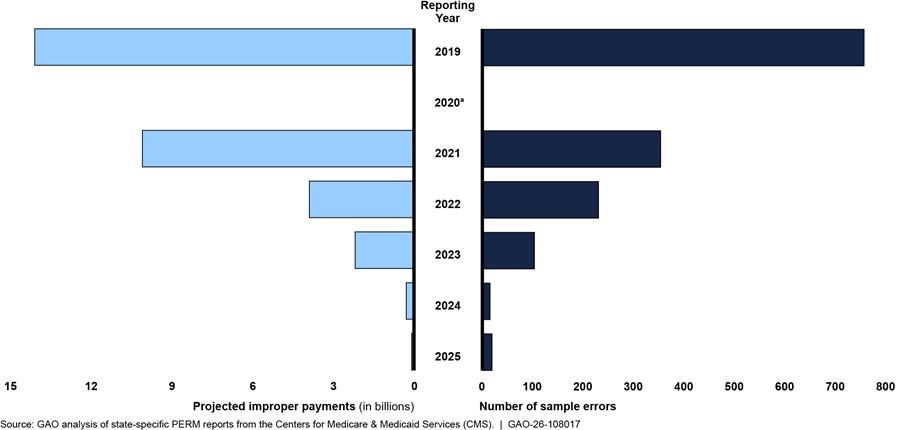
Notes: CMS uses the Payment Error Rate Measurement (PERM) program to measure and report a national improper payment rate for Medicaid. CMS uses a 17-state rotation per cycle, reviewing each state every 3 years. Thus, the data in the figure represent errors identified in the 17 states reviewed in that reporting year. Sampling periods (the period of time cases are pulled for the sample) begin about a year and a half prior to the reporting year. For example, for reporting year 2024, the sampling period was July 2022 through June 2023. Multiple errors on a single case are counted separately in this figure. All reporting years sampled approximately 6,000 cases except reporting year 2021. That year, CMS sampled about 3,500 cases.
CMS collects data on redeterminations that are sampled and have errors cited. Specifically, these refer to when the last action was a result of processing a redetermination submitted to the state or when a redetermination was not completed timely.
aThe projected improper payments and number of sample errors are not available for reporting year 2020 because CMS did not produce state specific reports for PERM due to the COVID-19 pandemic.
Although CMS did not officially cite errors for redeterminations completed during the COVID-19 pandemic, it did identify some errors that would have been cited had it not been for continuous enrollment and the COVID-19 pandemic flexibilities in PERM reporting years 2023, 2024, and 2025. CMS referred to these potential errors as “COVID differences.” CMS did not publicly report COVID differences, but provided the information to states that conducted redeterminations during the pandemic, even though they were not required to do so, in separate reports. Based on our review of these reports, the total number of PERM eligibility errors not cited due to continuous enrollment and the COVID-19 pandemic flexibilities ranged from about 90 to almost 300 in the reporting years we reviewed. (See fig. 4.) CMS officials noted that states may have performed differently if continuous enrollment and COVID-19 flexibilities were not in place and redeterminations were required.[50]
Figure 4: Number of Medicaid PERM Program Sample Errors Not Cited Due to Continuous Enrollment and the COVID-19 Pandemic Flexibilities, Reporting Years 2023–2025
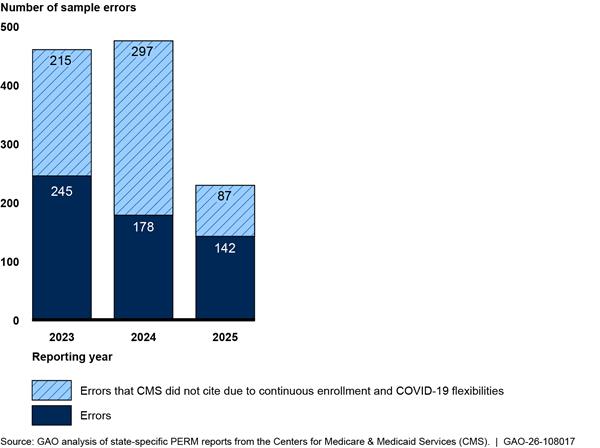
Notes: CMS uses the Payment Error Rate Measurement (PERM) program to measure and report a national improper payment rate for Medicaid. CMS uses a 17-state rotation per cycle, reviewing each state every 3 years. Thus, the data in the figure represent errors identified in the 17 states reviewed in that reporting year. Sampling periods (the period of time cases are pulled for the sample) begin about a year and a half prior to the reporting year. For example, for reporting year 2024, the sampling period was July 2022 through June 2023. Multiple errors on a single case are counted separately in this chart.
During the COVID-19 pandemic, states could receive temporary enhanced federal funding if they kept enrollees continuously enrolled in Medicaid. Families First Coronavirus Response Act. Pub. L. No. 116-127, § 6008, 124 Stat. 178, 208-09 (2020). We refer to this temporary continuous enrollment condition as “continuous enrollment.”
GAO Contact
Michelle B. Rosenberg, RosenbergM@gao.gov
Staff Acknowledgments
In addition to the contact named above, Jasleen Modi (Assistant Director), Luke Baron (Analyst-in-Charge), Matt St. Geme, Dhara Patel, and Shreya Shankar made key contributions to this report. Also contributing were Kaitlin Farquharson, Drew Long, Roxanna Sun, and Jeffrey Tamburello.
The Government Accountability Office, the audit, evaluation, and investigative arm of Congress, exists to support Congress in meeting its constitutional responsibilities and to help improve the performance and accountability of the federal government for the American people. GAO examines the use of public funds; evaluates federal programs and policies; and provides analyses, recommendations, and other assistance to help Congress make informed oversight, policy, and funding decisions. GAO’s commitment to good government is reflected in its core values of accountability, integrity, and reliability.
Obtaining Copies of GAO Reports and Testimony
The fastest and easiest way to obtain copies of GAO documents at no cost is through our website. Each weekday afternoon, GAO posts on its website newly released reports, testimony, and correspondence. You can also subscribe to GAO’s email updates to receive notification of newly posted products.
Order by Phone
The price of each GAO publication reflects GAO’s actual cost of production and distribution and depends on the number of pages in the publication and whether the publication is printed in color or black and white. Pricing and ordering information is posted on GAO’s website, https://www.gao.gov/ordering.htm.
Place orders by calling (202) 512-6000, toll free (866) 801-7077,
or
TDD (202) 512-2537.
Orders may be paid for using American Express, Discover Card, MasterCard, Visa, check, or money order. Call for additional information.
Connect with GAO
Connect with GAO on X,
LinkedIn, Instagram, and YouTube.
Subscribe to our Email Updates. Listen to our Podcasts.
Visit GAO on the web at https://www.gao.gov.
To Report Fraud, Waste, and Abuse in Federal Programs
Contact FraudNet:
Website: https://www.gao.gov/about/what-gao-does/fraudnet
Automated answering system: (800) 424-5454
Media Relations
Sarah Kaczmarek, Managing Director, Media@gao.gov
Congressional Relations
David A. Powner, Acting Managing Director, CongRel@gao.gov
General Inquiries
[1]Payments that should not have been made or that were made in an incorrect amount (including overpayments and underpayments) under statutory, contractual, administrative, or other legally applicable requirements are considered improper. They include any payment to an ineligible recipient, any payment for an ineligible good or service, any duplicate payment, any payment for a good or service not received (except where authorized by law), and any payment that does not account for credit for applicable discounts. 31 U.S.C. § 3351(4). Executive branch agencies also treat any payment that cannot be determined to be proper, due to lacking or insufficient documentation, as improper. 31 U.S.C. § 3352(c)(2).
[2]The PERM program also includes components related to determining improper payments for Medicaid fee-for-service and managed care. 42 C.F.R. § 431.954(b)(1). The program also measures improper payment rates for the Children’s Health Insurance Program, which was outside the scope of our review.
[3]See 42 C.F.R. §§ 431.820 (MEQC CAP requirements) and 431.992 (PERM CAP requirements).
[4]The Patient Protection and Affordable Care Act made changes to Medicaid eligibility rules, providing states the option to expand eligibility to certain nonelderly adults, as well as requiring changes to Medicaid eligibility processes beginning in 2014. Pub. L. No. 111-148, tit. II, 124 Stat. 119, 271 (2010), as amended by the Health Care and Education Reconciliation Act of 2010, Pub. L. No. 111-152, 124 Stat. 1029. In July 2017, CMS introduced a new measurement approach for the PERM eligibility component and revised MEQC program requirements so that states are to conduct MEQC reviews in between their PERM reviews. 82 Fed. Reg. 31,158 (July 5, 2017).
[5]CMS conducts the PERM across all states on a 17-state, 3-year rotational cycle, so that one-third of states are reviewed each year. CMS then computes the national estimate using a rolling average of the improper payment estimates from the most recent 3 years of data. As such, the 2019 improper payment rate reflected a new assessment of eligibility errors for the 17 states reviewed that year, as well as the error rate from before the suspension of PERM for the other two-thirds of the states.
[6]The continuous enrollment condition was enacted as part of the Families First Coronavirus Response Act. Pub. L. No. 116-127, § 6008, 124 Stat. 178, 208-09 (2020).
[7]The Consolidated Appropriations Act, 2023, ended the continuous enrollment condition on March 31, 2023. Pub. L. No. 117-328, div. FF, tit. V, subtit. D, § 5131, 136 Stat. 4459, 5949 (2022). States could resume full eligibility redeterminations beginning on April 1, 2023.
[8]Throughout this report, the term “state” refers to the 50 states and the District of Columbia. PERM reporting years reflect 12 months of data starting from about a year and a half before the reporting year. For example, reporting year 2019 includes data from July 2017 through the end of June 2018. CMS did not have state-specific reports for reporting year 2020 because the COVID-19 pandemic interrupted CMS’s data collection efforts and limited states’ ability to provide information on Medicaid eligibility errors.
[9]To develop the improper payment rate as part of PERM, CMS pulls a sample of fee-for-service and managed care payments. CMS then reviews the eligibility determinations for a subset of individuals on whose behalf those payments were made to identify Medicaid eligibility errors. Given this sampling methodology, PERM only reviews determinations for individuals who were approved for Medicaid eligibility. CMS distinguishes between errors that lead to improper payments and what it calls technical deficiencies—instances where there was a deficiency, but it did not result in an improper payment or an incorrect determination. In 2024, CMS stopped publishing information on technical deficiencies in its PERM reports, but shared that information separately with states. For purposes of this report, our review focused on identified errors.
[10]Reporting years for the MEQC program reflect data collected from the prior calendar year. For example, an MEQC report for reporting year 2020 reflects data from calendar year 2019. The MEQC is conducted in between PERM cycles. We reviewed the most recent reports available for each of the selected states.
[11]CMS relaxed MEQC reporting requirements in reporting years 2020 through 2022, due to the COVID-19 pandemic, so that states were required to report the root and specific causes only for their top 10 most commonly identified errors across both the Children’s Health Insurance Program and Medicaid in their MEQC reports. As a result, these data are incomplete, and we could not report the percentage of Medicaid eligibility errors by root cause for our selected states’ MEQC reports for these years.
[12]Income limits for Medicaid eligibility vary by state and other factors, such as the applicant’s age. Not all Medicaid eligibility determinations require an income test; for example, individuals whose eligibility is based on enrollment in another program, such as certain individuals in foster care, do not need a determination of income by the Medicaid agency.
[13]Additionally, individuals eligible on the basis of age or disability generally must also have resources or assets—cash or real or personal property that are owned and can be converted to cash—below specified standards that vary by state.
[14]An Act To provide for reconciliation pursuant to title II of H. Con. Res. 14, Pub. L. No. 119-21, § 71107, 139 Stat. 72, 295-96 (2025) (codified at 42 U.S.C. § 1396a(e)(14)(L)) (hereafter, OBBBA).
[15]OBBBA, Pub. L. No. 119-21, § 71119, 139 Stat. at 306 (codified at 42 U.S.C. § 1396a(xx)).
[16]CMS officials and officials in some states we spoke with noted that the timing of PERM and MEQC reviews can complicate using the two as complementary programs. CMS officials told us they plan to revisit the timing in the future, noting that any changes to the timing of the PERM and MEQC programs would require rulemaking.
[17]42 C.F.R. § 431.954(b)(1).
[18]CMS uses federal contractors to carry out the reviews under the PERM program.
[19]42 C.F.R. §§ 431.992 (PERM) and 431.820 (MEQC).
[20]42 C.F.R. § 431.992(b)(4). All states are expected to meet a statutory 3 percent target rate for eligibility improper payments. See 42 U.S.C. § 1396b(u)(1)(A).
[21]42 C.F.R. § 431.992(a)(2).
[22]42 U.S.C. § 1396b(u)(1)(A).
[23]82 Fed. Reg. 31,138 (July 5, 2017). CMS interprets the 3 percent threshold to refer to the lower bound of the confidence interval for eligibility error rates. We previously reported that CMS found its prior PERM and MEQC methodology insufficient to support a reduction in federal funds and thus found that CMS had not reduced federal funds from states for decades. See GAO, Medicaid Eligibility: Accuracy of Determinations and Efforts to Recoup Federal Funds Due to Errors, GAO‑20‑157 (Washington, D.C.: Jan. 13, 2020).
[24]42 U.S.C. § 1396b(u)(1)(B).
[25]Pub. L. No. 119-21, § 71106, 139 Stat. at 295 (amending 42 U.S.C. § 1396(u)(1)). In July 2025, the Congressional Budget Office estimated that these changes will result in a savings of $7.55 billion from fiscal years 2025 through 2034.
[26]Families First Coronavirus Response Act, Pub. L. No. 116-127, § 6008, 124 Stat. at 208-09.
[27]CMS allowed states to adopt flexibilities in response to the COVID-19 pandemic, which included changing Medicaid eligibility and streamlining processes in some states through state plan amendments. These amendments are formal requests to CMS for states to change their Medicaid program policies or operations.
[28]For the PERM, we reviewed all available state-specific reports from reporting years 2019 through 2025. CMS did not produce state-specific PERM reports in reporting year 2020 due to the COVID-19 pandemic. For the MEQC, we reviewed reports from reporting years 2020 through 2024 that were available for our selected states.
[29]Other sources of errors that CMS identified included “other” or “unknown” and “multiple”—where there was more than one source leading to the error, such as a joint policy and system issue.
[30]Across our selected states, we obtained MEQC reports from reporting years 2020 through 2024, but the content and format varied, reflecting changes to CMS’s reporting requirements during the COVID-19 pandemic. During reporting years 2020 through 2022, CMS required states to report on their top 10 most frequently appearing errors and typically combined eligibility errors cited for Medicaid and the Children’s Health Insurance Program. As a result, only reporting years 2023 and forward are noted in cases where we are reporting percentages.
[31]For example, states are generally required to conduct redeterminations once every 12 months. 42 C.F.R. § 435.916(a). In addition, the determination of eligibility (approval or denial) for any individual generally may not exceed 90 days for applicants who apply on the basis of disability and 45 days for all other applicants. 42 C.F.R. § 435.912(c)(3).
[32]MEQC reports for reporting years 2020 through 2022 included eligibility errors for Medicaid and the Children’s Health Insurance Program.
[33]Our review of MEQC corrective actions focused on those actions taken in response to improper denials.
[34]Results were largely consistent when we assessed corrective actions according to the proportion of improper payments addressed (i.e., corrective actions taken to address errors associated with the highest improper payments).
[35]CMS officials told us the agency does not have the authority to approve CAPs; it has the authority to accept CAPs. They told us acceptance differs from approval in that CMS cannot reject a proposed CAP, but must work with states to achieve an acceptable CAP.
[36]All states are required to provide CMS an annual update on the status of implementation efforts related to PERM CAPs. 42 C.F.R. § 431.992(d). States with an eligibility error rate above 3 percent in the prior review cycle are required to provide updates on the status of corrective action implementation to CMS every other month. 42 C.F.R. § 431.992(e). In their MEQC CAPs, states are required to provide updates on their previous MEQC CAPs. 42 C.F.R. § 431.820(c).
[37]CMS’s 2023 standard operating procedure for reviewing PERM CAPs noted that these evaluations were required.
[38]42 C.F.R. § 431.992(a)(2).
[39]42 C.F.R. § 431.992(b)(4).
[40]The remaining seven CAPs we reviewed did not include evaluations because the states’ preceding cycle did not require corrective actions for eligibility errors since the eligibility component was paused.
[41]Instructions in MCPIRP for prior cycle CAP evaluations note that states must evaluate the effectiveness of corrective actions by assessing all of the following: improvement in operations, efficiencies, number of errors, and improper payments. These instructions do not include the fifth requirement: the effectiveness of corrective actions based on the ability to meet the PERM improper payment rate targets assigned by CMS.
[42]The PERM CAP for the third state, which was for review year 2023, was not required to include an evaluation of its prior cycle CAP, according to CMS officials. This was because the state did not have to develop corrective actions for its prior cycle, which occurred in review year 2020, because of program changes as a result of the COVID-19 pandemic.
[43]The two required elements missing from the state’s evaluation of prior cycle corrective actions to address eligibility errors were an assessment of their effect on improper payments and the ability of the state to meet the PERM eligibility improper payment rate target.
[44]MEQC results for five of our seven selected states showed improper denial errors in 12 percent or more of the denials and terminations sampled in their MEQC reviews for at least one of the years we reviewed, and in one state the percentage of incorrectly determined denials and terminations exceeded 30 percent.
[45]The continuous enrollment condition was enacted as part of the Families First Coronavirus Response Act. Pub. L. No. 116-127, § 6008, 124 Stat. 178, 208-09 (2020).
[46]CMS allowed states to adopt flexibilities in response to the COVID-19 pandemic, which included changing Medicaid eligibility and streamlining processes in some states through state plan amendments. These amendments are formal requests to CMS for states to change their Medicaid program policies or operations.
[47]Consolidated Appropriations Act, 2023, Pub. L. No. 117-328, div. FF, tit. V, subtit. D, § 5131, 136 Stat. 4459, 5949 (2022).
[48]These waivers, which are known as (e)(14) waivers, are authorized under section 1902(e)(14) of the Social Security Act. See 42 U.S.C. § 1396a(e)(14)(A).
[49]Officials told us they did not cite errors for redeterminations completed as part of unwinding in reporting year 2025 due to variation in state implementation of unwinding and resumption of redeterminations. However, CMS did include this data in the national eligibility improper payment rate for reporting year 2025, which is a rolling average of the previous three reporting years.
[50]CMS officials noted that doing something incorrectly that is not required does not necessarily indicate that it would have been performed incorrectly had it been required. In addition, they explained that states were not formally notified of COVID difference findings prior to official reporting and thus were not given an opportunity to dispute the findings, which may have affected the number of COVID differences.