
Report to Congressional Committees
United States Government Accountability Office
A report to congressional committees
For more information, contact: Nathan Anderson at andersonn@gao.gov
What GAO Found
The Department of Energy’s (DOE) Office of Environmental Management (EM) is responsible for cleaning up waste resulting from the reprocessing of spent nuclear fuel, a process used to produce plutonium. Generally, EM manages this waste associated with reprocessing as if it is high-level radioactive waste (HLW) unless the waste can be classified as low-level radioactive waste (LLW) or transuranic (TRU) waste. LLW and TRU waste are expected to be less expensive to treat and dispose of compared with HLW. To classify its waste, EM relies in part on the statutory definition of HLW in the Atomic Energy Act of 1954, as amended, and the Nuclear Waste Policy Act of 1982, as amended. However, GAO, DOE, and others have raised concerns that ambiguities in this definition have impeded EM’s cleanup progress.
EM has three processes—known as waste classification tools—it can use to determine that certain waste associated with reprocessing can be treated and disposed of as LLW or TRU waste, rather than HLW. While these tools help EM address ambiguities in the HLW definition, they have shortcomings that hinder EM’s progress. For example, one tool cannot be used at the Hanford Site, EM’s most complex and expensive site. EM also faces the risk of litigation due to the lack of clarity in the HLW definition, which could affect EM’s ability to successfully use the tools. Until the HLW definition is clarified, EM will continue to face significant barriers to completing its cleanup mission. Given the complexity of this issue, any efforts to revise the HLW definition would benefit from input and ideas from experts across government, industry, and academia.
While EM has applied the three tools to treat and dispose of some waste associated with reprocessing as non-HLW, EM has not pursued additional opportunities that GAO and others have identified. Many studies over the last 2 decades—including analyses conducted by EM—have shown that opportunities exist for EM to expedite its cleanup efforts and realize significant cost savings while ensuring safe disposal. For example, in a 2020 report, EM estimated that classifying a portion of tank waste as LLW at its Hanford Site could potentially generate a cost savings of $73 to $210 billion. By systematically evaluating these opportunities and pursuing them to the maximum extent possible, EM could accelerate its cleanup mission and save at least tens of billions of dollars.
Why GAO Did This Study
Since 1989, EM has been responsible for cleaning up waste resulting from plutonium production for the nation’s nuclear arsenal. EM has faced many challenges in determining how best to treat and dispose of this waste, and the estimated future cost for addressing this and other waste is more than half a trillion dollars.
Senate Report 118-188 includes a provision for GAO to review DOE’s implementation of certain tools to treat and dispose of waste associated with reprocessing as something other than HLW. GAO’s report examines (1) EM’s efforts to treat and dispose of such waste and the barriers it faces in doing so and (2) potential opportunities to realize cost savings by treating certain waste as something other than HLW.
GAO analyzed laws, EM policies and documentation, and prior GAO and independent entities’ studies. GAO interviewed EM officials regarding EM’s plans to treat and dispose of waste associated with reprocessing. GAO also visited two EM sites and evaluated documentation to identify opportunities for EM to treat and dispose of certain waste as LLW or TRU waste.
What GAO Recommends
GAO recommends that Congress consider convening a panel of experts to recommend specific revisions to the statutory definition of HLW to address ambiguities in the definition.
GAO also recommends that EM systematically evaluate opportunities to treat and dispose of certain waste associated with reprocessing as something other than HLW and communicate to Congress regarding its efforts to implement these opportunities as well as actions Congress can take to minimize or eliminate any barriers impeding EM’s ability to pursue them. DOE agreed with the recommendation.
Abbreviations
AEA Atomic Energy Act of 1954, as amended
CERCLA The Comprehensive Environmental Response, Compensation, and Liability Act of 1980, as amended
DOE Department of Energy
EM Office of Environmental Management
EPA Environmental Protection Agency
HLW High-level radioactive waste
LLW Low-level radioactive waste
NRC Nuclear Regulatory Commission
NWPA Nuclear Waste Policy Act of 1982, as amended
RCRA Resource
Conservation and Recovery Act of 1976, as
amended
TRU Transuranic
WIR Waste Incidental to Reprocessing
This is a work of the U.S. government and is not subject to copyright protection in the United States. The published product may be reproduced and distributed in its entirety without further permission from GAO. However, because this work may contain copyrighted images or other material, permission from the copyright holder may be necessary if you wish to reproduce this material separately.
March 25, 2026
Congressional Committees
During World War II and the Cold War, the United States generated massive amounts of radiological and hazardous waste from nuclear weapons production and nuclear energy research. Since the late 1980s, the Department of Energy’s (DOE) Office of Environmental Management (EM) has been responsible for cleaning up this waste in a safe, cost-effective, and timely manner. In particular, EM is responsible for cleaning up a large inventory of waste resulting from the reprocessing of spent nuclear fuel—a process used to produce plutonium for the nation’s nuclear arsenal.[1] For decades, EM has faced many challenges making progress to treat and dispose of this waste, which can be highly radioactive and pose a range of risks to human health and the environment.
EM’s mission represents the largest government cleanup program in the world. In 2025, EM estimated that its remaining cleanup work will take decades to complete and cost more than half a trillion dollars.[2] Addressing legacy waste from the reprocessing of spent nuclear fuel is expected to be the costliest part of EM’s cleanup mission.
EM manages waste from the reprocessing of spent nuclear fuel at four sites: the Hanford Site in southeastern Washington State, the Idaho National Laboratory in Idaho, the Savannah River Site in South Carolina, and the West Valley Demonstration Project in western New York.[3] This includes approximately 90 million gallons of waste stored in more than 225 underground storage tanks, the storage tanks themselves and the residual waste within them, and certain equipment used in the process of retrieving and treating the waste. For the purposes of our report, we refer to EM’s inventory of waste resulting from the reprocessing of spent nuclear fuel as waste associated with reprocessing.
To address this waste, EM must classify it in accordance with applicable laws, regulations, and policies. Federal statutes, regulations, and DOE manuals define different classifications of radioactive waste, including high-level radioactive waste (HLW), transuranic (TRU) waste, and low-level radioactive waste (LLW). The way a particular waste stream is classified can determine what treatment and disposal options are available to EM.[4] In general, waste that is classified as HLW is expected to be the most expensive to treat and dispose of. Generally, EM will need to “vitrify” HLW (a process that immobilizes the waste in a glass form) and dispose of it in a deep geologic repository.[5] However, there is no such repository for the disposal of HLW in the United States.[6] Conversely, waste classified as LLW can be treated with other, less expensive methods, such as by immobilizing it in grout (a concrete-like material), and disposed of in existing near-surface facilities. In addition, TRU waste from defense activities may be treated, packaged on site, and disposed of at an underground repository in New Mexico.[7]
To determine which waste streams are HLW, EM follows the definition of HLW as set forth in the Atomic Energy Act of 1954, as amended (AEA), and the Nuclear Waste Policy Act of 1982, as amended (NWPA), which define HLW as:
(A) the highly radioactive material resulting from the reprocessing of spent nuclear fuel, including liquid waste produced directly in reprocessing and any solid material derived from such liquid waste that contains fission products in sufficient concentrations; and (B) other highly radioactive material that the [Nuclear Regulatory] Commission, consistent with existing law, determines by rule requires permanent isolation.[8]
This definition considers both the origin of the waste (i.e., material resulting from the reprocessing of spent nuclear fuel) and the waste’s radiological characteristics (i.e., highly radioactive material) and, therefore, the level of risk it poses to humans and the environment.
As a matter of policy, EM manages all tank waste as HLW unless and until it is classified as another waste type, according to DOE officials.[9] However, DOE, independent entities, and we have stated over the last 2 decades that classifying waste associated with reprocessing by its radiological characteristics—rather than relying primarily on the waste’s origin—could allow more appropriate treatment and disposal options, enable EM to expedite cleanup activities, and produce significant cost savings.
Senate Report 118-188 includes a provision for us to review DOE’s implementation of its HLW Interpretation—a process the agency uses to classify waste associated with reprocessing as a waste type other than HLW. Our report examines (1) EM’s efforts to treat and dispose of waste associated with reprocessing and the barriers it faces in doing so, and (2) potential opportunities to realize cost savings by treating certain waste as something other than HLW.
For both objectives, we reviewed EM documentation and interviewed EM headquarters and site-level officials to identify EM’s inventory of waste associated with reprocessing. We analyzed documentation and interviewed EM site officials to identify the type, quantity or volume, and status of all waste streams associated with reprocessing across the four EM sites where this waste is located—the Hanford Site, Idaho National Laboratory, Savannah River Site, and West Valley Demonstration Project.
In addition, we interviewed federal officials at the Environmental Protection Agency (EPA) and the Nuclear Regulatory Commission (NRC), state officials responsible for regulating certain waste associated with reprocessing, local officials at EM sites, industry experts, and independent organizations to identify a wide range of perspectives on EM’s treatment and disposal of waste associated with reprocessing. We also conducted site visits to the Hanford Site and the Savannah River Site to tour EM facilities, discuss plans for treating and disposing of relevant waste streams, and identify perspectives from EM site officials as well as state and local officials regarding opportunities for treating and disposing of waste associated with reprocessing as something other than HLW.
For objective one, we analyzed laws, including the AEA and the NWPA, which define HLW. We reviewed relevant regulations, DOE and EM policies, and other information associated with the statutory definition of HLW to understand the components of the definition and how EM uses it to guide its efforts to treat and dispose of waste associated with reprocessing. We analyzed information on EM’s use of three processes—known as waste classification tools—for determining that certain waste can be treated and disposed of as a waste type other than HLW.
For objective two, we analyzed EM documentation and interviewed EM headquarters and site officials to identify actions EM has taken to treat and dispose of waste associated with reprocessing as something other than HLW. We also analyzed EM documentation, our prior work, and the results of a literature review to identify a range of additional opportunities to treat and dispose of this waste as LLW or TRU waste, and in doing so, potentially realize significant opportunities for schedule acceleration and cost savings. Further, we evaluated the extent to which EM (1) has identified and evaluated (or is planning to do so in the future) strategic alternatives to accomplishing its cleanup objectives and (2) compared the benefits and limitations of each identified option to inform decision making, as described in EM’s 2020 Program Management Protocol.
We provide a more detailed description of our objectives, scope, and methodology in appendix I.
We conducted this performance audit from January 2025 to March 2026 in accordance with generally accepted government auditing standards. Those standards require that we plan and perform the audit to obtain sufficient, appropriate evidence to provide a reasonable basis for our findings and conclusions based on our audit objectives. We believe that the evidence obtained provides a reasonable basis for our findings and conclusions based on our audit objectives.
Background
Waste Associated with Reprocessing That EM Is Responsible for Cleaning Up
Since 1989, EM has been responsible for cleaning up radiological waste resulting from decades of nuclear weapons production and nuclear research that began during the Manhattan Project in 1943 and continued throughout the Cold War until the late 1980s. Figure 1 provides an overview of the waste streams that constitute waste associated with reprocessing across the EM complex.
Figure 1: Examples of Waste Streams Associated with Reprocessing Managed by the Department of Energy’s Office of Environmental Management (EM)
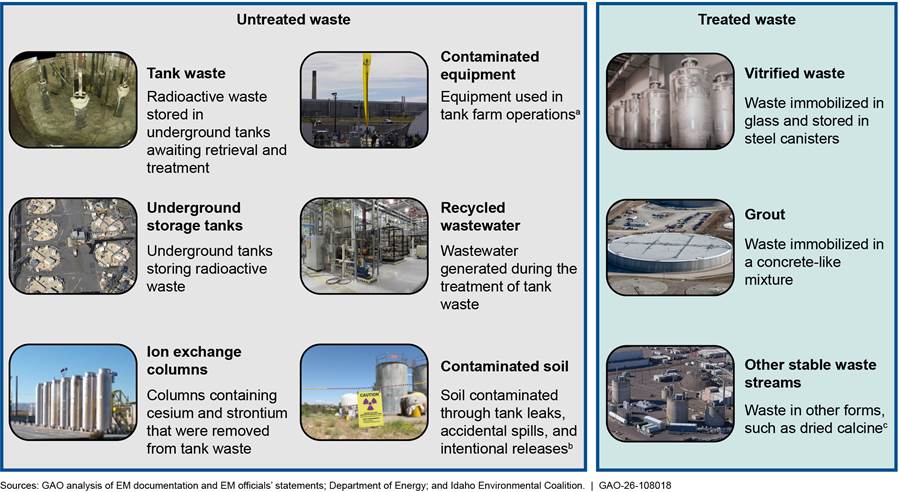
aContaminated equipment includes glass pumps, glass bubblers, and other items used during tank farm operations and the process of vitrifying tank waste.
bAccording to agency documents, over many decades, the Department of Energy (DOE) unintentionally discharged liquid waste from the tanks at the Hanford Site into the soil through accidental spills, also known as unplanned releases. In addition, DOE intentionally discharged waste into the soil at the Hanford Site through six sets of cribs (underground structures designed to distribute liquid waste to the soil) and trenches (ditches). EM officials refer to soil contaminated by liquid waste from reprocessing as “contaminated environmental media.” In January 2021, we reported that EM and Washington State disagree on how to classify and remediate such soil. GAO, Hanford Cleanup: DOE’s Efforts to Close Tank Farms Would Benefit From Clearer Legal Authorities and Communication, GAO‑21‑73 (Washington, D.C.: Jan. 7, 2021). According to NRC officials, soil contamination is not typically treated as waste associated with reprocessing at the Idaho National Laboratory and Savannah River Site.
cCalcine waste is dried, granular waste stored in stainless steel bins. EM officials told us that calcine waste will require additional treatment prior to disposal.
EM’s three largest and most complex sites—the Hanford Site, Idaho National Laboratory, and Savannah River Site—contain legacy waste associated with reprocessing for defense purposes. In addition, EM is responsible for cleaning up waste associated with the commercial reprocessing of spent nuclear fuel at the West Valley Demonstration Project in New York State. Figure 2 provides examples of waste streams that constitute waste associated with reprocessing at the four EM sites.
Figure 2: Examples of Waste Associated with Reprocessing Across the Department of Energy’s Office of Environmental Management (EM) Complex
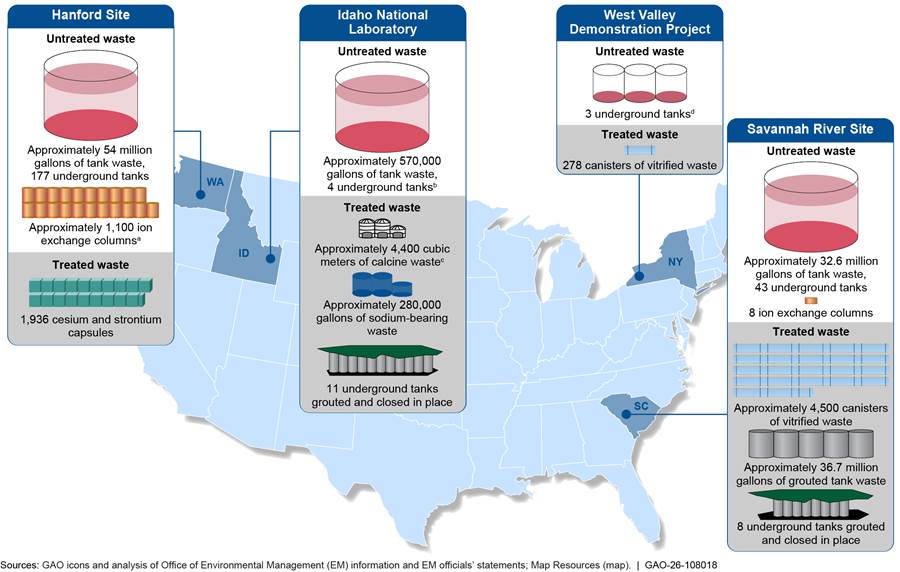
Note: Waste associated with reprocessing also includes additional waste streams not depicted, as these waste streams do not have identifiable volumes or amounts. These include contaminated equipment (e.g., piping), recycled wastewater, and contaminated soil.
aListed volumes represent the amount of waste EM anticipates generating during the process of treating selected waste streams.
bEM refers to this tank waste as “sodium-bearing waste.” The remaining waste is stored in three underground tanks and the fourth tank is empty, according to EM officials.
cCalcine waste is dried, granular waste stored in stainless steel bins. EM officials told us that calcine waste will require additional treatment prior to disposal.
dAccording to EM officials at the West Valley Demonstration Project, two tanks have been emptied to the maximum extent possible and the third tank has approximately 3,300 gallons of waste remaining in it.
In addition to the legacy waste depicted above, EM expects to process spent nuclear fuel at the Savannah River Site through 2032. Further, in May 2025, the President issued Executive Order 14299, which, among other things, instructs DOE to use available legal authorities to authorize the construction and operation of new nuclear fuel reprocessing technologies at DOE sites.[10] Ongoing reprocessing efforts at the Savannah River Site and deployment of new reprocessing technologies could result in the generation of additional waste associated with reprocessing that DOE may need to manage as HLW.
Radioactive Waste Classifications
The classification of radioactive waste affects the waste treatment and disposal options available to EM, and EM must therefore classify its radioactive waste to make cleanup decisions. Federal statutes define different classifications of radioactive waste, including HLW, TRU waste, and LLW (see fig. 3).
Figure 3: Selected Statutory Definitions for Specific Classifications of Radioactive Waste Managed by the Department of Energy’s Office of Environmental Management
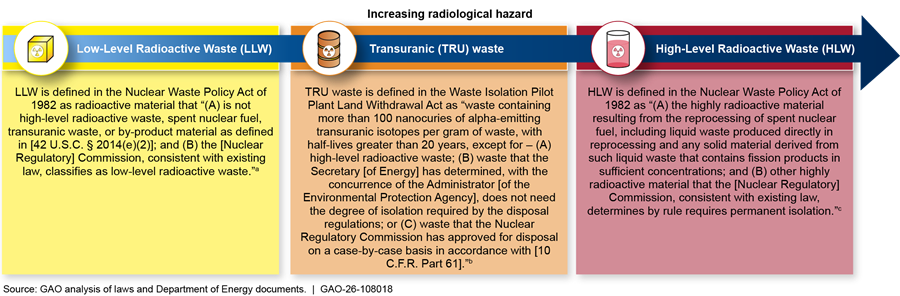
aPub. L. No. 97-425, 2(16), 96 Stat 2201 (1983) (codified at 42 U.S.C. 10101(16)). LLW is also defined by the Low-Level Radioactive Waste Policy Amendments Act of 1985 as “radioactive material that (A) is not high-level radioactive waste, spent nuclear fuel, or byproduct material as defined in [42 U.S.C. 2014(e)(2)]; and (B) the Nuclear Regulatory Commission, consistent with existing law and in accordance with paragraph (A), classifies as low-level radioactive waste.” The term does not include byproduct material as defined in 42 U.S.C. 2014(e)(3) and (4). Pub. L. No. 99-240, 102, 99 Stat 1842 (1986) (codified as amended at 42 U.S.C. 2021b(9)).
bPub. L. No. 102–579, 2(20), 106 Stat. 4777 (1992). Transuranic waste is also defined in the Atomic Energy Act of 1954, as amended, and the West Valley Demonstration Project Act as material contaminated with elements that have an atomic number greater than 92, including neptunium, plutonium, americium, and curium, and that are in concentrations greater than 10 nanocuries per gram, or in such other concentrations as the Nuclear Regulatory Commission may prescribe to protect the public health and safety. 42 U.S.C. 2014(jj); Pub. L. No. 96-368, 6(5), 94 Stat 1347, 1350 (1980).
cPub. L. No. 97-425, 2(12), 96 Stat. 2201 (1983) (codified at 42 U.S.C. 10101(12)). This definition is also cross-referenced in the Atomic Energy Act of 1954, as amended, 42 U.S.C. 2014(ee), and the Waste Isolation Pilot Plant Land Withdrawal Act, Pub. L. No. 102–579, 2(10), 106 Stat. 4777 (1992). High-level radioactive waste is also defined in the West Valley Demonstration Project Act as “the high level radioactive waste which was produced by the reprocessing at the [Western New York Service] Center [in West Valley, New York] of spent nuclear fuel. Such term includes both liquid wastes which are produced directly in reprocessing, dry solid material derived from such liquid waste, and such other material as the [Nuclear Regulatory] Commission designates as high level radioactive waste for purposes of protecting the public health and safety.” Pub. L. No. 96-368, 6(4), 94 Stat 1347, 1350 (1980).
Based on these federal laws, DOE has incorporated specific, corresponding definitions for HLW, TRU waste, and LLW into its radioactive waste order and accompanying manual that set forth requirements for the agency’s management of radioactive waste.[11] According to EM officials, DOE follows the statutory definitions for the different waste types but also considers the specific waste definitions in the manual for the purposes of classifying waste streams.[12]
Much of the radioactive waste EM is responsible for is “mixed waste” that contains both radioactive and hazardous components.[13] Mixed waste is subject to specific treatment, storage, and disposal requirements under applicable law, as detailed below. DOE policy states that all HLW must be considered mixed waste subject to such requirements, unless demonstrated otherwise.
To classify a given waste stream, EM evaluates the physical and chemical characteristics of the waste—including its volume and radioactivity—and other information needed to ensure the waste will meet the specific waste acceptance requirements of a given disposal facility. According to EM officials, EM generally does not formally classify waste associated with reprocessing until it is ready to make a decision about the waste’s treatment and disposal pathway. Nonetheless, as a matter of policy, EM manages most of its waste associated with reprocessing as if it is HLW unless and until it is classified as another waste type.
Relevant Legal Framework
Since much of the waste associated with reprocessing at EM sites is mixed waste, EM’s cleanup activities are governed by many federal and state laws and regulations, DOE Orders, and cleanup agreements. Those of particular relevance to EM’s efforts to clean up waste associated with reprocessing include:
· The Atomic Energy Act of 1954, as amended (AEA), establishes a comprehensive regulatory scheme for military and domestic nuclear energy and authorizes DOE to regulate defense-related nuclear facilities and the radioactive component of mixed waste. AEA also incorporates the definition of HLW provided in the NWPA.
· The Nuclear Waste Policy Act of 1982, as amended (NWPA), establishes procedures for the evaluation, selection, and approval of deep geologic repositories for the disposal of spent nuclear fuel and HLW. The NWPA also defines HLW, as detailed in figure 3 above.
· DOE Order 435.1 and Manual 435.1-1 set forth requirements for the management of DOE’s radioactive wastes in a manner that is protective of worker and public health and safety as well as the environment.[14] In Manual 435.1-1, DOE provides definitions for HLW, TRU waste, and LLW, which largely correspond to the statutory definitions detailed in figure 3.
· The Resource Conservation and Recovery Act of 1976, as amended (RCRA), is administered by EPA and governs the treatment, storage, and disposal of hazardous waste, including the hazardous component of mixed waste. Under RCRA, EPA can authorize states to administer their own hazardous waste regulatory programs to operate in lieu of the federal program.[15] Many EM sites, including the Hanford Site, Idaho National Laboratory, and Savannah River Site, operate under permits issued and enforced by states under their authorized RCRA authority. Under relevant RCRA requirements, mixed HLW that exhibits specified hazardous waste characteristics must meet the treatment standard of vitrification prior to disposal.[16]
· The Comprehensive Environmental Response, Compensation, and Liability Act of 1980, as amended (CERCLA), commonly known as Superfund and administered by the EPA, authorizes the President to respond to releases or threatened releases of hazardous substances to the environment. In the late 1980s, the President delegated the act’s response authorities to EPA and other federal agencies. If there is a release from a federal facility, the agency that administers the facility—such as DOE—has the responsibility and authority to take response actions under the act, subject to oversight by EPA and the states in which those facilities are located.[17]
· Site-specific cleanup agreements that DOE has negotiated with relevant regulatory entities specify actions EM must take and deadlines it must meet as it carries out its cleanup work at specific sites. These agreements include interagency agreements (called federal facility agreements) generally negotiated among DOE, state regulators, and EPA, as well as additional compliance agreements, compliance orders, consent orders, and consent decrees. Such agreements can set out a sequence for accomplishing cleanup work, cover a relatively large number of cleanup activities, and include cleanup milestones that DOE must meet.[18] According to EM officials, requirements incorporated into these agreements as well as EM’s partnership with regulators—and other stakeholders—are critical in informing EM’s waste cleanup decisions.
High-Level Radioactive Waste Definition and Related Legal Uncertainties Impede EM’s Ability to Treat and Dispose of Certain Waste Streams
EM has typically managed tank waste and other waste associated with reprocessing as HLW, in accordance with the definition of HLW in the AEA and NWPA. Over the last 2 decades, we and other independent organizations have identified ambiguities in this statutory definition of HLW that create uncertainty and complicate EM’s efforts to classify waste associated with reprocessing as something other than HLW. To help overcome the lack of clarity in the HLW definition, EM has relied on three tools to determine which waste streams associated with reprocessing can safely be treated and disposed of as waste types other than HLW. However, all three tools have shortcomings that limit their utility and EM’s ability to determine that certain waste can be treated and disposed of as LLW or TRU waste. Such shortcomings have impeded EM’s ability to take a more risk-informed approach to cleaning up waste associated with reprocessing.
Ambiguity of the HLW Definition Creates Uncertainty Regarding How EM Should Treat and Dispose of Waste Associated with Reprocessing
To make cleanup decisions, EM must determine whether certain waste associated with reprocessing is HLW or can instead be safely treated and disposed of as other waste types, such as LLW or TRU waste. To do so, EM generally relies on the statutory definition of HLW codified in the AEA and NWPA.[19] While EM must follow this statutory definition, federal officials, industry experts, and others have consistently acknowledged that it is ambiguous and does not make clear what specific wastes should be considered HLW under the law.
As previously noted, the AEA and NWPA define HLW as:
(A) the highly radioactive material resulting from the reprocessing of spent nuclear fuel, including liquid waste produced directly in reprocessing and any solid material derived from such liquid waste that contains fission products in sufficient concentrations; and (B) other highly radioactive material that the [Nuclear Regulatory] Commission, consistent with existing law, determines by rule requires permanent isolation.[20]
Since this definition of HLW was codified in 1983, DOE officials, independent organizations, industry experts, we, and others have identified inherent ambiguities in the definition. These ambiguities complicate EM’s ability to determine which waste streams associated with reprocessing must be treated and disposed of as HLW and which waste streams may be treated and disposed of as LLW or TRU waste. Such ambiguities in the AEA and NWPA HLW definition include the following:
· Lack of specificity in radioactivity thresholds. The law does not define the phrase “highly radioactive,” creating uncertainty regarding how radioactive “material resulting from the reprocessing of spent nuclear fuel” must be to qualify as HLW. Likewise, the law does not clarify what “concentration” of “fission products” would be “sufficient” for a solid material derived from the reprocessing of spent nuclear fuel to be properly classified as HLW. In contrast with the definition of HLW, the statutory definition of TRU waste included in the Waste Isolation Pilot Plant Land Withdrawal Act sets a clear radiological threshold at which point a waste stream will be considered TRU waste as opposed to LLW (see fig. 3 above).
· Lack of clarity in what waste streams are included in the definition. The HLW definition specifies that it includes liquid and solid waste “resulting from the reprocessing of spent nuclear fuel.” However, the law does not specify whether other types of waste associated with reprocessing should also be considered HLW—such as underground storage tanks containing residual waste; any contaminated equipment resulting from storing, retrieving, or treating the waste; and soil contaminated by liquid waste.[21]
EM notes that waste streams produced “upstream and downstream” from reprocessing are not HLW because they do not directly result from reprocessing. But other entities have disagreed with this position. For example, one stakeholder disagrees with EM on how to classify soil contaminated by liquid waste from reprocessing, and therefore whether it should be considered HLW.
These ambiguities are complicated by the HLW definition’s focus in part on the origin of waste—that is, the material resulting from the reprocessing of spent nuclear fuel. As noted above, the AEA and NWPA definition of HLW is not clear about what radiological characteristics a waste must have to be considered “highly radioactive” and therefore qualify as HLW. In the absence of such clarity, EM has historically taken a cautious approach of managing waste associated with reprocessing as HLW, regardless of its radioactivity level, unless and until it is classified as another waste type. EM officials stated that they manage the waste this way to ensure the maximum protection of public health and the environment.
For example, EM currently manages all of the Hanford Site’s tank waste as if it is HLW. We have previously reported that a substantial portion of this waste could be treated with grout and disposed of as LLW at commercial facilities outside of Washington State.[22] Moreover, in September 2024, we found that all of the waste stored in 21 tanks at the site—including waste that EM plans to treat and dispose of as HLW—may already fall below certain radionuclide concentration limits for LLW without any further pretreatment or treatment.[23]
Concerns about ambiguities in the AEA and NWPA definition of HLW have been raised for decades by independent organizations, industry experts, EM studies, and us. In many cases, these entities have recommended revising the definition, clarifying aspects of the definition, or taking other steps to clearly delineate DOE’s authority to treat and dispose of certain wastes as something other than HLW, specifically:
· In 1987, the NRC issued an Advanced Notice of Proposed Rulemaking—a preliminary notice that agencies can use when they are considering regulatory action to seek public feedback—titled “Definition of ‘High-Level Radioactive Waste.”[24] The notice sought public input on potential revisions to NRC’s regulatory definition of HLW in an effort to more closely align that definition with the statutory definition of HLW codified in the NWPA.[25] NRC specifically sought input on whether a revised regulatory definition should (1) identify particular radionuclide concentrations that would be considered “highly radioactive” under clause B of the NWPA definition and (2) set numerical limits to define “sufficient concentrations” of fission products to distinguish HLW from non-HLW. While NRC sought input on these revisions, it never proceeded with changes to its rules. According to NRC officials, the commission instead elected to finalize another regulation that supplanted this effort.
· In 2001, the Assistant Secretary for EM created a team to review the cleanup program and make recommendations for how to accelerate the cleanup process and save money, referred to as the Top-to-Bottom Review Team. This team found that the HLW definition’s focus on the origin of waste had “resulted in costly waste management and disposition strategies that are not proportional to the risk posed to human health and the environment.”[26] As a result of the definition, the team stated:
“Low-activity [HLW]…is managed as if high-cost retrieval and vitrification were the only option available to protect the public. This waste is less hazardous than some [LLW] that is considered acceptable for lower-cost near-surface disposal. This problem arises because HLW is defined based on its source rather than its constituents and their concentrations. In essence, there is no concentration below which HLW ceases to be HLW…. Present requirements and assumptions will result in retrieval and vitrification of low-hazard waste for negligible public health and environmental benefit.”
· In 2011, the Massachusetts Institute of Technology issued a report on the nuclear fuel cycle, including nuclear waste management, that noted, “the United States today has an inconsistent, unstructured, and ad hoc waste classification system.”[27] It further stated that “[o]ther countries have adopted a different strategy. Radioactive wastes are categorized by what is in the waste—not where it came from, who generated it, or its history.” The report recommended that a risk-informed waste management system should be adopted in the U.S. that classifies all wastes according to composition and defines disposal pathways according to risk. The report noted, however, that Congress would need to provide the authority for implementation of such a framework.
· In 2012, the Blue Ribbon Commission on America’s Nuclear Future reported on the significant criticisms of the U.S. nuclear waste classification system in general and the HLW definition specifically.[28] The report concluded that the U.S. waste classification system is not sufficiently risk-based and is not adequately focused on factors related to human health and safety risks. The report states that the definition of HLW, in particular, lacks clarity, specifically regarding the terms “highly radioactive,” “sufficient concentrations,” and “requires permanent isolation.” The commission concluded that this lack of clarity in the HLW definition impeded EM’s ability to make waste determinations necessary to achieve its cleanup mission. Further, the commission found that focusing the definition on the origin of the waste, rather than its radiological characteristics and the risk it poses, created obstacles to classifying certain portions of waste managed as HLW as LLW or TRU waste. The commission, however, did not identify specific changes needed to the statutory definition of HLW or provide recommendations on how to revise the definition of HLW.
· In 2019, a DOE-commissioned committee of leading experts found that problems inherent in the definition of HLW have contributed to inconsistencies in the treatment of waste associated with reprocessing across EM’s sites.[29] For example, the committee found that because the AEA and NWPA definition of HLW is based primarily on waste origin, waste streams that have similar characteristics and pose similar risks are nonetheless managed differently, and at different costs.[30]
· Over the past 2 decades, we have recommended that DOE and Congress take steps to clarify key aspects of EM’s authority to manage certain waste associated with reprocessing as a waste type other than HLW. For example, in 2003, we recommended that DOE seek clarification from Congress to classify and treat certain waste associated with reprocessing as non-HLW.[31] In response, in 2004, Congress passed the Ronald W. Reagan National Defense Authorization Act for Fiscal Year 2005, which included a section providing DOE with this authority for waste planned for onsite disposal at the Idaho National Laboratory and the Savannah River Site, but not at the Hanford Site or the West Valley Demonstration Project.[32] Further, in 2017, 2021, and 2024, we recommended that Congress clarify DOE’s authority to determine that certain waste associated with reprocessing at the Hanford Site is not HLW.[33] As of December 2025, Congress has not done so.
Absent a clear definition of HLW, EM has elected to manage much of its waste associated with reprocessing as HLW, regardless of its radioactivity level. Further, ambiguity in the HLW definition has led EM to manage similar waste streams associated with reprocessing differently across sites, for example:
· Both the Hanford Site and the Idaho National Laboratory store waste with similar radioactive constituents, yet the two sites manage them in different ways. Specifically, EM officials at the Idaho National Laboratory told us they manage six stainless steel bin sets containing approximately 4,400 cubic meters of dried granular calcine waste—mainly cesium and strontium retrieved from tank waste—as HLW until a treatment and disposal path is identified. These officials told us they are currently evaluating options to treat this waste, including through vitrification. The Hanford Site has similar waste—1,936 capsules containing cesium and strontium also retrieved from tank waste. EM officials at the site said these capsules are not managed as HLW and will remain onsite in dry casks stored on outdoor pads until a final disposal path is identified.[34]
· EM sites also currently address their underground waste tanks differently. Officials from the Idaho National Laboratory and the Savannah River Site told us their tanks are managed as HLW until tank waste is removed to the maximum extent practical, at which time the tanks are filled with grout and closed in place as LLW (see fig. 4). In contrast, the Hanford Site currently manages its tanks as HLW. This is because the site has not made a final determination on how the tanks will eventually be classified—and, subsequently, whether they will be exhumed or treated and left in place—once most of the tank waste is retrieved.[35] In addition, EM officials at the West Valley Demonstration Project told us their three tanks are currently managed as HLW until a final treatment and disposal path is determined in the future.[36]
Figure 4: Grouted Waste Tanks and Associated Infrastructure at the Savannah River Site’s F Tank Farm, May 2025
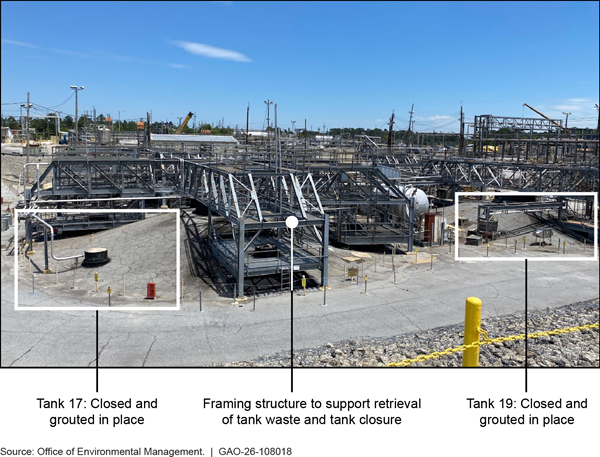
EM headquarters officials told us that individual sites are responsible for managing their waste in accordance with DOE Manual 435.1-1 and in compliance with applicable laws, regulations, and existing agreements with regulators, which can impose different requirements on different sites. These officials emphasized that EM must work closely with its regulators and other stakeholders in determining how best to manage its waste. Officials also noted that similar waste streams—such as tank waste—at the sites may have different radiological characteristics and chemical composition, leading to the waste streams being managed differently. However, we and others have previously found that the waste at the Hanford Site and Savannah River Site have similar characteristics, even though the sites have taken different approaches to treating this waste.[37]
EM Tools to Help Address Ambiguities in the HLW Definition Have Shortcomings that Hinder Their Use
EM has three main waste classification tools it can use to determine that certain waste associated with reprocessing is not HLW as defined by federal law. These tools are (1) the Waste Incidental to Reprocessing (WIR) evaluation, as outlined in DOE Manual 435.1- 1; (2) Section 3116 of the Ronald W. Reagan National Defense Authorization Act for Fiscal Year 2005; and (3) DOE’s HLW Interpretation, as incorporated in DOE Manual 435.1-1. To use these tools, a waste stream must meet particular requirements, such as falling below certain radiological concentration limits, for EM to be able to determine that the waste can be safely treated and disposed of as LLW or TRU waste, rather than HLW.
The three tools were developed over time, in part, to help clarify the AEA and NWPA definition of HLW and to help EM determine which waste it should manage as HLW and which waste could be managed as other waste types.[38]
· The WIR evaluation tool was formalized in 1999, when DOE first issued Order 435.1 on Radioactive Waste Management and its associated manual, Manual 435.1-1. This manual provides that DOE can determine that waste resulting from reprocessing spent nuclear fuel is “incidental to reprocessing” and therefore not HLW if it meets certain requirements.[39] Shortly after DOE issued Order 435.1, the Natural Resources Defense Council and others filed a lawsuit challenging the legality of this process. A federal district court agreed with the plaintiffs and held that DOE’s interpretation of the HLW definition in Order 435.1 and Manual 435.1-1 was inconsistent with the law.[40] However, a federal appeals court reversed that decision on procedural grounds in October 2004 and ordered dismissal of the lawsuit without ruling on the underlying claim.[41]
· Section 3116 was enacted in 2004. Specifically, while the lawsuit described above was pending, we reported that the lawsuit and any future legal challenges to the WIR process could affect EM’s efforts to implement treatment and disposal strategies for waste associated with reprocessing.[42] We recommended that DOE seek clarification from Congress regarding DOE’s authority for designating waste as incidental to reprocessing to help ensure that cleanup of HLW could proceed in a timely and cost-effective manner. Following our recommendation and as a result of the litigation, in 2004, Congress enacted Section 3116 to provide a statutory process DOE can use to determine that waste resulting from reprocessing is not HLW, if it meets specific requirements.[43] However, Section 3116 only applies to waste that is in—and will remain in—Idaho or South Carolina, and does not apply to waste at the Hanford Site or the West Valley Demonstration Project.
· DOE began developing its HLW Interpretation tool in 2016 and finalized it in 2019.[44] Under this tool, DOE has interpreted the statutory definition of HLW to exclude waste associated with reprocessing that meets certain criteria. In describing its need for the interpretation, DOE cited the Blue Ribbon Commission on America’s Nuclear Future and its conclusion that the definition of HLW had been problematic and had hampered progress. It also highlighted the limitations of Section 3116 and noted that, while the “WIR criteria was an important step forward in DOE’s management of HLW,” the HLW Interpretation tool represented the proper reading of the statutory definition of HLW.[45] DOE incorporated the HLW Interpretation into DOE Manual 435.1-1 in 2021.[46]
The three waste classification tools have similar requirements that EM must meet to determine that waste associated with reprocessing can be managed as a waste type other than HLW (see table 1).
Table 1: Comparison of Three Tools Used by the Department of Energy for Determining That Certain Radioactive Waste Is Not High-Level Radioactive Waste (HLW)
|
Waste classification tool |
Waste Incidental to Reprocessing evaluationa |
Section 3116 of the Ronald W. Reagan National
Defense Authorization Act for Fiscal |
HLW Interpretationa |
|
Applicable sites |
All sites with reprocessing waste, including the: · Hanford Site · Idaho National Laboratory · Savannah River Site · West Valley Demonstration Project |
Sites with reprocessing waste in “covered states,”c including the: · Idaho National Laboratory · Savannah River Site |
Specific sites with reprocessing waste, including the: · Hanford Sited · Idaho National Laboratory · Savannah River Site |
|
Key technical criteria |
To manage waste as low-level radioactive waste (LLW), determine that the waste:e · Has been or will be processed to remove key radionuclides to the maximum extent technically and economically practical, · Will be managed to meet requirements comparable to the Nuclear Regulatory Commission’s (NRC) LLW waste facility performance objectivesf, and · Will be incorporated in a solid form that does not exceed NRC’s Class C LLW limits or meets alternative DOE waste classification and characterization requirements.g |
To manage waste as non-HLW, determine, in consultation with NRC, that the waste: · Has had highly radioactive radionuclides removed to the maximum extent practical, · Does not require deep geologic disposal, and · Either: · Does not exceed NRC’s Class C LLW limitsg and will be disposed of in compliance with NRC’s LLW waste facility performance objectivesf pursuant to a state-approved plan or permit, or · Will be disposed of in compliance with NRC’s performance objectives for LLW disposal facilitiesf pursuant to a state-approved plan or permit and pursuant to a plan developed by DOE in consultation with NRC. |
To manage waste as non-HLW, determine that the waste: · Does not exceed NRC’s limits for Class C LLWg and meets the performance objectives of a disposal facility, or · Does not require deep geologic disposal and meets the performance objectives of a disposal facility. |
|
Oversight |
Optional NRC consultation |
Required NRC consultation |
Optional NRC consultation |
Source: GAO analysis of laws, regulations, and Department of Energy documentation. | GAO‑26‑108018
aAs incorporated into DOE, Radioactive Waste Management Manual, Manual 435.1-1, Chg 3 (LtdChg) (Washington, D.C.: Jan. 11, 2021).
bPub. L. No. 108-375, 3116, 118 Stat. 1811, 2162–64 (2004).
cSection 3116 identifies “covered states” as Idaho and South Carolina, and the provision only applies to waste that remains in those covered states.
dDOE stated in a 2024 settlement agreement that it intends to forbear from using the HLW Interpretation tool to classify or reclassify reprocessing wastes at or from the Hanford Site as non-HLW for the purposes of disposal of treated waste or closure of tank systems within Washington State. Further, the National Defense Authorization Act for Fiscal Year 2026 prohibits DOE from spending funds made available for fiscal year 2026 to apply the HLW Interpretation to wastes at the Hanford Site. Pub. L. No. 119-60, 3126, 139 Stat. 718 (2025).
eUnder the Waste Incidental to Reprocessing evaluation process, DOE may also determine that waste associated with reprocessing can be managed as transuranic waste if it meets criteria included in Manual 435.1-1.
f10 C.F.R. Part 61, Subpart C, Performance Objectives.
g10 C.F.R. 61.55. This regulation specifies certain radionuclide concentration limits for Class A, B, and C low-level radioactive waste for near surface disposal. While this classification system does not apply to DOE defense nuclear facilities, the classification system is nonetheless referenced in all three tools EM uses to determine that waste associated with reprocessing can be managed as non-HLW.
In addition to these requirements, EM also follows similar processes when applying these tools, including:
· Evaluating the radiological characteristics of the waste. To implement each of the three tools, EM must evaluate the radionuclides in the waste, specifically those constituents that may be more highly radioactive and those that are less radioactive. This technical evaluation of the waste’s characteristics can be made based on historical knowledge of the waste and sampling.
· Assessing the waste’s characteristics against a disposal facility’s criteria for accepting waste. Radioactive waste disposal facilities generally have waste acceptance criteria that waste must meet to be accepted for disposal. To implement all three tools, EM must evaluate the waste to ensure it will meet relevant performance objectives for disposal at a selected disposal facility.[47]
· Providing a process for participation by regulators and the public to provide input on EM’s plans for treatment and disposal. All three tools allow for EM to solicit input from relevant regulatory entities and the public, although this step is not necessarily required for each tool. For example, Section 3116 requires EM to consult with the NRC when determining that a waste stream associated with reprocessing is not HLW. By comparison, the WIR evaluation and HLW Interpretation tools allow EM to solicit NRC’s input and concurrence, but do not require EM to do so.
EM officials told us that despite this step being optional, EM has requested NRC’s review on all of its WIR evaluations to date. In the past, EM has also sought public comment on proposed uses of the HLW Interpretation as a part of assessing the environmental impacts of those proposals under the National Environmental Policy Act of 1969, as amended.[48] Historically, EM has also sought and responded to public comments when making determinations under each of the three tools.
While the tools provide EM with formal requirements and a process for clarifying which waste is not HLW and may be safely treated and disposed of as non-HLW, the three tools have shortcomings that impede EM’s ability to progress with its cleanup of certain waste streams. Specifically, the waste classification tools do not fully address the lack of clarity in the HLW definition that has hindered EM’s ability to complete its cleanup mission in a more risk-informed way.
· The tools do not provide a consistent radioactive threshold at which waste is HLW. While each tool includes some parameters around radioactivity, they do not provide consistent radioactive thresholds at which a given waste stream is not HLW and can be treated and disposed of as LLW or TRU waste. For example, the HLW Interpretation provides that reprocessing waste is not HLW if it does not exceed NRC concentration limits for Class C LLW and meets the performance objectives of a disposal facility.[49] Likewise, the WIR criteria require that, for certain reprocessing waste to be considered non-HLW, it must not exceed Class C LLW limits or must meet alternative, DOE-authorized requirements for waste classification and characterization.[50] Section 3116, similarly, provides a means by which reprocessing waste that does not exceed Class C LLW limits can be considered non-HLW when it also meets other criteria.[51]
However, even when reprocessing waste already falls below the Class C LLW limits, the WIR and Section 3116 tools also require EM to “remove key radionuclides to the maximum extent that is technically and economically practical” (WIR) or remove “highly radioactive radionuclides…to the maximum extent practical” (Section 3116). Yet neither of these tools clarify the meaning of these phrases. Additionally, these two tools could require removal of radionuclides even if the radioactivity of the selected waste stream is already sufficiently low enough to meet waste acceptance criteria for disposal as LLW at DOE or commercial disposal facilities. Thus, the tools do not provide EM with a single, consistent radioactivity threshold below which waste is not HLW.
· All tools do not all apply at the four sites. While the WIR tool can be applied at all four sites with waste associated with reprocessing, the other two tools have limited applicability. Section 3116 applies only to radioactive waste resulting from reprocessing at the Idaho National Laboratory and the Savannah River Site, but does not apply to waste from these sites that will be transported out of those states for disposal. In addition, Section 3116 does not apply to any waste at the Hanford Site—EM’s most complex and expensive site—or the West Valley Demonstration Project. The HLW Interpretation likewise does not apply to reprocessing waste from the West Valley Demonstration Project.[52] DOE also stated in a 2024 settlement agreement that it intends to forbear from using the HLW Interpretation tool to classify or reclassify reprocessing wastes at or from the Hanford Site as non-HLW for the purposes of disposal of treated waste or closure of tank systems within Washington State. Further, the National Defense Authorization Act for Fiscal Year 2026 prohibits DOE from spending funds made available for fiscal year 2026 to apply the HLW Interpretation to wastes at the Hanford Site.[53]
In 2019, a committee of experts, including a former Assistant Secretary for Environmental Management, raised concerns regarding the applicability of the tools. Specifically, the committee noted that there is a lack of consistency in application of EM’s waste classification tools across the sites, making it difficult for EM to make more risk-informed decisions about whether to classify selected waste streams as HLW or as another waste type.[54]
· Using tools can be an expensive and extensive process, leading to delays. A 2014 conference paper noted that using the WIR evaluation and Section 3116 can be expensive.[55] Specifically, the author stated that requiring extensive assessments to demonstrate that radionuclides have been removed from selected waste streams to the maximum extent economically and technically practical can be costly. The author notes that the process of using these tools can take 3 to 5 years to complete and cost several million dollars, leading to potential delays in treating and disposing of the waste. Further, EM officials we interviewed at one site stated that the process of using the tools can be onerous and costly.
Risk of Litigation Further Impedes EM’s Use of Waste Classification Tools
Lack of clarity in the HLW definition has left EM vulnerable to lawsuits when applying the WIR and HLW Interpretation tools. In fact, EM officials we interviewed at the Hanford Site told us they consider the threat of litigation as a risk to EM in making waste determination decisions. EM officials at the site stated they expect that certain entities may sue DOE if the agency attempts to use the WIR or the HLW Interpretation tools to address specific waste streams at the site as non-HLW. In addition, we have previously reported on disagreements between EM and a state regulator regarding the legal requirements EM must meet in treating and disposing of waste associated with reprocessing.[56] Such disagreements likely increase the risk of litigation EM faces in using the waste classification tools.
Given the ambiguity of the statutory HLW definition in the AEA and NWPA, EM has had to develop and rely on these tools to try to better define what waste streams associated with reprocessing can be treated and disposed of as something other than HLW. Unlike Section 3116, which is codified in law, the WIR and HLW Interpretation tools represent DOE’s interpretation of the law—specifically, the AEA and NWPA—rather than the law itself. As a result, DOE is vulnerable to lawsuits claiming that the tools improperly interpret the law and that their use is therefore illegal. For more than 2 decades, we have raised concerns about this risk of litigation impeding EM’s ability to determine that certain waste associated with reprocessing can be treated and disposed of as LLW or TRU waste. We and others have recommended that Congress clarify DOE’s authority to manage certain waste associated with reprocessing as a waste type other than HLW as currently defined in the AEA and NWPA, for example:
· In 2003, we reported that DOE’s authority to use the WIR evaluation tool was being challenged in court in a 2002 lawsuit discussed above.[57] While the lawsuit was dismissed on procedural grounds during appeal, EM continues to be vulnerable to further legal challenges to its efforts to classify waste as something other than HLW. In light of this litigation risk, in 2003 and 2009, we recommended that DOE consider seeking congressional clarification of the agency’s authority to determine that some tank waste, particularly at the Hanford Site, could be treated and disposed of as non-HLW.[58]
· In May 2017, we found that EM continued to face legal challenges to its ability to pursue treatment methods other than vitrification for large portions of tank waste with low levels of radioactivity at the Hanford Site.[59] We reported that while Congress clarified EM’s ability to classify waste at the Idaho National Laboratory and the Savannah River Site for onsite disposal in Section 3116, the Hanford Site was not included in this legislation. We recommended that Congress consider clarifying DOE’s authority at the Hanford Site to determine that portions of the tank waste can be treated and disposed of as a waste type other than HLW.
· In January 2021, we found that EM would likely face legal challenges regarding its plans to close underground storage tanks at the Hanford Site.[60] The site currently manages its tanks—which will contain residual waste after the majority of the waste is retrieved—as HLW. However, EM has stated that its preferred method is to close the tanks in place by filling them and associated equipment (e.g., piping) with grout and placing a surface barrier over the top.[61] To do this, EM would need to determine that the tanks—and any residual waste remaining within them—are non-HLW. We found that, if EM lost a legal challenge regarding its ability to take these steps, EM could then need to fully exhume the tanks and dispose of them as HLW at significantly higher costs. In May 2014, EM estimated that this scenario could increase cleanup costs at the Hanford Site by $18 billion dollars, expose workers to additional risks, and add significant delays in completing cleanup. However, one expert told us that based on their analysis, exhuming these tanks could cost approximately $53 billion. In our 2021 report, we recommended that Congress consider taking action to clarify DOE’s authority to determine that tanks and their residual waste may be disposed of as non-HLW.[62]
· In September 2024, we reported that experts on a panel we convened with the National Academies of Sciences, Engineering, and Medicine stressed the need for EM to have greater clarity about its legal authority to classify some waste associated with reprocessing as LLW or TRU waste.[63] We recommended that Congress clarify DOE’s authority to manage portions of Hanford’s tank waste as a waste type other than HLW.
In addition to these risks, a June 2024 U.S. Supreme Court decision could further complicate EM’s ability to determine that waste associated with reprocessing is not HLW. Specifically, the Supreme Court held that when a law—such as the AEA and NWPA—is ambiguous, courts may not defer to agency interpretations of that law, but instead must decide independently whether the agency has acted within its statutory authority.[64] Should the WIR evaluation or the HLW Interpretation be challenged in court, this recent Supreme Court decision means EM may face even greater litigation risk than we previously identified. This is because courts may not defer to DOE’s interpretation of the HLW definition in the AEA and NWPA simply because the law is ambiguous.
Until the HLW definition is revised to address its ambiguity and clarify DOE’s authority, EM will continue to face significant barriers to completing its cleanup mission. However, given the complexity of this issue, any effort to revise this definition would benefit from input, ideas, and expertise from a range of relevant stakeholders across federal agencies—including DOE, EPA, and NRC—as well as state officials, independent organizations, and others. By convening a multidisciplinary panel of experts, such as through a Blue Ribbon Commission, Congress would receive informed and specific recommendations for how to revise the definition of HLW to address the statutory ambiguity that has impeded EM’s cleanup progress for decades and continues to expose EM to litigation that could further delay cleanup progress.
|
Regulatory uncertainty. The ambiguity in the definition of high-level radioactive waste (HLW) has also created uncertainty regarding how requirements under the Resource Conservation and Recovery Act of 1976, as amended (RCRA) apply to certain waste associated with reprocessing. Specifically, we have previously reported that even if the Department of Energy’s (DOE) Office of Environmental Management (EM) is able to classify and manage certain reprocessing waste as low-level radioactive waste (LLW), it may encounter legal challenges under RCRA if it tries to use methods other than vitrification to treat the waste and prepare it for disposal. Under RCRA’s land disposal requirements, when hazardous waste with specific characteristics is mixed with HLW generated during the reprocessing of fuel rods—called mixed HLW—the waste is required to be vitrified (immobilized in glass) before disposal. Conversely, RCRA regulations do not require LLW with these hazardous characteristics—called mixed LLW—to be vitrified; instead, mixed LLW can generally be treated with less expensive methods like grout. However, in cases where DOE determines that mixed waste that DOE has previously managed as HLW can instead be managed as LLW or transuranic waste, there is disagreement between DOE and certain regulators as to whether the associated RCRA treatment standards also change, or whether (1) the original treatment standard (e.g., vitrification) must still be met or (2) a variance from the vitrification treatment standard must be obtained. In 2021, we found that this disagreement could lead to litigation, which could add several years to DOE’s ability to treat certain waste at the Hanford Site (GAO‑22‑104365). We have additional ongoing work specifically evaluating the effect of legal and regulatory matters like this on EM’s broader cleanup mission and plan to issue a report in mid-2026. |
Source: GAO analysis of laws, regulations, and DOE documentation. | GAO‑26‑108018
EM Has Not Fully Pursued Opportunities to Save Tens of Billions or More in Cleanup Costs
Despite ambiguities in the HLW definition and other barriers, EM has successfully used the waste classification tools in certain cases to determine that waste associated with reprocessing can be treated and disposed of as something other than HLW. In addition, numerous studies, reports, and analyses—including from DOE—have identified additional opportunities that could allow EM to accelerate its cleanup schedule for waste associated with reprocessing and realize tens of billions or more in cost savings. However, EM has not evaluated the full range of these additional opportunities or made plans to pursue them to the maximum extent possible.
EM Has Pursued Some Opportunities to Treat and Dispose of Certain Waste Associated with Reprocessing as LLW
EM has successfully used the three waste classification tools in certain cases despite ambiguity in the HLW definition and shortcomings with the tools themselves, among other barriers. EM has used a combination of these tools at the four sites to determine that certain waste associated with reprocessing could be treated and disposed of as something other than HLW.
For example, at the Savannah River Site, EM is actively retrieving tank waste and separating it into two streams, a highly radioactive portion and a portion with lower levels of radioactivity. EM estimates that the highly radioactive portion represents about 8 percent of the total tank waste. EM is managing this waste as HLW, vitrifying it, and storing it onsite in the Glass Waste Storage Buildings while awaiting a permanent repository for HLW.
On the other hand, EM is using Section 3116 to determine that the portion with lower levels of radioactivity—about 92 percent of the total tank waste—can be managed as LLW. EM is treating this waste with grout and permanently disposing of it onsite at the Saltstone Disposal Facility, a much cheaper alternative when compared to vitrification and geologic disposal (see fig. 5). For example, in May 2017, we found that treating one gallon of this LLW with grout at the Savannah River Site was estimated to cost $153 per gallon.[65] In comparison, we found that treating one gallon of similar waste with vitrification at the Hanford Site was estimated to cost about $1,081 per gallon—a cost more than seven times greater than using grout.
Figure 5: Saltstone Disposal Unit 9 at the Department of Energy Office of Environmental Management’s Savannah River Site
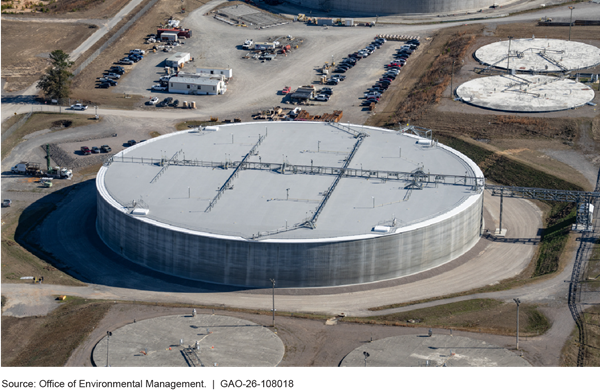
Table 2 provides an overview of EM’s use of the three waste classification tools to treat and dispose of certain waste associated with reprocessing as something other than HLW, as of December 2025.
Table 2: Department of Energy Office of Environmental Management’s (EM) Use of Waste Classification Tools to Determine That Certain Waste is Not High-Level Radioactive Waste (HLW), as of December 2025
|
Site |
Waste stream |
Waste classification tool |
Summary of EM actions |
|
Hanford Site |
Tank waste: Approximately 23.5 million gallons and secondary wastea |
Waste Incidental to Reprocessing (WIR) evaluation |
2023: EM determined that a portion of tank waste could be managed as low-level radioactive waste (LLW) and disposed of onsite at the Hanford Site’s Integrated Disposal Facility following separation, pretreatment, and vitrification.b |
|
Hanford Site |
Tank waste: 2,000 gallons |
WIR evaluation |
2023: EM determined that 2,000 gallons of tank waste could be managed as LLW and disposed of out of state following pretreatment and grouting. |
|
Hanford Site |
Tank waste: Approximately 2 to 8 million gallonsc |
WIR evaluation |
Ongoing: EM is conducting a WIR evaluation to determine if a portion of tank waste from the Hanford Site’s West Area can be managed as LLW and disposed of out of state following pretreatment and grouting. |
|
Hanford Site |
Tanks: 16 underground storage tanks |
WIR evaluation |
Ongoing: EM is conducting a WIR evaluation to determine if 16 tanks in the Hanford Site’s Tank Area C, the residual waste remaining inside them, and ancillary structures can be managed as LLW and closed in place after being filled with grout. |
|
Idaho National Laboratory |
Tanks: 15 underground storage tanks |
Section 3116 of the Ronald W. Reagan National Defense Authorization Act for Fiscal Year 2005 |
2006: EM determined that the site’s 15 tanks and any residual waste remaining inside them could be grouted and closed in place as non-HLW. |
|
Idaho National Laboratory |
Waste containers: 35 bins storing calcine waste |
Section 3116 |
Ongoing: EM is assessing whether it can determine that calcine waste containers—or “bins”—can be managed as LLW and disposed of onsite after the residual waste in the containers has been retrieved to the maximum extent practical and the containers have been grouted. |
|
Savannah River Site |
Tank waste: Approximately 34 million gallons |
Section 3116 |
2006: EM determined that a portion of tank waste could be managed as LLW and disposed of onsite following pretreatment and grouting. |
|
Savannah River Site |
Tanks: 49 underground storage tanks, including any residual waste and ancillary structuresd |
Section 3116 |
2012 & 2014: EM determined that 49 of the site’s tanks, the residual waste remaining inside them, and ancillary structures could be managed as non-HLW and closed in place after being filled with grout.e |
|
Savannah River Site |
Recycled wastewater: Up to 10,000 gallons generated during vitrification |
HLW Interpretation |
2020: EM determined that recycled wastewater generated during vitrification could be managed as LLW and disposed of offsite. |
|
Savannah River Site |
Contaminated equipment: Assorted equipment, including glass pumps and piping used during vitrification |
HLW Interpretation |
2023: EM determined that equipment contaminated during vitrification and tank farm operations could be managed as LLW and disposed of offsite. |
|
West Valley Demonstration Project |
Contaminated equipment: Vitrification equipment and associated feed tanks |
WIR evaluation |
2012 & 2013: EM determined that equipment contaminated during vitrification could be managed as LLW and disposed of out of state.f |
Source: GAO analysis of EM documentation and officials’ statements. | GAO‑26‑108018
Note: As described previously, EM has three main waste classification tools it can use to determine that certain waste associated with the reprocessing of spent nuclear fuel is not HLW as defined by federal law. Tank waste volumes provided represent estimates of the volume of tank waste that EM plans to retrieve from the tanks. Once retrieved, the volume of waste will increase as additional materials are added to the waste stream during treatment processes. Vitrification is a treatment process that immobilizes waste in a glass form. Grout is a treatment process that immobilizes waste in a concrete-like material.
aSecondary waste is generated by, or derived from, the process of vitrification. This waste includes glass pumps, glass debris, and other associated equipment.
bThe Integrated Disposal Facility is a permitted facility on the Hanford Site. EM plans to immobilize most of the secondary waste in grout at offsite, commercial facilities. Thereafter, most of this secondary waste is planned for disposal at the Integrated Disposal Facility.
cAccording to EM officials, this represents an approximate volume of tank waste currently stored in tanks and planned for retrieval and treatment. The volume of tank waste will increase during the retrieval and treatment process. The specific tanks that will be retrieved had not yet been determined as of March 2026.
dAncillary structures include equipment used in the process of treating tank waste, such as buried piping and valves.
eThe Savannah River Site has a total of 51 underground storage tanks. Two of these tanks were grouted and closed in place in 1997—prior to the passing of Section 3116. EM used two separate Section 3116 determinations for the remaining 49 underground storage tanks at Savannah River Site—one for its F-Tank Farm in 2012 and the other for its H-Tank Farm in 2014. Of those 49 tanks, six have been closed under Section 3116 as of December 2025. The remaining 43 tanks contain liquid waste, which EM plans to retrieve and treat in the future. The 43 tanks will then be grouted and closed in place under existing Section 3116 determinations.
fEM used two separate WIR determinations for contaminated equipment at the West Valley Demonstration Project. EM used one for a vitrification melter—a piece of equipment that generates the waste glass—in 2012 and the other for tanks associated with the vitrification process in 2013. In addition, the DOE grouted low-activity tank waste at the site from 1988 to 1995—prior to incorporation of the WIR evaluation process.
DOE, Independent Organizations, and GAO Have Identified Additional Opportunities to Save Tens of Billions of Dollars by Determining that Certain Waste Is Not HLW
DOE, independent organizations, and our prior work have identified additional opportunities for EM to accelerate its cleanup schedule and realize tens of billions of dollars in cost savings while maintaining the safe disposal of waste associated with reprocessing. These include opportunities for EM to determine that certain waste can be safely treated and disposed of as a waste type other than HLW. This could be accomplished, in part, either by using DOE’s three waste classification tools, or potentially in accordance with a revised statutory definition of HLW that clarifies DOE’s authority.[66] Table 3 provides examples of such opportunities identified by DOE, independent organizations, and our prior work.
Table 3: Examples of Opportunities for the Office of Environmental Management (EM) to Realize Cost Savings and Schedule Acceleration in Treating and Disposing of Waste Associated with Reprocessing
|
Site |
Waste stream |
Identified opportunities |
Date/Source |
|
Hanford Site |
Tank waste: Low-activity wastea |
Summary: We and others have consistently identified opportunities to save tens of billions of dollars and accelerate cleanup by grouting (rather than vitrifying) the Hanford Site’s low-activity waste. These opportunities identify potential cost savings ranging from $8 billion to $210 billion and potential reductions in EM’s planned treatment schedule of more than a decade. For example: |
|
|
· We found that EM could save billions of dollars and accelerate the Hanford Site’s cleanup timeline by grouting millions of gallons of the site’s low-activity tank waste—a treatment option we cited as already saving billions of dollars at the Savannah River Site. Notably, some experts who participated in our National Academies experts meeting stated that much of the Hanford Site’s low-activity waste could be treated with grout and disposed of at an alternate location.b |
May 2017 GAO, Nuclear Waste: Opportunities Exist to Reduce Risks and Costs by Evaluating Different Waste Treatment Approaches at Hanford, GAO‑17‑306 |
||
|
· The Savannah River National Laboratory analyzed EM’s options for treating a portion of the Hanford Site’s low-activity waste. The analysis found that grouting a portion of this waste, rather than vitrifying it, could generate a cost savings of between $18 billion and $34 billion.c |
October 2019 Savannah River National Laboratory, Report of Analysis of Approaches to Supplemental Treatment of Low-Activity Waste at the Hanford Nuclear Reservation |
||
|
· EM analyzed existing data and assumptions and found that almost 80 percent of the Hanford Site’s tank waste could potentially be classified as something other than high-level radioactive waste (HLW).d EM found that classifying large portions of this tank waste as low-level radioactive waste (LLW) and grouting it could potentially generate a cost savings of $73 billion to $210 billion and a schedule acceleration of approximately 8 to 14 years. |
December 2020 DOE, Evaluation of Potential Opportunities to Classify Certain Defense Nuclear Waste from Reprocessing as Other than High-Level Radioactive Waste |
||
|
· We found that EM could save billions of dollars by treating a portion of the Hanford Site’s low-activity waste using grout rather than vitrification. In doing so, EM could potentially save between $8 billion and $26 billion and complete treatment and disposal sooner. |
December 2021 GAO, Nuclear Waste Disposal: Actions Needed to Enable DOE Decision That Could Save Tens of Billions of Dollars, GAO‑22‑104365 |
||
|
· In a follow-on to its 2019 report, the Savannah River National Laboratory found that EM could save approximately $95 billion in the coming decades by grouting a portion of the Hanford Site’s low-activity tank waste rather than vitrifying it. |
January 2023 Savannah River National Laboratory, Follow-on Report of Analysis of Approaches to Supplemental Treatment of Low-Activity Waste at the Hanford Nuclear Reservation |
||
|
Hanford Site |
Tank waste: 3 million gallons with the highest radioactivity |
According to experts we interviewed, EM could reduce its costs by billions of dollars and accelerate its schedule by managing a portion of the 3 million gallons of tank waste with the highest radioactivity as something other than HLW. Specifically, these experts emphasized that only a small portion of the 3 million gallons should be vitrified as HLW. According to experts, the remaining waste could potentially be classified as LLW or transuranic (TRU) waste based on its physical characteristics and the level of risk it poses to humans and the environment. Further, according to experts, the HLW Facility—which DOE is constructing to vitrify the 3 million gallons of waste—may not be needed as currently designed, and the vitrification capability could be right-sized for a smaller volume of waste. Experts noted this could result in potential cost savings from processing less waste and avoiding the construction of certain infrastructure, such as cross-site waste transfer lines. |
September 2024 GAO, Hanford Cleanup: Alternatives for Treating and Disposing of High-Level Waste Could Save Billions of Dollars and Reduce Certain Risks, GAO‑24‑106989 |
|
Hanford Site |
Tanks: 149 Single-shell tankse |
EM estimated that exhuming all 149 single-shell tanks at the Hanford Site would cost $18 billion more than grouting the tanks in place. Further, in a 2018 document, EM stated that exhuming the tanks could take 50 years longer to complete when compared with grouting the tanks in place.f EM also cited its uncertainty regarding whether exhuming the tanks is technically feasible due to the amount of contamination, the difficulty and high cost of soil excavation, and technical issues associated with removing the tank structures. |
May 2014 DOE, Clean Closure Practicability Demonstration for the Single-Shell Tanks |
|
Idaho National Laboratory |
Tank waste: Sodium-bearing waste |
EM found that the radiological characteristics of its sodium-bearing tank waste may not require disposal as HLW. EM estimated that disposing of this waste as TRU waste and LLW instead, as appropriate, could potentially save $890 million to $1.2 billion. |
December 2020 DOE, Evaluation of Potential Opportunities to Classify Certain Defense Nuclear Waste from Reprocessing as Other than High-Level Radioactive Waste |
|
Idaho National Laboratory |
Treated waste: Calcine waste |
EM found that avoiding further treatment of its calcine waste and identifying a disposal facility that would accept the existing waste would result in cost savings. Further, EM found that much of this calcine waste could be classified as something other than HLW based on its radiological characteristics, and therefore, potentially be suitable for disposal in an existing disposal facility (as opposed to waiting for a deep geologic repository). EM estimated that disposing of this waste as LLW or TRU waste instead of HLW could potentially save approximately $11 billion to $14 billion. |
December 2020 DOE, Evaluation of Potential Opportunities to Classify Certain Defense Nuclear Waste from Reprocessing as Other than High-Level Radioactive Waste |
|
Savannah River Site |
Treated waste: Vitrified waste glass |
EM found that certain batches of vitrified waste glass canisters currently stored onsite as HLW could be classified as something other than HLW based on their radioactive characteristics. The batches could therefore be disposed of as LLW or TRU waste in an alternative disposal facility as long as the waste meets the facility’s disposal criteria. Doing so could potentially save between $3 billion and $4 billion and accelerate EM’s schedule for final disposition of this waste stream. |
December 2020 DOE, Evaluation of Potential Opportunities to Classify Certain Defense Nuclear Waste from Reprocessing as Other than High-Level Radioactive Waste |
Source: GAO analysis of EM documentation, independent reports, and prior GAO reports. | GAO‑26‑108018
Notes: As a matter of policy, EM is managing these waste streams as HLW under federal law and the information presented in this table identifies opportunities for EM to treat and dispose of this waste as something other than HLW, that is, LLW or TRU waste. In some cases, the opportunities identified across different sources refer to the same waste streams. As a result, the potential cost savings overlap in certain cases and do not represent separate opportunities that can be totaled.
aLow-activity waste is the term used at the Hanford Site for the primarily liquid portion of the tank waste, including dissolved saltcake, that contains low levels of long-lived radionuclides. According to DOE officials, low-activity waste represents the tank waste that has been pretreated with a treatment path to be ultimately managed as low-level radioactive waste.
bWe collaborated with the National Academies of Sciences, Engineering, and Medicine to convene a 2-day meeting in May 2016 on the treatment of the Hanford Site’s tank waste.
cA National Academies of Sciences, Engineering, and Medicine committee conducted an independent peer review of the Savannah River National Laboratory’s analysis. The committee provided general observations and made recommendations regarding the selection of treatment technologies and disposal sites. National Academies of Sciences, Engineering, and Medicine, Review of the Final Draft Analysis of Supplemental Treatment Approaches of Low-Activity Waste at the Hanford Nuclear Reservation: Review #3 (Washington, D.C.: 2019).
dEM also found that the requirement that the Hanford Site’s low-activity waste must be vitrified for onsite disposal in the Integrated Disposal Facility is unique to the site and that the most common method worldwide to stabilize similar waste that is low in radioactivity levels is grout.
eSingle-shell tanks were built from the 1940s through the mid-1960s with a design life of approximately 25 years. EM estimates that 68 of these single-shell tanks may have already collectively leaked over 1 million gallons of waste into the ground.
fDOE, Supplemental Information to the Clean Closure Practicability Demonstration for the Single-Shell Tanks, DOE-ORP-2014-02-Supp1Revision0 (Richland, WA: August 2018). According to this document, a large volume of additional waste would be generated from excavation of the tanks, equipment, and soil contaminated by liquid waste.
Opportunities in addition to those identified in table 3 may exist to determine that certain waste streams associated with reprocessing can be treated and disposed of as something other than HLW, for example:
· In September 2024, we found that waste stored in at least 21 tanks at the Hanford Site—representing approximately 11 million gallons of waste—potentially falls below certain radionuclide concentration limits for LLW in its current state, without any additional pretreatment or treatment.[67]
· In situ soil contaminated through tank leaks, accidental spills, and intentional releases at the Hanford Site has not been classified.[68] EM and Washington State disagree on how to classify such soil and, therefore, the best option to clean it up. In January 2021, we reported that treating and disposing of the contaminated soil as HLW could have tremendous cost implications, potentially costing hundreds of billions of dollars, if EM was required to remove large volumes of soil, according to DOE officials we interviewed at the time.[69]
· West Valley Demonstration Project officials we interviewed told us that three empty tanks that stored tank waste prior to retrieval have not yet been classified for treatment and disposal. They stated that the tanks could be classified as LLW, similar to tanks at the Idaho National Laboratory and Savannah River Site, and permanently grouted in place.
· EM officials at the Hanford Site and Savannah River Site told us that existing ion exchange columns used to remove cesium from tank waste are currently managed as HLW and EM has not decided on how best to treat and dispose of this waste stream. EM officials at the Hanford Site stated that they expect to generate nearly 1,100 ion exchange columns over the course of tank treatment at the site.[70] They added that EM is considering vitrifying these columns as HLW and noted that since a decision has not yet been made, other treatment and disposal options may exist (see fig. 6).
Figure 6: Ion Exchange Columns on a Storage Pad at the Department of Energy Office of Environmental Management’s Hanford Site
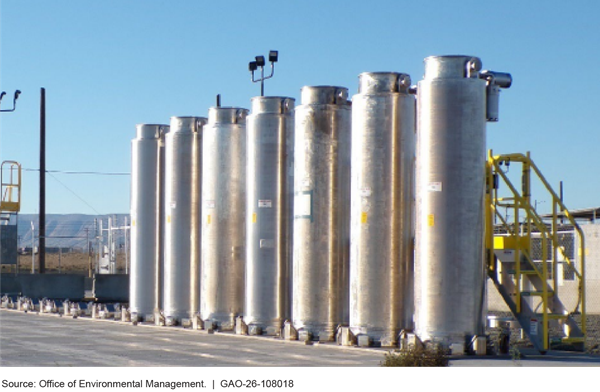
EM Has Not Fully Pursued Opportunities to Realize Billions in Potential Cost Savings and Other Benefits
While EM has taken some steps to treat and dispose of waste associated with reprocessing as something other than HLW, it has not systematically evaluated or pursued the range of opportunities identified by DOE, independent organizations, and us. For example, as described previously, EM issued a report to Congress in December 2020 that identified up to $229 billion in potential cost savings in treating and disposing of waste associated with reprocessing as LLW or TRU waste.[71] However, the report states that DOE was not proposing or committing to take any specific action to implement DOE’s findings. Further, EM officials we interviewed during our review told us the report was a one-time analysis conducted for Congress and that EM had no plans to either update the report or to pursue the cost savings opportunities it identified. However, EM officials stated they are working with new senior leadership at EM to analyze and discuss opportunities for cost savings.
Moreover, we have made numerous recommendations to EM over the last 2 decades regarding steps the agency could take to optimize its cleanup mission, expedite the treatment and disposal of waste associated with reprocessing, and potentially save tens of billions of dollars. Yet many of these recommendations remain unimplemented (see app. III).
EM’s 2020 Program Management Protocol states that EM headquarters should periodically identify and evaluate strategic alternatives to accomplishing its cleanup objectives, which includes the treatment and disposal of waste associated with reprocessing.[72] EM’s Program Management Protocol also directs EM to assess alternative methods for accomplishing EM’s objectives and evaluating potential opportunities to lower overall costs and accelerate schedules.
However, when we asked EM headquarters officials about additional opportunities identified by DOE’s 2020 report, external organizations, and others, they stated that EM site-level officials are responsible for determining treatment and disposal pathways for individual waste streams at their respective sites. They added that EM headquarters works closely with site-level officials to identify treatment and disposal options and were aware of opportunities identified by DOE, external organizations, and others. These officials said that EM does not have a central plan or strategy to evaluate or implement such opportunities but noted that EM senior leadership was aware of all treatment and disposal options and considers them when making treatment and disposal decisions. The officials added that the agency continues to evaluate opportunities for cost savings and schedule acceleration.
Yet, EM site officials told us that for certain waste streams—such as the portion of the Hanford Site’s tank waste that EM plans to vitrify and dispose of as LLW onsite—the agency already has a treatment and disposal approach in place and does not plan to alter this approach. For other waste streams—such as the cesium and strontium capsules at the Hanford Site—EM site officials stated they did not plan to assess treatment and disposal options until deadlines for addressing this waste approached.
As described above, EM may be missing opportunities to pursue alternative treatment and disposal options. By systematically evaluating potential options identified by others—and by DOE itself—and communicating to Congress its plans to pursue them to the maximum extent possible, EM could accelerate a cleanup mission that has been underway for over 3 decades and realize tens of billions of dollars or more in cost savings. Further, by communicating its plans to Congress—including identifying any barriers that impede EM’s efforts—EM could provide congressional decision-makers with the information they need to support EM’s cleanup mission and better position EM to pursue opportunities to save tens of billions of dollars.
Conclusions
EM estimates that its remaining cleanup mission will take many decades to complete and cost more than half a trillion dollars. The most expensive part of EM’s mission is related to cleaning up the legacy hazardous and radioactive waste resulting from the reprocessing of spent nuclear fuel during World War II and the Cold War. In addition to this legacy waste, ongoing DOE reprocessing efforts and deployment of new reprocessing technologies—which are encouraged by a May 2025 Executive Order—could generate an unknown volume of new reprocessing waste.
EM’s efforts to clean up waste associated with reprocessing are complicated by the ambiguity inherent in the definition of HLW codified in the AEA and NWPA, which could continue to affect EM’s cleanup mission into the future. DOE has taken steps to overcome this ambiguity and uncertainty. Nonetheless, the definition remains a substantial barrier impeding EM’s ability to determine that certain waste associated with reprocessing does not require treatment and disposal as HLW but instead can be safely treated and disposed of as LLW and TRU waste more quickly and at much lower costs.
We acknowledge the complexity of this issue and the far-reaching implications that revisions to the statutory definition of HLW would have on nuclear cleanup efforts across the country. As a result, any efforts to revise this definition would benefit from a multidisciplinary approach and input, ideas, and expertise from stakeholders across relevant federal agencies—including DOE, NRC, and EPA—state officials, independent organizations, and experts from industry and academia. By convening a panel of experts, similar to a Blue Ribbon Commission, to formally propose specific revisions to the definition of HLW, Congress will have access to expert input on how to address this longstanding and urgent issue and help EM to make progress on its cleanup mission with less ambiguity and uncertainty.
We and others, including DOE, have identified numerous opportunities for EM to accelerate its mission at certain sites by decades and realize tens of billions of dollars in potential cost savings by managing certain reprocessing waste as non-HLW. However, EM has not fully evaluated the range of opportunities identified or made plans to pursue these opportunities. By systematically evaluating the full range of opportunities to treat and dispose of waste associated with reprocessing as something other than HLW and communicating to Congress regarding its plans to implement identified opportunities—or its rationale for not doing so—Congress will be better informed of the full range of opportunities available to EM and the barriers preventing EM from moving forward with those opportunities. Moreover, EM will be in a better position to accelerate its cleanup mission, reduce certain risks to human health and the environment, and save tens of billions of dollars.
Matter for Congressional Consideration
Congress should consider convening a multidisciplinary panel, such as a Blue Ribbon Commission, comprising a group of relevant experts—for example, from key agencies, industry, and academia—to develop and recommend specific revisions to address ambiguities in the definition of HLW in the AEA and NWPA and to report these recommendations to Congress within 12 months. (Matter for Consideration 1)
Recommendation for Executive Action
The Assistant Secretary for Environmental Management should systematically evaluate the full range of opportunities to treat and dispose of legacy waste associated with reprocessing as something other than HLW and communicate to Congress on (1) EM’s plans to implement identified opportunities—or its rationale for not doing so—and (2) actions Congress can take to minimize or eliminate barriers that impede EM’s ability to proceed with these plans. (Recommendation 1)
Agency Comments and Our Evaluation
We provided a draft of this report to DOE, EPA, and NRC for review and comment. In its comments, reproduced in appendix IV, DOE agreed with the report’s recommendation and described the agency’s plans to implement it. Specifically, DOE stated that it does, and will continue to, evaluate the full range of opportunities pertaining to the treatment and disposal of certain waste associated with reprocessing. Further, DOE stated that it is committed to a structured process for proposing legislative changes and communicating with Congress regarding its cleanup efforts.
We support DOE’s efforts to evaluate the full range of opportunities to treat and dispose of certain waste as something other than HLW. To address the intent of our recommendation, DOE will need to communicate this full range of opportunities to Congress, including its plans for pursuing them to the maximum extent possible or, as necessary, its rationale for not pursuing certain identified opportunities. We continue to believe that implementing such opportunities will help EM to accelerate its cleanup mission and realize tens of billions of dollars or more in cost savings.
DOE, EPA, and NRC also provided technical comments that we incorporated into the report, as appropriate.
We are sending copies of this report to the appropriate congressional committees, the Secretary of Energy, and other interested parties. In addition, the report is available at no charge on the GAO website at https://www.gao.gov.
If you or your staff have any questions about this report, please contact me at AndersonN@gao.gov. Contact points for our Offices of Congressional Relations and Media Relations may be found on the last page of this report. GAO staff who made significant contributions to this report are listed in appendix V.
Nathan J. Anderson
Director, Natural Resources and Environment
List of Committees
The Honorable Roger F. Wicker
Chairman
The Honorable Jack Reed
Ranking Member
Committee on Armed Services
United States Senate
The Honorable John Kennedy
Chair
The Honorable Patty Murray
Ranking Member
Subcommittee on Energy and Water Development
Committee on Appropriations
United States Senate
The Honorable Mike Rogers
Chairman
The Honorable Adam Smith
Ranking Member
Committee on Armed Services
House of Representatives
The Honorable Chuck Fleischmann
Chairman
The Honorable Marcy Kaptur
Ranking Member
Subcommittee on Energy and Water Development, and Related Agencies
Committee on Appropriations
House of Representatives
Our report examines (1) the Department of Energy (DOE) Office of Environmental Management’s (EM) efforts to treat and dispose of waste associated with reprocessing and the barriers it faces in doing so and (2) potential opportunities to realize cost savings by treating certain waste as something other than high-level radioactive waste (HLW).
To inform and provide context for both our objectives, we reviewed EM documentation and interviewed EM headquarters and site-level officials to identify EM’s inventory of waste resulting from the reprocessing of spent nuclear fuel to produce plutonium for the nation’s nuclear arsenal. Throughout our report, we refer to this waste as waste associated with reprocessing.
We analyzed EM documentation and interviewed EM site officials to identify the type, quantity or volume, and status of all waste streams associated with reprocessing across the four EM sites where this waste is located. These include the Hanford Site in southeastern Washington, the Idaho National Laboratory in Idaho, the Savannah River Site in South Carolina, and the West Valley Demonstration Project in New York. We also conducted site visits to the Hanford Site and the Savannah River Site. During these visits, we toured EM facilities, discussed EM’s plans for treating and disposing of relevant waste streams, and solicited perspectives from EM site officials and local officials regarding opportunities for treating and disposing of waste associated with reprocessing as something other than HLW. We selected these two EM sites because together they contain the largest portion of waste associated with reprocessing among the four EM sites included our scope.
In addition, we conducted a literature review to identify reports, publications, and other information relevant to EM’s mission to clean up waste associated with reprocessing. We reviewed the literature review results, selected the most relevant information, and combined these results with existing documentation identified during our audit work. We reviewed:
· Our prior reports assessing EM’s efforts to treat and dispose of waste associated with reprocessing.[73]
· EM policies and other documentation focused on its treatment and disposal plans for specific waste streams. These included, for example, DOE Order 435.1 and Manual 435.1-1, which set forth requirements for DOE’s management of radioactive waste; EM’s 2020 Program Management Protocol; and DOE’s 2020 report to Congress outlining opportunities to use the HLW Interpretation tool to treat and dispose of waste associated with reprocessing as something other than HLW.[74]
· Published reports and papers from independent organizations and industry experts with knowledge and expertise in EM’s management of waste associated with reprocessing. These included, for example, the Blue Ribbon Commission on America’s Nuclear Future’s 2012 Report to the Secretary of Energy and the Savannah River National Laboratory’s 2023 Follow-on Report of Analysis of Approaches to Supplemental Treatment of Low-Activity Waste at the Hanford Nuclear Reservation.[75]
To address our first objective, we analyzed laws, including the Atomic Energy Act of 1954, as amended, and the Nuclear Waste Policy Act of 1982, as amended, which set forth a statutory definition of HLW. We reviewed relevant regulations, DOE and EM policies, and other information associated with this statutory definition to understand the components of the definition and how EM uses it to guide its efforts to treat and dispose of waste associated with reprocessing.
Further, we reviewed EM documentation and interviewed EM headquarters and site-level officials to understand and assess three processes—known as waste classification tools—EM may use to determine that certain waste associated with reprocessing may not need to be treated and disposed of as HLW, but instead can be treated and disposed of as low-level radioactive waste (LLW) or transuranic (TRU) waste. These tools are (1) the Waste Incidental to Reprocessing (WIR) evaluation process, (2) Section 3116 of the Ronald W. Reagan National Defense Authorization Act for Fiscal Year 2005,[76] and (3) the HLW Interpretation. We synthesized this information to describe EM’s use of the three tools and the applicability and implementation processes associated with each one. We also reviewed EM documentation and interviewed EM officials to assess any barriers EM faces in using these tools at the four EM sites.
In addition, we interviewed federal officials at the Environmental Protection Agency (EPA) and the Nuclear Regulatory Commission (NRC) and state officials responsible for regulating certain waste associated with reprocessing at three of the four EM sites in our scope.[77] We interviewed these officials to (1) discuss their roles and responsibilities in overseeing waste associated with reprocessing at the sites and (2) solicit their perspectives on EM’s plans for treating and disposing of certain waste streams as something other than HLW.
Further, we interviewed industry experts, such as Energy Communities Alliance officials, and local representatives and officials to gather their perspectives on EM’s plans for the treatment and disposal of waste associated with reprocessing and EM’s efforts to communicate with these external groups regarding its cleanup efforts. Specifically, we met with local government officials at the Hanford Site and representatives of citizens advisory boards at the Hanford Site, Idaho National Laboratory, and Savannah River Site.[78] These citizens advisory boards provide a platform for community members and other stakeholders to offer perspectives and feedback to EM regarding its operations at the site.
We also reviewed EM documents and our prior reports and interviewed EPA, NRC, and state officials to identify existing and potential barriers to EM in determining that certain waste streams associated with reprocessing can be treated and disposed of as something other than HLW. We analyzed this information and interviewed EM officials and others to solicit their perspectives on these barriers, steps EM is taking to overcome them, and any identified lessons learned.
To address our second objective, we analyzed EM documentation and interviewed EM headquarters and site officials to identify actions EM has taken to treat and dispose of waste associated with reprocessing as something other than HLW. In addition, we synthesized information identified by our literature review, our prior reports, and other documentation to identify a range of additional opportunities for EM to treat and dispose of waste associated with reprocessing as LLW or TRU waste. We also interviewed officials from the Savannah River National Laboratory to understand their work in analyzing the cost and schedule implications of different treatment and disposal scenarios for addressing the tank waste at the Hanford Site.[79]
To examine the extent to which EM planned to pursue the range of additional opportunities identified by us and others, we interviewed EM officials at headquarters and the four EM sites to solicit their perspectives on the identified opportunities and EM’s plans, if any, to implement them. We evaluated the extent to which EM is identifying and evaluating such strategic alternatives to accomplishing its cleanup objectives and comparing the benefits and limitations of each identified option to inform decision making, as described in EM’s 2020 Program Management Protocol.
We conducted this performance audit from January 2025 to March 2026 in accordance with generally accepted government auditing standards. Those standards require that we plan and perform the audit to obtain sufficient, appropriate evidence to provide a reasonable basis for our findings and conclusions based on our audit objectives. We believe that the evidence obtained provides a reasonable basis for our findings and conclusions based on our audit objectives.
|
Date |
Event |
|
1970 |
The first regulatory definition of HLW is issued by the Atomic Energy Commission—a precursor agency to the Department of Energy (DOE) and Nuclear Regulatory Commission (NRC)—in its Policy Relating to the Siting of Fuel Reprocessing Plants and Related Waste Management Facilities, which defines “high level liquid radioactive wastes” as “aqueous wastes resulting from the operation of the first cycle solvent extraction system, or equivalent, and the concentrated wastes from subsequent extraction cycles, or equivalent, in a facility for reprocessing irradiated reactor fuels.”a |
|
1972 |
The first statutory definition of HLW appears in the Marine Protection, Research, and Sanctuaries Act of 1972, which defines HLW as “the aqueous waste resulting from the operation of the first cycle solvent extraction system, or equivalent, and the concentrated waste from subsequent extraction cycles, or equivalent, in a facility for reprocessing irradiated reactor fuels, or irradiated fuel from nuclear power reactors.”b |
|
1980 |
Another statutory definition of HLW is included in the West Valley Demonstration Project Act, which defines HLW as “waste produced by the reprocessing at the [Western New York Service] Center of spent nuclear fuel.” The definition also includes “both liquid wastes which are produced directly in reprocessing, dry solid material derived from such liquid waste, and such other material as the [NRC] designates as [HLW] for purposes of protecting the public health and safety.”c |
|
1981 |
NRC develops another regulatory definition of HLW in its rules for the licensing of DOE geological repositories for HLW other than Yucca Mountain, Nevada. The regulation defines HLW as “(1) irradiated reactor fuel, (2) liquid wastes resulting from the operation of the first cycle solvent extraction system, or equivalent, and the concentrated wastes from subsequent extraction cycles, or equivalent, in a facility for reprocessing irradiated reactor fuel, and (3) solids into which such liquid wastes have been converted.”d |
|
1983 |
Another statutory definition of HLW is included in the Nuclear Waste Policy Act of 1982 (NWPA), which defines HLW as “(A) the highly radioactive material resulting from the reprocessing of spent nuclear fuel, including liquid waste produced directly in reprocessing and any solid material derived from such liquid waste that contains fission products in sufficient concentrations; and (B) other highly radioactive material that the [Nuclear Regulatory] Commission, consistent with existing law, determines by rule requires permanent isolation.”e This definition was later cross-referenced in the Atomic Energy Act of 1954, as amended (AEA).f |
|
1987 |
NRC considers changing its definition promulgated in 1981 to better align with the NWPA. NRC specifically seeks input on whether a revised regulatory definition should (1) identify particular radionuclide concentrations that would be considered “highly radioactive” under the NWPA definition and (2) set numerical limits to define “sufficient concentrations” of fission products to distinguish HLW from non-HLW. While NRC sought input on these revisions, it never proceeded with changes to its rules for various reasons, including pertinent updates NRC made to other regulations, according to NRC officials.g |
|
1990 |
The States of Oregon and Washington and the Yakama Indian Nation petition the NRC to further define the HLW definition; NRC declines, but includes criteria for incidental waste from reprocessing that would not be HLW. These criteria were that the wastes “(1) have been processed (or will be further processed) to remove key radionuclides to the maximum extent that is technically and economically practical; (2) will be incorporated in a solid physical form at a concentration that does not exceed the applicable concentration limits for Class C low-level waste as set out in 10 CFR part 61; and (3) are to be managed, pursuant to the Atomic Energy Act, so that safety requirements comparable to the performance objectives set out in 10 CFR part 61 are satisfied.”h |
|
July 1999 |
DOE issues Order 435.1 and accompanying Manual, establishing the Waste Incidental to Reprocessing (WIR) evaluation process for determining that reprocessing waste may be treated and disposed of as non-HLW under specific criteria. For DOE to manage waste as low-level radioactive waste, those criteria include that the wastes “(1) [h]ave been processed, or will be processed, to remove key radionuclides to the maximum extent that is technically and economically practical; and (2) [w]ill be managed to meet safety requirements comparable to the performance objectives set out in 10 CFR Part 61, Subpart C, Performance Objectives; and (3) [a]re to be managed, pursuant to DOE’s authority under the Atomic Energy Act of 1954, as amended, and in accordance with the provisions of Chapter IV of this Manual, provided the waste will be incorporated in a solid physical form at a concentration that does not exceed the applicable concentration limits for Class C low-level waste as set out in 10 CFR 61.55, Waste Classification; or will meet alternative requirements for waste classification and characterization as DOE may authorize.”i |
|
2003 |
DOE’s authority to use Order 435.1 and the accompanying Manual’s WIR evaluation process is challenged in a lawsuit in federal court. The federal district court holds that the relevant provisions of the Order and Manual were inconsistent with the NWPA, but a federal appeals court reverses that decision on procedural grounds in October 2004 and ordered dismissal of the suit without ruling on the underlying claim.j |
|
October 2004 |
Section 3116 of the Ronald W. Reagan National Defense Authorization Act for Fiscal Year 2005 is enacted, which clarifies DOE’s authority to manage portions of reprocessing waste at the Idaho National Laboratory and Savannah River Site as non-HLW when the waste meets specific criteria. The law only pertains to waste disposed of in South Carolina and Idaho and does not include the Hanford Site or the West Valley Demonstration Project.k |
|
January 2012 |
The Blue Ribbon Commission’s Report on America’s Nuclear Future notes that the current AEA and NWPA definition of HLW creates obstacles to managing different waste types, especially reprocessing waste with low concentrations of radionuclides. The report recommends using quantitative boundaries—focusing on the radiological characteristics—to classify waste streams. Further, the Commission calls for revising the U.S. waste classification system to be more risk-based, including changing the legal definition of HLW.l |
|
June 2019 |
DOE publishes a Federal Register Notice outlining its HLW Interpretation, a process establishing criteria DOE can use to determine that some reprocessing wastes may be classified as something other than HLW and be treated and disposed of in accordance with their radiological characteristics. Those criteria are “(a) does not exceed concentration limits for Class C low-level radioactive waste as set out in section 61.55 of title 10, Code of Federal Regulations, and meets the performance objectives of a disposal facility; or (b) does not require disposal in a deep geologic repository and meets the performance objectives of a disposal facility as demonstrated through a performance assessment conducted in accordance with applicable requirements.”m |
|
January 2021 |
DOE incorporates its HLW Interpretation into Manual 435.1-1.n |
Source: GAO analysis of Nuclear Regulatory Commission, High Level Waste Insights (undated) as well as relevant laws, regulations, reports, and documentation. | GAO‑26‑108018
a10 C.F.R. Part 50, App. F.
bPub. L. No. 92-532, 3(j), 86 Stat. 1052, 1053 (1972) (codified at 33 U.S.C. 1402).
cPub. L. No. 96-368, 6(4), 94 Stat 1347, 1350 (1980).
d10 C.F.R. 60.2.
ePub. L. No. 97-425, 2(12), 96 Stat. 2201 (1983) (codified at 42 U.S.C. 10101(12)).
f42 U.S.C. 2014(ee).
gDefinition of “High-Level Radioactive Waste,” 52 Fed. Reg. 5992 (Feb. 27, 1987).
hStates of Washington and Oregon: Denial of Petition for Rulemaking, 58 Fed. Reg. 12342 (Mar. 4, 1993).
iDOE, Radioactive Waste Management, Order 435.1, Chg 2 (AdminChg) (Washington, D.C.: Jan. 11, 2021); and DOE, Radioactive Waste Management Manual, Manual 435.1-1, Chg 3 (LtdChg) (Washington, D.C.: Jan. 11, 2021). In its Order and accompanying Manual, DOE also outlines a WIR process called WIR by citation. This process mainly applies to solid waste, such as clothing and tools. The WIR evaluation process also includes criteria under which DOE can manage reprocessing waste as transuranic waste.
jNatural Resources Defense Council v. Abraham, 271 F.Supp.2d 1260 (D. Idaho 2003), vacated as unripe 388 F.3d 701 (9th Cir. 2004).
kPub. L. No. 108-375, 3116, 118 Stat. 1811, 2162–64 (2004).
lBlue Ribbon Commission on America’s Nuclear Future, Report to the Secretary of Energy (Jan. 26, 2012).
mSupplemental Notice Concerning U.S. Department of Energy Interpretation of High-Level Radioactive Waste, 84 Fed. Reg. 26835 (June 10, 2019).
nHigh-Level Radioactive Waste Interpretation Limited Change to DOE Manual 435.1–1, Radioactive Waste Management Manual and Administrative Change to DOE Order 435.1, Radioactive Waste Management, 86 Fed. Reg. 5173 (Jan. 19, 2021); see also Assessment of Department of Energy’s Interpretation of the Definition of High-Level Radioactive Waste, 86 Fed. Reg. 72220 (Dec. 21, 2021).
Appendix III: Examples of Unimplemented GAO Recommendations Relevant to Waste Associated with Reprocessing
Table 5: Examples of Unimplemented GAO Recommendations Relevant to Waste Associated with Reprocessing, as of March 2026
|
Date (Month/Year) |
Recommendation summary |
GAO report |
|
June 2004 |
We recommended that the Secretary of Energy develop and provide to Congress a plan including the estimated costs and time frames needed to treat and dispose of all high-level radioactive waste (HLW) across the complex in light of a court ruling. In March 2008, the Department of Energy (DOE) stated that it planned to wait to address this recommendation until remaining legal uncertainty at the Hanford Site is clarified. We determined that DOE did not take these actions and closed this recommendation as not implemented. This uncertainty remains as of March 2026. |
Nuclear Waste: Absence of Key Management Reforms on Hanford’s Cleanup Project Adds to Challenges of Achieving Cost and Schedule Goals, GAO‑04‑611 |
|
September 2009 |
We recommended that DOE’s Office of Environmental Management (EM) consider seeking clarification from Congress regarding its authority to determine whether some waste managed as HLW could instead be treated and disposed of as another waste type. DOE did not agree with this recommendation and took no action to implement it. Further, we recommended that EM develop a risk-based approach for closing the Hanford Site’s storage tanks, including analyzing how much waste can be safely left in the tanks when they are closed, with the goal of reducing costs. We determined that DOE did not take these actions and closed this recommendation as not implemented. |
Nuclear Waste: Uncertainties and Questions about Costs and Risks Persist with DOE’s Tank Waste Cleanup Strategy at Hanford, GAO‑09‑913 |
|
September 2019 |
We recommended that EM develop a strategy, including a timeline, for implementing the actions required to achieve its preferred disposal pathway for the sodium-bearing waste at the Idaho National Laboratory. In April 2025, EM officials told us they are actively treating this waste and, once this effort is completed, will assess the range of potential disposal pathways. As of March 2026, this recommendation remained open. Further, we recommended that EM develop a treatment approach for the disposal of calcine waste that meets EM’s milestone for completing this treatment by the target date of December 31, 2035. As of March 2026, EM had taken steps to partially address this recommendation, but the recommendation remained open. |
Nuclear Waste Cleanup: DOE Faces Project Management and Disposal Challenges with High-Level Waste at Idaho National Laboratory, GAO‑19‑494 |
|
June 2022 |
We recommended that EM take steps to resolve existing challenges and problems identified in its review of facilities, systems, and components related to EM’s plans to treat and dispose of supplemental low-activity waste at the Hanford Site.a In May 2024, EM reported that it planned to complete a contract modification to require the relevant contractor to address such challenges. As of March 2026, this contract modification had not been completed, and this recommendation remained open. |
Hanford Cleanup: DOE Has Opportunities to Better Ensure Effective Startup and Sustained Low-Activity Waste Operations, GAO‑22‑104772 |
|
September 2024 |
We recommended that EM pursue an independent analysis on opportunities to optimize, in a manner that is protective of human health and the environment, the specific portion of Hanford’s tank waste that should be treated and disposed of as HLW based on its physical characteristics—that is, its radioactivity level. As of March 2026, EM had not taken action to implement this recommendation and it remained open. Further, we recommended that EM pause the design, reconfiguration, and construction activities on the HLW Facility at the Hanford Site until DOE (1) defines a mission need for the project, (2) considers the results of an independent analysis of opportunities to optimize the portion of the Hanford Site’s tank waste that should be treated and disposed of HLW, and (3) addresses technical issues with the facility.a EM did not concur with this recommendation and as of March 2026, had not taken action to implement it. |
Hanford Cleanup: Alternatives for Treating and Disposing of High-Level Waste Could Save Billions of Dollars and Reduce Certain Risks, GAO‑24‑106989 |
|
May 2025 |
We recommended the EM develop complex-wide analyses to identify optimal disposal pathways and schedules for its radioactive waste and analyze strategic alternatives to its current disposal plans. EM neither agreed nor disagreed with this recommendation. Further, we recommended that EM develop a nationwide integrated radioactive waste disposal plan that addresses complex-wide disposal issues, such as waste with no disposal pathway. EM neither agreed nor disagreed with this recommendation. As of March 2026, both recommendations remained open. |
Nuclear Waste: An Integrated Disposal Plan Could Help DOE Complete Its Cleanup Mission and Save Billions, GAO‑25‑107109 |
Source: GAO analysis of GAO reports. | GAO‑26‑108018
Note: A recommendation is unimplemented when an agency has not taken sufficient action to address the intent of the recommendation. This can include both recommendations that remain open pending additional agency action and recommendations that have been closed as “not implemented.”
aIndicates recommendations we have identified as warranting priority attention from heads of key departments or agencies because their implementation could save large amounts of money; improve congressional and/or executive branch decision-making on major issues; eliminate mismanagement, fraud, and abuse; or ensure that programs comply with laws and funds are legally spent, among other benefits.
GAO Contact
Nathan J. Anderson, andersonn@gao.gov
Staff Acknowledgments
In addition to the contact named above, Amanda K. Kolling (Assistant Director), Bryan Bourgault (Analyst-in-Charge), Noah Edwards, Claudia Hadjigeorgiou, and Nancy Kintner-Meyer made key contributions to this report. Mae Jones, Amanda Panko, Katrina Pekar-Carpenter, Justin Snover, and Sara Sullivan also contributed to this report.
Nuclear Waste: An Integrated Disposal Plan Could Help DOE Complete Its Cleanup Mission and Save Billions, GAO‑25‑107109 (Washington, D.C.: May 29, 2025).
Hanford Cleanup: Alternatives for Treating and Disposing of High-Level Waste Could Save Billions of Dollars and Reduce Certain Risks, GAO‑24‑106989 (Washington, D.C.: September 26, 2024).
Hanford Cleanup: Alternative Approaches Could Save Tens of Billions of Dollars, GAO‑23‑106880 (Washington, D.C.: September 2023).
Hanford Cleanup: DOE Should Consider Including Expedited Nuclear Waste Treatment Alternatives in Upcoming Analysis, GAO‑23‑106151 (Washington, D.C.: July 26, 2023).
Hanford Cleanup: DOE Should Validate Its Analysis of High-Level Waste Treatment Alternatives, GAO‑23‑106093 (Washington, D.C.: May 24, 2023).
Nuclear Waste Cleanup: Hanford Site Cleanup Costs Continue to Rise, but Opportunities Exist to Save Tens of Billions of Dollars, GAO‑22‑105809 (Washington, D.C.: July 29, 2022).
Hanford Cleanup: DOE Has Opportunities to Better Ensure Effective Startup and Sustained Low- Activity Waste Operations, GAO‑22‑104772 (Washington, D.C.: June 14, 2022).
Nuclear Waste Disposal: Actions Needed to Enable DOE Decision That Could Save Tens of Billions of Dollars, GAO‑22‑104365 (Washington, D.C.: December 9, 2021).
Department of Energy: Environmental Liability Continues to Grow, but Opportunities May Exist to Reduce Costs and Risks, GAO‑21‑585R (Washington, D.C.: June 8, 2021).
Nuclear Waste: Congressional Action Needed to Clarify a Disposal Option at West Valley Site in New York, GAO‑21‑115 (Washington, D.C.: January 13, 2021).
Hanford Cleanup: DOE’s Efforts to Close Tank Farms Would Benefit from Clearer Legal Authorities and Communication, GAO‑21‑73 (Washington, D.C.: January 7, 2021).
Hanford Waste Treatment Plant: DOE Is Pursuing Pretreatment Alternatives, but Its Strategy Is Unclear While Costs Continue to Rise, GAO‑20‑363 (Washington, D.C.: May 12, 2020).
Nuclear Waste Cleanup: DOE Faces Project Management and Disposal Challenges with High-Level Waste at Idaho National Laboratory, GAO‑19‑494 (Washington, D.C.: September 9, 2019).
Nuclear Waste: DOE Should Take Actions to Improve Oversight of Cleanup Milestones, GAO‑19‑207 (Washington, D.C.: February 14, 2019).
Nuclear Waste: Opportunities Exist to Reduce Risks and Costs by Evaluating Difference Waste Treatment Approaches at Hanford, GAO‑17‑306 (Washington, D.C.: May 3, 2017).
Nuclear Waste: Benefits and Costs Should Be Better Understood Before DOE Commits to a Separate Repository for Defense Waste, GAO‑17‑174 (Washington, D.C.: January 31, 2017).
Hanford Cleanup: Condition of Tanks May Further Limit DOE’s Ability to Respond to Leaks and Intrusions, GAO‑15‑40 (Washington, D.C.: November 25, 2014).
Nuclear Waste: Uncertainties and Questions About Costs and Risks Persist with DOE’s Tank Waste Cleanup Strategy at Hanford, GAO‑09‑913 (Washington, D.C.: September 30, 2009).
Nuclear Waste: DOE Lacks Critical Information Needed to Assess Its Tank Management Strategy at Hanford, GAO‑08‑793 (Washington, D.C.: June 30, 2008).
Nuclear Waste, Absence of Key Management Reforms on Hanford’s Cleanup Project Adds to Challenges of Achieving Cost and Schedule Goals, GAO‑04‑611 (Washington, D.C.: June 9, 2004).
Nuclear Waste: Challenges to Achieving Potential Savings in DOE’s High-Level Waste Cleanup Program, GAO‑03‑593 (Washington, D.C.: June 17, 2003).
The Government Accountability Office, the audit, evaluation, and investigative arm of Congress, exists to support Congress in meeting its constitutional responsibilities and to help improve the performance and accountability of the federal government for the American people. GAO examines the use of public funds; evaluates federal programs and policies; and provides analyses, recommendations, and other assistance to help Congress make informed oversight, policy, and funding decisions. GAO’s commitment to good government is reflected in its core values of accountability, integrity, and reliability.
Obtaining Copies of GAO Reports and Testimony
The fastest and easiest way to obtain copies of GAO documents at no cost is through our website. Each weekday afternoon, GAO posts on its website newly released reports, testimony, and correspondence. You can also subscribe to GAO’s email updates to receive notification of newly posted products.
Order by Phone
The price of each GAO publication reflects GAO’s actual cost of production and distribution and depends on the number of pages in the publication and whether the publication is printed in color or black and white. Pricing and ordering information is posted on GAO’s website, https://www.gao.gov/ordering.htm.
Place orders by calling (202) 512-6000, toll free (866) 801-7077,
or
TDD (202) 512-2537.
Orders may be paid for using American Express, Discover Card, MasterCard, Visa, check, or money order. Call for additional information.
Connect with GAO
Connect with GAO on X,
LinkedIn, Instagram, and YouTube.
Subscribe to our Email Updates. Listen to our Podcasts.
Visit GAO on the web at https://www.gao.gov.
To Report Fraud, Waste, and Abuse in Federal Programs
Contact FraudNet:
Website: https://www.gao.gov/about/what-gao-does/fraudnet
Automated answering system: (800) 424-5454
Media Relations
Sarah Kaczmarek, Managing Director, Media@gao.gov
Congressional Relations
David A. Powner, Acting Managing Director, CongRel@gao.gov
General Inquiries
[1]Specifically, the reprocessing of spent nuclear fuel allows for the recovery of plutonium and other beneficial isotopes.
[2]DOE, Fiscal Year 2026 Congressional Justification (May 2025).
[3]EM is responsible for cleaning up waste from the reprocessing of spent nuclear fuel at the West Valley Demonstration Project site. This waste was generated by a commercial facility from 1966 through 1972—the only waste from the reprocessing of spent nuclear fuel generated commercially in the United States. Congress enacted the West Valley Demonstration Project Act in 1980, which required DOE to carry out certain cleanup activities at the site.
[4]For the purposes of our report, we use the term “waste stream” to refer to the specific physical form of waste associated with reprocessing—for instance, tank waste, the underground storage tanks themselves, and contaminated equipment. In contrast, we use the term “waste type” to refer to the radiological classification of a given waste stream, including HLW, LLW, and TRU waste.
[5]Under relevant Environmental Protection Agency regulations, radioactive high-level wastes generated during the reprocessing of fuel rods that exhibit specified hazardous characteristics must generally be vitrified prior to land disposal. See 40 C.F.R §§ 268.40; 268.42(a). Some of the inventory of waste that EM currently manages as HLW exhibits specified hazardous characteristics, though EM may not be required under these standards to vitrify all the waste it currently manages as HLW. According to DOE officials, other methods to immobilize HLW are also possible but must be characterized to demonstrate compliance with applicable requirements for treatment of both radiological and, if present, hazardous constituents.
[6]Our prior reports have highlighted the implications of not having a deep geologic repository in the United States for the permanent disposal of HLW and spent nuclear fuel. See GAO, Hanford Cleanup: Alternatives for Treating and Disposing of High-Level Waste Could Save Billions of Dollars and Reduce Certain Risks, GAO‑24‑106989 (Washington, D.C.: Sept. 26, 2024) and GAO, Commercial Spent Nuclear Fuel: Congressional Action Needed to Break Impasse and Develop a Permanent Disposal Solution, GAO‑21‑603 (Washington, D.C.: Sept. 23, 2021).
[7]EM can dispose of such waste at the Waste Isolation Pilot Plant near Carlsbad, New Mexico. However, as we have previously reported, this facility is currently the only disposal option for TRU waste disposal and can only accept waste generated by atomic energy defense activities. GAO, Nuclear Waste: An Integrated Disposal Plan Could Help DOE Complete Its Cleanup Mission and Save Billions, GAO‑25‑107109 (Washington, D.C.: May 29, 2025).
[8]Nuclear Waste Policy Act of 1982, Pub. L. No. 97-425, § 2(12), 96 Stat. 2201 (1983) (codified at 42 U.S.C. § 10101(12)). The AEA provides that HLW has the meaning given to that term in the NWPA. 42 U.S.C. § 2014(ee).
[9]According to EM officials, EM manages this tank waste as HLW to ensure safety. EM will rely on detailed characterization of the waste to develop a disposition pathway and make an official waste classification determination, according to EM officials.
[10]Exec. Order 14299, Deploying Advanced Nuclear Reactor Technologies for National Security (May 23, 2025).
[11]For example, DOE’s radioactive waste management manual defines HLW as “the highly radioactive material resulting from the reprocessing of spent nuclear fuel, including liquid waste produced directly in reprocessing and any solid material derived from such liquid waste that contains fission products in sufficient concentrations; and other highly radioactive material that is determined, consistent with existing law, to require permanent isolation.” DOE, Radioactive Waste Management, Order 435.1, Chg 2 (AdminChg) (Washington, D.C.: Jan. 11, 2021); and DOE, Radioactive Waste Management Manual, Manual 435.1-1, Chg 3 (LtdChg) (Washington, D.C.: Jan. 11, 2021).
[12]According to DOE officials, DOE directives, including its radioactive waste manual, are often used by employees and contractors to assist them in implementing the statutory definitions.
[13]The term “mixed waste” refers to waste that contains both (1) hazardous waste subject to the Resource Conservation and Recovery Act of 1976, as amended, and (2) radioactive source, special nuclear, or byproduct material subject to the Atomic Energy Act of 1954, as amended. 42 U.S.C. § 6903(41).
[14]DOE, Radioactive Waste Management, Order 435.1, Chg 2 (AdminChg) and Radioactive Waste Management Manual, Manual 435.1-1, Chg 3 (LtdChg).
[15]State hazardous waste programs must be at least equivalent to the federal RCRA program but may be broader in scope or more stringent than the federal program. In authorized states, EPA continues to have a role and maintains its rights to issue orders and bring actions pursuant to statutory authorities.
[16]Specifically, radioactive high-level wastes generated during the reprocessing of fuel rods that exhibit specified hazardous characteristics must meet the treatment standard of vitrification prior to disposal. 40 C.F.R. § 268.40.
[17]While the agency that administers the facility where there has been a release of hazardous substances will typically be the lead agency to undertake cleanup activities at federal facilities, EPA oversees CERCLA cleanup activities at federal facilities on its National Priorities List, which includes some of the most seriously contaminated federal and non-federal sites around the country. For federal facilities that are not on the National Priorities List, most cleanups are overseen by state agencies rather than EPA, as allowed by CERCLA, which provides that state cleanup and enforcement laws apply to federal facilities not included on the National Priorities List.
[18]For additional details on the relevant cleanup agreements, see GAO, Nuclear Waste: DOE Should Take Actions to Improve Oversight of Cleanup Milestones, GAO‑19‑207 (Washington, D.C.: Feb. 14, 2019).
[19]The West Valley Demonstration Project is proceeding under the West Valley Demonstration Project Act, which provides a definition for high level radioactive waste that is distinct from the definition set forth in the AEA and NWPA. Pub. L. No. 96-368, § 6(4), 94 Stat 1347, 1350 (1980). At the West Valley Demonstration Project, EM manages the commercial waste associated with reprocessing at the site in accordance with the definitions provided in the West Valley Demonstration Project Act.
[20]Nuclear Waste Policy Act of 1982, Pub. L. No. 97-425, § 2(12), 96 Stat. 2201 (1983) (codified at 42 U.S.C. § 10101(12)). The AEA provides that HLW has the meaning given to that term in the NWPA. 42 U.S.C. § 2014(ee). DOE has adopted a similar definition for HLW in its Manual 435.1-1. Appendix II includes an overview of key events associated with the legal definition of HLW.
[21]EM officials refer to soil contaminated by liquid waste from reprocessing as “contaminated environmental media.”
[22]This portion is referred to as supplemental low-activity waste and comprises approximately 20 million gallons of tank waste. GAO, Nuclear Waste Disposal: Actions Needed to Enable DOE Decision That Could Save Tens of Billions of Dollars, GAO‑22‑104365 (Washington, D.C.: Dec. 9, 2021).
[23]GAO‑24‑106989. We found that waste in these 21 tanks could fall below limits for LLW established by the NRC in 10 C.F.R. § 61.55. NRC regulation 10 C.F.R. § 61.55 specifies certain radionuclide concentration limits for Class A, B, and C LLW for near surface disposal. DOE does not use the NRC classification system for LLW disposed of at DOE facilities, but it instead relies on site-specific performance assessments and waste acceptance criteria. Nonetheless, DOE also disposes of LLW at commercial mixed waste facilities, and those facilities are subject to NRC’s classification system.
[24]Definition of “High-Level Radioactive Waste,” 52 Fed. Reg. 5992 (Feb. 27, 1987).
[25]NRC regulations regarding the licensing of DOE geologic repositories for HLW (other than Yucca Mountain, Nevada) define HLW as “(1) irradiated reactor fuel, (2) liquid wastes resulting from the operation of the first cycle solvent extraction system, or equivalent, and the concentrated wastes from subsequent extraction cycles, or equivalent, in a facility for reprocessing irradiated reactor fuel, and (3) solids into which such liquid wastes have been converted.” 10 C.F.R. § 60.2.
[26]U.S. Department of Energy, A Review of the Environmental Management Program, Top-to-Bottom Review team presented to the Assistant Secretary for Environmental Management (Washington, D.C.: Feb. 4, 2002).
[27]Massachusetts Institute of Technology, The Future of the Nuclear Fuel Cycle, An Interdisciplinary MIT Study (2011).
[28]Blue Ribbon Commission on America’s Nuclear Future, Report to the Secretary of Energy (Jan. 26, 2012).
[29]Michael R. Greenberg, George Apostolakis, Timothy Fields, Bernard D. Goldstein, David Kosson, Steven Krahn, R. Bruce Matthews, James Rispoli, Jane Stewart, and Richard Stewart, “Advancing Risk-Informed Decision Making in Managing Defense Nuclear Waste in the United States: Opportunities and Challenges for Risk Analysis,” Risk Analysis, Vol. 39, No. 2, 2019.
[30]For example, certain waste at the Oak Ridge Reservation in Tennessee that is similar in characteristics and hazards to the tank waste at the Hanford Site and Savannah River Site is managed as LLW because it did not originate from the reprocessing of spent nuclear fuel.
[31]GAO, Nuclear Waste: Challenges to Achieving Potential Savings in DOE’s High-Level Waste Cleanup Program, GAO‑03‑593 (Washington, D.C.: June 17, 2003).
[32]Pub. L. No. 108-375, § 3116, 118 Stat. 1811, 2162–64 (2004).
[33]GAO, Nuclear Waste: Opportunities Exist to Reduce Risks and Costs by Evaluating Different Waste Treatment Approaches at Hanford, GAO‑17‑306 (Washington, D.C.: May 3, 2017); Hanford Cleanup: DOE’s Efforts to Close Tank Farms Would Benefit From Clearer Legal Authorities and Communication, GAO‑21‑73 (Washington, D.C.: Jan. 7, 2021); GAO‑22‑104365; and GAO‑24‑106989.
[34]Certain waste streams at both the Hanford Site and Idaho National Laboratory contain short-lived cesium and strontium radionuclides that have a half-life of about 30 years—the time in which half of the radionuclides decay. With such rapid decay, over time, the waste may eventually meet criteria to be disposed of as LLW. In 2024, we reported that DOE’s 2018 amended Record of Decision for managing the Hanford Site’s capsules stated that the capsules had already decayed from about 68 million curies to 46 million curies as of June 2017. GAO‑24‑106989. The Record of Decision noted that, if left in its current dry storage configuration, the Hanford Site’s capsules will reduce to about 1.6 million curies—or just over 2 percent of its original radioactivity level—within 145 years. DOE, Amended Record of Decision for the Management of Cesium and Strontium Capsules at the Hanford Site, Richland, Washington, 6450-01-P (May 14, 2018).
[35]In a 2012 Environmental Impact Statement, EM officials at the Hanford Site selected landfill closure as a Preferred Alternative for all of its tanks. Currently no decision has been reached on tank closure or disposal.
[36]EM officials at the West Valley Demonstration Project stated that while the site has four tanks, only three tanks came into contact with HLW.
[37]For example, in 2006, the National Research Council found that different approaches to treating this waste were not always based on a systematic consideration of risks and, as a result, waste having similar physical, chemical, and radiological characteristics may be managed in disparate ways. National Research Council of the National Academies, Improving the Regulation and Management of Low-Activity Radioactive Wastes, (Washington, D.C.: National Academies Press, 2006). Also see, for example, GAO‑17‑306.
[38]The Supreme Court has recognized that “the power of an administrative agency to administer a congressionally created and funded program necessarily requires the formulation of policy and the making of rules to fill any gap left, implicitly or explicitly, by Congress.” Morton v. Ruiz, 415 U.S. 199 (1974). Two of the tools discussed herein—the WIR evaluation and HLW Interpretation—are such formulations promulgated in DOE Manual 435.1-1 under DOE’s statutory authorities contained in the AEA and NWPA.
[39]The manual provides two processes for making the determination that certain waste resulting from reprocessing is incidental to reprocessing and is not HLW: the WIR by citation process and the WIR by evaluation process. To determine that waste is incidental to reprocessing by citation, DOE must determine that it meets certain criteria included in a 1969 proposed rule. The citation process covers radioactive wastes that are the result of reprocessing plant operations, such as contaminated laboratory items, clothing, tools, and equipment. Because this process is generally not applicable to the large volume of waste associated with reprocessing noted in figure 2 above, we do not discuss it in detail here.
[40]Nat. Res. Def. Council v. Abraham, 271 F. Supp. 2d 1260 (D. Idaho 2003).
[41]Nat. Res. Def. Council v. Abraham, 388 F.3d 701 (9th Cir. 2004).
[43]Pub. L. No. 108-375, § 3116, 118 Stat. 1811, 2162–64 (2004).
[44]Supplemental Notice Concerning U.S. Department of Energy Interpretation of High-Level Radioactive Waste, 84 Fed. Reg. 26835 (June 10, 2019).
[45]Id. In describing its interpretation of the statutory definition of HLW, DOE noted that “Congress limited the designation of HLW to those materials that are ‘highly radioactive’” and further stated that “DOE has both the scientific and technical expertise as well as the legal authority to interpret the term HLW in the AEA and NWPA to determine that certain of its reprocessing wastes are not HLW based on their radiological characteristics.” In summarizing its interpretation, DOE explained that it “interprets those statutes to provide that reprocessing wastes are properly classified as non-HLW where the radiological characteristics of the waste, in combination with appropriate disposal facility requirements for safe disposal, demonstrate that disposal of such waste is fully protective of human health and the environment.” Assessment of Department of Energy’s Interpretation of the Definition of High-Level Radioactive Waste, 86 Fed. Reg. 72220 (Dec. 21, 2021).
[46]Assessment of Department of Energy’s Interpretation of the Definition of High-Level Radioactive Waste, 86 Fed. Reg. 72220.
[47]EM officials stated that, in general, the performance objectives will be met if the waste complies with the disposal facility’s waste acceptance criteria.
[48]National Environmental Policy Act of 1969, as amended, requires federal agencies to consider and disclose the significant environmental impacts of a proposed major federal action prior to making a decision on that action.
[49]Under the HLW Interpretation, reprocessing waste is also not HLW if it does not require disposal in a deep geologic repository and meets the performance objectives of a disposal facility as demonstrated through a performance assessment conducted in accordance with applicable requirements.
[50]Under the WIR, the requirement that certain reprocessing waste must not exceed Class C LLW limits applies to waste that will be managed as LLW. Waste that will be managed as TRU waste following a WIR does not need to meet this requirement.
[51]Under Section 3116, reprocessing waste can also be managed as non-HLW if it exceeds Class C LLW limits but does not require deep geologic disposal and will be disposed of (1) in compliance with NRC’s performance objectives for LLW disposal facilities, (2) pursuant to a state-approved plan or permit, and (3) pursuant to a plan developed by DOE in consultation with NRC.
[52]As noted above, the West Valley Demonstration Project Act provides a definition for high level radioactive waste that is distinct from the definition set forth in the AEA and NWPA. Pub. L. No. 96-368, § 6(4), 94 Stat 1347, 1350 (1980). Thus, DOE has stated that the HLW Interpretation does not apply reprocessing wastes from the West Valley Demonstration Project governed by the West Valley Demonstration Project Act, and will not be used in connection with the disposition of any reprocessing wastes from the West Valley Demonstration Project. Supplemental Notice Concerning U.S. Department of Energy Interpretation of High-Level Radioactive Waste, 84 Fed. Reg. 26835 (June 10, 2019).
[53]Pub. L. No. 119-60, § 3126, 139 Stat. 718 (2025). The National Defense Authorization Acts for fiscal years 2020 and 2021 likewise prohibited DOE from spending funds from those years at the Hanford Site to apply the HLW Interpretation in fiscal years 2020 and 2021. Pub. L. 116-92, § 3121, 133 Stat. 1953 (2020); Pub. L. No. 116-283, § 3124, 134 Stat. 4374 (2021).
[54]Greenberg, Apostolakis, Fields, Goldstein, Kosson, Krahn, Matthews, Rispoli, Stewart, and Stewart, “Advancing Risk-Informed Decision Making in Managing Defense Nuclear Waste in the United States: Opportunities and Challenges for Risk Analysis,” Risk Analysis, Vol. 39.
[55]Conca, James. High-Level Nuclear Waste Redefined, Proceedings of the American Nuclear Society. Annual Meeting, Reno, NV: June 15-19, 2014.
[58]In June 2003, we recommended that DOE pursue legislative clarification because of a legal challenge that threatened DOE’s ability to proceed with its strategy for treating and disposing of radioactive tank waste that had been managed as HLW. Following our recommendation, Section 3116 was enacted, which authorizes DOE to determine that certain waste from reprocessing in Idaho and South Carolina is not HLW if it meets the criteria discussed above. However, as noted above, this provision does not apply to the Hanford Site in Washington State. As a result, in September 2009, we recommended that DOE seek clarity on its authority at Hanford to determine whether certain waste could be treated and disposed of as non-HLW. See GAO‑03‑593 and GAO, Nuclear Waste: Uncertainties and Questions About Costs and Risks Persist with DOE’s Tank Waste Cleanup Strategy at Hanford, GAO‑09‑913 (Washington, D.C.: Sept. 30, 2009).
[60]GAO‑21‑73. We also reported that the soil surrounding the Hanford Site’s tanks is contaminated primarily from tank leaks, accidental spills, and intentional releases into the soil, which largely occurred during nuclear weapons production.
[61]DOE, Tank Closure and Waste Management Environmental Impact Statement for the Hanford Site (TC/WM EIS), 2012.
[62]In our 2021 report, we also reported on a lack of agreement between EM and Washington State regulators regarding how to assess contaminated soil beneath the tanks. EM used a less stringent application of the WIR tool (known as WIR by citation) to assess the soil, but Washington State has advocated for a more stringent assessment process, such as a WIR evaluation. We reported that if the Hanford Site was required to treat and dispose of the soil as HLW, it could potentially cost hundreds of billions of dollars. We recommended that the Secretary of Energy obtain the assistance of an independent, third-party mediator to help reach agreement with Washington State on a contaminated soil assessment. See GAO‑21‑73.
[63]GAO‑24‑106989. According to the National Academies, it provides independent, objective analysis and advice to the nation, including the federal government, and conducts other activities to solve complex problems and inform public policy decisions.
[64]Loper Bright Enters. v. Raimondo, 603 U.S. 369 (2024). This decision overturned the precedent known as Chevron deference, which required federal courts to defer to a federal agency’s reasonable interpretation of ambiguous statutory provisions that the agency administered.
[66]EM officials told us that the use of the three waste classification tools and a revised statutory definition of HLW can both provide EM with opportunities for schedule acceleration and cost savings when combined with alternate waste treatment options and disposal at commercial LLW disposal facilities.
[68]According to DOE documents, over many decades, DOE unintentionally discharged liquid waste from the tanks into the soil through accidental spills, also known as unplanned releases. In addition, DOE intentionally discharged waste into the soil through six sets of cribs (underground structures designed to distribute liquid waste to the soil) and trenches (ditches).
[70]EM officials at the Savannah River Site told us that the site includes eight total ion exchange columns and EM does not anticipate generating additional columns as part of its tank waste treatment process.
[71]DOE, Evaluation of Potential Opportunities to Classify Certain Defense Nuclear Waste from Reprocessing as Other than High-Level Radioactive Waste (Washington, D.C.: December 2020).
[72]According to EM documentation, the purpose of this protocol is to establish requirements and explain expectations for planning, budgeting, execution, and evaluation of all work within EM. Office of Environmental Management, Program Management Protocol (Nov. 6, 2020).
[73]For example, see GAO, Nuclear Waste: An Integrated Disposal Plan Could Help DOE Complete Its Cleanup Mission and Save Billions, GAO‑25‑107109 (Washington, D.C.: May 29, 2025) and GAO, Hanford Cleanup: Alternatives for Treating and Disposing of High-Level Waste Could Save Billions of Dollars and Reduce Certain Risks, GAO‑24‑106989 (Washington, D.C.: Sept. 26, 2024).
[74]DOE, Radioactive Waste Management, Order 435.1, Chg 2 (AdminChg) (Washington, D.C.: Jan. 11, 2021); and Radioactive Waste Management Manual, Manual 435.1-1, Chg 3 (LtdChg) (Washington, D.C.: Jan. 11, 2021). EM, Program Management Protocol (Nov. 6, 2020). DOE, Evaluation of Potential Opportunities to Classify Certain Defense Nuclear Waste from Reprocessing as Other than High-Level Radioactive Waste (Washington, D.C.: December 2020).
[75]Blue Ribbon Commission on America’s Nuclear Future, Report to the Secretary of Energy (Jan. 26, 2012) and Savannah River National Laboratory, Follow-on Report of Analysis of Approaches to Supplemental Treatment of Low-Activity Waste at the Hanford Nuclear Reservation, SRNL-STI-2023-00007 (Aiken, SC: January 2023).
[76]Pub. L. No. 108-375, § 3116, 118 Stat. 1811, 2162–64 (2004).
[77]We interviewed state officials responsible for regulating mixed HLW at the Hanford Site, Idaho National Laboratory, and Savannah River Site. While these states do not have regulatory authority over the radioactive component of this waste, the waste associated with reprocessing at these sites is generally mixed with hazardous waste that is subject to state regulatory authority under the Resource Conservation and Recovery Act of 1976, as amended. New York State officials told us that the state does not have jurisdiction over HLW stored at the West Valley Demonstration Project. As a result, we did not interview New York State officials about the HLW stored at the West Valley Demonstration Project.
[78]We requested an interview with representatives from the citizens advisory board at the West Valley Demonstration Project, but members of this entity declined our request.
[79]The Savannah River National Laboratory is a federally funded research and development center. The center is funded by DOE but operates independently and performs tasks on behalf of DOE, such as research and development, systems engineering, and technical studies and analyses.