
Report to Congressional Committees
United States Government Accountability Office
A report to congressional committees
Contact: Alex Winograd at winograda@gao.gov
What GAO Found
The Army’s two efforts to modernize its battlefield networks—the nearer-term Command and Control Fix (C2 Fix) and the longer-term Next Generation Command and Control (NGC2)—seek to make command and control more adaptive, survivable, and better suited for modern large-scale combat operations.
Representation of Evolution of Battlefield Network Through Next Generation Command and Control (NGC2)
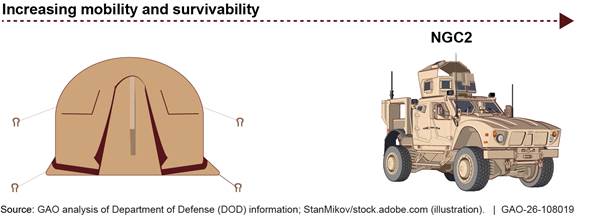
The Army’s approach to developing C2 Fix and NGC2 incorporates some key elements of an iterative business case. For example, the Army is using a flexible acquisition approach that collects user feedback and makes changes based on evolving market conditions and product capabilities. However, the Army has not taken important steps to implement other key elements that could position the Army to assess the scalability of these efforts. Specifically:
· The Army developed short-term schedules for NGC2 through fiscal year 2027 with a tentative goal of fielding NGC2’s full technology stack across 11 divisions and four corps by the end of fiscal year 2032. However, the Army is not well positioned to assess its ability to meet this timeline because it has not developed a detailed schedule that identifies the specific units, by fiscal year, that will receive the modernized capabilities.
· The Army identified NGC2 costs through fiscal year 2026 in documentation supporting the President’s fiscal year 2026 budget submission totaling approximately $3.3 billion. However, the Army has limited visibility into long-term costs because it has not completed an initial cost estimate for the life cycle of the collective effort.
The absence of a detailed schedule and long-term cost data limits the Army’s ability to assess whether it has the time and resources it needs to meet its tentative goal for fielding NGC2 across the service by 2032. This gap risks access to secure and reliable communications that soldiers in the field need for modern large-scale combat operations. This information would also better position the Army and Congress to be able to make informed decisions about how to proceed with this effort.
Why GAO Did This Study
The Army’s modernization strategy seeks to provide soldiers with network technologies to command and control forces across vast terrain and multiple domains (i.e., land, sea, air, space, and cyberspace). As part of this strategy, the Army is focusing its modernization efforts on developing a mobile system of hardware, software, and infrastructure for reliable and secure communications.
Senate Report 118-188 includes a provision for GAO to review the Army’s battlefield network modernization efforts. This report addresses (1) how the Army’s modernization approach for battlefield command, control, and communications networks enables it to meet evolving user needs and clearly specify the product to be provided; and (2) the extent to which the Army assessed its ability to scale NGC2 across the military service.
GAO reviewed Department of Defense policy and guidance, requirements and planning documents, and Army budget requests. GAO evaluated if, and how, the Army developed cost and schedule estimates; and compared the Army’s two battlefield network modernization efforts against GAO’s leading practices for innovative product development, specifically the key elements of an iterative business case for target schedule and internal value. GAO also spoke with Army officials.
What GAO Recommends
GAO is making two recommendations to the Army, including that it develop a detailed fielding schedule and that it estimate total costs for the NGC2 effort. In both cases, the Army should also regularly reassess its schedule and cost estimates as the effort evolves. DOD concurred with these recommendations and identified steps the Army is taking to implement them.
This is a work of the U.S. government and is not subject to copyright protection in the United States. The published product may be reproduced and distributed in its entirety without further permission from GAO. However, because this work may contain copyrighted images or other material, permission from the copyright holder may be necessary if you wish to reproduce this material separately.
|
Abbreviations |
|
|
|
|
|
|
|
C2 Fix |
Command and Control Fix |
|
|
DOD |
Department of Defense |
|
|
NGC2 |
Next Generation Command and Control |
|
August 20, 2026
Congressional Committees
The Army is modernizing its battlefield networks for command and control as part of one of six modernization priorities.[1] This priority focuses on the Army’s development of a mobile system for reliable and secure communications. The Army views this as being necessary to command and control forces distributed across vast distances and domains (i.e., land, sea, air, space, and cyberspace), among other things.
Senate Report 118-188 accompanying a bill for the National Defense Authorization Act for Fiscal Year 2025 includes a provision for us to review the Army’s network modernization approach and plans.[2] This report addresses (1) the extent to which the Army’s battlefield network modernization approach enables it to meet evolving user needs and clearly specify the product to be provided; and (2) the extent to which the Army has assessed its ability to scale its long-term battlefield network effort across the military service.
To address our first objective, we reviewed Department of Defense (DOD) and Army documents including requirements, plans, and acquisition policy and guidance. We also reviewed test results, lessons learned, and contract information. We interviewed officials responsible for the development of these documents and implementation of modernization efforts. We compared this information against GAO’s leading practices for innovative product development; specifically, the key elements that comprise an iterative business case for market and user needs and product definition.[3] The Army’s business case for the modernization of its battlefield networks includes but is not limited to requirement documents, testing schedules, and equipment fielding lists, and collected observations or lessons learned.
To address our second objective, we reviewed DOD and Army documents, including budget requests, requirements and planning documents, and acquisition policy and guidance. We also interviewed officials responsible for developing these documents and implementing modernization efforts. We evaluated if, and how, the Army developed schedule and cost estimates for its long-term battlefield network effort—Next Generation Command and Control (NGC2)—to inform investment decisions. We assessed the Army’s efforts against GAO’s leading practices for innovative product development; specifically, the key elements that comprise an iterative business case for target schedule and internal value.
We conducted this performance audit from January 2025 to August 2026 in accordance with generally accepted government auditing standards. Those standards require that we plan and perform the audit to obtain sufficient, appropriate evidence to provide a reasonable basis for our findings and conclusions based on our audit objectives. We believe that the evidence obtained provides a reasonable basis for our findings and conclusions based on our audit objectives.
Background
Overview of Army Battlefield Network Efforts
The 2021 Army Modernization Strategy identified a need for network modernization.[4] The Army’s two efforts to modernize its battlefield networks include the nearer-term Command and Control Fix (C2 Fix) effort and the longer-term NGC2 effort.[5] These efforts are intended to make command and control capabilities more adaptive, survivable, and better suited for modern, large-scale combat operations with near-peer adversaries, which are the focus of the 2026 National Defense Strategy.[6]
The Army’s two battlefield modernization efforts seek to address these issues by increasing command and control mobility and adaptability. C2 Fix was the Army’s initial and immediate effort in response to the lessons learned during the Russian and Ukrainian conflict. Army officials said that C2 Fix was the precursor and “down payment” for NGC2. For example, some hardware technologies included as part of C2 Fix are also part of NGC2. This includes common technologies, such as proliferated low and geostationary Earth orbit antennas, which support high-speed, lower-latency connections to communications satellites and on-the-move network connectivity. NGC2 is the Army’s primary effort since the Army fielded C2 Fix in fiscal year 2026, according to officials.[7] Figure 1 illustrates the Army’s planned transition to more mobile command posts.
Figure 1: Represention of Command Post Evolution Through Command and Control Fix Initiative (C2 Fix) and Next Generation Command and Control (NGC2)
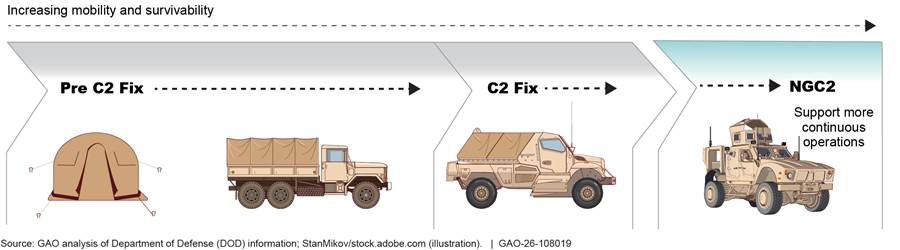
C2 Fix. This is the Army’s short-term solution intended to increase network survivability, mobility, and operational flexibility, among other things. The Army fielded C2 Fix to three divisions (25th Infantry Division, 82nd and 101st Airborne Divisions) and one partial division (3rd Brigade Combat Team, 10th Mountain Division). C2 Fix largely uses commercial hardware technologies and existing components from other programs. As of April 2025, 19 different, largely commercial, hardware technologies comprised C2 Fix. Examples of these technologies include
· variable height antennas tethered to drones that extend radio line of sight capabilities,
· Nett Warrior handheld systems that provide situational awareness during combat operations, and
· tactical radio interface kits that enable communication between different radio systems.
The Army is also implementing a short-term commercial software solution under C2 Fix to provide users with a common operating picture. In this context, a common operating picture creates a centralized platform depicting battlefield information, such as enemy positions and terrain. C2 Fix’s common operating picture is meant to be a bridging capability until NGC2 is fully fielded. An Army official said that C2 Fix has been successful because it gives commanders the tools they need to quickly establish and disband command posts while maintaining communication capabilities.
NGC2. This is the Army’s long-term solution intended to provide users with information faster to support better decision-making. The Army is using a multi-layered approach to manage and develop NGC2’s full technology stack, which includes the four layers as described below.
· Application. This layer is intended to provide user-friendly command and control tools through a common operating environment. Army officials said that this will enable users to identify and interact with data that they need to make decisions. The program manager for Command and Control Applications is responsible for the application layer.
· Data. This layer is intended to provide a common data source for applications. It is expected to share tactical information across different environments through analytic, artificial intelligence, or machine-learning services. Army officials said that, at a high level, this layer provides the information to be shared across the network. The program manager for Command and Control Data and Artificial Intelligence is responsible for this layer.
· Infrastructure. This layer is intended to provide a shared baseline for application and data access, through both cloud-enabled and cloud-independent environments. Army officials said that this layer is expected to provide storage and hardware capabilities for NGC2, including cloud computing, to supply the data layer. The program manager for Command and Control Infrastructure is responsible for this layer.
· Transport. This layer is intended to provide global data transport capabilities through different technologies that Army officials said are responsible for moving information between users. Examples of technologies include high-frequency radios, air-ground networking radios, and protected, anti-jam, tactical satellite communications. The program manager for Command and Control Transport is responsible for this layer.
NGC2 includes both software prototypes and hardware technologies. The software prototypes are intended to provide an open and modular command and control environment with a common integrated data layer—a common data source to feed applications. One of NGC2’s key features is the common operating picture, which is in development. As of August 2025, the Army awarded two agreements to develop these prototype software solutions for NGC2.
In addition to the software prototypes, as of June 2025, the Army plans to use as many as 23 different hardware technologies in the NGC2 architecture, that include
· mobile ad hoc network mounted and dismounted radios, which provide voice and data capabilities;
· backhaul network extension that supports communications range extension; and
· Nett Warrior end user devices that provide access to Wi-Fi, 5G, and connections to mobile ad-hoc network radio solutions.
Additionally, the Army plans to divest from some legacy systems under NGC2’s transport and infrastructure layers through a 30-month replacement strategy.
The Army planned to fully field hardware and one software prototype solution for NGC2 at the 4th Infantry Division in preparation for division-level testing at Project Convergence Capstone 6.[8] This event was held in the fourth quarter of fiscal year 2026. The Army fielded the second software prototype solution for NGC2 at the 25th Infantry Division to test this solution on the C2 Fix hardware architecture. Army officials told us that their intent is for all units to have access to the same data capabilities, even if they select different software solutions for different situations.
Army Battlefield Modernization Organization
In October 2025, the Army restructured the offices overseeing its battlefield network modernization efforts. It consolidated Army Futures Command with the Training and Doctrine Command to create the Transformation and Training Command. Army battlefield network modernization was overseen by the Army’s Futures Command through the Command and Control Cross-Functional Team. The offices under this command with responsibilities for battlefield network modernization were also restructured. Many of the disparate program offices responsible for individual component programs managing battlefield network and command and control acquisitions were reorganized under the renamed Capability Program Executive Command and Control Information Network to reflect the four-layer structure described above for NGC2, with each layer assigned an Army program manager. The Office of the Deputy Assistant Secretary of the Army (Cost & Economics) remains responsible for providing Army decision-makers with cost, performance, and economic analysis, including independent cost estimates.
DOD Acquisition Framework
In January 2020, DOD established the Adaptive Acquisition Framework.[9] The framework emphasizes several principles that include simplifying acquisition policy, tailoring acquisition approaches, and conducting data-driven analysis. The Adaptive Acquisition Framework includes six acquisition pathways that have distinct processes for pathway decision events, cost and schedule goals, and documentation. Of these six, the software acquisition pathway is the primary approach used for new acquisitions supporting the primary battlefield network modernization effort.
The software acquisition pathway is governed by title 10, section 3603 of the U.S. Code and by DOD Instruction 5000.87. It is comprised of two phases (planning and execution) and is intended to facilitate rapid and iterative delivery of software capability, including software-intensive systems, to users.[10] The pathway involves the use of small cross-functional teams that include operational users, developmental and operational testers, software developers, and cybersecurity experts to deliver software rapidly and iteratively to meet highest priority user needs. There are two paths within the software acquisition pathway that programs can choose: (1) the applications path for software running on commercial hardware and cloud computing platforms, and (2) the embedded software path for software embedded in weapon systems and other military-specific hardware. A March 2025 memorandum from the Secretary of Defense identified the software acquisition pathway as the preferred pathway for all software development components of DOD weapon systems.[11]
Other acquisition pathways being used for the Army’s battlefield network modernization effort include:
· Major capability acquisition pathway for acquiring and modernizing military-unique programs, including DOD’s costliest programs and other complex acquisitions;[12]
· Middle tier of acquisition pathway for rapidly developing fieldable prototypes or rapidly fielding capabilities with proven technologies that require minimal development, within 5 years of pathway initiation; and[13]
· Urgent capability acquisition pathway for fulfilling urgent existing or emerging operational needs in less than 2 years.[14]
DOD’s November 2025 Acquisition Transformation Strategy laid out new priorities for the department as it pursues the acquisition of new systems.[15] The strategy prioritizes speed of delivery as the organizing principle of DOD acquisitions and highlights its importance for maintaining deterrence and warfighting advantage. It also promotes prioritizing flexible requirements to support this goal and notes the need for early and accurate cost estimates.
Using an Iterative Business Case
We previously reported that leading companies develop business cases—collections of information that justify undertaking product development efforts—to justify investments and deliver well-defined products that align with corporate visions and goals.[16] These companies formulate business cases around four key elements—market and user needs, product definition, target schedule, and internal value (see table 1 and appendix I). They then systematically reassess these key elements, or iterate, as product development continues to determine whether to continue investing in a product.
|
Key elementsa |
Description and examples |
|
Market and user Needs |
Statement of a problem to be addressed to meet customer and user needs |
|
Product definition |
Describes the capabilities the product will provide, with increasing specificity over time, based on knowledge gained through iterations |
|
Target schedule |
Best estimate of expected delivery dates and available schedule margin for a minimum viable productb |
|
Internal value |
Describes the costs and benefits to developing the product, expressed through, for example, the product’s fit with the company’s strategic vision and portfolio goals |
Source: GAO analysis of leading company information. | GAO‑26‑108019
aA business case is a collection of information that justifies a product development effort.
bA minimum viable product has minimum capabilities needed for customers to recognize value and can be followed by successive updates.
Army’s Flexible Approaches Address User Feedback, Evolving Market Conditions, and Product Capabilities
Modernization Efforts Incorporate User Feedback and Monitor Evolving Market Conditions
The Army’s approach to developing C2 Fix and NGC2 incorporates feedback from users and plans for monitoring evolving market conditions, such as new technologies. This approach generally conforms with those used by leading companies, which frequently reevaluate user needs and market conditions as part of their iterative business cases to inform the high-level capabilities a program will provide.[17]
User feedback. The Army collected, and plans to continue collecting, user feedback through testing events. For example, the Army tested C2 Fix at a series of events at multiple divisions, including the 25th Infantry Division, between 2024 and 2025. Through events like these, the Army captured lessons learned and made recommendations to improve C2 Fix, such as by strengthening and waterproofing commercially available off-the-shelf kits so that they perform better in muddy, rough, mountainous terrain, and dense forest.[18] The Army is continuing this approach with NGC2 through testing events that focus on either partial or full elements of NGC2’s technology stack, as discussed in table 2.
Table 2: Planned Next Generation Command and Control (NGC2) Testing Events and Corresponding Details
|
Testing event |
Testing division |
Technology stack |
Event frequency |
Examples of goals |
|
Ivy Sting |
4th Infantry Division |
Full technology stack, including one NGC2 software prototypea |
Every month, August 2025 through March 2026 |
Each event has different end states and key tasks. For example, the end state for Ivy Sting 5 is to establish the division command and control architecture. |
|
Ivy Mass |
May 2026 |
Ivy Mass will serve as a risk reduction event, which includes division-level testing, ahead of Project Convergence Capstone 6. |
||
|
Project Convergence Capstone 6 |
Fourth quarter of fiscal year 2026 |
Project Convergence Capstone 6 assessed NGC2’s division prototype under combat-like conditions and with subordinate units. |
||
|
Lightning Surge |
25th Infantry Division |
C2 Fix hardware and second NGC2 software prototype |
Throughout calendar year 2026 |
These events will transform the 25th Infantry Division from C2 Fix to NGC2, tailored for light infantry formations. |
Source: GAO analysis of Department of Defense information. | GAO‑26‑108019
aNGC2’s full technology stack includes the four layers (i.e., application, data, infrastructure, and transport) and the capabilities under them.
Following several testing events, the Army Test and Evaluation Command created detailed evaluation reports. Generally, the purpose of these reports is to provide well-supported information on NGC2’s technology stack and to inform future acquisition decisions. These reports provide a detailed overview of the event, user observations, and recommendations, among other things. For example, the Army Test and Evaluation Command’s evaluation report for an Ivy Sting test event, which occurred between January 2026 and February 2026, stated that this event validated key capabilities and progress across NGC2’s full technology stack. These included that the Army
· saw application advancements for artificial intelligence and machine learning capabilities;
· integrated data between key and joint multinational partners;
· supported software demands through infrastructure hardware; and
· proved that transport capabilities, while not stressed to the fullest capacity, were resilient and effective.
This report also indicated that future testing events will focus on interactions between the data layer and cloud environment during simulated denied, degraded, intermittent, and limited operations. Other focus areas will include streamlining data translation throughout NGC2 and system resilience, such as reviewing system vulnerabilities and creating a survivability profile against emerging threats.
Market conditions. The Army also plans to monitor market conditions, such as identifying the most up-to-date technologies to meet technical requirements, through a continuous NGC2 market research approach during the effort’s execution phase under the software acquisition pathway. If successful, this approach will help ensure that NGC2 includes the most up-to-date technology. According to the draft strategy, the Army intends to identify the most suitable technologies and vendors that meet mission and technical requirements for NGC2 by creating a short list of technologies for demonstrations and prototyping. The identified technologies could then be considered for the NGC2 minimum viable product and minimum viable capability release.[19] However, Army officials said that this will not be determined until the start of the execution phase under the software acquisition pathway. The Army also collects information on potential technologies at other testing events, including an annual field exercise that focuses on denied, degraded, intermittent, and limited environments. Army officials said that these types of events can show what technology is working and allow them to adjust technologies based on what soldiers did or did not like.
Modernization Efforts Maintain Flexibility to Manage Evolving Product Capabilities
The Army plans to maintain flexibility by: (1) refining capabilities and technical features; (2) using specific procurement authorities; and (3) selecting multiple acquisition pathways to manage NGC2. This aligns with the practices of leading companies, which we previously reported initially define the high-level capabilities the product will provide, including its basic technical functions and features, and then update those and refine capabilities over time as part of their iterative business case.[20]
Refining capabilities and technical features. The Army identified and is positioned to adjust capabilities, including some technical features and key technologies for NGC2. The Army refines capabilities and then documents this in NGC2’s requirements documents. Overarching capabilities for NGC2 include, but are not limited to, providing an adaptive technology stack and robust and resilient transport. Examples of expected capabilities, as identified in requirement documents, for each of NGC2’s layers include:
· Application layer solutions should publish information from the data layer, be agnostic to computing hardware, and located in a central repository accessible to credentialed users.
· Data layer solutions should include analytic services to monitor and analyze open-source platforms to help understand different performance aspects (e.g., managing security and access or analyzing metrics), identify issues, and optimize resources.
· Infrastructure layer hardware solutions should be modular and available in a variety of size, weight, and power configurations for mounted, dismounted, and command post operations.
· Transport layer solutions should provide beyond line-of-sight assets that enable communication between geographically dispersed units and line-of-sight assets that enable secure and reliable communication with direct visual or radio paths.
The Army is using a tiered requirement development approach for NGC2 across four different types of documents that identify layer- and unit-specific requirements, as illustrated in figure 2.
Figure 2: Next Generation Command and Control (NGC2) Requirement Documents Hierarchy and Information
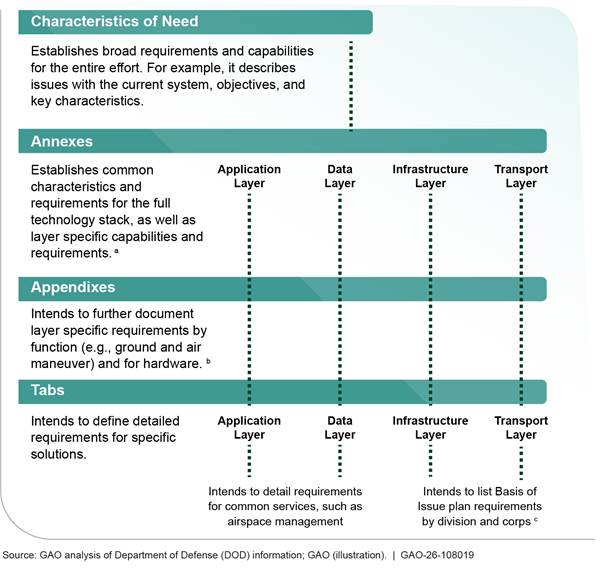
aNGC2’s full technology stack includes the four layers (i.e., application, data, infrastructure, and transport) and the capabilities under them.
bThe appendixes and tabs are still under development and the corresponding details presented here are what the Army plans to describe in these documents.
cAccording to the Defense Acquisition University, Basis of Issue plans establish the distribution of new equipment and associated support items of equipment and personnel.
The Army intends to update NGC2 requirement documents, as appropriate, based on evolving threats and technologies, lessons learned, and operational or mission changes. An example of requirement document iteration is the two updates the Army has made to NGC2’s Characteristics of Need since May 2024. The Army incorporated lessons learned from testing events to identify and integrate new capabilities for NGC2, such as increased resilience and enabling decision-making with artificial intelligence. Additionally, results from a 2024 test event were used to update NGC2’s Characteristics of Need by refining requirements across the layers. Army officials said that these updates allow them to learn from previous assessments and avoid leaving out additional technology information as it becomes available.
The Army also identified and updated the technical hardware features through the evolution of its Basis of Issue plans. According to the Defense Acquisition University, Basis of Issue plans establish the distribution of new equipment and associated support items of equipment and personnel.[21] These plans identify specific hardware technologies to be included, and officials said that they can be adjusted based on testing and changing operational needs. For example, the Army incorporated additional hardware technologies into C2 Fix’s architecture and Basis of Issue plan when they determined units needed additional communication capabilities after testing.
For NGC2, the Army developed an initial Basis of Issue plan specific to field the 4th Infantry Division ahead of Project Convergence Capstone 6. Army officials said that demonstrations may change different aspects of this Basis of Issue plan. Additionally, the Army expects NGC2’s lower-level requirement documents (i.e., tabs) for the transport and infrastructure layers to include Basis of Issue plans with equipment items (i.e., requirements) per division and corps. These plans may evolve to focus on different formation types (i.e., airborne, infantry, armor, etc.) as NGC2 matures. The Army expects to have baseline Basis of Issue plans for the infrastructure and transport layers by the beginning of fiscal year 2028.
Procurement authorities. The Army is using two procurement authorities that provide flexibility, such as continuously adding new technologies and multiple awardees, to meet the effort’s changing needs and capabilities.[22] These procurement authorities are:
· A commercial solutions opening allows for the competitive selection of proposals resulting from a general solicitation, which DOD has used to acquire innovative commercial products or services.[23]
· Other transaction authority may be used to award agreements for prototype projects that are directly relevant to enhancing the mission effectiveness of military personnel and the supporting platforms, systems, components, or materials that DOD proposes to acquire or develop.[24] Other transaction agreements resulting from the use of this authority are not governed by the Federal Acquisition Regulation.[25]
These authorities could enable the Army to address unplanned requirements or incorporate potential improvements based on new technologies and awardee performance. For example, the commercial solutions opening for NGC2 will remain open for 2 years and seeks proposals for innovative, commercial technologies that can provide support to all four layers. Army officials said that they intend to continuously receive proposals, even after the initial award. As a result, the commercial solutions opening allows the Army to incorporate or select evolving commercial technologies as they become available to meet capability needs. Additionally, the Army may incorporate contracts or agreements that fit within the NGC2 ecosystem and were previously awarded under other solicitation methods into awards issued under the commercial solutions opening. Army officials said that this approach gives the service greater flexibility to revisit its choices and pursue other promising technologies.
As of August 2025, the Army awarded two other transaction agreements for NGC2’s software prototype solution under the commercial solutions opening for the effort. These awards were made to Anduril Industries Inc. and Lockheed Martin Corporation.[26] The Army identified the Anduril and Lockheed prototypes as having low technical risk. For example, the Army considers the Anduril prototype to be a continuation of previous work with increased volume, such as expanding capabilities to include more vehicles. The Army is fielding the Anduril and Lockheed prototypes at the 4th and 25th Infantry Divisions, respectively. Army officials also told us that taking a multi-vendor approach helps increase innovation and allows the Army to revisit its choices as needs change or other technologies become available.
Acquisition pathway selection. The Army is using different acquisition pathways to promote speed and meet emerging needs. For example, it is using the software acquisition pathway for NGC2 for capabilities under the data, application, and infrastructure layers. The Army started the software acquisition pathway planning phase for NGC2 in September 2024 and expects to transition to the execution phase prior to the end of fiscal year 2026. The Army also used other pathways for hardware components. For example, the Army used the urgent capability and major capability acquisition pathways for C2 Fix to help integrate existing systems into this effort.[27] Similarly, the Army is using these pathways, in addition to the middle tier of acquisition pathway for rapid prototyping, and other strategies to acquire non-developmental or commercially available off-the-shelf items for NGC2 equipment. The use of these multiple pathways may enable the Army to field capabilities to fulfill existing and emerging operational needs or modernize programs that provide enduring capabilities.
Army Lacks Information Needed to Evaluate the Scalability and Affordability of NGC2
The Army identified some near-term equipment fielding plans through fiscal year 2027 and costs for NGC2 through fiscal year 2026 but does not have the long-term schedule or cost information needed to assess the scalability of this effort.[28] The Army’s approach does not align with the practices of leading companies that develop an initial estimate of schedule and costs as part of their iterative business cases.[29] As a result, the Army lacks information to determine if it can scale the effort across the service and within available resources.
Schedule. The Army developed specific short-term schedules for NGC2 through fiscal year 2027 and has a tentative goal of fielding NGC2’s full technology stack across 11 divisions and four corps by the end of fiscal year 2032, according to officials. Specifically, the Army plans to test NGC2 repeatedly through November 2026 (see table 2 above for additional details). The Army also plans to field NGC2’s full technology stack at the 4th Infantry Division and partially field it at the 25th Infantry Division. Additionally, the Army intends to divest from legacy systems and field NGC2’s transport and infrastructure layers, as part of that effort, at the end of fiscal year 2026. Army officials also told us that the service plans to field equipment to I Corps, 7th Infantry Division, and retouch the 25th Infantry Division during fiscal year 2027.
Army officials said that they have developed schedules for fielding NGC2 through the end of fiscal year 2027. However, the Army is limited in its ability to assess whether it can deploy NGC2 across its corps and divisions by the end of fiscal year 2032—its tentative fielding goal—because it has not developed a schedule that identifies the specific units that will receive the modernized capabilities by fiscal year. We have found that leading companies provide an initial estimate of expected delivery dates and available schedule margin as part of target schedule for their iterative business cases that they then revisit to assess whether development is on track and make related decisions.[30] Developing such a schedule is an important step to assessing the scalability of the effort because unit specific requirements, such as those planned to be documented in the Basis of Issue plan, can drive the expected costs and funding needs of specific fiscal years, among other factors.
Costs. As of May 2026, the Army had identified NGC2 costs through fiscal year 2026 in the President’s fiscal year 2026 budget submission but had not determined an initial cost estimate for the life cycle of the collective effort. Our review of the Army’s exhibits supporting the President’s fiscal year 2026 budget submission identified approximately $3.3 billion in funding requested for the NGC2 effort, as shown in table 3.[31]
Table 3: Next Generation Command and Control (NGC2) Requested Funding Totals by Layer for Fiscal Year 2026
|
Layer and description |
Requested funding totals for fiscal year 2026 |
|
Application: Intended to provide user-friendly command and control tools through a common operating picturea |
215 |
|
Data: Intended to provide a common data source for applications to consume and publish information |
140 |
|
Infrastructure: Intended to provide a shared baseline for application and data access, through both cloud-enabled and cloud-independent environments |
1,211 |
|
Transport: Intended to provide global data transport capabilities through different hardware technologies, such as high-frequency radios |
1,742 |
|
Total |
3,308 |
Source: GAO analysis of the Army’s exhibits supporting the President’s fiscal year 2026 budget submission. | GAO‑26‑108019
aA common operating picture creates a centralized platform depicting battlefield information, such as enemy positions and terrain.
According to Army officials, a portion of the fiscal year 2026 funding is dedicated to fielding for the 4th Infantry Division, and the majority is being used for the first year of the Army’s 30-month replacement strategy and additional fielding’s in fiscal year 2027.[32] Army officials said that NGC2’s estimated costs are derived from the cost for the 4th Infantry Division’s full technology stack. This estimate is over $1 billion and incorporates hardware, software, and licensing costs. Army officials also said that NGC2’s total cost per fiscal year will ultimately depend on the number of divisions the service plans to field annually. Army officials stated that the type of division would also drive costs, citing that an armored division will likely cost more to field than an airborne division. As of February 2026, Army officials told us that NGC2’s potential costs per fiscal year will be over several billion dollars and include the 30-month replacement strategy, fielding of two units (e.g., divisions or corps), and software licenses.
Aside from identifying these near-term costs, the Army cannot fully assess whether it can fully deploy NGC2 across its corps and divisions because it has not yet identified the long-term costs of doing so. Such a cost estimate could provide decision-makers with information on the range of expected costs for NGC2 both by fiscal year and in total for processes such as the Army’s annual budget request. As part of assessing internal value to support an iterative business case, we have found that leading companies make preliminary estimates to guide initial approval decisions. Because leading companies expect value-related metrics, such as cost estimates, to change over time, these later function as a reference point for future updates as development progresses.[33] Army officials said that they expect to begin developing long-term cost estimates after NGC2’s planning phase under the software acquisition pathway. They told us that waiting until the planning phase is completed will better enable them to ensure the estimate is informed by experimentation and prototyping efforts at the 4th and 25th Infantry Divisions.
As a general matter, programs using the software acquisition pathway are typically required to develop an initial cost estimate before beginning the execution phase and must update the estimate annually. As part of the planning phase, programs on the software acquisition pathway are also required to develop an acquisition strategy that includes a roadmap and cadence for software deliveries for operations. Army documentation states that the service will develop a cost estimate and multi-year roadmap, among other items, for NGC2 software pathway programs prior to entering the execution phase, projected before the end of fiscal year 2026. Officials told us that other programs that make up NGC2 will have their own individual cost estimates, but that there is not a cost estimate for the full effort. Similarly, the Army has not developed specific schedules for fielding NGC2 across the service beyond fiscal year 2027. However, the programs that are under other areas of NGC2’s full technology stack and using other acquisition pathways account for a large portion of the current effort—leaving a gap remaining in the information needed by decision-makers.
According to our prior work, leading companies use schedule and cost data—among other inputs—not only to establish an initial business case, but to inform key decisions and scale their investments throughout product development. Additionally, we have found that decision-makers at leading companies may deny moving forward with efforts if business cases indicates that technologies cannot be developed to meet critical requirements in a timely manner and within available resources.[34] Without fully identifying the schedule and long-term costs for NGC2, the Army lacks the information needed to determine if it can develop and scale the effort across the service within available resources and in time to meet user needs.
Conclusions
The Army has undertaken an ambitious effort to modernize its battlefield network to be more mobile and survivable. This is in response to the Department of Defense prioritizing the acquisition of capabilities needed to win a conflict with a near-peer adversary relative to those needed for counterterrorism and counterinsurgency operations. In modernizing its network, the Army is using flexible approaches that, if implemented as intended, are responsive to user feedback, changes in market conditions, and evolving capability needs. However, this effort may be hindered by the Army not having information it needs to assess whether its approach is scalable. Specifically, the Army has not developed a detailed schedule that identifies the units, by fiscal year, that are planned to receive the modernized network and has little information on the effort’s costs beyond fiscal year 2027.
Given that the Army currently plans to field 11 divisions and four corps, the Army may require billions of dollars annually to fully field its NGC2 solution and additional costs to support and maintain the systems once fielded over an extended period of time. The absence of a detailed schedule and long-term cost data limit the Army’s ability to assess whether it has the time and resources it needs to meet its 2032 tentative goal. This gap risks access to secure and reliable communications soldiers in the field need for modern large-scale combat operations. This information would also better position the Army and Congress to be able to make informed decisions about how to proceed with this effort.
Recommendations for Executive Action
We are making two recommendations to the Army:
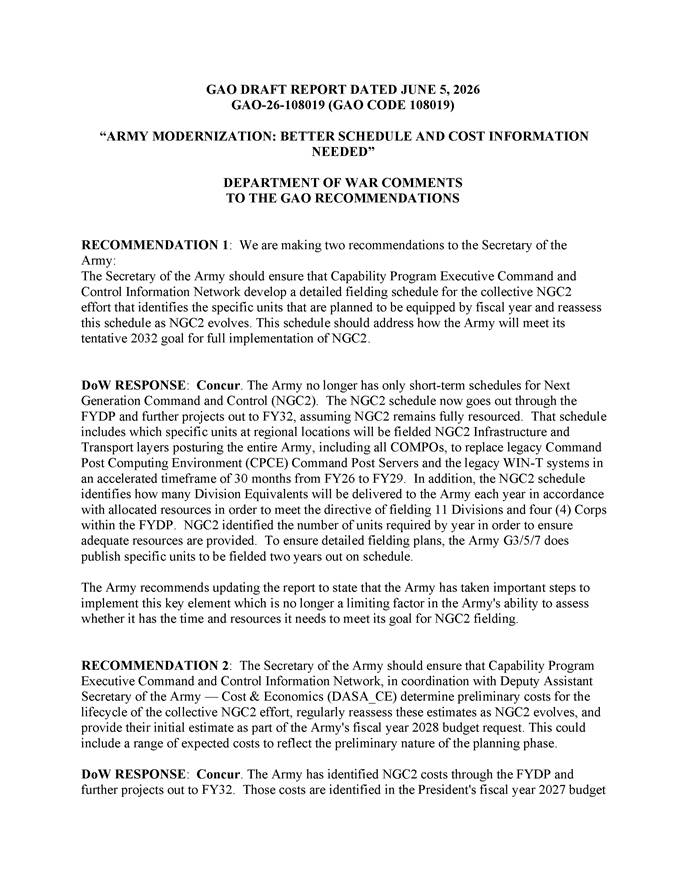
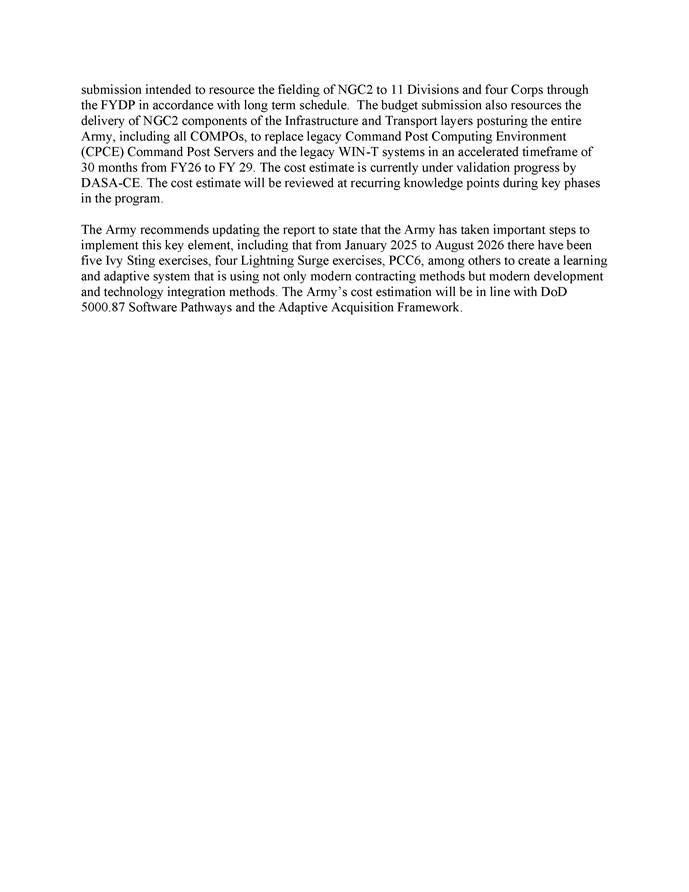
The Secretary of the Army should ensure that Capability Program Executive Command and Control Information Network develop a detailed fielding schedule for the collective NGC2 effort that identifies the specific units that are planned to be equipped by fiscal year and reassess this schedule as NGC2 evolves. This schedule should address how the Army will meet its tentative 2032 goal for full implementation of NGC2. (Recommendation 1)
The Secretary of the Army should ensure that Capability Program Executive Command and Control Information Network, in coordination with Deputy Assistant Secretary of the Army – Cost & Economics, determine preliminary costs for the life cycle of the collective NGC2 effort, regularly reassess these estimates as NGC2 evolves, and provide their initial estimate as part of the Army’s fiscal year 2028 budget request. This could include a range of expected costs to reflect the preliminary nature of the planning phase. (Recommendation 2)
Agency Comments
We provided a draft of this report to DOD for review and comment. In its comments, reproduced in appendix II, DOD concurred with both our recommendations and provided information on steps it says it will take to implement them. GAO will continue to follow-up with the Army to assess its implementation of our recommendations.
We are sending copies of this report to the appropriate congressional committees, the Secretary of Defense, Secretary of the Army, and other interested parties. In addition, the report is available at no charge on the GAO website at https://www.gao.gov.
If you or your staff have any questions about this report, please contact me at winograda@gao.gov. Contact points for our Offices of Congressional Relations and Media Relations may be found on the last page of this report. GAO staff who made key contributions to this report are listed in appendix III.
Alex Winograd
Acting Director, Contracting and National Security Acquisitions
List of Committees
The Honorable Roger Wicker
Chairman
The Honorable Jack Reed
Ranking Member
Committee on Armed Services
United States Senate
The Honorable Mitch McConnell
Chair
The Honorable Chris Coons
Ranking Member
Subcommittee on Defense
Committee on Appropriations
United States Senate
The Honorable Mike Rogers
Chairman
The Honorable Adam Smith
Ranking Member
Committee on Armed Services
House of Representatives
The Honorable Ken Calvert
Chairman
The Honorable Betty McCollum
Ranking Member
Subcommittee on Defense
Committee on Armed Services
House of Representatives
We previously reported that leading companies formulate business cases around four key elements—market and user needs, product definition, internal value, and target schedule. [35] Definitions and illustrative examples for the four key elements are described below.
Market and user needs. Statement of a problem to be addressed to meet customer and user needs. This includes
· broadly defined statement of objectives rather than an overly prescriptive description of detailed technical requirements;
· identifies expected market and users;
· extensive market research and customer input; and
· validate assumptions and more clearly define user needs as product knowledge grows.
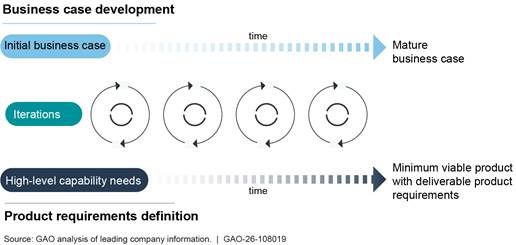
Product definition. Describes the capabilities the product will provide, with increasing specificity over time based on knowledge gained through iterations. Companies develop product definition by defining high-level capabilities the product will provide, including basic technical functions and key technologies, informed by
· technology readiness assessment (i.e., assess technology readiness, inform the level of effort required to fully develop a technology before it goes to market);
· supply chain assessment, including make or buy decisions (i.e., assess whether they will have product components when needed and whether they will develop or acquire needed technologies); and
· relevant legislative or regulatory requirements and industry standards.
Internal value. Describes the costs and benefits to developing the product, expressed through the product’s fit with the company’s strategic vision and portfolio goals. Companies assess internal value through
· strategic alignment (i.e., the product’s fit with the company’s strategic vision and portfolio goals, including how the product contributes to the company’s broader capability needs);
· benefit and opportunity cost (i.e., benefit of adding the product to the portfolio versus the opportunity cost of developing it over another product);
· financial estimates (i.e., estimated costs, return on investment, target revenues);
· commercial feasibility (i.e., whether the company has the competitive advantage to capture users in the market); and
· organizational readiness (i.e., whether the company has the available resources and skill sets to develop the product).
Target schedule. Best estimate of expected delivery dates and available schedule margin for a minimum viable product.[36] This can be informed by:
· specific product features; and
· historical development timelines for similar products and estimated time and effort to progress through the product development life cycle.
We also found leading companies iteratively review, validate, and update the business case on a regular basis throughout product development. Listed below are examples of how leading companies iterate their business cases in the context of the key elements.
Changing market and user needs. Leading companies interact with intended users to reevaluate capability needs on individual products (i.e., direct outreach to users, customers, and market research).
Refining a product’s definition. Leading companies translate high-level capabilities into specific technical features and functions that the product will include as it progresses toward a minimum viable product. See figure 3.
Figure 3: Leading Companies Iterate Capability Needs into Product Requirements as Business Cases Mature
Reassessing internal value. Market changes affect the value of the development effort or return on investment. Thus, leading companies allow for acceptable levels of uncertainty while they continue to refine the business case and expect early estimates to change as they gain knowledge with development progress. They also remain cognizant of portfolio-wide developments that will affect funding, so they maintain flexibility.
Adjusting schedule. Target schedule may be approximated initially. Leading companies expect to quickly refine it as they mature the business case and commit to bringing the product to market. This results in companies likely making trade-offs in other elements of the business case before they consider making adjustments and revisiting the schedule to assess whether development is on track to make estimated delivery dates.
GAO Contact
Alex Winograd, winograda@gao.gov
Staff Acknowledgments
In addition to the individual named above, Brian Fersch (Assistant Director), Scott Purdy (Analyst-in-Charge), Bonnie Binggeli, Stephanie Gustafson, Robin Harris, Min-Hei (Michelle) Kim, and Alyssa Weir made key contributions to this report. Noah Attal, Jean McSween, Kevin O’Neill, Mona Sehgal, Eric Trout, and Wesley Wilhelm also contributed.
The Government Accountability Office, the audit, evaluation, and investigative arm of Congress, exists to support Congress in meeting its constitutional responsibilities and to help improve the performance and accountability of the federal government for the American people. GAO examines the use of public funds; evaluates federal programs and policies; and provides analyses, recommendations, and other assistance to help Congress make informed oversight, policy, and funding decisions. GAO’s commitment to good government is reflected in its core values of accountability, integrity, and reliability.
Obtaining Copies of GAO Reports and Testimony
The fastest and easiest way to obtain copies of GAO documents at no cost is through our website. Each weekday afternoon, GAO posts on its website newly released reports, testimony, and correspondence. You can also subscribe to GAO’s email updates to receive notification of newly posted products.
Order by Phone
The price of each GAO publication reflects GAO’s actual cost of production and distribution and depends on the number of pages in the publication and whether the publication is printed in color or black and white. Pricing and ordering information is posted on GAO’s website, https://www.gao.gov/ordering.htm.
Place orders by calling (202) 512-6000, toll free (866) 801-7077,
or
TDD (202) 512-2537.
Orders may be paid for using American Express, Discover Card, MasterCard, Visa, check, or money order. Call for additional information.
Connect with GAO
Connect with GAO on X,
LinkedIn, Instagram, and YouTube.
Subscribe to our Email Updates. Listen to our Podcasts.
Visit GAO on the web at https://www.gao.gov.
To Report Fraud, Waste, and Abuse in Federal Programs
Contact FraudNet:
Website: https://www.gao.gov/about/what-gao-does/fraudnet
Automated answering system: (800) 424-5454
Media Relations
Sarah Kaczmarek, Managing Director, Media@gao.gov
Congressional Relations
David A. Powner, Acting Managing Director, CongRel@gao.gov
General Inquiries
[1]The Army identified six modernization priorities in its 2019 and 2021 Army Modernization Strategies.
[2]S. Rep. No. 118-188, at 23 (2024) (accompanying S. 4638).
[3]GAO, Leading Practices: Agile Portfolio Management and Iterative Business Cases Drive Innovative Product Development, GAO‑25‑107130 (Washington, D.C.: Sept. 17, 2025).
[4]Department of Defense, U.S. Army, 2021 Army Modernization Strategy: Investing in the Future.
[5]For the purposes of this report, we refer to both C2 Fix and NGC2 as efforts because they are comprised of multiple acquisition programs and do not represent a single program of record.
[6]Department of Defense, 2026 National Defense Strategy: Restoring Peace Through Strength for a New Golden Age of America (Jan. 23, 2026).
[7]Fielding refers to the process that the Army uses to provide new or upgraded equipment to a unit and ensure that the unit can operate the equipment in its operational environment. For NGC2, the intent is to field solutions tailored to the operational needs of the units, making this an iterative and ongoing process.
[8]According to the Army’s website, Project Convergence is the service’s premier experimentation event that brings operational units as well as joint and multinational partners together with complex realistic examples to test ideas, concepts, and promising technology. The Army typically plans for annual Project Convergence events.
[9]Department of Defense, The Defense Acquisition System, DOD Directive 5000.01 (Sept. 9, 2020) (incorporating change 1, July 28, 2022); Department of Defense, Operation of the Adaptive Acquisition Framework, DOD Instruction 5000.02 (Jan. 23, 2020) (incorporating change 2, Apr. 8, 2026).
[10]See 10 U.S.C. § 3603 and Department of Defense, Operation of the Software Acquisition Pathway, DOD Instruction 5000.87 (Oct. 2, 2020).
[11]Department of Defense, Secretary of Defense, Directing Modern Software Acquisition to Maximize Lethality (Mar. 6, 2025).
[12]Department of Defense, Major Capability Acquisition, DOD Instruction 5000.85 (Aug. 6, 2020) (incorporating change 1, Nov. 4, 2021).
[13]Department of Defense, Operation of the Middle Tier of Acquisition, DOD Instruction 5000.80 (Dec. 30, 2019) (incorporating change 1, Nov. 25, 2024).
[14]Department of Defense, Urgent Capability Acquisition, DOD Instruction 5000.81 (Dec. 31, 2019).
[15]Department of Defense, Secretary of Defense, Transforming the Defense Acquisition System into the Warfighting Acquisition System to Accelerate Fielding of Urgently Needed Capabilities to Our Warriors (Nov. 7, 2025).
[18]For a full definition of “commercially available off-the-shelf” item, see FAR 2.101.
[19]A minimum viable product has minimum capabilities needed for customers to recognize value and can be followed by successive updates. According to DOD policy, a minimum viable capability release is the initial set of features suitable to be fielded to an operational environment that provides value to the warfighter or end user in a rapid timeline. DOD Instruction 5000.87.
[21]The Defense Acquisition University is also referred to as the Warfighter Acquisition University.
[22]In March 2025, the Secretary of Defense issued a memorandum, Directing Modern Software Acquisition to Maximize Lethality, directing all components to use the software acquisition pathway as the preferred pathway for all software development components of DOD’s weapon system programs. It also directs the use of procurement authorities under 10 U.S.C § 3458 (for the use of commercial solutions opening procedures) and 10 U.S.C § 4022 (for the use of other transaction authority for prototype projects) as the default solicitation and award procedures for efforts under the software acquisition pathway that meet minimum threshold requirements.
[23]10 U.S.C § 3458. Previously, this authority could only be used to acquire “innovative” commercial products or services, defined as any new technology, process or method, including research or development, as of the date of proposal submission, or any new application of a technology, process, or method existing at the time of proposal submission. The National Defense Authorization Act for Fiscal Year 2026 expanded this authority to the acquisition of commercial products, commercial services, or nondevelopmental items, and removed the requirement that these products or services be innovative, among other amendments. Pub. L. No. 119-60, § 1823 (2025) (amending 10 U.S.C. § 3458).
[24]10 U.S.C § 4022. A prototype project includes a proof of concept, model, or process, a novel application of commercial technologies for defense purposes, and agile development activity, among other things. 10 U.S.C. § 4022(e).
[25]DOD may not enter into an other transaction agreement for a prototype project unless at least one of four statutory conditions is met: (1) participation by at least one nontraditional defense contractor or nonprofit research institution; (2) all significant participants are small businesses or nontraditional defense contractors; (3) specified cost sharing between government and industry; or (4) senior procurement executive approval based on exceptional circumstances. 10 U.S.C § 4022(d). For the purposes of section 4022, the term “nontraditional defense contractor” is defined at 10 U.S.C. § 3014 as an entity that is not currently performing and has not performed for at least the 1-year period preceding the solicitation any DOD contract or subcontract that is subject to full coverage under the cost accounting standards prescribed by certain statutes and regulations.
[26]According to Army documents, both awards met statutory requirements for the use of other transaction authority for prototype projects under 10 U.S.C. § 4022(d). The service determined that Anduril qualified as a nontraditional defense contractor through Anduril’s self-certification. These documents also state that the Lockheed award met § 4022(d) requirements because Lockheed has a nontraditional contractor participant on its development team.
[27]Examples include commercially available off-the-shelf items, such as proliferated low Earth orbit antennas.
[28]We identify scalability in this context to refer to the Army’s ability to field needed NGC2 capabilities to all Army forces that require those capabilities, within the constraints of time and available resources.
[31]This total represents an approximate $1.2 billion increase when comparing across the same budget lines for fiscal year 2025. The Equipping Program Evaluation Group scrubbed the Army’s budget to ensure NGC2 had sufficient resources to support its procurement and deployment by identifying funding that could transfer to the effort. In total, this group identified $1.2 billion in fiscal year 2026 and over $11 billion in planned future funding that could transfer to support NGC2.
[32]The $3.3 billion total for NGC2 during fiscal year 2026 is mostly comprised of procurement and research, development, test, and evaluation funding. For new obligations, Army procurement funds are generally available for 3 years. Research, development, test and evaluation funds are available for 2 years.
[35]GAO, Leading Practices: Agile Portfolio Management and Iterative Business Cases Drive Innovative Product Development, GAO‑25‑107130 (Washington, D.C.: Sept. 17, 2025).
[36]A minimum viable product has minimum capabilities needed for customers to recognize value and can be followed by successive updates.