
Report to Congressional Requesters
United States Government Accountability Office
A report to congressional requesters.
For more information, contact: Michael E. Clements at clementsm@gao.gov
What GAO Found
The Network of Central Banks and Supervisors for Greening the Financial System (NGFS) is an international network of central banks and financial supervisors that works to address climate risk management in the financial sector. Its steering committee forms working groups, which in 2024 issued 19 publications, including updates to climate-scenario analyses and guidance on sustainable investment. NGFS is funded by voluntary, in-kind member contributions and external project support.
The Board of Governors of the Federal Reserve (Federal Reserve), Office of the Comptroller of the Currency (OCC), and Federal Deposit Insurance Corporation (FDIC) joined NGFS in 2020, 2021, and 2022, respectively, to better understand climate-related financial risks and collaborate internationally. They withdrew in 2025, generally citing (1) changed agency priorities, (2) a determination that continued participation was inconsistent with their statutory mandates to ensure safety and soundness of financial institutions, and (3) NGFS’s increasing focus on broader environmental risks.
The banking agencies participated in NGFS meetings and working groups, responded to surveys, and reviewed draft publications. Costs related to NGFS participation were for staff time and did not include providing funding to NGFS, according to GAO’s document review and interviews with officials. Officials reported that the agencies shared limited information with NGFS, did not provide nonpublic supervisory data or adopt NGFS recommendations, and retained records in accordance with agency retention policies. NGFS-related records are confidential and not disclosed, except as compelled by law, according to the NGFS charter.
Federal Reserve, FDIC, and OCC Participation in 2022–2024 NGFS Working Groups
Source: GAO analysis of Board of Governors of the Federal Reserve System (Federal Reserve), Office of the Comptroller of the Currency (OCC), Federal Deposit Insurance Corporation (FDIC), and Network of Central Banks and Supervisors for Greening the Financial System (NGFS) information. | GAO-26-108020
Notes: The Workstream on Supervision incorporates climate-related risks within regulatory practices. The Workstream on Net Zero for Central Banks integrates sustainability into corporate operations. The Task Force on Adaptation promotes measures to respond to climate-related variables, which moderate harm or take advantage of opportunities.
Why GAO Did This Study
Established in 2017, NGFS serves as a forum for sharing best practices and conducting analysis on climate risk management in the financial sector. It has advocated for mobilizing capital for low-carbon investments. As of January 2026, it had 149 members from more than 92 countries.
GAO was asked to examine the banking agencies’ membership in NGFS. This report describes why the Federal Reserve, OCC, and FDIC joined and later withdrew, and the extent to which the agencies participated in activities and shared information with NGFS while they were members.
GAO reviewed the NGFS charter, annual reports, and publications. GAO also reviewed agency documentation on NGFS membership, activities, and records retention policies. In addition, GAO reviewed written responses from NGFS and interviewed representatives from the three banking agencies, and three industry and climate change organizations.
|
Abbreviations |
|
|
Federal Reserve |
Board of Governors of the Federal Reserve System |
|
FDIC |
Federal Deposit Insurance Corporation |
|
NGFS |
Network of Central Banks and Supervisors for Greening the Financial System |
|
OCC |
Office of the Comptroller of the Currency |
This is a work of the U.S. government and is not subject to copyright protection in the United States. The published product may be reproduced and distributed in its entirety without further permission from GAO. However, because this work may contain copyrighted images or other material, permission from the copyright holder may be necessary if you wish to reproduce this material separately.
March 26, 2026
The Honorable French Hill
Chairman
Committee on Financial Services
House of Representatives
The Honorable Andy Barr
Chairman
Subcommittee on Financial Institutions
Committee on Financial Services
House of Representatives
Established in 2017 at the Paris One Planet Summit, the Network of Central Banks and Supervisors for Greening the Financial System (NGFS) is an international network of central banks and financial supervisors that serves as a forum for sharing best practices on environmental and climate risk management in the financial sector. NGFS has advocated for mobilizing capital for low-carbon investments. Its purpose is to define and promote such practices within and outside of its membership and to conduct or commission analytical work, such as assessments of nature-related financial risks.
The Board of Governors of the Federal Reserve System (Federal Reserve), the Office of the Comptroller of the Currency (OCC), and the Federal Deposit Insurance Corporation (FDIC) became members in 2020, 2021, and 2022, respectively, and all three withdrew in early 2025.
You asked us to examine the banking agencies’ membership in NGFS and what their membership entailed. This report describes (1) how NGFS prepares information and work products on climate-related issues and how it is funded; (2) why the Federal Reserve, OCC, and FDIC joined and later withdrew from NGFS; and (3) the extent to which these agencies participated in activities and shared information with NGFS while they were members.
For the first objective, we reviewed NGFS’s charter, annual reports, publications, and written responses to questions we posed to NGFS.[1] For the second objective, we reviewed Federal Reserve, OCC, and FDIC documentation, including membership applications, public statements, and press releases related to joining and withdrawing from NGFS.[2]
For the third objective, we reviewed banking agency documentation related to NGFS participation, such as survey responses and comments on draft NGFS publications. FDIC officials stated that certain documents we requested were confidential to NGFS and provided summaries instead. We determined these summaries were sufficient for describing FDIC’s participation. We also examined publications the banking agencies issued during their membership to determine whether they reflected or were related to the agencies’ NGFS participation.[3] To describe agencies’ information sharing, we reviewed the NGFS charter and agency documentation. We also examined agency record retention policies and the availability of NGFS-related records under those policies.
For all three objectives, we interviewed officials from the Federal Reserve, OCC, and FDIC. We also interviewed representatives from a banking industry organization (Independent Community Bankers of America) and two climate change organizations (Ceres and ClimateWorks) to obtain perspectives on the banking agencies’ membership in NGFS. We based our selection of organizations on publicly available information (such as articles, public statements, and comments) indicating their knowledge of climate risk regulation, NGFS, and the banking agencies. We requested interviews from six organizations and three agreed to meet with us.
We conducted this performance audit from January 2025 to March 2026 in accordance with generally accepted government auditing standards. Those standards require that we plan and perform the audit to obtain sufficient, appropriate evidence to provide a reasonable basis for our findings and conclusions based on our audit objectives. We believe that the evidence obtained provides a reasonable basis for our findings and conclusions based on our audit objectives.
Background
U.S. Banking Agencies
The Federal Reserve, OCC, and FDIC supervise banking organizations for their safety and soundness.[4] Among their responsibilities, the Federal Reserve, OCC, and FDIC supervise insured depository institutions for their safety and soundness, issue regulations to establish capital, liquidity, and other requirements for the institutions they supervise, with the goal of promoting the health of the banking system.
According to the banking agencies, they have the authority to take actions that are reasonable and appropriate to effectuate their statutory responsibilities, including participating in international organizations.[5] As discussed further below, these authorities derive from statutes.
The banking agencies participate in a number of international organizations. For example, all three agencies participate in the Basel Committee on Banking Supervision, the Federal Reserve participates in the Financial Stability Board and the Committee on Payments and Market Infrastructures, and FDIC participates in the International Association of Deposit Insurers. Unlike NGFS, these organizations are standard-setting bodies. As of March 2026, we have an ongoing review of financial standards developed through the banking agencies’ participation in these organizations.
NGFS Objectives and Organizational Structure
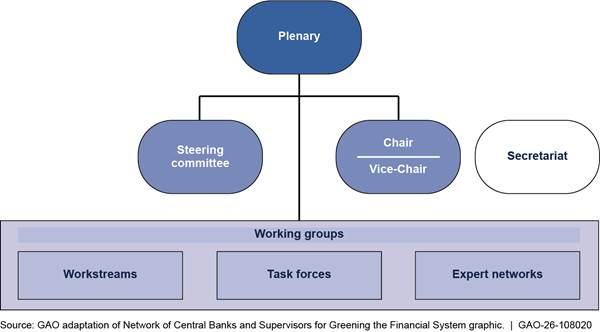
NGFS is a forum to share best practices related to climate risk management in the financial sector. Climate risk management in this sector can include actions such as considering climate stress tests and scenario analyses for decisions related to financial stability monitoring and incorporating climate-related developments into monetary policy considerations. According to the NGFS charter, its objectives include exchanging experiences and mobilizing mainstream finance to support the transition toward a sustainable economy. To meet its objectives, NGFS operates through its plenary (composed of member representatives), steering committee, working groups, chair, and secretariat (provided by the Banque de France). NGFS relies primarily on its working groups to provide insights to the steering committee and plenary (see fig. 1).
Figure 1: Organization of the Network of Central Banks and Supervisors for Greening the Financial System
Overview of NGFS Working Groups
The NGFS steering committee establishes working groups to conduct technical or analytical tasks contributing to the organization’s objectives. These working groups include (1) workstreams for long-term objectives, with members expected to participate in at least one; (2) task forces for temporary projects; and (3) expert networks. From 2022 through 2024, NGFS had four workstreams, three task forces, and three expert networks (see fig. 2).
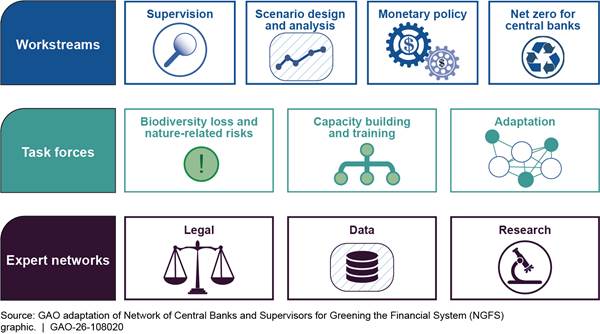
Notes: The Workstream on Supervision helps NGFS members incorporate climate-related and environmental risks within their regulatory frameworks and practices. The Workstream on Net Zero for Central Banks encourages integrating sustainability into central banks’ corporate operations. The Task Force on Adaptation promotes measures central banks can take in response to actual or expected climate-related variables that can affect human activities and the environment, which moderate harm or take advantage of opportunities.
NGFS Membership
Any central bank or prudential supervisory authority committed to contributing to the objectives and work of NGFS is eligible for membership.[6] According to the charter, applicant institutions should demonstrate a commitment to at least one of the following:
1. The design and integration of climate and environmental risk analysis tools in regulation framework or supervisory practices;
2. The adoption of policy measures aimed at mobilizing capital for green and low-carbon investments in the broader context of environmentally sustainable development;
3. The production of analysis or research on topic 1 or 2;
4. Involvement in regional or international forums on green finance and willingness to openly share best practices with other NGFS members; and
5. Willingness to contribute to NGFS’s objectives and implement its recommendations.
According to the charter, an eligible institution may apply by submitting an application to the NGFS chair describing its motivation for joining, examples of the commitments described above, and areas of interest for contribution. Once approved, the new member appoints representatives to the plenary and relevant working groups. Members also commit to contributing to NGFS’s work and dedicating appropriate organizational resources, appointing experts to participate in at least one workstream, and raising awareness of NGFS’s work in their jurisdiction. As of January 2026, NGFS had 149 members from more than 92 countries.
NGFS Decision-Making
As discussed above, NGFS carries out its work through a number of bodies within the organization that play distinct roles in decision-making and the production of work products.
· Plenary. Composed of member representatives, the plenary makes decisions by consensus, including admitting new members and approving NGFS’s strategy and work program upon proposal of the steering committee.
· Steering committee. The steering committee is the executive body in charge of preparing NGFS’s strategy and work program and, acting by consensus, steers the operational work and approves work products and working groups.
· Working groups. The NGFS chair proposes and the steering committee approves working groups, according to the NGFS charter. Their activities include issuing member surveys, developing and publishing reports, and working on climate scenarios. Members contribute by nominating experts to assist in one or more working groups. We discuss the banking agencies’ participation in working groups later in this report.
NGFS Facilitates Information Sharing and Produces Work Products, Relying on Voluntary and External Funding
Information Sharing and Work Products
According to its 2024 annual report, NGFS working groups organized more than 115 meetings, conferences, and webinars for its members throughout the year, providing a forum for information sharing. For example:
· The Workstream on Supervision organized regular webinars in which members shared their approaches on supervision of climate and environmental risks.
· The Workstream on Net Zero for Central Banks organized workshops on sustainable practices for central banks’ operations, including transition planning and climate‑related disclosures.
· The Taskforce on Capacity Building and Training held joint seminars and workshops with external partners.
· The Expert Network on Data conducted regular webinars for members and external partners and updated the NGFS Data Directory, which consolidates information on climate data sources.[7]
NGFS’s work products include publications such as climate scenarios, technical documents, and reports. In 2024, 10 working groups issued 19 publications aimed at, among other things, encouraging central banks to pursue sustainable and responsible investment practices, enhancing microprudential authorities’ understanding of financial institutions’ use of transition planning, providing a framework for addressing nature-related risks, and updating NGFS’s climate-scenario analyses.[8] The publications include nonbinding recommendations, such as integrating sustainability factors into central bank investment portfolios and setting up a governance framework to steer their integration into central bank investment practices. NGFS also issued a guide that calls on central banks to disclose their climate-related risks and opportunities.[9] This document also provides guidance to central banks on governance, strategy, risk management, and metrics and targets.
NGFS Funding
NGFS is funded through voluntary, in-kind (nonmonetary) contributions from some of its members and observers, along with external funding to support commissioned projects. The NGFS charter states that contributions, whether in-kind or financial, do not grant contributors any rights to set priorities or influence the outcomes of its work.
Voluntary Contributions
NGFS does not collect membership fees or have a budget for its activities, according to its charter. An NGFS official told us that NGFS relies on in-kind contributions from its members and observers for its activities and does not manage funds. The charter also states that members may also pool resources to finance specific projects, in which case a dedicated arrangement is established for that project.
The three U.S. banking agencies did not provide funding to NGFS, according to officials. Additionally, we reviewed documents related to the agencies’ involvement in NGFS and determined that costs related to NGFS participation consisted of staff time spent participating in working groups and other activities as needed and attending meetings (which were mostly virtual).[10] The officials also stated that they did not have additional information on NGFS’s funding structure.
Project-Based External Funding
NGFS receives external funding to support projects conducted in partnership with contributors who are not NGFS members or when NGFS requests funding for a project. These projects often require broader collaboration and additional resources. For example, the International Network for Sustainable Financial Policy Insights, Research, and Exchange is a global network launched to commission research on the financial oversight of climate-related risks and promote green finance.[11] It has commissioned and funded research projects in response to NGFS priorities and, at NGFS’s request, supported projects such as Case Studies of Environmental Risk Analysis Methodologies. In addition, NGFS’s climate-scenario work is funded through grants from Bloomberg Philanthropies and the ClimateWorks Foundation. These grants support an academic consortium that partners with NGFS to design and update the scenarios.
Banking Agencies Joined NGFS to Collaborate on Climate-Related Risks and Withdrew When Their Priorities Changed
Agencies’ Entry into NGFS
The banking agencies joined NGFS to better understand climate-related financial risks and collaborate with their international counterparts on these and related issues and later withdrew when priorities changed (see fig. 3).
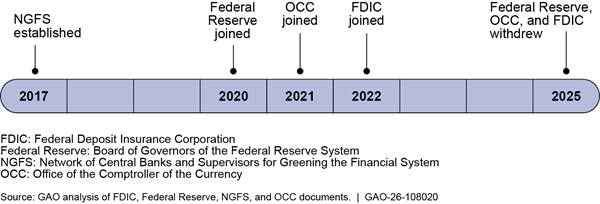
The Federal Reserve, OCC, and FDIC submitted their applications for membership to the NGFS chair in 2020, 2021, and 2022, respectively. The applications stated that joining NGFS would further their efforts related to climate-related financial risks and facilitate collaboration with other central banks and supervisors.
· The Federal Reserve stated that its membership would help improve its understanding of climate-related financial risks, particularly as they related to the agency’s mission. It noted that its work to understand and assess the effects of climate change on the economy and the financial system, both domestically and globally, was developing rapidly and would benefit from further collaboration with NGFS and its members. The Federal Reserve also noted relevant research and analysis conducted by its staff, as well as work to begin developing frameworks to more fully integrate climate-related risks into financial risk monitoring and policy. It noted that these frameworks were important to capture the relationship between climate change and central banking, financial stability, and bank supervision, signifying the agency’s interest in participating based on its roles as both a central bank and supervisor. A Federal Reserve official told us the agency communicated with the NGFS secretariat for about 1 year before joining and that staff observed NGFS meetings at the invitation of the NGFS secretariat during that time. In a December 2020 press release on formally joining NGFS, the Federal Reserve stated it was developing its understanding of how to best assess the impact of climate change on the financial system.
· OCC stated that understanding the potential effects of climate-related financial risks on bank safety and soundness was a priority related to its statutory mandate to ensure that banks operate in a safe and sound manner. Officials also stated that membership would increase collaboration with international regulators and better position the agency to improve the resilience of the U.S. financial system to climate-related risks. In a July 2021 press release, OCC stated that membership in NGFS would enable the agency to be more proactive in accelerating the development and adoption of robust climate risk management practices, and that the agency’s approach would involve engaging and learning from others and supporting the development and adoption of effective climate risk management practices at banks.
· FDIC stated that addressing climate-related financial risks in regulatory and supervisory frameworks was important to fulfilling its core mission of maintaining stability and public confidence in the U.S. financial system and was thus a top priority. It emphasized that engagement with domestic and international counterparts would help it achieve this priority. In a July 2023 congressional testimony, the FDIC Director of the Division of Risk Management and Supervision stated that climate change was a matter of international attention and as such, the FDIC, along with the Federal Reserve and OCC, joined NGFS to foster collaboration and share best practices in addressing climate-related financial risks on a global basis. The director further stated that this complemented FDIC’s existing work with the Basel Committee’s Task Force on Climate-related Financial Risks.[12]
Representatives from a climate change organization and a banking industry organization expressed different views about the federal banking agencies’ NGFS membership. Representatives from a climate change organization stated that membership provided an opportunity to obtain information from international colleagues and influence global discussions on climate-related issues.
In contrast, a banking industry organization representative noted that NGFS is largely driven by European members with financial systems that differ from that of the U.S. According to the representative, organizations like the Federal Financial Institutions Examination Council and the Financial Stability Oversight Council (which the banking agencies are members of) are better forums for coordinating on climate-related financial risk matters. These organizations are focused on the U.S. system and composed of only U.S.-based members.
Agencies’ Withdrawal from NGFS
The banking agencies individually withdrew from NGFS and provided the following reasoning through statements, press releases, and other documentation.
· Federal Reserve. Federal Reserve officials told us they withdrew because NGFS topics were increasingly less aligned with the agency’s priorities. In a January 2025 press release, the Federal Reserve stated that NGFS’s work increasingly broadened in scope to cover issues outside the agency’s statutory mandate. Additionally, in a press statement later that month, the Federal Reserve Chair stated that NGFS’s focus had broadened significantly to include nature-related risks and biodiversity. The chair stated that this caused a disconnect between NGFS’s work and the Federal Reserve’s mandate.
· OCC. In a February 2025 press release, the former OCC Acting Comptroller stated that OCC’s primary mission was to ensure the safety, soundness, and fairness of national banks and federal savings associations, and that participation in NGFS extended well beyond its statutory responsibilities and did not align with its regulatory mandate.[13] Additionally, OCC officials told us that the change in administration led to a change in priorities.
· FDIC. FDIC officials stated that withdrawal was a decision by FDIC’s then Acting Chairman Travis Hill. In a January 2025 press release, FDIC stated that NGFS’s work was not within the agency’s authorities and mandate.
FDIC and the Federal Reserve did not specify language from their statutory authorities and mandates in their press releases. However, like OCC, both are generally charged with ensuring the safety and soundness of financial institutions.[14] The banking agencies rely on these statutory authorities to carry out their policy initiatives, such as joining or withdrawing from international organizations.
Representatives from a climate change organization characterized the withdrawal as shortsighted, citing the increase in climate-related floods and fires. They noted that banks face risks and exposure when such events occur, citing a recent example where businesses that took out loans may have had to close for extended periods, putting them in a position to be less likely to make repayments. They also stated that withdrawal could mean the loss of opportunities to learn from international counterparts about new ways banks could make loans.
In contrast, a representative from a banking industry organization stated that withdrawing from NGFS would not affect the banking agencies’ missions, as the effect of climate-related events on bank performance has historically been relatively small.
Banking Agencies Participated in NGFS Activities and Reported That They Did Not Share Nonpublic Information or Implement Recommendations
Agencies Participated in NGFS Working Groups, Surveys, and Publications but Did Not Share Nonpublic Information
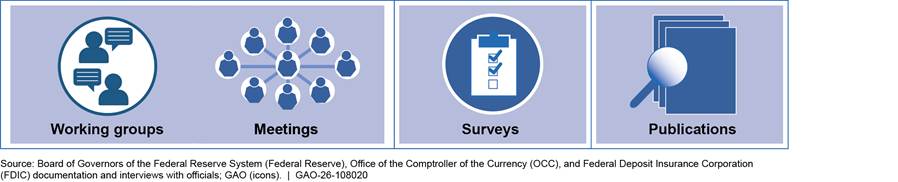
The Federal Reserve, OCC, and FDIC participated in selected NGFS meetings and working groups, responded to surveys, and reviewed draft publications (see fig. 4). However, none of the activities involved the agencies sharing nonpublic information, according to officials. Participation among agencies varied, but the Federal Reserve took part in all NGFS workstreams, indicating greater involvement than FDIC and OCC.
Figure 4: Federal Reserve, FDIC, and OCC Activities in the Network of Central Banks and Supervisors for Greening the Financial System
Working Groups and Meetings
While the agencies took part in NGFS plenary activities, most of their participation occurred in working groups, which consisted of workstreams, task forces, and expert networks (see table 1). Agency officials told us that they did not participate in all working group activities and, in some cases, participated only as observers.
|
|
Working groups, 2022–2024 |
Federal Reserve |
OCC |
FDIC |
|
Workstreams |
Supervision |
✓ |
✓ |
✓ |
|
Scenario design and analysis |
✓ |
✓ |
✓ |
|
|
Monetary policy |
✓ |
|
|
|
|
Net zero for central banks |
✓ |
|
|
|
|
Task forces |
Adaptationa |
|
|
|
|
Capacity building and training |
|
✓ |
✓ |
|
|
Biodiversity loss and nature‑related risks |
✓ |
✓b |
✓b |
|
|
Expert networks |
Legal |
✓ |
✓ |
|
|
Researchc |
✓ |
✓ |
|
|
|
Data |
✓ |
✓ |
|
|
|
|
Working groups, 2020–2022 |
Federal Reserve |
OCCd |
FDICd |
|
Workstreams |
Microprudential and supervision |
✓ |
|
|
|
Macrofinancial |
✓ |
|
|
|
|
Scaling up green finance |
✓ |
|
|
|
|
Bridging the data gaps |
✓ |
|
|
|
|
Research |
✓ |
|
|
Source: GAO analysis of Board of Governors of the Federal Reserve System (Federal Reserve), Office of the Comptroller of the Currency (OCC), Federal Deposit Insurance Corporation (FDIC), and Network of Central Banks and Supervisors for Greening the Financial System (NGFS) information. | GAO‑26‑108020
Notes: The Workstream on Supervision helps NGFS members incorporate climate-related and environmental risks within their regulatory frameworks and practices. The Workstream on Net Zero for Central Banks encourages integrating sustainability into central banks’ corporate operations. The Task Force on Adaptation promotes measures central banks can take in response to actual or expected climate-related variables that can affect human activities and the environment, which moderate harm or take advantage of opportunities. The Workstream on Microprudential and Supervision develops supervisory practices on climate- and environment-related risks, where microprudential refers to authorities that focus on the safety and soundness of individual financial institutions.
aThe Task Force on Adaptation was established in 2024.
bOCC and FDIC participated as observers in the Task Force on Biodiversity Loss and Nature-Related Risks.
cThe Expert Network on Research was established in 2023.
dOCC and FDIC joined NGFS in 2021 and 2022, respectively.
Federal Reserve officials told us that their staff was more involved in the Workstreams on Microprudential and Supervision, Scenario Design and Analysis, and Monetary Policy than in the other working groups. In general, the Federal Reserve’s staff did not have leadership roles in working groups and served as observers to understand how the work might affect U.S. financial institutions that operate internationally, according to Federal Reserve officials.
OCC officials told us that their staff were most involved in the Workstream on Scenario Design and Analysis, while FDIC officials said their staff were most involved in the Task Force on Capacity Building and Training. None of the agencies were members of the steering committee, which is responsible for setting the strategic direction of NGFS. OCC officials added that staff participation did not include any substantive discussions.
Officials from all three agencies told us that most meetings were held virtually. However, in October 2022, FDIC hosted a hybrid regional outreach session for the Americas in its Washington, D.C., office, which FDIC officials stated Federal Reserve and OCC officials attended. According to NGFS documentation, the session’s purpose was for members in a geographic area to discuss region-specific issues, and discussions focused on climate scenario analysis, stress testing, and nature-related risks. FDIC officials further explained that the session also included opening remarks from FDIC’s then Acting Chairman, Martin Gruenberg, and that findings from an NGFS internal feedback survey were discussed.
Surveys
The agencies also responded to NGFS surveys, which informed certain NGFS publications and projects and helped identify member priorities. For example, the agencies’ responses to a survey on climate scenario exercise planning helped inform a joint report published by NGFS and the Financial Stability Board.[15] In addition, the banking agencies’ responses to internal feedback surveys about member priorities and region-specific issues informed NGFS’s regional outreach sessions, discussions on the charter, and efforts to improve member experience. Survey submissions were typically aggregated to anonymize the responses, according to Federal Reserve officials.
Publications
The agencies also provided feedback and input on selected draft NGFS publications. OCC officials told us that their staff provided editorial review and comments on approximately six NGFS publications. These included technical edits on a section describing the model structure used to generate climate scenarios under the Workstream on Scenario Design and Analysis. Federal Reserve officials told us that their staff contributed to draft deliverables and provided technical comments on approximately 13 NGFS products. For example, according to Federal Reserve documentation, staff provided feedback on a draft report related to assessing climate-related risk—specifically, the staff commented on the tools used to measure and manage climate-related risks. They also provided feedback on an outline related to financial institutions’ transition plans, as part of the Workstream on Supervision.
According to FDIC officials, their staff provided limited edits and general comments on two NGFS publications. During its time as a member of the Task Force on Capacity Building and Training, FDIC staff provided feedback on a guide that identified approaches for central banks and supervisors to design and develop in-house training and capacity-building strategies for climate-related and environmental risks.
Information Sharing
Throughout their participation in NGFS, the Federal Reserve, OCC, and FDIC did not share nonpublic information related to their supervisory activities and shared only limited information, primarily through survey responses. Officials from all three agencies told us their participation was intended to enable them to better understand the approaches other central banks and other supervisors were considering or pursuing. According to agency and NGFS documentation, most information shared through surveys focused on agency practices and approaches to NGFS’s areas of interest. For example, the Federal Reserve shared information about the types of physical climate risk data it was collecting and the physical hazards it was assessing.[16]
Officials of the three agencies also told us that their participation in NGFS activities was intended to reflect each agency’s mandate and interests. For example, FDIC officials said they provided comments on an NGFS draft report to clarify that FDIC and other U.S. banking agencies did not have a mandate to promote a transition to a low carbon economy. FDIC officials also told us that feedback they provided on a training guide was limited to areas within FDIC’s mandate. Federal Reserve officials told us they responded to NGFS surveys selectively, focusing on areas of agency interest or expertise. Similarly, OCC officials declined to respond to an NGFS survey on nature-related risks because the topic was outside of the agency’s focus.
Agencies Did Not Implement Any NGFS Recommendations and Developed Separate Climate Guidance
The banking agencies did not implement any NGFS recommendations while they were members, according to agency officials. The agencies developed and jointly issued guidance for climate-related financial risks, separately from NGFS. The guidance, issued in October 2023, outlined principles for large financial institutions with at least $100 billion in consolidated assets.[17] It was intended to provide a high-level framework for incorporating climate-related risks into existing risk management practices consistent with safe and sound operations. Officials from all three agencies told us that these principles were not influenced by their membership in NGFS. In addition, we reviewed the principles and found no reference to NGFS. In a joint press release and in public statements, leadership from all three agencies described the principles as supervisory guidance focused on risk management for large banks consistent with existing rules and guidance.
OCC announced in a March 2025 press release that it was withdrawing from participation in the joint guidance, stating that the principles were overly burdensome and duplicative and that OCC’s existing risk management guidance for banks already applied to all bank exposures, including those related to severe climate events.[18]
In October 2025, the agencies rescinded the guidance, noting that it was unnecessary and could divert time and resources from managing other risks already addressed through existing risk management practices and regulations.[19] The agencies also stated that their existing safety and soundness standards require financial institutions to have effective risk management commensurate with their size, complexity, and risk of their activities. Officials from all three agencies told us that they did not solicit public comment on their decision to rescind the guidance.
A banking industry representative we interviewed said that the banking agencies’ joint guidance was similar to an NGFS recommendation. According to the representative, the guidance included material comparable to an NGFS recommendation on sustainability-related disclosure practices, such as climate-related risks, and could indicate that, while formally nonbinding, the NGFS recommendation may influence domestic regulatory actions. However, in public comments on the guidance, two banking industry organizations noted that coordination among U.S. banking agencies and with international bodies can help promote consistent supervisory expectations and climate-risk guidance to avoid duplicative or conflicting requirements on large financial institutions.
While the banking agencies did not implement NGFS recommendations, the Federal Reserve used NGFS information in their exploratory efforts to conduct a pilot climate scenario analysis exercise in 2023 (see text box).[20]
|
Federal Reserve Pilot Climate Scenario Analysis Exercise The Federal Reserve conducted a pilot climate scenario analysis exercise to enhance the ability of both large banking organizations and supervisors to identify, measure, monitor, and manage climate-related financial risks. The exercise used climate scenarios and variables developed by the Network of Central Banks and Supervisors for Greening the Financial System for the transition risk module and inquired about the climate risk management approach of six large bank holding companies. |
Source: GAO analysis of the Board of Governors of the Federal Reserve System’s (Federal Reserve) documentation and interviews. | GAO‑26‑108020
Federal Reserve officials used NGFS climate scenarios for the exercise because they are an existing and widely used set of scenarios that allowed participants to focus on evaluating the implications of the scenarios rather than on developing them.[21]
The 2022 joint report by NGFS and the Financial Stability Board listed FDIC and OCC as agencies that had conducted or were considering conducting climate scenario analysis exercises. However, neither agency ultimately did so.[22] FDIC officials told us they did not develop plans because their subject matter experts determined that the data and methodology needed further assessment within the context of the agency’s priorities. OCC officials told us that they had no confirmed plans to conduct an exercise, although they had considered doing so.
Agencies Retained NGFS-Related Documentation Under Varying Record Retention Policies
All three banking agencies retained certain documentation from their participation in NGFS activities in accordance with their record retention policies (see fig. 5 for the retention periods). The officials consider these records confidential and not publicly available, based on their understanding of the NGFS charter. The charter states that information shared within NGFS should be treated as confidential and not disclosed except as compelled by law.
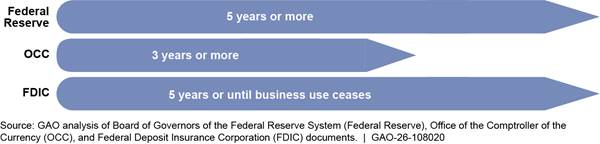
Agencies varied in how they applied their record retention policies to NGFS records compared to records related to other international organizations. Officials from the Federal Reserve and OCC told us they applied the same record-keeping practices for NGFS records as for records related to participation in other international organizations. In contrast, FDIC officials said that they applied different record-keeping practices to NGFS records than to records for international standard-setting bodies, such as the Basel Committee on Banking Supervision.
Federal Reserve
The Federal Reserve’s records retention policy applies to documents staff create or receive when participating in international organizations in an official capacity.[23] The policy requires officials to retain records for at least 5 years, but they may maintain them longer if needed for administrative or reference purposes. According to Federal Reserve officials, along with documentation we reviewed, the agency retained approximately 500 NGFS-related records, primarily consisting of NGFS-originated documents such as reports, presentations, agendas, and surveys. Additional records include survey responses, comments on draft publications, emails, and meeting notes.[24] Federal Reserve officials noted that their participation and work in NGFS was less extensive than in other international groups, such as the Basel Committee on Banking Supervision and the Financial Stability Board, and generated fewer records.
Access to the Federal Reserve’s NGFS-related records is restricted to staff with an official business need, and as of December 2025, approximately 50 Federal Reserve staff members across the Federal Reserve Board and Federal Reserve Banks had access, according to officials.
OCC
OCC’s records retention policy does not specifically address participation in international organization activities. Instead, officials stated that staff evaluate the type of record and the office using the records to determine the appropriate retention requirements on a case-by-case basis.[25] OCC officials told us that only documents used as background or working files to support OCC work, such as standard implementation or rulemaking, are considered records.[26] These records may be retained for periods ranging from 3 years to permanently.
According to OCC officials and documentation we reviewed, the agency retained approximately 75 NGFS-related records, consisting primarily of emails with meeting notes and comments on draft publications. OCC officials told us that approximately 11 staff members had limited access to these records as of December 2025. Access is generally limited to staff with an official business need, including oversight of departed employees’ records. Additional access is available to staff through an approval process as necessary.
FDIC
FDIC recordkeeping policies vary by division and depend on the type of record, according to officials. For the divisions that participated in NGFS, officials told us that NGFS documents were considered records if they were either project-related files—to be destroyed 5 years after close of project—or nonmission task force and working group materials, which may be destroyed and deleted when the business use ceases. As of December 2025, officials told us that no NGFS-related records had been destroyed or deleted, even though FDIC withdrew from NGFS in January 2025.[27]
According to officials, FDIC has retained no more than 500 NGFS-related files. These records consisted of comments on draft publications and survey responses, and meeting and presentation materials prepared by NGFS.[28]
As of December 2025, officials said that approximately 65 FDIC staff members had access to NGFS records. These records are maintained in work files and may be accessed by staff seeking to develop a broader understanding of climate-related financial risks—for example, certain documents, such as those associated with FDIC’s now inactive Climate Working Group, are available for review. Officials stated that FDIC’s recordkeeping practices for NGFS-related records differ from those for standard-setting bodies because NGFS is not a standard-setting body and NGFS records do not reflect any FDIC policy decisions.
Agency Comments
We provided a draft of this report to the Federal Reserve,
FDIC, and OCC, for review and comment. The Federal Reserve, FDIC, and OCC
provided technical comments, which we incorporated as appropriate
We are sending copies of this report to the appropriate congressional committees, the Chair of the Board of Governors of the Federal Reserve System, the Chairman of the Federal Deposit Insurance Corporation, and the Comptroller of the Currency. In addition, the report is available at no charge on the GAO website at https://www.gao.gov.
If you or your staff have any questions about this report, please contact me at clementsm@gao.gov. Contact points for our Offices of Congressional Relations and Media Relations may be found on the last page of this report. GAO staff who made key contributions to this report are listed in appendix I.

Michael E. Clements
Director, Financial Markets and Community Investment
GAO Contact
Michael E. Clements, ClementsM@gao.gov
Staff Acknowledgments
In addition to the contacts named above, Tarek Mahmassani (Assistant Director), Meredith Graves (Analyst in Charge), Janelle Ikard, Jill Lacey, Alberto Lopez, Marc Molino, and Mary Stack made key contributions to this report.
The Government Accountability Office, the audit, evaluation, and investigative arm of Congress, exists to support Congress in meeting its constitutional responsibilities and to help improve the performance and accountability of the federal government for the American people. GAO examines the use of public funds; evaluates federal programs and policies; and provides analyses, recommendations, and other assistance to help Congress make informed oversight, policy, and funding decisions. GAO’s commitment to good government is reflected in its core values of accountability, integrity, and reliability.
Obtaining Copies of GAO Reports and Testimony
The fastest and easiest way to obtain copies of GAO documents at no cost is through our website. Each weekday afternoon, GAO posts on its website newly released reports, testimony, and correspondence. You can also subscribe to GAO’s email updates to receive notification of newly posted products.
Order by Phone
The price of each GAO publication reflects GAO’s actual cost of production and distribution and depends on the number of pages in the publication and whether the publication is printed in color or black and white. Pricing and ordering information is posted on GAO’s website, https://www.gao.gov/ordering.htm.
Place orders by calling (202) 512-6000, toll free (866) 801-7077,
or
TDD (202) 512-2537.
Orders may be paid for using American Express, Discover Card, MasterCard, Visa, check, or money order. Call for additional information.
Connect with GAO
Connect with GAO on X,
LinkedIn, Instagram, and YouTube.
Subscribe to our Email Updates. Listen to our Podcasts.
Visit GAO on the web at https://www.gao.gov.
To Report Fraud, Waste, and Abuse in Federal Programs
Contact FraudNet:
Website: https://www.gao.gov/about/what-gao-does/fraudnet
Automated answering system: (800) 424-5454
Media Relations
Sarah Kaczmarek, Managing Director, Media@gao.gov
Congressional Relations
David A. Powner, Acting Managing Director, CongRel@gao.gov
General Inquiries
[1]These publications included the following: Network of Central Banks and Supervisors for Greening the Financial System, Sustainable and Responsible Investment in Central Banks’ Portfolio Management: Practices and Recommendations (May 2024); and Stocktake on Financial Institutions’ Transition Plans and their Relevance to Micro-prudential Authorities (May 2023).
[2]For example, we reviewed the Board of Governors of the Federal Reserve System, “Transcript of Chair Powell’s Press Conference,” Press Conference, Jan. 29, 2025, https://www.federalreserve.gov/mediacenter/files/FOMCpresconf20250129.pdf#page=14; and “Federal Reserve Board Announces it has Withdrawn from the Network of Central Banks and Supervisors for Greening the Financial System (NGFS),” Press Release, Jan. 17, 2025, https://www.federalreserve.gov/newsevents/pressreleases/bcreg20250117a.htm.
[3]Principles for Climate-Related Financial Risk Management for Large Financial Institutions, 88 Fed. Reg. 74183 (Oct. 30, 2023); Board of Governors of the Federal Reserve System, Pilot Climate Scenario Analysis Exercise: Summary of Participants’ Risk-Management Practices and Estimates (Washington, D.C.: May 2024); and NGFS scenario information. Climate scenario analysis is a forward-looking exercise used to assess how climate-related risks—such as changes in the economy, financial system, or distribution of physical hazards—may affect a financial institution.
[4]The Federal Deposit Insurance Act requires each federal banking agency to establish safety and soundness standards for all insured depository institutions. 12 U.S.C. § 1831p-1.
[5]In addition to more general authorities, certain statutes specifically direct the Federal Reserve to participate in international organizations, coordinate with foreign supervisors, engage with them on financial standards, or consider relevant international standards when developing regulation. See e.g., 12 U.S.C. §§ 1828 note, 3901, 3907, 3911, and 5373. The Federal Deposit Insurance Act requires FDIC to maintain stability and public confidence in the financial systems through activities such as insuring deposits and examining and supervising financial institutions for safety and soundness. The act does not address the types of international organizations that FDIC may join, see 12 U.S.C §§ 1811-35.
[6]International or regional public financial institutions, standard setting, regulatory, supervisory and central bank bodies, and multilateral development banks are eligible to become NGFS observers. Observers contribute to NGFS work and attend relevant meetings but, unlike members, are not consulted on items for decision.
[7]Transition planning is a strategy that lays out targets and actions supporting a move toward a low-carbon economy.
[8]Supervisors are regulatory authorities that oversee banks through examinations. Their supervision focuses on risk management and financial condition: the amount of financial resources a bank has, the quality of its loans, and the strength of its earnings. Microprudential authorities are supervisors that focus on the safety and soundness of individual financial institutions.
[9]For example, a risk to a central bank’s monetary policy could be climate-induced supply shocks that cause food or energy prices to rise. An opportunity for a central bank could be diversifying its financial portfolios into securities or sectors that support the transition to a net-zero economy.
[10]In 2022, FDIC hosted an outreach session in its Washington, D.C., office, which officials from the Federal Reserve and OCC also attended. We discuss the purpose of this session later in this report.
[11]The International Network for Sustainable Financial Policy Insights, Research, and Exchange was launched in 2019 and is cohosted by the ClimateWorks Foundation and the Grantham Research Institute on Climate Change and the Environment. It is independent from NGFS, with its own funding, but it focuses its efforts on NGFS priorities.
[12]Climate-Risk: Are Financial Regulators Politically Independent, Before the Subcomm. on Financial Institutions and Monetary Policy of the H. Comm. on Financial Services, 118th Cong. (2023) (statement of Doreen R. Eberley, Director of the Division of Risk Management Supervision, Federal Deposit Insurance Corporation).
[13]OCC is charged with assuring the safety and soundness of, and compliance with laws and regulations, fair access to financial services, and fair treatment of customers by, the institutions and other persons subject to its jurisdiction. 12 U.S.C. § 1.
[14]The Federal Reserve is also tasked with conducting the nation’s monetary policy to promote the goals of maximum employment, stable prices, and moderate long-term interest rates, among other responsibilities. U.S.C. §§ 225a. The Federal Reserve Act does not mention participation in international organizations and networks dealing with climate change. However, Federal Reserve officials explained that the Federal Reserve has legal authority to take actions that are reasonable and appropriate to effectuate its specified statutory responsibilities, including participating in international organizations relating to such responsibilities. Additionally, certain statutes specifically direct the Federal Reserve to participate in international organizations, coordinate with foreign supervisors, engage with them on financial standards, or consider relevant international standards when developing regulation. See e.g., 12 U.S.C. §§ 1828 note, 3901, 3907, 3911, and 5373. The Federal Deposit Insurance Act requires FDIC to maintain stability and public confidence in the financial systems through activities such as insuring deposits and examining and supervising financial institutions for safety and soundness. 12 U.S.C. §§ 1815 and 1831p-1. The act does not address the types of international organizations that FDIC may join, see 12 U.S.C §§ 1811-35.
[15]Financial Stability Board and Network of Central Banks and Supervisors for Greening the Financial System, Climate Scenario Analysis by Jurisdictions (2022).
[16]Physical risk data refer to information on economic and financial consequences of the impacts from severe and frequent climate events and impacts from chronic events.
[17]Principles for Climate-Related Financial Risk Management for Large Financial Institutions, 88 Fed Reg. 74183 (Oct. 30, 2023). The principles cover six areas: governance; policies, procedures, and limits; strategic planning; risk management; data, risk measurement, and reporting; and scenario analysis. The principles also describe how climate-related financial risks can be addressed in other risk categories, including credit, liquidity, operational, legal and compliance, and other financial and nonfinancial risks. The agencies individually requested comments from the public in 2021 and 2022 prior to issuing the final interagency guidance in 2023.
[18]OCC Withdraws Principles for Climate-Related Financial Risk Management for Large Financial Institutions”, Press Release, Mar. 31, 2025, https://www.occ.gov/news-issuances/news-releases/2025/nr-occ-2025-27.html.
[19]Rescission of Principles for Climate-Related Financial Risk Management for Large Financial Institutions, 90 Fed. Reg. 51756 (Nov. 11, 2025).
[20]Board of Governors of the Federal Reserve System, Pilot Climate Scenario Analysis. In the Federal Reserve’s exercise, the NGFS climate scenarios (Current Policies and Net Zero 2050) were used for the transition risk module, with participants using NGFS variables to estimate impacts on credit risk parameters. Transition risk refers to stresses on institutions or sectors arising from changes in consumer and business sentiment, policies, or technology during a shift to a lower-carbon economy.
[21]An industry entity and academic entities have raised concerns about the NGFS climate scenarios, such as critiques that exclusion of severe climate impacts may underestimate risks, and that the new damage function may overestimate economic losses. NGFS officials have acknowledged such criticisms, emphasizing that the scenarios are exploratory tools rather than forecasts, rely on evolving scientific research, and are subject to modeling limitations. NGFS will continue to monitor developments and update scenarios regularly.
[22]Financial Stability Board and Network of Central Banks and Supervisors for Greening the Financial System, Climate Scenario Analysis.
[23]According to the Federal Reserve’s policy, when staff participate in a professional capacity but not in an official capacity, the resulting documentation are nonrecords.
[24]Federal Reserve officials told us they generally do not require staff to create meeting notes; however, if notes were created and distributed, they would have been retained in accordance with the applicable record retention policy.
[25]GAO, Bank Capital Reform: Office of the Comptroller of the Currency Should Clarify Policy for Retaining Documents, GAO‑26‑108015 (Washington, D.C.: Jan. 29, 2026). We found that OCC’s records retention policy did not instruct staff whether to treat Basel Committee and related documents as records when created or received. We recommended that OCC revise its current records retention policy or issue supplemental guidance to clarify which Basel Committee documents should be treated as records. OCC agreed with our recommendation but had not implemented it as of February 2026.
[26]For example, meeting summaries or NGFS-originated documents are considered official records only if they meet these criteria.
[27]FDIC officials stated that while the records would have typically been eligible for disposition, they were retained due to a congressional request FDIC received shortly after its withdrawal from NGFS and due to our study on the topic.
[28]The estimated number of retained records may include some duplicates and documents that do not qualify as official records under FDIC policy, according to officials. They said that meeting notes were generally kept for the personal reference of individual participants and not typically shared with other staff.