
United States Government Accountability Office
A report to congressional committees
Contact: Shelby S. Oakley at oakleys@gao.gov
What GAO Found
In 2016, Congress strengthened the role of an existing office within the Department of Defense (DOD) to oversee and advocate for training and equipping special operations forces assigned to the Special Operations Command (SOCOM). That office, the Assistant Secretary of Defense for Special Operations and Low-Intensity Conflict known as ASD(SO/LIC), is also responsible for determining whether acquisition programs are within budget.
ASD(SO/LIC) cannot effectively conduct program oversight, in part, because DOD policy has not fully enabled it to perform its acquisition-related responsibilities. For example, GAO found disagreement between ASD(SO/LIC) and SOCOM officials regarding the former’s access to some programs’ information and meetings. This resulted in ASD(SO/LIC) not getting information to help perform its responsibilities. Collaboration between ASD(SO/LIC) and SOCOM to document clear protocols for the former’s access to this information could enhance its ability to monitor acquisitions and fulfill its statutory role.
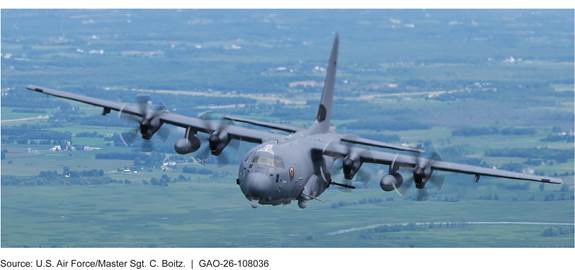
SOCOM reported mixed success meeting cost and schedule goals for its costliest acquisition programs. GAO found that, while one of nine selected programs reported cost growth, most reported delays, which can, over time, result in increased costs. SOCOM’s acquisition policy requires programs to report, in an online portal, current information—including cost estimates—relative to program goals. GAO found that officials for eight selected programs that must maintain such information did not do so, in part, because the command’s acquisition policy did not specify how frequently they needed to. Having ready access to current cost estimates in the portal could help support officials’ efforts to identify potential cost growth risks or opportunities to reallocate resources.
Most SOCOM programs GAO reviewed that experienced delays reported using fewer leading practices for iterative product development than programs not experiencing delays. Opportunities exist for programs to more consistently adopt these practices. By updating acquisition policy to reflect and encourage adoption of the practices, SOCOM could further improve its programs’ ability to achieve the speed and innovation needed to meet the needs of special operations forces.
Why GAO Did This Study
SOCOM is a relatively small organization within DOD, accounting for under 2 percent of the defense budget. SOCOM is responsible for preparing and equipping special operations forces.
A congressional committee report includes a provision for GAO to review ASD(SO/LIC)’s oversight of SOCOM acquisitions. This report examines (1) how ASD(SO/LIC) performs its acquisition oversight responsibilities and related challenges it faces, (2) the extent to which the costliest SOCOM weapons acquisition programs met cost and schedule goals, among other things, and (3) the extent to which these programs have taken steps to facilitate speed and innovation in product development.
GAO reviewed ASD(SO/LIC) responsibilities in statute and policy; analyzed documentation for nine, of over 80, of SOCOM’s costliest weapons acquisition programs, including cost and schedule data; assessed program efforts to adopt leading product development practices; and interviewed relevant officials.
What GAO Recommends
GAO is making three recommendations, including that DOD ensure (1) ASD(SO/LIC) and SOCOM collaborate to document clear protocols that enable the performance of acquisition-related responsibilities; (2) SOCOM updates its acquisition policy to specify the frequency that program officials should update total cost estimates; and (3) SOCOM updates its acquisition policy to reflect and encourage adoption of leading product development practices. DOD concurred with the recommendations.
|
Abbreviations |
|
ASD(SO/LIC) Assistant Secretary of Defense for Special Operations and Low-Intensity Conflict |
|
DOD Department of Defense |
|
SEAL Sea, Air, Land |
|
SOCOM Special Operations Command |
This is a work of the U.S. government and is not subject to copyright protection in the United States. The published product may be reproduced and distributed in its entirety without further permission from GAO. However, because this work may contain copyrighted images or other material, permission from the copyright holder may be necessary if you wish to reproduce this material separately.
June 12, 2026
The Honorable Roger Wicker
Chairman
The Honorable Jack Reed
Ranking Member
Committee on Armed Services
United States Senate
The Honorable Mike Rogers
Chairman
The Honorable Adam Smith
Ranking Member
Committee on Armed Services
House of Representatives
The U.S. Special Operations Command (SOCOM) conducts global special operations and activities to protect and advance U.S. policies and objectives. As part of its mission, SOCOM is responsible for training and equipping special operations forces drawn from four of the military services.[1] This requires the acquisition of unique equipment to enable its operations. In March 2026, the SOCOM Commander stated that SOCOM accounts for 3 percent of the Department of Defense (DOD)’s military forces and under 2 percent of DOD’s budget, though its role involves executing high-priority, national-security missions worldwide.
When Congress created SOCOM in 1986, it also created the Assistant Secretary of Defense for Special Operations and Low-Intensity Conflict (ASD(SO/LIC)).[2] ASD(SO/LIC) is a principal civilian advisor to the Secretary of Defense that provides, among other responsibilities, supervision of DOD special operations activities. The National Defense Authorization Act for Fiscal Year 2017 strengthened ASD(SO/LIC)’s role by specifying that ASD(SO/LIC) has authority over administrative matters relating to the organization, training, and equipping of special operations forces within DOD.[3] The associated conference report states that these reforms were to empower ASD(SO/LIC) in its role as a service secretary-like civilian, similar to a military department secretary, with responsibility for the oversight of and advocacy for SOCOM.[4] Congress subsequently directed DOD in the Servicemember Quality of Life Improvement and National Defense Authorization Act for Fiscal Year 2025 to update policies and processes to fully institutionalize ASD(SO/LIC), by, among other things, updating relevant policies, processes, and policy guidance.[5]
The Senate Armed Services Committee has expressed concerns about the ability of ASD(SO/LIC) to effectively oversee SOCOM’s acquisition programs.[6] In addition, the ASD(SO/LIC) position has experienced churn in recent years, with 13 individuals occupying the position since 2017. We previously reported on acquisition-related challenges that SOCOM has faced and recommended that ASD(SO/LIC) take steps, such as developing a staffing plan, to identify and address critical skill gaps.[7]
Senate Report 118-188 accompanying the Servicemember Quality of Life Improvement and National Defense Authorization Act for Fiscal Year 2025 includes a provision for us to review ASD(SO/LIC)’s oversight of SOCOM acquisitions, as well as the performance of SOCOM’s costliest acquisition programs. This report addresses (1) how ASD(SO/LIC) performs its oversight responsibilities involving SOCOM acquisitions, and related challenges it faces, (2) the extent to which the costliest SOCOM weapons acquisition programs have met cost and schedule goals and this information is available, and (3) the extent to which the costliest SOCOM weapons acquisition programs have taken steps to facilitate speed and innovation in product development.
To determine how ASD(SO/LIC) performs its oversight responsibilities involving SOCOM acquisitions, and related challenges it faces, we reviewed ASD(SO/LIC)’s current responsibilities found in statute and DOD directives for monitoring SOCOM acquisitions. We also reviewed SOCOM’s acquisition directive and policy to determine the extent to which processes involving ASD(SO/LIC) and SOCOM are documented and discussed potential challenges with ASD(SO/LIC) and SOCOM officials.
To determine the extent to which the costliest SOCOM weapons acquisition programs have met cost and schedule goals and this information is available, we selected all major capability acquisition programs with available unclassified data and designated as acquisition category II.[8] This represents the highest acquisition category of major capability acquisitions, based on dollar thresholds, of programs managed by SOCOM at the time of selection. We also selected any additional programs with available unclassified data designated as special interest by ASD(SO/LIC).[9] These criteria resulted in a selection—from the total of over 80—of the nine programs shown in table 1, which incorporated five of the six special interest programs. The nine programs were on the major capability acquisition pathway during our review. Two programs, Silent Knight Radar and Mk 18 Mod 1 Unmanned Underwater Vehicle, previously spent time on the middle tier of acquisition pathway until June 2023 and February 2025, respectively.[10]
|
Program name |
Program executive officer |
Reason for selection |
|
AC-130J |
Fixed Wing |
Acquisition category II |
|
Armed Overwatch |
Fixed Wing |
Acquisition category II and special interest program |
|
Silent Knight Radar |
Fixed Wing |
Acquisition category II |
|
Dry Combat Submersible |
Maritime |
Special interest program |
|
Dry Deck Shelter Extension |
Maritime |
Special interest program |
|
Sea, Air, Land (SEAL) Delivery Vehicle Mk 11 |
Maritime |
Special interest program |
|
Mk 18 Mod 1 Unmanned Underwater Vehicle |
Maritime |
Special interest program |
|
MH-47G Block II |
Rotary Wing |
Acquisition category II |
|
MH-60M Block I Upgrade |
Rotary Wing |
Acquisition category II |
Source: GAO analysis of Special Operations Command documentation. | GAO‑26‑108036
Note: The Department of Defense (DOD) categorizes major capability acquisition programs into acquisition categories based on cost thresholds, among other considerations. Acquisition category II programs have an estimated eventual total expenditure for research, development, test, and evaluation of more than $200 million but less than $525 million or for procurement in excess of $920 million but less than $3.065 billion, in fiscal year 2020 constant dollars. DOD Directive 5111.10 authorizes the Assistant Secretary of Defense for Special Operations and Low-Intensity Conflict to designate programs as special interest, with associated responsibilities including coordination with other DOD officials regarding these programs’ testing.
We analyzed the extent to which these acquisition programs met certain cost and schedule goals by comparing cost and schedule thresholds in their initial acquisition program baselines—which contain a program’s approved cost, schedule, and performance parameters that form an agreed-upon basis for satisfying an identified mission need—with current estimates provided by programs.[11] Our analysis of total acquisition costs included the sums of research, development, test and evaluation, and procurement costs. Our analysis of schedule performance included program goals for achieving operational capabilities or delivering systems that were either planned to occur or did occur most recently. Additionally, we gathered information from program officials about challenges that may have affected cost and schedule performance. To determine the extent to which cost and schedule information is available, we analyzed documentation for each of the nine programs. Examples included program status reports, briefing slides, and the contents of an online SOCOM acquisition portal identified by SOCOM officials as a key means for monitoring programs. We also reviewed relevant policies to identify the requirements for reporting of cost and schedule information. We assessed the extent to which SOCOM’s cost reporting reflected requirements in its acquisition policy for reporting program information through its portal. We also compared SOCOM’s cost reporting for selected programs with internal control standards for the federal government.[12] These include principles relating to having relevant, reliable, and timely information for decision-making and external-reporting purposes.
To determine the extent to which the costliest SOCOM weapons acquisition programs have taken steps to facilitate speed and innovation in product development, we analyzed written responses from the nine selected programs. Specifically, we assessed their responses about the extent to which they implemented leading practices for speed and innovation in product development that we have previously identified, and we followed up, as appropriate, to clarify officials’ responses.[13] Some of these practices included seeking and obtaining user feedback throughout continuous product development cycles, and identifying a minimum viable product with the minimum capabilities needed for the user to recognize value. We also assessed the extent to which SOCOM’s existing acquisition policy documents reflected these leading practices. In doing so, we reviewed our prior work on the leading practices and identified key terms to search for in the SOCOM policies.
In support of all our objectives, we interviewed or obtained written responses from officials in the Office of the ASD(SO/LIC) and SOCOM.
We conducted this performance audit from January 2025 to June 2026 in accordance with generally accepted government auditing standards. Those standards require that we plan and perform the audit to obtain sufficient, appropriate evidence to provide a reasonable basis for our findings and conclusions based on our audit objectives. We believe that the evidence obtained provides a reasonable basis for our findings and conclusions based on our audit objectives.
Background
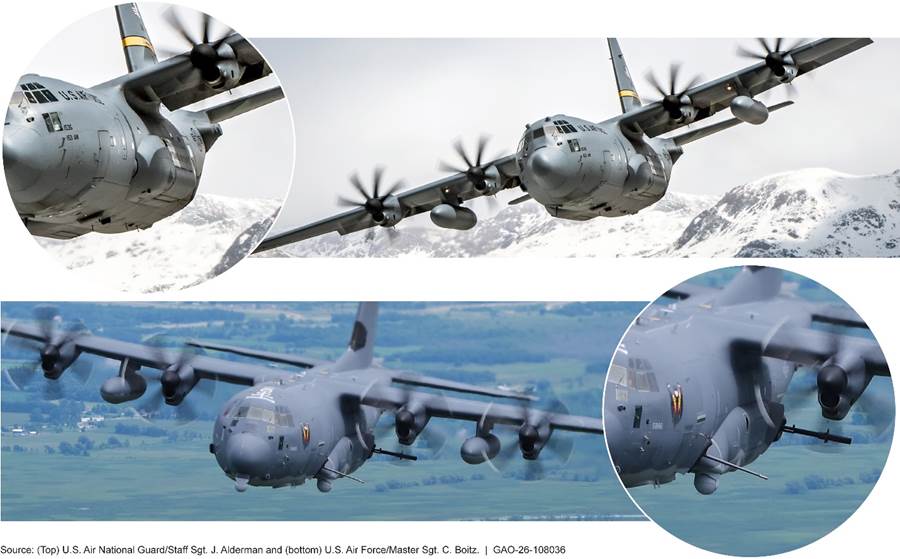
SOCOM is one of two combatant commands—which are led by active-duty military—granted specific statutory acquisition authority to acquire its own equipment.[14] This differs from the military departments where acquisition authority is held by civilians at the Secretary-level of the Army, Navy, and Air Force. The SOCOM Commander is responsible for the development and acquisition of special operations equipment and has the authority to execute funds relating to special operations forces. Equipment, materials, supplies, and services required for special operations forces activities for which there is no service-common requirement are known as special operations-peculiar equipment. SOCOM may develop its own weapon system that does not exist elsewhere within the military. Alternatively, as figure 1 shows, SOCOM may modify an existing system like an aircraft, adding special operations-peculiar equipment to enhance capabilities. In such an instance, the Air Force might develop and purchase the aircraft, and SOCOM would then add special operations-peculiar modifications, such as integrated navigation and weapon systems.
Figure 1: Air Force C-130 Aircraft (top) and the Special Operations Command AC-130J (bottom) with Selected Modifications
The SOCOM Commander and the military department secretaries serve as the head of an agency for acquisition for their respective entities. Acting as the head of an agency for acquisition purposes is significant because statutes generally assign acquisition functions to the head of an agency. The head of an agency also has statutory authority to delegate most acquisition functions, such as to the component acquisition executive. The SOCOM Commander and the military department secretaries also have authority, direction, and control over their respective component acquisition executives, who are generally responsible for the acquisition workforce and implementation of acquisition policies.[15] While ASD(SO/LIC)’s service secretary-like role includes oversight and advocacy for SOCOM and for the organization, training, and equipping of special operations forces, acquisition authority remains vested elsewhere (see table 2).
Table 2: Comparison of Selected Acquisition-related Responsibilities Across Department of Defense Roles
|
Acquisition responsibilities |
Military department secretaries |
Commander of Special Operations Command |
Assistant Secretary of Defense for Special Operations and Low-Intensity Conflict |
|
Has role related to organization, training, and equipping forces |
Yes |
Yes |
Yesa |
|
Has acquisition authority |
Yes |
Yes |
No |
|
Serves as head of an agency for acquisition |
Yes |
Yes |
No |
|
Directs component acquisition executive |
Yes |
Yes |
No |
Source: GAO analysis of relevant statutory authorities. | GAO‑26‑108036
Note: All roles above are nominated by the President and subject to Senate confirmation.
aThe Assistant Secretary of Defense for Special Operations and Low-Intensity Conflict’s role related to organization, training, and equipping forces is addressed in this report in more detail.
Acting on behalf of the SOCOM Commander, the SOCOM acquisition executive leads the management of SOCOM’s portfolio of over 80 unclassified acquisition programs—only five of which were acquisition category II programs at the time of our review. The SOCOM acquisition executive, according to officials, directly oversees less than 10 percent of programs as the milestone decision authority. The rest, according to officials, are delegated to the SOCOM program executive officers or below. The milestone decision authority for major capability acquisition pathway programs has overall responsibility for a program, approves entry into the next phase of the acquisition process, and is accountable for cost, schedule, and performance reporting, including to Congress.[16] Eight program executive officers support the SOCOM acquisition executive by providing routine oversight and—when delegated—serving as milestone decision authority.
Within SOCOM, the supporting office of the acquisition executive is known as Special Operations Forces Acquisition, Technology, and Logistics. SOCOM’s acquisitions are executed by program officials located at SOCOM’s headquarters in Tampa, Florida, and at military department acquisition commands, such as the Air Force Life Cycle Management Center, in different locations using SOCOM acquisition funding and policies.[17]
ASD(SO/LIC)’s Acquisition-Related Roles and Responsibilities
ASD(SO/LIC)’s acquisition-related roles and responsibilities include exercising authority, direction, and control of all special operations-peculiar administrative matters relating to the organization, training, and equipping of special operations forces. Some of these administrative matters include supervising budget preparation and justification. In these roles, ASD(SO/LIC) reports directly to the Secretary of Defense. Table 3 shows selected ASD(SO/LIC) roles and responsibilities related to acquisitions and administrative oversight matters outlined in DOD policy.[18] As part of these responsibilities, in 2022 ASD(SO/LIC) designated the Armed Overwatch and undersea acquisition programs—of which there are currently five—as special interest.[19] In doing so, ASD(SO/LIC) sets the expectation that SOCOM will provide regular status reports on cost, schedule, and performance for all six programs and include an ASD(SO/LIC) representative in all program updates with military departments and other entities, among other actions.
Table 3: Selected ASD(SO/LIC) Roles and Responsibilities Established in Department of Defense Policy
|
Area of responsibility |
Roles |
|
Acquisition, technology, and logistics matters |
· Conducts oversight to determine whether Special Operations Command (SOCOM) acquisition programs are consistent with budget and required capability priorities · Determines which SOCOM acquisition programs are Assistant Secretary of Defense for Special Operations and Low-Intensity Conflict (ASD(SO/LIC))-designated special interest programs · Establishes reporting requirements for ASD(SO/LIC)-designated special interest programs |
|
Resources and administrative oversight matters |
· Engages in the administrative chain of command between the Secretary of Defense and SOCOM Commander · Provides overall supervision of the preparation and justification of special operations programs and budgets · Advocates for SOCOM budget priorities within the Department of Defense and to Congress |
Source: GAO analysis of Department of Defense Directive 5111.10. | GAO‑26‑108036
Leading Practices for Speed and Innovation in Product Development
We previously found that leading companies use iterative cycles to deliver new, innovative products to customers with speed.[20] To do this, the companies employ iterative cycles of design, validation, and production to deliver a minimum viable product. Each cycle allows an organization to gain specific knowledge. This iterative structure involves continuous cycles that include common key practices, such as obtaining user feedback to inform decision-making. Figure 2 outlines how leading companies progress through iterative design, validation, and production cycles.
Figure 2: Leading Companies Progress Through Iterative Design, Validation, and Production Cycles to Develop a Minimum Viable Product
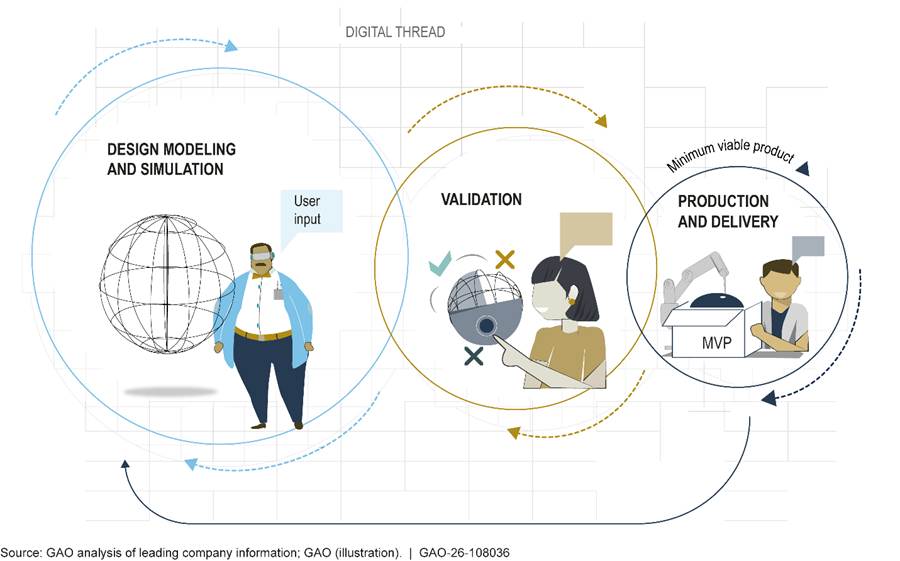
The full cycle, which can repeat, includes:
· Design modeling and simulation: allows an organization to develop specifications that ensure the design meets the most essential user needs.
· Validation: allows an organization to develop an integrated prototype that is tested in multiple environments to verify performance and that can be manufactured as the minimum viable product.
· Production and delivery: allows an organization to optimize manufacturing tools and processes to gain insight into efficiencies for future iterations.
The iterative structure is enabled by digital engineering, such as digital twins or digital threads. Digital twins are virtual representations of physical products and incorporate dynamic data of a physical object or system meaning the model changes and updates in real-time as new information becomes available. Digital threads are a common source of information that connects stakeholders with real-time data across the product life cycle to help inform decisions. In February 2023, we made four recommendations to SOCOM regarding incorporation of leading practices into its policies governing middle tier of acquisition programs.[21] While DOD concurred with these recommendations, it has yet to implement them.
ASD(SO/LIC) Cannot Effectively Perform All of Its Acquisition-Related Responsibilities
ASD(SO/LIC) struggles to effectively perform some of its acquisition-related responsibilities, in particular its oversight responsibilities. It faces two primary challenges that constrain its ability to do so: (1) lack of clarity about access to acquisition-related meetings and information and (2) limited personnel to perform responsibilities.
Lack of clarity about meeting and information access. ASD(SO/LIC)’s ability to conduct oversight of SOCOM acquisition programs and advocate for budgets within DOD and to Congress is limited by unclear access to SOCOM meetings and information. ASD(SO/LIC) officials receive monthly status updates on special interest programs that provide some necessary insight. However, in several instances in 2025, officials from the two entities did not share the same understanding about whether SOCOM officials should have informed ASD(SO/LIC) officials about or provided access to certain acquisition-related meetings in relation to some special interest programs. For example, in February 2025, ASD(SO/LIC) officials asked to participate in a program briefing to the SOCOM acquisition executive regarding a special interest program, but this request was denied by the SOCOM acquisition executive. SOCOM officials said that this was due to a change in the structure of monthly program reviews. The SOCOM acquisition executive split the meeting into two portions, with the second portion attended by an internal audience of the acquisition executive and program executive officers only. SOCOM officials stated that they included ASD(SO/LIC) in the first portion of the meeting, and that the information shared was the same as had been shared under the prior meeting structure.
In another example, ASD(SO/LIC) officials noted that they had not been invited to a 2-day meeting in November 2025 between the SOCOM requirements division, other stakeholders, and contractor officials regarding issues with Armed Overwatch—a special interest program—and only learned about the meeting after it occurred. SOCOM officials said that the acquisition executive determined a closed discussion was most appropriate in this case given the sensitive nature of the discussions with contractors.
ASD(SO/LIC) officials said that they can directly access a SOCOM acquisition portal—identified by SOCOM officials as a key means for monitoring programs—to gather information themselves. ASD(SO/LIC) officials said that access to the portal provides, for example, data to help answer some congressional requests for information. However, according to ASD(SO/LIC) officials, this portal does not consistently contain up-to-date information. SOCOM officials acknowledged that some data were not up-to-date, but they noted they are in the middle of transitioning to a new system. Once completed, this may go some way toward correcting this issue. In this report, we discuss our findings regarding program information that was not routinely maintained and updated in the current portal.
ASD(SO/LIC) and SOCOM have not established processes or protocols for notifying about or attending routine meetings or for providing access to information that ASD(SO/LIC) officials told us that they believe is important to perform their acquisition-related oversight responsibilities. These responsibilities are broadly described in DOD policy. However, DOD policy does not elaborate on the extent to which ASD(SO/LIC) has access within SOCOM to obtain information and attend meetings to stay abreast of program developments.[22] Additionally, a 2022 memorandum from ASD(SO/LIC) to the SOCOM Commander says that SOCOM will provide status reports for special interest programs but also does not speak to ASD(SO/LIC)’s access to additional information or attendance at internal program meetings. Similarly, SOCOM has not clearly identified what meetings ASD(SO/LIC) officials can attend or information they can obtain that would allow ASD(SO/LIC) to consistently perform its acquisition-related responsibilities. Neither of the two primary SOCOM policy documents governing acquisitions describe ASD(SO/LIC)’s role or establish protocols for participation in meetings or access to program information.[23] The sole mention of ASD(SO/LIC) in either document is a single reference in an appendix related to acquisition security.
The Servicemember Quality of Life Improvement and National Defense Authorization Act for Fiscal Year 2025 includes a provision requiring DOD to fully implement and institutionalize the position of ASD(SO/LIC) by, among other things, updating relevant policies, guidance, and processes, including protocols for participation in relevant decision-making forums, by December 2025.[24] The current ASD(SO/LIC) was confirmed in December 2025. According to an ASD(SO/LIC) official, a review started in January 2026—with an expected completion of June 2026—aims to arrive at an agreement on how ASD(SO/LIC) provides oversight of and advocacy for SOCOM. The official added that in February 2026, ASD(SO/LIC) reorganized, adding a second Deputy Assistant Secretary of Defense with a portfolio that covers special operations analysis, resources, and capabilities to provide oversight of and advocacy for SOCOM. Until ASD(SOLIC) and SOCOM establish—in, for example, relevant DOD policy, ASD(SO/LIC) memorandums, or SOCOM’s acquisition policy—documented processes and protocols clarifying ASD(SO/LIC)’s access to meetings and information, the assistant secretary will likely continue to struggle to perform its acquisition-related responsibilities. These responsibilities include determining whether programs are consistent with budget and capability priorities. Such institutionalization through updating policies and guidance and clarification of roles and responsibilities is of particular importance for consistent oversight and advocacy across leadership transitions, given the churn at the ASD(SO/LIC) position in recent years.
Limited personnel to perform responsibilities. We previously found that the office supporting ASD(SO/LIC) was not staffed to the level required to fully perform its acquisition-related responsibilities and we found that this was still the case.[25] As of March 2023, the Programs, Budget and Acquisition directorate within this office, which monitors SOCOM acquisitions, was the directorate with the largest staffing gap. As of March 2026, ASD(SO/LIC) officials said that there are two Pentagon-based positions dedicated to monitoring SOCOM acquisitions. These positions primarily focus on the six special interest programs.[26] They also track—via a briefing slide deck provided monthly by SOCOM—five other programs that receive a large number of annual congressional requests for information or that receive oversight from the Director, Operational Test and Evaluation. As of April 2025, however, SOCOM had more than 80 active, unclassified acquisition programs, meaning that ASD(SO/LIC) officials actively monitored less than 15 percent of them. In addition, given that programs are managed out of Tampa, Florida, and other sites around the country, ASD(SO/LIC) staff are not co-located with program offices and depend upon attending meetings or receiving information from SOCOM to gain insight into programs.
ASD(SO/LIC) staffing limitations have also prevented it from taking on all the acquisition-related responsibilities envisioned for the organization. ASD(SO/LIC)’s acquisition-related responsibilities were examined in a 2023 self-assessment. As a part of this assessment, ASD(SO/LIC) identified that it wanted to perform proactive monitoring of SOCOM’s acquisition programs and other activities—for example, the development of independent cost estimates. However, performance of these activities would be contingent upon having enough personnel and consistent information access.
We previously recommended in 2024 that ASD(SO/LIC) develop a staffing plan that incorporates strategic workforce planning principles, including identifying critical skill gaps and developing strategies to address them. ASD(SO/LIC) has yet to implement this recommendation. As of January 2026, DOD officials stated that they have drafted a plan that awaits approval. We are continuing to monitor DOD’s efforts to fully address the recommendation. The Servicemember Quality of Life Improvement and National Defense Authorization Act for Fiscal Year 2025 also included a provision requiring DOD to develop a long-term staffing plan for the Secretariat for Special Operations within the ASD(SO/LIC)’s office.[27] As of January 2026, ASD(SO/LIC) officials said that this staffing plan was still in development. However, at that time, an ASD(SO/LIC) official also told us that there was no intent to expand the number of positions dedicated to monitoring SOCOM acquisitions as a part of this staffing plan.
Selected Programs Controlled Costs Despite Delays, but Do Not Routinely Report Latest Total Estimates
SOCOM had mixed success meeting its schedule and cost goals on the nine selected acquisition programs we reviewed, with most experiencing delays. SOCOM reported meeting its cost goals for eight programs, but none of the programs routinely reported latest total costs in a portal used for monitoring programs. Further, five of the nine programs reported schedule delays ranging from 7 months to nearly 5 years.
Most Selected Programs Encountered Delays but Rarely Cost Growth
Five of the nine selected programs experienced schedule delays to planned capability deliveries or program milestones; only one program experienced cost growth. Delays ranged from approximately 7 months to almost 5 years. The other four programs delivered capability at least 6 months earlier than planned. See table 4.
Table 4: Schedule and Cost Performance of Selected Special Operations Command Acquisition Programs as of 2025
|
Program name |
|
Acquisition event |
Schedule performance |
Cost performance |
|
Silent Knight Radar |
|
Initial operational capability |
Early by 1 year, 8 months |
Meeting goal |
|
AC-130J |
|
Full operational capability |
Early by 1 year, 1 month |
Meeting goal |
|
MH-60M Block I Upgrade |
|
Full operational capability |
Early by 6 months |
Meeting goal |
|
Dry Deck Shelter Extension |
|
Initial operational capability |
Early by 6 months |
Meeting goal |
|
MH-47G Block II |
|
Initial operational capability |
Late by 7 months |
Not meeting goal |
|
Dry Combat Submersible |
|
Full operational capability |
Late by 1 year, 7 months |
Meeting goal |
|
Mk 18 Mod 1 Unmanned Underwater Vehicle |
|
Delivery of seventh system |
Late by 2 years, 5 months |
Meeting goal |
|
Armed Overwatch |
|
Full rate production |
Late by 2 years, 10 months |
Meeting goal |
|
Sea, Air, Land (SEAL) Delivery Vehicle Mk 11 |
|
Full operational capability |
Late by 4 years, 9 months |
Meeting goal |
Source: GAO analysis of information provided by Special Operations Command. | GAO‑26‑108036
Note: This analysis compares latest program estimates as of 2025 with maximum threshold estimates from initial acquisition program baseline documents, except for Mk 18 Mod 1 Unmanned Underwater Vehicle, for which the analysis compares latest estimates with the single acquisition management plan estimate. This was because Mk 18 Mod 1 Unmanned Underwater Vehicle was on the middle tier of acquisition pathway until February 2025, so it was subject to different acquisition events during that time than programs on the major capability acquisition pathway. According to Special Operations Command (SOCOM) officials, Armed Overwatch established a new full rate production baseline date and SEAL Delivery Vehicle Mk 11 established a new full operational capability date. SOCOM officials stated that both programs are currently on time for these milestones. Numbers of months are rounded.
Officials from four programs experiencing delays—Armed Overwatch, Dry Combat Submersible, Sea, Air, Land (SEAL) Delivery Vehicle Mk 11, and Mk 18 Mod 1 Unmanned Underwater Vehicle—said that they were on track to achieve cost goals despite experiencing delays, which can increase costs over time. Officials from three of these programs reported they were able to limit cost growth using fixed-price-type contracts. Fixed-price-type contracts require that the contractor meet contract requirements, including specified schedules, at firm prices or, in some cases, an adjustable price. The contractor generally assumes the risk of a cost overrun.
Two of these programs—Dry Combat Submersible and SEAL Delivery Vehicle Mk 11—were able to mitigate the severity of their schedule delays by getting approval to conditionally field systems prior to having all planned capabilities available. SOCOM’s acquisition policy allows DOD and SOCOM officials to certify that a system or equipment is operationally effective, safe, and suitable for use on a conditional basis, even if all planned capabilities have yet to be completed.[28] Two programs achieving schedule and cost goals—AC-130J and MH-60M Block I Upgrade—said that their programs benefitted from coordination that allowed close communication and alignment of program activities across multiple organizations contributing to those programs. Program officials from another program achieving schedule and cost goals—Silent Knight Radar—said that they incorporated lessons learned from their initial contract to add contract incentives for on-time deliveries in the subsequent contract. This tied contractor payments to deliveries, which led to the contractor purchasing required parts ahead of schedule.
Program officials for the five programs with delays reported a variety of challenges that contributed to extending their schedules. These challenges related to the COVID-19 pandemic, delayed deliveries from military departments, certification requirements, and technical complexity. See table 5 for examples of these challenges affecting the five programs.
Table 5: Challenges Identified by Five Special Operations Command (SOCOM) Acquisition Programs Not Achieving Program Goals
|
Challenge |
Examples |
|
COVID-19 pandemic |
MH-47G Block II program officials said that limited availability of labor and suppliers during the COVID-19 pandemic was a driver of schedule and cost growth. Dry Combat Submersible program officials noted that the COVID-19 pandemic caused significant delays with testing and deliveries. |
|
Delayed deliveries from military departments |
SOCOM officials stated that delays on the Mk 18 Mod 1 Unmanned Underwater Vehicle program were driven in part by Navy-funded production activities beyond the control of SOCOM. |
|
Certification requirements |
Armed Overwatch program officials said that the program had schedule challenges due to obtaining Federal Aviation Administration certification for military equipment being added to a civilian, commercial-derivative aircraft. Sea, Air, Land Delivery Vehicle Mk 11 program officials reported that their deep submergence certification schedule posed a schedule challenge requiring stakeholders to develop tailored instructions related to how the system interfaces with the submarine fleet. |
|
Technical complexity |
Mk 18 Mod 1 Unmanned Underwater Vehicle program officials said that they experienced delays due to mission-specific technical challenges. |
Source: GAO analysis of program information from SOCOM officials. | GAO‑26‑108036
These types of delays and challenges are not unique to SOCOM. We have previously reported that major defense acquisition programs across DOD experienced schedule slips that resulted from similar types of issues.[29] For example, the Navy’s LPD 17 Flight II ship program attributed delays to COVID-19 pandemic-related labor shortfalls, and the Air Force’s MH-139A helicopter program reported delays due to issues with Federal Aviation Administration certifications.
Selected Programs Do Not Routinely Report Latest Total Cost Estimates in the SOCOM Acquisition Portal
SOCOM has not ensured program managers routinely report the latest total program cost estimates in its portal. This, in turn, limits ASD(SO/LIC)’s visibility into these programs. SOCOM’s acquisition policy states that program managers are responsible for reporting current planned or actual data corresponding to program baselines, including total cost estimates, using a SOCOM acquisition portal.[30] SOCOM acquisition oversight officials identified this portal as a key means for monitoring programs, and ASD(SO/LIC) officials said that they used the portal as a source for answering congressional information requests. However, we found that the portal did not contain total cost estimate data for the eight programs subject to the requirement of having approved acquisition program baselines.[31] Seven programs were able to provide us their latest total cost estimates, while two programs were not able to until several months later.
While SOCOM’s acquisition policy requires maintenance of current data corresponding to program baselines in the portal, it does not specify the frequency of or circumstances under which to make routine updates—for example, when cost estimates for a program change.[32] Maintaining current program data in its portal is related to a challenge we have previously identified for SOCOM. In 2015, for example, we found that while SOCOM required programs to populate its acquisition portal with cost data, performance of this task varied across programs.[33] We recommended that DOD develop a strategy to improve procedures for the entry and maintenance of acquisition data. DOD addressed this recommendation in October 2020 by developing a department-wide framework for acquisition and sustainment data, providing common business rules across DOD for collecting such data. However, as discussed, our review found that SOCOM programs did not report the latest total cost estimates in the portal.
Internal control standards for the federal government state that agencies should have relevant, reliable, and timely information for decision-making and external-reporting purposes.[34] Additionally, cost estimating guidance developed by GAO states that programs should be monitored continually for their cost effectiveness by comparing planned and actual performance against the approved program baseline. The cost estimate should also be updated with actual costs so that it is always relevant and current.[35]
SOCOM program executive officers responsible for oversight of the nine programs on behalf of the acquisition executive stated that they do not routinely require program officials to update and report cost performance in comparison with program baselines in the portal. Instead, they focus on whether programs obligate and expend funds in a timely manner and the extent to which programs have sufficiently planned their future funding needs. SOCOM officials also stated that the acquisition executive reviews total costs for programs for which that official is the milestone decision authority. However, as described earlier, such programs make up less than 10 percent of SOCOM’s total programs. Having ready access to current cost estimates in the portal could better support officials’ efforts to oversee program costs and identify whether a program is at risk of exceeding its baselines.
SOCOM officials noted that the transition to a new acquisition portal is in progress and expected to provide automated data to a DOD-level acquisition reporting and analysis system by October 2026. According to SOCOM officials, the cost field must be filled out to create a program in the new portal. However, SOCOM’s acquisition policy does not describe the frequency of or circumstances under which to make routine updates to cost estimates in the new portal so that they are current.
Without doing so, SOCOM acquisition program officials may not have a full picture of potential cost growth risk or opportunities to reallocate resources as needed. Ready access to updated cost estimates would also help ASD(SO/LIC) exercise its assigned acquisition-related responsibilities, such as answering congressional requests, determining whether programs are consistent with budget priorities, and identifying programs to designate as special interest.
SOCOM Varied in Its Use of Leading Practices for Speed and Innovation in Product Development
Selected SOCOM programs that experienced delays tended to report less use of leading practices for speed and innovation in product development, while programs that did not experience delays tended to report more use of these practices. As previously discussed, five of the nine programs we reviewed encountered delays in delivering capabilities. Four of these programs also reported the lowest level of fully implementing leading practices. In contrast, three of the four programs that delivered capabilities ahead of schedule reported the highest level of fully implementing leading practices (see table 6).
Table 6: Reported Implementation of Leading Product Development Practices and Schedule Outcomes for Selected Special Operations Command Programs
|
Program name |
Number of leading practices fully implemented (out of 12) |
Schedule performance |
|
Silent Knight Radar |
9 |
Early by 1 year, 8 months |
|
AC-130J |
11 |
Early by 1 year, 1 month |
|
MH-60M Block I Upgrade |
10 |
Early by 6 months |
|
Dry Deck Shelter Extension |
4 |
Early by 6 months |
|
MH-47G Block II |
7 |
Late by 7 months |
|
Dry Combat Submersible |
3 |
Late by 1 year, 7 months |
|
Mk 18 Mod 1 Unmanned Underwater Vehicle |
3 |
Late by 2 years, 5 months |
|
Armed Overwatch |
3 |
Late by 2 years, 10 months |
|
Sea, Air, Land (SEAL) Delivery Vehicle Mk 11 |
3 |
Late by 4 years, 9 months |
Source: GAO analysis of selected Special Operations Command program-reported levels of practice implementation. | GAO‑26‑108036
Note: GAO requested that program officials identify the extent to which their programs implemented each of these leading practices and followed up, as appropriate, to clarify officials’ responses. The schedule analysis compares latest program estimates as of 2025 with maximum threshold estimates from initial acquisition program baseline documents, except for Mk 18 Mod 1 Unmanned Underwater Vehicle, for which the analysis compares latest estimates with the single acquisition management plan estimate. This was because Mk 18 Mod 1 Unmanned Underwater Vehicle was on the middle tier of acquisition pathway until February 2025, so it was subject to different acquisition events during that time than programs on the major capability acquisition pathway. According to Special Operations Command (SOCOM) officials, Armed Overwatch established a new full rate production baseline date and SEAL Delivery Vehicle Mk 11 established a new full operational capability date. SOCOM officials stated that both programs are currently on time for these milestones. Numbers of months are rounded.
See appendix I for a summary of implementation by practice across the nine selected programs, as reported by the programs. Below are examples of the variation across the nine SOCOM acquisition programs in the extent to which they used certain leading practices. These programs reported widespread use of the practice of incorporating end-user feedback during the design process; however, they reported using other practices such as digital twins less consistently. They reported implementation to some extent of practices related to refining the design to achieve a minimum viable product.
End-user feedback. Selected programs noted many examples of incorporating end-user feedback during the design process—a leading practice for iterative product development. For example, officials from the Dry Deck Shelter Extension, Dry Combat Submersible, Mk 18 Mod 1 Underwater Unmanned Vehicle, and SEAL Delivery Vehicle Mk 11 programs said that they had extensive early and ongoing user involvement. On the latter three programs, officials said that this user involvement led to the redesign of anchor systems on these platforms to meet future user requirements, saving time and resources in the long run. Officials from the MH-60M Block I Upgrade program said that user feedback identified the need for an engine inlet filter to help reduce the risk of engine replacement and overhaul resulting from entry of debris during operations. In addition, user feedback informed design modifications to early test versions of the filter. User feedback also informed off-ramping decisions for capabilities that program officials could add in subsequent iterations. For example, officials from the AC-130J program said that, based on user feedback, a potential threat warning system was off-ramped as it did not meet requirements. This allowed modifications to aircraft to continue while the program explored alternatives that would meet requirements. Operator-informed user involvement is a stated acquisition principle found in SOCOM’s acquisition policy that ensures the program is informed and shaped by special operations forces operators and incorporates their operational experience, technical expertise, and continuous feedback.
Digital twins. One of nine programs—AC-130J—reported full implementation of the use of a digital twin to conduct systems-integrated tests, and Dry Combat Submersible program officials noted that a digital twin is under development. Dry Deck Shelter Extension program officials explained that the shelters were originally designed prior to implementation of design practices such as digital twins. However, they planned to use digital design practices, which could include a digital twin, in future upgrades.
Minimum viable products. Programs reported some implementation of practices related to refining the design to achieve a minimum viable product—one with the initial set of capabilities needed for customers to recognize value. For example, AC-130J officials reported that users had a dedicated test aircraft, integrating physical and digital items, to ensure a minimum viable product that met user needs and remained within cost and schedule parameters. Dry Combat Submersible officials reported regular updates of the lights and cameras on the system to reflect the maturity and availability of new technology, as well as updates to command and control software to meet evolving user requirements within cost parameters. Armed Overwatch officials reported pursuing a strategy of receiving airworthiness certification for a partial capability—in essence a minimum viable product sufficient to allow for productive training and test progress—while awaiting final certification of the system’s full capability. In addition, SOCOM’s acquisition policy allows programs to field capability near the end of development through a process known as a conditional fielding and deployment release.[36] Conditional fielding and deployment release represents an agreement between DOD and SOCOM officials to certify a system as operationally effective, safe, and suitable for conditional use with restrictions even if the system or equipment does not yet meet all the requirements that are part of an acquisition program.[37] This joint agreement allows SOCOM to meet essential, near-term user needs by ensuring operators receive a capability when additional conditions need to be satisfied. However, SOCOM’s acquisition policy provides that programs can take this step reactively toward the end of development, rather than as a deliberately planned option earlier in the acquisition that the program would potentially define as a minimum viable product.
Our analysis of SOCOM’s acquisition policy documents found that they do not discuss the full structure of iterative development that includes continuous cycles of design, validation, and production resulting in a minimum viable product. One of SOCOM’s acquisition policies does, though, include a process for evaluating a potential solution in an operationally representative environment informed by operational user feedback. We also found elements of iterative development in one of SOCOM’s acquisition policies specific to software development cycles. However, these examples do not cover the entirety of the acquisition life cycle for all types of acquisitions. This is consistent with our prior findings on the extent to which military department policies and guidance reflect the full structure of iterative development.[38] It is also consistent with our prior findings from February 2023 on SOCOM middle tier of acquisition programs.[39]
Recent acquisition reforms by DOD align with findings from our prior work—that leading companies use the iterative cycles of design, validation, and production to gain relevant knowledge about the capability under development. In November 2025, DOD announced a range of reforms to the acquisition system that prioritized timely and urgent delivery of operational capabilities to the warfighter.[40] DOD aims to structure programs as schedule-driven capability increments, making tradeoffs throughout development to permit iterative enhancement and rapid delivery of subsequent increments. In addition, the office of the SOCOM acquisition executive’s stated mission includes provision of rapid and focused acquisition support to special operations forces warfighters. Its key acquisition principles include delivering capability to the user expeditiously and keeping warfighters involved throughout the process. Without acquisition policies that more fully reflect leading practices for iterative product development, SOCOM will miss opportunities to better ensure it delivers innovative capabilities faster and informs prioritization of remaining capabilities based on evolving user needs. Such policies could help show program managers ways that their programs can structure themselves for iterative development.
Conclusions
To better support special operations forces, investing every dollar efficiently to deliver capabilities as quickly as possible is vital for SOCOM. ASD(SO/LIC) plays an important acquisition-related role helping to ensure that SOCOM programs are consistent with budget and required capability priorities. Congress has directed that its position be fully institutionalized in policy and guidance. Collaboration between ASD(SO/LIC) and SOCOM to document clear protocols for ASD(SO/LIC) to participate in meetings and access information related to acquisitions would better position the office to perform its advocacy and oversight roles. The selected SOCOM acquisition programs that we reviewed were generally successful in meeting cost goals. However, specifying the frequency and circumstances under which programs should routinely update the total cost estimates in SOCOM’s acquisition portal would help ensure ready access to up-to-date information to inform resource allocation decisions. This step would also help ensure ASD(SO/LIC)’s visibility into programs remains consistent throughout changes in its leadership.
Lastly, while SOCOM acquisition programs provided several examples of incorporating end-user feedback into their design processes—an approach that we have found to be a key driver of rapid and innovative product development—we also found an opportunity for SOCOM to make improvements to drive speed and innovation throughout the entirety of the acquisition life cycle that may improve schedule outcomes. Embedding leading practices for iterative product development into SOCOM’s acquisition policies could increase their adoption throughout the acquisition life cycle, enhance innovation, and help alleviate delays experienced by programs. Taking these steps is consistent with DOD’s overarching aim of timely and urgent delivery of operational capabilities.
Recommendations for Executive Action
We are making the following three recommendations to the Department of Defense:
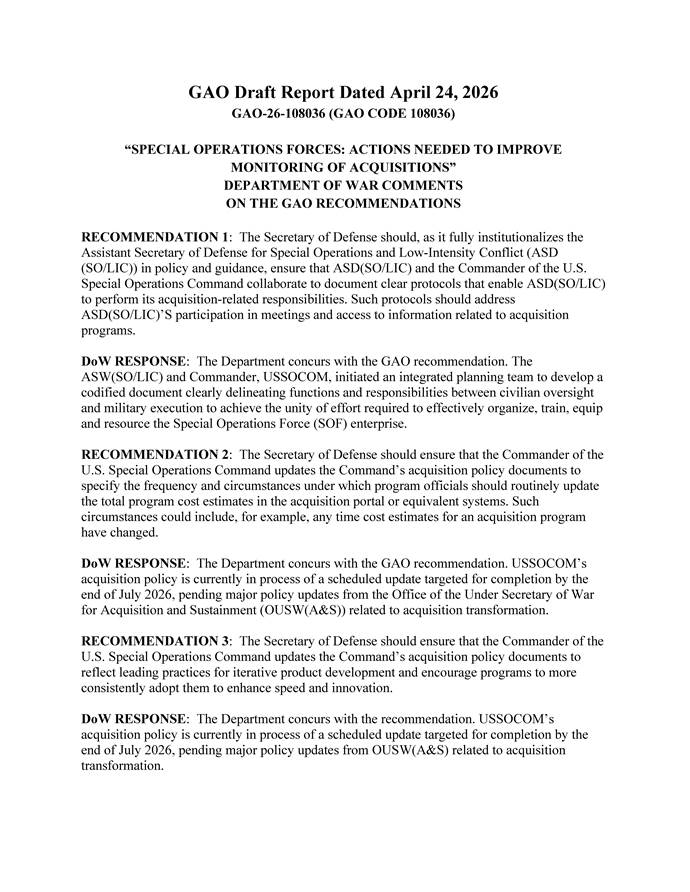
The Secretary of Defense should, as it fully institutionalizes the Assistant Secretary of Defense for Special Operations and Low-Intensity Conflict (ASD(SO/LIC)) in policy and guidance, ensure that ASD(SO/LIC) and the Commander of the U.S. Special Operations Command collaborate to document clear protocols that enable ASD(SO/LIC) to perform its acquisition-related responsibilities. Such protocols should address ASD(SO/LIC)’s participation in meetings and access to information related to acquisition programs. (Recommendation 1)
The Secretary of Defense should ensure that the Commander of the U.S. Special Operations Command updates the Command’s acquisition policy documents to specify the frequency and circumstances under which program officials should routinely update the total program cost estimates in the acquisition portal or equivalent systems. Such circumstances could include, for example, any time that cost estimates for an acquisition program have changed. (Recommendation 2)
The Secretary of Defense should ensure that the Commander of U.S. Special Operations Command updates the Command’s acquisition policy documents to reflect leading practices for iterative product development and encourage programs to more consistently adopt them to enhance speed and innovation. (Recommendation 3)
Agency Comments and Our Evaluation
We provided a draft report to DOD for review and comment. In its written comments, reproduced in appendix II, DOD concurred with our recommendations. DOD also provided technical comments, which we incorporated as appropriate.
We are sending copies of this report to the appropriate congressional committees, the Secretary of Defense, and the Commander of the U.S. Special Operations Command. In addition, the report is available at no charge on the GAO website at https://www.gao.gov.
If you or your staff have questions about this report, please contact me at oakleys@gao.gov. Contact points for our Offices of Congressional Relations and Media Relations may be found on the last page of this report. GAO staff who made key contributions to this report are listed in appendix III.
Shelby S. Oakley, Director
Contracting and National Security Acquisitions
Appendix I: Reported Implementation of Leading Product Development Practices by Selected Special Operations Command Programs
Table 7: Reported Implementation of Leading Product Development Practices by Selected Special Operations Command Programs
|
|
Level of implementationa |
||
|
12 Leading practices |
Full |
Partial |
Notb |
|
Design modeling and simulation |
|||
|
Early user feedback during design provides confidence that the design specifications can be developed to meet schedule and cost parameters identified in the project’s business case. |
8 |
1 |
0 |
|
Product teams use digital engineering and 3D printing, along with augmented and virtual realities to aid in rapid design, modeling and simulation cycles. Stakeholders and users access design information using digital twins that contribute information to real-time digital threads. |
1 |
5 |
3 |
|
Product teams refine specifications with user feedback, which may result in starting over with new design solutions. Product teams vigilantly monitor product technologies and will not hesitate to defer any to future design iterations if they prove incompatible with schedule and cost parameters. |
6 |
3 |
0 |
|
Product teams obtain user feedback during design simulation and modeling and make changes to the design based on that feedback. |
3 |
6 |
0 |
|
Validation |
|||
|
Validation includes integrated tests with users in the expected operating environment. As a part of this process, product teams revisit the business case, assessing whether the minimum viable product (MVP) remains within cost and schedule parameters and still meets user needs. |
5 |
4 |
0 |
|
Product teams conduct systems-integrated tests on a digital twin, or on a physical prototype connected to the digital twin. Each test data input and design update becomes a part of the digital thread. Validation data is available to outside stakeholders to collaborate on design strategies and decisions. |
1 |
3 |
5 |
|
Product teams make off-ramping decisions for a given MVP largely based on user needs, with the knowledge that some of the capabilities can be added in subsequent product iterations. Because the iterative process provides such opportunities, leading companies more frequently delay capabilities that are not ready until the next release, rather than decide not to provide them at all. |
5 |
4 |
0 |
|
Product teams incorporate user feedback and results from integrated prototype testing—including decisions about the minimum set of capabilities—into the product’s hardware and software design, modifying it as needed to prepare the MVP for production. |
7 |
2 |
0 |
|
Production and delivery |
|||
|
Leading companies do not view delivery as the finish line, but a springboard for establishing a new business case for the next iteration of the product. Leading companies will structure this business case around improvements to the already delivered MVP. |
7 |
2 |
0 |
|
Throughout production, product teams capture manufacturing data. The digital thread documents all the steps in the process, from the design of the machinery and toolset to the processes for manufacturing and assuring the product meets the company’s quality standards. |
3 |
6 |
0 |
|
Product teams include manufacturing and supply team stakeholders throughout product design and validation to ensure the manufacturing process can accommodate the design of the product, and recommend design changes if it cannot. |
3 |
5 |
1 |
|
After product delivery, product teams collect user feedback to inform the next iteration of the product or the design of a new product. Leading companies obtain feedback from a variety of sources, including surveys, customer clinics, showcases, and social media. |
4 |
5 |
0 |
Source: GAO analysis of selected Special Operations Command program-reported levels of practice implementation. | GAO‑26‑108036
aGAO requested that program officials identify the extent to which their programs implemented each of these leading practices and followed up, as appropriate, to clarify officials’ responses.
bIncludes not implemented and not applicable responses.
GAO Contact
Shelby S. Oakley, oakleys@gao.gov
Staff Acknowledgments
In addition to the contact named above, Robert Bullock (Assistant Director), Patrick Breiding (Analyst-in-Charge), Lori Fields, Scott Hepler, Jennifer Leotta, Jean McSween, Brittany Morey, Abbie Sanders, Sean Seales, and Tristan Shaughnessy made key contributions to this report.
The Government Accountability Office, the audit, evaluation, and investigative arm of Congress, exists to support Congress in meeting its constitutional responsibilities and to help improve the performance and accountability of the federal government for the American people. GAO examines the use of public funds; evaluates federal programs and policies; and provides analyses, recommendations, and other assistance to help Congress make informed oversight, policy, and funding decisions. GAO’s commitment to good government is reflected in its core values of accountability, integrity, and reliability.
Obtaining Copies of GAO Reports and Testimony
The fastest and easiest way to obtain copies of GAO documents at no cost is through our website. Each weekday afternoon, GAO posts on its website newly released reports, testimony, and correspondence. You can also subscribe to GAO’s email updates to receive notification of newly posted products.
Order by Phone
The price of each GAO publication reflects GAO’s actual cost of production and distribution and depends on the number of pages in the publication and whether the publication is printed in color or black and white. Pricing and ordering information is posted on GAO’s website, https://www.gao.gov/ordering.htm.
Place orders by calling (202) 512-6000, toll free (866) 801-7077,
or
TDD (202) 512-2537.
Orders may be paid for using American Express, Discover Card, MasterCard, Visa, check, or money order. Call for additional information.
Connect with GAO
Connect with GAO on X,
LinkedIn, Instagram, and YouTube.
Subscribe to our Email Updates. Listen to our Podcasts.
Visit GAO on the web at https://www.gao.gov.
To Report Fraud, Waste, and Abuse in Federal Programs
Contact FraudNet:
Website: https://www.gao.gov/about/what-gao-does/fraudnet
Automated answering system: (800) 424-5454
Media Relations
Sarah Kaczmarek, Managing Director, Media@gao.gov
Congressional Relations
David A. Powner, Acting Managing Director, CongRel@gao.gov
General Inquiries
[1]SOCOM comprises personnel assigned to SOCOM headquarters, its four service component commands, and subunified commands, such as Special Operations Command Europe. SOCOM’s four service component commands are the U.S. Army Special Operations Command, the Naval Special Warfare Command, the Air Force Special Operations Command, and the Marine Corps Forces Special Operations Command.
[2]National Defense Authorization Act for Fiscal Year 1987, Pub. L. No. 99-661, § 1311 (1986).
[3]National Defense Authorization Act for Fiscal Year 2017, Pub. L. No. 114-328, § 922 (2016). The act also specified that the administrative chain of command for SOCOM runs from the President to the Secretary of Defense, from the Secretary of Defense to ASD(SO/LIC), and then from ASD(SO/LIC) to the SOCOM Commander. The administrative chain of command does not include any operational matters subject to the operational chain of command.
[4]H.R. Rep. No. 114-840, at 1137 (2016) (Conf. Rep.). The term service secretary is often used to refer to the secretary of a military department. In this report, we refer to service secretaries as military department secretaries.
[5]Servicemember Quality of Life Improvement and National Defense Authorization Act for Fiscal Year 2025, Pub. L. No. 118-159, § 907 (2024).
[6]S. Rep. No. 118-188, at 199–200 (2024).
[7]GAO, Special Operations Forces: Documented Policies and Workforce Planning Needed to Strengthen Civilian Oversight, GAO‑24‑106372 (Washington, D.C.: Mar. 4, 2024); Special Operations Forces: DOD Should Slow Acquisition of Armed Overwatch Aircraft Until It Conducts Needed Analysis, GAO‑24‑106283 (Washington, D.C.: Dec. 14, 2023); and Special Operations Forces: Summary of Armed Overwatch Reports, GAO‑24‑107556 (Washington, D.C.: Sept. 5, 2024).
[8]DOD categorizes major capability acquisition programs into several acquisition categories—I, II, and III. These categories are determined based on cost thresholds, among other considerations. Acquisition category II programs have an estimated eventual total expenditure for research, development, test, and evaluation of more than $200 million but less than $525 million or for procurement in excess of $920 million but less than $3.065 billion, in fiscal year 2020 constant dollars. Department of Defense, Major Capability Acquisition, Department of Defense Instruction 5000.85 (Aug. 6, 2020) (incorporating change 1, Nov. 4, 2021).
[9]Department of Defense Directive 5111.10 authorizes ASD(SO/LIC) to designate programs as special interest. ASD(SO/LIC) responsibilities for such programs include providing guidance and advising as well as coordinating with other DOD officials regarding these programs’ testing events. Department of Defense, Assistant Secretary of Defense for Special Operations and Low-Intensity Conflict, Department of Defense Directive 5111.10 (May 5, 2021) (incorporating change 1, Mar. 12, 2025).
[10]DOD’s Adaptive Acquisition Framework is comprised of six acquisition pathways, each with processes, reviews, documentation requirements, and metrics that program managers can match to the characteristics and risk profile of the capability that DOD is acquiring. The two pathways relevant to our review are the major capability acquisition pathway—used to support complex acquisitions in a phased approach—and the middle tier of acquisition pathway—used to rapidly prototype or field a capability within 5 years of program start.
[11]One program had a single acquisition management plan estimate instead of an acquisition program baseline.
[12]GAO, Standards for Internal Control in the Federal Government, GAO‑25‑107721 (Washington, D.C.: May 2025).
[13]GAO, Leading Practices: Iterative Cycles Enable Rapid Delivery of Complex, Innovative Products, GAO‑23‑106222 (Washington, D.C.: July 27, 2023).
[14]A combatant command is a unified or specified command with a broad continuing mission under a single commander established and so designated by the President, through the Secretary of Defense and with the advice and assistance of the Chairman of the Joint Chiefs of Staff. See 10 U.S.C. §§ 161, 164. The second combatant command with acquisition authority is U.S. Cyber Command, which has the authority to conduct acquisition activities for the development and acquisition of cyber operations-peculiar equipment and capabilities. 10 U.S.C. § 2224 note (Acquisition Authority of the Commander of United States Cyber Command). A third command, the U.S. Transportation Command, has also been delegated authority to conduct certain acquisitions.
[15]Per statute, SOCOM has a “command acquisition executive” and military departments have “service acquisition executives.” 10 U.S.C. §§ 167(e)(4)(c), 3103. DOD acquisition policy generally refers to this position as a “component acquisition executive.” Department of Defense, Operation of the Adaptive Acquisition Framework, Department of Defense Instruction 5000.02 (Jan. 23, 2020) (incorporating change 1, June 8, 2022).
[16]While a major capability acquisition program has a milestone decision authority, a middle tier of acquisition program has a decision authority. A middle tier of acquisition decision authority approves middle tier of acquisition documentation within their purview, such as the documentation required to enter the middle tier of acquisition pathway. In November 2025, DOD began reforming its acquisition system to aggressively prioritize the timely and urgent delivery of operational capabilities. At the time of our review, those efforts were still ongoing.
[17]SOCOM engages with the Army, Air Force, Marine Corps, and Navy through a formalized memorandum of agreement with each service, which forms the basis for leveraging the services’ acquisition capabilities. Each SOCOM program then has a program-specific memorandum of agreement that defines the responsibilities and procedures for acquisition management between SOCOM and the other organization.
[18]Department of Defense, Assistant Secretary of Defense for Special Operations and Low-Intensity Conflict, Department of Defense Directive 5111.10 (May 5, 2021) (incorporating change 1, Mar. 12, 2025).
[19]We excluded one of the six special interest programs as designated by ASD(SO/LIC) due to unclassified data being unavailable for that program. As a result, we reviewed five special interest programs.
[21]GAO, Middle-Tier Defense Acquisitions: Rapid Prototyping and Fielding Requires Changes to Oversight and Development Approaches, GAO‑23‑105008 (Washington, D.C.: Feb. 7, 2023).
[22]While DOD Directive 5111.10 states that ASD(SO/LIC) can obtain reports and information necessary to carry out assigned responsibilities and functions, it does not specify processes for doing so.
[23]See Department of Defense, Acquisition Management System, United States Special Operations Command Directive 70-1, (Sept. 27, 2023), and Acquisition Management System Policy, Special Operations Forces Acquisitions, Technology, and Logistics Policy 70-1 (June 2, 2023).
[24]Pub. L. No. 118-159, § 907 (2024).
[26]ASD(SO/LIC) also has cognizant authority for and oversees classified SOCOM Special Access Programs. DOD Directive 5205.07 designates certain DOD component heads or agency heads—for example, the secretary of a military department—as cognizant authorities to manage and execute their respective Special Access Programs. ASD(SO/LIC)’s role as cognizant authority is detailed in DOD Directive 5111.10. Department of Defense, Special Access Program Policy, Department of Defense Directive 5205.07 (Sept. 12, 2024).
[27]The purpose of the Secretariat for Special Operations is to assist ASD(SO/LIC) in exercising authority, direction, and control with respect to special operations-peculiar administration and support of SOCOM. 10 U.S.C. § 139b.
[28]Department of Defense, Acquisition Management System Policy, Special Operations Forces Acquisitions, Technology, and Logistics Policy 70-1 (June 2, 2023).
[29]GAO, Weapon Systems Annual Assessment: DOD Is Not Yet Well-Positioned to Field Systems with Speed, GAO‑24‑106831 (Washington, D.C.: June 17, 2024).
[30]According to SOCOM officials, at the time of this review, SOCOM was transitioning to a different system for monitoring program information.
[31]One program—Mk 18 Mod 1 Unmanned Underwater Vehicle—had not previously been subject to this requirement as it was on the middle tier of acquisition pathway until February 2025.
[32]SOCOM’s acquisition policy states that acquisition program baselines are updated for milestone reviews and program restructurings.
[33]GAO, Defense Acquisitions: Better Approach Needed to Account for Number, Cost, and Performance of Non-Major Programs, GAO‑15‑188 (Washington, D.C.: Mar. 2, 2015).
[35]GAO, Cost Estimating and Assessment Guide: Best Practices for Developing and Managing Program Costs, GAO‑20‑195G (Washington, D.C.: Mar. 12, 2020).
[36]An unconditional fielding and deployment release certifies that the system or equipment is operationally effective, safe, and suitable for use and validates that appropriate parameters established for the acquisition program were met. A fielding and deployment release helps to inform the full-rate production decision.
[37]A conditional fielding and deployment release becomes an unconditional fielding and deployment release once all issues that make it conditional are resolved within a specified period of time.
[38]GAO, DOD Acquisition Reform: Military Departments Should Take Steps to Facilitate Speed and Innovation, GAO‑25‑107003 (Washington, D.C.: Dec. 12, 2024). As a part of this report, we recommended that the Air Force, Army, and Navy revise their acquisition policies and relevant guidance to reflect leading practices that facilitate speed and innovation in product development. The Air Force and Navy concurred with the recommendations, and the Army partially concurred. However, the military departments have yet to implement these recommendations. In addition, while SOCOM is also subject to DOD-level acquisition policies, we previously found that DOD-level acquisition policies do not fully implement leading product development practices. GAO, Leading Practices: Agency Acquisition Policies Could Better Implement Key Product Development Principles, GAO-22-104513 (Washington, D.C.: Mar. 10, 2022).
[39]GAO‑23‑105008. As part of this report, we made four recommendations to SOCOM regarding incorporation of leading practices into its policies governing middle tier of acquisition programs. While DOD concurred with these recommendations, it has yet to implement them.
[40]Secretary of Defense Memorandum, Transforming the Defense Acquisition System into the Warfighting Acquisition System to Accelerate Fielding of Urgently Needed Capabilities to Our Warriors (Nov. 7, 2025).