
Report to Congressional Committees
United States Government Accountability Office
A report to congressional committees
Contact: Jacqueline M. Nowicki at nowickij@gao.gov
What GAO Found
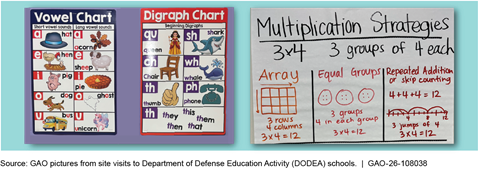
In school year 2024–2025, about 10 percent of the approximately 60,000 K-12 students attending Department of Defense Education Activity’s (DODEA) schools full time received strategic instruction. This is short-term extra help in a small group setting (see figure). About 5 percent had a “specific learning disability” (SLD). SLDs are a group of disorders, such as dyslexia and dyscalculia, related to understanding language or doing mathematical calculations. The number of DODEA students with SLDs increased 29 percent from school years 2018–2019 through 2024–2025.
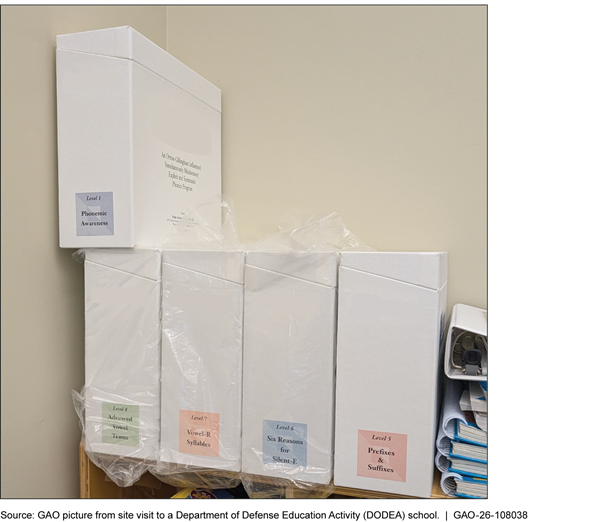
DODEA Instructional Materials for Students with Literacy and Math Deficits
Most staff in the 11 selected schools GAO visited—in five districts that serve 63 percent of DODEA students with SLDs—outlined obstacles to timely identifying students needing strategic instruction or special education for SLDs. These included limited screening tools, challenges with submitting complete student referrals for strategic instruction and special education, and delayed special education evaluations. For example, at nine of 11 schools, staff said they needed more or better screening tools to identify students. DODEA’s screening tools do not directly assess elementary school students’ foundational phonics skills, which help identify reading deficits. They also are not available for all students. These limitations make it difficult to identify students who are behind grade level when they arrive at a school—which is important given DODEA’s highly mobile population. In July 2026, DODEA officials said that they procured universal screening tools for all grades and plan to start administering them in late 2026. When implemented, these tools will provide key data to fill gaps in identifying students’ needs and connect them to support.
DODEA staff at all 11 schools we visited also cited obstacles to helping students meet their literacy and math goals. These included strategic instruction and special education teachers not receiving professional learning relevant to their roles, not having adequate access to data on students’ grades, and varied practices across DODEA schools that result in eligible students not receiving needed help to meet grade-level expectations. For example, during GAO’s interviews, 32 of 44 strategic instruction and special education teachers rated their professional learning opportunities as “bad” or “very bad.” Further, staff at all 11 schools said they wanted teachers to be able to provide input on needed professional learning—for example, opportunities focused on identifying students with literacy and math deficits and SLDs. DODEA guidelines say that professional learning should advance teachers’ ability to apply acquired knowledge and skills targeted to their role. Asking for and acting on teacher feedback would help DODEA advance teachers’ ability to apply the skills needed to help students with literacy and math deficits and SLDs meet their learning goals.
Why GAO Did This Study
Students in military families—many of whom attend DODEA schools—face unique challenges due to frequent moves. DODEA families have raised concerns about access to literacy and math supports and special education services. Research shows that instruction tailored to students’ needs can improve academic outcomes and reduce the number of students referred to special education.
The Joint Explanatory Statement accompanying the 2025 National Defense Authorization Act includes a provision for GAO to examine services for DODEA students with literacy and math deficits and SLDs. GAO examined (1) the number of students receiving strategic instruction or having an SLD, (2) the extent DODEA provides guidance and tools to identify these students, and (3) the extent DODEA supports teachers in helping students.
GAO analyzed DODEA data from school years 2018-2019 through 2024-2025 on student enrollment and reviewed relevant federal laws and DOD policies. GAO conducted in-person site visits to schools in five of nine DODEA districts, selected for variation in number of students with SLDs, among other things. GAO interviewed DODEA officials and held 47 group interviews with teachers, administrators, and other stakeholders. GAO also administered a nongeneralizable opt-in online questionnaire to parents of DODEA students with SLDs.
What GAO Recommends
GAO is making eight recommendations to DOD, including to (1) improve screening students for literacy and math deficits; and (2) solicit teacher input on professional learning. DOD agreed with five recommendations and partially agreed with three, as discussed in the report.
Abbreviations
DOD Department of Defense
DODEA Department of Defense Education Activity
IDEA Individuals with Disabilities Education Act
IEP Individualized Education Program
SLD specific learning disability
This is a work of the U.S. government and is not subject to copyright protection in the United States. The published product may be reproduced and distributed in its entirety without further permission from GAO. However, because this work may contain copyrighted images or other material, permission from the copyright holder may be necessary if you wish to reproduce this material separately.
August 26, 2026
The Honorable Roger Wicker
Chairman
The Honorable Jack Reed
Ranking Member
Committee on Armed Services
United States Senate
The Honorable Mike Rogers
Chairman
The Honorable Adam Smith
Ranking Member
Committee on Armed Services
House of Representatives
Students in military families—many of whom attend Department of Defense Education Activity (DODEA) schools—face a unique set of challenges because they may relocate as many as nine times before graduating from high school.[1] Further, military-connected families and our past work have raised concerns about access to literacy and math supports and special education services for children who attend DODEA schools.[2] Research shows that educational supports tailored to students’ needs can address learning challenges early, improve literacy and math outcomes, and reduce the number of students referred to special education.[3]
Per Department of Defense (DOD) policy, and consistent with the Individuals with Disabilities Education Act (IDEA), DODEA is required to provide a “free appropriate public education” to all eligible children with disabilities attending its schools.[4] This includes specially designed instruction and related services that meet the individualized needs of students.[5] IDEA recognizes a variety of different disability categories, including “specific learning disabilities” or SLDs.[6] An SLD is a disorder of one or more of the basic psychological processes involved in understanding or using spoken or written language or doing mathematical calculations.[7] SLDs include conditions such as dyslexia, dysgraphia, and dyscalculia. SLDs were the most common type of disability among DODEA students in the 2024–25 school year. Twenty-seven percent of all students receiving special education services in the 2024–2025 school year had an SLD, according to DODEA’s data. DODEA students who have literacy or math deficits and do not receive special education services for them may receive extra support through strategic instruction classes.
The Joint Explanatory Statement accompanying the Servicemember Quality of Life Improvement and National Defense Authorization Act for Fiscal Year 2025 includes a provision for us to examine issues related to how DODEA identifies and provides supports to students with SLDs and to students who have literacy or math deficits and do not receive special education services for them. This report examines (1) the number of DODEA students who receive strategic instruction due to a literacy or math deficit or who have an SLD, (2) the extent to which DODEA provides guidance and tools and oversees efforts to identify students in need of strategic instruction or special education for SLDs; and (3) the extent to which DODEA supports educators in helping these students meet their literacy or math goals.
To examine how many DODEA students receive strategic instruction, we analyzed data on student enrollment in strategic literacy and math instruction classes across DODEA schools for school year 2024–2025, the most recent data available at the time of our analysis. To analyze trends in the number of students who qualified for special education because of their SLD, we analyzed enrollment data for the most recent years for which comparable data were available (school years 2018–2019 through 2024–2025). To determine the proportion of students receiving strategic instruction or who have SLDs, we used enrollment numbers from DODEA’s Student Information System, which were in the system as of June 2, 2025, and Aug 4, 2025, respectively, and excluded students enrolled part-time, non-U.S. dependents, and DODEA’s virtual school attendees. To assess the reliability of all the DODEA data we analyzed, we interviewed agency officials and reviewed the data for obvious errors, outliers, or missing information. We determined that the data were sufficiently reliable to report on our research questions.
To address our second and third questions, we reviewed relevant agency policy and guidance and applicable federal laws and regulations. We assessed the information we collected about DODEA’s strategic instruction and special education efforts against DODEA’s strategic plan as well as its policy and guidance for these services.
We also conducted in-person site visits to a total of 11 elementary, middle, and high schools across six military installations. These schools were located in five of DODEA’s nine districts across two of DODEA’s three regions (Europe and Americas). These five districts serve 63 percent of DODEA students with SLDs and 59 percent of DODEA’s total student population. We selected schools to reflect variation in the number of enrolled students with SLDs, the level of special education services provided, total student enrollment, grades they serve, and representation of the different service branches.[8]
Across our site visits, we held a total of 47 group interviews with school, district, and regional staff. School staff groups included strategic instruction and special education teachers, special education paraeducators, principals and assistant principals, and Case Study Committee chairs and special education assessors.[9] District and regional staff included community superintendents and instructional system specialists who provide oversight, monitoring, and support for special education and strategic instruction staff in schools.[10] During these interviews, we discussed the identification process for students with literacy and math deficits and SLDs, services provided to these students, and professional learning opportunities available to staff supporting these students.
We used NVivo, a qualitative analysis software program, to analyze the 47 interviews. We coded content from the interviews into categories that corresponded to our research questions and key terms we identified in our records of the interviews. We then analyzed the coded content to identify common themes across the schools we visited. Information from this analysis is not generalizable across all DODEA schools but provided insights into the experiences of DODEA staff with identifying students with literacy and math deficits and SLDs, services provided to these students, and professional learning opportunities available to staff supporting these students.
We also administered a nongeneralizable, structured, and opt-in online questionnaire from July 18 to August 11, 2025 to obtain the perspectives of parents and caregivers of students with SLDs in DODEA schools.[11] To develop our questionnaire, we reviewed our records of interviews with DODEA school staff and district officials, prior GAO work reporting on parent perspectives on DODEA’s special education services, and DODEA’s processes for identifying eligible students with disabilities and providing special education services. We pretested the questionnaire with seven parents of students with SLDs to obtain feedback on the content, clarity, and accuracy of the questions and response options. The seven parents who participated in our pretesting sessions responded to outreach conducted on our behalf by community superintendents in two of the districts we visited.
The questionnaire included both scaled and open-ended response questions asking participants about their satisfaction with DODEA’s identification process and services for students with SLDs. It also asked about challenges with the identification process and services for students with SLDs and recommendations to address any challenges they identified. A link to the questionnaire was posted to GAO’s Facebook, LinkedIn, and X social media pages for eligible parents and caregivers to opt-in. We received 144 responses to the questionnaire, which are not generalizable to all parents of students with SLDs at DODEA schools.
Further, to inform all three research questions, we interviewed DODEA regional and headquarters officials about how students with literacy and math deficits and SLDs are identified and the services DODEA provides to these students. Finally, we interviewed district staff who oversee school psychologists in six of DODEA’s nine districts across all three regions about their role in the special education evaluation process.
We conducted this performance audit from January 2025 to August 2026 in accordance with generally accepted government auditing standards. Those standards require that we plan and perform the audit to obtain sufficient, appropriate evidence to provide a reasonable basis for our findings and conclusions based on our audit objectives. We believe that the evidence obtained provides a reasonable basis for our findings and conclusions based on our audit objectives.
Background
DODEA Schools
DODEA, a component under DOD’s Office of the Under Secretary of Defense for Personnel and Readiness, plans, directs, coordinates, and manages pre-kindergarten through grade 12 educational programs for DOD. In school year 2024–2025, DODEA educated more than 67,000 children from military families in 161 schools.[12] Located in nine U.S. states and territories and 11 foreign countries, DODEA schools are organized into three regions: Europe, the Pacific, and the Americas. The regions are subdivided into nine districts: four in Europe, three in the Pacific, and two in the Americas. About 70 percent of DODEA students attended schools overseas.
DODEA uses the same literacy and math curricula across its regions and districts. A higher percentage of DODEA students have demonstrated literacy and math proficiency compared to the national student population, as measured by the National Assessment of Educational Progress. In 2024, approximately half of DODEA fourth grade students—48 percent in literacy and 54 percent in math—were proficient, as compared to 31 percent in literacy and 39 percent in math nationwide.[13]
Identifying and Delivering Strategic Instruction and Special Education
DODEA has separate identification processes for strategic instruction and special education. Strategic instruction classes are general education courses designed to provide targeted academic support for students who have literacy or math deficits. The goal of strategic instruction is to remediate academic skill deficits so that students can successfully meet the demands of their grade-level instruction. Special education is specially designed instruction and related services for eligible students with disabilities. Strategic instruction and special education are managed separately by a school’s Student Support Team and its Case Study Committee, respectively (see fig. 1).
Figure 1: Process for Identifying Students for Strategic Instruction and Special Education at DODEA Schools
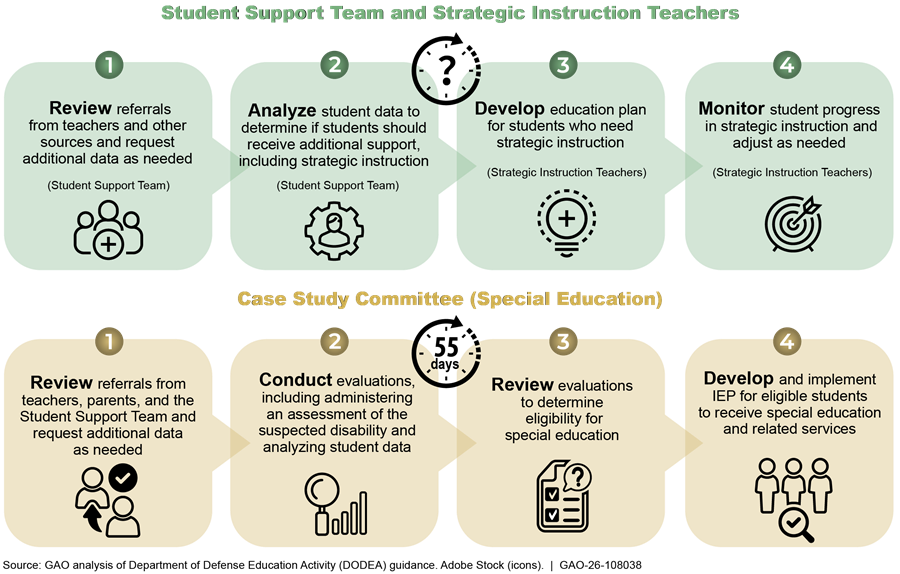
Note: Strategic instruction is not a prerequisite for a special education evaluation. At any point, any student can be referred to the Case Study Committee for a special education evaluation. DOD Manual 1342.12 provides that Department of Defense Education Activity (DODEA) is responsible for completing special education evaluations and holding the eligibility meeting to determine if a student qualifies for services within 55 school days after accepting a referral. The manual also requires the Case Study Committee to review and accept the referral within 15 days and convene a meeting to develop the Individualized Education Program (IEP) within 10 days. Conversely, there is no time frame requirement for completing the Student Support Team referral process. According to DODEA headquarters officials, the Student Support Team will analyze student data to identify appropriate next intervention supports. This may include strategic instruction, referrals to the Case Study Committee for a special education evaluation, and additional discussions with parents.
Various DODEA staff are responsible for delivering strategic instruction to students with literacy and math deficits and special education services to students with SLDs (see text box).
|
Key DODEA Staff Who Support Students with Literacy and Math Deficits and Specific Learning Disabilities Strategic instruction teachers: These staff provide targeted, short-term literacy or math instruction in a small group or individual setting. Special education teachers: In addition to teaching students with Individualized Education Programs (IEPs), these staff help develop and implement IEPs, track students’ progress toward IEP goals, and adapt lesson plans in response to students’ needs. Special education paraeducators: These staff assist students with disabilities in one-on-one, small group, and larger classroom settings. They assist with students’ behavioral needs, tracking students’ progress toward IEP goals and other tasks. Special education assessors: Through the 2024–2025 school year, these staff developed assessment plans, administered assessments, and analyzed assessment results to determine whether students were eligible for special education. School psychologists: These staff conduct behavioral and academic assessments and support eligibility decisions for strategic instruction and special education. They also provide nonclinical mental health services to students, such as education, screening, and short-term counseling. Instructional system specialists: These district-level staff monitor the quality of strategic instruction and special education services and assessments provided to students; provide training to school administrators, teachers, specialists, school psychologists, and other educators on effective instruction and assessment; and provide general oversight and coordinate support of strategic instruction and special education services and assessments across schools. |
Source: GAO analysis of Department of Defense Education Activity documentation and interviews. | GAO‑26‑108038
Student Support Team and Strategic Instruction. Using data from the classroom and other sources and input from teachers, the team is responsible for determining which students need strategic instruction. According to DODEA headquarters officials, the Student Support Team analyzes student data to identify appropriate next intervention supports, which may include strategic instruction, referrals to the Case Study Committee, and additional discussions with parents. The core members of this team include special education teachers, general education teachers, school psychologists, school administrators, and school counselors. Strategic instruction teachers serve as team members on an as-needed basis, according to DODEA’s guidance for Student Support Teams. The team can also consult with parents to discuss their child’s needs and progress. There is no required time frame for the Student Support Team to review referrals.
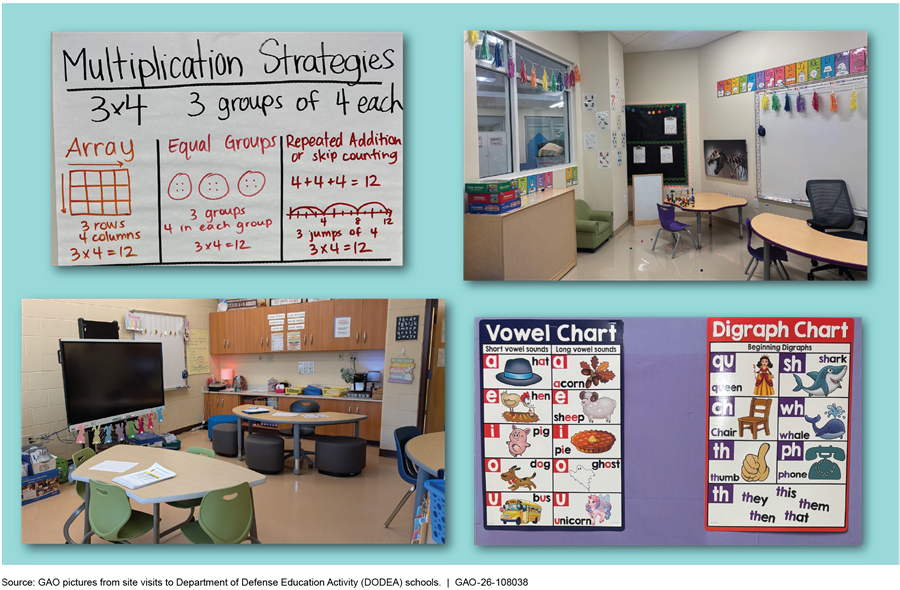
Students enrolled in strategic instruction classes receive targeted, short-term instruction by teachers with specialized training in intervention strategies. Strategic instruction is meant to be short-term support to help students get up to grade-level (see fig. 2 for examples of DODEA strategic instruction classrooms and materials). According to DODEA headquarters officials, strategic instruction classes are electives, therefore the decision to enroll in them is left to students and their parents.
DODEA headquarters officials said that strategic instruction teachers are responsible for developing education plans and monitoring progress for students enrolled in strategic instruction classes. These education plans outline the student’s goals, interventions to support progress toward those goals, and data needed to monitor the student’s progress.
Case Study Committee and Special Education. The Case Study Committee includes special education teachers, general education teachers, school psychologists, and school administrators.[14] According to DODEA policy, the Case Study Committee is required to determine a child’s eligibility for special education using a comprehensive evaluation that includes a variety of information sources such as assessments, teacher observations, academic performance, and parent input. Because each disability category under IDEA has its own unique assessment requirements and eligibility criteria, the committee must include data and evidence that align with the appropriate requirements when making eligibility determinations.
Parents can refer students directly to the Case Study Committee at any point while they are receiving support with the general education or strategic instruction teachers. Teachers should submit a formal referral to the Case Study Committee if interventions fail to resolve the area of specific instructional need.[15] DODEA guidance directs Student Support Teams to consider whether a student needs a referral for a special education evaluation if they do not respond to interventions through strategic instruction. Students can also be referred to the Case Study Committee for a special education evaluation before receiving strategic instruction or at any point while they are receiving support with the general education or strategic instruction teachers.
For DODEA students with SLDs to be eligible for special education, they must demonstrate that their SLD has an adverse impact on their educational performance and show a need for specially designed instruction, according to DODEA guidance. The Case Study Committee must make an eligibility determination before these students can receive special education services—including when students have a medical diagnosis that may impact their educational performance (see textbox).[16]
|
DODEA Does Not Diagnose Medical Conditions, Such as Dyslexia, But Considers External Medical Diagnoses in Special Education Eligibility Determinations DODEA school staff do not diagnose medical conditions, such as dyslexia—a neurologically-based learning difference that primarily affects a person’s ability to read, spell, and decode words. Medical diagnoses are typically made by medical or clinical professionals. However, DODEA instructs staff to identify the characteristics of dyslexia when they are present, especially when they affect a student’s educational performance and the student may require special education, according to DODEA training documents. DODEA considers these characteristics under the broader disability eligibility category of a Specific Learning Disability (SLD). An external medical diagnosis of dyslexia does not automatically qualify a student for special education services. DODEA staff must still determine whether a student meets the eligibility criteria for special education services, which includes the presence of a disability, such as an SLD, an adverse educational impact, and the need for specially designed instruction, according to DODEA guidance. |
Source: GAO analysis of Department of Defense Education Activity (DODEA) documentation. | GAO‑26‑108038
According to DODEA policy, the Case Study Committee must complete its evaluation and hold the eligibility meeting to determine if a student qualifies for special education services within 55 school days after receiving the parent’s written consent to evaluate their child. The policy also requires them to review a parental referral within 15 school days and convene a meeting to develop an Individualized Education Program (IEP) within 10 school days following the determination that the child is eligible for special education and related services.[17] IEPs are legally binding written plans that include a statement of the student’s present levels of academic achievement, the student’s goals, and the services needed to advance toward those goals.
About 10 Percent of DODEA Students Received Strategic Instruction and 5 Percent Had an SLD in School Year 2024–2025
Most DODEA Students Receiving Strategic Instruction Were in Elementary School
Our analysis of DODEA enrollment data found that in school year 2024–2025 about 10 percent of DODEA students received strategic instruction to address either literacy or math skill deficits.[18] Specifically, 6.4 percent of students (3,842) were enrolled in strategic literacy instruction and 5.6 percent of students (3,402) were enrolled in strategic math instruction. Of these students, 937 (or 1.6 percent) were enrolled in strategic instruction for both literacy and math.
Enrollment in strategic literacy instruction ranged from 4.8 percent in Europe to 7.8 percent in the Pacific. Enrollment in strategic math instruction was 5.3 percent in Europe and 5.9 percent in the Americas and Pacific.
Most students enrolled in strategic instruction for school year 2024–2025 were in elementary school (see fig. 3). Twenty percent of all students enrolled in strategic literacy instruction were in first grade, the largest proportion for a single grade. This represented 13 percent of first graders overall. Sixteen percent of all students enrolled in strategic math instruction were in sixth grade, the largest proportion for a single grade. This represented 11 percent of sixth graders overall.
Figure 3: DODEA Students Enrolled in Strategic Literacy and Math Instruction by Grade Level, School Year 2024–2025
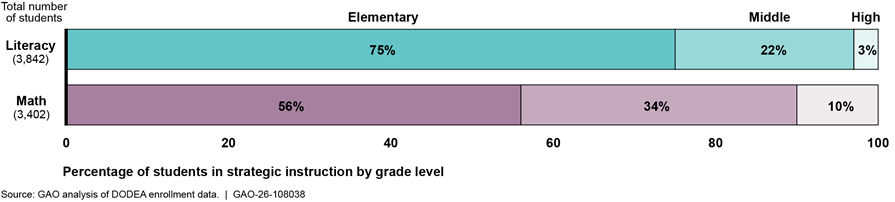
Note: GAO’s analysis of DODEA students enrolled in strategic instruction is based on data from DODEA’s Student Information System, which showed 60,451 students enrolled in grades Kindergarten through 12 as of June 2, 2025, and excluded students enrolled part-time, non-U.S. dependents, and DODEA’s virtual school attendees. We defined elementary, middle, and high school as grades K–5, 6–8, 9–12, respectively.
The Number of DODEA Students with SLDs Increased Over the Last 7 School Years
In the 2024–2025 school year, about 5 percent (2,835) of DODEA students had an SLD, according to DODEA data.[19] In comparison, about 3.5 percent of students nationwide had an SLD, according to Department of Education data for the same school year.[20] The number of DODEA students with SLDs increased 29 percent from 2018–2019 through 2024–2025 (the most recent years for which comparable data were available) (see fig. 4). DODEA has not analyzed the factors that contributed to this trend, according to headquarters officials.
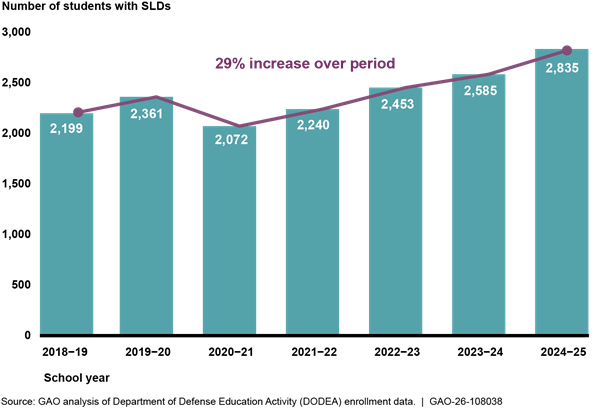
Note: The proportion of DODEA students with specific learning disabilities (SLD) increased from 3.3 to 4.6 percent over this period. GAO’s analysis of DODEA students who have SLDs is based on data from DODEA’s Student Information System, which showed total enrollment of 62,141 K–12 students as of August 4, 2025, and excluded students enrolled part-time, non-U.S. dependents, and DODEA’s virtual school attendees.
About half (51 percent) of students with SLDs in 2024–2025 were in elementary school (see fig. 5). The largest proportion of these students were in fifth grade (15 percent). This represents about 8 percent of all fifth graders. One special education assessor said that SLDs were typically identified in the later elementary years because students need enough schooling for staff to be able to distinguish a true learning disability from other learning obstacles. SLDs are among the most challenging developmental disorders to identify, according to the National Association of School Psychologists.
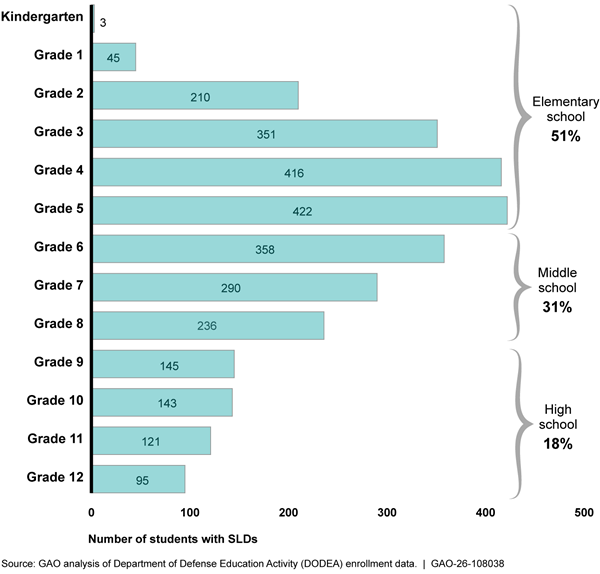
Note: The data include students with a specific learning disability (SLD) recorded as either their primary or secondary disability. To qualify for special education, students need to meet the requirements for at least one disability category, but they may have disabilities that span multiple categories.
The Americas region had the largest proportion of DODEA students with SLDs (5.8 percent), followed by the Europe region (4.3 percent), and the Pacific Region (3.8 percent). DODEA officials attributed the variability in part to the Americas region having several locations that are designated to support DODEA’s highest-need students.
DODEA’s Tools and Referral Processes for Identifying Students with Literacy or Math Deficits Sometimes Delay Services
DODEA staff at the schools we visited and parents of students with SLDs responding to our questionnaire cited several key obstacles to identifying students who need strategic instruction or special education. These included limited screening tools, incomplete student referrals, and delayed special education evaluations.
School Staff and Parents Said DODEA Had Limited Screening Tools to Identify Students Needing Help in Literacy and Math
|
DODEA Screening for Literacy and Math Deficits Screening is a systematic process for identifying students who may be at risk for poor learning outcomes. Screening tools are assessments used alongside other information to determine whether a student is struggling academically and may need further evaluation or intervention. Source: Adapted from Department of Defense documentation. | GAO‑26‑108038 |
Most DODEA staff we spoke with and most parents who responded to our online questionnaire said that the limited availability of screening tools was a key obstacle to DODEA’s ability to identify students who needed strategic instruction or special education to meet their literacy or math goals. Further, some of the available screening tools were limited to students in certain classes. School staff at nine of 11 schools and district staff in three of the five districts we visited said they needed more or better screening tools to identify all students with literacy and math deficits. For example, staff at these schools said that additional screening tools would be useful in identifying students’ deficits to better target instruction (see fig. 6 for specific examples). In contrast, one DODEA regional official offered a different view and cautioned against using additional tools. This official said that tools could be too sensitive and falsely identify deficits in students. Of the 121 parents who responded to this question on our questionnaire, 82 said the limited availability of DODEA resources to assess students, such as screening tools, was a challenge.[21]
Figure 6: Voices from the Field: Examples of Concerns Around DODEA’s Screening Tools Reported by DODEA Staff
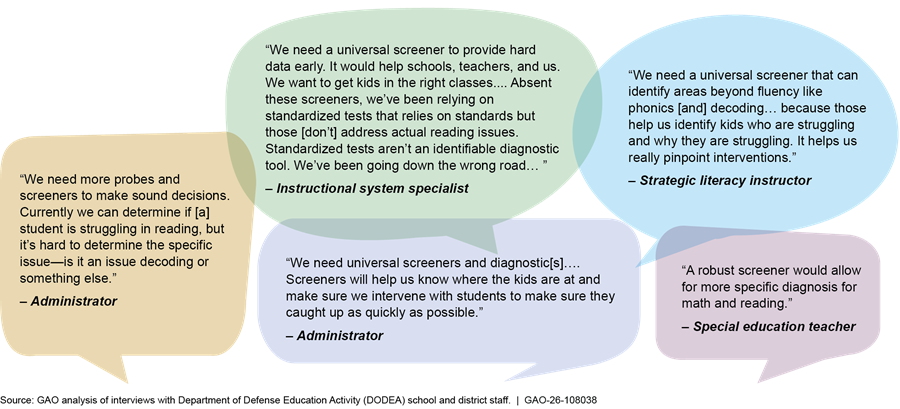
Note: The selected comments reflect themes discussed by DODEA staff across 47 group interviews GAO conducted and are not generalizable. In our interviews, DODEA staff often referred to screening tools as “screeners.”
DODEA headquarters officials said the resources included in DODEA’s curriculum, such as end-of-unit assessments and tools to help monitor student progress, should help teachers identify skill deficits. DODEA headquarters and regional officials also said that data from screening tools should be used in connection with other student data, such as assessment data and teacher observations, to identify support needed for individual students. DODEA headquarters officials and most district and school staff noted limitations with the tools available for identifying skill deficits by grade level or for students transferring schools.
· Elementary school screening tool. DODEA’s language arts curriculum includes a reading comprehension screener for elementary school students, according to DODEA headquarters officials. However, they said this screener does not directly assess foundational phonics skills. They also said that it does not use standardized scores that identify a reading concern or help predict which students might struggle with reading later.
· Middle and high school screening tools. DODEA uses a universal literacy and math screener for middle or high school students who are already enrolled in strategic instruction, according to DODEA headquarters officials. However, DODEA does not make screening tools available to identify students who would benefit from enrolling in strategic instruction. Two district officials we met with said they created a workaround by temporarily enrolling students in strategic instruction so that they could access the associated screener. Another middle school strategic literacy teacher said, “I want to enroll all my students in reading intervention just so I can screen them. How am I supposed to catch up [a] student and plan for them if I don’t know their reading level?”
· Assessing the skills of a highly mobile student population. DODEA staff at all 11 schools and district officials in three of five districts we visited said the transient nature of the military-connected student population makes it difficult to identify students who may need strategic instruction or special education. For example, DODEA staff at seven of the 11 schools we visited said some students arrived at their school without academic records from their previous public, private, or homeschool setting. One district official said that when a student arrives with no academic records, it can take a whole semester to identify that they need strategic instruction or special education. The official said that a universal screening tool administered at the beginning of the year, or when students arrive from outside the DODEA system, would help identify these students’ literacy and math needs earlier. In addition, researchers in one state have found that students who move frequently can have higher rates of school absences.[22] This can make it challenging to determine whether a student is struggling because they have a learning disability or because of missed instruction, according to one special education assessor. Screening all students when they arrive at a school could help better identify students who need support in literacy or math, given the highly mobile nature of the DODEA student population.
DODEA is developing an analytic model to predict which students may be at risk of not meeting academic expectations.[23] The model is currently available for students in third grade. DODEA headquarters officials said that they plan to roll out the model for students in second, fourth, fifth, and sixth grades during the 2026–2027 school year. They also said that they plan to make the model available to some students in eighth and ninth grade but did not provide a timeframe for doing so. This model also will not evaluate students who transfer from non-DODEA schools since it relies on internal data from the previous school year, such as grades and attendance. Moreover, the model is not an assessment. It will not directly measure students’ academic or cognitive skills; and must be used alongside other data to plan interventions that meet students’ needs, according to DODEA documentation.
Additional screening tools could provide such data to identify students who need strategic instruction or special education. In May 2026, DODEA headquarters officials told us that DODEA also plans to implement a universal literacy and math screening tool for all grades by the winter of 2027. These officials said the tool will include the capability to evaluate core components of early literacy, reading fluency, and comprehension. In July 2026, DODEA headquarters officials said that DODEA procured universal screening tools for all grades. They said that they plan to initially administer these screening tools to students in November or December of 2026. They also said that going forward, they plan to administer these tools three times a year for all students in kindergarten through ninth grade and to some students in grades 10-12.
DODEA’s guidance for Student Support Teams stresses the importance of using data to identify students’ needs, as doing so increases the likelihood of identifying their needs early and successfully addressing them through lower-intensity supports. According to this guidance, screening tools should be brief, reliable, and valid; should accurately identify student risk status; and should be aligned to valued outcomes. Further, DODEA’s strategic plan includes an initiative to strengthen systems and resources to help students successfully transition between grades, schools, districts, countries, and school systems to ensure every student is placed in the education setting that best meets their needs.[24] Without eliminating the gaps in its current approach to screening students for literacy and math deficits, DODEA may not be able to effectively identify all at-risk students in its highly mobile student population. When implemented, DODEA’s new literacy and math screening tool will fill gaps by providing data needed to identify students’ needs and help ensure a key strategic plan initiative is met.
Officials at all Schools We Visited Said Referrals Had Incomplete Data Which Can Lead to Rejections, but DODEA Has Not Systematically Analyzed Referral Outcomes
At all 11 schools and across each of the five districts we visited, school and district staff said that teachers sometimes submit referrals to evaluate the need for strategic instruction or special education with poor quality or incomplete data. For example, such referrals may not clearly identify the type of support the student has already received and the areas in which they have not been responsive to support.
Staff at all the schools we visited in the spring of 2025 said there was confusion about what data were needed to support referrals for strategic instruction or special education. When teachers submit incomplete referrals, the school’s Student Support Team or Case Study Committee may reject the referral because they do not have enough information. In all but one of our interviews with special education assessors and the DODEA staff responsible for chairing the Case Study Committee, staff said they had rejected referrals because teachers submitted them with poor quality or incomplete data. These rejections can delay starting the evaluation process and prevent students from receiving needed services in a timely manner. For example, one teacher said that students can fall further behind while their teachers collect additional data to support a new referral. DODEA’s guidance does not include required timelines for processing referrals for strategic instruction, which further complicates concerns about delays in students receiving needed services.
In other cases, the Student Support Team or Case Study Committee may make decisions based on referrals that contain poor-quality or incomplete data, which may result in providing support that a student does not need. For example, one district official told us that when referrals are incomplete, it is difficult to determine the appropriate support for students, which leads school staff to “roll the dice and see what to look at for interventions.”
In August 2025, DODEA issued new guidance for its Student Support Team referral process, which includes assessing whether students would benefit from strategic instruction. The guidance includes a standardized form for teachers to gather initial data for their referral.[25] DODEA headquarters officials said the form helps ensure a systematic approach to referrals by all schools for all students. DODEA headquarters officials said the form cannot prescribe which data the referring teacher should include, due to the wide range of student needs and variety of data that might be available based on the student’s grade level, the time of school year, and the nature of the underlying concern that prompted the referral.
DODEA has updated its information system to be able to identify the reasons for rejections of Student Support Team referrals for students who may benefit from additional literacy and math support, including strategic instruction. However, DODEA has not identified how often referrals are rejected and on what basis because it has not analyzed these data. In November 2025, DODEA updated its information system which, for the first time, provided DODEA with the capability to centrally analyze these referrals to identify the reasons for rejections. In May 2026, DODEA officials told us they plan to analyze these referral results in a number of ways, including identifying trends in screening data and areas for future data collection. DODEA officials said that the updated information system now also provides the capability to analyze the length of time for reviewing referrals. However, they said they have no current plans to do so.
DODEA also has no plans to examine reasons why special education referrals are rejected. DODEA officials explained that it uses a different information system for these referrals, and this system does not offer an easy way to consistently analyze reasons referrals are rejected. Officials told us that the reasons for the rejection are not always entered into the system and when they are, they are added in a “notes” field that also captures other qualitative information. They said that a systemwide analysis of reasons referrals were rejected would involve manually pulling individual records, many of which are incomplete, and would be burdensome.
However, the special education information system includes a different field, which is mandatory to complete, and identifies whether a referral was rejected because of, for example, poor or incomplete data. These data could be used to identify districts where rejections commonly occur due to data issues. By identifying common patterns for rejections in those districts and following up with them to address underlying issues, DODEA could make strides in improving the quality of referrals and reducing the number of rejections.
DODEA’s strategic plan includes a goal for the agency to use technology to streamline educational support systems and processes to promote student achievement, including using data to inform decision making. Federal internal control standards also call for an agency’s information system to be able to obtain and generate relevant data, and to process it into quality information to support agency processes. Without 1) analyzing data on the reasons Student Support Team referrals for students who may benefit from additional literacy and math support, including strategic instruction, are rejected and 2) identifying when special education referrals are rejected due to poor quality or incomplete information, DODEA lacks information it needs to make informed decisions to improve these referral processes to promote student achievement.
DODEA’s Reported Timeliness for Completing Special Education Evaluations Has Varied, and It Has Not Analyzed Reasons for Delays
DODEA’s reported timeliness in completing the special education evaluation process within the required 55-day time frame has varied, and DODEA has not analyzed reasons for delays in this process.[26] DODEA headquarters officials said they have developed professional learning on the required evaluation timelines for school psychologists. They also said they take corrective action on a case-by-case basis to ensure that staff understand the importance of timeline compliance when related issues are identified in broader compliance and monitoring efforts. In school year 2024–2025, DODEA reported that 12 percent of special education evaluations were not completed in a timely manner (see fig. 7). DODEA reported that while the timeliness of its special education evaluations has improved in recent years, there remains a continued need for proactive support to reduce the time it takes to complete the evaluation process.[27]
Figure 7: Percentage of Students Whose Initial Special Education Evaluations Were Completed Within Required 55 Days, By Year
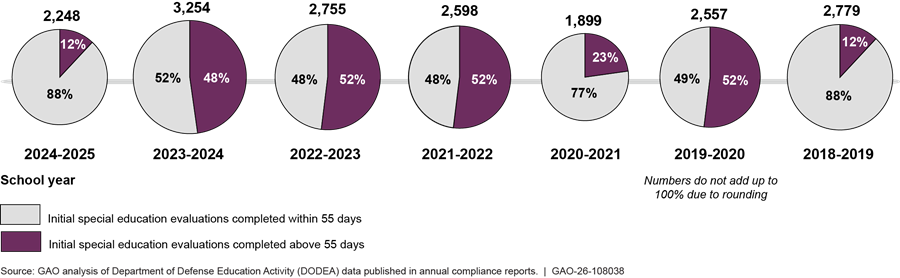
Note: DOD Manual 1342.12 provides that DODEA is responsible for completing special education evaluations and holding the eligibility meeting to determine if a student qualifies for special education services within 55 school days after accepting a referral. DODEA headquarters officials said that DODEA reporting prior to the 2024-2025 school year may have overstated the percent of evaluations “above 55 days”.
|
|
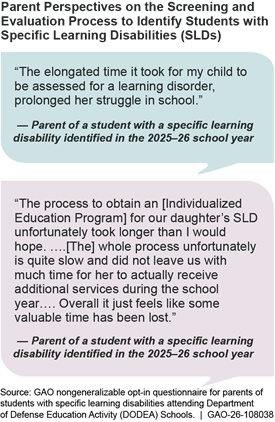
Despite this improvement, DODEA staff and parents we interviewed told us that timely identification and evaluation of students who need special education was a challenge. Specifically, DODEA staff at 10 of 11 schools we visited in the spring of 2025 cited this challenge. Further, of the 141 parents who responded to this question in our questionnaire, 75 were “dissatisfied” or “very dissatisfied” with the overall screening and evaluation process to identify students with SLDs (see sidebar for specific examples from parents).[28] In addition, the majority of parents who responded to our questionnaire said the overall length of time it took to screen, evaluate, and identify children with SLDs was a challenge (79 of the 123 parents who responded to this question).[29] DODEA headquarters officials acknowledged that the time it takes to conduct a special education evaluation is a frustration for parents and that they are developing communication tools to better explain the process and timeline to parents.
DODEA has not systematically analyzed the causes of delays in the evaluation process but has previously recognized the value of conducting this type of analysis. In its 2019 annual compliance report, DODEA noted that it would be helpful to collect and analyze data to determine whether delays were due to systemic issues or to various circumstances where stakeholders agreed to extend deadlines, such as deployments or school breaks.[30] DODEA headquarters officials said that some evaluations were reported as not having been completed within 55 days before the 2024–2025 school year, in part due to erroneously including referrals that were closed before the point in time an evaluation is considered to have begun for the purposes of the 55-day requirement, such as when a parent declined or withdrew written consent. DODEA has not determined the extent to which this has occurred or published corrected data. Other DOD components are also involved in the special education evaluation process. For example, overseas, the military branches’ Educational and Developmental Intervention Services programs are responsible for providing certain related services to DODEA students, including medical services for diagnostic or evaluative purposes related to special education evaluations. This means that the timeliness of all parts of the evaluation process is not always fully within DODEA’s control.
DODEA recently changed its approach to how it carries out special education evaluations, further highlighting the importance of analyzing the reasons for delays in the process. In May 2025, DODEA eliminated its special education assessor position. These assessors were responsible for conducting special education assessments and supporting the evaluation process. DODEA reassigned their responsibilities to school psychologists for the 2025–2026 school year. This change aligns with professional standards and, according to DODEA officials, is intended to enhance the efficiency, consistency, and quality of special education evaluations across the system. According to DODEA’s press release about this change, the increase in school psychologist FTEs will improve the timeliness of mental health services and academic assessments.
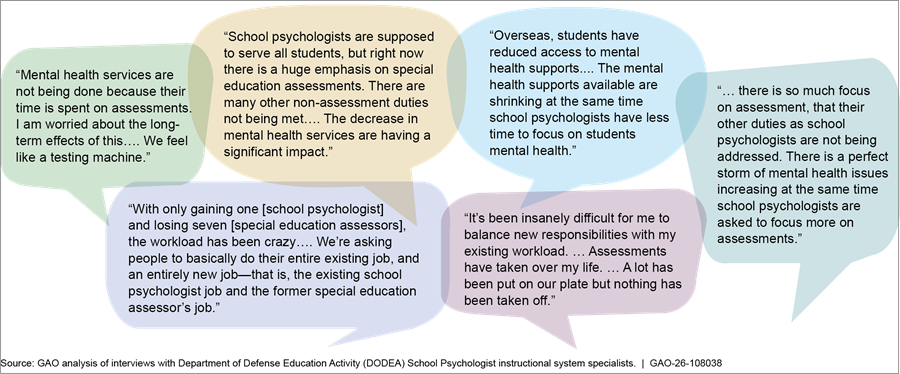
However, DODEA’s school psychologists are already responsible for a wide range of student supports, including critical mental health services, and have faced difficulties carrying out all of their assigned responsibilities.[31] While DODEA allotted an additional 21 school psychologist FTEs for school year 2025–2026, this increase does not make up for the 64.5 special education assessor positions lost.[32] All the district-level school psychologists we met with said that special education evaluations had crowded out other work during the 2025–26 school year. These staff—who oversee school psychologists in six of the nine districts across DODEA’s three regions—said that school psychologists had less capacity to provide preventative mental health services for students (see fig. 8 for specific examples).
Figure 8: Voices from the Field: Examples of Concerns about School Psychologists’ Ability to Provide Mental Health Services Due to Increased Workload of Special Education Assessments
Note: The selected comments reflect themes discussed by DODEA staff in GAO interviews and are not generalizable.
The effect of this staffing change on the timeliness of special education evaluation process is not yet clear, as data for the 2025–2026 school year were not yet available at the time of our review. However, staff at six of the 11 schools we visited prior to the change said they already lacked the necessary staff to complete assessments for evaluations effectively or in a timely manner.
Timely evaluations are crucial for ensuring that students with disabilities receive the instruction and support to which they are entitled under federal law, according to DODEA policy. Delays in the evaluation process postpone the provision of special education services. However, without analyzing the factors that have contributed to delays, DODEA cannot take appropriate actions to reduce those delays and may continue to face challenges ensuring that all students receive the support they need as quickly as possible.
DODEA Staff Cited Misaligned Professional Learning, Limited Data Access, and Certain Enrollment Practices as Obstacles to Helping Students Meet their Academic Goals
DODEA staff at all 11 schools we visited cited several key obstacles to helping students meet their literacy and math goals. These included professional learning that was misaligned with teachers’ needs, not having adequate access to data on students’ grades and progress, and practices that can make it difficult for students to enroll in strategic instruction classes.
DODEA Did Not Seek Teachers’ Input on Professional Learning Needs and Selected Teachers Said Their Professional Learning Is Not Relevant to their Unique Roles
Teachers’ Views on Current and Future Professional Learning Needs
Many DODEA strategic instruction and special education staff told us that current professional learning opportunities did not help them meet students’ needs and that DODEA did not ask them for feedback about the future professional learning they needed. Of the 44 strategic instruction and special education teachers with whom we met, 32 rated the current professional learning opportunities DODEA provided as either “bad” or “very bad”.[33]
|
|
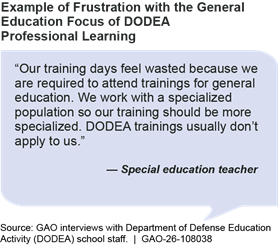
Strategic instruction and special education teachers receive the same agencywide professional learning as general education teachers, according to DODEA headquarters officials. At 10 of the 11 schools we visited, these teachers expressed frustration with the general education focus of agencywide professional learning (see sidebar for a specific example).
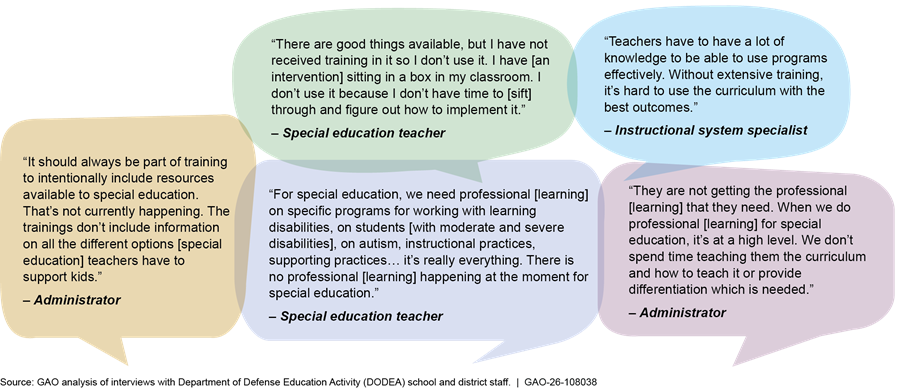
In addition, staff at 10 of 11 schools and officials in
four of the five districts we visited said that strategic instruction and
special education teachers receive limited professional learning on the
literacy and math interventions DODEA expects them to use to support their
students (see fig. 9 for specific examples).
Figure 9: Voices from the Field: Examples of Concerns about Professional Learning for Strategic Instruction and Special Education Teachers
Note: The selected comments reflect themes discussed by DODEA staff in GAO interviews and are not generalizable.
DODEA headquarters officials said that teachers can receive local professional learning at the school and district level in addition to agencywide professional learning. While teachers at eight of 11 schools we visited said they received local professional learning, staff at seven of these schools said they did not find it helpful. For example, some teachers said they did not have local access to professional learning on topics relevant to their work as strategic instruction and special education teachers, they were not able to provide feedback on the topics the professional learning covered, and the professional learning sessions were too short. Officials in two districts we visited who provide local professional learning also said that they did not have enough time to cover all the topics they would like to cover in these sessions.
Strategic instruction and special education teachers at eight of 11 schools and officials in three of five districts we visited said that they wanted professional learning that is more directly applicable to their roles. For example, some of these teachers said they wanted more professional learning focused on collaborating with general education teachers and identifying students with literacy and math deficits and SLDs. Some also wanted more in-depth professional learning on providing strategic instruction and special education in literacy and math. These views are consistent with those of teachers nationwide. As we reported in March 2026, most teachers nationwide said collaborative learning opportunities with other teachers improved their teaching and students’ learning.[34]
While DODEA headquarters and regional officials select the topics for professional learning, school staff said it would be helpful to have more input on their future professional learning needs. DODEA headquarters officials said they rely on feedback forms to capture staff input about the session they just attended. According to DODEA headquarters and regional officials, they view this feedback form as an opportunity for staff to provide additional input on their learning needs generally. However, the feedback form focuses on the professional learning session staff just attended and does not ask them about what professional learning they need in the future. Staff at nine of the 11 schools we visited were unaware that the feedback form can be used for general feedback on training needs. Further, at all 11 schools, staff said they wanted opportunities for strategic instruction and special education teachers to provide feedback on future professional learning that would be most helpful to them.
Staff at nine of 11 schools said that the “top down” approach to professional learning for strategic instruction and special education teachers at DODEA can result in professional learning that does not meet their needs. In the absence of professional learning from DODEA that directly relates to their work, strategic instruction and special education teachers at five of the 11 schools described seeking professional learning without agency assistance. For example, one strategic instruction teacher said that they seek out professional learning on their own time and with their own money. A special education teacher at another school said that teachers have obtained certifications on their own to support students in special education.
DODEA’s guidance on professional learning outlines agency expectations for high-quality professional learning, including that DODEA’s professional learning should advance teachers’ ability to apply acquired knowledge, skills, and strategies targeted to their particular role and content. DODEA’s strategic plan also includes a goal to expand opportunities for professional learning to support employee growth and organizational improvement. DODEA headquarters officials said that they are developing a system-wide plan to ensure special education teachers have the professional learning they need. By clarifying that feedback forms provided to strategic instruction and special education teachers at the end of agency-wide professional learning sessions are designed for general feedback on targeted future professional learning these teachers need, DODEA would be better informed in deciding what future professional learning to offer as part of the new system-wide plan. This, in turn, would position these teachers to be successful in helping students with literacy and math deficits and SLDs make progress towards their educational goals.
Professional Learning on Specialized Reading Interventions
DODEA requires special education teachers who support students with SLDs and who need specialized reading interventions for dyslexia and other reading-related disabilities to be appropriately trained and certified to implement the interventions with fidelity, separate from teaching licenses, according to DODEA headquarters officials.[35] However, DODEA staff we interviewed at all seven elementary schools, staff in two of the five districts, and one regional official described obstacles they face fulfilling this requirement. For example, a special education teacher said that their school provided the reading intervention for this teacher to use, but did not train them on how to use it. This teacher said that they did not have time to review these materials on their own to learn how to use this intervention (see fig. 10 for example of intervention materials at this school).
A regional DODEA official said that it can be difficult to obtain professional learning on specialized reading interventions for DODEA teachers in the Europe and Pacific regions because training sessions take place in the United States, and it becomes resource intensive to organize professional learning abroad. More than two-thirds of DODEA’s 161 schools are located outside the United States. This official also said that DODEA needs to ensure that there is commitment from district leadership for teachers to receive comprehensive professional learning before DODEA distributes the reading interventions to schools.
While DODEA requires teachers to be appropriately certified and trained to teach the specialized reading interventions for students who have reading-related disabilities, the agency does not know the extent to which teachers have the necessary certifications and training, and accordingly, where professional learning needs to be targeted to meet its own requirements. This is because, according to DODEA headquarters officials, it does not centrally track certification and training rates. Officials said that typically district or school level officials make decisions about which teachers receive training on these interventions and how to maintain training records based on the availability of specific interventions, student needs, and local priorities.
Teachers at one school we visited in the spring of 2025 said there are at least seven special education students with SLDs who would benefit from a specific specialized reading intervention at their school, but there is only one teacher in their district who is certified to teach this intervention. Given this, they said they cannot meet the needs of all students with SLDs in their school who are eligible for services. The administrator of this school said they asked that more teachers receive the required professional learning on this intervention, but DODEA denied the request. By monitoring certification and training rates systemwide, DODEA could identify schools where there are not enough certified or trained teachers to meet students’ needs, as well as opportunities to match certified or trained teachers with students who need interventions.
In July 2025, DODEA said that it was strategically investing in targeted reading interventions for grades 3–5 to address critical literacy development needs.[36] As DODEA takes steps to make these interventions more accessible, teachers would also need the associated professional learning to teach them with fidelity, in line with DODEA’s expectations that teachers using these interventions are appropriately trained and certified.
DODEA’s guidance on professional learning highlights its expectation that professional learning should make use of relevant resources and ensure that resources of time, talent, and funding are aligned to meet goals and outcomes. DODEA’s strategic plan also includes a goal to prioritize instruction and professional learning to ensure teachers can provide powerful learning for every student, including using evidence-based interventions focused on foundational reading skills. Until all special education teachers receive the professional learning they need to teach specialized reading interventions, DODEA cannot ensure the teachers are equipped to provide the interventions needed to provide quality instruction in foundational reading skills to better support students with SLDs.
Limited Access to Student Data Impeded Ability to Tailor Instruction to Students’ Needs, According to Selected Elementary School Special Education Teachers
Elementary school special education teachers do not have direct access to their students’ data for their literacy and math curricula, according to DODEA headquarters officials. Special education teachers at two elementary schools we visited said that these data include information on students’ test scores, grades on assignments, and academic progress. Special education teachers at four of the seven elementary schools we visited and officials in two of the five districts said that having limited access to students’ data and curricular resources made it more difficult for them to design individualized instruction for their students. For example, one teacher said that without access to their students’ data for the literacy curriculum, they were not able to assign them additional work or to align those assignments to their students’ individual needs. A teacher at another school said that without being able to view student records, they could not monitor their students’ progress to inform how they design individualized instruction. Teachers at a third school said that they did not have access to the teacher’s guide or the coursebook for the curricula, which made it difficult to plan lessons and tailor them to their students’ individual needs.
DODEA school staff outlined multiple obstacles that prevented special education teachers from accessing their students’ data, including limited collaboration time. According to DODEA headquarters officials, general education teachers can share student data with special education teachers who do not have access. However, staff at nine of 11 schools we visited in the spring of 2025 and officials in two districts said that it is difficult for special education teachers and general education teachers to find time to collaborate.
Further, special education teachers at three elementary schools said that relying on general education teachers for access to literacy and math curricular resources—including viewing students’ test scores, grades on assignments, and academic progress—is not practical because general education teachers need to use the resources for their classes and there is limited time where general education and special education teachers can collaborate to access resources. For example, one special education teacher said that without their own access to their students’ data, they must find time when the general education teachers can sit down with them to log into the system to view student data and assign work. According to the teacher, this is not always feasible because they do not have dedicated collaboration time with general education teachers. This teacher said that they are dependent on the general education teachers’ schedules to access their students’ data.
In July 2025, DODEA issued guidance outlining collaboration practices for staff to ensure high-quality core instruction and interventions. In this guidance, DODEA encourages staff to work together to analyze student assessment data to identify students with gaps in understanding and develop interventions to address those gaps. However, as we heard from some teachers, one of the barriers to working together is finding time to do so without dedicated collaboration time.
Administrators, district staff, and teachers also said that there is no clear method for providing special education teachers with access to their students’ data. For example, administrators and district officials overseeing special education teachers at two elementary schools said that they could not give special education teachers this access. An official from this district also said that special education teachers did not have access to these data because of a limited number of software licenses. At another elementary school, special education teachers said that they were told the general education teachers could not share passwords with them so that they could access student data.
DODEA’s strategic plan includes goals (1) to use technology to streamline educational support systems and processes to promote student achievement, including using data to inform decision making; and (2) to improve its communication systemwide to ensure educators work together for student success. DODEA also operates under the “One DODEA” ethos, which prioritizes uniformity and cohesion across its schools to ensure that students continue their education without disruption. By ensuring that all special education teachers in DODEA elementary schools have access to data on their students’ test scores, grades on assignments, and academic progress, DODEA could better enable these teachers to use that data to tailor instruction to help every student make progress towards their education goals. This could be done either by providing special education teachers with a clear method to access their students’ data or providing special education and general education teachers with dedicated collaboration time for this purpose.
DODEA School Staff Said Students Needing Support to Perform at Grade-Level May Not Receive it for Varying Reasons
Strategic instruction classes are the main method DODEA uses to provide targeted academic support to students not performing at grade-level in literacy or math. School and district staff described several DODEA practices that can result in students not receiving support for which they have been identified to help them meet the demands of their grade-level instruction. These include the use of waitlists when demand for strategic instruction classes exceeds the resources needed to offer enough classes; designating these classes as electives, which allows students to choose not to take them; and schools not offering the classes at all.
|
|
· Using waitlists. When demand for strategic instruction is high, some schools exceed DODEA’s expected enrollment rate (5-15 percent of total student population). DODEA’s enrollment data show that approximately 46 percent of elementary schools (for strategic literacy instruction) and 22 percent of elementary schools (for strategic math instruction) had participation rates above 15 percent for at least one grade.
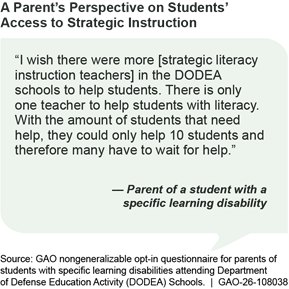
Some schools use waitlists when demand for strategic instruction is high. Staff at an elementary school in one district and officials in another district said that they had to place students on waitlists, which resulted in some students not receiving needed support intended to get them up to grade-level. Similarly, in responding to open-ended questions on our questionnaire, three parents also independently raised concerns about students who need strategic instruction not being able to enroll in these classes due to staffing constraints (see sidebar for a specific example).[37]
DODEA headquarters officials said that they discourage the use of waitlists, but the agency does not have an official policy prohibiting them. If schools do use waitlists, DODEA encourages schools to monitor them at the local level.
· Making classes elective. DODEA headquarters officials said that strategic instruction classes are electives in middle school and high school, meaning that even though students have been designated as needing support to help them meet grade-level expectations in literacy or math, students can choose not to enroll in them. According to DODEA’s enrollment data, all high schools had participation rates below 5 percent in strategic literacy instruction and nearly all (98 percent) had participation rates below 5 percent in strategic math instruction for at least one grade.
Administrators at two secondary schools and officials in one district we visited said that offering these classes as electives can present obstacles. For example, administrators at one school said that it can be challenging to encourage students to enroll in these classes because doing so means students forego other electives that may be more appealing to them.
DODEA headquarters officials said they do not track how many middle and high school students need help performing at grade-level but choose not to enroll in strategic instruction classes. According to headquarters officials, while DODEA is exploring ways to better understand instructional gaps, enrollment in elective classes remains a student decision.
· Not offering classes. According to DODEA headquarters officials, individual schools make decisions about when to offer strategic instruction. Staff at three secondary schools we visited also told us that there are years when they do not offer these classes, although these schools had students who needed help performing at grade-level. For example, administrators at one school said that they did not offer strategic instruction due to staffing constraints. DODEA headquarters officials said that the agency does not have an approval process at the district, regional, or headquarters level when schools decide not to offer these classes.
DODEA’s stated goal of strategic instruction is to remediate academic skill deficits so that students can successfully meet the demands of their grade-level instruction. DODEA’s strategic plan also includes a goal to provide timely, clear, and consistent instruction in reading and math to help students build the knowledge and skills to succeed. Further, the “One DODEA” ethos prioritizes uniformity and cohesion across DODEA’s schools to ensure that students continue their education without disruption. However, DODEA officials could not describe how DODEA ensures that students who are eligible for strategic instruction yet choose not to enroll in these classes receive appropriate academic support to help them perform at grade-level. By ensuring that all students who have been identified as needing additional support in literacy and math receive it, DODEA would be better positioned to ensure that all students build the knowledge and skills to succeed in meeting the demands of their grade-level instruction.
Conclusions
DODEA’s strategic instruction and special education for students with SLDs are central to its efforts to provide high-quality learning experiences for all DODEA students and help students develop to their fullest potential. However, DODEA faces unique challenges identifying students in need of these services, including serving highly mobile students who frequently move in and out of DODEA schools.
DODEA has several opportunities to further improve how it identifies students who may need extra support in literacy and math or special education. By adopting screening tools to assess all students for literacy and math deficits, DODEA has an opportunity to more effectively identify all students needing support in its highly mobile student population. DODEA could also take advantage of recent improvements to its information system to better understand why referrals are rejected and use the information to inform potential improvements in the quality, completeness, and timeliness of these referrals. Specifically, this applies to both referrals for students who may benefit from additional literacy and math support, as well as students who may benefit from special education. Further, while DODEA reports that it has improved the timeliness of its special education evaluations in recent years, analyzing the factors within its control that have contributed to delays in special education evaluations could help DODEA officials address remaining issues.
DODEA also has opportunities to better support teachers in helping students meet their literacy and math goals. Specifically, ensuring that strategic instruction and special education teachers have opportunities to share feedback on the future professional learning they need would help DODEA provide these teachers with skills to provide robust instruction for students with literacy and math deficits and SLDs. Additionally, as DODEA broadens access to specialized reading interventions, ensuring that special education teachers receive the required professional learning would prepare teachers to use these interventions to provide quality instruction in foundational reading skills to better support their students. Further, making data on their students’ test scores, grades on assignments, and academic progress available to all elementary special education teachers would allow these staff to more effectively design instruction to meet individual student needs—a key goal of DODEA policy and special education law. Lastly, ensuring that all students identified as needing extra support to meet grade-level demands for literacy and math receive that support would provide greater assurance that these students are prepared to meet the demands of post-secondary life.
Recommendations for Executive Action
We are making the following eight recommendations to DOD:
The Secretary of Defense should ensure that the DODEA Director eliminates gaps in DODEA’s current approach to screening students for literacy and math deficits. This could include adopting screening tools that assess foundational phonic skills in elementary school and expanding access to existing screeners that are currently only available to middle and high school students already receiving strategic literacy or math instruction. (Recommendation 1)
The Secretary of Defense should ensure that the DODEA Director analyzes data on the reasons why Student Support Teams reject referrals for students who may benefit from additional literacy and math support and use this information to better ensure the completeness, quality, and timeliness of referrals. (Recommendation 2)
The Secretary of Defense should ensure that the DODEA Director identifies referrals for special education that have been rejected due to poor quality or incomplete information and use the results to improve the completeness and quality of referrals systemwide. For example, by identifying the districts with the highest rejection rates using available data in its special education information system, DODEA could identify common patterns for rejections due to poor quality or incomplete data and take achievable steps to improve the quality of the referrals. (Recommendation 3)
The Secretary of Defense should ensure that the DODEA Director analyzes factors within its control contributing to delays in the special education evaluation process and take appropriate steps to address them. (Recommendation 4)
The Secretary of Defense should ensure that the DODEA Director clarifies that feedback forms provided to strategic instruction and special education teachers at the end of agency-wide professional learning sessions are designed for general feedback about these teachers’ future professional learning needs and use this feedback to inform future professional learning offerings. (Recommendation 5)
The Secretary of Defense should ensure that the DODEA Director ensures that special education teachers who teach students needing specialized reading interventions receive the professional learning necessary to teach these interventions with fidelity. This should include systemwide monitoring of teacher certifications for specialized reading interventions, as well as associated training rates. (Recommendation 6)
The Secretary of Defense should ensure that the DODEA Director ensures that all elementary school special education teachers have access to data on their students’ test scores, grades on assignments, and academic progress. In doing so, DODEA should direct school administrators to provide special education teachers with a clear method to access their students’ data or provide dedicated collaboration time between special education and general education teachers. (Recommendation 7)
The Secretary of Defense should ensure that the DODEA Director ensures that all students DODEA has identified as being eligible for additional support in literacy or math receive the necessary support to remediate academic skill deficits so that students can successfully meet the demands of their grade-level instruction. (Recommendation 8)
Agency Comments
We provided a draft of this report to DOD for comment. DOD provided technical comments, which we incorporated as appropriate. In its formal comments, reproduced in appendix I, DOD concurred with recommendations one, four, five, six, and seven and partially concurred with recommendations two, three, and eight.
For our second recommendation on analyzing data on the reasons Student Support Team referrals are rejected, DOD noted that recent system enhancements have increased the availability of data on Student Support Team referrals. It also noted that this will help inform decisions regarding the completeness, quality, and timeliness of referrals. DOD further stated that the Student Support Team is a general education problem-solving team that makes referrals to multiple pathways for specialized support, such as strategic instruction classes or special education. We agree and have clarified our report to more clearly distinguish among and explain relationships between the Student Support Team, strategic instruction, and special education. As discussed in this report, we encountered significant confusion among DODEA staff about the data needed to successfully support a referral to the Student Support Team for students who may benefit from additional literacy and math support. We continue to believe that understanding the reasons why Student Support Teams reject referrals would help ensure the completeness, quality, and timeliness of referrals, and ultimately ensure that students who qualify for additional support get it more quickly.
For our third recommendation on identifying Case Study Committee referrals for special education that have been rejected due to poor quality or incomplete information, DOD agreed that analyzing special education referral decisions would allow the agency to identify systemwide opportunities for improving referral quality. DOD said that it will explore available data sources to support informed decision-making while preserving the integrity of Case Study Committee final determinations, which are unique to each case’s circumstances. We agree. We clarified the recommendation to note that the purpose of identifying districts with the highest rejection rates is to identify common patterns that could improve the quality of the referrals themselves. We maintain that improving the quality of referrals would ultimately ensure that students the Case Study Committee determines are qualified for additional support get it more quickly.
For our eighth recommendation on ensuring all students identified as being eligible for additional support in literacy or math receive it, DOD acknowledged the importance of ensuring that students with literacy and math deficits have access to appropriate interventions and support. DOD also stated its belief that the recommendation is based, in part, on the assumption that all students identified as eligible for strategic instruction should ultimately receive that intervention. Strategic instruction classes are DODEA’s primary method for remediating academic skill deficits so that students can successfully meet the demands of their grade-level instruction. We continue to believe it is critical for DODEA to do all that it can to ensure its students receive the support needed to do so. Our recommendation was intended to work within the primary remediation structure that DODEA itself set forth. We have clarified the intent of this recommendation—that all students DODEA has identified as needing extra support to meet the math and literacy expectations of their grade levels receive the appropriate support to do so, regardless of how it is delivered. We continue to believe that doing so is critical to ensure that students are equipped with the necessary foundational skills to be productive members of society after they leave school.
We are sending copies of this report to the appropriate congressional committees, the Secretary of Defense, and other interested parties. In addition, the report will be available at no charge on the GAO website at http://www.gao.gov.
If you or your staff have any questions about this report, please contact me at nowickij@gao.gov. Contact points for Offices of Congressional Relations and Media Relations may be found on the last page of this report. GAO staff who made key contributions to this report are listed in appendix II.
Jacqueline M. Nowicki
Director, Education, Workforce, and Income Security Issues
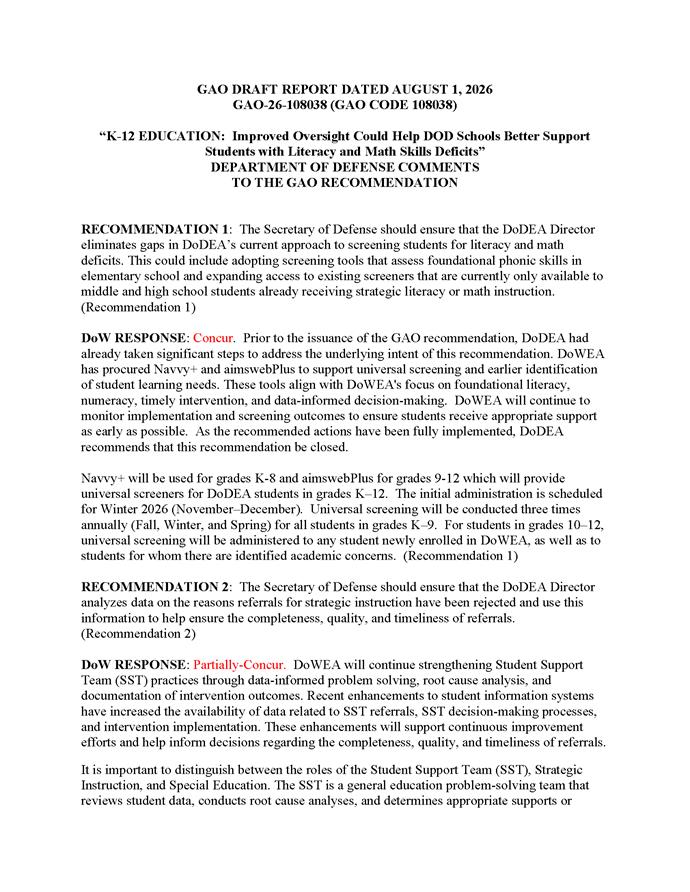
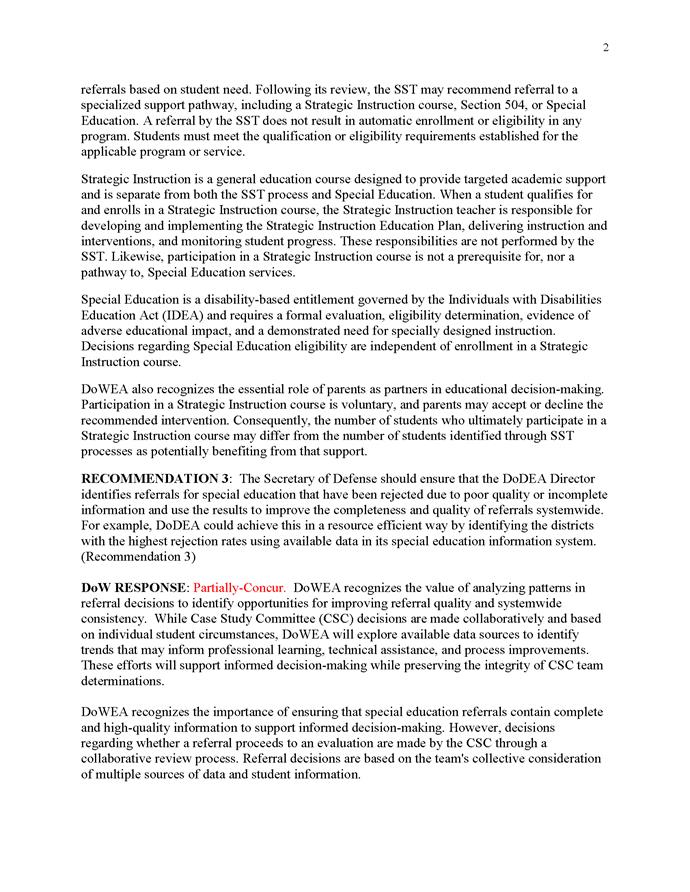
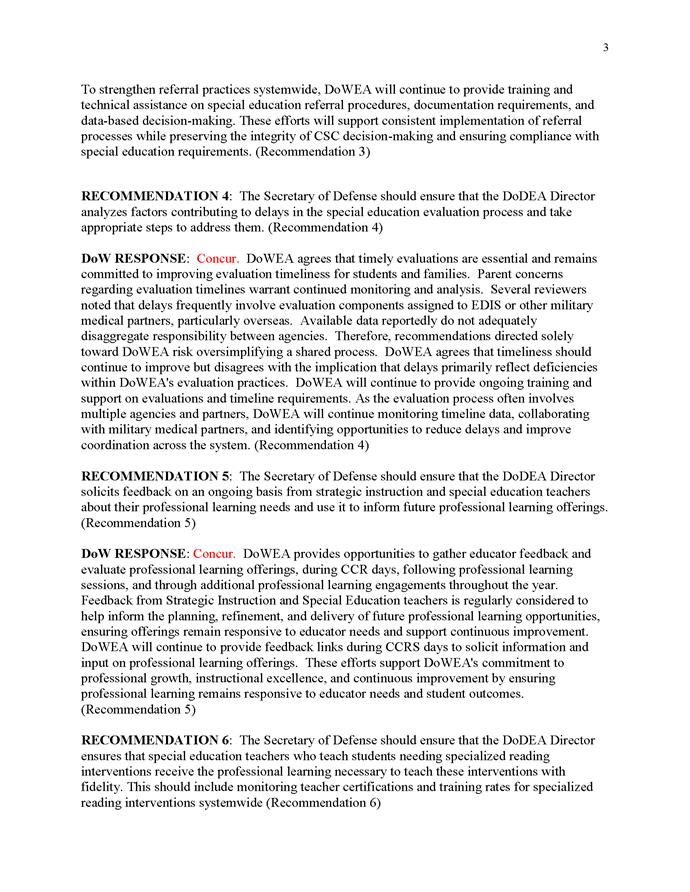
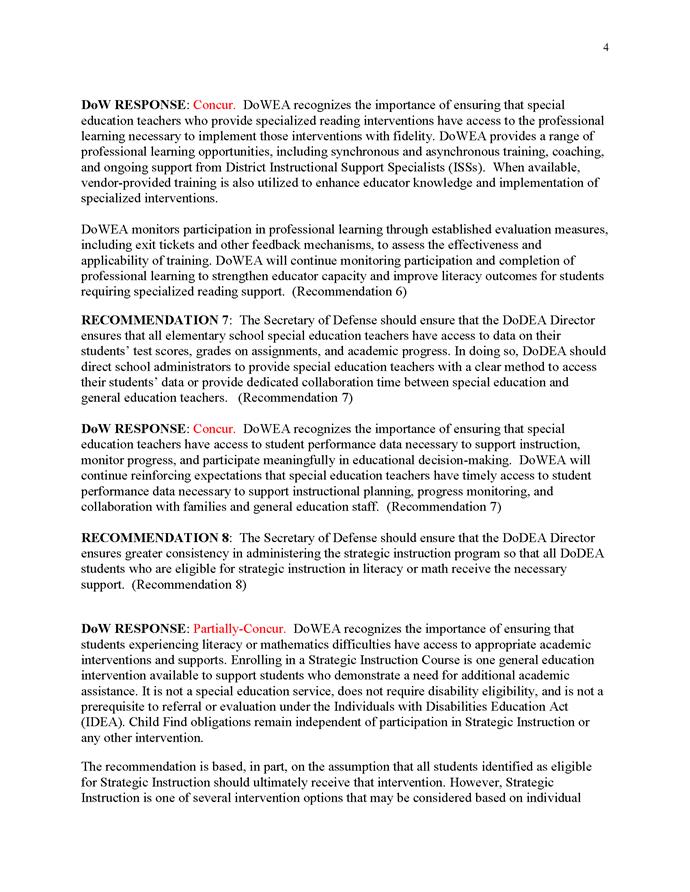
Jacqueline M. Nowicki, nowickij@gao.gov
In addition to the contact named above, Jennifer Gregory (Assistant Director), Brian Schwartz (Analyst in Charge), and Mary Edgerton made key contributions to this report. Also contributing to this report were Lucas Alvarez, Maggie Baucom, Alison Cashin, Jennifer Cook, Randi Hall, Jeanine Navarrete, Mimi Nguyen, Kate O’Dea Lamas, Trevor Osaki, Isaac Pavkovic, James Rebbe, Jerome Sandau, Rebecca Sero, Kyana Taban, and Seline Wiedemer.
The Government Accountability Office, the audit, evaluation, and investigative arm of Congress, exists to support Congress in meeting its constitutional responsibilities and to help improve the performance and accountability of the federal government for the American people. GAO examines the use of public funds; evaluates federal programs and policies; and provides analyses, recommendations, and other assistance to help Congress make informed oversight, policy, and funding decisions. GAO’s commitment to good government is reflected in its core values of accountability, integrity, and reliability.
Obtaining Copies of GAO Reports and Testimony
The fastest and easiest way to obtain copies of GAO documents at no cost is through our website. Each weekday afternoon, GAO posts on its website newly released reports, testimony, and correspondence. You can also subscribe to GAO’s email updates to receive notification of newly posted products.
Order by Phone
The price of each GAO publication reflects GAO’s actual cost of production and distribution and depends on the number of pages in the publication and whether the publication is printed in color or black and white. Pricing and ordering information is posted on GAO’s website, https://www.gao.gov/ordering.htm.
Place orders by calling (202) 512-6000, toll free (866) 801-7077,
or
TDD (202) 512-2537.
Orders may be paid for using American Express, Discover Card, MasterCard, Visa, check, or money order. Call for additional information.
Connect with GAO
Connect with GAO on X,
LinkedIn, Instagram, and YouTube.
Subscribe to our Email Updates. Listen to our Podcasts.
Visit GAO on the web at https://www.gao.gov.
To Report Fraud, Waste, and Abuse in Federal Programs
Contact FraudNet:
Website: https://www.gao.gov/about/what-gao-does/fraudnet
Automated answering system: (800) 424-5454
Media Relations
Sarah Kaczmarek, Managing Director, Media@gao.gov
Congressional Relations
David A. Powner, Acting Managing Director, CongRel@gao.gov
General Inquiries
[1]GAO, K‑12 Education: U.S. Military Families Generally Have the Same Schooling Options as Other Families and Consider Multiple Factors When Selecting Schools, GAO‑21‑80 (Washington, D.C.: Feb. 4, 2021).
[2]See, for example, GAO, Special Education: Improved Allocation of Resources Could Help DOD Education Activity Better Meet Students’ Needs, GAO‑25‑107053 (Washington, D.C.: Apr. 17, 2025).
[3]National Association of School Psychologists, Council of Administrators of Special Education, Council for Exceptional Children, Council for Learning Disabilities, Division for Learning Disabilities, National Association of State Directors of Special Education, and National Center for Learning Disabilities, Principles for SLD Eligibility: Practice & Policy Considerations for States and School Districts (Bethesda, MD), accessed April 13, 2026, https://www.nasponline.org/resources-and-publications/resources-and-podcasts/special-education/sld-eligibility-policy-and-practice-recommendations.
[4]IDEA—the primary federal law governing special education for children and youth with disabilities—guarantees eligible students with disabilities a “free appropriate public education” 20 U.S.C. § 1400(d)(1)(A). DODEA officials stated that DODEA provides special education services to eligible students pursuant to IDEA and as directed by DOD policy, and that IDEA provisions are made applicable to DODEA through separate statutory provisions and DOD implementing regulations that apply uniformly to DOD-operated schools throughout the U.S. and overseas. See, e.g., 10 U.S.C. § 2164(f); 20 U.S.C. §§ 921(b), 927(c); DOD Instruction 1342.12, Provision of Early Intervention and Special Education Services to Eligible DOD Dependents; DOD Manual 1342.12, Implementation of Early Intervention and Special Education Services to Eligible DOD Dependents, (Washington, D.C.: June 17, 2015, codified at 32 C.F.R. pt. 57); and DOD Directive 1342.20, Department of Defense Education Activity. DOD Instruction 1342.12 and DOD Manual 1342.12 establish policy, assign responsibilities, and provide procedures to implement IDEA for eligible DOD dependents.
[5]See DOD Instruction 1342.12.
[6]20 U.S.C. § 1401(3).
[7]20 U.S.C. § 1401(30).
[8]DOD uses three “service levels,” grouped by disability category, for its overseas schools. Each service level corresponds to the amount of instructional time and support the school should be able to provide for special education for students with a particular disability.
[9]Case Study Committee chairs manage the process to determine a student’s eligibility for special education. At the time of our site visits, special education assessors were responsible for assessing students who may have disabilities and require special education.
[10]We met with administrators at both the school-level (principals and assistant principals) and the district-level (community superintendents). In this report, we refer to both these school and district-level staff as “administrators”.
[11]Parents and caregivers of students with SLDs who attended DODEA schools during the 2024–2025 school year were eligible to complete the questionnaire. We asked respondents to complete one questionnaire response per household. In this report, we refer to respondents as “parents.”
[12]Department of Defense Education Activity, 2024-2025 DODEA by the Numbers (November 2024).
[13]The National Assessment of Educational Progress tests students in multiple subjects, including math and reading. It serves to compare achievement between different groups of students, such as students from different states or the DODEA system.
[14]Prior to school year 2025–26, the Case Study Committee also included special education assessors, whose responsibilities included developing a plan for assessing students suspected of having a disability, administering the assessment, and analyzing the results. In school year 2025–2026, DODEA assigned these responsibilities to school psychologists.
[15]See DOD Manual 1342.12.
[16]DOD Manual 1342.12, Implementation of Early Intervention and Special Education Services to Eligible DOD Dependents (Washington, D.C.: June 17, 2015, codified at 32 C.F.R. pt. 57).
[17]DOD Manual 1342.12, Implementation of Early Intervention and Special Education Services to Eligible DOD Dependents, Enclosure 4 (8)(b)(1) (Washington, D.C.: June 17, 2015, codified at 32 C.F.R. pt. 57.6(b)(8)(ii)(A)).
[18]GAO’s analysis of DODEA students enrolled in strategic instruction is based on data from DODEA’s Student Information System, which showed 60,451 enrolled K–12 students as of June 2, 2025, and excluded students enrolled part-time, non-U.S. dependents, and DODEA’s virtual school attendees
[19]Data reflects students with SLDs recorded as their primary or secondary disability (students may have disabilities that span multiple categories). GAO’s analysis of DODEA students who have SLDs is based on data from DODEA’s Student Information System, which showed total enrollment of 62,141 K–12 students as of August 4, 2025, and excluded students enrolled part-time, non-U.S. dependents, and DODEA’s virtual school attendees.
[20]Department of Education data do not distinguish between primary or secondary disability.
[21]Responses for the remaining 39 respondents ranged from somewhat challenging, not at all challenging, and not applicable. The question asked: “Using the scale [Extremely challenging, Very challenging, Moderately challenging, Somewhat challenging, Not at all challenging] please indicate how challenging, if at all, [was the availability of resources (e.g. screeners, assessments, etc.) from DODEA to assess children for specific learning disabilities] while in DODEA schools.”
[22]Kevin A. Gee and Hedy N. Chang, An Overlooked Early Warning Signal: Chronic Absence and District Mobility in Grades K-3 in California (Attendance Works, 2026).
[23]In January 2026, DODEA also released a nonpredictive indicator system for all grade levels that uses internal data, including absence rate, to identify students who currently show signs of academic risk.
[24]Department of Defense Education Activity, School Years 2026–2030 Blueprint for Continuous Improvement 2026 (Alexandria, VA: July 2026).
[25]DODEA guidance instructs staff submitting referrals to provide information about the student, including their strengths, areas of concern, and a description of any interventions they received, to help the Student Support Team understand the primary area of concern.
[26]According to DODEA training documentation on determining eligibility for special education, DODEA officials are responsible for selecting, administering, and interpreting a variety of assessments tailored to the referral concerns and the individual needs of the student. This may include both standardized measures (e.g., cognitive, processing, academic, social-emotional, and adaptive behavior assessments) and informal tools (e.g., interviews and observations).
[27]Department of Defense Education Activity, Annual Report of Compliance with DODI/M 1342.12 School Year 2024–2025. September 2025.
[28]Responses for the remaining 66 respondents ranged from very satisfied, satisfied, neither satisfied nor dissatisfied, and not applicable. The questions asked: “Using the scale [Very satisfied, Satisfied, Neither satisfied nor dissatisfied, Dissatisfied, Very dissatisfied], please identify your level of satisfaction with [the process to screen, evaluate, and identify children with specific learning disabilities] in DODEA schools; “Is there any additional context or feedback (positive or negative) you would like to provide about [your satisfaction with [the process to screen, evaluate, and identify children with specific learning disabilities]; and “Has your child been affected by the challenges you identified above? Yes, one or two specific examples of this effect is/are:”.
[29]Responses for the remaining 44 respondents ranged from somewhat challenging, not at all challenging, and not applicable. The question asked: “Using the scale [Extremely challenging, Very challenging, Moderately challenging, Somewhat challenging, Not at all challenging] please indicate how challenging, if at all, [was the overall length of time to screen, evaluate, and identify children with specific learning disabilities] while in DODEA schools?”
[30]Department of Defense Education Activity, Annual Report of Compliance with DODI/M 1342.12 School Year 2018–2019. September 2019.
[31]School psychologists provide a range of services designed to support students’ learning, growth, and development. In addition to assessment, their core functions include mental health interventions, behavior management, crisis intervention and response, and consultation and collaboration. GAO, K‑12 Education: DOD Needs to Assess its Capacity to Provide Mental Health Services to Students, GAO‑25‑107247 (Washington, D.C.: May 14, 2025).
[32]DODEA increased its school psychologist staffing levels from 81 to 102 authorized positions systemwide for the 2025–2026 school year. DODEA had filled 99 of those positions as of May 2026.
[33]In the group interviews we conducted at the 11 DODEA schools we visited, we asked 44 strategic instruction and special education teachers to rate the professional learning opportunities DODEA provided to them to support students with literacy or math deficits in strategic instruction or students with SLDs in special education. The question used a five-point scale, including “Very Good,” “Good,” “Neither Good or Bad,” “Bad,” or “Very Bad.” These negative perceptions contrast with the positive reviews of professional learning that the general population of DODEA teachers have reported in the past. See GAO, K‑12 Education: Teachers Generally Responded Positively to Professional Learning at DOD Schools, GAO‑22‑105464 (Washington, D.C.: July 18, 2022).
[34]GAO, K‑12 Education: Research on Effectiveness of Professional Development Is Mixed, but Teachers Find Collaborative Learning Most Useful, GAO‑26‑107874 (Washington, D.C.: Mar. 27, 2026).
[35]The interventions used at DODEA schools focus on building foundational reading skills. Documentation for one of these interventions said that it can be used with students as young as kindergarten, but students’ reading struggles often become apparent between first and third grade.
[36]We reported in April 2025 that DODEA district and regional officials found it difficult to obtain specialized reading interventions specifically for students with dyslexia or other reading-related disabilities. As a result, we recommended that DODEA make reading interventions for dyslexia accessible for students with SLDs. See GAO‑25‑107053.
[37]The questions asked: (1) “Is there any additional context or feedback (positive or negative) you would like to provide about [your satisfaction with literacy interventions, either in or out of the classroom, and by general education teachers, special education teachers, or other specialists]?”; (2) “Is there any additional context or feedback (positive or negative) you would like to provide about [how challenging the amount of time with special education teachers, literacy and math coaches, or aides was compared to what is stated in the child’s IEP] while in DODEA schools]?; and (3) “Has [your child] been affected by the challenges you identified? Yes, one or two examples of this effect is/are:”.