
Report to Congressional Requesters
United States Government Accountability Office
A report to congressional requesters
Contact: Janet McKelvey at mckelveyj@gao.gov
What GAO Found
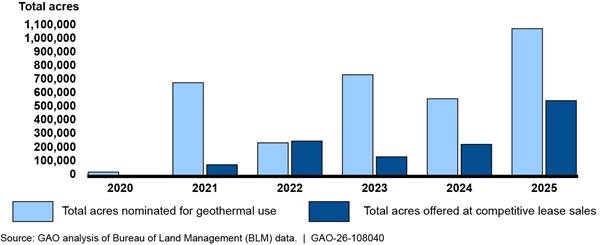
The Department of the Interior’s Bureau of Land Management (BLM) has processed an increasing volume of land nominations, leases, and permits for geothermal development on federal lands since 2019. Geothermal projects use heat from the earth’s interior to generate electricity. Parties interested in developing geothermal projects on federal lands nominate acres for BLM to review against land use plans. Such nominations increased from about 25,800 acres in 2020 to more than a million acres in 2025. BLM then offers qualifying lands for lease at auctions known as competitive lease sales, which have also increased since 2020. Once land is leased, developers submit plans to BLM for review and apply for permits at various stages of development. Drilling permits approved annually by BLM grew from seven in 2019 to 68 in 2024.
Geothermal developers and BLM officials identified various challenges facing the geothermal program, including:
· Inconsistent experience navigating the permitting process. Some developers reported instances of what they believe were inconsistent BLM determinations related to permits for exploration. BLM documentation notes that inconsistencies in terminology between developers and BLM officials may contribute to confusion or misunderstandings. However, handbooks that would resolve this confusion have been in draft since at least 2022 and are not publicly available. Without finalized geothermal resources handbooks, continued inconsistencies and misunderstandings could lead to longer development timelines and additional costs for developers.
· Limited visibility of permit data. Geothermal developers have limited visibility into the status of permits once these are submitted to BLM, which creates challenges for planning timelines and resource needs. BLM does not have comprehensive information on the status of geothermal permits, making it difficult for BLM to gain insights into permitting activity—for example, to determine if there is a growing backlog of permits across BLM field offices. By establishing a unified mechanism to track permitting activity, BLM could better track progress toward producing geothermal energy on federal land and generating revenue for federal, state, and county governments.
Why GAO Did This Study
Geothermal energy is a reliable and domestically-sourced option to help address growing demand for utility-scale power generation in the United States. Geothermal power plants on federal land have a combined 2,600 megawatts of capacity and, in 2022, generated enough electricity to power more than 1 million homes. Geothermal power plants on federal land represent about 65 percent of geothermal capacity in the United States.
GAO was asked to review geothermal leasing and permitting on federal land. This report examines (1) the extent to which BLM processed land nominations, held lease sales, and approved permits for geothermal development and (2) challenges BLM faces in managing the geothermal leasing and permitting program.
GAO analyzed BLM’s data on land nominations, lease sales, and permitting, and interviewed BLM officials in states with geothermal land nominations and leases. GAO also interviewed geothermal industry officials and administered a questionnaire to 22 geothermal developers.
What GAO Recommends
GAO is making three recommendations, including that BLM (1) finalize and publish geothermal resources handbooks and (2) establish a unified mechanism to track permitting activity. Interior did not provide comments on this report.
Abbreviations
BLM Bureau of Land Management
DOE Department of Energy
GRASS Geothermal Resources Automated Support System
MLRS Mineral and Land Records System
NEPA National Environmental Policy Act of 1969, as amended
NFLSS National Fluids Lease Sale System
NLR National Laboratory of the Rockies
Utah FORGE Frontier
Observatory for Research in Geothermal Energy
project in Utah
This is a work of the U.S. government and is not subject to copyright protection in the United States. The published product may be reproduced and distributed in its entirety without further permission from GAO. However, because this work may contain copyrighted images or other material, permission from the copyright holder may be necessary if you wish to reproduce this material separately.
September 8, 2026
The Honorable Jared Huffman
Ranking Member
Committee on Natural Resources
House of Representatives
The Honorable Susie Lee
House of Representatives
The Honorable Joe Neguse
House of Representatives
The Honorable Alexandria Ocasio-Cortez
House of Representatives
The Honorable Melanie Stansbury
House of Representatives
Geothermal energy is a renewable resource that can be used to provide a consistent and uninterrupted supply of electricity independent of weather. Geothermal energy production also creates fewer environmental impacts than using fossil fuels to generate electricity, and is a reliable and domestically sourced option to help address growing demand for utility-scale power generation in the United States.[1]
The Geothermal Steam Act of 1970, as amended, governs federal land leasing practices for geothermal resources.[2] Under the Geothermal Steam Act and implementing regulations, geothermal developers interested in leasing federal land for geothermal exploration and production can submit land nominations to the Department of the Interior’s Bureau of Land Management (BLM).[3] BLM then reviews nominations and periodically offers qualifying land at auctions (known as competitive lease sales).[4] In addition, under its implementing regulations, BLM processes permits and licenses for geothermal exploration, drilling, and energy production.[5]
Utility-scale geothermal power plants have operated on federal lands since the 1970s. According to a report from the National Laboratory of the Rockies (NLR), geothermal power plants on federal land have a combined 2,600 megawatts (MW) of installed capacity and, in 2022, generated enough electricity to power more than 1.1 million homes.[6] Based on data from the Energy Information Administration, geothermal power plants on federal land represent about 65 percent of the geothermal electricity capacity in the United States.
Recent studies estimate significant geothermal energy production potential on federal land, especially considering advanced technology that enables geothermal development in more areas. In 2024, NLR estimated that BLM and U.S. Forest Service land could support 10,000–25,000 MW of installed geothermal electric power generation by 2050.[7] That would be roughly a third of the Department of Energy (DOE)’s goal to achieve 60,000 MW of installed capacity nationwide by 2050.[8] In addition, NLR estimates that geothermal energy production using advanced technology could contribute a minimum of an additional 8,600–14,000 MW of installed capacity on federal land by 2050.
You asked us to review geothermal leasing and permitting on federal land. This report examines (1) the extent to which BLM processed land nominations, held lease sales, and approved permits for geothermal development and (2) challenges BLM faces in geothermal leasing and permitting.
To determine the extent to which BLM processed land nominations and held geothermal lease sales, we analyzed land nomination data from the National Fluids Lease Sale System (NFLSS) from 2019 through 2025 and lease sales data from 2020 through 2025.[9] We determined land nomination and lease sale data were sufficiently reliable for the purposes of our review.[10] We analyzed lease data from the Mineral and Land Records System (MLRS) to identify the number of geothermal leases on federal land as of March 2026. To examine the extent to which BLM approved geothermal drilling permits, we reviewed BLM Public Land Statistics reports with data on approved geothermal drilling permits from fiscal years 2019 through 2024.
To examine challenges, if any, that BLM faces in geothermal leasing and permitting, we reviewed DOE and NLR reports and obtained the views of BLM officials and geothermal developers. We also interviewed DOE and NLR officials knowledgeable on geothermal technology and barriers affecting geothermal development on federal land. We interviewed BLM officials in states with both geothermal land nominations and leases: California, Idaho, Nevada, New Mexico, Oregon, Washington, and Utah.[11]
We also obtained the perspectives of geothermal developers by interviewing three developers and obtaining written responses to a questionnaire from four additional developers. We coordinated our outreach to developers with Geothermal Rising—an international trade association for the geothermal industry—who distributed our questionnaire to 22 geothermal developers with experience working with BLM on leasing and permitting activities.
We conducted this performance audit from January 2025 to September 2026 in accordance with generally accepted government auditing standards. Those standards require that we plan and perform the audit to obtain sufficient, appropriate evidence to provide a reasonable basis for our findings and conclusions based on our audit objectives. We believe that the evidence obtained provides a reasonable basis for our findings and conclusions based on our audit objectives.
Background
Geothermal Energy
The heat flowing from the earth’s interior is replenished by the decay of naturally occurring radioactive elements that will continue for billions of years. Geothermal heat is observed at the surface as volcanoes, geysers, and hot springs. Under the surface, there is a range of geothermal energy, with temperatures only a few degrees to thousands of degrees above ground-surface temperatures. According to a DOE report, commercial electricity generation can be economically viable at temperatures above about 300 degrees Fahrenheit. Such temperatures are widely (but not uniformly) distributed underground and become more common with increasing depth.[12] Using existing drilling technology, developers can access such geothermal resources at depths of up to 4 miles underground, depending on site conditions.
Using geothermal energy to produce electricity requires three elements—heat, fluid, and circulation pathways through permeable rocks. Traditionally, geothermal development has occurred in areas where all three elements naturally occur (known as conventional geothermal energy). Areas with such geothermal resources are often, but not always, adjacent to surface features such as volcanoes, hot springs, and geysers. Such sites feature hot, permeable rocks deep underground that heat fluid in underground reservoirs. The heated fluid moves up through small pathways in these rocks and toward the earth’s surface, where the hot fluids can be extracted to produce energy.
With conventional geothermal energy production methods, geothermal resources suitable for utility-scale power generation are predominantly found in the western United States, Alaska, and Hawaii. As of February 2025, geothermal power plants in the United States collectively had over 4,000 MW of installed capacity, according to data from the Energy Information Administration.
Advanced technologies—known as next-generation geothermal systems—have created opportunities for developers to extract geothermal energy where fluids and permeable rock do not naturally occur. Like conventional geothermal energy production, next-generation systems also make use of the hot rock formations found deep underground. However, with next-generation systems, developers provide the fluid and permeability needed to produce electricity via manufactured fractures in the hot rock or a closed-loop system that contains fluid in underground, continuously connected pipes for the entire cycle (see fig. 1).
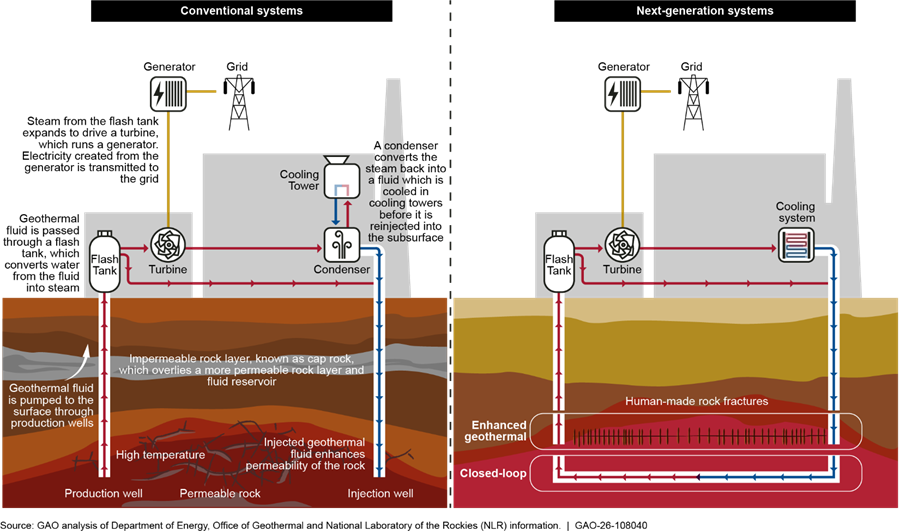
Note: The National Laboratory of the Rockies refers to next-generation systems as technologies that enable geothermal energy to be harnessed in low- to ultra-low-permeability formations through advanced drilling or stimulation techniques. This technology category currently includes enhanced geothermal systems and closed-loop geothermal systems. Enhanced geothermal systems have a human-made rock fracture network that enables subsurface fluid circulation while closed-loop systems enable the circulation of fluid without direct contact with the reservoir. Each system relies on a cooling system that is compatible with either maintaining pressure and injection fluids (closed loop system) or converting steam back into fluid, like conventional systems and enhanced geothermal systems.
Growing Private Sector Interest in Geothermal Energy
Geothermal development often involves resource uncertainties, high upfront costs, and long development timelines before generating power and realizing a return on investment. For example, geothermal developers must explore subsurface areas of interest to confirm the presence of suitable conditions for geothermal power generation. The subsurface can be examined using exploratory wells and other survey techniques that are costly and time-consuming for developers and may not find conditions necessary to generate electricity.
However, federal investment in geothermal technology research and tax incentives are contributing to technological advancements and growing private sector interest in geothermal energy production.
|
Utah Frontier Observatory for Research in Geothermal Energy (FORGE)
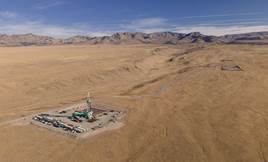
In 2014, the DOE issued a funding opportunity to build and operate a field scale underground laboratory where tools and techniques for the creation of enhanced geothermal systems (EGS), a type of next-generation geothermal technology, could be tested. Four years later, DOE determined a site near Milford, Utah, best met the requirements for an ideal test site—one with acceptable temperature, low permeability reservoir rocks, and a low potential for induced seismicity due to manufacturing fractures below the surface. Utah FORGE is the only field-scale laboratory in the world dedicated to EGS research. The site aims to accelerate EGS research and development by focusing on reservoir testing and monitoring with the goal of creating a replicable process for developing EGS resources. Source: GAO analysis of National Laboratory of the Rockies and Utah FORGE information (text); Eric Larson, Flash Point SLC (photo). | GAO‑26‑108040 |
Federal investment in research, development, and demonstration. By statute, DOE is required to conduct geothermal research, and does so through its Hydrocarbons and Geothermal Energy Office, Office of Geothermal.[13] The Office of Geothermal conducts geothermal research under the direction of various laws, such as the Energy Act of 2020.[14] The Office of Geothermal works in partnership with industry, academia, DOE’s national laboratories, and other stakeholders to increase deployment of geothermal resources through research and development that targets geothermal exploration and production. As part of these research efforts, DOE’s Frontier Observatory for Research in Geothermal Energy project in Utah (known as Utah FORGE) tested advanced drill bits and drilling technologies used in the oil and gas sector in more extreme geothermal drilling conditions, such as in hard rock. According to a 2025 NLR report, five wells drilled at Utah FORGE between 2017 and 2023 reduced drilling time needed to reach a depth of 6,000 feet from about 400 hours to 60 hours.[15]
Tax incentives. According to a 2025 NLR report, financial incentives, including expanded tax incentives, are contributing factors to the recent resurgence in geothermal leasing.[16] While tax incentives have existed for geothermal development since at least the 1970s, in recent years legislation has modified these incentives. For example, in 2022, the Inflation Reduction Act created the clean energy investment credit, which provides a base credit rate of 6 percent for qualified zero greenhouse gas emissions generation facilities, increasing to 30 percent for facilities meeting certain wage and apprenticeship requirements, with higher rates for those meeting additional requirements.[17] This credit applies to facilities that begin construction by 2035.[18]
According to a 2021 NLR report on the geothermal market, geothermal developers signed nine new power purchase agreements between 2019 and 2020 indicating to NLR researchers a renewed interest in geothermal power, especially in light of limited geothermal capacity growth since 2015.[19] In its 2025 update, NLR reported an additional 26 power purchase agreements signed since the 2021 report—indicating to researchers that the geothermal power sector is primed for substantial growth.[20] In addition, next-generation geothermal systems account for 60 percent of those 26 new power purchase agreements—an indication that geothermal developers are seeing economic opportunities as a result of these technological advancements.
BLM Authorities, Roles, and Responsibilities in Managing Geothermal Resources
BLM manages approximately 245 million surface acres—more surface land than any other federal agency—and approximately 700 million acres of subsurface mineral estate. The Federal Land Policy and Management Act of 1976, as amended, requires BLM to maintain land use plans for the areas it manages, providing for multiple uses, such as recreation, timber, fish and wildlife, and natural scenic, scientific, and historical values.[21]
All land management actions, including geothermal development, generally must conform to the approved land use plan governing the land management tract or area where the action is to take place. Consequently, geothermal development can occur only where it is consistent with the applicable land use plan.
Geothermal activities are authorized through the issuance of leases and several subsequent permits and approvals to drill fluid minerals under the Geothermal Steam Act of 1970, as amended, and implementing regulations.[22] To explore and develop geothermal resources on federal lands, developers generally must first obtain a federal lease from BLM; however, limited geothermal exploration activities may take place before a lease is issued. BLM administers its geothermal program primarily through receiving and processing land nominations and preparing leases, holding competitive lease sales, and issuing permits to develop geothermal resources.
Land nomination and leasing. Both geothermal developers and BLM can nominate land for auction at competitive lease sales. BLM state offices determine land availability for geothermal use and any stipulations required in the terms of the lease. According to BLM internal guidance and program documentation, BLM state offices coordinate with relevant BLM field offices to assess the resource on the nominated land within its jurisdiction and conduct any required environmental reviews.[23] BLM prepares a geothermal lease, to include the stipulations that dictate the conditions under which a developer may use the land.[24] If the land nominated for geothermal use is managed by another surface management agency, such as the U.S. Forest Service or Bureau of Reclamation, BLM will process land nominations and pass them to the appropriate agency for review. According to BLM guidance, the U.S. Forest Service generally leads environmental reviews for geothermal leasing on National Forest land, while BLM serves as a cooperating agency throughout the review. BLM conducts environmental reviews for all other agency land nominations and incorporates all lease stipulations provided by the other agency, as appropriate.
Lease sales. The Geothermal Steam Act of 1970, as amended, requires BLM to hold competitive lease sales at least once every 2 years in states with land nominations that BLM determined were available for geothermal use.[25] Developers bid on land to lease, and the lease goes to the highest responsible, qualified bidder, if any. Any land receiving no bids during the competitive lease sale is available noncompetitively for a fee for 2 years.
Permitting. To explore and develop geothermal resources on federal lands, developers generally must first obtain a federal lease from BLM.[26] According to internal guidance, once a lease is obtained, the developer works with local BLM field offices for approval of plans and permits to explore and then develop geothermal resources and, ultimately, to construct a geothermal power plant. These plans and permits include the following three phases:
· an exploration permit, which describes the overall process for exploratory drilling for geothermal resources;
· one or more geothermal drilling permits, which allow an applicant to drill wells to confirm and produce geothermal resources at a given location; and
· a utilization plan, which describes the proposed power plant and infrastructure needed to generate electricity from geothermal resources and provides much of the information needed to permit the power plant itself, and the associated site license and construction and commercial use permits.
Geothermal developers must submit sundry notices to BLM. These notices describe changes to previously approved plans and permits or work not covered by another type of permit. Applications for geothermal drilling permits can also be submitted after construction of a plant is completed if the developer determines that a geothermal field may benefit from additional wells.
BLM and other surface management agencies are required to comply with the National Environmental Policy Act of 1969, as amended (NEPA), when processing land nominations and reviewing plans and permits for geothermal development.[27] Interior provides guidance to BLM outlining NEPA implementation procedures and the level of environmental review necessary in response to a given action—including preparing an environmental assessment or an environmental impact statement.[28] In addition, Interior regulations and guidance identify categorical exclusions—categories of actions that normally do not have a significant impact on the environment, and therefore, generally do not require preparing an environmental assessment or environmental impact statement, absent extraordinary circumstances. BLM performs environmental reviews throughout the geothermal leasing and permitting process.
Revenues from competitive lease sales and subsequent revenue from lease rental fees and geothermal production royalties are shared among respective states and counties (which, outside of Alaska, receive 50 percent and 25 percent, respectively, with the state share subject to a 2 percent deduction for the costs of federal administration of the program) while the federal government retains the remaining 25 percent, in accordance with the act.[29]
The length of time from the start of exploration to the day on which a geothermal operation produces power and begins generating revenue is generally 8 to 10 years, according to DOE research.
BLM Has Processed an Increasing Number of Nominations, Leases, and Permits
BLM Has Processed Over 60 Percent of 2019–2025 Nominations Amid Growing Interest
From 2019 through 2025, BLM received geothermal land nominations for about 3.385 million acres of federal land and processed about 2.108 million acres (about 62 percent of the acres nominated) as of February 2026.[30] Of the 2.108 million acres processed, BLM offered about 1.245 million acres at competitive lease sales and determined that about 862,000 acres were not available for geothermal leasing. Of the 1.245 million acres offered at competitive lease sales, most (about 87 percent) were leased. As of February 2026, BLM state offices were reviewing the remaining 1.277 million acres nominated from 2019 through 2025 (see fig. 2). See appendix I for additional information on geothermal land nominations not available for lease or under review.
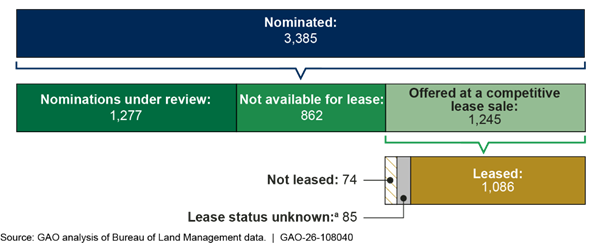
Note: Nominations under review refer to land nominations submitted to BLM that are still in process. Nominations not available for lease refer to land nominations submitted to BLM that were processed and determined to be ineligible for geothermal use. The most common reasons for BLM to reject land nominations for geothermal use were either the nomination was a duplicate of an existing nomination or that the applicable land use plan did not allow for geothermal leasing. Lands that are not leased at competitive lease sales can be acquired noncompetitively on a first-come, first-served basis for a period of 2 years.
aRecords for 84,652 (or about 85,000) acres offered at a competitive lease sale had missing land status information and it is unclear if these acres were leased or not as of February 2026.
From 2019 through 2025, BLM received land nominations for federal land managed by five agencies (see table 1). BLM-managed land represents about 97 percent of all land nominations offered at competitive lease sales within our review. BLM received land nominations for federal land within 12 national forests and three Bureau of Reclamation locations. In addition, 1,041 acres managed by the Department of Defense were nominated in California and were pending concurrence from that department as of February 2026.
Table 1: Status of 2019–2025 Geothermal Land Nominations by Surface Management Agency (as of February 2026)
|
Surface Management Agency |
Acres nominated |
Processed nominations |
|
|
(acres) |
(percent of acres nominated) |
||
|
Bureau of Land Management |
3,031,690 |
1,981,810 |
65 |
|
U.S. Forest Service |
310,791 |
95,008 |
31 |
|
Bureau of Reclamation |
41,536 |
30,980 |
75 |
|
Department of Defense |
1,041 |
0 |
0 |
|
Army Corps of Engineers |
<1 |
<1 |
100 |
|
Overall total acres/percentage |
3,385,058 |
2,107,800 |
62 |
Source: GAO analysis of Bureau of Land Management data. | GAO‑26‑108040
Note: Totals may not add up due to rounding. Processed nominations are acres that were either determined to be not available for lease or offered at a competitive lease sale.
The total acres nominated for geothermal use and acres BLM offered at competitive lease sales increased significantly from 2020 through 2025 (see fig. 3).[31] BLM land nominations increased more than fortyfold, rising from about 25,800 acres in 2020 to more than a million acres in 2025. In 2025, BLM received land nominations for over 400,000 acres in New Mexico—a significant increase over the 4,468 acres nominated in 2024. Similarly, in 2025, BLM received land nominations for over 180,000 acres in Idaho compared to just 280 acres nominated in 2020. In 2025, all BLM state offices with processed land nominations held at least one lease sale.
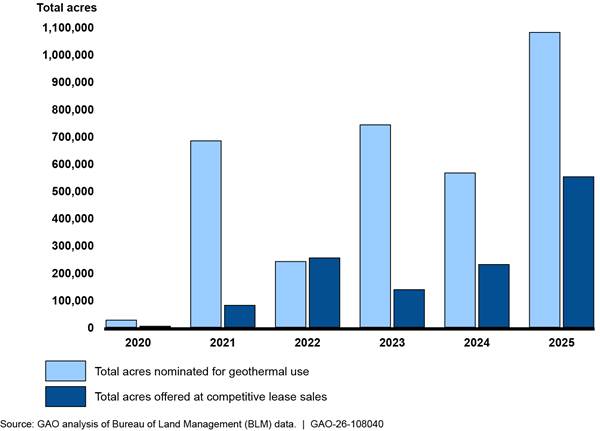
Note: Land nominations are not always offered for lease the same year they are nominated, therefore some acres offered at competitive lease sales during this period may have been nominated prior to 2020.
We reviewed land nominations submitted to BLM from 2019 through 2025 that were offered at a competitive lease sale and found that, as of February 2026, BLM took an average of 455 days to process nominations to a lease sale on BLM-managed land.[32] The average time to lease sale for BLM-managed land varies widely, depending on the state within which the nomination resides (see table 2).
Table 2: Average Days to Lease Sale for BLM-Managed Geothermal Land Nominations, 2019–2025 (as of February 2026)
|
BLM State Office |
Average time to lease sale (days) |
Total acres offered at lease sale (acres) |
Percent of 2019–2025 nominations fully processed |
|
Oregon/Washington |
1,595 |
5,235 |
100 |
|
California |
1,017 |
22,445 |
53 |
|
Idaho |
932 |
94,998 |
48 |
|
Utah |
872 |
82,168 |
77 |
|
Nevada |
335 |
998,669 |
75 |
|
New Mexico |
256 |
8,455 |
23 |
|
Overall average days/total acres |
455 |
1,211,971 |
65 |
Source: GAO analysis of Bureau of Land Management (BLM) data. | GAO‑26‑108040
Note: Totals may not add up due to rounding. Time to lease sale is the number of days between the date BLM received a land nomination to the date the land was offered for lease at a competitive lease sale. As a result, average time to lease excludes nominations that were either determined to be not available for lease or that were still being processed. However, fully processed nominations reflect both nominations that were determined to be not available for lease and nominations offered at competitive lease sales. Percentage of 2019–2025 nominations fully processed also includes 10,546 acres nominated in Montana and later withdrawn. In November 2022, 640 acres were nominated in Wyoming and is in pending status as of February 2026.
It took BLM longer to process nominations to a lease sale for lands managed by other agencies. As of February 2026, BLM averaged 1,098 days to lease sale for nominations managed by the U.S. Forest Service and Bureau of Reclamation (see table 3).[33] The average time to lease sale varied widely, depending on the surface management agency and specific location. In addition, we found that 59 percent of acres nominated on U.S. Forest Service lands were under review as of February 2026, compared with 35 percent of acres nominated on BLM lands. According to BLM officials, land nominations with a surface management agency other than BLM typically take longer to complete due to the additional coordination and review required.[34]
Table 3: Average Days to Lease Sale for Non-BLM Managed Geothermal Land Nominations, 2019–2025 (as of February 2026)
|
BLM state office |
Surface management agency |
Average time to lease sale (days) |
Total acres offered at lease sale (acres) |
|
|
U.S. Forest Service |
|
|
|
Utah |
Fishlake National Forest |
1,959 |
6,061 |
|
Nevada |
Toiyabe National Forest |
607 |
7,034 |
|
|
Bureau of Reclamation |
|
|
|
Nevada |
Lahontan Basin Project Office |
987 |
20,250 |
|
Overall average days/total acres |
1,098 |
33,345 |
|
Source: GAO analysis of Bureau of Land Management (BLM) data. | GAO‑26‑108040
Note: Totals may not add up due to rounding. Time to lease sale is the number of days between the date BLM received a land nomination to the date the land was offered for lease at a competitive lease sale. As a result, average days to lease sale excludes nominations that were determined to be not available for lease.
BLM and Interior recently implemented new guidance and process improvements that may address land nomination processing timelines.
Streamlined land nomination submissions. In December 2025, BLM revised its internal policy which had required all geothermal land nominations to be filed with paper applications with the appropriate BLM state office. With the December 2025 policy, BLM state offices have the option to receive land nominations for geothermal use electronically via NFLSS—similar to the existing practice for BLM’s oil and gas program. BLM state offices can also choose to continue requiring developers to file land nominations with paper applications. BLM expects this revised policy to improve the nomination process for both geothermal developers and BLM officials processing land nominations.
Guidance on deferred land nominations. In December 2025, BLM issued an instruction memorandum directing state offices not to defer land nominations due to ongoing or pending land use plan amendments, updates, or revisions, unless required by law or regulation.[35] As a result, the BLM Utah office offered about 73,000 acres that were previously in deferred status at a competitive lease sale in August 2026, according to NFLSS data.
Land nomination processing timeline goals. BLM’s December 2025 instruction memorandum also essentially sets goals for BLM state offices to process timely nominations for parcels on BLM-managed land within 1 year and for parcels managed by other surface management agencies within 2 years, in most cases.[36] Specifically, BLM sets a goal for annual lease sales and, where a state office has received nominations for BLM-managed lands, BLM directs the state office to offer in that annual sale at least 90 percent of nominated BLM-managed parcels that are available for geothermal use and for which the nomination was timely. In addition, for pending and timely nominations on lands managed by other agencies, the guidance directs state offices to proceed expeditiously after obtaining that agency’s consent. The memorandum also sets a goal of including at least 80 percent of such parcels in a lease sale within 2 years of the nomination submission date. While our analysis shows that, on average, BLM exceeded the timeline goals established in this instruction for past sales, BLM officials reported that BLM state offices are on track to meet these targets for future lease sales.
BLM Has Held More Geothermal Lease Sales and Received More Revenue In Recent Years
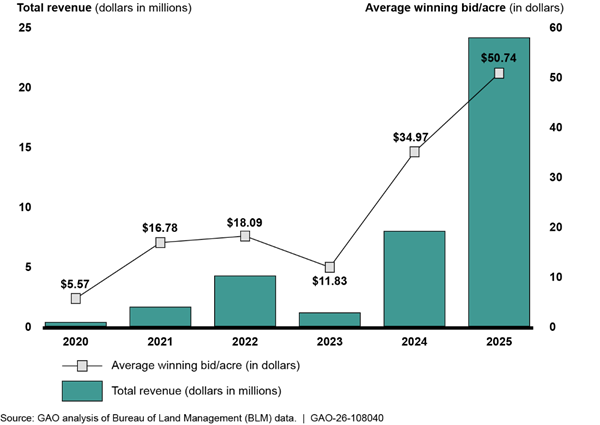
The frequency of lease sales and revenue from lease sales also increased in recent years. From 2020 through 2025, BLM held 19 competitive lease sales and generated about $39.4 million. In 2025 alone, BLM generated over $24 million across six geothermal lease sales. For example, BLM’s Idaho state office held a lease sale in September 2025—the first lease sale held in the state in over a decade, according to officials—and generated over $4.4 million by leasing about 24,000 acres for geothermal use. One lease in Idaho received a winning bid of $412 per acre—the highest bid received across all lease sales from 2020 through 2025.[37] See figure 4 for the total revenue and average winning bid per acre at competitive lease sales from 2020 through 2025.
Just as BLM has increased the frequency of lease sales, BLM is also managing a growing number of geothermal leases. As of March 2025, BLM managed 599 active geothermal leases, according to BLM documentation. By March 2026, total active geothermal leases grew to 749—an increase of about 25 percent in just one year, according to MLRS data.
BLM Has Approved an Increasing Number of Geothermal Drilling Permits Since Fiscal Year 2019
BLM has approved an increasing number of geothermal drilling permits since fiscal year 2019. BLM collects information from state and field offices on the number of approved geothermal drilling permits and the number of geothermal wells started and completed for each fiscal year. According to Public Land Statistics for fiscal year 2024, BLM approved 68 geothermal drilling permits—more than the previous 5 fiscal years combined (see table 4).[38]
|
|
2019 |
2020 |
2021 |
2022 |
2023 |
2024 |
|
Nevada |
7 |
7 |
5 |
11 |
12 |
38 |
|
Utah |
- |
1 |
- |
- |
10 |
29 |
|
California |
- |
1 |
6 |
1 |
- |
- |
|
Oregon |
- |
- |
- |
- |
- |
1 |
|
New Mexico |
- |
- |
- |
2 |
- |
- |
|
Total |
7 |
9 |
11 |
14 |
22 |
68 |
Source: GAO analysis of Bureau of Land Management reports. | GAO‑26‑108040
Similarly, BLM reported 18 new wells started in fiscal years 2024 compared to only five wells started in fiscal year 2019, according to Public Land Statistics. BLM also processes exploratory permits, commercial use permits, site licenses, and sundry notices that document changes to previously approved plans and permits.
BLM’s Geothermal Program Faces Various Challenges in Permitting and Data Management
Geothermal Developers Reported Inconsistent Experiences Navigating the Permitting Process Across BLM Field Offices
Geothermal developers we spoke with described inconsistent permitting experiences across BLM offices. For example, one developer reported inconsistencies in requirements for permitting actions for exploration and drilling activities. Specifically, the developer told us most BLM offices allowed for electronic submissions of permitting information via email, while other BLM offices requested mailed forms with wet signatures.
Additionally, some developers identified instances of what developers believe were inconsistent BLM determinations related to exploration, including casual use activities such as collecting soil, mineral, water samples, and surface disturbances of less than approximately 1 square meter.[39] Some developers reported that BLM field offices required a permit for geothermal activities that, according to developers, a different BLM field office would have considered casual use.
At the same time, BLM documentation notes inconsistencies in terminology between geothermal developers and BLM officials that may contribute to confusion or misunderstandings. Specifically, regulations define exploration operations as any activity searching for indirect evidence of geothermal resources.[40] Such activities include those in which developers are physically present on the land doing work that may cause damage to the land, such as by drilling temperature gradient wells to collect temperature data.[41]
However, according to BLM documentation, geothermal developers colloquially use the term “exploration” to describe resource drilling operations. Such operations confirm the existence of a geothermal resource by drilling much larger and deeper wells compared to temperature gradient wells. Resource drilling operations require a geothermal drilling permit, including an environmental review. Developers confirm the geothermal resource after conducting exploration activities. As a result of developers using different terminology, developers may encounter unexpected time delays and resource expenditures by incorrectly submitting an exploration operations permit application when the activity developers intend to conduct requires a geothermal drilling permit to confirm the resource.
These inconsistencies in experiences and terminology exist, in part, because BLM’s geothermal handbooks are not finalized or publicly available. According to NLR officials, NLR has supported BLM’s geothermal efforts since 2015, including supporting BLM efforts to develop geothermal resources training materials and handbooks for BLM officials.[42] BLM, with the support of NLR, developed five handbooks related to managing geothermal leases and permits for exploration, resource drilling, and utilization operations. Such handbooks are used internally by BLM to provide guidance on program management and are typically made available to the public, providing geothermal developers and others with a common understanding of BLM’s processes.
While BLM officials reported that the handbooks would complement broader progress across the geothermal program, as of June 2026, most geothermal resources handbooks have been in draft since at least 2022. According to NLR officials, NLR has no control over publication of these handbooks as this requires several BLM approvals throughout the process. BLM reported no obstacles to finalizing and publishing its geothermal resources handbooks and it continues to advance its work in alignment with bureau priorities. BLM officials did not provide an estimated timeline for when BLM will approve and finalize the geothermal resources handbooks.
According to BLM’s Directives Manual, which provides policy for updating its guidance, the bureau is responsible for developing and updating handbooks that provide detailed procedures to implement its programs.[43] If geothermal developers had access to these handbooks—as they currently do for handbooks for leasing and development of oil and gas resources and other minerals managed by BLM—then both BLM officials and geothermal developers would have shared expectations in navigating BLM’s geothermal leasing and permitting process. By finalizing geothermal resources handbooks and making the handbooks publicly available, BLM could better ensure consistent procedures across offices and inform geothermal developers on leasing and permitting requirements.
BLM Officials Reported Staffing Constraints That Have Challenged Review Schedules
A loss of staff has strained the geothermal program, according to BLM officials from some of the field and state offices we interviewed. For example, in New Mexico, geologists on staff—who balance the geothermal program workload with their work supporting the larger oil and gas and mining programs in the state—would have an unsustainable workload if the state office receives more geothermal land nominations. According to officials in one BLM office in Nevada, the office is 60 percent vacant overall and has only one of six geologist positions currently filled. Similarly, officials in California BLM offices shared that they have trouble recruiting and retaining geologists.
BLM offices have taken various steps to keep up with the geothermal workload despite workforce constraints. For example, BLM offices periodically request support from a neighboring BLM office—even when the supporting BLM office has staffing shortages itself. In addition, offices have adjusted processes. For example, BLM Nevada state office adjusted expected time frames to review annual nominations from about 11 months to closer to 15 months. The BLM California state office adopted a process of batching geothermal nominations to better manage and prioritize nominations to review for competitive lease sales, according to officials.
Sharing staff resources across BLM offices has allowed officials to administer BLM’s geothermal program in the face of vacancies and increases in land nominations and leases in recent years. However, since BLM officials are often multitasking across programs, vacancies in critical positions across offices could lead to an unsustainable workload for the remaining officials. Specifically, staffing shortages sometimes force BLM offices to face competing priorities, according to BLM officials.
In November 2021, GAO completed a review of changes in BLM’s workforce composition, following substantial changes BLM made to its organizational structure in 2016.[44] We recommended that BLM develop an agency-wide strategic workforce plan that aligns the agency’s human capital program with emerging mission goals. GAO has identified this recommendation as a priority recommendation since June 2022.[45] As of May 2026, BLM has paused implementation of a strategic workforce plan developed in January 2025. According to BLM, because human capital functions have been consolidated into the Office of the Secretary of the Interior, staff are evaluating organizational structures and priorities. We continue to believe BLM should ensure its strategic workforce plan aligns with the emerging mission goals and long-term strategies for staffing to achieve programmatic goals, such as leasing and permitting federal lands for geothermal use.
BLM Has Limited Visibility into the Permitting Process
BLM management has limited data on how the geothermal permitting process is performing, based on our review of available permitting information and interviews with BLM officials. For example, according to BLM officials, pulling together comprehensive information across BLM on the status of geothermal permit applications (i.e., how many are under review, approved, denied, or withdrawn by the applicant) would take significant time and effort. As a result, BLM cannot expeditiously evaluate or gain insights into the status of geothermal permitting activity across BLM field offices. For example, it is difficult for BLM to determine whether there is a growing backlog of permits awaiting review across BLM field offices.
BLM management has limited data because BLM state and field offices receive written permit applications from geothermal developers and these offices each use their own methods to track and manage permit applications and related permit information, such as sundry notices, utilization plans, environmental reviews, and other materials. BLM requires geothermal permit applications and other materials—such as for drilling permits, site licenses, construction permits, and commercial use permits—to be submitted in writing to the appropriate BLM office, but no longer has a system to allow for submission of these materials electronically. In contrast, BLM’s oil and gas program receives permit applications and other materials, such as applications for permits to drill, electronically.
BLM officials told us each BLM office may use different approaches to managing this information. For example, two offices said they use MLRS—a system designed to track federal lease information—to track approved geothermal drilling permits when possible. Alternatively, some field office officials reported that they developed their own spreadsheets to manage geothermal permit information.
According to BLM headquarters officials, BLM headquarters created a geothermal permit tracker template and offers it to BLM state and field offices to manage permit information. However, none of the BLM state and field office officials we spoke to reported using this spreadsheet to manage permitting information.
As recently as 2021, BLM used the Geothermal Resources Automated Support System (GRASS) to track information on geothermal operations, including permit information. According to a 2018 NLR report, BLM planned to modernize GRASS to include automated workflows for geothermal drilling permits and allow geothermal developers to electronically submit and receive updates on the status of their drilling permit.[46] While BLM expected to launch the updated version of GRASS no later than 2019, BLM pivoted to incorporate its geothermal database into another system modernization effort.[47] That system was deployed in 2021 without a mechanism to track geothermal permit information in response to significant delays and rising costs during its transition.[48] Nevertheless, BLM decommissioned GRASS in July 2021.
BLM has sought funding to develop a geothermal permitting system, but resources have not been made available. According to its FY2025 Budget Justification Review, BLM requested an increase in funding to invest in automation to track geothermal permitting milestones and support permitting studies.[49] In May 2025, BLM officials reported that BLM would like to develop an online geothermal permitting system once resources become available. In December 2025, BLM officials said that BLM is pursuing a permitting database internally, but said that there is an internal process to navigate before a final decision can be made, including decisions on funding. As of June 2026, BLM officials were unable to speculate on whether the request would be approved or provide a time frame for when BLM might launch a geothermal permitting database.
According to leading practices for performance management, agencies should collect data and use performance information to identify performance gaps and use performance information to support their missions.[50] In addition, the Presidential Memorandum “Updating Permitting Technology for the 21st Century,” as implemented by the Council on Environmental Quality’s Permitting Technology Action Plan issued in May 2025, directs the Department of the Interior and other agencies to make maximum use of technology in their environmental review and permitting process and encourages the use of data to minimize timeline uncertainties for the agency and the public.[51]
Though funding for an online permitting database may be challenging for BLM to prioritize in the current resource-constrained environment, there are less resource intensive ways to collect permitting information and make it available. For example, a spreadsheet or database in a shared drive could collect critical data. By establishing a unified mechanism to track, manage, and monitor up-to-date permitting information, including BLM review timelines, BLM could reduce uncertainty and better inform both BLM leadership and geothermal developers on progress toward producing geothermal energy on federal land.
Geothermal Developers Do Not Have Visibility on Permit Progress
Geothermal developers told us there is no certainty or visibility into the status of permits once these are submitted to BLM, which creates challenges for planning timelines and resource needs. For example, two developers reported that they do not receive feedback on the progress of a permit application or insights into what, if anything, is preventing approval on pending permit applications. In addition, one developer suggested that improved visibility on permit progress could reduce the need to solicit feedback directly from BLM officials, thereby reducing administrative burden on BLM staff and improving transparency with BLM’s permitting process.
Geothermal developers do not have certainty and visibility of BLM’s geothermal permitting process due, in part, to BLM not having a unified mechanism to track permit information, as previously discussed. Another contributing factor is BLM has not defined time frame goals for processing permits. Based on our prior work, effective performance management requires organizations to define goals.[52] Performance management activities help an organization define what it is trying to achieve, determine how well it is performing, and identify what it could do to improve results.
Until BLM defines time frame goals for processing permits, it cannot effectively measure progress and use that information to assess results and inform decisions. Moreover, without goals, there is not a shared understanding of expected time frames for processing geothermal permits between BLM staff and geothermal developers.
Conclusions
Across BLM’s geothermal program, evidence suggests that private sector interest in developing geothermal energy on federal lands has increased. In light of this interest, BLM state offices have processed more land nominations, offered more nominated acres for lease, and held more lease sales in recent years. In addition, BLM headquarters has taken steps to facilitate geothermal development on federal lands.
Nevertheless, BLM is missing key elements needed to effectively manage the geothermal program. By finalizing and publishing handbooks on leasing and permitting procedures, developing a mechanism to provide better visibility into the permitting process, and defining time frame goals for permitting processing, BLM could better ensure the program is positioned to support the nation’s goals for increasing geothermal development and realizing opportunities to generate revenue for the federal, state, and county governments.
Recommendations for Executive Action
We are making the following three recommendations to BLM:
The BLM Director should finalize geothermal resources handbooks and make them publicly available to inform both BLM officials and geothermal developers on the agency’s leasing and permitting procedures. (Recommendation 1)
The BLM Director should establish a unified mechanism to track, manage, and monitor the status of geothermal permitting activity across BLM field offices on the status of permitting reviews and accurate time frames for process completion. (Recommendation 2)
The BLM Director should define goals for the time frame to process geothermal permits. (Recommendation 3)
Agency Comments
We provided a draft of this report to the Department of the Interior for review and comment. The department provided technical comments, which we incorporated as appropriate.
As agreed with your offices, unless you publicly announce the contents of this report earlier, we plan no further distribution until 30 days from the report date. At that time, we will send copies to the appropriate congressional committees, the Secretary of the Interior, and other interested parties. In addition, the report will be available at no charge on the GAO website at https://www.gao.gov.
If you or your staff have any questions about this report, please contact me at mckelveyj@gao.gov. Contact points for our Offices of Congressional Relations and Media Relations may be found on the last page of this report. GAO staff who made key contributions to this report are listed in appendix II.
Janet McKelvey
Acting Director, Natural Resources and Environment
Appendix I: Additional Information on Geothermal Land Nominations Not Available for Lease or Under Review
We examined land nominations for geothermal use submitted to the Bureau of Land Management (BLM) from 2019 through 2025. This appendix provides additional information on the nominations that were not available for lease or under review as of February 2026.
Nominations not available for lease. According to BLM documentation, federal land could not be available for lease for multiple reasons, including the parcel did not have federal mineral rights, the nomination was withdrawn by the nominator, or the nomination was within a wilderness study area or national wildlife refuge. The most common reasons for BLM to reject land nominations for geothermal use were either the nomination was a duplicate of an existing nomination (about 27 percent of nominated acres) or that the nominated acres’ land use plan did not allow geothermal leasing (about 20 percent). In addition, about 14 percent of nominated acres were rejected because, according to BLM officials, the Department of Defense did not provide consent for geothermal development in close proximity to military installations in California and Utah.[53] According to a 2019 study from the National Laboratory of the Rockies, proximity to a military installation can be a barrier to geothermal development because the development could have potential impacts on the military mission.[54]
|
Source: GAO analysis of Bureau of Land Management (BLM) information (text); BLM/Bob Wick (photo). | GAO‑26‑108040 |

Nominations under review. Nominations under review include nominations with a land status of submitted, pending, and deferred that reflect ongoing review. Of the roughly 1.277 million acres under review as of February 2026, more than half (about 857,000 acres) were submitted in 2025. Of the land nominations submitted from 2019 through 2024, roughly half (about 234,000 acres) were in pending status at that time.[55] In addition, BLM deferred the lease sale for about 148,000 acres of federal land. According to BLM officials, deferred nominations have land use plans that support geothermal development, but other circumstances prevent BLM from processing the nomination before the next lease sale. Most of the nominations in deferred status relate to a legal dispute regarding the sage grouse, a bird native to some land potentially eligible for geothermal use.
GAO Contact
Janet McKelvey, mckelveyj@gao.gov
Staff Acknowledgments
In addition to the contact named above, Frank Rusco (Director), Quindi Franco and Karla Springer (Assistant Directors), Amy Mackay (Analyst in Charge), Matthew Bond, Kevin Donovan, Kathryn Fledderman, William Gerard, Colson Campbell Ricciardi, Cynthia Magallanes-Gonzalez, Serena Lo, Marietta Revesz, Matthew Mclaughlin, Michael Smith, and Sara Sullivan made key contributions to this report.
The Government Accountability Office, the audit, evaluation, and investigative arm of Congress, exists to support Congress in meeting its constitutional responsibilities and to help improve the performance and accountability of the federal government for the American people. GAO examines the use of public funds; evaluates federal programs and policies; and provides analyses, recommendations, and other assistance to help Congress make informed oversight, policy, and funding decisions. GAO’s commitment to good government is reflected in its core values of accountability, integrity, and reliability.
Obtaining Copies of GAO Reports and Testimony
The fastest and easiest way to obtain copies of GAO documents at no cost is through our website. Each weekday afternoon, GAO posts on its website newly released reports, testimony, and correspondence. You can also subscribe to GAO’s email updates to receive notification of newly posted products.
Order by Phone
The price of each GAO publication reflects GAO’s actual cost of production and distribution and depends on the number of pages in the publication and whether the publication is printed in color or black and white. Pricing and ordering information is posted on GAO’s website, https://www.gao.gov/ordering.htm.
Place orders by calling (202) 512-6000, toll free (866) 801-7077,
or
TDD (202) 512-2537.
Orders may be paid for using American Express, Discover Card, MasterCard, Visa, check, or money order. Call for additional information.
Connect with GAO
Connect with GAO on X,
LinkedIn, Instagram, and YouTube.
Subscribe to our Email Updates. Listen to our Podcasts.
Visit GAO on the web at https://www.gao.gov.
To Report Fraud, Waste, and Abuse in Federal Programs
Contact FraudNet:
Website: https://www.gao.gov/about/what‑gao‑does/fraudnet
Automated answering system: (800) 424-5454
Media Relations
Sarah Kaczmarek, Managing Director, Media@gao.gov
Congressional Relations
David A. Powner, Acting Managing Director, CongRel@gao.gov
General Inquiries
[1]Geothermal energy can also be used directly to provide heating and cooling locally to cities, businesses, and homes, without generating electricity first (known as direct use). This report is focused on using geothermal energy for utility-scale power generation.
[2]Pub. L. No. 91-581, 84 Stat. 1566 (codified as amended at 30 U.S.C. §§ 1001–27).
[3]30 U.S.C. § 1003(a); 43 C.F.R. §§ 3203.5(a)(1)(i), 3203.10. We use the term geothermal developers to refer to companies that nominate land for geothermal use, hold a geothermal lease, or apply for permits to explore, confirm, drill, and produce geothermal energy on federal land.
[4]30 U.S.C. § 1003(b); 43 C.F.R. §§ 3203.5(a)(2)–(3), 3203.13. BLM also has authority to lease geothermal resources for direct use, 30 U.S.C. § 1003(f), but as noted above, this report is focused on leasing and development of geothermal resources for utility-scale electricity generation.
[5]See, e.g., 43 C.F.R. §§ 3251.10, 3261.11, 3271.10, 3272.14, 3273.12, 3274.12.
[6]National Laboratory of the Rockies, 2025 U.S. Geothermal Market Report (Jan. 2026). A megawatt is 1 million watts.
[7]National Renewable Energy Laboratory. An Analysis of High Opportunity Geothermal Leasing Areas on BLM and USFS Lands (Aug. 2024). In December 2025, the National Renewable Energy Laboratory changed its name to the National Laboratory of the Rockies. As a result, some analyses cited throughout this report reference the lab’s former name.
[8]Department of Energy, Geothermal Technologies Office. Fiscal Years 2022–2026 Multi-Year Program Plan (Feb. 2022). In January 2026, the Geothermal Technologies Office changed its name to the Office of Geothermal. As a result, many analyses cited throughout this report reference the office’s former title.
[9]According to BLM officials, NFLSS was more consistently used by BLM state offices starting in 2018. NFLSS did not have any geothermal land nominations submitted in 2018, therefore this report reflects land nominations from 2019 through 2025. NFLSS does not record geothermal lease sale information prior to 2020.
[10]NFLSS data collected in February 2026 included 84,652 nominated acres with missing land status information. We determined that these nominated acres had been offered, but not leased, during a competitive lease sale. Since available data did not indicate whether these acres were leased or not as of February 2026, we excluded these data from our analyses where specific land status information is required.
[11]Of the BLM state offices we interviewed, we also interviewed select field offices within each state office jurisdiction. While there are three geothermal leases on federal land in Alaska, we excluded the Alaska state office from our review because the state did not have any geothermal land nominations in NFLSS. Similarly, while there were four land nominations in Montana, North Dakota, and Wyoming, we excluded these BLM state offices from our review because they did not have geothermal leases on federal land.
[12]Department of Energy, GeoVision: Harnessing the Heat Beneath Our Feet (May 2019).
[13]42 U.S.C. §§ 17191–17204.
[14]Consolidated Appropriations Act, 2021, Pub. L. No. 116-260, div. Z, 134 Stat. 1182, 2418 (2020). The Energy Act of 2020 is Division Z of the Consolidated Appropriations Act, 2021.
[15]National Laboratory of the Rockies. Geothermal Market Report.
[16]National Laboratory of the Rockies. Geothermal Market Report.
[17]An Act to provide for reconciliation pursuant to title II of S. Con. Res. 14, Pub. L. No. 117–169, tit. I, subtit. D, § 13702, 136 Stat. 1818, 1990–97 (codified as amended at 26 U.S.C. § 48E).
[18]Specifically, credits begin to phase out after 2032, such that the credit is zeroed out for projects which begin construction 4 or more years later. 26 U.S.C. § 48E(e)(1)–(3); see also id. at § 45Y(d)(3).
[19]National Renewable Energy Laboratory. 2021 U.S. Geothermal Power Production and District Heating Market Report (July 2021). Power purchase agreements are the contracts between geothermal developers and a utility company that allow utilities to procure electricity from power plants. These agreements make electricity prices predictable by locking them in place for the duration of the contract term, which typically lasts 15 to 25 years.
[20]National Laboratory of the Rockies. Geothermal Market Report. According to the report, the power purchase agreements represent more than 1,642 MW of new capacity commitments to be developed in the near term.
[21]Pub. L. No. 94-579, 90 Stat. 2743 (codified as amended at 43 U.S.C. §§ 1701–1781).
[22]Pub. L. No. 91-581, 84 Stat. 1566 (codified as amended at 30 U.S.C. §§ 1001–1027); 43 C.F.R. pt. 3200; see also id. at pts. 3000, 3280.
[23]BLM also has district offices, under its state offices, that guide and assist field offices in accomplishing mission activities. We use the term field offices to collectively refer to BLM’s district and field offices.
[24]The lease is a contract between the federal government and the lessee that specifies certain terms for development and payment of rents and royalties.
[25]Pub. L. No. 91-581, § 4, 84 Stat. 1566–67 (codified in relevant part as amended at 30 U.S.C. § 1003(b)(2)).
[26]Geothermal developers can request approval from BLM to conduct exploration activities on federal land before nominating or leasing land or after leasing land and on land leased by others. Certain exploration activities with little to no impact on the surface—known as casual use activities—can proceed without BLM review and approval.
[27]Pub. L. No. 91–190, 83 Stat. 852 (1970) (codified as amended at 42 U.S.C. §§ 4321–4347). As of February 2026, Interior’s Departmental Manual and amended Part 46 regulations set forth Interior’s procedures for implementing NEPA. Interior, 516 D.M. 1, “Handbook of [NEPA] Implementing Procedures” (Feb. 2026); 43 C.F.R. pt. 46.
[28]When it is not reasonably foreseeable that the proposed action will have significant effects, or when the significance of the reasonably foreseeable effects is unknown, the agency should prepare an environmental assessment. An environmental assessment is a concise public document that provides sufficient evidence and analysis for determining whether to prepare an environmental impact statement or a finding of no significant impact. When the action will have reasonable foreseeable significant effects, the agency should prepare an environmental impact statement—a more detailed statement.
[29]30 U.S.C. §§ 191(a), (b), 1019(a). For lands in Alaska, the state receives 90 percent of these revenues, subject to the 2 percent administrative costs deduction.
[30]According to NFLSS data, from 2019 through 2025, BLM received 1,006 applications nominating 8,387 legal land descriptions of varying sizes, totaling 3.385 million acres. BLM reviews nominated acres by legal land descriptions to ensure the lands are available and eligible for leasing. BLM forms parcels by combining multiple lands into a single parcel, which is then offered at competitive lease sale. For reporting purposes, we report the status of geothermal land nominations in terms of nominated acres.
[31]Due to the time BLM requires to perform pre-lease reviews of geothermal land nominations, acres offered at competitive lease sales from 2020 through 2025 include acres nominated for geothermal use prior to 2020.
[32]Time to lease sale is calculated based on the number of days between the date BLM received a land nomination to the date the land was offered for lease at a competitive lease sale. The median days to lease sale for BLM-managed nominations is 328 days. The median is lower than the average because there are some outliers where the days to lease sale took much longer than the median days to lease sale.
[33]The median days to lease sale for nominations managed by the U.S. Forest Service and Bureau of Reclamation is 987 days. The median is lower than the average because there are some outliers where the days to lease sale took much longer than the median days to lease sale.
[34]As specified in 43 C.F.R. § 3201.10(a), BLM may issue leases on lands administered by the Department of the Interior, lands administered by the Department of Agriculture with its concurrence, and lands subject to 16 U.S.C. § 818 with the Department of Energy’s concurrence.
[35]BLM, Instruction Memorandum (I.M.) 2026-004, Promoting Annual Competitive Geothermal Lease Sales (Dec. 16, 2025).
[36]BLM I.M. 2026-004 (Dec. 16, 2025).
[37]According to NFLSS data, two competitive lease sales in 2026 received winning bids that surpassed $412 per acre. BLM New Mexico and Utah state offices received winning bids of $701 and $1,207 per acre, respectively. In total, BLM generated over $41 million across these two competitive lease sales—more than all the revenue generated from competitive lease sales from 2020 through 2025.
[38]U.S. Department of the Interior Bureau of Land Management, Public Land Statistics 2024 (June 2025, Vol 209).
[39]Certain exploration activities with little to no impact on the surface—known as casual use activities—can proceed without BLM review and approval. Casual use activities do not require an exploration permit or further approval of a notice of intent.
[40]See 43 C.F.R. § 3200.1.
[41]Temperature gradient wells are typically no more than 500 feet deep with temperature data collected in no less than 30 feet intervals, according to Department of the Interior, Geothermal Resources Operational Order No.1, Exploratory Operations (Feb. 1, 1975).
[42]Training materials include 31 training module videos BLM provides to its staff, which are stored in a password-protected webpage and not available for public use.
[43]BLM, Manual MS 1221: BLM Directives (Washington, D.C.: Nov. 1, 2018).
[44]GAO, Bureau of Land Management: Better Workforce Planning and Data Would Help Mitigate the Effects of Recent Staff Vacancies, GAO‑22‑104247 (Washington, D.C.: Nov. 16, 2021).
[45]GAO, Priority Open Recommendations: Department of the Interior, GAO‑26‑109003 (Washington, D.C.: June 3, 2026). Priority recommendations are those that GAO believes warrant priority attention from heads of key departments or agencies. They are highlighted because, upon implementation, they may significantly improve government operation, for example, by realizing large dollar savings; eliminating mismanagement, fraud, and abuse; or making progress toward addressing a high-risk or duplication issue. We have highlighted the need for the Department of the Interior to improve Strategic Human Capital Management on our High Risk List for several years.
[46]National Renewable Energy Laboratory, Efforts to Streamline Permitting of Geothermal Projects in the United States (2018). In December 2025, the National Renewable Energy Laboratory changed its name to the National Laboratory of the Rockies.
[47]BLM used AFMSS and now AFMSS 2 to manage and track oil and gas development on federal land—including information on the status of oil and gas wells from initial permitting of a well through its final plugging and abandonment.
[48]GAO previously reported that BLM plans to replace AFMSS 2 with a new system, but as of January 2026, BLM has not received approval from Interior to start work on this new system. See GAO, Oil and Gas: Actions Needed to Improve Data Sharing at Interior, GAO‑26‑106475 (Washington, D.C.: Jan. 21, 2026).
[49]U.S. Department of the Interior, Bureau of Land Management, Budget Justification and Performance Information Fiscal Year 2025.
[50]GAO, Evidence-Based Policymaking: Practices to Help Manage and Assess the Results of Federal Efforts, GAO‑23‑105460 (Washington, D.C.: July 12, 2023).
[51]Presidential Memorandum “Updating Permitting Technology for the 21st Century” (Apr. 15, 2025); White House Council on Environmental Quality, Permitting Technology Action Plan (May 2025). According to the plan, timeline data should include milestones for agency actions and project sponsor actions, such as the submission of required information for application processing. In addition to tracking major milestones associated with the formal, publicly available project schedule, agency case management systems should also track events and milestones that occur before and after these major process milestones to assist with internal agency planning and ongoing process improvement. This information can assist agencies with improving transparency and accuracy of timeline estimates, which in turn can help project sponsors better plan for their application preparation and their project delivery milestones.
[52]GAO, Executive Guide: Effectively Implementing the Government Performance and Results Act, GGD-96-118 (Washington, D.C.: June 1996) and GAO‑23‑105460.
[53]10 U.S.C. § 2917 authorizes military departments to develop any geothermal resources within lands under their jurisdiction for the use or benefit of the department. These lands are not subject to leasing under the Geothermal Steam Act of 1970. See 30 U.S.C. § 1002.
[54]National Renewable Energy Laboratory, GeoVision Analysis Supporting Task Force Report: Barriers (May 2019)
[55]According to BLM documentation, a nomination in “pending” status is pending review or is under review to determine availability for leasing and has not yet been assigned to a competitive lease sale date.