
Report to Congressional Requesters
June 2026
United States Government Accountability Office
A report to congressional requesters
Contact: Allison Bawden at bawdena@gao.gov
What GAO Found
The Office of Isotope Research and Development and Production (IRP), within the Department of Energy’s (DOE) Office of Science, produced, sold, and distributed 265 isotopes during fiscal years 2020 through 2025. Many of these isotopes are critical to medical diagnosis and treatment, national security, industrial processes and manufacturing, and quantum science. IRP made over 7,700 isotope shipments, most of which were for medical purposes.
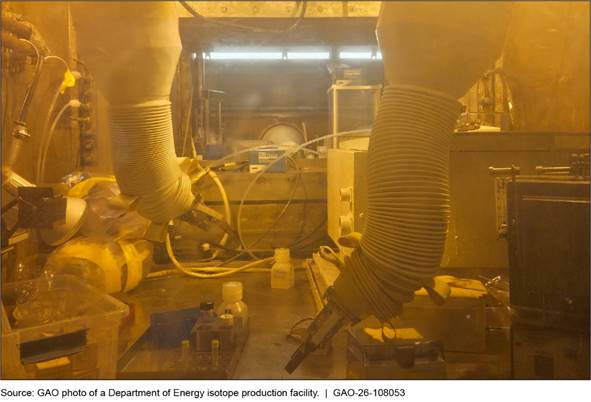
IRP assesses market needs for isotopes on a case-by-case basis and manually tracks interactions with industry, customers, and others. However, IRP has not systematically assessed needs or aligned production activities to address those needs. A university production site representative told GAO that clearer market analysis or forecasting would have enabled earlier production preparations for a critical isotope with imminent supply failure. Without a mechanism to systematically assess needs proactively and actions to address isotopes in short supply, IRP may be too slow to respond to customers, who could be forced to rely on sensitive countries to meet their needs or face supply problems.
IRP gathers information from industry and others to assess risks to isotope production and supplies, but IRP has not developed timely actions to mitigate such risks. According to IRP data, isotopes with market disruptions decreased from 40 in 2023 to 25 in 2025, but the U.S. continues to rely on sensitive countries for a majority of those remaining isotopes. Without mitigating risks, IRP may be unable to respond to emerging risks in a timely manner. This could lead to disruptions in isotope production and supplies, which have real-world implications for cancer patients, national security, and domestic industries.
Why GAO Did This Study
IRP is the only domestic supplier for many of the isotopes it sells. Many isotopes are rare or are too expensive or technically difficult for private industry to produce profitably, making IRP critical for producing them. Demand for isotopes is growing, and many of these isotopes are in short supply or represent a supply chain risk for U.S. industries.
GAO was asked to review IRP’s management of isotopes. This report examines (1) which isotopes IRP produced, sold, and distributed during fiscal years 2020 through 2025; (2) the extent to which IRP has assessed isotope market needs and aligned its activities to meet them; and (3) the extent to which IRP has assessed risks affecting the supply of selected isotopes and taken action to mitigate those risks.
GAO analyzed agency documents and data on isotope revenues, costs, sales, and shipments. GAO also reviewed documentation on IRP’s assessment of demand and risks to isotope production and supply chains. GAO interviewed IRP officials and a nongeneralizable sample of entities that received isotopes from IRP and represented the medical, industrial, and research and development sectors. GAO also visited isotope production facilities and interviewed officials at Oak Ridge National Laboratory in Tennessee.
What GAO Recommends
GAO is making four recommendations, including that DOE’s Office of Science (1) develop a mechanism to systematically assess demand and develop actions to address isotopes in short supply, and (2) mitigate risks to isotope production and supplies. The Office of Science agreed with the recommendations.
Abbreviations
DOE Department of Energy
NIDC National Isotope Development Center
NNSA National Nuclear Security Administration
IRP Office of Isotope Research and Development and Production
PET Positron Emission Tomography
This is a work of the U.S. government and is not subject to copyright protection in the United States. The published product may be reproduced and distributed in its entirety without further permission from GAO. However, because this work may contain copyrighted images or other material, permission from the copyright holder may be necessary if you wish to reproduce this material separately.
June 23, 2026
The Honorable Brett Guthrie
Chairman
The Honorable Frank Pallone, Jr.
Ranking Member
Committee on Energy and Commerce
House of Representatives
The Honorable Bob Latta
Chairman
The Honorable Kathy Castor
Ranking Member
Subcommittee on Energy
Committee on Energy and Commerce
House of Representatives
The Honorable Diana DeGette
House of Representatives
The Office of Isotope Research and Development and Production (IRP), within the Department of Energy’s (DOE) Office of Science, is the only domestic supplier for many of the more than 300 different isotopes that it provides. Many of these isotopes are critical to medical diagnosis and treatment, national security, industrial processes and manufacturing, and quantum science.[1] For example, approximately 20 million medical procedures are performed each year in the U.S. using isotopes. Other applications for isotopes include detecting radiation at ports and border crossings, exploring for oil and gas, and initiating the nuclear chain reaction in nuclear reactors. Demand for isotopes is growing, and many of these isotopes are in short supply or represent a supply chain risk for U.S. industries. Industry relies on foreign suppliers, including from sensitive countries, to obtain certain isotopes that IRP does not produce and industry cannot produce itself.[2]
IRP includes headquarters employees who oversee operations, guide research and development, coordinate with other federal agencies and industry, and set policy such as strategy, prioritization, risk management, resource allocation, and pricing. In addition to overseeing all production and research sites, IRP oversees the National Isotope Development Center (NIDC), located at Oak Ridge National Laboratory in Tennessee. NIDC serves as the nation’s interface for the production, development, and distribution of critical isotopes across DOE national laboratories and university partner facilities.
Many isotopes are too rare, expensive, or technically difficult for private industry to produce profitably, making IRP critical for producing them. IRP supports the domestic production of and development of production techniques for radioisotopes, which emit radiation, and stable isotopes, which are not radioactive.[3] IRP’s goal is to make critical isotopes more readily available to meet U.S. domestic needs when commercial markets do not or when supply chains are at risk.[4] To meet this goal, IRP operates from an annual budget consisting of yearly appropriations and revenues from isotope sales. Appropriations in fiscal year 2025 totaled about $170 million. Agency officials told us that IRP receives, on average, between $50 to $70 million in revenues from isotope sales each year.
We have previously reported on DOE’s management of isotopes. In our 2011 report on the helium-3 isotope, we found that the federal government’s awareness of and response to the helium-3 shortage was delayed because no DOE entity had stewardship responsibility for the overall management of the isotope.[5] In our 2012 report, we found that IRP had not established clear and consistent program objectives, which led to the program’s risk assessment efforts not being comprehensive.[6] In April 2025, we reported on DOE’s stewardship of the lithium-7 isotope, which is used in the operations of certain nuclear reactors.[7] Since our comprehensive review of IRP in 2012, the U.S. has continued to rely on foreign suppliers for key isotopes, some of which are in sensitive countries that could use U.S. reliance for political gain.
You asked us to conduct a comprehensive review of IRP, including whether and how it is planning to address any global and technological challenges affecting the U.S. isotope market. This report examines (1) which isotopes IRP produced, sold, and distributed during fiscal years 2020 through 2025; (2) the extent to which IRP has assessed isotope market needs and aligned its activities to meet them; and (3) the extent to which IRP has assessed geopolitical, technological, and other risks affecting the supply of selected isotopes and taken action to mitigate those risks.
To address these objectives, we reviewed agency documents on isotopes produced, sold, and distributed, including data on revenues, costs, sales, and shipment data for fiscal years 2020 through 2025. To assess the reliability of the data, we reviewed related documentation, interviewed knowledgeable DOE officials, and conducted electronic data testing to check for completeness. We found the data sufficiently reliable for our purposes. We reviewed and analyzed documentation to determine the extent of IRP’s assessment of demand, risks affecting the supply of selected isotopes, and documentation of actions IRP has taken to mitigate risks. We assessed how IRP communicated with industry and others to gather information on isotope needs and supply chain risks against the Research and Development, Competition, and Innovation Act and a DOE policy on program management.[8]
We conducted interviews with IRP officials about how they assess market needs, and how they assess and mitigate risks. We conducted a site visit to DOE’s Oak Ridge National Laboratory to view isotope production facilities and interview officials responsible for isotope production and NIDC officials who manage isotope sales and conduct assessments. We conducted semi-structured interviews with a non-generalizable sample of entities from the medical, industrial, and research and development sectors to obtain their views on how IRP addresses their needs and mitigates risks to isotope supply.[9] We selected entities that were among the top two purchasers of selected isotopes that IRP sold during fiscal years 2020 through 2025.[10] See appendix I for more detailed information on our scope and methodology.
We conducted this performance audit from February 2025 to June 2026 in accordance with generally accepted government auditing standards. Those standards require that we plan and perform the audit to obtain sufficient, appropriate evidence to provide a reasonable basis for our findings and conclusions based on our audit objectives. We believe that the evidence obtained provides a reasonable basis for our findings and conclusions based on our audit objectives.
Background
DOE’s Role in Isotope Production and Distribution
Isotope production and distribution have been part of DOE’s mission and its predecessor agency, the Atomic Energy Commission, since 1954, when the Atomic Energy Act of 1954 specified the role of the U.S. government in isotope distribution.[11] IRP fills this role by providing isotopes to support domestic and international medical, industrial, national security, and research applications. In addition, IRP provides a range of isotope-related services to customers worldwide, including isotope leasing, irradiation, and processing for both commercial and research applications.
NIDC, an organization consisting of contracted employees located at Oak Ridge National Laboratory, manages the operations involved in the production, sale, and distribution of isotopes. NIDC staff interact with national laboratories, universities, customers, and the broader isotope user community. For example, NIDC collects surveys to assist in monitoring isotope demand. In addition, officials from IRP and NIDC coordinate with many federal programs to identify current and future federal isotope needs.
IRP produces isotopes across eight DOE sites, including national laboratories, and partners with six universities to produce isotopes and invest in research and workforce development (see fig.1). IRP does not manage all DOE sites’ operations, but rather shares the use of these sites with other DOE missions, which consist of activities related to nuclear science, materials, research, energy, or defense. In addition, IRP facilities store the nation’s inventory of stable isotopes that DOE enriched decades ago during the Manhattan Project era. IRP extracts isotopes of interest from DOE-owned legacy waste or inventories to re-purpose unwanted or excess materials.
Figure 1: The Department of Energy’s (DOE) Office of Isotope Research and Development and Production Sites, Fiscal Years 2020 Through 2025
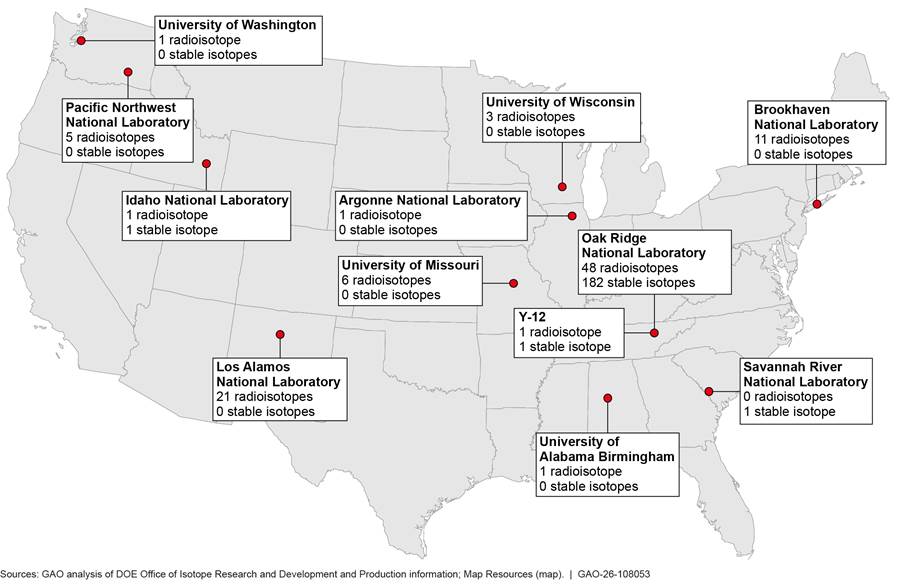
Note: Radioisotopes are isotopes that emit radiation, while stable isotopes are not radioactive. According to DOE officials, the Office of Isotope Research and Development and Production also partners with Texas A&M University and Michigan State University (not shown on map). Texas A&M University offers one isotope, but there have been no sales as of March 2026. The Office partners with Michigan State University to introduce new isotopes to the market. Officials told us that in late 2025 Michigan State University began its transition to operational status, but as of March 2026 no products have been added.
IRP Appropriations, Revenue, and Revolving Funds
IRP relies on appropriations and revenues from isotope sales to fund its operations (see fig. 2). Both yearly appropriations and sales revenues are deposited into a revolving fund.[12] The program draws from the revolving fund to cover (1) operational costs, which include isotope production, facility maintenance, employee salaries, and stand up of new production processes; (2) research and development activities, which include workforce development; and (3) federal projects for construction of new facilities. According to DOE’s fiscal year 2026 budget justification, IRP’s annual spending on research and development is generally aimed at developing new or more efficient isotope production techniques. Since the 1990s, IRP has priced isotopes at full-cost recovery or market price (whichever is higher), fostering sustainable program operations. According to DOE’s fiscal year 2026 budget justification, to further incentivize innovation and scientific advancements, isotope pricing for domestic research is strategically reduced.
Figure 2: Department of Energy (DOE) Office of Isotope Research and Development and Production Budget and Costs, Fiscal Years 2020 Through 2025
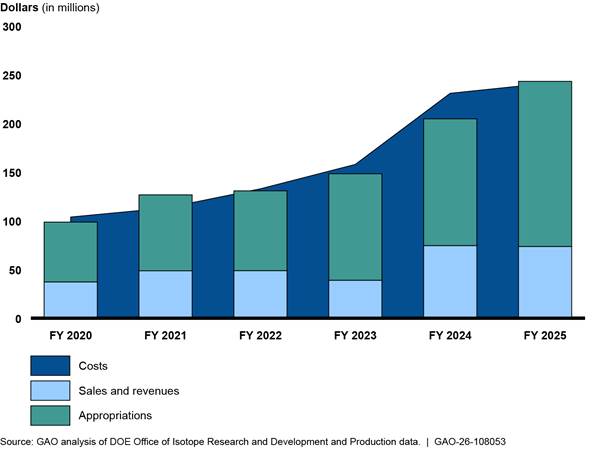
Note: The DOE Office of Isotope Research and Development and Production also received about $158 million through the Inflation Reduction Act in fiscal year 2023 and $98 million in Ukraine Emergency Supplemental funding in fiscal year 2024, which are not included in the figure. An Act to provide for reconciliation pursuant to Title II of S. Con. Res. 14, Pub. L. No. 117-169, tit. V, subtit. A, § 50172(a)(7), 136 Stat. 1818, 2051 (2022); Pub. L. No. 118-50, div. B, tit. II, 138 Stat. 895, 912 (2024).
IRP Produced, Sold, and Distributed 265 Isotopes for a Range of Purposes During Fiscal Years 2020 Through 2025
Isotopes Served Medical, Research, and Other Markets
During fiscal years 2020 through 2025, IRP produced, sold, and distributed 265 isotopes that served various markets, including medical, national security, and quantum computing. According to IRP isotope shipment data, during the same time period, IRP made 7,702 isotope shipments.[13] Of those shipments, 6,051 were of radioisotopes and 1,651 were of stable isotopes (see fig. 3).
Figure 3: Number of DOE Office of Isotope Research and Development and Production Shipments of Radioisotopes and Stable Isotopes, Fiscal Years 2020 Through 2025
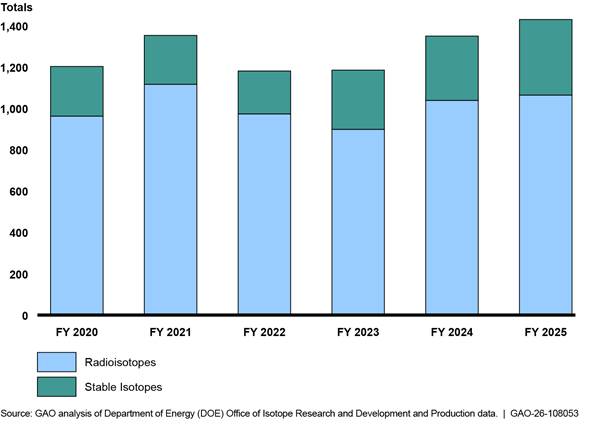
IRP-produced isotopes served various markets, but most were used for medical purposes. Our analysis of the 30 isotopes with the highest number of shipments by IRP during fiscal years 2020 through 2025 showed that about 95 percent of these shipments were isotopes used in emerging cancer therapy or other medical uses. For example, shipments of actinium-225, which is used in targeted alpha therapy to deliver radiation to cancer cells, accounted for over 50 percent of all shipments during fiscal years 2020 through 2025. For more information on the top 30 most shipped isotopes, see appendix II.
IRP Produced Isotopes at Sites Nationwide and Sourced Others Globally
As discussed above, IRP is responsible for research and development and the production and sale of isotopes distributed from eight DOE laboratories and sites, including Oak Ridge National Laboratory. IRP also partners with six universities for production, to invest in research and development, and to develop production capabilities (see table 1).
Table 1: DOE Office of Isotope Research and Development and Production (IRP) Radioisotope and Stable Isotope Shipments, Fiscal Years 2020 Through 2025
|
Production site |
Radioisotope shipments |
Stable isotope shipments |
Total isotope shipments |
|
Argonne National Laboratory |
28 |
- |
28 |
|
Brookhaven National Laboratory |
278 |
- |
278 |
|
Idaho National Laboratory |
61 |
2 |
63 |
|
Los Alamos National Laboratory |
275 |
- |
275 |
|
Oak Ridge National Laboratory |
4,925 |
1,057 |
5,982 |
|
Pacific Northwest National Laboratory |
49 |
- |
49 |
|
Savannah River National Laboratory |
- |
576 |
576 |
|
University of Alabama at Birmingham |
84 |
- |
84 |
|
University of Missouri |
298 |
- |
298 |
|
University of Washington |
21 |
- |
21 |
|
University of Wisconsin |
25 |
- |
25 |
|
Y-12 National Security Complex |
7 |
16 |
23 |
|
Total |
6,051 |
1,651 |
7,702 |
Source: GAO analysis of Department of Energy (DOE) IRP data. | GAO‑26‑108053
Note: According to DOE officials, IRP also partners with Texas A&M University and Michigan State University (not listed in table). Texas A&M University offers one isotope, but as of March 2026 there have been no sales. IRP partners with Michigan State University to introduce new isotopes to the market. Officials told us that in late 2025 Michigan State University began its transition to operational status, but as of March 2026 no products have been added.
Oak Ridge National Laboratory shipped the most isotopes of all IRP-managed facilities during fiscal years 2020 through 2025—about 81 percent of all radioisotope shipments and about 64 percent of all stable isotope shipments. Oak Ridge National Laboratory also shipped the largest number of different isotopes over this time period—48 radioisotopes and 182 stable isotopes. The largest university production site was the University of Missouri, which shipped about 5 percent of radioisotope shipments.
IRP also sourced certain isotopes internationally. According to IRP information, IRP procured isotopes from Canada, France, Germany, the Netherlands, and Sweden during fiscal years 2020 through 2025. These isotopes had a range of applications, including for cryogenics, industrial, medical, nuclear physics, and semiconductors. IRP officials told us that IRP evaluates which isotopes are needed for the upcoming year and communicates to NIDC which isotopes should be procured or produced. Officials told us that once NIDC receives this information, it engages with the production sites to initiate the procurement process.
IRP Does Not Systematically Assess or Align Actions with Market Needs
IRP gathers information on market needs for individual isotopes through various interactions with industry and research entities. IRP also relies on NIDC to understand the needs of domestic and international markets. However, IRP has not systematically assessed or aligned actions to address market needs. Furthermore, IRP has not formed an advisory committee to help it better understand and address market needs for critical isotopes, as statutorily required.
IRP Does Not Have a Mechanism to Systematically Assess and Respond to Market Needs
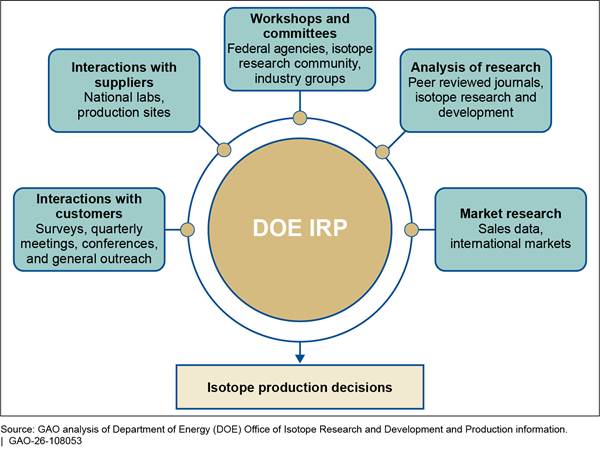
IRP gathers information on isotope market needs and responds to some individual isotope requests, but it does not have a mechanism to systematically assess overall market needs. The Research and Development, Competition, and Innovation Act requires that IRP produce critical radioactive and stable isotopes that are in short supply or projected to be in short supply in the future.[14] To do this, IRP gathers information on isotope market needs through various methods, including attending conferences with the isotope industry, and interactions with customers (see fig. 4).[15]
Figure 4: Information That DOE’s Office of Isotope Research and Development and Production (IRP) Collects on Isotope Needs That Influences Production Decisions
IRP works with NIDC to track the needs of customers seeking isotopes or isotope-related services, and NIDC collects and relays the information to IRP officials.[16] According to agency documentation, NIDC performs most of the work to track customer demand, though IRP may speak directly with customers about technical or sensitive matters. NIDC officials manually track customer interactions in a document that describes and prioritizes the actions that IRP plans to take when responding to customer needs. NIDC’s tracking document shows, for example, a customer contacted NIDC in May 2025 to inquire about producing an isotope because this customer was experiencing difficulties obtaining the isotope from a foreign supplier. IRP responded in September 2025 that it was pursuing production with material to be available in 2026. Another customer contacted NIDC in May 2025 to purchase an isotope that IRP already produces. NIDC contacted the national laboratory that produces the specific isotope to determine the quantities of the isotope that the laboratory could provide, and as of December 2025, was following up with the customer to understand their intended applications for the isotope and communicate available quantities.
IRP officials told us that prior to producing a new isotope or scaling up existing production, IRP tasks NIDC with conducting a formal market assessment to determine if industry is not meeting needs for that isotope.[17] Upon completion, IRP determines if it should continue, reduce, or expand its existing production of isotopes. IRP may also decide to take no action, other than to monitor need for the isotope. IRP documents its decisions to enter or exit an isotope market in its Production Change Order Form. The form requires justification for the program’s position and other pertinent information on production alternatives and feasibility. In addition, according to IRP documentation on forecasting practices, IRP and NIDC interact with other isotope suppliers both in the U.S. and internationally to understand their production capacity, operating cycle, and costs. These interactions include discussions with suppliers on isotope demand and integrating new production sites.
Although IRP has taken some steps to learn and respond to individual isotope market needs, it has not systematically assessed needs and aligned production activities to address those needs. According to information provided by IRP, NIDC conducted six isotope market assessments of different isotopes during fiscal years 2020 through 2025.[18] IRP officials told us that market assessments can take up to 3 months and 200 staff hours to complete.[19] We reviewed NIDC’s market assessments, which included descriptions of the isotope, market applications, production methods, supply chain, and recommendations for potential production actions.
Although NIDC’s market assessments of individual isotopes are detailed, the assessments are conducted on a case-by-case basis. According to agency documentation of IRP’s forecasting practices, IRP directs NIDC to conduct market assessments on an “as needed” basis, often when developing new supply. IRP officials told us that their decision to request a market assessment is based on their review of information from various sources, including meetings with industry representatives.
Additionally, NIDC manually adds information to multiple documents to track IRP and NIDC communications and interactions with customers and suppliers, which could be duplicative and introduce the risk of human error, making it difficult to use these documents as the basis for determining if a market assessment is needed. IRP officials said that the current manual process relies on email and paper records to assess supply and demand across the market. IRP officials stated IRP could improve aggregate data and forecasting tools to enable real-time analysis, helping avoid unnecessary investment, and support better decision-making. For instance, IRP and NIDC officials told us that they are developing ways to streamline communication, integrate isotope tracking, and capture real-time changes in production plans. However, according to these officials, the details and timetable for completing this effort are not yet final.
IRP’s ad hoc process of requesting market assessments and reacting to market needs has not always been efficient for isotope production. For instance, one IRP university production site representative we spoke with said that starting up production for some isotopes can be done relatively quickly, while other isotopes require safety analysis that can take up to 6 months before production can begin. In one such instance, IRP reacted to concerns of an imminent supply failure of an isotope that historically had been supplied by a sensitive country. IRP issued a short-notice tasking to the production site to begin producing the isotope, which takes significant time to begin production.[20] IRP officials did not have a formal market assessment or market snapshot for the specific isotope. According to the university production site representative we spoke with, clearer market analysis or forecasting of future isotope needs would have enabled earlier production preparations, possibly avoiding an imminent supply failure of a critical isotope. In this case, the production site began domestic shipments of the isotope in 2026, 2 years after a customer relayed its concerns to IRP about the isotope.
In another instance, a customer we interviewed told us that it had requested that IRP restart its domestic production of an isotope needed for medical imaging, but IRP told the company that it was not fiscally viable due to contamination concerns. A U.S. imaging equipment manufacturer ran out of its supply of the isotope and contacted IRP directly. IRP responded to the manufacturer but initially excluded the customer we interviewed from technical discussions, despite the company’s expertise in encapsulation and distribution. Only later did IRP allow the customer to manage the supply chain directly. Sustaining the supply of key isotopes is critical for medical imaging for cancer diagnosis and treatment, among other needs. Without a timely domestic production pathway, customers may not be able to meet time-sensitive patient needs or may seek critical isotopes from sensitive countries.
As noted, the Research and Development, Competition, and Innovation Act requires DOE to carry out a program to produce critical radioactive and stable isotopes that are in short supply or projected to be in short supply in the future.[21] In addition, DOE policy states that programs should determine and sequence program activities to meet delivery expectations.[22] Without a mechanism to systematically assess isotope needs proactively and developing actions to address isotopes in short supply, IRP must instead react to imminent market failures and may be slow to respond to the needs of customers. As a result, customers could be forced to rely on sensitive countries to meet their needs or experience supply problems.
IRP Has Not Established an Advisory Committee as Required by Statute
IRP has not created an advisory committee to help assess market needs as statutorily required by the Research and Development, Competition, and Innovation Act. The act requires the Secretary to establish an advisory committee to provide expert advice and assistance in carrying out the program no later than 90 days after its enactment, a deadline that passed on November 7, 2022.[23] The act requires the advisory committee to draft a report that includes assessing current demand for critical radioactive and stable isotopes, the impact of continued reliance on foreign supply of those isotopes, and proposed mitigation strategies, including increasing domestic production.[24] The advisory committee is to periodically update the report as needed.[25]
IRP officials told us that DOE had not yet established the advisory committee because of competing agency priorities, and that they had been operating with limited resources and increasing demands. IRP officials told us that they developed a charter and selected prospective committee members, but that the effort was paused when the incoming administration revisited the committee’s formation to ensure alignment with administration priorities. Additionally, officials told us that the charter expired during this pause, which they needed to resubmit to DOE for recertification. Officials told us that they were reengaging with prospective members and expected to form the committee in 2026. Without the advisory committee, IRP is not complying with the requirements of the act and is missing an opportunity to draw on expertise and assistance from the committee to better understand and thoroughly address the current demand for critical isotopes to help avoid imminent supply failures. Moreover, IRP is not using the advisory committee to inform its decisions on whether to enter or exit isotope markets and lessen reliance on foreign suppliers.
IRP Gathers Information on Risks to Isotope Production and Supply, but Has Not Developed Timely Actions to Mitigate Those Risks
IRP gathers information from various communications with industry and NIDC to assess risks to isotope production and supplies, but some isotopes continue to experience supply chain disruptions. In addition, IRP has not developed timely actions to mitigate those risks, nor has it communicated its production decisions to customers.
IRP Gathers Risk Information from Customers and NIDC but Some Isotopes Continue to Experience Supply Chain Disruptions
IRP officials told us that understanding risks is a challenge and involves gathering information from various sources, including international stakeholders, the national laboratories and isotope production sites, and NIDC. For example, IRP monitors international risks by coordinating with international counterparts, who are developing plans to reduce reliance on isotopes from sensitive countries. IRP officials told us that there may be opportunities to collaborate on those efforts to build supply chain resilience.
IRP officials told us there has been regular engagement between the national laboratories and isotope production sites to discuss risks to isotope production and supply chains. For example, one national laboratory provided us with a risk registry that describes risks to isotope production, their potential effect, and the probability of those risks occurring. Potential risks included schedule and equipment priority conflicts between major isotope production chains, scaling up isotope production to meet new demand or mitigate severe shortages, and raw material and component availability.
IRP also receives information from NIDC on emerging risks. IRP officials told us that NIDC flags concerns from customers, offers assessments, and brings forward issues based on its engagement with industry and data collection. IRP officials told us that IRP relies heavily on NIDC’s data, market engagement, and role as an integrator of information. IRP and NIDC hold biweekly calls and an IRP official meets weekly on-site with NIDC to provide relevant updates from IRP and address any questions. The IRP official also meets with NIDC’s senior leadership to discuss isotope procurement and sales, customer engagements, and any operational issues. According to IRP officials, IRP uses information provided by NIDC to monitor isotope markets.
IRP periodically assesses risks to isotope supply chains. We reviewed three risk assessments conducted during fiscal years 2020 through 2025 and found they identified isotopes with foreign dependencies that were experiencing global supply shortages.[26] The assessments identified the isotopes, documented communication that IRP or NIDC had with customers describing the shortage, and noted any actions IRP planned to take to mitigate the disruption.
Although IRP has taken actions to assess risks, some isotopes continue to experience supply chain disruptions. The number of isotopes with market disruptions has decreased from 2023 to 2025 from 40 isotopes to 25, according to IRP data, but supply chain risks continue to exist. The U.S. continues to purchase a majority of these 25 isotopes from sensitive countries, which may use U.S. reliance for political gain. For example, according to our analysis of IRP data, IRP identified 70 isotopes with potential market disruptions across three separate assessments conducted in December 2021, October 2023, and November 2025. Of the 33 isotopes that appeared in two of the three assessments, eight (about 24 percent) had zero shipments, meaning IRP had been aware of market disruptions for these isotopes for nearly 4 years but had not started shipping them. Examples include:
· Cobalt-57. IRP flagged cobalt-57—a radioisotope needed for devices that calibrate medical equipment—in 2021, 2023, and 2025 as experiencing global supply disruptions. According to a customer representative concerned about cobalt-57 being in sufficient supply, there are roughly 20,000 calibration devices in the U.S., meaning demand for cobalt-57 is high. However, IRP shipment data shows zero shipments for cobalt-57 during fiscal years 2020 through 2025. According to IRP documentation, customers communicated to DOE that they were reliant on a sensitive country for cobalt-57 and were unable to obtain sufficient quantities of the isotope. A customer representative we spoke with told us that the customer approached IRP in 2021 to ask if IRP could produce cobalt-57 with one of its accelerators, but progress has been slow. According to IRP documentation, IRP told the customer that it could potentially produce the isotope at Brookhaven National Laboratory but had not started production. According to NIDC officials, IRP requested that NIDC conduct a 5-year assessment of cobalt-57 coupled with forecasts, which NIDC updates annually to help IRP understand supply for the isotope, but IRP has not yet started producing this isotope.
· Nickel-64. IRP identified nickel-64 as experiencing global supply disruptions in 2021 and in 2025. IRP has started producing it, but not yet at commercial scale. Nickel-64 is a stable isotope used as starting material to create the radioisotope copper-64, which is used in Positron Emission Tomography (PET) scans and in clinical drug trials.[27] A customer representative we spoke with told us that nickel-64 is rare and expensive, with supply dependent on a sensitive country, and that a domestic source would be preferred. Another customer representative told us that they did not believe DOE was aware that copper-64 was emerging as the new diagnostic standard and that DOE should collaborate with other federal agencies, such as the FDA, to support a domestic supply chain of nickel-64 to support production of copper-64. IRP officials told us that they are in the pre-production phase of nickel-64 as a result of customer feedback on supply disruptions.
· Americium-241. IRP flagged americium-241, a radioisotope that is used in household smoke detectors, as experiencing global supply disruptions across all three of its assessments, and current production is not enough to mitigate supply issues. According to NIDC officials, americium-241 is also used in deep space exploration and demand is growing for the isotope, but only IRP and a sensitive country produce it. A customer representative we spoke with told us that americium-241 has strategic national importance with unresolved supply risks. The representative told us that IRP failed to meet production milestones for americium-241.
IRP Has Not Developed or Communicated Timely Actions to Mitigate Risks
IRP has not developed timely actions to mitigate risks to isotope supply chains. Specifically, IRP issued a strategic plan in July 2023 which listed isotopes of critical importance to various industries that were supplied only by sensitive countries. Although the strategic plan explains briefly what is needed to mitigate risks and fill gaps in supply, the information is not detailed or actionable. For example, the strategic plan states that additional processing capabilities are required to increase production of some isotopes and that reserves need to be replenished for some isotopes, but it does not indicate how IRP will achieve those desired outcomes. For example, Oak Ridge National Laboratory’s High Flux Isotope Reactor is scheduled to be offline for 18 months in the 2028–2029 time frame. The reactor provides one of the highest steady-state neutron fluxes of any research reactor in the world and is the primary domestic facility for producing californium-252, an isotope critical for initiating the nuclear chain reaction needed to start up a nuclear reactor and for other applications. A customer we spoke with told us that in the context of a renewed focus on nuclear energy, the loss of domestic californium-252 production would pose a serious challenge to reactor startup services and broader nuclear infrastructure. However, IRP’s planning does not show how IRP will mitigate the outage.
IRP also does not have a risk management plan that analyzes risks to isotope production or risks identified by customers to isotope supply chains. Instead, IRP officials told us they rely on manually compiled tracking documents and review production sites’ risk assessments to understand risks. However, IRP officials told us that there is room for improvement in data integration. For example, if a customer initially projects demand for 100 units of isotopes but reduces that to two units the following year, IRP does not have the forecasting tools to prevent unnecessary investments. By mapping capabilities and assigning confidence values to projections, IRP could model conservative or aggressive scenarios and make more informed decisions. Although officials told us that they are developing ways to generate visual models of real-time information that show levels of certainty and risks, they did not provide an estimated development timeline.
DOE officials told us they are developing a 5-year strategic plan, but it will not address risk management. DOE officials explained that the strategic plan would identify isotopes that DOE must produce and others for which allied partners or industry could help build redundancy and resilience into isotope supply chains. However, officials told us that the plan would not include risk information, such as risk management plans. Officials told us that a risk management plan would be a sequential next step after IRP updates its strategic plan but did not have a time frame for doing so. As of March 2026, IRP had drafted a strategic plan, but it had not yet finalized it.
We have previously reported on the federal government’s efforts to ensure there is sufficient supply of critical materials and mitigate supply chain issues. For example, in June 2022, we found that cross-cutting challenges constrained efforts to advance critical minerals recovery and substitution in the U.S.[28] In that report, we found that the U.S. is heavily reliant on imports of many minerals, such as cobalt and lithium, and supply chains for many of these minerals are also vulnerable to various risks, such as foreign government actions. We recommended that relevant federal agencies work together to update the national strategy to address issues such as risks to critical mineral supply chains, which agencies have not implemented.
The Research and Development, Competition, and Innovation Act requires IRP produce critical radioactive and stable isotopes that are in short supply or projected to be in short supply in the future.[29] Additionally, DOE policy provides guiding principles for efficient and effective program execution.[30] In particular, the policy states that DOE should implement risk management principles and practices and determine and sequence program activities to meet delivery expectations. The DOE policy also provides supplementary considerations, including that DOE identify potential risks and appropriately and proactively respond to those risks, that DOE implement a consistent and disciplined approach to responding to identified risks, and that applicable tools be used for performing risk management functions. We have previously identified characteristics that we consider to be desirable for a national strategy, including risk management.[31] Furthermore, we have previously identified leading practices for managing supply chain risks and building supply chain resilience.[32]
Assessing and mitigating risks is increasingly important given that isotopes have a wide variety of important applications, including emerging medical applications and quantum computing. IRP has identified isotopes experiencing supply disruptions, but it has not taken action to address these risks. The U.S. relies on sensitive countries for some of these isotopes, making responding to risks in a timely manner critical for IRP. Without mitigating risks to production and to isotope supplies, including identifying actions and time frames, IRP may be unable to respond to emerging risks in a timely manner, which could lead to disruptions in isotope production and supplies that have real-world implications for cancer patients, national security, and domestic industries.
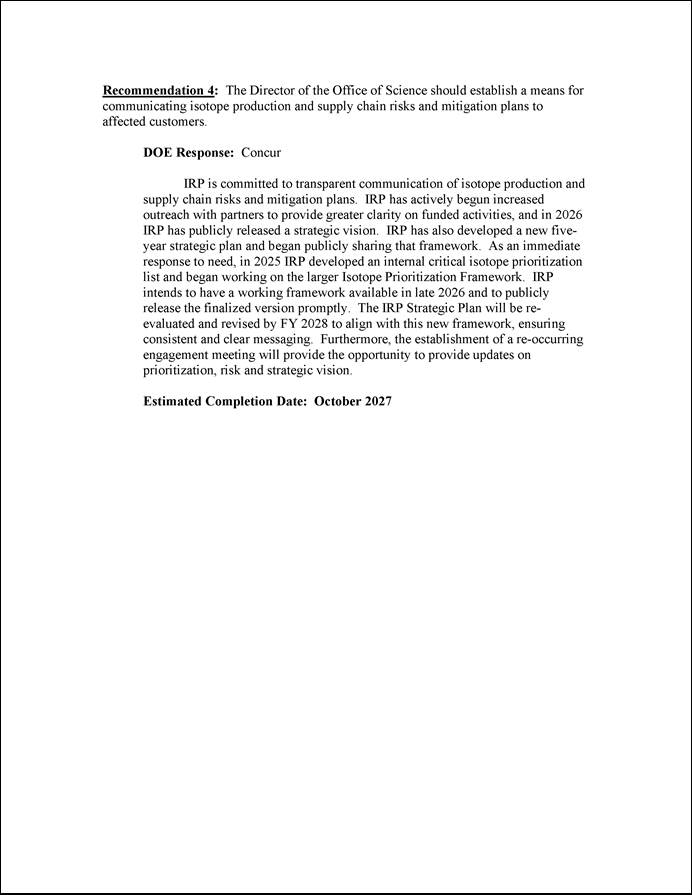
Furthermore, IRP’s reasoning for its production decisions is unclear to some customers. For example, one customer told us that they had no visibility into the criteria or rationale that DOE used to prioritize isotope production or how it evaluated supply chain vulnerabilities. Similarly, another customer we interviewed told us that communication with IRP was a problem and that they did not know what actions IRP planned to take, if any, in response to concerns they had raised with the agency. Another customer we interviewed told us that IRP does not clearly explain why certain projects are delayed, deprioritized, or rescheduled. This customer told us that IRP shifts its delivery dates without sufficient explanation, leaving suppliers uncertain about underlying constraints. Others we interviewed told us, however, that they had seen a general improvement in communication with IRP in the last year. Although IRP gathers information from customers, IRP officials also told us that they are seeking to expand public-private collaboration and to improve communication and coordination with the private sector. Federal standards for internal control state that management should communicate relevant and quality information with appropriate external parties.[33] Without IRP informing affected customers of how it is responding to risks, customers may not be able to fully participate in mitigation efforts and plan how to navigate and overcome risks while meeting the increasing need for isotopes.
Conclusions
Isotopes have a wide variety of applications and demand for them is growing, but many are in short supply or represent a supply chain risk for U.S. industries. IRP is often one of the few producers of critical isotopes and, during fiscal years 2020 through 2025, made over 7,700 shipments of 265 isotopes for medical therapies and diagnostics, national security, quantum computing, and other applications. However, IRP’s ad hoc assessment of market needs has at times hindered its ability to make timely production decisions that respond to changes in supply and demand, and it is not drawing on expertise that could assist it in understanding demand for critical isotopes despite a legal requirement to do so. In addition, IRP has not developed actions to mitigate risks to isotope production and supplies, nor has IRP communicated its risk mitigation plans to those most affected by market disruptions. As the U.S. government strives to produce critically important isotopes, taking actions to better understand the evolving marketplace and mitigate emerging risks would better position IRP to target its isotope production to enable vital applications.
Recommendations for Executive Action
We are making the following four recommendations to DOE’s Office of Science:
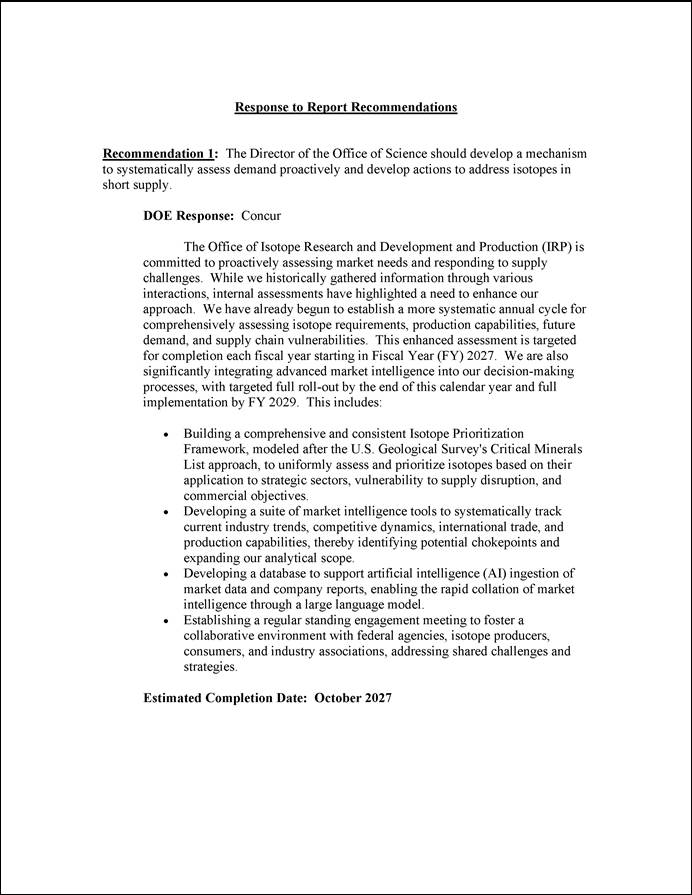
The Director of the Office of Science should develop a mechanism to systematically assess demand proactively and develop actions to address isotopes in short supply. (Recommendation 1)
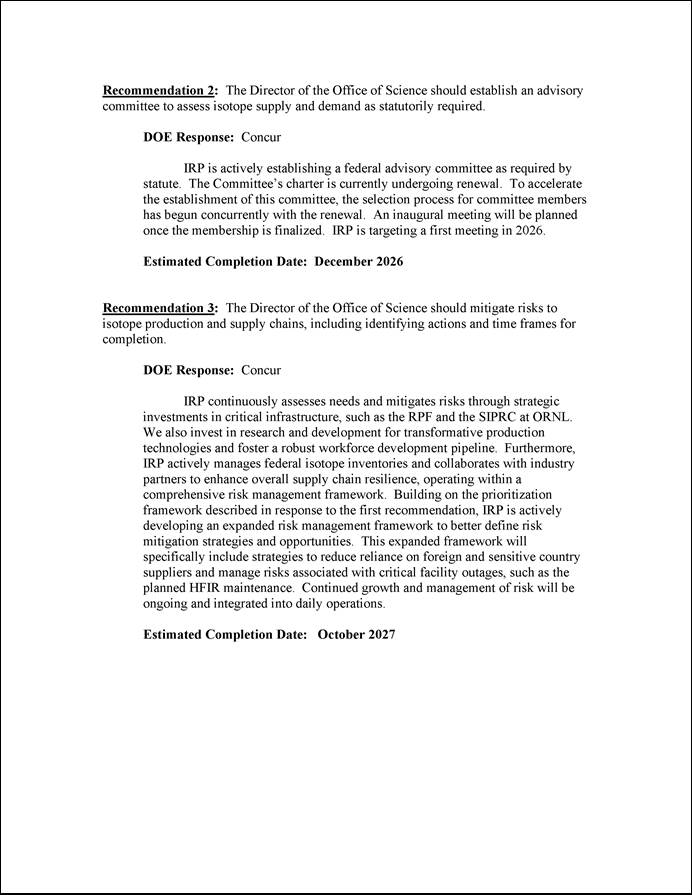
The Director of the Office of Science should establish an advisory committee to assess isotope supply and demand as statutorily required. (Recommendation 2)
The Director of the Office of Science should mitigate risks to isotope production and supply chains, including identifying actions and time frames for completion. (Recommendation 3)
The Director of the Office of Science should establish a means for communicating isotope production and supply chain risks and mitigation plans to affected customers. (Recommendation 4)
Agency Comments
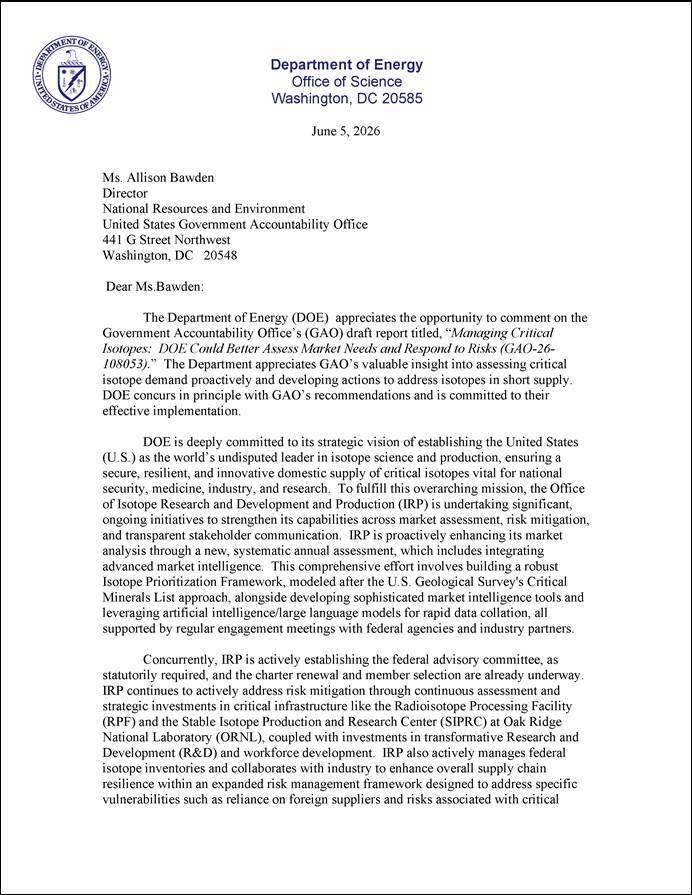
We provided a draft of this report to DOE for review and comment. In its comments, reproduced in appendix III, DOE concurred with all four recommendations. DOE stated that it plans to take several actions by October 2027, which include establishing a prioritization framework and developing other tools to collect and analyze market trends, developing a risk management framework, and finalizing its 5-year strategic plan to increase transparency with stakeholders. DOE also plans to establish the federal advisory committee by December 2026. DOE also provided technical comments, which we incorporated as appropriate.
As agreed with your offices, unless you publicly announce the contents of this report earlier, we plan no further distribution until 30 days from the report date. At that time, we will send copies to the appropriate congressional committees, the Secretary of Energy, and other interested parties. In addition, the report is available at no charge on the GAO website at https://www.gao.gov. If you or your staff have any questions about this report, please contact me at bawdena@gao.gov. Contact points for our Offices of Congressional Relations and Media Relations may be found on the last page of this report. GAO staff who made key contributions to this report are listed in appendix IV.

Allison Bawden
Director, Natural Resources and Environment
This report examines (1) which isotopes the Department of Energy’s (DOE) Office of Isotope Research and Development and Production (IRP) produced, sold, and distributed during fiscal years 2020 through 2025; (2) the extent to which IRP has assessed isotope market needs and aligned its activities to meet them; and (3) the extent to which IRP has assessed geopolitical, technological, and other risks affecting the supply of selected isotopes and taken action to mitigate those risks.
To describe which isotopes IRP produced, sold, and distributed during fiscal years 2020 through 2025, we reviewed agency documents on IRP’s mission and statutes. We also reviewed agency data on appropriations, costs, isotope revenues, sales, and isotope purchases. We also reviewed data on isotope shipments from IRP production sites during fiscal years 2020 through 2025. To assess the reliability of the data, we reviewed related documentation, interviewed knowledgeable DOE officials, and conducted electronic data testing to check for completeness. We found the data sufficiently reliable for our purposes.
To examine the extent to which IRP has assessed isotope market needs and aligned its activities to meet them, we reviewed and analyzed documentation to determine the extent of IRP’s assessment of demand and how IRP gathered information on market needs. We also reviewed agency documents outlining how IRP decides to enter or exit an isotope market. We reviewed IRP and National Isotope Development Center (NIDC) documents tracking communications with customers and any agency actions taken in response to those communications. We also reviewed NIDC’s market snapshots and market assessments and assessed them for completeness. We conducted interviews with IRP officials about how they assess market needs. We visited DOE’s Oak Ridge National Laboratory to view isotope production facilities and interviewed laboratory officials responsible for isotope production and NIDC officials that manage isotope sales and conduct assessments. We assessed documentation and information provided in interviews against the Research and Development, Competition, and Innovation Act and a DOE policy on program management.[34]
We conducted semi-structured interviews with a non-generalizable sample of entities from the medical, industrial, and research and development sectors to obtain their views on how IRP addresses their needs and mitigates risks to isotope supply. We selected entities from three categories of isotope applications: medical, industrial (e.g., oil and gas production), and research.[35] To identify potential interviewees within these categories, we reviewed names of IRP customers who received shipments during fiscal years 2020 through 2025, and gathered names of entities by conducting a review of relevant literature and publicly available information, such as DOE news briefs. We asked IRP and entities we interviewed for additional recommendations of whom we should interview and added them to our list of potential interviewees.
From the list of entities we identified, we selected seven that were among the top two purchasers of selected isotopes that IRP sold during fiscal years 2020 through 2025. We selected isotopes with 10 or more shipments over the period we reviewed. We selected isotopes with 10 or more shipments to capture isotopes that have a consistently high number of shipments and emerging isotopes that may have only recently begun to increase in demand. Of the entities we selected to interview, we ensured there was a range of isotope types for medical, industrial, and research purposes. The views of the entities we interviewed are not generalizable to other entities that we did not interview.
To examine the extent to which IRP has assessed geopolitical, technological, and other risks affecting the supply of selected isotopes and taken action to mitigate those risks, we reviewed and analyzed agency documentation of the risks affecting selected isotopes and any actions IRP took to mitigate those risks. Geopolitical risks included foreign dependencies on sensitive countries, technological risks included risks to schedule and equipment risks to production, and other risks included risks to supply chains. Documentation included risk assessments that IRP and NIDC conducted in December 2021, October 2023, and November 2025 that identified isotopes experiencing market disruptions. We compared those identified isotopes to isotope shipment data to determine the extent to which IRP has produced isotopes flagged as having market disruptions. We also analyzed the number of isotopes experiencing market disruptions and their foreign dependencies. We reviewed IRP’s 2023 strategic plan to determine if the plan identified risks and spoke with officials about IRP’s draft strategic planning efforts and whether those efforts would include risk assessment or management. We also reviewed IRP’s communication efforts with industry and others to gather information on supply chain risks. We assessed this information against the Research and Development, Competition, and Innovation Act and a DOE policy on program management.[36] We conducted interviews with IRP officials about how they assess and mitigate risks, and how IRP communicates with NIDC, production sites, and customers to understand risks to isotope production and supply chains. We also conducted semi-structured interviews with the same non-generalizable sample of entities to understand customer perspectives on how IRP was assessing and mitigating risks.
We conducted this performance audit from February 2025 to June 2026 in accordance with generally accepted government auditing standards. Those standards require that we plan and perform the audit to obtain sufficient, appropriate evidence to provide a reasonable basis for our findings and conclusions based on our audit objectives. We believe that the evidence obtained provides a reasonable basis for our findings and conclusions based on our audit objectives.
Table 2: Top 30 Isotopes Shipped by the Department of Energy’s Office of Isotope Research and Development and Production, Fiscal Years 2020 Through 2025
|
Isotope |
Shipments |
Uses |
|
Actinium-225 |
3820 |
Medical |
|
Lutetium-177 |
591 |
Medical |
|
Helium-3 |
583 |
Medical, national security, quantum science, research |
|
Actinium-225 (accelerator produced) |
275 |
Medical |
|
Thorium-228 |
166 |
Medical |
|
Heavy water |
91 |
Medical, nuclear reactors, quantum science |
|
Strontium-82 |
86 |
Medical |
|
Lead-203 |
84 |
Medical |
|
Germanium-76 |
72 |
Research |
|
Radium-224 |
72 |
Medical |
|
Lead-212 |
71 |
Medical |
|
Mercury-202 |
70 |
Research |
|
Rubidium-87 |
68 |
Medical, research |
|
Radium-226 |
66 |
Medical, research |
|
Cerium-134 |
61 |
Medical |
|
Cobalt-60 |
61 |
Medical |
|
Californium-252 |
50 |
Medical, national security, nuclear reactors, oil and gas, research |
|
Sodium-22 |
39 |
Medical |
|
Tungsten-188 |
33 |
Medical |
|
Mercury-199 |
32 |
Research |
|
Nickel-63 |
31 |
National security |
|
Copper-67 |
28 |
Medical |
|
Thorium-227 |
27 |
Medical |
|
Ytterbium-171 |
27 |
Quantum science |
|
Astatine-211 |
26 |
Medical |
|
Silicon-28 |
26 |
Quantum science, research |
|
Lithium-6 |
23 |
National security |
|
Barium-133 |
21 |
Medical, quantum science, oil and gas |
|
Actinium-227 |
21 |
Medical |
|
Samarium-149 |
20 |
Nuclear reactors |
Source: GAO analysis of Department of Energy’s Office of Isotope Research and Development and Production data. | GAO‑26‑108053
Note: This table presents information on the number of isotope shipments because isotope quantities, such as microcuries or micrograms, are measured in different units and are not comparable. The number of shipments does not necessarily correspond to the isotope’s importance. Other factors governing shipments include level of demand and whether there are other entities that produce the isotope, such as private industry or universities.
GAO Contact
Allison Bawden, bawdena@gao.gov
Staff Acknowledgments
In addition to the contact named above, Wyatt R. Hundrup (Assistant Director), Marie Bancroft (Analyst in Charge), Adrian Apodaca, R. Scott Fletcher, William Gerard, Matthew McLaughlin, Claire McLellan, James A. Reynolds, Ryan Rudolph, William Russell, Michael Smith, Andrew Stavisky, and Ned Woodward made key contributions to this report.
The Government Accountability Office, the audit, evaluation, and investigative arm of Congress, exists to support Congress in meeting its constitutional responsibilities and to help improve the performance and accountability of the federal government for the American people. GAO examines the use of public funds; evaluates federal programs and policies; and provides analyses, recommendations, and other assistance to help Congress make informed oversight, policy, and funding decisions. GAO’s commitment to good government is reflected in its core values of accountability, integrity, and reliability.
Obtaining Copies of GAO Reports and Testimony
The fastest and easiest way to obtain copies of GAO documents at no cost is through our website. Each weekday afternoon, GAO posts on its website newly released reports, testimony, and correspondence. You can also subscribe to GAO’s email updates to receive notification of newly posted products.
Order by Phone
The price of each GAO publication reflects GAO’s actual cost of production and distribution and depends on the number of pages in the publication and whether the publication is printed in color or black and white. Pricing and ordering information is posted on GAO’s website, https://www.gao.gov/ordering.htm.
Place orders by calling (202) 512-6000, toll free (866) 801-7077,
or
TDD (202) 512-2537.
Orders may be paid for using American Express, Discover Card, MasterCard, Visa, check, or money order. Call for additional information.
Connect with GAO
Connect with GAO on X,
LinkedIn, Instagram, and YouTube.
Subscribe to our Email Updates. Listen to our Podcasts.
Visit GAO on the web at https://www.gao.gov.
To Report Fraud, Waste, and Abuse in Federal Programs
Contact FraudNet:
Website: https://www.gao.gov/about/what-gao-does/fraudnet
Automated answering system: (800) 424-5454
Media Relations
Sarah Kaczmarek, Managing Director, Media@gao.gov
Congressional Relations
David A. Powner, Acting Managing Director, CongRel@gao.gov
General Inquiries
[1]Isotopes are varieties of a given chemical element with the same number of protons but different numbers of neutrons. For example, the helium-3 isotope, which is used in research and to detect neutrons from smuggled nuclear devices, has one less neutron than the helium-4 isotope, which is the helium isotope commonly used in party balloons.
[2]DOE defines a sensitive country as a country to which particular consideration is given for policy reasons. Countries may appear on the sensitive country list for reasons of national security, nuclear nonproliferation, or terrorism support.
[3]Radioisotopes are radioactive—that is, they are unstable forms of elements that decay or disintegrate, emitting radiation. Some radioisotopes are found naturally, and others can be produced in nuclear reactors or particle accelerators. Stable isotopes do not decay or emit radiation and are therefore not radioactive.
[4]DOE’s National Nuclear Security Administration (NNSA)—a separately organized agency within DOE—and IRP maintain a collaborative relationship. For example, while IRP has statutory authority and responsibility for commercial supply of isotopes, it offers technical and management support to NNSA, which is responsible for domestic molybdenum-99 production. IRP also interacts with NNSA on other isotopes including americium-241 and helium-3. Our review is focused solely on IRP activities.
[5]GAO, Managing Critical Isotopes: Weaknesses in DOE's Management of Helium-3 Delayed the Federal Response to a Critical Supply Shortage, GAO‑11‑472 (Washington, D.C.: May 12, 2011). We made four recommendations for the agency to (1) clarify whether the stewardship for isotopes belongs with the Isotope Program or elsewhere within DOE; (2) develop and implement a communication process that provides complete information to the assigned entity on the production and inventory of isotopes that are produced outside the Isotope Program; (3) systematically assess and document risks to managing the isotopes and supporting activities, such as not having control over the supply of these isotopes, and implement actions needed to mitigate them; and (4) develop and implement a method for forecasting the demand of isotopes that is more accurate than the one that is currently used. The agency implemented the first, second, and fourth recommendations. The agency did not believe further action was necessary and made no plans to address the third recommendation, which we closed as not implemented.
[6]GAO, Managing Critical Isotopes: DOE’s Isotope Program Needs Better Planning for Setting Prices and Managing Production Risks, GAO‑12‑591 (Washington, D.C.: May 23, 2012). We made four recommendations for the agency to (1) clearly define the factors to be considered when the program sets prices for isotopes sold commercially; (2) create clear goals and objectives to serve as a basis for risk assessment, identify risks to achieving its goals and objectives, and determine what actions to take to manage the risks; (3) consolidate the lists of high-priority isotopes so the program can ensure that its resources are focused on the most important isotopes; and (4) establish clear guidance for managing the revolving fund to ensure that the fund is sufficient to use as a contingency for unexpected losses in revenue. The agency implemented the first, second, and fourth recommendations. The agency did not believe further action was necessary and made no plans to address the third recommendation, which we closed as not implemented.
[7]GAO, Nuclear Energy: Department of Energy Needs to Improve Stewardship of Lithium-7, GAO‑25‑107626SU (Washington, D.C.: Apr. 30, 2025).
[8]Department of Energy, Program Management, Policy 410.3 Chg. 1 (Washington, D.C.: Jan. 30, 2025); An Act Making appropriations for Legislative Branch for the fiscal year ending September 30, 2022, and for other purposes (FY22 Legislative Branch Appropriations Act), Pub. L. No. 117–167, div. B, tit. I, § 10110(a), 136 Stat. 1366, 1452-54 (2022) (codified in relevant part at 42 U.S.C. § 18649). Division B of the FY22 Legislative Branch Appropriations Act is the Research and Development, Competition, and Innovation Act.
[9]We selected entities from three categories of isotope applications: medical, industrial (e.g., oil and gas production), and research. However, isotope applications can be used for various purposes, such as quantum computing and national security.
[10]We selected isotopes with 10 or more shipments over the period we reviewed. Of the entities we selected to interview, we ensured there was a range of isotope types for medical, industrial, and research purposes.
[11]Atomic Energy Act of 1954, ch. 1073, Pub. L. No. 83-709, 68 Stat. 919 (codified as amended at 42 U.S.C. §§ 2011–2281).
[12]The IRP’s revolving fund was first established in the act making energy and water development appropriations for fiscal year 1990. Pub. L. No. 101-101, tit. III, 103 Stat. 641, 659 (1989).
[13]IRP provided data on both the number of isotope shipments and the quantities of each shipment during fiscal years 2020 through 2025. Because isotopes are measured in different units—for example, microcuries or micrograms—isotope quantities were not comparable. We instead analyzed the number of isotope shipments across this time. IRP data on shipments included newly produced isotopes, such as radioisotopes with short half-lives, and inventoried isotopes, such as radioisotopes and stable isotopes that IRP production sites have in storage.
[14]Pub. L. No. 117–167, § 10110(a), 136 Stat. at 1452-54 (codified at 42 U.S.C. § 18649). Specifically, this act mandates that the Director of the Office of Science carry out a program for, among others, the production of critical radioactive and stable isotopes that are in short supply or projected to be in short supply in the future, including byproducts, surplus materials, and related isotope services.
[15]Agency officials provided us with their demand forecasting practices, which include all activities conducted by IRP and NIDC to plan isotope production and anticipate increases or shortages of isotope supply. Activities are outlined in five categories: general market activities, interactions with customers, interactions with suppliers, workshops and committees, and evaluation of research activities.
[16]For the purposes of this report, we define customers as those who purchase isotopes from IRP. A customer may also play other roles in the isotope market, such as producing new isotopes using inputs purchased from IRP.
[17]According to agency officials, there are no provisions of law and no analogous policy statements that define or prescribe the conditions under which the program will move into and out of markets for stable isotopes. However, DOE policy states that it will withdraw from markets if it determines that the isotopes are reasonably available from commercial sources. As noted above, DOE by statute is required to carry out a program for the production of critical radioactive and stable isotopes in short supply or forecasted to be in short supply in the near future, and to ensure that its efforts do not compete with or adversely affect efforts by the private sector to supply such isotopes. 42 U.S.C. § 18649(b)(1), (4).
[18]NIDC also conducted nine market snapshots of individual isotopes. These market snapshots are abbreviated assessments of individual isotopes that provide general market information. According to NIDC officials, these snapshots can be produced more quickly than a formal market assessment.
[19]IRP officials told us that one assessment includes over 130 cited sources, which include discussions with companies operating in the market, and internal documents.
[20]According to the IRP production site representative, the isotope is used to calibrate imaging systems in hospitals, which support scans that are performed tens of thousands of times per day in the United States.
[21]Pub. L. No. 117–167, § 10110(a), 136 Stat. at 1452-54 (codified in relevant part at 42 U.S.C. § 18649(b)(1)).
[22]See DOE P 410.3 Chg. 1 (rev’d Jan. 30, 2025).
[23]Pub. L. No. 117–167, § 10110(a), 136 Stat. at 1452-54 (codified in relevant part at 42 U.S.C. § 18649(c)(1)). The Research and Development, Competition, and Innovation Act was enacted on August 9, 2022.
[24]Pub. L. No. 117–167, § 10110(a), 136 Stat. at 1452-54 (codified in relevant part at 42 U.S.C. § 18649(c)(2)). The Federal Advisory Committee Act (FACA) governs, among others, the establishment, operation, and termination of advisory committees within the executive branch of the Federal Government. Pub. L. No. 92-463, 86 Stat. 770 (1972) (codified at 5 U.S.C. §§ 1001–14). FACA defines what constitutes a federal advisory committee and provides general procedures for the executive branch to follow for the operation of these committees.
[25]42 U.S.C. § 18649(c)(2)(A)(ii).
[26]Documents included IRP analysis of isotopes with market disruptions from December 2021, October 2023, and NIDC analysis from November 2025.
[27]PET scans detect early signs of cancer, heart disease, and brain conditions.
[28]GAO, Critical Minerals: Building on Federal Efforts to Advance Recovery and Substitution Could Help Address Supply Risks, GAO‑22‑104824 (Washington, D.C.: June 16, 2022).
[29]See Pub. L. No. 117–167, § 10110(a), 136 Stat. at 1452-54 (codified in relevant part at 42 U.S.C. § 18649(b)(1)).
[30]DOE Policy 410.3.
[31]GAO, Combating Terrorism: Evaluation of Selected Characteristics in National Strategies Related to Terrorism, GAO‑04‑408T (Washington, D.C.: Feb. 3, 2004).
[32]GAO, National Nuclear Security Administration: Explosives Program Is Mitigating Some Supply Chain Risks but Should Take Additional Actions to Enhance Resiliency, GAO‑25‑107016 (Washington, D.C.: Mar. 12, 2025).
[33]GAO, Standards for Internal Control in the Federal Government, GAO‑25‑107721 (Washington, D.C.: May 15, 2025).
[34]Department of Energy, Program Management, Policy 410.3 Chg. 1 (Washington, D.C.: Jan. 30, 2025); An Act Making appropriations for Legislative Branch for the fiscal year ending September 30, 2022, and for other purposes (FY22 Legislative Branch Appropriations Act), Pub. L. No. 117–167, div. B, tit. I, § 10110(a), 136 Stat. 1366, 1452-54 (2022) (codified at 42 U.S.C. § 18649). Division B of the FY22 Legislative Branch Appropriations Act is the Research and Development, Competition, and Innovation Act.
[35]Isotope applications can be used for other purposes, such as quantum computing and national security.
[36]Pub. L. No. 117–167, § 10110(a), 136 Stat. at 1452-54 (codified at 42 U.S.C. § 18649); DOE P 410.3 Chg. 1 (rev’d Jan. 30, 2025).