
Report to Congressional Requesters
United States Government Accountability Office
A report to congressional requesters
Contact: Chelsa Kenney at kenneyc@gao.gov
What GAO Found
Transnational criminal organizations (TCO) in Mexico seek to acquire semi-automatic firearms—AR-15s, AK-47s, and .50-caliber rifles—which they often convert to fully automatic firearms, according to agency officials. Armed with these weapons, TCOs pose a serious threat to Mexican law enforcement and military. TCOs acquire firearms from the U.S. primarily through straw purchasers—third parties who buy them on the TCOs’ behalf—and middlemen who smuggle the firearms through ports of entry on the border.
U.S. agencies collect data on trafficked firearms, but some data have limitations that limit their utility. The Bureau of Alcohol, Tobacco, Firearms and Explosives (ATF) reported that 68 percent (82,785) of firearms recovered in Mexico and traced from January 2020 to December 2024 had a U.S. source. Department of Homeland Security (DHS) U.S. Customs and Border Protection (CBP) data show that CBP seized 4,944 firearms bound for Mexico at land ports of entry on the border from January 2020 through December 2025. However, CBP’s data system does not consistently capture information on the semi-automatic rifles sought by TCOs, and some officers may have difficulty identifying specific types. Improved data on these types of rifles would strengthen federal agencies’ ability to generate intelligence to combat firearms trafficking from the U.S. to Mexico.
U.S. agencies conduct various efforts to combat firearms trafficking but do not assess effectiveness. For example, in the U.S., CBP conducts targeted outbound inspections along the U.S.–Mexican border and DHS’s Homeland Security Investigations and ATF seek to disrupt firearms trafficking along the border. In Mexico, ATF helps Mexican authorities conduct investigations and trace firearms. The Department of State’s Bureau of International Narcotics and Law Enforcement Affairs (INL) provides security assistance to Mexican authorities to combat firearms trafficking. In fiscal years 2020–2025, ATF and INL provided about $126 million for these efforts. But DHS has not established goals, desired outcomes, or performance measures that include baselines and targets for its efforts. ATF also lacks performance measures, after discontinuing measures it established in fiscal year 2023, and INL lacks baselines, targets, and results for some of its measures. As a result, the agencies do not know the extent to which their efforts are meeting objectives and cannot determine whether they are directing resources to the most effective programs. This could lead to waste and, potentially, missed opportunities to more effectively counter firearms trafficking.
Why GAO Did This Study
Estimates indicate that hundreds of thousands of firearms are trafficked from the U.S. into Mexico each year, presenting a serious threat to Mexican and U.S. security. TCOs in Mexico use increasingly deadly firearms as well as technology and drones. In February 2025, State designated six Mexican cartels as foreign terrorist organizations and as specially designated global terrorists.
GAO was asked to review U.S. efforts to combat firearms trafficking to Mexico. This report examines (1) the types of firearms TCOs in Mexico seek in the U.S. and the methods they use to illegally acquire and transport them into Mexico; (2) data U.S. agencies have collected on Mexico-bound firearms seized in the U.S. and on U.S.-sourced firearms recovered in Mexico, as well as the agencies’ uses of these data; and (3) efforts that U.S. agencies have made to combat firearms trafficking to Mexico, as well as the extent to which they have monitored these efforts’ performance. GAO reviewed agency documents and interviewed U.S. officials in Washington, D.C.; El Paso, Dallas, and Houston, Texas; and Nogales, Tucson, and Phoenix, Arizona. GAO also interviewed U.S. and Mexican officials at the U.S. embassy in Mexico City. GAO analyzed CBP data on seizures of southbound firearms at the U.S.–Mexican border in 2020–2025 as well as ATF data on firearms recovered in Mexico and submitted to ATF for tracing in 2020–2024.
What GAO Recommends
GAO is making four recommendations to DHS, ATF, and INL. The agencies agreed with three recommendations to improve performance management. DHS disagreed with a recommendation to improve data collection. GAO maintains that this recommendation is valid.
|
Abbreviations |
|
|
|
|
|
ATF |
Bureau of Alcohol, Tobacco, Firearms and Explosives |
|
BEST |
Border Enforcement Security Task Force |
|
CBP |
U.S. Customs and Border Protection |
|
DHS |
Department of Homeland Security |
|
DOJ |
Department of Justice |
|
FTIU |
Firearms Trafficking Investigative Unit |
|
HSI |
Homeland Security Investigations |
|
HSTF |
Homeland Security Task Force |
|
ICE |
U.S. Immigration and Customs Enforcement |
|
INL |
Bureau of International Narcotics and Law Enforcement Affairs |
|
OFO |
Office of Field Operations |
|
TCIU |
Transnational Criminal Investigative Unit |
|
TCO |
transnational criminal organization |
This is a work of the U.S. government and is not subject to copyright protection in the United States. The published product may be reproduced and distributed in its entirety without further permission from GAO. However, because this work may contain copyrighted images or other material, permission from the copyright holder may be necessary if you wish to reproduce this material separately.
September 28, 2026
The Honorable Bennie G. Thompson
Ranking Member
Committee on Homeland Security
|House of Representatives
The Honorable J. Luis Correa
Ranking Member
Subcommittee on Border Security and Enforcement
Committee on Homeland Security
House of Representatives
The Honorable Seth Magaziner
Ranking Member
Subcommittee on Counterterrorism and Intelligence
Committee on Homeland Security
House of Representatives
The Honorable Dan Goldman
House of Representatives
Hundreds of thousands of firearms are trafficked from the U.S. into Mexico each year, according to estimates, presenting a serious threat to U.S. and homeland security, including through arming Transnational Criminal Organizations (TCO) and facilitating the illegal drug trade.[1] TCOs in Mexico, often referred to as drug cartels, have evolved in the past few years, using increasingly deadly firearms, technology, and drones and posing ever-greater danger to civilians and law enforcement on both sides of the U.S.–Mexican border according to agency officials. In February 2025, the U.S. Department of State designated six Mexican cartels as foreign terrorist organizations and as specially designated global terrorists.[2] These organizations play a central role in the illegal firearms trade.
Various U.S. agencies, including the Departments of Justice (DOJ), Homeland Security (DHS), and State, have undertaken efforts to combat firearms trafficking from the U.S. to Mexico, including working with the Mexican government to intercept and prevent this illegal trade. Under the 2025 U.S. Mexico Security Workplan, objectives of cooperation between the two countries include increasing judicial cooperation to help dismantle TCOs and disrupt their illicit activities, expanding inspections, and intensifying cooperation with the government of Mexico to combat the illicit trafficking of firearms from the U.S.[3]
You asked us to examine illegal firearms trafficking from the U.S. to Mexico. This report examines (1) the types of firearms that TCOs in Mexico seek in the U.S. and the methods they use to illegally acquire them and transport them into Mexico; (2) data that U.S. agencies have collected on Mexico-bound firearms seized in the U.S. and on U.S.-sourced firearms recovered in Mexico, as well as the agencies’ use of these data; and (3) U.S. agencies’ efforts to combat firearms trafficking to Mexico and the extent to which they have monitored these efforts’ performance.
To address these objectives, we reviewed DOJ, DHS, and State documents, reports, and cables and interviewed U.S. agency officials in Washington, D.C; in El Paso, Dallas, and Houston, Texas; and in Nogales, Tucson, and Phoenix, Arizona.[4] We selected these locations at or near the U.S.–Mexican border to ensure that we obtained a diversity of perspectives on efforts to combat firearms trafficking, given that the selected locations included different U.S. states, types of ports of entry, and volumes of firearms seized at those ports of entry. We also conducted in-person site visits to El Paso and to Mexico City, where we interviewed U.S. agency officials at the U.S. embassy as well as Mexican government officials.
To examine data collected by U.S. agencies, we analyzed DHS’s U.S. Customs and Border Protection (CBP) data on Office of Field Operations (OFO) seizures of outbound firearms at land ports of entry on the U.S.–Mexican border from January 2020 through December 2025. We also analyzed DOJ’s Bureau of Alcohol, Tobacco, Firearms and Explosives (ATF) aggregated data on firearms recovered in Mexico and submitted to ATF for tracing from January 2020 through December 2024. To assess the reliability of both data sets, we conducted electronic testing for missing values or obvious errors, reviewed relevant documentation (e.g., user manuals and data dictionaries), conducted interviews with knowledgeable officials, and discussed the data’s sources and the methodology used to develop the data with agency officials. We determined that the data were sufficiently reliable for our purposes.
To further examine the agencies’ use of the data, their efforts to combat firearms trafficking to Mexico and their monitoring of these efforts’ performance, we assessed agency efforts against relevant criteria, such as agency guidance, where applicable, and standards for internal control in the federal government.[5] We focused our review on efforts that directly supported combating firearms trafficking from the U.S. to Mexico. For more information about our objectives, scope, and methodology, see appendix I.
We conducted this performance audit from January 2025 to September 2026 in accordance with generally accepted government auditing standards. Those standards require that we plan and perform the audit to obtain sufficient, appropriate evidence to provide a reasonable basis for our findings and conclusions based on our audit objectives. We believe that the evidence obtained provides a reasonable basis for our findings and conclusions based on our audit objectives.
Background
Although there are reportedly only two vendors able to sell guns in Mexico, according to agency officials, TCOs have been able to obtain and use firearms to assert control over Mexican territory and challenge the national security of the Mexican state. As a result, Mexico has seen increasing gun violence in recent years, with bystanders caught as victims in the crossfire.
Agency officials described TCOs in Mexico as both consumers and traffickers of firearms from the U.S., which they use to battle the Mexican military and law enforcement and engage in turf-wars with each other. Consequently, the demand for firearms in Mexico is very strong, and trafficking of firearms from the U.S. is highly profitable. For example, an AR-15 or AK-47 rifle purchased in the U.S. and smuggled into Mexico can be sold for double the purchase price or more inside Mexico. All TCOs in Mexico are involved in firearms trafficking from the U.S. to some degree, but Cártel de Sinaloa and Cártel de Jalisco Nueva Generación, also known as CJNG, are the two most heavily involved, according to agency officials.[6]
U.S. Agencies Involved in Combating Firearms Trafficking to Mexico
Several U.S. agencies, including DOJ, DHS, and State, are involved in combating firearms trafficking from the U.S. to Mexico, including working with the Mexican government to intercept and prevent this illicit trade.
DOJ
Within DOJ, ATF investigates firearms trafficking, including “straw purchases” (i.e., illegal acquisitions of firearms on behalf of other individuals).[7] ATF also conducts inspections of federal firearms licensees in the U.S. and investigates individuals and organizations that supply firearms to prohibited individuals and TCOs.[8]
In Mexico, ATF works with Mexican law enforcement, particularly through its Firearms Trafficking Investigative Units (FTIU), to investigate violations of U.S. federal firearms law and to assist Mexican law enforcement in submitting requests to ATF’s National Tracing Center to trace recovered firearms to initial purchasers. This tracing process begins when a Mexico law enforcement agency recovers a firearm and submits a trace request to the National Tracing Center. If the firearm markings provided on the trace request indicate that the firearm was manufactured or legally imported into the U.S., the center will attempt to trace the firearm through its chain of distribution using federal firearms licensee records, maintained in accordance with the Gun Control Act of 1968, to identify the original or last known purchaser.[9]
DHS
Within DHS, CBP and U.S. Immigration and Customs Enforcement’s (ICE) Homeland Security Investigations (HSI) are involved in combating firearms trafficking to Mexico.
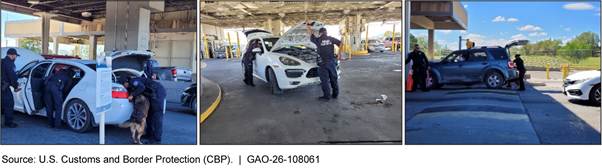
CBP. CBP’s OFO, sometimes in coordination with Mexican counterparts, inspects articles, including firearms, being transported into and out of the U.S. at the 28 official land ports of entry along the U.S.–Mexican border (see fig. 1). OFO conducts these inspections to ensure compliance with applicable U.S. law.
CBP’s U.S. Border Patrol monitors and conducts patrols between the land ports of entry on the U.S.–Mexican border. Border Patrol officials said that their involvement in combating firearms trafficking from the U.S. into Mexico consists primarily of supporting OFO outbound operations as needed. In addition, CBP’s Office of Intelligence and OFO’s National Targeting Center support these efforts by analyzing and providing actionable intelligence to frontline personnel at and between the ports of entry, including information about firearms illegally crossing into Mexico.
HSI. HSI enforces and investigates violations of all U.S. export control laws, which includes illegally exported firearms, ammunition, and related items from the U.S. to Mexico. HSI also has authority to seize firearms, ammunition, explosives, currency, and other export-controlled items that are illegally transported out of the U.S. Further, HSI works with Mexican law enforcement agencies through HSI’s Transnational Criminal Investigative Units (TCIU). In addition, according to DHS officials, HSI conducts financial investigations to identify and dismantle TCOs, which may result in seizing networks’ proceeds and assets. HSI’s Office of Intelligence analyzes and reports on firearms smuggling to Mexico.
State
State maintains U.S. bilateral relations with Mexico and provides security assistance to the Mexican government, including assistance intended to combat firearms trafficking. State’s Bureau of Western Hemisphere Affairs manages the U.S. Mexican bilateral relationship, including general oversight of the U.S. Mission to Mexico. State’s Bureau of International Narcotics and Law Enforcement Affairs (INL) manages security and law enforcement–related assistance.
Mexican Government Efforts to Combat Firearms Trafficking
Various Mexican state and federal entities have roles in combating firearms trafficking in Mexico. For example:
· Mexico’s Federal Attorney General’s Office conducts federal criminal investigations in Mexico, including most investigations of firearms trafficking, according to Mexican government officials. This office works with Mexican police and customs in conducting such investigations.
· The Mexican Secretariat for Security and Citizen Protection, a law enforcement agency, uses its authorities to pursue arms trafficking cases.
As an example of these Mexican government efforts, on a single day in May 2026, Mexico security services reportedly seized 13 long guns, eight handguns, and 78 magazines in operations conducted throughout the country.
TCOs in Mexico Seek to Acquire Rapid-Fire and Large-Caliber Firearms from the U.S. Through Straw Purchasers and Smugglers
TCOs in Mexico Seek to Acquire Rapid-Fire and Large-Caliber Firearms, Posing a Significant Threat
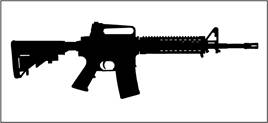
Firearms that TCOs in Mexico seek to acquire in the U.S. include semi-automatic AR-15s, AK-47s, and .50-caliber Barrett-style rifles or their equivalents, according to agency officials (see fig. 2).[10] According to agency officials, the TCOs convert semi-automatic AR-15s and AK-47s to fully automatic, rapid-fire, high-capacity firearms after they are smuggled into Mexico.[11]
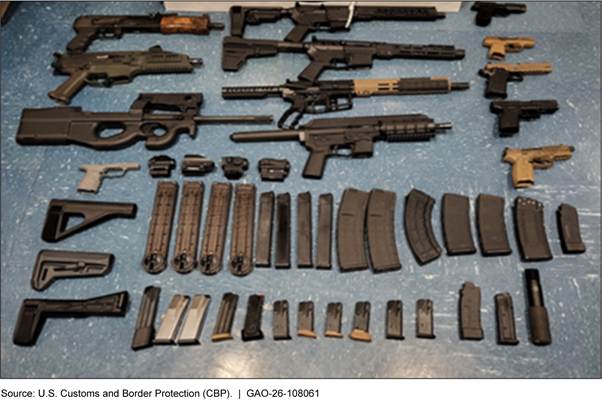
According to agency officials, TCOs in Mexico armed with converted fully automatic AR-15s and AK-47s and with .50-caliber rifles illegally acquired from the U.S. pose a significant and serious threat to Mexican law enforcement, military, and the general public.[12] Mexican military and law enforcement units cannot match the firepower of multiple TCO members armed with converted fully automatic AR-15s and AK-47s, according to agency officials.[13] In addition, TCOs in Mexico often use high-capacity magazines with these weapons, each holding 50 to 100 rounds.
The .50-caliber rifle—which fires a much larger bullet than either the AR-15 or AK-47—is highly sought by TCOs in Mexico because of its armor-piercing and anti-materiel capabilities, according to agency officials. In addition, agency officials said that TCOs seek to acquire other high-caliber firearms as well as belt-fed machine guns, which are often converted from semi-automatic tripod-mounted belt-fed guns acquired in the U.S. (See fig. 3.) The TCOs use high-caliber and belt-fed rifles to attack Mexican government helicopters, heavy and light vehicles, and military and law enforcement personnel.
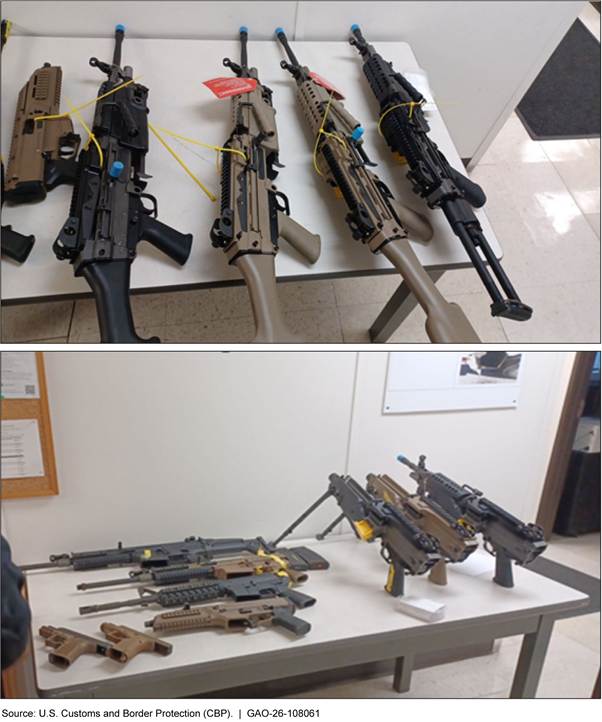
According to agency officials, some TCOs in Mexico mount high-caliber and belt-fed rifles from the U.S. on vehicles or trucks, known in Mexico as “monster trucks.” A monster truck is typically a large truck (e.g., a Ford F-150) with bolted steel or iron plates around the exterior and a covered platform on the truck bed, where a higher-caliber and belt-fed rifle can be placed inside a covered turret. Fully automatic rifles used in combination with belt-fed ammunition become a significant force multiplier for TCOs in Mexico, according to agency officials.
Agency officials also noted that TCOs in Mexico have evolved quickly in the past few years and now exploit the internet, drones, and biotechnology, in addition to firearms, to threaten Mexican society. According to the officials, drones have not replaced firearms in TCOs’ arsenals and instead are used primarily to surveil other TCOs or Mexican law enforcement or military units. However, drones used for surveillance in conjunction with fully automatic, high-capacity firearms, such as AR-15s or AK-47s, become another force multiplier for the TCOs, enhancing their ability to execute military-style assaults. Moreover, according to agency officials, there is growing concern that TCOs in Mexico will become more effective in using drones as weapons in the future.
TCOs in Mexico Use Straw Purchasers and Middlemen to Acquire Firearms in the U.S.
According to agency officials, TCOs in Mexico seeking to acquire firearms in the U.S. primarily use straw purchasers—individuals who knowingly buy guns illegally from licensed gun shops or at gun shows in the U.S. on behalf of persons legally prohibited from purchasing them.[14] To arrange for straw purchasers and transport of firearms to the border, TCOs in Mexico use middlemen who operate either independently or within the TCOs’ trafficking networks in the U.S., according to agency officials. Agency officials said that TCOs in Mexico generally purchase firearms for themselves and do not trade them with other TCOs.
According to agency officials, the individuals whom TCOs in Mexico and their middlemen in the U.S. typically recruit as straw purchasers are relatively young (21 to 25 years) and typically males, of all races, who are U.S. citizens or legal residents with no criminal background. TCOs in Mexico (through their middlemen in the U.S.) may recruit family members, friends, acquaintances, or social media connections as straw purchasers, often paying them to engage in the illegal transactions.[15] According to agency officials, TCOs in Mexico and their middlemen in the U.S. increasingly use social media and websites to recruit straw purchasers in the U.S.[16] For example, a TCO member or middleman might post on social media an open offer of $1,000 to anyone who buys specific weapons in the U.S. as a straw purchaser.
Agency officials said the middlemen whom the TCOs use in the U.S. are highly decentralized and constitute an ever-changing and evolving threat. According to agency officials, because these middlemen are so decentralized, straw purchasers often are unaware that they are purchasing firearms on behalf of the TCOs.
TCOs in Mexico Use Smugglers to Transport Firearms from the U.S. into Mexico
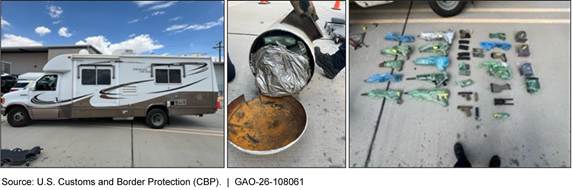
After firearms are illegally obtained by straw purchasers and brought to the U.S.–Mexican border, TCOs in Mexico most commonly use smugglers to illegally transport them in passenger and commercial vehicles through land ports of entry on the border, according to agency officials. The TCOs and their middlemen seek to recruit smugglers who are legally in the U.S. but frequently cross the border. Smugglers typically disassemble the firearms into component parts and hide them throughout a vehicle or in multiple vehicles before driving them over the border. (See fig. 4.) The firearms are then reassembled in Mexico.
Figure 4: Vehicle Stopped for Inspection, Hidden Compartment Holding Firearms, and Firearms Seized by CBP at the U.S.–Mexican Border
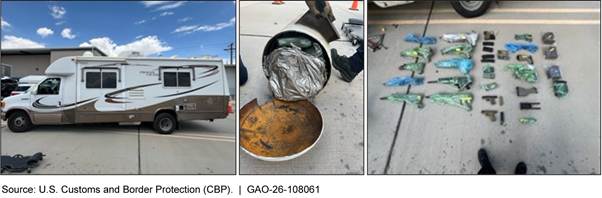
CBP conducts temporary outbound inspections of some vehicles at ports of entry along the U.S.–Mexican border. According to agency officials, firearms smugglers employ the following tactics to try to evade detection by CBP and other U.S. law enforcement:
· Firearms hidden in vehicles are frequently cached in concealed compartments, in household or industrial items, or beneath large volumes of other items. For example, agency officials said that rifles are often disassembled and hidden in items such as furniture and refrigerators in trucks or trailers. In addition, firearms are sometimes concealed within or beneath a large pile of miscellaneous items in the back of a commercial truck, making it difficult for CBP officials to find the firearms if they stop the vehicle for inspection.
· The TCOs in Mexico and their middlemen employ “watchers,” equipped with binoculars, near U.S.–Mexican land border crossings. If the watchers see that vehicles containing smuggled firearms will be entering an area where CBP is conducting outbound inspections, the watchers alert the drivers that they should move out of line and wait for the inspections to finish.
· Firearm smugglers will often drive to the larger ports of entry on the U.S.–Mexican border, where their vehicles will blend more easily with heavy southbound traffic into Mexico.
· Firearms smugglers often are not informed about a TCO’s involvement and sometimes are not aware that a shipment they have agreed to transport to Mexico contains firearms. Their unawareness diminishes the likelihood that CBP or other U.S. law enforcement can connect the smuggled firearms to a TCO in Mexico.
U.S. Agencies Collect Data on Firearms Seized at Border or Recovered in Mexico, but Some Data’s Limitations Hamper Utility
ATF Collects Data on Firearms Recovered in Mexico and Submitted for Tracing and Uses the Data to Inform Efforts
From January 2020 through December 2024, ATF completed traces for 122,084 firearms recovered in Mexico, 68 percent (82,785) of which had a U.S. source.[17] According to ATF, a U.S.-sourced firearm is one that ATF determines was manufactured in the U.S. or lawfully imported by a federal firearms licensee—a category that also includes firearms lawfully exported from the U.S. and later diverted abroad. These 82,785 firearms included 49,676 handguns consisting of pistols, revolvers, and derringer (60 percent); 32,601 long guns consisting of rifles and shotguns (about 39 percent); and 508 other guns (less than 1 percent). See figure 5.[18]
Figure 5: Numbers and Types of Firearms Recovered in Mexico and Traced to U.S. Sources by ATF, 2020–2024
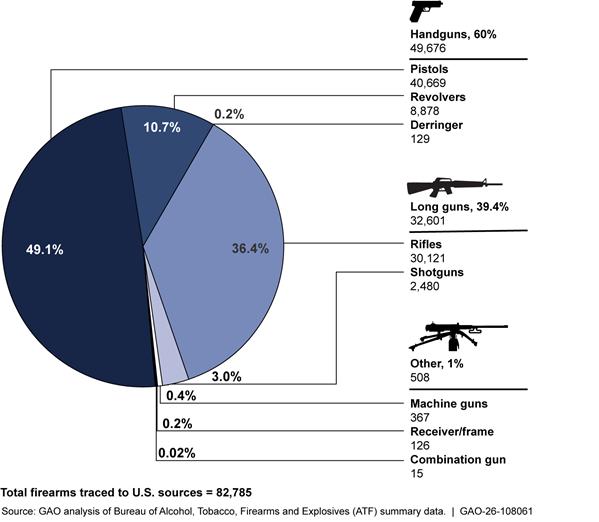
Notes: Because of rounding, percentages shown on the left do not sum to 100.
ATF defines “U.S.-sourced firearms” as firearms that it determines to have been manufactured in the U.S. or legally imported by a federal firearms licensee—a category that also includes firearms lawfully exported from the U.S. and later diverted abroad.
According to ATF, 39,299 firearms that were recovered in Mexico and traced from January 2020 through December 2024 had an undetermined source, including 13,838 long guns; 24,347 handguns; and 1,114 other guns.[19] Undetermined source country refers to firearms for which the trace request did not provide sufficient information in order for ATF to determine a source country.
In addition to U.S.-source firearms, ATF data on firearms seized in Mexico and traced from January 2020 through December 2024 indicate that the majority originated in the U.S., particularly the southwest border states of Texas, Arizona, California, and New Mexico.[20] In particular, while some firearms seized in Mexico that were of U.S. origin were traced to all 50 states, about 77 percent of these firearms that were first purchased from a federal firearms licensee came from the four southwest border states (see fig. 6).
Figure 6: Locations of Initial Purchasers of U.S.-Sourced Firearms Recovered in Mexico and Traced by ATF, 2020–2024
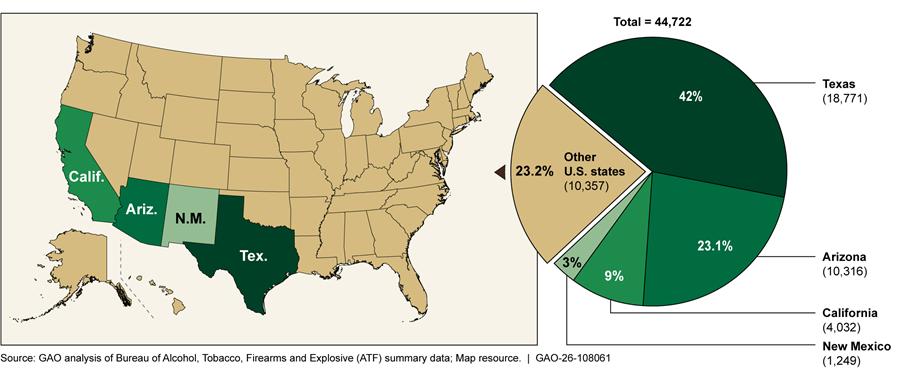
ATF analysis states that, given Mexico’s strict firearm laws, it is reasonable to assess that most of the firearms recovered there and submitted for tracing had been trafficked illegally. For example, from 2018 through 2025, 1,587 federal firearms licensees in Arizona were associated with 15,413 firearms recovered in Mexico and traced by ATF.
|
Arizona as a Key Source State for Firearms Recovered in Mexico Arizona—in particular, the areas around Phoenix and Tucson—has been identified as a key source state for firearms recovered in Mexico. According to an ATF intelligence assessment, law enforcement is more likely to encounter firearms traffickers or straw purchasers in Arizona than in any other state. Source: Bureau of Alcohol, Tobacco, Firearms and Explosives (ATF). | GAO‑26‑108061 |
In addition, ATF analysis states that geography tends to affect firearms sourcing trends in the U.S. and Mexico border states. Each U.S. border state tends to be the primary U.S. source state for firearms recovered in the adjacent Mexico state. For instance, California and Arizona are primary source states for firearms recovered in Baja California and Sonora, Mexico. Similarly, Texas is a primary source state for firearms recovered in Tamaulipas, Mexico.
ATF uses its trace data for various purposes. According to ATF officials, it uses trace data to help link a suspect in a criminal investigation to a particular firearm or to identify potential firearm traffickers.[21] ATF also uses the data to inform its collaboration with other U.S. and Mexican agencies and to notify federal firearm licensees about trends in straw purchasing and in types of firearms sought by TCOs. For example, since fiscal year 2023, ATF has used trace data, among other factors, to launch at least 20 campaigns to counter straw purchasing, called Don’t Lie for the Other Guy, in specific cities across the U.S. ATF has expended approximately $3 million to manage and facilitate these campaigns in fiscal years 2023 through 2025.[22]
CBP Collects and Uses Data on Seized Mexico-Bound Firearms, but the Data Have Limitations
CBP Collects Data on Firearms Seized at the U.S.–Mexican Border
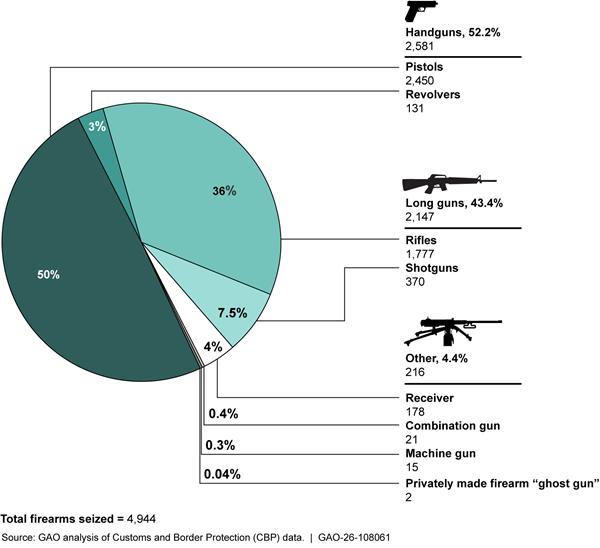
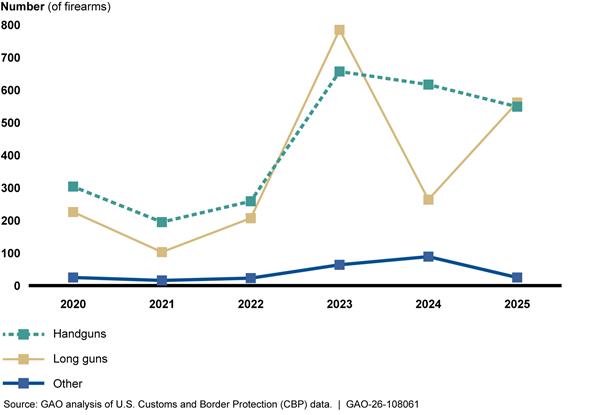
From January 2020 through December 2025, CBP’s OFO seized 4,944 Mexico-bound firearms at land ports of entry on the U.S.–Mexican border.[23] According to CBP data, OFO seized 2,147 long guns, including rifles and shotguns; 2,581 handguns, including revolvers and pistols; and 216 guns of other types (see fig. 7).[24]
Figure 7: CBP Data on Mexico-Bound Firearms Seized at Land Ports of Entry on the U.S.–Mexican Border, 2020–2025
According to CBP data, the numbers of seized firearms fluctuated from January 2020 through December 2025, with net increases in the numbers of seized handguns and long guns. See figure 8.
Figure 8: Numbers and Types of Firearms Bound for Mexico and Seized by OFO at Land Ports of Entry on the U.S.-Mexican Border, 2020–2025
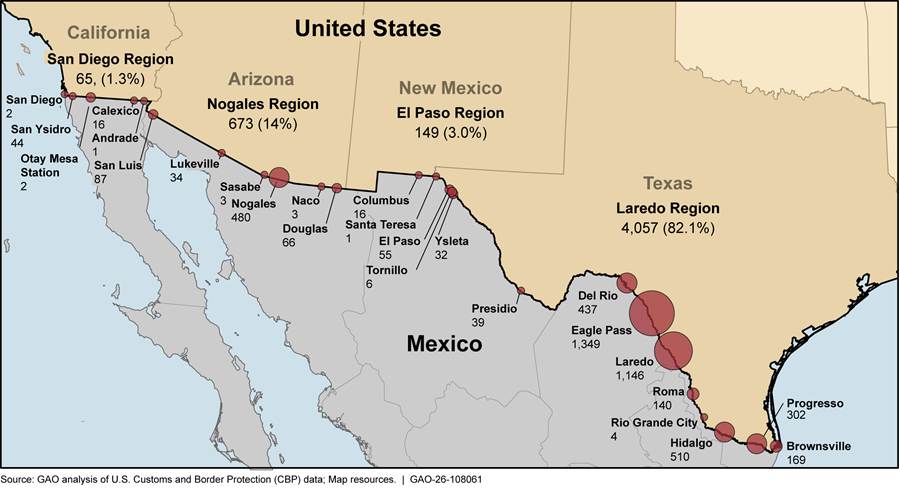
In addition, CBP data show that the quantity of seizures varied depending on the ports of entry, with most seizures occurring in the Laredo region (see fig. 9).
Figure 9: Numbers of Firearms Bound for Mexico and Seized by CBP’s Office of Field Operations at Land Border Ports of Entry by Region, 2020–2025
CBP officials told us that the frequency of these inspections differs among the 28 land ports of entry on the U.S.–Mexican border. For example, one port of entry may conduct outbound inspections intermittently throughout the day, while another port of entry may conduct outbound inspections 24 hours per day. In 2023, CBP developed an Outbound Working Group Implementation Plan to address limitations in staffing and infrastructure, such as equipment and facilities, toward supporting increased outbound inspections at the U.S.–Mexican border. During our review, CBP officials told us that staffing resources and outbound inspection infrastructure remain significant challenges that impede CBP’s ability to target its outbound inspections to combat firearms trafficking to Mexico.[25]
According to CBP analysis, the southwest border will almost certainly continue to be a key trafficking point for firearms and ammunition leaving the U.S. in the future. However, CBP officials also noted that increasing outbound inspections to match the level and pace of current inbound inspections would be costly and would delay southbound traffic—including U.S. export commerce—at the border.
DHS Uses Information on Seized Firearms to Inform Operations, but the Data Have Limitations
Both HSI and CBP use CBP outbound firearm seizure data to inform their primary efforts to combat firearms trafficking to Mexico. For example:
HSI. According to officials, HSI uses recent CBP outbound firearm seizure data as well as ongoing HSI-led and -supported firearms trafficking investigations to inform its selection of land ports of entry for its main operation to combat firearms trafficking to Mexico. HSI also uses CBP outbound firearm seizure data to analyze trafficking trends and provide TCIUs in Mexico City with real-time information to support their firearm trafficking investigations.
CBP. OFO’s National Targeting Center provided us with analysis demonstrating the use of firearms seizure data to inform the center’s analytical and intelligence products. According to National Targeting Center officials, they conduct a monthly review of firearms seizure data and compile statistics and trend analysis on methods of firearms trafficking into a product for the government of Mexico. For example, at the end of each fiscal year since 2023, the National Targeting Center has conducted an annual review of firearms smuggling methods, informed by these seizure data, that it documents and disseminates in an intelligence bulletin. Additionally, CBP Operations staff told us that they use seizure data, among other factors, to determine the time, location, and scope of key operations to combat firearms trafficking from the U.S. to Mexico.
Similarly, officials of CBP’s Office of Intelligence told us that the office uses firearms seizure data from SEACATS, DHS’s information system of record for CBP and HSI operations, to identify broad trends and reveal leads at tactical and operational levels.[26] The officials also noted that the office disseminates analytical findings and leads to operational components and other partners to enhance operations, investigations, and network development. In addition, the officials said that in prior years, they produced intelligence analysis on firearms most sought by TCOs in Mexico, including information on AR-15s, AK-47s, and .50-caliber rifles.
However, although SEACATS data identify general types of firearms, such as rifle or pistol, the data do not consistently capture information on specific types of rifles, such as AR-15, AK-47, or .50-caliber rifles—the types of firearms most sought by TCOs—in a way that is readily analyzable. Specifically, SEACATS has fields for manufacturer, make, model, and caliber of firearm as well as a field to enter a description of the firearm.
While the manufacturer, model, and caliber fields have drop-down options, these fields are optional. The make and description fields are free-form fields and do not include a standardized menu of types of firearms from which to select. While drop-down menus restrict users to predefined options intended to support standardized data entry, free-form fields allow variations in rifle descriptions in the data entry.
As a result, OFO officials said that if seizing officers correctly identify a firearm, they may not systematically enter information on the specific type of firearm seized due to inherent limitations of free-form fields. Another DHS official noted that some seizing officers may have difficulty in correctly identifying certain firearm types they encounter and that the capability of each OFO officer to identify specific types of firearms may differ between ports of entry. DHS officials stated that they have one training course where trainees complete a hypothetical seizure entry in SEACATS. However, these officials noted that the instructor guide for the course does not specify how to complete any data fields or outline specific processes to follow to complete a seizure entry in SEACATS.
Officials from the National Targeting Center told us that they often rely on information in SEACATS’s description field to identify types of firearms. The officials said that information about firearm types entered in the description field tends to be more specific than information in the other fields, which often offer more general firearm categories such as “pistol,” “rifle,” and “shotgun.” Officials can run reports using information from the description field to identify types of firearms seized; however, these reports have limitations in that they rely on free-form text data, which allows variations in rifle description that are not readily analyzable. In addition, although the manufacturer, model, and caliber fields have pre-defined drop-down options listing specific firearm types that can be selected during data entry, these fields are optional. Our analysis of SEACATS data found that roughly a third to just over half of these optional fields were left blank.
Some DHS officials expressed concerns about their ability to use SEACATS data. For example, Office of Intelligence officials noted challenges in identifying AR-15 or AK-47 rifles in the SEACATS data. The officials said that, in an effort to mitigate these challenges, they review the information source on seized firearms in SEACATS to verify that the information entered is analyzable.
The National Intelligence Strategy for 2023 states that intensifying transnational challenges are at the core of national and international security; therefore, the intelligence community should improve its ability to understand, anticipate, and provide early warning about transnational threats. Moreover, according to Principle 13 of Standards for Internal Control in the Federal Government, management should use quality information to achieve objectives.[27]
Although DHS uses data from SEACATS to target potential violations and identify trends in enforcement actions, the system does not consistently capture information that can be readily analyzed to identify specific types of firearms sought by TCOs in Mexico.
As noted above, since early 2025 several TCOs in Mexico have been designated as foreign terrorist organizations and, when armed with converted fully automatic AR-15s and AK-47s and with .50-caliber rifles illegally acquired from the U.S., these organizations pose a significant and serious threat to Mexican law enforcement, military, and the general public.
Improved data on the specific types of rifles most sought by TCOs in Mexico would strengthen DHS and other agencies’ ability to generate firearms trafficking intelligence and assist DHS entities in their operations aimed at helping to prevent TCOs designated as foreign terrorist organizations from trafficking these firearms to Mexico. More-complete intelligence would also increase awareness about the prevalence and nature of TCO related firearms trafficking seizures, particularly seizures of semiautomatic rifles that are easily converted into fully automatic weapons in Mexico.
U.S. Agencies Conduct Various Efforts to Combat Firearms Trafficking to Mexico but Do Not Assess Effectiveness
U.S. agencies lead and collaborate through a number of efforts to inspect, collect, investigate, and distribute intelligence and information to combat firearms trafficking to Mexico. In the U.S., CBP and HSI lead Operation Without a Trace and ATF leads Operation Southbound to combat firearms trafficking, among other efforts. In Mexico, ATF runs a firearms trafficking investigative unit and INL supports capacity building projects to enhance the abilities of Mexican government agencies to combat firearms trafficking in Mexico, among other efforts. However, the agencies’ ability to determine their effectiveness in combating firearms trafficking to Mexico is limited because they lack performance measures or have not established baselines and targets or collected results for existing performance measures.
Agencies Conduct U.S.- and Mexico-Based Efforts to Combat Firearms Trafficking
U.S.-Based Efforts
CBP and HSI (Joint)
Operation Without a Trace. In 2019, CBP and HSI, in coordination with ATF, initiated Operation Without a Trace to combat trafficking of firearms and ammunition from the U.S. into Mexico. Through this effort, CBP, HSI, and ATF identify, target, and investigate the financing, transportation, and communications methods employed by firearms procurement and smuggling networks to disrupt and dismantle firearms trafficking operations.[28]
CBP
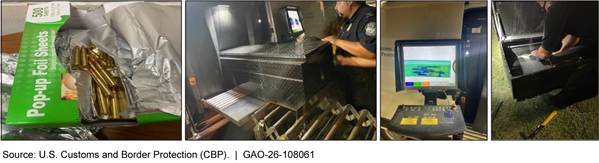
Operation Desert Lightning. In 2023, CBP initiated Operation Desert Lightning, an outbound firearms interdiction enforcement operation, in collaboration with the National Targeting Center, Border Patrol, HSI, and ATF. The operation uses intelligence developed with CBP-supported firearms trafficking interdictions and seizure data to support enforcement actions at targeted ports of entry on the U.S.–Mexican border. Concurrently with Operation Desert Lightning, the government of Mexico conducts operations at locations where OFO is not set up for enforcement actions to cover geographical gaps and attempts by TCOs to divert smuggling routes. According to CBP, OFO developed Operation Desert Lightning in response to the growing threat posed by TCOs and to increased weapons trafficking along the southwest border. See figure 10.
Figure 10: Operation Desert Lightning Firearms and Ammunition Seized by CBP at the U.S.–Mexican Border
HSI
According to HSI, one of HSI’s primary law enforcement missions is investigating violations of U.S. export control laws, including the illegal export of firearms to Mexico. HSI’s export enforcement mandate, combined with its border search authority, customs authorities, and extensive international presence (including multiple offices in Mexico) enables HSI to detect, disrupt, and dismantle weapons trafficking organizations, rather than focusing solely on investigations targeting parts of the network within the U.S.
|
Homeland Security Task Force (HSTF) The interagency HSTF leads a national effort to dismantle illegal firearms trafficking networks. In an example of the results of HSTF investigations, a member of Cártel de Jalisco Nueva Generación, known as CJNG, was charged in May 2025 with conspiring to provide material support or resources to a foreign terrorist organization in the Western District of Texas. This individual was arrested by the government of Mexico. According to the National Drug Control Strategy, the investigation and its results highlight benefits of the HSTF and the “foreign terrorist organization” designation, which facilitated the arrest. HSTF investigative results also included the identification and disabling of a highly sophisticated tunnel connecting El Paso, Texas, and Ciudad Juarez, Mexico; arrests of 24 suspects; and seizures of 74 weapons and $357,000. Source: National Drug Control Strategy. | GAO‑26‑108061 |
Homeland Security Task Force (HSTF). HSTF is a multiagency law enforcement taskforce network that focuses on combating TCOs, including those designated as foreign terrorist organizations. The HSTF National Coordination Center is the operational hub of the HSTF network, co-led by HSI and the Federal Bureau of Investigation to direct resources, coordinate criminal network analysis, and deconflict targets across task forces nationwide. The HSTF model is a governmentwide approach with six threat categories, including weapons trafficking, involving representatives from federal law enforcement agencies; federal prosecutors; relevant state, territorial, local, tribal, and foreign law enforcement agencies; and other federal agencies with the ability to provide logistics, intelligence, legal, and operational support to HSTF.[29]
Border Enforcement Security Task Force (BEST). HSI leads BEST, a multiagency taskforce that uses intelligence to investigate illicit movement of people and contraband, including firearms, along the U.S.–Mexican border. CBP, ATF, and other law enforcement agencies participate in BEST units and provide support for HSTF. According to HSI, it currently has 165 BEST units, including 37 groups directly on the border, conducting investigations related to TCOs, weapons, and other illicit activities.
ATF
Operation Southbound. ATF implemented Operation Southbound in 2020 as the primary DOJ-led interagency initiative to disrupt the trafficking of firearms from the U.S. to Mexico. Operation Southbound’s firearms trafficking investigations are conducted by multi-agency Firearms Trafficking Task Forces located along the U.S.–Mexican border. According to ATF officials, there were nine task forces at the operation’s inception and 13 task forces as of September 2025. In fiscal years 2020 through 2025, ATF provided more than $105 million for Operation Southbound (see app. II for more information).
|
Conviction of Straw Purchasers of Firearms Trafficked to Mexico As a result of an Operation Southbound investigation, ATF identified a group of straw purchasers that bought more than 100 firearms later trafficked to Mexico. The defendants purchased firearms that included AR-15 style rifles from federally licensed firearms dealers on behalf of another individual, who smuggled the firearms to Mexico. In 2023, four defendants were convicted of conspiracy to make false statements to licensed firearm dealers. Prison sentences ranged from 1 to 5 years.
Source: Bureau of Alcohol, Tobacco, Firearms and Explosives (ATF) (data); SAKINA/stock.adobe.com (image). | GAO‑26‑108061 |
National Firearms Trafficking Center. ATF established the National Firearms Trafficking Center in August 2023 to enhance its enforcement efforts focused on firearms trafficking, according to ATF documentation. According to ATF officials, the center functions as ATF’s national intelligence center for firearms trafficking. As such, the center analyzes and disseminates domestic and international trafficking intelligence to ATF field divisions, Operation Southbound’s Firearms Trafficking Task Forces, external federal, state, local, tribal, territorial partners, and foreign partners, officials said. The center also coordinates with ATF’s International Affairs Division to request assistance from ATF’s FTIU for investigative activities in Mexico. ATF provided nearly $2.5 million for the center in fiscal years 2024 and 2025 (see app. II for more information).
Mexico-Based Efforts
ICE-HSI
HSI Transnational Criminal Investigative Units (TCIU). In Mexico, HSI partners with domestic law enforcement through the TCIUs that have been trained and vetted by HSI.[30] According to HSI, TCIUs consist of Mexican federal law enforcement partners who work jointly with customs officers, immigration officers, and prosecutors in furtherance of ongoing HSI investigations and undergo strict background investigations to ensure joint efforts are not compromised. Although they do not focus exclusively on firearms trafficking investigations, TCIUs are HSI’s primary mechanism to pursue investigative and enforcement actions against individuals and networks in Mexico involved in smuggling U.S. firearms to TCOs. TCIUS investigate transnational crime, often connected to TCOs and other criminal organizations in Mexico that are engaged in firearms trafficking, narcotics trafficking, human smuggling, and other offenses.
|
Revocation of Federal Firearms Licensees for Alleged Trafficking Firearms to Mexico. In 2025, ATF revoked the licenses of two federal firearms licensees in Arizona due to violations of the Gun Control Act. According to ATF officials, these violations included making false entries and not properly maintaining required records. Falsification of records by a federal firearms licensee can be an indicator of straw purchasing.
Source: Bureau of Alcohol, Tobacco, Firearms and Explosives (ATF) (data) Arcady/adobe.stock.com (image). | GAO‑26‑108061 |

ATF
ATF International Affairs Division, Mexico Office. ATF officials said that the International Affairs Division’s Mexico office oversees ATF efforts and provides intelligence and investigative knowledge to the Mexican government and oversight to members of the FTIUs. The FTIUs then utilize the ATF intelligence and information to conduct operations in Mexico. The ATF attaché in Mexico City assists with domestic ATF investigations that have a Mexico nexus. ATF administers two FTIUs in Mexico City, one with Mexico’s Attorney General’s Office and one with the Security and Citizen Protection Secretariat, according to INL officials. In fiscal years 2020 through 2025, ATF provided nearly $12.7 million for this division and the operations it oversees (see app. II for more information).
ATF FTIU with Mexico’s Attorney General’s Office. Initiated in fiscal year 2024, the FTIU with Mexico’s Attorney General’s Office comprises Mexican law enforcement staff who work within the criminal investigations unit of the Mexico’s Attorney General’s Office, according to the Embassy Mexico City ATF Assistant Attache. The FTIU investigates firearm trafficking cases.[31]
ATF FTIU with Mexico’s Security and Citizen Protection Secretariat, Mexico City. In March 2026, ATF established its second FTIU, according to ATF officials. The unit completed the full vetting process in March 2026 and completed a 3-week training course at the ATF National Academy in April 2026. The addition of the unit will allow the government of Mexico to significantly increase its ability to disrupt and prosecute individuals illegally trafficking or possessing firearms, according to ATF officials.[32]
INL
Support for ATF efforts. INL provides funding to support ATF’s FTIUs with Mexico’s Attorney General’s Office and Mexico’s Security and Citizen Protection Secretariat in Mexico City. Since 2020, INL has also supported
|
Mexican National Convicted of Trafficking Firearms in Mexico As a result of Firearms Trafficking Investigative Unit investigations, in 2024, a Mexican national and an El Paso, Texas resident were convicted of trafficking firearms and sentenced to prison for 25-years and 10-years, respectively. Both had been involved in an organization that smuggled hundreds of firearms into Mexico. The firearms charges were made under the 2022 Bipartisan Safer Communities Act. The Mexican national who received the 25-year sentence was also convicted of straw purchasing of firearms and other charges.
Source: Bureau of International Narcotics and Law Enforcement Affairs (INL) (data); GAO (image). | GAO‑26‑108061 |
various ATF projects focused on building the capacity of Mexican government agencies to, among other things, investigate firearms smuggling and combat firearms trafficking in Mexico. INL provided $4.6 million to support these ATF efforts in fiscal years 2020 through 2025. See appendix II for additional funding information.
Agencies Report Results but Do Not Assess Effectiveness in Combating Firearms Trafficking to Mexico
DHS Reports on Firearm and Ammunition Seizures but Does Not Assess Effectiveness of Efforts to Reduce Firearms Trafficking to Mexico
DHS components HSI and CBP report results, such as seizures, of their efforts to combat firearms trafficking to Mexico.[33] However, they do not have performance measures to assess the progress of these efforts.
|
Arrest of Foreign Terrorist Organization Member by Firearms Trafficking Investigative Unit (FTIU). In May 2025, an FTIU arrested a high-ranking member of the Mexican Cartel de Jalisco Nueva Generación, which the U.S. government has designated as a foreign terrorist organization. The defendant—who according to INL officials was one of the first charged with supporting a terrorist organization for selling firearms to a Mexican cartel—was extradited to the U.S. in January 2026. As of June 2026, the case remained ongoing.
Source: Bureau of International Narcotics and Law Enforcement Affairs (INL) (data); GAO (image). | GAO-26-108061 |

HSI. HSI reports on firearms, magazines, and ammunition seized during Operation Without a Trace (see table 1). HSI data show a decline in firearms and magazines seized from fiscal year 2024 through fiscal year 2025 but an increase in ammunition rounds seized.
|
Fiscal year |
Firearms seized |
Magazines seized |
Ammunition rounds seized |
|
2024 |
1,421 |
6,226 |
299,374 |
|
2025 |
581 |
1,810 |
338,076 |
Source: GAO analysis of Department of Homeland Security (DHS) summary data. | GAO‑26‑108061
HSI also reported on weapons and magazines seized and operations conducted for HSI-TCIU (see table 2). These data show an increase in weapons and magazines seized from fiscal year 2024 through fiscal year 2025.
Table 2: Results of HSI TCIU Efforts to Combat Firearms Trafficking to Mexico, Fiscal Years 2024 and 2025
|
Fiscal year |
Weapons seized |
Magazines seized |
Operations conducted |
|
2024 |
87 |
229 |
40 |
|
2025 |
273 |
2200 |
58 |
Legend: TCIU = Transnational Criminal Investigative Unit.
Source: GAO analysis of Homeland Security Investigations (HSI) summary data. | GAO‑26‑108061
Further, HSI provided data on criminal arrests, indictments, convictions, seizures, and administrative arrests for HSTF for fiscal year 2025 (see table 3).
|
Fiscal year |
Criminal arrests |
Indictments |
Convictions |
Seizures |
Administrative arrests |
|
2025 |
339 |
212 |
172 |
405 |
86 |
Legend: HSTF = Homeland Security Task Force.
Source: GAO analysis of Homeland Security Investigations (HSI) summary data. | GAO‑26‑108061
According to HSI data and officials, in fiscal years 2020 through 2024, HSI BEST units seized firearms, firearm magazines, and rounds of ammunition bound for Mexico (see table 4). Additionally, in fiscal years 2020 through 2025, HSI initiated new investigations involving firearms trafficking to Mexico, leading to 692 arrests, 527 indictments, and 443 convictions.[34]
Table 4: Results of HSI BEST Efforts to Combat Firearms Trafficking to Mexico, Fiscal Years 2020–2024
|
Fiscal year |
Firearm seizures |
Magazines seized |
Ammunition rounds seized |
|
2020 |
2,299 |
2,530 |
438,455 |
|
2021 |
2,273 |
2,711 |
294,579 |
|
2022 |
2,977 |
1,614 |
422,078 |
|
2023 |
3,734 |
3,619 |
507,783 |
|
2024 |
4,946 |
7,454 |
510,033 |
Legend: BEST = Border Enforcement Security Task Force.
Source: GAO analysis of Homeland Security Investigations (HSI) summary data. | GAO‑26‑108061
Note: We defined firearms as long guns (rifle, shotgun), handguns (pistol, revolver, derringer), receivers, machine guns, privately made firearms, and combination guns (rifle-shotgun combination, shotgun pistol, submachine gun or machine pistol). We excluded related devices such as case, firearm casing, fireworks, machine gun conversion device, magazine, scope, stun gun, taser, vest body armor, barrel, grenade, magazine, receiver kit, rocket, scope, and silencer (muffler or sound moderator).
CBP. CBP reported on firearms, ammunition, and currency seized as well as staff committed to Operation Desert Lightning (see table 5).
Table 5: CBP Operation Desert Lightning Seizures of Firearms, Ammunition, and Currency and Number of Committed Staff, Fiscal Years 2023–2025
|
Fiscal year |
Firearms seized |
Ammunition rounds seized |
Currency seized |
Staff committed to operation |
|
2023 |
65 |
3,218 |
$542,998 |
1,319 |
|
2024 |
61 |
12,213 |
$398,648 |
3,120 |
|
2025 |
3 |
5 |
$92,764 |
289 |
Source: GAO analysis of U.S. Customs and Border Protection (CBP) summary data. | GAO‑26‑108061
Note: Data shown for fiscal year 2025 reflect CBP After Action Report information for Operation Desert Lightning phase 5 (February 23-March 1, 2025). CBP did not provide data for the operation for the remainder of fiscal year 2025.
However, although HSI and CBP report on results of their efforts, they lack performance measures to assess the extent to which these results are achieving intended objectives, goals, and desired outcomes to combat firearms trafficking to Mexico. As a result, neither can determine the extent to which their efforts are effective in combating firearms trafficking to Mexico.
The Administration has identified the combating of firearms trafficking to Mexico as a priority in several contexts. For example, the 2025 U.S. Mexico Security Workplan calls for the U.S. to expand inspections for firearms trafficking at U.S. ports of entry, with coordination between CBP and the Mexican government to conduct inbound and outbound inspections at the shared border. Additionally, Executive Order 14157 states that because international cartels constitute a national security threat beyond that posed by traditional organized crime, it is the policy of the U.S. to ensure the elimination of these organizations’ ability to threaten the territory, safety, and security of the U.S.[35] Moreover, Executive Order 14159 defines ending the presence of criminal cartels, foreign gangs, and transnational criminal organizations (TCOs) as a key mission of the HSTF network.[36]
DHS has not yet established any objectives, goals, or desired outcomes for its efforts to combat firearms trafficking to Mexico that could enable it to establish corresponding performance measures for its efforts to combat firearms trafficking from the U.S. to Mexico. For example, DHS’s Strategic Plan does not mention firearms trafficking in its strategic objectives, goals, and desired outcomes, although it articulates guidance for other areas, such as countering terrorism and securing the U.S.–Mexican border. Similarly, DHS’s Annual Performance Report and Plan does not lay out performance measures, targets, and results for firearms trafficking for CBP and HSI, although it reflects a performance framework aligning with other Administration priorities and polices—emphasizing securing U.S. borders, enforcing and administering the immigration system and safeguarding national security.
According to Principle 6 of Standards for Internal Control in the Federal Government, management should define objectives clearly—for example, in alignment with the organization’s mission, strategic plan, and performance goals and in measurable terms so that progress toward those objectives can be assessed. DHS’s Annual Performance Report and Plan states that, to ensure transparency and accountability regarding DHS’s use of its resources to achieve strategic objectives and deliver measurable outcomes for the American people, it will continue to refine its performance measures to align its performance framework with the Administration’s priorities, policies, and executive orders.
Absent the establishment of strategic objectives, goals, and desired outcomes for its efforts to combat firearms trafficking to Mexico, DHS cannot develop corresponding performance measures, including baselines and targets, for these activities. Without such measures, it does not know the extent to which these efforts are meeting objectives related to combating firearms trafficking and cannot determine whether it is directing resources to the most effective programs. This could lead to waste and, potentially, missed opportunities to more effectively counter firearms trafficking.
ATF Reports on Operation Southbound Investigations and Seizures but Lacks Performance Measures to Monitor Effectiveness
ATF reports the annual number of investigations and rounds of ammunition seized for Operation Southbound, but it does not have performance measures to assess the extent to which these efforts are meeting objectives. ATF data show that the number of investigations of firearms trafficking to Mexico generally declined from fiscal year 2020 through fiscal year 2025, while the number of firearms seizures and rounds of ammunition seized generally increased over the same period. According to ATF officials, the bureau’s enforcement emphasis shifted to using of ATF’s seizure authority to interdict firearms before they are smuggled and to consolidating multiple straw purchasers into single conspiracy investigations. The officials said that both changes reduced case counts while increasing firearms and ammunition recovered per case. See table 6.
Table 6: ATF Operation Southbound Investigations of Firearms Trafficking to Mexico and Seizures of Firearms and Ammunition, Fiscal Years 2020–2025
|
Fiscal year |
Investigations of firearms trafficking to Mexicoa |
Firearms seizures and ammunition rounds seizedb |
|
2020 |
3,378 |
171 firearms seizures 24,477 ammunition rounds seized |
|
2021 |
2,771 |
350 firearms seizures 104,319 ammunition rounds seized |
|
2022 |
2,484 |
514 firearms seizures 32,971 ammunition rounds seized |
|
2023 |
2,837 |
1,919 firearms seizures 72,838 ammunition rounds seized |
|
2024 |
2,148 |
1,806 firearms seizures 138,004 ammunition rounds seized |
|
2025 |
1,595 |
3,835 firearms seizures 430,273 ammunition rounds seized |
Source: GAO analysis of Bureau of Alcohol, Tobacco, Firearms and Explosives (ATF) information as of April 15, 2026. | GAO‑26‑108061
aAccording to ATF, the data shown reflect all investigations involving a firearm recovered in Mexico or interdicted while being trafficked to Mexico, a firearms trafficker from Mexico, firearms suspected of being trafficked to Mexico, or additional factors such as ammunition trafficking to Mexico.
bAccording to ATF, it examines the property seized or recovered in its investigations of firearms trafficking to Mexico.
Although it reports on its investigations and seizures, ATF does not have performance measures that would allow it to assess the extent to which these efforts’ results reflect progress toward goals and objectives for disrupting firearms trafficking to Mexico. In 2021, we recommended that ATF develop performance measures to assess the results of its efforts to investigate the trafficking of U.S.-sourced firearms to Mexico.[37] In response to our recommendation, ATF identified performance measures for Operation Southbound for fiscal year 2023. For example, ATF developed the performance measure “Firearms trafficking investigations where the firearms were destined to Mexico.” In August 2026, ATF officials said that ATF had paused the use of its Operation Southbound performance measures and monitoring because of organizational restructuring and leadership changes.
The GPRA Modernization Act of 2010 requires agencies to develop performance measures for their performance goals.[38] Performance measurement gives managers crucial information to identify gaps in program performance and to plan any needed improvements. Developing performance metrics and assessing program performance are key actions that agencies can take to define activity goals and determine the effectiveness of their efforts.
Without performance measures, ATF does not know whether its efforts are meeting objectives and cannot determine whether it is directing resources to the most effective programs. This could lead to waste and, potentially, missed opportunities to more effectively counter firearms trafficking.
INL Lacks Baselines, Targets, and Results for Some Performance Measures
Although INL has established performance measures for INL-funded ATF capacity-building and for the FTIU with Mexico’s Attorney General’s Office programs in Mexico, it has not established baselines and targets or reported results for each of these efforts. In 2021, we recommended that State develop performance measures to assess the results of INL’s assistance to Mexico related to firearms trafficking.[39] In response, INL worked with ATF to identify and develop performance measures with targets and baselines related to firearms trafficking to Mexico.[40] However, we found that INL performance data for its current efforts do not consistently include baselines, targets, and results, all of which are critical to providing the context needed to show progress, manage resources, and evaluate success.
INL-funded ATF capacity-building project. INL developed three performance measures related to firearms trafficking for its funding of ATF’s 2024 capacity-building project. As table 7 shows, INL identified targets and reported results for two of the measures. However, INL did not develop baselines for any of the measures or develop targets or report results for the third measure.
Table 7: Numbers of Baselines, Targets, and Results for INL Performance Measures for Its Funding of ATF Capacity-Building Project, Fiscal Year 2025
|
Performance measure |
Baseline |
Target |
Results |
|
Number of firearms trafficking cases opened in the U.S. as a result of Mexican eTrace submissions. |
None |
80 |
82 |
|
Number of firearms trafficking–related arrests made in the U.S. initiating from Mexican eTrace submissions. |
None |
60 |
24 |
|
Number of firearms trafficking and explosives-related cases opened in Mexico as a result of IAA training and eTrace submissions. |
None |
None |
None |
Legend: ATF = Bureau of Alcohol, Tobacco, Firearms and Explosives; IAA = interagency agreement; INL = Bureau of International Narcotics and Law Enforcement Affairs.
Source: GAO analysis of Bureau of International Narcotics and Law Enforcement Affairs (INL) information. | GAO‑26‑108061
INL officials told us in July 2026 that the second performance measure—the number of firearms trafficking–related arrests made in the U.S. initiating from Mexican eTrace submissions—is dependent on information they had thus far been unable to obtain from the government of Mexico. However, INL officials stated that they believed this information would become available through a separate ATF eTrace project.
INL officials noted that their effort to establish baselines and targets for the third performance measure, on the number of firearms trafficking and explosives-related cases opened in Mexico as a result of training and eTrace submissions, depended on information they had asked ATF to obtain from the Mexican government. However, the Mexican government had not yet provided the information. As a result, INL does not know how effective the project is in combating firearms trafficking to Mexico.
INL-funded ATF FTIU with Mexico’s Attorney General’s Office project. For its funding of the FTIU, INL developed three performance measures related to firearms trafficking. Although it reported results for these measures, INL did not identify baselines or targets for any of the three measures (see table 8). Without baselines and targets, INL does not know how effective the project is in combating firearms trafficking to Mexico.
Table 8: Baselines, Targets, and Results for INL Performance Measures for Its Funding of ATF Firearms Trafficking Investigative Unit (FTIU) with Mexico’s Attorney General’s Office, Fiscal Year 2025
|
Performance measure |
Baseline |
Target |
Results |
|
Number of Mexican and parallel U.S. criminal cases with a defendant held in custody for firearms trafficking charges as a result of FTIU and ATF’s collaboration. |
0 |
0 |
17 (10 Mexican cases and 7 U.S. cases) |
|
Number of seizures of illicit firearms in Mexico and the U.S. based on shared information from FTIU and ATF’s collaboration. |
None |
0 |
534 (218 Mexican seizures and 316 U.S. seizures) |
|
Number of convictions achieved in firearms trafficking cases. |
None |
0 |
2 convictions in the U.S. |
Legend: ATF = Bureau of Alcohol, Tobacco, Firearms and Explosives; INL = Bureau of International Narcotics and Law Enforcement Affairs.
Source: GAO analysis of Bureau of International Narcotics and Law Enforcement Affairs (INL) information. | GAO‑26‑108061
State’s general guidance for monitoring performance states that baseline data should usually be collected before or at the start of a program or project to provide a basis for monitoring progress. Baseline data are used to inform the identification of targets for the following fiscal year. The target for each performance measure indicates the expected change over the course of each performance period.
INL officials identified various reasons why such information was not available for its projects related to firearms trafficking in Mexico. For example, regarding ATF’s capacity-building project, INL officials stated that they had requested but have been unable to obtain information from Mexican government counterparts about firearms and explosives cases opened in Mexico. According to the officials, the Mexican government is developing a national database that will contain such information, but it had not yet implemented this system as of January 2026. In addition, INL officials said that monitoring its ATF projects is a priority for INL but that obtaining information from the government of Mexico is challenging. INL officials stated that baselines and targets are not available for ATF’s FTIU with Mexico’s Attorney General’s Office project because it is a newly formed entity and, as such, has no historical data for these indicators.
Collecting performance information to inform the establishment of baselines and targets would enable INL to determine whether it is directing resources to the most effective programs. Absent this information, it does not know the extent to which these efforts are meeting objectives and cannot determine whether it is directing resources to the most effective programs. This could lead to waste and, potentially, missed opportunities to more effectively counter firearms trafficking.
Conclusions
U.S. agencies face challenges in combating firearms trafficking to Mexico. Agency resources are finite, and TCOs have demonstrated the ability to use and adapt sophisticated methods to illegally acquire and transport firearms into Mexico. The TCOs employ straw purchasers to acquire certain types of firearms in the U.S., such as AR-15s and AK-47s as well as belt-fed and .50-caliber rifles, which are then smuggled through land ports of entry into Mexico. Once these firearms reach Mexico, TCOs can convert them into fully automatic rifles that present significant and serious danger to Mexican law enforcement, military, and the general public.
ATF collects data on firearms recovered in Mexico and submitted for tracing, and CBP collects data on firearms seized at the U.S.–Mexican border. However, CBP’s data have limitations related to identifying the types of rifles seized—particularly those sought by TCOs, such as AR-15s and AK-47s as well as belt-fed and .50-caliber rifles. This limits DHS’s ability to maximize the potential use of these data to target operations to prevent TCOs designated as foreign terrorist organizations from trafficking these firearms to Mexico.
U.S. agencies have efforts in the U.S. and Mexico to combat firearms trafficking. However, CBP and HSI have not established performance measures, baselines, and targets to monitor the performance of their efforts. Moreover, DHS has not yet established agency objectives, goals, or desired outcomes for its efforts to combat firearms trafficking to Mexico. As a result, DHS cannot develop corresponding performance measures, including baselines and targets, for these activities. In addition, ATF lacks performance measures to monitor progress on its efforts, and INL lacks baselines, targets, and results for some performance measures for its efforts.
Without developing objectives and corresponding performance measures and targets, DHS, ATF, and INL do not know the extent to which these efforts are meeting objectives and cannot determine whether they are directing resources to the most effective programs. This could lead to waste and misdirected resources, potentially hampering the overall effectiveness of U.S. efforts to combat firearms trafficking.
Recommendations for Executive Action
The Secretary of Homeland Security should ensure that the Commissioner of CBP takes steps to record readily analyzable data on the types of firearms—particularly types of rifles sought by TCOs in Mexico—seized during CBP outbound inspections. Such steps could include modifying CBP’s current data collection system, such as by making certain optional fields required or adding drop-down options, or by providing training or guidance in the identification of specific types of firearms. (Recommendation 1)
The Secretary of Homeland Security should ensure that the Director of U.S. Immigration and Customs Enforcement and the Commissioner of CBP develop objectives, goals, and desired outcomes to enable the department to establish corresponding performance measures for HSI’s and CBP’s efforts to combat firearms trafficking from the U.S. to Mexico. DHS could do so by updating its strategic plan, annual performance plan, or other guidance. (Recommendation 2)
The Attorney General of the United States should ensure that the Director of ATF develops performance measures for ATF’s Operation Southbound and uses them to monitor the operation’s effectiveness in combating firearms trafficking to Mexico. (Recommendation 3)
The Secretary of State should ensure that the Assistant Secretary of INL develops and uses baselines and targets and collects results for all INL performance measures to monitor its funding of the ATF FTIU and Mexican law enforcement capacity-building projects to combat firearms trafficking to Mexico. (Recommendation 4)
Agency Comments
We provided a draft of this report to DHS, DOJ, State, and the Department of Defense for review and comment. DHS provided written comments (reproduced in app. III) stating that it did not concur with the first recommendation and concurred with the second recommendation. ATF’s Audit Liaison Office stated in an email that ATF concurred with the third recommendation. State provided written comments (reproduced in app. IV), in which it concurred with the fourth recommendation. DHS, DOJ, and State also provided technical comments, which we incorporated as appropriate. The Department of Defense did not provide any comments.
In its written comments, DHS stated, in response to the first recommendation, that CBP’s current processes allow officers to document firearm seizures that support CBP’s frontline interdiction mission and referral to appropriate investigative agencies. DHS stated that it does not believe collecting data on types of firearms would fulfill its mission or provide sufficient operational benefit to justify the costs associated with the recommended action. DHS also stated in its comments that at seizure CBP officers cannot determine whether a specific seized firearm was sought by TCOs or whether it was destined for Mexico.
We continue to believe that taking steps to improve DHS’s ability to record readily analyzable data on firearm types—particularly the types of rifles sought by TCOs in Mexico—seized during CBP outbound inspections would aid efforts to combat firearms trafficking to Mexico. While CBP officers may not be able to definitively link a particular firearm seized to a TCO in Mexico, our report notes that certain types of firearms are extensively linked to TCOs. Therefore, improved identification of firearms sought by TCOs could improve efforts and investigations of firearms trafficking. In particular, according to DHS and other U.S. agency officials, TCOs in Mexico seek to acquire semi-automatic AR-15s, AK-47s, high-caliber, and belt-fed firearms from the U.S. and convert them into fully automatic weapons in Mexico. As our report notes, various U.S. government entities currently use SEACATS data to inform operations, intelligence, and analysis; yet some officials have noted challenges using the data to identify specific firearm types given the data’s limitations. We believe that strengthening data collection, particularly for these types of firearms, would in turn strengthen multiple agencies’ abilities to use it to inform their efforts to combat firearms trafficking by Mexican TCOs.
Further, DHS stated in its comments that CBP has concerns that requiring more detailed classification of firearms could reduce data quality by requiring officers to make technical determinations they are not capable of making, which could result in inconsistent or inaccurate entries. We are not recommending that DHS take any specific action, such as modifying its system or requiring certain fields. Rather, we are offering examples of various steps CBP could consider to improve the collection of readily analyzable data on certain types of firearms sought by TCOs in Mexico. Our analysis of seizure data indicates that, in many instances, CBP officers seizing firearms are making determinations on firearm characteristics such as make, model, and caliber. Improving their ability to do so—for example, through guidance or training—could help ensure that these officers accurately identify a greater number of seized firearms, particularly types commonly associated with TCO trafficking. We continue to believe that improving its data on types of firearms sought by TCOs could enhance DHS’s ability to use these data to target firearms trafficking by groups designated as FTOs.
Additionally, DHS stated in its comments that the recommended action would not provide a good return on investment, given the resources it would require, and that those resources would be better directed toward other efforts. In our report, we note that staffing and outbound infrastructure challenges constrain DHS efforts to combat firearms trafficking to Mexico. However, we maintain that better data on firearm types could enhance DHS and other agencies’ use of finite resources. A number of entities within the U.S. government use CBP’s data to inform operations, intelligence, and analysis.
· HSI uses CBP outbound firearm seizure data to inform its selection of land ports of entry for its main operation to combat firearms trafficking to Mexico, as well as to analyze trafficking trends and provide its TCIUs in Mexico City with real-time information to support its firearm trafficking investigations.
· OFO’s National Targeting Center uses the same data to inform its analytical and intelligence products. The center also conducts a monthly review of this data and compiles statistics and trend analysis on methods of firearms trafficking from these data.
· CBP’s Office of Intelligence uses these data to identify broad trends and reveal leads at tactical and operational levels.
· CBP Operations staff told us that they use these data to help determine the time, location, and scope of key operations to combat firearms trafficking from the U.S. to Mexico.
· ATF uses these data to support their intelligence analysis.
We believe that, given the extensive use of CBP’s data to inform operations, intelligence, and analysis, taking steps to strengthen the data’s quality could yield improvements in both the efficiency and effectiveness of U.S. government efforts to combat firearms trafficking.
Responding to the second recommendation, CBP agreed that measurable objectives, goals, desired outcomes, and performance measures are important for assessing its efforts to combat firearms trafficking from the U.S. to Mexico. The department noted that it will address this recommendation through existing departmental and component strategic planning, budget formulation, operational reporting, and performance management mechanisms, which it believes provide the appropriate structure for HSI, CBP, and other partners to coordinate, assess, and improve efforts to disrupt firearms trafficking and related transnational criminal activity.
In its written comments State said, responding to the fourth recommendation, that INL, in consultation with ATF, intends to begin collecting information needed to develop baselines for all of its performance measures for fiscal year 2027 and, once baseline data are established, to set appropriate targets. State said that INL will also take steps to ensure that ATF collects and reports results for INL performance measures to monitor its funding of ATF and Mexican law enforcement training projects to combat firearms trafficking to Mexico.
We are sending copies of this report to the appropriate congressional committees; the Secretaries of Homeland Security, Justice, State, and Defense; and other interested parties. In addition, the report is available at no charge on the GAO website at https://www.gao.gov.
If you or your staff have any questions about this report, please contact me at kenneyc@gao.gov. Contact points for our Offices of Congressional Relations and Media Relations may be found on the last page of this report. GAO staff who made key contributions to this report are listed in appendix V.
Chelsa Kenney
Director, International Affairs and Trade
This report examines (1) the types of firearms that transnational criminal organizations (TCO) in Mexico seek in the U.S. and the methods they use to illegally acquire them and transport them into Mexico; (2) data that U.S. agencies have collected on Mexico-bound firearms seized in the U.S. and on U.S.-sourced firearms recovered in Mexico, as well as the agencies’ use of these data; and (3) U.S. agencies’ efforts to combat firearms trafficking to Mexico and the extent to which they have monitored these efforts’ performance.
To determine the types of firearms that TCOs in Mexico seek in the U.S. and the methods they use to acquire them and transport them into Mexico, we reviewed documents, reports, and cables from the Departments of Homeland Security (DHS), Justice (DOJ), and State as well as reports from the Center for Strategic and International Studies and the United Nations Office on Drugs and Crime. We interviewed DHS, DOJ, State, and Department of Defense officials in Washington, D.C, and DHS and DOJ officials in El Paso, Dallas, and Houston, Texas, and in Nogales, Tucson, and Phoenix, Arizona. We selected these locations at or near the U.S.–Mexican border to ensure that we obtained a diversity of perspectives on efforts to combat firearms trafficking, given that the selected locations included different U.S. states, types of ports of entry, and volumes of firearms seized at those ports of entry. We conducted in-person site visits to El Paso and Mexico City. In Mexico City, we interviewed DOJ, DHS, and State officials at the U.S. embassy and interviewed Mexican law enforcement and military officials.[41]
To determine quantities and types of firearms seized at the U.S.–Mexican border, we analyzed data from DHS U.S. Customs and Border Protection’s (CBP) SEACATS on seizures of outbound firearms at land ports of entry on the U.S.–Mexican border from January 2020 through December 2025. We also analyzed DHS Homeland Security Investigations (HSI) Border Enforcement Security Task Force (BEST) seizure data. For both datasets, we conducted electronic testing of the data, reviewed related documentation, and interviewed CBP and HSI officials knowledgeable about the data. We determined that these data were sufficiently reliable for the purpose of quantifying the number and type of firearms seized.
For our analyses of CBP outbound seizure data and HSI BEST data, we defined firearms as long guns (rifle, shotgun), handguns (pistol, revolver, derringer), receivers, machine guns, privately made firearms, and combination guns (rifle-shotgun combination, shotgun pistol, submachine gun or machine pistol). We excluded certain types of firearms and related devices because they did not align with our categorization of firearms. The types of related devices we excluded included case, firearm casing, fireworks, machine gun conversion device, magazine, scope, stun gun, taser, vest body armor, barrel, grenade, magazine, receiver kit, rocket, scope, and silencer (muffler or sound moderator).
To determine the number of firearms recovered in Mexico and submitted for tracing, we analyzed DOJ’s Bureau of Alcohol, Tobacco, Firearms and Explosives (ATF) aggregated data on firearms recovered in Mexico and submitted to ATF for tracing from January 2020 through December 2024. To assess the reliability of the data, we reviewed related documentation and interviewed ATF officials knowledgeable about the data. To assess the reliability of the tracing data, we interviewed officials who were responsible for overseeing its tracing database and for executing the firearms tracing process. We discussed the methodology for submitting a trace request and the processes for maintaining tracing data and checking the data for missing information, outliers, and obvious errors, among other actions. On the basis of the information these ATF officials provided, we determined that the tracing data were sufficiently reliable for reporting summary statistics on the types of firearms submitted to ATF for tracing after being recovered in Mexico.
For our analysis of ATF data, we defined firearms as long guns (rifle, shotgun) handguns (pistol, revolver, derringer) machinegun, combination gun (rifle-shotgun, shotgun pistol, submachine gun, machine pistol) receiver and frame. We excluded certain firearms and devices that did not align with our categorization of firearms, such as flare guns, destructive devices, silencers, teargas launchers, any other weapons, machine gun conversion devices, and unknown weapons.
To determine the use of data by U.S. agencies, we asked ATF and CBP to provide any analytical reports about firearms trafficking from the U.S. to Mexico that they had published from 2020 through 2025. ATF provided two recent reports, based on a query of the Firearms Tracing System in 2025, identifying trends of firearms sourced from Arizona and New Mexico and traced with a recovery in Mexico. Additionally, ATF provided an intelligence assessment report published in 2024, the 2023 United States/Mexico/Canada Firearms Trafficking Trilateral Assessment. CBP provided intelligence products and after-action reports, published from 2022 through 2026, identifying trends in firearms trafficking to Mexico. We also assessed agencies’ use of data against relevant criteria, such as the National Intelligence Strategy for 2023 and standards for internal control in the federal government.[42]
To examine the agencies’ efforts to combat firearms trafficking to Mexico and their monitoring of these efforts’ performance, we asked DHS components HSI and CBP to provide performance measures for their efforts from 2020 through 2025. HSI provided results for its efforts to combat firearms trafficking to Mexico including results for Operation Without a Trace, Homeland Security Task Force (HSTF), BEST, and Transnational Criminal Investigative Units (TCIU). CBP provided results from its operations to combat firearms trafficking to Mexico, including Operation Desert Lightning. We assessed agency efforts against relevant criteria, such as agency guidance, including DHS’s Strategic Plan and Annual Performance Report and the 2025 U.S. Mexico Security Workplan. We reviewed relevant executive orders, including Executive Order 14159, Protecting the American People Against Invasion, and Executive Order No. 14157, Designating Cartels and Other Organizations as Foreign Terrorist Organizations and Specially Designated Global Terrorists. We also assessed agency efforts against standards for internal control in the federal government.
In addition, we reviewed U.S. agency documents and interviewed DOJ and State officials in Washington, D.C., and at the U.S. embassy in Mexico City. Additionally, we met with officials from Mexico’s federal Attorney General’s Office (Fiscalía General de la República, or FGR), Marina (SEMAR), and the Mexico City ATF Firearms Trafficking Investigative Unit (FTIU) Attorney General’s Office Vetted Unit Investigator.
We reviewed reports and documents from ATF and INL and cables issued by State’s Bureau of International Narcotics and Law Enforcement Affairs (INL) to identify projects and programs relevant to combating firearms trafficking to Mexico and to identify any performance measures that the agencies used to monitor the results of their efforts. Specifically, we reviewed ATF’s monitoring report on its fiscal year 2023 performance measures for Operation Southbound. To determine the extent to which ATF monitored their efforts to combat firearms trafficking to Mexico, we assessed ATF’s Operation Southbound against the GPRA Modernization Act of 2010.[43] We also reviewed INL’s fiscal year 2025 monitoring reports for its ATF projects in Mexico to build the capacity of Mexican government agencies and ATF’s FTIU Attorney General’s Office in Mexico City to investigate firearms smuggling and combat firearms trafficking in Mexico. We analyzed ATF and INL information for firearms-related efforts in Mexico to identify the types of capacity-building assistance that ATF and INL provided to improve Mexico’s ability to combat firearms trafficking in fiscal years 2020 through 2025. To determine the extent to which INL monitored their efforts to combat firearms trafficking to Mexico, we assessed INL’s ATF projects in Mexico (capacity building and FTIU Attorney General’s Office) against State’s guidance for monitoring performance.[44]
We obtained funding data from ATF on its efforts, including ATF’s investigations and seizures associated with firearms trafficking to Mexico for Operation Southbound and from INL on its INL-funded ATF projects for combating firearms trafficking to Mexico in fiscal years 2020 through 2025. We validated these data in discussions with U.S. and Mexican law enforcement officials. We determined that the information provided to us was sufficiently reliable to describe agencies’ efforts to combat firearms trafficking.
We conducted this performance audit from January 2025 to September 2026 in accordance with generally accepted government auditing standards. Those standards require that we plan and perform the audit to obtain sufficient, appropriate evidence to provide a reasonable basis for our findings and conclusions based on our audit objectives. We believe that the evidence obtained provides a reasonable basis for our findings and conclusions based on our audit objectives.
Appendix II: Funding Information for ATF and INL Efforts to Combat Firearms Trafficking from the U.S. to Mexico
The Department of Justice’s Bureau of Alcohol, Tobacco, Firearms and Explosives (ATF) and the Department of State’s Bureau of International Narcotics and Law Enforcement Affairs (INL) provided funding to combat firearms trafficking to Mexico and build Mexico’s capacity to combat firearms trafficking.
ATF. To combat firearms trafficking to Mexico, ATF provided $121 million to fund Operation Southbound investigations, the National Firearms Trafficking Center, and the ATF International Affairs Division in Mexico during fiscal years 2020 through 2025. See table 9.
|
Program or project |
Fiscal years |
Fundinga |
|
ATF’s Operation Southbound and its ATF-led multi-agency Firearms Trafficking Task Forces |
2020–2025 |
$105,760,865 |
|
ATF’s National Firearms Trafficking Centerb |
2024–2025 |
$2,460,084 |
|
ATF International Affairs Division, Mexico Office |
2020–2025 |
$12,694,213 |
|
Total |
$120,915,163 |
|
Source: GAO analysis of Bureau of Alcohol, Tobacco, Firearms and Explosives (ATF) information. | GAO‑26‑108061
aAmounts shown have been rounded to the nearest dollar.
bATF established the center at the end of fiscal year 2023 and began funding it in fiscal year 2024.
INL. To help build Mexico’s capacity to combat firearms trafficking, INL provided $4.6 million to support ATF’s firearms trafficking investigations units and capacity-building projects in fiscal years 2020 through 2025. For example, INL funded ATF’s Firearms Trafficking Investigations Unit and ATF’s Security and Citizen Protection Secretariat unit. See table 10.
Table 10: INL Funding to Combat Firearms Trafficking from the U.S. to Mexico, Fiscal Years 2020–2025
|
Program or project |
Fiscal years |
Funding |
|
2024 ATF Firearms Trafficking Investigations Unit IAAa |
2024–2025b |
$1,635,265 |
|
2024 ATF Firearms and Explosives Investigations Capacity Building IAA |
2024–2025c |
$1,339,563 |
|
2021 ATF Firearms Capacity Building IAA |
2021–2023d |
$1,637,068e |
|
Total |
$4,611,896 |
|
Legend: ATF = Bureau of Alcohol, Tobacco, Firearms and Explosives; IAA = interagency agreement.
Source: GAO analysis of Bureau of International Narcotics and Law Enforcement Affairs (INL) information. | GAO‑26‑108061
aThe 2024 ATF Firearms Trafficking Investigations Unit IAA includes an ATF unit that ATF administers in coordination with the Mexican Secretariat for Security and Citizen Protection. According to ATF, ATF signed an updated interagency agreement with INL in March 2026, which included funds for the SSPC unit.
bINL provided the funding for fiscal years 2024 and 2025 in fiscal year 2024.
cINL provided the funding for fiscal years 2024 and 2025 in fiscal year 2024.
dINL provided the funding for fiscal years 2021 through 2024 in fiscal years 2021 and 2023.
eSome project funds were scheduled to be cancelled on September 30, 2025. According to INL officials, INL deobligated the unused amount ($383,502.77) before the funds’ cancellation.
GAO Contact
Chelsa Kenney, kenneyc@gao.gov
Staff Acknowledgments
In addition to the contact named above, Joe Carney (Assistant Director), Ian Ferguson (Analyst in Charge), Abena Serwaa, Lisa Shibata, Reid Lowe, Chris Keblitis, Mark Dowling, Madeline Barch, and Tracy Abdo made key contributions to this report.
The Government Accountability Office, the audit, evaluation, and investigative arm of Congress, exists to support Congress in meeting its constitutional responsibilities and to help improve the performance and accountability of the federal government for the American people. GAO examines the use of public funds; evaluates federal programs and policies; and provides analyses, recommendations, and other assistance to help Congress make informed oversight, policy, and funding decisions. GAO’s commitment to good government is reflected in its core values of accountability, integrity, and reliability.
Obtaining Copies of GAO Reports and Testimony
The fastest and easiest way to obtain copies of GAO documents at no cost is through our website. Each weekday afternoon, GAO posts on its website newly released reports, testimony, and correspondence. You can also subscribe to GAO’s email updates to receive notification of newly posted products.
Order by Phone
The price of each GAO publication reflects GAO’s actual cost of production and distribution and depends on the number of pages in the publication and whether the publication is printed in color or black and white. Pricing and ordering information is posted on GAO’s website, https://www.gao.gov/ordering.htm.
Place orders by calling (202) 512-6000, toll free (866) 801-7077,
or
TDD (202) 512-2537.
Orders may be paid for using American Express, Discover Card, MasterCard, Visa, check, or money order. Call for additional information.
Connect with GAO
Connect with GAO on X,
LinkedIn, Instagram, and YouTube.
Subscribe to our Email Updates. Listen to our Podcasts.
Visit GAO on the web at https://www.gao.gov.
To Report Fraud, Waste, and Abuse in Federal Programs
Contact FraudNet:
Website: https://www.gao.gov/about/what-gao-does/fraudnet
Automated answering system: (800) 424-5454
Media Relations
Sarah Kaczmarek, Managing Director, Media@gao.gov
Congressional Relations
David A. Powner, Acting Managing Director, CongRel@gao.gov
General Inquiries
[1]Estimates by the U.S. and Mexican governments, among others, range from around 250,000 to 1 million firearms trafficked from the U.S. to Mexico each year. Center for Strategic and International Studies, Under the Gun: Firearms Trafficking in Latin America and the Caribbean (Washington, D.C.: November 2024.)
[2]See 90 Fed. Reg. 10030 (Feb. 20, 2025). The following Mexican cartels were classified as foreign terrorist organizations and as specially designated global terrorists: (1) Cártel de Sinaloa, (2) Cártel de Jalisco Nueva Generación (also known as CJNG), (3) Cártel del Noreste (formerly Los Zetas), (4) La Nueva Familia Michoacana, (5) Cártel de Golfo (Gulf Cartel), and (6) Cárteles Unidos. According to State, these designations deny the groups access to the U.S. financial system, prohibit U.S. persons from engaging with them, and can assist law enforcement actions of U.S. agencies.
[3]As we have reported, combating TCOs has been a shared priority for previous U.S. and Mexican administrations. Two bilateral cooperative arrangements between the U.S. and Mexico have guided this assistance: the Mérida Initiative from 2008 to 2021 and the Bicentennial Framework for Security, Public Health, and Safe Communities, which replaced the Merida Initiative in 2021. According to State, in January 2025, the Administration transitioned from the Bicentennial Framework goals to a prioritized bilateral security strategy that focuses on four shared goals: (1) securing the U.S.–Mexican border, (2) dismantling the cartels, (3) stopping fentanyl and arms trafficking, and (4) countering the opioid epidemic. See GAO, U.S. Assistance to Mexico: State Department Should Take Steps to Assess Overall Progress, GAO‑23‑103795 (Washington, D.C: Sept. 12, 2023); Firearms Trafficking: U.S. Efforts to Disrupt Gun Smuggling into Mexico Would Benefit from Additional Data and Analysis, GAO‑21‑322 (Washington, D.C.: Feb. 22, 2021); Firearms Trafficking: U.S. Efforts to Combat Firearms Trafficking to Mexico Have Improved, but Some Collaboration Challenges Remain, GAO‑16‑223 (Washington, D.C.: Jan. 11, 2016); and Firearms Trafficking: U.S. Efforts to Combat Arms Trafficking to Mexico Face Planning and Coordination Challenges, GAO‑09‑709 (Washington, D.C.: June 18, 2009).
[4]We also met with officials of the Department of Defense to better understand its role in combating firearms trafficking to Mexico. These officials stated that the department does not have efforts that focus directly on firearms trafficking, although its counternarcotics efforts could have an indirect effect. We focused our review on U.S. agency efforts that most directly focus on firearms trafficking to Mexico.
[5]GAO, Standards for Internal Control in the Federal Government, GAO‑25‑107721 (Washington, D.C.: May 2025).
[6]TCOs in Mexico are also involved in narcotics and human trafficking and other illicit activities.
[7]According to ATF, a straw purchase occurs when a person who is a convicted felon (or otherwise prohibited by federal law from purchasing a firearm) or who wishes to remain anonymous uses a third party—the straw purchaser—to execute the paperwork necessary to buy a firearm from a federal firearms licensee.
[8]Federal firearms licensees include individuals or businesses that have obtained a federal firearm license to deal, manufacture, or import firearms. See 18 U.S.C. § 923.
[9]According to ATF, firearms trace data reflect firearms recovered by law enforcement and submitted to ATF for tracing. They are not a statistical sample of firearms in circulation or of firearms trafficked, and trace volumes attributed to a state or to a federal firearms licensee are influenced by local recovery and submission practices. Also, the identification of a licensee or an initial purchaser in a trace result does not indicate that the licensee or purchaser violated the law.
[10]According to agency officials, TCOs in Mexico also seek to acquire 9-millimeter handguns.
[11]According to ATF officials, TCOs in Mexico do not seek to acquire fully automatic rifles inside the U.S., as such weapons are very expensive and draw too much attention to the attempted purchase.
[12]For example, according to agency officials, at least one TCO in Mexico attempted to assassinate the Chief of Police in Mexico City in 2023.
[13]In addition, TCOs in Mexico possess handguns, Glocks, that can be made fully automatic with the installation of a switch, according to agency officials.
[14]According to ATF officials, gun thefts and private gun sales in the U.S. also supply firearms that are then trafficked into Mexico.
[15]According to agency officials, straw purchasers will sometimes call gun stores throughout a state or area—increasingly farther from the U.S.–Mexican border—seeking specific types of firearms favored by the TCOs in Mexico.
[16]Suspected TCO members in Mexico are using encrypted apps, such as WhatsApp, Telegram, and Tik Tok, to arrange buyers and sellers for firearms trafficked from the U.S., according to agency officials.
[17]According to ATF, firearms recovered by Mexican government forces and traced by ATF accounted for around 62 percent of firearms that ATF successfully traced at the request of other countries from January 2020 through December 2024. ATF Firearms Tracing System data for 2020 through 2024 are the most recent trace data available. ATF could not provide an estimate of the number of firearms recovered in Mexico but not submitted for tracing. According to agency officials, ATF does not receive complete or timely tracing information for thousands of firearms recovered in Mexico by Mexican states and some Mexican federal agencies. They also explained that ATF has no authority to compel a foreign government to report recoveries or to submit trace requests. As a result, the exact number of firearms recovered in Mexico but not submitted for tracing and the exact number trafficked from the U.S. into Mexico are unknown. Our analysis of ATF’s data excluded certain devices that did not align with our categorization of firearms, such as flare guns, destructive devices, silencers, teargas launchers, any other weapons, machine gun conversion devices, and unknown weapons.
[18]According to ATF, although a firearms trace request includes a description of the weapon, firearms program specialists at the ATF National Tracing Center may update the firearm descriptors if they determine that the firearm was misidentified. For example, if federal firearms licensee records maintained pursuant to the Gun Control Act of 1968 showed that a firearm described as a machine gun was originally manufactured as a rifle, ATF would update the weapon type in the trace request to match its original configuration at the time of manufacture and would provide a remark to the requestor advising that the firearm was updated, even if it was later modified to function as a machine gun.
[19]From 2014 through 2018, 9,909 firearms recovered in Mexico and submitted for tracing had an undetermined source (see GAO‑21‑322). According to ATF officials, the number of recovered firearms with an undetermined source increased from 9,909 in 2014 through 2018 to 39,299 firearms in 2020 through 2024, principally as a result of (1) growth in total submissions from Mexico across the period—including submissions from Mexican state-level agencies that gained eTrace access beginning in fiscal year 2022—and (2) number of trace requests with incomplete or absent information.
[20]Our reports on firearms trafficking to Mexico from 2009 through 2018 presented similar findings. See GAO‑16‑223 and GAO‑21‑322.
[21]According to ATF officials, ATF is the only U.S. government entity with the authority to trace firearms, including firearms recovered in Mexico.
[22]ATF and the National Shooting Sports Foundation (NSSF) conducts Don’t Lie for the Other Guy campaigns to inform federal firearms licensees and the public about the legal consequences of straw purchases of firearms. See GAO, Firearms Education: ATF Should Use Performance Metrics and Information to Evaluate and Manage Outreach Campaign, GAO‑26‑108655 (Washington, D.C.: July 22, 2026).
[23]OFO officers at the ports of entry record firearm seizures at the border in CBP’s SEACATS data entry system, which, according to CBP officials, is the information system of record for all seized assets related to CBP and ICE-HSI operations. We defined firearms as long guns (rifle, shotgun), handguns (pistol, revolver, derringer), receivers, machine guns, privately made firearms, and combination guns (rifle-shotgun combination, shotgun pistol, submachine gun or machine pistol). Our analysis of SEACATS data excluded certain types of devices that did not align with our categorization of firearms. These types included case, firearm casing, fireworks, machine gun conversion device, magazine, scope, stun gun, taser, vest body armor, barrel, grenade, magazine, receiver kit, rocket, scope, and silencer (muffler or sound moderator).
[24]OFO also seized 1,438,632 rounds of Mexico-bound ammunition from January 2020 through December 2025.
[25]We reported in 2024 that over the past 10 years, CBP had frequently fallen short of its staffing targets for law enforcement positions, challenging the frontline workforce’s ability to fulfill the agency’s mission. Challenges to recruiting, hiring, and retaining CBP law enforcement personnel included high attrition rates in some locations, a lengthy hiring process, and competition from other law enforcement agencies. We also noted that DHS had conducted a pulse survey in November 2022, asking what employees needed to do their job better. CBP employees’ open-ended comments noted issues related to immigration and enforcement, leadership and management, information technology, and equipment and resource challenges. GAO, U.S. Customs and Border Protection: Efforts to Improve Recruitment, Hiring, and Retention of Law Enforcement Personnel, GAO‑24‑107029 Washington, D.C.: Sept. 25, 2024).
[26]DHS’s Privacy Impact Assessment for SEACATS states that the information contained in SEACATS is used (1) to track and record the arrest, seizure, penalty, or liquidated damages of persons or goods entering the U.S. or enforcement actions abroad, as well as individuals associated with the violation; (2) to target potential violations by understanding trends or violators; (3) to identify trends in enforcement actions; and (4) for other law enforcement purposes.
[28]We asked DHS to provide funding information for its identified efforts to combat firearms trafficking, but agency officials stated they either did not track or did not receive direct funding for firearms trafficking in fiscal years 2020 through 2025.
[29]HSTF threat categories include Weapons Trafficking, Narcotics and Contraband Smuggling, Human Trafficking, Human Smuggling, Transnational Gangs, and Illicit Proceeds and Financial Crimes. According to the HSTF webpage, HSTF includes 30 regional task forces and 29 satellite offices covering all 50 states as well as Washington, D.C., and Puerto Rico.
[30]According to HSI officials, HSI has four TCIUs in Mexico, with over 200 Mexican government members who conduct investigations into crimes, including firearms trafficking, within HSI’s authorities.
[31]INL provides funding for this ATF-implemented project. For funding information, please see appendix II.
[32]INL provides funding for this ATF-implemented project. For funding information, please see appendix II.
[33]We asked DHS for performance measures for its efforts to combat firearms trafficking to Mexico in fiscal years 2020 through 2025. Because DHS provided data for varying reporting years, reporting years differ across the efforts. The data we are reporting include the most recent reporting year.
[34]According to HSI, criminal charges typically associated with these investigations include violations of 18 U.S.C. § 554 (Outbound Smuggling), 18 U.S.C. § 933 (Firearms Trafficking), 18 U.S.C. § 922 (Unlawful [Firearms] Acts), 18 U.S.C. § 371 (Conspiracy against the United States), 22 U.S.C. § 2778 (Arms Export Control), and 50 U.S.C. § 4801 et seq (Export Control Reform Act).
[35]Exec. Order No. 14157, Designating Cartels and Other Organizations as Foreign Terrorist Organizations and Specially Designated Global Terrorists, 90 Fed. Reg. 8439 (Jan. 20, 2025).
[36]Exec. Order No. 14159, Protecting the American People Against Invasion, 90 Fed. Reg. 8443 (Jan. 20, 2025).
[38]Pub. L. No. 111-352, 124 Stat. 3866 (Jan. 4, 2011).
[40]For example, for the percentage of trace requests submitted by Mexican law enforcement officials that identify a purchaser, the project identified a baseline of 47.6 percent, a target of 60 percent, across 2 years.
[41]The information on foreign law in this report is not the product of our original analysis but is derived from interviews and secondary sources.
[42]GAO, Standards for Internal Control in the Federal Government, GAO‑25‑107721 (Washington, D.C.: May 2025).
[43]Pub. L. No. 111-352, 124 Stat. 3866 (Jan. 4, 2011).
[44]18 FAM 301.4 Department of State Program and Project Design, Monitoring, and Evaluation (02-21-2025).