
Report to Congressional Committees
United States Government Accountability Office
A report to congressional committees
Contact: Nathan J. Anderson at AndersonN@gao.gov
What GAO Found
Many countries are undertaking efforts to manage, treat, and dispose of nuclear waste. Several have taken actions that accelerated cleanup, reduced risks, and resulted in cost savings—lessons that could inform the U.S. Department of Energy’s Office of Environmental Management (EM) efforts. For example:
· The United Kingdom (UK) saved a total of at least £2 billion (equivalent to $2.6 billion as of March 2026) by implementing a risk-informed approach to managing its nuclear waste. This approach helped minimize how much waste would need disposal in a repository for waste low in radioactivity.
· Canada has prioritized accelerating cleanup activities at key nuclear waste sites. As a result, it expects to complete cleanup activities at one of these key sites nearly 30 years ahead of schedule.
· France and the UK have used test facilities that replicate operating facilities to address technical issues and train employees. These efforts have saved each country significant money and minimized disruptions to cleanup efforts.
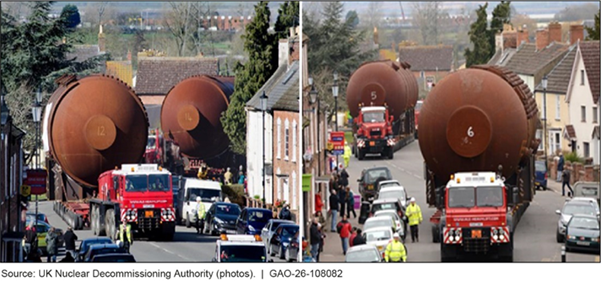
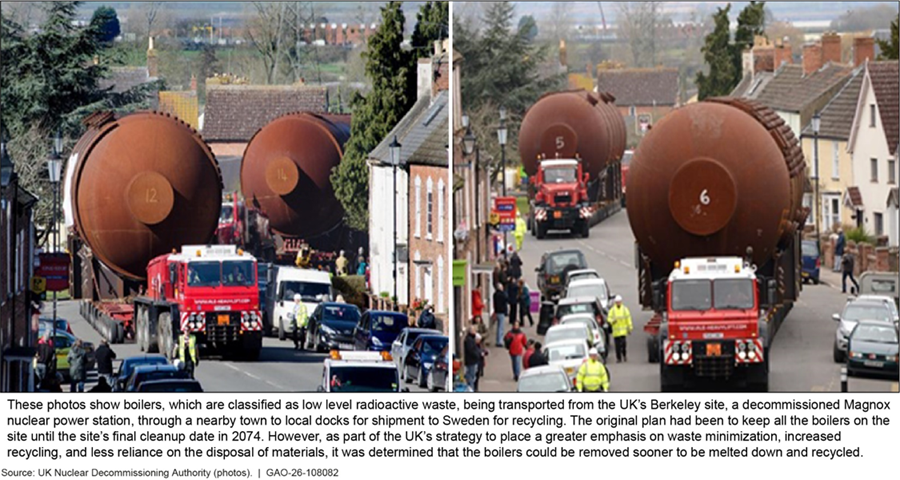
Decommissioned Nuclear Boilers Diverted for Recycling Instead of Disposal in the United Kingdom’s National Low Level Waste Repository
EM engages with other countries about nuclear cleanup, but this engagement is limited and not done strategically to identify alternative approaches that could reduce costs and risks at EM’s 15 cleanup sites in the United States. For example, EM participates in international working groups but does not disseminate lessons learned from other countries to EM’s decision-makers. GAO and other organizations have long reported on challenges facing the EM cleanup mission, including that EM does not have a fully risk-informed approach to cleanup. EM site officials told GAO they want more opportunities to engage with other countries, but EM headquarters officials stated that they typically teach other countries, rather than learn from them. Until EM more strategically engages with other countries to identify and evaluate alternative nuclear cleanup approaches, EM will continue to miss opportunities to employ new approaches that its decision-makers could use to reduce risks and costs across the EM complex.
Why GAO Did This Study
Many countries have nuclear waste resulting from activities such as weapons production, nuclear power generation, and medical uses. Efforts to address this waste can be costly, take decades, and present common challenges. EM is responsible for cleaning up 15 sites across the United States contaminated by nuclear weapons production and energy research. EM has estimated that its cleanup mission could cost between $641 billion and $840 billion and take until 2100.
Senate Report 118-188 includes a provision for GAO to report on EM’s efforts to leverage other countries’ lessons learned for managing nuclear waste. This report examines (1) selected countries’ nuclear waste management approaches from which EM could learn, and (2) the extent to which EM has considered other countries' approaches for nuclear waste cleanup.
GAO reviewed documents for six selected countries: Belgium, Canada, France, Germany, Japan, and the UK. GAO interviewed officials from five of these countries and visited selected sites in France and the UK. GAO analyzed documents and interviewed officials from EM headquarters and received written responses from all 15 EM sites about their international engagements.
What GAO Recommends
GAO recommends that EM strategically engage with other countries to identify and evaluate alternatives that could help reduce risks and costs or accelerate its cleanup activities. EM should disseminate identified approaches to EM decision-makers to explore and integrate into cleanup efforts, as appropriate. EM concurred with the recommendation.
|
Abbreviations |
|
|
|
|
|
DOE |
Department of Energy |
|
EM |
Office of Environmental Management |
|
IAEA |
International Atomic Energy Agency |
|
NEA |
Nuclear Energy Agency |
|
R&D |
research and development |
|
UK |
United Kingdom |
This is a work of the U.S. government and is not subject to copyright protection in the United States. The published product may be reproduced and distributed in its entirety without further permission from GAO. However, because this work may contain copyrighted images or other material, permission from the copyright holder may be necessary if you wish to reproduce this material separately.
July 29, 2026
Congressional Committees
The United States is among many countries that are undertaking efforts to manage, treat, and dispose of nuclear waste resulting from weapons production; nuclear power generation; and medical, industrial, and research activities.[1] This waste can comprise various forms and materials with different radioactivity levels, much of which poses a long-term risk to people and the environment and needs to be disposed of in a safe manner. Efforts to address nuclear waste can be costly and take decades to complete. Countries face common challenges with their nuclear waste disposal efforts, according to the International Atomic Energy Agency (IAEA), though the types and amounts of such waste in each country can vary widely.[2] For example, much of the waste has accumulated over long periods of time, and it can be difficult to separate, retrieve, or determine its properties in order to identify how to safely treat, store, and dispose of it. There may also be incomplete or inaccurate records of the waste that—when coupled with the potential for the waste, its packaging, and storage facilities to degrade—can complicate its management and disposal.[3]
Within the United States, the Department of Energy’s (DOE) Office of Environmental Management (EM) is responsible for cleaning up radioactive and hazardous contamination resulting from decades of nuclear weapons production and energy research. EM’s cleanup mission includes remediating 15 remaining sites across the country, known as the EM complex. This work includes addressing contaminated soil and groundwater; deactivating and decommissioning contaminated buildings; sponsoring research and technology development to improve cleanup efforts; and designing, constructing, and operating facilities to treat millions of gallons of radioactive liquid waste. Since beginning its cleanup program in 1989, EM has spent more than approximately $241 billion on its cleanup efforts. However, according to DOE, EM’s most challenging and costly cleanup work remains. In April 2026, EM estimated that completing its cleanup mission could take until 2100 and cost between $641 billion and $840 billion.[4]
Other countries that face challenges with cleaning up nuclear waste include France and the United Kingdom (UK), which also developed nuclear weapons and deployed nuclear energy. Both are in the midst of decades-long, costly cleanup efforts at multiple sites across their countries. At least 28 other countries, including Canada, have operational commercial nuclear power plants that produce waste needing disposal. In most countries, once the nuclear fuel in these plants has been used and removed from the reactors, that highly radioactive waste—known as spent nuclear fuel—is put in storage while awaiting disposal.[5] Some countries, such as France, reprocess the spent nuclear fuel so it can be reused as new fuel for nuclear reactors, but this still produces highly radioactive waste needing disposal.[6] A few countries, including Germany, have ceased their commercial nuclear power operations, are actively deactivating and decommissioning the plants, and are addressing any nuclear waste that remains.
Senate Report 118-188 includes a provision for GAO to review lessons learned from how other countries manage nuclear waste and EM’s efforts to leverage those lessons learned. This report examines (1) selected countries’ nuclear waste management approaches from which EM could learn, and (2) the extent to which EM has considered other countries’ approaches for nuclear waste cleanup.
To address our first objective, we first identified examples of the types of challenges EM’s cleanup mission faces to help focus our review on lessons learned from other countries that would be relevant to EM. To identify examples, we reviewed our related prior work and documents from other organizations, such as the DOE Office of Inspector General and the National Academies of Sciences, Engineering, and Medicine. Based on our review of these documents, we identified three categories of challenges to focus on in our review: risk assessment, waste management, and research and development (R&D).
We also examined documents from international organizations like IAEA and the Nuclear Energy Agency (NEA) and interviewed officials from IAEA and NEA. To learn about nuclear waste cleanup efforts in specific countries, we selected six countries from an initial universe of 38 countries based on a set of inclusion criteria, such as relevance to EM’s cleanup efforts, and other considerations.[7] The countries we selected were Belgium, Canada, France, Germany, Japan, and the UK. The findings from the selection of countries are not generalizable to other countries’ cleanup efforts. We reviewed publicly available, country-specific documents and conducted virtual interviews with officials from the relevant waste management organizations of five of these countries. Officials from the Japanese organizations we planned to interview declined our request to meet. In addition, we traveled to France and the UK to learn about their nuclear waste cleanup efforts, interviewing knowledgeable government officials and industry representatives and visiting selected cleanup sites in both countries.
To address our second objective, we reviewed relevant DOE and EM documents, such as EM’s 2022 Program Plan and its 2020 Environmental Management Program Management Protocol, as well as international agreements among DOE and other countries that pertain to nuclear waste management.[8] We also interviewed officials from EM’s Office of Intergovernmental and Stakeholder Programs to understand EM headquarters’ roles and responsibilities for engaging with other countries. To learn more about the wider EM complex’s engagement with other countries, we sent all 15 EM sites a questionnaire about their international engagements. We received and analyzed responses from officials at all 15 sites. We provide a more detailed description of our objectives, scope, and methodology in appendix I.
We conducted this performance audit from February 2025 to July 2026 in accordance with generally accepted government auditing standards. Those standards require that we plan and perform the audit to obtain sufficient, appropriate evidence to provide a reasonable basis for our findings and conclusions based on our audit objectives. We believe that the evidence obtained provides a reasonable basis for our findings and conclusions based on our audit objectives.
Background
EM Mission, Structure, and Cleanup Sites
EM is responsible for the cleanup of legacy nuclear waste—hazardous and radioactive waste generated by the development and production of nuclear weapons and government-sponsored nuclear energy research dating back to World War II and the Cold War. This cleanup scope makes EM the largest environmental cleanup program in the world, according to EM documents.
As of fiscal year 2025, DOE estimates that it will cost $539 billion to clean up its past activities, of which more than $419 billion was for EM’s cleanup. The estimated cost to clean up areas where federal activities have contaminated the environment is known as the government’s environmental liability.[9] We added the U.S. government’s environmental liability, which includes EM’s liabilities, to our High Risk List in 2017.[10]
EM is composed of headquarters and 15 cleanup sites (collectively referred to as the EM complex), which work together to advance EM’s mission. At EM headquarters, the Office of Intergovernmental and Stakeholder Programs, within the Office of Communications and Stakeholder Engagement, has primary coordination responsibility for EM’s international engagement efforts.[11] This office facilitates international engagement as well as the approval of foreign travel to support EM cleanup activities. The office is tasked with maintaining formal bilateral and multilateral agreements, supporting EM leadership’s engagement with foreign counterparts, serving as the entry point for external stakeholders seeking to engage with EM on international activities, and managing all aspects of foreign travel for EM headquarters and site employees. EM’s 15 cleanup sites may also engage directly with officials from international governments.
DOE Membership in International Organizations
DOE represents the United States to two international organizations, the International Atomic Energy Agency (IAEA) and the Nuclear Energy Agency (NEA).[12]
IAEA is an autonomous international organization affiliated with the United Nations and based in Vienna, Austria. The agency was founded to (1) promote the peaceful uses of nuclear energy by transferring nuclear science and technology through its nuclear science and applications and technical cooperation programs; and (2) verify, through its safeguards program, that nuclear material subject to safeguards is not diverted to nuclear weapons or other proscribed purposes. IAEA has 181 member countries including Belgium, Canada, France, Germany, Japan, the UK, and the United States.
EM represents the United States at the IAEA Joint Convention on the Safety of Spent Fuel Management and on the Safety of Radioactive Waste Management, which addresses, on a global scale, the safety of spent fuel and nuclear waste management from their generation to disposal. According to the IAEA, the Joint Convention is relevant not only to member countries with nuclear power programs, but also to countries that use nuclear applications in medicine, industry, agriculture, research, and education in which nuclear waste is generated.
NEA is an intergovernmental agency within the Organization of Economic Cooperation and Development that uses international cooperation to assist member countries as they develop the scientific, technological, and legal bases required for the safe, environmentally sound and economical use of nuclear energy. NEA has 34 member countries, including Belgium, Canada, France, Germany, Japan, the UK, and the United States. EM represents the United States on NEA’s Radioactive Waste Management Committee and NEA’s Radioactive Waste Management Committee Working Party on Decommissioning and Dismantling.
Nuclear Waste Cleanup Efforts in Selected Countries
Countries often categorize their nuclear waste to enable appropriate management and disposal. For example, some countries use IAEA’s descriptions of nuclear waste categories for waste management (see table 1).
|
Waste Categories |
Category Description |
|
Exempt waste |
Waste that meets the criteria for clearance, exemption, or exclusion from regulatory control for radiation protection purposes. |
|
Very short-lived waste |
Waste that can be stored for decay over a limited period of up to a few years and subsequently cleared from regulatory control according to arrangements approved by the regulatory body, for uncontrolled disposal, use, or discharge. This class includes waste containing primarily radionuclides with very short half-lives often used for research and medical purposes. |
|
Very low-level waste |
Waste that does not necessarily meet the criteria of exempt waste, but that does not need a high level of containment and isolation and, therefore, is suitable for disposal in near surface landfill type facilities with limited regulatory control. Such landfill type facilities may also contain other hazardous waste. Typical waste in this class includes soil and rubble with low levels of activity concentration. Concentrations of longer-lived radionuclides in very low-level waste are generally very limited. |
|
Low-level waste |
Waste that is above clearance levels, but with limited amounts of long-lived radionuclides. Such waste requires robust isolation and containment for periods of up to a few hundred years and is suitable for disposal in engineered near surface facilities. This class covers a very broad range of waste. Low-level waste may include short-lived radionuclides at higher levels of activity concentration, and also long-lived radionuclides, but only at relatively low levels of activity concentration. |
|
Intermediate-level waste |
Waste that, because of its content, particularly of long-lived radionuclides, requires a greater degree of containment and isolation than that provided by near surface disposal. However, intermediate-level waste needs no provision, or only limited provision, for heat dissipation during its storage and disposal. Intermediate-level waste may contain long-lived radionuclides, in particular, alpha emitting radionuclides that will not decay to a level of activity concentration acceptable for near surface disposal during the time for which institutional controls can be relied upon. Therefore, waste in this class requires disposal at greater depths, of the order of tens of meters to a few hundred meters. |
|
High-level waste |
Waste with levels of activity concentration high enough to generate significant quantities of heat by the radioactive decay process or waste with large amounts of long-lived radionuclides that need to be considered in the design of a disposal facility for such waste. Disposal in deep, stable geological formations usually several hundred meters or more below the surface is the generally recognized option for disposal of high-level waste. |
Source: GAO review of the International Atomic Energy Agency Safety Standards: Classification of Radioactive Waste. | GAO‑26‑108082
However, waste categorization varies from country to country, including among the six countries we selected for the purposes of this review—Belgium, Canada, France, Germany, Japan, and the UK. For example, France categorizes certain waste as intermediate-level, long-lived waste—a waste category that the United States does not use—which includes waste that does not emit high heat but has a significant quantity of radionuclides with long half-lives and is planned for disposal in a deep geological repository like high-level waste.[13] This intermediate-level waste mainly results from the reprocessing of spent fuels and the operation and maintenance activities of the reprocessing plants. Likewise, Belgium has a waste category called category A waste—another category the United States does not use—which includes short-lived, low-level and intermediate-level waste containing limited quantities of long-lived radionuclides. Such waste poses a risk to people and the environment for several hundreds of years. Moreover, each country defines its highest level category of nuclear waste slightly differently.[14]
In addition, the nuclear waste in our selected countries stems from different sources. For example, France and the UK have defense and commercial nuclear waste.[15] In contrast, Belgium, Canada, Germany, and Japan have nuclear waste from the commercial sector only. The sources of nuclear waste and activities to address that waste vary, but each of these six countries have some ongoing remediation work related to nuclear waste.
Belgium. Belgium’s nuclear waste is the result of its nuclear power generation, industrial, medical and research activities, and historical radium and uranium production. As of August 2024, at least seven sites involved in the nuclear industry were in the process of being decommissioned across the country, including two nuclear reactors in Doel and Tihange, and a research reactor in Mol.
Canada. Nuclear waste in Canada is the result of its nuclear power generation, R&D activities, and radium and uranium production. As of August 2024, at least seven sites involved in the nuclear industry were in the process of being decommissioned across the country, including the Chalk River Laboratories in Ontario, the Gunnar Mine Site in Saskatchewan, and the Whiteshell Laboratories in Manitoba.
France. France has nuclear waste resulting from civil nuclear research, its defense program, and 57 active nuclear power reactors, the country’s main source of nuclear waste. As of August 2024, 36 of the country’s nuclear facilities had been shut down or were undergoing decommissioning. Two of France’s main waste storage sites are La Hague in Normandy, and Marcoule in Occitanie.
Germany. Germany has nuclear waste resulting from the operation of research and training reactors, the repatriation of vitrified waste from the reprocessing of fuel assemblies abroad, and nuclear power generation.[16] However, there are no more nuclear power plants in operation, as Germany completed the phase-out of its use of nuclear energy for electricity generation in 2023. As of August 2024, 30 nuclear reactors were in the process of being decommissioned across the country. Two main sites with significant ongoing activity are the Asse II mine and Konrad repository, both in Lower Saxony.
|
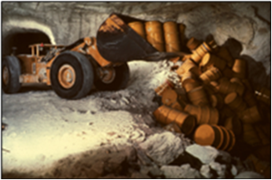
Waste Retrieval Cleanup Project at Germany’s Asse II Mine From 1967 through 1978, the German government disposed of about 126,000 drums of low- to intermediate-level nuclear waste in a former salt mine, Asse II, located in the state of Lower Saxony. Typical waste disposed of in the mine included sludges, scrap metal, building rubble, and mixed waste from several producers such as nuclear power plants and research institutes. The placement of the waste in the mine was initially performed as part of nuclear waste disposal research. Initially, the waste drums were stacked on their sides to make better use of the hollow space. Starting in 1971, the waste was primarily dumped using a wheel loader, in part because of an expectation that the waste would be permanently disposed of in the mine, with no plans for retrieval.
In 1988, water saturated with salt was found to be leaking into the mine. In subsequent years, the mine’s stability began to deteriorate. In 2013, the German government passed legislation for the waste to be retrieved and the mine decommissioned as quickly as possible to prevent long-term risks to humans and the environment. Efforts are ongoing to modify standard mining technology to allow for semi- and fully- automated waste retrieval operations. Waste treatment and storage facilities will also be constructed near the site so the retrieved waste can be safely characterized, packaged, and placed in interim storage. Planning for the waste retrieval process is ongoing. Sources: GAO analysis of German government documents; Federal Company for Radioactive Waste Disposal (Bundesgesellschaft für Endlagerung) (photo). | GAO‑26‑108082 |
Japan. Nuclear waste in Japan is the result of the country’s nuclear power generation, spent fuel reprocessing, and nuclear research. As of August 2024, 26 nuclear power reactors and 10 research reactors were in the process of being decommissioned, including units at Fukushima Daiichi and others located in Kansai and Tokyo.
United Kingdom. The UK has nuclear waste resulting from its nuclear power generation activities, research activities, and its defense program. As of August 2024, 17 nuclear sites involved in the nuclear industry were in the process of being decommissioned across the country. The most complex site, Sellafield, is located in Cumbria. Sellafield houses about 85 percent of all the UK’s nuclear waste on an area of less than 2 square miles. According to UK government officials, the UK currently plans to complete major hazard reduction activities at Sellafield over the coming decades, with full site remediation extending into the next century.
Several Countries Have Taken Actions That Accelerated Cleanup, Reduced Risks, and Resulted in Cost Savings
Several selected countries have taken various actions to address their nuclear waste that accelerated cleanup, reduced risks, and saved costs. These actions include intentionally directing limited resources to the highest risks, integrating or optimizing waste management, developing comprehensive nuclear waste inventories to inform their waste management efforts, and developing full-scale test facilities to facilitate technology development and infrastructure maintenance.[17]
Two Countries Shifted Their Approaches to Focus on Directing Limited Resources to the Highest Risks
The UK and Canada have shifted their nationwide cleanup
approaches to focus on directing limited resources to the highest risks. They
did this by developing integrated waste management strategies and focusing on
accelerating cleanup and reducing risks, which has enabled a range of financial
benefits in each country.
The United Kingdom
To manage its civil and defense nuclear waste in a cost-effective manner during a challenging economic climate, the UK has made several key changes, including (1) prioritizing the reduction of the highest hazards, (2) emphasizing waste minimization, and (3) focusing on proportional regulation and oversight.[18] In doing so, the UK adopted a risk-informed approach, which it defines as applying an approach that is commensurate to the hazard and risk posed. To guide its shift in these changes, the government developed a May 2024 policy framework for managing radioactive substances and nuclear decommissioning.[19] These changes enabled—and will continue to enable—the UK to accelerate cleanup and save billions of dollars, according to government documents and officials we interviewed. Below we describe each of these three changes in detail.
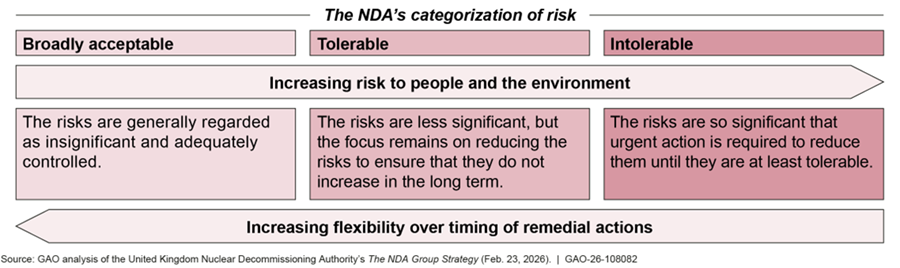
Prioritizing higher hazards and risks. The UK applies a risk-informed framework to prioritize its cleanup efforts based on three risk categories: risks that are considered intolerable, tolerable, and broadly acceptable (see fig. 1). Within this framework, the UK identified high-priority risks as “intolerable risks,” where the level of risk is not considered acceptable in the long term, and urgent action is required to reduce these risks. When addressing these risks, decisions may be made to accept certain near-term increases in risk in order to achieve long-term risk reduction. For example, workers may face near-term increases in risk when installing equipment needed to retrieve waste in environments with high radioactive contamination and that were not originally designed for waste retrieval activities.
Figure 1: Summary of the United Kingdom Nuclear Decommissioning Authority’s (NDA) Approach to the Prioritization of Risk
The UK’s Nuclear Decommissioning Authority has identified four legacy ponds and silos at the Sellafield site as the highest priority for action.[20] The UK’s National Audit Office has highlighted the types of risks posed by these facilities, noting that one of the silos is estimated to be leaking about 2,100 liters of contaminated water each day.[21] According to the Nuclear Decommissioning Authority, significant progress has been made in retrieving waste from the ponds and silos, but officials told us that independent reviews noted that progress remains slower than planned. The UK has achieved several major milestones for reducing risks; for example, from August through December 2023, workers at the Sellafield site accomplished the first retrieval and transfer of waste from inside one of the silos to one of the site’s new storage facilities. The Nuclear Decommissioning Authority reported in February 2026 that the site has made progress on these efforts, and waste is being retrieved from all four legacy ponds and silos at the site.[22]
Emphasizing waste minimization. In 2019, the UK Nuclear Decommissioning Authority issued a single nuclear waste strategy to address all nuclear waste at all of its sites, including materials that may become waste in the future.[23] This strategy applies two key principles:
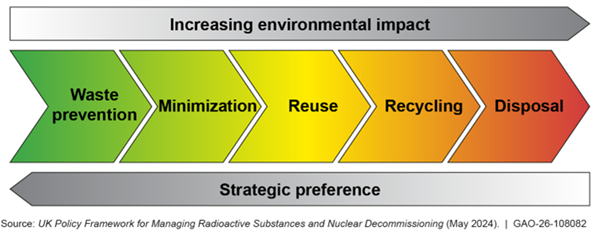
· Use of waste hierarchy. The authority applies a waste hierarchy—a priority order for managing waste materials based on their chemical, physical, and radiological properties and the environmental impacts of the waste management option—to help drive waste prevention and minimization. For example, opportunities to safely reuse or recycle materials are always considered before disposal (see fig. 2).
According to a UK government document, since implementing use of the waste hierarchy for low level waste, the UK government organization responsible for certain nuclear waste management activities has diverted 98 percent of waste from disposal at the UK’s national low level waste repository. This repository is the UK’s only national facility permitted to receive all categories of low level waste and is space limited. For example, one reported successful waste diversion effort involved the recycling of 15 large steel boilers—categorized as low level waste—from a decommissioned nuclear site, rather than disposing of them in the low level waste repository (see fig. 3). Moreover, in October 2024, the UK’s nuclear waste management organization reported that its efforts to divert waste from the low level waste repository had saved a total of nearly £60 million (equivalent to $79.4 million as of March 2026) in the past year, in addition to the more than £900 million in total (equivalent to $1.2 billion as of March 2026) saved over the prior decade. Government officials also estimated that its waste diversion efforts enabled it to avoid constructing another low level waste disposal facility, saving a further £2 billion in total (equivalent to $2.6 billion as of March 2026).
Figure 3: Nuclear Waste Being Transported through a Community in the United Kingdom (UK) for Recycling Instead of Disposal
· Focus on risk characterization. The UK Nuclear Decommissioning Authority has taken steps to focus on the risks posed by its nuclear waste, instead of relying solely on conservative waste classification assumptions, to optimize disposal pathways.[24] As we have previously reported, the classification of nuclear waste can dictate what disposal options are available and permissible.[25] This shift in focus has allowed the UK to minimize the volume of waste requiring management and disposal for high radioactivity, which has also resulted in cost savings.
For example, the UK nuclear waste management organization used improved radioactive waste characterization techniques to remeasure the radioactivity of approximately 1,800 drums of waste that had been managed as intermediate level waste and, accordingly, were destined for geological disposal.[26] This remeasurement was performed in part because, according to UK documents, the earlier measurement methods used were overly conservative and frequently resulted in waste being classified as higher activity waste. The remeasurement resulted in 90 percent of the drums being reclassified from intermediate level waste to low level waste, and 80 percent of the resulting low level waste drums then being reclassified to categories below low level waste. The further reclassification of this waste saved a total of over £9 million (equivalent to $11.9 million as of March 2026), in part because the very low level waste could be disposed of in a permitted landfill rather than in the UK’s national low level waste repository, according to a UK document. In addition, in its May 2024 policy framework, the UK government shifted its policy on intermediate level waste, stating that less hazardous intermediate level waste could in the future be disposed of in a near surface facility where it is safe to do so, while more hazardous intermediate level waste would still be planned for geological disposal.[27]
Focusing on proportional regulation and oversight. Over the last few years, the UK has sought to ensure that the regulations and oversight that guide nuclear cleanup are proportional to actual risks to better allow for progress toward cleanup efforts, according to UK officials. For example:
· A “G6” group of senior leaders from six key organizations across the UK government, regulators, and industry meets on a regular basis to discuss how to improve coordination and address barriers that may affect progress. According to UK officials, the group has collaborated to ensure alignment on priorities and to remove unnecessary bureaucracy, while maintaining appropriate regulatory oversight. The officials told us that one lesson learned through the G6 is that having the right individuals involved at the senior level has been instrumental to enable more timely decision making and progress.
· In 2025, an independent nuclear regulatory taskforce reviewed the UK’s nuclear regulatory framework and considered evidence from other industries in the UK, such as oil and gas, rail, mining, and health care, according to UK officials.[28] Through this effort, the taskforce identified that the UK’s regulation and oversight of the nuclear waste cleanup sector could be comparatively more conservative in terms of tolerance to risk, which may contribute to delays and increased costs and limit value for money. For example, the taskforce found in 2025 that it was expected to cost a total of £5 million (equivalent to $6.6 million as of March 2026) to complete demolition activities at a coal-powered site. However, the taskforce noted that it would cost at least £50 million in total (equivalent to $66.1 million as of March 2026)—10 times more—at a nuclear site because of the more stringent requirements, even though during the final stages of decommissioning and cleanup, the hazards and risks fall to levels comparable to non-nuclear industrial sites. The taskforce made a series of recommendations to improve proportional regulation, reduce unnecessary regulatory burden, and support more efficient delivery while maintaining high standards of safety and environmental protection. The government has since adopted these findings in principle and is considering reforms to address them.[29]
· The UK Ministry of Defense and its regulators have collaborated to identify ways to avoid expensive risk-averse solutions.[30] For example, the 2025 independent taskforce found that by applying a more proportionate approach to seismic controls in the construction of a new facility, the Ministry of Defense saved a total of £94 million (equivalent to $124.3 million as of March 2026) and accelerated its schedule for this project by 9 months.
In addition to evolving its approach to managing nuclear waste, the Nuclear Decommissioning Authority modified its organizational structure and changed contracting models to address cost increases and schedule delays, with the aim of improving cleanup efforts and value for money. Specifically, after experiencing significant cost and schedule challenges at the Sellafield Site, in 2015 the authority moved away from its “parent body organization” contracting model, which used management and operating contracts like those used by DOE, to a subsidiary model.[31] Under this new approach, the site licensing company became a wholly owned subsidiary of the authority, rather than being operated by a private contracting entity.
According to UK government documents, the authority determined that continuing with the original contracting model at Sellafield posed risks to its ability to deliver value for money. Officials from the Nuclear Decommissioning Authority told us that under this model, commercial incentives were not always aligned with long-term delivery objectives. The authority believed that changing the contracting model at Sellafield would remove “perverse incentives” and speed progress, thus shortening the time facilities present intolerable risks, according to an authority document.
The Nuclear Decommissioning Authority subsequently transitioned its other sites to the subsidiary model, an effort that concluded in 2023. According to the authority, the transition to the revised contracting model allows for more focus on long-term planning for the sites and more value for money.[32] In addition, an October 2024 report from the UK’s National Audit Office found that the authority’s contracting model changes had resulted in a range of financial and non-financial benefits, with the potential for more in the future.[33] For example, according to the UK National Audit Office, the authority is saving about £170 million ($224.9 million as of March 2026) annually as a result of discontinuing fees to site contractors and no longer having to pay for indemnities against certain risks.
Canada
Canada has similarly adopted an integrated waste management strategy to address all its nuclear waste, as well as adjusted its approach to focus on accelerating cleanup activities and reducing risks at key sites.
Adopting an integrated waste management strategy. In November 2020, the Canadian government initiated an effort to renew and modernize its national radioactive waste policy.[34] At the same time, in recognition that Canada had not yet developed plans to address the long-term management and storage needs for certain low-level, intermediate-level, and non-fuel high-level waste, the government tasked the Canadian Nuclear Waste Management Organization with developing an integrated radioactive waste management strategy to address these waste streams. The organization began its effort by commissioning an international benchmarking report on the long-term management of low- and intermediate-level waste from a survey of over 22 countries. Other steps entailed compiling an inventory of Canada’s nuclear waste, developing a cost estimate to assess the relative costs of implementing potential technical options, and extensive public engagement.
The strategy, released in June 2023, outlines a plan for long-term management of all Canada’s nuclear waste, including disposal plans for certain wastes that do not yet exist. In particular, the strategy recommended that (1) intermediate-level and non-fuel high-level waste be disposed of in a deep geological repository, to be managed by Canada’s Nuclear Waste Management Organization; and (2) low-level waste be disposed of in multiple near-surface disposal facilities, to be managed by waste generators and waste owners. The integrated strategy has allowed the Nuclear Waste Management Organization to advance its plans for a second deep geological repository in Canada, according to an organization document. In June 2025, the organization announced that it was seeking public feedback about the approach for siting the second repository, which would be used to dispose of intermediate- and high-level waste.[35]
Focusing on accelerating cleanup activities and reducing risks at key sites. In addition, as part of its efforts to accelerate cleanup and reduce risks, the Canadian government reviewed its organization responsible for enabling nuclear science and technology and managing the government’s decommissioning and nuclear waste liabilities. The review concluded that the organization’s business model needed to be changed. This resulted in a 2015 restructuring of Atomic Energy of Canada Limited,[36] the creation of Canadian Nuclear Laboratories, and the adoption of a government-owned, contractor-operated model for the management of Atomic Energy of Canada Limited’s sites.[37] As part of this process, the government tasked Canadian Nuclear Laboratories with accelerating nuclear waste cleanup activities across Canada’s nuclear waste sites to reduce risks and protect the environment.
Some progress has been made on this mandate, including by accelerating decommissioning activities at the Whiteshell Laboratories, Canada’s second largest site with nuclear waste, according to Canadian documents. Canadian Nuclear Laboratories now expects to complete cleanup activities at this site nearly 30 years ahead of schedule. Officials from the organization overseeing the contractor-operated nuclear laboratories told us that they are seeing cost savings associated with the accelerated cleanup efforts. Accelerated cleanup at the Chalk River Laboratories, Canada’s largest science complex, has resulted in the reduction of hazards and risks following the decommissioning of 121 buildings and structures since 2015.
Four Countries Use Comprehensive National Inventories to Inform Nuclear Waste Management Efforts
Belgium, Canada, France, and the UK have developed
comprehensive national nuclear waste inventories that inform their nuclear
waste management efforts, including forecasting future waste inventories and
storage and disposal needs, according to documents from these countries.
Belgium
The Belgian radioactive waste management agency is required by law to produce an inventory of radioactive waste and forecasts for waste production, according to Belgian documents. This agency produces two national inventories that address all government- and privately owned radioactive materials:
· A technical inventory, updated annually, of all existing and future waste to be managed, their quantities, and their chemical, physical, and radiological characteristics.[38]
· An inventory, produced every 5 years, that serves as Belgium’s nuclear liabilities inventory. This inventory identifies all of Belgium’s nuclear facilities and sites with radioactive materials and waste. It also estimates the costs needed to decommission the nuclear facilities and manage all of the materials and waste.
Having information about Belgium’s existing nuclear waste and forecasted future waste allows the nation to better plan for its waste storage and disposal needs, according to a Belgian document. For example, Belgium’s inventory data for the types of wastes to be disposed of in a future geological disposal facility are used to determine the repository dimensions required under different scenarios. The inventory also helps in other ways, such as by guiding R&D efforts, supporting optimization of waste treatment and conditioning processes, and informing the design and size of storage and disposal facilities, according to another Belgian document.[39]
|
Example of a Nuclear Waste Cleanup Challenge in Belgium In 2012, a routine inspection of a Belgian facility storing waste drums containing low-level nuclear waste immobilized in concrete led to the identification of a gel-like substance forming on the outer lids of several drums. Examination of other drums found more than 8,000 potentially similarly affected drums.
Belgium’s radioactive waste management agency kept the affected drums in temporary storage and began research to identify the root cause of the problem. Analysis of samples from these drums found that the gel resulted from the highly alkaline waste reacting with silica in the gravel and sand used as aggregates in the cementation process. Preventative actions taken include adopting stronger standardized screening of the materials to be used as aggregates and applying more stringent testing to rule out the risk of alkali-silica reactions. Because of uncertainties about how the affected waste drums will behave over time and the manner in which they will be disposed, instead of disposal in a near-surface disposal facility, a separate storage facility dedicated to these waste drums was constructed, with an operating lifetime of at least 50 years. The ongoing temporary storage of these drums will allow for further research, inspection, and follow-up until a safe disposal solution is identified. Sources: GAO analysis of Belgian government and waste management organization documents; Belgium’s 2020 report for the Joint Convention on the Safety of Spent Fuel Management and on the Safety of Radioactive Waste Management (photos). | GAO‑26‑108082 |
Canada
A Canadian government agency collects, compiles, analyzes, and publishes inventory data every 3 years for nuclear waste in Canada. This inventory provides the current and projected future volumes of nuclear waste in Canada. Having a timeline for the generation of nuclear waste provides the Canadian government with a better national-level understanding of its need for long-term nuclear waste management facilities, according to the agency’s 2021 report on Canada’s 2019 inventory. For example, the 2021 report includes projections for the volumes of waste to be disposed of in Canada’s currently proposed long-term waste management facilities by 2022, 2030, 2050, and 2100.[40] According to the report, if the projections are met, Canada will have made significant progress by 2050 on the long-term management of the vast majority of the country’s projected low- and high-level waste.
France
France’s national radioactive waste management agency is required to publish a comprehensive national inventory every 5 years of all radioactive materials and waste present in France, including from the civil and defense sectors, according to French documents. The agency also publishes an annual report with updates to the inventory of materials and waste, as well as a summary of forecast quantities.[41] These forecasted inventories involve wide-ranging scenarios based on the (1) framework of France’s national radioactive materials and waste management plan and (2) guidelines from the country’s long-term energy policy, according to French documents. For example, the scenarios in the 2023 national inventory report are built around principles that include the continuation of France’s reprocessing strategy until 2040 and consideration of different spent fuel treatment and recycling strategies.
The inventory helps inform France’s national radioactive materials and waste management plan, as well as discussions about the country’s energy policy, according to agency officials we interviewed. They also told us that the national inventory is a valuable tool because, by identifying current and future volumes of radioactive materials and waste, the agency can anticipate the needs for storage and disposal capacity. For example, the design of France’s future deep geological repository was based on a forecasted inventory from the 2018 national inventory report, the officials said.
The United Kingdom
Two UK government agencies collaborate to compile and publish a national inventory every 3 years of all radioactive materials and waste in the UK. The inventory, which is published in a suite of reports, also provides forecasts of expected materials and waste.[42] The UK government uses the inventory to understand how much waste there is and where. It also provides data about the chemical, physical, and radiological characteristics of the materials and waste.
The inventory supports planning and preparation for managing the UK’s nuclear waste, according to UK government documents. In particular, understanding the inventory helps the UK assess risks, storage and disposal needs, treatment and packaging options, and disposal routes, among other things. For example, the UK organization responsible for developing the country’s planned geological disposal facility uses the inventory data to identify the scope of waste and material types that will be permanently disposed of in the facility and to develop and analyze alternative scenarios and projections.[43] This then informs the organization’s conceptual designs for the disposal facility and related safety and environmental assessments.
The national inventory is also used by a wide range of stakeholders, according to a UK government document. These include researchers and academics working to develop innovative technologies and processes for managing the UK’s nuclear waste and members of the public seeking to understand more about the types and quantities of waste produced in the UK.
Full-Scale Test Facilities Helped France and the UK Save Money and Minimize Disruptions to Their Cleanup Efforts
Developing and using full-scale test facilities has helped France and the UK address technological and operational challenges to nuclear waste cleanup, in turn helping to save money and minimize disruptions to cleanup efforts, according to officials from both countries.
France
French officials we met with highlighted the importance of developing and using full-scale test facilities as part of their R&D efforts for addressing nuclear waste. For example, the officials noted that the Marcoule site in Southern France has a full-scale vitrification laboratory that is used to conduct pilots and other demonstrations of ways to minimize the volume of nuclear waste (see fig. 4). The vitrification laboratory is used to perform test simulations and demonstrate and optimize the operation of the equipment used for the vitrification of highly active liquid waste. According to a French document and officials, the use of the vitrification laboratory and other full-scale test facilities has resulted in benefits, particularly for training and testing scenarios. For example, operators can use the facilities to troubleshoot technical issues or ensure that the settings for specific tools, such as robotic arms, are correct before using them in one of France’s operating vitrification facilities. Further, having access to these types of test facilities has reduced maintenance and costs, French officials said.
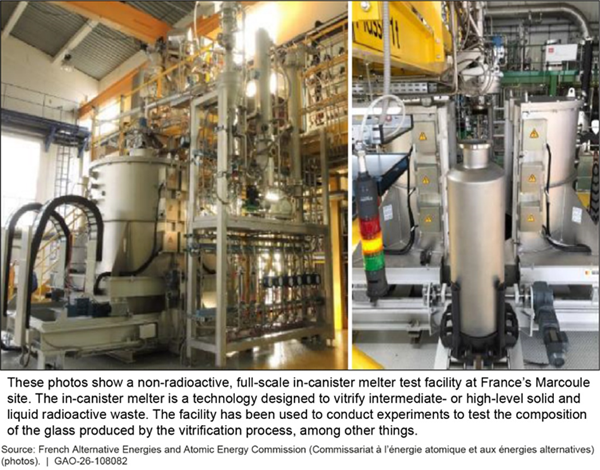
Similarly, Orano, which owns and operates the La Hague site in northwestern France, has a large “research hall” to develop new processes and equipment. In particular, the hall includes a full-scale test facility of a cold crucible melter used in the vitrification process. Orano representatives told us that the facility helps them train employees and problem-solve technical challenges in a non-nuclear environment. For example, in one case, Orano was able to design a specific tool and test the tool before deploying it in the field to address an unexpected technical issue.
The United Kingdom
Officials from United Kingdom National Nuclear Laboratory reported that one of the most valuable efforts the laboratory has undertaken was building a full-scale test facility that replicates Sellafield’s Waste Vitrification Plant.[44] The test facility, which began operations in October 2004, was built to provide a developmental tool to optimize and improve the operation of the plant’s three operating vitrification lines (see fig. 5).
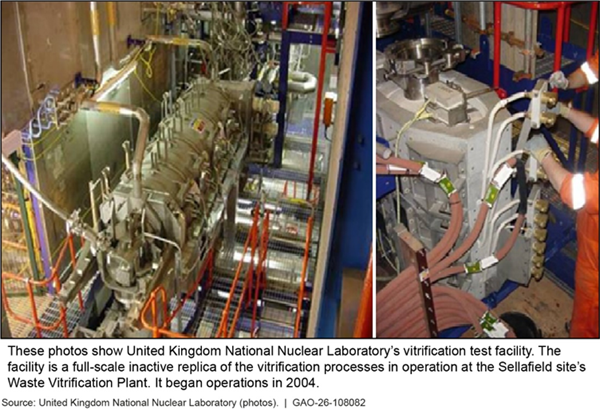
Use of the vitrification test facility helped the Sellafield site accelerate the reduction of highly radioactive liquids stored at Sellafield, according to information from United Kingdom National Nuclear Laboratory. In addition, through experiments performed using the test facility, the laboratory identified ways to increase the amount of waste that can be vitrified. The laboratory determined that this would result in the production of fewer containers of glass waste, thereby providing not only considerable operational savings, but also savings related to storage, transport, and final disposal of the waste.
Use of the test facility has also helped to minimize Sellafield’s Waste Vitrification Plant’s operational downtime, since operators and maintenance technicians can train and experiment on the test facility before making changes or repairs in the active plant, laboratory officials told us. The operational improvements and efficiencies made through use of the vitrification test facility for more than 20 years has resulted in at least hundreds of millions of pounds in cost savings—with the cost of the test facility being a fraction of the benefits delivered, the officials said.
EM Is Missing Opportunities to Potentially Reduce Risks and Costs and Accelerate Cleanup
EM uses formal and informal mechanisms to engage internationally on nuclear cleanup issues, primarily with Canada, France, Japan, and the UK. We and others have reported on significant challenges EM faces with accomplishing its cleanup mission, including challenges it has in common with other countries. However, EM’s limited international engagement and decentralized approach to decision-making is causing it to miss opportunities to learn from other countries that have successfully implemented approaches that reduced costs and risks and accelerated cleanup. Many EM officials and officials from international organizations also told us that EM could do more to engage internationally and take a more proactive role in identifying alternative cleanup approaches.
EM Uses Limited Formal and Informal Mechanisms to Engage with Some Countries
EM uses formal and informal mechanisms to engage with other countries on issues related to nuclear waste management, but that engagement is generally limited. For example, DOE has active formal bilateral or trilateral agreements, such as a statement of intent or a memorandum of understanding, with at least 16 countries on issues related to nuclear waste management.[45] In some instances, agreements were signed decades ago, and EM has not engaged with these countries about issues related to nuclear waste management for many years. For example, in 1998, DOE entered into a bilateral agreement with Argentina to work on decontamination and decommissioning issues; however, according to an EM official, there is no ongoing work between the two countries in part because EM did not have much to gain from the agreement.[46]
EM’s most active international engagement has been through the following agreements:
· Trilateral Agreement with Canada and the UK. In March 2020, DOE signed a trilateral statement of intent with Atomic Energy of Canada Limited and the UK Nuclear Decommissioning Authority. Under the agreement, the three countries exchange information on a variety of radioactive waste topics such as managing aging infrastructure, waste disposal, and contracting approaches.[47] In November 2021 and November 2022, the three parties reaffirmed their intent to share lessons learned and good practices concerning the management of legacy nuclear sites under the statement of intent.
Upper-level management officials from these organizations typically hold an annual meeting on the sidelines of the Waste Management Symposia, a nuclear waste conference held in the United States.[48] This conference is also attended by project managers, technical specialists, and other officials from DOE and other governments and private organizations throughout the world. According to EM officials, topics discussed during the annual trilateral meeting include updates and opportunities pursued, as well as activities for potential areas of collaboration. In addition to the conference, representatives from each country have also participated in technical workshops focused on selected topics. For example, the tri-parties held in-person meetings on stakeholder engagement and in-situ decommissioning in 2023.[49]
· Bilateral agreement with France. DOE signed a memorandum of understanding with France’s National Radioactive Waste Management Agency in October 2012 concerning cooperation in the field of nuclear waste management. The goals of the memorandum include enhancing communication and cooperation and establishing a framework for cooperation on nuclear waste management. Specific areas for cooperation under the memorandum include deactivation and decommissioning approaches, groundwater and soil remediation, nuclear waste processing pretreatment and immobilization, nuclear waste management, and external stakeholder outreach. While the memorandum of understanding was signed in October 2012, as of May 2026, an EM official stated that EM has strengthened its relationship with France over the past couple of years. EM leadership started meeting with French officials under part of this agreement in 2023 and 2024. During those interactions, EM senior officials visited the La Hague and Marcoule sites on two occasions to learn about the potential applicability of vitrification for waste treatment at the Idaho National Laboratory.
· Bilateral agreement with Japan. EM began formally collaborating with Japan in July 2012 on issues related to the Fukushima Daiichi nuclear accident, including topics like safety and regulatory issues, nuclear security, and decommissioning.[50] In addition, in October 2017, DOE signed a statement of intent with Japan’s Ministry of Economy, Trade, and Industry concerning cooperation around civil nuclear energy. According to the statement of intent, both parties plan to collaborate on R&D for topics such as nuclear waste management and decommissioning activities. Under this statement of intent, senior EM officials traveled to Japan in 2024 and 2025 to support the Fukushima Daiichi nuclear power plant accident cleanup and decommissioning efforts through an annual international forum.
In addition to formal mechanisms, EM also engages informally with other countries through its participation in international organizations involved in nuclear waste management issues, such as IAEA and NEA. For example, at IAEA, EM participates in periodic meetings with representatives from other parties to the Joint Convention on the Safety of Spent Nuclear Fuel and on the Safety of Radioactive Waste Management.[51] There have been eight meetings since the Joint Convention was established in 2001, with the most recent meeting having occurred in March 2025. Officials from EM sites are also involved in IAEA activities, according to EM sites’ responses to our questionnaire. For example, EM officials from one site indicated that they hosted an IAEA working group meeting in 2016 to discuss uranium mining and remediation with representatives from 15 different countries. In addition, EM participates in NEA committees, such as the Radioactive Waste Management Committee, where countries collaborate on issues related to nuclear waste management, spent nuclear fuel disposition, and R&D projects. EM officials noted that EM also participates in NEA’s Technical Advisory Group for the decommissioning and dismantling of nuclear facilities, through which EM’s West Valley site hosted a 3-day meeting and tour of the site in October 2024. Moreover, EM officials told us that staff from EM headquarters and EM cleanup sites also participate in NEA working groups to discuss topics that include salt repositories, technical advice, and stakeholder engagement.
EM site officials indicated in their questionnaire responses that they also periodically engage with other countries—including the Czech Republic and South Africa—through other informal means. For example, site officials indicated that in collaboration with Czech researchers, they have published several journal articles on vitrification processes and technologies. EM site officials also reported that most of EM’s current engagement and opportunities to share experiences and learn from other countries is through participation in conferences, particularly the Waste Management Symposia.[52] However, one EM site official noted that EM’s participation in the Symposia has slowed in recent years.
EM has engaged either formally or informally with other countries to discuss nuclear waste cleanup; however, officials were unable to demonstrate that they have collected lessons learned from those interactions and shared those lessons across the EM complex. For example, an EM official said that when EM officials participate in IAEA or NEA working groups and lessons learned are discussed, the working group will typically produce a report summarizing these lessons, and the report is made available on the IAEA or NEA websites. These reports are publicly available and provide a general summary of the discussion, but they are not developed for the purpose of applying lessons to EM sites. EM officials said that these reports are not specific to member countries, and as such, they are not directed to U.S. cleanup efforts. Further, EM officials said they do not have a formal mechanism to disseminate these lessons to EM site managers and decision-makers.
We and Others Have Highlighted Challenges EM Faces with Its Cleanup Mission That Other Countries Also Face
For decades, we and other organizations, such as the DOE Inspector General and the National Academies of Sciences, Engineering, and Medine, have highlighted significant challenges EM faces in accomplishing its cleanup mission. These include challenges in the three areas discussed above that other selected countries have also faced and taken steps to help address: risk assessment, waste management, and R&D.
Risk assessment. We and others have long recommended that EM adopt a risk-informed approach to addressing its cleanup mission. For example, in 2019, we found that EM did not have a framework for implementing, in a risk-informed manner, the various legal, regulatory, and other requirements and guidance establishing standards and procedures for its cleanup efforts.[53] We reported that EM would benefit from taking a risk-informed approach to help direct its limited resources and better consider the trade-offs among risks and costs as it makes decisions about how to approach individual cleanup activities at each site, prioritize activities at and across sites, and make policy decisions that can affect multiple sites. In our 2019 report, we made two recommendations, including that DOE establish how EM should apply the essential elements of a risk-informed decision-making framework into its decision-making requirements and guidance. EM took some steps to address these recommendations. For example, in 2020 and 2022, EM developed planning documents that contain some information about its approach for prioritizing work and considering certain goals, such as risk reduction, cost, and worker safety, when making cleanup decisions. However, as of May 2026, these documents did not include some essential elements of risk-informed decision-making, such as how EM and its sites will make trade-offs among these goals.
In addition, in 2024, we found that EM had not used a risk-informed approach to classify and treat certain high-activity tank waste it plans to process through a facility currently under construction at its Hanford Site.[54] Experts we interviewed for our September 2024 report told us that some of this waste could be classified as low-level radioactive waste or transuranic waste based on its physical characteristics. If EM did so, EM might not need to construct the facility at all but could instead use a faster and cheaper treatment technology, along with alternative treatment approaches.[55] This approach could save the federal government billions of dollars, accelerate cleanup at Hanford—EM’s largest and most complex cleanup site—and reduce risks to workers and the environment.
Waste management. In May 2025, we found that EM did not have reliable data on its nuclear waste inventory and had not developed an integrated waste disposal plan to address factors affecting its ability to complete its cleanup mission.[56] These factors include the need to consider the origin of radioactive waste when classifying it, having no available disposal pathway for some wastes, and constraints on the disposal of certain waste. In that report, we found that EM’s complex-wide estimates of remaining low-level radioactive waste were incomplete and did not include significant volumes of waste that EM is responsible for disposing of, making it difficult to develop accurate estimates of (1) the amount of waste needing disposal, (2) how much it will cost, and (3) how long it will take for EM to complete. We also found that EM had not assessed opportunities to optimize complex-wide disposal decisions, even though we previously found that EM could save billions of dollars by considering alternative disposal plans for certain waste. In May 2026, DOE stated it concurred in principle with our recommendation that it should develop a nationwide, integrated radioactive waste disposal plan. However, DOE officials told us that developing such a plan is not practical and that it would therefore use EM’s more broad Environmental Management Program Plan to do high-level disposal planning.
Research and Development. We have also reported that investing in R&D could help EM identify safer, more effective, and cost-efficient cleanup approaches, but that EM could better coordinate and prioritize its R&D efforts across its cleanup sites. Specifically, in 2021, we found that EM was not taking a comprehensive approach to prioritizing R&D and did not have a formal system to collect information on R&D efforts across its cleanup sites and laboratories.[57] For example, we found that EM did not have a comprehensive framework for prioritizing its R&D efforts to ensure it was directing its limited resources to its highest priorities, which could help it save money and accelerate cleanup projects. In the absence of a comprehensive approach to R&D, individual EM sites and national laboratories had their own decision-making processes for prioritizing R&D, but we found these might not address long-term or complex-wide needs and could be leading to duplicative and overlapping R&D efforts. We also found that DOE officials across the complex were operating on different understandings of what constitutes R&D, which was affecting EM’s ability to identify, track, and evaluate its R&D investments to ensure they are being maximized. EM has taken steps to address some of our four recommendations from the 2021 report but as of May 2026 had not established a comprehensive approach to prioritizing R&D across the EM complex.
EM Is Missing Opportunities to Identify Potential Alternative Ways to Reduce Risks and Costs and Accelerate Cleanup
EM’s limited engagement with other countries is causing it to miss opportunities to learn about approaches it could use to reduce costs and risks while accelerating its cleanup efforts in the United States. In particular, numerous EM officials and officials from international organizations told us that EM could do more to engage internationally and take a more proactive role in identifying alternative cleanup approaches that could address challenges EM faces that other countries are also experiencing. For example, a nuclear waste expert we interviewed told us that EM could learn more from other countries, particularly related to waste treatment, technology transfers, and decommissioning. The expert added that EM could benefit from further consideration of technologies beyond vitrification that may also support the safe management and disposal of its waste.
As described above, some countries with ongoing agreements with DOE have adjusted their strategic approaches to prioritize addressing the biggest risks in their nuclear waste portfolios, which has enabled them to achieve cost savings. The UK and Canada made such adjustments to address challenges and improve cleanup outcomes. For example, after the UK government initiated austerity measures in 2010 to cut spending and reduce its deficit, the UK placed increased emphasis on a risk-informed decision-making approach and changed its contracting model. According to UK officials, this new approach supported clearer strategic direction and more effective engagement among senior leaders on the UK’s nuclear cleanup priorities.
Similarly, in 2020, the Canadian government initiated an effort to renew and modernize its national radioactive waste policy, and it began developing an integrated waste management strategy and accelerating its cleanup while reducing risks. In addition, countries such as the UK and France have used test facilities, and the UK has chosen treatment options that are readily available to speed up cleanup and save costs. For example, in the 1980s, the UK purchased a readily available vitrification technology from France for its vitrification plant design at Sellafield instead of continuing to design its own system.[58] The UK decided to purchase the French system because it could be implemented more quickly and would have higher production output than the system they were in the process of researching and developing.[59] The UK’s system has been vitrifying high-level waste since 1990. In contrast, it took EM 25 years to design and construct a vitrification facility at the Hanford Site to treat waste low in radioactivity, and it only began vitrifying this waste in October 2025 after years of addressing technical issues.
Some foreign officials we interviewed told us that they would like to engage more with EM—including by doing technology exchanges and collaborative research. For example, French officials said that there could be opportunities to do more research together on common waste types, such as sludge. Moreover, officials from the UK told us that there are opportunities for further engagement with EM, such as accessing materials for waste treatment.[60] UK laboratory officials also suggested that a mobile vitrification technology, GeoMelt, that they demonstrated at the Sellafield site could be applied in the United States to immobilize small quantities of problematic waste or be adapted for use in shielded environments for materials higher in radioactivity.[61]
Some EM site officials responding to our questionnaire also expressed a desire for more international engagement and for EM headquarters to be more proactively involved in identifying and collecting opportunities to engage with other countries.[62] For example:
· EM officials from 10 of EM’s 15 sites identified areas for potential collaboration with officials from other countries, such as enhancing decontamination and decommissioning technologies to reduce worker and environmental risk or identifying alternative technologies for treating low-level waste. For example, an official from one site expressed interest in learning about monitoring techniques for remote disassembly of radioactive components located inside inaccessible areas, such as waste shafts and silos. Further, an official from another site said that many countries have applied readily available technologies in unique ways to achieve more cost-effective decontamination and decommissioning approaches. The official added that it would be helpful to learn more about how other countries have applied such cost-effective, innovative solutions.
· EM officials from six EM sites reported wanting more opportunities to engage with other countries on nuclear waste issues, either in person or virtually. An official from one site said that while online meetings are efficient, seeing the application of something like decommissioning and demolition technology in person is more productive than trying to understand technology applications through videos or photos. The official added that the additional cost of international travel could be trivial compared to the cost savings or cost avoidance that can be achieved through in-person observations and discussions.
· EM officials from five EM sites expressed interest in EM headquarters being more involved and directing international outreach efforts. For example, an official from one EM site said that EM headquarters seems to be more of a “pass through” for countries who request to visit or meet. The official added that headquarters is not proactive in identifying challenges and finding innovative partnerships with other countries. An official from a different EM site said that if headquarters could determine the relevant countries for exchanges, it could help to ease the exchange of information.
EM spends over 90 percent of its annual budget on contractors, and EM officials told us that they face challenges engaging with other countries in part because of EM’s current model of using contractors to complete its work. For example, a senior headquarters official told us that because many of their contractors are international businesses, they have insight into other countries’ nuclear cleanup programs and may apply that insight into their work at EM. However, a site official said that EM primarily uses contractors who tend to advance and suggest concepts that are more in-line with their employer’s business models, rather than being guided by what is in the government’s best interest. Similarly, a nuclear waste expert noted that EM could potentially make greater use of lessons learned from other countries and suggested that its current approach to managing cleanup contracts may not always provide strong incentives for contractors to control costs or meet deadlines.
Our work over the last few years has found that EM headquarters has not taken a centralized approach to addressing aspects of its cleanup mission. For example, as described above, we found that EM does not have an integrated waste disposal plan and does not systematically and comprehensively track R&D funding throughout the EM complex.[63] Similarly, we found that EM headquarters does not centrally collect and use comprehensive information on groundwater cleanup or soil cleanup, and that both soil and groundwater could benefit from innovative approaches to cleanup.[64] Further, in June 2024, we recommended that EM establish a formal lessons learned process for program management that could be applied across the complex and incorporates key components such as collecting and disseminating lessons learned.[65]
According to EM’s 2020 Program Management Protocol, EM headquarters should periodically identify and evaluate strategic alternatives to accomplishing its cleanup objectives.[66] However, EM’s decentralized approach to decision-making stifles efforts to identify and evaluate potential alternative approaches used internationally that could benefit cleanup efforts across the EM complex. Moreover, EM headquarters officials told us that for most of EM’s international engagement, EM is sharing lessons learned, not learning from other countries. Additionally, EM does not collect lessons learned from its formal and informal international engagements, and it does not have a lessons learned program related to international engagement, which further limits its ability to identify strategic alternatives.
As we have previously reported, EM’s estimated time frames and costs for its cleanup mission continue to increase—its most recent estimates for cleanup are almost 100 years and over $641 billion to complete the mission.[67] In contrast, by shifting their strategies, other countries have been able to accelerate cleanup and save taxpayer dollars. Without strategically engaging with other countries to identify and evaluate alternatives they have used to successfully accelerate cleanup and reduce risks and costs—and disseminating these lessons to EM site managers and decision-makers—EM will continue to miss opportunities to employ new approaches that could allow it to accomplish the same in the United States.
Conclusions
EM faces significant challenges with cleaning up nuclear waste at its 15 remaining sites—an effort it estimates will not be completed until 2100 and will cost more than $641 billion. Other countries, such as France and the UK, face similar challenges with their own cleanup efforts and have used various approaches to accelerate cleanup while reducing related risks and costs—lessons EM could learn from.
While EM engages with these countries through formal and informal mechanisms, this engagement is limited and not done strategically—i.e., it is not done with an eye toward identifying and implementing more effective, and possibly less expensive, ways of approaching cleanup. EM site officials told us they want more engagement with other countries and for EM headquarters to proactively identify opportunities for them to do so. Moreover, EM’s limited international engagement and decentralized approach to decision-making is causing EM to miss opportunities to learn about strategic cleanup alternatives from other countries.
EM may be able to incorporate certain lessons into its cleanup program on its own initiative—such as prioritizing “intolerable risks” across the EM complex or leveraging full-scale test facilities to problem-solve waste treatment technology. On the other hand, other lessons—like changes to oversight—may require Congressional action to initiate. Nonetheless, until EM more strategically engages with other countries to identify and evaluate alternatives they have used for nuclear cleanup, EM (1) will continue to miss opportunities to employ new approaches that could allow it to accomplish its cleanup objectives faster and at less cost and risk, and (2) will be limited in its ability to communicate to Congress proposed changes to the law that could improve EM’s execution of its cleanup mission, based on the experiences of other countries. Moreover, without periodically disseminating information about such strategic cleanup alternatives to EM site managers and decision-makers, EM’s international engagement will be of limited use in improving EM’s on-the-ground approach to cleanup.
Recommendation for Executive Action
We are making the following recommendation to DOE:
The Assistant Secretary for Environmental Management should strategically engage with existing or new partner countries to identify and evaluate alternatives they have pursued that could help reduce risks and costs or accelerate nuclear cleanup efforts across the EM complex and periodically disseminate these approaches to EM site managers and EM decision-makers to explore and integrate into cleanup efforts, as appropriate. (Recommendation 1)
Agency Comments
In its comments, reproduced in appendix II, EM agreed with the report’s recommendation and described the agency’s plans to implement it. Specifically, EM officials stated that it will work through appropriate diplomatic channels to collaborate with allied countries. EM added that it intends to collaborate through information exchange; identification and evaluation of alternative strategies, as appropriate; and the sharing of best practices. Moreover, EM officials added that international collaboration could potentially identify strategies to accelerate cleanup timelines and cost reductions across the EM complex. Finally, EM stated that to share information on international practices, EM will establish an internal website for EM site managers and decision-makers to disseminate insights and practices gained from international engagement activities. We continue to believe that by strategically engaging with other countries to identify and evaluate alternatives for nuclear cleanup in the United States, EM will be better positioned to employ new approaches that its decision-makers could use to reduce risks and costs across the EM complex. EM also provided technical comments, which we incorporated as appropriate.
Officials from Belgium, Canada, France, Germany, and the UK also provided technical comments on relevant excerpts of the report that we incorporated into the report, as appropriate.
We are sending copies of this report to the appropriate congressional committees, the Secretary of Energy, and other interested parties. In addition, the report is available at no charge on the GAO website at https://www.gao.gov.
If you or your staff have any questions about this report, please contact me at AndersonN@gao.gov. Contact points for our Offices of Congressional Relations and Media Relations may be found on the last page of this report. GAO staff who made key contributions to this report are listed in appendix III.
Nathan J. Anderson
Director, Natural Resources and Environment
List of Committees
The Honorable Roger Wicker
Chairman
The Honorable Jack Reed
Ranking Member
Committee on Armed Services
United States Senate
The Honorable John Kennedy
Chair
The Honorable Patty Murray
Ranking Member
Subcommittee on Energy and Water Development
Committee on Appropriations
United States Senate
The Honorable Mike Rogers
Chairman
The Honorable Adam Smith
Ranking Member
Committee on Armed Services
House of Representatives
The Honorable Chuck Fleischmann
Chairman
The Honorable Marcy Kaptur
Ranking Member
Subcommittee on Energy and Water Development, and Related Agencies
Committee on Appropriations
House of Representatives
This report examines (1) selected countries’ nuclear waste management approaches from which the Department of Energy’s (DOE) Office of Environmental Management (EM) could learn, and (2) the extent to which EM has considered other countries’ approaches for nuclear waste cleanup.
To address the first objective, we first identified examples of the types of challenges EM’s cleanup mission faces to help focus our review on lessons learned from other countries that would be relevant to EM. To identify examples, we reviewed documents such as (1) GAO reports from 2015 through 2025, including the High Risk List and Priority Open Recommendations letters; (2) DOE Office of the Inspector General reports from the past 10 years on management challenges; (3) selected DOE Office of Enterprise Assessments reports on nuclear waste management at selected EM sites; (4) National Academies of Sciences, Engineering, and Medicine reports on the effectiveness of EM cleanup activities; and (5) conference topics and themes from the 2025 Waste Management Symposia. Based on our review of these documents, we identified three categories of challenges to focus on during our engagement with other countries: risk assessment, waste management, and research and development.
To learn more about other countries’ nuclear waste cleanup efforts, we reviewed documents on nuclear waste management cleanup issues from international organizations such as the International Atomic Energy Agency (IAEA), Nuclear Energy Agency (NEA), and the European Partnership on Radioactive Waste Management.[68] We also interviewed subject matter experts from IAEA, NEA, and other organizations, and we attended the 2025 Waste Management Symposia.
We selected six countries to include in our review: Belgium, Canada, France, Germany, Japan, and the United Kingdom (UK). The findings from this selection of countries are not generalizable to other countries’ nuclear waste cleanup efforts. To select these countries, we identified two groups of countries that resulted in an initial universe of 38 countries.
· First, we considered eight countries that, like the United States, possess or are suspected of possessing waste resulting from nuclear weapons production.[69] Of these eight countries, we selected France and the UK after judgmentally excluding the six other countries because of potential limitations about how those countries’ experiences may apply in the United States and concerns about access to information.
· Second, we considered countries that possess waste resulting from nuclear power generation and the use of radioactive materials for medical, industrial, and research activities. Because all countries possess nuclear waste, we identified the 34 countries that are members of NEA’s Radioactive Waste Management Committee as a preliminary selection criterion and then excluded the four member countries with defense nuclear waste to develop an initial universe of 30 countries.[70]
From this list of 30 countries, we selected four countries considering the following criteria: (1) at least one country with an existing, ongoing agreement with DOE to collaborate on nuclear waste management issues; (2) at least one country that does not have an existing, ongoing agreement with DOE to collaborate on nuclear waste management issues; and (3) countries that have a range of nuclear waste, including high-level waste. We also considered recommendations from officials we interviewed from IAEA, NEA, and other organizations. Using this criteria as input, we judgmentally selected four countries with non-defense nuclear waste—Belgium, Canada, Germany, and Japan—to add to the initial selection of France and the UK.
To learn more about the selected six countries’ nuclear waste management efforts, including efforts related to our three areas of focus, we reviewed publicly available country-specific documents. We also conducted virtual interviews with cognizant officials from five of the six countries, including officials from relevant waste management organizations and national nuclear research centers and laboratories. Officials from the Japanese organizations we planned to interview declined our request to meet.
In addition, we traveled to France and the UK in September 2025 to learn about their nuclear waste cleanup efforts by interviewing cognizant government officials and industry representatives and visiting selected cleanup sites. In France, we met with officials from the National Radioactive Waste Management Agency (L’Agence nationale pour la gestion des déchets radioactifs), Alternative Energies and Atomic Energy Commission (Commissariat à l’énergie atomique et aux énergies alternatives), Directorate-General for Energy and Climate (Direction Générale de l’Energie et du Climat), and Orano, a nuclear industry contractor. We conducted site visits at three locations in Normandy: the National Radioactive Waste Management Agency’s La Manche Disposal Facility, Orano’s La Hague recycling and reprocessing facility, and the Beaumont Research Hall. We also visited the Alternative Energies and Atomic Energy Commission’s headquarters office in Paris, the List Laboratory in Saclay, and the Marcoule site in Occitanie.
In the UK, we met with officials from the Department for Energy Security and Net Zero, Ministry of Defence, and Office for Nuclear Regulation in their London offices. We also traveled to Cumbria to meet with officials from the Nuclear Decommissioning Authority and tour the Sellafield site. While in Cumbria, we also met with officials from the UK’s nuclear waste disposal organization and United Kingdom National Nuclear Laboratory, and we visited a low level waste repository and the Workington and the Central laboratories.
To address the second objective, we reviewed relevant DOE and EM documents, such as EM’s 2020 Program Management Protocol and the 2022 Program Plan, and press releases about EM’s work with other countries. We also reviewed memorandums of understanding and statements of intent (which we refer to as agreements) pertaining to nuclear waste management among DOE specifically or the United States generally and Canada, France, Germany, Japan, and the UK, among other countries. EM has bilateral agreements with five of the six selected countries, with Belgium being the only exception.
To learn more about EM headquarters’ roles and responsibilities for engaging with other countries, we interviewed relevant officials within EM’s Communications and Stakeholder Engagement office, specifically within the Office of Intergovernmental and Stakeholder Programs, about interactions with officials from other countries in nuclear waste management organizations. We reviewed documents received from EM such as information about EM officials’ international visits to other countries during calendar years 2020 through 2025 and meeting summaries for these visits with foreign officials.
To learn more about the EM sites’ engagements with other countries, we developed and administered a written questionnaire to officials at all 15 sites in the EM complex.[71] The questionnaire asked EM site officials about the following: (1) their engagements with other countries about nuclear waste cleanup from 2015 through 2025, (2) any insights into challenges associated with such engagement, and (3) opportunities for future engagement among EM and other countries. We pretested the questionnaire with subject matter experts within GAO to ensure the clarity, quality, and readability of our questions. We revised the questions where appropriate based on pretest feedback. We received responses from officials at all 15 sites. Three sites—EM Los Alamos, the Savannah River Site, and the Waste Isolation Pilot Plant—submitted more than one response. We reviewed the responses to identify which countries the EM sites had interacted with and for common themes, opportunities, and challenges.
We conducted this performance audit from February 2025 to July 2026 in accordance with generally accepted government auditing standards. Those standards require that we plan and perform the audit to obtain sufficient, appropriate evidence to provide a reasonable basis for our findings and conclusions based on our audit objectives. We believe that the evidence obtained provides a reasonable basis for our findings and conclusions based on our audit objectives.
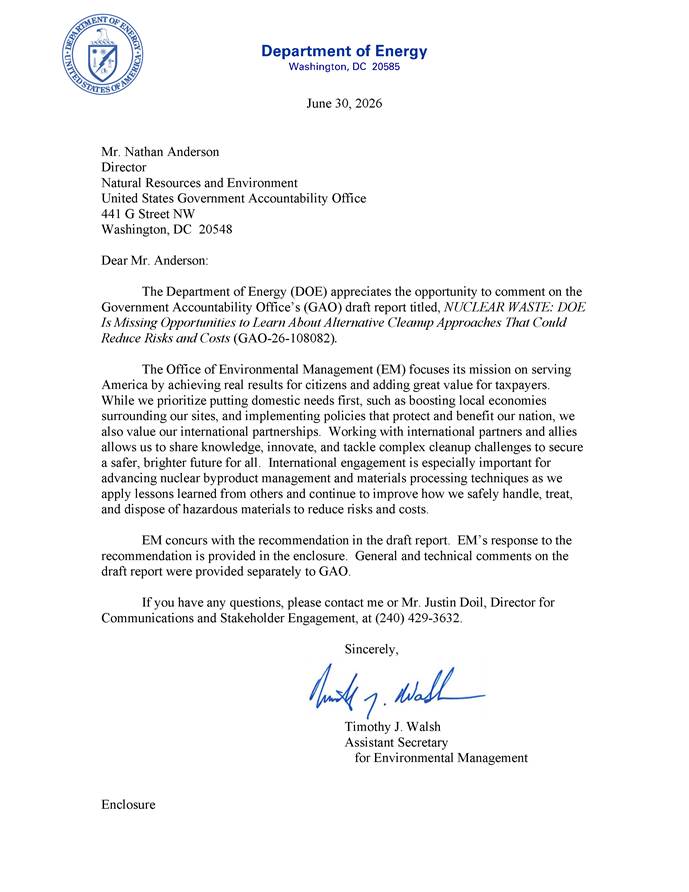
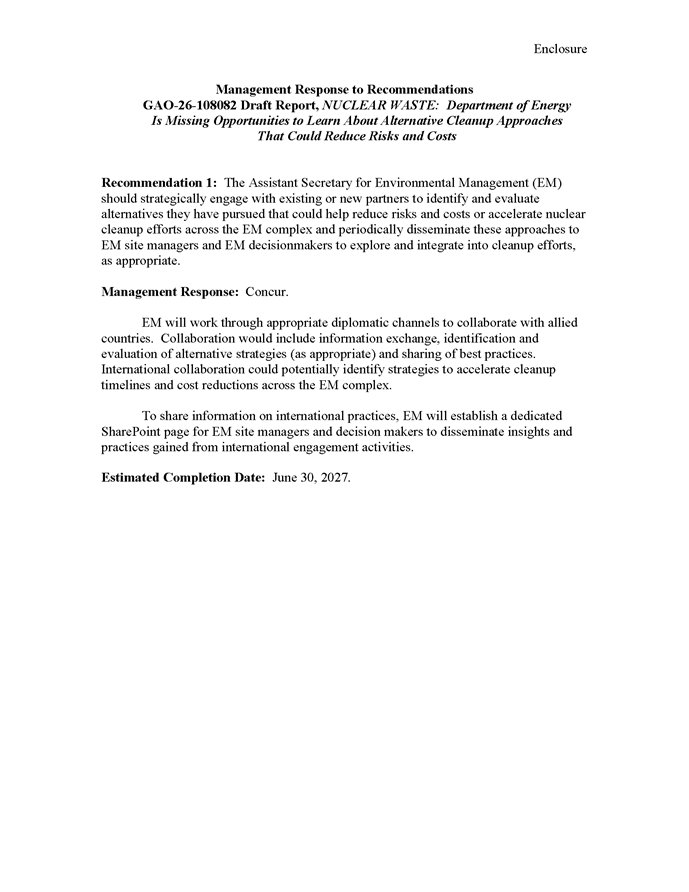
GAO Contact
Nathan J. Anderson, AndersonN@gao.gov
Staff Acknowledgments
In addition to the contact named above, Amanda K. Kolling (Assistant Director), Kevin Remondini (Analyst in Charge), Claudia Hadjigeorgiou, and Kelsey Sagawa made key contributions to this report. Adrian Apodaca, Myounna Blackmond, Tara Congdon, Claire Saint-Rossy, and Amber Sinclair also contributed to this report.
The Government Accountability Office, the audit, evaluation, and investigative arm of Congress, exists to support Congress in meeting its constitutional responsibilities and to help improve the performance and accountability of the federal government for the American people. GAO examines the use of public funds; evaluates federal programs and policies; and provides analyses, recommendations, and other assistance to help Congress make informed oversight, policy, and funding decisions. GAO’s commitment to good government is reflected in its core values of accountability, integrity, and reliability.
Obtaining Copies of GAO Reports and Testimony
The fastest and easiest way to obtain copies of GAO documents at no cost is through our website. Each weekday afternoon, GAO posts on its website newly released reports, testimony, and correspondence. You can also subscribe to GAO’s email updates to receive notification of newly posted products.
Order by Phone
The price of each GAO publication reflects GAO’s actual cost of production and distribution and depends on the number of pages in the publication and whether the publication is printed in color or black and white. Pricing and ordering information is posted on GAO’s website, https://www.gao.gov/ordering.htm.
Place orders by calling (202) 512-6000, toll free (866) 801-7077,
or
TDD (202) 512-2537.
Orders may be paid for using American Express, Discover Card, MasterCard, Visa, check, or money order. Call for additional information.
Connect with GAO
Connect with GAO on X,
LinkedIn, Instagram, and YouTube.
Subscribe to our Email Updates. Listen to our Podcasts.
Visit GAO on the web at https://www.gao.gov.
To Report Fraud, Waste, and Abuse in Federal Programs
Contact FraudNet:
Website: https://www.gao.gov/about/what-gao-does/fraudnet
Automated answering system: (800) 424-5454
Media Relations
Sarah Kaczmarek, Managing Director, Media@gao.gov
Congressional Relations
David A. Powner, Acting Managing Director, CongRel@gao.gov
General Inquiries
[1]The terms “nuclear waste” and “radioactive waste” are sometimes used interchangeably; we use both terms in this report to refer to the waste resulting from these types of activities involving radioactive materials. Some examples of industrial, medical, and research applications of radioactive materials include killing bacteria in food, treating cancer and other diseases, mapping underground sources of water, and measuring soil density for construction projects.
[2]International Atomic Energy Agency, Addressing Challenges in Managing Radioactive Waste from Past Activities, IAEA-TECDOC-2039 (Vienna, Austria: January 2024).
[3]For example, some of the waste was generated in the past when certain scientific understanding, technological advances, modern safety standards, and quality assurance systems were not yet in place, according to IAEA.
[4]Department of Energy, Fiscal Year 2027 Congressional Justification, Environmental Management (Washington, D.C.: April 2026).
[5]Such waste is generally disposed of—or expected to be disposed of—in a geological repository, which is an excavated, underground facility designed, constructed, and operated for the permanent disposal of highly radioactive waste. Considered to be the safest and most secure method for isolating spent nuclear fuel and other highly radioactive types of nuclear waste from humans and the environment, it uses an engineered barrier system and a portion of the site’s natural geology, hydrology, and geochemical systems to isolate the radioactivity of the waste.
[6]This process involves separating the plutonium from the uranium and other radioactive materials. The UK previously reprocessed spent nuclear fuel, including fuel sent from other countries like Italy and Japan. The UK ceased its reprocessing operations after shutting down the last remaining reprocessing plant in 2022 and has since transitioned to a post-operational cleanout and decommissioning phase that is expected to take decades.
[7]The initial universe included eight countries that, like the United States, possess or are suspected of possessing waste resulting from nuclear weapons production, and 30 countries that possess waste resulting from nuclear power generation and the use of radioactive materials for medical, industrial, and research activities.
[8]Department of Energy, Office of Environmental Management, EM Program Plan 2022 (Washington, D.C.: Sept. 22, 2022); and Environmental Management Program Management Protocol (Washington, D.C.: Oct. 30, 2020).
[9]Federal accounting standards require federal agencies to estimate future cleanup and waste disposal costs and report those estimated costs as environmental liabilities in their annual financial statements. Costs for cleanup work must be included in environmental liabilities estimates when they are both probable (i.e., more likely than not) and reasonably estimable (i.e., the outflow of resources that will be required is reliably quantifiable in monetary terms). See Federal Accounting Standards Advisory Board, FASAB Handbook of Federal Accounting Standards and Other Pronouncements, as Amended (Washington, D.C.: June 30, 2025).
[10]GAO, High-Risk Series: Heightened Attention Could Save Billions More and Improve Government Efficiency and Effectiveness, GAO‑25‑107743 (Washington, D.C.: Feb. 25, 2025); and High-Risk Series: Progress on Many High-Risk Areas, While Substantial Efforts Needed on Others, GAO‑17‑317 (Washington, D.C.: Feb. 15, 2017). In February 2017, we added the U.S. government’s environmental liability to our list of agencies and program areas that are at high risk for fraud, waste, abuse, and mismanagement or that are most in need of transformation. EM’s environmental liability is a major driver of overall federal environmental liability.
[11]Other DOE entities, such as the Office of Nuclear Energy, and the National Nuclear Security Administration also interact with officials from other countries. We did not review the activities of these other offices because they fall outside the scope of our review.
[12]According to EM officials, officials from other executive branch agencies, including the U.S. Department of State, participate in meetings of these organizations as well.
[13]The half-life of a radionuclide represents the time it takes for half the radioactive material to decay into another form.
[14]Throughout this report, when we refer to a waste category in connection with a particular country, we are referring to the category of waste as defined by the relevant country. For a discussion of how the United States categorizes certain radioactive waste, see GAO, Nuclear Waste: An Integrated Disposal Plan Could Help DOE Complete Its Cleanup Mission and Save Billions, GAO‑25‑107109 (Washington, D.C.: May 29, 2025).
[15]The United States likewise has both defense and commercial nuclear waste. EM’s cleanup mission is focused on waste from defense activities. The U.S. Nuclear Regulatory Commission, by comparison, has regulatory authority over commercial uses of radioactive materials and licenses commercial facilities that dispose of certain nuclear waste. The U.S. Nuclear Regulatory Commission, however, is not the focus of this review.
[16]Vitrified waste is nuclear waste that has undergone a treatment process that immobilizes the waste in molten glass.
[17]For the purposes of our report, full-scale test facilities refer to facilities that provide for pilot- and large-scale testing of nuclear waste cleanup technologies and equipment. They can also be used to train operators and maintenance workers and to troubleshoot technical issues. These types of facilities are also referred to as test rigs or mockups.
[18]Following the global financial crisis of 2008 and 2009, the UK government initiated a series of austerity measures in 2010 focused on cutting spending to reduce the deficit.
[19]United Kingdom Department for Energy Security and Net Zero, UK Policy Framework for Managing Radioactive Substances and Nuclear Decommissioning (London, UK: May 2024).
[20]The legacy ponds and silos comprise four main facilities at Sellafield used historically to prepare fuel for reprocessing or to store waste. They include the Pile Fuel Storage Pond, the First Generation Magnox Storage Pond, Magnox Swarf Storage Silos, and Pile Fuel Cladding Silo. These facilities date to the 1950s and 1960s and do not meet modern construction standards.
[21]The leaking storage silo is the Magnox Swarf Storage Silo. The Sellafield site and its regulators believe that the current leakage rates pose a low risk to workers and the public, according to the National Audit Office report. United Kingdom National Audit Office, Decommissioning Sellafield: Managing Risks from the Nuclear Legacy, HC 233 (London, UK: Oct. 23, 2024). According to Nuclear Decommissioning Authority officials, the Magnox Swarf Storage Silo is one of the UK’s most challenging legacy facilities. Modelling shows that the majority of contamination will remain in the ground underneath the building and poses no additional risk to the workforce or the wider public. Officials noted that the site began bulk retrieval of waste from the silo in 2022 and has removed more than 103.5 tons of waste.
[22]United Kingdom Nuclear Decommissioning Authority, The NDA Group Strategy – Effective from March 2026 (Cumbria, UK: Feb. 23, 2026).
[23]The types of sites for which the Nuclear Decommissioning Authority is responsible include the UK’s first fleet of nuclear power stations, research centers, fuel-related facilities, and Sellafield, which has the largest radioactive inventory and the most complex facilities to decommission in the UK.
[24]The United States classifies some of its waste based on the source of waste. For example, in the United States, high-level radioactive waste is generally defined as the highly radioactive material resulting from the reprocessing of spent nuclear fuel. 42 U.S.C. § 10101(12).
[26]Specifically, the nuclear waste management organization used advanced radioactive waste assay techniques. These assay techniques are analytical methods used to facilitate the determination of appropriate waste disposal methods by identifying, quantifying, and categorizing radioactive material within waste packages.
[27]In terms of benefits of this policy shift, the framework states, “[d]isposing of less hazardous [intermediate level waste] in near surface disposal facilities that meet all relevant safety and environmental protection criteria can be a more cost-effective solution for some waste than a [geological disposal facility]. It can also be a more sustainable and equitable solution by potentially speeding up decommissioning of some sites and freeing up the land earlier for other uses.” United Kingdom Department for Energy Security and Net Zero, UK Policy Framework.
[28]Among other things, the taskforce sought to address the underlying causes of over-complexity, duplication, and regulatory waste. J. Fingleton, Nuclear Regulatory Review 2025: Enabling Nuclear Delivery through Regulatory Reform, a report prepared by the United Kingdom Nuclear Regulatory Taskforce (London, UK: Nov. 24, 2025).
[29]The UK government published its response in March 2026. According to a UK government official, the government’s response stresses the need to address systemic issues of over-conservatism from both regulators and industry, with the goal of delivering faster and cheaper, while still maintaining the appropriate standards for safety. United Kingdom Department for Energy Security and Net Zero, Building Our Nuclear Nation: Government Response to the Nuclear Regulatory Review 2025, Policy Paper (London, UK: Mar. 13, 2026).
[30]The UK Ministry of Defense is managing the cleanup of certain nuclear waste at its sites from defense activities and from its retired nuclear-powered submarines. The UK Defence Nuclear Safety Regulator is the body within the UK Ministry of Defence responsible for regulating nuclear safety across the UK’s defense nuclear enterprise. The UK Defence Nuclear Safety Regulator often works alongside the civilian UK Office for Nuclear Regulation, which regulates the activities of the UK Nuclear Decommissioning Authority.
[31]DOE relies extensively on management and operating contracts to manage and operate many of its government-owned, contractor-operated sites. Two of DOE’s 24 management and operating contracts are with EM: the Savannah River National Laboratory and the Waste Isolation Pilot Plant. In the United States, management and operating contracts are agreements under which the government contracts for the operation, maintenance, or support, on its behalf, of a government-owned or government-controlled research, development, special production, or testing establishment wholly or principally devoted to one or more of the major programs of the contracting federal agency. 48 C.F.R. § 17.601.
[32]For example, UK officials told us that under the previous “parent body” contracting model, commercial incentives were not always aligned with longer term objectives for optimizing waste management. As such, according to officials, this could create tensions with efforts to minimize the volume of waste disposed of in the UK’s low level waste repository, which has limited capacity. According to UK officials, moving away from this model has supported a greater focus on value for money, including increased use of alternative waste management routes.
[33]United Kingdom National Audit Office, Decommissioning Sellafield.
[34]The Canadian government initiated this effort in response to a recommendation from a September 2019 IAEA peer review of Canada’s regulatory framework for nuclear and radiation safety against IAEA safety standards as the international benchmark for safety. International Atomic Energy Agency, Integrated Regulatory Review Service (IRRS) to Canada – 3 to 13 September 2019, IAEA-NS-IRRS-2019/05 (Vienna, Austria: Feb. 18, 2020). The Canadian government released its updated policy in March 2023. Natural Resources Canada, Canada’s Policy for Radioactive Waste Management and Decommissioning (Ottawa, Ontario: March 2023).
[35]The Nuclear Waste Management Organization began the siting process to identify host communities for Canada’s first deep geological repository in 2010, with the final selection of the host communities occurring in 2024. The first repository will be used for the disposal of the country’s spent nuclear fuel. According to information from the organization, the proposed second repository will be used for the disposal of Canada’s intermediate-level and non-fuel high-level waste and potentially spent fuel from new nuclear reactors built in Canada in the future.
[36]Atomic Energy of Canada Limited is a Canadian federal Crown corporation that conducts nuclear science and technology research and works to complete the Government of Canada’s radioactive waste and decommissioning responsibilities.
[37]In 2013, Canada’s nuclear laboratories and decommissioning sites mainly comprised the Chalk River Laboratories in Chalk River, Ontario, and the Whiteshell Laboratories in Pinawa, Manitoba. Canadian Nuclear Laboratories are responsible for nuclear science and technology, decommissioning and waste management, and clean energy technologies.
[38]These types of characteristics are used as parameters for waste classification. Examples include the chemical composition of the waste; whether the waste is solid, liquid, or gaseous; and the half-lives and activity concentration of radionuclides.
[39]According to a document from the Belgian radioactive waste management agency, the treatment and conditioning of radioactive waste involve a series of mechanical, chemical, physical, and other operations designed to convert the waste into packages that satisfy operational requirements for handling, transport, storage, or disposal.
[40]Canada’s proposed long-term waste management facilities, subject to environmental assessment and regulatory review, include a deep geological repository, a near-surface disposal facility, two long-term management facilities for historic low-level waste, and in-situ decommissioning disposal facilities. Natural Resources Canada, Inventory of Radioactive Waste in Canada 2019 (Ottawa, Ontario: 2021).
[41]Data from the national inventory are also published online, in French. “National Inventory of Radioactive Materials and Waste,” L’Agence nationale pour la gestion des déchets radioactifs, accessed July 2, 2026, https://inventaire.andra.fr/.
[42]The suite of reports for the 2022 inventory, the most recent inventory at the time of our review, includes (1) UK Radioactive Waste Inventory, (2) UK Radioactive Material Inventory, (3) UK Radioactive Waste Detailed Data, and (4) Summary of UK Radioactive Waste and Material Inventory for International Reporting. Data from the national inventory are also published online. “The Inventory,” UK Radioactive Waste & Materials Inventory, accessed July 2, 2026, https://ukinventory.nda.gov.uk/.
[43]The UK’s inventory for geological disposal does not include radioactive wastes covered by the Scottish government, which has a separate policy for the management of higher activity radioactive waste. Specifically, the Scottish government’s policy is that the long-term management of higher activity radioactive waste should be in near-surface facilities that should be located as near as possible to the site where the waste is produced. According to Scottish policy, the term “higher activity” radioactive waste refers to low and intermediate level waste that is not currently suitable for disposal in existing low level waste facilities.
[44]The UK’s vitrification test facility, also referred to as the vitrification test rig, is a full-scale inactive replica of the core vitrification processes of the Sellafield Waste Vitrification Plant’s operating lines. The facility contains identical feed systems, calciner, melter, and primary off gas systems to those on the active lines and was designed to be as representative as possible, with similar detail down to the length and angles of pipework.
[45]While most of these agreements were entered by DOE specifically, several of the agreements were entered by the government of United States as a whole.
[46]Argentina’s nuclear waste is the result of its nuclear power generation, research activities, and uranium dioxide production, which is used to fuel nuclear reactors. As of 2024, Argentina is managing radioactive waste at three power plants and a uranium dioxide production plant, among others.
[47]DOE also engages with Canada and the UK under separate bilateral agreements that had been in place prior to the signing of the trilateral agreement. In addition, Canada and the UK previously entered into a cooperation agreement in March 2019. According to EM officials, the trilateral agreement was developed and signed to formalize and build upon these relationships.
[48]The Waste Management Symposia is an annual international conference for the management of radioactive waste and related topics. It provides for an open forum for discussing and seeking safe, environmentally responsible, technically sound, and cost-effective solutions to the management and disposition of radioactive wastes and the decommissioning of nuclear facilities to enhance the transparency and credibility of the global radioactive waste industry.
[49]In-situ decommissioning, the permanent entombment of a contaminated facility, has been used by DOE at several sites, including the Hanford and Savannah River sites and Idaho National Laboratory. In “entombment,” radioactive contaminants are permanently encased on site in a structurally sound material, such as concrete, and appropriately maintained and monitored until the radioactivity decays to a level permitting restricted release of the property.
[50]The Fukushima Daiichi nuclear accident occurred on March 11, 2011, when a 9.0-magnitude earthquake and subsequent tsunami devastated northeast Japan. Damage to the Fukushima Daiichi nuclear power plant led to the most extensive release of radioactive material since the 1986 Chernobyl disaster. Cleanup and decommissioning work in response to the disaster, which displaced tens of thousands of residents and contaminated the surrounding area, remains ongoing.
[51]As noted above, the Joint Convention addresses the issue of spent fuel and radioactive waste management safety on a global scale, in part by establishing fundamental safety principles.
[52]Representatives from DOE’s National Laboratories also periodically engage with officials from other countries, but they were not the focus of our review.
[53]For our 2019 report, we developed a framework to assist agencies in identifying and implementing the essential elements of risk-informed decision-making for environmental hazards. As part of this framework, we defined risk-informed decision-making as an approach that considers the trade-offs among risks to human health and the environment, cost, and other factors in the face of uncertainty and diverse stakeholder perspectives. GAO, Environmental Liabilities: DOE Would Benefit from Incorporating Risk-Informed Decision-Making into Its Cleanup Policy, GAO‑19‑339 (Washington, D.C.: Sept. 18, 2019). In 2024, we updated a version of our framework for risk-informed decision-making; see GAO, Environmental Hazards: A Framework for Risk-Informed Decision-Making, GAO‑24‑107595 (Washington, D.C.: Sept. 23, 2024).
[54]In this report, we made three recommendations to DOE, including that it pause design and construction activities on the high-level waste facility at Hanford until it takes certain steps. As of May 2026, DOE had not acted on our recommendations. GAO, Hanford Cleanup: Alternatives for Treating and Disposing of High-Level Waste Could Save Billions of Dollars and Reduce Certain Risks, GAO‑24‑106989 (Washington, D.C.: Sept. 26, 2024).
[55]We reported that EM faces legal and regulatory uncertainties to classifying Hanford tank waste as low-level radioactive waste or transuranic waste based on its physical characteristics and the risks posed by the waste, according to experts. We recommended that Congress consider clarifying DOE’s authority to manage Hanford’s tank waste as a waste type other than high-level radioactive waste, such as low-level radioactive waste or transuranic waste. We found that without such clarity, DOE may be vulnerable to legal challenges if it attempted to manage portions of the waste as low-level radioactive waste or transuranic waste. GAO‑24‑106989.
[56]We made five recommendations to EM, including that EM develop complex-wide analyses—such as optimization models—to identify optimal disposal pathways; develop a complex-wide disposal plan; and create a forum for EM and cleanup site and disposal facility regulators to address regulatory constraints to optimal disposal approaches. GAO‑25‑107109.
[57]In our report, we made four recommendations, including that EM develop a system to collect R&D information across the complex to enable monitoring and evaluation of outcomes and develop a comprehensive approach to prioritizing R&D across the EM complex that follows a risk-informed decision-making framework. GAO, Nuclear Waste Cleanup: DOE Needs to Better Coordinate and Prioritize Its Research and Development Efforts, GAO‑22‑104490 (Washington, D.C.: Oct. 28, 2021).
[58]Mike T. Harrison, “Vitrification of High Level Waste in the UK,” Procedia Materials Science, vol. 7 (2014): 10-15, DOI: 10.1016/j.mspro.2014.10.003.
[59]Harrison, “Vitrification of High Level Waste in the UK.”
[60]For example, UK officials told us that UK stakeholders have identified challenges associated with the supply of a material called clinoptilolite zeolite, which is needed for the ion exchange process for the removal of strontium-90—a highly radioactive isotope—from certain nuclear waste. Officials noted that this could be an area of collaboration with a mutual benefit.
[61]DOE has explored using GeoMelt, which originated at the Pacific Northwest National Laboratory, in smaller scale tests and demonstrations at some sites, including the Los Alamos National Laboratory. In September 2024, we found that according to experts, DOE could save billions by relying on alternative technologies—including mobile vitrification technology—to treat high-activity tank waste at the Hanford Site, rather than constructing the High-Level Waste Facility. GAO‑24‑106989.
[62]EM headquarters officials noted that some sites may want more limited international engagement.
[64]GAO, Nuclear Waste Cleanup: DOE Should Use Available Information to Measure the Effectiveness of Its Groundwater Efforts, GAO‑25‑106938 (Washington, D.C.: Nov. 19, 2024); and Nuclear Waste Cleanup: DOE Should Collect Information Specific to Soil and Legacy Landfills to Inform Overall Remediation Efforts, GAO‑25‑107565 (Washington, D.C.: Sept. 26, 2025).
[65]DOE concurred with our recommendation; however, as of May 2026, this recommendation remained open. GAO, Nuclear Waste Cleanup: Closer Alignment with Leading Practices Needed to Improve Department of Energy Program Management, GAO‑24‑105975 (Washington, D.C.: June 4, 2024).
[66]EM’s 2020 Program Management Protocol broadly establishes requirements and expectations for planning, budgeting, executing, and evaluating EM’s work across all cleanup sites and management of the entire EM program.
[67]GAO, Nuclear Waste Cleanup: DOE Needs to Improve the Accuracy of Cost and Schedule Information for Major Projects and Activities, GAO‑26‑107820 (Washington, D.C.: Mar. 2, 2026).
[68]The European Partnership on Radioactive Waste Management, also known as EURAD-2, is a joint program for research, development, strategic studies, and knowledge management of radioactive waste across European Union member states. The program seeks to assist with delivering safe, responsible, and publicly acceptable solutions for the management of radioactive waste throughout all phases, including predisposal and disposal, across Europe.
[69]In addition to the United States, eight countries are known, or suspected, to have nuclear weapons, and therefore possess nuclear materials and waste from weapons production activities: China, France, India, Israel, North Korea, Pakistan, Russia, and the UK.
[70]NEA’s Radioactive Waste Management Committee, established in 1975, is an international body comprised of senior representatives from regulatory authorities, radioactive waste management and decommissioning organizations, policymaking bodies, and research and development institutions across NEA countries. The committee’s membership includes all NEA member countries. In addition to removing the United States from the initial universe of 34 countries, the countries that we excluded for having waste related to nuclear weapons programs included France, Russia, and the UK.
[71]We excluded DOE’s national laboratories and contractors because they were outside the scope of our review.