
Report to Congressional Requesters
United States Government Accountability Office
A report to congressional requesters
Contact: David Marroni at MarroniD@gao.gov
What GAO Found
The Department of Transportation (DOT) and its component agencies are underutilizing their office space department-wide based on the Utilizing Space Efficiently and Improving Technologies (USE IT) Act benchmark of 60 percent utilization. Specifically, GAO found that 89 percent of DOT’s 189 office buildings, including the DOT and the Federal Aviation Administration (FAA) headquarters complexes, were underutilized in August and September 2025 based on the USE IT benchmark. This was largely consistent with DOT’s USE IT Act reporting in March 2026. DOT’s underutilized office space costs hundreds of millions of dollars annually to lease, operate, and maintain.
In August 2025, DOT announced its intention to consolidate Washington, D.C.-area FAA office space, including fully vacating the FAA headquarters complex by summer 2027. As of June 2026, DOT is reconfiguring its headquarters without a definitive housing plan for 950 of the FAA headquarters personnel or detailed savings estimates. Due to these uncertainties, the agency may complete the consolidation without fully vacating the FAA headquarters complex, potentially offsetting any savings from the consolidation.
DOT has not pursued department wide-consolidation to increase space utilization or implemented space-maximizing strategies to address underutilized office space. Specifically, as of March 2026, DOT did not have plans to consolidate other DOT offices beyond FAA headquarters despite widespread underutilization. There are department-wide opportunities to consolidate, as 89 percent of DOT office buildings did not meet the USE IT Act utilization threshold for a period in 2025, and its largest office buildings averaged 34 percent utilization. In addition, adopting space-maximizing strategies could help DOT efficiently use its office space and support further consolidations and savings. For example, implementing a desk reservation system could help DOT use space more efficiently and increase utilization because DOT officials said that many employees spend roughly half their time offsite conducting investigations or inspections. By developing and implementing a department-wide consolidation plan that includes space-maximizing strategies, DOT may be better able to meet the 60 percent utilization threshold throughout its portfolio of office space and reduce facility costs by hundreds of millions of dollars.
Why GAO Did This Study
Managing federal real property has been on GAO’s High Risk List since 2003. In 2023, GAO reported that the COVID-19 pandemic and increased telework had contributed to low utilization of agency headquarters buildings, including DOT’s. Since then, DOT has reinstated its in-office requirements and reduced its staff size.
GAO was asked to review DOT’s office space use across the United States. This report examines 1) DOT’s office space utilization department-wide and the costs of underutilized space, 2) DOT’s consolidation plans for the FAA headquarters complex, and 3) the extent to which DOT’s efforts address underutilized office space department-wide.
GAO collected office space size and attendance data from 189 DOT office locations for a selected period in August and September 2025. GAO then calculated the utilization of each building by dividing its in-office attendance for the sample period by the building’s capacity. GAO calculated capacity by dividing a location’s total usable square feet by the 150 square feet per-person benchmark established by the USE IT Act. GAO interviewed officials from DOT and the General Services Administration, visited DOT offices in Washington, D.C., Virginia, and California, and discussed space-maximizing strategies with four architecture and engineering firms selected based on their experiences with government and private sector clients.
What GAO Recommends
GAO is recommending that DOT (1) complete its consolidation plans for the FAA headquarters complex, and (2) develop department-wide consolidation plans. DOT concurred with our recommendations.
|
Abbreviations |
|
|
|
|
|
DOT |
Department of Transportation |
|
FAA |
Federal Aviation Administration |
|
GSA |
General Services Administration |
|
OMB |
Office of Management and Budget |
|
USE IT Act |
Utilizing Space Efficiently and Improving Technologies Act |
This is a work of the U.S. government and is not subject to copyright protection in the United States. The published product may be reproduced and distributed in its entirety without further permission from GAO. However, because this work may contain copyrighted images or other material, permission from the copyright holder may be necessary if you wish to reproduce this material separately.
July 15, 2026
The Honorable Ted Cruz
Chairman
Committee on Commerce, Science, and Transportation
United States Senate
The Honorable Joni Ernst
United States Senate
Federal agencies have long faced challenges in identifying and disposing of underused buildings. For 23 years, managing federal real property has remained on GAO’s High Risk List, in part because of the government’s large amounts of underutilized real property.[1] In 2023, we reported that the Department of Transportation (DOT) and other federal agency headquarters buildings were underutilized and costly.[2] Agency officials identified the lack of an agreed-upon way of measuring utilization as a main challenge to increasing utilization, and we recommended that a utilization benchmark be developed and put into use.
Enacted in January 2025, the Utilizing Space Efficiently and Improving Technologies (USE IT) Act established such a benchmark and required agencies to measure building utilization and plan for the disposal of underused space.[3] Specifically, it requires that certain agencies measure the utilization of public buildings by comparing each space’s usable square footage to the building’s occupancy. If a tenant agency’s building utilization remains below 60 percent capacity for 2 consecutive years, the General Services Administration (GSA), in consultation with the Office of Management and Budget (OMB), must take steps to reduce the amount of underused space.[4] The USE IT Act included a focus on headquarters space in the National Capital Region, requiring GSA and OMB to develop consolidation plans within one year of enactment.
You asked us to review DOT’s utilization of its office space across the United States. We examined:
· the utilization of the DOT’s office space department-wide and the costs of underutilized space;
· DOT’s planning efforts for consolidating the Federal Aviation Administration (FAA) headquarters complex into the DOT headquarters complex and its potential to increase utilization; and
· the extent to which DOT has addressed underutilized DOT office space department-wide.
To determine DOT’s utilization of its owned and leased office space, we collected and analyzed available occupancy data on the 189 DOT locations identified as office buildings for USE IT Act tracking purposes.[5] According to DOT officials, for most of its office buildings, DOT uses self-reported timecard data to track in-person attendance and measure building occupancy.[6] We collected timecard data over a four-week period in August and September 2025—specifically from August 25, 2025, through September 19, 2025. OMB began collecting attendance data from federal agencies in May 2025; however, according to DOT officials, they could not provide attendance data for all offices because of data reliability issues. Subsequently, DOT officials said they could provide quality data for two pay periods in late August and September 2025, which was sufficient to calculate utilization rates for DOT offices. We did not collect data thereafter because the government shut down in October and November 2025. According to DOT officials, at the DOT and FAA headquarters complexes, DOT uses ID badge swipes as employees enter and exit the building to track in-person attendance and measure building occupancy.[7] We collected badging data for the DOT and FAA headquarters complexes over a 2-week interval in June 2025 and a four-week interval in August and September 2025.[8]
We assessed the reliability of these occupancy data by reviewing related documentation, reviewing the data for obvious errors and omissions, and asking agencies to verify and provide additional information where needed. To ensure consistency, we compared our data to the data released by DOT in March 2026 in compliance with the USE IT Act. We determined that the DOT attendance data were sufficiently reliable for the purpose of calculating building utilization in DOT office locations.
To calculate utilization rates at DOT office buildings, we:
(1) calculated the capacity of each location by dividing the total usable square footage of the space by the 150 usable square feet per person benchmark set by the USE IT Act,
(2) analyzed DOT in-person attendance data to calculate average daily occupancy at each building, and
(3) calculated the utilization rate for each building by dividing its average daily occupancy by its capacity.
This formula largely mirrors how we calculated building utilization in our 2023 report.[9] The USE IT Act formula defines occupancy as the average number of employees actually performing duties in person in a public building or federally leased space at least 40 hours per week over a 2-month period. Our occupancy sample spans 4 weeks of data from two months in 2025 (hereinafter referred to as August/September 2025) but otherwise our analysis mirrors how the USE IT Act measures utilization.[10]
To identify costs for federally owned DOT buildings, including the FAA and DOT headquarters complexes, we collected operating cost data for those buildings for fiscal year 2024, the most recent data available at the time of our analysis. The data included operating and maintenance expenses and estimated cost to address building deficiencies, from DOT and GSA. For DOT leased space, we collected annual rent data from GSA and DOT.[11] We assessed the reliability of these data by reviewing related documentation, reviewing the data for obvious errors and omissions, and asking agencies to verify and provide additional information where needed. We determined that the cost data were sufficiently reliable for the purpose of reporting the operation, maintenance, and rental costs of DOT buildings.
To assess DOT’s planning efforts for consolidating FAA’s headquarters complex into the DOT headquarters complex, we reviewed agency responses related to the consolidation efforts and interviewed DOT and FAA officials leading the efforts. We reviewed the Jones Lang LaSalle Workplace Consolidation Playbook, a comprehensive guide to office consolidation based on insights from companies that have successfully consolidated their offices.[12] Further, we visited the DOT and FAA headquarters complexes to document the office layouts and use of the buildings, and we reviewed previous DOT reports on past consolidation efforts.
To assess the extent to which DOT has addressed underutilized DOT office space department-wide, we reviewed GSA’s Workspace Utilization and Allocation Benchmark and presentations on workspace utilization.[13] We also conducted site visits at 12 DOT offices across five component agencies in Virginia, California, and Washington, D.C. We selected offices based on areas with a large population of agency personnel and several offices in one geographic location that could potentially support future office consolidations. In addition, we also interviewed DOT officials and conducted semi-structured interviews with representatives from four architectural and engineering firms. Specifically, we discussed office space management practices for increasing utilization in underutilized buildings with a non-generalizable sample of firms that were experienced with past government and private-sector workspace consolidation projects.
We conducted this performance audit from January 2025 to July 2026 in accordance with generally accepted government auditing standards. Those standards require that we plan and perform the audit to obtain sufficient, appropriate evidence to provide a reasonable basis for our findings and conclusions based on our audit objectives. We believe that the evidence obtained provides a reasonable basis for our findings and conclusions based on our audit objectives.
Background
DOT Office Space
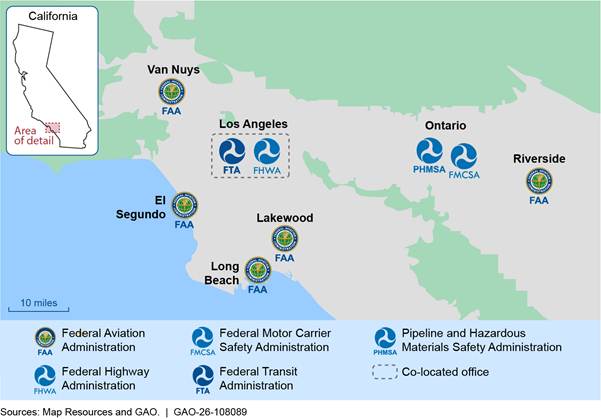
As a part of our review, we included DOT offices located nationwide across nine component agencies with over 5 million usable square feet. The components are the FAA; Federal Highway Administration; Federal Motor Carrier Safety Administration; Federal Railroad Administration; Federal Transit Administration; Great Lakes St. Lawrence Seaway Development Corporation; Maritime Administration; National Highway Traffic Safety Administration; and the Pipeline and Hazardous Materials Safety Administration.[14] See figure 1 for an example of various component agency office buildings located in the Los Angeles metropolitan area.
Figure 1: Map of the Department of Transportation Component Agency Offices in the Los Angeles Metropolitan Area in California
Office Space Reduction
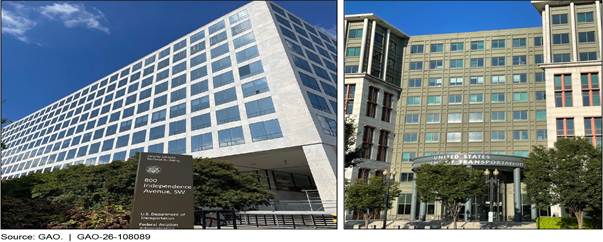
DOT has efforts underway to reduce its federal real property. In August 2025, DOT announced its plan to consolidate the FAA’s headquarters staff into the DOT headquarters complex in Washington, D.C. The federal government owns the DOT and FAA headquarters complexes and has two buildings at each complex. The DOT headquarters comprises the East and West towers, and the FAA headquarters comprises the Orville and Wilbur Wright buildings.[15] According to DOT officials, this plan largely moves personnel from the FAA headquarters complex and leased offices in the Washington D.C. area to the DOT headquarters complex.
DOT has reviewed consolidation opportunities and terminated leases. For example:
· DOT headquarters. A prior consolidation study published in October 2024 did not include cost estimates for moving all FAA personnel to the DOT headquarters complex.[16] Instead, it focused on moving personnel out of leased offices in the Washington, D.C. area and into the DOT headquarters complex and excluded over 2,000 DOT remote workers because telework and remote work policies were in place during its development. Due to recent changes to DOT personnel numbers, executive branch agency return-to-office requirements, and USE IT Act requirements, past consolidation efforts cannot fully inform current efforts.[17]
· Field and satellite offices. DOT and GSA have begun efforts to reduce space in FAA, Pipeline Hazardous Materials and Safety Administration, and the Federal Motor Carrier Safety Administration offices located in Alabama, Arizona, Wisconsin, and other states. Overall, DOT terminated or initiated plans to terminate nine office leases, which represented $3.6 million in annual rental costs and about 93,000 in usable square feet.
DOT Office Space Is Underutilized Department-Wide Based on the USE IT Act Benchmark, Costing Hundreds of Millions of Dollars
Most DOT Office Space Is Underutilized Based on the USE IT Act Benchmark
Our analysis of DOT attendance data found that 89 percent of DOT’s office buildings, including the DOT and FAA headquarters complexes, were underutilized during a 4-week period in August/September 2025 based on the USE IT Act benchmark.[18] These figures were largely consistent with DOT’s USE IT Act reporting on underutilized office buildings in March 2026. We define underutilized buildings as those that are utilized below 60 percent on average, based on the benchmark established by the USE IT Act. We analyzed 189 unique buildings in DOT’s portfolio, encompassing over 5 million usable square feet of office space located in 147 leased and 42 owned buildings.[19]
· Our analysis found that average utilization rates among owned and leased buildings were similar, at 37 and 41 percent, respectively.
· All 12 DOT offices that we visited in California, Virginia, and Washington, D.C. fell below the benchmark utilization rate, ranging from 27 percent to 50 percent utilization.
Smaller DOT office buildings tended to be more highly utilized. Figure 2 divides the buildings into four equal groups (quartiles) based on their usable square feet. It shows that only the smallest DOT offices, with an average capacity of 16 people, had an average utilization rate above 50 percent. DOT’s office buildings range in size from about 200 usable square feet to over 1 million usable square feet at the DOT headquarters complex, with 75 percent of the buildings occupying less than 11,000 usable square feet with total capacities under 75 people based on the USE IT Act benchmark.
Figure 2: Average Daily Utilization Rate of Department of Transportation (DOT) Office Buildings Divided into Quartiles by Size, as of August/September 2025
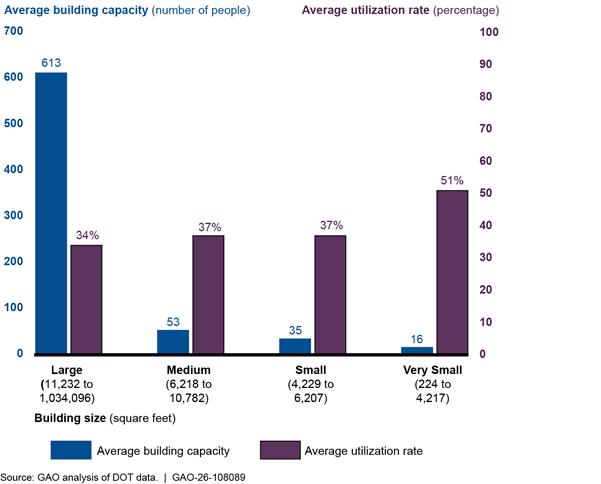
Note: Building capacity is calculated by dividing the location’s usable square feet by 150, the benchmark established by the Utilizing Space Efficiently and Improving Technologies (USE IT) Act. A building’s average daily utilization rate is its average daily attendance divided by its capacity. We used DOT attendance data from a 4-week period across August and September 2025. The time period included a federal holiday, which may affect utilization rates, though holidays are counted as reporting days according to the General Services Administration (GSA) reporting guidelines. To generate quartiles by building size, we ordered the 189 unique office buildings by usable square feet and grouped them into four quartiles of about equal size.
We found that both the DOT and FAA headquarters complexes were underutilized over the two time periods we tracked. Specifically, our analysis of June 2025 data shows that the DOT and FAA headquarters complexes averaged 30 percent and 29 percent average daily utilization respectively, based on the 150 usable square feet per person benchmark established by the USE IT Act.[20] Similarly, in August/September 2025, we found that the DOT and FAA headquarters complexes averaged 34 percent and 33 percent daily utilization respectively based on the same benchmark.[21] Furthermore, in March 2026, GSA publicly released the office building utilization rates for both headquarters complexes, which remain underutilized based on the benchmark established in the USE IT Act.[22]
Insufficient personnel assignments to the DOT and FAA headquarters complexes contribute to their underutilization, according to DOT officials. DOT’s headquarters complex has an estimated capacity of 6,894 personnel using the 150 square feet per person benchmark, and FAA’s headquarters complex has an estimated capacity of 5,298 personnel. This compares to 2,844 assigned to the DOT headquarters complex and 3,309 personnel assigned to the FAA headquarters complex and four other Washington, D.C.-area FAA offices as of January 2026.[23] DOT officials confirmed that the department did not have sufficient personnel assigned to its headquarters complex to meet the building utilization requirement of the USE IT Act. Furthermore, officials stated that workforce reductions in 2025 also contributed to underutilization. However, DOT officials noted that the DOT headquarters complex has been underutilized since before the pandemic.[24]
DOT’s Underutilized Office Space Costs Hundreds of Millions of Dollars Annually
Low utilization rates across DOT’s portfolio suggest that it could also save on rent and operations costs by canceling leases, reducing the size of some office buildings, and returning federally owned space to GSA. Of the 189 DOT buildings included in our analysis, we found 168 buildings were underutilized, totaling $370 million in annual rental, operations, and maintenance costs.[25] DOT pays rent to GSA to occupy federally owned buildings (which are owned by GSA, not DOT), so both leased and owned buildings incur rental costs. Operations and maintenance costs are limited to federally owned buildings and include custodial, utility, and other maintenance related expenses.
Table 1 illustrates the location, size, and rental costs of DOT’s 10 most expensive office buildings, all of which are underutilized. Four of these offices are located in federal buildings, and the remaining six are leased in private buildings.
Table 1: Department of Transportation’s (DOT) 10 Most Expensive Office Buildings to Rent and Their Average Daily Utilization Rates, as of August/September 2025
|
Building name |
City |
State |
Usable square feet |
Estimated capacitya (number of people) |
Annual rental costs |
Annual operations and maintenance costs |
Average utilization rate |
|||||
|
DOT headquarters* |
Washington |
DC |
1,034,096 |
6,894 |
$56,089,377 |
$16,000,000b |
34% |
|
||||
|
FAA headquarters* |
Washington |
DC |
794,761 |
5,298 |
$47,407,985 |
$8,893,639 |
33% |
|
||||
|
One Aviation Plaza |
Springfield Gardens |
NY |
140,032 |
934 |
$15,404,253 |
N/A |
13% |
|
||||
|
FAA northwest regional headquarters |
Des Moines |
WA |
257,447 |
1,716 |
$12,255,927 |
N/A |
32% |
|
||||
|
FAA southwest regional headquarters |
Fort Worth |
TX |
301,112 |
2,007 |
$10,476,513 |
N/A |
36% |
|
||||
|
FAA building - EL Segundo |
El Segundo |
CA |
127,181 |
848 |
$9,051,819 |
N/A |
27% |
|
||||
|
O’Hare Lake |
Des Plaines |
IL |
153,328 |
1,022 |
$8,097,408 |
N/A |
26% |
|
||||
|
John A. Volpe Transportation Systems Center* |
Cambridge |
MA |
173,311 |
1,155 |
$5,166,900 |
$3,196,718 |
34% |
|
||||
|
12 New England Executive Park |
Burlington |
MA |
79,043 |
527 |
$4,493,626 |
N/A |
47% |
|
||||
|
Anchorage federal building* |
Anchorage |
AK |
77,680 |
518 |
$4,243,706 |
$4,057,595 |
32% |
|
||||
Legend: *Indicates the building is federally owned.
Source: GAO analysis of DOT and General Services Administration (GSA) data. | GAO‑26‑108089
Note: We used the usable square feet provided by DOT for owned and leased buildings to perform our utilization analysis. DOT has excluded special use rooms, such as cafeterias, fitness centers, credit unions, health units, and video production rooms from usable square feet numbers, per GSA reporting guidelines. For rental and operations and maintenance costs, we used GSA and DOT data. GSA pays operations and maintenance costs at the building, rather than tenant, level for federally owned space. In instances where DOT is not the only tenant in a federally owned building, operations and maintenance estimates include some costs to maintain space beyond DOT’s footprint. DOT pays rent to GSA to occupy federally owned buildings (which are owned by GSA, not DOT), so both leased and owned buildings incur rental costs.
aBuilding capacity is calculated by dividing the location’s usable square feet by 150, the benchmark established by the Utilizing Space Efficiently and Improving Technologies (USE IT) Act.
bDOT provided an operations and maintenance cost estimate of $16 million for its headquarters complex.
DOT Has Started Headquarters Consolidation but Key Staff Relocation and Savings Remain Uncertain
DOT is taking steps to consolidate Washington, D.C. area FAA personnel into the DOT headquarters complex. Doing so would increase utilization of the DOT headquarters complex, according to our analysis. However, DOT does not have definitive space plans for all relocating FAA personnel or robust return on investment estimates to ensure the consolidation effort will result in efficient office space use and lower costs.
DOT Is Consolidating Headquarters Personnel to Ensure Compliance with the USE IT Act and Reduce Costs
In August 2025, DOT announced plans to consolidate DOT and FAA personnel in the Washington, D.C. area, including some from the FAA headquarters complex, into the DOT headquarters complex. Based on the average daily occupancy numbers from our sample periods, consolidating a substantial number of FAA personnel into the DOT headquarters complex could increase that headquarters’ utilization above the USE IT Act’s 60 percent threshold. The DOT and FAA headquarters complexes had an average daily attendance of 2,312 personnel and 1,732 personnel, respectively in August/September 2025. This represents a combined average of 4,044 employees, which would represent 59 percent utilization if they all worked in the DOT headquarters complex on a daily basis.[26] If DOT consolidates FAA personnel from other satellite offices in the Washington, D.C. area, the DOT headquarters complex may reach the USE IT Act’s 60 percent threshold.
In its 2027 budget request and interviews with agency officials, DOT identified various goals for its headquarters consolidation effort. They include (1) reducing its footprint in compliance with the USE IT Act and government-wide real property guidance, (2) maximizing space utilization in the DOT headquarters complex, and (3) lowering costs.
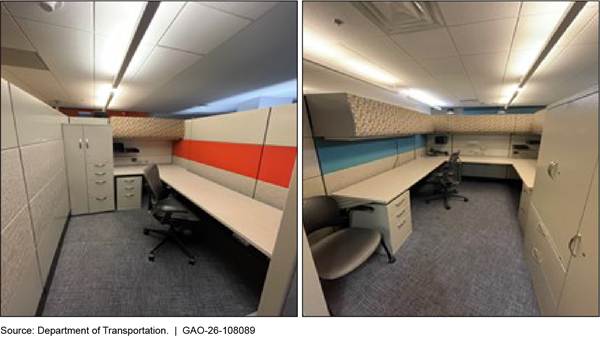
According to DOT officials, they plan to complete the consolidation in three phases from September 2025 through mid-2027. As of June 2026, 70 percent of one tower at DOT’s headquarters complex had been made available for FAA personnel, in part, by reconfiguring the furniture in parts of the DOT headquarters complex. DOT officials emphasized that their priority was to reconfigure space in the DOT headquarters complex as cost effectively as possible while avoiding major renovations, such as altering interior walls and columns, to save time and money. Specifically, they told us they are reconfiguring existing 8x10 feet workstations to 6x8 feet workstations to increase space utilization. DOT officials estimated that these new workstations use about 30 percent less space than the cubicles that have been traditionally used in the DOT headquarters complex (see fig. 3).
Figure 3: Department of Transportation Headquarters Reconfigured 6x8 Square Feet Workstation (left) and Standard 8x10 Square Feet Workstation (right)
DOT officials estimated that 80 percent of DOT’s workspace was configured with the 8x10 feet cubicles prior to the reconfiguration effort. DOT officials told us that they are also repurposing storage/file rooms into workstations to promote space efficiency. While DOT is undertaking the renovation themselves, officials said they are engaging with GSA on the consolidation effort and discussing their plans for the future of the FAA headquarters complex.
Uncertainties About Staffing and Savings Could Undermine the Success of DOT’s Consolidation Effort
DOT started consolidating staff into the DOT headquarters complex in September 2025, but the effort faces uncertainties that could undermine its success. DOT officials said in June 2026 that the agency’s goal is to fully vacate the FAA headquarters complex and return it to GSA by the summer of 2027. However, as of June 2026, DOT has not determined where all FAA personnel will relocate or how much the consolidation will save DOT and the federal government compared to the cost of the consolidation. DOT officials said they are moving as quickly as possible on the consolidation and are planning as they go.
DOT officials said that fully vacating the FAA headquarters complex will depend on (1) determining where an additional 950 FAA headquarters personnel will be relocated; (2) recreating the specialized spaces currently located in the FAA headquarters complex, including classified secure space and the Washington Operations Control Room (airspace monitoring center); and (3) obtaining funding to consolidate and reconfigure the DOT headquarters complex.
According to officials, the agency requested $60 million in its fiscal year 2027 budget to support the consolidation and estimate that the entire consolidation process will cost $91 million, of which DOT has already spent $12 million. Officials noted that vacating the FAA headquarters complex will allow DOT to avoid paying $56 million annually to GSA for rent, operations and maintenance. However, this estimate is incomplete as it depends on where FAA personnel will relocate (e.g., into leased space) and when DOT is able to return the FAA headquarters complex to GSA, and what GSA does with those buildings. DOT officials said they are working with GSA to discuss future space needs for the 950 FAA employees not being consolidated into the DOT headquarters complex, though DOT has not formally analyzed alternative options.
In addition, assuming a successful disposal of the vacant FAA headquarters complex, GSA could avoid an estimated $131 million in deferred maintenance costs. However, without a plan that defines the future location of almost one thousand FAA employees and the specifics to estimate the financial costs and benefits of various potential consolidation scenarios, DOT may not be able to project with clarity if or when its consolidation process could meet the goal of lowering costs.
Industry guidance on planning to consolidate office space emphasizes the importance of defining space requirements (such as determining updated personnel assignments and projecting future growth) calculating financial impact, and projecting cost savings.[27] Without knowing where the remaining FAA personnel will be located or having more clarity on the return on investment expected from consolidation, DOT risks its consolidation goals of increasing building utilization and reducing costs. Furthermore, if DOT’s current consolidation plan is not successfully implemented, DOT may be forced to retain an FAA headquarters complex that is neither well-utilized nor vacant enough to dispose of, potentially offsetting any savings from the consolidation.
DOT Has Not Pursued Department-Wide Consolidation or Space-Maximizing Strategies to Increase Its Office Space Utilization
There are promising opportunities for DOT to reduce its underutilized office space by pursuing consolidation beyond the DOT headquarters complex and by employing space-maximizing strategies. Doing so may move DOT closer to meeting the USE IT Act’s target utilization rate. However, DOT has not pursued these efforts as it has been focused on the headquarters consolidation effort and only recently began collecting and assessing utilization data department-wide.
Department-Wide Consolidation
As of March 2026, DOT officials said the agency had no plans to consolidate DOT office space beyond the ongoing consolidation of FAA personnel into the DOT headquarters complex, where they have focused their efforts. DOT has not developed a comprehensive plan aimed at maximizing space efficiency that covers all its office space department-wide. In addition, DOT had limited data on office space utilization prior to the implementation of the USE IT Act to inform efforts to improve utilization. As discussed above, our analysis and DOT’s USE IT Act reporting show that DOT has a significant amount of underutilized office space beyond the DOT headquarters complex. Given that our analysis found 89 percent of DOT office space facilities were below the USE IT Act utilization threshold in August and September 2025, there are likely significant opportunities for DOT to consolidate or dispose of space department-wide to increase utilization.
Co-location of component agencies is a potential strategy for DOT to consolidate office space and increase space utilization department-wide. Co-location is the practice where agencies merge staff from different components or agencies into another agency’s space to reduce the overall amount of space needed. However, most DOT component agencies continue to operate their own independent spaces and do not generally co-locate in part because they receive separate funding.[28] Based on our analysis of DOT’s department-wide utilization data from August and September 2025, 25 percent of the office buildings in DOT’s portfolio contain occupancy agreements from multiple DOT component agencies.[29] However, even if a building contains occupancy agreements from multiple component agencies, that does not necessarily mean that the component agencies are co-locating. For example, two component agencies could have separate occupancy agreements on separate floors of the same building and not share any space.[30] Therefore, the overall amount of co-location across the department is likely less than 25 percent of office buildings. Increasing the rate of co-location department-wide would help DOT consolidate office space.
Provisions in recently enacted legislation and accompanying language may impact DOT’s plans to further consolidate offices and personnel. For example, the Consolidated Appropriations Act, 2026 generally requires congressional notification to close or reduce services or personnel at a FAA regional operations center.[31] In addition, a provision in the accompanying Joint Explanatory Statement directs DOT to conduct specific analyses and provide them to the House and Senate Appropriations Committees when considering plans to close, open, redesignate, or reorganize certain regional or field offices.[32] DOT told us they are aware of and will comply with these provisions, as appropriate.
Space-Maximizing Strategies
DOT does not fully use the following space-maximizing strategies identified by GSA and design experts we interviewed at four engineering and architectural firms. Using these strategies across the department could help DOT increase its space utilization and comply with USE IT Act requirements:
· Reservation system to support workspace sharing. A desk reservation system allows employees to select an available desk to use rather than maintain a permanent designated workstation. This allows organizations to move away from a one-to-one desk ownership model and instead limit the number of workspaces to accommodate the average daily occupancy. According to a GSA study on workspace utilization, desk sharing strategies offer organizations flexibility and optimal workspace usage.[33] In addition, officials from four architecture and engineering firms we interviewed told us that desk sharing is an important strategy for increasing space utilization.
Under its current office space policy, DOT provides dedicated workspaces for personnel who are in the office for six days or more per pay period.[34] In response to in-person attendance requirements, nearly all DOT employees generally report to work in-person and thus qualify for a dedicated workspace under DOT’s office space policy.[35] DOT officials noted that a desk reservation system is not consistent with daily required attendance. However, according to DOT officials, many DOT personnel conduct investigations or inspections at offsite locations, such as airports or airplane manufacturing facilities, and spend a significant amount of time away from the office. For example, during two site visits to DOT field offices, DOT officials told us that their personnel spend roughly half of their time working offsite and typically have their own designated workspaces. Implementing a desk reservation system could help DOT use space more efficiently and increase utilization.
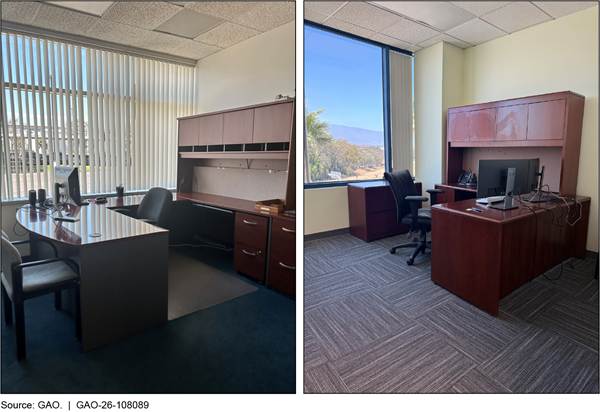
· Offices reconfigured for maximum utilization. Much of DOT’s existing office space is not configured to maximize utilization and comply with the 150 square foot per person benchmark set by the USE IT Act. For example, some DOT offices we toured on site visits had large, enclosed offices that take up more square footage per person than is permitted. According to representatives from architecture and engineering firms we interviewed, private offices usually take up more space per person, and workspaces be reconfigured to promote greater density. Figure 4 provides two examples of large, enclosed offices we observed during our site visits to DOT offices.
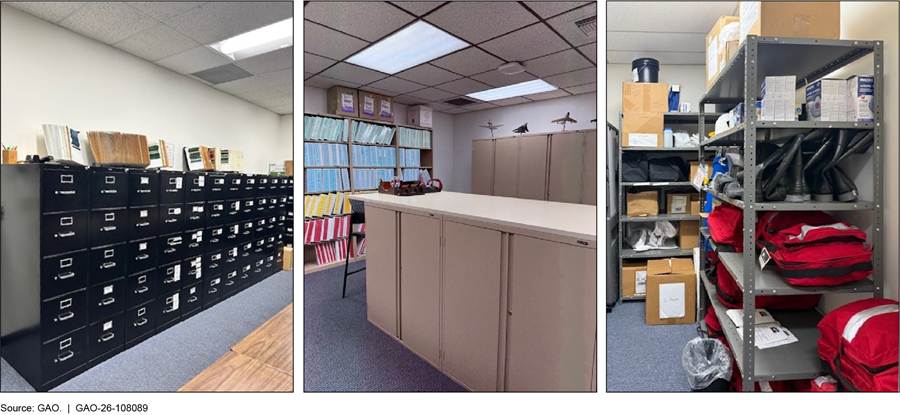
Additionally, some DOT offices had large storage spaces to store paper files and equipment for accident investigations. At one of our site visits, DOT officials told us that they are required to store investigation equipment and retain files for a specific duration of time. At another site visit, DOT officials told us they would like to digitize files to reduce the physical footprint and are currently working on these efforts. Figure 5 provides three examples of large storage spaces we observed during our site visits to DOT offices.
DOT officials told us that new furniture and renovations are costly. According to DOT officials, reconfigurations must be accomplished with available funding and agencies must make compromises when designing their office space to do so cost-effectively.
A department-wide consolidation plan that includes space-maximizing strategies would better position DOT to meet the 60 percent utilization threshold throughout its portfolio of 189 office spaces. Furthermore, a portfolio-wide consolidation could provide opportunities to offload space, saving the agency and taxpayers potentially millions of dollars in rent, operations, and maintenance costs. DOT and its component agencies can now leverage data collected for USE IT Act reporting to inform future department-wide consolidation efforts.
Conclusions
Nationwide, DOT office space remains significantly underutilized even after the implementation of the Return to Office policy last year. DOT has started to consolidate FAA personnel into the DOT headquarters complex but has not fully considered where FAA staff will relocate or the full financial costs and benefits that may result from the consolidation. Without a consolidation plan that addresses these and other issues, DOT may be forced to retain an FAA headquarters complex that is not ready for disposal and is underutilized for longer than expected, potentially offsetting the savings from the consolidation.
Beyond the FAA consolidation, DOT has an opportunity to make strategic decisions on the organization of its federal office space portfolio based on new space utilization data for all its components. The utilization data can provide a starting point for further consolidation decisions that lead to a smaller footprint. Developing a department-wide consolidation plan that includes implementing space-maximizing strategies could help DOT meet utilization requirements for its office space, leading to savings.
Recommendations for Executive Action
The Secretary of Transportation should continue to develop and implement a plan for consolidating FAA headquarters and other Washington, D.C. area FAA personnel into the DOT headquarters complex that includes a plan for relocating all FAA staff and the estimated savings from the consolidation. (Recommendation 1)
The Secretary of Transportation should develop a department-wide office space consolidation plan that incorporates space-maximizing strategies to meet utilization requirements. (Recommendation 2)
Agency Comments
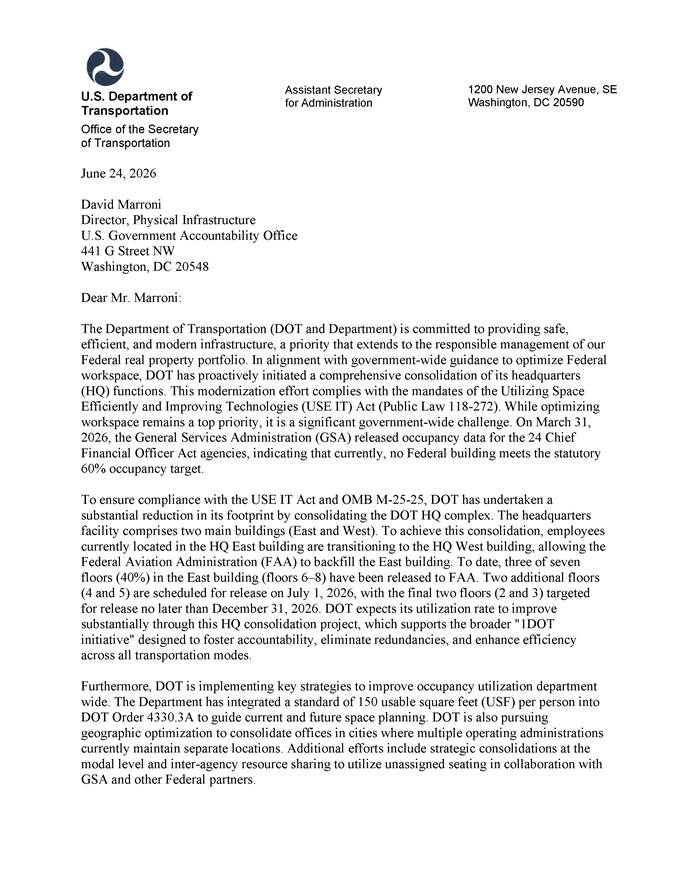
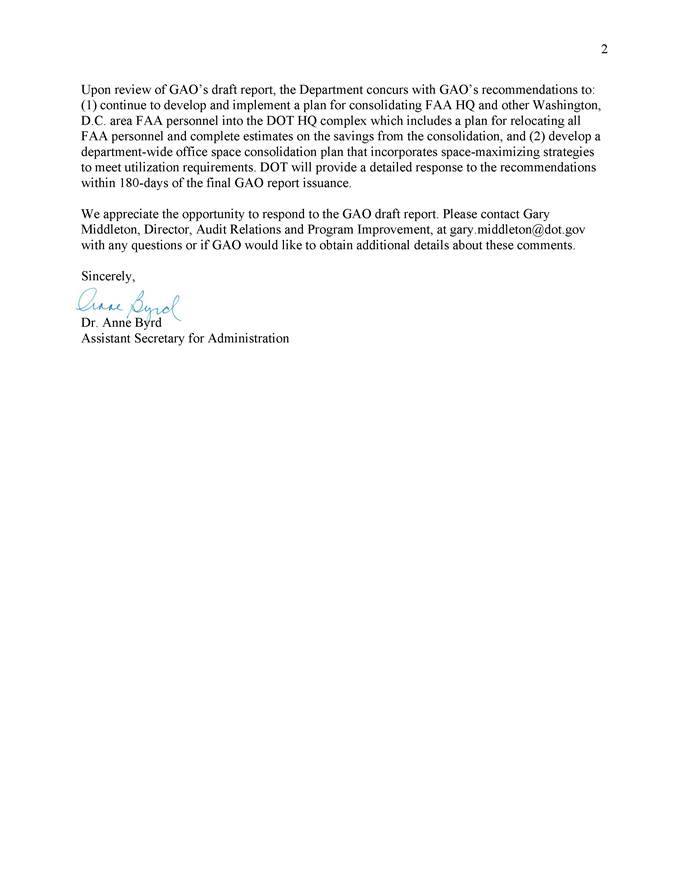
We provided a draft of this report to DOT and GSA for review and comment. DOT agreed with our recommendations and provided technical comments, which we incorporated as appropriate. DOT’s letter is reprinted in appendix I. GSA did not comment on the draft report.
We are sending copies of this report to the appropriate congressional committees, the Secretary of Transportation, the Administrator of the General Services Administration, and other interested parties. The report is also available at no charge on the GAO website at https://www.gao.gov.
If you or your staff have any questions about this report, please contact David Marroni at MarroniD@gao.gov. Contact points for our Offices of Congressional Relations and Media Relations may be found on the last page of this report. GAO staff who made key contributions to this report are listed in appendix II.

David Marroni
Director, Physical Infrastructure
GAO Contact
David Marroni, MarroniD@gao.gov
Staff Acknowledgments
In addition to the contact named above, GAO staff who made key contributions to this report include Keith Cunningham (Assistant Director), Nelsie Alcoser (Analyst in Charge), Audrey Blumenfeld, Melissa Bodeau, Caroline Christopher, Emily Crofford, Trinisa Fung, Alejandra Villegas Lopez, Terence Lam, Alanna Miller, and Josh Ormond.
The Government Accountability Office, the audit, evaluation, and investigative arm of Congress, exists to support Congress in meeting its constitutional responsibilities and to help improve the performance and accountability of the federal government for the American people. GAO examines the use of public funds; evaluates federal programs and policies; and provides analyses, recommendations, and other assistance to help Congress make informed oversight, policy, and funding decisions. GAO’s commitment to good government is reflected in its core values of accountability, integrity, and reliability.
Obtaining Copies of GAO Reports and Testimony
The fastest and easiest way to obtain copies of GAO documents at no cost is through our website. Each weekday afternoon, GAO posts on its website newly released reports, testimony, and correspondence. You can also subscribe to GAO’s email updates to receive notification of newly posted products.
Order by Phone
The price of each GAO publication reflects GAO’s actual cost of production and distribution and depends on the number of pages in the publication and whether the publication is printed in color or black and white. Pricing and ordering information is posted on GAO’s website, https://www.gao.gov/ordering.htm.
Place orders by calling (202) 512-6000, toll free (866) 801-7077,
or
TDD (202) 512-2537.
Orders may be paid for using American Express, Discover Card, MasterCard, Visa, check, or money order. Call for additional information.
Connect with GAO
Connect with GAO on X,
LinkedIn, Instagram, and YouTube.
Subscribe to our Email Updates. Listen to our Podcasts.
Visit GAO on the web at https://www.gao.gov.
To Report Fraud, Waste, and Abuse in Federal Programs
Contact FraudNet:
Website: https://www.gao.gov/about/what-gao-does/fraudnet
Automated answering system: (800) 424-5454
Media Relations
Sarah Kaczmarek, Managing Director, Media@gao.gov
Congressional Relations
David A. Powner, Acting Managing Director, CongRel@gao.gov
General Inquiries
[1]GAO, High Risk Series: Heightened Attention Could Save Billions More and Improve Government Efficiency and Effectiveness, GAO‑25‑107743 (Washington, D.C.: Feb 25, 2025). Since the early 1990s, the High Risk report has focused attention on government operations with significant vulnerabilities to fraud, waste, abuse, and mismanagement or that need transformation to address economy, efficiency, or effectiveness challenges.
[2]GAO, Federal Real Property: Agencies Need New Benchmarks to Measure and Shed Underutilized Space, GAO‑24‑107006 (Washington, D.C.: Oct. 26, 2023) and GAO, Federal Real Property: Agencies Should Provide More Information about Increases in Deferred Maintenance and Repair, GAO‑24‑105485 (Washington, D.C. Nov. 16, 2023).
[3]Thomas R. Carper Water Resources Development Act, Pub. L. No. 118-272, div. B, tit. III § 2302, 138 Stat. 2992, 3218 (2025). These requirements apply to executive branch agencies and departments covered by the Chief Financial Officers Act. Id. § 2302(a)(6); 40 U.S.C. § 901(b).
[4]A tenant agency is a federal agency that has an occupancy agreement to occupy a government-owned office space or government-leased commercial space.
[5]DOT reported utilization by occupancy agreement; we aggregated the offices located in the same building. For example, if more than one component agency is located in a large complex or building, DOT reported each component to GAO separately. We reported the utilization of the complex or building, rather than by individual office space.
[6]In addition, according to DOT officials, FAA used login data for 80 offices to supplement timecard information during this period.
[7]The federal government owns the DOT and FAA headquarters complexes in Washington, D.C. and has two buildings at each complex. The DOT headquarters is comprised of the East and West towers, and the FAA headquarters is comprised of the Orville and Wilbur Wright buildings.
[8]We were only able to report on June 2025 data for the DOT and FAA headquarters complexes, because only employee ID badge swipes data were available at that time. We were not able to collect this information for all DOT offices because DOT officials told us the data were not available. Also at that time, DOT officials reported a preliminary estimate of 1,078,106 usable square feet for DOT’s headquarters complex, which we used for our calculations. Subsequently, DOT officials revised this figure to 1,034,096 usable square feet to exclude additional space not considered as being for typical office use, per GSA reporting guidelines.
[9]In 2023, we used the 180 usable square feet per person benchmark suggested by GSA and OMB at the time. We calculated the DOT headquarters building capacity by dividing its 1,299,544 usable square feet (as identified by DOT officials at the time) by the 180 square-feet-per-person benchmark. The USE IT Act sets a 150 usable square feet per person benchmark, and DOT officials now report that the DOT headquarters building has 1,034,096 usable square feet. DOT has excluded special use space, such as cafeterias, fitness centers, credit unions, health units, video production rooms, and other types of rooms from these useable square feet numbers, per GSA reporting guidelines. Also, we collected attendance data from August and September 2025 for a four-week interval for all DOT buildings.
[10]The pay periods we analyzed included a federal holiday, which may have affected utilization rates. GSA reporting guidelines state that federal holidays count as reporting days. Agencies must monitor and report occupancy data every two weeks to OMB. OMB, Memorandum: Implementation of the Utilizing Space Efficiently and Improving Technologies Act, M-25-25 (Washington, D.C.: April 21, 2025).
[11]We collected cost information (rent, operations, and maintenance), where available, from GSA as they often acquire and manage space on behalf of DOT.
[12]Jones Lang LaSalle, Workplace Consolidation Playbook, (Chicago, IL: Oct. 6, 2025). Jones Lang LaSalle is a leading global professional services firm specializing in real estate and investment management, operating in 80 countries.
[13]GSA, Workspace Utilization and Allocation Benchmark (Washington, D.C.: July 2011) and GSA, Space Utilization and GSA Workplace Offerings (Washington, D.C.: July 24, 2023).
[14]We did not include office space from the DOT Office of Inspector General in our review.
[15]For the purposes of our analysis, we aggregated utilization and cost data at each site and refer to the complexes as DOT and FAA headquarters, rather than distinguishing data by building.
[16]Gensler, DOT Headquarters Consolidation Study, Final Report, (Washington, D.C.: Oct. 31, 2024).
[17]OMB, Memorandum: Guidance on Presidential Memorandum Return to In-Person Work (Washington, D.C.: Jan. 22, 2025). The presidential memorandum directed federal agencies to take steps to terminate remote work agreements and require most employees to return to work in person on a full-time basis. Return to In-Person Work, 90 Fed. Reg. 8,251 (Jan. 20, 2025). Furthermore, federal agencies, including DOT, have taken steps to reduce the size of their workforces. These steps include offering incentives for employees to voluntarily resign, terminating employees in probationary or trial periods, implementing reductions in force, and placing a hiring freeze on most federal positions. GAO, Federal Agency Workforce Changes: Update for January to June 2025, GAO‑26‑108719 (Washington, D.C: Feb. 24, 2026).
[18]The pay periods we analyzed included a federal holiday, which may have affected utilization rates. GSA reporting guidelines state that federal holidays count as reporting days.
[19]We excluded offices that DOT has cancelled or is scheduled to vacate, according to information from GSA and DOT, because impending office changes may affect attendance data as personnel prepare to relocate.
[20]Thomas R. Carper Water Resources Development Act, Pub. L. No. 118-272, div. B, tit. III § 2302, 138 Stat. 2992, 3218 (2025). While utilization remains low, we found that more than twice as many people entered the DOT headquarters complex per day on average in June 2025 than when we last measured sampled weeks in January, February, and March 2023, increasing from 1,002 to 2,146. This time period includes a federal holiday, which may affect utilization rates, though GSA reporting guidelines state that federal holidays count as reporting days.
[21]This time period includes a federal holiday, which may affect utilization rates. GSA reporting guidelines state that federal holidays count as reporting days. Moreover, DOT reported lower usable square feet estimates for the DOT and FAA headquarters complexes in the August/September 2025 data after excluding special use spaces per GSA’s reporting guidelines, according to agency officials. These lower usable square feet estimates in part explain the DOT and FAA headquarters complexes reporting higher average utilization rates in August/September 2025 compared to June 2025. We calculated the respective utilization rates using the usable square feet estimates from DOT at each interval to maintain consistency with DOT’s reporting to OMB.
[22]GSA reported the following utilization rates for the FAA and DOT headquarters complexes in March 2026: Orville Wright - 28.98 percent; Wilbur Wright - 16.23 percent; DOT Headquarters, East - 15.69 percent; and DOT Headquarters, West- 40.08 percent.
[23]The number of personnel assigned to the DOT headquarters complex is likely in flux because of ongoing efforts to consolidate Washington, D.C.-area DOT staff. Moreover, DOT officials told us that they have terminated or are planning to terminate the four other FAA leases in the D.C. area, and personnel working in those leased spaces will be assigned to the FAA or DOT headquarters complexes based on available space.
[24]Prior to the implementation of the USE IT Act, federal agencies did not have a standardized benchmark for allocating office space, such as the new 150 square feet/person benchmark. Our previous work discussed how the lack of a benchmark for measuring utilization presented challenges for federal agencies. (GAO‑23‑107006)
[25]Total annual rent, operations, and maintenance costs were about $382 million for 189 DOT office buildings. For federally owned buildings, GSA pays operations and maintenance costs for the entire building, rather than at the tenant level. In instances where DOT occupies a building with other federal agencies, operations and maintenance estimates include some costs to maintain space beyond DOT’s footprint.
[26]According to architecture/engineering firms we spoke to, about 60 to 70 percent of employees assigned to an office are likely to be present on any given day due to vacation, sick days, and off-site work duties, among other reasons. This may in part explain the discrepancy between the number of personnel assigned to the DOT and FAA headquarters complexes and their average daily attendance levels.
[27]Jones Lang LaSalle, Workplace Consolidation Playbook, (Chicago, IL: Oct. 6, 2025). In addition, the Playbook states that associated costs of office space consolidation can include capital expenditures for the new space, ongoing operational expenses, technology investments, and moving expenses. Many factors influence how much institutions will spend or save when consolidating offices; consequently, all financial impacts should be considered before making a decision.
[28]DOT components receive separate funding for administration and operations. Components may also contribute to the DOT administrative capital working fund in exchange for common administrative services, including office space. 49 U.S.C. § 327.
[29]Based on our analysis of DOT’s department-wide utilization data, 47 of the 189 buildings in DOT’s office space portfolio contain occupancy agreements from multiple DOT components.
[30]Some agencies may not be compatible with co-location due to mission needs or certain security requirements.
[31]Pub. L. No. 119-75, div. D, tit. I, § 119. Section 1996C of the same law prohibits the FAA Administrator from using funds to “to open, close, redesignate as a lesser office, or reorganize a regional office, the aeronautical center, or the technical center” without taking appropriate steps related to reprogramming funds. Id. § 119C (referencing id., div. D, tit. IV, § 405).
[32]Specifically, it directs that DOT to “when considering plans to open, close, redesignate as a lesser office, or reorganize a regional, division, or field office within the Department or an operating administration of the Department, to conduct an analysis on the effect of such action on each relevant office, which shall consider the potential costs; impacts on staffing and workforce; relevant external stakeholders, as appropriate; and the Department’s ability to carry out all statutorily authorized activities. The Department is directed to provide such analysis to the House and Senate Committees on Appropriations not later than 10 business days after such analysis is requested by either the House or Senate Committees on Appropriations.”
[33]GSA, Workspace Utilization and Allocation Benchmark. (Washington, D.C.: July 2011).
[34]DOT, Department of Transportation Office Space Design Standard Policy. DOT 4330.A. (Washington, D.C.: April 29, 2024).
[35]A January 2025 presidential memorandum instructed federal agencies, including DOT, to require most employees to return to full-time in-office work. Return to In-Person Work, 90 Fed. Reg. 8,251 (Jan.20, 2025). Therefore, most DOT employees report in-person to DOT offices. A DOT Office of the Inspector General (OIG) report found that DOT complied with federal in-person work requirements and guidance.