
Report to Congressional Committees
United States Government Accountability Office
A report to congressional committees
Contact: Kristy E. Williams at WilliamsK@gao.gov
What GAO Found
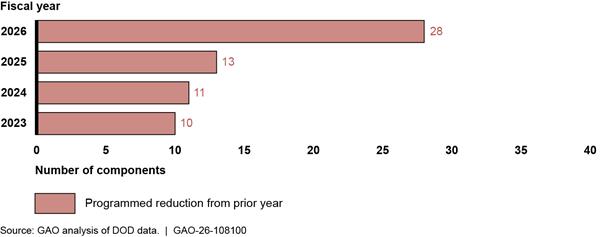
Department of Defense (DOD) components develop their program requirements and estimate needed resources—a phase known as programming—during an annual resourcing process. GAO found that roughly half of DOD components (22 of 40) programmed reductions to their civilian workforces in at least one fiscal year (FY) from FYs 2023–2025. These reductions ranged from 0.1 percent to 9.8 percent of a component’s civilian workforce. GAO’s review of DOD’s FY 2026 budget request identified more reductions than in prior FYs (see figure).
Number of Department of Defense (DOD) Components That Programmed Reductions to Civilian Workforces, n=40
Of the 14 components GAO selected for more in-depth review, 11 conducted some analysis of the impacts of workforce reductions during FYs 2023–2025 to inform their decisions. However, some components did not consistently conduct analysis as required or provide related documentation. According to component officials, DOD had not provided guidance for when and how to conduct and document this analysis. The National Defense Authorization Act for Fiscal Year 2026 includes a provision for DOD to provide additional guidance on analysis required to inform workforce reductions.
Additionally, since January 2025, DOD implemented multiple efforts to reduce its civilian workforce outside the programming process. For example, DOD approved about 53,200 applications for deferred resignations. DOD also hired approximately 59,500 fewer civilian employees from January to December 2025 than in recent years due to a hiring freeze. DOD incorporated some of these civilian workforce reductions into the FY 2026 budget request, per officials.
While selected components conducted some analysis for their civilian workforce reductions since January 2025, officials reported challenges in doing so. Further, component officials identified both preliminary benefits, such as organizational optimization, and challenges, like strained workforce capacity, resulting from the reductions. However, DOD does not have a plan to assess lessons learned from these workforce reduction efforts—a key practice for project and program management. Without assessing lessons learned, DOD may miss opportunities to better understand reduction impacts, inform strategic human capital management, and mitigate any challenges in future efforts.
Why GAO Did This Study
DOD’s civilian workforce performs a wide variety of responsibilities and plays an essential role in the department’s success. By law, the Secretary of Defense may not reduce the civilian workforce programmed full-time equivalent levels without conducting an appropriate analysis of the impacts of the reductions on seven elements, such as readiness, workload, and lethality.
House Report 118-301 includes a provision for GAO to review this analysis. This report examines (1) DOD components’ programmed civilian workforce reductions for FYs 2023– 2025, (2) the extent to which selected DOD components conducted required analysis to inform programmed civilian workforce reductions for FYs 2023–2025, and (3) the extent to which selected DOD components conducted required analysis to inform selected civilian workforce reductions since January 2025 and assessed lessons learned.
GAO analyzed DOD budget and personnel data. GAO also interviewed officials from 14 selected components about analyses for programmed reductions for FYs 2023–2025. GAO further interviewed officials from 12 selected components about analyses to support reductions since January 2025. GAO compared these efforts against section 129a(b) of title 10, U.S. Code, relevant federal internal control standards, and key practices for project and program management.
What GAO Recommends
GAO is making one recommendation for DOD to develop and implement a plan for sharing lessons learned from its workforce reduction efforts made outside the programming process since January 2025. DOD concurred with the recommendation.
|
Abbreviations |
|
|
|
|
|
CAPE |
Office of Cost Assessment and Program Evaluation |
|
DLA |
Defense Logistics Agency |
|
DOD |
Department of Defense |
|
DRP |
deferred resignation program |
|
FTE |
full-time equivalent |
|
OPM |
Office of Personnel Management |
|
OUSD(P&R) |
Office of the Under Secretary of Defense for Personnel and Readiness |
|
PPBE |
Planning, Programming, Budgeting, and Execution |
|
USD(P&R) |
Under Secretary of Defense for Personnel and Readiness |
|
VERA |
Voluntary Early Retirement Authority |
This is a work of the U.S. government and is not subject to copyright protection in the United States. The published product may be reproduced and distributed in its entirety without further permission from GAO. However, because this work may contain copyrighted images or other material, permission from the copyright holder may be necessary if you wish to reproduce this material separately.
May 29, 2026
The Honorable Roger Wicker
Chairman
The Honorable Jack Reed
Ranking Member
Committee on Armed Services
United States Senate
The Honorable Mike Rogers
Chairman
The Honorable Adam Smith
Ranking Member
Committee on Armed Services
House of Representatives
The Department of Defense (DOD) is the largest federal employer and employed over 793,000 civilian employees in January 2025.[1] In December 2025, the Secretary of Defense stated that civilian employees have played an essential, foundational role in driving the success of America’s military and ensuring it prevails on the battlefield.[2] The Secretary of Defense is responsible for establishing policies and procedures for determining the appropriate composition (or mix) of DOD’s workforce—including military, civilian, and contractor personnel—in order to carry out the department’s mission.[3]
DOD’s civilian workforce performs a wide variety of responsibilities, including providing care for active-duty personnel, their dependents, and wounded service members; managing financial accounting systems; providing logistics support; maintaining weapon systems and facilities; and carrying out cyber and intelligence efforts.[4] In early 2025, DOD rapidly implemented several efforts intended to reduce the size of its civilian workforce by an expected 5 to 8 percent.[5] The Secretary of Defense stated that these efforts were to streamline operations, bolster readiness, and prioritize critical missions.[6]
Section 129a(b) of title 10, U.S. Code directs DOD to prioritize risk mitigation over cost in determining the size and mix of its workforce. The William M. Thornberry National Defense Authorization Act for Fiscal Year 2021 amended the section to note that the Secretary of Defense may not reduce the civilian workforce programmed full-time equivalent (FTE) levels without conducting an appropriate analysis of the impacts of the reductions on seven elements: workload, military force structure, lethality, readiness, operational effectiveness, stress on the military force, and fully burdened costs.[7] As a result, in February 2024, DOD issued guidance directing the DOD components to perform this analysis when determining whether to reduce the civilian workforce.[8]
The conference report accompanying the National Defense Authorization Act for Fiscal Year 2024 includes a provision for us to review analysis conducted pursuant to section 129a(b) and assess whether this analysis sufficiently considered DOD’s readiness needs.[9] This report examines (1) DOD components’ programmed reductions to the civilian workforce for fiscal year (FY) 2023 through FY 2025; (2) the extent to which selected DOD components conducted required analysis and addressed all elements outlined in section 129a(b) to inform any programmed reductions to the civilian workforce for FY 2023 through FY 2025; and (3) the extent to which selected DOD components conducted required analysis to inform selected reductions to the civilian workforce since January 2025 outside the normal programming process and assessed lessons learned.
For objective one, we analyzed DOD budget data from FY 2022 through FY 2025 for all 40 components with publicly available OP-8 Civilian Personnel Costs budget exhibits to identify programmed reductions to components’ civilian FTEs in FYs 2023 through 2025 and to describe the extent of FTE reductions throughout DOD over this period.[10] We assessed the reliability of this data by interviewing and obtaining written information from knowledgeable officials, and testing the data by comparing component OP-8 data with other DOD budget materials for consistency. We found the OP-8 data to be sufficiently reliable for the purpose of selecting components and reporting FTE trends in this period.
For objective two, we selected a nongeneralizable sample of 14 components that programmed the largest reductions to their civilian workforces in FYs 2023 through 2025 for more in-depth review. We interviewed officials from these components about the analysis they conducted regarding these reductions. We compared their interview responses and documentation of their analysis to section 129a(b) and relevant federal internal control standards, including that management should use quality information to achieve the entity’s objectives.[11]
For objective three, we reviewed the following reduction efforts that occurred outside the normal programming process: (1) the government-wide deferred resignation program (DRP), (2) the DOD DRP and Voluntary Early Retirement Authority (VERA), (3) the DOD hiring freeze, and (4) the termination of probationary employees.[12] We analyzed DOD data as of May 2025 on the number and status of applications to the two DRPs for selection purposes, as well as data as of September 2025 for reporting on the approximate number of applications and approval rates.[13] We assessed the reliability of the data by interviewing knowledgeable officials and comparing the components included against the components included in FedScope reporting.[14] We found the May 2025 and September 2025 data to be sufficiently reliable for the purpose of selecting components and reporting the approximate number of applications and approval rates, respectively. We selected a nongeneralizable sample of 12 components for more in-depth review based on the component type, the status of applications to the DOD DRP, and the highest combined applications to the two DRPs. We interviewed officials from those components about the analysis they conducted regarding their reductions.
We reviewed related Office of Personnel Management (OPM), DOD, and component documentation, such as implementing guidance and analyses to support the reduction efforts. We also analyzed DOD data on its civilian workforce from January 2016 through January 2026 to identify trends in the workforce. We assessed the reliability of these data by reviewing related documentation like DOD policy, interviewing and obtaining written responses from knowledgeable officials in the Defense Civilian Personnel Advisory Service, and testing the data for obvious errors. We found the data sufficiently reliable for the purpose of reporting on trends in DOD’s civilian workforce. We compared DOD’s reduction efforts since January 2025 to relevant key practices for project and program management, including identifying and applying lessons learned.[15] We also compared the DRPs to section 129a(b) because DOD officials stated section 129a(b) applied to the DRPs, but it did not apply to the hiring freeze or termination of probationary employees. (For additional information on our methodology, including the components selected for each objective, see app. I.)
We conducted this performance audit from January 2025 to May 2026 in accordance with generally accepted government auditing standards. Those standards require that we plan and perform the audit to obtain sufficient, appropriate evidence to provide a reasonable basis for our findings and conclusions based on our audit objectives. We believe that the evidence obtained provides a reasonable basis for our findings and conclusions based on our audit objectives.
Background
Planning, Programming, Budgeting, and Execution Process
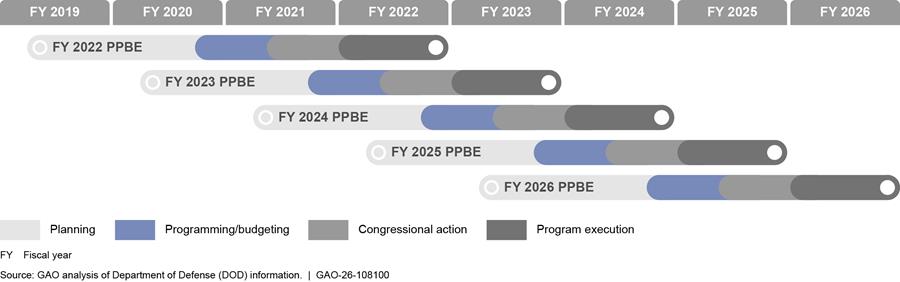
The Planning, Programming, Budgeting, and Execution (PPBE) process is DOD’s primary process for allocating resources and a framework for making decisions regarding policy, strategy, and building military forces.[16] According to DOD guidance, the process supports the objective to provide the department with the most effective mix of forces, equipment, personnel, and support attainable within fiscal constraints. The process begins with strategic planning and ends with execution, with the first three of the four phases generally taking around 2 and a half years. (See fig. 1.)
Figure 1: Notional Timeline for DOD’s Planning, Programming, Budgeting, and Execution (PPBE) Process
The four phases of the PPBE process are as follows:
· Planning. DOD examines its posture in the world environment and considers national security objectives and efficient management of resources to develop plans for the next fiscal cycle. The Under Secretary of Defense for Policy develops the Defense Planning Guidance to provide direction to the components during the subsequent programming phase. DOD’s Office of Cost Assessment and Program Evaluation (CAPE) also develops fiscal guidance, which directs the components in their budget programming.[17]
· Programming. DOD components develop program requirements and resource estimates for the next 5 years and submit them to the Office of the Secretary of Defense. CAPE then reviews and adjusts program requirements and resource allocations for the components to produce the consolidated DOD Future Years Defense Program, a multiyear plan that reflects cost data, personnel, and force structure.
· Budgeting. DOD components develop budget exhibits outlining requested funding amounts for requirements in the next FY. DOD’s annual budget request is part of the President’s budget submission to Congress. Congress considers DOD’s budget request and passes laws to appropriate funding for DOD.
· Execution. DOD uses appropriated funds to execute its missions.[18]
DOD Civilian Workforce
DOD Directive 1100.4 requires that assigned missions be accomplished using the least costly mix of personnel—military, civilian, and contractor—consistent with military requirements and other needs of the department. Functions that are inherently governmental cannot be contracted, and staffing requirements should be designated as civilian rather than military personnel except under specific circumstances.[19] The Under Secretary of Defense for Personnel and Readiness (USD(P&R)) is responsible for issuing guidance to the DOD components for personnel management, as well as allocating civilian personnel authorizations to the DOD components.[20]
The DOD components’ workforces vary widely in size and composition. For example, the Navy employed over 200,000 civilians as of September 2025, while the DOD Test Resource Management Center employed 23 civilians, according to DOD data. (See table 1.) The Department of Defense Education Activity’s workforce is entirely composed of civilian personnel, while civilians account for less than half of U.S. Transportation Command’s workforce, according to component officials.[21]
Table 1: Number of Department of Defense (DOD) Civilian Employees by Component, as of September 2025
|
DOD component |
Civilian employees |
|
Navy |
201,713 |
|
Army |
190,780 |
|
Air Force |
148,931 |
|
National Guard |
49,111 |
|
Military treatment facility under Defense Health Agency |
43,441 |
|
Defense Logistics Agency |
24,189 |
|
Marine Corps |
18,067 |
|
Department of Defense Education Activity |
13,893 |
|
Defense Commissary Agency |
10,452 |
|
Defense Finance and Accounting Service |
10,345 |
|
Other |
60,249 |
|
Total |
771,171 |
Source: GAO analysis of DOD data. | GAO‑26‑108100
Note: “Civilian employees” refers to appropriated fund civilian employees. This table lists the 10 components with the most civilian employees. The “Other” category includes other components, whose number of civilian employees ranges from 9,471 at the Defense Contract Management Agency to 23 at the DOD Test Resource Management Center.
DOD Civilian Workforce Reduction Efforts Since January 2025
DOD implemented multiple efforts to reduce its civilian workforce since January 2025 outside the normal programming process. On March 18, 2025, a senior defense official at a department press conference identified a three-part strategy for realigning the department’s civilian workforce: the government-wide deferred resignation program (DRP), the termination of probationary employees, and a hiring freeze.[22] Later that month, the Secretary of Defense announced the DOD DRP and Voluntary Early Retirement Authority (VERA). These efforts are described in greater detail below (see fig. 2).
Figure 2: Timeline of Selected DOD Civilian Workforce Reduction Efforts Between January and September 2025
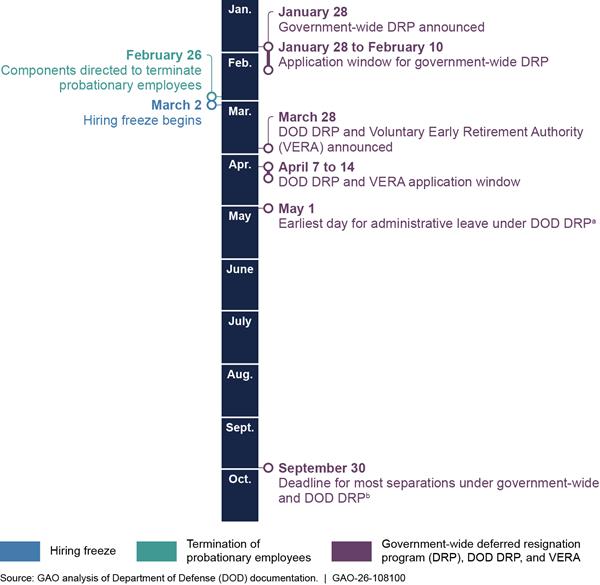
aPer DOD guidance, employees participating in the DOD DRP could begin administrative leave no earlier than May 1, 2025, and were required to enter a written agreement to resign or retire by September 30, 2025.
bUnder the government-wide DRP, if an employee was scheduled to retire between October 1, 2025, and December 31, 2025, they could request to extend their resignation date to match their retirement date.
Government-Wide DRP, DOD DRP, and VERA
On January 28, 2025, OPM announced that federal employees could voluntarily resign effective September 30, 2025, under the government-wide DRP.[23] Employees electing to resign would have their duties re-assigned or eliminated by their agency and would be placed on paid administrative leave until September 30, with some exceptions.[24] Employees who took this deferred resignation were also excused from return-to-office requirements while retaining their salary and benefits in the interim. Employees could retire early under VERA in conjunction with the government-wide DRP.[25] VERA allows an agency to downsize or restructure by giving certain eligible federal employees the option to retire and begin receiving some benefits early.
On March 28, 2025, the Secretary of Defense announced the opportunity for eligible civilian employees to participate in a DOD-specific DRP under terms similar to those of the government-wide DRP and to elect retirement pursuant to VERA.[26]
Termination of Probationary Employees
On February 26, 2025, the Defense Civilian Personnel Advisory Service directed the termination of all employees serving in a probationary or trial period in accordance with direction from OPM, but permitted six categories of exceptions.[27] In March 2025, a district court judge found OPM-directed terminations were likely unlawful, though the court’s order requiring that employees be reinstated was stayed.[28] In September 2025, the same judge issued a final decision stating, in part, that OPM lacked authority to direct other agencies to terminate their probationary employees and instructing agencies to update each probationary employee’s personnel files to reflect their termination was not performance- or conduct-based.[29] As of May 2026, the government is appealing this judgment.[30]
Hiring Freeze
On February 28, 2025, the Secretary of Defense directed a civilian hiring freeze and provided for potential exemptions for positions essential to immigration enforcement, national security, and public safety, and positions which support such functions.[31] Subsequent departmental guidance further clarified the process for submitting exemption requests.[32] That guidance established categories of positions that were exempt from the hiring freeze and allowed designated departmental leaders to propose additional exemptions.[33] For example, the Defense Contract Audit Agency obtained exemptions for contract auditors, an information technology specialist, and a budget analyst, among others. Alternatively, the Defense Health Agency identified around 110 occupational series—such as physicians and pharmacists—that military medical treatment facilities and networks could hire based on DOD’s categorical exemptions.
Other Efforts
In addition to these DOD-wide efforts, some components implemented additional efforts to reduce their workforces. For example:
· the Defense Information Systems Agency offered VERA and voluntary separation incentives in March 2025, prior to the DOD-wide VERA, according to component officials;
· the Army provided guidance to commands on how to initiate an Army-specific DRP in July 2025;[34] and,
· the Under Secretary of Defense for Research and Engineering ordered a reduction-in-force for the Defense Technical Information Center in August 2025.[35]
Other efforts implemented by the department during this period may have also had the effect of reducing the civilian workforce. For example:
· On January 27, 2025, the President issued Executive Order 14185 directing the Secretary of Defense and the Secretary of Homeland Security to abolish every diversity, equity, and inclusion office within DOD and the Department of Homeland Security with regard to the U.S. Coast Guard, respectively.[36] We previously reported that this effort led to the abolition or restructuring of 16 civilian positions at DOD.[37]
· On April 24, 2025, the President issued Executive Order 14284 requiring agencies to affirmatively determine that the continued employment of individuals serving probationary or trial periods would benefit the federal service before finalizing such appointments.[38] Per DOD guidance, this applied to DOD civilians serving initial probationary or trial periods ending on or after July 23, 2025.[39]
· On September 30, 2025, the USD(P&R) directed supervisors and human resources professionals to separate employees with unsuccessful performance and authorized the use of various incentives to facilitate the separations.[40]
Some DOD Components Programmed FTE Reductions for FYs 2023–2025
The number of DOD components that programmed reductions to their civilian workforce FTEs each year increased slightly in FYs 2023 through FY 2025. Specifically, 10 of the 40 components programmed reductions in FY 2023; 11 of the 40 components programmed reductions in FY 2024; and 13 of the 40 components programmed reductions in FY 2025.[41] Overall, roughly half of DOD components (22 of 40) programmed reductions in at least one FY during this period. More components programmed increases to their civilian FTEs than reductions in each FY during this period. Figure 3 shows the number of components that programmed increases or reductions to their civilian FTEs in FY 2023 through FY 2025.
Figure 3: Number of Department of Defense (DOD) Components That Programmed Increases or Reductions to Civilian Full-Time Equivalents in Fiscal Years 2023–2025, n=40
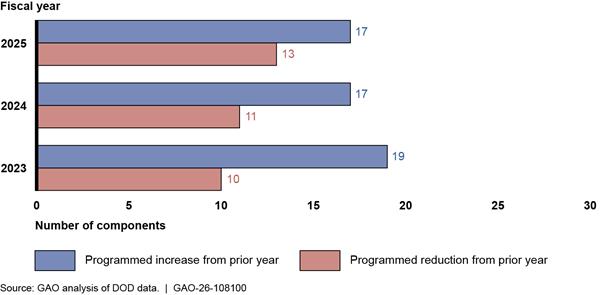
Note: The number of components depicted does not equal 40 because some components reported no change in a given year, or GAO was unable to determine the change for a given component in a given year from available data due to errors or incompleteness.
While some DOD components programmed FTE reductions from the prior FY from 2023 to 2025, the median change to component civilian FTEs did not vary significantly in this period.[42] Components programmed reductions from FY 2023 through FY 2025 that ranged from 0.1 to 9.8 percent of the component’s civilian workforce and from 1 to 4,557 FTEs. In addition, the largest individual component FTE reductions by percentage grew progressively larger each year from FY 2023 through FY 2025. For example, the largest reduction by percentage for a component in FY 2025 was 9.8 percent versus just 2.5 percent in FY 2023. Table 2 shows the five largest reductions by percentage for each FY.
Table 2: Department of Defense (DOD) Components with the Five Largest Programmed Reductions by Percentage in Fiscal Years 2023–2025
|
Fiscal year |
Component |
Percentage change in programmed civilian full-time equivalents (FTE), from prior fiscal year |
Change in programmed civilian FTEs, from prior fiscal year |
|
2023 |
Air Force (Reserve) |
−2.5% |
−283 |
|
Defense Contract Management Agency |
−2.2% |
−231 |
|
|
Missile Defense Agency |
−1.5% |
−32 |
|
|
Defense Contract Audit Agency |
−1.4% |
−56 |
|
|
Defense Technical Information Center |
−0.5% |
−1 |
|
|
2024 |
Marine Corps (Reserve) |
−7.8% |
−22 |
|
Defense Contract Audit Agency |
−1.9% |
−76 |
|
|
Defense Logistics Agency |
−1.7% |
−453 |
|
|
Defense Finance and Accounting Service |
−1.7% |
−190 |
|
|
Marine Corps (Active) |
−1.0% |
−205 |
|
|
2025 |
The Joint Staff |
−9.8% |
−138 |
|
Air Force (Active Duty) |
−5.0% |
−4,557 |
|
|
Defense Threat Reduction Agency |
−4.8% |
−68 |
|
|
Marine Corps (Reserve) |
−3.4% |
−9 |
|
|
U.S. Special Operations Command |
−3.2% |
−219 |
Source: GAO analysis of DOD data. | GAO‑26‑108100
Note: GAO did not include data on the component reductions programmed in fiscal year 2022 because GAO calculated the components’ reductions based on the change from one fiscal year to the next using budget data from fiscal years beginning in 2022 through 2026.
FY 2025 was the only year in which DOD reduced its total number of civilian FTEs—from 827,397 to 820,286, or a decrease of 0.8 percent. However, the department’s total number of programmed civilian FTEs remained greater in FY 2025 (820,286) than it was in FY 2022 (811,581), a difference of approximately 1.0 percent.
Selected DOD Components Did Not Consistently Conduct Required Analysis and Address All Statutory Elements to Inform Past Reductions
Selected DOD components did not consistently conduct the analysis required by section 129a(b) to inform reductions made to their civilian workforces, through the normal programming process, for FY 2023 through FY 2025.[43] Specifically, officials from 11 of the 14 selected components told us they conducted analysis pursuant to the requirements of section 129a(b) for the civilian FTE reductions we identified, while officials from three components told us they did not conduct such analysis. Officials from these three components stated that, based on their understanding of the analysis required pursuant to section 129a(b), their components did not need to conduct an analysis due to the nature of their components’ programmed reductions. For example:
· Officials from the Joint Staff and the Defense Threat Reduction Agency stated that their components did not conduct an analysis because the identified reduction was related to a functional transfer or realignment of FTEs, which they did not consider a reduction for the purposes of section 129a(b).[44] According to officials from a selected component and the Office of the USD(P&R) (OUSD(P&R)), an analysis under section 129a(b) is not required when the reduction does not lead to an overall DOD-wide reduction in FTEs, though some components may still choose to do an impact analysis. However, officials were unaware of any guidance to this effect. OUSD(P&R) officials confirmed in February 2026 that DOD has not issued department-wide guidance that interprets section 129a(b) in relation to FTE reductions from functional transfers.
· Joint Staff officials also stated that, while it appears the component programmed a reduction in FTEs from FY 2024 to FY 2025, the change in FTEs was due to the Joint Staff’s FTE programming methodology in the FY 2024 budget cycle. The officials further stated that this methodology requested too many FTEs in FY 2024, so it appeared to show a reduction when it was corrected to a more achievable level in the following budget cycle. According to these officials, the Joint Staff actually increased its civilian FTEs in FY 2025 in effect, which would not prompt a section 129a(b) analysis.
· Defense Contract Audit Agency officials stated that the identified reduction would not require section 129a(b) analysis because the FTE reduction we identified was based on a change in reporting for their reimbursable funding.[45] These officials told us that they understand the section 129a(b) analysis requirement to apply only to their direct funding.
For the 11 of 14 selected components that reported conducting analysis required by section 129a(b) to inform programmed civilian workforce reductions, the analyses and supporting documentation did not consistently and clearly address all elements outlined in section 129a(b). Of those 11, only one component, the Missile Defense Agency, provided documentation related to its analysis of the impacts on all seven section 129a(b) elements. The remaining 10 components did not consistently provide documentation related to an analysis that considered the impacts on each of the seven elements. As a result, while we could not determine whether and how the components conducted an analysis that consistently and clearly addressed the impact on each element, table 3 shows illustrative examples of the varied documentation that components provided to reflect their respective analysis conducted for each section 129a(b) element.
Table 3: Examples of Documentation Provided by Selected DOD Components Related to Their Analysis of Impacts on Section 129a(b) Elements
|
Element |
Examples of documentation provided |
|
Workload |
The Department of Defense Education Activity provided a Staffing Authorization document as an example of the analysis officials use to determine the impacts of various full-time equivalent (FTE) levels on workload across the department’s schools. This documentation summarizes the number of FTEs needed to adequately operate a single high school based on the results of a workload assessment. |
|
Military force structure |
The Defense Contract Management Agency provided documentation used to determine workload requirements for all its personnel to support the agency’s analysis of the impact of workforce reductions on military force structure. Agency officials stated that 386 active military and 150 reserve military personnel are needed to address workload requirements. Agency officials told us that the military services consider the experience personnel gain from serving with the Defense Contract Management Agency as pertinent and necessary. |
|
Lethality |
Documents provided by the selected components in support of their analysis of the impacts of programmed reductions on lethality were sensitive. |
|
Readiness |
The Missile Defense Agency provided a memorandum outlining the goals of its fiscal year 2023 annual workforce review as documentation of the analysis of the impact of workforce reductions on readiness. This review prioritized a leaner and more efficient workforce. In pursuit of this goal, the agency instructed officials to identify a 20 percent reduction in FTEs. |
|
Operational effectiveness |
The Defense Finance and Accounting Service provided documentation of its Performance Improvement Framework. This framework allows the Defense Finance and Accounting Service to monitor operational health metrics regarding the timeliness and accuracy of their services delivered to clients and improve operations according to that feedback. |
|
Stress on the military force |
The Department of Defense Education Activity provided a citation to a law establishing an Office of Military Family Readiness Policy. The functions of this office include coordination of local mental health counseling, as well as local programs and activities that relate to military families. Activity officials told us they considered this statutory responsibility when making decisions about reductions to avoid decisions that may elevate stress on the force by undermining the local educational support system military families rely upon. |
|
Fully burdened costs |
The Defense Logistics Agency provided a template the component uses to calculate its fully burdened costs for each fiscal year, and which will accompany its 2027 President’s Budget Estimate.a This template bases its cost projections on estimated workload and an average annual salary rate, organized by the types of funds it receives authorization from Congress to use for operations. |
Source: GAO analysis of documentation and interview responses from selected Department of Defense (DOD) components. | GAO‑26‑108100
aGuidance from the Under Secretary of Defense for Personnel and Readiness instructs component officials to use procedures outlined in DOD Instruction 7041.04 to calculate the impact of civilian FTE reductions. Under Secretary of Defense for Personnel & Readiness Memorandum, Total Force Management and the Civilian Workforce (Feb. 5, 2024); Department of Defense Instruction 7041.04 Estimating and Comparing the Full Costs of Civilian and Active Duty Military Manpower and Contract Support (Jul. 3, 2013) (incorporating change 1, effective July 1, 2020).
Officials from seven of our selected components stated that they considered the impacts of reductions on certain elements in their analysis but could not provide documentation related to analysis pursuant to each element when requested. For example, officials from the Defense Contract Management Agency described connections between their analysis and impacts on all the elements of section 129a(b) but could not provide documentation pertaining to four of those impacts when requested. (See app. II.) Overall, six or fewer of the 14 components could provide documentation related to analysis pertaining to each element of section 129a(b) (see fig. 4). For two of the section 129a(b) elements—lethality and stress on the military force—two of the 14 selected components could provide documentation.
Figure 4: Summary of Documentation Pursuant to Section 129a(b) Provided by 14 Selected DOD Components, by Element
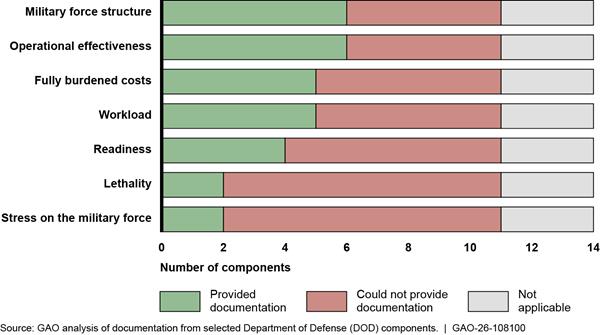
Note: For components that reported conducting analysis, GAO requested documentation of their analysis that reflects each of the seven elements of section 129a(b). Three components reported that they did not conduct analysis pursuant to section 129a(b). Where a component was either unable to identify documentation of their analysis or did not provide such documentation in time to incorporate into GAO’s review, GAO categorized them as “could not provide documentation.”
Officials from our selected components identified three main reasons why documentation of their analysis may not be available:
· Holistic approach. Component officials told us they take a holistic approach to the analysis required by section 129a(b), rather than conducting an analysis that individually addresses each element. OUSD(P&R) officials stated that, by their interpretation of section 129a(b), it is acceptable for components to conduct the required analysis holistically rather than by individual element, though they also stated that they would expect all elements to be considered. Officials from four of our selected components told us that their analysis is not organized by the specific impacts on elements of section 129a(b). Rather, their analysis takes a risk-based approach to analyzing mission-specific outcomes of employing various FTE levels. Officials from multiple components told us this risk-based analysis considers the impacts on the elements outlined in section 129a(b) within the context of their components’ unique mission considerations.
· Decentralization. Officials from multiple components told us that the processes and results of their analysis are spread across various offices and conducted through mechanisms such as meetings and emails—presenting a challenge to providing documentation describing their full analysis. For example, Air Force officials told us in April 2025 that the analysis that considers the impacts on section 129a(b) elements and informs the department’s programmed number of FTEs is conducted by many units and offices across the service, each focused on their requirements to fulfill their unique responsibilities. They further told us that, while some analysis-related discussions occur over email, there are no formal documents reflecting analysis based on section 129a(b). Additionally, they told us that the process is “case-specific,” meaning the Air Force conducts analysis at various levels based on conditions identified by program officials at all levels.
· Relevance. Officials from three of our selected components told us their analyses do not explicitly consider the impacts on all elements of section 129a(b) because certain elements either do not apply to their mission or do so indirectly. For example, the Defense Logistics Agency stated that the “stress on the military force” element is not applicable because less than 5 percent of its workforce is military. Defense Finance and Accounting Service officials told us that they do not assess lethality in their own programming process since it is more relevant to the military departments.
Section 129a(b) of title 10, U.S. Code states that the Secretary of Defense may not reduce the civilian workforce programmed FTE levels unless the Secretary conducts an appropriate analysis of the impacts on seven elements, such as workload and readiness. USD(P&R) delegated the responsibility to conduct this analysis to the components in February 2024.[46] Additionally, federal internal control standards state that management should use quality information to achieve the entity’s objectives.[47] Quality information is information that is appropriate, current, complete, accurate, accessible, and provided on a timely basis. Each unit also documents policies in the appropriate level of detail to allow management to effectively monitor the control activity.
Officials from our selected components outlined some reasons why documentation of their analysis may not be available. However, DOD components did not consistently conduct analysis that clearly addresses impacts on the seven elements outlined in statute prior to programming civilian workforce reductions because, according to some component officials, the Secretary of Defense has not provided guidance for when and how they should conduct this analysis, including operational definitions or examples for applying the seven section 129a(b) elements. Key DOD workforce policies include references to section 129a(b); however, these references were last updated before the analysis requirement was introduced through the National Defense Authorization Act for Fiscal Year 2021.[48] Additionally, a memorandum from USD(P&R) clarifies some component analysis responsibilities but does not provide much additional detail beyond the language of section 129a(b) (see fig. 5).
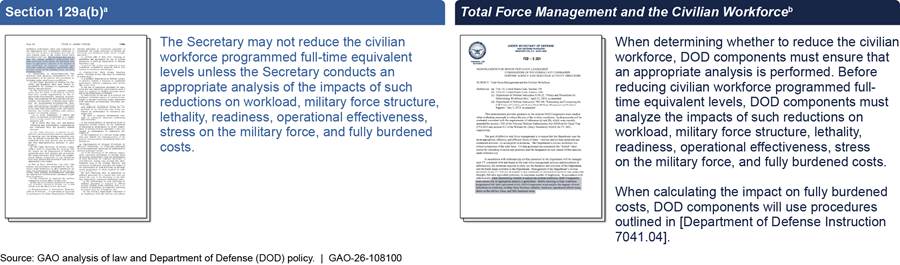
aSection 129a(b) of title 10, U.S. Code was amended by the National Defense Authorization Act for Fiscal Year 2021, adding the section highlighted above.
bUnder Secretary of Defense for Personnel and Readiness Memorandum, Total Force Management and the Civilian Workforce (Feb. 5, 2024).
As a result, current DOD guidance related to section 129a(b) does not comprehensively address when a programmed reduction should prompt this analysis. For example, OUSD(P&R) officials stated that there is no documented department-wide guidance that interprets section 129a(b) for FTE reductions arising from circumstances described by some of our selected components, including functional transfers, realignment of FTEs, or reductions programmed to occur across multiple years.
Moreover, DOD has not established an internal process for how the components should document and report their analysis pursuant to section 129a(b), according to DOD officials. The information DOD leadership reviews as part of the PPBE process is based on outcomes of component analysis, but typically does not include the analysis itself, according to component officials. OUSD(P&R) officials stated that there is not currently a reporting requirement and there is no visibility at the Office of the Secretary of Defense level as to whether components are conducting the required analysis. OUSD(P&R) officials also acknowledged that more guidance for conducting analysis pursuant to section 129a(b) may be needed based on the focus of our review and the discussions we held with component and department-level officials.
DOD officials stated that, even when section 129a(b) is not directly referenced in analysis, it is generally considered in components’ civilian workforce programming decisions. Officials stated that (1) section 129a(b) is more of a bedrock set of guidelines that DOD personnel are trained to always consider in workforce-shaping decisions, and (2) the impacts on those elements are considered as part of components’ programming decisions during the PPBE process. Accordingly, component officials reported that flexibility in interpreting the elements of section 129a(b) and designing analysis to fit their unique mission considerations is beneficial. Further, OUSD(P&R) officials told us that components are not currently required to supply documentation of their section 129a(b) analysis that explicitly describes the impacts on each element. Rather, the documents resulting from the PPBE process—such as DOD budget materials—aggregate the results of the impact analysis from each component, according to those officials.
In response to some of these challenges, the National Defense Authorization Act for Fiscal Year 2026 included a provision requiring the Office of the Secretary of Defense, in consultation with each secretary of a military department, to provide guidance to each secretary on the analysis required by section 129a(b) of title 10 of the U.S. Code. The guidance must also define the seven section 129a(b) elements, either on a DOD-wide or component level.[49] Implementing these requirements will help DOD address the challenges we identified and ensure components use quality information to inform future programmed civilian workforce reductions.
DOD Components May Not Have Conducted Required Analysis and Have Not Assessed Lessons Learned for Workforce Reductions Since January 2025
DOD components implemented multiple efforts to reduce their civilian workforces since January 2025 outside the normal programming process. Selected components conducted some analysis to support decision-making related to these workforce reductions, but the analysis for the DRPs may not fully address the impacts on the seven elements. Officials from selected components reported both preliminary benefits and challenges from the reduction efforts, but the department has not captured lessons learned to inform any future workforce shaping efforts.
Components Implemented Multiple Efforts to Reduce Their Civilian Workforces Since January 2025
DOD components reduced their civilian workforces since January 2025 by implementing multiple efforts, including (1) the government-wide DRP; (2) the DOD DRP and VERA; (3) the termination of probationary employees, and (4) the hiring freeze. Overall, the total number of DOD civilian employees decreased by roughly 10 percent (about 78,000 employees) in 2025.
Government-Wide and DOD DRPs and VERA
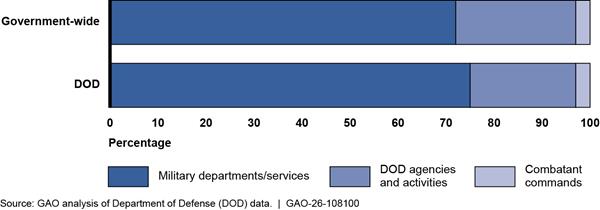
DOD received over 70,000 applications to the two DRPs, with over 70 percent coming from civilians in the military departments and services (and the National Guard), according to DOD data as of September 2025 (see fig. 6).
Figure 6: Applications to the Government-Wide and DOD Deferred Resignation Programs (DRP) by Component Type, as of September 2025
DOD approved about 53,200 of those applications, including approximately 22,100 out of 30,300 applications to the government-wide DRP (73 percent) and approximately 31,100 out of 40,100 applications to the DOD DRP (78 percent). The approval rates for the DRPs varied by component type, with the military departments and services (and the National Guard) approving a higher percentage of applications to both DRPs than the combatant commands or defense agencies and activities, according to DOD data as of September 2025 (see fig. 7).
Figure 7: Approval Rates for Deferred Resignation Program (DRP) Applications by Component Type, as of September 2025
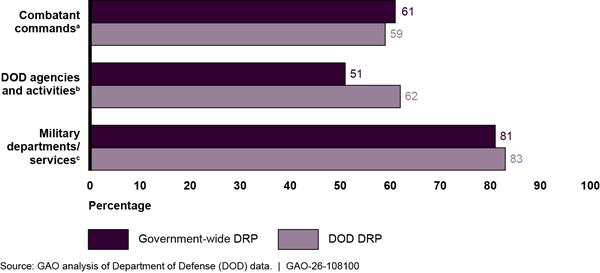
aThis includes all 11 combatant commands, except U.S. Africa Command, which was not included in the data for the DOD DRP.
bAs reported in DOD data, this includes defense agencies (e.g., Defense Security Cooperation Agency), DOD field activities (e.g., Washington Headquarters Services), the Office of the Secretary of Defense, and, separately, the offices of the Under Secretaries of Defense for Comptroller, Policy, and Intelligence and Security.
cAs reported in DOD data, this includes the Air Force, Army, National Guard (including both the Air National Guard and Army National Guard), Navy (including both the Navy and Marine Corps), and Space Force.
According to our analysis of DOD personnel data, a total of 46,229 civilian employees separated under the DRPs as of December 31, 2025, including 17,952 under the government-wide DRP and 28,277 under the DOD DRP.[50] In addition, between January and December 2025, 6,650 civilian employees retired early under VERA, which was offered alongside the DRPs. For comparison, a total of 2,030 civilian employees retired under VERA between January 2016 and December 2024.
Termination of Probationary Employees
DOD components terminated approximately 1,573 employees during a probationary or trial period since January 1, 2025, according to our analysis of DOD data as of December 31, 2025.[51] For comparison, DOD components terminated 1,690 employees during a probationary or trial period on average per year from FY 2016 through FY 2024. Components’ approaches to terminating probationary employees varied, and litigation limited the number of employees who were terminated, according to component officials. For example, U.S. Space Command and the Defense Contract Audit Agency identified probationary employees for termination, but ultimately did not terminate them due to litigation, according to officials from those components. The Army and Defense Information Systems Agency did not terminate any probationary employees based on the direction from the Defense Civilian Personnel Advisory Service, though officials told us they still terminate employees for cause.
Hiring Freeze
DOD’s civilian hiring slowed following the implementation of the department’s hiring freeze in March 2025, though some hiring continued as components obtained exemptions for certain positions or categories of employees. DOD hired approximately 33,781 civilians between January and December 2025—roughly 59,456 fewer than the historical average hired for those months (see fig. 8).[52] The DOD hiring freeze remained in effect as of January 2026, according to DOD officials. Those DOD officials told us that the department has been reforming the hiring process, such as through establishing strategic hiring committees, in line with administration priorities and goals, and they anticipate the hiring freeze being lifted once the committees are in place.[53]
Figure 8: Number of Department of Defense (DOD) Civilian Hires from January–December 2025 Compared with the Monthly Average for Calendar Years 2016–2024
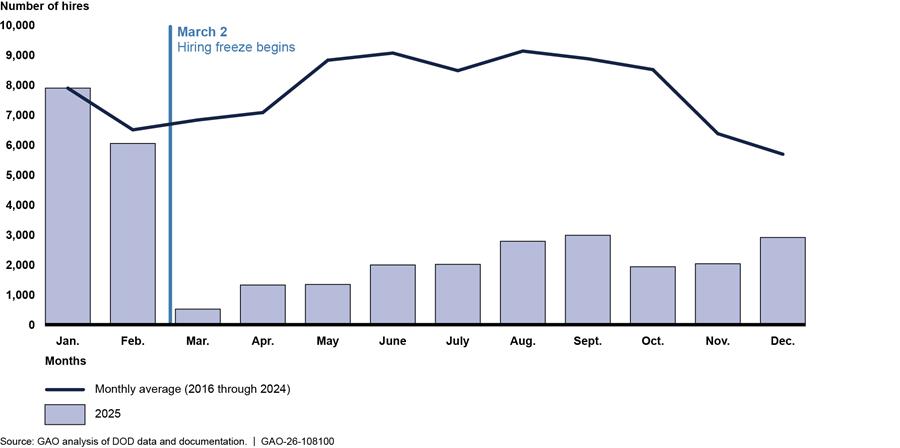
Note: “Civilian hires” refers to hired appropriated fund civilian employees. GAO analyzed DOD civilian personnel data from the Defense Civilian Personnel Data System to determine the number of appropriated fund civilian employees hired from January through December 2025, as well as the average number hired during those same months from 2016 through 2024.
Total Change in DOD Civilian Employees
The total number of DOD civilian employees increased slightly from January 1 to March 1, 2025, then decreased each month from April 1, 2025, to January 1, 2026, as shown in table 4. Overall, DOD’s civilian workforce decreased by approximately 9.9 percent from January 1, 2025, to January 1, 2026.
Table 4: Total Number of Department of Defense (DOD) Civilian Employees from January 1, 2025, to January 1, 2026
|
Date |
Number of civilian employees |
Change from prior month |
|
January 1, 2025 |
793,155 |
- |
|
February 1, 2025 |
793,680 |
0.1% |
|
March 1, 2025 |
794,873 |
0.2% |
|
April 1, 2025 |
789,138 |
−0.7% |
|
May 1, 2025 |
785,487 |
−0.5% |
|
June 1, 2025 |
780,921 |
−0.6% |
|
July 1, 2025 |
777,402 |
−0.5% |
|
August 1, 2025 |
774,150 |
−0.4% |
|
September 1, 2025 |
771,171 |
−0.4% |
|
October 1, 2025 |
730,372 |
−5.3% |
|
November 1, 2025 |
728,379 |
−0.3% |
|
December 1, 2025 |
727,652 |
−0.1% |
|
January 1, 2026 |
714,780 |
−1.8% |
|
Total changea |
−78,375 |
−9.9% |
Source: GAO analysis of DOD data. | GAO‑26‑108100
Note: “Civilian employees” refers to appropriated fund civilian employees. GAO analyzed DOD civilian personnel data from the Defense Civilian Personnel Data System to determine the number of appropriated fund civilian employees for each month. GAO has recent and ongoing work related to workforce reductions across federal agencies, including at DOD. The total number of civilian employees reported may vary in other GAO reports due to differences in data collection and the types of employees by pay status within the scope of each review. For example, GAO included employees in nonpay status based on the scope of this review, whereas prior reports specifically excluded employees in nonpay status. See GAO, Federal Agency Workforce Changes: Update for January to June 2025, GAO‑26‑108719 (Washington, D.C.: Feb. 24, 2026).
aThe total change reflects the change in the number of civilian employees from January 1, 2025, to January 1, 2026.
According to component officials, DOD programmed some of the reductions made since January 2025 into its FY 2026 budget request, and future programmed reductions were expected to appear in the FY 2027 budget request.[54] DOD’s budget request for FY 2026 included a decrease in civilian FTEs for most components. Specifically, 28 out of 40 components programmed fewer civilian FTEs than the prior FY (see fig. 9). The reductions in the FY 2026 budget request were also generally larger than in prior FYs, with the median change in component FTEs being a reduction of 6.5 percent. Overall, DOD’s budget request included 771,852 civilian FTEs for FY 2026 versus 820,286 for FY 2025—a decrease of about 48,400 (5.9 percent).
Figure 9: Number of Department of Defense (DOD) Components That Programmed Increases or Reductions to Civilian Full-Time Equivalents (FTE), in Fiscal Years 2023–2026, n=40
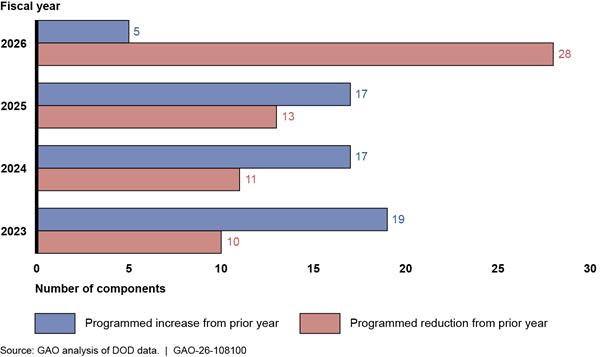
Note: The number of components depicted does not equal 40 because some components reported no change in a given year, or GAO was unable to determine the change for a given component in a given year from available data due to errors or incompleteness.
Selected Components May Not Have Conducted Required Analysis for Workforce Reductions Since January 2025
While selected components conducted some analysis when
making determinations about civilian workforce reductions since January 2025,
officials reported challenges in doing so.[55]
Furthermore, the analysis conducted for the DRPs may not fully address the
impacts on the seven elements outlined in section 129a(b).
Analysis Conducted to Justify Exemptions to Workforce Reduction Efforts
DOD established processes to request exemptions from the workforce reduction efforts such as allowing components to deny DRP applications or to hire during the hiring freeze, and officials generally reported conducting some analysis to support exemption requests.[56] Specifically, depending on the effort, officials from between 10 and 12 components reported conducting analysis (see app. III).[57] However, the analyses varied by component and reduction effort, as shown by the examples in table 5.
Table 5: Examples of Analysis Conducted by Department of Defense (DOD) Components to Support Civilian Workforce Reduction Efforts Since January 2025
|
Reduction effort |
Examples of analysisa |
|
Government-wide deferred resignation program (DRP) |
· The Defense Finance and Accounting Service used three categories—audit, support to the warfighter, and lost buying power to the department—to determine its exemption requests, according to a memorandum documenting its process. The Office of the Under Secretary of Defense (Comptroller) approved an exemption for audit functions in support of DOD components that have not achieved a clean audit opinion and are required to do so by 2028. The Defense Finance and Accounting Service compared the list of applicants against this approved exemption and accordingly exempted three positions. · U.S. Transportation Command’s directorates developed narratives for roughly 90 positions that describe the positions’ roles and, in some cases, the potential impact of losing them. U.S. Transportation Command requested exemptions for nine categories of employees, such as civilian mariners, the finance career field, and special security officers. · U.S. Space Command requested exemptions using a standard template with narrative justifications for each of 23 exemptions by position. These narratives address the positions’ (1) mission critical role, (2) impact on national security and warfighter support, (3) unique skill set and institutional knowledge, (4) workforce impact and increased operational risk, and (5) alignment with DOD and U.S. Space Command priorities. |
|
DOD DRP |
· The Defense Finance and Accounting Service considered two categories for exemptions: audit and customer care centers where it had experienced significant loss of resources in the government-wide DRP. · The Defense Health Agency developed narratives by applicant and position that described the role and the risk to mission if exemptions were not granted. For example, it noted that not approving certain exemptions would increase costs by diverting care to non-DOD providers and limiting revenue collection. |
|
Termination of probationary employees |
· The Defense Health Agency requested exemptions for approximately 3,800 probationary employees via memorandum. The memorandum described the number of requested exemptions by location, as well as examples of impacts if exemptions were not approved. It noted that terminating these employees would have “severe and far-reaching consequences … by significantly degrading medical readiness, force generation, casualty receiving, trauma care capabilities, and healthcare delivery.” · Air National Guard officials verified employees’ probationary status, then communicated with employees’ supervisors regarding the employees’ performance, according to component officials. Based on the supervisors’ responses, they did not terminate any probationary employees. · U.S. Strategic Command did not terminate any probationary employees based on follow-up guidance exempting employees with high-level clearances (e.g., Top Secret/Sensitive Compartmented Information), according to a component official. |
|
Hiring freeze |
· The Defense Contract Audit Agency submitted exemption requests by position, such as for an equal employment manager, chief of staff, and information technology specialist. Because DOD did not provide a categorical exemption for defense contract auditors, the Defense Contract Audit Agency repeatedly requested exemptions for defense contract auditors between March and August 2025. For example, in August 2025, it requested an exemption to hire 40 defense contract auditors, noting that disruptions to contract audits could cause an increased risk of noncompliance, financial losses, operational inefficiencies, strained relationships, and increased workload. |
Source: GAO analysis of DOD documentation and interviews with DOD officials. | GAO‑26‑108100
aFor each component that reported conducting analysis for a reduction effort, GAO requested documentation and results of the analysis, such as memorandums, summaries, lists of exemptions, and narratives. GAO also requested any additional documentation or information that would help understand the analysis. GAO reviewed the documentation provided by the components to summarize each component’s approach, then selected examples to reflect the variation in the approaches.
Challenges Conducting Analysis to Justify Exemptions
Selected components reported challenges conducting analysis to support their reduction efforts, whether in response to section 129a(b) or generally, especially for the DRPs. Eight out of 12 selected components reported challenges with analysis for the DOD DRP and VERA, seven for the government-wide DRP, four for the hiring freeze, and four for the termination of probationary employees. (For more information, see app. III.) The challenges the selected components identified included the following:
· Short time frames. Component officials noted that directives were fast moving and timelines were compressed. This required components to gather, validate, and analyze data quickly. For example, Air Force officials noted that short time frames for the government-wide DRP were a challenge for a large, geographically dispersed organization, and Space Force officials stated that the lack of notice and short application window did not allow enough time to properly plan for implementation and execution.
· Unreliable data. Some of the data relating to reduction efforts were initially unreliable, according to component officials. For example, Navy officials told us it is typical to have flaws in probationary data, so they validated the data by analyzing the electronic Official Personnel Folder for each employee that DOD had identified as probationary.[58] Moreover, the list of applicants to the government-wide DRP included errors, according to officials from two components and component documentation. Per instructions for that effort, applicants were to reply to the January 28 email and type “Resign” in the body of the email.[59] However, component officials told us that responses with questions or out-of-office notifications may have been incorrectly counted as applications. For example, Army officials told us that, when asked to confirm that they had applied to the government-wide DRP, about 550 employees stated their application was received in error. Documentation provided by U.S. Strategic Command officials identifies six employees included in error who did not apply to resign through the government-wide DRP.
· Novelty of the government-wide DRP. At the time of implementation, the government-wide DRP was an entirely new program, which created some uncertainty, according to component officials. For example, a DOD notice informed officials that components would be expected to eliminate billets based on government-wide DRP participation, but component officials understood and applied this guidance differently (see text box).[60] A U.S. Strategic Command official noted that while they understood the intent of the government-wide DRP was to reduce the workforce and reorganize the budget, it was challenging to perform analysis until they understood how the DRP would be applied.
|
Differing Implementation of Billet Reductions A billet is a position typically defined by grade and occupation and associated with a specific unit or organization. A February 6, 2025, notice from the Office of the Under Secretary of Defense for Personnel and Readiness stated that, following a deferred resignation, it is expected that the vacated billet will be removed from staffing documents. However, because officials interpretated this guidance differently, the components differed in how they eliminated billets, according to officials we interviewed. For example: · Some component officials—including those from Department of the Navy, Department of the Air Force, Defense Logistics Agency, and U.S. Space Command—told GAO they were required to eliminate a position for each application to the government-wide deferred resignation program (DRP), regardless of approval status. Navy guidance, for instance, specified that “The total number of positions eliminated must equal the total number of employees seeking participation in the program.” · Other officials—including those from the Defense Health Agency, Defense Information Systems Agency, and National Guard—told GAO that cuts were to be based on approved applications to the government-wide DRP, rather than all applications. · Defense Contract Audit Agency officials stated there was not a requirement to eliminate a specific number of positions based on the government-wide DRP, but rather a broader target for budgetary reductions that components could partially achieve by eliminating positions. The difference between applications and approvals for the government-wide DRP was significant for some components. For example, military treatment facilities under the Defense Health Agency had roughly 300 approvals out of almost 2,000 applications, according to DOD data as of September 2025. |
Source: GAO analysis of Department of Defense (DOD) interviews, DOD data, and DOD and Navy guidance. | GAO‑26‑108100
· Evolving guidance. Changes to guidance required officials to recalibrate their criteria to ensure alignment with mission priorities, according to Defense Health Agency officials. A U.S. Space Command official noted that, while they received the OPM memorandum for the government-wide DRP, they had to wait for additional guidance from DOD and the Department of the Air Force to provide clarity. Guidance also evolved quickly. For example, on February 17, 2025, OUSD(P&R) directed components to identify probationary employees deemed not critical by February 19, but on February 20 instructed them to pause removals pending further guidance. Then, on February 26, the Defense Civilian Personnel Advisory Service directed terminations, as discussed above.
|
Mitigating Analysis Challenges: DLA Example DLA is the largest logistics combat support agency of the Department of Defense (DOD), providing commodities and services to support U.S. military forces. DLA officials took a variety of steps to mitigate challenges in conducting analysis for DOD’s civilian workforce reduction efforts. Specifically, officials told GAO they · Established a cross-functional tiger team to centralize analysis and decision-making. · Coordinated with DOD and DLA legal and policy offices to ensure compliance with updated guidance and minimize the risk of errors. · Employed data tools to reconcile records across systems regarding probationary employees. · Solicited input from stakeholders in the agency to refine recommendations for the hiring freeze and to address potential operational gaps. · Leveraged analysis from the government-wide deferred resignation program regarding mission critical positions to accelerate their analysis for exemptions from the DOD hiring freeze and termination of probationary employees. · Designated Human Resources staff to provide direct support to affected personnel and supervisors. Source: GAO analysis of interview with Defense Logistics Agency (DLA) officials. | GAO‑26‑108100 |
In addition to those above, Defense Logistics Agency (DLA) officials identified litigation, extensive coordination, and resource constraints as challenges. Specifically, litigation risk and court injunctions were a challenge for the termination of probationary employees, according to these officials. Furthermore, the government-wide DRP required close coordination due to manually processing DRP requests, extensive communication, and rapid adaptation. Finally, DLA officials noted they both lost Human Resources personnel and were simultaneously implementing other initiatives, such as a return to in-person work and policy changes related to diversity, equity, and inclusion, among others.
Component officials described taking a number of steps to mitigate these challenges associated with conducting analysis. These steps included (1) correcting unreliable data; (2) establishing new processes or structures, such as cross-functional task forces; (3) communicating and coordinating across DOD; (4) gathering information from component leaders and subject matter experts; (5) communicating internally, such as with affected employees, supervisors, and hiring managers; (6) automating processes; and (7) leveraging analyses from prior reduction efforts, such as the government-wide DRP. For example, DLA officials told us that, among other mitigation steps, automating human resources processes reduced manual tasks by 30 percent, freeing up staff for higher-value initiatives (see sidebar).
Analysis Under Section 129a(b) for Workforce Reduction Efforts
As discussed, section 129a(b) of title 10, U.S. Code states that the Secretary of Defense may not reduce the civilian workforce programmed FTE levels unless the Secretary conducts an appropriate analysis of the impacts of such reductions on seven elements, such as workload and readiness. DOD guidance on section 129a directs components to ensure an appropriate analysis is performed when determining whether to reduce the civilian workforce.[61] OUSD(P&R) officials confirmed in December 2025 that section 129a(b) applies to both the government-wide and DOD DRPs, but not to either the hiring freeze or the termination of probationary employees.[62] As discussed, DOD reduced its civilian workforce and incorporated some of the reductions into its budget request for FY 2026—the next budget cycle.
Our review of the 12 selected components’ analyses and interviews with officials found that some components may not have fully addressed the impacts of the reductions on the elements outlined in section 129a(b) when conducting and documenting analysis. For example:
· National Guard officials told us that they did not conduct analysis under section 129a(b) for the DOD DRP because they did not request exemptions.
· A memorandum documenting the Defense Finance and Accounting Service’s analysis for the DOD DRP identifies the Secretary of Defense’s audit priority as the basis for its exemption request, but it does not mention or address the impacts on the elements of section 129a(b).
· U.S. Transportation Command developed narratives by occupational series and grade for each exemption request to the two DRPs, with varying degrees of detail. While some of the command’s narratives identified the potential negative impacts of not receiving an exemption, others provided a description of the position only.
· Navy officials told us they believed the Navy has documentation showing a specific analysis of impacts on the seven elements of section 129a(b), but they could not provide such documentation when we requested their analysis.
The selected components did not fully address the impacts on the elements of section 129a(b) as part of their civilian workforce reduction efforts since January 2025 because DOD guidance specific to those efforts did not consistently direct components to do such analysis. Specifically, guidance related to the government-wide DRP did not reference section 129a(b) and sometimes included other criteria. DOD officials told us in June 2025 that section 129a(b) is a basic guideline that would be considered in workforce decisions, even if it is not explicitly referenced in guidance.
Further, while DOD guidance for the DOD DRP and VERA required analysis under section 129a(b) to justify exemptions, this requirement was not always reflected in selected components’ implementing guidance.[63] For example, Army guidance listed categorical exemptions from the DOD DRP and established four guiding principles for commands to submit additional exemption requests, but it does not outline how and when to conduct a section 129a(b) analysis.[64] Air Force guidance for exemption requests required a written justification and analysis as required by section 129a(b) in accordance with five criteria.[65] (See table 6 and app. IV for additional details.)
Table 6: Comparison of Elements of Section 129a(b) and Army and Air Force Guidance for Exemption Requests to the Department of Defense (DOD) Deferred Resignation Program
|
Section 129a(b)a |
Army guiding principlesb |
Air Force criteriac |
|
1. Workload 2. Military force structure 3. Lethality 4. Readiness 5. Operational effectiveness 6. Stress on the military force 7. Fully burdened costs |
1. Future mission requirements and critical functions 2. Statutory and directed missions 3. Optimized mix of personnel 4. Organizational reshaping and restructuring |
1. Mission impact 2. Strategic landscape 3. Fund source 4. Retirements 5. Remote workers |
Source: GAO analysis of 10 U.S.C. § 129a(b) and DOD documentation. | GAO‑26‑108100
Note: The Army’s guiding principles are paraphrased here. For additional details on the Army’s guiding principles and the Air Force’s criteria, see appendix IV in GAO‑26‑108100.
a10 U.S.C. § 129a(b).
bAssistant Secretary of the Army (Manpower and Reserve Affairs) Memorandum, Army Implementation of Department of Defense Deferred Resignation Program (Apr. 4, 2025).
cCommands could also consider additional criteria beyond these five when reviewing DOD deferred resignation program and Voluntary Early Retirement Authority applications, according to Air Force guidance. Assistant Secretary of the Air Force for Manpower and Reserve Affairs Memorandum, Department of the Air Force Exemption Guidance for Department of Defense Deferred Resignation Program and Voluntary Early Retirement Authority (Apr. 14, 2025).
In addition, while exemptions to the DOD DRP required analysis under section 129a(b), the Secretary of Defense’s direction that exemptions should be rare led some selected components to limit or not make some exemption requests, according to component officials.[66] For example, the Defense Contract Audit Agency received exemptions for auditors from the government-wide DRP, but it did not request similar exemptions from the DOD DRP. Component officials told us that auditors are such a large part of the component’s workforce that such an exemption would not be rare. DLA officials identified the Secretary’s direction for exemptions to be rare as the primary factor driving a reduction in their requested exemptions from the government-wide DRP to the DOD DRP.
Because departmental guidance did not always require section 129a(b) analysis for each workforce effort, selected components did not consistently address the impacts on the elements of section 129a(b) in conducting and documenting their analysis. As a result, the impacts of these reductions were not fully analyzed and documented prior to incorporation into DOD’s FY 2026 budget request. In response to some of these challenges, the National Defense Authorization Act for Fiscal Year 2026 included a provision amending section 129a(b) of title 10 of the U.S. Code to require analysis for any reductions or realignments of 50 employees or more that occur outside the normal programming process, whether implemented before or after the submission of the annual budget request. Implementing this requirement will help DOD address the challenges we identified.
Selected Components Identified Preliminary Benefits and Challenges from DOD Reduction Efforts but Have Not Assessed Lessons Learned
Officials from selected components we interviewed between June and September 2025 identified both preliminary benefits and challenges of the civilian workforce reduction efforts, but DOD does not plan to assess lessons learned, according to DOD officials. According to some component officials, it may be too early to fully identify the benefits and challenges of the overall reduction efforts. However, officials from eight out of 12 selected components identified that their component had experienced measurable benefits from the workforce reduction efforts, while nine out of 12 reported experiencing challenges (see fig. 10).[67]
Figure 10: DOD Component-Identified Benefits and Challenges of Civilian Workforce Reduction Efforts Since January 2025
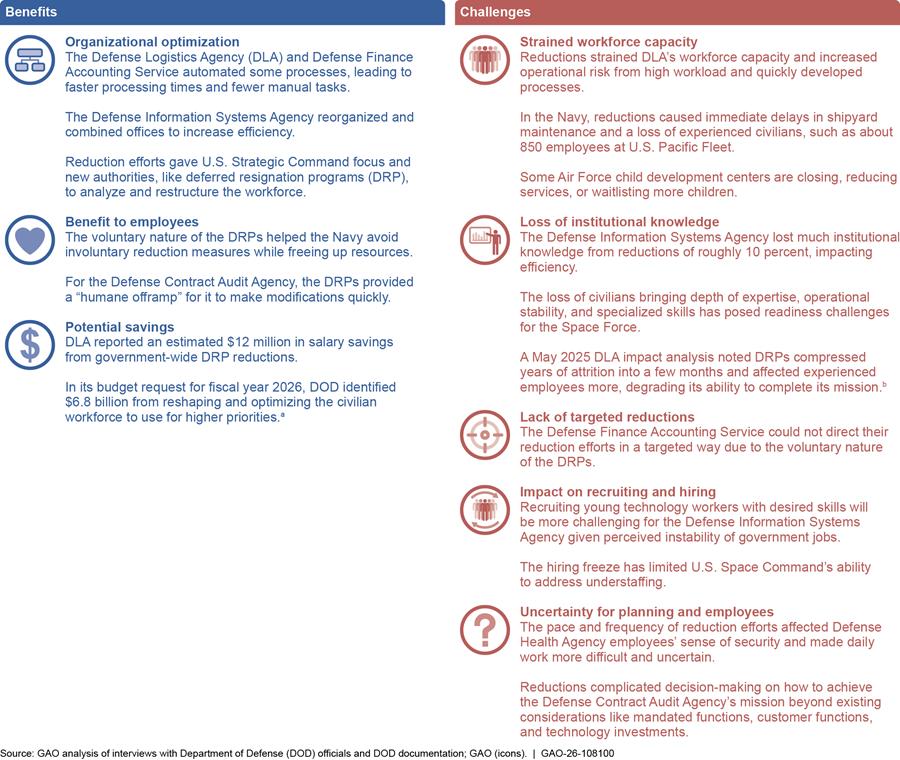
aOffice of the Under Secretary of Defense Comptroller/Chief Financial Officer, Defense Budget Overview: United States Department of Defense Fiscal Year 2026 Budget Request (July 2025).
bDefense Logistics Agency, Defense Logistics Agency (DLA) Deferred Resignation Program (DRP) Impact Analysis and Combat Support Agency (CSA) Posture Narrative (May 27, 2025).
In addition, component officials told us the DRPs may have had unintended consequences. Specifically, some civilians may have chosen not to resign or retire when they otherwise would have due to the availability of the government-wide DRP and DOD DRP, thus delaying when they would have separated from the department, according to component officials. According to our analysis of DOD’s civilian workforce data, approximately 14,433 fewer DOD civilians separated from January through August 2025 than the historical average for those months in 2016 through 2024, and approximately 33,768 more separated from September through December 2025 (see fig. 11). For example, the Defense Information Systems Agency announced an opportunity for VERA and Voluntary Separation Incentive Payments on March 10, 2025, and received 321 initial applicants, according to component officials.[68] These officials told us this program required separation by June 30, 2025. However, the Secretary of Defense announced the DOD DRP and VERA later in March 2025, and ultimately only 71 of the 321 applicants proceeded with their initial applications, according to these officials.
Figure 11: Number of Department of Defense (DOD) Civilian Separations from January–December 2025 Compared with the Monthly Average for 2016–2024
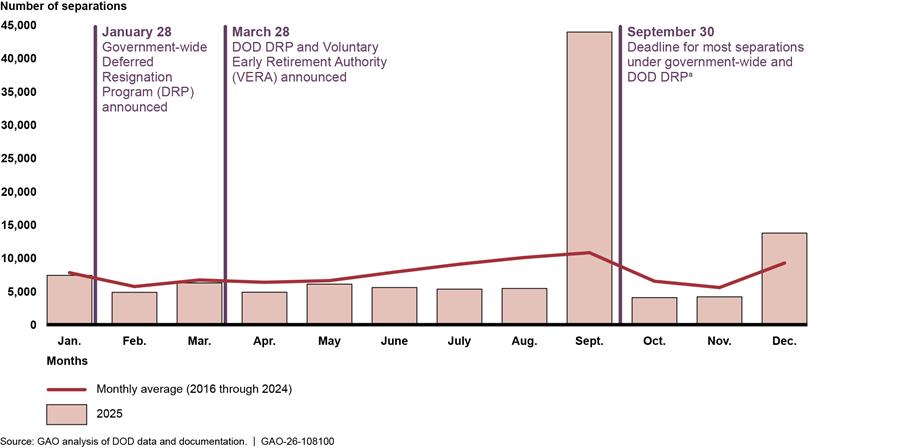
Note: “Civilian employees” refers to appropriated fund civilian employees. GAO analyzed DOD civilian personnel data from the Defense Civilian Personnel Data System to determine the number of appropriated fund civilian employees who separated from January through December 2025, as well as the average number who separated during those same months from 2016 through 2024.
aUnder the government-wide DRP, if an employee was scheduled to retire between October 1, 2025, and December 31, 2025, they could request to extend their resignation date to match their retirement date.
According to key practices that we and others have identified for both program and project management, it is important to identify and apply lessons learned from programs, projects, and missions to limit the chance of recurrence of previous failures or difficulties.[69] Key practices of a lessons-learned process include collecting, analyzing, saving or archiving, and sharing and disseminating information and knowledge gained on positive and negative experiences.[70]
DOD implemented multiple novel reduction efforts in rapid succession in early 2025, with limited time to identify, assess, and incorporate lessons learned. While DOD made some adjustments between its implementation of the government-wide and DOD DRPs—such as providing advance notice—it has not conducted a formal assessment of lessons learned regarding civilian workforce reductions, including the DRPs, according to DOD officials.[71] This is because DOD does not have a plan for collecting and sharing lessons learned from the department’s implementation of workforce reduction efforts.[72] While the department has not taken such steps, Navy officials we met with agreed it would be useful to assess lessons learned from the 2025 reduction efforts. A DOD official told us that, while there is not a formal lessons learned process, DOD maintained an open dialogue with components when executing the reductions.
The collection and dissemination of lessons learned from the series of civilian workforce reduction efforts implemented since January 2025 could assist DOD and DOD components in understanding the impact of civilian workforce reductions on DOD’s force structure, readiness, and operational effectiveness of the force, among others. A full understanding of lessons learned could also assist DOD in choosing between available strategies for any future reductions, as well as their sequencing. Without collecting and sharing such information, DOD may miss opportunities to gain valuable knowledge based on the components’ experiences that may inform strategic human capital management, be applied to any future workforce reduction efforts, and mitigate potential challenges, including challenges to readiness, workload, operational effectiveness, and other elements of section 129a(b).[73]
Conclusions
DOD’s civilian workforce performs a wide variety of responsibilities and plays an essential role in the department’s success. Section 129a(b) of title 10 of the U.S. Code requires the department to conduct analysis to understand how reducing its civilian workforce would affect key elements of concern like readiness, lethality, and workload, among others. However, despite reducing their civilian workforces between FYs 2023 and 2025, some selected components did not document such analysis. The additional guidance required of DOD by the National Defense Authorization Act for Fiscal Year 2026 will help ensure that the department has quality information to inform workforce decisions.
Since January 2025, DOD rapidly implemented multiple concurrent efforts to reduce its civilian workforce outside of its normal programming process. However, selected components did not consistently conduct and document analysis pursuant to section 129a(b) for the DRPs. The National Defense Authorization Act for Fiscal Year 2026 amends section 129a(b) to require this analysis for reductions or realignments of 50 or more civilians outside the programming process, which will help ensure that DOD conducts such analysis if similar reductions occur in the future.
Officials we interviewed reported experiencing a variety of benefits and challenges from the reductions, such as optimizing their organizations but losing institutional knowledge. However, the department has not taken steps to collect and share lessons learned from its recent civilian workforce reduction efforts through the development of a plan. Assessing such lessons learned could assist DOD in better understanding the impact of such reductions on DOD’s readiness, workload, and operational effectiveness, among other elements, and could provide valuable support in most effectively implementing any similar efforts in the future.
Recommendation for Executive Action
The Secretary of Defense should ensure the Under Secretary of Defense for Personnel and Readiness develops and implements a plan for collecting and sharing lessons learned from the department’s implementation of workforce reduction efforts in 2025 outside the programming process to help inform any future workforce reduction efforts. The efforts addressed within the plan should include the deferred resignation programs and hiring freeze, as well as any additional efforts DOD deems appropriate. (Recommendation 1)
Agency Comments
We provided a draft of this report to DOD for review and comment. In its written comments, reproduced in appendix V, DOD concurred with our recommendation. DOD also provided technical comments, which we incorporated as appropriate.
We are sending copies of this report to the appropriate congressional committees, the Secretary of Defense, and the Under Secretary of Defense for Personnel and Readiness. In addition, the report is available at no charge on the GAO website at https://www.gao.gov.
If you or your staff have any questions about this report, please contact me at WilliamsK@gao.gov. Contact points for our Offices of Congressional Relations and Media Relations may be found on the last page of this report. GAO staff who made key contributions to this report are listed in appendix VI.

Kristy E. Williams
Director
Defense Capabilities and Management
This report examines (1) Department of Defense (DOD) components’ programmed reductions to the civilian workforce for fiscal year (FY) 2023 through FY 2025, (2) the extent to which selected DOD components conducted required analysis and addressed all elements outlined in section 129a(b) of title 10, U.S. Code to inform any programmed reductions to the civilian workforce for FY 2023 through FY 2025, and (3) the extent to which selected DOD components conducted required analysis to inform selected reductions to the civilian workforce since January 2025 outside the normal programming process and assessed lessons learned.
For objective one, to identify programmed reductions to components’ civilian full-time equivalents (FTE) and to describe the extent of FTE reductions throughout DOD, we analyzed DOD budget data from FY 2022 through FY 2026 for all 40 components using publicly available OP-8 Civilian Personnel Costs budget exhibits.[74] These budgetary FTE levels are the product of programming decisions reflected in the Future Years Defense Program, which is classified.[75]
For objective two, we conducted semi-structured interviews with officials from each of 14 components we selected for review to learn how components with large programmed reductions to their civilian workforces for FYs 2023 through 2025 conducted analysis to inform those decisions. During interviews, we asked how component officials understood and the extent to which they analyzed the seven elements of section 129a(b) of title 10, U.S. Code in the development of their program for the selected year. We then requested documentation of their analysis and other key documentation, such as relevant policy. Finally, we compared their interview responses and documentation of their analysis to section 129a(b) and relevant federal internal control standards, including that management should use quality information to achieve the entity’s objectives.[76]
To select components for more in-depth review, we analyzed the DOD budget data collected for the prior objective. Specifically, we selected a subset of 14 DOD components that reported programmed reduction of civilian FTEs in any one year during the FY 2023 through FY2025 period. We used DOD budget materials to calculate annual FTE trends from FYs 2023 through 2025 for each DOD component listed in the OP-8 budget exhibits.[77] We then selected the components that had programmed reductions, using criteria that the component reduced at least 10 FTEs (regardless of size) and 1 percent of their total civilian workforces in any FY from FYs 2023 through 2025, as shown in table 7. If a component reported reductions in multiple years in this range, we selected the largest of its reductions.
We excluded three components whose reductions initially met these criteria for selection because we verified with knowledgeable officials that the reductions shown in their OP-8 budget exhibit were due to mistakes or artifacts of reporting, rather than an actual programmed reduction to their civilian FTEs.[78] We also excluded components whose budget materials for civilian FTEs are classified, such as the Intelligence Community components.
Table 7: Department of Defense (DOD) Components Selected for GAO Interviews on Programmed Civilian Workforce Reductions in Fiscal Years 2023–2025
|
Component |
Year-to-year reduction in civilian full-time equivalents (FTE) |
||
|
Fiscal yearsa |
Percentage of component |
Number |
|
|
Air Force – Reserveb |
2022–2023 |
−2.5% |
−283 |
|
Defense Contract Management Agency |
2022–2023 |
−2.2% |
−231 |
|
Missile Defense Agency |
2022–2023 |
−1.5% |
−32 |
|
Defense Contract Audit Agency |
2023–2024 |
−1.9% |
−76 |
|
Defense Finance and Accounting Service |
2023–2024 |
−1.7% |
−190 |
|
Defense Logistics Agency |
2023–2024 |
−1.7% |
−453 |
|
Marine Corps – Reserveb |
2023–2024 |
−7.7% |
−22 |
|
Air Force – Activeb |
2024–2025 |
−5% |
−4,557 |
|
Army – Active |
2024–2025 |
−1.5% |
−1,760 |
|
Defense Threat Reduction Agency |
2024–2025 |
−4.8% |
−68 |
|
Department of Defense Education Activity |
2024–2025 |
−2.8% |
−341 |
|
Marine Corps – Activeb |
2024–2025 |
−1.6% |
−341 |
|
The Joint Staff |
2024–2025 |
−9.8% |
−138 |
|
U.S. Special Operations Command |
2024–2025 |
−3.2% |
−219 |
Source: GAO analysis of DOD data. | GAO‑26‑108100
Note: An FTE is a standard measure of labor that equates to 1 year of full-time work, as defined by the Office of Management and Budget Circular A-11 as the total number of hours worked (or to be worked) divided by the number of compensable hours applicable to each fiscal year. See Office of Management and Budget, Circular No. A-11, Preparation, Submission, and Execution of the Budget (Aug. 2025).The military services report civilian FTE numbers separately for their active and reserve components (e.g., the Army’s Reserve forces and the Army’s Active Duty component), so GAO treated each as a distinct component for its selection. When GAO selected both a service’s active and reserve components, GAO held interviews and requested documentation for both jointly, to the extent possible. When officials responsible for the 129a(b) analysis differed, GAO requested that officials for both the active and reserve components attend the interview and contribute to the documentation request. GAO counted these as separate components in its analysis of interview responses and documentation, organized according to GAO’s selection process.
aThese fiscal years are the period over which each selected component programmed its largest civilian FTE reduction that led to their selection based on GAO’s methodology.
bDenotes military forces for which GAO interviewed and requested documentation jointly as possible, because GAO selected multiple forces within the same military component.
We chose the OP-8 exhibit for our analysis based on our review of DOD’s Financial Management Regulation and correspondence with knowledgeable officials from the Office of the Under Secretary of Defense (Comptroller). We assessed the reliability of civilian FTE levels in the OP-8 budget exhibits levels by comparing the data across years and budget exhibits.[79] We also interviewed knowledgeable DOD officials about the process of programming and producing budget data and obtained their perspectives on the data’s reliability.[80] We also asked component officials to confirm the accuracy of the data during our interviews. We found the data sufficiently reliable for the purposes of selecting components for more in-depth review and reporting on trends in the number of components with programmed increases and reductions to FTEs.
For objective three, we reviewed four categories of reduction efforts: (1) government-wide deferred resignation program (DRP), (2) DOD DRP and Voluntary Early Retirement Authority (VERA), (3) termination of probationary employees, and (4) DOD hiring freeze.[81] We selected the government-wide DRP, the termination of probationary employees, and the DOD hiring freeze for inclusion based on a senior defense official identifying these in March 2025 as DOD’s three-part strategy for realigning its civilian workforce.[82] Later in March 2025, the Secretary of Defense announced the DOD DRP and VERA, and we included it in our review.[83] In addition, we asked selected components we reviewed about additional efforts, if any, that were being taken to reduce their workforces.
To learn how a variety of components conducted analysis to inform workforce reductions in 2025, we selected a separate subset of 12 components for more in-depth review based on DOD data of the status of DOD DRP applications as of May 2025 using the total number of DOD DRP and government-wide DRP applications. Specifically, we selected a cross-section of military departments (and the National Guard Bureau), combatant commands, and other components that met the following criteria and thresholds (a) 80 percent or more of DOD DRP applications approved, (b) 30 percent or more of DOD DRP applications denied, or (c) 80 percent or more of DOD DRP applications pending decisions. Among the universe of components that met these thresholds, we selected (1) all military departments, (2) the combatant command with the highest number of DOD DRP and government-wide DRP applications, and (3) one to two other components with the highest number of DOD DRP and government-wide DRP applications for each of the three categories.[84] (See table 8.)
Table 8: Department of Defense (DOD) Components Selected for GAO Interviews on Civilian Workforce Reductions Made Since January 2025
|
Status of applications to the DOD deferred resignation program (DRP) |
Component type |
Number of components selected out of total number in category |
Selected componentsa |
|
Approvals – 80 percent or more |
Military departments (or National Guard) |
2 out of 2 departments |
Army Navy (Total of Navy and U.S. Marine Corps) |
|
Combatant commands |
1 out of 2 combatant commands |
U.S. Space Command |
|
|
Other components |
2 out of 18 other components |
Defense Contract Audit Agency Defense Logistics Agency |
|
|
Denials – 30 percent or more |
Military departments (or National Guard) |
0 out of 0 departments |
– |
|
Combatant commands |
1 out of 4 combatant commands |
U.S. Strategic Command |
|
|
Other components |
1 out of 2 other components |
Military treatment facility under Defense Health Agency |
|
|
Pending decisions – 80 percent or more |
Military departments (or National Guard) |
2 out of 2 departments |
Air Force National Guard (Total of National Guard Air Force and National Guard Army) |
|
Combatant commands |
1 out of 2 combatant commands |
U.S. Transportation Commandb |
|
|
Other components |
2 out of 4 other components |
Defense Finance and Accounting Service Defense Information Systems Agencyb |
Source: GAO analysis of DOD data. | GAO‑26‑108100
aGAO’s description of components aligns with DOD data on the status of DOD DRP applications. GAO interviewed officials from the Department of the Navy, the Department of the Air Force, and the Defense Health Agency.
bGAO selected U.S. Transportation Command and the Defense Information Systems Agency based on data showing 80 percent or more of their DOD DRP applications as pending a decision. However, officials from these components told GAO during interviews that almost all of their applications to the DOD DRP had received a decision by May 7, 2025. DOD officials told GAO that some components’ reporting for DRPs was not continued due to separations and other personnel movements. Because GAO used the categories for selection but not reporting, and because GAO’s selection is not generalizable, GAO did not remove these components from its review.
We also used the DRP data to report on the status of applications as of September 2025.[85] We assessed the reliability of the DRP data by interviewing knowledgeable officials from the Defense Civilian Personnel Advisory Service. They noted the data was used for internal tracking until the system of record, the Defense Civilian Personnel Data System, could be updated, and that some data changed as components made changes throughout the year, such as correcting duplicates. Because the Defense Civilian Personnel Advisory Service periodically compiled data on the status of DRPs from components, we asked officials from our selected components about the accuracy of the data for their component.[86] We also compared the components included in the data against the components included in FedScope reporting as of September 2024 for consistency.[87] Although findings and experiences from selected DOD components are not generalizable to all components, it provides relevant information about the experiences of components with the most applications to the DOD DRP and government-wide DRP and is appropriate for our design and objectives. We found the data as of May 2025 to be sufficiently reliable for the purpose of selecting components for more in-depth review. We found the data as of September 2025 to be sufficiently reliable for the purpose of reporting on the approximate number of applications and approval rates by type of component and DOD overall.
We also analyzed DOD data on its civilian workforce from January 2016 through January 2026 to identify trends in the workforce. Specifically, we analyzed data from the Defense Civilian Personnel Data System to determine (1) the average monthly hires and separations from January 2016 through December 2024; (2) the hires and separations for each month from January to December 2025; (3) the types of separations from January 1, 2025, through December 31, 2025, including as part of the DRPs and VERA, and during probationary or trial periods; and (4) the number of civilian employees by component as of the first day of each month from January 2025 to January 2026.[88] We assessed the reliability of these data by reviewing related documentation like DOD policy, interviewing and obtaining written responses from knowledgeable officials in the Defense Civilian Personnel Advisory Service, and testing the data for obvious errors.[89] We found the data sufficiently reliable for the purposes of reporting on trends in DOD’s civilian workforce, including how the number of hires and separations in 2025 compared to the historical average, the types of separations, and the number of civilian employees by component and for DOD overall.[90]
We reviewed related OPM, DOD, and component documentation, such as guidance and analyses. When components stated that they had conducted analysis to support reduction efforts, we requested and reviewed the provided documentation of analyses to describe the components’ approaches. We compared DOD’s reduction efforts since January 2025 to section 129a(b) and relevant key practices for project and program management, including identifying and applying lessons learned.[91]
In addition to the components selected above for each of our objectives, we interviewed or obtained documentation from the following offices:
· Office of the Under Secretary of Defense for Personnel and Readiness
· Office of the Deputy Assistant Secretary of Defense for Civilian Personnel Policy
· Defense Civilian Personnel Advisory Service
· Defense Manpower Data Center
· Total Force Manpower Directorate
· Defense Health Agency
· Office of the Under Secretary of Defense (Comptroller)
· Office of Cost Assessment and Program Evaluation
· Department of the Navy
· Naval Sea Systems Command
· U.S. Pacific Fleet
We conducted this performance audit from January 2025 to May 2026 in accordance with generally accepted government auditing standards. Those standards require that we plan and perform the audit to obtain sufficient, appropriate evidence to provide a reasonable basis for our findings and conclusions based on our audit objectives. We believe that the evidence obtained provides a reasonable basis for our findings and conclusions based on our audit objectives.
We interviewed officials from a nongeneralizable sample of 14 Department of Defense components on the analysis conducted for reductions to their civilian workforces from fiscal year (FY) 2023 through FY 2025.[92] Table 9 summarizes the extent to which officials from the selected components were able to provide documentation of analysis conducted pertaining to the seven elements of section 129a(b) of title 10, U.S. Code.
Table 9: Summary of Documentation Provided for Each Element of Section 129a(b), by Selected DOD Component
|
|
|
Documentation provideda |
||||||
|
Component |
Reported section 129a(b) analysis |
Workload |
Structureb |
Lethality |
Readiness |
Operational effectiveness |
Stressb |
Costsb |
|
Air Force – Active Duty |
Yes |
No |
No |
No |
No |
No |
No |
No |
|
Air Force - Reserve |
Yes |
No |
Yes |
No |
Yes |
No |
No |
No |
|
Army – Active Dutyc |
Yes |
No |
No |
No |
No |
No |
No |
No |
|
Defense Contract Audit Agency |
No |
— |
— |
— |
— |
— |
— |
— |
|
Defense Contract Management Agency |
Yes |
Yes |
No |
No |
No |
Yes |
No |
Yes |
|
Defense Finance and Accounting Service |
Yes |
Yes |
No |
No |
No |
Yes |
No |
Yes |
|
Defense Logistics Agency |
Yes |
Yes |
Yes |
No |
Yes |
Yes |
No |
Yes |
|
Defense Threat Reduction Agency |
No |
— |
— |
— |
— |
— |
— |
— |
|
Department of Defense Education Activity |
Yes |
Yes |
No |
No |
Yes |
Yes |
Yes |
Yes |
|
Marine Corps – Active Duty |
Yes |
No |
Yes |
No |
No |
No |
No |
No |
|
Marine Corps - Reserve |
Yes |
No |
Yes |
No |
No |
No |
No |
No |
|
Missile Defense Agency |
Yes |
Yes |
Yes |
Yes |
Yes |
Yes |
Yes |
Yes |
|
The Joint Staff |
No |
— |
— |
— |
— |
— |
— |
— |
|
U.S. Special Operations Commandc |
Yes |
No |
Yes |
Yes |
No |
Yes |
No |
No |
|
Total |
11 of 14 |
5 of 14 |
6 of 14 |
2 of 14 |
4 of 14 |
6 of 14 |
2 of 14 |
5 of 14 |
Source: GAO analysis of documentation and interview responses from selected Department of Defense (DOD) components. | GAO‑26‑108100
aFor components that reported conducting analysis, GAO requested documentation of their analysis that reflects each of the seven elements of section 129a(b) of title 10, U.S. Code.
bThis table uses abbreviated versions of the following elements of section 129a(b): military force structure, stress on the military force, and fully burdened costs.
cThe Army and U.S. Special Operations Command did not provide documentation in time to incorporate into GAO’s review. However, officials from U.S. Special Operations Command described two documents related to readiness, stress on the military force, and fully burdened costs.
Between June and September 2025, we interviewed officials from a nongeneralizable sample of 12 Department of Defense components on the analysis conducted as part of the 2025 civilian workforce reduction efforts. Tables 10 and 11 below summarize the extent to which officials from the selected components reported (1) conducting analysis to support each reduction effort, whether in response to section 129a(b) of title 10, U.S. Code or generally, and (2) experiencing challenges conducting analysis, for those that conducted analysis.
Table 10: Selected Department of Defense (DOD) Components That Reported Conducting Analysis to Support Civilian Workforce Reduction Efforts Since January 2025
|
Component |
Government-wide DRP |
DOD DRP and VERA |
Probationary employees |
Hiring freeze |
Additional efforts |
|
Army |
No |
Yes |
No |
Yes |
n/a |
|
Defense Contract Audit Agency |
Yes |
Yes |
Yes |
Yes |
Yes |
|
Defense Finance and Accounting Service |
Yes |
Yes |
Yes |
No |
n/a |
|
Defense Information Systems Agency |
Yes |
Yes |
Yes |
Yes |
Yes |
|
Defense Logistics Agency |
Yes |
Yes |
Yes |
Yes |
Yes |
|
Department of the Air Force |
Yes |
Yes |
Yes |
Yes |
n/a |
|
Department of the Navy |
Yes |
Yes |
Yes |
Yes |
n/a |
|
Military treatment facility under Defense Health Agency |
Yes |
Yes |
Yes |
Yes |
Yes |
|
National Guard Bureau |
Yes |
Yes |
Yes |
No |
Yes |
|
U.S. Space Command |
Yes |
Yes |
Yes |
Yes |
n/a |
|
U.S. Strategic Command |
Yes |
Yes |
Yes |
Yes |
Yes |
|
U.S. Transportation Command |
Yes |
Yes |
Yes |
Yes |
Yes |
|
Total components reporting conducting analysis (n= 12) |
11 |
12 |
11 |
10 |
7 |
Legend:
DRP = Deferred resignation program
n/a = not applicable (component reported not taking additional efforts to
reduce the civilian workforce since January 2025)
VERA = Voluntary Early Retirement Authority
Source: GAO interviews with DOD officials. | GAO‑26‑108100
Note: GAO interviewed 12 DOD components regarding civilian workforce reduction efforts since January 2025. For these interviews, GAO defined analysis broadly, rather than only analysis under section 129a(b) of title 10, U.S. Code. Responses for “Additional efforts” reflects the seven components that indicated they had undertaken efforts since January 2025 to reduce their civilian workforces beyond those listed by name.
Table 11: Selected Department of Defense (DOD) Components That Reported Challenges Conducting Analysis to Support Civilian Workforce Reduction Efforts Since January 2025
|
Component |
Government-wide DRP |
DOD DRP and VERA |
Probationary employees |
Hiring freeze |
Additional efforts |
|
Army |
n/a |
No |
n/a |
No |
n/a |
|
Defense Contract Audit Agency |
No |
Yes |
No |
No |
No |
|
Defense Finance and Accounting Service |
Yes |
Yes |
No |
n/a |
n/a |
|
Defense Information Systems Agency |
No |
Yes |
No |
No |
No |
|
Defense Logistics Agency |
Yes |
Yes |
Yes |
Yes |
Yes |
|
Department of the Air Force |
Yes |
Yes |
No |
No |
n/a |
|
Department of the Navy |
No |
No |
No |
No |
n/a |
|
Military treatment facility under Defense Health Agency |
Yes |
Yes |
Yes |
Yes |
Yes |
|
National Guard Bureau |
No |
No |
Yes |
n/a |
Yes |
|
U.S. Space Command |
Yes |
No |
No |
Yes |
n/a |
|
U.S. Strategic Command |
Yes |
Yes |
Yes |
Yes |
Yes |
|
U.S. Transportation Command |
Yes |
Yes |
No |
No |
No |
|
Total components reporting challenges (n=12) |
7 |
8 |
4 |
4 |
4 |
Legend:
DRP = Deferred resignation program
n/a = not applicable (component reported not conducting analysis for the
reduction effort or not taking additional efforts to reduce the civilian
workforce since January 2025)
VERA = Voluntary Early Retirement Authority
Source: GAO interviews with DOD officials. | GAO‑26‑108100
Note: GAO interviewed 12 DOD components regarding reduction efforts since January 2025. Responses for “Additional efforts” reflects only the seven components that indicated they had undertaken efforts since January 2025 to reduce their civilian workforces beyond those listed by name.
The Department of Defense (DOD) deferred resignation program (DRP) allowed DOD civilian employees who agreed to resign or retire by September 30, 2025, to be placed on administrative leave while retaining their salary and benefits in the interim. Per DOD guidance, Principal Staff Assistants and DOD component heads were responsible for administering the DOD DRP for their employees, and they were authorized to both exempt mission critical positions and disapprove employee requests to participate, subject to certain conditions.[93] DOD guidance also established five categories of employees that were not eligible for the DOD DRP (categorical exemptions).[94] The Army and Air Force issued additional guidance to implement the DOD DRP in their respective departments.
Army Guidance
Army guidance established five additional categories to exempt from the DOD DRP and allowed Army commands to submit additional exemption requests.[95] When doing so, Army commands were to consider four guiding principles (see table 12).
Table 12: Army Guiding Principles for Exemptions to the Department of Defense Deferred Resignation Program
|
Army guiding principles |
GAO summary |
|
Workforce reshaping decisions should be based on future mission requirements and critical functions—the organization you are driving toward, not a smaller version of your current organization. |
Future mission requirements and critical functions |
|
Leaders should fully assess all missions; functions outside those not statutorily or otherwise directed should be considered for elimination or reshaping. |
Statutory and directed missions |
|
Structure should be optimized with the appropriate mix of personnel based on core mission requirements and in consideration of military structure changes (both increases and decreases). |
Optimized mix of personnel |
|
While we focus on workforce reductions in the near-term, commands should continue to reshape and restructure organizations to ensure people and billets are aligned to critical missions and functions. |
Organizational reshaping and restructuring |
Source: GAO review of Army documentation. | GAO‑26‑108100
Note: GAO developed the summaries above to simplify reporting on section 129a(b) of title 10, U.S. Code; the Air Force’s criteria; and the Army’s guiding principles.
Air Force Guidance
In addition to DOD’s categorical exemptions, Air Force guidance exempted childcare and youth program employees and flight instructors for both aircraft and simulators from the DOD DRP.[96] Further guidance allowed certain entities to submit additional requests for exemptions in circumstances with no identifiable mission-enabling mitigation, such as transferring roles, eliminating non-essential functions, or automation.[97] Such requests required a “written justification and analysis as required” by section 129a(b) of title 10, U.S. Code in accordance with five criteria (see table 13).[98]
Table 13: Air Force Criteria for Exemptions to the Department of Defense Deferred Resignation Program
|
Air Force criteria |
Description |
|
Mission Impact |
The extent to which approving the application would pose an unsustainable impact on operational readiness or the ability to perform mission-essential functions. · Manning—Ensure level required for readiness and mission capability · Workforce Composition—Balance of skills, experience, and civilian-military mix required for readiness and mission capability |
|
Strategic Landscape |
Alignment with broader force-reduction objectives while ensuring readiness and mission capability. |
|
Fund Source |
Positions funded through Direct Operation and Maintenance and Research, Development, Test, and Evaluation appropriations are aligned with broader force-reduction objectives and should be approved whenever possible. Reimbursable-funded positions (e.g., Working Capital Fund) have limited benefit to reduction objectives. Department of the Air Force Operation and Maintenance will not be used to cover Deferred Resignation Program costs of Foreign Military Sales funded employees. If the Defense Security Cooperation Agency cannot make funding available to cover such costs, Deferred Resignation Program may not be approved for Department of the Air Force Foreign Military Sales employees. |
|
Retirements |
Regular retirement and/or Voluntary Early Retirement Authority requests should generally be approved for direct funded civilians, barring exceptional circumstances. |
|
Remote workers |
Applicants seeking exemption from return-to-in-person work requirements should generally be approved, barring mission-critical impacts. |
Source: GAO review of Air Force documentation. | GAO‑26‑108100
Note: Commands could also consider additional criteria beyond these five when reviewing Department of Defense deferred resignation program and Voluntary Early Retirement Authority applications, according to Air Force guidance. Assistant Secretary of the Air Force for Manpower and Reserve Affairs Memorandum, Department of the Air Force Exemption Guidance for Department of Defense Deferred Resignation Program and Voluntary Early Retirement Authority (Apr. 14, 2025).
GAO Contact
Kristy E. Williams, WilliamsK@gao.gov
Staff Acknowledgments
In addition to the contact named above, Jennifer Weber (Assistant Director), Brad Crofford (Analyst in Charge), Alexis Chavez Serrano, Christopher Gezon, Samuel Harbaugh, Ying Long, Lillian Ofili, Moon Parks, Terry Richardson, and Anne Thomas made key contributions to this report.
The Government Accountability Office, the audit, evaluation, and investigative arm of Congress, exists to support Congress in meeting its constitutional responsibilities and to help improve the performance and accountability of the federal government for the American people. GAO examines the use of public funds; evaluates federal programs and policies; and provides analyses, recommendations, and other assistance to help Congress make informed oversight, policy, and funding decisions. GAO’s commitment to good government is reflected in its core values of accountability, integrity, and reliability.
Obtaining Copies of GAO Reports and Testimony
The fastest and easiest way to obtain copies of GAO documents at no cost is through our website. Each weekday afternoon, GAO posts on its website newly released reports, testimony, and correspondence. You can also subscribe to GAO’s email updates to receive notification of newly posted products.
Order by Phone
The price of each GAO publication reflects GAO’s actual cost of production and distribution and depends on the number of pages in the publication and whether the publication is printed in color or black and white. Pricing and ordering information is posted on GAO’s website, https://www.gao.gov/ordering.htm.
Place orders by calling (202) 512-6000, toll free (866) 801-7077,
or
TDD (202) 512-2537.
Orders may be paid for using American Express, Discover Card, MasterCard, Visa, check, or money order. Call for additional information.
Connect with GAO
Connect with GAO on X,
LinkedIn, Instagram, and YouTube.
Subscribe to our Email Updates. Listen to our Podcasts.
Visit GAO on the web at https://www.gao.gov.
To Report Fraud, Waste, and Abuse in Federal Programs
Contact FraudNet:
Website: https://www.gao.gov/about/what-gao-does/fraudnet
Automated answering system: (800) 424-5454
Media Relations
Sarah Kaczmarek, Managing Director, Media@gao.gov
Congressional Relations
David A. Powner, Acting Managing Director, CongRel@gao.gov
General Inquiries
[1]In this report, “civilian employees” refers to appropriated fund civilian employees. Appropriated fund employees are paid using appropriations while nonappropriated fund employees are generally funded by the nonappropriated fund instrumentalities for which they work, such as exchange services on military bases. Some appropriated fund employees are funded through Working Capital Funds, which are designed to recover their costs over time through fees charged for products and services. At times, we also refer to civilian full-time equivalents (FTE). An FTE is a standard measure of labor that equates to 1 year of full-time work, defined by Office of Management and Budget Circular A-11 as the total number of hours worked (or to be worked) divided by the number of compensable hours applicable to each fiscal year. For more information, see GAO, Defense Workforce: Efforts to Address Challenges in Recruiting and Retaining Federal Wage System Employees, GAO‑25‑107152 (Washington, D.C.: Sept. 3, 2025); Office of Management and Budget, Circular No. A-11, Preparation, Submission, and Execution of the Budget (Aug. 2025).
[2]Secretary of War Memorandum, Recognition of Outstanding Department of War Civilian Employees (Dec. 15, 2025).
[3]10 U.S.C. § 129a(a).
[4]We have conducted a range of work relating to DOD’s civilian workforce, such as challenges in accessing health care in Japan and Guam and staffing gaps in DOD’s civilian firefighter workforce. See Civilian Workforce: DOD Is Implementing Actions to Address Challenges with Accessing Health Care in Japan and Guam, GAO‑25‑107453 (Washington, D.C.: Apr. 3, 2025); Federal Civilian Firefighters: DOD Should Take Action to Address Long-Standing Staffing Gaps, GAO‑25‑107288 (Washington, D.C.: Apr. 30, 2025).
[5]Department of Defense, DOD Probationary Workforce Statement (Feb. 21, 2025).
[6]Secretary of Defense Memorandum, Immediate Civilian Hiring Freeze for Alignment with National Defense Priorities (Feb. 28, 2025).
[7]William M. (Mac) Thornberry National Defense Authorization Act for Fiscal Year 2021, Pub. L. No. 116-283, § 912 (2021) (codified as amended at 10 U.S.C. § 129a(b)). Programming is part of DOD’s annual budget process in which DOD allocates resources to support the roles and missions of the military departments (i.e., Army, Air Force, and Navy) and defense agencies. During programming, DOD components propose programs that reflect systematic analysis of missions and objectives to be achieved, alternative methods of accomplishing them, and the effective allocation of resources. See Department of Defense (DOD) Directive 7045.14, The Planning, Programming, Budgeting, and Execution (PPBE) Process (Jan. 25, 2013) (incorporating change 1, Aug. 29, 2017). DOD guidance implementing section 129a points toward DOD Instruction 7041.04 when calculating the impact on fully burdened costs; that instruction provides that the full cost of manpower includes labor costs (both current and deferred compensation costs paid in cash and in-kind) and nonlabor costs, such as facilities costs, insurance, and office supplies and equipment. DOD Instruction 7041.04, Estimating and Comparing the Full Costs of Civilian and Active Duty Military Manpower and Contract Support (July 3, 2013) (incorporating change 1, July 1, 2020).
[8]Under Secretary of Defense for Personnel and Readiness Memorandum, Total Force Management and the Civilian Workforce (Feb. 5, 2024). DOD components include the Office of the Secretary of Defense (including, e.g., the Office of the Under Secretary of Defense for Policy); the Chairman of the Joint Chiefs of Staff and the Joint Staff; the military departments (e.g., Department of the U.S. Air Force, which includes both the Air Force and the Space Force); the combatant commands (e.g., U.S. Northern Command); the defense agencies (e.g., National Security Agency); the DOD field activities, the Office of the DOD Inspector General, and all other organizational entities within DOD (e.g., Defense Technology Security Administration). See DOD Intelligence: Actions Needed to Strengthen Program Oversight and Manage Risks, GAO‑24‑106190 (Washington, D.C.: Feb. 13, 2024).
[9]H.R. Rep. No. 118-301, at 1163-64 (2023) (Conf. Rep.).
[10]We analyzed programmed component civilian FTEs through OP-8 Civilian Personnel Costs exhibits in DOD budget documentation. DOD publishes its original programmed civilian FTE data in the classified Future Years Defense Program. We reviewed DOD’s Financial Management Regulation and consulted DOD officials to determine that OP-8 exhibits are the best available data to discuss programmed FTEs within a consistent evaluation framework and at the unclassified level. All DOD components are required to submit an OP-8 Civilian Personnel Costs exhibit for all appropriations that fund civilian personnel. However, OP-8 data for some components are not publicly available, such as the Defense Intelligence Agency. We used budget data from FY 2022 to calculate the change in FTEs for FY 2023. See DOD 7000.14, Financial Management Regulation, vol. 2A, ch. 3, Operation and Maintenance Appropriations (Dec. 2010).
[11]GAO, Standards for Internal Control in the Federal Government, GAO‑14‑704G (Washington, D.C.: Sept. 10, 2014).
[12]We also asked selected components about any additional efforts to reduce their civilian workforces.
[13]Data as of May 2025 were the most recent available at the time of our selection.
[14]FedScope was a publicly available online data analytics tool managed by the Office of Personnel Management (OPM). It provided information about most federal employees in the executive branch, using data from OPM’s Enterprise Human Resources Integration system. FedScope allowed users to analyze workforce trends, such as employment levels, demographics, and occupations. At the time of our review, the most recent federal workforce data available through FedScope were from September 2024.
[15]We have previously identified lessons-learned practices from reports by GAO, the Project Management Institute, and the Center for Army Lessons Learned. See Project Management: DOE and NNSA Should Improve Their Lessons-Learned Process for Capital Asset Projects, GAO‑19‑25 (Washington, D.C.: Dec. 21, 2018).
[16]DOD Directive 7045.14, The Planning, Programming, Budgeting, and Execution (PPBE) Process (Jan. 25, 2013) (incorporating change 1, Aug. 29, 2017); DOD 7000.14-R, Financial Management Regulation, vol. 2, ch. 1, Budget Formulation and Presentation (Oct. 2008).
[17]The Fiscal Guidance is the Secretary of Defense’s topline fiscal control provided to each of the military departments and components for use in developing program requirements and resource estimates. See Chairman of the Joint Chiefs of Staff Instruction 8501.01C, Chairman of the Joint Chiefs of Staff, Combatant Commanders, Chief, National Guard Bureau, and Joint Staff Participation in the Planning, Programming, Budgeting, and Execution Process (Mar. 1, 2024).
[18]In addition to amounts directly appropriated, there are six Working Capital Funds within DOD: Army, Navy, Air Force, Defense-Wide, Defense Commissary Agency, and Defense Counterintelligence and Security Agency. Defense Working Capital Funds are designed to recover their costs over time through fees charged for products and services. See Personnel Vetting: DOD Should Improve Management and Operation of Its Background Investigation Working Capital Fund, GAO‑23‑105812 (Washington, D.C.: July 27, 2023). For example, the Defense Finance and Accounting Service is funded through the Defense-Wide Working Capital Fund and, according to officials, it manages its FTEs and nonlabor costs based on customer workload and productivity factors.
[19]These circumstances include when military incumbency is required for reasons of law, command and control of combat situations, combat readiness, or esprit de corps; when unusual working conditions are not conducive to civilian employment; or when military-unique knowledge and skills are required for successful performance of the duties. See DOD Directive 1100.4, Guidance for Manpower Management (Feb. 12, 2005).
[20]DOD Directive 5124.02, Under Secretary of Defense for Personnel and Readiness (USD(P&R)), (June 23, 2008) (incorporating change 2, July 23, 2025).
[21]Civilian employees accounted for 946 out of approximately 2,400 personnel (about 39 percent) in U.S. Transportation Command’s headquarters and Joint Enabling Capabilities Command, according to component officials in February 2026.
[22]Matthew Olay, “Official: Roughly 21,000 DOD Civilians Volunteered for Deferred Resignation,” DOD News (Mar. 18, 2025), https://www.war.gov/News/News-Stories/Article/article/4124136/official-roughly-21000-dod-civilians-volunteered-for-deferred-resignation/.
[23]See Office of Personnel Management email, Fork in the Road (Jan. 28, 2025). OPM is a federal agency responsible for managing the civil service and setting and overseeing personnel and human resources for the federal government. OPM coordinates those policies across federal agencies, manages federal employee health insurance and retirement benefits, and establishes standards for vetting potential candidates for federal employment.
[24]Under the government-wide DRP, if an employee was scheduled to retire between October 1, 2025, and December 31, 2025, they could request to extend their resignation date to match their retirement date. See Office of Personnel Management, Guidance Regarding Deferred Resignation Program (Washington, D.C.: Jan. 28, 2025) and Frequently Asked Questions, https://www.opm.gov/about-us/fork/faq/ (last accessed Nov. 21, 2025).
[25]DOD components were to approve voluntary early retirement for employees who accepted and were approved for the government-wide DRP and who met the VERA eligibility requirements. Defense Civilian Personnel Advisory Service Message 2025043, Guidance on Deferred Resignation Program Extensions and Voluntary Early Retirement Authority Eligibility Confirmation Process (Feb. 5, 2025).
[26]Unlike the government-wide DRP, employees retiring under the DOD DRP were not permitted to extend their departure date to December 31, 2025. Employees could elect retirement pursuant to VERA without participating in the DOD DRP. See Under Secretary of Defense for Personnel and Readiness Memorandum, Guidance on Department of Defense Deferred Resignation Program (Apr. 1, 2025).
[27]Employees in a probationary or trial period are those who have not yet completed the service requirements necessary to finalize their appointments, either after being newly hired, or appointed as a supervisor or manager. The exceptions to termination were: (1) individuals whose positions had been designated as mission critical, (2) nonappropriated fund employees, (3) dual-status technicians, (4) political appointees, (5) appointments made under the Pathways program, or (6) individuals who had opted in to OPM’s Deferred Resignation Program. Defense Civilian Personnel Advisory Service Message 2025045, Direction to Terminate Individuals Serving a Probationary or Trial Period in the Department of Defense (Feb. 26, 2025).
[28]AFGE v. United States OPM, 770 F. Supp. 3d 1215 (N.D. Cal. 2025); OPM v. AFGE, 145 S. Ct. 1914 (Apr. 8, 2025).
[29]AFGE v. United States OPM, 799 F. Supp 3d 967 (N.D. Cal. 2025).
[30]At least one other lawsuit involved the termination of probationary employees. However, that case was dismissed by the U.S. Fourth Circuit Court of Appeals due to lack of standing. Maryland v. USDA, 2025 U.S. App. LEXIS 23126 (Sept. 8, 2025).
[31]Secretary of Defense Memorandum, Immediate Civilian Hiring Freeze for Alignment with National Defense Priorities (Feb. 28, 2025). A hiring freeze is a temporary suspension on the recruiting and hiring of new employees in some or all parts of the executive branch for a set period of time. A hiring freeze may include exemptions for federal employees working in certain areas such as national security or public safety. The President previously ordered a government-wide hiring freeze on January 20, 2025. DOD received an exemption from this hiring freeze for “positions related to immigration enforcement, national security, or public safety.” See Hiring Freeze Memorandum for the Heads of Executive Departments and Agencies, 90 Fed. Reg. 8247 (Jan. 28, 2025).
[32]Secretary of Defense Memorandum, Guidance Regarding the Department of Defense Civilian Hiring Freeze (Mar. 14, 2025); Under Secretary of Defense for Personnel and Readiness Memorandum, Guidance on Hiring Freeze Exemptions for the Civilian Workforce (Mar. 18, 2025).
[33]The Secretary of Defense delegated authority to the secretaries of the military departments, in consultation with the Under Secretary of Defense for Personnel and Readiness (USD(P&R)), to exempt their respective civilian positions from the hiring freeze. The Secretary also delegated authority to the USD(P&R) to exempt positions in the other DOD components. These leaders would then submit the proposed exemptions to the Office of the Deputy Assistant Secretary for Civilian Personnel Policy. See Under Secretary of Defense for Personnel and Readiness Memorandum, Guidance on Hiring Freeze Exemptions for the Civilian Workforce (Mar. 18, 2025).
[34]Assistant Secretary of the Army (Manpower and Reserve Affairs) Memorandum, Department of the Army (DA) Deferred Resignation Program (July 16, 2025).
[35]Under Secretary of Defense for Research and Engineering Memorandum, Rationalization and Transformation of the Defense Technical Information Center (Aug. 4, 2025). A reduction-in-force is the federal government process for eliminating positions due to agency reorganization, reduced funding, or reduced workload, among other reasons. Reduction-in-force rules determine whether an employee, who may be facing a layoff, keeps their current position or has the right to move to a different position.
[36]Exec. Order No. 14,185, Restoring America’s Fighting Force, 90 Fed. Reg. 8,763 (Jan. 27, 2025).
[37]GAO, Department of Defense: DEI Workforce Reductions, GAO‑25‑107397 (Washington, D.C.: Apr. 17, 2025).
[38]Exec. Order No. 14,284, Strengthening Probationary Periods in the Federal Service, 90 Fed. Reg. 17,729 (Apr. 24, 2025).
[39]Secretary of Defense Memorandum, Guidance on Implementation of Executive Order “Strengthening Probationary Periods in the Federal Service” (July 7, 2025).
[40]The available incentives included separation incentive payments, early retirement, and individualized deferred resignations. See Under Secretary of War for Personnel and Readiness Memorandum, Separation of Employees with Unacceptable Performance (Sept. 30, 2025).
[41]We do not include data on component reductions programmed in FY 2022 because we calculated the components’ reductions based on the change from one FY to the next using budget data from FY 2022 through FY 2026.
[42]The median change to component civilian FTEs in FY 2025 from the prior FY was zero percent (that is, no change), compared to median increases of 0.1 percent in FY 2024 and 0.5 percent in FY 2023.
[43]Section 129a(b) states that the Secretary of Defense may not reduce the civilian workforce programmed FTEs without conducting an appropriate analysis of the impacts of those reductions on seven elements: workload, military force structure, lethality, readiness, operational effectiveness, stress on the military force, and fully burdened costs.
[44]According to officials, functional transfers involve the movement of responsibilities from one component to another. We use “realignment” to refer to components’ efforts to update their programmed FTEs to match the level at which they can realistically hire or what Congress has historically authorized.
[45]Reimbursable funding uses amounts earned and collected for materials sold or services furnished because of a reimbursable agreement. Specifically, Defense Contract Audit Agency officials stated that the reduction of 76 FTEs was due to a change in reporting for Foreign Military Sales for FYs 2023 and 2024. Officials stated that the Defense Contract Audit Agency is committed to fulfilling all reporting requirements and ensuring compliance with section 129a(b).
[46]Under Secretary of Defense for Personnel and Readiness Memorandum, Total Force Management and the Civilian Workforce (Feb. 5, 2024).
[47]GAO, Standards for Internal Control in the Federal Government, GAO‑14‑704G (Washington, D.C.: Sept. 10, 2014).
[48]These key workforce policies are DOD Directive 1100.4, Guidance for Manpower Management (Feb. 12, 2005) and DOD Instruction 1100.22, Policy and Procedures for Determining Workforce Mix (Apr. 12, 2010) (change 1, Dec. 1, 2017). Pub. L. No. 116-283, § 912 (2021) (codified as amended at 10 U.S.C § 129a(b)).
[49]Additionally, the provision requires DOD to provide a briefing to the congressional defense committees on efforts to update DOD policy to reflect the analysis required by section 129a(b), as well as to submit an annual report that contains the analysis conducted pursuant to section 129a(b). National Defense Authorization Act for Fiscal Year 2026, Pub. L. No. 119-60, § 1107 (2025).
[50]Our analysis of hires and separations reflects personnel actions through December 31, 2025, based on data provided by the Defense Civilian Personnel Advisory Service on January 29 and January 30, 2026, respectively. A DOD official noted that the DOD components were still processing DRP and other personnel actions from FY 2025 and the first quarter of FY 2026 as of February 2026, so totals would continue to update over time. The official further noted that reported separations under the DOD DRP may include some separations under other agency-specific DRPs, such as the Army’s DRP from July 2025, because the separations were recorded using the same identification code in DOD data. The Army approved approximately 700 employees for the Army’s DRP, according to an Army official in February 2026.
[51]The total number of terminated probationary employees includes for all causes, not just those terminated in accordance with the Defense Civilian Personnel Advisory Service’s direction from February 26, 2025. See Defense Civilian Personnel Advisory Service Message 2025045, Direction to Terminate Individuals Serving a Probationary or Trial Period in the Department of Defense (Feb. 26, 2025).
[52]We analyzed DOD civilian personnel data from the Defense Civilian Personnel Data System to determine the number of appropriated fund civilian employees hired from January through December 2025, as well as the average number of employees hired during those same months from 2016 through 2024.
[53]On October 15, 2025, the President issued Executive Order 14356 requiring agencies to establish strategic hiring committees to approve the creation or filling of each vacancy within their agency. A DOD official told us in January 2026 that DOD had submitted its approach for strategic hiring committees to OPM and the Office of Management and Budget. Exec. Order No. 14,356, Ensuring Continued Accountability in Federal Hiring, 90 Fed. Reg. 48,387 (Oct. 15, 2025).
[54]U.S. Special Operations Command officials told us the reductions programmed in the FY 2026 budget request sometimes exceeded the reductions which resulted from the DRPs, including those programmed for U.S. Special Operations Command.
[55]We asked component officials about both analysis conducted pursuant to section 129a(b) and any other analysis.
[56]Defense Civilian Personnel Advisory Service Message 2025021, Solicitation of Exemptions from the OPM Memorandum “Guidance Regarding Deferred Resignation Program” January 28, 2025 (Jan. 31, 2025).
[57]We selected a subset of 12 components for more in-depth review on how selected components conducted analysis to inform workforce reductions in 2025. For more information on the selected components, see appendix I.
[58]The Official Personnel Folder contains Human Resources records and documents related to federal civilian employees. It is created when an employee begins federal service and is maintained throughout an employee’s career in accordance with OPM regulations. The electronic Official Personnel Folder is an electronic version and a system for accessing it online.
[59]Office of Personnel Management email, Fork in the Road (Jan. 28, 2025).
[60]A billet is a position typically defined by grade and occupation and associated with a specific unit or organization.
[61]This guidance addresses analysis DOD components must conduct when evaluating proposals to reduce the size of the civilian workforce. It references both sections 129 and 129a of title 10 of the U.S. Code. Under Secretary of Defense for Personnel and Readiness Memorandum, Total Force Management and the Civilian Workforce (Feb. 5, 2024).
[62]OUSD(P&R) officials told us that section 129a(b) does not apply to the hiring freeze because the hiring freeze limits DOD’s growth rather than constituting a reduction. The officials stated that the analysis requirement also does not apply to the termination of probationary employees because the terminations are considered individual personnel decisions and are not related to overall workforce reductions.
[63]A memorandum providing guidance on the DOD DRP directed Principal Staff Assistants and DOD component heads to conduct the analysis required by section 129a when determining which positions would be exempt and to also consider the loss of the position’s impact on readiness and the performance of mission-essential functions. The Principal Staff Assistants provide advice, assistance, and support to the Secretary of Defense in managing the department and in carrying out such duties as may be prescribed by the Secretary or by law. See Under Secretary of Defense for Personnel and Readiness Memorandum, Guidance on Department of Defense Deferred Resignation Program (Apr. 1, 2025); DOD Directive 5100.01, Functions of the Department of Defense and Its Major Components (Dec. 21, 2010) (incorporating change 1, Sept. 17, 2020).
[64]Assistant Secretary of the Army (Manpower and Reserve Affairs) Memorandum, Army Implementation of Department of Defense Deferred Resignation Program (Apr. 4, 2025).
[65]Commands could also consider additional criteria beyond these five when reviewing DOD DRP and VERA applications, according to Air Force guidance. Assistant Secretary of the Air Force for Manpower and Reserve Affairs Memorandum, Department of the Air Force Exemption Guidance for Department of Defense Deferred Resignation Program and Voluntary Early Retirement Authority (Apr. 14, 2025).
[66]Secretary of Defense Memorandum, Initiating the Workforce Acceleration & Recapitalization Initiative (Mar. 28, 2025).
[67]These responses reflect the questions asked during our semi-structured interviews. Specifically, we asked component officials about any measurable benefits their component had experienced from the reduction efforts, any challenges their component had experienced from the reduction efforts, and any steps taken to mitigate these challenges, if applicable.
[68]The Voluntary Separation Incentive Payment authority allows agencies that are downsizing or restructuring to offer eligible employees a one-time payment to encourage them to leave their job. The payment can be up to $25,000 or the amount of severance pay the employee would normally get, whichever is less. Employees can leave by resigning, retiring normally, or, if allowed, retiring early.
[69]We have previously identified lessons-learned practices from reports by GAO, the Project Management Institute, and the Center for Army Lessons Learned. See Project Management: DOE and NNSA Should Improve Their Lessons-Learned Process for Capital Asset Projects, GAO‑19‑25 (Washington, D.C.: Dec. 21, 2018).
[71]Component officials told us they were not given advance notice of the government-wide DRP and the application window opened the day it was announced. However, the DOD DRP was announced in advance, with the application window opening later.
[72]After receiving a draft copy of our report, DOD officials stated in April 2026 that the department is exploring an assessment of lessons learned and further guidance concerning analysis required under section 129a.
[73]OPM informed agencies in December 2025 that they may use DRP agreements of up to 6 months in FY 2026 to support workforce reshaping efforts, including DRP agreements of up to 12 weeks for employees for conduct or performance issues. See Office of Personnel Management Bulletin, 2026 Agency-Specific Deferred Resignation Program and Voluntary Early Retirement Authority Guidance (Dec. 11, 2025).
[74]We used budget data from FY 2022 to calculate the change in FTEs for FY 2023.
[75]The Future Years Defense Program summarizes resources associated with DOD programs by FY. These programs reflect decisions from Planning, Programming, Budgeting, and Execution documents. Officials told us that the Future Years Defense Program is DOD’s system of record for programmed FTE data. We reviewed DOD’s Financial Management Regulation and consulted DOD officials to determine that OP-8 exhibits are the best available data to discuss programmed FTEs within a consistent evaluation framework and at the unclassified level. All DOD components are required to submit an OP-8 Civilian Personnel Costs exhibit for all appropriations that fund civilian personnel. However, OP-8 data for some components are not publicly available, such as the Defense Intelligence Agency. See DOD 7000.14, Financial Management Regulation, vol. 2A, ch. 3, Operation and Maintenance Appropriations (Dec. 2010).
[76]GAO, Standards for Internal Control in the Federal Government, GAO‑14‑704G (Washington, D.C.: Sept. 10, 2014).
[77]We calculated the reduction from one year to the next within our scope (i.e., reductions from FY 2022–2023, 2023–2024, and 2024–2025).
[78]These components are the Office of Local Defense Community Cooperation, the Defense Technology Security Administration, and the Navy (Active Duty).
[79]We compared the civilian FTE figures in the OP-8 against the PB-31R Personnel Summary and PB-31Q Manpower Changes in Full-Time Equivalent (FTE) exhibits. The PB-31R and PB-31Q also report civilian FTE figures; however, they are not as consistently applied across all funds and components as the OP-8.
[80]We held these interviews with officials from the Office of the Under Secretary of Defense (Comptroller), the Office of Cost Assessment and Program Evaluation, and the Total Force Manpower Directorate.
[81]We also asked selected components about any additional efforts to reduce their civilian workforces.
[82]Matthew Olay, “Official: Roughly 21,000 DOD Civilians Volunteered for Deferred Resignation,” DOD News (Mar. 18, 2025), https://www.war.gov/News/News-Stories/Article/article/4124136/official-roughly-21000-dod-civilians-volunteered-for-deferred-resignation/.
[83]VERA allows an agency to downsize or restructure by giving certain eligible federal employees the option to retire and begin receiving some benefits early.
[84]We selected one to two components based on the total number of components in each criteria category. We excluded the Office of the Secretary of Defense from selection as responsibility to conduct analysis for the DOD DRP was divided among the Principal Staff Assistants per DOD guidance, and interviewing a selection of them would be inconsistent with our approach with other components.
[85]We used DRP data as of May 2025 for selecting components for more in-depth review as this was the most recent available at the time of our selection. We used DRP data as of September 2025 to report on the status of DRP applications as this was the most recent available at the time of our review.
[86]Officials from U.S. Transportation Command and the Defense Information Systems Agency told us during interviews that almost all of their applications to the DOD DRP had received a decision by May 7, 2025, while the data showed 80 percent of these applications as pending a decision. DOD officials told us that some components’ reporting for DRPs was not continued due to separations and other personnel movements. Because we used the categories for selection but not reporting, and because our selection is not generalizable, we have included these components in our report.
[87]FedScope was a publicly available online data analytics tool managed by the Office of Personnel Management (OPM). It provided information about most federal employees in the executive branch, using data from OPM’s Enterprise Human Resources Integration system. FedScope allowed users to analyze workforce trends, such as employment levels, demographics, and occupations. At the time of our review, the most recent federal workforce data available through FedScope were from September 2024.
[88]GAO has recent and ongoing work related to workforce reductions across federal agencies, including at DOD. The total number of civilian employees reported may vary in other GAO reports due to differences in data collection and the types of employees by pay status within the scope of each review. For example, we included employees in nonpay status based on the scope of our review, whereas prior reports specifically excluded employees in nonpay status. See GAO, Federal Agency Workforce Changes: Update for January to June 2025, GAO‑26‑108719 (Washington, D.C.: Feb. 24, 2026).
[89]Department of Defense Instruction 1444.02, Vol. 1, Data Submission Requirements for DoD Civilian Personnel: Appropriated Fund (APF) Civilians (Nov. 5, 2013) (incorporating change 2, effective Sept. 18, 2025).
[90]Our analysis of hires and separations reflects personnel actions through December 31, 2025, based on data provided by the Defense Civilian Personnel Advisory Service on January 29 and January 30, 2026, respectively. A DOD official noted that the DOD components were still processing DRP and other personnel actions from FY 2025 and the first quarter of FY 2026 as of February 2026, so totals would continue to update over time. The official further noted that reported separations under the DOD DRP may include some separations under other agency-specific DRPs, such as the Army’s DRP from July 2025, because the separations were recorded using the same identification code in DOD data. The Army approved approximately 700 employees for the Army’s DRP, according to an Army official in February 2026.
[91]We compared the DRPs to section 129a(b) because DOD officials stated section 129a(b) applied to the DRPs, but it did not apply to the hiring freeze or termination of probationary employees. We have previously identified lessons-learned practices from reports by GAO, the Project Management Institute, and the Center for Army Lessons Learned. See Project Management: DOE and NNSA Should Improve Their Lessons-Learned Process for Capital Asset Projects, GAO‑19‑25 (Washington, D.C.: Dec. 21, 2018).
[92]In some instances, components provided written responses to our semi-structured interview questions when component subject matter experts were either unavailable to meet or unable to complete all questions during the interview.
[93]The Principal Staff Assistants provide advice, assistance, and support to the Secretary of Defense in managing the department and in carrying out such duties as may be prescribed by the Secretary or by law. The conditions for exempting employees—that is, disapproving employees’ applications—varied by type of component. Specifically, the secretaries of the military departments were required to obtain the concurrence of the Chairman of the Joint Chiefs of Staff prior to exempting employees assigned to a combatant command or an activity controlled by the Chairman of the Joint Chiefs of Staff. The directors of the defense agencies and DOD field activities were required to obtain the concurrence of their controlling Principal Staff Assistant prior to exempting employees under the authority, direction, and control of the Principal Staff Assistant. Department of Defense (DOD) Directive 5100.01, Functions of the Department of Defense and Its Major Components (Dec. 21, 2010) (incorporating change 1, Sept. 17, 2020); Under Secretary of Defense for Personnel and Readiness Memorandum, Guidance on Department of Defense Deferred Resignation Program (Apr. 1, 2025).
[94]These included (1) Non-Appropriated Fund employees; (2) Foreign Local National employees; (3) Dual-Status Military Technicians; (4) Highly Qualified Experts; and (5) Re-Employed Annuitants. Under Secretary of Defense for Personnel and Readiness Memorandum, Guidance on Department of Defense Deferred Resignation Program (Apr. 1, 2025).
[95]The Army exempted (1) positions funded by Foreign Military Sales; (2) security guards, police, firefighters, and emergency dispatchers; (3) positions that perform patient care and their support positions; (4) medical professionals and medical pre-screen administrators at Military Entrance Processing Command; and (5) aircraft operations positions. The Army commands include the Administrative Assistant to the Secretary of the Army, Commanders/Heads of Army Commands, Army Service Component Commands, and Direct Reporting Units. See Assistant Secretary of the Army (Manpower and Reserve Affairs Memorandum), Army Implementation of Department of Defense Deferred Resignation Program (Apr. 4, 2025).
[96]Assistant Secretary of the Air Force for Manpower and Reserve Affairs Memorandum, Implementation of the Department of Defense Deferred Resignation Program and Voluntary Early Retirement Authority (Apr. 4, 2025).
[97]The Air Force’s Major Commands (e.g., Air Combat Command), Field Commands (e.g., Space Training and Readiness Command), Field Operating Agencies (e.g., Air Force Personnel Center), and Direct Reporting Units (e.g., United States Air Force Academy) could submit these requests. See Assistant Secretary of the Air Force for Manpower and Reserve Affairs Memorandum, Department of the Air Force Exemption Guidance for Department of Defense Deferred Resignation Program and Voluntary Early Retirement Authority (Apr. 14, 2025).
[98]Commands could also consider additional criteria beyond these five when reviewing DOD DRP and Voluntary Early Retirement Authority applications, according to Air Force guidance. Assistant Secretary of the Air Force for Manpower and Reserve Affairs Memorandum, Department of the Air Force Exemption Guidance for Department of Defense Deferred Resignation Program and Voluntary Early Retirement Authority (Apr. 14, 2025).