
Report to Congressional Requesters
United States Government Accountability Office
A report to congressional requesters
Contact: Christopher P. Currie at CurrieC@gao.gov
What GAO Found
The Department of Homeland Security (DHS) Office of Inspector General (OIG) has not ensured timely investigations of whistleblower retaliation complaints. OIG took over 3 years to investigate the majority (39 of 73) of the cases it opened and closed in fiscal years 2018 through 2025. OIG officials told GAO that case complexity and limited staff affected some case time frames, and that they have focused more on investigation quality and thoroughness than timeliness. While OIG policy requires timely review of whistleblower retaliation complaints, OIG has not defined this objective in specific, measurable terms; evaluated timeliness; or implemented other mechanisms to help enhance accountability and ensure more timely investigations. Improving timeliness could lessen the personal, financial, and professional hardships on complainants and help convey that protecting whistleblowers is a priority.
DHS OIG Time Frames for Closing Whistleblower Retaliation Investigations, Cases Opened and Closed, Fiscal Years 2018–2025
From fiscal years 2018 through 2025, OIG substantiated 11 of the 73 whistleblower retaliation cases noted above. The Secretary of Homeland Security did not decide whether to take corrective action for any of these cases within 30 days of receiving OIG’s report, as required by law. As of May 2026, the Secretary decided to take corrective action for five cases and had not decided whether to take corrective action for the remaining six. These 11 cases had awaited the Secretary’s decision for 4 months to over 2 years. DHS officials told GAO there is no process or designated official responsible for ensuring cases are reviewed in a timely manner. Until the Secretary decides on corrective action for the six pending cases and takes steps to ensure timely decisions on future substantiated cases, whistleblowers with substantiated cases will not receive timely restorative personnel actions. This could decrease confidence in DHS whistleblower protections and discourage other whistleblowers from coming forward.
Why GAO Did This Study
Federal employees who report wrongdoing play a crucial role in improving government operations but risk retaliation, such as removal from their duties. Whistleblower retaliation can damage careers and have a chilling effect on others’ willingness to report wrongdoing. Federal statutes protect whistleblowers, including DHS employees, from such retaliation. Within DHS, OIG is responsible for receiving and investigating retaliation complaints and the Secretary of Homeland Security is responsible for deciding whether to take corrective action on substantiated complaints.
GAO was asked to review OIG’s processes for receiving and investigating whistleblower retaliation complaints. This report addresses the extent to which OIG has ensured timely investigations of retaliation complaints and DHS has made timely corrective action decisions in response to substantiated retaliation allegations, among other objectives.
To conduct this review, GAO analyzed OIG policies, procedures, reports to Congress, and retaliation complaint and investigations data from fiscal years 2018 through 2025. GAO also interviewed officials from DHS and OIG. To obtain whistleblower perspectives, GAO interviewed nongeneralizable samples of three whistleblower advocacy groups, selected based on their work in this area, and current and former DHS personnel with closed whistleblower retaliation complaints.
What GAO Recommends
GAO is making one recommendation to DHS OIG and two to DHS to improve the timeliness of whistleblower retaliation investigations and decisions about corrective actions. DHS OIG and DHS agreed with the recommendations.
Abbreviations
|
DHS |
Department of Homeland Security |
|
FEMA |
Federal Emergency Management Agency |
|
MSPB |
Merit Systems Protection Board |
|
OIG |
Office of Inspector General |
|
OSC |
U.S. Office of Special Counsel |
|
WPD |
Whistleblower Protection Division |
This is a work of the U.S. government and is not subject to copyright protection in the United States. The published product may be reproduced and distributed in its entirety without further permission from GAO. However, because this work may contain copyrighted images or other material, permission from the copyright holder may be necessary if you wish to reproduce this material separately.
September 17, 2026
The Honorable Gary C. Peters
Ranking Member
Committee on Homeland Security and Governmental Affairs
United States Senate
The Honorable Bennie G. Thompson
Ranking Member
Committee on Homeland Security
House of Representatives
Federal employees who report wrongdoing in their agencies play a crucial role in safeguarding the government against fraud, waste, abuse, and violations of law. However, by reporting, they also risk retaliation from their employers.[1] Department of Homeland Security (DHS) personnel have experienced removal from their duties, early release from contracts, and negative performance evaluations after raising issues involving improper spending, sexual assault, and other wrongdoing.[2] Such acts of retaliation are damaging to the affected employees, and more broadly, can have a chilling effect on others’ willingness to report wrongdoing.
DHS is the third-largest federal department with more than 260,000 employees and over $100 billion in annual budgetary resources.[3] DHS leads the federal government’s work on issues that include counterterrorism, cybersecurity, border security, administration of immigration laws, and disaster response and recovery. Federal statutes protect whistleblowers, including DHS personnel, from certain retaliatory personnel actions when they have disclosed specific types of wrongdoing.[4] Within DHS, the Office of Inspector General (OIG) is responsible for receiving and investigating complaints alleging whistleblower retaliation.[5] When such complaints are substantiated, DHS’s Office of the Secretary is responsible for determining whether to take corrective actions.
We have previously reported on the numbers of whistleblower retaliation complaints at other federal agencies and the length of time agencies have taken to investigate them. For example, in 2015 and 2024, we reviewed the Department of Justice’s handling of Federal Bureau of Investigation whistleblower retaliation complaints.[6] We found that, in some cases, the process for resolving these complaints had taken many years and, in our 2015 report, we recommended the department take steps to improve its timeliness.[7]
You asked us to review OIG’s processes for receiving and investigating allegations of whistleblower retaliation and the number and status of alleged retaliation complaints. This report addresses (1) OIG’s process for reviewing and investigating whistleblower retaliation complaints, (2) the number of whistleblower retaliation complaints OIG reviewed and investigated in fiscal years 2018 through 2025, (3) the extent to which OIG has ensured that it investigates whistleblower retaliation complaints in a timely manner, and (4) the extent to which DHS has made timely decisions about corrective actions in response to substantiated whistleblower retaliation allegations.
To address these questions, we analyzed OIG documents related to its review and investigation of whistleblower retaliation complaints and communication of whistleblower protections and processes. These documents included guidance such as the Whistleblower Protection Division Policy and Process Manual, as well as employee whistleblower protection training materials and communications.[8] We also analyzed OIG’s semiannual reports to Congress to assess the timeliness of DHS corrective action decisions for whistleblower retaliation complaints that OIG substantiated.
In addition, we analyzed OIG data on whistleblower retaliation complaints reviewed and investigations opened in fiscal years 2018 through 2025 to (1) determine the number, status, and outcomes of these complaints and investigations and (2) assess investigation lengths.[9] To assess the reliability of these data, we reviewed relevant documents, performed electronic testing for missing data, outliers, and obvious errors; and interviewed knowledgeable officials, among other steps. We determined the data were sufficiently reliable for the purpose of reporting the information above. See appendix I for additional information on our data analysis.[10]
Further, we interviewed officials in OIG’s Whistleblower Protection Division (WPD), Office of Investigations, and other relevant offices to understand their processes, timeliness of reviews and investigations, and any challenges they experienced. We also interviewed officials from DHS’s Office of the Secretary and components involved in substantiated whistleblower retaliation cases to obtain information on their roles and timeliness in determining corrective actions in response to these cases. We compared the evidence we collected to relevant statutes, department directives, Council of the Inspectors General on Integrity and Efficiency standards, and internal control standards.[11]
In addition, to obtain perspectives about whistleblower protections and processes, we interviewed nongovernmental stakeholders, including three whistleblower advocacy groups and five complainants.[12] We selected the whistleblower advocacy groups based on their work on whistleblower cases and issues. We identified complainants to interview via outreach conducted on our behalf by an advocacy group we interviewed, among others. We interviewed complainants who self-identified to us as having filed DHS whistleblower retaliation cases in fiscal years 2018 through 2025 that have been closed. The stakeholder and complainant perspectives we gathered are not generalizable but provided valuable observations about and first-hand experiences with the whistleblower retaliation reporting process.
We conducted this performance audit from February 2025 to September 2026 in accordance with generally accepted government auditing standards. Those standards require that we plan and perform the audit to obtain sufficient, appropriate evidence to provide a reasonable basis for our findings and conclusions based on our audit objectives. We believe that the evidence obtained provides a reasonable basis for our findings and conclusions based on our audit objectives.
Background
Relevant DHS Whistleblower Retaliation Statutes
Several statutes protect DHS whistleblowers from prohibited personnel actions in retaliation for a protected disclosure. Figure 1 summarizes these protections for different categories of DHS personnel—civil service employees, U.S. Coast Guard servicemembers, and employees of DHS contractors or grantees.
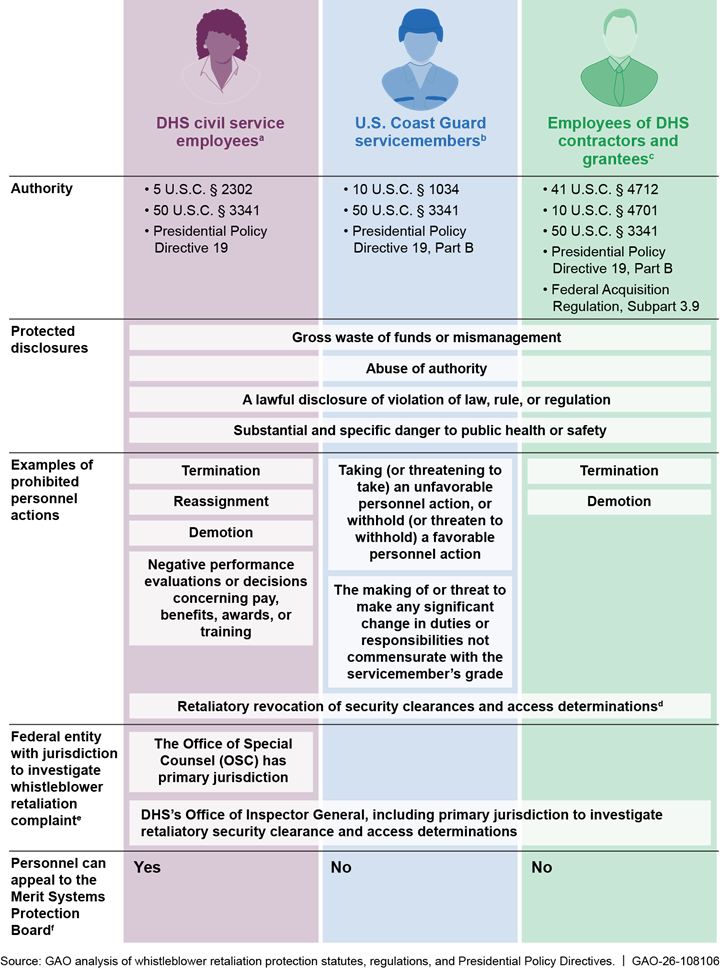
aFor the purposes of the Whistleblower Protection Enhancement Act, as codified and amended, “employees” generally includes current, or former federal civil service employees of federal agencies, as defined, as well as applicants for employment for a covered position. See 5 U.S.C. 2302(a)(2)(B) (defining “covered position”).
bU.S. Coast Guard is designated as a branch of the armed forces and some Coast Guard personnel are, therefore, members of the armed forces. See 10 U.S.C. 101(a)(4). Active-duty Coast Guard personnel are full-time enlisted and officer personnel responsible for carrying out the Coast Guard’s missions. The military workforce also includes reserve personnel. These are part-time enlisted and officer personnel. Coast Guard reservists are trained and qualified to take duty in times of war or national emergency and to augment Coast Guard forces.
cThis includes employees of federal contractors, subcontractors, grantees, subgrantees, and personal services contractors. 10 U,S.C. 4701(a)(1); 41 U.S.C. 4712(a)(1).
dProtected disclosures for DHS personnel against retaliatory security clearance and access determinations also include gross waste of funds or mismanagement, abuse of authority, or substantial and specific danger to public health or safety. See 50 U.S.C. 3341(j); Presidential Policy Directive 19.
eSee 5 U.S.C. 1212, 1214 (OSC); 5 U.S.C. 401-407, 401; 5 U.S.C. 2302; 41 U.S.C. 4712; 10 U.S.C. 1034.
fThe Merit Systems Protection Board (MSPB) has responsibility for adjudicating two types of employee appeals of alleged retaliatory personnel actions. See generally 5 U.S.C. 1204. Specifically, employees can file one type of appeal after the Office of Special Counsel (OSC) has determined to not seek corrective action in response to their whistleblower retaliation complaints. Employees can file the second type of appeal directly with the board, without a prior OSC case, for certain personnel actions (e.g., adverse action, performance-based removals, or reductions in grade), and allege that the actions were taken because of whistleblowing. However, Transportation Security Administration screener personnel do not have statutory rights to appeal directly to MSPB.
Agency Roles and Responsibilities
DHS OIG and the U.S. Office of Special Counsel (OSC) are responsible for receiving and investigating complaints alleging retaliation against a DHS whistleblower. DHS personnel may choose to file a complaint with one or both offices:
OIG. Within OIG’s Office of Investigations, the Internal Support Unit receives complaints alleging wrongdoing within DHS, including those submitted to OIG’s hotline through an online complaint form, toll-free number, or by mail. The unit reviews these complaints and routes those alleging whistleblower retaliation to the Whistleblower Protection Division (WPD).[13]
Within OIG’s Office of Counsel, WPD reviews and investigates complaints alleging whistleblower retaliation from DHS employees, contractors, and grantees.[14] This includes allegations of retaliatory security clearance determinations. In addition, OIG’s Whistleblower Protection Coordinator is responsible for educating and training these personnel about relevant whistleblower protections and processes.[15] Appendix II describes how OIG communicates with DHS personnel about whistleblower protections and the retaliation reporting process.
OSC. OSC has primary jurisdiction over retaliation complaints for most federal employees in the executive branch, including DHS civil service employees filing complaints under the Whistleblower Protection Act.[16] DHS civil service employees may report an allegation of whistleblower retaliation directly to OSC before, during, or after reporting it to the OIG, or without reporting it to OIG at all.[17] These complainants may wish to do so if, for example, OIG has declined to investigate their complaint or because OSC can seek corrective action on a whistleblower’s behalf when warranted. Also, unlike OIG decisions, complainants may file certain appeals with the Merit Systems Protection Board (MSPB) if OSC closes their case or if the complaint was with OSC for more than 120 days.[18]
DHS. The Secretary of DHS is responsible for determining whether to take corrective action in response to whistleblower retaliation complaints that OIG has substantiated. Upon receipt of an OIG report of investigation for a substantiated complaint, DHS Office of the Secretary staff typically coordinate with the relevant components’ general counsel to identify and draft proposed corrective actions before the Secretary’s final decision. Corrective actions may include, for example, correcting employees’ performance ratings, promoting employees, and updating training.[19]
OIG Investigates Whistleblower Retaliation Complaints That Meet Its Criteria
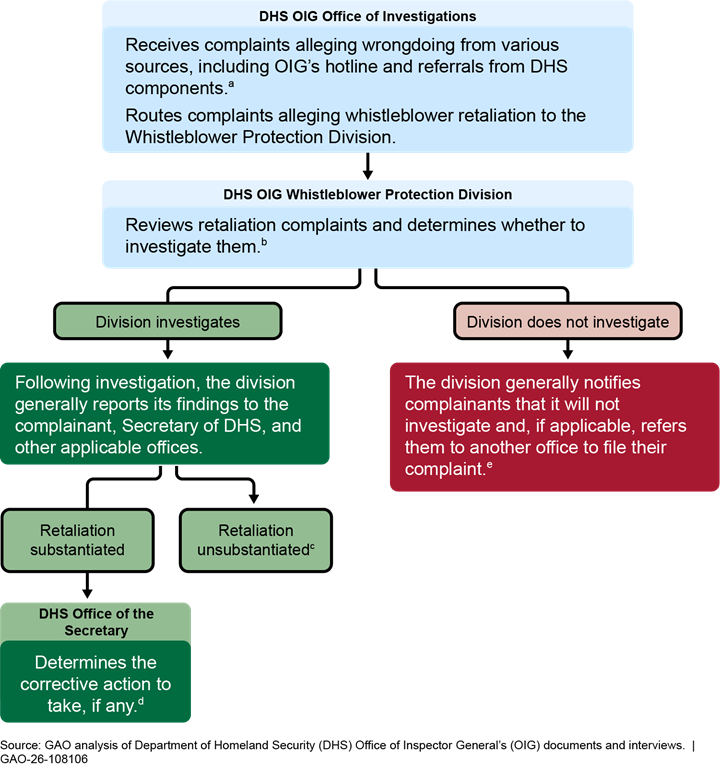
OIG has established a process for reviewing and investigating whistleblower retaliation complaints. In general, OIG’s Office of Investigations receives the complaints and WPD investigates and adjudicates them. Figure 2 provides an overview of this process.
Figure 2: Overview of DHS OIG Process for Reviewing and Investigating Whistleblower Retaliation Complaints
aAccording to OIG Whistleblower Protection Division officials, almost all whistleblower retaliation allegations are submitted through OIG’s hotline, which includes an online complaint form, toll-free number, and mailing address.
bAccording to its policy and process manual, the Whistleblower Protection Division reviews complaints to determine if they meet certain statutory criteria, taking the allegations in the light most favorable to the complainant (e.g., complainant experienced an adverse personnel action). If they do, the division investigates complaints that fall under certain categories outlined in its policies. For example, the division’s policy generally requires opening an investigation if the complainant is a member of the U.S. Coast Guard military services.
cCases may also be administratively closed if, for example, the complainant withdraws the complaint or reaches a settlement agreement with the agency.
dCorrective actions could include, for example, correcting employees’ performance ratings, promoting employees, awarding retroactive pay, reinstating personnel, and ordering contactors to take actions to abate the retaliation.
eFor example, the division may refer the complainant to the Office of Special Counsel, which has primary jurisdiction over complaints filed under the Whistleblower Protection Act, such as those filed by civilian DHS employees alleging retaliatory personnel actions.
WPD intake review. WPD does not investigate all whistleblower retaliation complaints. Rather, the division makes this determination based on whether the complaint appears to meet certain statutory criteria and who filed the complaint, among other factors. Specifically:
· Statutory criteria. According to WPD’s policy and process manual, the division is to determine whether the complaint meets certain statutory criteria, taking the allegations in the light most favorable to the complainant.[20] These criteria include the complainant having made a protected disclosure and the disclosure being a contributing factor in the adverse personnel action that was taken or threatened.
· Who filed the complaint. For complaints that meet the above criteria, WPD generally requires that the division open an investigation if the complainant (1) is a member or former member of the Coast Guard military services; (2) is an employee or former employee of a DHS contractor or grantee; or (3) alleges retaliation that affected their access to classified information, most commonly, through a security clearance revocation.[21] According to WPD officials, the division generally requires that investigations be opened for these complainants because OIG has jurisdiction and OSC does not.
· Other criteria. WPD also requires the division to investigate DHS retaliation complaints that allege serious or systematic problems; are referred by Congress; or are of significant, widespread public interest. WPD officials told us they make this determination on a case-by-case basis but such cases occur infrequently. They noted, for example, that multiple complaints against the same individual or unit would be considered a systematic problem.
If WPD declines to investigate, the division is generally to inform complainants that OIG will not be investigating their complaints and, if applicable, provide information on how they can file their complaints with OSC.[22]
WPD investigation and report. Once WPD opens an investigation, investigative counsel are required to have a case initiation phone call with the complainant and prepare an investigative road map outlining key investigative steps and the evidence to be collected, among other things. According to WPD’s policy manual, investigators are to interview the complainant, responsible management officials, and primary witnesses and collect relevant documentation. Such documentation could include personnel files, relevant communications, and documents related to disciplinary actions. Investigative counsel are to analyze the evidence and apply appropriate legal authorities, as outlined in the manual and whistleblower statutes, to determine whether an allegation is substantiated. OIG is then to send a final report with WPD’s findings and conclusions to the complainant, the Secretary of DHS, and other applicable offices.[23]
DHS determination of corrective action. When WPD substantiates a whistleblower retaliation allegation, DHS’s Office of the Secretary is responsible for determining whether any corrective action will be taken.
OIG Reviewed About 3,000 Retaliation Complaints and Opened 110 Investigations in Fiscal Years 2018-2025
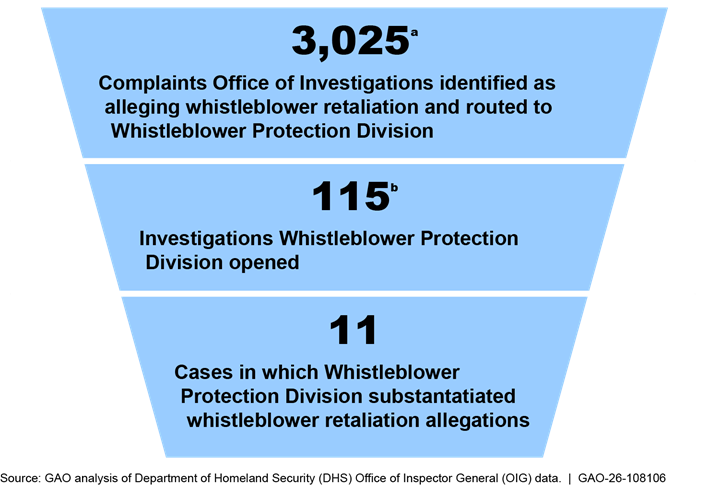
In fiscal years 2018 through 2025, OIG’s Office of Investigations received about 236,000 complaints alleging wrongdoing and identified 3,025 complaints as including allegations of whistleblower retaliation.[24] The office routed these complaints to WPD. Figure 3 summarizes the number of whistleblower retaliation complaints WPD reviewed and the number of investigations opened during this time.[25]
Figure 3: DHS OIG Whistleblower Retaliation Complaints Reviewed and Investigations Opened, Fiscal Years 2018-2025
aThe total number of complaints the Office of Investigations routed to Whistleblower Protection Division does not include complaints from October 1, 2017, to March 12, 2018, because those data were unavailable.
bIf the Whistleblower Protection Division declines to investigate, the division is generally to inform complainants that OIG will not be investigating their complaints and, if applicable, provide information on how they can file their complaints with the Office of Special Counsel.
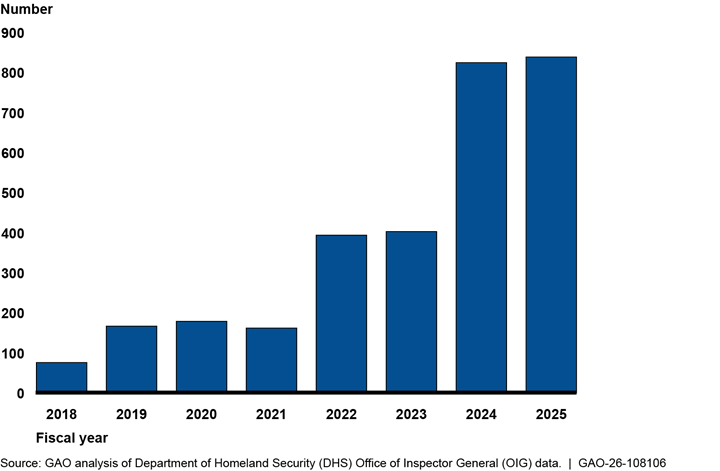
The number of retaliation-related complaints WPD reviewed increased from 75 in fiscal year 2018 to 834 in fiscal year 2025, as shown in figure 4, with more than half of the complaints during the 8-year period (1,657 of 3,025, or about 55 percent) being reviewed in fiscal years 2024 and 2025.[26] WPD officials said they were not sure why the number of complaints increased in this period but noted that one factor could be employees’ increased awareness of whistleblower protections and processes.[27]
WPD opened 115 whistleblower retaliation investigations in fiscal years 2018 through 2025. The division closed 73 of the 115 (63 percent) investigations opened during this period, as shown in figure 5.[28] The figure also shows that, as of September 30, 2025, WPD’s open investigations included 20 opened in fiscal year 2025 but also two investigations opened in fiscal year 2020. The majority of investigations (63 percent) that WPD opened during this period involved the Coast Guard and U.S. Immigration and Customs Enforcement.[29] Appendix III provides information on the agencies involved in these complaints and investigations.
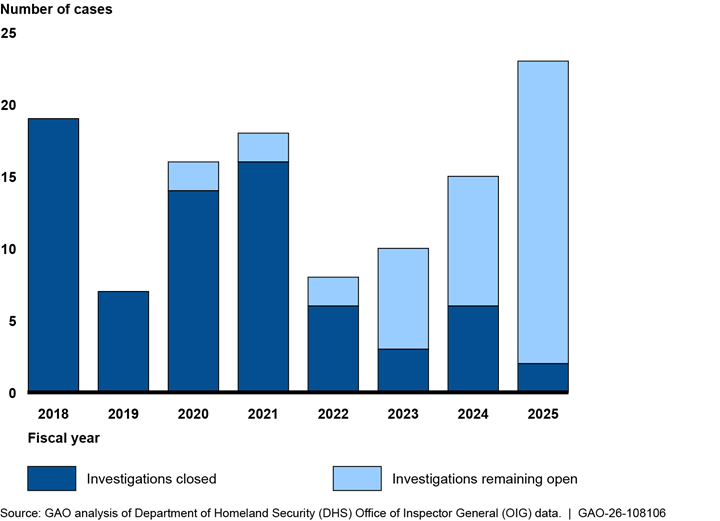
Note: This figure shows the status of OIG investigations as of September 30, 2025, broken out by the fiscal year they were opened. For example, as of this date, OIG closed 14 of the 16 cases it opened in fiscal year 2020 and two remained open.
WPD officials told us they review all complaints that the Office of Investigations refers to them to determine whether complaints meet the division’s criteria for opening an investigation. However, according to WPD’s manual, most complaints the division reviews do not meet the criteria (e.g., the complainant is not a member of the Coast Guard military services or a DHS contractor or grantee). As discussed earlier in this report, for most of these complaints, WPD’s policy is to provide complainants with information on how to file their complaint with OSC when applicable.[30]
WPD substantiated whistleblower retaliation allegations in 11 of the 73 investigations it opened and closed in fiscal years 2018 through 2025, as of May 2026.[31] WPD officials said allegations were infrequently substantiated because whistleblower retaliation could be difficult to prove in a way that meets the statutory criteria and required standard of proof. For example, WPD officials stated that whistleblower retaliation cases rarely involved physical evidence or admissions of guilt. They said investigators took steps like reviewing personnel files from comparable employees to try to understand whether the person’s supervisor would have made the same personnel decision absent the disclosure of wrongdoing. However, WPD officials said the number of variables involved in personnel decisions often made it difficult to substantiate retaliation allegations.
OIG Has Not Ensured It Investigated Retaliation Complaints in a Timely Manner
It took an average of about 3½ years to route, review and investigate the 73 whistleblower retaliation complaints WPD opened and closed in fiscal years 2018 through 2025. WPD’s investigations were the longest step in the complaint process, with the majority taking over 3 years to complete and some taking over 5 years. While OIG policy requires timely review of whistleblower retaliation complaints, WPD has not defined this objective in specific, measurable terms; evaluated timeliness; or implemented other mechanisms to help enhance accountability and ensure more timely investigations.
The Time from Complaint Submission to Investigation Closure Varied Significantly Across Cases
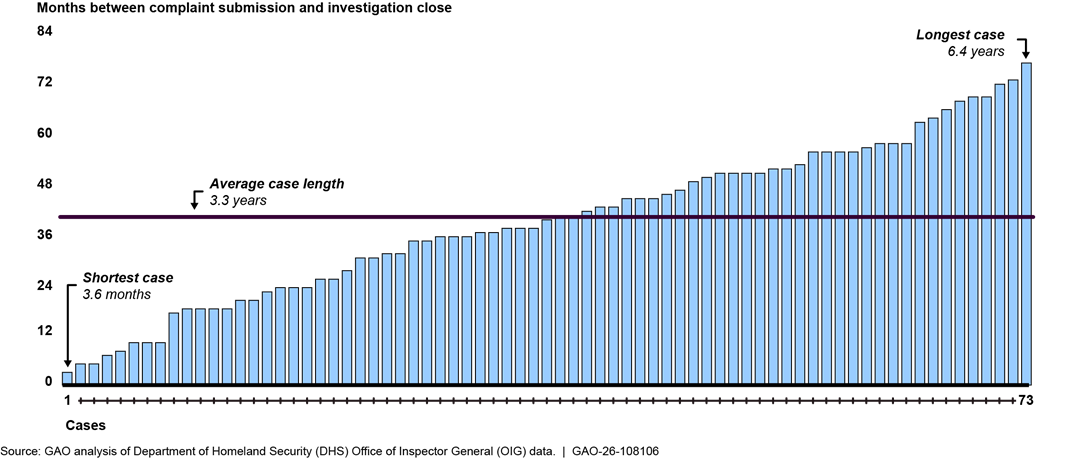
While the duration of investigations varied, about 3½ years passed, on average, from the time the complaint was first submitted until WPD closed its investigation.[32] Specifically, for the 73 cases WPD opened and closed in fiscal years 2018 through 2025, the time from when the complaint was first submitted to when WPD concluded its investigations ranged from about 3½ months to 6½ years, as shown in figure 6.[33]
Figure 6: Time from Complaint Submission to DHS OIG Investigation Closure for Whistleblower Retaliation Investigations Opened and Closed in Fiscal Years 2018-2025
This period—complaint submission to investigation completion—includes three key steps. First, after submission, the Office of Investigation routes complaints to WPD. Second, WPD conducts an intake review to determine whether to open an investigation. Third, WPD investigates the complaint. Figure 7 illustrates the median number of days it took to complete each of these steps for the 73 whistleblower retaliation cases WPD opened and closed in fiscal years 2018 through 2025. Specific time frames varied by case, but we found that it took a median of 3 days for complaints to be routed to WPD after submission.[34] WPD then took a median of 49 days to complete intake review and an additional 3 years to complete its investigation.
Figure 7: DHS OIG Complaint Review and Investigation Median Time Frames for Whistleblower Retaliation Investigations Opened and Closed in Fiscal Years 2018–2025
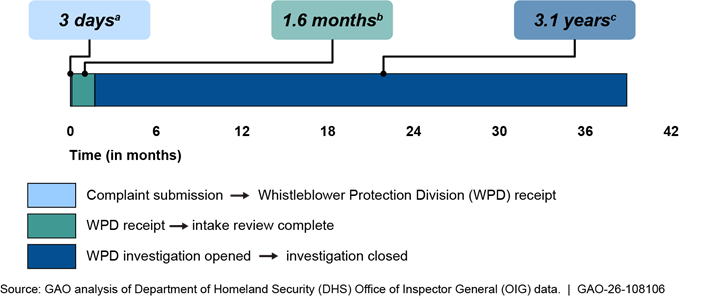
Note: The time frames from complaint submission to intake review completion include outliers that contribute to the differences between the median and average time frames for these parts of the process.
aAverage: 19.3 days. Range: 0 to 10.1 months. OIG officials told us they do not receive all complaints upon submission by the complainant. For example, OIG may receive some complaints after they were originally submitted to another government agency or DHS component.
bAverage: 2.4 months. Range: 0 days to 1.7 years.
cAverage: 3 years. Range: 14 days to 6.1 years.
WPD Has Not Ensured Timely Investigations, Taking Over 3 Years to Close the Majority
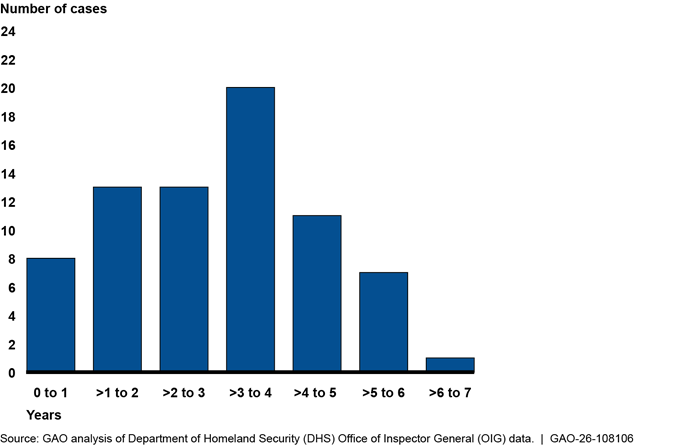
As shown above, WPD’s investigations were the longest step in the complaint process. We found that the division took from 14 days to about 6 years to investigate the 73 retaliation cases it opened and closed in fiscal years 2018 through 2025. Figure 8 shows that WPD closed 11 percent (8 cases) within 1 year but took over 3 years to close the majority of its investigations. Specifically, 39 cases (53 percent) took over 3 years to close, and of those, 19 cases took over 4 years. In addition, of the 42 investigations WPD opened during this period that remained open as of September 30, 2025, six had been open longer than 3 years and two had exceeded 5 years.
Figure 8: DHS OIG Time Frames for Whistleblower Retaliation Investigations, Cases Opened and Closed in Fiscal Years 2018–2025
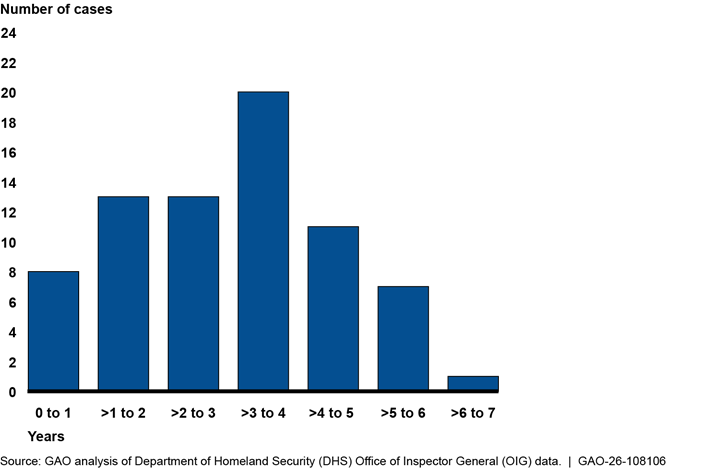
WPD’s manual states that completing investigations in 180 days is ideal, but “realistically, a thorough investigation involving document requests and multiple interviews generally takes well over 180 days to complete.”[35] Our analysis found that WPD met this 180-day time frame for 5 percent of the investigations it opened and closed in fiscal years 2018 through 2025.[36]
Factors affecting WPD investigation timeliness. WPD officials told us they completed investigations as quickly as possible, but case complexity and staffing limitations affected some case time frames. Specifically, officials stated that in more complex cases, investigative counsel needed to review a large volume of documents to determine if retaliation occurred. Such documents could include thousands of emails, personnel records, and performance reviews of other employees as comparative evidence. In addition, WPD officials told us that, for some cases, DHS components and other offices have taken a long time to compile and provide documents to OIG. These officials also noted that insufficient and changing staffing levels affected investigation lengths. They stated that significant WPD staff turnover prior to 2021 contributed to delays in closing cases.[37]
The division has taken some steps intended to help improve investigation time frames. For example, officials told us that, since 2025, the division has been fully staffed with eight investigative counsel.[38] In addition, OIG implemented the alternative dispute resolution program in 2022, which officials said could help improve timeliness. However, WPD officials told us they did not know the extent to which these actions have reduced investigation lengths.[39]
Reported negative effects of lengthy investigations. Lengthy investigations have negative financial, professional, and psychological effects on complainants, according to whistleblower advocates and complainants we interviewed. For example, representatives from two whistleblower advocacy groups we interviewed stated that complainants may experience serious financial hardship during lengthy cases. This includes being forced to sell their houses and cars and deplete their retirement savings. According to one of these representatives, complainants can also be blacklisted from other employment and miss promotions, training, and other opportunities for career advancement while their case is being investigated.
In addition, these representatives stated that many complainants experience anxiety, depression, and stress-related physical illnesses from the alleged retaliation, which are exacerbated by the prolonged uncertainty of lengthy investigations. Finally, one noted that retaliation can be harder to rectify the longer the case goes on, and that even if whistleblowers eventually “win” their cases, much of the damage has already been done. Representatives from all three of the advocacy groups we interviewed observed that lengthy cases engendered distrust in the system and ultimately had a chilling effect on potential whistleblowers.
The three complainants we interviewed with closed OIG whistleblower retaliation cases also shared their experiences with the effects of lengthy investigations. Figure 9 highlights the negative effects they reported experiencing.
Figure 9: Selected Complainants’ Reported Experiences with DHS OIG Whistleblower Retaliation Investigations
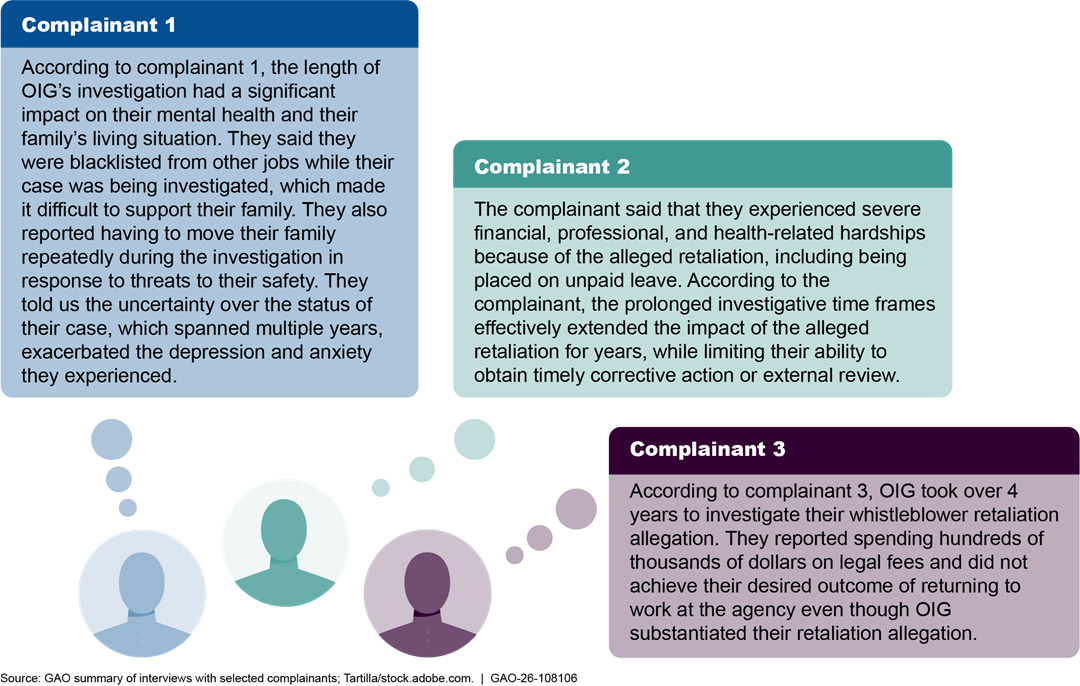
Notes: We interviewed selected complainants with closed whistleblower retaliation cases filed with the Department of Homeland Security (DHS) Office of Inspector General (OIG) in fiscal years 2018 through 2025. Our interviews are not generalizable but provide reported first-hand experiences with whistleblower retaliation investigations.
WPD officials also acknowledged the negative effects of lengthy investigations. Specifically, they stated that the passage of time could impede their ability to collect information for the investigation. For example, over time, witnesses may leave the agency, their recollections may fade, and documentary evidence may be lost. Finally, DHS Management Directorate and Coast Guard officials stated that lengthy investigations had limited the corrective actions the department could take to remedy substantiated retaliation. For example, in some cases, either the employee or manager who retaliated against the employee had left the agency or retired by the time WPD completed its investigations. As a result, potential corrective actions like promotions for the employee and disciplinary actions were no longer viable options.
The Council of the Inspectors General on Integrity and Efficiency’s Quality Standards for Investigations state that all investigations should be conducted and reported in a timely manner.[40] The standards note that this is especially critical given the impact investigations have on the lives of individuals and activities of organizations. Consistent with these standards, OIG’s 2017 directive states that WPD will provide a systematic and timely review of all whistleblower retaliation complaints that the OIG receives.[41]
However, WPD has not established mechanisms to help ensure timely investigations. For example, the division has not defined its timeliness objective in specific, measurable terms—either for each investigation or across investigations—or monitored investigation timeliness and evaluated results.[42] When asked about these options, WPD officials stressed the challenges posed by varying case complexity, staff levels, and caseloads. They stated that the division primarily focused on the quality and thoroughness of investigations and reaching the correct result for each case, rather than timeliness.
Standards for Internal Control in the Federal Government states that management should define objectives in specific, measurable terms so that performance toward achieving those objectives can be assessed.[43] These standards also state that management should establish monitoring activities and evaluate results.
Quality and thoroughness are important but need to be balanced with OIG’s stated intent to complete these investigations in a timely manner. Taking steps to better ensure this occurs—including defining OIG’s timeliness objective in specific, measurable terms and monitoring and evaluating investigation timeliness—would increase awareness of and accountability for timely investigations. It would also allow WPD to assess any future time frame improvements as a result of the division’s staffing increases and other initiatives. More timely investigations could lessen the personal, financial, and professional hardships on complainants; allow for more meaningful remedies when retaliation is substantiated; and help convey that protecting whistleblowers is a priority.
DHS Has Not Made Timely Decisions on Substantiated Whistleblower Retaliation Cases
For cases in which WPD substantiated whistleblower retaliation allegations, the Secretary of DHS did not decide whether to take corrective action within the time frame required by law. Specifically, the Secretary is required to determine whether to take corrective action no later than 30 days after receiving a report from OIG substantiating certain whistleblower retaliation allegations.[44] However, we found that the Secretary did not decide on corrective action within 30 days for any of the 11 retaliation cases that WPD opened, substantiated, and closed in fiscal years 2018 through 2025. Rather, these 11 cases awaited the Secretary’s decision from about 4 months to over 2 years, as of May 2026. Figure 10 shows the timelines for these 11 cases.
Figure 10: Timelines of Substantiated DHS Whistleblower Retaliation Cases, for OIG Cases Opened and Closed from Fiscal Years 2018-2025, as of May 2026
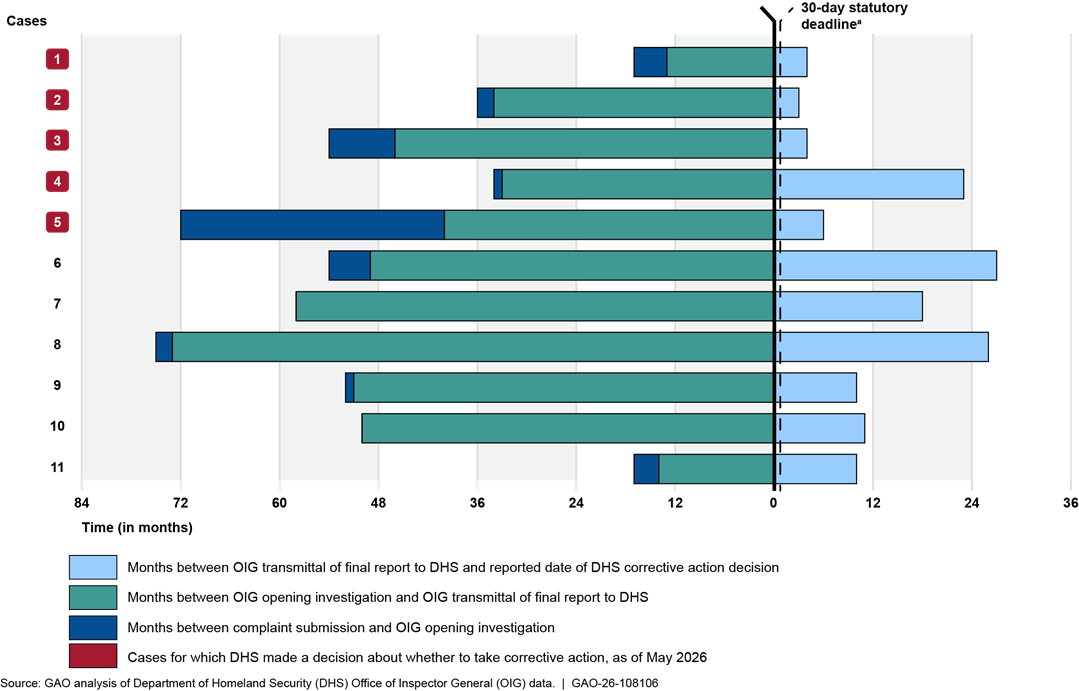
aStatutory provisions require that the Secretary of DHS determine whether to take corrective action no later than 30 days after receiving a report from DHS OIG substantiating certain whistleblower retaliation allegations. See 10 U.S.C. 1034(f)(1) and 41 U.S.C. 4712 (c)(1).
As of May 2026, the Secretary of DHS had decided whether to take corrective action for five of the 11 whistleblower retaliation cases that OIG substantiated. Four of these cases involved the Coast Guard, and one involved the Science and Technology Directorate. We found that the Secretary took from about 4 months to 2 years to review and decide on these five cases. Corrective actions included correcting employees’ performance ratings, updating training courses, and promoting employees.[45]
The Secretary had not determined whether to take corrective action for the remaining six cases, as of May 2026. Prior to the Office of the Secretary’s receipt, WPD’s investigations for these cases took from about 1 to 6 years. As of May 2026, these cases have been pending the Secretary’s decision for 10 months to over 2 years. The components involved in these six cases were Federal Emergency Management Agency (FEMA) (one case), Federal Protective Service under the Management Directorate (one case), and Coast Guard (four cases). The Office of the Secretary has coordinated with some of these components in identifying corrective actions for the Secretary’s decision. Table 1 describes the timeline and status of corrective action decisions on these six cases.
Table 1: Substantiated DHS Whistleblower Retaliation Allegations Pending Corrective Action Determination, for DHS OIG Cases Opened and Closed in Fiscal Years 2018-2025
|
Date OIG transmitted final report to Office of the Secretary |
Component involved |
Timeline and status |
|
February 2024 |
Contractors with Federal Emergency Management Agency (FEMA) |
According to DHS officials, FEMA received a copy of OIG’s report in March 2024 and provided a proposed order to the DHS Management Directorate in April 2024. However, the department stated that because of a change in administration, the proposed order needed to be reviewed by the current FEMA Administrator. FEMA officials in the current administration told us in January 2026 that they had not yet received a copy of OIG’s report of investigation, almost 2 years after FEMA had provided the initial proposed order for DHS review. As of May 2026, FEMA counsel had received the report and drafted the agency’s proposed order for this case. Officials from the Office of the Secretary’s Office of the General Counsel told us their leadership must review the proposed order and route it back to FEMA for review before they could route it to the Secretary for their final decision. These officials said they expected to route the proposed order to the Office of the Secretary for review in calendar year 2026. |
|
March 2024 |
U.S. Coast Guard |
Coast Guard officials said they received a copy of OIG’s report of investigation in April 2024. Officials said they drafted proposed corrective actions and submitted the proposal to the Office of the Secretary for review in May 2025. However, Coast Guard officials said the Office of the Secretary returned their proposed corrective action in July 2025 seeking additional options for responding to the retaliation. As of May 2026, Coast Guard officials told us they had drafted a revised proposal, which Coast Guard leadership was reviewing before routing it back through the Office of the General Counsel and to the Secretary for final decision. |
|
October 2024 |
Contractor with Federal Protective Service (under the Management Directorate) |
Federal Protective Service officials said they received a copy of OIG’s report of investigation in February 2026, over a year after OIG transmitted it to the Office of the Secretary. Office of the General Counsel officials said the delay was due to staff turnover, including retirements in the offices involved and personnel changes associated with a change in administration. As of May 2026, Federal Protective Service officials said the component and its procurement counsel had drafted a proposed order. Management Directorate officials said the directorate’s legal counsel—and potentially the Office of the Chief Procurement Officer—must review the proposed order before it is routed for final decision by the Secretary. |
|
May 2025 |
U.S. Coast Guard |
Coast Guard officials said they received a copy of OIG’s report of investigation in June 2026 and are drafting proposed corrective action to submit to the Office of the Secretary for review. |
|
July 2025 |
U.S. Coast Guard |
Coast Guard officials said they received a copy of OIG’s report of investigation in June 2026 and are drafting proposed corrective action to submit to the Office of the Secretary for review. |
|
July 2025 |
U.S. Coast Guard |
Coast Guard officials said they received a copy of OIG’s report of investigation in June 2026 and are drafting proposed corrective action to submit to the Office of the Secretary for review. |
Source: Department of Homeland Security (DHS) Office of Inspector General’s (OIG) semiannual reports to Congress and interviews with DHS officials. | GAO‑26‑108106
Note: Where relevant, orders are issued to the contractor involved in a substantiated whistleblower retaliation case and include proposed steps for the contractor to take to resolve the case, according to officials from the Office of the Secretary’s Office of the General Counsel.
A range of factors contributed to the time the Secretary took to determine whether to take corrective action. Two key contributing factors were (1) lack of clarity about the process, such as whether and when whistleblower retaliation cases are to be forwarded to components, and (2) no clear designation of a responsible party. Officials in the Office of the Secretary’s Office of the General Counsel and DHS Management Directorate told us DHS does not have a written process or procedure for how to respond to substantiated whistleblower retaliation cases and develop a proposal for corrective action. This was a factor when, for example, Management Directorate officials did not promptly forward cases to Federal Protective Service and FEMA. These officials told us a standard operating procedure or similar guidance would clarify the expected routing of substantiated whistleblower retaliation reports for review.
Further, they stated that there is no designated official responsible for ensuring that the Secretary made corrective action determinations in a timely manner. They explained that the process was collaborative, but no office or official was tasked with ensuring cases continued moving through the review process. As of June 2026, Office of the General Counsel officials told us they planned to develop a process for tracking and coordinating the review of cases but did not provide any details about these plans or timeframes for implementation.
Standards for Internal Control in the Federal Government state that management should implement control activities through policies and procedures, including documenting what is expected and specified actions that implement policies.[46] This can include the timing of when activities occur. The standards also state that management should assign responsibility and delegate authority to key roles to achieve the entity’s objectives and address related risks.
The Secretary of DHS did not meet the 30-day statutory requirement for any of the 11 substantiated whistleblower retaliation cases we examined. Specifically, the Secretary has taken from about 4 months to over 2 years to determine whether to take corrective action on these cases, which is significantly longer than the requirement. Congress, in passing statutory whistleblower protections, has recognized the severe financial and career hardship whistleblowers frequently encounter and emphasized the importance of these protections for both the employees and the effectiveness of the civil service.[47] Until the Secretary finalizes their determinations for the six pending cases and takes steps to ensure it makes timely decisions on future substantiated cases, whistleblowers with substantiated retaliation cases will not receive timely restorative personnel actions. This could compound the hardship they experience. It could also decrease confidence in DHS whistleblower protections and discourage other potential whistleblowers from coming forward.
Conclusions
DHS personnel have experienced removal from their duties, early release from contracts, and negative performance evaluations after raising issues involving improper spending, sexual assault, and other wrongdoing. Given the scale and scope of DHS’s budget and operations—which include counterterrorism, border security, immigration, and disaster response—it is important that acts of retaliation for reporting wrongdoing are addressed promptly so that other potential whistleblowers are not discouraged from coming forward.
However, WPD took over 3 years to investigate the majority of whistleblower retaliation cases it opened and closed in fiscal years 2018 through 2025. Establishing mechanisms to ensure more timely investigations, including defining timeliness in specific, measurable terms and monitoring and evaluating investigation timeliness, could enhance division and investigator accountability. Further, more timely investigations could lessen the personal, financial, and professional hardships on complainants and help convey that protecting whistleblowers is a priority.
In addition, for retaliation allegations that WPD substantiated, the Secretary of DHS has failed to meet the 30-day statutory deadline for deciding on corrective action, taking from about 4 months to over 2 years to make these determinations. This includes six substantiated retaliation cases awaiting the Secretary’s final decision about corrective action as of May 2026. Until the Secretary finalizes their determinations for pending cases and takes steps to ensure timely decisions on future substantiated cases, whistleblowers will face delays in receiving restorative personnel actions. These delays could compound the hardship they experience and decrease confidence in DHS whistleblower protections.
Recommendations for Executive Action
We are making a total of three recommendations—one to DHS OIG and two to DHS Office of the Secretary. Specifically:
The DHS Inspector General should ensure that WPD takes steps to complete whistleblower retaliation investigations in a more timely manner, including defining OIG’s timeliness objective in specific, measurable terms; monitoring investigation timeliness; and evaluating results to identify opportunities for improvement. (Recommendation 1)
The Secretary of Homeland Security should determine whether to take corrective action in response to six substantiated whistleblower retaliation cases awaiting a decision as of May 2026. (Recommendation 2)
The Secretary of Homeland Security should develop clear procedures and assign a responsible official for ensuring timely decisions about corrective action in response to substantiated whistleblower retaliation complaints. (Recommendation 3)
Agency Comments and Our Evaluation
We provided a draft of this report to OIG, DHS, OSC, and MSPB for review and comment. OIG and DHS provided written comments, which are reproduced in appendices VI and VII. OIG, DHS, OSC, and MSPB provided technical comments, which we incorporated as appropriate.
In its comments, OIG agreed with our recommendation that WPD take steps to complete whistleblower retaliation investigations in a more timely manner. The office described OIG leadership’s past efforts to improve WPD operations and stated that it would now be reasonable to set investigation timeliness goals. OIG also expressed concern that figure 5 might be interpreted incorrectly. Specifically, they said a reader might misinterpret it as showing that OIG closed fewer investigations in recent years, indicating a decline in OIG’s productivity. OIG suggested that GAO replace the figure with one showing the numbers of investigations OIG closed each year. We appreciate the importance of clearly presenting data to minimize the risk of misinterpretation, but maintain the accuracy and relevance of the information presented. The figure shows the status of OIG’s investigations at a point in time. Therefore, we did not remove or replace the figure as OIG suggested. Rather, to further reduce the risk of misinterpretation, we revised the figure title and added a sentence to the report and to the figure describing data in the figure.
In its comments, DHS agreed with our two recommendations to the department to improve the timeliness of its corrective action decisions and described actions underway and planned to address them. With regard to our second recommendation, the department stated that it was in the process of making decisions for each of the substantiated whistleblower retaliation cases pending the Secretary’s decision. In its technical comments, DHS stated that the Secretary had subsequently made a corrective action decision for one of the six cases pending as of May 2026. Specifically, the department stated that, on July 22, 2026, the Secretary made a decision about the Coast Guard case that OIG transmitted to the Office of the Secretary in March 2024. This is a positive step toward implementing our recommendation. With regard to our third recommendation, the department stated that it plans to create a documented process for reviewing future substantiated cases that will include defined roles and responsibilities. If designed to ensure timely decisions by the Secretary and implemented effectively, the department’s planned steps would address the intent of our recommendation. DHS estimated that it would complete the planned steps in response to both recommendations by August 2027.
We are sending copies of this report to the appropriate congressional committees, the Secretary of Homeland Security, the DHS Inspector General, the Chairman of the Merit Systems Protection Board, the Special Counsel of the Office of Special Counsel, and other interested parties. In addition, this report is available at no charge on the GAO website at https://www.gao.gov.
If you or your staff have any questions about this report, please contact me at CurrieC@gao.gov. Contact points for our Offices of Congressional Relations and Media Relations may be found on the last page of this report. GAO staff who made key contributions to this report are listed in appendix VIII.

Christopher P. Currie
Director, Homeland Security and Justice
This appendix discusses in more detail our methodology for analyzing whistleblower retaliation complaint data from the Department of Homeland Security (DHS) Office of Inspector General (OIG), the Office of Special Counsel (OSC), and the Merit Systems Protection Board (MSPB).
DHS OIG
To analyze the whistleblower retaliation complaints OIG’s Whistleblower Protection Division (WPD) reviewed, we reviewed record-level data from WPD’s internal tracking spreadsheet from March 13, 2018, to September 30, 2025.[48] We analyzed the number of complaints WPD reviewed each fiscal year and the components complainants identified as being involved in their allegations. We determined data from WPD’s internal tracking spreadsheet were reliable for the purpose of counting the number of complaints WPD reviewed each fiscal year and identifying components involved. Our data reliability assessment included electronic testing for missing data, outliers, and obvious errors; follow-up with agency officials to obtain missing data; and interviews with knowledgeable officials.
To analyze WPD’s whistleblower retaliation investigations, we reviewed record level investigation data from OIG’s Enforcement Data System for fiscal years 2018 through 2025, the most recent data available at the time of our request. We analyzed the number of cases WPD opened and closed each fiscal year and the components involved. To analyze case outcomes, we reviewed the case outcome data field and categorized each record as “allegation substantiated,” “allegation unsubstantiated,” or “administratively closed prior to conclusion.”
To analyze how long OIG took to review and investigate whistleblower retaliation complaints, we matched data from the Enforcement Data System to data from WPD’s internal tracking spreadsheet of complaints the division reviewed. Specifically, for complaints OIG converted to investigations, we assessed how long it took (1) Office of Investigations to route complaints to WPD, (2) WPD to review complaints, (3) WPD to investigate complaints, and (4) OIG to review and investigate complaints overall by counting the number of calendar days between each step as recorded in the Enforcement Data System and in WPD’s internal tracking spreadsheet.
To evaluate the extent to which DHS made timely decisions about corrective actions in response to substantiated whistleblower retaliation allegations, we analyzed case outcomes from OIG’s Enforcement Data System, described above, and identified 11 cases for which OIG substantiated whistleblower retaliation allegations in fiscal years 2018 through 2025. To identify the amount of time it took DHS to determine whether to take corrective action, we used the dates OIG officials told us they transmitted their final reports to DHS. In May and July 2026, we asked OIG and DHS officials about the status of determination decisions. We compared these time frames to statutory requirements.[49]
We determined WPD investigations data from the Enforcement Data System were reliable for the purposes of identifying the number of investigations WPD opened and closed each fiscal year, the dates WPD opened and closed cases, case outcomes, and the components involved. Our data reliability assessment included reviewing relevant documents, such as data dictionaries; reviewing previous GAO reliability assessments; electronic testing for missing data, outliers, and obvious errors; comparing data to publicly available information; and interviewing knowledgeable officials.
OSC
To analyze the number of DHS whistleblower cases filed with OSC, we reviewed case-level data from OSC’s Electronic Case Management System.[50] OSC provided data on cases involving DHS components and offices that OSC opened in fiscal years 2020 through 2025. Because one case may involve multiple allegations, we identified and reported the number of cases that included at least one allegation of whistleblower retaliation, as OSC officials defined it.[51] We analyzed the number of cases OSC opened each fiscal year, the DHS components and offices involved, and case lengths. We analyzed case outcomes using case closing dispositions, for which OSC officials indicated whether a prohibited personnel practice was found or corrected.
We determined that the OSC Electronic Case Management System data were reliable for the purpose of analyzing the number of cases, components involved in cases, and case outcomes. Our data reliability assessment included electronic testing for missing data, outliers, and obvious errors; review of previous GAO reliability assessments; and interviews with knowledgeable officials.
MSPB
To analyze the number of DHS whistleblower appeals filed with MSPB, we reviewed record-level data from MSPB’s e-Appeal case management system. MSPB provided data on appeals that MSPB closed in fiscal years 2018 through 2025 involving DHS components and offices.[52] We analyzed the number of initial appeals and petition for review appeals MSPB closed each fiscal year, the DHS components and offices involved, and appeal lengths.[53] To analyze appeal outcomes, we categorized the e-Appeal closing codes and confirmed the categories with MSPB officials.
We determined that the MSPB e-Appeal data were reliable for the purposes of analyzing the numbers of cases, components involved in cases, and case outcomes. Our data reliability assessment included reviewing relevant system documents, such as the data dictionary, policies, training, and guidance documents; electronic testing for missing data, outliers, and obvious errors; review of previous GAO data reliability assessments; and interviews with knowledgeable officials.
Appendix II: OIG Communications and Information for DHS Personnel on Whistleblower Protections and Processes
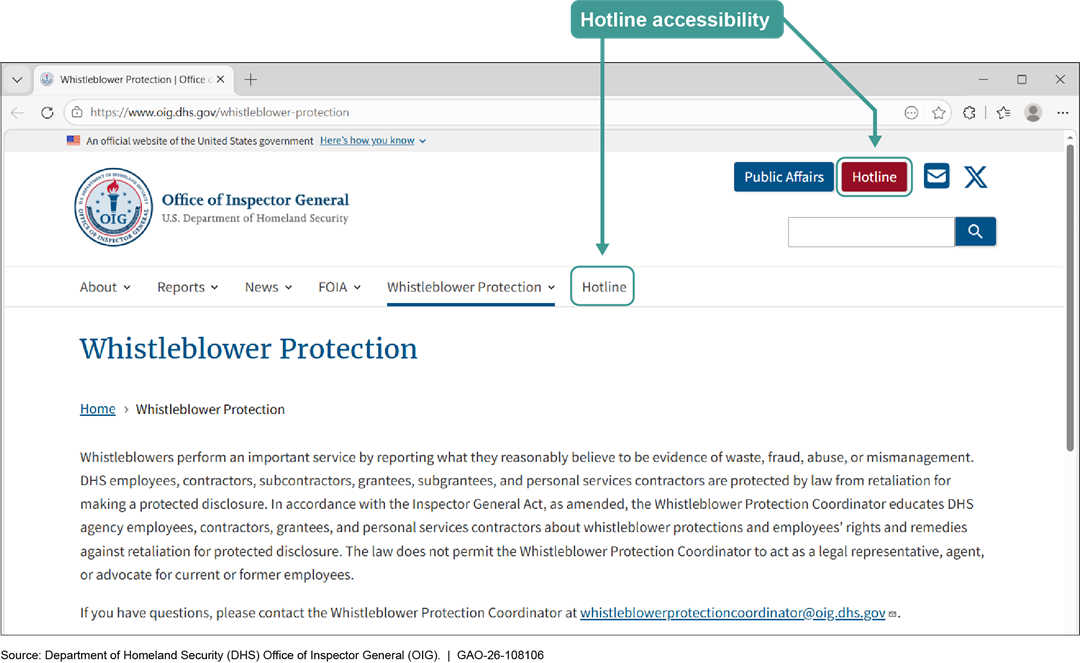
The Department of Homeland Security (DHS) Office of Inspector General (OIG) communicates whistleblower protections and processes for reporting retaliation complaints to DHS employees, contractors, and grantees in various ways, consistent with statutory requirements and standards for inspectors general.[54] For example, the Council of the Inspectors General on Integrity and Efficiency’s Quality Standards for Federal Offices of Inspector General states that OIGs should have a well-publicized mechanism for receiving allegations and have a direct link on their website.[55] This is intended to allow individuals to submit allegations of fraud, waste, abuse, and mismanagement, according to the standards. We found that DHS OIG’s complaint hotline is accessible from multiple pages on its website, including a link on a banner visible on every page of OIG’s website. The hotline links to an online form where individuals can file complaints, including allegations of whistleblower retaliation.
OIG’s website also provides information on whistleblower protections and processes, including what constitutes a protected disclosure for different DHS personnel, how retaliation is defined, and how to report allegations of retaliation. Figure 11 shows where employees can access the hotline and information on whistleblower protections and processes from OIG’s website.
Figure 11: Example of Links to Complaint Hotline and Information on Whistleblower Protections on DHS OIG’s Website
In addition, the Whistleblower Protection Coordinator Act of 2018 requires each Inspector General to establish a Whistleblower Protection Coordinator with specific duties, including ensuring employees receive clear education and communications about whistleblower protections and processes.[56] The coordinator is to communicate whistleblower protections and the process for reporting retaliation complaints through emails and in tailored trainings for new and current DHS personnel, including contractors, as described below.[57]
New employees. According to OIG materials we reviewed, new DHS employees are to receive an email, as shown in figure 12, and a 15-minute training that outlines (1) the role of the coordinator (2) contact information for the OIG Hotline and coordinator, and (3) employees’ whistleblower protections and rights. The Whistleblower Protection Coordinator told us that employees transferring within DHS, contractors, grantees, and U.S. Coast Guard members do not receive the new employee email, due to OIG’s limited access to contact information. Instead, contractor office representatives and supervisors receive the new employee email and are expected to communicate whistleblower protections and processes to new hires, according to the coordinator.
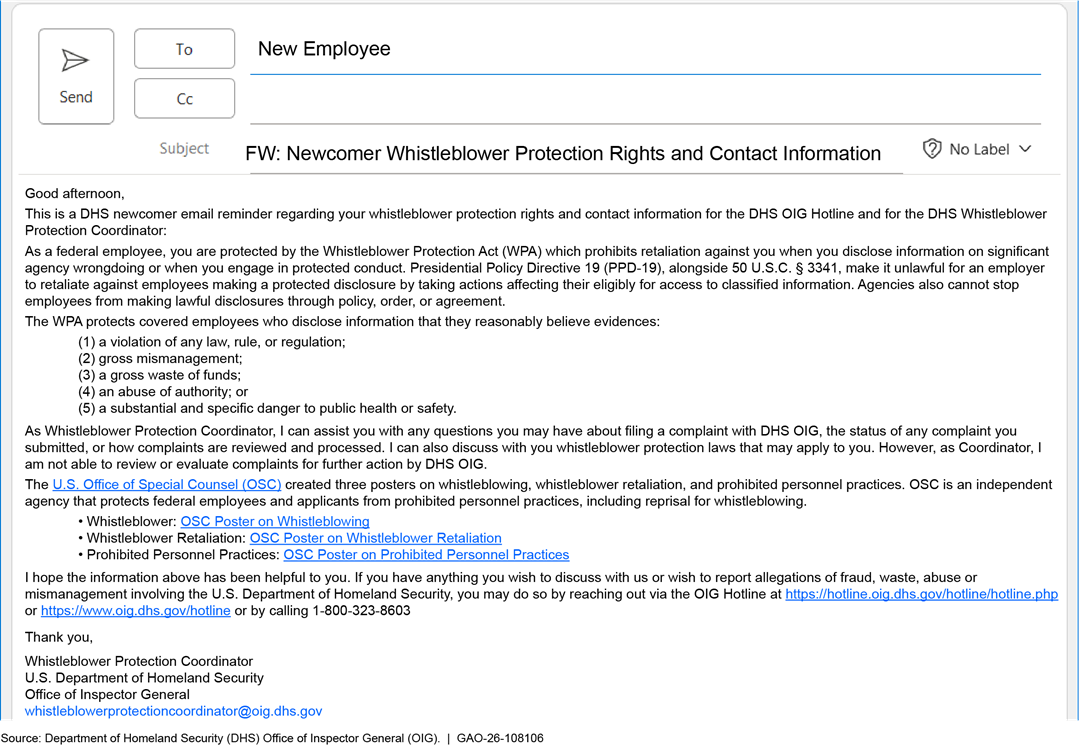
Note: In January 2026, as a result of our review, the Whistleblower Protection Division updated the new employee email to include information on Presidential Policy Directive 19 that prohibits an employer from retaliating against an employee for making a protected disclosure by taking actions that affect their ability to access classified information.
Current employees. OIG guidance requires the Whistleblower Protection Coordinator to send annual email reminders about whistleblower protections and rights as part of OIG’s recognition of National Whistleblower Appreciation Day on July 30.[58] We reviewed the standard email language used, which included a link to the complaint hotline, information about the role of the Whistleblower Protection Coordinator, and materials from the Office of Special Counsel on whistleblower retaliation and prohibited personnel practices.
The coordinator told us that DHS employees are required to complete recurring annual training that can include online information on whistleblower protections, such as No FEAR Act training and supervisory whistleblower training The coordinator also offers a longer, optional training course to current employees across components and is required to tailor these training courses to suit the audience, according to OIG guidance. The new employee and optional training materials we reviewed cover information about protected disclosures, personnel actions (e.g., security clearance and access retaliation), and how to report retaliation to the OIG and OSC.
DHS contractors. According to the Whistleblower Protection Coordinator, DHS offers online trainings for contractors that include information on the enforceability of nondisclosure agreements and appropriate procedures for making classified disclosures.[59] Further, the coordinator told us that they regularly engage with officials at each DHS component, DHS’s acquisition and contracting office, and the U.S. Coast Guard academy to ensure all DHS personnel receive information on whistleblower protections. For example, from our review of OIG training materials, the Whistleblower Protection Coordinator and DHS’s acquisition and contracting office provided training to contractors in July 2025, in recognition of National Whistleblower Appreciation Day. In addition, as of June 2026, the coordinator told us they planned to add specific links on OIG’s website for contractor related issues by the end of 2026. They also said they were expanding training and information specific to contractors. For example, they said they are coordinating with a DHS acquisition workforce point-of-contact to ensure whistleblower training is available to contractors through the contracting officer’s representative.
In addition to providing tailored emails and trainings, the Whistleblower Protection Coordinator also told us they field complainants’ questions, such as how to file a complaint and the status of their cases.[60] OIG guidance requires the Whistleblower Protection Coordinator to respond to inbox inquiries in a timely manner. According to the coordinator, they generally respond to inbox inquiries within 7 business days.
The Department of Homeland Security (DHS) Office of Inspector General (OIG) Whistleblower Protection Division (WPD) reported reviewing 3,025 whistleblower retaliation complaints from March 13, 2018, to September 30, 2025.[61] Sixteen DHS components and offices were involved in these complaints, meaning they were the agencies that employed the complainant (directly or as a contractor), as shown in table 2 below.[62] The components involved in the highest number of complaints were U.S. Immigration and Customs Enforcement, U.S. Customs and Border Protection, Federal Emergency Management Agency, and U.S. Coast Guard. Together, these components were involved in 69 percent (2,093) of the retaliation complaints WPD reviewed during this period.
Table 2: Department of Homeland Security (DHS) Retaliation Complaints WPD Reviewed, Fiscal Years 2018–2025
|
Component involved |
Number of retaliation complaints |
|
U.S. Immigration and Customs Enforcement |
687 |
|
U.S. Customs and Border Protection |
635 |
|
Federal Emergency Management Agency |
417 |
|
U.S. Citizenship and Immigration Services |
313 |
|
U.S. Coast Guard |
310 |
|
Transportation Security Administration |
261 |
|
Management Directorate |
105 |
|
U.S. Secret Service |
77 |
|
Component unknown or not DHS |
56 |
|
Cybersecurity and Infrastructure Security Agency |
54 |
|
DHS Headquarters |
47 |
|
Federal Law Enforcement Training Centers |
22 |
|
Office of Intelligence and Analysis |
16 |
|
Office of Inspector General |
10 |
|
Countering Weapons of Mass Destruction Office |
9 |
|
Science and Technology Directorate |
4 |
|
Office of the Chief Security Officer |
1 |
|
Multiple components |
1 |
|
Total |
3,025 |
Source: GAO analysis of Office of Inspector General Whistleblower Protection Division (WPD) data. | GAO‑26‑108106
In fiscal years 2018 through 2025, WPD opened investigations into 115 complaints. As shown in table 3, the component involved in the highest number of investigations was U.S. Coast Guard (57). U.S. Immigration and Customs Enforcement was second highest (15).
Table 3: Department of Homeland Security (DHS) OIG Whistleblower Retaliation Investigations Opened and Closed, Fiscal Years 2018-2025
|
Component involved |
Number of closed investigations |
Number of open investigations |
Number of closed investigations with substantiated allegations |
|
U.S. Coast Guard |
34 |
23 |
8 |
|
U.S. Immigration and Customs Enforcement |
10 |
5 |
— |
|
Management Directorate |
6 |
2 |
1 |
|
U.S. Customs and Border Protection |
5 |
2 |
— |
|
U.S. Citizenship and Immigration Services |
4 |
— |
— |
|
Cybersecurity and Infrastructure Security Agency |
2 |
1 |
— |
|
U.S. Secret Service |
2 |
2 |
— |
|
Federal Emergency Management Agency |
2 |
4 |
1 |
|
Transportation Security Administration |
2 |
1 |
— |
|
Other DHS |
2 |
— |
— |
|
Science and Technology Directorate |
1 |
— |
1 |
|
DHS headquarters |
1 |
— |
— |
|
Federal Law Enforcement Training Centers |
1 |
1 |
— |
|
Office of the Secretary and Executive Management |
1 |
— |
— |
|
Countering Weapons of Mass Destruction Office |
— |
1 |
— |
|
Total |
73 |
42 |
11 |
— = not applicable
Source: GAO analysis of Office of Inspector General (OIG) data. | GAO‑26‑108106
Appendix IV: Summary of Information in OIG’s Semiannual Reports About DHS Corrective Actions for Substantiated Cases
This appendix describes the corrective actions the Department of Homeland Security (DHS) has ordered and taken in response to four cases of whistleblower retaliation the DHS Office of Inspector General (OIG) substantiated in fiscal years 2018 through 2025, as reported in the Office of Inspector General’s (OIG) publicly available Semiannual Reports to Congress.[63]
Case 1, investigated October 2017 through December 2018.[64] OIG substantiated allegations that a Lieutenant Commander in the U.S. Coast Guard was retaliated against for making discrimination and harassment complaints against the complainant’s supervisors. OIG made four recommendations for corrective action.
In response to OIG’s Report of Investigation, the Secretary of DHS ordered Coast Guard to implement all four recommendations.[65] OIG reported that Coast Guard had implemented most of the recommendations by the end of the semiannual reporting period, including (1) correcting the Lieutenant Commander’s performance marks; (2) requiring supervisors to document their rationales for findings and outcomes in harassment investigations; (3) updating Coast Guard supervisor training on prohibited discrimination, harassment, and bullying policies; and (4) updating the Coast Guard Civil Rights Manual to clarify military members’ right to file whistleblower retaliation complaints with OIG.
OIG reported no disciplinary actions were taken against officials involved in the retaliation. DHS officials told OIG that one responsible management official retired in 2019 but was not subject to disciplinary action.
Case 2, investigated January 2018 through March 2021.[66] OIG substantiated allegations that a Coast Guard enlisted member was retaliated against for reporting alleged misconduct.
In response to OIG’s Report of Investigation, the Secretary of DHS directed Coast Guard to implement appropriate corrective actions by October 2021. Coast Guard reported that it raised the enlisted member’s performance marks and removed negative comments from their personnel records. During Coast Guard’s review, officials determined they could not definitely conclude whether the enlisted member would have been advanced without the retaliatory marks and advanced the member. Coast Guard awarded the enlisted member retroactive pay at the higher rank for all duties performed from the time of advancement.[67]
Coast Guard officials reported they took administrative action against the responsible management officials who were still employed at that time.[68]
Case 3, investigated November 2019 through March 2023.[69] OIG substantiated allegations that a whistleblower at DHS headquarters was retaliated against for making protected communications. Specifically, the whistleblower filed an Equal Employment Opportunity complaint and alleged DHS mishandled classified information. The retaliation involved suspending the whistleblower’s access to classified information, placing them on administrative leave, and suspending them indefinitely from duty and pay.
In response to OIG’s Report of Investigation, the Secretary ordered restoration of lost pay, reinstatement of lost annual leave and payment of the value of the same, and payment of compensatory damages for the whistleblower.[70]
Case 4, investigated April 2019 through March 2023.[71] OIG substantiated allegations that a whistleblower in the Coast Guard was retaliated against for reporting a reasonable belief of improper spending requests by their command, participating in an OIG investigation, and disclosing allegations of harassment and retaliation for prior Equal Employment Opportunity activity.
In response to OIG’s Report of Investigation, Coast Guard corrected the complainant’s personnel records to remove retaliatory performance evaluations and references of their retaliatory removal.[72] The complainant was selected for promotion at the next opportunity. Coast Guard officials reported they would review agency policies and consider supervisory and structural oversight changes.
In addition to the Department of Homeland Security (DHS) Office of Inspector General (OIG), the Office of Special Counsel (OSC) and the Merit Systems Protection Board (MSPB) are responsible for receiving, investigating, and adjudicating DHS whistleblower retaliation complaints and appeals.[73]
OSC
OSC is an independent federal agency whose primary mission is to safeguard the merit system in federal employment by protecting employees from prohibited personnel practices, including whistleblower retaliation.[74] If a federal employee believes their agency took, threatened to take, or did not take a personnel action because of a protected disclosure of wrongdoing, they may file a retaliation complaint with OSC. OSC is responsible for receiving, investigating and, where appropriate, bringing actions such as stays and petitions for corrective action, for whistleblower retaliation complaints filed by federal civil service employees.[75] OSC officials stated they also routinely resolve prohibited personnel practice cases by negotiating corrective or disciplinary action directly with the agency involved.
According to OSC officials, the agency investigates every complaint it receives to determine whether there are reasonable grounds to believe that a prohibited personnel practice occurred, exists, or is to be taken.[76] However, the depth of each investigation varies depending on whether the complaint meets certain criteria. For example, if the complaint does not meet the basic elements of a prohibited personnel practice, OSC’s investigation ends and officials close the case.
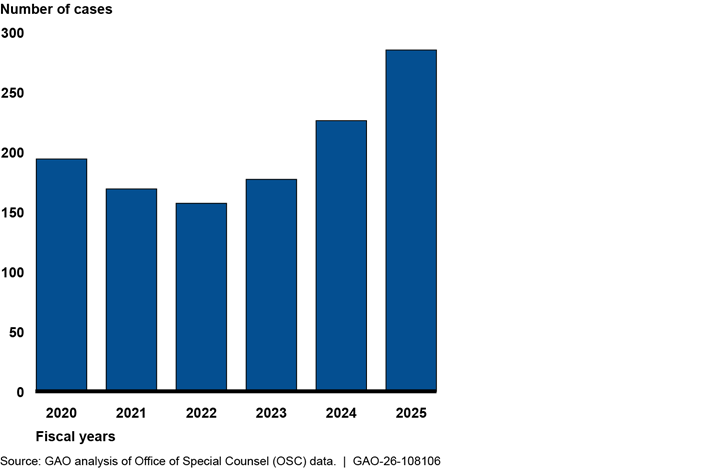
In fiscal years 2020 through 2025, OSC opened 1,208 cases filed by DHS employees claiming retaliatory personnel actions related to whistleblowing. As shown in figure 13 below, the number of cases filed ranged from 157 to 285 each fiscal year. OSC officials said these DHS cases accounted for 10 percent of all whistleblower retaliation cases OSC opened during this time. According to OSC officials, one case can include multiple allegations. The 1,208 DHS cases OSC opened during this period involved 2,053 separate allegations of whistleblower retaliation.
Figure 13: Department of Homeland Security Whistleblower Retaliation Cases OSC Opened, Fiscal Years 2020-2025
Over half (62 percent) of the 1,208 DHS whistleblower retaliation cases OSC opened from 2020 through 2025 involved U.S. Customs and Border Protection, Transportation Security Administration, and U.S. Immigration and Customs Enforcement, as shown in table 4.
Table 4: Components Involved in Department of Homeland Security (DHS) Whistleblower Retaliation Cases OSC Opened, Fiscal Years 2020-2025
|
DHS component involved |
Number of whistleblower retaliation cases |
Number of whistleblower retaliation allegations |
|
U.S. Customs and Border Protection |
301 |
502 |
|
Transportation Security Administration |
262 |
434 |
|
U.S. Immigration and Customs Enforcement |
195 |
345 |
|
Federal Emergency Management Agency |
116 |
211 |
|
U.S. Citizenship and Immigration Services |
86 |
149 |
|
U.S. Coast Guard |
62 |
90 |
|
DHS Headquarters |
54 |
90 |
|
Other DHS |
40 |
68 |
|
Office of Inspector General |
28 |
48 |
|
U.S. Secret Service |
25 |
48 |
|
Cybersecurity and Infrastructure Security Agency |
14 |
27 |
|
Federal Law Enforcement Training Centers |
12 |
19 |
|
Unknown |
7 |
12 |
|
Office of Intelligence and Analysis |
3 |
6 |
|
Science and Technology Directorate |
3 |
4 |
|
Total |
1,208 |
2,053 |
Source: GAO analysis of Office of Special Counsel (OSC) data. | GAO‑26‑108106
According to OSC, of the 1,208 DHS whistleblower retaliation cases OSC opened in fiscal years 2020 through 2025, 114 (9.5 percent) resulted in at least one favorable action for the complainant. A favorable action is an action an agency agrees to take to either resolve or stay the retaliatory personnel action alleged in a case. OSC officials said a single case or allegation may result in more than one favorable action. Officials reported 169 favorable actions obtained across the 114 DHS cases.[77]
According to OSC, 34 DHS whistleblower retaliation cases participated in OSC’s Alternative Dispute Resolution program for mediation. This program is a free, voluntary, and confidential dispute resolution process that provides an alternative avenue for resolving complaints. According to OSC officials, of the 34 cases that participated, 14 were mediated and six reached a settlement agreement that resulted in favorable actions for the complainant.
The average length of DHS whistleblower retaliation cases opened and closed in fiscal years 2020 through 2025, was 141 days (5 months).[78] Case lengths ranged from 0 days to 5 years during this time. The median case length across the 6 fiscal years was 2 months, when rounding down to the nearest whole month.
MSPB
MSPB is an independent federal agency with the authority to adjudicate federal employee appeals of alleged retaliatory personnel actions, such as removals or reductions in pay.[79] MSPB adjudicates two types of whistleblower appeal cases.
· Individual right of action. Employees, former employees, and applicants for employment can appeal personnel actions, such as changes in pay, performance evaluations, and significant changes in duties, before MSPB if they believe the actions were taken because of whistleblower retaliation. These individuals can file such appeals only after filing a complaint with OSC.[80] Once OSC notifies them that it has ended its investigation, they have 65 days to file an appeal with the board.[81]
· Otherwise appealable action. Employees may raise whistleblower retaliation as an affirmative defense before the MSPB on a more limited set of personnel actions known as adverse actions.[82] Adverse actions include more severe personnel actions, such as removals and reductions in grade or pay. Employees can file these appeals directly with the board without first filing a complaint with OSC. They generally have 30 days after the adverse action to file an appeal.[83]
Both types of appeals are called “initial appeals.” MSPB administrative judges first review appeals to determine (1) whether they meet criteria for adjudication, such as whether the appeal was filed within the required time; (2) whether the agency’s personnel actions are within the board’s jurisdiction; or (3) whether the appellant exhausted administrative remedies with OSC (in the case of Individual Right of Action appeals). If appeals do not meet these criteria, administrative judges dismiss the appeal.[84]
If an appeal meets the criteria for adjudication, the assigned judge will evaluate its merits by either conducting a hearing or reviewing the written record, consistent with the appellant's request. Administrative judges issue an initial decision, such as affirming the agency’s personnel action, reversing the agency’s personnel action, or ordering corrective action. When an employee or agency is dissatisfied with an initial decision, they may file a “petition for review” to be considered by MSPB’s three board members, who issue a final decision.[85]
Initial Appeals
In fiscal years 2018 through 2025, MSPB closed a total of 554 initial appeals filed by DHS employees claiming retaliatory personnel actions related to whistleblowing. MSPB adjudicated 109 of those on the merits (20 percent). Of the 445 initial appeals it did not adjudicate on the merits, MSPB dismissed 70 percent, 20 percent were settled, and 10 percent were withdrawn.
The number of DHS whistleblower retaliation initial appeals MSPB closed each fiscal year ranged from 46 to 102, as shown in figure 14. Seventy-four percent of these initial appeals were Individual Right of Actions and 26 percent were Otherwise Appealable Actions. Appeals from DHS employees accounted for 9 percent of all whistleblower retaliation initial appeals MSPB closed during these 8 years.
Figure 14: Department of Homeland Security Whistleblower Retaliation Initial Appeals MSPB Closed, Fiscal Years 2018–2025
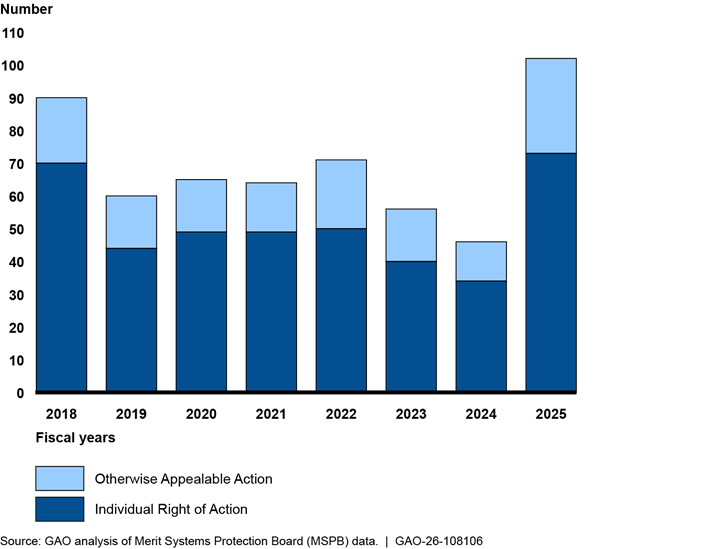
Over half (57 percent) of all DHS whistleblower initial appeals MSPB closed in fiscal years 2018 through 2025—both Individual Right of Action and Otherwise Appealable Action—involved U.S. Customs and Border Protection, U.S. Immigration and Customs Enforcement, or Transportation Security Administration, as shown in table 5.[86]
Table 5: Components Involved in Department of Homeland Security (DHS) Whistleblower Retaliation Initial Appeals MSPB Closed, Fiscal Years 2018–2025
|
DHS component involved |
Number of Initial appeals |
|
U.S. Customs and Border Protection |
121 |
|
U.S. Immigration and Customs Enforcement |
97 |
|
Transportation Security Administration |
97 |
|
Federal Emergency Management Agency |
74 |
|
U.S. Citizenship and Immigration Services |
45 |
|
Office of Inspector General |
41 |
|
U.S. Coast Guard |
19 |
|
Other DHS |
14 |
|
U.S. Secret Service |
10 |
|
DHS Headquarters |
10 |
|
Cybersecurity and Infrastructure Security Agency |
9 |
|
Federal Law Enforcement Training Centers |
8 |
|
Science and Technology Directorate |
4 |
|
Management Directorate |
3 |
|
Office of Intelligence and Analysis |
2 |
|
Total |
554 |
Source: GAO analysis of Merit Systems Protection Board (MSPB) data. | GAO‑26‑108106
According to MSPB officials, a whistleblower retaliation appeal can involve multiple claims, (i.e., different allegations within one appeal). The 109 DHS whistleblower retaliation initial appeals MSPB adjudicated on the merits in fiscal years 2018 through 2025 involved 150 claims.[87] An MSPB administrative judge granted the appellant’s request for corrective action for 15 of 150 claims (10 percent), denied the appellant’s request for 125 claims (83 percent), and did not reach a decision for 10 claims (7 percent).[88]
The average length of a DHS whistleblower retaliation initial appeal MSPB closed in fiscal years 2018 through 2025 was 164 days (5 months). Initial appeal lengths ranged from 3 days to 3 years.
Petitions for Review
In fiscal years 2018 through 2025, MSPB closed a total of 129 petitions for review filed by DHS employees claiming retaliatory personnel actions related to whistleblowing.[89] Appeals from DHS employees accounted for 10 percent of all whistleblower retaliation petitions for review MSPB closed during this period.
The number of DHS whistleblower retaliation petitions for review MSPB closed each fiscal year ranged from 0 to 64, as shown in figure 15 below. Sixty-seven percent of petitions for review were Individual Right of Appeals and 33 percent were Otherwise Appealable Actions.
Figure 15: Department of Homeland Security Whistleblower Retaliation Petitions for Review MSPB Closed, Fiscal Years 2018–2025
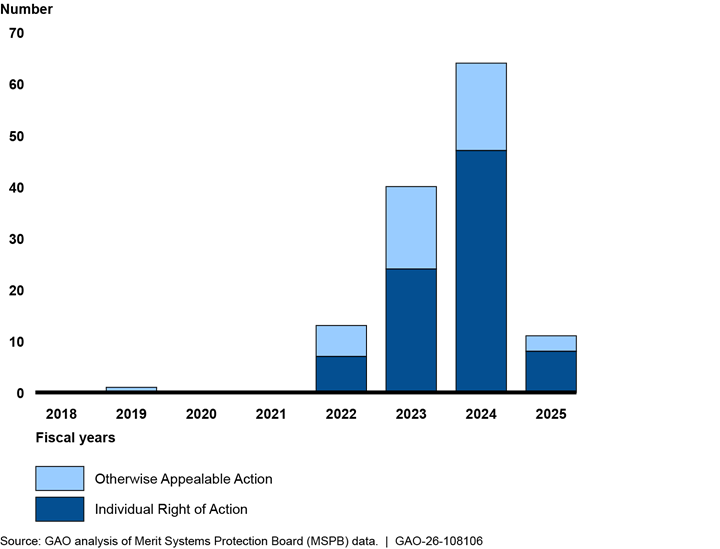
Over half (60 percent) of all DHS whistleblower retaliation petitions for review closed in fiscal years 2018 through 2025—both Individual Right of Actions and Otherwise Appealable Actions—involved U.S. Customs and Border Protection, Federal Emergency Management Agency, or U.S. Immigration and Customs Enforcement, as shown in table 6 below.
Table 6: Components Involved in Department of Homeland Security (DHS) Whistleblower Retaliation Petitions for Review MSPB Closed, Fiscal Years 2018–2025
|
DHS component involved |
Number of petitions for review |
|
U.S. Customs and Border Protection |
30 |
|
U.S. Immigration and Customs Enforcement |
24 |
|
Federal Emergency Management Agency |
23 |
|
Transportation Security Administration |
16 |
|
U.S. Citizenship and Immigration Services |
11 |
|
U.S. Coast Guard |
9 |
|
Cybersecurity and Infrastructure Security Agency |
2 |
|
Federal Law Enforcement Training Centers |
2 |
|
DHS Headquarters |
2 |
|
Office of Inspector General |
2 |
|
U.S. Secret Service |
2 |
|
Management Directorate |
2 |
|
Other DHS |
2 |
|
Office of Intelligence and Analysis |
1 |
|
Science and Technology Directorate |
1 |
|
Total |
129 |
Source: GAO analysis of Merit Systems Protection Board (MSPB) data. | GAO‑26‑108106
Of the 129 DHS whistleblower retaliation petitions for review MSPB closed in fiscal years 2018 through 2025, the board granted 37 petitions (29 percent), meaning the board agreed to review and re-adjudicate the appeal. The board denied 68 petitions (53 percent), dismissed 5 petitions, and upheld the initial decision in one petition because it was unable to come to a majority decision.[90]
Of the 37 petitions for review the board granted, the board remanded the appeal back to an administrative judge for further action for 33 (89 percent). The board reversed the initial decision for three petitions and affirmed the initial decision for one petition.
As with initial appeals, a single petition for review can involve multiple claims (i.e., different allegations within one appeal). The 129 DHS whistleblower petitions for review MSPB closed in fiscal years 2018 through 2025 involved 172 claims.[91] The board denied the appellant’s request for 106 of these 172 claims (62 percent), did not reach a decision for 63 claims (37 percent), and granted the appellant’s request for corrective action for two (1 percent).
The average length of a DHS whistleblower retaliation petition for review MSPB closed in fiscal years 2018 through 2025 was 48 months (4 years). The length of petitions for review ranged from 39 days to 85 months (7 years) during this time. According to MSPB officials, the board’s lack of a quorum from January 7, 2017, to March 4, 2022, impacted petition for review processing times. Officials reported that the board’s processing time after the quorum was restored averaged 1.4 years.
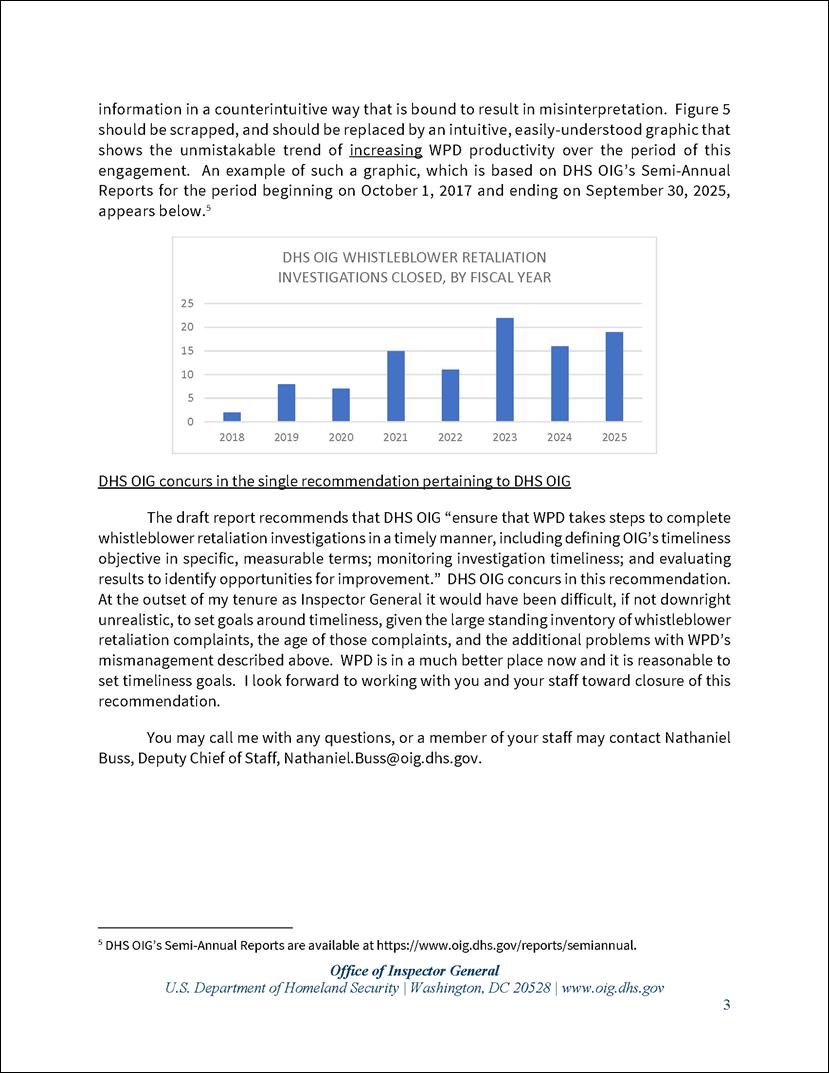
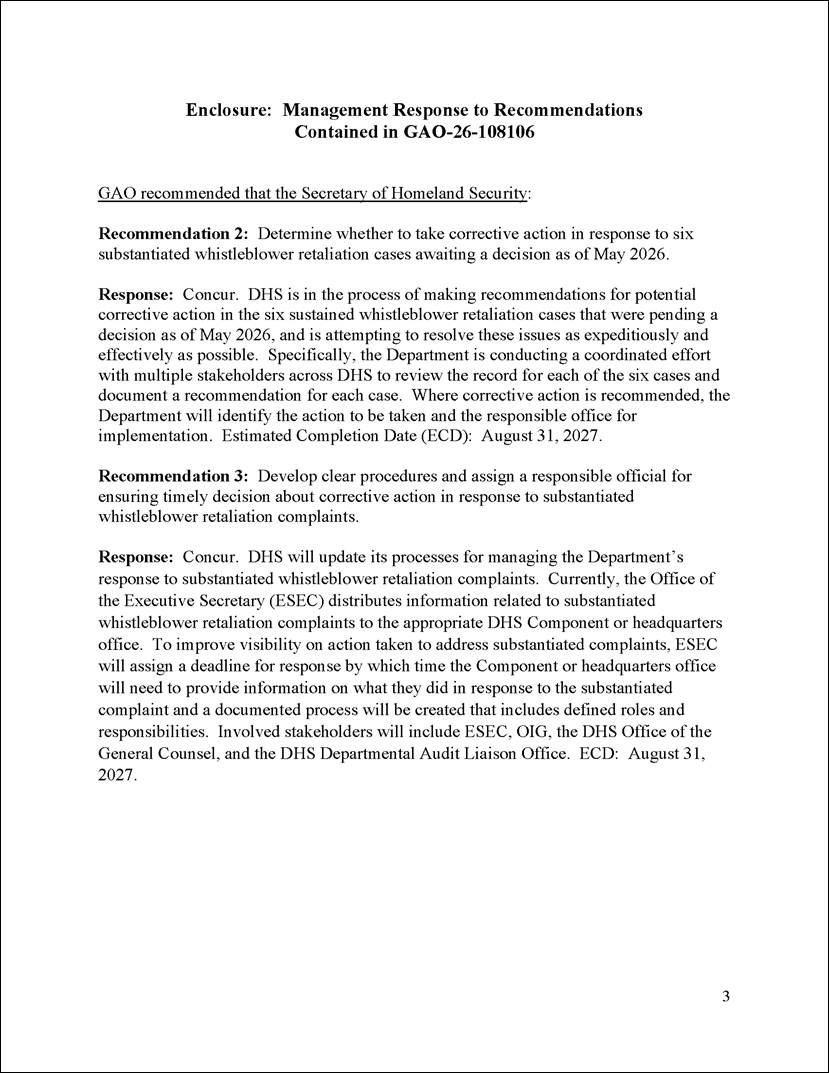
Christopher P. Currie at curriec@gao.gov.
In addition to the contact named above, Claudia Becker (Assistant Director), Alana Finley (Assistant Director), Johanna Wong (Analyst-in-Charge), Lauri Barnes, Kelsey Burdick, Carson Cherniss, Benjamin Crossley, Steven Flint, Taylor Gauthier, Jenna Lada, Heidi Nielson, and Rebecca Sero made key contributions to this report.
The Government Accountability Office, the audit, evaluation, and investigative arm of Congress, exists to support Congress in meeting its constitutional responsibilities and to help improve the performance and accountability of the federal government for the American people. GAO examines the use of public funds; evaluates federal programs and policies; and provides analyses, recommendations, and other assistance to help Congress make informed oversight, policy, and funding decisions. GAO’s commitment to good government is reflected in its core values of accountability, integrity, and reliability.
Obtaining Copies of GAO Reports and Testimony
The fastest and easiest way to obtain copies of GAO documents at no cost is through our website. Each weekday afternoon, GAO posts on its website newly released reports, testimony, and correspondence. You can also subscribe to GAO’s email updates to receive notification of newly posted products.
Order by Phone
The price of each GAO publication reflects GAO’s actual cost of production and distribution and depends on the number of pages in the publication and whether the publication is printed in color or black and white. Pricing and ordering information is posted on GAO’s website, https://www.gao.gov/ordering.htm.
Place orders by calling (202) 512-6000, toll free (866) 801-7077,
or
TDD (202) 512-2537.
Orders may be paid for using American Express, Discover Card, MasterCard, Visa, check, or money order. Call for additional information.
Connect with GAO
Connect with GAO on X,
LinkedIn, Instagram, and YouTube.
Subscribe to our Email Updates. Listen to our Podcasts.
Visit GAO on the web at https://www.gao.gov.
To Report Fraud, Waste, and Abuse in Federal Programs
Contact FraudNet:
Website: https://www.gao.gov/about/what‑gao‑does/fraudnet
Automated answering system: (800) 424-5454
Media Relations
Sarah Kaczmarek, Managing Director, Media@gao.gov
Congressional Relations
David A. Powner, Acting Managing Director, CongRel@gao.gov
General Inquiries
[1]Although retaliation is generally a broader term that can encompass other actions such as harassment, in this report, we use the term retaliation to refer to prohibited actions taken in reprisal for a protected disclosure. See, e.g., 5 U.S.C. § 2302(a)(2) (citing the enumerated list of personnel actions); 50 U.S.C. § 3341(j)(1) (concerning security clearance and access determinations).
[2]For the purposes of this report, DHS personnel include employees, contractors, and grantees. Department of Homeland Security Office of Inspector General, Semiannual Report to Congress, October 1, 2024–March 31, 2025, (Washington, D.C.), https://www.oig.dhs.gov/sites/default/files/assets/SAR/2025/oig‑sar‑oct24‑mar25.pdf; Semiannual Report to Congress, April 1, 2024–September 30, 2024, (Washington, D.C.: Oct. 30, 2024), https://www.oig.dhs.gov/sites/default/files/assets/SAR/2025/oig‑sar‑apr24‑sept24.pdf; and Semiannual Report to Congress, October 1, 2023–March 31, 2024, (Washington, D.C.: June 6, 2024), https://www.oig.dhs.gov/sites/default/files/assets/SAR/2024/oig-sar-oct23-mar24.pdf; Semiannual Report to Congress, April 1, 2023—September 30, 2023, (Washington, D.C.: Oct. 27, 2023), https://www.oig.dhs.gov/sites/default/files/assets/SAR/2024/oig‑sar‑apr23‑sept23.pdf.
[3]The budget information is rounded as of fiscal year 2024. This does not include the amounts appropriated in the 2025 law commonly known as the “One Big Beautiful Bill Act,” an act to provide for reconciliation pursuant to title II of H. Con. Res. 14, Pub. L. No. 119-21, 139 Stat. 72 (2025) (hereafter, OBBBA).
[4]The term “whistleblower” is defined in the context of protections against retaliation for disclosing certain types of wrongdoing. Thus, we generally use the term “complainant” rather than “whistleblower” to refer to federal employees who allege wrongdoing but may or may not allege retaliation. 5 U.S.C. § 2302; 50 U.S.C. § 3341(j)(1); Presidential Policy Directive 19. For example, the Whistleblower Protection Act prohibits retaliation against most federal executive branch employees who make a “protected disclosure,” or a formal or informal report that the employee reasonably believes evidences wrongdoing in the following areas: gross waste of funds; abuse of authority; any violation of any law, rule, or regulation; gross mismanagement; and a substantial and specific danger to public health or safety. 5 U.S.C. § 2302(a)(2)(D). In addition, 50 U.S.C. § 3341(j)(1) and Presidential Policy Directive 19 protects against a retaliatory personnel action that affects the complainant’s eligibility for access to classified information, such as through a security clearance revocation.
[5]DHS OIG‘s mission is to provide independent oversight of DHS operations, including investigating fraud, waste, abuse, and criminal misconduct involving DHS programs, personnel, and funds.
[6]GAO, Whistleblower Protection: Additional Actions Needed to Improve DOJ’s Handling of FBI Retaliation Complaints, GAO‑15‑112 (Washington, D.C.: Jan. 23, 2015); and GAO, Whistleblower Protection: DOJ and FBI Need to Improve Employees’ Awareness of Rights, GAO‑25‑106547 (Washington, D.C.: Nov. 12, 2024).
[7]GAO‑15‑112. For example, we recommended that relevant offices within the Department of Justice and its Office of the Inspector General jointly assess the impact of its efforts to reduce the duration of Federal Bureau of Investigation whistleblower retaliation complaints. The Department of Justice took steps that addressed this recommendation in 2020.
[8]Department of Homeland Security, Office of Inspector General, Whistleblower Protection Division Policy and Process Manual (revised May 2026).
[9]The data on whistleblower retaliation complaints reviewed in fiscal year 2018 does not include complaints from October 1, 2017, to March 12, 2018, because Whistleblower Protection Division officials said they did not begin tracking them until the middle of fiscal year 2018.
[10]We also analyzed data on DHS whistleblower retaliation cases from the Office of Special Counsel (OSC) and appeals from the Merit Systems Protection Board (MSPB). These agencies also investigate and adjudicate certain DHS whistleblower retaliation complaints.
[11]Council of the Inspectors General on Integrity and Efficiency, Quality Standards for Federal Offices of Inspector General (Washington, D.C.: Aug. 2012) and Quality Standards for Investigations (Washington, D.C.: Nov. 2011). GAO, Standards for Internal Control in the Federal Government, GAO‑25‑107721 (Washington, D.C.: May 2025). The relevant statutes and departmental directives are noted throughout this report.
[12]Three of the complainants filed DHS whistleblower retaliation complaints with OIG, one filed a complaint with OSC, and one filed complaints with OSC and MSPB.
[13]OIG established WPD, formerly known as the Whistleblower Protection Unit, in January 2017 to focus on investigating and adjudicating alleged whistleblower retaliation amongst the covered workforce, which includes current and former DHS employees, contractors, and grantees.
[14]OIG also offers an alternative dispute resolution program during WPD’s standard investigative process as an option for complainants alleging retaliation. If alternative dispute resolution is not successful, the retaliation complaint is returned to the investigative process.
[15]The Whistleblower Protection Coordinator Act required that each Inspector General establish a Whistleblower Protection Coordinator with specific duties, including ensuring employees receive clear education on whistleblower rights and protections. Pub. L. No. 115-192, 132 Stat. 1502 (codified as amended at 5 U.S.C. § 403(d)).
[16]See 5 U.S.C. 1211 et seq.
[17]Unlike OIG, OSC does not have the authority to investigate whistleblower retaliation complaints made by DHS contractors and grantees and Coast Guard members of the armed forces.
[18]See 5 C.F.R. §§ 1209.2, 1209.5. MSPB has responsibility for adjudicating two types of employee appeals of alleged retaliatory personnel actions. Specifically, employees can file one type of appeal after OSC has determined to not seek corrective action in response to their whistleblower retaliation complaints. Employees can file the second type of appeal directly with MSPB, without a prior OSC case, for certain personnel actions (e.g., adverse action appeals, performance-based removals or reductions in grade), and allege that the actions were taken because of whistleblowing.
[19]A corrective action may include “that the individual be placed, as nearly as possible, in the position the individual would have been in had the prohibited personnel practice not occurred.” See 5 U.S.C. § 1214(g)(1).
[20]Department of Homeland Security, Office of Inspector General, Whistleblower Protection Division Policy and Process Manual (revised May 2026). The WPD manual refers to this assessment as a prima facie analysis. The other criteria that are generally assessed are whether an adverse personnel action was taken or threatened and whether responsible management officials had knowledge of the protected disclosure. See 5 U.S.C. § 2302; 41 U.S.C. § 4712; 10 U.S.C. § 1034; 50 U.S.C. § 3341(j); Presidential Policy Directive-19. Additionally, figure 1 provides an overview of the statutory protections for DHS personnel alleging whistleblower retaliation. According to the WPD manual, if a case is opened, this analysis is repeated as part of the investigation using preponderance of evidence as the standard of proof.
[21]According to the WPD manual, the division may not open investigations for all complaints that meet these criteria, such as if the filing deadline was not met or the alleged protected disclosure was not communicated to a proper recipient.
[22]OIG officials stated that DHS whistleblower retaliation complainants who have the option to file with OSC benefit from doing so because (1) they can appeal their personnel action to MSPB after administratively exhausting remedies at OSC and (2) OSC can seek corrective actions, such as back pay and reinstatement, on behalf of victims of whistleblower retaliation. According to the WPD manual, the division is to notify the complainant of the declination if they were contacted during intake or if the investigator is referring the complainant to an external body.
[23]According to the WPD manual, the division also sends the report to the applicable head of the contracting activity for contractor or grantee cases, the DHS Chief Security Officer for security clearance and information access cases, and the OIG’s Office of External Affairs for substantiated retaliation cases. The manual states that parties affected by WPD’s report can request reconsideration of the division’s decisions under statute specific options. For example, members of the Coast Guard may contact the Coast Guard Board of Correction of Military Records to request a review of WPD’s report and request a correction of their records.
[24]Specifically, OIG received about 236,000 complaints alleging wrongdoing in fiscal years 2018 through 2025, and identified 3,025 complaints as including allegations of whistleblower retaliation from March 13, 2018, to September 30, 2025.
[25]Appendix III provides more information on the components involved in these complaints.
[26]The number of complaints WPD received and reviewed in fiscal year 2018 does not include complaints from October 1, 2017 to March 12, 2018, because officials said they did not begin tracking them until the middle of fiscal year 2018.
[27]Appendix II provides more information on how the OIG’s Whistleblower Protection Coordinator communicates whistleblower protections and processes to DHS personnel.
[28]We also reviewed the number of DHS whistleblower retaliation cases OSC investigated and MSPB adjudicated during this period. In fiscal years 2020 through 2025, OSC opened 1,208 DHS whistleblower retaliation investigations. In fiscal years 2018 through 2025, MSPB closed 554 DHS whistleblower retaliation initial appeal cases and 129 petition for review cases. Of those, 74 percent were Individual Right of Action cases—a type of whistleblower retaliation claim that requires complainants to seek corrective action from OSC before filing an appeal—and 26 percent were Otherwise Appealable Actions—a type of claim that is directly appealable to MSPB. See appendix V for more information.
[29]The remaining 37 percent of investigations involved at least 13 other DHS components and offices.
[30]WPD officials told us that most complaints they receive fall under the Whistleblower Protection Act, for which OSC has primary jurisdiction. They stated that WPD’s review and referral of these complaints to OSC is part of the agencies’ cooperative oversight of allegations of whistleblower retaliation.
[31]According to WPD officials, they referred 20 cases to the Alternative Dispute Resolution program in fiscal years 2024 and 2025, five of which were settled through the program.
[32]OIG officials told us they do not receive all complaints upon submission by the complainant. For example, OIG may receive some complaints after they were originally submitted to another government agency or DHS component.
[33]For the 554 DHS whistleblower retaliation initial appeal cases the MSPB closed in fiscal years 2018 through 2025, case lengths ranged from 3 days to 3 years. For the 1,080 DHS whistleblower retaliation investigations OSC closed, of those opened in fiscal years 2020 through 2025, the average case length was 141 days (5 months). See appendix V for more information.
[34]According to OIG officials, time frames for routing complaints to WPD include the time between submission by the complainant and receipt by the Office of Investigation. In addition, these officials said that after receipt, the office can take longer to route some complaints because, for example, it may route them to other DHS investigative offices prior to WPD; receive them in large batches, which can cause processing delays; or receive complaints that are missing documents or data that require additional information from DHS components.
[35]Department of Homeland Security, Office of Inspector General, Whistleblower Protection Division Policy and Process Manual (revised May 2026).
[36]OIG is not required to complete investigations within this time frame but is statutorily required to notify certain complainants when it does not issue a report on the investigation within 180 days of either receiving the compliant or opening an investigation. See 10 U.S.C. § 4701 (cases involving contractors and grantees); 10 U.S.C. § 1034 (cases involved members of the armed forces, including Coast Guard); see also 50 U.S.C. § 3341 note (retaliatory security clearance revocations). During our review, we found that WPD had not consistently documented these notifications in its case files to help ensure required communications with complainants occurred. As a result, WPD revised its policy manual in May 2026 to require written notifications to applicable complainants and provide more specific documentation instructions.
[37]According to WPD officials, this led to case backlogs and repeated reassignments of investigators to cases.
[38]WPD conducted a staffing assessment in 2019, but the division has not done another assessment since then and did not conduct an analysis to determine its stated target of eight investigative counsel. Officials noted that they currently aim for each counsel to have a caseload of four to five investigations.
[39]WPD officials said it was too soon to determine the extent to which staffing increases have affected investigation timeliness, and they had not assessed how alternative dispute resolution has affected case time frames.
[40]Council of the Inspectors General on Integrity and Efficiency, Quality Standards for Investigations (Washington, D.C.: Nov. 2011).
[41]Department of Homeland Security, Office of Inspector General, OIG Handling of Whistleblower Retaliation Complaints, OIG-2016-005.v2 (Jan. 24, 2017).
[42]WPD officials stated that they reviewed caseload statistics (e.g., number of complaints, open investigations, closed investigations, and other information) semiannually but have not specifically assessed investigation timeliness.
[43]GAO, Standards for Internal Control in the Federal Government, GAO‑25‑107721 (Washington, D.C.: May 2025).
[44]10 U.S.C. § 1034(f)(1) states that “not later than 30 days after receiving a report from the Inspector General […] the Secretary of Homeland Security […] shall determine whether corrective or disciplinary action should be taken.” 41 U.S.C. § 4712(c)(1) states that “not later than 30 days after receiving an Inspector General report […] the head of the executive agency concerned shall determine whether there is sufficient basis to conclude that the contractor, subcontractor, grantee, subgrantee, or personal services contractor concerned has subjected the complainant to a reprisal prohibited by subsection (a) and shall either issue an order denying relief or shall take” additional actions as outlined in the statute.
[45]See appendix IV for information about corrective action taken in these cases.
[47]See S. Rep. No. 112-155, 2 (2012) (Report of the Committee on Homeland Security and Governmental Affairs to Accompany the Whistleblower Protection Enhancement Act of 2012).
[48]WPD officials said they did not begin tracking these data until the middle of fiscal year 2018. March 13, 2018, was the earliest these data were available.
[49]10 U.S.C. § 1034(f)(1) states that “not later than 30 days after receiving a report from the Inspector General […] the Secretary of Homeland Security […] shall determine whether corrective or disciplinary action should be taken.” 41 U.S.C. § 4712(c)(1) states that “not later than 30 days after receiving an Inspector General report […] the head of the executive agency concerned shall determine whether there is sufficient basis to conclude that the contractor, subcontractor, grantee, subgrantee, or personal services contractor concerned has subjected the complainant to a reprisal prohibited by subsection (a) and shall either issue an order denying relief or shall take” additional actions as outlined in the statute.
[50]According to officials, OSC transitioned to the Electronic Case Management System from paper records in late August 2019.
[51]OSC officials categorize allegations within the Electronic Case Management System according to their applicable statutory provision. OSC officials identified whistleblower retaliation allegations as stemming from 5 U.S.C. § 2302(b)(8), (b)(9)(A-D).
[52]MSPB provided data on appeals closed rather than appeals opened because officials certify the accuracy of each fiscal year’s records after the fiscal year ends.
[53]According to MSPB officials, the board does not have statutory authority to hear appeals from adverse actions involving Transportation Security Administration screener employees except as provided under a Memorandum of Understanding with the agency; whistleblower claims can be asserted in that context. Officials said the memorandum was effective from September 2021 to early February 2026. Therefore, MSPB reported these cases separately.
[54]Specifically, Pub. L. No. 115-192, 132 Stat. 1502 (codified as amended at 5 U.S.C. § 403 note); 5 U.S.C. § 2302(c); Council of the Inspectors General on Integrity and Efficiency, Quality Standards for Federal Offices of Inspector General (Washington, D.C.: Aug. 2012).
[55]Council of the Inspectors General on Integrity and Efficiency, Quality Standards for Federal Offices of Inspector General.
[56]Pub. L. No. 115-192, 132 Stat. at 1502. The coordinator is not permitted to act as a legal representative, agent, or advocate for current or former DHS employees.
[57]5 U.S.C. § 2302(c)(2) requires agency heads, in consultation with the U.S. Office of Special Counsel (OSC) and the OIG, to ensure that employees of the agency are informed of the rights and remedies available to them under Civil Service Reform Act, the Whistleblower Protection Act, Whistleblower Protection Enhance Act of 2012, and related laws. To maintain OIG’s compliance with this requirement, the Whistleblower Protection Coordinator completes an annual OSC certification program.
[58]DHS OIG Office of Counsel, Whistleblower Protection Coordinator: Roles and Duties.
[59]41 U.S.C. § 4712(d) requires agencies to ensure that federal contractors inform their employees of whistleblower rights and protections.
[60]The Whistleblower Protection Coordinator may access WPD’s case management system to check the status of a complaint or to confirm that the email sender is the complainant and make case notes, as necessary, according to OIG guidance.
[61]WPD officials said they did not begin tracking the number of complaints they reviewed until the middle of fiscal year 2018.
[62]One complaint involved multiple components that were unspecified. For 67 complaints, complainants either did not report the component involved, or the agency involved was not a component of DHS.
[63]OIG substantiated allegations in 11 of the 73 investigations it opened and closed from fiscal years 2018 through 2025. As of May 2026, the Secretary had determined corrective actions for five cases. We included information about corrective actions as publicly reported in OIG’s Semiannual Reports to Congress. The report covering the period from October 1, 2024, to March 31, 2025, was the latest one issued, as of May 2026. As of this date, OIG had not publicly reported on corrective actions the Secretary ordered in one of the five cases, so we did not include a summary in this report.
[64]Department of Homeland Security Office of Inspector General, Semiannual Report to the Congress, October 1, 2018–March 31, 2019 (Washington, D.C.), https://www.oig.dhs.gov/sites/default/files/assets/SAR/2019/oig-sar-oct18-mar19.pdf.
[65]Department of Homeland Security Office of Inspector General, Semiannual Report to the Congress, April 1, 2019–September 30, 2019 (Washington, D.C.), https://www.oig.dhs.gov/sites/default/files/assets/SAR/2019/oig-sar-apr19-sept19.pdf.
[66]Department of Homeland Security Office of Inspector General, Semiannual Report to the Congress, October 1, 2020–March 31, 2021 (Washington, D.C.: May 27, 2021), https://www.oig.dhs.gov/sites/default/files/assets/SAR/2021/oig-sar-oct20-mar21.pdf.
[67]Department of Homeland Security Office of Inspector General, Semiannual Report to the Congress, October 1, 2021–March 31, 2022 (Washington, D.C.: May 20, 2022), https://www.oig.dhs.gov/sites/default/files/assets/SAR/2022/oig-sar-oct21-mar22.pdf.
[68]Department of Homeland Security Office of Inspector General, Semiannual Report to the Congress, April 1, 2021–September 30, 2021 (Washington, D.C.), https://www.oig.dhs.gov/sites/default/files/assets/SAR/2021/oig-sar-apr21-sept21.pdf.
[69]Department of Homeland Security Office of Inspector General, Semiannual Report to the Congress, October 1, 2022–March 31, 2023 (Washington, D.C.: Apr. 26, 2023), https://www.oig.dhs.gov/sites/default/files/assets/SAR/2023/oig-sar-oct22-mar23.pdf.
[70]Department of Homeland Security Office of Inspector General, Semiannual Report to the Congress, October 1, 2023–March 31, 2024 (Washington, D.C.: June 6, 2024), https://www.oig.dhs.gov/sites/default/files/assets/SAR/2024/oig-sar-oct23-mar24.pdf. OIG’s semiannual report did not provide information on Coast Guard’s actions following the Secretary’s determination for this case.
[71]Department of Homeland Security Office of Inspector General, Semiannual Report to the Congress, April 1, 2023–September 30, 2023 (Washington, D.C.: Oct. 27, 2023), https://www.oig.dhs.gov/sites/default/files/assets/SAR/2024/oig-sar-apr23-sept23.pdf.
[72]Department of Homeland Security Office of Inspector General, Semiannual Report to the Congress, April 1, 2023–September 30, 2023.
[73]In the legislative branch, Members of Congress or a representative of a committee of Congress and, for certain complainants, GAO are also authorized to receive whistleblower retaliation complaints. While the DHS Office of Inspector General has the authority to investigate whistleblower retaliation complaints made by DHS contractors and grantees and Coast Guard members of the armed forces, MSPB and OSC do not.
[74]OSC has jurisdiction over prohibited personnel practices committed against most federal civil service employees, applicants for employment, and former federal employees in executive branch agencies and the Government Printing Office. Prohibited personnel practices are employment-related activities that are banned in the federal workforce because they violate the merit system through some form of employment discrimination, retaliation, improper hiring practices, or failure to adhere to laws, rules, or regulations that directly concern the merit system principles. OSC is led by the Special Counsel, who is appointed by the President and confirmed by the Senate to serve a 5-year term. 5 U.S.C. § 1211(a)-(b).
[75]See generally 5 U.S.C. §§ 1211-1219.
[76]When complainants submit duplicate complaints, OSC officials said they add any new information to the original complaint.
[77]According to our analysis of OSC data, for those allegations where OSC found there was no retaliatory personnel actions, the most common reason was insufficient evidence (61 percent). The second most common reason was deferral to an Equal Employment Opportunity process (13 percent). If a complaint involves discrimination based on race, color, religion, sex, national origin, disability, and age, OSC will defer such claims to the Equal Employment Opportunity Commission process, pursuant to 5 C.F.R. § 1810.1.
[78]Because OSC opens an investigation into every complaint it receives, OSC’s average investigation length reflects investigations closed quickly for reasons such as lack of jurisdiction, inability to contact the complainant, or the complaint being more than 3 years old. In contrast, DHS OIG’s Whistleblower Protection Division performs an intake review to screen out complaints that do not meet their case opening criteria, and the division does not open investigations into those types of complaints. As a result, OSC’s average investigation length should not be compared with OIG’s.
[79]See 5 U.S.C. § 1204.
[80]See 5 C.F.R. §§ 1209.2, 1209.5.
[81]In addition, according to MSPB, individuals can file these appeals with the board at any time after 120 days have elapsed after filing with OSC but before the office has completed its review. Alternatively, they may choose to allow OSC to continue investigating until it completes its review.
[82]See 5 C.F.R. § 1201.3(a) (outlining the board’s appellate jurisdiction). According to MSPB, when an employee appeals an adverse action to the board, the agency has the burden to prove the merits of the adverse action, but the employee can also attempt to prove an affirmative defense, such as whistleblower retaliation.
[83]Additional appeal types have different filing deadlines, such as employees filing under the Uniformed Services Employment and Reemployment Rights Act who have no time limit for filing.
[84]Appellants may also settle with the agencies through mediation, or withdraw their appeals, instead of having their cases adjudicated.
[85]Board members are appointed by the President, confirmed by the Senate, and serve overlapping, nonrenewable 7-year terms. See 5 U.S.C. §§ 1201-1202.
[86]According to MSPB officials, in 2012 the board gained jurisdiction over Transportation Security Administration screener employees who file whistleblower appeals after exhausting their administrative remedies at OSC. 5 U.S.C. § 2304; 5 C.F.R. § 1209. However, MSPB officials stated that there is no statutory authority providing for direct appeals to the board for Transportation Security Administration screener employees except as provided under a Memorandum of Understanding reached with the agency. Officials said the memorandum was effective from September 2021 to early February 2026. They said Transportation Security Administration screener employees filed 19 whistleblower retaliation initial appeals from fiscal years 2022 through 2025.
[87]Claims include retaliation for whistleblowing under 5 U.S.C. § 2302(b)(8), retaliation for testifying or assisting individuals in whistleblower cases, and retaliation for cooperating with or disclosing information to OIG or OSC. We excluded claims that appellants withdrew before they were adjudicated from the total number of claims.
[88]MSPB does not reach a decision on a specific claim when, for example, there is no jurisdiction over the claim because the appellant failed to assert nonfrivolous allegations of one of the jurisdictional elements (e.g., the appellant failed to nonfrivolously allege that they engaged in protected activity); because the appeal is dismissed without prejudice for some reason other than failure to exhaust with OSC dismissed as untimely, or dismissed for collateral estoppel or res judicata; due to the context of a security clearance inquiry; or because the administrative judge dismissed the appeal as a sanction.
[89]MSPB did not have a quorum of members and could not issue decisions on petition for review cases from January 2017 through March 2022. During the time it did not have a quorum, the clerk of the board was permitted by policy to close petitions by granting a withdrawal of these cases when requested by a petitioner if there was no apparent untimeliness of the petition. When a quorum was restored in March 2022, MSPB reported it had 3,793 petitions for review waiting to be adjudicated. These petitions represented employees from all departments and agencies, not just DHS.
[90]Of the remaining 18 petitions for review, 10 appellants withdrew their petitions and eight settled.
[91]We excluded claims that appellants withdrew before they were adjudicated from the total number of claims.