
Report to Congressional Committees
United States Government Accountability Office
A report to Congressional Committees
For more information, contact: Heather MacLeod at MacleodH@gao.gov.
What GAO Found
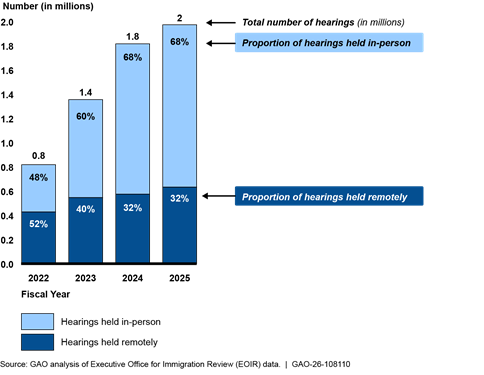
The Department of Justice’s Executive Office for Immigration Review (EOIR) conducts immigration court proceedings both in-person and using remote technology, such as WebEx—an internet-based video teleconferencing platform, or telephone. Per EOIR policy, immigration judges may use discretion to decide which, if any, remote medium is used by participants in a hearing. EOIR collects data on the medium used for each hearing, which reflects the location of only the judge and respondent. According to GAO’s analysis of this data, of the nearly 6 million hearings held from fiscal year 2022 through 2025, about 63 percent or 3.8 million hearings were in-person. Of the approximately 2.2 million remote hearings, most used WebEx (about 78 percent or 1.7 million). During this time, the number of remote hearings increased almost 50 percent, while the number of in-person hearings increased more dramatically. EOIR officials stated that as the COVID-19 pandemic subsided, immigration courts began scheduling more hearings overall, with more hearings taking place in-person.
Number and Percentage of Immigration Court Hearings Held Remotely and In-person, Fiscal Years 2022–2025
EOIR officials and selected immigration judges and attorneys described generally favorable experiences with remote immigration hearings. They identified benefits of using remote technology, such as reducing the time and cost associated with in-person hearings, increasing the efficiency of hearings, and allowing respondents increased access to private bar attorneys.
Some court stakeholders also provided perspectives on challenging aspects of remote hearings, such as variation in judge preferences for remote hearings, and technology limitations for language interpretation options. However, they told GAO these challenges did not outweigh the benefits of holding remote immigration hearings.
Why GAO Did This Study
Each year, EOIR immigration judges preside over immigration court proceedings for hundreds of thousands of respondents—foreign nationals charged on statutory grounds of removability. In 2017, GAO reported that EOIR would benefit from collecting more reliable data on the use of remote technology in immigration hearings, among other actions.
The Explanatory Statement accompanying the Consolidated Appropriations Act, 2024, includes a provision for GAO to update the portion of its 2017 report that addressed the use of remote technology in immigration courts. This report examines (1) what EOIR data show about remote and in-person immigration hearings from fiscal year 2022 through 2025 and (2) the benefits and challenges of using remote technology for immigration court hearings and any actions EOIR has taken to address challenges.
GAO reviewed EOIR policies and procedures regarding the use of remote technology in immigration hearings and analyzed EOIR data on immigration hearings from fiscal year 2022 through 2025. In addition, GAO interviewed officials from EOIR and the Office of the Principal Legal Advisor (OPLA) within the Department of Homeland Security‘s U.S. Immigration and Customs Enforcement.
GAO also interviewed immigration judges and OPLA attorneys from four immigration court locations selected to represent courts with variation in the size of geographic area of responsibility and hearing volume, and members of two nongovernmental organizations for immigration judges and attorneys who represent respondents. Further, GAO conducted in-person and remote observations of 22 immigration hearings from 11 immigration courts across the U.S.
Abbreviations
CASE Case Access System for EOIR
DAR Digital Audio Recording
DHS Department of Homeland Security
DOJ Department of Justice
EOIR Executive Office for Immigration Review
ICE U.S. Immigration and Customs Enforcement
OPLA Office of the Principal Legal Advisor
VTC Video teleconference
This is a work of the U.S. government and is not subject to copyright protection in the United States. The published product may be reproduced and distributed in its entirety without further permission from GAO. However, because this work may contain copyrighted images or other material, permission from the copyright holder may be necessary if you wish to reproduce this material separately.“released.” Detained respondents refer to respondents who had a custody status of “detained.”
July 15, 2026
Congressional Committees
Each year, the Department of Homeland Security (DHS) initiates hundreds of thousands of removal cases with the U.S. immigration court system.[1] Within the Department of Justice (DOJ), the Executive Office for Immigration Review (EOIR) is responsible for conducting immigration court proceedings and other activities at 73 immigration courts across the country.
EOIR immigration judges preside over immigration cases and associated hearings to decide whether noncitizen respondents—foreign nationals charged as removable for violating immigration law—are removable as charged under immigration law. If so, these judges decide if the respondent may be granted any requested protection or other relief to lawfully remain in the U.S. At these hearings, attorneys from the Office of the Principal Legal Advisor (OPLA) within DHS’s U.S. Immigration and Customs Enforcement (ICE) represent the U.S. government, and respondents may proceed without legal representation or obtain it at their own expense. Respondents may have one or more hearings to resolve their case depending on the specific charges and circumstances.[2]
At the individual discretion of the immigration judge, immigration hearings may be held in-person in a courtroom or using a remote technology medium, such as WebEx, traditional video teleconference (VTC), or telephone.[3] Further, judges may allow participants to appear at a hearing using a combination of hearing mediums. For example, some participants may appear in-person in the courtroom while others participate remotely by WebEx or telephone.
In 2017, we reported on aspects of remote hearings in a report related to this topic.[4] The Explanatory Statement accompanying the Consolidated Appropriations Act, 2024, includes a provision for us to update the portion of our 2017 report that addressed the use of VTC in immigration courts.[5] This report examines (1) what EOIR data show about remote and in-person immigration hearings from fiscal year (FY) 2022 through 2025; and (2) the benefits and challenges of remote technology use for immigration court hearings and any actions EOIR has taken to address these challenges.
To examine EOIR data related to remote and in-person immigration hearings, we analyzed data on immigration hearings that occurred from FY 2022 through 2025 from the Case Access System for EOIR (CASE).[6] We selected this time frame to capture EOIR’s use of remote technology from the first full fiscal year since the COVID-19 pandemic subsided through the most recent data available at the time of our review. We assessed the reliability of these data through electronic tests and discussions with EOIR officials. We found the data to be sufficiently reliable for the purpose of describing the frequency and distribution of immigration hearings by medium (in-person or remote by WebEx, VTC, and telephone), and by other characteristics, such as type of hearing and respondent custody status (whether they were detained or not detained).[7]
To examine the benefits and challenges of using remote technology for immigration hearings, we reviewed relevant EOIR policies and procedures regarding the use of remote technology in immigration hearings. We also conducted a mix of virtual and in-person site visits to four immigration courts: Fort Snelling, Minnesota; Annandale, Virginia; Atlanta, Georgia: West Peachtree; and Atlanta, Georgia: Stewart Detention Center. We selected these courts to reflect variation in the size of geographic area of responsibility, hearing volume, and proportion of hearings for respondents who have been detained in custody and those that were not detained. We observed a nongeneralizable sample of 22 immigration hearings both in-person and remotely at the selected court locations as well as seven other court locations.[8] These observations helped us obtain first-hand experience with the benefits and challenges of conducting immigration hearings using WebEx.
For each selected immigration court, we conducted interviews with judges and attorneys who participated in hearings in those locations to obtain their perspectives on the use of remote technology in immigration hearings. Specifically, for each court location we interviewed the regional deputy chief or assistant chief immigration judge responsible for overseeing that court, an immigration judge who presided over hearings we observed, and OPLA attorneys who have had cases heard in the selected court.
To obtain additional perspectives on EOIR’s use of remote technology in immigration court hearings, we interviewed members of two nongovernmental organizations (1) immigration judges who are members of the National Association of Immigration Judges, and (2) private bar attorneys who are members of the American Immigration Lawyers Association and represent respondents in immigration hearings.[9] We also interviewed EOIR and OPLA officials to obtain their perspectives on immigration hearings held remotely, including EOIR officials’ perspectives on challenges described or observed during our site visit interviews and hearing observations. We analyzed interview responses from all entities to identify common benefits and challenges of remote immigration hearings.
Appendix I provides more information on our scope and methodology for the data analysis completed. In addition, appendix II provides additional details about immigration hearings and respondent characteristics as they relate to hearing mediums.
We conducted this performance audit from January 2025 to July 2026 in accordance with generally accepted government auditing standards. Those standards require that we plan and perform the audit to obtain sufficient, appropriate evidence to provide a reasonable basis for our findings and conclusions based on our audit objectives. We believe that the evidence obtained provides a reasonable basis for our findings and conclusions based on our audit objectives.
Background
Roles and Responsibilities Within the Immigration Court System
EOIR is responsible for conducting immigration court proceedings, appellate reviews, and administrative hearings. EOIR immigration judges and appellate immigration judges are responsible for hearing, and exercising their independent judgment and discretion in deciding, all cases that come before them.[10] As an office within DOJ, EOIR’s activities are subject to the direction and regulation of the Attorney General.[11]
As of the end of FY 2025, EOIR’s Office of Chief Immigration Judge employed 634 judges who are responsible for conducting proceedings and acting independently in deciding matters at 73 immigration courts and three immigration adjudication centers across the country.[12] Immigration judges may have a docket comprised of hearings for non-detained respondents, detained respondents (i.e., dockets in which all of the respondents are in custody), or a hybrid where some respondents are in custody at the time of their hearing and others are not.[13] EOIR provides language interpreters at government expense to respondents and witnesses who are unable to fully understand and participate in immigration proceedings in English. Options for interpreters include staff employed by EOIR, contract interpreters, and telephone interpretation services. Attorneys from OPLA serve as civil prosecutors representing the U.S. government in all immigration proceedings before EOIR.[14]
Individuals appearing before the immigration court—respondents—may represent themselves or be represented by an attorney of their choosing, at no cost to the government.[15] In cases where a respondent has legal representation, the attorney may speak for the respondent, receive court documents such as hearing notices, and submit motions and evidence to the court.
Overview of the Immigration Court Process and Concepts
Immigration Court Case Process
Immigration court proceedings generally begin when DHS files a “Notice to Appear” which is the charging document that orders the respondent to appear before an immigration judge. On the Notice to Appear, DHS lists the date, time, and location the respondent must appear, records the respondent’s residential address, if any, and selects the immigration court that has geographic jurisdiction over that address. DHS transmits the notice to the appropriate immigration court and the court enters the respondent’s mailing address and other information, such as primary language spoken and country of origin, into EOIR’s electronic case management system. As shown in figure 1, immigration court proceedings generally follow several steps, and there may be multiple hearings for a respondent as part of an immigration court case.
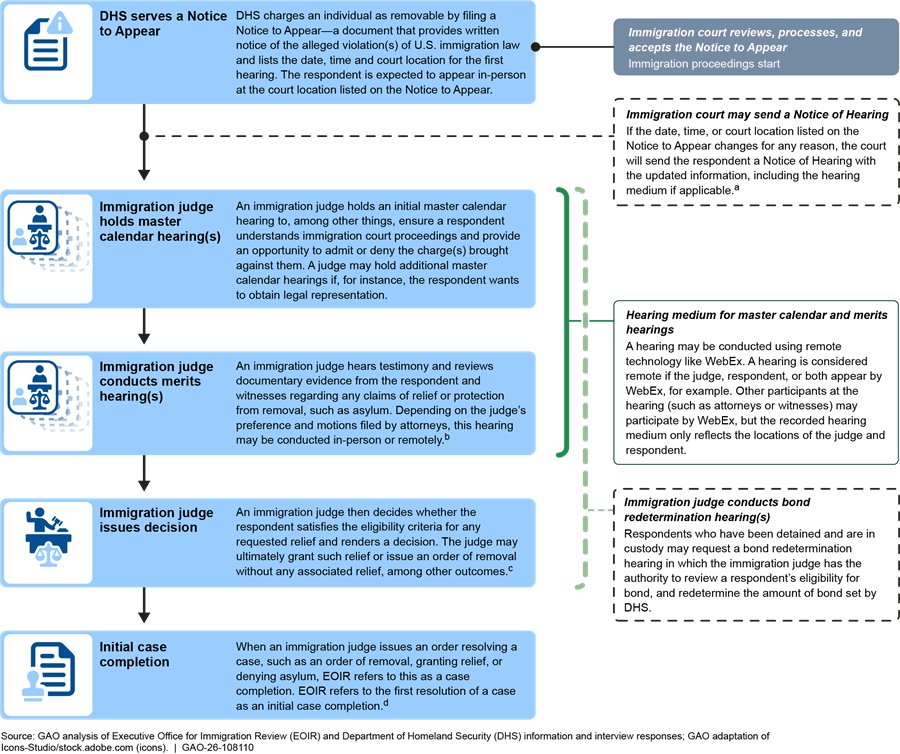
aIf the date, time, or location listed on the original Notice to Appear does not change, the immigration court will not issue a hearing notice. In some cases, a Notice to Appear may order a respondent to appear at a date and time “to be set.”
bThere are various forms of relief or protection from removal that a respondent may seek during immigration court proceedings as a defense against removal. For example, U.S. immigration law provides that foreign nationals arriving or present in the country may be granted asylum if they are unable or unwilling to return to their home country because of past persecution or a well-founded fear of future persecution based on their race, religion, nationality, membership in a particular social group, or political opinion. See 8 U.S.C. § 1158.
cUnder U.S. immigration law, a foreign national is removable if: (1) not admitted to the U.S. and found inadmissible under section 212 of the INA; or (2) admitted to the U.S. and deemed deportable under INA § 237. See 8 U.S.C. §§ 1182(a), 1227, 1229a(c), (e)(2). Those determined to be removable and not eligible for any requested relief or protection from removal would be subject to removal pursuant to the judge’s order once it is administratively final at the time of issuance (if no party appeals) or when all avenues for administrative review are exhausted. See 8 C.F.R. §§ 1003.1(b), (h), 1003.3(a)(1), 1003.38, 1241.1.
dA removal proceeding may have more than one completion. For instance, a respondent can submit a motion to reopen a case after an initial case completion, and the immigration judge may agree to reopen the case. In this example, while a judge has made an initial case completion, the case would require a second resolution to be completed. EOIR refers to any completion after the initial case completion as a subsequent case completion.
Respondent Custody Status
While immigration court proceedings are pending, respondents may be detained in ICE custody or released on bond, conditional parole, terms of supervision, or other alternatives to detention.[16] We refer to respondents in ICE custody as “detained respondents.” As shown in figure 1, detained respondents may request a bond redetermination hearing in which an immigration judge reviews ICE’s custody and bond decision. For this report, we refer to respondents who either have never been in ICE custody or have been released from ICE custody as “non-detained respondents.”
Types of Immigration Hearing Mediums
At the discretion of the judge, immigration hearings may be held in-person or remotely using mediums such as WebEx, VTC, or telephone. According to EOIR officials, the hearing medium should be recorded in CASE at the conclusion of the hearing. The hearing medium reflects only the locations of the judge and the respondent, not the locations of other participants such as attorneys, interpreters, witnesses, or any other attendees. EOIR defines each hearing medium as follows:
· In-person. Hearings where the respondent and judge both attended the hearing in-person and are physically in the same courtroom.
· WebEx. Hearings where the judge, the respondent, or both the judge and respondent attended the hearing via WebEx.
· Video teleconference (VTC). Hearings where the respondent and judge both attended the hearing from rooms where VTC technology can be used.[17]
· Telephone. Hearings where the judge and respondent attended the hearing by telephone conference call without video.
For all immigration hearings, both in-person and remote, EOIR uses the Digital Audio Recording (DAR) system to record court proceedings. Judges must turn on the DAR at the beginning of an immigration hearing and each time the court goes off and back on the record during a hearing.
EOIR’s Policy on Remote Technology Usage for Immigration Hearings
In 2022, EOIR issued Directors Memorandum 22-07: Internet-Based Hearings that described what an immigration judge should do to accommodate requests for a respondent, attorney, or both to appear at a hearing using a remote medium.[18] EOIR rescinded this memorandum in March 2025, stating the guidance provided in the 2022 memorandum was unhelpful and infringed on the decisional independence of an immigration judge.[19]
Given the rescission of the 2022 memorandum, the standing EOIR policy that applies to the use of remote technology in immigration hearings is policy memorandum 21-03: Immigration Court Hearings Conducted By Telephone and Video Teleconferencing—issued in November 2020.[20] This policy memorandum states that all immigration judges may conduct any hearing using remote technology if feasible, subject to applicable law. It also states that there are no specific criteria an immigration judge should use when deciding whether to allow a respondent or attorney to attend using a remote medium, subject to any applicable law, requirements of the Immigration Court Practice Manual, or operational need.[21] Immigration judges may issue standing orders or adopt local operating procedures addressing remote appearances or allow such appearances without the need to file a motion.
Immigration Courts Held an Increasing Number of In-Person Hearings Compared to Remote Hearings from FY 2022–2025
Immigration Hearings by Medium Type
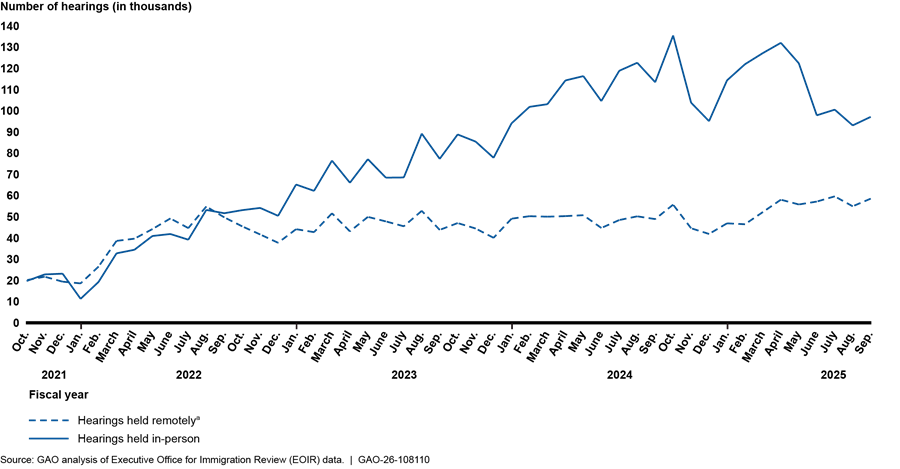
The total number of immigration hearings increased almost 150 percent from FY 2022 through 2025, from approximately 817,000 to approximately 2 million hearings, according to EOIR data. Figure 2 shows the number of hearings that took place remotely increased almost 50 percent comparing FY 2022 to FY 2025, while the number of in-person hearings increased more dramatically, by almost 250 percent. For a month-by-month breakdown of the number of remote and in-person hearings from FY 2022 through 2025, see figure 6 in appendix II.
Figure 2: Number and Percentage of Immigration Court Hearings Held Remotely and In-Person, Fiscal Years 2022–2025
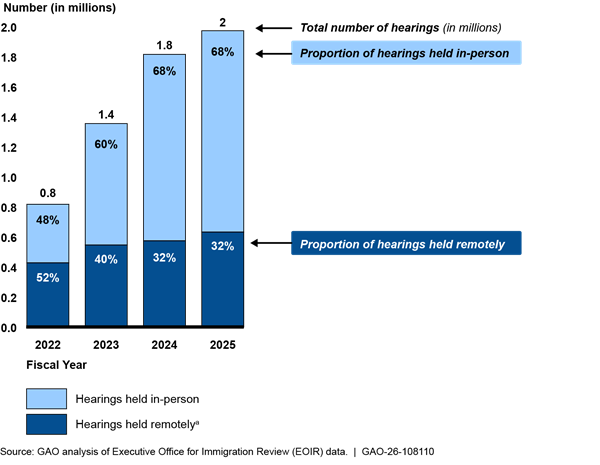
Note: The numbers of hearings in this figure are rounded to the nearest hundred thousand. Based on discussions with EOIR officials, we excluded records of hearings that were unlikely to have occurred. Additional details on these exclusions are described in appendix I of this report.
aRemote hearings refer to hearings where the judge, the respondent, or both participate from a location other than the courtroom using WebEx, video teleconference (VTC), or telephone conference.
EOIR officials attributed the increase in immigration hearings to a combination of factors. These include the return to normal operations after the COVID-19 pandemic as well as prior immigration policies. Specifically, EOIR officials stated that as the COVID-19 pandemic subsided, immigration courts began scheduling more hearings overall, and data show more of these hearings took place in-person. Officials added that the number of in-person hearings in FY 2023, 2024, and 2025 returned to align with the pre-pandemic trend in hearing volume. In addition, EOIR officials said that prior immigration policies led to an increase in the total number of immigration cases, as well as the number of hearings required per case, which contributed to the increase in immigration hearings overall each year.
As seen in figure 3, EOIR held nearly 6 million immigration hearings from FY 2022 through 2025. Of these, about 63 percent (approximately 3.8 million) were held in-person, and the remaining 37 percent (approximately 2.2 million) were held remotely. Of these remote hearings, about 78 percent (approximately 1.7 million) used WebEx.
Figure 3: Approximate Number and Percentage of Immigration Court Hearings Held Remotely and In-Person, Fiscal Years 2022-2025
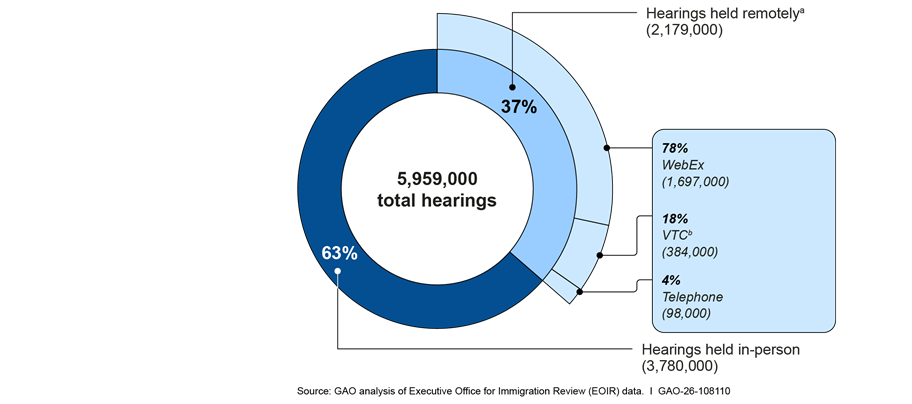
Note: The numbers of hearings in this figure have been rounded to the nearest thousand. Further, based on discussions with EOIR officials, we excluded records of hearings that were unlikely to have occurred. Additional details on these exclusions are described in appendix I of this report.
aRemote hearings refer to hearings where the judge, the respondent, or both participate from a location other than the courtroom using WebEx, video teleconference (VTC), or telephone conference.
bVTC refers to video teleconference technology.
Immigration Hearings by Medium and Custody Status
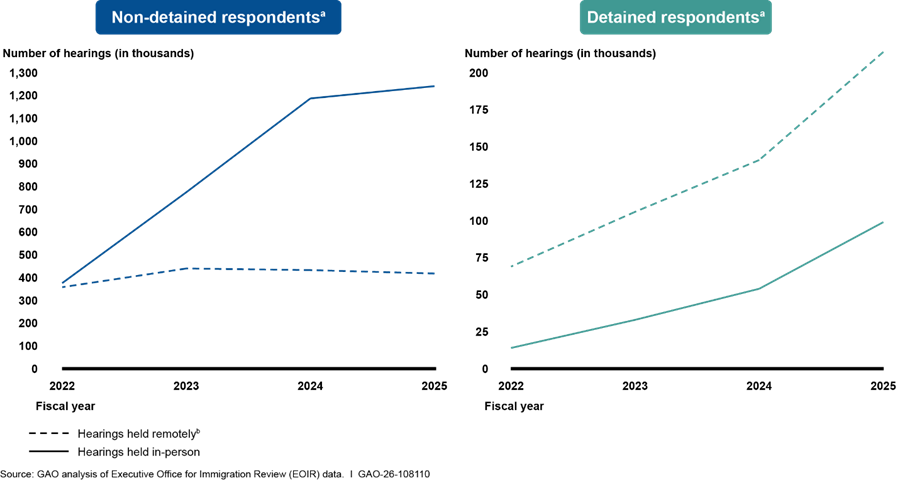
From FY 2022 through 2025, approximately 88 percent (about 5.2 million) of all immigration hearings were for non-detained respondents, while the rest (about 731,000) were for detained respondents.[22] As shown in figure 4, for non-detained respondents, about one-third (about 1.6 million) hearings were remote during this time period, and the proportions of remote and in-person hearings were consistent with those of the total respondent population.
Specifically, in FY 2022, the number of hearings for non-detained respondents was nearly evenly divided between remote and in-person. However, starting in FY 2023, the number and proportion of in-person hearings continued to rise through FY 2025, while the proportion of remote hearings decreased overall during this period. Given that non-detained respondents comprise most of the total respondent population, EOIR officials said the same factors driving the hearing medium trends for total immigration hearings applied to the non-detained respondents as well.
Figure 4 also shows that in contrast, approximately 73 percent (about 531,000) of hearings for detained respondents were held remotely, and the number of in-person and remote hearings for detained respondents followed a similar upward trajectory every year. Court stakeholders told us that detained respondents typically appear at hearings using a remote medium because it is more efficient than for example, incurring the costs of transporting detained respondents to the courthouse.[23] During our hearing observations, we saw examples of detained respondents who appeared remotely from WebEx-equipped rooms in a detention facility.
Figure 4: Number of Immigration Court Hearings for Non-Detained and Detained Respondents Held Remotely and In-Person, Fiscal Years 2022–2025
Note: The numbers of hearings in this figure are rounded to the nearest thousand. Based on discussions with EOIR officials, we excluded records of hearings that were unlikely to have occurred. Additional details on these exclusions are described in appendix I of this report.
aThe custody status of a respondent may change over the course of their case. For this analysis, we used the custody status of a respondent listed at the time EOIR extracted the data, which reflected either the custody status when the case was closed or, if a case was ongoing, the custody status at the time of the data extraction. A respondent may have had a different custody status at the time of any particular hearing. In EOIR’s data, the custody categories are “never detained,” “released,” or “detained.” We combined “never detained” and “released” into a single category “non-detained” for the purposes of our analyses.
bRemote hearings refer to hearings where the judge, the respondent, or both participate from a location other than the courtroom using WebEx, video teleconference (VTC), or telephone conference.
Immigration Hearings by Medium and Type of Hearing
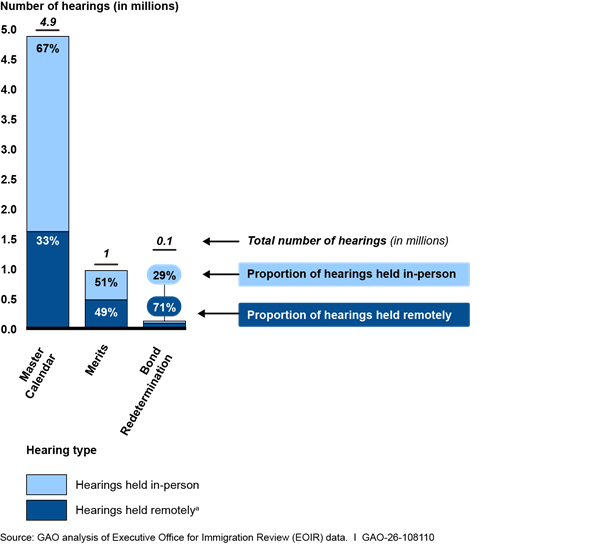
The vast majority of the nearly 6 million immigration hearings held from FY 2022 through 2025 were master calendar hearings (about 4.9 million), compared to merits or bond redetermination hearings, as shown in figure 5.[24] Of these master calendar hearings, about one-third were held remotely (about 1.6 million). EOIR officials said master calendar hearings are primarily held in-person because it is the first interaction the court has with the respondent. EOIR officials also noted that the initial Notice to Appear sent to respondents lists a physical immigration court address that a respondent is expected to report to for their initial master calendar hearing. We also heard from court stakeholders that some judges typically require non-detained respondents to appear at their initial master calendar hearing in-person to verify their identity and understanding of court proceedings.
Regarding merits hearings, our analysis showed that they were roughly split between in-person and remote during this time period. Court stakeholders we met with indicated that some judges prefer in-person merits hearings because they generally address the specific facts and circumstances of the case, and they find it easier to assess respondent and witness credibility in-person. Other judges are more amenable to remote merits hearings or may have a fully remote docket.
Bond redetermination hearings constituted a small number of the overall hearings (about 122,000) from FY 2022 through 2025. Of these, about 71 percent were held remotely (about 87,000). Court stakeholders noted that bond redetermination hearings are often held remotely because these respondents are in detention facilities at the time of the hearing.
Figure 5: Number and Percentages of Master Calendar, Merits, and Bond Redetermination Immigration Hearings Held Remotely and In-Person, Fiscal Years 2022–2025
Note: The numbers in this figure are rounded to the nearest hundred thousand. Based on discussions with EOIR officials, we excluded records of hearings that were unlikely to have occurred. Additional details on these exclusions are described in appendix I of this report.
aRemote hearings refer to hearings where the judge, the respondent, or both participate from a location other than the courtroom using WebEx, video teleconference (VTC), conference.
Agency Officials and Selected Court Stakeholders Described Generally Favorable Experiences with Remote Immigration Hearings
Remote Technology Generally Provides Increased Flexibility and Opportunities for Greater Efficiency in Immigration Hearings
Immigration judges and attorneys we met with provided their perspectives on how holding immigration hearings remotely using WebEx may benefit judges, attorneys, and respondents.[25] As shown in table 1, examples of benefits they described include reducing the time and cost associated with in-person hearings, increasing the efficiency of hearings, increasing agency flexibility to address staffing or space constraints, and allowing respondents increased access to private bar attorneys.[26]
Table 1: Perspectives on the Benefits of Holding Immigration Hearings Remotely According to Selected Court Stakeholders
|
Benefit |
Description |
Examples |
|
Reduced time and costs associated with travel to court |
Hearings held remotely using WebEx can save participants time and money by eliminating the need to travel to court. Hearing participants, such as non-detained respondents, their attorneys, or witnesses may be located hours away from the assigned immigration court, which can make it difficult and costly to travel to an in-person hearing. |
One judge from the Fort Snelling, Minnesota immigration court stated the court’s large geographic area of responsibility—which includes all of Minnesota, North Dakota, and South Dakota—and frequent inclement weather can create obstacles for participants trying to attend an immigration hearing in-person. The judge stated that conducting hearings using WebEx reduces the need for participants to travel and makes participating in court proceedings more accessible. |
|
During one hearing we observed in the Tacoma, Washington immigration court, the respondent was located in Alaska and appeared by WebEx with their attorney. The judge at the hearing noted that the respondent’s case should have been reassigned to another judge. However, using WebEx, the attorney and respondent were able to appear in court as required and receive instructions for next steps to appear before the appropriate judge, without having to incur the potentially significant amount of time and cost associated with appearing in-person. |
||
|
Remote hearing technology can also allow witnesses to participate in a hearing when they may not have otherwise been able to. |
One Office of the Principal Legal Advisor (OPLA) attorney we spoke with said that WebEx allows witnesses located in other countries to participate remotely in a hearing rather than only submitting written testimony, which may not be as helpful. Specifically, having a witness appearing remotely via WebEx allows judges and attorneys to ask questions to better understand their testimony and to assess their overall credibility, which improves the quality of facts a judge can consider when making their decision on a case. |
|
|
Increased efficiency of immigration hearings |
Using WebEx makes it possible for judges to hold hearings more efficiently |
One judge said that by using WebEx she can more efficiently provide initial advisory information that would otherwise have to be repeated for each respondent.a By using WebEx, she can group respondents together according to their primary language and then she can issue these advisory statements once through a language interpreter, if appropriate. In contrast, she said she does not have the flexibility to group respondents this way for in-person hearings. |
|
WebEx allows judges to maintain control of their courtrooms more effectively than hearings held in-person. |
One judge told us they can quickly move disruptive participants, like a witness with a crying child, to the WebEx virtual waiting room to allow the court proceedings to continue until that person is needed for the hearing. Another judge told us that in a traditional courtroom, if there is a disorderly person present, they may have to stop the hearing and wait for a bailiff to escort that person out of the room. But using WebEx, the judge can remove that distraction more quickly and easily. |
|
|
During our hearing observations, we saw a judge use the virtual waiting room to minimize disruptions to a docket of master calendar hearings for non-detained respondents who appeared remotely using WebEx. In this instance, a respondent did not comply with the judge’s instruction to turn on their camera. It was not apparent if the respondent was having technical issues or was refusing to comply with the judge’s instructions. The judge told the respondent that because they did not comply with her instruction, she was moving them to the virtual waiting room so she could address the next hearing on her docket. Afterwards the judge brought the respondent back into the virtual courtroom. The respondent had turned their camera on, and the judge moved forward with the respondent’s hearing. |
||
|
Increased agency flexibility to address staffing or space constraints |
WebEx allows judges to appear in other court locations outside of their normal geographic area without incurring the time or cost associated with physically relocating judges to a different court location. |
One judge told us EOIR uses WebEx to help redistribute hearings to judges and courts with capacity regardless of their location. This is useful when one location has a high number of respondents awaiting a hearing, and another location has one or more judges with excess capacity to hear those cases. This judge also told us that due to courtroom space limitations, she does not have an assigned courtroom and almost exclusively uses WebEx to oversee hearings on her docket. The judge explained that using WebEx allows her to hear cases without needing physical space in a court. |
|
WebEx allows OPLA attorneys to participate in hearings in different or multiple court locations. |
According to OPLA officials, they do not always have enough attorneys available for hearings at a particular court location to meet the volume of immigration hearings scheduled at that court. Officials said that Webex allows OPLA attorneys to be able to participate in hearings in a different court location, as well as attend hearings in multiple court locations in a single day and prevent unnecessary delays. They also told us that hearing schedules can change, and as a result, an OPLA attorney originally assigned to a hearing may not be available at the rescheduled date and time. |
|
|
OPLA attorneys we spoke with who are responsible for immigration hearings in their assigned court in Fort Snelling, Minnesota, are also responsible for some hearings at immigration courts in California, Texas and Virginia. These attorneys stated that OPLA attorneys are usually expected to appear in-person for hearings at their assigned court location, but they use WebEx to remotely attend hearings when representing the government at one of the other court locations. |
||
|
Increased respondent access to private bar attorneys for representation |
WebEx gives respondents greater access to counsel because respondents are not limited to attorneys located near the assigned immigration court. |
One judge told us that because attorneys can appear remotely using WebEx, they can represent clients across state lines without the time and expense of traveling to those locations. As a result, these attorneys can serve more clients. |
|
One private bar attorney told us that this flexibility can help respondents in locations where there may not be enough local immigration attorneys to cover the number of respondents with hearings at a particular court. |
Source: GAO analysis of interviews with immigration judges from the Department of Justice Executive Office for Immigration Review (EOIR), attorneys from the Department of Homeland Security Office of the Principal Legal Advisor (OPLA), immigration judges who are members of the National Association of Immigration Judges, private bar attorneys who are members of the American Immigration Lawyers Association organization, and GAO’s observation of selected immigration hearings. | GAO‑26‑108110
aAt the opening of a master calendar hearing, the immigration judge must advise each respondent of several rights, such as the respondent’s right to have representation (at no government expense), the availability of legal services provided by qualified attorneys, and that the respondent will have a reasonable opportunity to examine evidence presented by the government. 8 C.F.R. §1240.10
Immigration Court Stakeholders Described Challenges Including Judges’ Differing Preferences for Hearing Mediums and Limitations of Technology
While judges, OPLA attorneys and private bar attorneys we spoke with regarded remote immigration hearings favorably, some identified challenging aspects of remote hearings, such as variation in judge preferences for remote hearings, and technology limitations for language interpretation options.[27]
Variation in Factors Judges Use to Decide Hearing Medium
Some court stakeholders we spoke with said that while they recognize judges have discretion, there can be considerable variation among judges regarding whether and under what circumstances they allow a participant to appear remotely at a hearing using WebEx. These court stakeholders told us that the variation among judges can be challenging to navigate. For example, one private bar attorney said a judge she appears before generally requires attorneys to appear in-person for all hearings. Another judge at the same court permits attorneys to appear by WebEx for master calendar and bond redetermination hearings, but requires these attorneys appear in person for merits hearings. Further, two judges we spoke with said they are aware of some judges who generally do not allow participants to appear remotely.
Immigration judges from some of the selected court locations and members of the non-governmental association of immigration judges described a range of factors they consider when deciding whether to allow a participant to appear remotely using WebEx. Several judges noted that they make decisions based on the desire for hearings to be held in a timely, efficient, and effective manner, while others described a few specific criteria they use. For example,
· One judge noted that if the respondent lives close enough that travel is reasonable, she wants them to appear in court in-person. She said that she is likely to grant a request to appear by WebEx for respondents that do not live in the local area, have a medical condition, recently gave birth, or other similar circumstances.
· A judge from a different court stated she is more likely to grant a motion to appear remotely if she believes the respondent can adhere to proper courtroom decorum from the remote location—for example, that they are dressed appropriately and will appear from a private area with no background noise or distractions. This judge also stated she wants remote hearing respondents to appear on camera at all times during the hearing and act as though they are physically in the courtroom.
· Another judge told us that sometimes it can be difficult to ensure respondents who appear remotely by WebEx are not looking at notes or other materials to aid in their testimony, which is not allowed. This judge also stated that she is aware of judges who will almost never hold a hearing using WebEx because they prefer the formality of the courtroom and having all parties present. During our hearing observations, we saw an example of a judge trying to ensure a respondent—participating by WebEx—adhered to these rules. The judge suspected the respondent had a document in front of them during their testimony and stopped the hearing to question them. The respondent used their camera to show there was no paper in front of them and the hearing resumed.
As described earlier, current EOIR policy recognizes that judges have broad discretion to decide whether and when to allow a participant to appear at a hearing remotely. While the prior rescinded guidance provided some factors judges should consider when deciding a motion to appear remotely, judges we spoke with from all four selected courts generally found the current guidance sufficient and did not think the prior guidance was significantly helpful in their decision making with regard to allowing participants to attend hearings remotely.[28]
Simultaneous Interpretation Is Not Available for Remote Hearings
For in-person hearings where the respondent and the language interpreter are in the same location, EOIR is able to use simultaneous interpretation—where the respondent wears headphones so the interpreter can provide translation continuously in real time—to hold the hearing and create the required DAR recording. In contrast, with consecutive interpretation, participants must pause after each statement, so the interpreter can provide the translation.[29] In hearings where the respondent and language interpreter are not in the same location, current WebEx technology does not allow for simultaneous interpretation, according to EOIR officials. Consecutive interpretation is less efficient and can cause hearings to take double or triple the time compared to hearings with simultaneous language interpretation, according to EOIR officials and some court stakeholders.[30]
From FY 2022 through 2025 EOIR data show there were immigration hearings held for respondents who speak almost 600 different languages. Of the nearly 6 million total hearings held during this period, hearings for non-English speakers comprised about 5.7 million—of which about 2.0 million were held remotely.[31]
EOIR officials stated that WebEx does not have the capability to accommodate simultaneous language interpretation and create the required DAR recording of a hearing. They noted that WebEx was not developed with this purpose or capability in mind. However, EOIR officials also stated they are aware of this issue and are exploring ways to add this technological capability as options become available.
Technology Issues Can Sometimes Affect Remote Hearings
While some court stakeholders we spoke with mentioned that they occasionally experienced minor technology issues during hearings using WebEx, such as video or audio dropping momentarily for a participant, they did not consider these issues a significant or widespread problem. For example, one judge told us that while there are occasional issues with technology, he has become adept at resolving most technology issues he experiences when holding hearings by WebEx. OPLA officials also noted that their experiences with WebEx for immigration hearings have improved in quality and reliability since the technology was initially implemented.
In 15 of the 22 immigration hearings we attended, there were no observable technical issues. In the remaining seven hearings, we observed minor technology-related issues, but none were significant enough to cause delays in the hearing or require it to be postponed. For example, in one hearing we attended, the respondent appeared by WebEx from a detention facility and told the judge he could not hear the interpreter clearly. The judge paused the proceeding and was able to address this issue. In another hearing, we observed ambient noise from someone typing that periodically affected participants’ ability to hear each other, but participants repeated themselves as needed and the hearing continued to completion. EOIR officials stated they did not think these kinds of technology issues were indicative of a widespread or systemic issue and noted that these issues more likely stem from the bandwidth or technology at the participant’s location, as opposed to EOIR’s technology platform or infrastructure.
We provided a draft of this report to the Department of Justice and the Department of Homeland Security for review and comment. Both agencies provided technical comments, which we incorporated as appropriate. We are sending copies of this report to the appropriate congressional committees, the Attorney General, and the Secretary of Homeland Security. In addition, the report is available at no charge on the GAO website at https://www.gao.gov.
If you or your staff have any questions about this report, please contact me at MacLeodH@gao.gov. Contact points for our Offices of Congressional Relations and Media Relations may be found on the last page of this report. GAO staff who made key contributions to this report are listed in appendix III.

Heather MacLeod
Director, Homeland Security and Justice
List of Committees
The Honorable Jerry Moran
Chair
The Honorable Chris Van Hollen
Ranking Member
Subcommittee on Commerce, Justice, Science, and Related Agencies
Committee on Appropriations
United States Senate
The Honorable Hal Rogers
Chairman
The Honorable Grace Meng
Ranking Member
Subcommittee on Commerce, Justice, Science, and Related Agencies
Committee on Appropriations
United States House of Representatives
Appendix I: Scope and Methodology for Analysis of Immigration Hearing Data from the Executive Office for Immigration Review
This appendix provides additional information regarding the scope and methodology of our analysis of the Executive Office for Immigration Review (EOIR) data on immigration hearings. Specifically, we analyzed data on immigration hearings that occurred from fiscal year (FY) 2022 through 2025 from EOIR’s Case Access System for EOIR (CASE).[32] We selected this time frame to capture EOIR’s use of remote technology from the first full fiscal year since the COVID-19 pandemic subsided through the most recent full fiscal year of data available at the time of our review. To assess the reliability of these data, we performed electronic testing, reviewed documentation about the system, compared data to previously reported results, and interviewed EOIR officials. We found these data to be sufficiently reliable for the purpose of describing the frequency and distribution of immigration hearings by medium (in-person or remote by WebEx, video teleconference (VTC), and telephone), and by other characteristics, such as type of hearing and respondent custody status (whether the respondent was detained or not detained).
According to EOIR officials, CASE is used by immigration courts to schedule hearings which ultimately may or may not occur. It is not intended to be used for analyzing some of the characteristics we wanted to analyze for this report, and it does not have a specific variable that reliably indicates whether or not a hearing occurred. In consultation with EOIR officials, we identified and removed hearing records that likely did not represent a hearing that actually took place, such as a hearing that was rescheduled. Specifically, after discussion with EOIR officials, we used the following characteristics to identify and remove records where no hearing likely occurred:
· Digital Audio Recording (DAR). A DAR recording is the official record of an immigration hearing. For all immigration hearings, both in-person and remote, EOIR uses the DAR system to record court proceedings. Judges must turn on the DAR at the beginning of an immigration hearing and each time the court goes off and back on the record during a hearing. According to EOIR officials, hearing records with a DAR recording that is 60 seconds or longer are indicators that a hearing likely occurred. Officials said that we can infer any records that do not have a DAR recording or have a recording lasting less than 60 seconds do not reflect an actual hearing that occurred. We removed records without a DAR or with a DAR less than 60 seconds long.
· Hearing medium. In CASE, this variable has values to indicate whether the hearing was in-person or conducted by WebEx, VTC, or telephone, or whether there was no hearing.[33] According to EOIR officials, records that have a “no hearing” value or an erroneous value in the hearing medium field (such as “-”), or records where this field was blank, indicate the hearing likely did not take place. We removed these records.
· Hearing adjournment code. At the end of each hearing, judges select an adjournment code in CASE to indicate why the hearing was adjourned, choosing one adjournment code for each hearing that best represents the main reason for the adjournment.[34] Based on prior EOIR statistical reports on hearings and in consultation with EOIR officials, we identified and removed hearing records with adjournment codes that suggest a hearing did not occur. Specifically, we excluded records with adjournments codes: 59 (COURT CLOSURE), 74 (PUBLIC HEALTH), 99 (DATA ENTRY ERROR), or 8A (IJ COMPLETION), as well as records missing an adjournment code value.
Although we cannot be certain we identified and excluded every record that does not reflect a hearing that actually occurred, we believe the resulting filtered dataset is a reasonable approximation for the purposes of describing hearings that occurred from FY 2022 through 2025 by hearing medium.
To provide information on the custody status of the respondent (whether the respondent was detained or non-detained) for each hearing record, we used the “custody” variable in the “Proceeding” table in CASE. According to EOIR officials, this field reflects the custody status of the respondent at the time the case was closed, or at the point in time that the data was extracted, if the case had not been closed. Therefore, there may be instances where the custody status captured in our analyses does not reflect the actual custody of the respondent at the time the specific hearing took place. To examine the extent to which this could affect our ability to report on custody status for hearings, we used data from a more detailed table EOIR uses to document the date custody changes occur by respondent, to analyze how often the custody status changed for respondents in our dataset during our study period. We found that fewer than 4 percent of respondents had a change in custody status during the study period. As a result, we found the custody information in the “Proceeding” table in CASE was a reasonable indicator of the custody status of respondents who had hearings that occurred during our study period.
To provide information on the proportion of judges who presided over remote and in-person hearings from FY 2022 through 2025, we excluded judges where the judge is not identifiable, for example, records reflecting a “visiting judge”. We also excluded judges who presided over less than 100 hearings in total from FY 2022 through 2025 to try to capture information about judges who were active and engaged in hearings during the study period.
Appendix II: Additional Data Figures and Tables Regarding Immigration Hearings, Fiscal Years 2022-2025
In the Executive Office for Immigration Review’s (EOIR) database application—the Case Access System for EOIR (CASE)—EOIR tracks data related to hearing characteristics, including information on immigration judges and respondents. The following figures and tables provide additional information on hearing characteristics from fiscal year (FY) 2022 through 2025:
· Figure 6 describes the number of immigration hearings that took place remotely and in-person by month.
· Figure 7 describes the number of immigration judges by the proportion of hearings they held remotely.
· Table 2 describes the number and percentage of immigration hearings by type of case, custody status, and hearing medium.
· Table 3 describes the number and percentage of immigration hearings by the ten most common respondent nationalities and hearing medium.
· Table 4 describes the number and percentage of immigration hearings by the ten most common languages spoken by respondents and hearing medium.
· Table 5 describes the number and percentage of immigration hearings by the cities with the ten highest total number of immigration hearings and hearing medium for non-detained respondents.
· Table 6 describes the number and percentage of immigration hearings by the cities with the ten highest total number of immigration hearings and hearing medium for detained respondents.
· Table 7 describes the number and percentage of immigration hearings by the hearing type, custody status, and hearing medium. Hearing type refers to master calendar, merits, and bond redetermination hearings.
Figure 6: Number of Immigration Court Hearings Held Remotely and In-Person by Month, Fiscal Years 2022-2025
Note: Based on discussions with EOIR officials, we excluded records of hearings that were unlikely to have occurred. Additional details on these exclusions are described in appendix I of this report.
aRemote hearings refer to hearings where the judge, the respondent, or both participate from a location other than the courtroom using WebEx, video teleconference (VTC), or telephone conference
Figure 7: Number of Immigration Judges by the Proportion of Hearings They Held Remotely, Fiscal Years 2022-2025
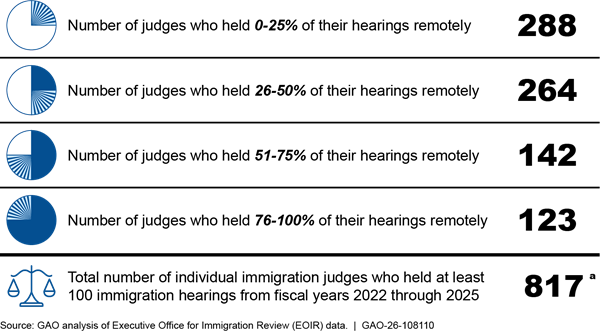
Note: Remote hearings refer to hearings where the judge, the respondent, or both participate from a location other than the courtroom using WebEx, video teleconference (VTC), or telephone conference. Further, based on discussions with EOIR officials, we excluded records of hearings that were unlikely to have occurred. We excluded judges who held fewer than 100 hearings in total from FY 2022 through 2025. Additional details on exclusions are described in appendix I of this report.
aThis total reflects the number of individual immigration judges who presided over at least 100 immigration hearings at any time during the fiscal year 2022 through 2025 period.
Table 2: Approximate Number and Distribution of Immigration Hearings by Case Type, Respondent Custody Status, and Hearing Medium, Fiscal Years 2022-2025
|
Case typea |
Total hearings (#) |
Hearings held in-person |
Hearings held using a remote mediumb |
||
|
(#) |
(%) |
(#) |
(%) |
||
|
Asylum: Total |
6,300 |
3,100 |
48 |
3,300 |
52 |
|
Asylum: Detainedc |
2,400 |
900 |
38 |
1,500 |
62 |
|
Asylum: Non-Detainedc |
3,900 |
2,100 |
54 |
1,800 |
46 |
|
Credible/Reasonable Fear: Total |
149,300 |
27,100 |
18 |
122,200 |
82 |
|
Credible/reasonable fear: Detained |
129,500 |
13,400 |
10 |
116,100 |
90 |
|
Credible/reasonable fear: Non-Detained |
19,800 |
13,700 |
69 |
6,100 |
31 |
|
Removal: Total |
5,748,600 |
3,728,500 |
65 |
2,020,000 |
35 |
|
Removal: Detained |
566,800 |
176,600 |
31 |
390,200 |
69 |
|
Removal: Non-Detained |
5,181,700 |
3,551,900 |
69 |
1,629,800 |
31 |
|
Withholding: Total |
48,900 |
18,700 |
38 |
30,100 |
62 |
|
Withholding: Detained |
32,400 |
9,800 |
30 |
22,600 |
70 |
|
Withholding: Non-Detained |
16,500 |
9,000 |
54 |
7,500 |
46 |
|
Other: Total |
6,000 |
2,600 |
44 |
3,400 |
56 |
|
Other: Detained |
200 |
100 |
29 |
200 |
71 |
|
Other: Non-Detained |
5,800 |
2,600 |
44 |
3,200 |
56 |
|
Overall Total |
5,959,000 |
3,780,000 |
63 |
2,179,000 |
37 |
Source: GAO analysis of Executive Office for Immigration Review (EOIR) data. | GAO‑26‑108110
Note: The numbers of hearings in this table have been rounded to the nearest hundred and therefore may not sum to the totals. Further, based on discussions with EOIR officials, we excluded records of hearings that were unlikely to have occurred. Additional details on these exclusions are described in appendix I of this report.
aFor the purposes of our analysis, we combined the “credible fear review” and “reasonable fear” case types in EOIR’s CASE data. We combined the following case types into the “other” category: continued detention review, claimed status review, departure control, DD appeal, deportation, exclusion, Nicaraguan Adjustment and Central American Relief Act adjustment, rescission, and AOL an undocumented case type code.
bHearings held using a remote medium refer to hearings where the judge, the respondent, or both participate from a location other than the courtroom using WebEx, video teleconference (VTC), or telephone conference.
cThe custody status of a respondent may change over the course of their case. We used the custody status of a respondent at the time EOIR extracted the data, which agency officials told us, reflected the status at the end of a case or, if a case was ongoing, the status at the time of the data extraction. A respondent may have had a different custody status at the time of any particular hearing. Non-detained respondents refer to respondents who had a custody status of “never detained” or “released.” Detained respondents refer to respondents who had a custody status of “detained.”
Table 3: Approximate Number and Distribution of Hearings for the Ten Most Common Respondent Nationalities and Hearing Medium, Fiscal Years 2022-2025
|
Respondent nationality |
Total hearings (#) |
Hearings held in-person |
Hearings held using a remote mediuma |
||
|
(#) |
(%) |
(#) |
(%) |
||
|
Mexico |
836,000 |
546,000 |
65 |
290,000 |
35 |
|
Honduras |
672,000 |
444,000 |
66 |
228,000 |
34 |
|
Guatemala |
660,000 |
418,000 |
63 |
242,000 |
37 |
|
Venezuela |
540,000 |
404,000 |
75 |
136,000 |
25 |
|
Colombia |
406,000 |
288,000 |
71 |
118,000 |
29 |
|
El Salvador |
378,000 |
205,000 |
54 |
173,000 |
46 |
|
Ecuador |
337,000 |
212,000 |
63 |
125,000 |
37 |
|
Nicaragua |
310,000 |
201,000 |
65 |
109,000 |
35 |
|
Cuba |
247,000 |
181,000 |
73 |
66,000 |
27 |
|
Brazil |
205,000 |
116,000 |
56 |
89,000 |
44 |
|
All other nationalities |
1,368,000 |
765,000 |
56 |
604,000 |
44 |
|
Total |
5,959,000 |
3,780,000 |
63 |
2,179,000 |
37 |
Source: GAO analysis of Executive Office for Immigration Review (EOIR) data. | GAO‑26‑108110
Note: The numbers of hearings in this table have been rounded to the nearest thousand and therefore may not always sum to the totals. Further, based on discussions with EOIR officials, we excluded records of hearings that were unlikely to have occurred. Additional details on these exclusions are described in appendix I of this report.
aHearings held using a remote medium refer to hearings where the judge, the respondent, or both participate from a location other than the courtroom using WebEx, video teleconference (VTC), or telephone conference.
Table 4: Approximate Number and Distribution of Hearings for the Ten Most Common Respondent Language Spoken and Hearing Medium, Fiscal Years 2022-2025
|
Respondent language |
Total hearings (#) |
Hearings held in-person |
Hearings held using a remote mediuma |
||
|
(#) |
(%) |
(#) |
(%) |
||
|
Spanish |
4,535,000 |
3,022,000 |
67 |
1,513,000 |
33 |
|
English |
229,000 |
112,000 |
49 |
117,000 |
51 |
|
Portuguese |
194,000 |
108,000 |
55 |
87,000 |
45 |
|
Creole |
180,000 |
124,000 |
69 |
57,000 |
31 |
|
Russian |
122,000 |
70,000 |
57 |
53,000 |
43 |
|
Mandarin |
90,000 |
36,000 |
40 |
53,000 |
60 |
|
Punjabi |
56,000 |
24,000 |
43 |
32,000 |
57 |
|
Turkish |
43,000 |
21,000 |
48 |
22,000 |
52 |
|
Arabic |
39,000 |
21,000 |
53 |
18,000 |
47 |
|
Wolof |
26,000 |
15,000 |
58 |
11,000 |
42 |
|
All other languages |
445,000 |
228,000 |
51 |
217,000 |
49 |
|
Total |
5,959,000 |
3,780,000 |
63 |
2,179,000 |
37 |
Source: GAO analysis of Executive Office for Immigration Review (EOIR) data. | GAO‑26‑108110
Note: The numbers of hearings in this table have been rounded to the nearest thousand and therefore may not always sum to the totals. Further, based on discussions with EOIR officials, we excluded records of hearings that were unlikely to have occurred. Additional details on these exclusions are described in appendix I of this report.
aHearings held using a remote medium refer to hearings where the judge, the respondent, or both participate from a location other than the courtroom using WebEx, video teleconference (VTC), or telephone conference.
Table 5: Approximate Number and Distribution of Immigration Hearings by Hearing Medium for Non-Detained Respondents for the Top Ten Cities with the Most Total Hearings, Fiscal Years 2022-2025
|
City, State |
Total hearings for all respondents (#) |
Hearings for non-detained respondentsa |
||||
|
Total hearings for non-detained respondents (#) |
Hearings held using a remote mediumb |
Hearings held in-person |
||||
|
(#) |
(%) |
(#) |
(%) |
|||
|
New York City, NY |
735,200 |
730,300 |
330,000 |
45 |
400,300 |
55 |
|
Houston, TX |
356,100 |
341,000 |
78,900 |
23 |
262,100 |
77 |
|
Miami, FL |
297,600 |
269,400 |
97,200 |
36 |
172,200 |
64 |
|
Los Angeles, CA |
280,200 |
279,400 |
124,000 |
44 |
155,400 |
56 |
|
Santa Ana, CA |
263,800 |
261,600 |
101,700 |
39 |
159,900 |
61 |
|
Chicago, IL |
198,400 |
187,800 |
38,300 |
20 |
149,500 |
80 |
|
Boston, MA |
180,600 |
175,700 |
85,400 |
49 |
90,400 |
51 |
|
San Francisco, CA |
176,200 |
175,700 |
37,300 |
21 |
138,500 |
79 |
|
Dallas, TX |
150,100 |
147,800 |
16,200 |
11 |
131,600 |
89 |
|
Newark, NJ |
150,100 |
149,300 |
39,800 |
27 |
109,400 |
73 |
|
All other cities |
3,170,700 |
2,509,700 |
699,800 |
28 |
1,810,000 |
72 |
|
Total |
5,959,000 |
5,227,700 |
1,648,400 |
32 |
3,579,300 |
68 |
Source: GAO analysis of Executive Office for Immigration Review (EOIR) data. | GAO‑26‑108110
Note: The numbers of hearings have been rounded to the nearest hundred and therefore may not always sum to the totals. Further, based on discussions with EOIR officials, we excluded records of hearings that were unlikely to have occurred. Additional details on these exclusions are described in appendix I of this report.
aThe custody status of a respondent may change over the course of their case. We used the custody status of a respondent at the time EOIR extracted the data, which agency officials told us, reflected the status at the end of a case or, if a case was ongoing, the status at the time of the data extraction. A respondent may have had a different custody status at the time of any particular hearing. Non-detained respondents refer to respondents who had a custody status of “never detained” or “released.”
bHearings held using a remote medium refer to hearings where the judge, the respondent, or both participate from a location other than the courtroom using WebEx, video teleconference (VTC), or telephone conference.
Table 6: Approximate Number and Distribution of Immigration Hearings by Hearing Medium for Detained Respondents for the Top Ten Cities with the Most Total Hearings, Fiscal Years 2022-2025
|
City, State |
Total hearings for all respondents (#) |
Hearings for detained respondentsa |
||||
|
Total hearings for detained respondents (#) |
Hearings held using a remote mediumb |
Hearings held in-person |
||||
|
(#) |
(%) |
(#) |
(%) |
|||
|
New York City, NY |
735,200 |
4,900 |
2,300 |
47 |
2,600 |
53 |
|
Houston, TX |
356,100 |
15,100 |
13,300 |
88 |
1,900 |
12 |
|
Miami, FL |
297,600 |
28,200 |
10,000 |
35 |
18,200 |
65 |
|
Los Angeles, CA |
280,200 |
900 |
400 |
52 |
400 |
48 |
|
Santa Ana, CA |
263,800 |
2,200 |
1,400 |
62 |
800 |
38 |
|
Chicago, IL |
198,400 |
10,500 |
9,500 |
90 |
1,000 |
10 |
|
Boston, MA |
180,600 |
4,900 |
4,300 |
89 |
500 |
11 |
|
San Francisco, CA |
176,200 |
500 |
100 |
22 |
400 |
78 |
|
Dallas, TX |
150,100 |
2,200 |
300 |
12 |
2,000 |
88 |
|
Newark, NJ |
150,100 |
800 |
100 |
16 |
700 |
84 |
|
All other cities |
3,170,700 |
660,900 |
488,800 |
74 |
172,100 |
26 |
|
Total |
5,959,000 |
731,300 |
530,600 |
73 |
200,700 |
27 |
Source: GAO analysis of Executive Office for Immigration Review (EOIR) data. | GAO‑26‑108110
Note: The numbers of hearings have been rounded to the nearest hundred and therefore may not always sum to the totals. Further, based on discussions with EOIR officials, we excluded records of hearings that were unlikely to have occurred. Additional details on these exclusions are described in appendix I of this report.
aThe custody status of a respondent may change over the course of their case. We used the custody status of a respondent at the time EOIR extracted the data, which agency officials told us, reflected the status at the end of a case or, if a case was ongoing, the status at the time of the data extraction. A respondent may have had a different custody status at the time of any particular hearing. Detained respondents refer to respondents who had a custody status of “detained.”
bHearings held using a remote medium refer to hearings where the judge, the respondent, or both participate from a location other than the courtroom using WebEx, video teleconference (VTC), or telephone conference.
Table 7: Approximate Number of Immigration Hearings by Hearing Type, Custody Status, and Hearing Medium, Fiscal Years 2022-2025
|
Hearing type |
Total hearings (#) |
Custody statusb of respondents and hearing medium |
|||||||||
|
Hearings for non-detained respondents |
Hearings for detained respondents |
||||||||||
|
Total hearings: non- detained |
Hearings held using a remote mediuma |
Hearings held in- person |
Total hearings: detained |
Hearings held using a remote mediuma |
Hearings held in-person |
||||||
|
(#) |
(#) |
(%) |
(#) |
(%) |
(#) |
(#) |
(%) |
(#) |
(%) |
||
|
Master calendar |
4,872,000 |
4,345,000 |
1,236,000 |
25 |
3,109,000 |
64 |
527,000 |
379,000 |
72 |
148,000 |
28 |
|
Merits |
965,000 |
830,000 |
376,000 |
39 |
455,000 |
47 |
135,000 |
102,000 |
76 |
33,000 |
24 |
|
Bond re-determin -ationb |
122,000 |
53,000 |
37,000 |
30 |
15,000 |
13 |
70,000 |
50,000 |
71 |
20,000 |
29 |
|
Total |
5,959,000 |
5,228,000 |
1,648,000 |
28 |
3,579,000 |
60 |
731,000 |
531,000 |
73 |
201,000 |
27 |
Source: GAO analysis of Executive Office for Immigration Review (EOIR) data. | GAO‑26‑108110
Note: The numbers of hearings in this table have been rounded to the nearest thousand and therefore may not always sum to the totals. Further, based on discussions with EOIR officials, we excluded records of hearings that were unlikely to have occurred. Additional details on these exclusions are described in appendix I of this report.
aHearings held using a remote medium refer to hearings where the judge, the respondent, or both participate from a location other than the courtroom using WebEx, video teleconference (VTC), or telephone conference.
bThe custody status of a respondent may change over the course of their case. We used the custody status of a respondent at the time EOIR extracted the data, which agency officials told us, reflected the status at the end of a case or, if a case was ongoing, the status at the time of the data extraction. A respondent may have had a different custody status at the time of any particular hearing. Non-detained respondents refer to respondents who had a custody status of “never detained” or
GAO Contact
Heather MacLeod, MacLeodH@gao.gov
Staff Acknowledgments
In addition to the contact named above, Adam Hoffman (Assistant Director), Michelle Loutoo (Analyst in Charge), Justine Augeri, Eviana Barnes, Lena Burleson, Benjamin Crossley, Dominick Dale, Michele Fejfar, Rebecca Gambler, Grant Mallie, Sasan J. “Jon” Najmi, and Yinghua Shi made key contributions to this report.
The Government Accountability Office, the audit, evaluation, and investigative arm of Congress, exists to support Congress in meeting its constitutional responsibilities and to help improve the performance and accountability of the federal government for the American people. GAO examines the use of public funds; evaluates federal programs and policies; and provides analyses, recommendations, and other assistance to help Congress make informed oversight, policy, and funding decisions. GAO’s commitment to good government is reflected in its core values of accountability, integrity, and reliability.
Obtaining Copies of GAO Reports and Testimony
The fastest and easiest way to obtain copies of GAO documents at no cost is through our website. Each weekday afternoon, GAO posts on its website newly released reports, testimony, and correspondence. You can also subscribe to GAO’s email updates to receive notification of newly posted products.
Order by Phone
The price of each GAO publication reflects GAO’s actual cost of production and distribution and depends on the number of pages in the publication and whether the publication is printed in color or black and white. Pricing and ordering information is posted on GAO’s website, https://www.gao.gov/ordering.htm.
Place orders by calling (202) 512-6000, toll free (866) 801-7077,
or
TDD (202) 512-2537.
Orders may be paid for using American Express, Discover Card, MasterCard, Visa, check, or money order. Call for additional information.
Connect with GAO
Connect with GAO on X,
LinkedIn, Instagram, and YouTube.
Subscribe to our Email Updates. Listen to our Podcasts.
Visit GAO on the web at https://www.gao.gov.
To Report Fraud, Waste, and Abuse in Federal Programs
Contact FraudNet:
Website: https://www.gao.gov/about/what-gao-does/fraudnet
Automated answering system: (800) 424-5454
Media Relations
Sarah Kaczmarek, Managing Director, Media@gao.gov
Congressional Relations
David A. Powner, Acting Managing Director, CongRel@gao.gov
General Inquiries
[1]DHS is responsible for identifying, detaining, and initiating removal proceedings for individuals who are suspected and determined to be in the U.S. in violation of U.S. immigration laws. It is also responsible for litigating administrative immigration charges against, and executing removal orders for, these individuals. A respondent may be removable on statutory grounds of inadmissibility, if they have no prior lawful admission, 8 U.S.C. § 1182(a); or deportability, if they were previously lawfully admitted, 8 U.S.C. § 1227. See also 8 U.S.C. § 1229a(c), (e)(2). The lawfulness of a prior admission may be at issue in removal proceedings. See, e.g., 8 U.S.C. §§ 1182(a)(6)(C)(i) (inadmissibility for obtaining admission by fraud or willful misrepresentation of material fact), 1227(a)(1)(A) (deportability for being inadmissible at the time of entry).
[2]Immigration hearing types include master calendar hearings, merits hearings, and bond redetermination hearings.
[3]Under 8 U.S.C. § 1229a(b)(2), a removal proceeding may take place in person; where agreed to by the parties, in the respondent’s absence; through video conference; or through telephone conference (except that an evidentiary hearing on the merits may only be held via teleconference with the respondent’s consent). WebEx is the current internet-based video teleconference platform EOIR uses to conduct remote immigration hearings by video teleconference over the internet and is accessible from any location with internet access.
[4]GAO, Immigration Courts: Actions Needed to Reduce Case Backlog and Address Long-Standing Management and Operational Challenges, GAO‑17‑438 (Washington, D.C.: June 1, 2017). In this report, we reported that EOIR lacked reliable data on (1) the number of remote hearings it conducts, (2) respondent appeals related to the use of remote hearings, (3) motions that respondents filed requesting in-person instead of remote hearings, and (4) respondent experiences with remote hearings on aspects of remote hearings. EOIR implemented three of four recommendations related to their use of remote hearing technology. The unimplemented recommendation directed EOIR to use data related to hearing medium to assess what effects, if any, hearings using remote technology had on hearing outcomes. EOIR officials stated they analyzed court appeals that involved issues related to the use of remote technology in the hearing and did not find compelling data to suggest hearing medium was the cause of appeals (fewer than one percent of appeals in 2019 and 2020 cited issues with hearing medium).
[5]2024 Explanatory Statement, 170 Cong. Rec. S1095, S1405 (daily ed. Mar. 5, 2024).
[6]CASE is the database application used by EOIR personnel for immigration case management and immigration appeals tracking. It is the primary application used by the EOIR immigration courts to record events, actions, decisions, and workflow for immigration cases. An immigration case may have several hearings. For instance, there are master calendar hearings—where charges are introduced and the court ensures the case is ready for trial—and merits hearings—where respondents may argue for relief and present evidence for the court to consider in deciding whether the noncitizen may be granted asylum, stay in the country, should be ordered removed, etc.
[7]CASE is not necessarily intended to be used for analyzing some of the characteristics we wanted to analyze. However, through discussions with EOIR officials we developed reasonable assumptions for specific characteristics that are not tracked in the system. For example, CASE does not have a specific variable that indicates whether or not a hearing occurred, but through discussions with EOIR officials, we developed criteria to identify hearings that likely occurred. While this identification is inexact, we believe it provides a reasonable approximation of hearings that occurred during the fiscal years we selected. Additional details about these specific characteristics can be found in appendix I of this report.
[8]We requested permission to observe additional hearings to provide additional context to account for the variety of hearing types and different judges. Based on this request and our availability, EOIR arranged these additional hearing observations in the following court locations: Van Nuys, California; Oakdale, Louisiana; Conroe, Texas; Miami, Florida; Phoenix, AZ; Tacoma, WA; and Falls Church, VA.
[9]We conducted a total of 12 interviews. Specifically, we conducted a total of six interviews with immigration judges—the regional deputy chief immigration judge or assistant chief immigration judge, as well as one additional immigration judge for each selected court location except for the two selected court locations in Atlanta (West Peachtree and Stewart Detention Center). For these two selected court locations, we interviewed one assistant chief immigration judge and one additional immigration judge who conduct hearings in both of these court locations. In addition, we conducted four interviews with attorneys from the DHS’s U.S. Immigration and Customs Enforcement Office of the Principal Legal Advisor, as well as one interview with members of the National Association of Immigration Judges and one interview with private bar attorney for respondents with hearings at those court locations, where available.
[10]Under U.S. immigration law, an immigration judge is an attorney appointed by the Attorney General as an administrative judge within EOIR, qualified to conduct specified classes of proceedings, including formal removal proceedings under INA § 240. See 8 U.S.C. § 1101(b)(4); 8 C.F.R. § 1003.10. An appellate immigration judge is an attorney appointed by the Attorney General to act as their delegate in resolving administrative appeals. 8 C.F.R. § 1003.1(a)(1). Appellate immigration judges and immigration judges are to render decisions consistent with relevant law and regulation, operating with independence and discretion, see 8 C.F.R. §§ 1003.1(d)(1)(ii), 1003.10(b).
[11]See 6 U.S.C. § 521; 8 U.S.C. § 1103(g); 8 C.F.R. § 1003.0(a). EOIR was created as a separate agency within DOJ on January 9, 1983. It was created as a result of an internal DOJ reorganization to improve the management, direction, and control of the quasi-judicial immigration review programs that had been within the legacy Immigration and Naturalization Service. See Board of Immigration Appeals; Immigration Review Function; Editorial Amendments, 48 Fed. Reg. 8038 (Feb. 25, 1983). See, generally, 8 C.F.R. pt. 1003, for organization and responsibilities of the Office of the Chief Immigration Judge and the Board of Immigration Appeals within EOIR.
[12]EOIR immigration adjudication centers are locations where immigration judges and court staff conduct hearings exclusively through video teleconferences.
[13]A docket refers to the caseload of a judge or court.
[14]See 6 U.S.C. § 252(c). OPLA provides specialized legal advice to the Director of DHS’s U.S. Immigration and Customs Enforcement, and is funded through U.S. Immigration and Customs Enforcement’s Operations and Support account.
[15]See 8 U.S.C. §§ 1229a(b)(4)(A), 1362. Respondents may also be represented in certain circumstances by accredited representatives and certain other categories of persons who are expressly recognized by the immigration court. See 8 C.F.R. §§ 1001.1(j), 1292.1.
[16]U.S. immigration law provides DHS with broad discretion (subject to certain legal standards) to detain or conditionally release noncitizens depending on the circumstances and statutory basis for detention. See 8 U.S.C. §§ 1226(a), 1231(a)(6). The law requires DHS to detain certain categories of noncitizens, such as those deemed inadmissible for criminal convictions or terrorist activity. See 8 U.S.C. §§ 1225(b)(1)(B)(iii)(IV), 1226(c)(1), 1226a(a)(1), 1231(a)(2).
[17]VTCs are a closed system where video teleconference “calls” are made from one room with VTC technology to another room with VTC technology. According to officials VTC is primarily used for hearings for detained respondents who appear from a detention center.
[18]EOIR, August 11, 2022, Director’s Memorandum 22-07: Internet-Based Hearings.
[19]EOIR, March 14, 2025, Policy Memorandum 25-25: Cancellation of Director’s Memorandum 22-07.
[20]EOIR, November 6, 2020, Policy Memorandum 21-03: Immigration Court Hearings Conducted by Telephone and Video Teleconferencing.
[21]Operational need may be embodied in policy. For example, following the outbreak of COVID-19, EOIR adopted a policy that “[h]earings amenable to being conducted by telephone or VTC [video teleconferencing], especially for cases involving detained aliens, should be conducted through those mediums to the maximum extent practicable in accordance with the law.” Policy Memorandum 20-13, EOIR Practices Related to the COVID-19 Outbreak (Jun. 11, 2020). Nothing in this Policy Memorandum alters that policy.
[22]The custody status of a respondent may change over the course of their case. We used the custody status of a respondent at the time EOIR extracted the data, which agency officials told us, reflected the status at the end of a case or, if a case was ongoing, the status at the time of the data extraction. A respondent may have had a different custody status at the time of any particular hearing. We define non-detained respondents as those who had a custody status of “never detained” or “released” and detained respondents as those who had a custody status of “detained.”
[23]Immigration judges may require any respondent—including those who are detained—to appear in-person for any hearing.
[24]Immigration judges use master calendar hearings to ensure respondents understand immigration court proceedings and provide respondents an opportunity to admit or deny the charge(s) brought against them, among other things. During merits hearings, judges hear testimonies and review documentary evidence regarding a respondent’s claims of relief or protection from removal. Judges may also hold bond redetermination hearings at a detained respondent’s request and review their eligibility for and amount of bond.
[25]According to DOJ policy, Policy Memorandum 21-03: Immigration Court Hearings Conducted by Telephone and Video Teleconferencing, the medium of a hearing is determined by the individual judge at their discretion and must be requested by the respondent or attorney if the initial medium of the hearing is “in-person.” As such, the option to hold a hearing remotely may not be available.
[26]We did not ask each interviewee about each benefit described. Rather, these perspectives were gathered through open-ended questions and reflect the themes and examples volunteered in each interview.
[27]We did not ask each interviewee about each challenge described. Rather, these perspectives were gathered through open-ended questions and reflect the themes and examples volunteered in each interview.
[28]EOIR, August 11, 2022, Director’s Memorandum 22-07: Internet-Based Hearings. EOIR, November 6, 2020, Policy Memorandum 21-03: Immigration Court Hearings Conducted by Telephone and Video Teleconferencing.
[29]The Immigration Court Practice Manual states that respondents who do not have sufficient proficiency in the English language to fully understand and participate in removal proceedings are provided language interpretation at government expense (either simultaneously or consecutively). Regarding persons serving as interpreters, see 8 C.F.R. § 1003.22. In simultaneous language interpretation, the respondent wears headphones so the interpreter can provide translation continuously in real time.
[30]In addition to providing their perspective on the inefficiencies of consecutive interpretation, one court stakeholder also told us that a benefit of consecutive interpretation is that multi-lingual participants, such as OPLA attorneys or attorneys for the respondent can ensure the language interpretation is accurately characterizing the information being spoken.
[31]According to our analysis of EOIR data, Spanish speaking respondents made up the largest proportion of hearings—about 76 percent or approximately 4.5 million hearings overall, of which about 1.5 million were held remotely. Portuguese, Creole, Russian, and Mandarin were the next most frequently spoken foreign languages in a total of about 587,000 hearings, of which about 250,000 were held remotely. See appendix II for additional information.
[32]CASE is the database application used by EOIR personnel for immigration case management and immigration appeals tracking. CASE is the primary application used by the EOIR immigration courts to record events, actions, decisions, and workflow for immigration cases. An immigration case may have several hearings. For instance, there are master hearings—where charges are introduced and the court ensures the case is ready for trial—and merits hearings—where respondents may argue for relief and present evidence for the court to consider in deciding whether the noncitizen may stay in the country, should be ordered removed, etc.
[33]Although records with a value of “no hearing” likely did not take place, we identified other records listing a hearing medium (like WebEx, etc.) but with other indicators that suggested the hearing did not take place, so we could not fully rely on this field to identify hearings that did not occur.
[34]The list of adjournment codes is publicly available on EOIR’s website at: https://www.justice.gov/eoir/policy-manual-eoir/part-VII/appendices/m.